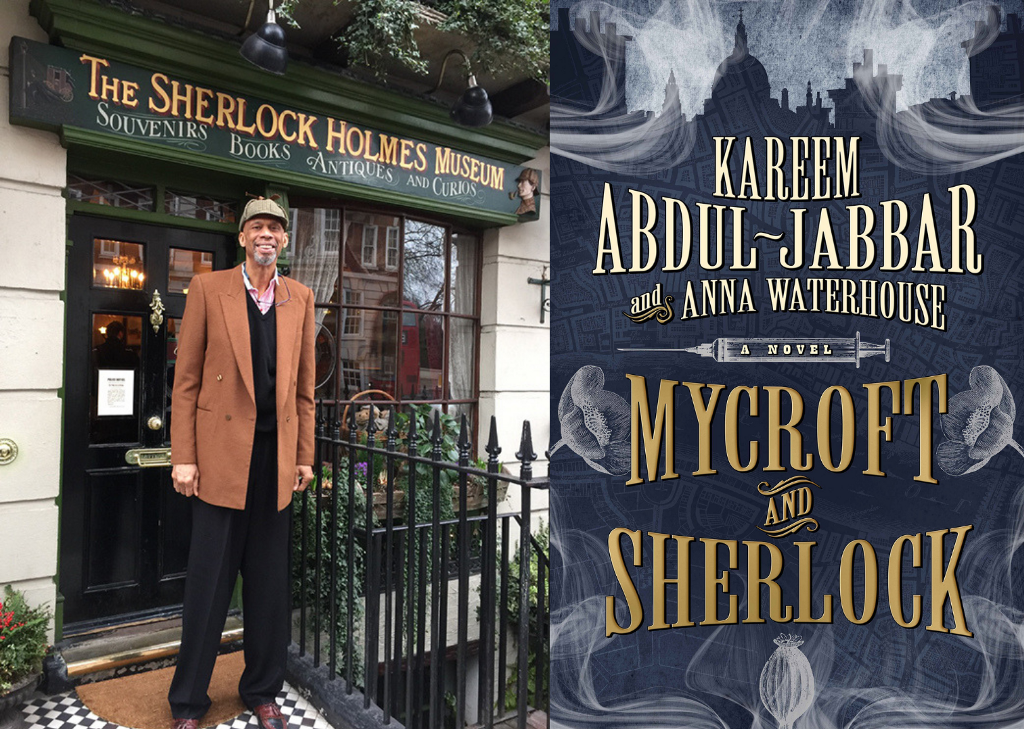
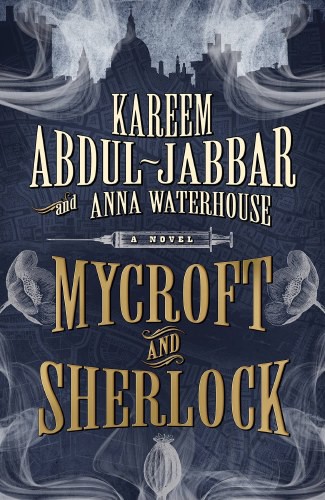
Kareem Abdul-Jabbar spent decades proving his prowess on the basketball court. Season after season he skyhooked his way to becoming the National Basketball League’s all-time leading scorer. After his retirement, he has become a fixture in the media as well as bookstores. He teamed with seasoned screenwriter Anna Waterhouse in 2017 for Mycroft Holmes, a book about the older, and smarter, brother to Sherlock Holmes.
Purchase the book
Mycroft Holmes presented Mycroft in a light that Sir Arthur Conan Doyle’s work never did. Abdul-Jabbar and Waterhouse rounded out the character and made him a complex main character in a thrilling detective tale. Now, the duo returns with a sequel to the work that brings the brothers together to solve a crime. Mycroft and Sherlock adds yet another wrinkle to the Holmes-canon that is equally refreshing and a return to classic Holmesian mystique and intrigue.
I corresponded with the NBA Hall-of-Famer and the seasoned screenwriter via email about their detective sequel, tackling such a famous canon, and tried to get them to predict the 2018–19 NBA champion.
Adam Vitcavage: The first novel focused on solely on Mycroft Holmes. Why introduce Sherlock as such a pivotal character?
Kareem Abdul-Jabbar: We were extremely curious about their relationship because in the Sir Arthur Conan Doyle books, they are polite and Sherlock is certainly admiring of his older brother’s genius, but neither is in the other’s social circle(s) and if they spend leisure time together, we are not informed. We began to wonder how two people who should have so much in common are instead little more than polite strangers. Since we begin Mycroft’s “life” at 23 (in Mycroft Holmes), we have some leeway as to who their parents are and what the dynamics are. Then we stipulate, from what ACD tells us about Mycroft, how he and Sherlock would naturally gravitate to different interests. Finally, we put them together…and watch them combust!
AV: Was there ever a time your second book would just follow Mycroft without Sherlock?
KAJ: Was there ever a time that we didn’t think of including Sherlock? No. He’s too big a fictional character to marginalize him. And frankly, he has too many fans. We also were anxious to show their myriad differences, and it was easier to do so when they were side by side.
AV: Sibling dynamics are my favorite relationships in literature. What was the most important aspect of exploring Mycroft and Sherlock’s brotherhood?
KAJ: Their family. Their father, and in particular, their mother. We allowed ourselves free rein, since the only thing ACD tells us is that they were “country squires” — not exactly a limiting option. How would two boys (moving into manhood) go about protecting a fragile parent? What sorts of obstacles would they face? How might it intensify a natural sibling rivalry?
AV: I was very intrigued by Cyrus. He is such a unique point of view for the time period. How did he develop for the first novel and continue to evolve for this one?
KAB: To be frank, we weren’t interested in writing the typical Holmesian pastiche (or any sort of pastiche) that did not include people of color. There were many living in Victorian England but you’d hardly know it from the writing of the time. Mycroft’s passion and search for fine cigars (especially in Mycroft Holmes) would lead naturally to his meeting people from varying backgrounds. And, because of my family origins in Trinidad, we knew this particular person “of varying background” could hail from there.
We also knew we didn’t simply want someone whose primary function was to say, “And why is that, Holmes?” Which meant that we had to formulate a real personality, real opinions (sometimes contrary to Mycroft’s), and real and believable affection between the two. Lucky for us, some characters spring forth fully grown, like Athena from the head of Zeus (we wish!), and that’s what happened with Douglas. He is, to use another literary reference, Mycroft’s Jiminy Cricket.
AV: Writing is often a solitude task. How do you to manage to collaborate in such an effective way?
KAJ: By remaining in solitude! Seriously, it’s a great way of working. I like plotting. I have a certain knowledge and love of history. Anna is great with dialogue and is a researcher by nature. We both like social commentary (when appropriate), and we have the same vision about the big picture: how a story set in Victorian England can show us where certain problems and issues were first birthed. After the initial pass where we construct the story, we will pass a chapter back and forth until we’re passably happy with it — and then move on, though we’ll often go back and add or change as necessary (because plots aren’t static…they have a sneaky way of changing on you).
Our vision was to show a story set in Victorian England where certain problems and issues were first birthed.
AV: What have you two learned about each other through writing these two books together?
KAJ: I think there’s a separation between the personal and the professional. I don’t think we “learned” anything in particular about each other’s personalities. I couldn’t tell you the first thing about her interactions with her family and friends, for instance, and she would have no idea about mine. But in every subsequent book, it’s easier to trust each other’s abilities. We’re both opinionated, but we’re also both team players: we don’t fight for an idea just because it’s “ours.” We’re looking out for the book.
AV: What’s the future look like for Mycroft Holmes books?
KAJ: We’re finishing up a third one. We’ll be handing it in, in the next few weeks. If all goes well, it’ll be out next year. With every book, we have an eye out for ACD’s description of Mycroft Holmes in his 40s (obese, sedentary, co-founder of The Diogenes Club) and are very aware that it’s the bullseye we will eventually have to hit.
AV: Anna, you have worked a long time as a screenwriter. Any upcoming projects we can look forward to?
AW: Thanks for asking. I finished a feature film based on the kidnapping of General James Dozier by the Italian Red Brigades — an absolutely wild story that I first read about in Time Magazine. Phoenix Pictures and the wonderful Mike Medavoy are producing the film. I’m also working with Robert Towne on a limited series based on a book by James Crumley called Dancing Bear.
AV: Kareem, you have joined the Veronica Mars writing room after a long history with Hollywood (your cameo in Troop Beverly Hills remains a favorite). What has it been like in writing for television?
KAJ: A very different beast. I’m used to either writing alone or with a single co-author. But television writing involves brainstorming and writing with five other writers, all of them brilliant, witty, funny, and very fast on their feet. It’s like running a fast break without ever being able to slow down. I find it very exhilarating but also very challenging.
AV: Finally, Mycroft and Sherlock are the masters of deduction. Who would they deduce has the best chance to dethrone the Warriors as NBA Champions?
KAJ: They would be stumped until they could observe the two teams and get a sense of what their strengths and weaknesses would be. I don’t think they would be rabid fans, since their attention would focus mainly on crime and other circumstances that cause crime.
The protagonist of The Witch Elm, Toby Hennessy, has been lucky his whole life. A young good-looking white man, he’s got money, a loving family, a girlfriend he worships, every kind of social privilege a person can have. Until he surprises two burglars in his apartment, that is. They beat him nearly to death, and he wakes up a different person — not lucky, as he sees it, at all.
Toby goes to recuperate at the Ivy House, the family home where he spent summers with his uncle Hugo and cousins Leon and Susanna. He expects the Ivy House to be idyllic, but in this way, too, his luck has run out. He’s in the middle of a murder investigation, and he’s far from ready to cope.
Tana French’s first stand-alone novel (her others have been part of a series about Dublin murder detectives), The Witch Elm combines questions of luck, privilege, guilt, and responsibility with a murder investigation, a big heap of family drama, and crystal-clear Irish prose. It’s as gripping as it is thought-provoking, as intelligent a novel as I’ve read in years.
I spoke to French via Skype about people who are too lucky for their own good, how we can all learn to see our own privilege, and what happens when you find a skull in a tree.
Lily Meyer: What was the first spark of The Witch Elm? Did it begin as a novel about privilege or luck?
Tana French: Mainly, I was thinking about the connection between luck and empathy. If we’ve been too lucky in one area of life, that can stunt our ability to empathize with people who haven’t been that lucky. For example, I was lucky in that I had a pretty happy, loved childhood, and that meant that growing up, when I was a teenager, if somebody told me about having a terrible childhood, there was a part of me that was going, “Surely it can’t have been quite that bad! They’ve got to be exaggerating a bit.” It wasn’t that I didn’t believe the person, but it was so far outside my frame of reference that I couldn’t quite take it on as a reality. Of course, I grew up and copped onto myself, and realized that I needed to shut up and listen.
That kind of inability to empathize with something outside our frame of reference spreads across a whole lot of categories. I started thinking: What about somebody who’s been lucky in every possible way there is? Here’s a guy who’s white, male, straight, cisgender, from an affluent family, from a loving, stable family, physically and mentally healthy — what would that do with his ability to empathize with people who haven’t been that lucky, and to accept that they’re living in a completely different reality from his, and their experience is still real.
If we’ve been too lucky in one area of life, that can stunt our ability to empathize with people who haven’t been that lucky.
LM: In a lot of ways, The Witch Elm is about ableism. The book starts with Toby getting beaten up in a way that has serious consequences — brain damage, PTSD. How did that inform your writing?
TF: When Toby’s physical and mental health are taken away from him, this is something he absolutely can’t process. He considers his physical and mental problems to be alien things imposed on him, and he refuses to find a way to operate within these new parameters. I wanted to examine what happens when your luck in a certain area is suddenly ripped away from you. When you find yourself, overnight, on the other side of the coin, how do you reconstruct your view of yourself? How do you reconstruct your view of the world?
LM: My empathy for Toby changed constantly over the course of the novel. Sometimes I felt for him, and sometimes I was furious at him. How did your own feelings toward Toby change?
TF: My attitude to Toby is that I hope you occasionally want to give him a good kick, but I hope you never hate him. I never wanted him to be a jerk. I didn’t want him to abuse his luck to deliberately make other people’s lives difficult, or to take advantage of his power. I wanted him to be one of these people who are just bopping happily along, completely oblivious. He’s a nice guy! He’s generous; he’d go out of his way to do someone a favor.
The problem with Toby is that he does not — and will not — consider the fact that other people are living in a world that’s different from his own. But he’s not an asshole. There will always be assholes, and there’s no point having a conversation with them. That’s not where change can take place. I’m more interested in the oblivious person bopping through life, since we’ve all been oblivious to other people’s experiences at times. It’s when figure out that we’re oblivious that the questions emerge: what is our duty to others? How aware are we supposed to be?
LM: Toby particularly struggles to empathize when his cousin Susanna brings up the fact that women in Ireland have no right to abortion while pregnant. (The 1983 Eighth Amendment in Ireland’s Constitution gave pregnant women and fetuses equal right to life, criminalizing abortion under essentially all circumstances; the exact conditions in which abortions can legally be performed have historically remained opaque.) Since you finished The Witch Elm, Ireland has voted overwhelmingly to overturn the Eighth Amendment, which will enable pregnant women to have autonomy over their bodies. What was it like to see that vote happen?
My attitude to Toby is that I hope you occasionally want to give him a good kick, but I hope you never hate him.
TF: It was pretty amazing. You know, the vote on the Eighth Amendment was presented as an abortion vote, but it was much more than that. The amendment affected every pregnant woman. It was quite a frightening thing to be pregnant in Ireland and know you were, legally, not a person. So it was quite amazing to realize that Ireland had become a different place for women. I’d been involved with the campaign a lot, and this was a pretty big payoff.
LM: How did it feel to write Toby compared to the Dublin Murder Squad detectives?
TF: I really enjoyed this. I had a lot of fun writing this book. I’d looked at the process of a homicide investigation six times from a detective’s point of view, and I kept thinking about the other perspectives involved. For detectives, investigations are a source of power and control. For For everybody else, the murder investigation comes barreling into your life and turns your whole world upside down. It’s got to be terrifying. I thought that deserved a voice.
LM: How did you come to write a book so skeptical of the police? Susanna, especially, doesn’t trust them in the slightest.
TF: Like a lot of people in his position, Toby has an unthinking faith in authority and the system, since the system is set up for middle-class, affluent white men. He expects it to do well, and do its job. I thought you needed a balance to that in the book, especially in order to understand how Toby’s view of the system will change once he is no longer in perfect health. After he’s attacked, he is no longer the ultimate reliable narrator. He’s pretty mentally fragile. He’s got some damage going on, and as a result, people no longer see him as intrinsically trustworthy.
LM: How did you work with the contrasts between the book’s two main female characters, Toby’s girlfriend Melissa and his cousin Susanna?
Toby has an unthinking faith in authority and the system, since the system is set up for middle-class, affluent white men.
TF: Melissa was interesting to work with because Toby sees her so unrealistically. He sees her as an angelic saint, almost a Madonna figure, who is so wonderful and self-sacrificing for staying with him. Once he has to see her in terms of herself, it turns out that she’s not self-sacrificing. She loves him, and she’s there because she wants to be. But when he does something that she considers to be unacceptably destructive, her whole perspective on him changes. She has her own boundaries and breaking points, and Toby sees that.
To a certain extent, the same dynamic is going on with Susanna. Toby sees her as his quirky little cousin who’s become Mrs. Mom and purees green beans for fun. That’s his initial perspective on her. Over the course of the book, he realizes that she’s never been that person. It’s the same process as with Melissa, but in a very different way. He has to learn to see them on their own terms.
LM: We first meet the murder victim as a skull in a tree at the Ivy House. Is this a Hamlet reference? Or Garden of Eden, like a really horrible apple?
TF: The Garden of Eden reference was totally subconscious, but it’s there — somebody pulls this thing out of a tree, and suddenly Paradise is ruined. Hamlet was an undercurrent throughout, especially the Ophelia line I used as an epigraph: “Lord, we know what we are, but not what we may be.” That line has always fascinated me. It’s terrifying. Toby’s got a speech like that in the middle of the book, about how what’s terrifying isn’t his physical and mental damage: it’s the fact that he’s different now. He could wake up tomorrow as a mathematical genius, or a Star Trek fan. Day to day, he could be anything.
LM: Toby is the only character in the novel who can’t cope with death, even though he almost dies at the beginning. Do you think his refusal to think about death is a way to hold onto his belief in luck?
TF: Absolutely. He’s holding onto his perception of himself as the one in control, too. From birth, he’s been positioned as a definer, a decision-maker. He decides what gets to happen and how, and the idea that death has shown up in his family home without his say is outrageous and devastating to him.
What happens when all your privilege ripped away overnight, how do you reconstruct your view of yourself?
LM: How did you plot The Witch Elm? How did you know there would be a skull in a tree?
TF: I was bouncing around the idea of the guy who’d been lucky all his life until suddenly, one night, he wasn’t. While I was thinking about that, my brother sent me a link to a story about four kids in 1943 who found a skull in the trunk of a wych elm, which, of course, led to the whole skeleton. It was a woman, and to this day, no one knows who she was. My brother sent me this story with a note saying, “This sounds like a Tana French book,” and he turns out to have been right.
The skull down the tree combined with the guy who’s been lucky until he isn’t, and then I started writing. After that, I had no idea. I’m in awe of those authors who have outlines, but me? I tend to have the basic premise, the narrator, and a core location. From there, I dive in, follow my nose, and hope I’ll find a book there. I had no idea who the skull was or who put it there, but I figured I could work it out.
LM: When did you know who the murderers would be, and how did you then conceal that knowledge?
TF: A lot of rewriting! Once I start figuring things like that out, I always have to go back and rewrite. The funny thing is, though, your subconscious is doing half the job while you write. Sometimes, when you figure it out — “Oh, my God, that’s who done it!” — you realize you’ve actually been planting clues already. Before you even knew what you were aiming for, you already have a lot that fits just right.
LM: What were you happiest to discover in this novel? And what felt most compelling as you wrote?
TF: Toby does something right at the end of the book that, at the beginning, he would never have believed he would do. When I realized that was clearly where the book was going — that his complete transformation, and his inability to deal with that transformation, were taking him to this event — I knew it would be massively difficult to write. It was an oh-shit moment, because if I hadn’t pulled that event off, the novel would have fallen flat on its face. But it was a really exciting moment, too. It was great, thinking, “Oh! I see! That’s where he’s headed.”
Mow the Glass, the latest album from Oregon’s The Lavender Flu, rests on the uneasy boundary between garage rock and psychedelia. This is an album that can evoke haunting musical fragmentation with a deftness equal to its more straightforward rock numbers. Depending on the listener, it can come off as either retro or timeless: the sort of music made by like-minded eccentrics at any time over the last few decades.
That air of timelessness is only accentuated by the album’s liner notes, which open with a line about “Ursula K. Le Guin whispering to James Tiptree Jr. in heaven.” While that can be read as a tribute to one of the greatest writers to hail from the band’s home state, it’s also indicative of a running theme in many a left-of-center album in recent years: the emergence of Ursula K. Le Guin as a bona fide musical influence.
Le Guin’s ethos has found a number of devotees willing to translate the ideas and themes of her prose into music across a variety of styles and genres.
2018 has abounded with surreal cultural moments, ranging from the inspired to the genuinely awful. On the delightful side of that surrealism is the fact that Ursula K. Le Guin received an 8.3 on Pitchfork for a new edition Music and Poetry of the Kesh, an album she made in collaboration with Todd Barton as a companion piece to her novel Always Coming Home (which is itself getting a deluxe reissue next year). And while the music on Music and Poetry of the Kesh itself may not have its own lineage — at least, not yet — Le Guin’s ethos has nonetheless found a number of devotees willing to translate the ideas and themes of her prose into music across a variety of styles and genres.
Bands drawing upon literary influences isn’t anything new, from the prog rock of Uriah Heep (named after a Dickens character) to the intense emo of Straylight Run (Neuromancer) and Gatsby’s American Dream (you definitely get this one). But what makes Le Guin’s musical influence more noticeable is its subtlety. This isn’t a case of a band naming a song after a minor character in A Wizard of Earthsea (although there’s some of that, too) — it’s about grappling with the same themes and motifs that Le Guin worked so memorably into her own writing.
Baltimore dream-pop duo Beach House released their seventh studio album, 7, earlier this year to abundant critical acclaim. While not a case of an artist reinventing themselves, it does stand apart from the rest of the band’s discography, in part due to the involvement of musician Sonic Boom from beloved experimental groups like Spectrum and Spacemen 3. In an interview with Pitchfork about the making of the album, Beach House’s Victoria Legrand and Alex Scally both citied Le Guin’s The Left Hand of Darkness as having informed the album.
“There’s a certain amount [in our imaginary mood board for the album] that is not sci-fi, per se, but some kind of pre-apocalyptic unrest,” Legrand said in the interview. “Glamour and destruction mixed with youth and nighttime and black cars and The Left Hand of Darkness. If you tie the Warhol Factory to these kind of more abstract and futuristic things, there’s some crazy hybrids that you get.”
The blissful and often narcotic pop of Beach House isn’t the only musical configuration for rock bands inspired by Ursula K. Le Guin’s writings. A number of heavy metal bands have found her work inspiring, including the jazz-influenced Norwegian outfit Keep of Kalessin, which takes its name from Le Guin’s beloved Earthsea series of books. That influence has also gone deeper for certain artists–in 2017, Noisey profiled the Oakland metal band Ragana, describing them as “a black metal band that loves Courtney Love and Ursula K. Le Guin.” Earlier this year, the band posted a moving tribute to Le Guin on their Facebook page, including a reference to Always Coming Home. The tribute called Le Guin “a true earth witch, a true visionary human, illuminator of inner worlds.”
Like The Lavender Flu, Ragana has roots in the Pacific Northwest — specifically, Olympia, Washington, about two hours north of Portland, where the group first met. Lyrically, they evoke Le Guin at both her most pastoral and her most galaxy-spanning. Musically, they veer from harrowing blends of guitars and screams to more restrained, blissful passages. It’s not the first music that comes to mind when thinking of Le Guin’s writings, but it’s not far removed from it either.
San Francisco’s Cold Beat represent an entirely different application of Le Guin’s works to a musical setting. Songwriter Hannah Lew has spoken about her fondness for Le Guin’s writings. In an interview with Vol.1 Brooklyn (which, full disclosure, I conducted), Lew noted, “I really like her ability to imagine totally different realities and possibilities. She puts out philosophical what-ifs that are really valuable to consider about gender and the way societies work in general. It’s always good to imagine something really different.”
Cold Beat’s music has also veered into the explicitly science fictional: they’re a postpunk band with a retrofuturist aesthetic and, as such, make the tension between the organic and technological aspects of their songs a key element. In a 2013 interview with Rookie, Lew spoke about science fiction as a lyrical influence for her. “The landscape of what I write is in this weird, other place — definitely sci-fi, but it’s weird space poetry,” she said. “I think sci-fi allows us to imagine things we don’t want to admit in real life.”
Science fiction has inspired an expansive range of music: everything from Janelle Monáe’s concept albums about androids living in repressive societies to Rush’s dystopian 2112 to Planetarium, a collaborative work from Sufjan Stevens, Nico Muhly, Bryce Dessner, and James McAlister. But Le Guin’s aesthetic is distinctive for a number of reasons: it’s one that explores borders, boundaries, relativism, and intimacy in notable ways. It’s not surprising that these themes have drawn in lyricists over the years.
Le Guin’s aesthetic explores borders, boundaries, relativism, and intimacy in notable ways.
In an interview conducted four years later with Bandcamp, Lew continued to make the case for science fiction’s relevance to her music. “As an artist, I’m always working with narratives as a way to broaden my vocabulary about what reality is,” she said.
Shortly thereafter, she spoke about the potential of science fiction to offer a glimpse of a better world. “When we broaden our vocabulary and learn more, there’s a lot out there to discover,” she said. “I think it’s inspiring, especially when we’re getting down. It’s really healthy to remember that there’s a lot more out there.” It’s the same kind of thought experiment that one might see in an Ursula K. Le Guin essay or story — albeit in the process of being transfigured into a catchy and propulsive song. And while Le Guin’s own foray into music hasn’t necessarily spawned a legion of sound-alikes, the fact that she felt compelled to create such a work suggests that she left room in her writings for music—a gateway that this group of musicians has passed through, creating memorable work as they go.
“Women aren’t funny. Ever heard that ridiculous statement? As Tina Fey retorted in her indisputably hilarious book 2011 Bossypants, “It is an impressively arrogant move to conclude that just because you don’t like something, it is empirically not good. I don’t like Chinese food, but I don’t write articles trying to prove it doesn’t exist.”
Purchase the book
Not only are women obviously funny, they’re capable of being many different kinds of funny. From silly and absurdist jokes to wry and erudite satire, we love books that showcase their unique voices, diverse forms and mastery of wit. These 6 books are of course a mere sliver of what we could have included from the last year alone.
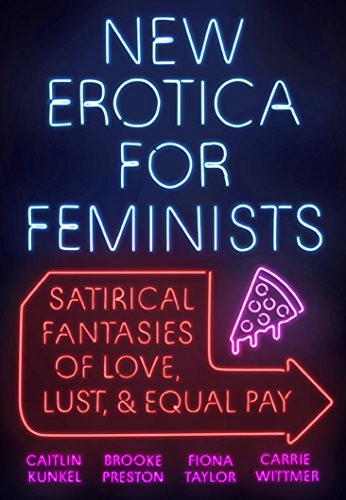
As the co-authors of the book New Erotica for Feminists: Satirical Fantasies of Love, Lust, and Equal Pay, we’re so proud to add our own voices to this proud pantheon, with our satirical vignettes that subvert tired porn and cultural tropes to feminist (and funny) ends, imagining a world where women get what they really want: equality. Until that day comes, we’ll continue to tirelessly celebrate and amplify funny women like the ones on this list.
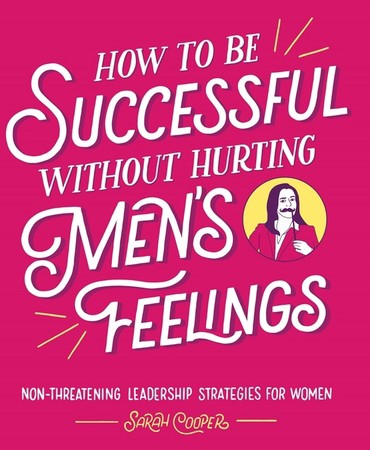
Sarah Cooper’s fierce and funny collection of satirical work advice for women everywhere could sadly be interpreted as genuine advice by a terrifying number of human beings. Cooper, an ex-Googler, has written a pointed and poignant examination of expectations for women in the workplace. This book will leave you on the floor laughing — but also crying, because it’s 2018 and we haven’t gotten far enough. Featuring fun illustrations by the author herself, anti-inspirational sayings like “Your imposter syndrome will never be good enough,” and Men’s Achievement Stickers (example: “Stopped Myself From Explaining Something I Didn’t Understand), How To Be Successful Without Hurting Men’s Feelings proves that women’s anger about workplace inequality can be channelled into smart, satirical humor.
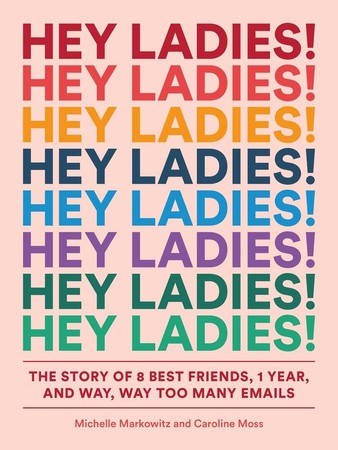
If you’ve ever gotten an email with the subject line “Hey Ladies!” you know what you’re in for — an increasingly expensive bachelorette party planning chain that devolves over the course of several hundred emails. Born out of a popular column on The Toast, writers Michelle Markowitz & Caroline Moss hilariously detail the emails between a group of eight friends in the year leading up to one of their weddings. In between all the logistics are pitch-perfect satirical details about each character, snarky side texts between them responding to the main threads, and lots and lots of heightened moments you’ll recognize (and probably cringe at!) from your own life. You can read the entire book in one laugh-filled sitting, then go back to pull out your favorite sections to savor later — maybe each time you get another email?
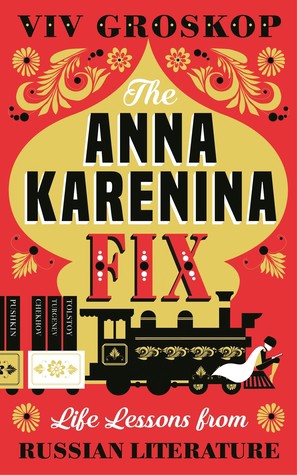
Have you ever read Russian literature and thought, “Wow, this is actually filled with really good and not terrible life advice?” Journalist, critic and comedian Viv Groskop, who has studied Russian literature for 20 years, is the one person who did. So she wrote The Anna Karenina Fix, a clever, funny and truly helpful self-help memoir hybrid, filled with lessons learned (or not learned) by characters in Russian novels and their authors. It is a joyful read that you’ll love if you’re into Russian literature or even if you know nothing about it. And if you’re in the latter camp, you’ll want to read some immediately. Only a true master of words, culture, life and comedy could write this, and we’re so glad Viv did.
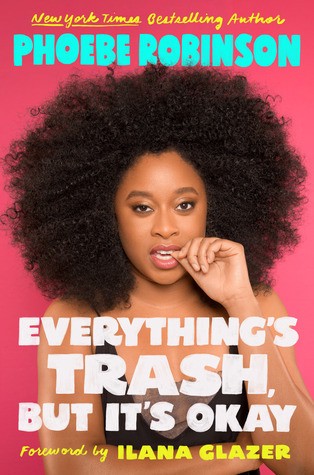
Like much of the best humor since the dawn of time (and all of the books on this list), comedian Phoebe Robinson’s second collection of essays is as funny as it is necessary. Robinson finds the funny in the darkest of times and themes (one particularly notable essay covers hiding her large amount of debt from her parents until after she’s paid it off), and seeing her unique perspective on comedy, work, and the current state of the world inspires and educates. These are dark times, but thankfully Everything’s Trash is like a stuffed animal — in that will make you feel all right and you’ll throw a tantrum when you can’t find your copy.
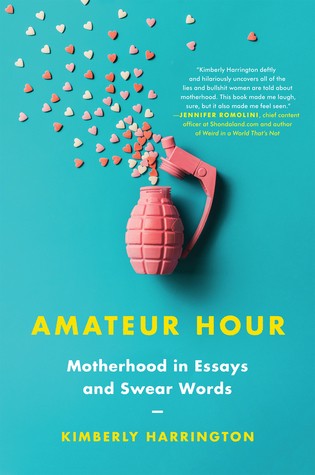
Kimberly Harrington is a noted copywriter and satirist whose skilled words make brands or break blowhards, but in her debut book Amateur Hour, Harrington looks inward as much as outward. Musing on everything from how her love for social media can lead to potentially problematic parenting conundrums to the often lonely tragedy of miscarriage, Amateur Hour is a feisty, arresting collection of essays that bring intimate laughter and tears often in the same breath. In a world of endless mommy tell-alls that feel like the literary equivalent of house chardonnay, this is top-shelf whiskey.
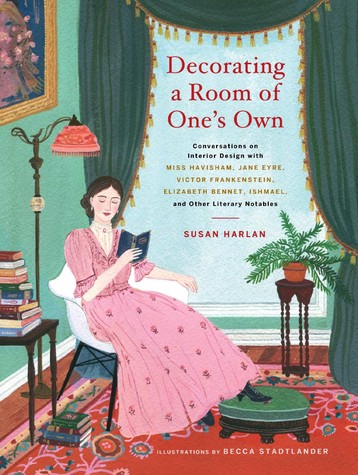
This beautifully laid out and illustrated book is an incredibly funny, detailed homage to the homes in some of our favorite stories. Harlan, a college professor at Wake Forest University, has turned her discerning eye and lovely prose to a very funny premise that combines an Apartment Therapy-esque voice with the narrators and characters of classic literature. Some of the gut-busting chapters include “Jay Gatsby’s Desperately Sad McMansion of UnFulfilled Dreams,” “Stella and Stanley’s Not Overly Welcoming New Orleans Walk-up,” and an interlude centering on a conversation of underwater living between Grendel’s Mother and the Sea Witch from the original fairy tale version of The Little Mermaid. Harlan’s prose is as vivid as the comedic pictures she paints, and putting this book on your coffee table shows off your command of design elements as well as the narrative structure of Moby Dick.
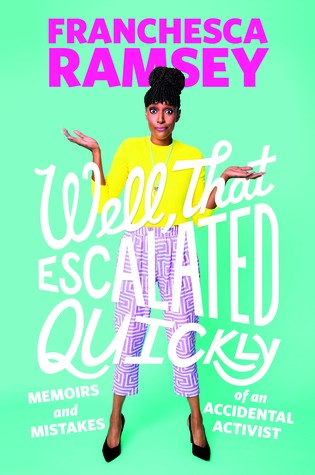
Franchesca Ramsey unwittingly stumbled into celebrity — and activism — when her YouTube video, What White Girls Say…to Black Girls, went mega-viral. Ramsey’s charm is that she’s not afraid to own up her mistakes — and she admits in this book that she’s made a lot (like, a lot-a lot.) This collection of humorous essays covers everything from her in-defense-of-“sluts” showdown with Jenna Marbles to natural hair to her “accidental” activism. Though the topics aren’t light, Ramsey’s easy-breezy delivery is. Toward the end of the book, she takes it a step further and supplies a glossary full of not-so-simple concepts like white feminism and ableism, along with an activism primer. Read this if you want to laugh and change the world.
A s a Midwesterner who has lived on the East Coast for decades, I find myself constantly struggling with simplified versions of the Midwest as well as outright erasure. I’ve followed Sarah Smarsh’s work since I first learned about her, eagerly reading in her words a complex and thoughtful perspective on Midwestern life that I have found too seldom told. Smarsh’s evocative essays, such as “Poor Teeth” among many others, blend personal experience with research and analysis to convey and to explore what it means to be poor and working-class in the rural Midwest.
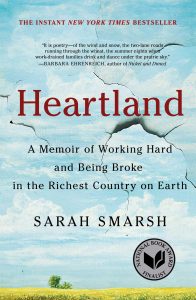
Her new book, Heartland: A Memoir of Working Hard and Being Broke in the Richest Country on Earth, takes on the intertwined themes of class, work, gender and sexism, violence, healthcare, education, race, political agency, and above all the way those outside the Midwest have written their own agendas and stories onto the region. This matters for Midwesterners, of course, but Smarsh powerfully argues that these stereotypes and misconceptions matter for the fate of our country as a whole — that those stereotypes about the region and its people are part of what is driving the political polarization that now threatens our democracy. The urgency of these issues is being heard, thankfully, and the book recently landed on the New York Times best sellers’ list.
Smarsh addresses these themes primarily through her own story, which includes a tumultuous upbringing as her parents each tried to stabilize themselves in the face of economic uncertainty. She tells the tale through the dialect and point of view of her family, with added perspective from research. The voice in the book comes from home, not from a policy document, and throughout the book she weaves in asides addressed to an unborn and imagined daughter, August, using this most intimate personal conversation to summon the truest things she can say about herself, her family, and the land that formed her.
Sonya Huber: You present a theory that stereotypes of poor white people held by those outside the Midwest helps to shape the conservatism of those poor white people. Do you feel as though your book might help those outside the Midwest understand this? What would change this dynamic?
Sarah Smarsh: I hope so. My journalism for the last few years has also been focused in that direction of challenging the idea that a whole swath of our country could be a political or cultural monolith. Most “good liberals” like myself would be reluctant at this point, hopefully, to do that about most groups. And yet there’s sort of this ironic willingness to look at the middle of the country or rural America as all white, all conservative, or even as all male. I wouldn’t dare to hope that my book could work against a cultural tide that powerful, but I do know that the individual connections that I’m making are powerful. Even people from privileged coastal experiences are saying that they felt like their eyes were opened in some way about the complexity and nuance and diversity of the place I come from. Even if the book doesn’t change things in the big picture, I know that it is changing some hearts and minds at the ground level. And that’s good enough for me.
SH: The overgeneralizations about such a huge chunk of the population is one of the big mysteries I wrestle with since I’ve been away from the Midwest. Do you think it’s partially caused by people not going to the Midwest and not having real experiences and encounters with that complexity and nuance and diversity?
SS: That’s absolutely it. You can even hear it in our language; we say “flyover country.” As I say in the book, that suggests that it might be dangerous to walk there [laughter]. And there is occasionally an earnest effort by New-York-based or coastal media outlets to “explore” these regions, but it’s framed as a safari or a journey into a war-torn landscape…
SH: Like [scary voice] “Welcome to Meth Land.”
SS: Exactly! It’s presented as a vaguely dangerous and miserable vision. That is not really a failure of the individual — that’s just human nature. It is a class and regional parallel to how we are also tribal and fearful along racial lines or other aspects of diversity. If people don’t know human beings from a group, they’re more vulnerable to stereotype and caricature. That is an outcome of the economic tide of our country. Since the Industrial Revolution, so for more than a century, this has been an increasingly urbanized country, and the economic imperative has been toward urban centers on the coast. There are some beautiful national parks in between the coasts, but there has not been a sense of places like my home as a destination in any sense, and maybe rightly so, depending on your set of values. People have no reason to go there. A kid like me would have occasion to go to New York City but it often doesn’t work in the opposite direction.
If people don’t know human beings from a group, they’re more vulnerable to stereotype and caricature.
SH: In various times of my life outside the Midwest, I would get nostalgic and say to a friend, “Oh, I miss how pretty the Midwest is in the spring.” That was always a complete conversation stopper. It wasn’t an idea that many people could comprehend, that there might be beauty there.
SS: I was thinking about this because I recently went to the Wichita Art Museum to see a photography exhibit about contemporary farmers in their 40s, so roughly my generation, who care about things like sustainability, who are owning the mistakes of their ancestors and who are fighting against all economic odds to hold onto the land in the face of corporations and industrialized Big Agriculture. And this exhibit documents that. And I was so moved, because it occurred to me that I have never seen what feels like my home landscape validated or explored in the context of an art museum, other than the Dust Bowl, which feels like the last image of the region in the popular imagination. Wherever I go, I get “Dorothy” jokes [from The Wizard of Oz] and I’ve had people literally reference The Grapes of Wrath with no sense of irony or self-awareness. It boggles the mind. It’s a testament to how powerful a strain of contempt for particular regions of the country have proven to be in our collective framework.
SH: Along the same lines as the photography exhibit, I wanted to ask you about the language you use in this book, which by and large, is written in the conversational tone of “home.” I stopped for a full minute when I was reading and hit the phrase “warsh bin,” which almost moved me to tears. I have never seen that in print when it was not presented either in quotes or in italics. Seeing Midwestern dialect on the page without apology really affected me. But you also present research and move in and out of that manner of speech. Did you deliberate about that, and how did you decide on the balance?
SS: For me those decisions about language have something to do with how the book operates at the sentence level but it also plays a role in the literal theme and the reconciliations offered by the book, a balance between the two worlds I occupy in class terms. None of that was necessarily done with a heavy hand or any overt intention, but there was a decision along the way where I thought, I’m going to write this with the language that is natural to me. That for me is a kind of an integration, with the vernacular and turns of phrase of my home and also a more formal version of English that I come to by way of higher education. That’s kind of how language operates in my mind, as this thing melded together. I speak two types of English: “country” and “fancy.” In some contexts I am very mindfully employing only “fancy,” if you know what I mean. The book felt like it could have both of those forms of expression.
It is the case that having a sense of working hard and not receiving support is a sadly universal American experience at this moment of historic wealth inequality.
SH: The book also uses that language — and the gaps between those two forms of English — to narrate a realization about politics and political orientation. You describe in the book a revelation that occurs in a sociology class in college, where you suddenly see how the odds are stacked against you and your family and your entire community, and that alters your politics away from an individualized sense of judging individuals for their economic failings and more toward a liberal analysis of how class operates. Is there something about the Midwest or rural life in general that acts to suppress the awareness about one’s own context or about class divisions?
SS: That is a complicated question. While I describe that moment in the book as a kind of a political awakening, I was already pretty socially liberal, but economically less so. Yes, that moment was a kind of leftward shift, but it was less about a movement from right to left than it was about a politicization in general. Most of the people I come from don’t vote, especially when I was a kid. Now I think in the country as a whole there’s much more of a sense of political identity, even if it’s in a negative direction, as in tribal identity.
When I was a kid, no one was walking around saying “I’m a conservative.” Those same people might have been voting for Reagan, but I was not around people who were discussing politics, and that came in large part from a sense of removal from the places that made decisions about policy. And frankly that also came from a lack of information. I hesitate to use the word ignorance because that has a negative connotation, but a real lack of information because of the burden of class. If you’re out in a field all day, and you left school in the 9th grade, and you can’t access the language national discourse harnesses to parse the economy and politics…it’s not for lack of intellect or sense of civic responsibility, it’s the default for that place and that class to not have the knowledge, awareness, or language to begin to be engaged — let alone the time.
I think that moment when I woke up to these vague assumptions I’d been holding that were moderately economically conservative, and I saw through what were to my mind now the falsehoods, I guess I became aware of the gulf between the assumptions I had inherited and the facts. For one, it just pissed me off. I thought that if the people where I’m from knew this, they’d be pissed off too. And I was always kind of a rabble rouser in high school. If a kid suffered an injustice with the principal, they’d come to me and ask me to lead a walkout. I’ve always been that person, but I was in the context of a largely apolitical and maybe even disenfranchised place. Once I was on a college campus and started getting the straight dope about things work in this country, you could say it radicalized me, which is a commonplace experience for that to happen.
SH: And then as the Internet and social media became more widely accessible, there’s been a shift more toward claiming right-wing politics as a kind of identity in the places where we are from.
SS: Yes. The Right has been very artful and successful with harnessing and claiming the touchstones of my home and culture.
SH: Interesting. So the Right has appropriated the markers of that culture, in some ways.
SS: Yes. I think it is. And it’s a way to signal, falsely and successfully, to people and to say, “We see you, and we validate your place.” Whether or not people know the details about what the Republican Party really stands for these days, there’s something primal to being seen and recognized. For decades, unfortunately, the Democratic Party failed to do this.
SH: And then unfortunately what many on the Left do is to take all the cultural markers and signs of that place and identity and disparage them, lumping them in with those right-wing politics. So that the culture itself comes to falsely stand for those political views.
SS: Yes! So that makes it kind of an Ouroborous, the image of the snake swallowing its own tail.
I’m a writer and I believe in the power of story to transcend the political divisions that are at the fore today.
SH: You mention that when you were in college, your mom had voted Republican, but then over time her beliefs shifted too. Was your slow discovery of politics a factor in how your family members’ politics changed? What do you think in the larger political timeline caused their shifts?
SS: That’s an interesting question. I just went to an event here in Wichita about how people form their beliefs and why they hold onto their beliefs. Researchers were validating what I always suspected, as someone who came from a small town, where most people were vaguely calling themselves Republican in the ’90s, even though it isn’t the Far-Right thing that is going on now. Now that I’m in the media and most of my close friends has college degrees, I see how it’s a function of group and social belonging in some senses. I’m sure it’s possible that the information I got ahold of in the spaces that otherwise my family wouldn’t have had access to might have influenced my family.
But I think my mom was the first one other than me to have what my biases would call an awakening to the bullshit of the Right. For me it happened about 2001. A year prior I had voted for George W. Bush in my first election, and then I took the sociology class that blew my mind. For my mom it came a little bit after that, with the revelations about the falsified Weapons of Mass Destruction narrative that had been used to justify our military actions in the Middle East. She is someone who always read the news and tried to sort things out the best she could. At that time there wasn’t the social media information silos we have today. In 2003 my mom was reading the newspaper and watching the nightly news, and finally she said, “I don’t care who I voted for a couple of years ago, this is BS.” I feel like she made that shift on her own. My other family members — I suppose it might have influenced them that I was saying, “Hey, come caucus with me,” and get involved.
SH: Is your book in an implicit dialogue with Thomas Frank’s 2004 book What’s the Matter with Kansas? What were you thinking as you read that book?
SS: The book was not conceived or constructed in response to any book. But that book was a big piece of political culture. I respect Thomas Frank a lot, and I have written for a magazine he founded, The Baffler. And we have very similar politics. I don’t really like the framework that was seized from that book and that America kind of ran with, which is the idea of “people voting against their best interests.” I’m not sure that he’s the one who articulated that specific phrase, but I do feel like that was the book that made that idea the go-to explanation or mystery. While I might agree with that assessment, it is just by definition a flawed and confounded way to begin seeking to understand people’s behavior. First of all, there’s an inherent condescension, an assumption that someone must be an idiot for doing what they do. Second of all, to me it also suggests that people in some states and regions are voting “correctly” and others are voting “incorrectly.” It suggests that there are essentially different kinds of people in different places. But what I know to be true from the political journey that you and I just talked about is that we are a product of our experiences, which I would think any good liberal would agree with. For someone who is casting a ballot from Thomas Frank’s vantage, which I believe is New York City where he’s lived for decades, it might clearly be a vote against their best interests. But in the context of their own experience, they have their reasons and, heck, maybe it’s misinformation, but it’s not stupidity. I can tell you that.
SH: Are you finding as you travel and read from the book that people are connecting personally with the stories you tell?
SS: I am finding that, and it’s been very humbling. My hope against hope was that that would be the case. I find myself in the role of commentator because of the topics I write about, but at my heart, I’m a writer, and I love language, and I believe in the power of story to transcend the political divisions that are at the fore today. I’m writing about a space and a class that has been stereotyped and maligned, perhaps even scapegoated, that demographic, for our country’s woes. I worried that that might keep people from connecting to the story. It turns out that no matter what city I’m in, whatever context, people from all different walks of life — not necessarily poor, not necessarily rural — connect with the story. I think that might have something to do with the subtitle of the book (“A Memoir of Working Hard and Being Broke in the Richest Country on Earth”). It’s a sad state of affairs, but it is the case, that having a sense of working hard and not receiving support — whether it be healthcare or having time off or support to have a child — is a sadly universal American experience at this moment of historic wealth inequality, even if one’s experience wasn’t so extreme as mine.
His hand trailed across her breast, tracing a shape with his finger.
“I’m so glad that they didn’t make you wear a scarlet letter after all,” Arthur said. “I mean, you thought your husband was lost at sea. It was an honest mistake.”
“It definitely was,” Hester said, running her fingers through his surprisingly silky hair.
“I’ve also been thinking — your embroidery is so exquisite and the people here don’t appreciate it. Want to move to New York and open a shop? I was thinking it might be nice to hire shunned ‘fallen’ women so they have livelihoods.”
“YES,” Hester cried, falling into his arms and starting the arduous process of removing nine petticoats. Then they had really hot sex, by Puritan standards. So, just missionary with light kissing.
“What are your fantasies, Pierre?”
He took a deep breath, nervous to share his dreams with her. She smiled encouragingly. I can trust her, he thought to himself.
“It would be a beautiful thing, a thing I dare not hope, if we could spend our life near each other, hypnotized by our dreams: your patriotic dream, our humanitarian dream, and our scientific dream.”*
“Well, darling, I meant more like ‘Are you into dirty talk?’ but that sounds amazing too,” Marie Curie said breathlessly. “Let’s do it.”
And they did! Marie and Pierre went on to win a Nobel Prize in Physics together in 1903. Then Marie won a second Nobel Prize, for chemistry, in 1911 — no man required.
Oh, and their daughter ALSO went on to win the Nobel Prize, because we all turn into our mothers eventually.
*Actual quote from Pierre Curie, as he was trying to persuade Marie to marry him.
The firefighters arrive almost immediately and begin battling the blaze ignited when one of my dogs knocked over my pizza- scented candle.
Once safely on the front lawn, I cry out over the roar of the flames, “My dogs! My beloved dogs, Tina Spay and Amy Pawler, are still inside!”
“It’s too dangerous — don’t risk it!” yells my white male neighbor named Chad or Kyle who has probably never had to overcome adversity of any sort.
“Well, I don’t know about you, but I’d rather die than let cute dogs named after my favorite comedians slash authors slash Golden Globe hosts perish,” replies a shredded fire-fighter who looks like a genetic mash-up of Idris Elba and danger.
He rushes into the inferno. Agonizing seconds tick past — we’re sure he’s lost to the blaze. Until — oh, yes! In the heat, his sculpted outline reappears with Tina Spay and Amy Pawler safely draped over his shoulders, snuffling him in doggie kisses of gratitude. His shirt has been artfully burned away by the flames to reveal a rippling, burnished torso, but — what’s that tucked in his oh-so-very-slim fireman suspenders? He retrieves it and hands it to me.
“I couldn’t help but notice you have some really rare first editions. You can replace your house, but you can’t replace a signed 1970 copy of Judy Blume’s Are You There God? It’s Me, Margaret.”
About the Authors
Caitlin Kunkel, Brooke Preston, Fiona Taylor, and Carrie Wittmer are comedy writers and satirists whose work has been featured in the New Yorker, McSweeney’s, and many other outlets. Together, they cofounded and edit the website The Belladonna, which responds to today’s culture, news, and politics with comedy and satire written by women and other marginalized genders.
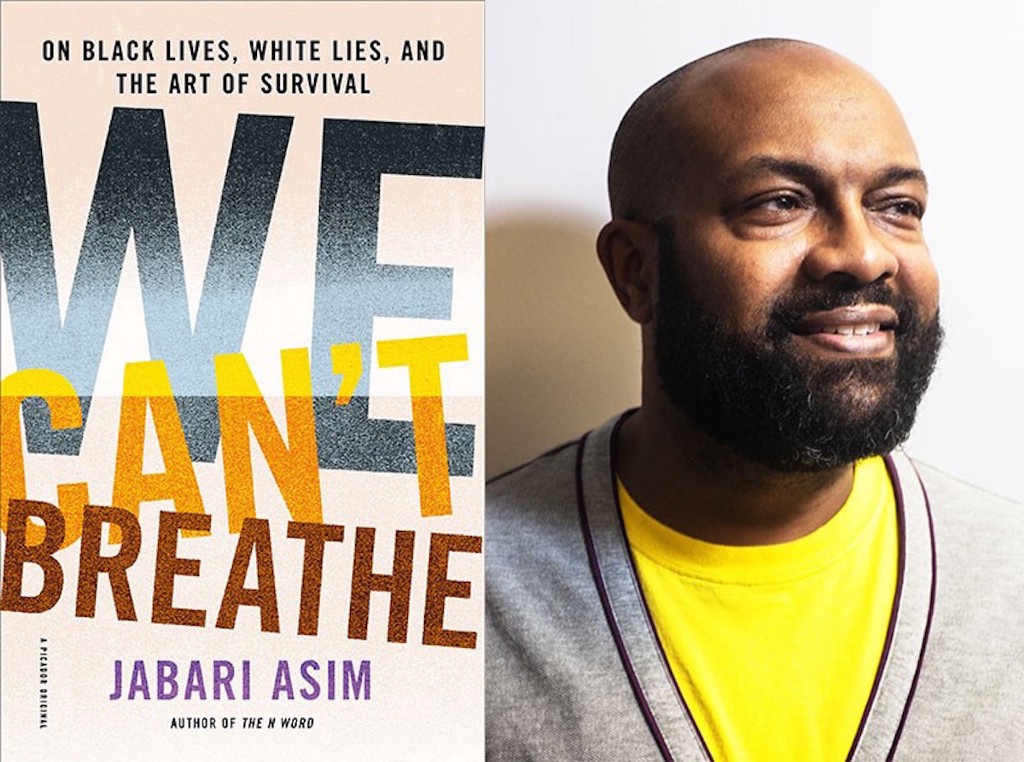
Jabari Asim’s newest essay collection, We Can’t Breathe, is a masterful dissertation on Black culture, Black art, personal and American history. It is a beautiful mix of unpredictable narrative and prose that kept me engaged and enthralled from beginning to end. We Can’t Breathe gave me the impression of sitting with a respected friend and listening to him wax poetic on the nature of white lies (and white people lying), Cadillacs and Cadillac Records, and what is or what feels to be authentically Black. I read this book with a pen in my hand, underlining and dog-earing pages in this exquisitely written and tight collection. Each essay left me shaking my head “yes” and feeling just a little smarter and more engaged with my world and my culture.
Jabari Asim is the author of six books for adults and nine books for children. He is an associate professor of writing, literature, and publishing at Emerson College and was the editor-in-chief of the NAACP’s Crisis magazine. Asim is limitless in his discourse on Black art, language, and existence having appeared on The Colbert Report, Hannity & Colmes, The Today Show, NPR’s Morning Edition, Tavis Smiley and many other programs discussing Black lives and social/economic problems.
Jabari and I chatted about his inspiration for this collection, whether or not appropriation is always a bad thing, and whether Black art can exist without suffering.
Tyrese L. Coleman: I could not put this book down. Aside from how well-written it is, I enjoyed the mix of academic, political, and personal essaying. How did you decide to combine these particular pieces into a collection?
Jabari Asim: Thanks for the kind words. I compiled a list of issues and subjects that had attracted my curiosity of late, then I set about trying to figure out what I had to say about them. I had been entertaining a few ideas about the role of reading in childhood, for instance, and I had begun to re-read a number of books I had first encountered during my primary-school days. That preoccupation led to “The Seer and the Seen.” “Getting It Twisted” emerged from observations about language, power, and disagreements over the nature of reality. Ultimately I felt it was important to keep the collection concise and portable. I didn’t want to risk overstaying my welcome.
TLC: Speaking of the combination between academic, political, and personal, when it comes to topics pertaining to “Black Lives, White Lies, and The Art of Survival” do you believe it is possible to even separate the academic and political from a personal perspective?
JA: I think I like “thoughtful” more than “academic.” No, I don’t believe it’s possible, not even if one tries his utmost. Of course, I’m not really aspiring to that kind of separation. For me, writing personal essays is most satisfying when I’m able to incorporate all the things I am.
For me, writing personal essays is most satisfying when I’m able to incorporate all the things I am.
TLC: I’m also wondering whether that third aspect, the personal, is what differentiates “the thing itself,” a sense of authenticity which you describe as “some intangible quality derived from Black people’s history not on this continent but on this planet” from work by non-Black writers taking up Black discourse or topics relating to Black experiences.
JA: The most frustrating thing about my experience of blackness is my inability to wrap neither my consciousness nor my imagination all the way around it. It is constantly changing shape, wonderfully complex and reliably mesmerizing. Therefore I’m hesitant to rely too much on words like “authenticity” and “genuine”; I think I know Blackness when I’m feeling it, and I think I notice its absence when I’m not feeling it. One doesn’t have to be Black to successfully render Blackness in a cultural context but an artist’s Blackness or lack of it inevitably factors in how that art is made. I’m able to appreciate culture by non-Black people that addresses Blackness, such as Michael Roemer’s Nothing But A Man, for example, or Alice Neel’s portraits. That said, the art of Aretha Franklin, Nina Simone, and James Brown, to name just a few, manifests this wonderfully intangible quality that never completely leaves me, and I’m certain it’s a Black thing that causes that effect.
I think I know Blackness when I’m feeling it, and I think I notice its absence when I’m not feeling it.
TLC: One of my favorite essays in this collection is “The Elements of Strut” where you discuss the Black body, movement in various forms from walking to dance, and the difficulties of just living inside of a Black body, one you call “profoundly inconvenient.” It reminded me of Claudia Rankine’s discussion of Serena Williams in Citizen and how her body “got in the way” of the umpire’s sight of vision, and of course, the most recent U.S. Open where we saw her body being policed yet again, from her clothing choices to the coaching allegation. It seems to me that she is someone whose body is constantly scrutinized. Do you believe a Black body can or will ever go unseen or unregulated? Or maybe, is there or will there be a time where we are completely self-possessed?
JA: Well, other observers have said it far more eloquently than I can, but there’s this other side of living in a Black body that involves being excessively visible, to the point where one is seen in spaces where one is not in fact present. We might call it “phantom Blackness.” Once in court I opposed a policeman who testified that he’d seen me eluding law enforcement (in a car, mind you), when in fact I was many miles away, surrounded by witnesses. He testified that we had exchanged glances at an intersection, followed by me looking nervously away and speeding off. He had woven a richly layered narrative that sprung entirely from his imagination. That, to me, is indicative of the other side of invisibility. Taken together, these paradoxical phenomena raise yet another question: Is it possible for the living Black body to be at rest?
TLC: Whose strut are you admiring today and why?
JA: In the essay, I discuss the dancer Lil Buck as well as several other creative artists, including Janelle Monae. The first time I saw her “Tightrope” video, I watched it again and again, maybe a half-dozen times. Even now I occasionally turn to it to give me a boost like a multivitamin would, or to ease my malaise. I don’t just admire the ease and style with which some folks strut; I envy it. The way graceful Black bodies inhabit and engage with space is utterly marvelous.
TLC: In “The Seer and the Seen: On Reading and Being” and more pointedly, “The Thing Itself” you discuss literature, appropriation, the white gaze, whether or not a white artist can accurately interpret a Black narrative and interpreting art with the Black body and the Black narrative in mind. You seem to be suggesting that we look at potentially problematic art starting from an assumption that the artist is coming from a place of good (except in William Styron’s case…who knows where he was coming from). Are you attempting to defend controversial artists such as Shultz and Yerby in some way?
JA: Schutz and Yerby are in quite different positions. The former is operating from outside Black culture, the latter was creating from within. I’m less concerned with an artist’s intentions than with the consequences of their art, which, of course, they can’t control. What I really want to say is don’t censor creatives: let me, the individual observer, determine whether a work of art succeeds or violates my sense of propriety; don’t presume to make that decision for me.
TLC: While reading both of those essays, I thought of our current “call out” culture and internet intellectuals who weaponize the word “appropriation” (specifically and as an example, the impassioned debate over Bruno Mars and whether or not he is appropriating Black music). Where do you believe the line exists, if at all, between harmless mimicry, appreciation and appropriation? Is appropriation always bad?
JA: I think appropriation can certainly work as homage, and I use “appropriation” guardedly because I’m a writer whose influences are often so painfully obvious that it would be foolish of me to pretend that I’m a fount of original ideas. I think the discussion gets so much more complicated — and, often, painful — when elements such as profit and credit are factored in. What’s more, non-Black artists who comment on Black experience in their work must work extra hard to prove that they are not merely eroticizing Black suffering. Artists do that with wildly varying degrees of success.
Non-Black artists who comment on Black experience in their work must work extra hard to prove that they are not merely eroticizing Black suffering.
TLC: Can Black art survive as a commodity without the availability of suffering porn?
JA: It depends on who’s looking at it, listening to it, collecting it, profiting from it. Certainly when Black people make, receive, collect and share art, it can happen in a wonderful context that is enriching and not exploitative. When Black makers and receivers operate in their own space, unseemliness can still exist (think of all the misogynist art we have made, for example) but its likeliness is reduced. We’d also have to avoid overlooking the abundance of Black cultural production that, even when responding to the most challenging travails of our journey on these shores, transcends suffering even while portraying it. A corrupt gaze can reduce even that kind of art to tragedy porn, despite the artist’s best intentions. That’s one of the many predicaments involved in making culture: We can resist and discourage responses to our art that we deem inappropriate but we can’t prevent them. Still, we continue to create, despite everything. Frederick Douglass reminded us, “in the struggle for justice, the only reward is to be in the struggle.” Exchange “art” for “justice” and it still makes sense.
Writers, like anyone, love our routines. But sometimes — oftentimes — routines lead to ruts and a change of scenery is just what the doctor ordered. Sometimes we need to leave our schedule behind, along with our responsibilities. But this is easier said than done when your responsibilities and routines consist of working to pay your bills and keep the roof over your head. Artist’s residencies provide a place to write without the worry of making it to the next paycheck, where you can focus solely on your craft. Paradoxically, though, many residencies won’t offer that without first asking for your money, and lots of it.
That’s why we’ve rounded up seven residencies where you can break out of the daily grind without breaking the bank. At these low- or no-cost residencies, located around the world, you can have all the time and space you need to complete your next memoir or book of poetry, along with the inspiration of new surroundings and without the stress of giving away all the contents of your wallet.
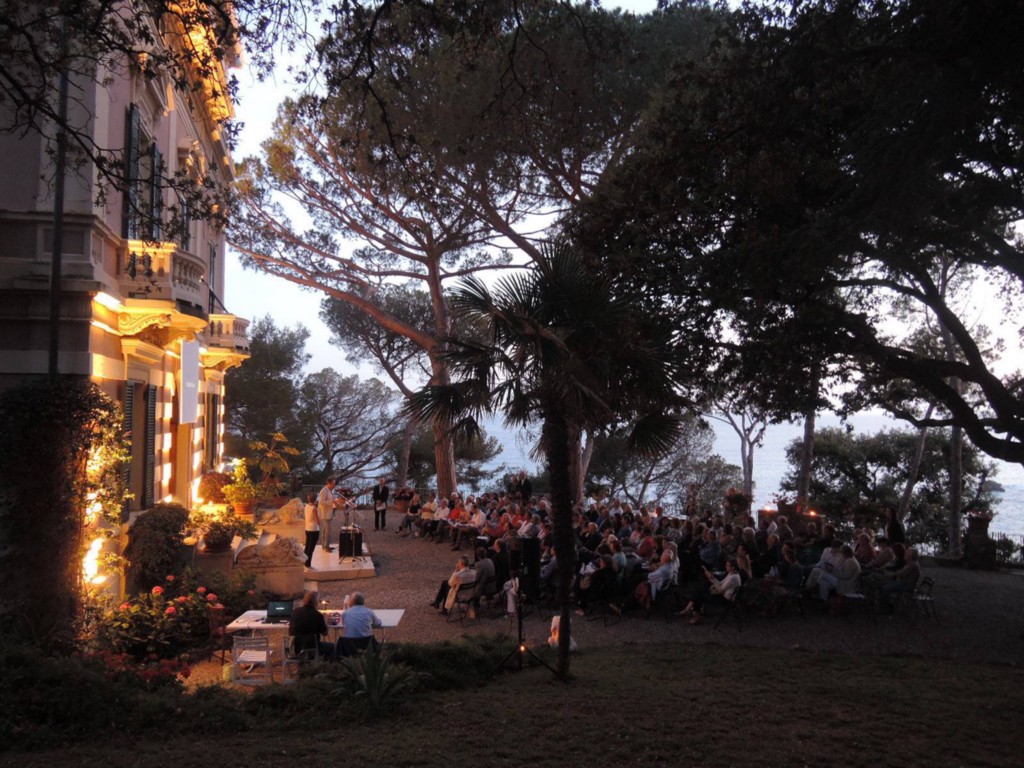
What better place to find inspiration than in a fishing village in the idyllic Italian countryside? The Bogliasco Foundation offers about 60 fellowships every year. These fellowships are free, though you do have to pay for airfare to Italy. Residencies last one month and include a private room, private work space and three meals a day — imagine all the free fresh fish you could be eating to fuel your creativity.
It’s not quite as exotic as Italy, but note that VSC is located in Johnson, Vermont, a town so far north in the Green Mountains that you might as well be in Canada — in a state that boasts of maple syrup just as delicious. Cost is $4,000 per month, but 90% of applicants receive financial aid and 150 fellowships are offered every year. Residencies include a private room, private studio, and meals.
Have you ever wanted to write a noir fiction about an incident at a cereal factory? If the answer is either yes or no, spend a month in Red Wing, Minnesota at Tower View, an estate that was formerly used as Quaker Oats Company’s research laboratory. For better or for worse, a residency at Anderson Center won’t require you to conduct breakfast cereal-related experiments, but you will be offered a month’s lodging with dinners included and a private studio for writing.
At Art Farm Writers Residency, you’ll be asked to exercise more than just your mind (and the muscles required to type on your laptop). This residency offers indefinite lodging and studio space in return for 12 hours of maintenance per week, which could take the form of construction, carpentry, grounds work or office work. Here, that little voice telling you to stand up and look away from your computer screen every few hours takes material form.
This residency includes lodging, meals and lectures at one of three very different locations; Woodstock Area, New York, Palm Springs, California, or Martha’s Vineyard, Massachusetts. The program was created to give artists the space and time to create without worrying about anything else. The cost is $800 per week, but applicants are selected on a needs-blind basis and all accepted applicants will be offered enough financial aid to make the program possible for them.
Located at the foothills of the Blue Ridge Mountains in Virginia, the drive to this residency might remind you of the opening scene of The Shining, but you’ll get more writing done than Jack ever did at The Stanley Hotel (and hopefully less murdering). Your residency can last anywhere from two weeks to two months. There is a $40 application fee, but that’s the only thing you’ll be asked to pay.
Do you need some warm weather to help get through your writer’s block? The Studios of Key West offers month-long residencies to about 35 artists every year, and they’re free (apart from a $40 application fee) if you can get yourself to Florida. They include a picturesque room in a cottage and space to yourself to write.
In a recent New York Times Style Magazine article, writer Ligaya Mishan wrestles with the art of the literary retelling, when authors respond to a piece of literature by altering the narrative, adding their own flourishes, creating something altogether new. Is this plagiarism or art? It’s art, Mishan concludes, adding that “revisiting and recasting the work of fellow writers (constitutes) a sustained exploration of the human condition over time.” My favorite retellings are Jane Smiley’s A Thousand Acres, her modern take on King Lear, Curtis Sittenfeld’s Eligible, a hilarious retelling of Pride and Prejudice, and Joanna Trollope’s Austen redux, Sense and Sensibility. They each preserve the original’s landmarks, while dotting their own terrains with updated characters and modern plot turns. Mishan also cites Jean Rhys’ The Wide Sargasso Sea, an anti-colonialist prequel to Jane Eyre, which British author, Daphne du Maurier, was said to have recast in her own gothic masterpiece, Rebecca, a novel that celebrates 80 years in print.
There is no such thing as a feminist retelling of a novel written by a woman. The very existence of the novel is a feminist act.
My new novel, The Winters, has been called a “feminist” response to Rebecca, a word I bristle at only because it implies Rebecca isn’t feminist. In fact, du Maurier’s Rebecca is one of the most feminist characters of the 20th century, something for which she was horrifically punished, and which my book, in a way, tries to avenge. I’d even say that there is no such thing as a feminist retelling of a novel written by a woman. The very existence of the novel is a feminist act.
Not so with the works of our favorite male writers, I’m afraid. Retelling their best-known works, adding a feminist spin, isn’t merely to put a bow on the narrative. It is to kill the narrative dead, bury it and start all over again.
Let me take a stab at it:
The Picture of Dorian Gray
A young woman, now named Dorinda, sells her soul for a shot at eternal youth and beauty. As her portrait withers she stays the same age, much to the astonishment and horror of her L.A. friends, who have to pay a lot of money to look that good. (And even still, who’s her doctor?) Finally, sick of living so superficially, Dorinda decides to take a knife to her aging portrait and end the glossy charade. But she’s stopped in her tracks by how good she looks in the aged painting, her hair a cool flaxen gray blend, flatteringly cut to the chin, her wrinkles reflecting wisdom and experience, especially the way the outer corners of her eyes give off a knowing insouciance. It’s also great how the absence of estrogen has quieted her head to the point where she doesn’t give a shit about what men find attractive. She buys a few flattering caftans and devotes herself to causes that might turn around a planet headed towards disaster due to eons of idiot masculinist policies. It ends with a global matriarchal revolution that reestablishes the idea that the aging woman is a gathering force, that though youth is beautiful to behold, it’s fleeting for good reason, and that becoming a powerful, ethereal crone is #goals.
Moby-Dick
The female narrator and savior of a whaling expedition recounts how a crazed, vengeful captain, intent on getting back at a whale for taking off half his leg, almost dooms his entire crew. Doesn’t matter that she warns the captain about the innate godlessness of the sea and his powerlessness in the face of it. The captain is all “(S)trike through the mask! How can the prisoner reach outside, except by thrusting through the wall? To me, the white whale is that wall.”
“Yes, fine, I get it,” our narrator says, rubbing her temples, “but your megalomaniacal hubris is going to get us all killed. It’s one whale, man. Let. It. Go. Plus you get around just fine with that peg. It’s an inspiration really. Consider the example you could set, bowing to the forces of nature, working with them as opposed to against them, proving, in essence, that the interdependence of humans and nature is the ultimate goal, the one true manifest destiny, not this ridiculous and outmoded notion of male dominion.”
“I guess,” says the captain.
“Good. So let’s turn this baby around and port at Martha’s Vineyard.”
“Is there a Starbucks there?”
“Dude, you know that guy wanted to kill you, right?”
Heart of Darkness
Another goddamn boat, this one creeping up the Congo to retrieve (yet another) crazed colonizer driven mad by his own racism. Our female captain, Marlo (she drops the W in honor of That Girl), makes slow progress, her journey constantly interrupted by even more ridiculous men, some clutching unnecessary paperwork designed to make them seem important, others foisting endless repairs upon her shitty boat while talking up this great man she’s supposed to extract, who’s variously called “first-class” and “a very remarkable person.” After fending off attacks and one stray Russian, she finally meets this so-called very stable genius, only to be like, this guy? This guy’s a complete buffoon. If this murderous recluse, half off his gourd on power, is the best you have to offer, we’re all screwed. She kicks some dirt over his half-dead body and heads home to tell his long-suffering fiancée that she is way better off without him.
The Old Man and the Sea
Seriously. What is it with boats? This retelling is called “Plenty of Fish,” a modern take on a long boring fishing expedition, concerning an old woman (she’s over 40) heading out to sea (hetero dating) after a long time not catching any fish (dick). Don’t call this chick lit. It’s a nightmare, with no happy ending, just endless dates with guys that look nothing like their profile pic, yammering on about their workouts, The Wire, and how Bernie would have won.
Lolita
This one’s easy. A delusional pedophile moves in with a wealthy widow so he can rape her 12-year-old daughter. The widow finds a diary in which he’s written down all of his fantasies. She knocks him out with drugs, then she and her daughter, wearing her heavy metal tap shoes, kick him into hamburger meat. Of course there’s a trial, with some (men) painting the pedophile as the “real victim” in all this, who shouldn’t be blamed for something he didn’t even do (yet). Thankfully the mother and daughter are found innocent of the charges and hailed as heroines, an entire wing of The Wing named for them.
Lord of the Flies
A plane crashes near a remote island in the middle of the Pacific Ocean. The survivors are a group of preadolescent girls. After crying for a while and braiding each other’s hair, they form an ad hoc society. Unlike boys in a similar situation, these girls don’t split into factions or participate in shabby in-fighting. They don’t devolve into violence and chaos. They eschew the natural inclination to dominate in times of scarcity and danger and instead show how, with a spirit of cooperation, they can form something close to a perfect society.
Oh, who am I kidding? If the upcoming movie retelling features a bunch of hungry girls with no cell reception, you just know it’s going to be a bloodbath.
Shortly after the ensemble cast of Lady Windermere’s Fan took their bows after the play’s premiere performance in 1892, playwright Oscar Wilde addressed the cheering crowd at the St James’s Theatre in London. “Ladies and gentlemen,” he told his audience, “I have enjoyed this evening immensely. The actors have given a charming rendering of a delightful play, and your appreciation has been most intelligent.” He then went on to congratulate them (that is, the audience) on the success of their performance, which led him to believe they thought “almost as highly of the play” as he did himself. The impromptu speech, delivered with a cigarette in hand, remains a classic example of Wildean wit: self-deprecation leads to self-adulation, and mockery mingles with exaltation to the point where the writer’s disarming charm became both armor and cudgel. This was the Wilde who was the toast of the town, the one who lives on in performances of his very funny plays, in undergraduate classes that read The Picture of Dorian Gray, and even in the many Goodreads quotes that remind us of his knack for cutting epigrams. Yet it’s also the Wilde that biopics set up to deconstruct. In his move to the big screen, Wilde has long been turned from a wit into a martyr, a cautionary tale both about rampant homophobia and the perils of shameless superficiality.
Oscar Wilde died at age 46. He was destitute and living in Paris. Only eight years had passed since his famed speech, but his entire world had been upended. To know what happened in those pivotal years one need only watch any of the four filmed biopics of the playwright that have been produced in the last 60 years. Whether they begin in the glittering world of London theaters (as does the Peter Finch-starring 1960 film The Trials of Oscar Wilde, which opens with the speech above) or plunge us straight into Wilde’s penniless existence in France (as does the new Rupert Everett vehicle The Happy Prince, directed by the actor himself), the key story to be told about this 19th-century dandy is the one about how he lost everything he had — and for whom.
In his move to the big screen, Wilde has long been turned from a wit into a martyr.
Because to tell the tale of how the author of The Importance of Being Earnest ended up separating from his wife, barred from seeing his two kids, serving two years in prison doing hard labor, and becoming a persona non grata in English society is to tell the tale of Lord Alfred Douglas. Better known as “Bosie,” the young high-cheekboned man (played in 1997’s Wilde by Jude Law, if you need good mental image) had a longstanding relationship with Wilde — a “close friendship,” as the 1960 Oscar Wilde film euphemistically puts it. Bosie’s affiliation with the famed playwright led to Wilde bringing a libel suit against his friend’s father, Lord Queensbury, for calling him a sodomite — a suit he summarily lost, not least because the statement was true. This led to Wilde being tried and convicted for “sodomy and gross indecency” — in short, for being gay.
That trial, as it happens, remains the most revisited part of Wilde’s history. If one were to watch the four films made about Wilde in quick succession, you’d find the trial at the heart of them all, with lines from it being repeated word-for-word. Part of this has to do with how well-documented the trial was. Were it not for such accurate transcriptions, we never would have come to associate Wilde with the phrase “the love that dare not speak its name”; it originally came from a poem by Lord Alfred Douglas (“Two Loves”) which became incriminatory evidence for the lurid relationship between the two.
But if there’s a repetitiveness to the stories we’ve come to tell about Wilde, it is mostly because we’ve been driven to make him a martyr. In life, this meant punishing him for his flamboyance (and his sexuality), and in his after-life this means only telling that part of his story. In fairness, the impetus to tell the story of Wilde’s trials, with an emphasis on the cruelty of Lord Queensbury, corresponds to a desire to rehabilitate a writer who ended his life in penniless infamy. The two 1960 biopics, for example, follow this kind of narrative, and it’s no surprise to find their two respective Wildes playing a two-dimensional image of the playwright. Peter Finch, who punctuated his every line reading as if it were punchline, and Robert Morley, whose unblinking and affected Wilde seemed to constantly wear the mask of comedy on his face, gave us Wildean wit at its zenith and showed us its demise. There’s a thrust to see Wilde as a suffering gay in order to restore him to his rightful place in our cultural imagination.
The two — wit and suffering — are not mutually exclusive, but big screen attempts to tell Wilde’s story so heavily lean into his tragedy that they make his life and work feel subservient to it. This made more sense in 1960 where Hollywood productions were still beholden to the Motion Picture Code, which required that every portrayal of moral deviance (like, say, homosexuality) be paired with an ending that showed audiences the tragic consequences of non-normative sexual practices. The two more modern adaptations, produced independently and away from such censuring demands, have given us more softened takes on Wilde with well-rounded performances that go beyond gay minstrelsy. This is, no doubt, a reflection of the out gay filmmakers behind the films and out gay actors portraying him in an era where the “love that dare not speak its name” is more vocal than ever. Stephen Fry (in 1997) and Rupert Everett (in 2018) do away with the affectations that Finch and Morley had trotted out, and have chance to play a more tender Wilde. Moreover, able to sidestep moral censorship issues, the films show a decidedly more queer-friendly take on the writer. Not only do you see him openly swooning over Bosie and tearfully being moved by the generosity afforded him by his close friend Robbie, but there’s a number of (tastefully) graphic sex scenes and enough full frontal nudity that stop you from wrapping either relationship in any kind of euphemistic language.
Big screen attempts to tell Wilde’s story so heavily lean into his tragedy that they make his life and work feel subservient to it.
If there’s one thing these four films have in common, it is the centrality they place not only on the trials but on Wilde’ tempestuous affair with Bosie. Just as Wilde couldn’t quit Bosie in life (as The Happy Prince shows us, the two lived together after his prison sentence, seducing and inviting boys over to their estate before running out of money once Oscar’s wife and Bosie’s mother both cut them off financially), those wanting to introduce the Dorian Gray author to a new generation feel the need to re-tell this most infamous love story. But with time, we’ve seen filmmakers increasingly sour on Bosie. If he was a narcissistic buffoon in the 1960 iterations, he’s gone full fuckboi in these most recent films. His cruelty has become more astringent. One need only look at Jude Law’s 1997 performance, where at one point he yells at an invalid Wilde too sick to even get himself a glass of water: “There are two boys out there. If you’re not coming I’ll fuck them both myself!”
Here’s where The Happy Prince may be the most successful of this quartet of biopics. Despite focusing yet again on Wilde as a sad gay and rehearsing still some of the greatest hits we’d seen in those three previous versions (the play opening, the trial verdict, the prison sentence, all in flashbacks this time around), writer/director Rupert Everett makes a point of disassembling the Wilde/Bosie romance. Using its titular short story as a frame (we first see Oscar telling it to his two young boys and later to two young Parisian urchins), Everett manages to put not Bosie but Robbie Ross — Oscar’s first lover, a friend, and later his literary executor — at the center of this story. He becomes the helpful “swallow” to Wilde’s “Happy Prince,” their close friendship and platonic relationship the emotional anchor of the film. It’s a touching revisionist history that stages Wilde’s attempts to wrestle himself away from Bosie.
“The Happy Prince” is a touching revisionist history that stages Wilde’s attempts to wrestle himself away from Bosie.
Still, I crave other big-screen versions of Wilde. Ones where we see his queer sensibility without needing to have it serve as prologue for his dour decline, a cautionary tale about Victorian repression. Where’s the Oxford-set film about his time in college when he became enthralled with aestheticism and was taught by both Walter Pater and John Ruskin? Where’s the romantic drama all about the love triangle between Wilde, Bram Stoker and Florence Balcombe, Oscar’s childhood sweetheart who ended up marrying the Dracula writer instead? Where’s the road trip film all about the lecture tour Wilde did in North America that was tied to the U.S. premiere of Gilbert and Sullivan’s Patience? Where’s the behind-the-scenes drama all about the failed London production of Salomé which was to star Sarah Bernhardt? I hope they’re currently being daydreamed, written even. Wilde’s multitudes demand to be plumbed further, proof that he was and will be more than a mere example of the joys and dangers of utter decadence.
DON’T MISS OUT
Sign up for our newsletter to get submission announcements and stay on top of our best work.
YOUR INBOX IS LIT
Enjoy strange, diverting work from The Commuter on Mondays, absorbing fiction from Recommended Reading on Wednesdays, and a roundup of our best work of the week on Fridays. Personalize your subscription preferences here.