I feel tricked. I feel like the 21st century pulled a fast one. Growing up, I was raised on a pre-millennium realist fiction that focused hard on real people, their real problems, the real gripes and desires of a real modern society. I fell in love with a complex but containable realism—you could see its four walls.
But now that I try to write my own realist fiction, I have to contend with all that the 21st century is throwing at us: AI, social media, pandemics, cartoon leaders, climate disaster, drone warfare, space…great topics, just not ones that feel real. There is too much future, today.
The science fiction writer William Gibson called this “the alien present.” To deal with it, Kazuo Ishiguro gave himself permission “to use what traditionally might have been called genre tropes.” Meanwhile, Geoff Ryman pioneered “Mundane Science Fiction,” using mundanity to ground the complex topic of the future in the same way ‘80s pop used it to ground the complex topic of love (see ABBA, “The Day Before You Came”).
With my debut novel, Sike— about a young man using an AI psychotherapist to navigate his relationships—I tried to deliver a doorstep technology in a realist way. I wanted to be indifferent to the tech, non-polarized and gently mocking, integrating the future into the story alongside other indefinite topics (like modern psychology, rap, love).
Here are some books that do similar: four about technology; one each about medicine, synthetic love, the internet, mathematics; and two set in space.
A time traveller recounts his exploits to a room full of cynics. He has been to the future, past civilization’s demise to the end of the world, and back again. The Time Machine is serious about time travel, and serious about the discovery that, 800,000 years from now, society has divided into a literal under- and over-class, with the underclass living underground and harvesting the child-like overclass for meat.
But while the subject matter is extreme, everything is couched in the contemporary. The novel starts in present day, and Wells places his fictional science next to actual contemporary science, and the fictional thinkers of the novel praise and dismiss the real-world thinkers of the time. Meanwhile, the detail given about the future is deliberately vague, the level of detail in other fictional utopias being declared as “altogether inaccessible to a real traveller.”
Wells is at pains to make it all real. Even on a sentence level, he delivers extreme imagery on the back of realist, even dry observation: “The place, by the bye, was very stuffy and oppressive, and the faint halitus of freshly-shed blood was in the air.”
“O MIGHTY CALIPH AND COMMANDER OF THE FAITHFUL, I am humbled to be in the splendor of your presence…” This isn’t a typically realist start for Ted Chiang’s book of science fiction short stories. But part of Chiang’s genius is in taking you to realism in roundabout ways. In this first story, a character listens to fable-like tales of time travel, and then time-travels himself and spots characters from the tales. When an inventor succeeds at alchemy, he quickly dismisses it as economically unviable. The fable is made true, and the magic is made rational and redundant.
Subtle spins like this plunge you into a strange type of realism. The stories start and you think, huh, ridiculous. But Chiang ploughs on, doubling down on the tech and using it to focus elsewhere, until you think, huh, feasible. You don’t think the story is true, but you can’t help believing that it could be, or should be.
What feels most realistic is that, except in a few stories, Chiang’s technology doesn’t lead to doom. When it does, the story feels less like a dystopian take on technology, and more like a parable for a pressing modern concern.
Laila Lalami’s latest novel is a surveillance dystopia. The protagonist Sara is detained for a crime she is predicted to commit. Data has been mined from her dreams, and the “Risk Assessment Administration” has determined she might kill her husband. She is put into a retention centre away from her children, and her every move is tracked, the data fed into her risk score. She is meant to stay there twenty-one days, but months later there is no hint of release.
The taste of dystopia could overpower any flavor of realism, but Lalami’s villains use technology that would look normal, even old hat, in the latest Apple product launch. Everything feels plausible, even the dream readers, even the interpretation of all the tracking, done by “agents who cared only about the data, not about the truth.”
The uncanniness goes deeper. The legitimate fears of inmates echo the day-to-day paranoia of real life. Have you ever acted differently upon seeing a CCTV camera? Even when doing nothing wrong, Sara fabricates movements for the Guardian cameras that monitor the centre, lest she “convey unintended meaning.” Dissociation through video happens again—more perniciously, more recognizably—during a call between Sara and her husband. The mundane tension of it is chilling. He is moving around his office, she is at her lowest ebb. “Now isn’t a good time for me to chat,” he says. “I’m really busy…”
We’re in the mind of a robot, called Klara. She’s an “Artificial Friend,” who is in a store and waiting to be bought by a family. Eventually a young girl called Josie chooses her, and Klara’s job will be to give Josie companionship. Klara gains energy from the sun. Josie suffers from a mysterious illness, possibly a result of a genetic enhancement surgery she underwent, and Klara thinks the sun might be able to help her too.
Ishiguro is a master of matter-of-factness: Klara and the Sun delivers its extreme subject matter through Klara’s naïve eyes. So we come to recognize the loneliness of technology, the horror of sequestering a child’s future, gradually, bit by bit, as though the future is creeping on us.
And as we stand in the wings with Klara, watching the human theatre and only ever half understanding it, the sense of technology as humanity’s tool develops. Ishiguro doesn’t condemn the future, even when he condemns the humans living it.
A paranoid professor of Hitler Studies navigates his family through a toxic spill and goes on the hunt for a pill that cures the fear of death. The toxic spill is massive, uncertain, and escalating; the pill is unverifiable and addictive. The characters are up in arms, and DeLillo laughs at everyone and everything, guiding the reader to do the same.
White Noise is far from farce though, and it’s not fable either. Perhaps it’s the oblique angle of the humour, or the depth of interaction with a modern American commercialism, that lets us see the spill and the pill as realistic tokens from the world around us.
There is something also in DeLillo’s attention to character. The spill and the pill, and ultimately death, are less relevant in the physical than they are as conversation choices between deeply human protagonists.
Lacey’s book could be a blueprint for a realist future fiction. In the very first paragraph, she lands a heavy insight about desperation: The protagonist, Mary, has placed her last hopes on a stranger, and is hoping that “whatever that stranger might do to her would be the thing she needed done to her.” This is followed swiftly by the introduction of a mysterious health treatment, PAK. But straightaway we learn that, in an aloof way, Mary still doesn’t know what this is. The effect for the reader is instant: this can’t be science fiction if we don’t know, or care about, the science.
As Mary earns money to pay for PAK, by engaging in a new social experiment that aims to distribute the sating of a celebrity actor’s romantic needs across a series of girlfriends (the “Maternal Girlfriend,” the “Intellectual Girlfriend,” the “Emotional Girlfriend”), she never really knows what’s going on. Mary is chosen as the “Emotional Girlfriend,” and becomes part of the various technology-laden experiments that are perilously forced upon the girlfriends by the actor’s flippant research team. We watch as she tries to understand love. She thinks of “all those billions of hearts beating out there, trying to find love or keep love going.” Love is another strange concept, almost futuristic for Mary. The miracle treatments and synthetic emotion manipulation blend in behind it.
The protagonist is an authority on internet culture, who spends all her time online, even as she travels to deliver talks about the internet. She can tease out the subtlest nuance of a meme, dissect a joke for its essential function. She is an expert on the modern virtual world and its reflection and redistribution of the real world. Sitting on stage at her talks, she thinks, “This did not feel like real life, exactly, but nowadays what did?”
Disaster hits her family, and perhaps there is her answer. Her sister’s unborn baby is diagnosed with a rare disease, and suddenly reality pokes in. She instantly asks, “…oh, have I been wasting my time?” She becomes estranged from the internet. She types words, but “All at once they were not true, not as true as she could have made them.”
No One Is Talking About This pins down the aggregated fakeness of the very real internet, and somehow translates social media into prose. There is an uncanniness. You come away from the book as if you’ve been trawling an app yourself—the imagery falls so thick it feels algorithm generated.
A mother takes a housekeeping job with a maths professor, with the catch that the professor has amnesia and can only remember new things for 80 minutes. He is genial and eccentric, and when he hears that the housekeeper’s son is home alone, he insists on her bringing him along each day. The professor teaches them all kinds of mathematical things, revealing the beauty of numbers, kindness, memory, and family.
AI, space travel, biomedical breakthroughs—in some ways, the future is pure mathematics, and Ogawa shows you the numerical beauty motivating today’s tech mavens. But you wouldn’t necessarily call Ogawa’s subject matter futuristic. Rather, the book is a lesson in how to deliver a complex topic seamlessly, and how to use it to step around and gaze in on more human topics like family. You aren’t required to care about math or science, technology or the future, to see the beauty.
Martin MacInnes cares about science, and so does his protagonist, Leigh. She is a marine biologist who becomes an astronaut, and her journey to chase down a mysterious ovoid meteor takes her through sea and space to the origin of the earth…perhaps. You’re never absolutely clear what has happened, and the ambiguity of time, and the confusion of stars, rocketships, waves, and algae, deliver the sense of a wild and unknowable universe.
If this is science fiction, the science runs out. We track it for a bit, but it trails away as Leigh travels beyond contemporary human knowledge. Similarly, the story lets go of the mission narrative and stops paying attention to the meteor, which disappears with no explanation. MacInnes lets it all go. He cares about science, but he cares more about questions of human nature, and the futility of that questioning.
There is nothing made up or fanciful in Orbital, which details a day in the life of six astronauts on the International Space Station. “They are the latest six of many,” Harvey tells us, “nothing unusual about this anymore…” Rather, they are all aware of “what has suddenly become their own mundaneness.”
Like Harvey, the characters are slightly less enamored by the space travel—which is shown to be problematic for its by-any-means-necessary pursuit of progress—than by what’s back on earth. They stare out of the windows watching day and night flit by, and run experiments that will benefit humans back home. It’s as if Harvey wanted to write about earth, about everywhere on it, mountain and lake, Pretoria and Patagonia, so she sent her characters up into orbit to look down at it all. This is almost the basis upon which the book was marketed: Don’t worry, everyone said, it’s not really about space. It’s just set there.
The effect is powerful and, counterintuitively, Orbital’s approach refreshes the excitement of space rather than relinquishes it. The new realness brings new magic. We learn that the floating, puffing astronauts are not in zero gravity, they’re in free fall. They’re only weightless in “the sense that you’re weightless for a moment on a plunging roller coaster.”
The book is short, but you spend all of it with these falling astronauts in their small shell of a space station. By the end, you feel like you’ve been there. The book lands the future so neatly in this way. You realize this is real, this is us. I’m up there.
My two sisters and I squirmed on the living room couch in anticipation of hours of performances vying for the title of Europe’s best song. The Eurovision Song Contest was the only night besides New Year’s Eve that our parents let us stay up late. Mom regularly sent us to bed after the 7:15 p.m. Tom & Jerry cartoon, and we grumbled as we climbed the wooden stairs to our room, still aglow from the Mediterranean sun.
But tonight was a rare chance to extend our bedtime into darkness. We wore high-rise jeans, bottoms rolled up around ankles. On my T-shirt, a giant imprint of a red lipstick mark took up most of the white space. My twin sported a Big Bird T-shirt. It would be years before I’d learn the feathery yellow character was part of a popular TV show—we did not have Sesame Street on our three channels.
It was 1989, and a band called Riva represented our country, Yugoslavia. Riva hailed from a small coastal city a few hours north of Dubrovnik, our city. Located in Yugoslavia’s Croatia republic, Dubrovnik has become known to Americans as the setting of King’s Landing in Game of Thrones. For me, it was home—I grew up racing down stone steps to the Adriatic Sea, picking ripe pomegranates from Mom’s garden, and watching Dad transform his fish catch into dinner on his homemade grill.
Participating countries choose their Eurovision contestants, who then enter the annual international song competition, typically held in May. The rules have changed over the years, but the organizer, the European Broadcasting Union, emphasizes the event is strictly cultural and must not involve political statements. Still, nations have withdrawn or been banned for everything ranging from controversial lyrics and financial difficulties to armed conflict. The last two years have seen calls to ban Israel for its destruction in Gaza—I was glad to see that more than 70 former contestants recently signed a letter to this effect. Meanwhile, Russia has been banned from participating for invading Ukraine.
As a kid, I did not think about any of this. For weeks leading up to Eurovision, my sisters and I imitated lead singer Emilija’s dance moves, shaking our hips to “Rock Me,” hands fisted into microphones, scrunchy-clad ponytails bobbing sideways. The tune endlessly rotated on the radio as all of Yugoslavia got behind our chosen performer. We recorded it by sliding a cassette tape in our JVC player, then pressing the red “Record” button at just the right time.
Yugoslavia would cease to exist altogether, perishing from maps, passports, and Eurovision.
Switzerland was hosting the contest because it had won the previous one, thanks to a 20-year-old singer in a white tutu named Céline Dion, whose performance in French catapulted her career. She was Canadian, but even as some of today’s contenders embrace nationalism, Eurovision has never imposed citizenship requirements on its contestants. Now, Dion opened the evening—a Eurovision tradition. Sporting a blue leather jacket and pants, a sparkling corset, and gold hoop earrings that nearly touched her shoulder pads, she belted out “Where Does My Heart Beat Now.”
“I love her glittery top,” my twin said.
“And the blue outfit,” I added.
“Cool lipstick,” our older sister chimed in, noticing how the orangish-reddish shade matched her wavy bangs.
I held my breath as Riva stepped on the stage lit by fluorescent lights alternating between pinks, purples, and greens. Emilija, a few days shy of 21, wore red gloves, red lipstick, and a red top propped by shoulder pads, stretching her thin frame. Her short brown hair formed a surfer’s wave that cascaded onto her forehead. Big triangles hung off her ears, and a shiny bow of a necklace decorated her neck. Men in white blazers—of course, more shoulder pads—pranced around her while pecking portable keyboards and electric guitars. “Rock me, baby!” my sisters and I screeched along, hips cocked, three sets of skinny legs zigzagging in every direction.
When the twenty-two participating countries started calling in to report their scores—a nail-biting experience accompanied by Eurovision’s trademark awkwardness, thanks to time delays and accents as thick as the shoulder pads on stage—we plopped back on the couch. I adored Eurovision—staying up late, knowing all my friends were watching the same show and cheering for Yugoslavia, the thrill of a live contest being broadcast right from our living room TV. Over-the-top outfits, multilingual hosts transformed by multiple gown changes, anxious audience members waving tiny flags—I cherished the whole sequin-heavy, three-hour, glittery, multicultural spectacle that was our continent’s pop music Olympics.
When Riva took the lead, we catapulted from the couch.
“Idemo, Rivaaaaaaaa! we cheered, hands cupped over mouths in disbelief. “Idemo, Jugoslavija!”
My Mom is Serbian, Dad is Croatian, my sisters and I were born in Serbia, and my family lived in Croatia. The two republics were among six that made up Yugoslavia. Whether it was tennis’s Davis Cup, basketball’s European championships, or Eurovision, we cheered for Yugoslavia. We had Yugoslav passports and considered ourselves Yugoslavs above all.
It was hours past our usual bedtime when we won, scoring 137 points, 7 ahead of Great Britain. Riva’s members leapt from their seats and hugged, a coffee table littered with Marlboro packs, porcelain espresso saucers, and glass Coca Cola bottles between them. I crisscrossed the living room in sprints, all shrieks and high-fives. For the first time since it joined Eurovision nearly 25 years earlier, Yugoslavia finished first. Pride oozed out of me, my tween body swelling with giddiness at the thought that we’d host next year’s contest.
I didn’t know that after that night, Yugoslavia would only participate in Eurovision three more times—and by the third time, it would be a skeleton, consisting of only Serbia and Montenegro. Soon after, Yugoslavia would cease to exist altogether, perishing from maps, passports, and Eurovision. Croatia and Serbia would become separate countries, like the other former republics.
By then, my family would no longer be living in Croatia or Yugoslavia or Europe. We would leave on the verge of war and immigrate to Canada, where I would hear a lot more Céline Dion. In the decades to come, my family would keep scattering, adding more borders and distance between us. Our parents will stay in Canada and travel back to Croatia yearly. My sisters and I will divide between Canada and the United States. Family reunions will involve flights, immigration lines, international borders.
Yugoslavia’s demise is a subject for historians, but I often think about its failed national premise of unity—something Eurovision strives for.
But with or without Yugoslavia, the show must go on. This year’s Eurovision just finished, and just like the year when Yugoslavia won, it was in Switzerland.Since its start in 1956 with only seven competitors, nations as far flung as Australia have competed because they are members of the European Broadcasting Union. Austria won this year’s grand final, which was mired in controversy again as Pro-Palestinian protestors interrupted Israel’s performance.
It’s been more than three decades since Yugoslavia perished—it now appears in the pieces that used to comprise it as Croatia, Serbia, and the other former republics compete against each other. I cheer for Croatia, but Yugoslavia lives in my parents’ 50-year marriage, in my mixed roots, in my immigrant identity. It hides between the lines of my passport pages, where Serbia is listed for my birth country, Croatia for citizenship. It emerges from my throat during Eurovision, the Olympics, and the World Cup, when I root for Croatia, and if that’s not an option, other former Yugoslav republics.
Yugoslavia’s demise is a subject for historians, but I often think about its failed national premise of unity—something a show called Eurovision strives for. Now that I live in a United States that is jailing people based on political views, trampling over fundamental human rights, and espousing authoritarianism, I cannot help but be reminded of Yugoslavia. My family left because of steeping ethno-nationalism and growing political tensions between the two groups that made up our background. Now, I watch those same conflicts overtake my adopted home country.
My American friends used to stare with bewilderment when I squealed wide-eyed about all-things-Eurovision, but most are aware of it now. The pyrotechnic-loving show has grown into a global phenomenon and is the world’s most watched non-sports event, behind only the Olympics and the World Cup.Each spring, as nations announce their Eurovision representatives, I browse YouTube clips from my desk, six hours behind and an ocean away from where I grew up. Last year, Croatia’s Baby Lasagna came in second with “Rim Tim Tagi Dim,” whipping our little nation into a frenzy with the highest standing since it became independent in 1991 and joined Eurovision two years later. The year before, our band trotted out rockets and underwear-clad men who crooned about a mom buying a tractor. The New York Times called it an “insane, highly theatrical antiwar track,” and HuffPost described it as “Monty Python meets ‘Dr. Strangelove.’”
It was weird, it was ridiculous, it was so Eurovision. Contestants have stood on stilts, danced on poles and discs, and hatched from a giant denim egg. They have donned feathers and mesh and boas and leather and spandex and masks and heels and boots for kilometers. They have morphed into astronauts, puppets, pirates, sexy Roman soldiers, flight attendants, and vampires.
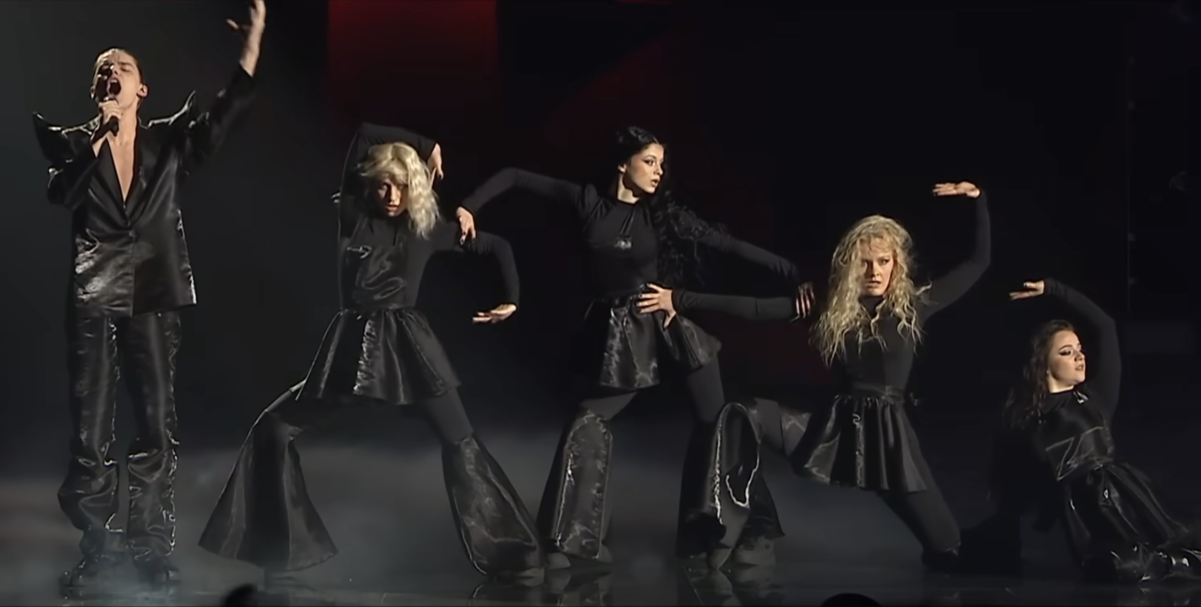
This year, Croatia’s Marko Bošnjak encouraged the audience to have a bite of “Poison Cake” as he performed his revenge tune in a fluffy black cape. There was smoke and fire, green and purple strobe lights, and back-up dancers flipping their waist-length hair because Eurovision will be Eurovision. Marko did not make it past the semi-final, but he was Croatia’s first openly gay Eurovision performer. I consider this a feat for a country where Freedom House found “societal discrimination discourages LGBT+ people from participating in politics.” I’m glad things are at least changing on the stage. It’s one of the things I love about Eurovision—it is more queer, more joyous, and more open than the sum of its parts. Last year’s winner, Nemo, was the first openly non-binary person to claim Eurovision’s title.
Eurovision is hardly some perfect utopia, but it embodies ideals that our individual countries may not. Behind those boundary-pushing acts and the crystal-encrusted microphone trophy, I want to believe it can be a force for good, a shred of humanity in an increasingly inhumane world. I hope it can be a platform for a future that respects all people, because I know people, borders, and countries can disappear. Switzerland—this year’s host and Eurovision’s birthplace 69 years ago—leaned into themes of diversity and unity; it announced that its three hosts were bringing together the country’s values of openness, integration, and community. The slogan “United by Music” was splattered across ads, along with calls for a “home where love and music unite us all.”
As a kid, Eurovision was a fun family night, a rare chance to stay up late. Today, it’s nostalgia, a longing for my motherland before war splintered it. I now have a daughter a year younger than that kid in Yugoslavia celebrating our first and last Eurovision title. I have a graduate degree in International Affairs, so I know better than to think anything—much less an event involving 37 countries—is politics-free. I know better than to believe that countries can’t be erased, or that a song contest can save a place like Gaza from daily destruction. When I streamed Eurovision, I knew I still lived in a world where fascism thrives, where we tear families and countries apart, where governments are hell bent on ruining lives while erecting new borders. But for a few hours, I relished the over-the-top costumes and the cultural quirks, the bizarre beauty of a cross-continental pop contest in a world ablaze. One minute, I was cursing at the screen about leaders who have learned nothing from the past, including my broken country. The next, I was lip synching to “Poison Cake” and cheering for Marko, my tongue rolling the hard R in his name, giving away my home even as I reside 4,000 miles away from it.
Eurovision is a snapshot of my childhood before my life became diasporic, before my motherland evaporated.
Deep down the Eurovision rabbit hole, I looked up Riva the other day, curious about where the band that brought us Eurovision glory ended up. Emilija, now in her mid-50s, has long brown hair, works as a solo artist, and runs a music school in Croatia. Instead of red gloves, she showed off red cat-eye glasses. I found out that around the same time Yugoslavia split, Riva broke up, each individual member pursuing their own path. This saddened me, as if learning it was reliving another ending. As if one band’s survival could have changed anything, rendered my country alive again.
I scrolled down her Instagram feed, not sure what I was searching for. She has about 1,000 followers, occasionally posts a selfie. Half a dozen posts later, I paused at the first one to garner over 100 likes and any comments. Above a sea of hashtags that included “#eurosong,” young Emilija looked through the screen, head-tilted, short brown hair and red lips, their darkened outline giving away a bygone decade. The caption underneath, “Neka dobra vremena…”—the good old days.
I paused and felt a shared longing—for her, a career highlight; for me, a yearning for a country still intact. Eurovision is a snapshot of my childhood before my family’s cross-Atlantic move, before my life became diasporic, before my motherland evaporated. As I watch the show each spring, I cling on to these befores, and the naivety of an 11-year-old girl who only saw countries coming together on a stage aglow with glitter and hope.
Four in ten U.S. adults believe humanity is “living in the end times.” We see existential threats in the form of climate change, our political campaigns, war, and AI. Correspondingly, the apocalypse is an obsession in our literature. Common are post-apocalyptic books, which take for granted the end of the world as we know it and explore how we’ll fare in the aftermath. Somewhat less explored is the pre-apocalyptic moment—the moment we see ourselves in now. What do we make of the dread, doom, and occasional excitement of living in anticipation of catastrophe?
In my novel, Circular Motion, the Earth starts spinning faster and faster. As days on Earth quicken from twenty-four hours to twenty-three, then twenty and below—the sun rising and setting ever more frequently—violent storms and economic meltdowns portend a civilizational collapse. Maybe the world will end… or maybe humanity will adapt. The characters must learn to live in this uncertain time of looming threat.
The crises of today may or may not lead to annihilation. What’s certain is that our lives will continue to be shaped by annihilation’s possibility. Each of these eight pre-apocalyptic books is set in the run-up to a particular apocalypse that only arrives near the end of the book, if ever. Most are not stories of mass destruction; rather, they are stories of life set to the soundtrack of alarm bells.
In six months, an asteroid will wipe out most life on Earth. People are abandoning their jobs, turning religious, experimenting with drugs, hanging themselves. Trying to keep his head amidst economic and spiritual mayhem, a young detective commits himself to solving a local murder case before the world ends. A more mature author might have smoothed down The Last Policeman into a pat meditation on the value of life, a reconciliation between the tragedy of a single death and the statistics of mass extinction. Winters, however, plays to baser tastes, thank god. Against his existential backdrop, he gives us a bloody (arguably, even, fascistic) cop novel, which doesn’t pretend that life is better understood when backlit by death, but perhaps that mortality intensifies our perspectives on life, misguided as they may be.
The Trisolarians are coming! As news spreads about the approach of an alien fleet, political factions debate whether to cooperate or prepare for war. The Three-Body Problem captures humanity’s ambivalence toward being supplanted. Annihilation is a fearsome prospect, but it throws into relief the inadequacies of the civilization that we have. We’re first introduced to the working of human politics through a brutal struggle session during the Chinese Cultural Revolution, and as the novel proceeds, terrestrial society gets arguably more dysfunctional. All clocks are counting down to our deliverance/destruction.
Some earlier works of climate fiction by Kim Stanley Robinson depicted Earth in the post-apocalyptic distant future, flooded out or ravaged by mass extinction. The Ministry for the Future, in contrast, shows Earth as it is—or at least could be—today: imperiled by climate change and responding to that threat. Through bureaucracy, diplomacy, and direct action campaigns, Robinson’s characters address the looming prospect of climate apocalypse. Here is the most dismally realistic book on this list, and also the most hopeful.
Five generations in Zambia, from the turn of the twentieth century to the near future: The course of history in this novel zigs and zags, but an ever-present dread makes it clear that whatever direction we’re heading, it’s not good. As colonialism gives way to globalization, then consumerism and techno-autocracy, politically engaged characters come to see polycrises mounting everywhere they look. Will their way of life be undone by surveillance devices implanted in their hands? By swarms of tiny drones? By predatory foreign lending or climate change? In rallies, they read from the Book of Revelation. They cry that the “end of days is here!” Ultimately, it’s their very fear of annihilation that causes the flood.
Ostensibly fiction, most of this novel about Erwin Schrödinger, Werner Heisenberg, and others is true. That’s to say, it is a record of these men going about the business of developing the instruments of apocalypse: poisonous chemicals and nuclear bombs. What’s fabricated is the men’s dreams, their longings and their madness. In one of Heisenberg’s prescient nightmares, he imagines the future victims of the atom bomb; yet he continues to expand the possibilities for humanity’s annihilation. Apocalypse, here, is a temptation: it is the desire to finally grasp the world, if only by obliterating it.
Here’s a weird one. Ostensibly nonfiction, there are no dreams, just actions and reactions. Beginning with a hypothetical nuclear strike on the Pentagon, Jacobsen imagines the ramp-up of an all-out nuclear war, providing estimates of the death toll as it rises with each passing minute. The lead-up to this apocalypse is short. As a former commander of the US Strategic Command is quoted as saying, “The world could end in the next couple of hours.”
This is, to my mind, the canonical pre-apocalyptic novel. Achebe brings to life a civilization in all its grandeur and complexity, only for it to be destroyed by the arrival of white colonizers. Things Fall Apart introduces the questions that will later be asked by alien apocalypse novels (Should we collude with the aliens or resist?), nuclear apocalypse novels (What constitutes technology progress?), and climate apocalypse novels (Who’s in charge here?). Even asteroid novels: As if the white missionaries are stony, incomprehensible projectiles of impending death, Achebe searches for the meaning of life in a world that is doomed. The doom, in this historical case, is all too real.
Apocalypse: 9/11
“The Suffering Channel” from Oblivion by David Foster Wallace
A bonus entry. Something smaller than an apocalypse novel—really it’s a disaster novella—”The Suffering Channel” follows the employees of a fictional lifestyle magazine, whose office is on the sixteenth floor of 1 World Trade Center, as they compose the magazine’s forthcoming issue, set to publish on September 10, 2001. The storylines, like many of Wallace’s best, get tangled in the weeds of the characters’ quotidian concerns—their workplace politics, their sartorial insecurities—and the result is something transcendent. Here, the impending doom of 9/11 freights every gesture, every gaze met and missed. Mundanity becomes profound, even beautiful, but painful too. This is not a simple story about appreciating life while you have it. The tragedy of destruction doesn’t negate the sorrow of existence; the sorrow of existence doesn’t lessen the tragedy of destruction.
When considering Booker Prize-shortlisted author Madeleine Thien, the title “children’s author” doesn’t immediately come to mind. And yet, for her latest novel, The Book of Records, Thien was determined to make the ideas in the text accessible to anyone the same age as her fourteen-year-old narrator.
The novel follows the journey of a child refugee, Lina, and her father, and deals with pressing topics—migration, authoritarian governments, cyberspace, climate change. Set in a labyrinthine building called “The Sea,” The Book of Records introduces thinkers from different eras—Hannah Arendt, Spinoza, and the Tang Dynasty poet, Du Fu. Lina learns from all three of them by reading about their lives, and it gives her the courage to confront her ailing father about their family’s tragic past.
When Thien and I spoke over Zoom in early March, it was still cold and dreary on the East Coast. It felt like we were huddled in a corner of her apartment, talking in hushed tones about books and writing. With her mourning dove-soft voice, Thien has the rare ability to put one at instant ease. Her speaking style, in fiction and real life, is relaxed and friendly. We spoke about lens-making, dance, the importance of the collective, and what it means to survive.
Naheed Patel:Your narrator, Lina, arrives as a child refugee from a fictional place called Foshan with her father to a place called The Sea, a labyrinthine structure that seems straight out of Borges or Calvino, that is “made of time.” Migrants arrive by the boatload at The Sea and sometimes stay for years before boarding other boats to their final home. You modeled it after Kowloon Walled City. How did this very real place inspire the fictional structure that ended up being The Sea?
Madeleine Thien: Kowloon Walled City has been demolished, but it was just minutes from where my mom grew up, in what used to be called No Man’s Land. When Hong Kong transferred to the British, this little parcel of land wasn’t ceded. It was an old Chinese military outpost, and because the British had no rights to it, and China couldn’t access it, it became a place for people who couldn’t afford to live nearby or needed, for various reasons, to remain outside the law, or were refugees who began building on this parcel, as it wasn’t under any regulatory authority. The building was makeshift. It’s a huge area of 300 interconnected buildings that people built on top, beside, and through. It’s a labyrinth. At its most inhabited, it had almost 60,000 people. It had everything needed to sustain them: bakeries, medical offices, workshops, small industries, manufacturing, dentists, restaurants. But in my head, the idea of this makeshift place existing for a time and giving refuge to those with no papers or place to go, is only a stop, not a permanent settlement, but a place to gather oneself to continue. That’s the place I had in mind. I imagine many similar places existed in the past and exist now. So it was that kind of timeless space.
NP:Did you have access to architectural blueprints of Kowloon Walled City while creating The Sea?
MT: I found a Japanese artist, Hitomi Terasawa, who did this incredible cross-section of one layer of Kowloon Walled City. It’s beautiful because she’s very artistic, and she drew all the rooms and people doing their activities. I think it’s inspired many: this city existed outside any government and was anarchic, but self-governing, for decades. It has all the things that one would expect with being in the shadows. It had a lot of crime, and people in terrible poverty or struggling with addiction. But it also had families, schools, churches, and temples. It’s an astonishing place. I imagined The Sea like that, with a moving population rather than a permanent one.
NP: What informed your descriptions of the migratory flow in and out of The Sea? There are boats arriving. There are people under duress. There are some who’ve left loved ones behind. There’s the intense anxiety of a last chance for loved ones to join you before everyone’s scattered all over the earth. What sources did you draw your observations from?
MT: I drew mostly from news reports. Over a decade ago, I wrote a novel about Cambodia and the Cambodian genocide, focusing on escape routes. Sometimes that was by sea, fraught with all the dangers, hope and horror that entailed. It was in the ether: the plight of people seeking safety. It felt painfully eternal and heartbreaking to write about The Sea, as other lives are being displaced daily. I was trying to find—for Lina—refuge and joy at an extremely traumatic time in her life.
I became interested in how Arendt, Du Fu, and Spinoza survived loneliness.
NP: The novel begins with Lina arriving at The Sea with her few belongings, including three books: three volumes with powerful educational and emotional value. The books are on three historical figures: Du Fu from the eighth century, Spinoza from the 17th century, and Arendt, who lived during the 20th century. The volumes outline less well-documented periods of their lives. What led you to that choice?
MT: For Lina, the books represent companionship and friendship. I loved that this child, this young woman, saw these figures as equals. While writing the novel, I considered detailing their entire lives—Arendt’s, Du Fu’s, Spinoza’s. That would be a 3000-page book! Lina’s at a stage where the self is starting to concretize; she’s a young person considering the world’s ethics or non-ethics, about reinventing oneself because conditions have forced you into a new existence. I became interested in how Arendt, Du Fu, and Spinoza survived loneliness and dealt with the need to transform without disintegrating their past self. I focused on those moments in their lives where we know less about them—it’s when they started to become the figures that history remembers them as. That moment before thinking solidifies.
NP:So, we meet them when they’re choosing between belonging and community, and an immutable truth about the world that they cannot bring themselves to ignore.
MT: I was guided by a famous line of Hannah Arendt, where she argues that we must love the world to understand and alter it. When we want to change things, we want to tear them down, destroy them, and remake them. But the forces unleashed can be unforgiving. It’s a difficult question, how to change the world, because you love it. I think we might enact that differently. That is the undercurrent running through the novel, with Lina, with me, with the historical figures. We’re all thinking about this question.
NP:The characters’ love of the world comes through in the sensory details, the inventive and lively descriptions. I especially liked the part where Spinoza is a lensmaker’s apprentice in Amsterdam. It’s rich with detail and must have required a lot of research.
MT: I had a fellowship at the New York Public Library, with a universe at my fingertips. I spent a long time learning about lens grinding machines for telescopes. There was a wonderful hundred-year-old book about telescope-making, with intricate details about grains, sand, and processes. Everyone studying Spinoza knows he was a lens grinder, but the physicality excited me. I could understand how he was considering consequences of consequences of consequences in our thinking and feeling, and also in creating a lens to help us see clearly or see greater distances. It was wonderful to be in this part of his mind.
NP:“Focus” is Latin for heart and home, as you mention in the novel. A lens brings all the light home. By illustrating this part of Spinoza’s life, you introduce a metaphor within lens-making, of searching for universal truth and focusing the light home. I couldn’t stop thinking about it.
MT: There was a real pleasure for me in in trying to show philosophy through the concrete things Spinoza touched and handled. The physical world is our philosophical world. It doesn’t come from the ether. Spinoza made philosophical observations through tangible things. Back then it was all a single field: science, philosophy, the natural sciences. They were considered a unity. Nowadays, we’re used to focused, intense expertise and fragmented knowledge. But part of the joy of being a novelist is to reunify ideas and experience them as a single pursuit.
What stuck was my relationship to music. That’s the closest I’ve come to feeling guided by a greater power.
NP:At one point, you wanted to be a dancer, but then you switched to writing. What prompted that?
MT: I’d danced since childhood. My mother enrolled us in ballet and traditional Chinese dance, and we did parades and acrobatics. At university, I started with contemporary dance and literature as a double major. I wanted to be a choreographer but lost my scholarship early on. I couldn’t maintain the GPA and had to leave school. I applied to a different university, got into a creative writing class, earned some scholarship money, got a job, and returned to school. At that point, the path towards dance ended. I would have wanted to keep doing it, but I didn’t know how between working 30 hours a week and going to school. For years I went back to dance class. I love it, but I don’t know if I would’ve survived in this milieu of incredible talent. To sum up, the desire to pursue dance never ended, but the path ended for me. I remember, as kids, our amazing ballet teacher, who became famous, but at the time, they had a tiny attic studio with one window. I’ll remember this room forever, the sound of the wooden boards, and the chalk for the shoes floating in this very particular attic light. And the sound of the piano, slightly out of tune. That attic room is the site of so much of my imagination, and my thoughts about beauty, desire, hard work, and physicality.
NP:Everything always comes back to the writing for me. Watching a performance, there’s endurance and physicality, and yet from the audience’s point of view, it comes off as effortless, fluid. Good writing is similar, I feel. There’s all this muscle working quietly behind the scenes.
MT: You’ve put your finger on the main thing about dance that has stayed with me in my writing. It’s that desire, knowing how hard it is, day in, day out, the endurance, self-criticism, repetition. But it should look effortless so that the audience experiences something of their own. You don’t want them to think, “God, you work hard.” You want them to move into another state of mind.
NP:Does being a novelist kind of feed into that desire to be a choreographer?
MT: What stuck was my relationship to music. That’s the closest I’ve come to feeling guided by a greater power. In dance, you have a piece of music, a soundscape, and you pull open movement, a narrative, from that sound. Sometimes I’m typing with headphones, and a beautiful piece of music comes on, and I feel like the music is coming from my fingers, even though I’m writing text. You can get stuck in a rhythm of habitual language. Music breaks me out of that, the words transform in a way that seems not to come from me. There’s a sense of movements that blend and emerge, and they’re all one orchestral or symphonic piece, but with different motifs. One hopes the polyphony will unify.
NP:In your acknowledgements, you mentioned that Walter Benjamin, a contemporary and close friend of Hannah Arendt, guided you through writing this novel. How did his writing become a beacon for you?
Something is always unresolved when I finish a book. It’s that seed that generates the next book.
MT: There’s a beautiful but obscure essay by Walter Benjamin about his childhood in Berlin. He knows he must leave Berlin, due to the forces pushing him out of Germany: the rise of fascism, and laws removing Jewish people from visibility and public life. From connectivity. In that essay, he wants to write his most cherished memories to vaccinate against their loss. He understands that it is both a personal and collective loss. We have private tragedies, but Arendt and Benjamin decided that focusing on the collective is the only way for them to survive intact. It helped them numb some of their private pain and made them act. This novel is very interested in collectivity. Sometimes Arendt’s words are transformed by Spinoza, and Spinoza’s ideas are expressed by Du Fu. I was looking for collective survival, collective love. I was doing a little bit of redistribution, because I felt that they would recognize things in each other. They’re all of them exiles, refugees who suffered great losses due to the politics of their time.
NP:Because they refuse to tamp down on their opinions in order to stay safe.
MT: There was something made of iron in them. They understand the need for a core, principled self that remains unbreachable, or else why not just hand everything to the forces of destruction? It’s going to take everything anyway. Why not just hand it over? They can’t. I admire that refusal to be ground down. And that’s the double-edged part of the collective, it nourishes a consensus, so you give up the determination to think for yourself. It’s a struggle, because the collective gives us belonging and identity. If the collective and identity are powerful, they give our lives meaning. To walk away from the collective and retain a sense of meaning and value, is extremely difficult, and very few can do it. Can withstand excommunication, public shaming. During the Cultural Revolution, they called it being made a non-person. All three had deep friendships that they nurtured. Friendship is like love. You take care of each other. That might be what drew me to all three—this gift of friendship, which I felt, imaginatively, they would extend to Lina.
NP: That’s a beautiful pivot back to Lina. Despite the intricate philosophical ideas in this book, you wanted it to be legible to someone Lina’s age. You wanted a 14-year-old to pick up this novel and understand its themes. Was that something that was very important to you?
MT: It’s a threshold age. What a 14-year-old absorbs, observes, and questions will stay with them for life. It’s a challenging age, and I felt that hunger to know, learn, and question was most alive in a 14-year-old’s mind. As we get older, some questions dull, or we push them away because we lack answers, or just getting through life takes up too much energy. But there are moments in childhood that are extensive. That 14-year-old understands there are things they don’t understand. That’s part of the discovery and excitement. As we age, there’s greater resistance to that acceptance. But I hope to retain forever that wonder and humility before the world.
NP:Your 2016 novel, Do Not Say We Have Nothing, spans the Chinese civil war to the present day. It was shortlisted for the Booker Prize in 2018 and won the Governor General’s Award for English language Fiction and the Scotiabank Giller Prize. Is there a through line between your works, or have you been building upon them?
MT: With each novel’s completion, new questions emerge. Something is always unresolved when I finish a book. It’s that seed that generates the next book. Over the past ten years, I’d written two books: one, as I mentioned earlier, about the Cambodian genocide and the other about the Cultural Revolution and the 1989 protests. During those 10 years, I was living with extremely difficult materials, lives, testimonies, and images that haunt me—the things humans inflict on other humans. I think in those two books, there’s a lot about the cost of survival, and what we must destroy within ourselves to survive. My new novel wanted to explore what we create within ourselves to survive.
NP:Spinoza says, in this new novel, that you must love yourself to survive.
MT: The novel asks what it means to love and have a responsibility to the world. These two forms of love, love of oneself and love of the world, shouldn’t be at odds. Spinoza writes about self-preservation as a driving force and acknowledges that we may be primarily self-serving. He felt it was important to see that clearly, so we could alter some choices in a conscious way: be guided by an ethics aware of the drive for survival but make room to choose something beyond the self. It’s this question of what it means to survive, and what kind of world I want to survive in. At some point, I hope the person I want to survive is worthy, but I need a certain kind of world for that worthy person to survive in, so I need to do something about the world to preserve the self I want to exist. Everything is interconnected.
Ernest and Marion Hart spent nearly the whole month of January 2020 in Rome. They visited the Piazza Navona, and St. Peter’s Square and the Vatican, and marveled at the great art everywhere they looked, but they also made time to frequent the wine shops and cafés, where they had veal chops and pasta, sampled osso buco, arancini, Italian ice cream and pizza, and tasted Brunello and amarone and Barolo, and they came to sense something of the daily rhythms of life there. On the last day, they went to the Spanish Steps and actually threw coins in the fountain and then spent an hour at the Keats-Shelley house, where the poet died. They saw his death mask, the delicate, aquiline, nearly feminine features in that profound repose. Gazing at it, Hart experienced a strange sweet quelling effect in his soul, and evidently his wife sensed this. The next day, flying home, she remarked on it; she’d thought about it overnight, and had come to believe that seeing the mask had somehow softened his normal inclination to gloomy deliberations (for years she’d told friends, teasingly, that this darkness was his nature, and her challenge). “Well, it looked like such pure deep rest,” he told her. In any case the whole experience had been so intensely satisfying for them both that as the havoc of Covid-19 subsequently passed so heavily over the world, the Eternal City became something they preserved in happy memory like a kind of mental bulwark. And now that the pandemic was waning, they’d commenced talking about finding a way to go back.
As things stood, they would have to incur more debt.
She was a writer of children’s books—their best friend Joan illustrated them—and though three had been published in the last five years, sales had seriously fallen off since the pandemic, as had so much else. The children’s book business had been slow to recover. He was a watercolor portraitist who specialized in family pictures, usually of children for their parents, and the recovery there was progressing a little faster. Even so, their finances were such that for supplemental income he manned the reference desk three days a week at the county library, while she taught a writing class at Midsouth Community College. She loved her work; he sometimes felt that he must tolerate his. Plus, her mother, Daisy, had moved in, and was helping to pay the rent.
Another impediment.
Daisy had fallen into the habit of shedding unwanted advice and at times she unwittingly made them feel as though they were her tenants. So Hart began walking out in the mornings—at first just for time alone. Yet the pattern had become habit and the habit pleased him.
Marion, as always, took things in stride. She considered that their irritations about her mother’s small trespasses were temporary; even in moments of annoyance, she could joke about it. That was Marion. Finding a way to season the facts with her usual wit. “My mom,” she would explain, “is a well-known pianist deprived of public performance by plague and my father is a bastard, but his alimony payments provide support beyond what she’s been able to make during the shutdown, so the three of us are sharing our wealth.”
This about alimony was only partially true: Daisy had indeed invested those payments and was receiving meager interest from them, but she no longer collected alimony as such and she’d been through several relationships since Edgar Clayton—as she liked to say—went over the wall. The old man, whom Hart had never seen face-to-face, was well-off by inheritance and lived in Madrid these days, involved voluntarily in some vague capacity with the State Department. An undersecretary of something. He hadn’t given Daisy one cent after the first two years, though they were still in touch occasionally. “They’ve got me between them,” Marion had said more than once. “I keep it interesting.”
Hart would say that she made everything interesting.
After nine years, he still liked watching her move through the rooms of the apartment—lissome, elegant, even in plain slacks and tan blouse, hair up, or held in a bandana—simply keeping up with what she gave herself to do. She was an arranger of things, bringing flowers into the house, or a lamp or vase she had found while thrifting; there were a lot of antiques in the rooms, and periodically she would change the order of where things were. When she was writing, she’d whisper low and he would hear it, and smile. Usually she sat at the dining room table for work, though Daisy’s presence had caused her to move everything into the little nook in the window of their bedroom. A happy arrangement, really. He could lie awake watching her, watching the light play across her features as she concentrated.
His memory was image-oriented after all, and that was probably the core of his gifts as a painter. He didn’t consider himself a true artist, since all his paintings were from photographs. Marion and Joan, in his estimation, were artists, Joan creating images from Marion’s created stories.
The three had met in an art class at the university.
Back then, he was a member of the university football team. Marion had been put off by this—she didn’t like the sport—and at first it seemed that he and Joan might become a couple. But consecutive knee injuries had put an end to football, and it was Marion who helped him through all that.
Now the library provided a quiet place to sketch when he was not helping people with their reference questions; he liked his workmates, who were all readers. Interesting people. And his clients had always been happy with the results of his work. Indeed, he enjoyed the whole process: taking the photographs either in the studio at home or out in various parts of the city, and then choosing the ones from which he would make the portraits. Marion took pride in the perfect accuracy of the work, and she would remark about how fortunate it was that the children were all beautiful. They were ordinary little citizens, of course, but so pretty to look at, each of them. And thank God, because Ernest Hart always painted what he saw. Recently, talking to Joan about the sweet time in Rome, she spoke of the dozens of sculptures they’d seen of the empire’s citizens. The artists for those had been honest, like Ernest. “These were perfectly rendered busts of wrinkled, ugly members of wealthy Roman society. God knows where the handsome ones went. Maybe they all gathered in Pompeii just before Vesuvius erupted.”
Joan shook her head, grinning.
“Too soon?” Marion said.
This particular morning, this one, begins quietly enough. Daisy goes out to the grocery store, and Marion begins preparing breakfast. It’s their weekly big breakfast morning. Joan is coming over with new sketches for their book. Hart kisses Marion’s cheek and sets out on his walk. Daisy has decided kindly to spare him the grocery trip. Perhaps she’s becoming aware of how her presence is affecting things. “I hope she knows we love her to pieces,” Marion says. “No matter what else.”
“She’s a great lady,” says Hart, meaning it in spite of his suppressed annoyance, heading out with a book.
It’s a hot morning, already past eighty. He walks down to Bradford Avenue and goes right, holding the book out so he can use his peripheral vision to keep from tripping on anything. He’s become quite adept at this, keeping an even pace, reading as he goes. It’s a paperback from the Brief Lives series, about the life of Sitting Bull. The two-and-a-half-mile point of the walk is the intersection of Bradford Avenue and Converse Street, perhaps fifty yards past a steep rise and descending slope. The routine has been to turn back at that intersection, for the immediate strenuousness of walking back up that slope and on home.
This morning as he reaches the crest he sees two ambulances, a fire truck, and a squad car ranged at various angles near a rusty Volkswagen minivan with a tree standing inside it.
The emergency vehicles block both Bradford and Converse. Their lights flash but he was reading the book and, in the brightness of the day, hasn’t seen them until now. He can’t recall sirens, even as ambient noise. Three EMTs are gathered tightly in the space where the minivan driver’s door would be. Two policemen are signaling traffic coming down the crossing street to turn around. A woman from one of the neighborhood houses is nearby. She’s wrapped in a white terrycloth bathrobe, shivering even in the heat, holding the robe tight at her neck. Beyond her is a man in a seersucker suit who appears dressed for work. He’s talking low, without looking at her. Hart approaches them, feeling the need to talk. But the man’s murmuring a prayer.
The woman turns to Hart. “I heard it happen. It woke me up.” She puts her other hand over her mouth. “Oh, God.”
“I didn’t even hear sirens” Hart manages.
The man says, “I just pulled up.”
The three EMTs at the driver’s side mutter commands back and forth. A bloody shape is partially revealed and then obscured as they work. It looks like they’re trying to pull back twisted steel.
A teenage boy with shoulder-length hair bound by a red bandana emerges from the house that stands in the tree’s shade. Hart has seen him on these walks. The boy approaches the minivan on the passenger side and pauses warily, looking in. One of the EMTs waves a warning at him, but the boy reaches into the space and brings out a suede shoe. A cop steps around the wreck to examine what the boy holds, and then, reaching in, brings out another shoe. Hart sees the cop’s thick, rounded, muscular shoulders through the tight gray shirt. The man in the seersucker suit says, “Ach—no—can’t do this” and steps away. He gets into his car and actually guns the engine; his tires screech as he turns around and heads fast back up over the hill. Hart thinks of leaving too, but the woman breathes a small frightened moan. Hart feels it would be impolite simply to leave her there. The muscle-bound cop and an EMT are now looking through the shrubs fronting the house.
“My God,” the woman says suddenly.
And Hart sees what she sees.
A tall, lanky man with his head slanting awfully to one side wobbles toward them along the sidewalk, wearing jeans and a T-shirt with a dragon’s head emblazoned on it, and no shoes. Hart looks at the bare feet. The man’s black hair is cut so short it looks as though the stubble on his dark jaw simply runs up his sideburns and over his scalp. Hart calls out to the EMTs and police. “Over here!”
The man sits down suddenly on the curb, perhaps twenty feet away. His head turns very slowly toward the smashed minivan and the tree, and then back to where Hart and the woman stand, fixed. The man stares at them, seems to take them in, then looks beyond them. His face shows no cuts or broken places; it’s one night-dark shade of blue, the skin itself a purplish midnight blue. He sinks back slowly on the grass.
“Here!” Hart calls to the EMTs, who are already rushing over.
“Christ,” the first EMT says, bending down over the man as two others arrive. He pushes on the chest, then bends down to listen. Two more EMTs run over with a defibrillator and they quickly set about putting it to use. Hart watches the spastic jolts and sees the violet hue of the flesh. The dirty soles of the feet. There’s nothing else anyone can do. Still another EMT, an elderly looking man with a spray of liver spots across his forehead. “I guess add this one, too,” he says. “Jesus.”
“But he—he was walking,” the woman exclaims, pointing shakily at the stilled shape on the grass. “He walked—he was walking. He looked at us. Didn’t he look at us?” she says to Hart.
The muscular cop has also stepped close. He stands with hands at his hips and stares. “Through the damn windshield, right out of his shoes.” He stoops slightly and indicates the face, the neck, the exposed chest. “Bleeding everywhere under the skin. Every single blood vessel, every—what do you call them.”
“Capillary,” the blond EMT says.
“Yeah. Capillary. Every capillary.” He shakes his head, bends down farther, lifts the body slightly and brings a wallet out of the back of the jeans. He straightens, opens the wallet and reads the driver’s license: “John Stahl. With an H. S-t-a-h-l. Born 1992. July. So, just—what—thirty-one years old?” He shakes his head. “Talk about dead man walking. Never seen anything like it.”
Talk about dead man walking. Never seen anything like it.
They’re all quiet. Hart thinks of mourners at a funeral.
The woman finally whimpers, both hands now clutching the collar of the robe, her knuckles whiter than the cloth. She keeps nodding slightly, staring at what’s there on the grass. “I’m sorry,” Hart says to her, as though apologizing for the fact that her life has brought her to this pass. And indeed he is sorry for it. For exactly that. He reaches to touch her shoulder but stops himself. Around them is a blur of activity. A TV van pulls up, people emerging willy-nilly from it as if spilled, with cameras and microphones.
Others are gathering now from the neighboring houses. A very old dark man with close-trimmed white hair and a pointed beard approaches. “Lawsy, Miz James,” he says. “I thought it would surely blow up. God help us.”
Hart walks back up to the crest of the hill and hurries on, trying not to look at any of the stopped or slowing cars. At length, he reaches his part of Bradford Avenue, and his own little road, Mills Court. Here is the familiar peaceful block: the yellow sign that reads No Outlet, the houses with their manicured lawns on the left, and, opposite those, his wide, low-slung, red-brick apartment building with its white-bordered windows, flowers in planters and smooth lawn dotted with stone nymphs and cherubs. He stands still for a while trying to call up full recognition of it all, then turns to gaze once more at the houses across the way, the trees flanking them and rising behind them, tall, slender pines with their tops showing sharply green against the pale summer sky. It’s a warm, sunny morning on Earth.
He feels displaced.
As he steps into the apartment he breathes the aroma of the bacon Marion’s been frying, and hears his own voice say, “None for me.” He sets the book down on the end table next to the sofa.
She says, “What were you expecting to see out there loitering like that?”
In that moment he decides not to say what he’s seen. “Just appreciating our street,” he manages.
“You weren’t waiting for Mom?”
“Such a pretty day,” he gets out.
But she has spoken over him: “That’s you, all right. Appreciating things. I wish you could do that while you’re walking. I’m always afraid you’ll trip and fall going along with your head in a book.”
“Peripheral vision.” His own voice sounds strange to him.
“Anyway, breakfast is almost done.”
“I’m not that hungry.” He lets himself down on the sofa, and watches her through the open entrance into the kitchen. She’s setting the cooked slices of bacon on a plate with a paper towel across it.
“Well,” she says. “Daisy won’t eat all this.”
Forcing a light tone, he says. “You’re my perfectly lovely girl.”
She pauses and smiles. “Sweet.”
This is an ordinary morning for her. He hauls himself in to sit at the table. “Not now for the bacon,” he says. “Really. Maybe in a little while.”
His hand shakes when he reaches for the cup of coffee she sets down for him.
“Should we turn the A/C on?” she says.
He makes his way to the thermostat in the hall. As he reaches to adjust it, he receives an intensely distressing awareness of the moment itself as being one of many separate meaningless others; he looks at his own hand and feels scarily on the verge of something.
Back in the kitchen, he tries to keep his attention on her features, which he loves in any light. She’s wearing gray slacks with a white tank top, and she’s pinned back her soft, ash-blond hair—the light from the window shines in the perfect waves of it. Oh, my darling.
There have been so many and such sweet times.
She continues preparing the breakfast, and when she opens the oven to keep things warm, he sees the dark blue of the inside. He quickly puts his hand up to his face, index finger and thumb squeezing at the top of his nose.
“You really not gonna eat?” she says.
“Prob’ly have something when Daisy gets back.”
She checks her watch. “Daisy should be back by now. And where’s Joan?”
He waits.
“Billy’s giving her hell,” she says.
Joan’s estranged husband is living in a rented room in Shelbyville and has actually taken out a protection order against her because she has been calling him demanding payment of money he owes her. It’s a lot of money. He’s a cop and he has friends in the precinct, and twice these friends have visited her after nightfall. Since they know her, too, they call the visits “friendly reminders” about the protection order. But for Joan it’s exactly like those old depictions of mobsters visiting store owners peddling protection, and it terrifies her.
“Who’s the one who actually needs a protection order filed,” Hart says now.
Marion waves this away. “She’s never gonna get the money back unless she files for divorce, but I think she still loves him in some obsessive way. It’s like an argument they both want to win without really changing anything. But he’s living in that upstairs room on Pond Street and she’s afraid to stay in the house.”
Hart sits back, feigning calm, clasping his hands at the top of his head. “I wish she didn’t have it to deal with.”His mind presents him with the figure of the woman clutching the terry cloth bathrobe closed at her throat. “I wish everything was all right.” He almost loses his voice.
“Daisy’ll want scrambled,” Marion says, as if to herself. Then: “Joan’ll prob’ly stay the night here.” She breaks three eggs into a bowl.
He folds his hands in his lap under the table. “I gotta set up the studio.”
Marion nods. “I know. The twin grandchildren. Mrs. Lessing, who insists on Mrs.”
“They’ll be here in an hour.”
“Just time for us to eat. Joan’ll bring new illustrations. And after I look at the illustrations and decide which ones we’ll use, we’re all supposed to go thrifting.”
“You think Joan’ll move in with us?”
“Nobody else’ll be moving in, Ernest.” The faintest note of vexation sounds in her voice.
“Hey,” he manages, evenly. “Everybody’s welcome.” As he draws in the breath to go ahead and, without being too graphic, start talking of the morning’s horror, Daisy arrives carrying a bag of groceries. “My God,” she says, setting the bag down. “There’s been a terrible accident over on Bradford. I wanted to pick up some donuts and I couldn’t get through. Must’ve been five or six ambulances and police cars.”
“It was two ambulances, a fire truck and a police car,” Hart hears himself say.
They stare. A long silence, no one moving. And then, in a strange rush of letting go, he’s telling them everything. He’s appalled at how it all pours out, and at the increasing tremor in his own voice. “Never saw a blue that shade, that deep,” he says finally, putting his hands to his face. “And it was—it was someone’s face, this guy’s face.”
Marion hurries around the table to embrace him. Then both women are near.
“The guy looked right at us.”
“Oh, baby,” Marion says.
He closes his eyes and sees again the lurching man, the terrible unsteady gait, the head so badly awry and the face, that ghastly dark tint. He looks at Marion, and at Daisy. All the words for the color run unbidden through his mind, words in a nightmare. Obscene words.
“I can see if Joan can go to her mother’s,” his wife says out of the silence.
“No,” Hart says. “Don’t do that. Let’s just—I’ve got this photo shoot.” He wipes his eyes. “It just shook me. I’ll be all right in a bit.”
“Should we forget breakfast?” Daisy says. “We should clear all this away.”
“I’ve got it, Mom,” Marion says. “He’s gotta eat.”
He manages to try a joke. “Where’s the donuts?” And feels the effort of drawing up his courage.
“Don’t be brave,” Marion scolds. “You don’t have to be brave.”
Her mother says, “Oh, honey, he can be brave or not, it’s up to him.”
“I’ve just gotta get set up for the shoot,” he tells them.
By the time Joan arrives with her sketches, he has gone into the studio. He’s having to fight the images that keep rising, and when he hears Marion and Daisy start telling it, he puts Chopin on the player, and fixes his gaze at what’s directly in front of him. Mrs. Lessing has asked for inside sets, no fake countryside. She wants bookshelves and drapes, and perhaps a wing chair. He puts together two different small sets, one involving a light gray plush scrap of curtain partially veiling two rows of books, the other with a lamp and a wing chair in soft pink light. The title letters on one book’s dust jacket are lined in pelagic blue, and he takes it off with a shaken agitation, fumbling with it, almost dropping the book. He pauses, the crumpled dust jacket in his fists. He looks around the room and finally closes it up in the bottom drawer of his desk. As he’s setting up the scene with the wing chair, Joan comes to the door. “You all right?”
He turns, looks into her dark eyes. “Guess so,” he says. “Yeah.”
“Maybe try to think of it as a bruise. One big, awful bruise.”
“Bruise doesn’t cover it. The guy looked at me.”
“Yeah, but he wasn’t really seeing you, Ernest.” She stands there, one hand on the frame of the door. Only the day before he confided in her that his mother-in-law’s almost continual presence has been getting on his nerves. And here is poor Joan dealing with Billy’s depredations. A marriage coming apart after fifteen years. He remembers thinking that Joan and Billy were solid as a couple—sometimes even suspecting that they might be more passionate when alone than he and Marion were.
“Anyway,” he says, forcing a small smile that turns into a sob. “Bruise—sounds too trivial.”
“Oh, God,” she says. “Poor Ernest.”
He sits down in the wing chair. It’s almost a collapse. “I can’t get it out of my head.”
She walks in, bends and put her arms around his neck. “You poor thing. Try not to let yourself dwell on it.”
They hold tight to each other for a moment. She’s his dear friend. When he took her out that time back in college they ended up in bed together; but there’s nothing remotely erotic in this embrace. Even so he feels the darkness of it, as though it’s a transgression, a defection. Everything seems to be caving inside him. When she lets go and steps back, he pulls up out of the chair, making an effort to seem strong, an infinitesimal part of him expanding with self-disgust, as if all this is an indulgence, something he should be able to control. “Hell,” he manages. “It’s done. I mean I just walked up on it. Christ.”
She glances back into the hall. “Any improvement with Daisy?”
“Wishing she’d go on tour for a while.” He hears the querulous tone and tries to walk it back. “No, she’s fine. And she is helping.”
Joan says, “Well, Marion feels exactly like you do about it.”
He glances at the wall with its photographs and paintings. None of it carries any weight now; it seems trivial. He can’t find himself in the web of things. He thinks of Marion and her sense of humor as if it’s a curiosity of nature, somehow not connected to him. When he looks back at Joan, it’s as if he’s just discovered her there. “Joan,” he says. “God.”
“Well” she says. “We just have to put one foot in front of the other.” Now she seems faintly confused. After a brief pause, smiling, she says, “Cliché saves the day.” Then she turns and goes on back into the living room. He hears the three women talking indistinctly. They’re having mimosas. He hears Joan laughingly say self-medicating.
A little later, he joins them, and has one, too, then pours himself a coffee. The breakfast is strewn on the table; several strips of bacon remain. He eats one, and his gorge rises.
“Maybe it’ll be in the newspaper,” Joan says.
“Oh, let’s stop,” says Marion. “Let’s put it behind us.”
Hart understands that Daisy has meant to distract them from the terror of the morning, and he loves her for it.
“Heard from your dad this morning,” Daisy announces. She’s standing at the sink, where she has rinsed her plate. She smiles. It seems almost genuine. She steps over, puts the end of her index finger on the shiny surface of the table and makes a slight circle. “It’s my pleasure to report that he’s had a minor operation to remove a boil from his right buttock.”
Marion says, “Mom.”
“No, really. So there he is. A short shit with an extra hole in his ass.”
Marion and Joan laugh, a little more heartily than the remark merits. Hart understands that Daisy has meant to distract them from the terror of the morning, and he loves her for it. He walks over and kisses her cheek. “Thank you,” he says.
Mrs. Lessing is a thickset woman with leathery olive skin and large white straight teeth. Her smile is odd. Her eyes and hair are a shade of light brown, and the twins’ features don’t reflect her at all. They’re blond, pale, slender, so strikingly identical that Hart can’t keep from continually glancing from one to the other. Their grandmother has them wearing the same outfit—red plaid skirt and pink blouse. Marion’s mother says, “Hello, I’m Daisy.”
One twin gives a quick curtsy and says flatly, “Carla.”
“Cissy,” says the other. This time the curtsy is exaggerated, with obvious mockery. She says to Joan, “You look like our math teacher at school.”
“Oh, I hope she’s good-looking.”
“She’s mean, and we don’t like her.”
In the same instant, almost as if intending to speak over any response Joan might have, Mrs. Lessing says, “What have I said about negative speech.”
Marion hurries to say, “Sorry for the mess, here. We’ve had a strange morning. Ernest saw an awful accident on his walk.”
Mrs. Lessing says, “There was a lot of traffic coming down from Poplar.”
“We had an accident last year,” Cissy announces. “A complete and total wreck.”
Hart says, rather insistently, “Well, we’re set up for our photo shoot. So, if you’ll just follow me, please.”
In the first setting, the girls argue over who’ll sit where. Cissy wants to be on Carla’s left, repeating the demand. “Her left. I want her left side.” Their grandmother seems merely to be observing them as they squabble. They look nearly translucent in the studio light; their very hair seems virtually diaphanous, wafting in the stirrings of air like filaments of white haze. Their pale cheeks show tiny blue veins. Hart finds that he can’t concentrate, can’t adjust the camera or their poses. Mrs. Lessing suggests several, and gets them to understand that they’ll have the opportunity to sit on either side of each other. “We’ll have one of each pose, sweeties.”
“Yeah, but what’ll he paint,” Cissy whines.
“I’ll paint what you agree is the one you want,” Hart tells them. The tiny forking of a vein in Cissy’s cheek shows even darker as the two girls keep on about how they should be posed. They’re so pretty, so delicately slight, so fair with their soft features and hazel eyes. So rude.
Somehow he manages to get them sitting still and takes a few shots of them in each setting. His stomach’s upset, looking at the color in the white cheeks.
When they’ve left, he goes into the bedroom and lies down. Marion, Joan and Daisy have gone thrifting, and are probably having lunch somewhere. His stomach hurts. He takes three chewable antacid pills and goes out to sit in the shade of the balcony off the dining room. He looks at the woods spanning that end of the building, the almost cloudless whitish sky above them. The day’s heating up. He closes his eyes, wanting sleep, but the face of the walking dead man jars him awake.
That evening on the local news there’s a report about the accident. The two newscasters, a young, movie-star-pretty brunette woman and a late-middle-aged man, go through it rather quickly. Behind them is a photograph of the wrecked minivan in its awful embrace of the tree. “Tragedy early this morning,” the young woman says, “when a high-speed chase ended in a crash that claimed the lives of two men.” Her partner picks up the story. “Martin Dupee, sixty-three, and John Stahl, thirty-one, of Collierville were killed instantly. Mr. Dupee, the driver, died behind the wheel and Mr. Stahl was thrown from the vehicle.”
There’s no mention of the macabre walk.
“Apparently,” the pretty young woman adds, “both men were intoxicated.”
The two newscasters turn then to local sports and weather.
“Why wouldn’t—what reasoning—” Hart begins. The TV screen now shows a green map of Memphis and surrounding areas.
Marion picks up the remote and shuts off the TV. “Think of it, Ernest,” she says. “What would a relative feel, hearing about a thing like that?”
They’re all quiet a moment.
“God” Hart says, low.
But Daisy and Joan are agreeing about how ghoulish it would be to report such details in a public broadcast.
In their bedroom, the Harts don’t speak about it. He brings up the lovely late afternoon light in the Piazza Navona. And the luminous twilights, how the shadow of Borromini’s church, Sant’Agnese in Agone, falls on Bernini’s Four Rivers Fountain at that time each day. “Remember” Hart says, “the guide telling us Borromini designed the building to do just that because of an ongoing spat between him and Bernini. Imagine, a four-hundred-year-old daily insult.”
“What made you think of that?” she asks.
“Rome,” he says, and brings her close in the bed. “I’m thinking about Rome.” He feels the urge to tell her, as the thought occurs to him, that this day casts a shadow that will always be there now, like the twilit shadow of the ancient church, but then she sighs, and says, “Maybe we can go back in the fall.”
“Oh, yes,” he says. “Oh, let’s do that.”
He sleeps so fitfully that it feels like wakefulness, like no sleep at all. Finally, turning the small reading light on, he tries to read the book about the man called Sitting Bull, whose literally translated name, according to the book, was Buffalo Bull Who Sits Down.
The morning paper has more about the accident, surprisingly as part of an article about alcohol and its effect on one family: it turns out that Dupee was the late-life son of a former Tennessee congressman, Wildcat Tyrus McGill, from the 1920s.
The Harts sit side by side at their kitchen table and read this, sipping coffee, Daisy and Joan having gone out to get takeout for brunch. The article says Dupee had been working as a handyman and Stahl was his nephew, helping him for the summer. The two had spent a long night drinking at a celebration of another nephew’s impending marriage. They were weaving in traffic and had no headlights on, and when a state patrol car attempted to pull them over they fled at high speed. The article says they were going a hundred and ten miles an hour when they hit the tree. The article writer posits the theory that the alcoholism could’ve been inherited, just as recent studies have suggested that suicide or the depression that produces suicidal ideation might be. Both men were divorced; both had been in several different kinds of difficulty involving alcohol and drugs and the itinerant lives they’d lived in the delta. For the nephew, there was also time spent in the Mark H. Luttrell Correctional center, after a violent altercation at a movie theater, two years before.
“No surprise,” Marion says. “Forgive me.”
Hart wants to know more. It can’t be that simple. “Why would they run?”
She shrugs. “Why worry about it now? We don’t know them.”
He stands and leans on the back of the chair. “But I can’t stop seeing it, honey. The guy looked right at me. He could see well enough to walk and he looked at me. And he was dead. And I—I can’t shake the memory of the particular shade of—of the color. I saw the deepness of it, its—its totality, just as I was beginning to know he was—what the situation was.”
“It’s done now, though. It’s over, honey.” She begins to clear away the coffee dishes. He watches her and reaches for a paper towel to wipe the table. “Let’s leave it,” she says. “Okay? We’ll just have to go over it again when Daisy and Joan get back.”
He gathers all his breath and sighs the words out slowly. “God, Marion. This is the blue planet. It’s mostly blue. A blue stone in the center of space.”
She’s silent, staring. Then she seems to draw herself up. “What’re you saying?”
“I couldn’t look at the sky this morning,” he tells her. “I started my walk and came back in. Marion, I couldn’t bring myself to look at the sky. I have this feeling: it’s like this is our—this—going along this way—living the minutes of the day, this is something not us, somehow, a chain of events unfolding in time and leading to some—fate. I can’t explain it.”
“Fate.”
“I can’t help but sense that this is the beginning of something.”
“Stop it,” she says. “You’re scaring me.”
He says nothing for a moment. They’re simply staring at each other. Finally he looks down. “I feel sickened, honey. I have this awful dread just now.”
She steps over and embraces him, and they remain like that for a few moments. “We just have to get past this next few days. It’ll fade.”
He doesn’t answer.
She continues. “Joan and I are supposed to have lunch with this woman who wants to be our publicist.”
“I’ve gotta try to paint.” The words sound troublingly beside the point.
“The cute twins,” she says. “They should go to Pompeii.”
He manages a smile and leans over to kiss her hair. “Keep joking,” he says. “And I’m sorry.”
How do you completely exclude one of the primary colors?
In the studio he sets out the photo Mrs. Lessing has picked—since, she told the girls, who were audible in the background with their arguing, the portrait is for her. He looks at the faces, and is confronted immediately by the new difficulty about shades of blue, and there are in fact hints of the color in all the photographs he has taken of them—he sees it in the light green, faintly cyanic drape and the blond walls of the room itself, and he sees it in the girls’ hair and pale cheeks, with those traces of the veins, and he can see it while anticipating all the necessary touches even to deepen some shade of gray; it’s all brutal distraction.
He backs away from it, experiencing again in memory the breath-stealing aghast horror of the tottering figure lurching toward him. He paces a little, still seeing it, and thinks of trying again with the walk. Go out and look at the lovely summer world. He puts sunglasses on, to mute colors. He fears now for his sanity. In the living room, Marion sits with her pages on her lap, penciling in changes.
She looks up. “Good idea with the sunglasses. You look cool.”
“Let’s do go back to Rome,” he hears himself say suddenly. “Now. Let’s find a way.”
She frowns. “Baby.”
“Maybe this is tied up with the pandemic, somehow.” The thought surprises him. “Can’t we—let’s find a way to go back this week.”
“Ernest,” she says. “Stop it. Everything’s all right. We’re all right.”
“I feel separate from you.”
She pauses, staring.
“From everything. And I think Rome—” he begins, but doesn’t finish.
“It’ll be fine.” She frowns slightly. “You’re just upset. It’s trauma, seeing a thing like that.” She seems to give a small half shrug, stepping toward him. The light from the window casts a bluish tint onto her white blouse, and he sees it above the frame of the sunglasses as he bows slightly to accept her kiss. The thought seizes him again that this is all one thing, part of something ongoing. There have been the depredations of the shutdown and the scares and climbing horrors of Covid, and Daisy’s moving in, and the increasing scarcity of funds and having to work the library job, and even Joan’s estranged husband with his friends in the police department—and Joan now, Joan, too—and through everything he, himself, making the effort to be decent and loving. Here this is now, like a pitiless last straw coming from the very chain of all circumstance. He recognizes the absurdity of the notion, yet feels it under his heart like truth. He stands braced against the counter, just beyond the bath of light from the window, as his wife approaches.
“Well?” she says. “C’mon—kiss me. In honor of our trip to Rome.”
In 1994, the graphic novel was formally introduced in India with the publication of Orijit Sen’s River of Stories. Initially, book stores refused to sell it as the graphic novel concept wasn’t recognized. However, with the onset of the internet, digital copies started circulating online and things changed. Eventually, Sen’s novel became a success in print too.
River of Stories focuses on the Narmada Bachao Andolan (“Save the Narmada River Movement”), a resistance movement that attempted to stop dam projects involving the river Narmada. The novel investigates the large-scale environmental damage and widespread displacement of indigenous communities caused by these ill-planned industrial developments and remains relevant to this day.
Now, thirty years since Sen’s book, the graphic narrative form is alive and well in India, having permeated the contemporary urban reading sphere. Its ability to intertwine the verbal and visual registers of storytelling has introduced new modes of representation, allowing for immersive literary experiences that speak to today’s readers.
While comic book series have been common sinceAmar Chitra Kathas(a much-loved children’s comic), graphic narratives have transformed the popular medium that was once associated with mere entertainment and moralism into something far richer. Dealing with sociopolitical concerns like sexuality, caste, gendered violence, capitalism, Partition, riots, and more, graphic novels have become crucial in capturing and commenting on the issues of contemporary Indian society. A simple yet subversive form, it successfully challenges grand narratives by creating space for stories from the margins.
Here are ten celebrated graphic novels that blend prose and gorgeous art to explore Indian cultures and histories.
A pivotal work of graphic art which has been translated into ten languages, Bhimayana narrates the life of Bhimrao Ramji Ambedkar. A renowned voice against Dalit exploitation and caste-based untouchability in India, Ambedkar himself grew up facing the brutality of discrimination and exclusionary ideology. Represented in the graphic format through the traditional Pardhan Gond art form by Durgabai Vyam and Subhash Vyam, this deliciously crafted book challenges more than the norms of caste. Refusing to place their characters into boxes, the artists entirely do away with conventional panels and instead use traditional Gond design patterns (called digna) to break up the page. Refreshing and subversive, this graphic biography celebrates Ambedkar and informs its reader in a simple, crisp manner of the horrors of discrimination that Dalits continue to face in India.
Kari was first published in 2008, a time when it was illegal to have homosexual relationships of any kind in India. It follows the eponymous lesbian lead after her bond with Ruth, her romantic partner, is broken. Kari’s funny and forlorn musings, as she traverses her smog-filled city, delves into the sewer, and deals with corporate drudgery, are as peculiar as her.
Doing away with and deliberately challenging the suicidal lesbian trope that features prominently in media whenever queer characters are concerned, Patil’s Kari is about the everydayness of resilience. It celebrates a lesbian lead who, albeit heartbroken, decides to live. Ending with the promise “to be continued,” this intricate and layered tale awaits a sister text from Kari’s lover, Ruth’s perspective.
Severing the Indian subcontinent into different countries, the Partitions of 1947 and 1971 caused widespread death and displacement. Millions migrated, abandoning not just homes but their entire lives. Capturing the chaos that ensued—reverberations of which continue to plague each side of the border today—Vishwajyoti Ghosh’s This Side, That Side is a poignant graphic anthology that weaves together diverse tales and traumatic memories from a variety of storytellers.
Delhi Calm investigates the contortion of democracy India experienced when regulatory and suppressive measures were imposed in the mid-1970s after a national emergency was declared. In this book, Ghosh replicates the intrusive ideology of the state and its overwhelming presence in citizen’s lives. How? By interspersing symbols and signs that fit perfectly within the verbal-visual blend that the graphic novel is all about. Slogans, announcements, placards, and banners which permeated that particular time are all jarringly featured. Capturing how censorship and surveillance encroached on the public realm, Delhi Calm critiques the turmoil that became everyday life in India’s capital city.
Interweaving the personal with the political, seven-year-old Munnu narrates the brutal reality of life in Kashmir. Munnu’s finely crafted graphic tale borrows from the author’s childhood experiences of growing up in conflict-ridden Kashmir and delves into the British involvement in the region’s tumultuous history. Simultaneously a delicate coming-of-age tale sprinkled with the humor and playfulness of childhood as well as a critique of political strife and violence, this graphic novel captures the uncertainties and vulnerabilities of day-to-day life in Kashmir.
Set in the northeast region of India, Parismita Singh’s graphic novel features a fictional hotel. When some travelers halt to take shelter from the pouring rain, their unusual presence stirs a storytelling streak amidst the hotel’s peculiar residents. In five crisp tales, occupants of the hotel share personal memories that are marinated in mystery, magic, and collective histories. Subtle references are spread out in fantasy-filled tales about the traumatic battles of Imphal and Kohima as well as the Sino-Indian war. Simple yet tasteful, this multi-layered story explores the diversity and vibrancy of Northeastern India’s folklore, history, and landscape.
Snuggled somewhere within the chaotic and confusing lanes of Connaught Place in Delhi, Sarnath Banerjee’s Corridor follows the interactions of tea and book seller, Jehangir Rangoonwalla, and locals who visit his shop for chai and conversation. But Corridor isn’t just a mixture of characters from varied socio-cultural backdrops, it explores diverse visual modes as well—there are photographs, colored illustrations, and traditional black-and-white sketches. Dealing with themes of urbanization and modernity, this graphic novel is an intimate interrogation of metropolitan city life and the challenges that slither its streets.
Published in 2011, this graphic novel exposes the deeply entrenched roots of caste-based discrimination in India. Beginning with Jyotirao Govindrao Phule and his partner Savitribai’s revolutionary life story, it goes on to revive his renowned dissection of the hegemonic casteist ideology in Hindu society, Gulamgiri (“Slavery” in English), through graphic art. Self-reflexively inserting their own journey of creating this book, authors Aparajita Ninan and Srividya Natarajan also create space for a contemporary analysis of caste-centered crime and exploitation. Multi-layered and subversive, this crucial graphic novel is a scathing critique of the systemic exclusions that continue in India to this day.
This is a rather unconventional text, even for a graphic novel. At the beginning, the reader is duly informed of two things. One, the Greater Harappa Rehabilitation, Reclamation and Redevelopment Commission (a fictional bureaucratic government-regulated establishment) has undertaken a country-wide survey. Two, our author, Sarnath Banerjee, has been ascribed the heavy responsibility of presenting these findings to the public in an appropriate manner. What follows is a set of “files” that, via Banerjee’s choice of the graphic format and his manner of storytelling, become witty stories. Each tale indulges in, comments on, and satirizes contemporary concerns that plague a postcolonial India roiled by cultural shifts and ongoing efforts at modernization.
When I first encountered the work of writer Kiran Bhat, I was re-evaluating the role I wanted travel to play in my life.
For the decade after I graduated college, real life had only seemed possible on the road. There was the matter of making it in America, and there were the matters of the spirit. The two seemed increasingly irreconcilable. Work and school, no matter how demanding, no matter that they consumed the majority of my time, seemed only a bleak interregnum between the short bursts of travel that made all the rest endurable.
There was, of course, the superficial element of drowning internal conflict in a deluge of new colors, smells, and sounds. But there was also the allure of fixing what was inside by navigating what was outside. A journey through space could be a journey within the heart, a way to connect with an authentic inner self. For the span of an evening spent in a Prague dive bar with half a dozen new acquaintances, the power of serendipity to do that felt real. A new way felt possible.
Kiran had also spent years traveling the globe animated by a similar belief. His writing drew upon his experiences traveling, living, and working across cultures as well as his knowledge of multiple languages including English, Hindi, Kannada, Spanish, Portuguese, Mandarin, Japanese, and Turkish. When I first found his writing online, I was intrigued by his self-description as a global citizen, his background as an Indian growing up in a small-town of the American South. Working across genre, he’d published several books including a novel, 2020’s We of the Forsaken World, and a multilingual book of poetry, 2022’s Speaking in Tongues. Our superficial similarities held within them the hope that the way Kiran had made ceaseless movement the core of a productive writing life might have some relevance to my own predicament.
Because, by then, my unquestioning belief in the power of travel had begun to waver. The rise of Instagram was a factor. Tourism had always been a consumer choice, a shorthand for communicating one’s culture, means, and taste, but something about seeing influencers broadcast their neatly packaged trips to Iceland right next to targeted advertisements for sneakers made the connection unbearably obvious. Going to where the guidebooks recommended while trying to avoid being too slavish a devotee to what they told me I was supposed to see, the artificiality of the experience began to become clearer. Finally, there was the most obvious realization, that the best place to learn how to come to terms with my life was right where I had to live it.
Though my life now is much more rooted in a solitary location, the city I’ve decided to call home, the question of relating effectively to the wider world hasn’t lost any of its intensity. My interest in travel as a means for self-transformation has faded, but I still need a way to look outwards. The problems our world faces still seem to demand greater understanding between cultures, and despite it all, I still wonder whether travel could be a part of that. It was in the spirit of that ongoing inquiry that I first reached out to Kiran via e-mail.
My unquestioning belief in the power of travel had begun to waver.
He told me he was deep into the planning phases for his now-ongoing online novel project Girar. The novel, to be published in regular installments for subscribers, would take place during the current decade in 365 locations around the world, following the lives of an archetypal mother, father, and son as they navigated the challenges of family in an increasingly fraught world. He wanted readers to think globally, he wrote, to understand the commonalities that bound us.
He told me how the novel had been inspired by a particular experience abroad. Some years before, while an exchange student in Madrid, he’d visited a cathedral in Segovia that had once been a mosque and, before that, a synagogue. While there, he had a vision. He saw “primitive human beings sitting around a fire, African tribes being conquered by Europeans, Muslims of the Mediterranean converting to Christianity.” While standing in that building that contained in its architecture each of the medieval religions of Spain, he saw a vision of the entire world, a moment in which was born the deep need to create work that included in it as many of the globe’s cultures as possible.
It was an epiphany that served as the impetus for the years of travel that followed. He visited over a hundred countries. It was a fact-finding mission, an effort to learn languages and cultural practices that could be incorporated into what he’d later call Girar.
After our initial correspondence, I subscribed to the project, interested to see how the publication process would play out in real time. Kiran later described for me the significant technical challenges he’d faced in the weeks prior to the online launch of his work. He’d outsourced the creation of the project’s website to third party developers and, despite their significant expense, found them often unresponsive to feedback. Girar’s first iteration was unusable, and the second, while more navigable, still had significant issues with design and functionality. The third – and current – version was more stable and user-friendly, though there remained issues with crashing pages and stories that wouldn’t load. But by that time, the launch date had arrived. Kiran had to go forward with what he had.
I began to receive emailed installments of the novel at regular intervals. The book follows its three main characters into settings informed by Kiran’s travels. Mother is a religious housewife, Father is a senior hospital doctor, and Son is a gay male living away from his parents after a decade of estrangement. The stories that comprise the novel follow them over years as they learn to accept and embrace each other. The characters, while somewhat rooted in Kiran’s personal history, are fictional creations – archetypes, essentialist ideas of three particular figures who take the place of Kiran and his own parents.
Each of the 365 planned installments of the novel takes a part of this core narrative and imagines it into a new part of the world, also addressing a political or cultural problem affecting the particular country in which it’s set. Each occurs on a particular date and time, the same date and time on which it’s eventually emailed to paid subscribers.
I was interested in how Girar fit into the long tradition of the serialized novel, which was, not surprisingly, still alive in our internet age. Kiran, currently living in Mumbai, told me on a fractured Whatsapp call over a poor connection that he wanted to publish the book in a way that “captured something of the particularities of the unique globalizing period we live in, both in the content of the fiction and in the means in which it is published”, mirroring the way that “information and news flood us with perspectives of all backgrounds all at once through our computers and smartphones.” But he also said he hadn’t delved into the existing world of serialized fiction available online before making the instinctive decision to go about putting Girar out the way that he did.
Poking around, I found that there were millions of readers already consuming longform fiction in this way. Thriving communities on sites such as Wattpad, Radish, and yes, even Substack had formed around many kinds of writing, especially genre work in romance, fan fiction, and fantasy. While translating this kind of enthusiasm to a more literary endeavor seemed unrealistic, the pandemic success of Dracula Daily, a wildly popular online serialization of Bram Stoker’s novel, showed how a diverse community of scholars, casual readers, and everyone in between could form around more ostensibly serious writing.
He visited over a hundred countries. It was a fact-finding mission into what he’d later call Girar.
Yet many writers trying to build similar online conversations around their own serialized work expressed their frustration with how difficult it could be to do that when operating apart from an established intellectual property. The possibility of a steady income and creative freedom continued to draw people to the attempt, but the same debates about how to build a relatable online persona that attracted readers and kept them engaged echoed what I’d heard for years from those wondering how important a social media presence was in getting a traditional publishing deal. Speaking to Kiran after Girar had been running for a year, he had no easy answers. But he did tell me how grateful he was that he’d found a way to drum up support for his work through word of mouth online and in person. In fact, unlike his previous published work, subscriptions to Girar were eventually able to fully support Kiran’s life in Mumbai, which he now views as home.
Girar continued to arrive in my inbox one email at a time. I read some parts, but, on busy days, missed others in the deluge of emails I received daily. Some I read with undivided attention in deep quiet, others I scrolled through my smartphone while waiting for my sandwich at lunch. Reading the novel online became enmeshed in my broader struggle to reclaim attention from the buzz of the internet. And while I appreciated that Kiran had told me this was exactly the struggle he wanted to interrogate with the way he’d decided to publish, I wondered if that decision left the work more vulnerable to being totally submerged by the firehose of “content” that constantly threatened our focus. After all, I’d have to put down a book to click through some Instagram reels, set aside my e-reader to refresh my email. If the work was just another tab among many, how could it hope to consistently hold our attention against the algorithmically-determined distractions that were only a click away?
One way was the quality of the work. Another was the frequency with which it appeared, which needed to be metronomic, conducive to the establishment of a new reading habit. Yet even that could pose problems. Kiran told me that when he first conceived of Girar, he assumed that readers would be able to keep pace with its planned release schedule. The pandemic and its psychic demands quickly put that notion to bed. Though each chapter builds on the previous into an overarching narrative, each is also a stand-alone story involving the same core group of archetypal characters. The reader can still dip in wherever and whenever they’re able in order to learn more about Fijian Indian culture or what might be happening in one of the high-end resorts of the Maldives. That’s what I found myself doing.
Though Kiran had previously written that he “really wasn’t thinking about models of publishing and how much or little I fit them,” it was clear to me in later conversations that in choosing to publish his work online, he was consciously trying to forge his own literary path. He’d been influenced by the unwillingness he saw in big publishers to take on what he described as aesthetically demanding titles as well as the difficulty he’d seen small and independent houses face in supporting their releases, including his own previously published work.
Kiran still hoped to traditionally publish Girar in a single volume once its serialization was complete. But while the technical challenges he continued to face in maintaining the website’s security against hacking incurred significant ongoing costs of time and money, he told me he appreciated the financial and creative freedom his choice to publish online had allowed, and that the personal connections he’d built with readers along the way had been invaluable. And, while he felt traditional publishing “continued to choose its books based on commercial viability rather than aesthetic,” he hoped more and more authors were inspired by work like his to “find ways to think outside of the box and create unique publishing models that benefit literature as a whole.”
As I tried to weigh the clear benefits of doing things the way Kiran had against the difficulties of maintaining reader attention inherent to the online form, I found myself returning to the varied settings of the novel’s chapters, following the story as it developed week by week. Kiran told me his overriding concern in writing the novel was “a certain level of authenticity or verisimilitude.” Recognizing that he was not a native of most of the cultures he wrote about, focusing on marginalized and indigenous communities, he felt a particular obligation to get the details right. He started with his own research, reading books, watching documentaries, thinking back to his own relevant travel experiences. He would then draft the chapter, bringing the story forward, building on his growing knowledge of the characters of Mother, Father, and Son. Then, drawing on the network of friends and readers he’d built during his circumnavigation of the globe, he sent the work to people belonging to the communities was writing about.
In one way, we are just shapes. In another, we are part of a space that knows no gender or nationality or race.
An installment set in Zimbabwe was criticized by a friend from Harare, re-written, then sent to another friend from the south of the country, who told him the story reminded her of her own mother. Another installment, about the culture of the Russian republic of Buryatia and its Siberian capital Ulan-Ude, also got mixed feedback – one friend from the region hated it, while another found it relatable and true. Both were female, educated in the West, around the same age. Yet their differing reactions made clear that culture is a subjective experience, and that the exercise of writing the novel could not be driven by a desire to please everyone.
However, our interest remained easily distractible at best, and Girar needed to be more than a factually-accurate encyclopedia of indigenous culture. Whether he was writing about the Lakota or the Sindhi, whether he set a story in a Libyan desert oasis or a Dutch-style fishing port in Malaysia, that grounding in diversity was only a means to inspire in readers a greater curiosity and empathy towards differing global perspectives. Perhaps even to begin to recognize that while the superficialities of the story of Mother, Father, and Son were ever changing, the core thread remained smooth and unbroken.
As another Indian kid born in the American South and raised in the Hindu tradition, I saw in that some echo of the teachings of our common religion, the mystical insight into the essential one-ness of man. I’d felt the limitations of our Western conception of identity, based as it is in the body and its always changing particularities. I wanted to know if Kiran, who’d told me that the literature and mythology of India’s Vedic period had also influenced him deeply, felt that Girar‘s focus on how archetypal characters – Mother, Father, and Son – moved through the shifting superficialities of global culture could help us understand something deeper about the word “identity”.
In his response, he told me that sometimes readers expressed confusion about the novel’s central conceit, thinking that its characters were a distinct trio physically traveling to the varied locations of the story rather than archetypes changing context. When he tried to explain more clearly, he returned to the idea of the avatar. Throughout the Sanskrit texts, Lord Vishnu, the Hindu preserver, takes various forms, among them Narasimha, half-man and half-lion, the illumined sage Buddha, and the giant fish Matsya. In each of his forms, Vishnu remains Vishnu, but he changes his shape to fit the context of how he must preserve the state of the world at that particular time.
Mother, Father, and Son were far more prosaic, three regular people in a regular family. But they too were fixed subliminal essences changing only their external human context as circumstances demanded. In one way, we are just shapes. In another, deeper way, we are part of a much wider space that knows no gender or nationality or race. Bedrock truths can often turn into cliches when we attempt to render them in language. Yet that doesn’t mean we won’t keep trying.
Kiran ended that e-mail with thoughts that mirrored my own. Whether we take the shape of a male or a female, a frog or a human, he wrote, what comes first is this essence and its connection to the universe. Yet, though our physical representation is temporary, there is still a beauty in that too. While wrapped up in contemplation, we can’t forget to rejoice in the multiplicity of forms that pervade our reality. He hoped that Girar’s attempt to do that would not be seen as an attempt to appropriate perspectives that didn’t belong to him, but rather as a heartfelt attempt to tell stories that are emotional and penetrating, that remind us of the diversity of our world and the obligation we have to ensure that each of its cultures is preserved and respected.
I can’t say that Kiran’s work has rekindled in me the insatiable need for movement that once felt so central to my self-conception. The ways in which we get what we need can change, after all. Now, I travel primarily from the couch in front of my television, watching videos of people in other parts of the world, reading work like Girar when I can, still working to find a way to relate to the world without making myself the center of every story. Those of us that feel movement through time and space is secondary to the changes in consciousness it makes possible must fight against the inevitable momentum that drives a search for self into simple solipsism. We must continue looking outwards – whether online fiction like Girar can help us do that depends on whether we can reclaim the focus to give it the attention it deserves.
We’ve entered an age of hypercapitalism. Corporate profits soar as antitrust law weakens, wages stagnate, product and service quality declines, hard-won protections for workers and consumers erode, and wealth inequality worsens. Some evangelicals now preach the “prosperity gospel”: that riches are God’s blessing, poverty his deserved punishment, and empathy how the devil gets in. It feels like everything in America is subject to privatization and profiteering, and everyone is buyable for the right price.
While short-sighted, profit-driven actions threaten stability for all, particularly the poor, excessive wealth is also bad for those who possess it, albeit in smaller, more personal ways. Pursuing money for money’s sake deadens the soul to other joys. Those born into luxury often lack a sense of purpose and gratitude. Deep pockets grant outsized power and insulation from the opinions of other people, which distorts perception of reality. That money can be toxic is an old notion: those evangelicals might do well to remember that the Bible says it’s the root of all evil, that those who covet it “pierce themselves through with many sorrows.”
In life, what constitutes excess is up for debate; after all, the dose makes the poison. In literature, it’s easier to identify the certifiablytoo-rich. The protagonist of my book, Bad Nature, leads a well-compensated corporate life. Her money isolates her, gives her an illusion of control, and facilitates her grandiose revenge plot. Neither her vengeance nor her funds make her happy or a good person. In fact, they make her much worse. The following books reach beyond Gatsby and Chuzzlewit to illustrate the damage money can do to those who have it.
The profoundly traumatized Bonnie Lincoln is leading a downtrodden, low-wage life when she wins the lottery. Rather than using the winnings to help her struggling friend Krystal, or otherwise putting it to uses commonly considered “good,” Bonnie builds an elaborate recreation of her favorite comfort-watch, the ’70s TV show Three’s Company. Her increasing isolation from the unsafe outside world, and demented identification with the characters of the show, bring her fleeting happiness, but ultimately results in a descent toward madness and surreal, violent solipsism.
Speaking of solipsism: The anonymous protagonist of this book pioneered the art of bed-rotting with a numbing array of expensive prescription medications, bad movies on VHS, and a bottomless bank account left to her by her dead parents. She doesn’t have to work or even do laundry, leaving her free to pursue her dream of round-the-clock sleeping. Her somnolent, privileged detachment protects her from traumatic events unfolding in the outside world, yet the novel ends on a note suggesting envy for her cringingly earnest friend Reva who is wide awake to experience history in a way the narrator never will.
My Year of Rest and Relaxation has often been compared to Oblomov. Raised in privilege, the titular character barely leaves bed, lets his estate run to ruin, and spends most of his time lost in nostalgic dreams of childhood, when time seemed cyclical and safely repetitive. Unlike the nihilistic “superfluous men” of Russian classics or Moshfegh’s cynical sleeping beauty, Oblomov’s passivity is pathetic. His tragic incompatibility with a changing world leads others to both take advantage of him and pity him, but he remains terminally indecisive, stuck behind a “heavy stone … left on the narrow and pitiful path of his existence.”
This wildly imaginative, mind-bending, hard-to-summarize doorstopper follows its titular character, an enterprising 11-year-old boy, as he builds an empire of penny stocks and junk bonds from a payphone outside his Long Island elementary school. Its 796 pages consist entirely of dialogue and convoluted side-plots that lampoon the chaotic, nonsensical, corruptible busy-ness of free market capitalism, with characters so subordinate to the pursuit of profit that they start to feel less like people than financial instruments. Poor JR, oddly innocent despite his amorality, ends up under investigation by the IRS and SEC, while the adults he roped into his scheme fall apart.
This book offers four conflicting perspectives of Andrew and Mildred Bevel, a married couple who enrich themselves by shorting the American economy, directly leading to the Wall Street crash of 1929. The couple grows resentful, suspicious, and competitive with each other, careless of the rest of the world, even as they lead it toward disaster. Afterward Mildred retreats to a Swiss sanatorium in shame, while Andrew devolves into desperate attempts at self-justification, using his money to shape the narrative in his favor.
As with the real-life ultra-rich, the billionaire driving the plot of Birnam Wood has mystifying motivations. He’s already extraordinarily wealthy, so why does he need to extract rare minerals from a protected New Zealand land reserve? Trying to imagine this character happy is like trying to get an animatronic shark to smile. He doesn’t get what he wants in the end, and neither do the naïve idealists who fall for his venture capitalist/philanthropist front.
19th-century English literature is replete with tales of the miserable or sinful rich, often contrasted with the nobler poor. It’s difficult to choose just one, but Washington Square is a personal favorite. In it, plain, charmless Catherine falls for Mr. Townsend, a suitor who’s only after her money. Her father, Dr. Sloper, suspects Townsend’s true motivations, and so threatens to cut Catherine out of his will if she weds him. His misgivings prove well-founded, but Dr. Sloper’s cruel, controlling focus on his fortune prevents him from seeing his daughter’s humanity, and destroys their once-loving relationship.
This brutal satire of extreme materialism focuses on Patrick Bateman, a perfectionist, image-obsessed Ivy League yuppie who also happens to be a psychotic predator. Scenes of cartoonishly graphic gore bookend his banal workday routines, distorting but also accentuating the violence inherent in maintaining privilege. He does “not hope for a better world for anyone,” wants to inflict his “sharp, constant pain” on others, and blends in on Wall Street with eerie ease.
These semi-autobiographical novels follow Patrick—an eloquent, caustic, elitist Englishman with a crippling drug addiction, unlimited resources, and a deeply damaged childhood—from age 5 to 45. Here money and its gloss of respectability enable truly reprehensible behavior and protect no one except the powerful.
Rafiq, a Kurdish communist leader, flees Saddam Hussein’s Iraq for London. There he lives in poverty, rendered ineffectual by history. Having internalized the logic of Western capitalism, his three children—Siver, Mohammed, and Laika—grow up to pursue wealth, but none ever feels securely at home, no matter how much capital they amass through marriage, work, or following the market’s cues.
The Fletchers live large in Long Island off the polystyrene fortune amassed by their Holocaust-survivor grandfather. Generational wealth in no way empowers them to cope with their generational trauma, and their “kidnappable” richness also makes them a target for crime, leaving them all crippled to varying degrees by neuroses. This novel’s narrator claims to be agnostic on the question of whether it’s better to “rise to success on [your] own but never stop feeling the fear at the door” or to “be born into comfort and safety” but “never become fully realized people.” Still, this book’s scathing depiction of the rich seems to suggest an answer.
Most people, when I tell them that, assume I mean it figuratively—that he was special, a kid I liked a lot—because teachers aren’t supposed to have a literal favorite. But Tyler was mine. I found it comforting, that first year of teaching, to have this one, private failure amid so many public ones: lesson flops, classroom management nightmares, papers piling up ungraded. I had a favorite, and no one would have guessed it was him.
I can still picture Tyler exactly as he was twelve years ago. His brown hair fell long into his eyes with the kind of minimally groomed indifference only a seventh-grade boy can manage; he wore a blue Under Armour hoodie with neon orange lining. He sat slouched at his desk, his brow furrowed in an imperturbable pout.
Before I became a teacher, I’d imagined the students I would connect with the most would be the kind I had been: diligent, earnest, shy—the kind who lingered after class in hopes of a private conversation or an affirming word. Tyler wasn’t like that. In fact, he took pride in pushing me away. Every day, Tyler raised his hand straight in the air and waited; every day, I hesitated, and then, driven by delusional optimism that this time might be different, I’d call on him. “So, what you’re saying is…” he would begin, and then proceed to mock or contradict whatever I’d just said. He would lean back with a triumphant smirk, while the rest of the class laughed, or groaned—and I would be left wondering why I was such a sucker.
Sometimes he actually had a point; other times he just seemed cynical, or even mean. He was smart and read voraciously, but his work was sloppy and late. The math teacher described him as “on the fringes.” Each day, he was the first to leave, slipping past me and rocketing away.
I was a new teacher, in a profession I deeply wanted and was desperate to do right—but I was also shy and still lacking the conviction that a room full of twelve-year-olds had any reason to listen to me. Tyler’s daily remarks made my already tenuous grip on this whole operation even more unsteady. “Well, this will be fun,” he said one afternoon about the activity we were about to begin, and I knew we needed to have a talk.
At the end of class, as he attempted to shoot past, I called after him. This was the first time I’d had a private hallway conversation with any student. Tyler, on the other hand, seemed familiar with the procedure. He trudged back to the doorway where I stood waiting for him.
That fall, Tyler was already as tall as I was; by spring, he would be taller. I faced him, prepared to deliver some stern words that had not yet taken shape in my mind—and his eyes met mine. They were pale blue, staring back at me with an openness that sent a jolt to my heart. It wasn’t just his eyes; his face, his entire comportment had changed. I had expected to see the closed-off, sulking kid I was used to. Instead, I saw gentleness there. I saw vulnerability.
This is a good kid, a voice said clearly in my mind.
I have no recollection of what I said to him. I doubt he was even impacted by the conversation. But I was. From then on, whenever Tyler blurted out a sarcastic remark, or scowled through lunch detention, or gave an exaggerated, “What,” when I called after him at the end of class—I remembered the boy I had seen when I looked into his eyes. I wanted to see that boy again and again. And even though it wasn’t at all like the eager relationship I’d once had with my own teachers, that boy, Tyler, was the student who—gradually, astonishingly—opened up to me.
This is a good kid, a voice said clearly in my mind.
Five years later, I attended his graduation. In the crowd milling around outside after the ceremony, I hugged him and told him how proud I was. His mom took a picture: My hair looks flat in the light evening drizzle, and I’m holding my rain jacket bunched under one arm, but Tyler is beaming in his shiny blue gown.
It all felt like a story to me—Tyler’s story, with my role in it that began the moment we met each other’s eyes outside my classroom door. Wasn’t that the essence of a teacher’s job: to play a part, however large or small, in the myriad of stories unfolding before us? “I’m sure there will be more to the Tyler story,” I wrote in my journal that first year. “I just hope, and wish, it will have a happy ending. I think it will.”
I was wrong. In March of 2021, I found out that Tyler had died.
The call came on a Sunday. I had just finished writing a difficult scene in my novel, and I was reading it through again, feeling satisfied with the wording I’d chosen, when my phone rang beside me.
It was Tyler’s mom, Michelle. Over the years, we’d become close, first through phone conversations about Tyler’s progress in seventh grade, then reconnecting years later when she took a job in my school’s library. We used to eat lunch together in the dank, windowless office behind the circulation desk, and she would keep me updated on Tyler and his younger brother, whom I’d also taught. We’d stayed in touch after Tyler graduated and the family moved back to Ohio. I received periodic updates about how Tyler was doing in college: He had a 3.7 GPA. He had joined ROTC. He had a girlfriend. Michelle once texted me a picture of the contents of his dorm room desk: a jar of peanuts, an opened packet of Big Red chewing gum, and the copy I’d given him of Strunk and White’s The Elements of Style. I was glad to see her calling.
She sounded different—her voice higher, wavering—but I dismissed it, and when she asked if I had time to talk, I gave an enthusiastic yes.
She hesitated. “The reason I’m calling is not a good one,” she said.
My body understood before my mind could. When she said the words, I felt it through every capillary. My heart was pounding, but I couldn’t think, and I found myself grabbing absurdly for pen and paper, as if taking notes would help, as if I could make sense of it all later the way I once had when I used to call Michelle from my classroom phone. I would tell her how Tyler was doing, and what I planned to do next; she would thank me and tell me what a special teacher I was. Sometimes I would call when I didn’t really need to, just so I could hear that affirmation again, so I could hear her say that I was making a difference for him.
That’s what she was saying now, too, though I was only half hearing it. She said Tyler would have wanted me to know how much I’d meant to him; he’d just been talking about me the other day. The one teacher he cared about was what I managed to copy down on my notepad, in scratchy blue from a pen whose ink refused to flow.
I said something then. What did I say?
She was crying, then apologizing for crying. I couldn’t imagine how she’d had the strength to call me at all.
Later, I sat on the living room floor, shaking, my knees drawn to my chest. “He was my favorite student,” I said incredulously to my husband, as he cried with me. In those first hours, I couldn’t get past the probability. I had taught almost a thousand students. How could this have happened to the one who left the first, most indelible mark on my heart?
“I just have this awful feeling…” I couldn’t finish the thought. Had Tyler taken his life? In a noticeable omission that neither of us acknowledged, Michelle hadn’t told me how he had died. I understood what that meant.
A few hours later, I took a deep breath and searched for his name online. There, in his college’s news report, were all the awful words you hear: Found. Dorm room. Unresponsive. Coroner. No foul play. All the awful words, but about Tyler. My Tyler. Tyler whose poem “I Stand There” still hung on the wall above my desk in my classroom. He was twenty-one years old.
Tyler, I wrote that night, tears streaming. Did it matter, all that time I spent worrying about you and caring about you and chasing you down to get your stupid homework?
Didn’t you know how much I would cry for you?
Why didn’t you come see me?
I remember the first time Tyler smiled at me.
He was working, reluctantly, in my room after school, catching up on missing work and griping as I waited for him to fill in his assignment notebook for the evening. “Why do I need to write it down?” he groused. “I’ll just remember it.”
“How has that been working for you so far?” I asked. I’d found that dishing out a little snark of my own sometimes worked with him.
Tyler conceded: “Not great.” He returned to work, and I craned my neck to oversee. In a cluster of five desks, he always kept one between us, never sitting directly across from or beside me. I had no other student who did this.
Another boy, Tyler’s neighbor, was in the room with us—a cheerful, exuberant kid who reveled in my attention. Having finished his homework, he was using the remaining after-school time to spin around in circles.
“Whoa,” he finally said, stopping as he collided with a desk. “I’m dizzy.”
“I bet,” I said indulgently, and, in one of my more unprofessional moments, I shot Tyler a smiling eyeroll.
Tyler smiled back—bashful. Pleased at the shared confidence. He quickly dropped his eyes back to his paper.
“A deep mistrust of teachers,” his mom had called it one of the first times we’d spoken on the phone. Over time, she shared with me some of the experiences that had led him to build up his defenses: the first-grade teacher who had publicly shamed him for using his middle finger to point to the board before he’d known what middle fingers meant; the third-grade teacher who had called him a liar when he’d said he was reading Harry Potter. Michelle said it was like an armor, this thing that stood between Tyler’s true self and the rest of us.
Sometimes I could see behind the armor. Every once in a while, when Tyler made a genuine comment, his classmates would laugh, thinking it was more of his attitude. I could see his shock and disappointment then at being misunderstood. I remember walking past him on one of those days as he sulked at his desk, head down. I caught the powdery scent of his family’s laundry detergent, which so sweetly undermined his surly exterior, and I wondered at how much hurt and sensitivity this one boy tried to hide. It radiated from him. It made me feel the same, terrifying tenderness I’d once felt when I worked at a daycare—when the infants would fall asleep in my arms, relaxing into me, entrusting everything to me. Oh, crap, I would think, feeling the awesomeness of the task. I do not want to mess this up.
Was it normal to feel this way after losing a student?I wasn’t sure: Here was another teaching milestone, albeit one I never wanted, that I was experiencing first with Tyler. Tyler, I thought, trying to make myself understand. I wouldn’t see pictures of his college graduation. I wouldn’t attend his wedding, a fantasy I’d once idly entertained. Because of COVID, I couldn’t even attend his funeral.
I looked back at old journal entries, e-mails back and forth with Michelle, the card he sent me when he graduated eighth grade a year after I taught him, Sorry I never visited. I felt as though I was piecing together a puzzle—one I’d found dashed to the floor after I’d thought I was done. The puzzle came together differently now. All my fond moments with Tyler, all the small, tender triumphs—what had they mattered, if the end of it was this?
Was it normal to feel this way after losing a student?
“We’re just planting seeds,” the science teacher used to say during the year we taught Tyler together. “That’s the most we can do.” In the weeks after Tyler’s death, I thought of these words. I realized I had been understanding them wrong. In the science teacher’s metaphor, our students were a garden; we were cultivating seeds within them, hoping that what we taught would take root. What I had always imagined was that my students were the seeds—tender shoots by the time we received them—which we nurtured the best we could before passing them along. “We’re just planting seeds, but I want the full-grown tree,” I wrote in my journal one night after Tyler had sulked through my entire class and only lifted a pencil to doodle on the handout. “Or, I would settle for a sturdy sapling. Right now I think I’ve got a twig stuck in the dirt.” Part of what I thought I had learned from Tyler, after a year with him, was to trust in that full-grown tree even though I might never see it.
Now, though, everything I believed had been shaken. What did it mean if the student I sweated for, wept for, prayed for, poured my heart into—what did it mean if he didn’t want to go on living? If his story was over, if the tree I had watched and nurtured was suddenly pulled up at the roots, then what had been my role in it? I’d always thought that one day, when I was an old-lady teacher on the brink of retirement, I would look up and see him standing there in my doorway. Any chance I’d ever had, I’d tried to tell him how special he was to me, in the ways that teachers can: graduation cards, a few precious e-mails when he’d asked me for a job reference. I had told him—but had he known?
How could he, if he had done this?
One afternoon, Tyler arrived late to my class with a pass from the office and no further explanation. While I taught assonance and slant rhyme, he barely lifted his head. No snark. When the bell rang for the end of the school day, I managed to stop him on his way out the door.
“Walk with me,” I said, and to my surprise, he did.
I asked him why he’d been late.
“I was in the office,” he said evasively.
“Did something happen?”
It was as if I had opened the floodgates. “Okay,” he launched in. “So I tased David…”
Tasing, a prank making its way through our hallways and buses, meant poking someone hard just beneath the ribs; I’d had to break up some playful tasing on our recent field trip. Tyler had done it in this same, obnoxious spirit—not knowing, he said, that David, who walked with a limp and whose mom was dead, had just been in the hospital the day before. I had to admit, it was bad. “I already called my mom,” he finished, as if wanting me to know that everything had been thoroughly handled. “I have a detention.”
I’ll never know where my nerve or directness came from to ask, “Were you upset?”
He sputtered at the absurdity of my question. “Yeah, I was upset!” he exclaimed. “I’m not—” His voice broke, but he covered it quickly. “I’m a good person,” he said. “I wouldn’t hurt someone on purpose.”
My heart broke for him. I thought of him in the office, calling his mom to share his disgrace, and I wondered, Who had been there for him? “I know you’re a good person, Tyler,” I said. “You’re a great person.”
He smiled, his usual bravado, the armor, swiftly back in place. “I am a great person.”
“I really mean it,” I said.
We had stopped where we were in the hallway, at the junction where I would go one way back to my classroom and he would go the other to his locker. The crowds flowed past us on either side, but Tyler stayed with me. As we’d walked, he’d even leaned into me a little bit so we wouldn’t get separated—this boy who previously couldn’t even sit across from me.
“Thanks,” he said. Each fall, I look out into the classroom and wonder which student will be like Tyler. Of course, no student is really like him. But when I meet their eyes, when I feel that tenderness toward them, I know what it means. It’s my blessing, and my curse: The kids I connect with the most, the ones I always miss, are also the least likely to come back.
Tyler did come back, once, to visit me. When he was a junior in high school, he came to my classroom in jeans and a blue hoodie, smiling, and handed me a hot pink paper.
“What is this?” I asked. Michelle had told me that he’d be stopping by, but I almost hadn’t believed her. In all the years since seventh grade, he’d never been back to visit.
Now, here he was, telling me that the pink paper was a form signifying that I agreed to write his college recommendation letter.
I was speechless. I had dreamed of being able to write this letter. Who could write it more genuinely, more glowingly than me? “I am so excited about this,” I told him, holding up the signed paper before passing it back.
“It means a lot to me,” he said.
That summer, I began working on the letter. The gushing part was easy. “Few seventh-grade teachers are asked to write a college recommendation letter,” I began. “Fewer still are given the opportunity to write one for a student who has truly and personally touched their heart.” I hit a wall when it came to incorporating more current facts. Was it varsity soccer he played now? What had been the topic of his Junior Research Paper? Then there was the question of his grades, some of which, I knew, weren’t great. Should I address those? How? To omit mentioning them entirely would do him no service—and Tyler wouldn’t want me to sugarcoat, anyway. He wasn’t like that.
My final draft had a few blanks that I planned to fill in later, when school started again and I could ask him—but before I had the chance, Michelle reached out to tell me that the Common Application, the form students use to apply to colleges around the country, would only accept a letter from a high school teacher. As it turns out, no seventh-grade teachers are asked to write a college recommendation letter.
At times I thought of polishing up the letter and sending it to him, but I never did. Why didn’t I? Did I think he wouldn’t want to read a page and a half about what a strong, loyal, smart, and funny young man he was?
Why didn’t I send it?
After he died, I thought of that, and all the other ways I could have reached out but hadn’t during the three years since he’d graduated from high school. I had his family’s phone number—why hadn’t I called? Why hadn’t I sent him a birthday card, or even a card for no reason?
Of course, I knew why I hadn’t done those things. It was because of the shame I felt, as a teacher, for caring about one student this much. In a 2016 opinion piece for the New York Times, Carol Hay points out that our society “lacks a script” for the relationship between female teacher and male student. “There is no female equivalent for ‘avuncular,’” Hay writes. In the weeks and months after Tyler’s death, I felt this distinct lack of vocabulary for what we had shared. How could I describe the depth of my loss? “He was like…” I would begin, and try to finish the sentence. A nephew? A godson? Those weren’t right. He had been those things to others, but not to me. “Favorite student” was as close as I could get.
You’re the only one, Michelle used to tell me, that first year and all the years after. The only teacher who had really connected with him. The only one who had made him think he could be different in school. Whenever he had struggled, Michelle and her husband would say to him, “Remember the people who have faith in you—like Ms. Wilfrid.” It made me feel magical, powerful. This was a welcome departure from the way I typically felt about myself as a teacher, which was that I wasn’t good enough. Even several years into my career, I looked around and saw that other teachers were more popular than I was, more outgoing, and just overall seemed not to doubt themselves as much as I did, which could only mean they were better suited for the job. In this way, any hope or confidence that I gave to Tyler, he gave back to me in equal measure. Every rough day that I came home thinking I was a total crap teacher, I would remember Tyler, and I would think, “At least I did that right.”
Now, the words that had once been a source of such pride, You’re the only one, became a sign of my failure. So much of my understanding of myself as a teacher, my worthiness, had grown from my conviction that Tyler was okay. Now, it turned out, he hadn’t been okay, presumably for a long time. And I hadn’t been there for him. Wasn’t I the one who was supposed to be?
One week after Tyler died, my principal asked if I would write a short paragraph about him to include in her e-mail when she notified staff. I knew his college recommendation letter had the words I was looking for. I cannot think of any other student who would come back to his seventh-grade teacher to ask for a letter; I cannot think of a student I would be prouder to write one for.
Once, I had told Tyler’s parents, “I would do anything for him.” I never imagined what that might mean.
I thought I couldn’t do it, but deep inside me, a voice shouted, You HAVE to do this.
That voice screamed at me, pushing me to write through tears until I was done.
People later told me how nice it was, how it honored him. Even Michelle told me it was beautiful. It wasn’t enough. The one person who deserved to read those words from me would never see them.
Why hadn’t I sent it?
After our conversation about the “tasing” incident, I saw Tyler changing. Now he would hang back a little at the end of class; at dismissal, he would poke his head in my door before he left and say he was “checking the clock.” I knew why he was really there. “Come see me before you go,” I used to tell him, wanting him to know that it mattered to me that I got to say goodbye to him each day. I was amazed at how something so simple could be so powerful.
In early May, parents were invited to my classroom for “Poetry Day.” When Tyler stood to read his poem, my eyes found Michelle’s out in the audience, and we shared a secret smile. I had hoped to speak to her afterward, but she slipped out while I was talking to other parents.
“Did your mom already leave?” I asked Tyler, while his classmates busied themselves playing with balloons and promptly recycling the poems they’d worked so hard on.
“Yeah, I guess,” Tyler said. “Why—was there something you wanted me to tell her?”
I’d done enough fishing for compliments myself to recognize a fellow fisher. I was happy to bite. “Just that I’m proud of you. Can you tell her that?”
“Okay,” he said, nodding. “I thought I was in trouble.”
He didn’t really think that. Tyler saw the change in himself, too—and the challenge. The poem he’d read was called “I Stand There”:
I stand at a crossroads
Two paths,
Labeled
Temptation
And kindness
I stand there,
Thinking
I stand there.
“What’s the opposite of ‘temptation’?” he had asked me as we’d worked on it after school. He’d tried to explain to me what he meant, ultimately settling on “kindness,” but he never could find the right word.
I’m not saying that I was a perfect teacher for Tyler. I was new. I messed up, lots of times, usually because I was pushing too hard about homework. I had the idea that if I could just understand why a smart, savvy kid would go home and not even try, not even start, then I could fix it.
“What did you think we were doing today?” I asked him one afternoon, in a poor choice of words, when Tyler revealed that he had left all the materials for his writing project at home.
“I don’t know,” he said. “I don’t go home and think about this class.”
Stupidly, selfishly, I was hurt. I go home and think about you.
In June, on Field Day, I saw Tyler run. While I stood surrounded by seventh graders in school spirit-themed bandanas and face paint, already finished with their events and restless for the barbecue to come, the last leg of the relay race passed by.
“YEAH, TYLER!” our team screamed.
We were behind. I watched Tyler as he powered forward, long-limbed, his face set in determination. It wasn’t enough, but he overtook two opponents before crossing the finish line.
“Wow, Tyler,” I said when he came back to home base. “You’re fast.”
“Thanks,” he replied.
After Tyler’s death, as I read other people’s obituaries and remembrances, I learned so much about him that I’d never known. He’d been majoring in international business. He liked to blast 90’s punk rock on his way to early-morning ROTC drills. He loved coffee. There was no way for me to have known these things before; it hadn’t been my place to know them. Still, I felt an acute sense of loss each time I learned something new—just as I felt when I first saw him run. I always wanted to be more to him than I ever could be.
In a strange twist, this was one of the hardest lessons I learned from Tyler: not to feel this way again. I learned the emotional distance that a teacher needs to maintain, even when it’s hard, even when I didn’t want to. I learned to build up my own armor. Never again would I be so persistent, never spend so many hours and tears, never have such a hard time letting go. With Tyler, though, it was too late, and maybe it had never been that much in my control. “God brought you into our lives,” Michelle used to say. While I didn’t feel like a heavenly gift, I did agree that I felt the influence of the divine. The moment when I looked into his eyes. The moment he appeared in my doorway in his blue hoodie, smiling, a young man. The moment I saw him in the crowd after his high school graduation, and he reached out to me for a hug. I never could explain the force of feeling I had for him. I still can’t. But I always knew it was real.
And, somehow, I always knew that I would write about him.
Did I wonder what happened? Did I wonder how it happened—the horrible details? I did. Even though I knew I shouldn’t, even though I knew it would only bring me more pain to find out. I was ashamed for wondering, too. In an early conversation after Tyler’s passing, Michelle told me about acquaintances who would ask her directly: How did it happen?
“You would never ask that if someone’s loved one died of cancer,” she said, her voice rising in pain. “You would never say, ‘What were the last thirty seconds of their life like?’ Pretty darn horrible, what do you think?!”
A few months after Tyler’s death, I listened to an episode of This American Life about a woman, a self-trained investigator and member of the Mandan Hidatsa Arikara Nation in North Dakota, who helps find missing people. One of the people who went missing, murdered, was her own niece. When asked why she was trying to find out the painful particulars of how her niece had been killed, she replied that she had made a promise to look out for her. She said, “I guess it was important for me to know how badly I failed at that.”
That’s exactly it, I thought. Tyler was the student I had said I would do anything for. How badly had I failed him?
If you have lost someone to suicide, then maybe you know this feeling. All the questions you ask yourself. All the questions others ask. Was he depressed? That’s what friends and acquaintances have asked me, but it’s not what they really mean. They mean: Could someone have known this was coming? If we think it could have been prevented, then we can soothe ourselves with the belief that we would have prevented it. It would not have happened to us.
Don’t tell yourself that.
To this day, I don’t know how Tyler chose to end his life. I don’t think I’ll ever ask. Sometimes, though, I still get stuck thinking about it: Tyler, alone. His dorm room. Thirty seconds.
If you have lost someone to suicide, then maybe you know this feeling.
Why didn’t I send the letter?
Why didn’t he come see me?
Did he know how proud of I was of everything about him?
Ultimately, all of these are just another way of asking, What could I have done?
Accepting that the answer is nothing is almost as hard as believing there may have been something.
Once, when I was stuck in the loop of these thoughts, I thought I could hear him: Don’t do this, Ms. Wilfrid.
I wanted to listen to him. I try to.
On the last day of seventh grade, Tyler came to say goodbye to me.
It was late June, the latest school has ever run in the twelve years I’ve taught. I had been glad for it; I felt attached to my first batch of students and didn’t want to let them go. What barbaric job is this, I wondered, that forces you to have your heart ripped out year after year?
Most of all, I didn’t want to say goodbye to Tyler—but if we had to say goodbye, then I wanted it to be a good one. I had tried to orchestrate an opportunity for some parting words, asking him to come after school sometime during that last week of classes, but he’d been slippery, offering up a flimsy excuse and hurrying away. I knew not to push my luck.
“Tyler isn’t good at goodbyes,” Michelle had told me. “Please don’t take it personally if he doesn’t come see you.”
I understood. But the following morning, after I dismissed my homeroom, I was shoving desks back in place and saw Tyler in my doorway.
“Tyler,” I smiled. I never got tired of saying his name.
He was taller now than I was. His hair, which had fallen over his eyebrows for most of the year, was recently trimmed, making him look more open.
I thanked him for coming. “You know I don’t have anything bad to say, right?”
“I know.”
I handed him his final writing project, a short story that had earned a hard-won B+. “Yes!” he said, and gave a little fist pump.
While he looked over my comments, I told him how proud I was of him. “You really made this year your own,” I said. “And you did it just—as Tyler.”
He thanked me. He was still looking down at his portfolio, nodding slowly.
“I’ll tell you this much,” he finally said. “You were the only teacher that actually taught anything.”
A compliment? Of course, in typical Tyler fashion, it was simultaneously a dig at my colleagues, but I would take what I could get. “Thank you,” I told him. “That means a lot, coming from you.”
He stared hard at his project. I waited.
“You’re also the only teacher I’m going to miss,” Tyler said. He raised his head, and I looked into the blue eyes that I remembered from so many months ago. “I am actually going to miss you.”
I had no words. After so many times of my saying, “Tyler, wait,” and him saying, “What?”; after so many times calling him out for being snarky or stubborn or late; and after so many times watching him skirt by me to be the first one out the door…Tyler said he was actually going to miss me. And by “actually,” he’d meant truly.
My eyes burned with tears. “I am definitely going to miss you,” I told him.
By this time, I had made him very, very late for Spanish. I wrote him a pass, and I invited him to come back and visit me anytime next year.
“I will,” he said.
He didn’t.
Five years later, I would hug him goodbye at his high school graduation. It would be the last time I would see him.
I wish I’d had more time with Tyler. I wish I could have seen who he would have become. I wish I could have told him, over and over again, how special he was to me—how important he was to my own story. But as Tyler left my room that day, smiling, I thought, “What teacher could ask for more than this?”
It’s when I remember this moment, Tyler’s goodbye, that I can believe that I mattered to him, even if he departed this life earlier than I would have wished. He told me himself: The only one. Those were the best words he could find, just as later I would use the word “favorite” even though it wasn’t fully what I meant. What I meant, and what I later told him as I stood by the place where his ashes are, was that I loved him. That was what he meant to me. It mattered. He knew.
In her latest book, part memoir and part biography, Returning to My Father’s Kitchen, Monica Macansantos writes fifteen richly textured essays about her father’s legacy both in her writings and in the kitchen where she finds his continued presence as she recreates his recipes that he’s developed over the years. The collection is at once a coming of age of a writer and a foray into what it means to live in other people’s imaginings of being Filipino.
When Monica’s father, a poet, suddenly passes in their hometown in Baguio City, Philippines, Monica is away in New Zealand finishing up her doctoral program. She tries to replicate his nurturing domesticity in the way he tends not just to the food he made but the attention to his art as a poet, dedicating his life to careful observation of not just the external landscape, but his own internal one. Each essay catalogues seemingly unrelated events that connect evocations of her father’s presence.
Set in disparate locales and events such as a decaying mansion in Baguio City, a visit to Monica’s paternal grandparents’s house in Iligan City, a deadly landslide in an Itogon village in the aftermath of Typhoon Mangkhut in the Philippines, to renting an apartment in Wellington and a traumatizing encounter that ends up in a police station in New Zealand to name a few, each carefully crafted scene takes the reader into experiences with incisive observation and resounding realizations of lives lived in quiet moments and encounters.
I spoke with Monica over email about her father’s legacy as an award-winning poet in the Philippines, the experiences of dislocation, but also what drew her to explore writing about food, memory, and loss while becoming a writer.
Cherry Lou Sy: Until reading your book, I didn’t realize that there was a tradition of creative writing instruction in the Philippines. You’ve studied creative writing elsewhere—in New Zealand for your doctorate and in the United States for your MFA at the prestigious Michener Center, no less. How are these programs similar? How are they different? Do you think that one is more useful than the other?
Monica Macansantos: There’s one program that connects all three, and it’s the Iowa Writers’ Workshop. Creative writing instruction in the Philippines was pioneered by Edith and Edilberto Tiempo, both products of the Iowa Writers’ Workshop. Though it had some limitations, the education I received in the Philippines gave me a formal discipline that I brought with me when I studied creative writing abroad.
Some of my mentors at the Michener Center were products of Iowa or had taught at Iowa, but the rules of formalism were applied more loosely in our workshops and there was more room to apply political or contextual readings to a text. It was at Michener that I learned to loosen up a little–this is what Tomaz Salamun used to tell me at our poetry workshops! I also found it refreshing that we weren’t beholden to literary theory in the same way that Philippine creative writing programs had become since the ‘90s–I could hone my voice on my own terms, whether or not Roland Barthes thought I was alive or dead.
The poet Bill Manhire founded the International Institute of Modern Letters in New Zealand, which also modeled its workshops after Iowa’s and maintains connections with the Iowa program. In my PhD program we had no coursework and were mostly on our own, which I enjoyed as it gave me some independence. We met every six weeks for workshops, and they expected us to respond to our classmates’ questions about our work during the workshop itself. They talk about unsilencing the workshop these days, but I believe it has to be handled correctly, or else you’ll have the writer feeling that they constantly have to defend themselves instead of sitting with the feedback they get. As PhD students we also had to write a critical study on top of our creative thesis, and though I love writing criticism, there’s just something about the academic approach that sucks the joy out of it.
I’ve benefited from all three, but there’s a special place in my heart for the Michener Center.
CS: I really resonated with your qualms against the notion that “there is no such thing as an original idea” in how education is practiced in the Philippines. Before moving to the United States from Baguio City when I was thirteen, I also felt quashed by the focus on rote memorization as the primary mode of instruction. What do you think happened? Why is there such a focus on memorizing and regurgitating the same information?
MM: I remember our national hero, Jose Rizal, complaining about his schooling at Letran and the Universidad de Santo Tomas in his novel, Noli me tangere, for the same reasons you mentioned. He believed that the rote memorization produced robots who couldn’t think on their own and were quick to obey. I believe that colonialism, specifically Spanish colonialism, played a role in centering rote memorization as a mode of instruction, because it created loyal subjects who accepted authority at face value. If you believe that all knowledge is handed down and unchangeable, you can’t just rise up and challenge an authoritarian leadership. The persistence of rote learning shows our own struggles to transition to a mature democracy after we gained our independence, because our teaching methods don’t reflect a desire to create a democratic society.
CS: You spoke about the cronyism of literary circles in the Philippines. Do you think that writers in the Philippines can change? In your estimation, are elitism and cronyism still part and parcel of the Filipino literary scene?
MM: I should mention that not all writers in the Philippines play along with the cronyism of elite Philippine circles—some have been outspoken opponents of it, my father included, and their careers have suffered as a result. Those who quietly refuse to play along just don’t get the same career breaks that others do. It’s probably this that has scared other writers into obedience. That being said, when the essay you referred to first came out in TAYO Literary Magazine back in 2015, it resonated with many and was widely shared. But I witnessed the same old patterns falling back into place shortly after the essay’s initial publication. Lately, a few young writers have been positioning themselves against the old guard, which would have been a good sign if they also weren’t forming elite, cronyistic cliques of their own. Like the traditional gatekeepers they claim to oppose, they also expect slavish obeisance from those whose careers they choose to support, while going after those who don’t fall in line with vicious social media campaigns. So I don’t know—things are changing slowly because the world is becoming a smaller place and the Philippines isn’t as culturally isolated as it used to be, but more needs to be done.
CS: Some of the most traumatizing events in the book occurred while you were in New Zealand. How has this impacted you?
MM: For one, it didn’t stop me from falling in love with Aotearoa New Zealand! I made good friends during my time there and had some beautiful, life-changing experiences apart from deeply unpleasant ones. And because it’s a country that’s dear to my heart, I also felt it right to confront its racist underbelly and contribute to the conversations taking place about colonialism and racism in Aotearoa. Like many small countries, New Zealand can be welcoming and kind, while also being racist and xenophobic. The incidents I wrote about taught me to stand up for myself, because the individuals and institutions who refuse to recognize your humanity will put in the effort to make you feel small. A lot of immigrants become convinced of their smallness without being fully conscious of it, and I learned that to keep my self worth intact, I had to fight back.
CS: In the essay “A Shared Stillness,” you talked about how your paternal grandfather Lolo Manding’s learning Japanese during WWII was an act to be seen as human by imperial Japanese soldiers. Was this unusual? Do you think this time influenced your grandfather and how he raised his children?
MM: From what I know, Imperial Japan took over our school system during their four years in the Philippines and Nihongo became a required subject. I don’t think that many Filipinos learned to speak it well (as this was a hostile takeover), but my lolo Manding, being very good with languages, became a fluent speaker of Nihongo. The Philippines has had a complicated relationship with Japan: although their occupation was particularly brutal and those who lived through it maintained very hostile feelings toward Japan, there were also Japanese living in the Philippines before the Pacific War, many of whom were respected members of the community. My lolo also hated what the Japanese did during the war while liking the Japanese who came to visit the schools he administered—take note that there was a lot of soft power that Japan exerted in Asia after the war. He wasn’t a collaborator by any means, but in our long experience of colonialism, it became part of our culture to learn the colonizer’s language to survive. My lolo also spoke excellent English and taught his children to do the same, like many parents in the Philippines who emphasize English fluency when raising their children.
CS: I am fascinated by your father’s connection with Yeats. Do you know how this came about?
MM: I never got the chance to ask him about his first encounter with Yeats, but I assume that he read Yeats’s poetry as an English major in college. I think he read Yeats’s work more closely when he was in graduate school, studying poetry with the Tiempos at Silliman. He used to tell me that Filipinos had a kinship with the Irish—both cultures maintained a connection with the spiritual, and folklore occupied a prominent place in our cultures and literatures. When I was at the Michener Center, I took a class on Irish Postcolonial Literature, and could see how writers and artists from both Ireland and the Philippines found their voice in response to imperial subjugation. Ironically, it was the American colonization of the Philippines that perhaps enabled the works of Yeats to reach readers like my father. But my father found vital connections between his experiences and Yeats’s own reckonings with British colonialism, and he wasn’t oblivious to how American colonialism had fostered this connection.
CS: You mentioned that you admire the writing of Eudora Welty and Katherine Mansfield. Do you see them as representative of your time in the U.S. and New Zealand, respectively? Just as your father seems to have found kinship with Yeats, do you have a similar feeling with these two writers?
MM: I wouldn’t necessarily say that Welty and Mansfield are representative of my time in the U.S. and New Zealand, since I have other favorite writers from both countries. But they evoke experiences of my time in Texas and New Zealand that remain meaningful. Though I’d read Welty’s biography before moving to Texas for graduate school, it was in Brigit Kelly’s “Poetics of the Novel” class that I was properly introduced to her work, and I was so intrigued by the way she used language to render a scene the way a Cubist painter would. She reminded me of some Anglophone Filipino writers (Wilfrido Nolledo is a good example) who took risks in a language that was really their borrowed tongue to create new realities for us. Nolledo’s like our Barry Hannah, and I fell in love with Southern writing since it spoke to my Filipino sensibilities. The lushness of their descriptions, the obsession with class and oppression, the fascination with outcasts–as a Filipino writer, all of that spoke to me, and then Welty, Hannah, and Faulkner led me to Jesmyn Ward, Natasha Trethewey, and more writers from the American South.
As for Katherine Mansfield, it was only during the COVID-19 lockdown that I got into her work. That’s when I saw that she was also writing the kind of stories I wanted to write: they take their time to ground themselves in their settings while getting to know the people who populate them. If Welty’s a Cubist, Mansfield’s an Impressionist. As a Filipino who has written about my homeland while living abroad, I can relate to Mansfield’s desire to get away from her homeland’s small mindedness, while establishing the distance she needed to fall in love with her country all over again.
CS: In the essay that deals with the indigenous Igorot that live in Ucab in Benguet, you mentioned that it was a thirty-minute jeepney ride away from where you live in Baguio City. Growing up, you had an aversion to them because of how society viewed them as being uncouth. It wasn’t until the tragedy after the Typhoon Mangkhut, where over a hundred people died that you took interest in visiting this place. What do you think accounted for this change of heart? Do you think that your experiences abroad contributed to this?
By the way, when I was looking into the landslide, I encountered this article from theBBCcalling the Igorot miners “artisanal” and somehow this word felt triggering. Were you primarily seeing how the national news was covering the tragedy or did you also see international coverage like that of the BBC report?
MM: My change in attitude towards the indigenous peoples of the Cordillera occurred long before the Ucab mining disaster of 2018, and long before I lived abroad. In high school, I had classmates and teachers who’d say disparaging things about Igorots (a term used to collectively refer to indigenous Cordillerans), but I also had Igorot friends who talked about their traditions with pride, making me ashamed of the prejudices I harbored. I once used a slur directed at Igorots without knowing what it meant (I’d only overheard people using it, and just assumed it meant “dirty” without knowing it was used in reference to Igorots), and one of my Igorot classmates confronted me about it. When I went to UP-Diliman for college, my awareness expanded even further, thanks to professors who included Cordilleran history and culture in their lectures. I actually encountered much more prejudice from my Manila-born classmates towards Igorots, and this made me angry on behalf of the Igorots I knew from my hometown.
I decided to visit Ucab mainly due to my frustrations with the way the tragedy was being covered by the Philippine media. I’d just returned home from living abroad, and I found that the media was oftentimes dismissive of the victims’ reasons for working in small-scale mining operations. I found the victim blaming simplistic and dehumanizing. At the same time, thanks to activists like Ermie Bahatan and Leonida Tundagui who were posting about the tragedy on Facebook, I was beginning to get another perspective of the disaster. Because of my past experiences with anti-Igorot racism, I felt I had to do my part to help correct the injustice. This was where my experiences abroad came into play, since they gave me the courage to get out of my comfort zone. And so with Professor Ester Fianza, I took the trip to Ucab to cover the story myself.
It’s my first time to hear the word “artisanal” to describe small-scale mining! In the Philippines, it’s called “kamote mining”—kamote literally means yam, but in Philippine slang it means “bootleg” or “unregulated.” But if you read my essay, there’s more to “bootleg” mining than what official reports make it out to be.
CS: In your last essay, you mentioned that the “Americans posthumously made (Jose Rizal) the national hero of their new colony, hoping to teach us the concepts of Western democracy through his example.” Because I left the country at a young age, I remember learning in school that it was the Filipinos who chose Rizal to be the national hero instead of Emilio Aguinaldo or Andres Bonifacio, the other revolutionaries. What do you make of this choice?
MM: I should probably qualify what I wrote in my book about Rizal: though Americans recognized him as the national hero of the Philippines, it was because he was already widely recognized as the national hero by Filipinos. As our colonizers, they just made it official, and he didn’t have any say in it because he had been executed by the Spanish by then.
I understand why they’d choose him over Bonifacio, or Aguinaldo who led a guerrilla war against them: we were their experiment in American democracy, and who could better set an example for their new colonial subjects than a cosmopolitan Filipino gentleman who had traveled around the world and engaged with the European ideals of Enlightenment? However, as I mentioned in my book, I think even Rizal would have struggled with their appropriation of his legacy. As you may have guessed, I’m a huge fan of Rizal, since he provided the intellectual backbone of the revolution and gave us a sense of nationhood with his writings, while actively engaging with the ideas of the outside world and refusing the temptations of nativism. He’s one of the best satirists I’ve read. I think that if Filipinos were to find a way forward, we could emulate Rizal by rejecting parochialism while also being unashamed of who we are.
CS: Again, in your last essay, you wrote, “The far-reaching educational system the colonial government implemented remade us in their image, and though it made education more accessible, I wonder if it also awakened in us a lust for the invisible promises of the future, which we attempt to reach for again and again by obliterating our past.” Which past are Filipinos obliterating? What lust for the promise of the future do you think were awakened in Filipinos? How do you see this connected with the continuing political crises in the Philippines?
For Filipinos, I feel like we are emulating our former colonizers, while preventing ourselves from building our own story as a nation.
MM: By writing the essay, “Disappearing Houses,” I was hoping to process an uncomfortable observation I’ve made about Philippine society, which is this tendency to look towards the future and its empty promises while wiping away all traces of the past. It’s a tendency I suspect we inherited from the Americans, whose fascination with novelty (in my opinion) stems from perhaps an imperialistic desire to remake oneself and forget past mistakes and sins.
For Filipinos, I feel like we are emulating our former colonizers, while preventing ourselves from building our own story from the experiences we’ve shared as a nation. Perhaps it’s a past that’s filled with humiliation due to our experience of colonialism and dictatorship, which is why we choose to look forward instead of back, but this way of thinking prevents us from planning a future for ourselves that’s informed by our present and past. In the essay, I write about how it’s so easy for us to get rid of old structures that contain the past lived experiences of a community, replacing them with bland commercial buildings that purposefully erase these experiences, and thus obliterate our shared sense of community. I feel that we as a society have lost our way because we keep erasing our own roadmap. In other words, we’ve lost the plot.
CS: Is there anything else you would like to add now that you weren’t able to while working on your essay collection?
MM: Well you know how the writing process goes—there are so many more stories we wish to tell, which is why we move on to the next book.
DON’T MISS OUT
Sign up for our newsletter to get submission announcements and stay on top of our best work.
YOUR INBOX IS LIT
Enjoy strange, diverting work from The Commuter on Mondays, absorbing fiction from Recommended Reading on Wednesdays, and a roundup of our best work of the week on Fridays. Personalize your subscription preferences here.