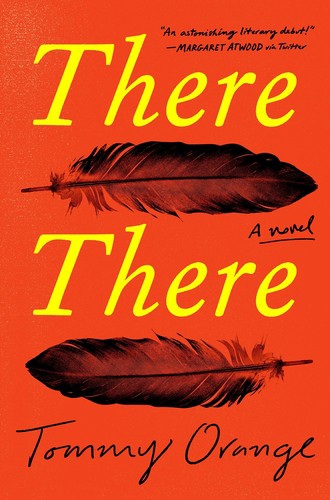
Tommy Orange is the author of There There, a novel that circles the lives of Oakland, California-based urban Indians. Tommy’s work offers varied interpretations of Native life, culture and inherited trauma, lived in and through the city. He spoke to me thoughtfully about the potential social implications of his book, so needed right now for urban Natives — living too long as ghosts in the American city.
Purchase the novel
We grew up not far from one another. I am only an hour further east, inland to Stockton, California. Our cities were post-industrial mirrors of each other, similar in class, construction, and constitution. And our lives as singular urban Natives, separated from our culture but with our culture still swimming through our blood, were submerged in the wilderness of our cities, only ever able to blend in as biracial alone; until now, as we both work to write ourselves into existence within the structures of the cities we grew up in. With work like Tommy’s novel hitting the shelves of the mainstream, priming all urban Native writers to come, we will live as ghosts no longer.
This interview took place in Santa Fe, New Mexico during the graduation residency for the Institute of American Indian Arts (IAIA), where Tommy is an alumnus and now faculty in the Creative Writing graduate department and I about to graduate with my MFA. We met in a high-end restaurant in the center of what is called The Plaza of downtown Santa Fe — an art district showcasing endless amounts of Native American art, authentic and not. It was happy hour in the restaurant and we were the only two non-white people in the place, the only Indians. We were put in a dark corner and ignored by our waitress and most of the staff, had to hunt down our waitress to finally get our check, and several attempts to flag down waiters ignored. A rush of stories ran through my head I had heard from IAIA peers and faculty about Indians being treated inhumanely in Santa Fe by the starkly white bourgeoisie, even as our art sells to these people for thousands upon thousands of dollars throughout their downtown boutiques. The irony of colonialist art appropriation practices never lost on us.
During the interview, though, Tommy and I pretended not to see the obvious — that we were the hidden Indians in the room, ignored against an all white space — so used to being treated as the ghosts we have been. Instead we focused on our work to be done, as always. We conducted our interview with much joy, conversation punctuated by laughter and our bright wide smiles, even as we sat in and spoke on the darkest parts of our historical past and present.
Marlena Gates: What is it to write about the violence and trauma of the Native in the modern sense, and how do you feel about the argument against the writing of Native life as harsh and cruel — a critique coming from inside our own Native literary community?
Tommy Orange: I’m writing to a Native audience and anybody from it knows that these are realities. I’m not making this stuff up based on nothing. It’s a grim, dark world and reality that we struggle through. I tried to have my characters transcend a lot of that stuff. They’re not bogged down by it or it doesn’t define them. I want to humanize all my characters and, sure, they experience things that are a part of our communities; but I wanted to flesh them out and have them experience joy and sadness like all humans do. One thing about Native people is that we’re turned into one dimensional people, a one dimensional thing; we’re a statistic or we’re a historical image. To make fully fleshed human characters represented in a big way, as something that gets distributed everywhere, does a lot of work to update people on what it means to be [Native], to just treat us like humans, know that we exist now, to just treat us like everybody else. We don’t get regular treatment. We are the minority of the minority. I don’t have any problems talking about the realities that we face.
MG: So making your Native representation all sunshiny bright and rainbows was not a priority?
As a reader I feel like I never read about people that I know, the people that struggle financially.
TO: Violence is such an ingrained part of our history but we’re never able to reconcile with it because people aren’t willing to admit that it was such an important piece of the conquering and the killing that has happened. We aren’t even willing to admit it, as a nation under Americans, and so there is this insidious violence. And there are other practices that aren’t direct violence that affect our lives based on policies. The thinking around us, and the erasure that’s happened, is a different kind of violence. So to represent that, as well as the real violence that happens, I liked.
MG: Then it actually humanizes the Native more to show clearly the dark side of their lived experience?
TO: I think so. That’s one of the functions of the novel — to build empathy for the reader. How do you do that? You have somebody go through an experience by having them walk in the shoes of the characters and fall in love with the characters and feel for them and you hope that that transfers somehow to real life. You hope.
MG: Tell me how you constructed your characters so real and true to life?
TO: I worked a lot with the Oakland Native population, at the Oakland Native American Health Center, but the characters were not pulled from any reality. I was not seeing people and thinking I could make a character based on them. The characters are from an imaginary Oakland. A lot of it was trying out a whole bunch of different characters, like an auditioning phase I called it, where I was just writing every day trying to write a new character, and whatever voice that felt like it would last and stick I would keep and develop those further. I created a lot of characters that I didn’t use and then after a distillation process I figured out which characters were most distinct and most essential to the narrative I wanted to write. There’s a spirit of the people of the Oakland Native community that I was channeling for every character.
MG: This book is getting so much visibility already, nationally and even internationally, with literary powerhouses such as Margaret Atwood calling it an “outstanding literary debut.” It will be read by large swaths of people and is already set to make a huge impact on the literary world as a new American genre. How is the average American reader going to benefit from understanding the plight of the urban Native in particular?
TO: My readership is for Native audiences, but you hope when you’re a writer you’re writing something that can connect to anybody. Not writing in a general way, but there’s this weird thing that the more specific you get the more universal you can be, for some reason, it doesn’t make sense but somehow it does. I think the idea of acclimating to a city environment is something that everyone has gone through. Also the way I frame environment through a Native lens has to do with understanding a way of life — to respect the “all your relations” thing. “All my relations” is a thing you hear in the Native community. It’s a way to have a relationship to your environment that gets to the cities too. It sort of counteracts this “connection to the land” Native trope, it’s a way to have connection to the land. Native people can have a connection to the city in the same way that you would any place. Like the way the sound of the freeway sounds like a river and how you can have that connection to it — a respect and love for the environment no matter where you’re at.
MG: All the urban Native characters of There There are a part of the American poor working class (PWC). In this way, through the details you map in your novel, could it then be an anchor for the PWC American to relate to the urban Native, finally, rather than continuing to see all Natives as mythic creatures in headdresses out on reservations somewhere?
TO: When you look at a lot of literature, if you do the numbers, the data, not only is it crazily white, but so much of the narratives have been upper middle class. As a reader I feel like I never read about people that I know, the people that struggle financially. A lot of the problems have been rich white people problems, and so getting the PWC onto the page was a big deal to me because I just didn’t see it. There was a gap. People do it more now, because there is a transformation happening in literature where representation is getting better. But for a long time you don’t get that many stories about people struggling. You got a lot of white privilege dramas about divorce in New York, or a college campus story.
Native people are turned into one-dimensional people, a one-dimensional thing; we’re a statistic or we’re a historical image.
MG: Can the urban Native genre as a whole help to transcend racial divides on the level of the poor, by creating a picture of the modern Native struggle in a real way, where Natives are right there alongside the PWC?
TO: I would hope so for sure. That’s an empathy connection building possibility. When you read about another culture, or another group of people who have another experience than you, but you can see yourself reflected in them anyway, it does a lot of work on your soul, on your brain. I’m a believer in the power of what books can do and what they’ve done for me.
MG: I can think of so many, but to you, what aspects of the book specifically break into that structural empathy building?
TO: Opal’s mother’s experience of domestic violence, the eviction notices they would pretend they didn’t see, riding the bus, everyone takes the bus. When you read a lot of novels people are driving everywhere, people are taking planes. When you go to an airport there’s a certain class of people at airports; poor people don’t fly. So I think a lot of the little details throughout the book connects people because I chose to have my characters living in this particular class.
MG: In many ways the Native American in general, living in America, surviving under so long a history of policies bent on destroying our bodies and cultures, is a walking contradiction just for existing. On the contradictions of the lived experience of the Native in America, outlined well in many moments across the stories in your book, in some ways are these cultural contradictions felt in the body of the urban Indian more than that of the reservation Indian?
TO: Yes. Reservation people will ask you where you’re from and if you say Oakland they will say “No, where are your people from?” even when some people go generations back in Oakland.
This goes back to the environment thing — what is your environment and what is your home and where do you belong? When you can make Oakland your home. Reservations aren’t home. That’s where we got moved to, shitty land. We got moved there because they thought it was shitty land, and then they found oil and they did more shitty things. So this idea of how to exist somewhere and feel like you belong and feel like it’s home is a contradiction because we feel misplaced.
A lot of Native families came on [the Indian Relocation Act], which had insidious reasons. But not everyone came because they got fooled. Some people were like, “I don’t want to live on the reservation, I want to live a new kind of life.” So I have a line in the book that says, “the city made us new and we made it ours.” It’s a contradiction to be from a people who are thought of to be historical and who live such a contemporary life, but 70 percent of Natives live in the city now.
We are thought of as historical, but 70 percent of Natives live in the city now.
So many people spend their time looking through glass, and around wires and cement, and that feels like a contradiction. You’re supposed to be Native yet you live in the city, and that’s most of us now. So it’s a contradiction we have to reckon with, and that’s part of the reason why I wanted to represent the urban Indian consciousness. Everyone has to reckon with this.
A lot of reservation Indians now live in cities, and their children probably will too. There’s not going to be some massive move back to reservations, so we have to forge a new identity that’s related to the city in a way that we bring cultural values and ways with us. We must leave behind some of this narrow-minded thinking on what it means to be Indian, because all this reservation identity based stuff didn’t exist before reservations, and what did it mean then? Reservation consciousness is an adaptation after removal, after being pushed there. Being Indian meant something totally different before reservations. So we can’t just refer back to reservations like we’ve been on reservations forever. We have to think of the new thing that we’re going to be. How are we going to remain Indian and not have to fall back on trope and tired stereotype? We have to make new ways.
Benny Bergsma didn’t like to talk about his father, but people who had loved the Automatika series as children always wanted to hear about him. If the subject came up he did not know how to back away.
What he would say was that his father did not discuss the creative process.
He would say, if pushed: “If a contract has to be notarized he won’t sign it.” He was always pushed.
He would say, if pushed further: “If there’s going to be a movie, he doesn’t want to go to the premiere.” He was always pushed further.
What it meant was that his Craigslist ad, offering thirty square feet of subprime real estate in Benny’s loft in Dumbo, had to be reposted eight weeks in a row, while Benny sifted through the hundreds, nay thousands of applicants who proved, upon investigation, to have read and loved the Automatika series in their rugrat days. So the Boy from Iowa was a shoo-in. Gil had not read the Automatika series because it was not set in New York.
There are 7 billion people on the planet. Of these, a mere 17 million have the privilege of living in the New York Greater Metropolitan Area. If you want stories about people who don’t live in New York, was his attitude, real life offers such stories in appalling abundance. And if you are one of the real lifers who happen not to be one of the 17 million, reading about New York is as close pending a change of luck, as you are going to get. Why would you read a book set anywhere else? [1]
As a non-fan Gil had no interest in Jaap Bergsma per se, but rooming with the embittered alcoholic son of the author of a cult series, this is very New York. Very unIowa.
He paid the deposit by PayPal, turned up a week later with his backpack, unloaded it on the bed and headed back to Manhattan.
It was his first day in New York! And on his very first day, when he hadn’t even unpacked, he saw Harvey Keitel eating a pancake in a diner! A diner in the Village! Needless to say he immediately entered the diner, not to intrude on Mr. Keitel, obviously, but simply to order the identical pancake.
Gil checked the listings in Time Out. He had saved up a list of films that he wanted to see for the first time in New York (Jules et Jim; Breathless; Battleship Potemkin; La Dolce Vita; Bicycle Thieves; The Leopard; all of Kurosawa, Mizoguchi, Ozu, because if there is a season you want to be able to immerse yourself in the oeuvre), holding out, somehow, in the face of often almost irresistible temptation, till the age of 22. [2] And now, by an amazing piece of luck, Jules et Jim was showing at the Tribeca!!!!!
Five hours permitted a preliminary pancake-fueled exploration of the island before box office time.
Gil had never had any desire to go to France, he had simply wanted to watch French films in New York. And when he saw Jeanne Moreau, at last, declaiming “To be or not to be,” he was glad he had waited. He was glad he had held out for something special.
He got back to the loft at ten p.m. or so. Benny was sitting crosslegged on a downtrodden sofa, morosely leafing through the Wall Street Journal.
Gil shared the glad tidings: “Dude!!!!!!!!! I saw Harvey Keitel eating pancakes!!!!!!!!!”
Benny: “Huh.”
It seemed best not to add to the man’s misery by mentioning Jules et Jim.
“Want a beer?” asked Ben.
“Sure,” said Gil. He felt slightly the worse for wear, truth be told, having been up since dawn the previous day, what with all the packing and discarding and fare-thee-welling not to mention actual traveling, not to mention the excitements of the day, but Iowans take their sociability seriously. He took a cold Sam Adams from the case in the fridge and joined Benny on the sofa. Benny lifted his beer-in-progress in downbeat cheer.
Benny, it quickly emerged, did not so much not want to talk about his father as not want to talk about anything else, the problem being, rather, that he did not like having to temper the wind to the shorn lamb.
“See, what happened is,” said Benny, “my dad read a letter from Roald Dahl to Kinglsey Amis saying write for kids, that’s where the money is. So he did, and there was, it just wasn’t enough.”
The more money there was, the more thousands of nauseatingly cute letters or, more recently, e-mails poured in from kids, kids who imagined that world peace could be achieved if we all just sat down and popped popcorn together. Or swapped knock-knock jokes. Or played ping pong. Why can’t we all just act like cute little kids?
A fifth of Jack Daniels into the day, Mr. Bergsma could not be guaranteed to ignore and discard. Dear Tommy, he would reply genially, Thank you for your interesting suggestion. I will pass the proposal on to Mr. Milosevic. Yours, J P Bergsma.
Only to get, meanwhile, in a mud- and bloodstained envelope, a heartrendingly charismatic letter from some kid whose whole family had been blown up when he was nine, a kid who had walked 500 miles through a warzone carrying only a battered copy of Automatika for comfort, a kid who had stowed away in a truck and now lived, sans papiers, on the streets of Paris, the whole couched in an uncomplaining stoicism, a nonchalant wit and erudition, which put the luckless Benny to shame. Mr. Bergsma would organize, at immense personal inconvenience and expense, a school, lawyer, bla. Doing irreparable damage to the personal fortune whose accumulation was the whole point of writing for kids in the first place.
The result being that Benny could never have music lessons, go to computer camp, go to private school, anything.
Gil could see why this might be somewhat disillusioning to fans of the series. While somewhat chilling and egotistical as such, anyway, though, it was the kind of thing he would definitely have expected of the embittered alcoholic son of the author of a cult series for kids. Very New York.
“Couldn’t he hire someone?” he asked.
Benny said that his father’s life was a ruined landscape of burned-out deals.
Gil would have been happy to crash at this point, but Benny, far from moving gracefully on, seemed to see a roommate as an economical substitute for a therapist.
Once, for instance, Benny elaborated, when Benny had just been accepted for admission at Choate, Jake Rabinowitz, a top entertainment lawyer, had negotiated a movie deal which included the right to two first-class tickets to the premiere.
Total dealbreaker.
Mr. Bergsma: “What is this. What the fuck is this.”
JR: “I got them to agree to first-class tickets to the premiere.”
Mr. Bergsma: “Look. I don’t want this. I never for this. I don’t want to clutter up my head with this crap.”
JR: “The contract does not require you to attend the premiere.”
Mr. Bergsma: “I don’t want to get into all this crap about what I want or do not want. I am trying to write a fucking book. You have now used up bargaining space, you piece of shit, you have squandered leverage, for something about which I do not give a fuck. I want this out of the fucking contract. I want a Crap. Free. Deal.”
Given that the whole issue of the premiere had been raised, given that it was not possible just to get on with the fucking book, given that it was necessary to discuss, Mr. Bergsma discussed the sort of thing he would have discussed had he chosen to discuss. But his lawyer, it evolved, would lose face if he went back to the other side with points the client actually cared about, such as fixing up a fixer-upper in Pittsburgh, rather than issues that were recognized as deal points by his industry peers.
Mr. Bergsma: “Look. I’ve managed a bar. I’ve had to fire people. I never do that without giving people a chance. What I say to people is, I didn’t fire you, you fired yourself.”
So that was that deal.
Benny cracked another beer while Gil made friendly Iowan noises to endorse the mild humor of the story.
Mr. Bergsma had hired all kinds of people — lawyers, agents, accountants, assistants, you name it — and they kept willfully firing themselves. To the point where he would explain the value of a fixer-upper in Pittsburgh from the get-go. You can get a house for as little as ten grand, he would explain. The value of it, obviously, is not simply the monetary value of whatever would otherwise have had to be paid for, the value is the amount of crap Mr. Bergsma’s mind would otherwise have had to be clogged up with at a time when he might otherwise have been writing a fucking book.
Somehow, though, instead of picking up the ball and running with it, people began pre-firing themselves. To the point where Mr. Bergsma just had to do everything himself.
Benny went on, for illustrative purposes, for another 15 deals, winding up 10 hours and 30 beers later, at eight a.m. Eastern time (seven a.m. Central), not because more, much more could not be said, but because his audience was semi-comatose. What it all explained was why Benny was forced to sublet space in his loft.
“Not that I’m not glad to have you, dude,” said Benny. “It’s just the principle of the thing.”
“Dude,” said Gil, “I’m wrecked.”
He sprawled on the bed beside the stranded backpack. Darkness claimed him.
With the wisdom of hindsight, it’s interesting that Benny had this wealth of privileged information at his disposal for 27 years, while Gil, when he went into action, had had a mere smattering for little more than a week.
In the morning, or rather late afternoon, of Gil’s second day in New York, he woke to find Benny incensed. A wall of the bathroom had this longstanding moldy seepage from the apartment upstairs. The seepage had now developed into a perceptible flow. It was the kind of thing Gil would have assumed was just normal in New York, but apparently a barrier had been crossed.
He would have liked to go back into Manhattan for pancakes, but an Iowan does not like to leave his fellow man in distress.
“Dude,” he said, “hey, look, I’ll go upstairs and see if I can fix whatever.”
Gil’s father had thought every boy should build his own treehouse; while not typical of Iowa, this is more easily achieved on a five-acre property with several 150-yearold trees than in a Manhattan apartment. Gil and his four brothers had each had a tree, and had, needless to say, engaged in cycles of competitive upgrading over the years, learning skills, as his father pointed out, that would stand them in good stead all their lives. [3] As now.
Gil had, obviously, brought his tool kit from home. He took it from the backpack and went upstairs and knocked on the door and a dude within told him to fuck off, which is so New York.
Gil talked on with the candid friendliness of the native Iowan. Presently (and he was too new in town to know how unthinkable this was) the dude opened the door a crack, leaving the chain on.
Gil talked nonjudgmentally on about the seepage escalation and his skills, such as they were, in plumbing and construction. The dude, eventually, did something even more unthinkable and let him in to see the source of the damage.
“Uh huh, uh huh,” said Gil, looking at the standing pool around the base of the toilet. “Well, I’m pretty sure I can deal with this.”
“We’re going out of our minds is all,” said the dude. ‘We’re trying to do an IPO. We spend all our time interacting with people. We don’t have interaction skills to spare, is the thing, on something like dealing with building management. And as for plumbers, forget it.”
The dude was wearing a T-shirt that looked like an archeological dig showing strata of pizza over the eons.
“See, if you decide that a user-friendly program needs an interactive paper clip to befriend a certain type of user,” he said, “it’s ultimately not a problem, because even if it does take more memory it’s just a question of getting more RAM, we’re talking a hundred bucks, max. But if you’re doing software development you can’t just upgrade the memory or processing speed of the human brain. Yet. To introduce spare capacity for dealing with morons. So there’s trade-offs. So, obviously, we thought the IPO would be a done deal a year ago, but see, if we had diverted interaction capability to dealing with plumbers we would probably have alienated investors even more.”
Gill was nodding and opening up his tool kit and turning off the water supply. The dude remembered the importance of names for human interaction and provided his, which was Dave. He outlined the initial business plan and the unexpected obstacles it had encountered.
The initial business plan had been, if we get lots of money we can free up our own time to do inconceivably brilliant things and we can also hire some other really smart people and just free them up to do inconceivably brilliant things, and we can also hire lots of people who are not that smart and pay them to do all the boring things we don’t want to do, freeing up even more of our own time for really interesting stuff. If we have enough people, we can deliver whatever we decide to do really fast [4] and it will make humongous amounts of money for people who are interested in money. [5]
This was a business plan that had worked for Dave’s older brother in 1996, but in the climate of 2007 it had needed fleshing out. Dave had drawn the short straw and been forced to make presentations, and in the midst of a presentation he had commented that actually they were now thinking it might make more sense to just rebuild from scratch using Lisp.
Bad move.
It had then been necessary to make a lot more presentations to new investors, investors who had not heard about the Lisp idea and could still be shielded from the full brilliance of the dudes. Dave had been forced to buy a suit and wear the fucker. But by this time, though Dave had made the ultimate sacrifice, it was 2008, and in the climate of 2008 the amount of aggro involved was making them wonder whether anything could be worth that amount of aggro.
“Uh huh uh huh uh huh,” said Gil, “do you have some kind of bucket or something I could use for the sources of blockage?”
“Um. A bucket?” said Dave. “Well, we maybe have some Colonel Sanders Chicken Buckets around, any good?”
“Good to go,” said Gil. A small horde of roaches poured from the pipe like the wolf on the fold, their cohorts gleaming in basic roach black. All very New York, but Dave seemed unhappy with the development.
“Hey,” said Gil. “I really need to replace this gasket anyway. I can pick up some roach stuff at the same time, no problem.”
Not because Gil was exceptionally nice or helpful or friendly, by Iowan standards, but because this was the way everyone talked where he came from. It would not have won him any Brownie points back home, but Dave was charmed, disarmed.
Gil went back into Manhattan for a late late breakfast of pancakes. Harvey Keitel wasn’t there today, but the point is, Gil was having pancakes knowing that at any moment Harvey Keitel might walk in. In some ways this was actually better than having Mr. Keitel physically on the premises. The pancakes were not, truth be told, better than his Mom’s, but his Mom, obviously, could not offer the possibility of Harvey Keitel just walking in off the street.
He bought roach stuff and a gasket at a hardware store that had probably been there since 1847. He bought a bucket, dry plaster, and a trowel. He bought an item of signage indicating that sanitary products should be disposed of in the receptacle provided, and a receptacle.
La dolce vita was on at the Angelika!!!!!!!!!!!!!!
He had some time to kill, and while killing time he passed a bookstore, just walking down the street, and in the window was a collection of essays by John Cage!!!!!!!!!!!!!! Which in future he could read over his pancakes in a place where, at any moment, Harvey Keitel might walk in.
After the film he got to talking to some dudes in the lobby, who invited him back to a party in their loft on Canal Street. In no time at all he was doing lines of cocaine with three investment bankers!!!!!!! Which was exactly why it was worth waiting to see La dolce vita in New York. At the age of 12 Gil had decided not to experiment with drugs, he wanted his first cocaine to be special, he wanted to try cocaine for the first time in New York, and it was definitely worth the wait. Because now, see, it was part of this whole experience of dressing like Bret Easton Ellis [6], seeing La dolce vita for the first time and going back to a loft to get high with three dudes from Morgan Stanley.
Gil started talking to a girl called Loopy Margaux, who said her dad had left his old job and gone to work for a hedge fund because it was less stressful.
“What was his old job?” asked Gil.
“Oh, arbitrage,” said Loopy. “What’s in the bag?”
Gil explained about the dudes upstairs and about the treehouse and such. With coke-fueled eloquence he elaborated on the sound system he had installed in his treehouse.
“Oh,” said Loopy. “You know how to install sound systems? I should introduce you to my dad. He had one installed by someone all his friends use, and it’s driving him crazy. If he took the business elsewhere word would get out and he would be ostracized. But if one of my friends came over it would be okay. Not that he wouldn’t pay you for fixing it on a friendly basis.”
“Sure,” said Gil, “no problem,” and meanwhile word percolated out that this was a man who had plumbing skills, electrical skills, construction skills and extermination skills, with none of the correlated obduracy, and in no time at all he had been offered three months’ free accommodation in a loft in TriBeCa in return for fixing stuff its owner was temporarily unable to pay to get fixed. Plus the offer of two tickets to Lohengrin in return for fixing more minor stuff another dude was temporarily unable to pay to get fixed. Plus other prepaid entertainment opportunities too numerous to mention. Such that Gil was able to ask Loopy if she would like to see Lohengrin in two days’ time and she said Yes!
It was nine a.m. Pancake time!
At two p.m., after a brief foray to the Metropolitan Museum of Art, he was back in Dumbo, back in his work jeans and a clean T-shirt, conferring upstairs with a different dude.
Dude B (Steve) said the dudes were thinking at this point they might be actually better off if they just went open source. If they went open source they would be dealing exclusively with their fellow hackers, and it would be fun.
“Uh huh uh huh,” said Gil, laying out the wherewithal of roach death.
There was friction among the dudes, because Steve was a Perl guru, whereas Dave was a total Pythonhead (not that Dave could not grok Perl or Steve Python, it was the philosophical issues underlying white space), but at least it was a relationship of mutual respect [7]. Whereas.
Recently Dave had presented the software, which had some powerful mojo under the hood, to investors. The display had yet to be finalized, it was just this black-and-white thing. But all the investors could talk about was the display.
“Uh huh uh huh,” said Gil. “Yeah, funny, display can totally eat up your time.” He tightened the gasket. “Hey, if you do another presentation maybe you could do a Gantt chart using my Gantt chart app.”
He began sweeping up roach remains.
“See, when I was a kid I had this Entenmann’s cookie empire, where in the early days I would buy a box of Entenmann’s for $1.19 and sell individual cookies for 25 cents at lunch and recess, and I kept growing my business to the point where I needed a web presence, and I had all these other irons in the fire, plus schoolwork. So I started doing Gantt charts in Excel. Which totally sucked, but I got a kick out of the Gantt charts, so I did an app, and yeah, it’s amazing how much time it took doing the display.”
The dudes checked out Gil’s Gantt chart app online and took in the cool display. They checked out Gil’s website, and the Mint analytics, similarly cool. A single brilliant idea occurred to the triumvirate.
Look. As things stand, using Dave for presentations, they are losing a minimum of one-third of their brainpower to fundraising crap. Instead of having three geniuses at work on the actual development they have two, and the work of those two is being delayed, in many cases, because they do not have stuff that Dave should have been developing.
But look. Why can’t they just coopt not just the Gantt charts and the cool display, but the creator of same? Why can’t they just make Gil a partner and have him do the presentations? The company has, at a stroke, 100% of its genius power available for serious work! It means assigning maybe 15% of the stock options to Gil, but the massive gains in productivity will add such colossal value to the end product that they will, in the long term, end up getting more. In the short term they will not have to pay him a salary.
This cool idea was also, needless to say, a hand-me-down from Dave’s older brother.
One with, you might think, little to recommend it at the worst time in history for an internet flotation.
Little to recommend it, at least, to a man with solid treehouse customization skills.
Gil, though, as it happened, though, had spent his teens fine-tuning his business plan, first just using Excel, then enhancing with a dashboard constructed in MicroCharts [8], and he had also spent countless happy hours playing around with R, an open source statistical graphics package. Then, as a senior at the University of Iowa [9], he had picked up a free academic license for Inference for R, a plug-in for Word and Excel which enables the user to insert R code and graphics directly into Word, or, as it might be, Excel. You set up your dataframe in R, you attach it to your document in Word or Excel, and hey presto! You can generate multivariate plots using Deepayan Sarkar’s Lattice package! Directly in Word! Or, as it might be, Excel! [10] Only problem was, it did not work in PowerPoint, which is, obviously, the weapon of choice for presentations. But, just before leaving home Gil had gotten an e-letter announcing an upgrade, such that Inference could now be used with PowerPoint. [11] Too late for his Entenmann’s empire.
Now, anyway, here was a chance to actually try out Inference in PowerPoint, with Lattice plots, in a legitimate business activity! And it was only his third day in New York!
On his fourth day in New York Gil went to B&H just to check the place out, because a tech store, run by Hassidic Jews, recommended by Joel Spolsky on joelonsoftware.com, it’s hard to get more quintessentially New York than that. He talked to some dudes who were studying film at NYU and had just won a prize for a short at Sundance. He went to fourteen galleries on 11th Street, four of which were having vernissages that very night. He met a transvestite who had unresolved plumbing issues. He met a woman who had nearly been electrocuted by her refrigerator and said it was preying on her mind — who knew when it would lash out again?
On his fifth day in New York Gil went to see Lohengrin at the Met with Loopy Margaux. On his sixth day he met Mr. Margaux, who said his sound system had a mind of its own, with an IQ of about 68.
“Uh huh, uh huh,” said Gil. There seemed to be no tactful way to say that he had better speakers in his treehouse. (His treehouse, admittedly, did not have a triptych by Francis Bacon, a Rauschenberg, a Jackson Pollock, and four flags by Jasper Johns.) He confined himself to the factual, making a number of recommendations which could easily be implemented with modest expenditure at B&H. He mentioned, shyly, the thing uppermost in his mind, the amazing Inference in Powerpoint presentation on which he had been working for the past four days, and Mr. Margaux, as a personal favor, looked at the prez on Gil’s laptop, and was sufficiently charmed to offer, as a further personal favor, to pass the word along to a couple of people who might be interested.
Gil walked back down the island through Central Park. He bought a New York hot dog with New York mustard and a New York pretzel. A troop of men on fixed-wheel bikes sped past. Pedestrians told them to fuck off. New York, New York, it’s a wonderful town!
On his seventh day in New York Loopy Margaux had scary news. She had decided to move to Berlin.
“Berlin?” said Gil.
Loops was 26 years old and had nothing to show for it. She was throwing her life away to keep a roof over her shoe collection. This was the gist. “Look,” said Loopy, and she took a print-out from her Marc Jacobs bag. “I can get a 1000-square-foot apartment with 13-foot ceilings and crown molding for $800 a month including bills. What have I been thinking?”
If Loopy had explained that she had just tried cannibalism, and that human flesh actually tasted better than pork, this he could have coped with, because cannibalism, this is something that you can imagine a New Yorker, not any New Yorker but some kind of New Yorker, doing. Or if she had confessed to a string of serial killings. But moving to Berlin? And the whole shoe stockpiling thing, the point is, this is a very New York thing to do. The idea that you would rather have a month’s rent in Berlin than a pair of Manolo Blahniks, well, huh.
Loops was saying she had sacrificed her goals, her dreams, everything she ever wanted to achieve, just to live in the City.
This sounded totally reasonable to Gil, who did not really care whether he ended up being a bartender, waiter, short order cook, or homeless dude living out of a shopping cart as long as he could stay in New York [12], but Loops made it sound like some kind of indictment.
Gil went back to the loft in Dumbo. Brooklyn was already starting to feel like exile. At some point he was going to have to break the bad news to Benny, namely that another dude must be found who had not read the Automatika series as a kid.
When he got in there was no sign of Benny. Instead there was a man who had the tormented, windswept look of Andrew Jackson as seen on a $20 bill.
“You must be Gil,” said the dude. “I’m Benny’s father. I had to come into town on business.”
Gil had heard so much about Mr. Bergsma (one night had not been nearly enough to exhaust Benny’s fund of aggrieved reminiscence) that he was surprised by how reasonable the dude sounded. Not a flamethrower in sight.
Gil said something polite. He wanted to try something new for his PowerPoint presentation. What if he used Hadley Wickham’s ggplot2 package? He took out the Sony Vaio and was soon deep in thought.
Mr. Bergsma came up behind him.
“What’s that?”
Gil explained the MicroCharts backstory, he explained about R and Bill Cleveland and Deepayan Sarkar and Hadley Wickham, and as he explained he did, in fact, generate a plot in Inference for R using ggplot2.
“When I was a kid my parents wouldn’t even let me touch their Smith Corona,” said Mr. Bergsma.
Gil remembered his chagrin at the belated release of Inference for R with PowerPoint interface. He could totally empathize.
“But yes, yes, yes, there is definitely a certain appeal. If they ever make the movie this kind of thing would be perfect for the Automatika machine.”
“Is there going to be a movie?” asked Gil.
“All I want is a crap-free deal,” said Mr. Bergsma. “It doesn’t seem much to ask. What is there about the concept that is hard to grasp? I’ve been sent a contract which includes clauses about the ice show and theme restaurant rights. They want me to get it notarized. I can’t just snap my fingers and conjure a notary public out of thin air.”
He extended a longfingered, largeknuckled hand and gently stroked the glossy metal. “Sparklines, though. Multivariate plots. I was trying to think of something fun for the new Automatika book. This looks like something kids would get a kick out of. I’ll just download this now, if you don’t mind. Maybe I can do some actual work for a change.” He sighed again. “Is it just me, or is there something sinister about Vista? Have you ever wondered whether the Church of Scientology might be behind it? It would explain so much.”
Gil went back to tinkering with ggplot2.
When he looked up five hours later Mr. Bergsma was at the far end of the loft, typing morosely into an antiquated IBM Thinkpad.
Gil went out to the kitchen for a cold Sam Adams. The contract was in the trash. He took it out.
He started looking through the clauses, and for sure the contract went on a long time.
On Day 8 Gil went back to the Margauxs’ to finalize work on the sound system. [13] This time he met Mrs. Margaux, who turned out to be the woman with electrocution issues. Which he was naturally also only too happy to resolve.
“Uh huh, uh huh,” said Gil, inspecting the rogue appliance, while Mrs. Margaux deplored Loopy’s new plan.
“What if she comes back with a German boy?” said Mrs. Margaux. “I don’t want to think of Hitler every time I sit down to dinner.”
“Eeeeeezy does it,” said Gil, edging the fridge gently forward.
“As if I don’t have enough on my mind. Kooky Fairweather has manoeuvred me into resigning from the Board of the Met. Lottie Rosenthal has just asked Dodie Pierpont onto the Board of the Balanchine. I can’t take much more of this.”
“Uh huh, uh huh,” said Gil. “Yep, I think I see what the problem is.” Three tiny mice slept unsuspectingly in a small nest of shredded paper towel.
Mrs. Margaux explained that meanwhile, in just the last month, eight of her closest personal friends had been coopted onto the boards of eight grant-making foundations for the arts, and she had not even been asked.
“Mmmm,” said Gil. He dropped a chamois on top of the nest and swept it nonchalantly up and into his tool kit. Though extermination, probably, awaited the rest of the family. “Well, what you could do…”
“Yes?” said Mrs. Margaux. (What could a mere Iowan know of the cutthroat world of New York philanthropy?)
“…is outflank. I don’t know if you know this, but J. P. Bergsma has this thing about wanting a fixer-upper in Pittsburgh.”
“Pittsburgh?” said Mrs. Margaux.
“I know,” said Gil. “I know. But see.”
He was about to make a simple, crap-free suggestion, to the effect that Mrs. M could end the 13-year dry spell of this much-loved author and be instrumental in facilitating a much-longed-for film, simply by organizing the unpopular Pittsburgh fixer-upper element which had been a stumbling block so many times in the past. One of his 200 newfound friends was a dude whose brother was a subcontractor in Pittsburgh, a dude facing problems because the developer he was working for had suddenly filed for bankruptcy. How hard could it be?
Fixing things on a case-by-case basis, though, is such an inelegant solution. It lacks scalability. It lacks grandeur. And it doesn’t give you data, that you can analyze. Whereas.
He said, “See, for ten, fifteen, twenty-thousand dollars you can get a house. A residency is normally for a maximum of 8 weeks. A typical grant is for $45,000, $50,000 for a year. So, say you go to these 8 entities, you offer the grant of a fixer-upper, for the people on the shortlist who didn’t make the grade. Among whom Mr. Bergsma is merely one. In return for a percentage of whatever artistic earnings they achieve over, say, 10 years. With some kind of cap? Making it, potentially, self-sustainable? Do a different city every year? Allow swaps? You then compare the achievements of your also-rans with those who got the actual award. And see, you could have a web presence, you could have something like minglebee’s Grand Prix dataviz, that lets you drill down to look at individual performance? And Mr. Margaux could potentially even devise an investment vehicle?”
The refrigerator was purring softly. Mrs. Margaux was initially skeptical, but when Gil called up www.minglebee.com, and she was able to see for herself the fun that could be had drilling down, well. Adam got so cross when people kept asking him for checks, but my goodness, this would actually be fun. Gil left her clicking on drivers in the Malaysian Motorcycle Grand Prix, 10/19/2008.
This elegant solution had the drawback of deferring, probably indefinitely, the resolution of Mr. Bergsma’s specific problem. Mr. Bergsma was saved, in this instance, by circumstances beyond his control.
The dudes who had won at Sundance, who thought funding was solid for their first feature, had suddenly found that the money had dried up because the producers wanted something guaranteed bankable and commercial. But the dudes had a soft spot for Automatika, the one commercial project they could even contemplate, unsurprisingly, really, because the kind of dude you would meet in B&H is the kind of dude who would have been that kind of kid as a kid. And, another of Gil’s 200 newfound friends was an entertainment lawyer with extermination issues. So, though it was not really in the spirit of rigorous experiment design, Gil pushed ahead.
Within a day it was the donest of deals. The lawyer’s extermination issues had been resolved; a crap-free two-pager, with an unconventional real estate clause, had been sent to Gil as a PDF attachment. The subcontractor had agreed to organize purchase and fixing-up of a fixer-upper in Pittsburgh, within walking distance of Carnegie-Mellon, subject to bank appeasement. One of the NYU dudes had lowered himself to make contact with his contact at Fox. Fox wanted in. And Mr. Bergsma, presented with the deal, had assigned the rights, minus the costs of the Pittsburgh fixer-upper, to Benny.
Mrs. Margaux, meanwhile, brought pressure to bear on Mr. Margaux; within a week she was able to go to her “friends” with an offer they could not, in all decency, refuse, using the new vocabulary item “drilling down” to killing effect.
Time passes.
The Dumbo dudes achieve a successful flotation and do, in fact, do something so inconceivably brilliant that their investors are happier than they could reasonably have expected. Thanks to the Iowan Investor Interface the dudes are spared actual personal contact with said investors, so they too are happier than they could reasonably have expected.
Mr. Bergsma moves to Pittsburgh and immerses himself in his Automatika world. Fifty creative types move to Pittsburgh and comprehensively outperform the types who pipped them to the post in their initial grant applications. The subcontractor realigns his construction business. Automatika the movie succeeds beyond the wildest dreams of the NYU dudes, such that they can select their projects. Loopy Margaux packs the bare essentials (five suitcases of shoes) and goes to Berlin to pursue her dream. Mr. Margaux has fun. While the actual money involved is peanuts, his genius for applying financial acumen to support of the arts and urban renewal is noticed at the White House. Mrs. Margaux is the envy of her friends.
Benny gets $500,000.
Benny got what he always said he wanted, the freedom to do what he wanted. He’s not as happy as he might have expected.
Mr. Bergsma had been talking for years about the kind of deal he was looking for, and Benny, Lord knows, had the inside track. So what was to stop Benny from pulling a CFD out of a hat? What was to stop Benny from finagling the fixer-upper? What was to stop Benny from expanding the Pittsburgh idea, to the point where Mr. Bergsma looked like a visionary instead of a crank? Meanwhile some kid just walks in the door, a kid who has never even read the books, and hands him the CFD on a plate. The son he never had.
Benny hates talking to people about his father.
Gil, needless to say, moves into Manhattan, where he lives to this day.
[1] Except, obviously, to avoid looking totally uneducated when you actually get to New York. Kafka, Borges, Proust — these you should read. Return to text
[2] There was a second list of films which he had had to downgrade to “Okay to watch in Iowa,” because he did not want to come to New York and look completely uneducated, but he had never felt good about it. He had mental conversations with an interlocutor who said “Wild Strawberries? Are you telling me Wild Strawberries doesn’t deserve first-time-viewing-in-New-York? Are you serious?” to which Gil would mentally reply that it was not a question of the artistic merit of the film, on which, as someone who hadn’t even seen it, he was unable to comment, but a question of what felt right for the viewing experience. That was the mental reply, but he felt bad about relegating Bob le Flambeur, The Crow, La Ronde, Wings of Desire, La Strada, 8 1/2, Solaris, plus much of Hitchcock, much of Mamet, all of Tarantino and others too numerous to mention. to the Iowa League. He wished he had grown up in New York, so these invidious choices would not have been forced on him, but what was he to do? The third list of films, obviously, was the list of films set in New York. But we digress. Return to text
[3] If you have never thought of a tree house as requiring plumbing and electricity, it’s probably because you have never seen tree house-construction as a competitive sport. You don’t come from a family of boys, is the inference. Return to text
[4] Dave and his partners had unhappily failed to read Frederick P. Brooks’ The Mythical Man-Month. If this business plan sounds remotely plausible to you, you may want to read F. P. Brooks’ classic work before proceeding. Return to text
[5] Dave was, obviously, not explaining the details of the actual project to Gil, because explaining the project to clueless morons who know nothing whatsoever about programming was what he did, these days, for a living. No way was he going to squander what few vestiges of patience remained on a mere randomly presented plumber. We’re talking nonrenewable resource here. Return to text
[6] Gil was wearing a slate gray shirt and slatier gray jacket that he had bought on eBay as looking like an ensemble seen in an author photo of Bret Easton Ellis, when in New York dress like Bret Easton Ellis being the thought; he attributed his ease in blending in, among real New Yorkers, to the infallible dress sense of Mr. Ellis. Return to text
[7] Dude C, Gary, was the dude who had wanted to go back to first principles and use Lisp. Return to text
[8] MicroCharts is a plug-in for Excel which enables the user to replicate the sparklines of infoviz guru Edward Tufte, emeritus professor of graphic design, politics and economics at Yale. ET’s pioneering Visual Presentation of Quantitative Information and its successors have never been reviewed in the Wall Street Journal, the Financial Times or the Economist; a sparkline, assuming you innocently placed your trust in the WSJ, FT or Economist to keep you au fait, is a small information-dense word-shaped graphic, enabling you to embed, as it might be, a time series or bar chart in text. MicroCharts, like its rival, Sparkmaker from Bissantz, runs only in Windows; Gil was a total Machead at heart, so he totally resented having to buy a whole separate laptop on eBay with Windows XP, after spending hours trying, to no avail, to get the fucker to work in Parallels or Crossover. Return to text
[9] The appeal of the University of Iowa to an Iowan father of five is pretty much self-explanatory. Return to text
[10] While R could be run in a Mac environment, Inference worked only in Windows, meaning that Gil spent further countless hours trying to get the fucker to work in Parallels or Crossover, finally retreating, bloody but unbowed, to his trusty Sony Vaio. Return to text
[11] Having read ET’s “The Cognitive Style of PowerPoint,” Gil knew that his god saw PowerPoint as the work of the devil, so he did not feel good about wanting to use it. The Columbia Accident Investigation Board had concluded: “As information gets passed up an organizational hierarchy, from people who do analysis to mid-level managers to high-level leadership, key explanations and supporting information are filtered out…it is easy to understand how a senior manager might read this PowerPoint slide and not realize that it addresses a life-threatening situation.” Hard to feel good about colluding. But if you are addressing the business community people expect a PowerPoint presentation. But, if you could do a PowerPoint presentation drawing on the Trellis plots of Bill Cleveland of Bell Labs (from which the Lattice package derives), the presentation would be data-rich and it would be totally okay. Return to text
[12] Did Giuliani realize that being President would involve moving to Washington? For four years? Was the question Gil had naturally asked himself when the nomination was up for grabs. Or, was it just part of a deeplaid plan to move the nation’s capital back to New York, where it belonged? Return to text
[13] He was not able to go back on Day 7, which was Saturday, because B&H is closed on Shabbat. Return to text
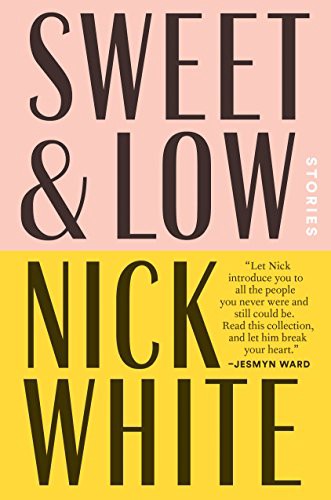
A s Nick White says in our interview, “This is the summer of the short story.” And his first collection, Sweet and Low,certainly deserves inclusion on any list of the summer’s best short story collections. The stories contained in Sweet and Low are brilliantly constructed, with each offering genuinely affecting moments. While reading White’s stories, I can’t help but feel as if I am reading a new master of the Southern gothic — one reminiscent of William Faulkner or Flannery O’Connor.
Sweet and Low centers around the lives of Southerners who are simultaneously grappling with their futures and dealing with ghosts of their pasts. White dives into issues of the South, while also exploring the complexities of masculinity. Fans of White’s debut novel, How to Survive a Summer, about a young man who is sent away to a gay-to-straight conversion camp, will find plenty to love in Sweet and Low.
I talked to Nick about the feeling of placelessness that comes from being a queer Southerner in exile, challenging the status quo of masculinity, and his recommendations on forthcoming short story collections.
Bradley Sides: How to Survive a Summer and the stories that make up Sweet and Low take place in and around the American South. I know you are from Mississippi. As a Southerner myself, I see the South as a complicated place. It’s rich with beauty, but it’s also broken in many ways. I’m curious what your relationship is like with the South.
Nick White: Yes, I too worry over my relationship with the South. Am I doing enough to capture its complexity? Am I relying too much on old tropes of past works of Southern literature? Does my voice even matter? These questions haunt me.
I lived in Mississippi for the first twenty-four years of my life, and I couldn’t wait to leave. And even though I have lived in the Midwest for almost a decade, I still have terrible bouts of homesickness. Only when I moved away did I realize, as one is wont to do, what I was leaving behind. I love living in the woods, far from everything, and I love small towns and little communities, even the toxic ones have their own kind of beauty — a wicked beauty, but a fascinating one nonetheless.
When I came out, I thought these spaces would be forever closed off to me. I don’t know if this was a notion I had learned from popular culture, or inferred from my own experience growing up there — maybe a little of both.
Right now, despite the current political climate, despite everything, I am made hopeful by some progress in my home state. Professor Jaime Harker from the University of Mississippi (along with her partner Dixie Grimes) just opened the first feminist queer bookstore in Water Valley, MS, and I am heartened by the existence of such a place in the Deep South. (Incidentally, I hope to visit the bookstore when I go down to read in Mississippi in June.)
Another highlight of queer life in Mississippi: this past March in Starkville, the queer students of Mississippi State University challenged the board of alderman’s decision to reject their request to have a pride parade in the city and eventually won the day. I gave a reading at the university on the Thursday before their big weekend of festivities, and the two students who led the charge came to my reading and presented me with a gift bag, which included a rainbow-colored Starkville Pride bracelet that I am still wearing. After the reading, they invited me to the Student Union where they were having a viewing party of the latest episode of RuPaul’s Drag Race. I don’t mean to get sentimental here — but, screw it: when I walked in and saw all these queer kids laughing and shouting and taking up space, I could barely keep it together. When I was a college student not that long ago, such an event like this was almost unthinkable. I may have wept a little, but it was dim in there, so I don’t think anybody noticed — the kids were too busy talking back to the queens on TV to worry about this weepy older guy who’d come tottering in. I didn’t know any of them, and they didn’t know me, but it was the first time, in a long time, that I have been home and felt, truly, at home.
Queer folk in Mississippi are doing some amazing work. They are braver than I was when I lived there. They have become, in many ways, my guiding light. I look to them and am encouraged to keep writing my own queer letter to the world.
BS: William Faulkner is, of course, one of the South’s most beloved writers of short stories and of novels. Your story “The Curator” holds Faulkner near its core. Has his legacy shaped your writing?
NW: Perhaps every writer from the South, certainly every writer from Mississippi, has to contend in some way with that haunting ending of Absalom, Absalom!: “‘I don’t hate it,’ Quentin said, quickly, at once, immediately; “I don’t hate it,” he said. I don’t hate it he thought, panting in the cold air, the iron New England dark: I dont. I dont! I dont hate it! I dont hate it!”
Whether I want to be or not, I am in conversation with these ideas of place and feelings of placelessness that come from being a queer Southerner in exile.
NW: “The Bear” — that long novella in his book Go Down, Moses. I grew up in a family of hunters and never understood how folks enjoyed such brutal work. Faulkner explores both the brutality and the romance of the hunt and how these are inextricably bound up with the protagonist Isaac McCaslin’s identity of himself as a “man.” Also, the sentences…my lord, they are fabulous. I think there is one in section four that clocks in at around 1600 words.
BS: The characters throughout your work, and especially the young men, seem to struggle with accepting a kind of rugged masculinity that society seems to want them to embrace. Why do you think it’s so difficult for society to welcome a new brand of gentler masculinity?
NW: Fear. When the status quo is challenged, people freak out.
At first, I did so by merely existing: I have always been a sissy. I knew I was a sissy long before I knew I was gay. My voice has always been too high, my mannerisms too femme, my obsessions with Lisa Frank and nighttime soaps too girly or camp. I was tortured for it at school. Ostracized, spit on, teased — my experience with this kind of hate is nothing new for those of us who are different, and it taught me to lie, to deny myself, lest anyone suspect I might be gay, when, of course, I probably fooled no one.
It feels so good to have to have reached a point in my life (thanks to therapy) where I know, at least, this much is true: what a gift my queerness is. I treasure being gay. But I do still understand the fear that comes from dancing outside the strict bounds of masculinity that was foisted upon me since infancy. I think exploring this fear and this uncertainty is what drove me to write much of what became Sweet and Low.
Whether I want to be or not, I am in conversation with these ideas of place and feelings of placelessness that come from being a queer Southerner in exile.
BS: One of my favorite stories in Sweet and Low is the first one, “The Lovers.” Here, we find a widow and a lover uncovering secrets about a man they both loved. It’s a beautiful and moving story. I was especially drawn to a line that begins the final section of the story: “How well can you know a person?” It’s a haunting thought, especially in the context of the situation in the story, which I won’t spoil. What do you think is the answer to the question you present?
NW: I think about this question a lot. My answer wavers, depending on current mood and the amount of alcohol in my bloodstream. I am multitudes, Granddaddy Whitman says. And I am never exactly the same person at any given point in time. There is a version of myself that I become for my students, and a version of myself for my boyfriend, and a version of myself here and now in this interview. All of them are slightly different, but all are authentically me.
I think we can usually only ever know versions of each other. Maybe that is a good thing. Another question I think my characters should probably ask is “How well can you know yourself?” The answer to this one is perhaps too frightening to consider, so I won’t.
BS: You populate Sweet and Low with such dynamic characters. Many of them are mostly good people who make mistakes. There are a few, however, who are bad dudes. What’s your take on writing unlikeable characters? Are they necessary?
NW: I don’t know that I have ever thought of a character in terms of whether or not I like them. Are they interesting? Do I want to know more about them? How did they get this way? What do they want? These questions usually clog up my brain when I am drafting.
In the early stages of writing, I always struggle to figure out the people in my fiction. When I am working with a character that readers might label a “villain,” I try to remember that the character doesn’t think of herself as a bad person, that she believes she is doing what is necessary to get what she wants. She is the heroine of her own story, even if she is causing a lot of havoc in mine. When our characters do awful things, I think we as artists have to do the work to understand the stories they are telling themselves, their motivations, even if not one bit of that information ever makes it to the page.
Wouldn’t it be kind of boring if we only had likeable characters in our fiction? Don’t we sort of love to see characters behaving badly? Would we have watched Dynasty if there had been no Alexis Carrington, or Melrose Place if there had been no Amanda Woodward? I think not. Try watching the early seasons of those shows without these women. Minus the shoulder pads and big hair, it’s a total snooze fest.
I treasure being gay. But I do still understand the fear that comes from dancing outside the strict bounds of masculinity that was foisted upon me since infancy. Exploring this fear and this uncertainty is what drove me to write ‘Sweet and Low’.
BS: I’m always interested in the genesis of characters. As I was reading, I couldn’t shake Pete from “Cottonmouth, Trapjaw, Water Moccasin” or Forney Culpepper from the linked stories in the second part of your collection.
Pete is hurt by abuse he experienced as a child, but he also does a lot of hurting. He beats his own son, causing him to leave home. At one point, you write, “Pete hoped to instill some meanness into the boy, one stroke after another.” Forney Culpepper, who appears in multiple stories — as a young boy and, eventually, as an adult — has his own troubles. He has a difficult youth, and he does some terrible things later.
What was the inspiration behind these two complex — and complicated — characters?
NW: These men are dealing with legacies of violence and neglect that they have inherited from their forebears. I’ve known men like this my whole life. I am related to men like this, lived next-door to men like this, went to school with men like this — they’ve terrorized and cajoled me. They’ve lured me into their ranks and expelled me once they found me wanting. They try and fail to make sense of their anger and loneliness, as do I.
NW: This is the summer of the short story, and, honey, I am thrilled. First, folks should read, if they haven’t already, Brinkley’s A Lucky Man and Thompson-Spires’s Heads of the Colored People — they are truly wonderful books, and I will be teaching from both of them next year in my workshops. Curtis Sittenfeld’s You Think It, I’ll Say It left me gagging as well. After finishing her story “The Prairie Wife,” I felt faint and heartsick and maybe a little broken — there is a sort twist at the end, which I won’t spoil, but is, to my mind, a masterstroke. Goddamn, what a book.
In addition to those, I am excited to share my book’s birthday with Lauren Groff’s highly anticipated collection Florida. Line by line, her stories marvel. Readers should check out the second story in that collection, “At the Round Earth’s Imagined Corners,” which is my personal favorite. It takes place over the whole lifespan of a single character, and I’ve read the story several times now and still don’t quite understand how she pulls it all off. I’ve come to the conclusion that the story must be made of magic. Anyhow, the whole book soars. A mentor of mine, Lee Martin has a new collection, The Mutual UFO Network, coming out on June 12 — he is a master of the craft, and no one understands humans more fully and more compassionately than he does. In July, Alexia Arthurs’s How to Love a Jamaican will debut, and I am here for this book, too. I read “Mermaid River” in The Sewanee Review and was blown away by her writing — the story’s ending just destroyed me. In August, I want to check out Catherine Lacey’s Certain American States. I loved her novel, The Answers, and will happily read more words from her. Also in August, Kevin Wilson’s Baby, You’re Gonna Be Mine promises to delight. His work is often both funny and bizarre, and his short fiction, in particular, is like no other. While it doesn’t come out until October, I want to add the 2018 Best American Short Stories anthology, edited this yearby Roxane Gay, because I am sure she has chosen work that will light the world on fire.
I could go on, for the summer is full of wonders: Bryan Hurt’s Everybody Wants to be Ambassador to France, Neel Patel’s If You See Me, Don’t Say Hi, Amy Bonnaffons’d The Wrong Heaven, Victoria Patterson’s The Secret Habit of Sorrow. Basically, you need to go to your local library now and put your name on reserve to read these folks’ books. No list is complete and I am sure there are many more collections I haven’t named that should be added here. Many of our best writers are doing wonderful, strange, interesting things with the short story right now: we are all so damn lucky to be able to read them very soon.
“GROUND CONTROL TO MAJOR TOM / Your circuit’s dead, there’s something wrong.” Those must have been startling words to hear in a song being broadcast during the BBC’s coverage of the Apollo moon landing. Pink Floyd’s “Moonhead” wasn’t exactly cheery and upbeat, but at least it was instrumental, leaving the song open to the interpretation of the listener. With David Bowie’s “Space Oddity,” though, the lyrics spelled out everything, leaving no room for doubt: An astronaut named Major Tom has gone into space, only to become stranded due to an equipment malfunction. Trapped in that vacuum, he’s “sitting in a tin can,” drifting “far above the world,” imploring Ground Control to “tell my wife I love her very much, she knows.”
“Space Oddity” was released as a single on July 11, 1969, five days before the Apollo 11 launch, and nine days before Neil Armstrong became the first man on the Moon. Bowie hadn’t intended the release to coincide that way; he’d recorded a demo of the song in January of that year, and the song’s pun of a title couldn’t have made it more clear that his main inspiration was all those nights in the cinema spent rewatching 2001: A Space Odyssey. But Bowie’s record label rushed the release of “Space Oddity” so that it might capitalize on the Apollo craze.
The tactic only partially worked. “Space Oddity” was miraculously broadcast during the BBC’s Apollo coverage despite it’s chilling conclusion, which couldn’t have been further from the typical cheerleading of the astronauts that was being conducted by the media. No one was more surprised than Bowie. “It was picked up by the British television and used as the background music for the landing itself. I’m sure they really weren’t listening to the lyrics at all,” he said. “It wasn’t a pleasant thing to juxtapose against a moon landing. Of course, I was overjoyed that they did. Obviously, some BBC official said, ‘Oh, right then, that space song, Major Tom, blah blah blah, that’ll be great.’ ‘Um, but he gets stranded in space, sir.’ Nobody had the heart to tell the producer that.”
Even musically, “Space Oddity” was melancholy. It was an odd mix of folk rock and cutting-edge electronics — including the Stylophone, a stylus-operated keyboard, and a more complicated sampling keyboard called the Mellotron. The former was played by Bowie himself, while the latter was played by a promising twenty-year-old named Rick Wakeman, who had only been in a recording studio once before. On one hand, the narrative of Major Tom and his calamity in space read like a straightforward adventure story out of one of Bowie’s treasured pulp magazines. On the other hand, the song’s complex arrangement, epic effects, and orchestral impact hinted at the boundlessness of space as well as the murky depths of the human consciousness — two vast reservoirs of darkness.
In a short film for “Space Oddity” made in 1969 for Love Me Till Tuesday — a promotional movie that wasn’t released until 1984 — Bowie’s face is cold, serene, composed. It might as well be made of plastic, the artificial flesh of some futuristic android. He’s wearing a silver spacesuit. Unlike the bulky spacesuits in the widely publicized photos of the ongoing Apollo space missions, however, this astronaut is clad in sleek, formfitting chrome, so as to enhance rather than obscure his lithe physique. With robotic precision, he dons a blue-visored helmet. There’s an air of extravagant vanity to this particular space explorer, as well as one of aloofness. His helmet secure, he steps outside his space capsule. He floats. The void beckons, threatening to swallow our hero. He is not humble. His name is no secret. It’s emblazoned on the front of his spacesuit in capital letters: MAJOR TOM.
There are no aliens in “Space Oddity” — those beings would factor greatly in some of Bowie’s best-known work to come — but a devastating metaphysical awe underpins the song. Faced with the vastness of the cosmos, Major Tom laments in newfound futility, “Planet Earth is blue / And there’s nothing I can do.” That ennui, bordering on paralysis, humanized astronauts in a way that NASA’s promotional sloganeering failed to do. “At the end of the song, Major Tom is completely emotionless and expresses no view at all about where he’s at,” Bowie said. “He’s fragmenting . . . At the end of the song his mind is completely blown — he’s everything then.” The influence of 2001 looms over “Space Oddity.” “I related to the sense of isolation,” Bowie said of the film, which had a “seismic impact” on him, “particularly the final, climactic images of the monolith doomed to float eternally in space.”
While Bowie never denied the obvious connection between his “Space Oddity” and Kubrick’s A Space Odyssey, other works may very well have exerted a gravitational pull on the song. The theme of astronauts lost in space was the premise behind 1953’s “The Quatermass Experiment,” the first serial in the Quatermass series that the young Bowie watched in a state of exhilarating fear from behind his parents’ sofa. A more immediate influence may have been “Beach Head,” an episode of the BBC anthology series Out of the Unknown, which aired on January 28, 1969, the same month Bowie worked on his early demo of “Space Oddity.” Based on the 1951 sci-fi short story “You’ll Never Go Home Again” by Clifford D. Simak, it’s a bleak rejoinder to the more heroic, optimistic portrayal of space exploration offered by Star Trek, which was fated to go off the air in June of 1969 due to low ratings. In “Beach Head,” an astronaut faced with the mortal terror of the unknown universe suffers a gradual breakdown — one not entirely unlike Major Tom’s slow descent into numb oblivion. There’s also Ray Bradbury’s famous short story “Kaleidoscope.” Published in 1951 as part of the collection The Illustrated Man — whose framing device, a modern-day fantasy involving a man whose full-body tattoos come alive, was clearly borrowed by Bowie for his 1967 song “Karma Man” — “Kaleidoscope” is the horrific account of the crew of a spaceship who are left adrift in their spacesuits after an accident in orbit. Major Tom would have felt right at home.
“Kaleidoscope” is the horrific account of the crew of a spaceship who are left adrift in their spacesuits after an accident in orbit. Major Tom would have felt right at home.
Many people, the producers of the BBC evidently included, assumed that since “Space Oddity” was about an astronaut, it must be a positive depiction. Bowie offered no such illusion. “The publicity image of a spaceman at work is of an automaton rather than a human being,” he said, “and my Major Tom is nothing if not a human being. [‘Space Oddity’] came from a feeling of sadness about this aspect of the space thing. It has been dehumanized, so I wrote a song-farce about it, to try and relate science and human emotion. I suppose it’s an antidote to space fever, really.” Eventually, though, the BBC caught on. After “Space Oddity” was broadcast on July 20, the song wasn’t played on BBC radio until after the safe return of the Apollo 11 crew. With astronauts risking their lives on the most dangerous new frontier imaginable, “Space Oddity” was temporarily considered too controversial for airplay. The single didn’t hit the charts until six weeks after its release. It took until November to peak at number five in the UK, thanks largely to an appearance on the popular BBC program Top of the Pops that featured Bowie miming the song and playing the Stylophone, interspersed with NASA space footage. In the States, “Space Oddity” flopped. Ahead of its time, it wouldn’t find a permanent place in the American psyche until the ’70s.
“I want it to be the first anthem of the Moon,” Bowie said of “Space Oddity.” It wasn’t an easy process, but eventually “Space Oddity” proved to be Bowie’s pivot from pop hopeful to bona fide star, and it remains the most immediately identifiable sci-fi song in rock history. It also marked a bigger pivot for popular culture as a whole. The hippies promoted a bucolic, back-to-the-land, borderline technophobic way of life, often framed in images of the zodiac and cosmic mysticism; meanwhile, military men in crew cuts were planting American flags on alien soil. As noted by sociologist Philip Ennis, “It is probably not hyperbole to assert that the Age of Aquarius ended when man walked on the Moon. Not only was the counterculture’s infatuation with astrology given a strong, television-validated antidote of applied astronomy, but millions of kids who had not signed up for either belief system were totally convinced.” The social critic Camille Paglia said, “As [Bowie’s] psychedelic astronaut, Major Tom, floats helplessly into outer space, we sense that the ’60s counterculture has transmuted into a hopelessness about political reform,” citing the lyrics “Planet Earth is blue / And there’s nothing I can do.”
Eventually “Space Oddity” proved to be Bowie’s pivot from pop hopeful to bona fide star, and it remains the most immediately identifiable sci-fi song in rock history.
An even less rosy assessment of “Space Oddity” came from The Observer in 1969, whose music critic Tony Palmer wrote that the song was a welcome breath of cynicism “at a time when we cling pathetically to every moonman’s dribbling joke, when we admire unquestioningly the so-called achievement of our helmeted heroes without wondering why they are there at all.” Ironically, Palmer would go on to produce 1979’s The Space Movie — a documentary celebrating the tenth anniversary of Apollo 11 — at the request of NASA.
Anthem or requiem? Celebration or deconstruction? “Space Oddity” was all these things. According to journalist Chris O’Leary, “Bowie once said he considered the fate of Major Tom to be the technocratic American mind coming face-to-face with the unknown and blanking out. His song was a moonshot-year prophecy that we would lose our nerve and sink back into the old world, that we aren’t built for transcendence, that the sky is the limit.” At the same time, it was embraced as the defining song of the Space Age — one full of beauty, horror, awe, and imagination, and a rethinking of our position in the universe, all the feelings that the best of sci-fi meant to elicit.
It was embraced as the defining song of the Space Age — one full of beauty, horror, awe, and imagination, and a rethinking of our position in the universe, all the feelings that the best of sci-fi meant to elicit.
With “Space Oddity,” Bowie set himself up for even greater sci-fi statements to come. But he had one more to deliver before the ’60s were through. Recorded in August and September of 1969, right after the moon landing, and released in November, just as “Space Oddity” was peaking on the British charts, “Cygnet Committee” was his most ambitious song to date. Clocking in at almost ten minutes, it’s a melodramatic, melodically meandering song steeped in a profound sadness and disappointment in failed idealism. Years from now, a utopia has collapsed, betrayed by its own ostensibly compassionate ideology. “A love machine lumbers through desolation rows,” he sings, “Plowing down man, woman, listening to its command / But not hearing anymore.” If “Space Oddity” cryptically augured the demise of the hippie era, “Cygnet Committee” made that point more brutally, encasing it in the blunt messaging of dystopian fiction. The future was barreling down on Bowie — and like the heroes of Starman Jones and the other sci-fi novels of his youth, he was either going to conquer or be conquered by it.
The ward is dark, but not really. There are lights on machines, dim lights in the nurses’ station, a blue glow from ceiling-mounted TV screens. Every twenty seconds a beep shrills. My daughter is sleeping, but I can’t, the fold-down vinyl armchair and thin blanket not shield enough against the cold blast from the grill by the window, not to mention the asthmatic two-year-old on the other side of the curtain and her tattooed father who prides himself on having stayed at her side for three days straight. I edge my way around my child’s bed, past the pulled curtains enclosing the father and daughter, and head into the hall for another stunted weep in the family washroom, where the cleaning crew that empties the garbage once a day has not yet come. The can overflows with cookie wrappers, toothpaste boxes, and untold wads of one-ply tissue.
I can’t keep the specialties straight: nephrology, cardiology, hematology, rheumatology, infectious diseases, oncology. This last unleashes the tears, my mind scuttling to the place where words won’t come. I splash cold water from the metal sink onto my face, careful not to touch the foam-clotted toothbrush some parent has left near the tap. I blot my skin with abrasive paper towels. I brush at a stain on my leggings, adjust my bra strap, lift then drop my mat of long hair, and launch back into the hall, hoping my daughter hasn’t woken up. When I near her room, a doctor emerges.
“She has fluid in her lungs and around her heart,” she says, “We have to prepare for the worst.”
The next day, doctors diagnose my daughter with the treatable autoimmune condition lupus. Yet I have already descended irrevocably into the territory of her death. Even now, months after those desperate autumn weeks — she is healing; she has remission in her sights — her loss grips me tight.
During my daughter’s hospitalization, I remember Lorrie Moore’s story, “People Like That Are The Only People Here” — the narrator’s bright, angry tone, her condemnation of doctors and indignation at her baby’s cancer diagnosis:
You turn just slightly and there it is: the death of your child. It is part symbol, part devil, and in your blind spot all along, until, if you are unlucky, it is completely upon you. Then it is a fierce little country abducting you; it holds you squarely inside itself like a cellar room — the best boundaries of it. Are there windows? Sometimes aren’t there windows?
Moore accurately captures the dark, frantic humor that springs from bleak rage in the face of a child’s demise. I take comfort in knowing that she based the story on her experiences with her son, and that her son survived.
During the earliest days of hospitalization, through the bleakest uncertainty and the first hopeful wave of treatment, I wrote a story for a magazine. The story’s optimism fills me now with shame, largely because of how it skates over truths. The story spins a light, woman-against-the-elements tale out of an El Salvador surfing excursion my husband and I took in the time before parenthood. Doctors admitted my daughter to the hospital eleven days before our scheduled wedding date. Nine days later, she collapsed and entered pediatric intensive care. The magazine rejected the story. We postponed the wedding. I haven’t looked at the story since.
Doctors admitted my daughter to the hospital eleven days before our scheduled wedding date. Nine days later, she collapsed and entered pediatric intensive care.
Yet in those September days before my daughter entered PICU — the air balmy, infused with pink-gold light, the leaves turning rosy — I wrote, curled up in an armchair squeezed between the hospital bed and the window overlooking the emergency entrance of the children’s hospital. Between visits from doctors, nurses and child life workers, food deliveries, bloodwork and ultrasounds, I kept pace with my wedding plans, with extensive help from family and friends. And I beavered away at the story.
We had spent that summer in search of an answer to our daughter’s fatigue and joint pain, in and out of Emergency. Yet we camped, went to cottages and weddings. My daughter attended theatre camp and played baseball. We hypothesized, considered depression, a reaction to medication, growing pains and imminent menstruation; we lined up specialist appointments. She was nine.
While my husband worked long days, her sister and I molded our lives around her fatigue, spending our days close to home while she lay on the couch as if in a stupor or sat outside on a patio chair. One afternoon, I fought with her about swimming at the outdoor pool a ten-minute walk from home. She’d woken up from a three-hour nap and refused to get out of bed.
“You promised,” I said, the more childish of the two of us.
“I can’t do it!” she screamed.
I believed her about her fatigue but found it hard to accept how much her illness was affecting our lives and how helpless I felt. Allowing that she might have a serious illness meant acknowledging the possibility that she might die. I resisted entering that territory as long as I could.
Having walked with my daughter right up to the brink, canceling our wedding only 48 hours before it was scheduled, I flog myself with complaints: we could have canceled sooner. I could have devoted myself earlier to my daughter’s care, when the first signs of slowing down and pain appeared. In “People Like That are the Only People Here,” the Mother faces her own moments of self-blame, thinking that her son’s illness is a punishment for her motherly transgressions: “Now her baby, for all these reasons — lack of motherly gratitude, motherly judgment, motherly proportion — will be taken away.” As I castigate myself, I find comfort in stories in which other parents consider their own failings in this light.
Allowing that she might have a serious illness meant acknowledging the possibility that she might die. I resisted entering that territory as long as I could.
The Abraham Lincoln character in George Saunders’ Lincoln in the Bardo is such a parent. Saunders focuses on the time leading up to and following the death of Lincoln’s eleven-year-old son Willie, likely from typhoid fever. Over one hundred voices clamor to tell the story. Many are unwilling ghosts; others are historical accounts of Lincoln, real and invented. These snippets surround the evening of a party the Lincolns hold while their son suffers upstairs on what turns out to be his last night. The testimonials explain and criticize not only Lincoln’s role in the Civil War but his choices as a parent, creating a democratic picture of a personal, though universally felt moment in the president’s life.
“Critics accused the Lincolns of heartlessness, for planning a party while Willie was ill,” fictional scholar Ann Brighney writes in Lincoln in the Bardo. A real scholar, named Leech, makes a related point: “In retrospect, the memory of that triumphant evening must have been blotted with anguish.”
Parenthood presents many opportunities to make a less-than-ideal choice. I made the right, difficult decisions in the end: canceling the wedding, centering my life around my daughter’s care, advocating for support and privacy. But my behavior when she first felt pain and fatigue haunts me. Ghosts populate Lincoln in the Bardo. They speak and relate and evolve and transform. These ghosts also live in denial that they are dead, a parallel denial to Lincoln’s refusal to accept that his son had a condition serious enough to take his life. What better way to flout the unthinkable inevitable than by hosting a party?
In the days leading up to our original wedding date, we consulted with doctors constantly about the likelihood of our daughter attending the event.
As I castigate myself, I find comfort in stories in which other parents consider their own failings in this light.
“Should we hold it at the hospital?” we asked ourselves. “People do that, right?” (Apparently not, unless the bride or groom is dying.)
“Should we hire a nurse to bring her?” we wondered. “Could she use a wheelchair? Are heart rate and oxygen monitors, and IV poles transportable?” The doctors indulged us. Our daughter had started treatment which the doctors expected to kick in at any time, but in the week before the wedding-that-didn’t-happen, her levels didn’t budge, the daily blood work revealing no improvement.
Lincoln’s former slave Elizabeth Keckley’s memoirs are quoted in Lincoln in the Bardo: “At least [Lincoln] advised that the doctor be consulted before any steps were taken. Accordingly, Dr. Sloan was called in. He pronounced Willie better, and said that there was every reason for an early recovery.” In our case, too, the doctor assured us our daughter would come home before the wedding.
Denial braided itself into a knot with belief in medical authority, the momentum of an impending event, and self-protection. Never once did we leave our daughter alone in the hospital; always she had a parent in the room. We talked with the doctors and the nurses and stayed present and keen, yet still we didn’t register the signs that she wasn’t getting better, wasn’t responding to the medication, couldn’t conceive of leaving in time to walk down the aisle, her arms full of flowers, at her parents’ wedding.
Yet that denial made more sense than the alternative, sinking completely into what it feels like to lose a child, as the Mother does in “People Like That Are The Only People Here”: “After this, there is no more life. There is something else, something stumbling and unlivable, something mechanical, something for robots, but not life. Life has been taken and broken, quickly, like a stick.”
Our wedding, like Lincoln’s party, represented hope, a sustainable defense against inconceivable loss.
Our wedding, like Lincoln’s party, represented hope, a sustainable defense against inconceivable loss.
Under the guilt Lincoln’s critics ascribe to him lies the expectation of retribution for the bodies dying on his watch on the Civil War battlefields. A child’s injury or illness, the parents’ pain in its wake, can be redemptive, too. This dreadful situation humanizes the parent caught in its net, showcasing her empathy and the care she administers as she rises to the occasion, its wake erasing all shadows of doubt or meanness or empathy withheld or not engaged.
Stories will often present a child’s death or illness to make sympathetic an otherwise despicable character, as The Sopranos does with Ralph Cifaretto in season 4’s “Whoever Did This.” Ralph is a loathsome mobster, despised by his boss, Tony Soprano, for having beaten a stripper to death and considered the act a joke. When “Whoever Did This” opens, a friend’s arrow strikes Ralph’s son in the eye, sending him to the hospital and a life in a vegetative state. Ralph’s pain in the wake of his son’s accident shifts him into a more solicitous light, especially as he seeks guidance from a priest about how to redeem himself in God’s eyes.
Stories will often present a child’s death or illness to make sympathetic an otherwise despicable character.
At the same time, the episode is setting Ralph up metaphorically as the Devil, going so far as to embed three lines from The Rolling Stones “Sympathy for the Devil” in the dialogue: To the surgeon, Ralph says, “Please allow me to introduce myself.” To Father Phil, the priest from whom he’s sought guidance, he says, “Pleased to meet you.” Father Phil says, “Were you there when Jesus Christ had his moment of doubt and pain?”
Ralph’s visit to the priest underscores the searching for answers we all undertake when our child is stricken:
RALPH: God? My son’s lying in the hospital hooked up to a machine. He never did nothing to nobody.
FATHER PHIL: Our Lord gave his only begotten to suffer.
RALPH: Nothing compared to this.
Ralph believes his son’s misfortune is his fault, vengeance on his own wicked ways. “He’s making my son pay for it,” Ralph says. “That’s how he’s punishing me.”
A child’s suffering defies all explanation. The idea that a divine entity engineered an accident or an illness is as unfathomable as the concept that a child’s negative energy could cause her cells to turn on each other or multiply without reason. While it’s easier to frame a child’s misfortune as a sociopathic mobster’s punishment, what about the situation of a more complex, noble figure, such as Lincoln? Should a child lost be a referendum on our worth? What about the rest of us, whose garden variety missteps are the stuff of everyday parenting? Maybe if we can feel compassion for an evil character in pain after an accident disfigures his son, we can stretch it to include our own small failures to ease our child’s suffering. In the throes of guilt, I found it easier at times to feel absolved by the villain than the more honorable man. We can empathize with our own pain as we witness it enacted by another, the more diabolical the better.
We can empathize with our own pain as we witness it enacted by another, the more diabolical the better.
If I ever return to the surfing story I wrote alongside my daughter’s hospital bed, I will align it with the real events of the day it was based on, a day I nearly drowned. My instructor and I had paddled our boards for over an hour towards a viable wave with no success, leading me to believe that we hadn’t gone far. I am an average swimmer, used to chlorinated pools and cold Ontario lakes, and uneasy in water over my head. When a wave finally came and I hesitated in turning and hoisting myself on my board, the water’s force shoved me below the surface as the surfboard skated across my hip, opening the skin. Panicked, I surfaced, clinging to the instructor, choking on sparkling aqua waves, tugging him under until he calmed me down, guided me back to the board.
Only then could I see how far we were from shore, the people tiny colored smears against the buff-grey sand. I berated myself for swimming so far out into the ocean with such little experience. At first, I refused thoughts of how far my feet would have to reach to touch bottom and willed away the sensation of the wave yanking me downward. Then my response evolved, balanced out: sometimes I walk myself up to the edge of the memory now, not to wallow in pity or fear, though that’s part of it, but to remind myself of how improbable and blessed survival is.
Sometimes I walk myself up to the edge of the memory now, not to wallow in pity or fear, though that’s part of it, but to remind myself of how improbable and blessed survival is.
In the aftermath of my daughter’s hospitalizations, I’ve struck a similar balance, if only to make my entry into the fierce terrain of my child’s death more bearable than the Mother’s broken life in “People Like That Are The Only People Here.” The guilt and denial served a purpose as I got down to the business of empathy and care. Finding myself in characters whose hapless parenting experiences matched or exceeded my own consoled me then inspired me to do better, to celebrate in the face of darkness.
The story I wrote — light-hearted and untrue — holds no place now. The story I will write will talk about how it feels to take a risk and fail and then survive, the risk we all take when we choose to love a child. I will tell the story of how not to drown.
When I opened my computer, it was still dark. Morning, but early. I couldn’t sleep. I tried not to wake my husband, Quincy, blissfully passed out. The word on the title page glimmered before me: “Invisible,” in that classic, typewriter-like Courier font, backlit by the blank white screenplay PDF.
I’m new to comedy and performance, and to the comedy improv community. New to the experience of receiving scripts in the middle of the night. I apparently have the part of Sue in this sketch; this white man’s sketch; this white man’s sketch in a diversity-themed comedy show. I am not new to being a brown person in the arts, specifically a brown writer. I’m certainly not new to white men and white people in general traversing art spaces designed for artists who come from the margins. So when I read the title of this man’s sketch — “Invisible” — I only had one thought: Oh no.
I got the premise of the sketch — or the “game” — within the first few lines. Carrie, an actress, is auditioning for a part, but the casting directors don’t seem to see her. Am I dead? she wonders. Nope, she’s just an actress in her 30s. Sue, my character, is a friend of Carrie’s from their college drama club, who happens to also be at the audition. Sue has three lines in total, to be delivered, the screenplay tells me, in a “ghost-like voice”: “No one sees me either, Carrie,” “Then I had the baby…before I knew it no one could see me,” and “I’ll play the sassy friend.”
Somewhere along the way the actor Chow Yun-fat also joins the chorus: “In China I’m a huge star. Here, they put me in a movie with Stiffler from American Pie. No one sees me here, just like you, Carrie.”
“No one sees me either,” “no one could see me,” “I’ll play the sassy friend.” The phrases rotated in my head, along with the random inclusion of an “invisible” Chow Yun-fat. I tried to picture myself in the scene. But I couldn’t see myself in it, not so much because it made me invisible as because the scene itself was indecipherable.
We are not forbidden from writing across the color line. Doing so can, at its best, be a radical act of empathy. I once heard that Richard Pryor wrote many of the lines for Mongo (Alex Karras) in Blazing Saddles, turning Mel Brook’s one-dimensional white hulk into a Shakespearean fool, and that Donald Glover did the same for Kenneth the NBC page (Jack McBrayer) in 30 Rock.
And this sketch was even well written. You could see a sure and steady hand in how it deftly and playfully moved between real and surreal. Acting as our guide is a young boy named Peanut who, like Haley Joel Osment’s “I see dead people” character, has an apparent sixth sense for seeing out of work actors as they “cross over” into obscurity. He’s not dead either, just an out-of-work child star. He’s there to guide Carrie through her emotional journey, and of course the audience along with her.
We are not forbidden from writing across the color line. Doing so can, at its best, be a radical act of empathy.
But at the end of the day he was still a white man writing a sketch for a diversity-centered, not just diversity-themed, program — a white man who has not had to struggle with invisibility to the same degree, the same micro or macroaggressions, that others in the program have, and like I have.
Does he feel the same anger I do when, during an improv show, two white men start a scene with me by pointing to the stage window and saying, “Quick! The Indians are coming! Let’s go get the guns!” Is he left speechless when a white man shouts at me in a Clint Eastwood snarl, “Get off my porch!”? Can this white man — who takes space in a program dedicated to diversity; who, despite his fine writing, is still a white man capitalizing on diversity — really see us?
This was the biggest part I’d ever been assigned at the improv theater. Our first rehearsal was to be later that day. Refusing would mean inconveniencing the group, and consequently gaining a reputation for being an inconvenience.
Does he feel the same anger I do when two white men start a scene with me by pointing to the stage window and saying, “Quick! The Indians are coming! Let’s go get the guns!”
I weighed the scales: to cause trouble, or to be a brown girl in a white man’s diversity sketch? To bow out, or take a bow on stage?
Just a few days later I saw a brown man performing in a white man’s romantic comedy movie.
I was lying on my couch, flipping channels. I stopped at a scene in which Jennifer Aniston is running around in a pink towel, inside a cheery, sun-dappled suburban kitchen. She’s wrangling two preteen boys, her sons, and both of their friends, trying to get them ready for school and out the door. Minutes later the dad, Timothy Olyphant, comes in. “Did you look this good when we were married?” he asks. “No, I actually got better,” she quips back.
The kids take this in. “Your parents are divorced, right?” a friend asks. “Oh, trust me, there’s weirdness,” one of her sons replies.
I pressed the TV remote’s Info button for the runtime and title of the film: I was five minutes into Garry Marshall’s Mother’s Day. I knew Marshall’s star-studded holiday trilogy, having watched the first two, Valentine’s Day and New Year’s Day, in much the same way as I happened to be watching this one, catching bits of them on cable and then piecing them together. Released in April of 2016, Mother’s Day would not only be the last in the series but Marshall’s last film ever — he died just three months later of complications due to a stroke.
Valentine’s Day blew out the box office. When New Year’s Day came out Quincy and I had joked that the next to follow would be Arbor Day. We imagined this one’s iconic scene and tagline, a young blonde starlet standing in a field without a speck of dirt telling her male co-lead, “Anything can happen on Arbor Day.” Mother’s Day actually came close to this exact scenario, so it made for the perfect thing to watch when you felt like ignoring the rest of your life.
Unfortunately no escape plan is fool-proof, and before long I started to see the cracks. As Aniston’s kids scurry out the door, the next pair of players are introduced — Sarah Chalke and Kate Hudson as sisters Gabi and Jesse, estranged from their Texan, proto-MAGA parents. On Mother’s Day eve, Jesse begins to feel a remorse bordering on forgetfulness about their estrangement, particularly from their mother, to which Gabi replies:
Oh, let me refresh your memory. She saw a picture of you and Russell on Facebook, and even though he’s a doctor, she threatened to disown you if you continue to date a man whose skin was darker than a Frappuccino.
I was immediately drawn out of my couch stupor by this third-person character and his own invisibility. He was somehow less a person than a Starbucks drink. My attention faded in and out from the other storylines, but any talk of this man instantly snapped me back. Eventually, attempting to reconcile, Jesse Skypes her mom Flo (Margo Martindale), who says:
Gabi told me you’re not dating that Indian fellow anymore. Finally came to your senses. But I’m not going to rub your face in it and say, “I told you so” — but I told you so.
I told you so, I said to myself. I reached for the remote. Seconds later Russell himself walks in as Jesse slams the computer closed, abruptly ending their chat. I laid eyes on him for the first time — it was Aasif Mandvi.
Mandvi, the first nonwhite correspondent on The Daily Show, who went on air the same day he was interviewed for the correspondent gig.
Mandvi, whose Daily Show segment in 2013 called “Suppressing the Vote” — about voter suppression in North Carolina in the wake of a repeal of the Voting Rights Act — was cited in the Fourth Circuit Court of Appeals’ decision in 2016 to overturn North Carolina’s racist Voter ID law, specifically drawing on Don Yelton’s comments to Mandvi in the segment (“If it hurts the whites, so be it. If it hurts a bunch of lazy blacks that want the government to give them everything, so be it”) with Yelton resigning not long after.
The creator of Halal in the Family, which took on issues of racism, Islamophobia, and bigotry, all weaved into a spoof of an 80s sitcom. An homage, really, it was almost titled The Qu’asbies.
Mandvi, the outspoken artist-activist, who participated in things like the “Deportation Jamboree,” and “This Alien Nation.”
Who, when I worked for an Asian-American community arts organization, supported our 2009 literary festival and patiently waited for entry, even as my check-in desk volunteers asked, “What did you say your name was again?”
This Aasif Mandvi was playing a character introduced to the audience by being described as a man whose skin was darker than a Frappuccino.
Are these the fruits of surviving in comedy as a brown person?
Are these the fruits of surviving in comedy as a brown person?
I wish I could say that being called an “Indian fellow” whose “skin was darker than a Frappuccino” is as bad as it gets in the film. The sisters’ American flag shirt-wearing father Earl (Robert Pine) is the mouthpiece of these words: “Are you the houseboy?” he asks Russell during the parents’ surprise visit. And then, after the truth is revealed: “Oh holy hell. You’ve got a towelhead for a husband?”
Then there’s Russell having to run panicked out of the house in a skimpy pink silk robe, lying on the ground as the cops racially profile him.
Not to mention Tanner (Ayden Bivek), Russell and Jesse’s unfortunately named child, seemingly designed to serve up the punchline for Flo’s joke that he is “too tan.”
There’s also Sonia (Anoush NeVart), Russell’s mom — or “mother of Russell” as she calls herself — who eventually comes to befriend Flo. In an effort to find common ground Sonia puts up with, and perhaps also cosigns on, Flo’s casual racism. When Flo says that she must love living near Las Vegas because she can “find some sand nearby when you get homesick,” Sonia replies, “I don’t get that joke but it sounds racist, and funny.” No Sonia, actually it just sounds racist.
Ultimately it’s not any of these things — the open and blatant acts of erasure — that get to me most. Not Jesse taking her family photo off the wall when she Skypes, or making Russell hide in the garage when her parents surprise-visit, not “towelhead” or “houseboy”, too-tan Tanner, or the fraught allyship between Sonia and Flo. What gets to me most is something slight, so fast it can almost be missed. At a playground, Aniston’s Sandy and Hudson’s Jesse speak to a third friend, Kristen (Britt Robertson) about her cold feet over marriage. “I get that. You don’t know until you give it a shot…are you ever sure?” Sandy says. “I was sure,” Jesse chimes in, almost regal and in her element among a protective ecosystem of white playground moms wearing athletic gear.
“You were sure? You were totally sure?” Sandy says.
“One-hundred percent, going Indian all the way.”
It’s so quick. And yet it feels like the worst blow of the film. I can see that “going Indian” is intended to be positive and funny. But it’s not. It’s just a reminder that Jesse, despite her hundred percent enthusiasm, doesn’t see Russell either.
When I first joined the improv theater, the repeated act of getting up on stage made me realize just how much of an issue I had with being seen. In his introduction to Invisible Man, Ralph Ellison talks about how his narrator’s voice taunted him with the pseudo-scientific idea of “high visibility,” to not truly be seen by being dehumanized through racist caricature, reduction, and exaggeration. “High visibility” was a forerunner to the concept of the “problem minority” with its falsifications and exaggerations, concocted during the civil rights era to uphold the myth of white supremacy.
As I hit the stage, I felt that I’d fallen into the clutches of its opposite: “high invisibility,” a way to avoid the risk of an audience laughing at my brown body and not with me, by not letting myself be seen at all. Doing improv revealed my long-held assumption that the best thing was for me to keep my head down and avoid notice, to be the docile and agreeable “model minority” — in other words, to be acknowledged, but in a way that demanded the paradoxical and impossible bargain of self-denial.
While I could write (and write and write) pretty unfettered at that point, whenever I got up on a stage I felt the free-flow suddenly go dry. I couldn’t quite let myself enjoy being up there, wanting to make sure I got things “right.” I couldn’t tell you what right was, but I knew that I wasn’t doing it. After my very first class, when I felt particularly foolish about a scene where I acted the part of a space pirate, a classmate came up to me and said, “You looked a little sad when you got back to your seat. But you’ve got good instincts.” But what are “good instincts”?
Up on stage, most often with white people and in front of a mostly white audience, my instincts were working double-time. I could not simply give in to a moment the same way that I could in my writing. Instead, I found myself grappling with competing motivations: What’s better for the scene? What’s better for me?
Doing improv revealed my long-held assumption that the best thing was for me to be the docile and agreeable ‘model minority.’
Class after class I struggled with it. Class after class I tried to figure a way to take ownership of a scene, often despite a white person’s shortsighted initiation. In improv the only rule, the only “right” move, is to say “yes, and” — to accept and build upon whatever your scene partner has initiated. But as a person of color I can never simply “yes, and.” What will I be saying “yes” to? What will I condone by always playing along?
For my survival, I started to realize, it had to be “yes, but.”
Yes “the Indians are coming,” but they are coming for a Tupperware party.
Yes it’s your “porch,” but I bought the house.
With every “yes, but,” I began to feel myself truly turning up. And yet, the more I materialized up on stage, the more I hesitated to integrate myself into the community at large.
We are walking to the bar after our improv class lets out. I count off to myself — one, two, three, four white people out of our group of six. What am I getting myself into? I try to contend with the angry feeling growing as I do this mental accounting. I try my best to notice this anger. In my mind’s eye, I shine a spotlight on it as bright as the midtown block we’re on, so it doesn’t go off like a land mine inside of me.
Soon enough we are having fun, feeling ourselves one group, on the outs with all the people at the bar wearing team jerseys and watching football on the TV.
“My husband always dares me to live-tweet the Super Bowl and even though I don’t know anything about it, I always cave,” I say.
As soon as I say this I feel like I’m being typecast. Is it just me, or are they thinking about the Indian IT guy/doctor/lawyer I must have married? Should I mention that my husband is black?
“How did you guys meet?” says one of my classmates, a white woman. I’m standing beside her and another classmate, a white man.
“Through a friend,” I say. “The two of them went to writing grad school together in Philly.”
That must flag something for them. Writing grad school in Philly means I didn’t go down some expected route. But maybe I’m paranoid.
“I find it hard to meet people through friends,” the woman says.
“It actually didn’t happen instantly. Our friends knew each other for years, and when we finally met they were like, ‘Ah, doi?! Why didn’t we put them together sooner???’”
They laugh and I begin to let my guard down. Is this us becoming friends?
Just then I hear it. The white woman says, “arranged marriage” — something about how she fantasizes about it.
Without missing a beat, I start telling them about biodata — the term that sometimes appears in Indian online matrimonial ads. As opposed to a personal “about you” blurb, biodata is a list of facts — school, height, weight, job.
“Every first-generation kid knows this word,” I say. “It’s like profile information, but less the flirty OKCupid kind, and more LinkedIn.”
They laugh, and I immediately regret what I’ve done. This feels like a bit of cultural capital that I’ve commodified into a quirky, harmless “Eat, Pray, India.” And suddenly I feel as if I’m not there, standing next to my body rather than inside it, watching all of this go down.
This feels like a bit of cultural capital that I’ve commodified into a quirky, harmless ‘Eat, Pray, India.’
The white guy says something like “that’s awesome,” or “that word makes so much sense, all personal ads should have it.” My classmates are respectful, which is the best of situations for something like this. And yet, I leave the bar feeling awful.
The truth is I’d be okay talking about this with a bunch of South Asian people, my community. “Biodata.” This word that I would say loud and proud, perhaps even elongating the vowels and making a few of my friends’ eyes roll as I do. But here, even as my white classmates-cum-friends respectfully crane to hear my voice, over the yells of fans going bonkers because of the game, I feel like I’m farther and farther away from them.
When I picture myself on stage for the white man’s sketch, I don’t so much picture having fun in a “Sixth Sense”-y social commentary kind of way. I see myself as the sole brown-skinned angel in my Catholic preschool play. I see myself dressed as an “Indian woman” for Halloween, until I make my own costume in the 4th grade, dressing up as a hippie, a white 1960s hippie. I see a ten-year-old blue-eyed, blond-haired white boy dressed in a loincloth and getting a standing ovation on “Africa Day.” I see myself so happy to be winning the laughter and applause of my white lunch table crew, at the expense of impersonating my mother’s Punjabi accent. I see myself in college standing in the open quad having agreed to be a living statue of Krishna for my white friend’s Sanskrit class final project. “All you have to do is stay still,” she said.
I felt tired of the choices I’d made and risked continuing to make in the hope of being seen. In this case the choice was still mine.
I felt tired of the choices I’d made and risked continuing to make in the hope of being seen. In this case the choice was still mine.
Morning was turning afternoon. The sun was out, mixing with the computer’s glare, making the screenplay’s “Invisible” a little harder to read. Rehearsals would start in an hour but I was still in my nightclothes.
I am not new to being a brown person in the arts, yes, but, “I’ll play the sassy friend.”
Yes, but, to cause trouble or to be a brown girl in a white man’s diversity sketch.
When I was in college, I took a seminar on the novels of Vladimir Nabokov, which kicked off my love affair with his writing. I was nineteen or 20, an impressionable age, and at the time, I was given to accepting confident pronouncements as fact, allowing them to color my understanding of the world without further interrogation. Indeed, many of these pronouncements still hold a subconscious sway over my worldview today, though when I’m able to recognize one, I do at least try to subject it to new scrutiny. (Some gems from the era include: my dad telling me that you have to run out the charge on a phone before charging it again, or you’ll mess up the battery; my study abroad house mother exclaiming that of course I got sick, because I went to sleep with wet hair.)
One day a journalist who’d known Nabokov and his wife Véra personally came to visit our class — the kind of entertaining educational bonus-round that I imagine was more common for people who didn’t go to school in the middle of Iowa. For me, it stuck in the mind. The journalist had only met the couple once or twice, at a hotel where he was conducting an interview with the writer, but the casual nature of their friendship did nothing to subdue my response. I’m not sure why; maybe I was just star-struck at the idea of spending time with a literary icon, even by proxy. But more likely, I think, I had been waiting for someone to say what the journalist told us: that no, Nabokov wasn’t some aristocratic nightmare issuing grand pronouncements while his wife limped through the background serving tea. That instead, Vladimir was sensitive and humane, a caring spouse who knew every ounce of Véra’s great worth, and who took her opinion seriously. I found it intoxicating to learn that a historical “great man” understood the contributions of his family members, the silent but vital role they played in his accomplishments.
It’s well-known among Nabokov fans and scholars that he owed much of his artistic success to Véra. She was famously known to lick his stamps, answer his mail, and stand at the front of the classrooms in which he taught, fielding questions from the co-eds and only passing them on to Himself, seated behind her, if she deemed them worthy. Every writer since has probably wondered what more they could accomplish if only they had a Véra of their own, and doubtless many gifted and prolific female writers who have children and day jobs in addition to their literary work have wondered whether Vladimir could possibly have been as bright as all that if he couldn’t even write a novel and also run a load of laundry. So I was happy to hear that he repaid her labor with devotion; it offered a sheen of moral authority to someone I desperately wanted to go on admiring.
The journalist made another, more specific claim, too, and it’s actually this one that stayed with me the most tenaciously. He said that, at Véra’s own request, Vladimir promised that he would never use her as a character in one of his novels.
This idea became such an article of faith for me that when I studied abroad in St. Petersburg a few years later, I picked a fight with a classmate who had the audacity to suggest that a woman in an early Nabokov story we’d just read might be based on Véra. I insisted this was impossible, then insisted again, despite my not-quite-fluent ability to explain why in a class held entirely in Russian. But — the other student pointed out — she’s an émigrée, and has the same family history. I didn’t have any such textual evidence, but I refused to back down; in fact, I remember getting so angry about this classmate’s position that I slammed my hand down on the table several times, all because I wanted to take Nabokov at his word.
Inside my young undergraduate heart, this idea unlocked something. He couldn’t be all bad if he was a good husband.
It’s undeniable that Véra at least influenced her husband’s writing. She stopped him from burning the manuscript of Lolita in despair, and probably offered him comments, suggestions, inspiration, if only by being so close at his side. She devoted her life to his work, and there is no erasing that deep of a mark. But there is a difference between those contributions — given freely, as wife and vocation — and agreeing to appear in a novel, where your fate is decided for you. Particularly when it’s a novel by Nabokov, who was famous for abusing his characters rather torturously. Call it what you want: a god complex, the work of a control freak, but part of the joy Nabokov took in playing with form, with expectation, and with the trustworthiness of his narrators, came from the way that he reveled in making his characters look like fools.
Véra would’ve known this better than anyone, which is what makes both her request and his acquiescence noteworthy. She and her husband organized their entire lives around one shared principle: giving Nabokov the greatest possible freedom with which to pursue his artistic gift. And so his willingness to relinquish even one small piece of that freedom for Véra suggested to me that he loved her very much. Inside my young undergraduate heart, this idea unlocked something. He couldn’t be all bad if he was a good husband.
In the twelve years after that visit from the journalist, I read more Nabokov, and re-read him, alongside many other worthy writers. I finished college, spent some years in the working world, and attended an MFA program. I wrote a novel. And for whatever reason, I never stopped believing that Nabokov fundamentally respected his wife.
One day I was in my house in Tucson, where I spend most of my time — I work from home, writing fiction, drawing cartoons, and doing copywriting for a large tech company to pay the bills. (My husband is great, but is more of an equal partner than a Véra-level provider; he has a good job too, so he doesn’t lick my stamps, and we trade off doing the laundry). I was leafing through a copy of the New Yorker, and happened across a review of Letters to Véra, a collection of Vladimir’s correspondence with his wife, both before and after his rise to literary success. Oh, I love them, I thought, very much the way someone might react to a profile of Jay-Z and Beyoncé. And in that same voyeuristic spirit, I appreciated that some of the new gossip I found in the letters confirmed my existing suspicions about the couple: for instance, I’d always seen Véra as a woman hell-bent on supporting Vladimir, and felt vindicated by the New Yorker writer’s note that she burned many of her own letters so the historical focus would remain tightly trained on her husband.
What I didn’t expect from the review was a casual mention of Vladimir Nabokov’s torrid affair with a dog groomer and fellow émigré, which almost blew up his famous marriage and was apparently immortalized in many of his letters.
I couldn’t believe it. In fact, I was so shocked that I threw down the magazine in a huff (sorry New Yorker!) and began storming around the house, as if I’d received very personal bad news. I felt betrayed, angry, confused: how could he? Nabokov of all people! And then I felt ridiculous for ever having believed that he — Nabokov, of all people! — would not have had one or many affairs. He was, after all, a man with a rather elevated opinion of himself, known for writing sexually explosive novels (most people would point to Lolita, here, but I think we can also look to Ada, or Ardor); in historical context, it’s not particularly shocking that he’d also be a bit of a cad. As soon as I calmed down enough to form sentences, I texted my best friend: Can you believe this?? And though I don’t remember exactly what she replied, I imagine it was probably something along the lines of: …yes?
Why, anyway, did I care at all? What difference did it make to me?
I’ve always taken pride in being the kind of woman who isn’t cowed by men: before I knew what a concept like “patriarchy” meant I intuitively felt its effects, seeing other girls grow fearful of certain abrasive male teachers or classmates and retreat into silence or lose their confidence in school. Some of them fought back, of course, but many more wore their femininity like a mask, pretending to be the kind of people who had no opinions and never made waves. Men liked that mask, I noticed. They rewarded those girls with praise and ease, or simply ignored them — which was often good enough for the girls. They weren’t looking to prove anything, after all. They were looking for a way to slip under the radar and go back to their real lives.
It can be useful to know how to become invisible, and I can’t pretend I didn’t occasionally exercise that option myself, deciding that a fight wasn’t worth it and sitting back, blinking my eyes and chewing my lip until I ceased to register. But most of the time, I preferred being seen. The male teachers who intimidated my friends didn’t seem so tough to me: sure, they used sarcasm as a weapon, but I used confidence and facts. Those men, those boys, were just people to be argued with, and I found it more satisfying to get them to concede their lazy points than to simply know in my heart they were wrong. In return, I received appraising looks and grudging admiration — not to mention As on my report card. I liked flexing my intellect this way, against a hard surface that would eventually break under pressure. I liked being right. I liked cracking hard nuts. That there might be a cost to all this force I exerted did not occur to me for a long time.
But let me tell you, eventually you do get tired.
Loving Nabokov as a woman is a little bit like being a ballsy girl in a high school classroom, for the rest of your life. You know that, in all likelihood, he wouldn’t have thought much of you, no matter how scrupulously you pronounced his name (apparently a point of contention with his co-eds when he taught university; the correct pronunciation is Nah-BO-kov, not NAH-bo-kav). He would’ve palmed you off on Véra, taken your praise and smirked behind your back. This, I learned, was the dark underbelly of being a “cool girl” who can handle tough men: you have to prove yourself with each and every one of them, and after a while, it can stop feeling worth it — especially if the object of your interest is dead, and thus beyond persuasion.
Loving Nabokov as a woman is a little bit like being a ballsy girl in a high school classroom, for the rest of your life.
I’ve never wanted my politics to guide my experience of art, in particular — I prefer art to be personal and transcendent. But I also believe that politics are personal, and shape your experience of everything. In college, my ability to perceive Nabokov as a devoted husband reduced his political charge, and therefore offered me a simpler relationship to his art. I could be moved by the ghost of Lolita’s beloved face, and by the anguish of John Shade’s drowned daughter in Pale Fire, all without paying attention to the fact that he probably wouldn’t have respected my intellect — a fact I found unforgivable in other men. You might say this was right, that literature should always and only be judged on its own merits. But can’t we all agree that’s naïve? Ignoring a political problem is a political choice, too.
What I wanted was an indication of fairness in the world, a sense that some men understood their power to be unnatural and tried to compensate. And though it would never have occurred to me to ask for this particular fairness from Nabokov, I thought I’d found it in him all the same. When that journalist visited our seminar and told us of the writer’s private kindness and honor, I was 19, and I believed him — believed, even, things that he didn’t necessarily say. For instance, that Nabokov’s promise to Véra meant that he never strayed from or betrayed her. And that this meant I was safe with his writing, fully allowed to disappear inside his words without questioning the man who wrote them. Believing that his prodigious talent was all that mattered, since it did matter to me, so very much.
But letting something inside of you that way, designating it as divine, makes you vulnerable to it. And if you later discover that the object of your faith is imperfect, the way I eventually discovered the truth about Nabokov’s marriage, it has the power to crack you open. Maybe it’s foolish, but it’s true: Nabokov’s affair agitated all my tender places, the seat of my fragility, which is my sense of honor and shame. It made me aware of how much I crave goodness, and rely on the places where I think it resides. While I stormed around my apartment and raged to my friend — How could he? and Can you believe this? — I was mostly angry at myself for having been such a fool, for so long.
When my passions had cooled a bit, after reading that fateful review, I felt a familiar stirring of narrative interest in the back of my mind. What kind of person must Véra have been, I wondered, to withstand all this without losing faith in her husband? What did she want out of the marriage, and what did she get? Just proximity to power, or something more?
I wondered, too, about the dog groomer who almost usurped her: what kind of a woman was she? Did she grieve the loss of her affair, or was she relieved by it? Did she let go without a fight? I started taking notes about these women, inventing histories, toying with voice. The initial shock to my system was gone, and in its place was an energy and urgency not unlike the feeling of meeting someone for the first time and knowing you will fall in love with them.
The disappointment I felt taught me something valuable about my expectations for novelists: that maybe I should lower them.
Nabokov will always be important to me, and I’ll probably continue reading him for the rest of my life, returning to his novels and short fiction with the same rush of affection and awe that I felt from the beginning. But he’s no longer untouchable in my mind, no longer that same immovable object of creative energy and holy matrimony. Which is fine. The disappointment I felt on the day when I discovered he cheated on Véra taught me something valuable about my expectations for novelists: that maybe I should lower them. After all, artists are only human. They are imperfect. They err. And I began to reevaluate my expectations for myself, too, thinking that perhaps if a timeless artist can fail in a very human way, then perhaps I, a human prone to failure, can also create timeless art.
In time, my notes about the women who touched Nabokov’s life took on a life of their own, moving beyond any sort of biography until they took on a new form, and became a novel. I wrote the book in a kind of fever over the course of several months, coming back to it in the middle of the night, sneaking off to spend time with it while on vacation. I refused to talk about it with anyone in my life, referring to it only as my “secret affair manuscript” before changing the subject with a knowing smile. My anger, it turned out, became something useful to me once I stopped obsessing over it. Not a piece of armor, or a cloak of invisibility, or even a weapon, but something potentially more powerful.
The story of how Porochista Khakpour and I became friends is this: after I was finally diagnosed with late-stage Lyme disease in 2015, years after being mysteriously ill and diagnosed with, among other things, complex post-traumatic stress disorder and fibromyalgia, someone told me to get in touch with Porochista. She’s also a writer, they told me, and she’s been very public about her struggles with Lyme.
I sent Porochista a Facebook message; to my surprise, she wrote me back. When she announced on social media that she would be in San Francisco, I summoned my nerve and asked if she would be interested in having lunch, which led to an hours-long conversation at the now-defunct Boxing Room. We spoke about Lyme disease, but we also bonded over writing and being women of color, as well as over myriad things that surprised and delighted me. Our friendship, to my mind, began there.
Since that lunch in Hayes Valley, we have shared a room twice at the Association of Writing Programs conference; sought treatment together from her doctor in Santa Fe, whom Porochista wrote about in her book, Sick; bonded for hours in motel and hotel rooms. I think of her as one of my closest friends. In the months before Sick was to come out, Porochista experienced a severe Lyme relapse, the difficulties of which were compounded by mold and lead exposure. She stayed with my husband and me for three weeks while she saw doctors in San Francisco, and in our guest room, we had the following conversation about Sick, Lyme disease, psychic friendships, and, of all things, Costco.
Esmé Weijun Wang: You got here on Monday.
Porochista Khakpour: And then when did I start the IVs?
EW: You started them on Wednesday, I think.
PK: Wednesday. Right, so this is our third day of IVs this week, where… Or rather, my IVs. You’ll join me next week. Of immunity drips: high-dose vitamin C, Myers’ cocktail with glutathione. Just sort of basic IVs. With me, it takes a long time because I have to go really slow. It’s been anywhere from five to two hours today, so that’s not terrible.
My Lyme relapse seems to have gotten very, very, very complicated because of mold, and then lead exposure. This is definitely the most rotten I’ve felt in a long, long, long time. And you’ve been so kind to open up your lovely guest room to me, which I’ve stayed in before, and have had such a lovely time. It was an emergency, basically. I flew out of New York, got to L.A.. Got to L.A., got sicker, and you were just like, “Come on over.”
January, February, March, April, May. God, it’s been a long time. The last four months of my life have been completely crazy. I had a breakup that was really hard. I had all sorts of difficult situations with my family back in California. My dog got very ill at one point; he had to be hospitalized. I’ve had at least three or four hospitalizations with this Lyme relapse. And then I’ve been displaced from my house because in my Harlem apartment, there was demolition going on above and adjacent to me, pretty illegal ones. So there was just a ton of lead, asbestos, and God-knows-what exposure in my apartment. And because I was so ill and depressed, I didn’t really act in time. For the last month of my life, or a little more than a month, I’ve been just crashing with random people with my dog. [chuckles]
The last four months of my life have been completely crazy. I’ve had at least three or four hospitalizations with this Lyme relapse.
I’ve been sleeping on people’s floors, on their air mattresses… Guest rooms of total strangers, people following me on Twitter. And then I’ve been flying around the country. I’ll do two speaking gigs, like a Georgetown speech and SUNY Purchase; and then in between, go to New Mexico to get this Lyme treatment.
EW: I feel like in you discussing the context of this conversation, it’s not only giving context to how perilous life can be with an illness like Lyme, and all of the complications that can come with it; but also just how unstable it is. So many people we’ve talked to have tried so many things and experimented with so many ways of getting better.
PK: It’s endless.
EW: It’s endless.
PK: When I go into remission, I forget that… It’s like I have two selves. The last few years, it seemed like that was half the year; and then the other half, I would be this other person. You’re constantly having to come up with strategies and ways to exist, and, “Oh no, is this a Lyme symptom? Oh no, is that a symptom?”
EW: You and I have had many conversations since you’ve been here in which you’re asking me questions that I doubt even a very smart medical doctor would be able to answer, just because they’re so complicated. You’ll ask me, “Why do you think this is happening with my gums?” Or, “What do you think is happening with my stomach?” Or, “Should I eat this egg?” You’re confounded by all of these complex questions, and there’s not really a good answer at any point.
PK: You become like a child again. That’s what I always think of it as: you suddenly become like a child, and you have to constantly go back to questioning everything.
One thing I think about a lot, for instance, is how important it is to connect with people, and to have friendship and love and support because it is so incredibly unstable. But we started talking, when was it? 2014? And I guess I was doing somewhat well when I saw you.
You become like a child again. That’s what I always think of it as: you suddenly become like a child, and you have to constantly go back to questioning everything.
EW: I remember I was not doing very well when we first met. And I just remember being so blown away to meet somebody who had gone through what I was just starting to realize I was going through. I felt like you were so full of wisdom, and had so much knowledge, and really knew what was going on. I remember feeling so sick at that lunch and being confused and despairing. That was a really important time for me to be able to meet you.
PK: Now that I look back, I’m like, “Wow, how did I do all that stuff? What was I up to? How did I thrive through that?” I think that both of us as writers, and as people with chronic illness and disability, have ways of comparing ourselves to our past selves.
EW: Yeah, totally.
PK: I think part of the business of being a nonfiction writer and essayist, which is only part of what we do… Should we talk about that, too?
EW: We both like to pretend that we’re only practice essayists! Or not practice essayists, but temporary essayists who will return to being novelists.
PK: Yeah, we’re fiction writers. [chuckle] But I think it’s sort of our service. For you, it’s two-pronged because you actually… you have this other life, right?
EW: Yeah. I create a website and resources for people who are ambitious and living with limitations, which are often, with these people, chronic illness or mental illness. So some of those things are paid products, but then I try to make a lot of things that are low-priced or free. And then there’s the freelance-y writing stuff that can make some money, sometimes.
[laughter]
PK: Sometimes, occasionally. Yeah, that becomes an extension.
Service has been a part of my essays and my social media presence pretty much since 2011, I guess. Prior to that, I wasn’t that active on social media. And my really other bad health collapse was 2006… I wasn’t on social media talking about this stuff because I had this scheme to one day write a memoir, to write these essays. To be like, “I need help, and I wanna reach out to people; and maybe also me sharing helps someone, too.” There’s something very human about it. The work you do — my guess is that also helps you, and reminds you too, right?
EW: Oh, totally. “The teacher teaches what they most need to learn,” as they say.
So it’s May now, and the book is coming out in June. How are you feeling about meeting people who are going to have read this, and are reading it?
PK: The funny thing I started noticing the last few years is that people who would come to my readings were actually coming for something different. My readings would be about my other work, which is often Iranian-American stuff, like essays or my novels, which both have Iranian-American themes; but they would often actually be people who had no interest in that but have followed me on social media because of my battle with Lyme. They’d always be the people who stay at the end. It started happening a lot.
They’d be like, “Oh, you know… We might buy your book one day. We really just wanted to meet you.” And it would always have something to do with illness and disabilities.
So I’ve had this weird practice now because I think I have all these identifiers. It’s always like, What is the thing that will connect to Americans? That’s always been one of my battles since I was a refugee kid who came here. How do I relate to Americans? [chuckle] I never thought it would be illness and disability, but it always is. And I’ve talked to you about this before: in airports, having a wheelchair or cane or this oxygen concentrator now, becomes the subject of conversation and empathy more than anything. The thing that threatens to derail that is me telling my name, and where I come from.
That’s always been one of my battles since I was a refugee kid who came here. How do I relate to Americans? I never thought it would be illness and disability, but it always is.
Like I’ve said in the book, too, illness often makes me extremely white-passing, more than I am when I’m healthy. And so there’s also that funny mess too.
EW: Yeah. I feel like you’ve told me that a lot of times, you’ll meet various people who, if you happen to mention you have Lyme, will say, “Oh yeah, I have an aunt with Lyme” or “My cousin has Lyme.” I have a book about schizophrenia coming out next year and am often nervous about mentioning it to new people, but often I’ll get a response like, “Oh, my sister has schizophrenia.”
PK: It started to become comforting to me in a weird way, even though I have qualms about it, and I have a lot of misgivings about, why is that the thing? Why is that what makes you see us, and you can otherwise think we’re not like you in some way?
EW: It’s interesting to think about the different kinds of stigma that exist with different kinds of illnesses, or even illness in general. You’ve told stories about bonding with people at airports, but you’ve also had some really lousy experiences at airports.
PK: Yeah. I already have this defensive feeling in airports because long before the Muslim ban, there have been all sorts of problems. I only became an American citizen in 2001, and my family and I were on political asylum, so I had these white documents that I traveled with, and we were always pulled aside. “Flying while Muslim” or “flying while Iranian” has been an issue for a while.
But then there’s the stigma with illness, too. I think that actually has to do with the mental illness aspects, too, because I talk about PTSD. You’ve really been witnessing in full force my OCD, which is worst when I’m really ill. People are often like, “Oh, is it clinical?” I’m like, “Oh yeah. It’s really, really bad.”
If I just looked serene in my wheelchair, and I was smiling like Ms. Lyme — in this weird way, [the people I encounter at the airport would] be happy. But if someone pushes me and knocks me over when I’m in a precarious position, I might burst into tears; I’ll really be fragile about it. And then they’re like, “Oh, what’s wrong with this person?” Maybe they’re just hoping I had a sports injury.
EW: Something that we’ve talked about recently is how having a disabling illness can often be so debilitating to one’s self-esteem. That’s been something that I’ve thought about, and even written about a little. The word “disabling” can refer to being “less able,” and the idea of being confident is so often built around what we can do. And so those two things feel very related to me.
PK: It’s so true. I didn’t think of it that way, but when you’re confident, you can’t just be. It’s always about your productivity, and what you do. Common questions like, “What do you do?” And that’s just so American in so many ways, but it’s probably also human, like, “What are you doing on this planet?”
That’s a really, really, really hard part of the illness because I’ve always identified so strongly as a writer in things I do. I’ve always been seen as fairly dynamic and productive and energetic, but god, at 40, I kind of feel exhausted for the first time, or really in touch with my exhaustion.
I’ve always been seen as fairly dynamic and productive and energetic, but god, at 40, I kind of feel exhausted for the first time, or really in touch with my exhaustion.
EW: Yeah. We joke sometimes about how we’re practicing for being old. We’re going to be real experts. [laughter]
PK: I think we will be because that happens to people. You’ll start to see it happen in midlife, and then it goes to the end of their life. They start freaking out about every little thing that goes wrong in their body. But we’ve been doing this for years.
We don’t know what animals’ opinions on mortality are. We have some idea, right? We know that wolves in a pack, if they get injured or something, they might separate themselves. But what we do know is that human beings are awfully anxious about mortality issues.
Just the way like I’ve said to you, Let’s organize our next week for work stuff, that feels good, I think there’s a kind of harmful, macro version of that, which is like, “Okay, let’s organize our lives. And this is how it’s going to be. And these are what my dreams are.” I’ve done that for a lot of my life. I’ve achieved a lot of things I dreamed of, but I didn’t allot space for all sorts of things, like car accidents or illness or sexual assault or all those things that ended up really causing dramatic setbacks.
So I’m trying to be less of that person, even though it’s so deep in my wiring, because you just don’t know. I’ve become really good about living in the present. I’m actually horrified of the future now, especially because I’m having a rough time with it right now. But I can think, “Oh, I spent time with you. Food went down my throat. Oh, we had this moment of sitting in your backyard, and the sun was out. It was so nice.” Little things become so incredibly precious for me, because you and I both know that feeling of entire days spent in incredible horror, where you’re trapped in your own body and you can’t get out.
EW: There’s something that really disturbs me sometimes, and I’ve actually never voiced this thought out loud, so who knows what’s it’s going to sound like when it comes out. But I don’t know if you are familiar with this kind of… very middle-class, white woman cultural phenomenon that’s like, “an ordinary life, the beauty of an ordinary life.” Are you familiar with this?
PK: Yes. Oh, yeah.
EW: I feel like the kinds of things you just said sound like that. It’s a little bit like, “Oh, we enjoyed the beauty of our ordinary day.” But when it’s really taken seriously, it’s a lot harder than making a photogenic muffin and putting it on Instagram.
When it’s really taken seriously, it’s a lot harder than making a photogenic muffin and putting it on Instagram.
PK: I think you and I both often get applauded for being really vulnerable about illness. You know I’ve talked to you about how empowerment rhetoric is hard for me, whether it’s in minority culture, or disability culture. On the one hand, I love it, and it brings me out of a certain place. But on the other hand, it feels like it’s so alienating [to say], “Yeah, we’re sick, and we feel great! We’re kicking ass!” Because it’s also, “Wait, hold on. I’m not yet kicking ass. Wait a sec. I want to, but I feel like it’s hard to know what the strategy should be.”
EW: This is, to me, related to the human need to come to the realization over and over again that we lack such control over our lives. I think this is not necessarily unrelated to having OCD, or in my case, being obsessed with planners and making these long lists, and being obsessed with organization. Back when my major psychiatric diagnosis was bipolar disorder, I once saw a then-new psychiatrist; I came in with my giant Filofax, which was filled with lists and charts and things. I mentioned that I really liked to carry it around with me everywhere, and I really felt a need to have it. And she said, “This is actually really common for people who are dealing with psychiatric illness.” Which made a lot of sense to me, because if your body is so out of control, and a lot of your mind is so out of control, and there’s so little you can control, then why not try to control the things you can control?”
PK: Yeah. PTSD is the one that really threatens it. You’ll often remind me to, say, “Go make a list,” or something like that. As you’ve probably noticed over the years, you always tell me to do that, and I don’t. And I’ve actually really thought about this issue, about why I don’t do it more. This whole book was composed mostly not through journals, but through emails that I would send to people. Because I don’t delete any emails. [chuckle] I have one of those crazy inboxes.
But I think one of the reasons I am so scared sometimes to keep a planner or record things is because of these issues related to post-traumatic stress. I feel like it’s almost like this weird, magical thinking — that if I put it down there, I’m forced to be in a cycle that I’ve been in before. I was really thinking about this a lot today, where I was like, “Why can’t I do it? I’m a writer, I can just put this down in a list.” I have all of these scraps of lists, but I’m terrified of them being material in a way. My spirit wants to say, “This isn’t really happening. I’ll get over this soon, and I won’t be back into these horrible times in my life where I was just drowning.” And I want to say, like, “I have the tools now, and that won’t happen again to me,” but I feel like I’m a little bit there right now, and I’m scared. I have a lot of fear. I see you as someone who doesn’t have a lot of fear. I don’t know how to explain that, but I feel like you’ve conquered some of the fears that I still feel like so much of my existence has become defined by.
My spirit wants to say, “This isn’t really happening. I’ll get over this soon, and I won’t be back into these horrible times in my life where I was just drowning.”
EW: Something that you’ve really helped me to better understand and navigate is the literary world. I feel like I had such an idyllic view of what that world and community were like before I started entering more deeply into it. [chuckle] And it’s kind of sad, in some ways, that it would feel that way, but you were just saying to me recently that the friendships that you make are actually very central, and not necessarily the lagniappe to the real things, which are the laurels and whatnot of that world.
PK: Well, that’s like New York media and the New York literary world, really. It’s like the problems of capitalism in America are so within that culture, even when people don’t want it; but it’s the individuals that make it good. I keep seeing this stuff. I see a lot of millennial writers write things like, “Well, it’s good to have friends who aren’t too supportive.” And I just want to be like, “Really? Because what we do is really hard, and there’s no… There’s never too much love or too much support for writers, ever.”
Then, add all of the other layers of isolation of being, of other cultures of illness and disability, of having… Even the sexual identity thing, we can talk about. There are so many different marginal identifiers — so to think that support will be threatening to me, and love will be threatening to me? That’s crazy.
What we do is really hard. There’s never too much love or too much support for writers, ever.
EW: Yeah, like we really need to feel more alone in the world. [chuckle]
PK: I will always be honest with my friends, but I will never consider being unsupportive of them. I am really loyal, and I feel like I have friendships for life, unless someone really pushes me out. But there’s no chance I would have continued to be a published writer since my first book if I didn’t have really good friendships, of which you’re the peak to me. Because a lot of my friendships were like, “Oh, I could only relate to people with one side. This is my friend I can be this way with. This is my friend I can be this way.” And I think that was the magic of us, that there’s so many things we have in common.
EW: We’ve had so many interesting psychic connections.
PK: Yeah, where we’ll often be like, “Wait. That thing you said — did we talk about this already?”
EW: Yeah, or like the Market Guide for Young Writers, which we both used and read as kids. [laughter] I was so happy when you sent me the photo of your copy because I remember that exact cover, and the color of it, everything.
PK: It’s so crazy that we had that in elementary school. Or that the Californias we grew up in were different parts of California but were somewhat comparable. You brought up vitamins, and I could just say, “Oh you know, Costco. That was a Costco brand that our parents bought.” Or our attraction to certain indie or alternative cultures as a reaction to the rest of our school, or the idea of normalcy, the idea of being a misfit like in the ’90s and onwards. We were kind of born in the right time.
That’s why my whole book tour and all my interviews and stuff like that have everything to do with friends. All of that is just… friends. I don’t have any more desire to do things outside of friends. That’s what the literary world gave me, really. Not riches, not anything else, but just good friends, and that’s a lot.
It’s easy enough to slip the skin. Wedge your knife below the bumpy ridge of spine to separate cartilage from fat; loosen tendon from pink, sticky meat. Flay everything open. Pry free the heart. It takes some nerve. What I mean is, it’ll hurt, but you can get at what you crave if you want it badly enough.
Start with the head.
The initial incision should be sharp, precise. Don’t hesitate. This will be the toughest part. Do you know how hard it is to end a thing? They’ll say: Wait. They’ll say: I still love you. Remember making out in your car after work? How we named the dog three times before anything stuck? That weekend at the beach we fed birds and one landed on your bare shoulder, then sang for us? That’s a gator mating call; a bellow, rippling vibrations meant to stun prey. Heft the knife and feel for an artery. Nothing’s worse than something left half dead, bleeding-howling, so go for the throat. It’ll help if you drink enough beforehand to razor-sharpen your words. Slip someone else’s name into bed between the two of you. Thrust the dagger called apathy and slice without hesitation. After: hack free the skull. Keep it at your bedside, a gentle reminder not to call at 2am.
Next: the belly.
Bodies aren’t meant to be opened from the middle. Gutting’s ugly work, airing what’s decayed in secret. Gators contort to ingest. They do the Death Roll, a dance of twisted necks, diving to drown their partner before swallowing whole. Cut open a belly and a history spills out: past food lodged in coiled intestines, innards stuffed with a romantic dinner, remnants of a long-ago night you wedged your mouth against something slick and drew out all the pleasure for yourself. Dig into the bowels of the fridge and uncover the last pizza you bought together. Final jar of pickles, solitary spear floating lonely. Deodorant left behind in the medicine cabinet, fuzzy lick of memory on the tip of your tongue from suckling a breast and mistakenly catching the edge of an armpit. Once clean, the meat here is tender, but it’ll always carry the sickly-sweet aftertaste of rot.
Harvest the worthwhile scrape: the tail.
Everyone knows that to outrun a gator you sprint zigzag, but to catch one you have to sneak up from behind. Kneel on its back like a supplicant; brace yourself against its hind end. Ask anyone: all good meat resides in the rump. That beefy, thrashing muscle designed to sweep you off your feet. Below its rubbery hide is the flesh you’ve been craving. Do you wanna get a drink, you ask, cutting carefully to the chase. Forget middle names, Christmas gifts, the flavor of icing on that first birthday cake you shared. Blot out the memory of an unshaved ankle rubbing against your calf under body-warmed sheets. There’s only the sweet, tangy bite of what you’ve been missing. Something savory you haven’t had in years. Let your teeth strike bone, jaws tender with need, salivating. Swallow the meat whole and then drive home alone. Dive beneath sheets that smell only of you. Wallow there, a solitary beast.
Digest.
Now for your trophy. Drape the skin wetly across your shoulders. Zipper the cape snug beneath your chin; pull over the rubbery hood. Feel for the sudden ridge of snout, glance claws off the sharp jut of new teeth. Acknowledge that everything you eat was once part of something bigger. Know that whatever you consume stays lodged inside your flesh as muscle memory.
About the Author
Kristen Arnett is a queer fiction and essay writer. She won the 2017 Coil Book Award for her debut short fiction collection, Felt in the Jaw, and was awarded Ninth Letter’s 2015 Literary Award in Fiction. She’s a columnist for Literary Hub and her work has either appeared or is upcoming at North American Review, The Normal School, Gulf Coast, TriQuarterly, Guernica, Bennington Review, Electric Literature, Salon, The Rumpus, and elsewhere. Her debut novel, Mostly Dead Things, will be published by Tin House Books in Summer 2019. You can find her on twitter here: @Kristen_Arnett
The first rule of book club is: you have to read the book. It’s one, I’m happy to report, the ladies of the film Book Club are willing to follow. After a photoshop nightmare of an opening montage, in which we learn these four friends have been finding time in between marriages and divorces, law school and child-rearing to talk about books for several decades now, we see them settle in for a discussion on this month’s pick: Cheryl Strayed’s Wild. Rather naively, I thought we’d get to see what these four older women (played by screen icons Candice Bergen, Jane Fonda, Mary Steenburgen and Diane Keaton) actually thought about Strayed’s hiking memoir. I wouldn’t have been surprised if we’d gotten a nod to its Reese Witherspoon-led film adaptation (don’t people in book clubs often opt to watch the movie instead?). And while I admit “a judge, a hotel owner, a chef, and a widowed empty-nester walk into a suburban kitchen to discuss grief, heroin, and the Pacific Crest Trail” sounds like the set-up of a painfully unfunny joke, I was surprised — nay, outright offended — when Fonda’s Vivian went ahead and cut short their conversation on the best-selling book after two minutes. She was all too keen on handing out her pick for their following meeting: Fifty Shades of Grey.
Which brings me to the second rule of book club: you have to talk about the book. Okay, so maybe the Bill Holderman-directed movie wanted to move the plot right along. It was crucial for these women to get their hands on Mr. Grey — it’s what prompts the requisite self-reflections that late-in-life narratives like these are made of. It’s what makes Steenburgen’s Carol try to rekindle her sex life with her husband; what gives Keaton’s Diane the courage to go out with that handsome stranger; what incites Bergen’s Sharon to try her luck at online dating. But by the time they meet soon after to talk about E.L. James’ steamy book they again don’t even bother leafing through their ear-marked copies to share insights on what they’d read. Instead, they giggle giddily and squeal with glee when they get their hands on their next pick: Fifty Shades Darker. That’s when I began to fear the film’s title was slightly misleading.
Because a film called Book Club should be about a book club, and not every book-related gathering counts. A book club, a good book club, has rules. As a book club disciplinarian, I know whereof I speak.
Book Club also seemed designed to break the third rule of book club: don’t make it about yourself. To explain, allow me to, well, make it about myself. Last summer, in an attempt to up my social game — and driven to push back against a certain viral essay that was making the rounds (“Delete Grinder. Join Book Club.”) — I created my very own book club. Surely there was a market for a book club that billed itself not as an alternative to a hook-up app nor as an excuse to score a date. As I continue skidding into my mid-thirties and see the chances of meeting other gay men in socially acceptable situations (freelancing from home doesn’t quite lend itself to building a robust IRL social network), I figured gathering lit-inclined guys would be as perfect a socializing experiment as I could muster. It was surprisingly easier than I’d anticipated: I merely recruited like-minded Twitter acquaintances, suggested we take a stab at reading Call Me By Your Name together, and voilá.
Joining, let alone organizing, a book club was, I’ll admit, a gamble. While teaching freshman writing at Rutgers as a graduate student I often used “book club chat” as shorthand for the kind of solipsistic “this reminded me of that time…” monologues I discouraged when we sat down to think critically through whatever novel or essay we were reading that morning. But I figured I could avoid that sort of woolly thinking by enforcing some guidelines.
I’ve always been a staunch advocate for close reading, and so my motto in the classroom was always “text first.” In my years of teaching I’d learned that students love nothing more than to talk about themselves — often, though not exclusively, I found, as a way to mask the fact that they had not read the text. I was a stickler for staying with the text at hand. If you insist on telling me how your best friend is just as gossipy as Jane Austen’s Emma, I wanted to see you point me to places in the text where her love of gossip is apparent. If you’re wondering whether I imported that insufferable attitude into my book club, the answer is: obviously. I didn’t care that, like the women in Book Club remind us, there’s a large contingent of people out in the world who believe these types of gatherings are only tangentially related to the practice of reading and the art of conversation. (We’ve all seen that “My drinking club has a book problem” tote bag-ready mantra floating around the web, right?) If I was going to spend time reading a book, planning and making an on-theme baked good (we had cream-filled peach cookies that first time), and then moderating a discussion about it once a month, you’re damn sure I was going to have us focus on the book. Yes, that means there’s often a reading guide on my Notes app ahead of our Sunday meetings.
If you’re wondering whether I imported that insufferable attitude into my book club, the answer is: obviously.
It’s served us well, for the most part: Infidels by Abdellah Taïa nurtured a great back and forth on the value of structure, Joseph Cassara’s The House of Impossible Beauties spurred lively disagreements over what constitutes a good sentence, while Maria Semple’s Tomorrow Will Be Different served as a catalyst for an all-too-heated discussion of whiteness in publishing. Conversely, I’ve often seen conversations flounder when they turn into thinly-veiled performative moments of self-analysis. You lose a crowd easily if you see a book as a compact mirror rather than a picture window.
Which brings me to the fourth and final rule of book club: have fun. And here’s where I must admit defeat in the wake of Book Club. For, while these four broads never could spend more than a minute conversing about the novels at hand (as the final pick they unsurprisingly go for James’ trilogy capper), they served as a reminder that ultimately it’s the company you keep that makes a book club worthwhile. I could go red in the face insisting we go around the room talking about what we think this novel is about or making sure we spend as much time looking at the style and language of our chosen book. But it wouldn’t be the same without a game group of guys that, yes, like Vivian, Carol, Diane, and Sharon, just want to find time to unwind with a glass of wine (or two or three) while celebrating the way books can truly bring us together.
Book Club is not a good model for a book club; it breaks almost all of the rules. But it’s a good reminder that not all book club rules are created equal.
DON’T MISS OUT
Sign up for our newsletter to get submission announcements and stay on top of our best work.
YOUR INBOX IS LIT
Enjoy strange, diverting work from The Commuter on Mondays, absorbing fiction from Recommended Reading on Wednesdays, and a roundup of our best work of the week on Fridays. Personalize your subscription preferences here.