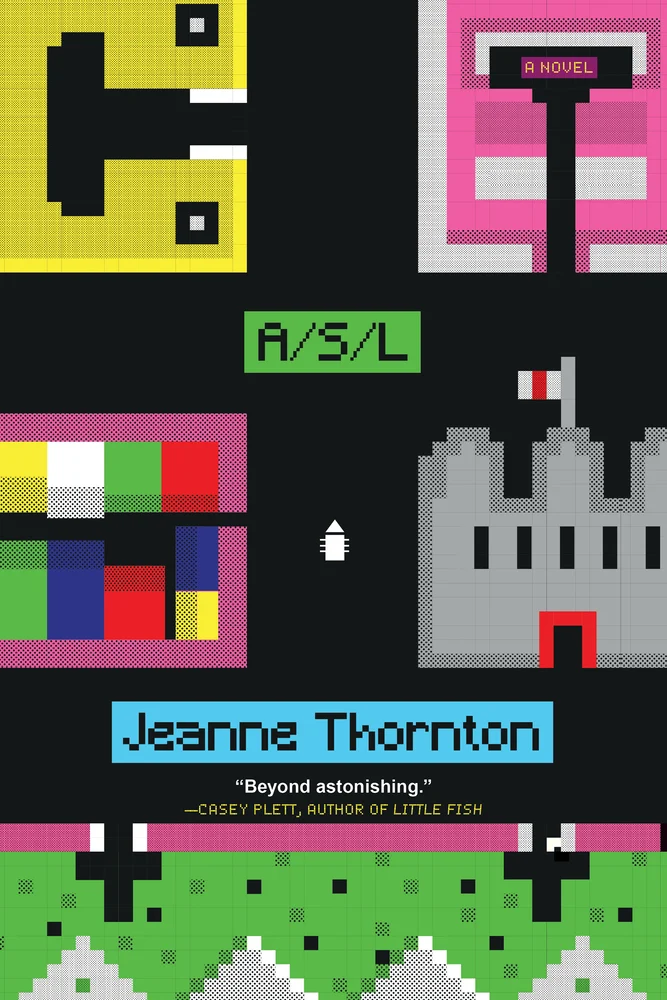
“A game is an experience that happens to you,” writes Jean Thornton in A/S/L, a novel that queers 1990s internet nostalgia and celebrates the transfemme gaming community.
A/S/L opens at a time after AOL Instant Messenger but before AI and the political oligarchy stronghold of Silicon Valley tech bros. Three teenagers dream of building a video game that will remake the world, Saga of the Sorceress, but they never finish it. The friends grow up and lose touch—until one of them begins the game anew. A/S/L follows these three characters, all transfemme—Lilith, Abraxa, and Sash—who, despite living in close proximity, have never met in person. Each, in her own way, takes up the sorceress’s unfinished quest.
Like Thorton’s previous novel Summer Fun, A/S/L is philosophically robust. Thornton asks, What does it mean for a trans woman to be good? Who benefits? What do we owe our friends? She calls out norms and protocols that arise in lucrative, patriarchal, and historically transphobic arenas, such as the music industry and banking, while likewise interrogating the insidious, pervasive, and often unnamed cultural demands on trans women intended to make things easier on cis and straight people. The book is inventive and playful, especially with form—from emails to technical gaming notes to chat room (channel) transcriptions—and because Thorton’s imagination is delightful, there is lots of joyful discovery. And recovery. Almost anything can be a video game, Thornton reveals—real estate, running on a treadmill, sitting in silence, asking for forgiveness, setting someone free, being free.
Jeanne and I have shared work, AWP panels, and dance floors. I am overjoyed to share our conversation about A/S/L.
Annie Liontas: What was your relationship to gaming as a young trans person who grew up in the 90s? What worlds were available to you and other trans/queer folks in games that weren’t open to you in real life?
Jeanne Thornton: My friend Stephen Ira says that trans women get video games like trans men get fanfiction. Gaming is the socially acceptable way to live these other lives. Your physicality doesn’t matter. You get to play a girl, and it’s okay because you’re [a] warrior girl, you’re not going into the Barbie aisle or something. It’s defensible or socially viable.
Gaming is the socially acceptable way to live these other lives. Your physicality doesn’t matter.
Like Lilith, I grew up in Texas. I didn’t have a lot of access—I didn’t know that trans people were a thing until I was in grad school in LA in 2005. I was a scout. I went to the scout camp and had this experience of being in these very, very southern, dude spaces. Gaming is this shadow space that’s dissociative in a way that’s strongly gendered, where you go to be disembodied with other people. A lot of the characters are based on people I knew in my particular gaming community, which was the community around a game called ZZT (CraftQ in the book), and it was really nice to summon them all. The IRC [Internet Relay Chat] scene right at the beginning, that was actually quite a joy to write in part because that was a pretty faithful attempt to reconstruct without transcribing what those 1990s chats were like in all their toxicity, all their messiness.
AL: The book is so dynamic because it’s taking on so many forms. It’s not trying to be a two-dimensional artifact, in the way that gaming also refuses to be two-dimensional.
JT: One of the key realizations in the book was that anytime I’m writing about a video game, it’s actually a travel narrative. I was trying to think of what it [feels] like to be in a video game, and I think it isn’t a fixed point. It’s a place you go to, and your body kind of goes away, and you have choices within that space. I guess it’s true that gender is a little like that.
AL: You’re writing into that historical period of early 1990s gaming and internet, (which you describe as “the adolescence…of the dominant art form of the 21st-century”). What was it like to capture this interstitial time for trans people and a trans youth culture, defining, and determining the internet?
I very consciously wanted there to be three distinct trans women, rather than filtering all transness into one perspective.
JT: If we had just been in a cult, explaining why this was so important would make more sense (laughs). But a lot of the impetus for writing this book is to capture this really specific gaming world that I was part of, where everyone’s a teenager and both making games and playing games. I didn’t know what [my online] friends looked like during this period; we didn’t hear one another’s voices. Everyone is sort of making up who they are, but there’s a richness of going online and meeting other people. You are [being] your most essential self with other people who are being their most essential selves, and also you have so little information about the people you’re around that everybody is having this common fantasy together.
At some point there was a switch, around the late 2000s, where being online went from being a place you went to be someone who wasn’t yourself to being your real life, almost your professional self, a brand that you portray. I don’t think I’ve ever made that adjustment well. I’ve talked about this with other people from the [ZZT] gaming scene. A lot of us from that world are really close, lifelong friends.
AL: Abraxa, Lilith, and Sash move through the world so differently— Lilith shopping from the Macy’s sale rack, Abraxa breaking into church basements, Sash seeking creative autonomy and independence at the expense of financial stability. How do they conceptualize freedom as trans women, and what is the cost of that for each of them?
JT: I wanted this to be [a] multi-narrative, multi-plot book that has no canonical truth, where each of the three characters could plausibly be a main character, and any of the three storylines could be the primary one. I was also very under the influence of Georg Lukács’ Essays on Realism,where he says that the goal of fiction is to present the classes with a true account of one another. I very consciously wanted there to be three distinct trans women, rather than filtering all transness into one perspective—almost as a corrective to Summer Fun, which is about a famous and beloved musician. They’re each trying to approach freedom through a different means and a different attitude towards what financial freedom means. I had not thought of that in terms of freedom, but I really like that framing of it.
Lilith works white-collar jobs—not to assimilate, because assimilation is not open to trans women—but with the idea that “I can move in a cis world; I’ll be one of the good ones. If I can do that, I will have freedom and stability.” Abraxa says, “I will be okay as long as I have a lot of skills.” Hers is almost like a blue-collar path. She can work on a boat or in construction—as long as she has independence, as long as she can leave whenever she wants and has the tools to be completely self-reliant. Sash is almost an academic, trying to arrive at a very pure knowledge that is not expressed externally. She makes no compromises [and] lives a life of keeping everything radically inside.
AL: Abraxa is your witchiest character. How does she, even in her most vulnerable moments, decide her terms?
JT: I approached Abraxa with a great deal of compassion. I also went through some pains to make sure that Abraxa’s parts of the narrative are very magical, steeped in occultiness. If you’re a reader who really wants to believe that all the magic in the book is real, nothing will contradict that. If you want to believe that this is a woman going crazy underground, nothing’s going to contradict that either. I wish I could be more like her in a lot of ways. There’s something about having a character who has that kind of radical freedom to just go off and reinvent herself, to go off and connect. I tried to show some of the price of that. She’s very isolated as a result in quite intense ways.
The way society treats women generally, it doubles down for trans women.
Hands down some of [the] most brilliant people I’ve ever met in my life were from ZZT, where everything they did seemed so effortlessly magical. Some of these people burn extremely bright. I knew someone from that community [who] died of an overdose in their 20s [and] somebody who committed suicide, also in her 20s. [The book is] thinking about your brilliant friends from your adolescence and the sadness of seeing them continue to be brilliant, but in a form that the world can’t make that much use of.
AL: And Lilith, in a way, is a kind of counterweight to that narrative because, at least on the surface, she’s very successful. Yet, beneath, we feel there is a loneliness to her experience. You write, “You’d think you’d remember being trans all the time, but you don’t for a while. Just a vague sadness.” How is that true for you?
JT: I think this is a fairly familiar trans experience. I have a family member in the hospital, and when I tried to call him last night—at the moment I said who I was, what my relationship was to this person, using a gendered noun for this but also using my gendered voice—it immediately became like, “We’re not gonna let you talk to him.” I realize in retrospect, okay, that’s really trans, but it’s not [how it] felt in the moment. I’ve been out long enough that it’s weird to have flashes of what it was like before, to move through the world with a relatively greater amount of—grace is the word I’ve sometimes used for this. The assumption is everything is fine until a moment of friction. That’s a really common transfemme trap, where you don’t map it back to, this is because I’m trans, because you actually don’t know at all. The maddening thing is that you don’t know ever, and you will never know. You will go to your grave not knowing, because often the people involved don’t know either.
I do think that religious conversion is sometimes a good metaphor for transness. It changes how you stand in relation to the world and how people are going to meet you in relation to the world, particularly if that conversion is something that has friction with how people deal with you.
AL: Sash asks, “Cis people don’t have to have [a] level of clarity about their history; why do trans people?” Her journey is especially moving for me, a trans person who came of age at a time in the 90s when gender was communicated as a fixed point. What does Sash’s trajectory reveal about the layered, complex trans experience in America?
JT: The dungeon of Sash is quite deep, and it’s very intense. I do think this is important, how Sash is trying to insist on that transition on her terms. My feeling of coming out at that time was, I better have my shit together before I cross this line, because it’s gonna be really intense, and you can’t go slowly. It’s jumping into the deep end of the pool, I think. That’s a lot less true today, in ways that are more palpable. My sense in 2025, and this is something that is terrifying to the right wing, is the idea that you can view transness as something you can experiment with, you can play with. You can dip your toe in the water, you can manifest it in different ways at different times. With Sash, both Lilith and Abraxas think of her as a cis woman. And actually, early readers of the book didn’t realize Sash was trans also. It’s one of those ways that online-ness [worked] in the past.
AL: What would it mean to listen to trans women’s stories? What is the power inherent in that act, both for storyteller and listener?
The way society treats women generally, it doubles down for trans women. We’re women, so it’s okay to hurt us. There’s actually a specific gaming-related story, an arcade game called Final Fight. It’s about three burly dudes, one of whom is the mayor of a fictional city, punching their way through a wave of bad guys. Some of the enemies are women. When they tried to bring the game to America, execs said, “We can’t have these dudes beating up women, so let’s just say they’re trans women.” Everyone accepted this. One of these women, Poison, is a beloved, almost-saint of transness, canonically trans, because we needed to have a woman we could beat up.
Trans inclusivity is this crisis point for understanding how our society constructs gender in general, how we construct womanhood in general, and I think that’s urgent. Given the eternal war on women, an understanding of the way that transness manifests in this is absolutely critical.
Late Friday night, Electric Literature—along with at least 40 other literary arts organizations— received a notice from the National Endowment for the Arts that our 2025 grant has been terminated. The reason given was that our work does not “reflect the nation’s rich artistic heritage and creativity as prioritized by the President.” This morning, the NEA’s literary arts staff announced their last day would be May 30.
This is a transparently autocratic effort to dismantle the nation’s most important arts granting organization and to broadly undermine artistic progress. After threatening so many, it is no coincidence that Trump has turned his attacks to the arts.
Creative expression is the lifeblood that vivifies a free and democratic culture. Trump is obsessed with a heritage and legacy of his own imagination. For him, literature is forward facing and therefore dangerous. Every story, even about the past, is a new story. Every story a writer tells is one Trump cannot control.
The NEA has supported hundreds of publishers, 600 translators, and 3,800 writers. The stories told as a result of that support will live on. Electric Literature will continue to publish culturally enriching stories about the past, present, and future with honesty and heart. Please support our work.
The photo booth in the museum lobby was in a lonely little corner away from everything else—the exhibit entrances, the front desk, the restrooms. It was a little gauche, after all. Photos for two bucks fifty. It seemed to the baby’s mother that the booth had the aura of the carnival about it, but maybe it was just the velvet red curtain. She had noticed the curtain first, one winter morning, midway through her maternity leave. The museum was the only place she could go to get out of her Kleenex-smelling apartment. That morning, she unwrapped herself from jackets and scarves, deposited her garments with the coat check (she was the first patron, it being exactly 11 am. Of course she had been awake since 5). The baby stirred in the pouch, disturbed by the change in temperature. This baby liked the cold, and wide open spaces, and colors (even if the books all suggested the baby was colorblind). The baby also liked to breastfeed. Like now. And here was this photo booth and its red curtain. Beckoning.
The baby’s mother found that no one much used the photo booth in the museum’s early hours. The dedicated weekday patrons or school groups had the Egyptian collection to see. They walked past the photo booth without noticing it, their eyes on the long cardboard maps that were handed out and soon discarded. If the baby’s mother placed her feet in the right direction—forward—she did not get interrupted. Or if she did, there was a polite knock next to the curtain first, asking if she was almost done with her picture. And she’d have time to detach her daughter, cover up. Yes, yes, so sorry. But mostly, she could sit there in the dark for fifteen minutes, or thirty—some mornings, forty, fifty—and let the baby nestle and burrow and drink. The baby’s mother would close her eyes, or look down at the round, mostly hairless head, or watch mindlessly as the screen offered different photo packages for purchase.
One morning, a guard peeked in. Everything alright? A young man. The regulation suit, loose tie. The baby’s mother didn’t have time to pull her nipple away.
Sorry, sorry, the guard said. He closed the curtain. But from below where it hovered, the baby’s mother could see the guard’s heavy black boots lingering there.
I’m just taking a picture, she said to the curtain. And then she did, for the first time. The click of the machinery. The startling flash. The first one pulled the baby’s smooth head up. The next made the baby start to scream. The baby’s mother hurried to empouchify, and emerged next to the guard to claim her portrait, one she would keep forever. It was the usual format, three pictures atop one another. The first was very Madonna and Child. The second looked like some villain was coming for the kid. The third featured only the baby’s mother’s exhausted face as she leaned forward, she guessed, to begin the departure. Did she really look that tired? Glancing down at the strip it occurred to her that each image was the size of a wallet photo, like the one her mother had kept in her wallet of baby-her, before she died.
The guard still stood there, looking at his boots. Sometimes you gotta wait to get the right picture, he said. He said this without a smile. He looked like he was new on the job.
I’m Ada, she said. This is Bridgie.
I do the lobby for the morning block, he said. She assumed this meant she had cover to use the photo booth. His nametag said “Bill.”
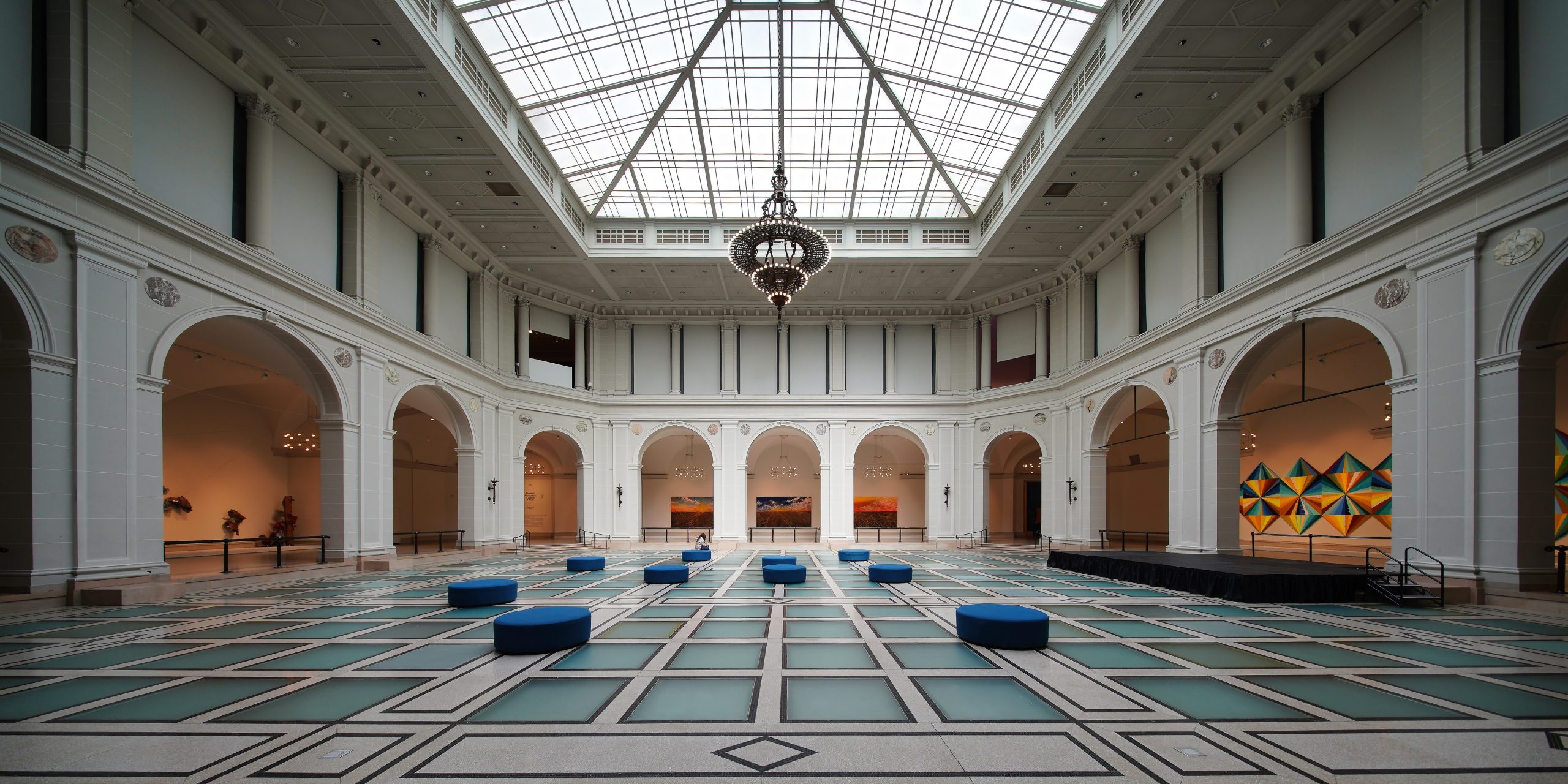
There were some policies at the Brooklyn Museum that made amazing sense to Ada in the dawn of her matrescence, beyond Bill’s lenience about the photo booth. For example, caretakers could take strollers into the museum and among the collections, even big bulky strollers like Ada’s, which her husband loved, or the two-seaters that the nannies wielded expertly like giant boats, like the cargo ships her mother liked to look at coming into New York Harbor, under the Verrazano, her mother sitting on a particular promontory (Ada was told) above the highway, Ada at her breast. Ada had been thinking a lot about her mother since Bridgie was born. She was told this was natural, her mother having died when she was sixteen. But Ada declined the museum’s munificence and left the stroller at home. A pouch worked just fine. Another good policy was the pay-what-you-will entry, of which Ada did indulge.
The bad policies, however, included a rule that you could not eat in the lobby. This Ada learned when Bill came up to her with those black boots clopping and his hands jammed into his loose pockets. It was not the way the other museum guards walked: fists enclosed behind their backs, slowly.
Hey, you can’t have food over here, he said.
Ada looked up from her miserable yogurt. It seemed like a rude way to say it. No “ma’am.” Though of course ma’am would have made her even more indignant. Still, she felt crabby.
She pointed over at the nannies and their brawling kids, jumping chaotically on the round cushion-couches, clutching juice packs. How come they can do it? she asked.
Bill started getting hot too.
Seriously? he said. They’re kids. You want me to bug little kids?
I have a little kid, she said.
He looked down at her pouch and seemed to soften.
I know, he said. Bridgie. When she can eat, then you’re all good.
Technically she’s eating what I’m eating, and if I can’t eat, then she can’t.
Bill did not seem to know what to say to that. His hands were still in his pockets. Ada noticed that he was using cologne. Maybe it was his first job.
He looked away towards the glass entry, Eastern Parkway, the silent stream of cars. The nanny-kids squirting their slime packets.
Fine, he said, just don’t drop it and get me in trouble.
I don’t want to get you in trouble Bill, she said.
As he walked off, she felt happier, if only because it was her first adult, non-husband conversation in days.
She watched the nannies, one of whom nodded at her. She watched the toddlers, their impossibly large hands. Bridgie stirred and started shrieking, so Ada got up, and the photo booth was right there. The darkness calmed the baby, and Ada resisted feeding her again—she’d been warned to stop snack feeding unless it was a desperate situation—and the baby kept her eyes open and looked up at Ada. Ada looked down and did not move for a long time. Only when she needed to go to the bathroom did she disturb the red curtain.
After the bathroom she wandered the museum. There was no clock, something thrilling and surprising about maternity leave. As long as she fed and changed the baby, she had no whims to follow but her own. Her husband would be back home at 5:30, but before that . . . . She circled Arts of Asia, the American Wing. She was, of course, too exhausted to think much about what she saw, but the baby was so light, now that Ada was mostly healed. So snug. Ada shifted the pouch slightly at the Judy Chicago Dinner Party exhibit so that Bridgie could take in some of the symbols of femininity, the triangles, the heroes, the silverware. The baby seemed to track more around the Joan of Arc plate. Ada went down to the café and had a turkey wrap, something she’d missed brutally during pregnancy, and then she was tired, so she went back into the photo booth and closed her eyes. The baby was warm against her, and they both fell asleep, and then they both woke up, and the baby wanted to eat again, and so she did. The sounds of people walking through the lobby were there but muffled, and Ada had the sense that when she emerged it would be almost dark. She was right. She pulled the red curtain back and headed for the coat check, but the cologne hit her first. The guard’s heavy boots. He was leaning against a wall. She wondered if he’d been on his feet this entire time.
Hi Bill, she said.
The mar of their morning disagreement about food seemed as far in the past as it was.
Jesus, she said, long shift!
He nodded, looking down at her shoes. Just sneakers, comfortable. Now they were mom shoes.
Guess so, he said, although apparently it’ll feel shorter later.
She smiled, glad to crack through. So you are new then, she said.
He straightened up. What made you think that?
Don’t worry, she said. I’m new too.
He stared at her, as if calculating. You’re in the museum a lot, he said.
It’s a free country, she said. Somehow she was annoyed again. Her back and forth had been wild these first months.
Ok, Bill said.
He pushed off and walked a little stiffly towards some patrons waiting near the bathrooms, turning awkwardly at an angle away from them before the encounter.
Ada bundled herself up for the cold walk home, and Bridgie started squalling.
She stayed away from the museum for the rest of the week, chastened by being noticed. She tried the lobby of the central library a few blocks away on Flatbush, but its echoes made the baby tense. On a sunnier day she trekked to the main entrance of the botanic gardens, remembering vaguely a school field trip as a child and a series of greenhouses. Her mother had chaperoned. But when she got to the gardens the price tag was steep for a single entry, and the greenhouses were all the way on the other side. When she found them, Bridgie had finally acclimated to the cold and seemed overstimulated by the sounds of the heating generators behind the glass. She wouldn’t latch to eat, an uncommon occurrence. Ada fed her with difficulty and shivered outside, staring blankly at the barren lawn.
She nodded coldly back and haughtily claimed the space, deciding to go even further this time, potential teenagers be damned.
So, she returned to the museum. Time really did pass in strange ways. The grand total of her preceding days had been the planning and execution of forays with Bridgie. No: her husband had cooked dinner one night. The next night, takeout. Another, thawed chicken breasts her past self had frozen before the baby was born. But these were minor events, curators’ notes the size of index cards next to the big paintings, sometimes inscrutable and terrifying and full of emotion and force. That was the weight of a moment with Bridgie. Which felt even bigger and more majestic in the photo booth, its soft carpeted walls, the dull sounds inside and out. The baby felt more human-sized there in the booth. That morning before lunch some teenager pulled the curtain aside without even asking and the shock of it made Ada indignant. Shouldn’t the kid be in school? She just said, It’s occupied. Like a bathroom. But after a minute she fled to the round lobby couches and tried to ignore the sound of the nanny-toddlers screaming.
When she wandered back to the photo booth, Bill stood next to it, nodded at her. She nodded coldly back and haughtily claimed the space, deciding to go even further this time, potential teenagers be damned. She took Bridgie out of the sling and put the sling under the baby on the seat and let her lie there, first looking up, and then looking down when Ada flipped her over. Ada’s legs guarded the edge. For some reason the baby did not mind this position today, did not scream.
A clank against the side of the photo booth disturbed her. Under and around the curtain she could see what it was: twin metal poles connected by a thick red rope on top, denoting entrance closed, but in an elegant way. She saw the base of the poles and the give of the rope and then the poles separated and the rope disappeared above the curtain, going taut. A pair of heavy black boots went by.
Closed, sorry, she heard Bill’s voice say as another pair of feet approached—sandaled, socked, ridiculously.
Machine’s messed up. It’ll be back up later maybe.
Ada smiled and put a finger to her lips, looking down at Bridgie, as if the baby knew what it meant.
She could have looked at her phone in the photo booth of course, but something about the space discouraged it. The darkness, the quiet, the way Bridgie was an equal presence. Once that afternoon she took the phone out after a text buzzed—her husband, elegantly phrased logistical questions, well-meaning—but the light of the device was harsh and alien. Bridgie screamed. Ada put the phone on airplane mode. She fell asleep. She woke up stiff, itching to get out and stretch. The poles and rope remained. She maneuvered herself and the baby around.
Bill cut a meandering path from over by the coat check to the booth, and she took slow steps, as if she were still tentative about the baby being in the pouch. She wasn’t tentative.
Come as much as you want, he said. Free country.
She grinned. The fact that he listened to her moderately thrilled her. Not a lot—she had to admit she did not find him attractive. He was too young and awkward. But it was nice to have a friend in a place like this.
Those boots, aren’t they bad for standing?
He looked down, as if he hadn’t thought of it.
They’re cop boots, he said. Like department issue.
Oh.
My brother thought that would help. Cops stand around a lot too, ya know.
I guess so. Do you want to be a police officer?
No, fire. I’m waiting to take the test.
She put her hand on the back of Bridgie’s head. She was vaguely aware that there was a waitlist. He seemed tragically thin to be a firefighter, but now she considered anew the military buzz of his hair.
What about you, you got a job?
It struck her—she hadn’t thought about it in weeks.
I do, she said. Before. After too. I work for the Board of Elections.
Just saying the words lifted the fog a little, the row of dim cubicles, the C train, the ballot machine contracts she’d done her legal read on before leaving. A different fog. But she didn’t want that. She vowed not to say the words again. She was in a snow globe here, the cushioning of the photo booth. The quiet galleries, clean, empty restrooms.
Bill glared down at his shoes and put his hands on his hips.
Maybe I’m doing it wrong, he said. I’ve definitely been getting blisters.
The maternal instinct in her flourished. It was unbelievable that she had a maternal instinct now. She reached over and put one hand on his suited arm, which tilted Bridgie. The baby’s eyes opened wide.
You’ll wear them in, she said. Soon you’ll be running around here chasing art thieves.
Or little kids, he said. More like that.
It occurred to Ada all at once, in a kind of a weather change, like a bank of clouds storming in, that someday Bridgie would be a little kid. Running, talking.
They developed a routine. He worked the lobby. She showed up precisely at opening time. In the hours preceding, she would be dying to get out of the house, get off the floor, where she lay with Bridgie and shook rattles, just a way to not be in the bed, now that she could at least bend down and not accidentally pee, or open her wound. Her husband, to be fair, had the baby for the hour after Bridgie woke up until he had to (got to?) get on the train to go to work (skyscrapers, engineering, he was an expert in windows and natural lighting), and though her husband did push it until the very last minute, he also did leave every day. The wind whistled cold air through the door as it opened and then closed. She always walked as quickly as she could to the museum because she couldn’t remember what the pediatrician had said about lowest allowable outdoor temperature for the baby.
In the warmth of the museum, she felt her shoulders unhunch. Bridgie seemed to smile too. Ada could never tell exactly what was a smile, versus gas, but it was something about the unclenching of the eyes. She waved to Bill, who came over and made a funny face at Bridgie, who did not respond, and then she paid her dollar and went to the café to get coffee and then came back to the photo booth. Bill would be sliding the rope across.
She would feed Bridgie, or just sit there, let Bridgie look at the flittering images. Screens were a worry but not much of a worry yet. That would come later, she was sure. Only very rarely would she take a picture. It cost $2.50, first of all. But also, it felt almost like evidence. Marking the time. She liked the time unmarked, the pictures fleeting, the baby feeding and not feeding and then sleeping again.
Once, she felt the baby’s bowels loosen sitting there in the photo booth and it all came to her at once. She did not want to move, she could not move. She realized how much of her energy she spent just getting to this space, to the museum. She needed a den. If this space had not worked for her, she would have found another. The shining clean bathrooms and their changing table were only a 10-second walk. Yet she couldn’t bring herself to do it. She was paralyzed, even with the sweet stink. She did nothing until Bridgie started squirming and then wailing, the diaper turning sticky. She shush-shushed the baby to no avail and unpacked her changing pad, a diaper, wipes.
The wailing wouldn’t stop. She was one wipe through when a foot came in. Big, black, and booted. Bill’s, of course. Waggling beneath the curtain sort of frantically. Suddenly the velvet rope clanked and detached, was hidden. She closed the diaper back up shit-full and threw the wipes, open, into her bag. The baby seemed surprised by the return of the diaper and closed her mouth: she was uncomfortably looking at the screen by the time a white-haired supervisor peeked in.
Are you, the supervisor said. Oh.
Oh sorry.
Is everything alright in here? There’s been a noise complaint.
Wow, really?
I guess she’s quiet now. Maybe a bowel movement?
Ada sniffed Bridgie’s backside, widened her eyes as if in realization. Look at that, I’ll go take care of this.
The bathroom’s that way.
I know.
Coming out of the photo booth she saw Bill, leaning against one of the mighty pillars in the lobby, his worried glance.
She stopped by him after the bathroom. Her energy had returned for the task but now was ebbing.
Thanks, she said.
You get caught changing her?
I don’t think so.
Then a thought occurred to her.
How’d you know I was changing her, though? Are you spying on me?
She hadn’t meant it as an accusation, just playful. But his cheeks turned red, like they’d been iced.
I’m sorry, he said. I don’t mean anything by it. I’ll stop.
She cocked her head.
Why are you staring at me all morning? she asked. But she already knew.
His eyes flared and he said he shouldn’t be talking and he went over to the photo booth to quietly push the poles and red rope even further out of view. His boots clopping. She headed for a less comfortable section of the museum but felt very happily conscious of the way she must look to him, an amalgam of bed and rest and femininity. It wasn’t so bad, then. Her daughter in her arm’s crook.
She did not want a flirtation. It should be repeated, she was not actually attracted to Bill. But it didn’t hurt to talk, to stand, to listen. They were in public. She reminded herself: she was doing nothing wrong.
She headed for a less comfortable section of the museum but felt very happily conscious of the way she must look to him, an amalgam of bed and rest and femininity.
Or mostly wasn’t. Was it wrong to start thinking more carefully about what she wore to the museum in the morning? Was it wrong to put on makeup before she left, Bridgie down on the little portable pillow while she applied? Wrong to spend less time in the photo booth? She should get her steps in, this is what one of the doctors told her in the hospital before leaving—remember, steps are the best exercise, other than Pilates. She walked around that whole museum every day, over and over, and the way she knew it was wrong was that she walked like she was getting a sweat in when she was alone in a gallery, or with just other patrons, but if she saw a guard, she slowed, she paused, she became a normal museumgoer again.
He disappeared at the end of January. It was only two days in a row, plus perhaps the weekend, though she did not know for sure about that. The weekend was her time to be somewhere other than the museum, with or without Bridgie. The Thursday and Friday, it was a hulking female guard in the lobby, glowering and no-nonsense. Ada recognized her from her usual posting on the American Paintings floor, a particular room with a few massive landscapes. The guard’s voice called out to patrons that they were too close to the mountains and streams. Ada wondered if the female guard and Bill ever had conversations.
On Monday Bill was back, and even as she went through the security posting, the bag check (a different guard, whose name she didn’t know, reaching into Ada’s bag to push diapers and lotion around with a drumstick), the lobby, he walked boldly across to her. Ada saw that he was clutching a brown paper bag in front of him. Two hands.
I went to Myrtle Beach, he said, with my brothers. She hadn’t asked, but she nodded anyway. You ever been there? he went on.
No, she said. She pushed down the ungenerous feeling that she didn’t actually want him approaching her like that, like she owed him something. She was still just visiting, a guest, at this place where he worked.
He seemed surprised by her shortness, and perhaps it made him cut to the chase.
Here, it’s for Bridgie, he said.
She took the paper bag. Inside was a child-sized t-shirt that said, “I’m a Surf’s Up Kid!”
I figured she’d grow into it, he said
Wow, she said.
Kids love the water. Both of my nephews do.
She wondered what Bill’s nephews were like. She wondered what any child over the age of one was like. She found writing on clothing incredibly tacky. Her heart dropped at the idea that this was what Bill’s nephews would want. Not that it was any of her business. It certainly wasn’t any of her business.
It’s so big for her, Ada said.
You’re right.
A plume of Bill’s cologne slapped the air, as if he were sweating.
She plumbed the raised lettering on the surface of the t-shirt with her thumbs.
Well, maybe she’ll grow into it, Bill said again. He clomped over to a wall by the bathrooms.
I hope she does, Ada said. Only later did she realize she hadn’t really said thank you.
She only stayed the morning in the museum that day. It was unseasonably warm for February. Spring was coming. Soon she would be able to just walk in the park or the streets of New York, watch them blooming. She would not need the four walls of the museum. She put the t-shirt in her little diaper bag, where it got in the way of the things she needed, her water bottle, wipes, a throw-up cloth, so many diapers. The red curtain rope of the photo booth was waiting for her there after her turkey wrap, but this time she opted not to use it, took the sunny walk home.
Opening the door, key in the lock, Bridgie wide-eyed at the jostling change in motion, Ada was surprised to see the lights on and music playing. Their one street-facing window open, a breeze coming in, and the sway of tree branches. Her husband on the couch stood up with a start.
You’re home early, he said.
No, you are, she said.
Yes, well. He smoothed his t-shirt.
During the week she rarely saw him out of pressed button-downs or pajamas.
I hopped off early and thought I’d relax for a second.
Relax? she asked.
I know, I know.
She found that her heart was pounding.
To make up for it, he went to help her untangle herself from the sling, kissing Bridgie. Then he started to empty the diaper bag.
What’s this? he asked. He held it up. Magnificent, perfectly ugly.
Ada didn’t look at the gifted shirt. Bridgie spit up a little, she said. I had to grab something.
The museum sells these? her husband asked.
It must have been a pop art show.
Ah, her husband said.
Later, he said she had a right to be a little cross with him, he knew he should have come to relieve her, it was just so nice by the window, the wind coming in, the start and stop of it, there even seemed to be a hint of sea.
The next morning, she woke up and the bed was empty. The clock said 8 am. The baby monitor was off. She threw herself out of the sheets.
Good, excellent timing, her husband said. Eggs are ready.
Bridgie was cooing in the kitchen in her expensive bouncer.
You didn’t need to take her.
I’m off today. I took off. Those buildings can design themselves for the afternoon.
The eggs were fluffed and full of cheddar cheese.
Go get a manicure, or just relax. We have a bottle.
I’d still need to pump.
Her husband stopped where he’d been cleaning the dishes. Right, right, he said.
Which is why they headed to the museum together, him pushing an empty stroller she knew they would not use, the baby perched alert and restless in the cocoon on her chest, looking over at her dad. The unusual presence.
She had nothing to feel guilty about, of course, but still she felt it, as they swanned across the lobby and Bill started walking towards them but then noticed and stopped. It was too late because her husband flagged him.
Hi there, permissible to bring this in, I hope?
The stroller.
For sure, yeah, Bill said. Hi there.
Bill was waving at Bridgie.
Say hellooo, Ada said, fingering her daughter’s fingers. Come on, the check-in’s over there.
Her husband turned his head sideways as he bought their tickets.
Bridgie’s a celebrity here.
She knows everyone, Ada said. She fussed with the baby’s head.
That’s wonderful, her husband said, putting down the full admission price for the two of them.
Was it possible that Bridgie angled her body towards the photo booth? No, certainly babies couldn’t see so far at that age. Ada maneuvered them to the elevator, the smooth ride up. The other elevator riders beamed at them, their happy family.
Ada remembered something her mother had told her. It disturbed her that she’d just remembered it then. How many aspects of her childhood, of her life with her mother, were sitting unprobed in the depths of her memory, waiting to be regurgitated? It had been a few days before Ada’s parents’ tenth wedding anniversary; she must have been eight or nine. There is nothing wrong, her mother said, and that’s a blessing. Ada remembered her mother fingering a card her father had left before he went to work.
I have to go to the bathroom, she said now. Can you take the baby?
The long unwrapping. Bridgie yipped when they tried to put her in the stroller. Ada strapped the baby to her husband instead.
There’s one in the lobby, Ada said.
She took the stairs down, out of habit. Felt the energy in her leg muscles, their capability. The sun pierced the stairwell windows. Soon it would be nearly summer and she’d avoid the museum, except on rainy days.
Bill looked up as she came into the lobby. Maybe she had a head of steam on her. His boots, she noticed, were gone today, replaced by boxy white sneakers. She pulled the curtain back on the photo booth and closed her eyes in the dark.
He joined her. It was his feet first, then his bony hand. The polyester blue of the standard-issue uniform sleeve. His nose. So many things remained a mystery—his address. His interests. His mother’s name.
Your husband’s pretty fancy, huh? he said.
She shook her head and the lights of the photo booth screen blurred. She leaned in.
She wondered if somewhere in the museum there was a composition like this, two faces clutched uncertainly, then two silhouettes, then one. The woman’s face with her eyes closed, the man’s open out of shock. She wondered how a frame would change things, or who the artist was, or would be, if they took a picture here, in the photo booth.
Jemimah Wei’s debut novel, The Original Daughter(Doubleday, May 2025), aches. It aches with the weight of the unsaid, the scourge of perceived betrayal, and the bitter nut of jealousy. But underlying all of it, it aches with love. When Gen is eight, a seven-year-old girl named Arin comes to live with her family and goes on to become her co-conspirator, rival, friend, but most of all—her sister. As the years pass in fast-changing Singapore, Gen and Arin grow up surrounded by friends who are wealthier and more privileged than they are, parents who are struggling to make ends meet, and an environment that pressures them to achieve success and academic glory at every corner. But even as they struggle, they always have each other. Until they don’t. One day, every tiny cut of envy, doubt, and insecurity that the girls have set aside bursts forth, in a single act of betrayal that sends them reeling apart. A sisterhood split asunder.
Jemimah and I come from the same humid part of the world (Jemimah, Singapore, and me, Malaysia), but we met, as one does, at an author event in New York City. It was a joy to read and feel words from our hot, sticky region. But beyond that, there’s real wonder in Jemimah’s story about sisterhood and Singapore. It captures a world that is imperfect yet undeniably true. Over email, we had an expansive conversation about The Original Daughter, falling asleep as a stress response, and why romantic love does not always have to be the center of a good story.
Vanessa Chan: One of the fascinating things that threads its way through The Original Daughter is the idea of surpassing one’s parents and not having a generational roadmap for how to live. Ma is a librarian and later works at a photocopy shop, a childcare center, and a grocery shop. Pa is a taxicab driver. It is clear from the outset that Gen and Arin will overtake their parents very quickly, but both must find their way in rapidly advancing Singapore without the roadmap their more privileged classmates have. Is this something you have experience with or have observed?
Jemimah Wei: We’re a young country, sixty this year, but the country has already been renovated several times over by progress. You could get whiplash from watching the way the country has changed. It’s fascinating to me, because the change is both reactive and strategic – the country has always kept one eye on how economic transformation relies on national narrative and global perception, and another on how the emotional temperature of its citizens fluctuate in response to these demands.
But on a local level, there is an immense cognitive dissonance to living precariously in one of the richest countries in the world. The skills which were crucial to a country in its developmental stages are often cast adrift in an accelerated world that runs on automation, and for many of these people, adaptability must become the key to moving forward. Learning to cope is a soft psychological skill that we don’t talk about much, but it’s also a skill that’s inherited. You model perspective on approaches you’ve seen, and while Gen is watching her parents, Arin is watching her.
VC: Singapore has been represented in recent media as a place of wealth and excess (see: Crazy Rich Asians). The Original Daughter is set in a Singapore with void deck aunties, hawker stalls, taxicab drivers – the working class that doesn’t ordinarily find itself drawn in literature. Was this the Singapore of your life? And was there a conscious effort to “deglamorize” Singapore?
JW: Singapore is home to immense wealth — the world of Crazy Rich Asians isn’t untrue. It’s just not the only story. The lived reality of many Singaporeans, myself included, isn’t like that, and I was very conscious of how literary narratives that have emerged in the global publishing landscape are often penned by those who could afford to leave. Due to generational wealth, due to riding the wave of opportunities, etc. For me, who lived one way most of my life then had a sudden, abrupt switch of circumstances due to work and scholarships, it can sometimes feel like I’m holding two realities in my brain—one of tradition, one of reinvention—and I’m not willing to let one supersede the other. It’s a fertile junction for me, artistically, and not an uncommon one amongst my peers.
As to your point on the working class, I suppose that’s what the characters are. But it wasn’t as if I deliberately set out to write a social novel, though if you’re true to representing the world of your characters then these things become evident in the telling. Of course, the characters are worried about money, who isn’t, but they’re also thinking of french fries, of charisma, of pettiness. It was important to me to decouple wealth from joy, to show the full dignity of lives that aren’t and shouldn’t be categorized only by their proximity to privilege.
There is an earnest glamor to love, to the delights of being deeply and physically attuned to the life you have, to being able to derive a sense of well-being from intimately sharing silence with a loved one or sucking nectar from a wildflower. I think that can be a point of ambition too, aspiring towards companionability with others and the self, while suffering under the discipline of realism.
VC: The Original Daughter is a novel about love and the ways love fractures. The love between sisters, the love between parents and children, the love of chosen family. Yet one kind of love that’s conspicuously absent is romantic love. Was this a deliberate choice?
JW: Oh, absolutely. Something I was very clear about from the beginning was that my debut would be a love story, but not a romance.
Growing up, books and shows were saturated with romance as the gravitational storytelling force, and although I love a good Taiwanese drama as much as the next person, I was weary of the overall prioritization of the hierarchy of romance in so much of media. For much of your formative years, your key emotional relationships are with other women, with family, with non-romantic partners. I wanted to show that these relationships are not so easily unseated by the appearance of romantic interests, who, in those early years, are often temporary. The immensely intimate love, enmeshment, and heartbreak of platonic relationships can be tsunamic.
VC: This novel aches. It is not light by any means – and deals with the rage and estrangement of sisters, parents, grandparents, and even death. Was it tough to write? How do you separate the ache on the page from the joy of your life?
JW: My body’s stress response tends to be to simply fall asleep, and it mortifies me to think of the amount of spontaneous napping that happened in the process of writing this book, sometimes in public…
But in response to separating ache and joy, the truth is nothing ails me more than not writing. Writing itself, even when immensely difficult, is the primary, most consistent source of joy and contentment in my life. If I must struggle, I’d rather it be on the page.
VC: Genevieve, the “original” daughter, fears abandonment which causes her to withdraw, essentially forcing her sister Arin away. What draws you to the theme of abandonment? And what do Gen and Arin have to learn about abandonment?
JW: Abandonment wasn’t a primary focus in my writing so much as it was the product of a long wrangle with self-regard. The struggles the girls have with abandonment, envy, and boundaries all spring from efforts to tolerate and develop relationships with their own less savory qualities. Arin, in particular, has a lot to learn about her relationship to self-abandonment in the face of conflict. That’s something I’m drawn to more: how we come to confront ourselves when all narrative is stripped away.
VC: This novel took you nine years to write, coinciding with the earliest parts of the pandemic. How did that influence your writing?
JW: When speaking in retrospect I think we often impose a casual narrative onto our journeys; it’s inevitable for writers to narrativize, but I wonder how helpful it is. As a young writer I was horribly discouraged whenever I heard of writers who seemed to have it all figured out, the map of their influences, the sequential steps of their process. For me it was all very messy and desperate. My head felt tangled up for much of the nine years. I was plagued by the sense that I wasn’t mature enough to handle the vision I had for the book. And I was totally felled by the pandemic, which was, for me, a long tunnel of hopelessness. Maybe I fed some of that hopelessness into the book and made their desperation more convincing, I don’t know. I would like to believe so, if only so I can believe that period was meaningful in any quantifiable way.
VC: Speaking of narrativization, this story grapples with the idea of theft—what parts of our life story do we own, and what parts of ourselves do we owe to and share with others? Do we own our lineage? What about our stories? Our traumas? What do you think about ownership?
JW: I think this is one of those yes, and questions. We’d like to believe the lines between our lives are clean cut, when part of every relationship consists of co-creating a life together. How can we love without giving ourselves totally over to the other? How can we inhabit narrative without letting it cannibalize our sense of self, and vice versa?
VC: Pressure permeates this book, especially the pressure to “succeed” and embrace what one of the characters calls the “season of success.” A lot of this has to do with the markers of success that both Gen and Arin have been told they have to achieve.
JW: Pressure is pretty endemic to Singaporean society. I feel suspicious of movements that purport to disengage from markers of success in hyper-competitive, cosmopolitan capitalist societies. I think that’s just stress undergoing a branding revamp, so now you’re not just expected to succeed, you’re expected to succeed while disguised as being mentally well. The truth is that when you fall off the bandwagon, it can be incredibly hard to climb back up, especially when you witness life accelerating onwards without you.
But the girls aren’t just pressured, they’re also addicted to the pressure in some ways. They love the feeling of achieving, of winning. The myth of meritocracy can isolate your perception of progress in the singular, instead of locating your life as part of larger machinations, in a way that makes the thrill and despair of success so intensely personal.
VC: Gen’s (and Arin’s) relationship with their mother is enduring and illustrates some of the most emotionally resonant parts of the novel. Can you talk about how the relationship between children and parents matter to this book?
JW: Your parents give you the tools to separate yourself from them, it’s a process born of love but one that can be very painful. Specific to this novel I was thinking a lot about the boundaries between independence and intimacy, especially in the formation of a self, and how difficult and worthy a venture it is to develop a love that withstands life’s seas of change. There is a melancholy that accompanies every transition, part of the challenge is to accept it with an expanding view of what love and relationships can be rather than instinctively reject it as a marker of failure.
VC: Gen is a flawed and sometimes frustrating protagonist because she often cannot see what’s in front of her. What is your relationship to “unlikeable” narrators?
JW: I feel terrible affection for unlikeable narrators. It makes it very hard for me to dislike difficult people in real life, especially since I’ve spent a long time in the psychological living room of a frustrating character who’s ultimately trying her best to forge a life she can live with.
VC: This is a novel about withholding. Much is left festering and unsaid. And yet, the reader is never lost because the motivations and psychology of the characters are clear, even when they rarely say what they want or mean. What is the secret to successful interiority?
JW: There’s a revision practice I do, called the “Emotional Synopsis,” where in between drafts I create an emotional map of the entire book, documenting the book’s events with emotional motivations and interior conflicts alongside the facts. It’s adapted from a revision exercise in Matt Bell’s Refuse to Be Done – his version is to keep the novel’s outline to pure facts, but because of this novel’s nature, it works better for me to have psychological conflict woven in. I go over this emotional synopsis again and again, getting a macro view of the characters’ changing inner lives, revising it and working out the bloats and kinks, before going back to the book with targeted solutions.
I think murkiness on the page can often result from a lack of clarity in the writer’s own vision. It’s crucial to me to fully understand why characters are doing what they’re doing so that I can track the way they process their own actions on the page. That way, the reader can experience their minds working in real story time to understand themselves, even when the characters might find their own intentions opaque.
VC: The Original Daughter passes through a significant expanse of years very seamlessly. How did you orient time?Was it challenging?
JW: Awful. In writing, in life, it often feels like time exists purely to frustrate me. At some point I was creating actual Google Calendars for the characters, to fill in the activities of their daily living in order to get a minute sense of the lives they lived. This responsibility to document time passing in their lives weighed heavily on me, but it was Keri Bertino, actually, who suspected that I was cornered by time and said, and I have to quote verbatim because it was so incredible: I encourage you to release yourself from the obligation to narratively account for all that time. Hearing that was like she’d cut something loose for me. It’s true, why did I have to show the girls laboring over algebra or learning the administrative ropes at a new job? I marked all the places that felt uninteresting to me and axed them, then found a way to incorporate missing story information elsewhere.
VC: We all acknowledge that writing is a lonesome endeavor, but I know that community is important to you, something you strive to build everywhere you go. Why is that?
JW: Writing is a lonesome endeavor, but in the long, undefined yet crucial period before you’ve finished your first book, it can often also feel like Schrodinger’s endeavor—if you stop writing right now, no one knows, no one cares. The book which isn’t, can feel like it never was. That period of time is vital for experimentation, for taking real risks in your work outside of external expectation, but it’s often very difficult to endure. What sustained me through this long season was passionate conversations about books, thinking aloud, together, about craft and writing, being excited and disappointed and hopeful alongside friends who were all serious about their art. Community, which for me is analogous to friendship, reflects back the reality of our artistic endeavors in a way that solidifies its existence.
Growing up in Singapore, which doesn’t have the same access to resources, publishing, and infrastructure, this wasn’t always a given, and writers here have had to work hard to build these relationships with each other and ourselves, to take our dreams seriously in a culture of extreme pragmatism. But part of having no fixed roadmap is a terrifying and challenging freedom to build the life we actually want to live. Once you commit to writing you’re already living outside the societally prescribed models of how a life looks. We don’t have to jump from one narrative to another, to live in the box of struggling artist, isolated writer, social butterfly, to think of writing in the same terms of production as other material goods. We can take and leave what works for us. For me, what that looks like is channeling my Singaporean pragmatism into figuring out what makes my writing life psychologically, economically, and artistically sustainable, and a large part of that is balancing my writing with the relationships that surround it.
VC: Who did you write this book for?
JW: Initially, just for me. But now that I’ve finished it, I hope it finds the people who most need to hear that love can be a life raft for them, too.
Given quarterly to a Southern-born limericist who lives in (note: not “on”—see our FAQ) the Arkansas River. Residents must live underwater in Colorado, Kansas, Oklahoma, or Arkansas. Must be named Dave (note: not “David”—see our FAQ).
The George R. Herman Award
The George R. Herman Society of Altoona, Pa., invites fiction writers, nonfiction writers, and poets to send thirty pages of work that directly honor the life of George R. Herman, a Blair County resident. Please submit your George R. Herman–based work by May 25, 2015. Prize: $50,000. Entry fee: $90. Judge: George R. Herman.
Award for Excellence in Writing and Parenting
Seeking parents of one or more children under the age of five who demonstrate excellence in both writing and parenting. Given annually to no one because nobody with children that age is any good at either.
Aging Teen Grant
Aging teenagers with five or more years’ experience in the art of reverse graffiti are welcome to apply for 1st- ($1,500), 2nd- ($500), or 3rd-place ($300) prizes. Applicants should submit a resume, ten images of current work, and definitions of what they think “aging teen” and “reverse graffiti” mean. (We’re a little fuzzy ourselves.) Nobody has won—or applied for—this grant, and it’s a good thing because we ran out of funding in 2006.
Baltimore–Pittsburgh “Interesting” Grant
The City of Pittsburgh awards $300 annually to one fiction writer who lives in the Baltimore-metro area but roots for teams from Pittsburgh—preferably because “it’s a long story, but my dad grew up in Pittsburgh, and . . .” Please provide a description of your allegiance to Pittsburgh teams in the “bio” section along with an author photo (must be wearing a #87 Sidney Crosby Penguins jersey and a mustard-yellow Willie Stargell–era Pirates hat).
JoAnn Fabric Residency
Awarded to anyone of any artistic discipline (need not be fabrics) who can squat at the mostly empty desk with a single piece of cobalt yarn and scary pair of orange scissors in the back of any going-out-of-business JoAnn location and pursue their art for as long as they can before Brigitte passes by a third time and asks if they need any help. Not available at this time because somebody’s already sitting there, but maybe try the dressing room in T.J. Maxx?
The One Where You Don’t Have to Reside in a Certain State
This $1,500 / month grant will be awarded to a poet, memoirist, or fiction writer from any state in the U.S. who shows your-level of competence in writing and doesn’t even necessarily have any qualifications except liking to write and talking about other residencies they’ve been to. Applicants can just sort of send us a loose email about wanting the award. Deadline: yesterday.
The Don DeLillo Prize
Tired of restrictions on writers’ grants? The Antioch Foundation of Washington, D.C., awards $150,000 annually to a fiction writer, nonfiction writer, memoirist, playwright, or poet living in the United States, Mexico, or Canada whose work—even loosely—reflects the values and style of award-winning author Don DeLillo. Send us five pages of any genre written within the last twenty years. No entry fee. Must be Don DeLillo.
The “Jack Kerouac Experience” Residency
Scraping the bottom of the barrel? Remember, your aunt Winnie still has that guest room you can write in, like Sal Paradise in On the Road. But unlike Paradise’s aunt (who was based on Kerouac’s mom), Aunt Winnie is intensely interested in your writing—and, like, always home. Think about it, though. Could be good, actually. Update: She just leased it to a grad student.
The Hoboken “Your Apartment” Residency
You still have your apartment, right? And isn’t your apartment a sort of residency in itself? All it entails is you sitting in a chair or at a desk and trying to write something. How is that different from “unemployment”? It isn’t! But hey, any residency’s better than no residency, right?
MacDowell
I mean, you can apply . . . Anybody can apply . . .
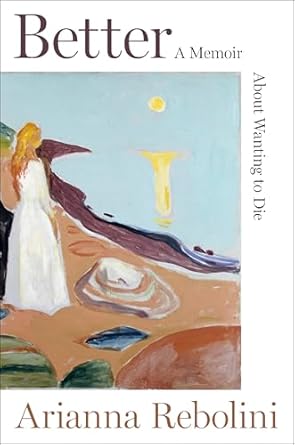
What drives someone to die by suicide is an enigma that will forever exist on the edge of our understanding. Although we can never truly know a person’s thoughts in their final moments of life, Arianna Rebolini gives us an intimate look inside the mind of someone who’s been there in her debut memoir, Better: A Memoir About Wanting to Die. She details her struggle in a narrative that’s at once vulnerable, lyrical, and investigative. Despite the obvious successes of Rebolini’s life—having a career in editing and a published novel, a close-knit family, and a loving marriage with a healthy child—she deals with overwhelming despair.
One day, instead of trying to kill herself, Rebolini checks into a psychiatric unit. The memoir follows her hospitalization, weaving in reflections from throughout her life: there are her initial thoughts of suicide in childhood, her attempt as a teenager, and conversations with her therapist, husband, and son, Theo. Rebolini grapples with a fear of “infecting” her son with her mental health, a fear that grows as her brother—who’s deeply similar to Theo—sinks further into his own depression. She scrutinizes Theo’s behavior, hypervigilant for signs of distress, and wonders if he should see a psychologist.
Delving into broader historical and cultural themes, Rebolini explores famous suicides—analyzing the writing of Sylvia Plath, Virginia Woolf, and David Foster Wallace—as she searches for an explanation as to why a person might succumb to their darkest urges. She also researches the insidious reality of systemic factors, such as barriers to mental health care and dehumanization in modern-day workplaces, and shows how they amplify suicidal thoughts.
As someone coping with chronic suicidality who shared high school classes with Rebolini, my whole heart goes out to her. Like cars in side by side lanes, we drove the same direction for years but were too trapped in our own stories to notice the other’s struggle. I wonder how we could have supported one another. Recently, we spoke on Zoom about what “better” means, the inaccessibility of behavioral healthcare, mental health’s impact on motherhood, the stigma of honesty, and why society is so afraid of suicide.
Marisa Russello: People have long been fascinated and horrified by the topic of suicide, but your book centers on the idea of moving toward something “better.” What does “better” mean to you and where did your motivation for writing this memoir come from?
Arianna Rebolini: I knew this book was going to be called Better before I knew what the book was going to be, and it’s one of the few things that stayed consistent over eight years of writing. My whole life I’ve said I want to be “better,” but I don’t think I can know how to be better if I don’t know what that word actually means. And so the motivation was to figure out, what does “better” mean? What would a better life look like? What would be better enough to feel like I’m living an okay life? And how can I get there?
That’s something that shifted throughout the writing—I don’t think it is a static concept. I wanted to settle into an idea and be like, Okay, so this is what I’ve decided is better enough. Now I know. Even still, I don’t think I have a firm grasp on what it means. But I think the “enough” is important. When it comes to health, we think of better as done with: I had this cold, and now I’m better, and think of it as a final stage rather than a relative one. So as far as suicide goes, for me,better means being alive and not having a life that is primarily focused on figuring out if I’m okay, just allowing myself to be.
MR: I like that concept of “allowing yourself to be,” not worrying about every little dip into sadness, because it’s normal to get sad. For me, I feel like I’m in more of an in-between state now—I’m not cured, but I’m not sick. Sometimes I really want to live, but sometimes I do want to die.
As far as suicide goes…better means being alive and not having a life that is primarily focused on figuring out if I’m okay.
AR: I feel like I’ve spent so long being like, Well, I’m not really better until that section is gone—until I’m done with going through points in my life where I want to die, so it was important to acknowledge that those periods don’t have to mean I’m not okay. Otherwise, I’ll be waiting forever.
MR:I really appreciate how candid you are about such difficult subjects. Have you encountered any challenges when discussing these stigmatized topics so openly?
AR: I’m lucky that in writing online I have found my audience, so when it comes to mental illness and suicide, I haven’t gotten a lot of trolls. Yet something I have dealt with is navigating people who are close to me reading it and their reactions. Whether being like, I didn’t know it was this bad, I’m sorry that happened, or This made me really feel bad, that’s something I have a hard time figuring out how to manage because if you want to write about this stuff, you have to go in knowing it probably will hurt people who are close to you.
What I’ve gotten the most trolls about is speaking candidly about motherhood and not really coming to it naturally. That’s where I’ve had people on social media be like, I’m going to call CPS. I go through periods where the way I handle it is engaging earnestly and being like, Why do you think that? Other times, I’m like, Whatever, block. But it’s something that scared me a lot and still worries me.
MR: People are so hard on moms. How do you think your narrative might be able to change the broader conversation about mental health and suicide?
AR: Not everyone has the time to do research and spend so many hours thinking about this. So I really like thinking about this book as: I’m not the only person who lives with this. I’m not the only person who has these thoughts. So I’m going to create one cohesive presentation of something that I have felt, something that I’ve seen other people feel and write about, and put it all together in a way that hopefully resonates.
Mental illness as a whole is a really complicated conversation, but when it comes to suicide, the stakes are so high, so I understand why people are like, We have to be strict about how we talk about it, because, God forbid, we set off someone else’s suicide. I get that fear. But if there’s anything we know about the history of how we understand psychology, there are so many times we thought we had it right, and we had it wrong. So we think we have this right, and we’re like, This is how to talk. This is what we know is the safe way. Don’t say “commit suicide” because that has negative connotations, and don’t do this. And we think that now, but what are we going to think in ten years? We do have to risk a little if we want to talk about it in a meaningful way.
MR:Something you wrote about that makes me really angry, and I think makes you feel that way too, is the inaccessibility of behavioral health care.
AR: I feel like anyone who’s tried to navigate the system understands how impossible it is. It’s so expensive [to live] here, and the majority of psychiatric providers don’t take insurance. That’s something I’ve had a really hard time grappling with ethically and morally. You’re going to them like, you’re supposed to help me, but you charge $400 an hour and don’t take insurance, like how do you square that? And how do I, as the patient, trust you?
Understanding how the insurance companies kind of bully the providers into this setup, I think it’s the fault of the system, but the person who bears the brunt of it is the one who’s in crisis, especially because we don’t really think of mental health care as preventative. When you need help the most, it’s the hardest to get quickly. You’re not in any state to navigate all these steps and figure out how much you’re going to spend, so it’s a system that does not encourage people to use it, which is maddening whether you’ve needed it for yourself or you’ve tried to help loved ones get the help they need.
MR: Yeah, just yesterday I was on hold for two hours with my insurance about a $2,000 reimbursement for my psychiatrist. For some reason it wasn’t processed. They said there was a glitch in the system, and they never notified me. I can’t imagine if I didn’t keep track of these things.
AR: Oh my God! I’ve had versions of that conversation so many times, and you suspect it’s on purpose. Then seeing that ProPublica investigation and interviews with people who worked for United Healthcare and Cigna and [realizing] no, it is on purpose. They want to keep you on hold for hours. They want you to lose track. They want to make it so that you’re like, This is not worth the money, and then they don’t have to pay.
MR: It’s infuriating. When you were reviewing the research, did you learn anything especially compelling or surprising that you would want to share?
AR: I am a feminist, and I think something that was important for me was seeing how the patriarchy and the same systems that oppress women, those systems are hurting men too—to the point that it’s a large part of why men kill themselves more than women.
Edwin Schneider—I don’t think I quoted him—but in his work he’s talking to men who kill themselves because their wives make more money. And you’re like, Oh my God! These fucking men. But it was important to take a step back and [reconsider] that that should make me more sympathetic because it’s the exact same system. The man—who believes that women need to make less and kills himself because his wife is more successful—is suffering from the same system that hurts the woman who is hated because she makes more. The man’s suffering is harder to grapple with because largely he benefits from that expectation, but the end result is him killing himself. I sympathize with that, and that was really interesting to read and think about. I still believe that so much of suicide comes from people’s inability to meet these arbitrary requirements of society.
MR: Authors whose writing you engaged with, like Sylvia Plath and Virginia Woolf, were celebrated for their artistic genius, yet their works present a romanticized view of suffering. How did reading them deepen or challenge your understanding of suicidal ideation?
AR: I think what it really did was make me question the worthwhileness of interrogating suicidal thought, which is a funny thing to come to terms with while I’m literally researching and writing a book about suicide. If there’s one thing I really came out feeling strongly about, it’s I got this out of my system and I never want to think about [suicide] this much ever again.
I think record keeping is great, obviously—I’m a writer. You want to observe and learn. But you read Sylvia Plath and Virginia Woolf, and you’re like, Oh my God! It is exhausting. There’s only so much you can say about being depressed. And it’s not a matter of like, Oh, get over it because I know it’s not that easy. But there’s a threshold where examination is no longer useful, when it just becomes like a quicksand. One of them talks about this. I think that you do get stuck deeper and deeper, and it’s hard to pull yourself out when it’s all you’re thinking about, whether you’re writing about wanting to die or figuring out like, Okay, I’m feeling good today. What made me feel good today? How can I do that again? It’s just so much thought, and that interiority makes it really hard to live your life outside of it.
MR: A theme your book touches on is motherhood—your vulnerability in this part of the memoir is so refreshing. How has your journey with mental health influenced your approach to parenting, particularly when it comes to balancing open conversation about your experiences with protecting your son from the heaviness of those challenges?
AR: That’s something I think about probably every day. I’m always trying not to project onto him my own history and my family history of mental illness, and I’m glad I have my husband, Brendan, to balance me out when I’m like, Oh my God, he’s so anxious. He’s so depressed. Well, he’s also just a five-year-old who doesn’t really know how the world works.
There’s a threshold where examination is no longer useful, when it just becomes like a quicksand.
It’s a balance of wanting to protect him but also understanding that kids are really smart, and they figure things out on their own. When I was looking at studies about suicide with kids as young as five, I was like, Oh my God! In my mind, when I have been afraid of Theo becoming suicidal, he’s—I don’t know—in middle school, but of course it can start younger than that. You just kind of forget as you get older how real life is, even when you’re six or seven. I try more than anything to start with honesty and respect and err on the side of not giving him enough information.
I’m hoping, talking to my psychologist and a child psychologist about what he can handle and when, whether it’s about his mental health or mine, that they’ll guide me because it’s something I’m very scared of getting wrong.
MR: I mean, who wouldn’t be scared of getting it wrong? I’m a foster parent, and the teenager who lived with us last year had depression. We ended up bonding over that, so sharing my feelings was something helpful [to my child]. But I was recently in a support group for people with suicidal thoughts, and someone was like, Oh, I’d never tell my kids because they would feel like they’d have to take care of me. And I thought, Oh my God! Should I have done that?
AR: It’s so imperfect, right? You can argue from either side. I literally wrote a book about wanting to die, so there’s no way Theo’s not going to know. But I think there’s a way to make it clear, like, This is something I have, too. And if you want to talk, I understand, but it is not your job to worry about me. I am taking care of myself. I think you can manage both.
MR: I appreciate that. So, given your own experiences with despair, what lessons do you hope to pass on to Theo regarding emotional well-being and resilience?
AR: I hope he can bypass the stage of figuring out how to accept this as part of himself. I think, for me—and this is not my parents’ fault, it’s the generation we were in—I spent those first years of living with OCD and depression, and then suicidal ideation, not really understanding and then having to do the work of figuring out what it was, figuring out that it wasn’t a bad thing to have, and coming to terms with it. I’d like Theo to be able to skip that work and just know.
And I hope he will have an easier time accepting help and drawing on strength from others when he doesn’t feel strong or resilient himself. Resilience doesn’t have to mean doing it alone.
MR: What are your thoughts about why our society is so afraid of suicide?
AR: It’s scary to be like, What would make a person want to stop living? And what about our lives and the systems we live in makes that person decide that dying would be better than existing?
As tough as [those systems are], being like, Well actually, maybe there should be a different system is scarier because that’s an unknown, and people don’t want to grapple with the idea that suicide has external factors. It’s easier to believe there’s something wrong with that person. That person was sick. They weren’t in their right mind. I think it’s very scary to look earnestly at the possibility that, no, they had valid reasons for wanting to die. And those reasons—their circumstances—didn’t need to be the case. Those are big, big questions that involve everyone. And it’s scary to think about how the world can and should be different and what that would mean.
MR: Absolutely. I think when a loved one dies by suicide, it shows that their suffering was so uncontrollable that they felt they had no choice but to die. What does that say about us? And I feel like that realization is terrifying.
AR: That’s a good point, too, because deciding to kill yourself requires so much isolation, and a lot of times it’s not apparent. I think it reveals a lot of distance between you and people that you love.
MR: Very true. Your book should be an excellent resource for clinicians and for families of people struggling. What do you hope your story will offer these readers?
AR: My biggest hope would be that it opens up room for uncomfortable conversations because I think the best thing you can do to engage with and possibly help someone is just to acknowledge, Yeah, that makes sense that you want to die from the way you’ve described it. I understand. It sounds simple, but it’s such a hard thing to say because you don’t want them to be like, I told you so. I’m going to go kill myself now. But you really need to get uncomfortable to actually help someone.
MR: In my experience, [someone suicidal] would be relieved, maybe even hopeful, that you’re listening and validating them, and they would open up more.
AR: And there is research [that supports] that’s the best thing you can do to help…it means you can actually talk about what’s going on.
“A Case of the Horses,” an excerpt from The Wanderer’s Curseby Jennifer Hope Choi
I was talking to a Korean friend in London in the winter of 2021 when the topic initially arose. “Sounds like your mom has yeokmasal,” she said nonchalantly. “You know, the wanderer’s curse.”
No, I didn’t know, had never heard of the word let alone its ominous connotations. From what I could acquire in English online, the meaning of yeokmasal derives from Chinese characters. Yeok: station, ma: horse, sal: not so directly translatable but, in this context, some amalgamation of aura, vibe, destiny, bad or negative energy/spirit/curse. The term may date as far back as the Silla dynasty. Koreans traveled then across great distances on horseback; in order to maintain efficient transportation speeds, riders would trade out their tired steeds at horse stations dotted across the country. When someone has yeokmasal, they will wander, station to station, stopping only long enough to refresh their horse before moving wherever the wind carries them. Such is the nomad’s burden, itchy feet whisking you away from the family you are meant to honor and serve. The wanderer’s curse is supposedly hereditary and a measurable disposition. To find out whether one is beset with yeokmasal, one must consult a fortune-teller (a common practice across all tiers of caste in ancient Korea). One’s saju is deciphered from birth chart information; within specific astrological coordinates, one may discover, among other fates, whether one is plagued with the curse.
To find out whether one is beset with yeokmasal, one must consult a fortune-teller.
Today yeokmasal is not associated with the blemished implications of yore. Living abroad for vocational opportunities can be viewed as a boon. Confucian principles regarding familial duty still apply, so maybe it is understood that a person is destined to eventually go back home and settle down. These days the term can even be filtered through the high-gloss sheen of wanderlust, the globetrotter’s longing for exploration that glorifies the romanticism—not the instability—of perpetual travel. Wandering is a familiar preoccupation for my generation in America—a time of constant in-betweenness, especially so for children of immigrants. It is no wonder, then, that Millennials have been drawn to “vanlife,” a trend that gained popularity across the country around 2015, perhaps peaking post-2020 Coronavirus isolation. Even my mother could see the appeal. In a van, you could stay at home and move around. Why buy a house or pay rent when you could make anywhere your yard? Kitted-out vehicles afforded thrill-seekers with the open road’s vanishing point, thrusting them toward a titillating, unseeable future.
Anyone who’s been on the road for longer than a week understands there are pitfalls to what may seem like a derring-do flex of freedom. There are certainly ways to bathe and nest in a confined mobile space, but for how long? Wanderlust conveys an air of exhilaration, risk for the sake of stimulation and adventure. But to be a nomad is another matter, something more enduring, a state that shudders with existential restlessness. No end in sight. No thrill either.
Unless you are Buddhist, uncertainty can feel like a soulful affliction, holding both provocative and terrifying possibilities: fulfillment of purpose or the bottomless unknown. Wandering is perhaps a way to embrace uncertainty, making discovery feel constant and ripe with promise. Are those who possess the wanderer’s curse galloping toward hope? Or are they ever averting stillness, so that whatever they may be escaping never gets the chance to catch up?
When I asked my mother about yeokmasal, she said, without hesitation, “Oh yea . . . I have that.” At no point had Umma received a saju reading of her own, though it didn’t take prescience to see the woman had a case of the horses. Her itinerant ways belonged to a bigger story.
I’d assumed Umma’s season of wandering started when she’d answered the job listing in a nurses’ journal in 2007, for a position that would take her to Ketchikan, Alaska—and many cities and states after that. Since retiring, she’d been spending three-month stints in Suwon, South Korea, to care for my elderly grandparents. After 40 years abroad, she’d landed back in the home she’d been desperate to leave. I wasn’t convinced she’d stay in her own city, back in the States, either. Though she’d relocated to South Carolina indefinitely in 2018, we seemed to share a cavernous longing for elsewhere. “I’m still looking for something that it’s not there,” she told me on a recent call. “I don’t know what it is I’m looking for.” Almost anticipating what I had not spoken, she added: “You know, you don’t have to be like me . . . ”
There was a time I believed I couldn’t possibly be anything like her. Now I wondered: Would I be as unsettled at seventy, too?
Did I even have a choice?
To find out if I was “officially” accursed, I’d have to get my saju read in Seoul. Did I believe in that kind of stuff? Kind of. I am not a woo-woo person; I like to say I am medium-woo, prone to occasional metaphysical rumination. I know my astrological signs, but I don’t know when or which planet is in what house aligned in or out of my favor.
I asked my Korean Londoner friend for a recommendation. “I can tell you right now, you have yeokmasal,” she told me, hardly containing her laughter. “You don’t need to go to him to find out.” But I wanted to hear what this soothsayer could glean about both Umma and me, so we made the appointment. Our guy was apparently quite legit, as far as fortune-tellers go. The plan: My mother would take a break from her caretaker duties in Suwon and travel two hours by subway north to join me in Seoul where she’d live-translate our readings. I would pad out my itinerary with other activities prior to her arrival. In order to get the full immersion I was seeking, I decided to sample Airbnb’s suggested Experiences—excursions led by local “experts.” In Tuscany, there are truffle hunting expeditions. In Oaxaca, traditional cooking classes. In Seoul, options revolve around K-culture. Regardless of the focus, every host relays some essential notion of Koreanness in their overviews—whether in Korea’s history, its treasures and trades, or its current ontological dilemmas.
“Are you Warmton or Coolton?” asks one host. K-beauty professionals can decipher your “personal color” within a one-hour session, because “knowing your own body color is helpful for making a good image.” In another you can learn how to apply makeup like Korean idols and celebrities, “drawing eyebrows that can greatly influence your impression” and “shading to make your face look slimmer” during your stay in the “Beauty Kingdom.”
You can also take K-pop vocal and dance lessons where you’ll be endowed with “so much insider info, you may just make it in the industry yourself.” Because Koreans love to drink, you can play drinking games, sharing fried chicken and clinking thimbles of soju with strangers, to “feel the culture of a real Korean college student.” And for the more emo-minded, you can delve into young Korea’s “sad cultures” on a walking tour through Gangnam District.
I was taken by one host named GJ. She offered a range of Experiences, from conversational Korean language courses to something called “Amazing toilet restroom tour,” exploring, I presume, Seoul’s most noteworthy water closets. I was charmed by her hustler’s gusto and kooky “what you’ll do” descriptions. For a seemingly unremarkable stroll around her outskirts neighborhood, participants can “dive into real Korean life” to “get to know what Parasite claims. Here is a chance to look around the local residences where we actually are. You may be able to smell them.”
“Is it a waste of the commission that this platform takes?” she shares on her bio page. “I agree with that a little bit. But they made typical trip different. Isn’t it? . . . The reason why I can continue to have positive personalities is that I don’t make my living by those experiences. I am ready to show you my sincerity, and I want to feel your sincerity, too.”
GJ happened to offer saju readings, branded as a form of “Oriental fortune-telling.” She would follow it with something called K-tarot, an additional reading performed with a handmade deck of cards based on illustrated Korean divination texts known as “dangsaju.” GJ explicitly states her services are not for native Koreans. I couldn’t track down any other English-speaking saju readings, so I signed up. Because I would be paired with another American client, I decided I’d mostly observe, vérité style. “This experience has nothing to do with supernatural shamanism,” GJ mentioned in a message. “Fortuneteller is not shaman. Two are different. I will talk about what is saju to you!”
GJ’s K-tarot may be a clever marketing ploy, appealing to astrology enthusiasts, but it also gestures to a greater trend in Korea. The clairvoyance business has seen renewed interest, especially among Korean youth. According to Korea Economic Daily, as of 2018 the industry was on its way to becoming worth $3.7 billion in South Korea. Market research indicated two-thirds of all Koreans seek guidance from fortune-tellers at least once a year—a number that apparently increased post-pandemic.
In any Seoul neighborhood, you will likely come across fortune-teller tents set up on sidewalks.
In any Seoul neighborhood, you will likely come across fortune-teller tents set up on sidewalks, where seers offer tarot card, face, and palm readings at minimal cost. The most popular services, however, are saju readings. These days one can book online for sessions held at YouTube-famous fortune-telling cafés. In some of these establishments, rather confusingly, women present themselves as mudangs (Korean shamans) and augur via the landing patterns of tossed wooden sticks or ancient coins. Like GJ mentioned, mudangs and fortune-tellers are not the same—but they can overlap, perhaps in the way a square is a rectangle but a rectangle is not a square. They are sometimes referred to interchangeably or without much distinction. These nebulous parameters likely present ample opportunities to profit off the ductile faith of others.
The busiest saju season is from December to February, after the completion of academic exams and before the lunar new year. Young Koreans ask questions about college admissions, which schools they ought to attend, whether the country will go to war, or if this year they’ll fall in love. Couples visit to determine their matrimonial harmony in a reading called gunghap. Business tycoons and bureaucrats also request guidance with risky financial acquisitions and career moves. There are a number of controversies involving prominent South Korean leaders across conservative and progressive ideologies, who defer to the private counsel of personal fortune-tellers throughout pivotal political decisions.
One’s pillars of destiny are fixed, so any fortune-teller ought to divine the same characters based on birth information. For Koreans, though, one’s lot in life is not set in stone. Saju is like a cosmic blueprint. Ultimately an individual wields the power to alter their fate through intentional choices or sometimes with the help of expensive talismans. And that’s the kind of enterprising spirit Koreans can get behind.
Janet Shin, a professor of the Oriental Science Department at Wonkwang Digital University and the Korea Times’s resident fortune-telling columnist, believes saju ought to be treated with academic interest rather than brushed off as woo-woo hooey given how its storied past is woven into Korea’s philosophical history. There are centuries-old dang saju texts displayed in the National Museum of Korea and the Museum of Folk History. Sources differ on the exact origins, though many believe saju is based on Chinese philosophies. According to Shin, saju’s historical background is indeterminable, due to competing political interests and ideologies that have fluctuated across multiple dynasties throughout East Asia.
Wherever it started, saju has become as Korean as kimchi. And, like any metaphysical belief system, it functions as a way of making sense of the unknowable, to better comprehend one’s place in the world.
But how does saju work? The word, which translates to “four pillars,” resembles the Chinese astrological tradition of Ba Zi. While Ba Zi readings are influenced by elements from the I-ching, or The Book of Changes, to interpret readings Koreans rely on their sacred tome known as Tojeong Bigyeol or Secrets of Tojeong, written by Lee Ji-ham, a scholar of the Joseon dynasty.
The process itself involves an explosion of numbers, beginning with those pillars, based on birth year, month, date, and hour. Each pillar is divided into two rows (one of “celestial stems” and another of “earthly branches”) for a total of eight characters. Every character corresponds to one of five elements—earth, wood, fire, water, and metal—and is attributed with yin or yang (dual forces sometimes simplified as positive or negative energies). Additionally, each pillar represents a stage of life, read from right to left (birth to childhood, adolescence to young adulthood, and so forth until death).
With so many factors at play, it may seem as if one’s personal saju permutations are rare. In actuality, there are only 518,400 possible variations in a sexagenary cycle. Uniqueness arises not through the numbers themselves but in how and by whom those numbers are interpreted. Prognostications are dependent on the diviner’s personal proclivities and beliefs. One fortune-teller may infuse elements of quantum theory into their readings, or psychoanalysis, while another may prioritize their client’s reactions and body language to shape the bricolage. Some might not believe in fate or destiny at all, valuing the social or performative aspects of the transaction instead. In other words, there is no single way of practicing saju. It is a tradition dependent upon subjectivity and its very own lore.
Nowadays folks can skip a face-to-face encounter altogether by entering their info into an app for speedy results. But for my purposes, I would need to interact with humans attuned with divination skills. Which is one reason why I decided to meet with GJ. Saju schematics are dizzying and resources are written in Korean or Chinese, so there are limits to what I could research in English. GJ had been studying saju for a mere two years. Even though her approach was marketed for foreigners, I needed to beef up on basics before the legit, second appointment. I also wasn’t confident Umma would convey necessary nuance—or if she’d even show up. Hours before my departure, she got wishy-washy on me. Maybe she wouldn’t even make it to the saju appointment. “It’s against my religion,” she joked. And with that, I boarded my flight.
Before venturing into Seoul for four nights, I spend a few days with my grandparents and mother in Suwon. Aside from sleeping on a stone slab disguised as a mattress, and gorging on childhood favorite foods (thick discs of hobak jeon, unctuous braised galbi jjim, and the crunchiest oi muchim slathered in sweet soy), I prepare my usual, embarrassingly exhaustive document for traveling somewhere new. The list includes where I want to eat and drink (best mandu, sundubu, third wave coffee, Korean rotisserie chicken) along with several phonetically spelled-out common phrases I can refer to when stage fright short-circuits my brain. Can I take this to-go? / Ee-guh po-jang dweh-yo? / 이거 포장 돼요? I’m sorry (formal) / Joesonghabnida / 죄송합니다.
Grandpa is worried about me getting around, because my Korean is so shitty. Grandma says thieves abound in the big city, so I need to wear my purse front and center. Umma has not informed Halmoni about how she’ll stay with me in Seoul for one day, but we’re proceeding as planned. She waves me off when I depart, morose but acceptant, like one of the string quartet musicians who resolves to play one last song on a capsizing Titanic.
I’ve chosen to stay in a hanok—a traditional Korean house with tiled rooftops and rice paper doors. This one offers classic Korean breakfasts, heated wooden floors, an interior courtyard with an Oriental garden, and a private sauna and spa tub. It is located a short walk from Gyeongbokgung—the primary palace of the Joseon dynasty—where I spend a sunny but bitterly cold afternoon touring the grounds and nearby folk museum.
Visitors donning hanboks receive free admission to any of the city’s palaces. It’s a popular activity, and one I’d seen advertised in many Airbnb Experiences. For about seventy dollars, you can spend two hours cosplaying Korean royalty while a multilingual professional photographer documents your every move. The fee includes “VIP treatment”: borrowing Korean outfits with the help of a “Personal Hanbok assistant” and optional hairstyling or accessories at additional cost. The host will then snap faux candid shots of you and your partner or friends beneath Gwanghwamun—Gyeongbokgung’s towering gate—or beneath the vibrant rainbow-like dancheong paintings adorning the eaves, or while sauntering by the royal banquet hall’s tree-lined lake. Tourists of varying backgrounds find the pastime alluring, as seen in one host’s photo gallery: a lesbian couple smiling in complete regalia mid-stroll; a woman in a hijab pinching up her carnation-pink chima, curtsy-ready; a Fu Manchu–mustachioed man wielding a fake sword.
On my visit, I weave around a dozen of these simultaneous photo shoots. I see a gaggle of Chinese women posing in choreographed group formations. There are several white dudes, begrudgingly outfitted in full court dress, including coronet headgear, trailing their Asian girlfriends from balustrade to balustrade, recording the inanities on their smartphones. Some rent their outfits directly from one of the many boutiques in the surrounding neighborhood and the costumed families, couples, and teens waltz around the ancient streets in their sneakers, clutching selfie sticks, posing together at tea shops or nearby Bukchon Hanok Village. The epitome of Korea can be found in these transactional displays, antiquity clashing with modernity—specifically jarring at Gyeongbokgung. The palace was first constructed in 1395; 93 percent of its original 500 buildings were obliterated during occupation, when the Japanese empire sought to destroy any signifiers of Korean legacy. Now there’s an entire cottage industry for larping olden-day Korea in the twenty-first century.
That evening, I participate in something more my speed: a Korean youth generation tour that promises to peel back Korea’s shiny veneer, exposing the country’s “sad cultures.” As a former Morrissey fan, I suspect I’m the ideal participant for a sad cultures tour. I meet June, our docent, at the Gangnam Style “horse dance” stage. Our cohort consists of a couple from Singapore, a young Kiwi doctor, and a finance guy in a Union Square Donuts beanie.
Fifty years ago, Gangnam, meaning “south of the river,” teemed with rice paddies and agricultural landscape. Today it is a district reputed for its uber wealthy residents—synonymous with a Beverly Hills lavishness available to only a sliver of the population. June is a handsome Korean guy in his twenties with the prototypical em-dash eyebrows, Spock sideburns, and a hint of edge (a tragus piercing). He says by the end of our time together, we will know Korea’s dark side and why his peers in the MZ generation (South Korea’s combined Millenial and Gen Z demographic) frequently describe their predicament as “living in hell.”
Hell Joseon is the dystopia MZers were born into and cannot escape. Beginning in the 1960s, government resources and funding had been funneled almost entirely to central Seoul. Park Chung-hee seized power via military coup in 1961, served as president from 1963 until his assassination in 1979, and many of his economic reforms led to Korea’s meteoric transformation, often referred to as the Miracle of the Han River. Some see Park as a despot, others as a complicated leader who rectified the nation through stringent, if dictatorial, control. He enforced rapid development, including the implementation of key infrastructure (bridges and roads) and an emphasis on exportation of domestic goods to kickstart the country’s industrial growth. Further expedited by Seoul’s bid to host the 1988 Summer Olympics, soon high-rises sprouted from the land. Furious productivity established untenable momentum. It seems MZers now feel trapped by many of the systems that hoisted the country from financial collapse. They are encumbered by impossible-to-maintain ideals, manifested in appearance, career, and social demands, in an ongoing climate of state-led media censorship and political oppression. But, June assures us, this will be “not whining tour . . . I love my people.”
Due to the inequity of postwar development, areas outside the city have lagged behind Seoul’s progress. Rural towns do not provide adequate opportunities, jobs, and healthcare for young people and have become largely occupied by Korea’s elderly. According to June, 92 percent of the Korean population resides in urbanized, metropolitan areas, which constitute only 16.7 percent of the entire country’s usable land. Buying a home in Seoul, the nation’s capital city, is inconceivable for most; the going rate for an apartment—not a house—hovers around one million U.S. dollars, while the average monthly salary clocks in around $2,800. As a result, the life of Korea’s youth generation is rife with ceaseless, gladiatorial competition. In a time when family-run conglomerates (known as chaebols) dominate contemporary Korean society, Golden Spoons (those born into wealth) can easily skip the line to ascend quickly in the corporate world, while those from more humble upbringings toil in the muck indefinitely.
We walk by hagwons, the cutthroat after-school academies so intense the government had to install a 10 p.m. curfew to regulate children’s excessive study hours. Next are the pylon signs filled with the names of plastic surgery clinics that accommodate Korea’s obsession with “lookism.” There is even a Korean web toon called Lookism (that has since been adapted into a Netflix anime series of the same name) in which Park Hyung Seok, an unattractive, self-loathing high school teenager, assumes a strapping body by day, but must return to his shlub self at night. In that form he is treated with stereotypical derision by bullies prior to his metamorphosis and has zero friends; no women will give him the time of day; and he’s so depressed he wants to die. When he’s living as his hotter self, his life improves. Women swoon at the sight of his K-pop-idol physique, and he becomes a social media influencer and a model. The moral is ambiguous. Perhaps the point is that Park Hyung-seok must confront how good-looking people experience life differently, which directly affects how one sees oneself. In psychological terms, this can be referred to as the Looking Glass theory, in which a person interprets their identity based on how others perceive them. Meaning that self-image is not conceived in isolation but among others, through social dynamics, because individuals and society work in concert, one entity informing the other. Each social encounter is a mirror in which one’s reflection varies. And ultimately the individual must weigh and assess this feedback to find a kind of equilibrium.
Balance is not so simple in Korea. According to June, it is common for companies to require headshots with job applications. “It doesn’t matter who you are on the inside, only how you look on the outside,” he states, expressionless. With regard to plastic surgery’s ubiquity, he asks, “Have we gone too far? Maybe.”
By some estimates, one in three women between the ages of nineteen and twenty-nine have undergone procedures. With the incremental tweaks, everyone has begun to look the same—white skin, rounder eyes, V-line chins, button noses, upturned smiles, slimmer calves, bigger breasts, smaller faces—but also farther and farther away from looking Korean. When June’s friend moved abroad, she told him, “I feel free. I don’t have to care about how I look finally.”
Korea’s triumphant comeback narrative has spawned these hellish preoccupations. “Earlier generation struggled and worked so hard,” June says. “Their screams were covered by development and successes. [They said] let’s give those successes to our next generation.” But those children now feel trapped. “We can’t develop faster. They had hope, older generation, but we can’t develop like old days,” June continues. “Younger generation sees there’s no hope.”
Suicide is arguably the saddest of the sad cultures we broach on our two-hour doom-and-gloom cruise. Before inviting us to eat Korean fried chicken—perhaps the most depressing post-mortem drinks hang invite I’ve ever received—June concludes his spiel on the banks of the Han River. We could spot nearby Mapo Bridge, a disturbingly frequent suicide destination. In 2012, Samsung Life Insurance posted uplifting messages along the railings to deter potential victims from leaping to their deaths. “Doesn’t it feel good to be outside walking on a bridge?” one sign said. “Worries are nothing,” said another. The topic is so common within cultural discourse, there’s even a suicide jumping joke among young Koreans. “What temperature is the Han River today?” one will ask. And to any answer they’ll retort, “Nevermind, too cold!” It’s an eerie evolution. In the span of fifty years, the Han River has come to symbolize new beginnings for one generation and definitive ends for another.
After a light breakfast of marinated fish and fermented soybean soup, I meet GJ outside Bulgwang Station for my first saju reading. She’s in her forties, lean and springy, with an almost twitchy alertness, like a cricket. She’s pacing, checking the time, waiting for our second participant. Sandra, a Black woman also in her forties, from San Diego, finally arrives in a taxi, apologetic for the delay. She’s wearing a beret. Despite having been in Seoul for two weeks on vacation, she hasn’t taken the subway yet. I ask what brought her to South Korea in the dead of winter. Her answer has something to do with working in the health sector, a visit for ideas to share back home. As for this Westerner-centric fortune-telling event? “Oh, curiosity,” she says, then adds coquettishly, “I have my reasons.”
We trail GJ’s brisk pace and our guide chatters away about the busy day, her teenage daughter’s exams, and the park we pass, recently revamped to serve the community. Elderly Koreans are seated at the benches, embanked in bristly dead grass.
We de-layer and order drinks at a spacious bookstore–café. GJ can’t seem to catch her breath. She’s starting a new sentence before finishing the last one, her mind moving faster than her body can handle. Through the course of the session, she will refill her black coffee three times. At the moment, she’s losing track of her belongings, touching pens and loose papers, looking under the table, into her bag, monologuing a continuous, nervous ramble until handing us gifts: tangerines and long-twist donuts called kkwabaegi.
Sandra appears unbothered by our host’s frenetic state. “Coffee and carbs!” she sings.
Though the answer is rather obvious, I ask GJ anyway: “Are you okay?”
“I’m okay,” she says, then immediately reneges. “Actually, I’m not okay.” She’s awaiting text updates about her daughter’s exam results. We learn her kid skips class and doesn’t care much about school which, in Korea, is a very bad, very big deal. GJ interrupts her own tangent. “This is my personal history. I’m so sorry. Just give me your birth day and time.” She hands us an informational printout along with pages she’s ripped from her notebook so we can write down our birth information, then leaves to retrieve our coffees.
It occurs to me that I’ve never seen a fortune-teller stressed.
It occurs to me that I’ve never seen a fortune-teller stressed. “She seems frazzled,” I whisper to Sandra. “It’s freaking me out a little bit.” Sandra shrugs as classical music, like the ambient soundtrack at a shopping mall, tinkles in the background. I stare at the printout, which is covered with boxes, charts, and phoneticized Korean-to-English words, including the ten celestial stems and twelve earthly branches. There’s a pentagram too, each point representing one of the five elements, +/- signs marked throughout a list of characters. The four pillars are represented by eight squares, one marked “social mask,” another “success.”
Sandra asks me where I’m from, and I tell her Brooklyn because nowhere else feels right. I haven’t returned to California since my mother left seventeen years ago. Even though I’ve lived in Tulsa for two and a half years, it isn’t home. New York isn’t anymore either, but it’s as close as I’ve gotten so far. “You don’t have an accent,” Sandra notices. “Cheater!” I smile and let out a nervous warble, because obviously I’ve lied and both of us know it.
GJ returns and begins punching numbers into an app on her phone. It will calculate our eight characters and correlating energies she’ll interpret. GJ takes a swig of her java, slams the mug on the table, and continues mumbling and scribbling into her notebook. I notice Sandra’s birth date and fill the gap of silence: “Ah, you were almost a New Year’s baby!”
“All the women in my family are basically Capricorns,” she says, swirling her latte. “It’s really scary. We have nothing but earth signs.”
“WOW. Wow,” GJ exclaims. Apparently, out of eight characters, I only have two elements: tree and water. “I . . . I met the first person to have only two . . .” she says. “I so curious. It’s very simple. But you are not a simple person.” She switches over to Sandra’s numbers, pleased. “As you see, you have ALL of five element.”
Noticing my disappointment (is two bad?), Sandra whispers to me, generously, “Just means I’m complicated.”
After more coffee chugging and notebook scribbling and mug slamming, GJ is ready to explain Sandra’s pillars. She’s pointing with her pen tip to characters and boxes on our printouts. I have been listening to Korean people talk in accents my entire life, but I cannot seem to keep up with GJ. Yet Sandra is “mm”ing and “hmm”ing, gasping and concurring with “One hundred percent” or “That’s so true.” At one point they share a giggle about a third-pillar revelation and Sandra’s propensity toward secret-keeping (“so Capricorn”), which prompts her to say: “It’s like Diana Ross. I’m coming out!”
Why? How??
GJ agrees. She’s chewing loudly on her donut as she continues: “You are medium fire, candle. Not big flame. Yea? It’s not the dangerous! People know you. Earth and fire. Negative earth. This is a continent. Maybe hollow, is very wide. . . . And then this fire, fighting fire, big fire . . . So this is really good. Negative earth is . . . guard, they, everybody know what is your potential . . . If earth character have big energy, earth need tree, be control. Fire . . . ”
“It’s opposite,” Sandra finishes.
“Yea, opposite. We say, kill. Literally means kill. Tree kill earth. But it is not correct word in English so . . . earth need tree. And fire hurt. Fire melt metal.”
I’m thinking, Is Sandra killing earth? How does a medium fire melt metal? when GJ turns to me, laughing a little too hard, and says: “You don’t have fire!” Which feels like a dig, but seeing as how I don’t know what’s happening, I release an unconvincing “Ahhh.” And while I don’t know how she arrived at such a conclusion, Sandra summarizes with an analogy having to do with how forests need a good scorching every now and then to kill off diseases so new saplings can grow.
“Can you understand?” GJ asks me.
I cannot. How did Sandra get all that? I can understand GJ is speaking English but the words sound randomly strung together as if pulled from a bingo tumbler. She turns to my chart. “You have all tree. Tree is a start,” she says, pointing to the top of the pentagram. “You start a lot. You have energy to start. But there was no finish-y.” It’s a good and bad thing, I’m guessing. Some people are too afraid to start anything new, but starting too often can also be a weakness.
Sandra mmhmms. “You’re lacking something in experience,” she says. “There’s something missing. . . . You fall short in a sense.”
“How do you know??” GJ asks, impressed.
“Just listening to you,” Sandra replies. “When you think about yin and yang, you think about positive and negative. To be a well-balanced individual . . . you shouldn’t have all negative, and you shouldn’t have all positive. You should have a good, equal balance.”
“That’s right,” GJ says.
“What this is saying is basically when in your life span it’s going to happen,” Sandra goes on, gesturing to the pillars. “Or it’s trying to point out what happened in your life.”
“That’s right,” GJ says.
One tree is giant (me). One character hides and never answers (my father). One has energy to survive (my mother). Then we start getting into the good stuff. “Tree never stay in one place. I think you’re still here,” GJ says, of my second pillar. “This is very important period in your life. You . . . make some achievement. Or you try something very hard things? Because it’s really nice timing here . . . OR? Or somebody, somebody inspiration, inspired by you. Or your work or . . . your artwork is about you.”
I tell her I’m writing a book. She digresses, sharing how she’s written and self-published six books. She has concerns about South Korea’s hierarchical collective society and how the disparity has affected recorded history. For example, Bukchon Hanok Village, with its in-tact traditional Korean homes, is a common tourist attraction. I’d chosen to stay in a hanok because as gross as it is to admit, doing so felt “authentic.” However, GJ gripes, most of what remains of Korea’s past upholds royal-family, upper-class culture. There is no lasting evidence of how commoners lived. Thatched homes, the domiciles for 90 percent of the population, were destroyed or collapsed half a century ago. She laments how the rich have all the power, how the poor, younger generation is never meant to complain. Her books offer young people advice. “I want to show this about alternative,” she says, laughing strangely. “Don’t suicide. Just call somebody. Just call somebody. Yea.”
By the time we get to my fourth pillar, it appears that around age seventy or eighty I will need some grounding. Children, maybe, to balance all my treeness. “Or! Or a very precious thing in your life. Like a children or like a pet or maybe your book! You need this background, earth, because you are a giant tree. Giant tree need earth. Be positive. Earth. It is only background? Or your family?” she sums up, sucking her teeth. “Or . . . very precious things what it is in your life.”
“She’s saying you’re stuck in the past,” Sandra translates.
“I cannot say, I don’t want to say it is too late,” GJ admits, hesitantly. “There is nothing to be late . . .” Which sounds like she’s saying it’s too late. To remedy that, I’ll need an earth character. I ask her what that would look like.
“Just try to think about it. I don’t have the process. So you have to step by step,” she says, bursting into incredulous laughter, “to reach your future.” In her opinion, I’ll achieve far more than writing. Traveling, art, branching out like the tree I am. As for Sandra, GJ has other ideas: “I think you should be fortune-teller. I think you have some ability.” Sandra gets a touch bashful, as it seems this is not the first time she’s heard the suggestion. “What do you do?” GJ asks.
“Real estate.”
“Really??” GJ says, baffled. And for once I can understand exactly what she means.
We wrap up with her K-tarot. Each card in her deck (which bears no relation to European divination tarot) depicts a Korean word and its meaning. “This is about . . . your true character,” GJ elaborates. Then she counts tally marks on a scratch paper based on our birth coordinates, searches for the corresponding cards, and fans out four per person. “You have the best,” she says to Sandra, pointing to “long life.” She also has two luck cards. “Two luck is best,” GJ dotes.
As for me, I’m shocked to find I have two “wander” cards, 역, transliterated as “yeok” and “yeog,” positioned in the time frames of near future and future. This prompts me to ask about yeokmasal. GJ is taken aback, as if she hasn’t heard the word in ages. It means something different now, she explains. Today yeokmasal is more about travel, and the fortune to explore the world beyond home. If you have a partner or children, it’s not possible to leave. “Old people insist yeokmasal and travel life is not good. . . . But I think yeokmasal is good. You are live now.”
“How do you know if you have yeokmasal?”
“We have to calculate,” she says. “Jen . . .” she trails off, tapping away at another app on her phone. After a minute, the results are in. “Ahhhh,” she says. “You have yeokmasal.” She shows me the screen, which depicts an unambiguous 70 percent. “Anyway . . . you should focus not about travel,” she deduces. “Why you don’t feel about your home. It means, you think you don’t have a home. Because you are Korean, but Korean American. Yea. This is your identity.”
I could have let that sink in, but I pivot to another two points she’s mentioned. Something about separating from my partner but that we’ll meet again. And, supposedly, I’m meant to be famous in Korea. These things will happen before I’m sixty. “Cool,” I say, relieved. “I have some time.”
GJ finds this hilarious. “You worry about you don’t have enough time!”
Again apt, but I deflect. Me? Famous in Korea? “Yea. Why not?” GJ says. “Korean American. Korean American. We need them!”
“But you get there,” Sandra affirms. “On your own time . . . Which is the right time.”
This selection may not be reproduced, stored in a retrieval system, or transmitted in any form by any means without the prior written permission of the publisher.
“Some Contemporary Characters” was originally written in 180-character segments and serialized via Twitter by @ElectricLit from November 30 to December 2, 2009, and later published in Issue No. 3 of the original Electric Literature quarterly. We’re republishing it here to mark Electric Literature’s exodus from X. You can read more about that decision in this letter from Executive Director Halimah Marcus.
Some Contemporary Characters by Rick Moody
There are things in this taxable and careworn world that can only be said in a restrictive interface with a minimum of characters:
Saw him on OkCupid. Agreed to meet. In his bio he said he had a “different conception of time.” And guess what? He didn’t show.
I waited for her three days. On and off. True, they were the wrong three days. Went back a week later—to that coffee shop of longing.
Bunch more online dates. All candidates underemployed with big plans. One guy worked in sewage treatment. One guy played sax on the IRT.
The waitress at the establishment used the word “honey” repeatedly. Each time it was a kindness in that lonely urban setting.
No lie: I walk by the place where I was supposed to meet that man, two weeks later, he’s sitting there reading a book.
Certain questions relating to human conduct require earnest reflection. The rest of the world is absent for a time. How to explain?
A man more than twice your age who’s always late. Rule him out right away, or at least let him attempt to explain himself?
I said, “Old enough to remember that feminine beauty is nowhere apparent in a point-of-purchase glossy containing the word cellulite.”
I said, “Young enough to assert a right to text an account, warts and all, from the diner bathroom in case you’re a serial rapist.”
Willing to play along, if playing along involves a certain idea of language, because we are how we use the tongue now.
The thinning hair and the extra fifteen pounds, sure, but I could tell that from the photo online. He wasn’t a total schlump.
A jeans-with-skirt-over-them-type, sort of busty, with three different hair colors, none of them found in nature.
I think he wore an earring at some point, you could see the little divot in his earlobe—how long ago and why?
If she had an ass-to-die-for what did that mean with regard to gender politics, and was I willing to die for an ass to die for?
What did he actually do? Did he actually do anything? Is it only me who stumbles on these guys whose occupation is daydreamer?
Is it only me who stumbles on these guys whose occupation is daydreamer?
Proposed another sit-down, four days hence, then drove to Vermont to have my colon cleansed by a harpie with dreadlocks.
I said yes to the date, then hooked up with a co-worker, b/c I could. For the record: the dude with last shift at the Carmine St. bar.
Next I suggested a film by Tarkovsky because I felt that if she could sit through it there might be hope. Instead, the film caused typing.
Dullest movie I have ever seen: made confessional poetry and folk music night at the Student Union sound like big fun, that’s how dull.
The suppression of the semi-colon; the inability to avoid the use of LIKE; the overreliance on the simple sentence—ills of the age.
Why agree to a third date? Because I already had plenty of people to go with me when I needed eyebrow piercing.
Sooner or later love is about death, no matter the lover—desire coughs up the rank fumes of death. And so I proposed bowling.
He said, “The shoes are sublime. The shoes recall a semiotics of freight-train-hopping. And, yes, the pins connect us to American folklore.”
She said, “The shoes are funky, and they make me want to dance on one of those light up dance floor video game things. Give me a ten.”
He said, “I’d say you were the worst bowler ever, but that would be dialectical-style analysis, and, well, Hegel is so eighties.”
She said, “If I bowl a strike now you have to tell me if you’re impotent or if you take Viagra or have benign enlarged prostate.”
Maybe he’s a life coach, and it’d be just my luck since everyone says I make dumb decisions about things. But I can bowl.
An ungodly strike, an indisputable strike, one pin teetering at the rightmost margin like chastity itself toppling with a dramatic sigh.
Not that anyone’s keeping track but now comes the part when the rules of engagement permit a discussion of human sexuality.
I determined not to gab, and thereby I would be young again, by instead using my lips for what lips are designed for, which is not gabbing.
Kissing a guy with gray hair on the street in front of a pizzeria by a bowling alley and shoving my tongue way in, inadvisable?
Contraindicated. Against the code. Breaking most conceivable taboos. Pedophiliac. Bringing waves of guilt. Still, she was ardent.
That was it, nothing else, and people kiss every day, and the only difference nowadays is that people try to text while kissing.
Her eyes drifted off. I could see her preparing something witty: “I can’t quxhyte reeeaad keybrd cuz my yongue is in somnody’s mout.”
Actually, I did text on the way home and mainly because I knew my roommate was going to get up in my face: Did he kiss old?
Up around 4am sorting and recycling back issues of The Nation. A bit more age appropriate than smooching some barmaid?
He called me because, he said, phoning after a date was required. Landlines—so Tracy & Hepburn. I thought: letting me down easy.
She IM’ed me on FB to tell me that her mother had summoned her home for the weekend, she had to go. I thought: met a kid her own age.
My mother is two years older than he is, same age practically. She’s already telling me which jewelry is mine when she dies.
Note to self at dawn: S. Spielrein recognized the destructive essence of longing, an idea she passed on, like an STD, to Freud and Jung.
He’s assuming that I get all my information from the iPhone or from the Interwebs. But I also get my info from bar patrons.
Enough! Enough blather! Enough neurotic vacillation! Enough middle-aged hand-wringing! For whatever reason she seems to like you! Enough!
Coney Island was open one more weekend, and it was getting cooler, and I had this halter top I really liked. Cream-colored.
I’d never been to Coney Island, because I dislike crowds, though I had been writing notes about the Russian mob, existentialism thereof.
On the train he told me that his dad, who’d disliked him and called him ne’er-do-well, left him enough money to survive precariously.
On the train she indicated that she’d been assaulted by a friend of her older brother when in her middle teens. Details murky and sad.
On the train he said that his partner of decades, estranged, worked with deaf kids. He saw the loss of her as a “great, enduring fuckup.”
On the train she coiled her necklace, some trinket from St. Mark’s Place, around her fingers, like a proposition she couldn’t resolve.
On the train he said that he hadn’t slept with anyone for years. Said his one successful relationship had been with solitariness itself.
On the train she asked what I liked to do with my body, and I winced because there was nothing at all that I liked to do with it.
On the train I asked what he liked to do with his body and he answered that he wasn’t certain—how could he be?—that he inhabited a body.
On the train she hooked a thumb in her jeans, and looked away. One sandal and then the other traversed the summit of a knee. I watched.
On the train I tried to flirt, who knows why, because what did I think I wanted? I don’t know. Sometimes you just do things.
On the train she could not flirt much because there was no phone service and as a result her affect was much constrained.
On the train I said that the sand was warm at Coney and there were hypodermic needles and if you lay down you could see stars.
On the train I said that I had lower back pain and needed a lot of support under my knees. In fact, I needed support generally.
On the train I looked at his gray pullover, his thriftstore suit pants, his whitish hair. This man will be my lover? And then? After that?
On the train, when the riders thinned out, she circled around the metal pole, mocking and engaging the pole dance.
On the train, when everyone got off, I let him know that I knew what was expected, which was an idea of a young woman.
On the train I asked her why she did these things, didn’t she have any better way of meeting people? If people were what she was after?
On the train I said why were you on OkCupid in the first place, trolling for co-eds, if you’re against the way that people have fun now?
Into an awkwardness of human relations mercy can sometimes felicitously intrude, or, contrawise, we came to the end of the line.
You can see the Cyclone from just about anywhere and my heart thundered at the screams as we ambled off the train.
“You’ve got to be kidding,” said I, “I am no longer young, I am no longer at the point where I can remember my youth, and I’m panicky.”
‘I am no longer at the point where I can remember my youth, and I’m panicky.’
He said: spinning things made him puke, and rollercoasters reminded him of military service, even though he never served.
She said that we were going on the coaster no matter what, even when I observed that the freak show was rumored to be of high caliber.
What’s a rollercoaster but a spot where you make out with someone you just mashed yourself against? Is there another purpose?
Entire phenomenon is really about the first great plummet, because every hill after the first is slightly less persuasive.
You have to be willing to do the first hill and to feel the wooden beams of the frame all shuddery beneath you. The rest is gravy.
A price break is offered the second time around, which is the way life is: you pay to be nauseated, then you get a volume discount on more.
We rode three times and by the third time the scary parts got all routine, and he was green, so we went to play Skee-Ball.
Coney Island is a demolition site, a future overdevelopment shrine, and the only thing that salves the wound is the ubiquity of Skee-Ball.
Roll this old wooden ball up a ramp and try to get it in this ball-sized hole, then you get some tickets which are worth nada.
The tickets are actual tickets, because they say “ticket” on them. If you win ten thousand you can redeem these for a Chinese squirt gun.
I’m good at bowling, and I’m good at Skee-Ball, and so I won a stuffed rabbit, and we took the rabbit and walked out to the boardwalk.
Out there: the same Atlantic Ocean that laps the Outer Banks and pools in Casco Bay. It shimmers in the moonglow, unused.
Every beachfront should have a boardwalk. Every boardwalk should have Orthodox couples. Always there should be gang activity.
I said I was writing about the Russian mob and Dostoevsky for Contemporary Psychoanalysis. Wasn’t trying to boast. Just talking.
He said he’d like it if we went to have dinner in Brighton Beach because the amusement park was just “too adolescent.”
She said I needed to take my “inner adolescent” out and show him a really really really really really really really nasty time.
And then we were on the beach, pretty ugly beach with all the trash and everything, but next to the Atlantic. In twilight.
I come from a landlocked state (PA) and I live part-time in a landlocked state (VT) and so I am awed by an oceanic expanse.
I don’t want to say that something happened on the beach that wouldn’t have happened catalytic. It should have happened on the Cyclone.
I don’t want to say that something happened on the beach, that the ocean was somehow responsible, but she did put away her iPhone.
I was supposed to text or e-mail my friend Ariel every twenty minutes or it meant that he was hacking me into pieces and eating me.
Putting the phone in her pocket was somehow the most revealing thing, like when myopics put their glasses on the bedside table.
There was the light from the boardwalk, sound of the ocean, some Latino troublemakers cackling nearby, and we fell into each other’s arms.
In the sand. In the sand. I can’t even stand up most days, what with the bad back, but I fell into the sand and, oh, her arms!
We twisted around some way so I was on top. For a while. He couldn’t crush me. I could feel his complications in the dim light.
She was like some sprite, and there was that incredible feeling, known to all persons, when your cares become insubstantial.
He tasted like Listerine, Mylanta, roast beef, mesclun salad, decaf from one of those old coffee pots from a tag sale, salt water taffy.
She tasted like chai latte, lite beer, nicotine gum, Tic Tacs, grapefruit, cider vinegar, chocolate chip cookies, and the middle class.
He kept trying to say something, but then he couldn’t say it. He couldn’t say anything. I thought this was amusing.
Low light helps. A distracting milieu. Tens of hundreds of tourists. Calliope sounds. Rollercoasters. The moon.
It’d be interesting to see how many languages, world over, offer some version of the phrase “Get a hotel room!”
They say “get a hotel room!” in Spanish, they can say it in Russian, and they can say it in, in Black Vernacular Dialect too.
I like saying “suck my dick” to any asshole who gets on my nerves, but when you’re lying on the sand embracing someone you don’t bother.
At some point there were limitations which were the limitations of conscience and propriety in a public place, no matter how honky-tonk.
You always think that love or sex or whatever are like totally liberated or totally liberating but there are things you just don’t do.
De Sade’s only limit was his imagination, you know, but he was in a prison cell when he scribbled down his provocations.
There were a few hotels there, I guess, but we’d have to pay up and he has no credit cards because he didn’t believe in usury.
There are certain hygiene regimens—scalp-related—that I really don’t like to do without unless it’s absolutely unavoidable.
My parents’ names are all over my one Amex, didn’t want him to see that, and then I realized I didn’t have any extra underwear.
So we found ourselves walking back toward the train, upbeat, at least till we realized we’d misplaced the rabbit.
On the train I thought: some feelings you only realize later how important they are. Do you know where your toy rabbit is?
On the train I asked myself, “Am I ready to step out from the wings onto the stage of romantic activity? Did I somehow slay the rabbit?”
On the train he got even shyer, though I’d just felt him up against me, I’d felt his heartbeat and some other parts of him too.
On the train, she knew what I knew, that I was a retiring person trying not to be, and I was embarrassed in her knowing.
On the train it started to feel hopeless and awkward where on the way out it had been hopeful and there’d been an adrenalin of possibility.
On the train, running out of things to say, I figured I’d discuss politics. Must have been desperate, as this is such a bad topic.
On the train he brought up politics, which to him probably meant like Al Gore or something. I was 13 when Al Gore ran.
On the train I stammered about campaign financing being the third rail of the American political establishment and she said: “Huh?”
On the train I told him that I was pierced, I was tattooed, I was tribal, I loved whatever way I wanted to, and that was my revolution.
On the train I said, “You don’t understand, politics isn’t the kind of thing you can just ignore, even if voting is a big buzzkill, and—”
On the train I said, “The other thing you’re overlooking, if you don’t mind me saying, is tech stuff, and that is so political.”
On the train I said, “There’s a reason that I have failed at all of this sort of thing for years, and I don’t want you to have to—”
On the train I said, “Doesn’t it occur to you to give a person a chance? Does it occur to you that a person could be different?!!”
On the train I said, “I can tell you are going to use multiple exclamation points when you write this down, and while I admire excess in—”
On the train I said, “This is really stupid, we were having a nice time, and now it’s all… I really think it’s you.”
“Of course you think it’s me,” I said on the train, “because when does someone your age take on the responsibility for her—”
“You were just waiting to condescend,” I said on the train, and I got up and moved to the other side of the car.
On the train I thought: I just held this woman, this china vase, this wolverine, and now I’m no better than the vagrant in the two-seater.
There’s a point when you can start repairing all the awful shit you said, but then you kind of dig in and say more awful shit.
I was a social worker at a halfway house back when and I used to say to clients: when you are becoming angry you are becoming reverent.
Sometimes I think that when I am flipping off some asshole, hating him, belittling him, maybe I’m honoring him too.
What if I’m just not in a place anymore when I can go through with it? What if the use-by date is used and bygone?
On the train I said, “I figure you are trying to be nice and you just don’t know how, because all you really know about me is my bio.”
She was rather vehement about my non-awareness of her unique properties, from across the car, and I was nodding in agreement.
All this had happened, and we still had like, I don’t know, eight stops or something. I just had to sit there with him staring at me.
We fitted in the whole of a May to December romance—from unwarranted optimism to contempt—between Surf Ave and Union Square.
I couldn’t believe he was willing to write the whole thing off so easy, and now he was going back to his hovel to pick his scabs.
I couldn’t believe she wasn’t mature enough to realize that this is what happens when you’re involved with other people: rollercoastering.
I couldn’t believe I rode the train all the way to Coney Island and back with this geezer just because he could quote from philosophers.
We got off the train together, and that was a heavy labor. Another Saturday night in which I was to lay myself down beside insomnia.
We got out, climbed the stairs, he was going south, I was going east. We were alike: both guilty of thinking more than we were admitting.
All I could formulate was the perception that I hadn’t really kissed anyone like that in so long. Did I not deserve it just a little?
He said, “we could just start the conversation over as though we haven’t met. You could even play my part. It’s a small effort.”
I kissed him good night because I was kissing goodbye to all the old guys.
But then we were kissing good night, and I didn’t know why except that this is the custom. Like Judas summoning the Roman guard.
I kissed him good night because I was kissing goodbye to all the old guys and their nostalgia and shaky confidence and felt tip pens.
“I’ll call you,” I said, which meant, I think, that I devoutly wished to call, but that something was likely to prevent me.
“I’ll call you,” he said, which meant, I guess, that he wouldn’t call at all, but he thought he should say something.
Ninth Street, it was, when she turned east toward the park, and I could see her receding, an actual person receding.
No one would have thought I ever knew him, except that maybe I walked his dog for him or something, or typed his correspondence.
No one would have ever thought I knew her, except from Casual Encounters on Craigslist or because I needed help with my affairs.
I watched him head into the crosswalk and almost get run over by a bicyclist, and then I called Ariel and told her that I was in one piece.
I watched as some fellow accosted her on the sidewalk—for loose change,I suppose. In that moment I seethed with jealousy.
Ariel said I needed to get right back on the horse, the dead horse, so first thing I did was sign on OkCupid. Any activity?
I knew she was going to post about it. I decided it wouldn’t be the actual mutual-assured-destruction account unless I posted too.
Started following his status updates, because I needed to vet them, you know, but also because I was curious. I mean, they were about me.
I’d already friended her, and I confess I felt sad when reading her posts, though can you really be sad about a bunch of ones and zeroes?
Like a week later I saw him through the window in that coffee shop. Looking at his watch, contemplating his different conception of time.
Electric Literature is leaving Twitter today. Back in 2009, we made our grand entrance serializing a short story by Rick Moody, written in 180-character segments specifically for the platform. We were the first to publish a story to Twitter (three years later, The New Yorker followed suit), and the experiment was covered by the New York Times, the Wall Street Journal, the LA Times, Entertainment Weekly, and PBS.
Moody’s story holds up. In honor of our exodus, we’ve republished “Some Contemporary Characters,” which was previously only available in Issue No. 3 of the original Electric Literature quarterly. We will also be sharing it on Bluesky over the next few days. It’s difficult to imagine literary invention taking place on X today, let alone the media covering it. But those were the heady days of the late aughts, when social media was going to democratize the internet and put publications, politicians, and celebrities in direct conversation with their audiences.
Sixteen years later, X is a dystopian shadow of itself, a vanity project of a destructive, dangerous billionaire—and a very bad place for literature (and most everything else). As a staff, we’ve been talking about leaving for months, but as of last year, 11% of EL readers were still finding our articles there, so we opted to stick around. But when Lit Hub reached out to suggest we leave together, it was an easy invitation to accept.
Electric Literature has the luxury of making this choice because we don’t rely solely on traffic-driven advertising to fund our work. Our traffic may take a hit by ditching X, but it’s a risk we are willing to take. In 2024, 12% of our income came from advertising, and 28% came from individual donations. Members, who make regular, tax-deductible contributions, ensure Electric Literature has true editorial independence, a gift that is increasingly rare and powerful. Please consider safeguarding our freedom by becoming a member today.
I am happy for Electric Literature to outlive Twitter. You can still find us on Bluesky, Facebook, and Instagram, but social media is not where the future of literature lies. The best way to connect with the writers and work we publish is the “old-fashioned” way—by getting our emails and regularly visiting our home page, electricliterature.com, which is updated every weekday.
See you there,
Halimah Marcus Executive Director, Electric Literature
And I can give all I’ve got to making your lemons good
And lemons are good on so much salads fish rice
Pasta soup tea cleaning your fingernails
After making your fish dinners
I will sing to them swell up little ones
Drink up sweeties and then when you pluck
One bright swollen cut it open lean in
You will hear the song here I am here I am
The only thing I don’t like about my plan
Is I don’t want worms to crawl into my ears
And tickle them I know this has to happen so
I will accept it but yuck but everything else
Will be great so much love for you
Packed in my body
Body becomes beetle
Beetle poop is the bread of worms
Worm poop is like cinnamon toast
Yup up the roots into the leaves
Flowers god I can’t wait for you to taste these lemons!!
They’re going to be good I promise
And if you have to sell the house don’t worry
About me after six or seven seasons I will be so small
All composted out leaves songs rain ahhhh
Mostly spirit I can follow you to your next place
Just buy a little lemon tree for me
The account will grow LEMON DADDY
Put me near your desk
I’ll hang out
Just a little thing in your branches
mistake
My loves my loves my loves my

Loves ok what if you really

Fuck something up at work

I have done this so many times

Once I really fucked up this water cooler

The facilities staff said who

Fucked up this water cooler

I closed my door and pretended

I wasn’t there for 4 hours

I now feel I should’ve taken responsibility

Said that was my mistake

Is there something I can do to help

And I will try

Not to fuck this water cooler up again

And then reflection and forgiveness

Is it normal common ok expected

To make a mistake??

Is a person who fucks up a water cooler still worthy

Of respect dignity friendship clean water??

Daddy did anyone think to give you water cooler instruction??

If somebody else fucked up the water cooler

Would you judge them?? Or maybe go to them

With two hands embracing paper towels

Getting on the ground with them saying

This happened to me too

Here goes our 4-point plan so

No one fucks this up again

What is forgiveness

See if you can talk to yourself

The way you would talk to Umma

If she felt bad about a mistake

I love you I love you and you could fuck up a thousand

Water coolers every tuesday for a thousand years

Wow god I wish you would live a thousand years

I would trade 600 limbs for the chance

You live a thousand happy years

You cannot control if somebody else forgives you

And if they don’t ok bon voyage I hope

They improve their forgiveness skills one day

Teaching the melon to reserve judgment is advanced

You only control your own melon of forgiveness

And now I must recommend a thing

It’ll sound somewhat batty

It’s admission that breaking a cooler

Breaking anything really plus reflection forgiveness

Restoration actually strengthens modifies

The water-cooler breaker

As you break the thing

Bits of you also

Break off and lines

Of departure can be mended

With silver or lacquer maybe

Even a little golden blossom

From what would not be imagined my

Loves my loves continue to break away

Continue toward the unplanned blossom
DON’T MISS OUT
Sign up for our newsletter to get submission announcements and stay on top of our best work.
YOUR INBOX IS LIT
Enjoy strange, diverting work from The Commuter on Mondays, absorbing fiction from Recommended Reading on Wednesdays, and a roundup of our best work of the week on Fridays. Personalize your subscription preferences here.