




The drains were backing up. The sink in the bathroom, which I feared my daughter had stuffed with paper, drained with the slowness of an hourglass. The sink in the kitchen was only a little better. Just last week the super had removed a clump of hair the size of a baby’s head from the shower drain, and it still wasn’t draining properly. We have to get a fucking plumber over here, I said to my wife. Can we talk about this later? she said. Let’s deal with bedtime first. Then we’ll talk about the plumber later. I ran the water in the bath till all the yellow had gone out of it, and then I put the stopper in and let the water fill the tub. I sat on the edge of it, thinking about our predicament. It wasn’t so easy to find a decent plumber, the last plumber who’d come to the apartment was basically a thief, given how much he charged for half an hour of work. What are you doing? my wife called. I’m filling the bath, I said. I could really use your help, she said. I’ll be there in a minute, I said, but really there was no reason I had to be in the bathroom watching the water fill the bathtub, so I came out and found my son in the living room chewing up the edge of the rug and my wife in the kitchen spooning apple sauce into my daughter’s mouth. I picked up my son, reaching into his mouth and pulling out a few fibers from the rug I’d bought from a friend, who for a while was adrift and selling rugs but was now a newspaper reporter in Tehran. I went into the kitchen, and my daughter said, I’m a baby. My mama’s feeding me. You’re three and a half almost, I said. I’m a baby, like Max, she said. Alright, I said. It’s almost bath time, baby. She’s just having a little more applesauce, my wife said, and then she’s going to take a bath. I’m a baby, she said. Alright, baby. Finish your applesauce and then let’s take a bath. I brought my son into the bathroom and shut off the bath water, and then into the foyer, where we have our changing table, which is not really a changing table, just my old falling-apart Ikea dresser with a changing pad on top of it. We’re going splish-splash, Max, I said, as I took off his clothes, and that got him excited and he started flapping his arms wildly, and when he was naked I carried him into the bath, and a few minutes later, my daughter walked in naked, and stepped in, and while my son kicked his feet, and my daughter played with a plastic bag, filling it and squeezing the water out the small holes she’d made in it, I sat on the floor next to them, thinking about something my mother had told me a few weeks earlier, how when I was just about my daughter’s age I had developed a fear of taking baths, it came out of nowhere, according to my mother, just one day it seized me, and I refused to get in the tub. When she told me this, it was as if I could suddenly remember it, the very texture of the fear, it wasn’t a fear of the bathtub, but a fear of the drain, that little round entrance into another world, a world of darkness beneath the floor, behind the walls. What if it sucked me down? But you have to get clean, Gabriel, my mother would say, and she tried to pick me up, but I clung to the edge of the tub, screaming. Daddy, the water’s getting cold, my daughter said, and I said, Alright, time to get out, and I picked up my son and swung him from side to side letting the water drip off him back into the tub, onto my daughter’s head. It’s raining, I said. Then I wrapped him in a towel, and I helped my daughter out, and we went into the living room, where my wife was picking toys off the floor. Was this really my wife, this tired-looking woman picking toys off the floor? She said, Did you have a good bath? And my daughter said, Daddy wasn’t playing with me, and my wife said, Why wasn’t daddy playing with you? and my daughter said, I don’t know, and for a moment I felt like bursting into tears, while I was putting on my son’s pajamas in the foyer. Did you make a bottle? I called to my wife, who answered that, yes, the bottle was already made, it was in the refrigerator. Great, I said, as I carried my son into the kitchen and got the bottle and then through the hall into our room where he still had his crib next to our bed. I turned the sound machine on and sat in the glider chair by the window and gave him the bottle, letting my eyes close, my head fall back against the top of the chair, while my son sucked his bottle down, and then I stood up with him and burped him and sang him hush little baby and put him down in his crib with his stuffed giraffe and left the room just as he started to cry. My wife was brushing my daughter’s teeth, and I went past the bathroom, his cries following me down the hall, into the kitchen, where I started doing dishes, letting the water run lightly, because of the problem with the drain, hearing my son crying over the sound of the water, but the sound of his crying didn’t hurt me viscerally in the way my daughter’s crying used to when we’d leave her to cry herself to sleep. His crying wasn’t pleasant, but I could bear it, it didn’t destroy me like my daughter’s crying had once destroyed me. Say goodnight to daddy, my wife said, and I turned, and they were standing in the doorway, my daughter’s face buried in my wife’s neck. I turned off the water, dried my hands. Goodnight, I said and touched the curls on top of my daughter’s head. No kiss, she said, burying her face into my wife’s shoulder. That’s OK, I said, trying to take it in stride, trying to take it all in stride, it was just a phase, I told myself, she’s three years old, she’s supposed to be a little difficult, and besides we have plenty of good moments, I thought, as I kissed the back of her head and told her I loved her. Then I finished washing the dishes and went in the living room and picked up my aunt’s manuscript. My aunt was writing a book about my grandparents’ life in Prague before the war, trying to put the pieces back together. It was almost unbearable to read, to see coming what the characters in the story could never see coming. My wife came out of the bedroom. I put the manuscript down. Is she asleep? I asked. She was exhausted, my wife said. Do you want to hang out for a little bit? I asked. Sure. Just let me go get a cookie, she said. But right then the buzzer on the front door sounded. Who the fuck is that? I asked. Jesus Christ, if the kids wake up, I will murder someone, my wife said. She went to the door. Who is it? she said in a completely different voice. It’s Jewel from down the hall. I’m sorry to ring your bell so late. I heard my wife unlock and open the door. Are you okay, Jewel? I don’t know if I’m okay or not. The landlord turned my electricity off. I have no phone. He’s trying to get me out of here. Do you think you can give a call down to Happy Lucky Kitchen and order me some food, I have the money to pay for it, and maybe I could have just a glass of water. Of course, Jewel, my wife said. Come in please. Sit down. Oh, that’s okay, sweetheart. Just some water would be nice. I got up from the couch and went in the kitchen and poured a glass of water from the filter, brought it over to the door. She was wearing a dirty bathrobe. Her bleached-looking, useless eyes were wide open. I handed her the water, touched the glass to her hand. Thank you so much, dear, she said. She told my wife the phone number and what she wanted, and my wife called to order the food. I told her I could walk her back to her apartment. Thank you so much, sweetheart. I took her arm and we began to walk down the hall. Her apartment was on the very opposite end of the floor. Her fingers clamped hard onto my arm. Can you see anything at all? I asked. Oh, don’t talk about it, she said. I’m going to call a social worker tomorrow, I said. No, please don’t. Those people have a vendetta against me. They want to take my social security and shut me up in a home, but I’ve lived here forty-one years, and I won’t go. Finally, we were standing in front of her door. She fumbled in the pockets of her robe and pulled out the keys, used the finger of her other hand to find the lock. When she opened the door, I smelled rottenness, decay. Something shivered deep inside me. Her apartment was dark, but from the light in the hall I could make out framed photographs on the wall opposite the door. One was of Nelson Mandela, smiling and waving. Come check on me from time to time, she said. I will, I said, and then I walked back to my apartment, where my wife was in the kitchen, stabbing a straightened clothes hanger down the drain.
Teaching Orphaned Girls to Be Heard Through Poetry

O n my first visit to Our Little Roses in Honduras, a nation of 250,00 orphans, a girl says to me, “Don’t forget us.” Maybe she says it to every gringo that passes through the only home for abandoned girls in the murder capital of the world, but in my case, her request changes my life. I go back and live a year in the orphanage. I can’t just say “yes” to her and not mean it.
The only way I can think of to honor this request is to teach them poetry and put together a book of their poems. So what if my Spanish is early days? So what if I have hardly taught? So what if I don’t know much about anthologies? So what if I need to find a grant because the church doesn’t support this idea? So what if I knew little about pubescent girls and menstruation?
So what if I need to find a grant because the church doesn’t support this idea? So what if I knew little about pubescent girls and menstruation?
I don’t look good on paper but I forge ahead, get the grant, start teaching. About two months into my time, I am completely exasperated. The girls do not want to write poems. They are not paying attention. The girl who asked me not to forget them is ignoring me. In addition, I’ve invited a documentary film crew, too, so what becomes more disturbing to me is the crew may be capturing for all time my biggest disaster.
When ‘Good Writing’ Means ‘White Writing’
I go to visit the founder in her office to ask her advice, she who welcomed this poetry idea. She’d said with hesitant joy, “Well, it’s ambitious.” The keys on a string around my neck jangle; I look grim as a jailer. Behind me, the kids in their uniforms laugh and yell. I believe they are mainly laughing at me. It’s a lonely business. The founder turns to me and says:
“You see that girl in your 11th grade class, the one that has been giving you trouble? Let me tell you about her. At the age of four, her mother gave her away to a stepmother. The stepmother tied a rock around her neck and threw her in a well. She screamed for days. A neighbor found her and brought her to our doorstep. She’s been here for fourteen years and no one has ever come to visit her on Family Day.” Out the window, girls and young women laugh, bounce balls, step lightly, eat baledas.
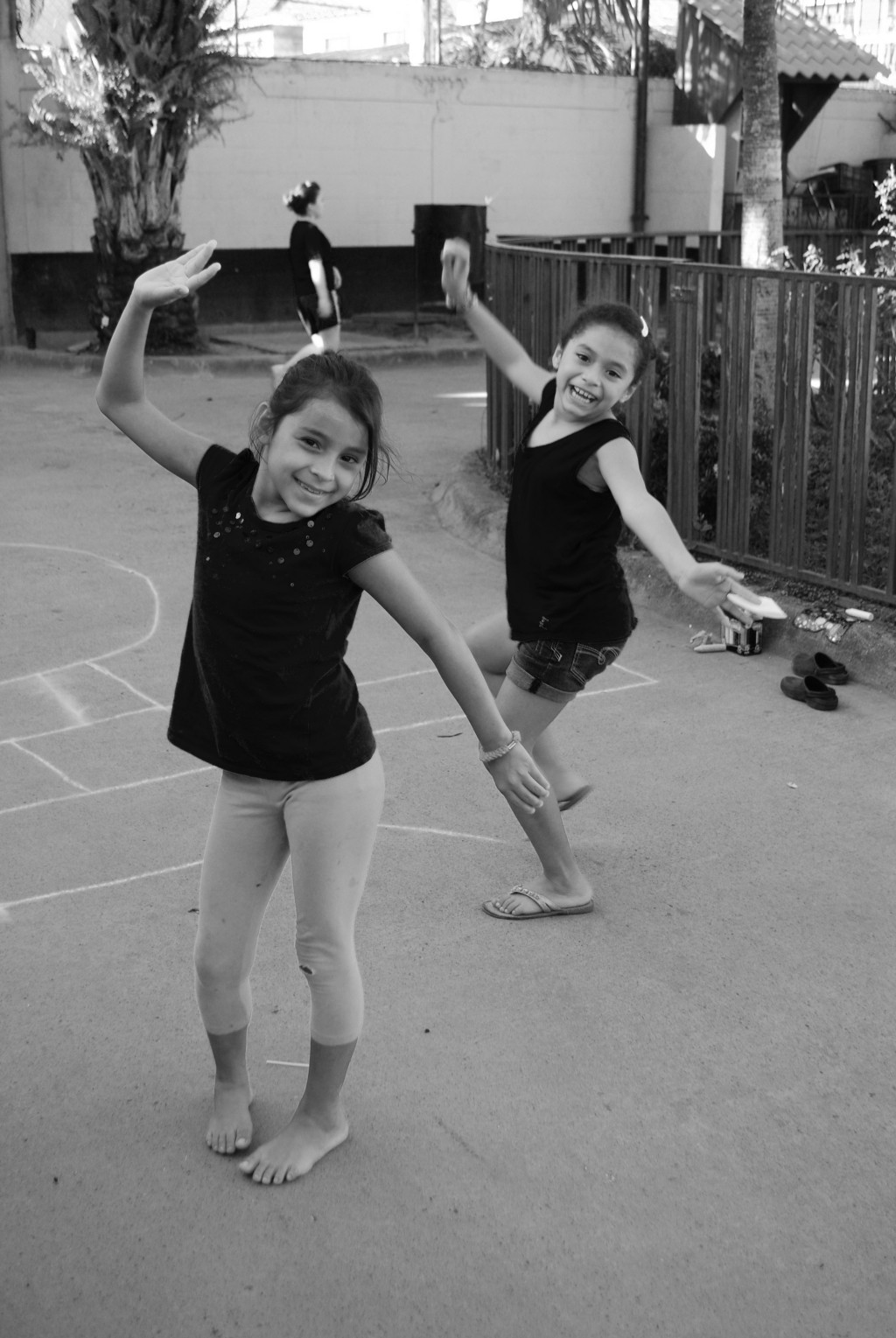
Back I go to the classroom. Through my windows I can see the mountains, blue on blue on blue, and mangoes hang, ripe and orange. There is that troublesome girl, smiling shyly, holding her pencil, waiting for me to begin. Knowing her story, my teaching changes. If she writes a poem, fine; if not, fine.
There is that troublesome girl, smiling shyly, holding her pencil, waiting for me to begin. Knowing her story my teaching changes. If she writes a poem, fine; if not, fine.
That girl and I sit in the courtyard after class. A turtle near the fountain twitches. Around us the other 71 girls carelessly play. Prompting her toward a poem, I ask the girl to use the word “charity.” What comes back is the truth as she knows it:
What is home for you?
Your school can be your home
even if you don’t have a bed.
Living here has been like
tasting cotton candy:
It is that sweet.
Her poem changes my teaching: the minute I see it, hear it, digest it, I awaken. The next day I come up with new techniques. The textbooks from Texas handed down year after year with ripped and scribbled-on pages kill the energy, so I ask the girls to drop them onto the floor. Thunk! Thunk! We never pick them up again. There’s mischief now in that room. And there’s more love in me and they smell it.

I say, “Look at me! Mírame!” All I deploy from now on is spoken words. “Listen to this,” I say as I begin to recite. One girl who has been sleeping all semester shifts her head just a little. Has she really been listening the entire time? “Now you say it,” I suggest. The girls stiffen. “That’s right, take out your pencils and write down what I am saying, I will say it again.” The world between us opens.
What works is for me to repeat the poems to them and for them to repeat the poems back to me: a call and response. What works is asking them to memorize poems. We harken back to poetry’s oral tradition. They see poetry as something durable and invisible, like those girls, like Honduras, like me: a poet, a priest, gay.
We harken back to poetry’s oral tradition. They see poetry as something durable and invisible, like those girls, like Honduras, like me: a poet, a priest, gay.
I stand at the whiteboard with marker pens that don’t work. I have my elegant lisp from a year prior in Madrid learning Spanish. The girls look at me like I am a circus freak.
Am I paranoid or are they whispering what I dread? “He’s gay, right?” I like being called gay as much as they like being called orphans: not much. Especially if someone says it before we do. Makes people laugh, makes people pity. Now I never know what those girls think but I’m going to guess that like psychics they can see my history of suicide, family estrangement, and a lock-up in a psychiatric ward.
Straitjacketed in their navy blue school uniforms, sweating, their foreheads like windows after a rainstorm, I decide to introduce dancing. I find a pitifully old boom box and a recording of Diana Ross and The Supremes singing “Stop in the Name of Love.” I say, “After every vocabulary quiz we will dance to The Supremes. For twenty minutes.” When I tell them this at first they look at me stunned as if to say, “You’ve got to be kidding me, Mister.” But it doesn’t take long to convince them. We dance: the girls undulate, and I, the old gringo, bust a move.
Am I paranoid or are they whispering what I dread? “He’s gay, right?” I like being called gay as much as they like being called orphans: not much. Especially if someone says it before we do.
Weeks go. We start with Shakespeare’s 18th Sonnet: “Shall I compare thee to a summer’s day?” We tackle Auden, Machado, the 23rd psalm King James version and an anonymous poem from the Terezin concentration camp. Odd grouping I know, but it’s what’s in my head and with faulty internet and power outages it’ll have to do. No textbooks. No paper. We study words they don’t know. They each keep a diary.
Support Electric Lit: Become a Member!
The girls write poems first in Spanish, then translate them into English, or first in English and then in Spanish. Girls protect their stories. Some of the girls are truculent, intractable, mercurial, stubborn. Their personal stories are what they have, often all they have, so exposing that to strangers does not happen quickly, and sometimes it feels like it will never happen, and that becomes fine with me. Exposing feelings is delicate surgery. The girls snap like the turtle they torture in the courtyard. One girl writes, “It is horrible to know you’ve been thrown away.” I think, “Careful, Spencer.” Some of the girls will only publish anonymously; like Emily Dickinson before them, the idea of publication horrifies them. It’s like “publishing your soul,” Dickinson had said. And yet in the same breath many of them also want to be known. Dickinson sent 575 of her poems out in letters. So a part of her wanted to be heard. Poetry roots in the loam of wanting to be heard and not seen.
Tick-tock. My last day approaches, along with a mounting enthusiasm for poetry. It’s close to Christmas, 2013. We plaster the school hallways with poems. One girl, not in my classes, who speaks no English, studying to be a beautician, hands me a piece of paper crumpled into a ball, and says, “For you, Mister.” The poem is titled, “Invisible for All My Life.”
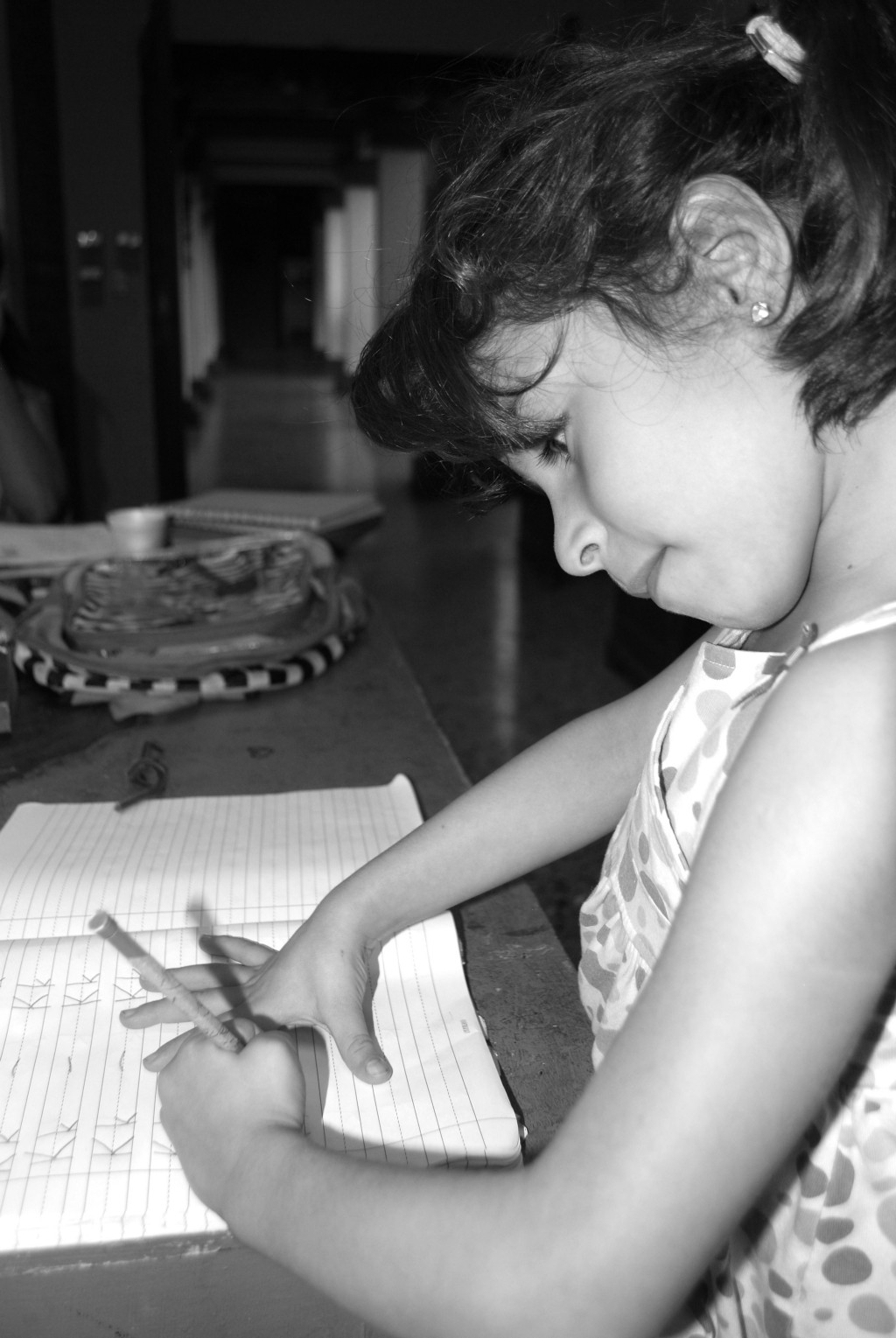
Another girl comes to me, who had been stabbing her pencil into the sofa when we met privately saying how much she hated poetry, and now says to me, shoulders back, “Yes, Mister, I want to recite the Langston Hughes poem about Helen Keller.” She recites with more confidence than I’ve ever seen. Where did it come from? For months she had paid no attention, had emphatically stated she wanted her poem to be anonymous in the book, and then, after her Hughes recitation, she comes to my desk, looks out the window as all the other students are leaving, and says, “Mister, I want my name in the book.” I tap the letters of her name onto the keyboard, save the name in the document on the laptop, a name she hated most of her life: Leyli Karolina Figueroa Rodriguez.
Girls protect their stories. Some of the girls are truculent, intractable, mercurial, stubborn. Their personal stories are what they have, often all they have.
Much time has gone since I taught those girls. Yet not a day passes that I don’t think about them in my church office in Madrid, how they trusted me to pastor their book of poems to the world this Christmas. The book was difficult to publish. Half the editors didn’t know where Honduras was. Many rejected us.
For so long I thought they needed someone with better Spanish or a Latino or someone better informed about social justice. I’m no Gabriela Mistral. Anyone but white, eccentric, bohemian, expat me. Wasn’t I better off publishing poems from abroad, staying removed from things like Elizabeth Bishop? I’d tried mightily to hand off this project to anyone the year before and the year during when I lived there. But it didn’t work out. God kept pushing me to the center of the room. Who’s to make sense of it? These days, I suppose many might shy away from the idea of a white American priest teaching the brown people.
But then the girl from the well had turned to me at Christmas and said, “Now I know why God brought you here.” (God is never used ironically in Honduras like in Europe or the U.S.). “Really,” I say, incredulously. “Yes,” she said, straightening her back, “God brought you here because you understand us.” I know what she is saying: “Mister, you know what it’s like to be thrown away.” Those girls. Maybe you’d have to know them for this story to make sense. Maybe you will.

About the Author and the Project
Born in Hartford, Connecticut, and raised in Minneapolis, poet Spencer Reece is the son of a pathologist and a nurse. He earned a BA at Wesleyan University, an MA at the University of York, an MTS at Harvard Divinity School, and an MDiv at Yale Divinity School. He was ordained in the Episcopal Church in 2011. Reece’s debut collection of poetry, The Clerk’s Tale (2004), was chosen for the Bakeless Poetry Prize by Louise Glück and adapted into a short film by director James Franco. He is also the author of the collection The Road to Emmaus (2013), which was a longlist nominee for the National Book Award.
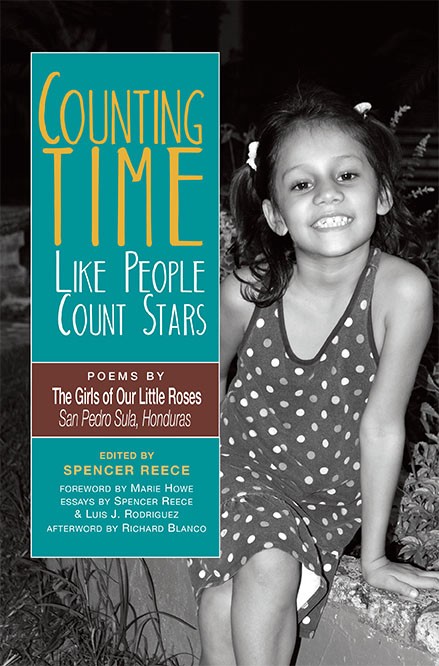
Counting Time Like People Count Stars, the book of the girls’ poems, was published by Northwestern University Press in October 2017. Learn more about the Our Little Roses poetry project at the BBC.

10 Beers Inspired By Books
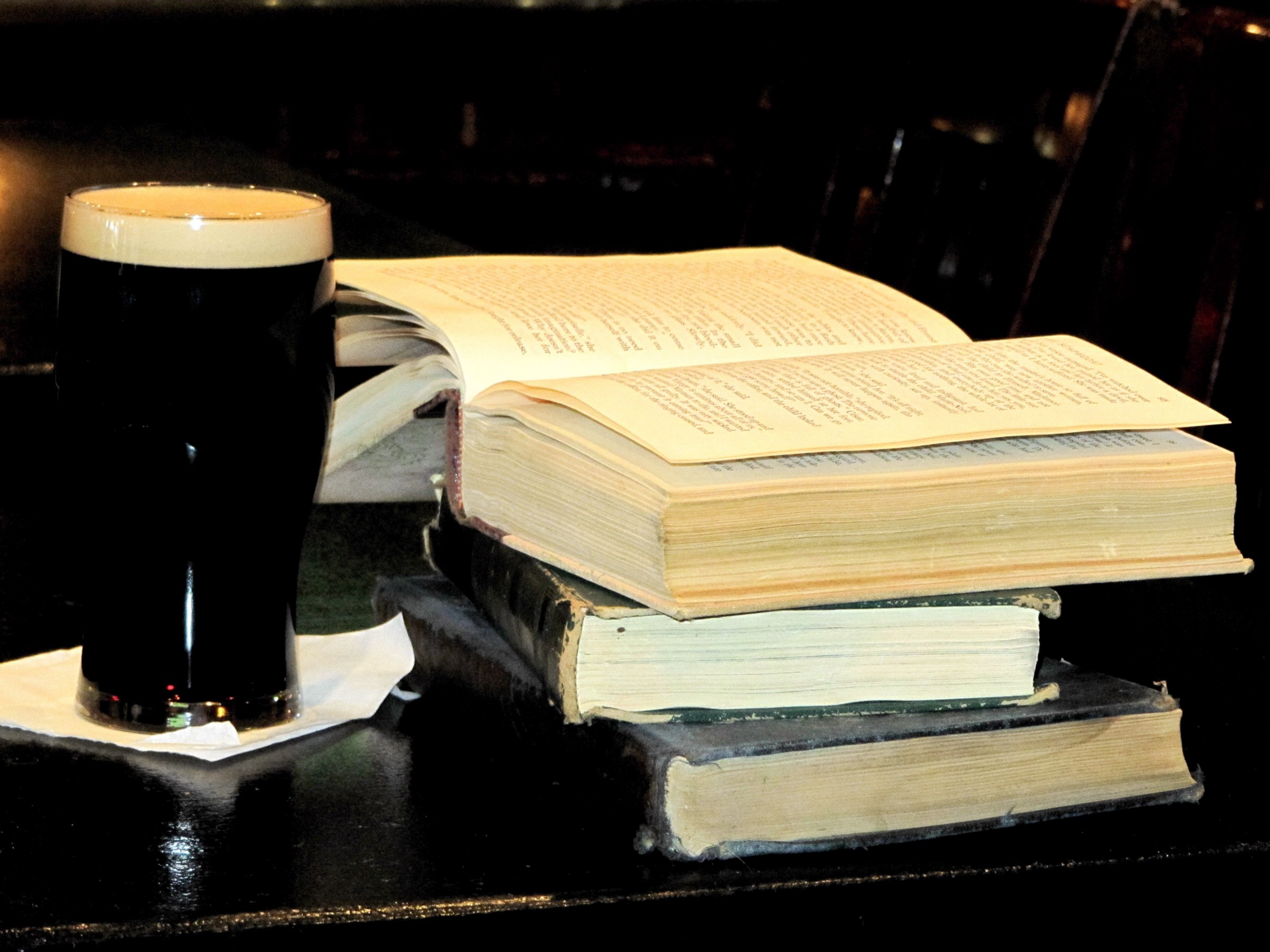
Beer has more connections to the literary world than you might imagine. There’s the obvious thing, where being a writer makes you want to drink. There’s the obsessive nerd factor. And there are also similarities between creative writing and making beer: some people revisit traditional forms, others want to experiment, and in recent decades, there’s been an increase in the number of upstarts — both indie presses and craft breweries — creating something for a small but dedicated audience.
So it’s probably not a shock that more than a few breweries have sought inspiration from literary sources. Some seek to distill the essence of a writer into an ale or lager; others take a particular literary work as their starting point. Here’s a look at nine of them, from breweries all across North America. We’ve also provided suggested food pairings. Suggested book pairings go without saying.

Surly Inherent Weiss
How, exactly, would you convey the essence of Thomas Pynchon’s psychedelic mystery novel Inherent Vice within the confines of a bottle of beer? Surly’s Inherent Weiss, an imperial hefeweizen, gives it a shot, and comes up with something that embodies that novel’s contradictions. It’s hazy and peppery — and, like the novel that inspired it, it’s got plenty of blissful notes, but also an unexpected complexity. And it’s just strong enough to leave you a little dazed, if you’re not careful.
Food pairing: Pizza, a Pynchon favorite. For the appropriate level of surreality, we suggest none pizza with left beef.

Ninkasi First Rule
Oregon is home to a thriving craft beer scene, as as well as a host of innovative writers. Put the two together and you have Ninkasi’s First Rule, an IPA that takes its cue from Chuck Palahniuk’s Fight Club. This one’s made with a whole lot of different kinds hops — perhaps a nod to the growing underground movement in the novel that inspired the beer. (“The first rule of Hop Fight Club is…”)
Food pairing: Steak, cooked rare.
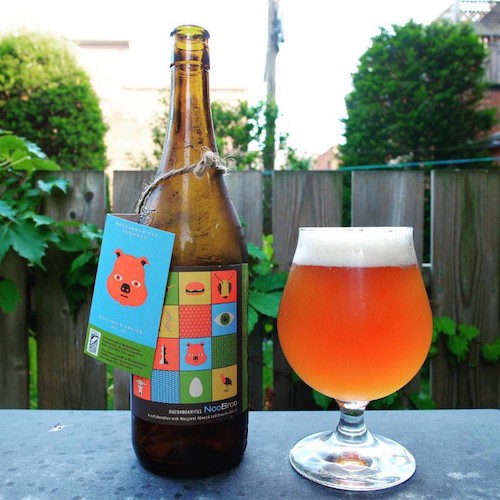
Beau’s MaddAddamites NooBroo
Between writing fiction, writing comics, and having her existing work adapted for television, you’d think Margaret Atwood would be pretty busy. But you can also add “collaborated with a brewery” to her list of accomplishments. Atwood worked with fellow Canadian novelist Graeme Gibson and the Ontario-based brewery Beau’s to create the impressively-named MaddAddamites NooBroo. It’s a gruit ale, an older style of beer that makes use of an abundance of herbs and botanicals, including several that hearken back to Atwood’s post-apocalyptic series starting with Oryx and Crake.
Food pairing: ChickieNobs.
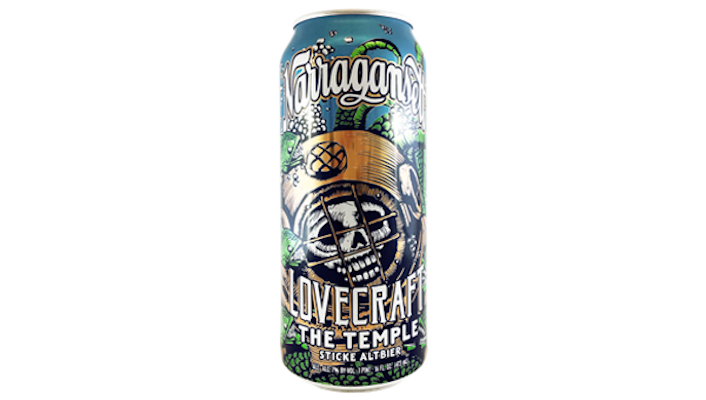
Narragansett The Temple
Given that Rhode Island’s Narragansett Brewing Company is based out of Providence, can anyone guess which influential-yet-problematic author has inspired several of their beers, including The Temple, a sticke altbier? Yes indeed: it’s the master of cosmic horror, H.P. Lovecraft. Throw in some nightmare-inducing can art and you have just the thing to fuel a late-night horror writing session, the beer slowly causing you to become more and more aware of an impossible presence, just outside of your field of vision, promising vistas of impossible geography and ancient cities. Or maybe just more beer.
Food pairing: Cthurkey, with a toast to the Elder God of your choice.
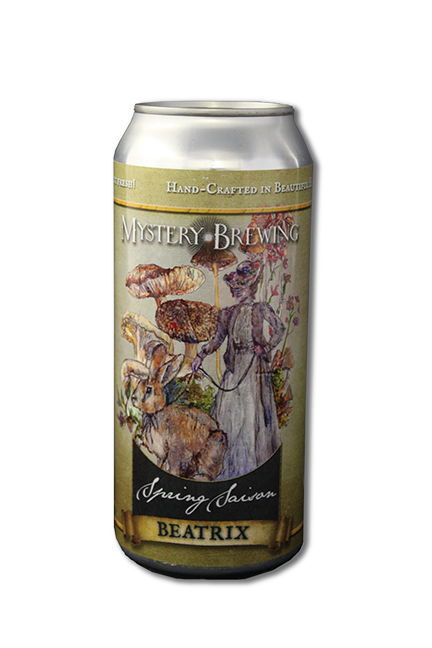
Mystery Brewing Beatrix
North Carolina’s Mystery Brewing has more than a few beers with something literary at their center: besides the Beatrix spring saison, they also brew beers inspired by the works of Victor Hugo and Charles Dickens. As befits a beer inspired by the creator of Peter Rabbit, the brewery describes this saison as “hoppy.” Could it have been anything else?
Food pairing: Slow-roasted carrots.
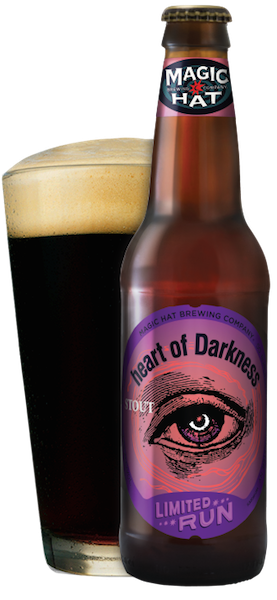
Magic Hat Heart of Darkness
Some brewers apply their literary inspiration to technique, finding a style or ingredients that line up neatly with a book’s plot or themes. Others take a more literal approach — which seems to be the case for Magic Hat’s Heart of Darkness. The stout is inspired by Conrad’s book insofar as it’s dark.
Food pairing: A river-dwelling fish, cooked to perfection; alternately, the horror, the horror.

Notch Brewery Infinite Jest
Salem’s Notch Brewery is pretty open about its influences. It has beers named after songs by both Sonic Youth and The Replacements — Our Brewery Could Be Your Life? — and it also brews Infinite Jest, a pale wheat beer that takes its cue from David Foster Wallace’s much-admired doorstopper. Is the wheat, perhaps, a nod to Wallace’s midwestern roots? Does the list of ingredients offer valuable advice in your next game of Eschaton? Only Notch Brewery knows for sure.
Food pairing: Poutine, or a microwaved head.

Fiction Beer Company Old Bums and Beat Cowboys
As one might surmise from its name, Denver’s Fiction Beer Company has embraced the whole “beers inspired by books” concept. Its literary tipples represent a pretty broad scope of work: among the inspirations for beers the brewery currently has on tap are works by Shirley Jackson, J.K. Rowling, and Aldous Huxley. And then there’s their Old Bums and Beat Cowboys IPA, which takes its cue from a certain well-known novel by Jack Kerouac.
Food pairing: Fast food, the better to eat while you’re on the road.
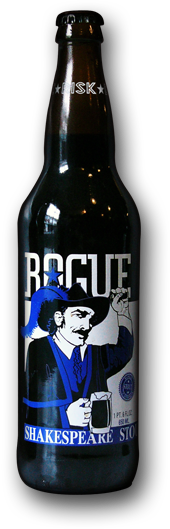
Rogue Shakespeare Stout
Sometimes, when it comes to literary inspiration, you have to go with the classics. Such is the case with Shakespeare Stout, from Oregon’s ubiquitous Rogue Ales. Given that Rogue’s beers have included nods to everything from savory doughnuts to sriracha in their flavors, this Bard-inspired beer finds the brewery in a more restrained mode, creating a hearty and filling beer perfect for drinking in iambic pentameter.
Food pairing: A savory meat pie would seem fitting for both old-timey England and present-day Portland.
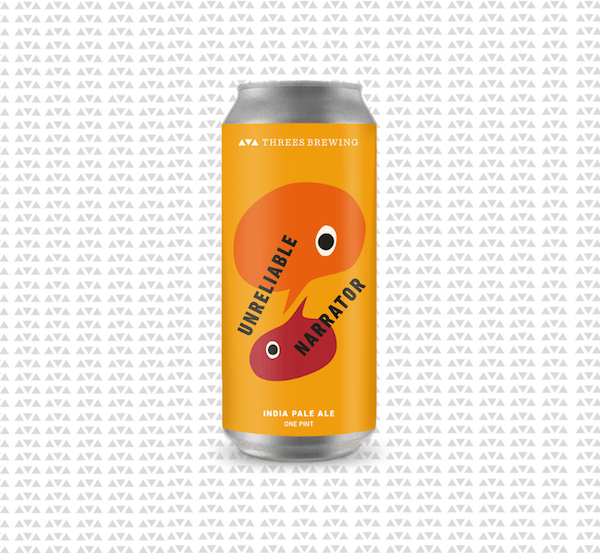
Threes Unreliable Narrator
This beer, from Brooklyn’s up-and-coming Threes Brewery, doesn’t take inspiration from one book or writer so much as it riffs on an entire literary trope. Unreliable Narrator is an IPA made with a host of complex hops and can art that looks like it was taken from a vintage New Directions paperback. Though, given its name, there theoretically could be any style of beer inside that can, couldn’t there?
Food pairing: A hamburger, but disguised as a salad.
‘The Real World’ Made Me Come Out to My Mom
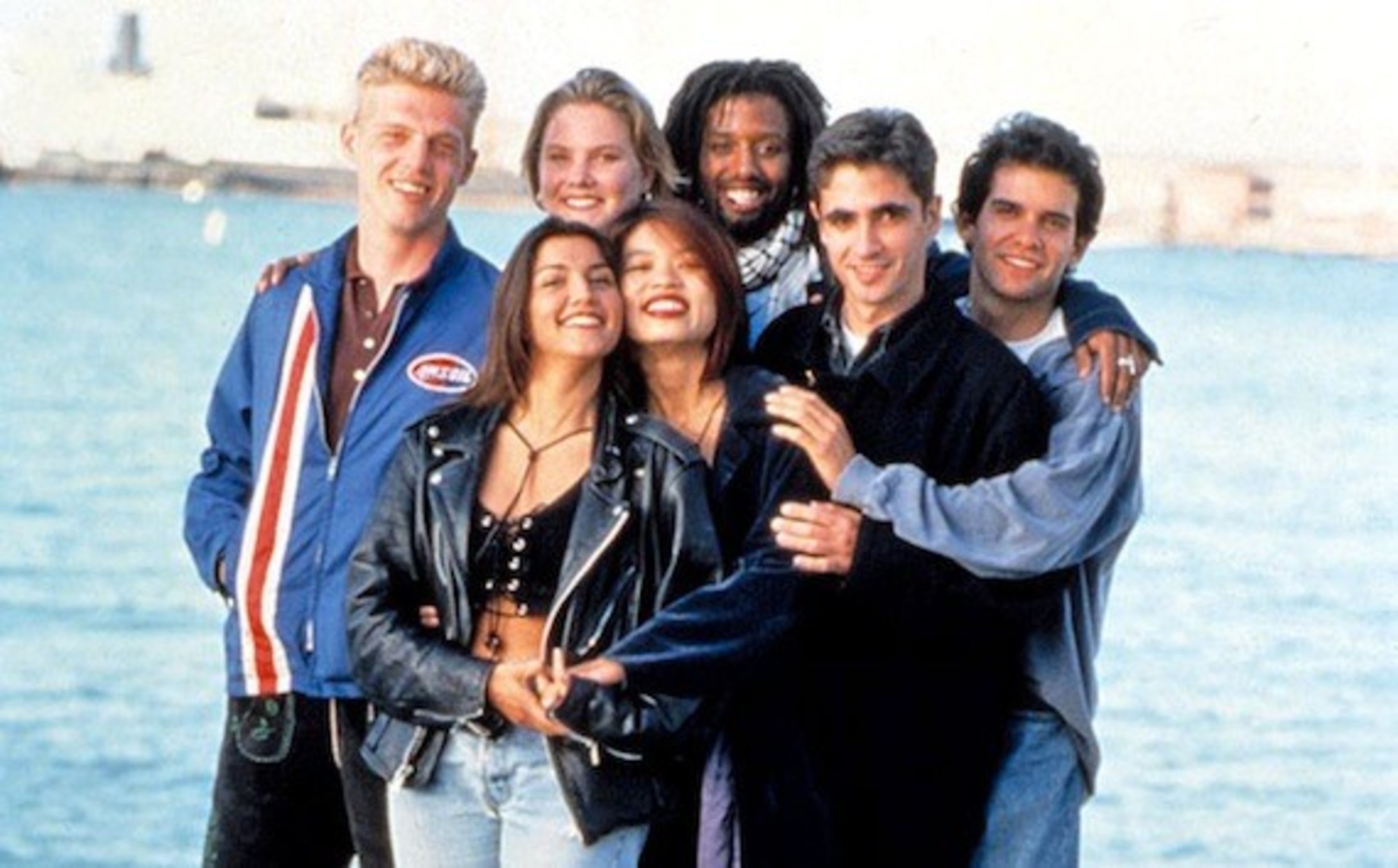
I listened to Billie Holiday on certain school nights. With my underwear soaked in period blood, I crawled across my bedroom carpet. I got intimate with it. I knelt at the stereo. A cassette spun on the tape deck. Blues filled the corner. I fell to my side and curled my body around an invisible ball of feelings that was tethered to me as if by an umbilical cord.
A pretty heroin addict from long ago was singing to me. She was voicing how it felt to be in love.
She was voicing how it felt for me to be in love with a white girl. “You’re my thrill. You do something to me. You send chills right through me. When I look at you. ’Cause you’re my thrill . . .”
“You’re My Thrill” expressed every emotion I felt for this white girl, and it didn’t matter that a whole bunch of time and space existed between me and Billie Holiday. Her delivery proved to me that she understood how crazy in love I was with this girl I’m not even going to bother describing. All the white girls I fall for are the same. They’re all Michelle Pfeiffer. Or James Dean. None of them have been Nina Simone. None of them have been Richard Pryor. None of them have been Screamin’ Jay Hawkins. Only Billie Holiday could voice my yearning. She was dead. That seemed fitting.

This white girl who I French-kissed went to Catholic school with me. She kept her things in a locker by the chapel. The pimple on her chin turned me on. Every part of her turned me on. We touched titties and tongues in her bedroom. We bit each other. Her hands bruised my arms and flanks and we tasted one another’s blood. We crawled through moonlight into dark, wet tunnels and felt each other’s necks. She listened to Zeppelin. She had her flaws.
I enjoy saying that my father forcing me to mow the lawn and use the leaf blower turned me gay. I also blame MTV’s The Real World. Do you even know what The Real World was? It was reality. It was a tv show where a bunch of fairly good-looking people with conflicting identity politics were put together in a house, plied with free alcohol, and filmed giving one another lectures and HPV.
The San Francisco season premiered at the same time I invited the white girl of my dreams over for enchiladas. Pedro starred as the gay cast member. That was a thing in the ‘90s— the gay cast member.
Like me, Pedro wasn’t white. He was light skinned but not white; there’s a difference. Pedro dated a black guy. He had a handsome face and spoke with a Cuban accent. When had a Cuban on tv last been so popular? It had to have been Ricky Ricardo. Pedro was dying of AIDS. He was doing it better than Magic Johnson.
Pedro had beef with one of his roommates, Puck. Puck was a white guy of the worst type: a white guy with a bicycle. He delivered things on his bike. He was a bike messenger. He reveled in being disgusting in a very “boys will be boys” kind of way, and the show’s editors dedicated a segment to his grossness. They juxtaposed this grossness against Pedro’s AIDS-y gentility.
All the white girls I fall for are the same. They’re all Michelle Pfeiffer. Or James Dean. None of them have been Nina Simone. None of them have been Richard Pryor.
A scene opens with Pedro being interviewed. In an accent similar to Mom’s, he says, “I really have a big problem with Puck. I’m fixing myself a bagel with peanut butter and I’m getting really into it.” Cut to Pedro in the kitchen. Sensual R & B plays as he slices a bagel. The musical choice suggests that gay Latinos sexually interact with everything. Sticking a knife into a bagel is erotic for us.
We don’t see the fingering happen, but we see Puck walking out of the kitchen, seemingly chewing, and over his shoulder Pedro calls, “Did you stick your finger in the peanut butter?” Cut back to the interview, where Pedro confirms that yes, Puck stuck his finger up his nose and then fingered the peanut butter jar, licked his digit, and went on with his straight life. Puck denies his crime. The tapes are replayed. They vindicate Pedro.
Puck totally did it.
Watching this drama made me hungry for a bagel. It also made me wonder if Pedro ever got so frustrated he wished he could give Puck AIDS.
Queering Gender, Queering Genre
In college, I met a conservative gay writer with HIV.
He was dating the roommate of this boy I was having experimental sex with, and once he walked into their sparely furnished living room while I was hanging out on the couch in sweats and radiating viral heat.
My immune system was fighting something fluey. I could feel coughs growing inside me.
The writer strode toward me. I remained seated. He reached out his hand and said, “Hello, I’m Andrew.”
“Hello,” I replied to the Englishman I already knew to be Andrew Sullivan. “I’m sick.”
In a tiny way, I felt powerful. Powerful enough to kill Andrew Sullivan by coughing on him.
In a tiny way, I felt powerful. Powerful enough to kill Andrew Sullivan by coughing on him.
Andrew Sullivan made a yikes face.
He waved at me in place of a handshake and paced to the balcony. There, his date, a gorgeous white boy, was waiting, leaning against the railing. Andrew Sullivan put his hands around the swimmer’s shoulders. He pressed his chest against the boy’s back, HIV positive to HIV negative.
Pedro’s accent soothed me. His beauty soothed me. The high stakes of his life so inspired me, they almost made me want to have AIDS. But I think being in love with a mean white girl was enough. She was my AIDS.
The Real World: San Francisco had a gay. The Real World: Los Angeles had a lesbian. The roommates found out when she wore her “I’m Not Gay But My Girlfriend Is” t-shirt to shoot pool.
Pedro partly made me come out to Mom.
If he could argue with a bike messenger on international TV about sticking his finger in peanut butter, the least I could do was acknowledge that I was bonkers for a white girl.
Scarlett O’Hara, Lana Turner, Divine. White girls. Baltimore drag queens make the prettiest white girls.
White girls are the Holy Grails of Western civilization. I wish they could be replaced with something else. Let there be a new grail. Let that grail be a dead Mexican woman in a long dress. Let her name be Wisdom.
Let her ghost unmoor the hero’s journey. Let the ghost whisper her sibilant name. Let her breathe it right into your mouth.
White girls are the Holy Grails of Western civilization. I wish they could be replaced with something else. Let there be a new grail.
I still hang out with white girls. I still hang out with ghosts.
When do you think white girls will go extinct? We are more than a decade into the twenty-first century, and I see no indications of their decline.
There are still plenty of them to feel inferior to. There are still plenty of them to get high with. The last one I hung out with hates men.
She lives with her partner on a street with a funny name. Something like Cerulean or Imbroglio.
The white girl delivers marijuana. Unlike Puck, she uses a Honda. One of her clients is a high school teacher who invites her to sit at her kitchen table. The teacher will pack a bowl and ply the white girl with weed, peppering her with questions about transgendered womanhood. Since the white girl is kind of new to her job, she feels like she has to humor the teacher. She can’t stand it, though. She’s not a teacher. The teacher is.
The white girl and I are pharmaceutical sisters. I take estradiol twice a day and progesterone once a day to supplement my failing ovaries. I take spironolactone to fix the mess my adrenal glands make. The white girl takes these same hormones and androgen blockers for other reasons. Mainly, it’s because her ovaries exist on an alternate level of consciousness. She’s trans.
When do you think white girls will go extinct?
We squatted on her tiny stoop together. The night sky gave us a whole bunch of black to stare at. Her cat pranced along the lawn. With cautious paws, she crept toward my feet. She crouched as if she were going to come at me and then leapt back and darted into the grass.
Her tail twitched. Its tip seemed to have been hacked off and then peeled. “What happened to her tail?” I asked.
The white girl said, “Bob accidentally slammed the door on it and she tried to yank it out and ripped the fur off. When Bob opened the door, it was just bones and blood. He felt so bad.” The white girl shook her head. Her strawberry-blond curls bounced.
She crossed her legs and tugged her miniskirt toward her knees. “We had to put a cone on her because she kept chewing it. It’s healing now. It looks way better.”
We stared at the cat. I wondered what the raw tail would have tasted like. I considered the default: chicken.
Support Electric Lit: Become a Member!
The cat twitched her nub.
The white girl asked, “Want some?” She held out a smoldering J. “No thanks.”
The cat frolicked. The white girl asked, “Do you like acid?” “I’ve never done it,” I said.
“Oh, I love it,” she said. She scrunched her curls and sang acid’s praises. It was her favorite.
After she finished telling me about some trip she went on using experimental drugs, I told her, “One time, in junior high, this boy gave me a tab. Since it was wrapped in foil I thought it looked like jewelry, so I kept it in my jewelry box. That way my parents couldn’t find it. It just blended in.”
The white girl reached for her curls. She scrunched. “Coke makes me so horny,” she said. “I love coke.”
The white girl reached for her curls. She scrunched. “Coke makes me so horny,” she said. “I love coke.”
We wandered back inside her house. The soft recessed lighting made me feel like we were in a peach. I was sitting on the carpet, hating my body. To my right, a huge flat-screen played a music video. White girls in swimsuits ran on a beach, showing off their peaches. The white girl’s endless legs hung off the couch. Her fingers curled. Purple acrylics scratched her thigh, tattooed with the word misandry to express her hatred for the male sex.
This tattooed thigh makes her the ultimate woman.
Baby rocks tumbled from a plastic sack that she tipped over her phone. They hit the screen and she set the phone down on the glass-topped coffee table. Swiping, she pressed a Costco membership card to the rocks, flattened them, and made little white beaches. She raked the plastic across them and chopped.
She snatched a dollar bill off a closed laptop and rolled it into a tight tunnel. Leaning over, she placed the money between her nostril and the whiteness then dragged it along the beach. The beach vanished.
About the Author
“Myriam Gurba lives in California and loves it. She teaches high school, writes, and makes “art.” nbc described her short story collection Painting Their Portraits in Winter as “edgy, thought-provoking, and funny.” She has written for Time, kcet, and The Rumpus. Wildflowers, compliments, and cash make her happy.”
A Mattress Company is Launching Its Own Print Magazine
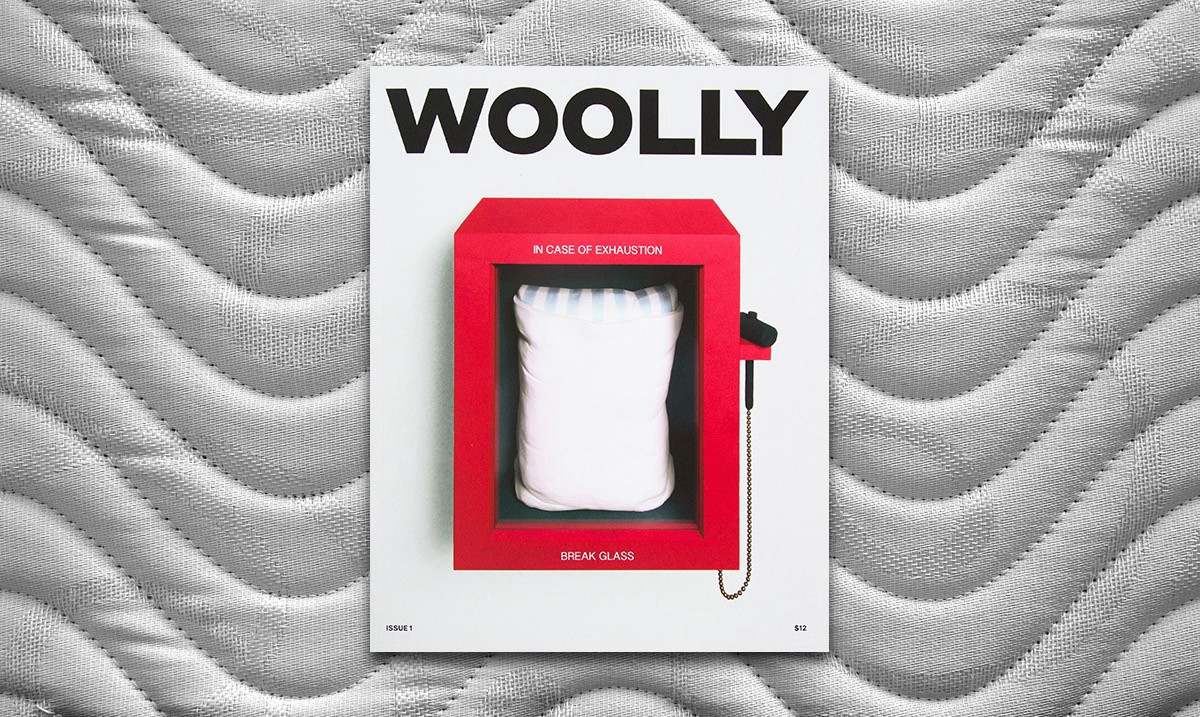
Online mattress retailer Casper has already branched out into pillows, sheets, and bed frames. Now it’s taking the obvious next step: a $12 print periodical.
The magazine, Woolly, describes its first issue as “96 pages of first-person essays, satirical service journalism, advice columns, and original artwork.” Unlike Casper’s now-shuttered previous digital publication, Van Winkle’s, the company’s new foray into creating content instead of comfort is a little less obvious in scope. Where Van Winkle’s focused on all things sleep, Woolly is branded as “a curious exploration of comfort, wellness, and modern life.” Do we need a 96-page quarterly glossy about coziness? Well listen, I mean, do we need a magazine on modern farmers? Do we need Paris reviewed?

Casper is not exactly the obvious choice for literary sponsorship. I guess one could argue that bed is a great place to read, but Casper is very much a podcast-ad kind of company; it’s like Blue Apron starting a food publication, or MailChimp launching a scientific journal of primatology. But scrape away the “hipster mattress” ethos (full disclosure: I have a Casper), and what you find is kinda just… a magazine. One of the editors came over from Van Winkle’s, and the other one has a list of writing and editing credits as long as your nightshirt. Apparently the print mag also got a boost from the team behind McSweeney’s. Whatever else Woolly may be, it’s editorially legit.
Casper isn’t the only company pivoting to content. At this point, it’s an actual trend, at least convincing enough for the New York Times (sponsor: Uber). MEL Magazine, a men’s interest online publication, is a project of razor subscription service Dollar Shave Club. Gay dating app Grindr has a new online magazine called Into. Airbnb has a travel mag, and so does luggage company Away. At first glance, it seems like one step above sponcon, a cross between a vanity project and a sub rosa advertising wing. Why pay for an article when you can buy the whole content machine?
Support Electric Lit: Become a Member!
But the thing is, these mags aren’t half bad! (Full disclosure: I have friends who work at MEL and Into, but at least one of them I would definitely insult if I had to do so for integrity.) I read a couple things on Woolly and they’re well-written and fun. It doesn’t feel like a retail company blundering into the world of publishing, like a compressed Casper mattress bursting out of its cardboard box. It feels like some people who just wanted to make a good magazine found a way to get the money it takes to do so. In other words, if you work in books or media or any kind of writing-related industry, it feels like someone’s living the dream.
Yes, on the face of it, a Casper magazine sounds absurd, even a little insulting to all the struggling legacy print mags — except, oops, most of those were started by eccentric bazillionaires who got a bunch of money from TV or bakeries or Plimptoning or whatever and felt like throwing it down a hole anyway. Maybe the thing that will save print, where advertising failed, is pure patronage. All I’m saying is, if Tesla comes calling, Electric Lit will pick up the phone.
10 Novels Agents Have Already Seen a Billion Times
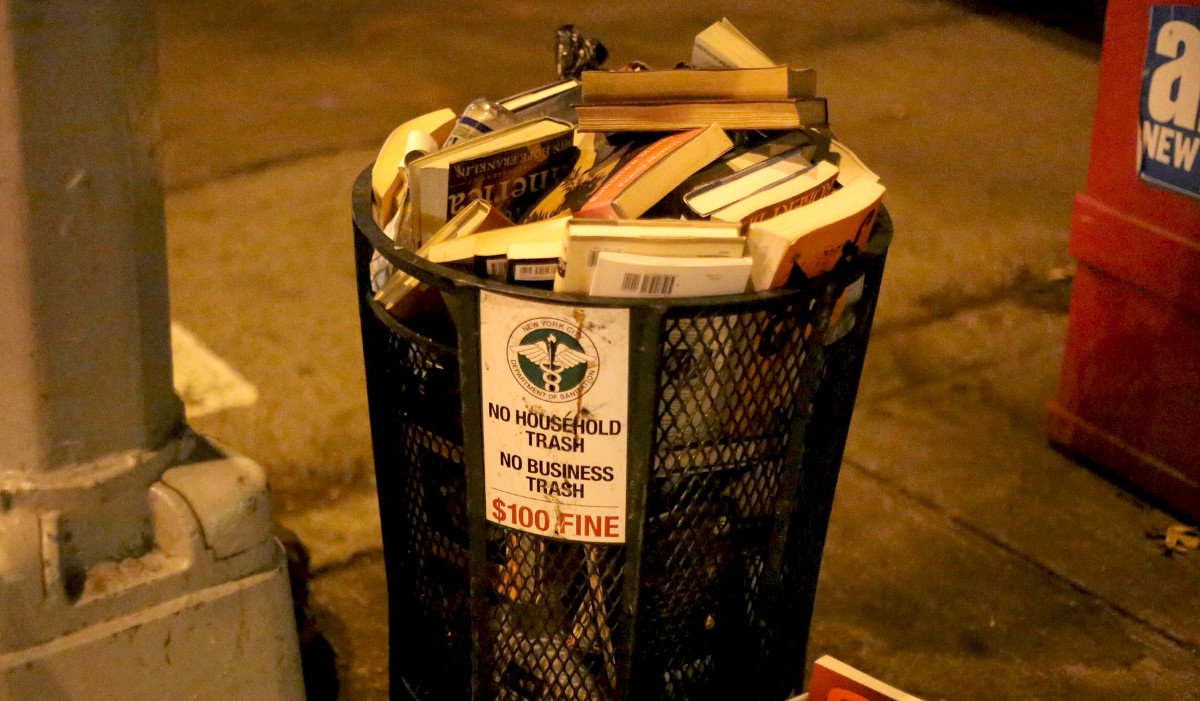
As a literary agent, I receive roughly 500 queries, or book pitches, a month. After 11 years of doing this job, I have seen a lot of book ideas. Obviously I’ve noticed trends (did you know all vampires live in Seattle now?) but there are other similarities outside of pop culture or critical mass made evident by the slush pile. When an agent or editor says they are looking for something they’ve never seen before, these are the things we don’t mean.
If what you’re already writing looks like something on this list, don’t panic. To misquote a friend, publishing is a rich tapestry; lots of books like these have been published (you can probably think of a bunch off the top of your head), and some are even great. Your book might be great, too! But if your gut tells you it isn’t after reading this list, don’t fall back on the assumption that publishing will make an exception for you just because all the other options are terrifying. Take some time to think about it and adjust your course as necessary. And if you want to write a book but haven’t started, or if you’re still trying to get going on your NaNoWriMo novel, don’t do one of these:
1. The Axe To Grind Novel
This book sure will show your stupid boss/girlfriend/teacher/parent they were an idiot for firing/dumping/failing/not loving you! Unfortunately, your personal injustices are your own, and it’s hard for the reader to generate enough sympathy for the infallible “protagonist” when everyone else is 100% horrible and wrong. If your life was The Glass Castle, then yeah, write that, but I sure hope it wasn’t.
A subcategory of The Axe To Grind Book of Non-Fiction is the Stunning Work from a Fearless Whistleblower that will Set the World of [Industry] on Fire. Maybe it will! But I usually learn about these stories from the news, as they are genuine news, and not in the query pile.
2. I Didn’t Ask For This!
These fantasy novels (for any age reader) feature a Chosen One who would really rather not, thanks, but will anyway for Reasons. YA has been doing this for a while, but as per usual, adult books are just catching up. Good for the grownups. The problem here is that if the main character doesn’t want to do the thing, then I probably agree with them! I don’t want to do most things. The Reasons need to be specific and relatable to get me to care and follow along with a protagonist who harumphs a lot.
3. Strange But True
If you have to say ‘but it really happened!’ to convince the reader, Anne Lamott comes over and takes back your copy of Bird by Bird.
All those wacky stories from your grandpa/hairdresser/neighbor/ex-friend that are just soooooo good that you could make them into a story, kinda like Life of Pi but maybe not so Indian and more about your mom’s summer camp in Connecticut? A series of anecdotes does not add up to a novel. If you have to say “but it really happened!” to convince the reader, Anne Lamott comes over and takes back your copy of Bird by Bird.
4. You Can Trust Me
These usually start: I’ve been a parent/teacher/writer/blogger/chef/ ornithologist for five minutes so here is a manual on how to do That Thing right. I can really tell it like it is because I didn’t waste time getting things like “credentials” or “formal training.” What the writer doesn’t know here is that people like credentials, or at least a writer with a well-known Twitter, when it comes to handing over $17–25 for advice or information. Why? Because of the illusion of trust, i.e. Oprahness. We trust the person we recognize more than the one we don’t. Would you buy a book from someone you’ve never heard of purporting to solve a problem serious enough you want to read a book about it and not just Google it? Probably not.
5. Anything Zombie
Clarkesworld said it best: No more zombies, please.
6. Greatest Hits
Your collection of 30 years as a syndicated columnist/your journal/your blog. You need a better reason than it’s all just sitting here so…. to write a book. That’s why you want to publish it; it’s not why any reader wants to read it. Plus, you need new stuff so people who actually know you — your primary market — have a reason to buy your book.
7. Picture Books for Adults
Just don’t. What reason do adults have to walk into a store and hand over cash money for a thing that they can’t read to children and that other adults have so few impulses to really read? When was the last time you said: “you know what I’m in the mood to read? A Dick and Jane book, but with thinly veiled references to meth and masturbation”? Never.
When was the last time you said: ‘you know what I’m in the mood to read? A Dick and Jane book, but with thinly veiled references to meth and masturbation’?
8. Eat, Pray, Whatever
These stories of enlightenment in the face of illness/divorce/loss/grief as an important personal journey, most often written by women, are heartbreaking and profound. These issues are serious and so is the self-actualization (of women. Sorry dudes, we’ve heard enough about your self-actualization). But this formula of illness etc. leading to radical life change has crossed my desk so many times that it no longer holds any meaning. It’s a familiar jumble of medical jargon, empty white wine bottles, and taillights in the mist.
9. “Historical” YA
These young adult novels are usually set in the ’80s or ’90s and are chock full of awesome nostalgia and references that happened at least ten years before actual teen-aged readers of YA were born. What’s clear to me now is that they are just thinly veiled Axe to Grind novels starring cheerleaders and jocks instead of your boss and ex-wife. You aren’t fooling anyone.
10. Professor Wonderful
Yes, academia is just like Dante’s Inferno and all the young coeds are hot, but what is a middle-aged professor supposed to do but burn it all down in a madcap romp of alcohol, questionable professional practices, and probably pot? I liked Wonder Boys too, a lot, but academia hasn’t changed in a long, long time, and neither has this story.
Writing books is hard, and I respect the effort you’ve put into your novel, even if it’s on the list. But reading bad books is also hard, and together, we can stop these tired ideas before they start.
I Pretended to Be Emily Dickinson on an Online Dating Site
Like most brilliant ideas, it began as a joke. A friend and I were at lunch, discussing our frustrations with online dating, when I suddenly realized the ridiculousness of our conversation. Here we were, two modern, educated women, and we had spent nearly two hours talking about our romantic relationships! This wasn’t the sort of woman I wanted to be. I wanted to be Gloria Steinem. I wanted to be Ruth Bader Ginsburg. I didn’t want to be the sort of woman who spends her entire life talking about boys.
I decided, right then, that I needed to do something to alter the course of our conversation. Putting on my big-girl feminist cap, I said, “You know, there have been a lot of talented, amazing ladies, throughout history, who never coupled off. Emily Dickinson, for example.”
Emily Dickinson has long been my go-to gal amongst my single lady heroes. She was a virgin, unmarried, and a recluse, but, man, was she talented. I wondered aloud to my friend began to wonder: How would Ms. Dickinson fare in the world of online dating? Would a lovelorn poet, obsessed with death and privacy, be able to woo a modern man? We laughed, and then went on discussing our own dating disasters.
For the next week or so, I went about my business as usual, but this Emily Dickinson idea wouldn’t go away. I kept wondering, if I created a profile for Emily, how would people respond to her? Would she get emails? Would people get the joke? It would be an interesting art project, if nothing else.
Would a lovelorn poet, obsessed with death and privacy, be able to woo a modern man?
Eventually, one quiet Saturday night, led by a genuine curiosity and my own frustrations with dating, I did it. I brought Emily Dickinson into the 21st century.
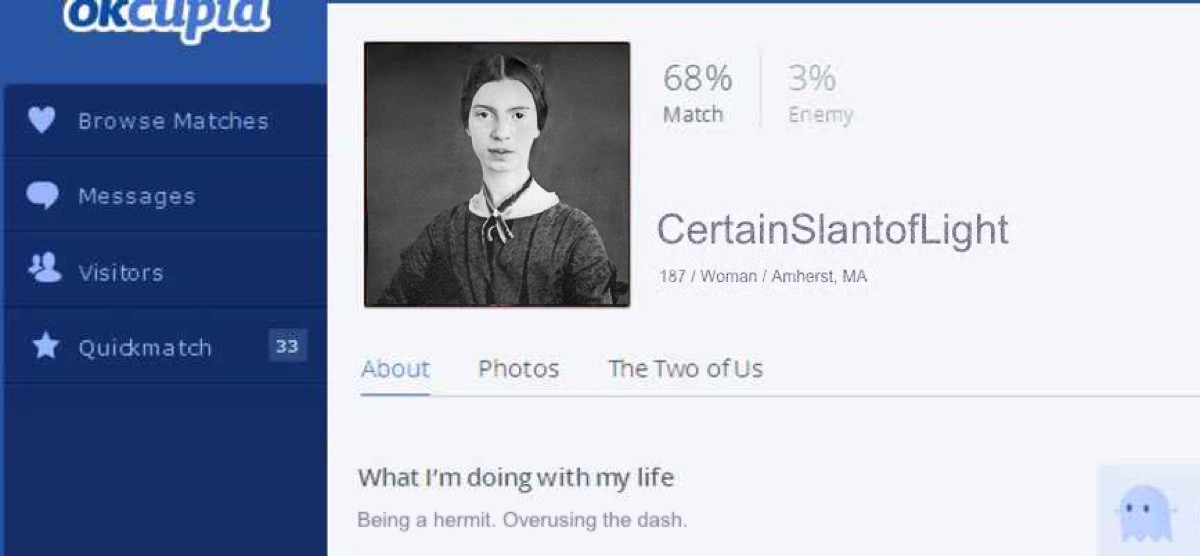
Using a combination of actual Dickinson quotes and my own sarcastic sense of humor, I created what I thought was a fairly accurate OkCupid profile:
What I’m doing with my life: Being a hermit. Overusing the dash.
I’m really good at: Breaking rules, specifically capitalization and punctuation.
Favorite books, movies, shows, music, and food:
Movies: What is a movie?
Books: Wordsworth, Browning, Keats, Emerson, Shakespeare (i.e. dead people)
Music: Yes, I do enjoy playing the piano on occasion. Thank you for asking.
Food: Baked goods, especially my famous gingerbread. I love making it for the neighborhood children, but I can’t leave the house. Instead, I stand at the window and lower it down to them in a basket. It’s so much easier that way.
The six things I could never do without: white dresses, gardening, graveyards, writing letters to older men, talking smack about my parents, pain
I spend a lot of time thinking about:Death, death, and more death.
On a typical Friday night I am: in my bedroom, alone.
You should message me if:You’re not dying, but you like talking about death.
As soon as the profile went up, I was bombarded by emails. There were messages from men who thought it was funny and played along:
Hi, I’m Ezra Pound I’m a strange mix of hermit and extrovert.
When can we go zombie hunting?
Well, technically, Jane Austen was the zombie killer, not Dickinson, but close enough.
There were also emails from men who were utterly confused, who wrote things like, “Why?” and “I don’t get it.” One 22-year-old guy questioned me about my profile pictures, two 19th-century photographs of Dickinson:
Him: Those pictures from the 1950’s?
Me: More like 1850.
Him: So how is that u in the photo? That’s impossible.
I think I blew his mind. Poor guy.
There were even a few pervy emails in the mix:
I’ve never spanked a chick in black and white before.
But for me, the most intriguing emails came from men who treated me like I was just an ordinary single lady, lookin’ for love. I like to refer to them as the “Hi” guys. Every woman who has participated in online dating knows them. A man sends you an email that reads, “Hi, I’m John” or “Hi, I’d like to get to know you.” The messages aren’t offensive. They’re just boring. A “Hi” message is equivalent to saying, “Hey, I didn’t read your profile and I don’t care about your brain or your personality, but we should go out sometime.”
Emily got those emails as well, which I found really interesting. Did these men think the 19th-century photographs of Emily Dickinson I had posted were images of an actual living, breathing woman? Did they think I was an historical reenactor? Or were they just so desperate for sex or companionship that they emailed every profile they came across?
Why was Emily Dickinson succeeding at online dating to a much higher degree than I ever had? Well, she was famous, for one thing, and dead for another.
But it wasn’t only the “Hi” guys who were interested in dating Emily. Intelligent men, who got the joke, eventually starting hitting on her/me as well.
So, other than being an Dickinson impersonator what else are you interested in?
They had no idea who I was. They didn’t know my age, my weight, my gender, nothing. For all they knew, I could be an 80-year-old man or a group of thirteen-year-old girls or a really smart gorilla. Yet still they wanted to meet me; they wanted to know me. Several men gave me their phone numbers, even though they had never seen a photo of the real me.
They did see photos of Emily Dickinson, though. My profile contained two photographs of Dickinson, the only two in existence, although only one has been authenticated. In both, she is unassuming and well-covered. Her OkCupid pictures did not include images of her cavorting on beaches. There were no boob-squeezing selfies or come-hither stares. It was obvious that she didn’t fit in with the cool kids.
So why was she getting so much attention? At first, I found it curious, but after a while, I realized that Emily’s experience was merely an extension of the OkCupid experience in general.
Online dating is a make-believe world. When we create a profile, we’re projecting a certain type of image. People are drawn in by that image, and then they create their own fantasy on top of that. An online dating site is really nothing more than layers upon layers of ego and insecurity. Essentially, nothing is real.
In the guise of Emily Dickinson, I was hip. I was smart. I was funny. I could quote poetry on demand. But my real OkCupid profile projected that image as well. So why was Emily Dickinson succeeding at online dating to a much higher degree than I ever had?
Well, she was famous, for one thing, and dead for another. Maybe that was it. Men do tend to fetishize famous dead women, especially if the woman in question has a head full of neuroses. Marilyn Monroe, Francesca Woodman, Sylvia Plath. If most modern men met these women in real life, they would call them crazy, but somehow, in the safety of death, they become worthy. Maybe this wasn’t your run-of-the-mill OkCupid projection about a real-world woman. Maybe this was a step beyond that: a fantasy about an interesting, talented, dead woman with a penchant for morbidity. The “Belle of Amherst” had suddenly become the “Depressive Dream Girl” of online dating.
The ‘Belle of Amherst’ had suddenly become the ‘Depressive Dream Girl’ of online dating.
Unfortunately, not everyone was in love with Emily. People kept reporting me for falsely representing myself, as if I were actually trying to pull a fast one on the entire male population. A user would issue a complaint and then OkCupid would delete my images. Apparently, on OkCupid, you’re allowed to be a harassing perv, but under no circumstances can you pretend you’re a dead poet.
I kept reposting the images anyway, and people kept reporting me. This process happened over and over again. Eventually, I got tired of this merry-go-round and added a disclaimer to my profile: This is clearly a joke. I am not actually Emily Dickinson. That seemed to help, although several people told me that the disclaimer made the whole thing “less funny.”
But even with all the haters, Emily was not hurting for suitors. She was, in fact, an unlikely star in the online dating scene. She received a hundred “likes” in two days. Once I left the house for an hour and came home to find seventeen messages in my inbox. I could barely keep up. I wanted to respond, at least once, to every message I received, but it quickly became a full-time job.
So, after two days of playing Emily Dickinson, I decided to cancel the account. I was lost in the wormhole of online dating, and if I didn’t end the experiment, I would never leave the house again. (Which would make my Emily Dickinson impression all the more authentic.)
Of course, with all that interest, I might have actually met someone, if I had stuck with it. It would have made a great romcom. “Bespectacled writer disguises herself as Emily Dickinson and ends up falling in love with very own Thomas Wentworth Higginson!” In the movie trailer, there would be a montage of the female lead belting out Taylor Swift’s “Blank Space” as she danced around her apartment.
It would have made a great romcom. ‘Bespectacled writer disguises herself as Emily Dickinson and ends up falling in love with very own Thomas Wentworth Higginson!’
But I didn’t want to lead people on. And I didn’t want to disappoint them by not being Emily Dickinson — by being instead a real flesh-and-blood person, a non-recluse, a non-genius, and alive.
Early on, a guy asked for my real-world profile and I sent it to him. He thanked me, but then I never heard from him again. Then, right before I deactivated my account, a guy I knew from my real OkCupid profile “liked” my Emily page. I messaged him, revealing my true identity. He wrote back, “You are so messed up.”
I rest my case.
Liska Jacobs Knows a Hot Mess When She Sees One

Get ready to know Liska Jacobs’s name. Her debut novel, Catalina — the first of two from MCD Books, FSG’s new experimental venture — is the kind of drunken, mascara-smeared bender that inspires thinkpieces, fandom, and heated arguments at cocktail parties. Jacobs’s heroine begins the novel on the edge of disaster, and she never looks back. Dumped by her married boss/boyfriend, Elsa snatches a purse full of pills and heads out to do some damage while she licks her wounds. Through the breakups of both friends and lovers, Jacobs explores the art world’s influence, the fantasy of southern California, and how we think about wanting.
Elsa’s voice has echoes of the strong, tragically beautiful protagonists of literature who’ve come before her, but Jacobs’s work stands alone, an insightful and sexy glimpse into the tragedies of aging and the misconceptions of youth. Jacobs and I caught up over email recently about self-destructive characters trapped in their messy identities, and the most enthralling fuck ups in literature.
Heather Scott Partington: You have done such a beautiful job weaving art and museum work into the narrative. What do you remember most about your time at The Getty? What do you think most people would be surprised to know about that world?
Liska Jacobs: Thank you! I worked at the Getty Research Institute as a Special Collections Library Assistant for five years, beginning as a work-study student while finishing up my undergraduate degree. I was very lucky, this was in 2008, right at the beginning of the recession.
The Getty is such a gorgeous place, perched up on a hill, overlooking West Los Angeles and the 405. What I remember most was that on a clear day you could see the sun reflecting on the swells in the Santa Monica Bay — you could see Catalina too. But because it’s so removed I also remember a feeling of isolation, of loneliness. It’s where I first realized that when you look at something beautiful, a distance is created between what it is you’re viewing and yourself. In Catalina, Elsa is a lot like the Getty, or one of the art pieces in the galleries. She’s beautiful and that makes her something to look at, something to project onto, but also makes her very alone.
What I eventually found to be surprising was that working at the Getty was a job like any other. When I started there I was very young, I thought the Getty was going to be it for me. A place I could work until retiring — just surrounded by art and beauty and like-minded people. But the reality was timecards, and sick days, and cutbacks, and end of month reports. It was important in Catalina to show Elsa coming to terms with that same kind of disillusionment — that fantasy never quite matches the reality.
HSP: What was it about Catalina that made you want to set your novel there?
LJ: Today it was triple digits in Pasadena, where I live, so I retreated to the west side. I’m working from the LMU library, which is on a hill facing the bay and the mountains. I can see Catalina from here. I’ve lost count of how many times I’ve been able to make out that island from somewhere in Los Angeles. It’s always there, on the horizon, this funny little lump of land just off the coast. Half of it is this classic California tourist trap, selling the idea of “paradise,” and the other half is this rugged natural landscape.
You really can’t ask for a better setting than one that can reflect that kind of duality, and the tension created by it.
I felt like it was this perfect compact version of Los Angeles. At the heart of the city you have Hollywood, which perpetuates this fantasy world, how relationships should be, what we should want, and surrounding us is the Santa Monica Mountains, the Los Angeles National Forest, and the Santa Monica Bay — the real Southern California. In the book, you have a group of friends who haven’t seen each other in five years. They’re all different people now, they have contrasting wants and needs — but they’re still pretending nothing has changed. You really can’t ask for a better setting than one that can reflect that kind of duality, and the tension created by it.
Support Electric Lit: Become a Member!
HSP: Elsa follows a long tradition of protagonists who make bad decisions, and she’s a beautiful mess. Who are your favorite literary fuckups?
LJ: Such a great question. My favorite literary fuckups have to be Joan Didion’s Maria Wyeth, Elena Ferrante’s Olga, and Deborah Levy’s Kitty Finch. Oh! And of course Sylvia Plath’s Esther Greenwood.
But I’m probably most influenced by Jean Rhys’s protagonists. Specifically, for this book, Sasha Jensen in Good Morning Midnight. Like Sasha, Elsa is self-destructive and spiraling. When I first started writing Catalina I thought maybe I would do an updated version of Sasha’s story. I had thought times have changed, Elsa could have a happy ending, or at least a liberating moment. But as I wrote and rewrote the ending I had to accept that female characters like Elsa, like Sasha — women who are pissed off and calamitous, who are labeled “unlikeable” — get punished. Maybe it’s a societal or cultural thing, I don’t know. But it was a pretty depressing realization. I mean Good Morning Midnight came out in 1939, and nothing’s changed? Women still don’t have the luxury to fuck up, there’s no girls will be girls for us. What a bummer.
I had to accept that female characters like Elsa, like Sasha — women who are pissed off and calamitous, who are labeled “unlikeable” — get punished.
HSP: Elsa hits rock bottom early, and then spends some time down there. How did you keep narrative tension when a character began the story at such a desperate point? How did you maintain a sense of forward propulsion?
LJ: Ha! You’re right. From the first sentence Elsa is ordering up a pitcher of Bloody Marys just for herself, and it doesn’t take long for her to start popping pills. Part of it is knowing nothing good can come from this — someone drinking and doing drugs and having sex will have to hit rock bottom.
Why Are Friendships Between Teen Girls So Radioactive?
But that’s only a fraction of the tension. It really comes down to the other characters. There’s history between Elsa and all of them. With Charly, they’re old friends — best friends — and upon reconnecting Elsa almost immediately sees a crack in Charly’s perfect world. Same with Robby, who is Elsa’s ex-husband. That word is so charged in and of itself. Then add in his new girlfriend Jane, who’s a fitness fanatic and know-it-all, and smiles a bit too much at Tom (the new factor in the “old-friends” equation) — and it becomes a powder keg. Elsa is on a private bender, and she will inevitably be the spark. I think it’s sort of like watching a train wreck in slow motion. You can’t look away.
HSP: Catalina captures the push-pull of young marriage, and the way that young relationships don’t necessarily grow with us. Elsa tells herself, “Drink and be content. This can be enough for you, too… Give it time, just wait.” Can you talk about how you worked this into Catalina? How it shaped Elsa?
LJ: Poor Elsa and Robby. They really aren’t suited. In many ways the roles we have for men are just as unfair as the ones we give women. Robby, who thinks of himself as a savior, a good guy, sees Elsa and fits her into the box of damsel. But Elsa is no damsel (or she sure as hell will not let anyone treat her as one). It’s a recipe for disaster! For them both. When we’re young we try on certain identities as a way of finding ourselves. It puts any relationships — romantic or otherwise — in peril from the start. And it’s hard to write that kind of truth without bleeding into melodrama, or to be tempted into clichés.
When we’re young we try on certain identities as a way of finding ourselves. It puts any relationships — romantic or otherwise — in peril from the start.
Really, Catalina came about because of Elsa. I wanted to write a female character who was pissed off and disillusioned. After leaving the Getty I sat down and her voice sort of tumbled out. I kept writing to find out why she was hurting.
HSP: It’s not just romantic relationships from Elsa’s past that needle her. Catalina is one of the more frank examinations of female friendship, of the way we can outgrow each other and change without knowing what to do. Elsa says, “I think over our friendship. Back in the beginning, in those dusty orchard days, I’d swear we were on the same page…” What drew you to exploring these relationships and breakups?
LJ: Recently I was talking with a friend about why some break-ups hurt more than others, and we agreed that when someone teaches you something they sort of become part of your identity, which makes it a much harder break-up. This is what’s happening with Elsa, she’s reeling after an affair ends with her boss, Eric, who is an intellectual and well-known curator. He’s really gotten under her skin.
And this is where female friendships come in: they start under the skin, and only go deeper from there. Which makes them such dangerous and precious things. When they go wrong they are profoundly painful, and writing about it requires a tremendous amount of honesty, mostly about yourself. I have a twin sister and a little sister, and we’re close. But if you look at the span of our relationship there are dark spots that all three of us pretend aren’t there. I think we’re starting to see more realistic portrayals of female friendship — Elena Ferrante’s Neapolitan novels come to mind. Hopefully we’ll see more.
HSP: Catalina switches point of view several times, which has the effect of Elsa seeing outside of herself. When she writes of her proposal, the propulsion toward marriage, she says, “You’re in the passenger seat and there’s traffic and he slips the ring on your finger and you betray yourself. You say yes, believing you love him because you want to love him.” Can you talk a little bit about your approach to point of view and narration?
LJ: I’m so glad you asked this. Elsa is going through an identity crisis. It’s why she gives a false name to the hotel bellboy Rex, why she gives another to the television producer Rafa — and why she can imagine that there’s a version of herself still in New York.
But her crisis is also about memory, which works two-fold. Elsa will replay a memory and judge what she said or did, or if the memory is painful it’s easier for her to put distance between herself and the incident. It’s something I think we all do. So in Catalina, Elsa slips into second-person when she’s uncomfortable, but also because she’s searching for the true version of herself. Is she unlikeable? Is she a whore? Is she at fault, or the victim? Because this is a first-person and a voice-driven novel, I thought it was important to have this reflected in the writing. I also think memory is murky at best, somewhere between truth and fiction, and switching to second-person blurred that line even more.
I also think memory is murky at best, somewhere between truth and fiction.
HSP: My favorite line in the novel comes at the end of a sad story Tom shares, and he says, “That’s just how it is, baby… The worst kind of want is to survive, and we all have that.” What does this mean to you?
LJ: In Catalina all the characters want things. Really it’s a whole book about wanting. What I think Tom is saying is that the worst kind of want is the kind that makes us stay in impossible situations. I don’t know if it’s cultural or a human thing, but we always want more and are willing to give up so many things to get it.
Charly and Jared, Robby and Jane, and Tom too — they were all there from the beginning. It was important that none of them feel like the villain or the classic foil character. What I wanted to do was write a story where the tragedy wasn’t just because of one person’s actions — each one of them is trapped by the identity they’re ascribing to, and what they think they want.
HSP: Was this novel something you workshopped during your time at UC Riverside’s MFA? If so, how did you retain so much of your own voice and perspective? This novel doesn’t feel over-workshopped.
LJ: I’m so glad you think so! I came into the UCRPD program with Catalina as a novella, and showed it to Mary Otis in my first workshop. I hadn’t shown it to anyone up until then, and honestly if she had said there was nothing there I would have been so discouraged I would probably have chucked it. That’s something I really appreciate about the UCRPD program, every single professor I worked with treated me and my work with respect. When you have that kind of support as a writer you can really cut loose. I felt I could push Elsa and the other characters further and further, eventually fleshing out the novel. I owe that program a hell of a lot.
I think part of the reason I was able to retain my voice is because the story is so voice-driven. I know who Elsa is, what she would and wouldn’t do, and I know the other characters just as well. Half the fun was getting all them into a room and seeing what happened. It’s probably why I stuck them on a boat!
HSP: Catalina is the first in a series, correct? Can you talk about how it’s been different to write the second book? Is that something you’ve started already?
LJ: I think the main difference is time. With this next book there are set deadlines which I’m required to meet, but I think that actually energizes me. It helps that I’m really excited about this next book. I’ve even managed to bang out a first draft!
With Catalina I had all the time in the world. From novella to when Catalina comes out Nov 7th, it will have been five years. This next book isn’t a sequel per se, but I think anyone who loves Catalina will love it too.
HSP: What’s the best thing you’ve read lately?
LJ: Oh, this is a tough one. I’ve been reading a lot, mostly for essays and lists to accompany the publication of Catalina. How about I name two? I was floored by Richard Lange’s short story collection Dead Boys. He hits the right note between hardboiled Los Angeles and real human truth. And Rachel Khong’s Goodbye Vitamin, which I think should be a California classic. Her descriptions of traveling the length of the state are understated and gorgeous.
The 7 Scariest Little Girls in Literature
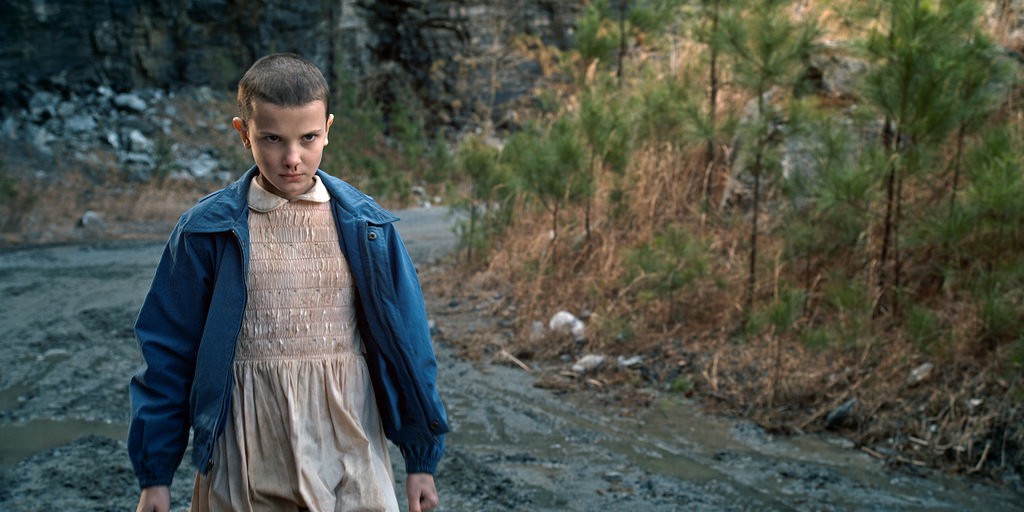
The breakout star of Netflix’s Stranger Things is Eleven (or, as we now know, Jane, but she’ll always be Eleven in our hearts). In her pink frock with the Peter Pan collar, she looks sweet and sometimes even canonically “girly.” But she can also move a truck with her mind, or open a portal to the Upside Down, or simply make you pee yourself. She’s terrifying. Everyone loves her. She’s our friend, and she’s crazy.
What makes the scary little girl so sensational? Films, especially, come back to the vacant-eyed and terrifying child again and again: from Wednesday Addams to the Shining twins, they stare directly at you while you shove popcorn into your mouth and try not to grab a neighboring stranger’s arm. Sometimes they’re evil, but not always; the terror doesn’t solely come from them meaning you harm. These little girls are scary because they can’t be manipulated, because they refuse to conform to the role of the female child: sugar and spice, seen and not heard. They’re scary because they’re powerful, but also because they’re not supposed to be.
This list collects powerful and frightening young women of literature, who refuse to stay in their sweet and innocent box. With these girls, what you expect is not what you get, and what you get might fuck you up.

Rhoda—William March, The Bad Seed
Adults see Rhoda as just a little girl. In fact, they see her as the ideal little girl: obedient, intelligent, and objectively cute. But the children she attends school with see that something isn’t quite right with Rhoda. After a child is found murdered, and Rhoda is caught in a lie, her mother Christine begins to investigate, and discovers a series of deaths all connected to her young daughter. The book follows Christine’s investigation of what’s wrong with Rhoda—and whether it’s her fault.
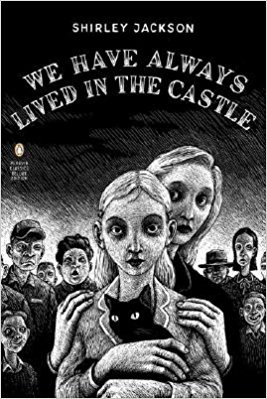
Mary Katherine “Merricat” Blackwood—Shirley Jackson, We Have Always Lived in the Castle
Merricat commits an unthinkable crime when she is only twelve. (Spoiler alert for a 55-year-old book follows!) After being sent to bed without supper, she poisons her family with arsenic in the sugar bowl. Only two of her family members survive, one because she denies pudding at the table and the other because he only added a small amount of sugar. Merricat shows no remorse for killing her family; however, she becomes spiritual and places boundaries on herself — the guilt finds different ways of manifesting in her life. At the end of the novel, Merricat and her surviving sister, Constance, are run out of the town and rely on each other for survival. The reader is left supporting Merricat as an independent, powerful witch in her own right.
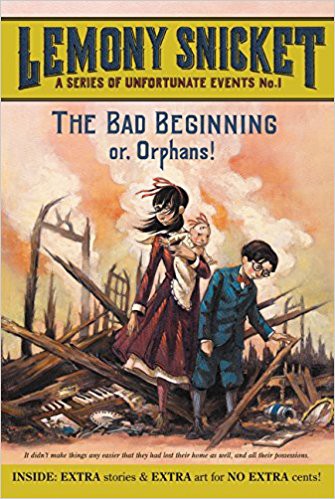
Sunny Baudelaire—Lemony Snicket, A Series of Unfortunate Events
Sunny Baudelaire is an unexpected heroine. She’s only a toddler, but she’s also the most wise Baudelaire of the pack, constantly spewing out deep intricate references that would make the biggest Rick & Morty fan squeal with delight. Sunny has her older sister, Violet, to look up to, but even before the frontal cortex that would help her mimic her sister’s behavior is even given a chance to develop, she already knows how to navigate the world. She uses her teeth for everything, understands the drawbacks of fear of the known and unknown (i.e., leeches, snakes, dark hallways), and is a master of disguise. There is more to Sunny Baudelaire than her age in months.

Beloved—Toni Morrison, Beloved
Beloved’s power transcends her brief life. She is a revenant kept alive by the guilt of her mother and murderer, Sethe—and once she takes on a human form, nutritionally supplemented by Sethe as well. It isn’t until the power of the black female community exorcises Beloved from 124 Bluestone that Sethe and her daughter Denver can go on to live a life without the trauma of the past continuously haunting them.

Alia—Frank Herbert, Dune
Because Lady Jessica drinks the Water of Life while carrying Alia, her child is born with unusual abilities. She is far more knowledgable than the average toddler, can speak clearly, and can even tell the future. Even in a science fiction context, such power behind the face of an innocent little girl is uncanny and, yes, scary.
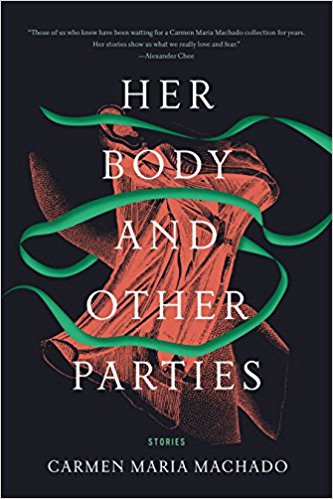
The girls-with-bells-for-eyes—Carmen Maria Machado, Her Body and Other Parties
In the middle of Carmen Maria Machado’s breathtaking collection of short stories, there is a novella Especially Heinous: 272 Views of Law & Order SVU. As if the Law & Order SVU series wasn’t captivating enough, Carmen Maria Machado gives Benson, Stabler, and New York City a supernatural twist. Benson is haunted by girls who have bells for eyes, young women who were murdered and improperly buried around the city. They seek out Benson to find their bodies and eventually possess her. The bells are their way of communicating, but so is their heartbeat coming from the ground of the city. They are powerful when they are powerless, their presence can be heard as well as felt, and the guttural intuition that ensues from such sensations helps Benson solve the case.

Amma—Gillian Flynn, Sharp Objects
In a similar vein as The Bad Seed, Sharp Objects takes a look at the power of generational evil, nature versus nurture. Protagonist Camille escaped Wind Gap, her hometown, only to be drawn back to solve a series of murders whose victims are found with nails painted and teeth pulled. Amma, the protagonist’s stepsister, is coddled by their mother, who feeds Amma pills in order to keep her unwell. In the novel, Amma begins to recognize the power of her sexuality, a realization that continues to haunt the adult psyche and helps to make young girls creepy. At the end of the novel, the mystery is solved — but at this point, you can probably guess who the murderer was.
A Life Described in Teeny Tiny Pieces

Beth Ann Fennelly began her career as a poet, but over the course of seven books, her work has continued to branch out in terms of experimentation and collaboration. Her most recent book, Heating & Cooling: 52 Micro-Memoirs, uses short-form prose—some as short as a sentence—to explore the fleeting moments that become persistent memories.
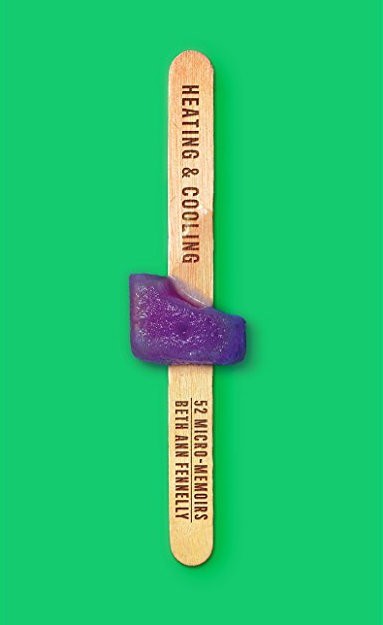
With a consistently beautiful economy of language, Fennelly tells small stories that ask the reader to focus on tiny moments, and how those moments build into the arc of a life. From entertaining factoids about the poet’s past (did you know Fennelly played the Mary Poppins to Vince Vaughn’s Mr. Banks in an elementary school production?) to deep truths about friendship, marriage, parenting, and aging, Heating & Cooling expresses a life in a distinct and unusual form for memoir. The vignettes are consistently entertaining, but always poised, eloquent, and full of moments of tenderness.
Over email, Beth Ann and I talked about creative anxiety, her exploration of structure, and the portrayal of middle-aged love.
RS: Your book perfects a version of the vignette format. Have you always worked in this style, or did it develop in your work over time?
BF: This form is a departure for me. Before I published this book, my husband and I wrote a collaborative novel. Called The Tilted World (HarperCollins, 2013), it was set in the flood of the Mississippi River in 1927, and it ended up being a big project. Although we’d published four books each, we’d never written one together. In addition to teaching ourselves how to collaborate, we had to do a lot of research. And it was high stakes: we spent four years writing the novel. Imagine, if it failed, how costly that would have been for our marriage.
Luckily, it didn’t fail. After we returned from book tour, tuckered, I wasn’t sure what I wanted to write next. There followed a long, frustrating fallow period in which I wasn’t writing. I was scribbling little thoughts and ideas in my notebook — some just a sentence, or a paragraph, the longest just a few pages — but nothing was adding up to anything. Eventually, however, it occurred to me that I was enjoying this scribbling. After the high stakes, research-heavy, character-imbedded thinking of the novel, my own life seemed rich material again. The little memories or quirky thoughts or miniature scenes I was creating seemed refreshing. So, strangely, I identified the feeling of writing before I identified the activity. I thought, What if this “not writing” I’m doing actually is writing, and I just don’t recognize it because it doesn’t look like other writing I’ve done? What if I need to stop waiting for these things to add up to something, and realize maybe they already are somethings, just small? Once I’d recognized the form and gave it the name the micro-memoirs, I realized I was almost done with a book.
What if this “not writing” I’m doing actually is writing, and I just don’t recognize it because it doesn’t look like other writing I’ve done?
RS: From the first micro-memoir, “Married Love,” which continues with “Married Love II, III, IV, etc.” throughout the book, you begin a theme that I was trying to put a name to—it seemed almost like domestic humor. How did you build these pieces over time, and how did you choose these specific anecdotes from your marriage?
BF: “Domestic humor” — what a great term! In this sequence, I was thinking about middle-aged love. This year my husband and I will celebrate our 20th anniversary, and I still think he’s sorta awesome about 98.3 percent of the time. When we met, I’d write him all of these gushy romantic love poems. And while I still love him, and still write about him, the role he plays in my work is different now — he’s not the singular obsessive focus of my work, and sometimes he’s relegated to the margins. But there’s a bit of comfort in that, too — that if I take my gaze away from him, he’s not disappearing. Also, the kind of love we have has, of course, changed from that first-bloom erotic intensity to something more mellowed and complex and richer and funnier. I wanted to look at that, because our society tends to only portray early love, or unrequited love. Middle-age love hasn’t captured our imaginations, so it was fun to investigate.
RS: The book is very funny; do you make an effort to put humor into your writing or does your general sense of humor find its way onto the page?
BF: I don’t sit down and try to be funny — I just try to capture the events of my days, and any day is full of a lot of funny moments, if you just take time to notice them. Motherhood is funny. Sweet and noble and exasperating and empowering — but also funny. I wanted the book to capture the fullness of the human experience — and humor is a big part of being human.
A Poet Survives Abuse, Brain Trauma, and a Hurricane, Then Turns to Memoir
RS: What’s your process for deciding what form a memory takes in writing?
BF: I think when the memories come, they arrive with a kind of feel. Some want to be dreamy, more poetic, have elongated syntax, or be rich with metaphor. Some want to move very fast and need a short sentences or a flat tone. Some need white space to moderate and provide a moment of reflection that allows a difficult trope to touch down. Each piece seems to have its own requirements and I just try to use my ear to figure it out.
It was important to me that the book have a lot of stylistic variation and look different on the page — I wanted to keep the reading experience lively.
RS: How do you select the stories that made it into this edition? Did you have a unifying theme? Do you have any sections that you cut that were particularly difficult to part with?
BF: An early draft of the book had 100 pieces. My editor suggested I cut it down, not because any of the micro-memoirs were huge pieces of garbage, but because the book felt a little overwhelming. So I cut down pieces that seemed like outliers, thematically. I kept ones that focused on my central roles — wife, mother, writer, woman — and hoped the cuts allowed a kind of coalescing among these central roles. The book is in some ways about the choices we make in an effort to be happy.
I wanted the book to capture the fullness of the human experience — and humor is a big part of being human.
RS: I loved the piece “Nine Months in Madison” — I’m from there! But I loved how the piece elucidated artistic anxiety through a sense of place. How did you reach that intersection of place and anxiety with this piece?
BF: Oh Madison is such a cool city! But while I lived there, I was feeling a lot of pressure to figure out what I would do next for a job, and how I would manage to make a living. I was really poor. And I was training for a marathon, circling Madison’s lakes endlessly, and circling the dilemma of my future endlessly, and I used the form of random pieces of information about my time there — information that linked up but didn’t fully construct a narrative — with information about Madison, like how many people have drowned in the lake, especially Otis Redding. I wanted a kind of itchy feel to come out of these numbered sections that would be both self-portrait and city portrait — or, as you put it, the intersection of place and anxiety.
Support Electric Lit: Become a Member!
RS: In the piece “Daughter, They’ll Use Even Your Own Gaze to Wound You,” I loved the approach you took to discussing various forms of harassment — can you talk about approaching very serious topics like this through art?
BF: That micro-memoir details in three paragraphs the three times in my life when a man exposed his genitals to me. The times took place in different cities, when I was at different ages. I always assumed this was a very unusual thing that I’d been exposed to three times, but one time I was in a conversation with six women and five of them described similar experiences. It made me consider the omnipresence of threat for women — that these experiences are so common — that women just have to accept this as part of what it means to be a woman, and have eyes that someone might, at any time, place something wounding in front of. I wrote the three paragraphs with a two-sentence rhyming couplet at the end, so it’s kind of a fucked up sonnet. Not that a reader would need to know that — just that the Shakespearian sonnet form was in the back of my head as a model. Sometimes it’s the presence of art that can help us shape these experiences, construct an arc that offers meaning to the randomness of life.
