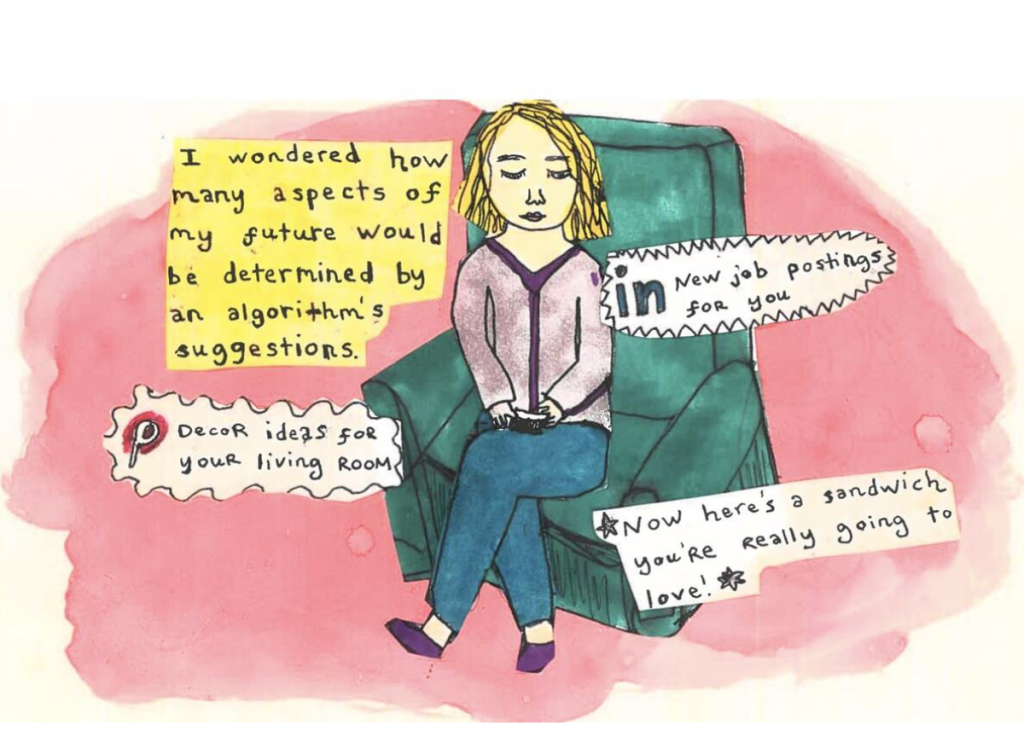
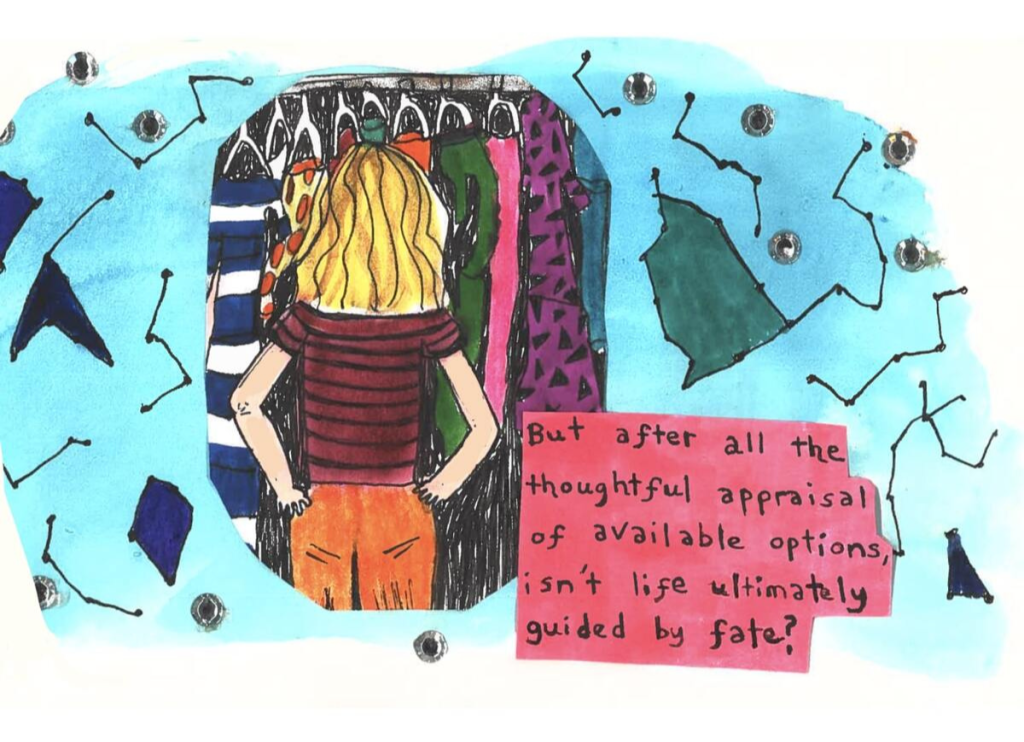
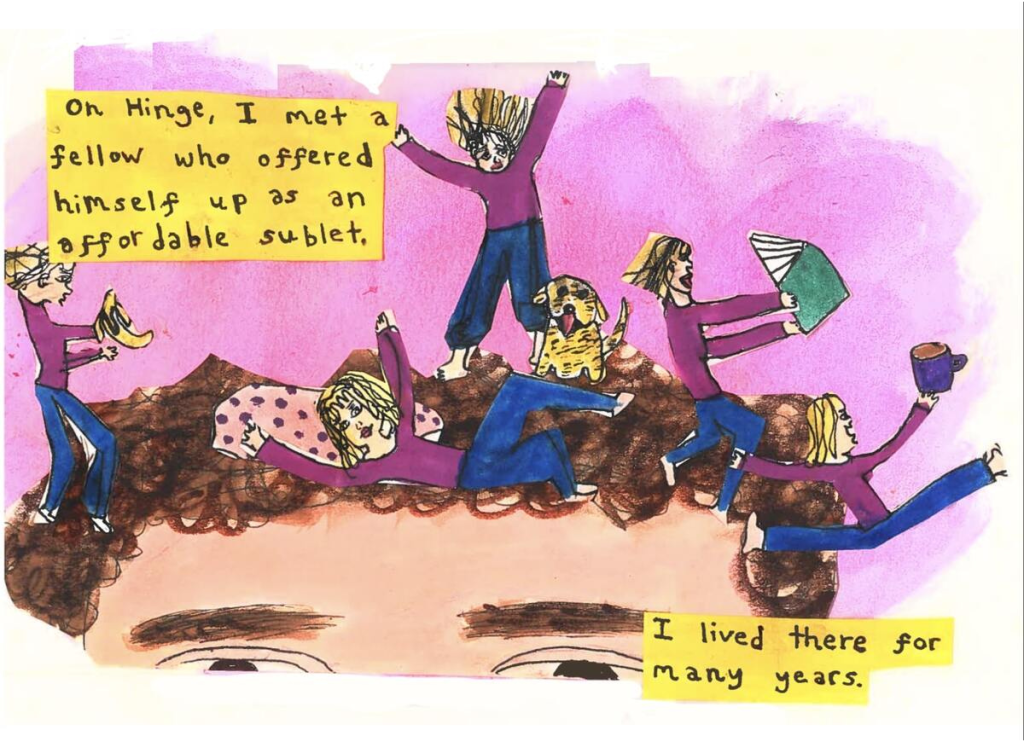
No One Suspects an Art Thief Wearing Sandals and Socks

“Lottie Woodside and the Diamond Dust Cher” by Marie-Helene Bertino

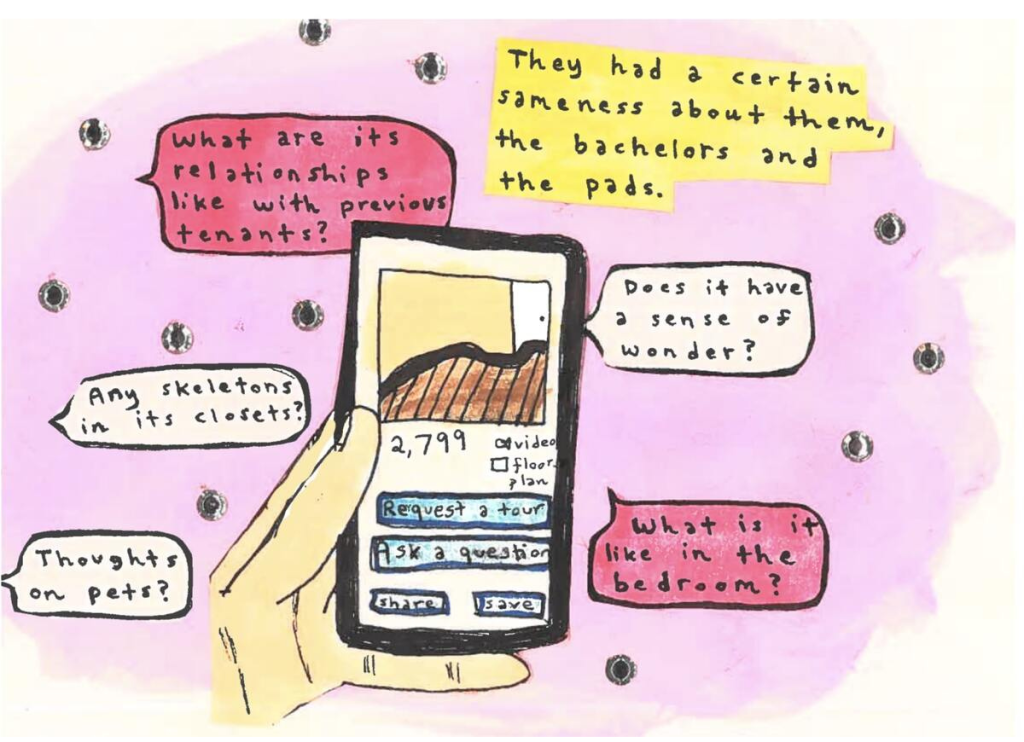
Lottie Woodside was learning it takes two fools to start a marriage and a team to end one. Lawyers, a notary clerk, Derek even brought the girlfriend: an overmatched but dear-­looking thing who avoided Lottie’s eyes and sat on the bench in the notary’s hallway, reinforcing her bangs with a purse comb.

“I hope you promised her ice cream after,” Lottie said, and regretted it.

Since they had agreed to divorce, Derek preferred to keep their interactions brisk and professional, but the finality of paperwork and a state building seemed to stir old compassion. “Well, you know,” he said. Lottie knew this phrase, unfinished and delivered with chagrin, was meant to be conciliatory, a hand up into her new life.

The marriage was defunct. Thirty years folded into a drawer like holiday linens.

Lottie thought this earned her a cab ride.

She found one but upon opening the door saw that it was already occupied by a woman who, talking on her phone, blinked into the surprise of a new person. Lottie scanned the street for another cab but the woman waved come in, as if her departure would be more of a delay.

“I might not be on the way,” Lottie said.

“Everything is on the way,” the woman said. Then, into her phone: “Not you, Steve. The woman getting into this cab.” The cabdriver protested but the woman seemed to be in control of his cab and everyone in it.

The light turned green.

Lottie gave the cabdriver her Brooklyn address.

The woman caught her looking at the large, flat package wrapped in brown paper and propped against her knees. Her hand flew instinctively to protect it. Whoever was on the end of the line expressed dissatisfaction. “Relax,” the woman whispered. Lottie pretended not to notice the woman scanning her. “She’s no dealer. Sandals with socks.”

Lottie pressed her forehead against the cold window. She had taken a personal day from her nannying job and was looking forward to getting home. She planned to scrub Derek from their apartment with cleaning supplies that smelled like trees and by moving the couch from one side of the room to the other.

At a red light, the cabbie consulted the women in his rearview mirror. “We’re going nowhere fast.”

The woman leaned in to the partition separating them. “Can you try Tenth?” Elegant cuff links blinked on one sleeve.

The cab driver pulled out of traffic and performed a quick turn. The street was clear. He reached Tenth Avenue and made a sharp left, jostling the women against each other.

“Pardon me,” said Lottie.

Yards ahead, a streetlight turned yellow. The cabdriver accelerated.

Lottie pointed to a spot on the floor near the package. “You lost one of your cuff links.”

“Did I?” The woman clutched at her sleeve. “Hang on, Steve.” She bent over the package to feel around on the floor. “These things never stay where they’re supposed—”

Lottie didn’t hear the rest of the sentence. She was outside the cab, sitting on the curb, legs arranged uncomfortably beneath her. An expression of glass fell over her in waves. A gem shone on the pavement. It turned and signaled to someone. To her? Lottie leaned in; her eyes adjusted and the object resolved into focus. The woman’s cuff link. Lottie’s handbag slumped against a nearby hydrant. She stood, shook her arms and legs. Her backside ached. Where the curb stopped me, she reasoned.

A Subaru had collided into the cab on its left side, where the woman had been searching the floor. Its driver was out of his car holding his head, wondering at the wreck. The cab was pummeled into a crescent shape; the cabbie settled on one side of it, the woman on the other. Lottie saw where her door had flown open and ejected her. The cabdriver’s cheek rested against the steering wheel, smiling dimly in a good dream. Lottie had been in the presence of death only once and it was unmistakable.

In the back seat the woman clutched at her chest, as if trying to locate the pendant to a necklace. The cab steamed and bitched around her. “I’m okay,” she said.

People clambered out of the surrounding shops, wanting jobs. They asked who needed assistance and made phone calls. Lottie picked up her handbag and shook it. How lucky, she thought, everything that belongs to me is intact. In the distance, a siren yearned toward them. The woman in the back seat cried for help. Her door was stuck. Strangers took turns pulling. The ambulance arrived. Paramedics spilled out and tended to the drivers, the woman. A policeman established a divide with yellow tape, creating a temporary order that Lottie appreciated. No one not directly involved in the accident should be able to participate.

Someone identified Lottie as involved in the crash, and a paramedic slipped an oxygen mask over her mouth and nose. She sat on the curb breathing into it while the others worked on the cabbie. She was certain he was dead so when his eyelids rebooted, when he exited the cab unassisted, Lottie felt some cousin of duped. It felt stranger than anything else that had happened: man returned from the dead. The crowd watched him attempt tentative, directionless steps. He made it to the corner and threw up into a city trash can. The paramedics turned to the woman in the back seat who’d gone quiet.


It was the kind of overfamiliarity that Harolyn had hated, but Lottie liked that the doctor used we and us, as if they’d both been in a wreck.

“Are we married?” he said, placing against her breastbone a stethoscope he’d breathed onto twice to warm. There are two kinds of doctors: those who warm the stethoscope and those who don’t.

For the first time in thirty years, Lottie answered the question in the negative. We are not married.

“Is there anyone we should call?”

She pictured Harolyn the last time she saw her, laughing at a family of picnickers battling the wind on Higbee Beach. She felt the familiar, happy pain of missing her friend.

He shone a light into her eyes. “What is today’s date?”

“I never know the date,” Lottie said.

In a framed picture on the shelf behind him, the doctor was smiling the same way he was smiling now, his arm around a blond man holding a SOLD! sign.

“It’s Memorial Day,” he said. “The start of the summer. What’s the last thing we remember?”

Lottie told him she’d hailed a cab that had been hit by another car. The police had driven her there, to the Midtown hospital, over her insistence. Now she was talking to him. She wasn’t nauseated, had no neck or back pain, had no trouble breathing.

“You’ll be sore tomorrow,” he assured her, penciling a prescription for painkillers. “If you’re feeling signs of a concussion, come back. Sometimes these things hit us later. Confusion.­ Forlornness. Scattered thoughts. Mania. Euphoria. It signals swelling of the brain. You think you’re fine, then boom!”

“I’m seventy,” Lottie said. “What you’re describing is Wednesday.”

Something about nearness, fondness, something about significance acting out of proportion with time.

She asked how the driver made out and he told her fine.

“And the woman?”

The doctor blinked several times. “I’m sorry.”

So the one she thought would make it didn’t, and the one she thought wouldn’t did. “I didn’t know her.” Though appropriate, the sentiment fell short. Something about nearness, fondness, something about significance acting out of proportion with time. A nurse’s arrival seemed to signal to the doctor that their visit had concluded. “That’s a lot to process,” he said. “Stay if you need a minute.” When he was a child, he must have been every teacher’s favorite. His pinched, sincere expression reminded her of Pumpkin, the little boy she nannied. “Don’t forget your things.” He pointed to her purse and a package propped against the wall. Lottie recognized it as the one from the cab.

“That’s not mine,” Lottie said. But the doctor and nurse were gone.

It was hard to believe she and the package had emerged from the same car. Its wrapping was intact. Its pristine label indicated an office on the Upper East Side. Lottie carried it out of the hospital.


Lottie found a nearby coffee shop and ordered a sandwich and a cup of tea. At a free table she propped the package up on its own chair. She tugged at the tape and gently pulled down the wrapping to reveal a brightly colored portrait of Cher.

“Tuna salad!” the barista called.

Lottie left the painting to retrieve her order. At the condiment stand she shook pepper onto the bread, a habit Derek hated. She used more than she normally would, chewed, and studied the painting. Cher wore a sheer crocheted halter and sat elegantly slumped. She smiled with her mouth closed, lips outlined twice in black, eyes bright. Lottie returned the woman’s heavy-­lidded smile, enjoying the feel of the sun through the window flattening against her collarbones. Someone had said it was the beginning of summer. It sure was. Ambulances seared past the coffee shop, no doubt heading for the scene of her accident. No, that would have been cleared already.

Lottie finished her sandwich and reclothed Cher. The address on the label was up twenty streets and over three avenues. She walked to the bus stop, pausing to wait out a surge of pain in her lower back.

An almost-­empty bus arrived. Lottie and Cher had their own seat. Schools were letting out; at every stop, children charged onto the bus, yelling and draping themselves over her seat with no apology, until Lottie had to balance Cher on her lap. Lottie never minded children as Derek had. She liked that they made split-­second judgments and that they looked her in the eye. Most of the time Lottie enjoyed the invisibility that came with being older, the fact that no one thought she was capable of anything criminal or notable, but she occasionally wanted to be seen.

At each stop children hurled themselves down the stairs, into the arms of parents and nannies and by the time they reached the Upper East Side, a neighborhood of art dealers and museums, the bus was empty again. Lottie and Cher disembarked and walked to the address, where Lottie repeated her name into the intercom.

“Who are you here to see?” The receptionist sounded doubtful. “We’re booked.”

“Steve?” Lottie tried.

The door buzzed and Lottie opened it. She climbed four flights to a gallery space where a young woman sitting at a small, gleaming desk greeted her.

“Is this about the Basquiat?”

“I was in a car accident,” Lottie began, but then a man yelling from an office on the other side of the space startled the receptionist. The girl gestured to a folding chair next to a stack of magazines, crossed the room, and disappeared behind the door.

“Is it her?” the man said. “It’s been hours.”

“It’s an old lady,” Lottie heard her say.

Lottie gave Cher the chair and looked at the art. On an overlarge canvas the word RAPE stood against a field of crudely sketched penises.

“Isn’t it amazing?” The girl stood behind her. “The artist is a public defender of rapists.” She gestured across the space. “Over there will be our Warhol exhibit. All the diamond dusts arrive today. That’s why it’s a zoo.”

Lottie let out a low whistle. “Diamond dust,” she said.

From the office Lottie heard the sound of something large being thrown against metal. The man yelled for the girl, who jogged to rejoin him. They did not keep their voices low. “It’s only been a few hours. You know her, she’s probably talking. There’s a woman here to see you.”

“What does she want?”

“I haven’t asked yet.”

“If it’s not your job to ask her, whose is it?”

Lottie remembered what it was like to work in an office like this. She remembered refreshing her makeup after crying in the bathroom. Bonding with people her age. She’d met Harolyn when they worked on the same floor of a Midtown building. They ate their sandwiches out of wax paper, sitting on the same park bench every day. Lottie thought she’d spend the rest of her life meeting Harolyn at twelve forty-­five. But Derek disrupted her schedule, slightly, then more. She couldn’t remember when or why she’d left that job. She couldn’t even remember the building’s address. And she spent so many years there.

A phone rang in the back office. The man said, “It’s me.”

The receptionist emerged. “It’s not a good day,” she said. “He won’t be seeing clients.”

“I’m not a client,” Lottie reminded her.

“Oh my god,” the man yelled. “Anna!”

“That’s me,” the girl said.

Lottie nodded. She had made a decision. “Good luck with the diamond dusts.”

“Diamonds aren’t even rare. Everyone thinks they are but they’re not.” Her voice was sorrowful. “Did you want to leave a message? I can take down your name.” But the girl was already turning to the back office where he was calling her again. “No need.” Lottie picked up the painting and started toward the door. She stepped into the vestibule and pressed the button for the elevator, which came at once. As the door closed, she heard the man’s hot voice and the receptionist’s salving replies.

“She wasn’t a client. In a car accident. Sandals and socks.”

“Well, bring her in!”

“Well, she’s gone!”

In the lobby, men argued over a pallet of boxes. Lottie maneuvered past, through the door to the street. She was relieved to hear an enormous lock activate behind her.


Lottie wasn’t certain what she was doing was stealing, but she wasn’t certain it wasn’t. She’d bring the painting back after she had time to think. The bus was nearing Midtown when her cell phone rang.

It was her employer, Alice Blakeman, who about the birth of her son, Pumpkin, once said: “I would have been just as happy had we adopted a cocker spaniel.”

“I know it’s your day off,” Alice said. “But just for an hour?”

Lottie wanted to go home, take off her shoes, and scrub the walls. But she needed hours. Though guilt had made Derek financially considerate, the divorce had been expensive. She and Cher disembarked at the next stop.

Lottie and Cher crossing Fifty-­Sixth Street.

She thought of Cher’s certain gaze and straightened herself.

Lottie pulling Cher away from a delivery cart’s path.

Lottie and Cher waiting for a walk sign next to a pharmacy window that seemed to reflect all the light in the world. Amidst the blurred, bright people crossing and waiting, Lottie was a hunched figure in a light jacket. She thought of Cher’s certain gaze and straightened herself.

Lottie and Cher weaving through commuters belching up through the Fifty-­Ninth Street subway exit.


In the Blakeman office, Pumpkin jumped on the couch while Alice stood on a chair in the center of the room, spraying him with water.

“Thank god,” Alice said when Lottie entered. She motioned to Pumpkin with her shoe. “Ice cream, or whatever?”

Lottie and Pumpkin walked to the ice creamery on Fifth. Pumpkin ordered three scoops of mint julep. Lottie ordered one scoop of vanilla.

“Why would you order one scoop when you could have three?” Pumpkin said.

They sat on a low stone wall that bordered a park. Families dotted the lawn. Pumpkin stabbed at his ice cream with his small, pink tongue. Lottie had once attended Derek’s company picnic in this park. They had crossed this lawn holding eggs balanced on spoons. Teams. On the subway home, Derek had said he was proud of his “jock wife.” He balanced a platter of macaroni salad sheathed in plastic wrap on his thighs.

The sun retreated behind a cloud and threw shadows onto the field. The boy sitting next to her dragged his tongue across his ice cream while turning the cone for advantageous angles. He was attached to her, this was clear by how close he sat, how relaxed he was in her presence. Who was he?

“Do you like your ice cream?” she said.

He nodded. “It’s delightful.”

It was Pumpkin, she realized. The wealthy boy she cared for, who every so often opened into a moment of startling tenderness. Lottie worried these moments would become rarer as he aged. What did Harolyn always say about life? It’s like a piece of pottery. A kite? A bike. “Was I here yesterday?” Lottie said. “Did I watch you?”

Pumpkin nodded. “We made turkey casserole for Alice.”

“You’re a good boy,” Lottie said.

“What is that?” He pointed to the package.

Lottie unwrapped the top half of the painting, revealing Cher from the chin up.

“Ugly,” Pumpkin said.

Lottie felt a stab of loyalty. “It’s modern art.”

Pumpkin produced a marker from his pocket and, before Lottie could stop him, drew a pert mustache on the canvas. She slapped his hand, sending the marker through the air to clack against the concrete.

“Ouch,” he said, more loudly than the slap warranted. Receiving no response, he said it again.

“I want to know,” Lottie said, “what made you think you could do that.”

He retreated, flashed, hardened into a plan. “I’m telling Mother.”

She licked her fingers and tried to erase the smudge. It blurred and spread. She pulled Pumpkin off the bench, to the curb, across the street, toward his mother’s office.


Lottie and Cher sitting on the bus.

“No, thank you,” Lottie said, when a man offered his hand.

Lottie and Cher leaping to the sidewalk.

Shop owners hosed off hot concrete. It was the beginning of summer. Or summer was almost over. In any case, the sun was to be enjoyed, because it had been absent for so long or because it would soon be going away. It was dusk when Lottie and Cher walked home through the park. The lamps were lit. Baseball games were concluding in the fields. Winners and weepers. Reluctant families trudged toward the subway.

Her apartment had three rooms: bedroom, kitchen, and family. Pale yellow walls and a partial view of the park, if you hung out the window upside down like a bat, clenching the railing with your toes. This was her joke with Pumpkin, and it never failed to elicit his throaty, adult laugh.

Lottie sat on the couch, removed her shoes, and spent a long time rubbing each foot. Her ancient answering machine flashed with a message. The gallery, she assumed, but it was Alice Blakeman.

“I don’t know what to say. Pumpkin tells me—­it’s hard to even believe—­he says, well, Lottie, did you slap him?”

This would be the most thought Alice would ever give her and it would come in the form of bewilderment that someone on her payroll would do anything to confuse her. Lottie knew that over the course of the night the confusion would calcify into self-righteousness, then insult. Lottie would have to apologize.

“Or else what?” she said aloud, rubbing and making a difference to a firm knot in her heel.

The apartment was neat but not clean. A painting of an Italian café hung over the dusty television. “A conversation starter,” Derek had called it. He bought it during his traveling phase when he read about other countries and went nowhere.

It was meant to be their starter apartment, but they had lived in it for thirty years until a few weeks before, when Derek came home from his job at a medical supply firm and told her he would be moving into his girlfriend’s apartment that very night. She was a coworker and had attended the park party, watching the couple cross the lawn holding eggs on spoons. She’d even expressed regret that no one had eaten Lottie’s macaroni salad. “A waste of good noodles.”

Though it had been Derek’s decision to divorce, they’d both participated in the relationship’s dimming. His dalliances, her aloofness. There were no children or money to divvy. There had been a baby who hadn’t lived long. When Lottie pictured her, which she’d been doing more often, she lay in the hospital’s bassinet on one of her only days, too delicate for the world to hold. The only time she’d been in the presence of death before that morning’s accident. Weeks of damaging silence followed. Derek couldn’t meet Lottie’s gaze. He never blamed her but did not contradict her when she blamed herself.

Lottie poured a glass of wine and waited for remorse to split her in two. Garden-­variety doubt, at least. No feeling arrived. Even after a second glass. She liked that the dishes in the sink were hers. Her work dresses, pressed and zipped, hung in the front closet. A headache bloomed at the base of her neck. She thought of Derek in this space as she throated two aspirin. He’d always looked too big in it, clumsy fingers pulling a pot from a high shelf.

Lottie removed Cher from her wrapping and leaned her against the wall. Except for Pumpkin’s smudge, Cher was ­ flawless, making everything in the room seem dull. Her patient, beaming face. The bold lavender and fuchsia. They smiled at one another.

Lottie propped Cher on one of the kitchen chairs, turned on the radio, and pulled a pork cutlet from the refrigerator. She liked noise while she made dinner. On the news, a man was being interviewed about something that had nothing to do with Lottie or anyone she knew. She chopped chives as the water boiled, tossed a pad of butter into a warming pan.

Lottie and Cher eating dinner at the kitchen table.

Lottie had never felt young, not even in youth. She disliked only one thing about time: the accrual of loss. At fifty, Harolyn said, people start to leave the room. Sometimes Lottie would shop to take her mind off all the good people gone. Harolyn, her baby, several dear friends, Derek too, in a way. She’d miss parts of him. The evil you know, Harolyn would say. Harolyn had been the most person with a capital P Lottie had ever known. No one made her do anything. How had death managed it? One moment you’re a person and the next you’re not.

After dinner, Lottie surveyed the family room. A knobby couch, an easy chair, two bookcases. She removed the café picture and replaced it with Cher. She stepped back and studied the woman.

“This must seem so shabby to you.”

Lottie ran the vacuum over the living room and hallway carpets. The couch was lighter than she had anticipated. Or she was stronger. She dragged it to the opposite wall. The easy chair to where the couch had been. The television to the other wall. This rearrangement would create an enclave for Cher, she thought as she yanked the plug from the socket, a sacred space. She walked to the kitchen and retrieved a pint of ice cream from the freezer.

It occurred to her that the enclave should be on the smaller wall. The far wall did not offer the type of intimacy an enclave required. Lottie dragged the chair back across the room to the smaller wall, but there it was too close to the couch. The room creaked to one side, Cher in the middle, a steady rudder. Lottie pushed the couch to the far wall. Now the television was next to the couch instead of across from it. Then the bookshelves: two five-­tiered towers of unfinished wood that Derek had put together with nails and a high heel. He wasn’t all bad. It’s impossible to hate a person you truly know.

Lottie decided to move the couch to the bookshelf wall and the bookshelves to the green wall, creating the enclave she desired. She had to progress inch by inch. First one bookshelf, then the next, then she ran to the couch and moved it a few inches. The system worked but Lottie realized too late that the couch wouldn’t fit past the bookshelves. She should have done one bookshelf then the other. She tried to move the chair to make way for the bookshelves. It lodged between the couch and the wall and refused to budge.

Lottie’s strength was gone, her hands chapped and red. She attempted to lift the television over the couch to free up some space, but it was too stubborn to move. Lottie had positioned each piece of furniture so it could move neither forward nor back. A miracle of geometry.

Her headache was not responding to the aspirin, and an hour had passed. Or, three. Why the headache? It had been a regular day. She’d looked after Pumpkin and picked up a sleeve of veal on the way home for dinner. No, that was the year before. It had been Derek who knew what to do with veal. He’d surprised her with dinner and a fistful of wildflowers. They’d eaten at the kitchen table as the room filled with afternoon sunlight. If that was the previous year, what was today? Lottie remembered the accident, the painting. The lamp on the table next to her was off. She must have done it in her sleep. Her heart thumped. Had it been a dream, the cab, the Cher? There she was on the wall, every part of her glimmering in errant light. Two women in a room. Both recently survived a wreck.

“We’ve experienced quite a shock,” Lottie told her. It was the right sentiment: honest, simple. A kiln, Lottie remembered. Is what Harolyn said life is like. It turns up the heat until your true colors show.

11 Small Press Books You Should Be Reading This Spring

Writers—even if working in fiction—are often concerned about what is happening in the larger world. Though it takes time to see a book through from manuscript to hitting the shelves, the ones featured here have a finger on the pulse of our contemporary moment and take time to explore the deeper nuances of human connections.

From the tragedies of American history and the terrors of dictatorship, to reality television’s roots in home video to connections with spirits, ancestors, and families, these works embody the human condition. People are weird, people are mean, people are complicated, and people are beautiful. 

Every time I compile a list, there are so many books left out. This is only a small sample of what small presses are publishing. Still, these titles are an invitation to consider the world we live in, our historical contexts, and how reading can offer insights into our own lives.

The Feminist Press: The Gloomy Girl Variety Show by Freda Epum

In short, episodic essays and images largely of the author’s own visual artwork, Freda Epum has crafted a memoir that not only interrogates her identity as both a Nigerian American and as someone who has spent significant time in treatment for a life-threatening illness, while shaking up the idea of what memoir can be. Gloomy Girl is set against a backdrop of makeover and house-flipping shows—and the idea of houses appears thematically in the book, including opening with the unfortunately common Millennial experience of home-buying being out of reach. There is an effective contrast between televisions blaring popular broadcasts of a particular era—Maury, MTV’s The Real World, the Kardashian heyday—and Epum’s self-portraits and self-examination, making meaning out of fragmentation. A culturally relevant and emotionally impactful book. 

Dzanc Books: In Our Midst by Nancy Jensen

After the First World War, Nina and Otto Aust emigrate from Germany and settle in a small Indiana town. They raise their two sons, run a restaurant, and live in community with their neighbors. Yet, as World War II breaks out, Germans by birth like the Austs come under suspicion. In 1941, the restaurant is seized and Nina is arrested, and most of their friends and neighbors turn their backs. Haunted by the threat of deportation to Hitler’s Europe and with their lives thrown into disarray, the family fights to stay connected, even as the sons and Otto are placed in separate internment camps. The Austs are tight, bound by their love of music and their genuine affection for one another, but as their situation becomes desperate, Nina must make a terrifying choice to reunite the family. Beautiful and chilling.

Kallisto Gaia Press: Alternative Facts by Emily Greenberg 

Probing cultural touchpoints from Paris Hilton to B.F. Skinner, from Kellyanne Conway to Thomas Pynchon, and from The Tonight Show to Mevlüt Altıntaş, Greenberg fictionalizes the inner lives of figures who have contributed to the American cultural zeitgeist for better or, more frequently, for worse. In these seven stories, Greenberg utilizes press releases, mathematical equations, and diner menus to create a texture in the pages that mirrors the noise, disconnect, and the sense of just continuing on even when the world feels terrible that encapsulates much of our modern experience. Despite some of the absurd situations and clear satire, there is a disarming seriousness in Greenberg’s stories. Thoughtful and compelling. 

Tin House: The Edge of Water by Olufunke Grace Bankole

In Ibandan, Nigeria, instead of marrying the man she loves, Esther is coerced into a union with another man; and while the marriage does not last, the bond with her daughter, Amina, does. Esther has spent much of her life searching, and when she visits a traditional Yoruba iyanifa, the woman cautions Esther that Amina must never go to America, where danger awaits. Yet, Esther, who was constrained by convention in her own life, is loath to restrict Amina—Esther believes the iyanifa’s prophecy, but she also believes in her daughter Amina, who moves to New Orleans to make her own way. As a hurricane bears down on the city, Amina is evacuated to the Superdome and disconnected from her local family with no way to reach her mother. This multi-generational novel is an insightful testament to the power of bonds between mothers and daughters. 

Monkfish: My Mother in Havana by Rebe Huntman

Before Rebe Huntman takes a month-long trip to Cuba to learn about and research deities and saints representing mother figures, she has already had a career as a dancer and as a teacher, and has raised her son on her own after the dissolution of a marriage entered into young. While Huntman has ideas about what she is searching for in Cuba, which includes reaching for connection between herself and the mother she lost at only nineteen, she approaches her journey with an openness, rather than an agenda, and the result is an exploration of memory, spirituality, loss, the relationship to the body, and to people who have passed to the other side. The idea of the veil that lifts between life and death is thematic to this memoir, and one of Huntman’s true talents as a writer is the grounding she brings to the spiritual. Emotionally compelling. 

Schaffner Press: The Lives and Deaths of Véronique Bangoura by Tierno Monénembo, translated by Ryan Chamberlain

Atou is barely a teenager when she murders her father, a police officer who raped her, and then flees. In the slums around Conkary, the capital of Guinea, she is taken in by a group of women and their oft-drunk matriarch; they do not judge Atou. As she grows up with the women, learning how to hustle tourists and diasporic Guiana’s who see the country as only a place to flout their wealth, Atou finds a home of sorts. When she is in trouble and leaves Guinea for France, she adopts the identity of Véronique Bangoura, and begins a friendship with an older woman, Madame Corre, who claims to know her—and has her own connection to Guinea. Set during the terrifying twenty-six year dictatorship of Sekou Toure, the novel addresses generational trauma, abuse, and what it means to live in exile. Gripping.

Regal House Publishing: Play, With Knives by Jeanette Horn

A dramatic troupe crosses the Midwest by train, hitting stops like Lisbon, Kansas and Milan, Nebraska to perform for sparse audiences in once-opulent theaters now in disrepair. The lead, Ava, is married to another actor, but he has left her for bigger stages. Her budding relationship with set-designer Edgar makes her wonder about her estranged husband and what their status really is. The leader of the troupe, Fallon, writes the company’s original plays. As the train rattles from stop to stop, elements from Fallon’s scripts start appearing in the actors’ off-stage lives. Fact and fiction muddle: the characters in the novel blur with the characters they play on stage. Play, With Knives is an inventive book which breaks the third wall via readers seeing everything behind the curtain. Horn incisively captures the comedy, the tragedy, and humanity of backstage and beyond.

Sagging Meniscus Press: The Summer We Ate Off the China by Devin Jacobsen

A young teen impregnates herself with the sperm captured in a condom from her older sister’s boyfriend; a man prints and hangs three hundred flyers to locate a woman he believes is a love at first sight missed connection; and in the title story, a woman trained as a lawyer but working as a server returns to her Scottish village for a family friend she wants to help but cannot. In this wide-ranging collection, the stories move from the American South to Europe and are knitted together with an indelible sense of longing. The characters have wants and needs, yet they are often as dissatisfied as the tourists who visit the Dalí Museum in Florida, and leave in a state of bewilderment. In The Summer We Ate Off The China, Jacobsen captures the human impulse to hope, and our inevitable disappointments. 

Clash Books: VHS by Chris Campanioni

An auto-fiction pastiche of video recordings, VHS splices the experience of being the child of political exiles from two different countries into an impressionistic book that reads like a YouTube algorithm that truly knows what you want to see next. Not exactly a novel and not exactly a collection, Campanioni crafts everything from getting a new pair of glasses to swiping a metro card into a seminal experience. Indeed, these are the moments that make up life; he captures the sense we’ve all had when doing something ordinary—like riding the train, or wondering if it’s better to be a back or a belly sleeper—and it suddenly, because of the right light or the perfect background music, feels like a movie. Deft, poetic, and surprising.

Santa Fe Writers Project: The Death and Life of August Sweeney by Samuel Ashworth

Dr. Maya Zhu is an ambitious young pathologist who—much to the dismay of her Chinese immigrant parents—has chosen autopsy as her specialization. When August Sweeney, a man for whom the only thing larger than his body is his reputation as a celebrity chef, comes across her table, Dr. Zhu is immediately interested professionally. Yet, just as he was a complicated person in life, August creates complications even after his death, and Dr. Zhu’s autopsy becomes personal, as she realizes she and August are connected in surprising ways. This novel is written with the lushness of a decadent meal and the sharp precision of a surgeon’s scalpel, making it both sensory and exacting. In telling the story of August Sweeney’s life and death, Ashworth creates a world that is as outlandishly raucous as it is deeply personal. Utterly unique.

Ig Publishing: The Queer Allies Bible by NV Gay

In this guide for anyone who has questions about or actively practices allyship, NV Gay provides a reference that answers questions some people might be afraid—or not know how to—ask. The book is contextualized around both Gay’s own experience with gender identity, and in the lived experiences of the LGBTQIA+ community. Topics include negotiating religion, managing assumptions, creating inclusive spaces, and handling discriminatory remarks. Taken alongside the outrageous developments in the current political landscape of the US—for example, the misgendering or non-renewal of passports for trans people—Gay’s measured tone and fact-based writing is welcome, useful, and compelling. 

3 Debut Writers Discuss Craft and Obsession in Their First Novels

Obsession is the pulse and connective tissue that joins the three very different novels in this edition of our debut craft series. I interviewed the authors to discuss how each found their way into the nature of obsession—whether through an idea, a character, or a voice that haunted their writing—and went about circumnavigating and poking holes into the way we fixate and dwell, the way we obsess over things that are at times mundane and others, profound. One novel follows a pair of tumultuous lovers obsessing over rare songs on beloved records. In another, a culture critic obsesses over the truth behind a friend’s death and the absence of “genuine” friendship in the digital age. The third explores a Muslim adjunct professor’s obsessive urge to find love, or a substitute for it, in the messy modern dating scene of Los Angeles.

These three novels also share a tendency to move across cities and landscapes, chasing protagonists who are pursuing wild desires and, in the process, exploring the way people change—or don’t change— alongside their address. From Clinton Hill brownstones to Chicago karaoke bars, from Berkeley record stores and L.A. farm-to-table restaurants to a hospital in Tehran, the characters in these novels travel and relocate, all the while attempting to grasp their idée fixe. The cities they live in become stars in the uncertain constellations of their lives: each desperate to connect point A to point B. A few characters return home as adults, trying to rediscover who they were in order to find out who they will be. Others avoid home as much as possible and instead become hooked on searching for someone to sit beside them in the passenger seat. In the end, their questions revolve around the same central idea: Does someone’s newest obsession define them more than their past? And at what point, does an object of fixation bleed into identity? 

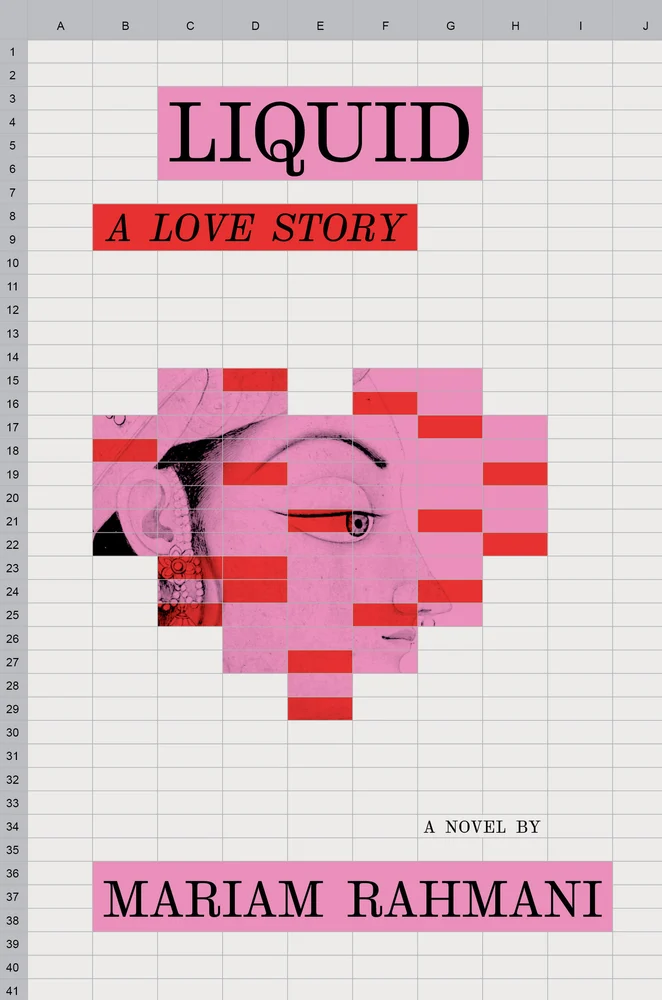
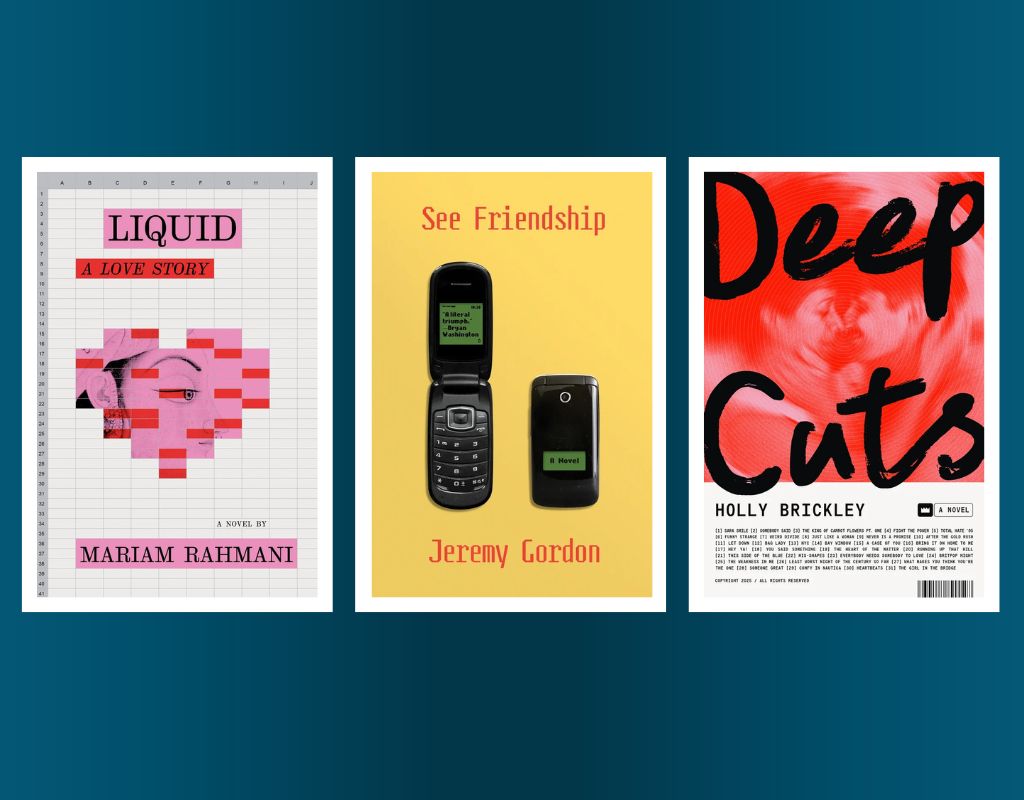
This spring, Mariam Rahmani, author of Liquid: A Love Story; Jeremy Gordon, author of See Friendship; and Holly Brickley, author of Deep Cuts are our craft interview debut novelists. They spoke with me about the initial inspirations behind their projects, the collapse of time, distance, and reality within a story, and how the voices of their protagonists came into being. 


Kyla D. Walker: Did you write Liquid with an outline in mind? Or was the voice of the narrator the main guide?

Mariam Rahmani: Absolutely the former. For me, this book was a study in genre. I watch a lot of rom-coms and I’m always fascinated by how little surprise matters. You know the ending from minute zero—and often, frankly, can surmise the entire plot from minute ten. But it’s still so enjoyable, and even satisfying. I was really interested in staging that relationship between the text and the reader. I also had a few other questions for myself that operated as challenges. How smart can a rom-com get? Can a “serious” novel have a happy ending? Can an “ideas” novel be aggressively femme? The queer and racial politics in the book are also a little twisted, or at least not strictly celebratory—you don’t always know whom you’re rooting for—and confronting that discomfort was important to me. Can the politically sad choice merit celebration? I.e., can another brown woman ending up with a white guy (yes, that’s me, but also so many other women I respect from identities that, like the narrator, are not my own) still feel, in the heat of the text, like something to root for? What of the bi or queer woman who chooses heterosexual love? Is the personal always political? When it comes to biography, is everything always meaningful? Granted, I’d say that’s one big difference between life and fiction—in the latter, it is meaningful. Admitting that, I suppose I was asking about realism. How real can this shit get? Fiction, I mean.

KW: How did you nail the specifically witty, kinetic, and enthralling voice of this protagonist? Did it take a while to find and hone within the prose, or did it come naturally?

MR: I felt like a TV writer. I’d spend days “workshopping” a joke or line with the people around me, months thinking about it. There was also a draft where I ruthlessly cut out everything that fell flat.

KW: What was your thought process behind leaving the protagonist/narrator unnamed?

MR: I used to find unnamed narrators extremely annoying, a pointless kind of withholding. Then, years ago—I was reading a novel by a woman of color—I read the move as a political act. There can be a strength in that lack of access, a level of control that reminds the reader they only have access to what the narrator is willing to give. They only have access to those parts, or versions, of her body; those corners of her mind; those shades of her emotions.

So there was that. But really the decision wasn’t mine; it had been made for me by the history of the novel. My novel is a response—indeed, rejoinder—to the gendered and racialized violence that inaugurated Iranian fiction via Sadegh Hedayat’s The Blind Owl (1937), the first novel in Farsi. Hedayat’s unnamed male narrator has an Iranian father and Indian mother whom he exoticizes and fetishizes, the type of orientalization of India that has a long history in Iran. In order to enter that conversation, my protagonist had to have the same identity—but we get a woman’s perspective. 

All that said, I liked how the lack of a name creates a sense of intimacy with the reader. It mimics love poetry—I’m thinking of a particular ghazal by Rumi, for example, where the refrain “me and you” chimes at the end of each couplet. Here the “I” of the speaker addresses the “you” of the reader. There’s even a moment or two in the book with “yous” that break the fourth wall, or act to generalize, rather than “one,” and pull the reader in. The reader becomes a kind of beloved.

KW: How did the cityscapes of Los Angeles and Tehran help sculpt the story? And why was it important to you to set the novel in both places?

MR: The book is a couplet: two halves that each make sense on their own but become altogether something else when paired together. It’s also a love letter to LA. That city was home to me for almost a decade, the longest I’ve lived somewhere on purpose (by which I mean, outside of the accident of where I grew up). 

Tehran is similarly a city I formed a relationship with as an adult. My mother’s from there, and we started traveling back as a family when I was four, going not every summer but every two or three, whenever my academic parents could afford it. But when I was eighteen I chose to go alone for the first time, the summer before college. For years, I went once or twice a year, sometimes for work in a sense—I did my master’s research there for my degree in Islamic art and later, working in contemporary art in Dubai and New York, would go check out galleries, etc. Unfortunately, now I haven’t been since the pandemic. I wrote this book in 2022. Maybe I was homesick. (There is a part of me that will always feel that it’s home, as complicated as that is, and though I was born in the US. It’s a place that’s at once so far from me and so close.) 

Politically, I’m interested in how similar the cities are. They’re almost at the same latitude, the climates are not so very different, they both have a lot of Iranians. But living in the US, existing in broader American culture, Iran feels very far away. Most Americans have no reason to think about it, and the ones who do often can’t access it given US-American relations since the Revolution. Liquid was a way to collapse that distance.


Kyla D. Walker: Did you write the novel with an outline or the ending in mind? Or was the voice of Jacob, the narrator, the main guide?

Jeremy Gordon: See Friendship initially began as a short story of about 9,000 words made up of essentially three scenes: a narrator reunites with a high school classmate at a bar in Los Angeles, where he discovers the true circumstances behind the death of a mutual friend; the narrator explains what he’s learned about these true circumstances, and the involvement of another former classmate, to his ex-girlfriend; the narrator comes face-to-face with the involved classmate in an interview for an untitled podcast project. Woven throughout these scenes were the narrator’s thoughts about his dead friend (their relationship, his death, and so forth), conveyed in a slightly world-weary, too-cool-for-school attitude about things that had taken place and could no longer be changed. 

The project expanded and evolved in many ways: Jacob (my renamed narrator) became more fallible and less self-assured; the podcast went from being a tossed-in dynamic to a central pursuit; new characters were added that allowed me to sketch out different ideas and emotions. But I knew the novel’s instigating event was a revelation, and that the concluding event was a confrontation—and that, to take us from A to B, I wanted a charming, sincere, knowing, but not altogether correct voice. As I revisit the story today, it’s clear how I’d established the core structure of See Friendship—and, in fact, if I were to quickly summarize the book now, the elements of the initial short story would work in a pinch.

KW: See Friendship vibrates between light humor and stark tragedy remarkably well throughout each scene. How did you manage to sustain this emotional balance, and was it intentional to layer the prose with both of these elements?

JG: I do not always attempt to “write what I know,” but I always try to “write what I like”—and while I’d like to think I have a relatively diverse taste in literature, there is a certain sensibility that I always enjoy. It’s a tone that says “we’re dying, but let’s have fun”; it faces near-certain tragedy with the mirth required to not be overwhelmed by near-certain tragedy; it has the courage to tell a dark joke on what might be the worst day of someone’s life. A book that was on my mind during the revision process was Percival Everett’s Erasure, which pairs scenes of unbelievable sadness with some truly hysterical lines. This “laugh to keep from crying” approach has always resonated with me both personally and on the page, and it served as a helpful compass as I was revising and editing. When the book felt like it was getting a bit too self-serious, I tried to lighten it up; when I worried I was making a mockery of serious things, I remembered that Jacob is not meant to be a buffoon. A reader who finished the book told me: “My initial reaction was very sad, which is maybe not what I was expecting by the end because it was also very funny.” That twinned experience is, actually, what I was shooting for. 

KW: What was your favorite part of the writing process for See Friendship? How long did it take from start to finish?

JG: I began writing the novel in the summer of 2019. I completed a first draft toward the end of 2020, then spent about a year-and-a-half revising it into the book that eventually went on submission. When all is said and done, nearly six years passed between breaking ground and publication, which seems sort of unbelievable even as I factor in the distorting effects of pandemic time. But, and I hope this doesn’t sound vague, this chunk of time did not seem so colossal because I continued to really enjoy the writing and revising process. There were a few points when I wondered how it was going, but never a moment when I doubted my commitment to seeing this specific project through to the end—and that self-knowledge, following some failed attempts at writing other novels, was invaluable. Sometimes, I’d look up after a long stretch of revising and rereading, and say out loud to my wife: “You know, I think this is still pretty good.” Or she’d ask me what I was laughing at, and the answer was: “My own joke.” To have that reaction several years into the process was really special, and informative—it confirmed to me that something in the writing was working, even when it felt like everything else was taking forever. That’s something for me to chase in the future. 

KW: How has your background of being a culture critic affected your approach to writing fiction and this novel specifically? Did the transition to writing fiction feel natural?

JG: My earliest attempts at writing fiction, as an adult, seem ridiculous to me when I revisit them now: I was convinced that they had to “sound differently” than my regular writing as a culture critic, and so I labored to find a tone and voice that ended up being completely affected. It’s not that these passages didn’t sound like me, because I have no essential self that I need to sound like; it’s that they weren’t coming from a natural source. But when I started writing See Friendship, I realized that I had found a way to cut the shit. I was still laboring, but I wasn’t pretending to be another writer.  And I think all the work I’d done as a culture critic had helped hone my sensitivity to what was and wasn’t working—because I knew what I liked, I could pursue that sensibility as my North Star in moments of doubt or crisis.

I’m working on a new novel that is, in many regards, very different from See Friendship; a couple of early readers have said as much. Yet it doesn’t feel like a “reinvention” or whatever; it’s coming from the same source of curiosity and inspiration that powered my first book. I think that hyper-awareness of what’s turning me on and what isn’t—for lack of a better phrase—is something that was shaped by my hours and hours of exposure to so many different types of media, whether in literature or music or movies or whatever else. Books are books, not movies or songs, but feelings and moods are cross-medium.


Kyla D. Walker: What was the genesis/inspiration for writing Deep Cuts?

Holly Brickley: The initial idea was to explore my lifelong envy of musicians in the context of a love story, where I thought it would make a good complicating factor. I knew I wanted to do it with a feminist lens, because that’s how I saw my envy, as a longing to be in the best of all the boys clubs; to have had, as a young girl, the carefree confidence that a young boy is so much more likely to have when he first picks up a guitar. Also, I’ve always wanted to write a rock novel, and I had this idea that by actually writing about songs—by weaving elements of music journalism into the fabric of a novel—I might have something new to offer the tradition.  

KW: Did you write the novel with an outline or the ending in mind? 

HB: No, I’m a pantser. Outlining never works for me because I get to know my characters as I write, and plot is driven by character. So I just felt my way forward, knowing the next one to two chapters and not much beyond that. I had a sense of where it would ultimately end up, but it was vague, and I had no idea how I would get there.

KW: How did you decide on the structure of a playlist for Deep Cuts? And did you decide on which songs you would use before writing the chapters?

HB: The idea to use songs as chapter titles came right at the beginning; that was part of my initial conception of a novel that actually analyzes songs. It was a little different at first, though. Some chapters read more like a traditional novel, while others were shorter impressionistic pieces focused solely on a song (no plot). Around the halfway mark, I jettisoned those shorter chapters, which I could see by then were unnecessary and probably pretentious. 

As for whether I knew the songs before starting the chapter, that varied. Sometimes I knew with certainty from the beginning; sometimes I thought I knew, but changed my mind. And other times it took some effort to find a song capable of doing the emotional heavy lifting I needed. For example, there’s one chapter that was fully written, minus the song, for several days while I flipped through my records and yelled “Alexa, next! Alexa, next!” Finally, I found “The Weakness in Me” by Joan Armatrading, and not only did the song facilitate the emotional pivot I needed, but it took that pivot to a deeper place. 

KW: What was your favorite part of the writing process for Deep Cuts? How long did it take from start to finish?

HB: I know this sounds crazy, but it was just a little over a year, from January 2022 to March 2023. I honestly loved every damn minute of writing this book, which is why I was able to write it so quickly—I was obsessed, writing every spare moment I could find, barely sleeping for nights on end. 

If I had to pick a favorite moment, it was probably writing the penultimate chapter, “Heartbeats.” That was a fun scene for a lot of reasons, but part of it was that I could finally see how to land the plane I’d been flying, frankly, blind. That was an exhilarating moment.

8 Books on the Evils of Unchecked State Power

You don’t write books for a single reason, or out of any one feeling. I wrote a novel because I wanted to record images and experiences of a brown man’s American life. I wanted to reflect, in my own version of the language, on love, fatherhood, sex, music, money, fate. But I also wanted to write about how ambition could lead a twenty-first century quiet American to do great evil. This last impulse came out of my anger at a specific period of American lawlessness: the imperial wars and covert operations that George W. Bush launched in the wake of Al Qaeda’s 2001 attacks on the United States, and that Barack Obama, to the sorrow of many of his onetime admirers, continued or, in some aspects, expanded.

The book I wrote, The Snares, has a spy as its protagonist. Though he’s a D.C. bureaucrat, rather than a clandestine officer, he nonetheless wields life-and-death power. He passes his days and nights reading reports at his desk and searching insanely detailed databases in service of his function: to select suspected terrorists for extrajudicial assassination.

My choice of protagonist raised an immediate problem. I’ve never worked in the intelligence services, held a security clearance, or tried to convince a president to conduct a drone strike. So how could I imagine myself into the mind of an executioner (even one who kills at a distance, in an off-the-rack suit, with government pay and a retirement plan)? And what of his victims, along with their families and neighbors (the “collateral damage” that surrounds them), who have no opportunity to challenge a bureaucrat’s decision to place them on a kill list? They, like the real-life casualties of American campaigns in South and Central Asia and across the greater Middle East, are subject to arbitrary and absolute power—missile strikes, arrest, torture, and detention without end.

I looked within, of course, but I also turned to other writers. Below are eight books, some of which I read before or while I wrote my novel, and some after, that address the depredations of the state. While their subject matter can be grim, these books—to me at least—offer consolation. They show that the bad times aren’t ours alone. Bullies, in uniform and out, have always been with us, as have the sycophants who argue that torture has its uses, that governments can conduct wars without also committing crimes, and that brutality preserves public order. The writer who bears witness to these evils demands a reader who will reject them. On the other side lies solidarity, art, laughter, freedom—the splendors, in short, of ordinary human life. At the onset of what looks to be a new and distinct age of official thuggery, these books might help us remember that the opposite of force isn’t weakness, but beauty.

By Night in Chile by Roberto Bolaño

Augusto Pinochet’s 1973 U.S.-backed coup d’état cost Bolaño his Chilean homeland, and almost his life. Bolaño’s vast corpus of novels, stories, essays, and poems is, among many other things, a response to that catastrophe—and never more directly than in the novellas Distant Star and By Night in Chile. The latter is the deathbed confession of a reactionary priest and conservative literary critic with close ties to the dictatorship. The priest gives private lectures on political theory to Pinochet and his generals. He attends a literary salon at the mansion of an elegant Chilean writer. Meanwhile, in the mansion’s basement, the writer’s American husband tortures left-wing dissidents. The priest enjoys poetry, wine, and good food. But when he looks back at the end of his life he sees only a nightmare. Complicity has poisoned his soul.  

A final note: though Bolaño writes, as he often reminds us, from the edge of the abyss, he’s never ponderous or self-serious. Even at its bleakest moments, this is a very funny book.

Sand by Wolfgang Herrndorf

Herrndorf’s novel captures the murderousness of Cold War-era decolonization. It’s set in 1972 in an unnamed North African country, where four Westerners (post-hippies, back-to-the-landers) have been killed in their agrarian commune. The local police are hapless and corrupt. Meanwhile, foreign intelligence officers (from the CIA, KGB, Stasi, and Mossad, along with various Arab factions) swarm the land, kidnapping and torturing at will. They leave a trail of corpses; the police hold no one to account. Bigger things than commonplace life or death—like nuclear secrets, state security, and international spheres of influence—are at stake. The protagonist, when he arrives several chapters in, is an amnesiac whose blankness resists his most gleefully sadistic interrogators. Sand is a big novel, with a brutal and maddeningly complex plot, but it’s never forbidding. Herrndorf, like Bolaño, loves to make us laugh.

Home Fire by Kamila Shamsie

A free retelling of Sophocles’ Antigone, Home Fire is the rare mainstream literary novel to treat the Muslim victims of the West’s “War on Terror” as fully human. Parvaiz Pasha, a young British man of Pakistani descent, leaves for Syria. He hopes to meet the militants who fought alongside his father, a jihadi who died after American interrogators tortured him at Bagram Air Force Base, Afghanistan. Parvaiz never finds his father’s compatriots. Instead, ISIS operatives coerce Parvaiz into working for that organization’s propaganda arm. When he tries to flee, they kill him. The novel’s central drama turns on the attempt by Parvaiz’s twin sister, Aneeka, to return his body to England for burial. But the Home Secretary, Karramat Lone, another British man of Pakistani origin, publicly revoked Parvaiz’s citizenship when he joined ISIS. Out of political expediency and his own monstrous ambition, Lone refuses Aneeka’s request. Lone’s pitilessness will have devastating consequences, for his own family and for the Pashas. I read the final fifty pages of this novel with an exquisite sense of dread. Shamsie’s narrative design is impeccable.

Sound Museum by poupeh missaghi

A woman rises through the ranks of an important government bureaucracy. She lives in a theocratic state that resists powerful adversaries near and far. Though she is conservative in temperament, she fashions for herself a feminist narrative of success in a system designed to thwart ambitious women—she sounds, at times, like Hilary Clinton or Sheryl Sandberg. But here the country is the Islamic State of Iran, and the protagonist has found her calling in its internal security apparatus.

The novella takes the form of a speech the protagonist delivers at the apex of her career: the opening of a monument to state torture, a museum that exhibits sound recordings of anguished prisoners in their isolation cells and the interrogation chair. missaghi calls her book a “theory fiction,” perhaps on account of the breadth of writing on torture and complicity (by Darius Rejali, Hannah Arendt, and many others) with which her narrator engages. But the novella is also a dramatic monologue, steeped in irony, in the tradition of Browning’s “My Last Duchess” or Poe’s “The Cask of Amontillado.” The narrator is both subject and vessel of the ideology of a totalitarian state. For all the pride she takes in her grotesque achievement, she is forever blind to its human implications. I hope missaghi writes a song of the drone pilot next.

The Little Book of Terror by Daisy Rockwell

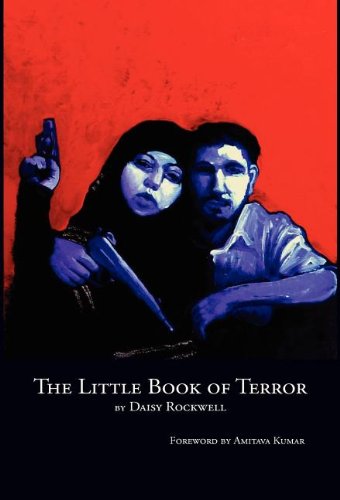
Rockwell’s brief and beautiful exploration of the limits of empathy juxtaposes her paintings of subjects from the first decade of the War on Terror with essays and personal reminiscences. Rockwell is a renowned translator from the Hindi (including of Gitanjali Shree’s International Booker Prize-winning novel Tomb of Sand), as well as an accomplished visual artist. Though she is Norman Rockwell’s granddaughter, she seems to paint, as Amitava Kumar notes in his introduction, more in the tradition of lurid, decades-old Bollywood film posters. Here she depicts a stylized, pink-skinned Osama bin Laden in his death mask, blood or flame obscuring his face; Saddam Hussein after his capture, enfeebled and wrapped in a shroud; and many lesser villains (and innocent victims) of that era. But she also paints the Abu Ghraib torturers Charles Granier and Lynndie England in a smiling, tender moment, as well as her own friends and colleagues, and images of the little green men her father became obsessed with in his old age. Throughout she challenges us to recognize the humanity of the other—including the most alien or despised among those Dick Cheney called “the worst of the worst.” She offers an alternative to the totalizing narrative of the state at war, and warns us to resist its colonization of the self. “Why do they hate us, indeed,” she writes. “And who are they? And who are we?”

Five Years of My Life: An Innocent Man in Guantanamo by Murat Kurnaz, translated by Jefferson Chase

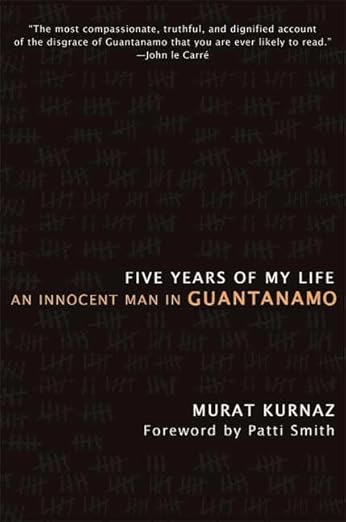
In the winter of 2001, at the age of nineteen, Kurnaz traveled to Peshawar, Pakistan, to study the Koran and prepare himself for marriage. Local police arrested him on the day he was to return home to Germany, though he’d done nothing wrong, and sold him to American operatives for a bounty. Five Years of My Life is Kurnaz’s memoir of his imprisonment in Afghanistan and Guantanamo. His American captors subjected him to beatings, electrocution, and waterboarding. For hours on end, they hung him by his handcuffs from a hook in the ceiling. Within a few months, the U.S. government had determined that Kurnaz was innocent. Yet guards and interrogators continued to abuse him for years. Eventually, the government repatriated Kurnaz to Germany, never having charged him with a crime. Kurnaz’s memoir is a testament to this nation’s moral collapse under conditions of mass hysteria. It records a young man’s dignified resistance to a machine designed to break his body and mind.

Invisible: Covert Operations and Classified Landscapes by Trevor Paglen

What is the secret state? Where are the spies, drone bases, satellites, weapons labs, and surveillance sites? Paglen ventures into the blank spaces on the map, trawls archives and databases, and searches the night sky for traces of that enormous apparatus from which the hundreds of millions of Americans without a security clearance are forever barred. He hikes through public land in Nevada to the boundary of an air force base that occupies—as Rebecca Solnit notes in her introductory essay—an area the size of Belgium. He repurposes astrophotography equipment to capture images of mysterious aircraft, hangers, towers, and chemical and biological weapons “proving grounds” at enormous distances—on occasion, from more than forty miles away. He records the passage of spy satellites in high-earth orbit, photographs government officers and contractors boarding planes linked to the CIA’s “rendition” (i.e., kidnapping and disappearance) of suspected terrorists, and discovers the location of a black site—a secret prison—in Afghanistan. He reproduces the blurred images of CIA officers wanted for crimes in foreign countries.

Many of Paglen’s photographs, particularly of government installations in remote regions of Utah and Nevada, are stunningly composed, even sublime. You feel, as you turn the pages, that Paglen has glimpsed an alien civilization—until you remember that he’s instead had the courage to show us hidden aspects of our own. This is art as witness, and resistance to unimaginable power.

Grief Lessons: Four Plays by Euripides, translated by Anne Carson

The books I’ve listed above all appeared in recent years. But writers have grappled with the problem of power from the beginning. For as long as there have been states, there have been outsiders to whom the state declines to offer justice, protection, or basic dignity. While dictators and technocrats darken our own era, the ancients feared gods and kings. But the human dilemma hasn’t changed. Grief Lessons is a collection of four of Euripides’ minor tragedies, in haunting translations by Anne Carson. A goddess tricks a hero into slaughtering his own family; a king condemns his wife to death to propitiate a god; a queen descends to savagery to fulfill a vendetta; a father banishes his son out of sexual jealousy. The plays are brief, each fewer than 1500 lines, but they encompass the fates of families and nations. Grief begets retribution begets more grief; the pages are drenched in blood. You emerge from the book with a renewed horror of arbitrary authority, beneath which every human life hangs by a thread.

 In “The Seers,” Sex Is Liberation

For Sulaiman Addonia’s characters, sex is often a site of self discovery, of liberation, and homecoming. 

His books center the experiences of refugees, exploring their joy alongside their rage at colonial systems. His frank writing about sex creates space for the importance of intimacy and desire in his characters’ lives, even as they encounter hate and violence. 

 The Consequences of Love, his debut novel, is a Romeo and Juliet story set in Saudi Arabia. Naser, an immigrant from Eritrea, living with his uncle, trades illicit letters with a girl he knows only by her pink shoes. In his second book, Silence Is My Mother Tongue, the siblings Saba and Hagos fight against traditional expectations of gender and sexuality while living in a refugee camp in Sudan. 

His latest book, The Seers, follows Hannah, a refugee from Eritrea, as she wrestles with the endless bureaucracy of London’s immigration system. The novel unfolds in a single paragraph, moving from Hannah’s present through her past. As she waits in a foster home in Kilburn, unable to work or study until the Home Office approves her application, she turns to sex and reading her mother’s diary as necessary forms of self-expression and self discovery. 

I corresponded with Addonia, who is based in Brussels, via email and he recorded answers to these questions using voice notes. We discussed following characters through the writing process, sex as a form of liberation in The Seers, and how he lets the subconscious lead his writing practice. 


Courtney DuChene: The novel has an interesting container. It begins with a sexual encounter between Hannah and the character Bina-Balozi and then moves backward in time to tell Hannah’s story as an asylum seeker, while returning to the opening scene at times. How did you come to this nonlinear structure for the story?

Sulaiman Addonia: I can’t answer this question because I wrote this book from my subconscious. The power of subconscious writing lies in not fully understanding the motivations behind your characters’ actions as you are performing on automatism. Unlike some authors who can explain the reasons behind their characters, scenes and motivations, I cannot. So, I often reflect on this book not as its writer, but as a reader who has written it.

During the first lockdown in 2020, I was working on a book of essays. One afternoon, I went for a walk and found myself standing in front of the pond of Ixelles in Brussels, where I am currently based. Suddenly, the name “Hannah” came to me. I took out my iPhone and started writing the first sentence. Three weeks later, I had a complete first draft. Maybe the fact that I wrote it all on my phone while sitting or standing by the water gave it a sense of fluidity and great energy. I don’t know. 

The art of writing lies in not knowing why things happen.

For me, though, the art of writing lies in not knowing why things happen. I’m in pursuit of pure art. So in that sense, I did not consciously work on Hannah’s background, history, friendships, and the way she told her story. She came to me fully formed. I was just the vessel for her story, a conduit for her voice. The nonlinearity was something only I noticed after I had finished the book. By the way, although I was unaware of the story structure, I felt it in my body as Hannah zigzagged with me across the pages, moving from one aspect of her story to another, at times in circles, to the point that I felt ill and completely fragmented after finishing the first draft of the book.

CD: This temporality is really interesting and in some ways reflects the liminality Hannah faces as an asylum seeker. How did you approach that both from a narrative and a structural perspective?

SA: The interesting thing was that once the name Hannah came to me and I started writing, I simply followed her and went wherever she took me. The structure and narrative, along with everything else in the book, came with her. 

But I suppose, in most cases, the family we are born into is meant to provide us with a structure, something that roots us to a household, a city, a religion, a land, a nation. But when that foundation is constantly bombarded and destroyed, as is the case with Hannah, who is born into a war zone, a state of adaptability becomes the new norm. And so, that fluidity—something innate to her that she discovered quite instinctively—becomes a profound aid in navigating a world that continually challenges her and presents obstacles along her path, even more so after she migrates to the UK.

A book reflects memory, and when that memory is fractured, fragmentation becomes a form of structure.

Everything in London is temporal and shapeshifts, yet Hannah’s adaptable inner structure becomes essential for her. Not because it provides her stability but because, in her new life as a refugee in London, she discovers that she needs to roll with it. When I reflect on the idea of deconstruction and reconstruction at the heart of Hannah’s existence, which is arduous by the way and leaves traces, I feel that her imagination, memories, and adaptability enable her to flow through life. That’s why I believe the book’s structure shapes itself around her story rather than the other way around. A book reflects memory, and when that memory is fractured, fragmentation becomes a form of structure.

CD: Throughout the novel, Hannah repeats the refrain “everything passes, love remains.” The repetition feels almost poetic. What kept you, and Hannah, returning to this phrase? How do you feel like it connects to the novel’s cyclicality? 

SA: Loss is what keeps Hannah returning to this. She first heard that refrain from her father, who said it to her while giving her the diary of her mother, who was killed in the war when Hannah was a child. Hannah learns that love lingers long after those she cherishes depart from her life. However, while in exile in London, her life is yet again marked by loss, this phrase continues to recur, undergoing both augmentation and diminution. As Hannah loves individuals differently, or as different parts of her fall in love with people with varied desires and sexualities, she discovers the various facets of love and the nuances of loss associated with each. The grief encapsulated in love allows her to bear the weight of loss. In other words, love resembles a web enveloping Hannah’s memory, which she clings to when recalling her story, moving this way and that, sometimes back and forth, and in circles.

CD: The novel is a single paragraph. How did you feel that form complimented Hannah’s story? 

SA: I often think about this single paragraph, this one burst of breath, an outburst of words, one long telling of a story on the same spot over three weeks. So, why did Hannah choose this form of narrating? Was she in a hurry to tell her story? And if so, why? I have no answers, and so, I don’t know if the single paragraph complements her story. Maybe it does, and maybe it doesn’t. Maybe Hannah was playful with me. She wanted to challenge me by telling a dizzying tale. I value that interplay with her as I do with all my characters. I am at their mercy because I choose to surrender to them, hungry for them to tell me their stories in the way that feels right to them rather than any logical reasoning on my behalf.

CD: In The Seers, sex becomes a form of rebirth and liberation for a number of characters and writing frankly about sex stretches across your novels. What role do you think the erotic plays in Hannah’s story? 

SA: Instead of being quietly hidden, almost buried by exile, the war, and violence in Hannah’s life, sex serves as a driving force in her life. Sex is how Hannah and her fellow African immigrants in The Seers assert their existence in this world, a world that is full of violence and prejudice. It gives them agency and control even as their application for asylum in the UK and the decision on whether their cases are dependent on the Home Office staff. Sex becomes a profound method that brings tenderness, kindness, visibility, and power during their daily struggles as both immigrants and Black people in the UK. As Hannah says while trying to persuade her male lover, BB, also known as Bina-Balozi, to let her top him on the bench of Fitzroy Square: “BB, I said, we’re black. We earn visibility when we’re on the verge of breaking the law. This is our moment to shine.”

What I found interesting about the long wait for a publisher for The Seers—around three years—is that, as storytellers, when we write about Black people, we are often expected to portray these characters, who are Black and refugees, as diminished by the racism and struggles they face. I agree that it’s essential to tell such stories. Yet, these characters are not allowed to speak in an equally loud, assertive, and frank manner about the things that bring them joy and happiness. That’s why I appreciate Hannah’s candidness in boldly discussing the role of desire in her life even as she encounters racism and prejudice.

CD: What relationship do you see between sex and the idea of home, two prominent themes of the novel?

SA: This is an interesting question that I am often asked. I remember some readers of my second novel, set in a refugee camp, expressing disbelief that people in a camp could be so playful with themselves. But strangely enough, intimacy is at the heart of all three novels I have written so far. It has always made sense to me that for people who flee with few belongings and find themselves living a life of scarcity, the body becomes the central focus in their lives. 

For people who flee with few belongings and find themselves living a life of scarcity, the body becomes the central focus in their lives.

For example, when Hannah is locked inside that room in Kilburn awaiting a decision on her asylum application, she is not allowed to work or study to improve her English, and is instead expected to live a quiet life, neglected, forgotten, and cast aside as if she were irrelevant. Yet in that room, Hannah’s desire takes over, becoming a torch that guides her body from head to toe, illuminating the tiniest aspects of her yearning. Hannah carves out dignity along with her ability to stand firm. She learns the language of her body before she perfects her English. She discovers the beauty of her Eros before she explores London. The erotic becomes a land into which Hannah strolls to breathe, to feel alive, to be whole, human, and vibrant with the sensuality and wilderness that echo within her. 

CD: Within the narrative, Hannah reads her mother’s diary, where she writes honestly about her sexuality. Where do you see the connections between the stories of the mother and the daughter’s sexual awakenings?

SA: An awakening of any kind is perhaps precipitated by factors that require us to delve deep inside ourselves, reflecting and pondering over situations that have occurred. So the question that comes to mind as I reread The Seers is: Is this sexual awakening for Hannah and her mother quite similar? Both find themselves in a war zone, and both are incredibly well-read and versed in their cultural identity and history, speaking several languages comfortably. But do both react to the circumstances similarly? I’m not sure they do. 

I would say the mother’s sexual awakening has taken place outside our gaze as readers, and she is incredibly comfortable with her sexuality, being a dominant, assertive woman who is confident in her powers. However, I would say the situation is quite different for Hannah, who, as she tells us, might have attributes of her father, who happily surrendered to her mother, as well as characteristics of her mother, which are the total opposite of her father. But perhaps the mother’s diary serves as a reminder for Hannah to embark on a journey and seek the kind of life she craves for herself, just as her parents did even during times of war.

CD: Sections of the novel move into third-person toward the end and observe Hannah’s movements. They all begin EYES, why did you want to show the readers these moments where it feels like she’s being observed? 

SA: It’s not what I wanted to show. Once again, let me reiterate that when you write a story from the subconscious, you are truly surrendering control to your character. So, I don’t know why the EYES section came about, but if I were to take a punt, I’d say it makes perfect sense from Hannah’s point of view. When you are a refugee in an unfamiliar place, people ultimately will not see you, perhaps the way you are, and you will feel alone and neglected. In that moment, you have to find someone or something to whom you become visible. Hannah, who reads extensively while living in Tavistock Park, connects with characters, writers, ideas, themes, and dead poets. In that sense, she might enjoy being probed, seen, provoked, and felt by the words, characters and ideas from books such as The Eyes by Samuel Beckett.

In Palestine, Searching for the Remains of My Grandmother’s Village

An excerpt from The Hollow Half by Sarah Aziza

Author’s note: This excerpt includes references to my grandmother’s village of ‘Ibdis, which was ethnically cleansed by Zionist armies in the Nakba of 1948. My father glimpsed the rubble of ʿIbdis once before, when he was able to cross over from the Gaza Strip with his mother in the 1970s. However, ongoing erasure threatens even these remains.

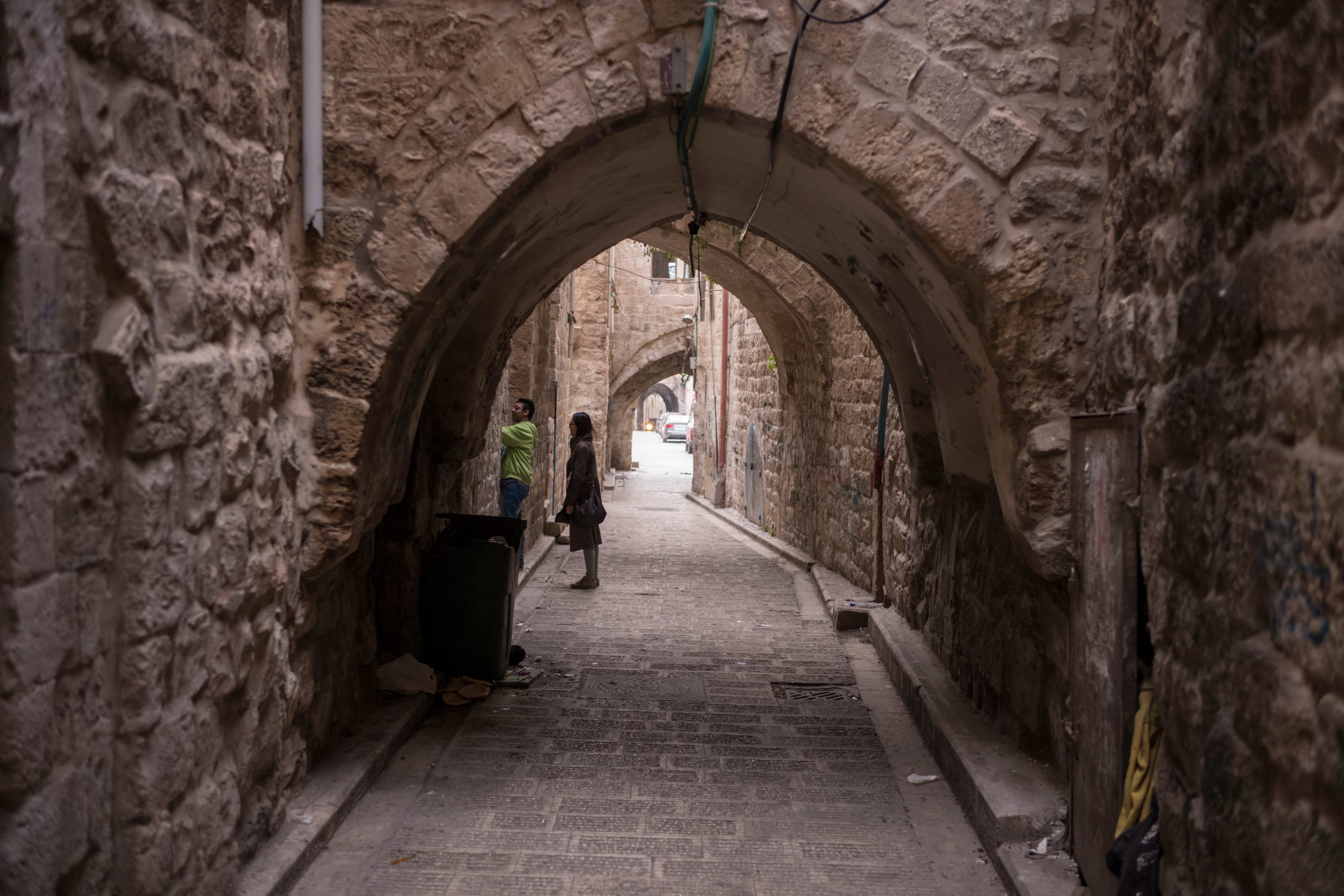
In 2012, I spent the summer of my sophomore year volunteering at a Palestinian charity in the West Bank city of Nablus. My previous visits to Palestine had been heady, headlong and painfully brief—but this time, I would be settled in one place for several spacious months. The long, almost mundane hours were a revelation. Palestine emerging, returning from the obscurity of symbols, entering my body as routine.

The organization provided lodging in a villa at the top of one of Nablus’s many hills, which I shared with a rotating cast of foreign volunteers. The house was grand and crumbling beautifully, full of evening wind. I slept on the second floor, in a room with wide stone tiles and an unscreened window that opened to a quiet street. Across from me slept a French Egyptian woman who made long bilingual phone calls. In the morning, I boiled Turkish coffee in the tiny second kitchen down the hall. Waiting for the steam, I pulled aside a fraying curtain to watch the slopes and buildings blooming pink.

My mornings brimmed, rich in children. I arrived early each day to greet dozens, ages three through eight. For the next several hours, I helped local teachers orchestrate art projects and games. Once shy around children, in Nablus I learned to kneel to their level, look them in the eyes. There, I glimpsed multitudes wide as any adult’s, each one a shifting pattern of desires, questions, and moods. Emerging miracles, each one with their own terms.

My Arabic tongue loosened, my throat filling with remembered, or inherited, words.

This job was the first time since my own childhood that I moved fully in Arabic. While I had returned to the language years before, this had come in the form of classes or sporadic conversations. Those Nablus mornings, there was no classroom formality, no sense of scrutiny. Any stumbles in grammar or conjugation dissolved into the bright chaos, and the children’s replies did not miss a beat. Khaltu! they called to me. Auntie, look! They waved fingerpainted pages, glitter on their elbows, in their hair. My Arabic tongue loosened, my throat filling with remembered, or inherited, words. I smiled for hours straight.

On my way home, I crossed the city center, past the fruit market, bakeries, and knafeh shops. I made the rounds often, filling bags with tomatoes, mint, pomegranates, and a few pieces of pita, their bellies still full of steam. I stopped for the thick, syrupy cheese pastry last. Knafeh was an indulgence I’d eat only partially, tucking the rest away in its wax for a later that might never come. Each bite was a delight so rich I’d wonder how it made me feel so innocent. I slipped my slice inside a pita, East Nabulsi style, laughing back at the shopkeepers who delighted at my taste. Nabulsiya! Many became friends, introducing me to their children and wives, hosting me for Friday meals. They claimed me, calling me bint Ziyad, though they’d never met my father. A signal of my honor, their respect.

Evenings, I sat with fellow volunteers on the stone balcony that wrapped around the second floor. As the hot air cooled to a marble breeze, I watched the hills drop into darkness. A moment later, they blinked back to life with the lights of nearby towns and refugee camps. In some, I could track headlights, their glow sliding along roads and slopes. Framed by the still dusk, it all felt close enough to hear the hum of these engines, the murmur of those neighborhoods.

But in the night, there was no way to know what web of obstacles lay between me and each glittering hill. Flying checkpoints, or the gun of a vengeful soldier, or an armed settler with bloodthirst. 

I spent several afternoons each week outside the city teaching in Balata, the largest refugee camp in the West Bank. There, I saw the evidence of Balata’s famed fierce resistance—posters of martyrs, faded and new, layered on bullet-ridden walls. The streets were narrow, poor, and overcast with its heavy history—decades of battle with Zionist forces, whose state-of-the-art weaponry has only intensified the rebellion in hearts and limbs.1

Back in Nablus, my Palestinian friends warned me to stay near home after dark. Raids were common in Balata, but Israeli soldiers might also enter Nablus by night, bursting into family homes. Boys and men often disappeared in this way, detained for months or years without recourse or charge. Nicknamed Jabal an-Nar2 for its own ardent history of insurgency, Nablus could at times feel autonomous, but as all Palestinian cities, it remained circumscribed. Above us, the sky sometimes ripped with Israeli F-16s. They dove low enough to chatter our teeth, fast enough to break the sound barrier, just to thunder a reminder of their lurking might.

On the outskirts of the city, new settlement outposts were appearing atop hills, driving Palestinian families off their farms. Each encroachment created new frontiers for violence. Palestinians enroute to school or work risked the dogs and bullets of settlers, and the soldiers who amassed to defend the illegal seizure of land. The safety I felt in Nablus was only as large as the space between human hearts.


Late that summer, I took a car west. After a few winding, road-choked hours, I approached the boundary between the West Bank and ’483. I felt my body rolling up like a scroll. A thousand microclenches, the press of my back against the seat. My inner music, which had grown so free, dropped to static. I pushed my thoughts inside this silence, ejecting Nablus and Balata, erasing friends’ faces, burying my family name. As if thoughts alone might reveal me, the truth wafting off me like a scent.4

The checkpoint came into sight. My veins burned like ice. As an American citizen, my presence in the West Bank was not illegal, but it would raise suspicion. Israeli forces often targeted foreigners suspected of solidarity with Palestinians. Just a few weeks before, one of my fellow volunteers, an Australian, had been detained, interrogated, and deported with a lifetime ban.

Some debasement seemed unavoidable, compromise built into the mechanisms that allowed me to be in Palestine at all.

Still, it was my Americanness that I would rely on when I reached the soldiers. Here, for once, I was grateful for my blond hair, the native English on my tongue. It was not uncommon for an IDF soldier to flirt with me, and if I managed a smile, I was occasionally waved through. Such interactions made me sick, as did every mercy my passport afforded me. Yet some debasement seemed unavoidable, compromise built into the mechanisms that allowed me to be in Palestine at all.5

This time, I was lucky. Nearing sunset, the soldiers looked drowsy, bored as they stood around the small station where I submitted my bag to be searched. I waited somewhere outside my body as they scanned my documents. I tried to look un-Palestinian, to mimic their slack, entitled stance as I leaned on one leg, hip cocked. I passed through. On the other side, I sank into a soup of adrenaline. As I felt the prickling wash of relief, I spoke to my driver—we’d both been mostly silent, as if afraid to disturb the gods before rolling our dice.

I was so nervous . . .

I know. But don’t be afraid.

But what if they kick me out, ban me?

Yes, they can do anything they want. But one has to try one’s best. This is your وطن. Don’t be afraid.


My father and brother greeted me in Jerusalem. We hugged, the grit of worry slowly shedding from our foreheads. It had been an anxious day, the three of us facing the Israeli border separately—they’d come through the Jordanian crossing shortly before I entered from the north. My brother, two years younger than me, now taller, sat beside me on the bed. This felt like a miracle, as it did whenever one of us made it across a border created, first and foremost, to exclude us. We went to bed early. The next morning, we would search for ʿIbdis.


The trip had been my father’s idea. It was rare for him to peer so intently toward the past—even in our first visit to Palestine together, it was the present he pointed to. But with his son interning with him in Saudi Arabia and his eldest daughter stationed, however briefly, in the West Bank, his imagination began to turn. That summer, we practiced a different life, glimpsed a hologram world. One in which we had not bound ourselves to Amreeka. One in which our bodies slept on this land.

I agreed to this search, but ʿIbdis was a word so unknown to me, even my curiosity was vague. On the two-hour drive south from Jerusalem, I watched the landscape shift from rich green to arid plains. Off and on, our route skimmed along the hulking separation wall that cleaved through the West Bank. Beyond, Jewish settlements, whole towns and cities of them, perched on Palestinian hills. My father sighed periodically, shaking his head and muttering angry appeals to Allah. Astaghfur . . . I felt the mixture of fury and impotence that had become familiar. Beside me, my brother said nothing.

I was dozing when our car moved off the highway and onto a rattling dirt road. I sat up to see a parched brown field. In the distance, a line of electrical towers partitioned the sky. Emerging from the parked car, my father squinted, scraping the landscape for clues. A few printed pages of directions, gathered from a crowdsourced Palestinian database, fluttered in his hand. It’s changed . . . he murmured. Brittle, bleached grass clutched the razed earth. Pale watermelons dotted the dirt.6 Silence blistered our skin. 

My father fixed his sights on a massive, shimmering sycamore tree in the middle distance. He began to walk, my brother and I following, watching as he bent to pick up a stick. He flicked it left and right, the low wind carrying his murmured memories: My mother would have walked this way, back and forth to the field . . . My father’s words summoned crops, ripples of green and gold from the cracked earth. We were sweating as we reached the tree. This was our jamayza . . . Unripe figs lay scattered at our feet. We bit into them and puckered at the starchy sour. I swallowed anyway, suddenly desperate to put this place inside me.

Most of the shattered houses my father had seen in the 1970s had disappeared—but only his eyes could measure this loss.

Most of the shattered houses my father had seen in the 1970s had disappeared—but only his eyes could measure this loss. We found a few overgrown, ruined walls. My brother climbed onto a scattering of stone slabs, his face quiet, studying. Understanding accreted, pearling into view. Our grandmother was young once. Hers, ours, was an origin of fullness, from which we might have grown. We stood next to an intact stone well, its throat dark and dry. My father repeated the story his mother had told him while standing at its edge: They bought this pipe from their Jewish neighbors—see the Hebrew on the side? The village had a party when the well was finished. The Nakba came the next day.

And then my understanding began to stagger, disintegrate. It was not tears but tremble that filled me. Too much, too much to be ghosts this way, haunting what we will never see. My grandmother, by then, was dead, buried over a year. When she died, after a bitter bout with cancer, my father had to fight to obtain a grave. The cemetery where her husband was buried had since been declared Saudi Only. Palestinian bodies, stateless even in death, were to be sent to a separate site. Ziyad spent the first hours of his bereavement calling in favors from every influential Saudi he knew. As an exception, she was permitted to lie beside Musa, in a graveyard named after Eve.

In ʿIbdis, we searched for the shattered cemetery my father had seen on his last visit, but no trace now remained. Perhaps bulldozers had returned to finish what earlier invaders had begun. Perhaps the graves had been swallowed under new layers of soil. I stepped as lightly as I could. Somewhere, near or beneath my feet, my great-grandfather slept. Alongside him, generations, their bones stacking deep into the past. Family lines cut to sudden, ragged edges after 1948. Already, members of ʿIbdis had been buried in Deir al-Balah, Jordan, and Saudi Arabia; the living were even farther flung. I looked at my brother—where would our bodies rest?

We spent hours in the baking heat, though it felt like far less. We scattered, tracing separate aimless shapes inside the village grounds. There was nothing to do. There was nothing to say. And yet we lingered, knowing this moment was a glitch in empire that might not repeat.

The sun was retreating as we found each other back at the well. Bending over its stone edge, I felt the air shuffle, shift. Floating toward us, a white, round face. A pair of bottomless black eyes. I turned to stone. Its wings appeared, pumping once, twice, and the owl was over us. For an instant, her pale body was larger than the sun.


From The Hollow Half by Sarah Aziza. Copyright Sarah Aziza, 2025.  Reprinted by permission of Catapult.

  1. The event of return does not take place after the fact, in a “post”-temporality where the Occupation no longer exists. Instead, the act springs from within the time of its reign, cracking its walls and fracturing its frame.
    —Adam Hajyahia, “The Principle of Return”
    ↩︎
  2. Mount of Fire ↩︎
  3.  1948, a common term to refer to the land inside the borders of the state of Israel. ↩︎
  4.  I don’t know what they thought I was capable of;
    I wish I was more capable of it.
    —Zaina Alsous, “Violence”
    ↩︎
  5.  Saving the argumentI am let in
    I am let in until
    —Solmaz Sharif, “He, Too”
    ↩︎
  6. My grandfather died with his gaze fixed on a land imprisoned behind a fence. A land whose skin they have changed from wheat, sesame, maize, watermelons, and honeydews to tough apples.
    —Mahmoud Darwish, Memory for Forgetfulness ↩︎

8 Funny Novels That Make Light of the Writer’s Plight

Nothing is easier to poke fun at than the life of a writer, with our overly lofty ambitions, fragile egos, and navel-gazing ways. For this reason, there is no shortage of comedic novels that pull back the curtain on this humiliating struggle, following writer main characters as they attempt to produce “important” works of literature in the face of their all too human shortcomings—fear of failure and of criticism, addictions of all kinds, jealousy of other writers, and of course, a debilitating sense of inadequacy paired with a desperate longing for external validation. 

My debut novel, Bitter Texas Honey, follows Joan West, a privileged, pill-popping, Texan degenerate who yearns above all else to be seen and acknowledged as a writer. To that end, she is desperate to finish her long-abandoned coming-of-age novel, or at least get a short story published somewhere respectable. While the novel is about much more than writing, Joan dedicates much of her mental energy toward this pursuit. She carries a notebook everywhere, mining her life (and the lives of those around her) for compelling material. However, like many young writers, Joan is sorely misguided. While she dreams of book signings and prestigious awards, she lacks the discipline to actually sit still with the blank screen and face herself, to be present long enough with her thoughts to write anything approaching truth. 

The following eight novels also satirize their main characters’ literary ambitions. Each of these books features a writer main character at varying career stages, battling against their own ego. What I enjoy most about books like this is their humor, stemming from the refusal to take themselves too seriously as authors. While not all these novels are autobiographical, one can’t help but pick up on a hint of self-deprecation in these stories. It feels that these authors are inviting readers to laugh at themselves alongside their main characters. 

Perfume and Pain by Anna Dorn 

In Dorn’s sharp, hilarious, and compulsively readable tale of lesbian chaos, 35-year-old novelist Astrid Dahl is struggling to write her fourth book. She longs for the naïve confidence she possessed in her twenties, and finds herself crippled in the wake of the criticism she’s received after being politically incorrect at a Barnes and Noble event. Dorn’s handling of Astrid’s authorly ego is delightfully ironic and embarrassingly relatable. People with healthy egos don’t become writers, Astrid muses early on. They become engineers.

Old School by Tobias Wolff 

Short story great Tobias Wolff’s semi-autobiographical novel follows a young, bookish scholarship student at a prestigious boarding school in the 1960’s. Spanning one academic year, the novel’s structure is built around 3 successive writing competitions held by the school to win an hourlong audience with incredibly famous visiting authors (Robert Frost, Ayn Rand, and finally, Ernest Hemingway). Wolff’s protagonist—ambitious, competitive, and insecure—is desperate to win, and you can’t help but root for him, even as he makes questionable decisions to achieve his goal. Come for Wolff’s masterful storytelling and moral acuity; stay for the funniest takedown of Ayn Rand in contemporary fiction. 

Yellowface by R.F. Kuang

Fantasy writer R.F. Kuang brings her genre chops to this satirical literary thriller. She takes aim at the entire publishing industry while skewering her protagonist, white novelist June Hayward, whose desperation for outward success leads her to steal and publish her late friend’s manuscript under a vaguely Chinese-sounding surname. Every page of Yellowface is dripping with June’s jealousy, greed, and unhealthy ego. The result is a gripping page-turner that is by turns funny and terrifying. 

Less by Andrew Sean Greer 

In Greer’s charming novel, 49-year-old “minor” author Arthur Less accepts a stack of invitations he would usually decline. He jaunts around the globe, to New York, Mexico, Italy, Germany, Japan, and India, to avoid attending, or even being in the same time zone as, the wedding of his longtime ex-lover. Throughout his journey, we are reminded of poor Arthur’s career insecurities. His narrator describes Less early on as “an author too old to be fresh and too young to be rediscovered, one who never sits next to anyone on a plane who has heard of his books.” Despite his perceived worldly failures, it is hard not to fall in love with Arthur Less by the end of this tenderhearted novel.

My Struggle: Book 5 by Karl Ove Knausgaard 

In the fifth installment of his poignant autobiographical epic, Knausgaard breathlessly catalogs in unbelievable detail the humiliations and humanity of an ambitious aspiring writer. The novel spans the decade leading up to his first book deal at age 28. Throughout, we watch young Karl Ove oscillate between overconfidence and crippling self-doubt. The result is both hilarious and poignant. You don’t have to read the preceding four My Struggle tomes to enjoy this engrossing and honest portrait of a budding novelist. 

A Lie Someone Told You About Yourself by Peter Ho Davies 

In Peter Ho Davies’ clever, at times heart-wrenching novel, a professor and writer confronts deep moral questions about marriage and fatherhood while grappling with the painful aftermath of an abortion, as well as his young son’s potential autism diagnosis. Despite the heavy subject matter, Davies brings his signature wit to the story, especially when poking fun at his protagonist’s descent into careerism in the face of his somber reality: 

He takes her advice of so long ago, writes about their loss…. Maybe it’ll be his big break, his New Yorker moment. He still feels owed something. 

A Novel Obsession by Caitlin Barasch

Caitlin Barasch’s addictive, thrilleresque debut follows New York City bookseller Naomi, a wannabe writer who goes to absolutely unhinged lengths to gather material for her first novel. Namely, by stalking her boyfriend’s ex-girlfriend. The story is painful, but propulsive. You might cringe the whole time, but I found it impossible to look away from the mess Naomi makes in her determination to prove herself as a novelist. 

Death Valley by Melissa Broder 

Melissa Broder’s latest follows a novelist as she ventures into the California desert to escape her “anticipatory grief” and gather material for the “desert section” of her novel-in-progress. Here, she intends for her main character to have a pivotal epiphany. However, Broder’s funny and self-aware hero lets her flaws lead her astray, and she find herself into serious danger. This slim novel represents Broder at her best. This survival tale is surreal, meta, and poignant. 

Exclusive Cover Reveal of “Little Movements” by Lauren Morrow

Electric Literature is pleased to reveal the cover of Little Movements by Lauren Morrow, which will be published by Random House on September 9, 2025. You can pre-order your copy here.

Thirty-something Layla Smart was raised by her mother to dream medium. But all Layla’s ever wanted was a career in dance, which requires dreaming big. So when she receives an offer to be the choreographer-in-residence at Briar House in rural Vermont, she temporarily leaves behind Brooklyn, her job, her friends, and her husband to pursue it.

Layla has nine months to navigate a complex institution and teach a career-defining dance to a group of Black dancers in a very small, very white town. She has help from a handsome composer, a neurotic costume designer, a witty communications director, and the austere program director who can only compare Layla to Black choreographers. It’s an enormous feat, and that’s before Layla’s marriage buckles under the strain of distance, before Briar House’s problematic past comes to light, and before Layla finds out she’s pregnant.

Little Movements is a poignant and insightful story that explores issues of race, class, art, and ambition. It is a novel about self-discovery, the pressures placed on certain bodies, and never giving up on your dream.


Here is the cover, designed by Cassie Vu.

Lauren Morrow: One of the first things people wanted to know when I told them about my book–that it had sold, it was real, it was happening!–was what I imagined for the cover design. I was at a loss. After all these years, I’d never truly considered the cover, despite knowing how important it is. The cover is often the first encounter someone has with a book. Perhaps that was why I couldn’t think about it. My job, for so long, had been to focus on the words inside. Shifting my focus to the outside, the visual presentation of it all, felt overwhelming.

Eventually, of course, I had to think about the cover. I sent my editor a concept document that included many of the gorgeous covers I’ve admired in recent years along with some early ideas. I knew I liked clean text and bold colors. And I was certain I wanted a figure of some sort, at least in part. The book is largely about dance, after all.

Soon after sharing my thoughts, my editor sent back some early design concepts, and while I liked some of them, nothing felt quite right. I offered feedback and sent images of different dancers doing different things than what they’d been doing in the design I’d like the most of the few offered. More complex positions and energy. The designer incorporated those ideas in a way that was nearly exactly what I’d asked for, and yet still, something was amiss. Everything shared was beautiful, but none of the dancers felt quite right. The image needed to be complicated a bit. It needed texture, layering, something unexpected. My agent even found dancer wallpaper that offered a more abstract feel, which I liked quite a lot (I still may buy the wallpaper for my apartment; watch this space).

The next round offered four very different concepts, all of which were lovely, but the one that caught my attention–and that of everyone I showed–was the one without a figure. There is so much movement in the image, even the suggestion of a body wrapped in the gorgeous flowing fabric. It makes you look twice, think twice. It makes you wonder.

I love that there’s no visible figure on the cover. No projection of who we’re meant to imagine on the pages. There is a quality of falling, of isolation–crucial to the book. It’s fluid, and sexy, and full of life, all without a body.

Another reason I was drawn to this particular design is that it feels like a nod to so much beautiful dance imagery, most notably the fabric that swims across the stage in the “Wade in the Water” section of Alvin Ailey’s Revelations. Ailey and his work loom large in the book, and it felt really powerful to see this deepened, inverted nod to that work here. I don’t believe it was intentional on the part of the designer, but for me, it’s impossible not to see that imagery on the cover. I spent many years working for Ailey and still see the company–and inevitably Revelations–at least twice a year. When I first scrolled through the final round of options and landed on this one, the fabric floating down, I got a bit teary. That was when the decision was made, I suppose. It felt fated in a way.

For so long I’ve kept things close to the vest with this book. It’s my way with most things, and a debut novel is a vulnerable thing. A person cracked open. But now, I’m eager to share it. To show it. There is proof that it exists. That it’s a thing people will be able to have and hold. And she’s a beauty.

Cassie Vu: We knew that we wanted to represent movement in some way on this cover, so first we went down the path of having a dancer in a spotlight on the cover, and different versions of cropped, dancing bodies. Ultimately we decided against that, because even though the book is set in the dance world, the main character is a choreographer, not a dancer. The author liked the deep purples and pinks of the color palette I had been working in, so we used that and leaned into a more abstract approach. The final image is meant to evoke movement, dance, perhaps the shape of a body, a little bit of tension… but nothing too obvious!

9 Books of Long Poems You Should be Reading

My favorite way to experience a long poem is to listen to it. Because while your body is busy walking or using the elliptical machine or folding piles of blue jeans and t-shirts and pajamas, a voice is laying, like garlands, rings of thoughts and images around your mind, layering a place for you to wander. 

It’s the digressions in a long poem that I love—the apertures, structural fractures, pockets, and tunnels. The trap door dropping you down into a dungeon; the stairs leading you out. Poe—whom I adore— argues in The Poetic Principle that poetry should have unity and this unity is impossible in a long poem; but it’s the disunity that attracts me. 

I once knew a man who worked in Mission Control at NASA, and he explained to me that his job was to do the math calculations required to keep the International Space Station in orbit. He used the metaphor of balancing a broom vertically in the palm of your hand: his work was like the infinitesimal or large movements to keep the broom aloft. I love that tension in a long poem, the way it’s always threatening to crash down, peter out, rupture, or break; I love the ways the author then invents shapes to keep the thing aloft, to account for shifts and junctures, the unity in the disunity. 

My new book, Rich Wife, is composed of long poems because the form is capacious. Registers shift; perspectives shift; the form can undulate from a list to a quote to a description of a memory or a painting. Montage, collage, dialogue, slang, poems within poems. The long poem allowed me to consider a knot of topics—money, beauty, art—with the fullness that the subjects demand.

And on to my recommendations.

Poemland by Chelsey Minnis

A book-length musing about poetry and its glittering potentials and failures, this poem consists, almost exclusively, of aphorisms, metaphors, absurd jokes, and idiomatic turns of phrase… Reading Poemland is like walking around the set of a film you love, sitting in actual chairs which are also pretend chairs, being in a place that exists but does not exist, tawdry but imbued with shared feelings of longing. Her writing is like fake fur, the color chartreuse, a miniature weapon hidden in a vintage snap-clasp purse. Charming and pouty, it reminds me of the feeling of reading a glossy fashion magazine while lying on your stomach in your childhood bed. It reminds me of those girlish leather diaries that have DIARY written across the front in script, and come with a tiny padlock and a tiny set of keys.

The book opens:

This is a cut-down chandelier…

And it is like coughing at the piano before you start playing a terrible waltz…

The past should go away but it never does…

And it is like a swimming pool at the foot of the stairs…

Nature Poem by Tommy Pico

The second book-length poem in a series of four book-length poems, Nature Poem is an argument, a conversation, a soundtrack, an endless scroll. Taking up the problem of both wanting to write a nature poem and not wanting to embody stereotypes about American Indians, Pico ends up writing a book that circles and weaves a complex response, encompassing feelings and ideas as large as the poem itself, impossible to distill. Reading this poem is like watching a virtuosic dance performance, as Pico shifts tones, employing lists, refrains, anaphora, epistrophe, jokes, puns, personification. Like Minnis’s poem, this poem too is about poetry itself, its limitations and magic. Nature Poem delves into romance, identity, pop culture, city life, and death, returning again and again to the premature deaths of cousins back home. Pico creates a place where meaning and emotion can stream back and forth intelligibly among this chaotic, fragmented world we share.

the fabric of our lives #death

some people wait a lifetime for a moment like this  #death

reach out and touch someone #death

he kindly stopped for me #death

kid-tested, mother approved #death

oops, I did it again #death

it keeps going, and going, and going #death

Tender Data by Monica McClure

The center of Tender Data contains a group of longish poems that were originally published as the chapbook Mala. These slender montages bring together the feelings of being a girl — being looked at, looking at yourself as an object, longing, desire, innocence and its loss, the narrow roles family and society present for you. Childhood scenes are spliced with older perspectives, with metatextual analysis of the poem as poem, critical analysis of how she’s positioning herself, resisting received categories. These poems juxtapose small town aspirations and gossip and poverty and glamour and grocery store aisles and slips of admonishments and slang. Climb inside these poems to become a girl in the early 2000s, in body and spirit, to experience the liquid confusing swirl.

Let’s talk about angels

I saw one just returned from jail with his gentleness

flung over the couch next to his money stack

We didn’t know each other anymore

and never had

We were standing beside our youths like babysitters

But the truth is I was the only one who’d ever had one

Bloom & Other Poems by Xi Chuan, translated by Lucas Klein

In his longish, essayistic poems in this book, Xi Chuan takes up a subject — the mandate to bloom, beautiful fakes and decrepit antiques of the Panjiayuan Antiques Market, an early morning, Manhattan — and he approaches it from in front, beside, below, near, far, with humor, with humility, with cynicism, with history, with literary forefathers, with grandiosity, turning and turning until the subject is exhausted thoroughly, until we, having journeyed and arrived together, land at the poem’s feet. Xi Chuan takes up what could seem the least promising of subjects—just walking around, looking around—and with the force of his intelligence and the shape of his thoughts wrings from them meditations which are surreal, self-deprecating, self-aware, often recalling, too, the long history of poetry, art, and politics of China, people from the past peering across time into the present, and he peering back at them.

People half real half fake pursue a happiness half real half fake,

fall in love half real half fake, and fall into a daze looking at half real half fake antiques; their demands for justice are also half real half fake.

On a world half real half fake they gain a sense of unreal reality we might call transcendent!

Collected Poems by James Schuyler

The long poem “Hymn to Life” appears at the end of Schuyler’s 1974 book of the same name, which is now out of print — but contained within his Collected. Hymn to Life is a churning meditation on mortality and the essential beauty, horror, and meaninglessness of life. The poem is structured around the passage of spring in D.C. — a city whose blankness and stony facades the poem abhors — and in it Schuyler cycles between personifying nature and time, dipping into memories, and describing the life unfurling in the new season, its blue jays and daffodils and pear trees, not idealized but as they are, wavering in and out of existence as time tumbles forward, and also as real things framed by the modern world — sometimes diseased, existing among ugly monuments, glum weather, the sounds of chainsaws, noticed, forgotten about, wild, planted in corporate planters, with tourists milling about. Meanwhile, through it all, life, which is passing, picturesque, not picturesque, slips by and we remain unknown to ourselves, by turns grumpy and depressed, by turns astonished by its wonder.

Attune yourself to what is happening   

Now, the little wet things, like washing up the lunch dishes. Bubbles   

Rise, rinse and it is done. Let the dishes air dry, the way

You let your hair after a shampoo. All evaporates, water, time, the   

Happy moment and—harder to believe—the unhappy. Time on a bus,

That passes, and the night with its burthen and gift of dreams. That   

Other life we live and need, filled with joys and terrors, threaded   

By dailiness: where the wished for sometimes happens, or, just   

Before waking tremulous hands undo buttons. 

Memorial: A Version of Homer’s Iliad by Alice Oswald

Memorial is a fragmented, pared-down, interpretive translation of The Iliad that removes everything but the graphic deaths, elegiac laments, and similes. So what’s left is this timeless imprint of war, its waste and finality, interspersed with brief, impressionistic portraits of familiar kinds of men, their cowardice, arrogance, callousness, regret, terror, mixed with the eternal natural world and rhythms of life — an old woman’s spidery hands measuring wool, the weak petals of a poppy battered by rain, rocks battered by ocean water in an explosion of spray, a toddler raising its arms to be lifted by its mother. The portrait of a soldier who loved to sit on his front porch and make his friends laugh is an ancient portrait of a living face, the boys who died then, the boys who die today. The wastefulness of ancient war, of modern war; life as a sieve the world passes through, or the world as a sieve that life passes through.

Like when a mother is rushing

And a little girl clings to her clothes

Wants help wants arms

Won’t let her walk

Like staring up at that tower of adulthood

Wanting to be light again

Wanting this whole problem of living to be lifted 

And carried on a hip

Pedro Pietri: Selected Poetry by Pedro Pietri

Pedro Pietri’s poems vibrate with indignation, revolving around those usually ignored — alcoholics, immigrants, the men who clean windshields at intersections, people living in government housing that’s overrun with cockroaches, people who play the lottery and have a collection of dreams. The most famous poem in this book, “Puerto Rican Obituary,” rotates around the refrain of a handful of names — Juan, Miguel, Milagros, Olga, Manuel — their hopes, exploitation, sacrifice, work, waste — the grayed-out half-life of people separated from their people, of people working now for a promised future that hovers forever just out of reach. Pietri’s poetry appeals to me in its stylistic irritability — the refusal to conform to prevailing conventions, veering into his own voice, manic all-caps, repetitions, patterns, deviations, dialect, surreal detours, a rhythm of his own.

All died

dreaming about america 

waking them up in the middle of the night screaming: Mira Mira

your name is on the winning lottery ticket for one hundred thousand dollars

All died

hating the grocery stores 

that sold them make-believe steak

and bullet-proof rice and beans

All died waiting dreaming and hating

Returning the Sword to the Stone by Mark Leidner

If Jack Handey wrote a book of poems, it might be a book like this one. Fond of aphorisms, surreal premises, outlandish but oddly familiar similes, and silly diction (on humility: “it feels awesome”), Leidner’s longish poems are absurd jokes taken so seriously they become unbearably sad and unbearably sweet. Beneath the jokes, the subjects are love, mortality, ego, and the mystifying beauty and pain of life. Reading these poems feels like playing NES with your friends for hours and hours, drinking 7-Up through Sour Punch straws, staying up so late that a feeling of wrongness seats itself in your chest — piercing pleasure, nostalgia, teetering between wells of joy and doom. 

I hate it when I’m in geometry class

intent on disrupting the lesson 

with inane and off-topic contributions

only to be moved to silence 

by the beauty of the Pythagorean theorem

Air Ball by Molly Ledbetter

The long poems in this book are composed of lines of single sentences leisurely doled out with the pacing, structure, and confidence of a stand-up routine, in which set-ups are paid off in ways you didn’t anticipate. These are poems concerned with taste, status, posturing, heartbreak, small observations, grief, and the difference between art-world art and the actual experience of art, which is private, occurs in slivers, and is never as perfectly encapsulated as a prestigious gallery show written up in a brochure. Ledbetter bestows meaning on what would otherwise be detritus or ephemeral — your Uber ride history, children shouting “air ball!” from a nearby school, a handmade plate that reads “This too shall pass.” These poems make me feel as though I’ve spent an afternoon with a new friend, and have left with fresh observations uncoiling within me, which have unspooled dozens of new thoughts.

I never thought about where the train that cuts through the center of town was going.

Whatever I hear now in its whistle is like those bells in The Polar Express.

Like believing in believing in Santa, which I do.

Like bunk beds that squeak like an old wooden boat.

Like how good those nuts on the sidewalk smell at Christmas.

Like a mediocre cookie plate.

Back then, I could really have been someone.