12 New Book Covers Created for Sherlock Holmes’ 125th Anniversary

Saturday, October 14 marks the 125th anniversary of Arthur Conan Doyle’s The Adventures of Sherlock Holmes: the first collection of his short stories previously printed in The Strand Magazine. Despite the fact that they are amongst Sherlock’s most famous cases, few stories in this collection have ever received their own cover designs — an oversight that has now been corrected.

To celebrate this major milestone, twelve professional book designers from Reedsy have created exclusive new covers for each of these fantastic stories.


1. A Scandal in Bohemia

(Design: Rafael Andres/Reedsy)

Also known as…

“Victorian Sextape”

What’s it about?

Holmes is hired by the King of Bohemia to recover a photograph showing him standing (fully-clothed) with his former lover, the American opera singer Irene Adler. In subsequent adaptations, Irene Adler would frequently be recast as Holmes’s love interest — or in the case of the recent BBC series, a bisexual dominatrix extortionist Sherlock-stalker.

The New Cover

“After reading the story it was clear that the photograph was the concept to play with,” said illustrator and book designer Rafael Andres.

“The idea of obscuring the identity of the character was the first idea that came to my mind. I considered covering the face somehow, but I decided the empty collar would have more visual impact — so I researched a vintage photo, deleted the head and reconstructed the shirt collar.”

“Combined with the title, I wanted this design to have a hint of humor — after all, for a prince in Victorian times, losing one’s head would be considered extremely careless.”

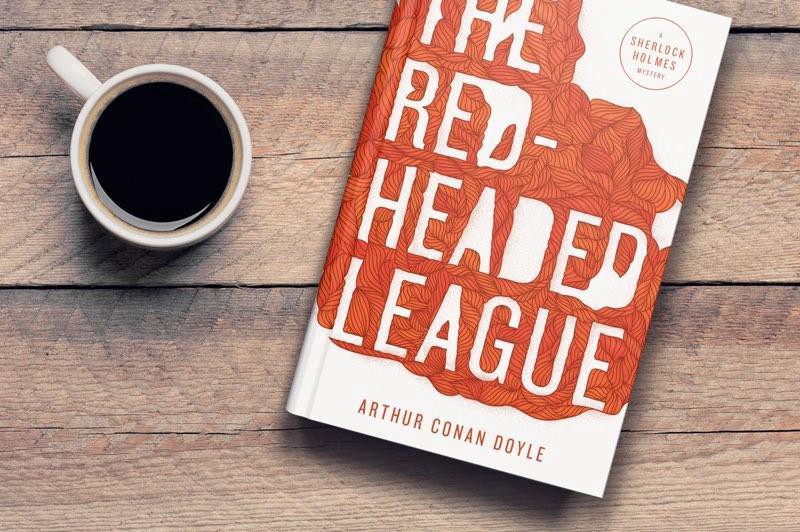
2. The Red-Headed League

(Design: Annabel Brandon/Reedsy)

Also known as…

“Gentlemen Prefer Non-Blondes”

What’s it about?

Holmes is visited by a red-headed pawnbroker who’s fallen into some good luck. There’s apparently a charitable organization in London that is simply giving money away to ginger blokes in exchange for doing menial tasks. As the poor red-head suspects (and as Holmes will undoubtedly prove) this league is not what it claims to be.

The New Cover

“I just love the idea of Fleet Street filled with hundreds of red-headed men fighting for the same job,” said designer Annabel Brandon. “I took a quick look at some great illustrators of hair like Gerrel Saunders, and Sara Herranz — and used their work as a jumping off point. But instead of showing the letters of the title as hair, I used the negative space — the hair being the sideshow to the subterfuge.”

3. A Case of Identity

(Design: Cinyee Chiu / Reedsy)

Also known as…

“The One Where Sherlock Lies to a Woman”

What’s it about?

A young woman, the recipient of a minor inheritance, comes to Holmes when her elusive fiancé disappears on her wedding day. The strange part is how this mystery beau made her promise to always be faithful to him — “even if something quite unforeseen” happens to him.

Holmes solves the mystery on the spot, yet chooses to shield his client’s delicate female psyche from the truth. Sherlock’s approach to human psychology is a little bit dated, to say the least.

The New Cover

“One of my favorite illustrators is Elly MacKay — who photographs her beautiful papercut artworks to create a real sense of depth in her designs,” says designer Cinyee Chiu.

“Inspired by her work, I played with the blur and the light with the two mysterious male characters in the story.”

4. The Boscombe Valley Mystery

(Design: Elie Huault/Reedsy)

Also known as…

“Sherlock and Watson Hit the Road”

What’s it about?

Holmes and Watson take a trip to a rural community in Herefordshire to investigate the murder of a local landowner. The victim’s son has been charged with the crime, and it’s up to Sherlock to prove otherwise.

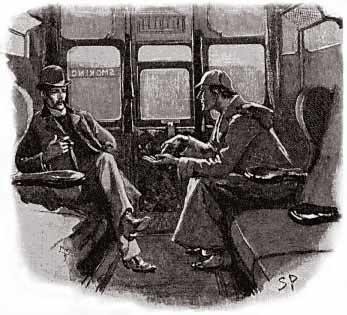
Like every Holmes story published in The Strand Magazine, The Boscombe Valley Mystery featured illustrations by Sidney Paget. It was Paget who, in this story, introduced the deerstalker hat which would become one of Sherlock’s signatures.

The New Cover

French designer and comic book illustrator Elie Huault created an evocative black-and-white cover that captures the beauty and the menace of the English countryside. The low-angle perspective hints at a voyeur hidden in the grass, teasing the notion that the real killer is close at hand.

5. The Five Orange Pips

(Design: Lara Evens/Reedsy)

Also known as…

“Sherlock Holmes vs. The Ku Klux Klan”

What’s it about?

A young man reveals that his father and uncle have recently passed and that the latter had extensive dealings in the American Deep South. Before their deaths, each received a mysterious envelope containing orange seeds, marked with the letters “K.K.K.” Modern readers will figure out who the murderers are even before Holmes does.

The New Cover

“I drew the inspiration for my design from Victorian wallpapers,” said designer Lara Evens. “Some of these wallpapers were embedded with arsenic, which made the colors especially vibrant — but had the downside that they were deadly. Killers hidden in plain sight, if you like.”

“I created a detailed illustration which seems innocuous at first glance. Only after reading the story, or taking a closer look, does it become clear that the illustration is conveying the details of a macabre tragedy.”

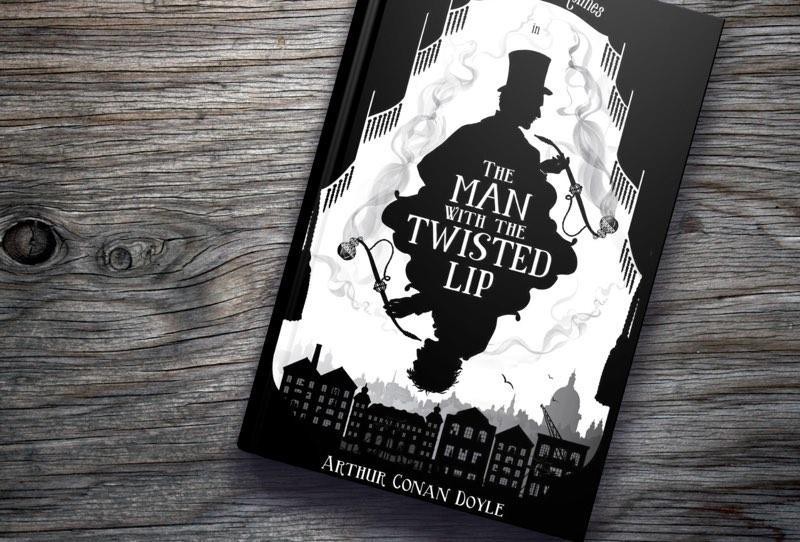
6. The Man with the Twisted Lip

(Design: Laura Barrett/Reedsy)

Also known as…

“Beggars Can Be Choosers”

What’s it about?

When respectable businessman Neville St Clair goes missing, Watson and Holmes head to the seedy opium dens of East London. A beggar is charged the murder… only for Holmes to reveal that the beggar and the victim are the same man! St Clair has been living a double life as a street bum — having long ago discovered how lucrative panhandling could be. This idea of wealthy beggars may seem unbelievable, but stranger things have happened.

The New Cover

Laura Barrett is a British designer and illustrator. Among her specialties are digital renderings of traditional Scherenschnitte or paper cutting designs.

“As the two character of the beggar and rich gentlemen are the same, I thought it might be nice to flip them and create an ornate frame,” Laura said.

To accentuate this theme of duality, Laura worked to create two skylines: the background, the relatively affluent areas surrounding St Paul’s Cathedral in the background, and London’s industrial docklands in the foreground.

7. The Adventure of the Blue Carbuncle

(Design: Andy Allen/Reedsy)

Also known as…

“A Very Sherlock Christmas”

What’s it about?

It’s late December in London. Sherlock has to figure out how a Countess’s priceless jewel went missing and ended up in the neck of a Christmas goose. It’s a mystery that takes Holmes and Watson across the city — and is wrapped up in an ending that embraces the spirit of the season!

The New Cover

For his design, designer Andy Allen wanted to avoid rehashing old covers. “I was thinking of including the goose somewhere on the cover, but it feels a bit obvious, and it’s on most of the covers of previous editions.” Instead, Andy chose to focus on the gemstone that gave the story its title.

“Playing with typography is something I really enjoy doing, and this story has so many twists and turns that I wanted to experiment with how the title is revealed on the cover. The facets and reflections of the gemstone pick out different sections of the title in a random order, so the reader pieces it together themselves.”

8. The Adventure of the Speckled Band

(Design: Jake Clark/Reedsy)

Also known as…

“Dial ‘S’ for Snake”

What’s it about?

Helen Stoner (a young woman with a small inheritance, like the victim in “A Case of Identity”) fears that her stepfather is out to kill her. Just a few years before, her twin sister had died uttering her final words, “the speckled band!”

The story’s twist is fairly well-known: the “speckled band” of the title is a venomous snake which the stepfather used to kill Helen’s sister — a fate he intended for Helen until those pesky Baker Street boys got involved.

The New Cover

“I wanted to shake things up a bit — bringing in a modern style to my cover with a bit of a vintage feel,” said designer Jake Clark.

“I thought of a slightly out-of-focus look that you used to see in older film photos. So I mixed in some photo textures, distressed it some, and mixed in a blurry portion of the title, and kept a desaturated warm tone to help push that idea. With the snake wrapped around the silhouetted man’s arm, I was looking to create a dynamic focal point.”

9. The Engineer’s Thumb

(Design: Vince Haig / Reedsy)

Also known as…

“Who’s got one thumb and was almost murdered? This guy!”

What’s it about?

Injured engineer Victor Hatherley is being treated by Dr. Watson and recounts how his thumb was severed the night before. Like many victims in Conan Doyle’s stories, Hatherley was offered an enormous amount of money to do a simple job. Blinded by his greed, he notices too late that his employers are counterfeiters, and he narrowly escapes with his life (but not his thumb).

Sherlock, Watson and the police search the scene of the crime, only to discover that they are too late and the villains have escaped with their loot. It’s one of the only two stories where the villains get away from Holmes, scot free.

The New Cover

“The original idea was based around a mock technical illustration — like the diagrams you might see on a patent application,” said designer Vince Haig. “It would have been an ink sketch of a hand, with the thumb sliced into coins to represent the how the engineer was blinded by greed.”

“In the end, I scrapped the technical illustration part as it wasn’t working particularly well — and I went with a design that looks more photo-real but in keeping with the same concept.”

10. The Noble Bachelor

(Design: Phillip Gesser / Reedsy)

Also known as…

“Runaway Bride”

What’s it about?

Sherlock Holmes finds himself once more playing the role of marriage counselor.

A bride disappears from her wedding reception, and no one is more confused than the groom, Lord St Simon. Her dress and ring are found washed up in Hyde Park, and one of the few clues Holmes has to go by is an incident at the ceremony that saw a mysterious gentleman return the bride’s dropped bouquet. Who is this man? And is he responsible for the woman’s disappearance?

The New Cover

“My original concept worked around the image of smoke rings rising from a pipe to form the shape of three wedding rings,” said designer Phillip Gessert. “The idea was to hint towards a third person, the mysterious bachelor, interfering with the marriage at the center of the story.”

“This concept proved a little too enigmatic, and in the end, I took a simpler approach using a simple illustration of a bouquet.”

Phillip’s final design has nods towards the illustration style of the period and also provides a contrast between an image of a wedding bouquet and the titular bachelor — hinting at the role he will play in this mystery.

11. The Adventure of the Beryl Coronet

(Design: Heidi North / Reedsy)

Also known as…

“Dude, Where’s My Crown?”

What’s it about?

A banker takes a bejeweled crown home for safekeeping, and late one night, he discovers it in the clutches of his son, Arthur — with some priceless gems missing. Arthur refuses to speak, and nobody can figure out where the gems went (or how Arthur even got them off the crown). It’s up to Holmes to get to the bottom of the case.

The New Cover

“I design a lot of books for the gift market and wanted to give this story the same treatment,” said designer Heidi North, a former Art Director for Simon & Schuster whose portfolio includes covers for almost every major publisher.

“I have worked on some embossed “leatherette” covers with ribbon markers in the past. I wanted to keep a masculine feel for Sherlock Holmes with the leatherette look, but I added a sinister twist. I liked the dichotomy between the gift leatherette look and the sinister aspect.”

12. The Adventure of the Copper Beeches

(Design: Jessica Bell / Reedsy)

Also known as….

Jane Eerie

What’s it about?

If there’s a recurring theme in Arthur Conan Doyle’s work, it’s that if someone wants to pay you more than you’re worth, something’s up. Young Violet Hunter is considering a position as a governess in a country estate. She’s offered an incredible salary with a number of strings attached, including the condition that she cut her long hair short. When this turns out to be just the tip of a creepy iceberg at the Copper Beeches estate, she calls for Sherlock Holmes.

The New Cover

With a plot that’s closer to a Victorian ghost story than an average Sherlock Holmes mystery, “The Copper Beeches” inspired designer Jessica Bell to create a cover that tips its hat to modern psychological thrillers and women’s fiction. The photograph of the woman could represent one of two women in the story, a mystery that’s only accentuated by the covering of her eyes.


About the Author

Martin Cavannagh is a staff writer at Reedsy, a curated marketplace that connects authors and publishers with the world’s best editors, designers and marketers. Over 3,000 books have been produced via Reedsy since 2015.

12 Bars Where You Can Drink Your Way to Literary Greatness

What’s the secret to becoming a successful author? Ask 100 people and you’ll get 100 different suggestions; there’s a whole cottage industry devoted to craft advice. You should write a little every day! You should write only when you’re inspired! You should meditate! You should go on a retreat! But there’s one piece of writing advice that nearly everyone agrees on: It really helps if you’re a little drunk.

And what better place to get writing-drunk than in the footsteps (and barstool butt-prints) of some of the greatest authors in history? We’ve found a cool dozen bars around the world with top-shelf literary pedigrees. Put together an international bar-hopping spree and make your favorite writers—from Simone de Beauvoir to James Baldwin to Roberto Bolaño—into your drinking buddies.

Photo: Sean Davis

White Horse Tavern, New York City

In a past life, the White Horse Tavern in New York City’s West Village was a hot spot for dock workers and longshoremen. Then, in the early 1950s, writers including Dylan Thomas began frequenting it and building up the locale’s reputation. Soon, James Baldwin, Norman Mailer, Hunter S. Thompson, and Jack Kerouac (who was turned away many a time) started turning up. These days not too many artists are skulking around the West Village or pulling up at the bar at White Horse, but in its day, it was among the most raucous, welcoming, beer-splattered centers of downtown intellectual life. And if you can get a window spot on a crisp fall day, it’s still pretty damn good.

Photo: Jazz Guy

The Algonquin Blue Bar, New York City

During the 1920s, the Algonquin Hotel played host to a group of authors, actors, journalists, and self-styled wits who dubbed themselves the “Algonquin Roundtable.” They met almost daily in the bar to engage in some lively literary discussions. Dorothy Parker, Heywood Broun, and The New Yorker magazine founder Harold Ross made appearances. Nowadays, the Algonquin welcomes literary lovers who don’t mind dropping close to $20 for a drink to (hopefully) absorb any creative greatness still lingering within the building.

Photo: Andrew Malone

El Quijote, New York City

There was a time — much romanticized now, possibly apocryphal — when art could be traded for rent at the Chelsea Hotel. Those were the days of Patti Smith, Robert Mapplethorpe, Janis Joplin, the Jefferson Airplane. It was a different New York, and a different Chelsea Hotel. Through it all, El Quijote has persisted. It’s more of a tapas scene now, but in it’s day, the bar and restaurant attached to the hotel lobby was a happening place and home to many a lively artistic debate.

The West End Bar closed and became a Cuban restaurant which also closed. (Photo: InSapphoWeTrust)

West End Bar, New York City

Are you surprised there are so many literary bars in New York City? The West End Bar was located in Morningside Heights, just a few blocks away from Columbia. A favorite among students and faculty, it soon became a popular meeting spot for the Beat Generation. Allen Ginsberg, Jack Kerouac, and Lucien Carr spent hours there discussing their studies and futures. It also featured prominently in the infamous incident that supposedly unified and haunted the Beats — the killing of David Kammerer.

Photo: Allie Caulfield

Spec’s, Vesuvio, and Tosca, San Francisco

The Beat Generation writers were also alive and well on the other side of the country, in San Francisco and drinking in three main watering holes: Spec’s, Vesuvio, and Tosca. Vesuvio was the haunt of the Beats: Ginsberg, Kerouac, and Neal Cassady. Spec’s also has a fair share of literary history; the city’s poet laureate Jack Hirschman met there every Wednesday evening with fellow poets.

Photo: Mbzt

La Closerie des Lilas, Paris

This cafe/restaurant/bar is famed for being the spot where literary giants wrote, drank, and hung out with each other. Ernest Hemingway was a regular here in the 1920s and even gives the establishment a warm salute in his memoir, A Moveable Feast. Situated between Latin Quarter and Montparnasse, a secluded-enough place that explains why writers preferred to hole away there.

Photo: Lienyuan Lee

Les Deux Magots, Paris

This famous cafe has garnered a reputation for being the assembly place of Paris’ intellectual elite. Common patrons of the establishment were Surrealist artists, Simone de Beauvoir, Jean-Paul Sartre, Ernest Hemingway, and a fair share of visiting American writers. It’s literary fame was so powerful that a prize was named after the cafe; the Deux Magots literary prize has been awarded to a French novel annually since 1933.

Photo: manray3

The Eagle and Child, Oxford

The Eagle and Child (nicknamed The Bird and Baby) has some pretty impressive literary associations. Namely, it is often linked to the Inklings writers group, which included the dynamic duo that is J.R.R. Tolkien and C.S. Lewis. Starting in 1933, the Inklings met on Thursday evenings in Lewis’s college rooms to read and discuss manuscripts and materials. While the formal get-togethers ended in 1949, the writers’ group continued to hang out at the pub.

Photo: Graham Stanley

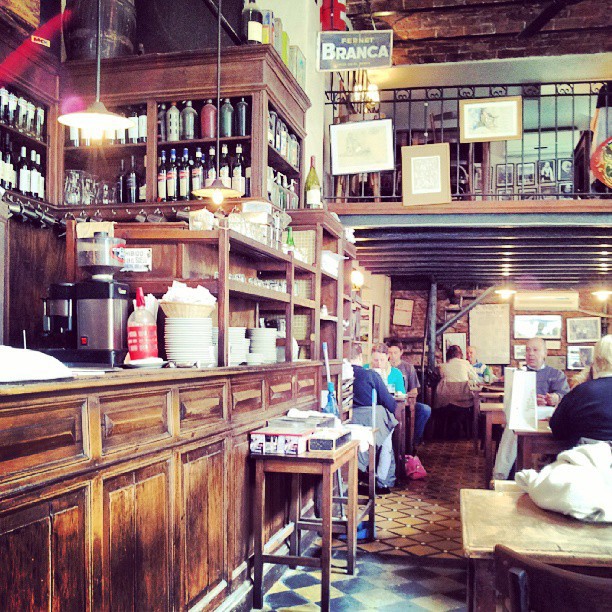
Cafe La Poesia, Buenos Aires

Cafe La Poesia in Buenos Aires continues to pay homage to the literary giants that graced the venue with their presence. It was founded in 1982 by journalist and poet Rubén Derlis and thereafter became a place for artists and thinkers of San Telmo to get together, discuss, and create. After being closed in 1988 and the businesses occupying it later having failed, Cafe La Poesia opened again on 2008, fully recognizing its important history.

Photo: Google Maps

Cafe La Habana, Mexico City

This renowned Mexican cafe has hosted a number of history’s most important figures, such as el Ché and Fidel Castro. It was also the meeting place for Chilean novelist Roberto Bolaño and the poetic infrarrealismo movement. In his famous novel The Savage Detectives, Cafe La Habana is disguised under the name Cafe Quito.

Photo: Google Maps

Est!, Tokyo

This veteran in the Tokyo bar scene has been active for over 80 years. Est! has served a number of fine literary figures such as Yukio Mishima.

Photo: Jessica Spengler

McDaid’s, Dublin

Dublin is a literary city and a drinking city. So it’s not surprising that a number of watering holes have laid claim to writers and books they have influenced. Among the people who have quenched their thirsts at McDaids’s are Brendan Behan, Paddy Kavanagh, J.P. Donleavy and Liam O’Flaherty. A number of portraits hang on the wall in commemoration of the bar’s impressive clientele.

Jennifer Egan Brings Us To a Forgotten New York

Aging rock musicians, New York fashion models, teenage backpackers. Italy, Illinois, an African safari. The breadth of Jennifer Egan’s narrative scope has been extraordinary — and extraordinarily successful, garnering a Pulitzer Prize, National Book Critics Circle Award, and Guggenheim Fellowship, among others. So no one should be surprised that her latest novel, Manhattan Beach, takes yet another different form from her previous books, this time historical fiction.

When we met for coffee in her neighborhood of Fort Greene, Brooklyn, Egan told me she was aware that her readers might be surprised, and not always happily so, at how different Manhattan Beach is from her last novel, the modern and experimental A Visit From The Goon Squad. Writing “straightforward” historical fiction wasn’t the plan, she said, but Egan doesn’t do things by halves, and Manhattan Beach embraces its form, fully immersing readers in the noirish world of New York City during World War II. At the center of the book is Anna Kerrigan, a young woman who is determined to become one of the sole female divers working at the Brooklyn Navy Yard. Anna is still haunted by her father’s sudden disappearance years earlier, so when she has a chance encounter at nightclub with a man who has clues to what happened, she’s determined to discover the truth about her father and the life he lived.

I had the pleasure of speaking to Egan about switching genres, why she’ll stick with a project, and doing extensive period research on everything from 1940s dive manuals to the strange lives of New York City’s piers.

Carrie Mullins: I took the B train to get here, and as we crossed over the East River from Manhattan I was thinking about how we’re not actually that far from the Brooklyn Navy Yard. But before reading Manhattan Beach, I wasn’t aware that it was there, or of its role in World War II.

Jennifer Egan: I know, most people aren’t. I wasn’t!

CM: How did you become interested in it?

JE: I think it started when 9/11 happened. It seemed like such an important step in the life of New York and the story of American power that I found myself starting to think about the beginning of America as a global superpower, and that led me naturally to World War Two. And I was thinking a lot about how it would have felt to be in New York at that time. I started looking at a lot of pictures, and this was really ages ago, I mean I had a one-year-old and a three-year-old and now they’re both taller than I am, so this was like 2004/5. I started looking at a lot of images of New York City during the war, and what was so striking again and again was the omnipresence of water. It was all about the water, and that’s just not true anymore; well I guess it’s a little more true now than it was when I first got to New York because the waterfront has been revived so beautifully. When I got to New York in the late ‘80s, it was a weird period where the waterfront revival hadn’t happened but there wasn’t really any commerce on the water in Manhattan. I used to live on West 28th Street and run along the west side and see all these rotting piles and piers.

CM: Oh yeah, they were totally decrepit. I grew up in the West Village, a few blocks from what’s now the incredible West Side Highway bike path, but at the time it was just trucks and drug dealers and prostitutes.

JE: Right! The piers have had all these sorts of strange lives, and that was interesting to me. And when I started researching, I immediately stumbled upon the Navy Yard, which was the epicenter. Then I thought yeah, that’s still there, so I had someone who was helping me research, and he set up a tour with their archivist. They had just hired her, she was from Pratt, and she was so great and took me around and showed me all this stuff. I was pop-eyed because it was so cool and I’d never had the slightest inkling that it was there. I was shocked by how enormous it was — it feels gigantic.

CM: You get that sense in the book, which kept striking me because I’d never even heard of it.

JE: It’s really big but it feels kind of hidden. It still is; it’s an industrial park but it’s somewhat invisible from the outside. So that’s sort of how it progressed: war, waterfront, Navy Yard.

Spies Like Us: A Conversation With James Hannaham and Jennifer Egan

CM: Did you know when you started researching that you wanted to do a work of historical fiction?

JE: I sort of did, though I didn’t think it would be as simple as ‘we are in the past.’ I thought there would be a little more dynamism to the movement between past and present. I had done a lot of that in Goon Squad, and I thought that’s kind of fun and supposedly I’m good at that (laughs), but I tried and it did not work in this context at all. I have a writing group I meet with, and they were so irritated with me. It was just not appealing whenever I tried to move around in time, so I just kind of let all that go. I don’t think of it as quite as straightforward as I think it’s interpreted as being, but that’s OK. It’s so clear to me that we’re in the present reading about the past, and that awareness is on my mind all the time. But when I tried to wink openly at the reader about that and threaten that illusion, they found that aggravating, so I stopped doing that. But you know there is a lot of stylization — I’m thinking a lot about movies, all of that is intentional, part of a way of having a little fun with the fact that we’re reading and writing this now.

CM: Was it a challenge to get all the historical details right? The cars, the venues, the outfits…

JE: I mean that stuff is pretty easy honestly, because of Google.

CM: My big fear is that I’m going to write something based off of Google and it’s going to be totally wrong.

JE: [Laughs] Well the hard part was the mindset. What are the people remembering? What are their pasts, their parent’s pasts? I didn’t have to research just World War Two but the Depression, and then back, and back, I was going all the way to the Gilded Age. The amount I felt I needed to know to start inventing turned out to be a lot greater than I thought.

The amount I felt I needed to know to start inventing turned out to be a lot greater than I thought.

CM: I know you did some interviews with people who lived through that era. Were those helpful in that regard?

JE: Yeah, I did a lot, and that was the best part, being able to speak with some remarkable people towards the end of their lives.

CM: What was the most surprising thing you learned from those interviews?

JE: That’s a great question. For the women who worked at the Navy Yard, it was striking how vivid that time still was for them. It felt like they’d had an experience that hadn’t been replicated since, which was very moving in a way. And a lot of them would say, oh no, no men ever whistled at us, they were such gentlemen — but I found myself a little skeptical. I think because we were creating an actual oral history, a historical record, and they would be part of an archive at the Navy Yard, I think they were guarded and very careful about the down and dirty of it all, which was frustrating. There was one woman who kept alluding to some incident that had occurred at a New Year’s Eve party but no matter what angle I came at it from, I couldn’t get it out of her. I think that guardedness is also left over from that time, this worry about saying something out of turn or seeming to complain. They felt very grateful a lot of them, to have had that opportunity.

CM: Is your approach to writing a project like this, where you’ve done a lot of historical research, different to something like say Goon Squad, that’s set in the present?

JE: Not really no, I pretty much did it the same way. It’s harder to do it when you need a lot of research because I don’t really start with a story or characters, I focus on a time and a place. I do what I guess some people would call automatic writing out of that, and try to write 5–7 pages a day. I just want to see what comes up. In a way, Goon Squad was the best suited book to my method that I’ve written, and maybe that’s why it was the easiest book I’ve written. I haven’t actually thought of that as a reason until just this second, but I think that’s really true because the fact that I wrote it in small pieces means that I didn’t end up with the hundreds of pages of handwritten material which I normally do, so it felt more manageable all the way through. And I guess the fact that all my books are so different from each other made it extra fun to make every part of that book different.

I would say this book is the worst suited to my methodology and the reason is that because when I don’t know what the story is and I don’t know what the characters are, it’s very difficult for me to research ahead of time. I mean I did some — I had a vague sense of the milieu but I didn’t know what I needed to know, so there was this weird sense of trying to build a bridge as you’re trying to walk across the bridge. It felt so hopeless in moments, so what I did was to do some slapdash research in the moment just to be able to go forward. I would do some research, and then I’d hack my way through something, but then at the end of the day I had twenty-seven legal pads of terrible writing that was poorly researched and I had to deal with that. It was a year and half of work. I had to type it up, which is always hard, and then read it, and then I thought so seriously about quitting.

Support Electric Lit: Become a Member!

CM: Why did you stick with it?

JE: Two reasons. One is that there was nothing else I really wanted to do, which in a way sounds passive but it’s important — if there is nothing else pressing on me then it means I haven’t resolved the thing I was doing. And then in a way the bigger motivator is that the research itself still felt incredibly enthralling. That was such a pleasure. I thought, why am I so excited to be reading a 1943 diving manual?

CM: I often have this anxiety about what I call the authenticity police, the idea that people want to see some kind of personal connection between the author and their work even though, at the end of the day, it’s fiction and by definition it’s all made up. Did you feel that at all, writing about a topic that you didn’t experience first hand?

JE: Going on the Liberty Ship in San Francisco was essential. I don’t know what I would have done if I couldn’t visit. I’ve been there repeatedly, and I went on a little cruise on it. I went to the National Archives, which are down at the old Custom House in Manhattan and it’s a pretty amazing building. I’d never been in there. But the nightclubs, the restaurants — a lot of it is movies and descriptions in fiction and frankly, in my prior life, a certain knowledge of nightclubs of my own. So I worked all that together and extrapolated.

There was a long time when I felt really stiff, I felt a little stymied. I think the challenge is to know enough that you feel comfortable. Even though this has been vetted very thoroughly, I’m sure people will still catch mistakes. And it’s like, really, who cares? I finally reached a point where I felt confident, but that took a long time.

CM: Some writers also seem to get more penalized than others for writing outside experiences that they’ve lived themselves.

JE: I’m lucky, I don’t feel like I’ve been penalized for that. On the whole, I’ve been pretty much welcomed into these other realms, so I guess it is possible. When I was working on Look at Me, I was afraid that I was overstepping my boundries in some way, that I was going too far, whatever that means, but no one had ever said that to me. I think one of the most dangerous things about prejudice of any kind is how it’s internalized and becomes a type of self-censorship. The work is potentially not even getting made.

I think one of the most dangerous things about prejudice of any kind is how it’s internalized and becomes a type of self-censorship. The work is potentially not even getting made.

CM: So many characters in the book read mystery novels — Chandler, Ellery Queen — and there are noirish aspects to the plot. Have you ever thought about writing a straight-up mystery?

JE: I would love to, but it’s so hard to do it well. Often unveiling the murderer requires so much feinting and darting that it’s hard to have real psychology. It’s a genre I think a lot about, and if I could find a way to do it well, I’d love to.

CM: Well I love that you’re writing across the bookshelf so to speak. A lot of fiction writers get hemmed in. The publisher says, this is the book that did well, let’s see five more like that.

JE: No publisher has ever said that to me, thank God, but I have moved publishers and I think that’s partly because a publisher buys one book and that’s what they like. There is no way I could find a world and stay in it, it’s just not going to happen. But I think it’s a challenge for readers, too, and I’ve been really grateful for the ones who have stuck with me. I lose some every time and I know this one will be no exception. It actually might be worse this time because a large audience found Goon Squad and I guess there could be a book that’s less like that one than this one is, but you’d have to think hard to find one, they have no overlap whatsoever. And before that I’d written a kind of gothic thriller which led me into the world of gothic fiction lovers, which is a big, vital, fun world to be in and they really embraced the book and I think Goon Squad was not really what they were hoping for.

CM: Yeah, I think you’re starting to see a little more flexibility in terms of authors writing across genres, but generally people see an author’s name and just want an iteration of the same experience they had the last time.

JE: I do sympathize, and I can’t blame anyone for saying this just isn’t my cup of tea. And it’s hard for authors — we live in a culture that really values branding and there is a legitimate pressure, that’s what social media is in a way. We all need to make a living. But for me, the fun of it is to do things I’ve never done before, and if I couldn’t do that, then I’d have to find something else to do.

How Big of a Deal is Wikipedia Plagiarism? That May Depend on Who You Are

Did prominent poet and editor Jill Bialosky break the first rule of Writing 101, the one that every college student learns in freshman year? That’s the claim literary critic William Logan is making about Bialosky’s memoir, Poetry Will Save Your Life. In The Tourniquet Review on October 4th, Logan accused Bialosky of plagiarizing “numerous passages from Wikipedia and the websites of the Academy of American Poets and the Poetry Foundation.” (Bialosky, and a group of 72 prominent authors who cosigned a letter of defense to The New York Times, disagree — or rather, they don’t disagree, but they don’t think it’s such a big deal.)

Here is a comparison of a passage about poet Robert Lowell that Logan references in his review:

Bialosky: “Although Lowell’s manic depression was a great burden for him and his family, the exploration of mental illness in his verse led to some of his most important poetry, particularly as it manifested itself in Life Studies. When he was fifty, Lowell began taking lithium to treat his mental illness.”

Wikipedia: “Although Lowell’s manic depression was often a great burden (for himself and his family), the subject of that mental illness led to some of his most important poetry, particularly as it manifested itself in his book Life Studies. When he was fifty, Lowell began taking lithium to treat his mental illness.”

Bialosky responded to the allegations saying: “William Logan has extracted a few ancillary and limited phrases from my 222-page memoir that inadvertently include fragments of prior common biographical sources and tropes after a multiyear writing process. This should not distract from the thesis of this book, which derives from my own life, my experiences and observations.”

To be clear, the “fragments” are chunks of almost word-for-word paragraphs, and the “common biographical sources” include Wikipedia, a source of information that every freshman student is taught not to use. Even the founder of Wikipedia, Jimmy Wales, has urged that Wikipedia should not be cited for academic purposes.

The 5 Weirdest Lawsuits About Authors Stealing Ideas

Copying and pasting off Wikipedia is a rookie mistake, and perhaps a forgivable one if you’re a college student or even an entry-level blogger. But Bialosky is the vice president and executive editor at W. W. Norton, a publisher of literary anthologies widely used in universities. That’s right: Instead of citing, say, The Norton Anthology of English Literature for biographical information, a Norton editor, writing a serious memoir, chose to copy and paste from a open-source website without using any attributions. It is baffling.

The only plausible explanations that we have for this are:

  1. Norton does not give its editors free copies of its lauded anthologies, and at a steep $61.42, they were too expensive for Bialosky, who had to rely on free web sources she was then too ashamed to cite.
  2. An overworked assistant or some poor hapless intern tasked with researching the poets’ biographies decided that they weren’t paid enough to ghostwrite parts of someone else’s memoir so copy and pasted instead. (Or a slightly more diligent hapless intern meant to un-Wikipedia the quotes eventually, but got distracted with ordering her boss’s lunch.)
  3. Bialosky herself took notes from Wikipedia and then later forgot they were verbatim, which raises the question of why a prominent editor was using Wikipedia as a primary source.
  4. Bialosky took notes from actual primary sources and later forgot they were verbatim, and the Wikipedia writer did the same thing.

Plagiarism claims are a common plague in the publishing industry. In 2002, author and historian Doris Kearns Goodwin resigned as a Pulitzer prize judge after allegations surfaced that many passages in The Fitzgeralds and the Kennedys were lifted almost verbatim from other writers’ works. Goodwin made a financial settlement with Lynne McTaggart, the author of a biography of Kathleen Kennedy from which she copied up to 50 passages, after McTaggart threatened to sue her for copyright infringement. Like Bialosky, Goodwin insisted that the instances of plagiarism in The Fitzgeralds and the Kennedys were inadvertent; she blamed a research assistant with sloppy handwriting for the “mistakes.”

Some notable voices think Bialosky should take her licks like Goodwin; others are appalled by the very idea that using the same words to describe something qualifies as “plagiarism.” Here are some reactions from the literary world, ranging from calling Logan sexist to calling Bialosky a sociopath:

The common refrain used by Bialosky and her supporters in defending her alleged plagiarism is that using “straight biographical information” is not plagiarism, and failing to use quotations and citations is “a common error.” A common error that, as Talya Zax at Forward points out, could devastate the career of a writer less established than Bialosky: “A student can fail or be kicked out of a class, and in some cases expelled, for plagiarizing in exactly that manner. I’m a writer at the start of my career; in an unofficial survey, my editors said that if they were shown evidence I’d plagiarized to a similar extent they would likely fire me.”

A group of 72 writers and self-described “friends of literature,” including authors like Jennifer Egan and Claire Messud, wrote a letter to the Times scolding it for publishing William Logan’s allegations and “giving a large platform to a small offense.” The gist: How could The New York Times “taint the reputation” of an “accomplished editor, poet and memoirist” and “substantial contributor to American letters”? The “friends of literature” — many of whom, not for nothing, are friends and colleagues of Bialosky — note that her theft was not “egregious” or “intentionally performed,” and that it would be corrected in future editions. They do not make the claim that it didn’t occur.

Repeating dry facts verbatim from Wikipedia is indeed a pretty common, non-egregious error — an easy mistake to make. An embarrassing mistake, even. Should Bialosky be shunned, ruined, or punished? Probably not. (Doris Kearns Goodwin, we’d note, is still a prominent public intellectual.) But should she be embarrassed? Probably yeah! And the graceful response to embarrassment is saying “gosh, I’m so embarrassed”—not rallying famous writers to your defense. (We appreciate her not throwing that theoretical-but-probably-real intern under the bus, though at this point everyone knows that people who grew up with the internet research by copying and pasting into a document and then paraphrasing later. Whether better methods should be taught is a matter for another story.) There’s a whiff of “do you know who I am” about this response, and all we can think is: yes, you’re a talented and respected woman of letters. Perhaps we should hold prominent editors to a higher standard, not a lower one.

—By Jo Lou, with Jess Zimmerman

On Poverty, Sports, and Violent Men

Last month, word started coming across the border from Canada of a new book from an author named Kevin Hardcastle. It’s called In the Cage (Biblioasis), and the most common point of comparison has been Cormac McCarthy, a claim we might have been inclined to discount if it weren’t coming from Donald Ray Pollock, a favorite around here and a man who knows a thing or two about Cormac McCarthy. The Globe and Mail described the novel, about “a retired cage fighter fallen on hard times, trying to support his family in Ontario’s Simcoe County” as “noirish,” “folkoric,” and “a fierce, beautiful book.” As it turns out, another of Hardcastle’s admirers is John Irving, who reached out about interviewing Hardcastle for Electric Literature.

Now, incisive, hardscrabble novels about fighters fallen from grace and turned to crime just so happen to fall in our wheelhouse, but even if that weren’t the case we’re not in the habit of turning down pitches from John Irving. So, please, read and enjoy Irving and Hardcastle’s conversation. They discussed rural poverty, combat sports, and refusing to write “utterly shitty characters.”


John Irving: People make — or, out of their circumstances, are forced to make — dire decisions in your novel, In the Cage. This is also true of many of the stories collected in Debris. Does this come from your sympathy for, and understanding of, the rural poor? Or is this partly an inclination in your imagination — one that draws you to the drama of dire decisions? Maybe both?

Kevin Hardcastle: The drive behind almost all of my work is to write poor people, and the rural poor, with empathy and understanding. And to not romanticize or write their situations as a tool for reflection or comparison. I grew up working class, and we were pretty damn poor at times, and I saw the damage it does to people. I was lucky enough to have a close, supportive family, who did the best with what they had, and that gave me a shot at writing these stories even though my chances of getting to publish books were never going to be very good, realistically, coming from my socioeconomic background, and from a small town where there are very few examples of artists who have ever made a living at their trade.

After making it this far, there is a wealth of material and an organic connection to the characters I write that helps keep the stories grounded without them becoming some kind of lesson, or too miserable, and without letting the people become caricatures. I hope, at least. I think the tightness of my family, despite hardship and tragedy, has taught me not to feel shame over being poor, or rural poor. I detest poverty as a condition and the factors that force it to be a way of life for so many. That is probably why I write criminals sympathetically. Most of those characters I write are good people, under intense pressure, who do what they’ve got to do to stay alive, or protect their families.

On a simpler level, I care most about writing where something is at stake. A small event or trick of chance that would be a nuisance to the rich can destroy the life of a poor person. I always think on that while I write. As a result, some of the most traumatic and painful parts of this narrative may hit close to home for many readers.

When you write the poor honestly, something is always at stake.

JI: Similarly, heartbreaking endings come naturally to you. You’re clearly drawn to them; you’re good at them. How much of this is based on what you’ve seen? How much on what you’ve read — meaning, what you most like to read? And again — the “imagination” word — how much is this what you instinctually imagine? Maybe all three?

KH: Well, I appreciate that very much, and I do put a lot of work into the endings. I have had a good deal of personal experience with elements in my fiction that fate the characters to potentially heartbreaking ends. I know poverty and mental illness and addiction and violence quite well.

That being said. I’ve been exposed to some bad things, but lots of that is a toe in the water compared to what others have gone through, and have sometimes survived. I still root many of the direst fictional events and situations in reality, but I use experience to extrapolate how much worse it could actually be, and where that’ll lead a person. I try to humanize hard actions and articulate how a person might get to a place where they push all of their chips into the middle. I’m not interested in explaining it all away, but I want it to be understood, and for readers to feel the weight of those decisions and what they ultimately lead to.

Watch Chuck Palahniuk Read Fight Club 4 Kids

JI: Violence is common in your literary world, where violence is also vividly described. I’m thinking of that boxed maxim to the left of the masthead to The New York Times: ALL THE NEWS THAT’S FIT TO PRINT. I’ve often thought of good fiction as the news that is necessary to hear, despite it’s not being “fit” to print. Not only the Times, but many newspapers, would tell us that someone uttered “a homosexual slur.” That’s not good enough (or bad enough) for good fiction; we have to hear the actual words. There is an awfulness to the violence in your fiction, but how else should violence be described? Everyone today asks where fiction “comes from”; related to my first two question, tell me about the violence. I’m guessing it’s true to what you’ve seen; I’m also guessing that you hate it, but you seem drawn to depict it truthfully. Increasingly, today, isn’t violence — in one form or another — what we most fear? Tell us about the violence in your writing, and in the world.

KH: It is important to speak plainly about violence and to write it plainly. This is something I believe deeply. As you suggest, good fiction tries to look straight down the maw of ugly or difficult matters — but without trying to be exploitative or too fantastical, or, as with writing poverty, without romanticizing what violence tends to be. If we engage with violence as it is, we can also start to see all the disparate components involved, whether in intent or magnitude. All violence is not the same, and all violence does not come from the same place. Writers tend to do better with sex as they depict it, and seem more comfortable doing that. But they lousy up writing about violence often. I think I do the latter far better, but that might just make me the weirdo here.

To apply all this to In the Cage, I had to write all those different kinds of violence with some authenticity. If you write violence incorrectly, or fudge it to make it easier to digest, you lose any lasting effect on your reader, and your work will not hold any goddamn water at all when somebody who understands that violence firsthand takes a look at it. There was a lot of conversation in the editing about how likely it is for a sawed-off shotgun to blow an arm off (something I’d suspect you have researched). Or about how your eyeball often sinks lower in your face when you have a broken orbital (something I knew from having a doctor examine a maxillary fracture in my face from sparring). Even for a regular reader though, who has never (luckily) experienced violence of this magnitude, it is much the same as lines or paragraphs where the writer is trying to tell us something meaningful without fully focusing on it. If you fake that, and don’t feel it yourself, in your bones, nobody else will.

Further, you can write violence in an overblown, bad action movie kind of way. Nobody flies across a room. Nobody’s fist explodes on someone’s face. That is ridiculous. If you are writing violence fantastically, to make a point about something else, I understand that approach. But, if you are trying to speak honestly about it, and write honestly about it, you have to understand what every single word means and where it should go.

Where it becomes especially important in my book is where “violence” as an aggressive, sudden, brutal act, in the depicted shootings and stabbings and murders, must be distinguished from the so-called “violence” of the Mixed Martial Arts fights. There is violence there, but this is where the general public, and many other sports fans, miss the point of what MMA is. I do not think that MMA is “violence,” as it stands. Violent and dangerous physical activities happen in the cage, but it is an athletic contest of skill, and technique, and heart, and mental fortitude that I do not think has an equal. To the average person, even a boxing or football fan, the damage from kicks and knees and elbows, the grappling, the blood, might appear more rude and brutal. But they are far less dangerous than twelve rounds of boxing or linesmen smashing each other over and over for the duration of a game. If you wouldn’t call football “violence,” you shouldn’t be calling combat sports violence. That’s important.

As we’ve discussed before, in an interview I did with you when Avenue of Mysteries came out, the monotony of the training in a combat sport, the workmanlike approach of it would bewilder people. Sure, there is room for nervousness, and fear, and fury, but they have to have been channeled and controlled for you to be successful. You can certainly apply a workmanlike approach to killing or hurting people, but much of that level of physical violence happens from losing to some of those impulses. That kind of violence also happens with more chance involved, a level of randomness not under the control of anyone. In most cases of real gunplay or fights in the street, the man or woman who should win does not always, and they will rarely come out of it unscathed. They are subject to chance in a way that athletes in the cage are not.

There is a reason I wrote Daniel as a truly exceptional fighter and a real problem to deal with. To make him formidable, sure, but also to show even a man that hard can never be fully prepared for violence at its worst. He can even be robbed of victory within the cage, within the rules, but that is a safer space than the outside world is for him, by far.

A small event or trick of chance that would be a nuisance to the rich can destroy the life of a poor person. I always think on that while I write.

JI: The sure-handed craftsmanship in the Debris collection of stories is very present in In the Cage, but the novel gathers a momentum that no short story can achieve. Similarly, a novel allows you to develop characters in a way no short story can equal. In the case of In the Cage, I don’t mean only Daniel and Sarah, though they are complex and heartfelt characters. I mean the bad guys, too. Wallace, Clayton, Tarbell — they’re truly terrifying. Tell me about your transition from writing short stories to expanding in a novel. Was it natural? Was it hard?

KH: This all happened sort of backwards for me, because I’d actually written a much crappier version of this novel six or seven years ago. I rewrote it before my then-agent tried to sell it and nobody would buy the thing. It certainly had its flaws but there was a good book in there for an editor willing to really dig in. Unfortunately, nobody was willing to take a chance on it at that stage in my career.

So, in the meantime I kept writing stories and getting them published, and that led to Debris, and to my publisher Biblioasis and editor John Metcalf. As the stories were mostly published in journals, and we didn’t have a ton of work to do, John asked for the novel nobody would bite on, and told me he saw something in there and would take a crack at it. That’s how I got one of the most important and influential editors in Canada.

I have heard a few excellent novelists, like yourself, or Cormac McCarthy, talk about the novel as the most impactful and lasting form of fiction writing, but I still believe in the short story as an unforgiving, bare bones, naked-as-the-day-you-were-born type of writing that demands so much skill and precision. My main goal here, in retrofitting the novel with the tools I’d sharpened writing stories, was to make sure the prose got up to that level throughout, and that I held the same kind of focus on the purpose and weight of the narrative, and the characters, from the first word to the last. It wasn’t easy to keep rebuilding this book, strengthening and defining the characters more clearly draft after draft, but the closer I got the more I felt like I’d finally written the book I wanted to write.

Author Kevin Hardcastle

JI: An aura of foreboding accompanies Daniel in In the Cage. You do foreboding well — the criminal associates in Daniel’s past, the low-lifes who overhang and cloud his future. “In the dark and pisswet alleyway” — how Chapter Two begins — does not bode well. “I’ve about had it with this shit,” Daniel says, only halfway through the second chapter. Near the end of Chapter Three, there’s another ominous omen — Daniel sees something, or he imagines he does. “A shape there. A second later it was gone and he didn’t know if it was an animal or just a trick of the brain.” No doubt there’s trouble coming. Where did you learn this — from what or from whom? It takes practice to get foreboding right.

KH: I think that is where my interest in writing horror fiction comes into play, and because I have always gravitated toward atmosphere and tone. I started reading your friend Stephen King when I was ten years old (thanks mom), and, while I didn’t understand all of the nuance and literary work, I understood the underlying tension in the characters’ lives. And I probably internalized, even as a young person, lessons on how to write real people, especially working class people — which King is not given enough credit for by even the most self-serious “literary” writers — and then to have the worst happen to them.

This is something you do as well, in that I’ve heard you answer questions about autobiographical writing by saying you write what you most fear happening to those you love, not what has actually happened. I do both, but I agree with that approach of building characters we empathize with and can see as real, then have all kinds of horrible shit happen to them, laying it out as stark and ugly as it needs to be.

The trick is not to telegraph entirely, but I don’t mind a little bit of fatalism, and the idea of the reader knowing that the axe is going to fall at some point — but not knowing when or how hard or exactly to whom. My favourite authors are those who can cultivate an atmosphere where fate looms heavy, but there is still some mystery as the characters move toward their end. Books like Death Comes for the Archbishop by Willa Cather, or the work of my favourite Canadian author, Alistair MacLeod, build such a powerful sense of mystery in the way characters experience the natural world. Cormac McCarthy spoiled my horror aspirations forever when I read him, because I realized nothing could be more frightening than the way he wrote almost-historical fiction, and the natural world, and the underlying terrors people suffer or provide.

It’s always been my aim to write stories where you know that there are only a few ways the narrative can end, few of them happy, but you will still follow the characters and root for them as they fight. The more serious and effective that sense of foreboding is, the more the reader will dig in.

JI: Your sympathy, extended to minor characters — even toward thugs who misbehave — is everywhere apparent. Daniel’s fellow worker, LeBlanc, has been laid off, too. They go out for a beer together. But LeBlanc presses Daniel to connect him with the criminals LeBlanc knows Daniel knows. When Daniel refuses, they have an ugly fight in the men’s room; Daniel takes the beaten LeBlanc home. Daniel’s unexpected sympathy for LeBlanc ends Chapter Ten — when Daniel realizes that LeBlanc’s “old lady” has left him, and the defeated man lives alone. Tell me about the origins of this sympathy.

KH: I think I cheat a bit by rarely writing utterly shitty characters. Instead, I write a lot of good people who are compelled to do bad things. In this novel, that includes some of the thugs and criminals that have been shaped by their injuries and trauma, the circumstances of their lives and the trappings of the region that made them. If I’ve done my job and genuinely empathize with them, the reader might too. I do my best not to be precious about where their decisions lead them. I love many characters I write, even the minor ones, but I don’t hesitate to harm or kill them when their number is up.

Support Electric Lit: Become a Member!

JI: I like what’s imaginative in your fiction, but I also like what’s realistic — what’s authentic. I believe those two elements, in the same story, are essential. You’ve done a little fighting — a little training to fight. I did, too. I competed as a wrestler for twenty years; I coached wrestling (I trained younger wrestlers) until I was forty-seven. You’ve trained for MMA. I recognize Jung Woo, the Jiu-Jitsu guy; I’ve rolled around with guys like him. And when Daniel loses a fight because of a bad ref — a bad call — he doesn’t try to justify himself. “I lost,” he says. Right or wrong call, that’s the truth; a bad call still means you lost. It’s a tough balance — between stretching your imagination and staying authentic. Daniel’s situation becomes growingly horrendous, but you keep it real. Tell me about that process.

KH: My training was mostly in Muay Thai, and some boxing, but I actually never trained full-out in MMA, and had no grappling until this year. When I was a younger, dumber man, I also got into some trouble in the street that I drew upon heavily in earlier writing about violence, but that was more of a visceral, very emotional type of experience. The actual technical understanding of fighting and how to write it didn’t come until I had proper training in Muay Thai.

There’s a reason for the great tradition of boxing literature and journalism by literary writers. Fighters and fight gyms are fascinating and full with human drama. There are no lies told in the cage, or in the ring, or on the mats, and there is something profound to that. If you spend enough time training, you identify the traits that make fighters who they are, and that shows you how they are built of different materials. I was never good enough to fight, but I trained hard, and I understood enough to know what separated people like me from true fighters. And I saw it enough to articulate it in writing.

When I wrote the fight and training scenes, I didn’t want to dumb down or over explain. I used common language from the sport, and I made an effort not to write in some hyper-interested academic way, or as an investigation of psychologies. Again, characters who fight are not literary tools or curiosities. In the fight, as you know well, there are thousands of hours of ingredients that go into one successful technique, or an exchange between combatants. A fighter will not be dwelling on that in the thick of it. Things happen fast and much of it is imperceptible to a spectator, but everything has a history and a reason and anything mystical in that cage is simply a result of repetition and training and drilling and sparring. The best man doesn’t always win and all of that training and work can be scuttled by a broken shinbone or a headbutt or an eye gouge, a bad ref, a blown call. The power of all of that is that there is no way to make it unhappen. There is a permanence and finality to the events that take place in combat sports that has a weight heavier than any other sport. You will have always been knocked out by that man or woman. It will always be that, if they sunk the choke in, and you did not tap or have the ref to pull them clear, they could’ve killed you.

But again, I don’t know everything, and I didn’t fight. So that is where I lean on my knowledge of MMA and what I’ve heard from true fighters who have been down in that deep water. For very practical reasons, I made Daniel a Muay Thai and striking specialist with decent grappling that is more defensive than anything. That was to play to what I knew best in my actual experience. I knew enough to let my imagination take the wheel when I was out of my depth. I think that base of knowledge, and being immersed in this world, really grounded the work and made it interesting enough to engage readers who don’t have a natural draw toward combat sports. Even for those who dismiss those sports entirely.

There is a permanence and finality to the events that take place in combat sports that has a weight heavier than any other sport. You will have always been knocked out by that man or woman.

JI: Fatalism, inevitability — we get that from Greek drama. Maybe Shakespeare got it from Greek drama, too, but Shakespeare did it as well or better. Doom is always impending. We know the criminal temptation is waiting for Daniel’s luck to run out. You’re still foreshadowing at the end of Chapter 26 — you never stop! Daniel and Sarah are talking about how he’s going get some money.

“I’ll get work,” he said. “Doesn’t matter what it is.”
“Yes,” she said. “It does.”
He tried to smile for her.

Or, much earlier in the novel, when Daniel finds his young daughter in a fight. He tells her not to do it again.

She said she’d not. Tried to stoneface him as she made the promise. Daniel looked at his daughter hard and knew that it was too late by years for her to keep it.

You write about family — especially Daniel’s fear of something happening to his loved one, his wife and daughter — with tenacity and understanding. You’re not a husband or a father, but you’ve done a good job of imagining a husband’s and a father’s fears.

I know: Flaubert was not an adulterous wife, but he got Emma Bovary right. Tell me more about that.

KH: This is something that I’ve heard from a few readers, especially those who have children and wives or husbands. As with my writing about poor and other marginalized people, I’ve not experienced the far extremes of love and loss in the way a father might, but I’ve been close enough to understand what it would look like.

Daniel’s entry point is my father, who was a welder, and who struggled a great deal keeping a roof over his family’s head in a small town with an economy they’d driven right into the dirt (not to mention our years in North England after Thatcher gutted that part of the country). He also lived with severe depression and anxiety, and alcoholism in his last years, as a result of physical and psychological abuse he suffered as a child. I loved my father very much, still do, and as I got older I began to truly understand and admire how strong he was for us, to break a cycle of violence and abuse, and to protect us as best he could from the indignities of poverty and the humiliations and perceived failures that haunted him through his life. He could not see any of his accomplishments, other than his children, and that is a hard thing to think about. But I wrote a lot of his life into other stories, and he lived to see some of those, and he thought there was good in doing it. It has also helped me work through a lot of these traumas to write them into my stories.

My father was not a “tough guy” in the way Daniel is, though he was hard as a coffin-nail when he had to be. But this whole heartbreak about lives you could’ve had, that were taken from you, and feeling powerless no matter what your skills — that is from my dad. He just couldn’t catch a break. If I’ve written Daniel effectively at all as a father, it is because of that.

JI: Readers who’ve read your short stories — “Montana Border,” in particular — will recognize Daniel and Sarah. There’s a neat overlap with the “Montana Border” story in the italicized beginning to Part One of In the Cage. I love those italics at the start of the designated Parts; they’re both Prologues and Epilogues. They introduce us, but they often sound like elegies; they’re very mournful-sounding. Okay, so you’ve expanded the cage fighter story (“Montana Border”) from Debris, but In the Cage has a darkness that’s more remindful to me of “One We Could Stand to Lose” and “Hunted by Coyotes” — in my view, those are the two darkest stories in the Debris collection. Did you always know that In the Cage was a very dark novel, or did it get darker as you wrote it? Did the darkness surprise you?

KH: Well, I went back and forth on what do with those italicized parts, but they seemed to win people over as the book developed, so it is good to hear you liked them. That is how I designed them since the early drafts, to set the tone of the novel, and to speak to some of the wounds from the past that put Daniel and his family in the position they are in.

It is true that “Montana Border” ends where Daniel and Sarah have narrowly escaped a biker gang from the prairie, and she is planning to leave with him, and the child she’s carrying. That isn’t a bad end in comparison to many of my stories, as you know.

The story I always knew In the Cage would be is the story of a fighter who just missed. He missed his shot to become champion and make real money right as the sport took off. There are thousands of those stories for fighters, and athletes, and many of them don’t get told. But, as with “Montana Border,” I didn’t want to write just the psychology of a fighter, or a character study of the kind of man who does that work for a living. I was more interested in exploring the circumstances that led him down the path he follows. The social and economic pressure, along with the effect of the terrain and the natural world. It was always going to be dark, looking at poverty and violence so bluntly, but the depth of that darkness seemed natural. I am interested in the struggle more than the end. It matters most how people fight when faced with that kind of darkness, even if it is a losing battle. All that foreboding and inevitability, the likelihood of catastrophe, they all lend a tension and atmosphere to the book that hopefully keeps a reader engaged, if unsettled. But none of that matters if they are not invested in how these characters fight and try to survive, whatever the odds.

Why I Can’t Stop Reading Self-Help Books

Novel Gazing is Electric Literature’s personal essay series about the way reading shapes our lives. This time, we asked: What’s a book you read in secret?

When your seven-year relationship implodes in two weeks and you find yourself alone in your apartment with only the silent company of your ornery cat, you may find, like I did, that you begin to grasp in search of solid ground. I suddenly had time. I had space. I just didn’t know what to do with any of it. So I did what I always do when I feel untethered and unsure about something: I turned to books.

But not to novels of love come and gone. Not to collections of poignant essays or biographies of inspiring historical figures. Instead, I turned to that self-help genre known, with vague aspiration, as “personal development.”

Ten years ago, when I worked at a small bookstore in downtown Vancouver, I would look askance at people that came in and asked for these books. What happened in their life that led them to this moment? I thought as I guided them to the self-help section, speaking softly and smiling as if anything more would break them. I was a bratty early twenty-something fresh out of university with shaggy hair and an even shaggier beard, and the only books I wanted to read at the time were ones that were at least 400 pages and had been reviewed as “difficult, but rewarding.” Naturally, I read David Foster Wallace’s Infinite Jest. But The Power of Now? Don’t even.

I have learned to consume them in secret, in my own home, reading them the way you would eat a bag of M&M’s that you keep stashed behind the kale chips.

In the last three years, though, as my longest relationship crumbled and I approached and then crested the age of 30 having accomplished none of the things my teenage self thought I would have by this point (be a novelist! Visit Berlin!), I found myself addicted to personal development books, to the promise they held.

I have learned to consume them in secret, in my own home, reading them the way you would eat a bag of M&M’s that you keep stashed behind the kale chips. When I talked about these books with my friends it provoked a wide-eyed frozen smile that I imagine is only used when they are listening to someone explain why this new cult they joined is actually really good, just hear me out. I even use the self-checkout feature at the library lest I become the subject of pity and clicking tongues in the librarian break room. “Did you see the guy come in to check-out Daring Greatly: How the Courage to Be Vulnerable Transforms the Way We Live, Love, Parent, and Lead? Poor, poor sweet dear. More baby carrots, Agatha?”

But despite the overwhelming urge to hide the cover of whatever self-help book I’m reading with a well positioned thumb, I keep turning to them, again and again, because they make me feel hopeful. Reading personal development books gives me a feeling akin to the one I got when I started a new year of school. I would imagine all the ways I’d be a better person that year: more organized, funnier, happier. I would have more friends, be more popular, think more positively. Those hopes, of course, eventually melted away under the consistent dull hot light of everyday routine, but for a brief brilliant moment each year my life opened up with possibility. Now, it’s within the pages of these books that I place my tiny pathetic hopes.

I read The 7 Habits of Highly Effective People by Steven Covey and wrote a personal mission statement, promptly lost the piece of paper it was written on, and forgot all the habits except maybe one (something about goals being good, I think?). I read Better Than Before by Gretchen Ruben and vowed to get my life back on track through fostering good habits, but only managed to keep cracking my knuckles. I read The Highly Sensitive Person by Elaine Aron, which was really helpful in providing me a rationale for canceling plans with people to stay home and watch Netflix. “I’m highly sensitive,” I’d text. “It’s a medical thing.”

I am aware that the Personal Development Industrial Complex fuels and is fueled by a brand of late capitalism that pushes us to be more effective and better members of society, to acquire more stuff to simplify our lives: to produce, to consume, to aspire. Many of these books have the whiff of scam about them, of the snake oil salesmen: Just follow these seven steps! These ten principles! These three easy frameworks! They make it seem so easy with their anecdotes, self-deprecating tone, and strategies backed up by the occasional scientific paper to prove to you that this is, you know, science. I know all of this. I get it. Still, I can’t stop.

Because the point of reading personal development books is not to be a better person afterwards. The point is to thrill in the imagining, while you are reading the book, of the better person you could become. It’s not the outcome, but the act of reading that is the balm. This is why they can become such a compulsion — why the “saved for later” section of my online library profile is not the latest Booker Prize winner, but is instead filled with titles like How to Manage Yourself and The Power of Habit and Start with Why. I recently read an almost 300-page book about how to manage email so I can be more productive, and you know what? I enjoyed it.

The point of reading personal development books is not to be a better person afterwards. The point is to thrill in the imagining, while you are reading the book, of the better person you could become.

When I turn the pages of these book, studiously copying inspirational quotes into my notebook that I think may come in handy later (they won’t), I feel a blossoming warmth spread throughout my body. Everything becomes possible. I can conquer the drudgery of work, the intricacies of my relationship, my own anxieties and bad habits, my procrastination. No longer will I flop onto the couch when I get home to watch YouTube clips of Kristen Wiig impersonations or 25-minute compilations of Seinfeld bloopers. I will do things. I will be somebody.

But, like with any drug high, I’m eventually left feeling confused and deflated. Real life pulls itself back into focus, leaving whatever epiphanies I had blurred. What was that fourth habit again? Wait, how was I supposed to organize my email inbox for greater happiness? Never mind, here’s another book to read. It will be in this one that I find the perfect thing, the one that sticks, the one that works. The ultimate answer is always on the horizon, tantalizingly out of reach.

John le Carré’s Sad Spies Offer a New, Better Vision of Masculinity

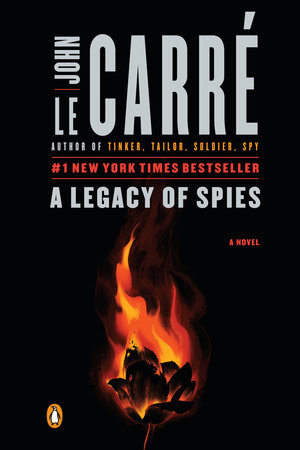
In the final pages of A Legacy of Spies, John le Carré’s 24th and most recent novel, Peter Guillam’s lawyer makes a plea to the former spy. “So our feelings. Can we talk about them for a change?” asks the lawyer, who has been steadfastly trying to determine her client’s role in a casualty-ridden cold war mission. “So much more illuminating than facts, I always think.”

Stylistically, this might be an incongruous line for a John le Carré novel. His prose, which generally unfurls with the subtlety and slow-burning devastation of a long-term arsenic dose, has rarely been this blunt before; his characters have always preferred quietly crumbling under the weight of their emotions to directly addressing them. In terms of substance, though, it could easily double as a thesis statement for his entire body of work. Facts are important in le Carré’s world; his spies spend hundreds of pages at a time digging and dying for facts. But it’s feelings — about that work, their pasts, themselves, their masters, their missions, and their results — that truly fuel their stories.

A Legacy of Spies by John le Carré

Le Carré’s extensive use and command of emotion in his work has always subverted the spy novel, even as his books — and his very pen name — have come to define it. In a genre typically preoccupied with action and ideals, classics like The Spy Who Came In From The Cold and the Karla Trilogy are notable for being deeply rooted in the internal lives of their characters. Action, as slow as it may be in le Carré’s world, is fraught with both global and individual consequences. Ideals crumble under the human cost of upholding them. Everyone has been broken by an authority that they trusted, whether it’s a father, a surrogate father, or an institution. Most often, it’s all of the above.

The stoic, hyper-masculine, and eminently capable spies that dominate so much of the genre on the page and on screen are absent in these works, replaced with broken men who are at war with themselves as much as with the enemy. Le Carré’s most famous character, George Smiley, is the very antithesis of James Bond. He’s aging, dumpy, and owlish, and constantly cuckolded by his much more charming and attractive wife. He works slowly and meticulously. His victories, such as they are, haunt him as much as his failures. The Spy Who Came In From The Cold’s Alec Leamas, The Honorable Schoolboy’s Jerry Westerby, The Night Manager’s Jonathan Pine are all, in their own way, weighing past failures and crises of faith against dangerous acts of hollow redemption. Even Peter Guillam, the closest that any le Carré character comes to the action hero archetype, is a mess when he’s first introduced in his most recognizable form (Guillam briefly appeared as Smiley’s contemporary in le Carré’s debut, Call for the Dead, before settling into the role of protégé in the later Smiley novels). He’s suave, womanizing, cool, and handsome. But he’s also on the verge of a nervous breakdown, sublimating his ambivalence about his calling and his loss of faith in everything and everyone (at least, everyone not named George Smiley) into increasingly paranoid and jealous theories. In a culture where masculinity is often marked by stoicism, a reader might know more about the emotional lives of John le Carré’s action heroes than about most other men in her life.

The stoic, hyper-masculine spies that dominate the genre are absent in these works, replaced with broken men who are at war with themselves as much as with the enemy.

Le Carré’s connection to his material also defies expectations. His own past as a spy was a key part of the marketing around his books in the early years and swiftly became part of his mythology thereafter, but the actual life experience that most informs his work is far more personal in nature. He writes less as a former MI5 agent than he does as the brokenhearted and abused son of a con artist. Le Carré’s (born David Cornwell) ruinous relationship with the charming but poisonous Ronnie Cornwell looms over every interaction in his oeuvre.

“From the day I made my first faltering attempts at a novel, he was the one I wanted to get to grips with,” Le Carré writes in “Son of the Author’s Father” from 2016’s autobiographical essay collection, The Pigeon Tunnel. The damage that Ronnie left in his wake also presents itself in my forms over the course of his son’s career. “Under yet other names he has appeared repeatedly in my novels,” Le Carré admits in passing while describing one of Ronnie’s best friends and victims, in an earlier version of the story that appeared in The New Yorker in 2002. He’s not simply a spy novelist; he’s a confessional writer who happens to work in the spy genre.

The emotional content of le Carré’s novels is, by far, the primary source of their resonance and endurance. It’s certainly not political relevance that has kept the writer’s popularity so steady over the course of a very unsteady half century. The Cold War, during which he forged his most famous books, ended during that period, and the distrust of America that wove in and out of his later work threatened to look anachronistic for a period of time. But even as his villains and their affiliations shifted, the power of his work remained remarkably solid. Circumstances change with time, but people don’t, which makes the exploration of their feelings eternally relevant. Whether he mines Russian moles, the arms trade, or the pharmaceutical industry, it is always heartbreak, disaffection, existential crises, and melancholy that illuminates his writing.

Even if our political world hadn’t gleefully swung back to the same enemies, paranoia, and fear of global annihilation that provided the backdrop for his classics, his work would remain equally relevant today. (And, arguably, the most le Carré thing of all about our current situation is also rooted in the personal: Our lives hang on the whims of a man whose father didn’t love him.)

Whether he mines Russian moles or the arms trade, it is always heartbreak, disaffection, existential crises, and melancholy that illuminates his writing.

Le Carré’s works are politically-minded, but the politics inevitably take a back seat to the characters’ emotional dramas — or perhaps it’s more accurate to say that the politics exist to serve the emotional story. Politics matter to the author because they inevitably have a human cost. They provide the framework through which his characters’ personal lives, and the ways in which global issues can manifest themselves in an individual’s emotional state, can be explored. Far from reducing politics to melodrama, though, le Carré’s extremely emotional stories about individuals actually help to broaden and deepen his reader’s understanding of these complex issues.

The Spy Who Came In From The Cold, for example, which le Carré called “the work of a wayward imagination brought to the end of its tether by political disgust and personal confusion,” is set during the Cold War. Many of the events take place in the literal and figurative shadow of the Berlin Wall, where the aging and embattled Alec Leamas infiltrates East German intelligence on a mission to bring down an agent — and where Leamas and his idealistic young girlfriend, Liz, become pawns in a much different plot. But it is Leamas’ emotional state that fuels the narrative, from the need for a modicum of redemption that makes him accept the assignment, to the broken mix of love and loyalty that sparks his final, tragic decision. The plot is the stuff of a prototypical spy thriller, ostensibly about Western machinations behind the Iron Curtain, but it is ultimately a book about betrayal, duty, and hypocrisy, passionately wrought by its author and achingly felt by his characters. Similarly, Tinker, Tailor, Soldier, Spy spins what could have been a straightforward search for a Russian mole into an interpersonal tragedy of broken friendships, surrogate family ties, and love affairs. The weight of its climax doesn’t come from the mole’s undermining of his country and service, but from the the mole’s betrayal of his fellow spy — who also happens to be his lover. (In case there was any lingering confusion about the subtext between Haydon and Prideaux in TTSS, Guillam confirms the romantic relationship in A Legacy of Spies.)

If his past novels weren’t so much more than the sum of their intrigues, it would be easy to dismiss le Carré’s latest work, A Legacy of Spies, as a simple act of pandering. The choice to return to George Smiley’s world and the events of Spy and Tinker, Tailor could be construed as the lazy choice of a late-career writer surrounded by a culture obsessed with reunions, remakes, and reboots. But Legacy’s emotional undercurrents make the rather slight (by le Carré standards) volume a far more complex affair, and the perfect coda to the Smiley series. Perhaps it’s the perfect coda to his entire body of work.

By producing such a broken masculinity within his pages, le Carré has come as close as any author has to illuminating men’s true humanity and making them whole.

Until now, Peter Guillam’s faith in George Smiley has remained uniquely unchallenged in le Carré’s novels. Guillam has questioned everyone else — including himself — to the point of neurosis, but he has always been anchored in his belief that his mentor and father figure was on the side of the angels. After spending multiple novels at Smiley’s side as the latter hunts down his Russian nemesis, Karla, and witnessing and suffering the massive and almost unjustifiable human cost that has come with this quest, Guillam’s final words to him in Smiley’s People are an earnest “George, you won.” While Smiley himself is left to struggle with the hollowness of his victory, Guillam has shaped him into a conqueror. Forcing Guillam to actually reckon with Smiley — the reality of Smiley, not his idealized imagining — is both the most shattering and most necessary thing le Carré could have done with his creation.

Although Smiley’s actual appearance in Legacy is brief, his presence is felt everywhere, lurking as surely as the specter of the author’s own father in his work. Smiley might be far from the villain that Ronnie was — he’s perhaps the closest thing that le Carré’s spy world has to a typical hero. But no one is blameless, no matter how well-intentioned their actions, which means that the sins of Guillam’s surrogate father influence his world almost as overwhelmingly as Ronnie’s shape the author’s. And Guillam’s feelings — about Smiley himself, about his actions, his victims — are every bit as complicated as le Carré’s. The spectre of Smiley colors Guillam’s every action and breaks his resolve. His name is constantly evoked by the younger British agents who question Guillam about his time in the service and his roles in some of their ugliest tragedies. His guidance is desperately missed as Guillam struggles with what to tell them. Even as he’s faced to confront his mentor’s fallibility and complicity in these tragedies, it’s Smiley himself that he seeks for clarification, council, and comfort.

If le Carré has denied Guillam and Smiley the relatively unambiguous glory of their fictional counterparts like Bond and Bourne, he’s given them something much more valuable in return. When men, either fictional or real, are denied the majority of their emotions, they’re also denied most of their options in response to them. Whether he’s an archetypal spy or an average joe on the street, a man who is only allowed to experience anger, righteousness, and occasionally lust can only act out of revenge, simplistic duty, and base desire. Le Carré’s characters, who can feel everything from shattered ideals, sadness, and ambivalence to love and fragile hope quite deeply, are granted much more complex options. By producing such a broken masculinity within his pages, le Carré has come as close as any author has to illuminating men’s true humanity and making them whole.

Nidhi Chanani’s Graphic Novel ‘Pashmina’ Is Part of an Important New Genre

I t was only as recently as 2006 that Gene Luen Yang’s American Born Chinese became the first graphic novel to be nominated for a National Book Award. That book, about a Chinese American boy’s struggles with his identity, drew comics for young people from the the fringes to the mainstream.

A little over a decade later, Vulture declared graphic novels for young readers to be the “most important sector in the world of sequential art.” Graphic novels and memoirs, particularly those created by women, tap into the power and options in the combination of visual and written stimulation to relay stories across genres and ages.

My own graphic novel consumption has increased to include titles such as This One Summer by Mariko and Jillian Tamaki, Ms. Marvel, Vol. 1: No Normal by G. Willow Wilson and illustrated by Adrian Alphona, The Best We Could Do by Thi Bui, and excerpts of Mira Jacob’s forthcoming graphic novel, Good Talk: Conversations I’m Still Confused About. I grew up reading comics — from Archie to Amar Chitra Katha — but today’s graphic novels mean so much more, especially those by marginalized women. As cliché as it sounds, it’s validating to see women like me in comic panels.

The latest addition to the canon of sequential art books — and specifically the subset that is written and/or illustrated by people of color and indigenous people — is Pashmina (First Second, 2017) by cartoonist Nidhi Chanani.

Pashmina is an unabashedly feminist tale about Priyanka “Pri” Das, a comics-obsessed teenager in Orange County, California. It features her mother, who won’t speak of Pri’s father or India, the country her mother left and has vowed never to return to; Shakti, the powerful Hindu mother goddess; and a mysterious shawl that transports Pri to the India of her imagination when she wraps it around her shoulders.

Chanani’s illustrations dramatically alternate between black-and-white (when Pri is in the United States) and full-throttle color (when Pri is in India). In the course of this first-rate adventure tale, Pri learns about women’s choices — especially her mother’s — and living without fear. I talked to Chanani about magical realism, South Asian families, and how Pashmina came to be.

Pooja Makhijani: You are well-known for your short strips, yet this is your first full-length novel. In the course of writing and illustrating this book, what did you learn about sustaining plot and character?

Nidhi Chanani: On one hand, I learned things around the art — and how to keep the character consistent page after page. I also learned a lot about body language and positioning to convey emotions. In the place of words, I utilized facial expressions and positioning to give the reader insight into my characters’ emotions.

On the story side, I learned to know my characters. It sounds simple but writing a lot about Priyanka, her mom, and her uncle allowed me to fully realize them on the page. The reader may never know that Priyanka hates bubble gum, for example, but I do, and that makes her grounded in reality.

And finally, throughout the process, I learned how to parse out information: to utilize the “page turn” to keep revealing parts of the story in pieces, to keep the reader engaged in Priyanka’s journey.

(“Pashmina” by Nidhi Chanani)

PM: Pashmina explores the ways women are constrained by patriarchy. Why is this story about the intersection of power, community and identity best told in comic form?

NC: I think the question sometimes presumes that comics is better than other mediums. But it’s simply another medium to me. I do believe it has merits that are different than others. I believe there are access points to comics that traditional prose cannot touch.

I don’t limit myself to comics. I want to explore all mediums. And within anything, I do want to challenge things and hopefully create dialogue and a narrative that goes beyond the page.

PM: Priyanka is the daughter of a single mother, a family structure rarely represented in young people’s literature of the South Asian diaspora. Why was this representation important to you?

NC: There are family dynamics that are rarely seen from many communities — including ours. I wanted to work within a story that isn’t often seen but is still relatable.

Although I grew up in your traditional Indian family (mother, father, sibling), we had tons of problems. Those problems, as much as we tried to hide them from our community, came to define us. My mom eventually left my dad.

She was ostracized from the Indian community.

I saw what a difficult time my mom had to move within our community without support. In an instance it’s a triumph for women to stand up for themselves, but the community does not support moving past the traditional roles. It adds another challenge.

I wanted to explore what having a single mom from the beginning would mean for Priyanka. To have that as a norm within her life, but to have unanswered questions. I feel that she had respect for her mother, while also not completely understanding her. Then through the book, she gains the understanding she was missing.

The Best of This Year’s Small-Press Comics

PM: Priyanka’s “India” is one of monkeys and elephants and other such touristic images of India, yet you are subverting these familiar visual tropes so that they no longer reinforce stereotypes. What was your intention in representing India in this way on the page?

NC: To put it quite simply, I wanted Priyanka, a teen who’s curious about her culture but not versed in it, to have a positive introduction to India.

I wanted her to be drawn into the amazing aspects of India, but to also indicate that there’s more. In many ways, Priyanka’s relationship with the fantasy India is one that many people have. I wanted to mimic that, while also giving context to why later, she chooses to visit the real India. My attempt to represent it in parts had to pay respect to that truth.

PM: There is an element of magical realism in Pashmina and, in those magical realist panels, the palate switches from black-and-white to color. Can you talk about this artistic choice a bit?

NC: I love India, and I wanted to represent India in the way I eventually came to imagine it. I also wanted to fully utilize the medium of comics.

I could’ve done the whole book in full color — which is great and those books are very welcoming to readers. But it was very early on that I wanted to add more impact to Priyanka’s story. In a visual medium, the use of color is powerful. It’s one that I feel I know and understand well, so adding another layer to the story through color — and the absence of — provided for a richness that I feel is the strength of telling this story through comics.

I love India, and I wanted to represent India in the way I eventually came to imagine it. I also wanted to fully utilize the medium of comics.

PM: Pashmina also contains a lot of religious iconography — the divine mother goddess figure.Where does your interest in this stem from? Are you a spiritual or faithful person?

NC: I was raised Hindu and I describe myself as a lapsed Hindu. I find that even though I don’t practice Hinduism, I have aspects of its spirituality in my life. I was very much like Priyanka growing up, where I dragged my feet at prayer time and questioned whether it made a difference.

Beyond my own interests, I felt that the pashmina had its own story to tell. And Shakti had a pressing need to connect with women. Who better to tell that story than her?

(Nidhi Chanani, Photo Credit: Angela Grammatas)

As much as there are religious components to Pashmina, I don’t think of that first. I really think of it as a feminist story, and I believe gods and goddesses are feminists.

PM: MacArthur Fellow and National Book Award finalist Gene Luen Yang introduced Pashmina as the first graphic novel wholly created (written and illustrated) by an Indian American. Did you write Pashmina with this awareness? How does that label — “first” — make you feel?

NC: Oh man! Yes, I was aware of that fact. I was aware of it as I wrote and drew every panel.

I was aware of it when I chose to add Hindi into the text and refused to add asterisks within the pages. (My publisher, to their credit, never asked me to). I was aware of it when I chose how to represent India, Kolkata and every character.

I stressed about all of it, honestly.

But in my best moments of writing and drawing, I forgot that I was a “first” anything. I just approached it as my story. My chance to write and create the best story I could.

I think firsts are hard, but important. All I can hope is that Pashmina does well enough to pave the way for more Indian American graphic novels and comics. The responsibility is not one I asked for, but given that seat, I know that how I perform and how my book performs will impact others. I do my best to be intentional and aware.

How “The Remains of the Day” Helped Me Understand Brexit and Trump

At the end of Kazuo Ishiguro’s The Remains of the Day, Stevens, the former butler whose reminiscences constitute the entire plot of the novel, wonders what kind of dignity is to be salvaged from his life.

Stevens is an indelible narrator because he is in the business of convincing himself, over and over again, that his life has significance, that he is a consummate professional, a loyal butler, one of great standing. Underneath the voice lies the tremulous undercurrent of his shattered self: feelings of shame, heartbreak, worthlessness.

I’ve read this novel several times, since long before Ishiguro won the Nobel Prize: as a study in creative writing, as part of my undergrad degree program, for pleasure. When I picked it up again earlier this year, I was struck for the first time by the social critique that pervades every page of the book, going beyond (and encapsulating) discussions of class anxiety.

The novel was published in 1989, when Margaret Thatcher was in power in England. She was the leader of the Conservative Party, also known as the Tories, and made neoliberalism the philosophical heart of her agenda (as did Ronald Reagan, when he was in power). She privatized public utilities, cut rich people’s taxes, preached that the free market would solve everyone’s problems, weakened trade unions, cut social welfare programs, and generally paved the way for the neoliberal world we know today.

Neoliberalism, as a term and philosophy, was first formulated in the 1930s by a man named Friedrich Hayek. As an agenda, neoliberalism aimed — and succeeded — at remolding social reality. People ceased to be thought of as individuals with inalienable rights, vested with meaningful thoughts and feelings. Under neoliberalism, your worth is directly correlated to your salary. If you’re not useful, if you’re not making money — for someone, if not for yourself — you have no value. And money is everywhere; you just have to know how to get it, how to sell yourself, become a brand, be better than everyone else.

The Remains of the Day, I believe, looks at the state of Britain in ’89, and the neoliberal foundations set in ’37 that made such a state possible. In Stevens’s thoughts, you’re able to see the new-world philosophy in its grand début.

Stevens is, essentially, the ideal neoliberal cog. The man makes no distinction between his personal and professional life; the latter has fully taken over the former, even in the private space of his mind, for “great butlers are great by virtue of their ability to inhabit their professional role and inhabit it to the utmost.”

We are treated to true introspection only once, at the very end, when he leaves Mrs. Benton after she tells him that she likes to imagine the kind of life they would have had together. “At that moment,” he tells us, “my heart was breaking.” For the rest of the novel, we weave together the threads of Stevens’s private self only through the remarks made by other characters to him.

This lack of interiority is chilling to an observer, but Stevens himself doesn’t experience it as a loss. His sense of worth stems from his job and nothing else — so much so that he convinces himself that his greatest triumph in life was to serve Lord Darlington’s guests as his father lay dying. When Miss Kenton announces that his father has died, and that Stevens should come upstairs to see him, he delivers one of the most memorable lines in the book: “I’m very busy just now.” His performance that day displayed true loyalty and dedication to service: “[I] attained,” he says, “at least a little of that crucial quality of ‘dignity.’”

He convinces himself that his greatest triumph in life was to serve Lord Darlington’s guests as his father lay dying.

To be bound to a fine and noble house means everything to Stevens, since it means he is fine and noble, too. Look at his pathetic pride, as he prepares to embark on his driving tour of the country: “One never knows when one might be obliged to give out that one is from Darlington Hall, and it is important that one be attired at such times in a manner worthy of one’s position.”

Stevens continuously measures himself up to other butlers, past and present, in order to discern his value. He fusses over the pronouncements of The Hayes Society, an exclusive butler club that he doesn’t belong to. “What is a ‘great’ butler?” he asks himself time and time again. “I am talking of the likes of Mr. Marshall of Charleville House, or Mr. Lane […] It is not at all easy to define just what this quality is.” This greatness is intangible; an imaginary device you’ll find across all careers, built in order to sustain competition, that central neoliberal tenet. No wonder Stevens can’t define it.

Because Stevens’s sense of worth is bestowed upon him by his job, he severs himself from any kind of critical thought, introspection or commentary when it comes to his employers, and hence is divorced from a sense of morality. Take this unforgettable instance, when Stevens talks to an outraged Miss Kenton on the dismissal of Jewish staff:

Miss Kenton, let me suggest to you that you are hardly well placed to be passing judgments of such a high and mighty nature. The fact is, the world today is a very complicated and treacherous place. There are many things you and I are simply not in a position to understand concerning, say, the nature of Jewry. Whereas his lordship, I might venture, is somewhat better placed to judge what is for the best.

Stevens operates under the firm belief that it just wouldn’t do to criticize or question one’s social superiors. This mentality is catastrophic, as we all know. You’ll find it in the typical Wall Street banker, in Adolf Eichmann and his infamous defense: “I was just following orders.”

Crucially, Stevens must live by this belief. For his employer to be immoral would mean that Stevens is immoral, too. To accept Darlington’s sins, and therefore to be, in a sense, complicit in them, would be excruciating — for, unlike Lord Darlington, Stevens was made to think all his life that he had no choice in any matter, and that he would be taken care of, guided by the superior moral worth of his wealthy benefactor. He articulates this towards the end: “Lord Darlington wasn’t a bad man […] He chose a certain path in life, it proved to be a misguided one, but there, he chose it, he can say that at least. As for myself, I cannot even claim that. You see, I trusted.

That ethics should be separated from economics is a neoliberal statement in itself, elaborated by Hayek: Economics should be “independent of any particular ethical position or normative judgments,” i.e., business is business and it’s perfectly okay to be a shark. One worries about doing a good job; one does not question whether his boss is an anti-Semite, and even when this becomes an obvious fact, one accepts it without question — because questioning is not one’s place.

Which leads us to one of the darkest sides of neoliberalism: Like his former employer, Stevens doesn’t believe in democracy. He believes his opinions don’t count: “The hard reality is, surely, that for the likes of you and me, there is little choice other than to leave our fate, ultimately, in the hands of those great gentlemen at the hub of this world who employ our services.”

Stevens doesn’t arrive at this “truth” from first principles. He is made to feel this way by Darlington and his cohort. There’s an infamous moment when Mr. Spencer sadistically questions Stevens in order to prove a point, and amuse his friends: “We need your help on a certain matter we’ve been debating. Tell me, do you suppose the debt situation regarding America is a is a significant factor in the present low levels of trade?” Other questions on economics follow; to each, Stevens unfailingly replies “I’m very sorry, sir, but I am unable to be of assistance on this matter,” for, he says, “It was clearly expected that I be baffled by the question.” He dutifully plays his part, to their amusement.

Like his former employer, Stevens doesn’t believe in democracy.

Darlington later apologies for Spencer’s behavior, and adds: “Democracy is something for a bygone era. The world’s far too complicated a place for universal suffrage and the like.” Of course he’d think that: Lord Darlington, and all the Darlingtons to follow, seek the extinction of democracy in order to escape any form of accountability. You can see them in the Koch brothers today—above environmental taxes, above everything and everyone.

Neoliberalism, by the way, was essentially formulated to prevent fascism. Of course, if you tell people that their thoughts and feelings are useless and do not merit any consideration, and that worthy thoughts only belong to an elite possessing market power — what do you expect will happen?

Now you’re probably thinking, Wait. If Stevens is supposed to be an exemplar of the neoliberal attitude to come, why doesn’t he try to get ahead? Why does he not seek to climb the social ladder, beyond his services as a butler?

And here we come to the incredibly painful crux in Stevens’s situation. Like the Republicans, the Tories are committed to preserving what they believe are “traditional” cultural values and institutions. When Thatcher was presented with Hayek’s ideas, she gleefully embraced them and said that she would blend them with Victorian values. It wasn’t a novel notion. Thatcher, in effect, just reinforced an existing mood present since the end of the war: She capitalized on theBritish class malaise that is showcased in the book.

The volatile paradox of Thatcherism would have been clear to everyone living in Britain in the ’80s. The party upheld Glorious Tradition: family values, hard work, stability, working one’s way up the ladder. Tory Members of Parliament represented the aspirations of many people: old money, status, power, a page in Debrett’s Guide to the Peerage.

Their policies resulted in the opposite, most of the time: Deregulation killed the distinction between bankers and speculators, resulting in a highly unpredictable economy. Hard work? Think mass unemployment. Stability? More like a boom and bust economy. And of course, there were the sex scandals (sound familiar?). But here’s the thing — they never stopped promoting their traditional values. They lived above these beliefs, and yet professed that these were the backbone of English society.

Stevens is caught in a perverse schism: He desperately wants to be perceived by other people as a gentleman. When the village people he meets take him for a lord, he doesn’t correct them. He is deeply unsettled when some of these people see through him — for instance, when a chauffeur tells him “Couldn’t make you out for a while, see, ’cause you talk almost like a gentleman.” “Almost,” always.

At the same time, Stevens is deeply invested in the false, essentialist mythology of his position: the belief that he is part of a great tradition. As this is the only thing that gives him his self-worth, he fervently clings to it just as much as he wants to (unconsciously) escape it. He is thoroughly indoctrinated by Conservative, English class rules: a reverence that’s practically an institution.

Stevens is deeply invested in the false, essentialist mythology of his position: the belief that he is part of a great tradition.

He is the pre-echo of the Thatcherite paradox, suffering from an irreconcilable rupture within himself. He knows he’s being played, a small cog in the greater machine of things, and comforts himself in the mythology of The Great English Tradition.

I have no doubt that Ishiguro perceived all of this in the late ’80s, and continues to see it today. Perhaps we can find his words in the socialist doctor Stevens meets, who is exhausted and aghast at the fact that “people want to be left alone to lead their quiet little lives,” believing they have no right to participate in the country’s major decisions, that great rich men at the top will take care of everything.

Reading this novel after the Brexit vote, after “President Trump” became reality, is incredible. I used to consider Stevens from a literary perspective, analyzing him for style, for technique — character construction, voice, double-speak, unreliable narrator, all of that. Today, Stevens gives me pause.

I could see him, in the middle-aged white men openly talking about English cultural supremacy, English pride in June 2016 — “we call this land of ours Great Britain,” Stevens says early on in the novel. The same men harp on about how this generation’s worthless, how everyone is “depressed”: These twenty-somethings, they don’t work hard enough. We didn’t have time to think about our problems, we concentrated on greater things.

After Brexit, after Trump, I saw Stevens everywhere. I don’t usually take a character out of its context, but there must be something, I thought, that would make such a connection so vivid to me. Reading The Remains of the Day this time demanded that I delve into England’s cultural and economic history; the novel was a blueprint of sorts, and helped me understand the times we live in.

After Brexit, after Trump, I saw Stevens everywhere.

The connection was neoliberalism. Stevens in ’36 set the stage for the multitudinous Stevenses in ’89, the staunch Tory supporters Ishiguro would no doubt have encountered. Part of Brexit, I believe, lay in the fact that the neoliberal Tory schism (or Thatcherite Paradox) was exacerbated to the point of rupture. Disenfranchised, disempowered, the Stevens of 2016 and today clings to whatever mythical old-world comfort is to be found: his sense of English superiority; his racist, imperial ideas; his Tradition.

But it’s not just Brexiteers and Trump supporters. Stevens’s character traits could apply to just about all of us, no matter where we lie on the political spectrum. Neoliberalism is the all-pervasive credo of the world today: It’s there when we’re competing for Instagram likes, or thinking about the ways we can (further) monetize our lives (look at the way we talk about our personal “brands” now, with just a hint of irony). It’s there when we check our friends’ Facebook profiles, wondering what they’re doing, what we’re missing out, losing out on. When we worry about never being good enough, never maximizing our potential. When we feel ashamed of our debts, of our non-gilded, non-fabulous, non-exciting lives. When we feel that we can’t change the system — so much so that we don’t go out and vote.

When the Nobel Prize committee says that Ishiguro has produced novels that “[have] uncovered the abyss beneath our illusory sense of connection with the world,” I think I understand a little what they mean.

An Oral History of a Lynching

“The Case of Rupert Steele”

by Charlie Schneider

Rupert Steele, a porter for the Pullman Company, was eighteen years old when he died in Raton, New Mexico on December 15, 1958. After being kicked off a Los Angeles-bound Phoenix Line train for alleged sexual assault of a passenger, Steele was brought to the jail cell of the Raton City Police Department, where he was subsequently beaten by a mob and shot four times in the chest. His was one of the last recorded lynchings of a black man in the 1950’s, one of the few in the West in total. The lynching itself has been extensively investigated (see Aaronson on contemporary accounts, Klein on the Pullman memoranda, Urbina on archival photographs). These interviews aim to elucidate the circumstances leading to Steele’s dismissal from his workplace on the night in question. The following interviewees are the only remaining Pullman eyewitnesses. Gaylord Reese, the other porter on duty that night, died in 1967. Transcripts condensed and edited for clarity.

Edgar Fortuyns, b. June 1916. Pullman Buffet, Lounge, and Sleeper Car Attendant on the Phoenix Line 1937–1959, on the Cascades Line 1959–1961. At home in Los Angeles, June 1978.

Twenty-odd years on the Phoenix Line, that’s right, and I did everything. I was most at home in the buffet car, though. I did my plates up with doilies and doodles like no passenger was seeing anywhere else. Little daisies, curlicues, chocolate smiles for the kids. It became standard practice company-wide. I made myself useful. That’s the secret: you have to be irreplaceable, but the secret behind that is, even then you’re probably replaceable. There was always another black man looking to wear the white gloves.

The Case of Rupert Steele (Electric Literature’s Recommended Reading Book 282)

Rupert Steele knew how to get tips. He was the passengers’ favorite. He wasn’t even a porter for that long, but I liked him, too. Young guy. Grew up in west Compton when you had black families starting to come around in the 40’s. Joker type, grin on his face all the time. They didn’t let him go to his graduation because he’d somehow walked a cow to the second floor of his high school, and if you didn’t know this already, cows aren’t built to walk down stairs. So his school had to either take out some windows and get a crane in there, or slaughter the cow in the hallway. He never said which one they did. So instead of going to his graduation, he went to the Union Station office and got himself a job on the Phoenix.

The Phoenix didn’t pass through Phoenix. We went through Flagstaff going from LA to Chicago, 36 hours one way. I didn’t really look at the Grand Canyon till six months on the job. Flagstaff was a big stop, lots of bags to load and unload, passengers to wake up and de-board, compartments to turn over. The Pullman conductor, Oelschlager, he’d have knocked you silly if you stopped working, and then he’d have told you to get back up, get back to the job, and don’t bleed on Mrs. FitzSimmons’s or whoever’s handbag. That’s the kind of man he was. Some conductors protected their porters, got chummy, called them their boys even when they did something. Oelschlager didn’t.

In 1958 I would’ve been somewhere around 40. Near the end of the sunny days of me and Martha Washington. She was a white lady passenger, a constant friend of mine from 1953 to 1959, just before they shut down the Phoenix Line. I was married to my first wife Tamara at the time, but I was out maybe twenty-five days a month. She said, you’re gone for most of the marriage, you get home stinking like you fell into a still, and I know you’ve got someone on the side. She wasn’t wrong about any of those things, I can admit that. She did accuse me of having a bunch of little Edgar Fortuyns running around in Missouri or wherever, and of course that wasn’t true. Tamara and I already had two of our own, two strong boys, Martin and Anton.

But, yes indeed, there was Martha Washington. When I met her she’d booked a sleeper for herself and another one for her three big duffels and her incidental bags, which were filled up with toy cars for her nephews, pretty pink bows for her nieces. When she got on in Gallup, I had to make three separate trips from the platform, but don’t think I’m complaining. Pullman advertised like it paid us big, but it was those tips we lived on. High maintenance meant high pay. More bags, more needs, more money. That’s the way it was with tipping then. It was understood.

Well, you had to anticipate needs. That was number one. You couldn’t act like you wanted it too badly, but you could never let the passengers think you were doing them a favor, either. It had to be natural. Like if they had an empty glass or missing luggage or a hangnail, something was wrong with your world and you wouldn’t rest until you made it right. Rupert had it by instinct, that sense of proportion. His line: not at all, ma’am, not at all — I want to take care of this. They ate it up. Marilyn Monroe even asked for him by name once. You can imagine, Gaylord Reese and I never let that one go. Great service all the way across the nation, a never-stopper, Rupert, pouring tea and breaking hearts. And so on. Rupert smiled and told us we were just jealous. He was right.

I did have Martha, though, and I still see her smile in my dreams: white teeth between two lips red as the mints they had at the Helen Moorefield Lodge in LA where I used to take her. We had a good six years, and then she got married, I got re-married. We’ve exchanged a few letters. Her son’s name is Harold.

Attempted rape. That’s what they called it. They said Rupert got caught loitering inside a white lady’s compartment, which I know not to be true from the first, and then they called that loitering attempted rape. It was a lie on a lie. Was he leaning on the doorframe just a little, telling the lady she had a nice dress on or something? Sure. We all did that once in a while. It was part of the job. Not a punishable offense normally, but it was enough for Oelschlager that time. He had it in for Rupert, and with the lady being a spotter, I guess he took his shot. Pullman hired the spotters to monitor the workers, take notes, report abuses. To entrap us, or try.

With a male passenger, you could tell whether he was going to be a devil or the gentleman clerk of the county. You could read him right away. A certain slouch of the shoulders, or if he said thank you too many times and too loudly, if the first thing he said was that the air in the car was too cold, the seats uncomfortable, the train late. If he called you George. Many passengers called us George, after George Pullman himself. Many called us boy or worse. Some porters smiled. Some even laughed. Some went to the kitchen and kicked the stove and took a shot of something. But they all kept working. In the end you figure, call me boy all you want, I’m still getting your money.

That’s the issue, you never were quite sure who was a spotter. A man with a newspaper and a glare could be one, or just a tight-ass. A man who pulls out his album of photos of his children and wants to share a drink with you when the buffet car’s empty could be a spotter, or he could be a lonely widower. And with a single white woman you had to be especially careful. She might have been traveling alone for real, like Martha was, or she might have been a Pullman-certified bounty hunter. That’s a thin tight-rope, and lots of men couldn’t keep their balance — a white lady gets her own sleeper, asks you to help her with some small things, like reaching a bag, or pouring her tea. And then she says, won’t you shut the door.

If you were smart, you resisted. And Rupert was smart. That’s one more reason I know he didn’t do anything. He’d never fallen for it before, so why that time? I’d told him right when he got the job — white ladies are nice and hot to trot, but all it takes is the one who’s not. So keep your distance.

Well, with Martha, I kept my feet outside her door and said I’d see her in Chicago. Of course, I still served her tea and such for 16 hours, but she got the message. Save it either for the exit platform or the grave. On the platform, we did it quiet and dignified. She slipped me her phone number inside a rolled-up twenty-dollar bill. I protected myself.

Many men didn’t have the good sense to do it this way, and I saw them suffer for it. I remember all the ones who shut the door in my tenure — Danny Buck, Babe Henderson, Samuel Freeman, Robert K. Mitchell, Robert K. Wilson, Gary Winters, Willie Travers. They heard Oelschlager’s two knocks on the door, saw his mustache looking down on them, heard him ask them for the time right to the second, almost casual, like he was having a laugh. It was so they’d know exactly when they lost their jobs, just to hammer it home. The strange thing about it was that usually he had such a harsh voice, but when he asked them what time it was, it became courteous. While he did that, the ladies sat quiet on the bed, looking at their nails like they did nothing wrong, maybe feeling a little pleased. I wondered if maybe they weren’t a little disappointed, too.

And usually those men worked the rest of their rides for no pay, even if they were a day out from the destination. The union had only a few thousand members by then, not like it was in the forties. Lines kept closing. If you protested, spoke up as a member of the Brotherhood of Sleeping Car Porters, you might find yourself losing shifts due to sudden personnel changes. Pullman would take any excuse to get rid of you.

Oelschlager chewed Rupert out all the time. Small things, like making him re-wash dishes and glasses after they’d already been washed, or making him fetch something he could have reached out and grabbed himself. The man’s favorite accusation was to say he smelled alcohol on your breath. When he first saw Rupert back there in the kitchen, he told him to keep his head down and be good and stay away from the bottles. Rupert just smiled and told him yes, sir. Oelschlager eyed me up and said he’d been watching me, too, and that he’d find my flask eventually. Nothing to find, I said, but of course I did have a flask, and Gaylord had one, too. Very common. We all had them, and many conductors did as well. I kept mine underneath all the extra bed sheets in one of the back compartments. Gaylord never let on where he kept his. Those trips got long for all of us, especially around the holidays. You have to cope. I suspect Oelschlager might have behaved differently if he’d had a way to unwind. He saw Rupert clowning with us porters — pulling my comb out from his sleeve, switching the contents of our shaving kits — and pleasing the passengers without cheapening himself. He had the charm, but he kept his spine. Oelschlager didn’t like this.

I’ll illustrate. Take inventory. You could count on Pullman to be tight about it. Every dining car had around $20,000 worth of silver, and tons of those nice linen napkins. If anything went missing, the porter had to pay for it, which meant you were paying for something every trip. People seemed to think those napkins came with the price of the ticket. Same with the silverware.

So I was complaining about all of it once in the kitchen, saying to Rupert, there’s nothing you can do, you say something to the passenger, you’ll get reported. You talk to the top office, they won’t trust you for snitching. Plus you won’t get a tip either way. Rupert said, nah, just watch. So later on he notices a lady slip a napkin and a fork into her purse as she’s going to leave the car. Oelschlager’s chatting at some table ahead of her, and Rupert walks over to her and says, Ma’am, I’d hate to see you carrying all that extra weight. She turns around with her eyes all wide. I can tell she’s ready to blow her top that this boy porter thinks he can tell her something. But Rupert just points over toward Oelschlager. She sees him standing there talking, but she doesn’t do anything. She’s frozen. So Rupert says please, allow me, and he reaches right into that purse and takes out the stuff himself. Then he holds his hands up, smiles, and tells her, not at all, Ma’am, no trouble at all. The only words she utters the entire time? Thank you. Then she tips Rupert twenty dollars! That was his elegance. If I’d tried something like that, forget it.

I think Oelschlager must have seen Rupert get that tip, if not what led the lady to give it to him. Even seeing that would have been enough for him. Twenty dollars was a lot. Bing Crosby gave twenty dollars. Marilyn Monroe. But some lady? I don’t think that lady was rich. Oelschlager made good money, but that doesn’t mean he got that kind of respect.

Raton. Yes. It was a nothing little station right near the Colorado border. An empty ticket booth in the winter months, lots of scrub-land outside. I remember my own run-in with Oelschlager myself that night. I told him mid-car that some passengers were switching berths and making a mess of the manifest, and that he should probably go set them straight. He didn’t like this, that I said this in front of some passengers like I was giving him an order. He said — I remember this very clearly, because it was the only time I heard him use the word — “Edgar, I simply will not have a nigger tell me how to run my train car.” He stared at me a second longer before he walked away.

You heard the word from passengers from time to time, but never from Oelschlager. I mean, I figured he must have thought it. Of course we porters knew that. That was in the air of every train car we ever set foot on. But hearing it from the conductor’s mouth, that stung. It still does. Rupert’s death is on his hands, not mine, but he got to call me nigger.

You have two choices when it happens. Either you hit the man who said it and pay the consequences, which will surely be greater for you than for him, or you swallow it.

Say something back? Let’s say it goes to a complaint. Let’s say that complaint goes from Oelschlager to Murray, the supervisor. At best, Murray sits you down, skips the sympathy and goes straight to the warning, and out you go, back to work. You fuss enough, you end up the same as the men who shut the door. So what’s the point? What would you have done?

I think that’s the night I realized I wouldn’t die a Pullman porter. I never forget it could have been me in that jail cell.

I went and found my flask and took a good couple of swigs. Behind Oelschlager’s mustache was just another man made of bones that break the same as anybody else’s. He could boss me, fine, but he wasn’t going to call me anything other than my name. I went to find him and tell him this, and as I’m entering the sleeper car I see he’s actually not far ahead of me. Rupert’s standing with his elbow on the spotter’s doorframe — the door is wide open — and then all of a sudden Oelschlager’s got Rupert by the collar, and he’s yelling that Rupert won’t be terrorizing another woman on this train, and Rupert shoots me this surprised look like “This is part of the job?” Then Oelschlager tosses him in the bathroom and locks it with his conductor’s key as people with messy hair are poking their heads out of their sleepers. I told them everything was fine, which I didn’t believe, but I was a good Pullman employee. It’s a company exercise, I said, and a lady asked me for some tea, and I said yes, ma’am, right away, but not before asking if she’d like milk and sugar.

It’s that look I can’t stand to think about. That “why me?” kind of look. Like Rupert was surprised. His surprise surprised me. He knew it was part of the job. I guess we never think our own collar’s the one that will get grabbed. I asked him through the door how he was doing. I thought maybe I heard him crying in there. That’s when I remembered: he was just a kid. He was going home to his parents. I wanted to tell him, of course this is part of the job. It might as well be written in big, block letters on top of the papers you sign: YOU’RE ON OUR TIME. I told him to hang on, we’d get things sorted out. I told him I’d be right back as I had to see about some tea.

I made that tea in its silver pot and placed it on a silver tray with a silver spoon, and I ran the scenario over in my mind. I’m coming through the doors, Oelschlager’s barging ahead of me, Rupert’s leaning on the doorframe, smiling. Simple as that. Oelschlager had no case. So why, when I came back with the tea, did I ask Rupert through the bathroom door if he really hadn’t tried anything with that woman? I’d seen him myself, but I still asked him that, and I have asked myself why I did ever since. It wasn’t the last thing I said to him, but it feels like it was. The tea lady said to me, you forgot the sugar, sugar.

Rupert never answered, anyway. Oelschlager came back as we were pulling into Raton, unlocked the bathroom door, handed Rupert his bags, and told him to find his own way home. Wait, I said, kid’s barely got any hair on his lip. Oelschlager said he had enough and asked me, did you deliver that tea as requested, Mr. Fortuyns? I nodded to Oelschlager and gave Rupert what I had in my pocket, maybe $40, and told him to call his parents, told him to put them in contact with me. We porters had a telephone chain, so they were able to reach me a few days later, after Rupert didn’t come home. I sent them my wages from that trip.

It’s not a phone call I want to talk about.

A policeman was waiting for Rupert at the platform in Raton. Oelschlager must have radioed ahead. As our train pulled away, the policeman gripped Rupert by the back of his jacket and made a big spidery crease in it. Didn’t even grip him by the arm. The back of the jacket, like you would a child. I’ve always wondered what story Oelschlager told on the radio, whether he knew what they’d do to him.

I was looking up at down for a while after that, as they say. I stayed on the Phoenix Line for a few months, but I couldn’t meet Oelschlager’s eye. I could barely take orders from him. He never said a word about the incident. One time after Rupert was killed I found a small kitchen knife in my jacket pocket during a shift. I didn’t remember putting it there, but no one else could have. I went to the kitchen, turned the knife over in my hands, tested the sharpness. Just let it sit there for a full minute as I stood alone in the kitchen. When that shift ended, I applied for a transfer to the Cascades Line, where I stayed for another few years until I got sick of it. By then, Pullman was hemorrhaging porters as the big passenger railways died off. They begged me to stay.

Despite everything, I felt the loss, when they shut the Phoenix Line down in 1960. I’d spent so much time moving like a bullet through those big American landscapes. Standing on solid ground gave me the jitters. I couldn’t stay still and look at anything. The San Gabriels out there, or even the nice palms swaying in the breeze over here? The world only looked real when I was moving. But I got married again, had a couple more sons. I took up speed-walking. I started a party supply business in 1962, and that’s what I’ve been doing since. Chairs, plates, tables for dinner parties in Baldwin Hills, that sort of thing. It’s okay. Martin and Anton do the deliveries, I do the inventory and run the office. We do okay.

Dolly Greenfield, b. 1930. Spotter for the Pullman Company 1958–1960. At the Milwaukee Women’s Shelter, August 1978.

No, naïve is generous. I was stupid. I had nothing against them, which is even worse. It was only after that job, with the 60’s, that I started waking up.

That first boy is the one I remember best. That was the boy you asked about. That porter, yes. So young. I still remember his name from the radio. He couldn’t have been more than 20. It was my first ride, Chicago to Los Angeles, winter of ’58. Beginner’s luck, I guess.

I took the job because my husband Paul got drunk and fell asleep at the controls in the train yard that year, and two cars almost collided. He got bumped down to half-time. I never resented Pullman for it. What company wants a drunk at the controls? I said to myself, half-time, that’s easy math: half his normal wages plus our savings equals five, maybe six more months in the townhouse and then Paul, little Lucius and I are hitching rides on freight trains. We had eloped after the war, so there was no point in going to our parents. Of course I took the job. An hourly wage, and a $2,000 check for every porter you catch.

The Pullman man — he had one sideburn longer than the other, I remember — said I was to be alert to infractions of any kind, to any suggestion that the porters or conductors were stealing, to any unwanted advances toward myself or anyone else. I would remain anonymous, note the infractions, and the offenders would be justly punished, usually with a fine. That was it, he said, except it wasn’t it. He told me to wear one of those gingham dresses so popular then. Respectable, but tight in the right places, with just enough leg, he said. I didn’t like wearing them. They looked like tablecloths. I’m not a picnic table, I told the man. He nodded, but I could tell he didn’t know what I meant. He said, what could be so bad? You get to see the country. I didn’t have a reply to that at the time.

Don’t get me wrong, I was excited. I’d spent my life around Chicago, which I still believe is a wonderful city. It’s just not the only one.

Paul and I met through a high school friend in 1946, eloped to Door County in 1947. Those were good days, years. Paul at the train yard, our baby Lucius, whom I basically raised myself. I knew what it took to make me happy then, because I had everything I was supposed to have. I had my husband and his hands, his sturdy arms. I had his steady job at the Pullman yards. I had a roof in McKinley Park. I had a Chambers stove, a portable dishwasher, and my Alfred, Lord Tennyson, who I can’t believe I loved. And there was our Lucius. I tutored him in arithmetic at the kitchen table every weekend. After a while we called it the multiplication table. He was a slow study then, but now he’s 25, in Chicago, a CPA. No wife. I call him sometimes and ask him what seven times eight is, and he still has to think about it. There’s math and there’s arithmetic, I guess.

Tennyson’s god-awful. So starchy and stodgy, another man who liked the sound of his own voice, but that’s what I thought was good. There is one line that sticks with me, because I remember I quoted it to that young porter: And though we are not now that strength which in old days moved earth and heaven, that which we are, we are. And now I think, what is that, Lord Alfred? Tell me, what is it that I am?

Tennyson did keep me company on the trains. I took him to my room, to the buffet car. I was the single lady in gingham, with the blonde curls and the book in her hands and her wedding ring tucked in her pocket.

In my memory I’m sitting there all alone in the buffet car, but if you asked me in the 50’s, I’m sure I’d have said it was lively and full of smoke and people rushing around. I can’t picture the people anymore, but the sounds haven’t gone away, I suppose. I still hear the glass clink, the whisper of a table cloth from when the porters changed it up, and if I’m quiet I can still call up their footfalls. They wore those thick black shoes. I hear a man’s sneeze — someone who put extra pepper on his halibut, maybe — a newspaper’s crackle, the metal snap of a lighter. A jazz drummer’s fingers doing a number on the ridge of a table. It was a lively place. I do miss it sometimes. I’ve never traveled better.

I didn’t see much stealing, not on the part of the Pullman workers. Passengers, sure. They’d have stolen the wheels if they could have. I saw mothers instructing their little boys to stuff butter knives and sugar spoons into the pockets of their overalls, but I couldn’t write them up. I wrote up porters and conductors for things like dropped dishes or mishandled luggage, for language, for failure to rouse passengers at their stops, or for seating mix-ups and unchanged bedding.

I don’t know what the fines were, but I’ve invented terrible numbers in my head. I don’t think anyone was fired for a dropped dish.

About the other misconduct, another mother from Lucius’s school, Hetty Lundquist, had also done some spotting in her time, and she told me about tricks some women used, like asking for help with their luggage, asking for blankets, suggesting tea and conversation. Some plain took off their hosiery in their compartments, right there in front of the porters. Hetty told me about a desperate woman who would take the rest off, too, and invite the men in just like that. She said that woman set the record at twelve porters in one year. She was living high for a while, I’m sure.

The thing was you had to time it right. Not at the beginning or end of the train ride. There was too much arranging, re-arranging, getting people things. On a full car, you were less likely to get one into your quarters, especially in the daytime. They’re needed in too many places, and there isn’t time for that mid-ride lull.

When I took the job, I wondered what to put in my coat pocket to threaten the porters with when they got fresh. The Pullman man told me I had to protect myself. I found myself considering things like whether puncturing one of those nice dark blue uniforms with a screwdriver or bringing down a wrench on a porter’s cap would be more effective. Both seemed too violent. I chose our letter-opener with three pennies suspended in the glass handle. I never once had to use it.

I did wear the gingham dress. A big, green wool coat, too, to cover it up. I put on the dragonfly brooch Paul had given me when we got married: green and turquoise, its tail a little bent. If you looked closely, you saw the dragonfly’s body was actually a woman’s. Paul gave me that in Door County in 1947, where we rode bikes on Washington Island in the sunshine. I thought it’d make him happy if he knew I was wearing it, as he wasn’t thrilled I’d taken the job. The Negro isn’t to be trusted, he said, and I told him — I’m ashamed to say this — that that was the whole point, wasn’t it? That’s how it was going to be until he stopped drinking. And he shut up. At the time I didn’t realize that conversation shouldn’t have been so easy. If you can’t trust anyone, what does that say about you? It’s why I live in Harambee. I’m a minority there, so I know what it feels like. I laugh sometimes, wondering what Paul would say if he saw me these days.

For ten years now. At some point he’d become more barley than man. He tipped over a Coke machine. Drunk, of course. He started getting rages and it wasn’t safe and that’s all I’ll say. Lucius still sees him, but he’ll only tell me that Paul is making progress. He’s painting now, apparently. Lucius is loyal to him, the poor thing. Sons and their fathers.

Mainly I watched the fields roll by on that first trip. Even the Midwest is striking when it calls out your freedom mile after mile. The world was so enjoyable to look at alone, and I felt guilty, discovering this. The siloes in the distance, the endless rows of cut corn. It was like the whole landscape had gotten a buzz cut. I could almost hear the racket all the millions of crickets and birds would make out there during the summer. I imagined our little family getting out of the city for a picnic, and then I imagined myself out there all alone. I couldn’t remember when I’d last been alone somewhere just for my own sake. Isn’t that sad, thinking that at 28 years old? Certain things came to my mind: a bottle of cabernet sauvignon — a wine I never drank — camembert cheese, a checkered table cloth, a book laid out spine-up on the grass, a car parked at the edge of the sunlit field, waiting to take me anywhere from Saskatchewan to Galveston. I reminded myself to place Paul and Lucius back in the scene, like cardboard cut-outs.

I traveled on the Phoenix Line one or two more times before they closed it in 1960, and the views remained a pleasure: the Grand Canyon turned almost purple in the morning light, one little finger of the Mojave, the small part of the Santa Fe National Forest the line cut through. Part of me wished Lucius could have seen it, part of me didn’t. If he were there, I’d have been porter-proof, and we needed money. After that first trip, I sent him postcards whenever I got to my destination.

A knock. That’s how it started. I placed my coat over my legs and let my bare feet stick out. I told him to come in. I still remember his face. He had high cheekbones, no facial hair, and a curious look about him. He told me the dining car hours, the list of specials, and he said something else: I’m here for your pleasure, ma’am. It gave me a tickle. My pleasure. What was my pleasure? Nobody talked about my pleasure. I realized then that I wouldn’t tell Paul much of what I felt on the train. I had my secrets from him, anyway, like that he wasn’t my first. I told the porter thank you and to come back a little later. I think I even blushed.

I learned it from the radio, like I said. A beautiful name. I’ve said it in my prayers since then, even when I was still working for Pullman. Every day, I’ve said it.

Later on in the evening, the conductor knocked. He had a large mustache, deep blue eyes, and a soft voice. He asked straight out if I was a spotter, and I said yes. Good, he told me. I can often tell. He said, I’m sure I can arrange something for you. He was feeling generous, maybe, trying to keep me happy so I wouldn’t criticize, or maybe he didn’t like the boy, or…what? I still don’t know what he was after, frankly, but I didn’t question it because it made my job easier. I was relieved. I thanked him. He said he’d send the porter my way in a few minutes. I nodded and waited.

The porter found me leaning back on my headboard, with my coat still over my legs. I smiled at him and told him to sit down, but he said no thank you, ma’am, and asked what he could do for me. I couldn’t think of what to say. I stared at him until he asked me what I was reading, and I told him Tennyson.

I’ve never been much for poetry, he said. But I like the name. Sounds like a currency.

His voice was light, friendly. I asked him why a currency.

I don’t know, he said, it just sounds nice. That’ll be twenty Tennysons and fifty cents, if you please.

The dark landscape rolled along outside my window as this young boy talked to me about my favorite poet, even if he was actually talking about money. Paul never talked about either. Paul barely talked. For lack of another idea, I asked the boy if he’d like to hear a poem. He said that would be a pleasant first for him as a porter. I remembered that this porter could mean our rent, our groceries, our taxes. I told him a reading would cost him, and he shrugged his shoulders, laughed, said he had a few Tennysons to spare. I had no reply to this, so I said the first thing that came into my head.

A calf massage, then.

He said that would be a second first. He kept one hand on the doorframe while the other stroked his bare chin. Not a no, I thought. And I wish — no. What good is a wish.

I knew nothing about poetry other than Tennyson, of course. I chose “Ulysses,” the one I quoted before. When I got to the line, yet all experience is an arch wherethrough gleams that untraveled world, the boy asked what he was talking about. I told him I didn’t know.

When I finished the poem, I told him to close the door and take a seat. He closed the door most of the way and sat on the chair opposite my bed. He looked at me like I might bite him. I told him to sit on the bed, and he did so, but only on the very edge. That made me laugh. He did that little shoulder shrug young men do when they’re trying not to look nervous. It’s okay, I said, and placed his hand on my calf, where it rested. He stared straight ahead. His face was bare, with some baby fat on it still. He should have been in college. I remembered to tell him to rub, and he did. When I took his hand and moved it up toward my knee, he stood up and said, I’ll need to go now, Mrs. Greenfield. He only looked at me when two loud knocks sounded into the cabin and a black shoe slid the door all the way open. A look of pain, like I’d hit him. I still don’t know if it was the knock or that look that startled me, but in any case, there in the doorframe was the conductor, head down and already writing on his notepad like he was making a prescription. I felt like I’d been caught doing something even though the conductor was the one who had talked to me beforehand. I wanted to apologize, but the boy began to speak, and the conductor held up his pen to silence him. Then I said the boy was there by my request, which we all knew wasn’t true. I couldn’t think of anything better to say. The conductor said a better porter wouldn’t have taken my request. He said, you’re a spotter, after all. You can file when we get to Los Angeles.

It’s this moment I come back to. Right here, if I’d said something better, that boy’s night would have ended differently. I can’t help but believe that. It didn’t happen with any of the other porters in my time spotting. I still don’t know what else I could have said, but I know I have to live with that.

The porter threw up his hands, said I asked for the massage, that he wasn’t going to do anything. I told the conductor the boy was right, but the conductor held up his pen to me this time. He spoke very sharply to the porter: get out.

Oh, and where am I going? asked the boy, and he took a step forward. That’s when the conductor put his notebook in his pocket and hauled the boy by the lapels out of my compartment. He slammed the door. I don’t know where they went, and I didn’t see the porter get off the train in Raton.

I only learned what happened to him when I heard the radio report in Los Angeles, where I also received my $2,000 check, which I sent overnight to Chicago. I got a telegram on the way home, in Walnut Ridge, Arkansas: DOLLY. YOU ARE DOING GOD’S WORK. YOU COME HOME SOON.

Fully closed. That’s how I remember it, anyway.

I said it was closed most of the way? I did, didn’t I. It’s possible. It’s possible he left it a little open. But whatever I said before, I remember it being closed.

Honestly, I don’t see how it matters. The point is, he came in and he said yes.

Well no, he didn’t actually say yes. But he sat down on my bed and put his hand on my calf.

When I think of him now I wish I could hold him. I wish I could tell him how sorry I am. I can honestly say I’d have gone in his place if I’d known the conductor would do that.

Throw him off, that the conductor would throw him off the train, yes, that’s what I’m saying. If he were being reasonable, he’d have just given him a fine and left it at that.

I never wore that dragonfly brooch again, and I didn’t get another porter for months afterwards. In the end, I got seven more fired in the two years I worked with Pullman, three of them right toward the end when the line was closing. Eight porters in all was $16,000 in 50’s money — a lot. But Paul had started gambling. I was a fool to stay as long as I did.

With Paul and Pullman. I really would do it all over again, from scratch.

But, some work of noble note may yet be done. That’s the Tennyson line I go back to. It’s what I’m doing at the shelter. It pays very little but I believe it’s noble. We work with women who have been left, women who have been beaten. Sometimes when I offer a blanket or a shoulder or a diaper for one of their kids, I want to ask, does that help? I would never actually ask that, though. They have other things on their minds.

Hermann Oelschlager, b. 1902. Pullman Conductor on the Phoenix Line 1946–1960, on the Union Pacific Line 1961–1968, and select Amtrak lines out of Chicago 1969–1973. In a café near the downtown branch of the Chicago Public Library, January 1979.

George Mortimer Pullman. That name owned a railway empire, hundreds of train cars, and a company town. And yet he died so hated that his family buried him at night, eight feet deep in a mahogany casket lined with lead, in a pit filled with asphalt and concrete. They said they feared the workers would dig him up, but I’ve wondered whether it wasn’t an act of good riddance. Soon after, the Pullman company sold its town and its name back to Chicago. That’s a life and a death, isn’t it? It’s your successes that end up costing you.

When I pulled a gun on my son Herman rather than let him bring his friend — his activist friend — into my apartment. That cost me. My son hasn’t been in the apartment for just about two decades. 1960, right when they closed the Phoenix Line down. He was in his early 20’s, with a fresh bachelor’s in sociology. He’d landed a fellowship at the Fair Employment and Housing Commission in Los Angeles. Better than the stockyards, I told him, though watch you don’t become a communist.

Now he’s lawyer in California, for some kind of labor organization. I have three grandkids I’ve never met. I know their names: Harriet, Theresa, and Marcus. The wife sent me pictures. She writes me the letters my son won’t. She’s a kind soul, though we’ve only met a few times. The last time was at a frigid dinner two winters ago in West Chicago — steak, peas, and glares. When I write to her, I tell her the kids are beautiful, that she and Herman made beautiful babies. Now they’re all somewhere in their 20’s. Marcus is a machinist, Harriet’s a law student, and Theresa is a painter.

The activist friend, well, I’ve suffered prejudice, too. You’ll recall that there was more than one time when Germans weren’t held in high esteem in this country. My last name never did me any favors. Children have thrown bricks at me during two different wars. I was born in Lincoln Square, right here in Chicago on the North Side. The Nord Seite. Sometimes that just didn’t matter. At the yards they called me the Sour Kraut. The Germans were the villains of this century, there’s no doubt about it.

My wife didn’t survive Herman’s birth. That was 1936. But she was a good woman. She liked horses. She’s the one who suggested I drop the second n in Herman. More American, she said. We were only together for a year before she died when we were 24, and I had this new son on my hands. He terrified me. They give you this screeching little thing and tell you it’s yours. I was spoon-feeding him cow’s milk for a week or two, but he started dying. I never knew a woman’s milk was any different from a cow’s. I had to hire a wet nurse, and I could barely afford her with my salary from the stockyards.

I was the shackler. I shackled the pigs by the hind leg to the Hurford wheel, also known as the killing wheel. The wheel brought them up to the rail, where they were stuck and bled. Eight hours a day with those shackles for years. You might think it was chaos and bloodshed, but it was really very orderly, even serene. It’s kinder than it sounds. The pigs never knew what was in store.

Anyway, the years passed, the wet nurse left, Herman attended school and never suffered. He became a reader like me. I took him to the library to look for books about baseball, about chemistry. The first book I remember getting him, I think, was The Kid from Tomkinsville. An orphan from Connecticut gets drafted to the Brooklyn Dodgers. I read it to Herman aloud: Courage is all life. Courage is all baseball.

1946, that’s when I got the Pullman job. I loved it immediately. I was out for days sometimes, but by that point Herman knew how to use a stove and work a lock. He was comfortable on his own.

The roles are simple and well-defined. A porter must handle the world, and he must smile as he does so. There is no question that’s good work, but a conductor must be all things to all men. He must be equal to everything. He must be methodical. He must check and triple-check. He must handle the money. He must merit Pullman’s trust.

I managed time slips and rest periods for the porters. Never forgot a slip, never lost a slip, never doctored a slip. I reassigned accommodations, collected cash for seat upgrades. I clipped Pullman tickets. But I also did many things I wasn’t paid for. I soothed a dislocated shoulder more than once. I fetched many children’s precious bracelets from the sink drain. More than once I distracted a magnanimous drunk a hair’s-breadth away from donating his entire bank account to his seat-mates. I juggled bottles of Nesbitt’s Orange Soda for a car full of Catholic women on their way to a convention. And so on.

You’ve got your facts right. The porters were black. There were many good ones. They had children and families. They unionized, and I understood.

Well, that was of a different order, Herman walking that black man through our doorway. Like they were brothers. That was beyond. I smiled and shook his hand, gave him some tea and told him I’d like to speak with my son in the kitchen if he didn’t mind.

Let me tell you why I started carrying a revolver, Herman, I said. You know what the Red Summer is? In July 1919, right when I was starting out at the yards, a black boy swam too far north on 29th Street Beach. White men threw rocks at him until he drowned. The whole South Side rioted. The sky was black from arson. Black gangs with baseball bats, hammers, knives, and wrenches stole furniture from houses on Pershing Road in broad daylight. I saw a white gang throw bricks through a black man’s windows and then throw the man himself down his own front stairs. I saw three blacks chasing a white woman who ran out of her burning apartment building. She only had one shoe on. This is what happens when you mix. You two can’t work together. You don’t have anything in common. He’ll make you feel guilty. There must be an order to things, Herman, I said. It’s nothing personal. There are clear lines. They keep everybody safe. You’re a good boy, and I don’t doubt your sincerity, but we have to respect the order of things. You’ll regret it if you don’t.

That’s more or less what I told him. I couldn’t not say it. It was my conscience. I told him this from love, do you understand? But he said I’d eat my words within a year, that Oelschlager might as well be a Nazi name. So I pulled the revolver from my ankle holster and laid it on the counter. That’s all I did, and he hasn’t dined at my table since. I always thought he’d have forgiven me by now. I raised him, alone. What more does he want?

So you spoke to Mr. Fortuyns, then. Of course I remember him. An efficient worker. Though he was always whispering in the corners with Mr. Reese. Who knows about what. Union business, I figured. The Porters called it the Brotherhood. If only George Pullman had lived to see it. He never counted on black men organizing, making their own picket lines. The Brotherhood made some trouble, but I kept my nose out of it so long as they did their jobs. They went the way of Pullman last year, I heard. Merged with another union. Like I said, it’s your successes that cost you.

I knew Fortuyns drank. I smelled a hint of it on his breath one too many times to doubt it, but I never could catch him in the act. The truth is I didn’t look too hard for where he stashed his bottle, because he was a good worker. I received very few complaints about him over the years we worked together. If I’d had any sense that alcohol affected his performance, he’d have been gone. Mr. Reese, the other regular porter, he didn’t drink. Of that I’m certain. With Mr. Fortuyns, you knew something else was going on behind the cordiality, but not Mr. Reese. I respected him. His wife was dead, too. We have to protect men like that.

I’m sorry to hear that he’s dead. He was a good man, a sincere man.

But Mr. Fortuyns is well, then? Party supply? A family business. Good, that’s good.

Mr. Steele, yes. I really didn’t know him well. Tall for his age, full of energy. Over-respectful — Yes, sir, Mr. Oelschlager, right away, sir, and On the double for you, sir, with a little grin. It wasn’t some game. But it’s a shame, what happened to him. He was the youngest porter I ever worked with. I rode him when I had to. In general, I found you had to discipline them at first.

Not a matter of respect. Respect was assumed. My uniform carried it. It’s that a disciplined porter is a loyal one. Which is not to say he won’t try to sneak things by you, but rather that he will not try to sneak too much by you. A porter, because of who he is, because of his position, because of what he is paid — which is very little — will always find short cuts a temptation. I saw this capacity in Mr. Steele immediately. And the young ones always have something to prove. I certainly did when I was at the yards. I couldn’t chain those hogs fast enough. I was the good German. Now, of course, nobody cares about my name.

I mentioned Mr. Steele’s capacity for shortcuts, and I am deliberate in using the word capacity. I’m not saying he took them. I’m saying he could have. A porter’s duties are many and various. There are many ways to skimp, and if you do, there is no doubt you’ll land in a spotter’s sights. And that, in turn, means the conductor will be held responsible. Mr. Steele was good with the passengers, and in my experience this is as much a curse as it is a blessing. You can get too comfortable. Smug, even. You can decide Pullman works for you.

Which, of course, is what happened to him. I regret it. It brought him to storm into a woman’s compartment with a wolfish look on his face. Not just any woman. She was a spotter. When he closed her compartment door behind him, he locked himself out of his job.

I’m sure I can arrange something for you? No, I never said that. What, you spoke to this woman? She’s clearly got a problem with guilt. There’s nothing for her to feel guilty about. Mr. Steele walked into that compartment barefoot and on his own. I couldn’t have arranged that if I’d tried. And I don’t know why I would try.

Mr. Fortuyns didn’t tell you that, about the shoes? See, there you go. He must have been protecting him. Or he might not have noticed. Why would he? He was a porter himself, he’d always have a sympathetic eye for another one. But for a conductor, a porter without shoes on is a signal that cuts through the air clear as a train whistle. It’s just damning. There’s no possible reason for a porter to take his shoes off during a trip, ever. I don’t care if you have bunions, flat feet, a doctor’s note, or whatever else, it is simply unquestionable. I escorted Mr. Steele to the bathroom, where I locked him in. Simple as that.

I knew the woman was a spotter the moment I came back to apologize on behalf of Pullman. It was the notebook in her hand. Still, she seemed shaken. Her very first ride, can you imagine? That’s what she said, though I suppose it could have been a ploy. She hid her bare legs under a green wool coat, but she showed just enough above the knee that weaker men would indeed have been tempted. She asked me what would happen to Mr. Steele and about payment. I said both Mr. Steele and her payment would be well taken care of.

I haven’t forgotten what followed, as it surprised me. She gestured to her bed and asked if I had a minute to sit down. She’d seemed shaken, as I said, but this simple gesture spoke to a surprising aggressiveness. I wondered about its source. I studied her face. A conductor has to be able to read faces. Hers looked a bit like the singer Connie Francis, with her beehive hair and dark brows, but she didn’t have her confidence. She looked like what would have happened if Connie Francis stayed at home for years and only thought about singing. When I saw that I knew the spotter was looking for her big moment. Catching a porter and a conductor in one night, that’s an achievement. She was eager. I had to be careful. No lingering in her compartment, feet firmly in the aisle.

Because conductors were the better catch for spotters. We were under more scrutiny from above, not less, because of our power and responsibilities. We held the purse on those rides. I’ve said our word was trusted, but that’s also why it was special if you nabbed one of us. You had to show spotters you knew their game and wouldn’t deign to play it.

I don’t know. The hat fit so well, I don’t think I could have done any other job. If not for Pullman, what, a commuter line? A different company? But that would have been so dull. In fact, it was dull — I worked Amtrak lines out of Chicago for four years before I retired. The Hoosier, Hiawatha, and Illinois. Nothing plush, nothing beautiful about an Amtrak. It’s a warehouse on wheels. It’s a shuttle. You punch tickets. No, when Pullman folded, so folded a special thing.

I looked at the spotter right in the eyes until she looked away. I’ve learned that people can’t argue with a cold stare, especially when it comes from a man in uniform. I told the woman I’d be back, though I had no intention of returning. I didn’t see her the rest of the trip. I assume she filed when we reached Los Angeles.

It’s possible she might have just liked to talk, of course, but I wasn’t going to take that chance.

I asked Mr. Steele the time through the bathroom door. It may have been around ten or eleven in the evening, I can’t remember now. He didn’t reply. I asked him again, and again once more, and he remained silent. A passenger leaned over and told me the time, whatever it was. I believe I delegated some tasks to Mr. Fortuyns while I radioed ahead to Raton.

I don’t remember exactly what I said, and it hardly matters. Think about it. What matters is that a spotter has no incentive to keep you on the job. She may even be paid per infraction. And Pullman, they didn’t ever want to see you sacrificing their bottom line. You had to be indispensible. If porters get unruly under your watch, that means fewer passengers. The porters could smell weakness. You have to send a message.

No, if the spotter woman hadn’t been there, I’d have just kept him in the bathroom.

I couldn’t tell you more than that.