The place where history and cartography converge can be tricky to navigate. This is something I know from experience, looking back on both my family’s history and how I understood it growing up. As a child, the quickest answer to describing my paternal grandfather’s side of the family was they were Austrian. (My father’s parents moved here in the 1930s.) But in talking with other relatives, I’ve been told that some relatives, several generations back, considered themselves to be Polish. That the national borders of central and eastern Europe have shifted considerably over the last hundred-plus years isn’t necessarily news–especially when you’re talking about the post-World War I breakup of the former Austro-Hungarian Empire.
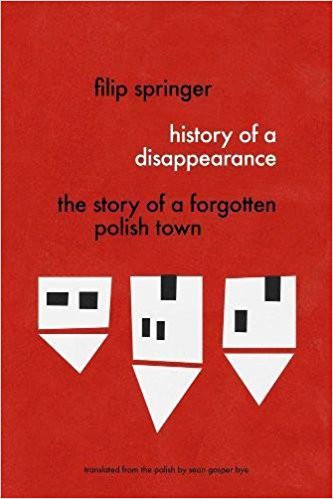
I was reminded of my own confusion in terms of how best to think of one part of familial history by Filip Springer’s History of a Disappearance: The Story of a Forgotten Polish Town. Though Springer isn’t writing about the part of Poland from which my family members hailed, he touches on a number of the same questions: what makes a particular piece of land belong to one nation or another? What does it mean to multiple generations of people who think of a place in an entirely different fashion? And how do those of us on the outside of these discussions best process the issues at hand?
At the center of Springer’s narrative is the German town of Kupferberg. Alternately, at the center of Springer’s narrative is the Polish town of Miedzianka. Unlike Superman and Clark Kent, they’re always in the same place at the same time—Kupferberg is located in a geographic region that was handed over to Polish control in the 1940s. Before the book even begins, a map of Lower Silesia shows a series of towns with names listed in both German and Polish; a larger map shows how the borders of Poland, Germany, and the Soviet Union changed after the Second World War. There’s a long and complex history here, one that eludes easy description.
What does it mean to multiple generations of people who think of a place in an entirely different fashion?
Springer’s approach to telling this story juxtaposes the intimate and the international in scale. The long first chapter covers several centuries’ worth of history, concluding in 1929, just before the shape of Germany and Poland will be forever altered. It’s followed by a collection of quotes, some taken from a manuscript, others from interviews. The juxtaposition, a range of voices with sometimes-conflicting opinions on major issues, helps to give the reader a sense of how these questions of borders and nations play out among everyday people.
Springer’s shifts in tone and style work with multiple purposes: he’s able to convey both the scale of the changes that affect Miedzianka/Kupferberg, and he’s able to give the reader a sense of the constant shifts in landscape that befell this place. Sometimes he hones in on particular stories: the tale of a woman named Barbara Wójcik, who eludes death numerous times in post-war Poland, is gripping on its own; in the greater context of the narrative, it speaks to the fragility of life in times of conflict and of the role of chance and luck in simply surviving.
After Communism had taken hold in Poland after the war, a nearby uranium mine became one of the sources of industry for the town of Miedzianka. Springer’s harrowing description of the everyday routine of the mine’s workers–and the devastating effect it had on their health–makes for one of the most gut-wrenching sequences in a book that abounds with them. Throughout the book, Springer demonstrates how governmental policy, interpersonal conflict, and the legacy of war lead to clashing worldviews and a series of broken bodies, environmental devastation, and histories that remain in constant flux.
This is a work that constantly pushes at the boundaries of what nonfiction and reportage can do.
The sociopolitical questions raised in Springer’s book also bring to mind plenty of contemporary political hot spots, including Russia’s recent military actions in Ukraine and its annexation of Crimea. And questions of shifting borders and concepts of national identity have shown up in fiction: China Miéville’s The City & The City features a micronation shared by two populations who have trained themselves to ignore one another’s residents and architecture, while Dave Hutchinson’s Europe in Autumn is set in a near-future Europe in which nations have become even more granular.
To call History of a Disappearance a work of nonfiction that reads like fiction does it a disservice: this is a work that constantly pushes at the boundaries of what nonfiction and reportage can do. Springer deftly brings together archival research, oral histories, and meditations on what can be learned from the history of this town (or, if you prefer, these towns). The story of how Kupferberg became Miedzianka demonstrates how national conflicts play out against the backdrop of smaller communities, but it also raises themes that are far from specific to the histories of Germany and Poland. In this provocative narrative, Springer raises a thoughtful array of questions that many will wrestle with for years to come.
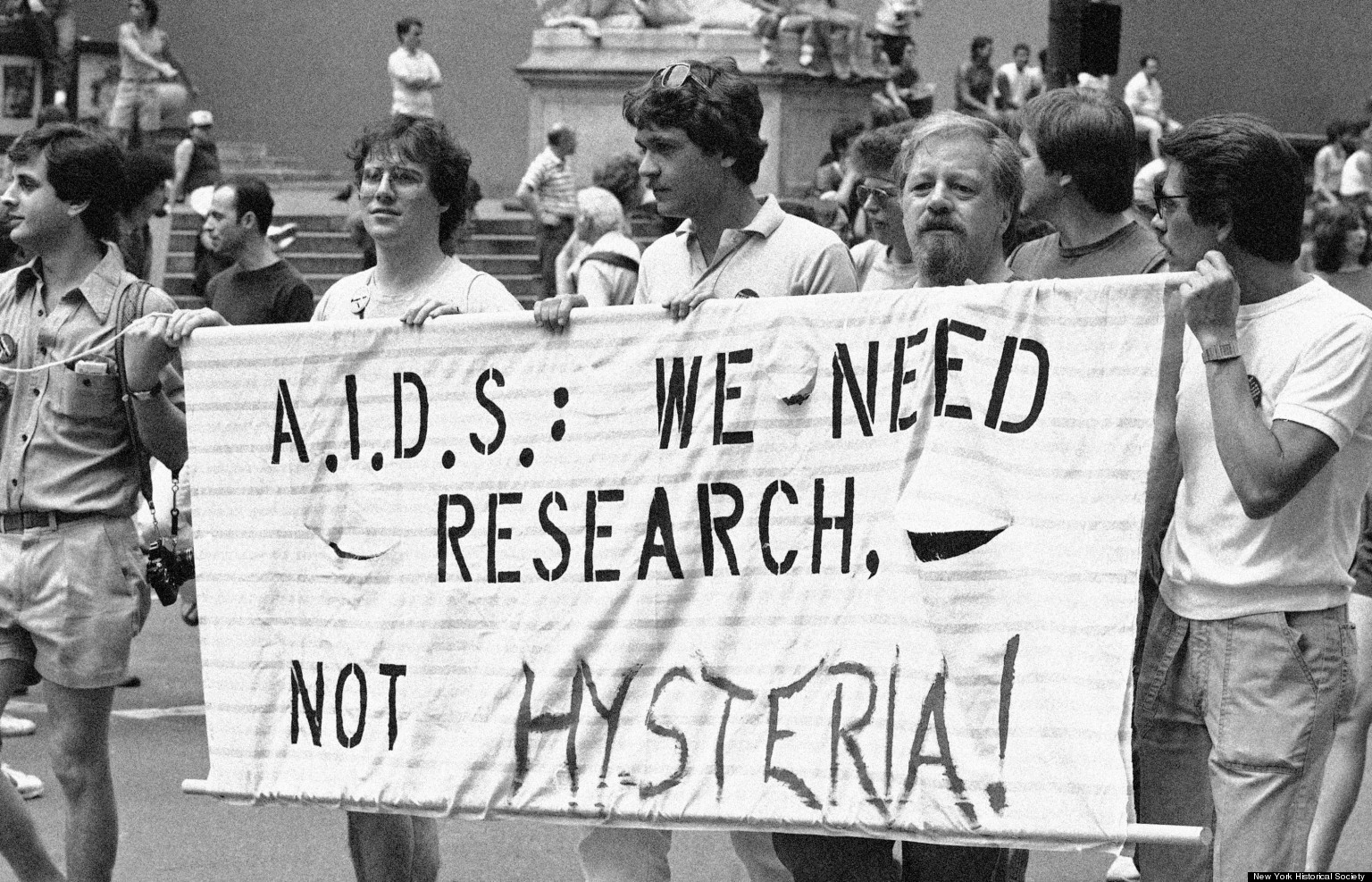
A s a disabled writer, I’m wary of using a medical marker to define an era, because HIV/AIDS is a sociopolitical issue as well as a medical one. But when looking at early HIV/AIDS literature, the convenience of using 1997 as a dividing point is difficult to ignore. That year marks the advent of Highly Activate Antiretroviral Therapy (HAART), when the experience and depiction of HIV/AIDS changed, at least for those of us with privilege and access to doctors and medications, from a death sentence to what is euphemistically called a “manageable chronic condition.”
In compiling this list of HIV/AIDS literature, I’ve necessarily made a few choices. First, the work had to be written before and/or about pre-1997 HIV/AIDS. And because I wanted to look at the undigested reality of those times, I decided not to include work about this era by contemporary authors writing from a retrospective distance. I also limited the discussion to work originally published in English. Perhaps the most important choice I make is not to include the important and crucial memoirs of the period because what I want most to explore is this: Early in the HIV/AIDS pandemic, how did writers create a fictional world based on all-too-painful reality?
1985
Samuel Delany’s Tale of Plagues and Carnivals, part of the eminent science fiction writer’s Nevèrÿon series, is one of the first novels to address AIDS. In this ninth tale of the series, a fatal sexually transmitted disease breaks out, predominantly among gay men. Delany parallels what happens in Nevèrÿon with how New York City dealt with the very early AIDS crisis. That what is seen as the first AIDS-related novel to be published by a “major” publisher was genre-fiction is notable. That it was by an African American gay man even more so, as the African American AIDS experience has too often been marginalized or ignored.
1986
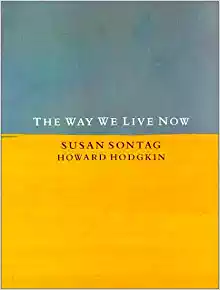
In “The Way We Live Now,” her short story first published in The New Yorker Susan Sontag creates a community surrounding Max, who is sick with AIDS in the hospital. We never hear from Max. Instead, the story is told in fragments by others as they grapple with something they’re not sure they know how to grapple with, the illness and impending death of a friend. Though borrowing her title from Anthony Trollope’s 1875 novel, Sontag’s story is informed both by her own experience of cancer, and her hospital visits to Joe Chaikin, the avant-garde theater director whose 1984 stroke left him with partial aphasia. It is this personal experience that saves the story from the disturbing trope of the voiceless patient and lack of sociopolitical context.
1989
Eighty-Sixed by David Feinberg and The Irreversible Decline of Eddie Socket by John Weir: I think of these two first novels together because they both depict gay life in New York City before, on the cusp of, and during the pandemic. They track what some might see as the sexual excesses of the pre-AIDS era into the time of what was known as the AIDS crisis. By doing so, behavior itself might seem as much a cause for a virus spreading as the longing for what might be unattainable: the perfect body, the perfect love, the perfect life. But read closer to see how the gay community, built on secrecy, competition, and caring, morphed into an example of how a long-despised and marginalized group learned to take the power to change into its own hands.
1990
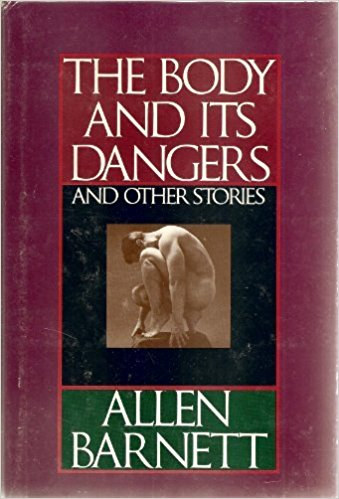
The Body and Its Dangers and Other Stories by Allen Barnett shares with the Feinberg and Weir novels a bit of gallows humor amid so much pain, death, and loss. In “Time as It Knows Us,” the book’s longest and most moving story, Barnett takes us inside a communal household where everyone is ill or HIV positive and looks at how friend cares for friend.
1990
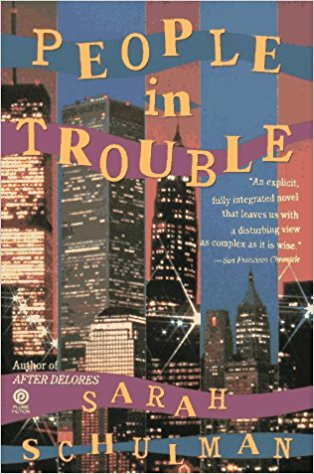
At the center of People in Trouble by Sarah Schulman is a love triangle set in, and illuminated by, the ravages of AIDS, homelessness, and other social ills of the Reagan era. Realizing they have nothing to lose, the AIDS activists of Justice (based on ACT UP), with whom Molly and Kate become involved, devise and perform acts of civil disobedience to gain attention from a purposefully distracted world. What’s uncanny about this novel is not only the character of real-estate mogul Ronald Horne (enough said), but also the small but resonant symbols of the era, including the teddy bears that were ubiquitously used to comfort those dying of AIDS and the car alarms in the city, to which nobody paid attention despite the loud consistent noise.
1992
Was by Geoff Ryman at first might not seem like an AIDS novel, though its protagonist, Jonathan, is an actor dying of AIDS. Jonathan’s pilgrimage to Kansas to find out about the “real” Dorothy Gael, who L. Frank Baum famously transformed into Dorothy Gale in his classic children’s book, The Wonderful Wizard of Oz, on which the ever-popular musical movie starring Judy Garland is based, can be seen as a fever induced dream. In Was, Jonathan learns of the difficult life of the dysfunctional and abusive Gaels, who suffered through the 1888 Kansas diphtheria epidemic. Interspersed is the story of Frances Gumm, who will become, despite and because of, her own family issues, Judy Garland. Ryman shows how myths and obsessions become the succor of those with difficult pasts, and how we deal with difficult pasts informs the way we deal with a difficult present. In an era where families, and most of society, abandoned gay men to AIDS, the fictions of Was felt all too real.
1994
The Gifts of the Body by Rebecca Brown is a cycle of interconnected stories, all told from the point of view of a caregiver for people with AIDS. Each of the ten stories is about a different patient and each has a theme related to various “gifts,” physical and emotional, of the body. Written in Brown’s trademark minimalist style, we experience the give and take of caregiver and cared for, what passes between them, and the emotions related to our bodies’ mutability. Unlike “The Way We Live Now,” The Gifts of the Body, though told from the point of view of the caregiver, distinguishes itself in its diverse array of characters and the humanity given to each, not only by the caregiver but also by the writer.
1996
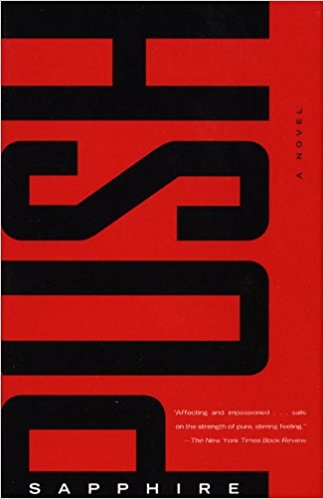
Sapphire’s debut Push is told in the visceral voice of Precious, an overweight, dark skinned, HIV-positive teen living with her abusive mother in Harlem. One of the short novel’s revelations is that Precious caught HIV by being raped by the man she knows as her father. Push charts Precious’s journey to self-esteem, helped by a teacher, as well as an AIDS support group. Though some of the latter part of the novel, which includes her classmates’ telling the stories of their lives, can read as agit-prop, Sapphire’s protagonist opens up AIDS fiction to include the voice of an African-American teenager as she is brutalized by, and fights against, a relentless world.
2004
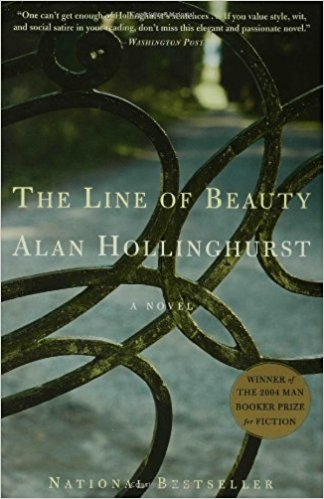
The Line of Beauty by Alan Hollinghurst is the only novel I include published after the advent of HAART. Hollinghurst’s first novel The Swimming-Pool Library (1988), in which there is no mention of AIDS, was set in the summer of 1983, “the last summer of its kind there was ever to be.” The Line of Beauty, which takes place in London during the Thatcherite 1980s (in one of its most famous scenes, the protagonist Nick Guest dances with Mrs. Thatcher), perhaps too subtly for some, indicts those in power, and those whose “values” kept them in power, for the neglect and stigmatization of those dying of AIDS. Hollinghurst does this with no direct political rhetoric. The Line of Beauty puts the early HIV/AIDS era in the sociopolitical context it belongs.
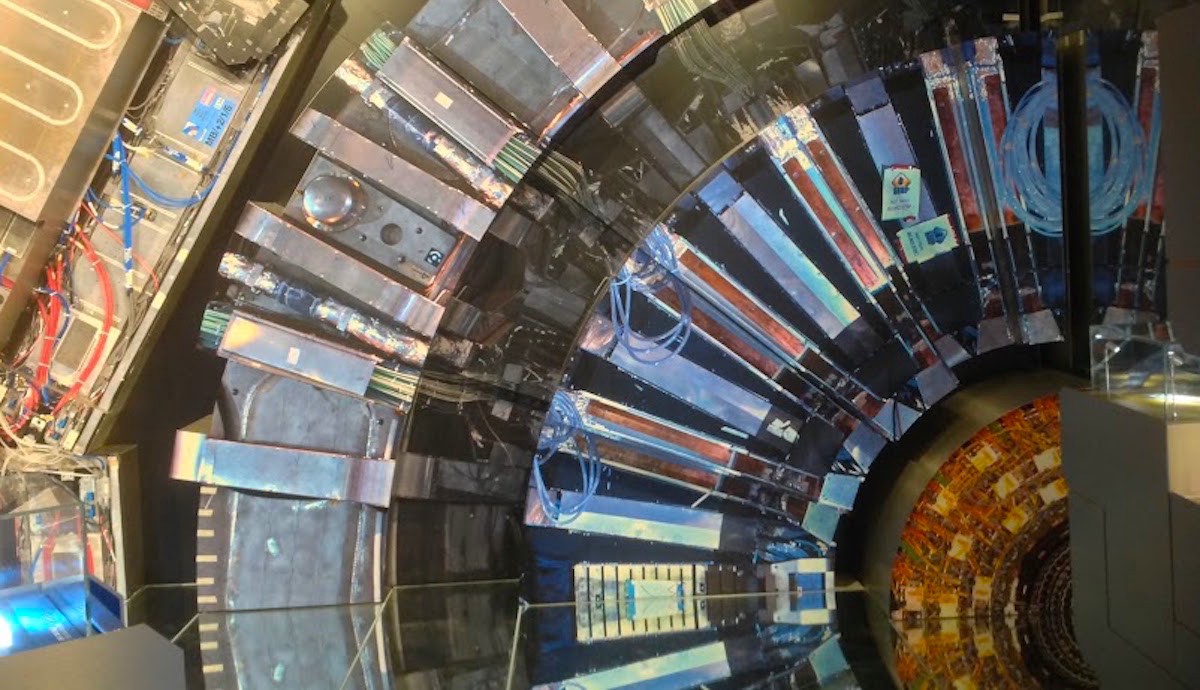
Let’s begin by talking about the Large Hadron Collider. It’s a particle accelerator located in Switzerland. As its name suggests, it’s massive. Its research may well help humanity determine certain essential properties of the universe in which we live. And, for numerous science fiction and disaster-story aficionados, its very existence opens the door to a host of tales of science gone wrong and the earth itself being consumed in a storm of anti-matter. (The BBC docudrama End Day, made by a pre-Rogue One Gareth Edwards, memorably depicts this; it’s got plenty of nightmare fuel in its imagery of the world imploding.) There is, in fact, a website dedicated to answering the question, “Has the Large Hadron Collider destroyed the world yet?” As of the writing of this review, thankfully, it has not. Still, its allure to storytellers isn’t hard to understand.
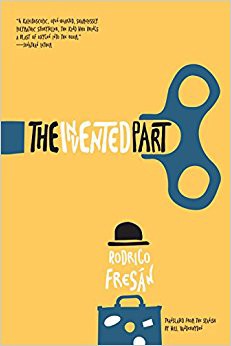
Rodrigo Fresán’s 2014 novel The Invented Part, newly translated into English by Will Vanderhyden, is a book that deals with the implications of the Large Hadron Collider on humanity and the universe. It’s also a tale of a lonely and frustrated voice grappling with their isolation from society, in the mode of William Gass’s The Tunnel and Saul Bellow’s Herzog. It’s a strange and rewarding book, and one which channels a stylized, almost hermetic environment—which seems to fit the themes of both supercolliders and the inner workings of the human psyche.
The Invented Part opens with a whopping sixteen epigraphs—musings on writing, memoir, and veracity from the likes of John Cheever, David Foster Wallace, Marcel Proust, Bob Dylan, Michael Ondaatje, and Iris Murdoch. First and foremost: that’s a lot of epigraphs. But by the end of the opening section in which they appear, Fresán’s intention for them seems clear—there’s a sort of micro-narrative taking place over the course of these sixteen quotes, one which establishes a realm in which quotes from venerated authors create an irreverent dialogue. For example, Kurt Vonnegut’s “All this happened, more or less” is immediately followed by James Salter’s “Nothing actually happened.” Epigraphs are frequently used as a way to usher the reader into the thematic ground that the ensuing book will explore. Here, Fresán is up to something a little different: the collage-like effect of these quotes provides a preview of what to expect from the novel to come. In other words, it’s the epigraph (or epigraphs) as overture.
If this sounds contentious, odds are good that the narrator of The Invented Part—and maybe the book itself—agrees with you. Once we’re past the epigraphs, the narrator (called the Boy, the Young Man, or the Lonely Man) veers into a section musing on fictional beginnings. From an early moment, the narrator takes aim at a particular mode of reading.
Today’s electrocuted readers, accustomed to reading quickly and briefly on small screens. And, yes, goodbye to all of them, at least for as long as this book lasts and might last. Unplug from external inputs to nourish yourself exclusively on internal energy.
This all might seem a little overwhelmingly “get off my lawn,” but that’s intentional—a fictional character feeling alienation rather than a novelist striving for the same. In the hundreds of pages that follow, the story of this novel’s writer-protagonist manifests in a host of forms, from archetypically-told tales of the artist as (literally) a Young Man to sections in which Fresán uses different fonts to convey the collisions of different narratives. The narrator of The Invented Part abounds with contempt for technological alterations to the experience of reading, and yet his story is being told in a manner that seems half Modernist and half hypertext.
What follows is a life told in fragments, showing the novel’s central character at a host of points in his life, from heady and idealistic youth to the more jaded voice encountered earlier in the narrative. There’s also an abundance of references to other artists — not just writers (though Joan Vollmer, Charlotte Brontë, and F. Scott Fitzgerald are the subject of plenty of rumination throughout the narrative), but also musicians. Which is another point at which the narrative folds back on itself. At one point, a comparison is broached between songwriting and fiction, which leads into this long digression:
Do any of you have even the slightest idea who Harry Nilsson was or is? Or Warren Zevon? And, just to be clear, I’m not talking about their dissonant or clever self-destructive epics but about their constructive intimacy in the moment of composing subtle and perfect songs.
As the novel goes through its abundant permutations, themes of the cosmic, the weird, and the science fictional start to enter the narrative. In the span of two sentences about two-thirds of the way through the book, Fresán invokes 2001: A Space Odyssey, H.P. Lovecraft, Jorge Luis Borges, and Adolfo Bioy Casares. Here, you have the transcendental, the paranoid, and the bizarre all invoked in short order—all of which serves as a notification for Fresán’s final gambit.
By the end of the novel, this narrator’s destination is in sight: the Large Hadron Collider, where he hopes to turn his metaphysical debates into something much more cosmic, and remake the universe. Given that the previous five hundred pages have found our hero dissecting his own life using a host of fictional devices, it doesn’t seem too far off the mark to note that The Invented Part is its own kind of “clever self-destructive epic.” And while writers writing about alienated writers is a familiar sight, there’s a welcome distancing here, as Fresán’s literary invocations remind the reader of the dangers of an unchecked creative ego.
Perhaps in keeping with the book’s science fictional side, The Invented Part is the first volume in a planned trilogy; Fresán’s followup, The Dreamed Part, is due to appear in English translation in 2019. This is a head-spinning novel, one in which heady invocations of art abut the loose outlines of a plot that could well serve as fodder for a SyFy original movie if treated differently. But then again, that blend of intense aesthetic discussion and absurdist pulp plotting is one that constantly reassembles itself, and offers a read unlike little else that’s out there. In terms of its knowing merger of pulp science fiction tropes and rigorous musings on art and society, the work of Bhanu Kapil is one of a handful of points of comparison—but Fresán and Kapil are very different writers. The Invented Part is a surreal and circular narrative, eventually cycling around and colliding with the very story it’s telling. As images go, that seems entirely fitting.
Parsons gets on flights and gets off later sometimes realizing he remembers nothing whatsoever about those hours in the air, kills routine delays in Chili’s and Wolfgang Puck’s and PF Chang’s nursing craft beers while working on client reports, buys breath mints after with the company card, arrives at the layover thinking it’s his destination, arrives at his destination thinking it’s his layover, arrives home anxious he’ll miss his flight out. Parsons’ home is Colorado Springs, but it could be anywhere, as much as he travels, a never-ending gauntlet necessitated by his boss’s insistence that clients value face-time, which maybe they do, though it seems to Parsons that what they value is any excuse to eat too much then play alpha dog afterward in scotch and cigar bars. Parsons is that excuse. Parsons’ actual title is “Associate Energy Consultant,” but his job is to fly and eat dinner. Parsons is thirty-one and single and clinically depressed, though undiagnosed. Parsons thinks this is his life, foreseeably.
Parsons plays a MMORPG called Lords of Chthon, in which he is a blacksmith orc or orcish blacksmith. Parsons’ orc’s name is Parsons1986 — the digits are his birthday year. Parsons immediately regretted naming his orc after himself, but once it was in the system it was impossible to change, and anyway it makes him identify a little more than he otherwise might with his avatar, an unprepossessing red and green creature forever falling into elvish Pits of Despair or getting ambushed by Goblin Militias. Parsons himself belongs to an orc guild and has made a couple of friends among the orcs, although “friends” might be pushing it. But he does feel a bond with them, especially an orc named Terrykins who always says hi to him and asks him how his day has been.
Parsons usually says “good you?” and lets the action proceed, but today, camped out at California Pizza Kitchen on a two hour delay, when Terrykins asks how he is, Parsons — or Parsons1986, technically — says “bad.” Parsons1986 tells Terrykins his life feels utterly unfulfilling and meaningless. Parsons1986 says he sometimes thinks about hurting himself. Parsons1986 apologizes, saying he knows people come to the Chthonic Realm to get away from this kind of thing, but he doesn’t really have anyone else to talk to. Parsons cannot talk to his boss or coworkers, and as for his family, don’t even get Parsons started on them. Parsons is lucky he turned out as well-adjusted as he did.
Parsons watches Parsons1986 watch Terrykins bob gently up and down in front of him, bow and arrow in hand, clearly unsure of how to respond. Parsons has a feeling Terrykins is about to kill Parsons1986 for the keks, so-called, so he slams his laptop shut, spilling his beer on his lap. Parsons gathers his bags and flees to the bathroom in a mincing shuffle of mortified dismay.
Parsons cleans up in the bathroom and looks at Parsons in the mirror. Parsons is not a bad-looking guy, save the dark stain on his crotch and a receding hairline that, like so many other things in his life, he cannot do anything about. Parsons thinks how strange it is that we walk around all the time looking at people, basing value judgments of others on how they look, on the casts of their faces, when anything could be going on inside; the man looking back at him in the mirror, for example, might be a happy person in a fulfilling job and relationship — even though the Parsons in the mirror is himself, he has a slightly hard time divining Mirror Parsons’ mental state.
Parsons leaves the bathroom marginally comforted by the thought that the people passing by cannot read his mind, do not know anything about him, although this thought becomes somewhat uncomforting the longer he dwells on it. Parsons partly wishes people could read his mind, know the pain he is in, although he’s not sure why he wishes that — after all, if he hasn’t been able to do anything about the way he feels in three decades, what could a stranger do? Parsons has always had trouble connecting with other people, and his attempts to share his loneliness have not exactly been fruitful, take Terrykins, for example. Parsons is put in mind of a date he went on recently, in Atlanta, with a woman he’d met on a gaming chat site. Parsons had thought of it as a date, anyway, but the woman showed up to the fancy restaurant he’d booked wearing frayed white jeans, and an unmistakable look of confusion on her face. Parsons got through the dinner by drinking and lying a lot. Parsons told her that he was married, had four (four!) children. Parsons told her he was working in biotech, a field he could barely describe to himself let alone someone else. Parsons thought about killing himself that night, though Parsons increasingly often thinks about killing himself, including how he might do it.
Parsons has variously considered jumping off something tall (probably the easiest way to go, though there might be incredible pain in that last millisecond) and shooting himself (probably painless or close to it, but he doesn’t know how to get a gun or want to go through that process, and anyway, the thought of disfigurement, even in death, is disturbing, though he knows that is irrational), but he has in fact gradually, without consciously making the choice, settled on a default suicide plan. Parsons’ bathroom counter features a large bottle of Ambien and two bottles of Lorazepam sitting beside each other, like soldiers awaiting deployment orders from Parsons, who stands before them nightly. Parsons imagines swallowing all of them, lying down on his Tempur-Pedic mattress, and being swallowed by the foam, just disappearing down into the Chthonic Realm.
Parsons sits in a plastic chair at Gate C7, with an hour to spare before the delayed flight will purportedly arrive. Parsons’ crotch is still damp. Parsons realizes he has decided to kill himself when he gets home; no, this not quite right — the decision was made long ago, it simply now feels like the right time. Parsons is frightened by the thought, the resolution he feels. Parsons makes a deal with himself: if Terrykins has killed Parsons1986, Parsons will end things tonight; if Terrykins hasn’t… he still might, but it’s not definite. Parsons opens his laptop. Parsons logs in. Parsons opens Lords of Chthon. Parsons finds Parsons1986 dead. Parsons’ gut wrenches in a sick twist of terrified relief. Parsons sees unread messages in the dialogue box. Parson reads these messages, in which Terrykins expresses sympathy and tells Parsons to send a PM, then lists a phone number and says Parsons should call him or her, then warns him of an axe-wielding troll creeping up behind. Parsons’ gut wrenches again in a sick twist of relieved terror. Parsons begins crying silently. Parsons shakes in his seat, shakes so hard that a girl texting on her phone across from him looks up in alarm and scuttles away.
Parsons, later on during the flight, attempts to work on a spreadsheet, but he cannot focus. Parsons feels ashamed of his earlier outburst, but then he looks down the metal tube in front of him, and he is suddenly overcome by a great affection for his fellow passengers, these strangers sharing this cramped space and stale air while trapped utterly in their own heads, and in this fleeting moment he forgives himself, thinking how hard, how hard it is to be a person! Parsons leans his head against the pillow, falls quickly asleep, and dreams of a horde of monstrous avatars rushing across a sweeping plain, joyful in their movements and weaponry, the arrows they launch like wishes into distant battlements.
Updated October 3 to include the finalists—see below.
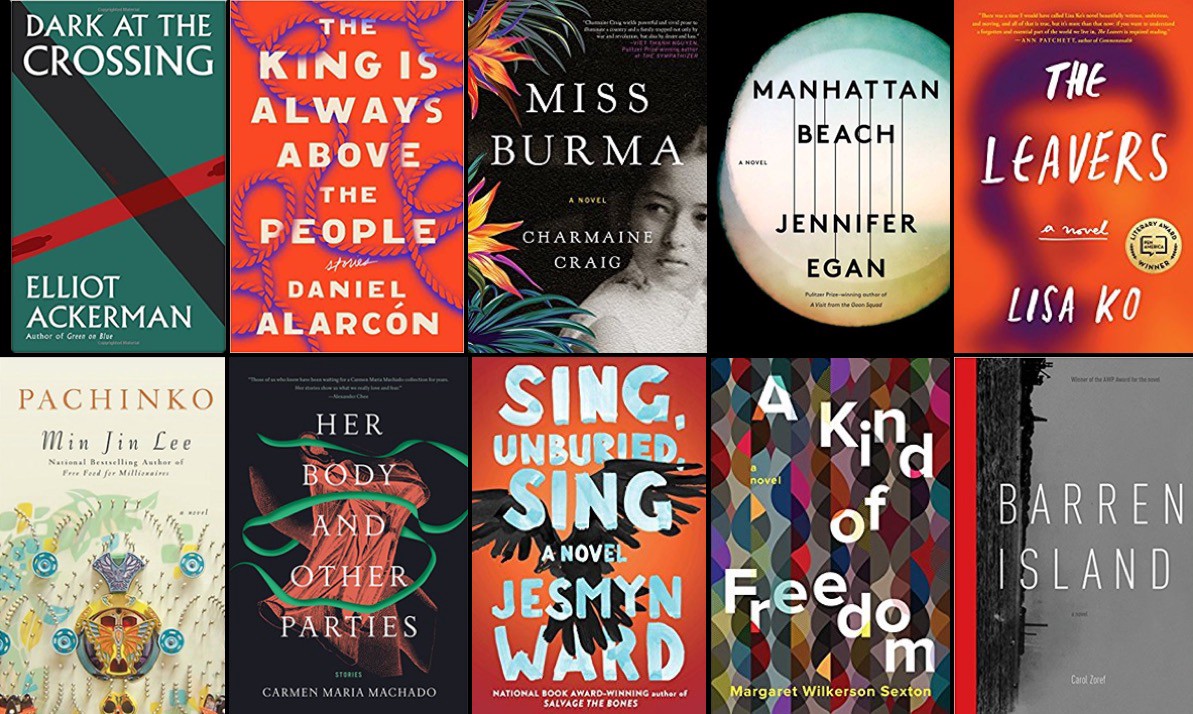
The National Book Awards fiction longlist is out, and it may not look how you expected. That’s partly because of the absence of hard-hitters like Paul Auster and George Saunders, both of whom have new novels that were shortlisted for the Man Booker prize this week. But it’s also because a full 40 percent of the semifinalists are first-time authors published by either independent or university presses.
Of course, there are big names too—notably Jesmyn Ward, who won this award in 2011 for her novel Salvage the Bones, and is in the running again for this year’s Sing, Unburied, Sing. (Perhaps even more impressively, her short story from A Public Space was printed in Recommended Reading.) Jennifer Egan, winner of the 2011 Pulitzer Prize for fiction, is also on the list for her upcoming Manhattan Beach.
But it’s not just 2011 all over again. The deluge of debuts includes Carmen Maria Machado’s dark and intricate short story collection Her Body and Other Parties; Lisa Ko’s The Leavers, about a boy whose undocumented Chinese immigrant mother goes missing; Margaret Wilkerton Sexton’s New Orleans family saga A Kind of Freedom; and Carol Zoref’s Barren Island, about immigrants working in a horse-rendering plant in an island off New York. These first-timers are published by, respectively, three independent presses and a university press: Graywolf, Algonquin, Counterpoint, and New Issues Poetry & Prose. Another longlisted book, Charmaine Craig’s Miss Burma, was also put out by independent publisher Grove.
We asked Machado, who’s written for Electric Literature in the past, what it was like to have a first-time book in the running for such a prestigious award. She gave us a pretty unfiltered reaction: “I, uh, can’t believe this is happening? But I’m so fucking grateful to everyone at Graywolf and my agent Kent Wolf for believing in my weird beautiful little book.” Machado also drew attention to the longlist’s diversity, not only in terms of publishing history but also experience and voice: “I’m really honored that the NBA judges are giving recognition to women, queer folks, people of color, small presses, debut books, and short story collections. As a debut author, I definitely was not expecting this. I guess I’d imagined that if something like the National Book Awards was in the cards for me, I’d be working my way up to it over the course of my career, if that makes sense. So… I’m in shock. But it’s a good kind of shock.”
The judges (Alexander Chee, Dave Eggers, Annie Philbrick, Karolina Waclawiak, and Jacqueline Woodson) will now go into chambers; the finalists will be announced on October 4, and the award on November 15. Chances are still better than even that it’ll be someone whose work you already know, from one of the more established publishing houses. But those chances are definitely not as high as they usually are.
Here’s the whole list:
Elliot Ackerman, “Dark at the Crossing” (Knopf/Penguin Random House)
Daniel Alarcón, “The King Is Always Above the People: Stories” (Riverhead Books/Penguin Random House)
Carol Zoref, “Barren Island” (New Issues Poetry & Prose)
Update:
The shortlist has now been announced, and the finalists are:
Elliot Ackerman, “Dark at the Crossing”
Lisa Ko, “The Leavers”
Min Jin Lee, “Pachinko”
Carmen Maria Machado, “Her Body and Other Parties: Stories”
Jesmyn Ward, “Sing, Unburied, Sing”
Two debut authors, two indies, four women, and only one white guy! No matter who wins, we kind of all win in that sense. (But the actual winner will be announced at the ceremony on November 15.)
I n the past several days, I have read the following books: Just Mercy, Hillbilly Elegy, Rise from Darkness, and String Theory, David Foster Wallace’s exploration of greatness in tennis. I read Walden while boiling water for pasta and The Bully Pulpit while pretending to use the bathroom to get a break from my toddler.
Since you’re wondering: no, I haven’t taken a speed reading course (although I did read 10 Days to Faster Reading). I signed up for Blinkist.
Blinkist is an app that allows you to “access … key insights from 2,000+ bestselling nonfiction books, transformed into powerful packs you can read or listen to in just 15 minutes.” In other words, it’s like SparkNotes for the self-help department.
In many ways, Blinkist is not an app that was designed with someone like me in mind. I don’t read much from its staple genres: Personal Growth & Self Improvement, Management & Leadership, Motivation & Inspiration. Anyone can use Blinkist, and it does offer books in topics ranging from Parenting to Politics to Biographies, but its bread and butter — Entrepreneurship & Small Business, Marketing & Sales, Productivity & Time Management — appears to be targeting a market that is decidedly not me.
Blinkist seems built for the type of person who is actively looking for ways to lifehack the time they spend unwrapping their power bars in order to maximize their morning growth potential. The type of person who uses the words “paradigm shift” and “actionable” confidently and without having to Google “business jargon,” like I just did. The type of person who really WANTS to read The 4-Hour Workweek, but just can’t find the time between Crossfit and Extreme Racquetball, which is like regular racquetball but muddy and you won’t shut up about it.
This app is for the type of person who really WANTS to read The 4-Hour Workweek, but just can’t find the time between Crossfit and Extreme Racquetball, which is like regular racquetball but muddy and you won’t shut up about it.
I am not a businessperson, in vocation or temperament. I am also not a person deeply invested in my own personal improvement (but I don’t want to brag). I’m a lowly freelance writer who finds the very idea of a “power nap” offensive, and I’ve never once looked at something and thought, “There’s gotta be a better way!” In fact, as someone who lives with chronic depression, I’m more prone to thinking, “This current solution is bad, but it is the best we can hope for, and who even cares because soon we shall all return to the cold, unforgiving dirt for the Eternal Power Nap.” But it was this fact — that I am someone who both loves to read and is sometimes too depressed or exhausted to do it — that got me thinking about the toxic relationship between depression and productivity (or lack thereof). And I wondered if Blinkist might help.
I went through a long bout of major depressive disorder in college, and the first thing I lost was the ability to read. I was an English major who suddenly couldn’t finish a page: I would stare at my textbooks, my novels, my laptop screen, and the words just swam. It was the feeling you get when you are exhausted and realize that you’ve just read four pages of a book without actually reading a word, only it was everything I read, and it was all the time.
That was a long time ago, but now, even in the midst of the daily, mild depression I now live with quite comfortably, books can quickly become weaponized. That’s because depression will feed on anything, no matter how small or strange or insignificant. In this way, it is the goat of mental illnesses: whether you put filet mignon or a tin can in front of it, it’s going to eat. And I don’t mean a cute goat, by the way, one who goes down slides or sings along to Taylor Swift. I mean a goat that can see an unread book on your nightstand and use it to convince you that not only will you never finish that book, you will never finish any books, reading is a waste of time, and also, even though you still know all of their first and last names, none of your elementary school classmates remember you.
Or a goat who cannot choose its next book because there really are so many books, and there really is so little time, and what if it makes the wrong choice and halfway through discovers that it just doesn’t like Cormac McCarthy and needs to admit that to itself, and this means that it — the goat, obviously the goat — is stupid and is never getting those precious hours back, and why are there so many books to begin with? I love books, but I think there are too many, and I’m pretty sure it’s specifically to torture me. Don’t take my word for it: I think even Ray Bradbury would agree with me on this, since he wrote an entire “how-to” guide on how to solve the book overpopulation problem (unless I am gravely misreading Fahrenheit 451).
I love books, but I think there are too many, and I’m pretty sure it’s specifically to torture me.
Whether a stack of books on your nightstand sends you into an existential crisis, or you’re just a normal busy person, the best part of Blinkist is that it gives you the feeling of accomplishment. When I finished a “book,” I clicked a checkmark, and it congratulated me. “Done and dusted!” it proclaimed, and I got a little serotonin burst. I hadn’t done anything real or important — in truth, I had just read a very poorly worded, laughably simplified summary of a heavily researched, 400-page book — but that didn’t matter. There’s also nothing inherently impressive about, say, leaving the house, but if you can overcome the inertia of your own depression to turn that knob and step outside, then, at least in that moment, it’s enough.
Blinkist also aids the decision-making process. Reading the summary of Hillbilly Elegy confirmed that I didn’t really need to read the whole book. “Reading” String Theory by David Foster Wallace fascinated me enough that I plan on reading the whole book. It’s like when people justify illegally pirating music by saying they’ll probably buy the album anyway, except it’s not a lie.
Blinkist is decidedly not a substitute for reading books. It may be a substitute for reading books that no one actually needs to read in the first place, books that only contained 15 minutes worth of an idea but had to be stretched out to 200 pages for the publishers. The Four Hour Workweek? Check your email less, be rich to begin with. Boom. Done and dusted.
Blinkist is decidedly not a substitute for reading books. It may be a substitute for reading books that no one actually needs to read in the first place.
But the thing that brought me the most joy from Blinkist was, more often than not, how bad the summaries were. Here, for example, is how Blinkist introduces the classic transcendental meditation that is Walden:
You’ll also discover:
* why devoting yourself to your work can make you a fool;
* how so-called “savages” are actually very advanced when it comes to housing; and
* which one of Thoreau’s visitors had a habit of crawling up his leg.
Spoiler alert: that last one was Emerson!
Today, I cancel my free 7-day trial to Blinkist. I’ll spend my money on SSRI co-pays instead of the $79.99 Premium subscription. And if I ever change my mind, there’s a whole section on life hacks for happiness.
The other African girl was tall. She had a broad, square-shaped body with muscular arms and legs. Her skin was like onyx, very black and shiny from the baby oil she smoothed on after her morning bath. Her name was Agatha and she was from Kenya.
When I first arrived at St. Mary’s in the middle of the term, she sat on her bed watching as Auntie Harriet helped me to unpack my things. All of the other girls were lounging on the sofa and armchairs at the front end of the long, narrow dormitory. They were painting each other’s toenails bright pink and eating a large tin of Quality Street chocolates. I noticed that they were all white or Asian. The girls had not looked up when Auntie Harriet and I walked in with Sister Miller, who asked me if I had brought a hot water bottle to sleep with. It could be rather cold at night in this part of England. It didn’t get cold where we were from, did it?
I was often the only, or one of very few, black students at the schools I attended. My father worked for the United Nations. In Year Three at an international school in Rome, a boy refused to hold my hand during a game of Ring Around the Rosie because his mother said that God left black people in the oven too long. That meant that we were mistakes. The teacher corrected him: Colored people are just like us. I was not supposed to correct teachers, so I didn’t say anything about her use of the word colored. Everyone in my class called me burnt toast behind my back for months. Then, a popular girl started putting twigs in my big curly hair at recess and laughing at how they did not fall out. Once, I grew hot and I shoved her hard. I was pleased that she skinned her knee and that she looked ugly when she cried. For a full year, until we moved again, I did not have a single friend. From those experiences, I learned to observe carefully. I learned there were ways to make it so that race didn’t matter, or at least so that it didn’t matter as much.
I was not supposed to correct teachers, so I didn’t say anything about her use of the word colored.
“Agatha,” Sister Miller said, motioning for her to come over to us, “this is Nadia. She is from Ghana.” She said it like “Gay-Na.” “Is that near Kenya?”
“Not really,” said Agatha. “Nice to meet you.”
My father taught me to say, when people asked me where I was from, that I was Ghanaian. I overheard him tell a friend that my American passport was just a practicality. It would enable me to go to college in the States without any trouble. And, it would easily open up doors for me that had taken him many years to jimmy open. He sounded angry about all of this. He said the word American as though it was an insult. My mother, who left him — left us — when I was two, was Armenian-American.
A few days after that conversation, a woman on the metro in Rome asked me if I was Indian. She was looking back and forth between my father and me with a furrowed forehead. People often walked up and asked me questions like that. The woman’s tone suggested that she couldn’t figure me out and she didn’t like it. “My daughter is black,” my father snapped. The woman hurried away. “Don’t ever be confused about that,” he said to me, as though being confused was a choice, as though blackness was a simple thing.
I was obsessed with literature about people like me: Black people, in-between people, people who complicated the rules.
I am not proud of this, but when I met Agatha and observed that we were to be the only two black girls in the dorm, I was relieved that she was dark-skinned. I was relieved that she had a wider nose, nappier hair, and fuller lips than me. I was relieved because this meant I would not be at the bottom of the racial pecking order. To be clear, I did not believe that this pecking order was just or right. My father was dark-skinned and so were many of the people I loved and respected the most. But it did not matter what I believed. The rules were written long before I arrived at St. Mary’s, long before Agatha and I were born. I knew the rules well because they shaped my life, and also because I was obsessed with literature about people like me: Black people, in-between people, people who complicated the rules.
In “Why I Love Black Women,” sociologist and writer Michael Eric Dyson wrote:
The preference for (light skin) finds painful precedent in black culture. It dates back to slavery when the lightest blacks — whose skin color was often the result of rape by white slave masters — were favored over their darker kin because they were closer in color and appearance to dominant society.
Mulatto slaves, as they were then called, were often viewed as more intelligent and were thus assigned indoor domestic work instead of strenuous outdoor, manual labor. Many were taught to read and write, and in some cases were even granted freedom before it was required by law. This preferential treatment was designed to stratify the black community and to establish whiteness as the ideal to be aspired to, even among black people.
After the American Civil War, these divisions persisted, as lighter-skinned former slaves had internalized their privilege. They often distanced themselves from darker black people through marriage and the establishment of separate civil and cultural organizations. And the transition into freedom was easier for light-skinned black people because of the stereotypes that white people held about blackness. In his book, Soul by Soul: Life Inside the Antebellum Slave Market, Walter Johnson notes that dark-skinned slaves, particularly men, were believed to be more prone to violence and theft and incapable of controlling sexual urges. After slavery, darker-skinned black people found it more difficult to find paid work.
The same forces that led to the privileging of lighter-skinned black people in America were also exerted in Africa during colonialism. In Black Skin, White Masks, Frantz Fanon writes that “the colonized is elevated above his jungle status in proportion to his adoption of the mother country’s cultural standards.” This truth was evident in Rwanda, for example, where first German and then Belgian colonists favored the Tutsi tribe over the Hutu tribe based on the Hamitic hypothesis.
This hypothesis, believed by many Western scholars at the time, held that there were two races present in Africa: the Hamitic race and the Negroid race. The Hamitic race was thought to be a superior race of people who originated in northern Africa. British historian C. G. Seligman went so far as to claim that all significant discoveries and advancements in African history, including those of Ancient Egyptians, were achieved by Hamites. He argued that Hamites migrated into central Africa as pastoralists, bringing more sophisticated customs, languages, technologies and administrative skills with them. Hamites were believed to be more closely related to Caucasians. Tutsis were believed to be descendants of Hamitic people because they had more ‘European’ features. Hutus were believed to be fully Negroid. Tutsis were therefore allowed more access to education and jobs. Ethnic identity cards were introduced to ensure tribal division. Many have argued that this division was at the root of the Rwandan Genocide of 1994, during which members of the Hutu majority murdered as many as 800,000 Tutsi people.
After pointing to the wardrobe and telling me that I should put my things in it, Sister Miller disappeared into her small private room in a corner of the dormitory. We heard the theme song for Coronation Street through the open door. Agatha sat on the chair next to the bed that was to be mine. She listened to Auntie Harriet and me as we chatted about how I should make sure to wear two pairs of socks if it snowed and how much money I would get each week for the tuck shop. Agatha nodded at everything we said as though she was somehow a part of our arrangements.
Agatha nodded at everything we said as though she was somehow a part of our arrangements.
Auntie Harriet tied her shoulder-length box braids back with a hairband that had been around her wrist. She took all of my things out of my small suitcase and placed them neatly in the drawers. My new green and red school uniforms were hung in the closet and a teddy bear was placed on my pillow, even though I was twelve. Then, Auntie Harriet hugged me and told me that she would come back to get me in two weeks. She would bring a hot water bottle. I was to spend every other weekend with her in London.
“Nice to meet you, Agatha,” she said, “I hear that Kenya is a very nice place, very advanced for Africa.”
“Yes,” said Agatha, nodding more vigorously.
I had come to St. Mary’s because my father thought that all the moving around was disrupting my education. He had left his small village for boarding school in Kumasi at the age of nine. Boarding school, he believed, would teach me to be independent. It would provide more educational rigor and discipline than the American school in Rome where he had recently been transferred back to from the Kampala office. He called the school in Rome “Foolishness International.” When we went there for a tour, the principal let us peek into the classrooms while lessons were in session. Later that day, my father told my stepmother that the children seemed to spend all day painting with their fingers and expressing their opinions. How could they have opinions when they didn’t know anything yet? Nobody knew anything until they were at least eighteen. First you should learn facts; then you can form opinions. Anabel laughed.
“That is not how they think in America,” she said, “Everyone is entitled to an opinion, even children. Facts or no facts.”
In the dining hall that night, I learned that all of the girls in my dormitory — the Year Nine girls — were to sit together at every meal. Agatha told me this as we stood in line to be served our shepherd’s pie and sides of peas. She had not left my side. She showed me where the toilets and the showers were. She explained the schedule — what time the bells for breakfast, assembly, church, and classes would ring. I had already gotten this information in writing from the boarding mistress that morning, but I let her tell me anyway. As she talked, I watched the other girls. I wondered why Agatha was not with them. They seemed to be enjoying themselves, looking at teen magazines and gushing over boy band members. If there was something wrong with Agatha, I didn’t want to inadvertently become associated with whatever it was. I hoped that race was not the issue, but I did not rule it out as a possibility.
Agatha set her plate down at the very end of the table, leaving a space on the bench between herself and a pretty blonde girl with rosy cheeks. The blonde girl looked like the girls in the school’s brochure, the ones who had been running around in the field of geese. I sat across from her rather than across from Agatha. I could feel Agatha staring at me, but the boarding mistress said grace so I was able to close my eyes to avoid looking at her. A twinge of guilt tightened my heart and I resented it. It was not as though I sat so far away from her, I told myself.
“I’m Nadia. What’s your name?” I asked the blonde girl as the room filled once again with loud conversation. She perked up at my question.
“Are you American?” she asked.
“Yes,” I said, sensing immediately that this was the right answer. My father was the one who had exiled me to this school. I couldn’t be expected to follow his rules about nationalities now. I was alone and had to fend for myself. If my American accent (courtesy of my international school education and the summers spent with my mother in Massachusetts) was an asset, then why should I not use it to my advantage?
“I’m Claire,” she said. “Everybody, Nadia’s American.”
It quickly became clear that Claire was the most important of the Year Nine girls. The other girls watched her while they talked. When her upturned nose wrinkled, they started to stammer, reversing what they were saying. It also quickly became clear that Claire did not like Agatha. Claire doled out her attention evenly, giggling at jokes and smiling at each girl as she asked them a question or approved of an opinion. But she never so much as glanced at Agatha, who ate her meal in silence.
After dinner, we were allowed to watch a film in the common room. Claire selected The Wizard of Oz from the sparse collection on a small bookcase against the wall. There were not that many films the nuns deemed appropriate for young ladies. Nobody else even attempted to weigh in on the decision. As I settled into a beanbag chair and Claire turned off the lights, Agatha walked by the common room in her pajamas, a book in her hand.
“Thank God she’s not coming in here,” said Claire. “She smells so horrible. Didn’t you notice, Nadia? It’s really awful, isn’t it?”
All of the girls turned to look at me.
“Oh, yes,” I lied, “It’s so bad. I’ve been holding my breath all day.”
Everyone laughed and Claire pressed play.
The next day, when my father called, I could barely bring myself to speak to him, I was so ashamed.
In George Schuyler’s 1931 novel Black No More, Dr. Junius Crookman develops a revolutionary process that can make black people white. Max Disher becomes one of his first customers after he is rejected by a white woman. Black Max becomes white Matt. He marries Helen, infiltrates a white supremacist organization, extorts millions of dollars, and absconds to Europe. Meanwhile, as more and more black people become white, black leaders lose their power and America loses its cheap labor. The country is in turmoil. Then, it is discovered that it is possible to identify “new” white people because they are several shades lighter than “original” white people. So, America throws out notions of white superiority and, instead, everyone rushes to purchase skin darkening creams. Now, black becomes beautiful. Through satire, Schuyler illustrates the absurdity of racism.
“My sociology teacher had once said,” Dr. Crookman tells reporters during a press conference, “that there were but three ways for the Negro to solve his problem in America…To either get out, get white, or get along.” There was no way for me to get out of St. Mary’s, though I begged my father. It seemed that getting along would be difficult without Claire’s approval. So, I stooped to what Max did. I rejected blackness, and embraced whiteness.
There was no way for me to get out of St. Mary’s, though I begged my father. SonI rejected blackness, and embraced whiteness.
That week, I carefully considered every move I made. I got to know each of the Year Nine girls and to understand their places in the social order. Claire’s full name was Lady Claire Suggitt-Jones. Her father was a member of the House of Lords. Her mother was a beautiful socialite who was frequently in the pages of Hello Magazine at polo tournaments and ribbon cuttings. Most of the other English girls were of a similar ilk — either titled or moneyed. My family could only afford the school fees because they were paid by my father’s employer. Claire’s sidekick, Veronica Ivanenko, was the most beautiful girl in our year, more beautiful than Claire but without any discernible personality of her own. Her father was a Russian millionaire. Her parents were divorced and her mother was now dating a famous pop star. The three Asian girls were all from Honk Kong. They would occasionally wander off together, speaking in Cantonese. Of them, Patricia was the leader because she had a wicked sense of humor that even Claire, who prided herself on being quick to jab a precise joke into the fleshy part of other people’s stories, had to admire. Around Claire, Patricia was quieter, more prudent with her dry wit. She too, it seemed, played by the rules.
I began to develop my role in the group. Because I was believed to be American, I was expected to behave like the teenagers in the American television shows that the girls watched a great deal of. Luckily, I had watched the same shows. I was supposed to roll my eyes frequently at the stuffiness of life at St. Mary’s. This was not difficult to do. I did find St. Mary’s stuffy. I was also supposed to have some experience with boys and other forbidden things like cigarettes and alcohol. I didn’t have any experience with any of those things, but it wasn’t difficult to pretend that I did. Nobody knew me. Because I had often found myself without friends in the past, I had spent a lot of time alone with nothing but books and my imagination to keep me company.
Always, Agatha watched me. As I walked to the tuck shop with Claire and Veronica, she followed close behind, her eyes searing my back. Once, I entertained the girls by arguing with Sister Miller who wanted to tear the pages about dating and menstruation out of our magazines. Puritanical suppression of ideas, I called it. Agatha listened, but did not laugh when everyone else laughed. Since her bed was across from mine, sometimes she would walk over to try to talk to me before lights-out. I didn’t ignore her, but I didn’t encourage her either. I answered her questions in as few words as possible.
“The food here is not nice, is it? Do you miss eating food from home?”
“Not really,” I said, even though every time I went to Auntie Harriet’s for the weekend, all I wanted was foo foo and peanut soup.
“Is there a place in London where you go to do your hair? I need to get my braids redone.”
“My Aunt does it,” I said. In truth, Auntie Harriet took me to a place in Wembley once a month. I felt bad for lying about that because Agatha’s hair was starting to look bad. There was a lot of unbraided growth. The extensions in the front of her head were hanging onto her short baby hairs for dear life. But I didn’t want to risk losing my status by inviting her to come to the salon with me.
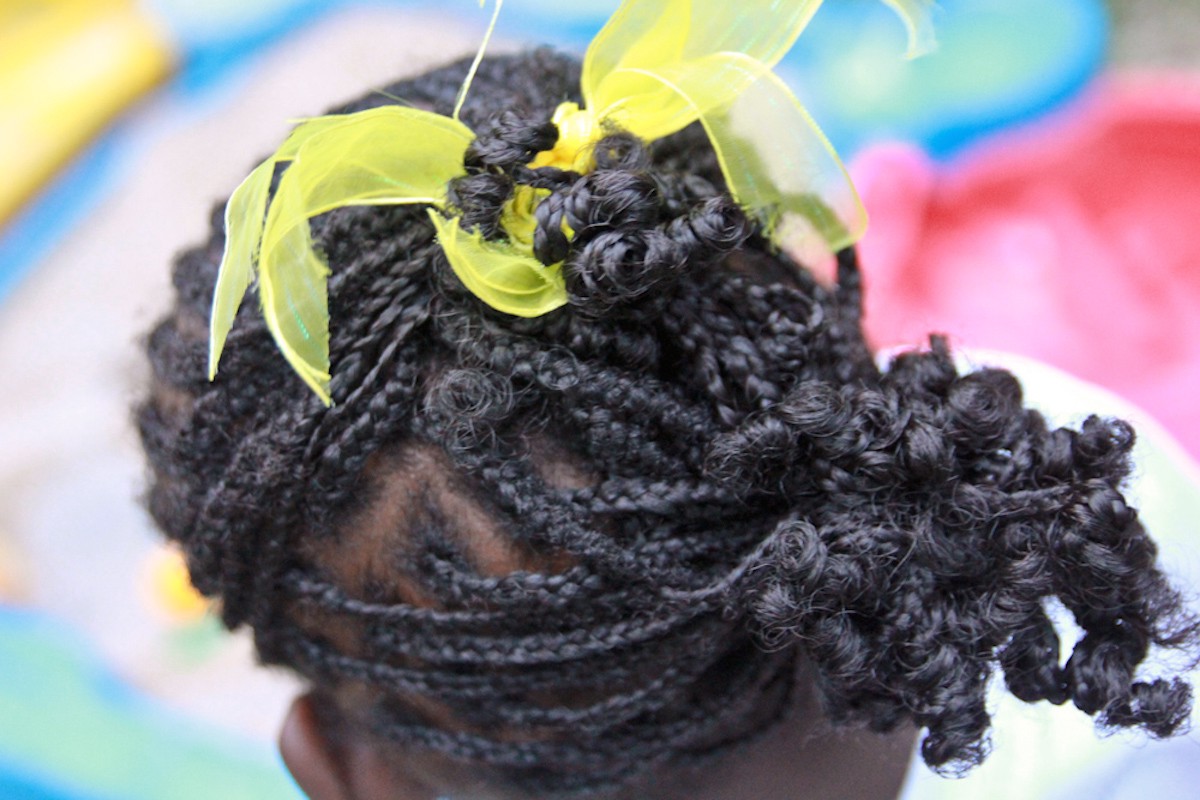
A month after I started school at St. Mary’s, I began to find Agatha’s braids everywhere. I found one in the shower and one in the entrance to the laundry room. One of the Belgian nuns who washed our clothes (I never learned why the nuns were assigned jobs based on nationality. The Belgians did laundry; the Irish worked in the kitchen) handed it to me thinking that it might be mine. Given that potential confusion, I made sure to dispose of every braid I found, wrapping them in toilet paper and throwing them into the garbage. Meanwhile, Agatha’s hair was looking more and more desperate. She tried to cover it up with headbands and ribbons, but they weren’t much help. Unlike me, she had no family in England. I was the only African girl she knew.
One day, during P.E., it was warm enough to play field hockey outside instead of playing handball in the gymnasium. We all changed into the very short green skirts and matching bloomers we wore for sports activities. We ran three laps around the field to warm up. Claire and Veronica jogged right in front of me.
“Look at her go,” Claire said pointing at Agatha. “She looks like a gorilla. Like a giant ugly gorilla.”
I picked up speed and passed them. It would be easier for me to pretend not to have heard her. I ran faster than I had ever run in my life.
That night, at dinnertime, Veronica found one of Agatha’s braids in the bread basket as we stood in line for roast beef and potatoes. She shrieked so that everyone turned to see what was happening. Claire picked up the braid with a napkin.
That night, at dinnertime, Veronica found one of Agatha’s braids in the bread basket as we stood in line for roast beef and potatoes.
“Oh my days,” she said. “It’s Agatha’s filthy weave. It probably has insects in it. I’ve completely gone off my food.” She said this in a loud voice for all to hear. She dropped the braid on the floor dramatically.
The hall roared with laughter. I saw that even Sister Harris, who had a soft spot for Agatha, chuckled.
“Nadia,” Claire squealed, “Are your braids going to fall out like Agatha’s?”
“No,” I said trying to sound light, “mine are not fake like hers.” I decided I would put a photograph of my mother up on the wall behind my bed. She had olive skin and straight, silky hair. Never mind that I barely knew her.
Behind me, I heard a tray slam down onto the counter. I turned around to see Agatha walk calmly but stiffly out of the dining hall.
After that, Agatha stopped trying to talk to me before lights-out. She stopped watching me.
In Toni Morrison’s The Bluest Eye, Pecola longs, painfully, for blue eyes. She idolizes Shirley Temple and detests her dark skin that even her own mother deems ugly. She is tormented at school. She sees whiteness as the key to being loved. She obsessively eats candies, the wrappers of which are printed with a photo of a blonde-hired, blue-eyed girl named Mary Jane. She hopes that eating the candy will transform her eyes to blue. She also appeals to God. But she only receives her blue eyes through madness after she is raped by her father, gives birth to his child, and is thoroughly shunned by her community. She decides the shunning is because everyone is jealous of her blue eyes. Perhaps her fixation on blue eyes as opposed to white skin speaks to a deep-seated knowledge that it is the world that needs to change, not her. Because she cannot change the world, she chooses to see it differently, through different eyes.
I too chose to blind myself, but I chose to blind myself to the horrible way in which Agatha was treated. The narrator of The Bluest Eye tells us this of how people felt about Pecola: “Her simplicity decorated us, her guilt sanctified us, her pain made us glow with health.” I cannot claim that I did not relish the fact that I was accepted by Claire while Agatha was not. I cannot claim that under Claire’s blue-eyed gaze, I did not, despite my guilt, glow with health.
I cannot claim that under Claire’s blue-eyed gaze, I did not, despite my guilt, glow with health.
On Friday, Auntie Harriet came to take me to London. Agatha was sitting on her bed reading a book. She had headphones on. She almost always had her headphones on in the dormitory now.
“Ay!” said Auntie Harriet, catching a glimpse of the state of affairs on Agatha’s head. “We should take her with us to Wembley. Does she have no one to braid her hair?”
I could not think of a reason that would make sense to Auntie Harriet as to why Agatha should not come with us. So, Auntie Harriet spoke to Sister Miller and then to Agatha who looked up at me, surprised. Agatha called her parents in Nairobi to ask for permission.
As we walked out of the dormitory, Claire stared at us open-mouthed. There would be questions, questions to which I was already thinking up answers.
“Thank you,” Agatha said to me quietly in the car. Tears filled my eyes. She had nothing to thank me for. I knew I would be nice to her as long as we were in London, but things would not change when we were at school. Not if I could help it. She observed me, smiling a sad little smile. Then, she turned to look out the window. It was grey and raining. It was always either grey or raining or both.
“Whatever these English people did to deserve this weather,” said Agatha, “must have been bad, very bad.”
The memory of how I treated Agatha still causes me to hang my head, to gnaw at my cuticles, to feel an uncomfortable remorse. It has led me to reckon with my own relative privilege. I know, from life and literature, how insidious racism is, how destructively absurd. I used to look to literature to help me understand how to exist in an often racist world. I sought to understand the unjust rules, and admittedly, how to make them bend in my favor.
Now, I read to understand how to reject them, how to rewrite them. In The Fire Next Time, James Baldwin writes:
The subtle and deadly change of heart that might occur in you would be involved with the realization that a civilization is not destroyed by wicked people; it is not necessary that people be wicked but only that they be spineless.
This realization is deadly because it forces you to see how you are implicated in racism and the violence that results from it. It is subtle because complicity is often made up of small decisions and actions. Complicity is an unspoken word, an unasked question, an unextended invitation. It is the decision to sit across from a blonde girl rather than a black one. Complicity is an act of distancing. It is willful blindness.
Alice Anderson’s voice is pure music, distinct, rhythmic, and lilting. I first heard her read the poem “Joy Ride,” from her second collection of poetry, The Watermark, and I was mesmerized. I met Anderson on social media, where she has a huge presence and following. We met up in person at the AWP in Los Angeles in 2016 and made a magical connection that has persisted since. She is a fierce advocate on behalf of those affected by intimate partner and domestic violence and a voice for those impacted with traumatic brain injury.
According to the National Coalition Against Domestic Violence, on average, nearly 20 people per minute are physically abused by an intimate partner in the United States. Some Bright Morning, I’ll Fly Away shines a light on the violence one in three women and one in four men will experience in their lifetime. In the aftermath of Hurricane Katrina, when her doctor husband’s mental health spirals out of control and he tries to kill her, Anderson must gather up her three small children and flee for her life. An epic battle ensues — emotional, psychological, spiritual, and legal — for her children’s welfare, for self-preservation, and ultimately for redemption. Anderson’s debut in prose, a memoir, Some Bright Morning, I’ll Fly Away is as poetic and lyrical, as dramatic and captivating as her poetry, and as fierce as her advocacy on behalf of victims of violence.
Kelly Thompson: So, we’re speaking on August 29th, in the midst of Hurricane Harvey, now downgraded to Tropical Storm Harvey, which is devastating Texas with unprecedented amounts of rain and flooding. How is it that your memoir, Some Bright Morning, I’ll Fly Away, which begins with the aftermath of Hurricane Katrina, enters the world 12 years later with Hurricane Harvey? Would you call that synchronicity? There’s a sense of having come full-circle with its release this week.
Alice Anderson: It feels incredibly full-circle, but also heartbreaking. There’s this kind of mirror image that is happening with Hurricane Harvey that happened with Hurricane Katrina.
When Hurricane Katrina hit the Mississippi Gulf Coast it devastated the entire coast. Mississippi has 32 miles of white sand, gulf beaches. And all of the towns along the coast, all the way from Bay St. Louis to Ocean Springs, where I lived, to Gautier, to Pascagoula, they were all destroyed. Then the levies broke in New Orleans. It was a devastating catastrophe, but it was a man-made catastrophe. Many people on the coast felt ignored or forgotten-about.
I thought about the people on the coast of Texas the other day. To me, it feels like Katrina all over again.
Katrina was definitely a character in my poetry collection, The Watermark. Katrina is also almost its own character in the memoir Some Bright Morning, I’ll Fly Away. The only way I know how to talk about something that big is to make it into a personification, because it really does come in and change your entire life, or your life entire.
KT:The Watermark was your second book of poetry, released last year to great acclaim. Diane Seuss, another brilliant poet, said that “poem after poem seethes liked a hurricane . . . .” A couple of lines in the poem, “Birds,” resonated with me “You must find grace within the calamity. That’s where all the beauty lives.” Some Bright Morning, I’ll Fly Away certainly does that, finds grace within calamity on so many layers because your memoir isn’t just about surviving Hurricane Katrina, but it’s also about surviving your ex-husband Liam’s violent attempt on your life and the unrelenting battle that follows to free yourself and your children from his abuse.
AA: That line is almost like a motto to me. Many years ago, when I was getting an MFA at Sarah Lawrence College, my class was so small; there were three full-time professors, Thomas Lux, Mark Doty, and Jean Valentin, and only five poets in my class. But, the late great Thomas Lux nicknamed me, “The Redemption Addict.” I see that as a pull-through in all my work. That is who I am at my core, no matter what it is, no matter how ugly, how terrible, how violent it is, I am able to, or I strive to, see the redemption. The silver lining. The meaning in it. And I think that’s just me as a poet and also me as a survivor. That came through in the memoir as well.
KT:It does. The story begins with what I think of as a prose poem. In the prologue, we read: “We make chapels of our scars. Every one of them is a chapel. Every one of them becomes the religion of your life.” Which reminds me of how the best writers, to me, have been the ones who take the stuff of their lives, take the dark and the light and transmute it into art. Clearly, that is your religion. Would you speak to that function of art in your life?
AA: It’s very interesting because I did something in this memoir that maybe some writers do, I’m not aware if there are a lot of writers who do this, but I wrote the memoir while I was going through many of the events. I didn’t write the stories right after Hurricane Katrina. But, about five years in, I began writing as it was happening.
Writing was a way to be a translationist of my own life. What I was experiencing was absolutely devastating and oftentimes nearly unbearable. Writing the book was a way of backing up from it and making it into something beautiful, and seeing the higher meaning of it all while it unfolded. At a certain point, though, I stopped writing the book because I didn’t know where this story was going to end.
But then, there’s a scene where I’m driving in the middle of the night in my car with the sunroof open and one child next to me, another child in the backseat and we’re following an ambulance that’s carrying my third child. And I had this overwhelming spiritual feeling, you could say religious, where I realized, “I’m driving through the end of my book. This is the end of the story.” I discovered that there’s a real transcendence to writing your life as it happens.
I discovered that there’s a real transcendence to writing your life as it happens.
KT:No spoilers, but yes, that harrowing scene at the end where everything comes full circle is breathtaking. I love your writing process, the way life parallels art and vice versa. There’s more than one near-death experience in this story. I’ll read from the passage in the chapter Heck on Wheels that occurs after a terrible motor accident from earlier in the narrator’s life:
I saw my whole life rise up. All of it. The blood and the guts of it…blackbirds sprang out of my mouth and into a sky filled with stars the shape of every moment of shame I’d ever swallowed. And then they fell to the ground, beautiful shooting jade, exploding into laughter. Everything was silent. I didn’t see God.
Ah, that’s so beautiful. I get a sense that your near-death experiences add to the theme of redemption and magic that runs through all of your work. That transcendence that comes across even inside the brutality.
AA: I think it’s added to my experience as a human being, as a person with a heart. It’s very interesting that you chose that quote, because I went back and revised that section, or that little part of that chapter, after a conversation about near-death experiences you and I had. And, in talking with you, I thought, “I have more to say and I need to be more courageous about what that moment was.” But, I think that those experiences, any experience that takes you so close to the edge, whether it’s the edge of life and death, or the edge of sanity and madness, the edge of violence and safety, the edge of health and wellness, of ability and disability, any experience that’s on that edge feels spiritual to me, and it’s a challenge to try and capture it on the page.
KT:Very much so. That’s not the only near-death experience your narrator has. Her ex-husband tries to kill her, and with the divorce and fighting for custody, the aphasia from the traumatic brain injury, I think those edges really do lend themselves to the richness of this story.
AA: Definitely. One of those near-death experiences was the accident, one brutal moment in my life where I flew off a scooter and into a bus stop pole, and almost died. That it was followed by the added trauma of someone trying to kill me years later was a different experience of near death altogether. What I really struggled with and tried to capture, something I don’t see often in writing about domestic violence or abuse, is this feeling of being killed in slow motion.
Depending on the situation, it may be beatings over time, or verbal and emotional abuse. Whatever it is, it is killing you little by little. I left after he tried to kill me. It was so brutal and it was the first time.
Author Alice Anderson
KT:You didn’t really experience repeated physical violence in the relationship because after he tried to kill you, you left. But there was escalating verbal and emotional abuse prior to that.
AA: A couple of years ago on Twitter, there was this famous hashtag, “Why I stayed.” A lot of abuse survivors suffer because of the stigma and the judgment. When you talk about violence, people still can’t quite wrap their heads around the fact that the danger is not just getting beat up, or pushed around, or a black eye, or a broken bone. The danger is really death. So, it was important to me to capture on the page the actual danger involved in domestic violence. And that’s where that line in the story comes from, where the idea of being killed in slow motion came from.
KT: That line comes toward the end of the story, you write, “You don’t think about the ways domestic violence can kill you in slow motion…” If you think about the trauma involved and the emotional impact as well as the real danger, anyone on the receiving end of intimate partner violence is experiencing a slow death, and it’s misperceived, minimized, and stigmatized in our culture. You also write, “The damage keeps settling in. Just like abuse: the damage keeps settling in.”
I want to read from a passage early in the book that foretells all that the narrator would endure.
My life unfurled in a series of disastrous…sometimes devastating events marked by a doomed love, by babies born, by a once in a lifetime hurricane, by brutal domestic violence, by a night of the soul so long it seemed that daylight may never come. All of it complicated by a gothic legal battle, a traumatic brain injury, and affairs of the heart, both sweetly maternal and wildly romantic.
So, as a reader, that’s like, “Whoa.”
AA: That seems like way too much shit to happen to one person doesn’t it?
KT:Yeah. So this is a question for writers, as well as readers: Did your background in poetry lend itself to your ability to cover so much ground in your memoir?
AA: I think so. The way that I wrote Some Bright Morning, I’ll Fly Away is not typical. I wrote the first scene, “How I Learned to Shoot a Gun,” and I had the same feeling about writing that scene, or chapter, that I’d get when I wanted to write a poem. That moment becomes big and real in my head, as I’m driving down the street, or when I first wake up in the morning, for weeks on end, I’m thinking about that scene. And I’m layering it in my head, so that when I finally write it down, it’s pretty much finished. I don’t do a lot of drafts.
So, I just kept writing these scenes until I had a stack of them. Then I made a list about things that I might write that would connect them. When I first started writing, I did think all of those things in that passage that you read would kind of hold an equal value. I think a lot of people who know me online thought this book would be much more a brain injury book. But in the end, the larger story, which is sort of the story of my family’s survival, rose to the top, like the cream.
KT:I love the image in that same passage, “Like a strange ball of ribbon dropped from the sky in a storm, random, out of control, my life unfurled.” In addition to the larger metaphor of the storm, it’s a perfect metaphor for the story. I see it as a form for the structure of the book, in a way.
AA: Well, you know I’m very visual, so when I write that, I actually am carrying that ball of ribbon around in my head. It’s this kind of pale pink color, and it drops from the sky before the hurricane comes. And it’s literally sort of unwinding in slow motion. It’s like when you see those white plastic bags caught in the wind in the street, and they never really land. They move around in different shapes. I think of that unraveling just like that. Even in the unraveling, it’s still beautiful, and so fascinating. So, it’s a metaphor for all of the different kinds of unraveling in the book. All of it. Yes.
KT:So gorgeous. I love that image. The narrator of Some Bright Morning, I’ll Fly away not only experiences trauma and brutality in her amazing life, which includes great adventure like modeling in Paris, and an award winning debut book of poetry, Human Nature, but it seems that wherever she goes, a kind of magic goes with her. And, yeah, I fell in love with this narrator. I recently spoke with Rene Denfeld about her new book of fiction The Child Finder, which also comes out this week, and in The Child Finder, the protagonist of the story says she doesn’t believe in resiliency. Instead, she believes in imagination. And, I couldn’t help but think of the narrator in Some Bright Morning because she is so imaginative and magical. Did imagination play a role in her ability to survive?
AA: I love that you said that. I hadn’t thought of it that way. I really have a deep connection with the magic of the universe, no matter what is happening. There’s a scene where I’m in an upstairs bedroom changing the baby’s diaper, and I look out the window, and see all of my journals from my entire life, dozens and dozens of journals, the ones I’d thrown in the garbage because he forbid me to write, heard the crunch and creak of the garbage truck, and that moment, I looked at those white pages, even in the devastation, and, not just as I was writing this, but in the moment it was happening, I really saw those pages like bird wings. Past the garbage truck, I could see out into the deep water bayou, where cranes were flying by, and I knew, even as my ex-husband was erasing me, the journals would come back to me … in some form. I think I have a natural connection with the magic of the world. I am always on the lookout for it.
I’m not sure why I have held on to such wonder considering the life I’ve lived, but I think I have. I wanted the narrator of this book to have that wonder and to enjoy the magic of it because there is a lot of beauty in the world, no matter what is happening.
KT:That sense of wonder in this narrator goes all the way back to her childhood and comes forward consistently, and beautifully so. On that note, although there’s much sorrow and pain in this story, it’s also full of humor and laughter. One chapter is aptly titled, Welcome to the Circus and it’s full of colorful characters. A favorite of mine, Dr. Colette V. Colette, is a psychiatrist, and appears in the FEMA trailer on the county fairgrounds where family court is being held. She’s wearing maxi pads affixed to her shoulder, embellished with Christmas bows and decoratively-trimmed Post-It notes that read, “I love you, but don’t hug me.” Evidently, everywhere she goes people insist on hugging her and it hurts her shoulder.
Then the narrator goes to Dr. Colette V. Colette’s office to be evaluated as to whether or not she’s a fit mother and every inch of shelf space and desk top and floor space is covered with pink flamingos of every kind. And, I have to say that I laughed until I cried during those sections. The maxi-pads and the flamingos. I still laugh thinking about so many of those amazing characters, not to mention the image of holding court in a FEMA trailer in the middle of the fairgrounds in the aftermath of a hurricane. Truly a circus!
AA: There is a lot of “You couldn’t make this shit up” in this book. Even before I knew I was going to write a memoir, I would say to my close family members who knew what I was going through, “Man, I should write this story someday.”
There is a lot of “You couldn’t make this shit up” in this book.
KT: Something I found beautifully done in the memoir is the treatment of the family. The narrator’s parents come across as multi-dimensional beings in spite of the narrator’s difficult history with them. I don’t want to put out any spoilers but the father daughter story was stunning. What was it like to write about that?
AA: A lot of my earlier work features the father, right? So I really loved that I finally had the chance to tell the end of the story. I was pleased to be able to write about it.
KT:In honor of those affected by partner violence who may be struggling, especially those who might be in a violent situation even as they read Some Bright Morning, any words?
AA: Oh, my goodness. Well, we can go back to the first line of the book, “We make chapels of our scars,” and there’s this wall, this huge, shimmering wall of silence, still, around domestic violence, and intimate partner abuse. And there are a myriad of reasons that people are silent.
One of the things that was wonderful about writing this book was that I could finally tell my whole story. A lot of people, when they read this book, the first thing they say to me is, “I had no idea.” And it wasn’t because I wanted to be silent, or I wanted to keep secrets, but the experience of escaping a violent environment is not quick. The leaving is just the beginning. It is not over in a night, or a week, or a month, or, a lot of times, it’s not over in a year.
I liked being able to tell the story that as long as it may take, or as much as you may be wondering, “Why am I still enduring this?” You’re still always going towards your moment of freedom. I hope that people feel that. To those struggling, I hope that you make chapels of your scars because everything you’ve gone through becomes who you are. And, it doesn’t have to be shameful, and it doesn’t have to be ugly. The truth is no matter what happens, you’re still beautiful. You’re still the chapel.
To those struggling, I hope that you make chapels of your scars because everything you’ve gone through becomes who you are. And, it doesn’t have to be shameful, and it doesn’t have to be ugly.
KT:And I think the story will help other victims know that they’re not alone and that there is a way out, a way through. And for those who may have a traumatic brain injury, your narrator’s fierce determination to regain function is an inspiration. Any words for those with a traumatic brain injury?
AA: Oh, my gosh. I’ll say three things. The first thing is, “Nobody gets traumatic brain injury until they get a traumatic brain injury.” And the second thing, every neurologist, every specialist, tells every person who’s had a TBI, “How you are at two years is how you’re going to be.” Do not believe the outcome that is ascribed to you. As Lidia Yuknavitch says, “We are not the story they made of us.” If I believed the story they told me I would never read again. I would never speak in fluent sentences again. I would certainly never teach college again, and I would never write again.
Finally, brain injury recovery is very, very slow. Over a period of four years, I kept working day after day, and refusing to believe the prognosis I was given, finding new ways to recover that worked for me, that I just made up most of the time. I was not the story they made of me. I have come farther than anyone could have ever imagined. And I’m in year eight, and I was just talking to my partner the other day, saying, “You know, a year from now, we’re going to be talking about when we first started dating, and I was like this, but look how much further I’ve come.” Because I see improvement year by year. And, so, it’s slow—
Nathan Englander’s new novel, Dinner at the Center of the Earth, can’t decide whether it’s funny or not; or maybe, my predilection for dark humor is warring with my concern over the seriousness of the subject matter. On the one hand, the book seems incredibly hopeful and sincere (read: naïve); on the other hand, many of the imagined scenarios can be read as nothing other than farcical. Regardless of his own intentions, how are we, the readers, meant approach this book? Can love, as Israeli actress Gal Gadot now famously pronounced, truly save the world? Or is love, a certain kind of love, precisely what is tearing the world these characters inhabit apart?
Briefly, the novel follows several threads across different timelines: a secret prisoner being kept in an underground cell, named Prisoner Z, and his guard; the guard’s mother, Ruthi, who sits at the bedside of her comatose boss; Prisoner Z’s history as a student turned spy turned traitor; an Israeli waitress Prisoner Z fell in love with but who goes on to fall in love with a Palestinian mapmaker; and, woven through and around it all, the dreams of a man Englander refers to only as “the General,” and who is clearly a not-very-well-disguised Ariel Sharon. These threads all weave together at certain points, but they’re all telling different stories with different points of tension, all of which, in the end, are about love.
Can love, as Israeli actress Gal Gadot now famously pronounced, truly save the world? Or is love, a certain kind of love, precisely what is tearing the world these characters inhabit apart?
Because here, in my estimation, is what the book is about, at its core: it is about terrible, terrible love. It is about the love Ruthi has for her comatose boss, the General, and her utter belief in his ability to rise again from his coma, like a very slow Jesus. It is about the love Ruthi’s son has for Prisoner Z over whom he’s been watching for years, day in and day out. It is about the rush of lust and love that a spy feels for his savior, even if she’s actually his captor. It is about the love of country coming before personal relationships, and the love between individuals who belong to enemy camps. And, most of all, it is about the irrational, wholly mysterious love for one’s nation and its people.
The book’s somewhat chauvinistic title is fitting. The dinner in question takes place in the book’s final scene, underground, where two people meet for a romantic date in a secret, illegal tunnel connecting Israel and the Gaza Strip. Though Israel and/or Palestine are not, in fact, the center of the earth, they may as well be, and Englander knows this; the people who believe in Israel’s right to exist are matched in fervor only by those who believe in the right for Palestine to exist (the Venn diagram of those who believe in both has a relatively small overlapping area). The way Englander navigates this fervor, this love of country, is more by telling and quick plot maneuvers than by showing. Oddly enough, or perhaps purposefully, the love of country that comes through most clear is the violence enacted by the General.
Love really doesn’t save the world, whether in Englander’s novel or out of it.
The General is portrayed in sections titled “Limbo,” a space that is presumably where the remnant of his consciousness have gone. Here he is always remembering a single gunshot, an allusion to the accidental gunshot that killed Ariel Sharon’s—I mean, the General’s—son when the boy was only 11. In this limbo space, the General remembers the violence he himself wrought, as well as the reason for it, which comes as an alarming directive from Prime Minister Ben Gurion:
“The world hates us, and always has. They kill us, and always will. But you, you raise the price,” Ben Gurion says. “Don’t stop. Don’t stop until our neighbors get the message. Don’t stop until killing a Jew becomes too expensive for even the rich and profligate man. That is your whole purpose on this earth. […] You, put here solely to raise the bounty hung on the Jewish head. Make it expensive. Make it a rare and fine delicacy for those with a taste for Jewish blood.”
This chilling, seemingly cold-blooded pronouncement comes from a defensive place and in a time very soon after the blood of millions of Jewish people (and Romani and gay and others) had been spilled. Englander’s theory for the General’s existence, put in the mouth of that former prime minister, feels uncomfortably accurate for anyone familiar with Ariel Sharon’s history. And it, too, is coming from a place of love — the love of one’s people and the refusal to let them continue to be slaughtered.
The violent love of the General and his former boss are felt most strongly in the book. On the opposite end is the naïve Prisoner Z who longs for peace, and whom we follow as he inadvertently betrays his country, believing that he is working towards peace. He’s a heartbreaking character, kept prisoner for some dozen years, spending his days writing letters to the General, including this extremely poignant observation:
“To lose this war with Palestinians, to cede ground, to raise the white flag of surrender — it is the only way for us to win. History will prove it. Only now, the history for which I fight is, as yet, a future unknown.”
Prisoner Z’s motives are the same as the General’s — to save and protect the Jewish people — but while the General worries for their material lives, Prisoner Z worries over their souls as well.
In between the extremes of aggression and surrender lies the muddy space of compromise, which Englander seems like he wants to explore through a romance between an Israeli and a Palestinian. But though their existence is interesting — intelligence operatives but for opposing sides, both admits in conversation to their own side’s failings and wonders how they’ll be able to bridge the gap between them — the characters themselves aren’t really fully developed. They’re placeholders for ideology more than they are people. The implication, whether intended or not, is that compromise is indeed the least understood space in this conflict, the most romanticized yet least practiced. It’s a shame, because while I’d never expect a novelist to solve the issues between Israel and Palestine, he did have a good opportunity to give them a fighting chance here, but the couple feels rushed into the story and don’t carry the emotional or intellectual resonance they could.
While the book broadly explores what various kinds of love look like, it ultimately sees its futility: love really doesn’t save the world, whether in Englander’s novel or out of it.
The inaugural Well-Read Black Girl (WRBG) Festival was a family affair, truly. Or better yet, in the words of Shirleen Robinson, a WRBG book club member and attendee, it felt “like a homecoming.” Homecoming pinpoints the energy and morale of everyone at WRBG Fest. Homecoming invites the memory of being welcomed with open arms. Homecoming is the place that you want to be in and once you’re there couldn’t imagine being anywhere else.
On September 9, BRIC, an arts organization in downtown Brooklyn, housed a sea of brown faces of varying hues, all of them eager to inhabit the space, excitedly tweeting while listening intently (yes, you can do both), and anticipating what came next. The June Kickstarter for the WRBG festival not only made its original goal but obliterated it within the first week, and the hype was to be believed. Everything came to fruition seamlessly, lovingly, and with purpose.
The several hundred attendees were primarily Black women, but also men, women, and nonbinary attendees of other ethnicities. I was one of those women who watched and felt the audience hang on to every word, starting with Tayari Jones’ fireside chat with WNYC’s Rebecca Carroll. Naomi Jackson’s opening remarks and those of Well-Read Black Girl founder Glory Edim had the main room packed to standing room only. Across the hall in the studio was the overflow crowd who watched the fireside discussion live. Familiar “ummhmms,” similar to those that fill conversations between me and my friends, reverberated through the space when Jones said that “perfectionism can be your way of procrastinating.” We didn’t all know each other in that moment, but we shared those knowing glances while murmuring our agreement.
We didn’t all know each other in that moment, but we shared those knowing glances while murmuring our agreement.
The theme of paralysis, of ownership, of intent was ever present on the panels at WRBG Fest. These themes can and have halted us as women, as women of color, as women writers of color, in varying degrees. There was the understanding that all of us as artists feel a certain level of hesitation about our work and place in the art world. Yet as Black women, the weight and expectations, from ourselves and the outside world, was different, distinct, and one on which we could silently commiserate, while writers — both debuts and highly established — relayed their struggles, their joys, and their enthusiasm to be in this space made by Black women, for Black women, and in celebration of Black women.
From the day it was announced as a Kickstarter campaign, or really from the time Glory Edim created Well-Read Black Girl, the solidity and size of the community could not be dismissed. The overwhelming buying power and support of Black women by Black women has resulted in the ongoing success and growth of online communities like Black Girl Nerds or For Harriet, steady ticket sales for the film Girls Trip, and the achievements of other Black female curated areas in- and outside of the arts. In less than three months, Edim and team members Carla Bruce-Eddings (books editor), Ebony LaDelle (publishing advisor), and Dianca London Potts (online editor) worked with the support of others in the arts community to make this idea come to fruition. The overwhelming response made clear that it’s time for Black women to acknowledge our place and contributions in the art world — and in lieu of the industry creating this space, Black women would once again build it for ourselves.
The success of WRBG Fest also lies in the structure. The morning was dedicated to a conference that included a small workshop lead by Marita Golden and a literary agent roundtable. This provided the hands-on craft portion and provided access to publishing professionals. The rest of the festival included discussions with well-known authors like Bernice McFadden, Jacqueline Woodson, Tiphanie Yanique, Nicole Blades; those with debut books on the horizon such as Morgan Jerkins, Jenna Wortham, and Vashti Harrison; as well as established critics and editors like Doreen St. Felix, Rebecca Carroll, Evette Dionne, and Ashley Ford. Topics included self-care and writing methods, owning your truth online and off, writing as resistance, and a kidlit chat. The latter panel was organized by the nonprofit I, Too Arts Collective founded by author and social justice educator Renée Watson. The new nonprofit was also a partner along with PEN America and Rest in Beats. Rayo & Honey was tapped to provide WRBG curated pennants for inspiration with quotes from literary legends like Toni Morrison and Maya Angelou. (The overall event was co-presented with 651 Arts.)
In lieu of the industry creating this space, Black women would once again build it for ourselves.
WRBG Fest kept things small the first time around to further build audience and community for WRBG. In addition, Brooklyn high school students and participants in I, Too Arts’ Langston Hughes Young Writers Institute were invited to attend the festival specifically for the Dream Keepers children’s literature panel that included Jacqueline Woodson, Ibi Zoboi, Liara Tamani, Vashti Harrison, Nic Stone, and was moderated by Watson. It was important for the younger generation to not only bear witness to this event but also feel their worth with so many women writers surrounding them at different stages in their journeys.
“It’s really powerful to see so many Black women together celebrating literacy and celebrating each other,” Watson told me, “I think there’s this myth that Black women don’t get along and there’s all this bickering and jealousy and fighting, but all these major authors are here and I’ve seen nothing but love and hugs. That’s a beautiful, powerful thing. And it’s a powerful thing to show to our young people.”
I, Too Arts Collective’s Langston Hughes Young Writers Institute participants who attended WRBG Festival and received books at the YA Dream Keepers panel
The partnership with I, Too, Arts was a “natural fit,” Watson said, as I, Too Arts’ efforts were intertwined with WRBG’s. Watson mentioned that she and Edim are mutual fans of one another. Haymarket Books, publisher of the September WRBG bookclub pick Electric Arches by Eve Ewing, was on hand to sell copies. WORD Bookstore was also fully stocked with Black woman voices from those present to those who have been WRBG bookclub picks in the past like debut Zinzi Clemmons’ What We Lose and highly praised titles such as Brit Bennett’s The Mothers.
Mothers brought daughters, writers brought their notebooks, and everyone brought good energy. As a Black woman who has inhabited many artist spaces, I can say that the spirit here was felt deeply in my marrow. While there are festivals dedicated to the PoC experience, more are being built within the community to exemplify and lift up the Black female experience, especially for artists. To see such a range of authors and artists in one space, so close, and at an accessible price point (festival tickets were $15) made WRBG Festival stand out with the warmth and enthusiasm Edim has brought to the bookclub she created two years ago. I wasn’t the only one who felt how special this moment was. National Book Award winning author, and a judge for fiction this year, Jacqueline Woodson enthusiastically exclaimed how phenomenal WRBG Fest was: “I can’t believe we’re all in a bunch of rooms together. It feels safe and necessary and empowering and exciting.”
Mothers brought daughters, writers brought their notebooks, and everyone brought good energy.
Recent Whiting Award recipient Kaitlyn Greenidge emphasized that the overall planning of WRBG Fest made it one of the best she’d been to. “I think Glory and the team at WRBG have been phenomenal at bringing in women readers and bringing in people who are interested, people who are maybe just casual readers and people who absolutely love books and people who work in the industry. I’ve seen all those types at this conference.” She added that seeing “all those types being welcome is rare at literary conferences.”
The WRBG team was committed to continuing to foster that sense of community and be welcoming. Bruce-Eddings noted that while the focus of the festival would always remain on Black women anyone who wanted to join in these festivities was welcome, and that wasn’t going to change anytime soon.
Writing as Political Resistance Panel with LaShonda K. Barnett, Bernice L. McFadden, Natashia Deon, Tiphanie Yanique, Jacqueline Woodson, moderated by Feminist Press’s Jamia Wilson
WRBG has always highlighted the intensity and focus of Black women writers, giving a platform to share and promote new work that is often ignored or even hidden by the publishing industry. Material can be eclectic, not always rooted in pain but illustrating promise, sacrifice, and beauty — and WRBG lifts these conversations to another level through a closer inspection of identity, craft, and experience in the work we see published traditionally. This can often be absent in the critique of titles that exist because few PoC voices are in the field of criticism to expound on those connections.
Being part of the WRBG community as team member and an artist has been pivotal for London Potts, she says, because it’s so important for Black women writers to come together and not be in a vacuum. “I think I struggle as a lot of other people today who are writers of the fear of the blank page, the anxiety of a deadline, the sense of maybe my work isn’t urgent enough,” she told me. “And I feel like I’m in a constant state of writer’s block. And I’m also an anxious person and I feel I don’t always fit in a space. So I feel like this every morning when I wake up and schedule social media for WRBG it’s another affirmation that there’s a home for me and women like me.”
Author Tayari Jones in conversation with Rebecca Carroll for the WRBG Festival’s Fireside Chat.
The event closed with a performance from Madison McFerrin with Rest in Beats, and the presentation of flowers accompanied by heartfelt appreciation to Edim from her teammates. The entire festival was beautiful in the fact that it was a homecoming. I couldn’t temper my smile, nor did I want to, at the knowledge that we were all part of something so big, so necessary, and so timeless. There was no way we weren’t carrying this with us out BRIC’s doors, into the evening, and back to the page.
As Tayari Jones said earlier that day, “Hold this room in your heart so when people outside of it try to stop you, you’re encouraged to keep going.”
DON’T MISS OUT
Sign up for our newsletter to get submission announcements and stay on top of our best work.
YOUR INBOX IS LIT
Enjoy strange, diverting work from The Commuter on Mondays, absorbing fiction from Recommended Reading on Wednesdays, and a roundup of our best work of the week on Fridays. Personalize your subscription preferences here.