On a Sunday morning in May, we wait to bloom gold. The five of us form a circle in the living room, a coffee table with lemon meringue pie in the center. Liana and Daniel take up the green couch. Peas in a pod. Our parents take to the loveseat, the cushions already marked with their grooves. I’m in a chair of my own.
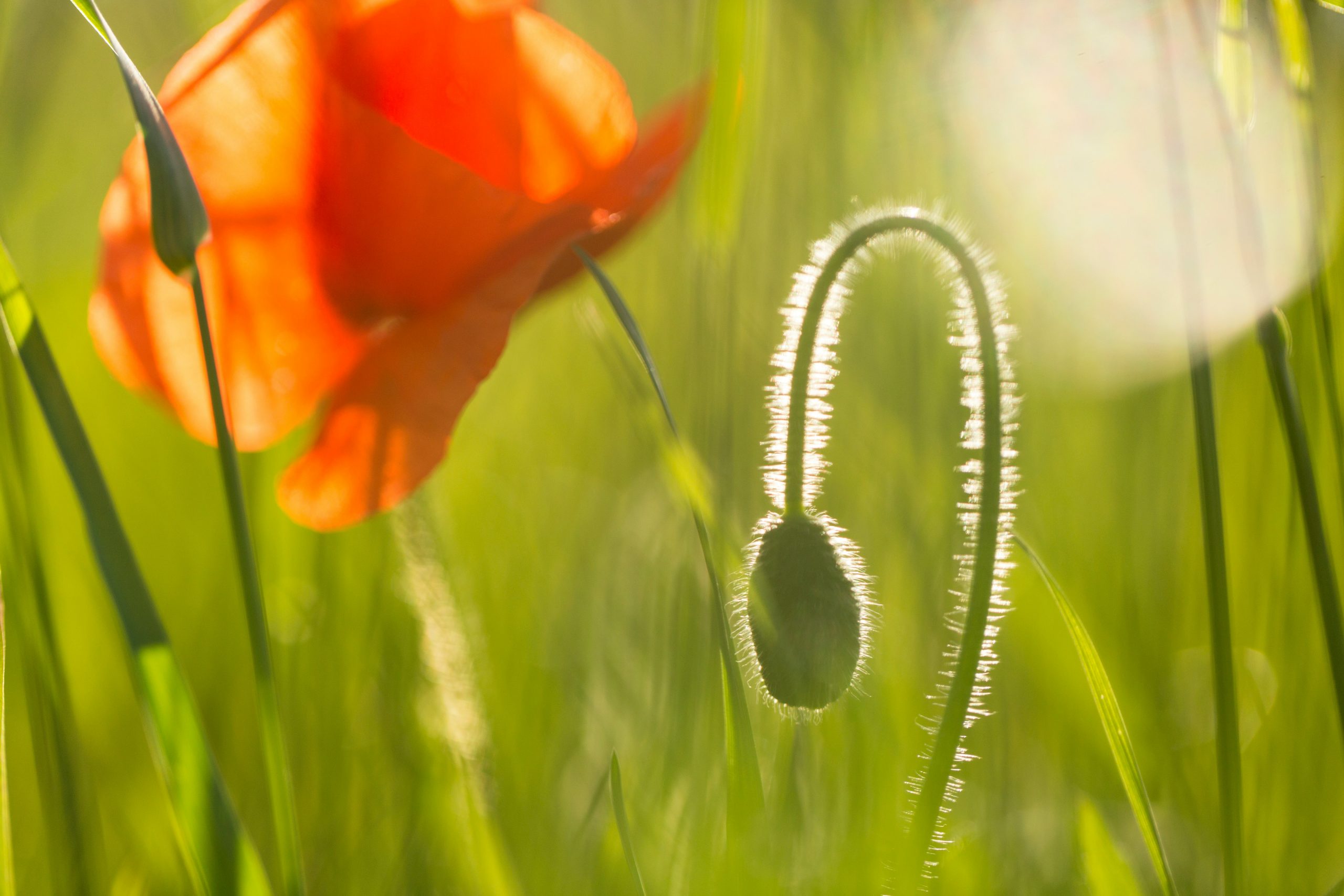
As the sunlight travels through the room, the blooming begins. Liana’s green frayed stems lead to petals unwrapping in mid-air. Her hair shimmers in layers of gold over her shoulders and the sun shines on her petals. It’s a domino effect: Daniel has a head full of gold poppies in minutes. Pruning his stems in the winter was a good idea, because the petals stay close to his head and tickle his ears.
Our father has a few gold blossoms speckling his hair, but on his head it’s mostly green stems. Each year, as he ages, there are fewer blooms. No one says anything about the loss. My mother praises the straining color and we smile and nod in agreement.
My mother’s hair is yellow daisies. The petals should be white, but she’s painted her roots a young yellow. They stand upright until she pins them down with a headband so the blossoms curl upward. They bounce as she shakes her head from side to side.
“Those flowers look old. Everything is too yellow,” Daniel says. Liana laughs. My mother’s eyes meet mine and a lump forms in my throat.
Our father barks at them to stop it.
“Daniel is obviously joking,” my mother says, meeting my eyes again.
By now, everyone is licked by sunshine. As the youngest, it should be time for my blooms. Everyone turns to me. Four pairs of eyes peeking through a yellow field at high noon. It’s so bright I fear the light will swallow me.
“Are they there?” I ask their blank faces.
“No, just those long stems,” Liana sighs.
“We can wait,” our father says, reaching for his newspaper to work on the crossword. It’s a Sunday morning tradition. Liana and Daniel always get their guesses out before I have a chance to think.
“How about some dessert?” my mother suggests.
I busy myself with cutting the pie and placing a slice on each white plate to distract myself from the pressure building in my chest. The room is filled with the family’s sweet and floral scent and too much light.
By the time every plate is covered in crumbs and the crossword is complete, nothing has changed. I try to fit my fingers through my thick stems, but they don’t go through. The sword-like leaves scratch my back.
Liana and Daniel pick at the lint on their sweaters, take selfies with their golden halos, scroll on their phones. Once it’s clear I will not bloom, we move on to the photo.
We line up outside in the sunshine like we do every year. I search for the camera washed in light as I smile wide. My eyes water.
After another year is documented, Liana plucks one of Daniel’s stems (Hey! Oh, grow another!) and offers me a golden poppy.
“Maybe next year,” she says.
We don’t mention it’s my sixteenth spring. That no one in our family has ever been three years late. Especially not on our father’s side. I twirl the stem in my fingers like the poppy is a tiny twirling ballerina.
My father pats me on the back. “Another year of enjoying childhood.”
Daniel coughs a word at me I don’t hear and Liana pushes him as they walk away.
My mother takes me by the arm. “I was a late bloomer, too. It’ll happen. I know it,” she says as she picks the poppy out of my hands and places it behind my ear.
“I hope so.” I think of how I’ll be golden. How everything will change.
“Will you be upset if you get daisies?” my mother asks me.
“Never, mom! No,” I tell her as I force myself to smile. We don’t speak about how we are excluded from their golden world. We don’t talk about how badly we want to be in it.
She smiles back and squeezes my arm. As soon as I’m alone, the poppy falls out from behind my ear and I’m back to stems.
The next morning, I think of the juniors and seniors, even some sophomores, who will have a head full of soft petals to show off. I step into a dress and avoid the mirror.
Gold blooms shine bright at the table where a plate of waffles steams in the middle. As I sit down, ready to take a bite, the table chatter stops. Everyone is staring at my head and for the first time, I don’t feel the stems poke my back.
“Blooms?” I ask the room.
My mother turns around and gasps, dropping a plate. Ceramic flies. Liana and Daniel’s mouths are O’s. My father is devoid of color but for speckles of gold.
Blooms.
I rush to the mirror, imagining the crown around my head. The color hiding all along.
But there is no gold. The straight stems lead to what looks like clouds, deep blue-purple clouds, that fan around my head. I watch as they unfurl and open.
Vauhini Vara is a writer of everything—short stories, novels, journalism, texts and emails, Amazon reviews, and now, Searches, a book-length work of inventive nonfiction exploring the offerings and exploitations of large technology companies, and the undeniable hold they have on our lives.
Vara is not new to the world of technology. Having grown up in Seattle in the 1990s and then attended Stanford University, Vara has always found herself surrounded by the industry. She started her career as a technology reporter, first at the Wall Street Journal and then at the New Yorker. In 2022 her debut novel The Immortal King Rao was named a finalist for the Pulitzer Prize. It tells the story of a man born to a Dalit coconut farming family who goes on to become the CEO of the world’s largest technology company, one which eventually takes on the job of global governance.
Though the story of King Rao unfolds in a dystopian future, Searches concerns itself just as much with the past and present. In 2021, Vara was given access to an early version of ChatGPT, which she used to help her write a story about the death of her sister Deepa. Published first in The Believer, “Ghosts” became the first ever viral AI essay. Now, Vara has taken the experimentalism of that essay and applied it to a whole book. Like “Ghosts”, Searches includes moments of collaboration with AI, but it certainly doesn’t leave out the critical analysis.
I met with Vara over Zoom to discuss AI and its impact on our culture.
Anu Khosla: The first thing one notices about this work is that it’s actually not strictly your own words that make up the book. I was curious about how this project, if at all, shifted your ideas around authorship as you were writing it?
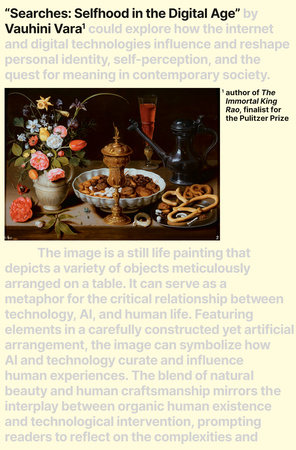
Vauhini Vara: The book started out as being basically the even-numbered chapters, just those more experimental chapters that are looking at the language that we use when using technology products. I’ve had two editors on this project. The first one was Lisa Lucas, and then she left Pantheon, so my new editor is Denise Oswald. My editor Lisa said something just offhandedly: “I wonder what would happen if you shared chapters of your book with ChatGPT.” My immediate reaction was one of horror and disgust, I was like, “Absolutely not,” but then I thought about the whole project of the book. In a way, it is pushing the boundaries of my own complicity in the power of these technology platforms. I ultimately started to think that maybe sharing my work with ChatGPT and allowing it to engage with it would be almost the most extreme possible manifestation of that, which is what got me interested in doing it in the first place.
I have been thinking a lot about authorship, to answer your question more directly. You’re probably referring largely to the use of ChatGPT and other AI products to generate text in the book. But then there’s also that last chapter where the text is not made up of my words, but it’s also not ChatGPT, it’s other human beings, which was very intentional on my part. I think that maybe the most facile way of describing authorship is to say that it represents one individual human perspective. But then, I’ve published oral histories, for example. When I publish those, it’s my name that’s on the oral history as its author, and yet all the words that I’m publishing are the words of other people. I wanted to complicate that binary understanding of authorship that comes up often in discussions of AI, like either something was written by one human being and sprung out of their brain with no other influence or it was text-produced by AI, which is this disembodied technology that’s owned by big technology companies and represents their interests. I think in some ways it’s more interesting to acknowledge the ways in which authorship is always communal. The distinction that can be made, I think, between human authorship and AI authorship is less about these questions of influence on an individual author and the primacy of one individual author, than on the difference between humans and corporate-owned machines, essentially.
AK: You are someone who knows a lot more about these tools than others. Knowing what you know about them, why do you think you’re drawn to them when so many writers are repelled by them?
I wanted to complicate that binary understanding of authorship that comes up often in discussions of AI.
VV: I would like to be able to claim some interesting moral authority that propels my need to use these tools and be attracted to them. I think in any nonfiction, in my opinion, the I-character is a construct in some ways. In the context of this book, I’m using a version of myself that in some ways is meant to be a character, even though it does represent a version of myself. It also feels to me that what makes any literature interesting, including nonfiction, is an interest in the main character’s own agency. Often when we talk about big technology companies and their products, again, we talk about it in this binary way where we, the users, will often say: “These companies are trying to exploit us. That’s their goal. That’s all they do. That’s what they’re in the business of.” And then these companies, defending themselves, will say: “We make these products and offer them to you to use, and we would not be at all successful if nobody wanted to use our products. The reason we are successful is that we’re clearly offering something that people want.”
In the context of this book, my goal was to place myself as a character right at that intersection of those two arguments and to explore the tension between them, because the truth is both of those positions are accurate. There’s something true in both of them. I wanted to, in some ways, use myself to show the ways in which that’s true, because I think so often in writing about technology, it’s either the one or the other. As a reporter covering technology, I often find it hard to find people to talk to who represent that tension and nuance. You either find the hardcore critiques or the hardcore boosters of these companies and their products, and I was interested in the middle ground. So I was putting myself there to be a middle ground.
That’s an intellectualized version of the answer to the question, though. As I write in the book, I was in middle school in the mid ’90s when the Internet started to proliferate, and so it has always been a part of my life. I do count myself as somebody who finds value in these companies’ products. I have had the choice to turn off Google’s tracking of all my search history starting in the year 2005, and I never have done that because on some level, I find it really interesting to be able to have that record for myself of what I’ve searched for since 2005. I opt to have Amazon track all my order history and search history because that makes it easier for me to find what I’m looking for the next time I want to order something. The personal answer to that question is that it’s not just that I’m representing myself for literary purposes as somebody who sits at that nexus between what big tech gets out of these products and what we get out of these products. It’s also that I am someone who believes that I do get some value out of these products, and that’s why I use them.
AK: As I was reading, I was struck by something that I don’t believe I’ve ever realized before. For those of us who have been exposed to tech for a long time, we’re very used to hearing the terminology of “my product is democratizing this industry.” One of the ideas that you present really powerfully in the book is that actually the main impact of many of these companies has been that they’ve been able to really consolidate power. Can you talk to me about this relationship between the idea of democratization paired with the actual outcome of consolidated power?
VV: On the face of it, access to technology like ChatGPT or Google or Instagram would suggest a democratization function, because they’re readily available to us, and they do offer us something that makes our life marginally better or more connected or easier by certain definitions of those terms. The problem is that while these products are doing that, they’re built in such a way that much greater amounts of power and wealth are accruing to the people who control the technologies.
I think oftentimes when people who run or invest in these companies use terms like “democratization” to refer to what the companies are doing, my sense is that they’re doing that in good faith. They really believe that these products are democratizing society. It also happens that there is a rhetorical value of that term that serves their interests. And so I think that’s why the term has become so prolific. I don’t think that there’s a cabal sitting in a back room saying, “let’s use the term ‘democratization.’ That’s how we can get everybody hooked on our product so that we can exploit them further.” I think there’s a genuine belief in the power of these technologies for democratization. I think there’s something useful and interesting about that idea of democratization as being embedded in technology, because it is possible for there to be technologies that do truly democratize access without accruing power and wealth to the people who are already powerful and wealthy. I talk about it in the book, but Wikipedia is an interesting example. Obviously, the people who contribute to Wikipedia are disproportionately anglophone and male and white, but at the same time, Wikipedia isn’t a for-profit company. Anybody can edit it, anybody can access it. There’s no exploitation of users’ personal information when we use it. And so those kinds of models are really interesting to think about, because oftentimes when we think about technology, we’re thinking about those corporate-owned technologies in which the value that they give us is bound up in the value that accrues to the people who own those technologies. There are all these other counter models that are interesting to think about.
AK: Reading the ChatGPT sections in this book, it’s really clear to me that the AI is an optimist. You talk a lot in the book about how you are an optimist yourself. How did it feel to observe this attribute that’s true in yourself in this technology as well?
VV: It’s true that I consider myself an optimistic person, and I characterized myself that way in the book, and yet the ChatGPT’s version of optimism really grated against me. I think the way I would define my optimism is, I would hope, as a clear-eye optimism that recognizes the real problems that exist now, but is hopeful that there is a different future that we can imagine and get to. Whereas the optimism reflected by ChatGPT is less about that. It’s more about characterizing the way things are now as perfectly fine. There are problems, but it’s not that big of a deal. Or, there are problems, but look on the bright side! That’s the optimism that doesn’t resonate with me. I’m not a technologist, but my understanding from reporting on AI is that this optimism is not inherent to large language models or AI in general. Rather, it was designed into these tools as they became productized because the companies behind them realized that they wanted these products to be good little chat boxes. In the same way, when I have had customer service jobs, I was told by my bosses to keep a positive attitude and spin things in an optimistic way. ChatGPT is essentially getting the same instructions.
AK: I’ve been seeing examples online of people asking AI products questions and then receiving truly horrible advice, to, say, put batteries on their sandwich or whatever. The AI doesn’t seem to know, at least yet, when we’re asking it to tell us facts or when we’re asking it to help us write a story. It makes me think a lot about the concept of genre. For you, especially as someone who writes in both genres, do you have a strong emotional reaction to the distinction between fiction versus nonfiction?
ChatGPT, for all the things that it does really well, is functionally not capable of representing an individual perspective.
VV: I’m thinking of the investor presentation section of the book, which is the one where I’m using AI generated images to make an imagined pitch deck. It’s part of a nonfiction book, and yet I’m obviously not actually making a presentation to investors. And so I think what’s important is the social contract between the writer and the reader. That’s what’s important for me about the distinction between nonfiction and fiction, which is why, for me, it matters to define fiction as almost being a promise that the author is making to the reader that this is a representation of reality. The connection for me between that and AI made by large language models in particular, is that there’s an assumption that that social contract is between human beings. There’s a human author of a book and there’s a specific audience, whether it’s an actual explicit audience (the way I’m talking to you) or an implicit audience (the people who are going to pick up my book but I don’t know who they are). There’s a relationship between actual human beings there, and that’s how communication and language have functioned since the beginning of communication and language. So what’s disruptive—and I don’t mean that in a positive sense—about large language models is that the large language models neither have an individual perspective nor a model for understanding who they are talking to, right? So there’s no understanding of themselves as having a perspective. This gets talked about less, but there’s also no understanding of who is being addressed. I will, to give credit where it’s due, mention the well-known paper called “On the Dangers of Stochastic Parrots.” I quote it in the book. The authors of that paper, they’re technologists, they’re not writers, but they almost get into literary theory in that paper because they talk about the way in which the essential breakdown that takes place when we use ChatGPT and feel like we’re communicating is that we assume our interlocutor has an understanding of human communication like ours, but that’s not true of ChatGPT, and that’s the problem.
AK: Do you think that ChatGPT would make a good literary critic?
VV: My answer to that question in reference to ChatGPT as a product, specifically, is absolutely not. And the reason I say that is because what I love about criticism, when it’s good, is the precision of the point of view of the person who’s offering the criticism. And ChatGPT, for all the things that it does really well, is functionally not capable of representing an individual perspective. The other reason is that when I love criticism, when most people really like criticism, it’s because of its originality. It’s because we’re reading something that we’ve never heard framed quite that way. ChatGPT, again, functionally by virtue of the way it’s designed, is always an anti-originality technology, in that it’s always interested in the statistically probable perspective rather than the surprising or original perspective.
AK: There’s a tweet from a couple of years ago that went viral that I think about a lot that said, “can we get some a.i. to pick plastic out of the ocean or do all the robots need to be screenwriters?” I still haven’t seen a real answer to the question, so I’ll ask you. Why is it so important to these companies that the AI be able to create art as opposed to just solve those more technical problems?
VV: With my journalistic hat on, I have to say I don’t know how the companies would answer the question, but I find it a super interesting question. I write in the book about a conversation with somebody who works at OpenAI. I wanted to ask him about how companies like OpenAI are talking to people like university professors and filmmakers and photographers and writers. The fact that they’re doing that outreach so aggressively makes me wonder if it’s less about an interest on their part in having these products used for creative purposes than about an understanding on their part of the cultural capital that creative people have. Because creative people have been some of the most vocal critics of these technologies, and a lot of creative people also happen to have a lot of cultural capital. They have followers on social media, they make movies, they write books. My sense is that creative uses, like using AI to write a novel, just isn’t that big of a market opportunity for these AI companies. I really can’t imagine why it would matter to them to make the case for it. I think the reason it’s useful for them to make that case is because of the role that plays in the cultural conversation about AI in our lives.
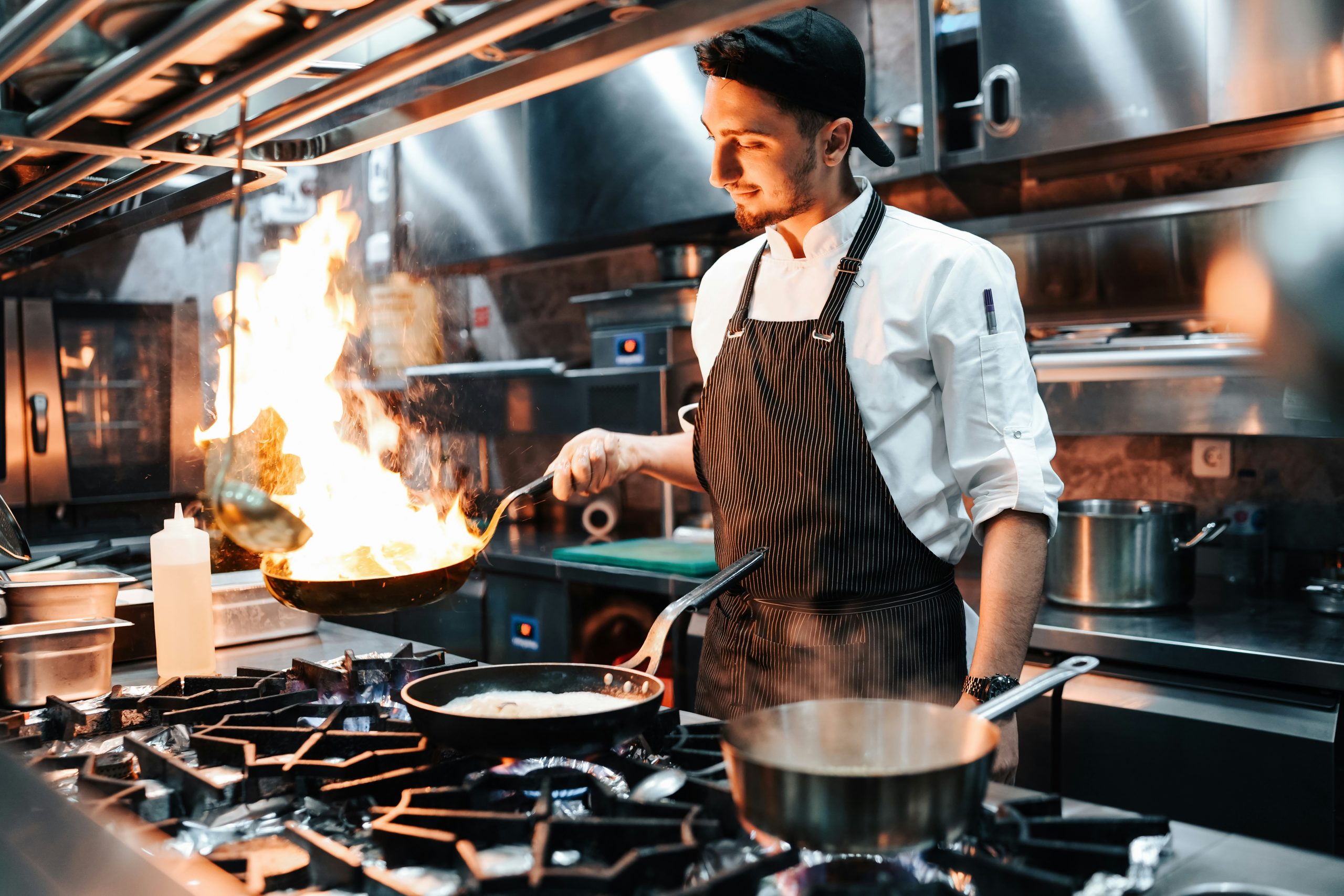
Aside from the standard TV procedural jobs—doctor, lawyer, cop—no other profession has been as mined for cultural gold as the chef’s. The Bear, a show about a restaurant where the secret spice is trauma, has won every Emmy in sight. As I write this, Top Chef is filming season 21. (Oh, Canada!) We are inundated with chef content: reality shows, profiles, Youtube channels, memoirs, feature films, on and on. I’m part of this: my novel is about the life and death of a legendary chef (why yes, you can buy it wherever books are sold).
When I pitched this piece to this website, I figured it would be pretty easy to find great literary chefs. Instead, I found that actual working chefs are about as rare in fiction as realistic depictions of autopsies are on TV. (Another thing my book is about!) While there are a handful of recent novels about the restaurant industry, almost none of them are set in the kitchen. So to make this piece work I wound up expanding the frame to include the greatest cooks in literature—but don’t worry. They include, as with any decent restaurant, a bunch of absolute freaks.
Babette Hersant is the greatest chef—not cook, chef—in English literature, and it’s not close. But we won’t know it until the end of the short story (or flawless 1987 movie by Gabriel Axel). In 1871, two pious spinster sisters in the Norwegian town of Berlevaag open their door to find a “massive, dark, deadly pale woman with a bundle on her arm,” who faints the moment they lay eyes on her. She is bearing a letter from one of the sisters’ former suitor, and it identifies the woman as Babette, a refugee from the political violence then raging in Paris. The sisters take her in, and steadfastly, for 12 years, she dutifully cooks for them the bland, abstemious Danish food to which they are accustomed.
And then, one day, Babette comes into 10,000 francs. She insists on making the sisters and their community a feast. The sisters have deep misgivings about such a meal, as do the townsfolk, especially once they discover that there is a turtle involved. They all vow that whatever they are served, they will not let it seduce or delude them: “we will cleanse our tongues of all taste and purify them of all delight or disgust of the senses, keeping and preserving them for the higher things of praise and thanksgiving.” They sit down to dinner mute and full of holiness.
It takes one glass of wine for it all to unravel. Brilliantly, Dinesen doesn’t begin to describe the food, because to do so would be like trying to describe a Beethoven symphony. “Of what happened later in the evening nothing definite can here be stated. None of the 17 guests later on had any clear remembrance of it. They only knew that the rooms had been filled with a heavenly light, as if a number of small halos had blended into one glorious radiance.”
No one who eats this meal leaves untransformed; all are, for a few hours, enraptured. Then we discover the meal has cost Babette—who we discover was the chef at an illustrious Paris restaurant—all 10,000 francs. “So you will be poor now all your life, Babette?” asks a sister. Vehemently she replies, “Poor? I shall never be poor. A great artist, mesdames, is never poor.”
If we can let ourselves believe one great meal can change a person’s life, then maybe we can believe that, too.
It’s hard to imagine this children’s book about a little nudist—to my mind, the finest work of Maurice Sendak’s career—getting published today. It’s not just that Mickey is frontally naked half the book, it’s that it’s trippy as fuck, with absolutely no socially-relevant messages. Instead, Sendak produces a gorgeous color-soaked dream sequence in which Mickey falls out of his bed and clothes, landing in cake batter mixed by three gargantuan bakers who look like Oliver Hardy (of Laurel & Hardy). The cooks put him in the oven, and he bursts out, yelling, “I’m not the milk and the milk’s not me! I’m Mickey!” Then he jumps out and fashions an airplane out of bread dough, and flies up into the night, before diving—again, buck naked—into a milk bottle. It’s my kids’ favorite book, and still, after six years, my favorite to read them, and the mere fact that Mickey builds a fully-functioning propeller airplane out of bread dough more than justifies his inclusion on this list.
Hannibal Lecter from Red Dragon by Thomas Harris (followed by multiple sequels and TV/film adaptations)
Let’s pretend we can get Donald Trump’s sneering pronunciation of the name out of our head for a while, and focus instead on the actual character, for whom good manners are as important as they are to Paddington Bear. Of course, while Paddington handles people who forget their manners by giving them a Hard Stare, Lecter kills and eats them. But if that were all he did, he wouldn’t have spawned four decades of multimedia franchising. We keep coming back to Hannibal not because he turns people into food, but into cuisine. He gave us the most famous wine pairing in American culture, liver and Chianti. The most recent portrayal of Harris’s character, by Mads Mikkelsen, is food porn at its most exquisite. The show’s food stylist, Janice Poon, released a full cookbook of Hannibal’s recipes. Small wonder that our response to Hannibal’s killing sprees is usually: “let him cook.”
If you like Hannibal, wait until you meet Tarquin. A supreme sybarite, he floats through life on a river of crème anglaise. The book is presented as Winot’s culinary manifesto, replete with seasonal menus and sophisticated glosses on Brillat-Savarin and Rabelais, all framed by his leisurely drive to his villa in sun-soaked Provence. I say “presented,” because it slowly becomes apparent that something much darker is going on, for Winot will not tolerate limits on his hedonism—any limits. To say much more would diminish the pleasure of this perfect novel, and invite the fury of Tarquin himself, which, trust me, you do not want.
Aida is one of the few working chefs in contemporary fiction (credit also to Bryan Washington’s Lotand Lillian Li’s Number One Chinese Restaurant), but Zhang quickly removes her from the hustle of the restaurant industry. Agricultural experiments by a Monsanto-style company in middle America have choked Earth’s atmosphere with smog, annihilating crops worldwide and forcing humans to rely on mung bean flour. The book kicks off when she is invited to cook in an “elite research community” of plutocrats in the Italian Alps, in a tech billionaire’s secret redoubt untouched by the smog. Zhang’s food writing is exquisite, soaked in sex and pleasure (“larks’ bones crunching in the molars like the detonation of a small star”), and made all the more so by the sinisterness of Aida’s environment. The book asks a question: How far will we go to fulfill our desires?
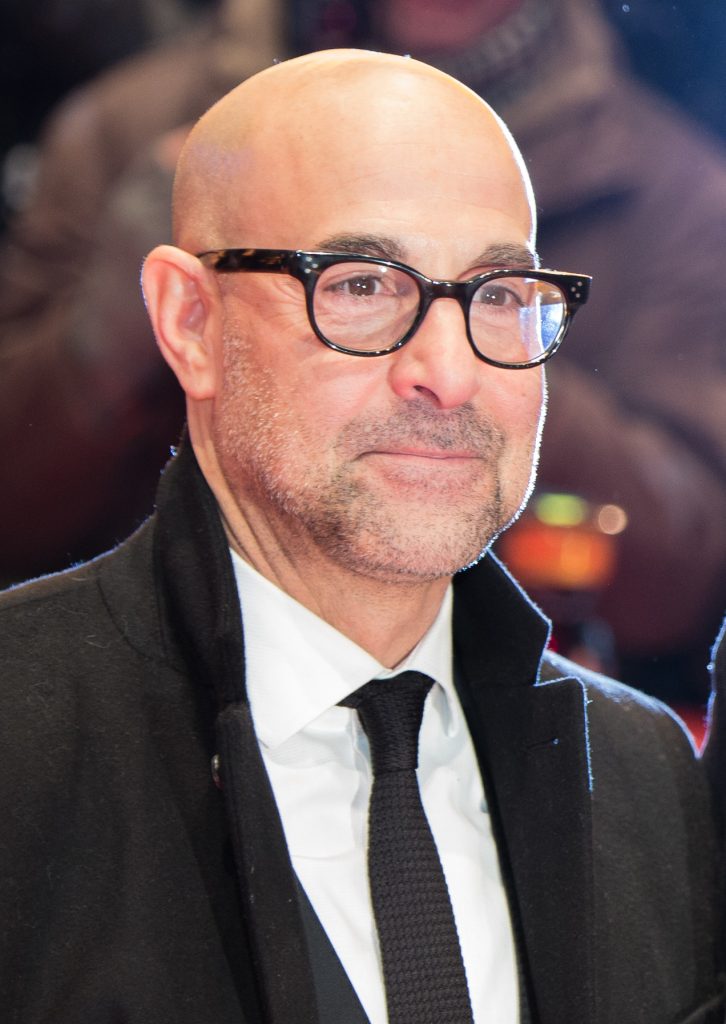
By Martin Kraft, CC BY-SA 3.0, https://commons.wikimedia.org/w/index.php?curid=59451265
Stanley Tucci from “Stanley Tucci” by the Internet
“Hold on, buddy,” I hear you say, “Stanley Tucci is real. I have beheld him in culinary-themed films such as Julie and Julia and Big Night. Now you are just padding your word count.” You would be wrong. Sure, there is a Stanley Tucci who has a social security number and an IMDb profile. I am not talking about him. I am talking about the grand literary project that we of the internet have collectively undertaken, a project called “Stanley Tucci.”
This Stanley Tucci, who tells us he is proud of us while kneading our backs with his erotically-bare forearms, is our invention. We have adapted him, coopted him, as Hilary Mantel did for Thomas Cromwell; indeed, Stanley Tucci is the Cromwell of social-media-generated erotic fiction. Our work with him has already been adapted to the screen, in a CNN series where he swans about Italy, eating and gazing. He is a safe harbor for our horniest fantasies (mine involves him blurbing my novel), and yet, we share him freely with one another. Those fantasies, notably, involve him cooking for us and making us a negroni; he has that quality that all great fictional cooks, from Babette onward, possess: that somehow eating their food can heal us.
Jiro, the titular character of Anthony Bourdain’s first graphic novel, Get Jiro!, sort of exists as a tandem bike for Bourdain’s id and superego: he is an ultradisciplined sushi chef, a man of few words and utter self-control, who also responds to people badgering him for California rolls by swacking off their heads right there at the counter. (Which seems like a clear cross-contamination hazard.)
Jiro can do this because he lives in a Los Angeles that is riven by a power struggle between two chef gangs (just go with it), one of which is run by a manifest clone of Alice Waters. I am not going to explain the story any more than that. It’s fun, go read it. But what’s fascinating is how dated this vision of a badass chef seems now—and by extension, how the world popularized by Tony Bourdain (whom I revered, and still deeply mourn) has transformed in the last decade.
Bourdain’s initial fame rested on his image of the chef as a chainsmoking feral being, a man (almost always a man) with no feeling in his fingers or his heart, a man who, were he not inside a kitchen slicing leeks, would be outside slitting throats. A mad god-king, the madder the better. It was seductive, it was exciting! We wanted to taste the crazy. A sushi chef so psychotically committed to his art that he would decapitate an unworthy customer? Obviously, we’d be lining up to try it.
My theory is that chefs are vehicles for our collective cultural ambition. Get Jiro! was released in 2012. The most famous chef alive was Gordon Ramsay, and the most lauded restaurants were those that chased perfection at any cost, preferably a high one. Even after the global financial crisis washed away the places that were coasting on Lehman Brothers first-years playing credit card roulette, it was still the era of the $1000 omakase and meals with the runtime of Götterdammerung.
A decade later, gastronomy in this country has evolved to a point where going to restaurants and traveling for food and watching cooking shows has become a substitute for culture, replacing things like going to the theater. So where the hell are the novels about it? In all of these works, cooks embody the culture that calved them. Babette is revealed to be a true Romantic, a communard who even in exile still finds a way to be an artist of pleasure amid the ascetic Norwegian Calvinists. In the Night Kitchen is published in 1970, when you could get away with putting a buck-naked kid in a book. The grasping hedonism of the 80s and 90s gave us Hannibal and Tarquin. Today, what do we get? The Bear—an encyclopedia of modern trauma. Name your personal damage, and you can find a member of the Berzatto family that represents it. I love the Bear,but what if you could create a chef who wasn’t a human panic attack? It’s long past time that the novel stepped up to the pass.
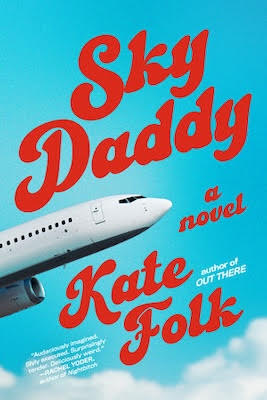
It wouldn’t be wrong to call Kate Folk’s debut novel Sky Daddy a marriage plot. The protagonist, Linda, has had numerous lovers, but she wants to settle down. She’s looking for a “fine gentleman” who’s sleek, strong, and ready to commit, and she already has her dream wedding planned: hurtling to her death in the “aluminum embrace” of her beloved.
Linda is sexually attracted exclusively to aircraft. The lovers she seeks out every month are planes, and she yearns for a soulmate airplane to claim her as his bride in a crash that will “meld [their] souls for eternity.”
Sky Daddy is a zany, charming, and unexpectedly poignant portrait of a woman who feels herself to be unassimilable to the world of normal people. Linda’s sexual obsession with planes is her sole source of pleasure, and it’s also her biggest secret. When her coworker starts inviting her to quarterly Vision Board Brunches, Linda wonders how to manifest her soulmate without revealing the true nature of her wish.
I interviewed Kate Folk over Zoom at the end of January. We talked about Moby-Dick, manifestation, and wanting things that are bad for you.
Angela Hui: Linda wants to die in a plane crash so that she can be united with her soulmate airplane forever. Several of the short stories in your collection Out There also feature characters whose desires are dangerous to themselves or others—they want to get shot by hunters or lobotomize their lovers. Why, in your writing, is love so dangerous?
Kate Folk: I don’t know, it’s one of those things in my writing where I wouldn’t have realized it was a concern of mine until it started popping up across different stories. I think it’s a theme I’m drawn to because it encompasses so much more than just romantic obsession. It’s this impulse toward self-destruction and self-sabotage—feeling like something bad is going to happen and wanting to hasten the process and have it on our own terms, which is an interesting part of human nature. Maybe it’s been heightened by the internet and how so much of our lives are mediated by tech: there’s this desire to have something happen with the physical body in the real world.
AH: You published a piece a few years ago about how your daily journaling practice helps you write fiction, and there’s an excerpt of a journal entry where you describe being on a turbulent flight and thinking you’re about to die. Did you draw on that experience while writing Sky Daddy?
KF: Maybe, I’m trying to remember when I wrote that entry. It was probably around the same time I started working on the book in 2019. I think the line was something like, “I’m going to die drinking a Diet Coke I didn’t even want.” I was flying out of Iowa City after spending the holidays there. There was bad weather, and it was a really shaky little regional plane.
I actually got the idea for the book when a friend texted me a link to a YouTube video from a channel called TheFlightChannel, which creates simulations of actual aviation incidents. The graphics are very bland, and it looks almost like a video game. And then there’s descriptions of what’s happening at every stage of the flight where something goes wrong. It just has a really eerie feeling to it. They don’t show people inside the plane; the cockpit’s empty. So I was imagining the plane as a sentient being of its own, and from there I started thinking about a character who has a connection with planes and falls in love with them.
I’m afraid of flying, but I feel like writing the book has actually helped me to be less afraid.
I’m afraid of flying, but I feel like writing the book has actually helped me to be less afraid. Linda would think turbulence is fun and know that it isn’t a threat to the plane. But it’s still really hard for me not to be terrified in the moment.
AH: I’m curious about the theme of religion and spirituality in the book: the phrase “sky daddy” is a snarky way to refer to God, Catholicism comes up a few times, and Linda refers to her airplane fetish as her “personal religion, access point to the eternal sublime.” When you started writing this book, did you know that spirituality would play an important role?
KF: No, that was something that became more prominent as I drafted it and the story took more shape. Linda has a kind of secular religion of feeling like she’s bound by fate and destiny. I thought it would be interesting to compliment that with other characters’ more traditional religious beliefs and how they’re all coming from the same place of wanting to connect to something bigger and wanting their lives to have meaning outside of themselves.
I was also thinking about my own experiences flying and being afraid of flying. I’m not a religious person, but I will pray when I’m on a plane and there’s turbulence. There’s that joke about how there are no atheists on a turbulent plane. It seems like one of these moments where our lives really are in the power of something that we have no control over, so people turn to a higher power.
The title came much later. For most of the time I was writing the book, I called it Moderation, which refers to Linda’s job as a content moderator as well as the overall theme of moderation—trying to moderate her impulses and that kind of thing. I always knew that was more of a working title. When my editor and I brainstormed ideas for titles, Sky Daddy was the most eye-catching one, and I like how it has that double meaning: the term for God, and also, obviously, planes are the sky daddies above us.
AH: Spirituality also comes up in the Vision Board Brunches Linda attends in order to manifest the life (or death) she wants. What do you think makes manifestation appealing to Linda and to people in real life?
I think it’s really empowering to have a clear vision of the things I want in life.
KF: Linda takes the vision boards so literally, which is part of the humor of it – the idea that if she just pastes these images on the board, they’re literally going to come true. But I feel like there is great value in doing things like that. I’ve never actually made a vision board myself, but I’ve written things that I would like to do or that I would like to have happen. I think it’s really empowering to have a clear vision of the things I want in life.
For Linda, the appeal of the Vision Board Brunch also comes from being drawn into a community of women that she feels she was always ostracized from growing up, because she was a weird kid and was always fixated on the sky. Linda has to be on her best behavior and present herself as one of them, these women she sees as normal people with good jobs and relationships. That’s one of the tensions in the book: Linda wanting to reveal herself but knowing that she can’t fully do so, or being afraid that if she does reveal herself then other people won’t like her and her goals will somehow be hindered.
AH: It’s interesting to see Rhonda Byrne-style manifestation in a work of fiction because it’s like the character is trying to become the author of the story they’re in. Is that how it felt when you were writing?
KF: Yeah, that’s a really good point. Earlier drafts of the book didn’t have as much of a shape or sense of momentum, and I felt like the Vision Board Brunches were a nice way to take the story into another gear. There’s a sense that maybe the vision boards really do work, and Linda’s found a way to manipulate the strings of fate a bit – I definitely wanted it to be ambiguous. Whether or not things really are being manifested, Linda believes that they are, so there’s an internal engine to the story that’s driving things forward.
AH: You’ve said that Sky Daddy is in “casual conversation” with Moby-Dick. Obviously, marrying a plane is Linda’s white whale. How else do you see the two books being in conversation?
KF: Zadie Smith gave a lecture that was then published as an essay in the Believer, and she talks about using scaffolding devices when she’s drafting a novel. When I wrote the first draft of Sky Daddy, it was useful to have Moby-Dick as a scaffold.
Writing a novel is just so difficult and daunting, especially at the beginning. I tried all these different ways to get into the story, but the voice was never quite right. Then I happened to start reading Moby-Dick in the fall of 2019, and right away I loved the voice in that book. The voice of Ishmael is so playful and full of life, and it combines all these different registers and literary allusions.
Planes are the white whales of the sky.
Once I started thinking of Sky Daddy in the mode of Moby-Dick, I saw all sorts of connections popping up, and it felt like I was really onto something. Planes are the white whales of the sky, and Ahab’s monomaniacal obsession with Moby-Dick makes him believe it’s his destiny to kill this whale even if it kills him in the process.
There was also a similarity in that whales were pursued for their oil, and planes are full of oil in the form of jet fuel. I was thinking about flying as this carbon-intensive activity that’s bad for the environment and potentially will become taboo as climate change accelerates. Linda is pursuing this thing that she wants to kill her, literally, but also that is killing us all; we’re all addicted to lifestyles that are leading to catastrophe for humanity.
At first, I tried really mapping the story onto Moby-Dick. I made an outline of every chapter in Moby-Dick, and then I tried to figure out equivalent events that could happen in my story. Eventually I let go of that, because it wasn’t leading to writing my own book, so I had to start over and write it my own way. But some of the DNA of that process of experimentation is still in there, especially in the voice.
AH: Sky Daddy is your debut novel. Was it also the first novel you ever wrote?
KF: No, it definitely wasn’t. I’d written three or four novels before this that were never published, one of them when I was in an MFA program and then a few others, including one that we took on submission but didn’t sell. I think all of that was important in figuring out how to write novels. It’s really difficult to know how to do it other than by doing it. That’s the advice that novelists always give, which is very annoying – it’s both insufficient and completely true.
I spent a full year just generating. I wrote a thousand words a day in Linda’s voice, just to see where it went, and I had Linda do all kinds of stuff that didn’t make it into the final version. I felt like that helped me really explore the possibilities for the story.
AH: Are there any darlings you had to kill that you would be willing to share?
KF: Yeah, there were a lot of chapters directly inspired by chapters of Moby-Dick. In Moby-Dick, there’s a chapter called “Cetology,” and there’s all these chapters about whales that aren’t tied to the actual story – it’s just like, here’s some facts about whales. And they’re not even really true facts. That was a great source of inspiration, because Melville refers to the whales as gentlemen, and he’s very sassy about it, and he’s really opinionated about what counts as a whale and what doesn’t, and what the good whales are.
I thought that was really funny, so I had a chapter similar to “Cetology” called “Aeronautics,” where Linda classifies interesting types of planes and has a lot of opinions about them, like she hates the Concorde and thinks it’s an abomination, and she thinks that some of the jumbo jets, like the 747 and the A380, are very snobby and aloof. Those are parts that ultimately didn’t fit in the story, and they were probably too literally inspired by Moby-Dick, because I didn’t want the book to be primarily an homage to Moby-Dick.
AH: What other works inspired or influenced Sky Daddy?
KF: I was partly inspired by Sayaka Murata’s novel Convenience Store Woman, which I love. The main character works at a convenience store, and everyone is asking her when she’s going to get a better job or get a boyfriend and get married, but she’s perfectly content working at the convenience store. I wanted Linda to be a similar type of character, where everyone else looks down on her lifestyle and her job as a content moderator, but she’s actually quite content with it – except, of course, that she wants her fate to be realized on a flight.
Another inspiration was J. G. Ballard’s novel Crash and the Cronenberg film that was adapted from it, especially when I started thinking more about the plane crash angle. I was also thinking about the genre of “sad girl books”—Melissa Broder’s novel The Pisces was an inspiration as well. But Linda is a little different, because she’s not sad; she’s actually very glad to be pursuing this goal in her life, even though most people would say it’s a bad goal.
AH: Tell me more about the idea of “sad girl books.” How do you see your work fitting or not fitting into that genre?
KF: It’s a category you see on TikTok, along with “hot girl books” or whatever. I don’t really like the way those books are talked about. But I think about writers like Ottessa Moshfegh or Halle Butler – I love their books, and I’ll read anything they write. Those are potentially in that genre we’re talking about, books about women who are kind of dirtbags, which is a genre I really love, because I love unlikable female characters. A lot of the stories in Out There have a similar vibe, with women who are complicated, who aren’t necessarily girl boss types, who are maybe pursuing things that aren’t good for them. I can relate a lot to that type of character and find them really interesting.
AH: One of the few things Linda does other than think about planes is work as a content moderator for a tech company. Why did you choose that job for her?
KF: When I started writing the book, I was also writing a short story about content moderators because I had listened to an NPR segment and read some articles about it and found it so interesting. It’s this huge sector of the tech world that’s hidden, and it’s not illustrious like other tech jobs; a lot of it is outsourced to other countries and much more low-paying.
Linda uses the internet to watch flight simulations and research famous incidents, and to keep track of her “lovers” with the flight tracking app on her phone, and I think the internet might also have pushed Linda into wanting this darker thing and desensitized her to images of death. So it’s made her the ideal candidate for that kind of job. Her character is part of a generation that’s grown up with the internet and has access to all types of disturbing content.
AH: This book made me realize how much overlap there is between the sexual fetish and the objective correlative. Does a character’s fetish always reveal something about their psychological state? Is a kink ever just a kink, or is it always a symbol for something else?
KF: I wanted it to be both, in a way. I didn’t want there to be some formative incident in Linda’s childhood that definitively explained why she’s into planes. I wanted it to be just sort of who she is. Also, I kind of get it—her kink, or whatever. I don’t share it, but I can see how planes have that raw power and sexiness, and they’re amazing machines. Once I started thinking from Linda’s point of view, it didn’t actually seem like that much of a stretch.
At the same time, I definitely want there to be potential within the book for those connections to be made. There’s such a sense of power and freedom in a plane, because it can travel across the world, and it also has the power to kill people. It’s something that can be feared but also revered. Linda has been disempowered in her life in various ways, and the plane is a way for her to latch onto this very powerful symbol.
AH: Did you do any research on obscure fetishes?
KF: Yeah, that was another source of inspiration. I saw a documentary on Youtube years ago about people with objectum sexuality who are in relationships with objects. That was part of what inspired me to have Linda refer to planes with male pronouns and think of them as masculine, because one of the women in the documentary referred to her love object as “he” and thought it was really important not to say “it.”
But I also didn’t want Linda to represent a sexuality or to be reduced to a diagnosis. I wanted her to be very much a singular character who isn’t meant to stand in for a real type of person in the world.
AH: Right, and she wants to be singular. She doesn’t even want to know if other people are hot for planes, because she’s a “jealous lover.” She’s so alone in her obsession.
KF: Yeah, that’s part of the romance of it. She doesn’t want to share it with anyone else, because it’s her private thing with the planes.
I think often about the fact that I am a first-generation lover. By this I mean that I am the first woman in my family to love entirely as I choose, the product of generations of arranged marriages for women – girls, some of them – in a South Asian culture preoccupied with enforcing rigid boundaries of caste. Love, to us, is a transgressive, abstract, Western thing, only tangentially related to the everyday work of marriage – in fact, we distinguish arranged marriages, the norm, from “love marriages,” in our everyday speech. “Love,” in this case, is a synonym for intercaste, or interreligious, spoken in a tone of hushed warning – we grew up with cautionary tales of love marriages gone awry, women and men who chose to love on their own terms and alienated their communities in the process. As a first-generation lover, I swing from feeling incredibly lucky to deeply confused. And as a novelist, I find myself obsessed with the texture and significance of relationships between women: friends, lovers, mothers, daughters. I am also gay, which to me is less of a sexual orientation than an existential condition of questioning, wondering, Is there another way?
I won the strangest jackpot of history to be born in America, during an era of unprecedented cultural representation for people who look and love as I do. I live in Lesbian Mecca, also known as Brooklyn, where I’ve fallen head-first into queer community, a boisterous network of dear friends and lovers, continually colliding. My friends and I will often send each other voice memos with date recaps, sex play-by-plays, new loves and letdowns, all of us trying our best to love in accordance with our principles, againand again, as Charli XCX put it. Sometimes it feels like the blind leading the blind; other times it feels like we, in our collective brain trust, have experienced the entire pageant of human emotions. It is a privileged, historically unimaginable existence. It feels like I am joining the party at a high, but possibly also at last call – the world is getting actively worse around us. My same phone that pings with messages from my friends, my girls, brings ever-accelerating news of genocide, our slow descent into fascism. What is the point of being gay when polar icecaps are melting? I look to writers, to queer elders for advice. And so, when I saw online that a new Dean Spade was dropping, I thought, Thank God.
Dean Spade is a veteran of queer movements for justice, your favorite queer writer’s favorite queer writer. He is best known for his book Mutual Aid, an action-oriented handbook to organizing local communities, and for founding the Sylvia Rivera Law Project. He’s also brilliantly, eminently online, someone I’d look for as a green flag on a crush’s Instagram “following” list. Online, he leads workshops on relationships, films advice videos, and shares resources and calls-to-action. He is a man of the people, and he sees his people are struggling – on dating apps, in doomed situationships, in messy friend groups and incestuous political collectives. Love in a F*cked Up World is his response: a love letter to the gay, horny, and confused.
It feels like I am joining the party at a high, but possibly also at last call – the world is getting actively worse around us.
Love in a Fucked Up World styles itself as a self-help book, a choice that is both earnest and subversive. The self-help genre can be mired in heterosexual or regressive advice, telling readers to “lean in” or put up with bullshit or generally hyper-fixate on improving themselves as individuals without acknowledging the social forces that shape them. What’s more, Spade roots his authority not in psychology credentials, but in his experience as a “lifelong participant and student of social movements,” a person on a lifelong quest to improve his relationships. Spade opens with a frank analysis of our situation – it’s dire. “We live in a time of intense conditions. We are told we are freer and more connected than ever because of technology, but every day we confront skyrocketing inequality, terrifying ecological crisis, and endless war,” he asserts. “How can we hold on to each other in these hard times, take the brave and bold actions required of us, and become better able to love each other through it all?”
Spade’s commitment to situating our everyday romantic struggles within The Biggest Struggle of All Times – maintaining our dignity and resilience under late-stage capitalism – takes its cues from his feminist predecessors, particularly Black feminists who insisted that “the personal is political.” His approach is also really, quintessentially, gay. If queer people generally have the sharpest read on societal norms due to our outsider perspectives, Spade’s trans activist lens questions everything. Spade takes aim at the big myths of heterosexual society: the book opens with a takedown of the dangerous “Romance Myth,” or the idea that “relationships should be exclusive, long-lasting, and follow a predetermined pattern of escalation.” But he also questions behaviors that are normalized, or even valorized, within the queer community, such as having a lot of hookups (he gently asks whether we are actually “numbing out” by chasing sex on dating apps). Or whether our well-meaning fixation with boundaries – setting up hard, automatic rules against other people – keeps us from interrogating the roots of our desires, the varied circumstances in which we say “yes” and “no.” Sometimes Spade is preaching to the choir; other times he’s subtweeting.
Spade gets away with it because of his tone: measured, questioning, constructive, like a voice memo from your stablest friend. LOVE sweeps from the existential to the specific, demystifying the steps of initiating, tending to, and sometimes ending your relationships. Chapters cover topics such as conflict and apologies, choosing when and how to break up, and regulating your emotions through the rollercoaster of dating – what my friends and I call “being on the streets.”
Sometimes Spade is preaching to the choir; other times he’s subtweeting.
I wondered whether Spade would draw from his own personal experiences; generally, he doesn’t. In this way, Spade avoids the trapdoor of confession, of using his own marginalization as the basis for moral authority, which often afflicts marginalized writers trying to theorize about the world. But Spade also doesn’t maintain the rigid, impersonal boundaries of a therapist, for he understands that trust and collective wisdom comes from shared stories. In LOVE, Dean includes fictional case studies,” short third-person stories about characters in complicated situations. One case study follows Denise and Kila, whose relationship ends because of jealousy in an open relationship. Or Mei and Honey, best friends who used to date, and maintain connection by co-hosting an annual Lunar New Year party.
It’s not surprising that LOVE was developed from online workshops Spade teaches; it is a book that knows its audience. Many words in his book – “polyamory,” “bodywork,” “attachments” – do not appear in the Bible, as the saying goes, but could be transcripts from your group chats. LOVE is interspersed with worksheets and charts (“Seven Steps for De-Escalating a Crush”), very screen-shottable, one of which I texted to a friend in a sticky romantic situation: maybe helpful for you?! She laughed. It felt like LOVE had been eavesdropping on our voice memos.
Spade is invested in helping readers live their lives on purpose. He is unflinching in his diagnoses of common “cognitive myths,” which he calls “distortions,” such as the romance myth, or disposability culture, or individualism. But beyond his diagnoses, Spade is pragmatic and intentional about offering solutions, concrete ways to revise our patterns of thought and action. He did, after all, write a self-help book instead of a novel.
This is a joke I can make as a novelist, but also because the fiction I’m drawn to write and read shares overlapping concerns with LOVE: how to build relationships in late-stage capitalism, across significant power and identity barriers, and persist amid horrors. This is a large, vibrant, interdisciplinary literary project. The novelist Miranda July recently shouted out LOVE as a recommendation for readers of her bestseller ALL FOURS. I thought this was a lovely suggestion, to read LOVE as a nonfiction companion to, or debrief after, her fiction, which follows a menopausal woman’s riotous sexual awakening. I work in a genre of contemporary fiction about women and queer people in transgressive, damaging, revelatory relationships; I derive continual comfort knowing that all of my romantic experiences have already been described in totalizing detail by gender-marginalized writers before me. Fiction can use sex to physicalize otherwise invisible, private feelings of powerlessness or alienation in the world. What I encounter less often is an interest in unfurling how relationships are made to work, what they look like when they are healthy and functional. That might make for less sexy fiction. Indeed, Spade calls out the cultural narratives around us that romanticize relationships that are dramatic, driven by “subterranean wounds,” making stable relationships seem less exciting. His intervention, then, is to translate the raw experience of life, the reality refracted and theorized by fiction, and illustrated by his “case studies,” into something we can hold: he synthesizes it into action.
“A core idea in this book is that awareness is key to liberation,” Spade writes of the internal romance narratives that guide us. “Noticing allows us to catch the patterned cultural norms and scripts so we can say, ‘Hey, that’s not me, that’s not mine!’ and make conscious choices.” These choices, to Spade, make all the difference.
The world that Spade urges his readers towards has its seeds in the world we currently live in. By we, I mean his readers – I’m imagining queer people living in urban centers with rich histories of activism, beating hearts connected by arteries of public transportation and walkability. Material things, like trains and bars and bookshops – I’m thinking of Brooklyn, my gay utopia. But when I think of the state of American dating more broadly, I feel less hopeful. My generation, Gen Z, is in the middle of a loneliness epidemic. Many of us live at home, since we cannot afford rent in the kinds of cities that foster human connection. Only 4 percent of American attends a social function on a given weekend – and can you blame anyone? My friends and I often joke that it costs twenty dollars to stick your foot out of the house. We are still seeing the psychological fall-out from Covid, which prematurely stunted our social development as teens. Our boys have been slingshotted into an internet rabbit hole of incelhood. I believe in the world Spade prescribes, but I could not lend his book to a straight friend. The worlds in which we live, and love, would not be the same.
What I encounter less often is an interest in unfurling how relationships are made to work, what they look like when they are healthy and functional.
While I find dating revelatory, an opportunity to learn and practice my principles, most straight women I know find it demoralizing, degrading, or straight-up terrifying. Stories of violence against women regularly make headlines, slow-cooking the nervous systems of those who date men. Queer dating isn’t utopic, but queerness, the framework of Spade’s book, operates in a world much freer of violence. Amid the violences of capitalism and war that trammel us all, Spade assumes that within his readers’ relationships, nobody is trying to hurt the other, that the relationships themselves are not inherently exploitative or unfree. After the second Trump election, Gen Z American women took to TikTok to call for a 4B movement, not to practice accountability with men. For lovers to be equal, engaged partners in Spade’s prescribed work of managing relationships, there must be minimal power differentials between them – and I fear that is rarely the case.
Coming from Spade, this doesn’t feel like an oversight, but rather optimism. Spade, a longtime veteran of movements against criminalization and shame, is choosing against throwing any of his readers under the bus, especially men. Expressions like “toxic masculinity,” for example, which have become shorthand in our culture for a range of unpleasant male behaviors, rarely come up in the book – even if they could help analyze certain patterns of control or dominance that cause relationship dysfunction. Similarly, phrases like “white privilege” or “cis privilege,” seldom come up. Instead, Spade moves away from a suffocating, unequal world of one-on-one romantic relationships, and into a different relationship terrain altogether: friendships, where we come up for air.
Liberation, in Spade’s imagination, comes in the form of friendships. In my own relationships as a young person post-Covid, friendship is a truth I have settled in over and over again, each time with a fresh sigh of relief. “Romantic and sexual relationships are rarely this free. Family relationships are bogged down in prescribed roles, and work and school relationships are often hierarchical and oppressive. From what I have seen, friendship is the closest most people get to each other,” Spade writes in his final, strongest chapter, Revolutionary Promiscuity. Here, Spade is not calling for sluttiness, exactly, but rather a generosity and outpouring of effort and love into our friendships and broader community networks, instead of chasing a single romantic partner. Friendship, to Spade, is a “refuge for freer relational practices that thrive outside the confines of romantic love and family. Increasing the significance of our friendships leads to more of the liberated connection we need to survive these harrowing times.”
Liberation, in Spade’s imagination, comes in the form of friendships.
Spade’s conception of “promiscuity” was a breakthrough for me, putting language to the rising tide of love I have found, attracted, and cultivated in my own life. I am an active thrower of house parties and suppers, park hangs. My goal is for people to find love at one of my functions; so far, a few people have hooked up, which is a promising start. Love, to me, is an offer to cook lunch for a friend — restaurants are expensive — or run errands together, or buddy-read a book; sex is good, but have you ever had your best friend offer to wash your dishes for you? Friendship, Spade reminds us, is not the answer in itself: it is the base organizational unit, the loving nucleus around which we can build larger community projects, even resistance movements. These are movements where I feel I have more than enough.
“That’s just the new normal, folks,” said a radio host.
She heard it constantly. Everything bad was referred to, with a jocular glibness, as the new normal.
ADHD. OCD. Depression. Agoraphobia. Xenophobia. Paranoia. Antisocial personality disorder. Most of the diagnoses in the DSM-5. Albeit often at a subclinical level.
Abnormality was the new normal.
“You know what it is?” said Stephanie over breakfast. “It’s a long, collective moment of TI. Tonic immobility. A state of body paralysis induced by stress. A stress adaptation.”
“I’m familiar with TI,” Anne told her.
In humans, it was brought on by war. And rape.
“With some species,” said Stephanie, forking up scrambled eggs, “it happens when they’re about to be eaten by a predator. They may be simulating death as a defense mechanism. If the predator in question prefers live prey. Or they may be submitting. A neurological shutdown. Possibly for pain avoidance. I haven’t read the scholarship. I’m just spitballing here.”
“Really? But what’s the evolutionary advantage of submitting to your own death?”
She struggled to chew a bite of slimy egg. Stephanie liked to undercook them.
“Passivity’s kind of a stress adaptation, too. Right? Cynicism. Denial. Even despair. As a biologist, if I were observing a particular organism or population, I’d look at the behavior. And I’d see certain behaviors as a response to a survival threat. Maladaptive, in some cases. Such as the group behavioral response to global warming. The response, so far, is maladaptive. It won’t prolong survival.”
“So the culture’s like a prey animal. In its death throes.”
“Well, I mean, the animal does escape, sometimes. Occasionally the TI strategy works.”
“But it won’t work. In this case.”
“Yeah, no. This is a fight-or-flight situation. With the climate. And there’s no possibility of flight.”
Anne pushed her eggs around on her plate.
“They’re too wet. Aren’t they.”
“Kind of.”
“I’ll eat them. You want a slice of sourdough?”
In her practice she’d offer up coping techniques. When other interventions weren’t called for or agreed to. Rituals of self-care. Open the window. Take deep breaths. Put on music.
But lately she’d lie in bed, unable to fall asleep, thinking of crowds. The patients in their great ranks, like a sad army.
Clients, she was supposed to call them, but she preferred the word patient. Always had. It wasn’t that she wanted to position herself as an MD. More that client sounded transactional. Applied to tax-preparation customers and real-estate buyers alike.
While patient was a good word. Since it also meant forbearing. Forgiving, even. Therapy took time.
She saw them in hospital gowns, staring toward the horizon. The patients everywhere. In institutions and outside them.
Maladaptive.
Because if you multiplied that prescription, for acceptance and accommodation, and made it into policy, you’d have systemic failure. On the macro level, acceptance of the normal would mean death.
It had started to seem to her that, as she counseled her patients on how to live better within that new normal—or the abnormality that passed for normal—she was delivering therapeutic euthanasia.
With her head on the pillow, feeling the warm air sweep over her skin as it moved the curtains, she pictured herself walking along the rows of patients. Who stood watching and waiting and never moved. Dosing each one with a sedative and a painkiller.
Palliative care.
Stephanie tried to make her feel better.
“You know the drill,” she said as they lay there. “Your job isn’t about systems. It’s about individuals. Helping them know what they can control and what they can’t.”
“But it isn’t just my job. It’s everyone’s job. Is how it feels to me these days. Everyone’s going around saying, Feel better. And here’s how to do it. Surrender your agency. Be at peace with catastrophe.”
“Listen,” said Stephanie, swiveling onto an elbow. Propping her head on her hand. “Do you have any idea where this is coming from? I only ask because historically, when you’ve been distressed like this, it’s usually been transferred to you by a patient. Where your clinical detachment has partially failed. No offense meant.”
Anne shook her head. “It’s ambient. It’s obvious.”
But after Stephanie turned onto her other side and started snoring, she went back over her patient interactions. There was someone. A kid. Well, a young man. His bleakness was persuasive. The fear, he said, was common sense.
It shouldn’t be healed, he argued. It shouldn’t be erased.
The compulsion to normalize, he said, was the real pathology. Being enacted on a grand scale. A sociopolitical scale.
She’d sent him to Stegman for an SSRI.
In their last session he’d told her about a dinner he’d been to at his girlfriend’s house where one of the other guests seemed to be made of plastic.
Uh-oh, she’d thought. For a second her association was Capgras. Impostor syndrome. She’d had an elderly patient who believed her husband had been replaced by a copy. And the copy was a murderous android.
Janet, had been the patient’s name. Sweet woman. Far too eager to please.
She wondered if Janet was still alive. It had been years.
Here, though, it turned out to be a metaphor.
“And the thing is, I used to have a crush on his girlfriend,” he said. “Back in high school. She’s the older sister of my girlfriend now. Smart and attractive. But, so, maybe you’re thinking, I had a vested interest in not liking the guy. Territorial. But it wasn’t that. He just, all he could do, in the conversation, was recycle these stale talking points. These pieces of pat received wisdom from business school. He has this smug certainty that all the systems will keep functioning. Systems of wealth and power. The way they always have.”
“Maybe they will. And that was what threatened you.”
He was silent. In the Zoom window, she watched him pick up a thermos and drink from it. Hoped it was water.
When he set it down he nodded. “It does threaten me. But it also threatens you. It threatens us all. And everyone after.”
“When you say it,” she said, “what does that mean?”
“The complacency. The pretense. That all this climate and mass extinction shit isn’t a five-alarm emergency. That what we need isn’t a worldwide revolution. Yesterday.”
She sat with that a minute. Her turn to be silent.
“Let’s get back to this guest. Your feelings about him.”
“Sure. Let’s get back to talking about a dinner party.”
“You were the one who brought it up. Isn’t there more to unpack there?”
“This is what I’m referring to. The dinner’s trivial. My feelings about it are trivial. They just don’t matter, Anne.”
“So everything has to be about the need for a revolution?”
“There you go! Unpacked! That’s what I’m saying. Everything, everything, everything. Should be about that. From now till 2050. And beyond.”
“OK, then. If that’s how you feel, why are you spending your time working at a bar? Helping your customers self-medicate?”
“Uh . . . because I need a job? And I’m no one?”
“You’re no one?”
He sat back in his chair. Threw up his hands.
“You know what I mean.”
“But you’re not no one.”
“I am. And, sorry, so are you.”
“You’re saying we’re similarly powerless.”
“You’ve got a career and I don’t have anything, but we both listen to people complain all day. And we both drug them, too.”
We both listen to people complain all day. And we both drug them, too.
Behind him was a poster of a pretty actress wearing a vest that looked like armor. Her long hair flowed around her wildly. Like Medusa’s snakes.
She felt like saying, It’s hard to take you seriously. With Xena the Warrior Princess in the background. Or whoever.
She didn’t say it, of course.
Anyway, they’d already gone over fifty minutes.
Radicalized. That was another term she heard all the time that she didn’t remember hearing so much when she was younger. It had been used in the sixties—mostly around Vietnam protesters, if she recalled right from her reading, and maybe Malcolm X—but then it seemed to recede until 9/11. When it turned into a radio and TV staple.
And it was never a positive. Back in the Vietnam era, you could be a radical for peace. Or justice. Now a radical was only a terrorist. It was Al Qaeda, the Taliban, the white supremacists who stormed the Capitol. The violent extremists.
She read practitioners who specialized in radicalization. There were networks. Radicalized youth were spread across the demographic spectrum, rich and poor, single and in relationships.
But neglect, psychological abuse, and abandonment were strong predictors.
On those fronts Nick was a piss-poor candidate, in her opinion.
Still. You never knew. A worldwide revolution, he had said.
Red flag? Or standard existential angst?
He wasn’t talking about taking up arms. No history of violence. No suicidal ideation, as far as she knew. He wasn’t socially isolated. But then again, it often seemed to come out of nowhere.
“I’m not sure how to help him,” she said to Stegman on the phone.
They were both in their kitchens. Making dinner.
“Sounds like you’re pretty enmeshed,” said Stegman. She could hear the pop of his bourbon cork. For a neuropsychiatrist, he had some old-school vices. “In his rationalizations.”
“I guess so.”
“When in doubt, take a step back. Go to trauma and repression. Have you spent enough time on ECD?”
“His childhood was uneventful. Is how it sounded to me.”
“Impossible.”
She heard cracking—a tray of ice cubes being twisted, that was it. And then the glug-glug-glug of him pouring the whiskey.
“Come on, Lou. Can we get real? Relatively. Stable, protected, no upheavals. He’s got married parents who’ve lived in the same upper-middle-class neighborhood for more than twenty years. He was never bullied, molested, or sidelined by his peers. First sexual experience at age sixteen. No issues of gender or sexual identity. Academically, and in sports, some moderate successes with a few minor failures. A decent balance for resiliency. He does some pot. That’s it.”
“Don’t be reductive. Dig deeper.”
He sipped.
His earbuds captured ambient sound too well.
Nick wasn’t resistant to talking about his childhood—he enjoyed it. Got caught up in the narratives. A bike he once had with a banana seat. It had been his father’s before it was his. In the seventies. A cousin teaching him to ski at Big Bear, all expert and condescending, then falling flat on his face. His little sister hiding his underwear. When the school bus was already moving along their block. His mom giving him bowl cuts in fifth grade because he refused to go to the barber. Didn’t like how it smelled in there.
The barber had halitosis.
“No repressed trauma,” he said near the end of a session. “Except for, maybe, that barber. Man. Someone should have told him. His breath was a biohazard. And that was way before COVID.”
“You were a golden boy.”
He smiled. “No. I just had a golden life.”
“But, somehow, you’re not a golden man.”
The smile vanished.
“The guy at the dinner, say. Is that what a golden man looks like?”
He made a grunt of irritation. “I wish I’d never mentioned it.”
“But you did. There must have been a reason.”
“Sure, yeah. In the eyes of MAGA voters who refused to wear a face mask or get vaccinated, and vote against solar and wind, that man would probably look golden.”
“What about your parents? Who gave you that golden childhood and sent you to a golden university? Would he seem golden to them?”
He sighed. “I doubt it. They’re registered Democrats.”
“So what would golden look like for them?”
He cocked his head. Fiddled with a pen. “Maybe Luis. My brother-in-law. He’s DACA and studying to be an immigration lawyer. From a Guatemalan family who were refugees but never got citizenship. His father’s a farmworker in the Central Valley. Probably has off-the-charts chemical exposure. His mother works at a bakery. Luis is a good guy. He’s, like, pursuing the American dream.”
“But you’re not pursuing that dream. You used to be, but you’re not anymore. So your parents are disappointed in you.”
The poster of the warrior princess, she noticed, had been taken down. Either that or he was Zooming in from a different room.
“I had the dream,” he said quietly. “Then I woke up.”
“And now you can’t remember it.”
“Not true. I remember it perfectly.”
“But it doesn’t motivate you anymore.”
“Anne. It was never real life. It was only a dream.”
His monologues had a youthful poignance. They stayed with her for their earnestness.
A dream gets implanted in you, he’d told her in an early session. A dream of the heroic individual, tall and powerful as a god. The monomyth! A dream of infinite selfishness. But instead of liberating you, it binds you to the wheel. The great wheel moves the plow. And the plow tills the field.
“And far away,” he said, “always ahead of you but never reached, there’s a shimmering mirage. That they call happiness.”
She agreed to go on a field trip. Over a weekend. It wasn’t Stephanie’s own study but the project of a new colleague that she’d been invited to observe. Had to do with insects and the waterbirds that ate them.
“We could do a hike, right?” said Stephanie. “It’s been a while.”
“A hike-hike?” asked Anne. “One of those death marches that call for trekking poles and a heavy pack? Or a pleasant, relaxing walk? With an elevation gain under a thousand feet?”
“Huh. I wonder what your vote is?”
“I’m not in the mood for a death march.”
“It’s a wetland. Like elevation gain is maybe two feet.”
“But with mosquitoes.”
“I hope so. No mosquitoes would be a bad sign. For the study.”
“And we’re not allowed DEET. Because it’s so toxic.”
“Correct.”
So they drove out of the city. Across the state line, into Nevada. It was a rare kind of wetland they were headed to, said Stephanie: a wetland in the desert. Shrinking every year.
Along the freeway they drove, past car dealerships and outlet malls and onto smaller roads. They passed a ranch flying a Trump flag almost as big as the farmhouse itself.
“Are you supposed to have a flag with, like, a person’s name on it?” she asked Stephanie.
“You’re the shrink,” said Stephanie. “You tell me.”
On the barn was painted America First. Just to be clear.
A few miles on they picked out another sign, tiny and barely visible in a brushy patch of wildflowers. Black Lives Matter. On a rainbow background faded by the sun.
“In the war of the signs, I guess we know who’s winning,” said Stephanie.
They stopped at a modest, low building, the refuge headquarters. Stephanie talked to a ranger while Anne used the restroom. She didn’t like to pee behind bushes.
For Stephanie it was an occupational hazard. Not for her. She’d picked a job with flush toilets.
“He was wearing a hat like Smokey the Bear’s,” she said as they got back into the car.
It made her think of a bygone era, when the park rangers were everyone’s friends. And no outlaw ranchers faced them down with armed militias.
“Smokey was a real bear,” said Stephanie. “Did you know that? There’s a museum to him. Next to his grave. Near Lincoln National Forest. I went there once on a road trip.”
“I thought he was invented in World War II,” said Anne. “So people wouldn’t leave their campfires burning and destroy the lumber supply.”
“Yeah but a few years later they found a baby bear in a tree. Badly burned from a fire. They called him Hotfoot first but then changed his name to Smokey and sent him to live at a zoo in DC. With Ham the space chimp. When he died they sent the body back to New Mexico. To be buried in his old forest home.”
“Sweet.”
“There was another Smokey after him. Smokey II. But he wasn’t as popular. When he died they burned him.”
After a while on a bumpy dirt road they came to a place where the road got wet. Reeds all around them, rustling and scraping against the car when the road was narrow. She heard mud spattering into the car’s wheel wells.
“He said we’d see the survey flags.”
“Like, Day-Glo pink?”
“You see one? OK. Look for a pullout on the left.”
A Jeep was parked. And a pickup truck.
A woman in waders and an orange vest approached as they were getting out their hats and water bottles. “Steph! Hi! You found us!”
They started discussing the fieldwork. Something with plots and water samples.
“Inverts,” the colleague kept saying.
Association: Krafft-Ebing. The sexologists who used to call gay people inverts. Gay men had a feminine soul in a man’s body, they had suggested. Lesbians had the reverse.
But the colleague was referring to invertebrates.
“It’s looking grim,” she told Stephanie. “The densities are even lower than we expected.”
Drought was a factor. Water withdrawals from the nearby river. But pesticide-spraying was also a likely culprit.
“They spray pesticides? On a wildlife refuge?” asked Anne.
“Oh, absolutely,” said the colleague. “To subsidize the farmers.”
Stephanie’d forgotten to introduce them. She wasn’t always on top of the niceties.
The colleague offered to take them both into the swampy water—she’d brought some extra pairs of waders—but Anne demurred.
“I’ll just go look around with her a bit,” said Stephanie. “Maybe for half an hour. We can do the hike after. OK?”
“If you stand in the bed of the truck, you’ll be able to see us,” said the colleague. “There’s a cooler with water and beer. And lemonade.”
“I’m Anne, by the way,” said Anne.
“Nice to meet you,” said the colleague.
Still no name.
Task-oriented. And far more interested in arthropods than people. Stephanie was an outlier in her department—focused on the big picture. Commonalities among lifeforms. Most of the rest of them saw the world through smaller windows. Shied away from anything they thought might be viewed as anthropomorphic.
We were us, to the biologists, and the others were the others.
Not so different from shrinks, actually.
But the colleague was considerate. She set up a folding chair for Anne in the pickup bed. The ground was too muddy, she explained. Its legs would sink in. She spun it over the tailgate one-handed, then flicked her wrist to open it. Deft.
Stephanie pulled on the waders and a vest and the two of them went forging off into the reeds. Anne popped the tab on a beer and tried sitting in the chair. But sitting down, she couldn’t see anything but the pale-green grasses.
So she perched on the cab of the truck instead. Cross-legged and sipping. Looked for the high-vis vests and made out five of them.
They were counting insects. And she was counting people.
They were counting insects. And she was counting people.
They bent over, moving forward a few shuffles at a time. The work was painstaking. Slow and painstaking. Someone wearing a bug net over his face, not too far from the truck, lifted a container of yellowish water up to the light.
When there was a light breeze, it was pleasant up there on the truck cab. A sea of grasses waving before her. Here and there, a stretch of glittering water.
Far above, sometimes a plane.
But when it was still it was stifling. She almost felt claustrophobic. Though surrounded by air.
Mosquitoes began to descend. She slapped at them. Mosquitoes had always been drawn to her. Stephanie they ignored.
She wished Stephanie would come back.
The longer she waited, the more she thought about her patients. Still Nick, but also Brent and Helen. All three of them preoccupied by the looming state of emergency.
If they were here, would they be comforted by the sight of those orange vests? Moving through the muddy water, dedicated to the granular detail of insects? Performing their careful measurements?
Maybe Helen. She believed in science and hope. Local solutions. Resistance.
But not Brent. Brent was a hardened cynic when it came to his fellow humans. On the spectrum, plus OCD. He said the summer sea ice in the Arctic was already a ghost. A foregone conclusion. Only a handful of years more. And as went the Arctic, he said—bobbing his head in a constant rhythm—so went Greenland. When Greenland melted, he told her, that would be about 23 feet right there. Sea-level wise. And it was melting fast. Faster than previous projections. So, there went the coastal cities. Antarctica would lag, but still melt too. On down the road.
230 feet, he said. When all the ice was gone.
He had no children. Would never have any.
A sound decision, certainly. Though not a sociopath, he exhibited low empathy. To him the future was of little personal interest. It was a problem for others to deal with.
He did regret how it would end up for the animals. And the plants and trees. He had a soft spot for those who didn’t speak and kept a spreadsheet of confirmed extinctions. Sometimes he’d use up a whole session discussing a tree frog or a butterfly. The last attested sightings. The animals’ natural history.
During a frenzied OCD episode, he’d text her dozens of pictures of Hawaiian snails. Or mussels in Appalachia.
Rest in peace, brothers and sisters, he would text.
RIP. RIP. RIP. RIP. RIP.
She’d noticed clouds but hadn’t paid much attention. The forecast had said cloudy, but no rain. By the time it started she’d been reduced to propping her sunglasses on top of her head and playing a game on her phone. No signal, so she couldn’t read the news.
The game was so basic Stephanie made fun of her for playing it.
“Mindless,” Stephanie would say.
“Exactly. It’s a form of meditation,” she’d claim.
You sorted panels of color into vials. That was it. She was on level 1,228.
Recently, she reflected, Nick’s affect had shifted for the better. Partly the Lexapro, no doubt, but also the girlfriend. She situated him in his life. It was a good match—the bond was surprisingly strong.
To her, he was golden.
Anne’s guess was he would go, eventually, the way most upper-middle-class people went. Toward the domestic. Ensconce himself in a smaller world he could control.
Maybe he’d stay on the Lexapro long-term. It was possible.
And go forward, like so many, with despair held at bay by comfort. Nestled in affection.
The first drop she saw was on the screen. Then, rapidly, rain was beating down on the truck. Hollow, tinny pings on the metal. Far off, a spidery bolt of lightning.
She gazed out over the sea of reeds. Were the biologists coming in? Or would they keep on working?
She saw the orange vests draw closer to each other. She couldn’t tell which one was Stephanie. Faintly, she heard their voices.
She thought of signaling to them. Waving her arms.
But what would she be signaling? It’s raining? And I’m here?
Stephanie already knew these things.
With the lightning, she should get down from the truck. The bed was slick with water.
She picked her way across it, folded the camp chair and propped it on its side, and stepped over the tailgate. Down into the slippery mud.
Oh! But the car was locked. The keys were in Stephanie’s pocket. No reason to lock it, out here, but the car locked itself if you left it unattended.
“Dammit,” she said.
The rain was coming harder. She was getting soaked.
She leaned against the side of the car, folding her arms. Her fault, too. She could have asked for the keys. It hadn’t occurred to her.
Her clothes were sodden and her hair was plastered to her scalp, dripping down her face and onto her shoulders. She wiped a tickling drip off the back of her neck.
Around her the rain made a vast pattering sound in the reeds. So many small sounds she couldn’t track them.
So you’re wet, she told herself. Big deal. That’s done. At some point, you’ll be dry again. Just listen, why don’t you.
The sounds went on and on. Spread about her in their inseparable millions. A symphony of water and plants. If she listened without resistance, the sounds would take her beyond the shivering.
Beyond the inconvenience. Into the elemental.
It was hard to believe the elements would fail us, she thought.
Less hard to believe we would fail them.
All around, all around, all around.
The rain is coming down, she said to herself.
She raised her face and closed her eyes.
Let me be liquid. Bathed in the clouds.
Right now, here in the home that made us, we still have the rain.
As American families have grown more racially and culturally mixed, so too have their stories. These stories, more common than ever, are captured in memoirs by multiracial authors who delve into the complexities of the mixed-race experience. Many of these memoirs follow authors as they navigate their identities within families, communities, and cultures that struggle to fully embrace every part of their heritage.
My own family called me “pale-faced or mixed race.” Some referred to me as “light, bright, almost white.” But most of the time I was known as “high yella.” That’s because I was the white passing, youngest son growing up in an all-Black family. The journey to reconcile my identity within my Black family was complicated by struggles with poverty, abuse, and generational trauma.
My memoir, High Yella, is my account of how I had to leave my troubled Black family behind in search of a new identity. Ironically, it was only when I returned to them that I began to fully understand my true self as a parent of color after my husband and I adopted two Black daughters. Our efforts to guide our children to find their place in the world were rooted in the significance of where they—and I—came from.
There are many powerful mixed-race memoirs about love, family, and identity. Here are 8 that stand out, each capturing the unique journey of the mixed-race experience.
June Cross was born in the 1950s—at a time when interracial relationships were illegal and deeply taboo—to a white up-and-coming actress and a Black comedian. To protect June, her mother decides to have her be raised by a Black family, all while maintaining a complicated, secret relationship with her daughter. Her memoir explores the heartbreaking sacrifices of time where love across color lines was forbidden.
Award-winning novelist and musician James McBride intertwines his own coming-of-age journey with the story of his mother, Ruth, a white Jewish woman who married a Black man and raised twelve children in a racially segregated America. As he grows up, McBride struggles with his racial identity, often questioning why his mother refuses to discuss her past. Eventually, he uncovers her history and her decision to embrace Black identity and Christianity.
Comedian Trevor Noah was born in apartheid South Africa to a Black mother and white Swiss father, during a time when miscegenation was illegal. In fact, his very existence was “born a crime.” Noah tells humorous and sometimes harrowing stories of his youth, from growing up in poverty to being hidden indoors to avoid detection to hustling CDs in the streets, and finally the freedom that came with the fall of the apartheid regime. At the heart of his memoir is another fierce, independent mother, whose determination and faith shape his resilience.
Sarah Valentine grows up believing she is white because she is raised in a white suburban middle-class family in Pittsburgh that never talked about race. As a young adult, she discovers that her biological father is Black, and the revelation shatters her sense of self. Valentine’s memoir explores the psychological and emotional toll of being denied one’s true heritage and how she embraced her identity as a Black woman, after spending her life living as a white woman.
Angela Nissel’s memoir chronicles growing up in Philadelphia, where she constantly feels like she exists between two worlds. In predominantly Black spaces, she is sometimes seen as too light-skinned and talking “too white”, while in white spaces, she is viewed as an exotic outsider. Her journey sees her dabbling in Black activism, working as a stripper, briefly hospitalized for clinical depression, before finally finding herself on the West Coast. Mixed is a witty examination of what it means to fit in, told through a lifetime of fascinating and colorful anecdotes.
Anne Liu Kellor’s memoir follows her journey across China as she searches for a deeper connection to her heritage and herself. Raised in the U.S. by a Chinese mother and white father, Kellor wrestles with questions of identity, language, and belonging as she moves from L.A. to immerse herself in Mandarin and Chinese culture in Chengdu. Heart Radical is a meditation on how language shapes identity and how one woman pieces together a life from the fragments of two cultures.
Lisa See traces the sweeping history of her Chinese American family, beginning with her great-great-grandfather Fong See, who immigrated to the U.S. in the late 19th century at the tail end of the Chinese Exclusion Act. His son Fong See built a successful business in Los Angeles despite being a second-class citizen facing rampant racism and xenophobia and married a white woman at a time when interracial relationships were against the law. On Gold Mountain blends personal narrative with historical insight, shedding light on the challenges of building a new life in a country that doesn’t want you and the enduring strength of family bonds.
Novelist and essayist Danzy Senna’s personal investigation into her family’s past uncovers the complex and often painful history of race, class, and identity that shaped her upbringing. Senna is the daughter of two American writers from completely different backgrounds, her mother, a white woman from a prominent Boston family, and her father, a Black man from a struggling single-mother household. The marriage was tumultuous and her search to understand herself and her parents takes her through generations of Black and white ancestors, revealing hidden truths and uncomfortable realities.
After an exciting week and a half of voting, March Gradness has officially come to a close. There were some heavy hitters in this year’s bracket, but only one book can rule them all. Before we announce the winner, let’s take a look at how our bracket predictions played out.
Those who have been following this competition over the years may recall that last year, our staff brackets went poorly, to say the least. Every one of us completely biffed it. This year didn’t go much better. Out of a maximum of 120 points, our winner was Associate Editor Preety Sidhu, who scored a total of 70. Last year’s winner didn’t even crest the halfway point, so at least we can say we’re improving!
From there, it only gets worse. Managing Editor Wynter K. Miller came in second with 66 and Senior Editor Katie Henken Robinson clocked in third place with 57. Our lowest score went to Executive Director Halimah Marcus, whose total came to a staggering 47, losing even to Commuter Editor Kelly Luce, who failed to fill out her bracket to completion. Halimah has retroactively claimed this poor performance was a “leadership strategy” to make the rest of the team “feel successful”…but we have our doubts.
We also asked for our readers to fill out brackets, and for the most part, these went about as well as ours did. It’s harder than it looks to predict these book competitions! Our winner was Lauren Hutton, a former intern here at EL, who beat all of us total of 77 points. Congratulations, Lauren!
Now, without further ado, the title of Best Campus Novel goes to (drumroll please)…Disorientation by Elaine Hsieh Chou!
This campus novel won some very difficult battles along the way, beating out major contender The Idiot and predicted winner The Secret History. And it wasn’t even close! Disorientation didn’t just win, it destroyed the competition in the finals.
For those who have been following along, here’s how the full bracket played out:
Thanks to everyone who played! We can’t wait to do it again next year with yet another pun-based bracket.
There are times when everything, including poetry, feels like a young person’s game. And it’s undeniably impressive when a poet in their twenties—or even younger—lands a poem in a prestigious journal or publishes their first book. But this list celebrates debut collections published when their authors were over 40, some much older. Publishing a first book later in life is a distinctive achievement, celebrated by contests both longstanding (like American Poetry Review’s Stern Prize) and more recent (like Two Sylvias Press’s Wilder Series and Wesleyan University Press’s Cardinal Poetry Prize).
None of these books could have been written by a twenty-year-old. While, like any debut, the books introduce the concerns and voices of their poets as ars poeticas, they have clearly been constructed over time. They’re reflective and meditative, and dive deeply into subjects like the aging body (menopause, illness, hysterectomies) and experiences more common to middle life like losing one’s parents.
When my debut full-length poetry collection, Law of the Letter, is published this spring, I’ll be 42. If you’d told me this when I was twenty-two, I would have been devastated. But while I kept writing throughout my twenties and thirties, I didn’t pursue or really even understand the mechanisms of publishing, MFAs, or self-promotion. After I started to apprehend how things worked (mostly due to the community and low-cost, low-time commitment opportunities I found through Women Who Submit and the AWP Writer to Writer mentoring program), it still took me years to assemble a manuscript and find it a home with Inlandia Books. And while the book does contain one (revised) poem from my senior thesis, it is not a book I could have written twenty years ago.
These collections, all debuts from poets over 40, stand apart from those written earlier in life, carrying the depth, reflection, and perspective that come with time. They’re a testament to the fact that creativity has no expiration date—and that some of the most remarkable voices gain recognition later in life, along with the insight that comes with time.
In Sister Tongue, selected by Tracy K. Smith for The Stan and Tom Wick Poetry Prize, Farnaz Fatemi reflects on and integrates years of experiences about language and inheritance, about what can be translated and what cannot. Fatemi looks at multiple facets of these subjects from many angles, sifting new meaning from each. In between poems about language, family, and femininity, she chronicles a journey to Iran, filled with the subtleties of a child of immigrants returning to the motherland: “I am trying to explain what it feels like to have not come from a place and to have come from the very same place.” The feeling she evokes is so familiar—like straining to hear words coming from another room and not quite catching them. Trying carefully to use the right words in another language, but knowing you will never be truly fluent. The story that unfolds in many tongues, both physical and metaphorical, is about the lifelong attempt to understand oneself in the context of family and culture. As Fatemi writes: ”I want the foreigner in me / to meet the foreigner in me.”
Amanda Gunn’s debut collection also takes a long view, starting with a section of family portraits, and moving into a series of poems about Harriet Tubman. Ancestry and inheritance root this collection in such specific and tender ways. Relationships are captured with striking and resonant detail—“She was eleven years old / too old to measure her worship with the span of her arms, / to say, I love you this much, / but still aching to.” These lines represent the very much embodied nature of Gunn’s poems, also reflected in the book’s title. Gunn draws skillfully on taste and smell, which of course are the senses linked most strongly with memory, to evoke places and people—Shalimar and Oscar de la Renta perfumes, the sensory details of baking. Form-wise, Gunn leaps expertly from prose poem to syllabic stanzas to sonnets I didn’t realize at first were sonnets because of their subtle rhymes, and the incorporation into iambic pentameter of words like fritillary. In the title poem and others, Gunn reflects on a body that has experienced a seasoned spectrum of experiences, from loss and disappointment to sexiness and danger.
“It’s going to take bodies; it always does.” This opening line of M. Soledad Caballero’s poem “What It Takes” lies at the intersection of several of the themes of her collection I Was a Bell: migration from the terror of Pinochet’s rule in Chile, the ravages of cancer, and the sometimes grueling process of simply living. Like all good poets, Caballero approaches these topics from bracingly original angles; there’s nothing maudlin or self-pitying here. There is instead a gallows sensibility—sometimes humor, but more often a clear-eyed, Dickinsonian acknowledgement that death (of humans, animals, empires) is always around the corner. The speakers in these poems imagine and experience worst-case scenarios while the world continues—elections unfold, hair is lost to chemotherapy, and birds travel throughout the book while the poet watches and names them. The title poem, which unfolds in four searing sections, considers a specific female body, how the perceptions of it by both its owner and others change over time and through disease. “You were a musician. / I was a bell” is one in a list of equally powerful images, rendered unblinkingly.
Certain Shelter by Abbie Kiefer
Two intertwined subjects constitute many of the poems in Abbie Kiefer’s collection: the death of the speaker’s mother, and the speaker’s hometown in Maine. Kiefer uses them to deftly illuminate each other, describing place and grief intimately and specifically, and reminding us that nothing ever remains the same. The word “certain” in the title emphasizes the only certainties in life: death and the passage of time. Time is a an integral mechanism of Certain Shelter’s progression: “When My Mom Has Been Dead Eight Months, They Tear Down Lucky Candlepin” appears early in the book, and then, later: “When My Mom Has Been Dead Two Years, the Old Bowling Alley Lot Is Still Empty.” Several poems describe revitalization efforts that make it further than the bowling alley, but can’t compare to what once was; the image that stirs the most hope in the speaker is a bonfire made of industrial remnants. Kiefer writes: “I’m so tired / of writing all these sad, sad poems. / As if my life is only a meditation on its own end.” But poets have always written about grief and death, and these are powerful meditations on both.
In the afterword to Susto, Tommy Archuleta reveals the stimulus for the collection: a homemade book of curanderismo found among his mother’s possessions after she died. Interspersed throughout Susto are remedies that could be found there: rituals to call a soul back from the dead, to contact the dead, to ward off unwelcomed visions. Their pace and sequencing parallel the flow of grief in stages, in waves. The rest of Archuleta’s book is made up mostly of short, untitled poems that read like compact sonnets with devastating voltas, like this one about a soldier: “He’s home now / for good / says his mother / Yes home now / for good / say the wolves.” The poems are full of ghosts and talismans, of disquiet over who will honor the dead and how. The book’s epigraph comes from another book about curanderismo and defines “sus” as 1) shock and 2) magical fright. In Susto, Archuleta illuminates the ways that both of these ideas permeate and shape grief.
“Sometimes you won’t see a person for miles,” Kelly Madigan writes in The Edge of Known Things. It’s true of that poem but also of this collection, in which the natural world is the only truly knowable world. Where humanity does show up to intersect with nature, there is often violence, conveyed in startling images and sharp language—young boys poking a possum with a stick, the shape of a tarantula’s heart. The realms of memory and perception are much less reliable in Madigan’s poems. There’s something just off-balance about every attempt to remember or sense—a feeling particularly striking in the poem “Memory as Lighthouse, Memory as Bomb” and in the final poem, “Reliquary,” which imagines other forms death might take besides a tunnel of light. Lines repeat in different poems throughout the collection, creating a sense of disorientation. It’s not an unpleasant sensation, but an invigorating one.
The Kingfisher by Amy Clampitt
The Kingfisher, the first of five collections published during Amy Clampitt’s lifetime, came out when she was 63. The poems are incredibly meticulous; part of the marvel of reading them is discovering their inventive rhyme schemes and compact sonnet or sonnet-like forms. Clampitt rolls out phrase after chewy phrase without being too precious about their cleverness: “carnivorous rubies,” “shuddering orifices of summer,” “rancor of cypresses,” “castles’ elephantine hooves.” A longtime reference librarian at the Audubon Society, her details (whether domestic or natural) are intensely observed. The book’s epigraph is from Hopkins, while Marianne Moore is named in the first poem, and Clampitt clearly draws from their exuberance and precision, respectively. What struck me on this reading, though, is the central character of time. Time prevents the speaker from reintegrating into the Midwest of her childhood, from observing firsthand the centuries required to make sea glass. Clampitt ends the poem “A Procession at Candlemas” with the heart-piercing line “the sorrow / of things moving back to where they came from.”
You probably don’t need anyone to tell you about Voyage of the Sable Venus, the first debut by a Black author to win the National Book Award for poetry. But in case you’ve never read it: the book is anchored by the title poem, a long assemblage whose lines are made up entirely of the titles of art and artifacts that depict, or are created by, Black women. Lewis leads into the poem by describing the rules she used to choose the titles. The poem represents a mind-boggling amount of labor and art, using repetition and forced proximity, among other techniques, to yield such gems as “measuring and pacing Playland–Comrades! / The Sun God and the Poet / swinging in the park.” In the first section of two that bookend the central poem, Lewis meditates on ancestry, beauty, and history in specific, embodied ways. It’s formally adventurous, some poems using rearrangement or cento-like forms, but there are also sonnets, tercets, and an ekphrastic series about The Wiz. The last section plumbs nearly-unspeakable depths of trauma, and how childhood educations (formal and informal) shaped the poet’s ideas about family, violence, and text. In “Art & Craft,” for example, Lewis hits us with: “A B was good, but an A was too good. They’d kick your ass, call your big sister/ slow, then stare over your desk, as if you’d // snaked out of a different hole.” It’s a momentous book, one that warrants several re-reads.
Have you noticed the cats-on-book-covers trend lately? I sure have. Clearly, someone in publishing has decided that cats on covers sell books. Today, there are approximately 600 million cats in the world, and in the United States, 25% of households have cats. So maybe this publishing trend is actually onto something.
As a diehard cat lover, I will pretty much buy anything and everything emblazoned with a cute cat design—household items, clothing, accessories, books and whatnot. Yup, I’m a sucker. So, I cannot stress how disappointing it is to purchase a new book with an adorable cat on the cover, only to find out there are no actual cats in the story. Zero, zilch, none whatsoever. What a total letdown—the same kind of letdown a hungry (or not-so-hungry) cat experiences when staring down at an empty food bowl.
It’s one of the reasons I was compelled to write my debut adult fiction book, Cat’s People—a story for, and about cat people. Not only does my book have a cat-emblazoned cover in the loveliest shade of pink, but in its pages you will also find six points of view filled with heart, love, humor and kindness, one of which is a stray cat named Cat.
This reading list captures the full spectrum of catness, from mischievous troublemakers to wise companions, and everything in between. Whether you’re looking for a heartwarming or heartbreaking tale, a bit of mystery, a rollicking adventure, or even a little romance, these books celebrate cats in all their furry glory. So, if you’re tired of being duped by cat-covered books that have nothing to do with actual cats, this list of memorable feline characters is for you.
Many of you have likely read this extremely popular novel by Backman, but for those who haven’t, it combines two of my favorite tropes: grumpy old man with a heart of gold, and cat hater who begrudgingly transforms into cat lover. The cover is also pitch-perfect, allowing you a glimpse into the story about an old man with his back to the world and a scruffy-looking cat in need of a home Velcro-ed to his legs. As the central character Ove reluctantly allows the world back into his cold, deadened heart, his disdain for the stray creature he fondly calls Cat Annoyance is eventually replaced with care and affection, allowing Ove to fully evolve into the feline servant he was meant to be. Make sure to keep a box of tissues nearby, because I guarantee you will need them.
Over the last decade or so, Japanese authors seem to have cornered the market on ultra-cozy books featuring cats. It’s not all that surprising since cats have long been revered in Japan due to the belief that cats bring good luck and fortune. Who am I to argue with that? In fact, there are so many translations of Japanese cat-centric novels that I could have probably written this entire article about them. For the sake of variety, though, I have chosen to feature my favorite of the bunch. To me, The Travelling Cat Chronicles has it all—a main character named Satoru who is kind, in touch with his emotions, and overall the kind of human being you would want to be lifelong friends with; a cat narrator named Nana, who is funny, full of snark, observant, curious and somewhat in denial of his attachment to his human; a scenic road trip across Japan in a silver van; and a bittersweet ending that will have you once again reaching for that box of tissues. I promise, not all of the books on this list will make you bawl your eyes out.
We all know the saying, “curiosity killed the cat,” so it seems logical that cats and mysteries should go hand-in-hand. Except, in these cozy mysteries full of humor and heart, it isn’t the cats who are killed (thank goodness!). In the case of We Solve Murders, the new series by beloved author Richard Osman, Trouble the cat plays more of a supporting, therapeutic role for his human Steve Wheeler, a retired police officer. Steve, a homebody at heart, yearns for a quiet life where he can spend time at home with Trouble, watching TV, attending weekly pub quizzes with friends, and taking strolls around the picturesque village where he lives. When his daughter-in-law, Amy, is framed for the murders of her former high-profile clients, Steve must leave the creature comforts of home, and Trouble, to help her. As a cat lover, I know how very hard it is to leave my cats for extended periods of time. So it comes as no surprise that Steve will have to solve this mystery in a jiff so he can hurry home to his beloved Trouble.
In the Conrad the Cat series by L.T. Shearer, the first of the series being The Cat Who Caught a Killer, the cat character named Conrad is a former stray who plays a more central role in the mysteries. Conrad spends his days assisting his human, Lulu Lewis, also a retired police officer, as she solves murders. And when I say assist, I mean it in the most hands-on sense, or rather, paws-on sense. Because Conrad is a very special cat, one who can actually talk. Although he only chooses to converse with Lulu. Some readers might find it hard to suspend their disbelief with regards to a cat who can actually talk out loud. But that’s what makes this series so much fun. Haven’t we all looked at our cats or dogs at home and wished they could sometimes speak to us?
Romance lovers rejoice! It turns out that romance and cats are quite the winning combination. And if you’re a cat lover, the idea of strangers meeting and chatting about their mutual affection for cats, or one trying to convince the other that cats are not to be disdained, is likely a familiar scenario. I can’t tell you how often I’ve been in situations from my day-to-day life where I’ve struck up conversations with total strangers about cats. It’s a known fact, really, that cat people have a knack for finding one another. This, of course, creates the optimal condition for a meet-cute.
And a meet-cute is exactly how Get a Life, Chloe Brown by Talia Hibbert gets started. In the first scene between the protagonists, Chloe is failing miserably at convincing a stray cat to come down from a tree. She climbs up, and of course, gets stuck. Then along comes Red, not only to help Chloe rescue the cat, but to rescue her as well. It’s the absolute perfect start to this grumpy and sunshine romance.
Crazy Stupid Bromance by Lyssa Kay Adams, a friends-to-lovers romance, features Alexis Carlisle, a main character who is indeed mad about cats. So much so, that she has opened ToeBeans, a cat cafe that becomes a refuge not only to rescue cats, but to survivors of sexual violence as well. Unlike Chloe, Alexis doesn’t have a handsome stranger swoop in to rescue her. Instead, it’s her friend Noah who stands by her side. Except, well, he has been secretly in love with her for a long time—so in love that he has to pretend he isn’t scared of her somewhat deranged cat, Beefcake. The scenes between Noah and Beefcake are the absolute best. This line from the book pretty much sums it up: “Beefcake opened his mouth and dropped the remains of a dead mouse on his chest.”
If action is more your thing, boy, do I have some recommendations for you. Let’s start with Starter Villain, a wholly original, satirical sci-fi romp by the prolific John Scalzi. This book may just have the best cat-themed cover ever. Have you ever imagined your cat as an evil villain secretly plotting to take over the world? Well, that’s pretty much the vibes of the artwork here. And the plot is exactly that. The narrator, Charlie Fitzer, is a substitute teacher living in his childhood home with a cat named Hera, and another recent kitten rescue he names Persephone. One day, he suddenly inherits a supervillain empire from his recently deceased uncle. He is then whisked off to the volcano lair headquarters, because what is a supervillain empire without its volcano lair? Soon, Charlie will find out who really runs the show—a group of sentient genetically enhanced cats who unbeknownst to him, have been manipulating his entire life. If you’re a fan of the Austin Powers film franchise and popcorn books, this one is definitely for you.
Speaking of popcorn books, the Dungeon Crawler Carl series is definitely worthy of a big bowl of buttery popcorn. It features a unique, humorous and action-packed story set in an end-of-the-world scenario, after an alien invasion kills almost the entire human population. The survivors are left with two choices—to try and live on whatever is left on the planet, or to join a cruel and deadly intergalactic reality show. That’s when we meet Carl, a Coast Guard veteran, who was clumsily trying to rescue his ex-girlfriend’s show cat, Princess Donut from a tree when the world annihilating event happened. Half-naked, and wearing a pair of Crocs several sizes too small, he makes the split-second decision to join the games. Needless to say, Princess Donut is the real star of the reality show, with her supremely indifferent attitude and unexpected heroics.
DON’T MISS OUT
Sign up for our newsletter to get submission announcements and stay on top of our best work.
YOUR INBOX IS LIT
Enjoy strange, diverting work from The Commuter on Mondays, absorbing fiction from Recommended Reading on Wednesdays, and a roundup of our best work of the week on Fridays. Personalize your subscription preferences here.