I love to travel, but let’s get real: have you seen the price of plane tickets these days? Much cheaper, in my opinion, to spend a week on the Nile for thirty bucks or make the trip free by visiting your local library. For years, I have used books to travel. I was maybe ten when I realized, through reading, I could trade my dull, suburban, happy childhood for the exciting world of spy craft in Malaga or carnivals in Rio. I still use books—all of them: fiction, non-fiction, memoir, academic—to vacation. I love the giddy feeling of exploring parts unknown on the page, of trekking across an unfamiliar narrative and landscape. If some readers choose books based on their covers, I choose them (almost exclusively) based on their settings. I’m also a slow reader, so if I’m going to spend hours in a book, I want to spend those hours somewhere fun (or interesting/terrifying, but we’ll get to that).
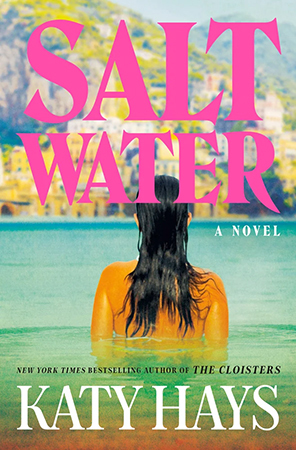
As a writer, I am equally drawn to the way a setting can shape a story. Moreover, I know that when I commit to a novel, I will spend months (often years) in my chosen locale. It is for these reasons that I decided to set my sophomore novel, Saltwater, on the island of Capri. A place where performances (of wealth, of celebrity, of excess) are common, Capri was the perfect backdrop for a story about a family obsessed with managing its public persona, even as cracks in its façade began to surface. Without the island—sultry, luxurious, claustrophobic—the family drama in the novel wouldn’t have been as vicious nor the results as killer. Which is why I’ve rounded up seven cheap vacations here, all of which have fatal consequences.
My favorite book in Rachel Hawkin’s enviable oeuvre of perfectly paced thrillers, Reckless Girls unfurls on the fictional South Pacific Island of Meroe where a young woman and her boyfriend have sailed their sailboat, The Susannah, for some much-needed rest and relaxation. It’s all aboard suntans and light beers until another vessel shows up one morning, anchored in their private cove. The ensuing resentments (and murder, naturally) fracture the serene atmosphere and transform the dreamy tropical island into a nightmare.
If you haven’t read Who is Maud Dixon stop everything, grab a copy, and thank me later. The story of a young woman who takes a job as an assistant to a critically acclaimed and commercially successful writer—Maud Dixon—and discovers the pseudonymous author is not who she seems, Who is Maud Dixon takes a dark turn when the two women travel to a Moroccan riad so that Maud can finish her next (overdue) novel. But Maud has bigger plans than writing and research. Luckily, so, too, does her assistant. Come for the publishing inside baseball, stay for the coasts of Morocco.
Everyone knows Silvia Moreno-Garcia is the queen of atmosphere, and while both Mexican Gothic and the Seventh Veil of Salome get a lot of (well earned!) attention it’s Untamed Shore that has long had my heart. A dreamy, sun-drenched noir set in Baja, Untamed Shore is the story of a local girl, Viridiana, who finds herself entangled in the lives of a wealthy couple vacationing on the coast. When one of the vacationers is found murdered, it quickly becomes clear that the hard glitter of the Pacific isn’t the only thing creating mirages on the beach!
Talk to me for five minutes about suspense fiction and I’ll try to get you to read Christopher Bollen. The Destroyers (my favorite of Bollen’s oeuvre) is set on the Greek island of Patmos where, legend has it, the Book of Revelation was written. Broke and desperate, Ian Bledsoe arrives on Patmos hoping to talk his childhood friend, Charlie, into offering him a financial lifeline. But when Charlie disappears, everyone on the island is a suspect. And I mean everyone. The Book of Revelation may have predicted the end times, but I guarantee this will be the beginning of your love affair with Bollen’s writing. (Bonus picks from Bollen include: A Beautiful Crime, set in Venice and Havoc, set along the Nile).
I am obsessed with Calla Henkel. So obsessed I don’t even care if she learns about it by reading this listicle. In her stunning, intricately plotted debut, Henkel takes us to early 2000s Berlin where art student, Zoe, finds herself partnered up with a pop culture and fame obsessed roommate. Together, they rent an impossibly chic apartment from a secretive thriller writer for their year abroad in Berlin, only to discover the city, its nightlife, and residents, have darker plans. Heady and intoxicating (with some great Amanda Knox salvos), not everyone in this apartment will survive their year in the Grey City.
Christine Mangan has made a career out of crafting perfect historical noirs and her latest, The Continental Affair, is no exception. In the gardens of the Alhambra, Henri, a desultory gopher for a criminal organization, watches Louise, the beneficiary of a modest inheritance, “accidentally” pick up the bag of money Henri was sent to collect. What follows is a game of cat and mouse across Europe as Louise searches for excitement and Henri searches for her. Glamorous, claustrophobic, and haunting, The Continental Affair updates Agatha Christie’s locked room mysteries with dramatic results.
What kind of list would this be without Patricia Highsmith? The truth is, very little happens in this novel. The set up is: a young woman commits suicide and her father arrives in Venice to exact his revenge on his daughter’s husband who he blames for her death. The father proceeds to stalk the widower, Ray, through the narrow alleys of Venice, down the canals, and across the Lagoon. A master class in atmosphere, tension, and letting the setting do the work for you, Those Who Walk Away is a slow but stunning work of fiction by one of the best suspense novelists to ever ply the trade.
Ask me for a book recommendation on the spot, and my mind will probably go blank. I can’t explain it, but when someone who knows I keep up with contemporary literature wants to know what they should read next, suddenly, it’s like I’ve never read a book in my life, or my mind can only access books I wouldn’t recommend. But if I’m given time to consider, Lydi Conklin’s Rainbow Rainbowwould be at the top of the list. It’s one of my favorite story collections from the past decade—maybe ever. The stories are propulsive, vivid, affirming, and just really damn good.
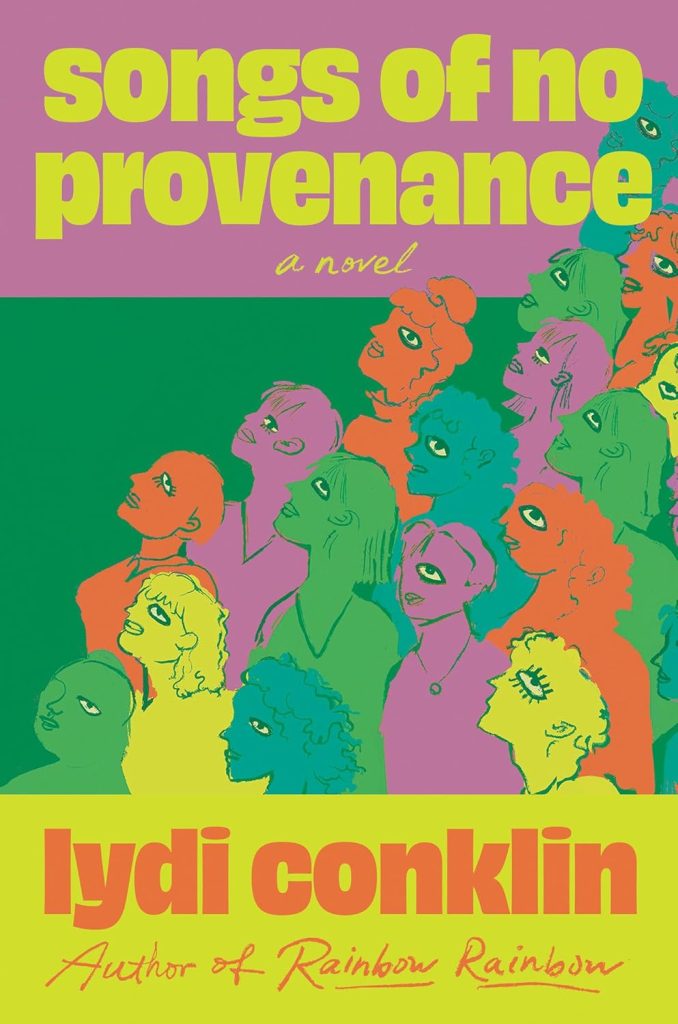
Needless to say, I couldn’t wait to check out their debut novel, Songs of No Provenance, about an indie folk singer who flees to teach songwriting at an art camp after doing something sexual on stage she’s quite certain will get her cancelled. Joan Vole isn’t interested in teaching these teenagers, but joins the staff as an attempt at refuge—campers aren’t allowed smart phones, so she’s hopeful no one there can get online and come across what she’s done. Surrounded by young artists and fellow camp staff—including Sparrow, a nonbinary artist who is a fan of her music—Joan questions her past, future, and relationship to making art. Songs of No Provenance hits that sweet spot of being character-driven, yet suspenseful. As the reader wonders if (when?) everyone at camp will discover what she did, we’re offered a compelling portrait of this flawed artist. The novel dives into issues of identity, queerbaiting and appropriation, kink, fame, secrecy, art making, and more. And like Lydi’s first book, it’s really damn good.
Lydi and I discussed their novel over a couple of weeks via Google Docs, and talked about music, queerbaiting and appropriation, and liminal identities.
Rachel León: We have a mutual friend [JP Solheim] who is composing one of the fictional songs from the novel, so I thought we could start there. You use such vivid descriptions of Joan’s music, I’m curious if you have your own sense of what her songs sound like? And do you have plans to share JP’s version of the song with readers?
Lydi Conklin: Oh I love JP so much! Yes, JP is one of the artists who so kindly agreed to interpret and record and/or perform songs from the book! So far I have gotten five songs. Three are the same song, which I love so much, because they are all done so differently and beautifully, by my musician friends Caitlin Watkins, Anna Vogelzang, and John Shakespear. I listen to them all the time, and I love how they live in the same universe and come from Joan’s mind but are each so deeply in their own voice. And then my friends Jacob Milstein and Emily Bielagus did two different songs from the book, which they added lyrics to and completely changed the meaning/emotion of the songs. I’m obsessed with both approaches. I do have my own idea of how Joan’s songs sound, and probably Emily’s voice and style is the most similar to Joan’s, though I love seeing the songs interpreted in vastly different ways from how I pictured them. I will release the songs the musicians have interpreted in the weeks leading up to the book’s release, which I’m really excited about. Usually writing a novel is such a solitary act, and it’s been amazing to get to work in collaboration on this piece.
RL: That’s so cool! You’ve done a lot of residencies, which often offer the opportunity to be in community with artists of other disciplines, in addition to having time to work in solitude. This novel made me wonder how much of your creative process pulls in other mediums. Like, I know you also draw comics—do you doodle when you’re stuck? Are you someone who writes with music or in silence? How does being in community with artists of other disciplines strengthen your own work?
LC: That’s such a good question! I keep my mediums pretty separate artistically for the most part. Like one editor who was interested in Rainbow Rainbow wanted to publish it with my drawings as well and to me that felt wrong. I really think of them as separate endeavors, and the way I work on them also reflects that. Like with comics, I often use speculative elements, and I have a rule in my fiction to never use speculative elements, because I’m more interested in the weirdest thing that could possibly happen in real life, whereas in comics I feel the medium is already in the world of the made-up, and so I use speculative elements like floating boobs and talking dogs to explore very real character-based emotions.
I don’t usually use art or music in the process of writing, though I did listen to songs over and over again that inspired this book, to try to get into Joan’s mindspace and creative space and to try to learn how to write songs myself. I had only written kind of silly songs [prior] to this book, like a song about sports. Although I did write some grim goth songs in middle school about people bleeding in graveyards. I do have a lot of friends who work across disciplines artistically. I did theater in high school and a lot of my friends are still in that world, which inspired a manuscript I’m working on now, and all my musician friends formed the inspiration for this book, especially my friends’ band You Won’t, which is my favorite band. I was always so jealous of their glamorous life of touring and playing shows and writing this book was one way to get to live inside that world.
RL: Ooh, can you share the songs that inspired the book? Or is that something you prefer to keep private?
There are definitely authors and musicians whose work I cannot consume at all because of what I know about them. And I don’t know if that’s right or wrong.
LC: Oh yes! There is one song that was the biggest inspiration of the book that for some reason I like to keep private! But there were many songs that inspired it. Paige’s career and vibe is slightly inspired by young Joanna Newsom. Artists that inspired Joan’s songwriting and vibe range wildly, and I studied many songs to get inspiration, such as the works of Adrianne Lenker, Ani Difranco, Diane Cluck, You Won’t, and many others.Certain songs I would play over and over to wedge myself as deep as I could into a certain vibe.
RL: I like that you’re keeping it private! Sometimes we need to do that as artists, for some things to belong to us alone…Keeping on the idea of consuming art, the novel explores the idea of how/if we can separate the art and the artist, particularly when the artist behaves problematically. It’s a question that comes up more and more with cancel culture, and I’m curious where you land on the issue: are the two inextricable, or can you separate the art from who made it?
LC: Oooh that’s such a good question, and the book definitely delves into those issues, thank you for noticing! I am especially interested in exploring that issue around queerbaiting as a phenomenon. It’s such a hard thing to think about—I recently read Monsters: A Fan’s Dilemma which was an interesting read on this exact subject. I have had difficulty separating the two when I know certain things about an author. But then I feel mixed about it, because of course there’s so much I don’t know about other authors who could be doing horrible things. Sometimes that’s why it’s better not to meet your heroes. But other people I have grown to love their work even more because I know them, and I know them to be such wonderful people. But yeah, there are definitely authors and musicians whose work I cannot consume at all because of what I know about them. And I don’t know if that’s right or wrong, and I think that’s so interesting. I often bring a lot of myself into the work, and so I’m always curious about how that conflation and separation occurs, and I enjoy playing with it intentionally. Like my next book is decidedly fiction, but it plays with the idea of autofiction.
RL: I want to talk about queerbaiting and appropriation—particularly in that context of the issue of the art vs. the artist.
LC: This is a complex issue that I have thought about a lot. I do remember when I was young seeking out role models who seemed like they were queer or were gesturing toward queerness in some way, and I would cling to them even though, in retrospect, many of them were just using queerness aesthetically or to gain an edge or whatnot and weren’t actually queer. But I have complicated thoughts about that since fandom is already such a land of fantasy and those figures did help get me through. In more recent years I have been frustrated at times by so many books about queerness written by cishet authors, though I’ve come to realize this also is a complicated situation because I was able to write about being trans years before I was able to come out and writing helped me figure out my gender. So there’s no way to know who is writing about such topics because they are beginning to face something in themself and who is using them in some kind of bad faith manner. That is an issue that comes up in the book with some of the other members of Joan’s singer-songwriter collective who experiment with gender to various depths and with Joan vs. Sparrow’s generational differences in thinking about trans identity.
RL: Complex for sure—like, when is it queerbaiting and when is it appropriation? Because there can be an overlap, right? Joan does both, doesn’t she?
I was able to write about being trans years before I was able to come out and writing helped me figure out my gender.
LC: Yes, she definitely does. But I think for Joan, what appears on the surface to be queerbaiting and appropriation and is problematic when she identifies as cishet at the beginning of the book eventually shifts to mean something else later in the book when she realizes more about her own queer identity and how it takes shape. Joan is a complicated figure who has built very sturdy shields against her darkest and hardest thoughts. So while Sparrow has one interpretation of the way Joan makes work, later it turns out perhaps there is a truer reason Joan is exploring those topics. But yeah I think queerbaiting probably in general is a subcategory of appropriation, like appropriation of a specific culture, with a bad faith intention attached to it.
RL: The way Joan’s identity shifts feels really true to me. You mentioned earlier the generational differences between how Joan and Sparrow think about trans identity, which made me think of a few of your short stories and how one thing I love about your work is the way you explore liminal identities. As someone whose gender identity and sexuality is constantly shifting, I’m grateful for how you capture liminal identities. I feel like our society wants everything to fit neatly into a box, to be able to categorize people as this or that, and I think pushing against thatis important, so thank you. Can you talk about capturing liminal identities on the page?
LC: Oh thank you so much, Rachel! That means so much to me to hear you say all that because that is really what I’m trying to get at. As a young person, I knew I was trans and was always drawn to trans identity, and really desperately wanted to have top surgery and change my name and pronouns, but I didn’t think it was possible to be transmasc without taking testosterone, which I didn’t want to do for various personal reasons. So for years, actually decades, I was in this space of sorrow where I felt there was no place for me in trans identity and no way forward for me to feel comfortable with myself. Then, years ago in some Brooklyn bar, I remember meeting Julia Weldon, an amazing singer/songwriter and actor who, many years later, did the narration for the Rainbow Rainbow audiobook, and I followed them on Instagram. They were a transmasc person like me who got top surgery without doing HRT. And I was like, whoa, you can do that? Why didn’t anyone tell me that? For years Julia was the only person I knew who had taken this journey, so I thought maybe just they were cool enough and no one else could! Then I had a really transphobic therapist who got in the way of my progress for a long time, but finally I got an amazing therapist who told me that the gender options are a buffet and you can take what you want and that was a big breakthrough for me. Ever since I have taken my own path no matter what people think about it. But I always thought back to how much Julia’s story affected my life, and how I wished there were more people taking similar paths that I could’ve witnessed in some form of media sooner. So I decided to explore those types of liminal identities in my own work ever after. I also frankly think liminal identities are more interesting to explore on the page, even if I didn’t have a personal stake in them, because nuance and complexity are the realms of literary fiction.
RL: Since we’re talking about things I admire in your work—another is the intersection of sad and funny. I’m drawn to humor that hits on multiple levels, stuff that can feel wrong to laugh at…I’d love to hear your thoughts on this topic.
Liminal identities are more interesting to explore on the page.
LC: Oh yes! I love the intersection of humor and sorrow so much. I admire Lorrie Moore for that, and there’s another story, called “Lupinski,” that my MFA student Nathan Blum introduced me to that does it beautifully as well. I always want the most visceral reaction possible from the reader, and both of those emotions are the most visceral ones you can pull out of anyone. I also feel like they go together. There is so much funny in the sad and so much sad in the funny, they can hardly be peeled apart from one another. So thank you for noticing it!
RL: We need to wrap up our conversation, but there’s still so much I’d hoped to discuss! Let’s try to tie some topics together: fame, secrecy, kink, shame, and songs of no provenance—the link [between them] being what we keep private (and why) and what’s public, and how that [decision] can change our relationship with that thing, whether that’s art or something about our sexuality and/or proclivities. Our lives have become more public with social media, but there’s a curation involved, just as I imagine there is with fame. The question of the interplay between fame and secrecy feels central to this novel. Was there anything you discovered about these things through writing Songs of No Provenance?
LC: Oh totally! I love this question. I’ve never thought too much about fame in the past because in my field, even if my work was of a flavor that could theoretically achieve fame, literary fiction is not a realm that ever comes with that type of fame. My greatest heroes are virtually unknown to people outside my world, which always makes me sad. I also, as my friends would attest, am hopelessly out of the loop with anything related to fame or pop culture, so it’s not something that interests me. But I became very interested in it through Joan’s world. The kind of success she would want in a vacuum is not maybe that far from what she has but when pitted against what her mentor/friend Paige achieves it starts to look sickly. And I love that idea that in a time of hunger for fame, secrecy and shameful acts that cannot ever be known about would have an even stronger erotic tenor. Songs without authors become so precious to Joan—before she even understands why, they stand in for works of art that can exist without any of the terror and wonder of actual fame and success, untethered as they are from any actual person.
The weather in San Angelo had been 72 and sunny since the day he arrived. The weatherman spent his first few months in town studying historical data and analyzing weather models in an attempt to solve the mystery of the newly formed microclimate, but no clear explanation emerged. Nobody seemed to mind. They were simply grateful that he had come and brought with him these endless days of gentle sunshine. Such appreciation was completely new to the weatherman. He’d spent the first nine years of his career in a Midwestern town he hated, where he was blamed regularly for tornadoes and floods; his former neighbor even billed him for the hail damage on her new truck. Maybe he deserved this new gig, his wife Lori suggested. Maybe San Angelo was his reward.
To celebrate one year in their new town, he and Lori went out to dinner at the local Moroccan restaurant. The hostess guided them to their favorite table, outside near a small fountain in the courtyard. As they dined, he was pleased when a gentle breeze drifted in from the north-northwest, as he forecasted that morning.
“All the stress I carried with me has totally evaporated,” he told his wife after the meal, as the waitress poured mint tea into their tiny glasses. “I honestly feel like I could do anything.”
“So you’re ready?” she asked, leaning forward.
The steam from the tea fogged his lenses. He wiped away the condensation with the end of his shirtsleeve. “Are you?”
Five chromosomally normal embryos, frozen in development, waited for them inside a lab somewhere in Utah. They’d banked them three years ago, after the miscarriage, but decided to wait on the transfer until Lori passed her real estate exam. Then delayed the process further when he snagged the job in San Angelo.
“I want to try,” she said. “Who knows, if you do for the implantation what you do for the weather, we may have a baby by Christmas.”
He squeezed her hand, delighted by their decision but also bristling at the suggestion that he did anything more than simply predict the weather. It was an absurd notion, that he had a certain power over the local climate, and yet he couldn’t deny that he’d considered the possibility, if only in passing. The weather in San Angelo had been unusually temperate since they arrived. “We’ll take a bottle of champagne to go,” he told the waitress, as the breeze picked up and snuffed out the candle on their table. “Rain is on the way.”
The weatherman and Lori shared the champagne on their walk home, laughing and stumbling through the serene streets of San Angelo under a star-studded sky. “Meteor!” Lori shouted, pointing up at what seemed like cosmic confirmation, a sign from the heavens that the life they wanted—in a pleasant town with a house they owned and a baby in their arms—was as likely as tomorrow’s sunrise.
His impromptu prediction for rain that evening didn’t pan out, and when he ran into the waitress at the café the next morning, she called him out on his miss. Lori’s comment at dinner stuck in his mind. Despite what the latest models indicated—clear, sunny skies for days on end—the weatherman, trying to redeem himself, guaranteed that rain would arrive later that evening, a forecast he later reiterated to his viewers. That night, when the weatherman stepped out onto his porch and held out his hand, small drops of precipitation landed in his open palm. It was the last rain that would fall in San Angelo for months.
The wildfire came in November, after their third unsuccessful embryo transfer. He almost missed it. He’d stopped double-checking his forecasts about six months in and hardly bothered consulting the models anymore. But on his walk to work that morning, a strong gust of wind flung his tie over his shoulder. Discarded cigarettes and newspapers tumbled down the empty street. Why hadn’t he worn a windbreaker?
At the station he studied the models and reviewed historical data on Novembers in San Angelo going back a hundred years. There was a day like this one 78 years ago, after a similarly long drought, and on that evening heat lightning sparked a wildfire up in the hills. He called Lori to tell her he had to stay late. He also asked her to pack a go-bag, just in case.
That evening, he forecasted something other than calm nights and smiling suns. A fire was imminent.
Lightning lit up the sky on his walk home. An orange glow blossomed high up in the hills. The swirling red lights of firetrucks twisted up the road towards the blaze. Smoke blanketed the night sky, and the winds gained strength, threatening to carry the fire west, into town. The weatherman couldn’t help but feel responsible.
The failed transfers had distracted him, the rising hope that came crashing down—not once, not twice, but three times. He worried about Lori. So fatigued from the influx of hormones, her life was in a holding pattern, waiting for a baby who refused to come. He worried about himself too: he wasn’t sure, after the three failures, if he could do a fourth—but those two perfectly viable embryos were still there in Utah, waiting their turn. Who knew their fate, or how Lori’s body would respond. It was all so unpredictable, out of his control.
The winds picked up, as he’d predicted, and the fire raced across the hills.
Desperate for a solution, the weatherman recalled the impromptu forecast for rain he made the night of their celebratory dinner at the Moroccan restaurant—his prediction hadn’t panned out until he announced it the next day, on television. At the time, he briefly considered whether his influence on the weather was somehow tied to his television appearances, but quickly dismissed the theory as outlandish—why would it matter whether he was on air? But now, with a wildfire threatening San Angelo, he saw no other option but to make an emergency forecast and hope his theory was right.
He ran back to the studio and convinced the night crew to let him on. Although he had no evidence to prove it, he forecast that in a matter of minutes heavy rain would fall in the area, enough to put out the fires but not enough to cause flooding or landslides. He would have never dreamed of pulling such a stunt as a rookie weatherman, back in that Midwestern town he hated, but his confidence had grown since he’d arrived in San Angelo.
Within the hour, the rain poured down, and the fire stopped.
Houses were saved, gardens were saved, the lives of horses and dogs and humans were saved. He was relieved, and in awe of his power.
The next morning, at the studio, his boss called him into her office. “You’re not like other weathermen, are you?” she asked.
“I don’t understand,” he said, wondering how much she knew.
“The people of San Angelo love you,” she said. “You’ve brought this town endless days of pleasant weather, and then you stop a wildfire?”
“You think I stopped it?” he asked, stunned.
“You made the forecast. That’s all that matters, right? Viewers associate you with the weather, good or bad. How long have you been a weatherman? You must know that.”
The weatherman understood that something more was at play here. He’d been fascinated with storms and tornadoes and floods for as long as he could remember, since he was just a kid in Nebraska. After years of studying models and analyzing patterns, he was convinced he’d reached a deeper level of intimacy with the movement of clouds and jet streams. The weather was a part of him.
He was convinced he’d reached a deeper level of intimacy with the movement of clouds and jet streams.
His boss searched through papers on her desk. “That’s precisely why I’m irritated with them for stealing you.” She handed him a letter. “They want you on the ‘Good Morning Show.’”
The “Good Morning Show” was the last of its kind, the only national broadcast that still reserved space for the weather. It was the reason the weatherman applied for the job in San Angelo in the first place, to work for a network affiliate that might propel him to the national stage. But he didn’t forecast success to come this fast.
That evening, when he showed Lori the offer letter, she popped open the fancy bottle of sparkling cider they’d been saving for when one of the transfers actually worked. “Finally, good news,” she said.
The next morning, on his drive up the coast to the studio in Los Angeles, he watched the sun climb over the peaks in the east, lighting up a band of cirrus clouds in purples and pinks. A week before, the appearance of the thin, wispy clouds would have delighted him for their beauty alone, but now all he could think about was whether the clouds signaled an approaching system, and where that system might land. He needed to look into high-altitude winds and study the topography of this area, only half an hour from his home in San Angelo but meteorologically foreign to him. He needed to learn so much about so many new places. He stepped on the gas.
At the studio, he stood in front of a green screen and introduced himself to the nation as their new weatherman. It terrified him, thinking about all those people watching, millions spread across the country, in all different climate regions. Overseeing the weather on the national stage, he realized, would be infinitely more complex than his local gig.
At his desk, he requested special reports from his team of data analysts and researchers. He studied Arctic weather patterns, the Aleutian low-pressure system, and the currents in the Gulf of Alaska. He read up on pollination cycles in the Central Valley and predator-prey relationships in the Southwest. It was an obscene amount of pressure, to know that you have the power to save towns from disaster, if that was indeed what was going on. Simply bringing about a rain shower or a modest change in wind direction, as he had in San Angelo, wouldn’t be enough. His domain expanded well outside of that climatically hospitable town, and he might now have the opportunity to do so much more: end droughts, disperse tornadoes, divert hurricanes. Calm the effects of climate change. In the glow of his monitors, he zoomed in and out on high-resolution maps late into the night, waiting to feel the weather move through him, as it had in San Angelo.
The work was exhausting, and after only a few weeks, the atmosphere of his marriage shifted. Lori dined solo at the Moroccan restaurant, leaving him leftovers in the fridge, which he ate over the kitchen sink alone when he finally arrived home. Unlike during the previous three cycles, he had to skip their check-ups at the clinic and left Lori on her own in the evenings to inject herself with progesterone. The weatherman apologized and told her he wanted to be there, but in truth he needed to keep this fourth cycle at a distance. If he hadn’t seen how those endless sunny days in San Angelo led to a wildfire, he might not be so vigilant. What might happen now if he let his guard down? A tornado could rake through Oklahoma, a blizzard could devastate Wyoming—and he’d only have himself to blame.
In the days leading up to the fourth embryo transfer, a hurricane formed in the Gulf. Not since the wildfire had he faced an event of this magnitude. After all those hours studying jet streams and pressure systems and regional climate patterns, this was his first real test. He monitored the system closely as it escalated from tropical disturbance to depression to storm. It was a wonder, watching it evolve. Wind speeds increased, thunderstorm activity concentrated near the center, and the storm’s circulation intensified. Refusing to leave the studio, he waited expectantly for the eye to form.
By the time the storm strengthened into a full-fledged hurricane, with that clear, visible eye at her center, he knew Audrey—as the World Meteorological Organization had christened her—intimately. She whirled over the waters of the Atlantic, pushing towards the coast. The weatherman knew by instinct what she would do; there was no more need to consult his reports or models. “The hurricane will weaken significantly before she hits land,” he told his viewers that morning, then in the afternoon, and again in the evening—but no matter how intently he insisted on this prediction, he could not get the models to agree with him. He debated warning everyone in Audrey’s path to evacuate, but where would he tell them to go? If he was wrong about her intensity, he might be wrong about her trajectory, too.
The timing for such complications wasn’t ideal. The fourth embryo transfer was the same day Audrey would hit land—but despite his forecast, Audrey slowed, delaying her arrival while she gathered strength and structure over the warm ocean waters. Her movements, more unpredictable than he’d anticipated, swirled his sense of time, and he missed the transfer.
He escaped the studio and rushed back to San Angelo when he realized his mistake. At the clinic, Lori let him walk her out to the car but wouldn’t talk to him. Instead, she rolled the window down and stared up at the row of palms in the median. At home, she lay on the couch, bloated, while he warmed up broth on the stove. He wished he could guide the embryo to its intended home, to safely implant and grow—but that, unlike the weather, was beyond his control.
When Lori fell asleep that night, he slipped away to the studio. Audrey had changed course. Contrary to his earlier predictions, she was now due to make landfall slightly east of where he’d anticipated, barely skirting Houston. This was good news: her eye would now cut through a less populated area. But his forecasts had focused on weakening the storm, not changing her course. What had he done to cause this recurvature? He racked his brain. Was it the westerly winds? The low-pressure system in the Southeast? Or another forecast he made days ago, for a completely different region? If he wanted to orchestrate the nation’s weather effectively, he desperately needed to grasp the multi-order effects of his interventions.
He wasn’t sure how many nights he’d spent at the studio, trying to understand how he’d diverted the hurricane, when Lori showed up at his cubicle. “This is unexpected,” he said, scrambling to cover his notes about Audrey. “How are you feeling?”
Lori placed a hand on her stomach. “I’m trying not to have any feelings this time,” she said. “I had a good feeling the other times and it never worked out.” She stared at his notes on the hurricane, still half visible under a stack of papers.“What’s going on with you?” she asked. “I get why you couldn’t make the appointments, but to miss the transfer?”
He wanted to share his secret, but he couldn’t tell her now, not while she was waiting for the embryo to implant. “It’s been really busy here,” he began.
“Work’s always busy,” she said, her voice rising. “That’s, like, the human condition. But you have to find time to show up for this shit.” The analyst in the next cubicle lifted his head; she lowered her voice. “Look, I went in for the blood test this morning.”
The weatherman glanced at his calendar. “I didn’t know that was today.”
“Because I didn’t tell you.” She took a deep breath. “My hCG levels indicate the embryo implanted.”
This wasn’t how he imagined finding out. He’d pictured Lori showing him a pregnancy test, the two of them popping open that bottle of sparkling cider in the fridge, like they had when he received news of his promotion, and brainstorming names. “So it actually worked?” he asked.
Lori nodded. “So far.”
In those months leading up to fatherhood, the weatherman installed a car seat in Lori’s SUV, researched pediatricians, and put together the crib, above which he hung a mobile of cumulus clouds, snowflakes, and rainbows. He also set up a makeshift weather center in the basement, in anticipation of days when he might have to work from home. The company offered parental leave, but with a child on the way, his work felt even more urgent. What a gift, to offer his daughter a more stable climate. He just needed a little more time.
The enormous complexity of unraveling the consequences of even a minor storm, however, left him defeated. Even the “Good Morning Show’s” sophisticated models had their limits. As an intermediary step, he wrote out long lists trying to establish clear priorities: should he even bother with hurricanes, or would tornadoes be easier? Would consistent, drought-ending rain in the Central Valley be fair to the animals who have adapted to the region’s cycle of wet and dry periods? And how should he define his area of responsibility? He was the nation’s weatherman, but the weather doesn’t respect borders.
The questions wouldn’t stop accumulating, not even after Ana was born that September.
The weatherman was home more often in those early months with his daughter, but whenever Lori had to feed her or she was asleep (usually on Lori, after eating), he retreated to his makeshift weather center in the basement to track storms and deliver the morning forecast in front of a green screen. It wasn’t the same as being in the studio, but it would have to work temporarily while they settled into their new life with Ana.
After a few months, Lori restarted coursework for her real estate license; and while she was in class, on Tuesday and Thursday afternoons, the weatherman studied his models alongside Ana, who batted at the plush clouds and smiling sun that hung from her baby gym. He’d bottle-feed her and hush her to sleep to a soundtrack of the rumbling sky. He loved spending time with his daughter and wished he could spend every hour with her—but he was still frustratingly far from easing the burden of climate change and knew his true duties as a father laid elsewhere.
He was still frustratingly far from easing the burden of climate change and knew his true duties as a father laid elsewhere.
When Ana started daycare, the weatherman disappeared back to the studio. Meanwhile, Lori began to establish herself as the top realtor in San Angelo. Sellers and buyers alike were attracted to her friendly demeanor and no-nonsense approach. She would tell you exactly what made a house special, but didn’t try to oversell it. The local board of realtors named her a Rising Star and honored her at the annual awards banquet, which unfortunately coincided with a series of tornadoes in Oklahoma. The weatherman did not attend, nor did he attend the two parent observation days at Ana’s daycare, due to a flood in Missouri and, later, a blizzard in Rochester. The weather never took a break, so neither could the weatherman.
Lori’s professional success renewed her confidence, and after another long string of nights when the weatherman came home too late to tell Ana goodnight, she waited for him at the kitchen table with a bottle of wine. When he finally walked through that creaky front door he promised to replace, she’d nearly finished the bottle.
“Where the hell have you been?”
“Another atmospheric river’s coming through,” he said, exhausted.
“That’s not what I mean. You know that’s not what I mean.” She took a drink. “You need to take a serious look at those little storm systems moving through your head.”
The weatherman sat down at the table, opposite Lori. “You want me to see a therapist?” he asked.
“No. I mean, sure. I don’t know. It’s just, we don’t even watch TV together anymore,” she said. “Don’t you see how that’s bad?”
“Since when do you care about TV?”
“There it is again,” Lori said. “You’re completely missing the point. I can’t keep doing this.”
He loosened his tie. “My work is not what you think,” he blurted out. She could share the stress, if that’s what would keep them together. “I’d much rather be with you, but I can’t. You know that rain we got the night of the fire? That was me. I made that happen.”
Lori was confused. “What are you talking about?”
“The wildfire a few years ago. I put that out. That’s why I got the promotion. I can control the weather.” He knew he sounded deranged, but if anyone would understand, it was Lori. “What I mean is, what I predict actually happens.”
“Isn’t that true of every decent weatherman?”
“It’s different with me,” he said. “Haven’t you noticed how the Central Valley is steadily climbing out of a drought? That doesn’t just happen.”
“It doesn’t?”
“No, I intervened.”
“Intervened?” she asked, pouring herself the last of the wine. “Do you realize how absurd that sounds?”
“Yes.”
She swirled her glass of wine, considering her husband’s claim. “Fine. If you control the weather, make it snow.” She gazed through the window at the live oak in their backyard, illuminated by the full moon.
“Lori, it’s July.”
“So what?”
“Well, it doesn’t work like that. For starters, I have to be on TV.”
Lori laughed. “Are you serious?”
“Completely.”
“So make it snow tomorrow.”
“You have to consider the downstream consequences.”
“The snowball effects!” Lori said, clearly not taking the weatherman seriously.
He stormed back downstairs to his home weather center and studied his models, trying to see where there might be potential for snow. He found an opening, a strong cold front he could possibly nudge further south, and prepared a forecast for the next morning. But at the studio, he couldn’t bring himself to deliver it. Snow in San Angelo in July would only set him back further—and that wouldn’t be fair to the farmers in the Central Valley, or the folks in double-wides in tornado alley, or, longer term, to Ana. Couldn’t Lori understand that?
When she asked him to move out, the weatherman rented a condo in Pasadena, not far from the studio. He assumed the arrangement was temporary: his marriage wasn’t perfect, but it could withstand whatever this was. But a few weeks later, when he picked up Ana for the weekend, Lori told him she’d started seeing someone and encouraged him to do the same. He pressed for details—was this new man the reason she asked for the separation?—but she didn’t divulge much, only that his name was Cooper and he worked as a general contractor.
Hoping to cast a gloom over Lori’s new relationship, the weatherman forecasted inclement weather for San Angelo for Lori and Cooper’s weekends together, while Ana was safe with him in Pasadena. But despite the heatwaves and the high winds he summoned, the couple seemed unfazed, even happy. Months later, at pickup, Lori told him she and Cooper were going out of town and left him with the address of their hotel in the Malibu Hills, in case of emergency. He recognized the name of the hotel. The lead anchor of the “Good Morning Show” always talked about how much she loved its world-class spa. Why would Lori, who hated overpriced luxury hotels, want to spend her weekend there? Then it dawned on him: Cooper planned to propose.
He needed to give her what she’d asked for, proof that he wasn’t delusional, that he’d been distracted and absent for good reason.
In his afternoon forecast, he described an unusually cold winter storm system that would bring Arctic air much further south, into the Los Angeles Basin. “If we’re lucky, we may even see a small amount of snow at higher elevations, near the Santa Monica Mountains and in the Malibu Hills,” he stated. Los Angeles drivers, unprepared for snow, would be forced to pull over and wait out the storm, Lori and Cooper included. They’d arrive at the hotel exhausted and irritated, having missed dinner, in no mood for a romantic retreat, the storm a sign from the gods that their relationship wasn’t meant to be. Watching the snow out her hotel window, Lori would finally believe he was telling the truth.
When the weatherman determined the storm would hit much harder than he intended—a ripple effect he hadn’t accounted for, likely due to his interventions in the Pacific Northwest—he demanded that the network put him on air. It was too late to shift the system; all he could do was issue a warning. “We’re anticipating heavy snow, zero visibility for drivers. Microbursts flipping vehicles,” the weatherman told viewers. “Please, shelter in place until this storm passes, and stay off the roads.”
He tried calling Lori; no answer.
He left the station and sped down the highway to San Angelo, where Lori’s parents would be with Ana. He had no idea what he’d do once he was at the house, but he knew he needed to be with his daughter. Maybe they had Cooper’s number? Maybe Lori had checked in with them?
When he arrived, he knocked on the door, a new wooden door with an intricately carved live oak at its center, acorns lining the perimeter. No one answered. The neighbor across the street spotted him as she covered her dahlias with burlap. “Mr. Weatherman!” she called out, her hands up in protest, irritated with the cold air that had traveled all this way to ruin her garden. “What is this!”
“Have you seen Ana?” he asked, frantically.
“They all headed out,” she shouted back.
“Ana is supposed to be here with her grandparents.”
“Pretty sure they all left. Saw two cars leave the driveway.”
He sped back up the highway, into the Malibu Hills, directly into the storm. When he reached the long line of cars stalled in the canyon, he flung open his door and bolted up the road on foot, searching for Lori’s car. As he ran faster, snow crunching under his dress shoes, he recalled the night he met Lori, back in that Midwestern town he hated. Snow was falling in the parking lot of the movie theater. When he stepped out from under the awning to gauge whether the flakes were fluffy or wet, a snowball thudded into his chest. Lori rushed up to him, laughing, and explained that she had mistaken him for someone else. He couldn’t remember what movie he’d seen that night, or the density of the snow, only Lori, her mittened hand offering him a snowball. “Take your best shot,” she said.
Traffic began moving ahead steadily.
The weatherman was still running when the “Good Morning Show’s” news van slowed alongside him. “What are you doing out here?” the producer asked, sliding open the door to let the weatherman in.
“What’s the latest on the storm?” he asked, still running. “Any fatalities?”
There was only an inch or two of snow on the road.
The producer shot his cameraman a look. “Nothing like that,” he said. “Just some stalled traffic, maybe a few ruined interiors for those sad fools in convertibles.”
The weatherman stopped, relieved Lori and Ana were safe, but also in shock, knowing how close he’d come to ushering in a more severe, life-threatening storm. When he caught his breath, he pleaded with the producer to put him on air. “Please,” he said. “It’s a matter of public safety.”
The producer didn’t need to be convinced. Reporting from the field always boosted ratings. The crew positioned the weatherman on the side of the road, where the wind had blown the snow into ankle-high mounds. Behind him, the hills were dusted white. The producer signaled for the cameraman to start rolling.
The weatherman looked directly in the camera and disclosed to the “Good Morning Show’s” viewers what had transpired during his tenure as the nation’s weatherman. He described his nascent ability to guide the weather, starting with the wildfire in San Angelo, and promised that he’d tried his best to bring pleasant conditions to all Americans, noting the consistent rain in the Central Valley, but admitted that in the end he found the task insurmountable.
Of course, nobody would believe him. They probably thought he was some Hollywood megalomaniac, driven mad by a small taste of celebrity.
All I wanted was to bring certainty into our lives, he continued. But the weather refuses to be controlled. It’s unpredictable, always changing. At least since the Babylonians, we’ve looked up at the clouds to see what will happen tomorrow—that’s thousands of years of practice, and we still get it wrong.
The producer signaled for him to wrap it up.
I used to believe a forecast was a glimpse into the future, but it’s nothing more than an accumulation of guesses designed to impose order on chaos, the illusion of control.
The weatherman leaned over and grabbed a handful of snow. He paused and stared into the camera, trying to find his reflection in the lens.
The producer dragged a finger across his throat.
Reporting live from the Malibu Hills, he concluded, this is your weatherman, saying farewell. He tossed the snowball at the camera, and it exploded onto Lori’s television screen.
When I was a young girl we would sit in a circle around a fire, the center as our hearth. The tall evergreens towered above us, swaying in the Northern prairie night sky, between thousands of tiny stars. My Mosom’s deep, ancient voice held the space as he told stories of our trickster, Wesakechak, and the dark spirit of the Witigo.
Us little ones, young Nehiyaw and Métis, would sit in awe and horror, unable to turn our ears down low. As a young Cree girl, this was the embodiment of storytelling. It was generational, sacred, amongst nature, and manifested ancient memory, as well as present and future memory. These teachings and philosophies are in my blood, which is exactly why when I sat down to write my memoir, Soft As Bones, I wove it together as a braided spiral. In my culture, circles are very important, as well as the spiral. It represents connectedness, and I was taught that we are connected to everything around us, everything that came before us, and everything that follows.
Soft As Bones is a memoir woven with my personal experiences, my parents’ and grandparents’ stories, colonial impact on our lineage, all blended together with ceremony, healing, and stories of Witigo and Wesakecahk. True to Indigenous storytelling, it is not just my personal memoir, it is collective—Soft As Bones is a microcosm for understanding intergenerational trauma, telling some of our shared histories and experiences, as well as generational healing and teachings for Indigenous peoples across Turtle Island. It is a book that does not vilify, but instead captures the ambivalence and complexity of the range of human emotion and experience, especially the Indigenous experience.
Soft As Bones does not speak for all Indigenous experience, because we are not a homogeny. We are connected, but we are not all the same, but there is a common thread across Indian Country. As storytellers, we carry our lineages, ancestors, and the land with us. Here are seven books by Indigenous storytellers that embody, reckon with, and claim the past in order to reclaim the present, and pave the way for what is still to come.
Drake’s debut poetry collection that won the National Poetry Series is a journey as much as a revelation, illuminating the terrain of Diné girlhood with grace and defiance. The Sky Was Once A Dark Blanket captures the Native experience of connection to language, land, and lineage all through the modern lens of what it means to be a young Diné woman existing in the modern world. From remembering Mildred Bailey, Native American Jazz singer, to water, Coyote, songs, and critiquing the influence of Kylie Jenner—The Sky Was Once A Dark Blanket embodies histories and preserves futures all at once.
Miranda’s memoir is a collage of personal memory, tribal history, and archival fragments telling the stories of her Ohlone and Costanoan-Esselen family that creates a mosaic confronting California’s genocidal mission past. Deeply lyrical and intimate prose intentionally resists linear storytelling, embracing Indigenous storytelling and the non-linear way we are connected to our histories and future. Beyond that, her structure mirrors the disruption that Native communities experienced as a result of colonialism.
Nenquimo traces her journey from her childhood in the Amazon rainforest to becoming a powerful leader and activist for the Waorani people of Ecuador. This memoir is deeply rooted in oral tradition and ancestral teachings, while also challenging the violent history of colonialism, missionary intervention, and environmental destruction that has threatened our Indigenous ways of life. We Will Be Jaguars is fierce advocacy and spiritual resilience, reclaiming a future where Indigenous land stewardship is essential when looking towards the future, highlighting that protecting the Earth is inseparable from protecting Indigenous memory and presence.
Mailhot’s memoir pulses with raw emotion and literary fire. She tells her story in poetic fragments, diving into the complexities of mental health, love, and survival as a Native woman who grew up on Seabird Island in the aftermath of colonial violence. Heart Berries strips everything down to its inner emotional core, baring truths about pain and self-sovereignty with a voice of unwavering honesty. In writing herself whole, she makes space and claims it for Indigenous women to exist—truthful, messy, brilliant, complex, dynamic, and unapologetically alive.
Johns blends haunting memory and horror in Bad Cree, a novel that is equal parts page-turning and cultural meditation. Dreams and waking life begin to blur for the protagonist Mackenzie when she wakes up from a nightmare holding the head of a dead crow. This young Cree woman finds herself being pulled back to the land—and the unresolved grief of her family’s past. What emerges is a story of reconnection to language, kin, and ancestral magic and power. Johns’ novel shows that the act of remembering is not passive—it is transformative, and sometimes terrifying.
Becoming Kin draws on Anishinaabe teachings, Christian history, and contemporary politics in order to confront the mythologies of settler colonialism with clarity and grace. This book asks the important question of what it would mean to truly live in kinship—with each other, the land, and the past. Krawec blends her personal memories and storytelling with activism, offering the reader a roadmap for decolonial healing rooted in honesty and accountability. Becoming Kin is a powerful invitation to examine the stories we inherit and the systems we live within.
Simpson’s Theory of Water embodies the sacred teachings of water for Indigenous people across Turtle Island. This book explores water like the constellations in the night sky, non-linear, but fully connected and part of the same system all rooted in Nishnaabe thought. Theory of Water envisions paths forward that honor ancestral wisdom while disrupting colonial frameworks, all through personal memory, cultural history, alongside the work of other influential artists and writers. Simpson invites readers to reconsider time, relationality, and governance through Indigenous paradigms—it is visionary, poetic, and deeply rooted in land and love.
Earlier this year, when I sent a note of congratulations to author Sanjena Sathian about her new novel Goddess Complex, she cheekily responded with, “Our doppelgänger books are doppelgängers of each other.”
And it was true. Similarly to Goddess Complex, my new novel The Other Latafeatures an Indian American woman who receives messages meant for another woman with the same name. Both of our novels are about how our protagonists meet their doubles, resulting in unexpected journeys of self-discovery.
Doubles and doppelgängers are having a huge moment in pop culture right now, as exemplified by the hit TV show Severance and the popular, acclaimed movies Sinners and Mickey 17. And of course, literature has a rich history of these stories as well, from Fyodor Dostoevsky’s The Double to Jekyll and Hyde to Tom Ripley, but what’s especially interesting to me is how prominently they’ve been featured in novels by Asian and Asian American authors in recent years. Bestsellers like Kirstin Chen’s Counterfeit and R.F. Kuang’s Yellowfaceimmediately come to mind, as does Kazuo Ishiguro’s modern-day classic Never Let Me Go. But the past five years have also seen Padma Viswanathan’s The Charterhouse of Padma, Matthew Salesses’ Disappear Doppelgänger Disappear, Amanda Jayatissa’s My Sweet Girl, Liann Zhang’s Julie Chan is Dead, and Mansi Shah’s upcoming release Saving Face.
It’s because we’re always being mistaken for one another.
While doubles are largely defined as having a similar if not identical resemblance to another, doppelgängers have a more a supernatural or otherworldly quality and serve as a manifestation of a character’s deepest fears. In some cases, their existence makes the protagonist reflect on what they are lacking, holding up a mirror to their insecurities. And in other cases, it can be a story of identity theft, in which the doppelgänger seeks to assume the protagonist’s life (or vice versa). Doubles and doppelgängers books written by AAPI authors tend to have characters assuming someone else’s identity as a way of navigating their complicated relationship with their own, as a reaction to the high expectations they feel from society or within their communities, to transcend their circumstances, or some combination of all of these.
Kirstin Chen reminded me of what also makes this terrain of particular interest to Asian and Asian American authors, particularly children of the diaspora: “It’s because we’re always being mistaken for one another.”
While in Julie Chan is Dead, Julie can easily take on her identical sister’s identity due to their shared resemblance, it’s nearly as seamless for the unrelated characters in Disappear Doppelgänger Disappear, The Other Lata, and Goddess Complex to swap identities too, for the reason Chen stated.
My inspiration for The Other Lata was an email mixup I experienced in the early 2000s, when someone who shared my first name forwarded me an email mistakenly sent to her. And while this mixup lingered in my thoughts long enough to inspire my third novel, what made me believe I could pull the premise off was a more recent experience.
A few years ago I attended a literary festival that only had one other South Asian author. We were constantly mistaken for another, as if we had inadvertently cast ourselves in the bookfest version of The Parent Trap, completely interchangeable because we were both authors and had brown skin. We would get called by each other’s names, my dinner order would be delivered to her, and when I went to get a drink at a bar, the bartender told me, “You were already here.”
It’s not the first time I’ve experienced this in my life. But because the festival took place in a small town over the course of a weekend, the way the two of us were so often conflated was particularly memorable. And it inspired this line in Lata:
“If someone isn’t looking to see a difference, they simply won’t notice.”
Cons and scamming lie at the heart of several of these novels. And it’s not a coincidence that wealth and luxury are motivators for this duplicity.
The doppelgänger motif arises as characters grapple with the extremes they will go to to level up in socioeconomic stature. In The Other Lata, Lata Murthy longs for the extravagant Manhattan lifestyle promised by Sex and the City. When she begins receiving invitations to fancy parties and soirees for a Mumbai socialite who shares her name, Lata seizes upon the opportunity to accept the invites and pretend to be the other Lata to gain entry into elite circles.
In Julie Chan is Dead, Julie Chan and Chloe VanHuusen are identical twins who were separated at a young age. Not only did they have little contact, they also end up living vastly different lives: Julie works as a grocery store cashier while Chloe is a popular influencer. Upon discovering her sister is dead, Julie literally steps into her twin’s shoes and takes over her social media accounts, at last having the opportunity to try on the glamorous life she had long coveted.
Both Lata and Julie find that the easiest way to take over their doubles’ lives is to brandish the markings of success, such as a high-end wardrobe, expensive jewelry and designer shoes and handbags. That the characters’ need to wield these status symbols to be fully accepted as their doubles also speaks to the class anxiety that is a shared commonality of the Asian and Asian American experience.
Class consciousness and materialism also plays an important role in Counterfeit, though it is not a traditional doppelgänger story. Ava and Winnie’s counterfeit luxury handbag business is predicated on how smoothly, and with minimal effort, Asians can be mistaken for another. The pair use the model minority myth to shield them from being detected in their subterfuge.
These protagonists are acutely aware that their lives do not measure up to what is expected from Asian Americans.
“The model minority myth is grounded in flattening differences between East Asian immigrants, a vast and wildly disparate group of people,” says Chen. “When I was writing Counterfeit, it was really fun to think about how Ava and Winnie could weaponize the very stereotype that was so often used against them.”
The model minority myth looms as a more menacing presence in a pair of novels in which the authors draw from their identities—specifically, their own names—for their doppelgänger novels. Goddess Complex’s Sanjana (the character shares the same first name as the author except for a slight difference in spelling) and Disappear Dopplegänger Disappears’s Matt are at their absolute lowest when they learn of their respective doppelgängers. These protagonists are acutely aware that their lives do not measure up to what is expected from Asian Americans, both within their communities and the expectations conferred on them from being in the “good” minority.
Sanjana does not regret her decision to have an abortion, but in doing so her life has become rootless: she is broke and near-homeless after dropping out of graduate school and walking away from a troubled marriage. Matt, a divorced novelist estranged from his daughter and adoptive family, feels so invisible while moving through the world that he actively wonders if he is disappearing from it. What makes encountering their doppelgängers an even more shocking and disorienting experience is not just the oddness of these doubles’ existences, but how Other Matt and Sanjena (spelled with an “e”) seem to be the better, more socially acceptable versions of themselves. To Matt and Sanjana, these figures are painful reminders of how they are failing, at least when measured against the concept of the model minority.
By naming their main characters after themselves, Salesses and Sathian add a metatextual layer to Disappear and Goddess. Sathian was consciously playing with the tropes of autofiction and the idea that readers often conflate the protagonist with the author. She says that the fact Sanjana and Sanjena share a resemblance and similar names also reflects the idea that “there is a homogeneity to the Indian American diaspora because of the way we are socially engineered to enter America.”
From an early age, many first and second generation Indian Americans have the same mandate to focus on schoolwork over a social life, attend the most prestigious colleges with the goal of establishing careers in stable, lucrative fields such as medicine, tech, and law, and to get married and have children with someone given that same mandate. If we are often mistaken for each other by non-desis, one of the reasons might be that so many of us are following the same “model minority” playbook.
“As our diaspora matures, it makes sense that [doubles and doppelgangers have become] a collective preoccupation,” Sathian adds.
Salesses also addresses the self-imposed conformity that accompanies the oppression of the model minority myth. In Disappear, Matt is astonished by his discovery of a parallel reality that includes his doppelgänger, Other Matt, who is smart, successful and well-respected—qualities that make this other Matt not just seen, but valued. Other Matt’s disappearance allows Matt to step into his doppelgänger’s life, yet it isn’t the quick fix that Matt desires. Too many malignant forces still seek to erode him from without and within.
The novel was published during the first Trump administration, referencing Matt’s anxiety and unease in a world where a presidential candidate is pointedly supported by citizens proudly sporting red hats. The invisibility that Matt struggles with stems from racism, as evidenced by the book’s preface, a list of legislation targeting Asians in America, such as the Chinese Exclusion Act 1882, the first major law barring immigration based on ethnicity, and the executive order that forced Japanese-Americans into internment camps during WWII.
In an interview with Ploughshares about Disappear, Salesses noted that “racism makes it difficult to love yourself, and encourages people to make themselves into the image racism prefers, in order to get some sort of approval.” Matt, as so many in the diaspora, ponders how much of his feelings of invisibility can be blamed on assimilation. It is an act of self-preservation in the wider world, yet at the same time costing him his self-worth and connecting to those most important to him.
As we are faced with the return of an administration that wants to further erode liberties, it might not be a stretch to say that our current timeline has an unfortunate doppelganger too.
So much of diasporic fiction is preoccupied by the notion that the better self is the one we were never allowed to choose.
Matt also has to face another disquieting reality, this one in relation to the passing of time. “He is at an age of dwindling options: Each choice he made limited the choices he had left.”
And it taps into a universal truth: as we get older, reinvention eludes us. The plentitude of opportunities we feel in our youth narrows as the hours and minutes go by. Doubles and doppelgängers represent the idea that what we hoped for ourselves was possible after all, if only we had made better choices. Or if only we had the freedom to make those choices at all.
So much of diasporic fiction is preoccupied by the notion that the better self is the one we were never allowed to choose. As immigrants, the children of immigrants, or transracial adoptees, we know there is a version of ourselves that could exist if we had never left our homelands. Who would that person have been?
Viswanathan mused on this in an essay about her novel for LitHub, writing:
“I would have grown up vegetarian, plus Indians’ posture and gait are different—as well as different cultural influences and values…But how different would I be fundamentally?”
We might be forever chasing this idealized version of ourselves that our families, communities, Western culture and Asian cultural norms tell us exist—and are not us. A fundamental question that will never have an answer. Except in fiction, when we can continue exploring ourselves, and the potential promise of these other versions of ourselves that remain ghostly, spectral and perpetually out of reach.
I did not set out to write a novel from the point of view of a sociopathic young man, but rather had a manuscript entitled “Gaslit” told from a victim’s perspective. For some reason I could not make “Gaslit” work—I could barely open the document without looking away and giving up. Then it happened. I realized I needed to write from the point of view of the victimizer. I realized there would be a path of destruction and many victims along the way. It was an “aha” moment. It was amazing. The Stalker took shape.
I spent months wholly invested in the interiority of my sociopathic narrator, Doughty—his way of thinking and seeing people, his way of inhabiting the physical world. I often thought of Patricia Highsmith signing her personal correspondence as “Ripley,” the murderous protagonist she wrote into five whole books. Once I had Doughty’s voice, there was glee in how easily his behavior and sense of self came to me. Doughty is an entitled, joyfully abusive young man, who exalts in his ability to hurt others. His relationships are purely transactional, he sees every human as a means to an end—propping up his deluded sense of self and the idea that he is more important, more intelligent, more deserving, an all around superior human than the plebeians who surround him. He is the poster boy for the endless belittlement of women.
Like every woman of my generation, I was taught to keep a key pointed out between two fingers when walking in the dark to fend off rapists. But how to “fight off” what is commonly known as the worst abuse, the emotional abuse women contend with daily? It’s the air we breathe. The ease and flow of being Doughty eventually took its toll on me. So I decided to end the novel sooner than intended. Entitled men are not only running our country, but, on a daily basis, try to assert their power over women. Simply leaving the house forces women to face the Doughtys of the world. Being “strong” or being a “survivor” isn’t some kind of solution. Every single woman I know has to wake up and get through her day being strong, and every single woman I know gets her power and dignity threatened when she steps outside.
Below are some novels that inspired The Stalker and some new titles that are narrated from the point of view of a psychopath.
The Swedish writer Lagerkvist won the Nobel prize in 1951, and while I love all of his work, The Dwarf is his masterpiece. Piccoline, a court dwarf, keeps a journal that documents, among other acts of violence, the beheading of a princess’s cat. In his deluded worldview, he is always righteous and superior. Everyone but Piccoline is a fool. “What is play?” He muses. “A meaningless dabbling with nothing at all … They all play, all pretend something. Only I despise this pretending. Only I am.” This is a tight, hilarious, and dark look at self-delusion,violence, and the world that upholds it, even nurtures it. Sadly, The Dwarf is timeless in its understanding of society at its most permissive and mankind at its worst.
I worship Patricia Highsmith’s novels and short stories, her diaries and notebooks. I saw Loving Highsmith, a series of interviews with her lovers, at Film Forum. I can’t get enough of her. Ripley’s Game, focuses on Tom Ripley at a time in his life when he should be content. He is wealthy, married to a woman he adores, and yet when he overhears someone referring to him as having “no taste”, calling him a “philistine” at a party, it sets off his uncanny ability to create a massive storm of terror. The demonization of homosexuality formed Highsmith and informs the character of Ripley. But class is no less salient an issue in the novels by the young woman from Texas who came to New York and garnered great success worldwide. Does a person ever get respect from those in power, if they are not born from it? Will Ripley’s violence ever lead to satisfaction or peace? There are no clear answers, but I love the excruciating pain of reading her novels.
Following Nutting’s excellent story collection, Unclean Jobs for Women and Girls, Tampa enters the mind of Celeste Price, who, like any good predator, has her image all figured out—she’s a middle school teacher married to a police officer! She’s in the perfect situation to fulfill her horrific desires and molest pubescent boys. I love that this book was banned in some bookstores for being too explicit. I love this kind of courage, the courage to offend. I love that Nutting embodies a self aware monster, with stunners like this peppered throughout the novel: “I just wallpapered my cervix with the name of a teenage boy.” I love nothing more than a very finely drawn villain. The ending is perfect in that it is not at all what one hopes for. Is it problematic because most abusers in this world are men? It’s fiction. Let it be. It’s brilliant.
Confessions by Kanae Minato, translated by Stephen Snyder
Speaking of middle schools, this exquisite Japanese thriller is told from multiple points of view, revolving around the tragic death of the daughter of a teacher, Yuko Moriguchi. It begins with her reading a letter she wrote to her class and even though Nabokov hated epistolary components to novels, I don’t. I love them. Filled with plot twists, it is revenge, not unlike in Ripley’s Game, that moves the layered plot forward. The various subplots involve poisoning, bombing, drowning, and a very intense take on motherhood.Uniquely violent and strange, Confessions shows us why translation is so important. The novel explores rage, oppression, revenge and soullessness, all human concerns, but the story unfolds within a unique Japanese environment. My favorite takeaway from the novel is the idea of hikikomori, a condition that afflicts people, usually the young, and causes them to stop leaving their homes. Confessions is deeply fascinating and upsetting, layered in its understanding of human suffering and darkness.
Set on a college campus in Washington D.C., this novel follows a group of students who are part of a study on psychopaths. Chloe Sevre is attending the fictional John Adams College purely so that she can kill one Will Bachman, who we discover isn’t entirely innocent himself. Then again, is anyone? For Chloe, everything is a cover, and every story is a lie, but her joy in being who she is is real. She’s a total psychopath. At one point she refers to her choice in clothes, facial expressions, and hairstyle as “a whole costume of innocence.” One of the fascinating aspects of this novel is how well it describes the obsessive, premeditated aspect of behavior that often appears as “normal.” How can wearing jeans and no makeup be a smart, well thought out act of premeditation? Kurian, who holds a PhD in social psychology, gets inside the compulsive perfectionism of covering one’s tracks. With twists and surprises, the author undoubtedly uses her knowledge to create a whirlwind of a novel that leads to a very unexpected ending, upending our ideas of when, where, and why evil behaviors occur.
I read The Looker quickly and gleefully, while cringing. And it hurt, too. You feel the pain of the narrator, an unnamed graduate professor of literature, as she spirals into madness. Her husband leaves her after many failed attempts at IVF (which makes him a complete piece of crap in my book). She then becomes obsessed with the famous actress who lives on her Brooklyn block and projects the perfect life onto her. A fantastic examination of the expectations this world puts on women to reproduce and a sympathetic portrait of the pain of a would-be-mother’s lost dream, The Looker also pokes fun at academia, Brooklyn, and privilege. I have a huge soft spot for novels that use all caps and this novel uses them wonderfully. There is a paragraph on hating women, and another on hating men, that alone make the book worth reading. Sims uses humor to temper the darkness of her stalker. The violence in this novel also brings to mind the origins of Thomas Ripley in Highsmith’s first novel about him, The Talented Mr. Ripley. Her acts of violence are not quite premeditated, but they stem from the deep, uncontrollable feelings she suffers as a result of this cold, misogynist world. Brilliant fun.
Kepnes’s novel mirrors The Stalker and Highsmith’s Ripley series more than any other book on this list in that she writes exclusively from the point of view of a male predator. The third novel in Kepnes’s series, her psychopathic narrator is on the move again (like Ripley!) as Joe moves to the small community of Bainbridge Island, and sets his obsessive stalking behavior on one Mary Kay, a librarian, with a “problematic” (for Joe!) teenage daughter. Kepnes’s bookish sociopath finds everyone in Mary’s life an obstacle to controlling his desired victim and, as he tries to subdue these obstacles, chaos ensues. His voice, his way of seeing the world, his premeditation which, in his mind, is just being alive correctly, is fabulously narrated. His stalking—hey, he just wants to make sure she’s ok!—his delusional sense of self, every insane thought and action serves his outsized belief in himself. Again, some all caps sentences! Notice all my exclamations! Good on you, Kepnes, for defying the rules of how to write a novel. Break the rules, just like Joe Goldberg does, but you know, he has to. It’s what’s needed. He’s just being a great guy. Why is he so misunderstood? He’s just too brilliant for this world, and just loves women so much. Interesting fact: both Kepnes and I had work in Word Riot, an often subversive online and print journal from the early aughts.
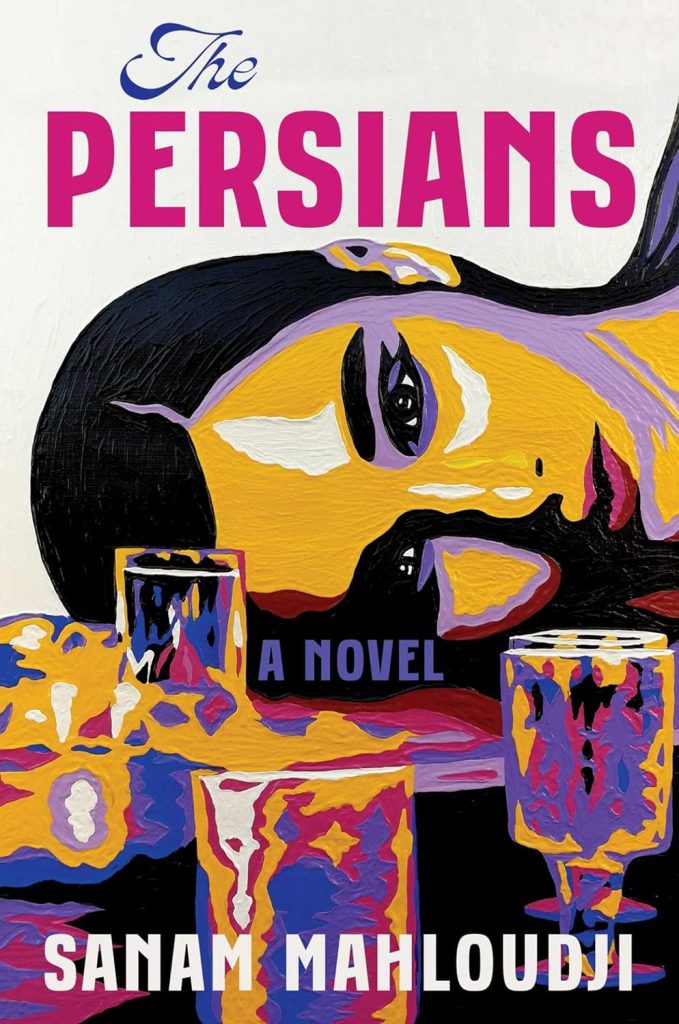
Born in another country and a citizen of this one, I’ve always thought that there’s a distinction to be made regarding how and when and why one immigrates—or doesn’t. To leave, to stay: who do we become? What part of ourselves might we lose? Are we running from or running toward? The Persians, Sanam Mahloudji’s crackling and confident debut novel, explores such nuances through the inner lives of the Valiat family, descendants of an influential patriarch, who are dispersed in Tehran, Houston, New York, and of course, Los Angeles, with a few side visits to Aspen.
The multigenerational women of the book—though there are male characters, the women of the historied Valiat family are the true power—drive this complex family drama, and with each chapter from the point of view of one of the characters, there’s a compelling interiority and intimacy. Mothering—and Othering—is woven throughout The Persians, glinted by secrets and silence, ultimately revealed. Such estrangements echo the larger separation from country of origin to adopted country, between mother and child, and even in an individual life: what we expected ourselves to be, and what we actually are.
Mahloudji’s talent for combining affecting individual narratives with a playful language and energy drives the momentum of the story and she imbues the book with larger cultural and historical backdrops. It is both a singular story about the Persians—or perhaps, these Persians—even as it confronts our universal desires to belong, to self-actualize, to be remembered, to connect.
I engaged in a wide-ranging epistolary interview with Sanam Mahloudji about the Valiat women, our cultural expectations, and the craft of writing.
Mandana Chaffa: Your short story “Auntie Shirin” was published in a McSweeney’s anthology in 2018—was she the start of The Persians? Or had you been working toward this novel prior to that?
Sanam Mahloudji: “Auntie Shirin,” published by McSweeney’s Quarterly—a publication I had admired for so many years—was the initial nugget for what later became The Persians, but I had not been working toward a novel at all. I was really focused on the short story form: that was my first love as a writer.
In 2018, when the story was published, I was only just beginning to think about writing with the goal of publishing. I didn’t really have an agenda with my writing, and that was critical for me. When I started writing (at least as an adult—I did enjoy it also as a child and teenager), I was a union-side labor lawyer, and I had spent my entire life before that in really regimented, directed paths. It was school, work, school, work…and I really hadn’t let myself just play. The idea of writing a novel seemed more like a career choice in a way, whereas short stories seemed like play because most people don’t read them, and that suited me just fine.
If a story is like writing a song, a novel is the whole symphony.
Looking back, I’m grateful I had no plans of writing a novel because my focus for years was really tinkering with words, forming interesting sentences and character and dialogue…considering the rhythm of words and engaging the senses. One needs to do all these things in writing a novel, but I think some people forget about the details when trying to hammer out hundreds of pages.
“Auntie Shirin” was the first story I wrote where I thought I had something more to say than I could accomplish in around 15 pages. Before then, the way I wrote stories was centered on a single moment, or interaction or line of dialogue that would start me thinking—and I would follow that one line of inquiry until its end. Perhaps I did that to protect myself—maybe something unconscious in me knew I’d eventually want to write a whole book but at the time it was important to write in a more low-stakes way, get some stories under my belt…to just play.
What I soon learned is that writing a novel is an incredible joy and something I found even more satisfying artistically than short story writing—it requires not only all the focus on language and sentences, but also inventing and retaining a lot in your head at once. Having to hold a whole world in my mind and call myself to express parts of that world when needed for a scene even as that world is also changing and shifting because of what is showing up on the page—I think that is maybe the biggest difference between the two experiences. If a story is like writing a song, a novel is the whole symphony.
MC: Shirin’s comment that “We didn’t come here for a better life. We left a better life” encapsulates the experience of many who left Iran after 1979, but the book also explores a range of post-Revolution experiences. Those who were able to leave. Those who couldn’t. More personally, your own emigration from Iran occurred in the same time period—would you talk about your own experiences in diaspora and how that has informed the novel in complement or contrast?
SM: I think about those lines a lot. Their meaning has changed for me during these years of writing The Persians. At first, I thought Shirin was a bit in denial saying these words because what she actually left didn’t exist anymore—the pre-revolutionary Iran. And so what she left was actually Islamic Republic Iran, and of course that couldn’t have been a better life. Could it? But with time, I have questioned that interpretation. I thinkthere is a deep loss when you leave your country, your history and culture, behind in the way Shirin and much of her family did…and even if on the surface maybe she has a freer life in Houston than she would have in Tehran, I do wonder what Shirin would have been like if she had stayed. I think she might be a happier person, and probably less focused on outer success and riches. Maybe she really would have had a better life if she had just stayed and dealt with life within the Islamic Republic—at least she still would have been home.
These are questions I ask myself—and are part of what inspired me to write these characters. Some who stayed, some who left. Who would I be if my parents never left? There is a part of me that grieves that person that could have been. Who would she be? My primary language would be different—I speak Persian, but my fluency is mainly to speak in the home with family. What would I be like if I thought in Persian? If my references to culture and music, to land, trees, animals are the ones you’d find in Iran, not the United States or London where I now live? Of course, everyone can listen to or watch anything these days with the right VPN, but even back in the 80s and 90s, the Western pop culture would have been filtered through layers of an Iran and Iranian-ness I couldn’t fully know. It’s kind of like the concept of terroir for wine—I can’t inject myself with that no matter how much I engage with Iranian culture. Although I am Iranian, in many ways I have been formed by the United States.
The staying versus going is also why I think some of the characters mirror each other, or why I needed to have so many different points of view. I feel like the Iranian experience is so fractured—we are never in one place, or time. Because I grew up with my family scattered across different countries, and because of this real palpable sense of before and after the Revolution, I had to imagine the stories of people who might have been my relatives into existence in order to construct a fuller image of who I am.
There is a deep loss when you leave your country, your history and culture, behind.
In a sense, that is Bita’s role in the book. She is a person who needs to construct a whole history of her family in order to figure out who she is.
MC: Did you always intend to do character-driven chapters when planning this book? It’s especially effective as these are individuals—perhaps even an entire culture—where people don’t easily share their deepest feelings, so this structure invites the reader to become a confidant.
SM: Yes, although I wouldn’t say that I was really planning the book in the early stages. I had written “Auntie Shirin” and there were these characters I couldn’t get out of my head. Shirin, Bita, Elizabeth, Seema. Niaz is the only one who doesn’t appear in the short story. I just wanted to know everything about these characters. Why they acted the way they did, what their problems were—I had some initial ideas, but from the very beginning I felt like I had a lot to explore and find out.
Perhaps because I had been writing short stories, the idea to write a chapter from a different character’s perspective felt natural to me—almost like separate short stories. But I also knew I didn’t want to write linked short stories. That can be a great form, but I really felt like there was an overall arc to this story that wanted to be told.
You are right—I do think that Iranians tend to be quite secretive as a people. They don’t usually share their real feelings. And I think even with younger generations, the force of history and habit is strong. I actively fight against that tendency in myself. There is such a fear I think of not appearing a certain way—as some kind of ideal version of oneself.
I wanted these characters to be able to tell the truth. And I knew it might not naturally happen in their interactions with one another, but if it could, it would be a really big deal.
MC: “Women have the fire in my family. But they are useless without power.” Yet, I’d suggest that in the Valiat family, in its many hues and flavors, it is the women who have the power. Of imagination, of resolution, of reinvention. Even with their wealth and significant freedoms, the men seem to have challenges rebounding into new circumstances, other than Ali, who was able to shift his station in life at a time and in a way that was decidedly revolutionary.
SM: Shirin says this during a conversation with her niece—I think she’s standing with Bita in her New York City kitchenette burning hair off her arms. Shirin thinks she is doing this big favor for Bita, making her look more presentable. And while she works, Shirin is running through, probably for the millionth time, the family history…this story that she feels she needs to keep repeating like some kind of prayer or mantra, as if to keep it alive although it’s long gone—but in a way they keep it alive by this telling and retelling.
You are correct that in the book, the women are more resourceful. Shirin has reinvented herself as an event planner in Houston. Niaz in her young thirty-odd years has had so many different pursuits—from the boldness of exploring her sexuality as a teenager in the early days of the Islamic Republic, to getting involved with her Blue Room parties, to starting her salons. Bita with her questioning of where she is going with her life and her slow budding attraction to her friend Patty. I do think all these women are evolving and challenging norms, while most of the men don’t seem so nimble.
This was, of course, intentional. Iran was and is a patriarchal society, and yet my whole life I have seen women who respond to whatever is thrown at them in ways that are wholly startling and, you’re right, powerful. Many of the men I have seen started out in positions of power vis-a-vis women but have seemed to flounder, or else are just going through the motions of the life that is expected of them. They work “in business.” They have “mistresses” because that is a way for them to feel powerful. But really, [maybe] they wanted to be an artist, something they’d never dare. They don’t have the guts. Or maybe they don’t really want to be an artist. I feel sad for these men, actually. They probably feel enormous pressure.
All these women are evolving and challenging norms, while most of the men don’t seem so nimble.
I think Shirin is also expressing her deep frustrations at this lack of equality in society. She does think that her mother and sister have been useless and powerless to some extent. And she thinks Niaz is wasting her life, and Bita too, to a degree. Maybe it’s that she really expects a lot from them. She would have wanted more for herself—there is a part of her who certainly doesn’t respect what she does for a living, even as she boasts about it. She knows she is capable of more.
From what I have seen, the Revolution did more damage to the psyche of the men in my family because they went from power to no power. The women already had no power, so they could only go up.
MC: Seema’s perspective arrives unexpectedly; a reminder that others’ voices are always missing in the narrative we’ve created for ourselves. Were you always planning to include her in the book directly, not just in the memories of others?
SM: Yes, I knew that she was going to have her own thread in the book, and that although we learn in the first chapter that she died a year before the action of the novel begins, I knew I had to find a way to bring her back.
She is Shirin’s sister, and yet she is so different from Shirin. It was really important to me to have the reader get to know characters who grew up in the same household but who ended up really different—that was part of the fun of writing the book. To see how differently people can respond to the same circumstances—the way siblings can be so unique is fascinating to me, especially when they are of the same gender. But also, each member of a family plays a role, or fits into a certain role in order to make a larger whole. Like in a band. Seema to me is like the conscience of the family. The one underneath it all. She’s the heartbeat. I have a lot of sympathy for her.
In earlier drafts of the book, she had died ten years earlier; in the editing process, it became clear that her death needed to be much more recent and present. That the family needed to be in an earlier part of their journey of grieving her, that her death was still new.
MC: Another compelling theme is how lives and personalities are formed in the absence of others, not just their presence—Niaz without Shirin, but with Elizabeth; Bita and Shirin without Seema, and more generally, Iranians without Iran. How much does absence, whether it’s people or place, play a role in your creative pursuits?
SM: I started writing fiction around the same time that my father died very unexpectedly. So, for a long time, the absence of my father ran alongside this new presence in my life of writing, of creative work. He was a very serious reader of literature, and in a way maybe I was trying to make up for that absence by pursuing a life in writing.
I don’t think I could have written this book if I had told my family about it—so I wrote it in secret. I only told my mother I’d written a book called The Persians after it sold to publishers. I wouldn’t have felt the freedom to form it in the way I imagined if she knew I was working on it. I probably would have been discouraged, or wouldn’t have even really started.
I also wonder if living in London opens up another absence for me—the absence of the United States—that has been helpful for my creative life.
MC: One of Elizabeth’s coping mechanisms is that one must “Accept and Move On. A.M.O…Forget the past. Focus only on the future.” It’s not an altogether bad approach, to be honest, though I’m even more taken with Niaz’s conclusions: “Persians left but keep looking for Tehran. Isn’t it better to just let go?” She—and Bita, to a large extent—the younger generation as a whole, understand more deeply total forgetfulness is both fruitless and can exact a cost on one’s soul, and forward momentum.
SM: The younger generation, Bita and Niaz, are certainly more in touch with their emotions, and think about feelings in a more modern way. And you are correct that A.M.O. is a coping mechanism. Elizabeth is probably lying to herself—she hasn’t forgotten anything! And by the end of that scene she does away with A.M.O., or at least she says she does. But you are right—I don’t think total forgetfulness is best for one’s soul and future. Acceptance is important—but again, I don’t know if Elizabeth was really accepting anything. Her coping mechanism feels a bit surface level. A label, but not a real truth. A way to trick herself.
Elizabeth doesn’t have the “tools” of modern psychology (she says something to this effect) but has figured out a way to live with herself. But I do think that her final act—which we don’t see, which happens after the book ends– will see her really coming into her own in a new way—or at least I like to imagine that for her. And even before that, in her last few scenes I do think that she has some real insights and develops some true acceptance.
Letting go does sound nice though, doesn’t it? I wish I were better at that. That is one of the goals of certain teachings, like Buddhism…but it’s so hard to do.
MC: You began the book with Bita’s impressions—Bita who is the direct connection to Seema—and gave the last words to Elizabeth. Would you talk about that decision? Did you always mean to bookend the novel in such a way?
SM: I had always meant to start with Bita as she feels the closest to me. She was my entry to this family. But for a long time Niaz had the last word. And I actually killed Elizabeth off! Not in a full scene, but in a short flash forward…but while editing the book, I came to see that Elizabeth was not finished.
Then it really made sense to me to end with Elizabeth. She is the source for all these other characters—she is the oldest living Valiat. The Persians wouldn’t have been who they were without her. She deserved the last word.
MC: The book is titled The Persians, which hints at another kind of veiling, doesn’t it? Immediately after the Revolution, at least in my own limited circle, people were more likely to say they were Persian, rather than Iranian, because of the attendant reactions. Is this another echo of how the family shaded the truth about the real background of their inscrutable “Great Warrior” patriarch, from whose callous actions there arose great wealth and status, and perhaps a little bit of a curse?
SM: I didn’t think of it that way, but I like that interpretation, and I think it makes a lot of sense in the context of the book—the Great Warrior’s story and the family’s various shadings of truth. I wanted the title to be audacious and bold—so much so that maybe I’m also making some kind of joke or commentary. I am thinking of big books written by Westerners with titles like “The XX” or “The XX People” where they are supposedly explaining a whole people to the West. I wanted to do that myself. And since I am now sort of a Westerner it felt appropriate. It felt like a very Western title from a Western Iranian.
I really wanted that title precisely because it felt a little ridiculous for me to claim it. I was only a baby when I left Iran, but in a sense, I wanted to show the reader (and myself) that this culture, this identity, is not something one can just shed by spending a few measly years in the United States. I have inside me a whole history and culture, even if I have to invent or create parts of it. It still exists in my head and in my soul. This relates to what I mentioned earlier—though in large part I was formed in the U.S., maybe there’s such a thing as an Iranian soul.
And I couldn’t have called them The Iranians. While I usually call myself Iranian, or Iranian-American, I think that calling themselves The Persians just gives that air of grandiosity. This status, imagined or real. Reza Shah officially changed the name of the country from Persia to Iran in 1935 in part to distance itself from its colonial legacy (it was never a colony exactly but Britain and Russia toyed with Iran for many, many years, had their “spheres of influence;” and later the U.S. too), and 1935 is not that long ago! I thought The Persians better points to the quasi-colonial history that I’m interested in. And even the begrudging longing for Western acceptance I’ve seen.
MC: Out of all these vivid characters, I have a particular affection for Niaz, who stayed with her grandmother in Iran, rather than leave with her parents—a casualty of one of the family secrets that drives, and drives apart, the family. Yet, she’s no victim; her story, her agency, is no less than those who left for a safer life. She has often untenable situations as a result of being a woman in Iran, but in many ways, she’s one of the most resourceful members of the family, and creates beauty and community, regardless of her circumstances, or perhaps, because of them.
SM: I love Niaz, too. When I imagine who I would have been if my family didn’t leave Iran, she’s kind of person I would want myself to have been. She is spunky, she is a real rebel—she sees through the bullshit. She gets swept up in her desires, and fantasies, but she takes real risks, and I think in many ways she has had the most interesting life.
By the end of the fourth month of pregnancy, the baby is roughly the size of an orange or avocado. Her skin is still mostly translucent, so you might be able to see her blood vessels.
Autumn comes suddenly, abrupt and welcome after the endless heat. The trees costume themselves in fiery red and orange, and the days shorten. I’m hungry for the dark. I walk the early dusks through Williamsburg, under the bridge, toward the water, toward the park. There is often the smell of something ashy, like a faint burning. It smells of adventure, newness, something about to happen. There is a particular smell of fire—rubber and garbage—that reminds me of youth, of trouble, the fire of protests, the fire that arrives as a warning, the first sign of danger. Once upon a time, this was the season of destruction. Once upon a time, this was the season of blackouts, one-night stands, remorse.
When I first met Johnny, he asked if alcohol made me uncomfortable. “Not at all,” I said. “I don’t mind.” It was the truth. I’d been intentional about remaining close to alcohol. The first three months after I quit, I lied to everyone about why I wasn’t drinking. “I’m on these dumb antibiotics,” I kept reciting. This meant I kept going to nightclubs, bars, house parties. I became inured to its presence, the ah of a popped beer bottle, the clank of ice against glass. It wouldn’t rule my life, I swore. I would heal myself. I wouldn’t be someone who made my sobriety its own kind of addiction. I was twenty-four.
Our first year dating was a whirlwind: travel, bar after bar after bar, in Spain, in Manhattan, in Boston and Providence and Oakland. I was finishing up my doctoral degree in clinical psychology and he was learning how to code. We stayed up like teenagers, slept past noon, woke bleary-eyed and disoriented.
In twelve-step meetings, there’s the same saying of alcoholics and co-dependents: They don’t have relationships, they take hostages. What is addiction but wanting gone awry?What is the story of addiction but the story of a longing you have to disavow? Leaving when you want to stay. Stopping when you want more. The addiction to the substance can become the addiction to another person. The continued thump of another heart. To burn yourself at the altar of the other, and to call the burning love. In Arabic, my favorite expression is: What is coming is better than what is gone. All addiction is the same in this way: the delusion of a better tomorrow, the delicious waiting for that turn. You wait because there is the promise of what will come, that kryptonic hope. Whether it’s the next hit, the next drink, the next lover—the addict is the quintessential archetype of the hopeful.
I’d always sought out drinkers, even after I stopped. But Johnny was different. I drank to destroy. He drank medicinally—like a chemist, not a gambler. His drinking was a constant and so it was like background noise. I poured whiskey into cut glasses. I lingered at the mezcals in the store. By the time I met him, I never drank. I never touched it. It didn’t have to be my lips touching alcohol, just so long as there were lips on it. There was a proxy delight in his drinking, the adventure without the consequence, my nervous system relaxing with his, the long exhale I felt at his eased body, the rush of serotonin. I loved his hangovers, the way I entered them like a room. Like this I found a way to keep drinking without drinking, a way to cheat the years.
Waiting can be an inherently hopeful act. You wait because you believe—even on the faintest level—that something is arriving. There is something to wait for. Against all odds, Penelope genuinely believed Ulysses would return.
For years, I rarely thought of drinking myself. If I did, I envisioned it like visiting a faraway land that I used to live in. I wanted to see if things had been rearranged. I wanted to check in on the gardens.
There was and how much there was. Kan yama kan. How many narrators. How many endings. When there is deep trauma. When that trauma has taken root. A technique in narrative therapy: asking the client to tell the story in third person.
In Beirut, she never knew mornings. Instead, she’d sleep past noon, stay up until sickly sunrises. She sucked her stomach in. She threw up in the bathroom. She lied. The city felt like a playground. Then a prison. The city grew around her like a tree. She drank. She sloshed around like liquid in a dirty glass, she spilled into booths and taxi cabs, she rolled around in beds with strangers, she woke up in unfamiliar places, her neck hurting and her mouth dry. She visited emergency rooms: the time she cracked her head, the time she woke her friends hyperventilating from too many drugs, the numerous alcohol poisonings. Afternoons spent flirting with the cute doctors as they unsnaked IVs for fluids and antiemetics. The dreaded hours of solitude: the hangover, heart palpitations, nothing to armor against the truth. Every day she seemed to get farther and farther from herself. A self built from bluster and duct tape: You try too hard. She tried too hard. She drank too much. She ate too much. She wanted and wanted and wanted and the bottom would never bottom out.
The first time she drank, she was sixteen and visiting her cousin in Amman. Studies show that an indicator of later alcoholism is whether someone’s first experience involves inebriation. She blacked out for five hours. She cried on the hood of a stranger’s car and told stories about love and nonexistent breakups. That was the thing with her and alcohol. Other people got drunk and told the truth; she drank and lied. She lied and blacked out and forgot the lies. The second time she drank, it was at her friend’s house in Lebanon. They drank Bailey’s straight from the bottle, and she remembers how the air in her room seemed to vibrate, the carpet, the electric tingles in her fingertips, all that unbridled potential. It was a feeling she’d chase for the next eight years: the promise of something happening. She could imagine small revolts, her crush appearing at the house, taking a flight to Paris. Never mind it was two in the morning. Never mind they were high-schoolers. When you were drunk anything could happen.
“A blackout doesn’t sting, or stab, or leave a scar when it robs you. Close your eyes and open them again. That’s what a blackout feels like,” Sarah Hepola writes. I’d found the best way to disappear. A blackout is the most spectacular magic trick of all. You erase yourself without anyone knowing it. You are absent only to yourself; to everyone else, you are still laughing, still moving, your mouth opening and closing, words fall out like stones. You still order another beer, tug a body against yours. You are a marionette, a hijacked engine, possessed. I never knew who took over when I blacked out. Maybe it was a stranger. Or maybe it was me, the actual me, the truest one.
What is addiction but wanting gone awry?
The year I graduate high school, my family moves to Qatar, a neat bit of luck that means I’m the rarest of creatures in Beirut: a single young woman, still a teenager, living in her own apartment, with her own roommate, without curfews. Beirut is fourteen years out of its civil war, an era that partitioned the city, brimmed the country with sectarian ties and violence. People rarely speak of it, and when they do, it’s like something of a bygone era. I start drinking right away: at the orientation event at university, with friends after classes. It begins like something fun, a little naughty, an adventure that never ends in a city that seems boundless. In this way, what I knew of Beirut I knew of drinking—I became fluent in the city at night, its alleyways and tiny bars and the sea glittering under the moon. The drink and Beirut became similar things, magical and terrible at turns. I became the confidante of taxi drivers. I befriended middle-aged bartenders who’d tell me to go home. I danced on boats, beaches, tabletops. One night, my friend nearly got taken by Hezbollah men—we’d drunkenly wandered into their tents in Beirut’s downtown square—and I, plastered, flirtatiously begged the man in Arabic to leave my friend alone. Take your Americans and go, the man had finally said, hesitating before adding, not unkindly, and sober up, sister.
Whatever I do tonight, I write in a bad poem during this time, will be outdone by tomorrow.
The truth is I lived in Lebanon for nearly a decade with only a hazy grasp of its history. I was a tween, then a teenager, then a college student. I parroted what I heard adults say during dinner parties, and drank my way through a political science degree. I chose the major because I couldn’t think of a better one, but my brain was always unable to hold all the dates and politicians. By the time I moved to New York for graduate school, I could barely explain anything. It was like trying to explain grammatical rules of Arabic, my first language, the first I knew of this world, but didn’t learn to read or write until age twelve. It meant I understood the sinews of it, the syntax, intuitively, but had no way to explain why. In America, Lebanon was seen as safer ground: the refugee camps, the Sabra and Shatila massacres, the oligarchical politicians, the corruption were overlooked. The West loved to tut over Lebanon. Creased brows. A country of French speakers. A country of bikini-clad women with dark eyebrows on postcards. The Paris of the Middle East, did I know they used to call her that?
I don’t send a voice recording to the avocado-slash-orange baby that week. Or the next. Or the next. Instead, I wait until I’m alone in the house, and rant to my grandmother’s photograph. She’s looking more solemn these days, more tired, a little older. I can almost make out her mmms. My soliloquies are becoming more deranged. She was right. I should’ve never stayed in America. I’d married America. Did she know that? I’d married it and I’d missed her death and I’d never forgive myself. And anyway, what was the point of leaving a place, when that place became a euphemism for every other place, when it became the reference point, when it superimposed itself on everything?
One morning in Beirut, I’d woken hungover.
“Get up,” my friend Karam said when he called me. “Let’s go somewhere.”
“I think I might be dead.”
“It’s Valentine’s Day. You can die after.”
We decide to go to Saida with another friend. It’s the third largest city in Lebanon, on the Mediterranean coast in the southern part of the country. In the days of the Phoenicians it was a major trading port. That day, we take a bus and I’m the only girl, flanked by my two friends. We walk through the cobblestone streets, the ruins and their distorted reflections in the sea, the streets filled with people and hawkers. The day is unseasonably warm, the air smelling of salt. We buy ice cream, then argue about which restaurant to go to. There are small stores everywhere, with men inside them: electronics, fruit, nightgowns.
There is a way that air rearranges itself in disaster. The ruins remain still. The water keeps lapping at the coastline. The people get in and out of their cars, the traffic worsens. But the voices start to seem louder. One man calls to another from across the street. A woman hurries by with a child. A man plants both his hands on the hood of a car, bracing himself, his head bent.
“Did you see?” one shopkeeper yells. Nobody responds. “Are you seeing?” We peer into his store, where the television is blaring. This is the scene I will return to in fiction, in poetry: Arab men hunched over television screens, learning about their cities, their dictators, their young men, the catastrophes that have befallen them. The dream my brother and I would share for decades before speaking it aloud: the light across a face, the story of a crisis.
We keep walking. “Something’s wrong,” Karam says, but we don’t respond. A woman is crying on the phone. We walk faster. I suddenly feel young, and my first thought is to call my father, my second is that he will want to know why I’m not on campus, why I’m wandering a strange town with two boys.
A crowd begins to gather on the street, mostly men, their voices laid atop one another’s, gesturing toward the sky, toward the sea. They are arguing, they are explaining. Something is wrong. Karam gestures toward the nearest shop, and we step inside. The man is my grandfather’s age, shaking his head at the screen. There is smoke, a fire, people gathering. The shot is aerial, then close up. The newscaster is speaking in formal Arabic, and neither of us can keep up.
“Uncle?” Karam begins. “What’s happened?”
He turns to face us, his eyes heavy and red-rimmed. I am startled. I am always surprised to see men cry, especially older men, especially older men who then speak gruffly. “What do you think happened? They killed him. They burned him alive.” He turns back to the television screen, the man’s face on it: Hariri. The prime minister. He has been assassinated. His car blown up near the sea in Beirut, a site that will be honored for years with a counting clock marking the time since the explosion.
Men gather on the street in Saida that afternoon. It is sunny. I am afraid, but excited too, my friends and I exchanging raised eyebrows, mouthing What the fuck as the voices gather, a fire starts, cars honk. They are burning tires, they are shouting. A man catches my eye as he jogs past and slows down. He grabs Karam’s sleeve. You should go, he tells him simply, before it gets bad. We are in the prime minister’s hometown, these men are his kin, they are furious. It takes us several tries to hail a cab. The smell of gasoline, already everywhere.
We take the cab north to Beirut, the sea blurring outside the window, the cab driver listening and cursing at the radio the whole time. The cab driver drops us off downtown, because Karam wants to see where the explosion had happened. We can’t get close and so we wander through the empty streets, a ghost town, the stores closed, the eerie sense of children without supervision, a city without adults.
Seventeen years later, it is October in Brooklyn. Seventeen years later, our block is transformed for Halloween. Windows alight with orange blinking fairy lights, child-drawn witches and ghosts, or for the more ambitious, a full murder scene, a towering Frankenstein, a cloaked woman that cackles when you walk by. I watch the mothers pushing their children past the decorations in strollers.
“A cat,” they tell them. “Is that a cat? Do you see the cat? What color is the cat?”
One summer in Beirut, your father takes you to the balcony one afternoon and tells you the drinking is a problem.
I watch them point, their children’s rapt, solemn gazes. I try to imagine doing the same, try to record myself describing the neighborhood to the baby. There’s a couple that lives two doors down, the woman’s pregnant. They have this dog, he’s kind of the worst? He’s always jumping up on you, then running around himself in circles. And he almost knocked the pregnant woman down the other day, and she automatically put her hand on her stomach and laughed. I sort of hated both of them for a moment? I don’t know. There’s a witch hanging from their stoop.
When the port exploded in Beirut in 2020, many first thought it was an Israeli attack. Some thought it was a foreign entity. The betrayal, the true betrayal, was learning it was your own. Your own politicians. Your own government. It was a self, cannibalized. It was a match, lit, and then tossed back into the room you were standing in.
All month, my friend texts me from Beirut. The port explosion caused billions of dollars in damages. Hospitals were destroyed. In the year since, the economy has fallen. The revolution has faltered. People are starving, Hala, my friend writes. There is a circulated video of a woman with a shawl half-wrapped around her face, storming a bank in Beirut at gunpoint. She is robbing the bank for her own money. I just want my money! she is heard shrieking. The manager looks wan. The banks have been limiting withdrawals. It’s mine! she cries when the man tries to calm her. Give me what is mine!
Later, it is revealed the gun was fake. A plastic toy. The woman got her money. It was for her mother’s treatment. I rewatch the video dozens of times. I am disturbed by her. I want to be like her. Taking what is mine. The shawl falling. My face visible throughout. Not bothering to hide.
When I remember my drinking, I see it refracted through places. Beirut is a city without curfews or oversight, a place where things can be bought off, where things can be erased if you have wasta, know the right people, accent the correct vowels. It is a city where neighbors slaughtered each other for fifteen years, where entire areas are Shi‘ite or Sunni or Maronite, where people rarely speak of the war. For years, it was the backdrop of my drinking, my mistakes, my unease, my attempts to recover, a place of music and trash and bougainvillea, traffic that ate up entire afternoons, stunning views from house party balconies. A few weeks before I graduated college, Hezbollah took brief control over several neighborhoods in west Beirut, including my own. More than gunshots or my mother’s frantic voice checking in daily during that week, I remember ice clinking in glasses, my friend’s rooftop, how every night we topped off each other’s drinks and listened to the upcoming summer hits.
There are dreams I have that are more like muscle memory: it is always night, the streets are always empty, I am walking through Centreville with its glowing mosque, I am in the backseat of a car driving up the mountains, to my grandmother, to Meimei where I weep on a couch while she strokes my hair.
I don’t think you understand, I told her in Arabic, how bad I can be.
What I’ve done.
She shushed me. There’s nothing you’ve done that the morning can’t fix. But it was already morning. Dawn had broken and I’d woken her, and I kept telling her things, whisper-crying things as she hushed me, things I’d forget by the time I woke up, things I could never bring myself to ask her to remind me.
If there is any night in my life I wish I could take back, it’s this one.
Another technique in narrative therapy: you ask the client to tell the story in second person.
One summer in Beirut, your father takes you to the balcony one afternoon and tells you the drinking is a problem. Only he doesn’t say drinking. He says what you’re doing. He is unable to even name the damage. Unable to speak it into the air. He says your siblings and cousins look up to you, this can’t continue. You say nothing. It will continue. It will continue for a long time. You’d come home the night before at four in the morning. You are twenty or nineteen, and your knees are still bleeding through the Band-Aids from where you skinned them jumping a fence the night before. You don’t remember the fence. You don’t remember the blood. You don’t remember shouting into the empty street: God, I’m so bored right after, then starting to cry. Your father ashes his cigarettes and waits. You don’t say drinking either. You just tell him okay.
During my doctoral program, I moved into a shitty apartment with roommates across from Penn Station. It was chaos. Take-out containers and dirty laundry. The muggy endless summer. House parties on Saturdays, spilling onto the outdoor patio, the arguments, the crying.
Someone was always crying. I took to making recordings while drunk, little anthropological notes, heartbreaking moments caught on tape. I’d plead with myself on the recordings. Talk about how bad it was. How I needed to remember. There was a bar downstairs and it was ruining my life and when I said that to my mother, she said I was ruining my own life, but my mother was thousands of miles away, in Doha where it was sunny all year round, and the houses were in compounds with swimming pools and gyms and palm trees. Not here. Not on this piss-smelling corner in front of that terrible bar, smoking a cigarette, watching the Madison Square Garden clock. Every time I came outside to smoke, the clock had sped forward. It wasn’t fair. It was a Tuesday. I had work the next day. I was supposed to be at school at nine a.m. and it was already two in the morning. I’d record my quavering voice, watching the lights of Penn Station. It was bleak magic.
The next morning I’d hear the slurred, heart-punching messages: Hala, please, please stop. Hala, please, please, please.
My friend who lives in Beirut texts: The hospital has four more days of fuel.
There was a brothel in Beirut. There was a man who ran that brothel. I would go there just to drink sometimes. One night, the man asked me to leave. A girl like you shouldn’t be here. I turned mean. What did he know about a girl like me, what was he saying about the other girls, I slurred, waving my arms at the working women, but they barely turned at my voice. He insisted, his voice turning low: Please, this isn’t right. We argued until he capitulated, exhausted, pouring me another drink, my victory feeling heavy in my chest. I wanted to keep arguing. I wanted to tell him I was no Midwestern apartment complex, no hardworking mother, no table manners, no prayers, nothing. I wanted him to understand just how bad I was, how much worse I could be. I wanted to tell him that about the latent thing in me. I wanted to tell him that, my God, it had woken up and I couldn’t put it back to sleep. But I could hear him mutter to himself as he turned away, But what’s happened to her that’s she’s here?
There is no story of the drinking without the story of the Bad Boyfriend. There is no story of the Bad Boyfriend without the story of the lies.
I can’t tell you that story yet, I tell the avocado-sized baby during a walk.
I put up a pumpkin-orange wreath in Brooklyn. The lines in front of gas stations in Lebanon are hours long. Someone gets shot over petrol. Then another. Then another. There aren’t antibiotics in the pharmacies. The country defaults on its loans to the World Bank, and the economy collapses. Whenever I think of my grandfather, his grave next to Meimei’s, the grief is so sharp it must be dodged. So I call upon my old trick: I pretend he is alive. Sometimes I can pull this off, the blessing of ghorbeh, the distance, that tentpole of diaspora. Death can be ignored, so long as the Atlantic stays where it is, the miles in the thousands. Like this my grandfather continues to live in a building overlooking the sea. Like this he breakfasts every morning on pita and za’atar, Sundays on ka’ak and knafeh. Like this he drowns it in syrup, like this he spends his afternoons reading articles on his computer, like this he tells the neighbors bint binti is a writer in another country, that I’ll be coming home soon, maybe even this winter. The same logic works for the entire country: like this Lebanon can live in its former iterations. The gas shortage, the exploded hospitals, the gunfights in traffic jams, I don’t need to grieve them because they aren’t happening. This is my shameful luck, my lucky shame.
In Brooklyn, I google Halloween costumes. In Brooklyn, I read about what a womb does in one month, two, five. I wake one morning to a Johnny that won’t speak. He moves from room to room, red-eyed. He is silent in the living room. He is silent in the kitchen.
Please, I say. Just tell me what it is. You’re scaring me.
He turns to fill his glass with water. Something about the moment feels familiar: turning away, the clink of the ice machine, slow motion until I realize that his back is crumpling. His shoulders shake. The glass nearly drops, but my body has moved to his body without realizing it, two bodies that have known each other for years now. Two bodies now clutching each other. I walk him to the couch and for the first time in months—for the first time since the sesame seed turned into an orange, an avocado—he pulls me to him and sobs. He sobs into my hair, my neck, my shoulder. Outside the window, the trees are orange and red, blurring fiery in the wind. For a quick, disjointed second, I miss my mother, her smell of leather and flowers, the silver box of jewelry she had in Oklahoma, the inside blue velvet, soft as a cat’s tongue. I used to want to sleep inside that box as a child, two inches tall, resting my head against the amber of her necklace.
“What kind of father,” he begins. He talks. He tells a story I’ve heard before, but it’s the first time I hear it on this couch, in this month, where somewhere, a baby with his eyebrows and my ears is turning in amniotic fluid. Even with all those letters, long as an afternoon, the story unfurls in front of me as though for the first time.
What happens to a story when you hear it? The touching it makes it yours, changes its shape. But some stories aren’t yours, no matter how long you live inside them, analyze them, remember them. I could write a thousand poems about this story, and it still wouldn’t be mine.
One night I go to Dave & Busters with my brother and cousin Omar and their girlfriends. We are bored and nobody can come up with a better idea. Children ping around the space like comets, the persistent lights and bells of the machines soothing. While everyone is getting drinks, my brother’s then-girlfriend, Yara, and I try the claw machine. She wants to know about the surrogate and I tell her everything.
“She has daughters,” I say. “She always texts me during the doctor’s appointments.”
For our birthdays that year, Yara and I had gotten tattoos: a small matchstick on the inside of my right forearm, a technicolor red heart on her shoulder. I’d had a whole thesis about the matchstick: it could mean destruction or warmth, a reminder that the same thing can do both things, depending on how you held it, how you used it. When I asked her about the heart, she shrugged. “I think it’ll look pretty.” It did. “I’ve only told Johnny so far,” I say impulsively. “But I did find out the gender.”
She squeals. “Tell me, tell me, tell me!”
I tell her and she cries and laughs and jumps up and down. I snap a picture. The photograph is blurred, the absurd candy lights streaking her face, her expression animated with joy. It is the first real joy I feel in a long time, a response to hers: this moment, someone unabashed with their excitement. Unwilling to apologize for it.
In this story, there is a boy who lives in Massachusetts. He has a father and mother and brother. He goes to a private school, lives in a three-story house, summers in Maine and ski trips in Aspen. There are no bombs in this story. There are no prime ministers being assassinated, no evacuation ships, no passports being hidden in the bottom of a suitcase. There are no food stamps, no immigration officers mispronouncing a name. There is a father who disappears into himself for days at a time. There is a mother who adores that father. There is a boy, the youngest, who is bright and talented and loved and punished for those things in equal measure. There is a boy who is given one medication, then another, then another. There is a boy who drinks for the first time at thirteen, and never stops. For years, he dreams of leaving that house, the snow, the people who love and punish him in equal measure. Then one day, he does. He gets on an airplane and goes to country after country, with a dusty backpack and worn-out sandals, places with names he beats his tongue against until he gets it right, until he says them perfectly, until he can ask for water and bathrooms and then explain his thoughts, the texture of his dreams, in another language. He goes from city to city, living on the beach, eating fruit from tree branches, spending hours under the sun. He decides not to die.
My final year in Beirut, I meet a man named Daniel. He is Irish and Egyptian, and speaks in lilting, musical tones. He drinks as much as I do. His mother is dying in Dublin, and we spend nights closing down bars, then kissing in the street. I once forget a necklace at his house, and he carries it around for weeks before we see each other again.
The boy travels for years. He goes to Seville and Costa Rica and Mexico and Chile. He gets a job doing it. He takes other boys and girls on trips, even though he is barely twenty, twenty-one, he takes teenagers to cities across a different continent, scolds them to listen to the local guides, laughs at their jokes, does head counts before excursions. One trip, in a new group of kids, the boy meets another boy, a few years younger. His name is Taylor. They play guitar together. The years between them feel like a chasm, but really they are both children. They both need protecting from what’s to come.
Every time Daniel offers me affection, I flinch. I cancel dates. I pretend I don’t care when he dates a Lebanese bartender. One night, we spin on a dance floor and then he asks me to look at him, just for one second, love, without looking away. I can’t do it. My eyes dart like fish. I leave Beirut. His mother dies. The worst nights in Manhattan, the ones that are the coldest, when the drink seeps into me like possession, when I can’t stand for more than a minute, when I can’t speak a full sentence, he’s the name I whisper against dive bar bathroom sinks, as though I could invoke him.
The boy takes the group of teenagers to a small town in Mexico, where there are trees and hills and a group of Mexican children. This is part of the trip, rich American teenagers playing with Mexican children, hide-and-seek and tag. Taylor is the first one to start a game, the children giggling around him. He tells them to chase him. He disappears between the trees.
There are two ways to tell the story that is not my story. There is the story of the children, who chase after Taylor, this boy with parents and an older brother, this boy who lives a thousand miles from here, who plays guitar and piano, who will graduate in a year. It is a hot day in July. The children chase after him, they watch him run on his long legs, watch him turn back, give a broad smile, then jump behind a large tree.
I was two years into Manhattan. We kept missing each other: when I was in Beirut, Daniel would’ve left the week earlier. Daniel was in London, but I’d just flown back to New York. It was early August when we messaged each other. He was coming to New York later that month. He had a birthday party. He turned twenty-five in Dublin. It was a warm night. He was smoking. He sat on a windowsill. He leaned or he tipped. It was the first birthday he’d have without his mother. There is no other way to tell this story. He never came to New York. He fell. He fell and fell and fell.
The other way to tell the story that is not my story: the boy. The boy who grew up with snow and money. The boy who left and decided not to die. The boy who is a few years older than Taylor, who has played guitar with him, talked about his future, the colleges he will go to, the music he loves. The boy hears screaming and then the children are running back, not being chased, they are running alone, crying out, Se cayó! Se cayó! and the boy is confused, shouting in English, then Spanish: Who fell? Who fell? But he already knows the answer, is already running to the tree, to the well that was hidden behind the tree, the impossible drop, the dark that will take days to mine, days to find the bottom, but before that there is the earth beneath the boy, his knees hitting it, his voice cracking as he begins to scream a name.
Tell me what you fear and I will tell you what has happened to you, Winnicott wrote.
It is October in Brooklyn. The avocado-sized daughter is four hundred miles away. The boy who fell to his knees in Pozos, Mexico, is panting against my neck.
“What kind of father,” he says. The first thing he did after the falling was call Taylor’s parents. He was twenty-two. He told a mother and father that their son had fallen. That they didn’t know how far. They didn’t know if he was still alive. For days, he spoke to police officers and journalists and medics. For days, he sat with a mother and father who waited for news, and when the news came, he was there. There was a father and he turned to the boy and asked, Will we ever recover from this. Here is the crux, where two stories meet like rivers: two bodies in October, crying, two bodies that each fell in love with a person, with their history, the mirror they became. It took me years to realize we’d both loved boys who fell, then years to understand we’d learned different things from the fallings. About love, about grief, about the inevitability of one into the other. Here is the crux of our story: I wanted a child. He didn’t. His reasons are as plentiful and vivid as mine. We came to each other with a wounding that wasn’t ours, a wounding we gave each other nonetheless.
For the first time, pressed against his familiar salt and forest smell, I think: She’s going to be half me, and half him.
When people ask why I stopped drinking, I always say, Because I knew I’d die otherwise. I list the ways: I would fall out of a window while leaning to wave at someone. I would hitchhike with the wrong group of guys. I’d wake up not only to a strange man, but to him holding a knife to my throat. I talk about all the ways I had tried to die. This is the truth, but there is another one, one that I never talk about, which has just as much to do with love.
My brother quit drinking in his twenties, too. Once, overhearing us talk about it, my father grumbled, I don’t know where you all get this from. Nobody drank in his family, a lineage sprawling back to Gaza, to the villages that were dispossessed in 1948, generations upon generations living off the land, the sea, each other. All Muslim. Nobody drank, but there were stories of great-uncles, a wayward aunt, someone’s grandfather who gambled everything away, a man who became so angry that he’d stopped another’s heart. People who didn’t know when to stop. People who wanted and paid for that wanting.
What story can be built from a blacked-out memory? For years, I had fragments. Everything else would be a lie, conjecture, an attempt at guessing a life. Instead, I lived in montages: two days at the house of a stranger, who’d wake me just to give me more vodka, then watch me sleep. My finger tapping drunkenly against my own thigh. A gate I tried to scale. The meeting with the dean where I almost lost my scholarship. The mornings, always late, always guilty, always trying to remember: what had I said, to whom, where had I gone, why was my thigh bruised, to whom did I owe an apology. The night I showed up drunk at my friend Michael’s house. What happened to you? he asked. I apparently replied, Me. I happened to me.
What story can be built from a blacked-out memory? For years, I had fragments.
I once went to a fortune-teller in Jordan. She was famous among the locals. I met with her for an hour and she told me I’d one day choose between two men. That’s mostly what I remember. She said other things: that there would be planes and oceans I’d have to cross, lovers I’d have to choose between. She recorded the whole thing and gave me the tape; your guess is as good as mine as to where it is now. There was one other thing: she said I’d been a witch in a past life. She told me I’d died from either thirst or fire. That I’d burned myself up. She told me I was here now to make different choices. I was sixteen.
The night of my twenty-second birthday, the last I’d celebrate in Beirut, I got so drunk I fell face-first on the pavement. My final months in Beirut had a manic quality to them. I did not know how to leave, and so the leaving had to become necessary. I destroyed everything I could. I slept with the wrong people. I said terrible things. I fought. I saw the Bad Boyfriend again. I ripped clothing, I vomited inside cabs. I was making Beirut unreturnable for myself. For years, since the Bad Boyfriend, I spent most of my time with American boys. They were safe, disposable, always leaving, always drinking. The shifting tide of expats: the constant arrivals, how well it lent itself to longing, the constant going-away parties, the group shifting to make room. We drank ourselves incoherent on rooftops, balconies that overlooked bullet-riddled buildings. They didn’t care about the messes they made, in bars, in taxis, on the street: it wasn’t their city. I could hide under their cloak. In this way I was both inside and out, a local remade into an outsider.
That night, I turned twenty-two. My hair was dyed pink. I fell so hard against a friend’s sink she heard it two rooms away. I ended the night cutting my friends’ hair, and they cut mine. We did it like children at a sleepover, fondly, carefully. More, I kept telling them, more.
Obsession is an illness of repetition. This was the task of drinking— an endless arithmetic. The hand outreached for a drink, once, twice, a thousand times, a loop.
The next morning, I dragged myself to a friend’s house for a miserable brunch. Halfway through I went to a bedroom alone. My face was scraped raw from where I’d fallen. My hair looked terrible. After ten minutes or so, the door opened. It was one of the expats, a few years older and from Massachusetts. His face was impossibly gentle.
“Can I sit?”
We sat at the edge of the bed in silence for a while. I knew it was over. My time in Beirut. The summer. My college years.
“You’re lucky you have a pretty face,” he said, and the tension broke. We both laughed, until mine caught in my throat. He put his hand on my shoulder, awkwardly, palm-first, and I knew he was trying to think of what to say. There were bad men, but there were other ones too. The other ones were always trying to think of what to say to me. They tried to cut me off, wrestled me into cabs, poured me water. He and our friend Michael had taken me to the ER once. They convinced the doctors not to call my parents. He’d forced me to go home the night before my GRE. I can see our reflection in the mirror, mostly out of view: my scraped face, the tufts of pink, his hand against my shoulder, his somber face. I’ll remember this, I suddenly thought. That, among the violence, there was so much tenderness.
A place teaches you how to love. How to grieve. How to destroy. I never got to live in Palestine. I got the Midwest, a year in Maine, the desert, a near-decade in Beirut. When I left Beirut, I didn’t just leave a city. I left what it had done to me. What its men had taught me, what they’d taken. What I’d given.
I left Beirut for New York a skittish, cigarette-prone girl with no radar for danger and nobody I knew around for miles. I found an apartment two blocks from the Columbia campus, lived with two other graduate students. The first month, I spend the darkening days going from bar to bar, drinking the way I’d done in Beirut, dye my hair a purplish red, wear the same men’s gray hoodie everywhere. I am here to study psychology, but instead I skip classes, sleep until the afternoon, dream of Beirut every night. I miss the traffic, the unlocked doors, the chaos. I’d left the city like I was fleeing it, but I couldn’t sleep without its noise.
A few weeks into Manhattan, I go out alone to a Columbia bar. I meet a woman, a sculptor or something. There are two men, tourists. There is a couple. I keep flitting outside to devour cigarettes. I haven’t washed my hair in days. I might be depressed, I text my friend Dalea, who lives in Florida and keeps telling me to move. When I finally visit, I can’t believe we’re in the same country: her enormous apartment, the unrelenting sun, the flip-flops and tank tops she wears to class. In Manhattan, the weeks blur into endless flights of stairs in subway stations, slushy crosswalks, missed 1 trains, psychology professors who speak about happiness unironically. I argue with one of the men in the bar about Palestine. The woman tells me I have interesting eyes, as though it’s a fashion choice, but that I need to learn to put on eyeliner properly. I have one white wine, then another, then a third. I start feeling dizzy.
“I think I need to sit down,” I tell the woman. Behind her, the couple are kissing. The bar is hot and the way the light is hitting the bar top is making me anxious. “Can I sit?”
That’s the last thing I remember. It is a tampered tape, an erasure poem. I watch strangers kiss and then—shapes, blinking lights, my eyelids making sense of sun. There is a white ceiling. There is a scratchy blanket under my chin. I am alone in a bed. It takes me minutes to be able to sit up; I feel like I am upside down, moving through water. There are strange marks on my arms and thighs: rainbow-colored, dots in different colors, pen or paint. It will take weeks for them to fully disappear. There is someone else in the apartment, a bathroom out of sight, the sound of water running. My instinct is to grab my phone, my hoodie, my shoes, dash down the long hallway, into a grimy stairwell. I walk down two, three flights of stairs, then a glass door, then pavement, then sunlight. I run down one block, then another, then cannot take another step. Something glitches in my brain, something shimmering and strangely colorful, and I realize that the line on the pavement is moving, or sparking. Two sanitation workers watch me. “Late night?” one of them asks.
“Do you see this?” I mumble. It is the first thing I’ve said since waking and my tongue feels funny.
“What’s that, sweetie?” “She okay?”
“Just fucked up.” He snaps his finger near me. “You need water or something?”
I shake my head. It takes a minute, but they eventually keep working. I call the first person I think of, my friend Andre. It is mid-morning, a weekday. He is in his apartment in D.C., his voice booming and familiar in my ear. I talk frantically about sidewalks and holes and shimmering lights.
“Hala,” he says firmly. “I need you to look up. Look for the nearest street. What street are you on?”
I’m in the Bronx. I’ve never been in this neighborhood before. I realize my hands are shaking. I’m suddenly afraid I didn’t run far enough, that someone is going to find me. But who? I remember the woman, the tourists, the couple. I hear him clicking on his laptop. He is finding directions. He’s going to get me home. He promises.
“But the sidewalk. I don’t think I can step on it.”
“So maybe there’s something wrong with the ground,” he says amiably. “Or maybe there isn’t. What we’re going to do is assume that it’s going to be like every other time you’ve taken a step, okay? The ground has been there. We’re just going to remember that.” He sounds conversational, casual. “So let’s take a single step, okay? Can you do that for me?” I take one step. The ground holds. I take another. He tells me what train to take and to call him when I get out. It is the 1 train. It is crowded, people headed to work, teenagers to school. There is a woman wearing a baby in a sling. She looks away when she sees me watching. The numbers blur by. I get out at 116th Street and call Andre back. He tells me where to turn, until I’m at the university health center.
There is a kind doctor, a litany of questions, and then she asks, “Is there anyone I can call?”
I open my mouth. I tell her about Andre in D.C. and Dalea in Florida.
She takes a breath. “Not your friends, honey. Is there a parent I can call? A family member?”
There is nobody nearby, I tell her. My parents are in the desert. My siblings too. My cousins, my aunt, my grandparents—Beirut. Everyone is thousands of miles away. It is the first time I really understand this and I start crying so hard she has to call in a nurse to help calm me down.
“Poor kid,” I hear one of them say, and cry harder. I’m not a kid, I want to say, but I’m too busy wiping snot with my hoodie sleeve. There is a hushed conversation between them, another doctor who comes in and asks me a couple of questions, about sex, about if I’m feeling any pelvic pain, questions that make me cry harder. The three of them face me. “We think someone put something in your drink,” the first doctor says gently. “And we need you to go to the emergency room.”
What is a story in hindsight? Conjecture, a guess. I don’t remember how I got to the emergency room, just that there was a girl my age with me, a volunteer for a crisis center. I don’t remember what tests they ran, just that the doctor said I could make a police report, but I’d have to get a rape test first. I don’t remember the volunteer’s name or the color of the doctor’s hair or the color of the hospital gown, but I remember saying no to the rape test, even though they asked more than once. I said no each time. I feel fine, I said, and now, fifteen years later, I can’t remember what the truth was. Only that, whatever the answer was, I didn’t want to know.
In the hospital lobby, the volunteer held my hand. We’d been together for hours. I never wanted to see her again.
“None of this is your fault,” she says. “The thing is . . . it’s not fair but . . . we have to watch out for ourselves. Girls, I mean. You can totally drink.” She says this in a rush, so it sounds like one word. Youcantotallydrink. “But it just might mean that, like? Bad things are more likely to happen.”
I smile at her. She is my age, maybe a year younger, but I feel decades older. She has shiny hair, a pretty coat. She wants to help. She is spending her free time doing this, meeting crying girls in hospitals, holding their hands, telling them it isn’t their fault.
“Totally,” I tell the volunteer. “Yeah. I’ll stop maybe.” She hugs me outside the hospital.
I don’t stop. The following year, I move to the shitty Penn Station apartment above a bar. It is named after a Shakespearean play. The bartender has long, sandy hair and reminds me of Dave Grohl, which reminds me of the Bad Boyfriend, but this one has kind eyes. I flirt with him and he wants nothing to do with me, except for one night when I black out and couldn’t tell you what happened. This happens more and more, the blacking out.
One night, a homeless man blocks my building door. He tells me to look at him. Something is going to happen to you, he says when I finally do. He means bad. He means something bad. But something already has. For years, I waited for things to happen, and then they did, and now I couldn’t stop the happening.
Every night. Every single night I tried not to drink. Every single night I failed.
What kind of mother?
And now? It is October in Brooklyn. Johnny’s face buried in my neck. His own question: What kind of father. The grief between us cracks open and in that overture something in me revs to life. Here is the thrum I move easiest to: the excitement of misery, the somber hit of a crisis. I become obsessed with help. For two weeks I research therapists.
I calculate costs in a spreadsheet. I call ketamine clinics, rehab centers, addiction psychiatrists. I feel Johnny’s unhappiness in my bones, as my own. I call between patients, on my way to errands, with the same rush of a first sip. I will fix it. I will fix everything. I imagine us in the waiting room of a swanky rehab, drinking orange juice in a beautiful courtyard in Arizona or Wyoming. We would talk about our lives. Our miscalculations. We would talk about our drinking. We’d spread our mistakes out between us like a picnic. We’d finally understand. The receptionists are confused when I call. There are long holds. Who is the patient? Who am I calling for again?
One of the psychiatrists listens as I breathlessly speak for an hour. I’ve gone ahead and scheduled an appointment. I’m in his stuffy office, only I’m telling Johnny’s story. I talk about his childhood. His father. The boy who died. I talk about the pills, the drinking, dropping thirty-eight years at the doctor’s feet. Help him, I say at the end. Please.
The doctor grimaces. I can see something on his face. My stomach drops. It’s worse than I thought.
“And you?” he asks.
“I’m . . .” I look around, confused. Had I misunderstood something. “I’m sorry?”
“Okay.” He scoots his chair forward. “Has your husband said he wants to get help?”
I feel my shoulders tense. “Not yet, but I think—”
“Mm,” he talks over me. “And do you think—I mean really think— that it’s something he’s ready to do right now?”
His question is a blade. I think of Johnny saying, “You’re still trying to change me,” think of everything he’s told me. I feel myself shrink into the couch. My voice comes out small. “No.”
He sighs. He says he’s going to tell me something. I hate when people announce their announcements. I wait.
There is a kindness in how he looks at me. Solemnly. “If you’re not careful, then this,” he says slowly, waving vaguely at the room, the city, the man somewhere in that city, my own frenetic body, “is going to cost you your sobriety.”
The last night I was alone with Daniel, we went drinking at a bar in Gemmayzeh. Its sign was neon and red. A drunk British woman kept saying we looked in love. We laughed her off. My stomach flipped. She was outing me in a way that sex hadn’t. But Daniel was drunk and so was I, and we kept drinking, and we looked at each other and for a second everything slowed down. We didn’t say a word. His mouth softened and I knew he was about to speak, about to say everything. I looked away, ordered another drink. The moment broke. After he died, I thought of that night. How nobody on the planet would know about it. That lady. That rush of mezcal. How it was just me and my memory of it. Nobody could fact-check me. Just me and my memory, growing larger and unrulier and more different every passing year.
The night after the psychiatrist I go to bed spent. I have lists and nobody to give them to. I think about the doctor and the fortune-teller. I think about the meetings. The slogans. An avocado. The attempt to control is just an attempt to protect. But we hurt anyway. Trying to control the hurt only makes it hurt worse.
In the morning, I wake with a fever.
There are doctors. An urgent-care visit. My urine is clean. The ultrasound is clear. My lower back aches. The fever rages. My breath catches. The second doctor refers me to a third doctor and the third doctor tells me sternly to go to the ER. The IV bag reminds me of Beirut, alcohol poisoning, unimpressed doctors. I have this sickness, I once wrote in a journal. Everything reminds me of something else.
A fever is its own kind of intoxication. I am fuzzy with heat. I cry from pain when I pee. I fall asleep nauseated, then wake craving my grandmother’s lentil soup. I’m convinced she is in the other room. Johnny orders some for me, but it isn’t what I want, and I weep as I eat it. The Styrofoam container, the plastic spoon clicking against my teeth. I watch a television show about a woman with a daughter, then half-dream that I’m talking to my own. The fever maddens me, wrecks me, ices my bones then sears them. I have spent myself like a bad check and there is nothing left but this tired fire.
I have a cyst on my ovary. It has happened before. After the last miscarriage, I had grown one. I liked this language. My ovary grew the cyst like a rose, like I’d planted it there on purpose. It ached when I coughed or moved too quickly. My third trip to the emergency room, the new doctor takes inventory of my symptoms: back pain, breathlessness, urinary symptoms. Blood work clean. The fever is the outlier, she says. But she has a question.
“We’ll check, of course. But. Are you sure you’re not pregnant?”
I don’t mean to laugh. I laugh so hard a nurse pokes her head in. I laugh so hard I start to cry a little. The orange. The avocado. The crying hardens. I think of the hours I’ve spent making the wrong lists. Not cribs or names, but doctors and rehabs. Wanting to fix someone that hadn’t asked for it. Someone that had asked only for an afternoon, to be held while he cried. The pregnancy test they run is negative, of course. But later, I google the symptoms and she’s right. I have all the symptoms of someone in their fourth month of pregnancy.
They never find out the cause of the fever. Fever of unknown origins, the medical records read. HCG negative. The MRIs come back clean, the tests, the blood work. They can’t find anything. The carved pumpkins rot slowly on the neighborhood stoops. I keep rewatching the same episodes of television. On the show, the daughter saves the mother. The mother saves the daughter.
What got me sober wasn’t the concept of my own death, but Daniel’s. In his death, in the ensuing grief, I could see my own. The falling that happened for years. Because I knew I’d die otherwise. He was drunk. He leaned or he jumped and twelve hours later my friends Sarah and Dana called me and asked me to sit down. I was in Manhattan then, that shitty apartment near Penn Station.
My professors, the clients at the substance use clinic I interned at, my second year of the doctoral program. Nobody knew. Nobody knew, as I talked about breathalyzers and harm reduction and explained stages of change, that I was in the trenches with them. “It must be hard,” I’d say, but mean It is hard. I know it feels like you might not be able to change. Am I going to be able to change? The sessions were marvelous, disorienting places to be: I spoke to two people at once. I listened attentively to the patients’ insights: what worked for them, what didn’t, what they wrote on Post-its to look at each morning, their reminders for the people they wanted to be.
The fever breaks as suddenly as it came. A good fire purifies, licks things down to their bone. The fever cleans me out. On Halloween, I stand under the moon with a glass of water. I leave it outside, because that’s what the spell books say, because I don’t know what I believe anymore, because I’m thirsty right then and there, because I want what I’m already holding in my two good hands.
In the movement to decolonize mental health, the goal is true cultural humility—in giving power away, in collaborating, in naming hierarchies to try to dismantle them. In meeting people where we are, too. But before I learned this language, I felt it in my body: how my suffering was no different than their suffering. How my graduate classes and DSM codes were useful, but how people needed to find their own language, their own system of meaning. I had patients that relapsed and never returned. I had patients that were forced to come in through ultimatums: a furious partner, an adult child. They didn’t often last long. People needed to want the change, or at least needed to be curious about it. People needed to have hope, even if it was the slightest ember of it, for a different version of themselves. Future Them needed to flicker in form, the slightest glow. We built our future selves from our present selves, I started to understand. Every day I didn’t drink was another day I learned I was capable of not drinking. Every day I didn’t drink was another grace for my future self. I never told anyone I was getting sober that year. I administered drug tests. I read breathalyzers. I asked people how much they’d drunk the week before. I asked them what it would be like to have a different life. I asked them if they were willing to have a terrible hour, a terrible day, a terrible week, in service of that different life. I took notes for their files. I took notes for my life.
It was my mother I called after my last blackout. In that same shitty Penn Station apartment. I’d gone a month without drinking after Daniel. I cried like a lunatic in Washington Square Park, on the 1 train, in the back of classrooms. I went to open mics and read bad poetry. I went to churches, a Buddhist temple. When I prayed, I prayed that his falling had felt, briefly, like flying. Then I went to a party and had one drink, then another. Then another. I went on a three-day bender. At the end of those ugly, telescoped days was me: waking naked and shivering in my own bed at noon. I was alone. I couldn’t tell if someone else had been there. I didn’t want to know. I shivered my way through the hangover, my one, simple task hovering above me like a moon: make it until the evening.
Evening came. I was in my bed, the Christmas lights I’d hung the only light. I dialed my mother’s number from instinct; she was visiting my brother in San Francisco from Qatar. We spoke about her trip, about the weather, and I burned in shame at the last few days, the memory-fragments that flung at me like spears.
“Your voice sounds strange,” my mother said. She sounded suspicious at first. We’d always had a difficult time of it, she and I. Long, terrible years. Arguments that would erupt from nowhere. Too much alike or too much different, never sure which.
“Does it?” I’d never noticed before, but some of the lights were flickering a little; it made them look like flames. I thought of all the things I’d tried: the phone reminders to stop after three drinks, the pacts with friends, my broken, recorded voice begging me to stop, stop now. I suddenly knew what to do. There was a moment of enormous, shattering defeat that fell over me, which felt suspiciously like relief.
“Actually,” I said. “I think I need to stop drinking.” I was twenty-four.
She didn’t ask why. She didn’t lecture me. Speaking the words aloud invoked them, like naming a jinn. My mother didn’t gloat. She got quiet. My mother. My body had belonged to her before it had belonged to me. My pain had always been an unbearable thing, even when I wanted her to bear it. She spoke as though she was in the next room, as though she was in this room, as though her hand was in my hair, my hair in her lap as it had been in my grandmother’s that night. My mother said yes, yes, I should try, I could always change my mind, but who knew, it might make everything better.
A decade later, I walk across the East River after the last pregnancy scan, the one where the doctor tells me there is no longer a heartbeat. It is February, months before I meet the surrogate, before the poppy seed that turns into an almond that turns into an orange. It is February, and cold, and the water dances under the sun. I call my mother first. My mother, from whom I had learned the lists, the frantic urge to fix.
“I have to tell you something,” I say.
My mother. From whom I learned to fix men, to leave cities, to have a temper, to have faith. I hear her take a deep breath, like an engine revving, with advice, with instructions to pray better, to keep hoping, with offerings of prayers and advice, then the breath hisses out. Not this time. “I’m sorry,” she says instead, her voice breaking. “Hala, Hala. I’m so sorry.”
It is everything I need. She lets my pain land in her hand like a bird.
She catches it. She holds it. It stays as long as it needs.
Can you imagine telling a story so compelling and urgent, so wondrous and propulsive, that a person who originally planned to kill you instead lets you live another day, and then the next, and the next, all because the yarns are woven so well? In the broadest strokes, this is how Scheherazade, daughter of a high-ranking political advisor, avoided losing her head: oral storytelling. By beguiling the insecure and murderous ruler, Shahryār, with humorous and witty tales punctuated by well-placed cliffhangers which necessitated keeping her alive, this wily young woman presented one of the earliest examples of how a good story can take you on a journey that you never want to end—and could even save your life.
I grew up with oral storytelling, my imagination constantly enlivened by the manner in which my parents, aunts, and grandparents shared tales. I also come from a country where one of the main languages (Shona) is truly made for expressive verbal exchanges. Shona is ostentatious, slippery and singular. Solemn but also always in on the joke. Its range is wide and direct, with the pronouns that are most used largely describing “I” and “them”: the individual and the community.
When writing my novel, The Ones We Loved, I wanted the story to be one you not only read, but also listened to. I felt as though I heard my characters speaking to me, and I wanted that same sentiment for my readers. Oral storytelling is how my people passed on traditions, language, culture and beliefs. It still is. My whole world has been built around the voices I listened to and what they chose to reveal. Most pressingly, I’ve often learned about the experiences of those closest to me, both fantastic and heartbreaking, through oral stories framed as “something I once heard,” or “a friend once told me.”
As a reader, I don’t think I have consciously sought out authors whose way of writing carries the rhythmic form of orality that I am drawn to, however certain books have given me the feeling of sitting cross-legged before an orator, enthralled by their voice and the people being presented as characters. Every great story starts with good words, but it also begins with the right voice. Below, I have gathered eight books that embody the dynamism of oral storytelling in a number of ways.
The sequel to Black Leopard, Red Wolf, this book is, in my opinion, the most immersive of the duo. While both are astoundingly detailed in their world-building, Moon Witch, Spider King acts as a looking glass, tracing how everything came to pass, and why the characters from the first novel move as they do. Readers began the narrative with the character of Tracker, a hunter known for his remarkable ability to find anything or anyone no matter the distance. In the sequel, the character of Sogolon takes over, a skillful witch with a relentless survival instinct. This shift in narrative voice, centering an older woman and working back to her youth, is a choice that heightened the orality of the novel, framing each revelation as an audible experience that completely took over my body. Much like a really great song.
This collection contains the poem “Backwards,” which is one of the most evocative pieces of writing I’ve ever read. In it, the poet attempts to turn back time, and side-step grief. “The poem can start with him walking backwards into a room. He takes off his jacket and sits down for the rest of his life, that’s how we bring Dad back.” Shire is deliberate with her words and use of punctuation, making every line its own story, and letting each pause shift the tone of this world that she’s made into something you can read in your head, or whisper to yourself on public transit.
Torto Arado (Crooked Plow) by Itamar Vieira Junior
“When I took the knife out of the suitcase, wrapped in an old and dirty piece of material, with dark stains and a knot in the middle, I was barely seven years old.” From the first sentence of Torto Arado, we are privy to the happenings of the main character, listening in while looking back. It’s the voice of a young woman recounting the moment when her life and that of her sister changed dramatically because of curiosity. Their childhoods are split in two—before opening the suitcase and after opening the suitcase. Like any good story, this book takes its time to unravel using short chapters as though cognizant of the fact that a narrator will need time to stop, drink some water, and take a breath before continuing. As it reaches its end, a singular voice emerges to tell the story as both a participant and an outsider, adding clarity where needed. It’s a mesmerizing turn.
Morrison’s writing in Jazz is like a bayou—dense, humid, breathless and mysterious. You want to know what’s in the swampy water and might even be brave enough to dip your hand in. A novel about two people who moved to Harlem in love, they slowly discover how the pace of a city can interrupt the steadiness of a union. Their love is also haunted by the ghost of a murdered mistress and this betrayal unfolds like a secret, which I’m not certain I was told completely. It’s a stunning book, and the question that stayed with me after reading wasn’t “Where did we go?” but “Why did we make it here?”
Told as a series of vignettes, this novel outlines the genesis and impact of one incredible event involving alien life touching ground in the frenetic city of Lagos, Nigeria. With corrupt military men, a brilliant scientist and her precocious children, reluctant sex-workers, and one particularly moving portrait of a lost child, I found myself turning down my ambient music so I could better hear the story. It moves at a fast pace that only quickens as the characters grow more desperate, so by the end you are holding your breath and wondering if this event truly could have happened in just a few hours.
An inventive book that is outstanding in its reaching. Reaching past language for something more complete and a little terrifying. When I first started reading, it was a little challenging to find a pace or something to hold onto, but I kept going because Naga made it necessary to trust her voice. And I’m glad I did. This is a love story between a boy and girl that demonstrates all the ways love can make us tender, obtuse, cruel, envious, courageous and imaginative. The main characters are foreign to each other in obvious and subtle ways, and both try to lessen the chasm between them that’s defined by social class and gender norms. The character of the grandmother will always stay with me because she has one of the most beautiful lines in the book, that is delivered with so much love. I won’t spoil it here, just take my word for it.
It’s rare to find intimate work that focuses on the life of a young African woman leaving her country for the first time and learning how to remember herself and her home. Most often this narrative of departure and memory has been portrayed via the adventures of African men who left their homes in the 60s and 70s to build new roots in the countries that had previously colonized their own. Bugul knew her voice would be one of the few prodigal women, and so she chose to tell the story as if sharing it with a neighbor over a meal. The book is about a girl’s journey into womanhood, and like most work written by Black women, while writing about the self, Bugul inadvertently ended up writing about the communities she loved, left behind, and later returned to.
I began to miss this book while I was still reading it. It was such a strange feeling, but one I recognized as being that thing that lives between anticipation and uncertainty. I didn’t yet know how the book would end, but as all stories do, it would finish, and I wondered where I would once again find these characters who’d brought me into their fold. The lead character, Darling, spends her time wandering through town with her friends looking for amusement and food. Together they do as friends do—share dreams, tease each other and ask questions about life’s large themes like death and love. As they grow older, readers see how their maturity changes their connections to each other and the place they call home. This novel is patient with our ignorance and yet also undistracted by it. The story continues, the characters transform and the reader’s sole responsibility is to witness and listen.
The following story was chosen by Ottessa Moshfegh as the winner of the 2025 Stella Kupferberg Memorial Short Story Prize. The prize is awarded annually by Selected Shorts and a guest author judge. This story will be performed by an actor this spring. To hear more great short stories performed by great actors subscribe to Selected Shorts wherever you get your podcasts.
Kestrel
You had to call it “The Community Orchard” or Abuela couldn’t hear you, professing deafness to words like co-op, and amnesia to childhood farm. Even if both titles were true. Maybe it’s just the way imagination gets stirred into memory. But I swear there was a time you could watch each tree tilting on its axis. Warming to the glow of her.
Most days after school, I’d drive to Abuela’s. She’d pass me a steaming mug of manzanilla and bundle a cardigan over her knees, though she always kept the house too warm. At any point in our conversations, she could find the exit ramp leading back to her own memories as a girl of my age. Then seventeen-year-old Abuela and I would poke at our manzanilla sachets and laugh about high school and the foolishness young couples get up to.
Now, a low sun squints through rows of crabapple. My hair goes suthering in the wind. Perched on my gardening glove, a small falcon bobs its tail, trills. Impossible sounds from its bird alphabet. Abuela named the kestrel Clementine after rescuing her from a fugitive kite string in a tree. She’d always bring Clementine to the orchard with a little leash and a bird harness. Clementine won’t wear the harness for me, so she clutches my hand.
The first time it happened, I found Abuela slumped over the lip of the bathtub. The CT scan revealed a stroke. Abuela was put on blood thinners and, until she could no longer contain herself, bedrest.
Now, Clementine pecks at my forearm. The smell of the new drainage ditch coats the back of my throat. Here, the soil remembers. A few rows down-slope, Abuela once held a cherry sunward, showing me the translucent flesh kindled red. She told me this was the spot where, long ago, a family witch had lifted a curse cast by a rival farmer. I remember where she used to mound the leaves each year, right where bandits were rumored to have hidden their loot. She’d cover me with the leaves, one by one, until the world went dark and warm. Then crying out that she’d struck gold, Abuela would dig me out again and fold me into her arms.
She discovered Clementine the week after her stroke. Looped up in kite string. The kestrel had no fight left to give her. Abuela simply twisted the string from the under-branches then plucked Clementine, “like a fruit,” she’d told me. The string had bitten into the flesh of Clementine’s wing, and there was ligament damage. The vet prescribed a sling, antibiotics, rest.
After school, I’d help Abuela feed Clementine and clean her roost. We’d talk and Clementine would add her klee-klee to the conversation. If she was hungry, she’d give a low, plaintive warble, a sound reserved just for Abuela, who would admonish her, saying that warbling was only for kestrel chicks calling to their parents. Over time, Abuela took over more and more of her care. Nurturing Clementine didn’t seem to drain her energy so much as rejuvenate it. By the end of the month, Abuela returned to the orchard. I took her return as evidence that the health scare was over. I told Mom about the improvement, and she asked “Who, Abuela? Or the bird?” and I thought, yes and yes.
The setting sun casts the trees in bronze. They give off an almost shadowless glow. As if the light is emanating from every surface. My ankles chafe with the scruff of ryegrass. Last week, community orchard hands found Abuela between the rows of pears. Arm cushioning her head. Like she might wake soon.
I watch now as the cherries burn. Bulbs of incandescent red. Clementine goes suddenly tense. She makes a sound I’ve never heard her make. A gentle, questioning coo. Her head and tail bobbing. Then with a lunge, she detaches from my arm as if from a branch. Her klee-klee sails over the crabapples and pears and the leaves and leaves and leaves while the sun goes to seed, and the wind floats her higher, forever out of my reach. Higher.
DON’T MISS OUT
Sign up for our newsletter to get submission announcements and stay on top of our best work.
YOUR INBOX IS LIT
Enjoy absorbing fiction from Recommended Reading on Mondays, strange, diverting work from The Commuter on Wednesdays, and a roundup of our best work of the week on Fridays. Personalize your subscription preferences here.