Plus, Phillip Pullman to name a character after a victim of the Grenfell Tower Fire, while copy editors at the NYT stage a walkout
Where is everyone? They’re off reading about wizards.
Yes, it’s the Friday before a long, long weekend, but the literary world never quite seems to slow down, does it? In today’s news: 20 years after its publication, the first Harry Potter book is being translated to Scots, Philip Pullman will name a character in his new book after a victim of the Grenfell Tower Fire, and a safety net against grammatical errors and fake news is eliminated at the NY Times, and the editors are not taking it sitting down.
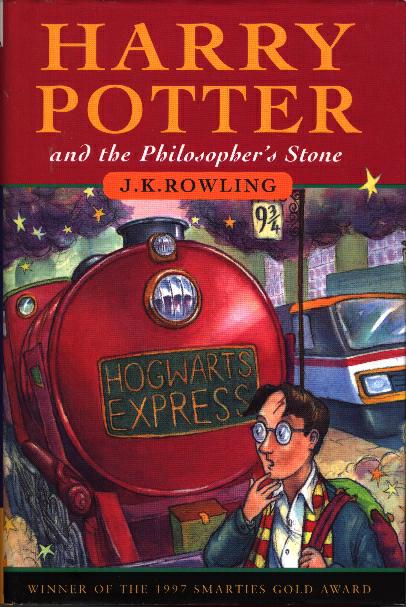
Harry Potter and the Philosopher’s Stone to be translated to Scots
Harry Potter may have been inspired by the quaint streets of Edinburgh and the Scottish countryside, but for twenty years and after dozens of translations worldwide, the books have never before appeared in the ‘local’ language. That’s about to change. Harry Potter and the Philosopher’s Stone, the book that started it all, is finally being translated to Scots. Scottish imprint Itchy Coo, part of Black & White publishing, will be releasing the book in October. Matthew Fitt, an esteemed expert who has brought other children’s classics to the language, including Roald Dahl’s The Eejits and Chairlie and the Chocolate Works, will serve as translator. The forthcoming edition will be the book’s 80th translation. Author J.K. Rowling has many times voiced her love of Scotland, calling it one of the most “hauntingly beautiful places in the world.” Plus, the Edinburgh café where she wrote much of the book, The Elephant Room, has now become a popular tourist attraction for Potterheads visiting the charming city. The first paragraph reads:
“Mr and Mrs Dursley, o nummer fower, Privet Loan, were prood tae say that they were gey normal, thank ye awfie muckle. They were the lest fowk ye wid jalouse wid be taigled up wi onythin unco or ferlie, because they jist widnae hae onythin tae dae wi joukery packery like yon.”
It sort of heights the magic, doesn’t it? For Scots, anyway.
Philip Pullman to name a character after a Grenfell Tower Fire victim
In light of the recent Grenfell Tower fire, authors including Margaret Atwood, Jacqueline Wilson, and Philip Pullman are participating a fundraising auction to support those affected by the tragedy, which left 79 people dead and hundreds homeless. Pullman alone has now raised £32,400 after offering to name a character in the second book of his new series, The Book of Dust, after a name provided by the winner of the auction. James Clements, the former teacher of a 15-year old girl who passed away in the fire, offered up the student’s name: Nur Huda el-Wahabi. Pullman, a former teacher, stated: “I wish I’d met Nur Huda, and I’m desperately sorry she died. I hope the character I give her name to will be someone she’d have liked to know.” The large sum was raised through hundreds of micro-bids of £10–20 that kept adding up, with all of it going to the British Red Cross London Fire Relief Fund. Even though the auction closed on Tuesday evening, donations are still rolling in to support the cause.
Elimination of a NY Times copy editing desk causes walkouts and protests among staffers
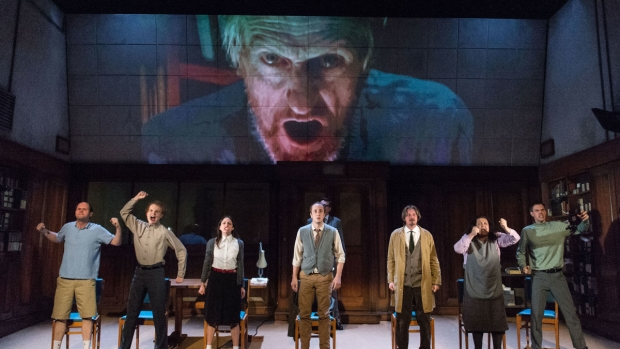
Copy editing has roused a lot of emotions over at the New York Times, with hundreds of employees outraged over the elimination of a standalone copy desk consisting of about 100 editors. The action culminated Thursday afternoon with a walkout protesting the cut in staff size. Participants carried a number of signs including, “They say cut back, we say fight back,” ““Without us, it’s the New Yrok Times,” and “This sign wsa not edited.” The staff cuts at the Times are part of an effort to streamline the editing process. However, staffers reaffirmed the importance of the copy editing desk and it’s “safety net” function in catching both grammatical and factual errors. The walkout garnered a lot of attention on social media, with reporters tweeting in support of it and recalling instances when copy editors came to their rescue.
Hello, and welcome to my week-by-week review of the world. Today I am reviewing Okja.
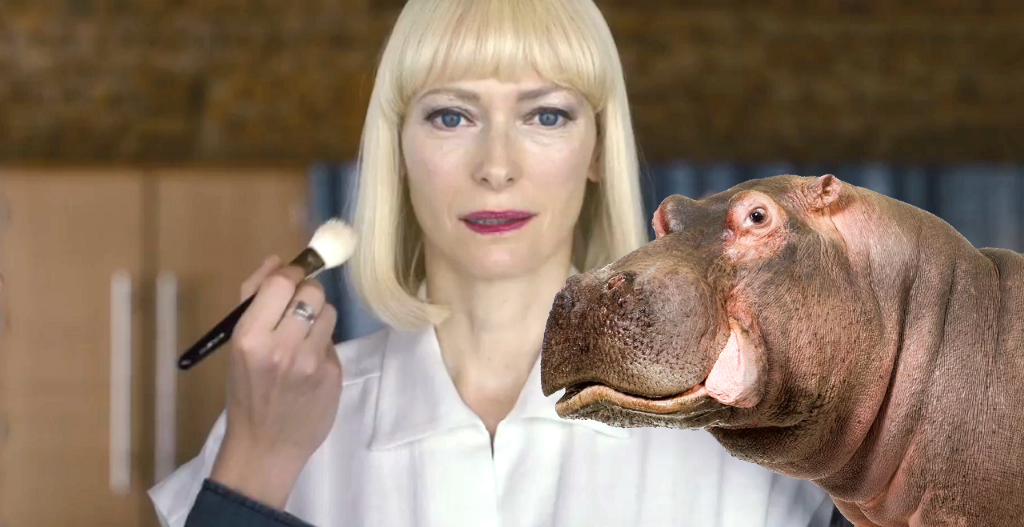
Okja is the new movie from Bong Joon-ho, director of cult favorites 설국열차 and 괴물. In Okja, a magical hippopotamus named Okja befriends a young girl named Mija in the mountains of Korea. Meanwhile, Tilda Swinton and Jake Gyllenhaal are planning to eat Okja and feed her to America. Okja has been cloned which means hot dogs for everyone.
The message of this movie seemed to be that we should not eat animals, but some of my most delicious meals have previously been animals. And to be honest, the movie actually made me quite hungry, leaving me with an acute curiosity about what hippopotamuses taste like. Dominoes doesn’t offer hippo as a topping. No one in my area does.
I’m not sure why vegetarians value animal life more than plant life. To me, life is life regardless of whether it has a face. I feel the same amount of remorse for eating a puppy as I do a head of lettuce. Not that I’ve ever eaten a puppy, but I probably would if presented with one that nobody would miss. I’ve also never eaten an entire head of lettuce. Go ahead and try it if you think you can. It’s a lot of lettuce.
Okja is partially subtitled which means you need to either wear your glasses or learn Korean. I did neither, but fortunately for me, the woman next to me was able to translate. I would not recommend bringing a translator because it will make other theatergoers very upset.
That’s another issue with this movie — it’s not in theaters. It was released on Netflix.com so people won’t have to leave their house, but some people have roommates they want to get away from and Netflix didn’t consider this.
The theater I went to was an underground theater in a weird lady’s pool house. She shows movies there every once in awhile. Tickets are cheap and there’s no popcorn and it only seats six people. It’s a poor moviegoing experience but I wanted to see Okja and I couldn’t figure out how to watch it on Netflix.com.
I would recommend this movie because it’s fun to watch a trained hippo do tricks. Ever since Ringling Bros. and Barnum & Bailey Circus went out of business, there aren’t many venues for animal tricks. You’re probably best of training your own pets to do things nature never intended.
BEST FEATURE: Tilda Swinton. Tilda Swinton is always the best feature of any movie she’s in. I like her so much I would marry any woman named Tilda Swinton. WORST FEATURE: The movie is of average length but I was hoping it would be much longer because I had nothing else to do that day.
Please join me next week when I’ll be reviewing Ramadan.
Presenting the fifth installment of The Bodega Project, where authors from across New York reflect on their communities through that most relied-on and overlooked institution, the bodega. Read the introduction to the series here.
Yesterday my sister called while she was out doing her ritual South Slope Bodega Survey, looking for the cheapest place to buy gas relief medication. We both tend to get bored when walking and feel trapped when talking, so our solution is to combine walking and talking whenever possible. It’s all a part of our illness, our maximum productivity illness, our bang for our buck illness, which is also the source of this survey compulsion of hers. But every once in awhile indigestion strikes — not her own, she wants me to emphasize — and an unexpected item demands to be bought. Then the territory must be reassessed.
“So this place sells a single packet of Gas-X for two dollars but the other place had eighteen for $12…” She mumbled quietly into the phone. “That comes out to less than a dollar per tablet…”
Eavesdropping on her quiet negotiations is oddly validating, since I’m equally prone to bouts of misguided frugality, but even I can grow impatient. I know her scrupulousness defies the logic and utility of bodegas, which lies not in its pricing but in its proximity. Usually when people talk about their bodega they say, “the bodega around the corner,” or, if they live in a more residential area, “down the street.” At a dinner party, no one would think to send a guest out for a bag of ice with these instructions: “Okay, first put on some good walking shoes, then walk for twenty minutes down 7th Avenue. There, you will find a bag of ice for fifty cents less.” That kind of thing just doesn’t happen because most people acknowledge, tacitly and intelligently, that whatever price you pay at the nearest bodega is a fee you pay for convenience.
Most people acknowledge, tacitly and intelligently, that whatever price you pay at the nearest bodega is a fee you pay for convenience.
But I know where she’s coming from. It’s a habit born of exigency. The rule in our household was always to get the best possible deal no matter what, because our family couldn’t afford otherwise. To this day I still thrill when eating mangoes, a former extravagance. And though my parents’ economic circumstances have improved significantly, they still bicker at the supermarket over three dollar tofu. They bypass the fresh bamboo, until one of us is in town, and then they’ll treat themselves. They walk past sacks of coveted pistachios, opting for the humbler peanut.
There’s nothing remarkable about any of this. It’s a common immigrant story. My sister has, like bonsai, learned to grow in an economical, constricted way, self-stylized to the extreme. My habits, on the other hand, have become wayward ever since I left home for college, growing like a weedy garden path that only reveals traces of its original design. Although our source illness is the same, the way we cope is radically divergent. My methods also make no sense, and so I don’t feel justified to correct hers.
For years, I shopped at bodegas that were further away not in order to pay less, but to paymore.
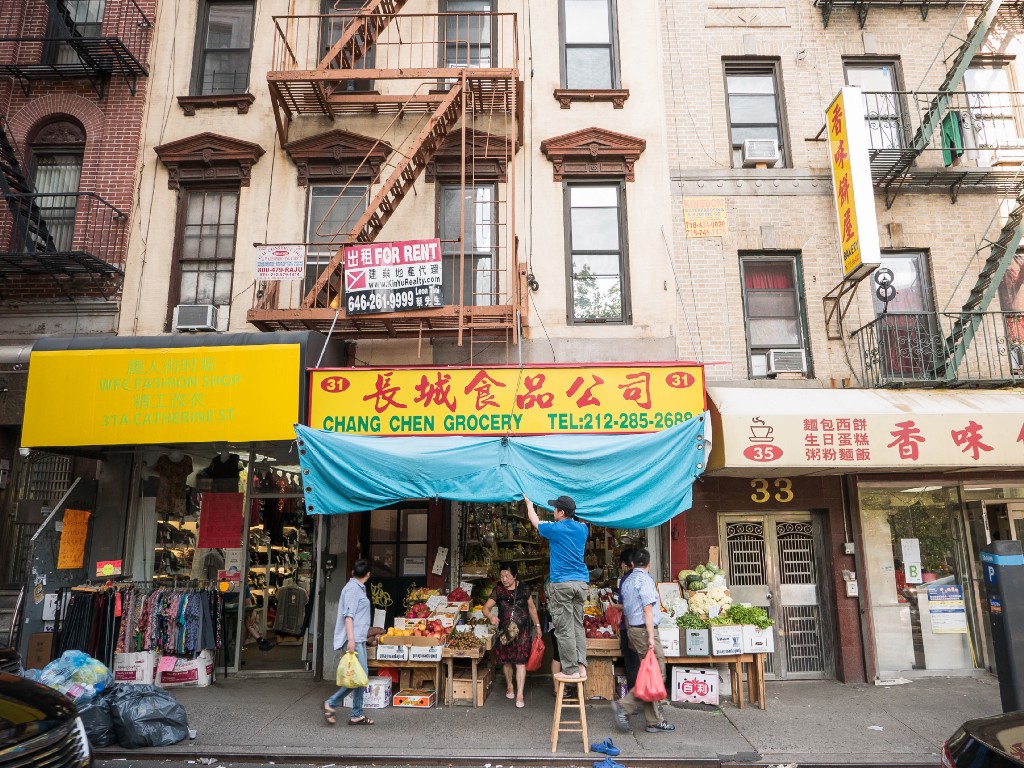
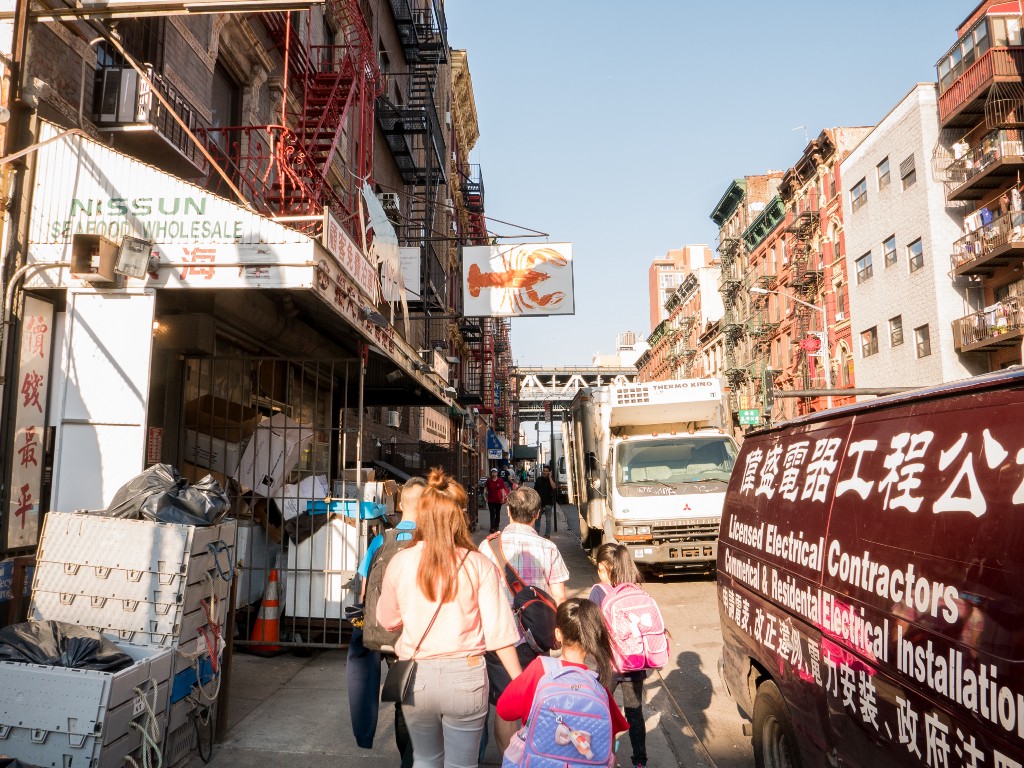
When I first moved to Chinatown in 2009, I would occasionally shop at a small nearby bodega that was right across the street from my apartment on Catherine and Madison, then operated by an elderly Fujianese couple. The store was so narrow it was basically just one aisle. I could never enter that space without feeling like an intruder, so I learned to stand at the threshold and call out for things: a bottle of soy sauce or sesame oil, a box of tea. Mostly the grocery sold produce — daikon, bittermelon, eggplant, ginger, and lots of fruit — stacked neatly in boxes along the sidewalk.
The proprietors worked unceasingly, every single day of the week. Sometimes relatives would come and go, relieving them for short stretches. They spent the day in that half-outside, half-inside threshold zone, enduring all kinds of weather. The uniform they wore consisted of sensible rubber boots, long shirts with elastic sleeves, and sturdy plaid aprons in which they kept paper bills and change. Whenever I walked by they would softly insist that I try some tangerines or press apple slices into my palm. Their shy manner I thought implied that they were new to this marketing business. Perhaps they’d once worked elegant jobs back home, as dressmakers or ceramicists. Anyway, I sensed their loss every time they lifted up a bouquet of celery or a strand of grapes, as though it were an object more suited to aesthetic contemplation.
I was no longer in the same economic bracket as many of my neighbors, but I still retained the habits of my childhood and our particular way of thinking. I wanted to get the best possible deal — but was that still fair?
During this time I was working on my MFAin writing. The non-utility of this pursuit was reason enough to cower in shame before them. I’ve written a lot about the particular dissonance of growing up under one set of circumstances only to find myself in another. My relationship with the nearby bodega accentuated these anxieties, and it quickly became the site of many tortured interactions. I knew I was no longer in the same economic bracket as many of my neighbors, but I still retained the habits of my childhood and our particular way of thinking. I wanted to get the best possible deal — but was that still fair?
And this MFA in writing. Who could afford something so impractical? I grappled with this every time I sat down to write. I was in school, but it wasn’t real school. Going out for afternoon runs, reintegrated into the street, at the level of commerce, I would be reminded again that my labor was not the same labor as that undertaken by my parents, or by my neighbors. And so, to avoid the shame of my own desires I often hid from the nice couple at the Nearby Bodega. There was no easy way to appear before them wearing running clothes. Instead of buying from them, which often led to conversations about what I did, I would walk the twenty minutes to Whole Foods, where nobody judged me, and I could judge everyone.
About a year later I passed the Nearby Bodega and saw that the gates were pulled down. A flimsy “For Rent” sign hung out front. I suddenly had a sinking feeling of complicity, imagining that the older couple had been forced out of business. I was wrong, but for about a month I believed this. Quickly another store opened, festooned with festive banners. The new proprietors introduced themselves to the block. They were also from Fujian province, although they were younger, in their mid-thirties perhaps. All the same I couldn’t go there, because now I felt a misplaced sense of loyalty to the older couple, who in my mind had been pushed out of their store, when in fact they’d upgraded and moved to a larger space on Catherine Street. After discovering their move I walked an extra two blocks further to the older couple’s larger store, to pay more for things I could easily have gotten at the new Nearby Bodega.
I often have rules I operate under that make little sense to anyone else. Clearly I felt my loyalty was now to the older couple, so I would go there regardless of expense. Nobody compelled me to do this and in fact I told no one about it; it just became the rule I followed. But, as the weeks went on, the younger couple at Nearby Bodega began to wear me down. It seemed stupid not to buy from them. And they were two blocks closer! Perhaps my rule could be revised.
The young woman in particular had such a great laugh. Everyone wanted to be around her. She possessed a lovable manner, and a flawless asymmetrical haircut which she’d dyed warm chestnut brown. She would joke with everyone who walked by, and before you knew it you would be buying something. The one time I got lured in it was because the sidewalk was nearly empty. It was probably eleven in the morning on a weekday, an odd hour for commerce since everyone, presumably, was supposed to be at work. Except for me. I walked by wearing pajama-like clothes, because I was a writer and nobody was keeping tabs on me. As she bagged up my outrageously affordable apples, she said, cheerfully in Mandarin, “How nice to have the day off! It must be so nice.” Immediately, my cortisol spiked, my heart skipped beats. I stammered something dark in response. “Uh, yes. Because my work is usually so stressful. I feel I am working to death.”
After that encounter I could of course not go back to the Nearby Bodega. I especially couldn’t go during everyone else’s normal work hours, which greatly constricted the available hours that I could go there. In addition, I now had to hide from the woman at the Nearby Bodega in order to keep up the appearance that I was unavailable during work hours, implying that I was somewhere else, hard at work. During this period, whenever I needed to get someplace, I would walk down alternate, parallel blocks, which meant I could no longer frequent the older couple’s bodega either, since they shared the same street. Instead I would walk across, in a diagonal, over toward City Hall, and end up at Alibaba’s, an upscale organic bodega owned by a Turkish family. Then I would scurry back like a criminal, laden with slightly more expensive groceries which left me with a sick feeling of indulgence. This was the fee I was paying to avoid feeling ashamed for my good fortune.
I would scurry back like a criminal, laden with slightly more expensive groceries which left me with a sick feeling of indulgence. This was the fee I was paying to avoid feeling ashamed for my good fortune.
If, however, I were to go out with my partner, and he wanted to go to the Nearby Bodega, I would allow myself to go with him, albeit standing off to the side and feigning indifference. If he were there it would somehow seem more excusable, since he clearly had a legitimate career and bore himself with the confidence of someone who deserved things. Even if we did happen to be in running clothes. The burden of accounting for myself would temporarily be lifted, the suggestion being that, well, he was in charge here. Once, after we’d spent a summer away — to Paris or Greece, I can no longer remember — we came back looking rested and tanned and the woman saw me and waved hello. “How was vacation!” she shouted. “I haven’t seen you in a while!” She seemed genuinely happy to see me again. I smiled back, cringing inside.
Finally, one winter evening — and this was under perfect conditions; I had just come home from an exhausting day of teaching and it was extremely cold, so I must have looked especially beleaguered — I went to the Nearby Bodega with the intention of buying something small, some lemons, maybe. Perhaps it was my exhaustion, or my excitement at such low prices after having become acclimated to the sky-high prices at Whole Foods, but I began buying expansively, off-script. Just pointing and nodding without any plan whatsoever. Yes to the sack of bananas, to the melon, and the off-season Rainier cherries. I would take it all. While she was bagging up my things I saw a lone, unmarked bag of fish balls, their last of the day. The woman pointed at them and said, “You’ll like these!” Okay, sure! Why not! I said. I was in a good mood. I told her to put it in. But after, when she shouted out the total price, I blinked a few times, shocked.
The fish balls were ten dollars. Nothing in Chinatown is ten dollars. “Why do they cost so much?” I demurred, gazing at the cash inside my wallet. I barely had enough. “Oh, they’re made at the place down the street,” she said. “They get really big.” She made a ballooning motion and laughed again, perhaps to dispel the discomfort which had suddenly descended. I didn’t think it was funny. “I can get these at the grocery store for three dollars,” I lied. The mood hairpinned fast. “You will like them,” she said again quietly, stuffing my cash into her fanny pack. She didn’t linger. I watched her retreat back into the store, where she rubbed her hands beside the space heater. The interaction left neither of us feeling good.
At home I dumped the offending fish balls into a pot of boiling water. I really can’t go back there, I raged to my partner. I’ll never go back. She thinks I’m a chump and she can rip me off? I’m no chump. I stood at the stove, fuming silently. According to the laws of the street, only outsiders got ripped off, and now I had been identified as one: I was fair game.
Getting ripped off turned out almost to be a gift, as anger aligned my decisions into a coherent narrative. I had gotten ripped off, that’s why I couldn’t go to the Nearby Bodega. This narrative made me seem like a sane and rational person. I was filled with an expansive, self-righteous feeling which stopped me from going. It was so easy. Since I was now definitively an outsider, I no longer had to weigh loyalties when I went to art openings on Orchard Street, the same galleries which had displaced former restaurant supply stores. And I no longer had to consider what it meant that I could browse luxury boutiques on Ludlow, pretending not to flinch at the prices. All this was possible because I no longer belonged to my own past.
One beautiful, spring weekend, my mom came to visit. We went out early in the morning to get breakfast. We stopped by the bakery for egg tarts and pork buns, then waited in line at the soy pudding place to buy still-hot quarts for a dollar, and a bag of freshly fried tofu. Shopping with her, I relaxed into the background and let her do all the accounting.
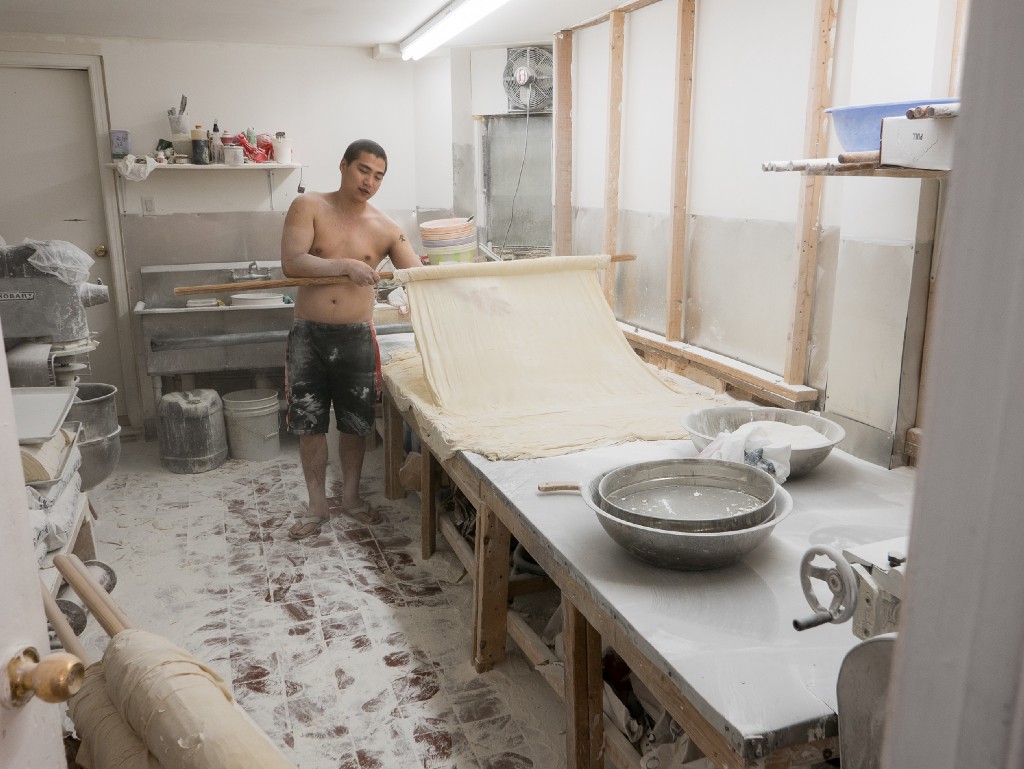
On the way home, we walked by the noodle factory on Madison where, lined in a tidy row on an industrial steel table, bags of oversized fish balls sat.
“Hey, your favorite!” she said, stopping to inspect them. “You love fish balls, don’t you?” I hadn’t told her about my latest aversion, but thought I would humor her anyway. She seemed in a mood to splurge, and I wasn’t going to stop her.
“Ten dollars,” she mumbled. Leaning in behind her shoulder, I realized they were the same ones that I’d bought months before. This time, the prices were clearly marked on a piece of cardboard in red sharpie. They were ten dollars.
About the Author
Anelise Chen is the author of So Many Olympic Exertions, an experimental novel that blends elements of sportswriting, memoir, and self help. Her writing has appeared in TheNew York Times, NPR, New Republic, BOMB Magazine, VICE, The Village Voice and many other publications. She teaches writing at Columbia University, and writes a column about mollusks for TheParis Review.
The idea of a narrative as contagion, as the means by which some uncanny door can be opened to nefarious ends, is one with plenty of permutations in horror stories. This turns up frequently in tales of cosmic horror, from H.P. Lovecraft to John Carpenter’s homage to the genre in In the Mouth of Madness. In the film Pulse (also known as Kairo), an otherworldly presence spreads through the internet, with ghastly consequences. The opening of Mark Z. Danielewski’s House of Leaves also touches on this premise, and it even takes on a meta-narrative aspect in David Foster Wallace’s Infinite Jest.
It isn’t hard to see why. The act of reading or watching something ostensibly gives the reader or watcher a sense of safety, a sense of distance. Narratives like this collapse that sense into something unsettling. When I was in middle school, I remember reading a story in a collection of age-appropriate scary tales where the premise was that this story in this particular book was, in fact, written by a killer; that this one copy had been prepared and placed for one reader’s eyes only, and something horrific would soon follow. (I was a particularly gullible child, which made this story particularly effective.) It was the earliest evocation of something menacing in a place where menace could be kept at a distance.
Giorgio De Maria’s The Twenty Days of Turin (translated from the Italian by Roman Glazov) is all about collapsing that sense of safety. Initially, there seems to be another layer of narrative cushioning built in: the story is told by a writer researching a series of killings that took place in Turin ten years earlier. As Glazov notes in his introduction, the novel was first published in the late 1970s, and was set in the then-near future, making it our recent past — but there’s a timeless quality to it that makes questions of specificity relatively moot.
From the earliest pages, there’s a sense of the supernatural at work — that, having lived through this experience, these characters are cognizant of the presence of the uncanny in the recent past. When discussing the events of a decade ago with a lawyer, the narrator ends up in a discussion of the qualities of ghost stories; later, an account of the beginnings of the killings has the same sense of subtle wrongness as a Robert Aickman story. Sleepless people convene in public spaces, and suddenly “an odd character” makes an appearance, leaving bodies in his wake. The description of one victim is particularly unsettling.
With considerable force, two hands had grabbed her by the middle of her body and then–hoopla!–raised her high enough to take her by the ankles and spin her. The whirl ended with her ruthless obliteration against a solid mass.
Slowly, the narrator discovers more fragments of something ominous: the discovery of spectral voices on recordings made around the same time as the killings leads to one scene of quiet dread — but its power comes from the incongruity of what the voices are saying, which is almost quotidian in contrast to the uncanny nature of their existence. Much of this ties back in to a phenomenon unique to the town before the killings: a library of ostensibly anonymous diaries available to peruse where, for a fee, the identities of the authors could be revealed.
The namelessness of the narrator of this book subtly dovetails with that idea, as does the sense of a community for which questions of public and private identities are inexorably interwoven. There’s the sense throughout that the killings may have been the manifestation of a collective unease–or the harbinger of something worse. Slowly, hints emerge that the violence of a decade ago may be returning; slowly, the narrative takes on qualities of the paranoid thriller, with ominous figures and threatening actions lurking in the darkness. Questions of privacy and control come to the forefront, as do dueling themes of personal repression and political repression.
It doesn’t hurt that De Maria can juxtapose precise evocations of dreams with the anxiety of living in a totalitarian state, nor is it a bad thing (narratively speaking) that the lines between the book within the book and the book itself feel increasingly blurred. At the conclusion of The Twenty Days of Turin, the novel’s seemingly disparate elements come together in a moment that contains a more palpable sense of dread than anything I’ve read in a good long while.
As I reached the final pages, I heard a strange sound coming from a few feet away from me — one that seemed to have uncanny echoes of the sounds the narrator heard as he researched the horrors of the recent past. It seemed entirely of a piece that this haunted novel of creeping repression might carry ghosts of its own in its pages, spilling out to infest a society with its own signs of creeping authoritarianism. The sounds turned out to be my radiator crackling to life, but the fear persisted. De Maria’s novel may reference a tangible period of time, but its reach is timeless, and it’s all the more horrific for it.
A writer with aphantasia on visual memory and imagination
So you can’t picture me? There is this slight disappointment in their eyes when they ask it, a quick shift to disbelief. A shuttering.
I have felt in my life a wide berth between what I and another person are saying — the shuttering, as I think of it. The moment in a miscommunication when the other person gives up, or in. What was translucent becomes opaque.
When you start asking around about what happens in people’s heads when they imagine things, the first thing you’ll notice is: it’s impossible to talk about. There is no linguistic framework for people who don’t imagine visually. A surprising amount of people won’t believe you if you say you can’t. They will say, but you know it’s not like, literally using your eyes. They will say, maybe you just need to practice. They will say, you probably don’t realize you’re doing it.
When you start asking around about what happens in people’s heads when they imagine things, the first thing you’ll notice is: it’s impossible to talk about.
And it’s not just imagination: it is also memory, the most basic kinds of thought. An image will never “pop into my head.” I will never have an elaborate visual fantasy or visualize a scene from one of my favorite books. I have never been bothered by a film version of a book not looking how I pictured it, because I have never pictured one. When I remember things I do not see them.
For roughly the first twenty-six years of my life, I did not realize this was not normal.
[imagine a beach]
It’s true that I don’t have a good memory when it comes to my experiences, and it’s true that I can’t “see” you if you’re not standing in front of me. I’ve often felt a sneaking suspicion that despite my lifelong goal to Be A Writer, I am not naturally creative. I do not create so much as record. This is why I turned away from fiction early on and began writing poetry. If I said, I am all in one ear and out the other — if I said, every poem I’ve ever written is literal — well, I’d be telling the truth.
If I said, I am all in one ear and out the other — if I said, every poem I’ve ever written is literal — well, I’d be telling the truth.
There is something to this, though: the creative as tied to the imaginary, the imaginary derived from the imagination, the imagination derived, at its core, from the image — always a visual. We live in a sighted world; it is, after all, considered the primary sense. And make no mistake — I can see (with the help of contact lenses). I can even dream (most people like me can). But I cannot consciously form mental pictures, whether those be imagined or recalled from memory. This is called aphantasia — a as in without, phantasia as in fantasy — literally, the absence of fantasy.
It might sound depressing at first. My mother cried when I called, mystified, to ask her if she could actually “see” a picture in her mind when the meditation tapes said to imagine yourself on a beach. Of course, she said. I see a beach. A pause. What do you mean when you say you can’t?
Of course, everyone said. I imagine a beach. Why, what do you do?
Nothing.
I’m not sure why it’s always a beach — the American cultural imagination, it seems, relies heavily on the tropics. When I was stressed, my mother always told me to imagine myself on a beach. This is roughly what would happen in my brain, though the specifics often varied:
Okay, there is a beach, there is sand, there is water. A beach is made of sand which is made of tiny rocks. A beach leaches heat from the sun. Skeet shooting is better than hunting but only slightly because you’re still firing a gun. A beach, a beach, a beach. I am imagining a beach. If you ran in cleats on the beach you might shatter a seashell. If I lived on a beach it might have seashells but they would all be in shards. I would allow bears on my beach, but only in the summer. They would stomp the shells before I ever got to them but I would never declare it open season. In winter Jim Carrey stands on the beach. Could I pull off Kate Winslet’s Eternal Sunshine hair? I wish someone would invent that memory machine. Remember you are on a beach. Okay. On my beach, it would always be mostly sunny, no breeze, for the love of god don’t feed the bears.
In the time it took you to read that paragraph, an image or two may have flashed through your head. Maybe a beach, maybe an ocean, maybe the sun, maybe a gun. Maybe just some shapes. For me, it was just words, my own voice in my head, not a sound exactly, just a thought, just words.
This is called aphantasia — a as in without, phantasia as in fantasy — literally, the absence of fantasy.
Among the friends I polled about the acuity of their visual imaginations, I heard responses that ranged from it’s like a watching a movie that I get to direct to I see abstract fuzzy shapes, but I know what they are. I did not speak to a single person who did not have any capacity for mental visualization; part of me wonders if this is because I surround myself with artists, writers, and musicians. I know there must be other aphantasic writers, artists…poets, even. Could Gertrude Stein see mental images? At times it is such a lonely, dark world.
[color theory]
People talk about similar things, sometimes — usually with color. What if what I see as red looks completely different from the red you see? someone will ask, probably after smoking a bowl or two. A dawning reality. I guess we’ll never know, everyone in the room agrees. But red is still red and nothing else. What about those poor colorblind people? Who can’t tell the difference between a red light and a green?
My father is one of those people. When I was small I wondered if I was different — maybe I was colorblind too? Maybe there was something a little off about me, about how I saw the world? I wasn’t colorblind, but I wasn’t wrong, either.
Then again, does anyone see the world the “right” way?
A few months ago, sitting on the basement stairs, I showed my mother a photo of what people with different types of color-blindness actually see. It depicted several multicolored and rainbow-striped hot-air balloons floating in a clear blue sky. To the dichromat — a person with red-green colorblindness, lacking the medium-wavelength cone, who can’t distinguish between colors in the green-yellow-red sections of the visual spectrum, my father — the only distinctions in the picture are between what we would see as a vague periwinkle, a grey, a navy, a yellow-green, and an olive green.
My mother cried when she saw this photo, too. She told me how she had ordered a pair of glasses that were supposed to correct colorblindness, as a surprise for my father. She saw a video online where people put the glasses on and were suddenly astonished by the world around them. Like waking up from a coma, like looking at the earth from your first airplane window. She thought it would make hunting easier for him, that he might enjoy the changing seasons a little more. Maybe sit in awe of a sunset with her. She said, I just thought, how could he live that way? He’s missing out on so much.
Then again, does anyone see the world the “right” way?
In his lecture on blindness, Borges said that as he went blind the world became a constant mist, greenish or bluish, vaguely luminous. The world becomes undefined and full of certain colors: yellow, blue which may be green and green which may be blue. No red, no black, no white unless that white is grey.
This makes sense, considering what we know about vision. As the brightest and roughly the central color on the visual spectrum — think Mr. Roy G. Biv, a man you might remember from elementary school — yellow is the most vivid color for people with normal color vision. It tends to be the first color we see in a prism or a rainbow, the first color we notice in a scene, which is why it’s used for precautions, construction vehicles, yield signs, the like. Blue, on the other hand, has the shortest wavelength and scatters easiest — as Rebecca Solnit notes in A Field Guide to Getting Lost, “blue is the light that got lost.” It’s the reason the sky is blue, the ocean is blue, and distant mountains are blue — the atmosphere scatters the light and blue is what we see when something is too far to make out, when we can’t see clearly. To my father, yellow is just a slightly brighter version of red, orange, and green; the rest of the world is a dull, indistinct blue.
When the glasses arrived, my mother wrapped them up like a birthday gift, gathered us in the living room, waited hopefully with her hands clasped in her lap. He opened it — masked bewilderment with gratitude — tried them on. Made some jokes to lighten the mood. My mother on the edge of her seat, praying. He looked around the room, then out the window. I guess the grass might be greener, he said. The glasses didn’t work — but who’d expect them to?
The glasses didn’t work — but who’d expect them to?
She was distraught; he was confused. He asked, why would you think I needed these? He said, It’s never bothered me. This is the way the world has always looked.
[aphantasia: a rediscovery]
Aphantasia was first described in 1880 by Francis Galton, in a paper called Statistics of Mental Imagery. Galton noticed that “the great majority of the men of science” to whom he first posed the question of mental imagery “protested that mental imagery was unknown to them.” They called Galton “fanciful and fantastic” for believing that “the words ‘mental imagery’ really expressed what [he] believed everybody supposed them to mean.”
This is exactly how I felt the day I found out, though I am not a scientist.
It turns out that maybe 2 percent of the population lacks a “mind’s eye.” These people are generally not ill, or impaired; rather, their brains work (and have worked since birth) in a slightly different way. In studies, when asked to describe a loved one’s face, most aphantasic test subjects did so easily, but the facial-recognition sectors in their brains did not light up the way they did in control groups. When asked to close their eyes, imagine they were standing in a spot in their home, and count the number of windows they could see from that spot, they were able to give an accurate number. Scientists found that the visual circuits, which lit up in the control group when they were asked to use their imaginations, remained dark in aphantasic subjects. Instead, other regions of the brain lit up, regions which had been inactive in control subjects.
All of this is to say: there is more than one way to store visual information in the brain, more than one way to access our memories, more than one way to imagine. More than one way to cross a lake. There is, of course, always, more than one way to think.
All of this is to say: there is more than one way to store visual information in the brain, more than one way to access our memories, more than one way to imagine.
Many of the people who admit to having aphantasia, including Blake Ross, the Facebook programmer and writer who wrote the article that first clued me in to the fact that my imagination was not quite “normal,” are what I casually and probably offensively refer to as STEM people. They are good at math, at science, live in that bleak logical world of computer languages. I am not this. I am not objective. I am not a software person, a math person. I do not think in formulas or graphs or charts.
But then how do you think?
(These days, hardly at all.)
In many ways, Ross’s article was intuitively familiar to me — the endless I don’t knows when asked about your day; the “milk voice;” the preoccupation with ideas; the inefficient, convoluted steps to a given If Situation, Then Result? type of imaginative game — and in others, completely foreign. I can’t imagine not being able to dream. Sometimes I stay in bed for hours after I first wake up in the morning because I am more likely to remember what happens in a dream if I’m not so deeply asleep. I can’t imagine never having had a song stuck in my head.
This feels like a pleasant (if alienating) reminder in an age where everyone repeats the same catchphrases and the world seems to have devolved into a Facebook advertising algorithm or a BuzzFeed article that assumes it knows how you feel about any given situation at any given moment — there really is so much variation between all of us, locked in our own heads. I lived the last twenty-six years assuming my friends and I were thinking the same way just because we were thinking the same things (see: the hive mind). But there will always be a divide — uncrossable, unchartable, endlessly inexplicable.
I lived the last twenty-six years assuming my friends and I were thinking the same way just because we were thinking the same things. But there will always be a divide.
[elementary education]
As I’m writing this essay, a good friend is editing a first grade language arts textbook. He sends me a page, which instructs teachers to: “Define imagination as ‘making a picture in your mind of something that you are not experiencing in real life.’”
They say the point of a liberal arts degree is to teach you how to think critically; is the point of elementary school to teach you to think visually? And if it is — did I fail?
The best way to describe how I think is in analogies, or the homework you were assigned when you were seven. A horse is to a car as a [blank] is to a microwave. The city is to a mouth of humid breath as I am to the cockroach roaming inside. Wedged between the teeth. Often my analogies are not analogous so much as associative: the things we learn, growing up, the shorthand we create for ourselves. I think in words, always, all the time. Inside my brain is dark, a noncolor, a nonspace, an echoed running monologue of my own voice. It is difficult to remember the experiences I do not immediately write down. My whole life has been a sieve, like trying to remember a dream after waking. All fog and quiet and I don’t know.
[lost in translation]
As a poet, being aphantasic and not knowing it made graduate school more frustrating than it needed to be. Now, it feels like rereading a mystery novel after you know whodunit: all the signs are there. But then — well, how many times can someone tell you you’re too spacey? If a poem is a metaphor, what is mine? O litany of disconnected nouns, vague impressions of invented planets! In MFA workshops, I received constant feedback about how my work was too abstract. A professor once told me, not unkindly but not kindly either, that reading my manuscript was like listening to too much Radiohead. I know what a concrete image is but it did not dawn on me fully why having them mattered so much to other people: when you can’t visualize imagery either way it’s hard to care whether it’s concrete or not, whether each image is part of a larger scene. I never knew that they could: to read a poem and see it! To read a poem and see anything but the words, the letters.
As a poet, being aphantasic and not knowing it made graduate school more frustrating than it needed to be. Now, it feels like rereading a mystery novel after you know whodunit: all the signs are there.
This, by far, is the greatest disappointment, that someone can do the thing I’ve spent my life dreaming of — see a poem, see a story, see a memory — no, not just someone, but most people.
See — if you think in words it turns out you write in words, too, and people call you cerebral and professors tell you that you don’t quite fit in one camp or the other and that’s not necessarily a bad thing but they’re just not quite sure what to do with you
When you are a child your mother also says I’m just not quite sure what to do with you.
[miscommunications]
When I was ten, I wrote a short story in a notebook that involved every swear word I could think of, every obscene thing I wasn’t supposed to know or talk about. I tried to make it the most debauched story I could imagine. Looking back, it was probably something vaguely erotic, the words fuck and shit, and the assumption that sex was something that involved men and women and their private parts. I didn’t know what it was, exactly. Immediately after writing it — and I have this memory exactly, strongly, like it’s branded on my brain, on my flesh — I was so ashamed of myself that I tore the sheets out of the notebook, crumpled them up, and threw them in the trash. It was thick black paper and I wrote in silver sparkly gel pen. I remember this, the feel of the stiff, ripped sheets, the cold silver metal of the trashcan in the bathroom.
I was so ashamed of myself that I tore the sheets out of the notebook, crumpled them up, and threw them in the trash.
Except I didn’t do that, apparently. One evening a short time later my mother came into my room and had a deeply uncomfortable talk about the story with me, the specifics of which I no longer remember — I know she found a notebook of mine that was titled My Stories, and she opened it up, happily, proudly, to read them, what her only daughter had created. Then she found that one and was horrified; I doubt she thought she’d have to have the sex talk so early. Neither of us were prepared for it. I remember this: lying very still on my bed, on top of my quilt — navy blue with white snowflakes — staring at a ceiling sprinkled with glow-in-the-dark stars and burning with shame. Thinking but how how how how could she possibly have found it? And god please let this end. I so sharply remembered throwing it out. Throughout this conversation, my mother did not understand that I did not understand what sex was — that I didn’t even really know how my own reproductive system worked or what it was, only where it was, and that it was forbidden. And thus enticing. And thus, the curiosity and its attendant hot rush of shame.
To grow up female is to internalize that shame, feed it, live with it, let it grow in your belly and sternum and proliferate in your lungs. It’s the one thing I’ve been unable to eradicate in my adulthood, that rears its head at the most inconvenient of times — when I’m thinking to myself, well, this one thing I want to say — it’s normal, right? — well, maybe not, I should keep quiet — well, what is normal, anyway? — better not say it, just in case, all the same. And the person I’m speaking to just looks on expectantly. Asks what I’m thinking. Oh, nothing — and then the shuttering, that miscommunication, excommunication, where the face becomes an expressionless mask. The gap, widening.
These days we say most things are normal, so long as they are not directly harmful to others. Children will explore sexuality long before they know what it is. I can’t remember when I first grasped the mechanics of heterosexual sex, or what my reaction was. A nebulous fear of men that persisted well into adulthood, perhaps. The longing for attention, the recoil when it came. An uncomfortable laugh. The persistent, quiet revulsion at the thought of my own body, its many vulnerabilities.
In so many scenes the details have been lost. What is the difference between describing and imagining? If I say I was in a forest with dappled light am I supposed to see the forest? I can describe to you how a few months ago I was leaning against an enormous, primeval-looking log, about twenty feet off the trail and a little ways up, and he was standing in front of me, and there was moss all around us, and I touched his cheek and I pulled him nearer and dared him to fuck me right there. And I can describe the next moment, when a couple and their small child walked by and we sprang apart, a little embarrassed and a little exhilarated, laughing. But I do not see this. I feel the forest but that is not it, either. I know what a forest is: I know. It is a fact and I feel it. A forest grows behind my right lung when we talk about a forest.
What is the difference between describing and imagining? If I say I was in a forest with dappled light am I supposed to see the forest?
When I call up a memory I feel it in a very specific place in the back of my rib cage, behind my right lung. I do not see it. (This is also, curiously enough, the place I feel brain-freezes when eating ice cream.) When I was a child and my mother told me we were leaving Canada and moving back to Texas, we were in the car and she was driving me home from something — ice-skating lessons? — and it was sunset and we were at the crest of an enormous hill. The sky was pink and orange and endless and I did not want to leave. The mountains, the ocean: I knew their absence would haunt me. I can’t emphasize enough: I do not see this as I write it. But I know it and I feel it: that one felt like dread.
[lost in translation]
Here’s the thing about imagination, though: in most cultures, the very concept is centered on sight. It’s impossible to extricate the two, linguistically — translations range from images to chimeras to phantoms to shadows. The English word comes from the Old French imaginacion, which meant concept, mental picture, or hallucination, from the Latin imaginari, to picture to oneself. In most European languages, the word comes from the Latin. In German, it’s Fantasie, from the Latin and Greek phantasia — fantasy, imagination, appearance, to become visible. In Icelandic, from the Old Norse: ímyndunarafl, the image-making power of the mind.
Comparatively, in Chinese, the characters 想像力 (xiǎngxiànglì) break down to miss you/want — image — power. In Japanese, the characters are the same — 想像力 (sōzō-ryoku) — but they break down to idea — image — power. The Chinese characters give imagination an intuitive emotional context while the Japanese characters appear to remain more abstract, though I couldn’t say for certain because I am not a speaker of either language. The nuances escape me.
The only major language base for a nonvisual — or at least nonspecific — imagination seems to come from ancient Buddhist texts.
The only major language base for a nonvisual — or at least nonspecific — imagination seems to come from ancient Buddhist texts. In Sanskrit, the words typically translated as “imagination” can also mean anything from thought, mind, spirit; intelligence, genius; wish, desire; choice, option; supposition, meditation, opinion, understanding; to composer or contriver, depending upon their contexts. This last word — विकल्पन (vikalpana) — is the first direct connection I’ve found linking art and imagination.
Arabic, though, has by far my favorite interpretation. خيال (khial) translates as imagination, fiction, illusion, shadow, or silhouette; it can also mean ghost, wraith, or shade. Arabic, of course, is a language of poets. We are all aware of this, instinctively, even if we don’t naturally fold the knowledge into the language itself — the greatest power of the imagination lies in the fact that it’s as much a creator of horror as it is of beauty.
[imagine a boy]
As a young teen I had an active imagination, in that I thought at length about plenty of scenarios that did not explicitly happen. Sometimes these were career-oriented — Oprah wants me on her show, my book in her Book Club? What a charming guest I am, what lives I’ve changed — but most of my imaginative energy was spent in less fruitful ways. Hopeless romantic, raised on love stories — for the most part they began “and then he kissed her,” “and then he touched her hair.” We could talk about cultural expectations of women here, or the rom-com industrial complex. We could talk about how he was never specific (and I was always her, direct object, outside myself, outside agency, flat character receiving the action in the story of my fake life). Or if he were specific, he was only ever called “he,” and even if he were supposed to be a real person there was never an image associated with him. I would never have expected there to be; it didn’t really matter who he was or what he looked like. I met Zac Efron in a CVS in Hollywood, in the self-tanning aisle. (And then he kissed her.) Or my favorite musician at a dive in his Scottish hometown. (She sat down next to him and ordered a beer. Struck up a conversation. And then he showed her the loveliest highland hills, and the whole world was green. And then it rained, and then he kissed her.) And then and then and then there is nothing there but the words, hollow, an empty black space and then.
Aside: When I tell a friend about the Zac Efron fantasy, she comments on how visual the details are — self-tanner! CVS! What she can’t seem to grasp is the fact that for me those details are purely situational. This is how I imagine: If I were to meet Zac circa 2006, where would it be? Probably LA. Probably buying self-tanner because on TV he always looks a little orange. Probably at a CVS or some other basic pharmacy because he’s not super-mega-rich-and-famous yet. (Stars! They’re just like us.)
I don’t have to see it to tell the story. In fact, sometimes not seeing it makes it easier. It begins simply, with a verb. And then.
What I mean by this: there are plenty of ways to get where you want to go, whether that’s on camera talking to Oprah or the bland heroine in a story the patriarchy kindly started for you. I don’t have to see it to tell the story. In fact, sometimes not seeing it makes it easier. It begins simply, with a verb. And then.
[the anatomy of a memory]
I am still this way: in love with love, with longing, with impossible odds. “Longing, we say, because desire is full of endless distances,” wrote the poet Robert Hass. Sometimes my own memory feels distant enough from me that I long for it; the men I love have almost always been far away, in some way or another. The better to tell myself stories about, the better to not be broken by. I have always lived primarily in the darkness of my head, a lost continent, a shield of mist. No one needs to visit me there. I wouldn’t really want them to.
Some nights when I am in bed waiting for sleep, I try to imagine my long-distance lover, how it began — list the elements of the scene I won’t see again but can always feel — sitting across from me, black jacket, smooth knotted wood, long dive bar table, a little sticky, half a beer left, knees touching underneath, telling drunk stories over the dark low bar noise, are we flirting, is this happening, is this all in my head — and then. He kissed me. The back of the room, a black wall, beside the door. This happened. I know it because I feel it: the hope, the fluttery nerves, the is this a bad idea excitement of it all. His knees take shape behind my right lung. He does not feel closer, or close enough. The start of the story still contained in the feeling: longing, lust, those early trappings of love.
This is the thing people tell me about their own love stories: no matter how precious they are or were or should be, your memory warps them, your present self looking back warps them. They’ll close their eyes and say, Yes, I can see the person I loved, if I focus I can see this experience I cherished or suffered through as it plays out. But what I’m seeing might not be what actually happened.
My memory works closer to erasure than reframing or reshaping. It becomes a nothing space that once held an emotion; when the emotion fades, the detail goes with it.
This is fascinating to me, the morphology of a memory, how visuals could shift and change over time. My memory works closer to erasure than reframing or reshaping. It becomes a nothing space that once held an emotion; when the emotion fades, the detail goes with it. I remember my longtime on-and-off boyfriend, who has since passed away, but I also do not remember him. I know that version of myself must have existed, but I do not remember her. This is the hardest and easiest part: when a person is gone, they are so fully gone. When a time has passed it becomes nothing but facts — words, sentences, nothing attached. I remember such small things. All the verbs and none of the nuance.
I could say we sat in the parks at night and climbed up to the tops of the buildings and kissed on the bleachers, which were a dull, scratched silver and ridged and riveted and sometimes too cold and sometimes too hot, and we argued about politics and I spoke to him in Spanish even though he didn’t understand it and we did the kind of drugs that burned as they dripped down my throat and turned the sky into one shimmering dome of star and the parking lot into a grey-blue ocean and we drank gin in church at 2 a.m. and we played cards and we got stoned and warm and sleepy and floated in the hot tub, the light under the water casting shadows against our legs and the june bugs flocking around us like june bugs do — and we did and we did and we did and I know all these things happened. And the feel of the relationship at the time was some vague unwanting guilt.
So much of my life as a woman has been that: a vague unwanting.
I do not remember my college boyfriend at all, though I have poems about him. I wrote them assuming they would inspire memories in the future. I was surprised when they didn’t. To read them now feels to me like reading something written by a stranger, about a stranger’s life.
I imagine we all have these moments: this inability to connect to who we were, even when we try our hardest. So the present becomes all the more precious: this intangible thing we’re reaching for even as it passes by. It seems like every few years I burn my life down and start over somewhere new — and I’m still not good at endings. Doesn’t matter if it’s a friendship, a relationship, a place, or just the flight home at the end of a vacation. Something is lost. Something will never be found, won’t be made better in the retelling. Something always gets erased.
I imagine we all have these moments: this inability to connect to who we were, even when we try our hardest.
[hallucinations]
The day I discovered aphantasia, I took a close friend out to lunch and asked her about her imagination. She told me if she closed her eyes, it was a little like she was sitting in a small dark room, watching a projector, housed where her third eye would be. If her eyes were open, she could still visualize, and see whatever she was imagining right in front of her. Like a hallucination? I asked. No, she said, a little like a TV’s picture-in-picture setting, where reality is the little picture.
When I was a teenager and took acid, I never hallucinated, though the desire for a hallucination was the explicit reason I took it. What I remember: the shag carpet squirmed like little worms and the shadows from the streetlamps played on the brick like ghosts and the falling leaves became small parachuting bodies, or suicides, depending on the mood. The long journey home, and the mistrust: those, amplified. The crisp October air, the smell of damp autumn rot grew larger and smaller and larger again. The standing on a 10-inch-wide ledge on the roof of the building? Well, the ground looked closer and I was euphoric as a leaf. I knew I would not fall and I did not fall.
Eventually, though, I did. You always do, at least once. Years later, after a particularly long weekend that involved too many different varieties of drugs, I remember the next three days were full of disturbing auditory and proprioceptive flashbacks. I hid in my room. There was a fist in my mouth. I was sure I was falling, or being suffocated. I was sure someone was touching me. I was sure there was a man in my room. I crawled into the shower and he followed. I could hear him speaking and sometimes it was words and sometimes it was a garbled low growl. I hid under the covers for three days. Intellectually, I knew he was not there because I could not see him. To actually see it, or him — eyes open or closed, in my mind or in the world — I never would have considered it possible. I recovered from that trauma a great deal faster than anyone would or should have thought possible. There’s a certain luxury to aphantasia in that way — to be able to assume visual flashbacks are just devices employed in movies to further the plot, that they don’t terrorize people in real life.
There is, of course, always, a dark side to being a deeply visual person: the nightmares, flashbacks, trauma, PTSD. You don’t only remember the lovely things. Hell will always get top billing. It took my friend years to recover from PTSD because the past kept coming back and crowding out the present. More than a decade later, she said, she could still see her worst nightmares happening, just as vivid as the first time. Mine? They’ve been mist for years.
[show, don’t tell]
As a poet, the inability to imagine visually helps, in certain small ways. I am accustomed to thinking in metaphor. To my knowledge, I’ve always thought this way; if I don’t, my thoughts bore even me. There are times I have been asked what I was thinking about, only to realize I was thinking nothing at all. For me, thought is never passive — I have to construct it in sentences. Think of it as a defense mechanism. I have spent my life assuming counting sheep was a metaphor, assuming none of us visualize and all of us want to, so much that we’ve developed the entire language of imagination to revolve around that wish.
I have spent my life assuming counting sheep was a metaphor, assuming none of us visualize and all of us want to, so much that we’ve developed the entire language of imagination to revolve around that wish.
The way my brain works lends itself easily to wild poetic leaps and associative shifts. If a word gets stuck on the tip of my tongue, I have to follow a bread crumb trail of vague verbal associations to find my way to it, and if I get lost, then I might as well just use an association as a stand-in and hope you understand. After all, I don’t have to reconcile any of the imagery I use in conversation, in poems. If all rain is acid then everything outside the desert will die. If I am an unlatched suitcase in space you are the vacuum my contents fall into. A concrete image is exactly the same as an abstract one. An idea can be expanded upon indefinitely with very little emotional consequence. If I write a poem about a person’s face melting off, I’ll never be haunted by the sight of it.
I tend to care more about the way the poems look on the page than the images they contain. I care about structure and texture and sound: the richness of the words themselves, mouthfeel. An o so round. The long ah sound of every down-home Texan vowel. The crisp click of an x.
If I write a poem about a person’s face melting off, I’ll never be haunted by the sight of it.
I think other disciplines can’t quite get away with this in the same way. There’s a lenience people give poets; they assume a poem doesn’t need to make logical or syntactical sense to have its intended effect. Doesn’t need to be seen if it’s felt. To quote Ntozake Shange, queen of the New York City subway poets: a poem shd happen / to you like cold / water or a kiss.
In fiction, they teach you: set the scene so the reader can see it, feel it, be immersed, stand inside of it and look around. There are so many rules — all those balls you need to keep in the air. Tie up your loose ends and while you’re at it, your shoelaces too. Don’t make your characters stand and ruminate at the kitchen sink, but don’t rely wholly on plot either. Show, don’t tell. Even that — show — we prioritize the visual, always. Show me, show me, show me. The woman’s skin burned to bone the day she forgot her umbrella at home. The body began disposing itself: all seeping blood and strings of viscera. After the astronaut’s cable was severed from the ship, the air ran out, his mask cracked, and the capillaries in his face and eyes burst. His skin shrunk in slow-motion, to this: a shiny white suit around a dehydrated husk. You shucked the fresh corn, found kernels dry as dust. Your mother stood at the kitchen sink, shoulders slumped, fingers pruning in dishwater. Those wretched scraps of celery, fat and floating. Show me, show me.
[miscommunications]
In Peter Mendelsund’s What We See When We Read, a book that is about exactly what it says it is, he makes the argument that we, all of humanity, don’t actually see that much when we read. Maybe abstract shapes, maybe a flash here or there. He says we become immersed, but immersion isn’t the same as visualization; that we remember traits, the inner lives of characters much more than we visualize the details authors provide for us. And who could argue with that? What’s happening when a person reads is different, after all, than what happens when a person conjures a memory, or actively pictures something in his or her head. The words don’t necessarily immediately translate into pictures — or do they, for some people?
The strangest thing about this book — written by a book designer I respect, admire, even, at times, idolize — is its utter insistence on this point-of-view. Mendelsund spends several pages talking about Vladimir Nabokov, who wrote frequently about the power of the image in prose, the power literature holds for the development and strength of our visual imagination. Nabokov was known to draw out his characters, his stories, and the characters in the stories he read, even draw pictures of what he imagined in the margins of books. He is not the only author to have done this; many great writers seem to demonstrate an acutely visual imagination. For him, the act of reading as well as the act of storytelling was deeply rooted in the visual. But Mendelsund, like the scientists Galton interviewed so many years ago, doesn’t even consider that Nabokov may have been describing the act of reading as he experienced it. That what he saw when he read a book — if associative, if memory-driven, if personal — was, in fact, seeing.
Perhaps we are already so different in life experience that we can’t imagine perceptual experience being different, too. After all, what makes us human, if not how we think?
It’s common courtesy today to accept that not everyone experiences life the same way. Treat others as they would like to be treated, so says the revision of the golden rule. So why would we assume everyone experiences imagination like we do — why assume if they say they’re not, they’re lying? Perhaps the potential for miscommunication, for deeper divisions within our shared humanity, fundamentally affects our sense of self, sense of reality, sense of sense itself. Perhaps as humans we are already so different in life experience that we can’t imagine perceptual experience being different, too — or at least, don’t want to. After all, what makes us human, if not how we think?
[lost in translation]
A few months after I discovered aphantasia, I joined an online group for aphantasics, looking for artists, for new friends, for what I vaguely thought might be my people. What I found? Like in any group of human beings, some are creative, some less so. Some are good writers and some are not. But most — almost all — had this tendency to blame certain personal weaknesses on whether or not they had the ability to conjure mental images, as though to lack it was a disorder or a disability and not just a different way of perceiving the world. Disorganized? It’s the aphantasia. Lost your keys? Aphantasia. Nonreligious? Your lack of faith is probably due to your aphantasia. Difficulty relating to other people? The fault lies in the disorder. Can’t meditate or make a decision? Well, have you considered the aphantasia?
This, I think, is a natural human tendency. I did it too, at first. The world makes a little more sense when you realize why you’ve always felt a little bit outside of it, and everybody loves a scapegoat if it means you can give yourself a pass when it comes to the hard work of improving yourself. There must be an innate reason why I am this way, we think. We blame an astonishing amount of natural human flaws or traits on what we perceive as pathological or physiological problems. We want an excuse, a doctor to prescribe us a quick fix. And though aphantasia is physiological, in that in most cases it is intrinsic to one’s natural brain circuitry and functioning, it seems absurd to consider it some kind of disability requiring treatment.
I deeply, desperately wish I could close my eyes and picture the faces of my loved ones. I wish I could remember a book and see the story.
I will freely admit this: I deeply, desperately wish I could close my eyes and picture the faces of my loved ones. I wish I could remember a book and see the story. I wish I could re-experience the shades of my memories like characters do in movies — maybe like you do, in your head. I wish my daydreams were visual and strange like my dreams at night are, and I wish that I could see glimpses of the dreams I remember upon waking. When I think of my future, I wish I could visualize any small part of it.
Can I see myself in five years, or ten, or fifteen? No.
Is that the reason I am the way I am? No.
Borges, on his own blindness: a gift, he says, which gave him knowledge of Anglo-Saxon poetry, of the Icelandic language, the discipline required to write poems he could only hear, not see. A vaguely luminous state of being. A perpetual mist. It is not the same to lose outer sight as it is to lack inner sight, but both are states in which you can almost grasp what it is you cannot see. Both an instrument. He quotes Goethe: “Everything near becomes far.” The visual world slinks away from the physically blind; the richness of memory from the mentally blind. But neither is anything more or less than this: a chance to become something new.
Trying to write this essay has in many ways felt like embarking upon an impossible translation project. When the language doesn’t fit you create a new language, reframe your vocabularies, feel them shift into other things like a foggy road in and out of headlights. First an opaque wall. Then translucence, an other side you can’t quite make out.
See how it’s all so visual, still? See how I still call it “seeing”?
The experience I had reading Julie Carr’s Objects from a Borrowed Confession was one that I’ve had only a handful of times, in a life that often feels constituted more of reading experiences than of any other kind. It’s the feeling I had when I first read Bluets by Maggie Nelson, a book I’ve purchased and foisted upon innumerable friends and lovers. It’s the feeling I had when I discovered the work of Jenny Boully, a writer whose work I return to over and over again, so known do I feel by that which she captures, miraculously, in language. And now there is Carr’s Objects from a Borrowed Confession, a book that instantly demanded real estate alongside Nelson, Boully, and my beloved Joy Williams on my “In Case of Fire” shelf.
Carr is, by trade, a poet, though the question that feels the least interesting about the ten pieces compiled in this book is how to designate or categorize them. Carr is a pyromaniac when it comes to form and genre, torching those limiting structures and allowing instead for the content and concerns of any given piece to necessitate the manner in which it will appear on the page. Broadly speaking, the primary interest taken up by each of the pieces in Objects from a Borrowed Confession could be said to be — well, confession. In her Author’s Statement, Carr writes, “I wanted to understand what the act of confession has to do with intimacy, empathy and subjectivity.” And it’s true that this search for understanding is manifest in pieces like “What do we want to know and how far are we willing to go to get it?” — the epistolary novella that begins the collection — and in the book’s remarkable center-piece, “The War Reporter: On Confession,” which enlists two seemingly disparate sources — the letters of Martha Gellhorn and T.J. Clark’s mesmerizing The Sight of Death — to further advance and complicate the matter and meaning of the so-called confessional. But it’s Carr’s radical willingness, her nonpareil intellect, and her insatiate curiosity that authorizes — that forces — the pieces in Objects to brim over the banks of their purported subject matter and survey, with stunning precision, something new, so that an essay on the relationship between sleep, poetry, and narrative time can also accommodate a deeply moving through line which recollects Carr’s mother, dying of Alzheimer’s disease, while also probing our blinding, collective impassivity in the face of gun violence. The utmost pleasure, then, of reading Objects from a Borrowed Confession is watching as Carr, with stunning lucidity, goes about the business of disentangling the tangled and knotting the untied.
It was productively difficult and not a little intimidating, preparing questions in advance of speaking with Julie Carr by phone. Luckily, she is more kind and thoughtful than I could’ve imagined, and met me and my prolixity with total generosity. Some elaboration and trimming was done afterward by email.
Vincent Scarpa: I wondered if you could begin by talking a bit about the origin of your interest in the confessional as a mode. You talk in your author’s note about the disjunct you experienced when hearing ‘confessional’ as a kind of pejorative lodged against Sylvia Plath and Adrienne Rich, these poets who were important to you as a young writer.
Julie Carr: Well, first let me thank you for engaging the book. To attempt an answer I’ll say that I think it was a little bit of an East Coast/West Coast situation. I’m from the East Coast, I grew up in Boston. As a kid, I read a lot of poetry; mostly Emily Dickinson at first. When I decided I was going to be a poet — I was around 10 the first time I decided that — I read whatever was around, and what was around were the Boston confessional writers. So the first poets I loved as a teenager were, you know, Merwin, Roethke — of course Plath. Later on, in my twenties, Adrienne Rich was the most important poet to me. And Denise Levertov. I did my MFA at NYU, and the people teaching then — Sharon Olds, Galway Kinnell — were the post-confessional writers. But at that point I’d already begun to be interested in more experimental writing, as well as slam and performance poetry that was going on in the city.
When I left NYU and eventually went to Berkeley, I had the East Coast in my blood. The sense of the feminism of confessional writing was very strong. That was what I understood feminist writing to be: truth-telling, political. I certainly knew about language poetry before I got to Berkeley, but the scene was so influenced by it at that time. This would’ve been the early 2000s. And there was this disdain for the confessional that came from some — not all, but some — of the language poets. I didn’t understand what the venom around it was about. It was in the air in ways that were very unpleasant. If you went to a reading and someone read something that was even remotely confessional or personal, there’d be this group sneer that would happen. I don’t know what that scene is like now, but in those years it was kind of tough.
So I was trying to understand all of this and then I had what I call my “Alice Notley moment,” which was this key moment for me in understanding what I was going to do in my own work. I absolutely adored Alice Notley — I still do — and I really loved her book Mysteries of Small Houses. It deals really directly with motherhood, and at that point I had two little kids. And what was great about it was that she didn’t seem to have any kind of filter in that book. Political rage, personal narrative, overheard language, the mythic, the learned — she allowed for all of them to coexist. That was immensely exciting to me. She came to give a reading, and during the Q&A I asked about her use of real life — by which I meant her life as a mother — in the poems. She’s known to be very acerbic, you know, and so she answered, “Well, there’s no such thing as real life,” and dismissed the question. I felt completely confused, I felt hurt, I felt like I was being told that my question was naive. It was a sort of post-modern answer, but I think it was also an answer informed by where she was — in Berkeley, with these specific kinds of poets around her. But ultimately her answer did make sense to me. I came to believe that she was rejecting the idea that one would make a distinction between a readerly life, an intellectual life, an imaginative life, and a so-called lived life. Her answer also signaled to me that there was a way in which that generation of feminists were not going to get trapped in any gendered division that would demand that they write about their personal lives. They weren’t going to allow that to happen; it would be anti-intellectual, and ultimately anti-feminist, if they were to allow that. What that meant for me was that I knew I wanted to make work that refused those distinctions, that I would embrace the lived life as a feminist, while also trying to do the work of being an engaged reader—an “intellectual,” if you will.
So, confession, then, is always lurking in the work no matter what I’m doing. It started to have different names. People would say, You’re a Domestic Poet. Or, even worse, a Mommy Poet. But all of those terms really meant the same thing, which is that you are allowing yourself as a woman to write from this gendered position that diminishes you. And I think a lot of the women in my generation were going to confront that, directly or indirectly.
Poet Julie Carr
VS: That leads us into “What do we want to know and how far are we willing to go to get it?,” the novella that opens the book. It’s an epistolary fiction — letters written from the point of view of one woman to her ex-lover’s ex-lover. The speaker never receives a response from this woman, but I wondered if that meant, necessarily, that she had not experienced at least a variety of communion. Is one of the requirements of a meaningful conversation that one be met with a response? Must one even be heard, necessarily? Or is it enough to have stated what one wishes to have stated? For as one goes through the letters, one does pick up on the speaker’s somewhat obsessive, somewhat unglued nature, but one also witnesses her arriving at the gates — sometimes with a key, sometimes not — of thoughts and feelings that she otherwise may not have found had she not composed this series of letters.
JC: That’s definitely the question that that project was asking. She starts out in this place of trying to heal a kind of pain that’s come from her obsessive relationship to a person she doesn’t actually know. And then, through the process of writing the letters, it seems as if she does manage to heal and to resolve that obsession. My intention in placing it first in the book was to think about the act of confession as its own act of healing; its own work that’s not so much about what the response might be. If you think about Catholic confession — well, I’m not a Catholic and I’ve never done, or given, or taken confession — but it seems to me, from the movies anyway, that the priest doesn’t really say much, and when he does it’s just to give you a blessing and a little task that seems beside the point. And with traditional psychotherapy, very similarly, the therapist would say very little.
And when one confesses in a work of literature, there’s also the possibility that you’re never going to hear any kind of response or engagement. I guess I’m saying that yes, I do believe that in the kind of confession I was looking at in that piece, the answer is not what’s important. What’s important is the saying; the asserting of one’s own complex psychology or emotional life.
“When one confesses in a work of literature, there’s also the possibility that you’re never going to hear any kind of response or engagement.”
VS: So it might actually be a condition of possibility that she does not receive a response, insofar as she’s never disabused of that which, via the act of writing, comes to constitute her system of beliefs about the relationality at work in this strange dynamic.
JC: Exactly. If she were to get a response, it would deflate the energy that she’s generated around this relationship — if you can call it a relationship. And also it would short-circuit the process that she’s moving through; a process she’s only somewhat aware of. She doesn’t really know why she’s doing it. She comes up with various reasons, but they’re not quite the reason. My hope is that the reader will think of reasons that might be different from those that the speaker claims as her own.
VS: Well, for better or worse, I had no trouble understanding the place from which she was coming. The one thing that she arrives at in her own self-scrutiny that feels really honest is when she says, “If one’s lover chooses another, one is inclined also to long for that other body in order to understand whatever it is one seems to lack.” And I thought, you know, decontextualized, ‘addressing the lack’ feels like the raison d’être for so much of writing, at least in my own practice. I wonder if it feels that way for you, too.
JC: Oh, absolutely. I can’t imagine not having a sense of lack, and I can’t imagine wanting to write for any other reason. It feels fundamental to any working creative process that you’re trying to fulfill a sense of, you know, “Without this, I would be nothing.” And specifically with writing, you’re just trying to make voices in your head that make some kind of meaning or beauty out of things that otherwise feel either pretty mundane or deeply painful.
“I can’t imagine not having a sense of lack, and I can’t imagine wanting to write for any other reason.”
VS: I was thinking, too, that ‘addressing the lack’ can also be a really political act; an act of civic responsibility in some way. I come from a fiction background, and one of the things you notice as you read a lot of contemporary fiction — certainly not all, but a good deal of it — is this seemingly willful disinterest in addressing anything like a sociopolitical climate. Whereas poetry, it seems to me, feels like a very primed medium for doing that. And poets have taken it upon themselves, too. I was thinking, for example, of 100 Notes on Violence [Carr’s 2010 book], which is addressing the lack of any real, meaningful discourse — or rage — on the mind-boggling gun violence we have in this country.
JC: That’s absolutely true, and it’s something I’ve been thinking about a lot with this book I’ve been writing over the last few years called Real Life: an Installation (to reference my memory of Notley again). I’ve been thinking about how we’re constantly inundated with discourse around various crises, but so much of it is data-driven or information-driven — or scandal-driven, in recent months. It doesn’t often access any kind of affective space that’s meaningful or that’s generative. And that seems like what art should be doing: making a space. Do you know that Audre Lorde essay, “Poetry is Not a Luxury?”
VS: I do. I love it.
JC: So that’s basically what that essay’s about, right? This idea of thinking and feeling as a particularly privileged space. She’s speaking of poetry as the space where affect gets to live, and without that you can’t really have any meaningful response or action.
VS: So this feels like a good time to jump ahead a bit to the center-piece of the book, “The War Reporter: On Confession.” You’re using the letters of Martha Gellhorn and the art writing of T.J. Clark as these prisms through which to question, as you have it, “Confessing, does one ask to be forgiven, or instead, to be recognized, even, one could say, made?” I was mind-blown by this essay, and it activated so much of what I’ve been trying to work through both on and off the page vis-à-vis the nature of autobiographical writing and the impulse to exteriorize the interior. What I admire most, though, is the way in which the essay advertises that asking further questions, reconfiguring and complicating the primary question, playing with affirmation and negation — these are the methods by which the writer gets closer; not to the answer, per se, but to what it is that prompts one to ask the question. As it pertains to this particular essay, I’d love to hear you talk about what you felt you came into the piece already believing, what you were in search of as you wrote, if the process of writing occasioned any marked shifts in your understanding of the impulse to confess and the meaning of a confession — anything here that strikes you.
JC: Well, one thing to say is that I started writing that because I was obsessed with Martha Gellhorn and also with that T.J. Clark book. They seemed to have nothing to do with each other, but I was reading and rereading them both at the same time and never not thinking about them. The two were together in my mind to start with, and I didn’t know why. So one question was, What do these two works have to do with each other, and why do they both compel me so much? Which wasn’t a hard question to answer on some level: they’re both confessional works. But the next question that came about was, What are they confessing? There was a kind of assertion in both of their works of a project that was distinct from what seemed to be the real project. The assertion is that they’re doing a kind of service for the reader that is an ethical, political service, and they see themselves as called to do that. They go about it diligently and carefully and with a lot of ethical pride. And in both cases that service is something like, I have this special skill of being able to see things that you, the reader, can’t see, and I owe it to you to show you what I see. And yet, what seems to be going on is actually something very different. In The Sight of Death, it all comes back, finally, to Clark’s own anguish at his mother’s death when he was a child. And the anguish is sort of about the fact that she’s dead and isn’t there to acknowledge him, but it seemed to me that it was also the anguish of the survivor. That he continues to live and to celebrate life by being so intently awake to his senses; so completely immersed in being alive while she is dead. And it occurred to me that this was also the case for Martha Gellhorn. It isn’t just that she’s reporting back from the war to say, you know, we have to value human life. It’s that she’s constantly asserting her own aliveness, and it feels as if there’s a wonderful and terrible guilt around that aliveness. So that she’s both in love with being alive, and almost suicidal at times. That was what it really came down to for me. And why it was important to me, which I say in the essay, is because while I was writing this my mother was dying, and one of the things that hits you when your parent dies is that you’re not going to be miserable forever. You’re going to keep living.
VS: That’s beautiful. It makes me think, too, that a place where the so-called personal and the so-called political merge is at this point of guilt where one must acknowledge that the world is evil and we still love to live in it.
JC: It’s exactly that, yes.
VS: One of the other questions that essay raises is how are we to confront and assimilate the fact that quite often, “the very thing most needing to be told remains outside of language.” I was magnetized by this idea, as one of the areas my own nonfiction continues to circle around is the inadequacy of language; the seeming impossibility of meaningful, slaking expression taking place without the sacrifice of a lived experience’s specificity or sanctity. It’s no secret that I worship her and her work, but even after having read The Argonauts a dozen times, I can’t quite get on board with Maggie Nelson’s proclamation that “words are good enough.” As much as I love Barthes, I’ve always thought that what he proposes in Mourning Diary — “The very fact that language affords me the world ‘intolerable’ immediately achieves a certain tolerance” — was wishful, wistful bullshit. And though I stand in reverence before her work, I can’t say I feel a kinship with Sarah Manguso when she says, in 300 Arguments, “Nothing is more boring to me than the re-re-restatement that language isn’t sufficiently nuanced to describe the world.” (On the contrary, most days I find myself shocked that we’re not all entirely preoccupied by language’s vacancy.) So I’d love to hear your thoughts about this relationship between language (in)adequacy and confession, namely the idea the essay posits that it’s perhaps the work of confession to “see into something that can’t be seen, to name something that has no name.”
JC: I mean, it is a very common thing to say, especially for a poet. If you read a lot of poetics essays throughout the ages, many of them come back to this idea that what poetry is is the act of pointing toward something that lives outside of language. So I can understand why Sarah Manguso would say it’s boring! And she’s also very wry and ironic; that book can feel like one big eye-roll, which I appreciate. But I can be more earnest than that and say of course it’s true that language is always approximate. I think the thing that’s interesting about that for me is that when we’re using language to point to something that language can’t do, there’s this kind of awareness that I have of that space, of that gap. And, ironically, that gap itself is the thing that makes me love the language. When I’m reading a poem I love, it’s never that the poem says it so perfectly; it’s that it doesn’t, but it manages to point to what it doesn’t say, to something that can’t be said. And that feeling of approximation is, to me, incredibly moving.
“When I’m reading a poem I love, it’s never that the poem says it so perfectly; it’s that it doesn’t, but it manages to point to what it doesn’t say, to something that can’t be said.”
What I love the most in art is effort, or you could say desire, if you want. So it’s not always about the achievement so much as it is about the feeling of wanting to do something. I used to be a dancer, and I started to notice that the dancers I was most moved by were older dancers, dancers in their forties or older. Not because they couldn’t jump as high or something like that, but because they embodied this sense of work. Their bodies showed the work of dancing; the effort of trying to access something.
That’s what I mean when I say that language is reaching toward something that it can’t achieve, or that confession is confessing to something that can’t be seen. Language is desire because of how it tries to reach beyond itself. I stand by that even though at this point it’s kind of an old fashioned thing to say, maybe even a cliché. In a lot of writing, the thing that language desires but can’t have gets named as, you know, God, or something. But it doesn’t have to have a name; it’s more interesting to me to think of it as something that can’t be named.
VS: That makes a lot of sense to me, and I love what you’re saying about effort and reaching. I think what I’ve been trying to convince myself of in my work, one of the questions I’ve been asking, is when it comes to that which seems to be on the other side of language, can the reaching toward or the gesturing toward constitute its own species of expression?
JC: I think that’s exactly it. That’s exactly what we’re doing. There’s a famous quote by Martha Graham, which I carried around with me when I was a teenager: something like, “There’s no such thing as success, only sweet failure.” That’s been a guiding principle for me.
VS: Finally, I wanted to turn to the relationship between confession and memory; a relationship we see in a few different incarnations and from a few different vantage points throughout the book. In “What do we want to know and how far are we willing to go to get it?,” the speaker wonders, “Is retyping the words of someone you have lost or are afraid of losing, or of someone you wanted but never had, a way to resist this loss, this never-having?” And in “By Beauty and by Fear: On Narrative Time,” you propose the possibility that poetry — if not all writing — might be “a refusal of directed velocity.” Both of these passages — and many more throughout — seem to express the longing to preserve the present tense as well as the fear that attempts to do so will prove unavailing. And yet, the book is such an attempt anyway, isn’t it?
JC: Last night I lead this workshop in a women’s prison, and for a writing prompt I said something like, “Write about a person you feel very close to; the ways in which you are close to them, but also the ways in which you aren’t or can’t be close to them.” The person could be someone on the inside or someone on the outside. For the women who chose to write about someone on the inside, it was manageable. But if they were writing about someone on the outside, it was immediately a problem, because all sense of closeness was in memory. They didn’t have any intimacy to write about that wasn’t only in memory.
Anne Carson has this line — in “The Glass Essay” — about a video of the past day running beneath the present day at all times. As in, if it’s May 25th, you have all the other May 25ths running underneath you; this sense of the past as always being in the present. In that poem she’s mourning the loss of this person and doesn’t want to have that video running. She’s trying to forget at the same time as she’s constantly remembering. I guess what I’m getting at is that memory is, at times, something that you have to court. Because you don’t have the person anymore, you have to remember them, but it’s also intensely painful to remember them. And so you’re pressed up against the constant presence of memory as something you both want and want to reject. One of the women in the prison told me she refused to write about anyone on the outside because to remember was too painful. I wasn’t prepared for that. I should have been.
VS: That makes me think of my favorite line in 100 Notes on Violence: “memories tutor one another.” I’d never heard it phrased that way, but the second I read it I thought, Exactly. And memories are essentially what you don’t want to remember, right? By which I mean, that you have to remember something — it signifies loss. I kept thinking of that in those moments throughout the book where you’re addressing your mother’s Alzheimer’s disease.
JC: Right. I feel like I have this mother, but really what I have is a fiction I’ve made of her that I can revise at any time. And I think that’s what the book is interested in (to return to your earlier question): the idea of both confession and memory as being artificial on a certain level. When you’re telling your truth, your story, you’re also always inventing it, and memory has that same quality. You’re always in your memories, and you believe them as the narrative of your life that’s true, but you’re actually always inventing them, too. You’re editing, selecting, highlighting, using different filters — all those things. It’s so malleable and flexible, and yet it’s the biggest lie we have, right? So, to write the memory is often to rewrite it, just as to make the confession is, to some degree, to invent it.
Plus Nelson Mandela’s prison letters will finally be published, and a new 1984 play incites shocking bodily reactions from its audience
In today’s literary roundup, Paddington Bear creator Michael Bond dies at 91, Nelson Mandela’s prison letters will be published by Liveright, and the graphic adaptation of Orwell’s 1984 isn’t going over too well with audience members. Or maybe fainting and retching is the point? Hard to say…
Paddington Bear creator Michael Bond dies at 91
The world first met Paddington Bear, the good-natured bear from Peru donning an old hat and battered suitcase, in 1958. Michael Bond, the likewise affable creator of the fictional children’s character, has died at the age of 91. The death was announced by his publisher, Harper Collins, which stated that he died of a short illness. The prolific writer published more than 200 books total, including about one Paddington book per year for the first decade of the series. The idea for the iconic character came during his last-minute shopping on Christmas Eve, when he saw a forlorn plush toy laying about. He was shopping near Paddington Station, and the rest is history. He was a man of many talents and audiences; in addition to the Paddington series, Bond wrote adult books and even created an animated TV series. For many, including Bond himself, Paddington Bear was a helper through difficult times. “If I bumped into Paddington one day, I wouldn’t be at all surprised. He feels very real to me, you see,” he once told the Sunday Telegraph.
Nelson Mandela’s letters from prison to be published
During his 1962–1990 imprisonment, Nelson Mandela’s lonely, confined life quickly led to a lot of letter writing. In fact, he wrote hundreds of them to family, friends, supporters, and government officials. Soon, the public will have access to these correspondences, as W.W. & Norton imprint Liveright will be publishing two versions of the letters. The first, which is scheduled for July 2018 (100 years after Mandela’s birth) will consist of facsimiles of 250 letters with a foreword written by his granddaughter; the next two-volume set, to be released in 2019, will compiled with scholars and specialists in mind. The letters, many of which have never been seen before by the public, chronicle the apartheid-era revolutionary’s experiences and feelings, including being denied attendance to both his mother and older son’s funerals. The letters are sure to illuminate his courageous and tenacious spirit — one that made him a symbol of freedom and bravery across the world.
Theater adaptation of 1984 leaves people vomiting and screaming
After the Trumpian Julius Caesar debacle, another New York City play is stirring up some controversy. 1984 premiered at Broadway’s Hudson Theatre on Thursday, an adaption of George Orwell’s acclaimed dystopian novel. It was clear from reading the book that Oceania doesn’t seem like a fun place to live, but clearly the stage version took things to the next level. During previews in London, instead of a night of leisure and enjoyment, audience members were screaming, fighting, and vomiting by the end of the performances. Like the 1949 book, the play is set in a dystopian future run by Big Brother awash with propaganda, censorship, and a good amount of torture. This particular adaptation does not downplay the graphic aspects of the novel, depicting the intense psychological and physical torture of the main character Winston Smith. Given these reactions, security guards have been posted around the building and theatergoers have been warned to leave their under-14 year olds at home because this is not for the faint of heart.
A complete breakdown of the whodunits, sagas & poetry volumes helping the former Secretary of State through this difficult time
There are many admirable qualities about former Presidential candidate Hillary Clinton, and her penchant for reading (not just the news and briefings) is one of them. Now that she a bit more free time on her hands, without having to run an entire campaign and all that, she’s seized the opportunity by revisiting old favorites and and discovering a few new books, too. Yesterday, at the American Library Association conference, Clinton indulged the audience with how she likes to spend her free time these days, giving a very relatable answer of drinking wine, hiking, and reading. Sounds about right. She also listed a number of books that have made their way across her nightstand of late, so keep adding to your summer reading lists because she’s named some good ones, and let’s be honest, you want to form a book club with Hillary Clinton. Two glasses of wine in, think of the stories.
1. My Brilliant Friend, by Elena Ferrante
Clinton said that she finished all four of Ferrante’s Neapolitan novels, which revolve around two female friends who grow up in post-war Italy, and which detail the coming-of-age of not only a strong relationship but of a city and a country. Also focusing on themes such as class and power, these books definitely sound right up our former Secretary of State’s alley. And everyone’s, frankly. There’s a reason why they’re an international sensation.
2. A Great Reckoning, by Louise Penny
I didn’t peg Hillary Clinton as the mystery-loving type, but at the conference, she confessed that she “devoured” Penny’s novels. The Great Reckoning is one of the author’s many thrillers about Chief Inspector Gamache of Quebec, this one dealing with Gamache’s challenging new role as commander of the Sûreté academy in light of an unexpected murder of a former friend and colleague…Dun dun dun.
3. Death at La Fenice, by Donna Leon
Similar to Penny’s novels, Leon’s mysteries focus on the fictional Commissario Guido Brunetti and take place in Venice, Italy. Death at La Fenice is the first in the series, in which a high-profile conductor is poisoned during intermission at the opera house. In a classically brilliant mystery move, the hero Brunetti sets out to discover who the killer is.
4. Maisie Dobbs, by Jacqueline Winspear
Continuing on with European-set mysteries, Winspear’s Maisie Dobbs series is about a young maid who becomes a London PI in the aftermath of the Great War. Hillary definitely loves some good, old-fashioned female power.
5. A Test of Wills, by Charles Todd
After years of fighting in WWI, Ian Rutledge returns to his job in Scotland Yard. Struggling with a bad case of shell shock and having to battle his inner demons, Rutledge must investigate the murder of a retired officer.
6. The Return of the Prodigal Son, by Henri Nouwen
When Nouwen encountered Rembrandt’s painting The Return of the Prodigal Son, he was cast into a spiritual journey. This book, which seems in fitting with Clinton’s faithfulness, is a moving meditation on the various themes of the parable, including homecoming, compassion, reconciliation, and love.
7. Shaker, Why Don’t You Sing? by Maya Angelou
Angelou stated that she pledged her loyalty to Hillary Clinton and her campaign ever since Bill Clinton was inaugurated in 1993. The support and admiration clearly goes both ways. Shaker, Why Don’t You Sing? is Maya Angelou’s fourth volume of poetry, published in 1983. Written during one of the most productive moments of Angelou’s career, the volume contains powerful poems including “Caged Bird” and “A Plagued Journey.”
8. A Thousand Mornings, by Mary Oliver
Given her love for hiking, it comes as no surprise that Clinton enjoys the work of Mary Oliver, which chronicles the poet’s observations of nature and everyday life.
9. TheJersey Brothers, by Sally Mott Freeman
Based on the real lives of three brothers, The Jersey Brothers tells the story of their experiences during WWII. When the youngest brother is captured in the Philippines, the other two try to bring him home.
10. The View From Flyover, Country by Sarah Kendzior
The View from Flyover Country is the most topical selection on the former candidate’s nightstand. A collection of essays by St. Louis journalist Sarah Kendzior, the book explores issues such as labor, gentrification, media bias, and the economy.
Visiting the author of Borne and the Southern Reach Trilogy in his natural habitat to discuss panthers, slugs and Nabokov’s notecards
Electric Literature’s contributing editor Michael J Seidlinger is on the road as part of his project, #followmebook, visiting writers and exploring the limits of social media. As part of a limited summer series called “The Writing Life on the Road,” he’s sharing his conversations with writers he encounters as he makes his way from New York to California. This week, Jeff VanderMeer, author of Borne and the Southern Reach trilogy, shares details and insights from his writing life in Tallahassee, Florida.
What follows are highlights from Jeff’s interview with Michael. His responses have been edited for clarity.
Setting the Scene: A Very VanderMeer Landscape
We’re at St. Marks Wildlife Refuge, the end of the road so to speak, at the lighthouse that was inspiration for my novel Annihilation. Spread out before us are the marsh flats and brackish water that lead out to the coast. The beach is maybe a quarter mile distant in front of us, and behind us there’s more beach.
The lighthouse in St. Marks Wildlife Refuge
Living the Good Life in Tallahassee
I like people, I have a lot of friends, but I don’t really feel the need to be social on a daily basis. I don’t have a need to be interacting with a community of writers every week or anything. I don’t need to be in a place like New York or San Francisco that has something going on every week. They say Tallahassee is a great place to raise a family, but what they’re really saying is that the quality of life is pretty high, and it’s not too stressful. Anything else that I need I can get from the internet or from traveling. It’s nice to have a home base where not only is the city completely full of tree cover — it’s called Tree City USA — but you drive 15 minutes out of town, and you’re in some kind of wilderness or there is some sort of nature trail you can take. I do feel real appreciation for living in Tallahassee because I moved around a bunch when I was a kid and didn’t really have a place that I could call my own before. I lived in Fiji for five years, but that doesn’t really make me a citizen of Fiji. We traveled around the world a lot — lived in Ithaca for a while, lived in Gainesville — but it wasn’t until I was in this place that I really felt part of the landscape, which relaxed me into writing things like Annihilation.
Finding Inspiration in Nature: Encounters with Animals
A lot of my encounters with wildlife wind up in my books. I was attacked by a wild boar out here, and that became a scene in Annihilation. I saw a Florida panther a while back, and that experience permeates the spirit of a lot of my books. It’s not in there as a direct encounter, but it appears in situations the characters can’t control. It’s the idea of being powerless while this thing comes towards you, and you’re not sure if it’s going to try to eat you or not, and there’s not really anything you can do about it. The physicality of some of those encounters goes into things like the giant bear in Borne and some of my other work. So there are a lot of animals that are in there that are the direct result of encountering them in the wild.
It’s probably safer not to encounter a panther in the wild. But if you happen to, use it in a novel.
The Need for Quiet & Taking Notes on Leaves (Actual Leaves)
When I’m working on a novel, part of working on it is hiking at the local park or somewhere else. I’ll have a very specific input, which is the scene or the problem I’m working on, and I’ll usually get the answer while I’m hiking. My subconscious is always whirring like a machine in the background. Suddenly, because you’re not fragmented, an idea comes into focus and pops into your head. I had to learn early on what kinds of leaves you can write notes on, because when I ran out of paper I’d use leaves but some of them just kind of fall apart in your pocket. I always get inspiration when I’m working out in the gym, where you have to be very much aware of what you’re doing. You’re very much in your body and not in your mind, and then, because your brain is distracted or in a certain kind of place, an idea comes to you. Sometimes it’s enough to just step away from the computer, so I don’t have a million emails in my face and I can actually think about my work.
I think Fiji kind of started that because it was a tropical paradise. I kept a bird journal there, and spent a lot of time interacting with nature, walking around beaches and things like that. For that reason, I have always felt a huge affinity for bodies of water, specifically the sea but not necessarily just the sea. I’ve always felt a huge affinity for animals, too, and an animal point-of-view. I remember very vividly that a friend of mine came across a sea slug called a “spanish dancer” that had washed up and my immediate reaction was to put it back in the ocean. My friend’s immediate reaction was to stomp it and hack it to death with seemingly no thought whatsoever as to the fact that it was a living creature.
Can you see why they call it a spanish dancer? Don’t tread on it.
Why He Writes in the Mornings, Unless He Doesn’t
I tend to write best in the mornings, but I do a lot of editing in the afternoon. However, certain novels — like this new one that I’m working on, Hummingbird Salamander — are night novels, and the tone requires me to write it at night. I don’t know why. Usually I’ll just let the project determine what my routine is, because some of the routines that are successful for one project will not be very useful for another and they will constrain the kind of fiction I can do.
Writing Routines: Longhand, Type, Repeat
Usually the texture and tone take a while to develop, so I’ll immerse myself in it by writing longhand, then typing it up, then breaking it down again by rewriting it in longhand, and doing that process of building it up and tearing it down until it seems like it’s right. Then I might step away from longhand and I might not. It just depends. Whatever seems to be going the most smoothly is what I’ll stick with, and that applies to things like outlining. Some of my books I’ve done more script outlines on, and some I’ve had almost no outline at all. Again, it just depends on what the book requires.
One thing that Nabokov used to do really stuck with me. He’d let a novel accrue on notecards no matter how much of an outline or structure he had in his head. He’d put a thought or bit of dialogue or scene fragment as it came to him on one notecard, and then he’d be able to assemble those in chronological order for the novel, so it wouldn’t be a pain in the ass to sort through it all. I do something very similar. I naturally think about the novel before I write, and I let that stuff accrue By the time I’ve typed up all the notes in chronological order, I’ll have 30,000 or 40,000 words in scene fragments, leading all the way to the end. That seems to really work for me rather than forcing myself to write particular scenes.
That night in school, you were seated on the floor, turning over the pages of a notebook and contemplating the task ahead. You flipped back and forth, fanning the flame of the candle nearby. The pages were many and you were sleepy. You thought you should sleep now and wake at midnight. Or read now and sleep till dawn. Already, your mind was full of other pending decisions. When do you loosen your braids? What do you wear tomorrow for the exams? And more urgent, what will you have for dinner? You shut your eyes to ease the stress of indecision. Soon, with your back on the bed, you were dozing. The breeze helped. The thunder, the lightning and the rain that followed were like a dream. You did not hear Pastor James knock.
He came in the heavy rain to your room off-campus and sat on your mattress, dripping water from the hem of his jeans. He talked about a fallen tree that almost knocked him off his motorcycle, him and Linda; the Linda in Sociology whom he gave a ride, whose big bosom caressed his back, making the drive on the bumpy Old Egume Road pleasant.
“She rode my back,” he said, raising his voice over the clatter of rainfall.
You smiled and shook your head.
“I said she rode on my bike.”
Your smile widened even as you tried to purse your lips. You giggled, and then laughed.
He asked why you were laughing and you said nothing.
He told of one of his pretty course mates who stood by the roadside, waving frantically at passing vehicles.
“I don’t think she knew I was the one,” he said. “Sadly, I had a passenger already.”
You had come alive and were ready to return to the Eng 306 notebook you were reading earlier, but Pastor James reached further into his memory and pulled out random campus tales that you failed mostly to understand. The plots were confusing. You could not tell the end of one story from the beginning of another. They were a series of unrelated events stringed as one long narration, animated by his loud voice. There was the story of two Aminas and a missing laptop, Amina Ibrahim and Amina Yusuf. One was the owner and the other was the suspect. That you understood. But you could not tell which of the two equally pretty Igala ladies was owner or thief.
You wanted him to slow down, to explain more, and delineate the features of each lady, but then, he had moved on, talking about a man in his department, a very wealthy young man with two wives and many girlfriends all over campus and beyond. The worst part, Pastor James said, the girlfriends knew he was married with two wives but didn’t care. He had money.
You were curious about the missing laptop but let him carry on without interruption. His words became meaningless. They simply passed through your head without settling. They came in one ear and went out the other. He became only a voice, a hollow voice with a lone audience, persistent on entertaining. You wondered why he was telling you stories about people you did not know, episodes that were of no interest to you. Perhaps the telling was the objective.
As he rambled on, you flashed a torch at the wall clock. Moments later, you yawned and stretched. He shook himself like a wet duck and asked you to drop the curtains. You hesitated a while and then did his bidding.
“You know my problem with you?” he asked after you returned to the floor. “You are too quiet.”
“I am not that quiet-o,” you said.
He sneered, and after a suddenly loud thunderclap, said, “People are going to suffer this night.”
“Thank God. I was thinking of going to class but something told me not to go,” you said.
“God save you this night,” he said and lay back on the bed. “Cold for finish you.”
You worried that he would leave a wet patch on the bed. You worried, also, that the rain would linger and it would be hard to get rid of him. It was nearly 9 p.m. You yawned again. As he failed to acknowledge your prompt, you offered to make him tea.
“My dear don’t bother yourself,” he said. “If I want something, I will ask for it. You know me.”
Noodles then, you suggested. Despite his objection you set about preparing it, your last two packs of Indomie, saved for the next day, for breakfast and for lunch. Your stove was in the room. It was a studio flat that housed all your property. All domestic activities, except bathing in the washrooms adjourning the block of eight rooms, were confined to the room.
Your generosity was part of a resolve at the start of the year to be more accommodating, more tolerant, as your friends always urged. You appeared happy but murmured whenever you turned away from Pastor James to the cooking. You were broke, left with just your fare home. But at least you pretended to be hospitable. That must be a virtue.
“Where were you even going?” you asked, leaning on a cupboard.
“Here.”
“Here?” you asked, because he had never visited you except for the night he brought Blessing on his motorcycle and entered just to say hello. He had lingered a while without sitting, looking around the room and commenting on every item that caught his attention. After he left, Blessing told how he had taken her to Domi Bite where they had a lousy meal of plain boiled rice with watery stew over which he belched twice. And instead of taking her back to Inikpi hostel, he had driven her to a forested location.
“So what happened?” you had asked.
“Nothing.”
“Tell me na,” you had pleaded. “What happened, what did he do?”
“Nothing, really. We just sat there for a while and then left.”
You had been disappointed. You wanted an event, a long story with a tragic end.
Blessing had compensated you with another story about Miracle, the tall, lanky fellow who came to school as Monday and within months changed his name to Miracle, on the instruction of the Holy Ghost. At first he would be angry at whoever addressed him by his old name and spew some bollocks about sins against God. Later, he simply refused to answer to Monday, and gradually, Miracle began to catch on.
“We were on a bus coming back from Idah,” Blessing had said. “The two of us were in the back seat. I was very tired so I slept off. And can you believe what that goat did? He put his hand in my top and was touching my breast.”
You had laughed so hard that she joined in, laughing, too, then told you to stop.
“It’s not funny.”
“So what did you do?”
“I slapped his hand off, of course. But do you know the worst thing?” she had asked. “He tried it again, the dog.”
Blessing had spent the night at your place. When you heard her sniffling in her sleep, you turned your back on her and stilled yourself. Early the next morning, as she was leaving, she paused at the door and said, “You know PJ is an asshole.”
Pastor James was a student like you. He was the founder of the Living Spring Campus Fellowship, where he preached on Sunday, Tuesday, and Thursday evenings. His services were attended by about four hundred students drawn from the older, orthodox fellowships to his liberal doctrines. Female members could wear pants to fellowship, and didn’t have to cover their heads. Romantic relationships were encouraged.
Among friends with whom you attended the fellowship, you were the only one that did not hold an executive position, though like them, you hardly missed services. For the second year you had been overlooked for a post. You were not really disappointed, knowing as well as anyone you deserved to be overlooked, for despite your diligent attendance, you were only half committed. You were a passive-aggressive: neither in nor out, not leading and not following either, or to put it plainly, a rebel, as Mama, the ladies’ leader, once said, noting that rebelliousness was synonymous with witchcraft. Your position on the scale of relevance might be hundredth.
So it was natural that you should be surprised to get a visit from Pastor James. No one from fellowship visited. At least, not Pastor James. Blessing did, sure, and by extension, her friends Ilemona, John, Miracle, and other executives of the fellowship, all of whom you considered sycophants and attention seekers.
You liked attention yourself, but you would not take a step out of your room to seek it. You were too lazy to work for it, to go up the stage and sing a number one week, and the next testify about a healed headache, and another week about your increasing CGPA. You would leave fellowship immediately after the closing benediction while others remained to shake hands with Pastor James. You wanted the reward of their effort. You wanted fame or at least, a measure of recognition. You wanted your name mentioned from the stage once in a while. You wanted people to recognize you without you knowing them in return. Unmerited fame. In the absence of that, you would keep to your corner and continue as though you didn’t mind obscurity.
You served the noodles on a flat ceramic plate with a fork tucked in it. He asked that you join him. You declined at first but the aroma of your cooking, rather than his insistence, persuaded you.
You were both on the floor, facing each other, the meal between you. You ate slowly, making sure to wind every string perfectly around the fork before eating.
“Why are you so shy?” Pastor James asked.
You neither answered nor smiled as you might have done in lieu of a reply, having begun to fully regret your generosity, feeling foolish for letting him impose on you at that time of the day. You would not ask him to leave though. It was rather late to be upfront. Once on the path of politeness, you had to go all the way, else the distance covered would count for nothing.
“Let me feed you,” he said, bringing his fork to your mouth.
You shot your head back and said, “No.”
“Then feed me.”
“Let’s just eat,” you said.
“No. Feed me.”
You stared at him for a while and said, “I am not eating anymore.”
“Thank God,” he said, “I will eat everything.”
He put the plate on his lap and continued to eat.
You sighed and drew nearer the candle and tried to read. Now that you were sure he should go, what could you do? What could you have done earlier?
“So, have you had sex before?” he asked, still eating.
You looked up from the book and glared at him.
“What kind of question is that?”
“A very simple question. Yes or no.”
“Why do you want to know?”
“Must there be a reason?”
“Then there is no need to know.”
“Okay, do you have a boyfriend?”
“I won’t tell you.”
“I know you don’t.”
“If you know, then why did you ask?”
You returned to your book. He asked you to put out the candle. You eyed him and said, “No”, louder than you intended. You were being antagonistic without a cause, you thought. You were like that, dissenting without reason, like Mama had said at that Ladies Meeting when you opposed her idea that ladies were uniform attire for the fellowship’s fourth year anniversary. The red linen material she suggested would cost five thousand naira each, which, as you had pointed out, was the monthly allowance of many. Yours was fifteen thousand naira.
It turned out you were alone in your objection. The argument that had prolonged the meeting was not over the cost of the material but the choice of linen over taffeta, over satin, over gabardine, over ankara; and why red and not maroon, or burgundy, or pink, or fuchsia. The triviality of the deliberation annoyed you.
On the day of the anniversary, 25th August, you had come wearing a maroon silk gown and sat at the back row of the Old Lecture Theatre, watching as the people you tried to save from penury arrived in different styles of red, linen gowns, with complementing shoes and purses. The subservient lot, you had muttered, how they love to be led, to be prodded in a direction.
In a world not insistent on specifications, you, too, were in red. What was maroon but a darkened red? Your particular shade wasn’t even very dark. It was bright enough to be red.
In your semi-compliant attire you had sat watching the dance, musical, and drama presentations. You did not participate in any event. Even when Mama had proposed you present a poem in praise of women, you had told her you were not a poet. You were too selfish to commit fully. All you wanted was to be allowed to seat and watch, to be a witness.
The rain had stopped and the candlelight was out. You were sitting beside Pastor James, looking into the darkness though seeing nothing. You sat still, pretending not to feel him draw closer. You knew where he was going but wanted to be sure, to wait and see, to be a spectator over yourself, a witness to your own calamity.
He took your hand and you let him hold it. You even smiled when he observed that everything about you was just so small. Though he did not ask, you knew what he wanted, but you doubted your instincts. You wanted to see further, to know how far he would go, what he would really do. He couldn’t have any evil intention. Not likely. You tried to imagine his alternative motive.
He caressed your legs and noted that you were very hairy. You said nothing because you hated to talk. You believed he would know to stop. He continued and you did nothing to stop him. You let thoughts take precedence over action.
It seemed inevitable that he would lean into you and push you onto the mattress and lie on you, his weight bearing down on your chest, leaving you breathless; and that you would be unable to free yourself, however hard you fought, because you were trapped, buried under him. You were talking a lot, telling him to get up, begging him to stop, threatening to shout.
He told you to shut up and behave like a matured woman.
“Seriously,” you said calmly, “get up.”
“Am I hurting you?” he asked.
“Yes.”
“Is that what you will tell your husband when you marry?”
You rarely thought of marriage. You didn’t even have a boyfriend. You were 19, technically an adult, but young enough to let him carry on, begging instead of calling for help. He was 26. He was gyrating on top of you, slobbering over you, his cheeks rubbing your face, his stubble pricking, and his manhood grinding your pelvis. You were weak from punching and wriggling to extricate yourself.
You stopped talking and started crying. A while later, after quick successions of banging against you, he pressed himself firmly against you and then collapsed on you.
“I know you won’t tell anybody,” he whispered, and in a minute, he was gone.
You remained in bed, eyes closed, feeling dirty and urinated upon. You wished to turn into a mouse and scurry into a hole.
It was past ten when you launched out into the dark, headed for Inikpi hostel. The path was invisible. You went ahead on the confidence of your daytime knowledge of the unpaved road hemmed by bushes on the right and Eagles Lodge on the left. Some of the rooms in the lodge were illuminated by candlelight.
You took short, calculated steps to avoid the puddles. At this pace it would be midnight before you reach the hostel. Frogs croaked all around. You feared what might jump at you from the bush. A car lumbered by, honking. You stopped and waited for it to pass, telling yourself to fear not. Once, you stepped into a puddle and fetched some mud in your shoe. The road ahead looked scary. After Eagles Lodge was Millionaires Quarters, and for about half a kilometer after there would be no houses but bushes on both sides of the road. You will reach the male hostels first. At all times, Dangana and Isah Ocheja hostels have male students whistling at female passers-by; boys who will walk up to you, tugging at you, demanding your attention. After the male hostels you will get to some lecture theatres, two cafeterias, and then, Inikpi.
Blessing, being the fellowship treasurer, would think you had a financial emergency and had come to borrow some money. You had been reluctant the first time she offered to lend you some money from the fellowship treasury. However, the deal had proven to be without consequence. Whatever the purpose of your visit, you both would end up on her narrow bed on the lower bunk, gossiping about other fellowship members, especially Miracle, or else, talking literature and CGPAs.
As you went you searched for the word to describe your ordeal. You found none. A strange cry from the bush caused you to freeze. You stood, not knowing whether to go forward or backward. The hostel was still far, yet you feared returning to yourself. You feared that alone, you would cry all night and not sleep. But the hostel was far, and it was late. You tried to convince yourself that the situation was not urgent, that you were exaggerating and overreacting, creating a tragic tale out of an innocuous episode. In a month, you thought, you and Blessing would be huddled on her bed, laughing over the event which you would then describe as a pseudo sexual experience.
You were at a crossroad, surrounded by bushes and darkness and the whistling of insects. Your thighs ached from the as yet ineffable encounter. As you lingered over which way to go, you remembered your exams and the books you had to read, then you hurtled back the path you had come.
You lit a candle and read till it burnt out. You lit another candle and read to the last page of the notebook, by which time you had memorised more than was required for the exams. Still, you continued reading, choosing your material randomly, magazines, textbooks, notebooks, burning out more candles.
DON’T MISS OUT
Sign up for our newsletter to get submission announcements and stay on top of our best work.
YOUR INBOX IS LIT
Enjoy absorbing fiction from Recommended Reading on Mondays, strange, diverting work from The Commuter on Wednesdays, and a roundup of our best work of the week on Fridays. Personalize your subscription preferences here.