During the 2015–16 Premier League season, more than £1 billion (or $1.24 billion) was spent by English soccer teams on buying new players. It was the first time the league had crossed this milestone, and if nothing else it marked the degree to which the UK’s national sport had become a big business like any other, with the league itself worth an annual £2.4 billion in tax alone. While such huge sums are no doubt an indication of the sheer popularity of soccer in Britain and elsewhere, they’re also an indication of how the injection of serious money has changed the game, now that football teams are owned by Russian oligarchs and oil-rich sheikhs, and now that even coaches who win the league one season are fired halfway through the next for an unprofitable spell of losses.
Such transformations — which have arguably mutated soccer into as much an advertisement for cold, hard capitalism as a testament to human excellence — are what Dennie Wendt spends a good portion of time dealing with in his debut novel, Hooper’s Revolution. Set in 1976, it charts middling footballer Danny Hooper as he makes a move from a no-hope team in the English Second Division to the American All-Star Soccer Association (AASSA), which is in the process of enticing ageing European and South American soccer stars in a bid to raise its profile. His transfer to Portland’s Rose City Revolution is a forced and grudging one, coming after a deliberate foul of his that leaves another player with a career-ending injury, yet it’s also of the highest importance. Because as he soon finds out — much to his shock — he was chosen not simply for his fearsome defensive prowess, but to foil a communist plot.
As he’s told by a British intelligence operative by the codename of “Three,” communists have taken advantage of the American indifference to soccer by infiltrating the AASSA and its roster of teams. “The whole league is a den of Marxist iniquity!” the agent informs him, adding that propagandists have furtively penetrated the league because, “if you want to send a message, and you want to reach the biggest audience possible, you send it through football.” Hence, Danny is sent by the Anglo-American intelligence community to join the league as a player and keep his eyes open for anything specific the communist infiltrators may be planning. In other words, his task is to ensure that the AASSA remains the preserve of capitalism and the ‘free world,’ and that its expansion by an assorted motley of moneyed expats isn’t hijacked by Soviets and various fellow travellers.
On the one hand, this mise en scène sets Hooper’s Revolution up as an allegory for how popular sports such as soccer can act as Trojan horses for politics and ideology, especially if — as in the case of the New York Giganticos — teams are “owned by a free-spending Manhattan media conglomerate.” On the other, Danny’s sudden transition to the less prestigious American league provides the novel with its meaning on a personal level, showing how success often depends on us adjusting to the fact that it rarely arrives in the form we expected.
This comes out in Danny’s initial unhappiness about being moved across the Pond, where he has little choice but to play for a team who, according to its overweight star player, was “Shite. Utter rubbish,” and who in a pre-season exhibition match “accomplished almost nothing, maintained almost no possession, and mounted no threats” on their opponents’ goal. As the above lines indicate, much of the novel’s character and humor stems from watching Danny come to terms with playing for an almost buffoonish team, and with playing a sport in a country that needs to localize it heavily to find it even remotely interesting. For example, he learns from his coach, Graham Broome, that if games are tied after the usual 90 minutes of play, instead of ending with the sharing of one point each, the teams engage in a “Super Soccer Showdown,” in which they take “Sniper Shots” against each other from the halfway line. Not only are such alterations amusingly ludicrous, but they reveal how the book is as much about ‘glocalization’ and the difficulties of translating one culture into another as it as about the politics of sport.
However, in true triumph-out-of-adversity fashion, Hooper’s Revolution witnesses Danny as he gradually acclimatizes to his new environment, and as his team slowly improve their performances. Watching them as they scrape together wins against all the odds is surprisingly entertaining, and quite apart from anything the novel does say about the commercialisation of soccer, its biggest draw is undoubtedly the sheer color of the footballing milieu Wendt paints. Teams have ridiculous names like the Chicago Butchers and the Seattle Smithereens, players occasionally stagger onto the pitch blind-drunk, and the league histories given at various points are often hilariously funny. Indeed, by making the AASSA and its teams so flamboyantly ridiculous, it’s clear that the book is less a straight-up sports novel, and more of a fantasy one, insofar as it captures the larger-the-life nature of so much professional sport.
This fantastical element is most vividly encapsulated by the New York Giganticos. By far the league’s best team, they boast as their prized possession “The Pearl,” a thinly disguised avatar for Pelé (who did actually play for the New York Cosmos between 1975 and 1977). As great as Pelé undoubtedly was, he’s represented more as an outright magician or deity in the novel, performing such feats as being “credited with an assist on his own third goal after playing the ball off the crossbar and back to himself for a volley into the upper corner.” Given his status as “a benevolent being sent by even more benevolent gods for the betterment of football, and therefore for the betterment of the planet”, it will prove unsurprising to more astute readers that he becomes the target of the communists’ scheming, and that it winds up being Danny’s task to save him.
Ultimately, that communists think they can somehow further their interests by targeting the miracle-working Pearl is a manifestation of how the novel is less a realistic depiction of the soccer world and more a magically realist depiction of its power to captivate. Added to this, the implausibility of their machinations also reinforces the novel’s status as a metaphor for how football was very much a site on which certain politico-economic orders and value systems vied for cultural ascendency, at least in the sense that the pumping of money into football served to normalize big business and conspicuous consumption in the eyes of millions of fans. Of course, it would have been nice if Wendt had delved into this facet of his story a little deeper, yet nonetheless, in focusing on the wonders of soccer and on the personal struggles to adapt to the strange detours of fate, he’s written a novel that sports fans will be rooting for in the seasons to come.
The doctor looks at me and says — no fuss, no apology — that someone like me should never be pregnant. This medication, that complication: they keep on doing card tricks with your life, even when you’re doing better. I can’t decide whether to be relieved or devastated. What’s gone is not only the chance to have a baby but also the chance to decide whether or not I want a baby. So I say to my doctor, “Huh, that’s interesting.” Afterward the room is silent except for the crinkling of the exam table paper and the bubbling of the keyboard as the doctor finishes her notes.
I make my next appointment on my way out and sit alone in my car and glide through New Jersey toward the Newark brownstone where I live.
I think of the time when I lied and told a cashier at Meijer that I had a daughter. This was in Ann Arbor, during college, years ago. The years since seem to have come and gone without even taking off their coats. The cashier asked me if I had a sick kid at home when the ten bottles of Pedialyte I was buying wobbled down the conveyor belt, fluorescent against the night outside, little lies themselves. I said yes, and the cashier — I remember her hair was the color of the inside of a bitten almond — asked how old and I said eleven.
The lie emerged from my mouth sure of itself. But it was a ridiculous lie, the type of lie that would capsize you, the type of lie that makes people believe they know everything about you. I was only twenty-one, after all.
I was buying the Pedialyte for Octavia, who was my roommate, not my child, and her colon was full of bleeding ulcers. The Meijer was familiar to us, we’d been shopping there for years, but now Octavia was bedridden and in many ways I’d gotten used to doing everything with her, so it felt strange to wander the bright empty aisles alone.
Only one month earlier we’d decided, she and I, that it would be wise to go grocery shopping in a blizzard. This was before she got sick, before I got sick, before her father died and before mine did too. Back when writing was easier because I didn’t have anything to write about. Maybe the blizzard was telling us: stay home, girls, and let the world do its worst, but not yet to you. Instead we flew through the aisles, staticky with excitement because we loved this kind of daily danger back then, and beckoned it. By the time we were outside the wind was busy rearranging the world. The wheels of the cart tried to trample the snow drifts, those piles of uncarved marble looking bright and starved on the asphalt. She pulled the cart and I pushed. Our laughter was crinkle cut and captured by the wind, carried to the stars, which I seem to recall shining brightly, which is impossible, but still, that’s how I remember it: the constellations looking down on us through the white silk of the storm as though we were their only constituents, the two of us and our plastic bags that flapped in the wind like wild beating hearts.
Then we drove home on the icy roads and we were completely fine.
As I angle my car into its spot in Newark, a light precipitation falls. Somewhere between snow and rain. I kill the engine and sit in the car that ticks as it cools, surrounded by the quiet midday street. I should get on the train and go to work for the afternoon like I said I would, but I might call in. I want to call Octavia but she and I lost touch years ago. I’ve heard she’s better. I’ve heard she has a baby. I’ll probably cry in the shower later. There’s nothing wrong with crying in the shower sometimes, even when you’re in your thirties. Especially when you’re in your thirties.
Back then I’d been embarrassed of the lie. Now I think that it might have felt good to shock someone, to have, if only briefly, a secret life. It filled the parts of me I felt were empty. The cashier had stared at me when I said the made-up age — eleven — and the look in her eyes said she could do nothing for me but tell me how much I owed.
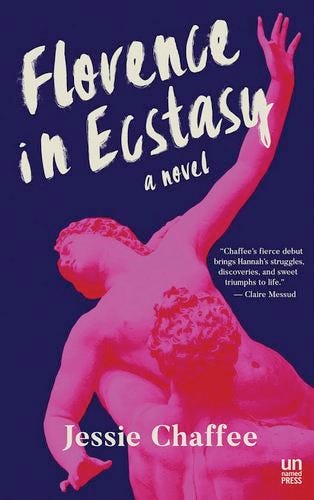
Most novels about eating disorders are written for teens and fall into the category of Y.A. These books don’t necessarily dumb down their treatment of the problem, in fact they’re absolutely necessary for the young people who connect with them, however they do present a specific version of a disease which doesn’t only affect adolescent girls. The way that eating disorders and body dysmorphia manifests in adults — who are dealing with the complex demands of an adult life — is a different beast entirely, and one that is generally missing from the literary canon. It’s an odd oversight in a time when our bodies are more exposed and criticized than ever, and it makes Jessie Chaffee’s debut novel, Florence in Ecstasy, feel especially relevant.
Hannah is a woman in her late twenties whose life in Boston has unraveled after a struggle with anorexia and bulimia. When the book opens, she is in Florence, Italy, where she has escaped to deal with, and sometimes avoid, the problem which led her to a profound isolation from her family, friends, and self. I sat down with Chaffee over coffee to talk about the challenges of writing about a place as romanticized as Italy, her research into the history of women depriving themselves of food, and why she refuses to call her narrative a confessional.
Carrie Mullins: Your novel is about a young American woman who has been struggling with an eating disorder. When she leaves her life in Boston, she goes to Florence. Why Florence?
Jessie Chaffee: I have a history with Florence — I studied abroad there in college and have kept going back. When I was beginning the novel, I knew that I wanted to write in some way about a woman who is alienated from her own life, and I wanted her to be an outsider. I chose a city that I knew, but not so well that it was familiar like New York. Also I felt that Florence is a place that is filled with beauty and life and food and representations of women and bodies, so it would be a really interesting place for a woman who is struggling with her body.
“Florence is a place that is filled with beauty and life and food and representations of women and bodies, so it would be a really interesting place for a woman who is struggling with her body.”
And then of course I was interested in the history of women in Florence. When you go to Florence, you hear about the art and artists and the Medici family in big broad strokes, but you don’t always hear about the women in that through-line of history. The women in that past become important to Hannah.
CM: You set yourself an interesting challenge because there is a popular genre in America: an American woman goes to Italy and has some kind of life-changing revelation. Your book nods at that narrative but also disrupts it. Were you aware of that as you were writing, that people would have certain expectations of that story or that they’d romanticize Italy?
Jessie Chaffee. Photo by Heather Waraksa.
JC: I appreciate that question because there certainly is a strong popular history of that, and I did not want this to be a book where the place is the fix, that Hannah shows up and Italy heals her. Italy is part of that but it’s also complicated for women, for her. I got a Fulbright grant to live there for a year, and I spent a year in Florence to do research around the saints, but also to immerse myself in the place and form connections with people who live there, which was really helpful in how the city and the people and the language is portrayed.
CM: That’s awesome. Did you know that you were writing this novel when you got the Fulbright? By the way, I also studied abroad there and I feel like Florence is a hard city because there are so many tourists and everybody speaks English, but I thought that you captured the reality of the city with the actual Italians who live there.
JC: I did. I applied for the Fulbright with this novel. Once I knew that the saints were going to be such a significant part of the book, I realized I had to do more research. It was also really helpful to be there to capture other aspects of the city. As you were saying Florence is so touristed, and it’s easy to remain trapped on the tourist paths, so I also wanted to portray the lives of the Florentines, and some of the more hidden places, like the rowing club.
CM: Can you talk a little bit about what that research process was like?
JC: When I was writing an early scene where Hannah is in the Basilica of San Domenico, she literally runs into Saint Catherine because they have her mummified head there, and finger. There are also images of the saints, Saint Catherine in ecstasy, Saint Catherine looking over a woman who is possessed by demons. Art becomes a mirror for Hannah, a way to reflect on her own life. It becomes a kind of language for her to understand her experience with her body. So when she looks at these images she wonders, who says this woman is possessed by demons? Who says she’s not possessed by God? And which woman am I? When I began to research the saints and read their stories, I realized there were other points of parallel between them and this contemporary woman and her experience with her identity and her body, that it’s about this sort of longer history of women’s struggle for meaning and expression.
CM: You could have written the book without the saints, but they offer an important language for the reader, too. It allows us a different angle to come at what is often trivialized as a women’s problem, or a teenagers’ problem. I really appreciated that this was a book about an adult woman, and not Y.A.
JC: It absolutely was. It is a book about a woman with an eating disorder, but I also hope it will resonate with anyone who’s experienced addiction or alienation from their lives, unhealthy relationships, any of things that cause you to lose yourself, and then you have to figure out how to rebuild from the wreckage. And I wanted to write a book about an eating disorder and I didn’t want it to be about an adolescent. I hadn’t seen literature written about the experience of adults struggling with this, and one thing I’ve realized since writing the book is that at readings, there is always someone, and often more than one person, who comes up to me and talks about their experience with an eating disorder. These are people of all ages and backgrounds, it’s not only women. I think it is a really insidious problem and issues around body image, around eating, across the spectrum. I wanted to challenge some of the stereotypes about eating disorders only being an adolescent disease, as being only about pressures of beauty, and to bring a different perspective. And to think about the longer history of women and eating and denial, and denial as a form of expression. There are a lot of conversations that are important about not wanting to romanticize eating disorders, so that’s also an important line to be negotiated. Part of having the saints in there is that Hannah identifies with them, but ultimately her healing involves rejecting some of what they represent. She understands that they’re gaining power through their extreme behavior but it’s also isolating them.
“I wanted to challenge some of the stereotypes about eating disorders only being an adolescent disease, as being only about pressures of beauty, and to bring a different perspective.”
CM: And isolation is such a theme in the book. I’m interested in your process because Hannah is struggling and much of that happens inwardly. How did you go about depicting her struggle on the page, since you couldn’t just bounce it off of other characters?
JC: Yeah, the disorder that Hannah is dealing with, the experience of it is ultimately isolation from her entire life. There are many novels I admire that really deal with women’s interiority, and spend time inside their minds and bodies and selves, and take on loneliness and what that looks like. So I was reading a lot of Jean Rhys. I think her depictions of isolation even when you’re around other people and being in an altered state are incredibly powerful, and something I was trying to do in my own work.
CM: What does it feel like to you, going from the private to the public writing sphere, knowing that people will read into your work and decide what you’re ‘saying’ about the topic of eating disorders?
JC: It’s a really interesting thing now because I think most writers are expected to be quite public, you’re expected to represent your brand. In some ways it’s at odds with writing, which is solitary. You spend all this time trying to say what you mean on the page and then all of a sudden you’re talking about it in other ways. It’s complicated. When it comes to being in coversation about things in the book, I was concious when I was writing that the issues that I was writing about matter today. They’re part of the political and social conversation, they are people’s experiences. I very aware of what message I wanted the book to have, and it’s why I ended on a hopeful note for Hannah. I’m willing and prepared to be held accountable for that. I think you do the best job you can for your work to be the most authentic representation of what you’re trying to say, because once it’s out of your hands it’s not yours anymore. You can no longer frame it or qualify it; or you can, but people are having their own personal experiences with it.
CM: It’s always going to be tricky — as you said you can’t control what people read into your book — but it does feel like there’s this extra layer for women writers who are writing a female narrative because there is a tendency in literature to decide that’s “women’s writing.” I personally feel this tendency to prove what I’m writing is literature or it’s universal.
JC: I think you’re absolutely right. I mean look, I’ve written a book about a woman in Italy with an eating disorder who discovers women from the past. There are any number of tags in that, which people might take and say this is women’s fiction, this is not something that applies to everybody. So I think the content that we choose to write about is political. I think that choosing to write about women’s interiority in a way that isn’t easy or stereotypical is my way of pushing back.
“Choosing to write about women’s interiority in a way that isn’t easy or stereotypical is my way of pushing back.”
An interesting thing that I didn’t consider while I was writing that I certainly consider now is that it’s more likely for women writing about the interior lives of women, for their work to be considered confessional or navel-gazing, where if a man does it, it’s an incredible representation of the human experience. That made it interesting to address the literature of the saints, much of which is literally confessional and at the same time is this full literature with a capital L. I heard an Italian feminist writer, Dr. Dacia Maraini, speak about the literature of the saints as being left in the convents and out of the canon of Italian literature and I think that’s true. Just as women were left out of the theological canon, where we see men writing about spirituality, I think the same thing happens to women’s writing today.
Interpreter of Maladies author wins short fiction prize
Jhumpa Lahiri has been selected as the winner of the 29th PEN/Malamud Award for Excellence in the Short Story. Named in honor of Bernard Malamud, the $5,000 prize “recognizes a body of work that demonstrates excellence in the art of short fiction.” Lahiri, who has published two collections, won the Pulitzer Prize in 2000 for her debut, Interpreter of Maladies.
Past winner os the PEN/Malamud include Sherman Alexie, Lorrie Moore, Joy Williams, and George Saunders.
Sorry to Disrupt the Peace by Patty Yumi Cottrell has one of the strangest narrators that I have read in a long time. Helen, the main character and narrator, draws the reader in right away with her stream-of-conscious thinking. It feels like she grabs your hand and starts running, dragging you behind her. You don’t know where she is going, when she will turn a new corner, but you follow her anyway. You want to follow her. Once you are adapted to her train-of-thought it is easy to follow her along as she investigates her adoptive brother’s suicide.
The thing about Helen is that she thinks everything is supposed to go a certain way. Akin to following the plot of a movie or book, she’s the hero. She is the center of the universe. When she gets even an inkling that’s she’s not, she becomes wounded and lashes out. One example, for instance, is when she decided to show up to her parents’ house to help them with their grief. In her head she pictured them welcoming her home with open arms and a plate of warm cookies. The thing is though, she didn’t let them know she was coming —
“It hurt me a little, that my adoptive parents were not expecting me, that they were so astonished by my arrival, that they seemed scandalized by my suitcase, by the mere suggestion that I would be staying a few nights with them in my childhood home… I made a note to myself that they had not greeted me with a plate of cookies and milk, not even tea and stale muffins, as I had pictured. Then I forced my way into the house because I was certain my adoptive parents were too astonished by my sudden appearance to invited me in.”
When she finds out that a grief counselor has been helping her parents through the loss, she tries to undermine him at every turn. She rolls her eyes, she makes snide comments, scoffs at any religious comfort he tries to bring to her parents. She becomes jealous that they are relying on him instead of her. She even tries to make her adoptive funeral about her —
“I had heard them talking about the funeral in the kitchen, it was scheduled for tomorrow morning, even though no one directly asked me to go, not even my adoptive parents. I’ll show them. I’ll just show up and sit in the front row of the church, right in front of Chad Lambo, and everyone will see me and my sisterly mourning, I will create a mourning spectacle of myself.”
Her reactions to things makes the reader question her sanity, and highlights her self-centeredness. Like immediately after finding out her adoptive brother killed himself, she focuses on buying the perfect black sweater. In fact, she gets overwhelmed with the options for sweaters since she is used to wearing whatever clothes she finds on the street.
She then turns her focus on how the suicide is really at the worst possible time for her since she is on probation at work. When flowers arrive for the funeral, instead of just placing them on the table, she dumps them into a mop bucket full of bleach. She points out what she did to her parents and waits for approval like a little kid and doesn’t understand why they died and why her parents are upset.
Not many writers can pull off this sense of controlled chaos like Cottrell does, let alone adding that on top a suicide mystery, tension of race, and exploring adoption. Cottrell does a great job of balancing these many plates and keep them spinning. Helen is unlikable enough to be interesting but not too unlikeable that the reader doesn’t care about her. She uses Helen’s family and friends as a dose of reality, reminding the reader that what Helen’s doesn’t necessarily match everyone else’s.
They are constantly exasperated by her antics, some the characters flat out say they don’t like her. She uses body language to show the chilly distance between Helen and parents and partner that with key flashbacks. The choice to not use dialogue tags creates more confusion and forces the reader to really focus on the words. If read too quickly, you might missing something and have to reread the conversation again. You cannot read this book quickly.
She creates empathy for all her characters, whether they are likable or not. She also creates a conversation about suicide that should not be ignored. Sorry to Disrupt the Peace is a book you can’t put down, and once you do, the whole world shifts.
Have you ever seen a pony? I mean a pony in real life. If you haven’t, you should. Basically take a horse and shrink it down to hilariously small proportions and that’s what a pony is.
When I came across this pony at a children’s birthday party in the park, thinking it was a horse threw off my sense of perspective, and I thought the children surrounding it were enormous kids, each suffering from the same unfortunate glandular disorder. Perhaps they were part of a support group and the horse was a therapy horse.
As I got closer I discovered the children were healthy and it was the horse that had a disorder.
Knowing I hadn’t been invited to this party, it was going to be tough to get close enough to that pony to touch it. I told the partygoers that I was a park ranger and I needed to inspect the pony to make sure it wasn’t a bear or anything dangerous. A mom at the party said, “sure, whatever.” That was my ticket in!
The pony smelled like oats, which I love. I eat oatmeal for breakfast every morning, so I really felt a personal connection to this pony. I pictured him coming over for breakfast in the morning. The two of us sharing a bowl of oats and a cup of orange juice. Then the pony would give me a ride to work and all the townspeople would see us pass by and wave and be jealous of our friendship — and my independence from fossil fuels.
But this would never happen because this pony was not sentient and belonged to a party supply rental company. I stared into his eyes wondering if he could sense what the two of us could become, but as near as I could tell, he couldn’t sense anything. He just stared straight ahead. Then with his hind leg he kicked a child.
Chaos erupted and I took this as my cue to run back to my car and drive home. When I got home I spent the afternoon thinking about that pony. It left me with more questions than answers. If I saw that pony again, would I recognize it? Would it recognize me? Are pony burgers a legal thing and if I ordered one, what would the odds be that I could end up eating my almost-pony-friend?
I drove back to the park and looked for the pony, hoping it has somehow escaped and was now living free in the park. I saw a squirrel and possibly a muskrat, but no pony.
BEST FEATURE: I named it Gerald. WORST FEATURE: I think I saw lice in its mane.
Please join me next week when I’ll be reviewing a salad fork.
What happens after we die remains one of humanity’s big questions. While we may be unlikely ever to find a definitive answer, that hasn’t stopped us from trying: nearly every religion has its own take on an afterlife, and tales of people’s journeys to the underworld or the heavens have existed for millennia. Right now, we’re at a moment in time where questions of the afterlife have suffused pop culture. Charlie McDowell’s new film The Discovery hinges on the discovery of scientific proof-of-life after death. The television series The Good Place offers a skewed view of what the afterlife might be like. The acclaimed Black Mirror episode “San Junipero” and the eighth season of Doctor Who offered very different visions of how a technologically-based afterlife could operate. And George Saunders’s first novel, Lincoln in the Bardo, riffs on history, mortality, and the weight of one’s time on earth after it’s drawn to a close. Over the years, fiction has wrestled with these same questions, and come up with a narratively compelling (and disparate) series of answers. Here are ten books and stories that offer distinctive takes on afterlives, resurrections, and metaphysical questions about the nature of humanity.
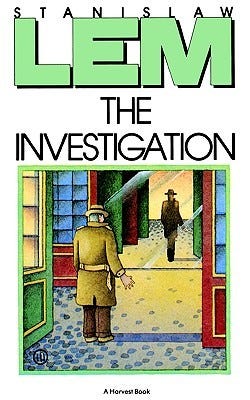
1. Stanisław Lem, The Investigation
The premise of Stanisław Lem’s 1959 novel is heady indeed: in England, a number of dead bodies have gone missing, seemingly rising from the dead and tasked with some mysterious purpose. As is the case with some of Lem’s other fiction, The Investigation is less about providing definitive answers and is more about how people grapple with events that defy rational explanation, hinting at humanity’s insignificance in the greater cosmos.
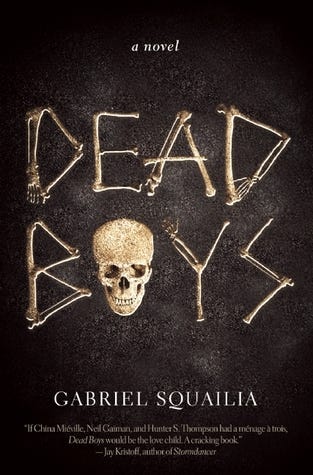
2. Gabriel Squailia, Dead Boys
You’d be hard-pressed to find a more visceral take on the underworld than the one featured in Gabriel Squailia’s Dead Boys. The novel is set in an afterlife whose population enters with decaying bodies, which its protagonist is particularly skilled in repairing. As the narrative advances, Dead Boys incorporates aspects of the quest narrative, discussions about the nature of the body and the soul, and plenty of disquieting surrealism along the way.
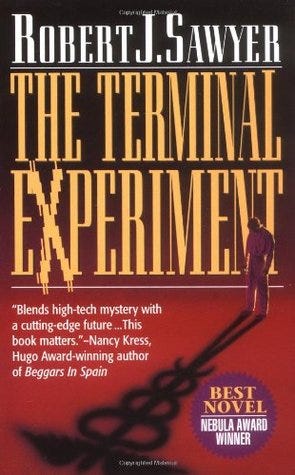
3. Robert J. Sawyer, The Terminal Experiment
The protagonist of Robert J. Sawyer’s novel The Terminal Experiment discovers evidence of energy leaving the body at the time of death — to some, confirming evidence of a soul. What follows blends the heady (discussions abound over the nature of consciousness and the existence of an afterlife) with a twisting plot, as a simulated version of the protagonist’s consciousness turns murderous.
4. Xia Jia, “A Hundred Ghosts Parade Tonight” (in the anthology Invisible Planets)
Xia Jia’s evocative, surreal short story is set in a futuristic park where the souls of the dead are encased in immortal robotic bodies, and is narrated by an ageless child who is cared for by these immortal figures. It’s a haunting, moving tale of an ersatz community, as well as a powerful depiction of the effects of time on a location that’s fallen out of public favor.
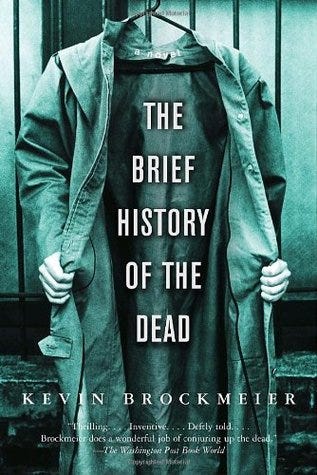
5. Kevin Brockmeier, The Brief History of the Dead
Much of this elegiac novel is set in the afterlife — envisioned here as a massive city where the dead reside until forgotten by the living. When a pandemic hits the world of the living, leaving one person left alive in relative isolation, the city’s population dwindles rapidly. The result is a wholly original work, and one that leads to an incredibly powerful conclusion.
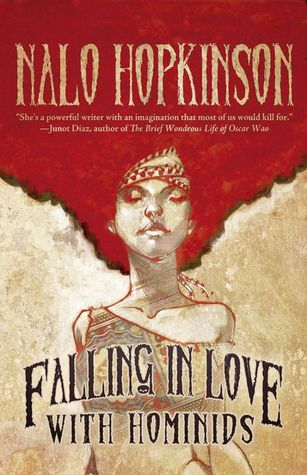
6. Nalo Hopkinson, “Old Habits” (in the collection Falling in Love With Hominids)
The characters in Nalo Hopkinson’s “Old Habits” all reside in a strange state of life after death: their souls dwell in that most purgatory-like of modern spaces: the shopping mall. The result is a tale that’s both absurdist and tragic, turning familiar sights and spaces into something unsettling, and showing how the mundane can shift into the uncanny depending on the context.
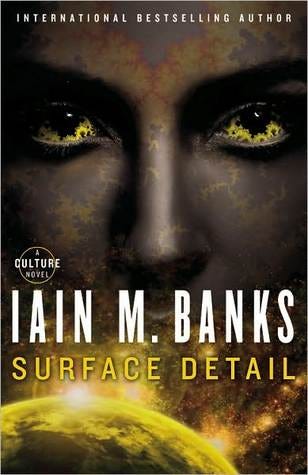
7. Iain M. Banks, Surface Detail
Iain M. Banks’s Culture novels feature high concepts in abundance: societies organized along bold political lines, the interaction between artificial intelligences and humans, and chilling moral decisions. In Surface Detail, Banks throws notions of the afterlife into the mix, as various consciousnesses are suspended in simulations of a host of heavens and hells.
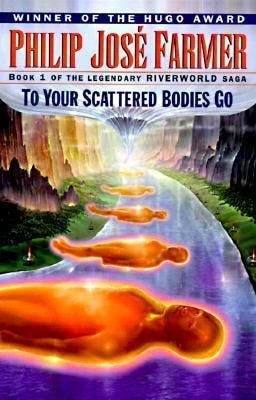
8. Philip José Farmer, To Your Scattered Bodies Go
The first book of Farmer’s acclaimed Riverworld series establishes the basic premise: at some point in the future, on a distant planet, every human who has ever lived is brought back to life along the banks of a massive river. Farmer’s novel has a mystery at its center: why was this done? But it also crackles from the interaction between different historical figures, all sharing the same space.
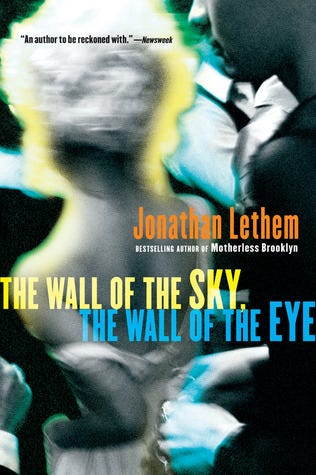
9. Jonathan Lethem, “The Happy Man” (in the collection The Wall of the Sky, The Wall of the Eye)
The narrator of Jonathan Lethem’s “The Happy Man” is dead — but he’s returned to the living world to work a job and make money for the family he left behind. Periodically, though, he returns to hell, where he undergoes torments that seem taken from a twisted fairy-tale playbook. In Lethem’s story, memories and the present coexist, life and the afterlife blur together, and worlds real and virtual haunt one another.
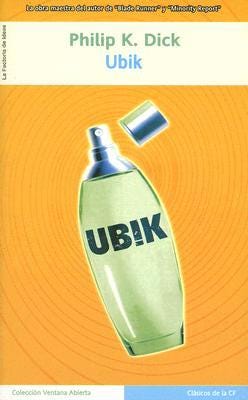
10. Philip K. Dick, Ubik
As with many of Philip K. Dick’s best novels, Ubik poses questions of time, space, death, and life, providing thought-provoking answers as its plot unfolds. Its storyline centers around a group of characters for whom time itself has begun to break down; a limbo-like state between life and death also plays a significant role in the book.
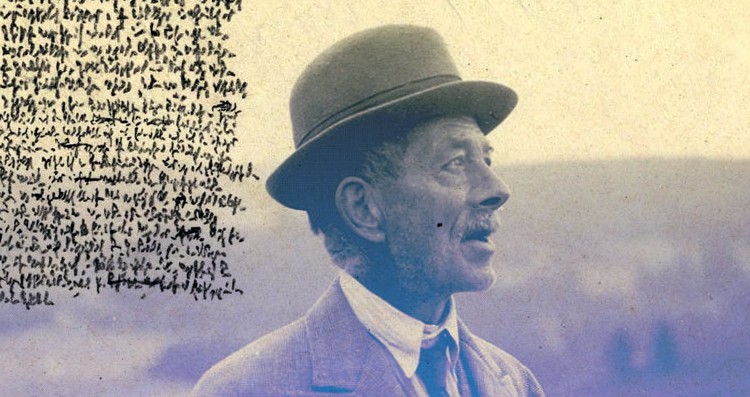
The arrival of Girlfriends, Ghosts, and Other Stories, the third Robert Walser collection from New York Review Books — and fourth title overall, including Walser’s celebrated novel, Jakob von Gunten — continues the publisher’s deep dive into the late writer’s work, emphasizing the vastness of Walser’s back catalog and making sure his prose remains easily accessible to English-speaking audiences. This newest offering, lovingly translated from the German by Tom Whalen, with Nicole Köngeter and Annette Wiesner, contains 88 chronologically arranged texts, and the mishmash of stories, essays, reviews, and remarks delightfully captures Walser’s playful use of language.
Though both appear over halfway through the collection, title stories “Girlfriends” and “Ghosts” nicely reflect the book’s overall mood. In the first, a protagonist hides behind a curtain, spying on two sisters as one employs the other as a footstool, while “Ghosts” finds the author using a recently read novel as a device to question the existence of the supernatural. In these stories, Walser’s narrators react to a one-sided encounter — the novelist in “Ghosts,” cannot tell when his words are being read, after all — and this method of storytelling pockmarks the collection, as Walser frequently writes as if an outsider, or a ghost himself. Also, like most Walserian tales, these two stories gracefully flit about via visual association, segueing into ruminations on independence (“Unfreedom can harbor an enormous amount of freedom; independence can be slavery”) and the small pleasures found in dime store novels:
There are little books we read as if we’re eating something delicious. We quickly forget them. After a certain amount of time, perhaps we recall them again. They’re like people we’re capable of loving because they’re not difficult. I also wish this for what I have written here.
Such moments of observation, nostalgia and political curiosity continue in several other texts, and though Walser never mentions it directly, shades of World War I sometimes linger. “The Children’s Game,” from 1919, revolves around a poet who watches a group of children as they gather “against an old tower” to play. The little ones jockey for dominance, and the poet monitors as one grows too powerful before he falls “over a branch” and is “forgotten,” leaving an opening for another child to take the lead. In 1917’s “The Murderess,” a narrator walks with a farmer over a mountain, where he sees a woman possessing a “robust healthy appearance.” After the woman passes the duo, the farmer reveals to the narrator that the woman “beat her husband to death.” Hearing this, the narrator writes, “What astonished me the most was the good, natural appearance of the woman whom we had just seen pass us so quietly and inconspicuously … not a murderess but just any upright, honest, diligent woman.” In both of these stories, Walser’s surrogates take on the role of commoner absorbing the actions of a drastically changing world, where friendly faces can hide danger and power is fleeting.
All is not political, however, and as those familiar with the author might expect, the collection also features several takes on nature. These contain an even greater sense of wonder and sanctuary for the writer and regularly continue his pattern of one-sided observation/interpretation. The very short “On the Terrace” vividly describes a rain shower’s effect on a lake; “Spring” sees Walser enjoying a bird “trying to practice its singing, endeavoring to loosen its throat”; and “Dear Little Swallow” embraces an epistolary style as the author aims his words directly at the title bird, praising its beauty and asking it to stay as long as possible to stave off the cold winter months. Even the collection’s opening story, “A Morning,” which charms as Walser recounts the tedium and minutiae of office work, speaks to his love of nature. Here, Walser toys with the confines of a traditional job, describing a harried worker as “Totally Be-Mondayed, his face pale and bewildered” and his environment “a life among desks.” Characters battle over an opened window, a woman outside sings, and the temptations on display by Mother Nature make the morning hours drag for the men stuck indoors.
The variety of work on display in Girlfriends, Ghosts, and Other Stories is impressive. Whether written as fairy tale (“No One”) or drama (“Porcelain”), spy story (“The Red Leather Pouch”) or book review (“Ludwig”), each text sees Walser manipulating language with a wry irony to suit his desires. Of course, sometimes his desires show his privilege as a white male living in a patriarchal world, and texts like “The Bob” and “The Girls” illustrate the author’s perhaps unintentional slips into sexism and degradation masked as good humor. The inclusion of these works may temper the attraction of Walser to some, yet they help round his complex character, and they add extra depth to Tom Whalen’s excellent afterword, which presents a brief, helpful bio on Walser, his correspondence with other authors, and a history of Walser’s translators.
In “Something About Writing,” Walser claims, “The existence of a writer is determined by neither success nor acclaim, but rather depends on his desire or power to fabulate anew again and again.” Though not every text bears fruit, Walser clearly shows his power to fabulate in Girlfriends, Ghosts, and Other Stories. The collection is a very strong, and it continues NYRB’s winning streak of Walser translations.
Edan Lepucki’s second novel, Woman No. 17, is a sexy noir concerning an unlikely friendship between two self-destructive women — Lady, a forty-year-old writer and Esther, a recent college grad/aspiring artist. When Lady breaks from her husband, she haphazardly hires Esther — known as “S” — to help out with her spry toddler. S moves into Lady’s guesthouse in the Hollywood Hills with family baggage and a hidden agenda, and quickly becomes Lady’s sole confidante. Though Lady confesses her deepest, darkest secrets to S, the lies S tells intensify as she begins a dangerous romance with Lady’s eighteen-year-old son, Seth, who’s never spoken a word.
Whether it’s writing a bestseller, remaining composed for a live TV interview with Stephen Colbert (where, in 2014, she became a cause célèbre — part of Colbert’s fight against Amazon), helping her students craft and publish their work, keeping up with her two small children or making readers love unsympathetic characters, Lepucki does it all with ease and enthusiasm. I love knowing her and reading her, and I was elated to have this opportunity to call her at home in the Bay Area to talk to her about bad moms, art snobs, and Woman No. 17.
Arnold: This story concerns a writer whose editor suggests she write about her son. You have a son. Did your editor or agent convince you to write about being a mom or what was the germ of the story?
Lepucki: Nobody asked me to write about my son, though the seed of the story definitely came from my own life as a mother. When my son was about fifteen months old, he wasn’t yet speaking. That’s normal for that age, but he was my first child, and my nephew spoke very early, and so I became paranoid that my own son was delayed, and not only that, but that he would remain silent. It’s sort of like when women are forty-weeks pregnant and become convinced they are never going to give birth, although, obviously, they will! I started to imagine what it would be like if your child didn’t speak, and more importantly, what would your relationship with your child be like and how would it be changed? At the same time, I had read this book by Andrew Solomon called Far from The Tree about parents of children who are different from them. There are chapters about autistic children, another about schizophrenic children, and so on; each one concerns a different community and identity, and all the parents in the book are heroic in some way. They manage to find a connection with their child and advocate for them and understand that the story of their child belongs to their child and isn’t about them. Of course, I was curious about a parent not like that. The story (of Woman No. 17) began with this idea of Lady, the mother of a kid who does not speak. I asked myself: What if she wasn’t an accepting mother? What if she couldn’t wrap her head around how to raise a child with a disability?
Arnold: An author has to love something about each of her characters. Lady and S, your two narrators, often act like awful people. What do you love most about each of them?
Lepucki: I really like both of them! [Laughs] I knew from the onset that they were going to be quote-unquote unlikable. As soon as Lady was on the page she had this kind of judgmental quality to her. She doesn’t understand herself very well. I knew people were going to have an issue with her — that, or enjoy her bad behavior. The same thing with S. She does some reprehensible things and is very reckless. But I was interested in their voices, how they speak, the way that they see the world. I think both of them are very funny. I know I wrote these characters, but they are not me: I was simply their mouthpiece. They both have troubled relationships with their own moms. They both want to connect with people. S really wants her art to reach people and she wants to understand who her mom is and why she drinks herself silly. Like S, I was a child who shuttled between divorced parents, and so I feel for her. For Lady, I identified with her struggles with motherhood. I mean, we don’t have the same situation and I wouldn’t make the same choices that she made, but I understood her sense of isolation and wanting to do the best for her child and not really knowing what that is. She doesn’t really have a model to follow. Thankfully, I do. My mom was and is a great mom, and I feel like whenever I need help she’s there for me. Lady doesn’t have that privilege, and my heart goes out to her. So they were really fun to write and it was fun to watch them spiral out of control, but I also just love them and felt their vulnerabilities.
Arnold: Is Lady a bad mom?
Lepucki: I don’t know. I think that’s for the reader to decide. One of my questions for the book is: What does it mean to be a bad mom or a good mom? For me, being a good mom means being present with my children, being patient with them, putting their needs before mine — but within reason. Handling discipline well. There are so many different elements. It’s just a constant dance. And, at times, I find it difficult to be present, and deal with their manic, child craziness…especially after not having slept! So it’s a big question for me: Am I a good mom? Aside from obviously bad mothers who harm their children, I don’t know what makes a mother good. I think it’s a complicated question. As for Lady, she doesn’t always do what’s best for herself or her children, but I also think she loves her children. It’s an imperfect love, but it is there.
“Am I a good mom? Aside from obviously bad mothers who harm their children, I don’t know what makes a mother good. I think it’s a complicated question.”
Arnold: You mentioned Seth being mute. He is otherwise healthy and normal. Why did this degree of his disability interest you?
Lepucki: After I was deep into the book I regretted my choice to some degree because it’s hard to write a scene of dialogue with someone who does not speak! At a certain point, you’re like, wait, how many times can someone raise his eyebrows? [Laughs] I knew he didn’t speak and early on I talked to a friend of mine who is a therapist. I asked her what would be some reasons why a child wouldn’t speak. She works with a lot of children and asked if he has autism, because autistic children often have delayed speech or limited speech. Or they don’t speak due to an anxiety issue. But I wanted Seth to be able to read and negotiate minor emotional social cues, and I thought if he were impaired in other ways, it would be difficult for him to be an agent in some of the drama of the narrative. I needed him to be savvy in these social ways. I also met with my friend who is a speech therapist and we talked about what his malady could be. One of the things I landed on was Selective Mutism, which isn’t an accurate diagnosis for Seth because he doesn’t speak ever and people who have Selective Mutism often speak to one or two people. I thought about how frustrating it would be, to be a parent of a child who didn’t have a diagnosis that described your child. Parents of children on the autism spectrum sometimes experience this because not everything in the diagnosis fits their child. In that case, the question is, well, do they really have an impairment? There is a frustration and pain in not having an answer to the question: Why is my child like this? I think the fact that I didn’t have a direct diagnosis for Seth works in Lady’s favor and how she struggles with Seth. I also know it’s an exceptional case. He doesn’t speak, but he can also communicate easily — he doesn’t have social anxiety. I compare it to when you read a mystery novel where there’s a unique, sensationalist murder — Is it possible? Yes. Is it probable? No. It’s fiction. Seth literally cannot speak, but he does communicate very well. The women in the novel? They talk a whole lot, but their communication skills could use some work!
Arnold: It’s implied in the novel that Seth’s early childhood trauma of losing his father, Marco, may have led him to close down. How did Marco’s absence form Seth?
Lepucki: I think it’s Lady’s perception that, because she cannot find a reason for Seth’s silence, then it must be because of trauma. One of the reasons people stop speaking is trauma. Normally, that trauma is major, such as witnessing a murder or being sexually abused (that’s what happened to Maya Angelou, as she describes it in I Know Why the Caged Bird Sings). In Seth’s case, the trauma of losing Marco was more enacted on Lady. She’s still processing it and hasn’t faced the pain of it. She’s still not over her baby daddy! But I do think that the abandonment also hurt Seth, because it meant that Lady isolated the two of them further. Had there been another person in that family dynamic the way that Karl is there now, Seth would have probably gotten better services, and the family would have integrated into a community of non-speaking people. Marco’s abandonment has more of an effect on Lady, and how Lady deals with Seth, than on Seth himself.
Arnold: I thought you did a great job capturing that self-righteousness artists sometimes have about themselves or their work. Both Esther and Kit take pictures. I loved your Elle piece about being a photographer’s muse. Can you speak here to what sparked your desire to write about photographers?
Lepucki: First of all, I did not title the Elle piece. I would never call myself a muse! When S showed up on the page I hadn’t planned for her to be a big part of the book. I didn’t think she was going to narrate half of it, but as soon as she was in scene I was really fascinated by her. As soon as she admired the photograph of the Pizza Hut in Lady’s house, I saw that she was interested in art. To my surprise, I had this artist figure — though maybe it’s not such a surprise, since I have always loved to hang out with visual artists. Like I said in the Elle piece, all my roommates in college were art majors — that is, if they weren’t English majors. And to this day I love to talk to the artists I know about process and how they come up with images.
In some way, the visual art in Woman No. 17, namely when S becomes her mother for this performance piece, is a surrogate for fiction writing. S’s project is much more extreme than writing, as you know, but when we are writing fiction we do become other people. I am not S and I am not Lady, and I would not do most of the things they do, but I did, in a sense, get to do them when I wrote. I think I poured some of that experience into S’s way of being in the world. Then there’s Kit Daniels, who is the famous photographer. I loved writing her — she’s such a bitch! I would spend, like, an hour describing her outfits for every scene.
After having written the book, I find myself reading profiles of Sophie Calle, a famous French artist whose work I love so much. And I just read an article about this woman who is a muse and has asked all these famous photographers to take her portrait. She has a collection of like two hundred portraits. That’s an act of art in and of itself. While I was reading it, I thought, Someone has to write a novel about this woman! It’s not going to be me.
Arnold: Where did the ideas for both Kit’s and Esther’s individual photo projects come from?
Lepucki: You know how it is: you start writing and suddenly things emerge. Or that’s how it feels to me, as if these ideas simply appear, without reason, and I take them without questioning where they came from. However, recently, my friend Christine Frerichs, who is a painter, read a description of the book and she wondered if she’d had an influence on the character of S. Christine reminded me that when she was in college she did a photography project about her own mother, who passed away. For the project, Christine dressed as her mother and photographed herself in these outfits, one for each day that her mother had been in a coma. I remembered the project after Christine described it to me, though I had forgotten about it until that moment. But it certainly connected to S’s project; Christine’s photos must have stuck in my subconscious in some way.
As for Kit’s photographs, I honestly have no memory where the Women Series came from, but I’ve always loved portraits taken by photographers like Diane Arbus and Sally Mann, those very provocative black and white photos of people that are kind of staged and kind of candid. They give you a sense of somebody’s identity, but there’s also a mystery about who the person in the photo really is. That stuff has always been appealing to me so it’s not surprising that I wrote about it.
Arnold: Esther’s secret project subverts the distinction between art and reality. In your mind, is there a fine line or is it clearer than Esther sees it? Is she the crazy drunk person she is portraying in this world or is she really faking it?
Lepucki: I think that’s the question of the novel! The thing about S is that she’s young. Some people at that age know very clearly who they are and what they want and how they want to be in the world, but she’s not one of those people. And because of that she has a nimble identity. That she can drink so easily and take on this role of her mother, or who she assumes her mother is, scares her. It begs the question: Is this a role, or is it her true self? You can’t fake that far! At the same time, she understands that her performance doesn’t totally match up to her mother. Her mother is far more honest than S is. Deceit is at the center of S’s project. Also, her mother is much more open with her body and very affectionate and doesn’t really care what people think of her. S wants those qualities in herself so she’s using this project as means to be those things. I wanted the reader’s idea of S to collapse so that you don’t really know what’s truly her, and what’s her performance.
Arnold: S does a lot of drinking. Did you do any research?
Lepucki: You know what’s funny — during revision I drank so much! In every scene where they were drinking sparkling wine I’d be like, “I’m getting sparkling wine tonight because it’s so good and I’ve described it in such loving detail!” [Laughs] But I didn’t do any of the private drinking of straight tequila or vodka. That sordid, secret drinking was not appealing to me. One reader review called Lady an alcoholic as well as S, and I was like, is Lady an alcoholic? And then I was like, oh my God am I an alcoholic and don’t know it?
Arnold: I’m going to ask you a question you once asked me: are you an artist? Are writers also artists?
Lepucki: When did I ask you that? Was that my pickup line for you? [Laughs] What did you tell me?
Arnold: I said no, but then I thought about it a lot and decided maybe I was. I mean, I’m definitely a weirdo and I’m artsy. When I was younger I used to make art. My mom still wears my jewelry sometimes. But she paints and I grew up believing an artist was someone who paints or draws, which I can’t do.
Lepucki: My answer is both yes and no. On the one hand, no. There’s something a little bit more mundane about writing, because all of us write every day, be it in emails or on Facebook or a note to our spouse. There’s a sense that writing is much more enmeshed in our everyday lives, which makes it less like art. But I also think that writing is an art form, and I always say that writing is the best art form because it shows us consciousness. No other art form can do that. That’s what makes it so beautiful and important. Some days I think that I am an artist because I have to step outside of myself and the situation I’m in to see it closely, and that is the role of the artist: to observe culture and comment on it through music or painting or photography or a short story. Sometimes I write a sentence that feels like art. A lot of times I feel like I’m not living up to the art that I would like to make. But that’s my life goal — to become an artist.
Arnold: What are you working on next?
Lepucki: I have seventy pages of a new book, which I will not say anything about. But of course it takes place in LA and I’m sure all the characters are unlikable!
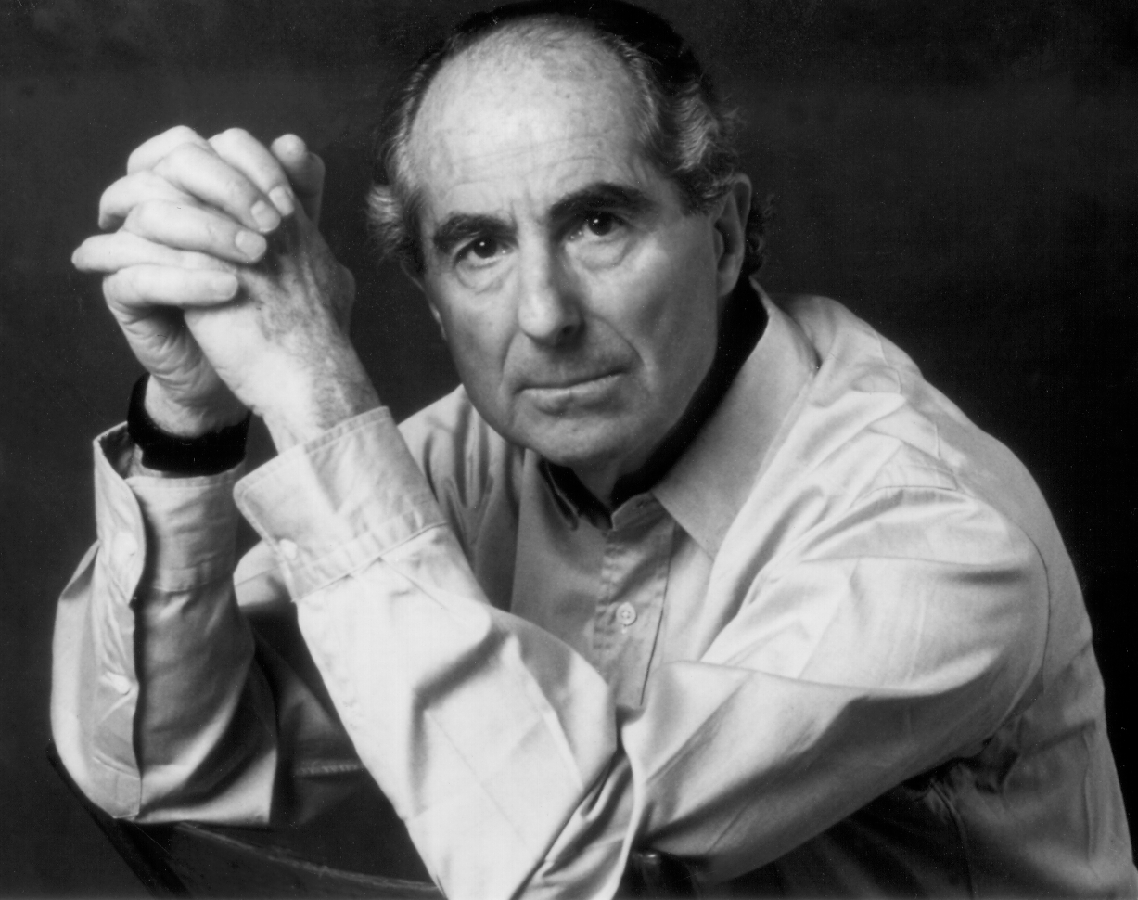
Reading a book after the publication buzz has died down lets you see how it stands up without the protective gauze of “coverage.” Reading a canonical book knowing the reputation(s) it bears, is worthwhile because — even though it has stood the test of time — it is likely out of sync with the worldview of the current day, and is therefore a trickier test of your perspective (George Orwell’s work being a stark exception these days). As in, it’s lucky Philip Roth got in when he did because it seems probable that if he were writing today a lot of his manuscripts would be tossed out by the women — white, specifically, as Marlon James pointed out — who make up the majority of today’s publishing industry. Before this assignment, I had never read Philip Roth.
Before we go any further: this is not a hate essay about how the misogyny in Philip Roth’s novels makes them not-great literature, or makes me feel bad about liking the one I read for this series, The Ghost Writer.
Among the titles in Philip Roth’s canon that I did not choose to read for this assignment are: The Professor of Desire (1977), When She Was Good (1967), The Breast (1972), and The Great American Novel (1973), none of which, allegedly, were titled satirically. Despite having not read these or any of his other novels before, between criticism over the years, the many think pieces about Roth’s retirement in 2012, and having been an English major once upon a time, I knew enough about him to sketch a biography. I knew he was Jewish and from New Jersey. I knew that from roughly 1959 to 2012 he secluded himself in the rural Northeast so that he could do nothing but write at a remove from the world. Roth has said in interviews that in his career of 31 novels and numerous short stories, he more or less wrote the same book over and again. All of this tells me that he sought to write literature that resounds with a particular kind of timelessness, one that comes from turning very deeply inward to craft a singular human story over a long period of time.
And The Ghost Writer mostly reads like that.
When Roth published The Ghost Writer in 1979, he would’ve been between the ages and stages of Nathan Zuckerman, his recurring protagonist who appears in this novel, and E. I. Lonoff, the elder statesman author who has invited Nathan to spend an evening in his countryside home. The evening visit and the morning after comprise the entire novel. Both Zuckerman and Lonoff are Jewish men, concerned with writing the male, post-war Jewish experience. For his part, Zuckerman tells us “I had come to submit myself for candidacy as nothing less than [his] spiritual son.”
“I had written for the whole world to read about Jews fighting over money,” he disdains
Zuckerman, young and zealous, is from a Jewish neighborhood in New Jersey. Only four published stories into his career, his writing is already offending his Jewish family and community so much that his father has gone to the local Rabbi to seek both counsel and mediation. Zuckerman is outraged, indignant. How could his father, a foot doctor not an artist, understand the goals or the achievements of Nate’s art? “I had written for the whole world to read about Jews fighting over money,” he disdains. “It was not for me to leak the news that such a thing could possibly happen. That was worse than informing — that was collaborating.” Zuckerman is bitter but not disheartened because Lonoff, he will understand.
Lonoff lives like a recluse, a monk for the religion of his art, in a small cabin with his wife surrounded on all sides by untouched field, away from the writing and publishing scene of New York. Every minute of his days he is “turning around sentences” with no idea how else to spend his time. The consequence of living like this for so long, his wife Hope (“Hope”!) later tells us, is that he is now the kind of man who “takes three months to get used to a new brand of soap.” But Zuckerman considers Lonoff’s life a paradise, not purgatory. Lonoff as an embodiment of Zuckerman’s possible future is a warning the young man will almost certainly not heed. And it’s unclear if Roth thinks he should. On the pin-board in Lonoff’s office, Zuckerman observes a quote from Henry James’s The Middle Years written on index card: “We work in the dark — we do what we can — we give what we have. Our doubt is our passion and our passion is our task. The rest is the madness of art.”
Having not read Roth before, here is what might be the most late-to-the-party-esque take in this essay. With two writers at the center of the story, both Jewish (one from a neighborhood in New Jersey, one removed from New York), writing about the male, Jewish, postwar experience, the novel’s autobiographical details are shameless and abundant. So much so that it is difficult to parse where Roth ends and his fiction begins — such that I ask whether I’m meant to make that separation at all. “Not living is what he makes his beautiful fiction out of!” cries Lonoff’s wife, Hope, as she rages out of the house, once and for all, at the end of the novel. Are we to imagine this is also Roth? A man who creates reams of stories out of a life in isolation? But an author is not his fiction; to say otherwise is an insult to his imaginative powers. And Hope’s cry comes at the end, but not the very end of the novel. On the last page and at the end of the visit, Lonoff is putting on his shoes to chase after Hope; he turns to Zuckerman and says, “‘I’ll be curious to see how we all turn out some day. It could be an interesting story. You’re not so nice and polite in your fiction,’ he said. ‘You’re a different person.’”
It is difficult to parse where Roth ends and his fiction begins — such that I ask whether I’m meant to make that separation at all.
Roth’s work is a fascinating human and artistic study. He wrote for most of his life, without stopping, about every stage of life as a writer, a man, and a Jew in the postwar decades. Roth the present is in constant conversation with his ghosts past and future; he is eternally the ghost of the present. With a chapter title like “Nathan Dedalus” it’s clear Roth is writing his portrait of the artist as a young — and as an old — man. If one goal of art is, simplistically, to express oneself — to move the self out of the pneuma of thought into tangible form — then Roth has exorcised himself onto pages with a dedication that is rare. I’d only read something like it before in the Elena Ferrante books.
It is difficult to find a meaningful piece of myself in The Ghost Writer because the obstacles are so blatant and so high.
If I was to suggest a shortcoming it would be that art which has come from so deep within should have at least one kernel of human truth that I, too, can hold. It is difficult to find a meaningful piece of myself in The Ghost Writer because the obstacles are so blatant and so high. For starters, I can’t play any of the available female roles, which are as follows:
Indistinct Plaything of a Man: “…when I was left alone with those long-necked aerial friends of Betsy’s, who walked with their feet turned charmingly outward and looked (just like Betsy!) so appetizingly wan and light and liftable.”
Caricature of Hysteria (and all of the most frustrating things “hysteria” invokes; the Greek stem translates to “womb”): “…the sound of glass breaking and the sight of a disappointed woman, miserably weeping, was not new to me. It was about a month old. On our last morning together, Betsy had broken every dish of the pretty little Bloomingdale’s set…”
Victim of Ambiguous-Consent Sex / Rape: “…I confessed that the mutual friend had not been the first to be dragged to the floor while Betsy was safely off dancing her heart out…”; “On my knees, I struggled to unclothe her; not resisting all that strenuously, she on her knees told me what a bastard I was to be doing this to Betsy…I pinned her pelvis to the kitchen linoleum, while she continued, through moist smiling lips, to inform me of my character flaws.”
And, lastly, Blank Screen for Projections of Male Desire — actually wait, let’s adjust that to “Smart, Attractive, but also Blank Screen” because Amy Bellette is notably beautiful and does seem rather intelligent: “…it was for him, the great writer, that Amy had chosen to become Anne Frank…to enchant him, to bewitch him, to break through the scrupulosity and the wisdom and the virtue into his imagination…”
That’s right: in that last option, momentarily putting aside the sexism — which is a massive aside — Amy Bellette is conceived by Nathan Zuckerman to be the survived Anne Frank, symbol of the holocaust tragedy, escaped from the camps, hiding her true identity because she is tired of being in the world as, well, the storied, diary-writing Anne Frank. Now, she lusts for the fat, aging Lonoff. It’s like the anti-Semitic version of Anastasia. Elements like these are enough to make me wonder if I’m reading a tasteless satire. But because of everything I said before, I know that I’m not.
The female roles — or rather, confinements — are presented by the narrator, Zuckerman; I can’t get around him to the actual women, and I can’t identify with him because he confounds me and his narcissism shuts me out. The only character I might connect with is E. I. Lonoff and that’s because he finds the New York publishing scene tiring. This does not feel like a special connection.
After their evening, Zuckerman is put up for the night in Lonoff’s office. He tests the writer’s chair and it is surprisingly not ergonomic, bad for the back; he cowers in front of his idol’s typewriter, an Olivetti that looks just like his; he peruses his genius’s private library, replete with Heidegger, Wittgenstein. Yet Zuckerman fails to soak it all up, to get out of his head, to even be in the room. He ends up dwelling on his anger towards his father, indulging in self-pity, and masturbating. It was Wittgenstein who said, “The limits of my language mean the limits of my world.” Even though Roth has achieved the artistic goal of creating a full expression of his subjectivity, as a piece of fiction, it is exclusionary. I don’t know if that it’s necessary that Bildungsroman works be insular rather than capsular — but in Roth’s case, it is a fact. I read his work the way I look at fossils in a museum: in an encased glass box with a placard that reads: “The Male Jewish Writer’s Postwar Experience.”
The only character I might connect with is E. I. Lonoff and that’s because he finds the New York publishing scene tiring. This does not feel like a special connection.
This is part of why I hadn’t read Roth before. Because when I was in college, I started reading John Updike’s revolting novel Towards the End of Time and became very confused until, in my desperate Google searches for explanation, I found a 1997 review of the book by David Foster Wallace. Along with Updike, Wallace includes Roth and Norman Mailer in a threesome he crowns “the Great Male Narcissists” of the postwar era, and suggests the following as a possible descriptor for any of them: “Just a penis with a thesaurus.” I hadn’t read Roth because in a 2009 n+1 conversation, Emily Gould took Wallace’s coronation a step further and talked about Roth as one of the “Mid-Century Misogynists.” (For what it’s worth, Gould does go on to say that she thoroughly enjoys reading Philip Roth, but the point gets a little lost.) I hadn’t read Roth because he was on a list that I have come to be very disappointed by, written by a woman who’s work I love, to whom I and all female writers owe much: “80 Books No Woman Should Read” by Rebecca Solnit.
I don’t want anyone excluding me from art and/or literature because of my gender. (Solnit’s list contained a small disclaimer about people reading whatever they want, but it was the article’s headline that broke the internet.) The last chapter of The Ghost Writer is titled “Married to Tolstoy.” At least four times, Hope, in a winning polemic against her husband, tells Lonoff he is frightened of losing his boredom. Tolstoy defined boredom as “the desire for desires.” Imagine having no desire but the want of it, and not wanting to be any other way. I submit that curiosity is a form of desire, and if I had no curiosity then perhaps I could not read Philip Roth. This book didn’t tell me anything good about being a woman, but I’m also a human and I’m curious about men. I’m curious about how other humans understand themselves. I’m curious about eras I didn’t live through, and the attitudes of individuals and society during those times. On that level, Roth created something assiduous and wonderful.
I am fortunate that I can read the books of the canon and see them for what they are — interesting works of art, gorgeous and disturbing records of human existence.
Of course, I can say all of this as a 21st century woman. I can enjoy simply going to the museum of literature because I’ve had the benefit of Doris Lessing, Susan Sontag, Louise Erdrich, Elena Ferrante, indeed Rebecca Solnit. In the past few months alone, for my Bildungswoman reading I’ve had the pick of Sarah Gerard, Jamie Attenberg, Julie Buntin, among many, many others.
So yes, I am fortunate that I can read the books of the canon and see them for what they are — interesting works of art, gorgeous and disturbing records of human existence. I can feel excited and grateful that I’m around as the canon is broadening, that I can freely work to ensure the voices within tell all human stories — not just one.
Sign up for our newsletter to get submission announcements and stay on top of our best work.
YOUR INBOX IS LIT
Enjoy strange, diverting work from The Commuter on Mondays, absorbing fiction from Recommended Reading on Wednesdays, and a roundup of our best work of the week on Fridays. Personalize your subscription preferences here.