Writers and publishing houses worldwide announce boycotts
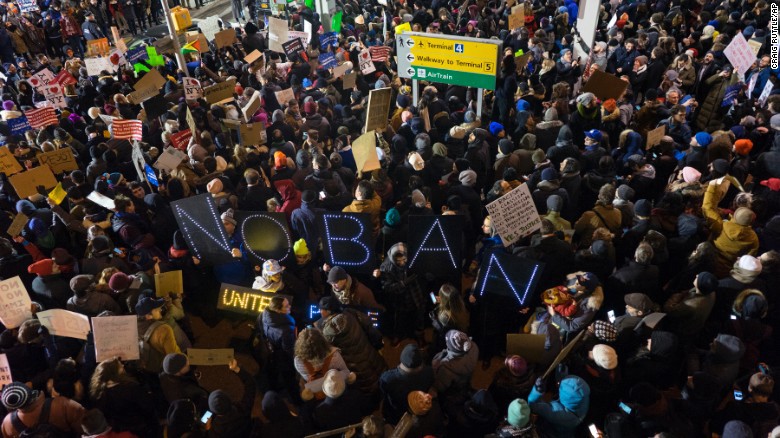
In the tumultuous days since the President issued a discriminatory and illegal executive order restricting immigration and travel into the United States from seven predominantly Muslim countries, the worldwide literary community has taken notice. Publishers and authors are gearing up for the fight.
As reported earlier today in the Guardian, UK publishing house Comma Press was among the first to take action, announcing plans to only translate writers from Yemen, Somalia, Libya, Afghanistan, Iran, Iraq and Sudan (the seven nations targeted by the ban) during 2018. Comma CEO and publisher Ra Page made the announcement after an emergency conference with staff on Monday. “If the only narrative America wants to export right now is the narrative of hate, then we need to look elsewhere. We need to consciously turn our backs on the circus that America is descending into,” he told the Guardian. “We need to fight this. And make no mistake it will be a fight.”
Comma, a not-for-profit press, has writers on its roster already affected by the ban, including Hassan Blasim, the Iraqi broadcaster and author of the acclaimed novel, The Iraqi Christ, who is currently unable to enter the U.S.
Individual writers have taken public action, as well. Former UK Children’s Laureate, Calorie Blackman, plans to boycott the United States indefinitely, Earlier this week, she tweeted: “thank you to all those who have invited me to various US lit fests/events but I won’t be visiting the US any time soon.”
The Humans author Matt Haig has also promised not to return to the United States while the ban remains in effect. He described his motivations to the Guardian: “It just seems like a lack of solidarity at this present moment to go on holiday there with the ban in place.” While recognizing his choice is only a “small gesture,” Haig hoped it would help inspire more collective action.
Additionally, London-based Arabic press Saqi Books will publish a satirical collection titled Don’t Panic, I’m Islamic that will feature affected authors. Due out later this year, it would be a more ethical purchase than any title from a certain white nationalist-supporting American publishing house.
Canadian-American author Linwood Barclay will also be forgoing travel to the United States during the ban, cancelling multiple appearances in the process. While detailing his decision for The Global Mail, Barclay remarked on criticism he has received for his choice, “one person messaged me the other day and said writers should keep quiet about their opinions, which struck me as amusing. Right, that’s why authors decide to do what they do, so they can keep their thoughts to themselves.”
No word yet from US-based publishers, but in the meantime, an important reminder for all of us, from Colson Whitehead, laureate-of-the-resistance:
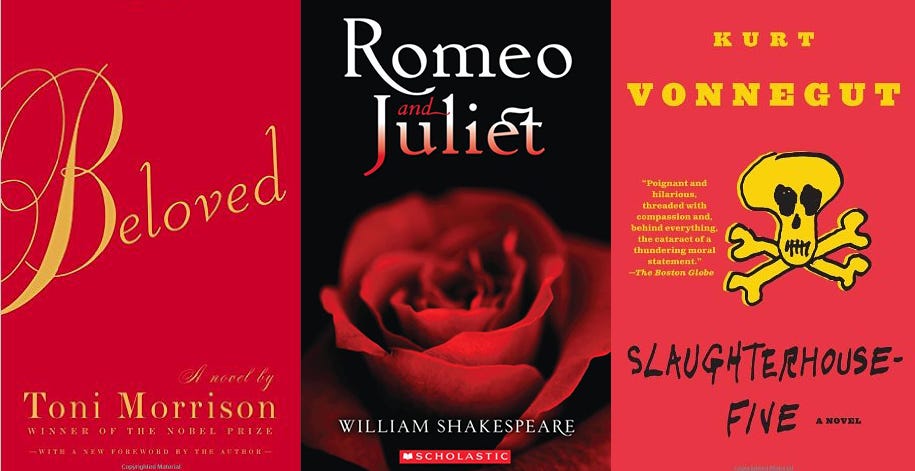
A proposal would have allowed parents to nix “sexually explicit” work like Beloved and Romeo and Juliet from school reading lists
The Virginia Board of Education has rejected a proposed regulation that would have granted parents a line item veto on class reading lists with books containing “sexually explicit content.” The ACLU of Virginia has been highly critical of the measure and argued that the ambiguity of the term “sexually explicit” would produce a slippery slope of suppression. In a letter to the Board, ACLU representatives warned of the possible ramifications for classic titles, including Romeo and Juliet, Beloved, and Slaughterhouse-Five.
The proposal was hotly debated, but ultimately rejected by the Board, which instead approved a compromise measure that would guarantee parents the right to know what their children are reading (but no right to veto books).
Summing up the Board’s current stance, member Daniel Gecker told the Richmond Times, “We are addressing this by saying we are not going to address the sexually explicit issue in the classroom and we are going to rely on local policy to deal with those issues.” (Talk about ambiguity.)
The standoff has been years in the making. Back in 2013, local parent Laura Murphy was outraged to learn that her son had read a sex scene in Toni Morrison’s Pulitzer Prize-winning novel Beloved. Murphydeviseda rule that would require teachers to provide parents with a complete reading list at the start of each term, with potentially objectionable titles highlighted; parents would then have a right to replace those texts with substitutes. The plan initially appeared last year in the Virginia State Legislature. It passed both chambers, but was vetoed by Governor Terry McAuliffe (D). The measure was then revived as a proposed regulation before the Board of Education.
Unfortunately, the Virginia debate does not appear to be anomalous. Recent Tennessee protests have sought to ban a text book for its propagation of “Islamic propaganda.” Elsewhere in Virginia, Huckleberry Finn and To Kill a Mockingbird have come under fire.
While it unfortunately appears that teachers’ opinions have been minimized in the debate, Charles Miller, a Virginia educator with 40 years of experience was allowed to address the board during the hearing. He told members that “unfiltered sexually explicit messages bombard our kids every day…ironically, these regulations seek to reduce some of the greatest works of literature to nothing more than one of those messages.”
There were two entrances, my father says, but I remember two parks: one with my family inside, waiting for me at a picnic table, and the other, a mirror park from which my family had vanished. I was alone, and four, and scared. I made my family disappear. The mechanics of the disappearance are foggy: why did I go through the gate, and how long was my father’s back turned, and with thirty adults looking for me — we were at a family reunion when I wandered away from the playground — how did we keep missing each other?
That was the day my parents first told me, belatedly, to find a rock and hunker down when I am lost. Good advice that I ignore to this day in my headlong rush for immediate solutions. That afternoon, by trying to solve the problem on my own, to locate myself and my family, I widened the gap between us, wandering so far down the road that I had to be driven back to the picnic area by strangers, a woman in a dark sedan and her rather large pre-adolescent son. I remember the car’s cool blue interior, the woman driving slowly from one pavilion to the next, craning her neck to look out the window, the son making jokes to stop my crying — that kid would have made a great brother — and I imagine the conversation as the car’s tires crunched the gravel:
“Is that your daddy?”
Lifts self to window. Shakes head, wails.
“Is that your daddy?”
Shakes head harder, cries some more.
If the woman had wanted to kidnap a child, I wouldn’t have been a desirable prospect, covered in snot, pigtails askew, attracting attention. Whichever relative found and claimed me didn’t need to convince her; my rescuer must have been glad to see me go. My grandmother thrills to tell the story of the day my family could have lost me forever, because it reminds her of the day she was almost lost. She says that when she was a girl, “gypsies” lured her to their car with a kitten. She reached for the kitten and found herself in a tug-of-war, gripped on one side by the child snatchers and on the other by her sister, who won. To hear my grandmother tell it, such kidnappings were an ever-present danger in the ’30s.
If the woman had wanted to kidnap a child, I wouldn’t have been a desirable prospect, covered in snot, pigtails askew, attracting attention.
While I resist the scapegoating of the Roma, I don’t otherwise doubt her account — in poor, working class families during the Depression, children were often unprotected. And I understand my grandmother’s terror, her fear of strangers. How could I have been so trusting? I wonder if the woman who gave me the ride tells the inverse of the story — if she felt a chill opening her door to a strange child, fearing some kind of entrapment.
My father, whose other “rookie parent mistakes” — his words — include a scar in my eyebrow, inflicted when he leaned to pick me up with a camera hanging from his neck, and numerous black eyes and broken pairs of glasses caused by his poor aim with a softball, adopts a hangdog, slump-shouldered expression when somebody mentions the afternoon I was lost. When asked about the details of my disappearance, he can’t recall how old I was, but remembers his own age: “Old enough to know better.” And now I’ll have to convince him my entire writing career — nay, adulthood — is not built on old resentments, a veritable graveyard of my childhood. How easy it is for misunderstandings to occur, and to disappear from someone’s life forever.
My classmate Bethany, during the third grade, was the first friend to go missing: she moved to Oklahoma. I never heard from her again, despite earnest promises to keep in touch, and I naïvely spent months waiting for a postcard. I was torn between two versions of the story of her disappearance: 1) she lost my address in the shuffle of moving boxes; or 2) she was one of the victims of the Oklahoma City bombing.
When I learned about the children who died in the bombing of the Murrah Building, I made the connection to Bethany; the last I’d heard of Oklahoma was from Bethany’s mother, when she told me they were moving. In my nine-year-old brain, everything had to fit somewhere. The Bethany I knew was swallowed by Oklahoma, with those other missing children, destined for an empty chair at the memorial site. Morbid and improbable as I now believe that connection to be, as a child I watched 20/20, Unsolved Mysteries, and various true crime shows, beginning an insomniac fascination with cases of missing and exploited children. In fact, I last saw Bethany at my house for a sleepover, where we spent the night talking about Polly Klaas, who a year earlier had been kidnapped from a slumber party and strangled with her own red tights. I’ve since learned that Polly was strangled with a random piece of cloth — not her tights, which were torn from her body and recovered at multiple sites. Was this misinterpretation dramatic license on the part of the media, or further evidence of my own gruesome imagination?
Was this misinterpretation dramatic license on the part of the media, or further evidence of my own gruesome imagination?
The last night I saw Bethany, we said prayers to avoid Polly’s fate and discussed every salacious detail. We knew the dangers lying in wait, even at sleepovers, and unlike chanting “Bloody Mary” into a mirror, our game had real-world implications. Around midnight my mother was dismayed to find us in the kitchen, blinds open and staring into the dark backyard, which merged abruptly into woods. For half an hour we had been singing religious hymns and patriotic songs, which we felt to be related in sentiment.
“Bethany’s mom is coming early tomorrow. Why aren’t you in bed?”
“We can’t sleep,” I said. “Someone might be out there.” To be fair, someone might have been out there; the man who lived next door was arrested several years later for kidnapping a young couple in a drug deal gone wrong, and for a few days he was on the lam, no doubt hiding in those woods. And beyond the danger of the neighbors, my family lived in rural East Texas, where at night it became truly dark — who knew what predators were concealed beneath the pines?
My family lived in rural East Texas, where at night it became truly dark — who knew what predators were concealed beneath the pines?
“There’s no one out there,” said my mother. Her voice was full of the sense she hadn’t passed on to me.
“But in case there is,” Bethany said, blinking back tears, “these songs will soften his heart.”
I don’t remember my mom laughing or rolling her eyes — she must have known Bethany wasn’t the source of this hysteria. Over the next year, my mother would become too familiar with my routine: get worked up for no clear reason and stay up all night crying and vomiting. However, she wouldn’t believe I was scared by something as remote as the news. She blamed a fear of changing schools and the rigors of fourth grade. She didn’t know that I was poring over kidnappings and cold cases.
Years later, when I ran my Google search for Bethany — a search undertaken maybe fifteen years after her disappearance, when both I and the Internet were more mature — I felt more than morbid curiosity. She was a tragic figure, stolen away by her mother to Oklahoma, and possibly the victim of terrorism. If I had been familiar with the movie Twister, which came out a year after the bombing, I would have believed Bethany had been sucked into a tornado. She was a casualty of my childhood imagination, and I wanted to recover her. Older and wiser, I felt confident I could clear up lingering doubt and hysteria, restoring Bethany to a natural, healthy young adulthood, at least in my mind.
She was a casualty of my childhood imagination, and I wanted to recover her.
Instead, I found a disturbing blog post written by a girl of the same name. This Bethany protested charges of sexual exploitation of a minor, filed against Bethany’s father by his stepdaughter, Bethany’s stepsister. The legal case against her father seemed ambiguous; perhaps the hidden camera he’d installed was a parenting error, overstepping the bounds of stepfatherhood. Bethany believed he had good reason to monitor the girl’s activity. Had he simply been misguided in his efforts to catch her bringing boys into her bedroom? The stepsister’s allegations to a teacher at school were more troubling, harder to explain.
It must have been difficult for Bethany to reconcile her stepsister’s claims with the father she knew — the father I hoped she knew, who would never touch his daughter. Here my speculation meets its limits — guilty or innocent, the pain, the resulting familial drama, is unimaginable. Was this my childhood friend, and was this her life? The timeline and general profile fit, given that Bethany was raised by a young single mom whose husband had left for another mom, and the discovery opened for me a third possibility: that Bethany was not, at the age of nine, a reliable pen pal, because her life had been consumed with other, more important things than keeping up with old friends from elementary school. And because she was nine.
Deterred by the contents of the blog post, I never reached out to her. In stumbling across the news of her family’s troubles, I felt that I’d intruded on her life. If this was the same Bethany — and I hoped it wasn’t — what could I say? You never sent me a postcard! At first I thought you were a bombing victim, but then I read about the charges against your father. At least you’re alive. I hope those allegations weren’t true! Remember how we were afraid of men like that? My years-late intrusion would have been as bad as my nine-year-old catastrophizing, imagining for my friend an early grave.
More recent investigation suggests that maybe-Bethany has emerged safely — married with children, practical haircut. In pictures, her smile seems genuine and happy. She’s survived the men lurking in the woods, or outside the window, or just down the hall, and has chosen to bring new lives into the world. She protects these lives, and the cycle continues. We have both escaped the tragedies that have claimed, at last count, five of our classmates: kidney failure, car accidents, and a helicopter crash. As a mother, surely Bethany thinks about the dangers that are out there, for children and adults. Maybe she worries not only about predatory men, but the premature exposure to graphic news stories that runs rampant at children’s sleepovers.
My anxieties took an unusual direction and timbre — stomach in knots, burrowed under the covers, listening intently to the voice of Barbara Walters — but I don’t believe I’m alone in projecting catastrophe, naming it, and waiting for the other shoe to drop. The world is an unsafe place, not just for those who are taken, but for those who are left behind, with the infinite ability to keep losing.
The world is an unsafe place, not just for those who are taken, but for those who are left behind, with the infinite ability to keep losing.
The kidnapper took Polly, leaving her two friends tied up, huddled together under pillowcases. Brushed by tragedy at an early age, they must have imagined an alternate experience in which they weren’t the survivors, but the chosen victims, ripped tights and all. They didn’t choose to witness Polly’s abduction, to live it or survive it. Most people would refuse such knowledge, given the choice. But for some, exploitation isn’t hypothetical — for Polly, and Polly’s friends, and perhaps for my lost friend’s stepsister, the danger was real. What sickness compelled me to learn all that I could, as if living through the lost girls I never was?
In part, it was the same sickness that propelled the 24/7 news cycle, the fascination with spousicidal celebrities and the disappearance of white, middle class women and children that predominated ’90s news media and persists today. Media frequently exploit tragedy, taking their audience along for the ride in a white Bronco. And what of the silenced voices, the missing women and children whose stories the media ignores because they fall outside the frame — the wrong race, the wrong class, a homely face? But I wasn’t just looking for entertainment. I sensed that I couldn’t always be protected, safe within my nuclear family; I wanted to see the threat coming. There was comfort in knowing what was out there, in determining the worst thing that could happen to me — face on a milk carton, body in a ditch — and hoping for a better outcome.
“Let me grow up,” I prayed. “And marry the preacher’s son. And if this preacher moves, let the next preacher have a son, maybe one without visible earwax. Amen.” I was eleven, and this prayer was a staple of my requests to the divine. A couple of years older and absorbed with new concerns, my nightmares about becoming a child abduction statistic had quieted, though not disappeared. My body could be violated by sticks and stones and men with knives, but God would protect my soul. And backed by this higher power, I knew I probably would grow up, and so set about building my future, through prayer and bargaining. I also prayed that my two best friends, sitting in the church pew beside me, would not be “discovered”: I saw them as model-beautiful, sleek-haired and slender, compared to me, and dreaded the day their beauty would separate us, whisking them away to glamor and fame while I was left to pray alone. One of those friends developed scoliosis in the next year and had to wear a back brace; I found myself secretly relieved when the other one had to get braces for her teeth, like me. I hoped my friends would find preachers’ sons of their own, or even preachers, and that we’d move to the same subdivision and raise our children together.
Backed by this higher power, I knew I probably would grow up, and so set about building my future, through prayer and bargaining.
I am not that girl anymore. I’ve plucked my unibrow and left the old church behind, and far from finding a safe alternative to the career of preacher’s wife, such as, for example, teacher, lawyer, or accountant, I’ve spent a total of seven years in school trying to become a writer. My old friends are different, too: one has turned into her mother (and an accountant), and the other has been married twice, which makes her even worse, in the eyes of the church, than me — married zero times, with zero offspring, an explicable profession, and two cats. I’ve simultaneously avoided the abduction I feared and failed to achieve the life I expected. I’m living a future I couldn’t have imagined as a child, and in a sense, I have safely self-abducted, gone so far afield that no one would find the body.
I’ve simultaneously avoided the abduction I feared and failed to achieve the life I expected.
Don’t misunderstand: I don’t pine for the preachers’ sons or pity the younger self who made those requests. I don’t regret outgrowing the childish hope that made such naïve prayers possible, as comforting as blind faith can be. But I do miss those friends who have vanished from my life. In a literal sense, I can contact them any time, but the metaphorical distance is too great. Having outgrown the religion in which I was raised, I no longer fit into my old life and friendships. And in this new life, I’m still trying to locate myself, searching out signposts and establishing new landmarks. In a non-mortal, social sense, my prophecies have come true.
By looking for a boogeyman, a turbulent outside force that would be the cause of my separation from friends and family, my younger self was delaying the knowledge that people don’t usually disappear, but they change. No one knows, at any age, who they will become. Only in the context of my small town environment was the degree to which I changed even unusual. And only from my sheltered position was my fear of loss disproportionate.
By looking for a boogeyman, my younger self was delaying the knowledge that people don’t usually disappear, but they change.
We all confront mortality and impermanence eventually, and in tragic cases, sooner. Compared to those girls facing death and disappearance in actuality, children who lost or never had the illusion of safety, my improbable fears were a luxury. If I was precocious, my early exploration of extreme trauma — the hunt for those missing and exploited children — was rehearsal for the minor tragedies I knew would come: grandparents would die, friends would lose touch, my life would change. Casual, everyday trauma.
Several months ago my parents visited me and my brothers in Austin. Although my brothers live forty-five minutes away, I only see them when my parents visit; we get along fine but live separate lives, three different products of the same household. How could I have known, staring out the kitchen window with Bethany, that little brothers could disappear? That safe and sound, living thirty miles apart, we might find nothing to say to each other — harder to fathom than dark backyards, jagged pines, and kidnappers in closets. I think my mother worries about the day she and my father will be dead and gone, no longer there to provide the connective tissue between siblings. I worry too.
In one nightmare sequence of my childhood, my mother was abducted nightly through the kitchen door, carried into the backyard and murdered, off-screen, by a man I somehow knew belonged to a gang. I also knew his name. Before waking I would pick up the pair of bloody gloves and say, “Red did it” — a line adapted, I believe, from the movie Drop Dead Fred. Both movie and dream were garish. Not since those nightmares has the possibility of my parents’ deaths occupied so much space in my mind. After watching my mother bury her father last year — five years after the death of her mother — I dread the day the darkness looms larger, a shadow that moves out of imagination and into life.
I dread the day the darkness looms larger, a shadow that moves out of imagination and into life.
During my parents’ visit, we made a loop of the city park, crossing the river and attempting a return from an unexpected angle. It shouldn’t have been possible in a busy city, in the middle of the day, in the era of smart phones, but we got lost. When did this park become a forest? Were the cedars in conspiracy with the pines? The live oaks looked thick, ideal for secreting a body. I could see the headline: “Family of Five Mysteriously Disappears.” If you have any information on this case, write to us at Unsolved Mysteries.
Rather than turn and retrace our steps, we charged ahead, brothers serving as scouts, me walking alone at a thoughtless pace, while my father stayed back with my mother and her creaking knees. My family members’ isolated experiences of being lost formed a dark premonition on a sunny day, a gesture toward my fears about the family’s dissolution.
But if we just kept moving forward, we’d find a way across the river. And turning around would be a defeat. After an hour, my mother announced her intention to find a rock and hunker down.
“Come back with the car once you work it out,” she said, digging in her heels.
But this solution was unsatisfactory. If we left my mother on a rock, would we ever find her? And without her, the family unit would crumble.
“Let’s just cross at the pool,” I said. “The bridge isn’t too far back. And we’re not swimming. They’ll let us through.”
“We’ll have to pay,” said one of my brothers, usually a spendthrift. I shook my head at him — an aspiring engineer but afraid to think outside the box.
“Try it and let us know how it goes.” This from my father, who has finally mellowed after years of stress and Blue Bell ice cream. Now the whole family was hanging back, sitting on separate rocks while I went to talk to the booth attendant.
“All clear,” I said a few minutes later. We walked past the booth on tiptoe, as if getting away with something, crossing the bridge without paying. I rolled my eyes at my own furtive apprehension — there were no trolls under this bridge, or men crouching in the bushes. Our family’s values made it hard to ask for an exception to the rule. You paid for your mistakes. But I had found a shortcut, bringing us all back to the other side.
Our family’s values made it hard to ask for an exception to the rule. You paid for your mistakes.
“You would have been a good lawyer,” my mother said, picking her way through the groups of sunbathers.
I was too tired to argue. All I wanted was to get back to the car, to the GPS that would take us safely back to our four separate homes. Later that night, reverting to my old pattern, I would pray for my parents’ safe travels. We had been lucky so far. But the truth is, none of us are safe. We are all one late-night phone call from catastrophe — even the fortunate ones, born into lives of relative safety. I could die in my car, driving like a maniac, or have a brain aneurysm, swift and sudden and non-negotiable. I could have an aneurysm while driving, killing myself and others. Or worse, my parents could die in a crash, leaving me the sole survivor, and then I truly would be a lost girl, an orphan. But it’s impossible to live daily with the knowledge of impending doom; we all need our safeguards against hysteria. I prayed my parents safely home. I hoped our luck would hold.
Kevin Wilson’s breakout novel, The Family Fang, earned him recognition in the literary world and also landed a film adaptation starring Nicole Kidman and Jason Bateman. Not bad for a second book. But it does add some pressure to the follow-up. Wilson spent years writing a story about a different kind of family. In Perfect Little World, he brought his sharp literary prose to a story with a plot that sounds like sci-fi: a commune where you live with your children, but they don’t know who their parents are. It’s clear that the author’s obsession with family is something he’ll continue to explore. Perfect Little World feels fresh every step of the way, at once breezy and thought-provoking. I recently reached out to Wilson at his home in Tennessee. We spoke about the success of The Family Fang, not trying to copy it in Perfect Little World, what it’s like to have a book adapted, and much more.
Adam Vitcavage: The Family Fang came out in 2011. Did you expect it to get all the praise and success that eventually came?
Kevin Wilson: No, I think unless you’re an insane person, your expectations for a work of literary fiction are pretty low key. You just hope some people read it and it gets reviewed. If you spend two years in your basement writing a novel, it’s crazy to think its going to be a bestseller and people will make a movie out of it. That’s not reasonable.
I just hoped it would get good reviews and people would read it. I wasn’t prepared at all. I don’t think anybody was expecting the response it got.
Vitcavage: Did the response trickle out slowly or did you find yourself under a tidal wave of praise overnight?
Wilson: It got some pre-publication reviews, and that helped. Then TheNew York Times did a profile of me, and I think that was a really big thing. People knew about the book before it came out, which is not generally expected. It did well fairly quickly with minor success, but when the option got picked up for a movie, that’s what really helped. More people started to check it out. It had the initial bump of publicity and as that started to wain, the option came in and that set it off again. It was kind of just pure luck.
Vitcavage: Luck is a huge player in the literary world.
Wilson: I feel like it’s all luck. My students sometime ask if I dislike anything, because I have a pretty optimistic outlook of literature. I feel like there are so many things that get published and so many amazing writers that it’s impossible to understand why some books get popular and other books don’t. It’s a combination of talent and luck, more than anything else.
Vitcavage: It’s interesting you bring that up. One of the questions I jotted down was what makes modern fiction popular and what makes it good. So you feel it’s pretty much luck?
Wilson: Yeah. I think there are those moments where a book can kind of ride the momentum of current events or the zeitgeist. You can’t plan for that because the book is written so far in advance of the book coming out. You can’t jump on trends, but sometimes a book can do that and it’s just luck.
For instance, there are two books that came out this year. One is The Underground Railroad by Colson Whitehead and the other is Underground Airlines by Ben Winters. I think both of those books are just stunning. But who would have thought that within months there’d be two books that reimagine the Underground Railroad? That’s insane. How could you plan for it?
Vitcavage: I remember, when those books first came out, thinking they were the same book but that people kept confusing the title. It is very interesting. Speaking of planning, you obviously didn’t plan seriously for The Family Fang to become a movie, but what were your experiences with the adaptation?
Wilson: It was one of those things. Nicole Kidman’s production company liked the book and wanted to see if they could adapt it for the screen. I had no problems with that, I was stoked. They asked if I wanted to write the screenplay, but I had never done anything like that. I have friends who have had options on their books and the odds of it happening are so slim because so many things have to go right. I didn’t want to write a shitty script and all of a sudden kill the chances of the book becoming a movie. So I stepped away pretty quickly and they got Pulizter Prize-winning writer David Lindsay-Abaire to do the adaptation. I feel like they made the right choice.
They would keep me posted and show me the script and they let me know when a director had been found, but I mostly stayed out of it. I love adaptations. I think it’s this really cool thing that exists and keeps certain elements of it while also making it new. I didn’t want to get in the way of that. My book is my book and whatever the movie became wasn’t going to change my book.
Vitcavage: So The Family Fang, the book and the film, are obviously about the family — it’s right there in the title. Your new novel Perfect Little World is also a family-oriented story. When did this come into your mind?
Wilson: For me the thing I am most interested in writing about is family. Especially the complexity of what it means to be connected with other people. I just find it fascinating and weird. The natural order of things doesn’t make much sense to me: that people make you and you live with them for a long time. That’s just weird to me. I like writing about it.
The main genesis for this book came when my TV and film agent said I should start thinking about writing a screenplay or something. I said, “Oh, I don’t know,” and one day when I was out to dinner with my wife while the kids were with a babysitter, I asked her what I should write about.
I was just talking and brought up a thought I had for awhile, from when we first had kids, which was: God, this is terrible. I wish we could just give our kids to some place, to a bunch of doctors to just raise for us and they would be perfect kids. Then we would meet back up with them later in their lives. She said it was terrible and asked when we would ever see our children, because you would never know them. I suggested you could live with them while the doctors raised them. She said it still sounded like a bad idea. I said let’s find out and started to think about it as a TV show, but wanted it as a book. It all came out of my own anxieties of being a parent and trying to find some other way. What was possible?
It all came out of my own anxieties of being a parent and trying to find some other way. What was possible?
Vitcavage: When you’re writing about family, are you just trying to find how family makes sense?
Wilson: A lot of what I write about family is taking my own experiences of raising a kid or being a kid and working through it. That’s why I write fiction: because I am able to take elements of my own life and hide them within a fictional landscape so that no one knows and it’s unrecognizable.
Then I get the benefit of telling the story as well as work through these thoughts I’m having. As I’m writing, my views on how the world works shift.
Vitcavage: How long did this book take?
Wilson: Probably three years with some revisions at the end.
Vitcavage: Did you feel pressure during those years because of The Family Fang’s success?
Wilson: There was some pressure. The Family Fang felt like such a lucky thing, and I don’t think you could expect every book to do well. You just don’t know and it’s a crapshoot every time. But I wanted to write something that’s good and to build on the goodwill from the The Family Fang. It was hard. One thing about the book is that it’s not very funny, whereas The Family Fang had a lot of humor to push through the weirdness of the story.
As I continued to write this new book I kept thinking how it wasn’t funny, and how that is a crutch I rely on. I rely on humor to help with the dark things I’m trying to write about. I felt I needed to write a funny book because The Family Fang was funny and that’s what people liked about it, but Perfect Little World resisted that. It was impossible to make a silly book about these people in a scientific commune. It would just become absurd.
I had to keep constantly dialing back my expectations of what people wanted, so that I could write the book that it wanted to become. I don’t know if I made peace with that yet. This is a different book and I’m happy because I don’t want every book to be the same. There are elements that are similar, but I just can’t copy The Family Fang over and over. I know there will be some point when I’ll get real desperate and write a sequel to The Family Fang, but not yet.
Vitcavage: This isn’t a straightforward sci-fi book. It’s literary fiction, but when you explain the premise of the book, do people think this is some sort of pulpy sci-fi paperback?
Wilson: Yeah. I mean, when I explained that the first novel was titled The Family Fang people thought it was a vampire novel. I’m not good with this stuff. When you explain the plot, this book sounds very sinister, which it isn’t.
Say ,“There’s this weird scientific commune led by this child genius,” and they say that it sounds awful. My books don’t summarize well and it does sound very science fiction-y and sounds like it can easily exist way, way in the future. Part of that is that I really love what people call “genre” and I think it’s hard for people to differentiate what’s genre and what’s literary. It gets blurred more and more.
Vitcavage: I think now more than ever that the line between literary fiction and so-called genre fiction is blurred because every story has been told so now there needs to be a twist on everything.
Wilson: That’s a good point. That makes a lot of sense, and I think also people are becoming less and less embarrassed by their love of what people would call straight-up genre. I love that stuff and I don’t read it with any shame. I think it’s great and don’t think any less of it than literary fiction. The more you think like that, inevitably you’ll bring those elements into your work.
Vitcavage: You just mentioned how The Family Fang was a vampire novel and that you’re bad at titles. Was Perfect Little World your title?
Wilson: No, no. All three of my books have never been the titles I’ve chosen. I’m terrible at titles. I don’t what that is about me, but I just don’t do well with them. For the longest time, the title of this book was An Infinite Family. As we started to get closer An Infinite Family sounded too much like The Family Fang, and it’s pretty clear I write about family, so to have it in the title twice felt unnecessary. It took a crazy amount of time before I said I just don’t care what it’s called. My agent, editor, and I would sit on the phone for thirty minutes just saying titles. Finally my agent pointed out the line in the book that says “perfect little world” and asked how I felt about that.
We had other titles that worked, but they were already titles of other books. You get pissed off after searching on Amazon after coming up with a title and having to restart. We landed on Perfect Little World and like anything it took awhile to get used to it. It sounds great to me now.
Vitcavage: I read an interview recently that you did when The Family Fang came out about the painting on the cover of the book. You basically said it was marketing who picked it. At the beginning of this book, there is a family tree of sorts. Was that something you came up with or was it marketing again?
Wilson: No, I needed that as I was writing the book. The people that edited the book will tell you that I often changed the names of characters throughout the story. I needed a family tree just to tell who was who. I had that in the book as one of the first pages and they said that they would actually use it because it was interesting. I was very pleased because there are a lot of characters in the book and it’s hard to remember all of the names.
Vitcavage: It was really helpful. I love when books include stuff like that.
Wilson: Yeah, I dig that stuff, too. I like it when books have maps of the place.
Vitcavage: Exactly. Books aren’t just the story, it’s the world the story takes place in. You also mentioned your agent wanted you to write a screenplay. Are you working on something like that?
Wilson: My wife and I are tinkering around. My feeling is that I really am a fiction writer and what I love is writing fiction. I think people have this idea that if you can write one form, you can write any form. I don’t think that’s true. It took me a long time to become a decent writer of fiction. So, if I was going to write a screenplay or something, it will take me a long time to make it work.
Whenever I’m writing something other than fiction, I find myself just trying to smash my literary techniques into that. I’m a fiction writer and I was to stay with that because I finally figured out how it works.
I love TV and movies and it would be neat to be a part of that. I’m open to it, but don’t really know how long that would actually take for me to become proficient.
Vitcavage: You mentioned how this morphed from an idea while thinking about television. Can you see this becoming a long form project?
Wilson: That would be awesome. There’s this weird thing when your first book gets optioned by Nicole Kidman, you can’t go around thinking so and so is going to call me up and option by book. This feels cinematic. If it does become a long form TV show, it would be different from the book. That excites me, how it become a separate thing. It’s important to me that the book is always the book.
Vitcavage: I’m a big proponent of that. They are completely different things. The book is the book and the television show or the film will be different. And that’s okay.
Wilson: Yeah. There were some things that the screenplay did for the movie where I thought I would like to go back and change the book. He did things to streamline the narrative that were so good. It was very frustrating.
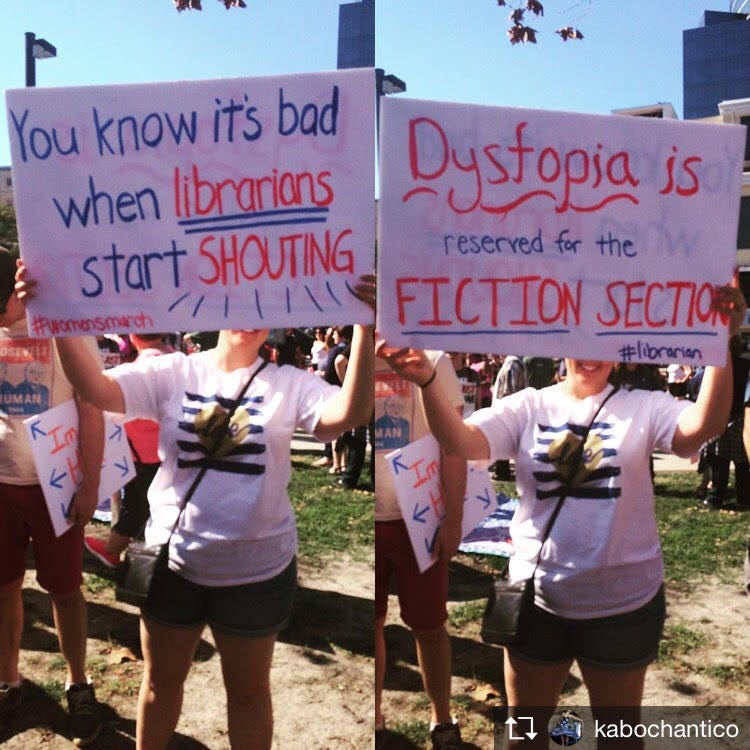
Readers will not forget — literature is a form of resistance.
Photo from Electric Literature’s Contributing Editor, Kelly Luce
We’re only eleven days into the Trump Administration, and readers in enormous numbers are coping by stocking their shelves with dystopian novels. George Orwell’s classic 1984, has been making headlines for seizing the number one spot on Amazon’s Best Sellers list. Everyone probably remembers that book from a high school summer reading list, but as the revival suggests, it deserves a second (or third) look. Through his narrative, Orwell warns of the dangers of totalitarian rule, which he saw taking hold in Russia and Spain at the time he penned the classic novel (it doesn’t take the most incisive reader to see the troubling parallels with our current reality).
According to Boing Boing, Sinclair Lewis’s, It Can’t Happen Here, which is described as a “timeless look at how fascism could take hold in America,” has also surged to the top of the Amazon charts. Like Orwell Lewis was writing in the 1930s during a time of anxiety and political uncertainty, as Hitler and other fascists rose to power. Ray Bradbury’s Fahrenheit 451 andAldous Huxley’s Brave New World are also seeing an increase in demand.
Confirming the trend, The Atlantic reports that John Steinbeck’s 1961 novel The Winter of Our Discontent has enjoyed a recent boost, and that readers are searching for lessons outside of fiction, purchasing Hannah Arendt’s The Origins of Totalitarianism, and J.D. Vance’s Hillbilly Elegy in great quantities.
Let’s forget about a silver lining. The situation is bad, and too many people are suffering to take comfort in sales figures. Still, there’s a historical pattern of remarkable writing taking place during frightful political times. While it doesn’t seem promising that many positive strides will be made in the next four years, perhaps we can count on Trump inspiring the next earth shattering political dystopia (that is, if he doesn’t create one himself).
The famed dictionary is interested in documenting neologisms associated with the President and his brand of bigoted leadership.
It’s only fitting that a President who champions made-up facts would inspire a bevy of made-up words, each of them striving to describe some aspect of the lunacy that is Donald J. Trump. According to the Guardian, the famed Oxford English Dictionary has taken notice of these terms and added several to a watchlist of words under consideration for the dictionary’s next update.
The Trumpisms gaining the most widespread traction include:
— Trumponomics — a reference to the President’s alleged economic policy
— Trumpertantrum — tweeting lewd lies in the day’s wee small hours
— Trumpkin — Jack-’o-anterns bearing his unfortunate visage
— Trumpflation — the coming currency disaster
— Trumpist — a Trump supporter
— Trumpette — a woman who supports Trump
— Trumpista — a Latina Trump supporter
2016’s political dumpster fire resulted in “Brexit” and “alt-right” finding their way into the dictionary — why not a few more to round things out?
Not all the slang currently up for OED consideration is a play on Trump’s name. “Healther,” a term that riffs on the “birther” conspiracy theory, is in the mix (according to the Guardian — “a person who believes that Hillary Clinton has a serious, undisclosed illness”). However, lexicographers doubt this lingo will be relevant for much longer given the results of the election.
During the campaign, Trump was quoted as saying, “I went to an Ivy League school. I’m very highly educated. I know words, I have the best words…but there is no better word than stupid. Right?” He happened to be referencing the State Department’s endeavor to provide aid and relief to Syria. But in light of this weekend’s events, I’d have to agree with him…there truly is no better word than stupid to describe our freshly inaugurated President. It seems there may be a few new synonyms for his particular brand of stupid.
Every day, eight hours (give or take; the boss is easy-going) in a five-mile circle, 55 or 60 or 65 miles per hour, fully loaded or just the tractor unit depending on the protocol. At the end only the tires change. They take the tires away to measure the wear and tear and he gets new ones, some new type or formulation, and does it again.
He took the job because he likes to drive. It’d be a pretty sad joke if he didn’t, and he’s seen jokes like that get played on other guys, so he’s grateful. The songs on his cassette tapes say that driving is freedom but that’s not this. Even before the job, he’d drive in a circle and come back home. It just got him out of the house for awhile.
He can play whatever music he likes, doesn’t have to talk to anyone most of the day. There’s two lanes to the loop, but there will never be two trucks again; the business has mostly gone over to indoor tracks and computer models. He’s the only driver, and if the boss makes a Dunkin’ Donuts run or gets called away then he’s alone. The truck is a little cranky; sometimes the A.C. will go out, and every so often when he puts it in reverse the engine dies, but he knows where to kick it or finesse it to make it run again.
The scenery is just interesting enough that he never has to think much unless he wants to. Where it was cleared to build the loop, he’s watched a generation of tall grass and thistle and chokecherry give way to a generation of mountain ash and staghorn sumac. Where it wasn’t, he’s watched the beeches and sugar maples thicken, watched a few fall to beetles or lightning. He’s seen, and once in awhile run over, rabbits and squirrels, raccoons, deer, the occasional fox. Glimpsed skulking coyotes. Last year, a couple of beavers dammed the stream that cuts under the loop through two culverts, flooding a section of road along the eastern side, and they had to be trapped and taken out. At the time they were a novelty, got their picture in the paper, but he knows that next year or the year after a new pair will show up and do the same thing and be taken out in turn. He likes animals, and he likes knowing the patterns of things.
One of the patterns: under the trees, his summer days end in shadows, and in deep winter half his shift is in the dark. It’s dark today, although winter is starting to thaw into spring, a few skunk cabbage leaves poking through the patches of grayish snow on the shoulder. He enters the stretch furthest from the office, where the trees close in like a tunnel, and sees a pair of glints up ahead.
He takes his foot off the gas, waiting to see which way the deer will run in the hope he can miss it. But it doesn’t run, and now he realizes that the eyes are too high for even the most massive buck. He flicks on his headlights. That just tells him that what he’s seeing doesn’t make any sense. Whatever it is doesn’t look like it’s going to start running in time. Instinct locks in and he swerves to the right as much as he dares.
It’s enough — he misses the eyes and the body they’re in, catching a sidelong downward glimpse of it out the window as he passes. It looks like a human form, but gigantic, too tall and broad to be right even though it’s stooped like an old drunk. The flesh is hairless and peach-colored, sort of patchy, raw in places, like it’s suffered a bad burn or itched itself to an oozing pulp. A bear? A bear with mange? A black bear shouldn’t get that big either, jesus christ.
It lets out a moan, standing in the swirl of dirty air in the truck’s wake. He shouldn’t be able to hear it with the windows closed and the engine running, but he does hear it. It sounds like pain. And the moan turns into an electric whine that makes his truck whine in sympathy. The headlights flicker, and he’s sick with sudden heartburn.
He grabs the steering wheel too hard as he forces the truck out of the swerve. If he goes in the ditch now he thinks he’ll have a heart attack right there in the cab. The headlights flicker again, then die, taking the cabin lights, all the lights in the world maybe, with them. The whine gets louder.
When he glances in the mirror, the thing is still standing in the middle of the left lane, not nearly as far away as it should be by now. He can’t see the speedometer needle. He presses the gas anyway, but the truck ignores him. He starts repeating to himself “oh shit oh shit oh shit”, the most relevant prayer he has.
And then he passes out of the tunnel of trees. As soon as sunlight hits the cab the whining cuts off. His headlights flick back on and burn steadily. Only the full-body fear remains.
Fear keeps his foot on the gas, 75, 85 miles an hour, a ridiculous speed for the curve of the road and the heft of the truck. He’s going to tip, wind up mangled in the creek, die in flames among the maples. He can think that, but it isn’t real enough to make his foot come back up. He’s about half a mile out past the office when the obvious crawls into his brain, that given the nature of the road he’s on, he’s now running towards what he was running away from.
He slows then. But what next? The road isn’t wide enough for a u-turn. Reverse is too risky. If he stops, he can either stay in the cab til the end of the world or get out and walk. It’s not a long walk back to the office, but by the measure of having that thing at his back it’s no good. The best way out is another pass through that tunnel of trees.
It didn’t get him once — was it trying to get him? Most times, animals are more scared of you than you are of them. If it is an animal.
If it’s still in the road, he decides, he’ll hit it. Risking the swerve was stupid to begin with. Hell, maybe he’ll be putting it out of its misery.
He puts his foot back on the gas. It takes a moment to convince himself to push down. As much as he dreads the trees, as much as he wants to never reach them, he needs to get inertia on his side. His hands slip on the wheel. He tightens his grip.
He waits for those shining eyes to appear, but they never do. The lights don’t flicker, and as the shadows close over him there’s nothing there.
He scans one side of the road, then the other. Nothing. There’s nothing when he comes back out into the open, no evidence that anything crashed through the brush, nothing running across the fields to the north. He even looks up into the sky; nothing but a few thin clouds. He rolls down the window, catches no distant whine. The blast of cold air smells faintly of bad eggs.
When he reaches the office again, he pulls over.
“What’s up?” the boss asks, barely glancing up from the TV; he doesn’t bother concealing his Sally Jesse Raphael addiction any more. “Damn thing break down again?”
“I’m gonna have to call it a day. I feel like crap.” It occurs to him to lie, blame it on bad mayo in last night’s sub or something, but that would mean admitting to himself that he doesn’t want to tell the truth.
The boss grabs the remote and turns the volume down. “You want me to call Becky to give you a ride home? You look like you got kicked in the nuts.”
“Nah, I’ll be ok.”
As he drives home, he thinks about quitting, never going back. Never having to drive under those trees again. There are other jobs.
He microwaves dinner and wonders if he should move. He could go stay with his sister in New Jersey. See the ocean. People drive trucks in New Jersey.
The hum of the microwave, with the slight whine of the dying motor underneath, prickles him until he has to leave the kitchen. In the bathroom he opens the window to let in air on the edge of cool and cold.
In the pond across the road a few spring peepers have begun to call, the same calls as every year, as high and as eerie as the electric sounds but part of the world, part of the pattern. Too soon, he thinks, but every year a few come out too soon and yet the chorus as a whole always survives. There might not be peepers in New Jersey. That’s when he decides he’ll go back to work in the morning. Let a thousand more miles cover it over.
Acclaimed novelist Joshua Mohr’s Sirens immediately earns a place on the list of great addiction memoirs, and then it gets better. Substance abuse, rationalizing, and guilt are the cohesive elements that bring Mohr’s personal narrative together, but failure, lost love, parenthood, the possibility of redemption, health issues, and a constant struggle against the monster of relapse are what ultimately turn this memoir a special reading experience and make it one of the most unapologetically searing and brutally honest nonfiction books indie publishing will see in 2017.
Jumping back and forth in time and ranging in tone from depressive to hilariously surreal, Mohr offers readers an unadorned and sometimes uncomfortably straightforward look at the stages of his life. From his early life drinking his mother’s leftover alcohol, his time spent as a substance abuser willing to experiment with anything and unable to see the damage he was doing to himself and others, and finally his days as a husband, devoted father, and heart surgery survivor, the author’s life is an open book from which he reads the juiciest, darkest, funniest, and most dangerous/cringe-inducing passages . In the process, he discusses writing, the nature of relationships, rehab, violence, and shame. The result is an outstanding memoir that is not only about addiction and recovery but also about all the things that occupy the space between those two things.
The writing in Sirens is very personal, but Mohr manages to pull the reader into the story of his life and to turn his experiences into something that everyone can learn from; the private story of an individual that, through sharing and questioning, becomes a collective experience full of lessons:
“What do you struggle with — what’s that one thing in your life that you wish to control, yet the compulsion spins constantly, relentlessly? We all have that seductive adversary, the voice in our head calling us to calamity. What’s yours?”
When writing about the self, there is usually a level of either detachment (usually steeped in practiced nonchalance) that helps the individual cope with the past/present or a shamelessly self-serving filtering and (re)constructing of the past in order to place the writer under a positive light. Neither one of these is present in Sirens. Instead, Mohr does something that, at first light, seems counterproductive but ends up working very well: he drags out his demons in an attempt to keep them at bay and opens up old scars to offer readers the blood of truth. Mohr did awful things in the past and still struggles with the pull of narcotics and alcohol, but he wants it all out there, wants his daughter to know her father won the battle despite having touched the bottom in a way that almost cost him his life:
“The MRI showed a lesion on my brain, a scar from a stroke in my past. When I mentioned my enthusiastic drug history to the neurologist, she said I probably had the first stroke when I was a loaded and might not have known. I imagined myself sitting at a dive bar, coked up and twisted on whiskey, and stroking right there, surrounded by other sorrow machines, me speaking in tongues, brain curdling, and no one noticing, including me.”
“I’ve told you terrible things about myself in this book, and while I’m not a Nazi doctor, I do question my own worth,” writes Mohr. This moral questioning can be found throughout the memoir, and asking the question and seriously pondering it becomes more important than arriving at a conclusion. In fact, Sirens is about uncertainty and changing, about duality and knowing one familiar road is always there, beckoning, but having the willpower to take a different, unknown one for the sake of that which we love most. Yes, this is a true story about a man coming to terms with his mistakes and knowing that a bad step leading back to the abyss is always a possibility, but it is also a narrative about learning that love is perhaps the most powerful motivator in the world.
Perhaps one of the best things about this memoir is that its author systematically avoided the elements readers expect to find in the genre. Mohr plays with time and his own chronology. He talks to a dog and to the ghost of Dr. Forssmann, a man responsible for the operation that saved his life who also happened to be a Nazi doctor. He deals with the emotional and intellectual battles of addiction, loss, relapse, and rehab. He deconstructs his actions in order to understand himself, and the writing that emerges out of that process is at once heartfelt and humorous, entertaining and uncomfortable to read, slightly fantastic and as full of pain and regret as only the best nonfiction can be.
Mohr already demonstrated his is a superb storyteller with his novels, and Sirens now proves he is just as great at writing nonfiction. This memoir is touching and funny in ways that feel natural. It is a study in what it means to be a parent and about learning to accept the inherent multiplicity of human nature. In a way, Mohr becomes a philosopher, even when he never mentions occupying that skin in this book. His words grant him that title and make Sirens a very exciting addition to Two Dollar Radio’s already amazing catalog.
“We are never just one thing. I was never only the heart defect, only the author or junkie or husband or father or professor or drunk. I wear all these layers of skin. Like stars creating a constellation.”
This article was written in partnership with the Authors Guild for their Writers’ Resource Library. The Authors Guild is the nation’s trade organization for authors. It supports authors in their professional lives, and it advocates for authors on issues of copyright, fair contracts, free speech and tax fairness. Memberships are available for writers at all stages of their careers, and include new membership categories for Student and Emerging Writers.For more about joining the Authors Guild visit authorsguild.org.
Submitting your work to magazines can be a discouraging process. You work for months on a short story, send it to your favorite magazine, and six month to ten months later, receive a form rejection. Here at Electric Literature’s Recommended Reading, where I’m assistant editor, we open submissions for one month at a time a few times a year. Reliably, we receive over 1,000 submissions in under 30 days. For editors, searching for a story to publish in the submissions queue can be like searching for a needle in a haystack: it takes ages to find that needle, but when you do finally grab it, it pricks you to let you know it’s there.
Most writers say that if you’re not getting rejected, you’re not submitting enough. Others say that you should aim for 100 rejections a year. This is solid advice, but at a certain point, if you’re trying to establish a career as a writer, some of those rejections need to turn in to acceptances.
Reading as many stories as I do, I’ve compiled a list of common problems I see in stories from “the slush pile” (an unkind industry term for unsolicited submissions), that prevent promising stories from getting past the form rejection. This article, used as a pre-submission checklist, and combined with time, patient self-editing, and honest self-assessment, can help your story become that needle editors are looking for.
Have you written a story?
It seems terribly basic, doesn’t it? After all, you’ve written the story. You’ve polished it. You’ve gotten rid of all the typos. You’ve put it in a respectable font. But is it a story? Stories that don’t actually tell a story are commonplace in the slush pile. They aren’t about much. A character who is having some thoughts moves from room to room and gazes longingly out of windows. These stories may be filled with beautiful, lyrical language, but at the end of the day, nothing much has happened or changed. The non-story is a character sketch or set piece, at times very profound about the workings of the human mind or heart, but the people in these non-stories don’t actually go out and do much of anything. What is this story about? What happens in this story? These are questions that can quickly reveal if you’re dealing with a non-story. Where is its center? Where does it turn? What is at stake? What are the plot points? Why have we spent our time reading the story? A story doesn’t have to do much, but it has to necessitate its own telling.
Are you bored?
Take a moment to read through your story. Read it from start to finish. Mark the places where you grow bored. Assume that an editor will stop five pages before that. If the editor or reader assigned your story stops reading on the second sentence, then perhaps the easiest way to stay in the game is to open boldly. I do not mean that you need to start with sex or death or violence or a powerful image (though these things can be useful). Rather, I think a bold opening is an opening that strongly and clearly lays out a route to the heart of the story. Effective openings frame the architecture of the story’s meaning. At the end of an effective opening, we have gained some clue as to the story’s voice, structure, and plot. Bold openings come in a variety of shapes — they can be lyrical or concrete, spare or maximalist, witty or solemn, action-packed or meditative — but they are never boring. So be bold. It’s gut-check time. Are you bored? If you are bored, then the reader will be bored. Go cut out the boring parts. Can the story still stand without them? If not, find a different solution. Refuse to be bored. Refuse to write the easy thing.
Does the world need another story like this, told this way?
Often, writers think about clichés as well-worn phrases that have been drummed of all meaning by excessive usage. Consider another application of the term: the story that is so familiar to the reader that they don’t even have to finish the first page to know how it will end. The drug addict, the orphan, the sex offender, the hardboiled detective, the malaise-stricken divorcee — a cast of characters familiar to any person who has taken a writing class. Of course, if written masterfully, even a cliché rises to the level of compelling narrative. There are always exceptions to the rules. But is your story an exception? Does the world need another stream-of-consciousness piece about a young man on heroin as he wanders from place to place on his college campus? Do we need another manic pixie dream girl or a star-crossed story of kids with cancer? Does the world need another alcoholic middle-aged man who behaves badly because he has a sadness he cannot comprehend? Possibly, but have you reinvigorated the limp story? Have you brought something fresh to the trope? Do you have something to say?
Flashback as story
If the most (or only) interesting part of the story happens in a flashback, editors sometimes wonder why that isn’t the story itself. Flashbacks can be clarifying and can provide emotional weight, but they can also feel like narrative dead-ends. After all, we know how they end — they lead up to the story thread that is happening in the present — and they can’t drive a story forward, at least not usually. In stories that rely heavily on flashbacks, the present thread of a story typically feels extraneous. There is little action or little in the way of motivation. In some ways, this is a specific application of the non-story. Consider the balance between past and present and think about ways you can shift the tension so that the story feels like it moves forward (often achieved by adding action to the present thread).
Are you turning your story into a screenplay?
There is a danger in being over-descriptive. When a moment in a story is painstakingly described, it becomes impossible to enter that moment as a reader. For example, if you tell the reader about every movement, every breath, every door that is shut or open, then you’ve left little room for the reader’s imagination. In a sense, stories operate in the tension between what the writer has put down on the page and what the reader creates as they read. This isn’t an imperative to write sparsely, but rather to choose your details carefully and to leave room for the reader. The story that reads like blocking for a screenplay is a common sight in the slush pile, and rarely does one of these make it past the early rounds of consideration.
Are your characters motivated?
One way to grab an editor’s attention is to populate your work with vivid or interesting characters who have human motivations. One way to jumpstart a non-story is to give a character a motivation and have them try to see it through. This is one of the keys to narrative tension. A character with a motivation is immediately more interesting than a character without one. It also introduces questions that can propel a story forward. What do they want? Will they get it? How will they get it? How will they overcome the minor complications that arise from trying to achieve their goal? This is so basic as to be almost redundant, but a shocking number of writers forget this fundamental idea. It is also important to note that sometimes the first draft of a story is writing toward discovering a character’s motivation, and that’s okay. It’s part of the process.
Is this piece ready?
Have you read it out loud, start to finish? Have you set it aside for a week? Did you get fresh eyes on it? If not, don’t submit. Sit on the story. Think it through. Find a solution. If you notice a problem, the editors will notice it, readers will notice it, everyone will notice it. If you are anxious about anything at all, work on it. Work at it until you have made peace with it. If you worry about the pacing, the characterization, whether or not you have too many characters, if you should dramatize more, if you should summarize more, if the story feels flimsy in the middle, if the ending bugs you — fix it. Make your story as good as possible. Don’t settle for almost there. Take your story to the very limits of what you’re capable of. Don’t stop until you can picture your story alongside the work of your favorite authors. Submit only your very best. That being said, don’t let perfectionism be an excuse for never submitting your work. To paraphrase the French poet Paul Valery, a piece of writing is never finished; it is only abandoned.
Are you comfortable with receiving edits?
Once you’ve submitted your story, instead of spending this time anticipating rejection, biting your fingernails, and pulling out your hair, keep writing, but also take the opportunity to reflect on what kind of edits you would be willing to make if the story is accepted.
There are as many different ways to edit as there are editors. Some editors like to offer broad comments. Some editors like to get into the weeds. Some editors like to copyedit. Some like to actually shape the architecture of the piece. Some editors don’t do anything except read and accept or decline stories. Consider what kinds of edits you are open to and what kinds of edits you are not willing to accept. Where do you want to stand firm and where do you want to give ground? It’s important to think about this beforehand so that, if your story is accepted, you’re ready when the editor comes with their suggestions to engage in a dialogue. The best editing is always a conversation, and it’s easier to engage in the conversation if you’ve thought about it ahead of time. Also, know that it’s okay to walk away from an acceptance if you feel uncomfortable making certain changes. And if the story is rejected, you may have generated ideas for further revision.
Hello, and welcome to my week-by-week review of the world. Today I am reviewing Papercuts.
There are few things in this world that unite us all, regardless of race, gender, or religion. One of those things is the universally held disdain for paper cuts. That’s why it’s so curious that Electric Literature chose to name their card game Papercuts after one of the world’s most unpleasant physical sensations. They may as well have named it Talking at the Movies or Stolen Laptop.
At first I had assumed the title was a warning, telling me that whatever was inside the box would put me at risk for small, thin lacerations. And I was right. I received almost nine paper cuts from the contents of the box. Not much of a surprise since the box contains nothing but paper. Each piece of paper is in the same size and shape of a playing card and if you try to shuffle them, that’s when you really get into trouble. Those suckers can cut.
Unfortunately the instructions to the game were obscured by all of my blood so I had no idea how to use the game. I felt exactly like how Ralph Hinkley must have felt when he lost the instructions to his alien costume in The Greatest American Hero.
In a way it was freeing to not be bound by a rule book. I was able to enjoy the game on my own terms, which meant putting on a pair of mittens, and sitting in silence with my back to the pile of cards for several hours.
The cards remain in a heap on the floor as I’m reluctant to risk putting them back in their box. I considered asking a neighborhood kid to do it for me, but I don’t want a lawsuit on my sliced up hands. Hopefully if I leave the window open the wind will blow them away over time.
Until then I’ll just have to stare down at the cards occasionally and try to understand what they mean. One of them reads “vest worn by Jeffrey Eugenides.” I have no idea who he is or why he’d be wearing a vest. Vests have been out of fashion for years.
Another card reads, “porny drawings by Dr. Seuss.” I’m guessing that’s just an embarrassing typo and should read “pony drawings.” It doesn’t sound like this game was ever copy edited.
I have given Papercuts 4 out of 5 stars because I fear retribution.
BEST FEATURE: The hidden morse code message above the title. WORST FEATURE: My paper cuts got infected.
Please join me next week when I’ll be reviewing oil.
DON’T MISS OUT
Sign up for our newsletter to get submission announcements and stay on top of our best work.
YOUR INBOX IS LIT
Enjoy strange, diverting work from The Commuter on Mondays, absorbing fiction from Recommended Reading on Wednesdays, and a roundup of our best work of the week on Fridays. Personalize your subscription preferences here.