Ted Wilson Reviews the World: My Metal Detector

★★★☆☆ (3 out of 5)

Hello, and welcome to my week-by-week review of the world. Today I am reviewing my metal detector.

I’m not sure if they still make metal detectors or not, so if you don’t know what one is, don’t be too hard on yourself. Metal detectors are basically what they sound like — machines that detect metal. You may be wondering why such a machine would exist when metal is already pretty easy to spot.

It turns out, there’s a lot of metal hidden in the ground that is invisible to the human eye because the human eye can’t see through dirt. The metal hidden underground can be anything from an old coin dropped by one of America’s earliest settlers, to an ancient sword. You never know what you’re going to find! So far about 98% of the things I’ve found have been unidentifiable chunks of rusted metal.

I’m keeping all the chunks I find to see if they can be assembled into something incredible, like a working tractor. The other 2% of things I’ve found were a coin purse I lost in my yard during hurricane Gloria in 1985. The coin purse was empty when I lost it and still empty when I found it.

Possibly the greatest thing about my metal detector is that it doubles as a tool for getting things down from high places. Or things from regular heights while laying down. Just the other day I needed to reach a box of cereal in the cupboard but didn’t feel like getting off the kitchen floor. So I used the metal detector to prod the cereal box off the counter until it tipped over and spilled all over me. A broom stick could have done the same thing, but I don’t own one of those just in case they attract witches.

I took apart my metal detector to find out how it worked and I have to say, I understand even less of it now. There’s not a whole lot to it. It’s a stick shape with a circle on the end, filled with wires and some circuits and stuff like that. I don’t know why I was expecting to understand how a machine can sense metal. I don’t even know how a toaster works.

My metal detector is a great conversation starter. Like when it detects a piece of metal — if someone is walking by — I can say, “Looks like it found something!” Or if someone sees me trying to detect metal, I can run across the park to them and if I get there before they get into their car I can say, “This is my metal detector.”

One day I know I will run out of metal to detect because all the metal will have been found. That will be a sad day for my metal detector. Without any purpose, it won’t be a metal detector. It won’t be a detector of any kind. It will be nothing. Maybe I will bury it and if someone ever invents a plastic detector, they will find mine.

BEST FEATURE: The beeping noise it makes when it has detected metal sounds just like my alarm clock.
WORST FEATURE: It doesn’t work in ponds. Water just completely breaks it.

Please join me next week when I’ll be reviewing our new President, Hillary Clinton.

Beginning the Day with Renee Gladman’s Calamities

“I began the day wanting these essays to do more than they were currently doing,” Renee Gladman writes in her new book, Calamities. The pieces in Calamities are 1–3 page vignettes that obsess over writing, language, place, and belonging. Gladman writes:

“[I] even had a book alongside that I thought would help me, but it turned out I wanted more from this book as well.”

More than forty of the sixty essays in Calamities start with the phrase “I began the day…” In a book that reflects on a vast and particular set of material — Eileen Myles to Friday Night Lights, Amtrak trains to faculty meetings, writing and teaching to reflecting on existential questions of being (often at the same time) — the technique of recurrently returning to the literal morning stabilizes the book while also allowing it to re-boot every few pages. “I began the day having given myself the task of compiling a list,” Gladman writes, and, “I began the day wandering the streets of the small city where I live,” and, “I began the day in a fog that cleared before I’d gotten the chance to write about it… I thought, ‘This is an essay,’ then looked up to take it all in.”

Gladman is an Italo Calvino for the 21st century.

The pieces in Calamities are meta-nonfictional. They often inspect the process of writing — the terror and bliss, the struggle of using language to represent anything — and they critique the struggle of creation as they enact it. Gladman writes, “I began the day wanting to fold the previous essay into this new one,” and the reader would think she means it in a metaphorical sense. But then she writes, “I had learned just after writing it that it was possible to make beautiful, complex structures with paper and you did not need to be an architect to do this…. As morning became night, I forgot to get up and do anything that was not about folding paper.”

Gladman is an Italo Calvino for the 21st century. In the spirit of Calvino’s Invisible Cities, Gladman’s most recent books featured a “linguist-traveler” who was learning about the elusive city-state of Ravicka. In the spirit of Calvino’s If on a winter’s night a traveller, Gladman’s narratives often self-interrogate, and double back on themselves to readjust. Six Memos for the Next Millennium was a series of Calvino’s writing lectures he wrote to deliver at Harvard. Gladman wrote many of these essays on writing while she was a Radcliffe Fellow — at Harvard.

But while the reflections in Six Memos are self-confident — conjuring ancient Greek, and anticipating the next millennium — Gladman is left in wonder in regard to her obsessions with writing. In one essay, she shouts to her departing poetry class, “Read the nothing!” as she unsuccessfully tries to summarize a strange thought she has about the poet ED Roberson, and grids. In another: “I couldn’t understand why my days unfolded the way they did and why they took me away from writing.’” And, “I began the day thinking that writing was becoming a thing of the past as my fondness for Rollerblading was though in my time of writing and my time of Rollerblading–and these did sometimes overlap — I was far better at the former than the latter.”

One of the recurring threads in Calamities is the sense that Gladman has trouble fitting in. For example, as a black experimental writer who publishes with small independent presses, a writer like Gladman hasn’t traditionally been represented in the academy. Yet Gladman attended Vassar College. She taught at Brown University. She was a Radcliffe Fellow.

In one essay, Gladman doesn’t know when she’s allowed to enter a department faculty meeting. “A senior member opened the door and thought it would be a good time to play a joke on me, saying you can’t come in here.” Gladman writes. “I didn’t think it was funny, since often I can’t attend meetings.” In another piece, she begins the day reflecting on the “university level,” and contemplates a surreal journey with a car that keeps running out of gas, a series of gates, and eventually nothingness. “No food came; no one screamed down to say hello.” In one chapter, she gets fired. She obsesses over the University president’s use of the phrase “slam dunk.” As in, the president, the provost, and some other men at the university level, had not found Gladman to be a “slam dunk.” She leaves, obsessing over the phrase. It clangs through her dreams.

[Of the many recurring threads in Calamities] is the sense that Gladman has trouble fitting in.

But in addition to a sense of alienation — in regard to writing, community, being a body in space — Gladman’s essays are also full of strange joy. “I found that I liked to be bossed around in resort conditions,” she says of a near-unprecedented vacation she takes with her mom and sister. “You can be sunning on the beach, drifting in and out of sleep, and at any moment the tall robust captain might stand over you and command you to do something. It was exhilarating to be told it was time to dress for lunch or that I needed to put away the Snickers.”

In Gladman’s struggle to fit in, to write, and to convey meaning, Calamities unfolds as a series of days that in many ways fit under the category of this book’s title. But Calamities is a book on writing that embraces the chaos and uncertainty of creation.

There’s joy in the madness, and Gladman knows where to find it.

Jade Chang Won’t Write a Traditional Immigrant Novel

In The Wangs vs. The World, Jade Chang tells the story of Charles Wang, a Chinese immigrant in L.A., by way of Taiwan, who makes a fortune in the cosmetics industry, only to lose it all in the 2008 financial crash. The Wang children are accustomed to a rarified Bel-Air lifestyle and the sudden disappearance of their inheritance — not to mention their designer clothes, cars, and schools — comes as a shock that they’ll have process over the course of a family road trip from California to Upstate New York.

The “road trip” and the “immigrant story” are two favorite genres of American story-tellers; as such they come with certain expectations on the part of the audience. That’s why it’s impressive to see Chang, a debut novelist, embrace these archetypes only to spin them on their heads. She refuses to play to the idea of immigrants as alienated outsiders. The Wangs are worldly, funny, and big-hearted, even as they face disillusionment at the reality of the American dream. I spoke with Chang at a coffee shop in New York and she told me about her research process, her love for her characters, and what she learned by working at a luxury magazine.

Carrie Mullins: I feel like the first lines of the novel set up so many of its themes: “Charles Wang was mad at America. Actually, Charles Wang was mad at history. What made you decide to start there, with this question of who or what to blame for our circumstances?

Jade Chang: You know, growing up you hear so much about how World War II changed the course of history, how it just flipped everything around. And when I was a kid, I read so many World War II novels, so that thought must have been buried in my consciousness: fuck history, how did the outside world just walk in and toss everything around and tear it all apart? I might have been living this other life. As a child of immigrants, you think of the other life you could have been living, if things had gone a slightly different way. I think it came from an awareness of that.

CM: This is a story about a wealthy family who goes bankrupt. They’re used to this rarified lifestyle, with walk-in closets and designer watches. Of course your readership is all post-crash. Did you think about having to bridge the experience of the average American reader with that of the Wangs?

JC: When I first started thinking about this book, there wasn’t that same kind of animosity towards the wealthy. I wanted to write something that felt fun and delicious and kind of glamorous. But as I was writing the book, I was also seeing what was going on in the wider world. I was working at a luxury magazine that basically taught rich people how to spend their money. I also became more and more aware of all these predatory lending practices, all these financial issues, so I started to think, how do I write these characters in a way that is understandable? I feel like whenever I write anyone, I adore them, while I’m writing. Even if they’re doing something dumb or reprehensible, I still feel this affection. I was really interested in peeling back emotional layers in characters. We’re all human and when you really understand someone’s basic desires and fears and hopes and dreams, you can feel an empathy for them, no matter who they are.

CM: So did your knowledge of the crash come through the osmosis of living through it, or did you go back and do research?

JC: I’ve weirdly always loved reading the business pages, and I’ve always found writing about finance to be interesting. Because if you really think about it, money is the most abstract thing possible. It’s this essentially worthless thing that we decide is worth a particular amount. I read a lot of nonfiction books about the crash. I was working at that magazine, so I definitely got to see a lot of the immediate outcomes of the crash.

CM: It’s interesting you paired the story of “wealthy family falls from grace” with the immigrant narrative because those two don’t often go hand-in-hand.

JC: I wanted to write something that was over the top and fun while still being fairly serious at its core. I really wanted to write an immigrant novel that gave the big middle finger to the traditional immigrant novel that we see in America. I didn’t want to write about the Wangs like they were outsiders, like all they’re trying to do is fit in with society. I think you see that novel a lot. For whatever reason, the publishing industry loves to put forth that narrative. In TV shows and movies you see it a lot as well, and it’s not the only way to be an immigrant or a person of color. I didn’t grow up with money like the Wangs but I grew up in a mixed area and I never had that experience like, oh my god, I’m such an outsider in this country. And it was really important to me to centralize this perspective. But honestly it was less political and more like this is fun, you know?

I really wanted to write an immigrant novel that gave the big middle finger to the traditional immigrant novel that we see in America.

CM: Speaking of being a child of immigrants, in the book it’s not just America that is idealized and falls short, it’s also China.

JC: I’m glad you caught that. I think that it’s such a driving force for Charles— all he wants now that he’s lost the fortune in America is to go back to China and reclaim the life he feels is rightfully his. I like a book that has a compulsive force that pushes things onward, so that worked as something for Charles.

That first chapter still exists basically as I wrote it so many years ago. That anger, that joy, that drive, all those things were ways that I wanted the book itself to feel, and they definitely came to me in his voice first.

CM: He plays against stereotypes a little, because people expect rich men to be a certain way. Were you conscious at all of playing against those clichés?

JC: I really just thought about a person, like a full fledged person. I’ve met really wealthy men, they’re my friends’ fathers, I’ve interviewed them, and they are complex. Some are exactly the cold assholes who care about propriety and acquisition and very little else, but so many of them are all different things at once.

CM: Totally, though I feel like readers can actually get mad when you stray from those boxes, they’ll be like, “Oh, this doesn’t ring true.”

JC: Yeah, it’s interesting. I’m not a huge fan of workshopping my novel in progress, but I went to Squaw Valley, to a weeklong writing workshop, and I brought the first chapter of the book. It was really interesting, most people in the workshop were really into it, which was great, but there were a few people who were like, “Would a Chinese immigrant have these thoughts? Would he be able to articulate them?” It was fascinating… and offensive. To be clear, it was only one or two people, but it was really fascinating to me that other writers were like: we can’t see the possibility of someone slightly outside our usual experience existing. It’s sad.

Are Writing Communities “A Game for the Healthy”?

The Blunt Instrument is an advice column for writers. If you need tough advice for a writing problem, send your question to blunt@electricliterature.com.

Dear Blunt Instrument,

You’ve written before about the importance of community building in the writing world, so I thought you might be able to help me with my dilemma. Like more than a few of your readers, I am chronically ill. My level of energy, and ability, waxes and wanes. When I’m having a good day, I try to earn some money; when I can, I write. But I don’t find myself with a great deal of energy for praising the work of others, or engaging too profoundly with social media (don’t have the strength or spirit to tweet all day long, for example).

Since my handicap prevents me from socializing in person, except on rare occasions, I find myself feeling resentful. I’ve had some ability to publish but not very much. I send out a good deal of work, but I’m certain that if I was healthier I’d be able to shake more hands, feel the energy to devote to professional friendships, and learn more about the larger writing world.

I grow discouraged. No doubt readers with significant disabilities (blindness, deafness, clinical depression, anxiety) will see themselves in my story. Working professionally at any level is difficult. Writing is difficult. Add community building on top of that and … well, it all seems like a game for the healthy and energetic.

How do you think I should look at my situation differently? Or shouldn’t I? Ought I to just accept that, absent the strong community ties that put publishing within the reach of so many, I’m simply bound to obscurity? Or is there a secret door somewhere I’m missing?

Yours,

A Devoted Reader

Dear ADR,

I sympathize with your situation. I believe community has numerous benefits for writers, but finding one isn’t necessarily easy. Like other parts of the writing life (actually writing, editing and revising, sending out your work, and so on) community building takes a lot of time and effort and can take a long time to pay off. It’s the long con that’s not a con.

If you live in a small, non-literary town or for any reason can’t leave your house much, social media is a great alternative to IRL local communities. But as you say, it still takes time and energy.

Social media is a double-edged sword — yes, it offers community and provides access to writers (and editors, and agents) you admire. But it also fosters competition.

Further, social media is a double-edged sword — yes, it offers community and provides access to writers (and editors, and agents) you admire. But it also fosters competition. The more writers you follow, the more you’re confronted with other people’s success; it’s hard not to compare yourself and feel rejected and discouraged at least some of the time.

Because you have a chronic illness, my advice to you is different than it would be for just any writer. I’ll suggest two different paths you could take that I think could improve your situation.

The first path would be to specifically seek out communities built by, for, and of other writers dealing with similar challenges. To name a few examples:

Deaf Poets Society is a literary magazine devoted to work by people with disabilities (not just the deaf). (From the first issue’s editors’ note: “As founding editors — and as sick and disabled poets ourselves — we’ve set our sights on building a platform to amplify the voices of our fellow crips. This issue is our first go at achieving this goal, and we hope that it cracks that proverbial ceiling of beliefs about the disabled body. To say the least, we found reading work from every poet who submitted a challenging, critical process — and, above all, as a gift to ourselves and our community.”)

We Need Diverse Books is a grassroots org that promotes diversity in children’s books, defining diversity as “including (but not limited to) LGBTQIA, Native, people of color, gender diversity, people with disabilities, and ethnic, cultural, and religious minorities.” They recently published a roundtable discussion on perspectives of authors with disabilities.

The Mighty is a community platform where people living with disease, disability or mental illness can share stories. They also have a Facebook group.

This is just scratching the surface. You can also search social media sites and blogging platforms (especially social platforms like Medium) for likeminded writers and readers that share a similar illness or disability. By changing the makeup of your community, you may feel less that community is “a game for the healthy and energetic” and more that it’s a way to make friends you can actually relate to and who might offer encouragement.

The second path would be to distance yourself from social media. Yes, community has value, but it’s not actually a requirement; there are successful authors who avoid social media (and the social world) entirely. And connections are hardly a guaranteed route to publishing. You may find that you’re less distracted and more focused — especially important when your free time and energy are limited — when you get away from social media.

If you go down this path — really, either path — it’s important that you give yourself a break and come to terms with the likelihood that success will take longer for you than for someone in perfect health, all other things being equal. And that’s okay. I mean, it sucks, and it’s not fair, but it is actually okay*. As writers we put a lot of pressure on ourselves to publish faster and more frequently. But most of the time, the buzz of getting something published is short-lived, and people move on to the next thing quickly. (Often, we’re not comparing ourselves to a single other writer but all writers everywhere at once, which is why it feels like we can’t possibly keep up.)

Think about the last great book you read — do you care how old the author was when they wrote it or how frequently they publish new stuff? I don’t. If anything I’m more inspired by authors that take decades to finish a book, or that don’t find success until later in life. My hope for you as a writer is that your ultimate goal is to connect with readers. If it takes longer to make your work as good as it can be and then to find the right publisher, then let it take longer. There’s no deadline for writing a great book.

*I should clarify that it’s not okay if you’re actively being discriminated against by editors, but I don’t get the sense that’s the problem you’re having. As a side note, if you’re submitting work to a publication whose editors specifically say they’re looking for work from disabled (or “diverse” in general) authors, consider mentioning your illness/disability in your cover letter. On the other hand, there is of course no need to disclose this information if that makes you uncomfortable.

Take care,

The Blunt Instrument

Stupidly, Terribly Present

These poems, while different in style, play between place and displacement. What can you tell us about the relationship between the “ghost thing” poems and “DEAR ESCAPE ARTIST?”

My work is often focused on place and haunted by displacement. The earliest poem here “Out at Coney Island” is set in New York but preoccupied with a past that’s set in Prague; the “ghost things” are preoccupied with New York but slide around in time and space; and DEAR ESCAPE ARTIST is set in New Orleans but preoccupied with absolutely anywhere else.

What has the reception been for these poems when you’ve shared them or read them aloud?

One time I read all of the “ghost thing” poems-in-progress (there were about 12 of them then) at a karaoke bar and a woman in the audience heckled me. I was explaining that I’d been writing the poems for a couple of years but I couldn’t work on them too often because I have to cultivate this deep self-hatred to get to that voice, and I couldn’t stay there all the time. “Yes you can,” she kept yelling, “yes you can!” It was terrifying.

Both poems offer us semi-mythic figures: the escape artist, the ghost thing. Are they two sides of the same coin?

The escape artist is more of a person, although absent, where the ghost thing is stupidly, terribly present, but pretty abstract. Both the ghost thing and the escape artist allow the speaker to throw their feelings away from themselves, though. (The ghost thing tends to boomerang whereas the escape artist manages paper airplane distances.) The escape artist voice felt like something of a departure in my work, particularly because I’d been focusing on translations and erasures for a year and a half, but the other day my workshop pointed out to me that DEAR ESCAPE ARTIST and the ghost thing poems share an urgent, direct address to a shifting other.

Where can a curious reader find more of your work?

DEAR ESCAPE ARTIST is a collaboration with my artist friend Sara White featuring loose ink drawings alongside the poems; it’s due out November 15 from Antenna. The poems featured on Okey-Panky were the first I wrote in the series, although they’ve changed considerably as the concept grew into 18 poems, covering a wide range of topics such as insomnia, zen, sinkholes, and shrimp. DEAR ESCAPE ARTIST will be available soon on Antenna’s website. In addition, you can find links to other online publications on my website.

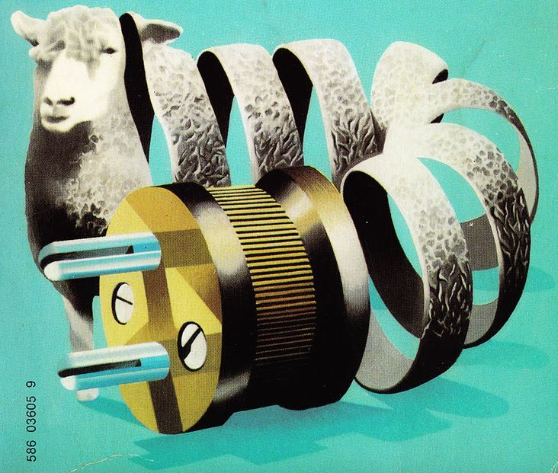
My Year in Re-Reading After 40: Do Androids Dream of Electric Sheep

BEFORE RE-READING:

It’s time to have some fun! While I greatly enjoyed Iris Murdoch’s magnum opus The Sea, The Sea, it would be an exaggeration to say that the book entertained, exactly. Edified, perhaps. Enlightened. But “entertained” comes on too strong. So I am counting on Philip K. Dick to do me a solid and put the “wheee!” back in “reading.”

I mean, the movie was a barrel of monkeys, after all.

Yes, I know the movie and the book barely resemble one another. (Any more than the sure-to-be mediocre movie sequel will resemble the greatness of original. But I digress.) And while Blade Runner is maybe my favorite film of all time — I own like two DVDs these days, and one of them is the Blade Runner: The Final Cut — for whatever reason, I’ve only read the book that inspired it all once, some years ago. Worse yet, it was a pirated ebook (sorry, estate of Phillip K. Dick) that I read on my original white Kindle, replete with typographical errors, weird squiggles, and non-existent paragraph breaks. Worse still, I read Do Androids Dream of Electric Sheep? in one sitting while working pretty hard on a bottle of bourbon in a hotel room in a strange town several time zones away from home. Thus my comprehension levels were not, shall we say, quite where they ought to have been.

What I remember is a story that reproduced, amplified, and exploded all those old noir tropes. Grizzled PI? Check. But with lasers. Vicious villains? Check. But they’re androids. Criminal androids, people. A femme fatale? Check. But she’s also an android.

Perhaps a bigger fan of sci-fi and fantasy than myself doesn’t end up so mesmerized by such a glossy and grim reworking of the old tropes. But they catapulted me into a world where everything old was new again, and I could once again be thrilled with a PI chasing the bad guys down dark city streets.

All of which is a roundabout way of saying that I don’t really recall much of the book’s substance. Now, as I discussed last month, that’s also the case with, well, almost every other book, I’ve ever read, but those were owing to the normal tug and pull of memory and forgetting. Do Androids Dream of Electric Sheep? has persisted in memory in grim defiance of the obliterating effects of alcohol, which makes me wonder, slightly, if I’m not confusing the movie and the book.

After all, how many books do you think you could keep concentrating on through an ever-thickening bourbon haze, and actually finish? I’d wager 1 in 20. 1 in 50, maybe. (Hey, this sounds like a great scientific experiment. Someone about 15 years younger than me should try it out.) About halfway through a bottle of Jim Beam alone in a hotel room, SportsCenter or whatever dumb movie is playing on TBS start sounding like great options, right after you order in some Domino’s. Reading is freakin’ hard when you’re in that state, and I’m not even talking about the part where the words get blurry.

My original idea was to attempt to recreate that original reading with a fifth of Jim Beam, but wisdom precludes that possibility. You don’t make it to forty without learning that the hangovers hurt a lot more than they used to, and that with small humans in the house that depend on you, you simple aren’t allowed to be surly and hungover for a whole day following your little fiesta.

Instead, I’m going to plop down in my favorite reading chair with a glass of homebrewed hard cider. Maybe I’ll have two. If I get lucky — by which I mean, if none of the small humans in the house require care or maintenance and if I can manage to stay awake long enough — I’ll finish in one sitting again.

Besides wanting to re-read the book that inspired the fantastical movie, I’m curious to see if it’s even possible to enjoy a book sober that you loved while drinking. Also, this time I’ve got an actual paper copy, with real pages and correct typography and everything.

What I really hope is that Do Androids Dream of Electric Sheep? proves to be as hypnotic on a re-read as it was the first time around. Because in this installment I’ve talked far too much about bourbon and reading on bourbon, and said virtually nothing about the book itself. Time to get that rectified.

AFTER READING:

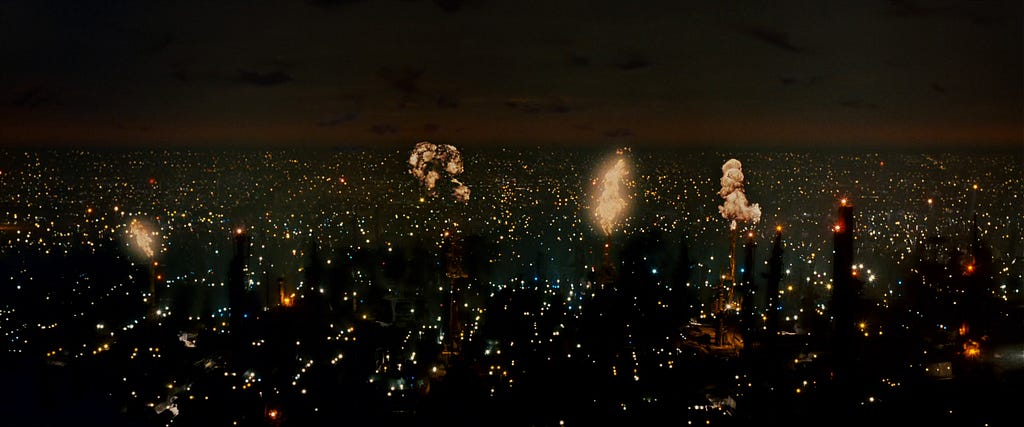
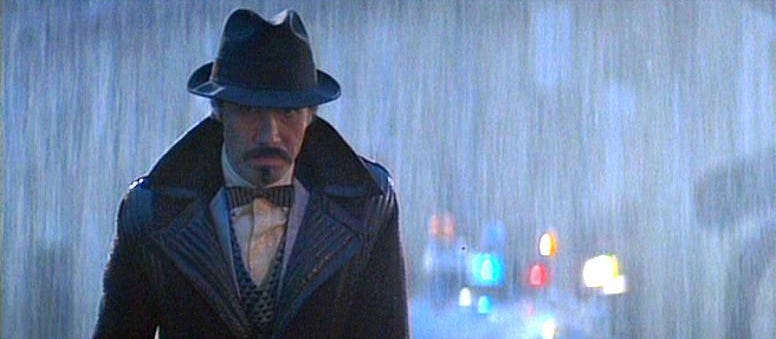
I said it once already but damn, Do Androids Dream of Electric Sheep? really is nothing, nothing at all, like the movie. Though inextricably intertwined, the two are different enough that we’re not only talking about two different media, but two different stories with entirely different aims. Blade Runner, for all its gritty darkness, exists to entertain, while perhaps doing a bit of philosophizing along the way,

It’s too bad she won’t live. But then again, who does?

and poeticizing,

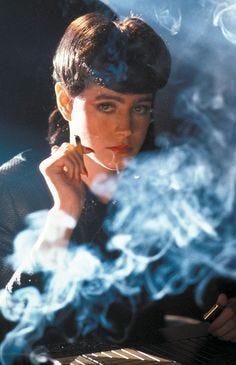
featuring the most fatale-ist of femme fatales.

Do Androids Dream of Electric Sheep?, on the other hand, serves an entirely different purpose. Philip K. Dick’s oddly lumpy prose weaves a fictive dream strong enough to alter the qualities of your own known world. Replete with all the set pieces of pulpy science fiction — the flying cars, the laser tube, the weird religion (what the hell is Mercerism all about, anyway?) — while twisting and subverting the standard tropes of noir fiction. Read it, read it, read it.

“I love you, Rachael said. “If I entered a room and found a sofa covered with your hide I’d score very high on the Voigt-Kampff test.”

The Voigt-Kampff test, of course, is the empathy test that the Rick Deckard, android hunter (the term “blade runner” appears nowhere in Do Androids Dream of Electric Sheep?), to determine if his subjects are human or not. The test measures empathy, an emotion androids are incapable of:

“You’re reading a novel written in the old days before the war,” [Deckard said.] “The characters are visiting Fisherman’s Wharf in San Francisco. They become hungry and enter a seafood restaurant. One of them orders lobsters, and the chef drops the lobster into the tub of boiling water while the characters watch.”

“Oh god,” Rachael said. “That’s awful! Did they really do that? It’s depraved! You mean a live lobster?” The gauges, however, did not respond. Formally, a correct response. But simulated.

Rachael, of course, is an android. A Nexus-6 model, to be precise. The most sophisticated android ever designed, yet still incapable of feeling the fundamentally human emotion of empathy. But, Dick asks, can you love without empathy? The book isn’t exactly sure, but it certainly hints at the possibility when Rachael claims to love Deckard, citing the example of how she’d feel seeing his flayed flesh on display.

Later on, Rachael tosses his goat — a real, live goat, not an android reproduction, very expensive, very rare — from the roof of Deckard’s apartment building, so perhaps she didn’t really love him all that much, after all. Or did she simply love too much? That’s only one of the delicious mysteries Do Android Dream of Electric Sheep? leaves for us to ponder.

I’m not a fan of books that bludgeon us with dazzling philosophical insight, cloaked perhaps with a light drizzle of plot frosting.

Not naming names, but …

It’s far, far superior when the plot bubbles the philosophy to the surface, creating seeming paradoxes and blazing insights that force us to re-evaluate what we thought we knew. Take the strange quasi-religion of Mercerism that Dick created, wherein one grips an “empathy box” to commune with a strange prophet climbing a hill like Sisyphus while rocks are hurled at you. Sort of makes sense, if you think about it. After all, what would a post-apocalyptic world need to heal? The opposite of what brought on the apocalypse in the first place: human empathy.

All this makes you wonder, are we really so different from the androids? Aren’t we just thinking boxes that seem to experience empathy? How often do we really, truly walk a mile in someone else’s shoes? Do we ever really connect with our fellows? Maybe we just beam signals at each other from our respective solipsistic ships, responding to elaborate stimuli in an ever-more intricate dance?

Do Androids Dream of Electric Sheep? does offer a partial answer to these questions: in the end, what trips the androids up, despite their superhuman strength and intelligence, is that they can’t care about one another. Deckard knows this, and hunts them down one by one. He murders them without mercy and uses his bounty to buy a real, live goat. Which, as you know, the android that says she loves him proceeds to kill. (What a strange, magnificent plot!)

Then, the book closes not with his successful android hunt, but with a Jesus-like pilgrimage into the post-war wasteland of northern California. But unlike Jesus or the saints, Deckard attains no great insight in the desert. All he finds is a toad. Which would be a remarkable find in a world where nearly all wild species have been killed off, except the toad, too, turns out to be an android. The world snaps shut on us all in the end.

Which, I think, is just what makes Do Androids Dream of Electric Sheep? so mesmerizing. Its self-referential circle swallows itself whole; you can’t accept the world it creates without accepting the world you’re in.

Like this.

And if that sounds a touch too precious, like a Zen koan painted on a kid’s woodblock from Pottery Barn on the mantle over your great-aunt’s fireplace, I can only say that’s because I’m no Philip K. Dick. I cannot quite describe the alchemy by which he achieves his effects. This was true when I read the book while quaffing bourbon on a hard hotel chair; it’s true while I read it stone-cold sober in my favorite easy chair. Once I started, I couldn’t even drag myself over to the fridge to pour myself a hard cider.

Hoary as it seems to say it, Philip K. Dick is inviting us to consider the nature of being human. To go back to Rachael’s formally correct but simulated answer about the boiling lobster. If being human really means to empathize with the suffering of others, then how can we boil lobster alive to enjoy as a delicious, if high-maintenance, dinner?

In college I worked in a Cajun restaurant. Every year around Mardi Gras we’d get in a huge shipment of live crawdads (I don’t care if they call them “crawfish” in Louisiana; where I come from, they’re crawdads). Once I watched the chef drop vats of live crawdads into boiling water. They made a horrific squealing sound when they got dumped in. “Just the shells cooking,” the chef said. I wasn’t so sure it wasn’t a chorus of pain, but all the same, it’s not like I intervened. In fact, I don’t remember feeling even the slightest twitch of empathy.

And yet, no one who wasn’t a serial killer would toss a puppy into a boiling pot. As humans we respond to a puppy’s face, it’s big black eyes and yelps. Lobsters look like fishy bugs with no feelings. Even though recent research indicates that it’s highly likely that lobsters (and presumably crawdads) do feel pain, we eat them anyway. Meanwhile, puppies whimper and lick our hands and we give them names. Like Denis Leary once suggested, we should just line all the animals up for auditions. The otters, who swim around and do cute little human things with their hands, get a pass. The cows, who make baseball gloves and hamburgers, go to the slaughterhouse.

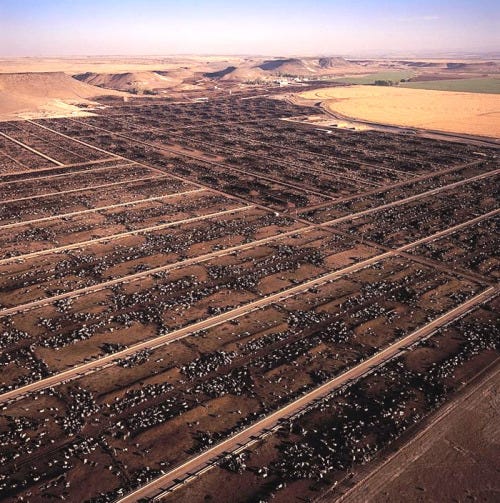
With a stop here first

It all comes back to the old Buddhist dodge — even though the Buddha forbade the killing and eating of living creatures, Buddhists everywhere chow down on dead animals. As any good Buddhist will tell you, it’s okay, because someone else did the killing.

Not that I’m picking on Buddhists. We all do it, one way or another. There’d be no civilization if we didn’t. Humans are natural born killers like the tiger or great white shark. We’ve just learned to farm the messy parts out to other people and, at times, machinery.

But Philip K. Dick is over here in the corner, reminding us that to be human is to feel empathy.

If selectively.

DOG-EAR REPORT:

Can’t set the scene much better than this:

In a giant, empty, decaying building which had once housed thousands, a single TV set hawked its wares to an uninhabited room.

Philip K. Dick is a master of the minor detail that signals we’re in a majorly different world. For example, in this scene, when Deckard finally has the femme fatale alone in a hotel room. Does he bend down to kiss her? Yes, but:

Bending, he kissed her bare shoulder.

Why her shoulder instead of her lips? I don’t know, but it works to perfection. And this is why you and I are you and I, and he’s Philip K. Dick.

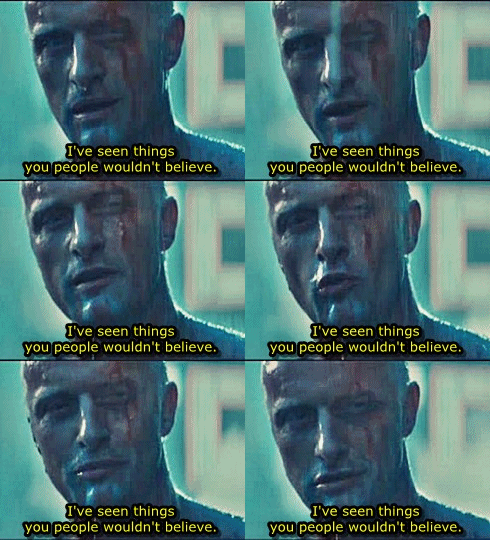
I bet this is the line Rutger Hauer read over and over again, preparing for his role as Roy Baty in the film version:

Roy Baty entered, somber and large, smiling his crooked tuneless smile.

Next: An old story by a new star.

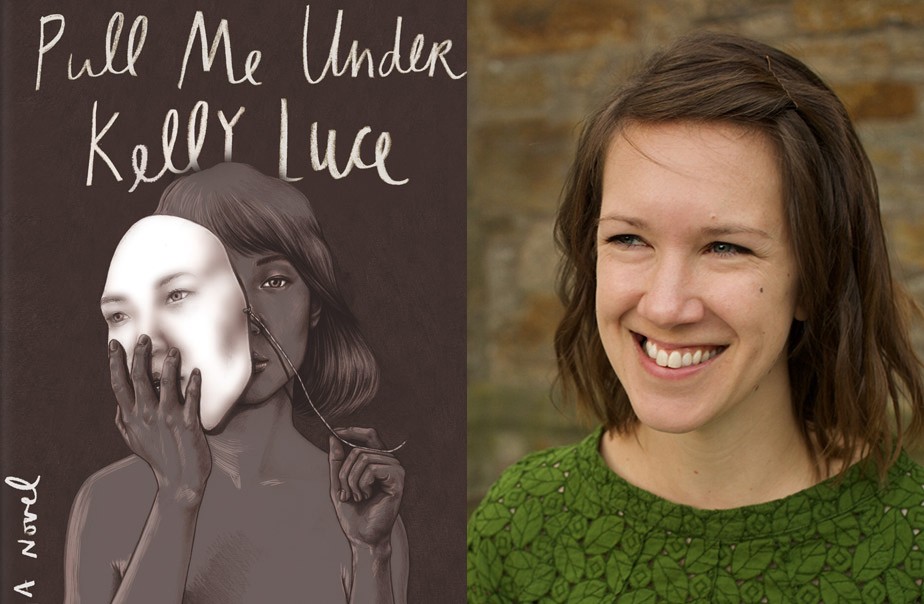
Kelly Luce & The One Violent Act

Before I set out to interview Kelly Luce — upon the publication of her debut novel, Pull Me Under, out now from FSG — I asked her: should I try to obscure our pre-existing friendship in the interview? I was worried that any praise from me would be read first through the lens of my having known Kelly for years and considering her a kind of big sister. She dismissed this, said, Of course not. I think this is because she knows — and knows that most other people know, too — that I can’t fake enthusiasm. I can love a person, not connect with their work at all, and find polite dodges and maneuvers around saying so if indeed my opinion is asked, but I cannot simulate admiration for that which I simply don’t admire. I sometimes wish I were a better bullshitter, but it’s just not in my genetic makeup. All of which is to say that, having absolutely nothing to do with the fact that she’s my dear friend, Kelly Luce has written a phenomenal novel in Pull Me Under, one that captivates and disquiets in its search for answers about the parts of ourselves that are unknowable. The novel tracks the story of Rio Silvestri, who, when she was twelve years old, fatally stabbed a school bully. In the twenty years since, she’s remade her life and herself in Colorado, but her father’s death, along with a mysterious package that arrives on her doorstep, spurs her to return to Japan. Luce maneuvers the reader through this story seamlessly, and, seeing as it’s Halloween season and all, I’ll say, too: she is a virtuosic jack-o-lantern carver, slicing and hewing away at her characters until their pulpy interiors are exposed. And from inside that space, she shines a light.

I was delighted to talk with Kelly — by email, by text message, and various other forms of communication — about Pull Me Under, the function of setting, the possibilities and limits of language, and what she’s working on next.

[Note — Kelly Luce is a Contributing Editor at Electric Literature.]

Vincent Scarpa: In Pull Me Under, as in your first book (the story collection Three Scenarios in Which Hana Sasaki Grows a Tail, released by A Strange Object in 2013), much of the action is set in Japan. I know you’ve spent a fair amount of time there, and I wonder if you could talk a bit about why that landscape, that culture, has proven generative for your fiction. Is there something fundamentally singular to Japan that you can point to, or is it that your fiction is precisely that endeavor: to at least sketch the contours of what that might be? I think of the poet Louise Glück who writes: “All you need to know of a place is, do people live there./If they do, you know everything.” It’s a line I’ve always loved — in no small part because of its reductiveness — so I wonder, too, if there are universalities you’ve encountered — on and off the page — in what seem, at least to this untraveled American, vastly disparate places with distinct ways of being.

Kelly Luce: I love that line. But it is reductive — just look at the current conversation about who gets to write what, and Lionel S’s pouty wanting-it-both ways: the writer’s right to imagination and the writer’s responsibility to not suck at imagining.

Of course there are human truths to be discovered, and travel is one way we can peek at them, given the variables removed from the equation of humanity: language, terrain, socioeconomics, culture, and other factors. Take away those commonalities and I believe you find, based on the traveling I’ve done so far, a baseline propensity for kindness, a desire to help and be of use, the need to identify and belong, and a desire for connection.

The years I lived in Japan, in my early twenties, felt like a second growing up in many ways. You learn a lot about yourself when you live someplace where you’re illiterate and unable to speak or comprehend the speech around you. Your senses recalibrate and you start to see parts of yourself that maybe aren’t as great as you thought. So that transformation, combined with the other-worldliness of living in a place that was, at times, incredibly foreign, does inform and “inspire” (ew) my writing about the place. There’s something about being just outside a place that creates the right amount of tension for creativity. In Hana Sasaki, this often took the form of a slipstream realism in which reality was mostly reality as we know it, but there’s maybe one element that’s a little uncanny. In Pull Me Under, there are no psychic toasters or haunted karaoke machines, but there is a sense of overwhelming un-reality at the violent act the narrator committed as a child, which she must live with for the rest of her life.

There’s something about being just outside a place that creates the right amount of tension for creativity.

VS: I’d love to hear the origin story behind this novel. It doesn’t read at all like how one might expect from a debut novel; one always feels that you — the writer — are doing things correctly. Are there other novels in a drawer somewhere in your house? If so, I wonder what it was about this one that roused you to keep following it.

KL: You know, when I read that word, correctly, I shudder and feel embarrassed. Because I have this expectation that a good book, at least a good book to me, is somehow incorrect, somehow…pushy. And yet I know that’s a compliment.

There are no other novels in my drawers. I’ve been doggedly chasing this one down for eight years or so. I had to grow up to be able to finish it and see its shape, get the characters and emotional truths right. Chizuru/Rio was so hard to pin down. She’s sneaky as hell.

As for the origin of the story: when I living in Japan, I learned about the phenomenon of kireru, which means “to snap.” The concept of snapping and committing violence under pressure isn’t foreign to us, but the people who were snapping — namely, young children, including girls — surprised me. I was teaching junior high at this time, and I wondered whether any of my students, cheery or well-behaved on the surface, were capable of this. So the book was born from a question: what would have to happen in a child’s life for her to do this? And as I started to answer that question, Chizuru (Rio) was born.

VS: We both studied with the benevolent genius Elizabeth McCracken at the Michener Center, and in reading Pull Me Under I thought of two things Elizabeth said that have always stuck with me as irrefutable rules for fiction. One is this idea that there’s a bomb in every story, and the writer’s job is not to diffuse it, but rather to let it go off and then examine the damage. Which could probably be a kind of synopsis for what Pull Me Under is doing. But the thing I want to ask you about has to do with another piece of McCracken wisdom: never let the bad habits of the characters become the bad habits of the work. You have, in your narrator, Rio, a character who has cultivated what she perceives to be a necessary amnesia. She’s learned to perform a self to others that’s entirely divorced from her past, and in doing so she’s become a kind of mystery, a kind of lie, to herself, too. To quote her from the text, (and I don’t think I’m giving anything away): “That night in bed I imagined my body as a subdivision. Here was the community gym, here the in-ground pool. The girl who killed Tomoya Yu. Nurse. Wife. Mom.” She is, quite literally, walling herself off, and yet never does this behavior disallow the reader access or entrance into her interior; we’re always able to see through whatever guise or mask she tries to hide behind. Can you talk a bit about the challenges I imagine this must have presented, and the choice to take on those challenges — maybe even amplify them — by writing Rio in the first person?

KL: I wish Elizabeth McCracken would write a craft book. And I say that as a person who believes that no one should ever write a craft book.

A big part of why the novel took so long to figure out was precisely the point you bring up here: Rio’s psychological slipperiness, even and especially to herself. One of my struggles with the novel was conveying her emotions in the moment. I always felt like I was being too obvious or resorting to cliché. Racing hearts, hot faces. Emotion has a physical component, of course, and I wanted Rio to be a very physical character. I don’t like when fiction removes characters from their bodies in favor of floating them vaguely in some ethereal jelly-plane of Ideas. So Rio inhabits her body more than most people do, as an ultra distance runner, and in her awareness from childhood of the “black organ” inside her. It was grueling to go through the novel and make sure each emotional reaction on her part felt fully inhabited and unique to not only her character but the setting and environment around her.

I don’t like when fiction removes characters from their bodies in favor of floating them vaguely in some ethereal jelly-plane of Ideas.

One huge breakthrough in this area came from a recommendation by Jim Crace, who visited the Michener Center my first year there. He noticed my emotion-immediacy problem (Me, paraphrasing him: “This is a hugely powerful premise for a novel and a great character — so why the hell do I feel bored?”) and suggested I rewrite the novel in the present tense. Just to see what happened. I tried it, and was immediately more engaged myself, more able to feel in the moment what Rio was noticing and how her feelings tinged her perception.

VS: There’s much to be said about the role that language — its possibilities and its barriers — plays in Rio’s life. As a teenager, she wills herself to become near-illiterate in reading kanji, and, to a lesser extent but still with purpose, to unlearn the Japanese language itself, so that she might not speak it. This is a strategy of isolation, a conspiracy to shed herself of herself. But what she can’t disremember is music — a universal language one becomes fluent in regardless of will, but especially so for Rio, whose father is a renowned violinist, given to assigning people their own musical intervals as a means of both trying to understand them and trying to reduce their fundamental unknowability. What were you trying to coax out — about language, about relationality, about contact — by weaving this thread throughout the book?

KL: I’m not sure. It wasn’t intentional, that’s for sure, but if I look at it from here, analytically, I think what I came to understand was how powerfully language is part of our identity. Native languages, languages learned as an adult, language forgotten, intentionally or not. Language is how we communicate our deepest selves, how we come to be known. And we all yearn to be known. This is true of music as well, as you point out.

VS: I recently read an interview with the writer Paula Fox in which she says something that, I think, crystallizes so beautifully the question contemporary fiction should be asking — a question that feels central to Pull Me Under, and one which you masterfully render Rio seeking an answer to: “How do we stay neat in a cyclone?” Maybe what I admire most about Pull Me Under, then, is that it doesn’t purport to offer a solution — because, of course, there isn’t one; there’s no such thing as staying neat in a cyclone. By the end, Rio has come to reconcile — as best she can — certain aspects of her past and herself, but you show us — expertly, without a trace of didacticism — that such reconciling does not constitute repair or restoration. The rejection of that kind of moralistic ribbon-wrapping seemed to me the best demonstration of your striking gift for restraint; a restraint that characterized the stories in Hana Sasaki, too. Have I arrived at a question here? I guess what I’m wondering, as it pertains to restraint — is it instinctual, or is it the product of revision? Is it intrinsic to your writing practice, or is it a muscle you’ve trained? I wonder, too, which writers you’ve felt most instructed by in this regard.

KL: It’s instinctual. And it’s not for everyone. Some people tell me they read this or that story in Hana Sasaki and say they “liked it, but…what actually happens at the end? Was X or Y really real?” As if I’ve laid out a math problem but forgot to write the answer at the bottom. But I like to leave a space for the reader. Reading, like listening to music (or watching excellent TV or film or looking at art) should be an active, creative experience. Not a passive one.

That’s not to say there’s no place for directness, for telling-not-showing. You need that, too. In fact, the more of that you employ, I think the more inviting that creative reader-space becomes. Kawabata was a master at this. Read “The Grasshopper and the Bell Cricket” and you’ll learn everything you need to know about narrative restraint (which is very different from descriptive vagueness.) Stuart Dybek does this incredibly well, too, as does our mutual hero Joy Williams. She has this line in one of her stories; the scene is so mundane, just two people chatting about nothing, being boring like people usually are in their daily lives, and out nowhere we get this line…help me out here, VS, I don’t have my books with me; I’ve mentioned this line to you before…

VS: It’s that scene in her story “Lu-Lu,” right? “Heather scratched her shoulder. The sun beat down on the crooked part in her hair. Why has love eluded me, she wondered.”

KL: Yes! I fucking love that tag.

VS: OK. Two final, less verbose questions. The first: which writers should we not fail to read? The second: now that the novel is out in the world, what are you working on next?

KL: I’m super into the Icelandic writer Sjön right now — he writes with such magic and subtlety and almost this stark lyricism that is just brilliant and strange and great. And Laila Lalami, whose The Moor’s Account I will never forget till I die. And everyone should read Steinbeck for his tenderness and humor, both of which I wish were still considered cool elements to include in one’s fiction.

I’m working on my next novel. It’s still early in the process, but it involves female homelessness, prenatal memory, the so-called conflict between science and faith, and a Franciscan brother who is an astronomer at the Vatican. (Yes, the Vatican has astronomers, and quite an amazing observatory!)

Death Is a Costume We Wear to War: a Conversation with Vi Khi Nao

Vi Khi Nao is an artist who transcends medium — one of those rare writers who proves that the acts of making a painting and writing a novel are much closer kin than most people of letters would have you believe. The first of Nao’s works that I fell in love with were her drawings that appeared in the 2013 NOON. They were images of teapots shape-shifting into women, or women shape-shifting into porcelain — a spout-clad kettle with shapely legs. After pouring over her pictures I went back and read everything she had ever written. She’s published widely, in every genre someone has been fool enough to confine her in. One gets the sense from all of her works that Nao could be given any set of materials, any language, any confines or paints or stone and she would still be able to figure out a way to break your heart, or make you laugh, or, very possibly, accomplish both at once. In her newest work, Fish in Exile, a novel out this week from Coffee House Press, Nao articulates a narrative of all consuming grief through an impressively large cast of characters that circle around the tragedy of two children drowned at sea. Since May Nao and I have been writing each other, first by email, then by paper, her from South Bend, IN, then Providence, RI, me from Taos, New Mexico, then San Francisco. In her last letter she wished me the very best wish that anyone could wish another — she wrote “I hope the muse comes to visit you.” May Nao’s remarkable muses come and visit us all.

Rita Bullwinkel: In Fish in Exile the sea is an unrelenting, evil god that devours everything that is fed to it. What is your personal relationship to the ocean?

Vi Khi Nao: My family crossed the sea by boat to escape from Vietnam. Our exit from it was dark, scandalous, and private — very much like husband Ethos and wife Catholic’s relationship to the ocean. Its unrelenting darkness and its strength pull us like weeds from the ground up. My family spent three days and three nights inside of a tiny boat with thirty other people. Feces and vomit and seawater were up to my waist. Inside that boat, I smelled everything primal. Having shared my young human body with the sea this way, inside of a vessel — I feel closest to the sea — to what is very atomically very mortal — these seemingly immortal liquid magnets ask me to return to Rhode Island frequently — to Providence — in particular because the space is so close to the Atlantic. My intense feelings for the ocean are like big gigantic clouds that hover over my heart and any potential attraction for the earth. The more I try to erase the sea from my existence, the more I miss her. The more I try to relax and let it be, the more water in my consciousness opens the space to want her more. With the ocean, I feel like I exist inside of a paradox and all I want to do is to be inside her embrace.

RB: The two most powerful parts of the narrative for me were when Charleen gives a chapter long re-telling of the myth of Persephone, and when an unknown, never before referenced, interviewer (police detective?) interviews Callisto and Lidia about the day that the children disappeared. Both of these portions of the novel are 100% dialogue and written in a play-like format. How and when did you write these two sections? What about the content of these two sections called for the use of a different narrative form?

VKN: I wrote these sections in 2012, during my time at Brown University. Like a musical score, the structure of Fish in Exile demands polytonality and insists on having many perspectives to address the complexity of the human psyche during grief. I had to find a form that could polychromatically meet the charged, protean appetites of my characters’s emotional needs. The play, an extreme focused genre of writing, accelerates these demands and accelerates the way different perspectives interact with each other on the page. When I finally settled down in my open kitchen in Providence to write these sections, they came to me all at once. These voices were voices that had already lived through a mouthful of censured, thwarted experiences. These sections had come from a place of pre-mediated silence and they were ready to exit the void and enter the literary consciousness of the page. In life and in relationships, when one has been replete of all other forms of indirect, ancillary communication, a direct dialogue is inspired to take place in order to settle on a resolution. Sometimes that direct conversation shows itself in the form of a war. Change is a nuptial result of insanity, circularity, and repetition. Moving out of orbit, transformation is created. Not from change, these play-like sections were both born from transformation.

RB: One of the things that Catholic and Ethos do to cope with the loss of their children is build a gigantic aquarium in their home. They buy two fish to put in the aquarium, and name them Pistachio and Dogfish, and Catholic sews the fish children’s outfits (a little dress, a little vest), which she slips on the fish at different intervals, and almost immediately, each time, this clothing causes the fish to die. Countless times throughout the book, Pistachio and Dogfish die, and are then resurrected by new fish, with the same name, that either Ethos or Catholic has bought at the store. The fishes’ continual death at the hands of their parents seems to be an overt visual display of the trauma that Catholic and Ethos are continually reliving in their own minds. How do you understand Catholic and Ethos’s desire to continually buy new fish and to continually kill them? What is Catholic after when she forces Dogfish into her carefully constructed little dress?

VKN: When Catholic drowns the fish over and over again, she isn’t learning the language of forgiveness or surrender. She is learning and relearning the language of control. Control gives her certainty. She can control how the fish enters the body of the dress. How the dress is created. The dress is precisely sewn. Calculated to the fin. The sewn dresses like death is so assured — while life, for her, is filled with uncertainty and doubt. She is afraid and is afraid to surrender. Afraid to experience life and birth again. In her fear of experiencing pain, she endures more pain. Her fear is understandable and relatable — we all go through it. We humans do insane, personal things to keep the status quo of our trauma going, yes? But death is a costume we wear to war, to dinner parties, to bathing rituals, to breakfasts. We cope with our demise by creating a larger container of demise. What Catholic and Ethos do with the fish is very human and very predictable. We should be able to relate to them and we do this all the time. We drown ourselves in our grief. Not only metaphorically, but substantially. Each time, we die and we are given another opportunity to live and instead of living, we relive our pain again. It seems like our pain is circular. Our learning is circular. And, it seems like we are incapable of orbiting out of trauma. When we do orbit out of it, are we more human or less human? Or have we become another window into ennui? Into another dream we can’t get out of?

We humans do insane, personal things to keep the status quo of our trauma going, yes? But death is a costume we wear to war, to dinner parties, to bathing rituals, to breakfasts.

RB: The emotional hue of Fish in Exile is overwhelmingly heavy and dark blue and seeped in grief in a kind of way that even the sentences feel weighted down by the depression of unjust lost life. What was it like to sit in the extreme sadness of this narrative for so long? How did you instill such a singular feeling of grief in the prose line by line?

VKN: I have been sitting with these sentences for so long. They have become anchors to the drifting boats of my heartaches. The extreme sadness? The emotional hue you mentioned — how? I tried to sustain an abusive relationship with a woman that could not be. This is how some of the heavy and dark blue was born. Physical bruises, black and blue, on my skin became nocturnal witnesses and diurnal eyes to the tumulus years living inside of me. To instill a singular feeling of grief line-by-line is to endure an abuse of 1.5 years second-by-second, day-by-day. However long it takes the body to grieve when nothing else works. I used to tell others that being in the violent relationship with that beautiful woman was like having ten children. I had to will myself to abandon ten children in order to release that pain. Would you abandon ten children if you knew it was better for you? Would you? If you were a mother? A father?

RB: All of your characters have the most miraculous names (Catholic, Ethos, Callisto, Lidia, Helio and Charleen). How do you name your characters? How do you feel each of your characters are in conversation with their names?

VKN: After visiting the Dali museum in St. Petersburg (Florida), my protagonist Catholic appeared out of the blue and told me she must be in my novel. Naturally, when a ghost commands you in such a fashion, you must listen & I made a point to insert her in. Ethos came from acquiring a two-month job as a barista in Lakeland, Florida, where Frank Lloyd Wright houses some of his beautiful chapels and architectural designs. If Ethos were a chapel, he would be Wright’s Annie Pfeiffer Chapel. Because I was indigent and carless and busless, I used to walk 4 hours each day, 2 hours each way to work at Starbucks. When I entered work, the plastic manufactured water bottle labeled “Ethos” eyed me with such thirst inducing mania that he had to be in my novel. Much of his existence at Starbucks satiated my dehydration after a long fatigued walk. I would come to work and be already tired and he would be there, sitting patiently in a basket. Probably sitting in the same basket that Moses rode down the Nile River. I gulped & swallowed so much of him. I stole Lidia from Michelangelo Antonioni’s La Notte. I like the idea of a character not walking out of screen — that would be too cliché, no? Instead, it would be nice if she didn’t walk off screen. Instead she could be a protagonist’s neighbor? With hair that you could eat like squid? At Brown, I had a classmate named Helia and I masculinized her so she could become a boy I could adore. Like Helio, she asked really good, astute questions. And, Charleen! I have no idea how she came about. She walked right into my manuscript without introducing herself or providing herself a history. She is very rude!

RB: So much of your prose is steeped in sound. When you are writing, what does the sound of a sentence mean to you? Below are some of my favorites sentences, and strings of sentences, that I had to stop reading for so I could say them out loud.

— “I do not like the way my wife smells when she’s tearing me apart.”

— “My soul is a cul-de-sac.”

— “My son. I glance at my son. At his handsome face. Such a beautiful man my mammary gland once nourished. I breastfed him daily, spoon-fed him my nipples. And now just look at him, milky and white.”

— “The image stays with me as I leave him to be with the sofa. Furniture is comforting. It doesn’t try to make love to me or ignite my fear. It’s just there, slutless and lovely.”

VKN: My first language is Vietnamese. My second language is Latin. When you speak in Vietnamese — whatever comes off your lips should sound very musical. Sound drives the meaning of the Vietnamese language. So if you love those sonic sentences, please know they were influenced and born from my mother tongue.

Cabin Creek by Madeline ffitch

By small aircraft, the crew, their packs, and the shifting, stinking stack of pressure-treated two-by-eights were set down 40 miles into the Idaho backcountry. There were no engines and no wheels allowed, besides the engine and the wheels of the small aircraft. The plane shook itself down onto the buffalo-grass landing strip, jostling the chemical boards against the crew, so that they had to brace themselves against the windows. The pilot waited long enough for the crew to unload the boards, then lifted his plane back into the sky. The crew watched it carve up across the valley, blink out over the ridge, gone. The valley grew dark. There was no one there to meet them.

The place was called Cabin Creek but they didn’t sleep in the ghosty low cabin, pierced every few feet by posts to hold up the roof, 120 years old. They pitched their tents in sight of the cabin, but slept outside on the ground, amid the silver sagebrush and sand drop-seed along the valley’s edge. They lit their stoves and drank powdered hot chocolate and the creek ran.

It was a government job and they had a radio. The office relayed the plan to the crew, and they waited for the packer to arrive with his mules. The first part of the plan was for the mules to carry the boards to the bridge site, two miles from the landing strip. The next part of the plan was for the crew to build the bridge.

The crew boss was a young woman in baggy clothes. She was the boss of three people, two young lovers and a debtor. The lovers had missed the hard weather of the fall and spring, when trees fell and bridges washed out, when trails flooded and the boss hiked all day alone with a fire axe, trying to make it down from the ridges before the lightning came, finding dry tinder only by scraping the underside of logs. The lovers had missed all of that. They had arrived for the summer season and were there to stare at each other. They only set up one tent, though they had packed two into the aircraft. They kept the others up all night.

The boss had been like them once, like them but lonelier. She had joined a crew one summer, yet found herself many months later, eating a stringy Thanksgiving turkey at the ranger station, huddled together with other people who preferred not to talk to each other, who didn’t have plans for the off-season, who couldn’t remember what to do with their per diems. That’s how she became the boss. She just stayed.

The debtor was at least 10 years older than the rest of the crew. He was in his prime. He was in credit card debt. His other life was a dark mystery, something about contracting, but he took the job on the crew to earn money and not spend it. He had worked all spring, and planned to stay until the snow came. Each night at dinner, he tallied up the money he had made so far, cloistered away from temptation. In the backcountry there were no wheels and there was nothing to buy. He was jocular with the lovers, clean jokes always. The worst he would call a person was bonehead or clown. He set store by rituals, making sure everyone saw the small gold cross at his neck, the way he touched it — right hand then left hand — before eating. It chilled the boss. The debtor didn’t like it that a young woman was his boss. The morning after they arrived, he asked, “What are we supposed to do while we wait for the packer, just sit here? Just sit here making our hourly like a bunch of clowns?”

The boss said, “We can make improvements. There are plenty of improvements to be made.”

“It’s illegal for us to make improvements,” the debtor said. “This is by definition an unimproved area.”

“Not those kind of improvements,” the boss said.

“We have the boards so why don’t we just carry them to the bridge site?” the debtor asked.

“We’re going to wait for the packer to bring the mules. Meanwhile, we’ll clear the trail,” the boss said.

“Clear the trail with what?” the debtor asked.

“We’ll use the crosscut saw,” the boss said, and retrieved it from the cabin’s toolshed. When she assembled it, she had trouble remembering how the handles fit, and it was especially hard to do it with the debtor watching her. The two lovers, who had plunged naked into the creek before breakfast, volunteered to take the saw and walk together out onto the trail.

“And you can fix the cabin step please,” the boss said to the debtor.

“With what shall I fix it Dear Liza?” the debtor asked in a singsong.

“Use a large stone,” the boss said. “Just prop it up.”

“Whatever you say, you’re the boss,” the debtor said. He walked sideways up the slope, pulling goldenrod, innocent, smiling, his teeth gleaming into the sand.

The boss left the clearing. She passed the lovers pulling the crosscut back and forth through a white pine that had fallen across the trail. She cut down out of the valley, waded through Cabin Creek at a shallow place. She came up out of the creek bed into the next canyon where the trail made a narrow line through the prairie clover under the wide open sky. She kept on two miles. The ranger had reported that the pack bridge had washed out, had relayed it by radio to the office. The boss found the place, a collapsed bank with some railroad ties tossed aside by winter storms. Coneflower nodded down into the hole, primrose climbed up out of it. The river branch took it all in, eating the bank, claiming it. The boss took some measurements and began the walk back to camp.

This time, before the bend that led down to the creek, she saw a rusted wheel on its side, partly buried in sand. A large wheel. An old wheel. A wagon wheel. Old trash, out here, was to be left alone as history. Yet it was hard to keep track of what was to be left alone, what was history, what was trash, what was an improvement. A tin can was history if it was made before can openers. A wire was history if it had been used to carry telegraphs before this place had been shut off to improvements. The boss could hardly tell one kind of wire from another, yet the wagon wheel she could tell was history, and it also had the dangerous possibility of becoming an improvement. If you picked up the wheel and rolled it, it could help you, which was not allowed. The boss kept her eyes on the trail, let the wheel lie.

But re-crossing the creek, the boss saw a wrapper at the feet of an elderberry stand, a red plastic wrapper that told the story of the bar it had wrapped. It told the story of a guy who had just been a guy in a garage with a snowboard, a mountain bike, and a trumpet, and then one day he just got sick of those other bars, so he made his own bar and it tasted great! This wrapper was easy. It was new trash. It was not history. It had clearly been left way out here by some hunter, some hiker, maybe even another crew, though the crews were supposed to know better. The boss picked the wrapper up and put it in her baggy pocket. She would come back with a garbage bag if necessary, to clean this place up. The boss felt that in the eyes of the debtor she must make resolute decisions, brook no contradictions.

When she got back to camp, the packer had arrived, followed by the pack string of eleven mules and two horses fitted with blinders.

The packer was blatantly handsome with a ravaged unsettling face. For many long years he had chosen the lone job, the job of packer, so he didn’t see many people. When he did see people they asked to take his picture because they weren’t sure what they were seeing. An old man or a young man, acne scars or the weathered face of a cowboy, a brown-skinned person or a white man, no nose or the nicest nose. He stirred people, the way he fit into his jeans, luxuriated in taking a good piss against a ponderosa, yet chewed tobacco with discretion, the way he was perfectly, equitably friendly. He barely showed his preference for his girlfriends when he had them. He was either always flirting or never flirting. Women wanted him to look at them, and then he looked at them and it made no difference.

The packer tipped his hat briefly to the boss, his eyes on his mules. He unhitched them, set them out to graze alongside the cabin, and he and the boss walked over to the landing strip. They could smell the pressure-treated lumber. It outdid the wild smell, the smell of the yarrow, the buffalo-grass, the smell of the mules, everything.

The packer looked at the boards, rubbed the back of his neck. “The pack string will not carry these,” he said. “They are the wrong shape. They are too long. If I try to rope these across my animals’ backs, they will be spooked.” He raised his hand to his mouth and spit tobacco behind it.

“But the people in the office said,” the boss said.

“Yes. The people in the office are the people in the office,” the packer said. “They don’t understand mules. They don’t understand horses. They don’t understand what the pack string will carry.”

“Shit,” said the boss. “If only we could use a wagon. Or a cart.”

“If we could do that, a lot of things would be different,” said the packer. “Probably none of us would be here.”

The boss lifted an acrid board to her shoulder, closed her eyes against the chemical smell. She let it fall back into the other boards. The pile slumped.

“You’re not thinking of carrying them, are you?” asked the packer.

“It’s not so heavy,” she said.

“It’s two miles to the bridge site. That’s out of your pay grade,” the packer said. “I’ll radio the office.” He held out his hand for the radio, and she relinquished it without argument.

While the crew stayed outside, the packer moved into the ghost cabin. He stretched out in it, put his feet up on the deep low windowsill, strung a line between the dark posts to hang up wet socks, walked around in his underwear. The packer drank coffee from beans that he boiled in a pot on the woodstove. He kept his distance from the crew, but he set up a backgammon board on the front step.

Outside, the crew cooked on small stoves with blue flames. The tradition was that they shared the evening meal. The boss cut an onion directly on a rock.

“I think we’ll get germs from that,” the debtor said, tossing jelly beans into his mouth.

“Almost certainly,” the boss said. The lovers whispered to each other. As a game, they used a bungee cord to hook their belts together and they walked around like that, glowing.

The packer came out of the cabin and stood on the front step in his socks. He dipped some tobacco. He took off his hat and held it quietly until the crew stopped what they were doing.

“Did you radio the office?” the boss asked.

“The office radioed me,” the packer said.

“What did they say?” the boss asked.

“They say there’s a fugitive,” the packer said.

“A fugitive?” the boss asked.

“There’s a guy on the loose,” the packer said. “Someone running, someone on the run. He’s wanted for something. A guy who. Who killed someone. A deputy sheriff. He killed a sheriff or a sheriff’s deputy they think.”

“Holy moly,” the debtor said. The lovers listened, their fingers linked together, their eyelashes velvety and damp.

“What should we do?” the boss asked. “I mean, what does the office say we should do?”

“The office says to stay calm,” the packer said. “Don’t go looking for the fugitive. Don’t try to take him in. It’s not our job.”

“But what if we see him?” the debtor asked. “What if he comes through here?”

“If we see him, or if we see his camp, or if he passes us, they say to radio it in,” the packer said. “That’s what the office says.”

“The office. Those clowns,” the debtor said.

The boss did not like to agree with the debtor, but it was true that the office were clowns. The office told them to report every smoldering stump, which they did not do because they did not agree with the office policy on fire management. The office told them to treat their water with iodine or a filter, but they took their chances and drank from clear rushing streams, and sometimes their shit gushed forth painfully but mostly it didn’t. Mostly they were fine.

“They can say what they want,” the packer said. “If I see him, I’m taking him.”

“But maybe he’s a hero, we don’t know,” the boss said. “Like Robin Hood.”

“A hero? They say he killed a sheriff’s deputy,” the packer said.

“Is there a reward?” the debtor asked. “I bet there’s a cash reward.”

“We don’t know what he did,” the boss said. “We only know what the office says.”

“He’s a bonehead,” the debtor said. “Who does he think he is, Rambo? Does he think he is Rambo?”

“Do you think he can make it?” the boss asked.

“Make it, what does that mean?” the packer asked. He spit tobacco into a can. “Look,” he said. “We probably won’t even see the fugitive. The wilderness is vast. It would take a lot to flush a man out. No one seems to understand that.”

“He’d have to want to come near us,” the boss said.

The packer put his hat back on. “I told the office about the two-by-eights,” he said.

“What did they say?” the boss asked.

“They said the pack string can carry them to the bridge site,” the packer said.

“Oh good,” the boss said. “What a relief.”

“The mules can’t move those boards,” the packer said. “They will not do it.”

“Oh,” the boss said.

“Why don’t we just move them ourselves?” the debtor said. “It’s what I’ve been saying all along. What do you think?” He looked at the lovers and the packer, not at the boss. The lovers shrugged and twined together. The packer raised his eyebrows but didn’t get involved. He was the packer and not part of the crew and he liked it that way.

“Carry them to the bridge site?” the boss asked.

“Where else?” the debtor said.

“The bridge site is two miles away,” the boss said.

“What else do we have to do?” the debtor said. “I bet I could carry two at a time.”

The packer shifted, and the front step cracked beneath his weight, lowering him slowly to the ground. For the first time, he looked directly at the boss. She blushed.

“Think your crew could fix this step?” he asked.

“I told you to fix that step, ” the boss said to the debtor. “Why didn’t you fix it?”

The debtor smiled. “I didn’t want to move a large stone,” he said. “It takes rocks like that nearly 100 years to build up such a patina.”

The boss said, “But we are supposed to build things with rocks, I mean instead of man-made things. Just as long as we don’t use an engine or a wheel.” If the debtor had not fixed the step, what had he done instead? Some preparation, some arrangement, another of his rituals? If there was a veil, she tried to see through it, to steady herself, but she couldn’t.

“We can move the two-by-eights tomorrow,” the debtor said, smiling. “It sure beats just sitting around.”

The next morning, the packer sat around while the crew moved the two-by-eights. The boss was not surprised to find out that you can do nearly any stupid thing if that’s all that you are required to do. It was a 10-hour workday and it was a government job, so they carried the pressure-treated two-by-eights, 12 feet long, two miles to the bridge site, one at a time or two at a time, all day long. If that’s all that’s required of you, you can do it all day, and they did. Use a work glove to cushion your shoulder, hoist the board up so that it balances, then down the path to the creek bed, wade across, feel the water fill your boots, climb out the other side into the wide open canyon. Up the bank, along the rut through the sagebrush and clover, come to the bridge site, crash another board down on the pile. The river rushed over the railroad ties, the primrose climbed, the coneflower leaned, the boards stank. They crew passed each other all day on the trail and spoke words of encouragement. The lovers called each other by names that were not their real names, ridiculous names that no one else could understand. If the boss spoke to one of them, they looked at the sand and laughed. The debtor carried two boards at a time. The boss carried one. “Let me know if you need help,” the debtor said. “I know how it is. Some people are better at holding the clipboard, that’s just true.”

They took lunch at the place in the trail where the boss had found the wrapper. Their sandwiches and sardines tasted like the boards, like chemical molasses, rancid candied ginger. After, the boss went to dig a cat hole behind a tree, fifty feet up out of the creek bed. She got her pants down, squatted, then noticed, right next to her boot, a pile of human shit. Sitting there on the leaves. Steaming there with a pinecone on top of it. The boss felt cold. She felt like she had shit before she had shit. Then she looked up and she saw the color red through the trees. She did not know what it was, but this time it was not a wrapper. It flashed out at her through the leaves. The creek bed was far too green, too lush, too much dogwood and elderberry, too many leaves radiating out and out so the boss couldn’t understand distance, depth or height or if she was looking up a slope. She could have been looking into a mirror, but among the leaves a swatch of red. It could be red flannel, canvas, a tanager, a scrap of something larger. Her bowels lost their urge. She got a prickle, sensed a presence. She pulled up her pants and went back to the crew.

“Find anything exciting back there? Enlightenment? Gold?” the debtor asked, which was what he asked when anyone came back from shitting. The lovers laughed, fed each other the crusts of their sandwiches.

“Nothing,” the boss said. “Nothing you would be interested in.”

That night, alone in her tent, the boss turned on her flashlight and its beam caught a lock of her own hair, hanging in a slipknot from the mesh ceiling. She was so frightened that she shut off her light and sat in the dark, feeling cold dread drench her, listening, listening. That was when she began to believe that the debtor was a witch. That was when she began to be really afraid. His bland smile covered his close watch of her, his furious sideways glance, the talisman at his neck. He was a hidden person, he was watching her, looking for a weakness. Quivering there in her tent, as the lock of hair cast a shadowed semaphore on the wall, she planned to drop her fingernails into the creek where he would not be able to retrieve them, to bury her hairbrush, to save her spit after she brushed her teeth. She thought about how she was a part of everything, all the bits of her going on forever burrowed beneath the dry sand, beneath the rushing, speaking creek.

The next morning at breakfast, she watched the debtor hide his evil nature. He drank a cup of coffee, hocked a loogey. He said to the lovers, “One time I was in traffic and the guy ahead of me was being a real bonehead, like going real slow in the fast lane, so I said to myself, what is it with this guy? What a clown! And then I pulled up to pass him and looked in his window, and guess what? He really was a clown! With a red nose and a rainbow wig and everything. Can you beat that?” He laughed and the lovers laughed, but the boss just stirred her hot chocolate, looking up at the debtor from under half-lowered lids, appraising him. He dabbled in the occult. If he planned to destroy her, she must make herself powerful. She must amass help. Yet who could she talk to? The packer would probably agree that the debtor was a witch but he probably wouldn’t care. He would just rub the back of his sunburnt neck, chew tobacco, gaze at his perfect boots. It was impossible to talk to the lovers. She didn’t want to try.

After carrying the boards all day, the crews’ necks were itchy and red. Their eyes watered from the chemical that had been used to treat the boards. They had headaches. The lovers went in the creek and the boss and the debtor soon followed. It was the only way. They soaked their bandannas and lay them against their necks, raw where the lumber had rubbed. They made their bodies flat down in the creek. The boss and the debtor kept their clothes on, but the lovers let the creek water drip off their pubic hair so that it looked like they were peeing. The lovers found a submerged log and draped themselves across it. The water eddied off their lithe bodies. Nearby, the mules stamped. One horse laid its head upon the other horse’s back. They lashed their tails against the flies.

The packer lounged on the cabin step. “It’s probably dangerous for you to be carrying those boards so close to your brains,” he said. “I wouldn’t do it. Do you know what they use to treat those boards with? Arsenic maybe or something. Rat poison.”

“Oh, holy moly,” the debtor said. He looked at the boss. “Now that is something it would have helped to know ahead of time.”

“Are you joking? You’re the one who wanted to do it this way,” the boss said.

“Me, I’m just a cog in the wheel,” the debtor said.

“Did you tell the office we’re doing it this way, when you radioed?” the boss asked the packer.

“This morning the office said there’s a cash reward for bringing in that fugitive,” the packer said.

“I knew it,” said the debtor. “Does the office get the reward or do we?”

“He might be armed so they say just let him pass,” the packer said.

“What about carrying the boards? Did they say anything about that?” the boss asked the packer.

“They say whatever gets the job done, just move them. Just build the bridge. Even if you put it on overtime,” the packer said. “I don’t know that I would do it, but that’s what they say.”

The boss stretched out her shirttails, wrung them out. She twisted her hair under her hat. She took off first one boot, then the next, emptied water from them. She put her boots back on, left them halfway unlaced. She stuffed a peanut butter sandwich in her pocket.

“I’m going to take a walk,” she said.

The boss found the fugitive easily. When she had seen that pile of shit, some part of her had known. Some part of her had known that the fugitive was in trouble. If you can’t even cover your own shit you probably don’t know how to hide out for long. And the red wrapper. And finally the flash of red through the trees. So she went back to that green radiating place, she returned to the elderberry stand and looked up the creek bed, and she saw the glimmer of red again, but this time she turned off the trail. She went towards the red. As she crashed through the undergrowth, she kept her eye on that red piece, until she drew close enough to see that it was the corner of a tent. A tent with a red rain fly, a fire ring on the ground, a backpack spilled open, energy bars in red wrappers strewn on the ground. The boss stepped into his camp.

“Hello,” she called. “Hello, I found you.” First there wasn’t a sound but there was a low fetid odor and the moments passed and she began to consider a dead body. But then the tent’s zipper came down, and he put his head outside the door. The odor poured out with him. “I’ll fucking shoot you,” the fugitive said. “Or give me some food or some help.”

“Don’t shoot me,” she said. “I’m not going to hurt you.”

“No, you’re not,” said the fugitive. “I could hurt you. Give a man a chance. It wasn’t my fault even though they say it was. I could shoot you.” He blinked further into the light. He climbed all the way out of his tent. He pulled himself to his feet. He wore a windbreaker, blue jeans that bagged at the knee, some broken hiking boots. The fugitive was a small man. He had a beard, many days’ growth. He smelled like cheese and vinegar, stale cigarettes, fear. He did not seem to have a gun.

“I just want to talk to you,” the boss said.

“Fuck talking, could you get me some food? All I have to eat are these bars,” the fugitive said. “Used to like these things, too. Can’t believe it, they’re like a candle melted onto cardboard.”

“I brought you some food,” the boss said. She took the damp sandwich from her pocket and he fell upon it.

The boss was momentarily disappointed. She’d had higher hopes for the fugitive. In her mind, she had conjured him as someone who only ate pemmican, who walked into the wilderness with one bullet, stuffing brush down into his clothes, who hunted and gathered, not someone who ate these irritating bars, who ate this damp sandwich as if it were steak. But then she thought, if you are on the lam, you just eat whatever’s easiest, and those bars are all over the place by the crate load just sitting there behind every convenience store. Just grab a few and run. The boss felt that prickle again. She had made up her mind before she’d even set foot in the fugitive camp, before she’d even seen him. She knew she would not turn him in.

“I saw your shit,” she said. “You should cover it if you don’t want to be caught. You should not litter wrappers. This is a pristine area.”

“Listen to yourself,” said the fugitive with a mouthful of peanut butter. “Who are you?”

“I’m the crew boss,” she said. “I’m out here building a pack bridge. Give us a week. Once we build the bridge you can cross it and keep going. The others want to turn you in but I don’t. It’s like I told them, we don’t even know what you did. You could be a hero. You could be like Robin Hood.”

“I stopped paying child support,” the fugitive said. He finished the last piece of crust, belched. “Couldn’t keep up with it. Never could. Never did. Then they came after me with a warrant and I lit out, and on the way I maybe took a pot shot at the sheriff’s car, but that kid was always an asshole, he had it coming, I grew up with that guy. Seriously. I’ve always got the bad side of things, and now I’m being hunted down like a dog. But I’m foxy. They can’t catch me. Let them try.”

“I can see your tent from the trail,” said the boss. The fugitive looked at her.

“You seem like you know what you’re doing out here,” he said. It felt good to hear.

“I do,” she said. “I’m the boss.”

“You could help me hide better,” he said.

So together, they found a new place for his camp, staked his tent low behind a black cottonwood tree. The boss told him: no fires allowed, they will see your smoke. Clean up the wrappers. Go further back to shit, dig a deep hole, cover it with needles and leaves so no one can see where you dug. The fugitive nodded obediently to all orders. Then it was nearly suppertime.

“I will come back when I can,” she said.

“Bring more food,” he said. “Coffee. Cigarettes. Fuck all, I’m bored. Bring something to do.” He did not thank her.

At camp, the debtor did not take his eyes off her, but she pretended not to notice. They cooked supper. The boss cut a carrot directly on a rock. Many times the debtor opened his mouth as if to ask her a question, but when he finally spoke, he said, “Cutting on a rock will dull the knife.”

“Almost certainly,” the boss said.

After dinner, they took turns playing backgammon against the packer until it was dark. The boss went to her tent and sat inside its doorway to take off her boots. The lovers murmured in the dark of their tent. The debtor’s tent was quiet. The packer turned down the lantern in the cabin. For a while, it was only the cicadas. Then, from behind her, in the lodgepole stand, the boss heard something. A crack. A break. She peered through the back screen of her tent. At first, nothing. Then she saw a movement in the stand, a brief separation of shadows. The debtor stepped furtively from behind a pine. He looked to either side of him, then continued along the tree line, skirting the clearing. The boss held her breath, watched him circle the camp, lost him in the deepening night. What was he doing out there? The witch, the boss thought, the witch. But though the arches of her feet panged and her mouth went dry, she thought of her fugitive and felt stronger. The boss lay awake a long time. She did not hear the debtor return.

While the others splashed in the creek, walked the horses, or played backgammon, the boss spent quiet afternoons with the fugitive. He did what she told him to, but he was not very grateful. He pressured her for sex.

“I’ll go right for your eyes, you try anything” she said, showing her thumbs. She had brought him leftover oatmeal and they shared it, poured on some freeze-dried marshmallows. He wore a pair of her socks.

“Then what are you after?” he asked.

“A secret,” she said. “I want to show them I can do this. I’m the bravest. I’m the best at this job. I do it my own way. They think I’m like some kind of example of affirmative action or something.”

“They? Who is they?” he asked.

“It’s just one guy,” she said. “It’s this guy on my crew. He’s older than me. He’s only doing this job because he owes money. I’m glad I’ve got you to talk to.”

The fugitive laughed.

“What’s funny?” she asked.

“Talk to me? Talk to me about what?” he asked.

“About my real feelings. About how much I hate this fucking guy. Sometimes I think he wants to kill me,” she said.

“Now let’s not go there,” he said. “You don’t know the first thing about it.”

“He acts all squeaky clean, but he’s a chauvinist,” she said.

“So? Lots of people are,” the fugitive said.

“He’s in credit card debt,” she said.

“So? Lots of people are,” the fugitive said.

“One of the things I do is try to show him that I’m stronger than him,” the boss said.

“But you probably aren’t,” the fugitive said. “You’re a girl.”

“I can out-hike him,” she said. “And I’m a harder worker because I have to be. So I hike next to him and talk about the project and he can’t talk because he’s too out of breath and that’s how I show him who is the boss.”

“Y’all are sad,” the fugitive said.

“You aren’t sad?” the boss asked.

“About what?” the fugitive asked. “I’m feeling very alive.”

“But everyone is sad,” the boss said.

“Who is everyone?” he asked.

“I’m sad,” she said.

“See? Just like I said,” he said.

“The world is fucked up,” she said. “I mean for one thing death is as unknowable and terrifying as it has ever been. There is racism and poverty, there are small things like stomach aches and loneliness. Why even list all the reasons there are to be sad? Just think about global warming.”

“Oh come on, that shit’s not going to happen,” he said. “When I was in the jungle, meaning Vietnam, I looked around and knew the only god was mother nature and since then I knew she’d provide and I’m not worried about people messing it up. We can’t even make a dent.”

“That doesn’t make any sense,” she said. “That’s just a fantasy.”

“A fantasy? Whoo boy. You don’t even want to hear my fantasies,” he said. “Can’t you bring me a deck of cards or anything,” he said. “Can’t I light a fire?”

“I said no fire,” the boss said. “We’ve got to keep you safe.”

In the lodgepoles and along the trail, the boss found traces of the debtor’s craft: a knot of grass, a symbol made of twigs, a small arrangement of stones. She gazed at these, transfixed, then shook herself, kicked dirt over them, scattered the stones with her boot. When she came upon the debtor holding his pendant, looking at her sideways, she kept her head high, looked through him. Now she had the fugitive, she was not so afraid.

The boss hoarded food for the fugitive, filling her pockets, hanging it in the trees after supper each night. Granola, granola bars, bananas, packets of tuna. During the day, the work came more easily as she considered would bring the fugitive next. The boss began to look forward to the walk back through the valley once she had left one rank board and was going to retrieve the next one. She sang an old song through the prairie clover, hard times come again no more. She let her arms swing free. She met the debtor coming towards her with two boards. He smiled hugely, leaned the boards down to rest against the sand. She felt strong, unafraid.

“Let’s use the wheel,” the debtor said.

“The wheel?” she asked.

“You’ve seen it, don’t act like you haven’t,” he said.

“No wheels,” she said. “No wheels, no engines.”

“Let’s use it to build a cart,” he said.

“It’s from the Oregon Trail,” she said. “It’s part of history. It’s a covered wagon wheel. We can’t use it.”

“Who is going to know?” he asked.

“The packer,” she said.

“It would be a secret from him,” the debtor said. He smiled at her. “I’m not so bad,” he said. “I know I can be a bonehead, but I’m not so bad.”

The lovers came up behind them, pushing the wheel. Their laughter was like the creek, like the clover. One of them gently brushed the hair from the other’s eyes. They were like wild ponies. The boss tried to maintain her wide armed stance, her open-hearted strength, but she felt the familiar feeling of her power flowing out of her, dissipating into the sagebrush and sand. She hesitated. She wanted the cart too.

So they fastened a board on either side of the wheel to make an axle, and they used it as a cart. They loaded the cart with two-by-eights, and the boss pulled it, and the lovers steered it on either side, and the debtor went along behind with a pine branch, wiping away the snakelike track they made along the trail.

One morning, the crew woke up and the backgammon board was gone.

“The fugitive,” the packer said. “I knew he was around here, I had a strange feeling.”

The boss flushed, thought quickly. “Why would the fugitive steal your backgammon board?” she asked. “Of all things.”

“Then where is it?” the packer asked. The boss could not think how to answer.

Then the debtor was there, sucking down coffee, talking fast. “I’m sure the fugitive didn’t take your backgammon set,” the debtor said. “If he’s on the run, he would not be able to carry something like that with him. It wouldn’t be practical.”

The packer looked at him, then at the boss. He paused. “Why are you making it your business to defend the fugitive? ” he asked. The boss felt calcified, slow. She opened her mouth, but the debtor cut in.

“You must think we’re a couple of boneheads,” he said. “Why would we defend him? We don’t even know where he is,” he said. The boss, cold, looked at the debtor. She tried to stay calm. The debtor drank the last of his coffee. He looked at her sideways, caught her eye and held it.

“Someone’s playing a prank,” the debtor said. “Someone’s being a clown.”

Out of sight of the packer, they loaded lumber onto the cart. This way, they could take six boards at a time. After they dropped the first load at the bridge site, the lovers skipped back ahead through the canyon, taking it in turn to give the other one a piggy-back ride. The boss and the debtor pulled the empty cart behind them. The boss tried to clear her mind, tried to just breathe, tried to feel her power. She tried to speak. But the debtor said, “That was close back there, with the packer. He was almost onto us, don’t you think? Holy moly, wasn’t that wild?”

“Onto us?” she asked.

“About the fugitive,” he said. When she didn’t say anything, he said, “Oh, come on, I know you’ve been visiting him, too. He told me. I think he likes you.” The debtor nudged her.

“But when?” the boss asked. “When have you visited him?”

“At night,” said the debtor. “I bring my lantern over. We play cards, backgammon, drink Dr. Pepper, just a snifter. After all, it’s an early morning for me.”

“I told him no lights,” the boss said.

“What a stick in the mud. You’re not his boss, you know,” the debtor said.

“He’s my friend,” the boss said. “I want him to be safe.”

“Oh, right, your friend,” the debtor laughed. “I understand him,” he said. “I understand why you might need to run away from your life. I’m not saying he doesn’t like you, too. He does, I think. I think the fugitive likes you as more than a friend. I mean, you may not be great looking, but.”

“Okay, but what are you going to do?” she asked.

“Eventually I’m going to turn him in,” the debtor said.

“But you just said it. You said he’s your friend,” the boss said.

“Ha. He’s more like an experience I’m having,” the debtor said. “He’s nice and all. But he doesn’t even believe in global warming. He’s a real bonehead. He killed a guy. It’s not my fault this can’t last.”

“It’s the reward, isn’t it?” she said.

“Well,” the debtor said. “Darn. Okay,” he sighed. “I need that. I could really use that reward. You aren’t going to ruin this for me?”

The boss saw each small thing separately, the silver leaves of the sagebrush, the frayed rope, the skewed wheel, the track in the sand behind them. She saw each thing, yet could not grasp them, the way they trembled in the light, nearly lost their edges. She felt her power return, surging up into her from the valley floor. She had to act, she had to warn her fugitive, she had to keep him safe. She turned to the debtor. “Don’t worry,” she said. “I don’t care about the reward.”

The boss went to the fugitive’s camp right after work. She made no pretense, and the debtor waved at her, and gave her a broad wink as she left camp. The boss was past caring. She was full of her mission. I will save him, she thought. I will get to him in time. I will let him know that the witch is duplicitous. The witch seeks to destroy him, just as he seeks to destroy me. She crashed up the creek bed, she burst into his camp, she saw the fugitive, sitting with his boots up on a log, the green valley choking up around him, cradling him in place, the heap of wrappers and cigarette butts clogging the camp. Unable to budget, he sat eating the last of his bars, playing backgammon against himself.

“Little lady,” he said. “What did you bring me? A man’s gotta eat. I’m nearly out of bars.”

She thought, That witch, that debtor is a double crosser. She thought, I have to warn him. But instead she said, her voice ringing and bitter, “You betrayed me.”

“Me?” he said. “Oh lord, little lady, you fiery thing. What the hell is your damage? Are you on the rag?”

“You’ve been fraternizing with other people on my crew and you didn’t even tell me,” she said, and now, to her own ears, her voice sounded like a whine.

“Oh, what is it with women, always so jealous. Come on, girl. What did you bring me? Please tell me it’s not more bars. I could use a decent cup of coffee,” he said, and moved a backgammon piece.

“I thought you were my friend. That debtor’s a piece of shit. Worse than that, he’s a witch,” the boss said.

“A witch? Where did you pick that up?” asked the fugitive. “Look, you’re alright company even though you won’t put out. I am humbly grateful for the time we’ve had together. But then that friend of yours started coming around.”

“He’s not my friend,” she said.

“Well, he started bringing me all kinds of things you never did. A map. Some jerky. This backgammon board.”

“I would have brought you those things,” she said, her voice pleading, high pitched. “I would have. That debtor’s trying to destroy me. He’s trying to destroy you too.”

“I like him,” the fugitive said. “He’s a man’s man. You complain a lot. He never complains. You always brag, you’re trying too hard, you’re trying to prove something. Not him. And you ever notice how many plants he knows? Edible things. Which mushrooms not to eat. You ever on the run from the law, he’s your man.”

Seeing her face, he laughed. “Pity party,” he said. “Sad violin. Come over here and play me.”

“I don’t feel like it,” she said.

“Oh, come on, don’t pout. One round,” he said.

“I don’t want to,” she said, beginning to wilt.

“You can have first go,” he said. He wagged a backgammon piece at her. Quietly, she sat down beside him.

“The others think we should turn you in,” she said. “But I would never do that.”

“I know you wouldn’t,” he said. “I trust you.”

At night, the rain began and the boss lay in her tent being concerned for the fugitive. His cheap tent was probably a lake by now in that low place they’d staked it. Then the boss had to pee. Naked, she crawled from her sleeping bag. She unzipped her tent and took two big steps downhill away from it so that her pee wouldn’t trickle back inside. She squatted and set forth a strong stream of urine. It steamed up beneath her from the mud, sending its warm smell back into her face. When she was finished, she realized she could not see a thing, not her tent, not her hand before her face. She did not have her flashlight. She was naked in the rain. She took two big steps back in the direction she thought she had come, but she did not reach her tent. She opened her eyes until they stung, which did nothing. It was a blackout. She reached her arms out around her in a wide circle, but still she did not feel her tent. The boss lowered herself again to all fours. She crawled uphill, because she knew her tent was uphill, but soon she was crawling into a thicket, feeling pine needles and rocks beneath her. She had left the clearing. So she backed up until she found herself return to an open place, which she hoped was camp. She tried to orient herself but that was now impossible. The rain came harder. She was getting cold. The boss had heard of people lost in blizzards, in whiteouts, being found dead just feet from their tents. Sometimes they had crawled in circles around and around their tents and had never found their way inside, and had died that way, as lost as if they had been miles from safety. The boss thought of calling for help, but she was naked. And she was embarrassed. So she kept crawling. On all fours, she moved forward into the dark force that pressed against her, she pushed at it, she tried to make it give way.

It was a long time later that a light came on. The boss was shivering, desperate. Her hair hung in dripping ropes alongside her face. Her fingernails were full of mud. She was exhausted, beginning to dim. But still, she hesitated before she crawled toward the light. It was the packer, on the front porch of the cabin. He was right there before her on the step, not forty feet away. The step, the cabin, had been that close the entire time. He looked out into the dark. “Hello,” he said. “Is there someone there?” But she stayed silent. She had become a skittering thing of the night, a thing with sharp teeth, a thing that came from the creek, that bit into live animals and drank their blood, a staring raw-eyed thing that did not come near the human settlement. She backed away from the light. Now she knew where the cabin was, she could orient herself. She knew her tent was directly behind her, maybe ten paces away. She knew she could make it. “Hello?” the packer called. She didn’t answer, but she backed into the tool cache and metal clattered. She crouched, stayed still. “Who’s there?” the packer’s voice came again. Silently, she waited him out. Eventually, he turned off the light. It was black again. She heard nothing from the cabin. She stayed low, turned around, and crept toward home.

The boss reached out for the door of her tent, stretched her arm, stretched her fingers, and something caught her foot and pulled her down. She hit the ground and a rock came up into her mouth against her teeth and she tasted blood. An arm came up behind her and buried her face in the mud. Her elbow buzzed and her knees rang out, she was in a tangle with another warm body. That other body was grunting. “Phheuw, Hunnng” it said, other noises from the gut, she was crushed beneath it. She could not see the other body, but it pinned her. She rested.

“Got you,” he said. It was the packer. “You fugitive. I got you. What do you want, is it food or guns, what is it? What did you do? Huh? Tell me what you did.”

“First it was child support,” the boss said. “Then I tried to shoot my way out. That was my mistake.” She rested in the black cold mud.

“What?” he said. “What?”

“It’s me,” she said. Her laugh surged up low and liquid in her throat.

The packer hesitated. His body went slack, uncertain. Then he reached up and felt her left breast, an appraising squeeze, a weighing. He breathed in sharply, backed up, took his hand away.

“It’s you. Oh Jesus,” he said. He switched on the flashlight. “I thought you were the fugitive out here,” he said. “What the fuck, what’s going on, what are you doing? Why are you naked?”

“I got lost,” she said.

“What was that about child support?” he asked.

Nearby, the debtor’s light came on, setting his tent aglow. Inside, the debtor’s shadow swung up against the cloth walls. The boss heard the brief shrill of the zipper, saw the door fall open.

She sat up. She pulled the packer to her, clamped his sinewy forearm. She dug her nails in.

“What the hell?” he said. “Let go. You’re hurting me.”

“I found the fugitive,” she told the packer. It had begun raining again. The boss held onto the packer and did not let go. “I know his camp. I know him. We have to radio the office. We have to turn him in.”

Outstanding issues, such as the packer’s groping hand in the dark, the boss did not bring up. She didn’t mention it, but she would consider that hand for years. That hand weighing her breast, that quick furtive hand in the dark. The hand that belonged and did not belong to the packer. In the light, it was not his hand, but in the dark, in the mud, it was.

The Limitations of Punching Up

Back in 2014, I was reading online reviews of the first book in my Internet Apocalypse trilogy, when I came across a reader who found the novel problematic. The issue, he wrote, was that my book satirized all members of society equally. I reread the criticism many times, confused how the equal distribution of criticism had somehow led to an unjust result. After all, I had always been inspired by dramatist George Wolfe, who said (paraphrasing) that the highest form of satire critiqued both sides of an argument. But increasingly I began hearing from some friends and writers that good satire only punched in one direction, specifically up. The concept is that satirists should stay focused on attacking only those in power or at least those typically associated with success and comfort.

The highest form of satire critiqued both sides of an argument…

Last year, Gary Trudeau put forth that argument when he condemned the slaughtered Charlie Hebdo cartoonists, for what he called their near “hate speech.” Whether Hebdo’s various controversial cartoons typically involving Islamic fundamentalism were artistically valid or flawed gave way to Trudeau’s larger and generalized pronouncement that great satirists “always punched up.” The purpose of satire, he said, was to “comfort[] the afflicted while afflicting the comfortable.” Humor publications seemed to agree, and some I wrote for even included “punching up” requirements in their guidelines. So now, in 2016, with the release of Reports on the Internet Apocalypse, I wanted to examine what has become an accepted maxim for satire writers, and explain that despite its omnipresence and good intentions, the phrase “good satire always punches up” is not only false and ill-informed, but ultimately dangerous to the future of the art form.

By its very definition, satire is concerned not with identity or social standing, but behavior. Specifically, satire is a literary device designed to expose and mock human vice and folly. Accordingly, it is not satirists’ job to ensure the behavior being attacked is being perpetrated only by the highest members of society. Instead, satirists expose and explain all of humanity’s failings with humor.

Being careful with our definition is no mere pedantic point because adherents of “punching up” like Trudeau seem to be conflating satire with mere ridicule. Indeed, Trudeau declared “[r]idiculing the non-privileged is almost never funny — it’s just mean.” And who would disagree? Everyone knows you shouldn’t put a stumbling block before the blind or kick someone when they’re down. But by definition, satire is not mere ridicule, and the “punching up” rule should not be confused with valid prohibitions against victimizing the most vulnerable members of society. The downtrodden don’t need rules to keep them safe from satire because satire, by its very definition, is self-limiting.

Satire is not mere ridicule, and the “punching up” rule should not be confused with valid prohibitions against victimizing the most vulnerable members of society.

Again, for satire to be satire it must attack not mere identity but actual vice and illogic. Being part of a minority, whether that’s being black, Latino, Jewish, gay, or any other oppressed class is neither a failing nor an affront to reason. If you go up to a homeless guy and roll your eyes, saying, “Hey, nice shirt!” that’s not satire, and no one has ever mistook it for satire. Same with polish jokes or dumb blonde jokes. Insult humor never professes to be exposing character flaws or wrongheaded thinking. And of course that kind of humor becomes especially unkind when directed at the disenfranchised. But by the same token, members of groups outside the ruling class are not exempt from satire when exhibiting flaws worthy of being satirized.

It is difficult to understand how this “punching up” position has become so entrenched given satire’s long history of critiquing the folly of those both within and outside of the ruling class. Take a novel like Don Quixote, one of the most revered books in literary history. Readers have understood the novel as a rebuke of a world so wicked that only an insane man has the capacity to see justice. But Don Quixote, weak, old, and with a troubled mind deluded by too many badly written books, is also an object of ridicule. His age and instability do not get him a pass. Cervantes takes great delight in wringing dark comedy out of Quixote’s wrong-headed sense of importance and nobility. Early in his journey, Quixote believes he’s come to the aid of an overworked and underpaid shepherd and demands the boy’s master pay him all that he is owed. Quixote rides off, thinking he has done a good deed, but all his bravado has really accomplished is getting the boy whipped until he’s near dead.

Cervantes takes great delight in wringing dark comedy out of Quixote’s wrong-headed sense of importance and nobility.

Franz Kafka routinely skewered both oppressors and the oppressed in his fiction. While The Trial exposes an arbitrary and byzantine justice system, Kafka’s greatest attacks are reserved for Joseph K, the victim of that injustice. Kafka mocks K’s groundless sense of self-importance and hypocrisy. In one scene K grandstands, claiming the justice system is obsessed with sex, and in the next, he misses a meeting with his own lawyer to court a sexy maid. Elsewhere, a group of accused rise when K enters the room which he believes is a sign of respect before he learns they rose from pity, believing K to be a hopeless case. Kafka’s short story A Hunger Artist also takes shots at characters on both sides of the power equation. The story, which involves a performer who captivates audiences with long fasts, condemns the amoral and capitalistic practices of a cruel circus that treats the “artist” worse than a caged animal once he falls into obscurity. But by the story’s conclusion Kafka explains the protagonist is not an artist at all, and deserves no acclaim. Starvation is his natural state and his art required neither training nor discipline to perform. Even a desiccated wisp of a man, abused and forgotten by a cruel system, is not safe from Kafka’s critique when that character has flaws to expose.

Or far more recently, let’s look at the great “Celebrity Trial Jury Selection” skit from The Chappelle Show. There, Chappelle satirizes a black juror seemingly incapable of convicting any black celebrity whether it be Michael Jackson, O.J. Simpson, or R. Kelly. Chappelle mocks those in the black community who required an unreasonable level of proof to secure a conviction — including testimony from R. Kelly’s own grandmother personally identifying Kelly on the sex tape of him urinating on a minor. And yes, in the same skit, Chappelle also masterfully skewers a justice system so corrupt and racist that it naturally has given birth to skeptical black juries. In the spirit of the George Wolfe quote above, Chappelle has satirized all aspects of the argument and delivered ridicule wherever he found folly. He did not dole out disproportionate mockery based on his targets’ social standings. He did not only punch up. Good satire punches up and down. It punches anything that needs a punch.

Good satire punches up and down. It punches anything that needs a punch.

Sure, criticizing multiple groups or sides of an argument at once can be complicated, but if your target is so clearly evil (corrupt politicians, fallen preachers, criminals) I’d argue you don’t need a tool as wonderfully illuminative as satire. It’s like those moments on The Daily Show when the Republicans would do something so off the rails obstructionist that Jon Stewart would simply play a piece of video before looking at the camera and exclaiming, “What the F*ck?!” Of course, Jon Stewart has created some of the greatest political satire in the last fifteen years, but I doubt he’d point to those moments as the show’s highest achievements. Contrary to Mr. Trudeau’s words, that’s not satire at its best; its satire at its easiest. The kind of satire anyone can achieve. Just look at Twitter. Is there anyone online who can’t sarcastically reply to Donald Trump’s latest racist, sexist tweet? Surely, that can’t be the standard by which we judge satire.

And Twitter, along with the rest of the Internet is relevant to this discussion. In our current technological world, we can TIVO out commercials, download individual songs from full albums, and subscribe only to sites that deliver the news we want to hear. In short, we’ve become tyrants to our own experience, creating comfortable, personalized worlds. We’ve not only become accustomed to comfort, we’ve become hostile to discomfort. But satire trades in that discomfort. It relies on visceral reactions to create moments of reflection that lead to deeper understanding.

Just look at the most famous example of satire in the English language: Jonathan Swift’s “A Modest Proposal.” Swift attempted to stir English apathy towards the plight of the starving Irish by proposing the consumption of Irish babies. First off, it’s not entirely accurate to say this piece “punched up” by critiquing the cold English ruling class. Instead, some have argued that the impetus of the piece was to criticize charity groups who at that time had incredibly convoluted and impractical proposals for dealing with Irish poverty. If that’s true “A Modest Proposal” would be punching sideways at best.

But more importantly, the notion of eating babies is meant to make readers uncomfortable — to make them reflect on what’s causing the discomfort and what can be done to stop it. Perhaps, that’s a reaction we’ve lost the stomach for these days, but if you’re reading “A Modest Proposal” and shut down at the mention of infanticide, odds are slim you’ll reach the point of illumination. The deepest lessons learned are often those the hardest going down. That is a vital source of satire’s power, and I hope we never grow so fond of our comfort that we lose the chance to learn about all sides of an argument. If satirists are doing their job, they’ll attack wherever there is illogical or bad behavior to be found, and we’ll be glad we kept their hands free to do so.