I moved to Wilkes-Barre, Pennsylvania in the summer of 2000, where I found myself living among men who were not much like me. My best friend was an ardent gun owner for whom handgun ownership was both an essential part of his identity and so commonplace as to hardly be worth a remark. One day he was showing me an automatic―I think it was a .32―he kept in the drawer of his kitchen table in his apartment, when the firearm discharged. The slug blew most of the linoleum tabletop apart before lodging harmlessly enough in a baseboard. We both laughed it off.
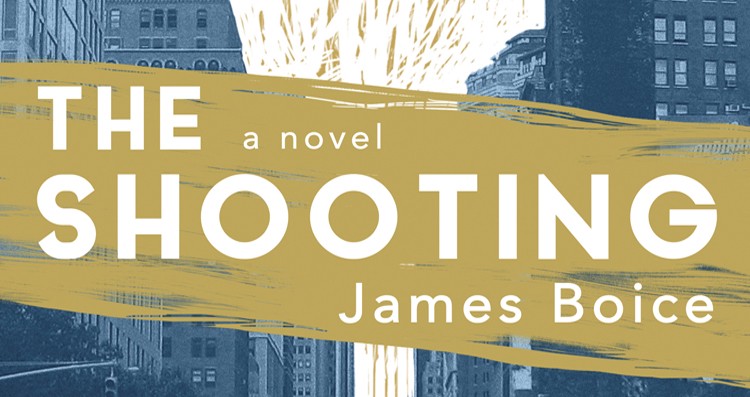
The reason I bring this story up is that I am tempted to put my copy of James Boice’s stunning novel The Shooting in the mail to my friend and ask him what he thinks. The Shooting (Unnamed Press, $16) is not perfect, but it’s been a long time since I’ve read a novel as powerful, angry, courageous, and messy as this one. Boice has no time for polite debates or liberal hand-wringing or timid vignettes of domestic life; he goes straight for the raw beating heart of gun violence in America, and the result is a novel of piercing power and unforgiving vision.
“The Shooting tracks the tragic intersection of two lives.”
The Shooting tracks the tragic intersection of two lives: of Clayton Kabede, the brown-skinned teenage son of a hard-working immigrant couple, and Lee Fisher, a reclusive gun-rights advocate. When Fisher shoots Kabede dead late one night when the latter has unwittingly trespassed onto his apartment, it sets in motion a whirlwind of recrimination, protest, and racial unrest that feels wrenchingly familiar in these convulsive times.
Described this way, The Shooting sounds like a straightforward piece of advocacy disguised as fiction but the reality of its author’s accomplishment is much more nuanced and impressive. Boice, who despite his youth is the author of three previous well-received but little-read novels, is almost preternaturally gifted; his prose has a fluid intensity that is often hypnotic, and his way of inhabiting the interior lives of his characters is unsettlingly accomplished. The Shooting is full of ugliness and pain, but it is the work of a romantic at heart―of a man who believes that people can find their way, however haltingly, to grace.
With this mixture of cruelty and tenderness, The Shooting reminds me―and this is guaranteed to piss everyone off―of Jonathan Franzen at his best. It also feels to me, weirdly, like a verbal 21st-century updating of Robert Altman’s great, sprawling film Nashville―another freewheeling narrative that careens towards a violent denouement, and that features a rotating cast of supporting actors whose stories suddenly veer into centrality. Some of the most affecting passages of the book are the micro-narratives that spiral off from the main course of events, highly compressed excursions that read like little parables of tragedy and redemption.
“The Shooting is too passionate to be satire, and too empathetic to be propaganda.”
It is tempting to celebrate The Shooting as an example of a social protest novel, of political fiction, that often seems missing from so much of our contemporary literature, but I am not sure that is exactly correct. A lot of political fiction seems somewhat one-dimensional, either satirically exaggerated or shrilly pedantic. The Shooting is too passionate to be satire, and too empathetic to be propaganda. It is equally tempting to view it as simply a terrific novel that happens to be about a hot-button political issue. In the end, I think, neither is exactly right.
The reason is that Boice is able to endow all of his nearly all of his characters with a well-rounded presence and reality. Fisher is ostensibly a monster, a man who kills a teenage boy with no remorse whatsoever, but at times he is also rendered understandable, even sympathetic; it’s entirely possible my friend from Pennsylvania might consider him, without a shade of irony, the hero of the novel. Boice has managed to make his mental landscape fully inhabited. Similarly, the gun-rights activist Jenny Sanders, whose life work is the repeal of the Second Amendment, is depicted as an unbalanced and manipulative zealot who regards even fellow gun-death mourners as tools to be used and discarded.
About the only people who are not given deeply rounded portraits―and I think that this, along with the African American argot Boice attempts to reproduce in the section narrated from Clayton’s perspective, is a mistake―are the immigrant family themselves. Theirs is the only experience that flattens out. It’s a minor failing, and one that is perhaps even necessary for the novel to function as the exquisitely-tuned yet unflinching look at the dark heart of America that it is. When Fisher finally goes to trial, the prosecutor mocks his western accent, saying, “are you sure the kind of guy you are? A cowboy?” Fisher responds:
―Yessir.
―But that kind of guy’s not real, is he? He’s never existed. He’s a myth, isn’t he?
Lee’s answer is immediate but calm.―He ain’t a myth. He’s real.
A remarkable government effort to make reading a fundamental part of the country’s culture
Forget the towering skyscrapers, luxury hotels, and beaches — the United Arab Emirates has a new reason to be the object of global envy. According to the Guardian, Vice President of the UAE, Sheikh Mohammed bin Rashid al-Maktoum, has implemented a groundbreaking initiative which requires government employers to give workers an allotment of free time for reading. The books must have some value related to the workplace or personal growth, but the mandate reflects a national effort to make literature and reading a mainstay of their culture.
The law also has implications for the UAE educational system. When their youngest citizens are still in diapers, a “knowledgeable briefcase” will be bestowed upon them. It will act as a sort of reading bag, where children can collect books, and the system will ensure that all reading materials are recycled or donated so that no books ever go to waste.
Sheikh Mohammed told the National, a UAE government owned publication, that, “The law will encourage the private sector to invest in the establishment of libraries and cultural centers. This will be done by providing the private sector with facilities, incentives and discounts.” The ultimate goal is for reading to infiltrate all aspects of society. There are even plans for library branches to be put in shopping centers.
The vice president has been applauded by many, but perhaps most notable was his pat on the back from novelist, Paulo Coelho. He responded to the author by saying:
“Did you know, Paulo, that in the 9th century, our region had over 100 publishing houses on the outskirts of Baghdad alone? … When its life was centered on books, Baghdad was, my friend, a beacon in the worlds of astronomy, medicine, mathematics and philosophy. Where is Baghdad today?”
Sheikh Mohammed makes a very serious point. What country wouldn’t benefit from a reading law?
Political commentators on both sides of the aisle have used up plenty of ink and screen time decrying the 2016 Presidential Election as the craziest one yet. Clinton v. Trump may very well go down in history as “the election that drove America nuts” and the campaign that definitively steered American politics off the rails and into the abyss of insanity. Truly, the rhetoric fueling this election cycle sometimes seems like it was borrowed from the DSM V.
In times like these, books are there to offer us some comfort and a little perspective. With the constant barrage of the 24 hour media cycle, it’s easy to forget that, hey, American politics has had a lot of dark moments, and we’ve dug ourselves out of deeper trenches before (see #2). We’ve made it through polarized elections (#8), and Joan Didion reminds us that every Presidential cycle seems more improbable than the last. In sum, human nature hasn’t changed, only maybe a few of us have gotten more orange.
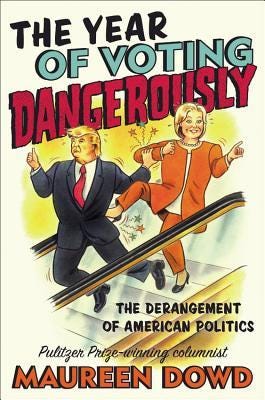
1. The Year of Voting Dangerously by Maureen Dowd
Before the victor has even been announced, Pulitzer Prize winning journalist Maureen Dowd has tackled the madness of the 2016 Presidential Election. Dowd discusses her personal history of covering both Trump and Clinton since the ‘90s and wrestles with how America ended up with two candidates boasting the lowest approval ratings ever.
2. Adams vs. Jefferson by John E. Ferling
Our current low road politics has a long and winding history. John Adams and Thomas Jefferson liked each other well enough at the founding, but despised each other by 1800. Their campaign was a ruthless collection of fear mongering and insults (sound familiar?). Jefferson claimed Adams had a “hideous hermaphroditic character.” Adams responded by calling Jefferson “the son of a half breed Indian squaw.” Ferling does an excellent job of rendering young America and showing how this turbulent election threatened to irrevocably fracture the country.
3. Political Fictions by Joan Didion
Unsurprisingly, Didion’s collection of essays takes a harsh look at how politics contribute to the demise of American morals. The pieces trace three presidential campaigns — ’88, ’92, and 2000. It includes essays on the Clinton sex scandal and the House’s failed impeachment proceedings. With acute observations and a journalistic edge, Didion scrutinizes how every election year is controlled by a small few who shape “the narrative of public life.”
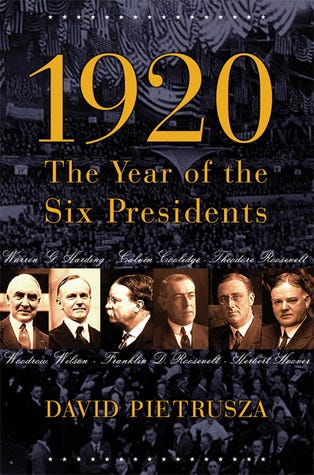
4. 1920: The Year of the Six Presidents by David Pietrusza
The 1920 election was groundbreaking for many reasons. First and foremost, women’s suffrage was ratified in August that year, which finally made it possible for the other half of the population to vote. Historically, it was an unusual election because six past and future presidents were competing for the Oval Office: Woodrow Wilson, Warren G. Harding, Calvin Coolidge, Franklin Delano Roosevelt, Herbert Hoover, and Theodore Roosevelt. Historian David Pietrusza delves into all of the different personalities and platforms that made up the dash for the White House, confirming the old adage that truth is often stranger than fiction.
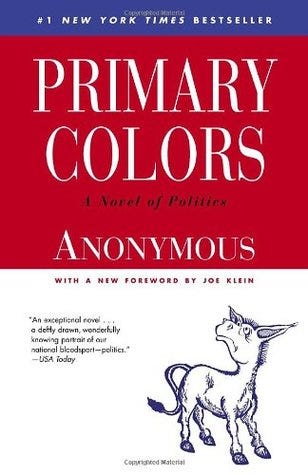
5. Primary Colors by Anonymous (later revealed to be Joe Klein)
Joe Klein’s incendiary novel was published anonymously, until speculation and handwriting analyses uncovered his identity. While the book has been presented as fiction, it’s easy to recognize the story of Bill Clinton’s 1992 presidential campaign. The protagonist, Henry Burton, works on the campaign team for Southern governor, Jack Stanton (the fictionalized version of Clinton). Burton becomes disillusioned with the governor’s two-sidedness, and is confronted with the reality of how shady presidential campaigns can appear from the inside.
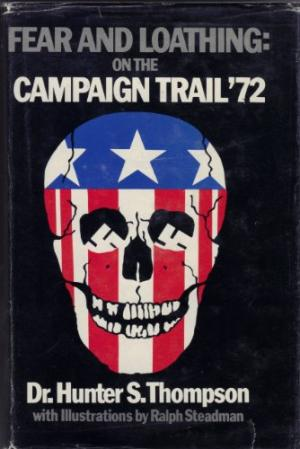
6. Fear and Loathing on the Campaign Trail ’72 by Hunter S. Thompson
Thompson’s book is a compilation of articles he originally wrote for Rolling Stone while reporting on the 1972 presidential race and doing lots of drugs. The race was between Republican Richard Nixon and Democrat George McGovern, but Thompson focuses his attention mostly on the latter. Full of wit and the usual Gonzo adventures, this one makes for a quick, wild read.
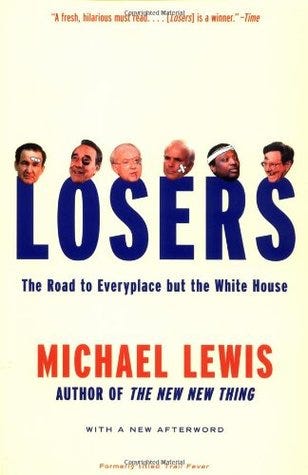
7. Losers by Michael Lewis
After the dust settles, most Americans swiftly forget about the losing candidate in the presidential election, but not Michael Lewis. The author is fascinated by what led to the demise of the six failed hopefuls in the 1996 election. In Losers, he deconstructs the political downfall of Pat Buchanan, Phil Gramm, John McCain, Alan Keyes, Steve Forbes, and Bob Dole. The title extends beyond the obvious and also contends that everyone involved in the election — from the candidates, to the media, and the voters — came away losers in some way.
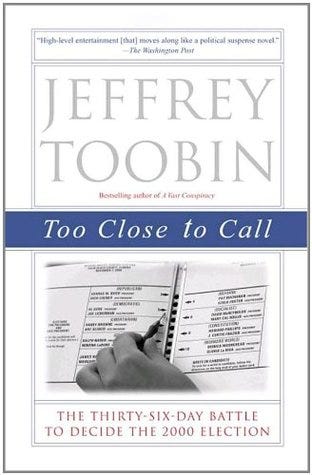
8. Too Close to Call by Jeffrey Toobin
Political and Legal Analyst, Jeffrey Toobin, uses his expert eye to assess the Bush Gore Florida recount. The incredibly close election uncovered a tangled web of political questions, in a race ultimately decided by the U.S. Supreme Court voting along apparently political lines. Might be worth taking a closer look in case Trump refuses to concede…
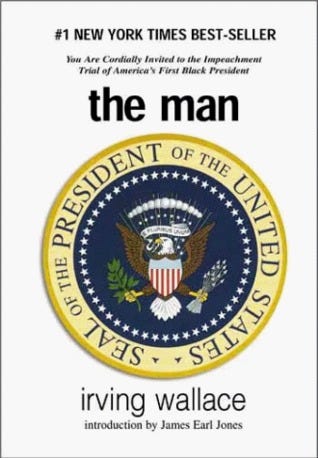
9. The Man by Irving Wallace
When Wallace’s political novel was published in 1964, it was considered groundbreaking. The plot focuses on the unforeseen inauguration of the first black President of the United States, following an accident with the former president and a chaotic succession plan that results in an obscure senator, Douglass Dilman, being named the new Commander-in-Chief. Dilman has to learn to balance his new role and family life, all while facing the pressures and difficulties of being a black president in the 1960s political landscape.
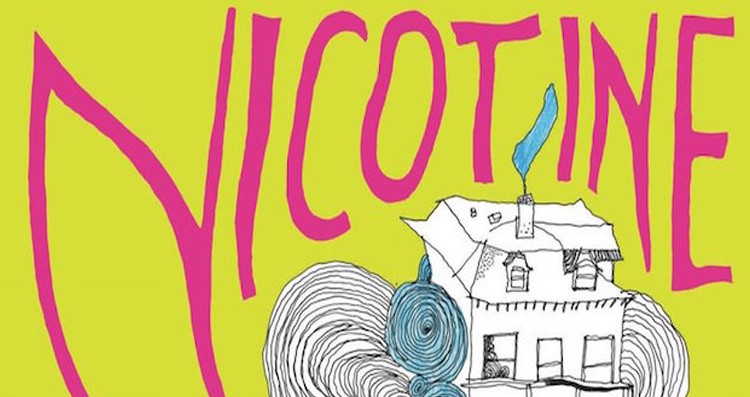
Nell Zink is back with her third novel Nicotine, a wry social commentary in which a Jersey City squat is coopted by a nefarious businessman. The squatters are forced to scatter, and rooms that were built from scavenged material are transformed into state of the art yoga and puppet making studios. The kitchen where residents prepared meals foraged from dumpsters is converted to a café with expensive drinks. In this darkly comedic feud between anarchists and capitalists, Zink lays bare how the aesthetics of idealism are appropriated by corporate opportunists and subsequently fed to an unwitting and unquestioning public. As the title suggests, this novel is both addictive and jolting before leaving a final harsh, corrosive taste.
Zink lays bare how the aesthetics of idealism are appropriated by corporate opportunists.
At the beginning of the book, protagonist Penny Baker has just graduated business school and has taken on the responsibility of caring for her dying father. Norm Baker is a spiritual leader with a cult following, but despite his teachings of openness and transcendence, Norm’s death is common. It is slow, and he is scared. Penny is overwhelmed by grief, loss, and classic uncertainty of an unmoored post grad.
The novels tone changes drastically when Penny makes a pilgrimage to visit her fathers’ childhood home in Jersey City. When she arrives she is surprised to see the word “Nicotine” in bold letters on the façade of the house. She knocks on the door and meets Rob, a resident who runs a bike coop in the garage. Rob gives Penny a tour of the house and introduces her to Sorry and Jazz. She soon learns that the squat is named Nicotine because its residents are chain smokers who resent being penned out of many public spaces. Penny, an avid smoker, decides to move in.
Matt and Rob embody two extremes: crude capitalism versus a radical denial of consumerism.
Matt is driven by desire to acquire money and power, and sees human emotion and sentimentality as weakness. Rob, on the other hand, is gentle and welcoming, and believes that community goodwill and effort can trump capitalism. These two polar ideologies butt heads and mingle in Penny, who is young and navigating the adult world for the first time. Zink notes multiple times her attention to her wardrobe: she adorns herself with bangles and flowing skirts when she goes to squatter functions, and wakes up early to clad herself in a business suit and a tight bun. She is able to try different lifestyles on for size, and her ultimate style is a patchwork of these two disparate worlds.
The scene in which the Norm Baker Center opens is perhaps Zink’s most bitingly satirical. A crowd of Norm’s followers gather to pay homage on opening night. A crossfaded Penny is called up to the stage to make a speech. She stutters before attempting to invoke the buzzwords of Norm’s philosophy. Despite the fact that these phrases come out warped and meaningless, the crowd enthusiastically repeats her chant. When the rally ends, there is a “final round of cheering and applause,” and, “in response, several people come inside to drink tap water and use the bathroom,” a comically disjointed response. Over the next few days, Rob, who has returned, witnesses “puppeteers in various stages of blissful self-delusion,” and supposed anti capitalists sipping expensive cappuccinos. The tussle between squatters and profiteers doesn’t stop there though. You’ll have to read the rest of the book to see who claims Nicotine.
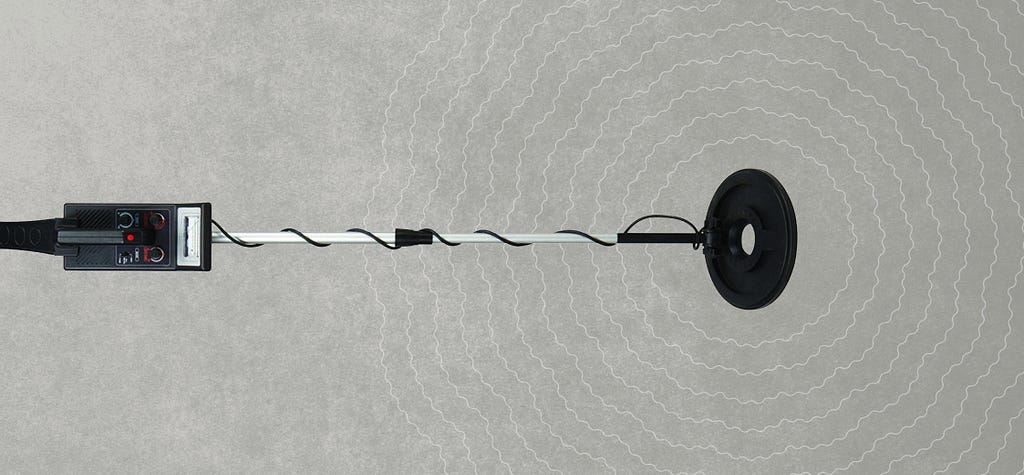
Hello, and welcome to my week-by-week review of the world. Today I am reviewing my metal detector.
I’m not sure if they still make metal detectors or not, so if you don’t know what one is, don’t be too hard on yourself. Metal detectors are basically what they sound like — machines that detect metal. You may be wondering why such a machine would exist when metal is already pretty easy to spot.
It turns out, there’s a lot of metal hidden in the ground that is invisible to the human eye because the human eye can’t see through dirt. The metal hidden underground can be anything from an old coin dropped by one of America’s earliest settlers, to an ancient sword. You never know what you’re going to find! So far about 98% of the things I’ve found have been unidentifiable chunks of rusted metal.
I’m keeping all the chunks I find to see if they can be assembled into something incredible, like a working tractor. The other 2% of things I’ve found were a coin purse I lost in my yard during hurricane Gloria in 1985. The coin purse was empty when I lost it and still empty when I found it.
Possibly the greatest thing about my metal detector is that it doubles as a tool for getting things down from high places. Or things from regular heights while laying down. Just the other day I needed to reach a box of cereal in the cupboard but didn’t feel like getting off the kitchen floor. So I used the metal detector to prod the cereal box off the counter until it tipped over and spilled all over me. A broom stick could have done the same thing, but I don’t own one of those just in case they attract witches.
I took apart my metal detector to find out how it worked and I have to say, I understand even less of it now. There’s not a whole lot to it. It’s a stick shape with a circle on the end, filled with wires and some circuits and stuff like that. I don’t know why I was expecting to understand how a machine can sense metal. I don’t even know how a toaster works.
My metal detector is a great conversation starter. Like when it detects a piece of metal — if someone is walking by — I can say, “Looks like it found something!” Or if someone sees me trying to detect metal, I can run across the park to them and if I get there before they get into their car I can say, “This is my metal detector.”
One day I know I will run out of metal to detect because all the metal will have been found. That will be a sad day for my metal detector. Without any purpose, it won’t be a metal detector. It won’t be a detector of any kind. It will be nothing. Maybe I will bury it and if someone ever invents a plastic detector, they will find mine.
BEST FEATURE: The beeping noise it makes when it has detected metal sounds just like my alarm clock. WORST FEATURE: It doesn’t work in ponds. Water just completely breaks it.
Please join me next week when I’ll be reviewing our new President, Hillary Clinton.
“I began the day wanting these essays to do more than they were currently doing,” Renee Gladman writes in her new book, Calamities. The pieces in Calamities are 1–3 page vignettes thatobsess over writing, language, place, and belonging. Gladman writes:
“[I] even had a book alongside that I thought would help me, but it turned out I wanted more from this book as well.”
More than forty of the sixty essays in Calamities start with the phrase “I began the day…” In a book that reflects on a vast and particular set of material — Eileen Myles to Friday Night Lights, Amtrak trains to faculty meetings, writing and teaching to reflecting on existential questions of being (often at the same time) — the technique of recurrently returning to the literal morning stabilizes the book while also allowing it to re-boot every few pages. “I began the day having given myself the task of compiling a list,” Gladman writes, and, “I began the day wandering the streets of the small city where I live,” and, “I began the day in a fog that cleared before I’d gotten the chance to write about it… I thought, ‘This is an essay,’ then looked up to take it all in.”
Gladman is an Italo Calvino for the 21st century.
The pieces in Calamities are meta-nonfictional. They often inspect the process of writing — the terror and bliss, the struggle of using language to represent anything — and they critique the struggle of creation as they enact it. Gladman writes, “I began the day wanting to fold the previous essay into this new one,” and the reader would think she means it in a metaphorical sense. But then she writes, “I had learned just after writing it that it was possible to make beautiful, complex structures with paper and you did not need to be an architect to do this…. As morning became night, I forgot to get up and do anything that was not about folding paper.”
Gladman is an Italo Calvino for the 21st century. In the spirit of Calvino’s Invisible Cities, Gladman’s most recent books featured a “linguist-traveler” who was learning about the elusive city-state of Ravicka. In the spirit of Calvino’s If on a winter’s night a traveller, Gladman’s narratives often self-interrogate, and double back on themselves to readjust. Six Memos for the Next Millennium was a series of Calvino’s writing lectures he wrote to deliver at Harvard. Gladman wrote many of these essays on writing while she was a Radcliffe Fellow — at Harvard.
But while the reflections in Six Memos are self-confident — conjuring ancient Greek, and anticipating the next millennium — Gladman is left in wonder in regard to her obsessions with writing. In one essay, she shouts to her departing poetry class, “Read the nothing!” as she unsuccessfully tries to summarize a strange thought she has about the poet ED Roberson, and grids. In another: “I couldn’t understand why my days unfolded the way they did and why they took me away from writing.’” And, “I began the day thinking that writing was becoming a thing of the past as my fondness for Rollerblading was though in my time of writing and my time of Rollerblading–and these did sometimes overlap — I was far better at the former than the latter.”
One of the recurring threads in Calamities is the sense that Gladman has trouble fitting in. For example, as a black experimental writer who publishes with small independent presses, a writer like Gladman hasn’t traditionally been represented in the academy. Yet Gladman attended Vassar College. She taught at Brown University. She was a Radcliffe Fellow.
In one essay, Gladman doesn’t know when she’s allowed to enter a department faculty meeting. “A senior member opened the door and thought it would be a good time to play a joke on me, saying you can’t come in here.” Gladman writes. “I didn’t think it was funny, since often I can’t attend meetings.” In another piece, she begins the day reflecting on the “university level,” and contemplates a surreal journey with a car that keeps running out of gas, a series of gates, and eventually nothingness. “No food came; no one screamed down to say hello.” In one chapter, she gets fired. She obsesses over the University president’s use of the phrase “slam dunk.” As in, the president, the provost, and some other men at the university level, had not found Gladman to be a “slam dunk.” She leaves, obsessing over the phrase. It clangs through her dreams.
[Of the many recurring threads in Calamities] is the sense that Gladman has trouble fitting in.
But in addition to a sense of alienation — in regard to writing, community, being a body in space — Gladman’s essays are also full of strange joy. “I found that I liked to be bossed around in resort conditions,” she says of a near-unprecedented vacation she takes with her mom and sister. “You can be sunning on the beach, drifting in and out of sleep, and at any moment the tall robust captain might stand over you and command you to do something. It was exhilarating to be told it was time to dress for lunch or that I needed to put away the Snickers.”
In Gladman’s struggle to fit in, to write, and to convey meaning, Calamities unfolds as a series of days that in many ways fit under the category of this book’s title. But Calamities is a book on writing that embraces the chaos and uncertainty of creation.
There’s joy in the madness, and Gladman knows where to find it.
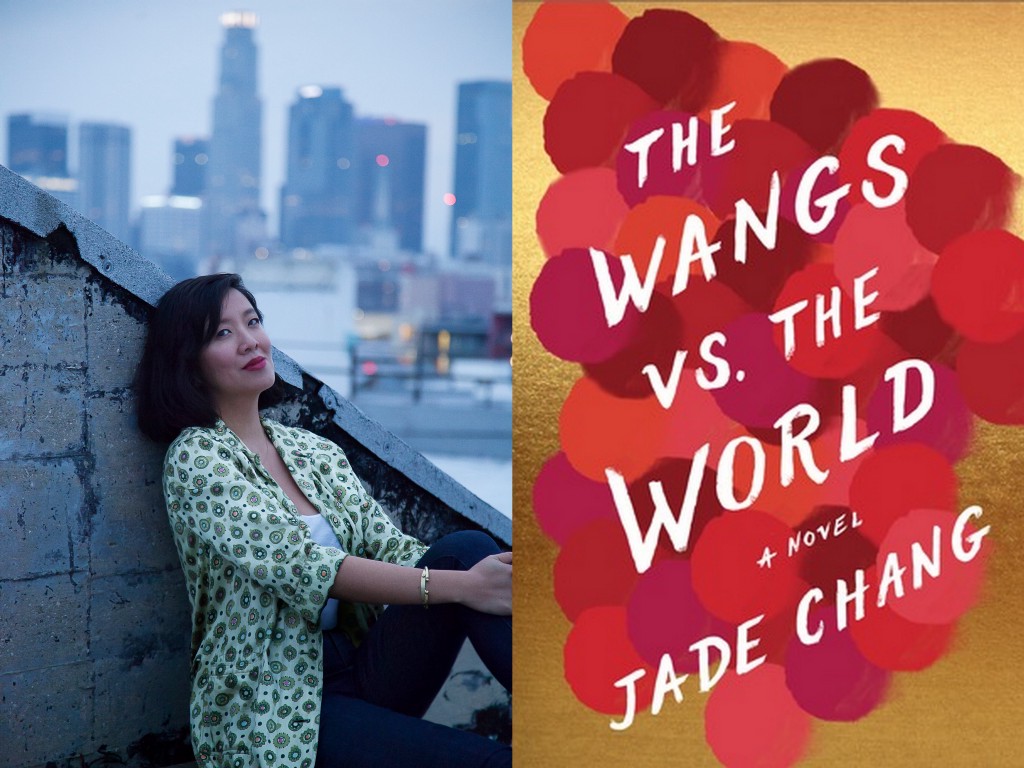
In The Wangs vs. The World, Jade Chang tells the story of Charles Wang, a Chinese immigrant in L.A., by way of Taiwan, who makes a fortune in the cosmetics industry, only to lose it all in the 2008 financial crash. The Wang children are accustomed to a rarified Bel-Air lifestyle and the sudden disappearance of their inheritance — not to mention their designer clothes, cars, and schools — comes as a shock that they’ll have process over the course of a family road trip from California to Upstate New York.
The “road trip” and the “immigrant story” are two favorite genres of American story-tellers; as such they come with certain expectations on the part of the audience. That’s why it’s impressive to see Chang, a debut novelist, embrace these archetypes only to spin them on their heads. She refuses to play to the idea of immigrants as alienated outsiders. The Wangs are worldly, funny, and big-hearted, even as they face disillusionment at the reality of the American dream. I spoke with Chang at a coffee shop in New York and she told me about her research process, her love for her characters, and what she learned by working at a luxury magazine.
Carrie Mullins: I feel like the first lines of the novel set up so many of its themes: “Charles Wang was mad at America. Actually, Charles Wang was mad at history.” What made you decide to start there, with this question of who or what to blame for our circumstances?
Jade Chang: You know, growing up you hear so much about how World War II changed the course of history, how it just flipped everything around. And when I was a kid, I read so many World War II novels, so that thought must have been buried in my consciousness: fuck history, how did the outside world just walk in and toss everything around and tear it all apart? I might have been living this other life. As a child of immigrants, you think of the other life you could have been living, if things had gone a slightly different way. I think it came from an awareness of that.
CM: This is a story about a wealthy family who goes bankrupt. They’re used to this rarified lifestyle, with walk-in closets and designer watches. Of course your readership is all post-crash. Did you think about having to bridge the experience of the average American reader with that of the Wangs?
JC: When I first started thinking about this book, there wasn’t that same kind of animosity towards the wealthy. I wanted to write something that felt fun and delicious and kind of glamorous. But as I was writing the book, I was also seeing what was going on in the wider world. I was working at a luxury magazine that basically taught rich people how to spend their money. I also became more and more aware of all these predatory lending practices, all these financial issues, so I started to think, how do I write these characters in a way that is understandable? I feel like whenever I write anyone, I adore them, while I’m writing. Even if they’re doing something dumb or reprehensible, I still feel this affection. I was really interested in peeling back emotional layers in characters. We’re all human and when you really understand someone’s basic desires and fears and hopes and dreams, you can feel an empathy for them, no matter who they are.
CM:So did your knowledge of the crash come through the osmosis of living through it, or did you go back and do research?
JC: I’ve weirdly always loved reading the business pages, and I’ve always found writing about finance to be interesting. Because if you really think about it, money is the most abstract thing possible. It’s this essentially worthless thing that we decide is worth a particular amount. I read a lot of nonfiction books about the crash. I was working at that magazine, so I definitely got to see a lot of the immediate outcomes of the crash.
CM: It’s interesting you paired the story of “wealthy family falls from grace” with the immigrant narrative because those two don’t often go hand-in-hand.
JC: I wanted to write something that was over the top and fun while still being fairly serious at its core. I really wanted to write an immigrant novel that gave the big middle finger to the traditional immigrant novel that we see in America. I didn’t want to write about the Wangs like they were outsiders, like all they’re trying to do is fit in with society. I think you see that novel a lot. For whatever reason, the publishing industry loves to put forth that narrative. In TV shows and movies you see it a lot as well, and it’s not the only way to be an immigrant or a person of color. I didn’t grow up with money like the Wangs but I grew up in a mixed area and I never had that experience like, oh my god, I’m such an outsider in this country. And it was really important to me to centralize this perspective. But honestly it was less political and more like this is fun, you know?
I really wanted to write an immigrant novel that gave the big middle finger to the traditional immigrant novel that we see in America.
CM:Speaking of being a child of immigrants, in the book it’s not just America that is idealized and falls short, it’s also China.
JC: I’m glad you caught that. I think that it’s such a driving force for Charles— all he wants now that he’s lost the fortune in America is to go back to China and reclaim the life he feels is rightfully his. I like a book that has a compulsive force that pushes things onward, so that worked as something for Charles.
That first chapter still exists basically as I wrote it so many years ago. That anger, that joy, that drive, all those things were ways that I wanted the book itself to feel, and they definitely came to me in his voice first.
CM: He plays against stereotypes a little, because people expect rich men to be a certain way. Were you conscious at all of playing against those clichés?
JC: I really just thought about a person, like a full fledged person. I’ve met really wealthy men, they’re my friends’ fathers, I’ve interviewed them, and they are complex. Some are exactly the cold assholes who care about propriety and acquisition and very little else, but so many of them are all different things at once.
CM: Totally, though I feel like readers can actually get mad when you stray from those boxes, they’ll be like, “Oh, this doesn’t ring true.”
JC: Yeah, it’s interesting. I’m not a huge fan of workshopping my novel in progress, but I went to Squaw Valley, to a weeklong writing workshop, and I brought the first chapter of the book. It was really interesting, most people in the workshop were really into it, which was great, but there were a few people who were like, “Would a Chinese immigrant have these thoughts? Would he be able to articulate them?” It was fascinating… and offensive. To be clear, it was only one or two people, but it was really fascinating to me that other writers were like: we can’t see the possibility of someone slightly outside our usual experience existing. It’s sad.
You’ve written before about the importance of community building in the writing world, so I thought you might be able to help me with my dilemma. Like more than a few of your readers, I am chronically ill. My level of energy, and ability, waxes and wanes. When I’m having a good day, I try to earn some money; when I can, I write. But I don’t find myself with a great deal of energy for praising the work of others, or engaging too profoundly with social media (don’t have the strength or spirit to tweet all day long, for example).
Since my handicap prevents me from socializing in person, except on rare occasions, I find myself feeling resentful. I’ve had some ability to publish but not very much. I send out a good deal of work, but I’m certain that if I was healthier I’d be able to shake more hands, feel the energy to devote to professional friendships, and learn more about the larger writing world.
I grow discouraged. No doubt readers with significant disabilities (blindness, deafness, clinical depression, anxiety) will see themselves in my story. Working professionally at any level is difficult. Writing is difficult. Add community building on top of that and … well, it all seems like a game for the healthy and energetic.
How do you think I should look at my situation differently? Or shouldn’t I? Ought I to just accept that, absent the strong community ties that put publishing within the reach of so many, I’m simply bound to obscurity? Or is there a secret door somewhere I’m missing?
Yours,
A Devoted Reader
Dear ADR,
I sympathize with your situation. I believe community has numerousbenefitsfor writers, but finding one isn’t necessarily easy. Like other parts of the writing life (actually writing, editing and revising, sending out your work, and so on) community building takes a lot of time and effort and can take a long time to pay off. It’s the long con that’s not a con.
If you live in a small, non-literary town or for any reason can’t leave your house much, social media is a great alternative to IRL local communities. But as you say, it still takes time and energy.
Social media is a double-edged sword — yes, it offers community and provides access to writers (and editors, and agents) you admire. But it also fosters competition.
Further, social media is a double-edged sword — yes, it offers community and provides access to writers (and editors, and agents) you admire. But it also fosters competition. The more writers you follow, the more you’re confronted with other people’s success; it’s hard not to compare yourself and feel rejected and discouraged at least some of the time.
Because you have a chronic illness, my advice to you is different than it would be for just any writer. I’ll suggest two different paths you could take that I think could improve your situation.
The first path would be to specifically seek out communities built by, for, and of other writers dealing with similar challenges. To name a few examples:
Deaf Poets Society is a literary magazine devoted to work by people with disabilities (not just the deaf). (From the first issue’s editors’ note: “As founding editors — and as sick and disabled poets ourselves — we’ve set our sights on building a platform to amplify the voices of our fellow crips. This issue is our first go at achieving this goal, and we hope that it cracks that proverbial ceiling of beliefs about the disabled body. To say the least, we found reading work from every poet who submitted a challenging, critical process — and, above all, as a gift to ourselves and our community.”)
We Need Diverse Books is a grassroots org that promotes diversity in children’s books, defining diversity as “including (but not limited to) LGBTQIA, Native, people of color, gender diversity, people with disabilities, and ethnic, cultural, and religious minorities.” They recently published a roundtable discussion on perspectives of authors with disabilities.
The Mighty is a community platform where people living with disease, disability or mental illness can share stories. They also have a Facebook group.
This is just scratching the surface. You can also search social media sites and blogging platforms (especially social platforms like Medium) for likeminded writers and readers that share a similar illness or disability. By changing the makeup of your community, you may feel less that community is “a game for the healthy and energetic” and more that it’s a way to make friends you can actually relate to and who might offer encouragement.
The second path would be to distance yourself from social media. Yes, community has value, but it’s not actually a requirement; there are successful authors who avoid social media (and the social world) entirely. And connections are hardly a guaranteed route to publishing. You may find that you’re less distracted and more focused — especially important when your free time and energy are limited — when you get away from social media.
If you go down this path — really, either path — it’s important that you give yourself a break and come to terms with the likelihood that success will take longer for you than for someone in perfect health, all other things being equal. And that’s okay. I mean, it sucks, and it’s not fair, but it is actually okay*. As writers we put a lot of pressure on ourselves to publish faster and more frequently. But most of the time, the buzz of getting something published is short-lived, and people move on to the next thing quickly. (Often, we’re not comparing ourselves to a single other writer but all writers everywhere at once, which is why it feels like we can’t possibly keep up.)
Think about the last great book you read — do you care how old the author was when they wrote it or how frequently they publish new stuff? I don’t. If anything I’m more inspired by authors that take decades to finish a book, or that don’t find success until later in life. My hope for you as a writer is that your ultimate goal is to connect with readers. If it takes longer to make your work as good as it can be and then to find the right publisher, then let it take longer. There’s no deadline for writing a great book.
*I should clarify that it’s not okay if you’re actively being discriminated against by editors, but I don’t get the sense that’s the problem you’re having. As a side note, if you’re submitting work to a publication whose editors specifically say they’re looking for work from disabled (or “diverse” in general) authors, consider mentioning your illness/disability in your cover letter. On the other hand, there is of course no need to disclose this information if that makes you uncomfortable.
These poems, while different in style, play between place and displacement. What can you tell us about the relationship between the “ghost thing” poems and “DEAR ESCAPE ARTIST?”
My work is often focused on place and haunted by displacement. The earliest poem here “Out at Coney Island” is set in New York but preoccupied with a past that’s set in Prague; the “ghost things” are preoccupied with New York but slide around in time and space; and DEAR ESCAPE ARTIST is set in New Orleans but preoccupied with absolutely anywhere else.
What has the reception been for these poems when you’ve shared them or read them aloud?
One time I read all of the “ghost thing” poems-in-progress (there were about 12 of them then) at a karaoke bar and a woman in the audience heckled me. I was explaining that I’d been writing the poems for a couple of years but I couldn’t work on them too often because I have to cultivate this deep self-hatred to get to that voice, and I couldn’t stay there all the time. “Yes you can,” she kept yelling, “yes you can!” It was terrifying.
Both poems offer us semi-mythic figures: the escape artist, the ghost thing. Are they two sides of the same coin?
The escape artist is more of a person, although absent, where the ghost thing is stupidly, terribly present, but pretty abstract. Both the ghost thing and the escape artist allow the speaker to throw their feelings away from themselves, though. (The ghost thing tends to boomerang whereas the escape artist manages paper airplane distances.) The escape artist voice felt like something of a departure in my work, particularly because I’d been focusing on translations and erasures for a year and a half, but the other day my workshop pointed out to me that DEAR ESCAPE ARTIST and the ghost thing poems share an urgent, direct address to a shifting other.
Where can a curious reader find more of your work?
DEAR ESCAPE ARTIST is a collaboration with my artist friend Sara White featuring loose ink drawings alongside the poems; it’s due out November 15 from Antenna. The poems featured on Okey-Panky were the first I wrote in the series, although they’ve changed considerably as the concept grew into 18 poems, covering a wide range of topics such as insomnia, zen, sinkholes, and shrimp. DEAR ESCAPE ARTIST will be available soon on Antenna’s website. In addition, you can find links to other online publications on my website.
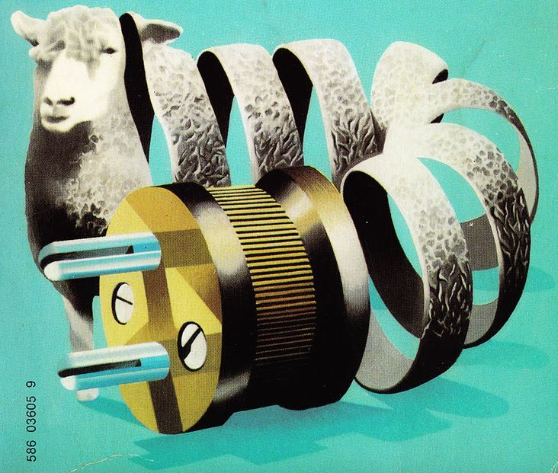
It’s time to have some fun! While I greatly enjoyed Iris Murdoch’s magnum opus The Sea, The Sea, it would be an exaggeration to say that the book entertained, exactly. Edified, perhaps. Enlightened. But “entertained” comes on too strong. So I am counting on Philip K. Dick to do me a solid and put the “wheee!” back in “reading.”
I mean, the movie was a barrel of monkeys, after all.
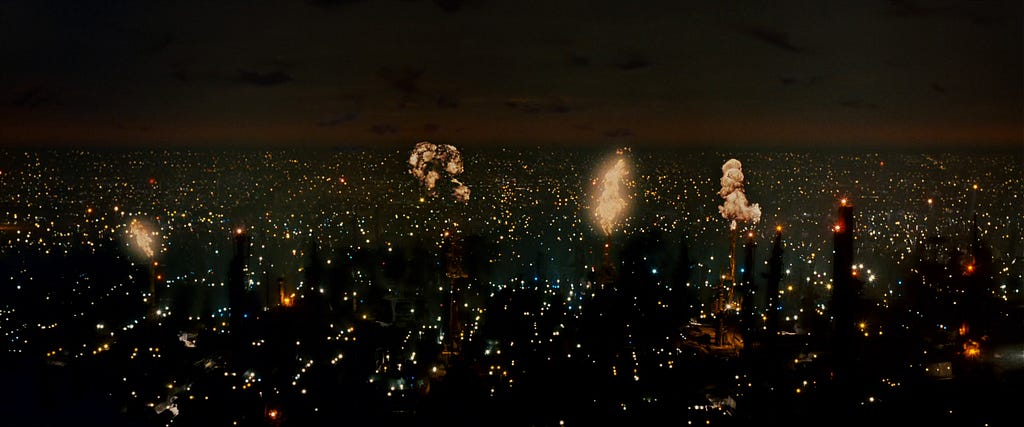
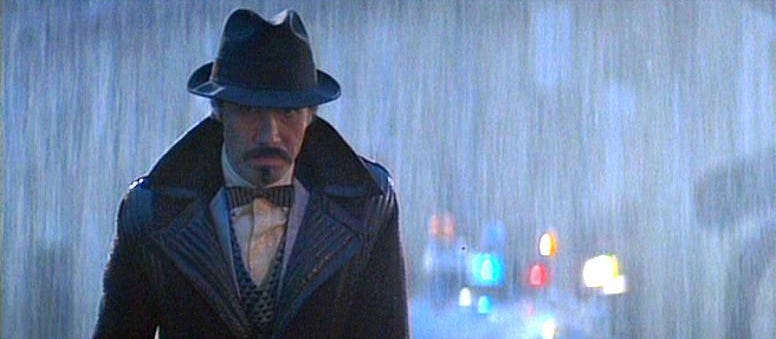
Yes, I know the movie and the book barely resemble one another. (Any more than the sure-to-be mediocre movie sequel will resemble the greatness of original. But I digress.) And while Blade Runner is maybe my favorite film of all time — I own like two DVDs these days, and one of them is the Blade Runner: The Final Cut — for whatever reason, I’ve only read the book that inspired it all once, some years ago. Worse yet, it was a pirated ebook (sorry, estate of Phillip K. Dick) that I read on my original white Kindle, replete with typographical errors, weird squiggles, and non-existent paragraph breaks. Worse still, I read Do Androids Dream of Electric Sheep? in one sitting while working pretty hard on a bottle of bourbon in a hotel room in a strange town several time zones away from home. Thus my comprehension levels were not, shall we say, quite where they ought to have been.
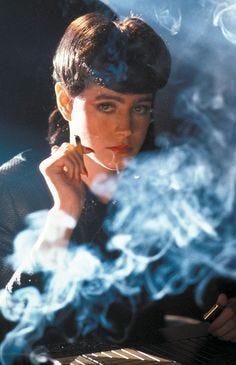
What I remember is a story that reproduced, amplified, and exploded all those old noir tropes. Grizzled PI? Check. But with lasers. Vicious villains? Check. But they’re androids. Criminal androids, people. A femme fatale? Check. But she’s also an android.
Perhaps a bigger fan of sci-fi and fantasy than myself doesn’t end up so mesmerized by such a glossy and grim reworking of the old tropes. But they catapulted me into a world where everything old was new again, and I could once again be thrilled with a PI chasing the bad guys down dark city streets.
All of which is a roundabout way of saying that I don’t really recall much of the book’s substance. Now, as I discussed last month, that’s also the case with, well, almost every other book, I’ve ever read, but those were owing to the normal tug and pull of memory and forgetting. Do Androids Dream of Electric Sheep? has persisted in memory in grim defiance of the obliterating effects of alcohol, which makes me wonder, slightly, if I’m not confusing the movie and the book.
After all, how many books do you think you could keep concentrating on through an ever-thickening bourbon haze, and actually finish? I’d wager 1 in 20. 1 in 50, maybe. (Hey, this sounds like a great scientific experiment. Someone about 15 years younger than me should try it out.) About halfway through a bottle of Jim Beam alone in a hotel room, SportsCenter or whatever dumb movie is playing on TBS start sounding like great options, right after you order in some Domino’s. Reading is freakin’ hard when you’re in that state, and I’m not even talking about the part where the words get blurry.
My original idea was to attempt to recreate that original reading with a fifth of Jim Beam, but wisdom precludes that possibility. You don’t make it to forty without learning that the hangovers hurt a lot more than they used to, and that with small humans in the house that depend on you, you simple aren’t allowed to be surly and hungover for a whole day following your little fiesta.
Instead, I’m going to plop down in my favorite reading chair with a glass of homebrewed hard cider. Maybe I’ll have two. If I get lucky — by which I mean, if none of the small humans in the house require care or maintenance and if I can manage to stay awake long enough — I’ll finish in one sitting again.
Besides wanting to re-read the book that inspired the fantastical movie, I’m curious to see if it’s even possible to enjoy a book sober that you loved while drinking. Also, this time I’ve got an actual paper copy, with real pages and correct typography and everything.
What I really hope is that Do Androids Dream of Electric Sheep? proves to be as hypnotic on a re-read as it was the first time around. Because in this installment I’ve talked far too much about bourbon and reading on bourbon, and said virtually nothing about the book itself. Time to get that rectified.
AFTER READING:
I said it once already but damn, Do Androids Dream of Electric Sheep? really is nothing, nothing at all, like the movie. Though inextricably intertwined, the two are different enough that we’re not only talking about two different media, but two different stories with entirely different aims. Blade Runner, for all its gritty darkness, exists to entertain, while perhaps doing a bit of philosophizing along the way,
It’s too bad she won’t live. But then again, who does?
and poeticizing,
featuring the most fatale-ist of femme fatales.
Do Androids Dream of Electric Sheep?,on the other hand, serves an entirely different purpose. Philip K. Dick’s oddly lumpy prose weaves a fictive dream strong enough to alter the qualities of your own known world. Replete with all the set pieces of pulpy science fiction — the flying cars, the laser tube, the weird religion (what the hell is Mercerism all about, anyway?) — while twisting and subverting the standard tropes of noir fiction. Read it, read it, read it.
“I love you, Rachael said. “If I entered a room and found a sofa covered with your hide I’d score very high on the Voigt-Kampff test.”
The Voigt-Kampff test, of course, is the empathy test that the Rick Deckard, android hunter (the term “blade runner” appears nowhere in Do Androids Dream of Electric Sheep?), to determine if his subjects are human or not. The test measures empathy, an emotion androids are incapable of:
“You’re reading a novel written in the old days before the war,” [Deckard said.] “The characters are visiting Fisherman’s Wharf in San Francisco. They become hungry and enter a seafood restaurant. One of them orders lobsters, and the chef drops the lobster into the tub of boiling water while the characters watch.”
“Oh god,” Rachael said. “That’s awful! Did they really do that? It’s depraved! You mean a live lobster?” The gauges, however, did not respond. Formally, a correct response. But simulated.
Rachael, of course, is an android. A Nexus-6 model, to be precise. The most sophisticated android ever designed, yet still incapable of feeling the fundamentally human emotion of empathy. But, Dick asks, can you love without empathy? The book isn’t exactly sure, but it certainly hints at the possibility when Rachael claims to love Deckard, citing the example of how she’d feel seeing his flayed flesh on display.
Later on, Rachael tosses his goat — a real, live goat, not an android reproduction, very expensive, very rare — from the roof of Deckard’s apartment building, so perhaps she didn’t really love him all that much, after all. Or did she simply love too much? That’s only one of the delicious mysteries Do Android Dream of Electric Sheep? leaves for us to ponder.
I’m not a fan of books that bludgeon us with dazzling philosophical insight, cloaked perhaps with a light drizzle of plot frosting.
Not naming names, but …
It’s far, far superior when the plot bubbles the philosophy to the surface, creating seeming paradoxes and blazing insights that force us to re-evaluate what we thought we knew. Take the strange quasi-religion of Mercerism that Dick created, wherein one grips an “empathy box” to commune with a strange prophet climbing a hill like Sisyphus while rocks are hurled at you. Sort of makes sense, if you think about it. After all, what would a post-apocalyptic world need to heal? The opposite of what brought on the apocalypse in the first place: human empathy.
All this makes you wonder, are we really so different from the androids? Aren’t we just thinking boxes that seem to experience empathy? How often do we really, truly walk a mile in someone else’s shoes? Do we ever really connect with our fellows? Maybe we just beam signals at each other from our respective solipsistic ships, responding to elaborate stimuli in an ever-more intricate dance?
Do Androids Dream of Electric Sheep? does offer a partial answer to these questions: in the end, what trips the androids up, despite their superhuman strength and intelligence, is that they can’t care about one another. Deckard knows this, and hunts them down one by one. He murders them without mercy and uses his bounty to buy a real, live goat. Which, as you know, the android that says she loves him proceeds to kill. (What a strange, magnificent plot!)
Then, the book closes not with his successful android hunt, but with a Jesus-like pilgrimage into the post-war wasteland of northern California. But unlike Jesus or the saints, Deckard attains no great insight in the desert. All he finds is a toad. Which would be a remarkable find in a world where nearly all wild species have been killed off, except the toad, too, turns out to be an android. The world snaps shut on us all in the end.
Which, I think, is just what makes Do Androids Dream of Electric Sheep? so mesmerizing. Its self-referential circle swallows itself whole; you can’t accept the world it creates without accepting the world you’re in.
Like this.
And if that sounds a touch too precious, like a Zen koan painted on a kid’s woodblock from Pottery Barn on the mantle over your great-aunt’s fireplace, I can only say that’s because I’m no Philip K. Dick. I cannot quite describe the alchemy by which he achieves his effects. This was true when I read the book while quaffing bourbon on a hard hotel chair; it’s true while I read it stone-cold sober in my favorite easy chair. Once I started, I couldn’t even drag myself over to the fridge to pour myself a hard cider.
Hoary as it seems to say it, Philip K. Dick is inviting us to consider the nature of being human. To go back to Rachael’s formally correct but simulated answer about the boiling lobster. If being human really means to empathize with the suffering of others, then how can we boil lobster alive to enjoy as a delicious, if high-maintenance, dinner?
In college I worked in a Cajun restaurant. Every year around Mardi Gras we’d get in a huge shipment of live crawdads (I don’t care if they call them “crawfish” in Louisiana; where I come from, they’re crawdads). Once I watched the chef drop vats of live crawdads into boiling water. They made a horrific squealing sound when they got dumped in. “Just the shells cooking,” the chef said. I wasn’t so sure it wasn’t a chorus of pain, but all the same, it’s not like I intervened. In fact, I don’t remember feeling even the slightest twitch of empathy.
And yet, no one who wasn’t a serial killer would toss a puppy into a boiling pot. As humans we respond to a puppy’s face, it’s big black eyes and yelps. Lobsters look like fishy bugs with no feelings. Even though recent research indicates that it’s highly likely that lobsters (and presumably crawdads) do feel pain, we eat them anyway. Meanwhile, puppies whimper and lick our hands and we give them names. Like Denis Leary once suggested, we should just line all the animals up for auditions. The otters, who swim around and do cute little human things with their hands, get a pass. The cows, who make baseball gloves and hamburgers, go to the slaughterhouse.
With a stop here first
It all comes back to the old Buddhist dodge — even though the Buddha forbade the killing and eating of living creatures, Buddhists everywhere chow down on dead animals. As any good Buddhist will tell you, it’s okay, because someone else did the killing.
Not that I’m picking on Buddhists. We all do it, one way or another. There’d be no civilization if we didn’t. Humans are natural born killers like the tiger or great white shark. We’ve just learned to farm the messy parts out to other people and, at times, machinery.
But Philip K. Dick is over here in the corner, reminding us that to be human is to feel empathy.
If selectively.
DOG-EAR REPORT:
Can’t set the scene much better than this:
In a giant, empty, decaying building which had once housed thousands, a single TV set hawked its wares to an uninhabited room.
Philip K. Dick is a master of the minor detail that signals we’re in a majorly different world. For example, in this scene, when Deckard finally has the femme fatale alone in a hotel room. Does he bend down to kiss her? Yes, but:
Bending, he kissed her bare shoulder.
Why her shoulder instead of her lips? I don’t know, but it works to perfection. And this is why you and I are you and I, and he’s Philip K. Dick.
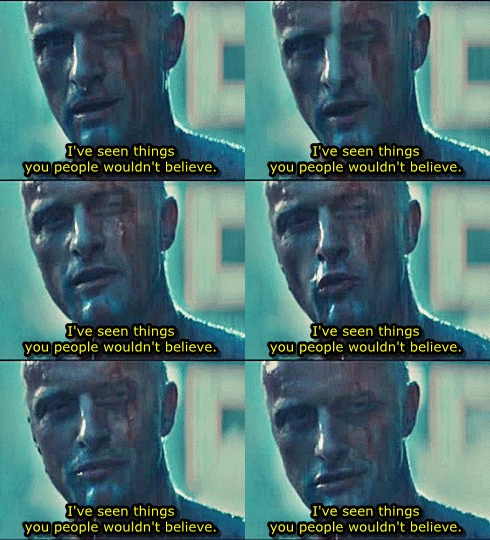
I bet this is the line Rutger Hauer read over and over again, preparing for his role as Roy Baty in the film version:
Roy Baty entered, somber and large, smiling his crooked tuneless smile.
Sign up for our newsletter to get submission announcements and stay on top of our best work.
YOUR INBOX IS LIT
Enjoy absorbing fiction from Recommended Reading on Mondays, strange, diverting work from The Commuter on Wednesdays, and a roundup of our best work of the week on Fridays. Personalize your subscription preferences here.