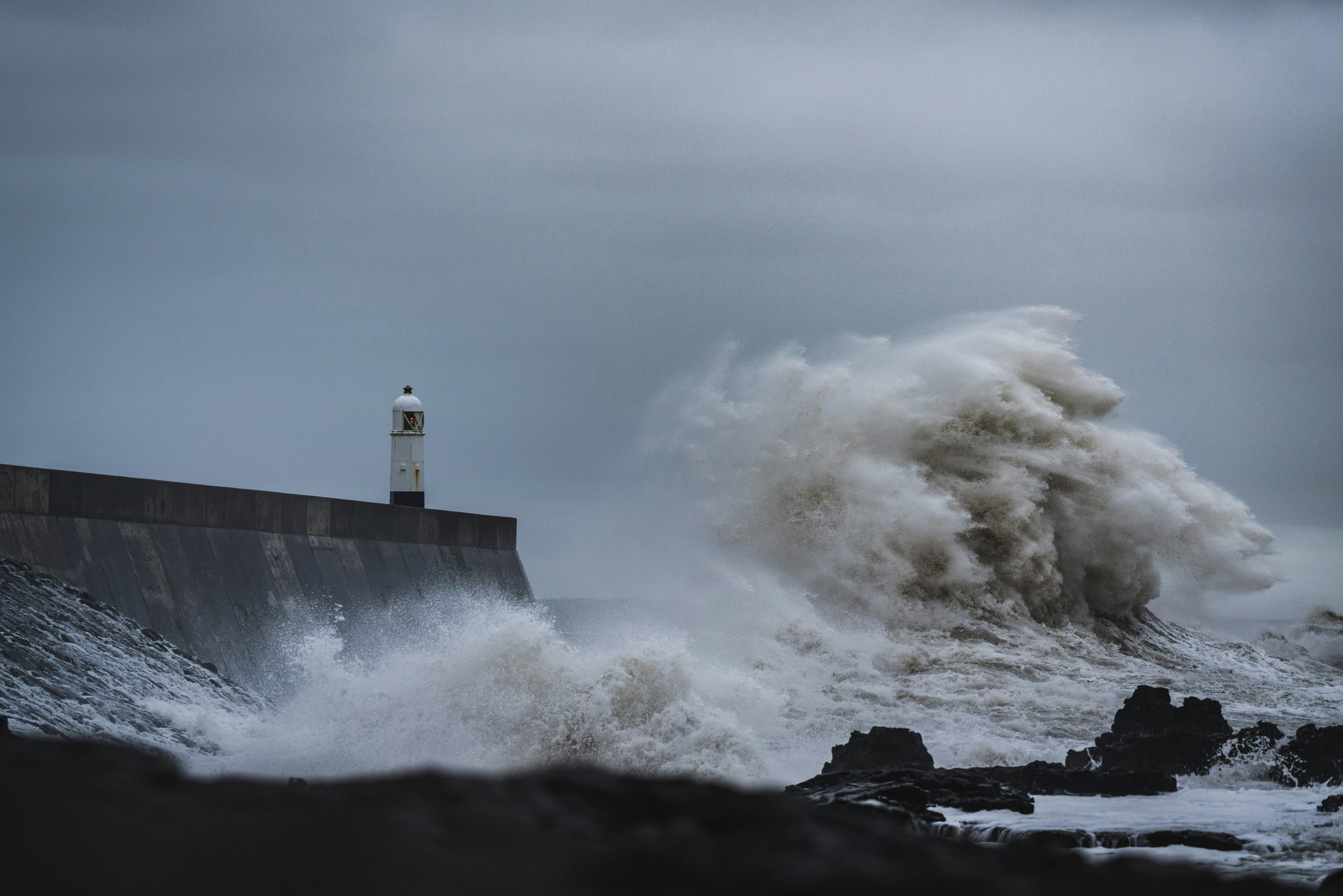
An Island Where Bodies Wash Ashore Like Driftwood

An excerpt from Wild Dark Shore by Charlotte McConaghy

Fen

She washes in with the storm, draped upon a tangle of driftwood. The girl sees her from among the seals. She picks her way through their fat sleeping bodies and moves to the surging waterline. Rough waves carry the lump closer, in with the tide. A shape of milky white lit by the moon. A shoulder, she thinks. And seaweed for hair. A hand draped delicately over wood.

The girl wades into the black roar. She dives under and swims out. Reaches for this bulbous thing to help steer it free. When her feet hit sand she rises, dragging the driftwood behind her. Swell slaps at her thighs and hips but she knows how to move with the water so as not to be tumbled. Preparing all the while for something terrible. Something altering. But a last wave sends the tangle onto the beach and the girl parts the curtain of snarled kelp to reveal a face, and it is not swollen or blue or nibbled; it is breathing.

The girl’s name is Fen and she lives here now, on this exposed patch of coastline with the petrels and the shearwaters and the penguins and the seals. She hasn’t been up the hill in a while, to where her family dwells in the lighthouse. She doesn’t like to leave the sea. But tonight the storm, the woman. Lightning on the horizon and rain she can hear approaching fast. She thinks quickly, and then, rather than trying to pull the body free, she drags the entire driftwood barge up the black sand as far as she can. She allows herself another look at this face, at this creature carried in from a sea too vast to make sense of. A gift for them or something rejected? And then Fen runs.


This is a place of storms, but this storm, this one will be the worst they’ve endured since coming here. She knows it as soon as she reaches the crest of the hill and collides with the wind. It takes her off her feet. In the distance she can see the lights of the building. A white shape flies end over end through the air: a bedsheet from the clothesline. They all know not to hang things overnight; someone will be in trouble for that lost sheet. Behind it one of the tool trolleys careens through the grass, is lifted up off its wheels and dumped again, spilling its guts, and this—these precious items being left out—is even worse than the sheet.

In the end she doesn’t have to struggle all the way to the house. Her dad’s been watching and the second he sees her cresting the rise he is running. They meet in the dark, on the trail to the shore. Even his considerable size is nothing against this wind, and he’s stooped almost double as he gathers her toward home.

“Stop!” she shouts. “Dad! We need Raff.”

This is a place of storms, but this storm, this one will be the worst they’ve endured since coming here.

“I’m here,” says her brother, materializing to take her other side in arms almost as big as their father’s, both of them hurrying her on.

“Wait!” Fen says, knowing that time now will be divided into before and after. “There’s a woman.”


Dominic

You are not meant to have favorites, but my youngest is that. If only by a hair, and with a gun to my head. If I really, really had to answer. And not because we are most alike: that is my oldest and me. Not because we are least alike: that is my daughter and me. Maybe it is because he is curious and kind and so smart it can make your eyes water. Maybe it’s because he whispers to the wind and hears its voice in return. Most likely I don’t know why. But it may also be because, for one brief moment long ago, I wished him dead.


I leave my youngest safe and warm in bed; he is too little to be taken out into a storm, though he’d rather not be left behind. The rain has come, as I follow my two eldest to the beach. The seals have retreated below the waves. The penguins are huddled in their nests. Raff and I lift the woman between us and inch our way back up the long winding trail. No trees to give cover; there are none on the island, only mounds of silvery tussock grass and a passage that grows slower with each step into the wind. It screams in our ears. In this kind of storm there is a danger we could be tumbled off our feet and back down the hill.

“Keep going, mate,” I say, and ahead of me Raff does, dogged.

My daughter is saying the woman was breathing. That somehow, she was breathing, and I know Fen is silently urging her to keep on, she is willing this body to cling to life. I have less hope, but I also suspect that to have made it so far, to have survived in an ocean so wild, she must be strong, this woman.


I’ve seen a body taken by the sea, and the state of it will rid a man of any hubris. We are soberingly weak under its hammer. This woman, delivered by such a sea—one more powerful than most—is clinging on with a bewildering defiance. She has been opened on one side, all down the left of her, and I can’t imagine how there’s not water on her lungs, but my first concern is the hypothermia; her breathing and her heart rate both seem very slow.

Back at the house, my three children and I carefully remove the woman’s clothes, what’s left of them. I set Orly to the shoes and socks and allow Raff and Fen to help me with the rest, leaving only the undies untouched. Fen takes her own clothes off too—“You don’t have to,” I say—but without a word she climbs into the bed to press her warmth around this stranger. The only way, truly, to warm her up. My boys and I pile blankets over them and monitor the woman’s temperature. It rises slowly. Hours pass as we hover, watching and waiting, and I wonder what it is my daughter thinks about as she uses her body like this, to save another.

Later, when the woman seems warm enough and I don’t think we can delay it any longer, Fen gets dressed. There is blood on the sheets, and on her skin. She pretends not to notice. We turn our minds to treating the wounds, using tweezers to painstakingly pluck out fragments of cloth. The woman’s limbs are lean and strong, her head shaved. The face, which I have barely looked at, is clenched and angular. Her strong jaw works against her teeth. Once she is free of material and debris, I stitch the worst of the wounds, my fingers too big to be anything other than clumsy. We slather the scrapes with disinfectant and then as much gauze as we have before bandaging her body. There is fever now: she is scalding to the touch. She makes sounds that frighten all of us and I come to my senses and send my nine-year-old from the room. He makes a fuss, he wants to help, and I know he is more frightened of the storm than he is of this woman’s noises. I relent, let him stay. This feels like a night to be together.

We sit with her and bear witness to the throws. Outside the storm is rabid. When the windows shake, Orly whimpers but the old stones hold together. Inside the sea is still fighting for her, it retains its hold. I think, deep in the darkest hours, that even if she survives this night that ocean will have her back one day.


I brought my children to Shearwater Island eight years ago. I was not expecting the island to feel so haunted, but for hundreds of years the lighthouse we live in was a beacon to men who built their lives upon the blood of the world’s creatures. The refuse of those sealers and whalers remains to this day, discarded along the lonely stretches of black coast and in the silver shimmering hills. The first time Orly admitted he could hear the voices, all the whispers of the animals killed on this ground—including, for good measure, an entire species of seal bashed on the head and wiped out entirely—I thought seriously about taking my children away from here. But it was my ghost who told me they might be a gift, these voices. A way to remember, that surely someone ought to remember. I don’t know if that burden should fall to a child, but here we are, we have stayed, and I think that actually my wife was right, I think the beasts bring my boy comfort.

Mostly it is quiet here. A life of simple tasks, of day-to-day routines, of grass and hills and sea and sky. A life of wind and rain and fog and of smiles huddled around a heater and of books read each evening. Of hands clasping a hot cup of chocolate or the bend of a head against the weather, of wet clothes flung off at the door and trying to pick out the difference between a giant petrel and an albatross at distance. Of frozen food and sometimes downloaded movies and schoolwork and training and music. Of the gurgling roar of an elephant seal or the banana pose of a fur, of the flamboyant orange eyebrows of the last royal penguin colony in the world. Of seeds. Of parenting. Of grappling constantly with what to tell them about the world we left behind.

Ships come every so often to bring supplies and scientists. Despite its wonders, Shearwater is not a tourist island: it’s too remote, too difficult to reach. Mostly no one comes here but a handful of researchers studying the wildlife, the weather, the tides. Certainly people don’t wash in from the sea. I am having trouble making sense of how she’s alive—the ocean around us is perilous and so cold, and there is no land for many thousands of kilometers. She must have come off a boat, but it doesn’t make sense that there should be a boat close enough to our shores. The supply ship isn’t due for weeks and the only ships that pass by are way out at sea, following the passage south to Antarctica, and to come off one of those would mean certain death. Unless of course this boat of hers was coming here, to Shearwater.

In the morning Raff and I assess the damage. Gutters are down and water has come under the doors, but our lighthouse has held strong even in the face of such a battering. The power sources can’t say the same. My son and I walk up the hill to see that both wind turbines have come clean off their shafts. One of them is face down hundreds of meters away—it has flown—while the other is protruding up out of the ground in a salute to its own demise. The solar cells are scratched, and the roof of the shed has been lifted up and off, leaving the batteries within to take an absolute beating. I’ll need to replace that roof but for now we set up a tarp to try to protect the remaining batteries—too complex to move and rewire all the cabling. Half of them are dead, anyway. The other half have some power stored in them, and this will have to stretch a long way.

Surviving in remote places is all about setting up contingencies. If one thing goes, there’s another option to take its place. It’s never occurred to me that all the solar cells, half the batteries, and both the wind turbines could go at the same time.

Surviving in remote places is all about setting up contingencies.

“We’ve still got the diesel,” Raff says as we walk home. I can’t hear any fear in him, just a focused kind of concern.

One thing we can’t do without is heating. I don’t know if we’d survive the kind of cold it will be without heating. Normally we’d be straight on the radio to the mainland, calling for help. Repairmen, new parts, more gas, more diesel. Alas.

Raff and I walk home along the headland. There is no real reason to do this, but I am letting him guide the way and his feet often lead him here. Shearwater is long and skinny and divided into two parts, its northern side mountainous and mostly unexplored, its southern side smaller, more inviting. This is where the various buildings have been placed, including our lighthouse, the field huts, the communications station, and the seed vault. There is a finger of land that joins the two sides, an isthmus, narrow in shape and low in altitude. We call it the pinch, and it’s where the research base sits. The base is several long white shipping containers made of aluminum so as not to rust in the salty air, as well as several wooden cabins. A hodgepodge of seventeen little buildings built over many decades. A dining hall and kitchen. The labs. A hospital. The storage unit. Sleeping quarters. Until recently a buzzing community of people, the pinch now holds a collection of empty buildings. And just as well because there is water lapping at walls and doors. The research base looks like it’s floating on a pond.

“Bloody hell,” Raff says.

High tide has never been this high before.

I am shaken but I’m not about to let him know that.

We still have some gas for cooking and manually heating water, and diesel for the generator to keep the freezer running so our remaining food stores don’t spoil, but everything else is getting turned off. No more lights, no computers or phone chargers or stereo, no washing machine or vacuum cleaner, no power tools. The kids don’t complain when I tell them; keeping this place running is a never-ending exercise in problem solving, and they understand that. What I am concerned about is the power to the seed vault down at South Beach, and whether it’s gone too. I get Raff started on repairing the damaged gutters and pack myself an overnight bag. It’s a ten-kilometer hike south to the vault so I’ll stay the night in one of the field research huts down there.

First I look in on the woman. Orly is perched on the end of her bed, reading to her from a book on botanicals that his astounding mind has no doubt memorized. He has barely left her side since she arrived.

“How’s she doing?” I sink into the chair by the window.

He shrugs. “Seems okay? She’s breathing.”

“You don’t have to stay in here.”

“I know.” He fiddles with a corner of a page, dog-earing it and then smoothing it out. “Just seems like someone should be here when she wakes up.”

I consider how much to tell him about my fears for the vault. In the end I just say, “I’m headed south for the night.”

“Can I come?”

“Not on this one, mate.”

The woman mutters something under her breath and even though she is not dead, there is something unnatural about it. A corpse reanimated. Her hand, the long fingers of it, clench once into a fist, then relax.

“Don’t get too tied up in it,” I tell Orly.

“In what?”

“In her surviving. She might not. Do you understand?”

“Yeah.” He studies her face, I study his. “It’s just . . . why isn’t she waking up?”

“I don’t know, mate. She swam a long way. She might still be swimming.”

The Shearwater Global Seed Vault was built to withstand anything the world could throw at it; it was meant to outlast humanity, to live on into the future in the event that people should one day need to regrow from scratch the food supply that sustains us. Specks, most of them. Tiny little black dots. That’s all they are. These treasures we keep buried in boxes below ground, down here in the arse-end of the world. The last hope of their kinds, but also of our kind.

The idea is a big one: to save humankind. But in all honesty that’s not why we came here. I needed a job, and I needed it to be far away. The purpose of it came later; in truth it came when my youngest recognized its magnitude.

While the seed vault is owned by the United Nations, the management of it has been allocated to the Tasmanian Parks and Wildlife Service, which also manages the nature reserve on the island as well as the research station—Shearwater Island belonging to Australia by virtue of its location. I was hired as caretaker of every building on this island, including the enormous frozen vault at its far south, and so in the beginning, when we first arrived, I was making the trip across island often. Because he was so little, I had no option but to take Orly with me, and I resented these regular hikes, when I could have been attending to the maintenance of the research base or the lighthouse. But as Orly got older, he would explore as we walked, touching and smelling and picking, and as he learned to talk he spoke the names of the plants we saw, and then the seeds we were there to visit, and I began to see, through his eyes, that in fact this job was important. I started imagining the use of these seeds, I imagined the world that would require them. I felt better about being here, on the island that was protecting this last floundering hope, rather than back on a mainland that would need rescuing. And with every danger that came upon Shearwater, every struggle, I would think, at least we’re not back there, dealing with fires and floods and food scarcity and all the rest of it.

At least we are here, in a place that seems hostile until you look more closely. Until you begin to see its beauty and its tenderness. Until you see the hidden abundance of it.

I never loved a place before we came here.

And now it’s over. The seed vault is closing. It was meant to last forever, and now we are sorting and packing the seeds for transport, and in just under two months we, too, will be leaving, with all the lucky little specks important enough to be chosen for relocation.

The tunnel is dry, always. It must be: it’s part of the design. Except that today, when I step into the mouth of the long descent, my boots splash. I stop and peer into the darkness. The wrongness of it stands the hairs on my arms. The impossibility of it.

I splash down into the earth, to the underground chamber, to its vacuum-sealed door. Like the door of a fridge. If the water has gone beneath it, we will be in real trouble, but it hasn’t, and I remember to breathe. Just the tunnel then, that’s alright. It will be alright. Within the vault it’s still dry. But as I check the temperature gauge my fears are confirmed. The lights are working but the cooling system has shorted out. It’s already a degree warmer than it should be in here.

It has been made very clear to us that keeping the seeds safe is more important than keeping ourselves safe. Quietly, down in the corners of me, I consider whether I could let thousands of species go extinct in order to save the lives of my three children. If I were to reroute the energy we use for heating the lighthouse I might buy the seeds a little extra time. But the answer is easy, and I don’t think they should have sent a man out here who has kids. That man would never make the choice they want him to.

I set up a pump in the tunnel, uncoiling the long dark tube until it snakes out the opening into daylight. If the water level reaches a certain height, the pump will turn on automatically. Next I walk each of the thirty aisles of the vault. They are dry, so I don’t hang around. Despite it all, despite the importance of this place and these specks, I don’t enjoy being down here. I’m not sure why, really, it’s a mystery even to myself. Something, maybe, about the pre-life-ness of it, which in a way is death, though Orly would tell me I’m mad, that this place is the opposite of death. Maybe it’s the stasis of it then, the way that life is being kept dormant. Maybe it has nothing to do with the seeds at all, and is simply the underground of it, or the deep, deep cold. Whatever the reason, the place unnerves me, so I let my boots splash their way back up to the surface.

I climb to the crest of the hill, where the shrubs give way to the long tussock grass, and I turn and look out at the horizon. It is like gazing off the edge of the world. Way down there sits Antarctica but mostly what lies before me is a boundless ocean and this edge is sharp. If I take one step in the wrong direction I will fall, and I am never, for a single moment, able to forget it.

The field huts sit among mossy hills on the shoreline, accessible only via a crooked set of metal steps built into the rocks. It takes me the rest of the day to reach them. I will sleep here tonight; we don’t travel after dark and usually we don’t travel at all unless in pairs. I am breaking a rule, but I can’t bring my children to see what’s waiting. The huts are pods, delivered here fully furnished on the back of a freight ship many years ago. The blue hut (so named because of its blue door) is closest, while the red hut is a little farther along and closer to the water. Once there were four scientists living within them. Now the huts sit empty. Once there was a third, its door green.

The blue hut is the last place I want to set foot inside. The unconscious woman isn’t going anywhere fast, but if she wakes she could eventually find her way down here, which means I can’t put this off any longer. I push inside. It takes my eyes a moment to adjust to the dark. The smell is a shuddering kind of bad.

There are two single bedrooms, and I move past them to the kitchen.

It’s not as grim as I remember it, but it is pretty grim.

In the backpack I’ve brought a scrubbing brush, cloths and towels, and bleach. I get to my hands and knees and start cleaning up the blood.
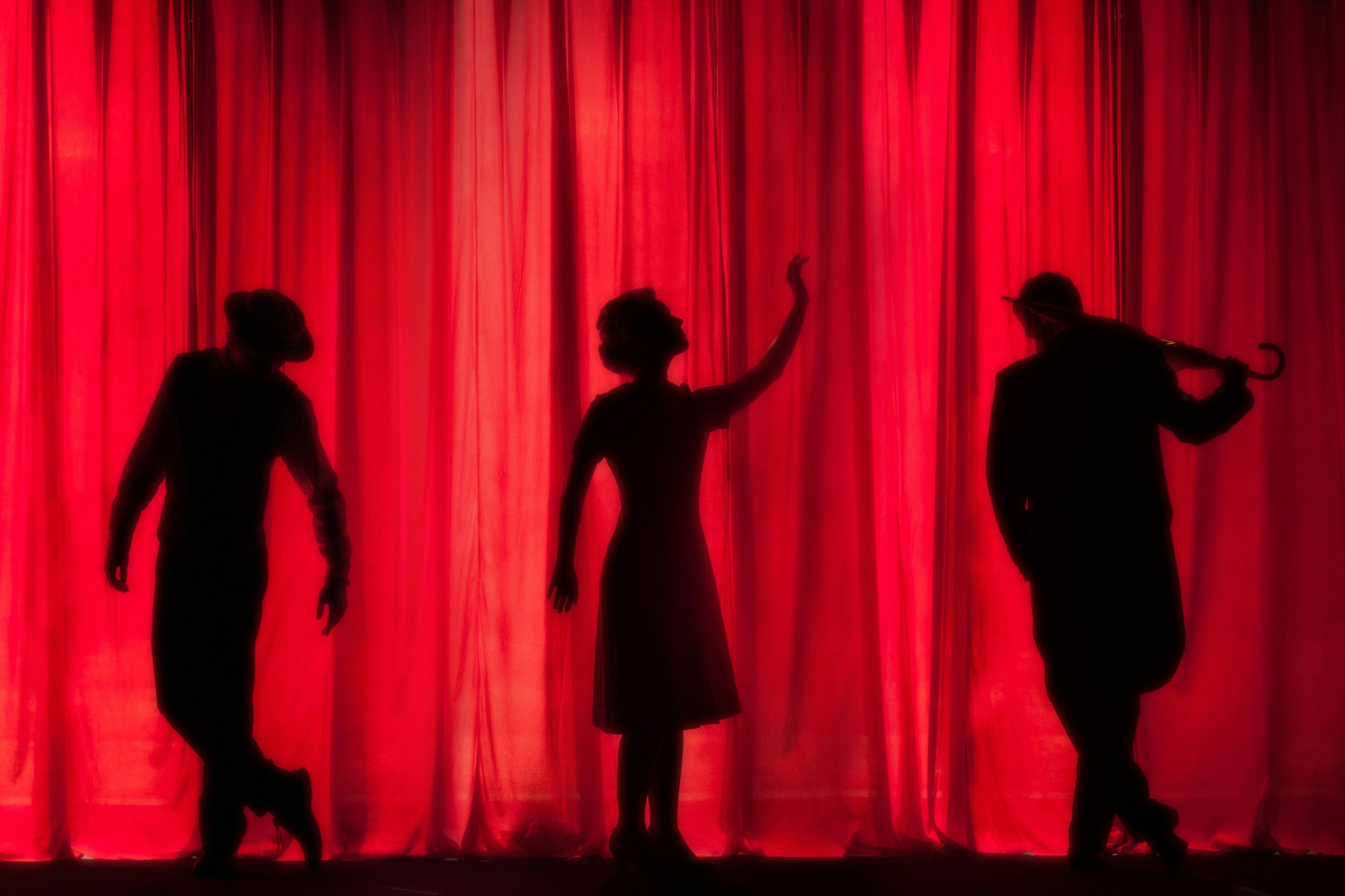
9 Twisted Novels About Theatrical Performers

The theater is a place of infinite possibility, where we can become anyone, go anywhere, summon any time period, replay situations, and rewrite outcomes. It’s a place where everything is progress, carrying us toward the plot’s prescribed ending. But the stage is also where people pretend to be others, where illusion reigns and you’re never quite certain whether you can walk through a doorway, whether a blade will stab or retract. It’s a place of unsurety, and a place of lies. But that’s also its magic, the magic of art: that only by lying can it reveal its truth. Talk about twisted.

My novel, Play, With Knives, is a little twisted. It’s about a struggling theater troupe touring the modern-day Midwest by train; only, the train is a kind of dreamspace, where random aspects of the playwright’s writings come to life and wreak havoc.

Whether involving magic, set in a dream or an alternate reality, or just featuring dark themes or a flailing main character, these novels set in the theatrical world are all a little twisted in some way too. As you’d expect, their themes center on performance, the shifting nature of identity, and the blurred boundaries between reality and fantasy. 

A Bright Ray of Darkness by Ethan Hawke

Yes, that Ethan Hawke, but drop your preconceptions, because this book is  fantastic.  It’s about an actor navigating the aftermath of his failed marriage and turning to all the wrong things—booze, sex, rage, self-hatred—all while performing in a Broadway production of Henry IV. Actors say Hawke’s descriptions of what it’s really like to be onstage are the best they’ve read. The book is messy and hilarious and a poetic tribute to the healing power of art. It’s based loosely on events in Hawke’s life, so there’s a gossipy element too. 

Station Eleven by Emily St. John Mandel

You’ve likely heard of this speculative hit, which was a finalist for the National Book Award in 2014 and was recently named a “Best Book of the 21st Century” by The New York Times. The novel is about a Shakespearean theater troupe traveling the Great Lakes region 15 years after a flu pandemic decimated the world’s population and, with it, civilization. Their tour takes them to a town controlled by a dangerous prophet who they must overcome to save their lives and the lives of others. Along the way, they risk everything for art.

Edith Holler by Edward Carey

 The book revolves around  Edith Holler, whose father tells her that their family’s theater will come crumbling down if she ever steps foot outside it. Confined to its walls, she writes a play based on a local fable about a woman who uses children’s blood to make a regional delicacy. When her father suddenly marries the heir to the company that makes the product, Holler discovers the truth behind the tale and must act fast to protect her family, their theater, her play, and the town’s children.

Madeleine Is Sleeping by Sarah Shun-lien Bynum

Another National Book Award finalist, this one from 2004, Madeleine Is Sleeping is told in tiny chapters, most a page or less in length, some just a sentence. It’s about a girl who falls into a deep and lasting sleep. Within her extensive dream, she leaves her small French village, joins a circus, and falls in love with one of its eccentric performers, which include a fartiste (exactly what it sounds like), a woman with wings, and another who is gradually becoming her husband’s viol. 

Glorious Exploits by Ferdia Lennon

This book I picked up purely due to its fun cover, and it didn’t disappoint. Set in Sicily during the Peloponnesian War, it tells the story of two unemployed potters who, on a whim, visit a quarry holding prisoners of war. The potters share a love of poetry and wine and, after asking the prisoners to recite a few well-known lines in exchange for food, come up with the idea to use them in a full-fledged production of Medea. As mishaps unfold, they soon realize that making art can be no less risky than making war.

The Night Circus by Erin Morgenstern

Here’s an author who did write about magicians. Morgenstern fully leans into fantasy with this novel about a circus that mysteriously arrives by train to present its audience with marvelous amazements. It’s about two young people, both orphans raised by powerful magicians, who are being trained to compete in a duel only one of them can survive. Of course, along the way they fall in love. My favorite part of this book was being dazzled by the magicians’ increasingly astounding displays.

Wise Children by Angela Carter

Carter’s Nights at the Circus also would have been perfect for this list, but instead, I’ve selected Wise Children, the author’s last novel and one about living. It’s a fictionalized memoir that tells the life story of twin actresses, detailing all the Shakespearean twists and turns of their theatrical family’s foibles. The prose is lyrical, even while the narration is as hilarious and entertaining as you’d expect from a professional vaudevillian. 

Between the Acts by Virginia Woolf

This is Woolf’s last novel and no less masterful than her others, full of gorgeous sentences and deeply interwoven themes. On the grounds of an English country house, a community is putting on a play celebrating English history. Over the course of a single day, we follow along as they prepare for and deliver the performance in three acts. The play tells the story of the nation but also of its individuals, muddling the past with the present, reality with the imagined, and asking where performance ends.

If We Were Villains by M.L. Rio

Again and again, this novel draws comparison to dark-academia darling The Secret History, and not without good reason. It takes place on a college campus, where a group of actors is putting on a Shakespearean production. They’ve previously been typecast—as hero, villain, temptress, etc.—but find that for this performance, they’ve been assigned different parts. The actors lean in, soon embodying their roles offstage as well as on, and the play’s violence precipitates a real-life death, testing their friendships, their acting skills, and their understanding of truth itself.

Omar El Akkad on How the Empire Weaponizes Language to Numb Itself to Genocide

Omar El Akkad’s nonfiction debut, One Day Everyone Will Have Always Been Against This, is a timely account of a severance from the West and its systems that have long betrayed espoused values.

“The dead dig wells in the living,” El Akkad writes at the end of the prologue, foreshadowing the narrative to come—of contending with the harrowing reality where the Palestinian death toll rises, their pogrom live streamed but impacting only those with a conscience. In the aftermath of a dissonance between reality and the Empire’s narrative—one where Western powers denounce the existence of a genocide, refusing to put an end to the Israeli occupation of Palestine—El Akkad writes about no longer being disillusioned by the facade of Western liberal values and instead, understanding, finally: “Rules, conventions, morals, reality itself: all exist so long as their existence is convenient to the preservation of power.” 

El Akkad, who worked as a journalist covering the War on Terror, details those early years when he began to notice the cracks in this “free world”, started to understand how power hinges on the subjugation of another, how language and fear are tools the West maneuvers to its advantage. He recounts his adolescent years in Qatar, when he believed in the West’s promise of freedom, and his teenage years assimilating in Canada. Through a narrative, personal and political, he speaks to the ways Western hypocrisy has revealed itself over the years, culminating at this point—where many, especially those in power, reject the very reality of Palestinians suffering mass slaughter. In the face of this, El Akkad turns to writing—which, he tells me, is his first avenue of retreat—and he speaks of what many of us have been feeling: a rupture in trust in Western institutions that can never again be sutured.

Egyptian-Canadian journalist, Omar El Akkad is the author of American War (named by the BBC as one of 100 novels that shaped our world) and What Strange Paradise (2021 Giller Prize winner). On a Monday afternoon, Omar and I spoke about language as a weapon of oppression, the power of negation, what it means to be a writer in these polarizing times, and more.


Bareerah Ghani: You write,“The empire…is cocooned inside its own fortress of language.” Later on, the book circles this idea of language being usurped from Palestinians. We’ve seen headlines like the Wall Street Journal’s,”Is It Time to Retire the Term ‘Genocide,'” and you bring up countless others, deconstructing them in this book. I’m interested in your thoughts on language as narrative, why it often lies at the center of oppression, and in this case, the erasure of an entire people.

Omar El Akkad: My suspicion is that it has to do with a reluctance on the part of someone with the privilege of looking away, to have to do the work of describing something bloody, grotesque. Throughout my career as a journalist I saw this in various forms, things like collateral damage instead of, we bombed a wedding party. Or prisoners in Guantanamo Bay who aren’t actually prisoners. They’re detainees, which you see mirrored in Israel. It’s not hostages. It’s administrative detention. Hostages are what the barbarians take. The civilized world puts people in indefinite detention.

Hostages are what the barbarians take. The civilized world puts people in indefinite detention.

My suspicion is that it’s an expression of power that you can do this, that you can get away with this but also I think it’s invariably tied with power over chronology, which is to say, that history is reset every time the less privileged party does something horrible. Such that the more privileged party is constantly reacting. Saeed Teebi said this in a panel we were on once—he was talking about the narrative framing of the occupation of Palestine: constantly the evil Palestinian does, and so the civilized Israeli is forced to respond. In that narrative framework, language is doing very, very heavy lifting. Otherwise the overt violence of physical warfare becomes too much for even the numbed sensibilities of somebody living in the heart of the Empire to fully bear. And you see this historically—the Vietnam war, for example, when Americans really started to turn on that, you start to see the visceral imagery of what warfare looks like, of what this campaign of mass destruction is doing. I think here the situation would be similar—if you presented plainly, both in imagery and in language, the reality of not just what is happening in Gaza, but what is happening in the West Bank, and what has been happening to Palestinians for the better part of three quarters of a century, even the most well versed in looking away would have trouble digesting it. But under the guise of language that describes an entire population as being a terrorist entity, for example, or uses passive language to describe a bullet colliding with a 4-year-old young lady—I could not for the life of me tell you what a 4-year-old young lady is—you can cocoon it, and you can soften it, and you can bubble wrap it. So I suspect that that’s what’s at play here, and that if you were to rip it away, the other layers of violence wouldn’t be able to stand on their own.

BG: But we’re also living in unprecedented times where there’s a genocide being live streamed. Yet, people are looking away. What do you make of that?

OEA: I think it’s a muscle that’s been well honed as part of the social contract when living in the most powerful society. There is no shortage of horror that the people in this country I live in and in many of the countries in the West, generally speaking, have been conditioned to look away from. We had twenty years of the so-called War on Terror, leaving millions dead, and by and large this society, through its media apparatus, through its centers of power, was able to look away. And it’s impossible to believe that, once that muscle is so well developed, it can’t be used for virtually anything. I think one of the reasons that you’ve seen it sort of stretched to a breaking point right now is because, like you said, it is being live streamed. The immediacy of it, the horrible intimacy of it is unlike anything I’ve witnessed in my lifetime. Unless you are a complete and total sociopath, seeing that every day has to change something in you. 

This is a vast overgeneralization, I apologize, but I think there’s an arc of proximity between a privileged people and the conflicts being waged on their behalf, that runs all the way from written depictions of wartime atrocity, pictures, photographs, and then you get into the Vietnam era and you start to see a film and color film, and you’re getting closer, and it’s becoming more difficult to look away. And then you get into the ’90s and it almost inverts. I remember growing up as a child, I was in Qatar, and we were watching footage of the bombing of Iraq during the First Gulf War, and it’s this grainy green night vision thing. Suddenly, that distance is starting to expand again. And then you get into the War on Terror, and you get this drone footage that looks like something out of a video game. It’s gray scale, very abstract. And now, suddenly, you’re sort of thrown back in. I think that makes it very difficult to look away with as much ease. 

BG: You call out the Democratic Party’s hypocrisy, talk about how it’s been their tactic, to play on everyone’s fear of how much worse the alternative would be. But now that Trump has been elected, it’s clear that endorsing mass murder has had repercussions which were maybe, previously, unimaginable for the Democratic Party. Do you think this is the beginning of some change, now that many have abandoned the us versus them mentality? 

OEA: The short answer is, Yes. I certainly hope so. This is the first time I’ve seen real domestic political consequences for one of the two central parties in this country, related to Palestine. Previously, you could say or do anything related to Palestinians, and suffer no domestic consequences. And now you watch a Democratic candidate lose to one of the worst human beings ever to run for President, and it’s very difficult not to imagine that voter fury over the carnage in Gaza didn’t play a part in that. So that for me, is a sign.

Under the guise of language that describes an entire population as being a terrorist entity, you can cocoon it, and you can soften it, and you can bubble wrap it.

Another sign is what I see at the ground level political discourse in this country. I’m not talking about the Presidency or Congress or the Senate. I’m talking about City Council elections down the road from where I live in Portland, Oregon, where you start to see council members elected from the working families party, for example. At a very grassroots level, you’re starting to see people just desperate for some other option. A lot of times when you pick up the ballot book here, it’s sort of Republican, Democrat, a bunch of people who are deranged and are going to get about three votes each. And that’s been just sort of what you’re expected to live with. You get two choices, essentially and I’m complicit in this. Up until a year and a half ago I would pick up that ballot, see whoever has the R next to their name, and I would vote for the person with the D. There’s a certain moral threshold that has been crossed where a lot of people, myself included, can no longer do that. So you have the very early makings of—at least at a local level—some kind of alternative. Those two factors are starting to give me some hope for change. The issue, of course, is how many people need to die, and how much carnage needs to be unleashed before we get to that place.

BG: I want to talk about the title, One Day Everyone Will Have Always Been Against This. You reference historical evidence of other atrocities committed such as against the indigenous population and then in hindsight, there was an apology. But like we said, this is the first time it’s being live streamed and yet people are looking away. And while you say that yes, you think this is the beginning of change, I wonder if witnessing this kind of blatant dissonance fractures your belief in this imagined future where everyone says, – even if for self-interest – yes, it was terrible what happened to Palestinians.

OEA: The title of the book comes from this tweet. The original title was The Glass Coffin, and it was only after completion that one of the editors at my publishing house suggested using the current title. I only say this because I’m trying to convince people that I didn’t just take a tweet and sort of stretch it out into 200 pages. I promise that’s not what happened. But one of the two things I found from talking to people in these early days of the book is that some folks seem to think that I mean next week, like the one day is coming imminently. But the timeframes I’m looking at are relative to things such as the genocide of the indigenous people in this hemisphere, where we have land acknowledgements today, and the US Government put out a little statement a few years ago, apologizing, hundreds of years after the fact. I hope that it happens in my lifetime but even that would be optimistic. The other thing that some people seem to think is that I consider that day, when it arrives, to be a good day, and in fact, quite the opposite is true. I have quite a bit of pent up preemptive fury about that day, because how many people had to die?

The kind of person I’m thinking of with that title is the kind of person for whom none of this matters. There’s no personal stakes. They can’t point out Israel or Palestine on a map. They simply want to know what the majority of polite society is thinking right now. There is this narrative that sort of appears well after the fact, where the horrible thing is considered this temporary aberration. They didn’t know better back then. Now we know better. It’s never true. It wasn’t true in the case of slavery or segregation or apartheid, and it won’t be true in this situation. It’ll just be an effective and useful narrative parachute. 

I have no doubt it’s coming. I just have real trouble wrapping my head around the sheer amount of carnage that happens between now and that moment.

BG: You state at the beginning of this book that this is an account of an ending, a severance from the West, and you speak of negation, this power to turn away, being dangerous and valuable. It got me thinking about well, what does it mean to not participate in the system? Sure we have boycotts. But what about those who are tied to the system, have been all their lives?

All of us as writers have an obligation to bear witness, even if we knew for a fact that it wouldn’t change a single thing.

OEA: I struggle with this. And the way I’ve started thinking about all this—and it’s not particularly novel—is as different arenas of engagement. One of the criticisms of this book that I think is perfectly valid, and against which I have no defense, is that I talk about all this resistance and its importance, and then get real squishy about the idea of armed resistance. But I have no right to tell anybody how to resist their occupation. And I can talk to you about how I’m a pacifist, I abhor all violence, and I do believe that about myself, but by virtue of how my tax money is spent, I’m one of the most violent human beings on earth. And so, as much as I want to make the moral argument for nonviolence, my argument for nonviolence now is purely pragmatic. There’s an asymmetry of power in that particular arena of engagement. The State has the bigger guns, and also narrative justification for any amount of violence. There are other arenas where the asymmetry is not nearly as glaring, or, in fact, inverted. The arena of non-involvement has an entirely different power structure. The State has a much harder time punishing you for what you don’t do or what you don’t buy. The arena of joy is very asymmetrical towards the individual. And you see this every time Israel releases a hostage, and they tell them not to display any expressions of joy when they see their family again. It is a deeply disturbing thing for me that I have to make a pragmatic rather than moral argument for shifting arenas away from violence, for example. But in terms of this non-involvement I wish that there was an algorithmic approach where I do this, this and this in every situation. But it’s been very different for me. There’s been situations where I’ll go give this talk. I’ll take the money. I’ll donate it somewhere good. Or I refuse to give this talk, because this institution has brutalized its own students. Everyone makes these decisions on a case by case basis and according to their own moral thresholds.

BG: You have an entire chapter on your shifting relationship with the publishing industry, and to writing itself. At one point you ask, “What is this work we do? What are we good for?” Now that you’ve written a book that will forever stand witness to the worst of humanity, what is your perception of this work we do– what does it mean to be a writer?

OEA: I’ve said this a couple of times, and it’s not me playing at false humility, I don’t think this is a book that’s going to be remembered. But if it is, I think it’s going to be remembered as one of the tamest examples of its kind. The amount of rage I’ve seen is orders of magnitude worse than what anyone who simply watches the nightly news in the U.S. or Canada would imagine. There’s this immense, almost incandescent rage at what has been allowed to happen, and how hollow so many of the covenants and agreements, and principles of equal justice and international law have proven themselves to be. In that context, I think that all of us as writers have an obligation, first and foremost, to bear witness, even if we knew for a fact that it wouldn’t change a single thing. Beyond that I’m not really sure anymore. And I used to be pretty sure both about the obligations of a writer, or the sort of job description of a writer, for lack of a better phrase, but also for the value—that we are creating this work that is going to outlive us and that this means something. But I don’t know anymore.

I don’t want to make the case that everyone has to drop everything they’re doing and write about this. Where I have really become disillusioned is in watching writers, who have previously traded on the currency of standing in the way of injustice, now suddenly taking a backseat and keeping their head down. And that’s in part because I’ve seen a kind of arc related to how situations like this, particularly grotesque, horrific situations, are treated. For example, the War on Terror, where there were these periods of immense silence, so many artists, so many writers kept their heads down and then you started to see, when it was safe enough, a trickle of stories after the fact, usually from the perspective of some former marine talking about how sad it made them to have to kill all these brown folks, and then their short story collection wins whatever prestigious prize. To know that this arc is likely still available to all of those writers where, 23 years from now, the same people who said nothing, are going to write incredibly moving stories about the mass graves they uncover in Northern Gaza, is infuriating.

BG: What do you make of all this misinformation on mainstream media, and does it diminish the impact of the work you’re doing with this book?

Where I have become disillusioned is in watching writers, who have traded on the currency of standing [up to] injustice, now suddenly keeping their head down.

OEA: I think it’s a numbing agent. I know when I talk to most people on this earth, a certain narrative is in place—one in which the wholesale slaughter of a people is wrong, and occupation and theft of their land is wrong. As much as that narrative may exist and is predicated on what’s actually happening, if you’re living in the heart of the Empire and you’re subscribed to that other narrative where there’s an overriding, inherent goodness to anything your nation state does, to even glance at that other narrative imposes a set of obligations on you that are crushing because now you suddenly have to contend with hundreds of thousands of dead people, dead kids, with 75 plus years of occupation, with the exact same things that are bemoaned and apologized for at every land acknowledgement at every literary festival I’ve ever gone to in this part of the world. It’s a crushing thing to even consider that that narrative might not only exist, but might have a far more direct relationship with reality than whatever the hell you’re watching on the nightly news.

Palestine is going to be free, and beyond that it is going to teach generations of human beings about what freedom actually looks like. And this work is going to be aided by activists around the world but is going to be done, and is being done by Palestinians themselves. I don’t think I’m doing a damn thing. This book for me is an accounting of a kind of leave taking from the person I was for the vast majority of my life into an uncertain space. The fundamental sense from the last year and a half at least personally, more than solidarity and activism, is a sense of complete failure, so it makes it difficult to answer that question about diminishing the impact of it, because it does come from a place of complete impotence. And yet, I have to set aside that feeling and go do whatever work I can. Because right now everything matters, every little piece of work, no matter how dejected I might be.

The Best New Books of Winter, According to Indie Booksellers

There’s no season better well-suited to curl up with a book than winter. Whether you’re seeking a Tuscan adventure or a book with a hot monster, these new titles—recommended by indie booksellers from across the country—span genres and styles, offering something for everyone. So grab a blanket, a hot drink, and escape the cold with the buzziest new books of the season:

Tartufo by Kira Jane Buxton

“A wonderful story full of humor, warmth, a small Tuscan village that has seen better days, and a cast of hilarious, quirky characters. If you have a passion for Italy and beautiful, descriptive writing, grab this book and find out what happens when local truffle hunter, Giovanni, finds the world’s biggest ever truffle. The word mayhem springs to mind, but in the best possible way. This book is a gem!”—Polly Stott, The Hickory Stick Bookshop in Washington Depot, Connecticut

Isola by Allegra Goodman

“If you enjoy reading historical fiction, pick up this book! The setting is 16th-century France, and Goodman does a masterful job of creating characters of different classes as well as a sense of life at a chateau and its village. Marguerite becomes the heir to this wealthy estate when she is orphaned at five and her guardian uses her inheritance to his advantage and as the years pass to eventually finance his expedition to New France. He takes her with him and during the voyage discovers she has befriended his secretary (remember this is the 16th century!). She and the secretary are then abandoned on a remote island. Is survival possible?”—Pat Moody, The Hickory Stick Bookshop in Washington Depot, Connecticut

But Not Too Bold by Hache Pueyo

“Have you ever watched a Studio Ghibli movie and gone ‘I wish there was a little more monster fucking in this?’ Alternatively, have you ever watched a horror movie with a hot monster and gone, ‘This needs more loving descriptions of food and decor?’

Great news for BOTH CAMPS: this book has it all. Despite being a confirmed arachnophobe, I really enjoyed the monstrous romance, the gothic fantasy vibes, and the gentle grotesqueries in this novella.”—Nino Cipri, Astoria Bookshop in Queens, New York

Stop Me If You’ve Heard This One by Kristen Arnett

“Florida clown meets Shakespearean fool in Arnett’s new novel for me, for you—for all of us failures and hopefuls. Cherry the clown tries to make sense of her craft—something no one else seems to understand—in the birthday parties, carnivals, and children’s hospitals of Florida. Arnett’s meta tragi-comedy or comi-tragedy is for anyone who has ever felt like a mess. This book won’t fix you, but it may mirror you back to yourself. You’ll end the book saying, ‘how did she do that?’ and ‘ow,’ and ‘please do it again.'”—Julia Paganelli Marin, Pearl’s Books in Fayetteville, Arkansas

Lion by Sonya Walger

Lion has quickly become one of my favorite autobiographical novels. Sonya Walger beautifully portrays the many feelings of frustration, yearning, and grief when reckoning with a parent’s inability to parent, to love, to listen, throughout both childhood and adulthood. This novel completely immersed me in Walger and her father’s broken world, and kept me tethered to every word. Lion will linger with me for a long, long time!”—Amali Gordon-Buxbaum, Books Are Magic in Brooklyn, New York

Coffeeshop in an Alternate Universe by CB Lee

“This Young Adult cozy fantasy follows a ‘geeky overachiever’ and a ‘troublemaking chosen one’ who meet in a magical coffeeshop where their two different worlds collide. What excites me about this novel is that it is queer, cozy, and the cover is STUNNING! I have a personal appreciation for CB Lee’s work after interviewing them for the Pride Book Fest and it was just such a pleasure. I think fun, quirky, queer novels are so important and should be celebrated!”—Kaliisha, Porter Square Books in Cambridge, Massachusetts

Stag Dance by Torrey Peters

“If you’re in any doubt of Peters’ abilities as a writer, just note how she’s able to queer old lumberjack lingo into poetry in this book’s excellent titular story, ‘Stag Dance.’ In all the stories, some futuristic, some timeless, she explores the allure (and dangers) of transitioning, as well as the meaning of sisterhood and community.”—Rachael Innerarity, Porter Square Books in Cambridge, Massachusetts

At the End of the World There Is a Pond by Steven Duong

“‘The Anthropocene,’ Steven Duong writes, ‘demands a new syntax;’ what might it be? His answer: poems like ghost story manifestos tweeted out into the void; verse in which the spectral presence of Vietnamese fathers and refugee mothers hangs heavy overhead, ever-present and ever-calling; a collection in which their young American offspring, self-dubbed the ‘king of not killing myself,’ reigns over his domain of Oxycodone and Molotov cocktails at the collapse of empire. His answer is this book, a trickster’s debut about loving and surviving (against all odds, against yourself, against your worst impulses made manifest) through the end of the world.

‘when the markets fall & the workers
pop their bubbly
I will die old
poet laureate
of wherever they find me’

And so I ask you, dear reader: let the guillotine spare our newfound poet laureate, syntax-monarch-turned-aquarium-revolutionary, so he may follow this first book with a second and third and fourth, and so we may read them all while the champagne flows and the workers of the world, having united and at long last arrived at the better world ahead, can sit back and relax, beloveds by their side and At the End of the World There Is a Pond in hand.”—Mira Braneck, A Room of One’s Own in Madison, Wisconsin

Underground Barbie by Maša Kolanović, translated by Ena Selimović

“Set during the Yugoslav wars, Underground Barbie by Maša Kolanović is translated from Croatian by Ena Selimović. Two friends play with their Barbies while air raid sirens sound and bombs fall. Despite everything, this book is playfully illustrated and charming. Highly recommended!”—Caitlin L. Baker, Island Books in Mercer Island, Washington

One Day, Everyone Will Have Always Been Against This by Omar El Akkad

“If the world could be saved by a journalist’s razor-sharp precision & a novelist’s sense of style & narrative alone, El Akkad would not have had to write this book. But he did. And we need to read it.”—Josh Cook, Porter Square Books in Cambridge, Massachusetts

Beartooth by Callan Wink

“After the death of their father, two brothers find themselves adrift and lost in the modern American West. Falling deeper and deeper into debt, they accept a job from a shadowy neighbor that, if successful, could allow them to climb out of the hole. However, failure means prison or worse. Let’s just say that things don’t go as planned, and the two brothers are forced to depend on each other as they never have before to find their way to safety. Callan Wink’s Beartooth is a gripping crime novel and a western story like you’ve never read before.”—Brad Lennon, Harvard Book Store in Cambridge, Massachusetts

Perfection by Vincenzo Latronico, translated by Sophie Hughes

“Somehow, a certain type of person (the young, progressive digital creative/freelancer/what have you) has the same houseplants and the same midcentury-style couch, despite living in different cities across different continents. They drink the same lattes in near-identical cafes; their dinner parties are all impeccably plated, locally-sourced, softly lit, and essentially indistinguishable. How could this be?

“Enter Perfection, a rare sharp social novel about millennials who find that the ever-elusive picture-perfect life omnipresent across their culture-flattening feeds seems to constantly be just out of reach IRL. The novel follows expat couple Anna and Tom as they socialize with their stylish artist friends across Berlin, attempt (and fail) to get involved in politics in a meaningful way, and go digital-nomad-mode in search of Meaning when Berlin ceases offering the newness they so desperately crave. And while I thought the premise of this novel seemed to land somewhere between vaguely grating and downright insufferable, Vincenzo Latronico’s Perfection, sharply translated from the Italian by Sophie Hughes, instead offered a vivid, piercing novel that so accurately depicts the young and disillusioned who go in search of some sort of contemporary specificity and authenticity, only to find themselves defeated and disappointed. Deceptively scathing and lowkey bleak, this novel made my ears ring.”—Mira Braneck, A Room of One’s Own in Madison, Wisconsin

Victorian Psycho by Virginia Feito

The Turn of the Screw meets American Psycho in this dark, comic tale about a governess as charming as she is murderous, and the long-buried secret that will rip her new family of employers apart (in more ways than one). Much like Miss Notty does to her victims, Feito turns the gothic novel inside out, bringing the disgusting, gory details of the Victorian age — everything from chamberpots to imperial exploitation — to the forefront, all presented through the eyes of a protagonist no less sociopathic than the society she holds in contempt. The only difference: she’s more than happy to admit it to herself.”—Nik Long, P&T Knitwear in New York, New York

“Much like its protagonist—a governess with a penchant for bloodshed—something evil writhes through the pages of Victorian Psycho. It’s my favorite horror novel of the year so far, and for good reason. Feito’s ability to breathe life into a soulless character is nothing short of masterful. With sharp, curt dialogue that doesn’t always match the characters’ seemingly sunny dispositions, this novel blends humor with horror in a way that keeps you on your toes. The ending? Utterly shocking. If you love Suspiria and American Psycho, you’ll devour this.”—Alexis Powell, The King’s English Bookshop in Salt Lake City, Utah

We Do Not Part by Han Kang

“Han Kang’s newest novel is very literally stunning, and several of its passages left me reeling. The narrator is a writer who ventures into a secluded stretch of woods in South Korea to help save her friend’s parrot, because her friend has been hospitalized following a brutal injury. The narrator’s journey forces her to face the history of two real massacres that bookended the Korean War, as well as her friend’s relationship to that history. Reality and fiction intertwine in the novel for both the reader and the narrator, making for an eerie book that left me hung up on the history it centers.”—Maritza Montanez, Greenlight Bookstore in Brooklyn, New York

Death Takes Me by Cristina Rivera Garza

“I’m still reading Death Takes Me, but I love Cristina Rivera Garza’s work for the way she and her characters analyze language, as well as for the careful attention she pays to gendered violence. Here, a professor goes for a run and finds a castrated corpse accompanied by a line of poetry at the crime scene. When she reports it to the police as part of a larger wave of serial murders, she gets roped into the investigation by a detective who’s intrigued by the professor’s knowledge of each poem, and newly obsessed with poetry herself. The writing is brilliant–disorienting, and more delightful than you may expect based on the story’s violence.”—Maritza Montanez, Greenlight Bookstore in Brooklyn, New York

No, Women Can’t Just Ignore Online Harassment

Alexandria Onuoha is on a bright spare stage dressed in white, bare feet, her black hair slicked tightly back. She is kneeling, but when the music begins, she quickly rises, arms eager and legs unbound. Her joints share a smooth vocabulary. She is soft wrists and loose limbs, blooming bones and fluid hips. She dances from the inside.

I ask her, What does it feel like to dance?

“Like everything makes sense,” she says.

She lingers there, speaks of history, family, Blackness, womanhood. I count one, two, three, four times she tells me:

“I feel free.”


Alex is a dancer, but there were times when people did not think she moved like one. She was a Black woman studying dance at a small, predominantly white liberal arts college in the Northeast. She moved her body according to the instruction she was given, but she often felt stiff and mechanical. “Robotic,” she said. The dance genres she grew up in, the languages her body spoke easily, were hip-hop, liturgical, West African, dancehall. She used movement to fuse culture and art, sexuality and spirituality, past and present.

Alex struggled in her dance program, and she recounted to me the aftermath of going public with her experience. She had been unsettled by a white male guest dancer’s comments on her body throughout rehearsals: the way it was failing, the way it did not fit.

She doesn’t remember precise words, but she remembers his tone registering as sarcasm.

Alex spoke to a professor about the guest dancer’s comments, but she did not feel she was taken seriously. When she got her grade, it was less than she believed she deserved, and she brought it up again to her professor, who she says dismissed her, telling her, in substance, “Sorry, this is just dance.” Alex didn’t think it was just dance.

Other professors made comments that suggested her body didn’t belong, and seemed baffled by the way it moved. She didn’t know what to call these critiques. Professors and guest dancers said they didn’t understand what her body was doing or what her art meant. She produced a choreographic piece combining dance from her Jamaican and Nigerian roots. When it was time to perform it, a guest artist said, “I don’t really understand what your piece is about, like, I am kind of confused, like, what’s the point of having Bob Marley speak?” She again told a professor she felt the comment was not right. The professor said the comment was fine. She told Alex to grow thicker skin.

Alex tried, but near the end of her program, she was exhausted. She was exhausted by the side-eye, the erasure of Black art, and what she saw as favoritism of white bodies. She decided she needed to speak. She wrote an opinion piece for her school newspaper on what she experienced in her program. She called it “Dancing Around White Supremacy.”

When the article ran online, friends saw it and texted to say they were proud. But at night, when she got back from an event and logged on to Instagram, she saw the other messages. She read them alone in her room.

She did not cry. She was still. She thought: “I can’t believe I go to school with people who think like this.”

She didn’t recognize names, and not everyone used avatars, but she assumed the DMs were from other students. Who else, she thought, would read her school newspaper? In a school with a student body of less than two thousand, she imagined the messages were sent by people she ate with in the dining hall, sat with in class, passed on the way to her dorm. Online, they called her a “black bitch.” They called her a “n*****.”

The day after the op-ed was published, Alex had dance class. She walked into class with dread in her step. She felt sweat coat her back. She didn’t want anyone to know what was happening inside her body, so she made it unreadable. She disciplined her face.

When class began, Alex said, the professor didn’t talk about Black art. She didn’t talk about Alex, how she felt, what she and the other students of color needed. Instead, she suggested that students should be careful, especially with what they say about guest artists. Someone could get sued, Alex remembers the professor saying.

After class and the professor’s not-so-subtle chiding, some of the white women dancers from her class came up to her in the cafeteria and said, “Oh Alex, we appreciate you being so courageous.” But Alex said none of them spoke in front of the professor.

Members of the school administration met with her after the op-ed was published. They said her choice could follow her, and they wanted to make sure she understood all the potential ramifications for her future academic career.
They did not say the words perhaps silence will keep you safe. But that was what she believed they meant.


Violence online is linked to a struggle over the structural power of white supremacy

The problem of women’s online abuse is almost always framed as a problem of misogyny, but Alex’s story, and the stories of countless other women, show that violence online is also linked to a struggle over the structural power of white supremacy, to the other systems with which it intertwines. Alex could not ignore what people were saying to her online, because language can be used to maintain power or to resist it. It can be used to keep certain people in their place or to fight a system that ranks human life. Language influences how we see ourselves, how other people see us, how they treat us. Language shapes public life. So do silences.

When Alex was abused online, she was punished through multiple attack vectors: her gender, her race, and the norms of behavior for Black people in predominantly white spaces.

Before the 2014 harassment campaign dubbed “Gamergate” became a cultural inflection point for the issue of women and online abuse, Black women were already navigating rampant misogynoir online. Gamergate was an explosion of masculine aggression toward women game developers, feminists critiquing video game culture, and anyone who dared defend them. Trolls organized on forums like 4chan and Reddit and the text-based chat system IRC to spread lies and disinformation about women they did not like, and they used those stories to justify attacks. 

Most mainstream coverage of Gamergate focused on misogyny as an animating force, neglecting a deeper interrogation of the way racism also shapes the experiences of women online. Savvy Black digital feminists had already documented the harmful behavior of 4chan users who coordinated to impersonate and harass Black women. Just months earlier, Shafiqah Hudson, Ra’il I’Nasah Kiam, and Sydette Harry had created the hashtag #YourSlipIsShowing, a nod to Hudson’s Southern roots, letting the trolls know “we see you.” Scholar Jessie Daniels, an expert on Internet manifestations of racism, told me the cultural conversation around Gamergate flattened the race element. White supremacy online, she said, does not get nearly enough attention as misogyny, despite the fact that misogyny and white supremacy are constitutive of each other. They are, she said, “of a piece.”

White supremacy is what Alex implicated in her op-ed—the same belief that animated the people who would call her slurs, the same belief she suspected influenced her professor’s reaction after the op-ed ran and which she believes also explains why some of the white women in her class did not defend her that day, a silence that tells its own story about white women’s complicity in Black women’s oppression.

In 2017, shortly after the first inauguration of President Donald Trump, I interviewed Kimberlé Crenshaw, a leading critical race scholar who coined the term intersectionality to describe the unique combination of racism and sexism Black women face. I asked if she would characterize the moment and explain what was at stake. I was so naïve that day.

She told me we have acclimated to the violence women face. She said a system of power is so normal that even those who are subject to it are internalizing and reproducing it. Remember that in 2016 nearly half of white women voted for Trump. Never forget that less than 1 percent of Black women did. In 2024, white women helped deliver Trump another win.

Black women’s experiences of abuse have been historically minimized and sometimes outright erased. Their prescience about the dangers of a nascent alt-right were largely ignored, and at least some of the online harms people experience today are a result of white people, including white women, refusing to heed Black women’s warnings. Black women’s pain is rarely deemed worthy of serious attention, which was precisely the point Alex made in her op-ed when she denounced the dance department’s lack of protection for Black women.

“They completely disregarded my feelings because in their minds, I was not capable of feeling,” she wrote. 


After Alex’s op-ed was published, she tried to ignore the abusive messages people sent her online. She told herself: “These people are just crazy. These people are wild. They’re insane. I don’t care.”
But she did care. There are so many ways that words matter.

There are so many ways that words matter.

In her book Seven and a Half Lessons About the Brain, neuroscientist Lisa Feldman Barrett explains that our brain’s most important job is to manage our body’s metabolic budget so that we can stay alive. We are not conscious of every thought, feeling, kindness, or insult functioning as a deposit or a withdrawal against that budget, but she says that is precisely what is happening inside us. Words that are generous and connective function as deposits, while words that are degrading and exclusionary function as withdrawals.

“The power of words is not a metaphor,” she writes. Words are “tools for regulating human bodies. Other people’s words have a direct effect on your brain activity and your bodily systems, and your words have that same effect on other people. Whether you intend that effect is irrelevant. It’s how we’re wired.”

Knowing the history of a word makes it that much harder to set aside. CNN race reporter Nicquel Terry Ellis and I were former colleagues at USA Today, and I interviewed her because I witnessed her abuse, which was differently textured than my own. She was called not just a “cunt” but a “house slave.” When we spoke, she told me about the time she was home on the couch, exhausted after a long day, and saw the message that had been posted on her Facebook fan page: “N*****.”

She thought about her former manager, another Black journalist, a person she respects and admires, who told her she should try to ignore this language, who stressed that Black people faced worse during the civil rights movement—bombings, lynchings, beatings. Ignore it and do the work, he encouraged.

She couldn’t. Terry Ellis told me: “To have someone send you a message, someone taking the time out of their day to send you a message and call you the N-word . . . a name that was given to your ancestors who were slaves, who were called that by slave masters when they were told to get out in the field and pick cotton. I mean, you think about all the historical implications of that.”

Jennifer M. Gómez, a Black feminist sexual violence researcher and assistant professor at Boston University’s School of Social Work, told me the slur was directed at her when she was Zoom bombed—a disruption from harassers during a video conference—during a virtual awards ceremony hosted by the American Psychological Association. The interlopers put up swastikas. They shouted “fuck the n*****” over and over. The audience left. The audience tried to return, but it happened again. Gómez left and did not go back. She sat at home, whispered to herself that it was fine, that she was safe in Detroit, that the interlopers were not in Detroit. But she did not feel fine. She wanted to take a walk. Is it safe? she wondered. She cried. She felt anxious. She scolded herself. She was a violence researcher who should know better. How dare she be shocked?

When she marinated on why the words felt so violating, she realized it wasn’t that the transgression occurred during a private event; it was, she said, that it “happened within my home.”


The words people use to speak to us and about us tell us a great deal about how other people see us, which impacts how they treat us. Misgendering or deadnaming a trans person doesn’t happen in a vacuum. It is connected to laws being passed in legislatures across the country that deny trans people human rights. Calling a woman a “cunt,” reducing her from a human to an anatomical part, is connected to a rape culture that makes sexual violence against her permissible. Calling a Black woman a racial slur reinforces her position in a white supremacist society that values white life above all other life, that demonizes Black bodies and brutalizes Black bodies, often without consequence. How other people see us, how they speak to us, shapes our lives—the privileges we are afforded, the dignity we are denied. 

One night I was swiping through TikTok at an unreasonable hour when the algorithm delivered Jools Rosa (who would later create the viral “demure” trend). Rosa is a trans plus-size Afro-Latina beauty influencer with more than two million followers on the app. In the video, Rosa painted the word fatty on her chin in color corrector and blended the insult into her face. Impressed with this symbolic approach, I scrolled through her feed. I saw a woman challenging stereotypical depictions, fiercely funny, serially self-deprecating, and at times painfully vulnerable. On a trip to Las Vegas, Rosa posted videos of herself in full glam to watch Beyoncé perform, posted another at the pool lauding herself for not sweating off her makeup, posted another divulging that she had met a man the night before. She felt good with that man, connected, but she is a trans woman in America, her safety is routinely threatened, and she started to question her reality, to grow paranoid. She convinced herself the man was going to round up people to assault her, so when he went to the bathroom, she slipped away.

I reached out to Rosa, and when we spoke, she told me she is subject to a daily torrent of racist, sexist, transphobic, fatphobic messages online. Men call Rosa disgusting. Children call her a gorilla. Thin, white, passing transgender women deride her for not being trans enough. One of the strangest parts of the abuse, she said, is how it morphs into a preoccupation with the way not only people on the Internet but everyone sees her. Someone once commented on one of her videos that if they ended up sitting next to her on a plane, it would ruin their entire flight. She carries that now, that specific wondering about what fellow passengers think of her.

“I start picking up on how I perceive people are perceiving me. I’m like, great. Everyone thinks I’m a nasty bitch. Everyone’s looking at how big I am. Everyone’s disgusted by me.”

Working out how other people perceive us is an important part of understanding communication. It’s why a lot of the online abuse you would not think would demand our attention does, especially some of the less obvious kinds. It’s easy to assume what a person sending a rape threat or death threat thinks of you. It takes more work to sit with the subtler messages. Linguist Emily Bender told me that understanding language includes imagining what the other person is trying to say.

“Even if we are able to set it aside afterward, we still have to have made sense of it, and it’s very, very difficult to do that sense-making without modeling the mind of the person who said the thing,” she said. “It’s intimate.”


I don’t want to suggest violence should be a woman’s problem to solve. I don’t want to suggest that there is a single solution, neatly wrapped, that she can take into her life, into her work, into her body to feel immediately better or stronger or more resolute. I won’t suggest that there is a way we can feel better about sexism or racism. I do not want us to feel better about sexism or racism.

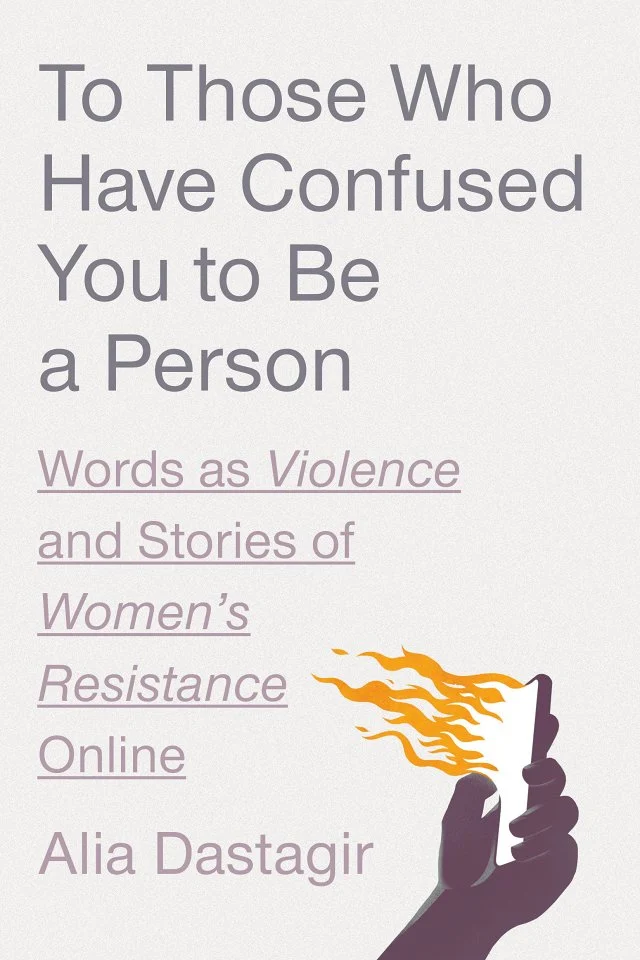
I began my book, To Those Who Have Confused You to Be a Person, wondering how women were surviving violence online. I wanted to know how women coped. I thought there would be a clear number of beneficial strategies and I would be able to sensibly arrange them.
I have learned a great deal about how women cope, but I cannot be honest about those findings and package them as I’d hoped. Coping involves a number of strategies influenced by alternating priorities. Everywhere there are binds, and everywhere women are getting tied up.

Everywhere there are binds, and everywhere women are
getting tied up.

What Alex knows with certainty, what she told me again and again, was that she tried to ignore the abusive messages but could not. She told herself she was unbothered. Her instinct to ignore her feelings is part of the unseen labor that Black women and other people who experience oppression perform daily. 

Like Alex, many women online try to regulate their emotions, to control what they feel and express. Emotion regulation is defined by psychologist James Gross, a pioneer in emotion research, as “the processes by which individuals influence which emotions they have, when they have them, and how they experience and express these emotions.” Emotion regulation can be done unconsciously, and it can be taught. The strategies people use to regulate their mood and behavior can be based on what they believe about emotion, and their tactics are also influenced by what is culturally accepted about emotion.

When I researched emotion regulation, I noticed two common strategies in the literature: expressive suppression, when a person tries to hide an emotion, and cognitive reappraisal, when a person tries to think differently about a situation to change an emotional response. 

If you are engaged in expressive suppression, you try not to let anyone around you see how you really feel. I think of Alex in her dance class, the way she controlled the muscles in her face so no one could read her distress. 

Cognitive reappraisal is generally considered a healthier emotion regulation strategy. Sometimes it is used to dull a negative feeling or to feel something else altogether. It may involve going over a situation in your mind several times to come up with an alternate take. You might see the situation one way, then try a broader perspective. 

When I began this research, I thought emotion regulation sounded like a reasonable strategy for coping with negative feelings. Things feel awful, things are awful, so you do what you can to manage your emotions, to feel better. We cannot snap our fingers and rid the world of violence, so we might as well learn to regulate our emotions around the violence we face, minimizing their disruptions. We can’t ignore the abuse, but we can reframe a situation to dismiss individual instances of hate and maintain a sense of self-worth, to continue to participate in public life. 

But when I dug deeper, I began to find the trouble.

In 2018 Alfred Archer, a philosopher at Tilburg University in the Netherlands, read a paper by philosopher Amia Srinivasan in which she writes that victims of oppression are often asked to turn away from valid emotional responses to give themselves the best chance of ending that oppression, a choice, argued Srinivasan, that constitutes an affective injustice. Archer was contemplating the paper’s arguments when he heard renowned emotion researcher James Gross give a speech, prompting Archer and fellow Tilburg philosopher Georgina Mills to think about the relationship between affective injustice and emotion regulation, concluding that “the demand faced by victims of oppression . . . is a demand that they regulate their emotions.”

Archer and Mills argue that while cognitive reappraisal may make a woman feel emotionally better, it can also involve “turning away from the injustice.” They offered the example of a woman who is angry at being sexually harassed, cognitively reappraises the situation to decide it wasn’t harassment, and then essentially ignores the problem and “gives up on attempts to challenge the injustice.” (The goal of reappraisal is to change your emotion, so the story you settle on may be one that makes you feel better but not necessarily one that is true.)

To illustrate the problem with suppression, they give the example of a woman who does not express her anger. That choice may keep her safe from further discrimination and avoid making other people around her uncomfortable, but it can decrease her positive emotions, cause problems with cognition, and lead to poor health outcomes.

When Archer and I Zoomed to lean into these complexities, he admitted that while some form of emotion regulation is necessary to survive life, in the context of oppression, the act of trying to control your emotional state is fundamentally unjust. 

“The fact that you have to try and work out how to respond, how to keep yourself healthy in the face of this, shows how big a difficulty it is. Because not only are you faced with all of these options, each of which brings costs, but thinking through how you are going to respond to a situation is enormously cognitively taxing in itself.”

José Soto, a professor of psychology at Penn State who has conducted research on how culture can influence emotion regulation, said that when a person is trying to manage emotions around aggressions that are group based and identity based, the effectiveness of emotion regulation strategies is also likely going to be influenced by that person’s goals. The goal of self-preservation and the goal of fighting oppression may require different strategies. 

Alex’s goal was to survive her senior year. And she did. She is a doctoral student now, studying how the messages of fascist groups impact the psychological development of Black girls. She organizes in Boston, writes for the Global Network on Extremism and Technology, and conducts research on far-right misogynoir.

“It doesn’t stop,” she told me of the abuse. “Anytime I write something, it doesn’t really stop.”

Alex told me the difference now is that she doesn’t “pretend it’s not there.”

Learning how to regulate emotions is important for psychological well-being, but the strategies we use can force us into near-impossible choices about what is good for the moment and what is good for the future, what is good for the individual and what is good for the collective. I struggled with how to conclude this essay, because I wanted to end with an idea that felt unequivocal and concrete. That urge was impossible to satisfy, so I landed on a conversation with psychotherapist Seth Gillihan, who teaches people how to regulate emotions by changing unhealthy patterns of thinking. Gillihan, who had been a source during my reporting on the trauma of the January 6 insurrection, told me that if someone is upset about their abuse and is beating themself up for being upset, wishing they had thicker skin, thinking they can’t do this work or that they shouldn’t be sharing ideas publicly if they can’t handle them emotionally, he would encourage them to notice those thoughts, to loosen those attachments, and to question those assumptions.

“Maybe you could ask yourself something like ‘Do any of the people I know who have expressed who they truly are in spite of society’s criticism or hatred, who have really changed society, have they done it without some level of abuse? Is it worth what it’s going to cost?’ And the answer might be no. But someone might realize, ‘Oh, nothing says this should be easy.’ And there can be real relief in that. And realizing this is hard. Yeah, it’s hard. Exactly. That’s exactly how it is.”

Pain and reprieve are the nature of struggle. They formed the poles of Alex’s experiences. They made their way into her art. When I asked Alex for some examples of her choreography, she shared a piece she created during college that featured five Black alums. The piece began with the women moving into a circle, clasping and raising their hands before breaking into smaller groups. One performed a solo, then they came back together, eventually dancing in unison. You don’t have to understand every move to feel the weight of it. Alex told me the piece was about how Black women are rarely protected, so they depend on the love between them to invent safety, to sustain movement.

Alex told me she later watched a recording of the performance. When it ended, in that liminal silence before the audience claps, you can hear a single voice, low and proud: 

“Yes.”

It was her mother.


Excerpted from TO THOSE WHO HAVE CONFUSED YOU TO BE A PERSON by Alia Dastagir. Copyright © 2025 by Alia Dastagir. Published in the United States by Crown, an imprint of the Crown Publishing Group, a division of Penguin Random House LLC.

9 Must-Read Books by Guatemalan Writers

Guatemala—the land of eternal Spring—the birthplace of my parents, their parents, their grandparents, and as far back as we can remember, the place I consider my second home. Guatemala, a country ravaged by civil war, the Spanish colonial regime, and the United Fruit Company; a place Anthony Bourdain was too scared to visit for fear of gang violence, drugs, and kidnappings. A place I visit every few years, where I have been stopped and frisked by military personnel and crooked police, threatened with machetes, and survived the shooting-up of my childhood home. It’s also the place I learned to ride a horse with no saddle, swim in lakes so clear that I could see my feet, and drink with locals who had to be up for work in a few hours. It’s a place blessed with beauty and plagued by history. 

I was an infant—less than a year old—during my first visit to Guatemala. I don’t remember this. I was three, seven, ten, and twelve when we went again, and my memories all blend together into two distinct but cohesive montages of images. The first, in the mountainous highlands—sleeping on hammocks, trekking the jungle with my grandfather while holding a machete, carrying water up from the lake to boil and drink or heat for showers, and walking down the mountain to the mill to grind corn for tortillas. The capital holds different mental pictures and associations—men in uniform with automatic weapons, my cousin standing on the corner with his friends selling drugs, the open-air markets, the gang signs spray-painted on neighborhood walls.   

My book, Guatemalan Rhapsody, explores the dichotomies of my upbringing—both the beauty and the danger—and shows what it means to have both of these things living inside of you. My characters present tough exteriors to conceal the pain and trauma dwelling within. These are a people who have been through much, both in their recent and ancestral histories, and tell the stories of country and its inhabitants. These are the fictionalized stories of my uncles, cousins, brothers, parents, friends, and strangers I knew or saw while I was growing up, all of which have been informed by the authors I have named here. From the humor I employ to the loss of our indigenous roots to the difficult circumstances my characters find themselves in, these topics converse with the other authors on this list. I think this is our way of presenting, center stage, a body that casts a shadow—a people too real to not stop the light that illuminates one half of our beings and obscures the other. 

Trout, Belly Up by Rodrigo Fuentes, translated by Ellen Jones

This collection of interlinked short stories brings to light the life of Don Henrik—a rural farmer on a quest to better his circumstances in life—and the lives of others in the surrounding areas in similar situations. Fuentes’ characters are overflowing with vices and virtues and feel more real than some of the people—made of flesh and blood—that I encounter on the street in real life. From a missing dog to hitmen to trout breeders, the stories in this collection end with an open-endedness that left me frantically turning pages and stopping just short of attempting to slice open the thin paper on which the words were printed to see if there was more.  

Dreaming of You by Melissa Lozada-Oliva

This is a novel told in verse, where “Las Chismosas”—the gossipers, a chorus of aunts and grandmothers—follow the narrator, Melissa, as she goes about her daily life dealing with breakups, periods, bad sex, and, of course, the bringing back of Mexican superstar Selena Quintanilla. Most people who grew up listening to Selena’s music, much like myself, know about her story and her untimely death. This book comes to us at the perfect moment, as the person currently serving time for Selena’s murder, Yolanda Saldívar, will be eligible for parole on March 30th of 2025 after serving 30 years in prison. The book ends with an alternate timeline in which Selena doesn’t die—she goes on to make more “bops” and fall in love with Johnny Depp after they star in a movie and having a daughter and….

Our Migrant Souls by Héctor Tobar

This book, as the subheading suggests, is a meditation on race and the meanings and myths of “Latino.” The book focuses on defining what it means to be a Latine(x) person in the United States now and how that term itself—a Spanish-given term, much like the term “Hispanic”—erases our indigenous and African past for the more “favorable” European option. The book discusses themes ranging from Hollywood’s rebranding of colonialism in an attempt to redefine it as a heroic act, growing evermore violent in its onscreen portrayal as if trying to imitate the real life barbarism that occurred in Guatemala and other Central American countries in the final decades of the last century to the “passive” mass killings occurring at the US-Mexico border by US policy makers who understand the desert to be a natural death machine of which they can wash their hands clean when asked if they have had a hand in killing anyone attempting to seek asylum or emigrate to the US. 

Popol Vuh translated by Michael Bazzett

The Popol Vuh, which translates into “Book of the Council,” “Book of the Community” or “The Sacred Book,” tells the story of creation according to the Maya—the thunder gods and the water serpent making land, the making of animals, and the three attempts to make humans. Much like the Bible, it features other myths but the main focus is on two sets of twin brothers (Jun and Wuqub and Hun Hanaphu and Xbalanque) who take on the gods of the underworld. The first set of brothers, the fathers of Hun Hanaphu and Xbalanque, disturb Vucub Came—the master of the underworld—with their game of pitz—a Meso-American ballgame best described today as a cross between soccer and basketball, where players must shoot a ball through a hoop using only their hips. Vucub Came challenges them to a game, then lords of the underworld trap and kill them. But Hun Hanaphu and Xbalanque, formed from the spit of the decapitated head of Hun Hanaphu, challenged years later, pass all of the tests set before them by the gods of the underworld and come out victorious. 

All My Heroes Are Broke by Ariel Francisco

This poetry collection is divided into two sections—the first section takes place in New York City, the other in Miami. The poems in the collection are short, and yet the turn at the end of each one is a gut punch for which you can not brace. Each of the poems could be rapped over a beat you have to nod along to, which is exactly what the reader will find themselves doing while reading. The language is taut, no word out of place or used for filler, all guts and veins and bones, no fat. 

Men of Maize by Miguel Ángel Asturias, translated by Gerald Martin

No list about Guatemalan writers would be complete without mentioning an Asturias book. Winner of the Nobel Prize in Literature, Asturias is well-known for his writing, specifically his novel, Mr. President, which, like Men of Maize, focuses on telling the novel through the point of view of multiple characters. I first came to Asturias by way of his story collection, Legends of Guatemala, which focuses on Maya mythology pre-Spanish conquest and the power struggle between the story telling of the Indigenous population and written word of the Spaniards. Men of Maize, much like the other books I have mentioned so far, is not an easy read. Divided into six sections, each from a different point of view covering the course of decades, the novel addresses the way of life of the Indigenous Maya population and its attempt to hold on to its culture; the maize at the center of the book is seen as sacred to the Maya, but the Ladinos see it as a means to an end—the achievement of modernity and monetary prosperity. The book relates the difference between the magical realm of the Maya and the “practical” world of the Ladinos and tells the stories of what it means when one culture attempts and succeeds to impose itself upon the other—the loss of identities, spiritualities, and histories. 

If Today Were Tomorrow by Humberto Ak’abal, translated by Michael Bazzett

The poems in this collection, to my mind and ear, are like prayers to the earth, the sky, the sea, the land, and the gods that came before us. Ak’abal was of the same location as all of my ancestors—the highlands of Guatemala, from tribes settled along the Motagua River Valley—and wrote with legs and feet like roots anchored to the land. The poems appear as a vision and slowly lead the reader to an ending—one that ends on the page but continues in the mind; here is his poem, “Dusk,”: “Like a wounded rose, / evening / bleeds / slowly / into nothing. / Then even nothing / is no more.” 

Knitting the Fog by Claudia D. Hernández

This memoir incorporates traditional prose with interspersed poetic forms to tell its story. Starting when Claudia was a child, focusing on age 5, when her mom ran away from her abusive husband and father of her children, Raul, leaving behind Claudia and her two sisters, Consuelo (9) and Sindy (15) with their aunt Soila, the book traces Claudia’s upbringing in Guatemala and her journey to “El Norte” and back. Claudia’s mother returns when Claudia is 8 and tells them that she married a man named Amado in America and that she plans to take them back with her. What follows is the journey through Guatemala and Mexico to their new life in the US, ending when Claudia is 13 during a return trip back to her homeland; but as the title poem says, “The soil knows no border.”

White Space by Jennifer De Leon

Covering topics ranging from her college years (and in the same vein as My Time Among the Whites by Jennine Capó Crucet) to her first visit to Guatemala at the age of twenty-eight, De Leon approaches her topics with retrospective clarity and tenderness. Born in the US but still feeling out of place in mostly white spaces with friends and colleagues who travel during breaks and summer, De Leon decides to go to Guatemala to stay for six months. Broken into three parts, the second part of the collection focuses on events during her visit—from her first day with her dad helping her get settled to re-learning Spanish to performing The Vagina Monologues in Spanish—De Leon bring humor to her experiences. The final section focuses on her writing once back from her travels, the raising of her child, and on the many return trips she made to the land of her ancestors. 

A Coward’s Guide to the Intifada

A Coward’s Guide to the Intifada by Corinne Goria

October 8

See tragic photos in the NYT—attacks in Israel by Hamas. I cover my mouth. It’s a weird reflex.

I walk to the playground by the beach. The sky is a mountainous gray. Waves are messy like a white and steel-colored fingerpainting. My one year old is toddling towards the swings which are pendulating fiercely with bigger kids and I have to run and grab him before he’s punted up and over the sea wall. Just as I reach for him – his soft belly, downy curls of hair still smelling of warmed milk – I see my friend with her son. Her daughters are in Hebrew school. She says, did you hear about it? I say yes, it’s so terrible. She says, I mean, people taken at a music festival. It’s really horrible. I say, yes, it’s horrible. I don’t want to talk about it. I don’t say I don’t want to talk about it, but I already feel accused. She says, at least with social media we’ll finally see what really is happening. I pause. I had no idea she thought the news was biased in the other direction. Or that anyone thought that. 

In a month, that friend will have a book reading. She’ll talk about working for the Kuwaiti government; about teaching diversity; about wanting everyone in the room – a hypothetical room – to feel comfortable. 

A hand goes up. “So, what did it feel like working for, you know, the Dark Side?” Some laughter ripples through the room. 

My friend treats the question with diplomacy. She tries, I think,  to make everyone in the room feel comfortable.

But my face has already turned bright red then pale. I want to leave. I wish I could leave. There are people all around me, including my mom whom I’ve dragged to the event with me. My skin is prickling and the hairs on my arms are on edge and I wonder if this is a reaction to a threat.


October 8

Reach out to friends with family in Israel. 

They say:

My family’s ok but it is really terrible.

Reach out to more friends with family in Israel. 

They say:

Thank you. My family is ok. There has been so much loss on all sides. It’s terrible. 


October 9

Call my friend who’s more like a sister from Tunisia via upstate New York. In a quiet side voice because I’m walking around my kids’ school before pickup ​I say, I am horrified. I feel ashamed to be Arab, or like I’m supposed to be ashamed of myself for being Arab, I mean much more than usual, I say ​openly, candidly. Without ​my usual wryness. 

She (who is ​darker-skinned than I am, more like my dad, more beautiful, and maybe more Maghrebian, or more Berber, than Arab. We’ve never really talked about it. Her parents are Muslim, mine aren’t) says – I know. It’s terrible. But you didn’t do it. 

I know, I say. But people, I’ve learned, aren’t that interested in nuance. You know, they recoil when I say I’m Lebanese. (Like either, terrorist, or, not at the right address, or at the very least, ​gaudy. Loud. Uncouth.)  

I’m worried about how teachers will treat my kids, how other kids and families will treat our kids.  

As I say that last bit, a friend who is half Jewish walks by with her dog and headphones and is sniff​ling. I wave and say, oh hold on one second to the phone, give her a hug – she looks startled, distracted, tearful. She doesn’t smile or crack a joke like usual. We part and I continue mumbling into the phone and pacing outside the school. 

I say, I’m ashamed to be adjacent to the people who did this. And I’m ashamed of humanity. 

Yes exactly, my friend on the phone says. 

​And I’m scared​. Scared for what’s going to happen next. It’s not going to be good. 

You mean like backlash?

Yes. It’s going to be bad, I think. 

I better go.

Text friend who was walking her dog with the headphones. I say:

Hi mama, I’m sorry I was on the phone when I saw you. I wanted to see if you were doing OK? You seemed to be down, maybe from the horrific events that have happened in the last few days. Just wanted to check in and give you a hug through text. (or if I’m imagining it all, please disregard!) xo

She writes back and says she was tired but also, yes, feeling the weight of the world. 

I feel relieved. I thought she might have been planning to ostracize me and my sons from our elementary school community. 

I ‘heart’ her text.

Full page full screens of the New York Times are about the massacres. 

“TAKEN AT A CONCERT.”  

“THE TERROR.” 

“NIGHTMARES WREAKED BY HAMAS.” 

It’s a shift. It’s as though the NYT leadership saw readers were turning to social media for catharsis and wanted in on the action.  

In the face of the all-caps headlines I shield my eyes. I feel as though I’m being yelled at by a dysregulated parent.

More messages about how horrible this all is from high school friends who are all white. Some are liberal. Some are conservative.​ None, it seems, have a single Jewish friend. Is that possible?

How do we support Israel? 

How do we support our Jewish coworkers? 

They text.


October 10

The first families are on the move. The first perish. Reuters Journalists are killed in southern Lebanon. 

I wait for friends who know that I have family in Beirut, who know that I’m Lebanese, who know that I’m Arab, to reach out. 

I wait for at least my closest friends to reach out. 

They don’t. 

Maybe they don’t know?


October 14

A​n Asian-American Pulitzer Prize winner is canceled by the Pritzker Center for his criticism of Israel. ​A Pulitzer-prize winner. 

This is frightening, I text ​to a writer friend. 

Frightening, indeed, they say. And that’s all. 

I post nothing. I say nothing​ to anyone.​ Not even to my husband. He listens to the news of what’s going on in Italian but he knows better than to discuss it when the kids are around.

The kids are always around.


October 16

There is a knock at the door of a Chicago family’s apartment. At home is just the mother and her 6 year old son. She opens the door and it is her landlord. Her landlord says Muslims and Palestinians must die. He strangles her. He stabs her. Then he stabs 6 year old Wadea 26 times. Wadea looks exactly like my plump-faced 7 year old, exactly like my father in his childhood photos. Wadea al Fayoume dies. His mother remains in critical condition at the hospital. My husband sees me sitting on our bed clutching my phone and says, what’s wrong? What happened?


2017-2023

At Cal State, as an adjunct, I teach Susan Albuhawa’s, Mornings in Jenin

I teach Imre Kertesz’s Kaddish for a Child Not Born

The class talks about how unlikely it is that Jewish settlers would steal a child from a Palestinian mother’s arms and take it to raise as their own.

We talk about how, on the other hand, we “know” – because of Steven Spielberg films, a student quips – that the Nazis were capable of any sort of atrocity.

In my international human rights class, I teach Corrie v. Caterpillar

In my Migration Politics and Policy class, I teach Ex Parte Shahid, which asks, for purposes of citizenship eligibility, whether a Syrian is or is not “white”. (Shahid’s “walnut complexion” and primary language and the court’s ‘original intent’ interpretation of the 13th amendment led the court to conclude “NOT white”.) 

I show the picture of my great grandfather’s simple gravestone: Born, Zahle, Syria (Zahle before, and Zahle after, was in Lebanon). Died, Brooklyn, New York. 

I talk about my great great grandfather, too. He applied for asylum for his wife and four children. He did not want to be conscripted into the Ottoman army. He traveled from Zahle to Mexico when he was 30. Then he died. 

According to a tourism website, Zahle is known for its warriors, wine and poetry.

I wonder aloud to my class if any one of these contributed to my great great grandfather’s death in Mexico.

Several months after a letter made its way back to Lebanon with the news of his death, the asylum papers came through. His widow, my great great grandmother, took her four kids and boarded a ship to America. 


February 2022

I opened the email asking for the course descriptions for my Fall classes. I was getting to teach a full course load. I’d even get health insurance.


May 2022

Suddenly, I’m pregnant. It was unplanned. I’m married with two kids. We’re economically ok for the moment; it’s not disastrous. But it’s unexpected. 

I’m due in the middle of the Fall semester. 

I walked out of the doctor’s office in dread. 


June 2022

When I tell her the news, the Director of the Department gives a hard laugh and tells me she can find someone to replace me for the year. 

That would leave me without any source of income. That would foreclose my dream of teaching a full course load. Of having health benefits.

I tell her I’m already working on how to invite guest teachers to fill in for me for just the few weeks after I give birth. 

She says, “You’ll have to pay anyone who takes over your classes. Our department doesn’t have the funds to cover that.”

I hang up. I want to cry but I don’t. I have other things I need to do right then. I’m working and raising two kids already. There’s no time for it. 

The following week HR tells me, Of course there is maternity leave. Of course it is covered. This is California. You’ll get five and half weeks of paid time off.  I ask about lining up other teachers, and how they’ll get paid. She says, the Department Chair will take care of that. When I ask if I would need to pass my salary to the substitute teachers she froze. Of course they’ll get paid. The Department will have funds for that.  No, you don’t give them your wages. Who told you that?

The Director of the Program calls me three times in a row while I’m at the doctor’s office. I see three new texts from her: 

“Pls send me the resumes of the writers you propose to take over your classes in the fall when you leave.” 

“I am working during my summer, unpaid, to resolve this problem as soon as possible.”

“Thx.”

This problem.


Spring 2023

I am woken up every ninety minutes throughout the night. The baby is a poor sleeper. 

I walk through lectures like a zombie. I still love to teach and I still love the students.

In the leadup to the CSU lecturers’ strike demanding better pay, more job stability, parental leave and health benefits, the Director comes into my office late at night. I never usually see her on Mondays. 

They don’t need me next academic year. They have professors coming from Israel to teach.

It’s evening and almost everyone on the floor has left for the day but I still have a night class to prepare for. 

She walks into my small, quiet office, closes the door behind her. 

They don’t need me next academic year. They have professors coming from Israel to teach. Their salaries are paid for by their universities in Israel so it’s a huge savings to the creative writing department. 

You understand, I’m sure. But we might have a class or two opening up the following year. 

I say, face turning red, my mind flailing about to keep my response dignified, “thank you for this opportunity to teach a full course load this year. Having health insurance has been a huge benefit to me and my family.” 

“And maternity leave,” she says. “Don’t forget, you also got to take maternity leave.”


October 2023

Our family’s health insurance runs out. 


November 2023

A college roommate forwards to a small group of us an IG post. 

“Jewish groups sue UC ​Berkeley over unchecked antisemitism.” 

She says she is fearful for our future generations. She asks about another friend’s family in Israel. 

The friend says, Her friends and family are all ok.

I don’t chime in. Even when things have turned lighter. When they forward silly memes. When they talk about a reunion. I still don’t chime in. I’m the only one of 5 on the text chain that stays silent. No one calls me out. One of them might not even recognize my number. It’s been so long since we talked. 

Same friend sends the IG post directly to me alone. 

If I was my normal self, if I was the compassionate vessel I’ve trained myself to be, a heart listener, I would have asked – did you feel that way when we were at Berkeley? I’m so sorry if you felt that way. I understand. How terrible. I’m so sorry you had to feel that. 

If I was the person I want to be I would say something eloquent and eviscerating.  About the students, about the US, about AIPAC, about 1948, 1896, about imperialism and xenophobia and ignorance. 

Instead, with body trembling, sitting in a parking lot, I write:

Such a sensitive issue and such a terrible heavy time for all sides, in the Middle East and for the diasporas in the rest of the world. I feel a lot of emotions as a Lebanese American, with family in Lebanon. A Jewish friend of mine just published a memoir about her time working for the Kuwaiti government. She said she hopes it will help people remember to always get to know others on a human level, never generalize or make assumptions. How are you feeling these days, friend? Sending hugs to you and your family

I am trying to be diplomatic and kind and magnanimous. I am not writing what I want to write.​ What I want to write is full of anger and sadness. I am still shaking when I receive her response.

I get out, walk up one flight of stairs to the Persian threader who will rip out my lip, chin and brow hairs. She’ll call me dear, I’ll call her honey, I’ll speak more freely than I do with my own mother even though I don’t speak Farsi. The thread will break and I’ll joke that it’s my strong Lebanese hair-itage that broke it. The threader will laugh and put her palm on my shoulder. 

I’ll leave and as I walk back to my car and climb in my mouth floods with acid again.

I make sure the mini mall security guard is far enough away before I scream in my car until my voice goes hoarse. 


November

The kids’ school pictures arrive. Matte finish. 8x10s and 5x7s. A red, textured background that looks like bloody plumage. 

My ten-year-old sees that I’ve sent a copy to our family Whatsapp chat and he gets angry. Mom, I told you not to share pictures without my permission!  

Is he embarrassed about his braces? About the forced smile, i.e., his acquiescence to the photographer? Does he just want some control? 

Ok. Ok. I say. You’re right. I’ll ask first next time.


​November

Three men walk down the evening street in Burlington, Vermont. A Brown student, a Trinity student and a Haverford College student. Ivy Leaguers? I don’t know what qualifies as an Ivy League. Only one is not a US Citizen. All three are of Palestinian heritage; they are wearing keffiyehs and speaking Arabic, on their way to celebrate Thanksgiving at a friend’s house. America can be that. 

A man spots them from his apartment window. He hears them. He sees the keffiyehs, maybe.

A man spots them from his apartment window. He hears them. He sees the keffiyehs, maybe. He sees the dark, wavy hair. The dark sparkling eyes and beards. Hears the Arabic, maybe. They are not what he looks like. The man watches them. The man descends his apartment stairs half-blind with rage. Half-blind with self-righteousness. The man’s hand is heavy and light. The man shoots them, one, two, three. The man shoots them, one two three four. Four rounds. One was hit in the spine. 

“We hope he will still be able to walk.” 


December

You should post something​, my husband says in a low voice. Our eight year old is kicking the soccer ball against the wall​ in the other room. Bang. Bang. Our toddler is lying on the floor eating​ a graham cracker and smacking his hand on the hardwood. Bang. Bang. About your family in Lebanon. Or about Arab Americans. Just some solidarity, my husband says. He is from Sicily. They’re marginalized​ and proud. 

​I shake my head. I tell our eight year old to go kick the ball outside but he doesn’t listen. I show ​my husband ​the story about Wadea. ​At first he says, what is it? thinking I’ve changed the subject. Then he is jubilant – oh! Is that the boy giving out the roses in that bar in Beirut? Remember that? He mimics putting the child on his shoulders and raising him up and down. The flower seller with the little black fedora that had been lifted to crowd surf over the dance floor, his dimples flashing shyly as he and his bucket of red roses traveled in a circle around the room, a little prince, a little god, suspended by kind, joyous hands lifting and bouncing him to the beat of the club music, him floating above all of us adults, shy, unsure, until finally he started smiling broadly under the hat, his dimples deep and his eyes all radiant light. 

I shake my head. It’s not him. Keep reading.

My husband gets quiet. He pales. He shakes his head. ​That’s terrible. ​He says in his Sicilian accent,​ What kind of people are in this world, he says. He walks back into the kitchen. 


December

More chatter on texts. More chatter on social. 

I stop reading the news. I stop looking at social. I stop responding to texts.

I sit on the seawall and stare out at a gray glassy ocean. A lone swimmer in a wetsuit breaks through with hand and elbow. A bird dives into the water.

For five minutes, I don’t even look behind me to see if anyone is brandishing a knife. I revel in the safety. I immediately feel guilty for being able to enjoy ​it.​

​I am the Room Parent and I sign off on the December email with “Peace on Earth”. 

How fucking weak, I say to myself. I think of saying more, even to friends, and then I think of backlash on my kids. My ten year old wants control of his image. 

What if he’s called a terrorist, jokingly, by his teacher? By other fifth graders? What if the teacher says, Whoa, watch out! Followed by some deep-toned angry mimicry of Arabic. 

What if the teacher or the parents are mentally or emotionally unstable? 

What if they are just misinformed? 

What if they have guns? 


January

My friend who works at the Jewish Museum in Northern California says she is furious at Netanyahu. He’s as bad as Hamas. She has trouble with the use of the word genocide​, though. We walk on the beach. She admires the rose-colored cliffs circling the cove. We pick up shells, ogle surfers, take selfies. Our tone dips into despair and then rises into silly laughter. We’ve known each other for twenty years.

I say – not having watched the news in weeks – it might not be genocide.

She says, I can’t tell you how relieved I am to hear you say that.

Later that day, alone, I look at the 1989 Convention on Genocide. 

I text her the link and say:

Looks like we’re already there. 

But to make her feel better, to try and bridge, I say, 

But maybe you were asking 

about how this compares 

to other atrocities, to other 

genocides?

She writes ​and says:

No, I just wanted some 

certainty.​ 

Tearful emoji.


February

My 79 year old aunt sends messages to Biden. 

Your policies are killing innocent children. You are funding genocide. You are dehumanizing all Arabs everywhere. 

My aunt is furious. 

I am still not watching. I am still not reading. 

Somehow something trickles through about the protests at Columbia University. There’s even an encampment. Tents. 

I am shocked. I am touched. What is that feeling you get when you walk into a surprise party that has been assembled for you? That’s the feeling I have. Why?

I call my other aunt in Beirut. She is 90 years old and she was a history professor at the American University of Beirut and she speaks four languages fluently and she never married and last I saw her,  she had traveled alone to my wedding,  her gray hair blown into a beautiful style. She had loved the food. She says, I am fine. But it really is horrible. They will try to take the whole region, mark my words. But I am fine. My apartment building has a generator. 

I say, Do you think you can come here? You know you can always stay with us. For as long as you want. 

She says, Go there? No way! Not the way you treat your university students. 


March

I fly to San Francisco. A friend tells me about this famous person being pro-Israel. That famous person being pro-Israel. She tells me there is a groundswell of Palestinian support, though.  

We walk through the Mission and see Free Palestine graffiti. A huge Palestine flag painted on the door of a beloved, abandoned Italian deli. I take photos and send them to my aunts and cousin and sister. 

We drink beer in the park, my friend and I. We eat sushi. I start to think that the only Arabic thing about me is my fatalism. I start to think Arabic fatalism is not inevitable. I wonder how different I might be if being Arab in this country were an asset not a blemish.

I start poking around IG again. I’m on antidepressants, after all. My feed is almost exclusively Al-Jazeera, Democracy Now and writers for Palestine, peppered by ads for bras, for the perfect yoga pant, for dining chairs, wrinkle cream, comedy shows, pet food. I have to put my phone down after starting to feel vertigo from the incongruence.


April

My dad of all people is the one who has the idea. The message arrives on a Friday. 

I’m going to visit the local university’s 

pro-Palestine encampment 

tomorrow and see if 

I can donate to them. 

Want to join? 

We parked too far away. My kids were complaining halfway through our walk up the campus. But my dad, on reaching the protestors’ table, had softened into a person I did not recognize. 

At the table were a lady who looked white and in her thirties, and a girl who looked Asian-American and in her twenties. I said thank you to both of them. 

I smiled a little too long at them. I never imagined anyone who had their own battle against the American mainstream would put themselves on the line for Arabs. For Palestine. Something that was so small in me, that seemed long dormant, stirred. I asked if we could bring the protesters anything. 

I never imagined anyone who had their own battle against the American mainstream would put themselves on the line for Arabs.

They said, just snacks maybe. Individually wrapped. And maybe coffee, but not from Starbucks, please. I said no problem. I thought about how I could get back the next day with coffee. How to bring it in containers that would reassure everyone that it had not been tampered with. How to bring it hot but sealed. Maybe just bring some cans of local cold brew. Or those packets that you mix with hot water? But how would they get the hot water? 

The next day the university arrested 61 students. All of the tents were trashed. 

I had been on my way to get coffee when I heard the encampment had been “cleared”. I was too late. I berated myself. I hated myself for being too late. 

I reminded myself coffee was not like food and water. Not a proxy for dignity and freedom of speech. I reminded myself the university did not have to arrest peaceful protestors. That wasn’t my fault. 

It’s a public university, though, and I’m paying taxes. 

I drove around the campus perimeter in circles. I was like a stray ant whose line had just been wiped up by a sponge.  


May

Lunch with a friend who works in the theater. She is neither Jewish nor Arab nor Muslim. She is a widow with two young kids and has successfully prioritized the important thing in life, namely, to survive until her children reach adulthood. 

When she ordered she asked for a hamburger with no bun. My doctor says I’ve got to lose twenty pounds, she says. 

She tells me about theater gossip. People are talking about genocide and apartheid and putting Palestine flags on their cubicle walls. The Theater Director, who is Jewish, is uncomfortable. He wants to issue a statement to the theater – to everybody, playwrights, actors, managers, directors, to keep politics out of the theater. He feels attacked. 

I look around and then say in a hushed voice, “Has he seen the DOD or DOS statements? The US is still arming Israel. We always have. Weapons and bulldozers and drones and tactical support and cyber support and assault rifles and bombs.” 

I’m not polished, I’m not building a methodical argument, or an argument based in human rights law or international humanitarian law or in logic. I’m flailing wildly and my cheeks are getting hot. 

“The Director might feel attacked but the world’s most bloated military budget is behind him. I mean, I mean, everyone on the other side of our bombs and rifles are actually being attacked.” 

As I reach for the water glass, my hands are trembling. My fork is still clean and shiny on the cloth napkin. We are sitting outside, a sunny breeze sends a shiver through the leaves, there are a few tables close to us and I feel I’m going to get screamed at or have rocks thrown at me or worse at any second. 

My friend said, “I guess I’m in such a bubble in the art world. Everyone is wearing keffiyehs. Palestine is the cause celebre.

“Well, it’s the first time in my father’s lifetime that anyone in America has cared,” I say. And even if the Director is in the minority in the theater world, he’s in the majority everywhere else. The theater world is not in charge of arms deals.

In the end my friend said she talked the Director out of issuing a statement to keep politics out. You’re in a position of power, she told him. It will be like censorship. 

I bet it wasn’t easy to say that, I say.

No. It was so hard, she said. She finished her meal. I took mine to go. I was still nauseous. 


May

Warm day. Dallas-Fort Worth. A mother and her children at their apartment complex swimming pool. Her six-year-old son and three-year-old daughter are splashing and shouting with glee in the shallow end. They can’t swim yet but love how weightless they feel in the water. How powerful they feel slapping and pushing the water to and fro with their small hands.

“The suspect approached the mother [who was wearing a head covering] and asked where they were from. The suspect then jumped in the pool and dragged the three-year-old girl into the deep end and tried to grab the six-year-old boy, the police report said.

The mother was able to pull her daughter from the water, police said, and local medics responded to the scene and the children were medically cleared.

The woman is being charged with attempted murder.” 

“My daughter is traumatized; whenever I open the apartment door, she runs away and hides, telling me she is afraid the lady will come and immerse her head in the water again.”


May and June

I see the toddler’s naked corpse with no head. It is not cleanly sliced off, the flesh is shredded at the neck. The arms flop lifelessly.

I hold my toddler and I clutch his head and I run my fingers through his soft curls. I think of how I’d like to die quickly if I was the mother of that other toddler. 

What about my other kids, though? 

I think, would it just make sense, cost-benefit analysis, devastation-life still left to live analysis, would it just make sense for all of us to die quickly? 

Is that what the people bombing us think? 

When did I start to think I was among those being bombed?


June

My sister calls my aunt sobbing. She can’t take any more images of dead children. 

I call my aunt almost immediately after. It was a coincidence. 

I tell her I have survivor’s guilt. She says she does too. We talk about traveling to Lebanon next October to see Aunt Shereen. To show the place means something – because Americans are visiting? Who cares? American citizens have already been wiped out on either side of the conflict.

To plead, don’t wipe this place off the map. A hubristic thought. 

I don’t plan on bringing my kids. 


August

I blow up at my husband. My mom. My kids. My sister. My aunt. I can see myself flailing wildly in life. A loose fire hose. Can’t get steady.

Reach out to aunt in Beirut again. She’s fine.

Reach out to a writer friend. Tell her my 90-year old aunt is fine. She’s going to the beach. She’s having her friends over for dinner. She’s living her life as a fuck you to Israel and the U.S. I text:

My aunt is proof there is courage in our blood, but I didn’t get that gene.


September

I dig out my grad school copy of Orientalism. 

“We still have at our disposal the rational interpretative skills that are the legacy of humanistic education, not as a sentimental piety enjoining us to return to traditional values or the classics but as the active practice of worldly secular discourse…Rather than the manufactured clash of civilizations, we need to concentrate on the slow working together of cultures that overlap, borrow from each other, and live together in far more interesting ways than any abridged or inauthentic mode of understanding can allow…

“Humanism is the only, and I would go so far as to say, the final resistance we have against the inhuman practices and injustice that disfigure human history…

“What is quite worrisome is the absence of analysis and reflection. Take the word “terrorism.” It has become synonymous now with anti-Americanism, which, in turn, has become synonymous with being critical of the United States, which, in turn, has become synonymous with being unpatriotic. That’s an unacceptable series of equations.”

“The human and humanistic desire for enlightenment and emancipation is not easily deferred.”

It’s the 2003 edition, with a preface by Said written three months before he died. He writes in that special window of lucidity and honesty afforded those who might intuit their impending deaths. 


September

Pagers explode while people are buying cucumbers and tomatoes. Children nearby are killed. 

What does that mean? They had pagers rigged before they were even sold? How many steps ahead did they have to plan this? Is “they” the entire supply chain? 

Leon Panetta calls it an act of terror. 

The UN calls it a war crime. 

Sources say Israel was on the phone with the US minutes before the attack. 

In the debate, Kamala says Israel has a right to defend itself. Kamala puts emphasis on the massacre of 1400 Israelis last October. Kamala glosses over the estimated 40,000 women, children and babies who have been massacred by Israel. 

Is one Arab baby worth one fortieth an Israeli baby? 

I would never ask this aloud. I would be afraid of the answer. 

Bernie says he will introduce a resolution to block a $20 billion arms sale to Israel. 


September

I yell at my eight year old to put his shoes on. I roll my eyes at my husband. I pick up our toddler and nurse him and it works – it silences him. I’m teeming with something I can’t yet name.

All the killing feels close and personal. I stand in a kitchen with four walls and multiple electric appliances. I stand in a house in a wealthy city in a wealthy state in a wealthy country protected by the most expensive military of all of human history.  Protected by a military that is helping massacre my relatives on my ancestral homeland. I feel persecuted and utterly ensconced. It is all so dissonant. I don’t know what to do with myself. I stare for a full five minutes at the blades at the bottom of the empty blender. 


September

My friend who works at the Jewish Museum texts:

Argh! Israel. (Enraged emoji.) 

I hope everyone you know is okay. 

It is horrible, infuriating, needless.

I text her:

Thank you for your kind text. 

My family is still ok. I love you, friend.


September

I’m letting the carpool out at middle school. My older son, a sweet eleven year old now, can’t find his Fortnite hat. He digs around in the trunk and finds my hat with the Lebanese flag and puts it on. I’d bought it recently but had never had the courage to wear it. It’s still bright and stiff. 

Israel has just bombed and killed hundreds in Lebanon. Dozens of women and children. I’d heard about it the day before. We are still waiting to hear from our aunt.

I stop him as he’s getting out. 

“A___,” I say. “Wait.” 

My heart is beating fast. Should I tell him not to wear the hat? 

What will his teachers say? What will the kids say? 

Will we all get called into the Principal’s office for advocating violence, or advocating Arab-ness which in America is the same? 

Will my son – already the new kid in his middle school – become ostracized? Will he yell at me with tears in his eyes – why didn’t you tell me what this hat meant? Why did you let me wear this? 

Or worse?

Or so much worse?

“Yeah?”

I stare at him. His smooth cheeks and long straight hair and deep dimples. His sparkling eyes under the brim of the hat. He’s been happier the last few weeks than I’d seen him in months. He had come out of some long shadow and his smile this morning is blindingly, painfully radiant. 

“Mom, yeah? What is it? I’m going to be late.”

“Nothing. I love you. That’s all. Have a good day, dear.”

“Love you, too.”

I think maybe the gene for courage found itself to him, despite skipping me. I think, what a strong son I have. I think, he doesn’t have any idea what kind of risk he’s taking. That’s my job. I should have said something. I should have stopped him. I think all of these things at once and I do not cry. 


November

Trump looms. In a few months, he’ll talk about taking over Gaza to build a resort. His face, with Netanyahu’s, will be on an Israeli Security Agency leaflet that litters the sky. “The map of the world will not change,” the leaflet says, in Arabic, “if all the people of Gaza disappear from existence. No one will ask about you.” 

I still don’t post. I still don’t speak about it. I write a narrative that I hope no one will read.

 7 Speculative Fiction Works That Offer Powerful Social Commentary

My last year as a high school teacher, I taught a senior English elective called Fear, Haunting and the Supernatural. I’ve been out of the classroom for two years now, and the real world hasn’t gotten any easier to understand. As I created my curriculum for this course, I often dwelt on the same questions I asked my students when thinking about my novel. Why do we create what scares us? Is fear the best vehicle for social change? How can fantasy enhance reality, rather than distract?

My novel Junie is a supernatural coming-of-age story about the titular character, who faces a life-altering decision after awakening her sister’s ghost, but it’s more of a story with a ghost than a ghost story. Sixteen years old and enslaved since she was born, Junie has spent her life on Bellereine Plantation in Alabama, cooking and cleaning alongside her family, and tending to the white master’s daughter, Violet. When wealthy guests arrive from New Orleans, hinting at marriage for Violet and upending Junie’s life, she commits a desperate act—one that rouses Minnie’s spirit from the grave, tethered to this world unless Junie can free her. 

What I’ve found so compelling in my years as a speculative reader, writer, and teacher is how other authors use fantastical elements to offer their own commentaries in unique ways. While Mary Shelley could have written a book about the dangers of science, telling a story of a scientist bringing a man-made corpse to life is far more resonant. While Octavia Butler could have written a modern Black character reflecting on their ancestry, it is far more powerful to see that character time travel and face the man who is both their enslaver and ancestor. In my novel’s case, the ghost serves to confront Junie with her grief, rage, and conflict in a more visual and visceral way. Fantasy allows authors to craft settings, characters, and plot points that foster conflicts that are impossible in pure realism. At its best, speculative fiction uses the unreal to put reality into clearer focus, allowing authors to create more potent social commentaries. 

The following seven works of speculative fiction are a few of my favorite examples of the genre’s limitless possibilities to examine power, race, and oppression: 

Our Share of Night by Mariana Enriquez, translated by Megan McDowell

 Our Share of Night follows Gaspard, a child in dictatorship-era Argentina whose mother has just died under mysterious circumstances and, unbeknownst to him, was part of a satanic, capitalist cult. To save his son from the cult and the darkness it worships, Juan, Gaspard’s father—a former cult member forced into leading its rituals as a child—does everything in his power. The novel is a fantastic allegory for wealth, fascism, and capitalism, focusing on how the wealthy worship power and abuse the poor and indigenous to further their ends. One of the most messed-up books you’ll ever read. 

Kindred by Octavia Butler 

From the outset, the book throws 1970s Black woman Dana into the world of antebellum Maryland, demanding she save a young boy. The boy’s identity as a plantation heir who will later assault his slave is revealed, explaining Dana’s heritage. This book showcases Butler’s mastery of speculative fiction, using fantastical or futuristic settings to explore human conflict in ways that would be impossible in reality. Unlike most time travel novels, Dana’s movement through centuries is a violent and traumatizing experience, one that forces her to confront the darkest realities of slavery and African American ancestry. It’s a modern classic for a reason. 

TW: Sexual assault

Sing Unburied Sing by Jesmyn Ward

Part road trip, part intergenerational family story, Sing Unburied Sing follows mother-and-son Leonie and Jojo as they travel to pick up Jojo’s father from Parchman Prison in Mississippi. Like most great ghost stories, the haunting has little to do with the undead spirits. Instead of focusing on supernatural ghosts, the novel explores how the lasting effects of systemic racial and class violence haunt people’s lives. 

Mexican Gothic by Silvia Moreno-Garcia 

When Noemi goes to visit her newlywed cousin Catalina, she’s already very apprehensive about Catalina’s reclusive English in-laws. What starts off as a wellness check turns into a horrifying fever dream in one of the strangest haunted houses in literature. Like Haunting of Hill House meets The Substance, Moreno-Garcia crafts a lingering and powerful social commentary on colonization. Prepare to have your understanding of fungi revolutionized; you’ll never see mushrooms the same way again. 

TW: Sexual assault

All’s Well by Mona Awad 

Mona Awad is best known for weird-girl classic Bunny. In her most recent book, theater teacher Miranda lives with incurable, debilitating chronic pain that has ruined everything from her acting career to her marriage. She spends all her free time immobilized in agony or tortured by male doctors with little regard for female pain. Her only slight happiness lies in staging a college production of All’s Well that Ends Well, despite her students’ mutinous opposition. When she’s visited by three strange men who give her the ability to transfer her pain and thrive, Miranda enters a manic state of joy at her revenge and physical freedom. Based on Awad’s own experience living with chronic pain, this book is a searing and often-times funny critique of the social disregard for women’s pain. 

Boys of Alabama by Genevieve Hudson 

This queer coming-of-age tale set in the heart of evangelical Alabama focuses on Max, a German immigrant with the ability to resurrect the dead. Hudson uses a Perks of Being a Wallflower-esque narrative to slice into the dark underbelly of Southern culture, from the cult-like football obsession to the charismatic politician/pastor known only as The Judge. The novel uses all the elements of Southern Gothic to great effect to explore identity, religion, queerness, and masculinity, all building to a compelling commentary on power and violence in religious communities. 

Babel by RF Kuang 

This historical fantasy novel follows Robin, a Canton-born orphan adopted by a British professor and trained to work as a translator as the fictitious Babel, a school within Oxford in the 1830s. In Kuang’s alternate history, translation powers the Industrial Revolution and British colonialism through silver bars that channel the “lost-in-translation” elements of language into action. The novel, beginning as a coming-of-age story set in academia, evolves into a powerful commentary on white supremacy, colonization, and power, revealing how imperialism exploits immigrants and the colonized. Warning: you will cry.

Exclusive Cover Reveal of “Algarabía” by Roque Raquel Salas Rivera

Electric Literature is pleased to reveal the covers of Algarabía by Roque Raquel Salas Rivera, which will be published by Graywolf Press on September 02, 2025. Pre-order your copy here.

Algarabía is an epic poem that follows the journey of Cenex, a trans being who retrospectively narrates his life while navigating the stories told on his behalf.
 
An inhabitant of Algarabía, a colony of Earth in a parallel universe, Cenex struggles to find a name, a body, and a stable home. The song of Cenex weaves and clashes texts by cis writers on trans figures with fragments from historical, legal, and other nonliterary texts. Cenex leads us through his childhood hospitalization, his years as an experimental subject, a brief stay in suburbia, twisted meanderings, and not-so-far-off lands accompanied by a merry band of chosen queers.
 
Referencing everything from pop culture to Taino cosmology and philosophy (at times in a single line), this book laughs at its own survival with sharp, unserious rage. The edition is composed of two original texts—one written in the Puerto Rican dialect of Spanish, the other in a reconsideration of English. Algarabía inscribes an origin narrative for trans people in the face of their erasure from both colonial and anti-colonial literary canons.


Here is the English-language cover, designed by Luis Vázquez O’Neill with art by Natalia Bosques Chico.

Roque Raquel Salas Rivera: “Every time I see the covers, I get chills. Historically, I have worked almost exclusively with Puerto Rican visual artists on my books. Natalia Bosques Chico and I began discussing the cover art and illustrations for this book before I had finished the manuscript. I have long admired Natalia’s work and her understanding of those images that form part of our collective imaginary and her work around trans icons such as Villano Antillano and Walter Mercado. I also knew that she’d be able to capture the feel of a trans epic. The final painting, a centaur set in a landscape near a bohío (the jíbaro centaur), is charged with remixed familiar images. The boys that ride horses or motorcycles with breathable ski masks are condensed into the lone figure of the epic anti-hero, shaped by wind, grass, and palm.

I had also previously worked with Luis Vázquez O’Neill, who had designed the book for the no existe un mundo poshuracán exhibit at the Whitney Museum. His vision for the covers was ingenious and the work was often collaborative. After much discussion, we felt having two covers—corresponding to each side and language of the flip book—made the most sense. The cover for the Spanish-language side focuses on the ski mask, which tapers off in unfinished strokes beneath the neckline. We wanted to convey that traditions rooted in radical change are works in progress and subject to revision, which is how I see this book in relation to my poetic and political lineages.

For the English-language cover, Luis integrated the use of red on Cenex’s path, linking both sides. The centaur’s tanktop fades into the page, an embodiment that is textual and speculative, as well as rooted in my experience. The style he used for the title, subtitle, and my name alludes to Algarabía‘s playful and intimate nature. The contrasting textures capture my use of variegated poetic styles such as décimas, sonnets, tankas, ekphrastic poems and, of course, the epic.”

Luis Vázquez O’Neill: “Designing the cover for Algarabía was an exciting opportunity to collaborate closely with Roque (whose work I deeply admire) and a creative challenge to use collage, illustration, and hand lettering as mediums. My first encounter with Roque’s writing was through La Impresora, an independent publisher in Puerto Rico, and later while working on a publication for the Whitney Museum’s exhibition no existe un mundo poshuracán, which referenced Roque’s poetry.

The book required bilingual covers—one for the Spanish version and one for the English version. Roque had commissioned a beautiful illustration of a centaur by Natalia Bosque Chico and asked me how could we incorporate the illustration for both covers in two different. The English cover uses Natalia’s illustration in the form of a layered collage showcasing the full centaur. The Spanish cover isolates the centaur’s mask, creating a more abstract representation of Bosque Chico’s centaur. The choice of handwritten lettering across both covers seemed like an appropriate and natural way to express the meaning we associate with the word ‘Algarabía’.”


Aquí está la portada en español, diseñada por Luis Vázquez O’Neill con arte de Natalia Bosques Chico.


Electric Literature se complace en revelar las portadas de Algarabía de Roque Raquel Salas Rivera, que será publicada por Graywolf Press el 2 de septiembre de 2025. Preordena tu copia aquí.

Algarabía es una epopeya que sigue el viaje de Cenex, un ser trans que narra su vida retrospectivamente mientras navega por las historias contadas en su nombre.
 
Habitante de Algarabía, una colonia de la Tierra en un universo paralelo, Cenex lucha por encontrar un nombre, un cuerpo y un hogar estables. El canto de Cenex entreteje y enfrenta textos de escritores cis sobre figuras trans con fragmentos de textos históricos, documentos legales y otras fuentes extraliterarias. Su protagonista nos conduce a través de su hospitalización temprana, sus años como sujeto experimental, una breve estancia suburbana, meandros retorcidos y unas tierras no tan lejanas en la compañía de un grupo jovial de cuirs predilectos.

Poblado de referencias a la cultura popular, la cosmología taína y la filosofía (a veces dentro de un mismo verso), este libro se ríe de su propia supervivencia con una rabia pícara y aguda. La epopeya se compone de dos textos originales: uno que fue escrito en español puertorriqueño y el otro que fue escrito en un inglés alterado. Algarabía inscribe un origen para las personas trans ante su exclusión de los cánones literarios coloniales y anticoloniales.


Roque Raquel Salas Rivera: “Cada vez que veo las portadas, me dan escalofríos. Históricamente, he trabajado casi exclusivamente con artistas plásticos puertorriqueños. Natalia Bosques Chico y yo comenzamos a discutir la portada y las ilustraciones antes de que yo completara el manuscrito. Hace tiempo que admiro el trabajo de Natalia, en particular, su comprensión de aquellas imágenes que forman parte de nuestro imaginario colectivo y su trabajo en torno a íconos trans como Villano Antillano y Walter Mercado. También sabía que sería capaz de capturar el sentir de una épica trans. La obra final, un centauro situado en un paisaje cerca de un bohío (el centauro jíbaro), está cargada de imágenes familiares remezcladas. Los chamacos que corren motora con máscaras de esquí transpirables se condensan en la figura solitaria del antihéroe épico, moldeado por el viento, la grama y las palmas.

También había trabajado anteriormente con Luis Vázquez O’Neill, quien había diseñado el libro para la exposición no existe un mundo poshuracán en el Museo Whitney. Su visión para las portadas era ingeniosa y el trabajo fue a menudo colaborativo. Después de mucho debate, nos pareció que tener dos portadas, correspondientes a cada lado e idioma del libro reversible, era lo más lógico. La portada del lado en español se centra en el pasamontañas, que se estrecha en trazos inacabados debajo del cuello. Queríamos transmitir que las tradiciones arraigadas en el cambio radical son obras siempre inacabadas y sujetas a revisión y así es como visualizo este libro en relación con mis linajes poéticos y políticos.

Para la portada en inglés, Luis integró el uso del rojo en la vereda de Cenex, uniendo ambos lados del libro. La camiseta sin mangas del centauro se desvanece en la página, una encarnación que es textual y especulativa, así como arraigada en mi experiencia. El estilo que utilizó para el título, el subtítulo y mi nombre, alude a la naturaleza íntima y lúdica de Algarabía. Las texturas contrastantes capturan mi uso de estilos poéticos variados como décimas, sonetos, tankas, poemas ecfrásticos y, por supuesto, la épica.”

Luis Vázquez O’Neill: “El diseño de la portada de Algarabía fue una oportunidad emocionante para colaborar de cerca con Roque (cuyo trabajo admiro profundamente) y un desafío creativo para utilizar el collage, la ilustración y el letrismo a mano como medios. Mi primer encuentro con la escritura de Roque fue a través de La Impresora, una editorial independiente en Puerto Rico, y más tarde, mientras trabajaba en una publicación para la exposición del Museo Whitney ‘no existe un mundo poshuracán’, que hacía referencia a la poesía de Roque.

El libro requería portadas bilingües: una para la versión en español y otra para la versión en inglés. Roque me encargó una hermosa ilustración de un centauro realizada por Natalia Bosque Chico y me preguntó cómo podríamos incorporar la ilustración en ambas portadas de dos maneras diferentes. La portada en inglés utiliza la ilustración de Natalia en forma de un collage en capas que muestra el centauro completo. La portada en español aísla la máscara del centauro, creando una representación más abstracta del centauro de Bosque Chico. La elección de realizar tipografía (letrismo) a mano en ambas portadas me pareció una manera apropiada y natural de expresar el significado que asociamos con la palabra ‘Algarabía.’”

A Middling Review of Original Sin

The Book of Eve

The Book of Eve, by C. R. Chatem-Johnson, Blumen Press

Review-essay by A. Treadham

Chatem-Johnson’s latest marathon-in-disguise-as-a-novel has arrived and none a moment too soon. The Book of Eve is timely and gripping, if also disgusting in the best possible way. Let me explain.

As its title implies, the novel tells the story of Eve from the beginning: nude and innocent, frolicking with Adam in the woods—for this is Chatem-Johnson’s Garden, rendered lush and sunlit in her vivid prose. It’s intriguing to follow Chatem-Johnson’s investigations of an essentially pre-pubescent Adam and Eve. They are chaste and amiable cousins until the very cusp of puberty, when Adam genially teases Eve for the coils of hair spreading between her thighs, even as he boasts of his own.  

In a state of distress, Eve runs into the trees, encountering the snake. Not the prelapsarian monster of temptation. Rather, a small green garter, mute and indifferent. Eve allows the snake’s presence to comfort her. The snake does not fear Eve, but neither does it menace her, and in contemplating the snake, Eve develops consciousness. So the encounter with the snake is developmental. Here I note the key difference between King James and Chatem-Johnson. Eve is not seduced. She is neither victim nor victor. She, sitting naked, tears streaming down her face, is a thinker. A philosopher.

As she considers the garden, Eve notices a small red scabby fruit hanging from a tree. She observes other animals eating these fruits—squirrels for instance, for this is a North American new world. She has lost sight of the snake but it has awakened in her the powers of contemplation. She tastes the fruit, its sweetness. And so she brings it to Adam and impresses upon him her changed vision of the world. 

To be safe from poison—for Adam is superstitious, if scientific—he will only taste the apple from her mouth. She chews for him. She presses her lips to his. To Adam, the apple and Eve taste impossibly good. 

And so they discover each other, blah blah blah. It’s all quite erotic and banal; you’ll have to read for yourself. 

It’s after an encounter among the trees, the fruit rotting now, the beasts crawling, that the story really takes root, and this reader was not expecting such a contemporary impulse. I have argued elsewhere that it is impossible to write an historical novel. We are always writing of our own time, however we may disguise it. 

Here’s what shocked me. Although this story of the Garden (or rather, the woods) is in the air, the water, the culture, I had never stopped to consider the experience of a pregnant Eve. Without an elder woman to guide her, without books, without precedent—of course, Eve feels she must have done something wrong. She must deserve this punishment. And while The Book of Eve makes clear she has not sinned—she has merely fed Adam nourishment from her lips and dallied with him among the damp leaves—despite that, Eve suffers. 

She loses the ability to eat. Her guts churn. Her limbs droop with fatigue. Adam believes she may be dying, and tries to force fruit between her lips, chewing it himself. She vomits. She weeps. Her body swells. He fears she may bear a contagion, and though it pains him, Adam shuns her.

Eve is alone. The snake comes to bear witness. It seems to mean something. But in truth, the snake merely wishes to sniff the puddle of vomit quivering in the dirt, the vile trail dripping from Eve’s mouth. 

Adam blames the apple, though he is not ill from eating it. He blames the snake, the sky, the very dust. Adam does not want his only companion to suffer. And Eve is very young, the novel reveals. Through skillful use of scratched branches and observations of the cosmos, Adam estimates that Eve is twelve. Adam hovers at a distance, while Eve suffers and swells and cries for wretchedness. The seasons change and change again. The climax when it comes is troubled with blood and agony. Eve dies, leaving Adam alone in paradise. There is no sound but the howl of a child whose mother was unprepared for its arrival. 

The rest of the story is that of Adam and the child and the cosmology they create from Eve’s ashes. The way the story gets told becomes the story itself, what the French call mise-en-abyme. Adam now recounts the story of Adam and Eve, as does the child, who blames the mother for being unable to survive giving birth. The story is told so many times, in so many ways, it begins to feel true. That woman, that original woman, stained. That mother, unsupported, lost, and of course, so deeply evil that her very name is the shuttering of light, the darkening of the world.

And so the original sin is revealed over the course of the novel to be a lie. And not just any lie: this fundamental sin, in Chattem-Johnson’s intricate, measured prose, is specifically a denial of the hardships of pregnancy and birth. Hardships so terrible that sin itself—the very concept, the theological fundament—must be invented to explain them. As Chattem-Johnson apparently has been working on the novel over the past nine years, it is disturbingly prescient. 

But of course, as I have written elsewhere, much as historical fiction is really contemporary, so too the present endlessly retells the story of the past. The handwriting was already on the wall, waiting to be transcribed. And now, Reader, alone in the Woods, without compass or guide, here we are.