Geek Reads: If Trees Could Scream

“If trees could scream, would we be so cavalier about cutting them down?” the humorist Jack Handey once asked. “We might,” he admitted, “if they screamed all the time, for no good reason.”

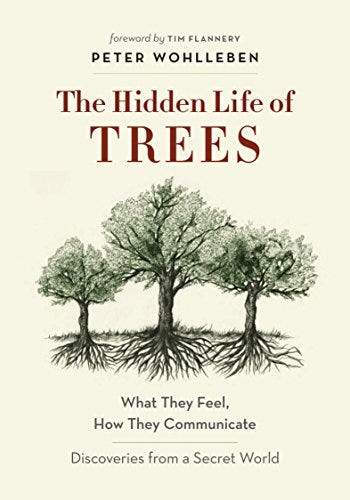
In his superb The Hidden Life of Trees, the German forester Peter Wohlleben indicates there may be some truth in Handey’s joke. “When trees are really thirsty,” he writes, “they begin to scream.”

Newly translated into English and subtitled “What They Feel, How They Communicate,” this revelatory book offers a numbers of deep thoughts about the towering giants in our midst. “We know how the sounds are produced, and if we were to look through a microscope to examine how humans produce sounds, what we would see wouldn’t be that different,” Wohlleben writes. “The trees might be screaming out a dire warning to their colleagues that water levels are running low.”

Could trees really be talking to each other? Now, don’t be hasty. “That doesn’t necessarily mean anything,” Wohlleben admits.

And yet.

Scientists at the University of Western Australia were able to record trees’ roots crackling at a particular frequency. And, Wohlleben notes, whenever “seedlings’ roots were exposed to a crackling at 220 hertz, they oriented their tips in that direction. That means the grasses were registering this frequency, so it makes sense to say they ‘heard’ it.”

So are trees really capable of communication? To University of British Columbia ecologist Suzanne W. Simard, “using the language of communication made more sense because we were looking at not just resource transfers, but things like defense signaling and kin recognition signaling.” In a recent interview, she added: “The behavior of plants, the senders and the receivers, those behaviors are modified according to this communication or this movement of stuff between them.”

These findings called to mind J.R.R. Tolkien’s Ents, the talking trees in The Lord of the Rings. Were those fantasy books even more prophetic than previously thought? The possibility made me eager to flip through a few other new volumes about biodiversity and the wondrous world in which we live.

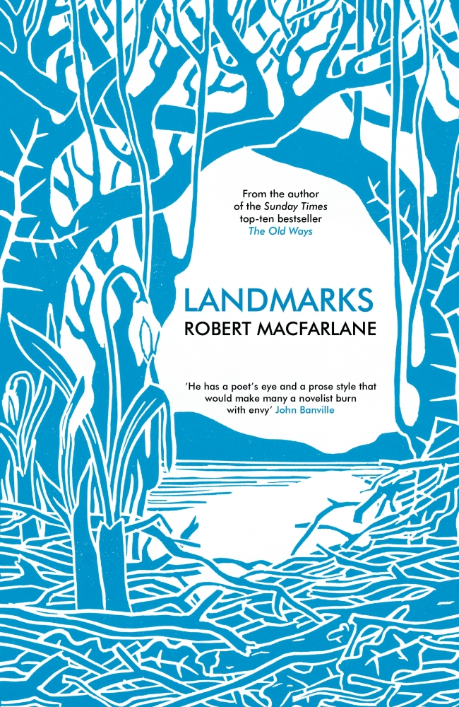
Robert Macfarlane has become my favorite living nature writer in large part because his passion for adventure and his etymological derring-do. His awe shines through in every sentence and he maintains a rare humility in the face of the natural world. He’s a Fellow at Emmanuel College, Cambridge and his latest book, Landmarks, revels in rescuing lost naturalistic words from obscurity.

Each chapter of Landmarks includes a glossary of odd words otherwise in danger of being forgotten. In Northamptonshire, he tells us, “brattlings” are “loppings from felled trees” and the “stump of a tree after the trunk has been felled” is a “nubbin.” He culls his naturalistic vocabulary from, among other sources, various regional dialects of Great Britain, nature poetry, and forestry manuals. Learning names for things I look at every day has helped me to really see them. Weeks after finishing the book, I still catch myself returning to his word-hoard time and again.

In Richard Fortey’s new The Wood for the Trees, the former paleontologist at London’s Natural History Museum describes a year spent studying four acres of woodland he purchased in Oxfordshire, England. He has the eye of a taxonomist or collector. “I wanted to collect objects from the wood, not in the systematic way of a scientist, but with something of the random joy of a young boy,” he writes.

It’s an understandable impulse. The window sill of my Philadelphia living room is cluttered with objects my wife and I have found while hiking, many from the nearby Wissahickon Creek Park. But my own materialism doesn’t always sit right. Perhaps I should have left these trophies — a hand-wrought key, a seashell, a hunk of coal — where they were.

Fortey’s is a lovely book and it provides a useful reminder to attend to the trees in our midst, but the assumption that the woods exist primarily for human pleasure — and plundering — is not one I’m entirely comfortable with. That said, Fortey’s love for the outdoors is entirely contagious. A few passages made me stop reading so I could absorb the imagery:

Overnight, several inches of snow have settled in the wood. A slow, steady fall of big flakes has left every holly leaf with a burden of white icing. The tiered branches of the small yews, usually so discreet and dark, are suddenly blatantly arrayed for a winter festival.

The book is subtitled “One Man’s Long View of Nature” and it crossed my desk during a transitional time at the end of the summer when — according to Wohlleben — trees begin to devote less energy to their leaves.

In the three years my wife and I have lived in our rowhouse, we’ve planted four trees in the small backyard: redbud and pagoda dogwood, coral bark Japanese maple and a small fig tree I adopted from a farmer in Amherst. Now that I’ve read The Hidden Life of Trees, I ask myself if I’ve done those trees and the others in the surrounding yards a disservice by introducing them into a foreign realm.

It’s difficult to imagine planting trees could be a bad thing, and yet it would be foolish to take our new scientific knowledge about trees lightly. Every year, it becomes more obvious how interdependent we are with the natural world — and how rapidly we are depleting its resources. By one account, 20,000 square miles of the Amazon rainforest vanish every year.

Even Tolkien’s Ents lament about their dwindling numbers. In The Two Towers, the wayward hobbits Meriadoc and Pippin meet the talkative Ent named Treebeard. “You see, we lost the Entwives,” Treebeard says.

“How was it that they all died?” Pippin asks, setting up the worst joke in all of Middle-earth.

“I never said they died. We lost them, I said. We lost them and we cannot find them.”

If Wohlleben is correct about the ability of trees to communicate — and I suspect he is — we all have a lot to lose every time a trees falls. Like Landmarks, The Hidden Life of Trees has me looking at my own little backyard with different eyes. That parcel of land doesn’t belong to me any more than it does to the squirrels and, now, to this fig tree. I am nothing more than a temporary caretaker. Wohlleben’s book makes me want to be a better one.

There’s so much we don’t know about trees, and likely never will. That’s perfectly OK with me, especially because my recent reading makes me want to adopt a less human-centric vision of the natural world. I’m certain that most trees would be better off without our meddling and the pollutants we belch into the atmosphere .

Every time I drive on the New Jersey Turnpike, for example, I am forced to wonder how many oaks and walnuts, pines and mulberries were chopped down to build a Service Area named for Joyce Kilmer (a man who wrote, “I think that I shall never see / A poem as lovely as a tree”).

Similarly — and I don’t mean to throw shade at these thoughtful nature writers — it’s also true that every time I read a book about trees I wonder if it’s worth the paper on which it’s printed. A precious few certainly are.

Midweek Links: Literary Links from Around the Web (October 5th)

All the best literary links that are fit to, well, link

Why do we love to write about witches?

Nell Zink isn’t “entirely demented” in an interview with The Millions

The Atlantic looks at two books about immigrant families and finding hope in the rubble of the American Dream

Elena Ferrante may have been unmasked, but does knowing actually help us understand her novels?

Novelist Rabih Alameddine is turning his Twitter feed into art

Alexander Chee, Emily Barton, and Whitney Terrell talk about taking 10 years to finish their second novels

Five books about creepy living dolls for your Halloween reading pile

Margaret Atwood, Etgar Keret, and others predict our dystopian future

Jess Row talks about writing while white and why we can’t deny fiction is political

Robert Wilder’s Madcap Teenage World

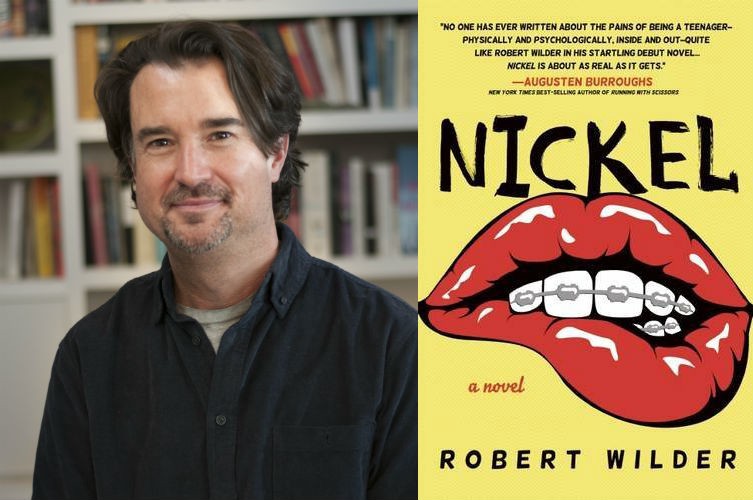
In the new novel Nickel (Leafstorm Press 2016), we meet Coy and Monroe, two best friends with hundreds of pop culture references at their fingertips. Their lives are one long stream of jibs and jabs, a sort of zany Howard Hawks back-and-forth, madcap dialogue for the millennial. They sit comfortably on the fringes of their school’s social scene, comfortable in their comfort with one another. When Monroe starts getting sick, Coy’s world slips into harsh focus, raising questions about their friendship, and whether or not he can save it, let alone save his friend.

‘Nickel’ is not only a coin, it’s the source of Monroe’s allergy. But it’s the coin that kept popping into my head while reading — more money than a penny, but not enough to really get anywhere good. Larger than a dime, but worth much less. As big as the outsize emotions of high school, and just as undervalued.

I spoke with Robert Wilder over email about metal poisoning and teenagers.

Hilary Leichter: You did such convincing work creating the maximalist, pop-culture-soup of Coy’s inner monologue. He has a very specific way of articulating the world around him, and every sentence feels packed with allusions, puns, and slang. How did you go about building his vernacular?

Robert Wilder: All teenagers speak in some sort of code, not only to their friends but to themselves as well. This unique style of slang serves so many vital purposes and is constantly changing. I’ve studied my students’ slang for 25 years, not only in terms of their oral communication, but in their prose and poetry as well. Coy speaks code to his best friend Monroe because they are a unit and their unique shorthand unites and protects them. It’s really a form of intimacy. Coy also has an internal slang where he plays with language as a way to figure out a rather complicated life. My goal was to try to create a series of vernaculars for Coy to employ that shows how he navigates adolescence. I took pieces of slang from what I’ve collected over the years as a teacher and father and tailor-made it for who Coy is and who he wants to become.

HL: The book captures a lot of the cruelty of teenage-dom, the kind of merciless way that these characters see adults, see each other, and see themselves. Their gaze can be unforgiving. How did it feel to live in that space while writing the book?

RW: I have been doing a few school visits recently, and I tell students and faculty that being a teacher means experiencing a sad version of Groundhog Day, over and over. Every new academic year brings a whole new slew of teased kids or students sitting alone in the cafeteria or individuals feeling awkward class after class. Seeing this kind of pain always breaks a teacher’s heart and you can only do so much to prevent kids from suffering. Each new school year reminds me how both fragile and resilient teenagers are. I have deep empathy for all the characters in the book — teens, parents, teachers. All of us are so beautiful and so broken. I really carried all those emotions with me as I was writing Nickel.

HL: Are there any other young protagonists that informed the way you wrote the characters of Coy and Monroe?

RW: My own students and my son London and his friends were the best protagonists for me, but I also love Christopher John Francis Boone in The Curious Incident of the Dog in the Night-time, Holden in Catcher (of course), and many teen characters in Lorrie Moore and Antonya Nelson’s fiction. One of the best books written about high school is Ms. Hempl Chronicles by Sarah Shun-lien Bynum. I was also influenced by my daughter’s music recommendations of bands like Girlpool and Slothrust. Phoebe Gloeckner’s graphic novel Diary of a Teenage Girl and David Small’s Stitches are both honest and moving and treat their younger selves with a keen eye.

10 Great Teens In Contemporary Fiction: A Reading List

HL: Can you talk about how your time as a teacher inspired or allowed for the research-project element of the plot?

RW: In terms of Nickel’s plot and shape, I tried to focus on the way a school year unfolds — how things are new and exciting in the fall but can quickly become mundane and tedious as the year goes on if we are not careful. I was also interested in how quickly things can change over even a brief winter or spring break. A lot can happen in those two weeks. I’m really a student on how schools react when kids get into trouble — whether it’s illness or behavioral or family trauma and how those issues can really change the course of a school year. There is constant cause and effect in any school; you just need to watch for it.

HL: There have been a lot of books written recently about kids who are sick, and the struggle is often a terminal illness. You seem to be twisting that narrative into something different — a diagnostic mystery narrative, where the mystery is the struggle. Was this something that you were consciously working towards?

RW: Absolutely. So much of our lives are a mystery, and I think we dwell far more in that uncertainty than in conclusions, oversimplifications, and melodrama. We know so little about so much. Most of us really have no idea how anyone else is doing. We often don’t even know how we are feeling in any given moment. I wanted the mystery of Monroe’s illness to mirror the mystery of Coy’s life. He has no idea when his mom will get “better” or how Dan really feels about having to raise a teenager or what his future will bring. We don’t learn and grow by the definite and easy-to-solve. We swim mostly in murky waters.

We don’t learn and grow by the definite and easy-to-solve. We swim mostly in murky waters.

HL: You’ve included a note in Nickel that the plot describes a “fictional medical situation.” Nickel allergies are a real thing, but what kind of research did you do to extend it as a metaphor and create a new illness?

RW: I did a lot of research on heavy metal poisoning and nickel allergies. It’s a fairly rare condition, and I put that disclaimer in the end so kids wouldn’t cut off their braces if they read the novel. I also wanted Monroe’s illness to strip bare everything around her, so there needed to be a few possible causes that her family and Coy investigate. I think that passionate dedication shows how much they all love Monroe and how often our lives or the lives of others can be boldly interrupted.

On the Swish and Roar by Kawai Strong Washburn

It’s Wednesday night and I’m about to break hearts again even though we’ve been down forever and the clock is under twenty now. The crowd can’t stop watching because I’m And 1 Mixtape, my shoes is chirping off the stutter-step and the sick crossover and I’m breaking ankles, mongoosing between two suckers as I spin to the rim and when I finger roll for two the net goes swish like an air kiss to the crowd, and now they know who’s coming, and it’s me and it’s Lincoln High. We’re still losing but sometimes I swear we’re always losing until the end and for real it’s nothing now. It’s nothing and I’m unstoppable.

I could do this all night, I could do this every night. Obie rifles the ball to Jaycee and Jaycee draws the double inside the key and sends the ball to me. And I get five points, ten points, twenty from the floor. We all watch the ball rainbow down and the buzzer goes off and my shot’s through the net like swish.

You never heard a crowd so loud, yelling for me, but that was two weeks ago. I took that night and put it inside me somewhere I can still get at, even now, all the way back home in Kalihi, where the roof’s all bust with rust and the floorboards creak and got the sour of old beer and spam musubi pushing in from our neighbor’s kitchen. Every night Mom busting her bones at J. Yamamoto, while I’m on our couch, living that night at Hauloa over and over. Because after that game I had plenty college scouts talking about me, and my picture in the paper, and my name in the news, but maybe that’s all gone now. Because of what I did.

It was like this: the day after that Hauloa game I came home early on a rest day and there was my brother Nainoa at the counter going through Mom’s purse. It was maybe the fourth or fifth time I seen him doing it, but might as well it was four hundred.

And it was weird, because for real I still couldn’t look at him without thinking about how Mom and all our family was always bragging on him over the phone, at family get-togethers, to strangers at the bank or wherever, no matter how hard I balled. He even got into Kahena Academy his first try. Best school in the state and him the best student, and all of it like he doesn’t even have to work. No doubt there’s doctor-lawyer-president in his future, everyone can feel ’um.

Yet still, there’s him going through Mom’s purse.

From by the door I asked what he was doing and he said he wasn’t doing nothing and so I was all, Don’t you start with this shit again. He was all, What do you mean? And I’m like, I seen you do this before. That’s Mom’s money. He was all, You do it all the time.

That wasn’t fully true. Because yeah, sometimes I’d take from Mom’s purse but it was only when I needed small-kine for important things — a little more for some new Jordans or extra for the stash Kam hooks me up with — and I could always make it back four or five times over in a day, as long as I still had buds for sell. So that’s nothing like taking money just to take it. I think Noa was like, grades is good, awards is good, even a ukulele player now, so why not see what it’s like on the flip side. Bad like me.

So I said, “It’s not like you need it.”

“And what, you do?” he said.

“Stealing ain’t gonna make you any more popular,” I said.

He snorted — I hate when he does that, basically just saying I’m better I’m better I’m better — and was like, “I guess I’ll just have to try for your C-average and study hall, right?”

“It’s been working just fine for me.” If I grinned it still felt like hate. Before Noa ever tried Kahena’s entrance test I’d already been rejected choke times.

“Maybe I was putting money back in, you ever think of that?” he said.

“Bullshit you were putting money back in.”

“Whatever,” he said. We were close and he’d dropped his hand from Mom’s purse, then tried to push past me for our room. But I put a hand on his chest.

“Stay straight,” I said. “You don’t want this.”

“Hey,” he said. But that wasn’t what set me off. It was his face. It was his face. His eyes was louder than his mouth, and I could see he was fully thinking everything about me I was scared of.

If family was a tree, he knew which one of us was the rot.

So I hit him. Full-on false crack — my knuckles, his nose. When he went down I put my knee on his chest bone and got ready for lump him more. But Mom was there, out from the shower I guess. We’d fully forgot about her. Towel-wrapped and her dark Hawaiian skin all slick and still soaped, long hair part-kinked and shiny. She tried for hold her towel up with her armpits but also tried for get me off Noa.

The more she pulled at me and hollered to stop, the more her hands said who her favorite was — just like always — so I turned and hit her, too. Hard. I’d maybe been in a couple scraps at school and then mostly in like seventh grade or something so even hitting Noa with real heat was something new. But no one in our family ever hit each other like I hit Mom right then. I mean, when I touched her, like when I felt the meaty spark of bone hitting skin, I knew I was falling off into something new. The way I figure there was me before, then the fist, and what I am now.

Mom’s strong, though. Way stronger than me. She stood up straight-backed, didn’t even touch her cheek, and asked, “What are you doing?”

I started for say, I’m saving him, but then Mom’s towel coasted off her body. I didn’t want to, but still I saw the stretch marks, the wooly fan of her urumut, and when she bent to get her towel, her tits drooping down like goat udders. My stomach was fully spinning with shame. I was still straddling Noa’s chest.

“Get off me,” he said.

“Never,” I said. “You don’t know what you’re doing.”

“Like you do?” he asked.

Before when me and Noa argued, Mom’d be like I don’t need to keep you boys, I know just where to hide a few dead bodies and I can always make more kids, only this time they’ll be girls and that’s all I ever wanted. But she didn’t say none of that this time. She was staring at me like I was a car accident. I don’t know. She was still naked.

I let Noa push me off, and he made it to the door of our room. There was a scratchy tearing sound and then something flapped out and cracked the white hall wall and spread on the ground. I turned and seen it was my calendar.

“Your big game against the Academy is in two weeks, in case you forgot,” he called from our room. “You’re gonna lose, trust me.” He came back out of the room — dumbshit must have figured out there was nowhere to go and I would just walk in there after him — and he pushed out the front door and let the screen crack close behind him. The old wood bounced twice and stayed wobbled.

Mom was behind me pulling on her towel, not saying nothing. I just watched that screen door, listened to the hinges and figured, one more thing in this house that’s all bust up.

There was the rest of that night, then the morning after I hid away, hopped the bus to school without breakfast, then the day after I dipped in for a sandwich dinner while Mom was working a double and when night came again, I was out on an away game. Me all suited up on Waihe’e High’s home court. I think I felt good, but whatever, I played like ass: passing out of bounds, air balls from inside and outside the arc, crossover bouncing off my knees, turnovers turnovers turnovers. I couldn’t feel nothing of my flow. When the team rode back to Lincoln after, I tried not for look at my hands, but there they were. There was noise all around in that school bus, girls and boys both hollering at each other and usually I’d get Nic up on my lap, let her put her ass on my legs, crack her mynah bird laugh. Instead this time it was me just thinking, over and over, anyone can have one bad game. But even then I knew it wasn’t just one.

When I got home it was only Mom sitting on the couch. I figured I’d see the same bruise on her face that had been growing the night before, but her face was brown and unswollen. No light in the room except for the small side lamp by the couch and she was sitting with that, trying for read a J. C. Penney catalog.

I put my bags down just inside the door, took off my shoes, sat on the side couch. Whole time she snapped through page after page after page. Kept sounding like they’d tear but they didn’t.

“Shopping for new curtains?”

Snap-turn of another page.

“Maybe some of those Christmas-kine socks?” I said.

She lifted another page but didn’t finish turning it. “Let’s not bullshit around it all night, Dean,” she said. She was still looking down at the catalog. “Talk.”

“I’m sorry,” I said to Mom.

She shrugged. “You hit like a flight attendant,” she said. “I was in tougher scraps at Walmart Black Friday.”

“I don’t know why I did it,” I said.

“I don’t believe that,” she said. “Maybe I was one of the girls you’ve been hanging around with,” Mom says. “Or pretend Nainoa was your son. And then do what you did.”

“He’s getting stupid,” I said. “I was trying for fix it.”

“Trying to fix it,” she said. “Dean, seriously. Speak the way you were raised.”

“The hell is this? Why won’t you let me say I’m sorry?”

“Because you’re not,” she said, and we stayed there, staring at each other until I stopped.

Now. Monday night, a game against Saint Christopher and I go three for fifteen and brick four from the foul line. Might as well I’m a pregnant whale, how I handle the ball. It’s a home game but not feeling like home with our crowd quiet as a pop quiz. While we’re playing I can hear our shoes cheep over the hardwood and the other guys snort and gasp when I drive or cut and they try for stop me. I know my family’s watching me, most times the game moves too fast for me to find them in the stands, but almost always they’re here. I try for picture them clapping and standing in their seats but then I’m on Noa’s chest, arm cocked, Mom naked, and she’s got that look in her eyes again.

I flinch and come back to now, and it’s the court and I don’t got the ball.

Saint Christopher stomps us bad and I get benched while still get five minutes left. I drop a towel over my head and let everything be dark and stink and muffled. Just before the towel shades my eyes, I see two scouts up near the rafters, packing up their cameras and laptops and heading for the door.

Maybe they weren’t here for see me.

We get rest the day after the Saint Christopher game, ten days left to the Kahena Academy game, and I’m home after study hall watching SportsCenter. There’s the Top Ten with windmill dunks and over-the-wall catches, holes in one and right hooks for the knockout, all of it giving crowds that roar. And when I hear it I feel it, and when I feel it I go back to that Hauloa game and taste the roar I still got.

Then someone enters the room from behind and a sandwich bag of my buds comes plopping into my lap. Noa’s voice says, “Saw this in one of your shoeboxes.”

I roll my head back since he’s behind the couch, so now I’m looking at him upside down, and I say, “What, you’re going through my stuff now?”

“You need to be more original than a shoebox. Plus,” Noa says, “I thought you were done with this.”

I roll my head forward and look at the fat sack of joints sitting there, the lumps of sweet pakalolo inside the Zig Zag papers.

“Don’t you got some cancer to cure?” I say. “Ukulele masterpieces to write?”

“I thought you said you’d quit,” he says again.

“I did,” I say, which is true. I haven’t sold nothing since I hit him and Mom, since I gone cold on the court.

“If that’s quitting, then my farts don’t stink.”

“Might as well they don’t, the way you act,” I say. “You think you can do whatevers, yeah? Like you can just go through my stuff like Inspector Gadget.”

“I wouldn’t do it if you weren’t a criminal.”

I stand from the couch and turn. “What?”

“You don’t have to study, you can sell drugs, you can hit Mom just because.” He was fully counting with his fingers, popping each one from his fist as he went.

“Last time I checked you was the one going through her purse.”

He shakes his head, look on his face like he thinks I’m stupid. “That was only one time.”

“More like five,” I say. “Feels good, yeah? Slumming it? Just a minute of being like me, right?”

He laughs. Mom’s right, I’m not sorry. I figure if I hit his teeth hard enough he’d swallow ’um. “You see that? It always ends up being about you,” Noa says. “You’ve had your picture in the paper one too many times. Thank God you’re finally in a slump.”

“Slump nothing,” I say. “I’m fine.”

“You play us what, next week?” Noa asks.

“Ten days,” I say.

“Another chance to visit the Academy,” Noa says, like it’s a dream come true or some shit. “I know which stand I’ll be sitting in.”

How many times I tried for get into Kahena Academy, where they got scholarships for us Native Hawaiians but you gotta prove you’re worth it with a fully juice test, all haole words and useless math. Like, just because you can define ‘catalyst,’ you get in, and Noa did, and I didn’t.

“Just shut up,” I say. “I oughtta knock you out.” My muscles is all heat, and the only thing that keeps me from hitting him again is how it felt before. I turn and go back to the couch.

“Dean,” he says. He repeats my name but I just turn up the SportsCenter volume.

“I didn’t mean it,” he says.

“Whatever,” I say, but I know what’s in his voice. It wasn’t like this before — before Kahena, before him taking off like a rocket, before basketball — used to be we was just brothers.

We’re both quiet for a while and it’s nothing but SportsCenter and I don’t know if my brother’s left the room or not but still I say, “And I’m not selling anymore. I’m not.”

The whole next week practice hurts, Coach pulling two trash cans from the bathrooms and making us run suicides until someone palus and someone does every time. Never me, but it don’t matter I don’t puke because each day of practice I’m so off might as well I’m playing on the JV team. That Thursday, after Coach works us hard another practice, I stop by J. Yamamoto on my bus ride home even though I got the drunk head of too much workout and not enough water. I’m off the bus and walking through the mist from the hot rain that just finished sizzling on the blacktop, and the shopping carts is all hissing and crashing across the lot while the workers line ’um up. I stand at the huge J. Yamamoto front windows and watch my Mom. She’s in full work mode: green apron, fingers pecking at the keys, easy wrist flicks to close the register drawer every time after she gives change.

Her eyes go down and up when she looks from the groceries to the customer. It makes me think of my Kahena application days. That first letter, how when it came Mom started with a bright voice, all, Here’s one from Kahena Academy! And if the letter was lighter than we thought no one said nothing and then we were all ripping it open and Mom’s eyes swooped low with reading and then her eyes came back up wet heavy and she said, Okay. Okay.

Might as well I was falling through myself.

We regret to inform you. Our applicant pool is three to one and growing. We encourage you. Try again.

Seventh grade, eighth grade, ninth, me applying and the letters coming, one every year. And then the try for the next year would start: fat flexy prep books and Mom packing me J. Yamamoto Whole Wheat Crackers and I was all, No Ritz? And Mom was all, They’re twice the price and you’re only paying for the commercials, and so J. Yamamoto crackers with old peanut butter and me in the cafeteria as soon as school was out, sweating the prep books until practice. All those mornings on the bus to Lincoln, Jaycee guys would be talking about The Bernie Mac Show or Temptation Island, and I was all, FOIL method and quadratic equation, and they were all, The hell does that mean, and I was all, I don’t know but I feel like I’m having its baby.

And Mom some mornings and some nights — and if she’s lucky both — at J. Yamamoto, her going after extra shifts the way a crackhead goes after batu. And at the end of the night her coming home with work still banging around in her bones, might as well she’s saying Dean, can’t you see what we are? And every time, all the way back from the first time I tried for the test, felt like her punching me. Then Noa aces it like it isn’t nothing. Me wanting for say it don’t matter if I can’t get what they want on some stupid test, guess whose name everyone knows after Friday night? Guess who can tell you how the girls smell naked at almost every school in our division? I wanted for tell Mom I’d make us all something we never been before.

But maybe not, anymore.

I go into J. Yamamoto. I don’t let Mom see me. There’s all the aisles, long and sharp and bright-colored order, and I walk them from the back where I cannot get seen until I’m at an aisle right next to Mom’s checkout. Cleaning supplies. I grab a plastic mop bucket and flip it and sit down against the icy press of a shelf, and Mom’s on the other side, saying, “But you know how men are,” and then she laughs.

“For real,” the other woman says. “I tell you about Ikaika coming by yesterday?”

Mom says, “Oh God. What happened this time?”

“He had these two or three limp flowers in one hand, and some sorry little card in the other.”

“You’d think he’d have learned something by now.”

And Mom’s friend says, “He did learn something, he learned how to use the microwave for three meals a day.”

“You didn’t feel sorry for him?” Mom asks. “Not even a little?”

“The card was from a gas station. It still had the price tag on it. He didn’t even write anything inside but his name,” Mom’s friend says.

They go back and forth like this for maybe two or three minutes and then, “Hey ladies,” a man’s voice says, hard to tell the age. “Get a spill on five, over by the shoyu.” It’s like someone turns the lights on at the party, they shut up that quick.

“Okay,” Mom’s friend says.

“Can one of you take it? Remember, people come to J. Yamamoto because they want to feel like they’re at home. Nobody likes a messy home, yeah?”

“I like a messy home,” she says.

There’s a sigh, I’m guessing from the man.

“Trish,” the man says, “I thought we were all in this together, yeah?”

“And yet Darren guys are back there hanging out in the stock room, same as they do everyday.” Mom’s voice this time.

“Malia…” the man says.

“Room full of boys back there,” Mom says. “And yet here we are.”

“Are you saying — ”

“We just worked a mob of customers,” Mom’s friend says. “And the hospital shift change is about to happen.”

“Trish,” the man says, and even I can hear the warning in his voice.

“Never mind,” Mom says. “I’ll take care of it.” I can hear her shoes squinch away towards the spill.

I get up off the bucket when her steps are gone, don’t want her to see me. I just coast from aisle to aisle, all the way in back by the meats and cheese, the white milk, and cold air that gives me chicken skin. I find all the hemojang parts of the store before she can get to them, like where someone put a can of soup they didn’t want in the baking aisle, or where a kid maybe ran their hand across all the boxes of cereal and spun ’um sideways. Some weak-ass piano music is tinkling out of the speakers and everything smells lavender-vanilla-laundry something and I clean up. I put everything back. I take the soup where it belongs, I line up all the boxes, I check every aisle and I check ’um again, each aisle I can find when I know Mom’s not in it. I think about each thing as I put it back, how someday it’s gonna pass through her hands, how her fingers thick and strong but still soft is gonna grip whatever someone else is buying, and she’ll carry it over the laser and glass and into the crackling bag, paper or plastic. And all I got now is the stomach-burn feeling of I’m sorry.

Five days left to Kahena. Last one before, it’s a Saturday night home game and Ryan Lee from Palace — Palace! — crosses over on me nasty and I’m broke ankle as he drops it through for two. Later I get an open layup and the ball over-bounces the rim, might as well it’s my first time seeing a basketball. I’m benched by the end of the first half and in the locker room Coach is all Biblical-kine angry and paces, swinging his fists in the air at whatever he thinks he’s fighting, and he’s saying words like men and valor. We mob out the locker room to the court and then we lose by twelve and that’s only after Palace puts in their second string for the last five minutes. I’m all of that time with my ass on the bench.

On the way out after the game, Coach stops me at the door. He’s still jawing his gum and every word blows a soft mint smell over my face.

“Kahena Academy,” he says.

“I know,” I say. “Five days.”

“That’s our playoff ticket right there,” he says.

“I know,” I say.

He stops chewing. I can hear the operations people all clanging and rolling and squeaking back up the bleachers behind us, clearing the arena up for whatever comes next.

“I want you to come back from wherever you gone,” Coach says. He raises his eyebrows. “Lot of people worked hard to get you where you were. We need you back. You hear me?”

I hear him. I do. And there’s a million words inside my mouth but I don’t think he’s the right one for say any of them to, so instead I’m saying Yes I hear you, Yes I’m coming back.

Two days left and it keeps on: My flow is gone and I can’t get it back and the Kahena Academy game is closer, closer. Most times when it’s quiet and there’s space in my head it fills up with that punch and how much I wanted for hurt Noa and Mom both, like really wanted to break some part of them, how it had been there for maybe two years in my heart, and the way afterwards my knuckles felt like bee hives, full of all this small pain that’s still stinging me from the inside, trying to get out.

And it’s been a while but I still got that shoebox and I figure, Why not? I text Jaycee I’m too sick to practice and catch the bus to Ala Moana Park and hang out past the Hibachis to sell. The ocean sags against the rocks with a bubbling sound and there’s a dying-fish stink of old bathrooms behind me and past the sidewalk the grass is starting for die in a yellow way. There’s a few joggers, and some Asian power-walker grandmas, and a homeless guy in shredded jeans and a puffy jacket gimping his shopping cart up the sidewalk. I sit there for a little while before customers start rolling up, no one knows me or even sees me and I swear to God I’m thankful for it.

Some of the same customers from the last time I was here come through. Korean college kid with his baggy breaker jeans and braced-up teeth who’s always talking about choke pussy he’s getting at UH-Manoa, a twitchy hapa couple looking all pecked with bloody scabs and got that yellow batu tan on their blunted faces from all the ice they been smoking, two Japanese dudes off from the office with their fine creased aloha-wear and glossed hair that looks like it was parted with an axe blade. I move a lot of what I got way fast, shifting sacks from my backpack to my pocket in between sells. At least I still got my flow for this if nothing else. Inside the backpack, get one of my textbooks with a square cut out in the middle part of the pages where I keep the serious buds, and for the first fifty pages can’t no one even tell there’s anything but words in that book. I cut the stash pocket out when I was in the back of biology class one day, and I still feel cherry when I got it, like I’m carrying around something for James Bond.

The ocean’s going pink with the last of the sun when I hear their creaky voices to my right and feel stupid for letting anyone sneak up on me, “So what, you still got a little something, or it’s all gone?”

I turn to look. There’s no one but the two Asian power-walking grandmas I saw earlier, maybe in their sixties, their bright plastic visors and runner’s shorts, pink socks and soap-white shoes. I can smell what’s gotta be some crazy Chinatown lotion blowing off their skin.

“The bathrooms is right over there,” I say, flapping my hand at the dying-fish-stink building of low grey concrete.

“Don’t get smart. You heard us,” one of them says, the one that looks older.

“You need directions or something?” I ask.

“No,” she says. “We need buds.”

I open my mouth but nothing comes out. The one who first spoke keeps going.

“We walk this road every day this time. Every day. And we seen you and hear all the plastic crackles and the dollar dollar handshakes. So don’t play stupid. You still got something, or it’s all gone?” The one lady that’s maybe just a little bit younger — she’s got more makeup, less loose skin — squints her eyes and puts a hand on her hip.

There’s no way. Do cops use old ladies for this kind of stuff? I look around for a minute, check all the places stupid cops might be standing in plain sight, or patrol cars in the parking lot. Finally I ask, “You’re serious?”

“Fifty dollars,” the older one says.

“One hundred,” the younger one says.

“But you’re like sixty years old,” is all I got.

They just stare at me, slow smiles pulling across their teeth. I figure why not, let me get cashed out, so I whip out my James Bond and give them all of what’s left, and after I get paid one of them takes a joint from the bag and a lighter flares, and soon enough they’re passing the dutch and dropping clouds of that Kona Gold stink all over me. The older one lets the smoke curl out her nose while she eyes me with a frown.

“You’re just gonna smoke out right here? Right where you bought it?” I say. “Auntie, thanks for the cash, but you’re crazy.”

The younger one straight up cackles when she hears it. They both sit down next to me on the bench, either side. She says, “You get to our age, you get tired of waiting.”

“Waiting, waiting, waiting,” the older one agrees, “for whatever you want.”

The younger one says, “You know?”

I turn and look at the older one. Then I turn the other way and look at the younger one. They don’t know me and I don’t know them but I just start talking. “I don’t wait for nothing,” I say. “You never get anything, you do that.”

Laughter.

“He’s all business, Sharon, yeah?” the younger one says.

“All business,” the older one, Sharon, agrees. “He’s like one of those, how’s it called? Hip-hop.”

“One of those hip-hops,” the younger one says. “With the bandannas.”

“Guns,” the older one says. “Tupac, yeah?” She shakes her head and clucks her tongue. “Those boys don’t know nothing.”

“Right,” I say.

“Everyone ends up waiting,” the older one says. Smoke’s all ribboning from the joint in her hand. She passes it back. “Even hip-hop boys.”

She offers the joint.

I hit it once. Been a long time since I smoked. I don’t like thinking of all that blackness getting into my lungs. Better there’s nothing but pure oxygen torching through me while I run the court.

“Listen,” I say. I start to go about how used to be I could cut and mongoose and float and I got nothing of it now, and that I think we got screwed, me and the whole family, like we were all guaranteed something that’s fully getting taken back at the last minute, and that something was me, who I was supposed to be. But I stop talking pretty much as soon as I start — I can’t believe why I’m even talking to these ladies, like are you kidding me, it’s just customers, crazy old ones anyway — and they’re all passing the roach back and forth and watching me from under falling lids.

“Ah, calm down,” the younger one says. “I wish I was more that way when I was your age. Don’t be so sad, maybe you’re not a hip-hop.” She raises the last scraps of the roach, all burned out. She laughs. “You seem pretty good.”

“Yeah,” Sharon agrees. “Sure helped us a lot. Like a doctor.”

Doctor. If I’m nothing, I’m definitely not a doctor, not in my family. I get up off the bench.

“Awww,” the younger one says. They’re way stoned now, everything sharp about them blunted. “Stay a little bit longer.”

But I just sling my backpack over my shoulder, I’m looking up at the sky: there’s black clouds coasting in off the Ko’olaus, heading straight for us.

“It’s not going to rain,” Sharon says, following my look.

“Yeah it is,” I say. I nod towards the baggie slouched between them, their calf socks and visors. “You all let me know next time you need a hook-up.”

“Sure, sure, sure,” Sharon says, all syrup. “See you soon.”

“Yeah,” I say. I don’t think I’m ever coming back here. I hope it rains all night. I hope it rains tomorrow, too, and then the sidewalks and buses and the roofs like ours can get that clean soak and shine.

When I get to the front door at our house, I hear the popping rips of meat hitting oil in a pan and from the half-burned, golden smell of breadcrumbs frying. I know it’s chicken katsu and Mom’s in the kitchen. I stand at the door for a minute and think maybe I can go out again and walk one more time around the streets, or maybe I can get through my room from the window, but then Mom’s at the door and smiling a tired smile.

“I thought that was you,” she says.

I look over my shoulder. Not like there’s anyone or anything back there at the end of the cul-de-sac, but it gives me a second to think about what to do.

“I’m not feeling too good,” I say.

“Nainoa told me about the new study group you’re in after school. Must be hard to do that after practice?”

It takes me a minute to figure out what Noa did for me, and then I nod and say, “Yeah, it’s hard.” I step inside the door and put my ball on the ground. It starts rolling across the slanted-ass floor, towards the hall to our bedrooms. I take off my shoes.

“How was basketball?”

“No problem,” I say. “Short slump. It’s over now. Just one of those things.” My lips is all dry and sticky and I lick them and Mom turns the chicken and her eyes go down and come back up.

“I’m sorry,” I say.

“I thought we talked about this,” she said. “It isn’t about just sorry.”

But I want to hold out everything that’s around us, like, No, Mom, I’m sorry. The Linoleum that’s got all these moles of black and yellow from years of smokers and slackers that had the house before us; or that we’re eating the chicken ’cause I bet it went on sale at J. Yamamoto with the sell-by date way past and already Mom’s gotta bread the hell outta it for keep the real taste out. And here I am with easy one hundred dollars in my back pocket after just a few hours. I don’t got nothing like the right words for even start that thought, so I say, “So how was your day?”

Right after I say it I see it’s not something I ever ask. I don’t know why. She must know it, too, because I see her brighten and fully think. She takes a while before she answers.

“My day,” she finally says. She taps the tongs on the pan. “My day sucked dick.”

“Right, I get you,” I say. “What kind of dick, though? There’s all kinds, you’ve got your long horse dick, your furry goat dick, your hot bull dick…

“But,” I make like I’m thinking, even rub my chin, “that’s really more of a balls thing, with the bull.”

Mom laughs. It’s a good one, too, one of those ones where even she seems surprised, like it just firecrackers out from a place she didn’t even know was there. “God, boys. You’re all so sick. I should know better than trying to compete.”

“I’m a perfect gentleman,” I say, “once you get to know me.”

“A perfect gentleman can help set the table, then,” Mom says. After I set down my bag she asks, “How was your day?”

I shrug. “Another day another dollar.”

“Hm,” Mom says. “If only they paid you at study hall.”

God, I’m stupid, to say what I just did. I don’t look at her but I figure she really knows where I was this afternoon.

“This family needs you. Just remember that.”

“What’d I say? Slump’s over,” I say, get my best grin out. “Soon Harvard’s gonna make me president, just so I can ball for ’um.”

“Okay,” Mom says. She licks katsu sauce from the tips of her thumb and index finger. “You don’t need basketball to be president.”

“That’s Noa you’re talking about,” I say. “It’s basketball for me.”

“You know,” she says, turned back to the katsu. “I see the way you think about this.” She spins her finger in the air to be like, this whole house. “You know what I mean?”

I tell her I do.

“It’s more than you think it is,” she says. “Whatever else basketball might be.”

“You don’t think I can do it,” I say.

“I think you don’t know what it really is,” she says. “We love you. But nothing’s easy. So you better open your eyes.”

She asks me to go tell my brother that dinner’s almost ready, and that I should take my backpack to my room, and then she’s with the plates and the katsu, and her eyes is grocery-down again, and I sling on my backpack and feel the James Bond in there like it’s burning a hole in my back.

We have dinner and there’s some talking, but nothing real between me and Noa, we just throw words past each other’s shoulders and then listen to Mom. It’s not long before dinner is done and we all peel off and Noa’s in the garage with his ukulele, making these runs of notes and clucking chords and it’s nothing like the way most of us play, it’s way beyond. And I try for work on my econ homework but in the end all I can do is write The market clearing price is I’m fucked, and then I’m on the couch, watching SportsCenter, and everyone else is asleep.

I slip into our bedroom and there’s Noa’s sleep-weight in the darkness, I can feel him all heavy and gone in his breathing. Without the lights the wall is just something for push against but I know I got the calendar pinned back up and marked down to all but the last two days, then KAHENA ACADEMY written from border to border.

Okay then. I open the closet and suit up with my Jordans and Allen Iverson ‘Sixer away jersey and grab my basketball and feel all the places the texture bumps is wearing down. It’s after midnight. So for real, I got one day now until Kahena. I slip the money I made today out of my backpack and carry it with the ball back into the front room and there, on the counter, is Mom’s purse.

The refrigerator kicks on and grumbles. Ice clatters in the tray. I can see where Mom’s wallet is, right in front and the clasp is gold that’s rubbing itself out. I reach out with the cash I got in my hand. I can remember the first time I got caught selling and figured Mom would cry when she had to come pick me up from the station, but she didn’t cry at all, just had this hard flex to her jaw and torqued her hands around the steering wheel, and shot air from her nose, over and over, each thing stacking on the other until I felt my head drop and I stared at the floor mat all the way home.

The bills I’m holding now could be from the old ladies. Or the scratched-up addicts. Or the college kid with all his stories. But now it’s mine, maybe the only thing that is. That’s the thing about money, once it’s in your pocket it doesn’t matter where it came from, only where it’s going. I imagine saying that to Mom and I know it wouldn’t fly.

I pull the money back and put it in my pocket. I’m out the door and down the street.

I walk through Kalihi in the dark. There’s almost no houses awake. I’m across the long line of lamps leaking weak light down onto the sidewalk and I can hear the small pieces of the street sticking to my Jordans. The park is closed I guess this late but that don’t mean nothing, and there’s the backboard all mossy on the edges and streaked with mud from other people balling in the rain that finally came earlier tonight. The net is broke in one or two places that sag and hang into holes in themselves.

I bounce the ball a few times, listen to the ringy pound. The wind comes on and the trees clatter like applause. I close my eyes for the first shot, I don’t know why. I let the shot loose from my ankles, jumping clean, but when the ball comes off my fingers I know it’s all wrong, and then the clang of the rim and the bounce of the ball. It rocks against the chain link fence by the playground. I watch it till it stops moving. Forget it all. All of this.

I shag the ball and take another shot, eyes open, and it swoops in and out of the rim and bounces, bounces, right to the edge of the court. I quick-step and scoop the basketball. I cut to the corner and then crossover, turn, bent with my back to the rim like I got D on me, it’s Kahena Academy, or whoever else thinks they can try for defend me. And here’s the corner I’m pinned in, you gotta shake ’um off you, you gotta get free, and I do, I’m fadeaway spinning for the hoop, and I let my shot go high and right at it. I watch it rainbow down. I’m remembering that Hauloa game again, the one I keep in my belly, just grinding on the swish and roar. I know this shot is going in, I can see it drop through the chains already, it has to, it has to, it’s just like I was saying. I’m unstoppable.

Arundhati Roy to Publish Second Novel After 20-Year Wait

The Ministry of Utmost Happiness is due out in 2017

Yesterday, Arundhati Roy announced the long awaited followup to her 1997 debut novel, the Booker-winning The God of Small Things. According to her publisher, Hamish Hamilton, The Ministry of Utmost Happiness will be out sometime in 2017. In a joint PR statement, Simon Prosser, of Hamish Hamilton UK, and Meru Gokhale, of Penguin Random House India, showered the novel with glowing preliminary praise, lauding both the “extrodinary” writing and characters who are “brought to life with…generosity and empathy…joyfully reminding us that words are alive too.” For her part, Roy said that she was “glad to report that the mad souls (even the wicked ones) in The Ministry of Utmost Happiness have found a way into the world.”

Fans of Roy may owe a “thank you” to John Berger. According to The Guardian’s report, the English writer urged Roy to focus intensely on completing the novel back in 2011. Roy remarked that she was “with John at his home, and he said: ‘You open your computer now and you read to me whatever fiction you are writing.’ He is perhaps the only person in the world that could have the guts to say that to me. And I read a bit to him and he said: ‘You just go back to Delhi and you finish that book.’ So I said ‘OK’.”

That isn’t to say Roy wasn’t busy writing over the last twenty years — she certainly was. Her riveting political non-fiction pieces, which cover issues in India and abroad, display the stunning prose and keen insights that won her fiction critical acclaim. In case you missed or forgot them, we’ve collected some of our favorites below:

“Gandhi, But with Guns” (in person reporting on the Maoist guerrilla forces deep in the Indian forrest)

“Not Again” (a critical analysis of the U.S. invasion of Iraq written in 2002)

“The End of Imagination” (on the Indian nuclear program)

“Brutality Smeared in Peanut Butter” (an analysis of the flawed U.S. position in Afganistan)

Carlos Fonseca & The Liberated Novel

Carlos Fonseca’s biography is marked not only by constant territorial displacements — he was born in Costa Rica in 1987, grew up in Puerto Rico, did his studies in the United States and now lives in London — but also by the multiple literary traditions that interest him. Despite his young age, he has already accumulated a vast series of influences, ranging all the way from Latin American to European authors without eluding the United States. Reading his works, one feels the presence of voices as disparate as those of W.G. Sebald, Alexander Von Humboldt, Simón Bolívar and Roberto Bolaño, among others. Fonseca is, without a doubt, a cosmopolitan offspring of cultural globalization as well as an attentive inheritor of both literary and cultural history.

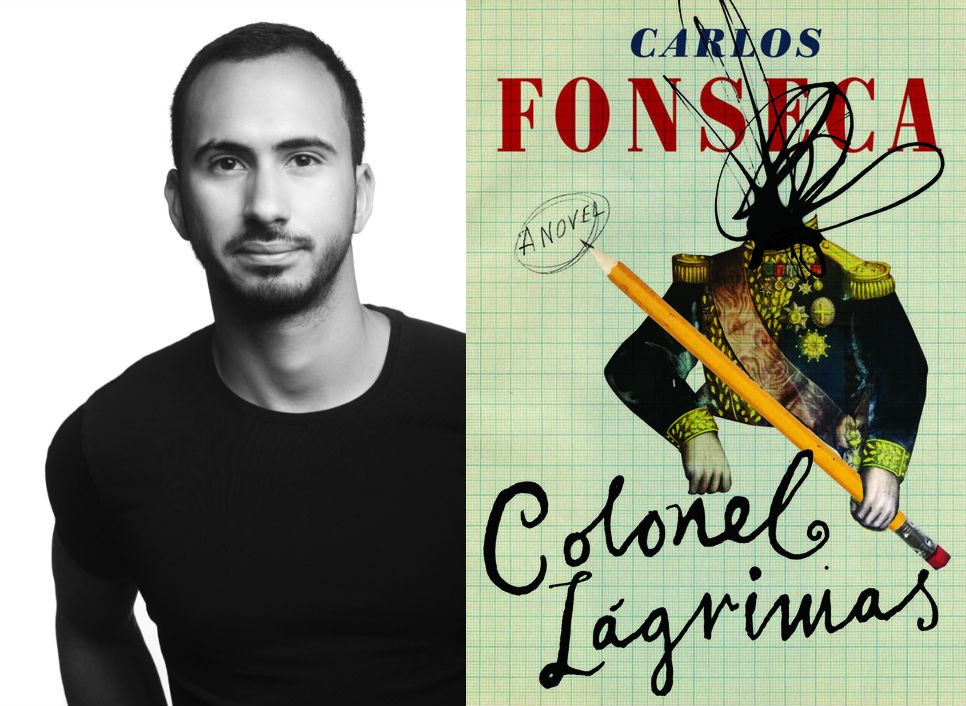
In 2015, the prestigious Spanish publisher Anagrama published his debut novel Coronel Lágrimas, a novel that was praised both by the Argentine writer Ricardo Piglia as well as by the legendary editor Jorge Herralde for its singularity, experimentation, intrigue and elegance. It couldn’t have been better described. Lágrimas is a novel inspired by the life of stateless mathematician and hermit Alexander Grothendieck. Through an attentive and rigorous attention to detail, Fonseca is able to construct a collage where the mathematician’s life finds its ultimate meaning amidst a series of series of historical, metaphysical and poetic fragments that end up giving shape to a fascinating literary artifact that shines like an eclectic mosaic.

After its extraordinary critical reception in Latin America and Spain, unusual for a debut novel, Fonseca has established himself as one of the most promising and interesting new voices of his generation.

In a typical cloudy afternoon in London — with Bloomsbury’s literary landscape as backdrop — I sat to talk with the author about the publication of the English translation of his novel, Colonel Lágrimas, which is out today from Brooklyn-based publisher Restless Books.

— Tomás Peters

Tomás Peters: From the very beginning of Colonel Lágrimas, your writing reminded me of the cinematic strategy Aleksandr Sokurov used in his movie Russian Ark, filmed in a single unedited shot. Russian Ark recounts the history of Russia through the halls of the Hermitage Museum, as well as some biographical elements from the narrator’s life and that of his companion, “the European.” There is something similar in your novel. Throughout the book, there is a narrator and a historical character who, without ever encountering each other, traverse historical events, emotional fallouts, and biographical details. How did you come up with such a narrative (and film-like) strategy of this kind?

Carlos Fonseca: I guess I imagined the novel sort of as the story of a man — the colonel — situated at a point in time that some have called the end of history. One could say that the museum is the backdrop to the historical logic of this end-of-time. In other words, I think that nowadays, history runs the risk of becoming like a large museum, whose halls exhibit an enormous archive of what has ensued, but within which it is impossible for something new to happen. Inside of the museum, so to speak, happenings are forbidden. In Colonel Lágrimas, I tried to portray both the allure and danger of that final museum, the dead end that characterizes our current era of information decadence. Like Borges, like Bouvard and Pécuchet, the colonel is a man trapped inside a labyrinth of information: a labyrinth that leads to the indiscriminate and pleasurable consumption of data. In that sense, I like your comparison to Sokurov’s Russian Ark, a movie that I loved when I saw it. I think in both cases there is an attempt to rethink and critique the ways in which we currently live the past. In my novel, the cinematic prose is also related to another fiction that has permeated modern society: the reality show. The false perception that we see everything in the present, from a privileged perch from which we can issue a moral judgment of the characters. I like to think that the novel works, to a certain extent, like a reality show about the private world of an old Borgesian protagonist, who is unable to act. If there is politics in the novel, it would be there, in the way that the novel critiques his passiveness and inaction.

TP: I think Colonel Lágrimas is a novel that showcases the craft of writing. Throughout its pages, it becomes apparent that its writerly resources are managed with a certain fluency and experimentation but, at the same time, with notable confidence. Considering that this is your first novel, do you think that you managed this narrative technique as part of your professional craft or did the story itself demand this sort of writerly treatment?

CF: I have always believed that literature is something that occurs primarily in the act of writing. When Faulkner sat down, in The Sound and the Fury or in As I Lay Dying, to narrate the same event from multiple different perspectives, he did so, in my understanding, with the full conviction that writing is everything: the event cannot take shape if the narrator does not describe it. In that sense, I like novels that deal with tricky environments, stories that stay away from predefined formats and in that sense force us to rethink the way we write. It is not a matter, of course, of beautiful storytelling. On the contrary, it’s a matter of twisting the rote usages of words until they become malleable enough for what you want to narrate. In that sense, I believe that biographies are woven around that malleable fiction that we call a private life.

TP: How do you take on the craft of writing in the literary context of Latin America, which is so full of biographical stories?

CF: When I was writing Colonel Lágrimas, I was conscious of this issue regarding biographical novels or novels of self-fiction, as they call them nowadays. The colonel is, ultimately, a man that sits down one day to tell the story of his life. From the very beginning, the question was: What does it mean to chronicle a life? What does it mean to narrate a biography beyond merely giving an account of what has happened to someone? There are as many lives as ways to narrate them. This idea tortures the colonel, forcing him to rewrite his private life in an attempt to restructure what has happened and what could have happened.

On the other hand, I have a friend who tells me, half in jest, that the novel is really autobiographical, that I am the colonel. Even though I find that take on the novel absurd, I like it a lot, because it forces me to think.

TP: It seems today as though the accumulation and cataloguing of historical archives and fragments has become an obsession of our age. In Colonel Lágrimas, without giving too much away, this is quite evident. Essentially, the historical remnants shape a story in which the recollections and secrets of the colonel — a character inspired by the mathematician Alexander Grothendieck — and the universal history intermingle. What do the figures of archives and memory mean to you?

CF: I could not agree more. As I see it, we see three decisive literary figures at the turn of the twenty-first century, whose novels provide different aesthetic responses to these questions: Roberto Bolaño, W.G. Sebald, and David Foster Wallace. All three, of course, were ardent fans of Borges. And all three died relatively young. I think we are now in an age where archival fiction enjoys the particularity of not being intruded upon by memory. In other words, if ten, or fifteen, years ago, archives were mediated by the subjective voice of testimony, marked by the memory of witnesses, nowadays, it seems like archives appear simply as they are: in their pure embodiment, with neither support nor intrusion. The aesthetic gesture would therefore consist of the arrangement, cataloging, and exhibition of the archive. This is not, however, something new. It is something we have inherited from the historical avant-garde and its ready-mades, its collages, its cut-ups. If there is politics in our archival fiction, it is related to the way in which nowadays, we are rethinking the logic of assembly and framing. In this sense, our task therefore has a great deal in common with Pierre Menard’s absurd odyssey. We owe everything to Duchamp.

Our task therefore has a great deal in common with Pierre Menard’s absurd odyssey. We owe everything to Duchamp.

TP: A year ago, in Argentina, there was some controversy surrounding the writer Pablo Katchadjian and his book El Aleph Engordado. His case has not only sparked debate related to the literary space of Latin America — due, in part, to the legal allegation by Borges’ widow, María Kodama — but also a broader discussion pertaining to the art world in general. Essentially, Katchadjian’s gesture would seem to be a contemporary ready-made. I would like to hear what you think of this case and, concretely, ask you how Colonel Lágrimas also plays a role in the stories and works of others.

CF: I have to tread carefully here, because it seems like nobody is safe from María Kodama’s ambition. Citations, plagiarism, ready-mades: all of the resources that are the hallmark of Borges’ work set the stage for a critique of private ownership. In this sense, Kodama’s gesture is paradoxical and absurd. If we follow her logic, we would have to put Pierre Menard on trial. The whole affair seems unfortunate to me, but at the same time, fascinating. I have always been interested in moments when art goes on trial, not merely aesthetically speaking, but also legally, because it entails the breakdown of an essential distinction: that which gives a certain autonomy and freedom to art, understood as an aesthetic space beyond the legal realm. I even read that one of the witnesses who will testify on behalf of Katchadjian will be Cesar Aira. That’s incredible! The collision of two up-until-now incompatible realms of judgment: the aesthetic and the legal. I am very interested in the disconnect between these two realms. I should probably be scared to say that the character of the colonel has a lot of Borges in him, lest Kodama take offense. But it is very clear: the colonel carries the Borgesian argument to its extreme, because he sets out to tell the story of his own life by stealing anecdotes from the “story of others.” The life of the colonel therefore consists, to a certain degree, of stolen identities. If Kodama is upset because someone stole, smartly, a few lines from her ex-husband, imagine what she would say to someone who plagiarizes an entire life. Nor is that idea so new: it is exactly what the French artist Sophie Calle did for a while.

TP: Latin American literature has lost some ground internationally, but it continues to stay alive. Every year, dozens of novels–and collections of short stories–are published, both by “prestigious” and independent publishing houses. However, the space to receive these publishing efforts is increasingly diffuse. In a context of instability along the literary circuits of Latin America and among readers, what does the political-critical mean nowadays in art and literature?

CF: I think far from seeing the lack of acceptance as a problem, it would be more positive to look at it is an opportunity to change the political-critical stance. When poetry was anchored to its duty of telling stories in a memorable way, it was unable to find the autonomy necessary for the formal experiments we saw in the avant-gardes. Similarly, I think that as long as the novel was tied down, for much of the nineteenth century, to its sociological function, it was unable to achieve the autonomy necessary to lay out a political critique beyond a social critique with moralist overtones. At the end of the nineteenth century then, we see the first great liberation. The novel becomes unshackled from the need for a large audience and in so doing gains an autonomous political stance. I would like to think that something like this could happen and is happening in Latin America. Now that Latin American literature does not have to epitomize the essence of “Latin America” to foreign eyes, it can afford to try something different. It can afford, so to speak, to play with different political-critical stances that move away from the representational. In that sense, I like the word that you use: bending. To some degree, in order to fulfill its political-critical role, literature needs that bending moment, that moment when, like Melville’s character Bartleby, it manages to pull away from its immediate reality in order to have a stronger impact on it.

Now that Latin American literature does not have to epitomize the essence of “Latin America” to foreign eyes, it can afford to try something different.

TP: London, where you currently live, has not generally been known as the essential destination for Latin American writers. In the past, Paris or Barcelona were the places to be, and now it’s all about New York, Mexico City, or Berlin. As a Latin American writer educated in the United States, what does London have to offer for Latin American literature?

CF: For biographical reasons, I have always experienced some sense of dislocation. I was born in Costa Rica, but at a very young age, I moved to Puerto Rico. This displacement left an impression on me that still persists to this day. Because I was a Costa Rican in Puerto Rico and a Puerto Rican in Costa Rica, I always felt somewhat foreign wherever I went. The same happened to me when I moved to California and again in New York. However, in the United States, there is a tendency to view Latin Americans through the lens of certain stereotypes. London is completely different, in that way. Latin America does not play a preconceived role in its political or social worldview. Being from Latin America, to a Londoner, is something really strange. It’s not exactly exotic. More like being a blank page. If the poetics of Latin American minorities in the United States sometimes end up demonstrating that we are not the stereotypes they have drawn onto us, in London, the political position is something perhaps even more radical: the outline of a territory entirely unknown to them. To me, however, I like that sensation of a vacuum, that sensation of distance and abstraction that allows one to imagine traditions that might seem, from a national or continent perspective, incongruous. And of course, then you start to meet Latin American authors that, for one reason or another, have also ended up in the city.

About the Conversationalists

Tomás Peters is a cultural sociologist based in Santiago, Chile. His main areas of research include cultural studies, sociology of art, Latin American studies and cultural policy. Currently he works at the University of Chile. He holds a PhD in Cultural Studies from the School of Arts at Birkbeck, University of London.

Carlos Fonseca Suárez was born in Costa Rica in 1987 and grew up in Puerto Rico. His work has appeared in publications including The Guardian, BOMB, The White Review and Asymptote. He currently teaches at the University of Cambridge and lives in London. Colonel Lágrimas is his first novel.

Literary Alchemy: the Wedding of Subject and Style

A Roman Introduction (Also an Ending)

Marcus Tullius Cicero may have been silenced by a body-splitting sword slash from Mark Antony’s henchman during the proscriptions of the Second Triumvirate, but his thoughts on elocution remain very much intact. “No language will inflame the mind,” he tells us, “unless the Speaker himself first catches the ardor, and glows with the importance of his subject.” To put it another way: how one says something is as important as what one says. Language works best when it carries a certain heat. Good oratory practices were Cicero’s main concern, but I’d argue his theory holds true for written words as well. Good prose, too, ripples with flames.

A Caveat

Achieving symbiosis between subject and style, however, is easier said than, well…well said. As Cicero also notes with undying universal applicability: “Times are bad. Children no longer obey their parents and everyone is writing a book.”

As Cicero also notes with undying universal applicability: “Times are bad. Children no longer obey their parents and everyone is writing a book.”

My Parents Raised Me Better Than This

I got into writing for all the wrong reasons: for the drugs, cash flow, sexual favors, discounted sushi platters, immortality, and — worst of all — for the ego boost. These benefits, however, are not as frequently distributed among writers as I was led to believe. And, in accordance with Thomas Mann: “A writer is someone for whom writing is more difficult than it is for other people.”

Signs of Salvation

I got into writing for the wrong reasons, but I would like to believe I have stayed for the right ones, which largely coalesce around a love of style, of the sensation of breathing life into words, the alchemic pleasure of fusing an idea with execution.

More on Style

Speaking on her writing process, Margaret Drabble says: “Sometimes whole paragraphs or pages come out absolutely fine, and they come out very fast, which I’m sure is how Dickens used to write, just very, very fast.” This speedy, gushy, approach to writing isn’t often discussed in an era of literary Craft. Perhaps this is because it’s hard to explain. Even harder to teach. Organic, immaculate expression has a hint of the metaphysical. One can’t help but think of witchcraft. One can’t help but imagine the raw material of human emotion and experience stewing in the cauldron of the mind until it bubbles into form, bursts into language. “Style is nothing but the mere silhouette of thought,” says Arthur Schopenhauer, and what is a silhouette but an image born from a moment of sun: ephemeral and bright?

This speedy, gushy, approach to writing isn’t often discussed in an era of literary Craft.

Take it Down a Notch

What Schopenhauer calls a silhouette, a grammarian like Virginia Tufte might call “syntactic symbolism.” Syntax is, of course, largely without meaning on its own (as are symbols, I suppose). Syntactical constructions are bones without flesh; symbols are flesh without bones. How to make them quiver and dance? According to Tufte, “A skilled writer may use the same structures in a way that mimics the particular actions a sentence describes.” In other words, content and communication are bound, inseparable. And, just as a body is not built part by part — but develops from a single embryo — eloquent language, it seems, should also emerge from the mind as a pre-formed and pre-fused thing. Otherwise we find ourselves facing Frankenstein.

Can a Person Die of Carpal Tunnel?

“It’s all longhand,” says Cynthia Ozick of her writing process. “I can’t read it, I write so fast… It makes me feel like I’m thinking with my hands.” I connect with Ozick on her preference for longhand. When composing, I write messily and wildly, scribbling across the page, sometimes up and down the sides. This physicality, I’ve come to believe, can energize sentences and elevate style: the tension of sitting contorted in a chair, legs twisted, arm flexed, hand dashing and smearing forward. Isn’t this how sentences work, after all? We corral the kinetic potential of individual words within punctuation and paragraphs? Words are a feral species, alive and charged by their own history. “They have been out and about, on people’s lips, in their houses, in the streets, in the fields, for so many centuries,” according to Virginia Woolf.

This physicality can energize sentences and elevate style: the tension of sitting contorted in a chair, legs twisted, arm flexed, hand dashing and smearing forward.

Just as a person cannot be reduced to an ID badge, a word cannot be reduced to a dictionary definition; like a person, a word carries with it a constellation of experience. “Look again at the dictionary,” Woolf tells us, where one will find thousands upon thousands of words laid out in alphabetical order, pinned down like butterflies for our inspection. Presumably within these pages are “plays more splendid than Antony and Cleopatra.” One only need go about “finding the right words and putting them in the right order.” And yet writing splendid plays, poems, tweets, isn’t so simple — otherwise we’d have more. If dictionaries do not house the true nature of words, how can we expect to conjure style from those pages? Words are inherently unruly and evolving, yet we use them as the building blocks of expression because we believe that they can be adequately tamed. If “words live in the mind,” as Woolf says, so the mind must be the source of style, or at least, the rodeo arena.

Meditation, or “I Almost Went to Art School”

I write longhand, in part because it feels like drawing, and drawing has always been for me a meditative practice. Before I was seduced by the perks of writing (the drugs, cash-flow, sexual favors, discounted sushi platters…) I studied visual art. Drawing — like writing — is a triangulation between the draftsperson, the page, and the subject. To quote David Hockney, it “makes you see things clearer, and clearer, and clearer still.” This is, in part, because the process involves the whole self. When drawing, “the image is passing through you in a physiological way, into your brain, into your memory — where it stays — it’s transmitted by your hands.” Technique is meaningless without an ability to see, and the ability to see is meaningless without technique. What we might call an “eloquent” drawing is a work born from the fusion of both: an image that seems to have sprung effortlessly onto the page.

Drawing — like writing — is a triangulation between the draftsperson, the page, and the subject.

Another Caveat

But, for me, writing has never been effortless (and neither has drawing, for that matter). As much as I believe in the sanctity of the first draft, in the initial outpouring of words, I am also a compulsive reviser. So is Ozick, it turns out. “When I look at my manuscript,” she says, “there are so many cross-outs.” Likewise this essay, even as I write it, is struck through with cross-outs and the snaking point of arrows and the black stars of asterisks. Such revision, however, also takes on physicality akin to working with a sculpture. It likewise starts with an initial form. And, to further defend against impending accusations of hypocrisy: revision involves taking that embryonic prose and feeding it, clothing it, nurturing it, and, in many instances, literally taking it to school.

Conclusion

“Brevity is a great charm of eloquence,” said Cicero, and in that spirit I will wrap up this essay. How to we make ourselves heard in the clamor of the modern forum? In the text-drenched Internet or on overcrowded bookshelves, spines jostling for space? Sheer volume — of both sound and mass — will only get one so far. The esteem of others also helps. But to “inflame” the minds of others demands, more than anything, that the speaker already be burning, that the speaker be willing to stoke the hot coals of an unruly language and watch its tonguing dance as it roars and takes us alive.

We May Know Who Ferrante Is, But Have We Learned Anything?

It’s been almost 50 years since Roland Barthes proclaimed the “The Death of the Author,” but readers have never stopped gawking at the corpse. If anything, readers demand ever more of authors today, expecting social media interactions and increasing access (even as author incomes have dwindled). In this environment, Elena Ferrante’s desire to remain anonymous feels almost radical. Even as she grew to international literary stardom, Ferrante refused to provide the reader with anything more — beyond an interview here or there — than the text. The words are all you need.

But readers rarely care about the wishes of authors much less dead French literary critics, so, along with magazines, they have been speculating about Ferrante’s true identity for years. Over the weekend, an article by Claudio Gatti in the New York Review of Books (and other newspapers around the globe) announced the most plausible case yet: Anita Raja, a translator who has worked for Ferrante’s Italian publisher Edizioni E/O and whose earnings and real estate holdings have skyrocketed alongside Ferrante’s international sales.

The reaction in the literary world — at least here in the US — was near universal condemnation. In the New Republic, Malcolm Harris questioned the journalistic value of the outing: “To report on a private person without invitation isn’t just unseemly, it’s poor journalism.” At Lit Hub, David L. Ulin wished we would just “leave Elena Ferrante alone”: “She’s not a superhero — or, for that matter, the presidential nominee of a major party who refuses to release his tax returns.” In the New Yorker, Alexandra Schwartz looked at the gender politics of a male journalist defying a female author’s wishes:

Certainly Gatti does not explain why he feels so free to interpret Ferrante’s “no” as his “yes.” But he has hit on something crucial to the whole debate: the question of an author’s right not to be known, and the particular resonance of that question when the author concerned is, presumably, female.

In less measured tones, my own social media feeds were filled with adjectives like “disgusting” “reprehensible” and “unethical,” and threats to never read New York Review of Books again. I only saw a handful of people defend the article, most of them qualifying it by saying that while it is a little slimy it was inevitable: Ferrante and her publisher openly used the mystery of her identity to further sales, stirring interest in unmasking her.. For my own part, I wrote back in spring about how we should leave well enough alone with Ferrante: “If anonymity helps Ferrante create the books you love, maybe that’s reason enough to let her be.” Nevertheless, I am surprised at the overwhelming condemnation of the article. This is hardly the first time in literary history that a pen name has been unmasked, nor the first time that holes in an author’s non-fiction — Gatti’s article references the forthcoming translation of her autobiographical essays, interviews, and essays — have been exposed. Moreover, Anita Raja has long been a leading candidate for Ferrante’s real identity and Gatti’s piece is far from the first time an outlet has claimed it was her.

“If anonymity helps Ferrante create the books you love, maybe that’s reason enough to let her be.”

The articles I link above delve into the ethical questions with the outing better than I can. I encourage you to read them. What strikes me the most about the whole kerfuffle is the question of what readers hope to gain from knowing.

Does Knowing Let Us Know Anything?

Despite agreeing that Ferrante should have just been left alone, I have to admit I was at least heartened by the revelation (assuming Gatti is correct) that the Neapolitan Novels are — shock! — actually works of fiction and not memoir with a different label. Gatti notes that Raja is not the daughter of an Italian working class family who grew up in Naples, but rather the daughter of a German-born mother and Neapolitan magistrate who has lived in Rome since she was a toddler.

The particulars of Raja or Ferrante’s life don’t matter to me, but I’m just glad that this strikes a blow to the persistent believe that fiction — especially important literary fiction — is really non-fiction.

This principle has guided past literary detectives who tried to expose Ferrante. Earlier this year, many of the same venues now condemning Gatti’s article reported on the claims by an Italian professor that Ferrante was really a Neapolitan history professor named Marcella Marmo. His evidence? Pretty much just that Marmo and the fictional character Elena Greco the same very rough biographies.

In my essay earlier this year about the Marmo claim, I noted how odd it was for Americans in particular to care about the identity since the answer was certainly to be some Italian academic or writer that they’ve never heard of before. Ferrante was never going to secretly be Jonathan Franzen or Zadie Smith. In short, the “gossip” factor of the revelation was inevitably going to pretty much nil for anyone not living in Italy (and probably for most living there too).

So what is gained from learning her “true” name is there isn’t even really any salacious value? What does knowing let us know? Well, the answer is, I think, that so many people still have a hard time wrapping their minds around the idea that fiction is, well, fiction. They think that learning the author’s identify will help them understand the work. Certainly that is the literary scholars argument in favor of revealing her identify.

Non-writers would likely be surprised at how often people assume that a work of fiction — especially one that is realist in any way — is thinly veiled autobiography. This impulse isn’t limited to readers. I’ll give you two examples from my own modest career. Twice, I have had editors ask me if they could publish my short stories as memoir instead, assuming my stories were actually “true” (they weren’t at all). Another time, a professor of literature taught a critical essay I wrote about David Shields’s Reality Hunger — a literary manifesto arguing for blurring the lines between non-fiction and fiction — and had his or her students email me to ask me about my childhood and how that could explain why I disliked Shields’s arguments. (What my childhood could possibly have to do with a literary criticism book about the definitions of “fiction” and “non-fiction” is beyond me). Both of those instances are amusing, but far from unusual. Many authors I know have told me about readers or editors making the assumption their work was non-fiction, and, it is probably worth pointing out here, that this assumption is especially common for women writers. There is a sexist belief that men can write from their great imaginations while women must only write about their lives.

Even when we don’t assume fiction must secretly be, in some sense, non-fiction, people believe that understanding the details of the author’s life will allow them to decode their art. Sure, Kafka didn’t really turn into a bug himself, but surely his relationship with his father or his romantic failures or his Jewishness or this or that must explain the true meaning of art. I have no doubt that critical essays on Ferrante will in the future shift arguments, perhaps saying that it wasn’t her class consciousness that inspired Elena Greco’s life but Raja’s feelings of being an outsider as a German-Jew in Italy or some such. But as plausible as these interpretations might be, they will all be limited ways to read the books and will shrink instead of enlarge our understanding her work.

Sure, Kafka didn’t really turn into a bug himself, but surely his relationship with his father or his romantic failures or his Jewishness or this or that must explain the true meaning of The Metamorphosis.

What Barthes was getting at back in the 1960s is that what (should) matter is the work of art itself. The author’s biographical details don’t explain art, all they do in Barthes’s mind is “impose a limit on that text.” Yes, it’s much easier to teach a limited, biographical view of art, but that isn’t the best way to experience art. Great fiction has multiple meanings, it isn’t a puzzle box that you can unlock with some biographical key. Art is not a mystery to be solved. Art is supposed to open up the mysterious inside you.

“I believe that books, once they are written, have no need of their authors,” Ferrante has said. The mystery of Ferrante’s identity also served to shield her books from those limiting impulses. It served to expand the books in her readers’ minds, to open them up to meaning. Even if it was inevitable that her secret would shattered at some point, it’s a shame to see it go.

Life Is No Joke

David Szalay examines the plight of the male from all sides in All That Man Is, his loosely collected novel-in-stories. All That Man Is follows a cast of mostly displaced characters from ages 17 to 73, as they try to navigate relationships and make connections. Szalay’s work echoes the existential malaise of many writers who came before; he acknowledges the connection for his characters who fancy themselves academics and amateur philosophers. Though All That Man Is lacks meaningful female characters, it is a considered study of male ennui; Szalay writes — beautifully — the discontent that travels alongside a man through each stage of his life’s journey, as each man discovers that “life is not a joke.”

Szalay’s stories are slow in pace, and the author builds scenes of boredom and self-interrogation into each tale. Many of his characters are academics, or want to be. His young backpacking travelers crave legitimacy they think they can find in the pages of the stories they carry. “They are in love with Eliot,” Szalay tells us:

with his melodious pessimism. They are in awe of Joyce. He is what they want to be, a monument like him. These are the writers whose works made them friends. And Shakespeare’s tragedies. And L’Etranger. And the plight of Vladimir and Estrogen, which they like to think of as their own.”

This sets the tone for what will become one of the linking features of many of his stories. Absent confidence and self-assurance, Szalay’s characters look to the past and to literature to lend their lives — lives which feel empty and lacking a kind of verisimilitude — legitimacy. Where Szalay’s characters cannot find fulfillment in romantic relationships, or in jobs that offer credibility, they search literature and history for their own meaning.

The past makes more sense than the present to most of Szalay’s characters. They are scholars, tabloid reporters, people who gather facts and make a narrative out of them. Often they have more trouble dealing with the facts of their own lives. “The whole appeal of medieval studies,” one character says,

the languages, the literature, the history, the art and architecture — to immerse oneself in that world. That other world. Safely other. Other in almost every way, except that it was here. Look at those fields on either side of the motorway. Those low hills. It was here. They were here, as we are here now. And this too shall pass.

Though he is trying to make sense of a younger girlfriend’s pregnancy, his reliance on the past for solace becomes an obsession and then an avoidance of the present. Szalay’s characters are often blind to what is in front of them; they miss opportunities because they are sitting around waiting for life to bring them a boon.

Szalay’s stories start off with younger protagonists and move toward the more aged. In general, they arch toward hope for absolution over obsolescence. But there is a sense — and one passage echoes Hemingway’s preoccupation with bullfighting — that these characters in strange lands are just passing the time until old age. One character observes the fights:

…in the middle of it all, slaughter. Slaughter. Slaughter as a spectacle for sport, entertainment. What is sadder than the exhaustion of the bull? The bull’s failure to understand, even at the very end, that his death is inevitable, and always has been? Is just part of a show.

All That Man Is is part of the show, and whether we see Szalay’s men falling in love with prostitutes or sleeping in dingy hotels, we come to understand that they are part of the larger time-wasting exercise of living. “I am not young,” one of the men says, “sitting there in the hotel with is hands in his lap, staring at the floor. When did that happen?”

Szalay’s scenes are deftly conceived, and imbue a quiet, delicate elegance. His men range in age and financial station, but always the message — the oppressiveness and weight of time — remains the same. If there is one thing that is lacking in Szalay’s work, it’s the inclusion of female characters as fully imagined beings — Szalay’s women are largely caricatures and temptresses. They serve no purpose other than acting as catalysts upon the men. Szalay writes men of all stripes well, and when his characters are confronted with the results of their actions, they often choose to run. Szalay paints a bleak picture of All That Man Is, but there is art in the telling. Perhaps that’s all there is.

D. Foy’s Gutter Opera

There’s a bit of me that’s felt lucky to survive D. Foy’s first two books. Characters in his 2014 debut novel, Made to Break, find themselves trapped in a cabin in the woods. Rather than detach once the narrative moved into horror genre, I felt like I was in that cabin. I got closer and closer and eventually something flipped. And this is the peculiar quality to Foy’s prose: the reader stands among other characters and is almost surprised that his own thoughts come free of dialogue tags. It’s a rare experience. It’s like if I were Robin Williams walking around a gothic reboot of What Dreams May Come — paint from the world around me getting on my hands, in my hair, because everything is fresh and not yet dry.

Today, Foy releases his second novel, Patricide (Stalking Horse Press, 2016). Describing it in emotions — shame, open-heartedness, burnt-heartedness, rage, love — would make more sense than providing a plot synopsis of how a young man named Rice orbits his father. There’s real genius in how Foy renders the elevated stakes of young adulthood. Your pulse will quicken with each transgression, or even the thought of transgression. And just like his first novel, Patricide will become your world while you’re in its pages.

I had the chance to talk with Foy in preparation for his book launch at BookCourt.

— Will Chancellor

Will Chancellor: Let’s begin at the beginning. What was the genesis of Patricide?

D. Foy: When I first began the work — and this is usually the case for me — I was just whistling in the dark, as it were. Really this book began by accident — which is also often the case for me. I’d been going over a passage in another, related project in which I’d written insufficiently about the same father who ended up as the obsession in Patricide. It was just a paragraph, not nearly what it should be, I knew, once I began to chew on it. It needed fleshing out, not a lot, I felt, but much more than was there. But once I began the work, it wouldn’t stop. I wrote five pages, then ten pages, then twenty-five pages, and by the time I’d hit seventy-five, I realized, “Goddamn, I’ve got a whole other book on my hands.” This thing was huge, a real beast, I remember thinking, too huge and too beastly, I thought, for me to grapple with. I was pretty scared, in fact. I wasn’t writer enough to match the work, I didn’t feel capable to treat it sufficiently, it was altogether beyond me. In the end, the thing that saved me was remembering and then relying on an old maxim: “The work will show you how to do it.” Rather than punch my way through the book using cleverness and willpower, I let go — to an extent — and trusted that I’d be shown the way by the work itself as it progressed.

WC: We’ve talked about this before, but you’re no stranger to manual labor. And “The work will show you how to do it,” was my takeaway from the first few shit jobs I had. Was that where you first heard this expression?

DF: I don’t remember where I heard it, to be honest. I only know that where on the whole it’s true for most things, it’s especially true with art. You set out to explore something only to learn you’ve gotten in way too deep. You can’t move on any more than you can go back, or so it seems.

The artists who fail at their work do so, in my opinion, because they didn’t give themselves the benefit of the doubt, that they have within them everything they need to accomplish their ends. What I’m talking about here is faith. Doubt may come — doubt will come — but rather than look at it as hostile, I’ve learned to see it as my guide. Doubt pushes you forward. You don’t know what you’re doing. This isn’t working. You have questions whose answers demand you move a bit this way or that to find the crack you can pry into an opening. Still, nothing’s giving. This is where faith becomes critical. Without it, this essential belief in yourself and in your quest, you’ll surrender and collapse.

WC: Did that happen with Patricide?

DF: I was just this side of that at many points in the work, a hair’s breadth off from despair. Finally, I don’t know how, I saw that if I turned my back on this thing, it would go away forever. The universe would see my weakness and strip me of any vision, I’d never have another chance, I’d be crushed. But in that same moment I saw, as well, the opposite — that if I persisted, if I stayed true to myself and my conviction, the universe would give me what I needed to see me through. So I did. Sometimes a bit of light appeared. Others I stumbled through black for days. No matter what, though, I kept going. Way in the depths of the work, I became overwhelmed with the sense that this book could actually kill me, literally, that if I didn’t watch myself, it would take me out.

WC: Because it’s such a relentlessly ambitious monster of a book?

DF: Well, relatively speaking. That might not be true for another writer, but it was for me. The book and its making became much more than just a behemoth by virtue of its subject. The Father is an entity in itself, what after a time I began to think of in the same category of Moby-Dick — this seemingly omnipresent, omniscient, insurmountable entity that no matter what I did was going to smack me down again and again, you know, like Moby-Dick crushes ships with the snap of his tail. It was this realization that led me to the next, that I’d never overcome this thing if I kept at it as I was, like a puny naked stupid man throwing himself into breach. The work made it clear, as I was saying, that I had to move around the father and The Father both, that I had to come at them from every direction — hence the variety of viewpoints and modes in the book. One way wasn’t enough. I needed every way. Meantime, I held fast and persisted and never turned away. Every day of work at a point became one of those don’t-quit-five-minutes-before-the-miracle-happens moments. Just when I felt I couldn’t go any further, I told myself to hold out just a bit more. And sure enough, every time I did this, the way appeared, and I moved on to the next impasse. And then after a thousand pages, and countless revisions and hackings and maimings and surgeries of every sort, it was over, I’d finished the thing, a book about a monster that was never born and will never die.

WC: Seems like the Anxiety of Influence is really deep in there. You’re not really giving me something familiar, “Father is a tree whose shadow blah blah blah;” or something lyrical, “Father is a carpenter, planing and joining the world in a shed . . .” Instead, if I’m reading you correctly, you’re giving me a straight up, “Father is Moby-Dick — the whale, but also the novel.”

DF: Well, it’s not that The Father isn’t a trope for something much bigger. It is. Really, given our culture for the last several millennia, dictated and determined by The Father, which is to say a psychotically overweening patriarch, we could go so far as to say The Father is The World, about as big a trope as you can ask for, I guess. I was talking about this elsewhere recently. Patricide isn’t simply a story about some kid struggling to escape a wretched father and the legacy thereof. It’s also an allegory of a world suffering its destruction by the Powers That Be — The Father — the dynamo of whose rule is a greed so profound His vision — and ours, too — is limited to His own obsessions and their effects. There’s a father in Patricide, and there’s The Father.

This is the history of mankind. Taught by The Father, ruled by the Father, punished and rewarded by The Father according The Father’s whim, The Father of course having devolved into the status of a wicked buffoon, we’re most of us ourselves a legion of fools scrapping around at the bottom of the cave The Father led us into.

I mean, it’s no coincidence — a thing, by the way, I don’t believe in — that Donald Trump has assumed such a hideously imposing stature. He is very literally THE FATHER. He is at once the product and the symbol of our time. He’s The Father at his most gluttonous, scurrilous, pathological, diabolical, idiotic, cowardly extreme, the worst of humanity distilled into a single repulsive villain, now a juggernaut, really, a stinking one-eyed fiend. And what is happening in the face of this moronic, tiny-handed, tiny-dicked Cyclops? By and large, obsequy and pandering, on a scale we haven’t seen, thankfully, for a very long time.

It’s no coincidence, either, that we’re now calling our era the Anthropocene — very literally The Time of Man. Without the least hyperbole, we could as easily call this time the Patercene. We’re living on the edge of the apocalypse, seriously, with no one to blame for how we got here but our ridiculous selves. Someone on Facebook recently posted a quote from Chris Kraus — “I think desire isn’t lack,” she says, “it’s surplus energy — a claustrophobia inside your skin.” She’s right in the first. Desire isn’t lack. But neither is it energy. It’s delusion pure and simple, and this delusion, our delusion, is the catalyst for the expenditure of our energy toward all the worst ends. It’s always been so, in the quote unquote civilized world, and exponentially more so now. We want shit we don’t need because we’re told again and again we need a lot of shit. And who is it telling us this lie that we need all this shit? The Father, no doubt, in the guise of Capitalism in the guise of the megalopolistic Corporation. And what have we done in the name of our frenzied grasping after all this shit? We all know. No one doesn’t know. The answer’s all around us. We’ve poisoned ourselves and our environment — the place we live in, our home — to the extent that it’s nearly uninhabitable. I dug into a lot of this stuff in the 1,000 pages I just mentioned, but ended up striking it in the name of the work, hoping that what remained would be infused with its essence. I could go on and on about this stuff. Just ask my wife.

We’re living on the edge of the apocalypse, seriously, with no one to blame for how we got here but our ridiculous selves.

WC: I love how you’re talking about circling the father — even little hidden circles like in the word “dynamo.” There was a similar word that stayed in my head while I was reading: radial. I’m wondering if this came from the subject matter or if you find yourself thinking in circles about everything all the time.

DF: Yes, I am a circular thinker, as opposed to a linear thinker — but this is intentional. I’ve trained myself to use intuition as a strategy and technique. The line is not the way of things. The circle is the way of things, and intuition is the way of the circle, which is the way that’s natural to us but which over time — really, since the invention of the technology of writing by the Sumerians roughly five-and-a-half-thousand years ago, and especially since the invention of the printed word back in the mid-fifteenth century — we’ve shackled ourselves to a very unnatural way of viewing the world, which is according to the logic of the line. In the face of language, written language, that is, this stands to reason. One letter follows the next to make a word, one word the next to make a sentence, and so on. And this is quite literally how we all see the world now, through the line. But that wasn’t how we saw things before, and in my art at least I strive to remember that daily. There’s more to be said, but my point is that eventually it became clear to me how stifling the logic of the line is, and once I understood this, I determined to free myself of it as best I could, if only in my thinking and my art. In any case, when we work according to intuition, whose law is the circle, digression becomes very important, or rather, I should say, it becomes inevitable. And digression in its turn is the way to vision. By vision I mean, sight, as in to see clearly.

WC: Do you ever second-guess an image in your head? Or do you just take it as a given that the story is going there?

DF: I wrote Patricide via intuition and digression, the writing itself directed by the work — a mode, actually that I call “gutter opera.” The work showed me how to see, dimly at first of course but with increasingly clarity as I progressed. I couldn’t approach it head on, I realized, but only from a variety of approaches, what amounts to a circling heteroglossia of sorts. The father was at first inscrutable. So was The Father, though it wasn’t long before I saw that He wouldn’t ever not be inscrutable. With no way to go through these entities, I had to go all around them, using every means I had. That the word “radial” was in mind as you read isn’t surprising. Everything about the book is radial. The narrative employs all three points of view, in a whirling sort of collaboration, and a slew of narrative modes, each of them slipping and spinning one from the next. The book’s structure, too, is patently, intentionally radial. It’s the structure of a tornado. A tornado continuously turns on itself such that nothing can escape it even as it moves forward according to a trajectory that for all intents and purposes is unpredictable, leaving a wake of destruction behind it. The book’s structure and approach are at once a reflection of the devastation of The Father and an act of patricide. They use the patriarchal framework within which the novel has until now largely been created to destroy that framework. The Father’s way is The Father’s death.

WC: The great thing about a circle, or anything radial, is that whenever you slice it through the center, you’re left with two equal parts. I read the chapters that way: each intuitive path you take at the beginning is a plane, a plane that’s going to split this whole fucker in two, so long as you pass through the father, who as it happens is always at the center. You could start off talking about addiction. If you hit that center, you can trust the result to be symmetric. And then there’s the center itself. To me, the Father in your book is a crushing black hole, absolutely nothing. Was this something you reminded yourself of mid-digression? Is it a view you agree with at all?

DF: Yeah, I agree with it! And that’s the paradox of this figure, isn’t it? The Father is everything and nothing, and everywhere and nowhere. I don’t think I reminded myself of this so much as it reminded me, every day I sat down to it. How do you grapple with such a thing? Can it be grappled with at all? What do you do when the strategy or approach or what have you — what’s at least given you the sense, however false, that it’s working — abruptly fails, and you’re left flailing in a void? You have to somehow find your way back and start afresh, though doubtless from a wholly different angle. The circling seemed never to end in this struggle, until it ended, of course.

WC: One of the most painful truths to experience in reading this book is to see this abusive tyrant of a father as a yes-man in his public life. It becomes a fight against our own empathy to say fuck you to the father. And, to borrow your example of the tornado, the damaging wind is our own emotion whipping around and howling. It seems like the first response is to dull it, but who’s done that successfully for long? In some ways the mock heroics, or, if we read with different eyes, the arch heroics of Quixote comes to mind as a way of putting wind to windmill, if only to have something to fight. Which is more of a menace, a publicly powerful father or a publicly impotent father?

DF: Man, that’s like asking the difference between an ape in the jungle and an ape on a chain. They’re both menaces, but in very different ways.

The publicly powerful father is The Father books are full of. He’s the man Tacitus writes about in The Histories, for example, a tome, not incidentally, I read with ultra-keen interest while working on Patricide. The Histories is many things, but foremost among them it’s probably the greatest record of mankind at its worst, indexing with brutal dispassion not only every wicked thing a person can think of doing, but also the means by which men turn those thoughts to plans and then, with diabolical prowess, actuate them.

The story Tacitus tells is the story just about any historian will tell. What we aren’t likely to see in these histories, though, is the ironic flipside of the equation, how it’s the fathers that spawn The Fathers, and vice versa.

On the whole, it seems to me, the publicly powerful Father is a direct consequence of the publicly impotent father, the father, that is, who in his humiliation and shame projects a lifetime of anguish onto his son, physically and psychically, to the extent that the son, in his own pain, dreams of power enough to take his revenge and prove himself mighty, while waiting for and searching out the means to do it.

There’s a bit about this in the book, the stories of Hitler, Stalin, and Mao, and the labyrinth of cruelties they were forced to navigate as children. It’s enough to make any feeling person weep. To feel compassion for these men in the aftermath of their destruction is hard, I know, but I think it crucial to remember they were once children, too — albeit children on whom the world bestowed supremely raw deals. Brutal men are almost always brutalized boys. This is the saddest thing. Every terrible act The Father commits is in the end a gesture toward the love He never got. All He ever wants is to be loved. But mangled as He is, He can’t do more than devise mangled ways to seek out that love, and in the process mangle everything He touches.

Brutal men are almost always brutalized boys.

So really the publicly powerful Father and the publicly impotent father are scourges of the same degree, diametrically opposed, the one in the mirror and the one in the world. Together they amount to a Janus of sorts who, whichever way he turns, can’t do more than wreak destruction.

WC: The boy’s mother in Patricide is frequently described as being even worse than his father. “Already my mother and shame were tantamount, Lee Harvey Oswald and assassination are tantamount, the way AIDS and death are tantamount, the way 9/11 and terrorists and war mongering and greed are tantamount.” And yet the novel isn’t called Matricide. Why does shame force acceptance rather than action for the boy? And if the mother is shame, is the father guilt?

DF: I’m not sure I’d say it’s acceptance that shame drives the boy into as much as it is dread and then, later, powerlessness so crippling and sheer that the only thing he can look to for relief, at first, at any rate, is the lie that is his hapless father. It’s only in looking back at these times that Rice, as a man, can clearly see the double bind his parents trapped him in, and, as well, the consequences of that bind. He couldn’t accept, much less admit, what he knew his father to be, he says. His knowledge simply festered. And then he tells us that no sooner had “oblivion called out with her promise” than he obeyed. His father is a drug addict. Very naturally he becomes a drug addict, too. But not only does he learn the lessons of his father, he masters them to the extent that in the end he makes his father’s detestable qualities look like virtues. This is Rice’s action, the action of no-action, the action of withdrawal, the action of submersion, the action of consciously obliterating, to the extent he can, his awareness of his life’s terrible conditions.

And, yeah, while I’d agree that the mother is, among many other things, shame, and that the father is, to whatever degree, guilt, his father is so much more than only that. Were that all that his father is, I wouldn’t have written the book. Labeling the father as guilt incarnate is too reductive, I think. Rice’s father is a swirling complex of delusion, fear, power, abuse, kindness, denial, love, avoidance, and so on and so forth, never one or the other long enough for his boy to make any sense of. He’s so radically shifty that Rice can’t understand him or his motivations from any single vantage. His father is insubstantial to the extent that to grapple with him, Rice is forced constantly to move around him in the circles we’ve been talking about.

About the Interviewer

Will Chancellor is the author of A Brave Man Seven Storeys Tall, a novel about in between spaces, particularly those of father/son. He’s currently working on his second novel, To Test the Meaning of Certain Dreams.