You’ll Fete Me When I’m Gone

I suppose it’s because my first novel was recently published that I’m feeling so unusually sensitive to the question of posterity. But the truth is it’s always been a hang-up of mine. Knowing how unlikely it is that my work will find its way into contemporary culture’s favor, I’ve clung to the fantasy that some future generation might discover it long after I’m gone and appreciate my writing as few of my living peers ever will. If I ignore the more likely scenario — in which the Earth is an enormous roiling hot tub devoid of human life — I can draw comfort envisioning my future as an adored, if deceased, writer of tremendous importance.

Pulp crime writer Jim Thompson once had an equally optimistic scenario in mind. “Just you wait,” he told his wife from his deathbed. “I’ll become famous after I’m dead about ten years.” It’s true that Thompson wrote some inarguably excellent books, among them The Grifters, The Killer Inside Me, and Population 1280. And it’s also true that he managed to achieve — as most writers never will — decades of financial solvency on the strength of his creative output. Still, considering that all of his books were out of print in the U.S, that he was never a great critical darling, and that he was working in a genre that wasn’t taken seriously, it seems curious he would adopt such a sanguine stance on the life of his books.

His prediction, like my daydream of future fame, wasn’t completely without merit. Anyone who’s paying attention knows that artistic work dismissed or even ridiculed in one era might at any moment enjoy an unexpected recovery, especially works once considered lowbrow by the elite.

Indeed Thompson turned out to be right. Starting in the late 1980s, roughly a decade after his passing, his work did become the subject of a renaissance. Thanks largely to the publishing house Black Lizard, his books were brought back into print. Then, in the mid-1990s, Robert Polito wrote an award winning biography of Thompson securing for him a place in the pantheon of great crime writers.

It happens in other art forms too. Douglas Sirk, the director of films like Magnificent Obsession (1954), All That Heaven Allows (1955), and Imitation of Life (1959), was long dismissed as a purveyor of glossy weepies and “women’s pictures.” Now he’s praised for his clever subversiveness and the stylish beauty of his direction. Given their obvious worth in the eyes of modern viewers, it’s easy to forget that his films were once thought of as something like Lifetime made-for-TV movies. It wasn’t until the 1971 release of Sirk on Sirk, a collection of interviews with the director, that he — and the genre of melodrama itself — received due reconsideration more than a decade after the films that defined his career. Just five years earlier, the book Hitchcock/Truffaut had done the same thing for the suspense thriller and for Alfred Hitchcock’s career.

Horror writer H.P. Lovecraft died broke and in almost complete obscurity nearly 80 years ago, yet today he routinely pops up in news stories of one type or another, whether it’s to announce a new annotated collection, the release of a novel centered on his life and work, or yet another video game based on his mythos. Though Edmund Wilson once wrote of Lovecraft’s work in the New Yorker that “the only real horror in most of these fictions is the horror of bad taste and bad art,” his stories now exist in an ever-deepening cycle of increased appreciation, analysis, and attention.

In thinking about this phenomenon — this second, more powerful wave of a creator’s work — I keep returning to that famous saw “Comedy is tragedy plus time,” a concept forever exemplified for me by those enormous inflatable slides made to look like the upended Titanic. On at least one website, its sales copy reads, “Go completely overboard.” If one hundred years can transform a genuine maritime tragedy into an occasion for both wordplay and slip sliding fun (“Feel the thrill and rush as you slide down and escape the sinking Titanic.”), then it must be true that even less time is required to turn the milder disasters of so-called “low art” into art that is now considered great or even essential.

Of course, artistic rediscoveries are hardly limited to people operating outside of popularly accepted modes. Plenty of non-genre writers don’t get their due during their lifetimes either. Zora Neale Hurston’s work didn’t find its audience until a decade-and-a-half after her death. Kate Chopin’s took a decade. John William’s novel Stoner sold badly and went out of print a year after it was first published in 1965, but since being reissued in 2003, it has enjoyed such an insane volume of support and praise that I once wrote an essay about how tired I am of hearing about it. Finally, here’s a fact so grandiose in its grotesque injustice that it is practically tattooed on my brain: Moby-Dick destroyed Herman Melville’s career.

What can we possibly glean from such outrageous case studies, except that our present selves cannot be trusted?

What can we possibly glean from such outrageous case studies, except that our present selves cannot be trusted? What great art we must be missing today! I mean, it’s easy to say in an offhand way that, yes, Van Gogh sold only one painting in his life before dying in what most believe was a suicide, but it’s quite another thing to grapple with the reality of that. It’s staggering, really.

Yet “making it” in one’s lifetime certainly doesn’t afford the artist any guarantees either. In a YouTube video of an on-stage panel discussion titled “American Writers: The Fragility of Fame,” poet, novelist, and academic Jay Parini recalls a time in the mid-1970s when, as he was researching a piece on the now-famous Modernist poet Wallace Stevens, he came upon the following (presumably paraphrased) quote: “He looks like an interesting, promising poet, this Wallace Stevens, but let’s face it, he’s no Trumbull Stickney.”

Parini recalls asking an older professor — the now-unknown, one time Pulitzer winner and National Book Award winner, Richard Eberhardt — “Who is Trumbull Stickney?” To which Eberhardt replied, “When I was a student at Dartmouth in the early 20s, we all wanted to be the new Trumbull Stickney.”

Taking the point further, Parini describes surveying a class of twenty-one senior English majors at Middlebury College asking, “How many of you have read the work of Norman Mailer?”

The response? “Not one person could identify Norman Mailer. Not a single one…Nobody had heard of Norman Mailer. So let’s just say the Great Eraser has been busy.”

How could this be? Norman Mailer was once a giant. He appeared on talk shows, had public feuds, made movies, and got into fistfights. The man co-founded The Village Voice, which, of course, those students have probably never heard of either. But, for crying out loud, Mailer won the National Book Award and two Pulitzer Prizes, one of them — for The Executioner’s Song — as recently as 1980. And yet, it appears he is very close to being forgotten, gobbled up by history until such time as he is rediscovered. Or not.

In individuals, evolving reactions to (and recollections of) works of art are commonplace. Take, for instance, discussions about how a movie seemed better or worse upon a re-watch, a book better or worse upon a reread. I’ve often heard myself say that a book or movie didn’t “hold up,” as if the work itself had lost its integrity or power, or as if on my initial encounter I had been tricked somehow, caught up in an illusion I could see through on a more careful or clear-eyed examination, the way a magician’s tricks can fold under scrutiny.

The Catcher in the Rye is the quintessential text famous for eliciting different reactions from readers as they age. Readers at the height of teenage angst and narcissism find Holden Caulfield perfectly relatable. “You tell em, Holden,” I thought as a sixteen-year-old. But years pass and opinions shift, sometimes with every encounter. Depending on a reader’s point of view, Caulfield can alternately seem like a whiney shit, a desperate character crying out for help, a jerky antagonist, a truth-telling hero, or a pitiful soul too sensitive to survive in the world. And, because reactions to books are often mixed together with the perceived relatability of their characters, readers can cycle between regarding The Catcher in the Rye as a good book or a bad one many times over a lifetime — perhaps as often as they’re willing to reread it.

A main character who uses racist slurs or holds sexist views might seem fine, or at least typical, in one era but like a bastard in another. The freewheeling sexuality taken for granted in a book from the late ‘60s or early ‘70s might seem alien or even disgusting in a more puritanical period. Or perhaps a work of art is disliked for being the first of its kind, a break with current storytelling styles, later retroactively lumped in with other more successful works it helped usher in and inspire.

It’s impossible to account for all the reasons a single person’s perspective on a piece of art might change, why a movie might make you cry on one viewing, then seem silly on another, so of course it’s hopeless attempting to grasp all the possible reasons the culture at large, or even just the culture of criticism might change its valuation.

Consider the 1999 Sam Mendes film American Beauty. At the time of its release it met with near-unqualified praise. Practically everyone at the time considered it a big, important film, and it won five Academy Awards that year: Best Picture, Best Director, Best Actor, Best Original Screenplay, and Best Cinematography. An unaccountable backlash soon followed, and by 2005, American Beauty topped Premier magazine’s list of the “20 Most Overrated Movies of All Time.” Even Mendes himself has since described the film as, “a little overpraised at the time.” In 2014, Entertainment Weekly ran a lengthy reappraisal of the film titled “Examining ‘American Beauty’ at 15: A Masterpiece, or a Farce?”

One can’t help wondering, if reviews and appraisals of art shift so radically with the passage of time — even a relatively short time — then what exactly is their value? As someone who feels obligated to at least head-fake a defense of my own occasional (and possibly indefensible) book reviews, I can only rationalize that the highest purpose of any review I write might lie in its future use as a yardstick measuring how far we’ve travelled from such retrograde or plainly incorrect viewpoints. Maybe, in some undefined future, someone will look back on one of my reviews (some of which seem completely wrong to me even just a few years later) and say, “This is what people said of that book then. Look how terribly incorrect they were.” Or, stretching to another point in a work’s life, “Look how correct they were.”

The truth I’ve settled on is simply that there is no truth about what constitutes good art or bad art, particularly beyond a certain I-know-it-when-I-see-it level of writerly or artistic competence. Increasingly, it seems to me that the truest answer to any question about a work’s quality is, “it’s complicated.”

It seems to me that the truest answer to any question about a work’s quality is, “it’s complicated.”

Better we should surrender to our own idiosyncratic preferences, embracing that rather than “good” or “bad,” works of art might be more fittingly characterized as “for me” or “not for me.” Or — because, who knows, I might still change my mind about Infinite Jest — “for me right now” or “not for me right now.” There’s a freedom within the contradiction that art can be both good and bad, that a book can have a 50% approval rating in the wild and still be 100% perfect to an individual reader.

But, forgetting the audience for a moment, what can all this possibly mean for us creators of art? Well, perhaps it’s good news. If there truly is no bad art, or if all art has its day in the long run, the outlook for artists is optimistic. It means that the real job of the writer, photographer, painter, or filmmaker is simply to create work that arises from one’s singular perspective, then to launch that work into the flow of culture. After that, one can only stand along the banks and see what’s accepted and what’s spit back, never knowing if the initial verdict will stand or shift. Freeing one’s self from present day appraisals means that there is no failure, only the potential for delayed gratification — understanding that the delay will likely extend to some time after your death.

F. Scott Fitzgerald famously died believing himself a failure, that The Great Gatsby hadn’t and wouldn’t find an appreciating audience or receive any real acclaim. The New York Times said of him in his 1940 obituary, “The promise of his brilliant career was never fulfilled.” There’s such sadness in that kind of departure, particularly looking back with these futuristic goggles of ours, able to see (for now anyway) the genius of his work. But when we embrace the secret — that the only real failure in art is to fail to produce it — we’re all better positioned to die like Jim Thompson with that boastful deathbed claim, “Someday they’re going to love me.”

The Theory of Everything

My son is fearful. Not scared. Scared is all right. I was scared during the war, but fearful is something else. He can’t get out of bed some days. He stays in his condo with the blinds closed. After his wife Cheryl left him, I went over there one morning and found him walking around in a daze without his pants on, just a T-shirt. The kids were there. This is why he can’t take care of them.

Even when Cheryl was around we’d come over and the house would be a mess, dirty dishes, not even in the sink but still on the table, clothes on the stairs, the kids — Abby two, Jeremy six then — plopped in front of the TV. And always fighting, the parents, not the kids. Over money. Rex asking where it went what he gave her, and she telling him he’s a lazy son of a bitch and got no right to accuse her. He’s not lazy, he’s got this disease, so I want to take up for him, but you should see how she lights into me. “Mind your own business!” she shouts at me. “I’m trying to do the best job I can and all I get is criticism.” Then she turns to Rex. “I married you, not your whole fucking family!”

All this happens in front of the kids. “Please,” I say, “the children.”

“Fuck this,” Cheryl says and goes into the bedroom and slams the door.

Rex stands there with his shoulders slumped, his belly bigger each time I see him. He’s always struggled with his weight. Comfort food he takes to a whole new level. He’s got a handsome face, his mother’s green eyes, thick curly black hair, but he can’t take care of himself, and always that shameful look. “I’ll talk to her, Dad,” he says. “She gets upset when she thinks everybody’s blaming her. It’s not her fault.”

I look around the house. At this time, they’re living in one of my rental places that I let them stay in for half the going rate. Is it too much to ask that they don’t keep it like a pigsty? I go over to where Jeremy’s watching cartoons. “How you doing, buddy boy?” I ask.

“Fine,” he says, and keeps staring at the TV.

“You want to maybe go to the batting cages after school today?” They got a slow pitch one that he likes.

“Okay,” he says.

In the high chair, Abby pokes at her Cheerios with her finger. I can smell her dirty diaper from here. “Maybe you should get some help,” I say.

“We’re fine, Dad. We’re just under a lot of stress right now. Cheryl wants to go back to school and get her nursing degree, and she’s frustrated trying to do everything.” This woman wants to be a nurse? “We don’t need to see anyone.”

“See anyone? I’m talking about a maid. Somebody to sweep up, make a nice place for the kids — ”

“Shhh,” Rex says, “she’ll hear you.”

“She should hear me,” I say. Something smashes, like glass breaking, in the bedroom. I look at Jeremy, who doesn’t budge. You’d think the little boy was deaf.

“You better go,” Rex tells me. “I’m in a difficult position here. She doesn’t need to get any more upset.”

“Fine,” I say, and that’s the last time I see the woman. This is more than four years ago. She walks out the door with the money that I leave for the kids’ new clothes for school. Up her arm. Jeremy, he’ll remember her. Abby won’t know a thing. Better off she’s got no memories.

Since then, Louise and I take care of the kids full time.

I stop over at one of my houses. It’s near the beach on Dakota Avenue right beside San Lorenzo Park, a very nice neighborhood, a two-bedroom home that three girls share who go to the university here in Santa Cruz. I don’t allow more than three in a place. These girls, I know their families. The parents gave me their home numbers and said if I should have any trouble call them right away. But so far so good. Now I understand a window is broken — somebody threw a rock through it. They want it repaired; I said I’d come over and take a look. “Did you call the police?” I asked them. They said they didn’t realize it was broken until this morning, and so here I am.

Two of the girls are at home, one with blonde hair and wearing flip flops and a flashy green jogging suit, the other with the low-cut jeans and the belly exposed like they all do now and golden tan. I’m not a man immune to the charms of young women. Believe me, I still look. The cleavage, this bare midriff business, but I keep my eyes on the girls’ faces when they tell me they woke up this morning and the window was broken. It’s a big window that looks out on the front yard. It will cost me a pretty penny to fix it.

“So you didn’t hear anything?” I ask.

“No way,” says Shannon — she’s the one with the shiny green jogging suit. “We came out and we’re like what happened?

“You were sleeping,” I say.

“Yeah,” Angela, the other one, says. “We had the fan on.”

“So maybe we should call the police,” I tell them.

I see them glance at each other. “I’m sure it’s okay,” Shannon says. “It was probably, you know, a one-time thing.”

“You think so,” I say.

“Oh, yeah,” Angela says. She’s got a big smile that could light up a tunnel. They’re nice girls, but I know they’re lying to me.

“You could be in danger,” I tell them. “What if this person comes back and makes more trouble? We should let your parents know about this.”

Shannon fingers her necklace. Why she’s wearing a fancy pearl necklace with a jogging suit and flip flops I don’t know. But I got some idea. I bet if I search in the garage I’ll find a recycling bucket full of beer bottles. “I have to ask,” I say, “where’s the rock?”

Angela looks at Shannon, who says quickly, “We put it back.”

“And you cleaned up the glass?”

They nod their heads. I look at the window. Most of the glass is on the outside of the window. I checked before I came in. “So did anyone have to go to the hospital?”

They both look at me.

“I’ll tell you what,” I say. “I’ll make you a deal. You pay half, I pay half. I won’t ask for details. You had a party maybe. It got a little wild. Maybe there was a fight. Somebody got pushed against the window or just backed up too hard. I don’t know. You’re lucky no one got seriously hurt. You promise me you won’t have a party again, and I don’t call your parents. Plus I help you out with the cost. You’ve been here almost a year, with no problem. We got a deal?”

Angela, the one with the bare stomach, crosses her arms over her belly, as if to hide herself, shame on both their faces. They nod, and I tell them I’ll have the glass company here by the afternoon. It’s too big to glaze myself. They tell me they’re sorry, they were afraid if they told me the truth, I’d evict them. I’m the nicest man they’ve ever known, they say. Young people say such things to old people. I’m eighty-two, I should know. They think we’re like children who surprise them with how smart we are sometimes. Then they fall all over themselves heaping praise on us just for having a brain that still works.

After school gets out, I take the kids to their swim lessons. We go to the municipal pool at the Simpkins Center. They’ve got four pools, including a big warm water pool they keep at eighty-six degrees. Abby, she took to the water right away. She raced through the different levels — seahorse, barnacle, guppy, goldfish…now she’s up to a sea otter. This would be a good thing, except her brother who is four years older and eleven is at the same level. He should be at least a sea lion. All his friends, they’re already barracudas. So I said, enough with the fishies, let’s just learn to swim, and we got a private instructor who teaches both of them. Dana. She’s a college student, full of “awesomes” and high fives.

I sit on the bench and watch where Jeremy can’t see me. He stands on the edge of the pool, and Dana tries to teach him how to dive. He’s got to do a standing dive to pass his test and be allowed to swim in the deep water here with friends. She shows him how to bend at the waist and point toward the water.

“Hey, Jer,” Dana coaxes, “just aim and fall in.”

“I can’t,” he tells her.

“Sure you can!”

“I can’t.”

“You can’t or you won’t?”

“Is there a difference?” he asks.

“Of course there is, sweetie,” says Dana. At which Abby, sitting nearby on the edge of the pool, stands up and offers to show them. “Let’s just concentrate on your brother,” Dana tells her. “Maybe you want to go down the slide a few times.”

“Can I?” Abby says.

“Absolutely.” She goes off, happy as can be. When she’s around older females it’s like she’s auditioning to be their daughters. It breaks my heart.

Dana says, “Should I give you a little push?”

“No!”

So he stands there, looking down at the water like a man on a cliff.

Amazingly, he does it. Okay, it’s not the best dive, more a roll into the water, but still it counts. Dana high-fives him. Jeremy doesn’t crack a smile, but on the way home he tells me he’s glad that’s over with. He won’t have to do it again. “Of course you’ll do it again. You did terrific!” I tell him.

“I looked ridiculous,” he says, staring out his window. Abby is in back playing with a purpled-sequined wrist purse Louise bought her the other day.

“You did not,” I say. “You tried, that’s what counts. And you went in.”

“I half did it.”

“You’ll do the other half next time.” We stop at a light on Ocean Street. I look back at Abby. She’s dangling the little purple purse on her arm and inspecting it in the light from the window.

“There’s Daddy,” she says. She rolls down the window. “Daddy!”

I see him now. Rex is coming out of the bank. I pull into a handicap space and wait for him to walk over.

“Hey everybody!” he says. He’s got a suit and tie on, his wavy black hair nicely cut and combed, and a royal blue dress shirt with gold cufflinks. I haven’t seen him wear a suit in years. When he dresses up like this he’s an attractive guy. You’d stop and think here’s a man who’s somebody’s handsome husband.

He works putting up drywall, a job he’s had almost three years, a record. I don’t know what he’s doing here in the afternoon.

“Daddy!” Abby says and reaches through the window for him. She’s a small child, and he pulls her out, grabbing her under the arms and spinning her around. If you didn’t know better, you’d think he was just getting off work and thrilled to see his kids at the end of a long day.

Abby hugs his neck, and he boosts her onto his back, then he taps at Jeremy for him to roll down his window. “What’s happening, pal?” he says and bumps knuckles with Jeremy, who lets his wet hair be ruffled. “Looks like you’ve all been hitting the surf.”

“Tell your father what you did,” I say.

“What’d I do?” Jeremy says.

“The dive.”

He shrugs.

“He dove into the pool.”

“You did?” says Rex. He acts puzzled. And why shouldn’t he? He’s got no idea that his son practically has a phobia. “That’s great. From the high dive?”

Jeremy stares at him like he’s crazy. “From the side. And I wouldn’t even call it a dive. I interacted with the pool,” he says. This is the way he speaks. Half the time I don’t get what he means.

Abby, still on Rex’s back, stretches her neck around to him and shouts in his face, “I’m a sea otter!”

“Wow,” Rex says.

“Daddy, I want to go with you,” says Abby. “Take me to your house.”

“Hey, pumpkin, can’t do it today. But soon. You want to come over and cook spaghetti with me again?”

“Yeah! Now!”

“Soon, I promise.”

He puts Abby down beside the car and opens the door for her. She gets in reluctantly. By now, she knows there’s no use begging.

“Dad,” Rex says to me. “There’s something I want to talk with you about.” All smiles. “It’s exciting. Really exciting.”

I look at the bank. I look at Rex in his suit. I know it’s got something to do with money. “I have to get the kids home,” I say.

“We’ll talk tomorrow then, all right? I’ll call you.” He puts his hand on Jeremy’s shoulder. “I’m going to be at your soccer game Saturday. Okay, tiger?”

“Don’t bother,” Jeremy says. “I hardly do anything except stand there and let them kick the ball by me. I might as well be an obelisk.”

“Great, then,” says Rex. “Wow, I can’t believe I ran into you guys. You’re all so — ” He steps back and pumps his fist in the air. “Unreal!”

Two days later I get a call from Rex, who says he needs to meet me for lunch. I tell him I’ve got a busy day. I have to pick up the tile for a bathroom I’m redoing in one of my places. “What’s it about?”

“I’d rather tell you in person, Dad.”

“I’m in person,” I say. “As in person as I got time for today.”

“I’m sorry.”

At least once every time we talk he says he’s sorry. It doesn’t do any good. He doesn’t change, and what am I going to do? He can’t take care of himself, simple as that. You have to be in the situation to understand. I sat with him during his worst spells, I got him into the bathroom after he soiled himself, I made him take his medication, I stayed all night in a chair and watched him that he doesn’t slash his wrists again. And how’s he going to take care of the children when he’s like this? When you got a child’s welfare on the line you don’t make ultimatums, because you’re making them to somebody who doesn’t react like a sensible person. From the outside it looks like we’re hurting more than helping — we make it possible for him not to take responsibility. I’ve heard it all before. Coddling, spoiling, “enabling,” whatever term you want to use. But throw the children in there and all the tough love goes out the window, in my opinion.

When I think of dying, this is the worst part. I don’t know what I believe. If an angel shows up and says, “Mr. Halper, please step this way for your heavenly reward,” fine, I’ll be the first on the bus. If there’s nothing afterward, I know from nothing. Either way, I don’t place bets. But if you ask me what I’m ready to do now, I’ll tell you. I’ll make a deal with anyone, good or evil. It doesn’t matter what happens to me afterward. Just let me live until the kids don’t need me anymore.

“Dad, just listen. Can you hear me out?”

“I can do that,” I say, and for the next ten minutes he tells me about this coffeehouse he wants to buy in Watsonville. The owner is selling. Rex says it’s on a side street but business is booming. In Watsonville, the market isn’t saturated like it is in Santa Cruz. And farmland there is being converted into residential property every day — upscale homes — and retirees are moving in, too. He’s got all the figures on the business. It hasn’t turned a profit yet but he knows he can make it happen if he takes over. The bank’s willing to give him a start-up loan. Only one catch. I got to be a co-signer. The collateral? My three rental houses.

That’s my income, beside my pension from the aerospace company.

But I know better than to say anything on the phone. “You get all the figures together and we’ll talk.”

“So you’re interested?”

“I’ll hear you out. That’s all I can promise.”

“Dad, thanks, thanks. We can drive out there tomorrow and see the place. When do you want to go?”

“Since when do you have all this time on your hands?” There’s a big pause. My question has already been answered. “You’re not working, are you?”

“It’s not what you think. I didn’t get fired. I’m just taking some time off. Preston told me I can come back anytime. I needed to stop for a while because my back was killing me. Last week I pulled something and I couldn’t even straighten up. And I’m taking Advil like candy. That’s not right. I have to find something else.”

“So go back to school, study for a career.”

“I’m forty-one, Dad. I don’t have time to be a freshman again. Just let me show you the place. It’s sweet, I’m telling you. You’ll fall in love with it.”

I can’t give him money, and I’m not signing away my security so he can open the billionth coffeehouse in California and then go out of business. He’ll scream at me that I never support him, that I’ve got no confidence in him, that I’m the reason he’s screwed up, that I never give him the chance to help himself, that I want to keep him “infantilized” (this he got from years of therapy), that he’s going to take back the kids. Can you imagine? He’s going to take back the kids. That’s what he threatens me with. But it’s what scares me, too. “We’ll talk about it tomorrow,” I say, just so I can think.

In the afternoon the following day, I’ve got an hour before I pick the kids up from school. Jeremy has soccer practice and Abby a sewing class that she’s in with her grandmother. Louise doesn’t drive much anymore, so I have to take her places, to the doctor, shopping, to her hairdresser. Sometimes we call Lift Line and they come for her. The sewing class is something Abby and she are doing together, even though Louise could make a whole dress from scratch if she wanted. But she says it’s an activity to do with Abby that doesn’t require too much exertion, and anyway, it’s a mother-daughter class, so she needs to go.

The blinds are drawn at Rex’s apartment. The porch light is still on at two in the afternoon. My heart starts beating fast. I’m always afraid of what I might find.

I knock, I hear shuffling, then the door opens. He’s washed and shaved, dressed and in a clean knit shirt and navy slacks. Nothing’s wrong. He’s not curled up on the floor with his hands tucked between his knees as I’ve found him other times.

“Dad?”

“I thought I’d stop over before I pick up the kids.”

“Um, maybe I should…” He steps outside and closes the door behind him. “I’m a little busy right now.”

I get what he means. I’m not naïve about such things. “You’ve got company, no problem.” I apologize for not calling first and start to leave when the blind is pushed aside and I see Cheryl.

“What’s she doing here?”

“Now just take it easy,” he says. “Everything’s fine.”

“Everything’s fine? How long has she been here?”

“Dad, I know what you’re thinking, but we’ve been talking — ”

“Who’s been talking? You and her?”

“Things have changed. Cheryl has a job in San Jose and she’s been living by herself and staying clean. She wanted to see if she could reach the one-year mark before she even contacted us again. It’s her anniversary today — ”

My head’s exploding with questions. “Anniversary? She got remarried?”

“Her anniversary of staying clean and sober, so I made arrangements for her to come here last night.”

I feel my knees go weak, and I sit down on the white plastic chair on the small balcony. “She’s gone four years and she just shows up and everything’s fine?”

“Listen, Dad, you’re not an uninvolved party here. I know that. And I know I can never repay you for all you’ve done. I can’t change what I did, but I can change. Cheryl wants to be part of that.”

“My God,” is all I can say. I feel my age suddenly. “Why doesn’t she come out here?”

“This isn’t the best time. She’s doing great. Maybe a little shaken up about coming here and trying to prepare herself to see the kids. But she’s taken responsibility, Dad, that’s the main thing. And she did it on her own. She’s not asking for anybody’s forgiveness. Believe me, she’ll be the last to ever forgive herself. But we want to try again.”

I can’t even show him my face, which is hot with fury.

“That’s why I need to talk with you,” Rex says. “I know we can make a go of the business.”

“What business?”

“The coffeehouse. We’ve got a lot of it figured out. Cheryl’s been working as a hostess in a restaurant, she knows about keeping the books, about how to manage a business. It’s still a work in progress, but everything’s falling into line. Just let me explain it all to you, okay? Not now. But tomorrow. I’ve got to go up to San Jose and talk to someone about a new roaster for the place. But after I come back?”

“Look,” I say, and forget what I’m going to say.

“You all right?”

“I have to pick up the kids now.”

“Actually, we were thinking about doing that this afternoon. A surprise.”

“No!” I say. I stand up and tell him to his face. “No more surprises today. You don’t just show up and introduce her to a daughter who has no memory of her! Are you nuts?”

“Calm down, all right? We weren’t going to do it that way.”

“I don’t care how you’re going to do it. Not today. I’m picking them up like always.”

“What should we do?” I say to Louise that evening. Jeremy and Abby I’ve told nothing. Jeremy complained of a sore knee after soccer practice. He said, “This could be as serious as Osgood-Schlatter disease, which tends to primarily affect boys my age, or as minor as a sprain. I suspect the swelling will respond to a combination of ice and anti-inflammatory therapy, but the prognosis isn’t good for me to play in Saturday’s game.” This is his way of explaining he’s looking for an excuse not to play.

I tell Louise that I’ve heard of grandparents going to court over such matters. “We have no official custody but we could make a case, a good case.”

“I’m not so sure we can,” Louise says.

“You want to just hand them over to her?”

“Keep your voice down. The children.” She’s got a gray shawl around her shoulders and her lips are blistered from the cold she’s had. The kids bring home all the stuff that’s going around. “We need to speak with Marvin,” she says. Marvin’s our lawyer, who’s helped us in the past. He’s got a young associate in his office who knows the ins and outs of family law.

“And what if Marvin tells us that they’re the parents and that’s who gets them? Are you prepared for that? Are you willing to list in affidavits all the bad things she’s done and talk about your son’s problems in front of a judge?”

I can see by the way she twists her mouth she isn’t. She’s always felt it was her fault what problems Rex has. She was forty-two when she had him, and it wasn’t so common back then to have a child that late. We tried for years with no success. He was our miracle baby. Somewhere he’s still a miracle in her mind.

She pulls the shawl tighter around her shoulders.

“You should go to bed,” I say.

“And you,” she tells me. “You hardly touched your dinner.”

“I’m fine.” Inside, my stomach turns over as if I’m on the Cyclone at the Santa Cruz Boardwalk, a ride Abby makes me go on with her.

“We find out what they have in mind,” Louise says. I say nothing. “When we know the facts then we can discuss it with Marvin.”

“Marvin’s got nothing in his pocket to help us. We should have severed her legal ties when we had the chance.”

“We never had the chance.”

“When she abandoned her children, we had the chance. We waited, like fools.”

Louise gets up from the table and pours a little cream over sliced pears for me. “Eat,” she says. “It will do your stomach good.” She sits down next to me and puts her hand on my neck and rubs with her thumb and forefinger. Her fingers feel tiny back there, but they’ve still got strength in them. “We do this together,” she says to me. “You understand that, right?”

I carve a crescent of sweetness from my pears and eat. I can promise nothing.

We talk to Marvin. He says the law is on the parents’ side. “There are precedents for grandparents having custody but the case has to be clearly that a child’s welfare is endangered by remaining with the parents. It’s a high bar. It might be easier to have a child yourselves.” Louise snorts at this. “The truth is,” Marvin says, “if she’s clean and sober, and willing to assume her parental responsibilities at this time, it’s going to carry a lot more weight than anything that’s happened in the past, particularly if you haven’t carefully documented it. And if they want to, they can even contest visitation rights by the grandparents. It’s a question of how much to push before they push back. You can gamble, but they could win and be vindictive. I’ve seen it happen too many times.”

I leave discouraged. Louise and I don’t speak for a while in the car, then she says, “We have to accept the inevitable. He didn’t divorce her. She never gave up custody. We stepped in and now we have to step aside.”

“So that’s it? Just like that? Since when are you so blasé?”

“I’m realistic,” she says.

“I am, too. That’s why it’s not going to happen.”

“What’s not going to happen?”

“I’m prepared for a fight,” I say.

“You’re prepared to take the children away from their father and mother for good?”

“She comes back from God knows where, supposedly all cleaned up and motherly, and wants them back, and our son says, great, terrific, we’re a family again, come home, children, and you say we’re taking them away? What about them taking away from us!”

“You heard what Marvin told us.”

“I don’t care what Marvin told us. And you’re always too ready to do whatever your son asks.”

Louise puts her hand on my arm. We’re at a stoplight on Mission Street and a boy not much older than Jeremy, a Hispanic kid, crosses in front of us with a surfboard on his head. “It will come to this eventually,” Louise says in a quiet voice.

I remember a piece of a conversation I heard at the pancake house when Louise and I took the kids out for brunch one weekend. A young man was saying to a woman, maybe his wife, “I’m talking about thirty years down the road.” I imagined he was speaking about their future, what his business might be, or what he pictured for their kids one day. Maybe a second home somewhere they all could meet for vacations. I thought to myself I can’t even say, I’m talking about five years down the road. This is what Louise means in her soft voice when she talks about “eventually.”

What did I expect? Maybe somebody in a nice pair of slacks, a tasteful blouse, a trim-cut blazer, and a little makeup to freshen the face, like the moms at Jeremy’s soccer games. Cheryl was always a pretty girl. But this Cheryl is thin and all sharp bones, her cheeks more sunken, her eye shadow too blue, and rings on four of her fingers, including a big silver one with a black stone. She wears snug jeans with embroidered pockets and a leather vest over a tight white sweater blouse.

Cheryl bends down and extends her arms for Abby who shies away. On the way here we told the kids, “Your mother is in town and wants to see you.” Jeremy nodded. Maybe he knew this day was coming. He remembers her, of course, but he never speaks about her. Abby said, “I knew she’d come back. I knew she would.” She became so excited that she made us go back so she could wear her Annie Oakley costume that she got for Halloween in three weeks.

Abby, a finger twisted tightly around her hair, finally goes over to her mother.

We all stand there a minute while Cheryl makes a big scene of hugging her. Cheryl’s on her knees in the sand. We decided it was best to meet at Seabright Beach and have a cookout in one of the fire rings. A neutral place.

Louise gives Jeremy a little push to go over too. I feel like he’s being shoved toward a stranger, but I keep my mouth shut. Now the tears come. Cheryl is crying, hugging Abby and reaching out her other arm for Jeremy, who keeps his body sideways but lets her put an arm around his waist. She turns her face from one to the other like she’s been on a long trip and planned all along to come back. I look away.

“Let’s eat,” Rex says. He’s got his hand on Cheryl’s shoulder this whole time.

“Wait a sec,” says Cheryl, and she jumps up and runs over to where they put down their stuff. She comes back with a present for each of them. Abby, who’s in her Annie Oakley outfit — never mind that her brother told her not to wear it because it looked stupid — gets a stuffed orangutan with a baby orangutan wrapped around its neck. Jeremy, who doesn’t rip open his present like his sister but instead neatly peels off the tape, has some kind of board.

“It’s a skim board,” Cheryl tells him. “You throw it out along the shore and jump on for a ride.”

“I know what it is,” Jeremy says, staring at it. He’s folding the wrapping paper back up in a perfect square.

“Oh, honey,” Cheryl says. She’s got a husky smoker’s voice. “Do you already have one? Rex said no. Right? You said he didn’t have one.”

“That’s what I thought,” Rex says.

“Do you have one? You’re not disappointed, are you?”

“It’s fine,” Jeremy says flatly. “I don’t have one.”

“But you like it right, honey?” Cheryl asks.

Jeremy looks at me.

“He’s not so big on water sports,” I explain.

“Oh,” says Cheryl. Her face is about to collapse.

“It’s fine,” Jeremy says again.

“Fine?” Rex says. “It’s a little more than fine, son. This is a top of the line model.”

Jeremy turns it over in his hands. “I’m most appreciative,” he says, “of your generosity.” This is the way he talks when he doesn’t want to talk anymore. He makes a little house of such language and shuts the door from the inside.

“Anybody hungry?” Louise asks.

While Rex starts a fire in the pit, Cheryl takes Abby by the hand and walks along the beach. Couples, groups of teenagers, other families come down to watch the sun set. It’s already too cold to go in the water but surfers go out with their boards and kids slap their bare feet along the water’s edge.

“So what do you think?” I ask Louise. Jeremy is next to his father, who’s fussing with the fire. Cheryl walks with Abby down the beach, telling her something. Her arms fly out, she jumps up, she squats down and gives Abby another hug. Then Abby shows her how she can do a cartwheel and a handstand.

“I think,” Louise says, “that Abby’s vote is yes.”

“You notice she hasn’t said a word to us. She went right to work on the kids.”

“She’s their mother. What do you expect? She doesn’t have to win our approval.”

“We’re fools.”

Later in the evening, Abby will get on the skim board and zip along. Jeremy won’t have anything to do with it. Cheryl will show Abby her blueberry-colored nails and tell her that they can get manicures. Jeremy she’s going to take to the music store. She says she wants to buy him an iPod. Does he download music? What are his favorite bands? Does he play an instrument? She wants her kids to play instruments. What’s his best subject in school? She hardly gives him a chance to answer, and when he does, he says, “The sun is supposed to set at 6:02. It’s a minute and a half late. The tides must be disappointed.” Rex chews a burnt marshmallow and says, “You kids!”

I watch the waves break on shore. My heart gets pulled out to sea like it’s in a rip current.

The kids spend the next week at the apartment with their parents. At first, Abby, when we pick her up for the sewing class with Louise, is all smiles and glee. She tells us Cheryl takes her shopping. They go out for fudge sundaes and to the movies. They carve pumpkins and bake the seeds. They cut out pictures from American Girl magazine and put them on Abby’s side of the bedroom she shares with her brother. But then, the following week, she doesn’t say so much. “Tell me what you’re up to, snookums,” I say. I’m trying not to make judgments. I keep busy on my houses, read a biography of Eisenhower, catch up on my sleep. My arthritis lets up a bit. I’m thinking I can make the adjustment. They’re trying hard to be good parents. In fact, Rex doesn’t even call for my help with the kids.

“Can you get me a new leotard?” Abby asks. “Mine is ripped.”

“You can get one at gymnastics,” I say. They have a little store there that sells all the accessories the girls need.

“Can you buy it?” Abby asks.

“Yes,” Louise says.

“Did you ask your parents?” I say.

“Cheryl says she can’t afford it.”

“We’ll get it,” Louise says.

“I thought she had all this money saved,” I say, referring to Cheryl. That’s what she had told us.

“Never mind,” Louise says.

“You got anything else you want to tell us?”

“Shush,” Louise says.

“Don’t shush me,” I say. “Maybe she wants to talk. Abby?”

“What?”

“You got anything else to say?”

“I’m tired,” she says.

Two days later, when Jeremy comes over to the house, I find out things aren’t going so well. Rex and Cheryl are fighting again. We’re sitting on the hood of my Chrysler Imperial. I’ve had the car for eleven years and I should trade it in for one with better gas mileage, but I bought it the day Jeremy was born. He has his soccer uniform on now. I’ve had to pick him up from his game because Rex and Cheryl drove out to look at the coffeehouse. I went with them once and was not impressed, a rundown building with too many flies inside. Every day Rex calls and asks if I’ve made up my mind. I tell him no, I haven’t decided, and in the meantime he should think about going back to work for Preston. Why don’t I tell him the truth? That I’m never going to sign. Because he’s got the kids as leverage. He could hold them hostage from us if I don’t cooperate, and in the meantime I can only hope he loses interest or the place gets sold to somebody else.

Jeremy and I are sharing a package of black licorice. It’s his favorite candy. I eat only one piece because of my dentures, but he chews away. Between bites he tells me about physics, that we exist in ten dimensions but can only experience four of them. He thinks we have many parallel lives that we’re undergoing at the same time. “In one universe I’ve scored five soccer goals. In another I’m just an energy force. Another has no cause and effect and I’m able to jump off a building and land safely on my feet. That one is very dreamlike. But in this one I’m sitting on a white car believing in time.”

“You don’t believe in time?” I ask.

“For the moment, I do.” He gives me a sly smile. I get the joke and we bump fists like the kids do nowadays. At this “moment in time” I ache over how much I love him.

“She’s drinking,” he says out of nowhere. He’s got a long sad face. He takes my index finger and wraps his own fingers around it. “One day, grandpa, I’ll be able to merge into other universes. I shall call myself The Permeator and solve TOE.”

“What’s this TOE?”

“The theory of everything, grandpa,” he says, as if I should know. “I expect that won’t be soon enough, though.” Tears start down his cheeks. I know what he means: I’ll be dead by then.

What I do next I’m not proud of. I call Cheryl when I know Rex isn’t at home. She agrees to meet me at Lighthouse Point, and I wait for her on a bench. I can see her approaching across the grassy park behind the bluffs. It’s the day before Halloween, and Abby has asked if we could take her out in our neighborhood, where she knows more people (and can get better candy, she believes).

“What’s so important?” Cheryl says, getting right to the point. I’ve only seen her a couple of times since that first night at Seabright. She wears a baseball cap with her hair in a ponytail threaded through the back. From one shoulder to the other she keeps shifting her suede handbag.

“I wanted to talk,” I say.

“So let’s talk. I’m here.” She’s wearing open-toed white sandals and I see her nails don’t have that pearly polish they did the first night. Now they’re chipped and dull, and I wonder if she ever took Abby for the manicure she promised. “If you came here to give me a lecture, you can save your breath. I’m not in the best frame — ”

“I don’t want to lecture. I want to make an offer.”

“What offer?”

I gesture toward the bench for her to sit down. It’s eleven a.m. and people are coming to eat their lunch. She sits carefully, not taking her eyes off me. I see an unhappy woman, a tormented person, a scared little girl inside her, but I got to do what I think best.

I reach in my sport coat and take out money from my inside pocket and hold it in my lap, then cover my hands over top like I’m putting a damp cloth over warm dough.

“What’s this?” Cheryl asks.

In the park, there’s a bunch of people around my age doing Tai Chi. They’ve got loose white clothes on and look like ghosts. The waves crash below, seagulls above caw, and here I sit with ten thousand dollars in my lap.

“You can get a new start,” I say.

“Are you trying to buy me off?”

“I’m giving you options.”

“Oh, my God. You think I’m going to take this money and leave the kids? You must really think I’m scum.”

“Not everybody should be a parent.”

“You arrogant old man. Who the hell do you think you are?”

I expect ugly names, but she hasn’t walked off yet. “You let us take care of the children. Maybe you live nearby. Maybe you live, say, in Watsonville and run a coffeehouse. I don’t know. Maybe you want to go away and think about whether you’re up to being a mother with full responsibility right now.” I don’t say maybe you shoot the money up your arm and drink it away. “Maybe we have an agreement about this, and then nobody makes a big legal scene.”

Cheryl’s mouth twists in an unpretty way, like she could spit on me, which would not be a surprise or undeserved.

“You’ve always hated me,” she says.

“I don’t hate anyone. I’m a practical man.”

“I’ve never been a whore. No matter what happened I’ve never gotten that low. You want to know something? This is lower than that.”

I look at my fingers. They got dirt wedged in them from crawling around under one of my houses to fix a pipe.

“Rex would think you’re despicable. You’d be lucky if he ever speaks to you again. You’ll be lucky if I ever do. Shit, you think you can hustle me!”

“I’m making you an offer. What you do with it is your decision.”

“I should tell you to shove that money up your ass.”

When I hear this word, this simple word “should,” because everything when you think about it comes down to the difference between should and did, I know what will happen. I stand up and leave the money on the bench. I count to myself, one, two, three seconds, and I know if I make it to ten, she won’t run after me and throw the money in my face. When I get to nine, I keep walking. I’m afraid to turn around, just like in the Bible because I’ve done a terrible thing that could turn me into a pillar of salt. But I don’t look behind me. I don’t look ahead. I just keep going.

The Most-Viewed Book Plug of All Time

Hillary Clinton’s book gets a spotlight at the big debate.

During last night’s Presidential Debate, Hillary Clinton took advantage of one of Donald Trumps frequent baseless attacks to mention her recent campaign book, Stronger Together, authored in conjunction with her running mate, Tim Kaine. With more than 80 million viewers reportedly tuning into the debate, that makes Secretary Clinton’s shout-out (by our rigorous and highly scientific calculations) the most-viewed book plug of all time.

Here’s the exchange, courtesy of The Washington Post transcript:

TRUMP: Secretary, you have no plan.

CLINTON: In fact, I have written a book about it. It’s called Stronger Together…You can pick it up tomorrow at a bookstore…

TRUMP: That’s about all you’ve…

(CROSSTALK)

HOLT: Folks, we’re going to…

CLINTON: … or at an airport near you.

So, will the plug translate into a sales bump? With a little luck, yes! It’s more important that you get out and vote in November, and maybe knock on some doors in October, but hell, if you have a little time now, why not go to your local bookstore and buy a copy of Clinton’s newest page turner?

That begs a question, though. Do campaign books actually sell?

Released on September 3rd, Stronger Together moved a modest 2,912 copies in its first week, according to Nielsen BookScan. The figures indicates a steep downturn from Clinton’s two most recent releases — her 2014 memoir Hard Choices topped the New York Times bestseller list and 2003’s Living History sold over a million copies in its first month. Now, this could just be reader fatigue. You try following up a bestselling memoir with another hit two years later. More likely, though, we’re seeing the reflection of a more systemic issue. First month sales for campaign memoirs are down across the board this election cycle. On the Republican side, Ben Carson led the charge with A More Perfect Union selling 126,000 in October 2015, the peak of his candidacy. Donald Trump’s Crippled America (November 2o15) came in at 69,000 first month sales, second best in the field.

For comparison, in 2006, President Barack Obama’s The Audacity of Hope sold 182,000 copies in its first month, before he had announced his official candidacy, and has gone on to sell in the millions. The memoir was not the only chart topping bestseller birthed from the 2008 cycle, as Sarah Palin’s Going Rogue (November, 2009) eclipsed the one million copy threshhold in under three weeks.

Like most election cycle releases, Stronger Together is a policy heavy affair. Divided into three sections — Growing Together (on the economy), Safer Together (national security), and Standing Together (domestic policy) — the book affirms Secretary Clinton’s committed positions, constrasting her qualifications against her opponent’s slippery-at-best stances. With that said, it’s essentially a glorified campaign address. So, for those already well acquainted with the platform, it won’t be the most riveting read. However, for anyone who still isn’t familiar with the Clinton platform it’s at least worth a skim.

Capote’s Ashes Auctioned off for $43,750

The famous American author’s ashes were sold to an anonymous collector in LA

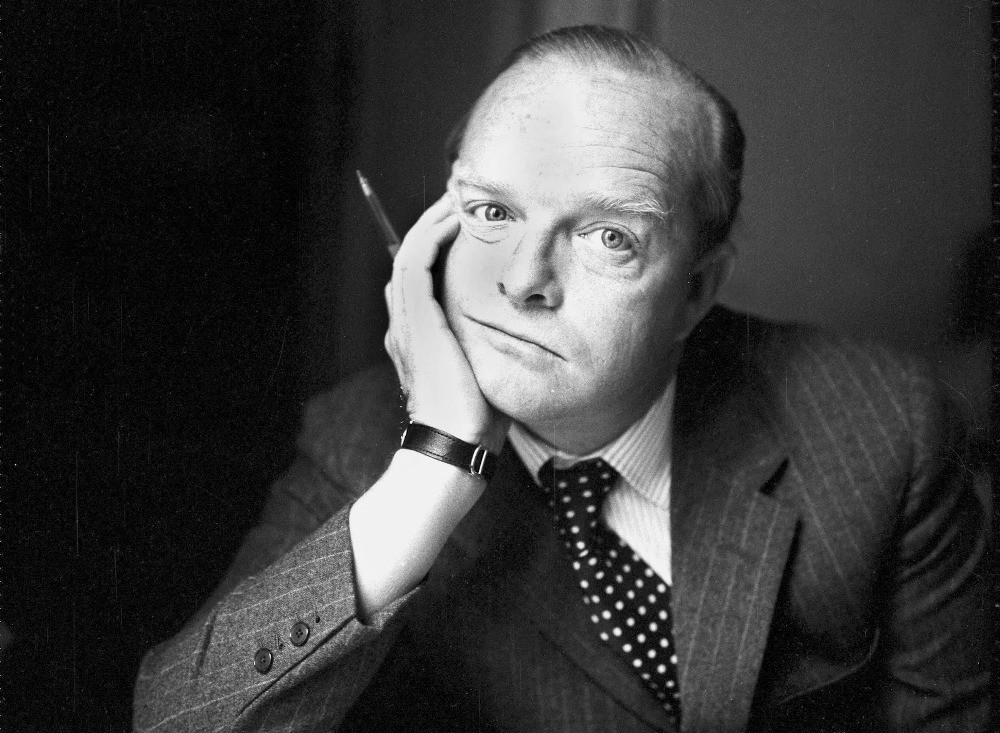
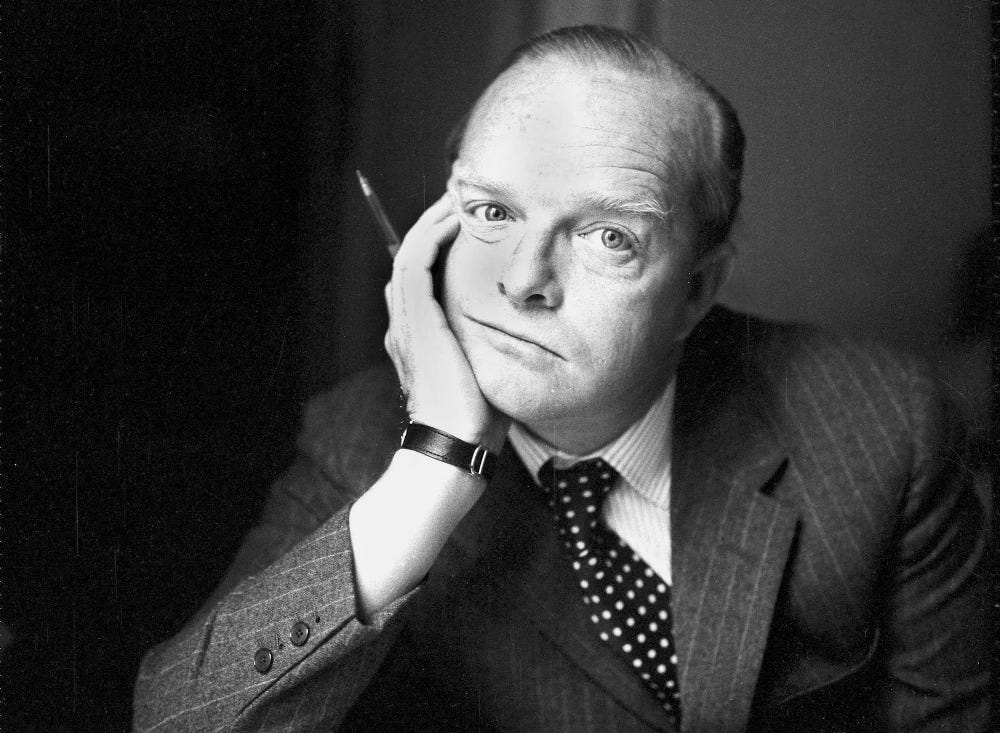
Truman Capote’s ashes were auctioned off to an anonymous collector for $43,750 over the weekend. They had — since his death from liver failure in 1984 — resided in the Los Angeles home of Joanne Carson, his close friend and wife of late-night star Johnny Carson. However, the ashes became homeless after her passing last year.

Initially listed at only $2,000, the ashes drew surprising interest, drawing potential collectors from Russia, Germany, China, and various South American countries, according to vendor Julien’s Auctions. The sale also included the clothes Capote wore at the time of his death ($6,400) and two prescription pill bottles ($9,280).

While the whole thing may seem slightly distasteful, it is worth noting that Capote, at least abstractly, granted his approval. As The Guardian reported, his will included instructions to Carson, stating, “ he didn’t want his ashes to sit on a shelf,” a point Julien’s Auctions president Darren Julien has taken quite literally, commenting, “I know 100% he would love [the auction]… it is just furthering the adventures of Truman Capote.”

Whatever your stance, there is no denying Capote cultivated his outsized pop culture presence with the same ferocity as his famed prose. So, at worst, he probably wouldn’t be totally displeased with a reentry into the public eye. Although, perhaps, it might be best to remember him through Breakfast at Tiffany’s, In Cold Blood, and his memorable T.V. appearances instead of relics.

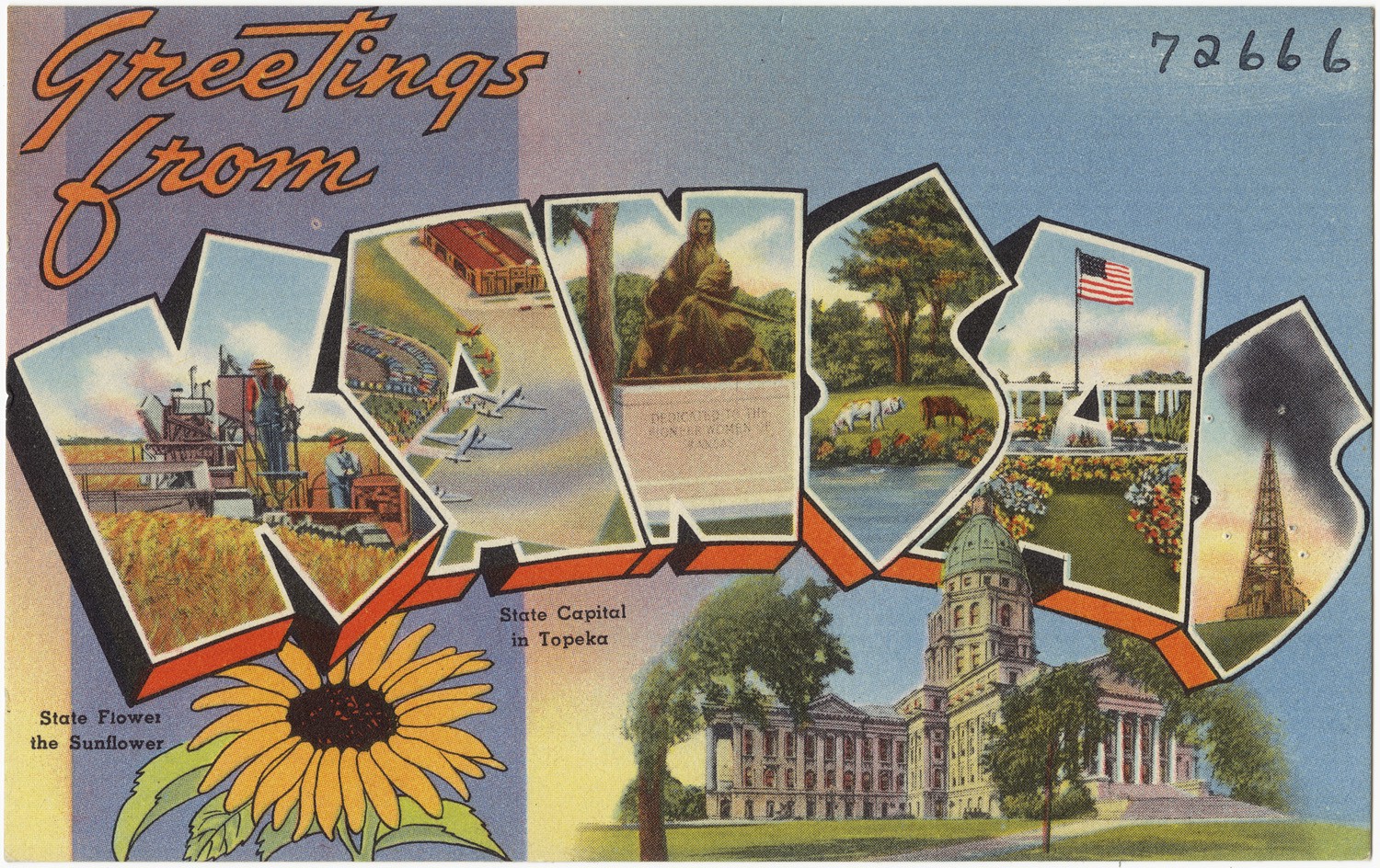
Map Inset: Kansas – A Video Essay

How Did We Get Here? Notes on Craft & Process

Once upon a bleak set of years, I did nothing but drive back and forth across the country. I had no job, no house, no partner, no plan, and, in the wake of various concurrent losses, I no longer had faith in my own desires.

On one of these junkets, I pulled over at a roadside rest stop in Kansas. The landscape reminded me of Andrew Wyeth’s painting, Christina’s World, and so I tied the dog to a picnic bench, set up a timer shot, and somehow spent hours trying to reenact the painting. At some point later on, I tweaked the color on a single shot, posted it to Facebook, and promptly forgot that this particularly lonesome day (and its attendant series of photos) had ever happened.

Christina’s World by Andrew Wyeth

When I first sat down to write about these dog days of roaming, I went poking around an old back-up drive and discovered the forsaken photos I’d taken that day.

The images are poorly lit and lackluster, and they certainly don’t get into the logistical grit of the drama going on in my life at the time, but, true to the old creative-writing adage show-don’t-tell, the photos manage to conjure the emotional truth of the story without explicitly stating a thing.

The isolation is clear in the landscape. The repeated attempts to get the perfect shot reveal a mounting desperation. The light changes; the sun fades. The sheer number of shots belies the fact that I had nowhere to go and no burning desire to get anywhere.

I wrote a brief essay-ish sort of piece, almost as if captioning a contact sheet, but it was difficult to read on a small screen, so I tried to find a form that would function in service of both image and text.

Video essay? Slideshow narrative? Lyric filmstrip? I’m not sure what to call it, but even with the rudimentary skills I was able to work up in the crash course of a 14-day software trial, as is often the case with revision, this exercise in form furthered my own understanding of the story at hand.

Some shots were taken in such rapid succession that by setting them in video sequence, it’s almost as if I’m reset in motion. This animated humanity and my voice on the audio track, bring to the project an intimacy that I find both strange and pleasing. This pit stop in Kansas marks what I can only hope is the loneliest I’ll ever be; the dog was the only one to hear my voice not just for those hours in the field, but for days. By offering a belated chance to both speak and move, the multi-media form seems to do more than just capture the experience I had with the dog the day we got stuck in that field; it somehow seems to release us from it.

Belle Boggs on Infertility, Waiting & Nature

As may have been the case for some of you, Belle Boggs came on my radar in 2010 when Graywolf Press released her collection, Mattaponi Queen, a set of stories so wise, so elegant, so indissoluble, it seemed impossibly unfair that it was a debut. Two years later, I read her essay “The Art of Waiting” in Orion and thought, “Damn, that’s a book’s worth of material right there, and I’m dying to read that book.” Clearly, I was not alone in this line of thought. So it was joyous to hear that Boggs had indeed expanded that magnificent essay into this even more magnificent book, which is written with prodigious insight and a contemporaneous earnest, open-hearted seeking — a blend which makes for my favorite kind of narrative nonfiction. This book is an achievement of the highest order, and marks Boggs as master and commander of rendering the human heart.

It was an honor to speak with her, via email, about The Art of Waiting (Graywolf, 2016).

Vincent Scarpa: One of the things that I found so remarkable about The Art of Waiting is your gift for specificity and precision. For example, you identify yourself not as a woman who wants to be a mother, but as one with “child-longing.” “This is what I wanted,” you write. “To hold a child of my own, be clung to in that way that primate infants have — legs wrapped around my middle, a hand in my hair and another on my arm.” I suppose on the surface, to some, that isn’t much of a distinction, but it felt so integral to the book, to your self-sketching from a place where you “desperately want [your] body to work the way it is supposed to.” Knowing that you were writing into a sphere into which so many have contributed their stories, did such precision and specificity feel especially important to making the book singular?

Belle Boggs: I think I was lucky to have a specific, very smart audience in mind when I wrote some of the first material for the book, which was (in addition to my family) the readership of Orion magazine. Orion’s focus on nature/culture/place and my reading of other Orion essayists convinced me that to write about my experience of infertility, I needed to do a kind of closely-observed, specific, outwardly-focused kind of writing. I started my career as a fiction writer, and when I began writing nonfiction I tried to apprentice myself to the many science and nature writers I admire, people like Annie Dillard, Janisse Ray, Rachel Carson, Jane Goodall, Sarah Hrdy, Sy Montgomery — I love their clean, beautiful prose and the way their books teach you something while also being memorable, original, a pleasure to read. I had some idea when starting to think about the book that it would be like Pilgrim at Tinker Creek, but about fertility! It didn’t quite turn out that way, but I’m glad that river walks and cicada broods and bald eagles made their way into the book, and I hope they make it feel singular, as you suggest.

I also think it’s writing in this way, with detail and specificity, that makes it possible to address desire and motherhood and ambivalence and sadness — it makes the writing enjoyable, and makes it possible to turn away from those moments of disappointment and loss and sadness, toward something else.

VS: Another important distinction gets made early on; one that echoes the book’s title and its focus on waiting. “Nonhuman animals wait without impatience, without a deadline, and I think that is the secret to their composure,” you write, whereas humans have, “the conscious possibility of a new purpose, a sense of self not tied to reproduction.” I admire this exactness for so many reasons, but perhaps chief among them is that it places the human and the nonhuman on equal footing — something that you do so beautifully throughout the text, and something one rarely sees done. I know there’s an origin story regarding Jamani, a female gorilla at the North Carolina Zoo, but I wondered if you could talk a bit about what you were aiming for in the apposition of the stories of human and nonhuman animals. That the book is bookended by writing about Jamani felt especially lovely; a supremely wise structural choice.

BB: Oh, thank you for asking about Jamani! Her story was a fascinating one to me — when I wrote the essay that was the seed of the book, I followed Jamani’s pregnancy from the zoo’s announcement, which was momentous (it was the first gorilla pregnancy at the NC Zoo in 22 years), to the additional attention from veterinarians, the additional visitors to their enclosure, and the impact on her relationship with Acacia, the other female in her enclosure. I finished the essay, and worked with my editor on it, then learned that Jamani’s infant was stillborn; I added that information in (to the Orion essay) as a postscript. Later in the book, I write about how all the female gorillas conceive — Jamani conceives a second time, her new enclosure-mate Olympia conceives, and Acacia does too — and how these births change life in the enclosure, and life for these gorillas, forever.

We can’t know the mind of a gorilla, and anthropomorphizing is a dangerous temptation, but I think my own reactions to Jamani’s pregnancies, and the reactions of her keepers, for example, are fair game. I was interested in how important Jamani’s story began to feel to me — almost like we were in this fertility roller coaster together, which is ridiculous but also true. Returning to watch Jamani with her baby, wearing my baby in a carrier, was very emotional for me.

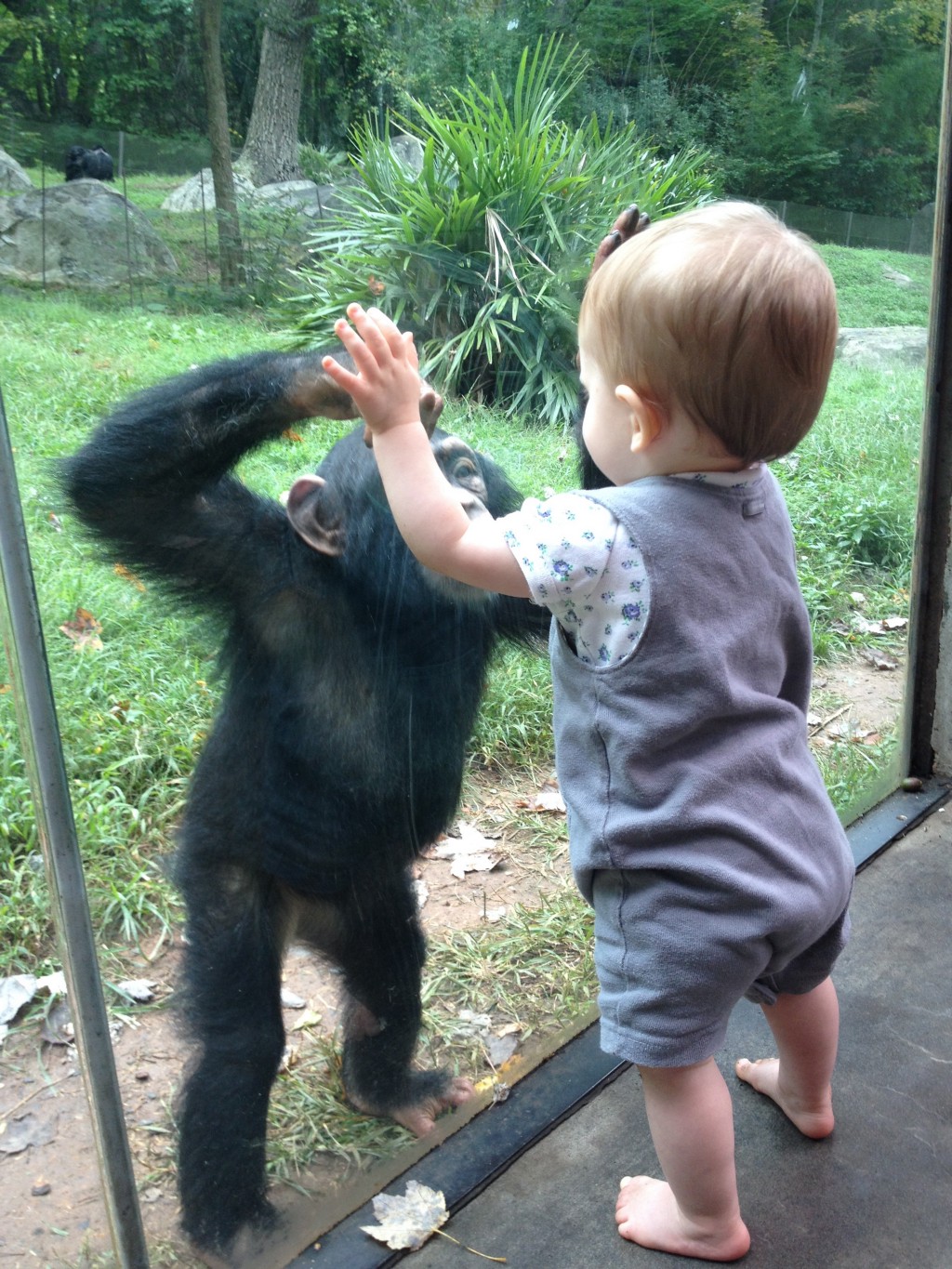
There’s something very powerful about our connection to other primates — I don’t like to see them in zoos, it feels wrong to me even as I understand the conservation work done there. The last time I visited the NC Zoo was with my daughter, Beatrice, and we watched the gorillas for a long time, in part because I was still writing about them. After she tired of the gorillas we went to a chimpanzee exhibit. Beatrice pulled herself up to the glass and stood watching, and very quickly a young chimpanzee ran up and put her hands directly against Beatrice’s hands, on the other side of the glass partition. They just stood there, gazing at each other.

VS: I think one of the readerly joys in narrative nonfiction, at least for me, is watching the writer run whatever she is investigating personally through the machinery of other narratives; to look at it through various other prisms. So it was a delight to see you contemplate fertility in films like Raising Arizona and Who’s Afraid of Virginia Woolf?, and not, I don’t think, because they just so happen to be two of my very favorite films. There’s this deepening and widening that takes place in that act of investigation, I think. [I was reminded, too, of Marisa Tomei on the porch in My Cousin Vinny, stomping her heels and talking about the ticking of her biological clock.] And I think you do a great service when you point out that, “We count on literature to prepare us, to console us, but I am shocked by how little consolation there is for the infertile.” Why do you think that is? Is it the same explanation for the lack of significant medical discourse around it, a void that has become at least partially filled by the abundance of online communities for women struggling with fertility?

BB: That is a great metaphor — running your investigations through the machinery of other narratives. Of narrative at all, which is sort of machine-like in its way. I think some people are very uncomfortable with a female body that ages or doesn’t work as they think it should, and I think pregnancy and childbirth is a useful narrative — it’s transformative and full of potential for conflict and growth. When I was trying to get pregnant, I noticed all around me these narratives that put the maternal-child bond at the center of life, and painted non-maternal, infertile, or childless women as deviants. I noticed it especially in my (high school) teaching and discussion of characters from literature, from Lady Macbeth to Miss Havisham to Albee’s Martha, and in my reading and writing, where even contemporary books I enjoyed or tried escaping into seemed to exalt pregnancy while using fertility treatment as a means of showing selfishness or privilege or a brittle nature that contrasts with someone else’s ease. I remember, for example, reading the noir page-turner Gone Girl and thinking, really? Intrauterine insemination (with all the details wrong) is going to be the means of this horrible character’s punishment of her (also horrible) husband? But then, I recognized it in my own writing — I’d used IVF (with the details wrong) to say something stereotypical about a minor character in one of my stories, too. And I regret it.

I think some people are very uncomfortable with a female body that ages or doesn’t work as they think it should…

But I love Raising Arizona — such a preposterous caper — as a depiction of long waiting and child/family-longing for the way Hi is able to go to two places in his mind, in the last, beautiful dream sequence. He sees a future in which he and Ed act as unseen well-wishers for Nathan Junior, and also in which they are old and gray-haired and somehow have the family they once imagined. This film is not about how others see the couple but how they choose to live together — Albee’s masterpiece Who’s Afraid of Virginia Woolf is like that too, when we realize the intimacy that actually unites George and Martha. I’m interested in the imagination as a tool for survival.

VS: I knew next to nothing about the fertility treatment industry, so everything you wrote about it here was surprising to me. Most especially, I was troubled, as you write being, by “the idea that investors are somewhere making money by exploiting the lack of coverage for a financially and emotionally risky medical procedure.” It seems such a dystopic, eerie capitalism. This is just one of many skilled and clear-eyed critiques you make of the industry, which feel even more pointed as you write from a place of having been in that system. I’m wondering what your impression is now, some years removed from that system, and if there’s any new information about which to be hopeful regarding coverage for women who are attempting to conceive?

BB: I’m glad that we had the opportunity to buy our so-called cost-share plan, which made it possible for us to pursue a safe, single-embryo transfer IVF, because we knew that we would have more chances (we paid a high, flat fee for the chance to go through IVF three times). But I’m also bothered that someone made money — above and beyond the high cost of treatment — because our lack of insurance coverage made us too afraid to pay per-cycle (I was afraid that if we had one failed cycle, I’d be too risk-averse to pursue a second cycle). The existence of these plans seems predatory to me, or at least opportunistic, even though I’d make the same choices if I had to do everything all over again. These plans are often not entirely up-front about the likelihood that you’ll even get all three or six of your chances: there are important details (aren’t there always?) hidden in the fine print.

And there isn’t really much new in the way of advances in insurance coverage: still just fifteen states mandate coverage, and among those fifteen states we see a lot of variation in what and how much they cover (you can find lots of information about state mandated insurance coverage at RESOLVE’s website). I recently met a woman in North Carolina who has had great success petitioning her employer to add fertility/IVF coverage to their plan. That’s not a possibility for many of us, of course — she works in a high-tech/high-demand field, but she actually started a similar advocacy campaign at a university when she was in graduate school, and she was successful there, too. I wonder what would happen if more of us spoke up about the need to cover this very common medical condition.

VS: More than just a personal investigation into your own struggles with fertility, and more than an examination of fertility through various cultural prisms, The Art of Waiting seems to me to be a call for new narratives on fertility, baby fever, motherhood. It seems a call to dislodge the culturally installed and reified narratives to which we have become attached and accustomed. Which I found so admirable and also so brave — this rallying cry to bust the mythos of one of society’s most ubiquitous narratives. Does that sound right?

BB: Yes! I have been a teacher for basically my entire professional life, and I think we need all kinds of narrative for young people, for all of us. I don’t think most of us are well-served by the narrative of “miracles” and things just happening to you — I’m for choice, and access to choices for everyone, and openness and honesty.

VS: As a fan of your fiction, I’m wondering if you foresee a return to that realm anytime soon, or if your interests have skewed toward the nonfiction realm for the time being. It’s kind of unfair how deftly you navigate both.

BB: Thank you, Vincent! I am always interested in writing both, and feel pulled all the time to write and research new nonfiction, but my next big project is finishing this novel for Graywolf, The Ugly Bear List. It’s set in the world of for-profit education and inspirational/Christian writing. I also have a lot of new stories I want to write…

Children’s Books Featuring Diverse Characters Are More Likely to Be Banned

PEN American Center “From the Missing Shelf” depicts a startling trend in banned books

Every year Banned Book Week falls on the last week of September. It’s an occasion to celebrate the freedom to read whatever our hearts desire despite censorship efforts from the easily offended.

PEN America is a hybrid organization that is deeply concerned with where literature and human rights meet. At the start of this year’s BBW they released a report that uncovers an alarming pattern in children’s literature. According to their research on commonly challenged or banned books, PEN America found that “books by or about people of color, people who identify as LGBT, and people with disabilities (“diverse books”) are significantly more likely to be challenged or banned even as they make up a disproportionately small fraction of all published literature.” The study comprehensively looked into how book bans have been reviewed in the news, diversity in publishing, and also featured interviews with authors and editors.

The most unfortunate consequence that PEN discovered from their analysis of banned books was that kids are not being exposed to a diverse range of characters in the stories that they read. Book lovers know just how important reading is in shaping one’s world and imagination. The report calls for action and change. We recommend giving it a read.

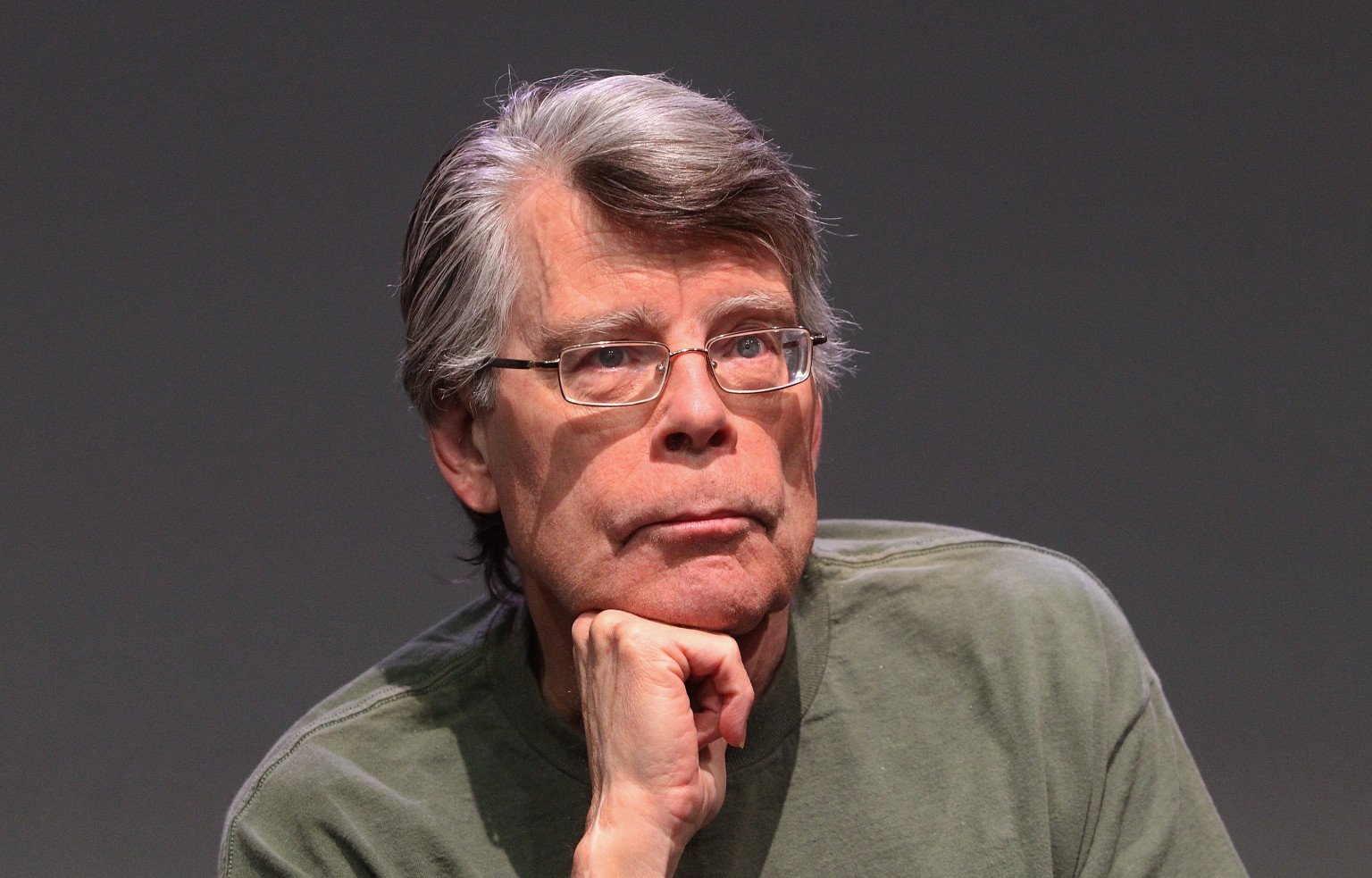
What’s Keeping Stephen King Up at Night?

The prolific horror author is “terrified” of a Trump presidency

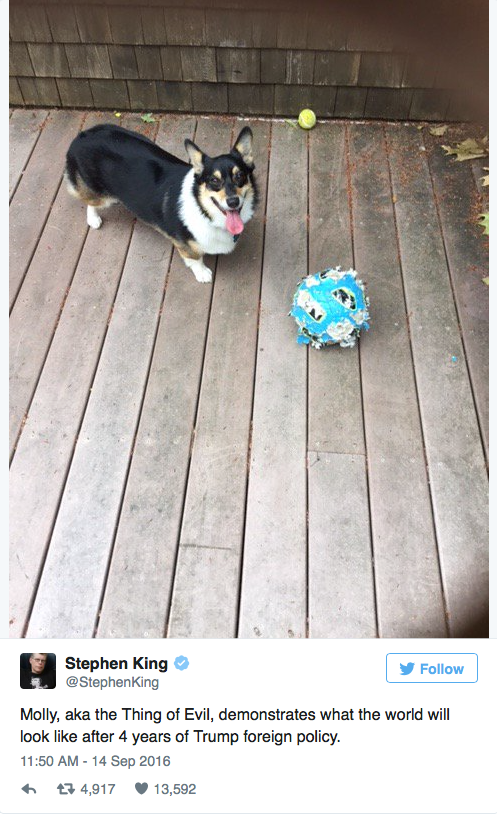
The monster hiding under Stephen King’s bed isn’t the terrifying clown from It, and it’s something the author finds far more fearsome than a deranged Jack Torrance. What pokes and prods at King from beneath his mattress is apparently Donald J. Trump. In a recent tweet the bestselling author said that Trump “is actually Cthulhu” and explained the Republican candidate’s “absurd hair” is a convenient cover for the tentacles.

King hasn’t shied away from expressing his contempt for Trump this election season. On Saturday at the Library of Congress National Book Festival, he appealed to his experience as a former English Teacher to explain why he saw a Trump Presidency as so disastrous:

“We live in a society where many believe that libraries and other cultural endeavours… are of minor importance. As if learning to think is a thing that just happens naturally, like learning to walk. Believe me, it’s not. Learning to think is the result of hard work and steady effort.”

King told the crowd that the diminishing importance of cultural institutions, such as libraries, has led to an “illiteracy or semi-literacy in a national population,” which makes it possible for candidates like Trump to have a real shot at becoming commander-in-chief.

King also pinpointed what he sees as one of Trump’s main campaign strategies: fear. “We’re afraid the government is going to take away our guns, we’re afraid that Mexico is going to invade the United States, we’re afraid of this, we’re afraid of that, we’re afraid of taxes, we’re afraid of transgender bathrooms — the whole thing.” King, the well known expert in the nuances of fear, said that frightening people was Trump’s way of keeping them from having a rational discussion.

King continues to fight his anxieties about national illiteracy by donating to small libraries, which was one of several reasons the National Book Festival was honoring him this past weekend.

However, come November, American libraries might need to look for a new benefactor, as King has threatened to move to Canada if Trump wins.

I’m a Loner, Baby, and I’m Gonna Threaten You

Narcissism creates privilege, and privilege feeds narcissism. The two create a cycle, rhythmically obsessing about, you guessed it, themselves. Earlier this year, in an article at The New York Times, Arthur C. Brooks declared narcissism as an “epidemic.” Brooks reported the alarming increase at which narcissism is infiltrating college campuses. The article spoke to our craving for social media attention, but it also did something else: it raised the point that narcissism and the privilege that it invokes can be dangerous. According to Brooks, narcissists “create havoc and misery around them. There is overwhelming evidence linking narcissism with lower honesty and raised aggression.” Loving ourselves is a dangerous game.

Teddy Wayne’s latest novel, the brilliantly terrifying Loner, shows how dangerous narcissism can be, but first, Wayne dabbles in sympathy. When we meet David Federman, he’s arriving at Harvard University. Both he and his teachers describe David as “somewhat of a loner.” The initial reasons for his isolation seem clear; he’s a misunderstood genius. He intentionally transposes words — it’s his special “social power” — in conversations: “tucitcennoc (Connecticut), citelhta (athletic), draynal (lanyard).” When he isn’t saying words backwards, he’s using such an advanced vocabulary that a person without a graduate degree would have a hard time following him. In the initial sections with David, it doesn’t appear that he means to be so overtly intelligent. He says, “I didn’t have the untrammeled intellectual curiosity of the true polymath. I was more like a mechanically efficient Eastern European decathlete grimly breaking the fish-line tape or heaving a javelin.” He’s someone on the outside — someone lost, searching for his way.

“Teddy Wayne’s latest novel, the brilliantly terrifying Loner, shows how dangerous narcissism can be.”

David’s status as a loner certainly isn’t an uncommon one — not by the world’s standards and not by literature’s own, either. In fact, some of 2016’s most celebrated novels revolve around misfits. Take for instance Jesse Ball’s How to Set a Fire and Why. The misunderstood Lucia is a both a sputtering and flaming ball of misdirected angst. In The Doubter’s Almanac, Milo’s brilliance sets him apart from anyone and everyone. Evie, the quiet heart of Emma Cline’s The Girls, craves acceptance. David’s situation in Loner, however, is different than those of his literary counterparts. His separation, we slowly realize, is deliberate. He wants — no, desires — to be a loner because the only thing he cares about is personal satisfaction.

At Harvard, David meets Sara, another young, social misfit. Initially, the two seem like the ideal couple. They give one another support, and they spend the evenings together. David tells her, “To be honest, you’re the only one here I’ve really talked to in any depth.” He knows what he’s doing all along, though, and it doesn’t take long for us to realize it, too. He’s trying to get something. He lies and manipulates Sara on repeated occasions. He takes her virginity. He fools her into thinking that he values her. Those acts are bad on their own, but the reasoning behind them makes them worse: he wants Veronica Wells, Sara’s beautiful roommate, and the only way to get her is to go through Sara.

“He wants — no, desires — to be a loner because the only thing he cares about is personal satisfaction.”

David basks in David. Every action he makes is methodically planned and calculated. His entire relationship with Sara is based on his narcissistic desire to attain something (or someone) that he deems as being better. In his personal life, he behaves similarly selfishly. He has a Facebook account, but he doesn’t use the social media site to socialize; instead, he uses it to get information to help him plan. He admits, “I don’t use the site myself except for voyeurism.” While he watches other people live their lives, he is careful to not allow his own life to be available: “I had hidden my list of friends and prohibited anyone from posting on my wall.” David is a man obsessed with control.

What makes David the most reprehensible is that he doesn’t care how cruel he is. The reason he behaves so narcissistically is because of his privilege. His parents are lawyers. His intellect seems to know no bounds. And, at the end of the day, he’s a straight, white young male attending Harvard. Why should a quiet girl’s feelings matter to him? Why shouldn’t he be able to manipulate a beautiful woman into a relationship with him? He believes the world is in his hands, so he behaves that way. Nothing other than his own satisfaction matters.

As cringe-inducing and upsetting as much of David’s actions are, it’s impossible to deny him our sympathy. After all, he is a lost person, alone in the world and void of any meaningful connections. Yes, he’s narcissistic. Yes, he’s cruel. And, yes, he does it all to himself, but, still, he’s alone. We can’t be so privileged as to deny him our pity. If so, what makes us any different from him?

“What makes David the most reprehensible is that he doesn’t care how cruel he is.”

Characters such as David, those being selfish, disturbed, alone, and ultimately privileged, aren’t uncommon. One of American literature’s most iconic characters, Ignatius J. Reilly, fits into the same mold.

Ignatius of John Kennedy Toole’s A Confederacy of Dunces is perhaps the classic narcissistic loner. Living as a young man in New Orleans in the 1960s with his mother, he struggles to fit in with in not only with his peers, but also with the society at large. Physically, he’s overweight, and he wears a green hunting cap. Those two things automatically provide Ignatius with some level of separation. However, it’s his unrivaled intellect and self-obsessed personality that completely take him out of normalcy. He doubts he’ll find a job because, as he says, “I suspect that they can see that I am forced to function in a century I loathe.” The culture doesn’t suit him, so he revolts against it. He’s constantly pessimistic. He’s sarcastic. He’s angry. He’s cruel. Mostly, though, he’s narcissistic. He refers to himself as having a “god-like mind.” Everyone who isn’t him drowns in faults. People who aren’t as educated as him are too vapid to understand life. He is so accustomed to such a privileged existence of being a white male intellectual that he doesn’t even recognize (or care) that he’s racist, homophobic, and sexist.

Holden Caulfield (J. D. Salinger’s The Catcher in the Rye), Jay Gatsby (F. Scott Fitzgerald’s The Great Gatsby), and Patrick Bateman (Bret Easton Ellis’ American Psycho) are others who possess a mixture of loneliness and privilege. These young men have so much — wealth, education, and opportunity, but, still, they carry on selfishly. The reason: because they can.

With Loner, Teddy Wayne has written a masterclass on the privilege found in white male narcissism. David’s story is difficult to read, but it’s necessary. How else are we to be reminded of how badly the world needs empathy?

Stealing Someone’s Favorite Word

Troublesome Pilot

I guess the wind
did it

or age
much goes

sideways
with age

comfort becomes
that certain

I-know-not-what
the digital

model augurs
effects of sea-rise

on the least tern
the pattern

of the great
auk egg

is gone

tides won’t
watch us

until we look
away

the drought-
stricken

marched in the arroyo
waving blue

sheets
the newscasters

laughed
because it snowed

that summer

most people occupying
the park

appeared to be
on assignment

“troublesome pilot”
you wrote

on the stove
when you smoked

the green puff
was a fuse

you sparked

in opposition
to death

you left carrying
whatever

would fit

in your pockets
I was spinning

lettuce
I hoped

time moved
in a circuit

as science has
predicted

future depth
of the mean

fortis beak

as many vintage
styles wait

at the light
for permission

to cross from here

the idea of wilderness
as circumscribed zone

it seems
embarrassingly

American
not to speak of

the love we shed

each snakeskin
nailed to the beam.

Apocrypha

A pilot carried us through night
and we arrived as late revelers
mingled with those who slept
where they weren’t supposed to
sleep. Tired and thus more given

to indiscriminate attraction,
I fall for the Caravaggio hanging
nearest: Judith traded
sackcloth for gown, wooed then
dispatched besotted Holofernes,

and though she’s jewel-less,
the joke works: he’s a victim
of fashion. Poor Holofernes,
never to see the morning’s
pigeons, the market draped

with fog until it isn’t — suddenly,
the vendor’s dog is shining,
sun doubles on its bare patch
of skin. Hit with light like that,
what creature wouldn’t glow

from the inside out. And what
landscape, now clothed, wasn’t
raised in the wild. Our ticket
permits re-entry from now until
the weekend. Beyond this, two

routes determine our revision.
The first reflects the past;
its concerns are familiar. The other
covets fashion. The future.
What will people wear then?