Fifth Dimension Books, the Austin-based sci-fi bookmobile, is proof that the modern bookscape is a vibrant, diverse ecosystem.
Four years ago, the owners of Fifth Dimension Books, Sukyi and Patrick McMahon, purchased a collection of 100,000 science fiction books from the estate of family friend, Dr. John N. Marx. They bought a 1987 library-system bookmobile from Craigslist, spent months putting the books in storage, and bringing it up to snuff. In 2013, they opened their mobile bookstore in Austin’s hipster Hyde Park neighborhood.
They bought a 1987 library-system bookmobile from Craigslist, spent months putting the books in storage, and bringing it up to snuff.
“We knew that we couldn’t compete with something like Amazon,” Ms. McMahon said. “And we knew we didn’t want to. But we also knew that we had to translate being ‘science fiction aficionados’ into ‘successful business owners’ if we wanted Fifth Dimension Books to work. So we have to be creative and we’re always looking for new ideas to try out.”
Their niche? Expertise. They knew their sci-fi and they love to talk about it. They also know how to connect readers with the genre. From neophytes (“I’m not sure science fiction is really my thing — all those robots”), to connoisseur collectors (“You have signed copies of rare books?!?”), to niche fans (“I’m looking for something in early diesel punk”), Ms. McMahon believes that there is a science fiction book for everyone. Fifth Dimension’s motto is Used & Collectable Books For All Ages; Sci-Fi, Fantasy, & Other Fringe Books. And they have those books by the shelf-ful.
Every month, Ms. McMahon stocks the shelves with new and different books, curating special shelves featuring less-read authors and various subgenres. She offers children’s puppeetering and a free, outdoor, award-winning story hour near in.gredients neighborhood grocer. The story hour is so popular that dozens of kids and their parents find their way to the Fifth Dimension’s child-sized bookshelves and to meet Octavia the puppet — named in honor of Octavia Butler. If you email Ms. McMahon, she’ll compile a personal “must read” sci-fi list for you.
“Sukyi and her weird wandering book mobile were a wonderful addition to our grounds every Monday morning for nearly a year,” said Josh Blaine, owner of local grocer in.gredients. “She attracted families from all over Austin with her free children’s story time, which included puppets, songs, and dance. It’s a beautiful sight: 20–30 parents and kids gathered on our lawn every Monday morning enjoying old-fashioned entertainment offered by a passionate and caring member of our community.”
The very, very young bookmobile patrons love lying on the floor, utterly absorbed in shelf of sci-fi for kids.
On its surface, Fifth Dimension Books appeals to the nostalgia of the thirty-plus and older crowds — readers that can remember bookmobiles from their childhoods. Younger book-goers love its “shop local” vibe. The very, very young bookmobile patrons love lying on the floor, utterly absorbed in shelf of sci-fi for kids. The store touts itself as a “mighty, yet miniature mobile mover of literature.”
The physical machine of Fifth Dimension Books is a Chevy P30 bookmobile — it’s over twenty feet long, gets 6 miles per gallon, and has a top cruising speed of something like 54 miles per hour. It drives like a refrigerator on wheels.
“I try not to stress it out, driving on the highway,” Ms. McMahon laughed. “Honestly, it was a bit terrifying to try and park this thing, before I installed the rear-mounted camera. Now if feels natural.”
Originally from New Jersey, the bookmobile was active for twenty-five years in the public library system before the McMahons purchased it. After the bookmobile checked out with a mechanic’s inspection, they had it shipped to Austin from the East Coast.
Once they had the bookmobile in Austin, they started thinking about how to move the books from Lubbock (where they were located) to Austin. The limiting factor in moving was how much weight a single truck could carry at a time. It took eight trips between Lubbock and Austin using the largest truck Penske had at about four hundred boxes per trip to move the entire collection.
It took eight trips between Lubbock and Austin using the largest truck Penske had at about four hundred boxes per trip to move the entire collection.
Fifth Dimension Books also had to figure out how to operate, legally, in the city. “Austin at the time did not offer a permit for mobile retail businesses. The ordinance we needed was currently under discussion by the city legislature so it was a matter of sitting through those meetings and stating our support,” Patrick McMahon said. “After the ordinance was unanimously passed we were the first mobile business in Austin to receive a permit of its type.”
But it’s the books and the bookshelves of Fifth Dimension Books that command curiosity, attention, and interest as soon as you step into the mobile bookstore.
The books on the shelves of Fifth Dimension and its inventory in storage are the lifetime collection of Dr. John N. Marx, a longtime professor of chemistry at Texas Tech University. When Dr. Marx passed away in 2012, the McMahons purchased the 100,000+ collection from the Marx family — a collection so well-known in the science fiction community that Dr. Marx’s passing was noted at the 2012 World Science Fiction Association’s Hugo Awards. (Dr. Marx ran his niche online bookstore, from 1998–2012.)
His collection, though, was more than just its numbers and sheer volume; the compendium represented a lifetime of collecting, cataloging, and curating. With Dr. Marx’s passing, the collection metamorphosed in its life cycle. “We feel that we are stewards of the collection and take that responsibility seriously,” Ms. McMahon said, referring to the legacy of the books.
A portrait of Dr. Marx, and a brief biography of him, hang above the bookmobile’s dashboard. It feels like Dr. Marx is offering a final benediction on his collection as customers pass by his picture, clutching a new-to-them book, eager to read. This new reader is a new chapter in the book’s own life history.
“Don’t the books fall off the shelves when you drive?” the customers of Fifth Dimension Books invariably ask the McMahons.
Thanks to the bookmobile’s design, the answer is no. The shelves line both sides of the vehicle, with five or six shelves per unit. They’re built to tip backwards just slightly, insuring that the book snug in their shelves. While the shelves travel from location to location as part of the bookmobile’s architecture, the books on the shelves move only through the circulation of inventory.
But books and their shelves move in curious and unexpected ways. Space in the store is at an utter premium — books, buttons, and T-shirts are tucked away in every nook and cranny — but the bookmobile means that the bookshelf comes to the reader, rather than the reader coming to it.
The bookmobile means that the bookshelf comes to the reader, rather than the reader coming to it.
There’s a kinesis about the books on those mobile shelves of Fifth Dimension Books, as the shelf inventory is restocked every month. Because the bookshelves are so small and the number of books so different — relative to what one might find in a traditional brick-and-mortar store — Ms. McMahon changes out the books on the shelves with regularity.
She also spruces up the shelves to help readers create their book encounters. Some books face out, some books are shelved spine to spine. To celebrate Black History Month, for example, Ms. McMahon curated a shelf of under-read African-American science fiction writers. Her “Blind Date With A Book” shelf features books wrapped in brown paper with snippets from the book’s covered penned on the wrapping and readers buy the books, title unknown. Thanks to the Blind Date With A Book, I read Serpent Catch by Dave Wolverton — a Neanderthal sci-fi that I probably wouldn’t have picked up on my own, but enjoyed reading it.
It is the constant — yet thoughtful — churn of books on their shelves is what really underlies the success of Fifth Dimension Books.
As book commerce becomes decreasingly non-local and impersonal, the McMahons and the Fifth Dimension bookmobile’s business builds a niche through its connections within the Austin community and the creativity of its owners.
Craft books are tricky. In an era inundated with YouTube tutorials, WikiHow entries, life hack listicles, and Reddit explainer threads, the act of keeping a reader interested for 150+ pages of how-tos — let alone bringing that reader to the book in the first place — is a tall order.
Enter Benjamin Percy’s Thrill Me: Essays on Fiction (Graywolf), which probably deserves a crunchier subtitle. (“How to Succeed in Writing Stories Without Really MFAing” and “How I Learned to Stop Fetishizing Realism and Love Genre Writing” are two descriptive, if egregious, non-contenders.) Percy’s bona fides are wide-ranging and robust. After cutting his teeth with The Wilding, a literary debut with a twist of the gothic, Percy jumped into the genre writing he’d loved as a kid with supernatural thriller Red Moon and post-apocalyptic road trip thriller The Dead Lands. He also writes the Green Arrow and Teen Titans series for DC Comics.
Thrills are Percy’s specialty and calling, in case you hadn’t noticed, and a plot that keeps the reader seeking answers is his Holy Grail. His appetite for skillful storytelling is admirably indiscriminatory. Over the 15 essays that make up Thrill Me, Percy cites authors ranging from T.S. Eliot to Annie Proulx and praises the plotting and execution of Steven Spielberg’s Jaws and Cormac McCarthy’s Blood Meridian in equal measure.
So, naturally, Percy endeavors to imbue these essays on the craft of fiction with the same sort of muscled tale-spinning found in both his favorite works and his own creations — and by and large, it’s a winning strategy. The prose, much of which was originally designed for delivery as lectures at writing workshops, is clean and clear, woven with an abundance of anecdotes and references that work as more than a perfunctory performance of subject knowledge. His textual exegesis, that gold standard of literary criticism, is crisp and pithy, serving the essays and their flows and rhythms rather than overwhelming with shows of erudition.
The book treads little new ground, but Percy makes style count, and the willingness to move beyond the standard-issue, well-worn “this is how fiction works” sort of deal is a huge boon — in other words, you’ll find no James Woodsian paens to free indirect style here. Percy also stresses that while there are certain objective requirements for good fiction, personal preference is also a huge part of the writing and reading process. This makes the author relatable to an audience outside the typical gathering of literary minds, and his appreciation for the master storytellers of genre fiction — Stephen King, for instance — who he holds in equal esteem to more hifalutin authors like McCarthy and Proulx, Jhumpa Lahiri and George Saunders, is refreshing. Genre has long been belittled in the world of letters, and when accepted, that acceptance is usually grudging. Percy dives in head first, and his enthusiasm, in conjunction with his eye for substance and style and his skillful explication, prove a heady mix.
That said, for many writers, who comprise the typical audience of such a book, there’s not much new here. Thrill Me is comprehensive in its scope, touching on most of the important pieces of storycraft from stylistic choices to character development, but in part because it’s just over 170 pages, it simply doesn’t have the space to do more than just that — touch on. It does so with character and vigor, and with a joyful populist tone, but rarely does it delve deep.
Percy’s genre touchstones, too, often skim the surface, both in choice and content. While Jaws may rarely get a namecheck in a literary essay on narrative plotting, there’s more than enough film criticism available that better explains the genius of Robert Shaw’s U.S.S. Indianapolis monologue in terms of narrative construction and delivery. And Percy’s penchant for the neat wrap-up — multiple essays, including the titular essay, end with a line regurgitating their titles — occasionally grates.
That said, even when they feel a bit too easy, Percy’s essays are expertly constructed. They neatly balance the objective and subjective, formal and informal, literary and genre. They educate and entertain. They lead you quickly to the book’s end. They are, in other words, never boring. For a book entitled Thrill Me, that is just as it should be.
I first met Larissa Pham at a reading at the Asian American Writers Workshop last spring. Her piece was lyrical and vulnerable, and she introduced herself to me (with some ambivalence) as a sex writer. Her novella, Fantasian, part of the New Lovers series from Badlands Unlimited, is a meditation on power and the self, in addition to being an erotic thriller. I interviewed Larissa about sex writing and power over e-mail and G-chat in early October. The author photo of Larissa that accompanies this piece is from an ongoing portrait series of mine.
Adalena Kavanagh: On twitter you wrote: “I maintain that you can’t talk about most things without talking, at some point, about desire.” Later you tweeted a photo of a pair of pants with a label that reads DOMINATE.
Your novella, Fantasian, is erotica, so yes, desire is a major theme but there are elements of dominance, as well. Why must we talk about desire? What role does a dominant/submissive paradigm play in your book and your work? (I hesitate to ask what place it has in your life, but if you feel comfortable talking about how the personal influences your art, feel free.)
Larissa Pham: I think we always have to talk about desire! I think desire informs so much of how we move through the world. I mean erotics here, because I’m always talking about erotics, but I also do mean desire in terms of want/need. I think being able to articulate wants and needs, and having access to the right kind of language for your wants and your needs is very important.
Now, in terms of the D/s paradigm — that’s an interesting question. Fantasian is an erotic novella, in the New Lovers series, so contractually there had to be sex in it. (6 chapters, 6 sex scenes.) And what is sex but just an ongoing conversation about power? All sex is about power and if anyone disagrees with me they’re lying to themselves. That’s hyperbole but I do believe it. I think D/s provides a really hyperarticulate framework for power in sex and I find that fascinating. It knows that power plays a role in sex (as power plays a role in most things) and it seeks to push it from subtext to surface level and even like, a meta kind of level, with the performativity of most D/s interactions.
So Fantasian is not only an erotic novella, but it is a book about power. At least, that’s what I was thinking about when I was writing it. The characters’ relationships to each other are shifting, which means their relative power dynamics are shifting, and what better way to convey that than with D/s?
I think the amount of referents within D/s, as a dynamic, are so rich that I often return to them in order to talk about other things. Like, I get to talk about class, or there’s this part where one of the characters gets fetishized by the other, and you get this really lush combination of heady erotics and then the power play beneath it. It’s really effective as a literary tool, as a way of accelerating character development and relationships.
AK: You reference Lacan’s theory of the mirror stage. Could you succinctly break that down for us?
LP: I have to admit that even though I quote Lacan, often directly, what I’m really positing is my own interpretation of his work. It’s through a scanner darkly, or whatever. But essentially Lacan posits that the I (which I take to mean the idea of a self as a discrete person) is formed when the child witnesses himself in the mirror. A mirror, when you recognize it, provides you with the image of…you! You have to reconcile yourself to how you look. Say, you look down and you see feet, you see your knees — when you’re in your body, you don’t really have a full sense of how you look. But if you wave your hands, if you kick your feet — those are gestures that are attached to a discrete body, and that’s you. They might have felt frantic or fragmented before. But now they’re enclosed in a shape, and the shape is your reflection.
So you’ve become visible. And when you become visible, you can’t go back. “Now that you know how you look…” That’s where you learn what desire is. What it means to be seen and interpreted. Because you have to deal with being a seen subject, in the way that you look around a room and you see all these other subjects. So the mirror, it’s a site of self-discovery. And it’s the beginning of the formation of a self. That’s my take on it, anyhow.
AK: In Fantasian, two Asian women meet and are struck by how similar they look. When I read your book I had to laugh at that because I am sure I am not alone in being mistaken for another Asian woman. (I had a boss who called me by the wrong name, even after he fired the other Asian woman). They share their first intimacies while looking at one another in a mirror. What does the mirror have to do with their identity and desire? Is their attraction narcissistic? Does that matter? Can you make a case for or against a narcissistic sexual attraction?
LP: The narrator and Dolores are drawn to each other because they look alike, yes. I wanted to tap into the attraction/repulsion you feel when you encounter something in another person that you recognize in yourself. Like, you might have a friend who has a trait you really dislike but it’s because you share that trait, and you have to deal with seeing it in someone else — it’s jarring; it can make you realize how ugly you are.
Of course, Dolores is in some ways the narrator’s mirror, and vice versa — they’re using each other and projecting insights because of needs that they have for themselves. I think people are very selfish and I don’t think there’s anything wrong with that. The mirror itself, the thing on the wall, almost becomes irrelevant when the two are together. Even in the first scene, when they meet, Dolores makes the narrator turn toward her and away from the mirror — they use each other as a surface, as the place where they hope to be reflected. There is a power imbalance, however. It’s not a perfect reflection.
Is it narcissistic? Would you fuck me? I’d fuck me. Don’t answer that question. I think — with those two, I don’t know if it’s narcissism so much as idealism. They each have something the other wants, which might just be the other.
AK: There is mutual attraction between these women, but there is also understanding between them based on their experiences as Asian women, in a way they do not experience with their respective lovers — the narrator and her white girlfriend, Dolores and her white boyfriend. How do these differences they have with their lovers affect their desire and how they are desired? How do their similarities to each other affect the sexual encounter that happens later? I also note that the sex the narrator has with women is different than with men. She is both softer and harder with women — “Because we’re both girls we know it’s okay to be rough, that we can take it…”, more romantic. With the man she later takes on as a lover she plays out a submissive role. Are these differences gendered or rooted in the narrator’s own psychology?
LP: In the scene where Dolores is putting makeup on the narrator, I’m trying to tap into these questions of yours. The two girls create a very secret, private space between them — a space that is entirely based on their mutual experiences. And Dolores even goes so far to say, “You and I aren’t that different,” and the narrator reacts to that, but Dolores doesn’t listen. It’s a tight little cage they’re in. But I think, Dolores and the narrator — they’re both seeking to be understood. Astrid, the white girlfriend, obviously doesn’t understand the narrator. And Alexei and Dolores get into fights, even though they love each other and are obsessed with each other. Because Dolores and the narrator both have this desire to be understood without explaining themselves, they come together, they’re drawn to each other, to this new kind of communication that allows each of them to speak directly to the other.
The narrator has a very different relationship to Dolores than she does to either of the twins, or even Astrid. With the twins, they’re just, you know, bodies. She doesn’t really know Dmitri, she doesn’t want to know him, he’s kind of just this hot thing she can rub up against and project on. With Astrid, she’s her girlfriend, that’s a little more conventional. But with Dolores — I’m not sure how much can be felt in the text, actually, but I never considered her and the narrator to be equals. Dolores bosses her around a lot. And the narrator is submissive in a similar way that she is to Dmitri, but whereas her sex with Dmitri is more performative, with Dolores, it’s the real deal. She’d do anything for her.
AK: If Lacan says that we first form our selves, the I, by recognizing ourselves in a mirror, how does that relate to the reality Asian Americans find themselves living in America? If we do not see ourselves reflected back to us, how do we form our selves? I feel like you were teasing out that idea a bit without getting too theoretical. How does this influence or inform these characters’ sexuality?
LP: That’s a reading I hadn’t anticipated! Thank you. I wasn’t really thinking about the state of Asian America when writing this book. I’m usually hesitant to comment on the experiences of groups of people, especially from an Asian perspective because the Asian experience in America isn’t a monolithic one.
But perhaps you may have noticed that there’s nothing identifiably Asian about Dolores or the narrator aside from how they’re described in terms of appearance. They don’t talk about their families or food or any of the other cultural cues that make up the social construction of race. Where Dolores gets her cues is from her surroundings, which are the hyper-privileged classmates she has at Yale. (Of course, she’s also choosing to belong to that particular culture.) So, perhaps, in an oblique way I’m addressing that conundrum — of having uncertain models for identity formation, so picking and choosing and trying to see what’s most advantageous, socially, is what Dolores and the twins have found works best.
This reminds me of that Junot Diaz quote, about thinking you’re a monster because you don’t have a reflection. Funnily enough, I always felt like a monster because I didn’t see my Asian American experience — which is most similar to Dolores’s — reflected anywhere. I wrote her partly to offer that.
AK: In addition to mirroring, and doppelgängers, we have twin brothers — which might be the most transgressive element of this book, because their boundaries are so porous, with each other, with the two women. Twins are spooky in that they seem like an optical illusion of doubles, but they’re real. Why twins?
LP: This is the part of the book I never know how to explain! The twins actually came first. At first, the book was just about Dolores and the brothers. I was intending to write a pulpy, gothic campus novel. Later, in another draft, I wanted to add a narrator, to explain Dolores’s fucked-up psychology, and then I got interested in the relationship between the narrator and Dolores. That’s where the mirroring comes from.
So why twins? I don’t really know. Like D/s, just invoking twins brings all these references, these slight wrongness-es. It’s very effective. But their characters are also foils to each other, and they’re intended to bring up the same questions that the relationship between the two Asian girls brings up: who are you, what are you, where did you come from? What makes you you, and what makes you different from any other person?
AK: In this book you’re talking about desire, and yes, you’re contractually obligated to write six sex scenes, but for lots of people, this is difficult to talk about. How did you get here as a writer?
LP: Hmmmm. I’m trying to remember where I got started sex writing. I usually don’t like to describe myself as a sex writer, but it is what I do, or it makes up a large part of what I do. I’m not really interested in what sex has to say about sex; I’m interested in what the sex we have says about other things, like our relationships to each other, or the things we hide from each other, or the narratives we craft around each other. I think questions of desire, intimacy, and relationships have always moved through my work. I wrote an essay for Adult Mag, right when it started, that I think cemented my ability to write things that were hot — things that were actually sexy and would get you off and be described as erotic. So I did that for a while. I wrote personal essays. I also kept writing about desire, and intimacy, and I took up that column, Cum Shots, which you’re familiar with. That was where I also learned to have a light touch, or a not-so-light touch, and how to play with narratives and pacing and structure.
I’m not really interested in what sex has to say about sex; I’m interested in what the sex we have says about other things, like our relationships…or the things we hide…
AK: I wouldn’t describe you as a sex writer, but why the hesitation to describe yourself that way?
LP: It’s all about avoiding being categorized, really. I guess it’s like when people hesitate to be called “women writers” — because historically, that has meant something. And I don’t really identify with “sex writing” as a genre, or at least, not most schools of it that exist… I’m not really an advice columnist (though I have been!) or a how-to expert (though I’ve done that too) and I don’t think I write the sort of thing that works, well in say, Playboy. Because there has been historically a genre of sex writing, and I don’t really see myself in that space. I’m more in the line of memoir, creative nonfiction, that kind of thing.
AK: Maybe you’re creating a new space.
LP: I hope so! There are a few writers who are doing what I’d like to do.
AK: Who?
LP: Maggie Nelson is someone who comes to mind most prominently. She’s really good at pairing the dirty and the ecstatic with theory and art criticism.
AK: Yes! You center Fantasian on Lacan’s mirror theory, and power. But like desire, power is a touchy subject, especially when it comes to sex and or romance. Do you consider your writing feminist?
LP: That’s such a hard question! I don’t even know if I consider myself a feminist.
(But that’s because I have problems with like, the word and the way the movement is constructed, lol) I think… I write with a sense of agency. I think I take ownership over my actions and that my narrators are people who have agency. When I write about my own life, I think I do it in a way that’s not exploitative of myself or people around me. So… do I enjoy writing about and depicting rough sex, or being submissive, or you know, tweet about wanting to get beat up? Yes, absolutely. But I don’t think it’s exploitative. I hate the word empowered, but… I suppose you could say I am empowering myself in my work. Even when I’m copping to flaws.
Do I enjoy writing about and depicting rough sex, or being submissive, or you know, tweet about wanting to get beat up? Yes, absolutely. But I don’t think it’s exploitative.
AK: I think this is why power is so interesting but also so difficult to live with and talk about. If someone were to critique the submissiveness of your character, what gives her agency? (I am not critiquing, I’m genuinely curious how one reconciles the goal of gender equality with desiring a submissive sexual experience.)
LP: If the character had been sexually dominant, would that be considered feminist? I feel like it’d be silly to say yes, women dominatrixes are feminist! They’re no more or less feminist than other kinds of people who have sex. I think the narrator is a really porous, impressionable character, but she knows what she’s doing. She’s submissive sexually and also, sometimes, emotionally/literally, in the text. But she also holds her own, sometimes. When, I think Dmitri asks her — who owns you? She doesn’t respond. Because she doesn’t play to that performative part of the sex he wants to have with her.
AK: Ah, I think that’s the key. She decides what she responds to and how she responds to it.
LP: Yeah. I think, in sex, and sex that incorporates power — one needs to remember that there are layers of performativity across the whole thing.
AK: It’s difficult to acknowledge the performativity of sex if you can’t talk about desire. Going back to an earlier comment, you say your writing is not exploitative. What would make sex writing exploitative? How do you avoid writing gratuitous sex scenes?
LP: Hmm. On a really basic level, I think of my creative nonfiction (and reporting!) and how I try my best to honor other people’s identities and narratives when I’m writing. Someone once told me that they appreciated my work because of how genuinely fond I seemed to be of the people I wrote about and how generous that seemed. I want to preserve that. I think mean-spirited writing — you know, making fun of someone for their lack of sexual prowess or whatever — is very exploitative.
As for gratuitous sex scenes — when I was writing Fantasian I thought a lot about, what is this doing for the plot? What in the relationship is changing and, down to the gesture, to the dialogue, to the setting — what can I convey with this scene? Ideally, you can convey enough meaning that your sex scene is totally necessary.
AK: What are your favorite books or movies that center on sex? Have you read The Lover? Seen the movie?
LP: Is that Marguerite Duras? I haven’t!
AK: Yes!
LP: Also I just have to cite A Sport and a Pastime real quick. I’m obsessed with it.
AK: Explain.
LP: It does everything I try to do in such a beautiful and fluid way. It’s a huge influence. The unnamed narrator — I stole that from Salter. But the sex itself — not only is it unconventionally and honestly, incredibly accurately described, but it pricks at the emotional senses, it has depth, it changes. The timbre of the sex scenes in that book allow you to witness the changing relationship between the characters.
AK:I recently wanted to watch romantic/sexual movies with Asian characters and I browsed through various streaming services and came up with very little. It was frustrating, which is partly why I made the connection between Lacan’s mirror theory and the creation of the self, and the frustration Asian Americans might have by not seeing their stories or selves reflected. I love that Dolores is Asian but you don’t write her using the markers that white audiences might expect when encountering Asian characters. Just to clarify my earlier question about the mirror stage theory and representation in media.
LP: Oh gotcha! Yeah I’m so tired of representations of Asian Americans in literature.
AK: Elaborate.
LP: We aren’t all tight with our grandmas and talk about food! (Even though I am both of these things!) It’s like — how do you represent an experience without using those markers? Obviously you don’t have to, but then you get accused of like, whiteness, which is silly because really it’s a class thing, or a regional thing that people are reacting to. That seems like a bit of a mess but do you know what I mean? I’ve received criticisms of, like… my characters seeming white but really they’re from the West Coast, or they went to Yale, etcetera, et cetera. There’s this idea that you have to tell that story of despair and pain and immigration.
AK:People forget that not all immigrants or children of immigrants are poor. I had the opposite problem growing up. Because my father is white lots of people didn’t realize I came from a working class background. It’s important to represent class in literature because that’s how lines are often drawn in society. It makes and breaks you!
LP: Yes! All of the characters in Fantasian are obsessed with class.
AK: Sometimes it seems easier to talk about race than it is to talk about class. Or maybe race is more visible so it’s easier to pretend class doesn’t exist.
LP: Yeah. Like on the one hand, it was important to me that Dolores is Asian and she’s in this relationship with Alexei, because I wanted to represent an interracial relationship that wasn’t like, weird and Orientalist. But I also wanted to write across that class line, I wanted to complicate their relationship. Race is definitely visible and affects you in a different way, but of course they intersect. That’s also why it was so important to me that Dolores is a bit well-off, a bit privileged and less aware of it. The conflict she and Alexei have is so emblematic of conversations I’ve had with white guys, men I’ve really cared about, but have had to navigate this difference of experience with.
AK: Money is another way to represent power, of course. I appreciated that you wrote an interracial relationship that wasn’t Orientalist. And then you have an incendiary relationship between two Asian women, which is no less complicated.
LP: Yes! Both of those things matter so much to me.
So, a bit of backstory: Fantasian originally started out as a conventional novel, a love triangle between proto-Dolores and the twins. In the character of Dolores, I wanted to explore casual sex and college relationships and the emotions that come with it. I wanted to represent in her, an Asian woman, the kinds of experiences I’d had but had no model for when I was in school.
I wanted her to be sensitive and pretty and like, maybe not very smart about everything but doing her best — I wanted her to be able to be flawed. So that approach to the character, and to the characters, stayed as the manuscript changed. Of course now Dolores is a bit more messed up, but that impulse — to be true to these real things, to depict these things that _do_ happen but aren’t really written about in satisfying ways — that stayed.
AK: Did she change as the novel became less conventional?
LP: Yeah, she’s become a much darker character. The novella’s a lot more psychological now. Which, personally, I love. I’m glad it’s this tight, dense thing.
AK: Dare we say she’s…somewhat “unlikable”? (Not a real question — I’m making fun of the literary world’s talking points) It’s very psychological. You’re left with a puzzle in the end, and no real answers. I mean, the narrator makes her choices, but they seem to satisfy Dolores. (This is vague, but readers — you have to read the book!)
LP: I wonder, is Dolores unlikable?
AK: Not until the end, I think.
LP: I have such a fondness for her as a character because I’ve been living with her for so long. Did you feel sorry for Dolores at the end? Some people told me they did.
AK: I didn’t find her unlikable. Maybe more unknowable. But how much do we really know someone?
LP: YESSSSS. THAT’S WHAT I WANT YOU TO ASK.
HOW
DO
YOU
KNOW
??????
AK: You can’t. You have to live with that uncertainty until it’s impossible to do so. You make a choice. But if people were easily knowable it would be much easier to write novels. Maybe even a bit boring.
LP: Definitely. I’m still not convinced I know what a novel is, though. (Or that the self exists.)
AK: My reasons for writing are rooted in trying to understand human psychology and studying people. But I would never claim to “get it”. I’m making educated guesses based on action.
LP: Yeah. It’s interesting to hear you say that because the impetus behind my writing comes from a different place. I’m really interested in trying to represent a feeling, or impart a feeling. Something really particular, which can be universal in its reception.
AK: I can see that. What do you hope to work on next?
LP: I’m working on a book proposal right now, although it’s in very early stages. It’d be nonfiction, auto-theory… like Intimacies, my current Tinyletter, or Cum Shots, but longform. I’ve been exploring that form for a while now, and I want to try doing something longer and more sustained in it.
AK: What do you mean by auto-theory?
LP: It’s such a trendy word but… theory that comes from the site of the self Chris Kraus / Maggie Nelson / Sontagian / Barthesian type stuff. Like, using the personal to theorize on relationships, intimacy, that sort of thing.
AK: Is it centered on a theme or experience?
LP: I think my work right now is centered on themes of intimacy and relationships, particularly sexual ones, so probably that, plus memoir — that seems to be the best description of what’s going on in my work and what I want to draw out. Using a small thing to illuminate big things, or using the personal to illuminate something that might mean something to other people.
ghost thing stuck in my head like Emily Dickinson/like a pop song
met a ghost thing, thought it was mine
come to me amplified by summer hunger
in a bad smell at street level, some death
washed incompletely down the drain.
come to me amplified by summer hunger —
slide out of time, down the memory hole
washed incompletely down the drain.
ghost thing, I’ll carry you on my back —
slide out of time, down the memory hole
waiting at the corner of Wooster and Broome.
ghost thing, I carry you on my back
wear a new old dress on your birthday.
waiting at the corner of Wooster and Broome
in a bad smell at street level, some death
wears a new old dress on your birthday —
met a ghost thing, thought it was mine.
ghost thing come in swinging from the chandelier
says you’re nothing but a prism for my light
nothing but a prison for my prison
blues to sing from
girl, your past is clean enough to eat from,
so why you play it so wounded?
ghost thing, I thought a surgeon
scooped you out
and I was glad and I was sorry
but here you are moving through this crowd
I’m moving through, nothing to do here
but keep on dancing.
yeah girl, let your shirt ride up to show that scar
as if it still belongs to you.
ghost thing in the laugh of the girl you should have married
She is the light that can’t be overthought or angled off to glare
into the squinting eyes
of a stonefaced passerby, but your orbit orients you indirectly
to the dark, the void
so you’re never facing the right way, or not for long, before
you look away.
Happiness means… you start and there you’re stumped — meanwhile
she’s already at the beach
she’s been there all morning and you’re late but she’s not waiting
for you, or anyone —
she’ll sun, and swim, and take a nap, and if a sunny stranger wants
to chat, she’ll rake the sand
between them when she laughs — but you, you’re out there dishing
deathstare everywhere you want to fuck
out scanning the world for broken things — today: the broad dark
back of a butterfly
freshly torn but still alive. Can’t you see your ministrations
do no good?
You’re doing it wrong. If you even get there you might be the most
broken thing on the beach
and we’re talking Coney Island here, but she’s the one who loves you
anyway and not because.
DEAR ESCAPE ARTIST:
I was watching underwater
for your last big thing —
saw you pick the lock
with the same frayed rope
they tied you up with —
was there a they or do you
do it to yourself? I am
always imagining a they. Perhaps this is something
we have in common. I wish
we could talk it over high
up on a ledge, feet dangling
just to pretend we’re not
holding on for dear life.
DEAR ESCAPE ARTIST:
My research tells me
there are at least three ways
to die in an escape-or-die
performance: drowning,
suffocation, falling (and
occasionally electrocution).
But this was something else.
Despair? The word calls up
a fainting couch, the word
is weak. There are times
the mind invents a rescue
helicopter and its ladder
flinging out like a tongue
just to get anywhere else.
DEAR ESCAPE ARTIST:
Tell me about the breath
I mean what you do to stop it.
No, not stop but quiet the need
for air in whatever box
you’re tucked into.
DEAR ESCAPE ARTIST:
I had a dream this morning I was you.
The trap was set, it was the kind of dream
that feels continued from another dream
mine or someone else’s bleeding through.
I was on a ferris wheel in black and white,
it was a famous movie, a theory of evil
at the highest point, everything so still
below, paused almost, except a single kite
whipping the gray air — it’s hard to watch
the struggle, as if its neck could break.
The dots move slow on the ground,
predictable, in circles. Why not squash
them, a man says, who is also me. I had to exit
the conversation before we started coming down.
DEAR ESCAPE ARTIST:
Do you ever think about the body
itself as the bind?
Out at Coney Island
the meat flag is flying. An airplane
pulls across the blue field.
If this were a film, you’d hear generic engine whir
in the distance — not this plane —
some stock recording from the archives
(was it going anywhere? were there passengers?
were they thirsty too?) — maybe not a plane at all,
some other kind of engine at close range.
Instead, children screaming — it’s alive!
They dug up a crab, so the boys
stab it to death with a rock
or a shell — hard to see that far —
the girls squeal — it’s oozing —
when the creature is entirely torn
in half, they wonder
how its legs still work the sand.
It’s hot.
When I close my eyes, the plane comes back
yellow slapped against the sky
like a refrigerator magnet, the red flesh
banner rippling on its line —
light falling on some red body
of water.
Last summer we came here hungover and I wanted
out of my body but we couldn’t even swim
because a storm out there somewhere drowned
three people at Fort Tilden.
We tried walking on the beach but nothing fit
us into the heavy air. I tried not to treat you like a ghost,
told you all the things that didn’t really matter that year.
If it had been a film, this would have been the moment
of recognition that the past is past,
and wasn’t all terrible, flashback sequence —
you and me spinning drunk in the square,
almost happy — cut to me slumped down
the wall of some historic building (your line — why do you let me treat you this way?)
to your attic apartment, your two hands
clasping air, holding it to my ear
(cue the sound effect, wings flapping, heavier
than expected) then let it out the window.
to us sitting side by side beneath the statue,
dawn coloring the square.
Now the girls are not impressed with the two squirming halves
the boys run to show them. A man’s voice says to bury it.
In another family everybody lies on someone else,
piled up like sea lions,
too hot to move, only barely lifting their heads
to curse each other out,
demand drinks.
The sun is against us again today.
It’s too hot to care about anything
but the promise the water makes
and keeps on making
to meet us here.
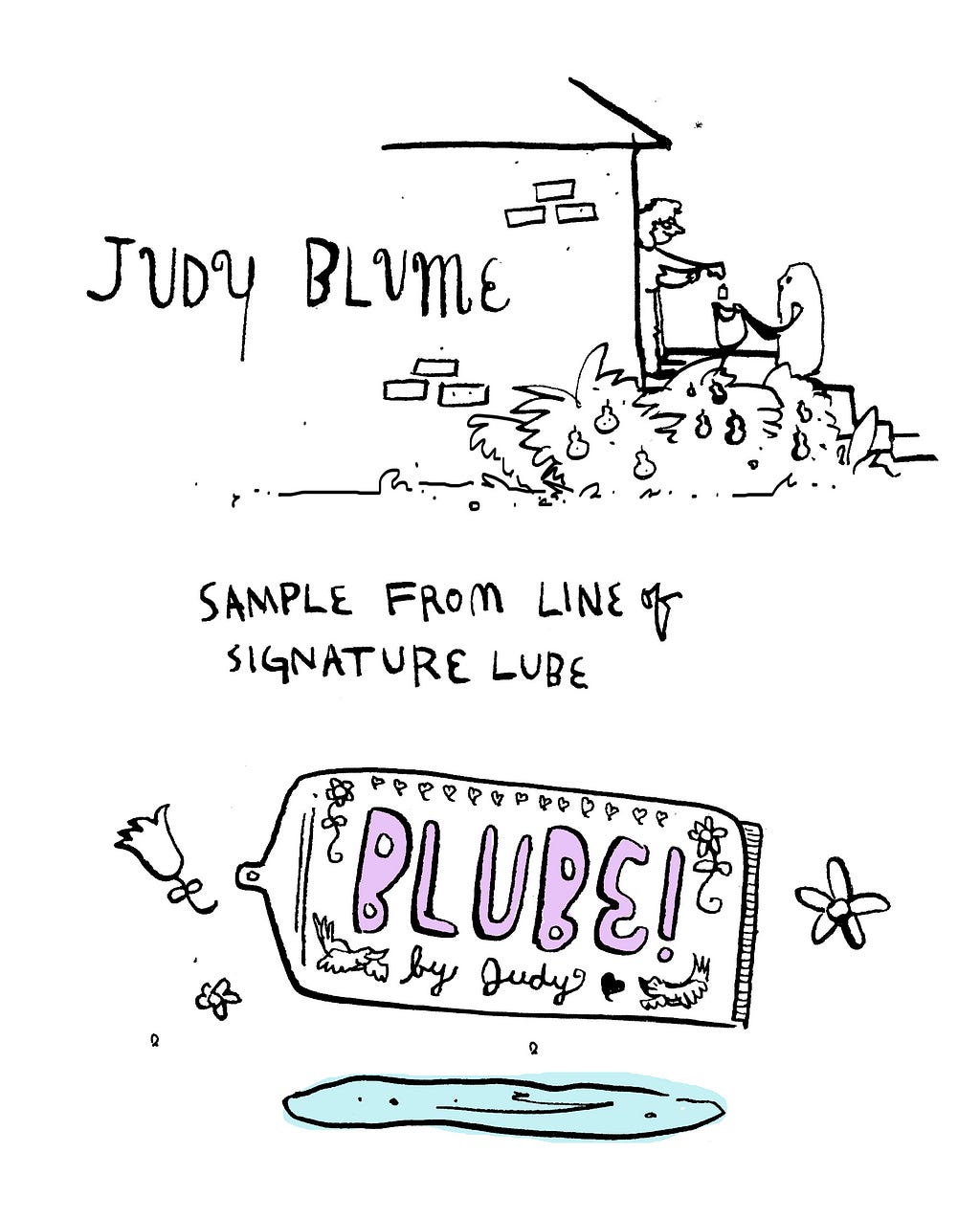
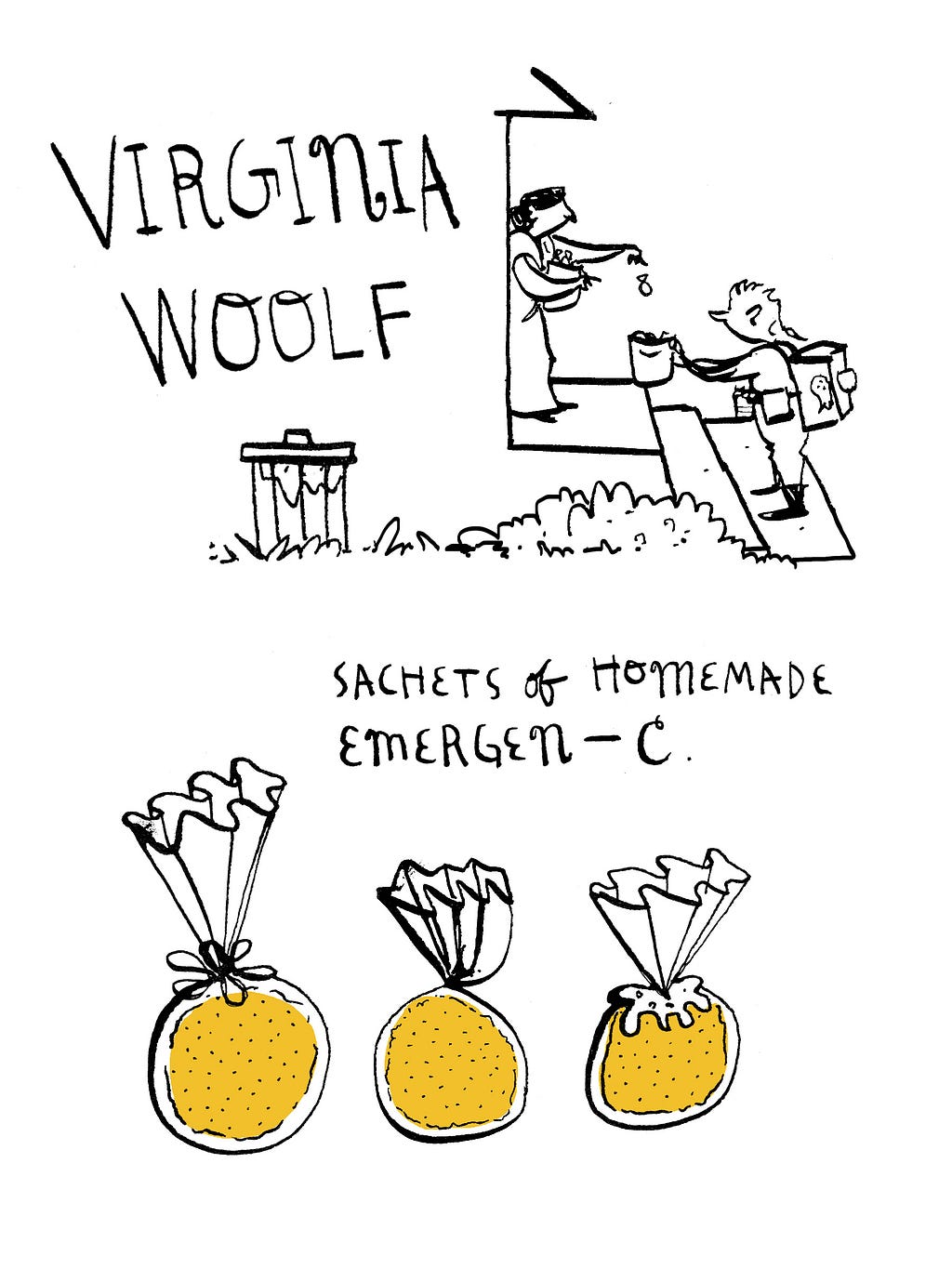
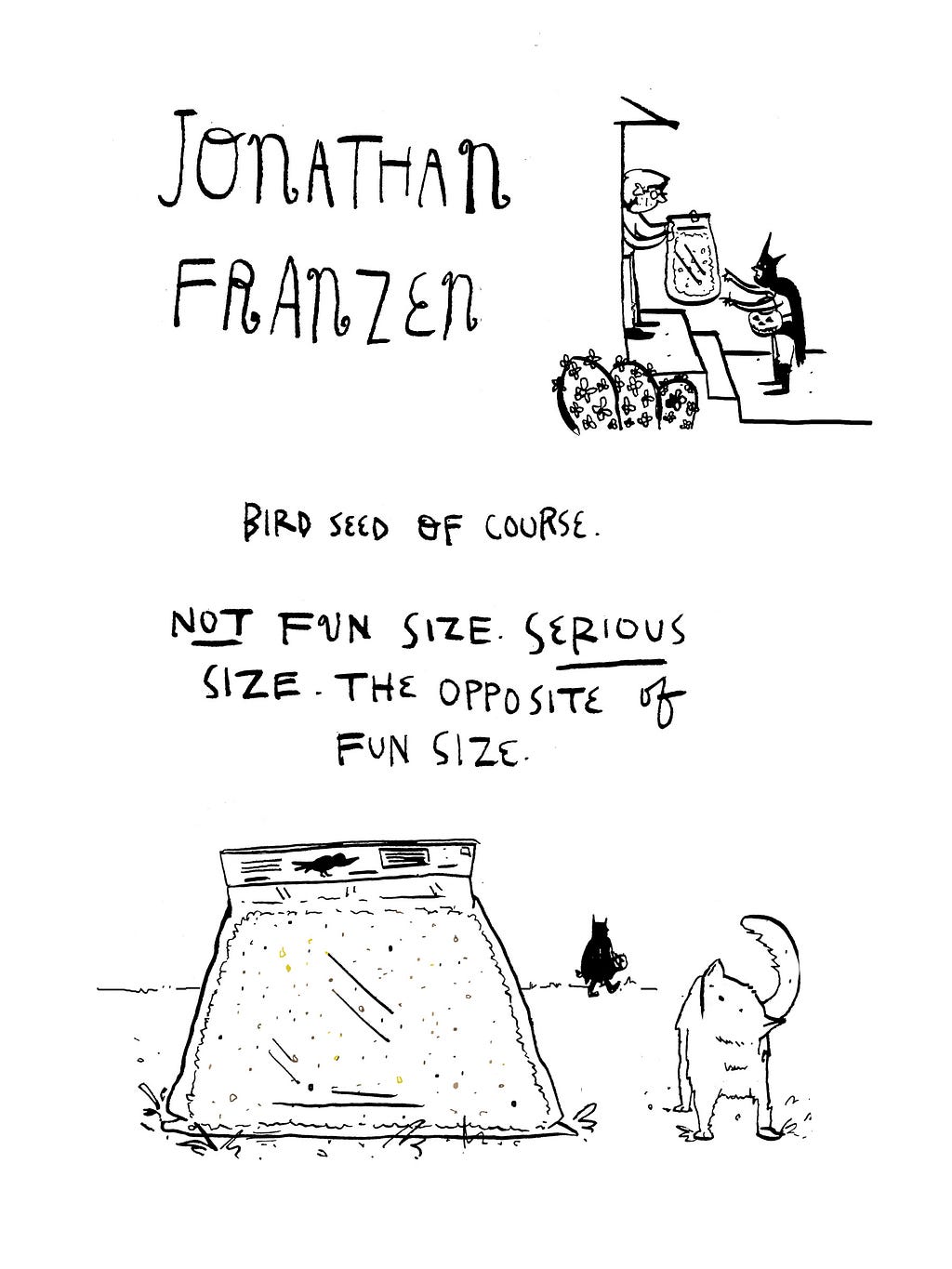
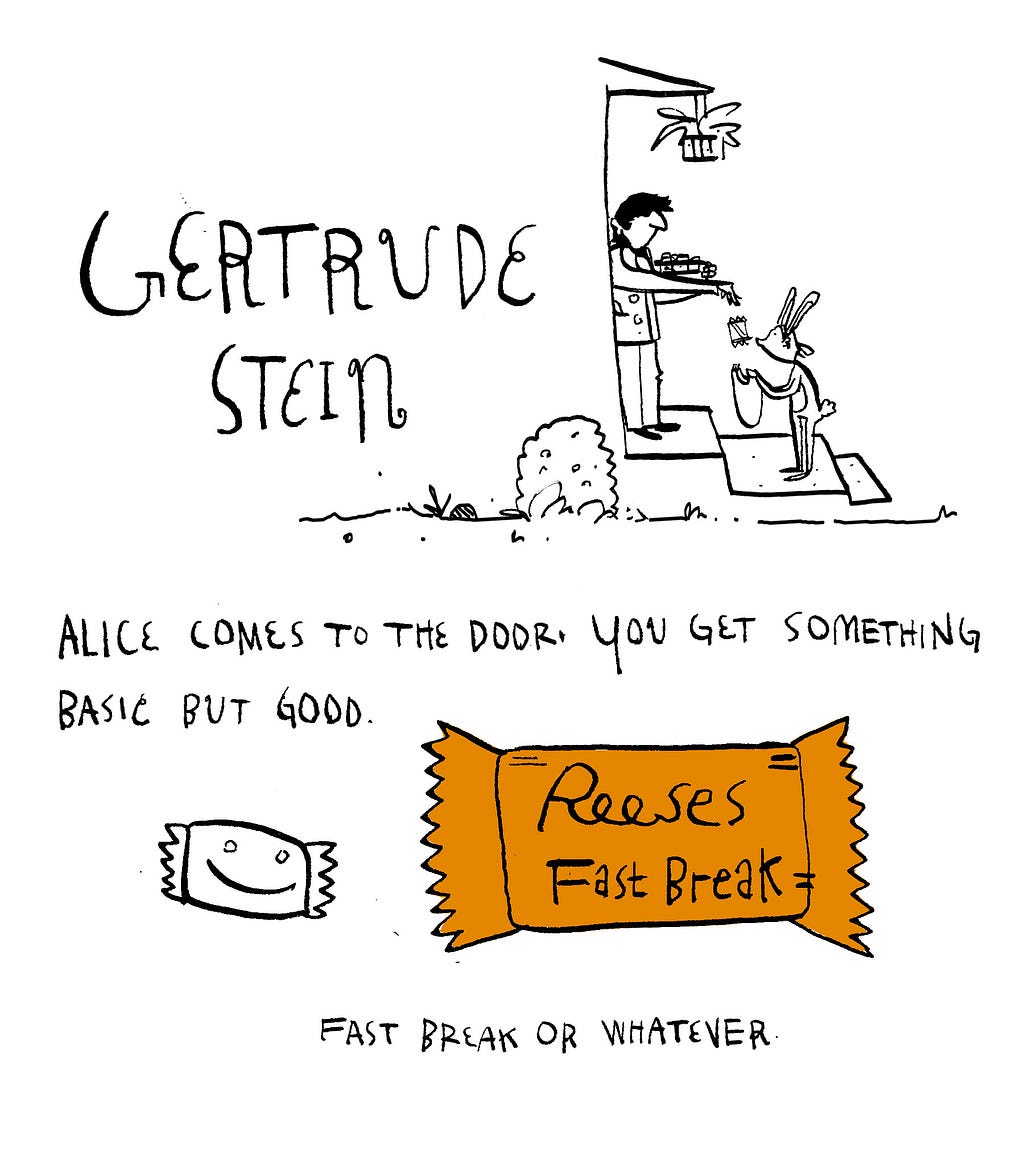
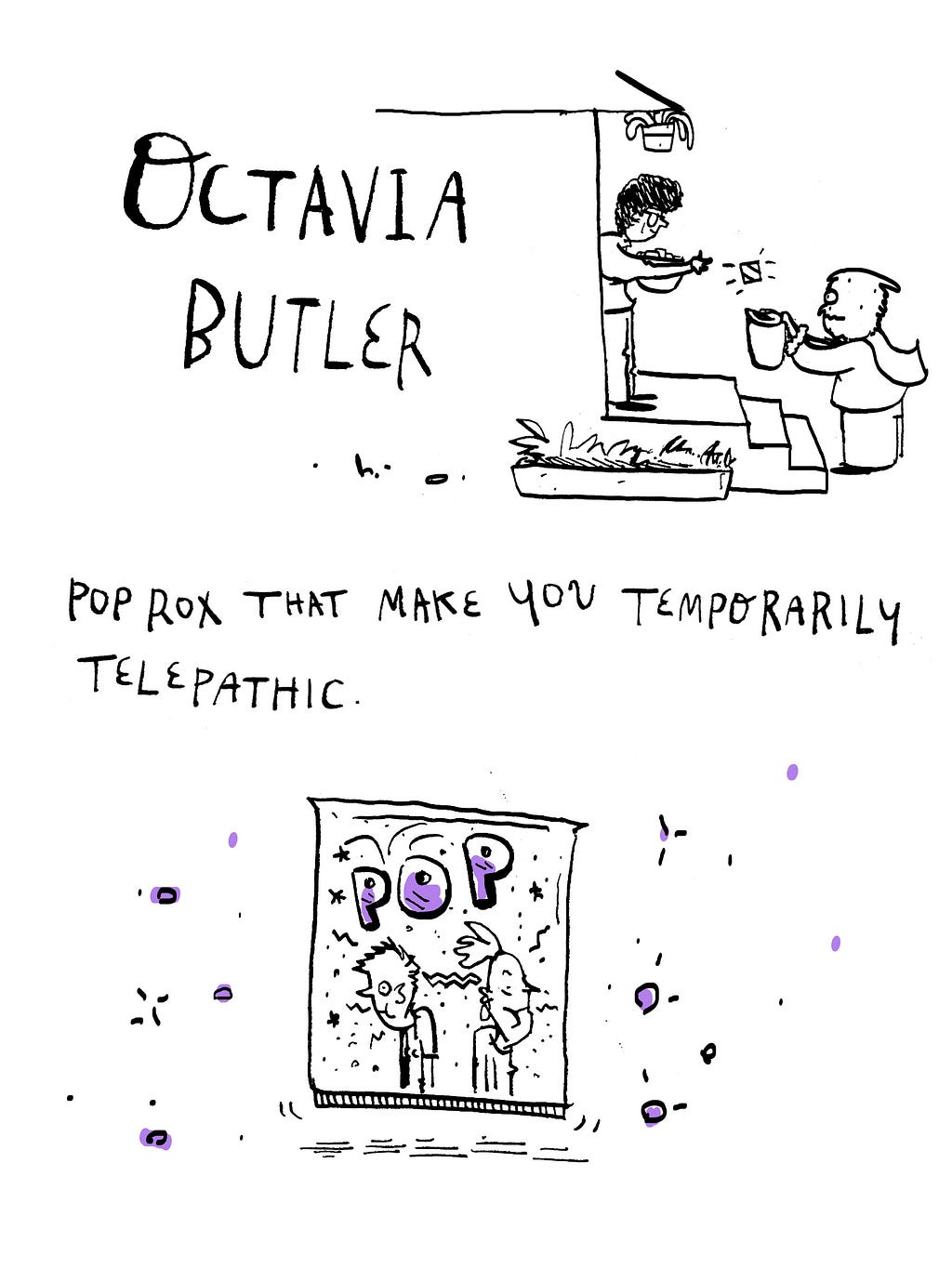
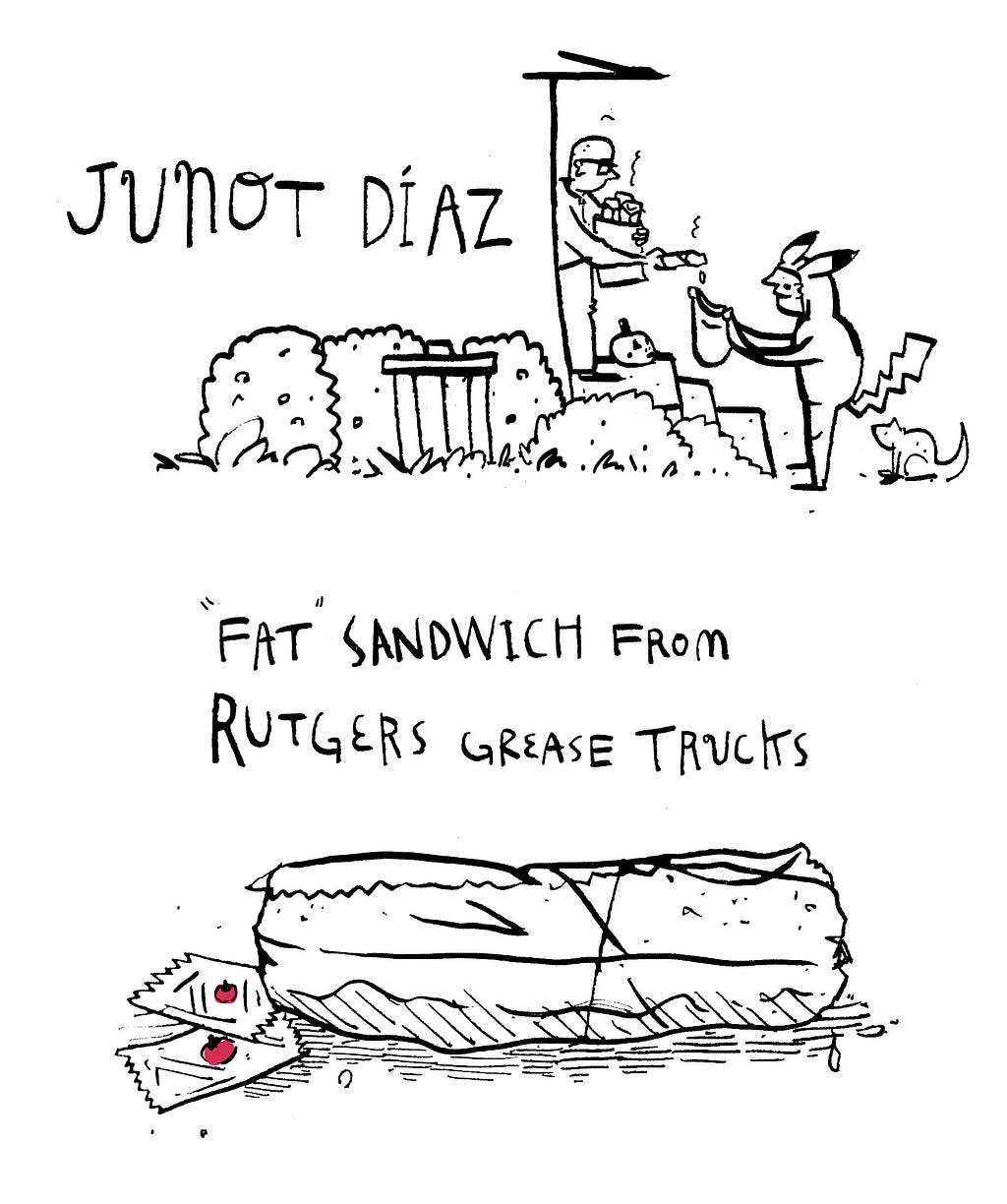
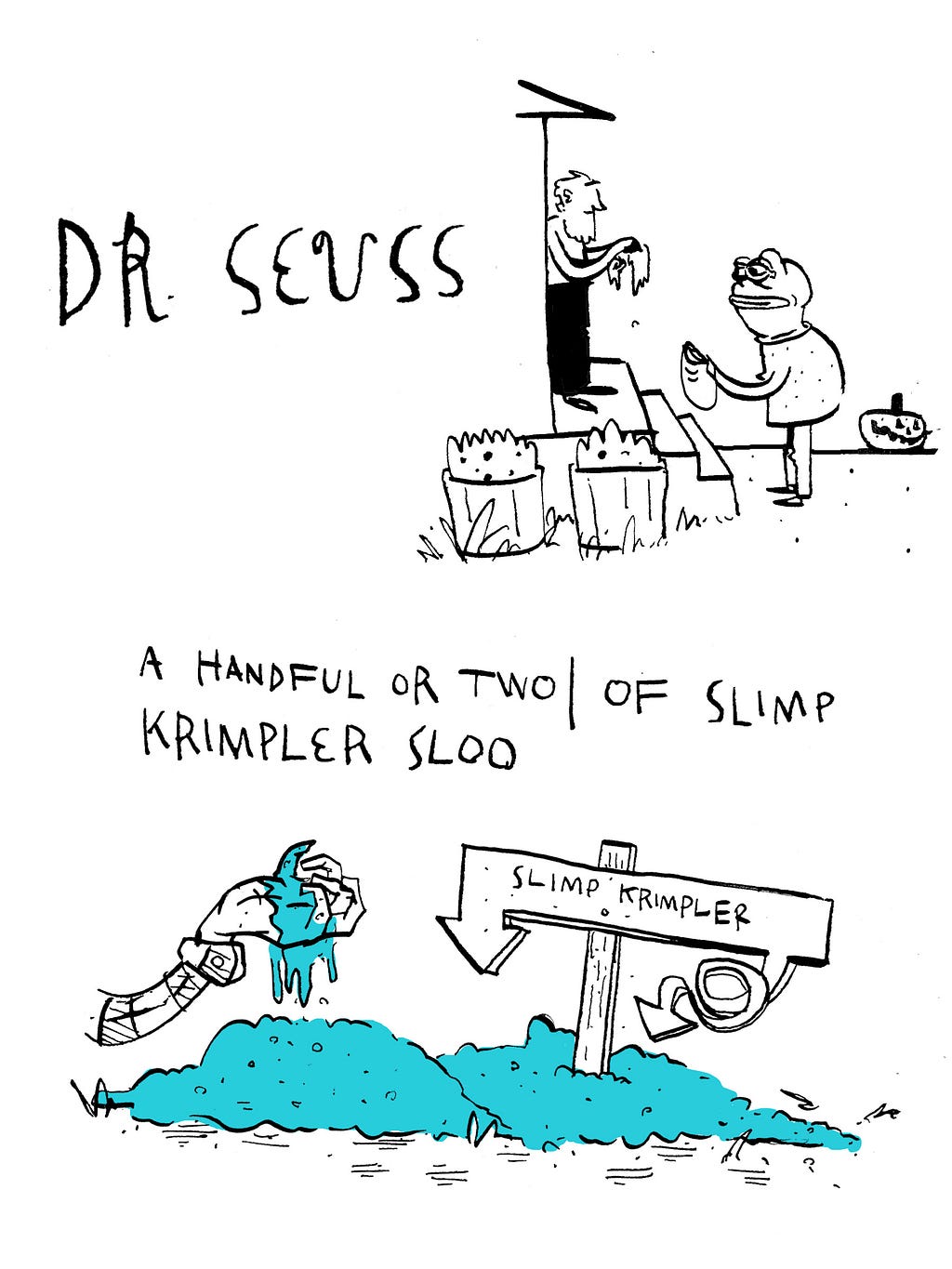
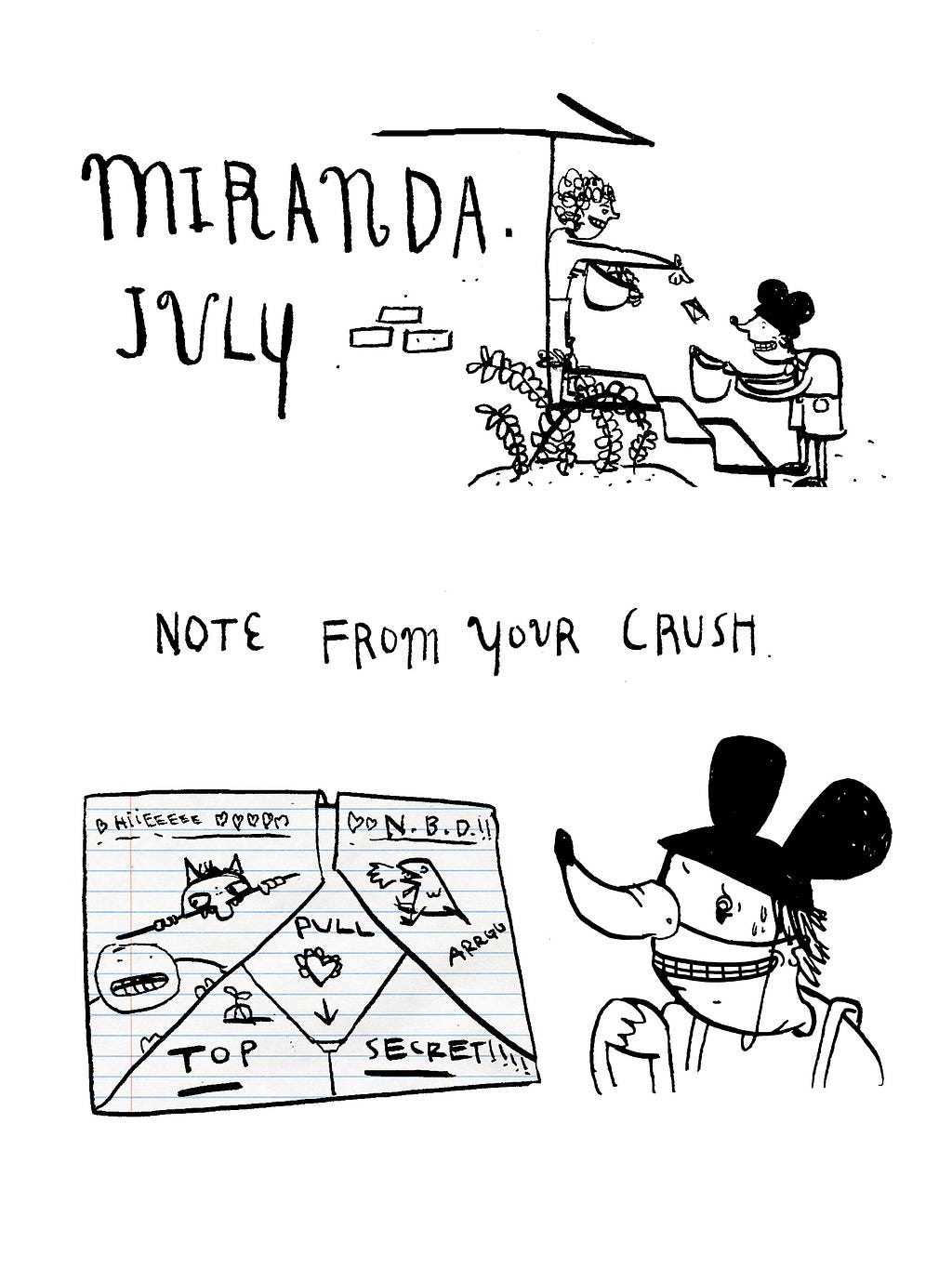
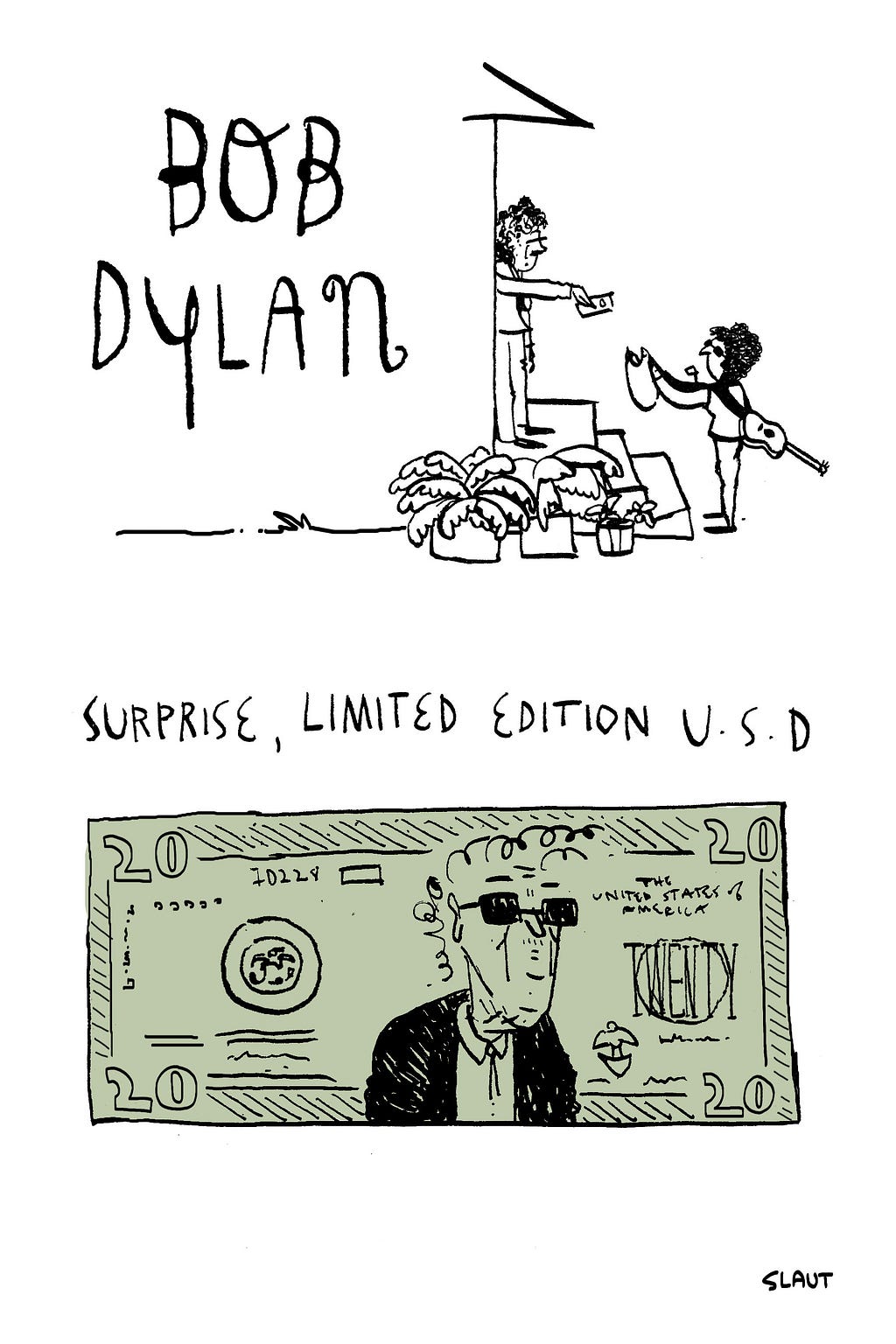
Halloween is almost here, which means so is Electric Literature’s second annual Genre Ball. If you like books, booze, and writers in funny costumes, be sure to get your ticket before they run out!
To celebrate both, we asked cartoonist and Okey-Panky Comics Editor Sara Lautman to illustrate what kind of treats famous writers will be handing out this Halloween. Enjoy!
Hello, and welcome to my week-by-week review of the world. Today I am reviewing a carton of milk.
I’ve found a lot of surprises in my fridge, from moldy potatoes to forgotten Snickers bars to a neighborhood kid who was got trapped while hiding from some bullies. Fortunately, I found him in time. Unfortunately, when I let him out my front door the bullies were there waiting.
One particularly unwelcome surprise recently came in the form of a carton of Bradlees brand milk. Bradlees shuttered all their stores in 2001. The carton was unopened, which gave me hope that maybe, just maybe, it was still okay. It turned out to be the opposite of okay.
First of all, the glue that sealed the carton shut had become hardened over the years, which meant opening it via the normal folding process was impossible. I tried to tear the carton open but it hurt my fingertips. Because I had accidentally sold my only pair of scissors at my tag sale a month earlier, it meant having to guy buy a new pair. It took me hours to find a tag sale with a pair of scissors for sale, and by the time I got home, I had forgotten all about the milk. It wasn’t until the next day when I remembered the milk was sitting out on the counter.
If the milk hadn’t gone bad in the past 15 years, letting it sit out for an entire day may have been the tipping point. The milk had reduced itself to a paste — a paste that smelled like a human corpse, if you’ve ever smelled one of those things.
My life before opening the milk had been so pleasant that I just stapled the carton closed so I could put it back in the fridge and forget any of this ever happened. That’s when I noticed the missing person on the side of the milk carton. It was a young boy who shared my name. I don’t like to share things so in my head I renamed him Ricky.
I wondered about Ricky. Had he ever been found? If not, where was he right now? Did he know he was missing? Had his family stopped loving him? Maybe Ricky had his own family now, and his own missing child. It was all too overwhelming to consider. Sometimes life can become an incomprehensible mess of unknowableness and it’s best to just not think about any of it.
This carton of milk pretty much ruined my day.
BEST FEATURE: The odd proportions of the carton make my hand look gigantic. WORST FEATURE: The ink transferred to my skin and then I got Ricky’s face all over my own.
Please join me next week when I’ll be reviewing a turtle.
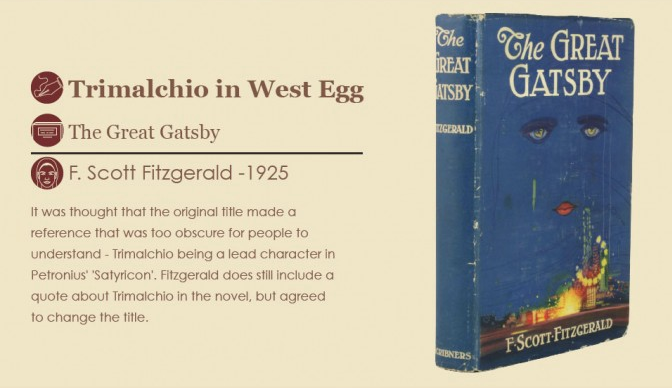
If you’ve ever wondered if great authors struggle with titles, the answer is yes and Jonkers has created an infographic that proves it. Here are the original titles of some of literature’s most famous novels, and explanations for how the books ended up with the names that they have today. The list includes more than one close call, because A Thing That Happened just doesn’t have the same ring as Of Mice and Men.
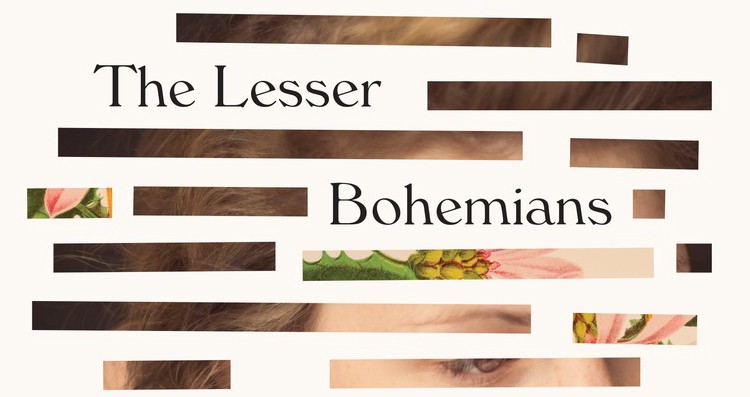
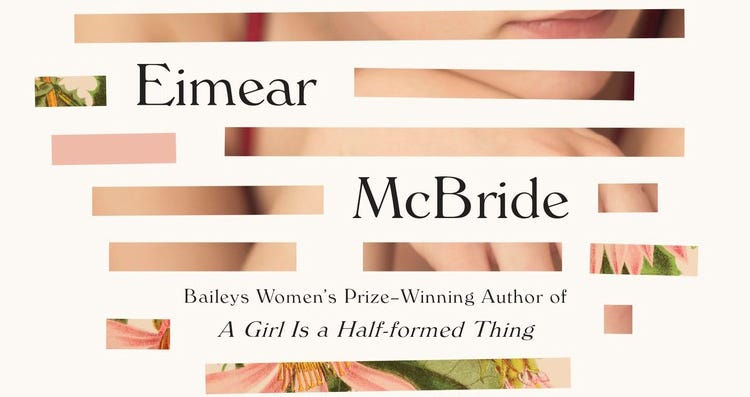
It’s impossible to talk or think about Eimear McBride’s new novel, The Lesser Bohemians, without acknowledging the author’s language (which is true also of her first book, A Girl is a Half-formed Thing). She curls her way around, into, and through sentences like a cat sliding through cracks in doorways and windows, wriggling out of the confines of familiar grammar and syntax and into something far freer and often more beautiful. At its core, however, The Lesser Bohemians is not an examination of language, nor a Joycean effort at style upstaging content. It is a love story.
The narrator — unnamed for much of the book — is a young woman, just eighteen, who’s left Ireland to attend drama school in London. Her world is full of new experiences, first among them being London itself, in all its glory, which she describes as she goes through it:
Lo lay London Liverpool Street I am getting to on the train. Legs fair jigged from halfway there. Dairy Milk on this Stansted Express and cannot care for stray sludge splinters in the face of England go by. Bishop’s Stortford. Tottenham Hale. I could turn I could turn. I cannot. Too late for. London. Look. And a sky all shifts to brick. Working through its tunnels, now walking on its streets, a higher tide of people than I have ever seen and — any minute now — In. Goes. Me.
This thrilling introduction to the narrator is telling of the following sequences, as she continues to discover, with eager trepidation, the life she has chosen for herself. Drama school means hard work, yes, but also independence. Renting a bed-sit with a no-boys-allowed rule, the narrator lives alone with her own thoughts, which she tries to escape often with the help of booze, drugs, and new friends. But she has one thing that she is eager to be rid of in all this — her virginity. When she meets an older, dashing man in the Prince Albert, a pub that will become significant in the memories it carries for them and the reader alike, she goes for it. She flirts, kisses, goes home with, and loses her virginity to this man. He is a fairly well-known actor, more than twice her age, and rather a conquest for our narrator.
The story centers around their love affair, which begins as nothing more than sex, first painful and not great, but increasingly desirous, hot, and heavy. And, eventually, it becomes something far more than just sex, just random fucks in the drab room that this broody famous actor rents. Of course, the young woman and the older man is a trope if there ever was one, but Eimear McBride handles these people atypically, gracefully, and she addresses each and every possible cliché within the characters’ thoughts and talks. They discuss the age gap, the impossibility he sees in their being together and the hopes she pins on him and the revenge fucking and the shame and the chasing around of one another — none of this is left to some rom-com-like montage but gone through with a fine-tooth comb so that each event feels self-consciously monumental for the participants. For example, when the narrator returns from her Christmas holiday and finds that her lover has another woman in his room, she both reacts and is aware at once of her reaction:
if I’d known you were back tonight You’d have done it yesterday? Sorry, bad timing that’s all but I’m really glad to see you. So tell her to go. I can’t do that, he says Not now. Fuck you, I say backing down the path, Wait — him quick checking up behind — How about tomorrow? We could meet in the morning and have the day. I turn sharp though and hurt his gate by the looks of the rust crumbs fly. Come back, he loud whispers Wait, hang on! But when I don’t the front door shuts and from across his street I look up. There. His room. The lowliest bulb. Skewed curtain light streaming and what beyond? Then even it goes out. You bollocks! I scream I feel like screaming but mostly that I’m such a child as the rain comes roaring down.
The first half of the book dwells on the difficulties of figuring out what they are to one another, but it never gets dull, not for a moment. The second half of the book explains much of what happens in the first because at the emotional crux of the book, the actor bares his soul to the narrator, telling her in plain language — for it is not the narrator’s voice but his, and McBride excellently distinguishes between speech and narration despite the absolute lack of quotation marks — about the horrible childhood he had, his years of addiction, and the story behind his estranged daughter and the woman he had her with. Many eighteen-year-olds wouldn’t be able to handle the things he tells the narrator, but she’s had her own rough childhood and bears the brunt of this confession with grace.
It is only after this that names begin emerging: the narrator’s is revealed, and after some more pain and time the actor’s is too. The emotional resonance that is in the act of identifying unnamed characters cannot be understated, which is why I refuse to name them here — the expression of their selfhood is in their names, so much so that the narrator’s full name isn’t revealed until very, very close to the end, when she is secure, knowing herself and her lover as well as she can for the time being.
What’s possibly most incredible about this novel is that it is a love story. Front to back, when looked at in its entirety, the plot is simple: young woman falls for older man. He resists falling in love with her. He falls in love, hates himself for it, tries to shed her and his feelings for her. Conflict. But the way Eimear McBride writes makes what is a relatively simple story feel as weighty, important, and visceral as love stories are to us in life. Much like Woolf’s Mrs. Dalloway, which also has a simple plot when laid out as a sequence of events, McBride makes beauty and importance in everyday reality.
While some people may find McBride’s book cryptic, it’s really not — her words are the connective tissue between a love story and its reader, and while they may take some getting used to, are the stuff of dreams, allowing us to sink into the lushness of language.
The New York Public Library has re-opened the Rose Main Reading Room
After two years, the NYPL has finally reopened the grandest space for New York bibliophiles. The stately Rose Main Reading Room is home to 52,000 books. Watch the time-lapse footage of the staff undertaking the enormous project of reshelving the stacks.
Well-written characters, the wisdom goes, must make hard decisions and face the consequences of their decisions. They are agents of their own destinies. The characters in Jen George’s debut collection of stories, The Babysitter at Rest, were not written with this wisdom in mind. George’s protagonists are experts in passivity: they are doubters, weepers, the blamers and blamed, they who sleep through alarms. Taken together, they form a picture of contemporary life that is at once exciting, absurd, depressing, and inconsolably honest.
The collection’s first story, “The Guide / Party,” begins with a sexless, long-haired guide breaking through the narrator’s apartment window. The Guide is there to train the narrator how to be an adult. The narrator is clingy and desperate for The Guide’s attention, whereas The Guide treats the narrator with bureaucratic indifference. When the narrator tries to “justify [her] delayed adulthood” by listing terrible things that have happened to her, The Guide responds “The listed defenses for your incompetence are universal conditions, not individual, and as such do not excuse you from anything.” Here, George undermines how we normally think about character. Precise details do not individualize the narrator. They generalize her, and even make the Guide “hate [her] somewhat.”
“Does greatness meaning growing up? Does it require forgetting childhood traumas? Becoming rich?”
Through The Guide’s insistent demands and the narrator’s expressions of authentic loneliness, readers feel the unrealistic expectations forced onto young people, especially young women, who are consistently told to “make a lot of money to buy expensive beauty treatments” or to “radiate positive,” even as their lives fall apart. The question at the heart of this story — and much of the collection — is how to be great. Does greatness meaning growing up? Does it require forgetting childhood traumas? Becoming rich? And, most importantly, what must be sacrificed to become great in society’s eyes?
In the collection’s title story, a cartoonish example of greatness comes via Tyler Burnett, a wealthy philanderer who wears dark sunglasses and who is somewhere “between [the age] forty-seven and fifty-two.” The narrator, a woman between seventeen and twenty-one, babysits Tyler Burnett’s “forever baby,” which is exactly what it sounds like, and quickly becomes his mistress. Tyler Burnett is glitz without substance, things without meaning. When he first meets the narrator he says, “Chemicals and fishing, the water. Yes, television. Art, no. A walk. To Swim. Jokes and such are not my kind. Sexy and rubs are my sort of thing. With you, something distracting.”
Like The Guide, Tyler Burnett makes excessive demands, though his are mostly sexual. His requests are so straightforward they’re at once funny, completely unsexy, and routinely disturbing. He buys the narrator gifts, like ice cream and ponies, and calls her child. About him, the narrator admits:
“At times I forget if we’re lovers or if he’s my father.”
Away from her lover, the narrator works a dead-end job where she is repeatedly demoted. At home, her roommates seem to always be throwing parties. Parties reappear throughout George’s work: they give her the liberty to write about people in extreme states. Her prose, in these scenes, moves with a witty, frantic energy that is both addictive and insouciantly violent. “Lizzie Olsen shoots people with nail bullets from her wooden gun while her parents snort ketamine on the banquet table. . . . Tyler Burnett shows up high on ketamine and we screw under the bed in my room.” This party ends with a friend buried alive in a pool sealed shut with bricks. Though George’s stories often slide toward nihilism — “Is this it?” we might ask, “Is life just empty sex and drinking?” — the absurd energy of her prose and subjects charges the writing with carnivalesque joy. Life, for all its violence and pain, still deserves to be written about.
“Her prose […] moves with a witty, frantic energy that is both addictive and insouciantly violent.”
In the collection’s final story, “Instruction,” George most directly grapples with greatness. The story takes place at an elite art school where the artists bury racehorses and are constantly disparaged by a large-handed Teacher. George uses sections and subtitles to move quickly through student gripes, their projects, conversations, and excerpts from the Teacher’s memoir. The narrator — an art student — and Teacher have an affair, but unlike in earlier stories, she resists the crippling influence of the egomaniacal patriarch. She even leaves school to move upstate with her contemporaries. “There were a lot of paintings of pastoral scenes and writing in the form of diary entries about nature or chores produced during that time, most of which are now considered garbage, the period being referred to in the art world as ‘The Garbage Years.’”
The narrator becomes one of the most prolific artists of “The Garbage Years,” an unfortunate legacy, she admits. Her achievement is equally distinguished and worthless. At the end of the story, she visits her dying Teacher. “You could have been great,” he tells her. “There are other things,” she responds, a phrase that speaks for characters throughout the collection.
Chasing greatness spurs doubt, self-hatred, and pain — especially when the conditions for greatness are determined by the sort of egotistical men that reappear throughout George’s collection. Despite its criticisms of greatness — or perhaps because of them — The Babysitter at Rest is an undeniably great debut collection of stories. George’s writing is funny, courageous, smart, surreal, seductive, and terrifyingly vulnerable.
DON’T MISS OUT
Sign up for our newsletter to get submission announcements and stay on top of our best work.
YOUR INBOX IS LIT
Enjoy absorbing fiction from Recommended Reading on Mondays, strange, diverting work from The Commuter on Wednesdays, and a roundup of our best work of the week on Fridays. Personalize your subscription preferences here.