Coming-of-age stories are typically defined as the transition from childhood to adulthood, which is why we most commonly imagine teens and young adults at their center. But growing out of our formative childhood patterns can happen at any age, and, for many of us, the most profound periods of transformation hit well into adulthood.
A woman’s thirties and forties can be particularly charged. According to many doctors, 35 is the age that women’s fertility begins to drop significantly, forcing us to contemplate what can feel like a life-changing decision for the first time, and one that may put us starkly at odds with societal expectations. Many 30+ women today find themselves in a life that looks very different from typical narratives of “successful” womanhood, resulting in a grating sense of failure and uncertainty. But while motherhood is a common avenue for transformation at this age, it’s important to remember that non-motherhood—the forced awakenings and hard earned growth that comes from sitting with the self—is, too. When we enter middle-age without the standard domestic trappings so commonly portrayed in the popular narratives of womanhood, a deeper understanding of the self awaits, along with a reorganizing of priorities, as we begin to set and trust who we are and what we want, cultural expectations aside.
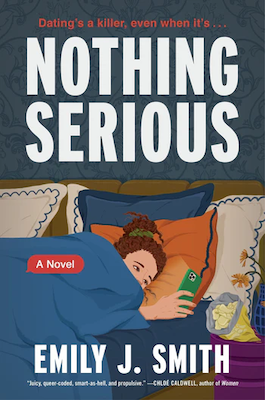
Edie, the main character in my debut novel, Nothing Serious, is a single, thirty-five year old woman reckoning with a life built on chasing the approval of men. Throughout her career—studying engineering, attending business school, working in tech—her instinct to fit in with the men around her has served as an asset, even cosplaying as confidence, but it has also left her hollow, unable to access genuine desire beyond the desire to please. The book is, at its core, a story of self-discovery, learning to untangle from a deep need to prove herself to others, to chase “success” on other people’s terms, to trust herself, instead, and in doing so redefine who she is and what it is she wants.
The list below celebrates women in their thirties and forties who, rather than conforming to the traditional paths of marriage and motherhood, embark on transformative journeys of self-discovery while choosing a life without children.
Jenny McLaine is an anxious 35-year-old, eager to please and always over-analyzing. The first page starts with her agonizing over captioning the photo of her morning croissant (settling on “CROISSANT, WOO! #CROISSANT”). But Emma Jane Unsworth’s unwavering humor does not distract from the poignancy in this laugh-out-loud novel. Jenny’s journalism career is floundering, and her personal relationships begin to unravel after a breakup with her longtime boyfriend, Art. Prone to extreme self-criticism as a result of her mother’s judgmental eye, Jenny feels like a failure at the very point in her life when she imagined it would all be coming together. She takes solace in a parasocial relationship with an online influencer that only serves to heighten her insecurities and self-doubt. The book follow Jenny as she learns to face her issues-head on, build her sense of self, and define, then trust, her own version of success.
Through philosophical contemplations on identity and art, conversations with her partner and friends, musings on her personal and family history, and a technique involving The I Ching—asking questions and flipping coins—the narrator of Motherhood takes us on a cyclical journey through one of life’s most important decisions: whether or not to have a child.
Before I knew much about this book, I was afraid to pick it up, assuming from the title that it was yet another contemplation on motherhood ending with the woman choosing to have children. If you share this concern let me dispel your worries with a necessary spoiler: the narrator decides that having a child is ultimately not for her. There are no formal conclusions, only the making of an inevitable and highly personal decision that broadens our definition and considerations of motherhood and life itself in the painstaking process of choosing.
Lauren Willowes (affectionately Lolly, to her family) lives carefree in the English countryside until the death of her beloved father. Unmarried in her late-twenties, she is sent to live with her older brother and his family in London. There, she spends years helping him care for his children, fading into the background of their family, and yearning for the rural landscape of her childhood. Lolly is well into her forties when she decides—to the shock and disapproval of her family—to live on her own in a town she has only heard of (endearingly called Great Mop). The family warns her against such a rash decision, encouraging her to stay in London, but she insists. Thus ensues one of the most charming and classic romps of a woman carving out a life on her own. Once settled in Great Mop, she even encounters the devil, with whom she has apparently made a pact, in order to achieve her life of freedom, and happily embraces her role as Witch. Who among us has not longed to escape it all, buy a little cottage in the mountains, and build a life anew?
The unnamed narrator is in the midst of an impassioned, albeit doomed, affair with a man referred to only as “the man I want to be with.” That man happens to be partnered with a wealthy, glamorous woman we know only as ”the woman I’m obsessed with.” The narrator’s obsession exposes her own insecurities, imagining the woman—who we become intimate with by way of social media stalking—to be everything the narrator is not. At that same time, she is entranced by the man’s manipulative charm, though he is frequently distant and sometime harmful. In addition to revealing reflections on the self, these masterfully rendered obsessions are a tool to observe the way society elevates some and marginalizes others, specifically in terms of race, class, and wealth. We watch as the narrator falls deeper into self-destruction until her wreckage catalyzes an awareness of the patterns she’s stuck in and, importantly, the societal forces that make it so hard to escape. This book has a voice like no other, veering almost into poetry in its form, a stream-of-consciousness that’s somehow both chaotic and immaculate.
Greta, Big Swiss’s 45-year-old main character, resides in a run-down, unheated farmhouse, occasionally infested with bees, in the increasingly gentrifying town of Hudson in upstate New York. Greta does transcription work for money and while transcribing sessions for Om, Hudson’s premiere (and only) sex therapist, she becomes fascinated by one of his clients, Flavia, whom she affectionately calls “Big Swiss.” It’s all a fun and intriguing escape until she recognizes Bis Swiss’s voice at the dog park, and a real relationship between the two women begins. As their intimacy grows, however, Flavia reveals part of her past that Greta is already intimate with from transcribing her therapy sessions, leaving Greta in the duplicitous and deceiving position of hiding how much she really knows. As their relationship grows in this kooky, smart, and darkly hilarious tale, the tension increases, until Greta is forced to confront her own issues and actions. In doing so, she begins to see how her own trauma has shaped her life, bringing her closer to accountability and self-acceptance.
This book is the essential text for neurotic women—and I mean that as the highest compliment. Immediately, we’re thrown into the unconventional, brilliant setup of this epistolary novel. Chris, a 39-year-old filmmaker, and her husband, Sylvère, an academic, move to a small town in Texas, where they meet Dick, a professor, to whom they are instantly drawn. After meeting, the couple begins an elaborate series of letters to Dick, as a vehicle for their own contemplations on life and art and self. Through her infatuation, which grows over the course of the novel— first stimulating, then straining, her marriage—Chris confronts her internalized misogyny and the effects of the patriarchy on the way her art is perceived and on the way she perceives herself. Her infatuation with Dick, which appears self-destructive and uncontrolled, ultimately acts as the mechanism for her own self-actualization. Kraus uses her own abjection—a state often imposed on women, especially as they age—as clay to shape and transform, leading to both a personal metamorphosis and a masterful work of art. She doesn’t shy away from the reality of living in a “man’s world,” but she strides in with open arms, seeing it for what it is, then subverts it so profoundly.
In so many of these stories, we see how, into middle age, we remain trapped in the assumptions that shaped us as children, and how the catalysts typically associated with youth, can, if we’re brave enough to surrender to them, transform us at any age. As Chris reflects in I Love Dick, “It was interesting…to plummet back into the psychosis of adolescence.”
The Woman Upstairs is the quintessential novel of a single woman who feels, as she enters middle age, that her life has not gone as planned. Nora Eldridge is a 42-year old-artist by night, school teacher by day. The book opens with an unforgettable internal monologue of rage and regret about becoming what she calls the “woman upstairs”—the quiet, reliable helper for the people around her, fading into a background of mediocrity. But her life is disrupted by the arrival of a new student in her third-grade class, Reza Shahid, who she becomes enamored by, along with his glamorous parents. Reza’s mother is a successful artist who frequently invites Nora to work with her in her studio, where they form a tight artistic bond, and his father is an intellectual and charming Harvard professor. Her obsession with the Shahid family is all-consuming until cracks begin to form. When Nora discovers a devastating betrayal, her idolization of the family starts to crumble, leaving her not only with a clearer picture of the Shahids, but a clearer picture of herself, one that sets her on a path of change and resolve.
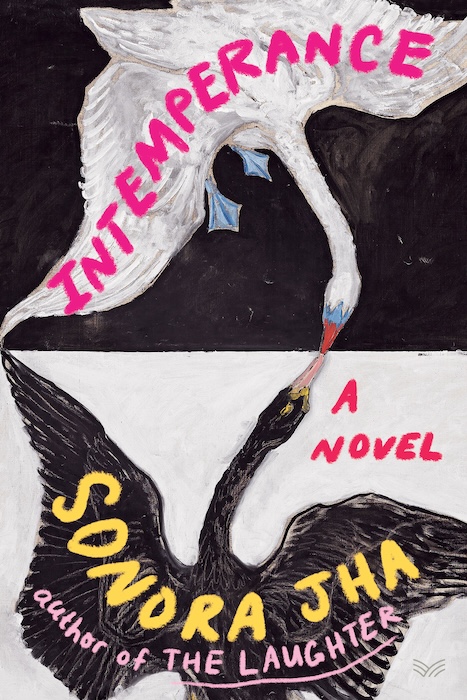
Electric Literature is pleased to reveal the cover of Intemperanceby Sonora Jha, which will be published by HarperVia on October 14th 2025. You can pre-order your copy here.
In this follow-up to the critically-acclaimed The Laughter—winner of the Washington State Book Award—a middle-aged woman starts a firestorm when she holds a contest, based on an ancient Indian ritual, in which men must compete to win her affections.
A woman who has left two husbands announces she will celebrate her 55th birthday by holding a swayamvar. Drawn from an ancient custom in her Indian culture, this is an event in which suitors line up to compete in a feat of wills and strength to win a beautiful princess’s hand in marriage. The woman, a renowned and respected intellectual in an American town who had once declared she was “past such petty matters as love,” knows she is now setting herself up for widespread societal ridicule, but her self-esteem and sexual libido are off the charts even as her body withers from disability, fading beauty, and her appetite for cake.
To her surprise, a cast of characters shows up to support her call—a wedding planner looking for the next enchanting thing, a disability rights activist making a documentary film, and even, begrudgingly, her own young adult son. The Men’s Rights Movement protests her project, angry at her objectification of men. She is waylaid by visitations from goddesses and princesses past, who either try to slap sense into her or cheer her on. She must also reckon with a brutal love story in her ancestry that was endangered by the caste system—a story that placed a generational curse on those in the family who show an intemperance of spirit. As her whole plan spirals into a spectacle, the woman embarks on a journey to decide what feat her suitor must perform to be worthy of her wrinkling hand. What feat will define a newer, better masculinity? What feat will it take for her to trust in the tenderness of love?
Intemperance is at once a satirical feminist folktale and a meditation on how we might reach past all sense and still find love.
Here is the cover, designed by Sarah Kellogg, with art by Hilma af Klint.
Author Sonora Jha: “I was delighted to receive four stunning cover options from my editor at Harper Via, Rakesh Satyal. I have worked with him and the design team at Harper Via for my previous novel, The Laughter, so I knew they would send me beauty, but four works of beauty? Agony. I narrowed it down to two images, both of which had swans, which immediately captivated me. Intemperance has multiple appearances of swans in the narrative—shape-shifting swans, angry swans, mythological swans, and even a flirty swan. It was hard to pick between the two final images, but I found myself returning to stare at this one, over and over. Ultimately, I asked myself, ‘Which one will you regret letting go?’ And this was the one. Every time I look at it, I fall more in love.
In the meeting of the swans, I see union and a separateness of identity. Here we have both intemperance and temperance. Darkness and light. One of the things the novel explores is the protagonist’s need for silence and solitude, and this cover speaks to the silence of a soaring bird yet also the muted, meditative flutter of its wings. The story is one of courtship and love, and of course, there’s the kiss of the swans at the beak, but I can’t tell you what the almost imperceptible touching of the tips of their wings does to me. I hope to see the original painting by Hilma Af Klint someday. I feel incredibly fortunate to have on my book cover the work of this radical Swedish artist from more than a century ago. The candy-like colors and crayon-like scrawl of the letters overlay a contemporary irreverence and whimsy atop the timelessness of Af Klint’s painting. A part of the story in Intemperance is set in the same years as Hilma was painting these works of hers (although on different continents), and this gives me goosebumps. Swanbumps.”
Designer Sarah Kellogg: “As I was researching imagery for the cover of Intemperance, I struck gold when I came across a painting by the artist Hilma af Klint. The painting features two swans stretching their necks toward one another as if in defiance or fearlessness, or perhaps as an act of love. The separate worlds of the two swans meet in the middle, and their wings are outstretched with no lack of restraint for what lies ahead. The hand-drawn lettering on top of the artwork provides a more modern element to hint at the story’s setting in present-day Seattle. The crayon-like texture plays into the messy process of coming into oneself, regardless of outside opinions.”
The Human Condition as It Applies to the Long Island Suburbs
Every year, I grow more
tired of paying for things.
The albumen in my cocktail
adds five dollars - five dollars
for not even a full egg.
The math reminds me that I
could pay to walk inside
a historic fort in Augusta,
or stand outside it for free
and relive history as one
of the Wabanaki people.
Unfriendly neighbors
run deep through history.
I should not be surprised
by the raging woman
who tells me to go back
where I came from - all
because she doesn't like
seeing my parked car
from her window.
I wonder what view
she thinks I'm ruining;
perhaps it's the bird shit
on her garbage cans,
its milk-white marbling
reminiscent of a veil
of egg whites dropped in gin,
or perhaps it's the space
she needs to stare through
while she has the morning cigarette
that burns a small hole
in the atmosphere between us.
Observing the Void Ten Feet From a Swing Set
A small worm assaulted
by smaller ants, twists and flips.
I watch the violence and
consider my options.
Save the worm. Let the ants eat.
How do I pretend I can choose
- that the worm is good
- that the ants are good?
Only five minutes ago,
I discovered the common park bench
is an endangered species,
its habitat reduced to fringe
spaces of dedication
to late loved ones.
I wrestle with a side effect
of my imperfect faith
in destiny, my concern
that I can ruin
what is meant to be.
From this seat placed in memory
of a stranger's husband,
I thumb this fear like a coin:
I am not special (heads)
I am alone (tails)
I would hate to die (heads)
or to live forever (tails)
Each path goes nowhere.
And so, the worm goes
into the earth, riding
on the backs of its captors.
I wipe the crust
from my inner eye
and sit in the position
I imagine God assumes
when watching over
our breaking hearts.
The Sieve
A friend used to joke that we’re all just blood bags
trying to avoid sharp objects.
He’d say this wryly as he threw out perfect
yogurt cups with creased lids.
Eventually, everyone else’s sadness catches up with me,
and I am forced to admit
that even though I feed the birds, it is the squirrels
who know I fill the feeders.
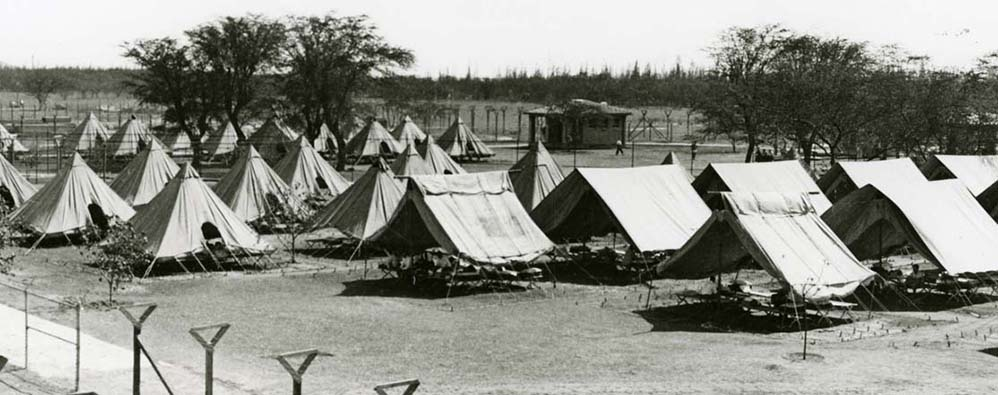
On February 19th, 1942, President Franklin D. Roosevelt signed Executive Order 9066, thus starting one of the most shameful periods in American history. The order forced the relocation of all individuals that posed a suspected “threat to national security” during World War II to internment camps, and in turn prompted the incarceration of hundreds of thousands of Japanese Americans across the country. Eighty years later, in 2022, President Joe Biden declared February 19th as the National Day of Remembrance of Japanese American Incarceration During World War II, to ensure that America both learns from, as well as never forgets, its past mistakes.
Today, with the current political climate leaving American immigrant rights more vulnerable than ever, it is crucial for us to reckon with the atrocities that the United States is capable of — especially in regards to oppressive practices that focus on immigration status, ancestry, race, and ethnicity. To remember those impacted by Executive Order 9066 and reflect on the struggles that were subsequently endured, I have compiled a list of books that depict the experiences of people directly impacted by the internment of Japanese Americans. From well-known classics such as John Okada’s No-No Boy, to lesser known, but just as essential reads such as Brynn Saito’s Under a Future Sky, here are seven books that present readers with nuanced, illuminating depictions of what it was like to live through this explicit, federally-imposed discrimination and internment.
Miné Okubo was one of over one hundred thousand Japanese descendants in America that were forced into “protective custody” faced after the bombing of Pearl Harbor. This graphic memoir, both written and illustrated by Okubo, showcases the challenges that she and other Japanese Americans were confronted with. First published in 1946, this book is recognized as the first real look into what occurred in Japanese internment camps, and depicts Okubo’s experiences in relocation centers in California and Utah — specifically in the Tanforan Assembly Center, and the Topaz War Relocation Center.
Taking place after Ichiro Yamada spends two years in a Japanese internment camp, and two more years in prison for refusing military service, No-No Boy depicts the struggles of Japanese Americans following this dark time in America’s history. Through what Ruth Ozeki calls an “obsessive, tormented” voice, author John Okada obfuscates the distance between the omniscient narrator and the voice of Ichiro. Okada’s one and only novelprovides a sobering portrait of a no-no boy, and has since been recognized as one of literature’s most powerful testaments to the Asian American experience.
Written by PEN Open Book Award recipient Brandon Shimoda, this collection of essays reflects on the afterlife of the U.S. government’s forced mass incarceration of Japanese descendants during World War II. Pulling from personal and familial history, years of research, and visits to memorials and incarceration sites, Shimoda’s unsparing precision in The Afterlife is Letting Go showcases the infinite connections between the treatment of Japanese Americans, and of other forms of oppression enacted throughout the United States’ history.
During World War II, Saito’s paternal grandparents were both forced into an internment camp in the Arizona desert — the place where, despite their struggles, brought them together and to eventually start a life together. In her poetry collection Under a Future Sky, Brynn Saito enacts a dialogue between the past and the present, communicating with family and friends as she honors the “riverstream of ancestors” that made her life possible. Through her lyrical, epistolary poems, Saito captures rage, confusion, and love in order to confront the hard truths of her family’s intergenerational trauma.
When George Takei was only four years old, soldiers knocked on his family home’s door, held the family at gunpoint, and ordered them to leave. Long before George Takei had become known for his role as Hikaru Suku in the Star Trek franchise, he and his parents were forced to move from their home and into concentration camps. They Called Us Enemy captures the beloved actor and queer rights advocate’s childhood experiences that followed Executive Order 9066. Written with co-authors Justin Eisinger and Steven Scott, and illustrated by artist Harmony Becker, this stunning graphic memoir considers what it means to be an American, and who gets to decide who is or isn’t.
In his memoir Secret Harvests: A Hidden Story of Separation and the Resilience of a Family Farm, author David Mas Masumoto writes of his experience discovering a lost aunt who had been separated from his family for seventy years, when Japanese Americans across the United States were forced into internment camps in 1942. Haunted by the past and motivated to learn more about his family’s identity, Masumoto asks how both shame and resilience brought his family to continue living in America against all odds. Featured throughout the book are illustrations by Patricia Miye Wakida, helping to further historicize an under-documented period of American history.
Through unsentimental prose and an unfaltering voice, Andrew Carnegie Medal for Excellence in Fiction winner Julie Otsuka depicts a Japanese family’s experience with internment during World War II in When the Emperor Was Divine. A mesmerizing, unsparing account of the terrors that thousands of Japanese Americans went through during a shameful time in American history, this debut novel is an early display of Otsuka’s ability to balance hard truths with beautiful language. Told from five different perspectives, When the Emperor Was Divine explores loyalty, identity, and oppression through measured delicacy and breathtaking restraint.
Say what you will about Scorpio people, but Scorpio themes make for heart-wrenching, compelling, juicy literature. Astrologer Chani Nicholas writes of “Scorpio’s underworld qualities, as well as its powers of regeneration.” Lately I’m fascinated by books featuring literal and psychological underworlds—which have captured the interest of readers and listeners for thousands of years, judging by the ancient Greek myth of Persephone and Hades, and the Mesopotamian myth of Inanna that preceded it. A person might become lost in an underworld, or else journey through one to discover something previously hidden about our own strength and resilience, and what we actually value.
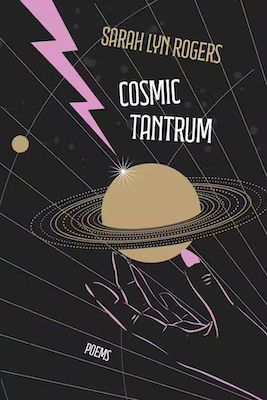
Along with underworlds, Scorpio is associated with death and rebirth, something I took to heart while working on my poetry collection, Cosmic Tantrum: I spent years writing an initial version that I later threw away, starting over from scratch to make something that feels darker and more complex, more me. My birth chart shows four planets in my eighth house, which is ruled by Scorpio. The eighth house encompasses some of the thorniest and most intense aspects of life: death, yes, but also sexuality, transformation, taboos, the occult, other people’s money, and letting go of attachments. Having multiple planets in one house is called a stellium—or, as my tarot teacher and astrologer Jeff Hinshaw likes to say, a house party. I wanted my book to feel like that—like a cast of big personalities walking through a haunted house. And in this new form, it does: Big and Little Edie exchange psychic barbs in their crumbling Hamptons mansion, a “local beast” minds its own business while townsfolk enact a strongly worded letter, and an Eldest Daughter awakens from the sleepwalk of automatic compliance.
Some of the books below percolated in the back of my mind while I wrote Cosmic Tantrum and some have come to me more recently. Each has inspired me with its willingness to plumb the depths of human experience, to sit companionably with mystery, and to find home and self-possession in and through the shadows. All of these qualities embody Scorpio energy, while the subjects and events of the books—taboos, inheritances, death, transformation—are aligned with the eighth house. Each book on the list feels kindred. I’m a Jill of all genres, so rather than narrow the list to just poetry, fiction, or nonfiction, this list is a mixer. A house party, if you will.
For anyone who can remember when the internet was a still niche hideaway, a bodiless space, an actual alternate world, this novel will evoke a powerful nostalgia. Three queer teens—Abraxa, Sash, and Lilith—meet in a chat room in 1998 and collaborate on a mystical video game about an exiled sorceress. They have never seen each other. But in the anonymous spaces they frequent, they find transformative opportunities for self-invention that aren’t accessible in the physical world. And the game—the imaginary world as they create it—offers a kind of psychic refuge. Underworld journeys abound in these pages: digital caves and dungeons, dark-night-of-the-soul reckonings with the self, and, at one point, a very occult basement dwelling.
This gutting poetry collection takes the form of a medieval bestiary—a catalogue of real and mythical animals, each imparting a lesson or moral. It takes this form even as the form collapses, as it paradoxes, as it resists its own rules, the way the tools we create to survive an experience later hinder us once we’re safe and no longer need them. A protective shell we must break so we can grow. By observing and taking on the attributes of animals (“I thought myself lion and serpent,” “You have a howl for this dark well”), the speaker reckons with childhood sexual abuse and reclaims personal sovereignty, lust, joy, learning to live “in the full / throat of summer.”
This poetry collection confronts an inheritance of violence and the underworld journey to break that cycle while “managing motherhood, marriage, and mental illness.” Bianca is the name Leigh gave her alter ego—“My fever, my havoc, my tilt”—while experiencing mania from not-yet-diagnosed Bipolar Disorder and C-PTSD. Leigh writes with warm, clear-eyed tenacity about the emotional and physical abuse she experienced as a child and its effects on her ability to forge a self, to muscle for herself a future in which she might continue to exist. New motherhood raises the stakes even higher and deepens her resolve: “I am not the thing / my child will have to survive.”
Originally published in 2016 and being rereleased this year by Northwestern University Press, Bruja takes the form of a dreamoir, a narrative built through a chronological catalogue of the author’s dreams. Some names are redacted, and there’s no introduction to orient a reader into the dream world before it offers itself up to us, but what we’re given feels so intimate: a self making subconscious sense of itself. It feels taboo to be able to see that. Classic death/rebirth/milestone images, ancient archetypes, and fraught feelings appear in Ortiz’s dreams—mother, murder, pregnancy, weddings, guilt, panic, “a dark and frothy tidepool”—and the sense of narrative builds from witnessing how these symbols and events recur, changed, over time. Most of the dreams have their feet planted in the mundane—a trip to the supermarket, conversations with friends, typing on a keyboard with missing keys—while always feeling vaguely mystical, like when the Corona beer ordered from a dream Taco Bell costs an angel-number-y $8.88.
I turn to this book for a reread whenever I feel stalled out in my creative life. Crabapple’s story is one of constant reinvention and using unconventional means to obtain the results she desires. Needing subsistence money, art-supplies money, and time in which to create, a young Crabapple supplements her illustration income with odd jobs as a “professional naked girl,” posing nude for sketch artists and “guys with cameras,” and as a model for SuicideGirls: “When I thought of every proposition or threat that I got just walking down the street in my girl body, I decided I might as well get paid for the trouble.” One of my favorite moments is when Crabapple branches out into journalism and her editors are aghast at her willingness to scrap drafts and start over from scratch, the way one must with visual art: a “draft” dies but is resurrected with the next blank page.
This novel in verse hits so many eighth house marks. Death and rebirth are literal here, as the poet-protagonist conducts a séance to resurrect Selena Quintanilla, looks death in the face, and enjoys the drama of Spanish songs, where “Everything is / a stage, I guess, or the altar we die on.” In poems where a kidnapping is mistaken for a date, a shadow self floats over the speaker, the poet isn’t sure how to be a gracious host to Selena, and Yolanda explains being “weak / with want,” there’s a pervasive feeling of fearing what one desires, and desiring what one fears.
In this novel, Yara, a young Palestinian American wife and mother, struggles to want the life she is living. Her grandmother, who reads Turkish coffee grounds, foresaw trouble the day Yara’s mother was to be married. Her mother believes the whole line is cursed. On paper, Yara meets the acceptable-life milestones: she has a career of her own, a breadwinner husband, two young daughters. But she despairs against patriarchal messages that her career—something that’s solely hers—is a frivolous distraction from complete devotion to her family and maintaining a perfect home. She receives these messages through subtle and not-so-subtle criticisms from extended family. Additionally, as she looks into her past for possible sources for her unhappiness, Yara confronts abuse in her childhood home in the U.S., and her mother’s suffering in her marriage, as well as her grandmother’s life in a refugee camp, one of the devastating impacts of the Israeli occupation of Palestine. What’s a curse and what’s inherited trauma? For Yara, the distinctions are blurred or unnecessary as she tries to break the cycle.
I couldn’t make a Scorpio list without including Gabrielle Bates, who is a Scorpio, and whose debut poetry collection, Judas Goat, goes straight to the underworlds of sexuality, death, betrayal, and forced obedience, and asks, “Without violence, how do I understand my life as meaningful?” This book examines with a magnifying glass the casual cruelty of nature and human nature— a “Judas goat” is the goat trained to lead the sheep to slaughter—but it’s also a love story. It’s true that “what the self forms around / cannot be undone,” but how terrifying and how tender to open to the possibility of loving and being loved, and allowing yourself to be seen by another.
“At Riis / with you, tits out & facing heavenward, I regard my debts to our legion.” This chatty, melancholy, yearning poetry collection considers queerness, what is inherited from homelands, what we can’t take with us to “the other side of the veil,” passing around the same twenty dollars, and how Eros is not the only or most important desire, of all the ones that can sustain us. Toska is jaded about the long-term viability of the American experiment, and skeptical of borders in general, reminding us of what’s more handleable in front of our faces: the present moment, sensual pleasures, holding each other when and how we can.
This memoir largely takes places in dungeons (not below a castle; this one is in a Midtown Manhattan office building) as Febos, new to New York City and open to unusual work to support herself in college, becomes a professional dominatrix. She takes on the job under the belief that she is a “cultural anthropologist,” observing and facilitating the transaction of other people’s vices, but she soon finds herself slogging through the underworld of addiction, not sure when or if she’ll find her exit. From addiction, and from the work, which loses its novelty and starts to feel cloying and claustrophobia-inducing. What I love about this memoir is Febos’s initial intense curiosity about this unfamiliar-to-her world, and the hard-won self-knowledge she obtains. Also: her lifelong obsession with secrets and being a secret-keeper—very writerly and very Scorpio, prizing mystery, that which is occulted from view.
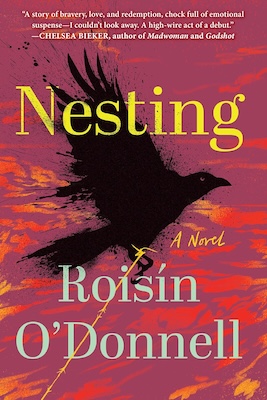
Mere pages into Nesting, the debut novel from Roisín O’Donnell, Ciara Fay makes a life-altering decision. After discovering she’s pregnant for the third time, she takes her two young daughters, throws them and some hastily-gathered possessions in the car, and flees her emotionally abusive husband Ryan. Though Ciara often doubts whether the flaws in her relationship are all in her head, something pushes her to get away while she can.
So begins an odyssey to find shelter, a home, and ultimately peace of mind for Ciara and her daughters. Due to Ireland’s lack of affordable housing, Ciara and the girls find themselves living indefinitely in a hotel in Dublin, where Ciara must check in every night while waiting for more substantial government support that seems doomed never to arrive. All the while, she struggles to resist Ryan’s continued attempts to draw her back into their dysfunctional marriage.
O’Donnell, who has also published the short story collection Wild Quiet (2018) in Ireland, grew up in Sheffield, England, and is now based in Dublin. To write Nesting, she thoroughly researched Ireland’s hotel accommodation policies, spoke to women who had escaped abusive relationships, and drew on her own experience of single-parenting young children. “I remember breastfeeding the baby and writing on my phone with the other hand,” she tells me on our Zoom conversation, laughing. “I think there is really something to be said for writing from the coalface of life. There’s this ideal of the writer sitting in a lovely, quiet room at a beautiful desk and having no outside interruptions. But I think there is actually a really strong quality you can bring to the page when you have a very busy life that you’re somehow able to channel that into the prose.”
O’Donnell brings these granular details to her portrait of a woman learning to live on her own terms, for herself and for her children. In our conversation, we discussed the craft of novel-writing, resisting the temptation of the trauma plot, the bureaucratic hurdles that women face when leaving abusive relationships, and more.
Morgan Leigh Davies: I want to start off by asking about the shift from writing short stories to writing a novel.
Roisín O’Donnell: It definitely was a big change. I had always wanted to write a novel, but I hadn’t planned on doing so at that particular stage in my life. I suppose I found that the short form fitted better into my life. I was working full-time and single-parenting two children. Time was in quite limited supply. With the short form I found that, crucially, I could get a first draft on the page before I ran out of confidence and gave up on it. Once you’ve got that first draft, then you have something to work with.
I was actually commissioned to write a short story; that’s where Nesting began. I was contacted out of the blue by a radio station and asked to write a short story on the theme of independence. We were coming up to the centenary of Irish independence, and they were asking writers to reflect on what that word meant to them. And that was the keystone that seemed to unlock these ideas that I was thinking about. It was 2020, the height of lockdown, and I was hearing all these messages about, Stay home, stay safe. I just always had this thought in my head: What if you don’t have a home to start off with; what if home is actually the least safe space that you could be?
So I wrote a short story called “Present Perfect,” and it was just one day in the life of a woman called Ciara Fay. She sort of barged into my imagination. My first glimpse of her, she was kneeling on a grubby hotel carpet trying to get gloves and coats on these two little kids, dashing out the door, trying to get to work—there was just something about her. She had this real energy, this real defiance, and yet she was incredibly vulnerable. I knew that she was a survivor of domestic abuse; that is mentioned a little bit in the story.
The story was read for radio, and normally that would be it. Everyone would say, nice working with you, and the project was done. But for me, it just wasn’t complete. I think I had a real feeling, which I hadn’t experienced with any short story before, as if the story was straining against the form. It wanted more space.
I had a real reluctance, at first, to actually take the project on board. As I said, the timing wasn’t ideal. And I had a real sense of, Well, can I do this?Can I do justice to this idea? But I just kept getting ideas for different scenes—something would float into my mind, a snippet of dialogue, or maybe a scene in the hotel, or something to do with Ciara and her ex. And I just thought, Right, okay, I’m going to start following the story and see where it leads.
It was only that point that I realized the technique that I had been using with short stories. Looking back, what I used to do was almost carry a story in my mind. I could be churning over an idea for months at a time before actually getting to the desk and writing the story down. Whereas with a novel, you can’t do that; you can’t hold a whole novel in your head. So for me, it was a real learning process. I think I have developed so much in terms of my craft, that I actually had to embrace that vulnerability of not knowing what would happen next and really put myself in Ciara’s shoes and allow the energy of the narrative to guide me.
MLD: Do you think that helped your writing, that so much of the book is also about being in-between places and not knowing what is going to happen next?
RO: Oh, definitely. I had to embrace that feeling of vulnerability. I think that if I had sat down and plotted the whole book and had a very clear idea of what was going to happen to Ciara, it would have been a very different novel, and perhaps would have felt less authentic. I think that putting myself completely in her shoes and embracing that vulnerability, definitely lent something to the narrative.
When I was starting out as a writer, I studied with Claire Keegan. She was someone who was really influential on my formative years as a writer. She talks about the character’s instincts and following the story almost through bodily awareness, through your senses. She’s a fabulous, fabulous teacher. She’ll say, First the nose and then, maybe, the feet. And what she means is, Follow the character’s instincts, lead with the senses, follow their desire. What is Ciara’s desire in Nesting? It’s security, it’s safety, it’s a reprieve from the stress that she’s under: That is the instinct that she’s constantly following. My job was almost to keep out of her way, and follow her path and see where it led.
MLD: Of course, you can write a short story about this kind of abusive relationship that is very emotionally affecting. But her getting repeatedly sucked back in, and then trying to push away—the cyclical nature of that felt to me like something that can only really happen in a long form narrative. How much were you thinking about that as you were writing?
RO: The longer form allowed for a greater level of realism, definitely. I had done some research when I was writing the short story, and one of the facts I came across was that it takes an average of seven times for women to leave an abusive relationship, and to leave permanently. That really stuck in my head. What is the driving force behind that? I wanted to create this character of Ciara, who is very three-dimensional and believable and authentic, and to explore what is going on psychologically for her.
Shame and fear and guilt are the key tools Ryan uses to manipulate her into coming back. A key decision that I made really early on was that I was going to start the novel much earlier than the short story. With the short story, it’s almost like the pinnacle of the mountain, whereas with the novel, you begin further down the slope. I made this decision that I’m going to bring the reader into Ciara’s home. I’m going to be very upfront and show exactly what she’s living with, so that we really follow the journey with her.
I suppose the other way of doing things that I feel would be maybe a bit more common, is to withhold that information and to use the trauma as a reveal, as a plot device. When I started writing Nesting, I did have in mind to structure it like that, so that it would start with her leaving, and we would gradually become aware of why she had left. But I realized I actually don’t. I don’t trust that as a form of writing. I just don’t like the use of someone’s trauma as a plot device. So that seemed like quite a radical, risky move at the time, to get the reader on board from those first pages, being very upfront by showing what Ciara is trying to escape. But I think in terms of the scheme of the novel, it really worked out because it gives you a clearer idea of just how difficult it is to break free from that type of psychological control.
MLD: For much of the novel, Ciara and her children live in a hotel that is used for homeless accommodation, and she is on a quest to find somewhere to live that is more permanent. I’m curious about this horrible process that she is trapped in throughout so much of the book, and the research you did into that.
RO: I knew that housing was going to be a big issue for Ciara, just because it’s such a dominant issue in Ireland at the moment. I don’t know anyone who hasn’t been impacted in some way. It’s to do with rising house prices, and there’s a shortage of places to rent, and the rents have skyrocketed. So Ciara has left a controlling home environment, but she finds herself living in emergency accommodation, a hotel that is very controlled. She has to sign in to the hotel every evening. There are very strict limitations on what they’re allowed to do or not do. There are no cooking facilities in the room. As she gets to know some of the other residents, they tell her the ways they found to try to circumvent some of these rules, but it’s extremely difficult.
I’m glad that you used the word quest, actually. That was really important to me when I was writing. I really did think of it as a quest narrative, in the same way as an old medieval text about, you know, trying to find the crown or the kingdom. Ciara’s kingdom that she’s trying to find is a home, but I think she is confused about exactly what it is she’s looking for. She does come to that realization that it’s not just a house that she needs. This idea of home is not just as a place to live, but as a place where you’re experiencing a sense of freedom to be yourself, and a sense of security and a sense of peace. That is so much more than just having a physical place to live in.
MLD: The bureaucracy they face is also overwhelming.
RO: It’s a minefield. I went down so many tunnels of research to make sure that I was getting that right. At one point, a friend who was reading it said, Do you have to be so picky about making sure that you’re naming the exact policy and that you’ve got the exact correct amount of money that she needs? You’re causing yourself a lot of stress. Does it need to be that precise? And I said, Yeah, it does. It does because that’s where the authenticity is coming from. I really do think that, in particular, that’s where we find the universal, and that’s where I felt that it’s going to really bring the story alive, to make it feel vivid and real.
MLD: I don’t know about these specific policies, but it felt authentically Kafkaesque. It makes it so clear that the entire system is organized against anyone leaving these relationships.
RO: And there’s the difficulty of reaching out and accessing the supports that are there. I don’t want to make it seem as if that there isn’t support. But for much of the novel, Ciara doesn’t actually reach out and access the woman’s refuge. She doesn’t really acknowledge what’s happened. I think that is very common with people I’ve spoken to. She’s been constantly told by Ryan that there’s nothing wrong, that she’s the one with the problem. So she finds it difficult to then reach out for support.
But you’re right. It is a huge ordeal that she has to go through. You could say, Is it worth it? Does she make the right decision? As a writer, you’re always trying to find the universal within a story, the point at which readers can connect. I think there are so many ways in our lives that we can find ourselves, maybe a shift, or in the wrong place, whether it’s in the wrong relationship, in the wrong job, and making a change is not going to be easy. To make her life whole, Ciara has to completely break everything in order to hopefully move towards a more hopeful place. I think that’s something that a lot of people can identify with, for different reasons.
MLD: I also wanted to ask about the support and solidarity that she is able to build with other people once she has sort of escaped, because we see that she has been alienated from other people in her relationship.
RO: It’s very common that an abusive partner will alienate their partner’s friends and family, and the woman can become very, very isolated, to the point where a repeated line in Nesting is, I cannot hear myself think.Ciara just can’t get a grasp on what’s happening, because the only voice in her head has been Ryan’s voice. She hasn’t had close friends and family to give her another perspective. I wanted to show that it’s a bit like the light being let back in after the door has been closed for so long.
Cathy, who lives in the room next door to her, is a very forthright character, and really puts Ciara in her place in a lot of ways, and brings a different perspective. She then makes friends with Diego, who’s a hotel worker from Brazil, and he helps her to reconnect with her memories of traveling. She’s taught and worked in Brazil. She’s becoming more in tune with her past, allowing memories back in that she hasn’t thought about for a long time, and becoming herself again.
I remember one of the women that I’d spoken to when I was doing research saying to me that she felt that her life was saved by the kindness of strangers on a regular basis. In her case, her husband was emotionally abusive, and he would quite often give her the silent treatment. So she might have had a weekend where he hadn’t spoken to her at all, but she would go to the shops, and in Ireland, we are quite chatty, and she’d be queuing up to pay for something at the till, and someone might say something to her—you know, terrible weather, or I like your hat, something small, and she’d have maybe a two-minute conversation, and she said it was like a gulp of oxygen. That really stuck in my mind.
The idea of these small interactions is something that worries me. I feel as if so many things now are becoming automated, and you can actually go to the shops and come home without having spoken to anyone. Communities are not as tight-knit as they used to be. I think it’s something really important for us to hold on to, because it’s that human connection which really can be so life-giving, especially to someone in Ciara’s position.
MLD: It makes me think, too, that you were saying you started writing this in lockdown.
RO: It was shortly after lockdown, I think, that she actually left the relationship, because she said it really opened her eyes to the void that was there when she didn’t have those interactions with people outside of her home.
MLD: I remember reading statistics about the uptick in domestic violence, which was horrible, but totally made sense.
RO: It’s not a good thing, but I feel in Ireland, there’s more conversation about it now than there used to be. I feel that COVID definitely lifted the lid on a lot of that, and that there are far more discussions now than there used to be.
MLD: So you feel that that’s changed in a notable way, in the last few years?
RO: I think it is changing. You definitely hear more conversations about domestic abuse, about coercive control. There’ve been more cases in the news. I just feel that it is gradually becoming a topic that people are more aware of. But I was very aware of all the stereotypes as well. When I was writing Nesting, I was writing against the weight of all the other stories and films that had gone before—this stereotype of, Why doesn’t she just leave? And particularly the narrative around a woman leaving an abusive relationship and driving off into the sunset, and then everything is okay, which still happens in a lot of books and films. It’s not realistic.
I think stories do carry power. They do carry weight. Because if that same story has been repeated over and over again, then it’s damaging our understanding of what that woman’s life actually looks like.
My freshman year of college, I bought a wildly expensive pair of rollerblades. The first semester had been a disaster. I barely passed my classes and had not retained a single piece of information, but who cared about that. I didn’t. What troubled me was that I had no friends, had not gone to a single party since I’d started college. One night, while I pretended to be asleep, facing the cinderblock wall of my dorm, my roommate and two of his friends were talking about me. “Your roommate, dude,” one of the guys said, “looks exactly like fucking Mr. Bean.” His name was Wynn Banks, and he already looked like he was in his forties; he always wore pastel shorts, even in the winter. He had a maid clean his dorm room every week. “He looks like fucking Mr. Bean,” Wynn said again.
“I mean, kind of?” my roommate said.
“You hearing this, Bean?” Wynn asked, but I still pretended I was asleep. When he was certain that I wasn’t going to respond, he said, “I’d kill myself if I looked like that.”
As soon as I returned to campus after Christmas break, I took the money my grandmother had given me and bought the rollerblades. At night after I’d done my homework and reading, so I didn’t have to see my roommate and his friends, I’d skate around the city, swinging my arms, the rollerblades clickety-clacking on the cracks in the sidewalk. My breath would gush out of me in clouds of mist, my face so cold. I’d skate until I could barely breathe, until I was so far from my dorm that I didn’t quite know how I was going to get back. The streaks of light the cars made as they zoomed past me felt like drugs, like I was in a video game. I wouldn’t think about anything. I wouldn’t think about how there was no way I was going to graduate. I wouldn’t think about how I’d never kissed another person in my entire life. I wouldn’t think about how, in my junior year of high school, I’d driven my car into a tree on purpose and returned to consciousness a week later with a huge scar on the right side of my face. I wouldn’t think about the pills that I had to take every day after that accident, and how I had stopped taking them a month earlier. And then, somehow, I’d be back in my dorm room, under the covers, and I’d finally let myself think one thing. Another day. I had made it another day.
I had signed up for a creative writing workshop, and we read Raymond Carver’s “A Small Good Thing” and Amy Hempel’s “In the Cemetery Where Al Jolson is Buried.” It wasn’t like everything got better for me, because it was still so bad, but I liked reading these stories. I liked it when my professor, who had written an award-winning collection of stories and was so soft-spoken and sensitive, would diagram sentences on the chalkboard. One time he drew a stick figure, and then he drew a giant boulder in the figure’s way, and he said this was what stories were: simply finding a way to get the figure over that boulder. In my notebook I drew a boulder on top of a stick figure, his little arms and legs poking out from under this massive rock. To me, that’s what a story was. I wanted to tell the professor that I’d tried to drive through the boulder, smash into it, but I wasn’t sure what had happened. I didn’t know where the boulder had gone.
I wanted to tell him that, now, empty air felt like a boulder to me. I couldn’t name it, couldn’t see it, and so how did I write a story about that?
There was this girl in the workshop, a junior, a biology major, who was taking the class for fun. She had close-cut hair that showed off her ears, which were huge and pointed like an elf ’s. She’d bleached her hair blonde, and now the roots were showing, but she didn’t seem to care. She was so intense, was always talking about the stories in the workshop like they really mattered, like we’d cure cancer if we could just get this character to have a believable epiphany. Our professor loved her, even though he was clearly intimidated by her.
I kept running into her on campus, three or four times a week, just random moments when we were standing in the same line to buy coffee or I was walking into a building as she was walking out, and one time she grabbed both my arms and looked into my eyes, and said, “Why does this keep happening?”
I said I didn’t know.
“Maybe we’re soulmates,” she said.
“Maybe?” I squeaked.
“I mean, I have a boyfriend, but, you know, something’s going on. I’m keeping my eye on you.”
In her first story for workshop, a woman went on a long hike in the woods with a man who was married to her cousin. Toward the end, the woman lay down on this huge rock and they had pretty explicit sex. When the professor said, “Does anybody want to talk about the scene on the rock?” my face burned so red that I put my head on the table. Everyone was silent, and the professor said, “Okay, I guess not.” And that was that. The professor said the story was nearly perfect, and then the girl—her name was Karin—said she thought maybe it was part of a novel, but she didn’t have the time or inclination to write a whole novel.
After workshop she grabbed me. “Boy, you really went crazy red there at the table. You looked so cute, like you’d just shown up from Narnia.”
“The room is sometimes overly hot,” I said.
“Come with me,” she said, and so I walked with her off campus, to an apartment complex. The whole time she was telling me about crocodiles, which was her focus in biology, and about how she was going to Africa as a research assistant to study them for the entire summer. “It’s all because of Lyle the fucking Crocodile,” she said, and I remembered those books, the crocodile that lives in some fancy house in New York or something like that. She talked so fast, pulling me along, and I tried to take in everything she said like there would be a test on it someday.
“I want to paint your nails.” She pushed me onto her bed, got out some sparkly blue nail polish, and knelt down beside me. She held my hand so gently, the most tender thing a stranger had ever done to me.
I remembered the way my mom lightly traced the scar on my face on the first night after I was released from the hospital. She said, “You are such a beautiful boy,” and I cried and I cried, and I apologized maybe thirty times for trying to kill myself. And now Karin was holding my hand, painting my nails, so careful not to get it on my skin, and I thought I was going to cry again. But I didn’t. I watched my nails sparkle in the light of her room. I stared at the dark roots of her hair. She smelled like green apples.
“You have to let them dry,” she said. “You can’t touch anything.”
I wanted to tell her this was easy, that I was so good at not touching anything.
She went over to her stereo and played Bob Dylan’s “Boots of Spanish Leather” and then she asked me to lie down. So I did. And then she lay right next to me. This was the first time I’d really heard a Bob Dylan song. I was so tired, all of a sudden, the room so warm. I could feel the heat of her body right next to me, but I didn’t reach for her. She didn’t reach for me either, which was such a relief.
“Can I ask how you got that scar?”
“It’s pretty boring. Car accident.”
“I was hoping it was something boring. If somebody knifed you or kicked you off the bleachers in high school, I was going to be so angry.”
“I can feel it even if I don’t touch it,” I said. “I can always feel it.”
“I think that’s good,” she said. “I wish my body worked like that.”
We lay there together for a long time. After the CD ended, I heard Karin snoring, and I got out of the bed and walked back to my dorm. My roommate and his friends were in the room. “Bean!” Wynn said. “What the fuck did you do to your fingernails?”
“I’m just getting my rollerblades,” I said.
As I closed the door, I heard Wynn ask my roommate, “Is he gay? Is Mr. Bean gay?”
“Who knows,” my roommate replied.
The following week, I had my first story workshopped. I’d spent more time on it than I wanted to admit, wanted it to be perfect, even as I could feel it falling apart the more I typed. It was about a boy in some undetermined past, maybe the Great Depression, who plays in the woods and falls out of a tree and breaks his leg. He’s trying to crawl home when a hobo pulling a junk cart finds him and gives him some water and offers to take him home. But instead the hobo just pulls him deeper and deeper into the woods, the sun setting, and the boy decides there’s no point trying to get out of the cart.
No one in the workshop had much to say, except that the two characters were kind of flat and it was hard to tell if any of it was real or not. Karin spoke up and said she thought it was really good but that it wasn’t a short story. “It’s a fairy tale, right?” she asked me, but I wasn’t allowed to talk. She turned to the professor. “Isn’t it a fairy tale?” The professor shrugged. “I think it has elements of a fairy tale, sure,” he offered. He seemed to consider the question a little more deeply. “I think it’s a story, “ he finally said, and Karin seemed like maybe she didn’t believe him. She looked at me, her eyes wide. No doubt I was bright red again. I looked down at my own story, the words completely foreign to me. Had I written this?
The professor said the hobo reminded him of the character Arnold Friend from a Joyce Carol Oates story and he recommended that I read it, said it might help me add depth to the character. “But this is promising,” he added, and I felt so happy and yet so jumbled, so confused. What had I done to earn that assessment? How could I build upon that promise? Why in the world had I written a story with a hobo in it? I knew the boy was me, of course, but who was the hobo? All writing was doing for me was teaching me that I didn’t know much of anything, that all I had was what was inside of me, and what was inside of me had almost made me kill myself. It was frightening. And thrilling.
All I had was what was inside of me, and what was inside of me had almost made me kill myself. It was frightening. And thrilling.
After workshop, Karin told me that I didn’t need to read that story by Joyce Carol Oates, and that my story was great because it was really a fairy tale and fairy tales had flat characters who served as symbols.
“But this is a short story class,” I said. “I should probably try to write a short story.”
“What dorm do you live in?” she asked.
“Upton,” I said. “On the top floor.”
“Oh, god, all the gross boys lived in Upton when I was a freshman,” she said. “One of them got drunk and pried open the elevator doors and fell all the way down. And he didn’t even fucking die.”
“There are a lot of gross boys in my dorm,” I offered.
“Come back to my place,” she said, taking my hand. And I went. Where else would I go?
We lay on her bed, on top of the covers, and she rested her head on my chest. She had put on a Magnetic Fields album, music entirely foreign to me, and the lead singer’s deep voice made me feel like I’d taken drugs. I kept waiting for the moment when I would kiss her, put my arms around her, but it never felt quite right. We were lying on her bed. She could hear my heartbeat. Why wasn’t this sexual? Or why was it also something else? Was this why I had no friends? Because I could not properly understand the context of any moment of my existence?
“Could I dress you up?” she suddenly asked. “Have you ever worn makeup?”
“What now?” I asked, my heartbeat speeding up, my hands turning clammy.
“You would be the most beautiful girl, do you know that?”
“I don’t know that,” I said. It was most certainly not true. I was and had always been ugly. I started to realize that Karin might be unbalanced, that her weird kind of confidence had hypnotized me.
“Are you gay?” she asked.
“No,” I said. This made her lift her head and she turned to face me, her expression concerned. “I mean . . . I don’t think so,” I continued. “ I guess I don’t know.”
“You don’t know?” She seemed genuinely surprised.
“How would I know?”
“Do you like boys or girls?” she asked, like it was so simple. The truth was that I’d never felt much of anything for anyone, was too scared to think about it. It was one of the reasons why I’d tried to kill myself, because I felt so deficient, could not make connections with people.
“I don’t know. Girls? Maybe both?”
“Oh, okay,” she said, like that explained everything. “You’re bisexual. Like me. Though most people who are bisexual are really one or the other, but I can imagine that you are, too.”
“I’ve never even kissed anyone,” I admitted. I felt like I was about to cry.
“I believe that,” she said. “You have that kind of vibe.”
We both just sat there on her bed. Finally, she said, “I could kiss you, if you wanted.”
“You could?”
“Yeah, I could. We’re soulmates, right?”
“What about your boyfriend?”
“It’s complicated. He’s actually one of my professors. He has a wife and a kid.”
“Is he the one that you’re going to Africa with?”
“He is. Like I said, it’s complicated. But don’t think about any of that. Do you want me to kiss you or not?”
“I do,” I told her.
And so she kissed me. Her mouth was so soft. She ran her fingers through my hair. She flicked her tongue against mine. I could feel the scar on my face burning. I couldn’t tell if what I was feeling was attraction. But it still felt nice.
And then she pulled away. “Would you let me put makeup on you?” she asked.
“Yeah, okay,” I said, and she smiled, jumped off the bed, and ran to her bathroom for her cosmetics. I could already see what was going to happen. She would adorn my face with the bluest of eyeshadows, the reddest of lipsticks. She would use that little mascara wand on my eyes and laugh as I flinched. She would make my cheeks so rosy, balance out my skin tone. She would have me take off my clothes, even my underwear. I would put on her lingerie, one of her dresses, since we were about the same size. She would take pictures of me with her camera and I would never know what would become of those photos, if she’d even developed them. I’d look in the mirror and, holy shit, I was kind of beautiful. She’d kiss me again and again. We’d have sex, her showing me how to do it, me concentrating so hard not to mess it up. It would not feel real at all. And after, when her boyfriend, the professor, called to say that he needed to see her, she would tell me I could spend the night in her apartment, sleep in her bed. When I woke up in the morning, alone, I would look at her pillow, the smear of my makeup on the fabric, and I would put on my own clothes and walk back to my dorm, thinking about how slowly I moved without my rollerblades, how heavy each step felt, how it seemed like I’d never get where I wanted to go.
I bought the story collection that my professor had published. I wondered why I’d taken so long to read any of his work. I think maybe I was afraid that if it was bad, I would have trouble listening to him in class. But it was very good. He wrote about sadness in ways that felt true, about how we disappoint other people. The story at the end of the book, a pretty short one, was what I focused on the most. A man living in some industrial city in the Midwest, newly married to a wife who’s a big-deal administrator at a hospital, is between jobs. He’s working on a novel, but he hasn’t written anything since they moved. Every day he takes long walks across this bridge, and he starts to think about jumping off. He goes two or three times a day, standing on the bridge, until one day a police officer stops and asks if he needs help. They both seem to understand what’s happening, what could happen, and the man talks about his wife, about moving to this city, about his unhappiness. The cop drives him home and makes the man promise not to walk over the bridge again. Back in his house, he looks at the clock and there are two hours before his wife will get home from work. He thinks about walking back to the bridge. He looks at the clock and then at the door. He tries to will himself to stay on the couch. And that’s the end of the story.
I kept hoping there was more. I read the story three times, as if it would be different at the end, but it was always the same. I don’t know exactly what I wanted the ending to be, but I knew I wanted something more.
The next day, I went to the professor’s office hours and told him how much I liked the story. He seemed embarrassed that I’d read his book. And I don’t know why, maybe because the professor radiated a kind of kindness, or it could have just been patience, I asked him if the story was autobiographical. This made him blush, and he looked out the window of his office. Regaining his composure, he said, “Well, all stories have some element of autobiography.”
“I drove my car into a tree when I was in high school,” I said. He picked up his pen and then put it back down on the desk. He looked so unprepared for this conversation. I must have looked so desperate.
“That story of yours meant something to me. It made sense to me,” I told him.
“Thank you.” After a pause he said, “Sometimes I wonder what would have happened if that police officer had never stopped.”
“It’s harder than it seems to kill yourself,” I told him, and he laughed and then instantly looked horrified.
“Can I ask you something?” he said. I nodded. “Do you need help? Are you okay?”
“I think I’m okay,” I said, growing uneasy now that the focus was on me, despite the fact that I’d caused this. “I’m not a danger to myself or anything.” I thought about all those pills I hadn’t been taking, how they just piled up in my desk drawer. Was I saving them for some reason?
“I’m here to talk, if you ever need to.” He took a little piece of paper and wrote down a phone number. “That’s my home number. You can call anytime that you feel like . . . you can just call if you need to talk to someone.”
“I better get going,” I said. He handed me the paper as I stood up, and I took it from him. Just before I walked out of his office, I turned to him and said, “I think I’d like to be a writer.”
“I think that would be a very good thing,” he replied, smiling.
At night, after she got back from studying reptile bones or sleeping with her professor, Karin walked me through the ways of sex, doing things that usually felt good but sometimes didn’t.
I stopped rollerblading as much, was sleeping every night at Karin’s apartment. She let me have a key to her place and I could come by anytime, though often she was out. I have no idea what my roommate thought was happening, if he even noticed that I wasn’t there anymore. At night, after she got back from studying reptile bones or sleeping with her professor, Karin walked me through the ways of sex, doing things that usually felt good but sometimes didn’t. It all felt momentous, though. She made me dress up in her clothes. She bought more and more outlandish makeup for me. I didn’t mind. I didn’t like it exactly, but it also felt somewhat natural, like Karin knew me better than I did, knew what was best for me, how to be the best version of myself.
The night before her second story was due for workshop, Karin stayed out all night at the library to write it. The next day, I read the story while she lay next to me in bed. “It’s intense,” she warned me. In my short history of knowing her, I found everything about Karin to be intense. I was becoming more prepared for it.
The story was about a woman who goes to the house of her professor, with whom she is having an affair, and confronts him. The wife, holding their baby, asks the professor what the fuck is going on, and the professor responds that this woman is certifiably insane; has developed an unhealthy attachment; and has been stalking him, leaving countless voice mail messages. And the woman, in that moment, feels so stupid that she’d believed the professor when he said he would leave his wife, that the two of them would be together, be research partners, would publish so many important papers on crocodiles, and raise their children in the wild, and teach them to appreciate the natural world. She takes a bundle of letters out of her backpack, letters the professor explicitly told her to destroy after she read them, and gives them to the wife. Then she leaves. She thinks about Sobek, a fertility-god with the head of a crocodile. She had imagined having a baby named Sobek with the professor, whether it was a girl or a boy.
When I finished reading, I asked if the story was true, and what exactly was going on.
“It’s fiction,” she said.
“Well, the professor says all stories have some element of autobiography.” I was wearing a teddy that she had bought for me. It was all so domestic—some version of domesticity.
“He doesn’t know everything.”
“Did you ever go to your boyfriend’s house?” I asked. “Did you talk to his wife?”
“Well, yeah. I did. The same night that I wrote the story.”
“Why didn’t you tell me?” I said, so confused.
“Because that’s my own business.” The lipstick she had put on my mouth earlier that night was now smeared across her face.
“What are you going to do?” I asked.
“Not go to Africa,” she finally said.
It was a delicate workshop. The professor praised the precise details, the way Karin controlled the tension in the narrative. The other kids in the class seemed to know that this story was at least partially true. Some of them had taken a class with the professor they took to be the professor in the story. One kid asked how libel worked, if fiction was exempt from that kind of legal stuff. I said I liked the way the setting contained the story and contributed to the tension. The professor said it was a very astute observation, that he agreed wholeheartedly. When the discussion was over and Karin could finally say something, she just shook her head, not looking at anyone. We all filed out.
“Are you okay?” I asked her. She looked so pale.
“I want to be alone for a little while,” she said.
“Are you sure?”
“You go back to the apartment. Get dressed up for me. Okay? I’ll be home later, when I get my mind right.”
I put on something she would like. I put on my makeup, which I’d gotten better at doing. I lay in bed and waited. And I waited some more. I thought that Karin had probably gone back to the professor’s house. But I didn’t know what I could do about that. So I fell asleep, my hands resting on my chest, like Sleeping Beauty, waiting for her to come back.
I awoke to the sound of the lock on the front door turning, then swinging open. I called out, still partly asleep, “Karin?” and I heard a man say, “Who’s in here?”
“It’s . . . me,” I said, confused. Before I could even get out of bed, I saw two men standing in the doorway of the bedroom, looks of horror on their faces.
“What the fuck are you doing in here?” the older man said, a handsome, businessman-type in a fancy overcoat.
“Waiting for Karin,” I offered sheepishly.
“I’m her father. Karin checked herself into a mental health facility last night. I’m here to get some of her things.”
The other man, looking embarrassed, simply said, “I’m the super.”
“You shouldn’t be here,” Karin’s father said to me. He started grabbing some clothes from a dresser, not really paying attention to what he was taking. “If I come back, you better not be here. I don’t want to know what you’re doing, what’s going on, what kind of fucked-up things you’ve done to my daughter, but I don’t want you here. Do you understand?”
“Yes, sir,” I said.
He turned to the super and said, “Make sure he leaves, okay?” and the super nodded. Her father went into the bathroom for toiletries.
“Could I go see her?” I called out weakly.
He immediately poked his head back into the bedroom. “Are you serious?” he shouted. “No! No! Not at all.”
“I’m sorry,” I said. I looked at the super, who kind of shrugged, like, what can you do?
After Karin’s dad left, the super stood there, shifting from one foot to the other. “So,” he said, “I’m just going to leave and I trust that you’ll get out of here in a timely fashion.”
“Okay,” I said. Okay, yes,”
“Sorry about your girlfriend,” he said, and then he turned to leave.
“Thank you,” I replied, not wanting to get into a long conversation with this very polite man about how Karin maybe wasn’t my girlfriend but was something way more complicated.
And because I was paralyzed by the situation, the weight of it, I went back to sleep, something akin to a coma, and when I woke up, it was late in the evening. I had missed both of my classes for the day, and now I needed to leave, to find somewhere else for my body to be. I had no idea where to go. I reached into my backpack for the professor’s phone number, but I couldn’t bear to call him. Instead, I washed off the makeup, changed into my clothes, and strapped on my rollerblades.
I skated through downtown, cars humming past me. Near an old warehouse that was being renovated, I stood at the edge of a steep hill. There was no clarity, not like that time in high school, in the car, when everything made so much sense, like there was no other option. My mind was empty. Nothing in there. And I bombed that hill, closing my eyes until I got too scared and opened them again. At the end of the hill was an intersection and I could see traffic rushing by. I was so close to the end of the hill, almost there, almost there. As I hit that cross street, I made this sound, like an animal, so ragged, something I did not want inside of me. A car honked, swerved, and I sailed on, across the street, not a mark on me, still alive, still so goddamned alive.
I didn’t stop, didn’t think. I just kept skating. I navigated the streets, pumped my arms, until I was back at my dorm, taking the elevator up to my room. It took me a minute to find my key, and then I walked in, and my roommate, who had been jacking off, screamed, “What the fuck, dude?”
I didn’t answer, didn’t care. I went to my desk and got out the bottles of pills. I took one of each. I knew they wouldn’t do anything. I knew it would take forever for them to have any effect on me, but I took them anyway. If I had to take them the rest of my life, I decided that I would.
“Where the fuck have you been, dude?” my roommate asked.
“I don’t know,” I admitted. “Out.”
“I thought you left school,” he said.
I got out my computer and started writing my story for workshop. I wrote about that moment when I came home from the hospital, my mom touching my scar. We were not a family that showed much affection. I wrote about how nice it felt, her hand on my face, her fingers trembling just a little. I wrote about how, after a few moments of silence, I told her I was scared that I was going to try again. And how my mom said, crying, to hold off for as long as I could stand it. To be as strong as I could for as long as I could. In real life, I hadn’t been able to respond, to give my mom that little thing she needed to believe that I was safe. I just cried some more. But in the story, as I put it together, the boy promises his mom that he’ll try.
I didn’t know if it was a story. Well, no, I knew it was a story, but I didn’t know if it was any good. But there was this feeling, once I’d written it, that it became fiction. It became a story about someone else. Ever since I’d tried to kill myself, this little piece of metal stuck in my heart sometimes shocked me when I felt it inside of me. The story I wrote made it disappear. Or made it easier to live with it. I didn’t know. I only knew that I wanted to keep doing this, write my way toward a life, hold on for as long as I could stand it. And then, when I couldn’t stand it, when it was too much? I would keep going.
Edward Underhill didn’t plan on having his debut adult fiction book, The In-Between Bookstore, featuring a trans main character, come out six days before the Trump inauguration, but it’s kind of perfect timing. Especially since the book features a time slip, where Darby Madden meets his younger self at the Illinois indie bookstore where he worked as a teenager. As the author of three young adult novels with trans main characters—Always the Almost, This Day Changes Everything, and the forthcoming In Case You Read This—his books are often about discovering who you are when the world isn’t quite ready for you. Two weeks before the Los Angeles wildfires began, Underhill and I met at a Los Angeles coffee shop to discuss his breadth of work as a trans author. The author and music composer understands the importance of meeting the moment, particularly at a time when trans people are being legislated into non-existence. Underhill provides a hopeful look on how to keep going when the fight feels the hardest.
Jennifer Chen: In your Author’s Note from the advanced reader copy I read, you talk about discovering your first queer book at age 17 in your Wisconsin hometown indie bookstore. Given the prevalence of book bans now, particularly for queer youth, how do you see your work as part of this big canon?
Edward Underhill: I feel like there’s been a lot of talk about book bans, particularly when it comes to books for teens. I’ve written books for teenagers, which has been on the cutting edge of more diverse representation than adult fiction. But at the same time, I actually feel like there’s less representation in adult books, particularly for trans identity outside of romance. Romance has historically made more room for more diversity earlier than other genres and mainstream commercial spaces. So with this book, I wanted to write something that was for me and my friends and where we are now.
JC: You mentioned earlier that you discovered your first queer book by looking at its cover. I’d love to talk about your book cover and how the main character, Darby, goes in on one side and comes out the other side. Can you talk about what you hoped readers would find in that imagery?
I wanted to write something that was for me and my friends and where we are now.
EU: I am super happy to talk about the cover because I love it. We originally had cover sketches that were a very different concept. Some sketches just had books on them. Others had images of the actual bookstore. But they felt like they were missing some sort of element that got at the self-discovery aspect or the time slip element. So I started making Pinterest boards and sending them to my publisher. I had some general images of fireflies, the Midwest, and a tree. There’s an important tree in the book with a tire swing attached to it, and my editor was very taken with the idea of having a tree on the cover, which I also liked. So we went back to the drawing board. My editor and his team had the idea of the character going in and then coming back out. I like that you see the younger character going in and the older character coming out, but you never totally see the younger character’s face and you only have hints of both of them. My editor also felt like getting the cover right so that someone would pick it up for the cover was important. I feel like the cover exists out of time and space in this very deep color scheme, but also I didn’t ever want it to be a book where you would think this is just going to be about trauma. I ultimately wanted it to be like a warm and healing book.
JC: Why did you choose to set your book in an independent bookstore, particularly now?
EU: I was a big library kid growing up. I loved to go into the independent bookstore where I grew up, which is sadly not around anymore, because it represented possibility. I felt very isolated and alone, especially as a teenager. Losing myself in stories was the easiest way out of my head for me and my writing. And even though I found the one queer book on the shelf that wasn’t my identity, I still found pieces that were lifelines that I could hang on to. And so for me, in that sense, the setting of a bookstore was completely natural. I wanted it to be someplace that had distinct smells and things you could touch and just like a very physical presence. I wanted something that could feel very grounded, but also like slip in and out of time and space and all of that. And to me, bookstores always exist slightly out of time.
JC: With this new administration, where do you have hope? What has helped me is what you’ve told me in other conversations we’ve had that trans people have always existed.
EU: It is a very weird time to be releasing a book like this, but I find hope in a couple of different places. Publishing still tends to view trans books as niche, but I’ve been very pleasantly surprised by how many booksellers, librarians, and readers who have been excited about my books and have not treated my identity like a big deal. When I got my very first book deal, I thought a lot about how I was going to present myself on social media, about what my boundaries were going to be around different things because I was absolutely prepared for plenty of transphobic bullshit to come into my DMs. And that’s happened. But I wasn’t prepared for how much I’ve also gotten the opposite. I’ve had so many people who have liked reading my books and have talked to me about aspects of the story that have had nothing to do with the trans characters. And that feels like a step forward to me.
The younger generation coming of age now also gives me hope because they have the Internet. They have a way to find community. When I came out, I remember Googling for other trans people because all I wanted to know was like, It’s not just me. Can I have a career, a community, and a future? And I found one blog. Now you can find everything online. For my birthday, my partner gave me To Survive on This Shore, a coffee table book by Jess T. Dugan, with photo essays of trans elders over the age of 50. I had never seen something like this. These people have been sort of quietly living their lives for decades. And that gives me hope, too, because it’s a reminder that we have always been here and we will continue to always be here.
It’s scary to be in the spotlight as a trans person right now.
It’s scary to be in the spotlight as a trans person right now. It’s been wonderful how my team for this book has said this story is worthwhile reading this year. I hope there are a lot of people out there who will be galvanized to take more action now, partly because it’s easier to find things out on the Internet and easier to have methods of connection. There’s more visibility now. It’s more likely you will know someone who is trans.
JC: Nonbinary comedian, activist, and writer Alok Vaid-Menon recently wrote on Instagram, “The apocalypse is not inevitable. Fight for the people that you are and the people that you love.” I’ve sat with that because I needed that reminder. What does that statement mean to you?
EU: I’m part of a group called Authors Against Book Bans. We started around the time of the election with a lot of fear, like should I use a pen name? But this is my actual name. I have fought long and hard for that name and to be here so I don’t really want to make myself smaller. But I think the apocalypse is not an inevitable idea, it’s something I’ve been hearing a lot in that group. If you think that something is inevitable, you only make it easier to take these books off the shelves before they’re even challenged. You only make this easier if you give up ahead of time. That is how fascist forces take power. And that’s what I’m hanging on to now. The incoming administration would love for me to go, “Well, I guess it’s too dangerous to write trans. I’ll have to write something else. Or I’ll have to stop writing.” I am very lucky to have people on my team who are behind me. My agent has said to me, “I will be trying to sell your books until I physically can no longer do it.” It’s important to have those people with you so you don’t feel alone in trying to do it. But it gives me more courage to keep writing those books. The apocalypse is not inevitable. There are ways to apply that in big and small ways. As it relates to books, I am going to write a trans book. Make them take it off and then put a new one in its place and make them take that one off and do it over and over and over again. Do not comply in advance.
JC: The second statement Alok wrote that I’ve been thinking a lot about is, “In a world hellbent on destruction, do not just critique, create, create, create.” It made me think about us as authors and members of marginalized communities. How do you continue to write?
EU: I write out of spite. I internalized that concept years ago, and it’s gotten me through agent and publisher rejections. And it still applies now. I tend to get sad and depressed first, and then I get angry and write something anyway. Writing The In-Between Bookstore was really helpful because having this speculative, slightly magical element allowed me to divorce from my own reality. I could totally get lost in it. I didn’t have to think about wrestling with political stuff. I was wrestling with the nuances of this small Midwestern town. And because there was a magical bookstore, I wasn’t sitting in my own trauma and fear all the time. What’s been very important to me is how writing can get me out of that fear and hopefully can get my readers out of that fear. Also, I don’t just want to read things for myself where it’s completely realistic, then you’re just sitting with the fear, right?
Nothing is actually equal until you have all of the mediocre books, all of the great books, and all of the trashy books.
I think it’s more important than ever to have every single type of book created. At a book panel I was on, another author said someone had left them a one-star review on Goodreads. They said, “It’s great to know that now that we finally have a queer book that’s as terrible as all of these straight books we have.” We need every type of book. You need the fluffy books. You need the trauma books. You need all of the books in between, because that book matters for somebody. Nothing is actually equal until you have all of the mediocre books, all of the great books, and all of the trashy books. And I think on that front, what worries me is that I think we have a little bit of a call- coming-from-inside-the-house of marginalized people who feel that their representation in books has to be “perfect” because otherwise it’s somehow damaging the cause. I’ve been here long enough to know that the bigots will never love you no matter how “perfect” you are. And so instead, I would rather have all of the representation of the bad people and the good people and the in-between people and the messy and the real people. That’s what motivates me to keep creating. There are so many interesting and varied stories out there. How can I tell that story with a trans person? What are the stories I can find? How do I write them in a way that makes sense to me? That’s where we get varied and interesting stories.
Throughout the course of reality television, many an unremarkable person, having never before put pen to paper, has turned to poetry to express their love and affection.
Given that the premise of a dating show is to turn love into a competition—demonstrable and quantifiable, able to be won or lost—this may come as no surprise. Such demonstration requires a reliance on romantic tropes: flowers, candles, fireworks, and—you guessed it—poems. What better way to prove your love but compare it to a summer’s day?
What better way to prove your love but compare it to a summer’s day?
But as both poet and longtime lover of reality TV myself, the tendency has raised some questions for me. For instance: who are these people? Have these contestants been poets all along, their writerly souls lying dormant until at last awakened on Love Island or some such place? Or is it all a well-meaning veneer, and the poet in question ceases to be a poet once they secure the object of their affection?
By looking at the distribution of poems per reality series, as well as analyzing some key examples, we might uncover something about the nature of love—or, at least, answer one critical question: does love make poets of us all?
The Stats
Since 2012, roughly 42 poems have been written by reality dating show contestants, spread over this randomly, but widely, selected sample. Though it appears some shows have significantly more poets to their name, this is primarily due to more seasons and spin-offs. On average, poems appear at roughly the same frequency on each of the selected shows.
But who, exactly, are these poets?
(Note: the following charts don’t include nonbinary, transgender, or other non-cisgender identifying individuals. Not, of course, because they don’t write love poems, but due to the cisnormative, heterosexual structure of nearly all reality dating shows that results in a lack of representation.)
When we breakdown the poets by gender, male contestants are found to be far more prolific than their female counterparts.
Now you may be asking yourself, how does this compare to the gender distribution of poets in the United States at large?
Not only are we currently a more feminine poetic society, but this number has held steady since around 2010.
When we compare these numbers to our reality series, the difference is frankly striking:
Why such discrepancy?This is due to something I like to call The Romeo Complex.
The Romeo Complex
The Romeo Complex is the idea that, in a setting of heightened reality, when confronted with a forbidden object, man will attempt to secure his desire through poetry—an act he believes will demonstrate both his romance and intellect—only so he can throw it all out the window to sleep with her (or, in more extreme cases, die for her) at the first possible opportunity.
How to Identify a Romeo?
Often employs rhyme.
Wants what (whom) he can’t have.
Excessively dramatic about his last break-up
Quick to marry. And to say “I love you”.
Courts his love through a watery veneer (see: figures below).
Fig. 1: Romeo looking at Juliet Through Fishtank, Luhrmann, 1996Fig. 2: The Pods, Love is Blind, 2023.
But what do we make of his poetry? Let’s take a closer look at some examples.
The Poems
Our first subject is Izzy from Love Is Blind season 5, the creator of the poem “Why I Love You.”
Izzy’s meter is fairly irregular, emphasized by the amount of feminine endings he employs. (Note: a “feminine ending” is when a line of poetry concludes on an unstressed syllable. This type of ending often signifies uncertainty or otherwise calls attention to itself, as in Hamlet’s famous line to be or not to be, that is the question.)
It may be a simple side effect of the name “Stacy” that the syllables fall this way. Nevertheless, we might question what it means about his love that nearly each line falls on an uncertain, dangling, syllable. (Spoiler alert: Stacy & Izzy do not end up together…)
Let’s turn this lens on “An Introduction,” a poem by Jonathan on The Golden Bachelorette, Season 1.
Jonathan starts off fairly regular and in a more typical poetic tradition. However, by the end of his second stanza, the main meter of his poem is no longer iambic, but anapestic (something more commonly encountered in a Greek epic than a modern love poem). While he engages with some internal rhyme, his conclusion puts rhyme above emotion, ending on a superficial observation about the poem’s object (Joan)’s looks.
His rhyme, however, remains romantic. Jonathan’s poetic efforts are clear. His priorities or intentions in the relationship, less so.
Our next poet is Miguel from Married at First Sight Season 15, who penned two poems, each untitled.
Miguel says it best himself: they’re better with a beat.
He writes more in the tradition of rap or slam poetry than the lyrical greats. This is to say: his sense of internal rhyme is top notch, even if that’s the only thing truly happening in these works.
Most notable here is that these poems are not an expression of love so much as a gesture meant to elicit love, or validation.The televised lover gives a poem sometimes as a gift, and sometimes as a wish to be seen.
The televised lover gives a poem sometimes as a gift, and sometimes as a wish to be seen.
Nowwe’ll be looking at our first woman poet: Stacy from Love Is Blind Season 5, the recipient of Izzy’s previously discussed poem, “Why I Love You.”
Stacy is one of our finest poets, and her response to Izzy’s poem is what some might call a modern masterpiece. The rhyme is constant, the intent is pure, the pay-off is golden. Stacy’s poem reads more as a limerick, in part due to its meter and, in part due to its playfulness.
This poem is more a gesture of mirth, and succeeds only by not taking itself too seriously.
Last but not least, let’s dive into “I Just Hope I Don’t Vomit on Your Shoes” from Joan of The Golden Bachelor Season 1.
Joan, a teacher, is, perhaps, our most formally consistent poet.This is metrically wavering at times, but not erratic, and the assuredness of her rhyme seals it all up. That said, Joan’s poem professes academic prowess while obviating any true or more vulnerable expression of feeling.
This is to say that, sometimes, the televised lover leans on the poem as a crutch—a thing which holds the auspice of romance, while not necessitating any real spilling of the gut. All in all, a lovely effort from Joan.
Conclusion
To return to our original question: does love make poets of us all? No.
Is what we see on reality television actually love? Also no.
What have we learned here today? Nothing.
We’ve just analyzed some bad poems. And given some Romeo’s the time of day.
Compilation of screenshots from: The Bachelor, Love is Blind, My Grown-Up Christmas List, House of Payne, The Bachelorette, Saturday Night Live, Below Deck, and Faizal Khamisa on Sportsnet
Love isn’t always as straightforward as romantic movies and pop songs would have us believe. More often than not, love is complicated and encapsulates myriad emotions, like lust, sorrow, yearning, heartbreak, hopefulness, confusion and ecstasy. These 10 poems from LGBTQIA+ writers celebrate all types of love, no matter how complex.
This poem is a journey from feeling deflated by life’s hardships (“everything you’ve held dear / crumbles like burnt paper in your hands, / your throat filled with the silt of it”) to coming through the grief and the hard times, and still—against all odds—loving life. The poem compares the idea of life itself to an individual as the narrator decides at the end to fall in love with her life yet again:
Sometimes we all need a reminder to be gentler with ourselves. In this poem, the narrator cautions himself not to be afraid of himself or his past, while still acknowledging that “gunfire / is only the sound of people / trying to live a little longer, / and failing.” Ultimately, he reminds himself to look toward the future and not be bogged down with past experiences or worries. He reassures himself, “The most beautiful part of your body / is where it’s headed.” Even when life is difficult, looking toward the future can be the best kind of self-care.
We’ve all daydreamed about meet-cutes with celebrities and movie stars. In this bittersweet poem, the narrator imagines he’s “in bed with River Phoenix / chain-smoking and talking about the afterlife.” This poem gives the reader (as well as the narrator) a kinder ending to River Phoenix’s story—the star of the iconic queer film My Own Private Idaho passed away when he was only 23. In this version of his life, though, he’s lounging in bed with the besotted narrator removing his shirt and indulging in philosophical pillow talk.
This gorgeous poem from the 1800s describes why and how a woman falls in love with a courtesan as soon as she sees her. The narrator perfectly captures the idea of love (or lust) at first sight: “One smile from you when we meet, / And I become speechless and forget every word.” The giddiness of the enamored narrator glows throughout the poem, like when she tells the courtesan, “I want to possess you completely– / Your jade body / And your promised heart.” Even though the courtesan may “belong” to another, the narrator vows, “My dear, let me buy a red painted boat / And carry you away.”
This poem immediately drops readers into a mysterious rendezvous on a winter night:
“In a strange house,
a strange bed
in a strange town,
a very strange me
is waiting for you.”
As the narrator waits for his lover to arrive, he bemoans that “time’s cruel ability / to make one wait / is time’s reality.” There is no possible way to speed up time when he’s so eager to see his partner. The idea of stopping time and escaping from reality to indulge in nonstop love pulses throughout the poem. The narrator says, “I know / I will see you tonight… / We may never be found again!” and we imagine the two lovers cocooned together in a room without clocks.
A young British woman in New York City explores both the lovely and seedy parts of her new home while dealing with a broken heart. She’s overwhelmed by this unrequited love:
“when i see your face
or hear your name
i want to pass out
from love
from sadness
from shame
& from regret.”
Even the grimier parts of heartbreak are written beautifully in this poem as the narrator reveals the depths of her sorrow: “i drank bourbon & cried / for four nights solid soaking through my sheets / my t shirts & the mattress.” Even so, the narrator still feels tenderly toward the object of her affection; near the close of the poem, she promises, “i will love you / gently / the whole length / of my life.” She knows that some loves remain with us forever, even if they didn’t work out the way we wanted them to.
The narrator gets right to the point by beginning this poem, “I have been in love more times than one, / thank the Lord.” While many writers might wax poetic about one true love, the narrator here recognizes that people are capable of having more than one great love—especially when you meet beautiful people, “of which / there are so many.” There’s a coy nod to bisexuality or pansexuality as the narrator points out that when it comes to her lovers, “some of them were men and some were women.” She also notes her love for nature as she continues “and some—now carry my revelation with you— / were trees.” This all-encompassing poem celebrates both romantic love and love of Mother Earth.
This subtly erotic poem portrays the yearning that can grow from two people being apart. While waiting out the time before a romantic reunion, the narrator lets us in on her intimate activities: “I stoke my own tinder, make fire / of what’s left,” she says, going on to let her lover know, “Oh, I whisper your name / when I’m close.” The longing in this poem leaps off the page as the narrator dreams of everything from Jupiter’s moons to seagulls calling out over the sea while she waits for her lover to return. Near the end of the poem, the narrator lets us know that thankfully, the space between the couple will soon disappear: “Look, / I say into your mouth, your ear, / not near but soon.”
“I want to grow old with you,” this poem begins. A common sentiment, sure. But this poem does something new and follows up with the specificities of what love in old age might look like. The narrator imagines going to the supermarket with her partner:
“I’ll wait at register two in my green sweater
with threadbare elbows, smiling
because you’ve forgotten the bag of day-old pastries.”
She paints a picture of her partner, saying, “You’re a little confused / looking for me at the wrong register.” She acknowledges that they’ve both changed since their youth, but ultimately, the overarching feeling in this poem is joy at still being together after all those years, even delighting the cashiers; as the narrator notes, “We’re everyone’s favorite customers.”
The narrator goes for a bait and switch in the first line as she slyly reminds us, “But we never tire of them, do we?” We can’t get enough of love once we’ve experienced it, and we never truly grow tired of reading about other people’s experiences in their love poems. Love and its odes are delightfully inescapable. Soon the narrator hones in on how we really feel: “What we tire of is that we never tire of it. / How it guts us. How it fails, then reappears.” The undeniable hopefulness of love lives on, as do these love poems.
DON’T MISS OUT
Sign up for our newsletter to get submission announcements and stay on top of our best work.
YOUR INBOX IS LIT
Enjoy strange, diverting work from The Commuter on Mondays, absorbing fiction from Recommended Reading on Wednesdays, and a roundup of our best work of the week on Fridays. Personalize your subscription preferences here.