Storytelling Is No Innocent Affair

My first encounter with John Langan’s fiction came last fall at a reading at Brooklyn’s WORD. There, he read from a novella called “Corpsemouth,” which encompassed everything from a movingly observed depiction of one family’s grieving process to a tale of the uncanny in Arthurian England. I sought out his three books that were out in the world at the time: the novel House of Windows and the collections Mr. Gaunt and Other Uneasy Encounters and The Wide, Carnivorous Sky and Other Monstrous Geographies.

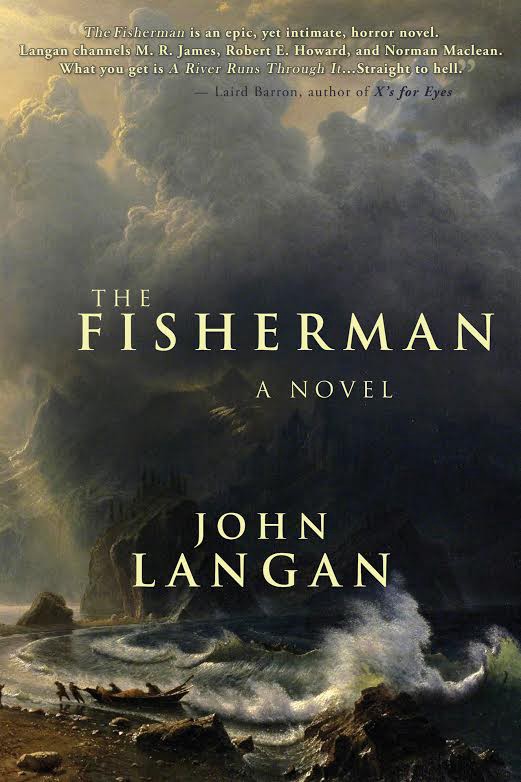
Langan’s fiction often involves stories told within stories, and that’s also true of his new novel The Fisherman (Word Horde, 2016). (It’s one of two books he has due out this year; a collection will follow in the fall.) Set in the Hudson River Valley, it’s about the friendship between two widowers and a trip they make to a mysterious location, and the ominous history that they uncover along the way. There’s a lot to admire in it, from its depictions of grief and loss to the story it tells about the slow economic decline of the region in which it is set, over the course of the last decades of the twentieth century. Oh, and there are monsters, too–some of the most unsettling imagery I’ve encountered in fiction in a long time, and a strain of cosmic horror that takes the style in a memorably different direction. Langan and I conducted this interview via email over several weeks, and touched on everything for the creation of The Fisherman to his feelings on horror to his fondness for nestled narratives.

Tobias Carroll: In your acknowledgements to The Fisherman, you mention that you began work on the novel over a dozen years ago. Was the version as you initially conceived it close to the final version that’s being published, or did it go through several permutations?

John Langan: Oddly enough, given the amount of time between its inception and completion, the novel’s arc is not substantially different from my initial conception of it. From the start, I knew that the book was going to be a kind of weird horror response to Moby Dick; I knew the climax I was writing toward. It was more a case of the novel developing–the word I want to use is “expanding”–as I moved further into it. Which is not to say I didn’t occasionally write myself into blinds; in particular, the climactic confrontation of the book’s story-within-the-story took me a while to arrive at. But the overarching plot structure remained in place.

Carroll: There’s a strong historical component to the novel, including the real-life flooding of several towns in upstate New York to create a reservoir system. When did this piece of history first suggest itself as the backdrop for a longer work of fiction?

Langan: I can’t remember when I first learned about the Ashokan Reservoir; I think I heard some garbled version of its construction when I was an undergraduate. Whoever told me about it claimed that, on a clear day, you could look down into the water and see the top of the steeple of the one of the drowned churches. Even after I visited the actual Reservoir, it was years before I learned that that story was a myth, if a powerful one. That image of the drowned town stuck with me; although I never could seem to find a narrative that was a good fit for it. Then, once I started work on The Fisherman, I knew I’d arrived at the right story for the Reservoir.

Carroll: Much of your work involves storytelling, from the framing device in House of Windows to the tale of Arthurian England told in “Corpsemouth.” As a writer, what appeals to you the most about nestling narratives in this fashion?

Langan: I love stories. In my view, they’re a–even the–fundamental part of what it means to be human. As Salman Rushdie put it, “Man is the Storytelling Animal.” Stories are how we learn the world; how we keep learning it. I come from a family of storytellers: my father was a font of narrative, from funny anecdotes about his time in the British Army to detailed summaries of movies he’d watched; my mother told us stories of her youth, as well as of various family members. I was raised Catholic, and a good deal of my religious instruction came through stories, whether from the Bible or the lives of the saints. I grew up reading the Marvel comics of the sixties and seventies, which were themselves fonts of narrative, and they steered me in the direction of the Greek and Norse myths.

Stories are how we learn the world…

A great deal of the fiction that shaped me as a writer is driven by storytelling: Robert E. Howard’s stories, Stephen King’s fiction, Faulkner’s work. At the same time, as Faulkner and Virginia Woolf made clear to me, storytelling is no innocent affair. I suppose you might call what they taught me the “Thirteen Ways of Looking at a Blackbird” lesson: every story is an illustration of its teller’s perspective. I love the idea of story as something that’s conveying information on multiple levels. I love the idea of different stories within the same work interacting with one another, amplifying meaning, generating new meaning.

Carroll: In The Fisherman, you go even deeper with this idea, with the narrator hearing a story that expands in his mind afterwards. Where did the notion of a nestled narrative of the uncanny that is itself somewhat uncanny come from?

Langan: Actually, that was a late addition to the story. As I originally conceived it, the story within the story was going to be just that, a story, something maybe thirty or forty pages long, of a length that it could be believably recounted within the span of maybe an hour. As the story grew, however, until it was pretty much the same length as the narrative surrounding it, the verisimilitude of it being told in one setting became more of an issue. In my previous novel, House of Windows, I had had a character tell an even longer story over the course of two nights, and despite the example of, say, Joseph Conrad’s work, I received a certain amount of criticism for that choice. I wasn’t concerned too much about the criticism, but I was concerned about anything that might take the reader out of the narrative. I hit on the idea of having the narrative that is included in the novel be a different, fuller version of what my characters originally heard, and highlighting that difference as an instance of the uncanny experience the characters have experienced. While its motivation was rhetorical, I liked the idea of a narrative that was itself supernatural, that had to be told so it could emerge in its fullness, a kind of “Rime of the Ancient Mariner” effect.
Carroll: In the notes on the stories at the end of your collection Mr. Gaunt and Other Uneasy Encounters, you write about the idea of the “trap story,” and how to avoid readers’ expectations. Was there a moment for you when you became determined to avoid cliched aspects when writing horror fiction?

Langan: Pretty much from the beginning–and I mean, back in high school, when I first started writing horror stories–I wanted to avoid those stories where the characters are basically pieces of meat to be sacrificed to the story’s monster figure. It’s one of the temptations of the horror field, this kind of sinister O. Henry form. The problem is, unless you’re a Poe-level genius, these stories tend to be little more than anecdotes, one-note jokes. I wasn’t interested in that; I wanted to write fiction that would linger in the reader’s mind. Ironically enough, I did that by self-consciously revisiting the genre’s central tropes and trying to dig into them. And I did that by investing in character, in trying to create figures whose fates would matter to the reader.

Carroll: I’d been curious about the aspects of The Fisherman that responded to Moby Dick. How did you filter aspects of Melville’s narrative into yours without it necessarily overpowering the story you were telling? Were there any aspects of Melville’s novel that you wanted to touch upon but were unable to?

Langan: When I first returned to writing horror fiction in earnest, I had this idea that I would write a number of stories that were responses to canonical American writers/texts; privately, I borrowed D.H. Lawrence’s title and called them my Studies in Classic American Literature stories. So my early stories focused on Henry James’s work, because I’m a big fan of his: The Turn of the Screw, What Maisie Knew, and “The Jolly Corner” in particular. But I also wanted to do something with Moby Dick, because it’s a book I love, one of those texts where you feel the writer is trying to cram the whole world into it. I didn’t want simply to rewrite Melville’s narrative, maybe substitute a monster for the whale; rather, I wanted to reshuffle its elements, to look at the novel as if through a kaleidoscope. I hoped such an approach would help my novel to avoid falling into either pastiche or parody. As I worked, I continued to sift through Moby Dick, trying to keep in touch with the narrative. I did think it might be nice to have a couple of extra stories in my novel that would have showed Dutchman’s Creek and the Fisherman in a different light–much as Melville does with the whale in some of the later chapters in his novel–but I decided I wasn’t trying to cram the whole world into my book, so it was okay to let those things go. The funny thing is, when I look over my novel now, I realize that there are all sorts of places where it coincides with Melville’s that I was in no way conscious of while I was writing. As an example: I’ve always loved the scene in Moby Dick where Ahab baptizes the harpooners’ weapons with blood. There’s a moment deep in the heart of my book where a group of characters engage in a similar act involving weapons and blood. It makes me think that I internalized Melville’s book even more than I knew, which, given the nature of my project, is reassuring.

Carroll: A lot of your fiction deals with the aftereffects of trauma–whether it’s the tragedies that befall both Abe and Dan in The Fisherman or the PTSD faced by several characters in the title story in The Wide Carnivorous Sky. Balancing the emotional realism of these with more horrific and fantastical elements seems like a substantial challenge–how do you keep the two in balance?

Langan: I think that without the emotional realism, the fantastical aspects of the story don’t have any real weight. At the same time, the fantastical elements give the emotional realism a kind of depth of metaphor from which it benefits. In order for them to function together in a story, it seems to me essential not to distinguish between the two of them, i.e. in the case of my stories, not to think of the tragedies/PTSD as real–with the attendant value that places on them–and the fantastical elements as unreal–with the consequent value that places on them.

…the fantastical elements give the emotional realism a kind of depth of metaphor…

As far as the narrative is concerned, both have to inhabit the same reality, to have the same weight. You don’t want to see one in terms of the other. The moment you start to think, “Look at this clever trope I’ve constructed for loss,” or, alternately, “Boy, these emotions make some nice window-dressing for my cool monster,” you’ve sacrificed a certain richness that I’d rather try to achieve.

Carroll: Near the end of The Fisherman, there’s a brief image that readers of the novella “Mother of Stone” will find familiar. Is that coincidental, or are you working towards creating a unified setting for some of your fiction?

Langan: It’s intentional. As of this writing, I’ve published a good number of stories that have yet to be collected; at least another two books’ worth, after the collection I have forthcoming this fall. In these stories, I’ve been drawing connections, both among the stories themselves and between my work and that of other writers, especially that of my good friend, Laird Barron. I suppose I have in mind the kind of intertextuality you find among Balzac’s fictions, or Faulkner’s, or Stephen King’s. There’s a sense of a world behind the individual narratives, a shared universe (or even multiverse) that lends them an additional sense of depth.

Carroll: How did you and Laird Barron first meet? Did you know from the outset that you’d develop such a personal and literary affinity?

Langan: Laird’s first story in The Magazine of Fantasy & Science Fiction appeared the month after my first story in F&SF. After Laird’s piece appeared, Gordon Van Gelder, who was editing the magazine at the time, sent me an e-mail telling me to check out Laird’s story if I hadn’t already, he thought there was something to it I would appreciate. Gordon was right. Following that, Laird and I struck up an e-mail correspondence that was almost nineteenth century in its formality. From the start, I responded to the ambition and the integrity of what he was doing; he was easily one of the most exciting writers of what I guess you would call my generation of horror writers–and considering that’s a group that includes Nathan Ballingrud, Glen Hirshberg, Sarah Langan, Livia Llewellyn, and Paul Tremblay, among many, many others, that’s saying something. Eventually, we talked over the phone, then roomed together one Readercon. Our friendship was immediate, easy, and profound; really, it was like meeting this other brother I hadn’t know I had. I think it was during one of those early phone conversations that we first hit on the idea of making connections between our stories. I suppose we had in mind the kind of exchanges the old Weird Tales writers had participated in. I’ve said before that Laird is one of those writers who keeps me honest, someone whose work is of such high quality it causes me to up my own game.

Carroll: Is there a particular strain of horror fiction that frightens you the most? Do you generally find yourself tapping into your own fears when you write about the supernatural, or exploring something more conceptual?

Langan: I think any story has the potential to be frightening; though sometimes, it’s only after I’ve finished reading something and am reflecting on it that it has its full effect on me. There have been times I’ve been discussing a story I read literally years before with one of my friends and, in recounting the narrative, I’ll realize how truly scary it was. As far as my own work goes, there’s always a great deal of myself in what I write, including what frightens me. Sometimes, I’ll begin with things I’m afraid of–suffocation, say, or the loss of a loved one–other times, I’ll discover the horror of what I wrote once it’s done and I have some distance from it. Actually, that happens quite a bit: I’ll think about some element of the story that I was particularly pleased with while I was writing it, and see how awful it is. At the same time, I try not to lose sight of what I guess you might call the big picture, which is a view of horror fiction as the fiction of un-ease, of what Stephen King called “a pervasive sense of disestablishment, a sense that things are in the un-making.”

Carroll: For the last question, I wanted to move away from the conceptual and the literary a bit. You’ve made specific references to Scotch in some of your fiction, and I’m curious–do you have a particular favorite?

Langan: I’m a big single-malt fan, and am always happy to try something new. I’m quite fond of Talisker, but there’s a lot to be said for Auchentoshan and Laphroaig, as well. I’ve had the Glenkinchie Distiller’s edition, and that’s very fine, too.

“Home” by Maryse Meijer

In the truck she sits straight, her hands flat on the seat. At a stoplight, seeing that his head is turned away, she opens the door and thrusts one shoulder out into the night air before he catches her arm. He doesn’t pull, just holds her still until she leans in again, slamming the door shut. When the light turns green he lets her go.

I live just down that street, she says.

Maybe on the way back I’ll drop you there, he replies. She rubs her arm.

No, she says. That’s all right.

At the restaurant she eats most of the large pizza they order, picking off the mushrooms and scooping the cheese into greasy knobs.

I need to go to the bathroom, she tells him, and he gives her a look like, So?

Don’t eat it all while I’m gone, she says. Laminated wood squeals under her pals as she slides her hand across the table. She looks over her shoulder, to see if he is watching her. He isn’t.

In the bathroom she pees half-standing over the toilet, while in the stall next to her a woman coughs.

Do you have any lipstick? the girl calls, leaning toward the woman’s ankles. Please?

Sure, the woman says, and a gold tube rolls beneath her stall door.

Thank you, the girl says. At the mirror she traces her mouth bright pink, her hips jutting into the edge of the sink.

You can keep that, honey, the woman says. It’s not so great on me.

When she gets back she sees him sweeping crumbs into a napkin. Despite the hard curve of his bicep his skin looks soft, a little loose, which is how she can tell he is older. Let’s get some beer, she says, smiling as he looks at her mouth. He lifts his hip for his wallet, licks his finger to peel out a five.

Something light, he tells her.

At the counter, a boy in a baseball cap stares at her when she orders a pitcher.

Can I see your I.D.? he asks.

She leans forward, her breasts plumping against her forearm.

No, she says.

Well, I can’t just give it to you without one.

Why not?

The boy sighs. Is that guy your dad?

She shrugs. After a moment the boy turns to pull the beer from the tap.

What’s your name? he asks her.

Ophelia, she lies.

Ophelia?

Yeah, she says. And I need some quarters, too.
She winks when he pours the change into her hand.

At the jukebox she punches in the numbers for a slow song. She dances by herself while men stare at her from their tables, arms curled around their paper plates. He is watching her, too, turned sideways in the booth and sucking foam from the top of his glass. She waves for him to join her and he shuffles to the broken tile of the dance floor.

Don’t tell me you don’t dance, she says, and puts her chin on his shoulder. At first he doesn’t move at all, but eventually she feels his hand at the top of her hip and he shifts from side to side, slower than the music. He smells like clean skin and cotton spread over something sour. She closes her eyes, but before the song is over he stops and says Let’s go.

Back in the truck they sit awhile. She picks at the scabs of her nail polish.

Why did you try to jump out like that? he asks.

I don’t know. I was just kidding.

When she turns to the window she feels his hand on her neck, and then he starts the truck.

When she sees him for the first time she is wearing a tight sleeveless top, short skirt, and black zip-up sweater, with a pair of flats made wrinkled at the heel. Her dirty blonde hair and her makeup make her look older than she is but still not old enough to be in a bar.

He is sitting on the stool closest to the door, drinking beer from the bottle. Shirley Temple, she tells the bartender, who winks at her while topping her glass off with vodka. Three cherries bump optimistically against the ice.

Cheers, she says, turning to him. He nods, tilting his bottle.

I haven’t seen you here before.

No, he says. You probably haven’t.

Want to buy my next one?

He shakes his head. You shouldn’t be having any. It’s only a soda, she says, and he looks away from her, sniffing. He finishes his beer in two long pulls as she watches.

Have a good night, he says, and as he is getting up to leave his eyes rest on her bare thigh. Then he is gone.

The next time they meet he is at the Laundromat, fishing change from the machine. Same jeans and grey jacket. Nearly every washer is spinning as she drags her laundry bag over to him and heaves it up onto a sorting table.

Hey, she says. What are you doing here?

He looks at her like, duh.

The hose on my machine is busted, he says. Oh. Bummer. She dumps her clothes, making a pile for underwear and socks and another for jeans, T-shirts.

How old are you? he asks.

Her head snaps up. What?

You look young.

So?

So what are you doing in bars?

She shrugs, opening a package of detergent with her teeth. She spits out a piece of plastic. I just hang out, she says.

Hang out?

Yeah, she says, slapping some clothes into a machine.

Shouldn’t your mom be doing your laundry?

She gives him a hard look before slamming the machine door.

Fuck off.

He puts his hands up.

She goes out to get a burrito and when she comes back he is sitting on a bench, reading. She sits at a table where she can watch him and flips through a magazine, eating chips and pushing at some spilled beans and cheese with her finger.

What are you reading? she asks. He tilts the book forward in his lap, but she only pretends to read the title.

I bet Cosmo is way better, she says. How to Please Your Man. 101 Ways. She yawns. The edge of the plastic seat bites into her thighs and her leg goes numb.

I hate coming here, she says. It takes so long.

You got that right, he says, and gets up to check his laundry. He’s good-looking, blue eyes and reddish hair, wiry body. They fold their clothes together in silence and she can tell that he is going back and forth in his mind, liking her and not.

You really shouldn’t be drinking at that bar, he says, loading his clothes into a bin. I know, she replies, and for a moment they just stand there.

Well, he says. See you.

Bye! she says, too loud, and an old woman pulling the cotton pills off a pair of socks stares, lips tight as a clothespin.

She knows he will come to the bar that night and she waits for him, holding her bottle of beer between her legs and watching a trio of boys cracking pool balls and smoking. When he comes in and stands behind her she is careful not to look at him. The hair on her neck prickles.

Are you finished with that? he asks.

Yeah. There’s some backwash left if you want it, she says, not taking her eyes off the boys. Do you play pool?

No, he says, and then: Come with me.

She runs her fingers through the sweat on the beer bottle. He waits.

Okay, she says, and she slips from her stool, pulling her jacket onto her arms.

Outside, they stand in front of his truck. He wipes his mouth with the back of his wrist and she sucks in her cheeks.

You haven’t said anything about my outfit, she says.

It’s nice. A little impractical.

She squints. You have a strange way of coming on to girls.

I’m not coming on to you.

She kicks at the gravel. Okay.

He puts his hands in his pockets, takes a few steps away from her, then turns and says Do you want to go somewhere?

He opens the door for her and slams it hard once she gets inside. There is no garbage on the floor of the cab, no empty bottles or cans, no food wrappers or old gum stuck to the dash. They drive for a long time; it’s late, she’s tipsy, and she falls asleep, her head slipping down the window. When she wakes up they are stopped in a steep dirt driveway and he is staring at her.

Oh, she says, wiping saliva from the side of her mouth. Where are we?

My house. Get out, he says, and then adds If you want.

She knows that they are in the foothills about an hour from town, though she doesn’t know exactly where.

The house has a big porch, but that is all she can make out in the darkness. There are no neighbors.

He unlocks the door and stands aside for her to enter, reaching his hand around the jamb to flip on the light. There’s an old brown couch and chair on a balding rug. Shelves filled only with books line the walls, the volumes pulled to the edges in perfect lines. A television rests on the coffee table. In the kitchen there are black pots hanging from the ceiling, a large Formica table. She checks the refrigerator: milk and brimming vegetable bins, big tub of yogurt, a brick of meat in the freezer.

Are you hungry? he asks.

No.

Then go wash your face.

What?

Upstairs. First door is the bathroom. There’s an extra toothbrush in the cabinet.

He starts unloading his jacket pocket on the kitchen table. Clatter of keys and coins, the dead thump of his wallet. She stares at him.

I thought you said you weren’t coming on to me.

I’m still not.

She chews the inside of her cheek.

Go on, he says.

Without another word she turns and heads up the stairs.

Take off your shoes, he calls after her, and she slips them off and drops them over the railing.

In the tiny bathroom she pees and rinses out her mouth, peeling the cellophane from the new toothbrush but leaving it unused on the rim of the sink. He knocks at the door and when she opens it he hands her a stack of blankets.

You can sleep on the couch, he tells her. It folds out.

She stares at the blankets, then back at his face. This is weird, isn’t it?

Is it? he echoes. A door at the end of the hall opens and closes. She goes to the stairs and knocks the blankets around with her foot and then sits down, thinking he will come out for her in a few minutes. When she wakes up she is still there, on her back in the hallway with her socks on.

She finds him in the kitchen, an apron around his waist. Three pots tremble and spit on the stove. The air is thick with the smell of stewing fruit, and the sink, streaked with juice, is full of pits and skins.

Is that breakfast?

No.

Then what is it?

Jam, he says, pushing a jar toward her. Pot holders are over there. Hold this steady.

It takes them several minutes to get all the fruit into the jars, lined and couching steam on the counters. She has seen people do this in movies, but wonders why anyone would do it in real life.

Who eats all this? she asks.

I do.

She begins pawing through the cabinets while he watches her. She frowns. You don’t even have cereal, she says.

There’s eggs.

What about lunch?

What about it?

Do you have peanut butter?

He shakes his head.

What do you eat with the jelly, then? She sighs. We need to go shopping.

He takes an envelope from the top of the refrigerator and hands it to her.

Write down what you want.

Can’t I just go with you? Sometimes I don’t know what I want until I see it.

No.

Well, get something good, like chips or something.

No chips.

She rolls her eyes.

Do you like fruit? he asks.

Some of it. Bananas.

Okay.

I also like ice cream, she says.

When he returns she is sitting on the back porch steps, eating a piece of bread and butter and some of the new jam. She can hear him in the house, tense footsteps upstairs and then down the hall and through the kitchen. Finally she hears the back door swing open but she doesn’t turn around.

Get in the house, he says. She licks a spot of jam from her thumb.

Back already?

Did you hear me?

Calm down, she says. She pushes herself up and squeezes past his body in the doorway, her shirt tangling against his. In the kitchen she reaches into the paper sack on the table and frowns.

You didn’t get any ice cream, she says, clutching a bag of mushrooms.

They didn’t have any.

Idiot, she groans.

Every morning for the next three days he leaves the house for a few hours. While he is gone she watches television, or sleeps on the couch, or looks through the magazines he brings her. In the evening they play cards cross-legged on the rug or at the kitchen table. Rummy and Snap and War, with the radio on to something she likes. The he goes to bed and she stays up late watching more TV. Once while he is gone she goes to his room and opens his dresser drawers, digging beneath the neatly folded T-shirts and underwear. She finds some money, small bills, and an envelope full of receipts. She doesn’t think about how many days pass or who might be missing her or what she is doing. She is just waiting for the next thing to happen.

One morning over his newspaper he says You smell like a bakery.

Like a nice French place or an outlet? she asks.

Outlet.

She looks down, pulling her shirt away from her chest. I need to get some clothes.

Now?

We could just stop by my house and I could —

No, he says.

She looks at him for a moment. Then we could go to the Goodwill, it doesn’t matter. But I don’t have any money. Can’t we wash stuff here?

The washing machine hose is busted, he says. Remember?

Oh. Well then, I guess you’re taking me out. She smiles, but he doesn’t smile back, and she can see him thinking, that he is upset.

What? she asks, reaching across the table to pinch the back of his hand. He flinches. Don’t you like shopping?

Outside, in the driveway, he asks her to lie down behind the bench seat of the truck.

You’re joking, she says.

Just lie down there. It’s clean.

Why? she asks, but he only looks at her. She waits to see if she feels scared, but she doesn’t. She climbs in. On her back, with her knees drawn up, she thinks, This is really fucked up. He drives carefully so as not to bump her.

You all right? he asks.

She presses down on her skirt. I’m fine, considering, she says. The truck vibrates all the loose flesh on her body and she has to clench her teeth to keep them from rattling.

Can we have the radio at least?

He flips it on, but all they get is static.

Kandy’s Super Thrift sits on a wide strip of road she has never seen before, bookended by gas stations and hamburger stands. Inside, half a dozen plastic fans whip up a breeze and a few sulky-faced girls snap gum at each other and spin the knobs on a black-and-white television.

Some dump, she says, idling through the racks, pushing at the clothes that have fallen to the floor with her foot.

What do you think about this, she asks him, holding up a white top that says I’m Your Petty Cash.

I don’t care.

She plucks a straw hat from a dented foam head. This?

Would you hurry up? he hisses.

She drops the hat and continues digging around in another row. It irritates her that he seems irritated, that he keeps his eyes on her like a giant unhappy bird. She sees a gap in the aisle, just big enough for her to fit through, and on the other side, the door.

Where do you like to shop? she asks.

He rubs his forehead.

The mall? I bet you go to the mall, she says. I bet you shop at the Gap.

You have five minutes.

Just let me try these things on, she says, holding out her arm, over which clothes are slung like slack bodies. You can come with me if you want, she adds.

No. Whatever doesn’t fit I’ll bring back.

She shrugs. You’re paying.

You seemed older when we met, he says as they walk out to the truck. More mature.

You seemed normal, she snaps back. Less nuts.

When they get home he runs a bath while she watches.

Get in, he says.

She turns her back to him, undresses. He sits on the edge of the tub. She slips into the water.

You have a grout problem, she says, shaving her legs with his razor. It’s missing in a lot of places.

Mm, he says.

Will you wash my hair?

He stares. Why?

She stares back, then shrugs. Nicer that way.

Scratching his jaw he sighs. Close your eyes, he says, and kneels beside the tub.

She leans forward, her chin on her knees. He scrubs shampoo in circles over her head, this thumbs hard against her scalp. He does the conditioner, then puts one hand on her forehead and the other on the back of her neck and lays her down flat in the gray water.

Rinse, he says, the ceiling light bright behind his head. From beneath the water she looks straight up into his face. When she is finished he squeezes her hair into a rope that drips over her shoulder.

You’re all set, he says.

As she gets out of the tub water slops over the porcelain and onto the floor. She stands in front of him, water slowing in the hair between her legs. He reaches up to touch her face. She opens her lips and he pushes two fingers past them and as she closes her eyes she thinks, Now. But she is wrong.

Because she wins the next night’s game of Rummy she is allowed to have one beer.

Toast me, she says, lying next to him on the living-room rug. She tips the neck of her bottle toward his.

No chance, he says. You cheated.

She laughs and forces the lip of her beer into his. When she is finished drinking she turns toward him, propping herself up on her elbow, her fist against her cheek.

So where do you work? she asks.

Slaughterhouse.

Oh, she says. She can’t tell whether he is joking or not. Do you have a girlfriend?

He shakes his head.

Why not?

He shrugs. Just don’t.

You have me, though.

He grunts, taking a long swallow of beer. She scoots closer to him.

Your hair is in my face, he says. She leans down to kiss him and he kisses her back. She tastes alcohol and that night’s spaghetti sauce. His eyes are closed for a moment but when she lifts her leg and spreads it over his hip, reaching for the zipper on his jeans, he puts his hand on her chest.

Stop, he says, sitting up.

Why.

Because.

Don’t you like me?

I like you, he says, rubbing his eyebrows. I like you.

Why, then? Why not?

He gets up and takes the bottles to the kitchen, throwing them into the trash so hard they crack. She follows him in, hands on her hips, and he turns to her and says Don’t you know anyone who doesn’t try to fuck you?

She flinches. You’re the one who brought me here! she shouts. We do the same things every day and you never want to go anywhere and I have to lie down in your stupid truck on the floor and you make me —

I don’t make you do anything, he cuts in, flinging the back door open. You want to go? Get out.

Fuck you! she screams, kicking the door shut so hard the windows rattle in their frames. His face twitches.

It’s late. You should go to bed.

Would you stop telling me what to do?

Early the next morning she goes to his room. He is lying on his side beneath the sheets, one rough cheek resting on his bicep. Everywhere there is cracking plaster, more bookshelves, painted dresser with its drawers shut tight. Water and a cluster of keys stand on a little table beside his bed. Everything feels familiar to her but also strange, because she sees so clearly the pieces but not how they fit together.

Come here, he says.

I thought you were sleeping.

No. I don’t sleep very well.

She shuffles toward him until the backs of her hands brush against the mattress. He makes room for her and she lies on her side next to him, her breasts chafing against her T-shirt.

He touches her eyebrow with this thumb. I’m sorry I made you lie in the back of the truck.

It’s okay. She tries to look him in the eye but she can’t.

Go to sleep, he says, and somehow she does.

When she wakes up he is gone. She rinses her underwear and shirts in the kitchen sink and when he comes home he sees her clothes slung over the shower rod, dripping on the floor, and he stops and says Didn’t I tell you I fixed the washer?

That evening he says he wants to go for a walk. Outside, it’s still light. It’s too cold, she says, stopping at the bottom of the porch, but he doesn’t turn around.

You should have put on a sweater.

She throws her hands up. This is exactly what I’m talking about. You always want to do something that doesn’t make any sense. She considers turning back, but instead kicks at a rock and keeps going.

They walk about a mile and then there is a loud cracking noise, like a gunshot.

What’s that?

Just a branch, he says. We can go back now if you want.

No, she says.

We can.

No, she says again. Chase me.

He looks at her.

Come on, she urges.

Okay, he says. Run. She takes off into the trees.

As soon as she knows she is out of sight she stops, leaning against a tree, the air on her lips brittle as she catches her breath. The sky is hooded with leaves and where the sun melts through it turns the dust in the air to gold.

You’re fast, he says, coming up behind her. She stumbles away from the tree.

Shit, she says, still panting. You scared me.

Should we go back?

Not yet.

Then what now?

She smiles. Now you have to kill me.

He pushes his hands into his pockets.

Yeah?

Yeah.

And what if I want you to kill me?

She blinks. What?

Go ahead, he says.

She reaches out and touches his stomach with the palm of her hand, running it up to his chest and then down past his belt while he watches her. She wonders about beauty, about the way he looks right now — older and folded in on himself — and the heat in her body that will not stop.

Aren’t you going to hit me? he says.

Her hands slide off him and she takes a small step sideways.

Don’t be scared, he says.

I’m not, she says.

Then hit me. He lifts his chin. Come on.

I can’t.

Yes you can.

When she sees him raise his hand she thinks for a moment that she should try to stop him, but she doesn’t and he hits her, hard, across her face, kicking her to her knees. He crouches down behind her, an arm wrapped tight around her waist.

What do you want? he asks.

Tell me I’m beautiful, she says.

You’re beautiful, he says into her ear, and then again into her hair. You’re beautiful. Her shoulders start to shake.

Listen to me, he says. You have to go home.

No.

You have to.

No, she says, sinking her fingers into the ground.

When I count to ten, he says. One. Two.

Why? she whispers. I don’t want to.

But he keeps counting. And when he gets to ten he lets her go.

Gay Talese Backtracks from Denouncing His Own Book

The April 11th issue of the New Yorker held a long exerpt from Gay Talese’s forthcoming book The Voyeur’s Motel. The book chronicles Gerald Foos, the titular voyeur who spent decades watching the guests of his Colorado motel have sex through a special viewing platform he built in the ceiling. Foos recorded his findings (number of orgasms by gender, race of couples, etc.) and presented it to Talese as a sort of cultural study. In a particularly film-ready twist*, Foos claims to have witnessed a murder in his motel in the 1970s, when a drug dealer strangled his girlfriend.

*In fact Steven Spielberg has already bought the movie rights to the book.

The piece immediately evoked questions about its journlastic ethics, but it wasn’t until the Washington Post fact-checked the article that Talese found himself in truely hot water. The Post discovered that Foos lied about various events, most notably the fact that he didn’t own the hotel for a period of eight years in the 1980s. Faced with the inaccuracies, Talese recounted his book on Thursday, saying, “I should not have believed a word [Foos] said. I’m not going to promote this book. How dare I promote it when its credibility is down the toilet?”

Days later, Talese changed his tune. The journalist claims that he stands by the story as he told it in the book, which is to be published on July 12 by Grove Press. He released a statement saying, “Let me be clear, I am not disavowing the book, and neither is my publisher. If, down the line, there are details to correct in later editions, we’ll do that.”

It may not be a surprise that this isn’t ending well (as the Post dryly noted, “So the guy who made elaborate amendments to his Colorado motel in order to spy on the sexual activities of his paid guests turns out to be very, very unreliable”) but The Voyeur’s Motel is furthering the already rife debate on the problems with new journalism, and more specifically new journalism’s fact-checking problem. The Daily Beast said, “At first defiantly defensive, then abjectly apologetic, and then pitifully self-flagellating, Talese made a variety of clashing statements to Farhi between Wednesday and Thursday, as though the the author was transitioning through Elisabeth Kubler-Ross’s “Five Stages of Grief.” The Huffington Post noted, “There’s something very A Million Little Pieces about the sequence of events that has unfolded.”

Twitter, already on Talese’s case for misogynist comments he made at Boston University this spring, has also taken Talese to task.

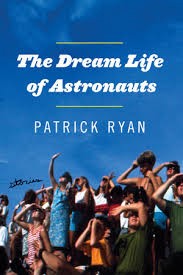
Patrick Ryan on Families Living in the Shadow of NASA and ‘The Dream Life of Astronauts’

Patrick Ryan’s latest, The Dream Life of Astronauts (The Dial Press, 2016), is an exquisitely crafted collection of short stories set in Merritt Island, Florida — better known as the home of Cape Canaveral. The space program forms the backdrop to each of the book’s nine tales, which span the period between the 1969 Apollo 11 launch to present day. But the author’s intimate, character-driven narratives draw their power more from family dynamics than they do launch pads or rocket boosters (even if both of those make appearances). In “Earth, Mostly,” a single woman learns to appreciate her precocious granddaughter following an awful date with a twisted driver’s ed instructor; a young boy develops a relationship with his hippie uncle while alcoholism wipes out his parents’ marriage in “The Way She Handles”; and the title story sees a gay teen thrilled to befriend a former astronaut, only later to realize that he’s become an underage sex-aid in the spaceman’s flailing marriage. Throughout the book, children and adults come into conflict with frequently moving — and darkly comedic — results.

Currently a contributing editor at One Story, the editor of One Teen Story (and a former editor at Granta), Ryan writes with authority here in a staggering range of narrative voices: a mobster in the witness protection program enforcing the pool rules in his housing complex, say, or a nonagenarian who harangues her nursing-home roommate for stashing “pornos.” It’s clear Ryan takes delight in such Floridian weirdness. The author grew up in the NASA part of the Sunshine State and renders his characters with a local’s precision and wit. I caught up with him over coffee in Midtown Manhattan to discuss the importance of creating sympathetic bad guys, why good fiction is always about what’s going wrong, and the funny, awkward and revealing nature of good writing about bad sex.

Jonathan Durbin: The NASA backdrop in this book lends it such an Americanness — you can almost taste the Tang.

Patrick Ryan: I’ll tell you something scary: they still make Tang. I watched the ’69 moon launch from my driveway, and that was exciting, But when I was growing up, everyone’s parents worked at NASA, so no one thought much about it. Our house was 20 miles away from the launch pad. The rockets would go off and they’d rattle the doorknocker. Pictures would move. You’d feel the ground rumble. And if you wanted to, you could go outside and watch the big ball of flame climb into the sky.

Durbin: Your parents worked there?

Ryan: Yeah. My dad had a job checking out camera equipment to the NASA photographers and my mom was a secretary at Technicolor. Every once in a while, if you were the family of a NASA employee, you would get a pass to see the launch closer up. But it wasn’t the VIP area; it was a field. I remember one time we were sitting out there late at night waiting for an Apollo launch that was scrubbed. It was the first time I’d seen a preying mantis. They were walking on us while we sat there, waiting.

Durbin: Did you want to be an astronaut as a kid?

Patrick Ryan

Ryan: I did. Anything that had an astronaut it, I loved. I was crazy about The Six Million Dollar Man. Space: 1999. Marooned. Like any good kid back then, I was crazy about all the Planet of the Apes movies. I most definitely wanted to be an astronaut if it meant having my own movie or TV series.

Durbin: Have you always been drawn to writing about Merritt Island?

Ryan: I tried not to, at first. I was always bent out of shape about being from such a boring place. But when I went to college and started putting stories up for workshop, people were always interested in the locale. I paid attention to that.

Durbin: This was when you were at grad school in Ohio?

Ryan: Yeah, at Bowling Green State. There’s one story in the book, “The Fall Guy,” that I wrote a very early draft of when I was in grad school. And it became one of those stories that just wouldn’t go away. I kept revisiting it and fiddling with it for years.

Durbin: The space program mainly forms the backdrop for a lot of these stories, sometimes in devastating ways. “Go Fever” is set just following the Challenger disaster. Until I read that, I hadn’t considered how people who worked on Challenger must have felt.

Ryan: I was spit-balling when I first wrote that — I never talked to anybody. But around the time Catapult published that story, on the thirtieth anniversary of the launch, I heard this NPR profile about an engineer who had worked on Challenger and had suffered horrible guilt. He’d gone to work saying, don’t launch, the O-rings are going to break, it’s too cold. But it was that go-fever thing: the higher-ups wanted to stay on schedule. The profile on this guy sparked hundreds of letters — people wrote him, telling him that he’d done his best and had certainly done nothing wrong, so he finally had some piece of mind. And he died two months later.

Durbin: That’s sweet and terrible. It’s obvious, but there’s so much narrative potential in the space program.

Ryan: Do you know about William Safire’s speeches for the ’69 moon launch? He wrote two for Nixon. One of them was the one he gave — hooray, these guys are heroes. The other one was written for the opposite scenario: what if they got up there and if they couldn’t leave? NASA was pretty sure they’d be able to land them on the moon, but not so sure about getting them off. If they got stuck up there, the plan was to say goodbye, let them talk to their families, and then shut down communication.

Durbin: My god.

Ryan: You can read the speech Nixon would have given. It’s basically saying to America: and now we thank these guys for their heroism and bid them farewell. Think about how weird that would have been. Everyone can see the moon! And the astronauts would have been up there, alive, until their air ran out.

Durbin: Nixon comes up in the first story in the collection, “The Way She Handles,” and throughout The Dream Life of Astronauts you address a kind of waning optimism — the enthusiasm of the ’60s being confronted by the realities of the ’70s. Your younger characters are always being disappointed, usually by the adults in their lives.

Ryan: The adults are all exhausted and the kids are all optimistic and sugared up. That probably goes back to my relationship with my dad. He wasn’t the most chipper guy on the block. I would say to him, I want to be a doctor. When I was maybe six years old. I want to be a doctor, or a pilot. Or an astronaut! And my dad would shake his head and say, “It takes an awful lot of training to do that.” That would be his whole response. You know — set your sights a little lower. [laughs]

Durbin: That sense of tamping down comes across in many of your pieces. Still, there’s an obvious sympathy for the adults. They’re not bad people. They’re just worn out.

Ryan: I want to write about characters who are earnest in what they’re trying to accomplish. Villains don’t see themselves as villains — that’s what interests me. No one wakes up and says, what kind of monster am I going to be today? Like the scoutmaster in “The Fall Guy” who tells the little boy, Julian, that he looks like “a goddamn girl.” The scoutmaster is dealing with his sons’ having bullied that kid, which is humiliating for him. But he’s also trying to give Julian what he thinks is a sound piece of advice, which is that Julian is bringing it on himself. Like, if you would just cut your fucking hair, people will stop bullying you. It’s awful advice, but he means well.

Durbin: [Laughs] I’m reminded of the grandmother character in “Earth, Mostly,” too, who offloads her granddaughter onto her friend so she can get to that date with her driving instructor — which goes so disastrously.

Ryan: I’d been working on that story for months, and I knew that date wasn’t going to go well, so I started to feel kind of like an asshole, thinking I was getting off in a way, enjoying knocking this character around. Then I started thinking, well, I’m the one pulling these strings. She wants to get laid, I’m sure, but she also just wants a boyfriend, and then this happens? I had to work through that, where I wasn’t feeling like a puppet master who was enjoying one of the worst days of this woman’s life. That was my plan, though. From the get-go, I wanted to give this character one of the worst days of her life.

Durbin: The scene she and the driving instructor share in the motel room is so awkward. It’s also hilarious.

Ryan: Good fiction is always about what’s going wrong, isn’t it? I have no interest in writing about actual sex. Well, I have no interest in writing about good sex. But it’s fun to write about people edging into that situation, particularly for the first time with someone, because self-consciousness starts to take over.

Good fiction is always about what’s going wrong.

My only interest is in writing close to a character. Even with Clark Evans, the astronaut from “The Dream Life of Astronauts,” who really is kind of a dick — I feel sorry for him. That helped me write the sex scene because he’s obviously got issues. He’s seducing this kid, Frankie, because he and his wife have come to this arrangement. The fact that Clark sits off to the side during that scene, that he doesn’t even have an erection, that he tells Frankie and his wife that he’s not even in the room — there’s something sad about that.

Durbin: Another opportunity for empathy.

Ryan: Right. Many people feel powerless in their lives, and it makes them act out in unfortunate ways. One of the unfortunate things with Derek, the talent scout from “Miss America,” for instance, is that he’s a grownup and he doesn’t realize the power he holds over the two teenage girls in that story. Not just that he could lure them into doing something unpleasant, but that they’re looking to him for something. It’s like the narrator in “The Way She Handles,” too, and his uncle Robbie.

It’s unavoidable that kids turn into adults who are going to disappoint and frighten children.

Robbie gets kicked out of the house. He has to leave. But when the narrator speaks at the end and says that he was mad at his uncle for that for quite a while — that felt sad and true to me. It’s unavoidable that kids turn into adults who are going to disappoint and frighten children.

Durbin: And it seems like age is just a number. In “You Need Not Be Present to Win,” the main character is seventy, but even so, he’s still a kid in relation to his ninety-year-old mother — and yeah, she’s disappointing him.

Ryan: The impetus for that one was my dad’s relationship with his mom. His mother was a wicked person with a long history of being awful. She died on the phone in the middle of an argument. When my dad was in his sixties, he had one last visit with her, and afterward he said, “I’m done with her.” I said, “What do you mean?” He said, “The next time I see her, she’s going to be in her coffin.” Ouch, right? And that was exactly what happened, and where the idea for the story came from. It’s a dark little note to end the book on.

Durbin: But it’s also optimistic, in a way. Many of your younger characters are trapped, but here the son takes action to better his circumstances. I read it as a positive outcome. It opens things up. Also, that story has a killer title.

Ryan: Ann Patchett gave me that title. I was working on something that didn’t make it into the collection, trying to write about these parents who were scam artists. She said, “Oh, you could call it that thing that’s printed on the back of raffle tickets — you need not be present to win.” I guess the ending to that story is kind of optimistic. I wanted “Miss America” to have an optimistic ending, too, because people are at least trying to rise to the occasion.

Durbin: You do that in a couple of places. In a bizarre way, “Earth, Mostly” also ends on a positive note.

Ryan: I thought that one was pretty bleak!

Durbin: It is, but the grandmother and Becca come together in the end.

Ryan: They’re bonding, yeah. They’re bonding over their bad attitudes. “My only babe. My sweet lover!” That line never changed. That was in every single draft.

Durbin: Did you write to that line?

Ryan: No. I only knew the grandmother’s date wouldn’t go well, and I knew that I wanted an ending where she was breaking down. She’s had this awful day and at the end she’s grabbing her granddaughter for comfort. I wanted her to say something that was a little off. I crossed my fingers because I feared my editor would ask, why the hell is she saying that? He didn’t. It’s weird but I knew it was right. Becca says, “Everyone’s awful!” and her grandmother has a moment of revelation that almost borders on panic.

Durbin: You take on many different perspectives in this collection, with so much authority. Are any of these narratives autobiographical?

Ryan: None of this is based on my actual experience. Well, almost none of it. A little of that boy-scout stuff in “The Fall Guy” is based on what I went through. I had a scoutmaster who had two sons; in real life only one of them was mean. The incident on Julian’s birthday in the story, that happened. Word for word. They lived right down the street from me. They would turn into my driveway and honk and I would get in and go to the scout meetings with them. I was around eight years old, and when they showed up that evening, I remember running out of the house, all happy, and the scoutmaster asking why I wasn’t in uniform. I said, “It’s my birthday!” and he said, “What’s that got to do with anything?” and then told me I’d lost my voting privileges and put the car in reverse. [Laughs] I was so afraid of him.

Durbin: Was there anything in writing these that surprised you?

Ryan: The end of “The Way She Handles,” that wasn’t planned. I decided to pull back in order to look at the narrator’s life from a later vantage, and it was thrilling. It was like running on a decline — you realize that the decline is giving you a momentum, and that you’re not entirely in control anymore. I’d never had that experience before. Normally, I’m so controlling. I write so slowly. I rewrite constantly while I write. That’s not a brag — it’s a problem. I write ten words, I take five back. Nearly every writer I know says the point of a first draft is to knock it out, but I can’t. I write a paragraph, and I can’t write the second paragraph until I feel like the first one is in okay shape. It’s not a great way to work. If I have a rare, three-hour session, say, and I write three pages? That’s Olympic. So this was a rare instance where the whole last part of the story came to me in a rush. I looked back on it and thought, how did I get so lucky?

The other thing was that when I started that story, it was about a boy and his uncle. I knew that the tension in the parents’ marriage was going to be displaced onto the uncle, and that he was going to be the scapegoat. But by the time I got to the end, I realized that the story was actually about the parents and the impact of their drinking — and that, really, the story was about the mother. If you write a moment with a character, especially if it takes you by surprise, and it feels true, you’ve got them. When the uncle shows up, rolling out of this pot van, and the mother comes running out, squealing as if the house were on fire — as soon as I wrote that, I was like, now I’ve got her. I’m good to go. It’s all about what feels true for the character.

Durbin: You’ve been revising many of these stories for years — no mean feat. How do you keep yourself interested in a story during that process?

Ryan: Revising a story that you don’t believe in is like making out with somebody you’re not attracted to. [Laughs] After I showed my editor a few of the newer stories, I told him about some of the older ones that were also set on Merritt Island. He said he wanted to see them. I said something like, “I don’t want to show them to you because I wrote that one in grad school, and I published that one in a really small journal a hundred years ago, and that one I could never publish anywhere, and I’m not really happy with any of them now.” But I agreed to look at them and see if there was anything I wanted to revisit. There was no rush. It wasn’t like scrambling around. I just slowly started to investigate the possibility of rewriting a few of those stories. Rebuilding them from the ground up. The experience of doing that — and then getting edits back and rethinking and retooling — was just as thorough and messy and great as diving into the brand new material I was working on.

Durbin: How does being an editor inform your writing?

Ryan: I think it makes me a better writer, which makes me a better editor — which, in turn, makes me a better writer. When I worked at Granta, John Freeman and Ellah Allfrey were very big on authorial intent, an idea that had been in my head but that I’d never heard anyone articulate before. It means that if you’re an editor, you try to get a handle on what the author is going for and help the author get there. As opposed to working against what an author is trying to do. I think about authorial intent a lot now, and that cycles back around to when I’m sitting down to work on my own stuff. I’ll think, I’m messing with the author’s intention here, and I am the author. [Laughs] But that’s what interests me.

Durbin: Do you feel like you’re still figuring out what makes a short story work?

Ryan: Yeah. Every time I sit down to write one. The thing is, I never want to be done learning how to do this. It’s not like riding a bike. Why in the world would I want to do it if I weren’t still figuring out how to do it? That’s half the fun.

About the Interviewer

Jonathan Durbin’s fiction has appeared in One Story, Electric Literature’s Recommended Reading, Catapult, New England Review and elsewhere. He is currently working on a novel and a collection of short stories.

Fleeting Interference

Vanity

…I was not a mistake is what my humanity thinks, I cannot
go somewhere
else than this body…

— Jorie Graham, from “Embodies”

Alone, spring cleaning, homekeeping, feeling feelings, it starts hailing, drifting pillars plinthing terra cotta pots on the front porch like the forts of malicious little elves. No doubt the palm will die. The fern will die. The succulents might live, fat tough tender bitter little camel plants. Chilly springtime apprehension: I actually believe that were I either more or less succulent you would want me more, but being only more-or-less succulent you want me less. Do all women think this? — succulence ambivalent “in today’s society” as my students say. Elf-shot, star-eyed like a manga girl, solidly early-mid-thirties, alternately lacking and over-abundant in succulence, solitaire is not better, but it’s less worse. I feel less bad writing mean small verse like this, sleek seal barking I I I I I. I feel less bad naked making faces in the mirrored window under the dismayed gaze of only hail, painting, for the first time in fifteen years, my nails. In the wide world, a lady’s or a ghost’s appearance: fleeting interference. Nightfall: the huge low wan moon like a woman’s belly and my heart in my body a cold calm grey clam, blind pretty pearl-dark many blue-eyed ugly one-foot thing. You’re lovely, you said, on a loop in my head; I’m lovely enough, I get it done. Next time you feel the hot flush of shame, think: how much more can you take of it? A lot, I bet, before you die of it. Try it. That’s what being female is like.


Vulnerability

I am shame and boldness.
I am shameless; I am ashamed.

— from the Thunder, Perfect Mind

He’s a hard drinker, and a hard worker. He’s hard. And when he’s here he’s hard, and when he’s not I watch The Wire (fat bass and splatter patterns and pussy) and want shoots through, vein of water through colder water. However: in public: at a club: we don’t touch. Remotely, checking texts, we don’t speak or blink, too busy dreaming things to do with lips and hands and tongue and hips. You thump. You yell, How dumb, but what’s dumb, I can’t tell. It’s loud. You stunt. I melt. You pun. What old news we are, most ancient and most boring story: They circled — he purpled — she lushed out. Lost on the long road of body, I’m in control until I’m not, hard left, steep drop. Some pressure system, some weather coming, the bowl of hail I have at home (for whom, if not for you?) turned to dirty water. Mazed, drenched, plucked string, gutbucked, feigning boredom: all the while my mouth in my mind is limned with your cum. Oh my creature nature! — oh my baser butcher, my lower lever, gone honor, never lover, please impose. What’s over? — please advise. Don’t ghost just yet, don’t jet, two fingers templed in relieved goodbye (that tense salute only men do), come back, come by. Both floored, who now can wreck the wall of cant? — we can’t, we set it up, we sealed us off, and now, what’s done?, I’m gone, it’s not a crush, it’s not enough, I want I want I want I want I want I want I want. Watching The Wire with great desire: come at me, motherfucker. I’m on my knees and I’m not going anywhere.


Valediction

…Living as he does much of the time in a world of metaphor, the poet is always acutely conscious that metaphor has no value apart from its function; that it is a device, an artifice. […] It is the only useful purpose they do serve in society: and if every poet were to vanish tomorrow, society would live no longer than the quick memories and dead books of their poetry.

— Thomas Pynchon, from V.

Before you go, here: clasp me dearer. For seven years up and down the Puget Sound I have followed you, beauty, your splendid heart a live coal chasmically perched. Look up for a moment: what are you seeing, where have you taken me? Is it treasured? Will you tell me? Know with the slow intelligence of lichen that what we feel between us is grounded, locable, occurred at this fungal chorus, this fairy ring, this sound water slapped with light. As harbor seals are undeterred by the filth of the city, you can find me, always, right here. As scolding gull and scolding crow dart among the needled maws of pines, mottled oxblood-pistachio of the doomed, dermatological madrona, all saying: stay: and knowing we won’t; the dark truth is it’s all part of us, pillar of logs by the dock bound with I don’t know what, fawn running from I don’t know what, vexed wasp eternally circling for sweetness. When we give ourselves to each other, the ceaseless struggle not to cringe away with suppliant eyes saying, Forgive this incident, oh, trust, love, don’t I know it — but it’s not worth it. I’m not ashamed of needing you as much as I do, and I do: when I say I love you, I mean you, you. Now: take my fingertip in your mouth. Can you taste the sap and fur and urchin spine and salt and rock and rust of the wild-for-to-hold northwest? Kissing-close the moment of closing; we’re still here together for now, dual oysters tonguing our precious grit. Trace your hands along this spine. We’ll fold us closed to end it.

Ramadan Diaries

I sat in this mosque today and prayed using Arabic verses my mom taught me. I don’t know what they mean but they’re in my head all day. More than I care to admit. Am I a prayer parrot? I sit in the mosque and try not to think about my career or hot hot sex with that barista or how bad traffic is gonna get when everything is underwater and it’s all bridges. I try to be thankful.

To me prayers are like the rules of the road. I kind of trust that they are working and keeping me safe. I’ve never lived without them, so I just don’t know.

To my mom, prayers are the entire limitless everything. Best of all time. #1 A+ Chinese Food. I really wish I could have her faith. She just texted me a video of grass blowing in the wind and wrote that the grass is praying. That literally just happened.

To me prayers are like the rules of the road. I kind of trust that they are working and keeping me safe. I’ve never lived without them, so I just don’t know.

I’ve gone through heavy heartache this year. It seems like some people deal with breakups by moving forward, like a cat you push off your lap that walks off to find some space in the dining room to download Tinder. I’m a cat that gets pushed off a lap and stays in that same room for months, displaying my asshole prominently as I saunter slowly around thinking of nothing but how amazing that lap was. Are these white people problems? Worse. These are house cat problems.

Maybe the grass is praying. Maybe we are powerless in our lives. Maybe sitting in a coffee shop thinking about analogies and prayer and love and feeling my stomach start to grumble is a waste of time. Maybe this barista will ask me why I’ve been here for so long without buying anything, and I’ll say that I’m fasting for Ramadan, and she’ll say, “Do you want to have hot hot sex?” and I’ll say, “Sure, just not on the grass.”


Ahamed’s Ramadan Diary — 6/9/2016

If you’re thinking of buying a self-help book and you can afford to buy a self-help book, do yourself a favor and buy a cowboy hat instead. A cowboy hat will actually make you feel better.

Self-help books sit in a huge shelf of various answers to life’s emptiness.

Seven Habits of Successful Slave Owners, Lose Touch With The People Who Love You and Prosper, Stop Caring and Just Care, The Codependence Cookbook, Enlightenment Through Spite…

Building Your Resentment Tent.

I Want To Smoke a Cigarette.

The Last Dad You’ll Ever Need.

How to Kill Your Enemy in Two Minutes or More.

I’m OK, You’re OK, Steve is Not Doing Great.

Didn’t You Want to be An Actor at Some Point?

Don’t Date, Wait.

Wherever You Go, There You Are, Bad At Things.

Don’t buy any of these above self-help books. Buy a cowboy hat.

When you put on a cowboy hat, everything changes. Look in the mirror, I dare you. You’re so handsome and pretty. You look GOOD, Steve. You’re doing great.

You kiss the brim of the hat. All the way around. You put the hat in your closet. Goodnight, sir, thanks for the shade haha.

Obama just sneezed. You feel it. He’s almost done now.

Tonight you’ll fall asleep in a poncho you purchased in Taos, New Mexico. You dream of a piece of warm toast deep in a lion’s den. It’s a metaphor for the husband you want to become.

It’s 7:50pm. I am sitting in a bookstore. I will eat at 8:04pm. I’m very very hungry.


Ahamed’s Ramadan Diary — 6/13/2016

I want to preface this by saying that I wouldn’t be considered a “real” Muslim by many Muslims. I’m okay with that. This won’t be a scholarly perspective on what just happened. I’m also not gay, but during Ramadan I sometimes feel sexually attracted to my refrigerator, and my refrigerator identifies as male.

I’ve been inside many mosques during my lifetime and felt safe in all of them. I’ve never been to a gay nightclub, but I’ve heard it’s another place where you can feel safe. Another place where you can find God.

I’m sure the comparison between the two is offensive to some, but there’s never been a better time to make it. Aren’t they both places of refuge? Places where oppressed Americans go to be themselves? Places where fear shouldn’t get in the way of love?

I’ve been a part of homophobia. At my all-boys private school we teased and bullied the more effeminate boys until they left. At their new school, finally safe, they would come out and we’d see it on Myspace and laugh. I was a part of that ugly process.

I’ve never been to a gay nightclub, but I’ve heard it’s another place where you can feel safe. Another place where you can find God.

I’ve seen Islamophobia. I remember 9/11, when a close friend quickly blamed the “Muslims” for the attacks. We were 12 years old. He had forgotten in that moment how I was raised. He had forgotten because I don’t look Arab.

After 9/11 I saw in my parents a different fear, a fear of our own government. As Muslims, they worried our phones were being tapped, our mosque was being monitored, and our lives would be affected by a large anti-Muslim movement.

Seeing both sides of this problem as a child was rough and confusing, but seeing it now is much worse. I guarantee we will watch politicians adopt pro-LGBTQ policies to defend their anti-Islamic ones. I guarantee children all over the country are being told by their friends, like I was, that this is a Muslim problem.

Blaming this attack on Islam is like blaming global warming on the sun. The problem is not who people are, but how we treat them. It’s the responsibility of the individual to recognize that we are all part of this larger problem. The shootings across the country, including this one, are a result of fear. That fear is the result of exclusion. Exclusion is the process of rejection, of keeping people out of our lives. This isn’t an Islamic practice, it’s a human one.

Donald Trump wants to solve this problem by keeping Muslims out of the country. He wants to solve this exclusionary hatred by increasing its scale. He wants to solve radical behavior by acting radical. He wants to create fear in Mosques as a counterattack to the fear that will now be felt in gay nightclubs. An eye for an eye will make the whole world blind. Ghandi said that. Don’t do me like that. Tom Petty said that.

I’ve been trying to articulate how I feel since yesterday. It’s overwhelming, and I’m sure a lot of this doesn’t make sense. I’m staring at my refrigerator with hungry eyes. He’s old. His skin is yellow and he doesn’t stop humming. But I love him. It’s what’s inside that counts.


Ahamed’s Ramadan Diary — 6/20/2016

If you haven’t been to a religious site like Jerusalem or Mecca, imagine a huge sports event but everyone is sober and there’s no game happening. It’s just the old stadium where the game once occurred, hundreds of years ago, but everyone is still just as excited and overwhelmed. As if LeBron is still out there, giving everything. But he’s not and instead he was killed by Jews on a hot day just like this one.

I wonder if stadiums will become the religious destinations of the future. Will orthodox Cavs fans migrate thousands of miles through the future winter desert of America, wearing snapbacks and jerseys despite the harsh winter, just to touch the wall of the stadium? To put a prayer through a slit in their favorite player’s locker? To burn incense in the hallways that make them smell like B.O. again?

At ten years old I traveled to Saudi Arabia with my family and a group of other Muslims. Most American children, including myself, think about Aladdin when they think about Saudi Arabia: stealing a cantaloupe from the bazaar, a corrupt and obviously gay villain, and a weird Muslim government that’s simultaneously strict enough to murder people for stealing cantaloupes and chill enough to allow the princess to wear a fashionable bikini top. Islam is always portrayed how we see fit.

It’s the classic Hollywood skill of choosing which stereotypes will sell tickets and which won’t. We pick and choose which aspects of their culture we want to demonize and are then blown away when they do the same thing to us.

I remember walking out into the Grand Mosque. I remember the desert sun, reflected off the marble. I couldn’t see anything. Then, my eyes adjusting, the hundreds of people crying with devotion, the feeling of something greater than myself. The indescribably large feeling of holiness, the connection we all had, the purpose of our lives joining together. The sad fact that there was no pizza in Saudi Arabia. The heat, and the white cloths we were all wearing. None of us were wearing underwear; I remember looking around and thinking about that. Sweaty balls. Also, how was there no pizza?

This was also my first mosh pit. Pilgrims were pushing and shoving each other to touch the black stone on the corner of the Kabaa, a once pure relic of the time of Adam and Eve, now black because of our sins. It’s a stampede of devotion, more and more intense as we got closer. I’m a little ginger being tossed and torn around, holding onto my mother’s dress for dear life. Suddenly she’s gone, it’s chaos, but I won’t let go even though it feels like she’s being torn away from me. My grip is firm. Suddenly we break through to a clearing and I look up. It’s not my mom at all. I was just holding on tightly to a woman who looked and acted vaguely like my mother, and that is a great analogy for every relationship I’ve been in since.

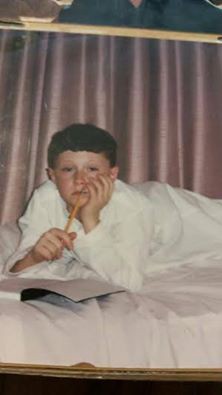
My mom had me keep a journal, and in this picture I’m probably writing about how stupid everything is. It’s an opinion I still hold close to my heart.

I’m thankful for that experience and for the confusion of life. I’m thankful for religion, and how stupid it all can be.

Bruce Bauman’s Broken Sleep Is a Subversive Rock n’ Roll Time Trip

Broken Sleep, Bauman’s second novel from Other Press (after 2006’s And the Word Was), encompasses the disparate concepts of art, Nazi history, musical fame, politics, DNA time travel, and insanity. This twisted, canny tale spans the decades between the 1950s and 2000s. Moses Teumer, a professor suffering from leukemia, goes looking for his real parents to find a bone marrow match. He discovers his mother, Salome Savant, was a young artist impregnated by a rumored Nazi; Salome was told after Moses’ birth that he was dead while he was skirted away in a quick adoption. When Moses finds Salome, he also discovers he has a half-brother, Alchemy Savant, who is a star in the most famous band in the world, The Insatiables.

But this is as far as any linear summary of the story should go. This witty, irreverent tome subverts both reader expectations and ideas of traditional linear storytelling. Salome, artist and — by name — Savant, believes herself to be living outside of normal time. She believes she can time travel through her DNA. She also believes that people die of Gravity Disease, a mysterious affliction that recalls Wordsworth’s words about the world being “too much with us.” As Moses, Salome, and Alchemy navigate the worlds of art, music, and politics, Bauman shows us how little truth matters — and how much what we believe to be true has taken truth’s place.

Most notable in Bauman’s exploration of how perception affects lives is his carefully tuned sense of voice. His characters’ voices, as Bauman said in a recent panel at the L.A. Times Festival of Books, drive the action of the story. In distinctly articulated chapters that alternate points of view, Bauman establishes sympathy for each character through his or her complex back story and motivation. Salome, for example, lives by an unusual, yet highly codified, bizarre set of beliefs. She explains,

Each morning I exhale the decomposing cells of my face and my body. And time, the human definition of time, that hobgoblin of impending bodydeath, is my earthly enemy. Disintegration has spoiled my external eyesight, and the new surgeries have failed. Everything outside of me appears foggy. My eyes were always so light sensitive. I have always seen, and still do see, the past and the future. Not seeing is humbling and mortifying, but seeing was often more humbling and mortifying. Others have defined me as a visual artist, but I am really a sensate morphologist — all of my senses, especially smell, are hyperacute. Even now, I can inhale the pulse of the moon.

Salome’s theories are not merely the quirks of an artist or the ravings of a madwoman. Over all of Bauman’s work in Broken Sleep is a classical idea of the Weird as a prescient, driving force. By modern conventions, Bauman spoils his ending, but it becomes clear that the ending is not the thing — how we get to the ending is the thing, and we turn pages to see how the prophecy comes true. Bauman’s prose works on a level that shows both years of careful weaving, and the writer’s singular, defining style.

Though Broken Sleep took Bauman years to write, one can’t help but draw synchronistic parallels between current political news and the political world of the book. Alchemy, Salome’s son, has an otherworldly understanding of the ebb and flow of human angst. The American dream is as different as each character, and yet, it is marred by the unrest of man.

At a fairly young age, Alchemy had determined that those rules and those tired or monumental edifices contained the foul dust of the American dream. Under the surface seethed resentment and paranoia — sentiments that alternately exploded and imploded in a needful catharsis every few generations, often in wars with far-off countries — and at that moment, unbeknownst to either Alchemy or Moses, was about to explode again. But even before a new screaming comes across the sky, both had their own explanations for the complexities of their America.

Thoughtful fiction such as Broken Sleep always seems to touch a nerve and reflect the current political cycle. The depth of Broken Sleep makes it believable as a slightly alternate history. Like ours, the world of Bauman’s characters is cyclical. Through the eyes of such different people — the schizophrenic mother, the rock-star son, the abandoned brother, and the faithful friend, we see that man has always dreamed, endured until a breaking point, and then fought. Bauman manages to capture both the insatiable drive for fame and success, and the harsh reality of unrealized dreams that seem distinctly American.

“I’ve made an effort to tell my story in a linear fashion,” says Salome. Only not really. Or more accurately, she can’t tell a story in a linear fashion, because she’s lost to time and her own mind. Salome is as unreliable a narrator as there ever was, but Bauman writes her crazy with purpose. She is wild and strange, and probably his most compelling character.

Broken Sleep is a byzantine novel. Bauman’s complex plot lines, multi-layered syntax and allusions to all areas of human interest make this dramatic undertaking a heady investment for readers. Bauman’s character names, chapter titles, background information, and references operate on a level of complexity that’s rare. At times, Bauman sacrifices a bit of clarity to serve his characters’ mentally ill, elusory, or drug-affected lifestyles, but the overall message of the novel is one of cohesive destiny. Broken Sleep is a trip.

Watch a Short Animation on What “Kafkaesque” Really Means

TedEd Writer Noah Tavlin Defines the Often Misused Term

Last year, TedEd writer Noah Tavlin helped clear up what — precisely — the term “Orwellian” meant. Now he has set his sights on illuminating what we mean, or what we should mean, when we say “Kafkaesque.”

Pulling from the stories “The Trial,” “Poseidon,” “The Hunger Artist,” and Kafka’s most famous work The Metamorphosis, Tavlin first lays out what most of us have come to understand as Kafkaesque (aside from the literal “like Kafka”): “[It] has entered the vernacular to describe unnecessarily complicated and frustrating experiences, like being forced to navigate labyrinths of bureaucracy.”

As an employee at an insurance company, Kafka saw all the inglorious nooks and crannies of the modern, absurd, burgeoning bureaucracy and often thrust his characters into it — consistently to tragicomic effect. But, the word is more complicated than a mere invocation of bureaucracy’s byzantine tendencies.

Tavlin refers us to Kafka’s story “Poseidon” where, humorously enough, the God of the Sea is an executive buried in an endless pile of paperwork, unable to explore his own underwater kingdom. However, the reason why he’s buried in paperwork is because “he’s unwilling to delegate any of the work…he deems everyone else unworthy of the task. Kafka’s Poseidon is a prisoner of his own ego.”

Physical injury is not necessarily “kafkaesque”

The issue “Kafkaesque” presents is thus not only due to the bureaucracy, but also to “the irony of the character’s circular reasoning in reaction to it…[Kafka’s] tragicomic stories act as a form of mythology for the modern industrial age, employing dream logic to explore the relationships between systems of arbitrary power and the individuals caught up in them.”

It is telling of an author’s popularity when their name enters the language as an adjective; even more telling when there are videos made and articles written to clear up the misuse of their metamorphosed name-adjective. Long live Kafka(esque)!

Colm Tóibín’s ‘Brooklyn’ and the Art of Adaptation

When English professor Kevin Griffith and his eleven-year-old son Sebastian uploaded pictures from their work Brickjest — a Lego toy adaptation in the form of discrete dioramas, each representing a scene from David Foster Wallace’s novel Infinite Jest — their collaborative project quickly went viral. In the articles that followed the focus was not on their fealty to Wallace’s text but, in part, on their ability to make us consider what it means for textual characters to become tactile and occupy a physical space, in an age of adaptations when such characters increasingly seem to be stepping off the page and becoming fodder for digital screens.

In an instance where an adaptation represents such a radical act of transformation, the resulting conversation seems to work both ways, to also look at the new meanings that might be found in the source text because of this other, highly divergent form in which it now exists. But when it comes to cinematic adaptions the criticism still tends to work in only one direction, obsessed with the adaptation’s fidelity to its source.

“p. 301. It was the incontinence plus the prospect of 11/4’s monthly Social Assistance checks that drove Poor Tony out for a mad scampering relocation to an obscure Armenian Foundation Library men’s room in Watertown Center . . .” (Left). “p. 409. Clipperton plays tennis with the Glock 17 held steadily to his left temple.” (Right).
“p. 69. Kate Gompert was on specials . . . Fourth hospitalization in three years, all clinical depression, unipolar.” (Left). “p. 64. The tall, ungainly, socially challenged and hard-drinking Dr. Incandenza’s May–December marriage to one of the few bona-fide bombshell-type females in North American Academia, the extremely tall and high-strung . . . Avril Mondragon . . .” (Right).

For a long time film was — and perhaps still is — considered not to be on equal footing with other forms of art. The filmmaker Andrei Tarkovsky, explaining the abundant presence of other art forms in his work (the music of Bach, paintings by Bruegel, his own father Arseny Tarkovsky’s poetry), suggested that because cinema was relatively young, the presence of older art forms lent it a temporal weight, and an authority that would cement its place among the arts. That not much has changed in the status of cinema-as-art over the years––as if film were perpetually young––is most apparent when it comes to adaptations, about which one invariably hears that the book was better than the film. It’s this sort of default reaction that even avid film buffs seem conditioned to believe, a statement sometimes made before due reflection. It is only partly thanks to a subliminal belief that literature is the superior form of art; the other part of it comes from the light in which critical conversations about adaptations actually take place.

In his book Concepts in Film Theory, the renowned film critic Dudley Andrew proposed three models that, in total, describe the ways in which a screenplay can draw from its source. When a film borrows from another text, the source doesn’t necessarily share a storyline with the resulting work — it merely serves to inform the film’s subtext and essential emotion. In Abbas Kiarostami’s film Shirin (2008), for example, an audience — composed almost entirely of women — sits watching a film based on the tragic Persian romance “Khosrow and Shirin.” We only ever see the women’s faces and never the film they’re watching, which exists solely for us as an aural presence: an amalgam of dialogue, song, and dramatic sound effects. (Incidentally, these were added in editing; Kiarostami filmed each of his actors individually in his living room, a blinking light falling on their faces to simulate the effect of being in a movie theater). But the knowledge that the film these women are watching is a classic romantic tragedy inevitably informs the way we read their expressions.

Three stills from Abbas Kiarostami’s ‘Shirin’ (2008)

The second of Andrew’s adaptation models describes films that intersect with their source text, in which a text is preserved wholesale when rendered into cinematic form. In Ritwik Ghatak’s 1961 film about the aftermath of the Indian partition, Komal Gandhar (“A Soft Note on a Sharp Scale”), a group of East Bengal migrant artists find themselves stuck on the wrong side of the border. On the one hand we see the characters preparing to stage a classic Bengali play, and on the other we get to see the play itself as it’s performed. The abrupt shift between these two registers proves to be a clever formal device, recreating the displacement being experienced by the characters themselves.

The most common form of adaptation Andrew calls transportation, in which the cinematic version retains the essence of its source text. Among many contemporary examples is the 2015 film Brooklyn (John Crowley). Based on the book by Colm Tóibín, and adapted by the novelist Nick Hornsby, Brooklyn the film makes significant departures from its novelistic source. The first third of the book, approaching sixty pages, shows the central character, Eilis Lacey, at home in Enniscorthy, Ireland. She lands a job at the town’s provisions store, run by Miss “Nettles” Kelly, then moves into the room of one of her brothers. In the film, Eilis (played by Saoirse Ronan) boards the New York-bound ship about ten minutes in, her time in Ireland occupying less than one-tenth of the movie’s total running time.

Among other things, the book intends to critique the Ireland of that time period (the 1950s), which had little to offer the young, compelling them to make Westbound oceanic journeys in search of better prospects. The film’s predominant concern is to focus on Eilis’s more positive experience after moving to the New World. Her less than ideal Irish work life is captured in a three-minute long scene, her personal life — she has no one to date! — reduced to and represented by a single dance room scene, which lasts only two minutes. Both of these scenes serve a metonymic function, allowing the audience to infer an accumulation of other moments similar to these that have led Eilis to make the decision to leave.

Saoirse Ronan, Brooklyn-bound, in ‘Brooklyn’ (2015)

While Eilis in the book is possessed of three brothers and a sister, in the film these characters are collapsed into a single sister, Rose (Fiona Glascott), after whose death Eilis comes back to Ireland. In both texts the factor keeping Eilis from returning to Brooklyn — the fact that her mother will now be alone — gives rise to a central question: should Eilis choose her homeland, or the new home she’s made for herself in Brooklyn? Hornby’s thoughtful choice increases the stakes of the narrative in the film, less giving way to more.

Most notably, however, it is a vital scene towards the end of the film that proves to be a significant departure from Tóibín’s novel. Unexpectedly making roots in Ireland after her return — this time she has a reputable job, and a love interest, Jim Farrell (Domhnall Gleeson) fixing to marry her — Eilis’s former employer Miss Kelly (Bríd Brennan) confronts her with the procured knowledge that Eilis is already secretly married to someone in America, a man named Tony Fiorello (Emory Cohen). In the book Eilis responds to this indictment with fear, and decides once again to leave Ireland. The film gives Eilis more agency in her decision to leave: she stands up to Miss Kelly, critical of her small-minded nature — and, by extension, that of others in the town, where everyone appears overly concerned with everyone else’s business.

Here is the scene as it appears in Tóibín’s novel:

In her tone, Eilis tried to equal Miss Kelly’s air of disdain.

“Oh, don’t try and fool me!” Miss Kelly said. “You can fool most people, but you can’t fool me.”

“I am sure I would not like to fool anyone,” Eilis said.

“Is that right, Miss Lacey? If that’s what your name is now.”

“What do you mean?”

“She told me the whole thing. The world, as the man says, is a very small place.”

Eilis knew from the gloating expression on Miss Kelly’s face that she herself had not been able to disguise her alarm. A shiver went through her … She stood up. “Is that all you have to say, Miss Kelly?”

“It is, but I’ll be phoning Madge again and I’ll tell her I met you. How is your mother?”

“She’s very well, Miss Kelly.”

Eilis was shaking.

“I saw you after that Byrne one’s wedding getting into the car with Jim Farrell. Your mother looked well …”

“She’ll be glad to hear that,” Eilis said.

“Oh, now, I’m sure,” Miss Kelly replied.

“So is that all, Miss Kelly?”

“It is,” Miss Kelly said and smiled grimly at her as she stood up. “Except don’t forget your umbrella.”

And the same scene in Hornby’s adapted screenplay:

The intention of both the book and film is to show Eilis’s character arc. But in the film Eilis’s response to Miss Kelly is a consequence of her change, while in the book the scene triggers a change in her.

Saoirse Ronan standing up to Bríd Brennan in ‘Brooklyn’ (2015)

The cinematic narrative spends a lot of time showing Eilis gaining validation in Brooklyn — receiving acceptance and friendship in the boarding house where she resides, achieving fulfilment at work and in college, finding love. “Think like an American,” urged a woman who befriended her on the ship from Ireland. In one particular scene, following Eilis’s confrontation with Miss Kelly, we see how living in America has shaped her:

Eilis shows her understanding that she has the choice to not honor what’s being asked of her. In this light, the depiction of Eilis standing her ground against Miss Kelly — whom she’d been intimidated by at the beginning of the film — can be seen as an actualization of her sense of self, constructed over time while living away in Brooklyn.

Saoirse Ronan in ‘Brooklyn’ (2015)

Tóibín concludes her arc through precisely crafted and meticulously paced sentences, in which Eilis reflects on her decision to return to Brooklyn, moving from fear to a certainty that the path she’s chosen serves her interests best. The moment of this realization comes in the book’s final paragraph, as Eilis once again leaves her hometown:

“She has gone back to Brooklyn,” her mother would [tell Jim Farrell]. And, as the train rolled past Macmine Bridge on its way towards Wexford, Eilis imagined the years ahead, when these words would come to mean less and less to the man who heard them and would come to mean more and more to herself. She almost smiled at the thought of it, then closed her eyes and tried to imagine nothing more.

‘Brooklyn’ theatrical release poster (2015)

Where the book uses interiority, the film relies on dialogue and image, thereby changing the texture of the moment that completes Eilis’s arc. The final paragraphs of the book contain a litany of Irish landmarks and towns, while the film shows Eilis wordlessly reuniting with her husband Tony, the iconic Brooklyn Bridge evident in the background. In discussing his adaptation process, Hornby (quoting Michael Ondaatje) suggests that a good film adaptation finds the short story within the novel, serving to underscore both the economy needed for a film’s brief runtime, as well as the audience’s capacity to measure change in a character across the tight temporal framework of a film.

The author Joseph Conrad wrote that “the power of the written word … is, before all, to make you see,” a sentiment almost exactly echoed by filmmaker D.W. Griffith, when he suggested that his purpose was “[a]bove all … to make you see.” An obvious difference between books and films is in the way they promote seeing. Whereas books conjure up mental images, the filmic image has a quality of given-ness to it. But another, less frequently discussed point of comparison is made manifest in Conrad’s and Griffith’s twin statements, not in the word “see” but from another shared word––you, the intended audience. And it is this ‘you’ that should be the kernel of all discussions concerning adaptations.

The choices by which Brooklyn the film departed from its literary counterpart were meant to etch a particular version of Eilis in the minds of viewers, within the tight timeframe of a film. Komal Gandhar staged a play inside a film in order for the audience to gain a better grasp of the experience of displacement. When it comes to discussing adaptations in general, the focus should be on their fidelity to the audience, rather than to the source text. The audience remains the focal point when a screenwriter reshapes their source text with the intention of bringing it to the screen — to bring it from one kind of readership to just another kind of viewership.

Everything You Wanted to Know about Book Sales (But Were Afraid to Ask)

Publishing is the business of creating books and selling them to readers. And yet, for some reason we aren’t supposed to talk about the latter. Most literary writers consider book sales a half-crass / half-mythological subject that is taboo to discuss.

Most literary writers consider book sales a half-crass / half-mythological subject that is taboo to discuss.

While authors avoid the topic, every now and then the media brings up book sales — normally to either proclaim, yet again, the death of the novel, or to make sweeping generalizations about the attention spans of different generations. But even then, the data we are given is almost completely useless for anyone interested in fiction and literature. Earlier this year, there was a round of excited editorials about how print is back, baby after industry reports showed print sales increasing for the second consecutive year. However, the growth was driven almost entirely by non-fiction sales… more specifically adult coloring books and YouTube celebrity memoirs. As great as adult coloring books may be, their sales figures tell us nothing about the sales of, say, literary fiction.

This is literally the sixth best-selling book of 2016

This lack of knowledge leads to plenty of confusion for writers when they do sell a book. Are they selling well? What constitutes good sales? Should they start freaking out when their first $0.00 royalty check comes in? Writers should absolutely write with an eye toward art, not markets. Thinking about sales while creating art rarely produces anything good. But I’m still naïve enough to think that knowledge is always better than ignorance, and that after the book is written, writers should come to publishing with a basic understanding of what is going on. Personally speaking, my knowledge of the fundamentals of publishing helped me not even think or worry about book sales when my own book was published last year. And since I need a reason to justify the time I’ve spent dicking around on BookScan, here is my guide to everything you wanted to know about book* sales (but were afraid to ask).

*Because “books” is an impossibly large category covering everything from Sudoku puzzles to C++ guides, I’m going to focus on traditionally published fiction books in this article.

THE BASICS

What is a book sale?

Wait, you say, everyone knows what a book sale is. Ah, yes, but, what this section presupposes is… maybe you don’t? Actually, one of the things that makes the conversation about book sales so confusing is that there are several different numbers thrown around, and often even people in the publishing industry completely confuse them. Here are four different numbers that are frequently conflated:

1) The number of copies of the book that are printed.

2) The number of copies that have been shipped to stores or other markets like libraries.

3) The number of copies that have been sold to readers.

4) The Nielsen BookScan number.

These numbers can all be wildly different. It’s not uncommon at all for a publisher to, say, print 5,000 copies, but only sell 3,000 copies to bookstores/other markets, of which, 2,000 copies are actually sold to customers. Meanwhile, BookScan shows 600 copies sold. And we haven’t even gotten into ebooks yet (more on that later).

A publishing employee calculating a royalty statement

What’s the actual number of books sold? Well… basically a combo of 2 and 3, plus ebook and audiobook sales. A publisher sells books to retailers like bookstores, but also to some institutions like libraries. However, retailers normally (though not always) have the right to return unsold copies. So some copies that are “sold” will eventually be unsold. (On author royalty statements, a certain amount of money is always withheld as “reserve against returns.”)

While this is basic, it’s surprisingly common for authors and publishers to either intentionally or unintentionally confuse these numbers: brag about their sales while citing the print run, for example. On the other hand, the media almost always references the BookScan number without any context about how wrong that number can be.

What Is BookScan and Why Should We Care?

In my hypothetical above, the Nielsen BookScan number, is the least accurate. It’s the furthest away from the “true” sales of the book. And yet, if you read any articles on book sales it is precisely the BookScan number you will see. This is because while publishers and authors (via royalty statements) have access to the real numbers, they are almost never released to the public or to rival publishers. Thankfully, there is Nielsen BookScan, an industry tracking tool that records point of sales based on ISBNs. (Yes, this is the same Nielsen of TV’s Nielsen ratings.) People in publishing can use BookScan to get a general sense of what books are selling, the health of the industry, or tear their hair out in frustration while looking up the sales of their rivals.

So Why Can BookScan Be So Inaccurate?

Nielsen BookScan counts cash register sales of books by tracking ISBNs. A clerk scans the barcode, and the sale is recorded. Pretty simple.

Bookstore employees scanning ISBNs

So why can it be inaccurate? To begin with, BookScan only tracks print book sales. Amazon and other major ebook vendors do not release ebook sales, so basically no one has any idea how those are selling (outside of publishers tracking their own sales). Ebook sales vary wildly from book to book (and genre to genre), but are typically less than 1/3rd of sales. For certain genres, especially science fiction and romance, ebooks can be as much as 50% or more.

Even for print books, BookScan can only do so much. BookScan gets data from most big bookstores (including Amazon and Barnes & Noble), but it doesn’t get all of them. It also doesn’t track library sales — which can be significant — or any sales that don’t go through a bookstore. BookScan itself claims to track 75% of print sales, and that may be true overall. For a popular literary fiction title, for which library sales or hand sales are a tiny percentage, BookScan is probably getting at least 75% or more of print sales. For other types of books, BookScan might record as little as 25% of print sales. Small press books, for example, can sell most of their copies at conferences, book festivals, and direct sales on the publisher’s website or at readings. BookScan misses all of that.

Lastly, BookScan was only introduced in 2001, so numbers for any books published before this millennium are completely inaccurate. (I’ve seen people bemoan the small sales of, say, Infinite Jest compared to some recent bestseller without realizing that.) All that said, BookScan does a good job showing general trends in the industry and seeing which books are doing better than others. But you should keep in mind that total book sales are perhaps twice that of every number listed.

A young author ready to publish his first novel

How Much Does an Author Make Per Sale?

So let’s say you bought a book (like, oh, how about Upright Beasts by Lincoln Michel), how much would the author make? Author royalty rates vary, but the industry standard is about 8% of the cover price for paperbacks and 10% for hardcovers (escalating to 15% if sales go well). Ebooks, which have variable pricing, are 25% of the publisher’s take. Now, as an author I’d love for those rates to be higher, but I do think it is important for authors to understand that the majority of the cover price doesn’t go to the publisher. Well over 50% of the cover price goes to the retailer that sells books to customers and the distributor who gets the books to retailers. There is plenty to be said about whether the publishing model could be more efficient, if middlemen could be cut out, etc. etc. But when certain corners of the writing world — such as certain self-publishing ideologues — scream about how publishers are ripping off authors and taking 90% of the pie for themselves, that isn’t really accurate.

A young author opening his first royalty statement

Don’t Most Authors Make No Money From Sales?

Correct. Most authors do not make any money off of actual book sales because most books do not “earn out” their “advance.” Traditionally published authors are paid money up front, before a book is released. This “advance” is money given up front to the author out of future royalties so that the author can buy ramen and pay the overdue electricity bill. “Earning out” means the book has sold enough copies that the total royalties (not the total sales) match up to the advance, thus providing a (most likely tiny) trickle of royalty money to authors for all sales thereafter.

This ‘advance’ is money given up front to the author out of future royalties so that the author can buy ramen and pay the overdue electricity bill.

Here’s an example: Writer von Author writes My Big Literary Novel and Big Publishing House Press pays her $50,000 dollars as an advance. The cover price of the book is $20 dollars and her royalty rate is 10%. (In reality it would be more like a ~$25 hardcover at 10–15% followed by a ~$15 paperback at 7–10%, but I’m simplifying.) If the publisher sells 10,000 copies of the book, the total sales are $200,000 and the author has earned $20,000 from royalties… except that she was already paid $50,000 so she is actually at negative $30,000. She doesn’t have to pay anyone back either though, the publisher takes the loss. However, if the book sells 25,000 copies, then the author would earn back her advance and at copy twenty-five thousand and one, she would start earning $2 per book sold.

A young author after reading his first royalty statement

How Does Publishing Survive If Most Books Don’t Earn Out?

To begin with, publishers survive on a handful of hits. A 50 Shades of Grey here or a Gone Girl there make up for a lot of low-advance books that don’t sell well. This is similar to how movie studios survive on a few massive blockbusters to offset the costs of movies that don’t earn what is expected at the box office. Additionally, the publisher makes money before the author does. Even if the distributor and retailer take, say, 65% of the sale price (and it can be as much as 75%), the publisher is getting 25% to the author’s 10%.

When an article talks about how some huge advance given to a debut author and/or celebrity author won’t earn out, that doesn’t actually mean the publisher won’t make money. (Here’s a blog post breaking down the example of Lena Dunham’s huge advance.) In fact, publishers may give huge author advances on books they know won’t earn out as a way of paying a de facto higher royalty rate.

Take our example above. If My Big Literary Novel sells 20k copies, the author still hasn’t earned back her advance yet the press is taking in $90,000 (35% of cover price minus 50k advance). Of course, the press also has to pay for the printing costs of the book as well as any marketing costs or money spent on cover art before it can even pay the various employees that worked on the book… but you get the general idea.

WHAT DO BOOKS ACTUALLY SELL?

Two authors gossiping about their friends’ book sales

Okay, Let’s Get to the Dirt: What Does an Average Book Sell?

Probably not surprisingly, the answer is… it really depends. The first thing that writers need to understand is that book sales — like advances — are all over the place. This is true even for individual authors. It’s not unheard of for an author to get roughly similar critical acclaim for their first three novels, yet have them sell 10k, 100k, and 10k respectively. Publishing is full of luck, timing, and unpredictable trends. (I mean, adult coloring books? Really?) And even then, publishers give dramatically different amounts of support and marketing even to books published by the same imprint.

That qualification aside, most fiction books published by a traditional publisher garner somewhere between 500 and 500,000 sales. Sometimes less, sometimes more.

Can You… Narrow that Down a Little?

Ignoring the outlier megastars like Stephen King or runaway hits like Anthony Doerr’s All the Light We Cannot See, most novels published by a big publisher BookScan somewhere between 2,000 and 40,000 books. Most short story collections issued by big publishers get about half that: between 1,000 and 20,000.

People really really really love this book

You can scale this down for publisher size. An independent small press is averaging more like 500 to 10,000 for novels and 300 to 2,000 for story collections. A micro press is more like 75 to 2,000 regardless of book type — at this level, the author’s “platform” and fan base matter more than if the book is a novel, story collection, or poems — with outside successes getting above 5k.

For debut books, you could cut all those numbers in half. Do keep in mind that this is after at least a year of sales. If your book just came out this month, don’t panic yet (and don’t check BookScan for a long time, if ever).

So the Average Novel Sells 20,000?

Well… no. Like baseball salaries or box office returns, book sales are heavily skewed by the minority of books that do really well. If you go into your local bookstore and look at all the books on the various tables, most of those will BookScan between 2,000 and 40,000 after a couple years of sales. The big books by the big names on the tables will get between 100,000 and a couple million.

However, most books struggle to find adequate distribution, much less coverage. Most books do not get placement on tables, and many do not even get to many bookstores at all. The majority of traditionally published novels sell only a couple thousand, if that, over their lifetime.

What Constitutes “Good” Sales?

As with anything here, we need qualifications. What constitutes “good” sales is entirely dependent on what type of book you are publishing, what size your publisher is, and what your advance was. 5,000 copies of a short story collection on a small press is a huge hit. 5,000 copies of a novel from a big publisher that paid a $100,000 advance is a huge disaster.

You also need to factor in the format. Selling 10,000 hardcover is worth more than 10,000 paperbacks. For ebooks, prices can be all over the place, even from a major publisher.

Qualifications aside, if you are a new writer at a big publisher and you’ve sold more than 10,000 copies of a novel you are in very good shape — as long as you didn’t have a large advance. It should be easy for you to get another book contract. If you sold more than 5,000, you are doing pretty well. You’ll probably sell your next book somewhere. If you sold less than 5,000, then you could be in trouble with the next book. (Although it is, as always, dependent on the project. If a publisher loves your next book, they may not care about previous sales.)

The smaller the press, the more you can scale down. One publisher of an independent press told me that most indie press books sell — not BookScan — about 1,500 copies, with 3,000 being good sales. Even then, the publisher stressed, an author selling 3,000 is really just paying for themselves. To be contributing to the operations of the press, they’d need to sell over 5,000.

An author (right) begging an editor (left) for a second chance

What Do Acclaimed, Buzzed-About Literary Books Sell?

So let’s say you jump through the hurdles of writing a book, getting an agent, and selling it to a respected press, AND you become one of the handful of books that is well-reviewed in big outlets and buzzed about in the literary world. How many books will you sell?

Most people would be surprised at the drastic range of book sales even among the books that people are buzzing about. If you took the ten literary fiction books that all the critics, Twitter literati, and well-read friends are discussing, their BookScan numbers might range from a couple thousand to 100k. Last year, NPR looked at the book sales of the Pulitzer Prize finalists and found the books ranged from under 3,000 to low six figures.

If you took the ten literary fiction books that all the critics, Twitter literati, and well-read friends are discussing, their BookScan numbers might range from a couple thousand to 100k.

That’s a small sample though, so I went through the BookScan numbers for every fiction book listed on the New York Times 100 Notable Books of 2014. I used 2014 instead of 2015 to make sure each book had at least 12 months of sales. No list is perfect, but the NYT list includes story collections and small press books alongside the big name literary authors and award contenders. 2014’s list includes names like Haruki Murakami, Lydia Davis, Marlon James, and David Mitchell as well as small press debuts by Nell Zink and Eimear McBride. It’s a good sampling of the “books that people are talking about” in the literary world.

The BookScan sales of those books literally ranged from 1,000 to 1.5 million, with an average (mean) of just over 75,000 copies sold per book. That 75k number is pretty skewed by the existence of Anthony Doerr’s runaway literary hit, All the Light We Cannot See, which sold over 1.5 millions of copies. (The next highest book was about 270,000.) If we remove the best and worst selling books on the list, we get a mean of 46,550 copies and a median of 25,000 copies.

(Once again, I’ll remind you that these are BookScan numbers for books published in 2014. The actual sales totals will be moderately to significantly higher depending on the book, and all of these books should continue to sell copies over the years.)

A photo of Stephen King reading this article

What If You Are a Finalist for a Major Award?

Let’s say you really hit the jackpot and are a finalist for the Pulitzer, what kind of sales would you get? Again, the range is huge. I looked up five years of nominees (from 2011 to 2015) and the range was 5,600 to over 1.5 million (yes, All the Light We Cannot See again). The mean was 250,100 and the median was 72,300. For the National Book Award, the mean was 178,600 and the median was 91,318

For comparison sake, I checked the finalists for science fiction’s prestigious Nebula awards. They ranged from 2,100 to 387,900 with a mean of 35,600 and a median of 12,300. That’s surprisingly less than the major literary awards, despite the frequently heard claim that genre fiction is more popular than literary fiction. (Although keep in mind that science fiction ebooks typically sell better as a percentage of total sales than literary fiction ebooks do.)

A famous author being awarded the National Book Award

What Does a #1 Bestseller Sell?

On average, a lot more. I checked the BookScan sales for all the books that hit the #1 spot on the New York Times list in 2014 and the mean sales were 737,000 with a median of 303,000. The top selling book was, as you can probably guess, 50 Shades of Grey at nearly 8 million. But the lowest was only 62,700, meaning more than 50% of NBA or Pulitzer finalists sold better than it. In fact, a whole lot of the 2014 literary award finalists sold better than bottom 2014 best sellers. If that’s confusing, remember that this is the list of books that were the best selling book in the country for one week, not for the whole year. Sales of commercial fiction books are often far more concentrated than the sales of popular literary fiction books, the latter of which can have very long tails.

Once again, I want to stress that these totals are perhaps 75% of book sales and do not include ebook or audiobook sales.

What About Short Story Collections? No One Buys Those, Right?

It’s a truism in the literary world that no one buys short story collections, and that even when you sell a collection a publisher will only buy it so that your future novel will do better. I myself have always believed this to be honest, even though I wrote and published a short story collection. However, looking at the data it actually seems that while fewer story collections sell, the ones that do can sell almost as well as novels. The seven story collections on the NYT 2014 list had a median of 23,000 BookScan sales… only 2k less than the median novel. When I expanded the data to include short story collections from the 2013 and 2012 list, the average sales were 53k and a median of 22.5k.

Tom Gauld nailing it

So All the Publishers that Rejected My Collection Are Fools!

Well, no. Those are mostly collections by buzzed about debut authors or established older writers. As I said, fewer story collections sell (although fewer are also published) and the ones that don’t sell fail harder than novels. And there’s a cap on story collections. No story collection is going to sell millions of copies like the biggest novels. All of the authors whose collections I counted in the last section sold better as novelists if they had novels out. Since big publishers survive on the few break-out books, it makes more business sense to bet on novels or push authors to write novels instead of stories. Whether that’s good for the culture or the art of literature is another question…

Still, it was heartening for me, as a lover of short stories, to see that collections from authors like Junot Diaz, Alice Munro, and George Saunders can BookScan over 100k, and a collection by someone like Stephen King can reach a million. (In fact, having looked at a lot of sales data I’m convinced Stephen King is the best-selling living short story author in America and probably the world). More importantly, great short story authors like Kelly Link, Lydia Davis, Aimee Bender, Jim Shepard, and so on will BookScan between 10 and 50k… which is comfortably in the range of what acclaimed literary novels sell.

How Does Genre Fiction Compare?

I’ve talked before about how the idea that literary fiction is a tiny niche market and that the various genres sell more is largely a myth. “Commercial fiction” — which is not a synonym for genre — can sell a lot more, especially when we are talking brand name like John Grisham, James Patterson, or Danielle Steel. YA fiction is also having a much-discussed boom these days. But for most writers of adult science fiction, romance, fantasy, and the like, the numbers will be roughly what I’ve listed in this article.

A ravenous genre fan

How Does Non-Fiction Compare?

Non-fiction is an insanely huge category that encompasses everything from craft books and joke books to travel guides and memoirs. While there is some variation in average sales between different types of novels, non-fiction sales are entirely dependent on which of the 1,000 types of non-fiction books you are talking about. I’m afraid I just can’t help there, except to say that what you might think of as literary non-fiction — lyric essay collections, memoirs, etc. — will be roughly similar to the numbers listed here.

What About Self-Publishing?

Like non-fiction, self-published books vary so wildly that they can’t really be generalized. If you publish your book through an established press, you can most likely guarantee a certain level of professionalism, distribution, and hopefully coverage for your book. Self-publishing, on the other hand, contains both professional full-time authors who spend time and money marketing their books as well as people who just think it would be fun to put an ebook up on Amazon and never spend any time marketing. Overall, self-published books sell far far less (in part because the majority of the market is still print, and it’s near impossible for self-published print books to get a foothold in stores), but of course their cut of each sale is much higher.

Which Sells More: Hardcover, Paperback, or Ebook?

Another surprising (to me at least) fact from the data I looked at is that books quite often sell the same amount in hardcover and paperback editions. If a book truly takes off, the paperback sales will eclipse the hardcover many times over. But for most books that are published in hardcover first, the paperback sales will be close to the same. Perhaps that’s a feature of the ebook era where readers who prioritize an affordable option will often choose the ebook?

As for ebooks themselves, the sales aren’t available publicly anywhere so it is impossible to say. According to a recent survey, ebooks account for about 20% of the total book market. From talking to publishers and authors, it seems ebook sales are erratic and — as a percentage of overall sales — vary wildly from book to book, publisher to publisher, and genre to genre. To add even more confusion, ebook prices fluctuate a lot more than paperback or hardcover. It is simply hard to pin down. For most traditionally published books, the percentage of sales that are ebook instead of print is somewhere between 10% and 50%.

A writer debating writing working on a novel or going back to dental school

So What Does All This Meeeaaan, Man?

I often hear that fiction is basically just an irrelevant niche and no one reads books at all. Now that we’ve looked at the numbers, well… I guess it depends on your point of view. If the average well-distributed novel is BookScanning only 10,000 copies, that seems pretty niche. Then again, there are plenty of industries where sales of 10k per product would be respectable. And we have to remember that the actual number of sales might be 20,000, and then maybe 30,000 people have read the book since plenty of people use libraries, pirate, or borrow books from friends. Every year, dozens of new books sell 100k copies on BookScan, and a couple sell a million. A recent Author Earnings report suggested maybe 4,600 writers earn 50k a year off of book sales alone. Not so shabby, maybe, until you realize that about that many MFA students graduate each year. Then again, that’s just looking at book sales, and not money made from freelance writing, speaking engagements, teaching classes, or other author income streams. And honestly, even getting a thousand strangers to read something you poured your heart and soul is pretty okay. Bottom line; who knows what any of this means, but at the very least if you are a newly published or aspiring author you now know the world you’re going into.

As for me, I’m going to get back to work on a weird novel that will never sell, but, hell, is damn fun to write.