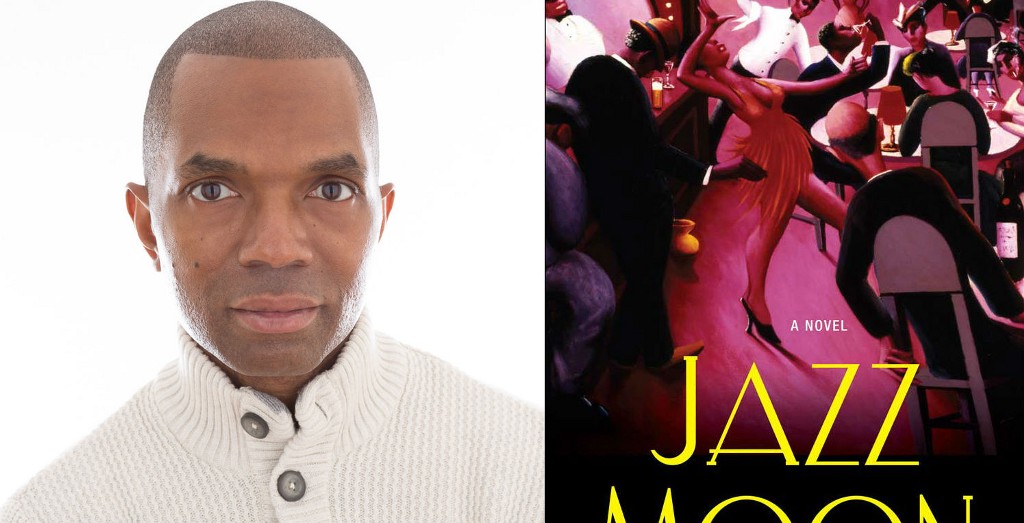
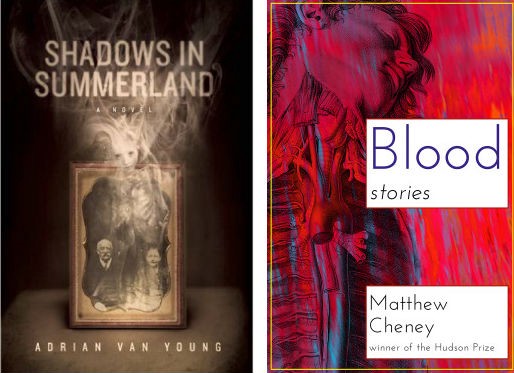
Midweek Links: Literary Links from Around the Web (June 15th)

Horrible fathers in litearture who will make you appreciate your own dad for Fathers Day

On writing and motherhood

Weird fiction in the post-Soviet era

The state of publishing isn’t great (but it’s better than newspapers)

A celebration of Terry Pratchett’s witty dialogue

Someone wrote an argument against the use of periods (which still uses a lot of periods)

The Canterbury Tales have been remixed to be about refugees

Science says kids who read more books grow up to earn more money

How James Patterson is trying to create a golden age of pulp fiction

Is YA fiction just adult fiction in disguise?

Iain Reid On Switching Genres, Loneliness, And Writing as a Culinary Reduction

To meet Iain Reid in person is to wonder how such a dark, suspenseful, and genre bending novel could be written by such a charming guy. Reid’s debut novel I’m Thinking of Ending Things (Simon and Schuster, 2016) takes the reader on a frightening road trip with a couple trying to determine the fate of their relationship, while nimbly exploring bigger themes of marriage, identity and solitude. This work is a stark departure from his two previous critically acclaimed memoirs. I spoke with Iain Reid about the move to fiction, finding a balance between wanting to be alone and being lonely, and the quest to find the answers.

Ann Cinzar: After writing two funny, light, entertaining memoirs, you’ve now moved to fiction. But, apart from that, you’ve also written something which in many ways defies categorization. Did you set out to write a book that would be totally different, one that might not fit a specific genre, or did it evolve?

Iain Reid: A little bit of both I think. I wanted for my own sake to do something that was different and that was for me exciting and interesting. As a reader I enjoy books and novels that make me feel a little unsettled, and not just in the content. I like that feeling as I’m reading something that I’ve never read anything quite like it. I’m not sure what I would describe the book as, or where it would fit in the bookstore. So that was in my mind, but not actively as I was writing, because by then you become obsessed with the story. But it came into my mind early on that I wanted to write something distinct and knew it would probably frustrate some people as it’s hard to classify or fit into any specific genre. I did think that would make it harder for a publisher to commit to releasing this book, because it’s a risk. There was no guarantee when I wrote it that someone would published it. I feel lucky that it found the editors who believed in it and got the chance to help and work on it. I think where it ended up turned out be the best place for it.

Cinzar: If you had to categorize it, what would you call it?

Reid: I would call it a novel, which I guess is vague. I would call it a story. It has elements of certain types of genre books but I don’t put it in any of those. Some people will, and that’s fine with me. There have been people calling it a philosophical thriller, and that isn’t a genre but that sounds right to me. I was more comfortable with that than some other things.

Cinzar: Maybe it’s a whole new genre?

Reid: That’s not up for me to say. That’s up for people who read it and they can decide. I’m just as interested as anybody else to hear what people will say, and what they make of it, or if people even read it. But I’m comfortable calling it a novel.

Cinzar: Your first two works of non-fiction, both memoirs, were well received and critically acclaimed. Why not stick with that genre and write another?

Reid: I think partially it’s because I’d written two books of non-fiction that are similar in tone and style. They’re about pleasant experiences in my own life and about real people in my life. Also, the process of writing them was comparable. So for my own sake I wanted to do something very different. First of all, that meant writing fiction, and second it meant new content. If I was going to think about something for a few years I wanted it to be unexplored and interesting for me. I remember meeting my agent for lunch right around the time my second book was set to come out and she asked what are you thinking for your next project? And that’s when I said ‘I have this idea for this story. It’s pretty disturbing and it’s a novel’ and she right away encouraged me to keep going. That’s when I committed it to it fully. Maybe if she had dissuaded me and said ‘I think you should write another memoir or non-fiction first’ I would have put it on the back burner but I think getting her early encouragement made me go into it full force.

Cinzar: Early reviews have compared I’m Thinking of Ending Things to everything from Lionel Shriver’s We Need to Talk About Kevin to Michel Faber’s Under The Skin to The Shining — -or maybe it’s just me comparing it to The Shining. Were there any specific influences as you were writing this book?

Reid: Definitely. I don’t know if I would be able to untangle everything and identify each specifically, because there wasn’t only one book or movie that I had in my mind when I was writing it. But all these books that were relevant to this story were in my mind. All those you mentioned, I wasn’t directly thinking about any of them, but they all have a place, as far as being influenced by them. I’d say even some movies, like Hitchcock. And Music. In particular, the band METZ — both of their records are ones that I listened to a lot while I was writing the book. METZ’s music captures a certain type of feeling and this book shares similarities to what that music evokes and conveys. A lot of times while I was stuck I’d go out for a walk and listen to that music and they go well together. And other music too. I often find music can have that effect and can influence and shape the way you write. But definitely any book that has rattled me would have in some way influenced the writing of the book. I can’t say one more than another — -It wasn’t an homage to any one book or author or music but it comes together in a way that is beyond your control. It happens on a level somewhere that is basically hidden but you know it has an effect.

Cinzar: It’s funny you mention music because as I read the book there were a few times when I thought “What is with the country music?”

Reid: Again, I think music is relevant to the story. We often listen to songs we like over and over again, and music is very evocative and brings us back to certain places and time, or messes with our sense of time, and it was relevant to the story.

Cinzar: It’s not giving anything away to say that the book begins with Jake and his girlfriend starting off on a road trip together. I love how within the first few pages, as they begin to drive into the country, Jake’s girlfriend comments that it must get really dark out there where they’re driving. And Jake replies, simply, “It does.” To me that line sets up the whole story you’ve written, which is so dark and ominous. After writing two light, funny books, how did it feel to write something so dark?

Reid: Darkness comes up in the story, in a few spots, even when they talk about space. So that is a theme in the book. But writing something that was dark was part of this progression as a writer. The two things I wrote previously were meant to comfort people, make them laugh, warm them. I don’t know too many writers who want to continue doing the same thing. You want to challenge yourself and do something that’s difficult. So I had done one thing and this novel was different. So it does have elements that are quite dark. But It’s not entirely dark for me.

Cinzar: Really? Which parts aren’t dark?

Reid :(Laughs) Some readers might disagree. For me, ultimately the book is about people and the people in our lives, friends, family, etc., and how important those relationships are and how easy it is to take them for granted. And that’s something I was thinking about a lot while I wrote and keeps it from being a totally dark book. That reflection on others in our life provides meaning for everybody. You can’t exist entirely on your own or in solitude. As someone who believes in solitude, it has a limit.

As someone who believes in solitude, it has a limit.

I was thinking about a lot of the people in my life who bring meaning to it and that counters some of the darker elements of the story.

Cinzar: Definitely that theme of relationships, as well as other themes and ideas like marriage, identity, and loneliness recur throughout the novel. Yet you’ve explored them in what might be considered a suspense/psychological thriller/horror story. What was the impulse to use this unlikely vehicle for those themes?

Reid: I think that’s what is was. If you wanted to write an essay or long non-fiction book on these themes it would probably be less fun to read. It would be dry and no one would want to read it. I thought I could think about these larger ideas and themes and incorporate them into a suspenseful story, which to me seemed natural anyway, because I find some of these themes unsettling. But, I also thought it might draw more people to the book. Some people may come to this book and they’ll just get the hit of dopamine when you read something suspenseful and that will be enough for them, and they won’t even realize they’re ingesting the other stuff. But I thought this type of story and the pace fit the ideas and the content nicely. In my mind this was going to be a story that was uncomfortable. For some people at least. I’m curious because I think this book will garner a wide variety of reaction so that’s interesting to me.

Cinzar: I’m Thinking of Ending Things is a relatively short and tightly written book. Was that a conscious decision?

Reid: Oh yeah, that was in my mind right from the start. And it became a priority particularly as I was finishing the first few drafts, even before getting into some of the big edits with the editors. I probably removed as much of the book as what stayed in. The book could have been twice as long but I knew that I wanted it to be as concise and short as possible. And that can be hard because sometimes you work on something maybe for a few months and it could be a chunk of the story, and you like it and it works technically, but you realize it doesn’t need to be in there, it doesn’t progress the story, so you have to delete it.

Cinzar: That’s a good lesson for writers.

Reid: Yes, it’s like liposuction. There were months of that. Removing stuff that took a long time to write, but you had to go in and clean it out. For this story it needed be that way. There are long books that I love that provide their own kind of pleasure. But I thought of this, to use a food analogy, like a reduction, something that you boil down, and then you have a spoonful of it and it has its own flavor. A full thanksgiving feast is something else, and that’s also great, but this you give on a spoon and you hope it still provides a certain enjoyment. But it was definitely in my mind to keep it that way. Hopefully all the stuff they talked about in the car is still in your mind by the time you get to the end. I know people are busy so I wanted them to feel maybe they could read it in one or two sittings. I think that way you’ll get the most out of it.

Cinzar: Let’s talk a bit more about this idea of solitude, because that theme of being alone and loneliness runs throughout the book. And it’s not only the question of can we be alone or are we meant to be alone, but that question of “are we alone?’ It reminds me of that scene from the Sopranos where Tony’s mom is dying and she tells him, “Anthony, don’t expect happiness…in the end you die in your own arms.” Do you think that’s true? In the end, are we all just alone?

Reid: Well, that’s a good question. That’s a heavy, important question to think about and I don’t think there is one right or wrong answer. You could talk about it for hours or days and never fully reach a satisfying conclusion. The only thing you can do is consider more questions. And that’s a lot of what this book is about: finding things to discuss and creating a dialogue to work through things. That’s how the story starts. Jake’s girlfriend is trying to figure out things about her own life and this relationship and whether she should continue or not, and she falls into this pattern of the philosophical dialogue to get through it without even realizing she’s doing it. So the question, are we just alone, I think there are multiple ways to look at it. I would answer yes and no. I’m not trying to be evasive but I think that’s the truth. I would say as a human being we require others. We’re seeing it more…even with restrictions on solitary confinement in prisons. This idea that you can’t withhold food and water, that’s a human requirement, but there’s an element of that with the presence of others, that we can’t withhold that either. It’s a balance, though. There is a tension, I think, between the ability to spend time alone and the requirement not to be.

Cinzar: It does feel to me that the book points to the conclusion that people are not meant to be alone?

Reid: Certainly there is solitude to a point, and then it can lose the benefits that it provides. That will be different for everybody. Feelings of loneliness can be productive for certain things, even writing. In some ways I think this book is a little about the process of writing, too. A writer can feel lonely throughout the process and give themselves over to the created world of the story. But at some point they have to finish the book and move on. No one can understand that process or what’s happened for that time, because you’re living it as you’re doing it. It can feel lonely. But you need that time, the solitude. You need to be working. Again, it’s the balance and tension between others and the self.

Cinzar: It seems we live in a culture where it’s easy to be alone and yet feel like you’re not, for example, with all our social media. But in the book you touch on the idea that as a culture there is so much pressure to be happy and yet so many people aren’t. Are the two related?

Reid: Exactly. In a lot of ways, the way culture is modernizing and progressing can perpetuate feelings of loneliness. We haven’t adapted to some of the changes. It seems like people are spending less and less time with each other and more and more time alone. They feel like they are spending time with others, but they’re not. Maybe we will adapt to that, as humans, because that’s the way we evolve, but right now it seems like we have sped up and its happening too quickly. I think that’s the case with an over-reliance on social media. You don’t want to be reductive, because there are a lot of good things about it, but it can be a lonely place. There is very little meaningful give-and-take. It’s more expression and comparison. But it’s not real. As opposed to meeting someone in person, hearing the good and the bad, and trying to work through that, that provides some kind of nourishment for relationships and friendships. It requires more work but you get more out of it. Even when people go to the gym they’ve got their earphones in and it’s about improving themselves but there’s no larger benefit or feeling that you are contributing to a group or something larger. It’s about ‘What can I do to improve myself?’ And this emphasis on how we should be happy all the time, which is a fairly new obsession, is also unreal and no one can achieve it and no one should want to. It’s unattainable. It’s a weird pursuit that heightens the tension and the stress level and everything becomes self-perpetuating.

Cinzar: The book also delves into this idea of the nature of identity, and whether we can ever truly know someone else…

Reid: Or ourselves. Can we ever know ourselves?

Cinzar: Exactly! That was my next question.

Reid: That’s one of those impossible questions to answer. But it’s a good question and one I think about and have thought about for years. And I continue to change my answer. I don’t know if we do. What I do know is we behave differently when we’re alone than when we’re with others. I think that is inherently human.

Cinzar: Do you think we do always behave differently?

Reid: I do. I think we have to. Even when you’re with someone you’re very close to, there always has to be a slight element of performance. And not in a way that indicates a phoniness, there is that sometimes, but it’s just there has to be to allow human interaction to happen. There is a slightly altered person each time. Just slightly. And the way you behave, the things you say, aren’t always the same. So how do we know ourselves if we’re always adapting to each new situation? It’s interesting to think about without coming to a definitive answer.

Cinzar: And so do you also believe, as Jake does, that “all relationships have secrets?”

Reid: Yes, and it’s not even just husband-and-wife but all relationships, between friends, family members. And not inherently malicious secrets, like a husband cheating on his wife. But it goes all the way down the spectrum, to the tiny small almost subconscious secret that isn’t meant to be a withholding of information but it happens when you put things together.

Cinzar: So which secrets are the most pernicious? The little acts we do that no one knows about, or the thoughts we have that we keep to ourselves?

Reid: You could go either way. That’s something that Jake expresses early on. His assumption is that thoughts are purer than actions. We deem actions to be a depiction of reality when in fact we can act any way we want and it doesn’t necessarily reflect how we’re thinking. But according to Jake it’s impossible to fake a thought because if you think a thought, it’s real. As soon as you think it. It doesn’t mean you’re right, but that thought is real.

Cinzar: At one point, Jake and his girlfriend have a discussion about the desire to have someone know them — — really know them. And yet, as we’ve just talked about, everyone has secrets. Is there a contradiction between our need to keep our secrets, and the hope to have someone really know us?

Reid: Good question. A little bit probably. Like so many things in life it’s about finding that balance. But I think there’s something appealing about the idea of trying to get to know someone better than you know anyone else. Especially when there is no biological need to do so, as with your children as an example. But it’s an appealing potential, in a relationship that’s something you decide to do between the two of you, attempt to progress to a point where you know each other better than anyone. But there are situations where it’s not like you’re keeping a hidden life, but the truth in your own brain is the only spot where there’s full access to what you’re thinking. And another person can’t be in your brain in that way. Plus, people change over the course of their life. So, I think you can get to know someone in a way that is still profound and extremely meaningful but never entirely, never fully.

Cinzar: Isn’t that a bit sad?

Reid: It can be. But it can also nice, because it never stops. The fact that you don’t ever [know someone] but you still love them and you have a desire to keep improving and working towards something…what a great thing. What a cool thing to be able to do with someone else. That means something.

About the Author

Ann Cinzar writes about family, culture, and lifestyle. Her work has appeared in a number of publications, including The Washington Post, McSweeney’s Internet Tendency, Brevity, and The Globe and Mail. Follow her on Twitter and Facebook or read more of her work at www.anncinzar.com.

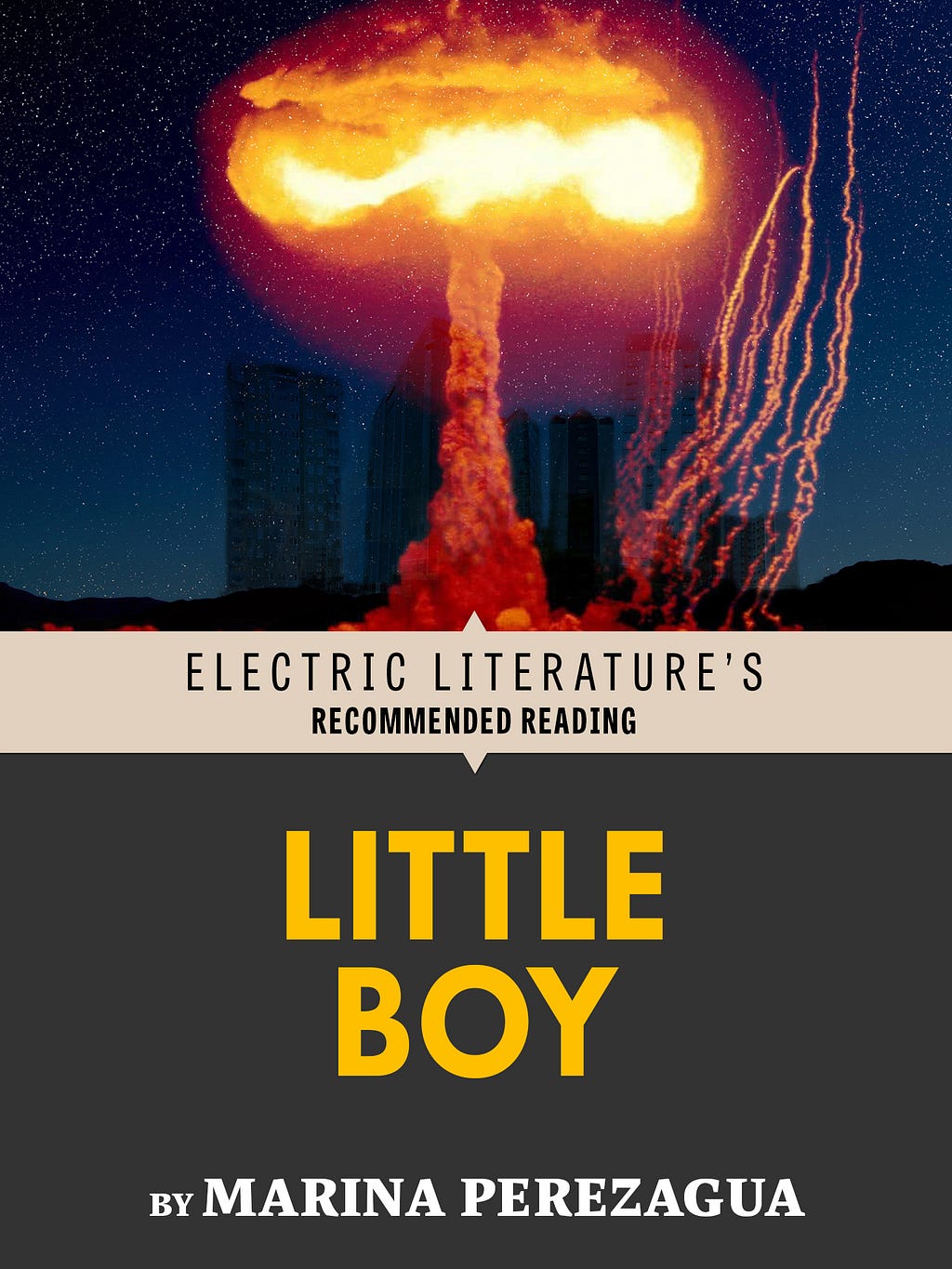
Little Boy by Marina Perezagua

Translated by Jennifer Early
Professor F.G. had spent thirty years teaching at Sophia University in Tokyo. He had the sharpest mind I have ever known, and he was the one who recommended I visit Japan before my relationship with Hiroo became too serious, hoping to hasten the break-up he knew was bound to happen. But I worked in reverse. First, I lived with Hiroo for four years in Port Jefferson, New York, and then we planned the trip that would, in fact, break us up. In order to be accepted by his family, I had to start by rediscovering my distant Japanese heritage. I packed a few photos of my cousins, whose oriental roots are obvious, and a couple of my father, too. Of course, I stopped myself from explaining that this was the side of my family I didn’t actually want to resemble. Hiroo had told me to speak as little as possible, and in any case he translated my words as he thought best.

We began our three months in Utsunomiya, in the prefecture of Tochigi, and this was how we first started living together in his home country. Our apartment was tiny. The entire bathroom fit inside the shower, and the oven was just another sort of kitchen drawer. When we woke up we had to put the futon out to air, and put it back carefully so it wouldn’t get in the way during the day. We had to rest it horizontally against the wall, because it was a futon made especially for Hiroo, who was so unusually tall that he had to walk around the apartment stooped over. He had never mentioned how cramped our living space would be. The first house I encountered when I arrived was his parents’ simple yet spacious home, facing the rice field that they cultivated themselves. So, when I saw the apartment Hiroo had rented, I assumed it was a temporary arrangement, and after a few days I began to think that nobody could live there for more than a couple of months. But in my second week, I met a woman who lived in a neighboring apartment. She lived alone in a space the same size and shape as ours and, despite what I had previously thought, she had lived there for ten years.

Because Hiroo was at University every morning, I often waited for him in our neighbor’s apartment. I shall call her H. I never asked her age, but I worked it out. It was 2008, and she had told me that in 1945 she was thirteen years old. She spoke English because, apart from the first fourteen years of her life, and the last ten, she had always lived in the United States. Ten weeks went by between the coolness of our first meeting and the tremor of what I finally discovered.

H. started her story with the same phrase that she would come to repeat so often: ‘Those who weren’t there can’t imagine what happened’. Reading that phrase in the small notebook in which I recorded what she had confided in me, I think perhaps that is why it has taken me several years to start writing her story down. How to explain something that can’t be imagined? How to describe that which, even for those who were actually there, defies being put into words? But there is always an atom of simplicity in difficult things, and I hope to grasp that here. In this case, it is something that, as a woman, I can understand, and something that marked H.’s existence more than the explosion itself. I will cling to this core as I spin around the reactor of memories and notes that I wrote down throughout our conversations.

Those who weren’t there can’t imagine what happened. Even H., who indeed had been there, didn’t know how to go about telling the story — she would sometimes explain this to me, as if excusing herself. She also used to say that she would have preferred to project her memories directly onto a screen. That way, she explained (and here her features would relax a little), she wouldn’t have to talk anymore. Her film would come out, showing those images that never left (leave?) her alone; those images that led day by day into the same place, which I could never have suspected until our last conversation.

I think about the film H. would have liked to project, bearing in mind what she told me. Imagining frames depicting all this helps me to sew together the frayed edges of her story. H.’s film would start with her lying in bed, a thermometer in her mouth. She had a fever, and she should have stayed at home. She was only thirteen years old and she should have listened to her mother, who didn’t want to take her to school. But H. was so insistent that at 8 o’clock exactly, after an hour in the car, she was sitting at her desk. This disobedience will mark her until the final credits roll. Exactly fifteen minutes and seventeen seconds later, William Sterling Parsons, captain of the Enola Gay, let the bomb drop and began to count on his monitors the seconds that it would take to fall from the plane’s altitude of 9,470 meters to the 600 meters at which it was set to explode. The crew had predicted that the explosion would happen after 42 seconds. After 43, they started getting nervous. As the tension grew, they silently followed their instruments as they counted on. Three seconds later than expected, the experiment worked: the precise instant at which they reached 45 seconds, H. was thrown into another classroom. Coming to her senses, H. looked around to see that there was nothing left standing, not even the walls. The entire school had become a playground, a playground free of any games, opened up to a city that itself had been opened wide. H. came to learn afterwards that, of the two hundred and fifty pupils, she was the only one to walk out. From what used to be a bathroom, she saw a naked lump walking towards her, asking her for water. It frightened her. Its head was so swollen it had tripled in size. Only when the lump said its name did she realize it was her teacher. She ran.

After the drop, Enola Gay started its escape, executing a 155° turn to the northeast. The crew put on dark glasses while they waited for the shockwaves which reached them one minute later, when they were already nine miles away. For H., the details were a lot less precise. She did not know how much time she spent unconscious, nor when she left the school. She remembered that all of the clocks she saw on the way had stopped at the same time: 8:16. But she couldn’t explain how she had ended up at the hospital. Maybe she was taken there by somebody, but she could not remember. The weeks that followed, spent piled alongside the other victims, were also unclear. Later, it was revealed that during the first few days, there was only one doctor for every three thousand victims. Although she didn’t know it at the time, she had burns over seventy percent of her body. After a few days her eyes sealed shut. She could not open them. She thought she had gone blind. There was no medicine, nor any sedatives for the pain. The only medication that they could give her was to change the position in which she lay. Every now and again somebody came to move her. But the pain was so intense that when they turned her she did not know whether she was facing up or down. Her entire body burned equally, and nothing could relieve her suffering. Her chest, her stomach and her knees felt like they were all part of the same burning metal sheet as her shoulders, her buttocks and the backs of her legs. H. felt as if she had lost all shape and form. Crushed by the pain, her front and back had been pressed together, a single dimension of equal burning agony. On the first day that she felt the wetness of her own urine, she realized she had started to recover. From then on, she was able to determine how she was lying. If her urine flowed downwards, she was lying facing upwards. If it immediately formed a puddle, she was lying face down. When they cleaned her eyes, she found she could open them, and when the pain decreased enough to let her move, she lifted her head to look at her raw flesh. She found that, although her extremities retained their original shape, the area between the bottom of her stomach and the tops of her thighs was an unrecognizable mass. The swelling was so great that she couldn’t be sure, but everything suggested that the bomb had specifically targeted her genitals.

From time to time, I would tell Hiroo about my conversations with our neighbor. He never said anything in response, but when he returned home, drenched in sweat, having just tied up his horse (as he used to call his bicycle), he would leave a few pieces of paper on the table for me, printed while he was at University. They ranged from John Hersey’s work for the New Yorker to extracts from archival documents and anonymous testimonies. That’s how I knew that the description of unrecognisable lumps that needed to say their name in order to be identified was not simply one of H.’s own expressions. The most potent, concrete imagery I believed to be of her own creation was repeated throughout other people’s testimonies. At that time, I explained this in the only way that seemed logical. I thought that the unspeakable nature of what they had been through could be the reason that all of these survivors exchanged the most effective expressions, creating, as they did, a language of horror: the latest language, learned all at once, transmitted not from parent to child, but from witness to witness. In this language, ‘a lump with a head so swollen it had tripled in size’ could only ever be expressed as ‘a lump with a head so swollen it had tripled in size’. No equivalent expression exists. It is a language without synonyms.

In H.’s film, the injured walk amongst the dead asking for forgiveness. This is how she grew up, apologizing for having survived. In the papers, they suppressed the words ‘atomic attack’ and ‘radioactivity’, and the Government avoided the word ‘survivor’ out of respect for the more than two hundred thousand dead. In the essay by Hersey I read that Hibakusha literally means ‘explosion-affected people’. In this way, the term leaves out not only the pain, but also the miracle of survival. Altering the grammar of this phrase slightly would change everything: ‘people affected by the explosion’. The phrase ‘explosion-affected people’ can refer to any explosion at all, like when a piece of squid hits the overheated oil in a pan, or a firecracker goes off in somebody’s hand at a birthday party. I tried to figure out, by asking H., how much of a difference was actually made by adding this extra article, but either I didn’t understand her response, or she didn’t understand my question. What I did learn was that the term disgusted her. ‘If I had to give us a name’, I read in my notes, ‘I would call us those who carry the bomb within us, because the morning the B-29 bomber dropped Little Boy was only the start of the explosion’. It makes me think of an inverted Big Bang that, hour by hour, shrunk (shrinks?) one more piece of the universe inside of H., until one day, nobody knows exactly when, it finally explodes.

After the end of the war, twenty-five girls were selected to travel to the United States to undergo a course of plastic surgery that would lessen the marks left by the bomb. They were known as the ‘Hiroshima Maidens’. H. envied them. She followed their journey on television, saw them descending from the airplane, timid, heads bowed, received with bunches of flowers into the country that would attempt to reconstruct the smiles it had also disfigured. H. wanted to be a part of that group but, for reasons I did not yet know, she would never have been selected. Nevertheless, the image of the twenty-five maidens prompted her to start saving. She saved all of the money she was given, and when she was old enough to work she did so for as many hours as she was allowed, always mindful of the operations that she herself would finance: a few fundamental changes to her face, and more importantly, the reconstruction of her genitals.

All those years later, H. still had some of her scars. She wore them without make-up. One of her cheeks was covered by a keloid that was the shape of Africa and the texture of resin. For a long time in Japan these scars were unmistakable. Because of them, the survivors became outcasts, shunned by those who feared the effects of radiation. They could not find work, and the specialized agencies that, back then, helped to arrange most marriages started to reject survivors who wanted to marry, assuming that their children would be born with deformities. In H.’s movie, her pregnant cousin appears on screen. Her stomach, instead of growing, starts to shrink after the sixth month of pregnancy. Her womb, as if in regret, retraces the steps from fetus to sperm, reaching the desirable flatness preceding pregnancy.

I return to that atom of simplicity that allows me to really grasp H.’s story, something that affects me much more than the bomb I never experienced. The moment of clarity came about on the last day we saw each other. That day is like a suction pad in my mind, sucking out my memories of H., holding them for me through the same means by which the suction pads on the feet of a small animal save him from falling: a vacuum.

But in order to speak of that atom, I have to go back to the founding of a peculiar organization, whose members did not know H.’s story. When H. created this organization, it had been twenty years since she had left her home country, and the only thing she would admit at first was that she was, like them, a Hibakusha. She had turned fifteen when, having been adopted by a new family, she landed in the enemy land, as if she and the bomb were two arms of the same boomerang, coming back into the hand that had cast it out. She told me that in her new school her classmates wanted to be soccer players, astronauts, teachers. All she wanted to be was a grandmother, because the doctors always said that the radiation would start to take effect sooner rather than later. On top of the voluntary plastic surgery, she had to undergo many other urgent, obligatory operations, matters of life and death, and when I met her she continued to suffer from new illnesses. She had learned to let them in silently, as she had done with me, with a cup of tea, calmly, as if each one would be the last. All of the illnesses had been well received, except one: the loss of her son. An atomic son may be difficult to understand, but its loss can be felt by anyone. It is a loss as real as the iron I lose every twenty-eight days. Even today, from time to time, the memory of H. appears to me from between my legs, in a wet, red sanitary towel, thrown into the stygian drain that dissolves the dead as well as those who were never born.

As the years went by, this loss corroded H., and one day she thought that perhaps contacting other mothers in a similar situation would relieve her, sharing the heat of those who, in an enemy camp, mourned the death of a child. That is how she got the idea. H. told me that when she was looking for a name for this group, nothing seemed more appropriate than what the Americans had baptized the bomb, and so that is what she named it: Little Boy.

On the only day I ever went out with H., we went to my favorite place: the Tsukiji Fish Market. We had to go very early. It was still dark when I started to dress myself, silently, so as not to wake Hiroo. This market is still the first place I would go if I ever went back to Tokyo. The fish were set out in sections, according to species. Needlefish in one direction, salmon in another. There were large, green areas full of algae. Sometimes, a whale would go by on the back of a truck. Because of the layout of the merchandise, the Tsukiji Fish Market is a museum that organizes things in a way that would make any other fishmonger look like a bazaar. I remember on that day an English tourist came up to me to ask something, obviously encouraged by my western features. Before he went away, he told me that he had heard me talking to H., and congratulated me for having such a good grasp of Japanese. It wasn’t the first time this had happened. I laughed, because H. and I communicated in what I believed to be English. I had learned English with Hiroo, who could not speak it either, and for a long time speaking that language was a half-hearted attempt that allowed me to communicate properly only with the Japanese. I stopped laughing when I realized that this half-language was a reflection of the conceptual limbo that surrounded Hiroo and me. We didn’t understand each other. It’s not that we didn’t get on well, and it also had nothing to do with cultural differences; it was just that our minds seemed to move at the same level of evolution, but on different planets. With H. I had the same feeling, and I didn’t understand a lot of what she was saying to me. What I could interpret, if badly, I would write down in my little notebook. But what may have been a conversation or a discussion with somebody else became with her, as it was with Hiroo, a barrier, a respectful bow towards another type of intelligence and, finally, to resigned isolation.

On the same day that I found out the organization ended up disbanding, H. told me that on many occasions she had toyed with the idea of telling the other women about her experience, but would justify herself by explaining that it wasn’t that easy. She worried that they would cast her out, expel her from the group that she herself had created, and banish her from the project in which she had invested the little energy she had left, not only for herself, but also for the others. I imagine that she held her story back from me for the same reason. But, before all this, she described how Little Boy grew. It was more successful than she had thought it would be because mothers started to get in touch with her sooner than she expected.

I look at my notebook. On the cover, I’ve stuck a photo of a painting from the Edo period. It is a whale hunt. The water should be red, but red in the sea would clash with the ochre tones of the coast. Aesthetics are the backbone of Japan. Looking at this painting, I am reminded of something H. often repeated: in Japan, the beauty of the lacquer that decorates the houses masks the rotten wood it covers. But H. wasn’t covered by any varnish at all. Her face showed who she was. There is no greater sincerity than that left behind by the bomb. The bomb revealed the hidden blood of the whales that should color the sea red, as if saying: I am the true paintbrush, the brush with the uranium bristles.

H. paid great attention to other people’s voices. She would say that the explosion may not have marked a Hibakusha’s skin, but it would always mark their voice. The description she gave me of the first mother to contact her started with how she sounded. Musical, but irregular, trying to avoid showing the real emotion of their first exchange. H. told me that when she heard J. speak, she couldn’t believe that such a voice had spoken to her. In that moment she was linked through the telephone line to a mother just like herself, to the first mouth that moved like her own, that breathed a breath that may have smelled just like hers. I smelled H.’s breath and noted down: a mixture of roots and molars, the breath of the living dead. I remember that H. once told me that in the days following the explosion, people walked with their arms stretched out in front of them. Those who had been blinded did so to avoid bumping in to other survivors, but those who could still see also held out their burnt arms so that the viscous skin wouldn’t stick to their bodies.

J. had not been affected by Little Boy, but by a different bomb: the rain — a thick, black liquid that followed the explosion. People allowed the rain to fall on them and J., like so many others, did not protect her child. Many people even drank the oily liquid, and she wasn’t to know that it carried a bomb in each droplet, a hail of ulcers and cancers that was invisible at first but, day after day, sprouted strong and firm, like potatoes. I was shocked by this capacity for recycling that H. described. People were healthy. People were, and then all of a sudden they were not. It was like that for many years. In that way, the bomb wasn’t all that sincere: appearances and the ability to move didn’t yet distinguish the living from the dead, and J.’s child spent the next six months visibly healthy, although silently dead.

J. and H. first met on a park bench. In H.’s movie, there is not a single leaf on the trees. At the point of impact, the temperature on the ground reached 4000°C. The maximum temperature of the surface of the sun is 5800°C; iron melts at 1500°C. Just like the lumps with heads so swollen they tripled in size, there are other recurring characters that enter into the eyewitness accounts. There are those who watched the sky as the bomb fell, and who are described in very certain terms: a verb — to hold, a plural noun — eyes, a phrasal verb — to fall out, and another noun — sockets. After leaving school on the day of the explosion, H. remembers having come across men and women stumbling about, holding their eyes with their hands so they didn’t fall out of their sockets. H.’s eyes were so blackened that they looked hollow.

Little Boy became clearer and clearer with each visit to H. Seeing as what H. was telling me took place between 1945 and 1963, it often pained me to think that I was seeing something that no longer existed, the light from an extinguished sun. At that time, I still didn’t know that the explosion had utterly destroyed any risk of humanity living in darkness. The father of the atomic bomb brought with him the promise of the most radical light; he was the last messiah, a major god of Theoretical Physics, giving us an indelible formula, a weapon that did not end with its detonation, but instead inseminated the rest of the world with the speed of mating rabbits. Today, there are more than twenty thousand bombs like the one dropped on Hiroshima. More than twenty thousand rampant, pyromaniacal bunnies that, at the moment of climax, could start a worldwide blaze big enough to bind us all together in the heat of a single sun.

H. showed me a few photos from over the years, but they were all taken after the day of the attack. It surprised me that she used to say the bomb had had a positive effect on her appearance, and she couldn’t recognize herself in photos taken before that Monday, 6th August. She told me that the bomb had dared to change parts of her body that disgusted her, had sketched out new features that she later made permanent through surgery. This had seemed like a harsh statement, but at that point I still didn’t know that, before the attack, H. was already a victim, and out of all of those close to her, the bomb was the only one who could see her as she really was.

In the photos, H. looked beautiful. She still did. I don’t remember when in our relationship I dared to ask the first intimate question, but I know that the response surprised me, because she opened up far more than I had allowed myself to. I asked her if she had continued to have sexual relations. She told me that she had been with two men, but they must have seen something that frightened them. She couldn’t say for certain, because she had never seen another vagina, but she thought that the operations had not been as successful as they had promised they would be. From then on, it was the only part of her she wouldn’t let anybody see, not even her doctors. And so, I thought, none of her illnesses could have entered that way. H.’s legs had been as firmly sealed as an atomic bomb shelter, although, sadly, nobody was trying to get in.

The desire to set up Little Boy stemmed from a natural empathy between H. and J. H. told me that, out of all the mothers she met, J. was the one who inspired her with the most confidence, and it was for that reason she found it so hard to hide her situation from her. Despite going through her own tragedy, J. wanted to live, and forced herself to contact other mothers, women who lived hidden away, buried behind walls, wardrobes, old-fashioned toys; invisible women who chased a specter to cling to, mourning the absence of a fleeting apparition as if they were mourning a second loss.

S. was the third woman to join the group. H. and J. visited her at her home. It was a normal house. When a death has recently occurred, an aura of sadness covers everybody, acutely felt by some and imposed upon those who were not as close to the deceased, or who perhaps are too young to understand. It is generally accepted that this is how things should be. In houses that suffered a loss long ago, everything returns to normal except for one piece of furniture: the mother. H. used to say that S. was not anxious, but rather she was stoic, serious. Perhaps she was unconvinced that Little Boy could change her day-to-day existence, a sack full of time she hauled around on her back with as much thought as one gives to swatting flies. Her living room smelled of roasted pumpkin. H. told me that when she was in the hospital, she heard that people had been to what had once been farms, digging up the unripe pumpkins that had been cooked by the blast.

H. heard a lot of things in the hospital. She remembered one man had said that, on returning home a week after the explosion, he found his wife’s pelvis lying in the empty space that had once been his house. The man added that it was not this image that disturbed him. What kept him up at night was reliving the moment in which, picking up the pelvis to put it in a bin, it burned his hand. After seven days, it was still hot. As H. started to get better, her pelvis continued to burn, and she thought that for some reason this part of the body must retain more heat than others. However, she told me that from the explosion onwards, she lost all desire for sexual contact. She was young, and had only responded to her instincts through masturbation, but the final burning in her genitals was not sexual but feverish. Even in the first days of semi-consciousness, when her mind did not yet know what her body knew, she experienced moments of delirium, into which seeped the fear of the consequences of her new state, and as she recovered, she realized that although she was still attracted to boys and those feelings had not changed, her libido had disappeared. It was as if she had lost a leg. She had heard of cases of amputees feeling, after a certain amount of time, some sensation in their amputated limb, and she too was waiting for this phantom limb syndrome. She waited for years, without wanting to understand that the feeling of a phantom limb usually comes about soon after the loss. She preferred to continue believing herself to be lucky, at least in that one sense. Having feeling in a leg that doesn’t exist serves no purpose, it could never walk or accompany the other leg: and yet — she believed, hopefully — having feeling in amputated genitalia would be enough to raise the tickle of an orgasm. When she finally said goodbye to that hope, she longed to feel this sensation at least once more. She suffered from many syndromes, but never that one. She was absolutely amputated, like a Greek sculpture who carries, in her own beauty, her penance: the impossible embrace of the Venus de Milo.

I don’t remember exactly when I began to understand what H. was not telling me. I suppose it was something that happened over time, something that I picked up imperceptibly until it came to me naturally. I do remember that I understood everything in an instant and, despite the fact that she had never mentioned it, I felt as if we had never stopped talking about it. H.’s restraint on that front meant that she had spoken with her most eloquent organ: her silence. I will retrace my steps and correct myself. If H.’s loss was to be found anywhere, it was not in the impossible embrace of the Greek Venus, but rather in the lost penis of the Apollo Belvedere. Except for one detail: what would have been a source of grief for another man was a great relief for H. The day that H. was finally able to tell me, I already knew. There were no surprises or drama on my part, only a stream of questions that had built up in my head, to which she would respond by confirming a few details. That was when she let me into her most intimate world, and I entered into it without any of the reserve I had shown when first asking about her sexual relations.

H. was always very conscious of being a girl, but she had been brought up as a boy because she was born with a penis that, in accordance with her consciousness rather than her surroundings, never actually developed. H. was born with a sex differentiation disorder. She belonged to what would later be named a third sex. When she was born, the doctors and her parents decided that she was a boy, ignoring a few ambiguous features and a female organ that could not be seen from the outside: a half-formed uterus. They sent her to a school for boys, and as she grew up they hid from her the fact that her sex was the subject of confusion during those first few weeks. Until she was twelve, H.’s difficult situation was disguised by her haircut, her uniform, her teachers’ predictions for her future as a young man. But as she developed, her conflicts progressed from her clothing and the style of her hair to other, more internal, changes. Although her testosterone levels were weak, they were still strong enough to allow her to start sprouting a beard during puberty like the rest of her schoolmates, and she went through other visible changes that ran parallel to the production of semen in her testicles. What had until then been mere dress-up started to become ingrained in her, inherent, and one morning she woke up in a uniform she could not remove. H. used to say that the most traumatic thing was not being able to take off the costume other people forced her to wear. External impositions, like a spider’s abdomen spilling its thread, had trapped her like prey. And, inside this web, a little space for movement: her small penis responding to the touch of her left hand. The little masturbating bug exploring the advantages of its new machine. But as soon as the thick milk turned her fingers into the webbed feet of a water bird, H. asked herself if such a climax would be enough to compensate her.

H. started to think more and more frequently of self-mutilation. During our conversations, she acknowledged that those thoughts could have remained a comforting fantasy toying with her mind, an escape. For that very reason, she was happy that the bomb had touched her, making her thoughts a reality. But to look at her own scar was not easy, and she spent weeks mourning the penis that she had always hated, that she still hated. For a long time, she slept on her back because she missed the friction between her little appendage and the futon. She thought of it like a lizard’s tail that, separated from its body, spends its last movements trying to reattach itself. It would have been less painful to imagine her penis burnt, dead, pulverized; but instead she imagined it thrashing around, looking for her amongst the ruins of Hiroshima like a lizard without eyes.

For ten years, H. felt the helplessness of a reptile pining for the movement of the tail it rejects. Her spirit wavered between the relief of that loss and the pain of castration, in the uncertain space between mutilation and the desire to see her tail regenerate as another organ. And, on the outside, she had the genitalia of a doll. Neither a penis nor a vagina. The explosion had also affected her testicles, reduced in their scrotum to half their original size.

That is when she first felt the desire to be a mother. She read in the news that some of the Hiroshima Maidens announced that after their operations they were thinking about getting pregnant, as their scars faded and they rediscovered parts of their previous forms under the social and economic protection of a country that had become, all of a sudden, good humored. The Hiroshima Maidens were received with ceremony, with balloons, with applause. H. remembered a television show called ‘This is Your Life’, featuring the Reverend Tanimoto who was visiting the United States with the young girls at that time. The presenter, wearing an unchanging smile, ran through the reverend’s life, starting at his childhood. H. knew that Mr. Tanimoto was there to speak as a Hibakusha and, like everybody else, she was waiting impatiently for his story. But the presenter was playing with his audience, keeping them in suspense, and between the different sections of the show, they played an advertisement for a nail polish whose name echoed the reverend’s ecclesiastical nature: ‘Hazel Bishop’. Stunned, the reverend waited until a young woman stopped using a scourer to scrape the surface of her nails, painted with the latest polish that was impossible to scratch. On top of the suspense and the nail polish, they added intrigue to Tanimoto’s story: a few minutes into the show, the silhouette of a man appeared on set, behind a translucent screen, and started to talk. The presenter readied the reverend for this surprise, telling him he was about to meet a man he had never seen before. Before coming out from behind the panel, the silhouette spoke: ‘On the 6th August, 1945, I was in a B-29 bomber flying over the Pacific. Destination: Hiroshima’. It was Robert Lewis, the co-pilot of the Enola Gay who, the presenter explained, had taken to the same stage as the reverend, in front of an audience of thousands, to shake his hand in a gesture of friendship. Despite these humiliations, H. could not stop envying the Hiroshima Maidens. After leaving the family that had taken her in, she started with the most affordable steps: breast implants and a strong course of hormones to make her features more feminine. She would have to wait another ten years, once she had saved enough money, to decide whether or not to have a vaginoplasty to permanently fix the sentence handed down to her by the bomb.

When H. formed Little Boy, she had already recovered from the final operations. She had spent all her savings on travel to and procedures in Sweden, because at that time the United States was still reluctant to perform the operations she needed. As Little Boy began, every mother told her story, everyone except H. who, as the founding member, reserved her right to silence. I knew that she also had her reservations about talking to me, and that the chapter she had told me was, in spite of its complexity, only the gentle side of a tough story. I had a feeling that the worst pain of all was caused by the very nature of the son that H. had lost, a nature I could not understand at that time. And so, I kept listening to the stories that she would tell me about the other mothers, all the while trying to figure out in which direction she was trying to lead me.

Twenty-one years earlier, S. stood on the bank of the river, watching her twenty-two month old son as he walked over the pebbles. She was talking to a friend at the same time, and the next thing she saw was an image that would define her life from that day onwards. The darkness of night had fallen at quarter past eight in the morning and, in front of her, there was the intense light of a small sun: her son burning a meter above the ground. But, of all the experiences that H. described, there is one that is so graphic that I don’t need my notes to help me remember: K.’s testimony. She lived in one of the few cement buildings in Hiroshima. While cleaning the windows of her third floor apartment, she watched her mother push her son on the swing in the park below. She dipped the cloth into the bucket, keeping her eye on the movement of the swing. The child seemed to be coming towards her, pushed by his grandmother, only to quickly retreat backwards, stubbornly playing the game. She said that with the explosion the child pitched forwards, swinging upwards one last time. Through the splintering glass she witnessed the transformation of her son as he fell through the air and towards the ground. Without changing shape, his entire body turned black in mid-flight. It was no longer flesh that flew through the air, but rather dust, compressed into the shape of a human, that started to fall like a rain of ash. H. told me the same thing about the birds that were flying over Hiroshima at that moment. As their wings were beating, they changed from birds into carbon molecules. Without catching fire, without sustaining any injury, the birds underwent the most logical of metamorphoses: perpetual weightlessness; the lightest, effortless, wingless flight.

On the ground, those closest to the point of impact vanished, leaving behind only an indication of their form in the so-called atomic shadows. Their silhouettes remained on the walls they had been leaning on, the steps they had been sitting on, because radiation reacts differently, depending on the material it strikes. If the radiation had to go through a person, the space they occupied retained their shadow. H. used to tell me that one of the mothers believed she had recognized the shadow of her daughter on the wall of her school. For months, she was determined to preserve that marking. She protected it from the wind and rain, like an archaeological dig, trying to conserve her daughter’s final image. When they started to reconstruct Hiroshima and the wall was pulled down, the mother left Japan.

I think that one of the testimonies that Hiroo left for me to read can be explained by the differing effects of radiation on the human body depending on the surfaces it encounters. A man expressed his surprise at seeing a woman wearing a close-fitting kimono. When he looked closer, he saw that the woman was, in reality, naked, so naked that she wasn’t even covered by her skin. However, the colors of her kimono, having absorbed and reflected the heat of the bomb in different ways, had left the floral pattern of her clothing imprinted on her body. The Reverend Tanimoto had also spoken of the nakedness of the victims. At first, it seemed as if they were wearing rags, but in reality these were pieces of flesh, hanging from them like pieces of fabric. H. told me that one of the last things she saw before her weeks of blindness was her doctor taking off her shoe and bringing with it all of the skin from her leg, as if it were a stocking. The doctors still did not know how to treat the wounded. Even the attackers did not yet know the physical effects of the bomb.

H.’s vaginoplasty was as successful as that type of operation could be at the time, although the resulting vagina was doubtless not good enough to be penetrated by a penis from that age. These were Paleolithic penises that wanted standard vaginas, holes with similar textures and dimensions. But H. was still satisfied. She was unorgasmically satisfied, because the loss of her glans meant that they could not construct a clitoris, but in the end this became less psychologically damaging than an orgasm brought about by a member she refused to acknowledge. Nevertheless, with time and with age, she had to accept that the bomb had come too soon. She used to say that if it had exploded ten years later, her life might have been enhanced by the existence of her son.

After J., S. and K., the first three women to join Little Boy, six more came along. Eventually, there were ten mothers in total. Ten mothers who were no longer mothers. Ten dismembered fingers, waiting to be of some use once again. H. used to say that she noticed the mothers were each hoping to hope once more, and they acted upon a desire to turn their sisterhood into one giant mother, mourning the death of one single child. It seemed as if, in their coming together, they could finally start to conjugate a verb that had so often been rejected as absurd–to recover. Seeing as H. was thirteen at the time of the attack, the other women were impatient to hear her story as the youngest mother. But she would always keep quiet, and for months the others respected her silence. Then, when she was left alone, she would search for the words to tell her story. She would explain, apologetically, that her movie was not only silent, but also silencing. H.’s tongue was held firm by the same images she wished could be projected to help everybody understand. And so she would evoke the absolute silence of the devastated city in the days that followed the explosion. In the hospital in which she lay, the wounded stopped groaning. Even the children stopped crying. The only thing she could hear was the whispering of names, coming from those who were looking for people they knew among the devastated faces. It was a strange experience, because identification depended less on those searching than on the victims themselves. If the injured didn’t have the energy or the desire to respond ‘I’m here’ to the mouth that whispered to them, then their parent, their child, would have to continue whispering indefinitely into the wrong ears.

H. told me that there was one masculine feature that the hormone treatment could not change: her baldness. At the age of thirty, she started to wear a wig. In reality, she didn’t know if her hair loss stemmed from a premature baldness due to her male biology, or from the effects of radiation. In my notebook, next to the word ‘wig’, I have a drawing of a bridge that connects the words ‘hormones’ and ‘radioactivity’. It makes me think of the way Japanese bridges are built. Because of the way in which they arc, whoever crosses can see the landscape from several different levels. Crossing is, therefore, not just the act of getting from one side to the other, but rather it is a way of seeing just how many different perspectives can be contained in one single landscape. H. was the bridge between man and woman, recognizing, as it curves, all of the genders that exist between these two shores. H. was also the link between biological and atomic trauma at a time in which young people of my age in Japan no longer knew what had happened to their country on the 6th August, 1945.

I started to alternate my research into the books and papers about Hiroshima, given to me by Hiroo, with my first steps towards understanding intersexuality. There was one piece of reading that interested me in particular, but I’m not sure how I came across it. It was a manga series by Chiyo Rokuhana. Its name — ‘IS (Aiesu)’ — is a reference to the word ‘intersexual’, reduced to the initials ‘IS’. The seventeen-volume comic was first published in Japan in 2003, and although it was later translated into English, I didn’t have access to the translation at that time. I couldn’t understand a lot of the dialogue, but some of the drawings were enough to illustrate the characters’ inner conflicts. In one of the cartoons, there was a teacher directing her female pupils’ attention to a projected image of a vagina. In the next one, the students are blushing with the black, striped shadowing that is used to show blushes in black and white comics. Everyone is blushing except for the main character of the first part of the first volume, Hiromi, an intersexual who was brought up as a girl despite the masculine genitals she had learned to hide. In the cartoon, Hiromi is the only one with clear cheeks, because they refuse to redden at the thought of a vagina she does not have.

When she founded Little Boy, it wasn’t her sex differentiation disorder that H. found hard to explain. Not only had her identity as a woman never been in doubt for her, but also the hormone treatment and the operations meant that there could be no ambiguity for anybody else either. What H. struggled to explain was something else indeed. It was a feeling she feared that the others would not understand, a feeling she believed came from her half-formed uterus, the organ whose dysfunctional destiny was decided from the very first weeks of gestation. The hermaphroditic embryo that every human being is at conception remained, for H., in this state of uncertainty. Neither male nor female. Male and female. But, no matter what her biology suggested, she was herself, firstly, as a woman. A few years after the explosion, H. began to feel the desire to have a child. What started out as a mere wish became, after a few more years, an urgent need to get pregnant, a need so strong that she would have tried everything she could to do so. She remembered those days when, as an adolescent without a clitoris, she would masturbate with her penis, and she thought that, as she didn’t have ovaries, she could at least have fathered the very child she desired. Her testicles, lack of menstruation, undeveloped breasts, and the presence of seminal vesicles all suggested that she was meant to be a father. But the bomb exploded too soon, when she was too young to want to be either a mother or a father.

H. and J. set up fortnightly meetings of Little Boy. Transport costs for those who lived further away were split between the group. They met in a room they had hired specifically for that purpose, which H. spent days cleaning because it must have been years since anybody had been in there. Then they started to talk. H. acted as chairwoman while the others, one by one, would tell their stories. The fact that H. was thirteen when the attack happened always fascinated the other mothers, and each time she opened her mouth they followed the movement of her lips as if wanting to pull the words out.

H. was preparing how she would eventually speak. Meanwhile, she was enjoying the possibility that these unmade mothers could be her best, perhaps her only, listeners. She said that the big, rectangular space they had hired changed according to the story being told. It was skin, river, nails, asphalt, it was full of children with blackened mouths, but also children running about, laughing, being lulled to sleep as they were passed from one mother to the next.

During my time in Japan, I only once went to the cinema with Hiroo. We saw a movie by Yojiro Takita: Okuribito. There were no subtitles, but I believe that my poor grasp of Japanese had blessed me with the sort of hypersensitivity that allows us to read beyond the scope of words: gestures, colors, the intuition of onomatopoeia. On the other hand, just as with Rokuhana´s comic, many of the images used in Okuribito sufficiently illustrated the plot. And, in one of the opening scenes, I noticed something that struck me as an enormous coincidence. All of a sudden, the young protagonist finds himself faced with performing his first ceremony as a nokanshi, alongside his mentor. In Japan, the nokanshi is in charge of preparing the body of the deceased according to the Nokan ceremony, in which the body is gently touched, massaged, and washed with a warm, gentle sponge, a sponge that is doubly kind: a goodbye that is, at the same time, a greeting. In this scene, the apprentice was preparing the body of a young and beautiful girl in front of her family. As I watched the nokanshi admire the cadaver’s face, I thought that she looked as if she were alive, and Hiroo translated that this was because of the gentle nature of suicide by carbon monoxide poisoning. The nokanshi started by caressing her face. But these weren’t ordinary caresses. He lightly pressed her eyelids, her cheekbones, and her chin, as if he wanted to relax even the smallest muscles. Then he took hold of a wrist, and held it so that he could push the rigid palm backwards, like a stretch in preparing for exercise. The body seemed to be stretching out, and it was difficult to believe that his touch was working towards an absolute ending, rather than towards a new awakening. It was the beginning of death that closely resembles the beginning of life. And it was exactly how Hiroo used to wake me up before I opened my eyes in the morning. The caresses that wake a drowsy body from sleep were the same caresses that nudged a rigid body towards death. And yet the coincidence that struck me the most was not this, but the second part of this scene, because it reminded me of a precise moment in the story H. was telling me. The nokanshi covered the body in a sort of quilt and, still under the gaze of the family, removed the young girl’s kimono from under it. Once he had taken off this kimono, he placed it over the quilt, which he then pulled back, leaving the girl naked underneath. This allowed him to place his hand underneath the cloth, and to start to clean her skin without needing to see her naked body. By the girl’s head, there was a steaming bowl of water, which the nokanshi used to wet the small towel he then placed under the material, starting from the top of her chest. He started to wash the body. Underneath the kimono you could follow the movement of his tender fingers, like the legs of a small animal furtively digging a tunnel. But the hand stops a little below her stomach. The little animal has found something, touches it, tries to identify it. Without a doubt, it is a penis. This penis between his fingers surprises the nokanshi, who looks, stupefied, at what is undeniably the face of a young girl — her feminine features, her long hair — and understands, in an instant, her suicide.

I believe that understanding a stranger’s suicide instantly, without words, simply through touching their body, was the kind of understanding H. needed. It is a mute communication that, in her case, could be best explained by an endoscopy. I’m thinking of a camera at the end of a surgical tube, which enters into H.’s fornix and leads to her uterus. Everybody she wishes could understand her, including myself, is sitting together in one room. The tiny camera that passes through her cervix projects the image onto the screen that surrounds us. We are the camera. At the moment all we see is pink. A pink tunnel. At the end of the tunnel is the resolution, the comprehension of H.’s conflict. But, at the moment, we wait. We wait, suspended from an umbilical cord that hangs from high above, from the sky, from a bomb that is getting closer and that, in its free-fall, starts to make out a grid of irregular streets; it starts, as it plummets towards the earth, to understand Hiroshima.

In Rokuhana’s manga, after discovering on the Internet that there are other IS like herself, Hiromi decides to have sexual reassignment surgery so she doesn’t lose the boy she likes. She would undergo an orchidectomy — commonly known as castration — and have her penis removed, recycled and used to construct her new vagina. During her first visit to the doctor, Hiromi is placed on a gynecology chair. In this hospital, they have never used such a chair in order to examine a penis up close, and Hiromi notices that, between her legs, there are more and more people joining the team of doctors. She feels herself being touched by more fingers than any one doctor can have. She also notices the flashes coming from the cameras photographing her, like some scientific discovery, and she listens to the voices of admiration coming from those who are examining her. She is not being treated as a patient, but as an object to be studied. Naturally, this led me to think about H.’s first contact with the occupying American doctors. They were there simply to observe, not to intervene, even when it came to simple cases of vomiting or infant diarrhea. Some victims, without knowing it, were still contributing to the development of the Manhattan Project. Later on, I read that the project’s human experiments didn’t start with the Japanese, but in fact went back a few months before the explosion. Specifically, to 10th April 1945, when they injected the first human with a dose of plutonium that was 41 times higher than a person receives in an entire lifetime. The subject was Ebb Cade, a fifty-three year old black man who was wounded in a traffic accident and then taken to the U.S. Army Manhattan Engineer District Hospital, in Oak Ridge, Tennessee. Cade was the first of 18 patients to receive a lethal injection of plutonium.

Little Boy continued to meet for a long time. Because she couldn’t find the right way to explain her situation, H. ended up lying so as not to break the ties that had united her with the other mothers. She told everybody that her son died of radiotoxemia. H. envied those who mourned one particular death. It seemed to her that describing the loss of something that had once existed was much easier than expressing the real loss: the loss of something that, despite being written in the nucleus of her cells, never came into being, the son she could never conceive. That is why she lied. She had to lie in order to say something.

H. was called a Hibakusha, but she told me in our last conversation that if she had to give herself a name she would use ‘the nuclear mother’, because on the morning that the B-29 bomber dropped Little Boy, she was impregnated with an atomic baby that she could feel but not see, in a nightmare of a pregnancy that turned the nine months of gestation into an entire lifetime.

Let’s come back to Hiromi’s story. She has a sore testicle. She adjusts herself through her skirt. Hiromi finds her mother’s diary. The writing tells her that she was called Hiromi because, if she had a sex change, she wouldn’t have to change her name. She decides to have the operation. She dreams of an artificial vagina. But Hiromi also dreams of children. Children that are a part of her. And so she then decides not to have the operation after all. I think that H. would have liked to be Hiromi. To be a father is better than being neither father nor mother. To be a father, and then to be a mother. But the bomb came too early and took her son away along with her penis. She never explained this in words. I am struggling to explain it in words. I saw it all through another endoscopy. This is not a metaphor, it is an endoscopy. H. opened her legs and spoke with her mouth closed. The camera, once again, entered her uterus. A heartbeat was beating louder and louder. The sound wasn’t coming from her genitals, and it wasn’t coming from the monitor through which I could see the pink tunnel walls. Rather, it was coming from somewhere high above, from the bomb that would slice through the air as it fell. I saw that it had its weight written on it in small numbers — more than four tons. I knew that the B-29 had problems during takeoff, and the crew had to arm the bomb in mid-flight, so I saw the hand of Morris R. Jeppson, the last man to touch it. He wasn’t shaking, but he was scared. It’s likely that Jeppson did not know that the bomb was attached to an umbilical cord. I looked upwards, following this cord. It was a very long cord — 9,479 meters. It brushes against H.’s abdomen. At one end of the cord, the bomb was about to drop and at the other, H. was waiting. I, too, was waiting for the cord to attach itself to her uterus. But H. only had half a uterus, and the cord planted itself outside of this, firmly rooted in the half that did not exist. I saw the hypocenter of the explosion and I understood the sudden incineration of the void: a baby’s backbone that drains its surroundings in circular, climbing waves. It was a spine without marrow. Empty. In an instant I understood the emasculating force of the bomb, dropped to cut off her penis, to burn her testicles, her desire, her son. It was early on Monday 6th August, and the bomb was falling fast through the sun soaked clouds. It was exactly 8:16:43 in the morning, and H.’s unborn son started to cry.

10 Terrible Fathers in Literature

On Mother’s Day we posted a list of ten fictional mothers who would make you be a little more grateful for the one you have; the candidates ranged from abusive alcoholics to narcissistic drama queens. It seemed only fair to produce a list for Father’s Day. What did I find? The mothers are going to have to try a lot harder if they want to compete for the bad parenting title. (For easy comparison: Mrs. Bennet would be crushed by any of the men on this list.)

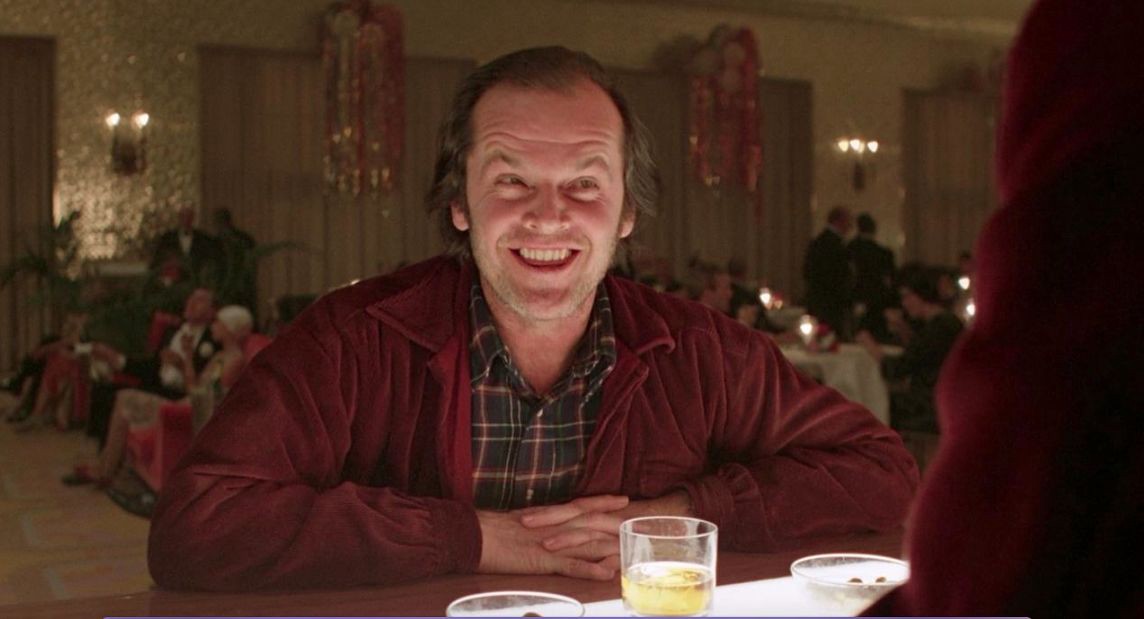
Literature is flush with options for fictional fathers who go below the minimum bar for terrible parenting (being absent, say, or unloving or overbearing) and plunge straight into crime. Violence is a common thread among fictional fathers, and often their horrors are the very crux of the story. Think what The Shining would have been if Jack Torrance had never picked up an axe. Still, if literature holds a mirror to society, it’s worth considering how our expectations for parenting vary between the sexes.

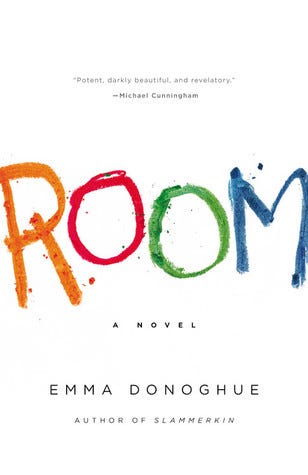
1. Old Nick in Room

by Emma Donoghue

Controlling fathers aren’t rare. Still, dictating what clothes your child can wear or setting strict curfews is nothing compared to the limitations Old Nick placed on his “family.” Family is a stretch: Old Nick rapes the woman we know as Ma, and she gives birth to Jack, then holds Ma and Jack captive for five years in a windowless bunker, the space Jack heart-breakingly calls Room. If Old Nick’s enslave-my-kid-in-the-basement antics sound eerily familiar, you’re not wrong: Donoghue was inspired by an even more twisted true story that made global headlines in 2008.

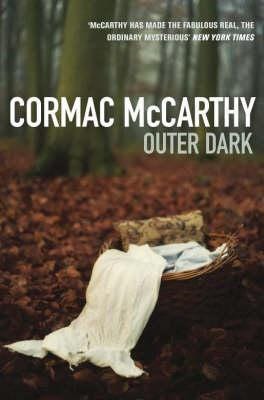
2. Culla in Outer Dark

by Cormac McCarthy

Cormac McCarthy’s most famous exploration of parenthood is probably The Road, though the father in that novel deserves to be on different list (in case anyone is putting together “Top 10 dads who try to save their kids in a scary, deteriorating post-apocolyptic world.”) Culla, the father in Outer Dark, is no less memorable on the other side of the spectrum. Culla impregnates his sister Rinthy and, after she gives birth, takes the infant to the woods and leaves it to die. He lies to Rinthy about what he did, telling her that the baby died of natural causes, then leaves town. Attempted infanticide. Lying. Incest. Abandonment. McCarthy, never one to shy away from human baseness, gives us them all in one truly terrible father.

10 Fictional Mothers Who Will Make You Thank God for Yours

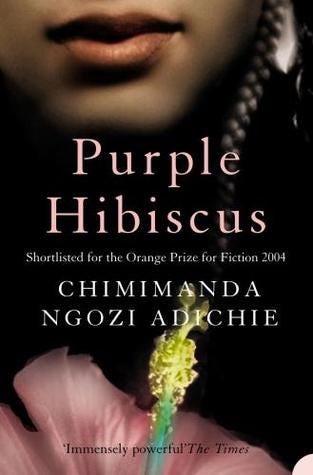
3. Eugene in Purple Hibiscus

by Chimamanda Ngozi Adichie

Thanks to a combination of modern investigative journalism and the public’s raving thirst for knowledge about the private lives of public figures, it’s increasingly difficult to two-face the system, to act like a moral exemplar in public and a monster at home. It still happens with shocking frequency, however, and Adichie’s beautiful tale of post-colonial Nigeria plays off this very premise. Eugene Achike is a prominent and respected Catholic businessman, but behind the guise of community activist lies a man who is not only overbearing and controlling towards his family, but beats them to a pulp as well. Abusing your children is bad, doing it while everyone praises you for being kind-hearted is worse.

4. Glen Waddell in Bastard out of Carolina

by Dorothy Allison

Dorthy Allison’s novel takes place in Greenville, South Carolina in the 1950s. It’s a grim place, struck by poverty and misogyny, and it spares the Boatwright women no moment’s rest. At the heart of their struggles is Glen Waddle. As bad stepfathers go, Waddell makes Humbert Humbert look like a good option. Waddell repeatedly violently rapes his young (we’re talking pre-teen) step-daughter Bone. One episode is so violent that he actually breaks her bones.

5. Jack Torrance in The Shining

by Stephen King

Thanks to Jack Nicholson’s creepy portrayal in the film version of The Shining, Jack Torrance might be the most famous bad dad on this list. Make no mistake, Torrance earns his infamy. Before the ill-fated trip to the haunted hotel in the Rockies, he was an alcoholic prone to violent episodes. He even lost his job after he broke his son’s arm. When the evil forces in the hotel unleash Jack’s violent streak, he goes AWOL on his family and then tries to murder them.

6. David Melrose in Never Mind

by Edward St. Aubyn

While it’s hard to beat a pyscho-killer father like Jack Torrance, psychologically manipulative fathers also deserve a spot on this list. Never Mind is part of a five book series which Edward St. Aubyn loosely based on his life growing up in a dysfunctional aristocratic English family. The father, David Melrose, is cruel and manipulative (and sexually abusive), waging a kind of psychological war on his family. For example, Melrose “knew that his unkindness to [his wife] was effective only if he alternated it with displays of concern and elaborate apologies for his destructive nature.” Not surprisingly, the later books in the series explore the repercussions of the father’s mental abuse, from depression to addiction to heroin.

7. James MacNamara in Down by the River

by Edna O’Brian

Edna O’Brien’s fiction is known for giving a voice to Irish women. As a result, it often exposes the ways in which men take advantage of Ireland’s patriarchy. Down by the River tells the story of a 14-year old girl named Mary MacNamara who is raped by her father James. The obvious monstrosity of this crime is doubled because it is Mary, not James, who must suffer the consequences. James “cooperates” with the law and avoids prosecution. Meanwhile, after a failed abortion attempt abroad, Mary is forced into an insane asylum and given over to religious fanatics who insist on her having the baby.

8. Alexander Zalachenko in The Girl With the Dragon Tattoo Series

by Steig Larsson

If one good thing can come of bad fathers, it is ass-kicking daughters hell-bent on revenge. Alexander Zalachenko is an ex-soviet spy and crime boss who dabbles in about every reprehensible trade you can think of, from assassinations to prostitution rings. When Lisbeth is a girl, Zalachenko beats his wife to within an inch of her life, thus leading Lisbeth down the path to becoming her future awesome, hacker/vigilante self. Without giving the series away, let’s say Zalachenko’s parenting only gets worse from there.

9. Rabbit Angstrom in Rabbit, Run

by John Updike

Janet Angstrom made our list of Worst Mothers in Literature, but that doesn’t mean that Rabbit isn’t an equally terrible husband and father. He’s a washed up ex-high school basketball star who can’t deal with adulthood. He abandons his family, knowing full well that his wife is struggling as a recovering alcoholic, and has an affair. Selfish and immature, Rabbit contributes to the sad fate of his family just as much as his wife.

10. Humbert Humbert in Lolita

by Vladimir Nabokov

No list of bad fathers — and stepfathers — in literature would be complete without Humbert Humbert. Obsessed with a twelve year old girl, he manipulates his way into becoming her stepfather and has sexual relations with her. As this list will attest, Nabokov is no longer groundbreaking in writing a book about a pedophile, but what will solidify Humbert in the canon of bad fathers is the way that his psychology is laid bare. Humbert’s endless justifications and excuses for his desires, the way that he tries to shift the blame to Lolita; these gross distortions of reality are more important than simply acknowledging his inappropriate lust towards young girls.

Electric Lit’s Got a New Look

Welcome to our new site! All of your favorite EL content is now in one place, including essays, reviews, mixtapes and the Writing Life Around the World, as well as literary oddities from Okey-Panky, and fiction from Recommended Reading.

We hope you’ll follow the publication to get the latest stories. Just click “follow” in the top right hand corner of the homepage.

We’re also changing the way we use Tumblr, which has been the home of Recommended Reading since it launched in 2012. We’ll still post teasers for new issues every Wednesday, but we’ll also share other content from Electric Lit throughout the week. Each new issue of Recommended Reading will be free for a month before moving behind a pay wall. The full Recommended Reading archives are accessible to members only. Learn more about becoming a member here.

We hope you enjoy the new site, and thank you for reading!

Joe Okonkwo on the Gay Black Entertainers of 1920s Harlem and Paris

Joe Okonkwo, whose background is in theater and acting, recently published his debut novel, Jazz Moon, set in the roaring twenties of Harlem and Paris. In addition to his work as a fiction writer, Okonkwo is the prose editor for the Newtown Literary journal.

Jazz Moon follows its protagonist Ben, a black gay man and a poet in 1920s America, as he leaves his southern home for New York City, and then ventures even further, to jazz-filled Paris, in a journey to find his place in the world and come to terms with his own sexuality and creativity.

I sat down recently with Okonkwo over coffee, at a midtown branch of the aptly French-named Le Pain Quotidien. We talked about the evolution of Jazz Moon, stereotypes and identity, and the struggles of writing while working other jobs seven days a week.

Catherine LaSota: You lived in many different places before landing in New York City.

Joe Okonkwo: I was born in Syracuse, and then we moved to New Jersey. I was one. Then we moved to Flint, Michigan when I was two. We were there for six years, and then we moved to Nigeria, where my father’s from, when I was eight. My mother hated Nigeria — I did, too, actually — so she and I moved back to the United States, to Vicksburg, Mississippi, where she’s from, and we stayed there two years. Then we moved to Houston in 1981, and she’s been there ever since. I went to California for a couple of years, and then back to Houston, and finished my theater degree. I made my living doing theater for a while in Houston — children’s theater, stage managing, teaching. And then I moved here in June of 2000.

CL: And when you moved to NYC, were you still doing theater work?

JO: Yes, I came here to do theater, to be an actor. I did maybe three off-off-off-off-off-off-off Broadway plays. But then I gave it up, because I can’t afford the headshots, the classes — I couldn’t do it. Also, if you’re an actor in this city, you have to be willing to be itinerant, you have to be willing to do a sublet here for three months, and a share there for two months, and I cannot do that. I admire people who can, but I can’t do it.

CL: You crave more steadiness.

JO: Yeah. So I gave up acting and went into web production.

CL: When was that?

JO: It must have been 2002. I was working at the Metropolitan Opera in the customer service department. I was the manager of a section called Issue Management. We were the problem solvers. So you can imagine dealing with opera customers, what that must’ve been like. It was challenging, it was a growth experience because I’m actually a very shy person, but I couldn’t be shy there. I had to get on the phone, talk to customers, explain things, apologize. But I got to go to the opera all the time, and I’m an opera queen, so…

CL: Were you writing this whole time, during your acting and work with places like the Metropolitan Opera?

JO: Yes. Not really getting published, mostly plays and poetry and some short stories. I started writing in probably first or second grade. Stories. And then I wrote my first novel when was 11 or 12.

CL: Do you still have that?

JO: Oh, I wish I did. I wrote it in pencil in a spiral notebook, which has long, long since gone. The story was called, “Conrad, City of the Demons.” It was about a drifter named Jerome Perkins who goes into this Old West town, and everyone is possessed by demons.

CL: Sounds very dark! Let’s talk about Jazz Moon. There are so many things being explored in your novel. It takes place in the 1920s, both in Harlem and in Paris. It touches on art, on homosexuality — on a lot of different pretty big themes, I think, such as identity, love, loneliness, and creativity. What sparked this project for you initially?

JO: What started it was just my love of that era. I mean if there was such a thing as a time machine, and I could go back to any era, I would go to the Harlem Renaissance.

CL: Why?

JO: It was an incredibly difficult time for blacks because of the overt racism — lynching and Jim Crow, and separate restrooms and separate water fountains — but it was also a really rich time in poetry, literature, art, and political movement.

It was really the first time that people realized that black was not only beautiful but also marketable.

What was happening politically then basically built the foundation for the modern civil rights movement of the ‘50s and ‘60s. And the music, the jazz. It was really the first time that people realized that black was not only beautiful but also marketable.

CL: Interesting. That’s America, that’s capitalism, searching for what is marketable.

JO: A lot of jazz blues records were made. A woman named Mamie Smith, in 1920, made a record called Crazy Blues, and initially the producers didn’t think it was going to sell. It was a black woman singing blues — that wasn’t gonna sell, right? It sold, and it started this blues recording frenzy. Those records were called “race records,” because they were made by people of a different race. And the section of a company that was in charge of race records was called the “race records division.” And the people who sang these records were called “race stars.” These record companies were amazed, flabbergasted, that there was a market. So people like Bessie Smith, Alberta Hunter, Ma Rainey became big stars.

CL: What do you think about the fact that people are given legitimacy in a certain part of society only if they are marketable?

JO: Well, I mean, that’s kind of the struggle of artists, isn’t it? You want to be true to yourself and make your art, but also make a living. And if you’re really ambitious, find fame and fortune. But you have to find that market, appeal to a certain sizable population, and if you can’t you’re not going to find that kind of commercial success.

CL: Something you explore in Jazz Moon is a kind of exoticism of black people, especially from Harlem, in Paris. Different characters struggle more or less with being categorized in a certain way. Is this a fair assessment?

JO: Sure. You have people like Josephine Baker, who played upon the stereotypes people had of blacks and Africans. And you have a character like Ben, the main character, who kind of tries to resist that. He doesn’t like being the exotic celebrity. Well, I think he likes it a little bit. But he doesn’t want to be an exhibit. And that’s what a lot of the blacks in Paris are. They are the entertainment. They’re not just entertainers, they are the entertainment.

CL: Ben is a very interesting character. He’s struggling to figure out his own motives and who he is. So when people are giving him a certain identity from the outside, I can see him liking that, but also struggling against it as he tries to make an identity for himself.

JO: Right. He says that he’s sick of jazz, and he’s sick of people asking if he knows Josephine Baker. It’s like a running joke. And he gets tired of that. He resists that, but then at the same time, when newer blacks from New York come to Paris and become the celebrities, he’s a little bit miffed that he’s not getting the attention anymore. So he likes the attention, but he doesn’t at the same time.

CL: At a certain point Ben is musing on love, and how the “plot” of love has supporting characters. Were there certain characters that were very vivid to you as you started this novel? Did you have any central or supporting characters in mind?

JO: When I started, I don’t think I had any particular themes I wanted to explore. I started with place and time period and went from there, and the people began to populate the story — it kind of happened. I didn’t set out to write a story with particular kinds of characters, to represent anything in particular. Some of the characters are based loosely on, if not actual people, figures from that era, especially in Paris. Blacks who went to the club scene, the art scene — some are a conglomeration of real life people.

CL: Can you talk a little about the role that research played in the creation of Jazz Moon?

JO: I came into the project having a great love for the era, knowing something about it, having a great love and admiration for the music. There were a lot of black shows and a lot of black vaudevillians, and that fascinates me. I did a lot of research on the time period, a lot of research on the literature of the era, the music of the era. And Paris, and gay bars. I did a lot of research on blacks in Paris, black entertainers in Paris. A lot of reading, a lot of exploring online. When I came into the project, I knew something, but not as much as I do now. It’s interesting, when finishing the novel, and getting involved in marketing, I’ve learned even more about the Harlem Renaissance and the music, and I found out a lot about the period. I’m not done with the Harlem Renaissance.

CL: Do you think you’ll write about that time period some more?

JO: Yes. I don’t know if it will be my next novel, but I’d like to write a story about someone who had a cameo in Jazz Moon. Her name is Gladys Bentley, and she performed at a place called the Clam House. That was a real place. She was a drag king, a blues singer and a pianist. She was a very big woman, very large, and she was known for wearing a white top hat and white tuxedo and tails. She would take popular songs of the day, and she’d change the lyrics and make them naughty, and she would openly flirt with women in the audience. She claimed to have gotten married to a woman in an Atlantic City wedding ceremony, but no one knows the identity of this woman or if it really happened. And then in the 50s, she was interviewed in Ebony magazine, and she renounced her lesbianism, and she said, I’m taking female hormones now, and that’s cured me.

CL: Her life sounds fascinating.

JO: Yeah, not a lot is known about her, which is kinda good for me, because it gives me a lot of license. So I think that will be my next big project.

CL: There are parts of Jazz Moon that are very sexy. I’m sure that, as an editor at the Newtown Literary journal, you see many attempts by writers trying to write sexy, with greater or lesser success in doing so. Do have any advice for how to write sex successfully?

JO: In early drafts, I went probably too far with the sex. In workshops at City College, people and my professor would say, if you want to reach a wider audience, you’re going to have to tone down the sex. You could argue that that’s pandering, but I would say that it is not pandering — even if you take a mainstream audience out of the equation. One thing I don’t like about about gay fiction, is that so much of it is so sex-centered. So much of it is all about sex, it’s all about the shirtless guy…there’s nothing wrong with that, but, you know, there has to be more to it than that. So the toning down of the sex was also about — I don’t want to offend anybody — but I didn’t want it to be the typical gay male book, all about sex. You know, obviously there’s some of that, there are some hot guys in there. But I didn’t want it to be just about that.

CL: It reads to me as a story about love primarily, which sex is involved in, but it’s a love story.

JO: It’s a love story, it’s a coming out story. In his lovely endorsement, David Ebershoff said it’s a story about “traveling far to find oneself.”

CL: It’s a love story in terms of romantic love, but also in terms of loving oneself.

JO: Absolutely. That’s one of Ben’s big struggles — to love himself, how he looks, how he is, realizing that he is worthy of being loved not only by other people, but worthy of being loved my himself.

CL: Did Ben emerge as a major character fairly early on?

JO: Oh, from the very beginning, absolutely.

CL: How many revisions did this novel go through, would you say?

JO: I didn’t even count, I just kept revising and revising and revising, and when it was accepted by the publisher, obviously I revised even more.

CL: Was it a very different novel in the first draft than as it exists now?

JO: I would say it’s not so much a different novel — I didn’t change any of the structure — but I went deeper, and I fleshed things out, made things clearer, found some more emotional depth. I’m a big fan of language. So that was a big focus, making the language as potent as possible.

CL: Speaking of your focus on language, there’s a lot of original poetry, and also song lyrics, in Jazz Moon.

JO: I identified primarily as a poet for a long time. I self-published a book of poetry back in 2002, and when I flip through the book now — there might be some flashes of good writing, but for the most part, it’s not something I’m proud of. Poetry is hard. It’s harder than fiction. Erica Jong gave an interview once, and she said writing poetry required being in a higher state of consciousness. And I agree with that. If I never write another poem again, I won’t regret it.

CL: Yet you wrote a book that contains a lot of poetry! What was that choice about?

JO: Well, you know, Ben is not necessarily based on me, but there’s a lot of me in him, and at the time I started writing this story, I was still probably identifying more as a poet than as a fiction writer, so I think that’s probably where that came from.

CL: So, now, as you’ve mentioned to me previously, you’re working day jobs seven days a week. When do you write?

JO: Right now I’m not. Too much going on, working seven days a week, and promoting the novel, and so right now I’m not.

CL: What did it look like when you were writing Jazz Moon? How were those writing sessions? Did you have any regular routine at that time?

JO: Yeah, I was writing pretty much every day. Sometimes early in the morning, sometimes after work, on the weekends, back when I used to have weekends.

CL: What were you reading as you wrote this novel?

JO: Everything. Toni Morrison, Alice Hoffman, Diane McKinney-Whetstone, Ernest Gaines, James Baldwin, Richard Wright, Andrew Sean Greer, Gloria Naylor, Mary Shelley, Thomas Hardy, Jane Austen.

CL: A good list. Have you read anything recently that you especially loved?

JO: Langston Hughes’s first collection of poetry, called The Weary Blues, published in 1926. And another Harlem Renaissance novel calling Passing, by a woman named Nella Larsen. The book is about blacks who are light enough to pass as white, and all that entails. Great book.

CL: Jazz Moon is your debut. How does it feel to publish your debut novel?

JO: I found out a year and a half ago it was going to be published by Kensington Books, so this whole year and a half has been anticipation and excitement and preparation, and now in less than two weeks it’s going to be here, so I’m incredibly happy and excited, but also scared because, to be perfectly honest, I’d like to make a splash. I’d like to move the dial, in terms of my writing career, and get out of this 9–5 web production thing, which I’m grateful to have, because it pays the bills, but it’s not what I really want to be doing with my time. I want to write.

CL: Your ideal would be to write full time?

JO: Write, edit, and teach full time.

CL: Was there anything that happened in that year and a half of time since your book was accepted by Kensington that was especially surprising to you?

JO: Well, yeah. I was laid off from my job of almost 6 years, 2 ½ years ago, and I’ve spent a lot of time unemployed and underemployed. And at the same time I couldn’t find a full time job, all these great things were happening on the writing side. I found an agent, I found a publisher, I became an editor at Newtown. Starting in 2017 I’m going to be an editor of Best Gay Stories from Lethe Press. I’ve gotten some short stories published, I’ve been nominated for a Pushcart Prize, I’ve been able to rack up great endorsements from people like David Ebershoff. All these wonderful things have happened writing-wise, so that part of my life is starting to fly, but the other part of my life, the one that pays the bills, has been, up until recently, some of it has been burning down. It’s been this weird dichotomy, on the one hand, to find this success as a writer, but at the same time, I’ve thought, how am I going to pay the rent in a couple of months. So it’s been a very odd time.

Sublime Terror & Genre Divides

Adrian Van Young is the author of the collection The Man Who Noticed Everything (Black Lawrence Press, 2013) and the novel Shadows in Summerland (ChiZine Publications, 2016) as well as The Murder Chronicles: A New Orleans Murder Mystery, an interactive, serialized mystery novella for The-Line-Up.com. Matthew Cheney is the author of the collection Blood: Stories (Black Lawrence Press, 2013) and co-editor (with Eric Schaller) of the occasional online magazine The Revelator. Van Young and Cheney, as it would happen, are also admirers of each other’s work and agreed to have a conversation by email in between bouts of winding down their teaching careers for the summer, and reading each other’s most recent books. They ended up covering a wide range of topics including but not limited to: emotional catharsis through sublime terror, Texas Chainsaw Massacre and The Witch, inhabiting aesthetic utopias, resisting emotion by way of creating it, loudly eating nachos while watching Michael Haneke, the so-called “genre divide,” and who they’ve been reading, among so much more.

Adrian Van Young: One thing I’m struck by and appreciate about your collection Blood is its overall bleakness. From the title story, to “The Lake,” to “How Far to Englishman’s Bay,” these stories have a very close relationship with doom, annihilation, the unreachable prospect of solace. God help me, I love that about them!

For me, there’s always been a beautiful sublimity about a narrative that channels irretrievably toward hopelessness.

For me, there’s always been a beautiful sublimity about a narrative that channels irretrievably toward hopelessness. There’s almost something hopeful in it — like, by utterly not acknowledging the possibility of hope you make room for it in this strange, indirect way. That said, I also felt that the bleakness of these stories was inextricable from their humor and their playfulness as narratives. These are funny stories — sometimes just by virtue of their squirm-inducing extremity. Do you see your fiction the same way I see it? What do you mean to evoke by the interpenetration of wholesale bleakness and wry humor?

Matthew Cheney: I recently said somewhere that my idea of a feel-good movie is Texas Chainsaw Massacre. This is true. I always feel better about life, the universe, and everything after watching the original Texas Chainsaw Massacre. I laugh during some of the most gruesome scenes. I feel a sense of great joy and release and catharsis — a sense of the sublime — at the end of the film, with Sally escaping and Leatherface doing his chainsaw dance. I’m a pacifist who gets light-headed at the sight of blood in real life, and yet somehow within the art form of this violent, gory movie — within the patterns of image and sound it creates — I find an aesthetic utopia, a certain bliss. I don’t have an explanation for that, but it probably explains the tone of a lot of the fiction I write, since one of the reasons I write is to try to inhabit aesthetic utopias. I want to feel the pleasure of the text, and for me a lot of that pleasure comes from a confrontation with things that are bleak and horrible.

Humor is a part of that, sometimes to relieve despair, sometimes just because I can’t resist a bit of laughter on the gallows (and we’re all on the gallows). The playwright Christopher Durang was a huge influence on me when I was a teenager. His play The Marriage of Bette and Boo is one of the great works of American art. It’s the kind of play that lots of places won’t produce because the humor is just coruscating — there are dead babies dropped on the stage, for instance. It’s as bleak as Long Day’s Journey Into Night, but much more hilarious. It’s the hilarity of, “Ohmygawd, I can’t believe I’m laughing about this,” which is, for me, the best kind of laughing, a laughing not of trivializing laughter so much as a laughter that could at any moment turn to uncontrollable tears.

You’re not exactly the cheeriest writer on the planet, yourself, Adrian — Hallmark probably isn’t flooding you with requests to turn your stories into greeting cards or after-school specials. What’s the attraction for you of, let’s say, the dark materials?

AVY: Actually, Hallmark has been flooding my inbox with requests to option my story ‘The Skin Thing’ for a Passover card they’re doing. On one side it’s going to say, ‘Why give up your first-born to the 20-foot tall skin monster?’ and then on the other, ‘It’s for the good of the colony.’ Really, though, folks, what you said about that “sense of great joy and release and purgation — a sense of the sublime” at the end of Texas Chainsaw Massacre — a movie I, too, love — reminds me of something Ben Marcus said in an interview that totally resonates with me on that level, and I’ll quote it here:

“In the end I am uplifted, profoundly so, by the bleakest, despairing work. It’s a great unburdening to read work of this sort. I do not want to be asked to pretend that everything is all right, that people are fundamentally happy, that life is perfectly fine, and that it is remotely ok that we are going to die, and soon, only to disappear into oblivion. I feel a kind of ridiculous joy when writing reveals the world, the way it feels to be in the world. That’s what hope is, a refusal to look away.”

I love that, and I feel like in many ways it gets at the heart of what we both intend by the despair in our fiction. It’s certainly all over my first collection of stories (The Man Who Noticed Everything) and shows up more intensely even in the collection I just finished (Hello My Midnight Self, It’s Me). On some level, as you say, it’s inexplicable, it’s just an aesthetic preference, but then on another I do think it is a kind of truth-telling that certain writers recognize intrinsically and then become addicted to explicating. I get that same sense when I’m watching the films of Michael Haneke, for instance — I remember seeing a matinee of The White Ribbon when I lived in Boston, and loudly eating theater nachos all throughout it, and suddenly feeling self-conscious that I was so cavalierly reveling in its nihilism but then thinking to myself, ‘Shit, man. This is who I am.’ Or when I’m listening to Nick Cave and The Bad Seeds, or when I’m reading the fiction of Thomas Bernhard, Shirley Jackson, Lovecraft, Laird Barron, Livia Llewellyn or Flannery O’Connor — most particularly Flannery O’Connor.

I’m curious about what you said about “[inhabiting] aesthetic utopias” in your work. Blood is just such a wide-ranging collection in terms of genre, form, diction, etc. So, although one person’s utopia can be another person’s dystopia, so on and so forth, utopia is a metaphor to me that suggests some sense of aesthetic unity or coherence, which isn’t necessarily a quality at the forefront of your writing — in a good way. I’m wondering: apart from that sublime despair we’ve just discussed, what defines your aesthetic utopia? Can there be more than one operating within the space of the same narrative or collection of narratives?

MC: Yes, I think a particular writer’s personal commitments to form and feeling can unite seemingly disparate materials. Someone who writes from feelings and ideas that are important to them will have a unity in their work even if they’re writing for very different audiences and in very different styles. Similarly, too, readers. We could create Venn diagrams of readerly attachments. For instance, a person who is open to most or all of the writers and artists you mention is somebody whose aesthetic universe I understand and am at least in sympathy with — we aren’t the same person, our tastes aren’t perfectly identical, but we’re in the same world, we speak mutually comprehensible languages, even if our accents differ here and there. People who only get Bernhard, or only get Barron are more inscrutable to me than people who are psychologically and aesthetically attracted to both.

Utopia is what we strive for and never achieve, it’s the potential within the words that we keep seeking and seeking.

What I meant by the use of the word “utopia” is the pleasure of working within the pattern-world of the text. Utopia is what we strive for and never achieve, it’s the potential within the words that we keep seeking and seeking. That potential is intellectual and affectual: I want to think and feel in certain ways while writing. Indeed, I need to feel and think in certain ways or the story will seem dead to me and I probably won’t continue working on it (I start five stories for every one I finish). Particular moves, tones, images, and problems lead me toward the pleasure of the text, bring me closer, while I write, to the impossible utopia I hope for before setting a word onto paper.

Here’s a clear example from the book. “A Map of the Everywhere” is a story I wrote for the first Interfictions anthology, an anthology of stories that live in between the borders of genres and styles. The first draft of that story began as an exercise for myself: I had a crazy sentence I’d written in a notebook (“Alfred worked in the sewer fields because all the other jobs he’d held had disappointed him.”) and I gave myself the challenge of somehow messing up expectations with each new sentence — very deliberately bending, sentence by sentence, whatever direction I felt I was going in. That draft gave me the skeleton of the story. It was surreal and almost completely nonsensical. What subsequent drafts produced was more sense, because now I needed to find the connections between all the 180-degree turns I’d made. This could have felt like drudgery, but it was some of the most fun I’ve ever had writing a story, even though it was incredibly difficult. However, that’s just the technical part, and the technical part doesn’t really explain why this story is what it is. It’s among the most hopeful, even joyous stories I’ve written, and I think part of that is that it was written at a very difficult moment of life, one when I was depressed and despairing, and so the story I needed to write was not one that expressed that despair and depression but rather pushed against it. Sometimes what I need is not to push against a mood (whether foul or fair) but to work through it, to heighten it and to make something from it; in this case, though, what I needed was some sort of glimmer of happiness, and that’s what the story provided me as I wrote it. I wouldn’t have finished writing it otherwise.

Perhaps some of this explains why I haven’t succeeded at writing a novel worth reading (some years ago I finished a complete draft of a novel; I hope no-one ever sees it, because it’s soporific drivel, but at least it’s a completed draft). I hate the feeling of writing being dead on the page. I struggle to pull myself through it when both thought and feeling seem distant. It’s not so much a matter of fortitude as faith: I lose faith in my ability to invest the words with meaning. With a story, I just toss it aside into a folder called “Failed Attempts”, thinking perhaps one day I’ll go back to it (I never do). My primary style of revision is to start over from scratch. With a novel, though … what do you do? With Shadows in Summerland, how did you know that what you were writing was the thing that would sustain you: the form, the vision?

AVY: “…the impossible utopia I hope for before setting a word onto paper…” That’s great. I may even crib that concept for one of my CW classes some time. You know, it’s funny, but I think I was thinking of utopia from this almost exclusively ideological standpoint rather than the individualized artistic utopia you speak of — like, I thought you were going to bust loose with some Oscar-Wildean treatise or something (Alas!). That’s as clear as indicator as any to me that I’ve been immersed in fringe 19th-century social and religious movements for far too long.

Which brings us around to Spiritualism and the question you asked about my novel, Shadows in Summerland. I will say that I both knew and was utterly unsure of the thing that would sustain me while writing the novel. Which is to say: I knew the genre expectations I wanted to avail myself of (a Gothic historical novel with strong elements of crime and horror). I knew the form I wanted the novel to take (5 different first-person POV’s that would each stand in for a different mainstay of the 19th-century American Spiritualist movement, creating this kaleidoscopic and/or panoramic effect). And I knew that I wanted the narrative to hew roughly to the life of one of the main characters, William H. Mumler, the “father” of spirit photography.

It’s interesting you mention revision as being crucial in writing a novel, because one thing I didn’t know is how I would get all of these elements to cohere into an actual narrative, a process that very much took place in revision. Like you, when I’m writing a short story I tend to revise wholesale several times from the ground up, sometimes rewriting them 3–4 times, each time more fluently, until I feel I’ve got it right. With Shadows in Summerland, I more or less kept the structure I happened upon in my first draft, blowing the novel up to this outlandish and unwieldy size in the second draft with lots of baroque language and superfluous subplots, then shrinking it down by half in the third (I cut more than 100,000 words). After that the fourth and fifth drafts, each endeavored over a couple of months, were mostly rearranging, fine-tuning, and cutting — strength-testing, if you will.

But I had never written or revised a novel all the way through before! I had no idea how fucking hard it was! That said, I’m happy with the way it turned out and can honestly say what pulled me through was a combination of love for the characters and their voices (one in particular, Fanny Conant, my trance-speaker darling), and not wanting to feel embarrassed about laboring at this project for nearly a decade and having nothing to show for it. A third motivator that existed outside my hermetic universe of writing the novel itself was my wife, Darcy, who is tirelessly supportive of me in everything and who is and always will be my first reader. And — not to be cheesy — but I think I just really wanted her to read it.

Since we’ve organically arrived at this sentimental moment, I’d wanted to ask you about feeling in your stories. Having now read most of your book and hearing you talk about your process in writing “A Map of the Everywhere,” it seems like you often write first from a place of emotion, which isn’t uncommon in fiction, per se. And yet I’ve been intrigued by the extent to which you’re able to translate that emotion, powerfully, onto the page. “The Lake” made me cry! Fiction rarely makes me do that (I must’ve had something in my eye), and I got similar feels after reading the excellent title story, “Blood.” How do you go about creating emotional effect in your stories? Does it flow out of a sense of connection you share with the characters? Is there some formula or equation you use and if so can I copy it and use it in my own lab experiments in the future?

MC: Fiction’s ability to evoke emotion fascinates me, because it is, indeed, so mysterious. Before tackling that mystery, though, let me just note one more thing about my use of the word aesthetic throughout here, since it may not actually be the most precise word for what I’m trying to talk about.

While what I was describing was the personal feeling of writing within textual patterns that are appealing and energizing, I am obsessed with the place of aesthetics in literary history, especially from the late 19th century on. Wilde’s “The Critic as Artist” is a piece I find endlessly compelling, for instance. I’ve long been interested in politics, too, so I’m always thinking about the relationship of politics to art, always despairing of it, always wondering if there is some way to square the circle of political art without falling into the trap of agit-prop. Recently, I’ve been thinking a lot about Steven Shaviro’s ideas about the relationship between aesthetics and neoliberalism, which you can see in his essay “Accelerationist Aesthetics” and more fully in his book No Speed Limit (the last chapter of which makes connections to Wilde, Marx, and Keynes; queer self-fashioning; glam rock; late Foucault; etc. It’s magnificent.) His argument isn’t one I can summarize accurately in a short space, and I’m not even certain I fully understand it, but I will say that what I pull from it for my own use is a sense of aesthetics as a way to find moments of refuge from neoliberalism’s insistence on efficiency, austerity, and quantification. I look to this sort of theoretical and analytical writing to help me think through techniques to try out in my fiction, ways to stay fresh and to keep challenging myself not to fall into ruts.

It’s much more interesting to watch someone on stage trying their damnedest not to cry than it is to watch somebody crying.

Speaking of techniques, there is actually a formula of sorts that I use when working through emotional material in my own writing. It’s something I learned back when I was doing more theatre than I do these days. Good advice to actors who have to do an emotional scene is not to play the emotion, but to play resisting the emotion. It’s much more interesting to watch someone on stage trying their damnedest not to cry than it is to watch somebody crying. Also, it has more of an effect on the audience, because it’s a more complicated action. Catharsis is not for the actor, but for the audience.

Thus, as a writer I’m trying to create situations where my characters will cry and scream and wail, but then as the person controlling the tone of how that crying, screaming, and wailing is represented, I try to keep the characters from blubbering all over the page. My models for this are Jean Rhys and Paul Bowles. Whenever I feel like I’m pushing the prose too much, trying to force an emotional effect, I read a few pages of Rhys’s Good Morning, Midnight or one of Bowles’s short stories. These are works that I find almost overwhelming in their emotional content, but also so incredibly, perfectly, scintillatingly restrained that I sit in awe of them, and that awe shames me to try to go back to my own work and keep it from exploding with sentimental goo.

I’m going to return now to something you said about Shadows in Summerland — the structure. You’ve got Mumler’s life as a kind of overarching structure to hold lots of stuff together, and then you’ve got the different points of view. You were coming to this as somebody well-experienced as a short story writer, so did you approach the different POVs as their own sorts of stories? How did you find the shape and work through it?

AVY: I like what you say about the act of resisting emotion rather than playing into emotion as being, ultimately, the catalyst of emotion in the outside party, i.e. the reader. That rings very true to me.

…they always have to be striving toward something, even if it’s clear early on that they’re never going to achieve it.

I once had a teacher in grad school — the awesome Rebecca Curtis — who told me something so simple and seemingly commonsense, and yet so vital when it comes to eliciting empathy for a character that it’s never left me, and I pass it on to all my students as though it were mine. Hell, sometimes even to strangers on the street! Which is that it’s difficult for a reader to feel sorry, or feel anything for a character that already feels sorry or too much for themselves. In other words, they always have to be striving toward something, even if it’s clear early on that they’re never going to achieve it. Perhaps, by your definition, striving not to feel something, even though those feelings are going to break through eventually.

Regarding the multiple-POV structure of Shadows in Summerland, I actually don’t think I conceived of the chapters as discrete narratives of any kind at the time I was writing it. I’d meant the entire narrative to have one continuity with a lot of simultaneous action and perception — a series of disparate strands that I would, then, braid together into this cable that would have a different warp & weft when seen from different angles. Afterward, though, when I’d whittled the novel down to what I believe is its essence, I did begin to recognize a kind of discreteness, or vignette-quality to the POV-chapters that I don’t think I’d intended in the offing. Indeed, a reviewer recently commented on this and I was taken aback by it initially, then gratified to find that it was true. I am sure that my experience as a short story writer played into this, but then again, my “short” stories tend to be quite long (25–50 pages on the average), many of the POV-chapters in the novel are practically elliptical by comparison, so if anything the novel represents a large-scale, multi-faceted compression of my short story technique.

At first when I was writing the novel, I wrote the whole thing through more or less chronologically, even though I knew I wanted the chronology to be scrambled in the final manifestation, which it is. Certain events I knew I wanted to happen in the novel were tethered to certain characters’ POVs, and yet still other events tethered to multiple characters’ POVs when I wanted them to perceive things simultaneously. The idea, I think, was to keep the plot moving along without disappointing the reader too much every time there was a character switch — that vertiginous feeling you sometimes get while reading a novel when the focus shifts from something you’re enraptured by to something you’re only vaguely interested in. I do think I’ve achieved that briskness of plotting that I intended by keeping the chapters quite short. (Though of course that remains to be seen — you haven’t read it yet!) The scrambling of chronology presented a challenge and required lots of different rotating configurations over the various drafts. I had one early reader, suffering from temporal motion sickness, who offered the solution: add dates! It’s a goddamn historical novel, add dates! I did that.

I shudder to even bring this up, because I’m so tired of talking about the “genre divide” and the “genre wars,” but I will say that you’re someone who straddles literary fiction and genre fiction — terms I see as instructive rather than pejorative from either side — in this very informed and un-self-conscious way. Who are some writers in a vein similar to yourself whose work you’re excited about? Anything particular of theirs we should check out post-haste?

And, while we’re talking about works of high genre, and since you mentioned your genesis from a tribe of “stoic New Englanders,” I’m dying to know what you thought of The Witch? Did it live up to the hype for you?

MC: It’s interesting to hear about your sense of Shadows in Summerland from while you were writing it — I would have thought that the vignette-like structure was planned from the get-go, because it not only works well to keep the plot moving, but it also creates a certain photographic effect, making the novel like a particularly weird and evocative scrapbook, which of course fits with the subject matter and plot.

I love the advice you’ve grabbed from Rebecca Curtis — it completely echoes my own ideas. I was thinking of this last night as I was watching the Dardennes brothers’ movie The Kid with a Bike for the third or fourth time. I’m captivated by filmmakers like Haneke, whom you mention above, and the Dardennes because of how they shape emotion and questions of morality in their work. I don’t know if the effect is particular to cinema or if it can be done in prose, too. (Maybe Joy Williams sometimes.) There’s a distance, a slowness to such films that for plenty of viewers, I’m sure, is just boring, but if you get on its wavelength, it’s almost unbearably tense. In many ways, the tension and power is because of what is left out — in The Kid with a Bike, we never know why Samantha is interested in the kid of the title, Cyril, who has been abandoned into foster care by his father. Why does she give him a home, why does she put up with him? A Hollywood version of the movie would give her a whole backstory, probably with a lost child or dead brother or something. But not the Dardennes. This ambiguity is suspenseful, almost unbearable, because not knowing why she is generous to Cyril, we don’t know what might make her stop being generous to him, we don’t know the limits, and he keeps testing those limits. It works, and is powerful and thought-provoking, because it leaves out so much that a more conventional film would insist was essential.

Jean-Pierre Dardennes said once, “In order to film what you want to show of a face or a body, you first have to decide what you want to hide,” and I think that’s great advice to any artist.

I used to care about the “genre divide” for the simple reason that I was trying to find places to publish my stories, which inevitably genre editors thought were “too literary” and lit journal editors thought were “too genre”, and so I needed to have some knowledge of how to thread that needle if I ever wanted to get published. I feel like things have changed a lot from when I first started publishing, and to be honest I don’t feel like most of what I write at this point has a home in the contemporary genre world, because the contemporary lit world is much more open than it has been in a while to stuff that’s more than domestic social realism. Though I have been for my whole life a reader of genre fiction of one sort of another, as a writer my commitments have been more in synch with the weirder side of the lit world. (I use the terms “genre” and “lit” to describe what my friends in the field of composition and rhetoric call “discourse communities”; these are not hard-and-fast separations between texts themselves, but rather differences in how texts get produced, distributed, read, and talked about.) The generation of writers, editors, and workshop teachers that clung mightily to the idea that Raymond Carver was the apex of all literature is withering, retiring, dying. I think even they got tired of reading sensitive, minimalist stories about adulterous academics.

It’s hard to say which writers write like yourself. (Any of us might be tempted to lie arrogantly and scream: “Nobody! I am entirely unique!”) A friend of mine recently told me my “genre” is Conjunctions, and that seems accurate to me (indeed, they’ve published three of my stories, which is more than anybody else). I draw on Kafka a lot. I revere Chekhov, but I’m not sure I write like him; similarly, I draw endlessly from Virginia Woolf, but I’m quite a different writer. (Which is not to suggest I’m anywhere near their league. To write well, though, we need to aim for the best, and these are the writers I think of as the best in doing what I aspire to do with language, form, and feeling.) Certain playwrights: Büchner, Beckett, Christopher Durang, Mac Wellman, David Greenspan, the early Suzan-Lori Parks, Sarah Ruhl. I adore the often bizarre prose of Deleuze & Guattari’s Anti-Oedipus and A Thousand Plateaus, books that have affected my more recent work, even though, or perhaps because, I hardly understand them. I go back to Gertrude Stein again and again, especially The Making of Americans, Lectures in America, and How to Write. You’ll find traces through my stories of Michel Foucault, particularly later (c. 1975–1982) Foucault, and Roland Barthes, whose A Lover’s Discourse and self-titled quasi-autobiography, Roland Barthes, I especially cherish. J.M. Coetzee in a thousand ways. And Guy Davenport. And Robert Aickman. And and and…

I’ve spent a decade intensively studying the work of Samuel Delany, and while I’m not conscious of any noticeable influence, I’m sure he’s floating in between my lines. I’ve learned a lot from Kelly Link, Jeffrey Ford, Mary Rickert, and Richard Bowes about what short fiction can do. Jeff VanderMeer’s Annihilation fascinates me in what it leaves out, in how much it allows to be ambiguous, as does the Southern Reach trilogy as a whole, which I think is one of the great recent works to explore epistemology and language, though I expect most people value those books for other qualities. (Similarly, I think I was eternally affected by Jeff’s earlier novel Shriek: An Afterword and the novellas “Dradin, In Love” and “The Transformation of Martin Lake” in City of Saints and Madmen. Very different, very haunting, very brave works.) Poets, too, far too many to mention — Paul Celan and Adrienne Rich especially, though in ways likely invisible in what I’ve written.

I feel like I should point to more recent writers, the exciting upstarts and humbling wunderkinder, but I’m a terrible person to ask about new fiction these days because Ph.D. work has kept me from reading much of anything new. (If you want recommendations from the 1920s and 1930s, I’m your guy — Claude McKay! Elizabeth Bowen! Winifred Holtby! Sylvia Townsend Warner!) Most of what I know about new stuff therefore is stuff I know about because I’m friends with the writer or publisher. For instance, I’m thrilled that one of my best friends in the world, Eric Schaller, had his debut collection published within weeks of mine. It’s called Meet Me in the Middle of the Air and it’s really great — quite different from my own writing, though the sense of humor is (darkly) similar, as Eric and I tend to laugh about the same things (hoaxes, parasites, death). Eric’s day job is as a professor of biology at Dartmouth College, and he brings a precise and scientific approach to horror fiction that’s pretty much unique.

I also highly recommend a new journal some local friends of mine put out, Outlook Springs, which is like the gonzo love-child of McSweeney’s and Lady Churchill’s Rosebud Wristlet. It’s a pleasure as an object given the careful attention to design, and its stories, poems, and essays are utterly unpredictable.

New Hampshire has a bunch of great short story writers — of course, Joe Hill is one of ours, but also James Patrick Kelly, Tim Horvath, Tom Paine, and Robin McLean. Probably others I don’t know as well. Robin just had her first collection published, Reptile House, and I went to a reading she was giving and we discovered we’re almost neighbors, which is great fun. You never know who’ll pop out of the woods up here!

Speaking of woods … The Witch. I’m very happy for the success of The Witch, because writer/director Robert Eggers is a New Hampshire boy — in fact, almost twenty years ago now, I went with a couple friends to Portsmouth to see an adaptation of Nosferatu put on by a bunch of high school kids who were friends of my friend’s daughter. Lo and behold, that was Robert Eggers and pals. He went on to great things, and now the world knows who he is, which is awesome.

What I liked about The Witch was its attention to material detail. It didn’t feel like people playing dress-up, and it didn’t feel like it completely elided the physical difficulty of its characters’ lives. It’s not Malick’s The New World, which really shows grime and suffering, but still, it doesn’t feel like a total Disneyfication of the era (though the characters aren’t gaunt enough). As a film, it didn’t connect with me much more deeply than that, because I didn’t really find the characters all that compelling and I wanted more weirdness. Basically, it wasn’t surreal enough for my taste — I much prefer Rob Zombie’s The Lords of Salem, one of my favorite horror movies of recent years (I’ve publicly called Zombie the heir to Artaud, which from me is high praise). But while I didn’t love The Witch, I didn’t dislike it, either. I’m happy I saw it, even if it didn’t affect me the way it did a lot of people. And, as I said, I’m thrilled for Eggers’s success and I think he’s crazily talented.

We could keep talking forever, I bet, so to try to help bring this conversation to a close, let me throw your own question back at you: What out there in the world of texts and images makes its way into your own work these days?

AVY: I totally called your bluff on that! Thank you for reading. And I love your insight about the photographic character of the chapters in Shadows in Summerland. That, in fact, I had intended, in particular with William Mumler’s POV, who tends to perceive moments in time as these little still-lifes or pre-cinematic moving photographs.

Clearly I have to watch The Kid with a Bike now, right?

I adored The Witch for many reasons, not least of all the fact you cite: that it didn’t elide the punishing difficulty of what the characters’ lives would’ve been like historically. Also — and this is something many other reviewers have mentioned, too — it was replete with that very kind of sublime terror we were discussing earlier. It fucking committed to its subject matter — big time! In this case, that terror took its bearings in theology, but I liked that about it, and feel that religious terror is something that horror films could be taking greater advantage of in general (see: The Exorcist, The Omen, Thirst, etc). In many ways, faith is as primordial a designation as fear itself — in some cases, is fear itself.

I’d wanted to mention, in addition, that The Witch reminded me of a less funny but just as emotionally wrenching version of one of my favorite horror films of the past 20 years: Antonia Bird’s Ravenous. Sort of like that, mixed with an early Nathaniel Hawthorne story, and I thought it was actually the best and smartest of this new wave of arty horror that’s been brewing the past five years. Even better than It Follows, which I liked quite a lot. Although your point about Rob Zombie is well taken, too. Lords of Salem was a trip — another disturbing film I watched a matinee of while loudly eating theater nachos! As I’m sure you were probably aware, the screenplay-to-book adaption is co-authored by Brian Evenson.

Which brings me around, organically, to what I’ve been reading, watching, cribbing from. Brian Evenson’s newest collection, A Collapse of Horses, just blew me away. I thought it was actually his most cohesive and elemental all around (caveat: I tend to think that about each of his collections as soon as they arrive). Really, though, it’s an electrifying and humbling experience — like what that gentleman with the cane standing on a rocky outcropping above a fog sea in the Caspar David Friedrich painting is probably feeling — -and there were stories in there (“A Collapse of Horses,” “The Punish,” “Cult,” “Past Reno,” “The Dust,” “Any Corpse”) that I would be hard-pressed to forget any time soon. But with you, I’m probably preaching to the choir on that one.

Some other writers straddling the genre-divide I’ve been stoked on are Victor LaValle, Amber Sparks, Livia Llewellyn, Gabino Iglesias, Alice Kim and, as ever, the masterful Sarah Waters. However, someone that stands out as having rewired my literary consciousness over the past few months is Megan Abbott, whose entire catalogue I am primed to devour. She has a deep, dexterous knowledge of noir, literary fiction, pop culture and academic theory, and manages somehow to pen them all into the same “aesthetic utopia” when she’s writing. I find reading her an incredibly rewarding experience. I liked The Fever, sure, like a lot of people, but Dare Me, her catacomb-dark cheerleader noir (which I’d describe as a mix between Bring It On, Heathers, Kate Chopin’s The Awakening and Double Indemnity) was superlative, and will serve as a guiding light for the new novel I’m working on, which is a sort of homoerotic Great Gatsby noir murder mystery set amidst the Black Metal scene in present-day New Orleans. Indeed, I expect she will be to this book as Sarah Waters was to Shadows in Summerland.

The Final Draft is the Movie: an Interview with Justin Marks, The Jungle Book Screenwriter

Justin Marks has been a making a living as a screenwriter in Hollywood for over ten years, but until recently, most people had never heard of him. Years ago, he was contracted by Disney to rewrite the script for the studio’s remake of 20,000 Leagues Under the Sea, a project that was eventually cancelled. When the call came to work with Jon Favreau on a new version of The Jungle Book for Disney, he was ready. The film has been a commercial and critical success, blending elements from Kipling’s original work with the 1967 Walt Disney adaptation.

Marks is, among other things, the creator of the upcoming Starz TV series Counterpart, to be directed by Morten Tyldum (Imitation Game and Passengers) and starring Academy Award winner J.K. Simmons. Here he talks about the pressure of (re)adapting a classic, the screenwriting process, and how the visual medium of film affects the way he approaches storytelling.

Kelly Luce: Before The Jungle Book was a Walt Disney film, of course, it was a book of stories by Rudyard Kipling. What was your approach to the Kipling? Had you read it before being hired to write this script?

Justin Marks: The influence behind the screenplay for this movie was twofold. First, we had the original stories by Kipling, which I’d grown up with — or at least, I’d grown up with the first Jungle Book collection, then became familiar with the second while researching the film. And second, we had a unique obligation to service people’s memory of the 1967 Walt Disney film. We made a decision, very early on in Jon Favreau’s involvement, that we would honor the 1967 film in terms of our story’s structure and treatment of characters, then use the Kipling to deepen and enhance theme. For example, the elephants played a very different role in our film than they did in the Walt Disney film, and that came entirely from the treatment given to them by Kipling. He was able to endow the jungle with a sense of myth and religion, and we wanted that to be swirling beneath the surface of a very simple story.

KL: What duty, if any, did you feel toward both the Kipling and the 1967 Walt Disney film? Both contain dated and offensive ideas about race and the effects of British colonialism. How did you approach carving out the heart of the story?

JM: Certainly Kipling’s work carries a lot of colonial baggage, and we felt we owed it to the audience to modernize our approach. But we did so mostly by digging in on the characters. It’s a coming of age story about a displaced young boy grasping for his identity, and meeting various mentors who pull him in different directions.

There was also a fair amount of attention paid to where Mowgli should end up at the resolution of our film. Did we want to send the message that identity is a matter of birthplace and lineage, or could it be a matter of choice? We liked this latter, more pluralistic answer, and felt it was truer to Mowgli’s journey as a character.

KL: Did the live action/CG style of the film affect your writing?

JM: It really did. For most of production, there was this big unknown when it came to how the effects were going to look as a finished product. We really had no idea how the effects were going to look when they came in. Early on, when we hadn’t yet seen anything, we constructed scenes so that they could rely emotionally on the human boy’s face. Then, as the shots came in, and Jon started to see what he had, I think he could then start to loosen up a bit and use the animals’ reaction shots to greater emotional effect.

KL: Novelists, story writers, and poets usually see some changes in their final manuscripts before a book is published, but for screenwriters, these sorts of changes can be massive. How different was the movie from your final draft of the script? IS there such a thing as a final draft in Hollywood?

JM: Our process on this movie was much more similar to animation than it was to live action. Typically what that means is the process is iterative, with endless meetings and reviews after we put the scenes “on their feet”, whether that be through animatic or motion captured pre-vis. The entire story team would evaluate these scenes together, and debate over them endlessly — and then more drafts would be written. I’m counting in my documents folder 198 unique drafts for the script, and that’s not even fully inclusive of smaller changes that happened later in the process. So I guess, when it comes to this project, the final draft is the movie.

KL: What’s your process like for a writing feature script? Do you write an entire draft before sharing it, or are you collaborating the entire time? What tools (physical and/or mental) are most useful for you as you create a story?

JM: The first draft is all about being isolated and getting to have your first true swing at the story. If you’re not able to take that shot, you’re really not able to develop the voice the project needs. It’s the the process of building the fortress that later you have to defend. Then, once you’re into revisions, it’s about hearing the notes and using them to shape a collective vision — and really Jon’s vision, since this is a very director driven-medium — in the most effective way possible. But yeah, that first draft is your one shot at getting the story right. I think it’s really hard to deliver a weak first draft that turns into a strong film. It’s about getting everyone excited about the potential of the movie, and the directions it could go.

KL: What are you reading for pleasure these days?

JM: It’s summer, and that means I’m always neck deep into John LeCarré, my favorite reading pleasure, and thank goodness he’s still alive and still churning out good books with strong regularity. I’m also doing a re-read of Nabokov this year — Lolita’s on the night stand for the first time since I was in high school. Just a pleasure to rediscover. He’s better in a second-language than most of us are in our first.

KL: If you could adapt any novel or short story into a feature film, what would it be, and who would direct it?

JM: My wife’s [Rachel Kondo, who’s essay on dialect, shame, and fiction writing can be read here] got a short story collection based on the people she grew up with on the island of Maui. The world rendered in such vivid, funny, and moving fashion… I’d love to direct those stories onscreen myself one day.

I’m Thinking of Ending Things as Lit-Fic, Philosophical Tract, and Thriller

Iain Reid’s I’m Thinking of Ending Things (Scout Press, June 14) is about questions. Notably, the question “What are you waiting for?” which arrives late in the novel, the context of which I won’t discuss for fear of spoiling anything. This is a novel you want to read without it being spoiled. At all.

I’m Thinking of Ending Things is being marketed as “The Psychological Thriller of the Summer” — this is wonderful in terms of getting the book a wider readership than it may have gotten if it were marketed some other way, but the fact is that the book’s thriller aspects are almost a kind of gloss to the deeper, far more uncomfortable positions to which it places the reader. Of course, thrillers can also be serious and disturbing and literary: The best of them often deal with deep social issues of one kind or another through the lens of a fast-paced story. However, this is not an accurate description of this book. It has thriller elements for certain, but they don’t mask the questions the novel poses. On the contrary, they serve as enhancements.

On the surface, I’m Thinking of Ending Things is about a nameless narrator and a new boyfriend, Jake, driving to Jake’s parents’ farm house and then driving back, when they stop at a school in a snowstorm in order to throw away the cups of lemonade they’d gotten from Dairy Queen. That’s it. That’s all the novel is “about.” That’s the problem with trying to describe plot when discussing complex novels, and it’s also why plot is often sneakily the secondary nature of good books. Plot, in this novel, serves as the railroad track along which the reader walks while actually being mesmerized by the scenery around them, so much so that, even though they feel the heat rising from the metal rails and the rumbling making the stones jump between the wooden slats, they don’t hear the train chugging along behind them at a dangerous speed.

Before I read the book, its title resonated with me as a suicidal thought, while for others (I asked around) the phrase made them think of a breakup. Indeed, the novel’s first line is, “I’m thinking of ending things,” and it refers, at least in the most obvious sense, not to suicide but to the narrator’s possible decision, one they struggle with throughout the narrative, about whether or not to end things with Jake. I write “they” rather than “he” or “she” because the narrator is extremely carefully ungendered throughout the book — rather, more specifically, the narrator never refers to themselves in a certain gender, which, as the novel comes to a close, becomes increasingly significant though not in the ways you may expect. The closest the narrator’s gender comes to being apparent is when they discuss Jake’s “last girlfriend” or when they describe Jake referring to them as a compact and young Uma Thurman, “in a good way,” which again leaves room for ambiguity. Although later in the novel it’s (sort of) revealed that the narrator is, or would be, a she, it still feels disingenuous to the carefully worded narration to identify them as such. An example of this careful wording comes whenever sex is described — there are never identifying bodily features to make us assume the narrator’s gender based on their body parts. In one scene, when the narrator and Jake are making out in a car, for instance: “I lean my head back as he starts kissing my chest.” Chest — not breasts, but chest, which makes the narrator’s body far more ambiguous.

This ungendered narrator, then, carries most of the novel through their musings, their conversations with Jake, and descriptions of the disconcerting things they remember or see. The mind of the narrator is not a safe place. It is incredibly intelligent, and incredibly lonely. Read with capital-C-worthy Caution. For example, one scene that hit me particularly hard — I couldn’t sleep and was reading late into the night — was this:

Two nights ago, I couldn’t sleep. Yet again. I’ve been thinking too much for weeks…

I think what I want is for someone to know me. Really know me. Know me better than anyone else and maybe even me. Isn’t that why we commit to another? It’s not for sex. If it were for sex, we wouldn’t marry one person. We’d just keep finding new partners. We commit for many reasons, I know, but the more I think about it, the more I think long-term relationships are for getting to know someone. I want someone to know me, really know me, almost like that person could get into my head. What would that feel like? To have access, to know what it’s like in someone else’s head. To rely on someone else, have him rely on you. That’s not a biological connection like the one between parents and children. This kind of relationship would be chosen. It would be something cooler, harder to achieve than one built on biology and shared genetics.

I think that’s it. Maybe that’s how we know when a relationship is real. When someone else previously unconnected to us knows us in a way we never thought or believed possible.

I like that.

(NB: This long excerpt caused a bit of a crisis in the way I thought about relationships and, as a result, caused a bit of a crisis in mine for a couple days. So I repeat, Caution.)

This is what I mean when I say that Iain Reid’s book is somewhat of a philosophical tract as well as a novel. The narrator often muses over big life-and-death ideas such as the one above, but in a disarming way that renders these thoughts to feel like a seamless part of the narrative. It’s an incredibly hard thing to achieve, and Reid has done it to perfection: introducing ideas to the reader without taking them out of the narrative.

It also doesn’t cause detachment from the narrator as some books of this nature do — think existentialist novels like The Stranger. It is, in fact, the opposite. By blending together the narrator’s memories, thoughts, and present-tense scenes, we get so caught up in the narrator that we almost forget to breathe.

Except, of course, when the narrator is shunted off to the side in small italicized scenes between unmarked chapters. These scenes are dialogues between two or more people about something that’s happened, or will happen — it isn’t clear until you finish the book where in the timeline these conversations sit — and it’s these that start off what is the most powerful element of the book: its eeriness.

— Was he depressed or sick? Do we know if he was depressed?

— Apparently he wasn’t on any antidepressants. He was keeping secrets, though. I’m sure there were more.

— Yeah.

— If we’d only known how serious it was. If only there’d been some sighs. There are always signs. People don’t just do that.

— This wasn’t a rational person.

— That’s true, that’s a good point.

— He’s not like us.

The rational response to these scenes is: what on earth are they talking about? As you read, you may have theories — about who, what, when, why, etc. — but it’s doubtful that you’ll guess or understand the full extent, especially as these conversations are often misleading. But what they achieve is the beginning of a menacing feeling that starts to overlay the entire book as you continue reading.

The narrator has some spooky memories that help with this sense too, but it’s often what’s happening in the present that leads to an increasingly surreal feeling of fear: a description of pigs having maggots eating them alive from the inside out; a small room with a whirring fan and a mysterious painting; two parents who seem to be out of time; all these are contributing factors to the shivers that escalate as the novel progresses.

While the ending of the novel was somewhat disappointing, the journey was ultimately more than worth it, and the ending is almost an afterthought when I think of the book now, after finishing it. The ending barely matters in the grand scheme of the novel, which is worth every minute spent on it.

But, and I must repeat it again, Caution.