Welcome to our new site! All of your favorite EL content is now in one place, including essays, reviews, mixtapes and the Writing Life Around the World, as well as literary oddities from Okey-Panky, and fiction from Recommended Reading.
We hope you’ll follow the publication to get the latest stories. Just click “follow” in the top right hand corner of the homepage.
We’re also changing the way we use Tumblr, which has been the home of Recommended Reading since it launched in 2012. We’ll still post teasers for new issues every Wednesday, but we’ll also share other content from Electric Lit throughout the week. Each new issue of Recommended Reading will be free for a month before moving behind a pay wall. The full Recommended Reading archives are accessible to members only. Learn more about becoming a member here.
We hope you enjoy the new site, and thank you for reading!
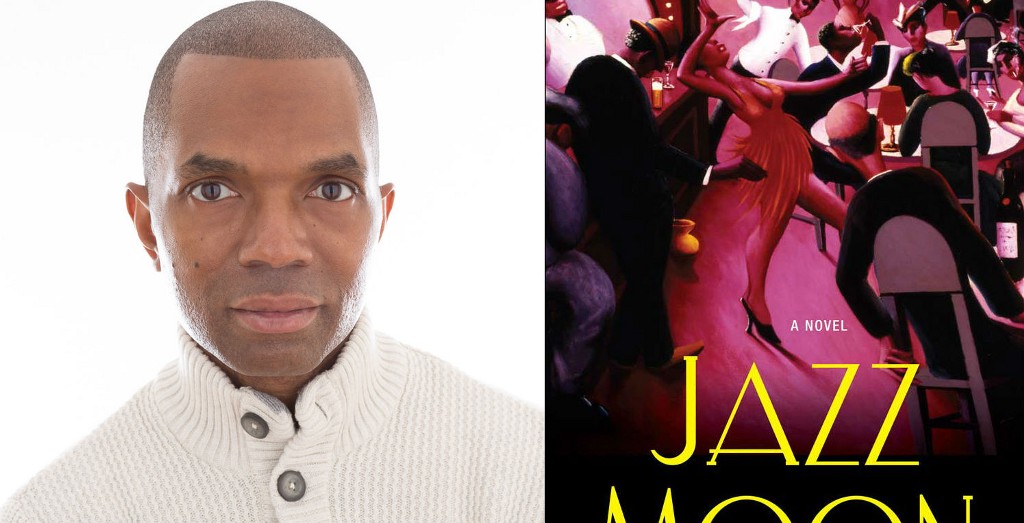
Joe Okonkwo, whose background is in theater and acting, recently published his debut novel, Jazz Moon, set in the roaring twenties of Harlem and Paris. In addition to his work as a fiction writer, Okonkwo is the prose editor for the Newtown Literary journal.
Jazz Moon follows its protagonist Ben, a black gay man and a poet in 1920s America, as he leaves his southern home for New York City, and then ventures even further, to jazz-filled Paris, in a journey to find his place in the world and come to terms with his own sexuality and creativity.
I sat down recently with Okonkwo over coffee, at a midtown branch of the aptly French-named Le Pain Quotidien. We talked about the evolution of Jazz Moon, stereotypes and identity, and the struggles of writing while working other jobs seven days a week.
Catherine LaSota:You lived in many different places before landing in New York City.
Joe Okonkwo: I was born in Syracuse, and then we moved to New Jersey. I was one. Then we moved to Flint, Michigan when I was two. We were there for six years, and then we moved to Nigeria, where my father’s from, when I was eight. My mother hated Nigeria — I did, too, actually — so she and I moved back to the United States, to Vicksburg, Mississippi, where she’s from, and we stayed there two years. Then we moved to Houston in 1981, and she’s been there ever since. I went to California for a couple of years, and then back to Houston, and finished my theater degree. I made my living doing theater for a while in Houston — children’s theater, stage managing, teaching. And then I moved here in June of 2000.
CL: And when you moved to NYC, were you still doing theater work?
JO: Yes, I came here to do theater, to be an actor. I did maybe three off-off-off-off-off-off-off Broadway plays. But then I gave it up, because I can’t afford the headshots, the classes — I couldn’t do it. Also, if you’re an actor in this city, you have to be willing to be itinerant, you have to be willing to do a sublet here for three months, and a share there for two months, and I cannot do that. I admire people who can, but I can’t do it.
CL:You crave more steadiness.
JO: Yeah. So I gave up acting and went into web production.
CL:When was that?
JO: It must have been 2002. I was working at the Metropolitan Opera in the customer service department. I was the manager of a section called Issue Management. We were the problem solvers. So you can imagine dealing with opera customers, what that must’ve been like. It was challenging, it was a growth experience because I’m actually a very shy person, but I couldn’t be shy there. I had to get on the phone, talk to customers, explain things, apologize. But I got to go to the opera all the time, and I’m an opera queen, so…
CL:Were you writing this whole time, during your acting and work with places like the Metropolitan Opera?
JO: Yes. Not really getting published, mostly plays and poetry and some short stories. I started writing in probably first or second grade. Stories. And then I wrote my first novel when was 11 or 12.
CL:Do you still have that?
JO: Oh, I wish I did. I wrote it in pencil in a spiral notebook, which has long, long since gone. The story was called, “Conrad, City of the Demons.” It was about a drifter named Jerome Perkins who goes into this Old West town, and everyone is possessed by demons.
CL:Sounds very dark! Let’s talk about Jazz Moon. There are so many things being explored in your novel. It takes place in the 1920s, both in Harlem and in Paris. It touches on art, on homosexuality — on a lot of different pretty big themes, I think, such as identity, love, loneliness, and creativity. What sparked this project for you initially?
JO: What started it was just my love of that era. I mean if there was such a thing as a time machine, and I could go back to any era, I would go to the Harlem Renaissance.
CL:Why?
JO: It was an incredibly difficult time for blacks because of the overt racism — lynching and Jim Crow, and separate restrooms and separate water fountains — but it was also a really rich time in poetry, literature, art, and political movement.
It was really the first time that people realized that black was not only beautiful but also marketable.
What was happening politically then basically built the foundation for the modern civil rights movement of the ‘50s and ‘60s. And the music, the jazz. It was really the first time that people realized that black was not only beautiful but also marketable.
CL:Interesting. That’s America, that’s capitalism, searching for what is marketable.
JO: A lot of jazz blues records were made. A woman named Mamie Smith, in 1920, made a record called Crazy Blues, and initially the producers didn’t think it was going to sell. It was a black woman singing blues — that wasn’t gonna sell, right? It sold, and it started this blues recording frenzy. Those records were called “race records,” because they were made by people of a different race. And the section of a company that was in charge of race records was called the “race records division.” And the people who sang these records were called “race stars.” These record companies were amazed, flabbergasted, that there was a market. So people like Bessie Smith, Alberta Hunter, Ma Rainey became big stars.
CL:What do you think about the fact that people are given legitimacy in a certain part of society only if they are marketable?
JO: Well, I mean, that’s kind of the struggle of artists, isn’t it? You want to be true to yourself and make your art, but also make a living. And if you’re really ambitious, find fame and fortune. But you have to find that market, appeal to a certain sizable population, and if you can’t you’re not going to find that kind of commercial success.
CL: Something you explore in Jazz Moon is a kind of exoticism of black people, especially from Harlem, in Paris. Different characters struggle more or less with being categorized in a certain way. Is this a fair assessment?
JO: Sure. You have people like Josephine Baker, who played upon the stereotypes people had of blacks and Africans. And you have a character like Ben, the main character, who kind of tries to resist that. He doesn’t like being the exotic celebrity. Well, I think he likes it a little bit. But he doesn’t want to be an exhibit. And that’s what a lot of the blacks in Paris are. They are the entertainment. They’re not just entertainers, they are the entertainment.
CL:Ben is a very interesting character. He’s struggling to figure out his own motives and who he is. So when people are giving him a certain identity from the outside, I can see him liking that, but also struggling against it as he tries to make an identity for himself.
JO: Right. He says that he’s sick of jazz, and he’s sick of people asking if he knows Josephine Baker. It’s like a running joke. And he gets tired of that. He resists that, but then at the same time, when newer blacks from New York come to Paris and become the celebrities, he’s a little bit miffed that he’s not getting the attention anymore. So he likes the attention, but he doesn’t at the same time.
CL:At a certain point Ben is musing on love, and how the “plot” of love has supporting characters. Were there certain characters that were very vivid to you as you started this novel? Did you have any central or supporting characters in mind?
JO: When I started, I don’t think I had any particular themes I wanted to explore. I started with place and time period and went from there, and the people began to populate the story — it kind of happened. I didn’t set out to write a story with particular kinds of characters, to represent anything in particular. Some of the characters are based loosely on, if not actual people, figures from that era, especially in Paris. Blacks who went to the club scene, the art scene — some are a conglomeration of real life people.
CL:Can you talk a little about the role that research played in the creation of Jazz Moon?
JO: I came into the project having a great love for the era, knowing something about it, having a great love and admiration for the music. There were a lot of black shows and a lot of black vaudevillians, and that fascinates me. I did a lot of research on the time period, a lot of research on the literature of the era, the music of the era. And Paris, and gay bars. I did a lot of research on blacks in Paris, black entertainers in Paris. A lot of reading, a lot of exploring online. When I came into the project, I knew something, but not as much as I do now. It’s interesting, when finishing the novel, and getting involved in marketing, I’ve learned even more about the Harlem Renaissance and the music, and I found out a lot about the period. I’m not done with the Harlem Renaissance.
CL:Do you think you’ll write about that time period some more?
JO: Yes. I don’t know if it will be my next novel, but I’d like to write a story about someone who had a cameo in Jazz Moon. Her name is Gladys Bentley, and she performed at a place called the Clam House. That was a real place. She was a drag king, a blues singer and a pianist. She was a very big woman, very large, and she was known for wearing a white top hat and white tuxedo and tails. She would take popular songs of the day, and she’d change the lyrics and make them naughty, and she would openly flirt with women in the audience. She claimed to have gotten married to a woman in an Atlantic City wedding ceremony, but no one knows the identity of this woman or if it really happened. And then in the 50s, she was interviewed in Ebony magazine, and she renounced her lesbianism, and she said, I’m taking female hormones now, and that’s cured me.
CL:Her life sounds fascinating.
JO: Yeah, not a lot is known about her, which is kinda good for me, because it gives me a lot of license. So I think that will be my next big project.
CL:There are parts of Jazz Moon that are very sexy. I’m sure that, as an editor at the Newtown Literary journal, you see many attempts by writers trying to write sexy, with greater or lesser success in doing so. Do have any advice for how to write sex successfully?
JO: In early drafts, I went probably too far with the sex. In workshops at City College, people and my professor would say, if you want to reach a wider audience, you’re going to have to tone down the sex. You could argue that that’s pandering, but I would say that it is not pandering — even if you take a mainstream audience out of the equation. One thing I don’t like about about gay fiction, is that so much of it is so sex-centered. So much of it is all about sex, it’s all about the shirtless guy…there’s nothing wrong with that, but, you know, there has to be more to it than that. So the toning down of the sex was also about — I don’t want to offend anybody — but I didn’t want it to be the typical gay male book, all about sex. You know, obviously there’s some of that, there are some hot guys in there. But I didn’t want it to be just about that.
CL:It reads to me as a story about love primarily, which sex is involved in, but it’s a love story.
JO: It’s a love story, it’s a coming out story. In his lovely endorsement, David Ebershoff said it’s a story about “traveling far to find oneself.”
CL:It’s a love story in terms of romantic love, but also in terms of loving oneself.
JO: Absolutely. That’s one of Ben’s big struggles — to love himself, how he looks, how he is, realizing that he is worthy of being loved not only by other people, but worthy of being loved my himself.
CL:Did Ben emerge as a major character fairly early on?
JO: Oh, from the very beginning, absolutely.
CL:How many revisions did this novel go through, would you say?
JO: I didn’t even count, I just kept revising and revising and revising, and when it was accepted by the publisher, obviously I revised even more.
CL:Was it a very different novel in the first draft than as it exists now?
JO: I would say it’s not so much a different novel — I didn’t change any of the structure — but I went deeper, and I fleshed things out, made things clearer, found some more emotional depth. I’m a big fan of language. So that was a big focus, making the language as potent as possible.
CL:Speaking of your focus on language, there’s a lot of original poetry, and also song lyrics, in Jazz Moon.
JO: I identified primarily as a poet for a long time. I self-published a book of poetry back in 2002, and when I flip through the book now — there might be some flashes of good writing, but for the most part, it’s not something I’m proud of. Poetry is hard. It’s harder than fiction. Erica Jong gave an interview once, and she said writing poetry required being in a higher state of consciousness. And I agree with that. If I never write another poem again, I won’t regret it.
CL:Yet you wrote a book that contains a lot of poetry! What was that choice about?
JO: Well, you know, Ben is not necessarily based on me, but there’s a lot of me in him, and at the time I started writing this story, I was still probably identifying more as a poet than as a fiction writer, so I think that’s probably where that came from.
CL:So, now, as you’ve mentioned to me previously, you’re working day jobs seven days a week. When do you write?
JO: Right now I’m not. Too much going on, working seven days a week, and promoting the novel, and so right now I’m not.
CL:What did it look like when you were writing Jazz Moon? How were those writing sessions? Did you have any regular routine at that time?
JO: Yeah, I was writing pretty much every day. Sometimes early in the morning, sometimes after work, on the weekends, back when I used to have weekends.
CL:What were you reading as you wrote this novel?
JO: Everything. Toni Morrison, Alice Hoffman, Diane McKinney-Whetstone, Ernest Gaines, James Baldwin, Richard Wright, Andrew Sean Greer, Gloria Naylor, Mary Shelley, Thomas Hardy, Jane Austen.
CL:A good list. Have you read anything recently that you especially loved?
JO: Langston Hughes’s first collection of poetry, called The Weary Blues, published in 1926. And another Harlem Renaissance novel calling Passing, by a woman named Nella Larsen. The book is about blacks who are light enough to pass as white, and all that entails. Great book.
CL:Jazz Moon is your debut. How does it feel to publish your debut novel?
JO: I found out a year and a half ago it was going to be published by Kensington Books, so this whole year and a half has been anticipation and excitement and preparation, and now in less than two weeks it’s going to be here, so I’m incredibly happy and excited, but also scared because, to be perfectly honest, I’d like to make a splash. I’d like to move the dial, in terms of my writing career, and get out of this 9–5 web production thing, which I’m grateful to have, because it pays the bills, but it’s not what I really want to be doing with my time. I want to write.
CL:Your ideal would be to write full time?
JO: Write, edit, and teach full time.
CL:Was there anything that happened in that year and a half of time since your book was accepted by Kensington that was especially surprising to you?
JO: Well, yeah. I was laid off from my job of almost 6 years, 2 ½ years ago, and I’ve spent a lot of time unemployed and underemployed. And at the same time I couldn’t find a full time job, all these great things were happening on the writing side. I found an agent, I found a publisher, I became an editor at Newtown. Starting in 2017 I’m going to be an editor of Best Gay Stories from Lethe Press. I’ve gotten some short stories published, I’ve been nominated for a Pushcart Prize, I’ve been able to rack up great endorsements from people like David Ebershoff. All these wonderful things have happened writing-wise, so that part of my life is starting to fly, but the other part of my life, the one that pays the bills, has been, up until recently, some of it has been burning down. It’s been this weird dichotomy, on the one hand, to find this success as a writer, but at the same time, I’ve thought, how am I going to pay the rent in a couple of months. So it’s been a very odd time.
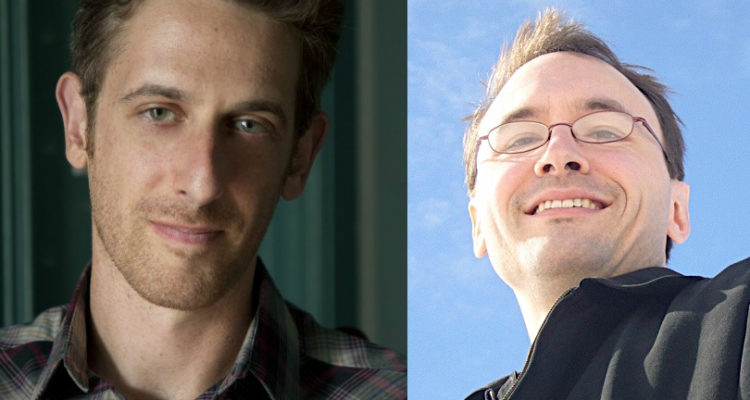
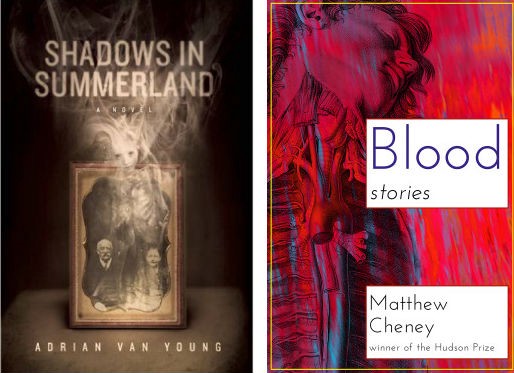
Adrian Van Young is the author of the collection The Man Who Noticed Everything (Black Lawrence Press, 2013) and the novel Shadows in Summerland (ChiZine Publications, 2016) as well as The Murder Chronicles: A New Orleans Murder Mystery, an interactive, serialized mystery novella for The-Line-Up.com. Matthew Cheney is the author of the collection Blood: Stories (Black Lawrence Press, 2013) and co-editor (with Eric Schaller) of the occasional online magazine The Revelator. Van Young and Cheney, as it would happen, are also admirers of each other’s work and agreed to have a conversation by email in between bouts of winding down their teaching careers for the summer, and reading each other’s most recent books. They ended up covering a wide range of topics including but not limited to: emotional catharsis through sublime terror, Texas Chainsaw Massacre and The Witch, inhabiting aesthetic utopias, resisting emotion by way of creating it, loudly eating nachos while watching Michael Haneke, the so-called “genre divide,” and who they’ve been reading, among so much more.
Adrian Van Young: One thing I’m struck by and appreciate about your collection Blood is its overall bleakness. From the title story, to “The Lake,” to “How Far to Englishman’s Bay,” these stories have a very close relationship with doom, annihilation, the unreachable prospect of solace. God help me, I love that about them!
For me, there’s always been a beautiful sublimity about a narrative that channels irretrievably toward hopelessness.
For me, there’s always been a beautiful sublimity about a narrative that channels irretrievably toward hopelessness. There’s almost something hopeful in it — like, by utterly not acknowledging the possibility of hope you make room for it in this strange, indirect way. That said, I also felt that the bleakness of these stories was inextricable from their humor and their playfulness as narratives. These are funny stories — sometimes just by virtue of their squirm-inducing extremity. Do you see your fiction the same way I see it? What do you mean to evoke by the interpenetration of wholesale bleakness and wry humor?
Matthew Cheney: I recently said somewhere that my idea of a feel-good movie is Texas Chainsaw Massacre. This is true. I always feel better about life, the universe, and everything after watching the original Texas Chainsaw Massacre. I laugh during some of the most gruesome scenes. I feel a sense of great joy and release and catharsis — a sense of the sublime — at the end of the film, with Sally escaping and Leatherface doing his chainsaw dance. I’m a pacifist who gets light-headed at the sight of blood in real life, and yet somehow within the art form of this violent, gory movie — within the patterns of image and sound it creates — I find an aesthetic utopia, a certain bliss. I don’t have an explanation for that, but it probably explains the tone of a lot of the fiction I write, since one of the reasons I write is to try to inhabit aesthetic utopias. I want to feel the pleasure of the text, and for me a lot of that pleasure comes from a confrontation with things that are bleak and horrible.
Humor is a part of that, sometimes to relieve despair, sometimes just because I can’t resist a bit of laughter on the gallows (and we’re all on the gallows). The playwright Christopher Durang was a huge influence on me when I was a teenager. His play The Marriage of Bette and Boo is one of the great works of American art. It’s the kind of play that lots of places won’t produce because the humor is just coruscating — there are dead babies dropped on the stage, for instance. It’s as bleak as Long Day’s Journey Into Night, but much more hilarious. It’s the hilarity of, “Ohmygawd, I can’t believe I’m laughing about this,” which is, for me, the best kind of laughing, a laughing not of trivializing laughter so much as a laughter that could at any moment turn to uncontrollable tears.
You’re not exactly the cheeriest writer on the planet, yourself, Adrian — Hallmark probably isn’t flooding you with requests to turn your stories into greeting cards or after-school specials. What’s the attraction for you of, let’s say, the dark materials?
AVY: Actually, Hallmark has been flooding my inbox with requests to option my story ‘The Skin Thing’ for a Passover card they’re doing. On one side it’s going to say, ‘Why give up your first-born to the 20-foot tall skin monster?’ and then on the other, ‘It’s for the good of the colony.’ Really, though, folks, what you said about that “sense of great joy and release and purgation — a sense of the sublime” at the end of Texas Chainsaw Massacre — a movie I, too, love — reminds me of something Ben Marcus said in an interview that totally resonates with me on that level, and I’ll quote it here:
“In the end I am uplifted, profoundly so, by the bleakest, despairing work. It’s a great unburdening to read work of this sort. I do not want to be asked to pretend that everything is all right, that people are fundamentally happy, that life is perfectly fine, and that it is remotely ok that we are going to die, and soon, only to disappear into oblivion. I feel a kind of ridiculous joy when writing reveals the world, the way it feels to be in the world. That’s what hope is, a refusal to look away.”
I love that, and I feel like in many ways it gets at the heart of what we both intend by the despair in our fiction. It’s certainly all over my first collection of stories (The Man Who Noticed Everything) and shows up more intensely even in the collection I just finished (Hello My Midnight Self, It’s Me). On some level, as you say, it’s inexplicable, it’s just an aesthetic preference, but then on another I do think it is a kind of truth-telling that certain writers recognize intrinsically and then become addicted to explicating. I get that same sense when I’m watching the films of Michael Haneke, for instance — I remember seeing a matinee of The White Ribbon when I lived in Boston, and loudly eating theater nachos all throughout it, and suddenly feeling self-conscious that I was so cavalierly reveling in its nihilism but then thinking to myself, ‘Shit, man. This is who I am.’ Or when I’m listening to Nick Cave and The Bad Seeds, or when I’m reading the fiction of Thomas Bernhard, Shirley Jackson, Lovecraft, Laird Barron, Livia Llewellyn or Flannery O’Connor — most particularly Flannery O’Connor.
I’m curious about what you said about “[inhabiting] aesthetic utopias” in your work. Blood is just such a wide-ranging collection in terms of genre, form, diction, etc. So, although one person’s utopia can be another person’s dystopia, so on and so forth, utopia is a metaphor to me that suggests some sense of aesthetic unity or coherence, which isn’t necessarily a quality at the forefront of your writing — in a good way. I’m wondering: apart from that sublime despair we’ve just discussed, what defines your aesthetic utopia? Can there be more than one operating within the space of the same narrative or collection of narratives?
MC: Yes, I think a particular writer’s personal commitments to form and feeling can unite seemingly disparate materials. Someone who writes from feelings and ideas that are important to them will have a unity in their work even if they’re writing for very different audiences and in very different styles. Similarly, too, readers. We could create Venn diagrams of readerly attachments. For instance, a person who is open to most or all of the writers and artists you mention is somebody whose aesthetic universe I understand and am at least in sympathy with — we aren’t the same person, our tastes aren’t perfectly identical, but we’re in the same world, we speak mutually comprehensible languages, even if our accents differ here and there. People who only get Bernhard, or only get Barron are more inscrutable to me than people who are psychologically and aesthetically attracted to both.
Utopia is what we strive for and never achieve, it’s the potential within the words that we keep seeking and seeking.
What I meant by the use of the word “utopia” is the pleasure of working within the pattern-world of the text. Utopia is what we strive for and never achieve, it’s the potential within the words that we keep seeking and seeking. That potential is intellectual and affectual: I want to think and feel in certain ways while writing. Indeed, I need to feel and think in certain ways or the story will seem dead to me and I probably won’t continue working on it (I start five stories for every one I finish). Particular moves, tones, images, and problems lead me toward the pleasure of the text, bring me closer, while I write, to the impossible utopia I hope for before setting a word onto paper.
Here’s a clear example from the book. “A Map of the Everywhere” is a story I wrote for the first Interfictions anthology, an anthology of stories that live in between the borders of genres and styles. The first draft of that story began as an exercise for myself: I had a crazy sentence I’d written in a notebook (“Alfred worked in the sewer fields because all the other jobs he’d held had disappointed him.”) and I gave myself the challenge of somehow messing up expectations with each new sentence — very deliberately bending, sentence by sentence, whatever direction I felt I was going in. That draft gave me the skeleton of the story. It was surreal and almost completely nonsensical. What subsequent drafts produced was more sense, because now I needed to find the connections between all the 180-degree turns I’d made. This could have felt like drudgery, but it was some of the most fun I’ve ever had writing a story, even though it was incredibly difficult. However, that’s just the technical part, and the technical part doesn’t really explain why this story is what it is. It’s among the most hopeful, even joyous stories I’ve written, and I think part of that is that it was written at a very difficult moment of life, one when I was depressed and despairing, and so the story I needed to write was not one that expressed that despair and depression but rather pushed against it. Sometimes what I need is not to push against a mood (whether foul or fair) but to work through it, to heighten it and to make something from it; in this case, though, what I needed was some sort of glimmer of happiness, and that’s what the story provided me as I wrote it. I wouldn’t have finished writing it otherwise.
Perhaps some of this explains why I haven’t succeeded at writing a novel worth reading (some years ago I finished a complete draft of a novel; I hope no-one ever sees it, because it’s soporific drivel, but at least it’s a completed draft). I hate the feeling of writing being dead on the page. I struggle to pull myself through it when both thought and feeling seem distant. It’s not so much a matter of fortitude as faith: I lose faith in my ability to invest the words with meaning. With a story, I just toss it aside into a folder called “Failed Attempts”, thinking perhaps one day I’ll go back to it (I never do). My primary style of revision is to start over from scratch. With a novel, though … what do you do? With Shadows in Summerland, how did you know that what you were writing was the thing that would sustain you: the form, the vision?
AVY: “…the impossible utopia I hope for before setting a word onto paper…” That’s great. I may even crib that concept for one of my CW classes some time. You know, it’s funny, but I think I was thinking of utopia from this almost exclusively ideological standpoint rather than the individualized artistic utopia you speak of — like, I thought you were going to bust loose with some Oscar-Wildean treatise or something (Alas!). That’s as clear as indicator as any to me that I’ve been immersed in fringe 19th-century social and religious movements for far too long.
Which brings us around to Spiritualism and the question you asked about my novel, Shadows in Summerland. I will say that I both knew and was utterly unsure of the thing that would sustain me while writing the novel. Which is to say: I knew the genre expectations I wanted to avail myself of (a Gothic historical novel with strong elements of crime and horror). I knew the form I wanted the novel to take (5 different first-person POV’s that would each stand in for a different mainstay of the 19th-century American Spiritualist movement, creating this kaleidoscopic and/or panoramic effect). And I knew that I wanted the narrative to hew roughly to the life of one of the main characters, William H. Mumler, the “father” of spirit photography.
It’s interesting you mention revision as being crucial in writing a novel, because one thing I didn’t know is how I would get all of these elements to cohere into an actual narrative, a process that very much took place in revision. Like you, when I’m writing a short story I tend to revise wholesale several times from the ground up, sometimes rewriting them 3–4 times, each time more fluently, until I feel I’ve got it right. With Shadows in Summerland, I more or less kept the structure I happened upon in my first draft, blowing the novel up to this outlandish and unwieldy size in the second draft with lots of baroque language and superfluous subplots, then shrinking it down by half in the third (I cut more than 100,000 words). After that the fourth and fifth drafts, each endeavored over a couple of months, were mostly rearranging, fine-tuning, and cutting — strength-testing, if you will.
But I had never written or revised a novel all the way through before! I had no idea how fucking hard it was! That said, I’m happy with the way it turned out and can honestly say what pulled me through was a combination of love for the characters and their voices (one in particular, Fanny Conant, my trance-speaker darling), and not wanting to feel embarrassed about laboring at this project for nearly a decade and having nothing to show for it. A third motivator that existed outside my hermetic universe of writing the novel itself was my wife, Darcy, who is tirelessly supportive of me in everything and who is and always will be my first reader. And — not to be cheesy — but I think I just really wanted her to read it.
Since we’ve organically arrived at this sentimental moment, I’d wanted to ask you about feeling in your stories. Having now read most of your book and hearing you talk about your process in writing “A Map of the Everywhere,” it seems like you often write first from a place of emotion, which isn’t uncommon in fiction, per se. And yet I’ve been intrigued by the extent to which you’re able to translate that emotion, powerfully, onto the page. “The Lake” made me cry! Fiction rarely makes me do that (I must’ve had something in my eye), and I got similar feels after reading the excellent title story, “Blood.” How do you go about creating emotional effect in your stories? Does it flow out of a sense of connection you share with the characters? Is there some formula or equation you use and if so can I copy it and use it in my own lab experiments in the future?
MC: Fiction’s ability to evoke emotion fascinates me, because it is, indeed, so mysterious. Before tackling that mystery, though, let me just note one more thing about my use of the word aesthetic throughout here, since it may not actually be the most precise word for what I’m trying to talk about.
While what I was describing was the personal feeling of writing within textual patterns that are appealing and energizing, I am obsessed with the place of aesthetics in literary history, especially from the late 19th century on. Wilde’s “The Critic as Artist” is a piece I find endlessly compelling, for instance. I’ve long been interested in politics, too, so I’m always thinking about the relationship of politics to art, always despairing of it, always wondering if there is some way to square the circle of political art without falling into the trap of agit-prop. Recently, I’ve been thinking a lot about Steven Shaviro’s ideas about the relationship between aesthetics and neoliberalism, which you can see in his essay “Accelerationist Aesthetics” and more fully in his book No Speed Limit (the last chapter of which makes connections to Wilde, Marx, and Keynes; queer self-fashioning; glam rock; late Foucault; etc. It’s magnificent.) His argument isn’t one I can summarize accurately in a short space, and I’m not even certain I fully understand it, but I will say that what I pull from it for my own use is a sense of aesthetics as a way to find moments of refuge from neoliberalism’s insistence on efficiency, austerity, and quantification. I look to this sort of theoretical and analytical writing to help me think through techniques to try out in my fiction, ways to stay fresh and to keep challenging myself not to fall into ruts.
It’s much more interesting to watch someone on stage trying their damnedest not to cry than it is to watch somebody crying.
Speaking of techniques, there is actually a formula of sorts that I use when working through emotional material in my own writing. It’s something I learned back when I was doing more theatre than I do these days. Good advice to actors who have to do an emotional scene is not to play the emotion, but to play resisting the emotion. It’s much more interesting to watch someone on stage trying their damnedest not to cry than it is to watch somebody crying. Also, it has more of an effect on the audience, because it’s a more complicated action. Catharsis is not for the actor, but for the audience.
Thus, as a writer I’m trying to create situations where my characters will cry and scream and wail, but then as the person controlling the tone of how that crying, screaming, and wailing is represented, I try to keep the characters from blubbering all over the page. My models for this are Jean Rhys and Paul Bowles. Whenever I feel like I’m pushing the prose too much, trying to force an emotional effect, I read a few pages of Rhys’s Good Morning, Midnight or one of Bowles’s short stories. These are works that I find almost overwhelming in their emotional content, but also so incredibly, perfectly, scintillatingly restrained that I sit in awe of them, and that awe shames me to try to go back to my own work and keep it from exploding with sentimental goo.
I’m going to return now to something you said about Shadows in Summerland — the structure. You’ve got Mumler’s life as a kind of overarching structure to hold lots of stuff together, and then you’ve got the different points of view. You were coming to this as somebody well-experienced as a short story writer, so did you approach the different POVs as their own sorts of stories? How did you find the shape and work through it?
AVY: I like what you say about the act of resisting emotion rather than playing into emotion as being, ultimately, the catalyst of emotion in the outside party, i.e. the reader. That rings very true to me.
…they always have to be striving toward something, even if it’s clear early on that they’re never going to achieve it.
I once had a teacher in grad school — the awesome Rebecca Curtis — who told me something so simple and seemingly commonsense, and yet so vital when it comes to eliciting empathy for a character that it’s never left me, and I pass it on to all my students as though it were mine. Hell, sometimes even to strangers on the street! Which is that it’s difficult for a reader to feel sorry, or feel anything for a character that already feels sorry or too much for themselves. In other words, they always have to be striving toward something, even if it’s clear early on that they’re never going to achieve it. Perhaps, by your definition, striving not to feel something, even though those feelings are going to break through eventually.
Regarding the multiple-POV structure of Shadows in Summerland, I actually don’t think I conceived of the chapters as discrete narratives of any kind at the time I was writing it. I’d meant the entire narrative to have one continuity with a lot of simultaneous action and perception — a series of disparate strands that I would, then, braid together into this cable that would have a different warp & weft when seen from different angles. Afterward, though, when I’d whittled the novel down to what I believe is its essence, I did begin to recognize a kind of discreteness, or vignette-quality to the POV-chapters that I don’t think I’d intended in the offing. Indeed, a reviewer recently commented on this and I was taken aback by it initially, then gratified to find that it was true. I am sure that my experience as a short story writer played into this, but then again, my “short” stories tend to be quite long (25–50 pages on the average), many of the POV-chapters in the novel are practically elliptical by comparison, so if anything the novel represents a large-scale, multi-faceted compression of my short story technique.
At first when I was writing the novel, I wrote the whole thing through more or less chronologically, even though I knew I wanted the chronology to be scrambled in the final manifestation, which it is. Certain events I knew I wanted to happen in the novel were tethered to certain characters’ POVs, and yet still other events tethered to multiple characters’ POVs when I wanted them to perceive things simultaneously. The idea, I think, was to keep the plot moving along without disappointing the reader too much every time there was a character switch — that vertiginous feeling you sometimes get while reading a novel when the focus shifts from something you’re enraptured by to something you’re only vaguely interested in. I do think I’ve achieved that briskness of plotting that I intended by keeping the chapters quite short. (Though of course that remains to be seen — you haven’t read it yet!) The scrambling of chronology presented a challenge and required lots of different rotating configurations over the various drafts. I had one early reader, suffering from temporal motion sickness, who offered the solution: add dates! It’s a goddamn historical novel, add dates! I did that.
I shudder to even bring this up, because I’m so tired of talking about the “genre divide” and the “genre wars,” but I will say that you’re someone who straddles literary fiction and genre fiction — terms I see as instructive rather than pejorative from either side — in this very informed and un-self-conscious way. Who are some writers in a vein similar to yourself whose work you’re excited about? Anything particular of theirs we should check out post-haste?
And, while we’re talking about works of high genre, and since you mentioned your genesis from a tribe of “stoic New Englanders,” I’m dying to know what you thought of The Witch? Did it live up to the hype for you?
MC: It’s interesting to hear about your sense of Shadows in Summerland from while you were writing it — I would have thought that the vignette-like structure was planned from the get-go, because it not only works well to keep the plot moving, but it also creates a certain photographic effect, making the novel like a particularly weird and evocative scrapbook, which of course fits with the subject matter and plot.
I love the advice you’ve grabbed from Rebecca Curtis — it completely echoes my own ideas. I was thinking of this last night as I was watching the Dardennes brothers’ movie The Kid with a Bike for the third or fourth time. I’m captivated by filmmakers like Haneke, whom you mention above, and the Dardennes because of how they shape emotion and questions of morality in their work. I don’t know if the effect is particular to cinema or if it can be done in prose, too. (Maybe Joy Williams sometimes.) There’s a distance, a slowness to such films that for plenty of viewers, I’m sure, is just boring, but if you get on its wavelength, it’s almost unbearably tense. In many ways, the tension and power is because of what is left out — in The Kid with a Bike, we never know why Samantha is interested in the kid of the title, Cyril, who has been abandoned into foster care by his father. Why does she give him a home, why does she put up with him? A Hollywood version of the movie would give her a whole backstory, probably with a lost child or dead brother or something. But not the Dardennes. This ambiguity is suspenseful, almost unbearable, because not knowing why she is generous to Cyril, we don’t know what might make her stop being generous to him, we don’t know the limits, and he keeps testing those limits. It works, and is powerful and thought-provoking, because it leaves out so much that a more conventional film would insist was essential.
Jean-Pierre Dardennes said once, “In order to film what you want to show of a face or a body, you first have to decide what you want to hide,” and I think that’s great advice to any artist.
I used to care about the “genre divide” for the simple reason that I was trying to find places to publish my stories, which inevitably genre editors thought were “too literary” and lit journal editors thought were “too genre”, and so I needed to have some knowledge of how to thread that needle if I ever wanted to get published. I feel like things have changed a lot from when I first started publishing, and to be honest I don’t feel like most of what I write at this point has a home in the contemporary genre world, because the contemporary lit world is much more open than it has been in a while to stuff that’s more than domestic social realism. Though I have been for my whole life a reader of genre fiction of one sort of another, as a writer my commitments have been more in synch with the weirder side of the lit world. (I use the terms “genre” and “lit” to describe what my friends in the field of composition and rhetoric call “discourse communities”; these are not hard-and-fast separations between texts themselves, but rather differences in how texts get produced, distributed, read, and talked about.) The generation of writers, editors, and workshop teachers that clung mightily to the idea that Raymond Carver was the apex of all literature is withering, retiring, dying. I think even they got tired of reading sensitive, minimalist stories about adulterous academics.
It’s hard to say which writers write like yourself. (Any of us might be tempted to lie arrogantly and scream: “Nobody! I am entirely unique!”) A friend of mine recently told me my “genre” is Conjunctions, and that seems accurate to me (indeed, they’ve published three of my stories, which is more than anybody else). I draw on Kafka a lot. I revere Chekhov, but I’m not sure I write like him; similarly, I draw endlessly from Virginia Woolf, but I’m quite a different writer. (Which is not to suggest I’m anywhere near their league. To write well, though, we need to aim for the best, and these are the writers I think of as the best in doing what I aspire to do with language, form, and feeling.) Certain playwrights: Büchner, Beckett, Christopher Durang, Mac Wellman, David Greenspan, the early Suzan-Lori Parks, Sarah Ruhl. I adore the often bizarre prose of Deleuze & Guattari’s Anti-Oedipus and A Thousand Plateaus, books that have affected my more recent work, even though, or perhaps because, I hardly understand them. I go back to Gertrude Stein again and again, especially The Making of Americans, Lectures in America, and How to Write. You’ll find traces through my stories of Michel Foucault, particularly later (c. 1975–1982) Foucault, and Roland Barthes, whose A Lover’s Discourse and self-titled quasi-autobiography, Roland Barthes, I especially cherish. J.M. Coetzee in a thousand ways. And Guy Davenport. And Robert Aickman. And and and…
I’ve spent a decade intensively studying the work of Samuel Delany, and while I’m not conscious of any noticeable influence, I’m sure he’s floating in between my lines. I’ve learned a lot from Kelly Link, Jeffrey Ford, Mary Rickert, and Richard Bowes about what short fiction can do. Jeff VanderMeer’s Annihilation fascinates me in what it leaves out, in how much it allows to be ambiguous, as does the Southern Reach trilogy as a whole, which I think is one of the great recent works to explore epistemology and language, though I expect most people value those books for other qualities. (Similarly, I think I was eternally affected by Jeff’s earlier novel Shriek: An Afterword and the novellas “Dradin, In Love” and “The Transformation of Martin Lake” in City of Saints and Madmen. Very different, very haunting, very brave works.) Poets, too, far too many to mention — Paul Celan and Adrienne Rich especially, though in ways likely invisible in what I’ve written.
I feel like I should point to more recent writers, the exciting upstarts and humbling wunderkinder, but I’m a terrible person to ask about new fiction these days because Ph.D. work has kept me from reading much of anything new. (If you want recommendations from the 1920s and 1930s, I’m your guy — Claude McKay! Elizabeth Bowen! Winifred Holtby! Sylvia Townsend Warner!) Most of what I know about new stuff therefore is stuff I know about because I’m friends with the writer or publisher. For instance, I’m thrilled that one of my best friends in the world, Eric Schaller, had his debut collection published within weeks of mine. It’s called Meet Me in the Middle of the Air and it’s really great — quite different from my own writing, though the sense of humor is (darkly) similar, as Eric and I tend to laugh about the same things (hoaxes, parasites, death). Eric’s day job is as a professor of biology at Dartmouth College, and he brings a precise and scientific approach to horror fiction that’s pretty much unique.
I also highly recommend a new journal some local friends of mine put out, Outlook Springs, which is like the gonzo love-child of McSweeney’s and Lady Churchill’s Rosebud Wristlet. It’s a pleasure as an object given the careful attention to design, and its stories, poems, and essays are utterly unpredictable.
New Hampshire has a bunch of great short story writers — of course, Joe Hill is one of ours, but also James Patrick Kelly, Tim Horvath, Tom Paine, and Robin McLean. Probably others I don’t know as well. Robin just had her first collection published, Reptile House, and I went to a reading she was giving and we discovered we’re almost neighbors, which is great fun. You never know who’ll pop out of the woods up here!
Speaking of woods … The Witch. I’m very happy for the success of The Witch, because writer/director Robert Eggers is a New Hampshire boy — in fact, almost twenty years ago now, I went with a couple friends to Portsmouth to see an adaptation of Nosferatu put on by a bunch of high school kids who were friends of my friend’s daughter. Lo and behold, that was Robert Eggers and pals. He went on to great things, and now the world knows who he is, which is awesome.
What I liked about The Witch was its attention to material detail. It didn’t feel like people playing dress-up, and it didn’t feel like it completely elided the physical difficulty of its characters’ lives. It’s not Malick’s The New World, which really shows grime and suffering, but still, it doesn’t feel like a total Disneyfication of the era (though the characters aren’t gaunt enough). As a film, it didn’t connect with me much more deeply than that, because I didn’t really find the characters all that compelling and I wanted more weirdness. Basically, it wasn’t surreal enough for my taste — I much prefer Rob Zombie’s The Lords of Salem, one of my favorite horror movies of recent years (I’ve publicly called Zombie the heir to Artaud, which from me is high praise). But while I didn’t love The Witch, I didn’t dislike it, either. I’m happy I saw it, even if it didn’t affect me the way it did a lot of people. And, as I said, I’m thrilled for Eggers’s success and I think he’s crazily talented.
We could keep talking forever, I bet, so to try to help bring this conversation to a close, let me throw your own question back at you: What out there in the world of texts and images makes its way into your own work these days?
AVY: I totally called your bluff on that! Thank you for reading. And I love your insight about the photographic character of the chapters in Shadows in Summerland. That, in fact, I had intended, in particular with William Mumler’s POV, who tends to perceive moments in time as these little still-lifes or pre-cinematic moving photographs.
Clearly I have to watch The Kid with a Bike now, right?
I adored The Witch for many reasons, not least of all the fact you cite: that it didn’t elide the punishing difficulty of what the characters’ lives would’ve been like historically. Also — and this is something many other reviewers have mentioned, too — it was replete with that very kind of sublime terror we were discussing earlier. It fucking committed to its subject matter — big time! In this case, that terror took its bearings in theology, but I liked that about it, and feel that religious terror is something that horror films could be taking greater advantage of in general (see: The Exorcist, The Omen, Thirst, etc). In many ways, faith is as primordial a designation as fear itself — in some cases, is fear itself.
I’d wanted to mention, in addition, that The Witch reminded me of a less funny but just as emotionally wrenching version of one of my favorite horror films of the past 20 years: Antonia Bird’s Ravenous. Sort of like that, mixed with an early Nathaniel Hawthorne story, and I thought it was actually the best and smartest of this new wave of arty horror that’s been brewing the past five years. Even better than It Follows, which I liked quite a lot. Although your point about Rob Zombie is well taken, too. Lords of Salem was a trip — another disturbing film I watched a matinee of while loudly eating theater nachos! As I’m sure you were probably aware, the screenplay-to-book adaption is co-authored by Brian Evenson.
Which brings me around, organically, to what I’ve been reading, watching, cribbing from. Brian Evenson’s newest collection, A Collapse of Horses, just blew me away. I thought it was actually his most cohesive and elemental all around (caveat: I tend to think that about each of his collections as soon as they arrive). Really, though, it’s an electrifying and humbling experience — like what that gentleman with the cane standing on a rocky outcropping above a fog sea in the Caspar David Friedrich painting is probably feeling — -and there were stories in there (“A Collapse of Horses,” “The Punish,” “Cult,” “Past Reno,” “The Dust,” “Any Corpse”) that I would be hard-pressed to forget any time soon. But with you, I’m probably preaching to the choir on that one.
Some other writers straddling the genre-divide I’ve been stoked on are Victor LaValle, Amber Sparks, Livia Llewellyn, Gabino Iglesias, Alice Kim and, as ever, the masterful Sarah Waters. However, someone that stands out as having rewired my literary consciousness over the past few months is Megan Abbott, whose entire catalogue I am primed to devour. She has a deep, dexterous knowledge of noir, literary fiction, pop culture and academic theory, and manages somehow to pen them all into the same “aesthetic utopia” when she’s writing. I find reading her an incredibly rewarding experience. I liked The Fever, sure, like a lot of people, but Dare Me, her catacomb-dark cheerleader noir (which I’d describe as a mix between Bring It On, Heathers, Kate Chopin’s The Awakening and Double Indemnity) was superlative, and will serve as a guiding light for the new novel I’m working on, which is a sort of homoerotic Great Gatsby noir murder mystery set amidst the Black Metal scene in present-day New Orleans. Indeed, I expect she will be to this book as Sarah Waters was to Shadows in Summerland.
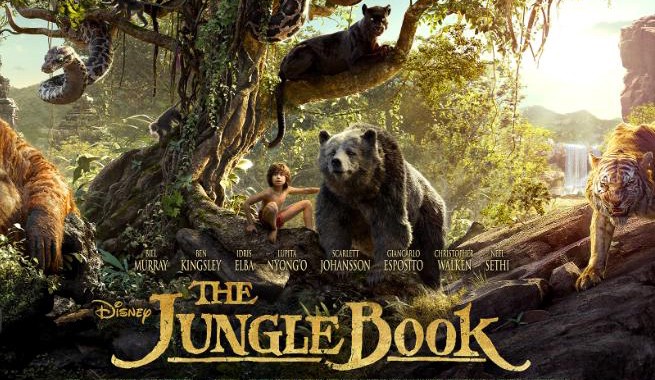
Justin Marks has been a making a living as a screenwriter in Hollywood for over ten years, but until recently, most people had never heard of him. Years ago, he was contracted by Disney to rewrite the script for the studio’s remake of 20,000 Leagues Under the Sea, a project that was eventually cancelled. When the call came to work with Jon Favreau on a new version of The Jungle Book for Disney, he was ready. The film has been a commercial and critical success, blending elements from Kipling’s original work with the 1967 Walt Disney adaptation.
Marks is, among other things, the creator of the upcoming Starz TV series Counterpart, to be directed by Morten Tyldum (Imitation Game and Passengers) and starring Academy Award winner J.K. Simmons. Here he talks about the pressure of (re)adapting a classic, the screenwriting process, and how the visual medium of film affects the way he approaches storytelling.
Kelly Luce: Before The Jungle Book was a Walt Disney film, of course, it was a book of stories by Rudyard Kipling. What was your approach to the Kipling? Had you read it before being hired to write this script?
Justin Marks: The influence behind the screenplay for this movie was twofold. First, we had the original stories by Kipling, which I’d grown up with — or at least, I’d grown up with the first Jungle Book collection, then became familiar with the second while researching the film. And second, we had a unique obligation to service people’s memory of the 1967 Walt Disney film. We made a decision, very early on in Jon Favreau’s involvement, that we would honor the 1967 film in terms of our story’s structure and treatment of characters, then use the Kipling to deepen and enhance theme. For example, the elephants played a very different role in our film than they did in the Walt Disney film, and that came entirely from the treatment given to them by Kipling. He was able to endow the jungle with a sense of myth and religion, and we wanted that to be swirling beneath the surface of a very simple story.
KL: What duty, if any, did you feel toward both the Kipling and the 1967 Walt Disney film? Both contain dated and offensive ideas about race and the effects of British colonialism. How did you approach carving out the heart of the story?
JM: Certainly Kipling’s work carries a lot of colonial baggage, and we felt we owed it to the audience to modernize our approach. But we did so mostly by digging in on the characters. It’s a coming of age story about a displaced young boy grasping for his identity, and meeting various mentors who pull him in different directions.
There was also a fair amount of attention paid to where Mowgli should end up at the resolution of our film. Did we want to send the message that identity is a matter of birthplace and lineage, or could it be a matter of choice? We liked this latter, more pluralistic answer, and felt it was truer to Mowgli’s journey as a character.
KL: Did the live action/CG style of the film affect your writing?
JM: It really did. For most of production, there was this big unknown when it came to how the effects were going to look as a finished product. We really had no idea how the effects were going to look when they came in. Early on, when we hadn’t yet seen anything, we constructed scenes so that they could rely emotionally on the human boy’s face. Then, as the shots came in, and Jon started to see what he had, I think he could then start to loosen up a bit and use the animals’ reaction shots to greater emotional effect.
KL: Novelists, story writers, and poets usually see some changes in their final manuscripts before a book is published, but for screenwriters, these sorts of changes can be massive. How different was the movie from your final draft of the script? IS there such a thing as a final draft in Hollywood?
JM: Our process on this movie was much more similar to animation than it was to live action. Typically what that means is the process is iterative, with endless meetings and reviews after we put the scenes “on their feet”, whether that be through animatic or motion captured pre-vis. The entire story team would evaluate these scenes together, and debate over them endlessly — and then more drafts would be written. I’m counting in my documents folder 198 unique drafts for the script, and that’s not even fully inclusive of smaller changes that happened later in the process. So I guess, when it comes to this project, the final draft is the movie.
KL: What’s your process like for a writing feature script? Do you write an entire draft before sharing it, or are you collaborating the entire time? What tools (physical and/or mental) are most useful for you as you create a story?
JM: The first draft is all about being isolated and getting to have your first true swing at the story. If you’re not able to take that shot, you’re really not able to develop the voice the project needs. It’s the the process of building the fortress that later you have to defend. Then, once you’re into revisions, it’s about hearing the notes and using them to shape a collective vision — and really Jon’s vision, since this is a very director driven-medium — in the most effective way possible. But yeah, that first draft is your one shot at getting the story right. I think it’s really hard to deliver a weak first draft that turns into a strong film. It’s about getting everyone excited about the potential of the movie, and the directions it could go.
KL: What are you reading for pleasure these days?
JM: It’s summer, and that means I’m always neck deep into John LeCarré, my favorite reading pleasure, and thank goodness he’s still alive and still churning out good books with strong regularity. I’m also doing a re-read of Nabokov this year — Lolita’s on the night stand for the first time since I was in high school. Just a pleasure to rediscover. He’s better in a second-language than most of us are in our first.
KL: If you could adapt any novel or short story into a feature film, what would it be, and who would direct it?
JM: My wife’s [Rachel Kondo, who’s essay on dialect, shame, and fiction writing can be read here] got a short story collection based on the people she grew up with on the island of Maui. The world rendered in such vivid, funny, and moving fashion… I’d love to direct those stories onscreen myself one day.
Iain Reid’s I’m Thinking of Ending Things (Scout Press, June 14) is about questions. Notably, the question “What are you waiting for?” which arrives late in the novel, the context of which I won’t discuss for fear of spoiling anything. This is a novel you want to read without it being spoiled. At all.
I’m Thinking of Ending Things is being marketed as “The Psychological Thriller of the Summer” — this is wonderful in terms of getting the book a wider readership than it may have gotten if it were marketed some other way, but the fact is that the book’s thriller aspects are almost a kind of gloss to the deeper, far more uncomfortable positions to which it places the reader. Of course, thrillers can also be serious and disturbing and literary: The best of them often deal with deep social issues of one kind or another through the lens of a fast-paced story. However, this is not an accurate description of this book. It has thriller elements for certain, but they don’t mask the questions the novel poses. On the contrary, they serve as enhancements.
On the surface, I’m Thinking of Ending Things is about a nameless narrator and a new boyfriend, Jake, driving to Jake’s parents’ farm house and then driving back, when they stop at a school in a snowstorm in order to throw away the cups of lemonade they’d gotten from Dairy Queen. That’s it. That’s all the novel is “about.” That’s the problem with trying to describe plot when discussing complex novels, and it’s also why plot is often sneakily the secondary nature of good books. Plot, in this novel, serves as the railroad track along which the reader walks while actually being mesmerized by the scenery around them, so much so that, even though they feel the heat rising from the metal rails and the rumbling making the stones jump between the wooden slats, they don’t hear the train chugging along behind them at a dangerous speed.
Before I read the book, its title resonated with me as a suicidal thought, while for others (I asked around) the phrase made them think of a breakup. Indeed, the novel’s first line is, “I’m thinking of ending things,” and it refers, at least in the most obvious sense, not to suicide but to the narrator’s possible decision, one they struggle with throughout the narrative, about whether or not to end things with Jake. I write “they” rather than “he” or “she” because the narrator is extremely carefully ungendered throughout the book — rather, more specifically, the narrator never refers to themselves in a certain gender, which, as the novel comes to a close, becomes increasingly significant though not in the ways you may expect. The closest the narrator’s gender comes to being apparent is when they discuss Jake’s “last girlfriend” or when they describe Jake referring to them as a compact and young Uma Thurman, “in a good way,” which again leaves room for ambiguity. Although later in the novel it’s (sort of) revealed that the narrator is, or would be, a she, it still feels disingenuous to the carefully worded narration to identify them as such. An example of this careful wording comes whenever sex is described — there are never identifying bodily features to make us assume the narrator’s gender based on their body parts. In one scene, when the narrator and Jake are making out in a car, for instance: “I lean my head back as he starts kissing my chest.” Chest — not breasts, but chest, which makes the narrator’s body far more ambiguous.
This ungendered narrator, then, carries most of the novel through their musings, their conversations with Jake, and descriptions of the disconcerting things they remember or see. The mind of the narrator is not a safe place. It is incredibly intelligent, and incredibly lonely. Read with capital-C-worthy Caution. For example, one scene that hit me particularly hard — I couldn’t sleep and was reading late into the night — was this:
Two nights ago, I couldn’t sleep. Yet again. I’ve been thinking too much for weeks…
I think what I want is for someone to know me. Really know me. Know me better than anyone else and maybe even me. Isn’t that why we commit to another? It’s not for sex. If it were for sex, we wouldn’t marry one person. We’d just keep finding new partners. We commit for many reasons, I know, but the more I think about it, the more I think long-term relationships are for getting to know someone. I want someone to know me, really know me, almost like that person could get into my head. What would that feel like? To have access, to know what it’s like in someone else’s head. To rely on someone else, have him rely on you. That’s not a biological connection like the one between parents and children. This kind of relationship would be chosen. It would be something cooler, harder to achieve than one built on biology and shared genetics.
I think that’s it. Maybe that’s how we know when a relationship is real. When someone else previously unconnected to us knows us in a way we never thought or believed possible.
I like that.
(NB: This long excerpt caused a bit of a crisis in the way I thought about relationships and, as a result, caused a bit of a crisis in mine for a couple days. So I repeat, Caution.)
This is what I mean when I say that Iain Reid’s book is somewhat of a philosophical tract as well as a novel. The narrator often muses over big life-and-death ideas such as the one above, but in a disarming way that renders these thoughts to feel like a seamless part of the narrative. It’s an incredibly hard thing to achieve, and Reid has done it to perfection: introducing ideas to the reader without taking them out of the narrative.
It also doesn’t cause detachment from the narrator as some books of this nature do — think existentialist novels like The Stranger. It is, in fact, the opposite. By blending together the narrator’s memories, thoughts, and present-tense scenes, we get so caught up in the narrator that we almost forget to breathe.
Except, of course, when the narrator is shunted off to the side in small italicized scenes between unmarked chapters. These scenes are dialogues between two or more people about something that’s happened, or will happen — it isn’t clear until you finish the book where in the timeline these conversations sit — and it’s these that start off what is the most powerful element of the book: its eeriness.
— Was he depressed or sick? Do we know if he was depressed?
— Apparently he wasn’t on any antidepressants. He was keeping secrets, though. I’m sure there were more.
— Yeah.
— If we’d only known how serious it was. If only there’d been some sighs. There are always signs. People don’t just do that.
— This wasn’t a rational person.
— That’s true, that’s a good point.
— He’s not like us.
The rational response to these scenes is: what on earth are they talking about? As you read, you may have theories — about who, what, when, why, etc. — but it’s doubtful that you’ll guess or understand the full extent, especially as these conversations are often misleading. But what they achieve is the beginning of a menacing feeling that starts to overlay the entire book as you continue reading.
The narrator has some spooky memories that help with this sense too, but it’s often what’s happening in the present that leads to an increasingly surreal feeling of fear: a description of pigs having maggots eating them alive from the inside out; a small room with a whirring fan and a mysterious painting; two parents who seem to be out of time; all these are contributing factors to the shivers that escalate as the novel progresses.
While the ending of the novel was somewhat disappointing, the journey was ultimately more than worth it, and the ending is almost an afterthought when I think of the book now, after finishing it. The ending barely matters in the grand scheme of the novel, which is worth every minute spent on it.
Occasionally bogged down by clichés and overzealous music cues, Genius, a new film based on A. Scott Berg’s Max Perkins: Editor of Genius and directed by Michael Grandage,manages to find authentic, original, even stirring moments in representing a profession so often done a disservice by Hollywood. The film focuses on the real-life relationship between Maxwell Perkins (Colin Firth) — editor of such classics as The Great Gatsby and The Sun Also Rises — and literary “‘genius” Thomas Wolfe (Jude Law), who, during the height of his career in the late 1920s and 30s, was considered a peer of Faulkner, Hemingway, and Fitzgerald. During a discussion following the screening, Berg shared that his book had been optioned even before its publication in 1978. Despite interest from Paul Newman the project was stuck in development for two years, until the script got in the hands of a studio head who killed it after reaching page three, once he learned that it was about a literary editor. Who could blame him for being worried? If depicting writing on film is hard then depicting reading is harder, and editing harder still.
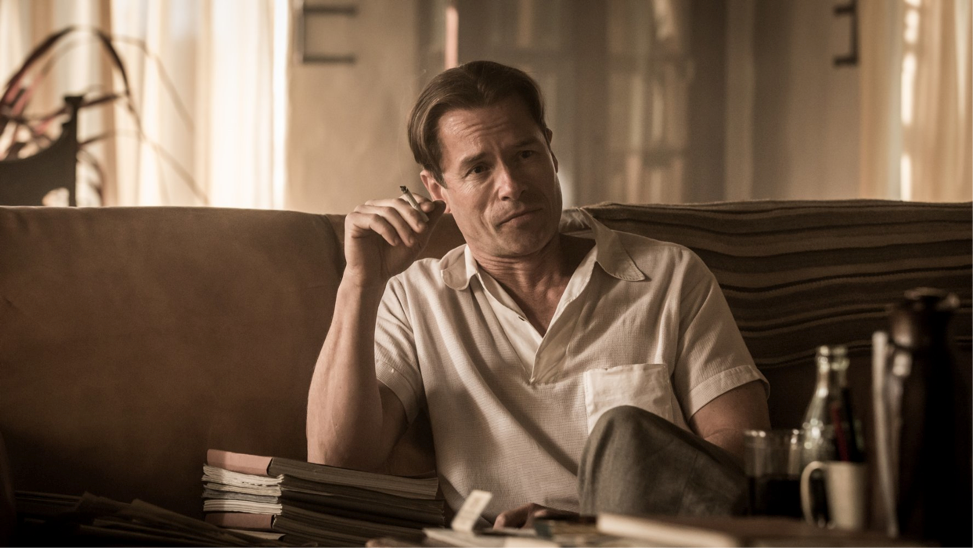
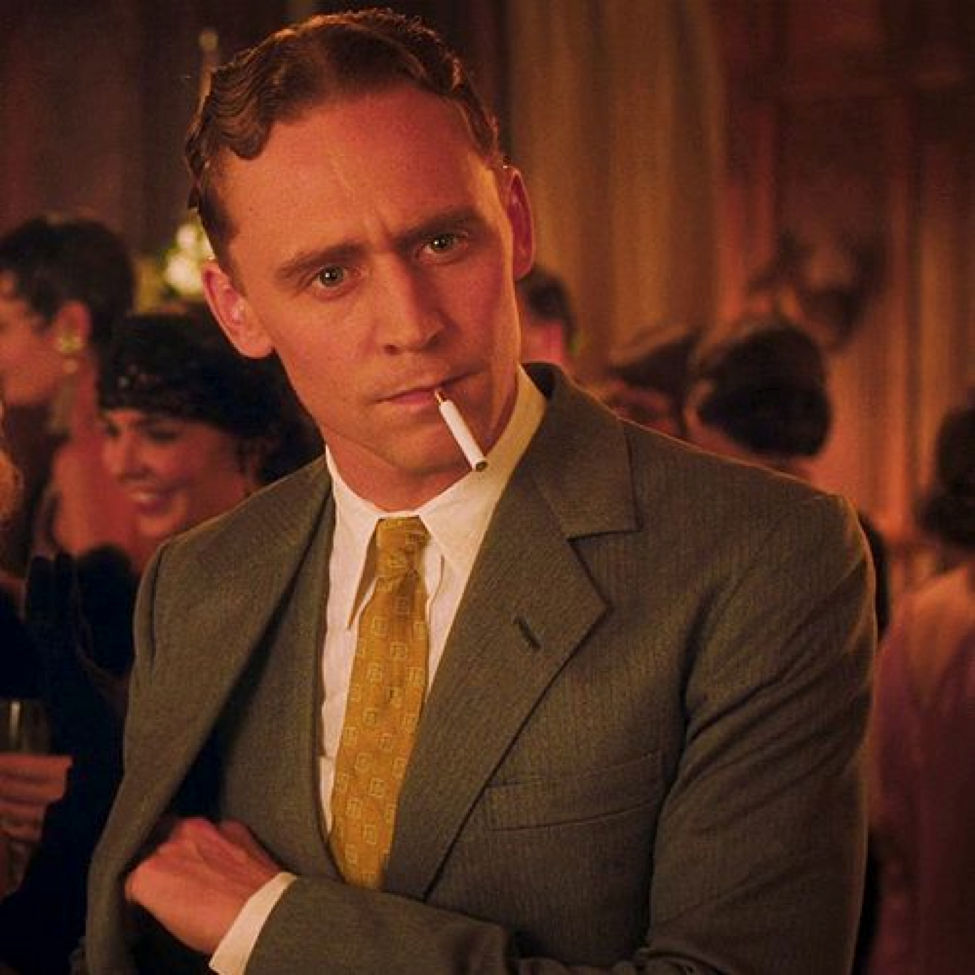
Genius opens with cinematic longing for an older New York: the hats and shoes of working men tromping through, the lighting gray and solemn. Meanwhile Wolfe, as-yet-unpublished, stands against a lamppost, smoking and staring up at the headquarters of Charles Scribner’s Sons. Upstairs Perkins is busy taking his pencil to Hemingway (later played in cameo form by Dominic West, a.k.a. McNulty — see Appendix A. Guy Pearce also appears as F. Scott Fitzgerald — see Appendix B. Both are welcome treats.). The sound of Perkins’ every red line echoes through the dusty hallway, until he is interrupted as a manuscript is slammed onto his desk. According to the courier it’s been rejected by every other publisher in town. (In non-Hollywood reality, it was the literary agent and woman Madeleine Boyd who brought Wolfe to Perkins’ attention). “Is it any good?” Perkins asks. “Good? No,” the courier answers. “But it’s unique.”
Appendix A — Hemingways in Hollywood
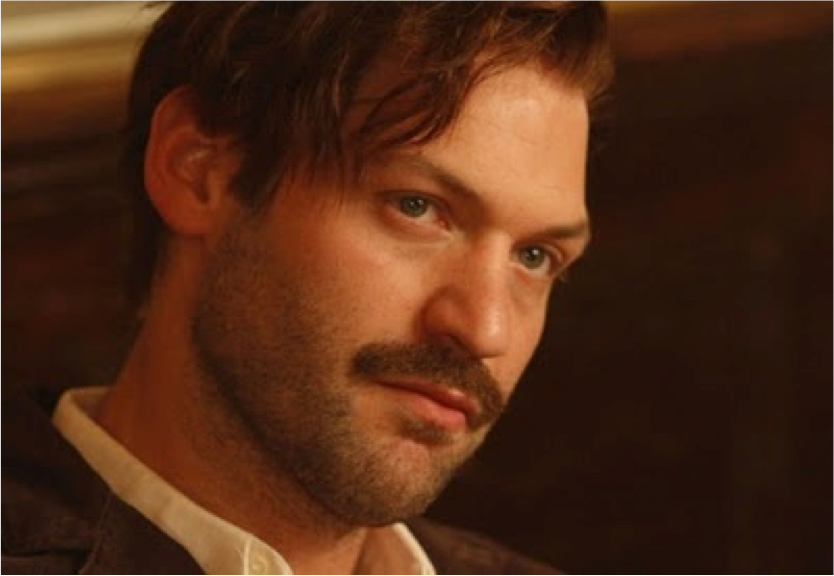
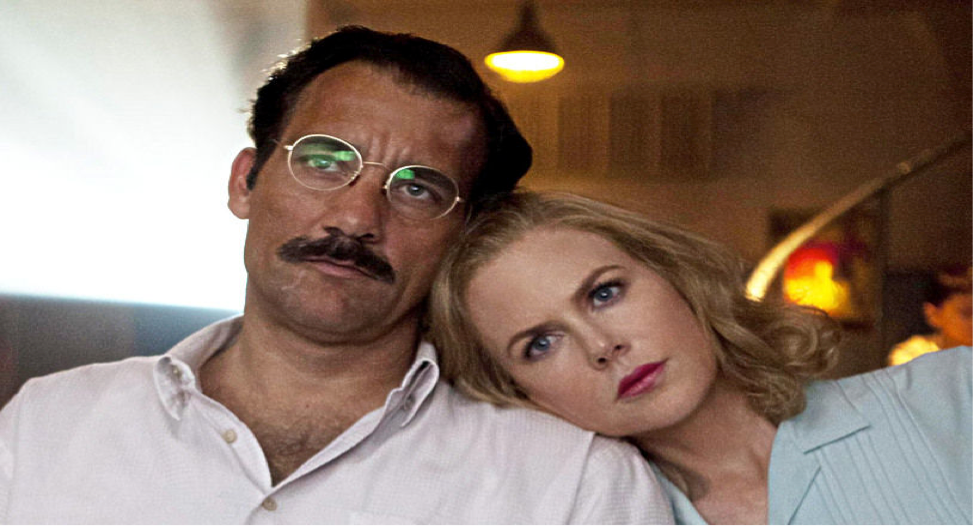
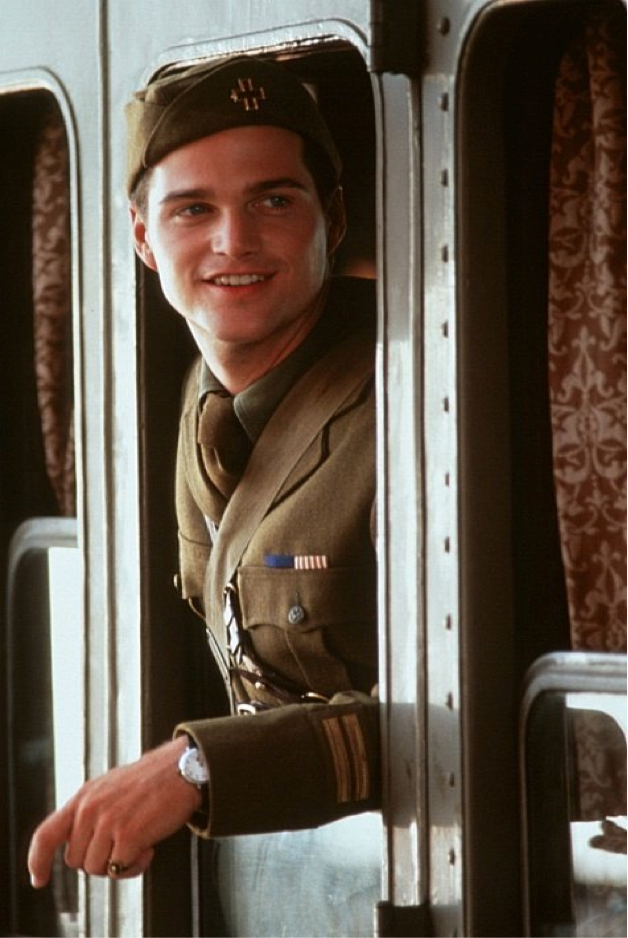
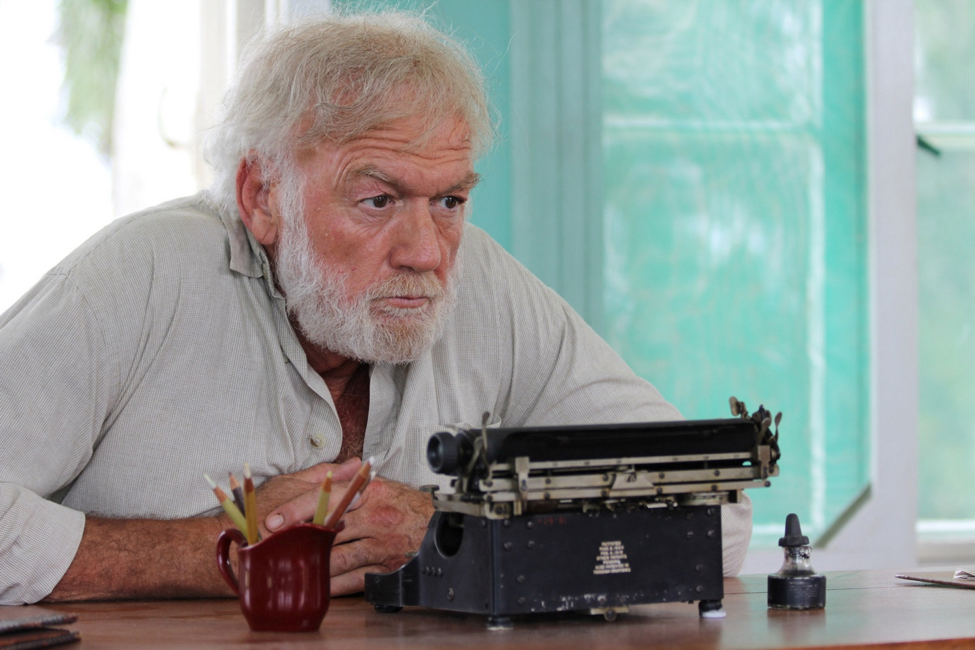
Dominic West in Genius (2016), Corey Stoll in Midnight in Paris (2011), Clive Owen in “Hemingway & Gellhorn” (2012)Chris O’Donnell in In Love and War (1996), Adrian Sparks in Papa Hemingway in Cuba (2015)
A reading montage follows. Perkins at his desk. Perkins on the train. The voiceover — that inelegant bridge between novels and films — begins. Jude Law drawls with his North Carolinian accent, as if it were always the author’s voice that a reader hears in her head: “A stone, a leaf, an unfound door; of a stone, a leaf door. And of all the forgotten faces… ”
But reading isn’t meant to be filmed. It’s the story inside the book that wants to be depicted, not the face absorbed by it. The rare films that do pull this off (The Princess Bride, The Neverending Story) use reading as transportation. To show someone reading is like showing a clouded mirror, rather than what it reflects.
And yet, if we have to look at a mirror it might as well be the face of an actor who is capable of subtlety. Colin Firth’s expression is implacable yet rapt as he takes in the words. Then, as if to confirm that the physical world still exists, he turns to the look out the window. As a reader who has been engrossed, I know this feeling. Coming up for air. He gazes briefly out, then Wolfe’s voice starts up again and Perkins turns back to the page as if caught, or pulled. That moment — the text of the novel chiming in a beat before the eye — is one of the better depictions of reading on film, the grown-up version of the sandwich that gets saved for later in The Neverending Story.
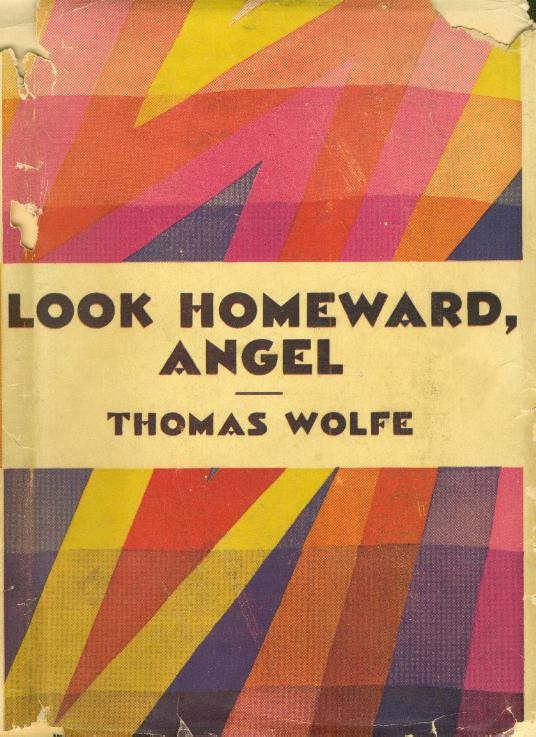
In Perkins’ introduction to the 1957 edition of Look Homeward, Angel — the novel submitted to Colin Firth at the beginning of the film — he characterized Wolfe as a prolific writer, one who “knew that cutting was necessary. His whole impulse was to utter what he felt and he had no time to revise and compress.” Grandage and screenwriter John Logan are savvy enough to take full advantage of the editorial relationship that forms between Perkins and Wolfe. For the audience this means another montage, as editor and writer tackle the opening passage to Wolfe’s second novel and only American bestseller, Of Time and the River. Perkins describes the process in his aforementioned introduction: “So then began a year of nights work, including Sundays, and every cut, and change, and interpretation, was argued about and about.” Grandage, a theater director making his cinematic debut, stages these arguments in locations across the city: in bars, on streets, even the platform at Grand Central Station. There are more shots of red pencil. But these marks matter, we know, because they are the hard earned results of a rigourous discussion about language and narrative, one operating at a much higher level than Finding Forrester’s“Punch the keys!”
First edition, 1929
As for depicting the writing process, Grandage and Logan were fortunate in their choice of author: the physicality of Wolfe’s habits offer them far more material than most. Unlike Proust, who famously wrote from bed (and whose In Search of Lost Time, incidentally,Wolfe sought to emulate with Of Time and the River), Wolfe, at six foot five, used his refrigerator as a standing desk, writing atop it in longhand. Shots of him scribbling away over the icebox are something to behold, as is the eventual deterioration of his friendship with Perkins. Like everything Wolfe does in Genius, their falling out is impassioned, exuberant, and drunken. Reflecting after Wolfe’s death, Perkins blames the riff on the dedication Wolfe wrote to Of Time and the River, which he made out to “a great editor and a brave and honest man.” According to Perkins, this had the effect of
“[giving] shallow people the impression that [he] could not function as a writer without collaboration, and one critic even used some such phrases as, ‘Wolfe and Perkins — Perkins and Wolfe, what way is that to write a novel’ … No writer could possibly tolerate the assumption … that he was dependent as a writer upon anyone else. He had to prove to himself and to the world that this was not so.”
Their brewing confrontation eventually comes to a head after Wolfe berates F. Scott and the ailing Zelda Fitzgerald at a dinner party, finally pushing Perkins, a decent and respectful man, over the edge. (As Nan Graham — former Editor-in-Chief at Scribner’s and its current Senior Vice President and Publisher — quipped in the post-screening discussion, “There are rules that editors live by: make friends of your authors but don’t make authors of your friends; don’t publish spouses. And, I would add, don’t invite competing authors to the same dinner party.”)
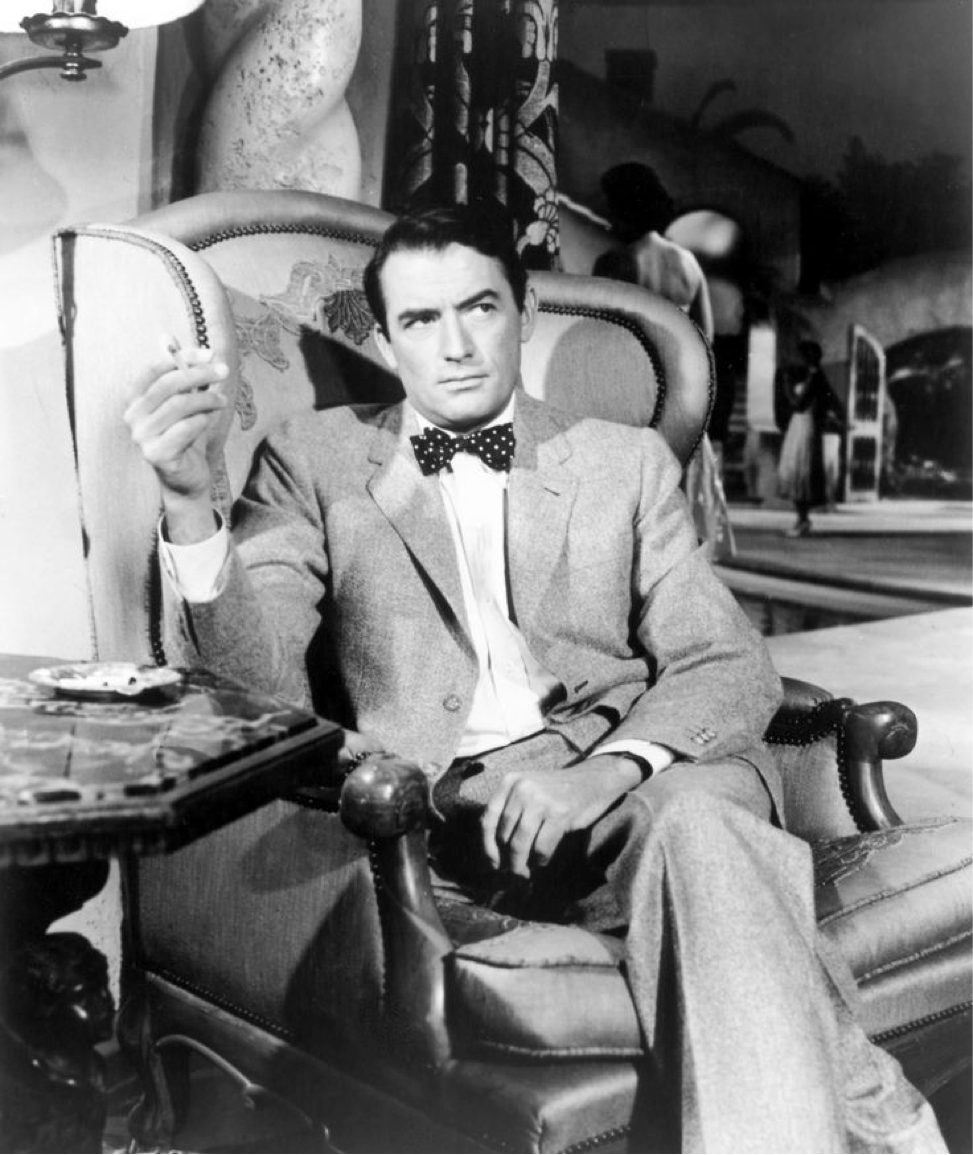
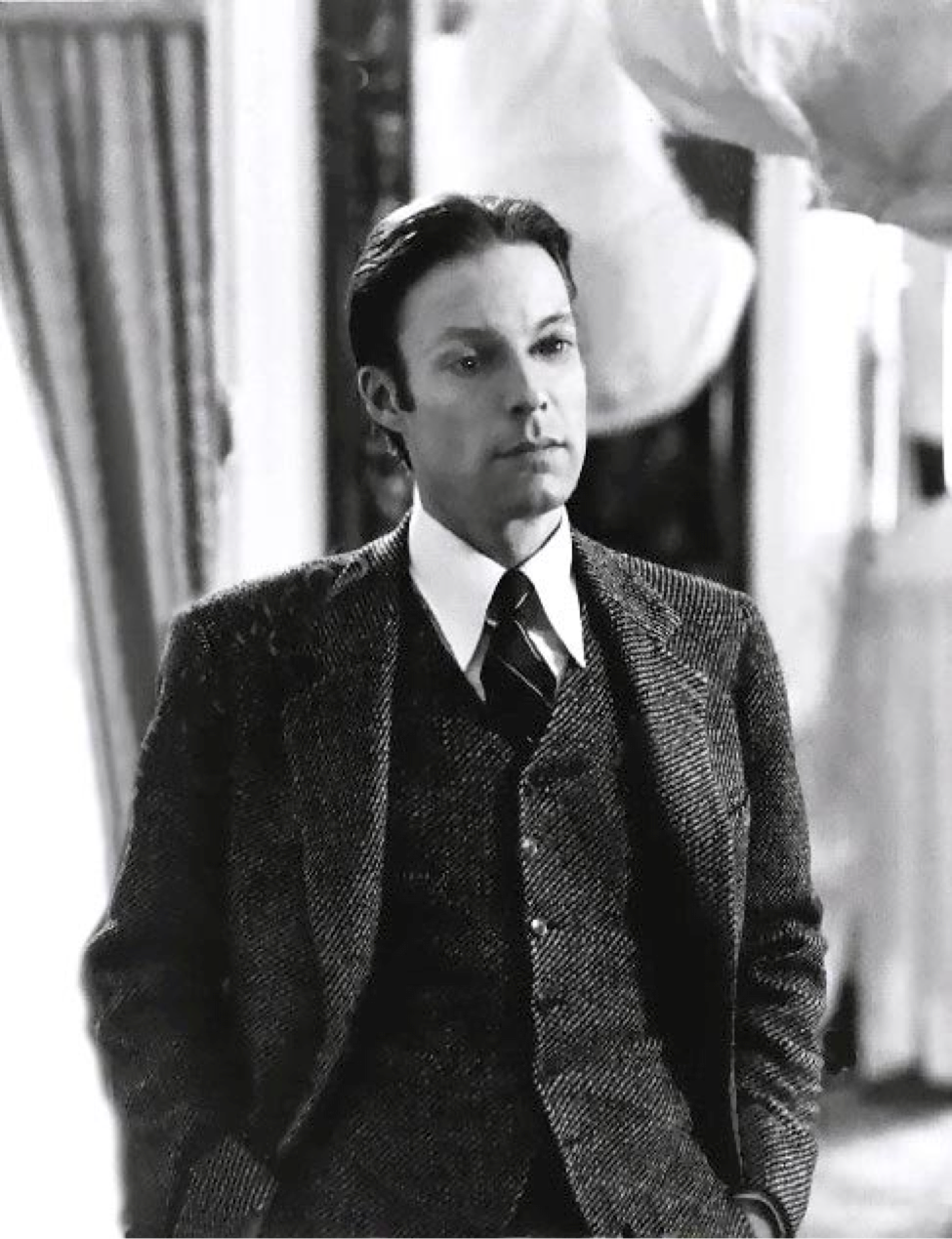
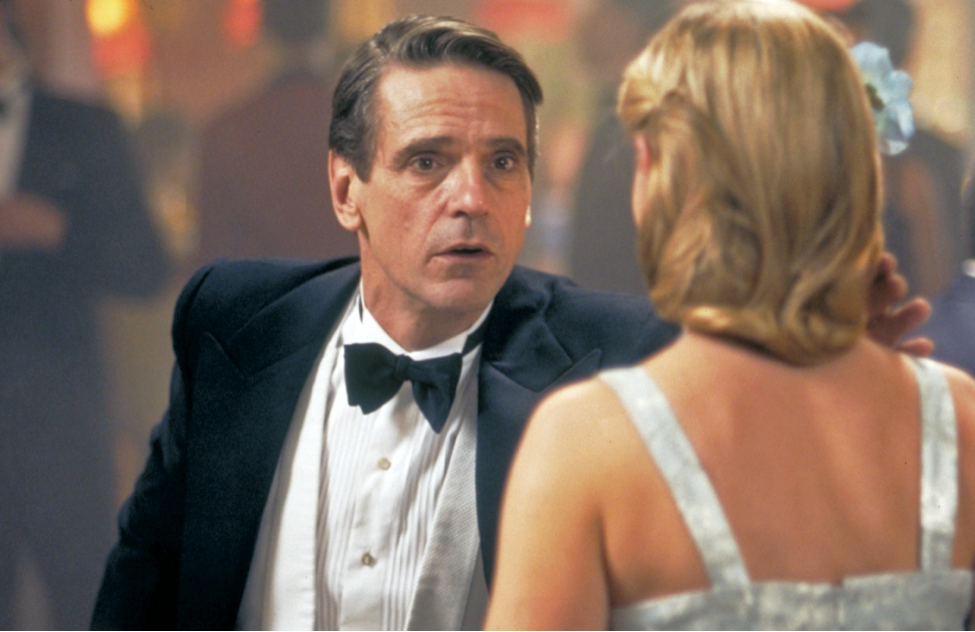
Appendix B — Fitzgerald in Hollywood
Gregory Peck in Beloved Infidel (1959), Richard Chamberlain in The Last of The Belles (1974), Jeremy Irons in Last Call (2002)Guy Pearce in Genius (2016), Tom Hiddleston in Midnight in Paris (2011)
Perhaps the most interesting question Genius raises comes from the comparison between Perkins and Mrs. Aline Bernstein (Nicole Kidman), a married woman who also supported Wolfe’s writing and with whom the author had a turbulent affair. (Although she was twenty years Wolfe’s senior, in the film they appear to be the same age.) In her final scene Kidman recovers a chilling performance from what has been, despite her character’s significance to his life and writing, a disappointingly one-dimensional role. During an unstable visit to the Scribner’s office she sums up the dedication she was given in Look Homeward, Angel as a “Thank you and good-bye,” warning Perkins that his will amount to the same. The question is whether Perkins, despite his personal relationship to Wolfe, can find stronger footing in his professional capacity as editor and literary gatekeeper, or if, like Bernstein, he will be locked into a role of servitude and end up abandoned.
Time turned out to prove Bernstein right. Wolfe ultimately left Scribner’s for Harper, though he died of tuberculosis of the brain before his third novel could be published. In a poetic and historical twist — omitted from the film — it was the spurned Perkins who wound up editing Wolfe’s posthumous manuscripts.
In the last half century Thomas Wolfe has faded from prominence, his work is rarely taught in college or even graduate classrooms, and many confuse him with his white-suite wearing homonym Tom Wolfe. After the film ended, my viewing companion leaned over said, “That ending was a real shock for me. I expected Wolfe to grow old and write The Bonfire of the Vanities.” Though Genius may inspire some, including me, to revisit Wolfe’s work, it’s Maxwell Perkins that emerges as the story’s true hero, the platonic ideal of an editor: firm yet compassionate, brilliant and devoted. Near the end of the film Wolfe shows up on Fitzgerald’s stoop to apologize, and Fitzgerald admonishes him for abandoning Perkins. “The man has a genius for friendship,” he says. A writer should be so lucky.
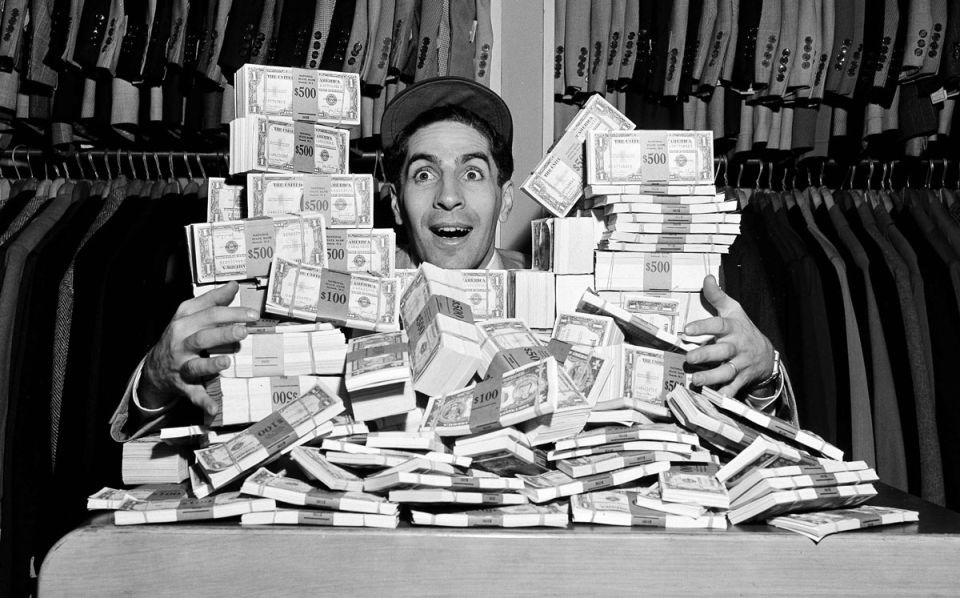
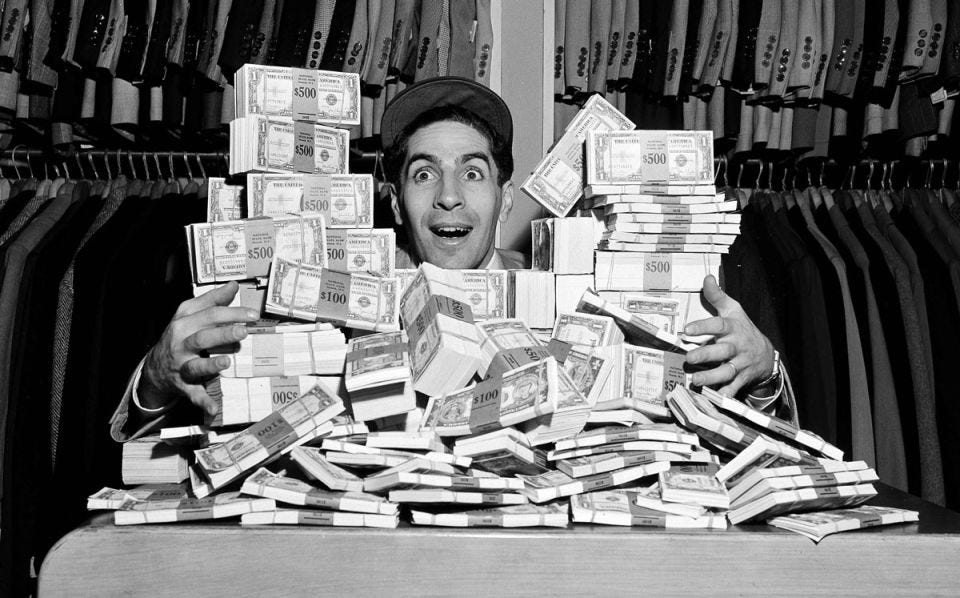
As readers, we like to think that literature has this higher calling, that it is transportive to the nth degree, that it — cue existential slow jamz — massages the brain into a deep empathy and thus makes us better people. Well, we can add another positive to the list! A new study has delineated the long-term financial payoff from childhood reading. The study — pulling from 5,280 men from Austria, Belgium, the Czech Republic, Denmark, France, Germany, Italy, the Netherlands and Sweden all of whom were born between the years 1920 and 1956 — indicates that those who read at least 10 non-compulsory-school-reading books ended up with 21% more income. The study also concluded, however, that after this number of books (10), there was no significant correlation between higher numbers of freely read books and higher additional incomes. 10 seemed to be the (relatively arbitrary) correlative cap.
On the bottom-line Capitalist value of books, Quartz has published an article running some quotes from one of the lead researchers on the study, Guglielmo Weber. Weber, like the study, boils literature down to lowest-common-financial denominators, not getting much further than the presence of books in a household as an indication of “families with stronger cultural and socioeconomic backgrounds.” He goes on, “Even nowadays, books capture something” (my emphasis). This is part of the problem: can “books” not be something(s) — at least for a reader — positively stripped of their economic jackets? That we don’t anticipate a paycheck at the end of a novel should be something intuitive; do we not get enough from the words alone?
Finally, too often in mass popular culture, we do exactly this: we throw around “books” as a huge unnamed thing. Books are wonderful; they are multivarious; they have genres and names and, if we are lucky, resist and challenge and blur those genres and names. I wonder what a long-term-earnings study of those who read Maggie Nelson, for instance, would illuminate for us.
We live in a world where an onslaught of information is a phone swipe away, where in order to run for government, residents have to start the campaign years before it officially begins. We live in a world where the majority of an entire continent uses the same currency, has lowered its borders and accepts many of the same laws. In this world, we can travel just about anywhere in under a day. Even fifty years ago, any depiction of our current living situation would be scoffed at and termed “science fiction.”
Infomocracy, the debut novel of both Malka Older and the first publication of Tor.com, is certainly science fiction, but it sets its sights on a slew of newly arrived realities, through a speculative lens. Their Information is with them at all times and accessible with an eye flick, but it’s not so different from our phone. Their world is both border-free and border-intensive, again, sharing similarities with us today. And while the modern world has no plans for a new transportation system through the Earth’s core (that I know of), fracking, Big Digs and waste concerns are no less a concern. It’s as if Older took the concerns of 2016 and turned the dial past 11, into science fiction.
At its heart, Infomocracy is politics meeting cyber-punk, when the movers and shakers behind the power investigate crimes and shady goings-on. With roots in noir and heels firmly planted in the present, it shows a world that really isn’t too different from today. Malka Older has created a thrilling, breakneck novel with fully human characters. And it asks tough questions.
Science fiction works best when it uses technological hypotheses as a fulcrum to explore humanity. As a genre, SF is uniquely suited to look at “today” and posit questions and then go about answering those questions. Infomocracy asks those questions directly: what would happen with news cycles when the world is voting for government? What will happen when the internet is so ubiquitous we’re never separated?
In Infomocracy, geopolitical borders are blurred. No longer is the world filled with disparate nations and coalitions. Instead, the world is split (to a large degree, anyway) into micro-governments with borders splitting down lawns and sidewalks. A “centenal” of Philip-Morris may lay between two “centenals” of Policy1st, on the way to Heritage or Liberty, discrete governing bodies that vie against one another in constant news streams and election maneuvers. Former countries are broken up into these micro-governments and one city could contain hundreds or thousands of these little districts. Some of the governments are corporate, some are for the people, some are frighteningly jingoistic.
He’s managed to find a centenal where alcohol and marijuana are legal but tobacco and pop-out advertisements are not. As Ken waited for the debate to start, he checked out this government’s broader policies. They’re called Free2B, which sounds like they might promulgate that kind of individualism that gets annoying quick once your neighbor starts playing gronkytonk at top volume at five a.m. or refuses to donate to the volunteer fire department until their house is burning down, but when he scans their policies, he sees they’re reasonably socially conscious. If they’ve got anything in a more temperate climate, he’s seriously considering moving there once the election is over.
Built on the bones of cyber-punk mainstays like Neuromancer and Snow Crash, the protagonists of Infomocracy are smart, driven, tech-savvy and resourceful. The world is dangerous and vaguely dystopian, but not outside the realm of possibility. While the characters — not all nice, not all good, but all intelligent, resourceful and amusing — obviously don’t dwell on the metaphors and parallels to today’s world, they’re all there. They recognize that resources are dwindling and that an era of plenty is ending, but they look beyond,
She takes a look at the menu and checks her body stats. The endive-prosciutto salad mostly closely matches her nutritional needs, but that’s hardly portable. Mishima decides to splurge on the peanut butter–banana–honey sandwich instead, a true luxury given the rarity of both bananas and honey. When it arrives, she waits until the waiter walks away, then wraps the sandwich in the linen napkin and heads back to her room. She doesn’t feel like making small talk with anyone right now, and they should understand. It’s election season.
It might seem like Infomocracy is too heavy on symbolism and words of warning. It’s not the case, far from it. Mostly it’s engrossing and thought-provoking, moving quickly and jaunting from one point of view to another, from the Middle East to Japan and back. The tidbits of heavy-handedness are sparsely laid out, easily to forgive in the moment. And they serve another function, as anchors. Infomocracy is fun and clever and it’s easy to get so distracted by the plot, the characters and the fascinating world that the larger picture is missing. While that’s forgiven in the point of view of the story, it’s not forgivable in the reader. We need a way to contextualize.
Science fiction is a way to think beyond the constraints of our time. It looks into the future and constructs a possible outcome and straps a story onto a construct. It’s about ideas and reactions to those ideas. What happens when our corporations start running for government, or constructing their own? How do pundits and campaign staffers react to new and powerful modes of media? These aren’t out-of-left-field questions and they require thought experiments to interpret.
That this particular thought experiment is delightfully well written and engrossing is quite beneficial. Nothing is worse than stodgy, high-minded sci-fi. Thankfully, that’s not a worry.
New publisher Tor(.com) and Ms. Older chose a good time to debut, when the election in our own country has started to reach a saturation point and the blurring of lines between fantasy and reality is in high-gear. I’m not sure if the world proposed in Infomocracy is better or worse than the endless stream of articles, essays, videos and talking heads we have now, but it’s certainly engrossing enough to distract us from our own disquieting present.
Electric Literature is committed to publishing work that is intelligent and unpretentious, paying all our writers, and offering our content for free. Members of Electric Literature are essential to supporting our mission of making literature relevant, exciting, and inclusive.
A monthly eBook sampling Recommended Reading’s rich archives, on topics such as magical cities, family conflict, gender and power, and more. These eBooks are compatible with most e-readers including Kindle and iBooks, and are not available anywhere else. Recommended Reading, our acclaimed weekly fiction magazine, has published over 300 issues to date, each with a personal recommendation from a top writer or editor.
Early access to The Blunt Instrument, Elisa Gabbert’s advice column to writers, and a special members-only bonus column every other month.
Access to year-round submissions for fiction and essays, with a guaranteed response time of 3 months or less. (Regular submissions have a 6-month response time.) Never wait to submit your work to Electric Lit again!
Members at the Novel level receive a “Read More Women” tote, and members at the Epic level get a copy of Papercuts, a party game for the rude and well read.
Electric Lit, Inc. is 501(c)3 nonprofit, and membership fees are tax-deductible to the extent permitted by law.
Have questions about the recent changes to our membership platform? Read more here, or email editors [at] electricliterature.com.
DON’T MISS OUT
Sign up for our newsletter to get submission announcements and stay on top of our best work.
YOUR INBOX IS LIT
Enjoy strange, diverting work from The Commuter on Mondays, absorbing fiction from Recommended Reading on Wednesdays, and a roundup of our best work of the week on Fridays. Personalize your subscription preferences here.