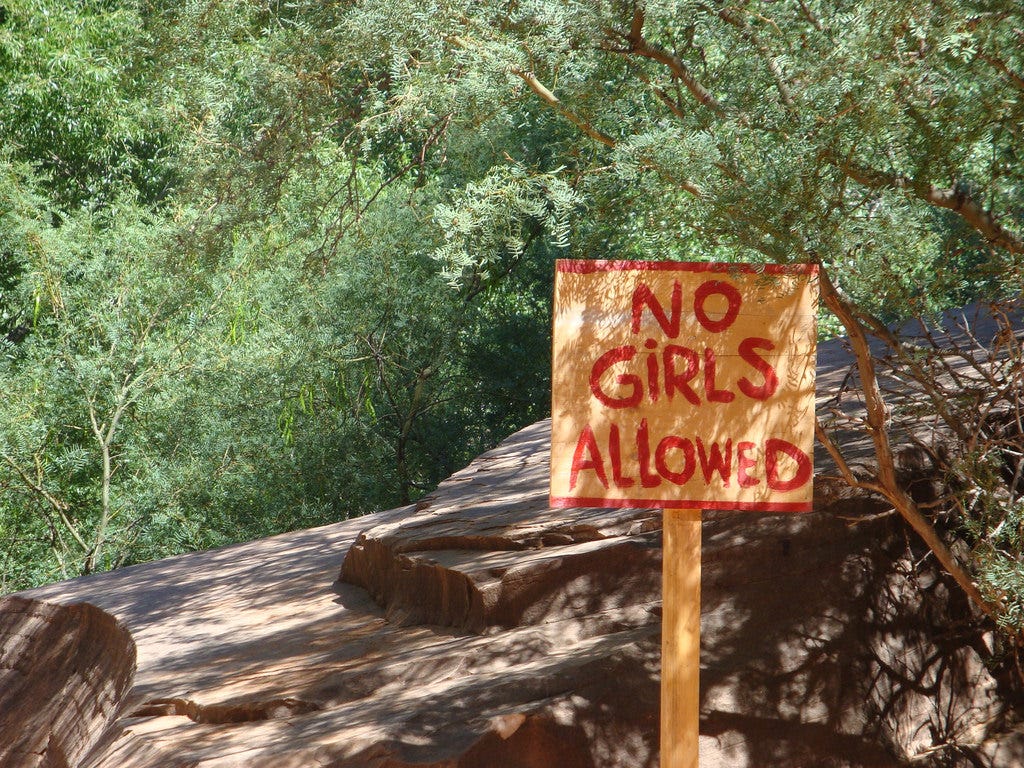
My questions for you are about nerve and grit. I write flash fiction, short stories, am working on a novel, and I’ve been sporadically writing blogs for fun for almost six years. I’m also aiming to write for online magazines. I have a fair amount of experience writing copy for companies, and I’m now in the early stages of setting up a freelance business.
I’d like to know how a writer trusts that their work is good, and has the grit to keep going with it?
I grew up in a place where people asked, “Who do you think you are?” of anybody doing something outside the norm, and in spite of moving on geographically, those words are often in my head on days of a confidence dip. I’d like to continue being constructively self-critical but be able to shake away this negative voice!
I completed an MA in creative writing three years ago where I got some good feedback. People have also said good things about my blog, I have happy copywriting customers, and sometimes I feel tuned into and confident about my writing. Recently however, I’ve decided to properly pursue becoming a paid freelance writer — rather than dabbling as a sideline alongside day jobs — and attempt publication of my creative writing. Logically, I know a lot of work, editing, and rejection will be part of this, which I am up for, but even so I think the idea of testing my writing via more “official” realms has spun me out and got me feeling all anxious.
Some side questions: Is submitting to competitions/magazines a good way to judge where you’re at? When writing fiction with the hope of publication, at what stage should you show your work to an agent?
If you could please offer some advice, that would be awesome!
Thanks very much,
Lisa.
@lisajderrick
Dear Lisa,
I’ll give you some practical advice in a minute, but first let’s establish something important: There is no such thing as “good.” There is no objectively good work and there are no objectively good writers.
I can name plenty of books that I think are genius but which are detested by great writers whose opinions I respect and vice versa- there are books I despise which are revered by writers I love. Writing also goes in and out of fashion; when I was a kid John Updike seemed to be universally accepted as a great writer, whereas these days I more often hear his name as an example of bad writing. The point is, a piece of writing has no inherent value in a vacuum. How “good” it is is decided by people at a point in time and space.
I don’t think this is uselessly abstract, I think this has real bearing on how you choose to think about your own writing and where you look for validation. Sitting around wondering if you’re “good” and expecting the world to answer is like asking how you know when your book is done — it’s not something the book or the world can tell you. It’s a decision you need to make.
There may be important and famous writers who went to the grave tortured and doubtful of their own talent. It’s possible that you can find great success as a writer without ever feeling like you “know” if you’re “good.” To me, that sounds like no way to live. So when I write, the standards I try to meet are my own: Do I want to read what I’m writing? It’s that simple. If I write a poem or an essay that I want to read and re-read after I’ve finished writing and editing it, then it’s good by my own lights.
If you don’t feel that way about your own writing, the challenge becomes: Write something that you would want to read. It may sound obvious, but I don’t think most writers hold themselves to these standards. Did you know that people are faster to recognize photos of themselves that have been photoshopped to make them look slightly more attractive? Self-assessments are often self-flattering. (It’s not easy, but I think working at being a better reader and editor of other people’s work makes you a better reader and editor of your own work too.)
Now for the more practical part. First, a reminder that freelance copywriting and fiction are totally different worlds. When you’re freelancing as a job, the standards you need to meet are the client’s. And typically, the client makes it pretty clear what they want, what the goals of the piece of writing are, and whether or not you’ve met those requirements. Getting creative work published is a very different game. As you say, you’re going to get rejected a lot. It’s very competitive and what “the client” wants is much less clear. Dealing with all that rejection and retaining your “grit” will come from, on the one hand, only submitting work that meets your own quality standards and, on the other, recognizing that rejection isn’t personal — more on that here.
So to answer your side questions, I’d say that no, submitting to contests and magazines is not a good way to “judge where you’re at.” The point of sending your work out is to get it published. Finding an editor who likes your work might give you a confidence boost, but it doesn’t “prove” that you’re “good,” since the process is both extremely selective and somewhat random. (You might be rejected from a number of small magazines only to finally publish the piece somewhere much bigger. On the other hand, work I hate gets published every day.) Send your work out when you’ve decided that it’s as good as you can make it. External validation should be a bonus — if you need it to believe that what you’re doing is worthwhile, you’re going to crumple with rejection.
As for the agent question: As a fiction writer, it’s unlikely that you’ll get an agent without a finished book unless you’re publishing stories in top-tier journals like the New Yorker and the Paris Review. (Nonfiction books are a different story.) If that’s not the case, have a strong polished draft of either a novel or a collection of stories in hand when you start sending out queries to agents. An agent may push you to make further revisions, but start with a book you’re confident in — that you would want to read.
Google almost any celebrated short story writer — George Saunders, Kelly Link, Alice Munro, Isak Dinesen, Joy Williams — and you’re likely to see the same two words over and over again: “writer’s writer.” Lest you be tempted to exalt that phrase’s use, consider Cynthia Ozick’s description: “Every writer understands exactly what that fearful possessive hints at: a modicum of professional admiration accompanied — or subverted — by dim public recognition and even dimmer sales.” Other words might be “underrated,” “under read,” even “obscure.” Ask your co-workers who Lorrie Moore is and watch the blank stares you get in return. Click over to Goodreads and check out some of the reviews of short story collections, and you’re likely to get comments like “I wish he’d write a novel,” and “I just hate short stories.”
As a short story writer, I lived in denial for years. I pretended that the editors were all wrong when they said that short story collections don’t sell, that the Goodreads comments were sullen outliers. After all, most of my friends loved short stories! Never mind that most of my friends were writers, and when I told non-writer friends that my book was a short story collection they were congratulatory but fervent in their expressed hopes that I would someday, finally, write a novel. I did, one sad afternoon, suck it up and start asking people — non-writers — whether they read or enjoyed short stories, and after that proved too dispiriting I took to the internet and read lots of reviews and comments and criticisms and understood, finally: It’s all true.
Most people really don’t like short stories. And that includes lots of critics, who often seem to regard short story collections as a warm-up for the real thing. (Don’t believe me? Look up how often a writer with one or two short story collections under her belt gets called a “debut writer,” when her novel comes out — and how often said novel gets called “her first book.”) If you’re thinking, sure, sure, the public hates short stories, but they win lots of awards and respect! then you should probably go ahead and search for “awards for short story collections” online.
Go on. I’ll wait.
See what I mean? That doesn’t mean collections can’t and don’t win awards (a collection won the National Book Award in 2015, for example.) But they certainly don’t win nearly as often as novels do. When Alice Munro won her Nobel Prize, it was the first time in over a century the prize had gone to someone known for writing short stories primarily.
This is not, by the way, a new phenomenon. There’s a reason so many short story writers headed to Hollywood to make their living, even in the first half of the last century. John Cheever back in 1969 was bemoaning the underdog status of short stories, calling the short story “something of a bum.” Though I’d argue he was always a better short story writer than a novelist, he wanted to stake his reputation on his novels. And he’s not unusual. Take Kafka — he published mostly short stories in his own lifetime, and yet the unfinished novels he left behind seem what he’s better known for — in addition to “The Metamorphosis,” a short story often billed as a novella or even a short novel.
I’ve seen many excellent short story writers make the inevitable and expected career move from short stories to novels, because they want the accolades and the acclaim and the wider audience/money/fame, too. And who can blame them? If you don’t move to novels, you risk looking like a small or unambitious writer or worse, a one-trick pony. Some really do want to write a novel, and some write great ones. Some clearly don’t have their heart in it, and the novels — even if technically perfect — don’t have the soul and the urgency of the short fiction they write. Sometimes critics acknowledge this, and often they don’t.
But WHY is this the case? Short stories have been around forever, of course, and many of our modern tales have their roots in the fairy tales and folktales told hundreds of years ago and collected by the Grimm brothers and Charles Perrault, among others. And as Anne Therlault points out, “One need only look to the sources cited by the great folktale and fairy tale publishers from the late seventeenth century all the way through to the early nineteenth century (a time when readers, editors and publishers showed renewed literary interest in both fantastical stories and traditional storytelling) to know that women were, by and large, the main collectors, keepers and tellers of these tales.”
Is the short story seen as a womanly art form, tamed and domestic, slight compared to the doorstop novels of the most well-known male novelists? Alice Munro has said that after some success publishing short stories, she fell into a depression because she couldn’t write a novel, the way she felt she was supposed to. “I had simply lost hope, she said, “lost faith in myself…I guess it was because I still wanted to do something great — great the way men do.” The Vancouver Sun ran a piece about her titled, “Housewife Finds Time to Write Short Stories.”
Aside from gender stereotypes, the novel is exciting, transcendent — the novel is the avatar of burning American ambition. The search is always on, the articles are always being cranked out about the next great American novelist. But what about the next American short story writer? We produce so many excellent short story writers here; why don’t we celebrate them the way we ought? Nabokov knew it. In 1972, he said “at the present time (say, for the last fifty years) the greatest short stories have been produced not in England, not in Russia, and certainly not in France, but in this country. Examples are the stained-glass windows of knowledge.” (And by the way, he greatly admired Cheever’s short fiction, too.)
Since then, the proliferation of MFA programs, the internet, the flourishing of new presses, and a thousand other factors have produced more excellent American short story writers than ever before. Look at the many excellent collections to come out in just the last few years, many on small presses — and look at something like the Wigleaf 50, which every year produces a sampling of the finest short short fiction around. Too, the explosive growth of those much maligned MFA programs has produced a larger audience, if only slightly, than ever before — writers trained in the writing and reading of short stories, ready to appreciate and love the form for what it is. Why do we then ask that these writers become novelists? Surely we have enough of those already?
I’m not sure, having spoken to many non-writers (including many avid readers) that the market will ever support a plethora of commercially successful short fiction. Readers cite the lack of time or interest in constantly immersing themselves in new situations, new scenarios, new characters. They cite plot over character, which will always favor the novel. They say if they’re going to read, they’d rather invest than dip in and out. And of course, mainstream magazines continue to die out and lose readership, and fewer and fewer feature fiction in their pages. So possibly, short story writers are doomed to remain “writer’s writers,” and that might be the problem we really have to solve: how do we assure that short story writers can feel free to pursue their craft without the pressure to move into another, longer form?
Poets don’t have this problem — we don’t tell poets to quit writing poetry and move into short stories already. And maybe poetry, or even visual art, is where we should look when considering short story writers. Maybe we should support short stories not as the cash cows they never will be, but as a vital and necessary art form that we wish to preserve. Maybe there could be more support for short story writers, more awards, fellowships, grants, and showcases. Maybe critics could review short stories collections the same way they review novels. Maybe Time Magazine could occasionally feature the next great American short story writer, whoever she or he may be. Maybe there could be more financial support for, a wider distribution of, the kind of literary magazines that publish top notch, innovative short fiction. Maybe high schools could teach more than the same five short stories (sorry, Updike) so that kids could learn to love the form early on.
Some of this is already happening. Every few years we claim a renaissance in short fiction which is at least partially true, and I like to think that more online publications, more innovative publishing ideas (using Kickstarter to fund projects, for example) — more access, in particular — has led and will lead to a wider readership for short stories. As a reader and writer of short stories myself, of course I’d love that to be true. But honestly, I’d just be happy if people stopped asking “when are you going to write a novel?”
About the Author
Amber Sparks is the author of the short story collection May We Shed These Human Bodies, and the co-author (with Robert Kloss and illustrator Matt Kish) of the hybrid novel The Desert Places. You can find her most days @ambernoelle and some days at ambernoellesparks.com.
Jensen Beach’s collection, Swallowed by the Cold (Graywolf), opens with a story about a tennis match between an aging tennis pro with one arm and another gentleman named Rolf. It sounds like the start of a joke one might tell in a bar after a few drinks, and yet this story lays so much of the groundwork for what is to come later in the collection. Buried off-center, among seemingly insignificant observations, are key details that come to form the core of later stories. Beach has finely threaded this collection so that there is a sense of parallelism running throughout it. Another striking feature is the way Beach has chosen to tell familiar stories from new, oblique angles, imbuing them with a wry humor. It is difficult to guess how these stories end or to classify them as funny or sad, uplifting or depressing, smart or silly, etc. The truth is that each of these stories is all of those things and much more.
The relationships in Swallowed by the Cold are all in peril. Marriages are threatened not only by infidelity but also by personal vices. These are people who waver, who hesitate just short of saying what it is that they want to say and doing what it is that they know is necessary. In one sequence of stories, Martin and his wife Louise navigate a practical but unhappy middle age. Neither is capable of seeing the other for the person that they truly are. Martin is unable to see Louise as anything but a drunk, near-embarrassment and is often relieved when she chooses to stay at home. Louise is frustrated and sees Martin as not only a bore, but a hard, paternalistic entity. They are each trapped by their own myopia. In “Kino,” Martin’s discomfort with Louise and his discomfort with himself collide in an unexpected way while in “The Apartment,” we see the source of Louise’s private tragedies, the near-misses, how close she came to another life, where she might have been happy. It’s one of the strongest stories in the collection, “The Apartment,” and it so beautifully embodies one of the themes that makes Swallowed by the Cold, so affecting: parallel lives — both those lives we might have lived if only things had gone a little differently, and also the parallel lives that people pursue when they live together yet separately as Louise and Martin do.
There is a hyperlocality to this collection of stories; that is, they feel so much as if they occur within a single neighborhood, though this isn’t exactly the case. It is a cliché, but it would be inaccurate to say otherwise: place is a character in these stories. The way that Beach has used his remarkable, clear voice to fully render weather and architecture and nature, has made it at once invisible and yet so striking. It was so easy to picture the park where Helle and Henrik meet in “Anniversary” or her apartment as they have dinner, the candles and the table. There is also the tennis court where Rolf plays the best tennis of his life in “In the Village of Elmsta,” the cracks and the nets and all.
As much as this collection is about people on the edge of trouble, it is also about Stockholm, its history, its geography, and its culture. There are also extreme examples of hyperlocality, stories where the plot itself hinges on place. In “Ships of Stockholm,” two people discuss a particular museum which is freighted with memory for one of them, transforming an idle flirtation between strangers into a reflection on the relationship between a father and son. There is also “The Drowned Girl,” which does not have a famous place at its core, but a minor cemetery in a small village which plays such a poignant, touching role in the life of a young girl as she works her way through grief. Places both named and unnamed loom large in this collection, becoming an unforgettable and necessary backdrop. While these stories are universal, they couldn’t have happened as they did in any other place.
Reading Swallowed by the Cold calls to mind such experiences as reading Mavis Gallant’s excellent Linnet Muir stories (collected in Varieties of Exile) and offers a sharp response to the critique often leveled at short stories for being too brief or for leaving things unresolved. Provided here is an expanded universe of personal intimacies and exploration of all the parallel lives that collect in a place. Jensen Beach moves deftly in and around all of his characters’ lives, often revealing with stark and startling clarity all the absurdity and beauty present in even the most mundane of daily rhythms.
Click here to read a story, “In the Night of the Day Before,” from Jensen Beach’s collection, Swallowed by the Cold, as part of Electric Literature’s Recommended Reading.
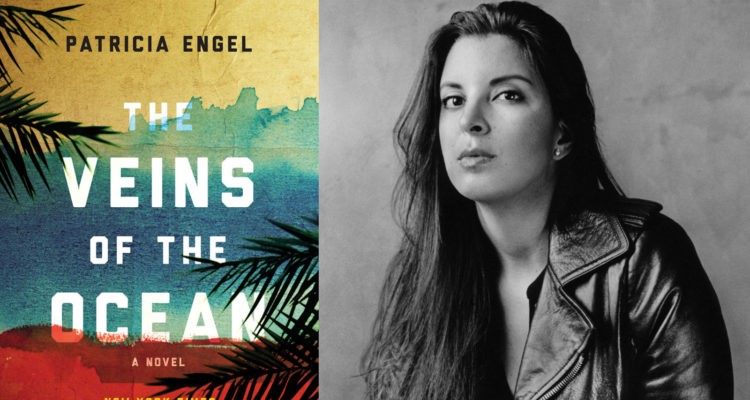
Patricia Engel’s new novel, Veins of the Ocean(Grove Press 2016), begins with one of the more arresting sequences I can remember. Whenever I’ve recommended the book to a friend, or a colleague, or anyone who would listen, rather than telling them what the book was about, or trying to explain why it was urgent to read now, at a time when our country seems hell bent on dehumanizing the immigrant (and first generation) communities that form its bedrock, I opened up my copy of Engel’s book and asked them to read the first page.
It begins:
“When he found out his wife was unfaithful, Hector Castillo told his son to get in the car because they were going fishing. It was after midnight but this was not unusual. The Rickenbacker Bridge suspended across Biscayne Bay was full of fishermen leaning on the railings, catching up on gossip over beer and fishing lines, avoiding going home to their wives. Except Hector didn’t bring any fishing gear with him. He led his son, Carlito, who’d just turned three, by the hand to the concrete wall, picked him up by the waist, and held him so that the boy grinned and stretched his arms out like a bird, telling his papi he was flying, flying, and Hector said, ‘Sí, Carlito, tienes alas, you have wings.’
Then Hector pushed little Carlito into the air, spun him around, and the boy giggled, kicking his legs up and about, telling his father, “Higher, Papi, Higher,” before Hector took a step back and with all his might hoisted the boy as high in the sky as he’d go, told him he loved him, and threw his son over the railing into the sea.”
You’re either the kind of person who reads those words and needs to read more, or you’re not, it seems to me.
But to give you more context, Veins of the Ocean is about Carlito’s sister, Reina: her love for her brother, who survived that fall only to repeat the same unspeakable act, years later, on his girlfriend’s son; Reina’s struggle to come to terms with her part in Carlito’s crime; her decision to leave Miami behind for the Keys, where she learns to free dive and works with dolphins and meets Nesto, a Cuban working odd jobs and saving up to bring his children Stateside. It’s at once a sprawling epic and an intimate story of one woman’s struggle to find some peace and a little hope.
Engel is a quietly commanding presence. She came into the EL offices on a recent Monday afternoon, after a final recording session for the audio book version of Veins of the Ocean. We spoke for an hour or so about life in South Florida, the story that inspired that chilling opening scene on the Rickenbacker Bridge, her research trips to Cuba, the courage of immigrants, and the way her characters’ lives, and her own, have been transformed by the Caribbean.
Dwyer Murphy: I want to start by asking about the opening section of The Veins of the Ocean, where your narrator, Reina, tells us about her family, and about Carlito. Can you tell me how that story — of her brother and the bridge — came to you, and how you went about crafting it into the novel?
Patricia Engel: The opening began as a short story that I wrote back in 2008, called “The Bridge.” I was with my mother one day, driving past a bridge, and she said to me, “A long time ago, a man threw a baby off that bridge.” She didn’t have any information, didn’t know when or how or why or what happened afterwards. She only knew that a man had thrown a baby into the bay. The image stuck with me, but I didn’t know what to do with it and I was busy working on my first book, Vida, at the time. I had no idea how to enter that story about the bridge, or even whose story it would be. Finally I sat down and wrote from the perspective of the sister of the baby who was thrown over, telling the story of their family and its collective trauma. I went on to write another book, It’s Not Love, It’s Just Paris, in the meantime, but that story about the bridge stayed with me. I always felt I would come back to it, though I didn’t yet know how.
DM: Did you eventually find out what happened? Were there newspaper clippings?
PE: No, I didn’t. I made it all up. But in the years since I published that story, people have sent me articles about incidents like that one. There’s a famous ongoing case in Tampa of a father who threw his 5 year-old daughter off the Sunshine Skyway bridge. Apparently it happens all too often, all over the world. Adults throw children from bridges.
DM: In narrating, Reina occasionally slips between English and Spanish, which enriches the language of the novel and also creates a sense of intimacy with the reader. Did you have a systematic approach as to when Reina would express something in Spanish versus English, or were you going by feel?
Some things are better expressed in Spanish…it’s natural to reach fluidly for whatever words best convey what you’re feeling.
PE: I write whatever feels true to the voice of the narrator. This is how Reina would speak naturally, as she is fully bilingual. Often it’s the way I speak naturally, too, and how my friends speak when we’re in our most comfortable element. You realize there are things you experience in your life that cannot be expressed in the English language, which is extensive and rich but not perfect. It has substantial gaps that don’t correspond to all the things we feel as humans. Some things are better expressed in Spanish, and when you have access to two languages, or more, it’s natural to reach fluidly for whatever words best convey what you’re feeling.
DM: This struck me as a distinctly South Florida book: the landscape; the ocean, which plays such an important part in the story; the Latin communities; the Keys. Was there something about the state that particularly inspired you?
PE: I grew up in the north, inland, nowhere near the ocean. I love the ocean, but I noticed when I moved to Florida twelve years ago that people who had the good fortune to grow up next to the beach view the world a little differently than people who didn’t. They experience life and the landscape in a different way. I wanted to tell a story that would show how that particular connection to nature and water develops. Also, I’ve always been interested in writing about specific communities and subcultures: how people find their communities and form new extended families when they’re taken from the world they know, when they’re displaced, whether it’s by immigration, or by some other kind of dislocation, or even a sentimental exile. In a place like Miami, which is a very expansive city but has so many different worlds within it, those communities are there, and they’re intertwined in a way they might not be in another city. From Miami, I moved the story south into the Keys, a place that’s even more distinctly situated: vulnerable to the elements, remote, and then to Havana and Cartagena. Those settings lent themselves to a different kind of story. I wanted The Veins of the Ocean, also, to be a novel of the Americas.
DM: The Caribbean comes into play, especially, when Reina meets Nesto in the Keys. She continues to narrate, but for long stretches we read Nesto’s history: his life back in Cuba, his childhood, his migration. I was wondering, where the Cuban community is so prominent in South Florida, and where the stories the community tells about its exile and its memories of home are so central to the culture there, did you feel any special pressure in crafting Nesto’s story?
PE: I’ve lived in Florida for twelve years, and I grew up with a lot of Cubans, who were like family to me, so I had a certain amount of second hand knowledge of their family histories. I also met somebody in Miami, a very recently arrived Cuban refugee, and the stories he told me were shocking and quite different than anything I’d heard before from longtime exiles. He was the product of a family who had stayed in Cuba and had experienced the revolution with all its highs and lows. He told me things I had never heard about before, in such detail, and he was the one who first encouraged me to look deeper into it.
But I knew I would have to go to Cuba myself. I couldn’t only do research from afar or rely simply on testimonials. So I went. I didn’t yet know what for exactly. I still wasn’t thinking it was for a book. I was just propelled by my own natural human curiosity, because I enjoy traveling and learning. But I kept going back. The more I went, the more I realized I would have to make even more trips, because there was so much to understand and I was barely scratching the surface. It’s an endlessly fascinating and complex country. The people are incredibly warm and have so much to tell. And at a certain point, I realized that because Reina’s character is so closed in on herself and is punishing herself in so many ways, it would be crucial for her to create a bond with somebody, in order for her to grow and fulfill her humanity. I thought, what kind of character could really reach her? It would have to be somebody who has endured a lot and with almost as complicated a past as she has; someone like Nesto. But I didn’t allow myself to be pressured into portraying life on the island with a particular slant or sympathetic to a specific point of view, as I would when describing any setting. Everything I have written about Cuba is absolutely true.
DM: This is also a story about the relationship between two siblings: Reina and her older brother, Carlito, who’s in prison, on death row, for having thrown his girlfriend’s child off the same bridge he was thrown from by his father as a baby. Reina’s life is so attached to Carlito’s, and their bond is so strong. It’s rare to find a book that’s so deeply about the brother-sister relationship.
How do you reconcile the fact that a person you love and have known all your life did something unforgivable…?
PE: It started because I wanted to write about incarceration and what that does to the family of the prisoner. They also have to absorb the consequences of the crime. As a family member, you’re free, you’re on the outside, but very often isolated by shame and blame, and how does that affect the love you feel for the person who’s on the inside? How do you reconcile the fact that a person you love and have known all your life did something unforgivable, committed this unnatural atrocity — throwing a child off a bridge, and in Carlito’s case, has lost the right to be alive? I considered who should tell the story of this man who, in spite of his guilt, is still human and worthy of our compassion, though he’s done this heinous thing. I decided it should be the sister who loved him best.
DM: Why did you want to write about incarceration?
PE: I’ve had some experience with it, and I’ve known other people who’ve also been affected by incarceration, not just as direct victims of crime but also the loved ones of people serving life and death sentences. I felt that incarceration gets portrayed as a single story in literature, in the media, and in our own popular consciousness. I wanted to offer something more. And it was on my mind, especially, because I live in Florida, which has such a corrupt incarceration system. Florida is one of the few states that still has death row and executes people regularly. That’s one of the greatest barbarisms of our country’s legal practice. And it’s not only the prisoners who are affected. There’s a long line of innocent people who suffer in different ways as a consequence of one person’s crime and the government’s punishment, and we don’t often hear about them.
DM: We’re in a particularly toxic moment in this country when it comes to issues of immigration, too. Latin communities, especially, are feeling the brunt of it. Your characters are very much of that world — Reina is first generation Colombian. Nesto was born in Cuba and is trying to get his children to the States. As you were writing, did you find this political climate affecting you?
Immigrants, whether they’ve arrived in their new country by choice or forced by circumstance, are the people I admire most…
PE: A general political and social disdain for Latin immigrants and their families has always existed in the United States, and has affected me all my life by virtue of being constantly reminded of my otherness and foreigness even though I was born in this country. But I started writing this book years ago, before this current phase of openly hateful anti-immigrant rhetoric was brought out so publicly and shamelessly. The times we’re living in now are quite unbelievable. I don’t write with a specific political agenda, but a human one, and a commitment to realism and truth. The fact is, I’m a daughter of immigrants and I grew up around immigrants, most of my closest friends are immigrants or the children of immigrants, and I still live in a predominately immigrant community. It’s the world I know and love. Immigrants, whether they’ve arrived in their new country by choice or forced by circumstance, are the people I admire most, whom I consider to be among the most courageous people in the world. I feel privileged to write about them in any way I can. With regard to the restoration of diplomatic relations between the U.S. and Cuba, I was as stunned as everyone else by the announcement. Had I ever imagined this new fold in history, maybe I wouldn’t have been able to write the story of Nesto, who was fleeing Cuba in a time when there was virtually no hope of change on the horizon.
DM: I wanted to ask, also, about religion. Reina isn’t somebody who goes to church on Sundays, but her life is touched by the spiritual: saints’ rituals and prophecies and, later, the offerings Nesto makes, and the belief system he was raised with in Cuba. Was there a story about religious development you wanted to tell?
PE: By the time the story starts, Reina, who comes from a Catholic background, mixed with some superstition and folklore, is a person who’s lost her faith. Yet Nesto, who was raised within a regime that systematically rejected religion, is full of faith. I wanted to show how people endure certain experiences, and some lose faith while others gain it, also how faith is so often tied to what we observe in our own families or communities. But faith is an ever-evolving thing, and open to interpretation. It accommodates our needs and the challenges life brings us. We can grow with faith or turn on it. Sometimes it comes back in unexpected ways. And, in the case of Nesto, who’s Cuban, I couldn’t ignore the fact that Afro Cuban religions are so prominent in Cuba, and there’s a great sense of the spiritual and divine being connected to the natural world. I did extensive research while in Havana to get those descriptions right, out of respect for the faith. In the novel, you see the unraveling of Reina’s past, and how she begins to piece together her own views of the world and beyond, deriving strength and meaning the more she grows connected to nature, and more specifically, to water.
DM: Finally, can we talk a little more about the ocean? In the Keys, Nesto teaches Reina to free dive, and a good deal of the story seems to be happening during those trips, underwater, essentially. Is diving something you’re interested in?
I always write for the person who knows more about something than I do. I want that person to feel like I got it right.
PE: I knew the ocean was going to figure prominently in the novel, as Reina’s and Nesto’s lives are controlled and transformed by the ocean in different ways. Personally, I’ve always been into scuba diving, but for my research I decided to take up free diving, too, took classes, and got certified. I hold myself to a tough standard with regard to research. I always write for the person who knows more about something than I do. I want that person to feel like I got it right. A lot of writers feel their imagination gives them license to write things however they want, but I know how it is to feel written about, as if a writer didn’t care much about getting things right, because they think their imagination takes precedence over reality, or else they’re just banking on the ignorance of their reader. So I’ve always gone overboard trying to get the details right, even for things probably nobody will notice. For this book, I spent a lot time many miles out in the ocean, throwing myself into the water with nothing but a wetsuit and my breath.
I don’t have a fear of the ocean, but free diving is very physical. There’s a lot of preparation and training involved. You’re limited by your body and can only go as deep as it lets you. But once you’re comfortable down there, being free of the noise and the tanks is a very special experience.
DM: What about dolphins? Between the boat trips, the dives, and working for a while at a dolphinarium, they feature pretty prominently in Reina’s story.
The Veins of the Ocean is an exploration of imprisonment in all its forms…
PE: In my years in South Florida, living in a seaside community, I’ve witnessed mass beachings of dolphins and manatees– sometimes from the red tide, and of course the oil spill. Soon after I moved here, I began volunteering with a marine mammal rescue organization. I spent many nights with dolphins in holding tanks, because they were disoriented and couldn’t swim straight, and we’d have to hold them, help them stay upright, and guide them along, keeping them in motion so they wouldn’t get water in their blow holes. I got to know people who dedicate their lives to that work, learned a lot about the line between animal conservation and captivity, and was deeply moved by the experience. The Veins of the Ocean is an exploration of imprisonment in all its forms; Reina begins to see parallels between the captivity and exploitation of the animals she works with and her brother’s treatment while in solitary confinement, as well as the ways the walls of her own life have closed in on her due to the burden of guilt she’s been carrying for her brother’s crime.
Because this line, “American history, despite periods of nativism and bigotry, has from the first been a grand experiment in bringing people of different backgrounds together, not pitting them against one another,” from the Writers Against Trump statement is not only empirically false, it’s a continuation of the ongoing legacy of sanitized lies America has shoved down its own throat since its creation;
Because we, the people who continue to struggle in the face of that lie, and whose ancestors suffered and died from the reality that lie conceals, are fully fed the fuck up with people who claim to have our backs dishonoring our past and perpetuating that lie;
Because in an age when we still have to shut down highways to declare whose lives matter, the lie of American exceptionalism and “a grand experiment” is really a way of valuing one life, one story, one experience over another;
Because no matter how many times you say words like “freedom” and “justice,” genocide is still genocide and slavery is still slavery. Rape is still rape;
Because American foreign policy is and has always meant perpetual war;
Because Wounded Knee, Cuba, the Dominican Republic, Haiti, Grenada, Guatemala, Nicaragua, El Salvador, Panama, Mexico, Vietnam, Cambodia, Iraq, Iran, Syria, Afghanistan, Chile, Argentina, the Philippines, Libya, Sudan, Puerto Rico, the Choctaws, Creeks, Chickasaws, Cherokees, and Seminoles and on and on and on…;
Because, as James Baldwin wrote: “it is not permissible that the authors of devastation should also be innocent. It is the innocence which constitutes the crime”;
Because, as Ta-Nehisi Coates wrote: “In America, it is traditional to destroy the black body — it is heritage”;
Because, as Rebecca Solnit wrote in the very same publication in which your letter appeared: “There are stories beneath the stories and around the stories. The recent event on the surface is often merely the hood ornament on the mighty social engine that is a story driving the culture. We call those dominant narratives or paradigms or memes or metaphors we live by or frameworks. However we describe them, they are immensely powerful forces. And the dominant culture mostly goes about reinforcing the stories that are the pillars propping it up and too often the bars of someone else’s cage”;
Because, as you wrote: “as writers, we are particularly aware of the many ways that language can be abused in the name of power”;
Because, as you wrote: “the search for justice is predicated on a respect for the truth”;
Because your self-indulgent willful delusion weakens your argument, makes you look like a joke to the rest of the world, and serves only yourself and those you claim to be against, and right now, in this heightened crisis amidst an ongoing crisis, when the stakes are so very high, we can’t afford to lie to ourselves anymore about where we came from and we won’t continue to swallow this same lie in the name of solidarity or unity or good intentions or any of the other make-believe justifications you bring to the table in the interest of giving yourselves a pass once again;
Because American literature has erased us, demonized us, falsified our gods and made a mockery of our struggles, and we need the custodians of story to do better or step aside;
Because literature is about telling the truth, and our job as writers requires us to sit with our discomfort, with our complexity, with our painful histories, and face them head on in order to call them by their name and move forward;
For all these reasons, we, the undersigned, as a matter of conscience, oppose, unequivocally, the candidacy of Donald J. Trump for the Presidency of the United States AND the facile, violent lie of American history being a “grand experiment.”
Pillows are made of feathers, go to sleep. It’s a big, black feather.
Come and sleep in my bed.
There’s a feather on your pillow too.
Let’s leave the feathers where they are and
sleep on the floor.
DAD
Four or five days after she died, I sat alone in the
living room wondering what to do. Shuffling around,
waiting for shock to give way, waiting for any kind of
structured feeling to emerge from the organizational
fakery of my days. I felt hung-empty. The children
were asleep. I drank. I smoked roll-ups out of the
window. I felt that perhaps the main result of her
being gone would be that I would permanently
become this organizer, this list-making trader in
clichés of gratitude, machine-like architect of routines
for small children with no Mum. Grief felt fourth-
dimensional, abstract, faintly familiar. I was cold.
The friends and family who had been hanging around
being kind had gone home to their own lives. When
the children went to bed the flat had no meaning,
nothing moved.
The doorbell rang and I braced myself for more
kindness. Another lasagne, some books, a cuddle,
some little potted ready-meals for the boys. Of
course, I was becoming expert in the behavior of
orbiting grievers. Being at the epicenter grants
a curiously anthropological awareness of everybody
else; the overwhelmeds, the affectedly lackadaisicals,
the nothing so fars, the overstayers, the new best
friends of hers, of mine, of the boys. The people I still
have no fucking idea who they were. I felt like Earth
in that extraordinary picture of the planet surrounded
by a thick belt of space junk. I felt it would be years
before the knotted-string dream of other people’s
performances of woe for my dead wife would thin
enough for me to see any black space again, and
of course–needless to say–thoughts of this kind
made me feel guilty. But, I thought, in support of
myself, everything has changed, and she is gone and
I can think what I like. She would approve, because
we were always over-analytical, cynical, probably
disloyal, puzzled. Dinner party post-mortem bitches
with kind intentions. Hypocrites. Friends.
The bell rang again.
I climbed down the carpeted stairs into the chilly
hallway and opened the front door.
There were no streetlights, bins or paving stones. No
shape or light, no form at all, just a stench.
There was a crack and a whoosh and I was smacked
back, winded, onto the doorstep. The hallway was
pitch black and freezing cold and I thought, ‘What
kind of world is it that I would be robbed in my home
tonight?’ And then I thought, ‘Frankly, what does it
matter?’ I thought, ‘Please don’t wake the boys, they
need their sleep. I will give you every penny I own
just as long as you don’t wake the boys.’
I opened my eyes and it was still dark and everything
was crackling, rustling.
Feathers.
There was a rich smell of decay, a sweet furry stink of
just-beyond-edible food, and moss, and leather, and
yeast.
Feathers between my fingers, in my eyes, in my
mouth, beneath me a feathery hammock lifting me up
a foot above the tiled floor.
One shiny jet-black eye as big as my face, blinking
slowly, in a leathery wrinkled socket, bulging out
from a football-sized testicle.
SHHHHHHHHHHHHH.
shhhhhhhh.
And this is what he said:
I won’t leave until you don’t need me any more.
Put me down, I said.
Not until you say hello.
Put. Me. Down, I croaked, and my piss warmed the
cradle of his wing.
You’re frightened. Just say hello.
Hello.
Say it properly.
I lay back, resigned, and wished my wife wasn’t
dead. I wished I wasn’t lying terrified in a giant
bird embrace in my hallway. I wished I hadn’t been
obsessing about this thing just when the greatest
tragedy of my life occurred. These were factual
yearnings. It was bitterly wonderful. I had some
clarity.
Hello Crow, I said. Good to finally meet you.
And he was gone.
For the first time in days I slept. I dreamt of
afternoons in the forest.
CROW
Very romantic, how we first met. Badly behaved. Trip
trap. Two-bed upstairs at, spit-level, slight barbed-
error, snuck in easy through the wall and up the attic
bedroom to see those cotton boys silently sleeping,
intoxicating hum of innocent children, lint, flack,
gack-pack-nack, the whole place was heavy mourning,
every surface dead Mum, every crayon, tractor, coat,
welly, covered in a lm of grief. Down the dead Mum
stairs, plinkety plink curled claws whisper, down to
Daddy’s recently Mum-and-Dad’s bedroom. I was
Herne the hunter hornless, funt. Munt. Here he is.
Out. Drunk-for white. I bent down over him and
smelt his breath. Notes of rotten hedge, bluebottles.
I prised open his mouth and counted bones, snacked
a little on his un-brushed teeth, flossed him, crowly
tossed his tongue hither, thither, I lifted the duvet.
I Eskimo kissed him. I butterfly kissed him. I flat-
flutter Jenny Wren kissed him. His lint (toe-jam-rint)
fuck-sacks sad and cosy, sagging, gently rising, then
down, rising, then down, rising, then down, I was
praying the breathing and the epidermis whispered
‘flesh, aah, flesh, aah, flesh, aah,’ and it was beautiful
for me, rising (just like me) then down (just like me)
pan-shaped (just like me) it was any wonder the facts
of my arrival under his sheets didn’t lift him, stench,
rot-yot-kot, wake up human (BIRD FEATHERS
UP YER CRACK, DOWN YER COCK-EYE, IN
YER MOUTH) but he slept and the bedroom was
a mausoleum. He was an accidental remnant and I
knew this was the best gig, a real bit of fun. I put my
claw on his eyeball and weighed up gouging it out for
fun or mercy. I plucked one jet feather from my hood
and left it on his forehead, for, his, head.
For a souvenir, for a warning, for a lick of
night in the morning.
For a little break in the mourning.
I will give you something to think about, I whispered.
He woke up and didn’t see me against the blackness
of his trauma.
ghoeeeze, he clacked.
ghoeeeze.
DAD
Today I got back to work.
I managed half an hour then doodled.
I drew a picture of the funeral. Everybody had crow
faces, except for the boys.
CROW
Look at that, look, did I or did I not, oi, look, stab it.
Good book, funny bodies, open door, slam door, spit
this, lick that, lift, oi, look, stop it.
Tender opportunity. Never mind, every evening,
crack of dawn, all change, all meat this, all meat that,
separate the reek. Did I or did I not, ooh, tarmac
macadam. Edible, sticky, bad camouflage.
Strap me to the mast or I’ll bang her until my
mathematics poke out her sorry, sorry, sorry, look! A
severed hand, bramble, box of swans, box of stories,
piss-arc, better off, must stop shaking, must stay still,
mast stay still.
Oi, look, trust me. Did I or did I not faithfully
deliver St Vincent to Lisbon. Safe trip, a bit of liver,
sniff, sniff, fabric softener, leather, railings melted
for bombs, bullets. Did I or did I not carry the hag
across the river. Shit not, did not. Sing song blackbird
automatic fuck-you-yellow, nasty, pretty boy, joke,
creak, joke, crech, joke. Patience.
I could’ve bent him backwards over a chair and drip-
fed him sour bulletins of the true one-hour dying of
his wife. OTHER BIRDS WOULD HAVE, there’s
no goody baddy in the kingdom. Better get cracking.
I believe in the therapeutic method.
BOYS
We were small boys with remote-control
cars and ink-stamp sets and we knew
something was up. We knew we weren’t
getting straight answers when we asked
‘where is Mum?’ and we knew, even
before we were taken to our room and
told to sit on the bed, either side of Dad,
that something was changed. We guessed
and understood that this was a new life
and Dad was a different type of Dad now
and we were different boys, we were brave
new boys without a Mum. So when he
told us what had happened I don’t know
what my brother was thinking but I was
thinking this:
Where are the fire engines? Where is the
noise and clamor of an event like this?
Where are the strangers going out of their
way to help, screaming, flinging bits of
emergency glow-in-the-dark equipment
at us to try and settle us and save us?
There should be men in helmets speaking
a new and dramatic language of crisis.
There should be horrible levels of noise,
completely foreign and inappropriate for
our cozy London flat.
There were no crowds and no uniformed
strangers and there was no new language
of crisis. We stayed in our PJs and people
visited and gave us stuff.
Holiday and school became the same.
CROW
In other versions I am a doctor or a ghost. Perfect
devices: doctors, ghosts and crows. We can do things
other characters can’t, like eat sorrow, un-birth secrets
and have theatrical battles with language and God. I
was friend, excuse, deus ex machina, joke, symptom,
figment, specter, crutch, toy, phantom, gag, analyst
and babysitter.
I was, after all, ‘the central bird … at every extreme.’
I’m a template. I know that, he knows that. A myth
to be slipped in. Slip up into.
Inevitably I have to defend my position, because my
position is sentimental. You don’t know your origin
tales, your biological truth (accident), your deaths
(mosquito bites, mostly), your lives (denial, cheerfully).
I am reluctant to discuss absurdity with any of you,
who have persecuted us since time began. What good is
a crow to a pack of grieving humans? A huddle.
A throb.
A sore.
A plug.
A gape.
A load.
A gap.
So, yes. I do eat baby rabbits, plunder nests, swallow
filth, cheat death, mock the starving homeless,
misdirect, misinform. Oi, stab it! A bloody load of
time wasted.
But I care, deeply. I find humans dull except in grief.
There are very few in health, disaster, famine, atrocity,
splendor or normality that interest me (interest
ME!) but the motherless children do. Motherless
children are pure crow. For a sentimental bird it is
ripe, rich and delicious to raid such a nest.
DAD
I’ve drawn her unpicked, ribs splayed stretched like a
xylophone with the dead birds playing tunes on her
bones.
CROW
I’ve written hundreds of memoirs. It’s necessary for
big names like me. I believe it is called the imperative.
Once upon a time there was a blood wedding, and the
crow son was angry that his mother was marrying
again. So he flew away. He flew to find his father
but all he found was carrion. He made friends with
farmers (he delivered other birds to their guns),
scientists (he performed tricks with tools that not
even chimps could perform), and a poet or two. He
thought, on several occasions, that he had found
his Daddy’s bones, and he wept and screamed at the
hateful Goshawks ‘here are the grey bones of my
hooded Papa,’ but every time when he looked again
it was some other corvid’s corpse. So, tired of the
fable lifestyle, sick of his omen celebrity, he hopped
and flew and dragged himself home. The wedding
party was still in full swing and the ancient grey crow
rutting with his mother in the pile of trash at the foot
of the stairs was none other than his father. The crow
son screamed his hurt and confusion at his writhing
parents. His father laughed. KONK. KONK. KONK.
You’ve lived a long time and been a crow through and
through, but you still can’t take a joke.
DAD
Soft.
Slight.
Like light, like a child’s foot talcum-
dusted and kissed, like stroke-reversing suede, like
dust, like pins and needles, like a promise, like a curse,
like seeds, like everything grained, plaited, linked, or
numbered, like everything nature-made and violent
and quiet.
It is all completely missing. Nothing patient now.
BOYS
My brother and I discovered a guppy fish in a
rock pool somewhere. We set about trying to
kill it. First we flung shingle into the pool but
the fish was fast. Then we tried large rocks and
boulders, but the fish would hide in the corners
beneath small crevices, or dart away. We were
human boys and the fish was just a fish, so
we devised a way to kill it. We filled the pool
with stones, blocking and damming the guppy
into a smaller and smaller area. Soon it circled
slowly and sadly in the tiny prison-pool and
we selected a perfectly sized stone. My brother
slammed it down over-arm and it popped and
splashed, rock on rock in water and delightedly
we lifted it out. Sure enough the fish was dead.
All the fun was sucked across the wide empty
beach. I felt sick and my brother swore. He
suggested flinging the lifeless guppy into the
sea but I couldn’t bring myself to touch it so
we sprinted back across the beach and Dad
didn’t look up from his book but said
‘you’ve done something bad I can tell.’
DAD
We will never fight again, our lovely, quick, template-
ready arguments. Our delicate cross-stitch of bickers.
The house becomes a physical encyclopedia of no-
longer hers, which shocks and shocks and is the
principal difference between our house and a house
where illness has worked away. Ill people, in their
last day on Earth, do not leave notes stuck to bottles
of red wine saying ‘OH NO YOU DON’T COCK-
CHEEK.’ She was not busy dying, and there is no
detritus of care, she was simply busy living, and then
she was gone.
She won’t ever use (make-up, turmeric, hairbrush,
thesaurus).
She will never finish (Patricia Highsmith novel,
peanut butter, lip balm).
And I will never shop for green Virago Classics for
her birthday.
I will stop finding her hairs.
I will stop hearing her breathing.
BOYS
We found a fish in a pool and tried to kill
it but the pool was too big and the fish was
too quick so we dammed it and smashed it.
Later on, for ages, my brother did pictures
of the pool, of the fish, of us. Diagrams
explaining our choices. My brother always
uses diagrams to explain our choices, but
they aren’t scientific, they’re scrappy. My
brother likes to do scrappy badly drawn
diagrams even though he can actually
draw pretty well.
CROW
Head down, tot-along, looking.
Head down, hop-down, totter.
Look up. ‘LOUD, HARD AND INDIGNANT
KRAAH NOTES’ (Collins Guide to Birds, p. 45).
Head down, bottle-top, potter.
Head down, mop-a-lot, hopper.
He could learn a lot from me.
That’s why I’m here.
DAD
There is a fascinating constant exchange between
Crow’s natural self and his civilized self, between
the scavenger and the philosopher, the goddess of
complete being and the black stain, between Crow
and his birdness. It seems to me to be the self-same
exchange between mourning and living, then and
now. I could learn a lot from him.
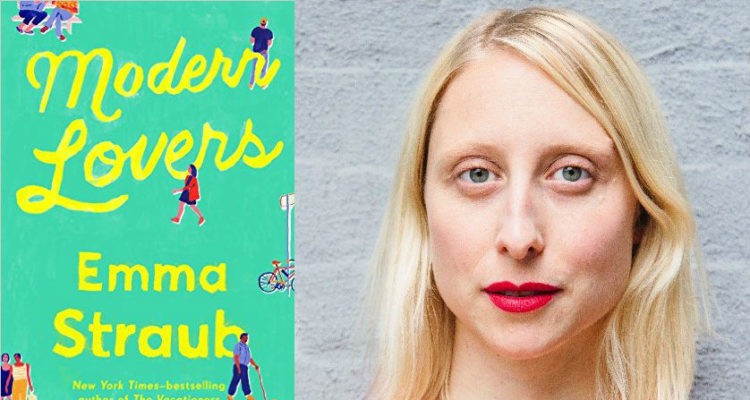
“This is Emma Straub’s tour of Brooklyn,” she says, stuck in traffic on Livingston Street.
We are on the phone discussing her new novel, Modern Lovers, and it’s fitting that Straub should be my vehicular guide through the borough of her most recent book. The novel follows two Ditmas Park families and their teenage children. It’s both a coming of age story and an uh-oh-entering-middle-age story. The parents, college friends and former members of the band Kitty’s Mustache, are grappling with their maturing marriages and relationships. A producer wants to make a movie about Lydia, their friend and the fourth member of their band. She skyrocketed to fame, and died young, and her renewed presence in the plot of their daily lives rekindles old grudges, old affections, and old questions about the fragility of friendship. Along the way, we encounter yoga cults, SAT prep courses, and delicious descriptions of Brooklyn dining. It’s summer in New York, and it’s sumptuous.
“I don’t know if you can hear that,” Straub says, “but that’s my phone telling me directions.” And then: “I’m turning this off because I know where I’m going.” She does know where she’s going. It’s hard to match the confidence of her narrative voice, the way it deftly manages and cares for the modern lovers of her book, its antic and engrossing cast of characters. Straub’s Brooklyn is lush and populated and humming with possibility. Over the Manhattan Bridge and onto the Flatbush Avenue Extension, one couldn’t hope for a better voice to lead the way. She confesses, unprompted and in no particular order, that she’s blocking the box, that life is good when you’re in front of Sahadi’s gourmet grocery store, and that she’s really quite adept at getting tickets. Most of all, she wants to make sure I know about the new cat cafe on Atlantic Avenue.
“You can go get a deep fried Twinkie [at ChipShop] and then pet a cat.”
I feel that my well-being very much looked out for during this interview. I feel it’s important to Emma Straub that I have plans after I finish talking to her about her novel. The empathy and humanity that is so visible in her writing comes through the phone, too.
“I’ve been sitting here for about seven minutes,” she says, “right at the door of Junior’s. I feel like I could get out of the car, go sit down, eat a piece of cheesecake.”
“If you need a slice of cheesecake,” she offers.
I do need a slice of cheesecake. Don’t we all? Or maybe it’s not that I need the cheesecake, but I need the offer. Every now and then, a book comes along that makes that kind of offer. Modern Lovers says, here, just in case you need this. Here is a book with a large, nuanced heart.
“The things you learn,” Straub says, “when you’re just sitting in traffic.”
Hilary Leichter: Modern Lovers revolves around a group of middle-aged friends that used to be in a band together in college. The fourth friend, Lydia, died of an overdose when she was young. I was reminded of some of my other favorite stories that deal with groups of friends, where one friend has died, or is gone, or has vanished. I was thinking of Virginia Woolf’s The Waves, and even The Big Chill. But The Waves felt really significant to me given that it’s also the name of the hotel that Andrew, one of the characters in your book, wants to open. Were these things that you were thinking about when you were writing the book? Was it important to you to have this absence, a character who is gone and creates a vortex at the center of your narrative?
Emma Straub: That is so funny. It never ceases to amaze me how many things happen organically within a book, like that, like The Waves, that you never think about in advance, and then someone says it to you and you think “Oh, that makes sense!” But you know, things can feel unintentional when you’re doing them and then they bubble to the surface in meaningful ways. That is hilarious.
One of the things that I was thinking about was the absence of old friendships and old relationships, but also how friendships that you keep change over time, and how sometimes you can feel sort of stuck in a previous moment with someone even when that moment has passed. We all have friends from childhood who we see a certain way, and who we know see us a certain way, even though we’re not really that person anymore. And sometimes that can be really nice and comforting. And sometimes it can be really frustrating. I think people also often feel that way about their families. Sometimes your parents see you one way long after you don’t want to be seen that way anymore.
HL: There’s a great passage where the character Harry, Elizabeth and Andrew’s teenage son, describes how he could construct a version of himself out of old photographs and his parents would probably not even notice. I think that’s a really interesting way about talking about characters in a book, too, kind of frozen in the eyes of their readers. Can you talk a little bit about the band, Kitty’s Mustache, and their hit song, Mistress of Myself? The main chorus from the song is a quote from Sense and Sensibility and then I started to recognize a lot of the characters’ names from Pride and Prejudice: Elizabeth, Lydia, and Jane, and Bennet(t). Is this just another thing that I’m throwing into the air?
Jane Austen…is in my family tree somewhere.
ES: It is, it absolutely is! But the Jane Austen stuff tells you a lot about the make up of my brain. I sometimes think about the DNA of writers and books, and I sometimes think: who are my literary relatives? Jane Austen, I’d certainly like to think, is in my family tree somewhere. There are certainly things that happen in this book that are not Jane Austen-approved. Happy endings for everyone? But in general, I do believe in happy endings, or satisfying endings. Not necessarily that everyone is peachy-keen and perfectly squared away. But I want the reader to leave the book feeling secure that things are sort of taken care of. That’s how I feel about Jane Austen. I feel very well taken care of by her.
HL: It’s a generosity. I felt that reading your short stories, too. I think there’s a real generosity that you give to the characters. Which isn’t to say that they’re all likable all the time, or they’re all lovable all the time, but you feel that they’re taken care of and someone loves them. I think that’s Jane Austen, too. Her characters feel loved.
ES: Think about all of the annoying people in Jane Austen novels. That’s just the job, of making you sympathetic to most of them, even if it’s just for a moment. Even the creeps can be entertaining. And of course the whole idea of likability is preposterous anyway.
HL: Yes, right! I’m thinking about the character from Pride and Prejudice. I’m completely blanking on the name, but he’s Elizabeth Bennet’s original intended, and she rejects him, and he’s the most annoying. But you just really feel for him. There’s compassion there.
ES: Do you mean Mr. Collins?
HL: Yes!
ES: And you’re just like blegh. But by the end you’re thinking oh, he’s just a person. He’s going to make her friend happy. It’s going to be alright.
HL: Exactly. What do you think Jane Austen would think of the marriages in your book?
ES: Oh man. I think she would enjoy Zoe and Jane’s marriage because they’re sort of funnier with each other. They’re sort of more quippy with each other than Elizabeth and Andrew. But I think Harry and Ruby would be her favorite couple in the book for sure. Young love. A young, powerful woman and the sort of gentle boy.
HL: I loved the way you included ephemera — articles, advertisements, clippings. It made the book feel like a neighborhood to me, like I was just sitting on the corner listening to what was happening around me. It had a Greek chorus vibe. I was wondering how and if Brooklyn asserted itself as a character in this novel, and if you had a chance to spend any time in those beautiful old houses in Ditmas Park as part of your research?
ES: Yeah, I did. When I was writing this book I was also looking for a place to move. My husband and I had decided we were going to move within Brooklyn, but we were exploring new neighborhoods. And we spent some time in Ditmas. We used to live quite close to Ditmas Park, so we’d walked those streets before, anyway. And we were going to a lot of open houses, really looking at real estate very seriously. I went to so many houses in Ditmas Park, which was great, because even when I walked in and thought “I don’t want to live here,” I thought, “well, maybe one of my characters wants to live here!” So I did a lot of real estate research, killing two birds with one stone. And what I really liked about Ditmas Park was that it’s this funny little island in Brooklyn that doesn’t look like anywhere else in Brooklyn. It’s got some of the trappings of more hip neighborhoods or more gentrified neighborhoods, but it also has been the way it is for a lot longer than people realize. There’s nothing trendy about it, which is what I really liked. It really is family oriented and feels like the ‘burbs. There are garages, and driveways, and all these things that growing up in New York City I always thought of as completely foreign. So I loved the idea that I could give my characters some of those things, things that I always secretly wanted or fantasized about.
HL: I love that idea of real estate hunting for yourself but also for your characters. There’s this wonderful line where Zoe is alone in the house and she hears a thud, and thinks someone is there, but it’s just the house creaking. She thinks, “The house had its own problems.” We’re seeing all this drama between characters, but maybe the house has its own story happening at the same time, and its own drama. What was the quirkiest house that you saw when you were looking at real estate?
ES: There are so many weird houses in Ditmas Park. I mean, everywhere in the world. The one house that I would say I enjoyed touring the most was — well there were a few that I really liked. Some of them had been sort of chopped up, and had weird carpets and locks on all the bedroom doors. There were some houses where we were like, “Uh, what’s going on here?” There’s some that would require a lot of renovations and money and things I didn’t have. And patience with renovations, that’s really what I didn’t have, because I was also seven months pregnant at the time. But one of the houses, I realized part way through the tour, belonged to Noah Baumbach’s father, and so was the setting for The Squid and the Whale, which is one of my favorite Noah Baumbach movies, and in which I have a very, very, very brief cameo. Sort of randomly, because I was friends with the woman who was his assistant at the time. I was just an extra. But I realized that I was inside that movie in this whole new way. We did not buy that house.
Houses do have their own stories.
Houses do have their own stories. My parents just moved out of the house I grew up in after about thirty years, and it’s so strange to me to think that someone else is living in that house now. That the house is still there, but that I can’t go to it. It boggles my mind. I feel like there must be traces of my childhood there, even though I know there aren’t, because obviously my parents took all of their things, and I haven’t lived there in fifteen years or more.
HL: I feel like the stand-in for that feeling in movies in books is always the series of notches on the wall. That’s the stand-in for every footprint and scuff.
ES: Yeah, my parents painted over that wall a long time ago.
HL: I was thinking a lot about Laura Lamont’s Life in Pictures while reading this, and there’s a recurring theme in some of your books about how people deal or don’t deal with fame. If Lydia from Modern Lovers and Laura could meet up and have a drink, would they have advice for each other? Or anything to learn from each other?
ES: I don’t think Lydia can learn anything from anybody. What I was interested in about Laura Lamont is that she was trying to do it all. She really wanted it all. She wanted the career, and the family, and love, and everything. And I don’t think Lydia gives a shit about anything except fame. I think she’s got a one track mind for sure. Lydia only cared about being famous. She is a spurned lover in the book, but that didn’t really matter to her, not in the same way that having success mattered to her.
HL: Were you ever in a band in college, like Kitty’s Mustache?
ES: When I was in college I had a boyfriend who was in a band, and I had lots of friends who were in bands, but I had absolutely no, less than zero, musical talent or ability. I didn’t even really like to do karaoke. It’s no good. Nobody wants to hear it, that much I know for sure. But I did enjoy, at Oberlin, going to see my friends’ bands all the time. And I had a lot of friends who were in the conservatory too, and so they were really, really good musicians. I had a lot of friends who had taught themselves how to play guitar, but I also had a lot of friends who were really astonishingly good musicians. It was a real pleasure to get to see them. And I was always in love with everyone who played music. I mean, how can you not be?
HL: Especially in college. There’s nothing like a guitar. Elizabeth is sort of the master songwriter of the group, and I loved the way you show her writing music, in her garage with the door half closed. I thought that was such a great image. Do you have a similarly specific set up for when you sit down to write a book?
ES: In theory, yes. After looking for a new place to live for a year, we finally moved in November, and then I had horrible bronchitis for the last couple of months of my pregnancy, and then I had a new baby, and then it was January, and then the baby — he’s much nicer now, but for the first few months he was basically screaming twenty-four hours a day and eating every two hours. So I have not had a chance to work yet in my new space. But I have a new office that I’m really, really excited about working in — someday. Someday. Maybe when my book tour is done. I’m hoping when my book tour is done I will get there.
HL: A new office is exciting.
ES: We live over in the Columbia Street Waterfront District now, and so I can see a lot of sky, which is really nice. I used to look out my window and see trees, and I love trees, and I miss the trees that I used to stare at out the window. But now I get sky, and I’m looking forward to seeing what that does to my brain.
HL: I wanted to ask you about vacations. Because your last book was about a vacation, and this book is about a Brooklyn summer. Is there something inspiring to you about that kind of bite-sized structure for a book?
Summer seems so endless and important when you’re a teenager.
ES: With The Vacationers, I was coming off of Laura Lamont, which covered decades and decades and decades of time. After that I wanted to give myself the opposite — not problem — but the opposite set of rules. The Vacationers is bing, bang, boom, and I knew I had to smush everything together to make everything happen really quickly. With this book, I liked the structure of a summer especially because of the teenagers. So much can happen in a summer when you’re a kid. Summer seems so endless and important when you’re a teenager. What are your friends doing? What are you doing? Where are you going, are you going somewhere? Do you have a job? Do you have to take the stupid SATs? Do you have a summer love, do you not have a summer love, does everyone else have a summer love? These are some of the things that I thought about. I also think that Brooklyn can be so disgusting in the summer. It’s so hot and sweaty and gross, and that can really drive people crazy. So I wanted some of that, too. That really sweaty, your-clothing-is-sticking-to-you kind of stuff that might drive you to join a yoga cult.
HL: If anything’s going to do it, it’s August in Brooklyn.
ES: Right now I’m sitting in front of the Brooklyn Civil Court, which I can tell you is the worst place on earth. Because I had to go there about fourteen times when my husband and I decided to hyphenate our last names. Which is a terrible thing to do. If anyone reading this, if you ever think “oh it would be so sweet to hyphenate my last name,” just do it when you get married. If you’re an idiot like me and you decide six years later that it would be nice if everyone had the same last name, it requires several trips to this pit of hell.
HL: Wait — is this the same place you go to get the marriage license?
ES: No, no. Actually recently, a couple of weeks ago, I married some friends of mine. I had to go to City Hall, to the Marriage Bureau to get registered with the city. And that was lovely. That was a lovely experience. There were flowers everywhere, there were people wearing wedding dresses, there were couples of every age. It was just the beautiful fabric of Brooklyn. That was glorious. I just wanted to stay there forever and marry everyone and throw rice. No, this is a very different place. This is low ceilings, and broken elevators, and a lot of bureaucracy.
HL: I’m so sorry.
ES: That’s my PSA of the day.
HL: I changed my name legally when I got married, but I still use my maiden name for writing, and it’s very confusing. I kind of made the decision on the spot when we went to get our license. So I think about that a lot — should we have hyphenated? But, too late!
ES: I think you did the right thing! When I got married I never in a thousand trillion years considered changing my last name. I was like, why on Earth would I do that? But now, what I realize we should’ve done is to pick some other name that we both liked. Like Sprinkles. Or like, I don’t know, Traffic Cone. Anything, anything would be better than the monstrosity that we have.
HL: I’m going to be looking for the next book by Emma Traffic Cone.
ES: Emma Traffic Cone is going to be huge in construction vehicle literature.
Four years ago, when I was still a writer zygote, I attended an MFA program dinner honoring Cheryl Strayed, who’d read on campus. Wild had recently debuted with the kind of acclaim we aspiring newbies dream up at our drunkest. While I sat at the table trying to balance the beast of a graduate student in the presence of free food with the desperate need not to come off as a ravenous, sloppy hummus machine, I listened as Strayed recounted a recent experience with a (male) interviewer. During the course of the conversation he expressed his admiration for the cover design, featuring a single (now iconic) red-laced Danner boot. This un-gendered photo had made this man feel that it was “okay” to read a book about a woman’s experience written by a woman, and he asked if the design was a conscious decision — perhaps part of a clever, all-out marketing effort — to convince men to pick up the text.
“I’m not looking for male readers,” said Strayed. “I’m looking for readers.”
Isn’t that, I thought at the time, what we’re all looking for? Isn’t a reader simply hungry for a story?
***
Maybe The New York Times knew that we needed a laugh.
After all, this was a morning we woke up to Donald Trump as the uncontested Republican presidential nominee. We needed a conduit for rage at a political tempest too grave and complicated to wrap our dissent around.
Perhaps they’d been curled up on the downy puff piece for a while, waiting for this opportune moment to impress advertisers with a wicked click-through rate. Dropping an article mastheaded with a picture of grinning, balding white men in what appears to be a funeral parlor designed by Betty Draper cheekily proclaiming “the one rule of men’s book club is no books about women, by women” was Twitter gasoline.
Maybe The New York Times knew that we needed a laugh.
We can debate the levels of hubris and/or drunkenness in the NYT editorial room all we want, but what we have is an article claiming real estate and resources in The New York Times’ Books section. Space and author payments that could have, you know, gone toward any other article. One that didn’t profile a misogynistic boy’s club with all the cheerful winking of a local newscaster ending the night on a squirrel that can water-ski.
Because, as female writers, as writers of color, as writers of nontraditional body types and nonbinary genders and different sexualities, you know what? We get it. We know there is a large swath of the American population that is not going to read our work, even if the upper echelons of the publication industry stoop to letting us in. Not 24 hours before the Book Club Bomb, Mallory Ortberg at The Toastpublished a sublime response to Entertainment Weekly’s piece quoting an editor claiming that there was no bias in extravagant book advances, and she would have paid a debut author “the same money if she weighed 500 pounds and was really hard to look at.” We don’t need to read the statistics from VIDA or The Guardian because this is the reality we’re living in. Each of us have a dozen anecdotes that tell the same story. These are the odds stacked against us.
As Ortberg points out in her essay, the shock and rage over the publisher’s comments do not stem from the fact that the vast number of books that are published, books that are promoted, books that are stocked, books that are reviewed, books that are read come from a narrow and homogenized cross-section of a working writer population that continues to become bolder, more nimble, more outspoken and more diverse. The anger, that sweet sweet 140-character indignation writhing in GIFs and hashtags, is a reaction to the casual, cavalier and shameless propagation of sexist, racist, homophobic and transphobic truths.
The anger, that sweet sweet 140-character indignation writhing in GIFs and hashtags, is a reaction to the casual, cavalier and shameless propagation of sexist, racist, homophobic and transphobic truths.
No matter how much writers themselves are working to become more inclusionary (evidenced this same week by the wide and deafening denouncement of Antioch Review’sabominable transphobic rant by the literary community, these ideas that books chosen by grandmothers are worthy of scorn and a man can only enjoy a book by and about someone who looks and lives and loves as he does, they keep getting published. They keep getting perpetuated. You cannot deny the right of these small-minded individuals to exist, but the elevation? That’s voluntary. That’s purposeful.
It is easy to dismiss the article and its subjects as a relic. The Man Book Club’s members are, as noted in the article, “lawyers and engineers in their mid-50’s.” We can roll our eyes as they decry “chick-lit” and fondly reminisce over how they’ve served as each other’s divorce lawyers at different points in their lives. The thoughtless way they note that their wives’ clubs “have a lot of turnover” without examining what obligations may prevent a 21st century woman from finishing a novel and planning an accompanying themed dinner party every month. It’s convenient to claim that this misogyny is an endangered strain, one that is a generation removed from our own, one that will die when these men are all inevitably gone and buried.
***
Reading the Man Book Club article a second time through today, hearing Strayed’s voice echo back, the cover of a childhood book resurfaced in my mind. No Girls Allowed, one of 300 Berenstain Bears titles released by Stan and Jan Berenstain. My copy was tucked into an Easter basket when I was five, between a bag of Brach’s jellybeans and a pack of yellow Peeps. The cartoon cover image, an ominous illustration of boy bear cubs sneering at a lone sister bear cub left outside of their clubhouse, seared into my brain from amidst the plastic pink woven basket and neon grass confetti. NO GIRLS ALLOWED was painted in red as a warning. A distinction. A threat.
Sister Bear could run faster, shoot better marbles and hit a baseball better than Brother Bear and his friends. And damn, it got annoying fast. She was such a pest, winning all the time, even though she was younger and smaller than all the neighborhood bros. The brothers get together and build a fortress clubhouse with the distinct purpose of excluding her and her evil “gloating” ways. Sister Bear, confused and devastated, runs home crying. Papa Bear is so incensed that he sets right to work on building a way cooler playhouse for his daughter, so she can also exist in the world. When the boys discover this super sweet new pad, they decide equality might actually be the way to go (for better real estate and snack delivery from Mama Bear), and so they decide to call a truce — as long as Sister Bear can agree to keep all that “boastfulness” to a dull roar.
Sister Bear was such a pest, winning all the time, even though she was younger and smaller than all the neighborhood bros.
I doubt there was any intentional subtext in my mom’s gift-shopping book choice. It was likely one of the only titles stocked at the local Fred Meyer, a half-conscious shelf grab between picking up the Easter dinner ham and remembering Cadbury eggs. She probably didn’t even think much of the subject matter once she opened it up and read it to me at bedtime. Even if the journey was problematic, it was the resolution that counted, right? I can tsk the moralistic Berenstains and their heavy-handed nuclear family lessons from this distance all I want — 25 years later, the same age as my mother was then, child free with a career writing feminist culture critique. The books were forged from, and wildly successful in, a culture littered with passive, micro-lessons for children. The body of Barbie. Ariel and her lost voice. The Berenstains and their bears weren’t aiming to change the world they sold 240 million books in; they were simply happy to perpetuate it.
And we absorbed it, breathed it in. Like each generation of girls before and after. We saw the blueprint for selves we did not understand. We drank the water because this culture was our only well.
I can’t say that this was the first time I learned the importance of tempering passion and achievement for the sake of a man’s feelings. Just as I’m sure that the wives of the Men’s Book Club members have heard whining over more than how unfair it is that they have nifty book clubs, and that a writer as lauded, awarded and beloved as Strayed has been wholeheartedly congratulated for eking out a great story despite her gender.
The Man’s Book Club could have asked for an invite to their wives’ clubs and discovered what it was about these literary works that made them so beloved to their spouses.
When threatened, the boy cubs could have leaned closer in on Sister Bear, stacked her into their teams against other, less capable boys. The Man’s Book Club could have asked for an invite to their wives’ clubs and discovered what it was about these literary works that made them so beloved to their spouses. Strayed’s interviewer could have asked himself why he was so tentative about reading women’s literary work. The New York Times could have uncovered one of a million new voices; told a story about those who are transcending rather than conforming.
Reading the article yet again, my pity for this dude squad begins to blossom. To think that they will head into the ground without the words of Terry Tempest Williams or Lidia Yuknavitch or Sandra Cisneros in their hearts. They will never listen to Lemonade. They will never roam a bookstore free to any possibility that may hook their gaze, any staff member’s favorite new selection. They will be halted because the pantones on a cover are too flamboyant or pastel. Or the name hints at something feminine. Or the author’s jacket photo couldn’t pass as their own mugshot. Too comfortable to learn, too lazy to evolve, their inertia cheered by one of our nation’s most iconic publications. As artists clamor and push, the pillars of the establishment burrow into their clubhouse in a contented hibernation.
The walls, however, are drafty. We can hear them snore.
On assignment for a newspaper that she seldom read anymore, Nikki watched a musician perform and afterwards interviewed him for a 2000-word feature article. Nikki’s boyfriend was out of town that weekend. During the show she stood in the middle of the club, behind a group of men who appeared, she thought, as if groomed for a band photo in a music magazine. At the bar she made small talk with a young woman who eventually asked Nikki her age, and when Nikki said 35 the younger woman nodded in this way that meant yes, you look about that old. After the show, still inside the club, the musician told Nikki the room might be too noisy, and she agreed it wouldn’t do, she could hardly hear, and she suggested they finish the interview at her apartment. “It’s not far — a 10-minute walk,” Nikki said. She and the musician turned right at the next block, and crossed a footbridge, after which the way home was so many pastel terrace houses and red-brick apartment blocks. The decay of Nikki’s building was assured by an indifferent landlord who, the property manager explained, spent much of the year overseas and out of reach. Inside, the musician sat on the sofa and lit a cigarette. The flat looked untidy because Nikki and her boyfriend were both happy letting the mess go on for weeks, until their jackets swallowed the chairs and their shoes came to conspire in corners. “Nice place,” the musician said. Nikki asked a standard question about the musician’s old jobs, and he told a story about the years he worked as a gardener at Centennial Park, where he harvested psychotropic mushrooms every April, before Nikki noticed that a stereo speaker had been turned 180 degrees, its red wires showing. A second speaker had fallen on its side. There were two books on the carpet. Nikki never left books on the floor. She asked him two more questions. Then she looked away. “Hold on a second,” she said, peering inside the kitchen drawer where she kept passports, a folder of lease-related paperwork, and painkillers. “Some things are missing,” she told the musician. And the musician said, “Maybe your boyfriend’s left you?” Now Nikki asked her next question. “What is music for? Politically or in other ways, what’s music’s function, and I mean contemporary rock music of the four-minute-song kind.” She said this while checking the cupboards. “But shouldn’t you be writing this down; shouldn’t you be recording this?” said the musician. And the naked sound of drawers reeling and cupboards banging shut continued to gather in strength until Nikki understood what had happened. She said, “We’ve been burgled.” Her shoebox containing sentimental objects was no longer under the bed. Her laptop wasn’t in the spare room. All the Apple products had disappeared. The musician kept asking, “We’ll keep going with the interview, won’t we? See, I really need to promote my stuff.” Nikki shook her head: she hesitated between contempt and pity for the thieves — and for the musician too.
Years later, Nikki would tell this story in job interviews to illustrate why she disliked practising forms of journalism that were essentially promotional — publicising films and albums and tours and music festivals — and why she now wanted to work in public relations proper. It might feel more honest to be a publicist, she said. Nikki didn’t mention that her pay hadn’t changed in six years — she was ashamed of this fact — and she never gave the musician’s name, because it didn’t matter much in her telling, and he wasn’t well-known. Eventually she found a PR job. There were other consequences of the robbery. After the break-in, she and her boyfriend moved to a more secure building in a quieter part of the city, where they became friends with their neighbour upstairs, a man with what she considered an old-fashioned name: George. He guessed — correctly, as it turned out — that her name was short for Nikomachi: the winner of battles. She fell in love with George and married him, and he and Nikki had one child — a girl. The robbery, according to Nikki, was the very night that her life went off in this direction. When her daughter was 13 years old, suddenly curious about love, and came home from school asking Nikki to “give examples” of how two people might meet and marry each other, the story began with the break-in.
In another city, somewhere colder, the musician also remembered the night that Nikki abandoned their interview. It shouldn’t be complicated: for a few years he made music, he was concerned with little else, but for good reasons it became impossible to continue with a full heart. Then he did something else with the rest of his life. Nikki was the last person who asked him those questions about music, and it made him cringe to think of how he’d answered. As far as he knew, his children had never listened to his old CDs. He didn’t play anymore, not at all, telling himself the house was too small for ten-year-olds and teenagers and his old instruments, too small for the person he used to be. It needn’t be painful: he’d left music behind. After he found work as a paramedic, his youngest daughter began referring to him as “Ambulanceman,” as if he were another superhero who eliminated every problem. At night, driving home, the former musician pictured the lounge room of Nikki’s old flat: a stereo speaker turned awkwardly, a paperback flopped open on the floor; something was about to be discovered, and he’d soon be leaving.
DON’T MISS OUT
Sign up for our newsletter to get submission announcements and stay on top of our best work.
YOUR INBOX IS LIT
Enjoy absorbing fiction from Recommended Reading on Mondays, strange, diverting work from The Commuter on Wednesdays, and a roundup of our best work of the week on Fridays. Personalize your subscription preferences here.