The Visionary Hatter

Translated by Alfred MacAdam

Crabby and Albina the albino giantess leave town on a bicycle built for two after drugging the corrupt and lecherous policeman Drumfoot, who is now dangerously transformed by a bite from Albina. While disturbed by the violence they’ve witnessed, the new companion they rescue might change their cynical idea of men.

Crabby pedaled in the forward seat. Albina, behind, moving her enormous legs automatically without holding onto the handlebars, was writing in her notebook: “I don’t know where I’m going, but I do know with whom I’m going. I don’t know where I am, but I do know that I’m here. I don’t know what I am, but I do know how I feel. I don’t know what I’m worth, but I do know not to compare myself to anyone else. I don’t know how to dodge punches, but I do know how to withstand them. I don’t know how to win, but I do know how to escape. I don’t know what the world is, but I do know that it’s mine. I don’t know what I want, but I do know that what I want wants me.”

In that manner, they reached the outskirts of Iquique. The fishmeal factories appeared, covered by a thick layer of café-con-leche colored dust and vomiting thick smoke that slithered up through the chimneys and down to the ground, where they threw down roots and stuck. Rotten meat, acrid excrement, fermented guts — the stench passed through their pores, infected their blood, and tried to infect their souls. Crabby made Albina sit up front and pedaled behind her, sinking her nose into Albina’s wide back. The pestilence was like the mass of demons born from Crabby’s intestines, and the fragrance that emanated from Albina’s white skin, the redemption of the world. Barely breathing, they covered twelve more miles.

After a steep hill, the ocean appeared, sending its salty aroma toward the flank of the mountain, which, under that extended caress, responded with a thousand perfumes from its ochre earth. “Let’s stop to enjoy the pure air and to eat a bit. Just look, Albina, all I have to do is stroll among the rocks on the shore for the crabs to come to me.” Which was exactly the case; hundreds of crustaceans came out of the cracks and began to follow Crabby. It was easy to catch a couple, open them up, roast them on a red-hot stone, and devour them. All the while crabs never stopped rubbing against the legs of the woman they considered their Universal Mother.

A ray of lunar light passed through the keyhole and hit Drumfoot’s forehead. He awakened without realizing he was naked, and lifted the leg with his normal foot to scratch himself behind the ear. Then he went into the kitchen and lapped up the water in the washbasin. Since the door resisted his shoves, he pulled up some of the floorboards and used his hands to dig into the clayish soil and make a hole to get out. He howled at the waning moon and set out, bent over, sniffing the road. “Mmm… they stopped here and placed their feet right on this spot… mmm!… they peed here and… mmm!” He rolled around in Albina’s excrement, panting with pleasure.

Some soldiers on coastal patrol found him that way, naked and carrying out that fetid act. After giving him a good thrashing, paying no attention to his heartrending barks, they dragged him off to the police station. After two days, he got his mind back. The bite on his shoulder had healed, leaving a violet, half-moon shaped scar. “Those witches will get what they deserve!” Drumfoot spent hours sharpening his knife.

The narrow road built by the Incas along the ridge seemed to float over the abyss. Far below, the waves, transformed into gigantic foamy lips, called to them, insidiously sucking. Luckily, the landscape flattened out little by little, and the path was swallowed up by the dunes on a beach. Albina stripped, ran over the hot sand, and plunged into the glacial water. Crabby followed her, fully dressed. They swam, frolicked, ate clams, and drank the little water they had left, knowing that if they didn’t find a town soon, thirst would swell their tongues.
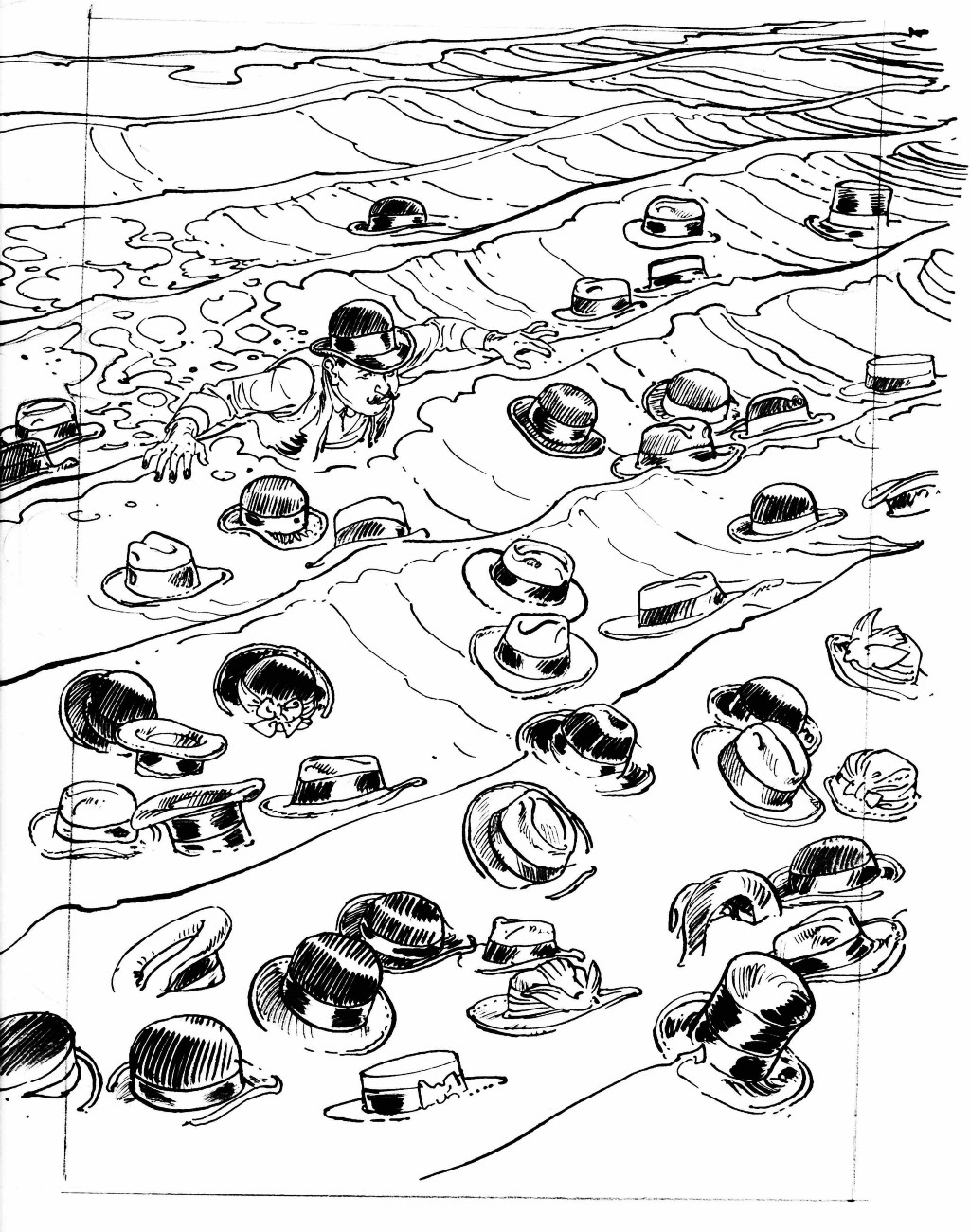
Original illustrations for ALBINA AND THE DOG-MEN by François Boucq, courtesy of Restless Books

Twelve bowlers floated out of a creek followed by top hats, pith helmets, military caps, pork pie hats, Panama hats, and a huge variety of hats with upturned brims. The tide was carrying them to the shore like an armada of fragile little boats. The intrigued women climbed the rocky wall. On a narrow beach, a small man — he had no visible deformity, so he couldn’t be called a dwarf — surrounded by empty hatboxes was staring out to sea. As they watched he burst into high-pitched laughter, ran toward the high waves, and let himself be carried away, beginning to drown in those convulsing waters.

Albina dove in. Swimming vigorously, she reached the desperate man, knocked him cold with a punch to the jaw, and floated him to the beach. Crabby shouted in a rage, “Why did you bother to risk your life? You should have let him carry out his destiny! He may be small, but he is a man, and one less man in the world is a good thing!” The drowned man opened his eyes, and with an amiable smile said to Crabby, “Madam, perhaps my destiny was to be saved by your friend here, or, even better, perhaps I’m here so that your destiny can be carried out. The plans of mystery contain multiple paths. But I see you have eaten clams! Allow me to translate what these scattered shells mean.” And the little man examined the remains.

“The white lady, who has fled from a temple — I don’t know if she transmits a blessing or a curse. She’s something less or something more than human. With regard to you, Madam Anger, it seems you hate men because you see them as identical to your father, a thin, tall, dead man who was a callous remover by profession. Since I am the opposite of him, a pudgy, living, short man, a hat maker by profession, you may accept me as a partner without a second thought.”

“As a partner? You’re raving mad!”

“Wait a second, let me go on interrogating my clams. A dangerous enemy is chasing you. One of you dances, and the other manages her. You’re looking for a tranquil place to set yourselves up. Now I appear. About a mile from here, in a ravine near the Camarones River — not much of a river, true, but more than welcome in these sandy territories — is my town, Camiña. A little-known place because the highway is far away from it and you can only get there on foot or by mule. About forty years ago, miners loaded with silver from the Chanabaya mine came to town. My father sold them all kinds of hats, because they wanted to look elegant for the prostitutes working in the saloons. But the silver veins gave out, the miners went off to other regions, and the whores followed them. I inherited an enormous shop filled with bowlers, wide-brimmed, narrow-brimmed, and pork-pie hats opening their felt jaws hungry for heads. Those mute complaints drove me to despair. With no other profession than this useless hat-making business and forced by my stature to have no wife, sick with boredom, I decided to bury myself in the sea along with my little felt brothers. But as you two may see, I have a different destiny. Come with me, I’ll give you everything I have, a magnificent shop in the center of town! There you can set up, as the clam shells tell me, the café-temple you want!”

Original illustrations for ALBINA AND THE DOG-MEN by François Boucq, courtesy of Restless Books

Hiding a smile under her severe face, Crabby looked over at Albina, certain she’d burst into a crystalline laugh of approval. The little man was offering them exactly what they had been seeking but had no hope of ever finding, convinced they could only locate it in an unreachable future. But perhaps because the day ended so brusquely, devoured in one bite by the full moon, Albina tensed her muscles to the point that her white skin turned garnet red, showed her teeth, as if all of them were canines, and stuck out a hard, black tongue. Leaping like a wild beast, she snatched the hat maker, wrapped him in a rib-smashing embrace, pulled off his clothes, rubbed her body with his as if the poor man were a sponge, and bit him on the left shoulder, pulling off a piece of flesh she swallowed with delight. Squealing with a sensual pleasure that filled her stomach with waves, she sat down, foaming at the mouth, and recited for hours incomprehensible words: “Bhavan abhavan iti yah prajanate… sa sarvabhavesu na jatu sañjate…” Crabby, always wearing her severe mask, swallowing her astonishment (she considered that with regard to Albina’s unsoundable mysteries it was just better to let them pass, perhaps like divine serpents), picked up the hat maker’s torn clothing, took needle and thread out of her pocket, and with the precision of a sailor sewed everything back together. The hat maker, almost stiff, sometimes emitted small barks or wiggled his backside as if wagging an invisible tail. Soon the sun came up. No sooner did the first ray of light caress her face than Albina, even though she hadn’t slept, seemed to awaken from a deep sleep. Pale once again, she made a small cry of sympathy and went to the hat maker, who was still in a faint, and licked his shoulder. The wound closed in a few seconds and became a violet half moon.

While Albina recovered from her attack by breathing in the sea air and waving her arms like a giant albatross, Crabby dressed their new friend. When she put on his trousers, she surprised herself examining with pleasure that short, large-headed pink penis arising humbly from a clenched scrotum grooved with wrinkles ordered like an ancient labyrinth. It enraged her to admire that sublime and grotesque appendage. She smacked him on the back, and barely had he blinked when she said incisively, “Seeing is believing, John Doe. If your worship says we three are knotted into the same destiny, let’s not make a habit of rejection, and let’s accept that Camiña awaits us. But before we take the first step along that fatal path, please be so kind as to tell us your name — that is, if you have one. I for one don’t go beyond my nickname. Crabby, at your service. My friend, in accord with her pigmentation, is named Albina.”

“Madam Crabby, Miss Albina, for many years now I’ve been called Hat Maker. Even so, I must confess — overwhelmed by shame, since it is a ridiculous injustice — that I was baptized Amado, because my last name, perhaps of Italian origin, is Dellarosa. So I am ‘beloved by the woman who is a rose!’ How’s that for a lie?” And the little man began to weep. Crabby spit violently toward the parched hills so that she wouldn’t feel the knot in her throat.

In that dried out valley, where the earth was a hard shell covered by a pattern of angular cracks, Amado Dellarosa guided them for hours along a steep path that went forward, backward, twisted left, then after a very long curve, went right, straightened out and again went forward, repeating the same movements again and again, hundreds of times. Crabby shook her head trying to banish an impertinent thought: this capricious path was a labyrinth that resembled in every detail the wrinkles on the little man’s scrotum. Albina, perhaps affected by rays of the sun drilling into her skull, began to repeat obsessively a single sentence: “Seek in the root the future flower.” Finally they entered a grand plateau surrounded by mountains: Camiña.

Original illustrations for ALBINA AND THE DOG-MEN by François Boucq, courtesy of Restless Books

The town consisted of an extensive circle of wooden houses built around a plaza where grew four enormous cypresses whose trunks were studded with woody eyes, making them look like a nest of ghosts. No living person or animal was visible. No breeze shook the spiny branches, no curtain waved, no fly buzzed. Everything looked clean, dry, immobile, and silent.

“Dear friends, don’t think my town is a cemetery. After twelve o’clock noon it’s so hot that all inhabitants, along with their pets, retreat to the penumbra of home and take a seven-hour siesta. For their part, the wild animals dig tunnels under the desert plain so they can let the heat pass while in narrow but cool grottoes. Believe me, King Sol hits so hard in these parts that the mosquitoes die in midair. Later in the afternoon, when the temperature becomes agreeable, the businesses still functioning — barbershop, billiard hall, grocery store, herb shop — open their doors while the townspeople stroll the ring-street, men in one direction and women in the other, doing nothing else but staring at one another and saying hello. Nothing extraordinary ever happens here. When the Chanabaya mine closed down and the miners left, the Lady, along with her whores, went off after them. By some miracle, she forgot us. For a long time now, no one has died in Camiña. Old folks, when they’re informed they have to give up and yield their spot to someone new, go to live in the abandoned mine tunnels, a charnel house that goes on for miles toward the very entrails of the earth. We know they’re still alive because from time to time they form a chorus and sing old love songs. It seems — though no one has proven it, as we’re all scared to death of even going near the mine — that they eat the red clay that covers the walls. As for us, we’ve learned to survive by keeping bees from the pampa. It’s a rare species, peaceful up to a point. If you approach them on tiptoe, fine, but if someone approaches planting his entire foot on the ground, they sting him without pity and he falls into a coma, transformed into a mass of rashes. For lack of flowers, these worker bees suck the juice of sea algae and make a delicious, salty honey. As you can see, the roofs of all the houses are covered with hives. Pinco, the deaf mute, transports our product to Arica on burros. The tourists just love it, and the money we get from sales allows us to survive. We are bored, yes, but in a certain way we secretly enjoy the fact that we have at our disposal an apparently infinite amount of time. You must understand that lacking any end changes your mentality. The urgency to do things disappears; idleness, once a sin, has become a virtue. The present moment stops causing trouble and offers us its unconcerned calm. Hope, because it’s unnecessary, is expelled from our souls along with fear. Since we all have the security of living, the only thing we long for is to sleep and find the opium that is pleasant dreams. Solitary pleasure is preferred rather than bothersome coitus. Seduction, lacking a mortal anguish to exacerbate it, becomes an obstacle. A long robe, wide and black, accompanied by a handkerchief worn on the head makes all women identical. It makes no difference whether you marry this one or that one, and that’s only done when a pregnancy is needed to fill the vacancy left by an old person. Do you see why I tossed my hats into the sea and wanted to make the waves my grave? Living without death is not living. But here I am going on and on, while the hat shop awaits us.”

No one peered out to see them arrive, despite the fact that their footsteps, no matter how hard they worked to make them weightless, resounded on the whitish asphalt, turning it into a drum. Suddenly, a voluminous bee, its body a brilliant scarlet, flew over to trace a halo around Crabby’s head. The hat maker whispered, “Make not the slightest gesture. It’s a warrior-spy. It can sting without losing its stinger, and its poison is deadly.” Crabby, stiff despite the heat, thought she would sweat ten thousand gallons of cold water. And her terror increased when the animal slowly flew toward Albina. Smiling, Albina shook her hips, opened her mouth, and stuck out her tongue. The bee landed on that moist appendage and began to drink her saliva. Gorged, it used its stinger to draw a tiny cross on Albina’s white throat and then drew another on Crabby’s forehead. Then it flew off like a flame to its hive. From all the roofs arose a general buzzing, rather like rain falling from the earth to the sky. “Well,” said the little man, “both of you were accepted! Hallelujah! I don’t have to tell you how many smugglers and bandits have been killed by those guardians! Without their permission, no outsider enters our town.”
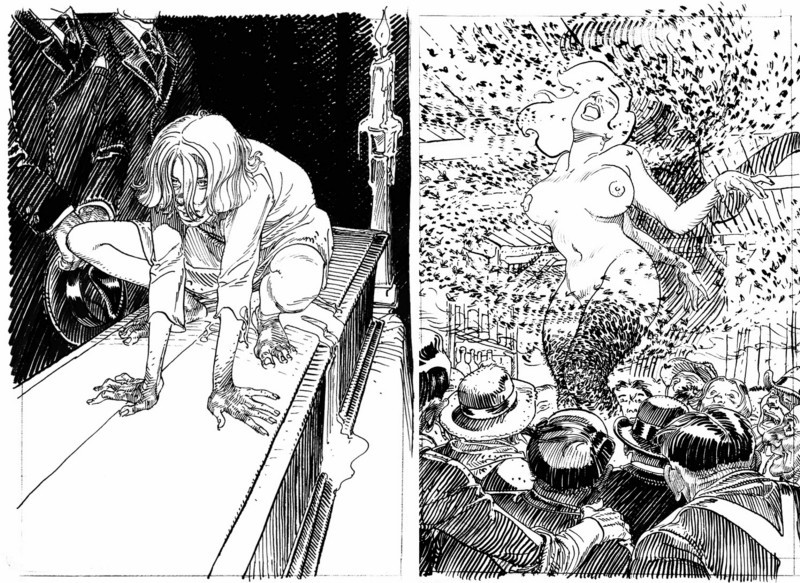
Original illustrations for ALBINA AND THE DOG-MEN by François Boucq, courtesy of Restless Books

Crabby swallowed her rage. Without warning her, this squirt had dared — a second time — to place the life of her friend at risk. Her own mattered nothing to her, but Albina’s? Shit! To say man is to say calamity! Nevertheless, the bitter saliva in her mouth became sweet syrup when the miserable pygmy raised the metal gate and, with the face of an angel, the eyes of a dove, and the gestures of a gift-giver, showed them the spacious place, where more than two hundred idiots could be packed in. “Thank you, Don Amado!” The now likeable little man stood before her on tiptoe and offered her his forehead. Crabby wrinkled her nose in disgust for an instant, and then, suddenly, as if a stretched elastic band had broken within her heart, she smiled for the first time at a man. Enveloped in a cloud of tenderness, she bent over, and planted a kiss between his eyebrows. Bursting into diaphanous laughter, Albina took off her clothes, and with her marmoreal skin shining like a star in the half-light, began to dance in order to bless the new café-temple.

On a khaki motorcycle, Drumfoot traced the road that rose toward the north. A blood infused with hatred accumulated in his erect penis. In his right fist vibrated a knife, also infused with hatred. The two extremes were guiding him, one wanted pleasure, the other death. While the mountain wind had swept away all tracks from that dirt path, a third extreme, his nose, with its abnormally developed sense of smell, picked up traces of the effluvia emanating from the white woman. It was a vaginal scent, unctuous, biting, bittersweet, greenish, as fragrant as the ivy flowers that open at dawn. Mmm! Suddenly an intolerable stench expelled him from his olfactory paradise. Blood poured from his nostrils. Barking his complaints, he passed by the fishmeal factories. He began to cough, lost control, and, making a leap, twisting like a beast, he fell on all fours, clinging to the edge of the pavement while his motorcycle smashed to pieces on the rocks a hundred yards below.

He left behind the sticky smoke infecting those territories and reached the beach. Vomiting, he ran to dive into the frigid ocean. When the salt water had extirpated even the tiniest particle of stench, he shook his body vigorously, surrounding it for a few seconds with a cloud of golden drops. He growled with satisfaction; there, abandoned at the outset of a narrow path, stood the bicycle built for two! He sniffed it over from end to end, from the handlebars to the tires. He licked the seat that had sunk itself between Albina’s buttocks, and then, overwhelmed by an enraptured hatred, his lower jaw tremulously revealing his canines, he ran along the path, his knees bent, using his hands as feet by leaning on his fists. Soon, so many curves, advances, twists, and switchbacks exasperated him. He located a point in the north, his goal, and left the path to get to it in a straight line. When it was already nightfall, after many hours of trotting, he realized with angry shock that he’d reached his starting point. There was the bicycle, now covered by a sheet of crabs.E
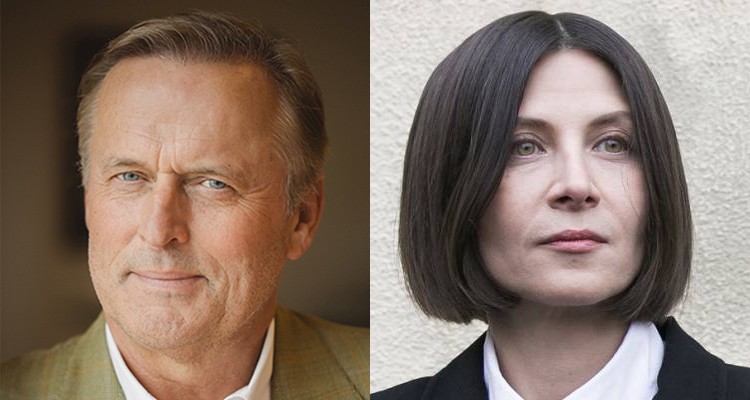
John Grisham and Donna Tartt Headline Author Protest of Mississippi’s Anti-LGBTQ Law

Ninety-five Mississippi writers signed a letter that calls for the repeal of House Bill 1523, an anti-LGBTQ law that is set to go into effect July 1st. Novelist Katy Simpson Smith penned the statement and recruited the signees, which include John Grisham, Donna Tartt, and Kathryn Stockett.

As The Washington Post reports, Mississippi Gov. Phil Bryant (R) signed HB 1523 last week. The measure “protects ‘persons, religious organizations and private associations’ from discrimination claims if they refuse to serve anyone based on the belief that marriage should only be between a man and a woman.”

“There’s this sense that Mississippi has gone down this path before,” Smith told The Post. After growing “more and more frustrated,” she decided to use her platform as a writer to speak out against the bill. She sent her statement to “as many writers as she could” and received 95 signatures. “It was an amazing thing,” she said, “to see this outpouring of support from the writing community.”

In the letter, Smith writes, “What literature teaches us is empathy. It reminds us to reach out a hand to our neighbors–even if they look different from us, love different from us–and say, ‘Why, I recognize you; you’re a human, just like me, sprung from the same messy place, bound on the same hard road.’” “It is deeply disturbing to so many of us,” Smith continues, “to see the rhetoric of hate, thinly veiled, once more poison our political discourse.”

Here is the complete letter and list of signees, available through the Jackson Free Press:

Statement of Mississippi Writers Opposing HB 1523

Mississippi has a thousand histories, but these can be boiled down to two strains: our reactionary side, which has nourished intolerance and degradation and brutality, which has looked at difference as a threat, which has circled tightly around the familiar and the monolithic; and our humane side, which treasures compassion and charity and a wide net of kinship, which is fascinated by character and story, which is deeply involved in the daily business of our neighbors. This core kindness, the embracing of wildness and weirdness, is what has nurtured the great literature that has come from our state. What literature teaches us is empathy. It reminds us to reach out a hand to our neighbors — even if they look different from us, love different from us — and say, “Why, I recognize you; you’re a human, just like me, sprung from the same messy place, bound on the same hard road.” Mississippi authors have written through pain, and they have written out of disappointment, but they have also written from wonder, and pride, and a fierce desire to see the politics of this state live up to its citizens. It is deeply disturbing to so many of us to see the rhetoric of hate, thinly veiled, once more poison our political discourse. But Governor Phil Bryant and the Mississippi legislators who voted for this bill are not the sole voices of our state. There have always been people here battling injustice. That’s the version of Mississippi we believe in, and that’s the Mississippi we won’t stop fighting for.

Ellis Anderson

Ace Atkins

Howard Bahr

Angela Ball

Marion Barnwell

Steven Barthelme

Matt Bondurant

William Boyle

Carolyn Brown

Kelly Butler

Jimmy Cajoleas

Sarah C. Campbell

Julie Cantrell

Hodding Carter III

Hodding Carter IV

Maari Carter

Jim Dees

James Dickson

Kendall Dunkelberg

William Dunlap

Lee Durkee

Margaret Eby

John T. Edge

Liz Egan

Kelly Ellis

W. Ralph Eubanks

Beth Ann Fennelly

Ellen Ann Fentress

William R. Ferris

Ann Fisher-Wirth

Tom Franklin

Martha Hall Foose

Christopher Garland

Melissa Ginsburg

John Grisham

Matthew Guinn

Minrose Gwin

Becky Hagenston

Derrick Harriell

Brooks Haxton

Gerard Helferich

Ravi Howard

Lisa Howorth

T. R. Hummer

Greg Iles

Deborah Johnson

Rheta Grimsley Johnson

Michael Kardos

James Kimbrell

Taylor Kitchings

Jamie Kornegay

Kos Kostmayer

Catherine Lacey

Kiese Laymon

T. K. Lee

Beverly Lowry

Richard Lyons

Suzanne Marrs

C. Liegh McInnis

Margaret McMullan

Greg Miller

Mary Miller

Andrew Malan Milward

Benjamin Morris

Family of Willie Morris

Scott Naugle

Teresa Nicholas

Michael Pickard

Catherine Pierce

John Pritchard

Douglas Ray

Julia Reed

James Seay

Kevin Sessums

Gary Sheppard

Katy Simpson Smith

Matthew Clark Smith

Michael C. Smith

Michael Farris Smith

Kathryn Stockett

Donna Tartt

Tate Taylor

Wright Thompson

Natasha Trethewey

Tiffany Quay Tyson

Jesmyn Ward

Brad Watson

Larry Wells

Neil White

Curtis Wilkie

Ruth Williams

Austin Wilson

Gerry Wilson

Steve Yarbrough

Steve Yates

Miroslav Penkov on Falling in Love with Bulgaria and the Making of STORK MOUNTAIN

Miroslav Penkov’s novel Stork Mountain sprawls in unexpected ways. Initially, the plot seems familiar: a young man returns to his ancestral home in Bulgaria, near that country’s border with Turkey, to hash out the fare of some familial property. But this, like so many things, refuses to go according to plan. The narrator’s relationship with his grandfather is a complex one, each revealing and withholding certain pieces of information along the way. There’s also the narrator’s infatuation with Elif, a young woman whose family’s history hearkens back to Bulgaria’s treatment of its Muslim citizens in the days of Communism. Along the way, Penkov incorporates several decades’ worth of history, along with folklore and mythology, both real and imagined. Our conversation, conducted via email, touched on everything from the way gender and family are handled in Stork Mountain to the time Penkov spent being mentored by Michael Ondaatje.

Tobias Carroll: Reading Stork Mountain left me with a substantial sense of the spaces you’re writing about–the Strandja Mountains, the city of Burgas, the border between Bulgaria and Turkey. What first drew you to writing about this region? And given that they loom large throughout the novel, I was also curious about your experience with the nestinari. When did you first encounter them, or the idea of them?

Miroslav Penkov: It was around the time I turned nineteen that I felt, for the first time, the kind of a pull place can exert on the human heart. I had just left Bulgaria and now a student in the US I was feeling terribly homesick. Writing was the cheapest, quickest way I knew that would get me back home and it was through writing, I think, that I truly fell in love with Bulgaria.

I knew then, from the get-go, that like with my story collection, I must write a novel set in Bulgaria. But I wanted the novel to be of grander scope–to combine several timelines, past and present, to weave in legend and myth, historical fact and complete fiction. And I knew I would need a central image–an anchor for the place and the story and the characters.

Once in my childhood, vacationing with my parents on the Black Sea, I’d witnessed the dance of the nestinari. It may have been only a tourist attraction, but the memory of these beautiful women and men walking barefoot across glowing coals never really left me.

One day, many years later, I was reading Gore Vidal’s Creation. Early on there are descriptions of Zoroastrian fire temples, of drinking haoma and hearing the voice of the flame, and I remember catching myself thinking of the nestinari and of their own ritual fires. I knew, right away, that I’d found my anchor.

The problem was, I knew nothing of substance about this old ritual. So I resolved to learn. To my amazement, certain sources really spoke of a Persian influence. Of the Wise Lord Ahura Mazda, of the Zoroastrian veneration of fire which had somehow made its way to the Balkans, where Greeks and Bulgarians had incorporated it into their own rituals. But there were other influences. First, the Eleusinian Mysteries, held every year in Greece for the cult of Demeter and Persephone. Then, the maenads, the mad priestesses of Dionysus who drank doctored wine and danced madly in his honor; and who, in their exhilaration, were known to tear sacrificial goats to pieces and even men who’d be foolish enough to disturb them. We all know those stories of Orpheus, himself dismembered by the maenads, his wretched head floating down the Helikon river. And Orpheus was a Thracian deity and the Thracian tribes had once lived in what is now Bulgaria. The maenads too had danced in Bulgaria and specifically in one particular mountain, where the cult of Dionysus had been most widely spread. The Strandja Mountains, on the border with Turkey, close to Greece. The Strandja Mountains, which, as I discovered in my amazement, happened to be the only site where the nestinari still practiced their dance.

The more I read, the clearer it became to me that the Strandja herself was a fire dancer. That for millennia, time and again, she had passed through fire, been reduced to ash and risen again.

I knew then that I’d found my place. But again there was a problem–I didn’t know all that much about the Strandja (beyond the basics I’d learned in school) and I’d never hiked its hills. So I began to read more about its tragic history, about the countless wars, the massive migrations of people forced to abandon their homes. The more I read, the clearer it became to me that the Strandja herself was a fire dancer. That for millennia, time and again, she had passed through fire, been reduced to ash and risen again.

TC: Have you found that this is a region that hasn’t been written about much in literature, or are there other works that you’d recommend to readers looking for more about this part of the world?

MP: Strangely enough, not that much fiction has been written about the Strandja Mountains. Or if it has, I couldn’t find it. And maybe that’s for the best as I felt like I’d been given a blank canvas; like I could be absolutely free. By the way, it’s important to note that the Strandja Mountains of my novel are my own invention, a fictional place like Faulkner’s Yoknapatawpha county or Garcia Marquez’s Macondo. I wasn’t interested in writing a history book, or an ethnographic monograph. I was interested in doing what Kazantzakis does in The Last Temptation of Christ. His characters are walking as much through Jerusalem, as they are through the Crete of his childhood. And so I too was describing the actual Strandja, but also the mountains where I’d spent my summers as a child.

I did, however, find some great sources describing, in excruciating detail, the rituals of the nestinari. I acknowledge them at the end of the novel, but most notably helpful was the early 20th-century work of Mihail Arnaudov.

In 2013 I went to the village of Balgari, to watch a proper fire dancing ritual. A little before sunset, an hour or so prior to the dance, it began to pour, drenching spring rain. People crammed inside the old church on the village square (an old-fashioned church, with a balcony for the women folk) and so I too hid inside. And there I stumbled upon a writer friend–Kapka Kassabova–she lives in Scotland and writes in English–who, accompanied by the village mayor, had been collecting material for her own book.

This book is coming out soon, I believe, a collection of essays, and I imagine it will show the region in a more journalistic fashion. Here is a link to one of the essays.

Also of interest may be Georgi Gospodinov’s novel The Physics of Sorrow, beautifully translated in English by Angela Rodel.

TC: The scope of Stork Mountain expands outward–it starts as the story of a young man returning to his ancestral home, and gradually incorporates stories from mythology, the narrative of his family through much of the 20th century, and questions of nationality and religion. How did you go about finding the right balance between these elements?

MP: I’m not sure I ever did find the right balance. I think I did my absolute best searching for it, but I’m entirely prepared that some readers may find themselves overwhelmed. Too many stories within stories, too many tangential legends and myths that don’t, at a first glance, advance the narrative. But in actuality they do advance it. They are the past manifested and they exert pressure on the characters and on their present. I wanted, no, needed to include these stories even if that made for a manuscript which would be perceived as less than optimally “tight.”

A novel can be many things, and this one, among others, is a territory.

A novel can be many things, and this one, among others, is a territory. An expanse through which the reader is meant to roam and even lose herself for a while. That’s not to say there isn’t a narrative to follow in Stork Mountain. On the contrary, there is a distinct path of causes and effects on which, ideally, the reader marches on. But there are moments when the path meanders, on purpose, so that the reader may take in the vistas, the place, the peoples and the cultures.

TC: Periodically, Stork Mountain flashes back to the days of Communism, looking into what its characters were doing then. What kind of research did you have to do into that period?

MP: Very little. I took the approach Edward P. Jones discusses in his essay “Finding the Known World.” For ten years his research constituted of reading, on and off, the first forty pages of the same book. Then one day he closed the book and started writing on his own.

What am I going to research about Communism (at least for the purposes of this novel)? Don’t I know that one of my great-grandfathers owned some land and when in 1944 the Party seized control of Bulgaria that land was confiscated and he was proclaimed a kulak? Thank God he’d shelter Communist partisans in his house before that, village friends of his, so the Party didn’t send him to a camp. Don’t I know that another of my great-grandfathers, a school teacher, publicly renounced his Party membership and so the Party exiled him to teach in the Rhodopa Mountains, far away from his wife and children? Or should I research what Bulgaria was like after 1989 when the Party had fallen and taken with it all semblance of economic stability? When we spent hours waiting in line for bread, and could never watch the Ninja Turtles on TV because the scheduled power outages somehow always coincided with the time the new episodes aired; and meanwhile the bastards across the street, whose apartment complexes were powered by different generators, had all the electricity in the world and could watch the Ninja Turtles to their heart’s content (of course later, when we had power, they didn’t, but who cares about them?).

No, I needed no special research to talk about Communism within the context of Stork Mountain. What I did research, however, was the so-called “Process of Rebirth”–the forceful name-changing campaigns against the Bulgarian Muslims, the attempts to either assimilate them or drive them out of the country. This process reached its climax in the mid-eighties, but it took different forms throughout the twentieth century. I wrote about it in my story collection and here too I had to be careful because it’s grave, serious business and because so few people are willing to talk about it openly and without some hidden agenda.

TC: Midway through the novel, when the narrator becomes fixated on rescuing Elif, you raise questions both of agency and of the narrator’s idea of masculinity. To what extent did critiquing the latter become incorporated into the narrative?

MP: One of the things I love about fiction is that it allows me to be other people; people who sometimes are as different from me as can be, but whom I try to understand and, ultimately, embody. Because of this I would never presume to judge my characters, nor would I judge the culture which shapes and traps them and which in turn they shape.

…I would never presume to judge my characters, nor would I judge the culture which shapes and traps them and which in turn they shape.

Marquez’s Chronicle of a Death Foretold deals better with the questions of masculinity, machismo, the place of women in that specific society, of religion, of history than almost any other work of fiction I’ve ever read. And there is no judgment in it that Marquez, the writer, directly passes on anything or anyone; only perfectly presented situations which a reader can witness and weigh against her own moral compass.

Stork Mountain starts with an example of such maddening machismo–a young Muslim girl cuts her wrist on a piece of broken glass and the narrator bandages her before she’s lost too much blood. But when her husband discovers that another man has touched his woman, he removes the bandage, entirely out of spite, and carries her, bleeding to the side. The peasants around shrug and go about their business while the narrator is left to ponder what the hell has just happened. This moment, in essence, lays out one of the big clashes in the novel–this foreign boy has entered a foreign world which he’ll fight to change; but the world will push back with equal force. It’s the clash of cultures and people, with their preconceived notions and beliefs, that interests me. Seeing how this clash manifests on the page is infinitely more interesting than providing a critique of one side or the other.

TC: The narration sometimes consciously overstates things: “And after this it rained, melodramatically, for many months,” for instance. Did you intend that more as a way to characterize your protagonist’s moodiness, or to show a kind of blurring of the lines between the novel’s more realistic aspects and the references to folklore?

MP: I believe a detail or a sentence should work on several levels. Ideally this particular sentence A) adds to the portrait of the narrator as a person melodramatic and a bit theatrical and B) adds to the general mood of the story. You’re right that the deeper we get into the narrative, the more indistinguishable fact becomes from myth. But this sentence is also meant to work on a third, more practical level. Readers don’t like coincidences in fiction (or at least coincidences that don’t get the hero in trouble); so if a coincidence must occur then it helps for the writer to acknowledge it as such (through the hero). Something similar happens here: at this point in the novel I had noticed that it had been raining for quite some time (necessary plot-wise) and now that the narrator was dealing with a broken heart I didn’t want the downpour to make the moment unnecessarily melodramatic. So I thought I’d let him acknowledge the melodrama of all this rain, for the sake of the reader.

TC: In your acknowledgements, you mention that some of the mythology and legends that are featured in the novel are fictional–the incorporation of Attila the Hun, for instance. How did you decide which aspects of mythology to work with directly and which to create for the purposes of this novel?

MP: There is only one little story in the book that is based on an actual legend–about a particular region in the Strandja protected by the Ottoman sultan. Right after conquering Bulgaria, the real legend says, Murad I desired to take as a wife a beautiful Bulgarian girl, a local noble. In return she asked him to let one of her horsemen hop on a horse. However many villages the horseman rounded in his gallop, the Sultan would have to take under his wing. Both the villages of Balgari and Kosti, the last two places where to this day the nestinari dance, fell within this ancient protected territory. I wanted to keep the seed of this legend, but I ended up changing it significantly to fit my own narrative (and, if I may be so bold as to say, improved it a little).

All other stories–and there are many, of janissaries and rebels and Slavic gods–I made up entirely. I don’t know how sacrilegious it is that I created, for example, certain Slavic deities, like Starost, the goddess Old Age, or imagined the topography of an underworld which does not come from Slavic folklore. But I worked with universal archetypes and allowed myself freedom since all these characters and stories arise either from the imagination of the grandfather or from that of the narrator, and take the form of allegory in an attempt to make sense of the real world.

TC: Were there any scenes from mythology that you had hoped to use in the novel that didn’t quite fit?

MP: Originally, five years ago, I wanted to include in the novel a second story line–letters exchanged between the grandfather and the grandson over the course of many years, but under the guise of a game–the boy would impersonate the first tsar in history, Simeon I the Great (914 AD), and the old man would pretend to be his Greek tutor from the days Simeon studied in Constantinople. You can see already how big of a mess such an idea creates. There were quite a few little stories I wrote (about the early Bulgarian khans) that never made it into the novel. For the longest time I wanted Stork Mountain to be titled Nominalia of the Imaginary Khans (after a famous historical list of rules called Nominalia of the Bulgarian Khans). But none of the people I asked for an opinion knew what “nominalia” meant and a good number of them weren’t sure about the meaning of “khans.”

TC: Much of Stork Mountain involves questions of family–both how it is defined and what a family’s obligations to one another are. How have you feel about these questions in your own life?

MP: So many of the stories in my collection East of the West deal with the idea that the members of a family, or a larger unit, say, a nation, are somehow bound together by blood. That somehow our blood unites us in one great collective which then permits us to share, unconsciously, experiences and knowledge. In Stork Mountain I wanted to explore this idea further, but the more I wrote, the more I realized (or rather, the characters realized it and I did through them) that underneath our genes, culture and traditions, there lies a deeper, greater bond rooted not in blood but in our common humanity. And suddenly, in the face of this greater bond, all the talk of blood binding us seemed like empty rhetoric.

TC: Your biography mentions that you were recently mentored by Michael Ondaatje. What was that process like? Do you find that it’s had any effect on your fiction?

MP: It was a real privilege to spend a year close to Michael. All this happened under the umbrella of the Rolex Mentor and Protégé Arts Initiative (an amazing program, well worth looking into and one I was unfamiliar with before they called me). They made it possible for Michael to visit me in Bulgaria and in Texas and for me to visit him in Canada. I’d already finished Stork Mountain by the time the mentorship began but even so, he gave me his thoughts on the first hundred pages. His input was incredibly helpful, but I feel like the things I learned from him, through conversation, or through the books he recommended I read, will be tremendously helpful when I sit down to write another book. Which I’ve promised myself will be much shorter. And tighter. Now that I’ve written the big, sprawling story, I’d really love to try my hand at writing a sparer 200-page novel.

Space Tourism in Modern Storytelling

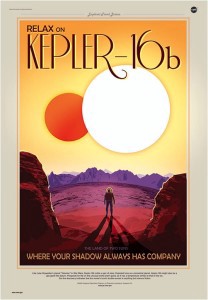
In the sight-seeing poster for planet Keplar-16b, a traveler in a space suit stands silhouetted before a purple and rose-colored desert. Craggy mountains rim the horizon. Orange and white orbs illuminate a yellow sky. “The land of two suns,” the poster explains, “where your shadow always has company.”

kepler 106

The image fronts as promotional material for a hot, long distance vacation booked through Exoplanet Travel Bureau, a faux tourist agency specializing in interstellar vacations. In fact, Jet Propulsion Laboratory, a branch of both NASA and the California Institute of Technology, released the image. The institute is “dedicated to the robotic exploration of space,” and their projects include monitoring weather by satellite, determining the properties of gaseous planets, and the 2003 launch and 2004 landing of the space rover Opportunity on Mars.

Since January of last year, JPL has released fourteen stunning, futuristic posters, depicting the treacherous beauty of interplanetary life. Each image undermines fundamental assumptions. In the poster for HD 40307g, a skydiver free falls through the atmosphere of a “Super Earth.” “At eight times the Earth’s mass,” the poster narrates, the planet’s “gravitational pull is much, much too strong.” The poster for Keplar-186f, a planet that orbits a cooler and redder sun than ours, disrupts expectations about the nature of light. In this one, a space-suited couple admires crimson foliage. “If plant life does exist on a planet like Kepler-186f,” a caption explains, “its photosynthesis could have been influenced by the star’s red-wavelength photons, making for a color palette very different than the greens on Earth.”

The retro-styled series takes its inspiration in part from the Kepler Project — NASA’s mission to survey our region of the Milky Way and locate planets similar to Earth. Kepler’s website explains, there is “clear evidence for substantial numbers of three types of exoplanets; gas giants, hot-super-Earths in short period orbits, and ice giants. . . The challenge now is to find terrestrial planets . . . one half to twice the size of the Earth . . . in the habitable zone of their stars where liquid water and possibly life might exist.” Left unsaid is the distant dream of interplanetary colonization, where scientific research meets sci-fi fantasy. So far, Kepler’s closest Earth-match is Kepler-452b, a planet 60% larger than our own with a 385-day orbit around a Sun-like star. Unfortunately, for wannabe visitors, this exoplanet is 1400 light years away.

While space tourism is futuristic, the style of JPL’s new posters harkens back to previous decades. The colors range from day-glo lime and orange, to gauzy hues of peach. The styles, too, are bygone, recalling Art Nouveau’s organic curves, Mid-Century’s precise lines, and the tie-dyed optimism of the 60s and 70s. The effect is more nostalgic than revelatory, depicting a golden age for interstellar imagination, a time when the future felt more playful and less apocalyptic.

The effect is more nostalgic than revelatory, depicting a golden age for interstellar imagination, a time when the future felt more playful and less apocalyptic.

Many of today’s pop culture depictions of space travel aren’t whimsical. No longer concerned with the anthropological details of alien species and exotic terrain, popular narratives focus instead on the survival of humanity and the long-term viability of Earth as a home. Consider the recent blockbusters Interstellar and The Martian, which both balance a desperate need for discovery with the psychological burden of participation in a mission likely to fail. Unlike the adventurers on holiday depicted in JPL’s posters, these films feature solitary pioneers confronting the abyss of time and space. The stakes couldn’t be higher. In Interstellar, Earth is barely habitable, devastated by drought and dust storms. The best possibility for humankind’s survival depends on a retired pilot’s ability to navigate a wormhole, locate a new home planet, and transmit its location back to Earth. In The Martian, astronaut Mark Watney is separated from his crew during a dust storm and presumed dead. Stranded on Mars, he must adapt to his new environment, keeping his body and spirit alive until he’s rescued. In each film, the heroes’ inner landscape, a predictably lonely terrain, is reflected perfectly by their surroundings, which are hostile and desolate. The protagonists are literally and metaphorically lost in the nothingness.

Unlike the adventurers on holiday depicted in JPL’s posters, these films feature solitary pioneers confronting the abyss of time and space. The stakes couldn’t be higher.

Aurora, the newest novel by science fiction guru Kim Stanley Robinson, vastly expands the narrative timeline of intergalactic travel. The heroine, Freya, grows up aboard an intergenerational starship heading for the star Tau Ceti. 160 years and seven generations into the journey, the crew has nearly arrived, and the problems they face are as philosophical as they are practical. Reaching their destination means establishing new means of survival and reshaping the mythology that give purpose to human life. Over a breakfast of strawberries, Freya’s father proclaims, “we are thrust out of the end of [an old] story. Forced to make up a new one, all on our own.”

The recently translated sci-fi novel Another Planet for Rent by the Cuban author Yoss further estranges our planet. Instead of a fabled homeland for far-flung voyagers, Earth is the destination. Alien tourists called xenoids have populated the blue planet. After witnessing humankind’s inept efforts to protect natural spaces, the xenoids take on the project themselves, enslaving humans mentally, physically, and sexually. Flipping the script on colonial narratives, Another Planet positions its protagonists as indigenous Earthlings rather than intergalactic saviors. Humans are the obstacle in an alien species’ narrative about stewardship and travel. The prospect is humbling. Our cosmological destiny may lie beyond our control.

Shifts in the way we imagine space travel come in part from NASA’s change in focus. Unlike the Apollo days, when the Cold War inspired large investments in rocket science and the race to the moon, NASA receives a significantly smaller portion of federal funds (less than .5% of the federal budget), which it divides between space exploration and researching Earth. Unlike the Apollo Missions, NASA’s recent work monitoring melting ice caps, rising oceans, and extreme weather events is sobering. Rather than inspiring patriotism and wonder, understanding the mechanisms and consequences of climate change means acknowledging a potentially catastrophic future.

Spaceship Earth, as Buckminster Fuller dubbed our planet in 1967, is near a tipping point. The accumulation of greenhouse gases in our atmosphere is pushing natural ecosystems towards unstoppable positive feedback loops that could spike the rate of planetary warmth. Once these processes begin, they may be impossible to stop. Melting permafrost will release stores of methane, a greenhouse gas that traps as much as 100 times more heat in the atmosphere than carbon dioxide. Shrinking ice caps will expose more of the ocean’s dark surface, which absorbs rather than reflects heat. Drought will damage rainforests, including the Amazon, one of Earth’s most important carbon sinks, and bushfires will decrease the carbon storage capacity of forests. In each scenario, a symptom of climate change becomes an engine, releasing greenhouse gases and fueling atmospheric warming.

Spaceship Earth, as Buckminster Fuller dubbed our planet in 1967, is near a tipping point.

Interplanetary life is still a far off dream, yet anxiety about Earth’s future imbues this research with new gravity. Rather than focusing on discovery, popular culture reflects an increased concern with the logistics of space travel: what psychological challenges will voyagers face during decades long missions to reach a destination; can travelers use asteroids to stock up on water and fuel; can astronauts have sex in space; can women give birth in zero gravity?

These practical questions give way to unsettling existentialism and thrilling narrative possibilities. The scale of the universe is unfathomable. What does it mean to be a speck in the infinite? Do specks have the right to colonize new planets? Will life on a new planet cause adaptations that fundamentally alter our species? To what extent would we include plants, animals, bacteria, fungus and viruses in resettling? Which humans would go and which would stay behind? What are the consequences of failure? Of success?

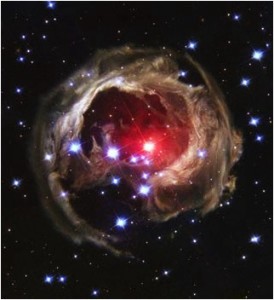
Numerous stars, planets, asteroids, and nebula populate our galaxy, but the volume they occupy is dwarfed by the emptiness that surrounds them. Because the distance between solar systems is so great, without cryogenic sleep, space travel would entail almost no sightseeing and plenty of shuttling through the nothingness. In other words, exploration beyond our solar system requires conquering not only the third dimension, space, but also the fourth dimension, time. Heroism means confronting aging, mortality, and boredom.

nebula

A recent breakthrough suggests how much we’re learning (and how little we know) about the nature of time. On Thursday, February 11, physicists triumphantly announced the first ever detection of gravitational waves. Produced by colliding black holes, these waves vibrated a pair of L-shaped antennas, a precise, highly sensitive arrangement of lasers and mirrors, in Washington State and Louisiana. The significance of this discovery is epic, fulfilling a prediction in Einstein’s 1916 general theory of relativity, which postulated that space and time are not fixed but mobile, capable of jiggling, curving, stretching and collapsing.

Rather than mapping the known world, as geographic exploration does, discoveries about the relationship between space and time magnify our perception of what we don’t know. Knowledge is infinite. When we glimpse the expanse of what’s unknown, the wormhole of imagination can be an insufficient processor.

couple

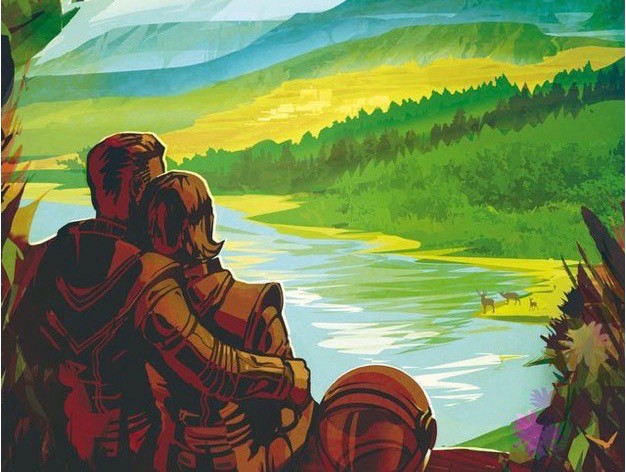
In the new JPL poster series, there’s only one image that features human tourists relaxing in the atmosphere with their astronaut helmets off. Looking out across a river at snow-capped peaks, a couple leans into each other. “Your oasis in space, where the air is free and breathing is easy,” the poster reads. After perusing drawings of the liquid ethane and methane lakes on Saturn’s moon Titan and the salt-water oceans beneath the icy surface of Jupiter’s moon Europa, fresh air, a (relatively) non-toxic environment, and just the right amount of gravity are nothing to take for granted. The miracle is that we’ve already arrived. While space exploration is awe-inspiring, perhaps the best lesson NASA can teach us is appreciation and stewardship for the home we already have, the planet we call Earth.

Jack Pendarvis on Movie Stars, Annie Hall, and The Small Ghost Donkey That Defines Us All: An…

Jack Pendarvis

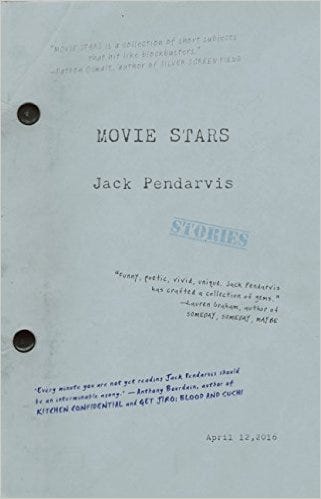
Jack Pendarvis’s new story collection, Movie Stars, is out April 12th from Dzanc Books. Pendarvis writes for Adventure Time and recently put out a work of non-fiction called Cigarette Lighter, but it’s been a long wait for a new book of fiction (his novel Awesome was released in 2008). As a fan, I couldn’t be more excited. These sixteen stories are hilarious first and foremost, but they’re also tender and kind and melancholy. They’re infused with the sort of dreamy wonder that only a good-hearted genius like Pendarvis can access. Movie stars like Bob Hope, Joan Crawford, Jerry Lewis, and Scarlett Johansson haunt the lives of the characters in these stories, as do movie memories. Everything these folks do has been shaped and continues to be shaped by what they’ve seen in movies, lending the whole collection an atmosphere of cinematic yearning. There are also cats in these stories. Lots of cats. If I had to give you one sentence that summarizes the overall spirit of the book, it would be this from “Duck Call Gang”: “I worry about all the little cats out there in the world.” Or maybe, from “Jerry Lewis,” this: “He had a bad day and couldn’t get any turds painted.”

I met Pendarvis at a coffee shop in Oxford, Mississippi, where we both live. He’s one of my writing heroes, a former teacher and someone I’m glad to call a good friend. Two guys at the table next to us were having a religious meeting where they used phrases like altar call. The staff was inexplicably blasting Billy Joel over the house speakers. Before I got there, my five-year-old son had told me that he believed his spit was full of escape pods.

[Read Pendarvis’ “The Black Parasol” in Electric Literature’s Recommended Reading.]

William Boyle: Movies are a unifying force in these stories. How did movies shape your life as a kid in Alabama?

Jack Pendarvis: There are different ways I came to movies. One, of course, was seeing them in the theater, especially things like The Aristocats (not to be confused with The Aristocrats) or The Biscuit Eater, which was a Disney movie about a rascally dog. And there were a lot of old movies on TV. I guess they were cheap to program. A bunch of Abbott and Costello movies. Tarzan movies — that’s in the book. There’s one traumatic memory of a Tarzan movie, which comes from my own life. They’d show things like Shirley Temple movies early on Sunday morning before church. Also, when I was a kid, I got a big coffee table book called The Great Movies by a guy named William Bayer. He was writing about movies I hadn’t seen at all. I was just looking at pictures. I read that book over and over. It was shocking. There was a picture of the Last Supper scenario that Buñuel does in Viridiana, and there was a matching shot from Robert Altman’s MASH. (I’d see Altman movies a lot on TV too. California Split came on a lot for some reason.) When I saw these matching shots — really blasphemous shots that imitate the Last Supper — it was kind of shocking and seemed taboo to me. You know, I was a Southern Baptist kid. I couldn’t believe that people were messing with the iconography that way, but it was also fascinating to me, and I wanted to know more about these people that were engaging with this stuff.

When I went to the University of South Alabama — uh, you can’t put that it in there, yeah you can, I don’t care — I went down to this smelly basement and they had tapes — I don’t know if they were VHS tapes or what — but you could go down to this really damp, moldy basement and watch movies. I watched Rules of the Game for the first time in that smelly basement. The Magnificent Ambersons, which Bayer talked about. Things that I’d just only heard of. And then I’d sneak into film classes. I saw Boudu Saved from Drowning and Hiroshima Mon Amour that way. VHS introduced a bunch of new movies to me. I remember you could go to the Phar-Mor drugstore in Mobile and rent a movie for 65 cents and keep it for as long as you wanted. And they had a really strange selection, like Under the Volcano and Harold Pinter things, you know, just lots of weird movies and foreign movies. That was revolutionary. I did see a David Lynch movie in the theater. I took a date to see The Elephant Man in high school. That’s not a good date movie when you’re in high school! We had to sneak out to see the rest of Private Benjamin, which was playing in the next theater. To be clear: When I talk about my childhood, I could mean anywhere from about age 10 to age 30. I’m serious. It all blurs together.

WB: Was there a movie experience that you had early on that was transformative — like you were too young for that movie and it changed the way you saw the world?

The ticket-taker said, pointing to other side of the theater, “In that movie, they do it. In this movie, they talk about it.”

JP: My brother talks about walking into our parents’ room and The Innocents was on and he saw a bug crawling out of a little cherub statue’s mouth and that it scared him to death and only years later when he was an adult he saw that scene again and realized what it was from and it freaked him out again. A movie I saw too early that had a big impact on me was Annie Hall, which came out in ’77. I was 13 or 14. I went to see it with my friend Franklin Tarelton, whose father had been my father’s high school football or baseball coach. We went to a place called the Airport Twin Cinema, which had two screens, on Airport Boulevard in Mobile. On the other screen was a soft-core movie that was very popular at the time. Something like Emmanuelle 3. And I was such an earnest 13/14 year old that I asked the cashier about Annie Hall: “Is this movie okay for us to see?” The ticket-taker said, pointing to other side of the theater, “In that movie, they do it. In this movie, they talk about it.” I felt nervous, but we bought the tickets. I was like, I guess I can handle that. I understood hardly any of the jokes, but it really made a huge impression on me. I think I mostly understood the slapstick.

WB: That was your first Woody Allen movie?

JP: I might’ve seen Sleeper on TV by then. It used to come on a lot. I’d already read some of his prose collections, Getting Even and Without Feathers. So I knew about him. It’s weird to think about now, but everyone knew about him then. He was quite famous and popular. I remember the woman who drove our car pool saying, “He’s a genius, but I don’t approve of him.” I liked the slapstick in Annie Hall, the way it was cut together, the imagination. It was instructive. I wanted to be a writer even back then. I loved James Thurber and I saw a connection between the kind of humor James Thurber wrote and what I was seeing on the screen. I associated it with New York, The New Yorker, that whole world I was fascinated by. I was too young. I mean, anyone else could’ve handled it, but I was a very young 14.

WB: Most of the stories in Movie Stars are set in Mississippi, but “Cancel My Reservation” takes place, in part, in Los Angeles. I’m assuming that movies influenced how you thought about place too? Your first impressions of New York and Los Angeles would’ve been through Woody Allen, through movies?

JP: My first impression of New York was probably from reading James Thurber and reading about James Thurber. I read a lot of stuff about New York. I was fascinated by Dorothy Parker and Robert Benchley and all those people. Ugh, I sound like just a horrible kid. So my impressions of New York were really like in Radio Days — which came out much later, obviously — when it shows the little kid listening to the radio and the elegant people in their penthouse eating breakfast, that sort of thing. I recently watched the Michael Ritchie movie Smile, which came out in ’75. Seeing it now, that movie looks so much like my childhood, even though it takes place in California and I grew up on the Gulf Coast of Alabama. The people, the buildings, the cars, everything. If you want to see what it looked like when I was a kid, you should see Smile.

WB: Since your formative movie-watching years were the ‘70s — this kind of golden age of filmmaking — did that generally shape how you write and think?

And we went to see The Deep, which was a distressing thing to see with your parents because Jacqueline Bisset brought out certain feelings I didn’t feel comfortable experiencing with my parents around.

JP: Well, I wasn’t going to see Taxi Driver when it came out. I was going to see things like The Biscuit Eater. I saw Smokey and the Bandit in the theater. I couldn’t believe all the cursing coming out of Jackie Gleason’s mouth! I kind of indignantly walked up the aisle and I expected my parents were going to be soon following in similar haughty indignation and they were just still in there and I was like, This must be okay, and I went back and watched the rest. And we went to see The Deep, which was a distressing thing to see with your parents because Jacqueline Bisset brought out certain feelings I didn’t feel comfortable experiencing with my parents around. And then, let’s see, I remember going to see The In-Laws with my parents. That was a wonderful movie-going experience. I’m talking about the original, with Peter Falk and Alan Arkin. That was a huge experience because my parents loved it so much and they were laughing and I was laughing. We all thought it was hilarious. That was a nice bonding experience.

WB: But you don’t think your taste wasn’t shaped by that specific ’70s aesthetic?

JP: I mean, I did see California Split, Smile, Cotton Comes to Harlem, and things like that on TV. I’m sure it seeped in there. And The In-Laws, Smokey and the Bandit, Annie Hall — those are all ’70s movies. I was getting a good dose of that. But the first Scorsese movie I saw in the theater, for instance, was After Hours in ’85. I was pretty ignorant about a lot of things. The Blues Brothers had a big impact on me too. I went to see it with my most religious friend. It had a lot of what I thought of then as blasphemy in it. But, at the same time, the scene with James Brown, that was uplifting spiritually. Saturday Night Live certainly gave me permission in new ways. The movies I went to see that pushed me into the Devil’s Crew were starring people I’d seen on SNL like Chevy Chase, Bill Murray, Dan Aykroyd, and John Belushi

WB: Another thing that unites these stories — though they’re all hilarious — is melancholy. For me, as a kid, watching movies compulsively was often sad as hell. Do you see a connection between movies and melancholy?

Movie characters are these vessels you can pour your own emotions into.

JP: Movies are supposed to be social, but I guess a lot of my characters are watching movies by themselves. I find that to be an enjoyable experience. Sometimes I like it better. I remember crying at the end of Shane the first time I saw it. And then I showed it to some of my friends in my 20s and they were just laughing. Same thing with Cocteau’s Beauty and the Beast. I didn’t cry, but I thought it was amazing. Then I showed it to some friends of mine. Every time the Beast came on screen, these two young women would say, “Courage!” like the Cowardly Lion in The Wizard of Oz. It was really getting on my nerves. So, I enjoyed that movie a lot more when I watched it by myself. I’m ambivalent, I suppose. I like watching movies by myself or with my wife. We have a similar frame of mind about movies and we enjoy the same things. It’s fun to watch a movie with her. In the book, one guy’s watching a Joan Crawford movie after his girlfriend’s just left. Movie characters are these vessels you can pour your own emotions into. If you want to think about the melancholy/lonely aspect, there are guys like the narrator of the story “Pinkeye” who’s imagining he can be a henchman in a movie. He’s projecting himself into a movie.

WB: There’s a lot of that. It’s funny, but it’s sad too. When you grow up watching a lot of movies, a lot of your knowledge comes from movies. You think of projecting yourself into a movie or when you see someone do something it recalls a movie memory. Your characters are always thinking that they’re doing things “like in a movie.”

JP: Movies actively — almost perniciously — encourage that. Think of Sherlock Jr. with Buster Keaton or even The Last Action Hero. Movies encourage that kind of identification. I guess fiction does the same thing. Not mine. Somebody’s. Think of Mary Katherine Gallagher in Superstar. I think that movie is an accurate portrait of a melancholy film fan.

WB: There’s a lot of facing down mortality in the book too. In “Duck Call Gang,” for instance.

JP: After that story came out in McSweeney’s, our friend Elizabeth Kaiser was concerned about me. Because, you know, they put it in the letters section. So, I think, maybe it was worrying. But it’s pretty close to documentary, I suppose. I made up the part about a gang that blows on duck calls.

WB: There are other narrators that think about getting old and dying in the way that narrator does. And that’s tied into the horror influence in these stories. There’s your take on the ghost story here, but also people are kind of haunted by their own mortality and there’s an awful lot of dread.

JP: What’s the point of writing if you can’t put in a little of that feeling that we all have that there are invisible people watching us? Don’t we all have that feeling? Or that we’re all kind of walking a line between two worlds? Aren’t we all walking a line between two worlds?

WB: The epigraph is from a book by called The Ghost World.

That’s the way I feel all the time, split between, ‘Oh that thing looks like a funny donkey’ and ‘Oh no, now that I saw it I’m going to die.’

JP: A book I found at the University of Mississippi library. Not the Daniel Clowes graphic novel. A book from 1893. It says: “In the neighborhood of Leeds there is the Padfoot, a weird apparition about the size of a small donkey, ‘with shaggy hair and large eyes like saucers’ . . . to see it is a prognostication of death.” Now what I like about that epigraph is that it’s funny it looks like a donkey — that it’s the size of a small donkey is a funny detail — but then if you see it you’re going to die, which is terrifying. That’s the way I feel all the time, split between, ‘Oh that thing looks like a funny donkey’ and ‘Oh no, now that I saw it I’m going to die.’ That’s my general feeling at all times. And maybe that kind of plays out through the book.

WB: Ha ha ha. It does.

JP: I thought of something. I saw Caddyshack at the theater. It was right after my grandfather died. And I was like, Lord I’m sorry, as I sat there watching a turd floating in a pool and a priest cursing and being struck by lightning. I was like, Any punishment that you give me will be just, Lord. That’s probably what I was thinking as I watched Caddyshack.

WB: What’s the role that nostalgia plays in the book? There are some characters who shun technology, who talk and act like they’re from another time, even though technology is very present in their lives. There’s not a yearning for another time, more of a general out-of-placeness. But maybe they’d be out of place any time?

JP: The narrator of “Cancel My Reservation” might be a nostalgic type, and that doesn’t work out too well for him. But otherwise I don’t think that’s a big motivating factor. I had to go back and add some technology. I always forget that everyone has a cell phone now. So, I might’ve gone back and stuck a few cell phones in so people have the illusion that I live in the present.

WB: To me, a lot of the things I was somehow nostalgic for as kid, came from the movies. Typewriters, record players, old cars.

This is the saddest interview ever. “Ancient Man Manages to Crap Out A Book! 167 pages! Barely a book! But you’ve got to hand it to him because he’s so decrepit!”

JP: I loved those things because they were part of our daily life back then, ha. In fact, I didn’t learn to type until I got my first job. My grandmother showed me where to put my fingers on the keys and I taught myself to type really fast. This is the saddest interview ever. “Ancient Man Manages to Crap Out A Book! 167 pages! Barely a book! But you’ve got to hand it to him because he’s so decrepit!”

Here Is the 2016 Baileys Prize Shortlist

The Baileys Women’s Prize for Fiction, formerly the Orange Prize, is one of the most celebrated awards in UK literature. Any woman writer who has published a book in the UK in English in the past year is eligible. Past winners have included Zadie Smith, Marilynne Robinson, and Barabara Kingsolver. The six finalists this year include three authors from the US, two from Ireland, and one from the UK.

Congrats to all the authors who made the shortlist!

Cynthia Bond: Ruby (US)
Anne Enright: The Green Road (Ireland)
Lisa McInerney: The Glorious Heresies (Ireland)
Elizabeth McKenzie: The Portable Veblen (US)
Hannah Rothschild: The Improbability of Love (UK)
Hanya Yanagihara: A Little Life (US)

9 Books Coming To TV In 2016

In 2016, as Hollywood steels itself for the era of Peak TV, studio green-lighters are looking to an old friend: the book adaptation. What better match, after all, for a medium that finds itself specializing in ambitious, serialized storytelling? There are so many books (novels, comics, graphic novels, historical epics…) being adapted for the screen, so many novelists cashing those sweet HBO checks for a season or two, it can be hard to keep track. Your favorite Elena Ferrante volume could be debuting on Netflix this summer, and you might not know. (A reader can dream.) Don’t worry, we’ve got you covered. Here’s a handy list so that you won’t miss any of the literary action coming to TV this year. (Ed. Note — This article was originally published on February 3, 2016 and has been updated where available.)

1. The Magicians, Syfy

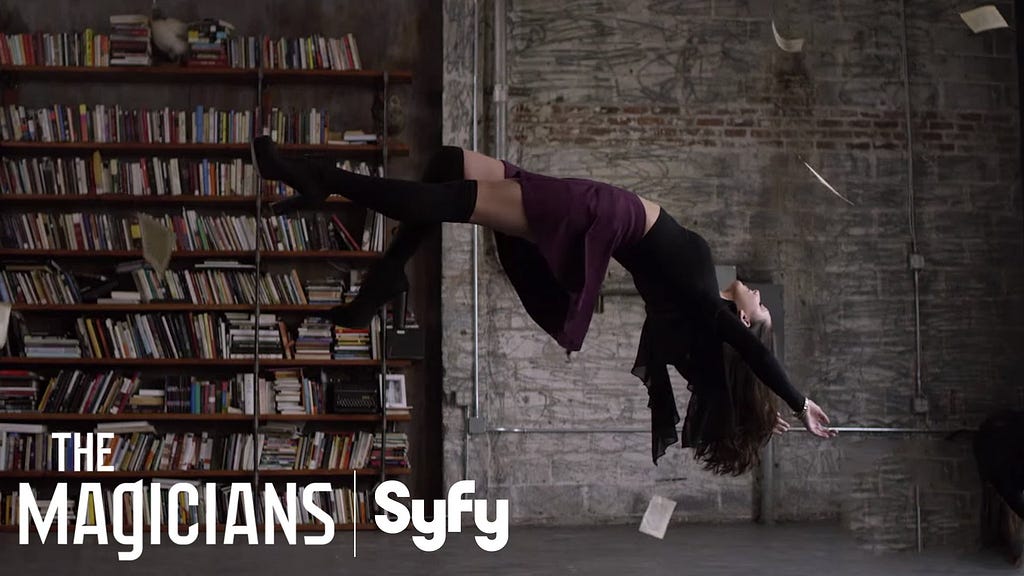
The Magicians, based on Lev Grossman’s 2009 fantasy hit, premiered on Syfy late last year. The remainder of the episodes will run in 2016. (New episodes started on the January 25th, with “The Source of Magic.”) The story, if you’re not familiar, is set amongst the student body at New York’s Brakebills College for Magical Pedagogy. If that doesn’t entice you to watch, what will? Where is your damn sense of wonder?

2. 11.22.63, Hulu

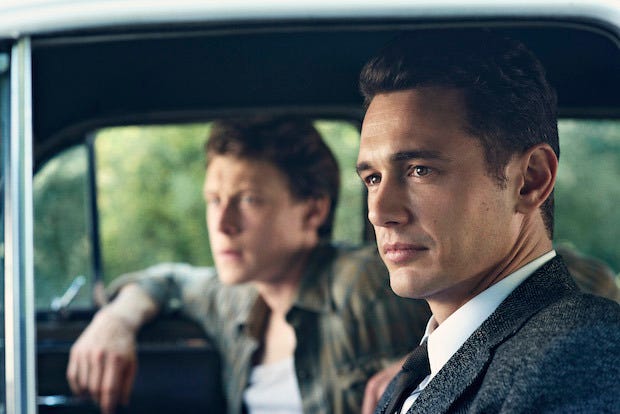
The Hulu Originals adaptation of Stephen King’s 11.22.63 (JFK, portals, time travel) has some pretty big names attached, including executive producer J.J. Abrams and star James Franco. The production is billed as a limited-series, meaning a fixed run of eight episodes (streaming started on February 15th). It’s about time Hollywood took some notice of this talented, emerging novelist plugging away in the woods of Maine. The man needs to eat.

3. Lucifer, FOX

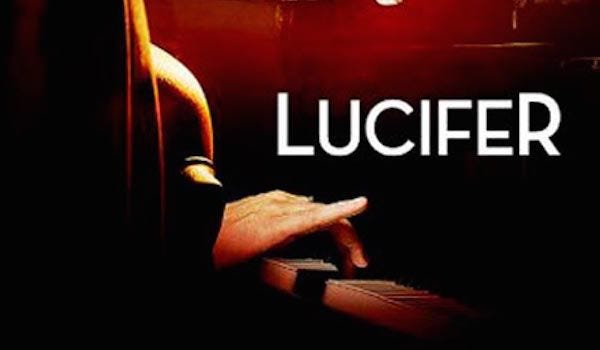
Lucifer, the latest supernatural police procedural from FOX, premiered last month to rave reviews…Nah, not really. This is a network show. Nobody raves about network shows. In fact, the NYT published a pretty brutal takedown. But fans of Neil Gaiman’s Sandman series or Mike Carey’s Lucifer spin-off may want to tune in anyway. (Update: Lucifer was recently renewed for a second season.)

4. American Gods, Starz

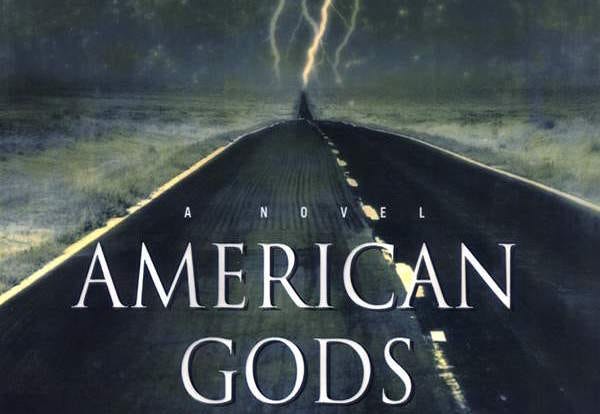
Neil Gaiman is making it rain. His novel, American Gods, long-rumored to be a prime candidate for adaptation, looks like it’s finally coming to TV this year. Gaiman himself is serving as an executive producer on this one, alongside showrunners Bryan Fuller (known for creating Hannibal, among others) and Michael Green. There’s no premiere date scheduled yet, but Starz announced last year that it gave production a green light and was expecting a late 2016 debut.

5. The Night Manager, BBC One/AMC

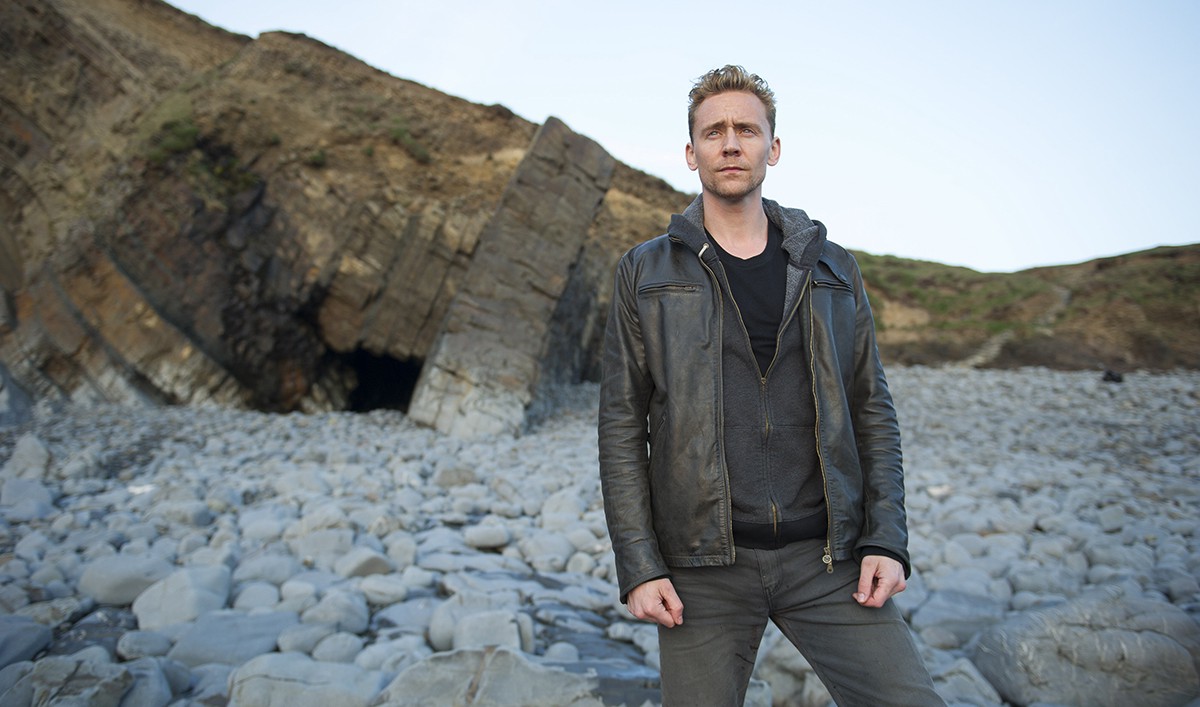
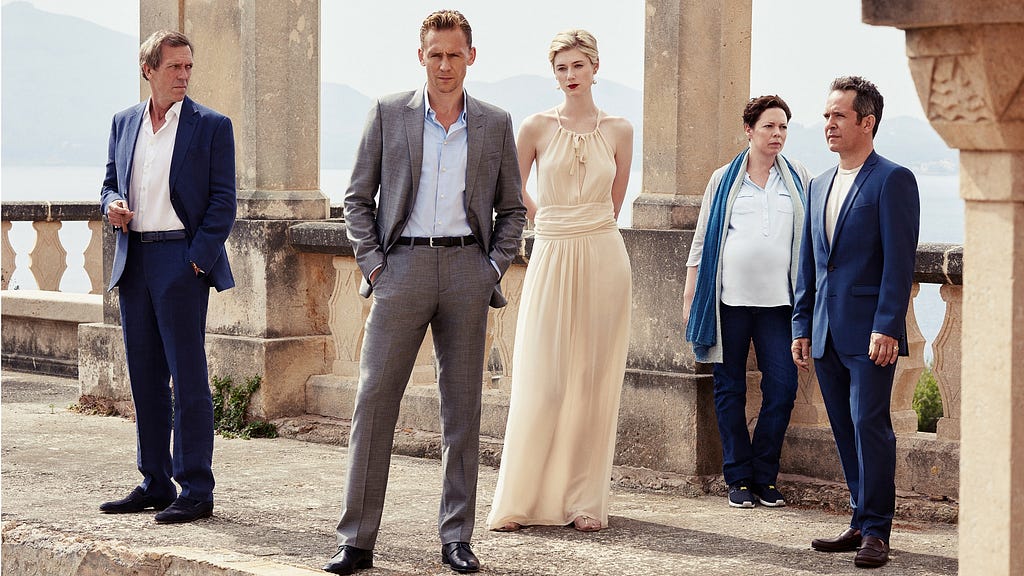
The BBC & AMC are bringing John Le Carré’s 1993 novel to the small screen this year, with a six-part miniseries starring Tom Hiddleston, Olivia Colman, Hugh Laurie, and Elizabeth Debicki. The novel was Le Carré’s first post-Cold War book, shifting focus from cat-and-mouse anti-communist spycraft to the world of international arms dealing (and drugs and mercenaries). Like any novel worth its salt, it begins in a grand hotel in Cairo. Presumably the show will do the same. It’s set to premiere on April 19th.

6. Luke Cage, Netflix

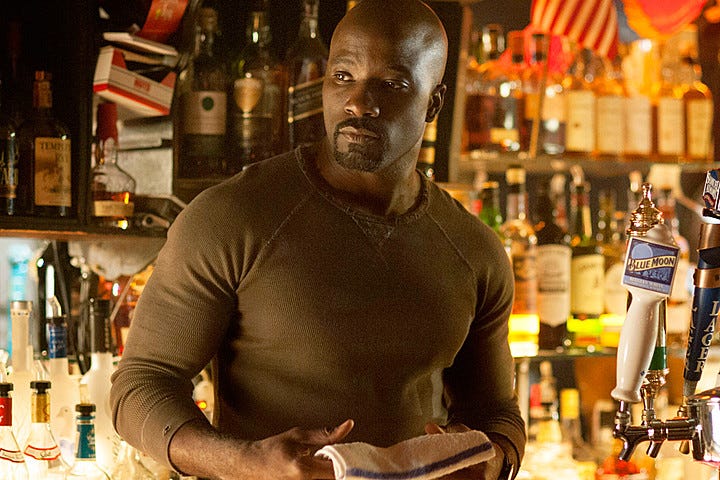
After receiving solid reviews for its first two Netflix productions, Marvel is back in 2016 with Luke Cage, set in the same comic book Hell’s Kitchen as Daredevil and Jessica Jones. There’s plenty to like about the new series’ prospects (and about its showrunner, Cheo Hodari Coker, previously on staff at SouthLAnd & Ray Donovan), but really there’s just one thing you need to know: it stars Mike Colter. The man is a damn star. A question remains, though: how many episodes before Rosario Dawson shows up?

7. War & Peace, BBC/A&E/Lifetime/History

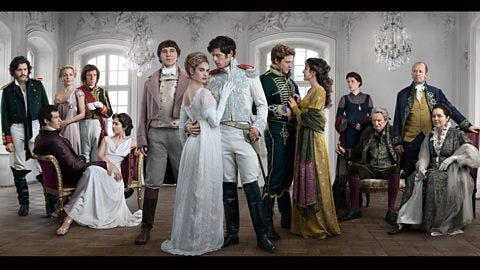
The BBC is always good for at least one epic adaptation, so long as costumes are involved. This year’s headliner is War & Peace, a four-part miniseries which will be simulcast in the US by that classic TV alliance: A&E, Lifetime, and the History Channel. The series stars Paul Dano, Lily James, and a whole lotta fur. We’re talking Zhivago-levels of fur. So go ahead, splurge on that old doorstop classic you always meant to get around to. Just make sure it’s the Pevear & Volokhonsky translation. Constance Garnett will get your ass laughed out of book club.

8. Preacher, AMC

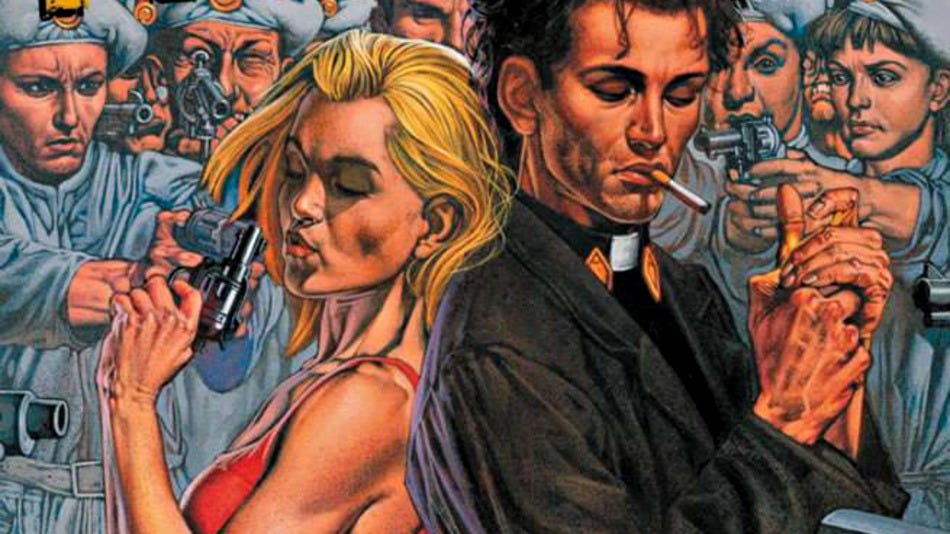
The DC Vertigo comic book (created by Garth Ennis & Steve Dillon) is finally coming to TV. The show, set to premiere later this year on AMC, is helmed by the team from Superbad (Evan Goldberg & Seth Rogen), along with Breaking Bad vet Sam Catlin. Dominic Cooper, of Mamma Mia! fame (and probably other fame, too, but who’s to say?), will star. The plot, which pretty much defies summary, involves a Texas preacher, an Irish vampire, and a quest in search of God.

9. Big Little Lies, HBO

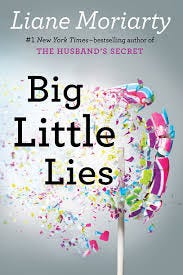
You thought we were going to have a TV books list without an HBO show? Granted, HBO often goes the route of signing novelists to work on its original material (see R. Price, G. Pelecanos, G. Flynn, et al), but it also knows how to do a hell of an adaptation. This year, they have David E. Kelley (creator of just about every popular drama in the 90’s) adapting Liane Moriarty’s 2014 novel about a group of mothers driven to violence. HBO is, of course, bringing the A-list talent: Nicole Kidman, Reese Witherspoon, Shailene Woodley, Laura Dern, and more. Will it air in 2016? Who knows. It still makes the list.

The Stories in Diane Williams’ Latest Collection, Fine, Fine, Fine, Fine, Fine Don’t Resemble The…

What to make of a Diane Williams story? They don’t resemble other stories, though some of the ones in NOON come close. NOON is a literary annual that regularly features a cabal of out-there authors; contributors include Lydia Davis, Rebecca Curtis, Tao Lin, and Sam Lipsyte. Williams just so happens to be NOON’s architect, purportedly editing each issue with slicing-dicing verve. (“Clancy Martin and I now laugh about how she will take forty pages of writing and slash it down to two pages,” Deb Olin Unferth has said, sounding like every other NOON writer. Unsurprisingly, Williams was a student of Gordon Lish.) The result makes NOON one of the only lit mags whose every issue is worth reading cover-to-cover.

The stories — NOON’s and Williams’ own — are weird, elliptical little gems. They — Williams’ especially — seem designed to confound. So yes, the stories in Williams’ new collection, Fine, Fine, Fine, Fine, Fine don’t resemble other stories. They are governed by a free-associative logic. They are replete with non-sequiturs and ungainly phrasing, and they revel in uncanny banalities. Of the 40, three or four edge close to 1000 words; most are half that, or shorter. They eschew the conventional pleasures of literature: narrative and character development, as well as the insights they provide.

And I must confess, though I just finished the book, I don’t recall much of what happens in it, nor. The stories take the form of a fleeting thought, and who remembers each thought that passes by? What sticks in the mind are the sentences.

Williams’ sentences have an unpremeditated quality, the kind indicative of laborious craft. Look at the harried opening of “Cinch.”

My back started killing me and Tamara asked what else did I want and why?

Oddly, she was suddenly unenthusiastic about me and she revealed resentment, of all things, and possibilities for her revenge.

But how busy I was! — building the twelve-by-sixteen rec room at the rear of the house.

Punctuation’s deployed in manner akin to musical notation, rather than as a tool for syntactic clarity. The first sentence does not have commas and periods where it should; there’s just that incorrect question mark at the end. It disorients but still gives the sentence a rather clear tempo. And the second and third lines defy the half-baked dictums everyone hears in freshman writing seminars: instead of using adverbs and exclamation points sparingly, she puts two adverbs at the front of one sentence and an exclamation point in the middle of the other. When the style works, as I think it does here, it’s sort of brilliantly awkward. It sounds like someone thinking to herself.

Often these stories are awkward in another way. Williams excels at the comedy of inconsequence, uncovering humor in the inane not through exaggeration or cloying commentary, but by mere presentation, as in the drolly repetitive party dialogue in “People of the Week.”

“I didn’t think you even knew what Ethelind looked like.”

“I saw her up front. I thought you saw her. Let’s go see Tim.”

“I don’t want to see Tim. Why would I want to see Tim? Who is Anita? I want to thank Anita.”

“Dale, is that you?” a woman called. It was Tim who turned, thinking someone had mistaken him for Dale.

The damage from that misunderstanding was irremeable…

Many acolytes of Williams are aficionados of the sentence. Indeed, she has cultivated a singular style, and the brevity of her stories serves to highlight that style, but it is so potent that it might distract a reader from what she’s doing to narrative.

A Diane Williams story resembles a story as it exists in the mind at the moment it reifies from abstract brain activity into concrete language. Her stories — events, “slices of life,” human things — are free from the interlocutor of literary convention. They are just being, and they are about just being. Williams shows what it is to be a woman, to be a wife, to be bored in a roomful of strangers, to be bowled over by despair. If I asked you, “What is it to be walking down the street?” something like the story “Personal Details” might roil in your mind before you can spit out an answer.

This is an interesting narrative project, and when it’s paired with the unwieldy precision of her sentences, along with volume after excellent volume of NOON, you begin to apprehend the unique contours of the space in literature Diane Williams has carved out for herself.

Art is, among other things, an expression of individuality. It is a stepping forth from the crowd. And one of the hallmarks of a great artist is that you sense no one could else could’ve produced her work. This admirable idiosyncrasy is how Williams gets away with something like “The Skol,” my favorite story in the book, reproduced below in its entirety.

In the ocean, Mrs. Clavey decided to advance on foot at shoulder-high depth. A tiny swallow of the water coincided with her deliberation. It tasted like a cold, salted variety of her favorite payang congou tea. She didn’t intend to drink more, but she did drink — more.

Who else would have chosen such an unsettlingly formal tone? Rather rather than telling a story, she relays information.

Who else would have compared the ocean’s taste to payang congou tea, the soothing stillness of the drink at odds with the force of the ocean, the Chinese words at odds with the English, all dissonance?

Who else would have used that dash there at the end, an awful final flourish, stuck in like a pin between your ribs?

Click here to read a story, “To Revive a Person Is No Slight Thing,” from Diane Williams’ collection as part of Electric Literature’s Recommended Reading.

The Wooden Miles: Poems by Kevin Craft

Matinee

She is one moving over the boardwalk — 
my mother in Ocean City — crossbeam
hammered and hovering above the dune
line, boardwalk cracking like an exhumed spine.
So much love does she have for it, walking
the boards has become her life’s work,
measuring out the wooden miles like stalking
her own horizon, summer after summer
climbing down the gray-green ladder of the Atlantic
only to climb back up again, every plank a sleeper,
every nail a fraction of that solitude
named for the beach end of the road — 12th Street,
13th — the music pier floating over breakers
like an ark. But who is alone walking
on a boardwalk if not my mother in winter
gauging the distance between storms
and the hours she has to make it through
childhood and back again, hers awash in
sistering, the small tasks of being eldest
among six, three in a room, one big bed,
born into a boom she can’t escape.
I know her by the broad-brimmed hat,
the trail of gulls and the easy way
she lifts me from the splinter in my foot
or finds me somewhere in her twenties
sitting on a bench, waiting if not wailing through
a blank day lost and found. What do I know
about difficulty then except what I glean
from late night arguments in the kitchen,
my mother driving to work and my father
chain smoking at the end of the driveway,
never mind the hopeless weeping
she all but buries herself inside that summer
Christopher was lifted, blue and lifeless,
from the bottom of the pool. The Atlantic
has nothing on her, pounding out its names
for erasure, emptiness and fullness the same
calamity underwriting now the doo-wop band,
now the high school prom and string quartet,
drawing the sanderlings into its sheen,
chasing them aside. Through cold war backwash
and every season of the Ferris wheel
she walks as if the boards depended on it,
the hardwood opening to her tender instep,
so many breaks collected in her stride.

Carousel

I am sitting
on the grassy shore
of Alcyon Lake

fishing for lazy carp
or waiting for fireworks
to embellish

twilight in July,
the bicentennial
darkness warming

to history like a shy
friend I am following
now to the train tracks,

drawn by the distant
clatter and whistle
with a fistful of pennies

to smash into medallions,
ovoid and weighty
as a lie. From the tire

swing my brother
falls and cuts himself
in the rusty creek,

a little bloodletting
we survive by leaping
from sand bank to gravel bar

running from the stones
I throw at yellow jacket
nests for no good

reason, the heat of summer
coiling in our brains.
Soon they will drain

the lake, cup by cup
of poison leaching out of
the lakebed until

the mallards flee
the carp disappear
the geese grow oblong

lumpy like clumsy
lovers with no better
place to make

love memorable, never mind
where a duck goes
when the water’s gone,

when the decade
evaporates
like gasoline in sunshine

billowing
out of both arms
open like the whitewash

glare of a missed slide
out of which a man
comes walking all over

again, brushing his sideburns,
holding up a fish
that glitters like the only
life he knows.

The Girl in the Cabinet (I Read What You Wrote and I Hate You)

by Melissa Chadburn

Last summer a friend sat on my kitchen counter and said, “You just always make things about you.” The feelings that followed…I so hated myself at that moment. I was ashamed to be there, taking up space, too much space in a friendship, in a workspace, at a meeting, in the board room, in the classroom, in the bedroom, at the party. A montage of myself just talking and talking and talking surrounded by a sea of blank faces. Thought clouds above everyone’s heads as they leave the place with the people, God, she sure does talk about herself.

What I should have done is seen this as progress. I should have jumped up for joy and said, “Fuck yeah!” In 1994 I went with my foster brother to visit his mom, my former foster mother, and her new partner at work. They worked in an ad agency; we entered the board room he and I, and I gave a presentation on why they ought to take me back in. The presentation included ways I would contribute financially, and to the daily household tasks, and how I would be invisible.

The presentation included ways I would contribute financially, and to the daily household tasks, and how I would be invisible.

Now, to their credit, they never held me to that last promise, but invisibility is definitely a thing I’ve aspired to. Which absolutely contradicts all the personal essays I write. I guess in person I strive to be invisible, no problem, and on the page, I aspire to BOOM!

I recently read Meredith Maran’s, Why We Write About Ourselves. It’s a lovely compilation of interviews with twenty memoirists on why they choose to write about themselves. In it Edwidge Danticat says, “Welcome to my bathroom. I’m naked.” This is the shame part I was thinking of. Then she writes, “It feels to me as though there are people waiting around with knives, waiting to skewer me.”

***

I tried to kill myself once. At the time my brother was sending me letters about his stepmother calling him bakla, (“fag” in Tagalog). He said if he wanted to be called a fag he would’ve just stayed walking the halls of school. Until then I imagined my two brothers were living a life of snow and hot cocoa and fresh baked cookies, a life of sledding, and two parents in one warm cherished home. But there it was in my hands, proof of us on separate coasts, filling with hurt. I swallowed a half a bottle of Tylenol, and disappointingly awoke the next morning with absolutely no side effects. I felt every bit of every thing. Despite this sensitivity, like a dog or like a man who’d been shipped off to war, I was most known for being compliant and every moment I swallowed my opinion — something in me was blushing with anger and fear.

I swallowed a half a bottle of Tylenol, and disappointingly awoke the next morning with absolutely no side effects.

When I consider the difference between my experience in writing fiction and that of nonfiction I feel I have more freedom to be honest in my fiction. By that I mean there is no swallowing of my opinion in fiction. There is no me and there is no you. It’s just a world of words — a bridge from my imagination to yours.

I am in search of what Sue Monk Kidd refers to as “the common heart.” A phrase she originally learned from reading Ralph Waldo Emerson. “He described it as a place inside of us where we share an intrinsic unity with all humanity.” This is a thing I long for and seek to accomplish in my writing but sometimes I’m met with controversy.

When it comes to my essays, part of what I do is share ideas. I go places and tell people my ideas, or people read about them and they hate that. Because ideas are very very dangerous and should be limited to only a few people. Male people and wealthy people and white people, preferably. So these people who are dead set on hating me, they go to a reading and when I say, “Question gobbledygook!” There are people who come to see me with angry eyes and they raise their hand and they say, “You are an idiot! Goobledygook is what is good about this country and if you don’t like gobbledygook you should just leave!”

There is no swallowing of my opinion in fiction. There is no me and there is no you.

And then sometimes when I get home there will be emails written to me:

Dear Resting Bitch Face,

I read what you wrote about gobbledygook and I hate you. I hope you die in hell. I want to rape you.

This might sound extreme but, in Why We Write About Ourselves, Ayelet Waldman talks of an experience she had in publishing an essay about loving her partner more than her kids and getting hundreds and hundreds of emails. Some of them threatening, some saying she should “be shot” or deserved to die. Someone actually taped a note to their household gate that said, “Your children should be taken away from you.”

And just last year Amanda Hess, a journalist who writes about sex, published a piece, “Women Aren’t Welcome Here,” in Pacific Standard about a man who opened up a twitter account just to send death threats to her. One tweet read: “Happy to see we live in the same state. Im looking you up, and when I find you, im going to rape you and remove your head.”

Back in my life, I will get another email, an email from a magazine that I like with really smart people in it. It will be a rejection in response to my query on a piece I wrote about gobbledygook. A form rejection like: We appreciate the opportunity to read “The Secrets of Goobledy Gook,” but we feel it is not a good fit for Top Tier Journal 100 at this time.

And then I might scroll through Facebook and see all these cash and prizes being thrown at people. Small island awarded to Chief Operation Officer of Gobbledy Gook. Author of 101 Benefits of Gobbledy Gook receives MacArthur ‘Genius Grant.’ By this time I will be very tired and go to bed. My lover and I won’t have sex that night and I’ll think maybe it’s because I’m fat or smell funny, which will prompt me to stay up and wonder about all the ways I’m unlovable.

My lover and I won’t have sex that night and I’ll think maybe it’s because I’m fat or smell funny, which will prompt me to stay up and wonder about all the ways I’m unlovable.

Encouraging people to fight for what they believe in is an easy enough task. Having an unpopular opinion is a completely different thing. People don’t like you for it and when people don’t like you, you see their ugliest sides. Sometimes this side stares you in the face. Sometimes it’s a dozen quick sharp slashes — being shunned. People think this opinion dealing could be contagious. People who are your friends may not invite you places. People may stop calling you.

In WWWAO, Jesmyn Ward writes about a scene in her memoir in a cellar in the woods. Her editor kept pushing her, dig deeper. Of this experience she writes, “I finally realized what that cellar had taken on for me. All the feelings of self-loathing and worthlessness I had at that age were embodied in that cellar. It symbolized all the dark things that happened to me, things I thought I deserved because of the way I thought of myself at that time: as a young black woman in the South.”

There’s many reasons I love what she says here. The cellar reminds me of the child in the basement in Ursula Le Guin’s story “Omelas.” It also reminds me of an essay Ursula Le Guin once wrote called “The Writer on, and at, Her Work.” In it she writes:

And I found myself
in the dark forest, in silence.

You maybe have to find yourself,
yourselves,
in the dark forest.
Anyhow, I did then. And still now,
always. At the bad time.

When you find the hidden catch
in the secret drawer
behind the false panel
inside the concealed compartment
in the desk in the attic
of the house in the dark forest,
and press the spring firmly,
a door flies open to reveal
a bundle of old letters,
and in one of them is a map
of the forest
that you drew yourself
before you ever went there.

Aside from the experience of writing and existing, there is only one true reward and this too is an idea or more of a hope and the idea is this: For every doo doo ca ca angry face, for every email seething with hatred, for every gala or shindig to which you are not invited there is a child somewhere — a girl — and maybe she will pick up a book or peruse the internet and she will find your words. And in your words she will discover a world of the possible and she will climb out of the cabinet and she will put down the razor.