“System Change, Not Climate Change,” we chant during environmental marches. We write the slogan on signs and hashtag it on social media. But how do you change systems when your government denies climate change, silences experts, and promises to increase fossil fuel production?
When my daughter was born in 2014, it was the warmest year on record; each year since has been warmer. Confronted with a crisis that would shape my child’s life, I felt both overwhelmed and determined to act. Eventually, I started a free environmental newsletter called Cool It: Simple Steps to Save the Planet. Through my research, I have come to believe that while engagement and voting are essential at changing systems, we can take immediate action as we wait. The purchases we make—and more importantly, the ones we don’t—and the gardens we grow can support the world we want to live in. Climate change isn’t a dystopian possibility hundreds years away, it’s already here.
In this reading list are seven books to read that offer a sustainable path forward:
In Soil: The Story of a Black Mother’s Garden, Camille T. Dungy addressed the first Trump presidency, writing, “In the months after the 2016 presidential election, I often found myself in the company of people, almost always white, who said, ‘This is all so surprising. This isn’t who America is!’ . . . But I was not shocked. For quite some time–since the beginning, really–Black Americans have pointed out that ‘this’ is actually happening.”
It is now 2025 and “this” is still happening, but even more egregiously. Soil expands the definition of nature writing, inviting in those—such as mothers—who have been excluded from the genre. She is mindful of her readers’ mundane responsibilities because she, too, has to wash the dishes. As Dungy nurtures her garden, pulling up bindweed and growing native plants, she contends with both a pandemic and racism. She weaves these lived experiences together into a book that is wise and sustaining, and through it, she shows us the work we must undertake to create a better future.
In Unraveled: The Life and Death of a Garment, journalist Maxine Bédat traces the life cycle of a pair of jeans from the cotton fields of Texas to a textile plant in China to a garment factory in Bangladesh to an Amazon fulfillment center in Washington and finally to a landfill in Ghana. Bédat ends her extraordinary reportage with some concrete action steps for consumers, including an invitation to join the Clean Clothes Campaign. You’ll be haunted by Rima, a textile worker in Bangladesh who is paying for our addiction to fast fashion through unbearable work conditions.
Could you go a full year without throwing anything away? That’s the challenge Eve O. Schaub embarks on in Year of No Garbage: Recycling Lies, Plastic Problems, and One Woman’s Trashy Journey to Zero Waste. Schaub composts food scraps, recycles glass bottles and cardboard boxes, and even teaches readers about “aluminum foil potatoes,” but what can she do with all the non-recyclable plastic that flows through even the most vigilant of households? Schaub is as funny as she is educational, and you’ll find several ways in this book to reduce your plastic waste.
In Thicker than Water: The Quest for Solutions to the Plastic Crisis, Erica Cirino visits the great Pacific garbage patch, describes the plastic found in the stomach of a sea bird, meets scientists working on plastic alternatives, and interviews activists fighting to close the petrochemical refineries of Cancer Alley. Plastic, we learn, is only cheap because we ignore its harms to our health and the environment. Cirino arms readers with alternatives to single-use plastic and advocates for more circular systems.
Amelia Pang’s Made in China: A Prisoner, an SOS Letter, and the Hidden Cost of America’s Cheap Goods begins when a woman in Oregon buys Halloween decorations and finds a note inside: “If you occasionally buy this product, please kindly resend this letter to the World Human Right Organization.” The note was written by Sun Yi, a political prisoner in China whose work unit made the decorations. Journalist Amelia Pang finds and interviews Sun Yi, bringing us both his story of state mandated reeducation and the horrific labor camps where so many of our goods are made. We have all purchased something (probably a lot of things) made by slave labor. The book ends with clear action steps.
In his evocative and well-researched book The Day the World Stops Shopping, journalist J.B. MacKinnon imagines how life would be different if we stopped shopping. Chapter four is titled “Suddenly, we’re winning the fight against climate change.” Shopping, it turns out, is a big reason we’re heating the planet. The gains we make with renewable energy are canceled out by our escalating consumption. Each decade, we buy more and more things, requiring more and more energy. On the day the world stops shopping, however, we not only win our fight against climate change, but we have more time and richer experiences. MacKinnon is clear that his book’s premise is only a thought exercise, yet he is serious about conscious consumption and how it is the key to saving the planet and ourselves.
In Nature’s Best Hope: A New Approach to Conservation that Starts in Your Yard, Douglas Tallamy challenges us to use our yards to support biodiversity. He sounds the alarm on insect collapse and explains why pollinators are essential to our survival. Most importantly, he gives us the information we need to turn our yards into habitats. Tallamy’s book highlights the importance of growing nectar plants like Joe Pye weed and keystone species like goldenrod and how native milkweeds are essential for monarch butterflies.
that isn’t mine. In my life, I reach for a lemon, blooming blue,
my hand breaking the waxy mask, a delicate sensation all its own.
Metamorphosis
I didn’t want to believe in nature or nurture. To be the girl
whose picture I keep in a book next to my bed. To die
at thirty-two with a gun clasped in my hand. My mothers,
my two fragile wings: the one who carried me, the other
who cared for me. Both of them a weight I bear, folding
and unfolding their pull against my back. I know
not all creatures can endure the burden of change, the way
the caterpillar dissolves completely during metamorphosis—
tissue thick and sticky, cells coding re-creation. But the body
and its double is already predetermined inside the egg,
long before the creature is even born. An open question:
if at a fancy restaurant, my father-in-law turns to me
and says “I guess you’re really white trash, then,”
does it mean it’s true? Once, after a terrible storm,
I found several chrysalises in the garden, bright green pods
nestled in the sharp slate of the garden path. The home
I made for them: a large dinner plate. I delighted in the bounty
of small gems, until the silhouettes of half-formed wings
shrunk and blackened against the cloudy edge. What I’d wanted
was an ending that wasn’t so inevitable. Instead, I learned
to camouflage myself. To make the face of some fiercer animal.
If you spend enough time on BookTok or looking at the latest best-seller lists, you may start to wonder—is reading only for the young? Most of the biggest book influencers are in their 20s—and it stands to reason they’re interested in reading about protagonists their own age falling in love, slaying dragons, and solving murders. But don’t let BookTok fool you. Recent research suggests that 75% of active readers are actually 45 and older.
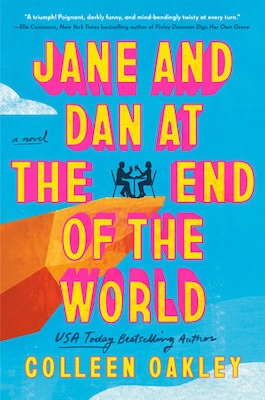
As someone in my 40s, I was interested in reading about women in the messy middle of life. It’s one of the reasons I wrote my novel Jane and Dan at the End of the World. There are so many love stories about the beginning of relationships— twenty-somethings falling in love and living happily ever after. But what happens next? Long-term relationships are rarely easy or picture-perfect and I wanted to explore what it means to find yourself next to someone fifteen or twenty years in, when there are kids and a mortgage and orthodontist bills and mountains of laundry and you wake up and wonder—whose life is this?
This reading list features protagonists over the age of 40—women navigating the complexities of middle life with all its triumphs, heartbreaks, and reinventions. These stories of women rediscovering themselves or chasing long-forgotten dreams prove that life’s adventures don’t end at 35.
Coming of age books aren’t always about teenagers. A 45-year-old artist embarks on a solo cross-country trip, but finds herself stopping in a small town and having an affair in a cheap motel—eventually coming to terms with her own sexual awakening, identity and sense of self.
Catherine Newman lays bare what it means to be a woman and mother in midlife, when the matriarch of the family gathers with her husband and adult children for a weeklong beach vacation. It’s moving, funny and oh-so-relatable.
A 40-year-old single mom has an unexpected love affair with the 24-year-old lead singer of one of the most popular boy bands on the planet. This age-gap romance is part fantasy fulfillment, part intense love story, and it was adapted brilliantly onscreen by Anne Hathaway.
This quirky and irreverent tale finds a middle-aged woman coming to terms with the challenges of midlife—raising a teenager, her lackluster career and marriage, her best friend dying. On a whim she begins wearing her dog in a baby sling—and then can’t stop.
Ann Patchett’s latest engrossing novel is about a 57-year-old mother who finally tells the story of her once-upon-a-time love affair with a famous Hollywood star to her three grown daughters. It’s poignant, introspective and beautifully nostalgic.
Historical fiction fans will love this true story of Martha Ballard, a 54-year-old midwife in 1789 who investigates a shocking murder in her small Maine town—and will stop at nothing to get justice, even at the risk of tearing her community and family apart.
Three middle-aged women discover that menopause brings them new “gifts.” They begin channeling their superpowers to find the killer of young women in their affluent neighborhood.
These were some of the comments I received in writing workshops regarding my work about disability, chronic illness, and neurodivergence. Often, I was the only student writing about living with disability, rather than using it as a cliché metaphor about being mad, blind, lame, or deaf, where disability was only present when it represented something else. Sometimes my classmates wrote about disabled characters, relying on crude stereotypes, or about disabled family members, focusing on the burden of caregiving or of loving difficult people. In these cases, disability was not at the forefront. Instead, it was being used as a plot device to convey either empathy for characters dealing with someone else’s illness or frustration at disability thwarting abled people’s attempts to live happy lives.
I was not represented in these works. None of my disabilities were visible. I was young. I was relatively successful. I loved and was loved in return. I was happy, except when I was not, but often this had little to do with being disabled and more to do with trying to survive in an ableist world. I did not want my existence to inspire pity in those who were not disabled, by which I mean I did not want to make others feel grateful they did not live a life like mine.
What I wanted was to write stories about the experience of living with chronic pain and the sensory onslaught of neurodivergence. I wanted to write stories about bodies and brains like mine without having to justify that yes, this really did happen and, yes, I really did feel this way, and no, I was not exaggerating to garner attention or sympathy. I wanted to be called what I was—disabled, chronically ill, neurodivergent—instead of sitting in workshops that insisted on using demeaning terminology such as “differently-abled,” “handicapable” and “special needs,” which imply we’re both helpless to our disabilities and yet somehow capable of overcoming them. I wanted to write about my crip community—our collective rage and exquisite joy and sharp humor—without abled classmates insisting I was generalizing. I was tired, I was in pain, and I did not want to spend my limited energy fighting for my place in workshops that didn’t understand me or my work.
Like many disabled people, I was skilled at masking. The abled world often does not want to accommodate us, and if we vocalize our pain, let alone demand access, we are punished. So we mask to fit in and hopefully succeed, though this comes at great mental and physical costs. I masked in workshop and on the page, dutifully following the writing advice I received in the workshop, even when much of it invalidated my lived experience.
I grew tired of writing the abled story of my disabled life.
But after a while, I grew tired of writing the abled story of my disabled life. I no longer wanted to translate my experience for abled audiences who often failed to understand—or even believe—my stories. In order to write, I needed to unlearn much of the advice I had encountered. I wrote my craft book, Nerve: Unlearning Workshop Ableism to Develop Your Disabled Writing Practice, about my experiences as a multiply disabled writer in order to help others who might need what I needed after so many workshops where abled writers insisted they knew best: strategies and methods to form a disabled writing practice. Along the way, I learned how to dismantle some of the most commonly received pieces of “feedback” in ableist workshops. Below is some advice on how to spot these comments, so you can dismantle and unlearn them too:
1) Disabled, chronically ill, and neurodivergent writers will often be encouraged to create work about these identities and little else.
When disabled writers include a small detail about disability in their work without it being the primary focus, workshop colleagues may call attention to that detail and insist it’s what the work is “really about.” This type of comment assumes the writer did not know their own intentions. Despite this common suggestion, it is possible for disability, chronic illness, and neurodivergence to inform a work without being the focus, just as it is possible for disabled writers to create work that does not include any discussions of this identity at all.
2) Assumptions about a writer’s identity or information from their previous pieces may be brought up in order to imply that this information needs to be included.
We do not need to consent to violations of our privacy and dignity.
When disabled writers do choose to disclose information about their identities in their creative work, workshops may focus their discussion on unanswered questions about the author’s diagnosis, asking invasive questions and speculating while the author is forced to sit silent. Workshops colleagues may ask us to include extensive information about our lived experiences and various disabilities, shifting the focus of our work to a medical report about our brains and bodies. We are expected to put our suffering on the page, to “show, don’t tell” what it is like to experience medical trauma. At the same time, we may be told to spare readers the details about our lived experiences that make them uncomfortable. But disabled writers do not need to shield readers from our suffering, just as we do not need to perform our trauma. We do not have to justify or explain every detail about our disabilities, treatments, and lived experiences for them to be accepted as true or valid or worthy of art, nor do we need to answer invasive questions on the page or in the classroom. Sharing our stories requires our consent, and we do not need to consent to violations of our privacy and dignity.
3) If writers choose to write about disability, they will frequently be told to do so with an optimistic tone.
We’re often told this suggestion is being made because the story is hard to navigate, difficult and upsetting to read. We may be asked, as I was time and again, to “describe how you find the courage to go on living,” as though our lives would be better off ended. The subtext here is that disabled people make abled people uncomfortable, and we must anesthetize our stories if we want to engage an abled audience. But why should we shoulder the burden of translating our stories for the ease and comfort of others? If even the mere facts of our brains and bodies are so upsetting to abled audiences, then perhaps these are not the readers we hope to engage with our work and certainly not the people we should be turning to for writing advice.
Similarly, disabled writers must resist pressures to demonstrate stoicism and grace above all else. This is not to say we cannot strive for these qualities in our lives and on the page, but rather that we must not allow abled others to reduce us to these qualities, must not accept that our stories are only of value if they imply that our lived experiences, full of frequent injustices, are easy to bear or devoid of unpleasant emotions. We do not need to revise our lived experience in order to make ourselves or our characters courageous and cheerful for the reader’s comfort.
4) Disabled writers may receive medical advice masquerading as craft advice.
Many times, the ableist need for optimism means requiring that disabled characters undergo treatment and prove their hard work, or at the very least, demonstrate hope. Because of this, we tend to receive all sorts of unasked for advice: recommendations to try meditation or essential oils, stories about a friend or family member or stranger from the news who benefited from some obscure treatment that the disabled writer ought to try. This “advice” implicitly asks us to prove we’ve tried everything in our power to be well. We’re expected to reveal this failure cheerfully and without criticism, certainly not mentioning that ableism is an inherent part of both the medical industry and of being offered unsolicited medical advice while we’re just trying to live our lives. Rather than succumb to calls for our work to provide inspiration—as though our lives are not challenging enough without the added pressure of needing to serve as a saccharine greeting card about looking on the bright side—we must remember that crafting our stories accurately is the ultimate act of agency. Resisting pressures to perform illness for others is a reclamation of our power.
5) Ableist audiences often want a triumphant recovery arc, or the promise of one to come.
As a result of points 3 and 4, workshops may encourage disabled writers to spend lengthy time discussing the possibility of recovery, as though each piece about disability should conclude with a magic cure or medical breakthrough. Alternatively, audiences will accept disabled stories that inevitably end in death, so long as the disabled character goes calmly and compliantly into the good night. Mostly, however, readers love a success story, meaning a story where disabled, chronically ill, or neurodivergent people rehabilitate and assimilate. In other words, where we become (or at least pretend to be) abled. But doing so requires the erasure of the reality for many disabled people, one where treatment and recovery are not always possible or even preferable, our unique identities intertwined with our disabilities and inherent to our sense of self. Implying our stories are only of value if we assimilate requires the eradication of our very existence. In a world where so many disabled people are denied access to public spaces, education, politics, and even healthcare, we cannot allow ableist workshops to erase us on the page, in the stories of our very own lives.
“Why not conclude by reflecting on how far you’ve come?”
“Can you show how hard you’ve worked to overcome this?”
“Can you spend more time explaining how this doesn’t define you?”
Years after my time in writing workshops, I still remember these frequent comments and still receive them from book and magazine editors. But if I were to revise based on this feedback, I could only conclude that I’ve come very far in ignoring advice like this—the kind that suggests my writing is only of value if I demonstrate how far away from my disability I have managed to escape. If I were to revise based on this feedback, I could only say that I have worked very hard—all my life—to navigate disability, chronic illness, and neurodivergence, all of which are difficult to live with, but even more so because they are rejected by an ableist world that refuses to accept or accommodate them.
I will no longer explain that disability does not define me, because it is a preposterous thing to ask of any writer about their identity. My disabilities do define me, and to pretend otherwise is to actively erase me—from society, from the writing workshop, and from my own work. Treating everyone the same is an ableist society’s convenient way to overlook that disabled people have different access needs, and thus rid themselves of the responsibility to educate themselves and provide accommodations. When workshops treat each writer and work the same, they mirror this injustice. Unlearning the expectations of the ableist workshop is an ongoing process, one that continues to help me write the story of my disabled life. I hope others in our community do the same, finding new ways to resist and reclaim.
Cosmic Tantrumopens on incantation: “If in place of a mentor you had a hostile mirror” begins the dedication, signaling to a particular audience with open arms. Welcome, dear readers who identify with the dutiful student, the overworked assistant, the eldest daughter. This vulnerable rush is the first crack into the playful, often ironic frame that drives Sarah Lyn Rogers’s debut collection.
Cosmic Tantrum is invested in the child who did not get to be a child, invested in the adult who remains one—for better or for worse. Rogers blends sympathy for Charlie Brown with hypnotic riffs on writing prompts, always letting funlive alongside something harder. The anxiety of monstrosity follows Rogers’s speakers throughout, finding deflection and absolution in successfully funny poems, a rare and difficult delight. Lines like “Write about your early fear of transforming into a brat, the worst monster” live inside facetiously titled poems like “UNIVERSALLY RELATABLE WRITING PROMPTS, PART 1.” This push-and-pull of vulnerability and deflection guide Cosmic Tantrum; it made sense to find echoes of Rogers’s poetic in our conversation. Over Zoom, we discussed how everything from work to astrology to memes to passive-aggressive cues find their way into our writing. Like her poems, she was charismatic, a generosity attached to every story—that expert blend of silly and vulnerable. In recounting personal experiences, she paraphrased a line in “ARS POETICA WITH NEED AND WILD CATS;” I was struck, when re-reading the poem in full later, by the transformation of a feeling she achieved in the simplicity of her line. It goes, “Are you cold? somebody / used to ask, a statement and request.They were, // and I should offer remedy.” I do not need a dictionary definition nor history lesson in the concept of “guess culture”—Rogers’s work illustrates the the tension of the phenomena elegantly. My favorite poems capture the mundane, lifting them towards immortality; Cosmic Tantrum makes immortal ugly feelings and dirty houses, with a warmth and cleverness to make them worthy of our attention.
Summer Farah: Could you tell me how the book came together? At what stage did the various connective threads—fairytales, therapy, and on—start talking to each other?
Sarah Lyn Rogers: This is its reborn version. I wrote a version of the collection 6 or 8 years ago—there was no theme for it, it was just…the first forty poems I wrote! What connected them was this mood of restraint, or withholding. When I was a baby poet, I really admired Marianne Moore for being able to say the thing without saying the thing. And so I had a whole collection of poems where, haha! I dropped one little piece of info, see if you can pick it up. I reached a point where I realized I wasn’t very interested in almost any of the poems anymore. They didn’t have any energy for me, except for the trances and the meditations. So, I kept those ones on the back burner and kind of threw everything else away. It was around this time that I watched the documentary Grey Gardens for the first time, and I was obsessed. Not only because of the squalor these former wealthy socialite women are living in, but the way that they talk to each other—this sort of obsessive push-pull thing. Their power dynamic intrigued me. So, not thinking about a collection at this point, I started writing a series of Grey Gardens poems. I came up with the collection title, Cosmic Tantrum, because I felt like I was going through one. It felt like I was fated to end up in one of the worst jobs I could possibly have for my mental health and well-being, which was being an executive assistant. It felt like this domino effect, like all these things had conspired to put me in this pretty triggering position of having to be of service to people who have power over you and you have to be very intimate with them. The tantrum component is me going through my Saturn return and realizing Oh, I’m sort of complicit in my suffering. [Cosmic Tantrum] didn’t match the old version, but the title had so much energy and charge around it, I thought: there’s something there. That’s when the concept of the local beast emerged—a series of fake newspaper headline poems about the “local beast,” a being who’s just existing but bothering other people by inhabiting their space. They were funny and bizarre and they had this sort of cryptic, absurdist energy that I was moving toward. Once those were in the mix, the collection really started to be fun to me.
SF: Your poems have a lot of humor in them, which is hard to pull off. They’re funny! Especially “Guided Meditation with Mean Voice,” with its opening line “Oh, so we’re doing this again.” How do you see humor as a poetic tool?
SLR: There’s something generous about humor. You have to be able to understand what another person will expect based on what you’ve already said, and then be able to subvert that. That maps really well onto poetry because you build your own container—it follows its own rules. Poetry has basically punchlines, but they’re the turn or the volta. It’s like, you thought this was going this way? I’m going to change it up on you. Humor could be another poetic form, you know, maybe it doesn’t have the same gravitas or credibility as other poetic forms, but I find it useful, and I think a poetry collection that wasn’t in any way funny wouldn’t be true to my life. Humor is how I cope with everything.
SF: I want to go back what you said about a sense of complicity, or responsibility in your own life. A lot of this collection is engaged with the image of the child, the “eldest daughter” in particular. The dedication, especially, is a beautiful affirmation of childishness, as well as the word “tantrum.” Can you speak to the oscillation between responsibility and childishness in your narrators?
SLR: I’m definitely writing this collection for parentified children. It’s a paradox—you’re a young person who is asked to take care of people who should be taking care of you. It’s like this upside-down world where big expectations are placed on you. There’s something very sad, and very silly, about, you know, having been a child who wasn’t exactly a child, dealing with adults who are maybe not exactly adults—maybe it’s your parent, maybe it’s your boss, maybe it’s the worst roommate you’ve ever had. The sense of responsibility is very connected to indirect communication. I don’t know how much you’ve heard before about “ask culture” versus “guess culture.”
SF: No, what is it?
SLR: Some people’s families are taught that when you want something, you directly ask for it. Can you pick me up after school? Oh, I’m sorry, I can’t. I have this going on. You’ll have to ask somebody else to pick you up. But some families have more of a “guess” culture, where they’ll indirectly say things so that you can’t tell them no. An example in the collection is in “ARS POETICA WITH NEED AND WILD CATS” someone asks—are you cold? And that means “I would like you to turn up the thermostat for me.” So there’s this You confused with me. Guess what I want and need and provide it for me without me having to say what it is. I’m not asking requests that can get denied, I’m admitting the request, I’m emanating the request. And you should receive it. Yeah—so that’s sort of been my experience with the world, guessing what other people want and need. That definitely was at play in my family of origin. It has played out at work, it has played out in friendships—it’s a very exhausting way to be.
SF: Do you feel like that gestural sort of upbringing—then working through the way that’s harmed you—shifted your poetics? I’m thinking about the first draft of the book you mentioned, “say the thing without saying the thing,” to the way it exists now.
SLR: I do. There’s this sort of this feedback loop where the epiphanies I have in my writing teach me how to live, which teach me how to have different epiphanies in my writing. Even the fact that the collection is very online, it’s sort of crass, it’s got these jokes in it—it’s not exactly announcing itself as a respectable poetry collection. And I definitely think that has been important for me as a person who has invested in feeling respectable, or at least not being a problem, not attracting the wrong kind of attention. The collection is able to exist in the world in the way that it does because of these insights, pushing me towards showing up in the world more the way that I want to. But I still think the collection is braver than I am. So it’s a process.
SF: That’s true for a lot of us, I think. Speaking of online, there are a lot of internet-isms and poems that are totally located in that online space. What is your relationship to being online—how does it affect your poetics and how you move in writing spaces?
SLR: I’m a very online person. I don’t post as much as I lurk, but it’s a way for me to be a fly on the wall. It’s sort of like the fantasy of being able to get inside people’s head. I love the rhythms of internet speech, but memes seep into the back of my mind—that rhythm or those word choices inform what I think is funny and what I think is profound. There’s a succinct way that the biggest tweets manage, like poetry, to compress really complicated ideas into just a few words, but in surprising combinations. Like, I think dril is a powerful poet. It’s like, I have all these different short, silly voices to draw on when I’m when I’m making my own work.
SF: I wanted to talk about Grey Gardens. It’s not something I’d watched, just heard of—I realized it was a documentary over the course of reading your book. I find the way you talk about it, especially in “Genre Study,” to be so compelling in considering genre—the way you position it as a fairy tale, then the repetition of fairy tales throughout the collection in other ways. Do you feel like there’s a relationship between poetry and documentary film? How do you feel those relationships function as you’re writing about a documentary?
SLR: I don’t know that I can speak to poetry versus documentary in general, but this particular documentary is interesting because it’s really just capturing without commentary. There’s no backstory, no pulling together any historical documents about the women. Well, the backstory is that these women are cousins of Jackie Kennedy Onassis. And at one point, their house was condemned because of how poorly they were taking care of it. It happened because Big Edie, the mom, got divorced and seemingly couldn’t accept reality and wanted to continue to live in a giant house—this was in a time before women could have their own bank accounts. So, her sons meted out money to her, but it wasn’t enough to pay to maintain the facility. So Edie, and her loyal daughter Edie, lived alone in this house. Couldn’t pay for a garbage pickup, couldn’t pay for landscaping, et cetera. So the Hamptons community got them in trouble. When you do see the documentary, and you see the squalor that they live in, you’ll have to know that this is after the house was already condemned and after it was already cleaned up. The Maysels went to film another cousin of Jackie, but discovered the Edies and were like, oh my God, no, this is the real story. They don’t give any context, they simply arrive at the space and film these women going about their day-to-day routines. I think there is something so poetic about that. You arrive in the middle of a sort of perplexing situation where you’re like Something more is going on here than I’m seeing. Why am I being shown this? That’s part of why I like the documentary so much. It doesn’t explain, it just presents. So, there’s all this room for me, the viewer, to insert my own perspective, the way poems allow for, like it’s a room you can step into.
SF: I like that: “a room that you can step into.” You’ve spoken a little bit about your relationship to work as it ends up in your writing. We know each other firstly as editorial colleagues—in your poetry, where does that editorial instinct go?
SLR: Hmm. Yeah, it’s really hard for you to maintain the balance between editing other people’s work for pay so that I can live my life and include time for my own projects. Most of my writing time is not really writing: it’s walking my dog, it’s taking an iPhone note that I’ll think about for weeks or months. I really don’t have a lot of discipline when it comes to protecting my writing time. Parts of this collection were written around editorial work that I was doing. It was certainly easier when I was a new editorial assistant with a fantastic supervisor, Yuka Igarashi, who was very respectful about me as a human and an artist. That was such a gift. The nice thing about poems is they are so short and you can steal an afternoon and work on something for a couple of hours and then forget about it for a few weeks and come back to it with fresh eyes.
SF: Are there collections or other works that you consider mentor texts for Cosmic Tantrum?
Candace Wuehle’s collection, Death Industrial Complex, which is sort of a portrait of the photographer Francesca Woodman. It’s very spooky. It’s very occult. It’s definitely more lyric than narrative, which is not exactly my style. So it was something I wanted to lean towards. Carolyn Forché’s Blue Hour. Definitely a stylistic and energetic inspiration is Chen Chen’s When I Grow Up, I Want to Be a List of Further Possibilities. Victoria Chang is also an influence for me—Obit is not a direct influence, but there’s something I love about the facetious way she uses form, how she manages to often be funny in the midst of tragedy.
SF: References to the occult and spirituality occurs throughout the book. It’s fun to hear that some of that was inspired by the work you were engaging with while writing, but what’s your overall relationship to the spiritual, astrology, tarot?
SLR: I love all that stuff. Tarot is a big thing for me. I took a six-month tarot immersion course almost 10 years ago now, in 2016, with Jeff Hinshaw. He ran this school called Brooklyn Fools Tarot. We spent each week in one of the cards the major arcana. We would live one week as The Fool and think—what sort of fool things are happening in my life this week? Tarot was a game changer for me, because not every card seemed like a good card. But you learn to see them as archetypes that you pass through. You know, maybe you’re in a The Tower moment, where everything’s crumbling, but you remember that after The Tower comes The Star, when you have relief. You can pour water on the parched earth. I liked being able to read for myself and pull cards that were like, what do I think of this experience, versus what is it actually about? Basically, creating an exercise for myself where I would think: what am I lying to myself about? How could I be more honest about my motivations in this situation? I think I love tarot as somebody who loves narratives.
SF: That kind of self-reflexive questioning, digging into honesty and vulnerability—how does that impact how you approach writing?
SLR: I’m not interested in writing that stays on the surface of a feeling. I want to know the yucky underbelly of why somebody’s doing something. I think tarot can offer in life, and in writing, a respite from the idea that we need to be good saintly people all the time. There are ways we sort of try to dodge our own pain, or make other people carry it for us. I think if we can be really honest about that, in writing, the way we can when we’re reading [tarot] for ourselves, it can inspire other people to take ownership of their own more destructive impulses, so that they can change them.
One thing about Blue, she always had a scheme. The summer after high school I drove a van she got from her cousin who we just called Cousin. Blue got Cousin to take out seats and cut a hole in the floor so I could drive over the metal circle thing at gas stations. I drove and Cousin unscrewed the bolts to siphon diesel. We got the job done six times and Blue knew a guy who drove his own long-haul truck to sell gas to, so there was money to be made. That’s something Blue liked to say.
I was afraid of Cousin because he was big and grumpy, but he didn’t talk much. I wasn’t supposed to drive but Blue said I was smarter than people thought and taught me how, so I became our driver. Nobody suspected me bumping over the metal thing in the middle of the night except for the sleepy-looking man who worked at the 7-Eleven on Broadway in Tahoe Park. He called the police.
Me and Cousin served the time. Blue made the money. I went to County for eighteen months and that’s where I got caught in the middle of a bad fight one time and ended up with a ruined face.
Mr. Cox who was my teacher visited right before I got out. I looked messed up compared to before and his eyes wobbled when he first saw me. He had on a nice shirt and I bet his shoes were shined. Mr. Cox always dressed like he was headed somewhere better than room 32, which was where the special-ed kids learned. I felt sorry for him sitting there with a phone to his ear and his red face and his ironed shirt. He liked showing PowerPoints of his vacations. There was a picture of him and his wife at the Grand Canyon and he told us that every year somebody got too close to the edge and fell off because the canyon could hypnotize you if you weren’t careful. He also said he got to go to fun places because he worked hard. He said, I work hard and so should you.
He held the phone thing away like he was afraid his lips might touch the plastic. He asked me how I was.
My shirt was not ironed. My shirt was orange and white stripes and I would never enjoy a Creamsicle again in the summertime, I will tell you. The color orange made my teeth hurt forever after two years of that’s all I got to wear.
I said I was going home to my mom in Oak Park and he said he gave my name for a job cleaning classrooms at the charter high school there.
You can’t be haunted by the past, Georgia, he said, and wouldn’t look me too long in the face. He said the most important thing was hard work.
Cutting the circle hole in the bottom of the van was hard work. Sparks flew everywhere. Driving so the hole in the van matched the circle in the ground was hard work. But he didn’t need to know all that.
Mr. Cox told me to remember I had a disordered brain. Whenever I thought I found a shortcut, I had to remember it was going to be a disordered shortcut. Period.
Mr. Cox was a nice man. Not a creeper. Nice dresser. Worked hard. Always visited his former students when they were about to get out of jail.
My first night at the charter-school job, I didn’t recognize Blue. I went in to the office and there was a lady standing at the copier, the machine’s light going back and forth.
She collected the papers and smiled like she knew something about me. Her hair was blond and in a twist. She also smelled like a whole other person than last time I saw her at Cousin’s house in West Sac. Back then her perfume was diesel and french fry grease and her hair was black. Back then she wore Dickies and men’s undershirts and a ball cap from Mobil gas. This lady looked like the waitress in the steak restaurant my mom took me to after I got out to celebrate. But this was still Blue. Same face. I would know her no matter what.
I said, I didn’t know you worked here, and she smiled without showing any teeth and didn’t say anything about my face. She didn’t like her teeth because of the gap in the middle, though when we were kids I made her laugh so she couldn’t help showing the gap. I loved her teeth.
What I mean to say is I can only tell what happened the best I can, but do not think I will say a word against Blue.
I was supposed to empty trash and dry-mop the floors in the classrooms, yet Blue said no. She told Mr. Cox that there was an opening for a janitor so he would not ask questions, but there was more to the job. There was money to be made.
My neck got hot because I hated fighting with Blue. I wasn’t mad about my time inside. I made the choice to drive the van. She didn’t force me. I never wanted her to suffer same as me. But I didn’t want to do her schemes anymore either. I didn’t want to get in trouble ever again.
Then she proved herself by showing me the empty rooms with no desks, no garbage cans to dump out, nothing but shiny floors. In the office we ordered clothes for me off Amazon using the school’s account. Pencil skirts and high-heel shoes. Button shirts like a steakhouse waitress. Blue gave me an envelope of cash and told me I should deposit the money in a bank. She said I needed to be smart and put my pay in a checking account I could look at online.
Then we went to her apartment in Midtown and she cut off my split ends and dyed my hair blond same as her. After she rinsed out the bleach, she held my head and made me look at us in the mirror side by side, her jaw square and whole, the side of my face looking like I fell into a wall. When I tried to look down, she held me tighter and forced me to look.
You are beautiful, she said. You are smart.
Her long nails scraped the back of my head lightly when she used the blow dryer and her touch made me shiver and want to cry.
She said we had to change our names at the job. She was Bea Andersen. I was Jo Little. We used to call each other Bee and Geo, short for Blue and Georgia, when we were kids, so there would be no slipping.
We’re different people now, she said. So we must change our names at work.
Blue dropped me at home at midnight and my mom was waiting with the light on in her room. She worked at Costco and went to meetings four times a week so she got tired a lot. She called for me, lying on her side all tucked in.
She said I smelled funny. She asked who did that to my hair and I said Blue.
She sat up in bed. Please, Georgia, anybody but Blue. And she was crying. I patted her cheeks with my fingertips and I was sorry to make her cry. But Blue was a canyon I fell into just by standing near the edge. Explaining this would not be a comfort, so I said, I love you, Mom. I said, I promise I will stay free.
I went in a few more nights to dust-mop the already clean floors. I emptied the garbage in the office. The school was big and the classrooms were empty except one hallway had a few rooms with desks in rows, white boards, and signs on the walls saying Work Hard and No Excuses. The garbage cans never had trash. The boards never had writing.
Blue was a canyon I fell into just by standing near the edge.
On Friday, Blue gave me a bottle of Dior perfume and the clothes. She said she had an idea for us. Like she said, there was money. I would get paid way more but I could not tell anybody what we were doing. My ears got hot. I thought about my mom crying in bed. I wanted to go home.
The look on your face, Blue said. Girl. She put her arms around me and I was a baby bird made of light bones and skinny feathers. She was meaty. She smelled like particles and money. Her face was wet pressing against mine and the salt from her tears burned my skin.
Georgia, I owe you, Blue said. I will never hurt you again. Trust me.
I trust you, I said. But I didn’t.
I went to work at five o’clock the next day. I was Blue’s assistant and she didn’t want me to talk to anybody at the meeting. Me being her assistant made her seem like a boss and that was the important thing.
The lobby was big as a parking garage and there were three tables set up in a U around a screen. Blue was making the projector work with a clicker. You look good, she said. She sniffed me. Good perfume, she said. Not too much. Enough. You smell rich.
Her top was silky. Her nails were shiny as vanilla ice cream. She said to pretend to take notes. There was a man coming to the meeting. That is, there were many men coming to the meeting, but only one was important.
How would I know which one was important?
Blue said I would know.
The men were coming in. A wash of them in suits, ties, dress-up shoes that made noise on the concrete. This is the superintendent, Blue said. Mr. Lewis.
Mr. Lewis’s eyes were above me watching the door. This was not the important man. The important man was entering with a lady with short blond hair and a purple dress. Her heels clicked on the floor like Blue’s. Mr. Lewis greeted the important man who was tall and thin and wore a tie. He was dad age. Grandpa age. He moved like a dancer on television. He wasn’t dancing but he moved graceful. When the tall graceful man entered, the other men talked faster, their voices a hum of bees. I became dizzy.
Blue moved me to a seat by the short-hair lady. The important man shook hands with everybody. When he came to Blue, he leaned down to talk in her ear. I wondered what he said. His hand was on her back. She brought him to me.
I’m Jim Bell, he said. I shook his hand firm like my mom taught me. You must be Jo. Ms. Andersen speaks so highly of you.
That’s nice, I said.
The meeting started. Mr. Lewis was talking. The blond-hair lady whispered to me, Jim has a Purple Heart from Vietnam. He doesn’t like to talk about the war but I think people here should know. Jim is a hero.
Blue showed a video of kids in black polo shirts and tan pants walking into the school. In the lobby there were pictures of kids in black shirts sitting in front of computers and holding basketballs. I never saw these kids. These kids who made no mess, left no garbage, whose teachers never wrote on the whiteboards.
Mr. Lewis was saying the charter high school had the best graduation record for minority kids in the city. The kids in the video walked in slow motion across the lobby. I never saw their footprints when I swept at night.
We send more minority students to four-year colleges than any other school in Northern California. This was Blue now talking. The movie was over and there was a graph with a jagged line full of spikes and valleys. Mountains. Canyons.
The woman whispered next to my face, her breath minty fresh. She said, Jim is the kindest man I have ever known.
Blue said to come in the next day at four p.m. She said to sit at her desk and she would be back soon. I opened her laptop and researched Purple Heart. A medal for bravery. When Jim Bell told the meeting that he planned a substantial donation, the short-hair lady whispered to me, I told you so.
I researched Jim Bell. There was a Jim Bell who was a soccer player in England. The important Jim Bell was in charge of Bell Partners Developing.
A man came in looking mean, and when Mr. Lewis stepped out of his office the man asked where were the students and Mr. Lewis said to remember we were a year-round schedule and this was our fall break. They closed the door and there was stern talking. My head tingled like when people were fighting in jail. Something bad was happening and I was going to get stuck in the middle. I was going to get hit.
I was about to run out when Mr. Lewis banged the door open. He rushed me yelling questions.
What did you do with that permit? You said you filed the permit.
The man behind him shook his head like he couldn’t believe someone was as dumb as me. They were mad at me. My face bones hurt. I looked down at my hands.
Goddamnit, Ms. Andersen depended on you. I depended on you. This is unacceptable. There are legal repercussions to your mistake, Jo. We can only hope nothing comes of this. We can only pray to God that the city council decides to give us another chance. Do you know what you’ve done? Do you know?
I clutched my skirt to keep from shaking. I squeezed my eyes closed. The mad man left and nobody said goodbye. Mr. Lewis kept yelling at me. I saw purple hearts bursting.
Suddenly Mr. Lewis stopped yelling and I heard him step into the hall. I heard him go into his office again and close the door.
Blue came in carrying her purse and jacket. I’m fired now, I said. Maybe they will arrest me.
Blue said no and to get my stuff. We were going somewhere fun.
Normally I loved riding around in the front seat when Blue was driving. In high school she took me everywhere and we sang along to the radio. We drove over the Yolo Causeway sometimes because Blue liked to look at the owls that hid in the trees by a dirt road there. On the way back into Sacramento toward the tall buildings coming up out of the flat land, she liked to say that we were headed to the Emerald City, and whenever I was with Blue I could believe that we were.
In the car was where she explained things to me, such as who at school was nice and who was only pretending. Teachers to trust and teachers to avoid. But that night in the passenger seat of Blue’s car, the sun was setting and the sky was on pink fire and my stomach hurt from getting in trouble. My head hurt too and I said I felt like I was dying.
Oh baby bird, she said, I wish you didn’t feel that way.
She took me to Dutch Brothers for a blue drink, which made me feel better. Don’t spill, she said. After we drive, we are going to dinner with Jim.
We took a turn through the Delta by the river that was a broken mirror for the sky that held storm clouds purple as hearts.
This is haunted country, Blue said.
I shivered in the way only she could make me.
She explained things when we got back to town. We’re not supposed to have those kinds of meetings on public property, she said. Not without a permission slip.
I didn’t know, I said. I tried to remember a permission slip. My mom signed a permission slip for camp at Sly Park when I was in seventh grade. That was all I could think of.
There wasn’t one, Blue said. If we filed with the district, we would have had to say what the meeting was for and we can’t do that.
I didn’t know what she was talking about. The ice cubes rattled in my cup over a bump in the road. They sounded like cracked glass.
We pulled into a parking lot and went into a restaurant. White tablecloths. Candles. Blue said to the lady we were guests of Jim and she brought us to a table where Jim was. He shook my hand and kissed my cheek. I felt that kiss in my body, and even though he was as old as a grandpa, I wondered if he could like me.
Mr. Lewis sends his regrets, Blue said. You just have us tonight.
He told us he was delighted and that we should get what we wanted, and I looked at Blue, who laughed with her teeth out and said we would have steak and shrimp but first we needed red wine.
This is a good night, Jim said. The work you are doing with the charter is really something. You are changing the world. Gives me faith.
Blue touched his arm, her fingernails white beetles on his sleeve. She asked him if he knew how she met me. She said, I met Jo at the Sacramento Children’s Home. We were there together. Roommates. She laughed again.
I wiped my mouth. Ran my tongue over my teeth in case there was lettuce there from the salad. In our front room my mom kept a photo of me sleeping on a hospital bed, my bald head covered in a beanie and wires, tubes everywhere. To remind her to never drink again, she said. The red wine burned in my stomach, which was already having a rough day. Jim looked at me. I wondered, Why tell this to the important man? My mom got sent to jail after my brain was injured in her DUI. I didn’t like people knowing about me like that. I can hide better if people don’t know. I was wondering if maybe Jim could like me, but how could he like me now?
Blue touched my hand under the table where Jim couldn’t see. I studied hard and got into Berkeley, she said. I worked to pay my way through and I just want to pay that forward, you know? Give kids like me a chance.
My grandson just graduated from Berkeley, Jim said. I don’t suppose you would know him. It’s a big school. Franklin Bell?
Blue tapped her finger on her chin. She was thinking. Wait, she said. Alpha Delta Phi?
Jim smiled like he was the happiest man in the world.
Oh, he was way too cool for me, but I knew of him. Everyone knew of him. Great guy, Blue said. Really great guy.
He would be lucky to know you, Jim said. I don’t know what happened with your parents, but if you were my daughter, I would be very proud.
When Jim excused himself to the bathroom, I said to Blue, I didn’t know you went to Berkeley.
Oh Georgia, she said.
When he came back to the table, Jim wasn’t looking at me or caring anything about me. He was falling off the cliff of Blue. The air was filling his jacket. He was dropping through the sky.
When the bill came, Blue grabbed the leather folder thing. This is on me, she said. Your gift to the charter means the entire world to those kids. She blinked back tears, building diamonds on her mascara. I remembered Blue in a ball cap and undershirt in Cousin’s backyard off Jefferson Boulevard. We covered our ears as he cut a hole in the van big enough to siphon gas through. She taught me when there was money to be made.
She set her purse on the table and took out a pink wallet. Mywallet. I looked down and there was my orange purse we bought on Amazon, open.
Jim tried to insist. Blue didn’t care. She signed my name on the bill. The money was everything in the account and more. I did not speak. I felt wind against my face. Jim’s blue eyes crinkled at the edges when he smiled at me. We were both lost. And yet me, the one with the injured brain, I was the only one who knew it.
When I got home, my mom called me from her bedroom but I stopped for a minute to look at the pictures on the shelf. The school photos of when I was little with no front teeth and then up to junior high. In seventh grade I had a big smile because I didn’t know what was going to happen.
There’s one picture of me and Mom in our backyard and we are happy. That was right after she got out of jail and before I got arrested. There were no pictures of me since being in County but I knew what I looked like. I was broken to pieces in a jail-yard fight and glued back together by a jail infirmary doctor. I had a crescent-moon scar under my eye, and my right cheekbone was sunk so far in my face was crooked.
Sometimes I looked at the girl in the seventh-grade picture who wasn’t in the car wreck yet. She didn’t have an injured brain yet. She never took a disordered shortcut. What happened to you, girl in seventh grade? She was off at Berkeley, working her way through.
Mom was looking at a show on her iPad with earbuds. She took one out for me so I could watch too. Her body smelled like cinnamon. I rested my head in the soft part of her shoulder and watched that show she was into about bikers with a tough mom who is in charge of everybody.
I worry about you, my mom said into my hair. I remembered that my bank account was empty and my stomach hurt. My mom would be so pissed if she knew. I didn’t know why Blue wanted me to pay, but I couldn’t be mad. She didn’t force me.
Blue didn’t tell Jim Bell everything. She didn’t tell about how after Sacramento Children’s we landed in the same group home on 59th Street with windows that had locks but no bars. She didn’t tell about the nights we ran through the park, playing on the swings and singing our favorite songs to the moon.
I’m proud of you getting a job, but Blue is rotten, Mom said. I don’t trust her.
I was so tired. My head was full of static. There were gunshots in my right ear from the show and gunshots in my left ear from down the street.
Blue is mine, I said. You can’t take her away.
There is one more part to the story. Blue wanted me in at two the next afternoon. I took a long time getting ready. I would be like the lady in my mom’s show who was so tough that no one would be mean to her. I would tell Blue to pay me back. No one would yell at me that day. No one would blame anything on me.
When I saw Jim Bell was in the office, I didn’t feel so tough anymore. He shook my hand and kissed me on the cheek. He asked me what was wrong. I touched my face and felt the hollow place where the doctors could not fix the tiny fractures in my cheekbone. The wetness on my skin.
You should be careful, I said.
He tilted his head. Blue came into the office then with Mr. Lewis and a boy in a black shirt and tan pants. My head felt sparkling. Something was strange. The boy seemed like someone I knew, but at the same time I did not know him.
This is Nathan, Blue said. He is our student body president.
Jim shook his hand but did not kiss him on the cheek.
We are on a year-round schedule, Mr. Lewis said to Jim Bell. Which means we are on break right now. But I wanted you to get a chance to talk to a student. Get a tour from a young person you are allowing to get a college preparatory education.
The way Mr. Lewis talked made me think of choking. He made me think of drinking sand.
Nathan led Jim Bell on a tour. Mr. Lewis walked alongside with his hands clasped behind his back like he was out for a stroll.
We were going to the rooms with desks.
This is where I take AP calculus, Nathan said.
With enough community support, we could serve every underprivileged student in the city, Mr. Lewis said.
Nathan was applying to MIT. He wanted to study chemical engineering.
Jim looked at his watch and said, I’m proud of you, son. He patted Nathan’s shoulder. I was jealous of Nathan. What would make Jim say he was proud of me?
When Jim left, Mr. Lewis walked off and Nathan, Blue, and I were alone.
Hey, Georgia, Nathan said. He had a sideways smile I swear I knew before.
Hey, I said. Pretending like I knew what was going on. I knew how to pretend.
I could pretend all day.
It’s Nate, Blue said. Don’t you remember him?
Think of me short, he said. Think of me following you guys around and begging you to play with me.
He was Nate from the home. Ten years later. Warm honey flowed through my chest whenever I remembered things I wanted to remember. It was a sweet feeling. A coming-home feeling.
You go here now? I asked.
Warm honey flowed through my chest whenever I remembered things I wanted to remember. It was a sweet feeling. A coming-home feeling.
Blue and he laughed. I’m here now, he said.
Blue wanted to show us something. We went outside to one of the older buildings, one that was round and full of windows. There was a giant stage and red-velvet seats and a balcony. I tried to picture the whole room filled with students and that just made the empty space feel lonely. Behind the curtains Blue flipped a switch for the lights.
We climbed stairs to a room of dusty couches and a window overlooking the stage. There were tools left behind. A screwdriver. A hammer.
Nate said, This place is haunted. I would not come here at night.
Would you for a thousand dollars? Blue asked. She sounded far away. She put her fingers on the window.
No way, said Nate.
Would you for a million? Blue tapped on the glass.
Nate pulled his shirt out of his waistband and said for a million he would. He cracked his knuckles. Blue took the hammer off the ground and smashed the glass. We watched the pieces fall to the stage below and catch the lights like stars.
In the office, Blue wanted my bank password and username.
I didn’t say anything.
Then she said, So I can pay you back. You didn’t think I was going to pay you back?
Blue taught me how to drive a stick shift. She taught me how to rig a locked window so I could escape at night and climb back in when I wanted. She taught me that the Yum Yum Donuts on Franklin Boulevard put out free donuts by their dumpsters at night. She taught me not to take pills at parties and to protect my drinks and she taught me that somebody cared about me.
Blue hugged me tight. After I got home, I looked into my bank account and there was still minus seventeen dollars and twenty-four cents.
When I went to work the next day, the door was locked. I texted Blue and got a red Not Delivered message. Maybe we were having a day off and nobody told me. My heart was beating fast when I walked home. I had a bad feeling.
That night, Blue tapped on my window. She crawled through and landed on my bed. Her ponytail was black through the back of her ball cap.
She told me I needed to listen. You are beautiful, she said. You are the most beautiful one who ever lived. Please don’t forget that. Please don’t forget me.
I never could, I said. Don’t you know that? You are my best friend.
I was going to just leave and not tell you, she said. I thought that might be better for you. But I couldn’t help myself. I had to see you.
She would not tell me where she was going. She warned me to never go back to the charter high school. She told me never to try to find her. She told me never to talk to Jim. If I saw him in the street or whatever, I needed to pretend I didn’t see him. I needed to pretend I didn’t know him.
Dye your hair back to brown, she said.
She hugged me so close she hurt my ribs. My mom called through the wall.
I’m sorry you went to jail, Blue said. It was my fault what happened to you. She put her hand on my face. She patted my messed-up cheek with soft fingers.
I love you, Georgia, she said. Don’t forget me, she said, and she was gone.
Mr. Lewis is superintendent someplace else now. The charter school has somebody else in charge. Sometimes I see kids around my neighborhood in black shirts and tan pants and I wonder if they are the kids I never saw in the school. I dreamed I saw Jim Bell. I’m proud of you, he said in my dream. He shook my hand and kissed me on the cheek. I know this will never happen. I don’t go the same places Jim Bell goes.
A man came to our house because Jim Bell hired him to find me, which he did through the bank card Blue used to pay for dinner. The man knew about me. Knew about my mom and my brain injury and that I was hurt in County. He wasn’t a mean man. He wasn’t mad at me. He just had questions.
Do you know where the other woman is? Jim says she went by Bea Andersen. I’m not law enforcement. I just want to talk to her. Jim Bell wants to get some answers. He deserves that, I think. Don’t you think he deserves that? The man won a Purple Heart. He thought he was giving money so kids could learn, and instead this woman embezzled the funds. That means she took the money for herself. You’re not in trouble. You’re as much a victim as he is—that’s what Jim says, and I agree.
I said, Please tell Jim I am sorry. I literally don’t know.
He left a card. Sergio Castillo. Private Investigator. I was glad my mom wasn’t home. He never came over again.
One more thing happened.
A year later on a full moon, Cousin who got arrested same as me came to the gym where I work. I give out towels at the desk and keep things nice. My hands smell like cleaner a lot but I like the job. I go by my own name. Coach Carl who owns the gym is nice to me. No one ever yells at me.
Blue’s cousin waited by my car after I closed up because he said he wanted to show me something. I went into his van and I saw there was a circle cut out of the floor. Our van from before had been confiscated by the police. This was another van.
I almost said, No thank you, but he told me not to worry. We drove down Highway 99 past Elk Grove and then took an exit past Lodi and went until we hit the river and took that snaky road for over an hour.
I asked if we were going to see Blue. I missed my friend. I wanted her to know that I wasn’t mad about her using my bank card to pay for the fancy dinner. I made that five hundred dollars back and more. I worked a lot. My mom wanted me to save up for school but I didn’t want to go.
Cousin didn’t answer me. We went on a dirt road.
My shoulders got cold. Cousin was never really mean to me, but this wasn’t right. I looked at my phone. No signal.
I thought about jumping out while we were moving, but what if I broke my legs? Then Cousin slowed down. Stopped. Looked at his phone. Backed up some. Killed the engine and the lights.
The moon was bright enough to see by. We parked at the edge of a field under a big oak with branches like knuckles. This is it, Cousin said. I ducked because I thought I was going to get hit. He ignored me and went to the back like in the old days. But instead of a bolt tool, he had a posthole digger. He put on a headlamp and pushed the digger into the soft ground, pulling up soil and grass. After a couple clods thrown out the back door, he clanged on metal. He got on his stomach and pulled a box out of the hole.
One thing about Blue, Cousin said. She always tries to make things right.
He put the muddy metal box on my lap. It was a safe with a combination lock.
She called me last night telling where to find it, he said. Half for you, half for me.
I wanted to know how much.
He would not answer but he said that Blue said that I was smart enough to be careful with this amount of money. I couldn’t buy a Lamborghini. Nothing flashy that police would notice.
I said okay.
You can’t deposit this amount in a regular bank account, he said. The IRS will want to know where the money came from. The police will want to know. Do you hear what I’m saying?
I said I did.
He turned on the radio. Hummed along. More relaxed now. Happy. She told me you’re smart, he said. I guess we both are.
We hit the road that snaked along the river, taking the Delta way back to Sac. The moon played around on the surface of the water and I thought, This place is haunted.
I get it—you hear “funny poem” and think, “There was an old man from Nantucket….” Or what you like about poetry—the slanting sunlight of the noble stance, perched on a crag; the melancholy swoon for the absent beloved—are the serious feelings. Poetry, after all, is serious business.
But poetry is an impertinent concoction of registers, references and intentions, providing a variety of pleasures, including giggles, chuckles, and/or yucks. The books on this list, then, discuss serious matters in funny ways, or they take the human comedy seriously. Some of these books helped me evaluate my own poems—my own stance in regard to various impulses to write—when I was working on The Coronation of the Ghost.
Now, the kind of laugh a funny line of poetry gets can sound like a huff or nothing at all. But there are similarities between the comedian and the poet that go deeper than sharing basement stages. We share rhetorical devices: understatement, overstatement, and misdirection, to name three. Some of us make fun of ourselves. And we have filthy mouths. Like the comic working with rhythm, time limits, expectations, poets also work inside and push against forms, whether or not that form is imposed from without (sonnet, ghazal) or arises from the possibilities and customs of the language (free verse).
And we also push against the received ideas of the art and of the moment. One way to reframe expectations is to rebuild them from the inside. I play with the sonnet in The Coronation of the Ghost, a form that others have painted over with love and argument, raided for parts, abandoned in all but the name, and even restored for historical accuracy. The funny in the poetry on this list helped me pump weird gasses into the rebuilt room and also move walls. Other poems in these books helped me move on up from the self-aggrandizing melancholy pup tent to more delightful abodes. Don’t worry, I don’t intend to give up brooding on the heath; there are melancholy passages in Coronation: as the title suggests, I was feeling belated, all of us the late us, and one speaker crowns herself for it, but that happens at the top of a see-saw. I think I overbalanced my despair, tipping the scales to delight, ending the book with a dram of hope. And if so, some of these books by funny people helped me do it.
“Baffle baffle baffle disclose / … baffle disclose / …Baffle. Baffle.” That’s the final stanza in the title sequence of Davis’s previous book, Shell Game, and I read it as not just an ars poetica for the sequence but for the tricky camaraderie with which many of Davis’s poems meet us on the street. That the explanation of what he’s up to comes after pages of verbal sleight of hand is one of the ingredients in Davis’s sense of humor. In his new book, Yeah, No, he writes emotion with Classical distance and wit, the sentiment arriving, for instance, as we run through the baffles of enjambment in “Cassiopeia”:
…so far
the five stars
haven’t left
their omega,
Anna,
in bed
with a flower,
a pink
zinnia.
Why are the stars devoted to Anna, who is in bed with someone else, a pink zinnia? I especially like the gesture at an abecedarian poem—prepped with “omega” and delivered by pointing from “Anna” to “zinnia”—and we’re freed from having to read an entire abecedarian.
Davis has said that he likes his poetry to be flexible and irascible, with a bite. Sometimes in Yeah, No the irascibility is pronounced: Davis has some lessons to impart because “…if / dignity means a lot to me so does linguistics.” But Davis knows that dignity can maintain itself while being silly, as in this couplet that possibly suggests a glum moment at the breakfast table:
Corn cakes,
why do you make me sad?
Elsewhere (two pages earlier) he signals his astringent intentions with “Bad Poem”:
Put that rock down
Davis warns his impulse to throw poetry rocks that it mustn’t, but what would the bad poem throw stones at? (It might eat the stone, i.e., the reader might.) At the same time, he warns us: one of these poems might not put down that rock—that criticism or insult—but just might go ahead and throw it. I say, throw the rock, read the book!
The speaker in these poems admires the mango. The book begins with the prefatory “Self-Portrait as So Much Potential,” in which the speaker dreams “of one day being as fearless as a mango.” This odd claim for the tropical fruit comes to make sense as the themes are developed, and while those are serious ones—being distasteful to one’s mother and feeling inadequate for that and for the culture’s rejection of queer people—the arc of the sorrow bends toward comedy:
…[my mother’s] grandchildren ready to gobble.
They will be better than mangoes, my brothers.
Though I have trouble imagining what that could be.
Flying mangoes, perhaps…Beautiful sons.
The intention to find silliness in the midst of pain characterizes the collection. Confronting his sadness, for instance, the speaker wonders if anyone could explain it to him:
Beatty became famous as a fearless satirist when his novel The Selloutwon the National Book Critics Circle Award and then the Booker, but about fifteen years earlier he had received accolades for his poetry at the Nuyorican Poets Café, where he was named the Grand Poetry Slam Champion. In Joker, Joker, Deuce, his second book of poems, he tells us the stories of his coming up, making fun of himself (“im gonna be / the bulimic bohemian // eatin up my people / then purgin their regurgitated words”) and everyone else in order to present the depredations of racism. After a vivid description of the messed up feet “my soul is rested on,” for instance, he says, “dont nobody appreciate feet / like [blacks] do” and then tells an anecdote about falling in love with his teacher’s feet in second grade and dropping his pencil a lot so that he could look at them. As their origins at the Nuyorican suggest, these poems ask to be read aloud — they give the mouth a workout and jump and slalom down the page.
JAM me in hot hell. Make me drive a street-cleaning truck
in the folds of the Devil’s anus, but don’t make me read all this Irish poetry.
All right, these lines made me laugh out loud. I think Madrid, the poet (“Madrid” is also a character in the poems), loves many Irish poems, including, I bet, the peat bog poems of Heaney to which the next lines allude. Or maybe the dislike is sincere. Regardless, this one’s also funny for its hypocrisy, which we get because earlier “Madrid” says he “…scissored out all the distichs [he] judged obscene.” Like outrageousness, misdirection is a tactic Madrid shares with the stand-up comic:
We
Split open the Big Bad Wolf…
The girl who stepped out from that chassis was not | the same as the one who went in. This new one got into Northwestern and majored in International Finance…
…Uppity little MacGuffin. You
Control the minds of the nation’s youth…
These bits should give you a sense of the field in which the Madrid circus performs, where erudition, persnicketiness, amorous flights, silliness, grandstanding, prayerful ejaculation, smut make a spectacle that will recalibrate your meter.
Although “A Note to Tony Towle (After WS),” a send-up of Stevens’ “Snow-Man,” heads toward critique (“deracination is fast qualifying as essence”), it makes darkly funny stops along the way, such as, “not to wake up and feel the morning air as a collaborator / thrown from some bluer and more intelligent planet.” And North melts the Stevensian frost by tap-dancing in the vaudevillian’s oversized shoes: “One must have breakfasted often on automobile primer /…and have read Paradise Lost aloud many times in a Yiddish accent…” (Try this! It’s weird.) Sure, the vaudevillian, like the tramp of silent film, is standing in a puddle, but there are poems in the book that are primarily funny, such as “The Nearness of the Way You Look Tonight,” which compares the beloved in a number of let me count the unflattering ways:
More reliable than bail-jumpers
Defter than those who are all thumbs
…You are faster than tortoises
Tighter than muumuus
…Hotter than meat-lockers are you…
Philosophical, smitten, absurd—North packs a lot of stances into his poems, and although What It Is Like offers a varied, erudite experience, North’s sense of humor runs through his observations and his fine music.
I wish I had invented the Minnis form. I wish I had thought up the Minnis voice, but there was no chance of that. In Poemland, Minnis writes a kind of femme absurd in stanzas of widely spaced four to six lines that peter out. A tipsy, wordly, girly persona speaks from these poems, and I hope you will read that gendered description as feminist; it might help to know that Minnis was included in the anthology Gurlesque: The New Grrly, Grotesque, Burlesque Poetics, described by its editors as using “gender stereotypes to subversive ends.” In that persona I hear a little Lucille Ball, if Ball had spilled eros on her goofiness, a little Mae West if West had attended a women’s college:
I like a man in a fur coat…especially a man with very little self-discipline…
…He is just a little tramp…
The subject of the statements is often poetry itself, which is a great way for Minnis to evoke situations without belaboring the point:
In a poem…
You have to make a charitable sentiment…
…I like it to be very obscenely old fashioned like an old fashioned stripper…
And:
This is when you throw your shoe at the door…
And it is like moving the old man’s hand to your knee…
And it is like poking someone with their own crutch…
Your behavior does not please god but it pleases yourself…
I like reading around in the book. The reiteration of a small number of themes invites flipping back and forth, searching for the jokes and thrown to the mat tropes that please you.
Cope can be downright silly, as in “Making Cocoa for Kingsley Amis” (although there may be more than silliness at play here that readers in the know would know):
It was a dream I had last week
And some sort of record seemed vital.
I knew it wouldn’t be much of a poem
But I love the title.
In general, Cope handles keen observations about gender roles and relations, as well as occasions for delight and love, in neat, rhymed packages, using both the concision and the rhyme to comic and pathetic effect. She also uses it to skewer, or corkscrew, stereotypes, as in “Loss.”
The day he moved out was terrible—
That evening she went through hell.
His absence wasn’t a problem
But the corkscrew had gone as well.
Mourning the impossibility of having a drink rather than the end of the relationship is a move that Dorothy Parker would approve. That said, Cope doesn’t sound as if she’d feel at home at the Algonquin. But you can decide, for she herself reads the audiobook. Her careful inflections together with her British accent bring us the droll, nimble music of her thinking.
The satirical title should signal a poet whose medium is irony. Hoagland can write about a lovely romantic moment, but he’s going to approach it at an angle, as in “Romantic Moment,” which discusses the mating habits of other species:
…And if she was a Brazilian leopard frog she would wrap her impressive
tongue three times around my right thigh and
pummel me lightly against the surface of our pond
and I would know her feelings were sincere.
Hoagland handles societal problems with a storyteller’s gift for jawin’ and feel for the trajectory of the plot, charming specificity, anger that, we understand, is directed at himself as well as the situation, and comic flourishes. In a poem concerned with race in America, for instance, he describes the American brand of whiteness as enfeebled, “…the way that skim milk can barely / remember the cow.” Rereading Hoagland, I wonder if unconsciously I lifted the description of trees as arthritic, which I use in the first poem of The Coronation of the Ghost. I don’t have to wonder but remember that I turned to Hoagland in the past, as I do now, for his strength in sharing weaknesses and mistakes and for being just damn funny.
In this land of opportunities, being an immigrant can often feel like playing a round of Twister. A certain contortion of mind, language, and will power seems written into the script; a lot of territory remains untouchable.
Shubha Sunder’s debut novel Optional Practical Training is named after the year-long uncertain space of temporary employment in the U.S., which international students can apply for upon completing their American degree. Sunder is a writer and teacher based in Massachusetts, author of the debut short story collection, Boomtown Girl. Like her, the protagonist and narrator of her novel moved to the U.S. for college from Bangalore, India, and she has just moved to Boston to teach maths and science at a private high school as part of her OPT. She is also an aspiring writer.
As Pavitra navigates her OPT year in Boston, a year shaped by cultural dissonances, we enter spaces of immigrant life that carry a quiet resonance for those in the know. The conversations in and out of classrooms, of workspaces. The precarious stability offered by a visa status. I spoke to Shubha Sunder about writing a novel that takes place within a year and the liminal space of being on a temporary visa.
Sarah Anjum Bari: Let’s talk about the title. How does Pavitra’s OPT status frame the story?
Shubha Sunder: The thing about OPT is that it’s such a liminal status. It lasts one year but I think it can be renewed in some cases to two, but then that’s it. After that you either go home or you have to have a different visa and be categorized as a different kind of “alien”. That made me realize that the whole novel has to take place within a year. She really can’t count on anything. She doesn’t have furniture, that’s why she needs a furnished apartment, but she’s not going to buy furniture because she doesn’t know for sure if she’s going to be able to stay for more than a year. The title, it’s so bureaucratic. The acronym is very important. It’s kind of like a dog whistle—everyone who’s been a foreign student in the U.S. will know immediately what this title refers to, but if you weren’t a foreign student in the US there’s no reason for you to know what Optional Practical Training is. That’s why the letters O-P-T are highlighted [on the book cover]. So it’s just weird and interesting I hope. Optional Practical Training [represents] the shock of arrival, it’s the cold plunge when the immigrant is dropped into the host culture and has to fend for themselves.
SAB: How did Pavitra—or this story—come to you?
SS: For a long time I had this idea of writing my first immigrant novel, because Boomtown Girl, my book of short stories, was set in Bangalore. And then during the thick of Covid lockdown, this is spring of 2020, I was in a place in my personal life where I had been dragged low. My marriage had fallen apart, my soon–to-be ex husband and I were figuring out how to co-parent our one-year-old. I was moving from our two bedroom condo into this tiny apartment. It was a state of mind that [felt like] rock bottom. I felt that if I’m going to make a contribution with my writing, it has to be right now. And so being in that one room apartment took me back to my first year in Boston, which was my first year out of college.
OPT is such a liminal status… That made me realize that the whole novel has to take place within a year
I started writing this scene which became the first chapter of the book, where this young woman is trying to find a place to live. That has to be the first thing she does when she gets to this city that’s foreseeably going to be her home for the next year. I just wrote down whatever came. I put it away, didn’t look at it for a while and then I did again, and I was like, Oh, it’s written in first person, but she’s not the one who is doing most of the talking. The landlord and other people are talking to her, about her. This is interesting because this is an immigrant story but it’s not so much an immigrant telling their story, as it is a story of America being reflected in the things Americans tell this young woman. She’s very young—old enough to be independent but she’s impressionable, at 22—and the things that people say to and about her are really going to form her sense of identity in this new context. And they also reflect back on who America is.
Once I figured that out, everything followed from there. I was able to draw from basic facts about what would happen during this year in this person’s life—it’s the nature of the diaspora, right? She’s not going to be the first Indian person in Boston by any means. So there’s going to be someone there before her, who’s going to make contact, so that prompted the chapter with the reunion with the childhood friend. And then of course someone else is going to follow and look to Pavitra for advice. That’s the scene [with her younger cousin visiting Boston from India]. So I had these two reunions which made for an interesting tension [between] someone who had a very thorough set of reasons for why he was going to stay in America, and someone else, the cousin, who has an equally thoroughly constructed argument for why she’s going to go back to India. There’s a moral aspect in each of their arguments—it’s the right thing to stay, it’s the right thing to go back. That’s one layer.
The other layer is that we have Pavitra, who’s taking all this in. So how are these conversations going to inform who she’s going to become and what she’s going to do?
SAB: That’s what struck me about this book. This form of a novel-in-voices. But we very rarely hear from the narrator, and we get brief outward demonstrations of her character. Is Pavitra really this quiet, demure person, or is the silence a device through which we understand her experience as an immigrant in America? What role is silence playing in this story?
SS: I don’t think she’s a chatterbox. I think the book demonstrates ways in which she’s outgoing. She takes the initiative to meet people, like the guy downstairs who becomes a love interest. You can’t be a quiet person and be a teacher. But I see this very much as a narrative that’s retrospective—it’s written in past tense. It’s a story told by someone who has been in the United States for a while. She’s rooted when she’s telling the story, she’s tracing back the origins of her life in the U.S. Her personality comes through in the details that she remembers. How she describes the things that people tell her. It’s how my memory works as well. I don’t so much remember things I’ve said, but I do remember things said to me. That’s how the novel operates.
SAB: How did you invent and characterize these other voices propelling the novel?
SS: I was conscious of how characters operate in relation to one another even when they haven’t met each other. I wanted to have conflicting, diverse perspectives. So in early drafts there were characters and conversations that I later eliminated because they were doing things that had already been done. Each conversation maps onto one character, and I wanted each one to be distinct. To be painting a different face of this prism, ultimately, that we see the novel and Pavitra through.
Some rules I set for myself were that nobody gets a free pass, including Pavitra. When something happens again and again in the book, people’s prejudices and biases get revealed. And so do her own. She says cringeworthy things too, and she makes her own assumptions and judgments about America that are not necessarily true or well thought out. I had some conversations with my editor about how far in the direction of caricature I wanted to take the characters. For example, the HR woman, Lila, who appears now and then to handle the OPT paperwork for Pavitra. She is almost borderline ridiculous. But the landlord, who we see is as “American” as Lila, is way more nuanced and complicated. He reveals himself to have all these layers.
SAB:In response to a friend arguing that writers should cater to the familiar territories of their reader, Pavitra reflects that, “People in India grow up reading books by English, European, and American writers, writers who’d never considered it their job to help little brown children in the tropics understand cold, white, Western worlds, yet we read them without complaining, with joy even.” Microaggressions, cultural stereotyping and misunderstandings are things she faces frequently throughout the book. Another scene that stayed with me is when Pedro, the guy from downstairs, and Pavitra go to the Zakir Hussain concert. The audience is late, they continue to talk during the performance, and Pedro is offended on behalf of the Indian classical musician. But Pavitra’s point of view reveals how this way of attending an event is rooted in its own historical and social culture. How would you say this novel is engaging with such conversations on navigating unfamiliar cultural spaces?
SS: Something I’ve always been attuned to is the earnestness with which people feel the need to state their values. People really want to be seen as unprejudiced, as having the right views on race, gender, class. You know, when a character states their opinions and then says something that’s directly in contradiction? The vegan poet towards the end of the book? That was one that I let myself have fun with more so than the other characters. I just love how he says, I’m not one of those vegans who goes around telling everyone why it is important to be vegan, and then he goes on to do exactly that. It’s just human nature, it’s who we are. But I find it specific to certain so-called liberal, progressive, East Coast and New England spaces that I’ve been in. I’ve witnessed these kinds of contradictions. This earnestness to believe and see the world a certain way, but not being able to quite do it. You see how it’s gotten us into this political mess, because I think at some level these declarations have a falseness about them.
As for Pavitra—she can speak English, she’s been in the US for 4 years on a college campus, so she’s not completely a fish out of water. But she’s about to truly discover the depths of the differences between the world that she’s been raised in and the world that she’s in now. When we go to a new place, we make judgments on the place based on what we’re told by locals and by people who’ve been there before. The things we’re told as the foreigner then inform how we proceed to be in that culture. There’s lots of opportunity for misunderstandings, for gaffes, unintentional insults, and making assumptions that are inaccurate. That’s the territory I find really interesting as a foreigner and a writer.
SAB:Could you talk about one of the major themes outlined in Pavitra’s experiences—the idea of teaching as a performance, and the different teaching styles your characters project based on the learning environments they themselves experienced?
SS: I’ve been a teacher now for close to 25 years. I did my MFA and switched to teaching creative writing. It’s been interesting to look back at the ways I’ve had to mould my teaching self to do the job well. Growing up in India, the classroom is not a place of enjoyment necessarily. You don’t go there to be entertained. But I think to some degree that is an expectation here. People think they’re going to college for an experience. Boredom is not something that’s considered okay. I’ve had to be conscious of that as a teacher myself. This whole notion of whether education is something that you pay for, an entitlement, is a big question and one that I think about a lot. If the student is a paying customer, it puts you in an awkward position because you can pay for services—for beautiful lectures, for a stimulating classroom environment, one on one time—but you can’t pay for an ‘A’. That’s where the waters get muddied. Education is an entitlement that society provides with the view of turning out an educated citizenry, someone says that in the book too. I think a lot about how these two things are at odds. And I think this makes teachers quite stressed out. You can see that in the U.S. on college campuses, public and private schools. Responsibilities and expectations get heaped on teachers as a result of things in society that are way beyond their control.
So these conversations around teachers, with colleagues and students, certainly those are inspired by conversations that I’ve been a part of.
SAB: This book is coming out at an especially precarious time in American politics. Trump’s inauguration may bring a particular set of difficulties for current and aspiring immigrants. What kind of response or effect are you anticipating this novel to have in this climate?
SS: What I find interesting is that when I was an international student—this was post-9/11—certainly there was this closing off that was happening because of fear. Fear of the outsider, then it was fear of terrorism, and now it seems a broad fear and loathing of foreigners and immigrants in general. What I find striking is how privileged Pavitra’s situation is from our present-day perspective. As an international student, she wasn’t being advised to get back to campus before Inauguration Day because there’s no way to trust that this new administration, one that openly flaunts its xenophobic credentials, is going to let her back in. Immigration has always been a fraught and integral part of America’s identity, so I don’t think there would ever be a bad time to write an immigrant novel. In general, I hope the book takes the reader to a place outside of the tired language of political rhetoric, one that’s more “real” and, for lack of a better word, more nuanced.
Writing retreats offer the opportunity for writers to fully immerse themselves in their craft, free from the distractions of daily life. These getaways combine inspiring locations, structured time, and a like-minded community to reignite creativity and boost productivity. Whether you’re seeking solitude to finish a manuscript or a collaborative environment to workshop ideas, a retreat can serve as the perfect catalyst.
I run a writer’s retreat called Studio Luce, steps away from the black sand beach of El Paredón, on the Pacific coast of Guatemala. The retreat is hosted in a 3-bed villa, featuring a newly built writing studio, alongside a tropical garden and pool. We offer week-long author-led retreats throughout the year, bringing together small groups of writers to focus on their craft.
While some retreats are well-known—particularly in the U.S.—there are many hidden gems scattered around the world that offer equally transformative experiences. Here are 7 unique international writing retreats for when you need to get away and focus on your writing:
This artistic retreat housed in a 19th-century Maison de Maître is located in the heart of the French town of Nérac. Studio Faire caters to all types of creative practitioners (including visual artists, designer/ makers, writers, screenwriters, musicians, and performing artists) and from all countries and age groups. Residencies are available for two or four weeks, hosting up to six participants at a time.
For those seeking a tropical environment, Casa na Ilha offers a retreat nestled on Ilhabela Island off the northern coast of São Paulo, Brazil. Surrounded by lush rainforests, and mountainous landscapes, the island boasts over 70 beaches and 27 crystal-clear waterfalls.
This year, dedicated three-week writing residencies are offered in March and May. It includes workshops alongside uninterrupted time to write.
For writers looking to disconnect from the digital world and immerse themselves fully in their work, this Moroccan retreat is for you. Located in the remote Berber village of Tissardmine, Café Tissardmine is unique in that it has no internet connectivity and runs on solar power. The artist-in-residence program accepts practicing artists from all disciplines and is self-directed with occasional writing workshops led by authors.
Located in the hill station of Panchgani, the Panchgani Writers Retreat is expanding its offerings this year to include a screenwriting workshop and a self-publishing workshop led by experts in their fields, in addition to its fiction, nonfiction, and poetry workshops.
Healthy living is at the heart of the retreat, featuring yoga, meditation, hiking trails, sightseeing, and vegetarian home-cooked meals.
The Arvon Foundation offers a range of residential writing courses and retreats across its three rural centers in England. Their dedicated writers’ retreat, held at The Clockhouse in Shropshire, runs for four to six days and welcomes writers of all experience levels.
The Library Of Africa and The African Diaspora’s self-directed one month residency offers participants the flexibility to shape their own experience. Residents are encouraged to immerse themselves in the library’s extensive resources and engage with LOATAD’s vibrant community.
Tucked away in a remote house in Andalucía’s stunning Sierra Nevada, Casa Ana offers four to five Writing Retreats each year, lasting ten nights each. These self-led retreats provide writers with uninterrupted time to focus on their craft. When you need a break, explore the hills, or unwind on the terrace with a glass of wine in the company of fellow writers. Meals feature fresh, regional produce from the Alpujarra.
Deena stepped out of the shower and opened her towel in the steam. “Does my breast look weird?”
We are taught to delineate between health and sickness in these moments.
As such, this is where our story begins.
When I used to ask my old friend Mary TallMountain how she was doing, she’d say, “Ah, you know, honey. I’m always dying and always keeping on.”
Deena’s breast did not look weird to me.
Maybe we’re always dying and always keeping on.
Fear
“Are you sleeping?”
“No,” Deena said.
Our bedroom was dark except for a sparkling shaft of moonlight through the window.
“I’m kind of high, but I’m scared.”
“Scared of what, love?”
It had been a few days since Deena asked me if her breast looked weird, but it was more than that. “Something bad happens every seven years.” I took a deep breath and held it. I was about to turn forty-nine. Seven times seven. I already knew it would be bad.
She’s Jewish and agnostic and good at reassuring me.
ButI’m a magical thinker and good at watching out for signs.
I exhaled. Everything was okay. Maybe everything would stay okay. Maybe I was just a little bit high and had the shitty kind of obsessive-compulsive tendencies that do this superstitious math but never keep the house clean.
I’m a magical thinker and good at watching out for signs.
Deena had my back. Deena curled into it.
But then I looked up at our dark bedroom window, at the moonlit reflection of our life, and I looked over Deena’s shoulder, tattooed with a half sleeve of violets, and I settled my gaze into the layers of the reflection, and that’s when I saw Deena’s dead mother doing dishes in our kitchen.
I’d never seen Deena’s dead mother doing dishes in our kitchen before. Not ever. I took a quick breath.
This
was
going
to
be
bad.
Legacy
When Deena’s mother, Jessie, learned she had breast cancer in the 1970s, she and Deena’s dad decided to filter information from their children. When they did share news with the kids, Deena’s father indicated it was secret “family business.”
In a world before Audre Lorde’s The Cancer Journals, and before the pink campaigns of the 1990s and beyond, this was culturally normative.
That’s a famous quote used in a lot of contexts, but Audre wrote it about breast cancer. It was in this same era that Susan Sontag’s breast cancer spread to her lymph nodes, and she had a complicated unilateral mastectomy—facts she chose not to mention in her 1977 classic, Illness as Metaphor.2
Silence didn’t seem to hurt Susan Sontag.
But silence didn’t protect Deena’s mother. Her cancer eventually metastasized to her brain, and she died in 2009. In her obituary, it said she’d had “a 15-year fight with cancer,” but Deena remembers it as more than twice that long.
The Chorus
I started interviewing friends and strangers who’d experienced cancer, asking them for their stories. Did their breasts look weird? Did everything turn out okay? In the dark reflection of our bedroom window in Santa Fe, I could see the chorus assemble.
Lee: As I dried from the shower, I noticed my left nipple seemed to pull into the breast itself. I did a self-exam, but I didn’t feel a lump, just the foreshortened nipple. I thought, Does my nipple look weird? I thought, What the hell—maybe it’s just one more weirdness of aging.
Nancy: I’d just gotten out of the shower. I have curly hair, so I hang my head upside down, bending over at the hips, to spray the gel in. That’s when I noticed the dent in my boob. I’d been noticing it for a while, honestly. Weird-looking, but I’d never felt any lumps. I thought maybe it was just some scar tissue left from an infection I’d had years before from mastitis when I breastfed my kids. Or maybe I’d gained some weight? Maybe it wasn’t that weird. But that day, when I stood up, the dent I’d only noticed before when I was bent over stayed dented. I thought, What the hell? There still wasn’t any palpable lump, but I called a friend who worked at the mammogram clinic for uninsured folks on the Pacific Northwest island where I live. Online, I found the Know Your Lemons campaign. I did think my lemon looked weird.
Paula: My mammogram revealed a spot, and they did a needle biopsy.
Cleotha: I was teaching my regular Thursday morning yoga class in the Old Fourth Ward in Atlanta. I wore this thin white sports bra. I always got down on the floor with my students. I shifted into downward dog. I was thinking everyday random thoughts you’re not really supposed to think about when you’re doing yoga, like Was it dumb to put money into my savings account when I still had credit card debt? That’s when I noticed a red-brown discharge on the outside of my white bra. My bra looked super weird for sure. I thought, Huh.
Stormy: I always did regular breast self-exams. I knew my breasts pretty well, so the lump freaked me out. I called a friend who’d had her own breast cancer scare a year before. She said, “Does it feel like a rock or a water balloon?” I said, “I guess it feels like a little water balloon.” She said that was good. Cancer feels more like a rock, but I should definitely get it checked out. I thought so, too.
We all step out of the shower each morning.
We all take stock, to some degree.
We wonder, Am I still living in a standard-enough body?
We ask, Has my nonstandard body deviated even more?
We turn it over, Maybe deviation is the standard.
We think, What the hell?
Maybe we consider our insurance status.
We say, Huh.
We decide, Maybe I should get that checked out.
The River Trail
I want to quicken up the pace of the beginning of this narrative, but the beginning meandered like a river.
Deena thought her breast looked weird.
Deena had lived through her mother’s breast cancer.
Deena called her doctor to schedule a mammogram.
Deena thought her breast looked weird.
Some days, we pretended not to think about it. We fell easily into bed, and I pressed my fingers into the soft edges of her breasts. “I don’t think there’s anything wrong—no lumps—just this slightly spongy redness at the bottom—maybe it’s just a perimenopause thing—maybe it’s that cute, new, red polka-dot bra just rubbing the wrong way?” And Deena said, “You’re just looking for an excuse to feel me up.” And maybe that was true, and we laughed at all the ways our bodies would always look weirder and weirder, the delights of middle age, and Deena used her strength to roll both of us over, so she was above me now.
In the morning, Deena would get that mammogram.
In the morning, I’d take our son, Max, to middle school, and I’d come home to work on an editing deadline or ghost-writing project.
In the morning, I said, “First, let’s go for a walk.”
Said the river: imagine everything you can imagine, then keep on going.
Outside our mid-century house in Santa Fe, a flagstone path leads from our front door to the sidewalk.
Turn right. Amble past our free little library.
(It’s a busy walking street, so every day, new book titles glow in the window. You can stop if you like.)
Keep walking past the cedar coyote fences and the bent chain links, past the cinder block and stucco walls.
At the corner, look both ways before you cross—even when the light holds green. It’s a notorious intersection.
Once you’re safely across, you can cut through the parking lot, blow kisses to the crows on the fenceposts, loop around the pull-up bars and the edge of the little playground, and follow the path downhill between the running track and the round labyrinth dug into the dirt.
The color scheme here is the color scheme everywhere in this high desert town: juniper greens and chamisa yellows, clay reds and tumbleweed browns.
Cross the bridge made of rusting metal and wood planks that look like rail ties.
Most seasons, the Santa Fe riverbed below runs dry, but it’s early summer now, so a streamlet flows along this endangered tributary of the Rio Grande.
From here, you can turn right or left. A paved trail wends above the waterway in both directions. I like to turn right.
Deena reached for my hand and held on.
At our feet, a gray bunny darted out from behind a stand of aspen trees and hesitated. Above, a Cooper’s hawk circled. The blue sky stretched cloudless ahead of us to the Sangre de Cristo Mountains in the distance.
I squeezed Deena’s hand. I saw she had tears in her eyes as she watched the bird. I said, “What do you think’s gonna happen?”
She said, “I think I probably have breast cancer, so it’s a good thing we’re catching it early.”
Things I Do When I Feel Like There’s Too Much I Can’t Control
Make and cancel hotel reservations in places I do or don’t have tickets for—New York, Paris, the northern coast of Sardinia.
Scroll through social media and fall for the ads for $84 houndstooth travel skirts at once kind of sporty and grandma.
Remodel the kitchen in apartments I don’t live in.
Disorder my eating, making grand plans for starvation as I stand under the scalding hot shower in the morning and ending up on the couch in the evening binging on burnt caramel chocolate squares and handfuls of salty tortilla chips.
Drink wine by the can because cans seem less totally alcoholic than bottles.
Check the credit card balances in an all-muscle panic, the hotel reservations and the houndstooth travel skirts and the cans of wine and the out-of-network medical appointments adding up and up and up.
Deena says it’s okay. She has life insurance. I can pay the bills when she dies, no problem. I nod in her direction and make another hotel reservation.
New York
An online flight tracker alerted me to the $99 tickets into JFK, and I yelled to twelve-year-old Max and texted my almost-thirty-year-old daughter, Maia: Pack your weekenders, kids.
I could finish my ghostwriting project from a New York hotel and still meet the deadline.
I like New York because New York doesn’t mind if you’re wrecked, tired, broke, and waiting to bleed, gray roots showing while you’re shoving greasy dim sum into your mouth just as you realize you recognize Martha Stewart at the next table, and you want to celebrity-post on social media so bad, but you actually kind of like Martha Stewart ever since that time she went to jail in the ’90s, and you made posters that read, Martha Stewart, Sister, You Are Welcome In This Home, and you want her to be able to eat dim sum in peace, so you try and take a stealth selfie so as not to bother her.
It was that kind of a day.
We had grand plans for Coney Island.
Deena wanted to come to New York, too, of course, but Deena had to work. Deena always had to work at the restaurant of the country club in our town. She’s a chef. She often worked late into the nights. Someday Deena wouldn’t have to work so much anymore.
“Then we’re gonna retire to New York!” I always said, and I showed Deena pictures of studios in Brooklyn and Harlem and one-bedrooms in the Bronx next to the place where seniors can get lunch for a dollar.
Deena acted like I was thinking eccentrically far into the future. I wasn’t even forty-nine, and she was only five years older than me. I just wanted for us to be seniors in the Bronx who could get lunch for a dollar!
But now I was in Manhattan with Max and Maia. And Deena wasn’t with us because she had to work. Deena texted though: Have fun on Coney Island! Don’t forget to get the pelmeni in Brighton Beach even if you already gorged on dumplings and egg rolls in Manhattan.
The other reason Deena couldn’t come to New York was because she had a diagnostic mammogram scheduled.
The first mammogram images had looked “fine,” the doctors said, but because she’d told them she thought her breast looked weird, and maybe because her mom had died of breast cancer, she qualified for the additional imaging. “Diagnostic” meant she’d get an ultrasound, too.
The kids and I ate dumplings at Nom Wah Tea Parlor.
We took stealth pictures of Martha Stewart.
My friend Katherine Arnoldi texted, Meet me at the Whitney?
I like New York because everyone’s famous in New York.
Deena texted, I’m kind of worried about the diagnostic mammogram, but I keep telling myself it’s going to be okay. It’s got to count for something that the regular mammogram looked fine.
As we headed to the Whitney, I texted back, It does have to count!
But that night in a hotel in Manhattan, I dreamed Deena’s arms were made of tightly clustered leaves—thick Brussels sprout branches—and I dug my fingers into an opening between the leaves in those branches, and that’s when I saw the little Brussels sprout with black spots, and I started looking for more, and there they were, three or four, now five and six, on each of Deena’s arms, these little Brussels sprouts with black spots on them, and I started digging through leaves and trying to take them out, one by one, like a vegetable game of Operation. Why did all the Brussels sprouts have these black spots on them?
Sometimes I can see a story before it happens. But it’s never the story I want to see.
Sometimes I can see a story before it happens. But it’s never the story I want to see.
Back in Santa Fe, Deena’s radiologist wore glasses like mine. She had dark curly hair like me. She nodded at a screen. “There’s a breast mass,” she said. “It doesn’t look like a malignancy, but we’ve got some lymph nodes over here that I’m going to call suspicious.” She made quick eye contact. This radiologist still looked nice and nurturing, like me, but the mood shifted. “Let’s schedule a biopsy.”
When my old friend Sia got her first breast biopsy, we both still lived in Portland. The results came back benign, and she called me, left a voicemail. I met her at Mary’s, a strip club downtown. Our friend Viva Las Vegas was dancing that night.
As we stepped in from the rain, Viva muttered to the bartender, “Oh, great, my writing teacher’s here.”
A neon sign buzzed in the window.
In my defense, I was everyone’s writing teacher in those days.
Sia and I knocked back whiskey shots in celebration of her good health. She smiled wide and said, “Cancer-free! Young motherhood gonna save me yet.”
Back then, we thought that since we’d had our first kids young, we’d protected ourselves from breast cancer. The statistics said a full-term pregnancy before age twenty cut our chances of getting the disease in half. We laughed at our good fortune.
Viva worked the pole to Loretta Lynn and Jack White. Petite and blonde and not that much younger than Sia and me, Viva left the stage with a flourish: “Thank you for supporting the arts!”
Wouldn’t we all live forever?
Eighty percent of people who have a breast biopsy learn they do not have cancer.
The odds were still on Deena’s side.
The odds were still on Sia’s side in those days, too.
The odds were still on Viva’s side.
Max woke up in our hotel room in Manhattan talking fast. He reached out and shook my shoulder. “Mama, we were flying!”
“What, baby?”
“I dreamed me and you and Deena were jet skiing!” Max sat up in his soft single bed. “We were going higher and higher into the sky, and the rope broke, and then we were flying. But then we came crashing down into the snow. It must have been wintertime, which would explain all the little elves—and Santa! And there was a dog with antlers.”
“A dog with antlers? Was the dream fun? Or scary?”
“Both,” Maxito laughed. “But crashing was fun.”
I could see the broken rope and the three of us floating down, more like we were parachuting than crashing. More like we were riding the dog with antlers, some strange new ride at Coney Island. The slow motion of it made it feel more like magic than terror.
I picked up my phone and texted Sia: I think Deena has breast cancer.
Mary Oliver, “At the River Clarion,” in Evidence: Poems (Boston: Beacon Press, 2009), 51. ↩︎
DON’T MISS OUT
Sign up for our newsletter to get submission announcements and stay on top of our best work.
YOUR INBOX IS LIT
Enjoy strange, diverting work from The Commuter on Mondays, absorbing fiction from Recommended Reading on Wednesdays, and a roundup of our best work of the week on Fridays. Personalize your subscription preferences here.