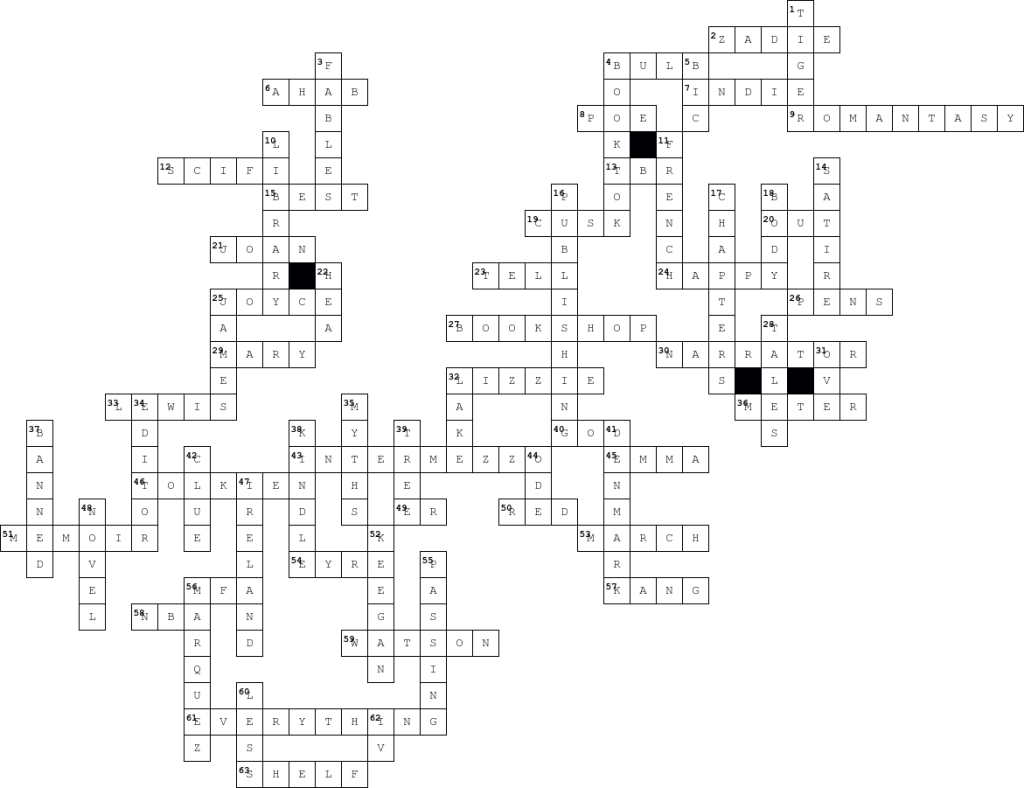
In my opinion, most crossword puzzles have too many boring trivia about sports, obscure historical events, and science questions (seriously, who cares how many molecules are in an atom?). So, we decided to take out the bits we didn’t like to create a crossword puzzle tailored for those of us with English degrees or who simply love to read. Forget baseball stats or presidential timelines; this puzzle is all about literature along with a couple cheeky little references that you’ll be able to guess by looking on our homepage.
Prefer solving puzzles the old-fashioned way? You can grab a printable PDF of this crossword here. If you get stuck, don’t worry—the answer key is waiting at the bottom of the page.
Answer key
Across:
2. Zadie 4. Bulb 6. Ahab 7. Indie 8. Poe 9. Romantasy 12. SciFi 13. TBR 15. Best 19. Cusk 20. Out 21. Joan 23. Tell 24. Happy 25. Joyce 26. Pen 27. Amazon 29. Mary 30. Narrator 32. Lizzie 33. Lewis 36. Meter 40. God 43. Intermezzo 45. Emma 46. Tolkien 49. ER 50. Red 51. Memoir 53. March 54. Eyre 56. MFA 57. Kang 58. NBA 59. Watson 61. Everything 63. Shelf
Down
1. Tiger 3. Fable 4. BookTok 5. Pilot 10. Library 11. French 14. Satire 16. Publishing 17. Chapters 18. Body 22. HEA 25. James 28. Tale 31. Ove 32. Lake 34. Editor 35. Myth 37. Banned 38. Kindle 39. Tree 41. Denmark 42. Clue 44. Ode 47. Ireland 48. Novel 52. Keegan 55. Passing 56. Marquez 60. Less 62. IV
Beside me, a staircase leads to nothing but open, blue sky. My breathing is ragged, my feet moving quickly. I pass a fork sticking perpendicularly out of a telephone pole, and just past that, the pile of bricks under which there used to be a red lacy bra. These are the familiar objects of my neighborhood. Any direction I turn out my front door, the aftermath of disaster is all around. I pick up the pace.
It is 2012, a year after a tornado has flattened Tuscaloosa, Alabama, and I have just moved from my nice, intact apartment in my still-intact neighborhood to an area half a mile away—a neighborhood that was, and still is, mostly destroyed. Why would you possibly move there, my friend asked. Is it, like, attraction to a car crash?
I wonder this on my daily runs, as I wave at the same construction crews again and again, as I watch bright red poppies bloom in a perfect row along a walkway toward what was once a house, now just an empty lot. I am on mile three of my looping run through the neighborhood, jogging up and down roads that hug the lake and snake around churches. Tuscaloosa was a college town filled with pine trees and brick houses and reverential statues of football coaches, until those things were gone.
A few houses down from my own, there’s a cardboard sign on a stick jammed into the ground in front of a pile of rubble. It reads: We will be back! There’s a smiley face beside the words. It hasn’t budged in a year.
Why are you moving to that part of town? For a long time, I wasn’t quite sure.
Everything can be lost.
There is plenty of research on our attraction to disaster. A place to rehearse our reaction to catastrophe without consequence, one idea goes. An exercise in human sympathy, a part of our pro-social behavior, another says. The urban disaster, a favorite landscape of the apocalyptic film genre, attracts us because of its vulnerability, still another idea says. The high-rises, concrete, intentionally-sculpted trees proclaim human triumph over nature. But once they’re flattened, there is no clearer indication of our susceptibility. Everything can be lost.
The sky was blue, and then slate, and then green. April 26, 2011. I was in class, a graduate seminar on William James at the University of Alabama, where I was an MFA student, when the tornado sirens rang out. We were a little giddy, a little scared. None of us were tornado people. The forecasters had been prepping us for days with how big the storm system looked, how worried we should be. Once-in-a-lifetime kind of storm. But unlike the approach of a hurricane where specific towns and counties are ordered to evacuate, there is no precise estimate for a tornado, no way to say you, get out of town. There’s just the waiting and seeing.
It was not the first tornado warning in the nearly two years I’d been living in Tuscaloosa. They came regularly in central Alabama and never amounted to much, so I’d carried on with my day as usual: teaching freshman composition, writing, heading into my seminar that afternoon, checking my phone every few minutes for updates—though not, like everyone else, about the weather.
Six months before, back in California, where I’m from, my mom had a massive stroke. No warning signs, no preexisting conditions. A headache sent her to bed, and by the time my stepdad joined her a few hours later, she was covered in vomit and shit. She was in a coma for a week. We have no way to know how much she will recover, if she will recover, the doctors told us. We always want to be optimistic, they said, and we nodded. But we also want to be realistic, they said. With this level of a brain bleed, most people don’t really come back.
Because there was no way to imagine that, we didn’t.
When they woke her up a week later, she was fully paralyzed, with no cognitive function or ability to communicate. I was twenty-six.
I have written about my mom’s stroke before, about what it felt like to be in the room with her once she was awake, the ledge of her head where her skull was removed, the bulge of brain still bleeding, how her eyes stared off into space and did not make eye contact, how her hand would not respond to squeezes. I have written before about how her swollen brain, bursting open where her skull had been removed, made me think of popcorn bursting from its kernel. I feel horror at having already written that, printed it, and also at the fact that I’m still thinking about it: half-popped popcorn kernel as mother’s skull. I am still there. I’ve written about all of this before, and here I am again, trying to untangle all that remains a knot.
Rilke, in Letters to a Young Poet, writes, “go now and do the heart-work on the images imprisoned within you.”
Her brain as a kernel of bursting popcorn. Her shaking hand in the hospital bed.
The row of delicate Icelandic poppies planted along a walkway leading up to a pile of debris that had once been a house.
The storm itself is not what haunts. The ghosts grew after, in the days that followed, in the weeks, in the year where I tied on my running shoes each day and set out amid the rubble. Flying back across the country as often as I could to visit my mom in the hospital. Flying home to Alabama and the wreckage. That is where I get lost. Why did you move there?
The tornado warning siren was compounded by police sirens, a loudspeaker telling everyone to take shelter immediately. We could hear it from Morgan Hall, where those of us who’d been in class had gathered in a nebulous pack in the central hallway, unsure of what to do next. Someone, looking at her phone, said: the tornado has touched down.
What I hadn’t known before, not having been a tornado person, was that this was the information you were always waiting to learn: has the tornado kept itself tucked up in the sky, or has it touched down to earth? The former could bring bad winds, the latter was devastating.
We opened the outside door to run a hundred feet in the blasting rain to the next building, which had a basement, and that’s when I saw the sky. I had never seen anything like it. Though it was mid-afternoon, the sky was mauve, a deep bruise over the clouds. And behind those clouds, as far as I could see, green. Pond-green. Patches that seemed almost neon.
It was April, and the fresh leaves and little white flowers from the tree outside were smeared across the concrete. The branches whipped to near-snapping. I’d never seen anything like any of it. I remember that moment so vividly, those few seconds first stepping outside the door, because it was the first time I understood that here might be another disaster.
My main disaster, always, was what was happening to my mother. My family, across the country in California, was always in emergency. There was the current question of where my stepdad would live, after months of couch-surfing between neighbors, since they’d lost their house right as my mom had her stroke. He’d hinted to me, our little secret, that he did not think he would live if she died, once she died. That he did not intend to. She was his whole world, his singular focus. So it was also my job to keep him alive. There was my brother, after all, twenty-one and in college, and it would not do for him to lose both parents. What had happened to my family was mine alone to fix, mine to hold while holding the hand of my mom, tubes in every vein, eyes rolled toward some distant corner of the room while I kept my mouth shut, knowing it was too selfish to beg her to come back.
In her craft book Body Work, Melissa Febos states that her compulsion to write her first memoir, which was about sex work, addiction, her childhood and more, “was an expression of [her] need to understand what the connections were between those things.” This is what I’m aiming to get at; the connections between things.
Thirty or so of us made it through the pelting rain and wind into the building next door. We took the stairs into the basement, paced, and then sat down in the narrow hallway on dirty off-white tiles that usually gleamed under the fluorescent lighting. But everything was dark. The power was out. We could hear the storm outside, a story above us. The hiss of rain, and then the moaning of wild wind.
One person had a radio, and turned it loud for the emergency weather information. The tornado had been in the next town over, but now, the voice told us, the tornado was on the ground right here, in Tuscaloosa. We held hands, our hearts thudding. My friend Jess, petrified of tornados, crawled into my lap.
The wind was as loud as I’d ever heard. Ashley was calling her husband over and over again. He was home with their dog in the part of town we’d just heard had been razed. He was not answering the phone.
The radio told us it was the biggest tornado Alabama had ever seen. It was a mile wide. No, a mile and a half. It was on the ground. All of us in the dark, straining toward the one radio. It was gaining strength, moving quickly, and then: it was headed for the University of Alabama campus.
Jess was shaking on my lap, pinching my arms. The sounds above us grew louder, smashing, metal torn apart, a machine cranked to high right above our heads. Cracks so loud someone said: gunshots. I tensed my muscles, ready for the roof to fly off, thinking about what it would feel like to be sucked up into the sky. Wondering how my family would survive a tragedy on top of a tragedy.
Back home, bad luck compounded. The most recent surgery to try to quell the relentless bleeding in my mom’s brain had resulted in sepsis, an infection so serious we’d had to wear astronaut suits and gloves and masks to visit her, and the only purpose of that visit, we’d been told, was to say goodbye. Alarms screamed, her eyes closed or opened in shock, but without focus. Nurses rushing in and out.
And then she died.
But that was not her final death.
Later, I would learn that when the tornado first touched down in Tuscaloosa, it tore through the Tamko Roofing plant, sucking a warehouse of nails and shingles up into the sky. So the tornado, as it tore through our town, was filled with weaponry.
Not long before the tornado, Jess had passed me a little love note. She had also recently lost someone important to her, a friend and former love. The note said we were sisters in grief, going through the same experience, and here was a thing she was doing to help with her grief and maybe I should try it. No, I said to her. Don’t try to connect these things. She later told me I snapped at her. It is not the same, I said. I didn’t want connection. I only had space for emergency, and the only way I knew to survive emergency was totally and completely on my own.
In our underground bunker, Jess curled into a ball, crying, the tornado above us. She was so scared, I thought right then, because she had room inside her to be scared. At first it made me angry, that she had space to be afraid. Then I was embarrassed for her. I was all filled up with grief and disaster and so could sit inside a tornado and wonder, with relative calm, what it would feel like to be suctioned up into the sky.
We waited, tensed. All of us straining to listen. After a few minutes, the cacophonous sounds grew fainter. But the radio had told us there was more than one tornado close by. We weren’t safe yet. We waited.
And then someone climbed the steps out of the basement, peeked out to ground level. Tree limbs were down, garbage cans and equipment knocked over. But the building stood. She could see no dead bodies. The rest of us emerged, blinking, into the afternoon. It was drizzling but we didn’t care. Someone put on music. We stood in a little pack between dumpsters, and people started dancing, laughing wildly. Hugging. What I remember is the overwhelming smell of pine, fresh, sharp, bringing me back to a memory of camping as a child and using pine needles to make beds for the fairies I was trying to catch. There were all of us here, alive. Ashley’s husband was ok. Jess had stopped shaking. I hadn’t learned yet that the air smelled like pine because all the trees for miles had been split or knocked down. That the cracking we’d thought was gunfire were the trees snapping in half. That the tornado had, amazingly, lifted its toe and stepped right over us, but that on either side of us, just past where we could see, there was nearly nothing left.
The storm left scars in the earth so deep, they can be seen from space.
My mom died of septic shock, but then they brought her back to life. Her brain still bled, her right side was still fully paralyzed, she could not communicate, but she was no longer dead. In her advanced directives, she’d written No Resuscitation.
We still never really knew what function or cognition would come back, what would be forever missing.
In the days following the tornado, the list of missing persons in Tuscaloosa alone was over four hundred. We heard stories of severed limbs in people’s yards. Of people’s bodies wrapped around tree branches like old mylar balloons. We heard the dead floated in all the bodies of water in town. I thought about it every time I ran by the small lake a block from where I’d later live, because I’d never heard for sure whether it was true.
Another of the first buildings to be flattened: the Tuscaloosa Emergency Management Agency. It was made of steel and 18-inch concrete walls, built to withstand nuclear fallout. The Emergency Operations Center, which held much of the city’s emergency rescue equipment, crumbled.
Sixty-two tornados hit Alabama that day. 240 people died, plus hundreds more killed in nearby states. It was the largest tornado outbreak in US history. The storm left scars in the earth so deep, they can be seen from space. Later, I would listen to the recording of a call between a policeman and dispatcher in Tuscaloosa. A bunch of babies are trapped in a building, the dispatcher says to the officer. Confirm your address. I am behind the precinct, the policeman says, and the dispatcher is confused, or growing irritated. Where are you, she says, there are trapped babies, you need to go. Confirm your address, the dispatcher says again.
I can’t confirm the address, he answers back. There are no addresses anymore.
We left our storm shelter, a big group of us convening at a friend’s house with the sturdiest basement. There was no question of going home to be alone for anyone; we were in it together. When we could find the emergency weather reports, they told us we had a couple of hours to take shelter again before another tornado would hit, this one much worse than the first. We bought as much beer as we could carry, made our way to the house, and when the tornado sirens rang out again, all sat on the dirt and concrete basement, in the dark, drinking, waiting for the worst of it.
But it didn’t come. This tornado was over. It was one of our friend’s birthdays, and eventually, after enough beer in the dark dirt of the basement, we crawled out into the yard, no lights but a hint of moon glow to see one another by, which told us that the storm had passed. Someone played music from their phone. We danced again.
The morning after the storm, the sun rose like it was any regular day. We emerged from the houses where we’d slept, and in a little pack went to go check on friends, on homes we hadn’t been able to access the night before. All of Jess’s windows had been shattered, and there were tree limbs in her living room, storm water and debris. We helped her pull out what could be salvaged, and then kept walking. Our friends and teachers were still not all accounted for. Trees and telephone poles were down across every road, so there could be no driving. What we didn’t understand yet was that we were still on the roads where nothing much had happened. We walked in a pack, shuffling like zombies. Stepped over downed power lines. And then we saw.
In the pictures I’d seen of storm wreckage up to that point, there were recognizable shapes: houses, their foundations or walls semi-intact but blown over, a car crushed, but clearly a car. What we came upon lacked anything recognizable. Nothing in the shape of a house, a car, a store.
We began walking toward friends’ apartments and houses, to see if they were alive. One of them, we knew already, had huddled in his bathtub while the rest of his apartment flew up into the sky. But we couldn’t make it to that part of town yet.
We ran into a frantic woman on a main four lane road. She was walking up and down the median and collecting scattered items, shirts and books and little plastic tchotskies. Nothing felt like reality because we could suddenly see the shopping center a mile and a half away, a collection of buildings we’d never considered from over here because it was all the way on the other side of town. All the buildings and trees that normally block the view were gone.
The woman was unloosed, muttering to herself. A looter, we whispered to one another, hanging back to keep our eyes on her. We knew to look for the bad guys. The national guard hadn’t yet arrived, though a day from now they’d be lining the edges of the neighborhoods with huge guns strapped across their chests. And a day from now, do-gooders would flood in from surrounding towns in pickup trucks, passing out sandwiches, bottles of water, hopping out of the back with chainsaws. President Obama hadn’t yet come to assess the damage, to say that he’d never seen anything like it. For now, there were just us.
The woman sat down on the curb and put her hands on her head. “Are you ok?” one of my friends asked, sitting beside her.
“I don’t know,” she said. Her dark hair was messy, ruffled by her nervous fingers.
“Do you need help?”
“No,” she said. “Maybe. It’s my husband. He died two weeks ago. I had a container of everything he owned being shipped back to his hometown. The tornado picked it up from the storage facility and dropped it here.” We looked at the road. It was covered in stuff. Shoe horns. Loose papers. Foam fingers. A twisted, half-intact metal shipping container.
“This is his,” the woman said, gesturing toward everything.
Our zombie pack started picking up the dead husband’s items. There were a few worn baseball caps near one another. I collected them, walked back to the woman on the ground, holding them in front of me. She nodded. I set them beside her, on a small pile of random goods she’d already begun assembling. We carried on like this for a long time.
“I just got a call,” she said when I brought over a car seat that was not hers. “Someone found his birth certificate.” I nodded, encouragingly. “In Georgia.”
We kept on with her for a while, helping to box some stuff and tuck it back into the wrecked container. She said a friend with a truck was going to come as soon as the roads were opened.
We did what we could. It wasn’t much. The road was still covered in people’s lives.
After Hurricane Katrina, countless stories were circulated in the media of looters, rapists, gangs of people who were taking advantage of the storm to steal from others. In these stories, the bad guys were usually Black. I have no doubt that racism abounded in the cleanup from the Tuscaloosa tornado. And also, what I saw, again and again, were all kinds of people helping one another.
The woman left eventually, and we did too. I’m sure she never got all her husband’s stuff. The morning we met her was likely just the beginning of the real difficulty, except it wasn’t the beginning, and that is the whole point. She was already inside her own private tragedy when the tornado came.
The critic Rebecca Solnit writes about our response to catastrophe in her landmark book A Paradise Built in Hell, in which she explains that, “in the wake of an earthquake, a bombing, or a major storm, most people are altruistic, urgently engaged in caring for themselves and those around them, strangers and neighbors as well as friends and loved ones.” In opposition to the story commonly perpetuated about looters and violence after a crisis, Solnit looks closely at the way communities came together after five disparate disasters, and how most—not all, but most—people chose altruistic collectivism. This, she says, is the kind of paradise of community that can arise in the midst of hell.
I’m spending time here, on the tornado and days just after, trying to get it right, because there is not much I can write about what comes in the weeks and then months to follow. Because this was the day I walked through my destroyed city with my friends and helped slice a tree into pieces so we could clear it off someone’s house. This was the day strangers began walking up the road from far-off to help, carting their chainsaws and axes, when people lugged coolers of PB&Js in Ziplocs and handed them out to every stranger they saw, this day, and the few that came after it, were the times I gathered with my community in this hellscape of destruction and found mostly—almost everywhere—people working from sunrise to sunset to help one another. I was there too, helping, doing what I could. Then I stopped.
“When will you be here?” my stepdad asked. I’d called him the day after the tornado to let him know I was alive. He hadn’t known about the tornado at all. “When can you be here?” It was all the reminder I needed. I didn’t have space for this new tragedy, for altruism, for community. I was still inside my own private disaster.
The pull of my private catastrophe was greater than this public one.
So I left. Flew home to be with my mom, days after the tornado. Probably I went because there was another emergency. I don’t remember now. But I do remember, vividly, what it felt like to take off from the Birmingham airport. Watching the trees and buildings grow smaller from the airplane window, I felt it all the way through my body. All my friends were back in Tuscaloosa, making crock pots of chili to share and sorting through donated clothes and chain-sawing downed trees, all of them there together, helping. There would be thousands of people who, like me, would leave the city while it was destroyed, those with the means to do so, but everyone else would be left to clean up the mess. I’d always thought of myself as a person who stayed to help. But here I was, leaving. The pull of my private catastrophe was greater than this public one.
I was extremely lucky, of course. I didn’t lose anyone or my home in the tornado, while so many others did. But I had many friends who also didn’t lose much personally, who stayed all summer in Tuscaloosa and helped with the relief efforts. I was back in California with my mom, waiting to see whether she could make any sounds now that her trach was removed, wondering whether this next brain surgery would successfully reintroduce the bone plate into her skull. My stepdad was falling apart at every turn, my brother did not come home from college, so I was there, alone, to do the work of keeping everyone alive.
One friend was out early every morning in Tuscaloosa, volunteering wherever she could, at first just rogue, wandering the streets and helping as soon as she found someone she could help. But then the national guard was there, the nonprofits descended to give order to the chaos, and she volunteered with them. Every day she went, morning to evening. Later, she told me about the overwhelming trauma of sorting through wreckage for so many days, weeks. Maybe she found dead bodies, I can’t remember. She started talking to a therapist about it, trying to process the experience, and as she described what it had been like out there, the therapist started crying. Can you believe it, my friend said. The therapist told me she’d never heard anyone describe the devastation of the tornado so effectively. And what I felt, hearing my friend’s story, was jealousy. She had been a part of something so big, so collective, that her grief was shared.
This, I think, is what pointed me toward the wrecked neighborhood. This is the beginning of the answer. Why did you move to that part of town?
Then it’s a year after the tornado, and I’m living in one of the neighborhoods I’d wandered through with my zombie pack, trying to help. The roads are clear. The power is on. I take long, looping runs past all that remains of the destruction. The Icelandic poppies are mostly open, their petals papery and thin, a bright red-orange against their green stems and the darker purple bulb of their interior. They are carefully spaced along the walkway, a stem arising every three or four inches.
The poppies are a marvel to me because they still bloom in such a meticulously straight row. Like the dirt here never got the message that everything above was different now. I slow down while I run past this brightness, wipe the sweat that is always blossoming from the humidity. The poppies’ walkway is concrete and leads to a step that leads to a front door, except there is no front door because there is no house at all. There’s a large, cracked, concrete foundation. Above that, where a house once stood, there is only air.
There are many beautiful places in Tuscaloosa I could run instead. There’s a path that runs alongside the Black Warrior River, for example, a wide calm waterway with low-hanging willows and brass bridges so pretty that in the spring, they’re clogged with high schoolers posing for prom photos. There’s also wide-open space a few miles away where, the story goes, a golf course had been donated to the city and left to grow wild, tall grasses and little yellow wildflowers springing up where there once had been so much order. It runs alongside an arboretum, and in there, tall, thin trees lose orange and red leaves in the fall that make the ground look aflame.
But I don’t run in those places. I run here, where I’d put my arms around a stranger and told her I was sure her son was ok, wherever he was. I run here, past the family of feral cats, and the glint of something buried deep in the dirt that, on closer inspection, is a button eye. I run past the one perfectly intact house with columns and a gazebo and no neighbors. Beside it, a real estate sign posted on an empty lot full of debris reads: “Gorgeous Waterfront Property!”
There were other factors in my decision to move to the neighborhood, though in retrospect, they were small. My old apartment’s rent was increasing by $25, and Jess, whose own apartment had been destroyed in the tornado while she’d been curled on my lap, needed a new place to live. There was no obligation for me to step in. I was perfectly happy living alone. But she was looking for a new place, and some string that was trying to tether me to something good, to another anchor point in the world, maybe some internal guide pointing me toward what I kept missing in the solitude of my grief said me, I want to live with you, and let’s move to Forest Lake.
A group of geese live in the small lake alongside tornado debris—a dumpster, a crane, unconfirmed dead bodies—a block from our house. The debris stands tall out of the water like it is meant to be there, a statue in a botanical garden.
Like most of the other houses for miles, the house Jess and I share still has the spray-painted X on the outside that signals disaster. X-codes, they’re called, or search codes by FEMA, and drawn on by first responders. The four quadrants around the X indicate emergency information: to the left of the X, who was in the crew, on top, the date and time, to the right, the hazards found inside, and on the bottom, the number of people inside, alive or dead.
X-codes still mark nearly every house. Even the houses that have been repaired, moved back into, maintain their X-codes. They’re a sort of remembrance, I think. I saw them in New Orleans, after Katrina. And I will see them once more: near my home in Asheville after Hurricane Helene, during the writing of this essay.
Back in Tuscaloosa, back to 2012. I run past a house on the corner whose yard is overflowing with flowers: pansies, roses, lilac. The lot looks almost normal, except for the black plastic still nailed over a section of the roof, and its spray-painted X-code. No bodies inside that one. The black plastic flutters in rhythm with the tall blooms as wind passes down the street in strong gusts, common now since there are no tall trees or buildings to block it. In the house next door, the young man who lives with three dogs emerges from his door each morning, shirtless, and practices some form of martial arts on his weedy lawn. I say hello to him when I run, to the construction workers repairing a roof, to the tractor driver clearing debris, to the dozens of lots with no humans but cicadas grinding their legs, and then I run home. Jess will be there, wrapped in the calf-length purple down coat she wore as a robe, pouring coffee. Why did I move to the disaster? Maybe a deeper part of me understood there was more work to be done connecting the threads, that the coming together I’d missed by leaving didn’t mean I’d lost it all.
It feels too easy, that idea. But I like what it suggests about humans, about me. Instead of the story I usually tell myself about how I was lost in grief and emergency, maybe this story is about unconscious choices acting in service of what I needed to be ok. That’s a generous idea. The world’s mysteries being answered by some inner music, singing you toward what you need.
There was nothing I could do to help my mom after her stroke. I stood against the hospital walls, sat on the edge of hospital beds. I held her hands, talked to doctors and social workers and nurses and hospice, but nothing was actually helping. I tried to teach my mom basic sign language and how to hold a pen to write yes or no or thumbs up thumbs down or to nod, anything to communicate—and failed. Time stomped forward. A month of that, a year. Six years. I have written about this before, but doing so has not enabled me to escape this central truth of my life. The almost unbearable weight of witnessing so much suffering. Living inside your own impotence right alongside it. Being there, alone.
A major loss in our own lives often isolates us from community, Rebecca Solnit writes. Nobody else is suffering in this way we are suffering; we are alone in our grief, in our loss.
Public disasters on the other hand, Solnit posits, usually have the effect of bringing a community closer together. For me, maybe I was still so deeply inside my private disaster when the tornado happened that I did not find the feeling of togetherness that so many did afterward. Or maybe I did for a few days, and then I left. Why did you move to this part of town? When I came back, I was outside the cohesion. Maybe by running to bear witness, I was trying to find my way back in.
Now, writing this, it is 2024, and Hurricane Helene has just taken out every road in and out of my city, Asheville. All of them are closed, gone. The water is out and power is out and cell service is out and internet is out. I have just completed this essay I’ve been thinking about for years, about public and private disasters, when another disaster arrives.
This time, I do not have a mother I am traveling back to see. She is long dead. This time, I have a child. She is two and a half, loves to sing, and has just gotten into poop jokes.
When a single road opens a few days after the storm, we pack our camper van and leave. I have a small child. There is no other choice.
We leave, and I get my daughter and husband settled at his mom’s house in Tennessee. I take a shower, I drink some water. And then I come back to Asheville, alone.
My camper van is filled all the way up with drinking water, shelf-stable food, diapers, wipes, pet food, flashlights, hygiene products, anything on any list I could find that people might need. I drive supplies deep into parts of the county with nothing left. I deliver them to the doorsteps of mothers I connect with on Facebook who need size 2 diapers, Similac formula, toddler snacks. I deliver latex gloves, Ziploc bags, cat food. And water, for everyone. I cook food, I knock on doorsteps to search for the missing, I comfort a man whose son-in-law was washed away in the river.
There’s no heroic conclusion to reach here about the right way to move through a disaster during the emergency or the long tail of its aftermath. This likely won’t be my last disaster, with the way things seem to be going. But I will tell you that for the five days I was back in Asheville alone after the hurricane, from sun-up to long after sun-down, I did not stop moving, driving, stacking, clearing, and each day, many times per day, I thought about the last disaster. I remembered not so much how the land had looked from the departing airplane window, but the feeling of getting further and further away from it. I remembered that as this time, I said yes to anything, feeling my hand graze a stranger’s as I helped peel away waterlogged drywall, as I passed along a box of pull-ups. So far, the feeling has been simpler. Gratitude, again, for not having lost much myself. And for getting to be here this time, in the middle of it. With all the other people in the middle of it.
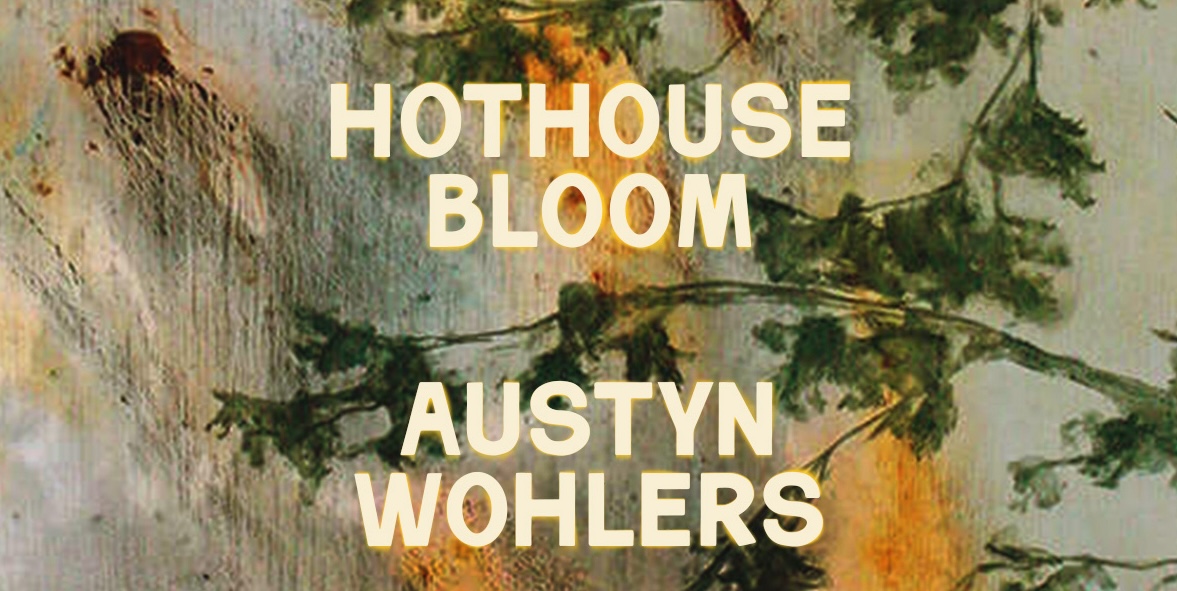
Electric Literature is pleased to reveal the cover of Hothouse Bloomby Austyn Wohlers, which will be published by Hub City Press on August 26 2025. You can pre-order your copy here.
In the vein of Rachel Cusk, Han Kang, and Clarice Lispector, Hothouse Bloom follows a young woman who renounces her painting career and all her human relationships to become one with her late grandfather’s apple orchard.
Anna arrives at the orchard with the intention to abjure social life, deverbalize her experience, and adjust her consciousness to the rhythms of the trees. She succeeds, for a time, until the arrival of her old friend Jan, nomadic and lively and at work on a book about the painter Charles Burchfield. Alarmed by her isolation and declining health, he tries to get her painting again, while Anna is determined to show him the orchard as she sees it.
As the harvest approaches, the outside world descends in the form of pickers, contractors, neighbors, and pomologists. Anna realizes that the only way back to her idyllic life is to turn a profit. It becomes an obsession, much like her former in the way it consumes her, the way an apple oxidizes, might rot.
Hothouse Bloom is a millennial pastoral, both painterly and critical in its ideas about art, permaculture, subjectivity, and the natural world.
Here is the cover, designed by Meg Reid, with art by Daniel Ablitt.
Author Austyn Wohlers: “Hothouse Bloom is a novel in part about the emotional and material necessity of other people that masquerades as a slow, painterly, and solitary nature novel for its first half. As we were looking for cover art, I was emphatic that I didn’t want it to just look like a run-of-the-mill American nature novel, and that I wanted it to feel a little psychedelic, since so much of the language of the book is watercolory, dizzying, and elemental. I’m happy to have found Daniel’s painting, which unites a lot of those elements. The blurriness of landscape and setting—in the background forested mountains, a tree, or a colored ray of light. The focus on flora, which takes up all of Anna’s vision. The two red silhouettes, which could stand for a number of people in the novel but most likely Jan and Anna, which are both stark and a little vague, a little mysterious, and red like the apples Anna cultivates.
It took us a long time to decide how we wanted to do the typography. I have always liked how older books, poetry books, and certain presses like NYRB look where there is more focus on the design and less on big text, and I like the starkness and austerity of the typography we went with. At the same time, I wanted it, again, to look a little ‘psychedelic’ or ‘off,’ to key readers in to some of the wonkiness of the book, and was playing with some very minor visual distortions of the title text. We ended up going with a barely perceptible gold inkstain around the white text that you might not even notice at first glance, as though Anna’s painting were spilling or some celestial substance oozing out of the title.”
Designer Meg Reid: “It was a joy to work with Austyn on this cover. I love when authors know exactly how they want their book to present itself in the world and it’s my job to simply put ideas in front of them and refine. I loved how the image reflected the overwhelming intensity of the natural world that Anna yearns to belong to with branches reaching in and intertwining with the figures and I was especially struck by the vivid red of the two silhouettes—an intense hue that evokes Anna’s paints, apples, and blood—against the bruised colors of the mountain and sky.”
Artist Daniel Ablitt: “‘Time and place (red silhouette)’ is drawn from a memory I have from a family holiday in the U.S. We visited Yosemite National Park for a few days camping. This painting is of myself with my younger brother. My aim was to capture that feeling you get with a memory; of the details being blurred but the strong emotional connection to that moment remains clear.”
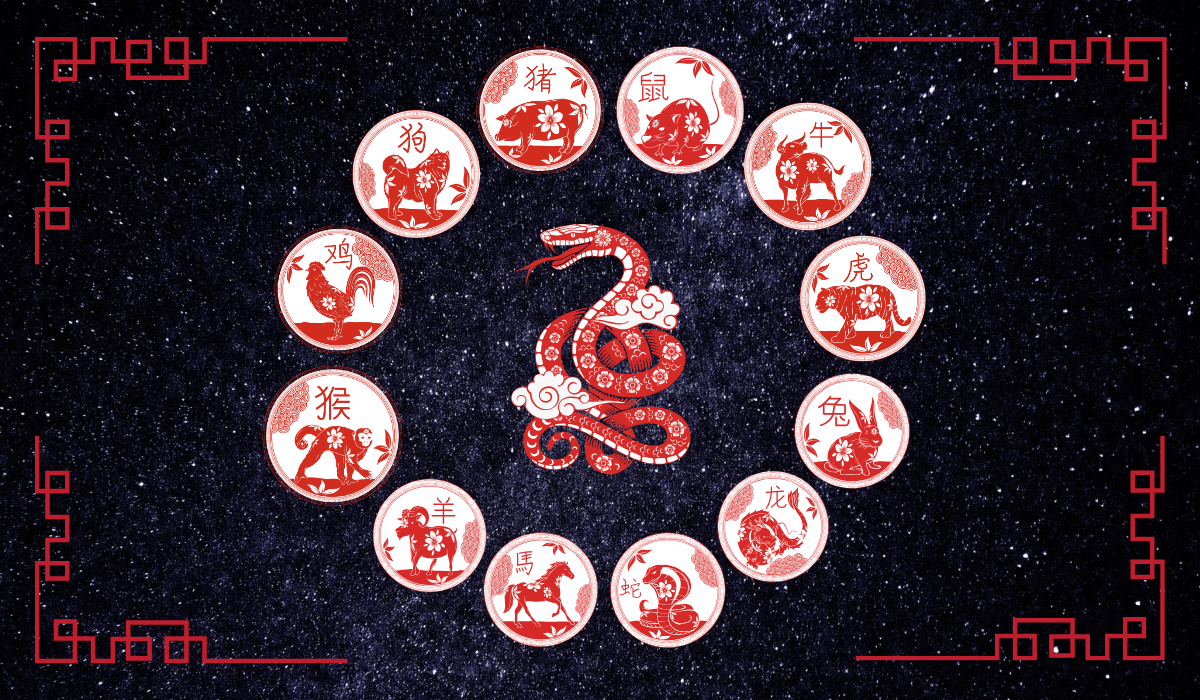
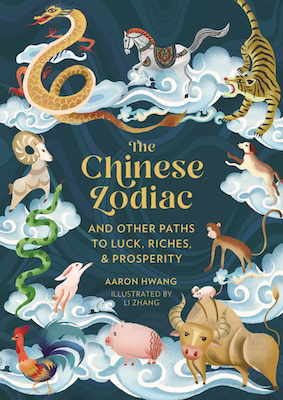
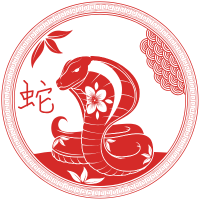
On January 29th, 2025 the Lunar New Year sheds its skin, and emerges into the Year of the Wood Snake.
Mysterious and maligned, the Snake is a misunderstood beast. Sixth of the twelve animals of the Chinese Zodiac’s cycling universe, the coils of the Snake represent the inner self, the unknown, and that which cannot be held.
For a writer, the Snake is the sting of mystery. Can the world’s white noise be rendered graspable? Can we reassess the familiar, and remember that some part will always be out of reach?
The Wood Snake in particular, invokes the blank slate, the empty page. When linked to the element of Wood, the Snake stands for the infinite possibility of emptiness. It is a time for new beginnings, to try new things, to keep in mind all that can be possible when preconceptions clear away.
Strongest in early Summer the Snake is associated with the quiet, inner fire of life, and paves the way for the heedless exuberance of next year’s Fire Horse.
Here is a look into the kind of fortune the Snake might portend for writers of every year sign.
This year the details seem to slip away. No matter how many problems you open up, smaller problems seem to rest inside. Words can only ever approximate the truth: pick a favorite problem and see if you can reframe it. Is the failure a problem, or is it part of the unevenness and texture that is reality?
As your Arts Star transitions to the Robbery Star the year sharpens to a blade before you. You will have to grasp one end or the other. It is a year for loss and ruthlessness. You will lose favorite words, scenes, pages, ideas, and yet, the Snake reminds us nothing is ever lost. Absence is also presence, one that is subtle and potent.
This year the ground shifts beneath your feet. Maybe you’re seeing a project in a new light, maybe the outside world is intruding on your routine. It may bring you peace to make your own stability. Carve out a time and space to which you can be constant, and it will bring you constancy in return.
This year you are part of the Western Triad—between the Ox and Snake persistence meets flexibility. For professional gains look to the Rooster’s social flair, reaching out, pitching ideas, coordinating projects, and putting yourself in the public eye. Pay attention to first impressions. Flash isn’t everything, but sometimes substance finds it a useful friend.
As your ominously named Death Star rises in the Snake, this is a year to take stock of your situation. The slipperiness of the Snake is said to frustrate the Tiger—this may be a year where nothing much seems to make sense, where all around you seem to be false fronts and false starts. Trust yourself, and focus on the process, the moment, the page, the simple pleasure of picking one more word.
Like a sunning snake or sleepy cat, this is also a year to bask. Try to rest mindfully. Don’t slump into vice as a mere distraction, avoidance, or guilty escape. Commit to pleasure. Be mindful of what you do for joy and you may be surprised how it feeds your art. Whether the tiger eats or rests, loves or hunts, it does exactly as it should.
In your native element of Wood, you may find your natural sensitivities amplified. Terms like joy, anger, and anxiety are rough umbrellas for countless sensations too specific and precise to name. When you next journal, stop and consider not just your thoughts, but these infinite feelings that we name too bluntly. Can you pinpoint the fine distinctions? Can you name what makes them yours? What do they become when they meet the page?
The Snake is also your Travelling Horse Star, suggesting movement. It’s a year in which you may cover a lot of ground, move from idea to idea, or else circle a restless pivot that won’t sit quite right. When in doubt, cut the snare, be free.
As the year of the Wood Dragon ends and your Age Star passes, you enter a new phase of life. Things may feel upside down this year as the fullness of the Dragon shifts to the emptiness of the Snake. Take this chance to pay attention to what is confounding or strange in your writing: scenes that confuse, images that captivate you alone, visions that feel potent for reasons you don’t understand. A new horizon is strange by necessity.
Lastly, with the Robbery Star, it’s a time to both hoard and discard. What preconceptions you shed and what new obsessions you take on is up to you alone, regardless of how peculiar. What a dragon deems precious is treasure by default.
As you meet your own year, a Zodiac is said to meet their Age Star. The sign of a new phase of life, it is a delicate transition, a tender new skin. Somewhere a radical transformation is ready to take place, perhaps one that scares you. Change arrives where we least expect, but the Snake has power to shape themselves. What is the transformation you are looking for? What is the first step to making it reality? Writing so often hinges on transformation—are there any that you haven’t considered yet, ready to fruit, and surprise even you?
The Age Star is also a time for reflection and caution. What is the heart of your work, your end goal, your life? Not everything needs to change, if you have the awareness not to let it.
This is a year for acceleration. The Wood Snake is spark and tinder ready to feed your hidden Fire, ready to burst forth next year.
For now, let yourself run wild. Chase your desires. When you want to write, write. When you want to daydream, daydream. You may be surprised how one feeds the other. Avoid self-editing and just see how long and far you can travel when you want to travel, both on the page and in your mind.
This year the Wood Snake is also your Death Star, which in your case means courage. Take ten minutes to answer the question: what about your work most scares you, and why? After doing this exercise, face the work again, acknowledge the fear, and move forwards.
The Wood Snake may deplete your hidden Earth element. When mystery hollows you, and meaning seems elusive, this is a good year to look outwards. What can you move or touch with your bare hands that brings you pleasure? What palpable measures of your work bring you fulfillment?
Reach out to others, be open about your craft and you are more likely to find like-minded souls. Push to get your writing somewhere it will be read, whether that’s in a published medium, a group workshop, or even just the hands of a trusted friend. Who is it you want to speak to, and how can you reach them? There might be more avenues available than you think, if you’re willing to take the leap.
Curiosity and mystery, the Monkey and Snake are a natural pair. Where the two come together, they create Water energy, the element of the subconscious, of endings, of letting go.
Consider journaling for ten minutes just before you go to bed, or just after you wake up. Follow no prompt at all, except for the first image that pops into your head. Pursue it, no matter how strange. You may write something interesting, but that isn’t the goal. It is enough to converse with the thing inside us that creates, unfiltered. Where water flows once, it flows easier after.
It is also a good year for work – even when it seems to go nowhere. Nothing truly disappears, and our choices settle within us like stones, lending their weight, even long after they’ve fallen from view.
This year you sparkle like silver, traveling from your Metal-partnership with the Dragon, to the Metal generating Western Triad. It is a year to play with nuance. What happens when a problem has no good solution? How are characters, are we, then forced to change? It’s also a good year to play with voice and humor. Push yourself, laugh, ventriloquize. You might be surprised who you meet.
To fill out your Triad you are seeking the persistence of the Ox. Keep showing up and answers will come. Surround yourself with reliable people, and you will find your own patterns growing more reliable.
As you exit your opposition to the Dragon, many things settle into place, and new challenges arise to replace them. The Red Phoenix Star and Death Star both meet you with the Snake, suggesting a year of passion and unease. Desire is a powerful force under the Red Phoenix. This may be a time to consider how desire drives story, and how it functions in your work. What do your characters really want, and what do they become if their desires are thwarted, or impossible?
We may also look at the year through the lens of our own desires. It is easy to assume all we want is the achievement of our goals. But there are always more goals, and hunger is a hard master. Fulfillment is not a place you arrive, but a relationship with travel. Where do you feel yours?
The Snake and Pig are natural opposites. Where the Pig lives in the moment, in the body, the Snake is of the ineffable. As the Snake loops its coils without a center, this year we may find the familiar grows unfamiliar. We may wonder what makes us who we are beyond a series of external poses, styles, or genres. But opposition years are a time for introspection, a good time to resolve what is unsure within ourselves.
If your writing stalls, take ten minutes to journal with one of the following questions: Why do I write? What do I want my writing to be? What do I need from my writing and why? What keeps me from writing? Write by hand so the process feels casual. Afterwards, let yourself return to the work, and see if the answers settle.
From Robert Coover’s The Public Burning to Lance Olsen’s Always Crashing in the Same Car, many novels over the past half century have used public figures like Richard Nixon and David Bowie as significant fictional characters.
Unlike traditional fiction where characters are “loosely based on” or “inspired by” real people, Coover’s and Olsen’s novels rely heavily on factual, biographical details. They name names. Yet, Coover and Olsen are neither biographers nor documentary novelists. They unapologetically invent, blending fact and fiction into a higher symbolic truth.
My debut short story collection, Alternative Facts, likewise names names and explores the porous boundaries between fact and fiction, focusing specifically on figures who have ushered in our post-truth era. George W. Bush almost tells Jay Leno the truth about his paintings, Kellyanne Conway lands a punch, and Paris Hilton falls from a helicopter onto Thomas Pynchon’s fire escape, leading to a surreal adventure full of magical dentists, talking dogs, and unexpected friendships.
Compared to fictionalizing public figures in novels, fictionalizing public figures in short story collections presents unique challenges. The characters have less time to develop, and their stories must also converse with each other, returning to similar themes and building an arc across the collection. At the same time, the stories must vary enough stylistically and structurally to maintain the reader’s interest.
Here are seven of my favorites, all masters of the form.
A finalist for the PEN/Faulkner Award, Various Antidotes depicts both historical and imagined figures reckoning with scientific and medical innovations, including the mental asylum, progressive relaxation techniques, and chloroform. Throughout, Scott dazzles with her ability to write in a range of voices and prose styles while developing subtle linkages between individual stories. An early story about Charlotte Corday’s guillotine beheading, for example, resonates in a later story about Topsy the elephant’s public electrocution. Likewise, my three favorite stories in the collection—about the microscopist Antonie von Leeuwenhoek, the blind beekeeper Francis Huber, and a man proved sane by X-ray—revolve around themes of lost and enhanced vision. Although Scott is perhaps better known for her biographical novels Arrogance and Careers for Women, her beautifully and intelligently crafted collection of short biographical fictions holds its own.
Millet’s Love in Infant Monkeys was a finalist for the Pulitzer Prize and for good reason. The ten short stories, all revolving around human and animal relationships, show Millet at the height of her powers: satirical and insightful, hilarious and touching. The title story focuses on Harry Harlow, the famed American psychologist who cruelly separated infant rhesus monkeys from their mothers, demonstrating the importance of maternal contact. In Millet’s story, one of the mother monkeys confronts a drunk and depressed Harlow in a dream. In “Sexing the Pheasant,” one of my favorite stories in the collection, Madonna shoots a pheasant on her country estate and struggles over what to do with the dying bird. Relieve it of its misery? Wait for her husband to return and finish the job? Millet brilliantly depicts the pop star’s self-absorption and vulnerability, ending on a surprisingly tender note.
As the title suggests, Martone’s debut collection includes eight short stories about well-known individuals, both living (at the time of publication) and dead, with ties to Indiana. In the poignant opening story, “Everybody Watching and the Time Passing like That,” James Dean’s indignant, flustered high school drama teacher, Adeline Mart Nall, recalls where she was when she learned of her famous former pupil’s death. In another favorite, the understated “Whistler’s Father,” the painter James McNeill Whistler’s father, who died when his son was only sixteen, quietly muses from beyond the grave about why his son didn’t paint his portrait. Although the collection was published when Martone was only in his late twenties, the writing already displays his later fiction’s hallmark playfulness, pop cultural fluency, and home state affection.
This collection features stories about fascinating yet under-appreciated women from history, many with ties to more famous literary men, including Lucia Joyce, daughter of James Joyce, a dancer; Dolly Wilde, Oscar Wilde’s witty and eccentric niece; and Allegra Byron, Lord Byron’s illegitimate daughter who died during childhood. Throughout, Bergman excels at bringing these historical women to life without airbrushing them, allowing them to exist on the page in all their messiness and complexity. Whether writing about the first racially integrated all-female jazz band, The International Sweethearts of Rhythm, or the female survivors of Bergen-Belsen, Bergman renders her characters with honesty and emotional nuance.
Another debut collection, Haskell’s I Am Not Jackson Pollock, offers an intensely psychological, philosophically rich look at the larger-than-life characters who populate our movies and mythologies, such as Jackson Pollock, Janet Leigh, Orson Welles, and Joan of Arc. In many of the stories, Haskell weaves together disparate vignettes, building subtle associational tensions and resonances. In “Elephant Feelings,” for example, he deftly shifts between threads about the elephant Topsy (again!), whose electrocution was filmed by Thomas Edison; Saartjie Baartman, an enslaved African woman exhibited across Europe as the Hottentot Venus; and Ganesha, the elephant-headed Hindu god. A former actor and performance artist, Haskell is at his best portraying characters losing themselves in their roles and struggling to reconcile themselves with their personas.
Translated from Italian by Gini Alhadeff, I Am the Brother of XX includes twenty-one haunting and geographically diverse short stories peppered with fictionalizations of well-known writers, scientists, and saints. Rendered in Jaeggy’s beautifully compact prose, these very brief fictions, most only a few pages long, feature isolated characters contemplating voids, nothingness, and silence. In “Negde,” the poet and essayist Joseph Brodsky takes an evening walk to the Brooklyn Heights Promenade, looking across the East River to where the Twin Towers once stood. In “An Encounter in the Bronx,” an unnamed narrator dining with the neurologist Oliver Sacks obsessively fixates on one of the fish in the restaurant’s aquarium who will subsequently be cooked and served to customers. The Austrian poet and author Ingeborg Bachmann also makes several appearances throughout, even entertaining the writer Italo Calvino at her rented Tuscan vacation home in the collection’s final story.
Years before Oates wrote Blonde, her magnum opus novel about Marilyn Monroe, she had already begun mixing fact and fiction in these five short stories about the final days (or afterlives) of Edgar Allen Poe, Emily Dickinson, Mark Twain, Henry James, and Ernest Hemingway. In each expertly crafted tale, Oates’s literary icons are brought down to earth, unable to escape their corporal frailties and vulnerabilities. Dickinson, revived as a robot, is sexually assaulted; Hemingway, no longer young or vigorous, confronts an ailing mind and body; and an elderly James, volunteering at a hospital for wounded soldiers, realizes he can no longer hide his erotic desires. Even more impressively, Oates evokes the distinct prose styles of her subjects, from Poe’s exuberant exclamations to Hemingway’s terse minimalism.
Literary merit has, for generations, been viewed as synonymous with gravitas, solemnity, and not smiling in your author photo. This especially holds true for books that tackle the topic of race (because it’s always a “tackling”), which readers often crack open expecting to be educated or to cry. (In a very funny 2006 guest essay for the New York Times, Paul Beatty describes reading Maya Angelou’s I Know Why the Caged Bird Singsand “growing more oppressed with each maudlin passage.”)
Of course, there have always been “serious” writers who approach the topic of race satirically, Booker Prize-winning Beatty amongst them. These are the authors whose work has always called to me and who I credit (and/or blame) for making me want to become a writer myself. There is something so absurd about race—this thing that is simultaneously a complete fabrication and also one of the most socially, politically, and materially real aspects of our lives—that only satire (in my unbiased opinion as a satirist) can capture.
Each of the books on the list below captures the absurdity of race in its own funny, probing, and heartfelt way. Some of the books include speculative elements, some are darkly comedic, some are laugh-out-loud funny. Some focus on the Black American experience, others on Asian American, Mexican American, mixed-race, and white American experiences.
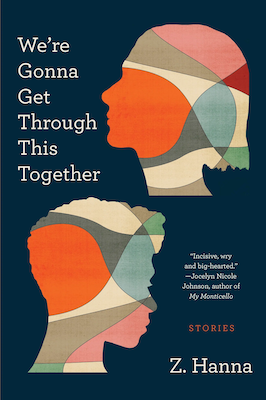
My debut short story collection We’re Gonna Get Through This Togetherbuilds off of the satirical (and also, at times, earnest) sensibility of these books. In several stories, I look at the well-meaning and also harmful ways that white people (especially those on the left) are engaging with race in our contemporary moment. In one of my stories, a white antiracist coach tries to keep her practice afloat after her Mexican-American business partner breaks up with her. In another, an aging white man sends an array of letters to a childhood friend, fundraising her to support Black lives. My hope is that my book—like the seven listed below—can create space for readers to look at race in new/funny/heartfelt ways.
In Colored Television, Danzy Senna tells the story of Jane Gibson, a biracial novelist living in LA who finally finishes working on her 450-page novel about mixed-race people called Nusu Nusu (Swahili for “partly-partly”). When she receives word from her agent that the book—a decade in the making—isn’t fit for print, Jane shifts gears and tries to pitch “a Mulatto sitcom” to a slippery television producer. Senna’s book is full of edgy (and deeply funny) banter about identity alongside earnest insights into racial dynamics in the U.S., such as Jane’s father telling her, “Black people didn’t want to be white […] They only wanted to have what white people had.”
Interior Chinatown playfully (and, at times, poignantly) satirizes Hollywood’s reliance on racist tropes about Asians and Asian Americans. Charles Yu takes his readers through a metafictional maze as he tells the story of Willis Wu, a second-generation background actor playing “Generic Asian Man” on a police procedural called Black and White that is perpetually being filmed. It is impossible to know what in the novel is happening on or off set, Yu’s way of communicating that Asian stereotypes are staples of both fictive worlds and our own. Amidst the tongue-in-cheek humor in this novel there are also many sincere moments, such as when a character calls out the painful contradiction of Asians being seen as “perpetual foreigners” in the U.S. despite a two-hundred-year presence in this country.
Nafissa Thompson-Spires, in her debut short story collection Heads of the Colored People, directs her unflinching gaze onto the lives of middle-class Black Americans, who navigate passive-aggressive white colleagues, suicidality, reality television cameras, and, in the haunting titular story, police violence. Thompson-Spires’s approach to satire is darkly comedic, with irony and agony sitting side by side. The funniest story in the bunch is “Belles Lettres,” a tense epistolary exchange between Dr. Lucinda Johnston, PsyD, and Monica Willis, PhD, two middle class Black mothers who argue in academic prose over the fraught relationship between their nine-year-old daughters.
My Name is Iris is a dystopian satirical novel that imagines a United States in which private citizens are required to wear technological ID bands (à la Apple watches) in order to enter their workplaces, go to the grocery store, and more. The hitch: in order to access one, you must be able to prove that at least one of your parents was born in the U.S. Iris Prince (born Inés Soto), Brando Skyhorse’s conservative second-generation Mexican-American protagonist, has to reckon with her politics, her challenging family dynamics, and her identity as she tries to procure a band, all while watching an ominous (and possibly imaginary) wall grow around her house. Skyhorse’s novel asks if it is possible to ignore or hide your racial identity when the state corporate nexus does not.
In Mat Johnson’s laugh-out-loud novel Loving Day, biracial comic book artist Warren Duffy returns home to Philadelphia to sell his recently-deceased father’s house and meets a rude Jewish teen named Tal who turns out to be his daughter. As the two try to build a relationship, they find their way to a mixed-race community called the “Mélange Center,” where people who identify more with their white side (like Tal) are forced to take courses about Blackness and people more identified with their Blackness (like Warren) must attend classes about the importance of embracing their white culture and ancestry. In this novel, Johnson packs endless punches about the absurdity of rigid racial categories and the lengths people will go to find a sense of belonging.
Jess Row’s Your Face in Mine is centered on a satirical premise—a white Jewish Baltimorean named Martin receives racial reassignment surgery to become Black—and, while it has its funny moments, the book approaches the topic of racial identity in a serious, almost philosophical way. The novel is narrated by a white reporter named Kelly who was friends with Martin in high school (when he was white) and meets him again as a Black adult, agreeing to help Martin tell his story of navigating “Racial Identity Dysphoria Syndrome.” (At one point Martin attributes his life-long struggles with depression, agoraphobia, and “involvement in illegal activities” as “the result of being born in the wrong physical body.”) In addition to commenting on the commodification of Blackness, Row touches on the fetishization of Asian identities in this novel as well.
Nana Kwame Adjei-Brenyah’s debut short story collection Friday Black, published a few years before his blockbuster 2023 novel Chain-Gang All-Stars, features his trademark satirical and speculative style. Using both humor and horror, Adjei-Brenyah spotlights the layers of violence that Black Americans are forced to navigate. In “Zimmer Land,” a Black employee at a theme park must feign both aggression and pain as white parkgoers “protect” their neighborhood from him. In “The Finkelstein 5,” a white man is found not guilty after using a chainsaw to decapitate five Black children who were standing outside of a library. Friday Black is ultimately an absurdist text pushing readers to consider the many-tentacled nature of white supremacy.
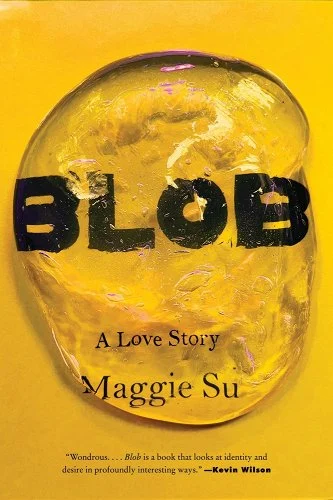
Firmly in the mess of her mid-twenties, Vi is fresh off a breakup, pretending to submit Peace Corps applications, and working at the front desk of a hotel in a midwestern college town. Outside of a dive bar one night, Vi finds a blob. She thinks about the slime she used to make as a kid, the kind made from Elmer’s glue and shaving cream, among other things. But, this blob breathes. Or, if breathing is too strong a word, at least at first, the blob’s body moves up and down. It’s alive. And it has beady eyes that seem sort of sad.
Lonely and wanting, Vi brings the blob home to her basement apartment. There, limb by limb, the blob becomes a man, aptly named Bob. Raised on a steady diet of Lucky Charms and television, his looks inspired by a collage of heartthrobs curated by Vi herself, Bob is a hot, blank canvas onto which Vi can project her greatest desire: to be loved.
With humor and honesty, in her debut novel Blob, Maggie Su crafts an absurd, compelling creation story that raises questions about love, belonging, identity, and what truly makes us human. Is a perfectly curated partner a dream or a nightmare? How does what we consume impact how we become who we are? How can relationships influence the stories we tell about ourselves? Can we ever really know anyone else?
I talked to Maggie Su about creation myths, efforts at control, relationships, and critiquing elements of culture that have caused harm.
Jacqueline Alnes: Can you just talk to me about Blob/Bob? I love him and want to know where he came from.
Maggie Su: I’ve always been really interested in speculative conceits and playing around with “what if” scenarios. At the time, I was really interested in relationships and how people connect. I found it so alien and strange and unlikely that you would meet someone. For some reason, it just blew my mind. I wanted to take the idea of romantic connection and make it into something as unlikely as I feel like it is to find a partner.
This started as a short story and turned into a five-minute play. By the time I started writing the novel for my dissertation, it was during COVID and I was stuck in my basement apartment (much like Vi) and I was feeling the isolation and loneliness. That’s where Blob and Bob came from –– moments of desperation and staying inside.
JA: I won’t spoil anything, but reading about Bob felt like a kind of creation story. Like a lot of creation myths, once the entity has agency, they can make their own decisions and the initial perfect premise is ruined, or changed. In love, you want someone to love you and stay with you, but you can’t force it; it’s such a devastating reality.
MS: It’s like the beginning of so many relationships, where you project your fantasies onto someone. The desire to control how things turn out. That’s one of Vi’s fatal flaws, is that she not only wants to control Bob, but also believes this myth that you can fully know someone. In her past relationship, she wants to know exactly what her ex-boyfriend is thinking. Every time he keeps something to himself, she wonders what it means. Blob allows her the opportunity to know everything about him because she created him. He is mine. I can keep him here. I think her realization that sometimes these things are outside of your control, you have to allow for space and allow people to be who they are, you can’t know everything about someone, are frightening and scary for her. I had fun playing with that balance through the speculative element.
JA: What Bob knows of the world comes from television and eating cereal. We see Bob watching something like Top Chef or wrestling and that becomes his language. It made me think about what we all consume on a daily basis, especially when we are in isolation. When we’re lonely and screens are what we turn to, our perception of the world can become so warped. Could you speak a little more to what Bob being new to the world allowed you to access?
MS: I loved being able to play with pop culture. The editors have these lists of my proper nouns and it became almost a found poem: Pop-Tarts, Fruity Pebbles, Top Chef, Padma Lakshmi. All these wonderful proper nouns pervade the book.
That’s how he’s learning about the world and that’s how we all learn about the world. I have a flashback where Vi is watching The Swan, that plastic surgery show that was on where they go in as “ugly ducklings” and come out after getting plastic surgery. I watched that as a kid, in my parents’ basement. There is critique there of the culture we grow up in and what we see represented. I think Vi not seeing herself represented anywhere and the microaggressions that exist in this small, midwestern town all came together to form her. I wanted race to be a part of the book, but I didn’t want it to be something that describes why she is the way she is; I wanted it to be a factor out of many. She is already an odd, difficult person, and you add this in and she’s wondering how her otherness fits within this society.
For Bob, I wanted to play with the newness, how he can see Jeopardy! or watch wrestling or consume porn. There was something exciting to me about having a character who doesn’t have as many hang-ups as Vi and seeing that creation –– and the difficulty he goes through about who he is and his identity crisis. Vi has that realization that everyone, even Bob, goes through this feeling of not knowing where they fit.
JA: And the way you do that with Rachel, too. She is this bubbly, blond coworker at the hotel and I think Vi has a perception that Rachel has it all together. But, the way she romanticizes her life means she never actually sees Rachel, in some ways.
MS: She feels like there are all these narratives that other people have and are able to follow and that for some reason, she’s not. She’s envious of people that are able to follow the scripts society has given them, or subvert them, or go between them more easily than she is.
JA: I longed for Vi to be able to accept love and also to finally love herself. Living as a Taiwanese-American in a midwestern college town and grappling with this quarter-life crisis on top of everything else –– things are rough for her at different points in the book. My question is, what did writing her allow you to explore?
MS: I was inspired by messy female characters. Some people will hate her and I won’t actually get offended by that, because I’m like, well, you hated her but you read the book, so something must have interested you about her. That’s all I can hope for. I rewatched that Season 2 Fleabag episode, the dinner episode, I think it’s fantastic. One thing I was learning from reading and thinking about flawed characters –– I mean, all characters are flawed! –– but I wanted there to be a mixture of lightness and darkness. I think the reason we are able to watch Fleabag is because there is that mix of comedy there as well.
I wanted to write a character who represented a messy Asian-American woman. I think we are seeing that more and more with Asian-American stories; it’s not just the Marie Kondo neat, perfect Asian-American daughter. There are bodily messy, socially messy, flawed women. The ways these stories connect to larger stories about race and go against the singular immigration narrative that has been really prevalent in Asian-American literature.
She’s a tricky character and I hope whether readers love her or hate her or find the horrible things she does forgivable or not, that they can see a character who is searching for love in the wrong places. It was important for me to have those vignettes of her backstory not necessarily to show why she does the things she does but instead: What are the forces that make us feel unlovable or unworthy or ungrateful? What is the guilt that we carry from place to place? There are certain things in our past, maybe, that we focus on where we made a mistake or didn’t do the right thing and Vi holds those closer to herself than anything else. She has this script for self-hatred and she’s having to unlearn that. It’s corny, but the love story is very much a self-love journey.
JA: Some of this relates to something you said earlier in our conversation about representation. Every person that Vi collages into Bob was in a magazine as like the “hottest hunk you should date.” I think the traits of what we see in movies or magazines or the qualities that were romanticized are narratives that don’t serve us. In the end, those are never real people.
MS: Definitely. It’s ironic because Bob is new and he is somehow still more socially adept than she is. He is able to find a connection with these frat boys and Vi is like, what? How are you able to do this?
JA: Parts of the story feel so absurd and hilarious, which helps lighten the darker moments or bring relief to Vi doing something that feels inexplicable. This book seemed fun to write. What did humor allow for?
MS: I remember complaining to my thesis advisor and she was like, you just wrote a scene where a man pops out of a pool like it’s a porno. How are you struggling? And I was like, that’s true.
It was a fun conceit. Bob added a lot of lightness to the book and optimism, in certain ways. His newness helped Vi get out of this stuck feeling she was feeling –– and he felt like that to me, too. When COVID was happening, there were a lot of dark news stories and a lot of isolation. To be able to escape into my writing and escape into these absurd situations brought me a lot of joy. I don’t ever write with the intention of being humorous, so I’m always a little surprised when it happens, but I like contradictions, I like putting things that are dissimilar together and seeing what happens.
The absurdity of working at a hotel, I had that summer job working the front desk at a hotel and sometimes when you are in that really mundane setting, you can find a lot of little humorous moments.
JA: I worked at a bed and breakfast and what struck me about working there –– and what you capture so well in Blob –– is just that humans are so weird. When they are walking through the lobby, making requests at the front desks, having interactions or fights that you get snippets of, it’s all so wild.
MS: I think when people are in hotels, they forget! They’ll come down in pajamas, more power to them, but you see glimpses into families, volleyball tournaments, dynamics. It was a fascinating ecosystem.
JA: For you, working through isolation especially, what was in the front of your mind to work through while writing this book? What questions were you interested in answering?
MS: I am in a very different place now. While writing, I was in isolation, in my twenties. I think it was me trying to digest the messiness of the dating scene, connection and relationships, intense loneliness, and really reflecting on what it meant to me to grow up in the midwest. Obviously Vi is not me, but so many of those experiences of feeling that otherness were. The pandemic and sitting with myself and sitting with my own thoughts and sitting alone really allowed me to channel it into something I could deal with. I started going to therapy for the first time, so I think that helped. A lot of people during the pandemic had to really come to a crisis point where they looked at their own lives and partially this book was that. And my thesis advisor was saying, your first book has been living in you for a really long time and it’s the one you need to get out. I felt that way about this book. I’m excited to move on.
JA: Reading this made me think about how hard it can be to see ourselves in that way where it’s raw and honest. It’s difficult to want to fully perceive yourself. It seems that Bob almost becomes this mirror for Vi, where when he enters her apartment she suddenly realizes the state of her apartment, she thinks about what she wears, she starts buying food. She starts being perceived in a way she has tried to ignore for the past few years of her life. Relationships, even if they are not right for you, can encourage self-reflection.
MS: So much of the book is how these external forces shape our characters. Vi is waiting for an external force to shape her, in some ways. She thought that her ex-boyfriend was this lifeline where, okay, I can just hold onto this person who seems normal and that will be my lifeline into this scripted, normal life that I’ve watched on TV. That will save me from loneliness. With Bob, it’s something she can control. In that way, I gave her what she thought she wanted. She thinks she can figure out how to be a person in the world through Bob. But I think you’re right. I think he provides a lens for her to want better for herself, in some ways, because she has to take care of him and therefore take care of herself.
JA: What did you learn from writing this book?
MS: I wrote a few novels for NaNoWriMo, but I would just abandon drafts so easily after that. The process taught me to trust myself and to follow what felt good in terms of writing. It’s very Yoga With Adriene. It’s been a dream of mine since I was a kid to publish a book, but it taught me a lot about trusting the process and trusting the reader. I wondered if it would be too much for people, is this unforgivable character going to pull people in or push people away, but it’s been really wonderful to learn that people have connected to some of her, regardless of whether you’d get a beer with her or not.
Let’s face it, women are no good. Or is it just me? I can’t speak for all women, but it’s beyond doubt that I, for one, am no good. And yet, even as I say this, an obstinate sort of self-belief, deeply rooted in some dark, hidden corner of my heart, insists that at least there’s one good thing about me . . . And that only leaves me all the more confused about myself, trapped in this oppressive, intolerable state of mind. It’s like having my head stuck in a rusty old cast-iron pot. I’m a stupid person. Genuinely stupid. And in the new year I’ll be nineteen. I’m no longer a child.
When I was twelve, my uncle in Kashiwagi submitted a student composition of mine for a contest sponsored by the magazine Blue Bird. My piece was awarded first prize, and one of the judges, a famous author, went hideously overboard in praising it, and I’ve been a mess ever since. That composition of mine is just embarrassing to me now. Was it really all that special? What was supposed to be so good about it? Titled “Errand,” it’s a simple story about being sent to buy some Bat cigarettes for my father. When the tobacco-shop lady handed me five packets, it made me a little sad that all of them were the same pale green color, so I exchanged one for a different brand in a vermilion packet. But then, sadly, I no longer had enough money. The lady just smiled, however, and said I could make it up next time, which was awfully nice of her and made me really happy. When I balanced the four green packets on the palm of my hand and placed the vermilion one on top, it looked like a blossoming primrose, so pretty that my heart seemed to skip, and I could hardly walk straight. That’s the gist of the piece, which I now find mortifyingly childish and cloying.
But it wasn’t long after that, at the urging again of my uncle in Kashiwagi, that I submitted another composition of mine, titled “Kasuga-cho,” and this time it was published not in the “Readers’ Submissions” section of the magazine but on the very first page, in big, bold lettering. The story begins with my aunt in Ikebukuro moving to Kasuga-cho in Nerima. She told me about the big garden in her new house and invited me to visit her there, and so, on the first Sunday in June, I boarded a train at Komagome Station, transferred to a Tokyo-bound train at Ikebukuro, and got off at Nerima Station, where I saw nothing but fields all around me. I had no idea which direction Kasuga-cho might be, and when I asked people working in the fields, none of them seemed to know, and I ended up fighting back tears. It was a very hot day. The last person I asked was a man of about forty who was pulling a cart filled with empty cider bottles. He stopped, flashed a lonely smile, and used a gray, soiled hand towel to wipe the sweat dripping down his face. He thought for some time, muttering “Kasuga-cho, Kasuga-cho . . .” Finally he said, “Kasuga-cho long way from here. You catch east train there, Nerima Station, east train to Ikebukuro. Transfer train to Shinjuku. At Shinjuku transfer local train, get off Suidobashi . . .” and so on, doing his best to give me these detailed directions in very broken Japanese. I knew right away that he was thinking of the other Kasuga-cho, the one in Hongo, but I also realized he was Korean, which touched my heart and made me all the more grateful to him. The Japanese people I approached feigned ignorance because they couldn’t be bothered, while this man from Korea, dripping with the sweat of his labor, takes the time to really try and help me. His information was wrong, of course, but I thanked him for his kindness and followed his directions, walking back to Nerima Station and jumping on a train for Tokyo. I seriously thought about going all the way to Kasuga-cho in Hongo, but that would have been silly, so I went straight home instead. Once there, I felt sad and out of sorts and decided to write down an honest account of what had happened. This account is what was published in huge print on the front page of The Blue Bird, and that’s when all my woes began.
Our house is in Nakazato-cho in Takinogawa. My father, who teaches English at a private university, is a son of Tokyo, but Mother was born in Ise. I have no older siblings, just a physically infirm little brother who entered middle school this year. By no means do I dislike my family, but I’m so lonely. Things were better before. They really were. Mother and Father both spoiled me rotten, and I was always joking and making everyone laugh. I was an excellent older sister too, very kind to my brother. But soon after my composition was featured in The Blue Bird, having won me another prize, I transformed into a truly cowardly, hateful creature. I even began talking back to my mother and arguing with her. The famous author Iwami-sensei, who was one of the judges, published in the same issue a commentary on “Kasuga-cho” that was two or three times the length of the story itself. It made me so sad when I read it. I felt as if I’d somehow deceived this great man, who was clearly a modest person with a heart much purer and more beautiful than mine.
And then, at school, Mr. Sawada brought the magazine to our composition lesson and copied out the entire text of “Kasuga-cho” on the blackboard, working himself into quite a lather as he harangued us for an hour, bellowing praise for each sentence. I could have died I had difficulty breathing, the world went dim and hazy before my eyes, and I had this horrifying sensation that my entire body was turning to stone. I knew I didn’t deserve all this praise; and what would happen the next time I wrote something mediocre or worse? Everyone would laugh at me, and it worried me half to death to think how embarrassing and painful that would be. Even at that tender age, I could tell that Mr. Sawada wasn’t impressed with the composition itself so much as with its having been featured prominently in The Blue Bird and lauded by the celebrated Iwami-sensei. But this realization only made me feel all the more unbearably alone. And the thing is, everything I was worried about actually ended up happening, in one painful, embarrassing scene after another. My friends at school suddenly began distancing themselves from me, and Ando, who had been my best friend, mocked me relentlessly, calling me “Ichiyo-san” and “Murasaki Shikibu-sama” and so on. Finally she stopped associating with me altogether, taking up instead with the Nara and Imai crowd, whom she’d previously despised. They’d huddle together, stealing glances at me and whispering, making nasty remarks, and bursting into squeals of laughter.
I told myself I’d never write another composition as long as I lived. Urged on by my uncle in Kashiwagi, I had submitted the piece without really thinking, and it was a big mistake. This uncle of mine is my mother’s younger brother and works at the ward office in Yodobashi. He’s thirty-four or -five and fathered a baby last year, but he thinks he’s still young and sometimes drinks too much and raises a ruckus. Whenever he comes to our house, he leaves with a handful of cash Mother slips him. When he entered university his plan had been to study to become a novelist, and although his teachers and mentors had high hopes for him, according to Mother, he fell in with an unsavory crowd and ended up dropping out of school. He apparently reads tons of novels, by both domestic and foreign writers, and he’s the one who urged me to send my stupid composition to The Blue Bird seven years ago and who’s made my life miserable in so many ways ever since. I didn’t like literature. I feel differently now, but at the time, with my silly compositions having been featured in two consecutive issues of the magazine, with my friends turning on me, and with my teacher openly giving me unwarranted special treatment, it was all just too much, and I came to hate even the thought of writing. I was determined that no matter how my uncle flattered and cajoled me, I would not be submitting any more works. When he pushed me too hard, I would just start wailing at the top of my voice and put an end to it. During composition class I didn’t write a single word but would doodle circles and triangles and paper-doll faces and things. Mr. Sawada called me into the teachers’ room one day and scolded me about my attitude, saying that there’s a difference between self-respect and arrogance. It was absolutely humiliating.
I was about to graduate primary school, however, after which I hoped incidents like this would be behind me. And indeed, once I began commuting to the girls’ school in Ochanomizu, I was relieved to find that not a single person in my class knew about my stupid essay having won some contest. In composition class I wrote with a carefree attitude and was happy to receive average marks. But my uncle in Kashiwagi continued to tease and badger me relentlessly. Every time he came to our house he would bring three or four novels and order me to dive in. I generally found these books difficult to understand and often just pretended to have read them when I handed them back.
When I was in the third year of girls’ school, my father received, totally unexpectedly, a long letter from the famous Iwami-sensei, the judge who’d selected and lauded my submission to The Blue Bird. In the letter, he called me a “rare talent” and said a lot of things I’m too embarrassed to repeat, praising me ridiculously and saying it would be a pity to waste such a gift. He urged my father to have me write more pieces and offered to help get them published. It was a serious letter, written in formal, self-effacing language that we were hardly worthy of. Father handed it to me without saying anything. When I read it, I once again felt admiration for the excellent sensei, but reading between the lines it was clear to me that my uncle’s meddling was behind this. He had somehow contrived a means to approach Iwami-sensei and trick him into writing the letter. I was certain of this, and I told my father as much. “Uncle put Iwami-sensei up to it. I have no doubt about that. But why would he do such a creepy thing?” I was near tears and looked up at Father, who gave me a little nod, showing me that he too had seen through it. And he didn’t look happy. “Your uncle in Kashiwagi means well, I’m sure,” he said, “but he’s put me in a difficult position. How am I supposed to reply to such a great man?”
When I read it, I once again felt admiration for the excellent sensei, but reading between the lines it was clear to me that my uncle’s meddling was behind this.
I don’t think Father had ever liked this uncle of mine much. When my composition was selected, both he and Mother had been thrilled and celebrated noisily, but Father alone protested, yelling at my uncle, saying that all this excitement was not in my best interest. Mother told me about this afterwards, sounding very disgruntled. She often speaks ill of her little brother, but she blows up when Father criticizes him in any way. My mother is a good, kindhearted, cheerful person, but it’s not uncommon for her and Father to get into arguments about this uncle of mine—the Satan of our family. Two or three days after we received Iwami-sensei’s courteous letter, they got into a terrible shouting match.
We were eating dinner when Father broached the subject. “Iwami-sensei has kindly gone out of his way to write such a heartfelt letter,” he said. “I’m thinking that, in order to avoid seeming disrespectful, I need to take Kazuko and pay him a visit, so we can apologize and she can explain exactly how she feels. Just writing a letter could give rise to misunderstandings, and I wouldn’t want to offend him in any way.”
Mother lowered her eyes and thought for a moment before saying, “My brother is to blame. Forgive us for all the inconvenience.” Then she raised her head with a little smile, dragged a straggling lock of hair back in place with her pinkie finger, and went on, speaking rapidly. “I guess it’s because we’re just a pair of fools, but when Kazuko was so extravagantly praised by the famous Sensei, we naturally wanted to ask his continued blessings. We wanted to try to keep things rolling, if possible. You’re always blaming us, but aren’t you being a little obstinate yourself?”
Father paused his chopsticks in midair and spoke as if delivering a lecture. “Trying to ‘keep things rolling’ is pointless. There’s a limit to how far a girl can go in the field of literature. She might be briefly celebrated for the novelty of it all, only to find afterwards that her entire life has been ruined. Kazuko herself fears this. The best life for a girl is to have a normal marriage and become a good mother. You two only want to use Kazuko to vicariously satisfy your own vanity and ambition.”
Mother paid no attention to what he was saying but turned away to reach for the hot pot on the charcoal brazier, then let go and cried out. “Ow! I burned myself.” She put her index finger and thumb to her lips. “But, listen. You know my brother has no ill will in all this.” She was still not facing Father, who now set his bowl and chopsticks down.
“How many times do I have to say this?” he shouted. “You two are preying on her!”
He adjusted the frame of his glasses with his left hand and was about to continue, when Mother suddenly let out a keening wail that quickly deteriorated into sobs. Dabbing at her eyes with her apron, she began bringing up financial matters, openly disparaging Father’s salary and our clothing budget and I don’t know what. Father looked at me and my brother and with a jerk of his chin ordered us to leave. I took my brother to the study, where for a full hour we heard them yelling at each other in the living room. My mother is normally an easygoing, openhearted person, but when she gets agitated she can say things so reckless and hurtful that it makes me want to stop up my ears with candle-wax. The next day, on his way back from teaching, Father called on Iwami-sensei at his home to express gratitude and apologize. That morning he had encouraged me to accompany him, but the thought of it frightened me so much that my lower lip started trembling and wouldn’t stop, and I just didn’t have it in me. Father returned at about seven that evening and reported that “Twami-san,” though surprisingly young, was a splendid gentleman who fully understood how we felt, to the extent that he ended up apologizing to Father, saying that he hadn’t really wanted to encourage the girl to pursue literature but had been asked repeatedly to write that letter and had finally done so, albeit reluctantly. He didn’t name the person who’d put him up to it, but obviously it was my uncle in Kashiwagi. Father explained all this to Mother and me. When I surreptitiously pinched the back of his hand, I saw him wrinkle his bespectacled eyes in a little smile. Mother listened, nodding calmly as he spoke, and had nothing to say in response.
For some time after that, my uncle didn’t come around much, and when he did, he treated me rather coldly and didn’t stay long. I forgot all about composition. When I got home from school each day I’d tend to the flower garden, run errands, help out in the kitchen, tutor my younger brother, sew, study my lessons, massage my mother’s shoulders, and so on. I was busy each day trying to be of service to everyone, and that kept me motivated and enthusiastic.
Then came the storm. At New Year’s when I was in my fourth and final year of girls’ school, my primary-school teacher Mr. Sawada paid us a visit. Mother and Father were taken aback somewhat but pleased to see him again and wined and dined him generously. Mr. Sawada told us he’d quit teaching primary school and was now working as a private tutor and living a more carefree life. He certainly didn’t strike me as being carefree, however. I had assumed that he was about the same age as my uncle, early forties at most, but now you might have taken him for fifty-something. He had always looked older than he was, I suppose, but in the four or five years since I’d last seen him he seemed to have aged about twenty. He came across as exhausted, lacking the strength even to laugh; and whenever he tried to force a smile, his hollow cheeks were creased with deep wrinkles. I didn’t feel pity for him so much as a kind of repulsion. He still wore his hair closely cropped, but it was predominantly white now. He praised me personally, which he’d never done when I was his student, and it left me somewhat confused at first, and then very uncomfortable. He remarked on how pretty I was, how ladylike, and so on-transparent flattery, delivered with an absurd degree of deference, as if I were somehow above him. He gave Mother and Father a frightfully tedious account of my primary school career, focusing on my compositions, which I, for one, had already happily forgotten about.
“Such a waste of talent.” he said. “At the time, I was not particularly interested in juvenile compositions and knew nothing of the teaching method by which creative writing can actually be used to enhance a child’s innocence and wonder. I have a firm grasp on the subject now, however, having done extensive research, and I’m confident in my mastery of the latest methods. What do you say, Kazuko-san? Why not have another go at studying composition under my tutelage? I can guarantee . . .” blah blah blah. He was quite inebriated by now, having drunk several cups of sake. Sitting with one fist on his hip, elbow out, he concluded this grandiose nonsense by insisting we shake hands to seal the deal. Mother and Father were smiling, but I could tell they didn’t know what to make of all this. Unfortunately, as it turned out, Mr. Sawada’s proposal wasn’t just drunken bluster. Ten days or so later he showed up at our house, acting as if we’d been expecting him.
“Very well. We’ll start by going over the fundamentals of composition,” he announced.
I was flabbergasted. I later found out that Mr. Sawada had found himself in trouble over something to do with entrance exams and had been forced to resign from the school, after which, in order to survive, he’d begun making the rounds of his former students’ homes, presenting himself as a highly qualified tutor and pressuring the families to hire him. Shortly after visiting us at New Year’s, it seems he discreetly wrote a letter to Mother, once again enthusiastically praising my so-called literary talent. He also informed her about the current popularity of the essay form and the recent ascendance of a number of young girls who were being acclaimed as literary geniuses. He was obviously trying to entice her into contributing to his scheme. Since Mother, for her part, still retained lingering regrets about my abortive literary career, she promptly fell into his trap, writing back to ask if he’d be willing to give me weekly lessons. She told father that her main intention in doing so was to offer some assistance to Mr. Sawada in his efforts to support himself, and Father reluctantly agreed, apparently feeling that it would be wrong to refuse a man who had once been my teacher. Such was the situation, and from then on Mr. Sawada showed up each Saturday to lecture me in the study, where he would proclaim the most ridiculous nonsense. I hated every minute of it.
“To master writing, the first thing one needs is a solid grasp of the use of postpositions.” He’d make obvious statements like this and then beat them into the ground, as if they were matters of supreme importance. “Taro plays in the garden,’ right? Taro wa niwa wo asobu, is incorrect. Taro wa niwa e asobu, is also incorrect. Taro wa niwa nite asobu’ is the proper way to say it.” When I giggled at these ludicrous examples, he glared at me reproachfully, as if trying to burn a hole in my face. Then he heaved a deep sigh and said, “Your problem is that you lack sincerity. However great a person’s talent, without sincerity he or she will never achieve success in any field. Are you familiar with Terada Masako, the one they call “the baby-girl genius”? Born into an impoverished home, the unfortunate child’s greatest desire was to study, and yet she lacked the means to purchase so much as a single book. The one thing she did have, however, was sincerity. She faithfully followed her teacher’s instructions, and that’s why she was able to produce that masterpiece of hers. And her teacher too must have been a zealous fellow. If you had a little more sincerity in you, I’m certain I could make you every bit as successful as Terada Masako. In fact, because you happen to be blessed with favorable circumstances, I believe I can make you into an even greater writer than she is. Why? Because in one respect, at least, I’m more advanced than her teacher was. I’m talking about my grasp of moral education. Do you know who Rousseau was? Jean-Jacques Rousseau. He lived in the sixteen hundreds-or rather the seventeen . . . Wait. Was it the eighteen hundreds? Oh, that’s right, go ahead and laugh. Laugh your insincere little head off. You have some nerve, mocking your own mentor because you think all you need is your talent. Listen to me. Long ago, in China, there was a man named Gankai, who . . .”
I know it’s naughty to say things like this about a teacher from primary school, to whom I’m supposed to be indebted, but I couldn’t help thinking that the man was losing his grip.
He would go on and on, talking about all sorts of random things, but as soon as an hour had passed, he’d switch it all off. “We’ll pick up from there next week,” he’d airily announce, then stroll out of the study into the living room, where he’d chat awhile with my mother before taking his leave. I know it’s naughty to say things like this about a teacher from primary school, to whom I’m supposed to be indebted, but I couldn’t help thinking that the man was losing his grip. He would flip through his little notebook, then come out with insanely obvious statements. “Description is an important part of writing,” he said one day. “If the description doesn’t work, readers won’t know what you’re trying to say.” After returning the notebook to his breast pocket, he turned to look sternly out the window, where countless small snowflakes were drifting down, like something out of a kabuki play. “For example, if you wanted to describe the way the snow is falling right now,” he said, “it would be wrong to say it’s falling heavily. That doesn’t feel like snow. Falling rapidly? Same problem. How about fluttering down? Still not quite right . . . Sifting down-now, that’s close. Now we’re zeroing in on the feeling of this snow. Yes, yes, very interesting.” He waggled his head and crossed his arms, terribly impressed with himself. “Softly falling-how’s that? Well, ‘softly’ is an adverb we normally associate with spring rain, so, no. Shall we settle on ‘sifting,’ then? Wait. ‘Sifting softly’—combining the two might be one way to go. Sifting softly, softly sifting . . .” He narrowed his eyes while whispering the words, as if savoring the taste of them. And then, suddenly, “No! Still not good enough. Ah! Do you know this line from the old Noh play? ‘Like goose down, the snow scatters and swirls.’ That’s the classics for you-solid stuff. ‘Goose down,’ in and of itself, is a truly ingenious device. Kazuko-san, are you beginning to understand?” He turned to face me for the first time since peering out the window. I hated him and felt sorry for him at the same time and was nearly in tears.
In spite of scenes like this, I stuck it out for some three months, absorbing the same sort of dreary, unfocused drivel every Saturday, but eventually I couldn’t bear even to look at the man’s face anymore and told Father everything, asking him to put an end to Mr. Sawada’s visits. Father heard me out and said that he hadn’t expected this. He’d been against bringing in a tutor from the beginning but had gone ahead and agreed after being persuaded that it was primarily to help my former teacher support himself. He had no idea that I’d been receiving such irresponsible instruction; apparently he’d simply imagined that a weekly lesson from the man couldn’t hurt and might even help me with my schoolwork. Once again, he and Mother got into a terrible quarrel over this. They were in the living room, but sitting in the study I could hear every word, and I ended up crying my eyes out. Knowing that all this turmoil was because of me, I felt like the worst, most unfilial daughter in the world. I even wondered if I should go ahead and wholeheartedly study the art of writing, if only to please Mother. But I knew I didn’t have it in me. I couldn’t write anything at all now, and in fact I never had possessed the literary talent some people ascribed to me. Even Mr. Sawada was better at describing falling snow than I, and I, who can’t actually do anything, was the real fool for laughing at him. “Sifting softly” was a word-picture I could never have come up with. Overhearing Mother and Father’s shouting match, I couldn’t help seeing myself as a truly horrible daughter.
Mother lost the argument that night, and we saw no more of Mr. Sawada, but bad things continued to happen. From Fukagawa in Tokyo emerged a girl of eighteen named Kanazawa Fumiko, who wrote beautiful prose that won universal praise. Her books sold far more than even those of the most celebrated novelists, and the rumor was that she became fabulously wealthy overnight. This was according to my uncle in Kashiwagi, who reported it to us triumphantly, as if he were the one who’d hit the jackpot. Listening to him, Mother got all worked up again. She babbled on enthusiastically as we cleaned up in the kitchen after lunch.
“Kazuko too has the talent to write, if only she’d try! What is your problem, Kazuko? It’s no longer like the old days, when a woman had to confine herself to the home. You should give it another shot, and let your uncle from Kashiwagi guide you. Unlike Mr. Sawada, your uncle actually spent time in college, and you see all the books he reads. Say what you like, that makes him a lot more reliable. And if there’s that much money to be made, I’m sure even your father will agree.”
So my uncle once again began showing up at our house almost daily. He would drag me into the study to harangue me, saying things like, “First of all, you need to keep a diary. Just write what you see and feel. That alone can make for real literature.” He also lectured me about a lot of difficult, convoluted literary theories, but I had zero interest in writing anything and let it all go in one ear and out the other. Mother is a person who’ll get all excited about something but soon lose steam. Her enthusiasm this time lasted about a month before turning to indifference; but my uncle, far from cooling off, was now all the more determined to make me into a real writer, and announced as much with a perfectly straight face.
“Kazuko really has no choice but to become an author!” he shouted at Mother one day when Father was out. “Girls with this weird sort of intelligence aren’t cut out for a normal marriage. Her only option is to give up on all that and devote herself to the artist’s path.
Mother, understandably enough, looked offended at such an outrageous statement. “Oh?” she said with a sad smile. “Poor Kazuko. It doesn’t seem fair.”
Maybe my uncle was right, though. The following year I graduated from girls’ school, and now, though I passionately despise his devilish prophecy, or curse, some small part of me wonders if won’t prove to be true. I’m no good. I’m definitely stupid, and I’m not even sure who I am anymore. I changed, suddenly, after I finished school. I’m bored every day. Helping out in the home, tending to the flower garden, practicing the koto, looking after my brother-it all seems silly and meaningless. I’m now a voracious reader of scandalous, off-color books that I hide from my parents. Why do novels focus so much on exposing people’s evil secrets? I’ve become an indecent girl who daydreams about unmentionable things. I now want to do just as my uncle taught me and restrict my writing to things I see and feel, as a way of asking God for forgiveness, but I don’t have the courage. Or, rather, I don’t have the talent. I can’t bear this feeling, as if my head is stuck in a rusty old iron pot. I cannot write, even though these days I often think I want to try. The other day I broke in a new writing brush by scribbling in my notebook a piece I called “The Sleeping Box,” about a trifling incident that happened one night. I later had my uncle read it, but before he got halfway through it he cast the notebook aside.
“Kazuko, it’s past time for you to give up on the dream of becoming a lady writer,” doing a stunning about-face and looking seriously fed up. It wasn’t advice so much as an admonition. “Creating literature requires a special kind of genius,” he informed me, with a wry smile. My father, on the other hand, takes a more lighthearted approach to it all, laughing and telling me that if I enjoy writing, I should go ahead and write. Mother sometimes hears gossip about Kanazawa Fumiko, or other young women writers who’ve become suddenly famous, and gets all worked up again.
“Kazuko, you could write just as well as this girl if you tried, but you don’t have the tenacity to stick to it. Do you know the old story about Kaga no Chiyojo? Long ago, when Chiyojo first called on a great haiku master she hoped to study under, he gave her the task of writing a haiku with the title ‘Nightingale.’ She quickly turned out several attempts, but the master declined to approve any of them. So, what did Chiyojo do? She spent an entire sleepless night racking her brains, endlessly repeating the proposed title in her head, until she noticed that the sun was rising, at which point, without giving it any thought at all, she composed the famous ‘Nightingale,’ I cry, / ‘Nightingale, sing for me,’ and / now day is breaking. When she showed this to the master, he praised her for the first time, slapping his knee and shouting, ‘Chiyojo’s done it!’ Do you see what I’m trying to say? Perseverance is vital in all things.” Mother takes a sip of tea after this pronouncement, then mutters the poem again under her breath. “‘Nightingale,’ I cry, ‘Nightingale, sing for me,’ and now day is breaking.’ Brilliantly executed,” she says, thoroughly impressed with her own story.
Mother, I’m not Chiyojo. I’m a dimwitted little imitation literary girl. Lying with my legs under the kotatsu covers to keep warm, reading a magazine and growing sleepy, it occurred to me that the kotatsu is a sleeping box for human beings, but when I wrote a story about that and showed it to my uncle, he tossed it aside without even finishing it. I reread the story later and realized he was right: it wasn’t the least bit interesting. How does one become skilled at writing stories? Yesterday I secretly sent a letter to Iwami-sensei. “Please don’t forget about the little girl genius of seven years ago,” I wrote. I think I might be losing my mind.
Though I shill out parenting advice for a living, books about it often make me want to scream. That’s because most of them take for granted that a small set of research by middle-class white men (and later, women), conducted mostly on other middle-class white people, is infallible. As someone who’s witnessed the complexities of research with children firsthand, I’ve always been wary of this body of work. Now, with Nancy Reddy’s new The Good Mother Myth: Unlearning Our Bad Ideas About How to Be a Good Mom, I have proof.
The book, part-memoir, part-analysis, follows Reddy as she takes on some of our most seemingly infallible ideas about parenting, herself in the throes of early motherhood. We learn about John Bowlby, who concluded that post-World War II orphans were traumatized not by war, but by the absence of their mothers; Harry Harlow, who noticed that Macaw monkeys preferred a wire and cotton “mother” to a sharp, abusive one, even when she had milk; and Mary Ainsworth, whose “Strange Situation” claimed to predict psychological well-being by a two-minute experiment with weird people, in a weird room.
These characters, and others, are exquisitely exposed by Reddy, who conducts an autopsy on not just the shoddy research of this period, but the social and cultural climate in which it was conducted, and the personal shortcomings (In Bowlby’s case, some might say vendettas) of the handful of mid-century researchers who still deeply influence parenting advice today.
I sat down with Reddy over Zoom to talk about hauntings, collective caregiving, and the process of writing her first non-fiction book.
Sarah Wheeler: You talk about how there’s no way to make motherhood easy, but there are lots of ways to make it harder. Can you talk about some of the ways that motherhood is made harder for us?
Nancy Reddy: I think it’s everything from the big national lack of a safety net, like access to good prenatal care, maternity leave, affordable childcare, all of those kinds of huge structural things that make parenting in America uniquely brutal.
And then there’s also all the cultural stuff around what it means to be a mom. At the center of the book is the idea that being a good mom, heavy scare quotes, means that you’re this omnipotent being who can just do it all yourself, powered by, I don’t know what, love and a superhuman need to never sleep. Parenting, like so many things in America, ends up becoming this really individualized and very isolating experience and I think a lot of moms feel pressure to do it correctly, themselves.
Early on, there was a mothering group, at the natural parenting store where I went for prenatal yoga, called “Cuddle Bugs.” And I remember thinking, “once I’ve gotten this figured out, then I’ll be ready to be among all these other moms,” instead of being like, “take your messy self and go, talk about what is happening and what you need.”
SW: One of the things that is so essential in your book is the idea that all of this pressure doesn’t come from nowhere. You trace it back to these iconic researchers of the mid 20th century, whose work still greatly impacts motherhood. You have a lot of great scenes of your new motherhood being almost shadowed by the work of these old white men.
NR: When I started the research part of the book, I was really trying to figure out where did these bad ideas come from. What is the origin of this mythology? What I discovered is that so much of what got circulated, and still gets circulated as science, really came out of a very particular cultural and historical moment. This is post World War II. There were a lot of women and mothers who had been working in the war effort who sent their babies to state supported daycare, where they did really well and the mothers loved it. And then all of a sudden, there’s men returning home from war, and there’s a lot of people in political life and public life worried about what’s going to happen. So it’s not an accident that the science that’s being done at that time supports those economic imperatives and gender ideologies. That they find that the most important thing that your baby needs is a mother to be home and constantly available all the time, therefore you can’t possibly work. It just happens to suit this economic agenda of getting men back in the workforce and women back at home.
SW: Can you trace some of the early research, let’s say on attachment, from that post World War II moment where it’s being conducted to you sitting in the nursery with your first born?
NR: Absolutely. I think the language and the images that we have are really powerful conveyors of that. Before I had my first son, I had this image of myself sitting at a desk typing my dissertation, with the baby in one of those [wraps]. And it was this image of this incredibly present mother. That’s an image that goes back, certainly to Harry Harlow’s monkey research, the newborn macaque monkeys clinging to the cloth mothers. That became this really iconic image of what it means to be a mother, to be totally available and totally selfless all the time.
SW: And those images stuck, right? An Instagram influencer making some one line comment about attachment or being present for your baby, that’s kind of a paraphrase of the paraphrase of the paraphrase of Harlow? You explain so well how the foundation for all of those paraphrases is actually quite shoddy, and not just politically problematic, but scientifically.
NR: Harlow is a really fascinating example of what happens when scientific research escapes academia: how it circulates and recirculates, and how much nuance is lost and how things get used for other purposes. In 1959 he gave this talk as president of the American Psychological Association (APA) called “The Nature of Love.” He played 15 minutes of a video where you see the baby and the cloth mother. And he says something like, ”Look at her. She’s soft, warm, tender, patient and available 24 hours a day.” And that’s really what got picked up about what it means to be a mother. But even in that talk, there are these little moments that are actually pretty radical, where he says, for example, if the important variable is not lactation but comfort, men could be good monkey mothers too. And nobody picks that up! Like, Women’s Wear Daily is not talking about it.
SW: We’ve also talked about the level of subjective interpretation of some of these findings. It’s a pretty big leap to go from monkeys with a wire mother covered in cloth to actual human interaction, right, which is so much more complex? So even just that suspension of disbelief is intense.
NR: Also just methodologically, it’s wild that he created this mother surrogate to try to understand what would happen with monkey babies, and then was very willing to go along with it when the popular press extrapolated from monkeys to human babies.
SW: And you make the argument that the way that academia works encourages us to make these pretty simple and kind of absolutist conclusions, in addition to the cultural and economic incentives to create research with these results.
NR: For me, there’s an important disciplinary distinction. A lot of attachment theory is grounded in either lab science, like Harlow’s work with the monkeys, or these laboratory procedures that came out of psychology, like the Strange Situation. You bring your baby in, they do a little experimental protocol, the whole thing takes 20 minutes. They tell you what your baby’s attachment style is, and that’s the end of the story. It’s very great for researchers, because you can do it really quickly. You can reproduce it. You can publish fast. You can train grad students to do it. But I’m not convinced that it actually really tells us anything very interesting about human relationships.
SW: I love the parts of the book where you talk about Margaret Mead and the contrast between Harlow and Bowlby or Mary Ainsworth’s Strange Situation, which was very artificial, and research on parenting that actually looked at real mothers.
NR: Yes, the counterpart to that, I would say, is the work that anthropologists do–deep ethnographic work. Margaret Mead is one example of that – going to a place, living in a community, learning a language and trying to do participant-observation. Mead, of course, is complicated. She did write about so-called “primitives” in Samoa. She’s still a white lady, going abroad and taking all of that with her. But what was really interesting to me was that she went to Samoa as a very young woman, spent time there, really got to know the culture and then brought back with her these ideas about parenting that she put into place when she had her own daughter. She observed that community, and she saw that it was not women in single-family houses raising children by themselves while their husbands were off at work. I think that that time really showed her how crazy the American ideals of the time were. And so she always lived with other families. She called it a “composite household.” She really intentionally surrounded her daughter with other adults and with other kids. And I think that’s pretty amazing, but you have to be very intentional in seeking that out in our culture.
SW: Speaking of American parenting, I thought you wrote so well about how our good mother myths uphold the work of capitalism. You have this lovely quote that’s basically, if we aren’t stuck in our homes, being anxious about our kids, then we’d be out on the streets, revolutionizing. Can you elaborate on that?
NR: It’s this optimization that you’ve written about too. Emily Oster is not to blame for it, but I think she’s a symptom and driver of that culture. Our culture pushes us to optimize these things for our kids in a way that is expensive and incredibly time consuming and probably not better for them. If more parents took the energy and the social capital that they were putting into competitive sports and fancy instrument lessons, and focused that on rec sports and music in the schools, and lunch programs, we could use those resources to benefit lots of kids, and not just our own.
Dani McClain’s book We Live For The We talks about the way that for a lot of Black mothers, motherhood becomes a springboard into forms of public service. I think it’s the opposite of what we’re talking about, where it’s not how can I get this for my kid?, but how can I get this for lots of kids? I also think about an organization that I’ve gotten involved with in my town that’s opposed to the proposed closure of our only majority-minority school. Through my work with that group, I’ve gotten to know one mother in particular who has these incredible research skills, where she’s been able to figure out all of this stuff like, how can we make sure the kids in the town adjacent to ours can be part of our little league? How can we try to get solar panels on the roofs of our buildings? Because that would save money, and enable hire more teachers, right? And I just that’s been such an inspiring example to me to be like, look at Karina using these skills that to do things for kids who are not her kids, you know?
SW: Through the book, you are kind of offering this, you know, it’s almost like a public service announcement, you know, that is your own story, which you’re very generous about. But also like, “Hey everyone, most of this kind of noise that you’re getting as a parent comes from a few influential researchers, in the last century. And guess what? I got news for you, it’s not great research!” So, thinking about what to replace those conversations with feels really valuable.
NR: I had a friend early on who was like, “But who do those ideas serve? Who is benefiting?” For me, the thing that I try to really listen to is just that should, like I so often feel like, well, I should be doing X, Y, Z, and that’s that should is almost always a sign that the thing I feel like I should be doing is actually not what my family needs, but is responding to some sort of external pressure, right? And oftentimes, when we put it down, it just feels really good to be like, “Nope, we’re actually not going to do that. Like, that’s not what we value.”
SW: You open the book with this stunning line “before I had a baby, I was good at things.” And it makes me think about how the forces you’re describing link up with the way that particularly white, middle class women are raised to be kind of problem solvers which added to this feeling of incompetence for you. And do you see that incompetence as further driving cycle of individualism?
NR: Not just that, but I think also the professionalization, right? It is so easy to see motherhood as a professional identity– that it’s the most important job in the world, and it’s so high stakes, it can only really be done well by the biological Mother and and and you should bring all of the skills from your education and your professional life to bear on this work. And I am really aware of how that approach to parenting sucks the joy out of so much of it. If you’re trying to improve your performance as a parent, it’s really hard to actually connect with your kid, which is where the joy is.
SW: You’ve talked about how these motherhood myths obviously harm mothers, and also harm children by distracting their mothers from the real pursuit of motherhood, which to me is achieving equanimity and acceptance while being present in a reasonable way, and modeling how to be a human. I think maybe you would agree with that? But how do they also harm other folks? You talked about how fathers or allo-parents are left out of this early research.
NR: Mothers are the most obvious target, but I also think it’s really bad for men. Women, whether you become a mother or not, have this whole motherhood advice industrial complex aimed at us. I do not wish that same kind of fire hose of expectations to be aimed at anyone else. But I think men oftentimes don’t have much guidance at all. I think about the men in my life who are mostly just trying to do a little bit better than their dads, or sometimes a lot better than their dads, but they don’t have a lot of modeling. I at least have the option of a Cuddle Bugs. I’m not sure if there was a father’s equivalent to that. For men, there’s so often not much in the way of expectations or support or community. And I think it’s harmful, if you assume that motherhood is natural and the inevitable destiny of every woman, that’s pretty bad for people who don’t want to have kids, right? Some of the people who have been the most meaningful supports in our family have been people who don’t have kids, but who really love my kids. If we have a culture that looks on women, especially those who don’t have kids, with suspicion, it harms those women, and it harms families.
SW: I’m also wondering how the myths dispelled by the research that you focus on in the book include or exclude women of color, mothers of color, working, working class, and poor mothers?
NR: The mythology of the good mother has always been—from the postwar period on—married, straight, middle class, upper middle class and white and by definition, excludes anyone who doesn’t fit those boundaries. It excludes women whose children are disabled, who are themselves disabled, women of color, and anyone who’s not a gestational parent.
SW: You’re no stranger to the world of motherhood and creativity – the anthology you co-edited, The Long Devotion: Poets Writing Motherhood, is beloved by many, and in your Substack Newsletter, Write More, Be Less Careful, you have a series where you interview writer-caregivers about their craft (we met in 2023 when you interviewed me). I’m wondering how those conversations informed your experience writing this book, as someone who still spends serious time caring for children?
NR: One thing that comes up a lot is feeling totally crunched for time, but also a changing relationship to time. There’s kind of the businessman’s approach to time, where it’s like nine to five and you’re putting in your shift at the writing factory. And I think that caregiving really forces us to think about time differently, and there are some moments in both writing and parenting where time feels stretchier and more expansive. Like if you’re a new parent and you have 15 minutes where you can write, you actually can do a lot in those 15 minutes.
One other thing that’s been coming up a lot recently is the idea of being gentle with yourself and being gentle with others, which I appreciate so much as a perspective, maybe because it’s not one that’s been easy for me to adopt. Beating ourselves up never actually gets the writing done or makes it better. One of the big things that that series has really shown me is how inspiring it is that there are so many of us who are just trying so hard, and we are out there and it’s valuable and it’s important, and that the process itself is valuable.
DON’T MISS OUT
Sign up for our newsletter to get submission announcements and stay on top of our best work.
YOUR INBOX IS LIT
Enjoy strange, diverting work from The Commuter on Mondays, absorbing fiction from Recommended Reading on Wednesdays, and a roundup of our best work of the week on Fridays. Personalize your subscription preferences here.