Everything Good That I Know I Learned From Women

by Tryno Maldonado

Translated by Janet Hendrickson

Leélo en español

1.

My mother is a teacher. A preschool teacher. If you want to fuck up a man’s amorous relationships with women for he rest of his life, there’s no more efficient method than this: sign him up for his mother’s preschool class. Good luck, Freud! With time I’ve developed the belief that my relationships with women are nothing but one emulation after another of this, my platonic and stormy relationship with my preschool teacher. Who happened to be my mother. The same longings, the same idealizations, the same expectations. The same scenes of jealousy. The same mistakes. Ah, Freud… One day, when I was six, my mother caught me masturbating with a pair of her underwear that she’d hung to dry in the shower. I was accused. That afternoon my grandmother Amparo told me I would burn in hell for being a pig, and she put out the embers of her cigar on the back of my hand as a taste of what was reserved for me there. Freud… I shit on Freud!

2.

My grandmother Amparo liked to smoke cigars in the afternoon while she crocheted and gossiped with her daughters-in-law. They drank very weak black coffee in pewter cups and smoked. Sometimes, and only if my grandfather wasn’t there, my grandmother secretly poured a little stream of mescal in her coffee and theirs. I never understood why these women, my aunts, laughed so much and so loudly. You could hear them laughing as far as the corner store where they would send me to buy more cigars. One day I secretly drank my grandmother’s coffee. I dipped a finger in every so often and stuck it in my mouth without her or my aunts noticing. That day I couldn’t stop laughing with them, either.

3.

My mother liked to invent words. Or perhaps she had learned them from her mother who, in turn, had heard them at the ranch where she was born. I don’t know. For example, my mother would tell me and my brothers that we’d “regurbled” the change or some arithmetic operation. When what she wanted to say was that we’d gotten “confused” or simply, that we were wrong. Don’t regurble it, she’d say. You write cat with a c, not a k. There were others of her own vintage, naturally. Chucitos. That’s what she called me and my brothers. According to her, I was a mix between Chucky, the diabolical doll, and Bruce Lee. Bruce Lee was my idol at the time, my role model. I would imitate his flying kicks, the ones he used to defeat Kareem Abdul-Jabbar, only I applied them against my brothers’ teeth. Bruce Lee. Chucky. Chu-cee. Chu-ci. Diminutive: Chucito. My mother. That’s what she was like. When our father would beat us with copper wire across the ass and thighs for getting into mischief, our mother (though she was on our father’s side at first) came to console us. Chucitos! she would say. And invariably, she drew a hesitant smile from the tears, a smile that immediately turned into laughter. Chucitos! And my brothers and I would laugh again.

4.

I have several scars on my hands, like calluses, from burns. My grandmother Amparo gave them to me with her lit cigar every time my mother, driven to despair, went to tell her I’d been suspended from elementary school again for masturbating in class. Show me the hand you did it with, my grandmother Amparo would say, and she’d draw the lit cigar near. You’re not going to heaven, she would say. I understood: You’re going to be my ash bin.

5.

I remember several of the many scenes of jealousy that wore my mother out when I was her preschool student. Certain perks, privileges came with being the teacher’s son. Also, I enjoyed academic impunity, since I was the most advanced student in class. (My mother’s sister, an elementary school teacher, had taught me to read and write a while before.) I bestowed cruel nicknames on the children whom my mother spent more time with than me, especially children with physical defects or who were particularly stupid. Like Doctor Celebrum (not Cerebrum.) Doctor Celebrum was a boy with Down syndrome who was in our class because special education schools didn’t exist in our town. Or Golden Feet, a boy with legs crippled by polio who had to use orthopedic braces to walk, with great difficulty, and who I tortured, making him chase the soccer ball at recess. I didn’t reduce my level of low-intensity terrorism against those brats who passed for my mother’s bastard children until their parents came to complain to the teacher (that is, my mother). I stole things in revenge from the richest kids, grocers’ and teachers’ kids, if my mother put a little star on their foreheads or took a picture with them at school festivals. Expensive crayons, glue in containers with blue elephants, play dough in brightly colored canisters, scented erasers… All of the prettiest and most expensive things in the classroom invariably ended in my backpack. That is, in the backpack of the teacher’s exemplary son. Those who didn’t pay tribute knew that they risked being branded the whole year with the worst nicknames or would find me urinating on them or chopping off their hair. I would sabotage festivals if I saw my mother looked pleased with this or that child’s talent for, let’s say, singing without changing the words or banging on the tambourine without fucking up too much. I had to stand behind everyone else during presentations because of my height, so I’d push the kid with the tambourine or whoever was in front of me as hard as I could; then I’d take off my shepherd’s serape and the stupid straw sombrero from the play and trample them on stage. All, of course, to get the attention of the teacher (who was my mother). Sometimes, while the rest of the children stupidly traced pages of colored circles with crayons, I would go to a corner and masturbate until my mother (that is, the teacher) came over to forbid it.

6.

My grandmother Amparo was from the ranch. She and her family experienced the Revolution in Zacatecas first hand. The Revolution. An age of barbarians from the north that, to my childish mind, explained why my grandfather carried a pistol on his belt and why my grandmother could spit more swear words than anyone else this side of the hemisphere into the eyes of the first poor devil to cross her. She let out more profanity than her thirteen sons and my grandfather combined. Her wide arsenal of insults never ceased to surprise me. Some seemed so clever I’d repeat them at school without even knowing what they meant. They made me invincible. But anytime my mother caught me repeating the shit I learned from my grandmother, she’d force me to swallow a handful of dish soap and plug my nose until it all went down. My cousins, my brothers, and I all knew it was best not to make our grandmother upset. One peso short when she sent us to the corner store, an order poorly carried out, and there it was. You risked her loosing her whole battery of slander on you like insecticide on an insect. She almost never hit us, and sometimes she would even cover up for us or intercede with our grandfather on our behalf. Our grandfather would break out the leather belt at the least provocation. He’d soak it in water, order us to drop our pants to our knees, and flog us. It hurt to the bone. For days my cousins and I would be left with deep red stripes crisscrossing our asses and thighs. A week would pass before we could sit down again. But after a few days, like outlaws hardened by the punishment, we would fall back into the illegality. My grandmother, however, could trample you, could kill your ridiculous, insignificant child’s soul forever with two or three venomous words. I would double over laughing when I heard her tell someone else, “Go to hell.” Although what I understood was, “Go to smell.” My grandmother would say: “That son-of-a-bitch asshole isn’t worth shit.” And I understood: “That sandwich tadpole ate a banana split.” My grandmother, furious, would shout: “Go fuck your mother.” And I understood: “Good luck, brother.”

7.

Once she got everyone in class together. My mother (that is, the teacher) had us get in line and we went out to the playground. There’s a boy in this school who is sick, said the principal over the microphone only used on Mondays for the flag ceremony. It’s a very contagious disease, she said. This sick boy likes to touch his private parts in front of other boys and girls. We’re going to have to suspend him so he doesn’t infect his classmates. That’s what the principal said, and for whatever reason, I enjoyed two weeks of vacation, starting that day.

8.

I’ve been a strange case since I was a boy. That’s what the preschool principal said when I saw her again a little while ago. Strange. From the Latin extraneus, from the exterior, an alien, a foreigner, odd. I stopped by the preschool to pick up my brother’s son, and I asked the principal if she remembered me. She made a gesture of horror. She practically crossed herself. I was a very odd child, and they didn’t know what to do with me anymore. That’s what she said. I didn’t talk to other kids except to call them names or threaten them. I didn’t socialize at recess. And when there was a field trip, I would plunk down in a corner with my arms crossed, and no one (not the principal, not the gym teacher, not the President of the Republic) could move me from that spot. I would spend the day sitting in silence, waiting for the group to return. When they came back from their outing, they nearly always found me with my uniform pants and socks wet. My pride wouldn’t let me move, not even to use the bathroom. However, my grades allowed me to enter the preschool color guard, and I consented for one reason: the flag bearer, a dark, skinny girl, wore little white leather boots for the ceremony, boots that were new and very cute. On flag ceremony days, in the afternoon, when my mother and I went home, I liked to lay face down on the back seat of the Volkswagen and rub my groin against the foam, thinking of the flag bearer’s little white boots.

9.

My grandparents’ street, where my cousins and I spent our childhood, appears in a Cormac McCarthy novel. The street McCarthy’s cowboys traversed was the street where we hunted rats with slingshots and played soccer. Once, one of my grandmother’s neighbors, with whom I think she’d had a falling out, came and knocked on the door. She looked angry. I was the one who got the door. I’d left class early, and my grandmother’s house was a few blocks from the elementary school. The neighbor had come to complain to me. She screamed a lot and waved her arms. My grandmother came to defend me from her hysteria. They exchanged words. Apparently one of my grandmother’s sons had done something very bad to one of the neighbor’s daughters. I didn’t understand very well, but it was clear that one of my twelve uncles had done something serious. Or even my father. I went to hide behind my grandmother Amparo’s skirts. Tell your son not to go after my daughter again. Which of my thirteen sons, ma’am? my grandmother said. Well, which one do you think. The biggest drunk of all. It would be my pleasure, ma’am, my grandmother said. But tell your daughter to be careful when she goes out. Which of my daughters? the neighbor said. Well, which one do you think. The biggest slut.

10.

I never dared to talk to the girl who was the preschool flag bearer. I can’t say I liked her face or that I was in love with her. I don’t remember what she was like. From the very first day I came to the conclusion that what drove me crazy me about her, what made me anxious and kept me up at night, was the contemplation of those little white leather boots that came up to her knees. An ungovernable fever made me want to rub my groin against just about any smooth surface at all times. It was like a disease. My parents even took me to the doctor, hoping that my problem had a cure. But no. My mother didn’t know what to do with me. My grandmother Amparo gave me a cleanse with herbs and a rotten egg and had a mass said. Nothing. I masturbated in school. I masturbated in the bathroom. I masturbated in bed. I masturbated in the car. I masturbated on the street. I masturbated through the fifth and sixth innings of baseball games under the mitt. I masturbated in church on Sundays. I even masturbated in my sleep. I was a precocious hand job champion! There were literally days when I didn’t go down to eat so as not to deprive myself of the pleasure of rubbing my groin against the mattress, imagining the little white leather boots of the girl who held the flag with the eagle and the serpent. Never again in my life have I experienced a period of such fervent patriotism. When my grandmother learned about my hobby of jerking off, she burned my hand with the tip of her cigar and repeated the dispatch to hell. What did hell matter, if I could bring the memory of those leather boots with me, so white and new, marking the way!

11.

Why didn’t my mother have eyes for me in class, that pretty twenty-nine-year-old all the other students fell in love with, who demanded her attention, screaming? She became another person the moment she crossed the classroom door. Such coldness! I wanted to break my head against the wall from jealousy. For example, there was a smart boy. He was a white boy from a rich family who hoarded my mother’s attention during class. His parents brought us a piñata for his birthday. An expensive piñata, one of those pretty suckers you don’t dare touch so it doesn’t go to waste. I was taller than all the other students. At kids’ parties (except at my cousins’, who were the same height as me or taller), I was always last in line to hit the piñata. Plus, I played baseball. I was famous for the threat my destructive power held against the national production of piñatas per capita. The birthday of the rich white boy, my mother’s (that is, the teacher’s) favorite, would be no exception, of course. The piñata had suffered a few feeble hits from other children and had lost a little arm or a leg. And there I went, last at bat, building momentum as if I were really in the batter’s cage. The other children formed a circle around me and sang and cheered for the piñata to break. But the commotion, the disorder, the uproar that broke out after the first hit exceeded my plans. My mother and the other teachers rushed to pick up the rich boy with the broken nose and take him to the hospital. They screamed and gestured hysterically. His preschool uniform was covered with blood. It seemed incredible that such a small, fragile, delicate creature could produce such quantities of blood. My mother held his head over her thighs before they took him. The boy’s blood stained her smock as she desperately tried to stop the hemorrhage, without success. I ran to hide in the school bathrooms, the piñata stick still in my hands, enervated by the contradictory feelings of resentment at seeing my mother hold the bloody face of her favorite student over her legs and the secret pleasure of having killed (at that moment I believed I had killed) the bastard child who was neither her son nor me, a morbid sensation like a drug that I’ve rarely experienced since. Except for a couple years later, when I ripped off a piece of my brother’s ear.

12.

The day my grandmother Amparo died, I refused to go to her funeral. My mother dressed me and my brothers in the best clothes we had (which she had bought secondhand and which I would hand down to my two younger brothers when they didn’t fit me anymore.) She ran a comb with lime juice over our heads until our hair was like soup. My parents and brothers got into the Volkswagen. But I didn’t want to. We were already running late. When my father, furious, came to see where I had hidden, he found me in bed under the sheets, my hair messed up, undressed. Get dressed and get in the car with your brothers if you don’t want the mother of all beatings, he said, raising his fist. That was what my father said when he was most irate. The mother of all beatings. And I obeyed because I imagined my mother, beaten and broken like a plastic figurine that fell to the floor and shattered into a thousand little pieces and made me feel like crying. Go to smell, I said, furious. My father couldn’t believe his ears. What did you say? Just go to smell, I said. When he came to his senses after the atypical response to his command (the first act of rebellion in his house), he clenched his teeth and pulled me out of bed by my hair and gave me the worst beating of his life. He hit me hard, the way I had seen him hit other adults his weight and size when they started fights at soccer games. Go to smell, I said again, between sobs. This time, my father didn’t even look at me. He left the room, slamming the door. Then I heard my mother start the engine and the sound disappearing down the street. The whole house was silent. I was flooded with a mix of rage, impotence, and desolation, knowing that my family had left without me. They would honor the obligations that corresponded to the son, daughter-in-law, and grandsons they were. Which, by contrast, made me a swine, not only in the eyes of my family, but the world. A son of a bitch, my grandmother would say. What I felt was rage and hatred directed, above all, at myself for the terrible offense I was giving my grandmother. Not only by failing in my duty as a grandson at her funeral, but because for all the effort I made, I couldn’t feel sad or pretend to feel sad at her death. I swear I tried. I tried with all my might. It was my first encounter with death, and the truth was that now that I was so close to death, it didn’t matter. What kind of person was I? Maybe the preschool principal was referring to that when she said I was a strange boy. I was a monster. A stranger.Extraneus. An alien who contemplated human experience from the exterior. That was what I thought then, at six years old, and I couldn’t get rid of that image of myself, a freak, for a very long time. I had believed that when someone in my family died, the day would be very sad. There would be thunder and lightning and it would very probably rain, and I would go crazy before the coffin with grief. But none of that happened. That afternoon I watched Mazinger Z, my favorite cartoon, without the least remorse, despite my mother’s explicit ban on TV for the period of mourning. I felt miserable because I didn’t experience the biblical pain that I thought would split me from head to tailbone like a bolt of lightning. I would be the only one from the immense brood of grandchildren to deny my grandmother one last gesture of gratitude, the so-called last farewell. I remained on the floor where my father had left me and cried, thinking about how ignominiously selfish I was, about how I was a terrible kind of human being, since unlike my many cousins and unlike my two brothers, I didn’t feel sad at my father’s mother’s death, I was a terrible kind of human being because I didn’t feel sad at my grandmother’s death.

13.

The day of the incident of the piñata and the rich boy’s broken nose, I found my mother crying in the bathroom at home. Apparently the principal had reprimanded her severely. The rich boy was the son of an alderman from the PRI, the party in power at the time, and from then on things got darker for my mother. Because of me. But I had no way of knowing, much less of understanding. They suspended my mother. Not only that. She had to change districts because of the incident with the PRI alderman’s son. In punishment, she was transferred to a preschool outside the capital. My mother worked in the outlying town where she was sent in retaliation for the rest of the days of her professional life, until her retirement. That is, for more than thirty years. Only the intervention of the teachers’ union (also connected with the PRI) kept my mother from being fired just like that. My mother never punished me for the incident of the boy with the broken nose. It was as if nothing ever happened. We never talked about it again. Neither then nor now that I’m older than she was at the time. The day of the incident of the boy with the broken nose, I woke up at midnight. I had heard noises on the first floor of the house, a tiny, two-bedroom public housing affair, where privacy between the five members of our family was impossible to maintain. I left the room with the one bed I shared with my two brothers and went to the bathroom. The noise I heard was my mother sobbing. She cried disconsolately, sitting on the closed toilet seat. She had forgotten to shut the door. My mother gave a start when she saw me but recovered right away. You’re not supposed to be awake, she said. Her eyes looked like eggplants from crying so much. I have something to tell you, I said. You can’t sleep? she said. I can, I said. Well? Chucita, I said. Chucita, I said again, like an incantation. Chucita. And for the first time in a very long time, I saw my mother smile.
Man Booker Shortlist Announced

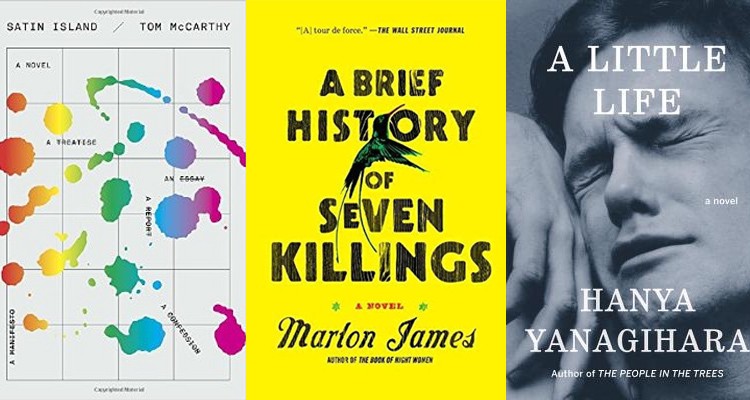
The prestigious Man Booker prize has whittled its longlist down to just six finalists. Several prominent names, including Marlynne Robinson and former winner Anne Enright, failed to make the cut. Last year, the Man Booker opened the award to all English-language writers instead of only those form the UK and Commonwealth, and the six finalists this year include two American authors alongside two British, one Jamaican, and one Nigerian author.

Congrats to all the finalists!

Satin Island by Tom McCarthy (UK)

A Brief History of Seven Killings by Marlon James (Jamaica)

A Spool of Blue Thread by Anne Tyler (US)

The Year of the Runaways by Sunjeev Sahota (UK)

A Little Life by Hanya Yanagihara (US)

The Fishermen by Chigozie Obioma (Nigeria)

(You can read our review of Satin Island here and our interview with Hanya Yanagihara here)

A Special Kind of Performance: Can Xue On The Course Of A Chinese Writer

We’ve asked some of our favorite international authors to write about literary communities and cultures around the globe. We’re bringing you their essays in a new ten-part series: The Writing Life Around the World. The fifth installment is by Chinese author Can Xue.

Beijing, China
translated by Jonathan Griffith

I have been fascinated by performances since I was three years old. But in my younger days my performances were very special — I performed in my mind. So no one around me knew my secret dramas.

Sometimes alone in my room, I would begin my drama. There was a fire and a lot of smoke in my home, and my grandma was too sick to move, so I supported her by her arm and ran out of the room with her. How happy both of us were!

Or sometimes at midnight, a tiger was chasing after me. I ran and ran, exhausted. Then I closed my eyes and said to myself: “Jump!” And I did jump, down from a steep cliff. I knew I would still be alive. When I woke (I always woke at the crucial moment), I found that I was.

The time came that I went to a primary school. My teacher was a poor young man; his face was not good-looking. It seemed that no young woman would be happy to get married to him. In the classroom, I listened to him, but my thoughts went in another direction. I would help him, to make him happy. One day I wrote a beautiful composition; it was so beautiful that it made a sensation in the school. “Whose student is she?” people asked. “Teacher Wen! Teacher Wen!”

Teacher Wen and I were very happy, and we went to the playground to take a walk. We talked and talked and talked…Of course the whole thing never happened in real life. My performances became longer and more complicated the older I grew.

Then came my thirteenth or fourteenth year. I began reading fiction and science fiction, and some of them were great books. Reading this fiction made me long to love someone. But who? My family was very poor. The authorities had put my father in a program of “reeducation through labor” (cleaning the library). In daily life, most people gave me supercilious looks when I went out in public. Additionally, I had lost my chance of receiving an education at a school.

All this meant that I could only come into contact with a few girls around me. So I stayed at home alone most of the time. I went to a small eating establishment nearby for my simple lunch and supper twice a day. One day (that was a shining day) when I returned from the eating establishment, I saw a healthy boy playing basketball on the playground. He was a little older than I was. I thought he was beautiful. I became so excited that my face blushed with shyness. Of course, he didn’t pay attention to me at all — boys were always like that. That night at home, I was so happy with the chance meeting. When I lay in the dark, the scenes of us appeared in my mind again and again. I worked out all kinds of new scenes in which the boy and I came face-to-face. My life of paradise lasted for the whole summer. Every day when I walked near the playground, I listened attentively to the sound made by the bouncing basketball. As I walked across the playground, I dared not turn my face; I had to pretend that I wasn’t paying any attention to him. How vigorous and nimble he was! What a beautiful body! Last night I had been in the park with him. We sat in the meadow, watching doves in the sky. But like all teenagers in those times, we didn’t touch each other. I only touched him with my eyes in my mind.

Time flew. One day the boy disappeared from the playground. He never reappeared, but my drama lasted for a whole other year.

* * *

Why did I learn to make clothes?…I badly needed time for my performances.

I didn’t begin writing until I was almost thirty years old. During that time I had been a “barefoot doctor,” a worker at a small workshop in a lane, and a temporary teacher. My last job before I became a writer was as a self-employed tailor. Why did I learn to make clothes? One reason was because my husband and I wanted to earn money to feed our child and ourselves. But the main reason was that I badly needed time for my performances. That was my ideal since my early childhood, and I had never forgotten it, even for a minute. And my husband helped me to realize the ideal. Time is money.

Both of us learned to make clothes according to a magazine called Dress-cutting and Sewing. We worked hard from morning to midnight every day. After half a year, we became two tailors — worthy of the name. The apartment changed into a workshop, and we even hired three helpers. We began earning some money. That was 1983, and at that time only a few people in cities owned their own business. But we made it. It was not much money, and our work was very hard.

* * *

…our customers always interrupted my writing. So my time was fragmentary — ten minutes, fifteen minutes…

In the same year, I began writing at a sewing machine. A strange thing happened: I found that when I was writing fiction, I didn’t need to work out plots or a structure or anything beforehand. No matter, a short piece or a long piece, it was the same. I just sat down and wrote without thinking. That’s all. Back then during the daytime, our customers always interrupted my writing. So my time was fragmentary — ten minutes, fifteen minutes, a half hour at most. In the evening, my four-year-old son (he was naughty) occupied almost all of my time.

So during these ten minutes, fifteen minutes, or half hour, I even managed to write a small novel — my maiden work. And the plot went smoothly in the novel! It was a perfect whole.

I was so amazed, What I achieved was something that I hadn’t expected — when I wanted to perform, I performed; when I decided to stop, I stopped. But I could always come back to it. How strange! I thought maybe I was a little bit like those ancient poets, who could write their poetry in an open county while they drank wine, or talked with their friends, or just stayed alone in a beautiful scenery. It seemed they could write any time they wanted. But not quite. It seemed that there was a logic that pushed my pen forward, as if it was impossible for me to write down wrong words and sentences. All of the plots and dialogues that I wrote down were so right, so beautiful, just like my childhood performances. The only difference was that I did it more sober-mindedly and with greater determination now. I found that I enjoyed these activities so much that I wrote every day, even when our business was so busy. It was not long after that I understood that my writing was a special kind of performance — a performance of one’s soul.

* * *

Writing fiction freely was dangerous in those dark days in China.

For all of my life, my soul has longed to go out. But the opportunity didn’t present itself until I was thirty years old. How miserable but at the same time how lucky it was! Writing fiction freely was dangerous in those dark days in China. But I was given the chance at long last. The long waiting made one so vigorous and original, it was impossible to do wrong.

Like the dancer Isadora Duncan, I didn’t need to work out things in advance because for me writing was the most natural thing to do. When I no longer needed to worry so much about money — that was after writing for five years — I just made a rule for myself: write for an hour every day, usually in the morning when I finished my running. Every day — one hour, no more, no less. No matter what I wrote — a story, or a novel — I wrote it smoothly, then left it as it was. The next day, I wrote from where I had left off the day before. I would hold a pen in my hand, think for a minute or two, at most five minutes; then the first sentence would appear in my mind. I wrote it down. Then the second sentence appeared, the third … How happy I was!

I felt that I lived a dual life. It was my worldly life that fed my performances, and at the same time, it was performance that gave the meaning to my worldly life.

The more I wrote, the more I wanted to write. My kingdom of fiction grew larger and larger, its boundary extending in every direction. Gradually I understood: since I was a dancer of the soul, this sort of performance just couldn’t stop. It was impossible. Another thing that occurred was that my personality began to change so much after I became a dancer — it became brighter and brighter. I had always loved worldly life, and now I loved it more! Now to me, every day became so beautiful. Cooking a meal in the kitchen, cleaning the apartment, washing clothes, helping my son with his homework, going to the market to buy meat and vegetables, running in the rain four kilometers with an umbrella. My everyday life was arranged in perfect order, so I was full of vigor. I felt that I lived a dual life. It was my worldly life that fed my performances, and at the same time, it was performance that gave the meaning to my worldly life. I loved both. Actually I thought the two were one. I still think so today.

Sometimes as I recall my childhood performances, I ask myself, why did they happen? Why was it that the performances made me happiest? As I grow older, I know the answer: it is because I wanted to live a full life. I wanted my body and my soul to dance at the same time. I am a daughter of Greater Nature, a nimble daughter, so nimble that I heard Mother’s calling even at three years old. The calling was from that deep, dark place, and very few people have the ability to hear it, but I had. But this ability brought with it a great responsibility upon me when I grew up.

* * *

In my writing life, I have observed that there are other people besides myself who have heard the calling of Great Nature when they were very young. But they didn’t concentrate on it, so they lost it very easily and never heard it again. For example, in the 80’s in China, some writers wrote beautiful experimental fiction, but after three or four years, all of them returned to traditional writing. I know that for a writer it is very difficult to concentrate on your performance all the time. There are too many temptations in the world, and nowadays it is easy for a famous writer to get more money if he or she wants to by dropping experimental writing and choosing realistic stories or film and TV plays. Almost all of my colleagues turned toward that road.

Year in and year out, I found that I was the only writer from my generation who still wrote experimental fiction in China.

But for me, it was another story. From the beginning, I wrote just for my ideal. But what is a life devoted to this ideal? I think it should be this: giving a performance every day, reading beautiful books, enjoying beautiful things — sex, food, comfortable clothes, and so on — in short, making my life always happy and keeping myself always curious about the things around the world. That means I must keep my body in a healthy condition. That’s it. Money is important because it can buy time or prolong my life (I have a serious rheumatism). But I always know that I want to live a life that is worthy for me to live. Year in and year out, I found that I was the only writer from my generation who still wrote experimental fiction in China. I was so sad, but at the same time, I was so proud!

I am proud because this kind of performance needs a great talent and courage, and very few people can achieve this. Inspiration is not the only thing that the writer has to have; at the same time you must have a strong rational faculty, because you will be demanding of yourself to do a sort of very special thinking, and this sort of thinking is not reasoning. I now call it “material reasoning.” Maybe it is a little mysterious, but looking at my day’s performance and the performances of my childhood, you may get some clues.

“Material reasoning” is not just thinking — it’s doing. That is why I call it a performance. In that atmosphere when you move your body, your action is following a strict logic. You perceive the logical structure directly through your senses. The more you do it, the more the structure appears in various forms. But from my experience, one must do it often if one longs to see the structure. Slacking off for a year or two, it’s very possible that the structure disappears totally. This happened to two of my friends. Both of them were highly talented in experimental writing when they were very young. I think Great Nature is fair to every human being. She always gives you a gift that you are worthy of. But some people lose it even if they don’t perceive it.

* * *

Now I’m full of gratitude to our Great Nature. In 2015, I’m 62 years old and still brimming with inspiration. Except for taking part in literature activities abroad once or twice a year, I write almost every day. Writing gives me strong confidence, keeping my body healthy. I feel that my life has become some kind of music. Every morning as I open my eyes, I see the sun rising differently. To me, every day is a brand new day!

Usually I study Western philosophy and literature in the daytime. At eight o’clock in the evening (I changed my morning performance to evening ten years ago), I give a performance. That takes almost an hour. But some times forty-five minutes will be enough. I look at the words and the sentences in the notebook (from the beginning, I have always written in a notebook). Ah, they are so neat! The strange thing is that my handwriting is usually ugly when I write into a contract or on an envelope. But with fiction, my handwriting is neat and tidy. The notebooks are so beautiful as a whole. In the beginning I didn’t know I could write like that. Now I know that it’s Great Nature who gives me the ability and lets me write beautifully. Actually as I grow older every year, my hand often shakes when I’m writing. But as soon as I begin to perform, the words and sentences, as if hearing the calling, become full of life!

— Can Xue

A few questions for Can Xue about the writing life in China…

Electric Literature: In your essay, you describe working as a “barefoot doctor,” a teacher, a tailor. Your first stories were ‘written’ while you were working at a sewing machine. At what point were you able to put other jobs aside and to begin dedicating yourself to writing? What happened to allow that?

Can Xue: As I mentioned in the essay, in my fifth or sixth year of writing, I published some work overseas (in the United States, Japan, and Taiwan). So I got some money. And at that time it was a big amount (about $10,000 USD). My husband and I were so happy that I immediately decided not to make clothes anymore. (My husband kept making clothes, though not so many, and I was in charge of the housework.) My publishing abroad is an amazing story. Both my American translator and my Japanese translator found Can Xue’s stories from magazines published in China. Then they wrote to the publishing house in Changsha, and got in touch with me. Meanwhile, one of my good literary friends helped me to contact the government in Changsha, so that I could get a small stipend every month. After a year, the government approved my application as “a professional writer.” That means you can get a monthly salary from the Writers Association of Hunan Province (about $60 USD).

EL: How was your first work published? Have the means by which publishers in China discover new writers changed over the last few decades?

They thought the books were not “real,” ”formal” and standard literature. They also thought the books were not very ”healthy.”

CX: Although my first Chinese book was published in Taiwan in 1987, and the other two were published in the United States and Japan in 1989, the leaders of the literary circle and the publishing houses at that time weren’t that interested in Can Xue’s work. They thought the books were not “real,” “formal” and standard literature. They also thought the books were not very “healthy.” I think in the past two decades the publishers have changed a lot. Since 2000, I have published many works. As for the new writers, most of the publishers choose their works according to whether they are welcome to readers. Also, the leaders of the Writers Association like certain writers, and those writers get many opportunities. So some young experimental writers are in a very difficult situation. As to me, since I’m more and more famous in China, and some young readers love my work, it’s now easy for me to get my work published.

EL: Your stories are often set in abstract or fantastical spaces that are charged with powerful forces. Are there places in Beijing — streets, neighborhoods, landscapes — that have a special impact on you or whose energy, perhaps, has been instilled into your stories?

CX: Basically no. Because experimental writing is not that sort. But in deep structure, there may be some influence. I just don’t know at the moment. Maybe someday, when somebody researches my work, they will find some changes in my writing that are linked to my move from the South to Beijing. That would be interesting. To tell you the truth, I mostly stay in my apartment, which is in the suburbs, all year round. I go downtown once a year at most. (It’s been three years since I last went.) My husband does all shopping for our family. When you ask about the streets, the neighborhoods and so on, I really don’t know much.

EL: Which Chinese authors do you consider the most meaningful for the current-day avant-garde?

CX: For the current-day, only Can Xue’s works are the real experimental writing that sells in China, I’m afraid. Another one I can think of is Liang Xiaobin (1954- ), who writes very beautiful essays. But he is very poor and has a serious disease.

EL: You are a longtime student of Western literature and philosophy, and a good deal of your work has been published to acclaim in the U.S. and Europe. Have those connections to the West had any affect (negative or positive) on your success in China?

CX: The influence you mention comes in two ways: 1. Since I have published some books abroad (mainly in the U.S. and in Japan) and received some acclaim, publishers in China are more welcoming of my work than before. I know most of my readers are young people who love “pure” literature very much. So since 2000, the situation for Can Xue has changed a lot. Before 2000, I only published 4–5 books (from 1985–1999), and the sales were very very poor (maybe because they had almost no publicity). 2. The literary circles in China are very traditional, As I know, experimental literature is in a very difficult situation. The traditional circles in China don’t consider Can Xue’s works to be “good” literature, and they don’t advocate for them. So it’s hard for me to promote my works. Meanwhile if a young writer wants to write experiment works, it will be very difficult, almost impossible for him to get any financial support from literary organizations that are founded by the government.

EL: You are in the relatively rare position of being able to make an informed comparison of the contemporary literary scenes in China and in the U.S. Do they share many similarities?

The biggest problem for both country’s literature is a lack of will to innovate.

CX: Yes, I think so. The biggest problem for both country’s literature is a lack of will to innovate. I think most works in recent years are sentimental and superficial, even the worldly-wise ones. I can’t see any innovative spirit in those works. For the Chinese writers, it’s because their individual characters are weak; they think that our tradition is more relaxed and comfortable, and they would like to lie in the tradition and have sweet dreams. Actually the tradition that they think of is not a real tradition anymore, because it has been past, disappeared. How can one still call it a tradition? In my view, if you want a real literary tradition, your only way is to recreate it. I think maybe in the United States, the situation is the same?

EL: You’ve shown a rare willingness to critique the works of contemporary writers, often quite bluntly. Has that made things difficult for you professionally? Are you surprised that more writers don’t engage in that manner of critique? You seem to take your duties to the literature and the culture very seriously.

…when I get a chance, I will criticize them. I think that’s my work (I am a critic too) and the meaning of my existence.

CX: Yes, you are right, I always tell the truth. But people don’t like to hear it. So I often put myself in a difficult situation in the literary circles in my homeland. But I’m not the least surprised by the attitude of my colleagues. They are traditional people, and that sort always deals with things like this. Their works are much more welcome than mine. Basically they are not “angry” people. But still, when I get a chance, I will criticize them. I think that’s my work (I am a critic too) and the meaning of my existence.

EL: You’ve managed to connect with Western readers in a number of ways, in addition to your fiction — engaging in interviews, writing critical essays. How do you connect with your Chinese readers? What are the outlets and the means of reaching those readers, besides publishing fiction?

CX: Besides publishing fiction, I often give short articles to newspapers, discussing my views of literature, criticizing my colleagues. I know that not a few young people like my essays. I will continue my criticizing whenever I get a chance.

About the Author

Can Xue, pseudonym of Deng Xiaohua, is the author of numerous short-story collections and four novels. Six of her works have been published in English, including Dialogues in Paradise (Northwestern University Press, 1989), Old Floating Cloud: Two Novelllas (Northwestern University Press, 1991), The Embroidered Shoes (Henry Holt, 1997), Blue Light in the Sky and Other Stories (New Directions, 2006), Five Spice Street (Yale University Press, 2009), and Vertical Motion (Open Letter, 2011).

You can find all the essays from The Writing Life Around the World at Electric Literature.

Writing Life Around the World

My World Is Full Of Vagueness And Myth: An Interview With Lauren Groff, Author Of Fates and Furies

by Natalie Villacorta

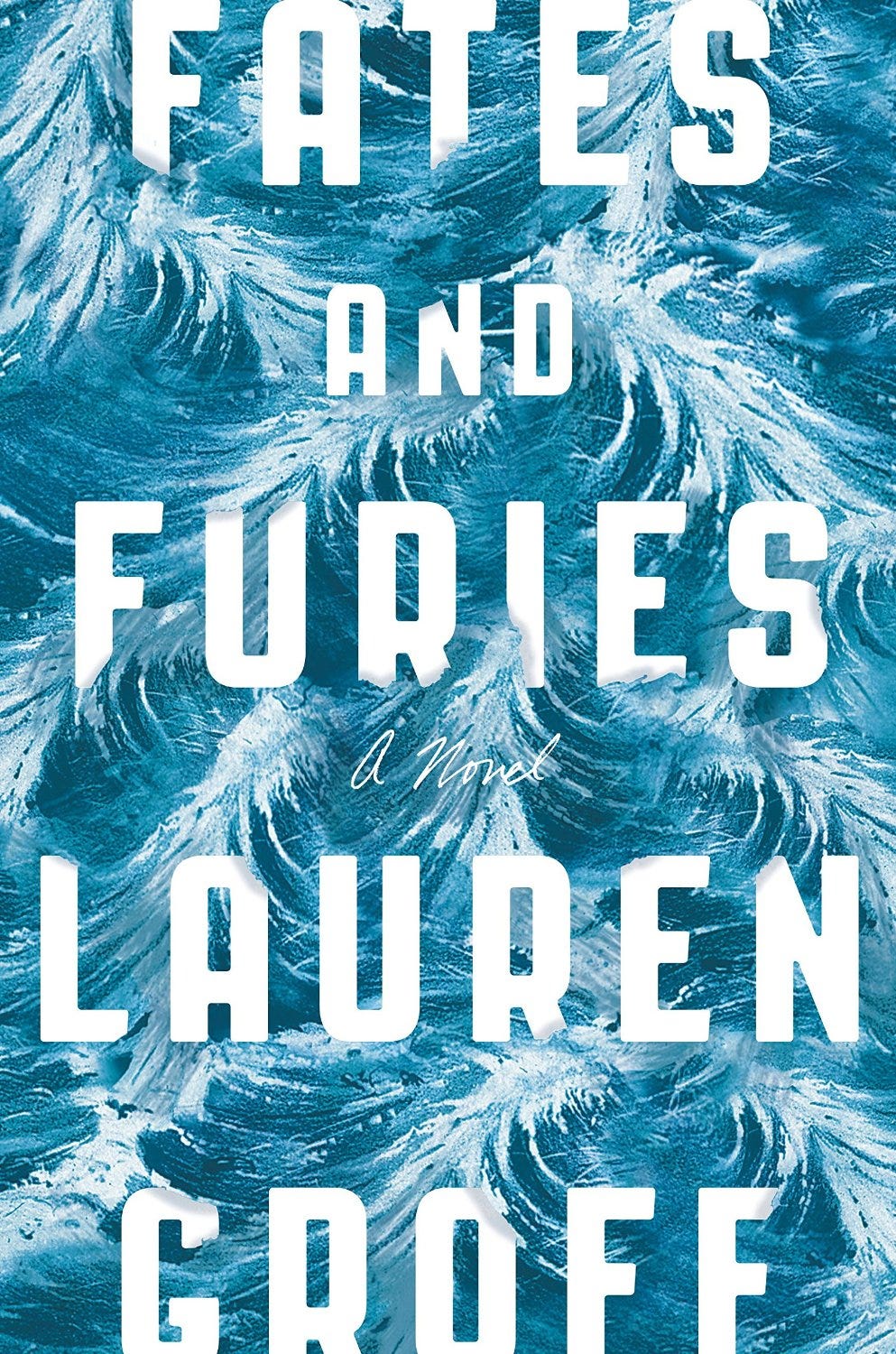
groff fates and furites

The form of Lauren Groff’s new book, Fates and Furies, is split into two parts, a division which reflects its content: the stories of a husband and a wife, deeply interwoven but managing, necessarily, to remain separate.

Fates tells the life story of Lancelot “Lotto” Satterwhite, who struggles to find a role in the acting world before discovering his talent is for writing plays, not starring in them. In Furies, Lotto’s wife, Mathilde takes center stage, telling a different version of the life built in the first part of the book. The halves are united by an omniscient voice represented by bracketed text that recalls a Greek chorus.

Groff and I spoke about narcissists, serial killers (the writer kind), and mansplaining.

Natalie Villacorta: The novel is about a playwright whose work is heavily influenced by Greek mythology, including the stories of Antigone, Odysseus and the Sirens, and the book takes its title from mythological figures, the Fates and Furies. How did you get interested in Greek stories and incorporate them into your own work?

Lauren Groff: During the process of writing this book, I read the Iliad, and I loved it. It’s such an incredible narrative; nobody needs to write a book now because the Iliad exists in the world. As I was reading it, I thought the underlying philosophical concepts were fascinating, what people take for granted as their world view was so interesting to me. So, in my book, Lotto believes — as many people who have a lot of privilege do — that he didn’t get what he got because of luck, he got what we got because he worked really hard at it and, in a way, that’s a lie. We all get what we get because of luck. But at the same time he also feels that he is fated for greatness, it’s in his stars. And this is what he is told from day one. Whereas Mathilde is very much the opposite and what I love the most about these ideas of the three Fates and the three Furies is they’re the most powerful goddesses there are. The Fates measure out life and they create it and they decide when to snip it out. And the Furies are these deep ancient goddesses who are avenging angels — their purpose is to go after malefactors. And I think we’ve gotten away from representations of women as powerful people and I got really excited about the mythology.

NV: Throughout the book, snippets of text appear in brackets. It feels like that text is the voice of each character’s conscience, or the chorus in a Greek play. Sometimes these sections tell the reader what is to come or reveal when a character is lying or mistaken. What were you trying to achieve with those sections? Why separate that text out?

LG: There are two reasons: One is I thought it was really fun. I like to have the long view on these characters as well as the intimate close view and I wanted to signal it too. But the other reason is I needed to marry both sides of the book and that was one way to have a through-line through both parts of the book. That sort of external, a little bit snarky voice. Because at first I had thought that this book was actually two books — a sort of Mr. Bridge and Mrs. Bridge or Old Filth and the Man in the Wooden Hat. And eventually, when I realized its structure was actually more like a marriage, I had to find ways to thread them together.

NV: The book includes many excerpts from Lotto’s plays that are just dropped into the narrative. How did you make that call and have you ever considered writing plays yourself?

Marriage is this paradoxical thing that’s both incredibly intimate, but also performative.

LG: This book is about creativity as much as it’s about anything else, and it’s about a lot of things. I wanted to be able to show how we take the events of our lives and transform them. And it occurred to me that plays are so easily summarized and excerpted. Also, it’s fun and Lotto actually sees his life as if he’s the actor in the middle of a play. He is the central character in his own narrative. Marriage is this paradoxical thing that’s both incredibly intimate, but also performative. Weddings are these elaborate performances put on for the people we love. There’s this external aspect to it. So I wanted to call all those into question throughout the book, and I think excerpting the plays was a way to do all of those things.

NV: After the production of one of his plays that draws directly from Lotto’s past, his sister says “you have to be a serial killer on the inside to do what you do to us. Put us in your plays, warts and all, showing us off like we’re some sort of sideshow freaks.” You’ve written a novel about a town that’s drawn from the town you grew up in, Cooperstown, NY. Have you ever been accused of something similar by your family and friends? How has this impacted your work?

And it’s true, you do feel like a serial killer in a certain way, or a robber, you’re stealing some essential piece of them.

LG: I put everyone I know into something of mine — whether or not they know that I’ve done it. And it’s true, you do feel like a serial killer in a certain way, or a robber, you’re stealing some essential piece of them. Part of the impetus for this book is frankly an apology to my husband for my own innate narcissism. To make anything and believe that other people would want to see it, it’s an incredibly narcissistic act. I put my work first, and my kids know it, my husband knows it. I’m a writer first and then I live my life second, and I know that sounds really sad, but that’s the way I organize things. So in a really major way this book is an apology to my husband, whom I have stolen from in order to create Lotto. I mean, my husband’s also 6 foot 6; my husband was an actor for a little while; he’s a really kind human being from Florida. So it’s unfair, and I was poking fun at myself in that excerpt but I was also poking at all of us who dare create things out of the people that we know and love.

NV: Yes, throughout the book, artists are called narcissists. One character remarks, “The balls is took to proclaim a creative profession, the narcissism.” So do you think narcissism essential to an artist’s success?

I don’t know if it’s the form of the novel that makes me believe that all novelists are probably at heart serial killer narcissists…

LG: I don’t know if it’s essential. I mean, you look at someone like Emily Dickinson and you just assume that she wasn’t. Her poems seem very private very internal and reflective. I don’t know if it’s the form of the novel that makes me believe that all novelists are probably at heart serial killer narcissists because, to be honest, the novelists I know are the kindest people on the planet. It’s not mutually exclusive. I think you have to have a certain level of empathy and curiosity for other people and that is manifested in generosity and kindness. But in order to publish a book, which is not what Emily Dickinson really truly did during her life, in order to make art that you hope is disseminated to a large group of people, I think you do. You have to have that sort of need to be looked at. …You gotta be a killer.

NV: After Lotto writes his first play, his wife says, “You were meant to be a playwright, my love.” And later in the book, his mother says from his birth she “molded” him to become an artist. Do you think people are “meant” to be writers or are they “molded”? Does it take another person’s belief to make someone realize his or her potential as an artist?

LG: It’s a difficult mix of both. If you don’t have the external support it’s incredibly hard to get a foothold. But if you don’t have that internal molding — which you have to do for yourself; nobody else can do it for you — then you’re not going to succeed in making anything you think speaks some sort of truth. I’ve been thinking a lot about this because one of the unspoken things about this book is privilege — particularly Lotto’s privilege — he’s white, he is male, he is rich, he has an education, and he has all these people around him who have made everything very easy for him. And I think it’s easy when you’re a creative person to take that for granted, which is what he does. Anybody has the ability to be an artist — it’s whether they want to claim that ability and whether or not they have the external support that is sometimes invisible.

NV: Lotto is accused of being a misogynist after comments he makes on a university panel: “We’re all given a finite amount of creativity….if a woman chooses to spend hers on creating actual life and not imaginary life, that’s a glorious choice. When a woman has a baby, she’s creating so much more than just an imaginary world on the page! … the reason for the disparity in creation is because women have turned their creative energies inward, not outward.” What do you find problematic about Lotto’s speech?

There’s a biological determinism in a lot of the discussions about male and female creativity that I find incredibly frustrating and infuriating.

LG: Someone said that to me actually. Some man stood up and actually mansplained a woman’s creativity to me, which I didn’t take very well, obviously. It’s something that I think people probably don’t think explicitly. But it’s so taken for granted that women have not created beautiful masterpieces of literary fiction in general. If you look at the Guardian’s 100 Best Books ever there’s like two from women. And it’s not that women haven’t created these books. It’s that the men have not looked at them. They don’t get on that list and people don’t read them and then they get left off every other list. There’s a biological determinism in a lot of the discussions about male and female creativity that I find incredibly frustrating and infuriating. And there’s a part of me that just gets enraged when I hear people say things like what that man said to me — I could barely see — because it’s not the way that I’ve experienced it. It’s not biology; there’s no mommy trap. I think there are forces in the society around us that do not allow the voices of women to have the effect that they should have. This is a deeply feminist book. Just because Mathilde makes decisions that I do not know if I would make doesn’t mean her story is not a feminist story.

NV: At one point, Lotto steals a story from Mathilde’s life and tells it as if it happened to him. She is angry. He says, “What’s yours is mine and what’s mine is yours.” Has this happened in your own writing?

LG: I’ve been married for nine years but I have been with my husband since I was 21. So we’ve grown up together in lots of ways. I steal his stories on a daily basis. I’m just a better storyteller. So we sit down at dinner parties and I’m the one who tells the story as if they happened to me. And in a certain way, I’ve told it so many times, it is. It’s my memory. And it’s not fair. It’s this growth that happens in a marriage. But I see it with my parents too. Yesterday they celebrated 42 years of being married. They’ve grown so much into one another that it’s sometimes hard to see the outlines of each individual. That said, you are a single person within this unity and there are no hours of the day that go by that I don’t think something that would hurt my husband very deeply. As you grow together you also stay a ferociously autonomous being.

NV: That gets at another part of the book — each character has a version of the story of Lotto’s proposal to Mathilde. In his version, she says, “sure.” In hers, she says, “no.” It seems both are true. How can that be?

LG: I resist very much the idea that there’s any single story for anything. One person walks down the street and there would be 500 different ways of telling it. There’s no such thing as absolute truth, except for science — even that is often proven wrong eventually. I love the idea that narratives are these separate textures and have separate weaves and it all depends on the relationship of the teller to the time that they’re telling it. This novel could be told from Chollie’s point of view, and it would be a completely separate book.

It’s possible that because I’m in my late 30s now, I’m just resisting the constant barrage that people are feeding us that things are black and white, and there’s only one way to think about these things, and there’s no bleed between things. My world is full of vagueness and myth, and I think that’s more beautiful in a lot of ways.

NV: You can see that difference in the structures of the two parts of the book. The first part is pretty much a chronological story of Lotto’s life. But the second part is haphazard — shifting from Mathilde’s childhood to the present setting to her future as an old lady and back again. How did that structural change happen and was it intentional?

LG: Deeply intentional. I was building a bildungsroman in Lotto’s half, which is a very traditional form of the novel and it has at its heart usually a man and he is the central figure. I built that in the first part in order to try to explode it in the second part. It was deeply satisfying. I wrote them at the same time. It was this joyous experience of trying to see this world of these people but from many different points of view.

NV: Lotto appears on a panel to discuss the future of theater. He says that the key is “innovation in storytelling and inverting narrative expectations.” How does that speak to your own approach to writing and thoughts about the future of the novel?

LG: I don’t know if I even agree with his statement. Because I think that you tell the story in the way that will tell the most truth. It doesn’t necessarily have to do with inverting narrative expectations. My only allegiance is to telling the story in the way that I think is best for the story. I don’t love innovation for innovation’s sake.

Real Surgeons Can’t Cry: How Writing Healed a Doctor

by Bud Shaw

I was once a transplant surgeon. I arrived in Pittsburgh in the summer of 1981 to train under the world’s greatest transplant pioneer, Tom Starzl. Starzl and his team were six months into a new program that overnight would revolutionize liver transplantation, and by the spring of 1983, I was one of his key surgeons. I count my four years in Pittsburgh among the most thrilling times of my life, and I owe Tom for much of my professional success. In 1985, three colleagues and I left to start a new program in Nebraska.

Later this summer, some of the most intimate moments of my life will appear in a book that anyone can buy and read. And judge — not just the writing, but also me. My resume lists more than three hundred published journal articles, fifty book chapters, and over 225 invited lectures, but nothing in all of that work exposed me to the kind of scrutiny this book will allow. That was medical stuff; the book is personal, particularly in the way I explore my own fallibilities, including those of a surgeon.

A month ago, at our family’s annual Fourth of July gathering, my oldest niece asked me what the book was about.

I’m not sure, I said. I never know what else to say.

You really need a better answer than that, she said. Isn’t the book coming out soon?

Riding my bike yesterday, I started thinking about that question. Various scenes from the book, from my life, came and went: telling a man his wife had died during surgery; using invisible sutures to anastomose an artery in a two-week-old, two kilogram boy; standing on a cliff at Dead Horse Point with my hang glider afraid to jump; suffering a lecture from Tom Starzl about rocket ships to the stars; locking my office door, pulling the shades and hiding under my winter coat, too frightened to go on afternoon rounds.

And then I remembered a patient named Hannah and, still riding along on the flood plain north of Omaha, I burst into tears.

I gave Hannah a new liver when she was barely old enough to walk. In subsequent years, she came to every patient reunion in Omaha, and I began blaming her for the dread I felt in attending those events. Years passed and as the number of people attending the reunion swelled, my discomfiture with so much personal attention and worshiping grew exponentially. And there, always there, was Hannah, following me around, angling relentlessly for my attention. I thought her cute at first, but she soon became the evocation of everything I resented about having to attend those reunions. Eventually, I just stopped going.

Even so, Hannah kept in touch. She sent me newspaper clippings of her success on the soccer team and in the band. I got invitations to her high school and college graduations, and, a few years ago, to her wedding. I kept all of them, in a drawer with the cards and letters from hundreds of other patients.

Hannah died unexpectedly a month before her thirtieth birthday. Probably an infection that got out of control.

I burst into tears yesterday when I thought of Hannah in a scene from decades ago. Our transplant program was still a marvel to the community that year. With TV cameras rolling, I stood talking into a microphone with the governor of Nebraska about the meaning of those patient reunions, and there at my side was Hannah, tugging at my hand, holding up a finger painting that looked like a napkin smeared with mustard.

I regret that moment as much as any in my life. I resented a little girl who considered me her hero. I ignored her. Now I have written about it and I wonder what it reveals about me then, and whether I’ve changed.

I’ve had plenty of opportunities to change.

Thirteen years ago yesterday, the telephone rang and I found out the lump in my groin was malignant. For years after I finished treatment, I wondered why that day didn’t change me. Shouldn’t such bad news do that — force me to appreciate life, start living each day as though it were my last?

It didn’t. I approached cancer like I had every other difficult hurdle in my life, the same way I took on impossible surgical challenges and got through them. Surviving became another job. I completed it and moved on. No need to make any big changes in how I lived, day-to-day or otherwise.

Admittedly, I was very lucky. The tumor was early stage, and the chemotherapy and radiation were mostly just annoyances. Cancer couldn’t change me. I returned to work, even more secure in the notion that I could overcome pretty much anything.

That conceit wouldn’t last. Cancer might not have changed me, but an anxiety disorder would.

Of course, surgeons don’t suffer anxiety. That’s a given. We walk into the operating room as the supreme commander. We direct the troops, fight the battle, and win. The only requirement for wielding such hairy power is expertise. We just have to know what we’re doing.

Even so, on a sunny Sunday afternoon in January, I found myself seeking relief from panic under the covers in my darkened bedroom. I thought it might be brain metastases from my previously cured cancer. When anxiety attacked me again a few days later and again a week after that, I convinced the chairman of neurology to order an MRI scan of my brain. It was normal. I thought the problem might be hormonal but those tests were also normal. I tried to ignore it, to keep it a secret, but when it started to interfere with work — when I had to ask a colleague to fill in for me because I was locked in my office, the blinds pulled, hiding under my winter coat — I went to a real doctor who told me I had a form of mental illness and put me on drugs.

The pills helped, as did other treatment, but I still had breakthrough attacks. None had any identifiable triggers, but all involved a sense of impending doom. Sometimes I thought my cancer was coming back and felt around for lumps. Other times I worried about bats we found in our house, that one may have bit me or my son in our sleep and now one or both of us were going to die of rabies. I stopped taking night call and operating at night because I thought my cancer might have been caused by sleep deprivation, that it was just weeks away from recurring. I eventually stopped operating altogether, declaring that my administrative and other work required all of my attention. I couldn’t face the reality that my ongoing attacks required me to step away from the OR.

And then I began writing.

I’ve been writing for a long time, but I always shied away from true stories. In second grade, I wrote heroic stories involving a pony and an eight year-old boy and I edited them repeatedly until my mother’s praise turned unqualified. The first two years of medical school depressed me and I began submitting short stories to various magazines in hopes of starting a different career. Failure made me increasingly despondent, especially after Playboy Magazine rejected my brilliant story about a classroom demonstration of the anatomy and physiology of human sexual response. (It involved strategically placed “spy” cameras and an enthusiastic pair of volunteers.) By 1996, I was so utterly burned out with work that I spent most of my free time writing fiction. I finally took ten months off and wrote an 180,000-word novel that was mostly an escape from my professional life. It hides in the recesses of my hard drive where it belongs.

I never wrote an essay about real life until after I stopped operating. Three years after. At first I avoided the professional side of my life, writing mostly about the trials of youth. I knew that if I wanted to write more seriously, I would have to explore more serious stuff — the failures along with the successes, the terrifying and the joyful, the dark with the hopeful. To succeed, I had to be unconditionally honest, and for that I needed to find new perspectives, views of history free of agenda: no trying to set the record straight about what I thought really happened during all those years.

For much of my career, I found blaming failure on things outside my control was an expedient way to move on, especially when a patient died. Sometimes I could fault the patient. He was probably just too old and frail to have the transplant. She should have taken better care of herself; stopped smoking before the surgery. More than once, I blamed another surgeon. He shouldn’t have cut there; I knew it was wrong but he wouldn’t listen. The diagnosis was obvious; I was right all along. I don’t think I’m alone in handling failures that way.

After reading an advance copy of my book, a surgeon friend was worried that I’d gone too far. I’d pulled back the curtains on a part of our world that ought to remain private. The public won’t understand a lot of this; it hasn’t got the right context. I asked if she thought people would read it and ask for our heads. Maybe; you can’t trust people who don’t understand what goes on not to get upset.

I understand that some surgeons will think I go too far, not only in revealing how sometimes things can go horribly wrong in the OR, but also in exposing my own vulnerabilities. It’s clear I am not immune to error, and while the failings I reveal are mostly mine, the implications for all of us are there in the stories, and some surgeons won’t like that.

I don’t think making surgeons uncomfortable is a bad thing. I spent my career successfully avoiding self-reflection and I think that’s part of why, these days, I sometimes start crying when I least expect it, like when I remembered Hannah and found myself overwhelmed with regret over my chronic detachment. I was the proud victim of highly developed, wholly successful, and utterly unexamined instincts of self-protection. That’s how I dealt with the failures, the deaths, the suffering of so many people. Like a powerful immune response, my rational mind rejected it all, shielding my heart from the starker realities.

Those instincts worked for a long time, until they didn’t, until I lost the sanctuary of the operating room and ended up under the covers in a fetal position unable to understand why I felt so terrified. That’s when I started to write again. The drugs they put me on were unavoidable — they may always be so — but I don’t think they would be working so well without the self-reflection my writing requires. If that makes my confessional essays selfish, I’m not apologetic. I wish I’d taken it up long ago, before the shield became so durable.

In developing a less self-serving interpretation of events, I forced myself to see alternative conclusions, and ultimately, to deal with the evidence of my own failings. I don’t know that I could have done that were I still operating.

On the other hand, could I have continued operating had I worked to become so self-reflective before I quit?

I’d like to think so. I’d like to think that I could have learned not to be so cowardly, to be both mindful and effective. To be brave enough to admit how little I can control and yet go ahead, make the cut, do the transplant. All I know for sure is that getting here required me to write about it so that I could arrive at a place where exercise-induced endorphins, or whatever it was, can blow me so wonderfully apart. I didn’t want the sobbing to stop yesterday. I rarely cry, and I wanted it to last long enough to feel regenerative, to wash away some regret.

As the superhero in my own book chapter, I couldn’t face the adoration of survivors during our annual transplant patient reunions because I couldn’t deal with my own failures. I was just too self-absorbed to feel the love of men and women, boys and girls, all of whom deserved so much more than my irritation. The scene that flashed through me yesterday on the bike has come to embody the remorse I don’t want to forget.

More than anything I want to redo that scene, to turn away from the governor and the cameras, lift Hannah up and tell her how much her gift means to me.

Last Night in the OR by Bud Shaw is available now from Plume

Dishoom: The Dance Party at the Center of the World

The second time I went to Dishoom — the Indian dance party thrown by DJRang that’s become a phenomenon in Durham, North Carolina — I danced for four hours straight. That was a mistake. My stomach hurt so much that when I went to bed, I couldn’t fall asleep. After some back-of-the-envelope googling, I realized I’d strained my abdominal muscles from too much twerking.

That’s the sign of a good dance party.

But to call Dishoom just a good dance party would be to understate its significance. It triggered something in me about our cultural moment. For the first time, there’s a national conversation about how the white gaze works in shaping pop culture: what art gets considered “mainstream” and what’s considered “fringe.” To summarize, white gaze centers the perspectives, experiences, and stories of white people in U.S. pop culture; and requires that all other output is peripheral to, or in service to, that narrative. Even the word “diversity” is a white fantasy, because it assumes that whiteness is the default to which things are added.

I understood this in my head. But Dishoom drove it home on a physical level. It’s a dance party of primarily Indian music, run and created by people of color, the children of immigrants. For those reasons alone, white gaze would dismiss it as fringe. But the party’s overwhelming popularity with all kinds of people signals just the opposite. When I was there, still dancing even though the dance floor was packed so tight I could barely move, all I could think was, This is not the fringe of US pop culture. This is anything but the fringe. This is the center.

~

DJRang — aka Ranganathan Rajaram — doesn’t set out to effect social change. He sets out to throw a good party. But art is always a mechanism of social change, simply by existing; the better the artist, the more profound its effect.

Good artists alter how the world turns.

Genius artists make the world turn around them.

Part of what makes Rang a genius is that he understands that DJing, like any live performance, requires radical presence. Most DJs phone it in, queuing up a list, hitting play, and then checking their text messages onstage. But Rang goes in with his entire musical library. When the clock hits ten, he makes a first offer. The crowd responds, or doesn’t. Then the party becomes a constant conversation — spoken in music, answered with body language, measured in waves.

He was inspired to create Dishoom while on vacation in Puerto Rico, where he went to La Respuesta, a club dedicated to underground artists. Three DJs shared two stations, layering dance hall, hip hop, salsa, and merengue until three in the morning. It made a profound impression on him. “You didn’t feel unwelcome walking in. Nobody eyeballed you. Just come in, have fun. I was like…I want this with Indian music.”

DJRang at Dishoom, May 2015. Photo credit: Tesh Parekh, IWP Photography.

DJRang at Dishoom, May 2015. Photo credit: Tesh Parekh, IWP Photography.

Rang already had a following from hosting bhangra parties in nearby Chapel Hill. His crowd had a strong Desi component, but otherwise, reflected the community at large. He wanted to use that following to curate a core crowd — friends of friends who’d spread the word, so that the degree of separation between any two people at Dishoom would never be more than two. And he wanted to host it at The Pinhook, a queer downtown space that set the tone for Durham’s revival five years ago.

The first Dishoom sold out in an hour. Over the next year, Rang added and subtracted elements until the party became what it is now: a four-hour slice of transcendent time, lit in magenta and blue, complete with pre-game bhangra lessons, live drumming, and live visuals. The vibe is welcoming. The mien is exuberant. The flyers are photoshopped Bollywood posters.

Posters for Dishoom, July 2014 and May 2015. From left to right: DJRang, singer Sandeep Kumar, dholi Jeetu Singh, DJRang, and video artist Saleem Reshamwala, aka KidEthnic.

Posters for Dishoom, July 2014 and May 2015. From left to right: DJRang, DJ Sandeep Kumar, dholi Jeetu Singh, DJRang, and video artist Saleem Reshamwala, aka KidEthnic.

The first time I went to Dishoom, I wandered around the rest of my weekend in a sort of haze. I’d had a peak experience. Everything else felt like a disappointment. And it’d brought up an avalanche of feelings I was just beginning to process.

On the most superficial level, I’d never realized how much I loved to dance. It’s because I’d never found a DJ I could trust, or even knew that that’s what I needed.

But on a deeper level, I was feeling a lot of anger. Not at the performers, of course, but at mainstream white culture for teaching me to be afraid. In the tiny town where I grew up, where the population was 97% white, I got to consider myself open-minded because I listened to Paul Simon and Cassandra Wilson. When I went away to college, I learned differently; and in a sort of self-preservation instinct, struggled with kneejerk reactions to things that seemed “foreign.”

For example, I realized I was avoiding my college’s Desi and Chinese cultural shows — which, to my classmates, were the unmissable events of the year. Of course, there were many reasons I didn’t go; I had to study, I had to catch up on sleep, I didn’t go out much to begin with, et cetera. But part of it was that mainstream culture’s dismissal of anything “fringe” made it easy for me to dismiss it, too.

I worked to deprogram myself. But I’m still angry I had to in the first place. White gaze cheats everyone. Moreover, I wonder whether I was avoiding those shows because part of me understood that art, like no other force, would require me to give up control over everything I thought I knew about what deserved my attention in life, and what didn’t.

~

Jeetu Singh is the dholi for Dishoom. He plays live Punjabi drum with the music. When he arrives, shit gets serious; the live physicality of the instrument tends to drive the crowd into a frenzy.

At one party, he wore a T-shirt by hometown brand Runaway that read DURHAM: REALER THAN YOUR CITY. The slogan speaks to the gritty underdog character of Durham itself, long held at arm’s length by its neighbors in “the Triangle” — Raleigh and Chapel Hill — largely because of racial prejudice.

Rang has played gigs all over the Triangle. He got frustrated with the racially-coded pressure to play single genre parties. “They’re for crowd control. ‘If you play all house music all night, black people won’t come to your club’…that’s how Raleigh operates.” Rang feels like he should be more vocal, but that carries financial risk. “Because I also have to work at some of those places, still,” he says, “and I also still keep in touch with some people that have said some really racist shit to me.”

He’s apprehensive about how Durham is changing, too. Gentrification is accelerating. The secret’s out, development’s afire, and condo towers are going up all over the city. “Nobody that makes Durham Durham can afford to live down there,” he says.

Meanwhile, Dishoom is an attempt to create a space that reflects the character of the Durham ideal. In fact, he wanted to go a step further: he and a partner tried to open their own nightclub across the street from The Pinhook. But they came up against constant hassle from nearby white residents who wanted to control not only their space, but the public space. They cited concerns about “noise” and “what your patrons would do.”

Meanwhile, two boutique hotels featuring $14 cocktails went up within a few blocks. Those same residents apparently weren’t concerned about what those patrons would do.

~

Saleem Reshamwala — aka filmmaker KidEthnic — mixes the live visuals for Dishoom. That means he “scratches” video in real time to the beat of the music, usually vintage Bollywood movies or corny Indian 70s shows. He comes from Indian, Japanese, and Middle Eastern descent, and at his first Dishoom, wore a T-shirt that read GRIND OF AN IMMIGRANT.

“Racially, I read as a lot of different things given different situations,” he says. “Everything depends on my hair and facial hair.” That social fluidity allows him to play with people’s expectations, in a way that gives him a kind of wicked pleasure.

Rang and Saleem met less than a year ago, but watching them onstage, it’s hard to believe they aren’t boyhood best friends. They have similar build. They read each other’s energy. When the visual mixing starts up, they bounce all over the stage like spring-loaded action figures.

But their sense of play has a serious purpose. In a club, the crowd is surrendering their bodies. It’s an act of vulnerability. Some DJs address that vulnerability by taking requests during shows. Rang addresses in the exact opposite way:

No requests, ever.

Trust the DJ.

Saleem also recognizes the element of trust involved. The videos he’s remixing are part of the very issues he wants to address, including among his community in Durham. “When you’re dealing with old footage, you have to deal with racism and skin-shade-ism and sexism and male-gaze and all that kind of stuff,” he says. But using vintage films is deliberate — their recontextualization is an act of re-creation. “We have to break old things into pieces small enough that we can recreate them into the world we wish existed.”

~

The third time I go to Dishoom, I start drinking water the night before. I prepare for it less like a dance party and more like hiking the Appalachian Trail. I wear sensible clothing — nothing flashy — a T-shirt, jean shorts, and the waterproof boots I normally only use for caving in Central America.

Before the doors open, I go up onstage to see dance floor from Rang’s point of view. His setup looks like the helm of a starship, with two glowing turntables and a board of candy-colored buttons. He demonstrates scratching, using his fingers to layer an improvised beat on top of, and in exact time with, the music. The turntables become a percussion instrument in the most literal sense. It’s not something many DJs know how to do anymore, but to purists, it’s like a visual artist not knowing how to use a paintbrush, or a writer forgetting how to use a pen. Scratching gives the music a muscularity that translates to the dance floor.

For the first hour, I just find an armchair in the back and listen to the music. Rang crossfades from bhangra to Beyoncé to Bollywood to “Beat It” in the space of a few minutes. I feel like I’m gliding from room to room of an infinite mansion, but as hard as I listen, I can never tell the exact transition point.

Meanwhile, the guests arrive. It’s like watching a human version of Noah’s Ark. There’s undergrads, mothers, dykes, bros, hipsters, otters, engineers, femmes, yuppies, artists, dentists, geeks, punks, activists, women in suits, women with weaves, women in salwar kameez, women in fuchsia wigs, women in bellydancing wraps, men in dreadlocks, men in baseball caps, men in Metallica T-shirts, men in Sikh turbans, men in slacks, Desi people, East Asian people, Black people, white people.

It’s ironic: one way to read a crowd, Rang says, is to use stereotypes to guess what people will dance to. (When asked how he’d stereotype me, he says, “White girl at an Indian dance party will dance to almost anything Indian.” Completely true, in my case.) But the end goal isn’t to stop at stereotypes. It’s to use them to create a place where — no matter how briefly — they cease to have meaning. In the space of Dishoom, Saleem says, he’s a bridge between his ideal world and the physical world of the party. “I’ll jump off the stage and run around dancing as stupidly as possible, to help give people permission to be whatever they want.” All good art effects change, but the mechanism of club dancing is unique: it overwhelms the senses, inducing a physical exhaustion that bypasses all learned behaviors, and creates a shared oblivion.

The party enters a dream space. Perfect moments line up like a string of prayer beads. The dance floor is overlooked by a mural of panda bears clutching PBRs and vomiting rainbows. Around eleven, Jeetu arrives with his drum strapped to his back, wearing a T-shirt that reads: KEEP CALM. THE DHOLI IS HERE.

By midnight, I start to get a dehydration headache, and tie my T-shirt at the midriff to give my skin more space to sweat. Around one, I start to get symptoms of heat exhaustion. By two, my body hurts too much to keep dancing. But I keep dancing anyway. The force of the music is greater than the instinct for self-preservation. The bass beats my heart for me.

Everyone is so happy.

All because we trust that we’re not in control.

~

*Full disclosure: both Ranganathan Rajaram and Saleem Reshamwala are contributors to my Patreon at the $1 level. But I’d planned to cover Dishoom regardless; in fact, Dishoom was one of the original inspirations for this column.

Under the Skin: You Too Can Have a Body Like Mine by Alexandra Kleeman

by Alina Cohen

If you choose to read Alexandra Kleeman’s debut novel, You Too Can Have a Body Like Mine, here are a few of the indelible images with which you’ll be presented: A lopped off braid, swallowed slowly by its owner’s roommate; a girl bathing in just salt, begging to go to soccer practice; and a grocery store with only fake food and empty boxes. As a counterbalance to the disorienting nature of her prose, Kleeman begins her story with a stripped down, simple set-up: The city has no name and her characters are designated via letters (A, B, and C), dehumanizing them to the point of structural shell. The story, in essence, is about a woman, her roommate, and her boyfriend, and the triangulation of their relationships that could easily transpire anywhere. A is a young woman who works as a proofreader and lives in an apartment with B, a woman who resembles her. A has a boyfriend, C, with whom things don’t seem quite right. A watches a lot of commercials and spends a lot of time being hungry and not eating. These are characters and roles with which a certain subset of readers will easily be able to identify: the jealous friend or lover, the floundering postgraduate, the millennial seeking meaning.

The power of Kleeman’s language lies partially in her descriptions, the way she dissects ordinary activities. Kleeman endows elements of contemporary life with new, strange ideas: a roommate conflict becomes a searing challenge to a woman’s identity, the simple act of cleansing takes on insidious dimensions, and a supermarket adopts a sinister agenda. Kleeman asks her readers to reconsider the mundane activities that comprise their daily lives and the strangeness inherent within. Using the terminology of both destruction and sexuality, Kleeman asks the reader to reconsider the act of eating:

“I dug a cool finger under its skin until I felt cool flesh, then I rooted that finger around and around,” she writes about the manner in which A eats an orange. “The rind tore with a soft, cottony sound, the peel one smooth, blunt piece trailing off the fist of the fruit…My hand ripped a wad of pulp and pushed it through the space between my lips. Juice crawled down the side of my palm.”

Kissing, too, receives the special Kleeman treatment. She writes, “A mouth was a means into a person, but it also offered one of the neatest ways out. Whatever entered that slick passage immediately began pushing through to the other side, emerging unrecognizable and many steps removed from itself… What this meant was… when he kissed me a part of him worked blindly to undo my body. When I put my own mouth on him, the material in my body sized up the material in his, checked to see if it was food or something other, something indigestible that would never truly penetrate.” Again, Kleeman mixes the language of sexuality and destruction, suggesting how intertwined and interrelated the two might in fact be.

There’s a hypnotic quality to her writing, a deep meditation on human activity that moves the writing forward more than shifting characters into different surroundings and circumstances. The plot takes off about two thirds of the way into the book, after A fights with both B and C. She becomes wrapped up in a cult that starves and dehumanizes its members, promoting conformity and a certain colorlessness. But by this point, the reader may not care what happens next; the novel’s suspense derives from the surprises in Kleeman’s language, not in her plot. It’s a strength of the author’s prose that eating an orange or kissing a boyfriend can become a major, thought-provoking action within the novel. Readers will trust Kleeman to take them somewhere new, strange, and surprising, wherever that may be.

You Too Can Have a Body Like Mine

by Alexandra Kleeman

Powells.com

Serial Killer Ted Bundy’s Deadly Charm

Star Power

Google Ted Bundy, and there’s this one photo, no larger than a thumbnail — it’s black and white and the ink has faded and bled, congealing at certain sides of his exaggerated face. He has the smile of a clown, John Wayne Gacy, but creepier. He looks into the barrel of camera, soaking in insouciance, smirking at the way he’s wielded our hearts — we’re writhing, but he’s still, calm to the last moment. In the picture he’s only half smiling — a certain Bundian quirk — at the mass of viewers that are destined to fall into his charms via the internet and TV, comme moi.

His face has a hollowness. He knows his appeal. He’s handsome in a jarring way, meaning he’s not really that good looking. I have never seen something as terrifying as that photo of Ted Bundy.

It’s so easy to call serial killers pure evil. Bundy’s defense attorney, John Henry Browne, said several years after the case: “Ted knew he was evil. Evil, evil, evil. And, believe me, really evil.” It seems almost comical. Evil? When he committed his crimes, Bundy always dressed as a man who needed help, wounded by circumstance. A man in crutches. A man with a broken leg in a cast. A man with an arm in a sling. A man with a past who needed to be saved. The lure is the best part: gaining the trust of a flustered woman, a woman who looks at you and feels desire and pity. Ted Bundy was an actor.

Performers are interestingly very commonly Sagittarians. Supposedly it’s because they house a certain desire for attention seeking and risk taking. A serial killer, an actor, willing to kill for the part. With a swashbuckling bravado, the Sagittarius Ted Bundy had a penchant for performance and for turning lips to blue as he raped and strangled to death upwards of thirty women. Since his execution in 1989, however, Browne has suggested that it may even be close to one hundred men and women. That is what Bundy supposedly told him, just before his death, but Browne hates to revisit those memories. To him, they’re “creepy.”

Ted is the Hollywood bad boy of serial killers, a rebel without a cause. Before he died he said: “I’m as cold a motherfucker as you’ve ever put your fucking eyes on.”

Maybe it was audacious luck, or maybe it was written in the stars.

In his 42 years Bundy worked at many minimum wage service jobs, at a Safeway store, and he volunteered at the Seattle office of Nelson Rockefeller’s presidential campaign. He worked on the re-election committee for Republican Governor Daniel J. Evans and in 1973, despite mediocre Law School Admission Test scores, Bundy was accepted into the law school of University of Utah due to recommendations from Evans and several University of Washington psychology professors. Yes, psychology professors.

In 1971 he took a job at Seattle’s Suicide Hotline crisis center where he met Ann Rule, a former Seattle Police Officer. She described him as “kind, solicitous, and empathetic.” In 1980, she wrote a book about him titled The Stranger Beside Me, in which she says of their relationship, “I was just in the right place at the right time” — words no other woman in the history of Ted Bundy’s life ever uttered. Ted. Friend. Confidant. Student. Son. Fiance. Volunteer. Father. Aspiring lawyer. Aspiring politician. Liar. Psychopath. Chauvinist. Rapist. Serial killer. Necrophiliac. Con-artist.

When they finally arrested him for failing to pull over for a routine traffic stop, they found props in the trunk — a ski mask, a second mask made from pantyhose, a crowbar, handcuffs, trash bags, a coil of rope and an ice pick. The front passenger seat was also missing. He seemed cavalier at the time of his arrest. Bundy was bored.

Ted Bundy was more vivacious than other killers, more camera ready, hungry: a fame whore. But there is a look that is pervasive among serial killers. There’s that infamous courtroom footage of Jeffrey Dahmer, who has agreed to let his victims’ families speak to him. It’s one-sided, a torrent of feelings and crying. There’s one victim’s sister who comes into the room and just screams at the top of her lungs: “JEFFFREEEEY!” I am left with goose bumps every time I think of it, and yet Dahmer is unperturbed, negligibly grazed, full of ennui. The complacency of their minds is what binds these men together. They kill because they can. They do what others cannot.

When you look at pictures of Bundy, there’s quite often a haze, a blurry vaporous cloud, not surrounding him like a halo, but the very opposite, as if concealing him. Maybe that’s why we think of him as a modern day Rasputin.

But compulsion is not rare. A desire for power is not uncommon. Serial killers are glorified because we can’t consider their ferocity, but cruelty is not remarkable. Bundy thought he had outsmarted his victims, but he was not the hyper intelligent killer we’d so like him to be; he just had an impulse, like any other, and was just graced with good looks and charisma. His kind of violence wasn’t exciting. It was mundane. What allowed him to get away with the things he did for so long was not his creativity, but a society that encourages sadism and barbarity, especially when it comes to women.

When the King County police finally released a detailed composite sketch of a suspect who they believed had committed the rapes and murders of several local women, it was printed in regional newspapers and broadcast on local television stations. Four people, including his on-and-off girlfriend, Elizabeth Kloepfer, and a UW psychology professor all recognized the profile, the sketch, and the car, and reported him as a possible suspect. Detectives, who were receiving hundreds of tips a day, dismissed the suspicions, thinking that a law student couldn’t possibly be the perpetrator. The classic excuse of “he was so nice!” “he was so charming!,” couched as always in “he was so white!”

Although he was on the FBI Most Wanted List he was able to escape from jail twice. In jail, he was able to build trust with outsiders, gaining a legion of women who fell in love with him. He even managed to get married and conceive a child with a woman named Carole Ann Boone. He was able to live for nine years after his initial death sentence just on his charm alone, and up until the eve of his execution he still produced and retracted information about his murders. Even at the very last moment he was laughing in the face of his created chaos.

But that’s not the act of a genius, that’s the game of a boy that can’t contain his pleasure at being watched, self involved to no end. Everything to Bundy was in his hope for attention and need for applause. Bundy played a part, and so did the women that he ensnared. The applause might have been the possession of their bodies just before they rotted into the soil, but they were still his incidental audience. For him, all the world was a stage, and thus a power play.

These days as I look at him, I am less afraid, less taunted, because in my power play, I know that violent white men are pathetic. It was so easy for Ted Bundy to inflict such pain and terror. When he was finally arrested people were surprised at his “normalcy.” But what did we expect? This is where privilege comes in — the privilege to live without fear that you’ll be caught when you’re hunting women without even cunning or agility. Even when you’re sloppy you’re not considered a suspect because you’re too charming to be such a savage.

When we remember him in fear we exonerate him. We do what he wanted from us. He wasn’t confused. Or ill. Or mentally disturbed. Right now as I think of his tired slacks, his weird faux-Bogartian smile, I remember him as the troll that he was. When I look at the picture of him, it’s not as terrifying. I can look past it, to the person that once resided in the hollow depths of that old black and white — and what better way to exercise my strength of resolve than to laugh in the face of his long-gone glare.

The Mundane and the Dramatic are Neighbors: An Interview with Vincent Scarpa

by Michelle King

I was introduced to Vincent Scarpa through a mutual friend, who suggested that based on our shared interest in literature and writing, we should talk. Matchmaking — even of the platonic sort — doesn’t always work out, but, in our case, it did. We bonded over the different projects we were working on, our recent heartbreaks, and our shared affinity for Maggie Nelson. I liked Vincent instantly, and when I finally read his writing, I liked it just as much. His short story “You’re Home Early,” out this week from Recommended Reading, is one of my favorite stories of his. Annie, a divorced orthodontist from Chicago, returns to her home state of Texas to see her father the day before he is executed for first-degree murder. Annie’s grief takes on a curious form. There’s no mourning, no crying. Instead, there’s sleeping with motel managers, and making callous (albeit clever) jokes about God, and buying stale chips from a vending machine. It showcases what Vincent does best — show how even life’s most emotional moments are punctuated by routine ones. It was such a pleasure to chat with Vincent and ask him a few questions about his process over email.

Michelle King: I loved this story so much. One of the things that stood out to me was the dichotomy between this seemingly disaffected character and this very emotional event. In the hands of a less skilled writer, this might have turned into a mawkish, melodramatic story. We don’t see Annie having some great revelation where she comes to terms with her past. We don’t see her suddenly understanding or forgiving her father. We see her numbing the pain with lots of beer and a deeply depressing one-night-stand. But we know that she is masking a great deal of pain. After all, there is still something that brought her back to Huntsville — if she was really as cold and callous as she claims to be, she would have just stayed in Chicago. How did you go about capturing this sort of feigned detachment — this defense mechanism detachment — while still imbuing the story with emotion? And, on a related note, how were you able to balance the emotion of the story without slipping into over-sentimental territory?

Vincent Scarpa: Well, first of all, thank you for all you say here. A lot of the characters in my stories are like Annie: dispassionate, stubborn people who have invented flimsy but semi-tenable shelters for themselves; isolated spaces in which they allow only what they can tolerate. I recognize myself as having the capacity and the tendency to do the same, and perhaps that’s why I’m attracted to writing these characters. The challenge of the story, then, is to force them — in a way that doesn’t feel contrived or convenient — to make a kind of contact with their pain. I hope that’s what’s achieved in “You’re Home Early.” I like thinking of Annie as being both more willing and more fragile than she lets on, and I tried to let those moments breathe in the story where we see her contemplating the possibilities and the implications of what is ahead of her. A good deal of her is on autopilot, of course, but she acknowledges that the reason she’s heading to Huntsville for her father’s execution “may be as complicated as because he asked her to.” She knows parts of her are still tethered to that past, that life.

Elizabeth McCracken, a mentor of mine and a bonafide genius, often says, “Don’t let the character’s bad habits become the story’s bad habits,” and that’s something I try to remind myself of in the drafting process. I’m not sure I can articulate exactly how one goes about that — how one imbues a story with emotion when the protagonist is actively dodging it — but I think it does have something do with nuancing the fuck out of your character, finding the best strategies to make transparent their dispassion until the reader can see what is behind it. This must be done with a light hand.

MK: The first time I met you I learned that Joy Williams is your favorite writer and now that I’m more familiar with her work (thanks to you), and your work, I’m not at all surprised. You both manage to show how life’s more dramatic moments are still surrounded by deeply mundane moments, simply because that’s life. Annie walks toward the site of where her father is being executed and an hour later she’s going to be standing in line at the airport, taking her laptop out of her bag and making sure she didn’t leave her water bottle in her purse. You write, “No somber downpour, no flock of birds. No rainbows. The minute passes like the one before and after it.” When you’re crafting a story, are you actively avoiding writing big, histrionic moments?

VS: I like that vision of where Annie is headed next. And yes, the mundane and the dramatic are neighbors, in life and in fiction. No writer captures this better than Joy Williams. As in her novel, State of Grace, where the narrator, while watching her lover crash his car, still remarks, “Grady did not once touch the brakes, which was commendable.” I’m a firm believer that there isn’t a writer better than Joy Williams, and with the release of The Visiting Privilege this week, I’m hoping she finds a whole new audience, an audience that does not yet know the state of impoverishment they are in.

Regarding that marriage of the mundane and the dramatic, I think we often forget that no event is so big as to disrupt our lives completely, despite how all-consuming it might feel at the time. An unsavory way of saying this is that a mother who has just lost a child in a drunk-driving accident still has to take a shit at some point, you know? Our bodies persist, uncaring, and so does the world. If I avoid writing, as you say, “big, histrionic moments,” maybe it’s because they don’t feel terribly organic or familiar to me. As if all the pain comes out at once, out at the right moment!

MK: I am very interested in why you chose the murder you chose. Why, to steal from your vernacular, a “brutally creative first-degree murder” rather than just a brutal one? What is it about the creative part that was important to you? What did that add to Elliott’s character?

VS: You know, it started, as some things do, with a nightmare, in which I more or less dreamed the details of that murder. I woke up sort of sick with myself, worried by having a brain that went to such a grim place when unattended. So of course I decided I must write it. And I think in this case, the nature of the murder serves to further nuance Elliott, and perhaps gives the reader a deeper sense of the degree to which he has become unmoored from his own sanity. If he had simply shot the boy, I don’t believe I would have been able to achieve that kind of effect. I wanted Elliott to be more than a caricature, I guess, and that involved giving the story permission to allow in this terrible nightmare, to let it become his dream, his course of action. I suppose I wanted, too, to exorcise myself of it. Which is maybe all we’re doing when we’re writing fiction: trying to contain elsewhere the horrific dream.

King: You grew up in New Jersey, you went to undergrad in Boston, you’re getting your MFA in Austin, and you’ve spent quite a bit of time in Florida. How have those spaces shaped or informed your writing? Did moving from the northeast to the south affect your writing in any significant way?

Scarpa: That’s an interesting question, whether or not my writing has changed since moving to the South. I’ve gotten better, I hope. And I’ve written a Texas story! But if there’s a relationship between my writing and my location, I think it probably has less to do with the city itself and everything to do with how I am in the city, what the city allows or disallows in me. In Boston, I was very cold, very heartbroken, a bit of a drinker, and severely overmedicated by a terrible psychiatrist. I produced some work there that I’m proud of — I did get into a prestigious MFA program with it, so I don’t mean to disavow it — but I read those stories now and think, God, they’re a little icy, a little humorless. Which is how Boston felt to me, and how I felt in Boston. Texas is a completely different world, in more ways than I ever could have suspected. I’m lucky to be surrounded by so many great writers and an expansive literary scene — these make for good conditions. I’m in a program wherein I get to have people like Rachel Kushner and Elizabeth McCracken, writers I worship, look at my work, and those opportunities light a fire under my ass to write the best stories I am capable of writing. I’m also on the right meds, the benefits of which can not be overstated.

I never thought I’d write about New Jersey — living there felt, in every way, unremarkable, as does returning to it when I make my infrequent pilgrimages home — and yet here I am, six years of distance under my belt, writing a novel that takes place in my old stomping grounds of Atlantic City, finding it the exact right location to tell the story I want to tell.

MK: Another question about setting. In some sense, you were limited as to where you had to set this story — you had to set it somewhere that has the death penalty. But that still gives you 31 choices. You could have set it in Florida or Utah or Pennsylvania. Why Texas? I know you well enough to know that you’re a careful and considerate enough writer that the answer is not just “Texas is where I’m studying” or “Texas is the one I picked out of a hat.” So, what specific to Texas and the people of Texas made it the right setting for “You’re Home Early?”

VS: I’m glad you asked this. Yes, I could have set the story, theoretically, in any state that has not yet abolished the death penalty, but in no state does the death penalty function like it does in Texas. We’ve put to death more human beings than any other state, and by a significant margin. Texas has carried out, since 1976, 528 executions. Oklahoma trails us in second place with 112 executions, a fifth of what our state performs. Thirty-six executions have taken place in the time I’ve lived in Texas! It’s fucking insanity. They take place about three hours away from where I live my comfortable, fully-funded life, which is horrifying and upsetting and difficult to accept as someone who finds the death penalty to be, speaking charitably, barbaric. So choosing Texas just felt right for this story, as it’s consistently on my mind. [And here is where I’ll plug a great organization, The Texas Coalition to Abolish the Death Penalty: www.tcadp.org. They do fantastic, important work.]

MK: Something that really stood out to me in this story — and it’s something that I don’t think we see often enough in fiction, and you do it so damn well here — is addressing the issue of beauty in our culture. We learn early on that Annie is “categorically unattractive.” How did you go about approaching beauty in this story? Can you articulate the role you think that beauty plays in this story?

VS: I’ll admit I was reticent to write in the details about Annie’s ugliness. I wanted it to feel necessary to the story, in no way gratuitous. I did not want it to be a punchline of some sort, or low-hanging characterization. (One notices recently a lot of nonessential strangers in short stories described simply as “fat.” Why is that? To what gain is that characterization employed?) But it’s genuinely something I wanted to explore, and I felt Annie offered herself as a character within whom I might do just that. Her self-perceived ugliness, buttressed by comments she’s been handed “from the playground onward,” has occupied a great deal of emotional real estate for most of her life, and it’s something about which she can do very little. The same can be said, of course, for her father’s predicament, and the way it has taken up space for Annie. That juxtaposition interested me.

And it does feel true to me that one of the few things one simply cannot get away with saying is, “I’m ugly.” It will always be a notion those around you try to disabuse you of. Because it seems like a kind of bait, sure, that’s the case sometimes. But I also think, you know, some people are categorically unattractive, and it’s nervous-making to hear them acknowledge that. We don’t want them to know it, and we sure as shit don’t want to hear them say it. It places us in a very specific kind of discomfort, a situation about which Emily Post did not provide guidance. There doesn’t seem to be any reply that isn’t already strangled in its delivery. But when Darryl allows Annie to say it, when he doesn’t refute it, I think she experiences a true moment of being seen, and being seen can make you feel quite beautiful, whoever and however you are.

MK: What is the information-gathering process for you in a story like this? I’ve read some of your non-fiction work, and that work requires a great deal of self-excavation — digging through old journals, combing through memories, looking at old pictures. But I imagine for “You’re Home Early” you had to do more outside research. Can you speak a bit about what that research process looked like that?

VS: I really do love research more than I love writing. I’m a total sponge. And it’s upsetting when I gather more than I can use, though I probably still use more than is necessary. For this story, I did a fair amount of research on the history of the death penalty in Texas, which is a discomforting history to say the least. I read up a little on dentistry — something about which I know next to nothing — because I felt it was important for Annie’s occupation to read with authority. I read some forums on the internet with members whose spouses, children, family, etc., are on death row. I have another story, “Best Behavior,” which appeared in the most recent issue of Indiana Review, and a good deal of that story takes place in a prison as well, so I carried some of that information over with me, too. The prison is a space and environment purposefully kept private and very much apart from society; this removal, this erasure, is in fact the primary condition which has allowed and continues to allow incarceration and the inmates themselves to be monetized in ways we can’t imagine. (Don’t trip on my soapbox on your way out.)

There is very little information accessible about the actual method and procedure of an execution; the details of how the dance is carried out are, undoubtedly with purpose, very difficult to locate, and conflicting when one does stumble across some information. Annie remarks upon this in the story, the whole thing “designed to be unknowable.”

Believe me when I say I don’t see this story as having any power whatsoever to change any of that, or even to shed light on it — plenty of light has been shed on the prison industrial complex, and to what avail? I have no such illusions of grandeur. But it did feel important to me that the story have some kind of political consciousness, which feels absent from most contemporary fiction. I wanted the story to at least acknowledge these things.

MK: I’m about to do something I hate in interviews — when the interviewer doesn’t ask a question, but instead just asks the interviewee to comment on something. I suppose I could try to cloak what I’m doing and start this with some clunky phrase like “Can you describe the writing process behind the scene where…?” but I won’t insult you with a disguise. The moment I want to talk about is Annie’s memory of watching a shirtless Elliott dancing on the beach in the middle of the night. I think I actually clutched my heart when I first read that paragraph. I haven’t been able to get that image out of my head. It’s this beautiful, odd, meaningful moment, and I would love for you to unpack it a bit.

VS: I’m not sure I fully understand its significance any better just for having written it. I hope — and it’s good to hear you say — that it’s a moment that contains meaning, but I’m not so sure I could articulate precisely what I was trying to point toward in including it. I think it’s a kind of foreshadowing for Annie — not of the murder her father will soon carry out, but rather of a moment, the moment, in which she will realize she does not know all of her father, that in fact she might know very little. Trying to unpack it any further than that will surely find me talking out of my ass. But what I can say is that I hope it achieves a similar effect as does a moment in Laura van den Berg’s terrific story “I Looked For You, I Called Your Name,” in which the narrator, a woman on her honeymoon, wakes up in the middle of the night, walks down to the beach, and inexplicably begins eating sand. Inexplicable, but somehow the exact right thing for the character to do in that story. One cannot say what it means, only that it does. So maybe, in my including this brief moment of Elliott dancing on the beach in the middle of the night, I was subconsciously trying to “cover” a Laura van den Berg scene. An impossible task, no doubt, a fool’s errand, for she is an absolutely peerless writer of stories, but her work has been extremely influential on me. And that moment from her story has never left me. So maybe it was a kind of homage?

MK: Reading your story, I was reminded of a quote from Sherman Alexie’s The Absolutely True Diary of a Part-Time Indian: “I think all of us are always five years old in the presence and absence of our parents.” Through so much of the story, we see Annie as hard and reserved, but the second she first sees her father, she breaks down. When I first started your story, before I knew anything about Annie or Elliott or their relationship, I assumed that Elliott had been a terrible father to Annie throughout her life. It didn’t occur to me that he had been an attentive and caring father, that him murdering a 17-year-old was actually incongruent with everything else about his person. What about father-daughter relationships were you interested in exploring in your writing of these two people?

VS: For me, what interests and activates me most — in fiction, in nonfiction, in life — is unknowability; the impossibility of complete and total understanding of ourselves or another. “Is there any greater mystery than the separateness of each person?” asks Joy, the narrator in Laura van den Berg’s novel, Find Me. (Someday I will perhaps find a way to talk about fiction without reverting to talking about Laura van den Berg’s fiction, but that day is not today.) And that’s it exactly, that’s what I’m after, that’s what compels me to write. In this story, it manifests as a relationship between a father and a daughter, but it could just as easily manifest in any number of dynamics.

There is something about the unknowability of our parents, though. (I like that Alexie line very much.) For example, and I hope he won’t mind me telling this story, but also too bad if he does, I suppose: my father recently confessed to me that he regularly chewed tobacco in the years of my adolescence. This revelation bewildered me — not because I’m a prude, but because it is completely incongruent with my idea of my father. So much so that I’m still not even sure I believe him. It dislodges — ever so slightly, of course, but all the same — my understanding of him. My father, who has made very clear his disapproval of and concern regarding my pack-a-day menthol cigarette habit since I took it up — since he became aware I took it up, that is to say — a former chewer? I simply can not picture it.

What’s going on with Annie and her father is an extremely amplified version of this. He had raised her efficiently. He had never so much as spanked her. He had never exhibited any violent tendencies. And yet what she must come to terms with, and I don’t think she does or will, because how does one, is that he “had the capacity for such harrowing wildness all of his life; all of her life.”

TED WILSON REVIEWS THE WORLD: SANDPAPER

★☆☆☆☆

Hello, and welcome to my week-by-week review of the world. Today I am reviewing sandpaper.

Unlike tracing paper (which is amazing), sandpaper is the most useless of the papers. It’s near impossible to write on, and whatever message you needed to leave won’t be worth the cost of a ruined pen tip. Worst of all, sandpaper can barely be folded into a paper airplane, and any plane-like shape you can manage will make you the laughing stock of your neighborhood paper airplane contest.

Sandpaper is used to dull the corners of wood because trees aren’t soft enough. Dull corners are the safe way out, but imagine a life where every piece of furniture in your home has the potential to draw blood if you bump into it. Sure, it doesn’t sound like fun, but you’d have so many scars, and scars make for great stories. Your party conversations would sound like, “This scar I got when running to answer the phone and I came too close to the corner of my kitchen table. It was my mother calling.”

If sandpaper had never been invented, our beaches would be a lot bigger. There would be thousands more children enjoying the act of building a sandcastle, then crying as an unobservant beachgoer steps on it. But that’s life, and kids need to learn hard lessons.

I wonder if what appear to be rising sea levels are simply the depletion of our beaches. Some scientists should look into that. Next time I see a guy taking sand from the beach I’m going to corner him and find out what he’s doing with it. If he’s selling it to a sandpaper producer I’m going to smack it out of his bucket and tell him the world doesn’t need round corners anymore. Then I’ll apologize if his bucket gets damaged.

Probably the absolute worst thing about sandpaper is how easy it is to mistake it for cinnamon graham crackers. They look similar enough but taste quite different.

BEST FEATURE: The sound of sandpaper being used sounds like the ocean if you don’t listen too carefully.
WORST FEATURE: When you accidentally eat some instead of cinnamon graham crackers, your appetite is ruined and you don’t even want any crackers any more.

Please join me next week when I’ll be reviewing Spock.