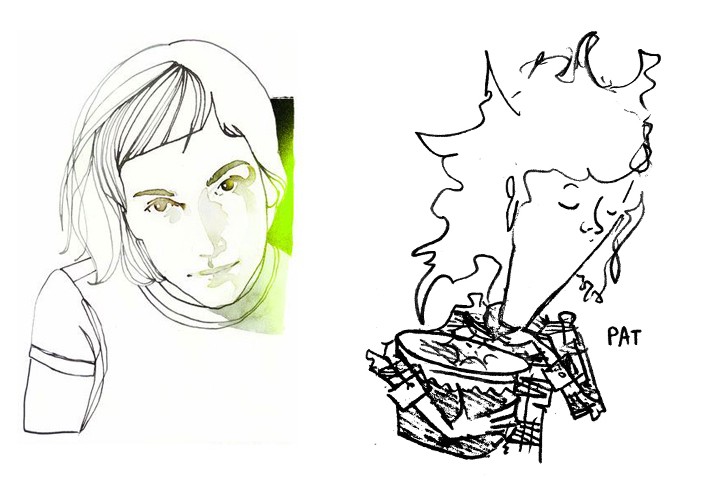
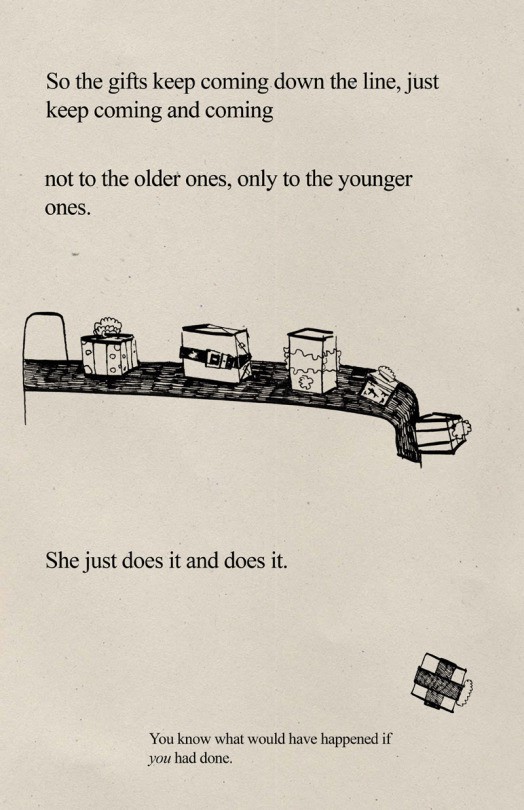
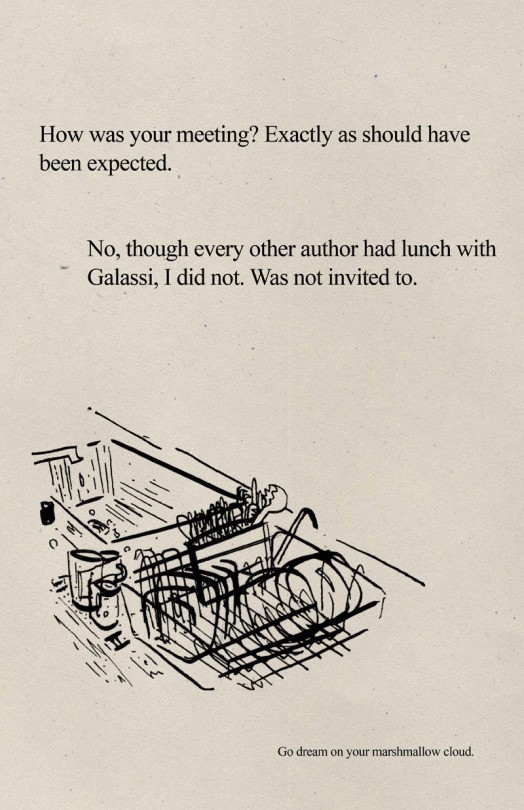
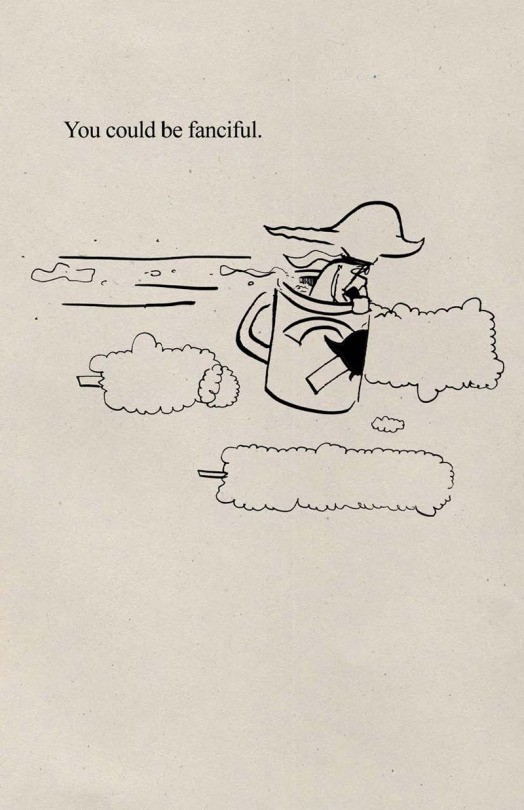
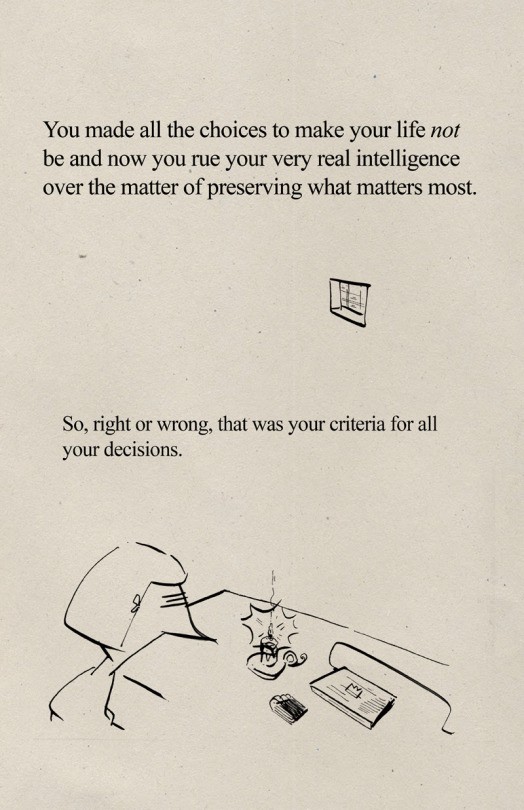
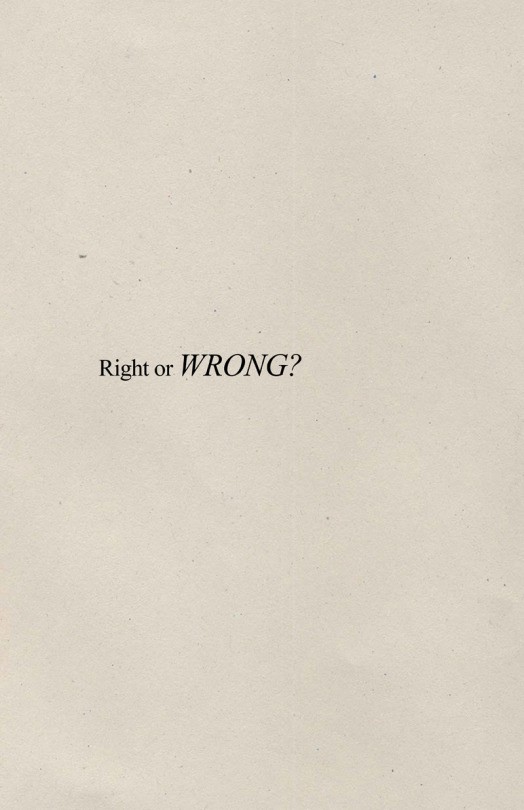
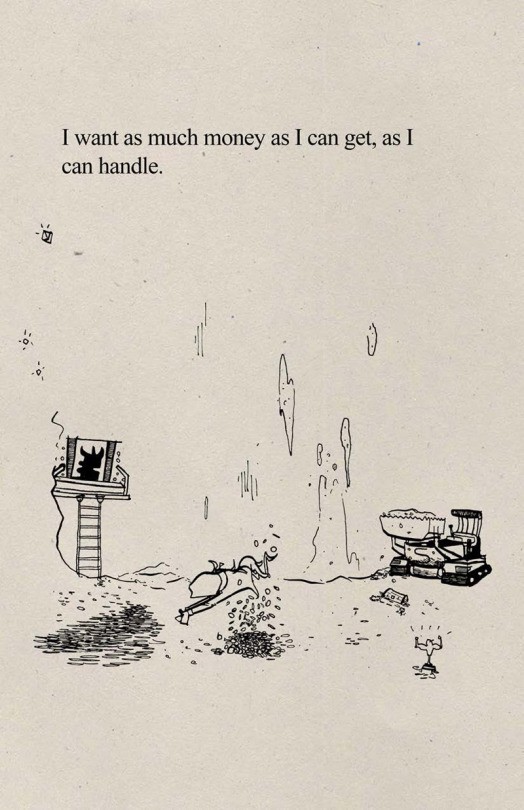
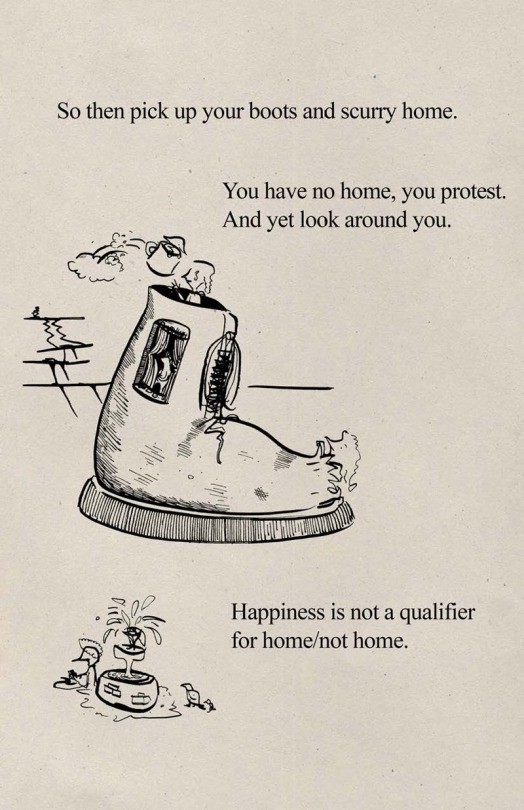
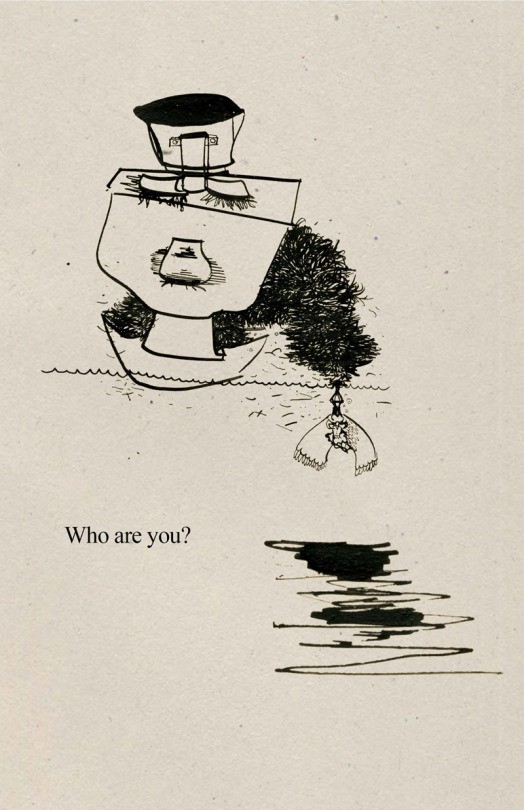
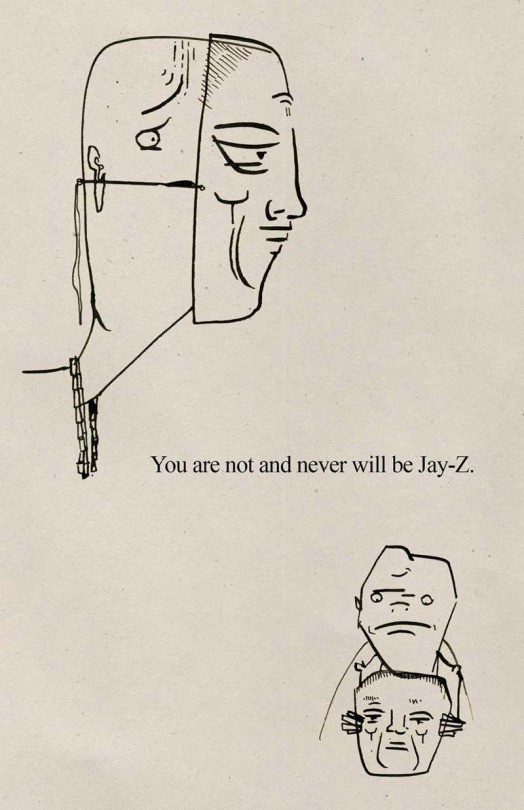
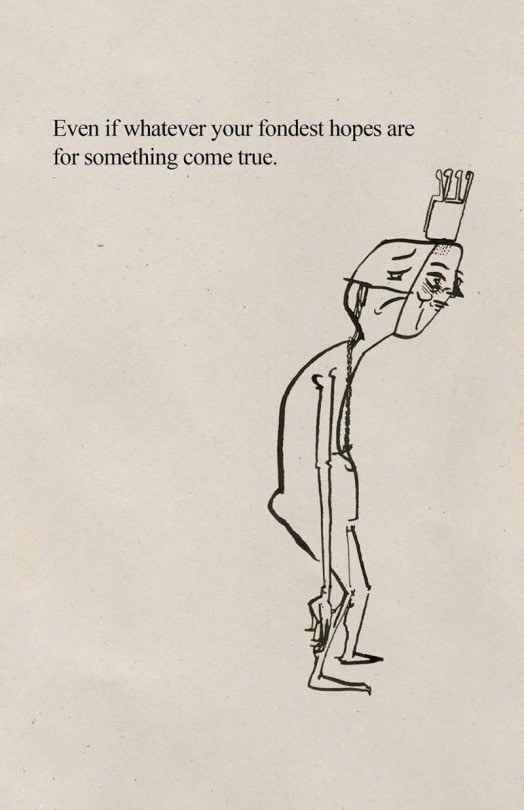
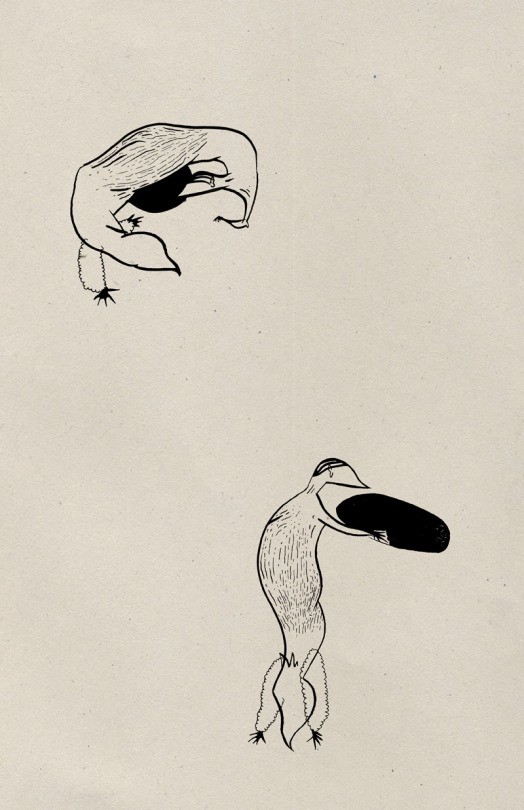
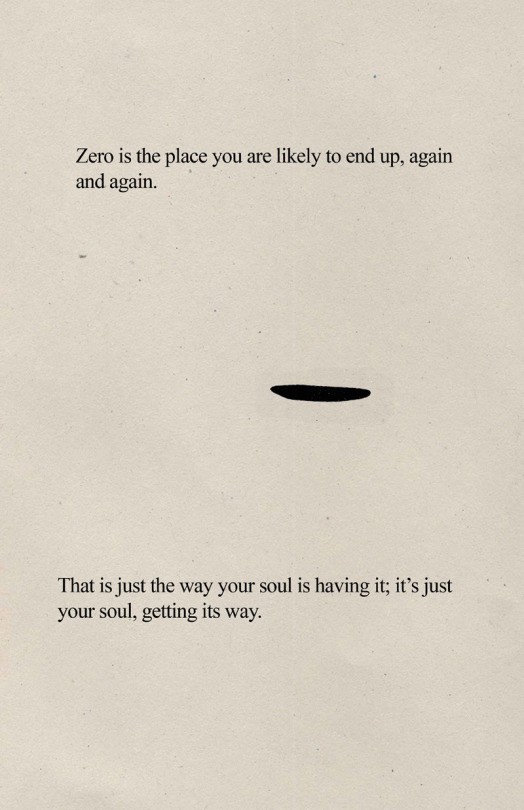
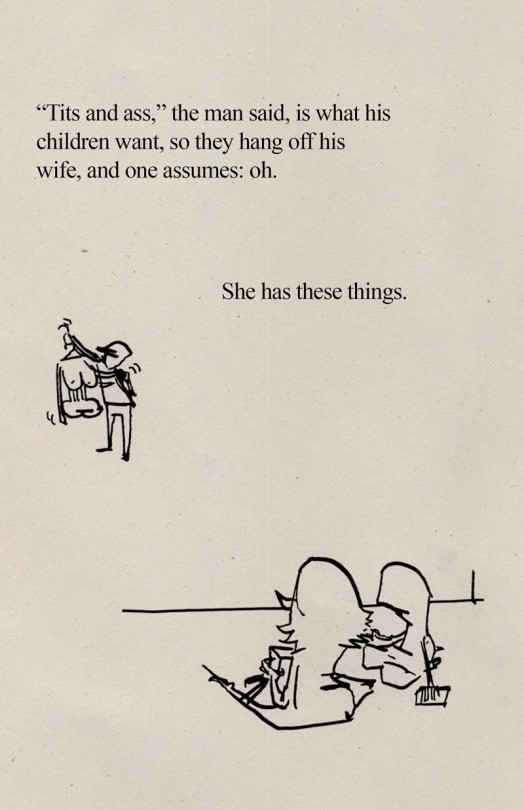
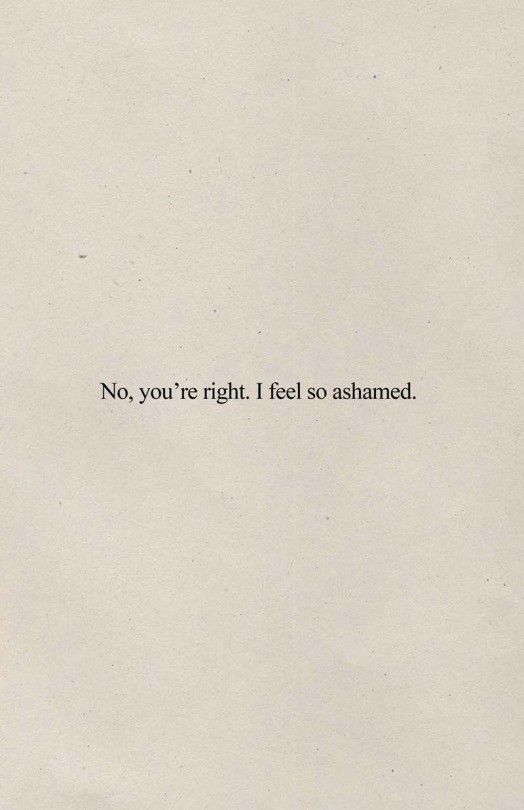
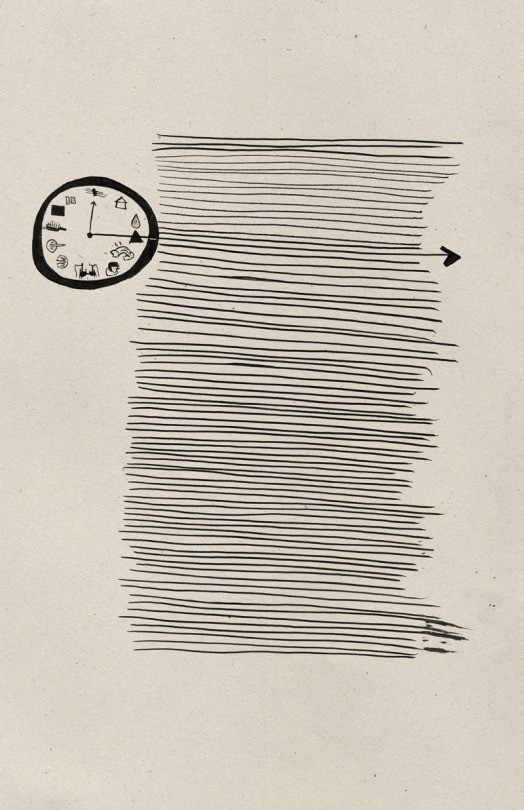
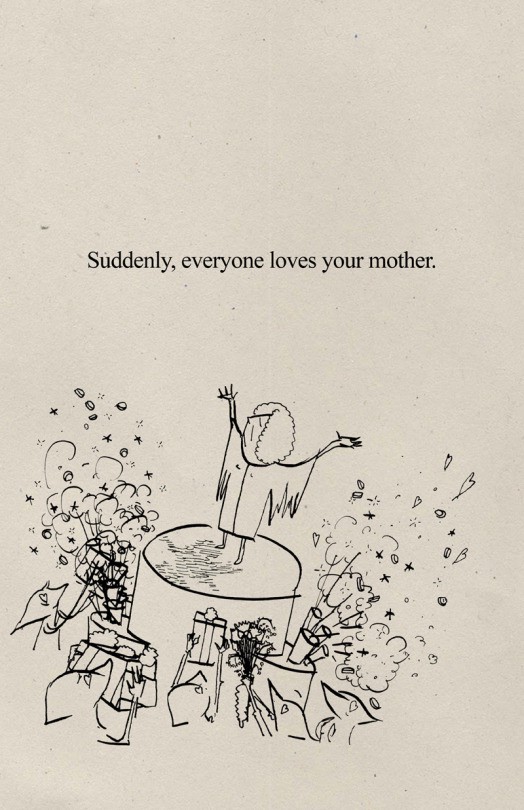
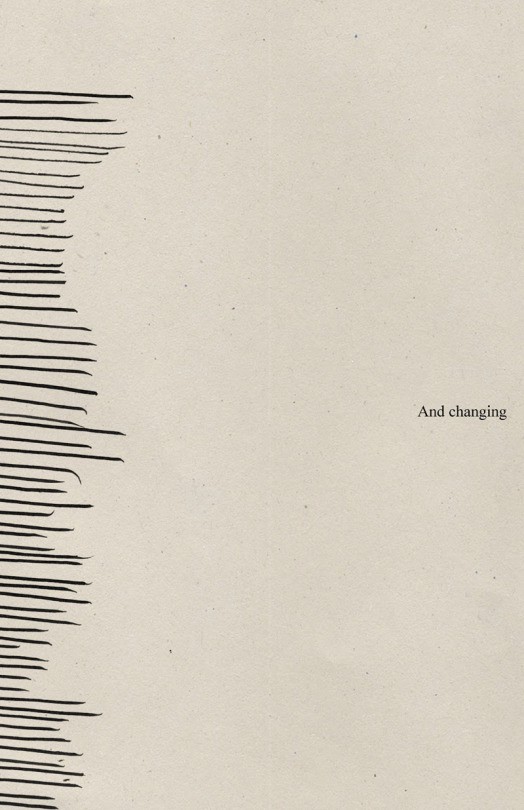
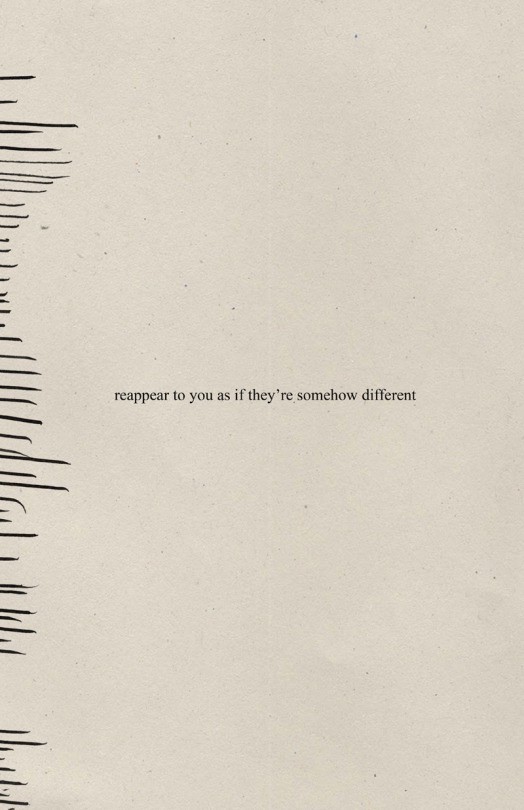
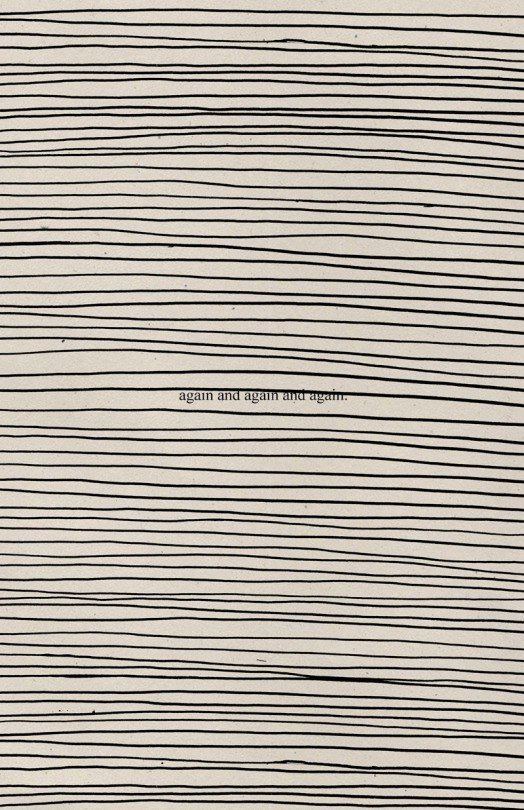
Read “The Humble Simple Thing,” a collaboration between Sheila Heti and Sara Lautman, in this week’s issue of our weekly fiction magazine, Recommended Reading.
Halimah Marcus: How do you two know each other?
Sara Lautman: I was the TA in a writing class at MICA, in Baltimore. Sheila came to speak as a visiting lecturer — a big lecture, open to students and the public. This was last year.
Sheila Heti: When I gave the talk, there was a small wiggly dog scampering around in the first row. I didn’t give a very good lecture. All I could think about was the dog. When I met Sara the next day, we liked each other immediately. She seemed smart and interesting and serious and I wanted to stay in touch.
SL: I had been reading and loving her books since The Middle Stories, which was published when I was a senior in high school. The day after the lecture, she came and spoke to our class. I asked if I could interview her for — nothing in particular. I was making illustrated essays and wanted to transfer that writing/drawing approach to interviews.
SH: Doing an interview didn’t seem so appealing to me at that moment.
SL: We ended up emailing back and forth about something else I could illustrate. I proposed a cut-up.
SH: I sent her a story that I had written very quickly, and never edited. It was about 1,500 words and called “R. Rose.”
HM: What was your process for collaborating on “The Humble Simple Thing”?
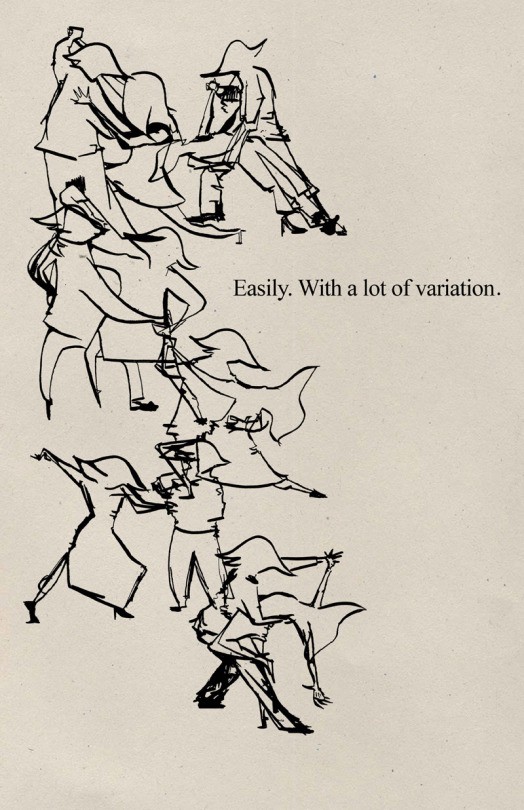
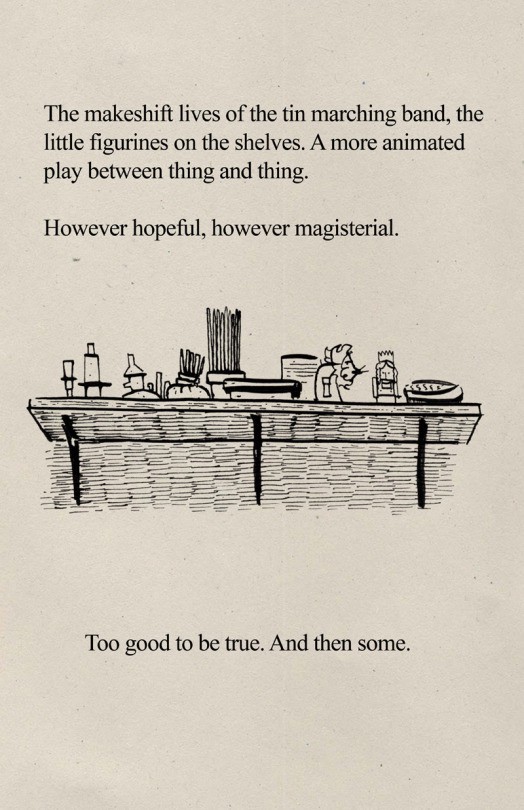
SL: Sheila sent me the story. I read it, went away from it for a day or so, then picked it back up and highlighted the parts I wanted to draw from. I made a word document with only those passages. That was the cut-up. I saw that there were many things to draw in it — many objects: gifts, chicken wings, a duck, Jay-Z. Those were toeholds. They made it easier to begin drawing emotional abstraction, which I ended up treating as kind of a play, with nonspecific silhouetted characters acting in metaphoric situations.
SH: I didn’t do anything.
SL: I drew a big stack of illustrations for the first selections. Then I put those in a sequence and selected some additional language. Then I drew more. That process repeated in littler cycles until I decided to be finished. It was a decision to be finished — there could have been many more pages.
SH: I don’t think I made many or any changes to the piece she ended up showing me. I was amazed and surprised by what she had made, and I thought it was wonderful.
HM: Sara, how did you decide what to cut and what to keep from Sheila’s original text?
SL: I cut a lot of stuff that was great and could have easily been kept. If my initial culling — the first favorites — had been different, the secondary, fill-in selection would have been different. Drawings dictate how the text needs to be edited. I decide how much information needs to be added and how much I can take away. Everything is contingent.
The piece itself — which, as I read it, is about personal standards in one sense, and, if you are making art, outside values placed on your work — felt close to what was on my mind at the time (and is still).
Then, of course, there are all the qualities I love about Sheila’s writing, and I already know them from being her reader — full frontal engagement with feelings, grasping the handles, tenacity mixed with compassion, gameness, trying to really solve problems.
HM: Sheila, how did it feel to be “cut-up” like that, and to see the final result?
SH: I recognize it as pieces of my brain. It still feels like me, like a distillation of what I was feeling at a particular time. But Sara also made new sense out of it. I don’t know Sara very well at all, in terms of sitting down and having coffee with her, or about the facts of her life, but on the other hand, I feel like I know her in a way I don’t know anyone else; to see your thoughts cut up and rearranged and illustrated — I see what of her is in this arrangement, which is not me. I feel like I’m her Frankenstein monster (or my words are) and that from how my words are behaving here, I know something about the Dr. Frankenstein whose hands sculpted it.
HM: Sara, can you talk a bit about your style as an artist, and how you shaped it to respond to Sheila’s words?
SL: I started drawing for “R. Rose” without planning anything. Some images worked, some didn’t, and I used the ones that worked as a guide for what to do next. I didn’t adjust my style in any premeditated way.
One change I remember: There were drawings early on with characters who had pupils on their eyes, and more detailed faces. They were overly characterized. Even though they were very minimal it felt like they were stealing focus.
After this project, and in between drafts, I ended up drawing these duck-headed figures a lot. I have another comic from around that time that’s just duck-heads miming the entire thing.
HM: Sheila, you mentioned you wrote the story that became “The Humble Simple Thing” quickly, without going back to edit it. Is that unusual for you? What is happening with the original story, “R. Rose,” now?
SH: I always write quickly. I didn’t edit this story because I didn’t feel like it would come to anything, even with editing. I gave it to Sara thinking she might be able to make something brand new from it. I imagine this piece will be its only life.
Sheila Heti’s most recent novel is How Should a Person Be? In the spring, McSweeney’s published her play, All Our Happy Days are Stupid. She is the author of five other books of fiction and non-fiction, including — with Heidi Julavits and Leanne Shapton — the New York Times bestseller, Women in Clothes. sheilaheti.net
Sara Lautman’s drawings and cartoons have appeared with The Pitchfork Review, Jezebel, The Awl, The Los Angeles Review of Books and many other places. The tenth collection of her comics, The Ultimate Laugh, will be published by Tinto Press in winter of 2015. Other recent collections, including Macrogroan6 and Lying and Cursing are available at Birdcage Bottom Books. saralautman.com
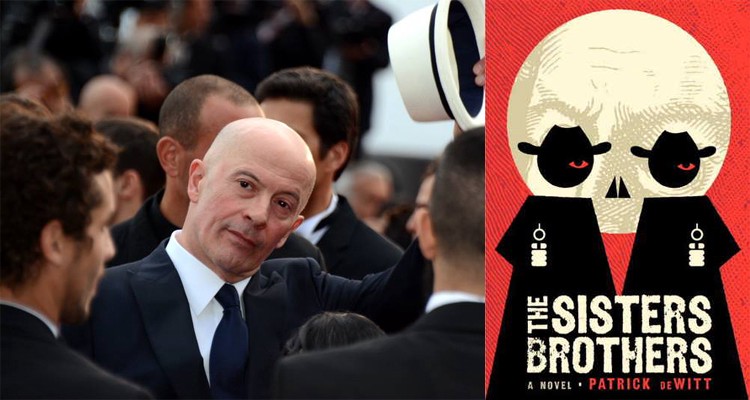
If you’re a fan of film director Jacques Audiard and/or novelist Patrick deWitt, this news is sure to whet your appetite: Audiard is currently working on an adaptation of deWitt’s The Sisters Brothers.
The novel is about Charlie and Eli Sisters, assassins sent on a mission to kill the prospector Hermann Warm after he’s accused of stealing from their boss. It’s set during California’s Gold Rush, which will certainly be a departure from Audiard’s previous films, including The Beat That My Heart Skipped, Un Prophète, and Rust and Bone (starring Marion Cotillard).
The Guardian reports that the film, which will be Audiard’s English-language debut, will star John C. Reilly.
In the meantime, if you’re thirsty for more deWitt, check out the recently-released trailer for his upcoming novel, Undermajordomo Minor, here.
People nodding along to their favorite podcasts or jamming out to their own personal playlists populate trains and buses in cities around the world. A symphony of high-volume, warring iPod songs often plague our daily commute. And yet, occasionally, we might glimpse someone paging through an actual novel (or, perhaps, you are that person…) In that instance, we rejoice: the book is not dead! Long live the book!
And now, finally, public transport users finally have a great reason to put away their headphones. In Cluj-Napoca — the second most populous city in Romania — travelers with their noses buried in a book were awarded free bus rides from June 4th-7th, 2015. Despite only being offered for an abbreviated time period, perhaps immensely positive reinforcements such as free rides will enforce a better reading habit. (Famous psychologist B.F. Skinner was on to something, wasn’t he?) We all know how hard it is to put down a good book!
We should all aim to emulate Cluj-Napoca’s recent movement. As The Independent reports, Victor Miron proposed the initiative to the city’s mayor, Emil Boc, in an effort to “encourage more people to read on public transportation.” The mayor then, amusingly, posted the idea on his Facebook page, which garnered a flurry of positive support. All we may need, then, is an enthusiastic, persistent champion of books to set this into motion in other cities around the world. An army of readers — instead of an army of vacant-eyed, head-boppin’ zombies with earbuds in — may soon populate your daily commute!
Social media, too, continues to play a big part in the promotion of literacy and the celebration of reading. (For example, I’m willing to bet you arrived at this Electric Literature article via Facebook or Twitter). According to The Independent, Miron is working hard to convince Facebook founder Mark Zuckerberg to participate in another of his reading-related campaigns: BookFace, which encourages Facebook users to change their profile picture to one of themselves reading. Because Zuckerberg recently launched “A Year of Books,” I’m optimistic that he’ll continue to align himself with the wonderfully lit-crazed demographic of his users.
Brooklyn has seldom been so lushly and tenderly rendered as in Bright Lines, Tanwi Nandini Islam’s debut novel. We follow Anwar Saleem, his wife Hashi, their daughter Charu, and their niece, Ella, through the rich, summer streets of the city. They deal with traumas forgotten and questions of burgeoning identity, coming of age and coming of middle-age. Problems of the past and future. Questions like, “who have I become?” and “who will I become?”
Tanwi and I met in late July at her bustling studio, studded with tins of almost-finished candles. She was hard at work filling an order for Hi Wildflower, her line of botanical perfumes, candles, and skincare. We ran off for an iced tea around the corner and talked about hallucinations, sex scenes, and the artistic hustle.
Hilary Leichter: Can you talk a little bit about the process that went into putting the novel together? How did writing the book change over the course of a decade for you?
Tanwi Nandini Islam: So the book takes place in 2003 which was an electric year for me. It was super intense. I went to Kenya that year. I went to Cuba that year. I was in this Youth Solidarity Summer which is a South Asian radical youth education collective that was teaching us about social justice. It was all this stuff happening. That was also the same year that the blackout happened. You know? That whole year — and it was right after September 11th. So there’s a lot of stuff that people of color, especially South Asian and people of Muslim descent were dealing with. And those things all have stayed with me. When I started writing Bright Lines, it was in a totally different incarnation, but I was living in India, in Delhi, doing a fellowship, working with teenagers, which is what I did for a decade. And the roommates I was living with, we decided to go to Kashmir and hang out in Kashmir, because that’s what you do. But it was Ramadan when we went so it was super dead, there was nothing to do after the sun went down. So I said, oh, I’ll start working on some stuff. And it was the first iteration of a novel that I wanted to write. And I knew the way to buy some time was to go get an M.F.A. For me, I’m not a school person. I’m not even an M.F.A. person. But I felt that it was a way for me to say, I don’t work right now except on my M.F.A. and my part time job.
HL: To give yourself permission —
TNI: The years to do it. The two years. And so I submitted that to a bunch of M.F.A. programs. I just remember getting that email from Michael Cunningham and it was, “We would love for you to come to Brooklyn College,” and it’s Michael. Fucking. Cunningham. And I said, “I’m coming, Michael!” I couldn’t even talk to him on the phone because I was in India. Back then it was really hard to do things like that.
HL: Yes. Skype was not a major thing.
TNI: Yeah, it wasn’t major! So I think my dad called him and asked him all the questions I wanted to ask him. And my dad said, “He’s a fabulous man.” And I said, “Yeah, he is a fabulous man.”
HL: And this was the first draft of the book?
And I knew I wanted to write about the Brooklyn of that time that was so different than the Brooklyn we have now.
TNI: Yeah. But the POV that really solidified into Anwar’s POV came a few years into my M.F.A. And I was also in another country, living in France, and working for a Kashmiri guy. There’s this weird Kashmiri connection, I don’t know what it is. But I was working for a Kashmiri shawl seller, selling shawls in the French Riviera at a hotel, working from 8:00 AM to 8:00 PM for 150 Euros a day. And I was just devouring Toni Morrison, and Marquez, all these people who I feel have influenced me. Being stuck and reading, and reading out of boredom, and then having your imagination come alive, and that area is so colorful, and beautiful, and the houses are pastel, the beaches are made of rocks. It’s just gorgeous. And it’s tiny. You can go from one end of France to the other. I just felt so inspired, and I started working on the book. It was that summer of 2008. And I knew I wanted to write about the Brooklyn of that time that was so different than the Brooklyn we have now. And I was part of the wave of people that were coming into the city after college, and doing all of that stuff. But you know, we were sharing an apartment, paying $500 a piece, you know, living in the city. The year that I moved to Brooklyn, Dave Chappelle had his block party on the block I was living on. It was just, I feel, a golden age of the early aughts.
HL: At a certain point, did you make a decision to write a “Brooklyn” novel?
TNI: Well the first few drafts I thought, “I should make this in Queens,” because it’s more South Asian. And I thought fuck that, it’s not more South Asian! All the people who own these Muslim oil shops — that’s very much the inspiration for Anwar — these health food stores, these herbal shops…they’re from Bangladesh. Their owners are Bangladeshi people, the people who work there are Bangladeshi people, and it’s a character that I knew I wanted to write. Anything I write, I feel is very much about creative entrepreneurship and the hustle. You know, it’s always about our hustle. When I met you, you were like, “I’m selling bags for my mom!” We’re all just trying to make a dollar, you know?
HL: We were both vendors at the Brooklyn Night Bazaar! Could you talk a little bit about retail and art? And about how your business, Hi Wildflower, plays into your writing?
TNI: I’ve been thinking about Bright Lines for a decade. And that’s a really long time to think about something. And not having a full time job in a traditional sense, and a 401k plan, and all these things that we are told we should have. They are elusive for us. And I knew that I sacrificed that. Even up to last year, I was just freelancing as a writer, trying to get copywriting gigs. And then I saw there are all these brands doing beauty, and candles, and I’ve been so interested in anything to do with essential oils and botanicals, and all these things that I think get a kind of new-agey spin. But all of those texts that people reference are things that I’ve been interested in for decades. That’s what I’ve been into since I was a teenager. I really wanted to do something that connects back to the themes in the book, but it’s a continuation of the stuff that I’ve always been interested in. It’s just another iteration. Every candle has a little poem on it, and I’m writing all the copy for everything, everything is a story-spun-world within itself. Each candle is a little slice of that world. They’re interlinked stories almost, these little objects that I’ve been creating. So it’s all connected.
HL: Your book and your business are kind of twins?
TNI: Yeah, they’re totally mirror —
HL: — sisters?
Everyone’s trying to not be anyone else’s minion.
TNI: Yeah! One is the dark and depressed and solitary sister, and the other one’s kind of, you know, very social and money oriented! And that’s the hard thing, to make your art something that isn’t about money. And my business is about products and creating a sustainable life for myself, and being accessible to people. And getting into these Brooklyn stores, so many of the women that I’m working with are small business owners like me! Everyone’s trying to not be anyone else’s minion. We’re trying to be our own boss.
HL: And there’s value in that.
TNI: I think so! My parents said, “Okay, shouldn’t you get a job and health insurance?” And I said, “I have job!” And now they’re saying, “Okay, it’s real.”
HL: I was really taken with all of the dualities in your book. Anwar builds two of everything in their home. And there are two adopted sisters, Ella and Charu, who are very much two sides of the same coin. Was this something that you were thinking about when you were putting the story together?
We embroider, and embroider, and embroider, and then we just unravel everything and start some new shit.
TNI: I think that is just my being. Anyone who knows me really well will say, “You say one thing with such conviction and then you completely say the opposite, with the same amount of conviction!” That is the artistic process. We embroider, and embroider, and embroider, and then we just unravel everything and start some new shit. It’s completely the back and forth of building something up and breaking it down. I think duality is just a great continuum. We’re just sliding back and forth between poles. There’s no equilibrium. I mean, I’m a Libra, so I’m very much into the eternal balance. I think when we get bored or stagnant we want to shake things up. When we are really really depressed we want some light. I think that’s our natural inclination as human beings, to gravitate towards the thing that we’re lacking.
HL: At the end of your book, the idea of “misdirected love” comes up. Taboo love, long-shot love, doomed love. And that for me felt like a guiding principle for everything you were writing. Do you feel that way? Was that a central, unifying theme for your novel?
TNI: For sure, yeah, for every character. I like you, but you like them, and they like me, and these triangles that we’re all —
HL: And sometimes misguided triangles? And false starts? To me it felt like a beautiful metaphor for a writer trying to figure out who a character is going to be in a book, and how they will be, and those shifting roles that we create when we’re building narratives and discovering. And how that process of discovery actually just naturally happens in real life.
TNI: That, to me, was the guiding principle. There’s something about misdirected love where it’s, “It’s not you, it’s me.” And it completely is not about the other person. It’s literally about you. In the case of Anwar, in his misdirected love, it’s this fantasy he has of a person that lives upstairs. And the fantasy is actually as beautiful and vivacious and wonderful as he thinks it is.
HL: Yes, there is wish fulfillment in this book, but not necessarily with the caveat of “be careful what you wish for!” The consequences are proportional. And I feel that sometimes female characters in fiction, when they get something they desire, they’re instantly slammed and punished in some way.
TNI: There’s drama to counteract it.
HL: In your book, people get what they want, and then just deal with it. It felt very real.
TNI: I’m glad it felt real. There is this Chekhov quote: “The bourgeoisie loves so-called ‘positive’ types and novels with happy endings since they lull one into thinking that it is fine to simultaneously acquire capital and maintain one’s innocence, to be a beast and still be happy.” And my response to that was, well, sometimes realism is a deadly and ugly place. How many stories of young Muslim women have we read that are really torturous and upsetting and hurtful and tragic? I wanted to write something that does have very painful and dark things that deal with death and loss and the history of war, but to counteract that with these wishes that are completely feasible and tangible. All of these people get to experience that moment of euphoria. And they get to experience the crash that comes after, if they need to experience that. But most of the time it’s, “Finally, something good finally happened!”
HL: It is satisfying when something good happens to a character you care about.
TNI: Yeah, like, “You’re gonna get laid.” That’s a good thing! Everyone gets laid in this book.
HL: End of interview.
TNI: Yeah, that is the whole point! I think any book I ever write, everyone will get laid. I like writing sex scenes.
HL: The sex scenes felt very honest. I feel like there’s a trend right now to write honest sex scenes that are uncomfortable, or funny, or —
TNI: Not beautiful?
HL: Yes! But these scenes felt committed to both being honest and generous to the characters.
TNI: And just fun! I wanted it to feel playful. Like, there’s props involved! And there’s memories involved. I wanted it to be a complete sensory experience.
HL: Ella and Anwar plant a Linnean flower clock in their backyard, a garden of plants that open and close, timed throughout the day. I loved how it became an internal stopwatch for the book. But then it’s destroyed —
TNI: It’s burned. It’s totally destroyed. I’m not saving all my journals. I hoard certain things, and other things–-it’s over, I start over. Destroy. From scratch. When the family is dealing with the final showdown in part one of the book, with the fire, it is very much “Look, we need to rise from this moment by going through this really intense thing as a family. We’re not going to make it unless we do that.” And it actually gets worse until it gets better.
HL: I wonder if you could talk a little bit more about Ella and Anwar, our dual protagonists. They both experience life changing traumas. Anwar can remember his, and Ella can’t really remember hers. And the way their trauma manifests itself in the book is through hallucinations, which are stunning. As a result, I felt that Ella and Anwar were sort of the the book’s imagination, running on overdrive. I was wondering about your writing process, writing their hallucinations. What place did you have to go to get there? To get to those really freewheeling, amazing images?
People get hallucinations. Depression is a real thing. Psychological trauma is a real thing.
TNI: I think for me, thinking about Bangladesh and Brooklyn, the things from Bangladesh that I think are very present throughout the book — obviously plant life and botany, but there’s the ocean and the rivers and all this water imagery. The way that the characters are inundated with hallucinations is very much connected to times of day in which they’re occurring, and things they’re drawn to. Rezwan’s head is a hallucination that Anwar sees when he’s high. When he smokes pot, he’s not stuck in his life, at his apothecary, in his studio, in his home, he’s just chilling. And he’s free, and he’s seeing whatever he needs to see. But how sad, or how beautiful, that he gets to see his friend, in his severed state of death. Because that’s where he feels the most guilty. And I think for Ella, seeing the worlds that they’re creating, and the plants that are growing, and everything that’s coming alive in their gardening, that’s where she gets to be completely unfettered and liberated. It is a space of liberation for the characters. It is very much pushing away the repressive feeling that they both have grown up with either because of faith or family or expectations from Anwar’s wife Hashi, or Ella feeling like, “I’m a freak because of what I desire and who I am.” I didn’t want to make it so clinical. People get hallucinations. Depression is a real thing. Psychological trauma is a real thing. And in places like Bangladesh, for many people of color, for many societies where there’s been a war and a collective dealing with after, there is a collective, post-traumatic stress that people experience.
HL: All of the characters have a specific talent that transcends their everyday world. Whether it’s Hashi in her salon, or Ella in the garden, or Charu making her beautiful hijabs.
TNI: They’re very creative.
HL: Do you think there’s something about working with your hands that is important to the creative life?
TNI: It’s a desire to make your mark. In this particular family, it’s very much, “What’s my hustle? What’s the thing I bring to the world?” It is very tactile. For Charu, she’s an all-over-the-place, expressive, creative person, and this is her thing where she feels, “I’m good at this, and I’m going to make this into my business for my friends who don’t have a cool place to buy hijabs.” This wasn’t so much a post-9/11 book; I wasn’t writing it that way. But you have to write it that way. It is that. You can’t write about it as if it never happened. So she is doing something that’s subversive.
HL: Do you feel that your book is really committed to carving out a space for marginalized voices?
To me, I want people to read it and say, “I don’t know this world, but I feel this world. This is also my world.”
TNI: It’s not a conscious thing in that way but, you know, there is no white protagonist in this novel. That is a conscious thing. That’s just not what I’m writing about. But the fact that you can enter this story and find a connection to these characters no matter who you are as a reader, is saying there’s inherent universality in that. Because we are a country of people who come from all over the world. We’re all coming from these different points, and that’s what I think my book is trying to do. If you look at my friends, and if you look at the studio where we’re all working, we’re all different. And I think it’s a fallacy to think of this as an other-ing — we are all very much other, in our own quests. To me, I want people to read it and say, “I don’t know this world, but I feel this world. This is also my world.” It’s just human. I think about writing Bangladeshi characters, and what that means, especially because there are so many Indian writers that are well known. And there are a few Bangladeshi writers that are better known now, but I think we’re still writing stories that are distinctly different because of a distinct history. There’s a table. And it’s like, can I sit at the table with my story? And it’s not always easy to do that. Even the book cover was completely different. And it was totally wrong. And I was very vocal about it. I think the author isn’t just a passive voice. You have to be very active. What I ended up with, I think, has iconography that goes with this book. It goes with what I was trying to say.
HL: But you had to speak up about that?
TNI: Oh, yeah. I created a vision board. And I said, this is what I want it to feel like. What I had before, was a brown girl with pastel pink pants and a pastel blue background. And I said no, no, no, no. If you’re trying to make it iconic, I want you to think, who are the people at the core of this book? Even the title could mean so many things, but to me, it’s evocative of genealogy, expansion. The colors are very much connected to what Ella sees, her psychedelic vision of the world.
HL: The cover looks like it’s bursting.
TNI: And that is the word. A radius of light. To see this ascension, on a bike in silhouette, is a powerful thing.
HL: It’s an action. It’s active.
TNI: My publisher was great about this. They said, we want you to be happy about this. And they worked with me. And I thanked the artist. I said, you fucking nailed it!
HL: I felt reading this book that you gave so many voices a seat at the table.
TNI: This is emblematic of my friendships and my social circles and my life. Different genders, different races, different class backgrounds. We are all friends sitting at the same table.
HL: Would you say something that doesn’t show that experience is maybe not even realism?
TNI: It’s very limited. It doesn’t feel real, it feels almost real. And I think that’s the place of a book, to feel not exactly like reality. But it should feel like something that deepens your sense of reality.
HL: What are you working on now?
TNI: I have a new book that I’m working on. This book, Bright Lines, is sort of a time capsule of the past–-the recent past. And this is going to be a time capsule of the near future. It’s an alternating narrative that takes place in the 1920’s and a little bit after today. The couple is a perfumer and a scientist, and they are creating an interactive film about the oldest woman on earth. It’s not going to be sci-fi, but it’s definitely going to be an immersive, virtual-reality inspired story.
HL: And what are you reading right now that you’re excited about?
TNI: I have a whole stack of friends’ books! But right now I’m reading Celeste Ng’s book, Everything I Never Told You. There’s a novel called A Bad Character, by Deepti Kapoor, and she’s a friend, and I’m reading hers. And TheStar Side of Bird Hill by Naomi Jackson. We’re doing an event together. So those are some things I have on my stack. After my book is out, I’m going to sit on a beach and just devour everything.
For more on Tanwi Nandini Islam, read Jason Diamond’s essay, “How Literature Smells,” in Electric Literature.
A bedtime story entitled The Rabbit Who Wants to Fall Asleep, written by Swedish psychologist Carl-Johan Forssén Ehrlin, is Amazon’s newest bestselling chart-topper. The book’s impressive sales record suggests an army of exhausted parents desperate for their children to fall asleep fast(er).
According to CBS News, Dr. Umakanth Khatwa, Director of Sleep Laboratories at Boston Children’s Hospital, describes the book as “gentle hypnosis.” In bedrooms all over the world, then, parents are turning into beginner hypnotists. Ehrlin “employs psychological and positive reinforcement techniques to promote relaxation and induce sleep,” including a carefully constructed language pattern and sentence structure.
The book encourages readers to yawn frequently (and we all know far too well how peskily contagious a yawn can be!) as well as to insert the name of the awake and excitable child being read to within certain designated places. While reporting that this final technique does allow children to effectively identify with the sleepy rabbit protagonist, Imogen Russell Williams also highlights the overlooked and “sinister” aspects of the children’s book in her article for The Guardian. The book’s disclaimer states: “Even if this book is harmless to use, the author and the publisher takes no responsibility for the outcome.” Use of the word “outcome” may suggest a scary statistical possibility of the book falling into the wrong hands at the wrong time, or it could just be an amusing and obvious reminder that the book isn’t foolproof. Your child might still require three long, excruciating hours before finally closing their eyes.
Williams points to another off-putting moment, when readers are introduced to a wizard character “who ALWAYS makes children and rabbits fall asleep using his magic sleeping powder.” I wouldn’t expect a children’s book to include a reference to sleep-inducing drugs, either, but to each their own.
The vast majority of parents, however, claim the book did indeed send their children straight into sweet and innocent dreamland. Rave reviews populate its Amazon page; one parent says the book worked perfectly on her “sleep-fighting champion” of a 5-year-old, while another wrote excitedly (and yes, in all caps): “MR. HYPER WAS ASLEEP BEFORE THE BOOK WAS OVER!!”
If Mr. Hyper was able to fall asleep, then perhaps a young Mrs. Hyper can be convinced, too.
This fall will see the release of the debut novel by Morrissey, the acclaimed English singer and former frontman of The Smiths. The novel will be released by Penguin UK in September with the title List of the Lost. However, Electric Literature has obtained the following list of proposed early titles for the novel:
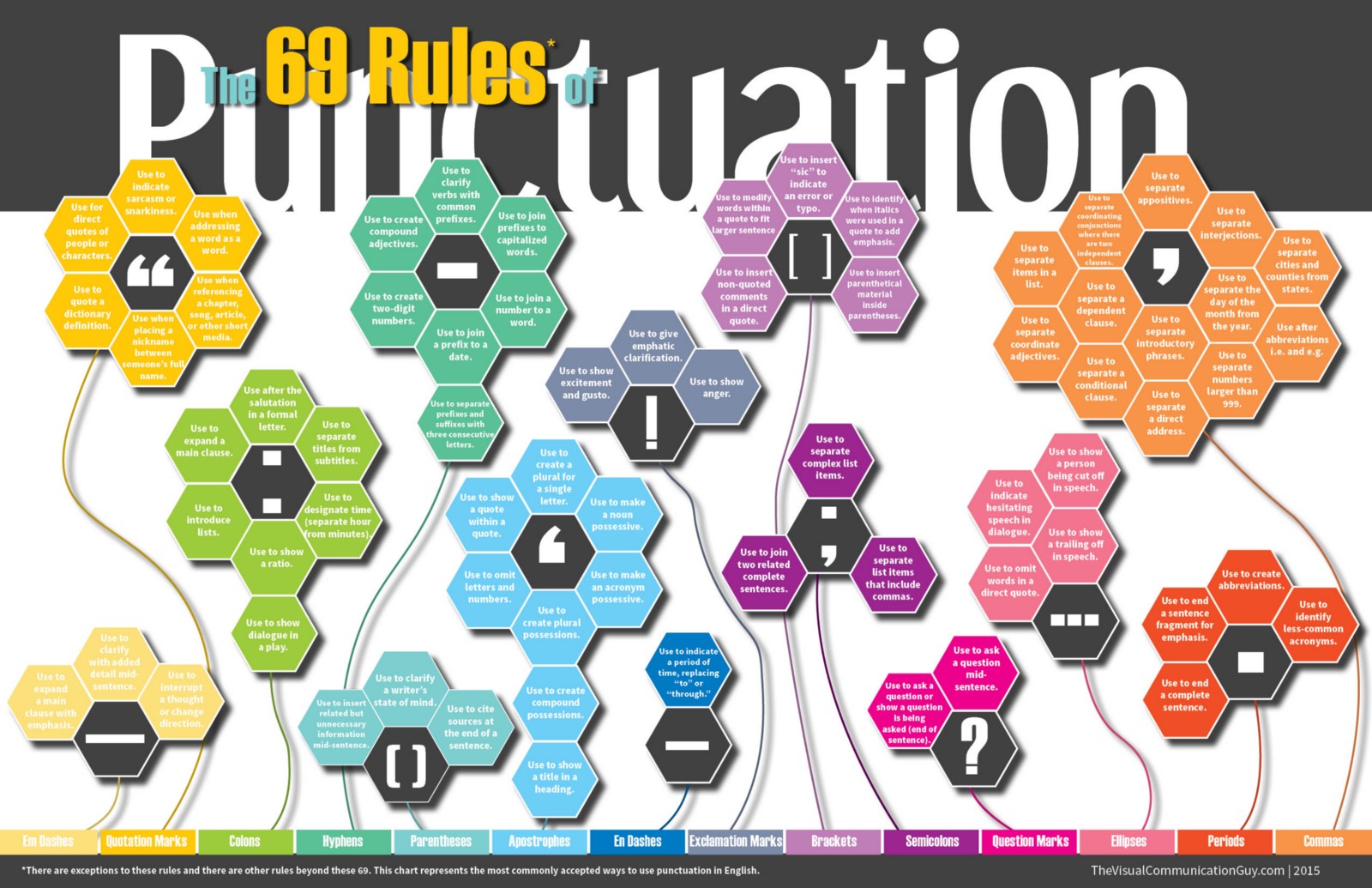
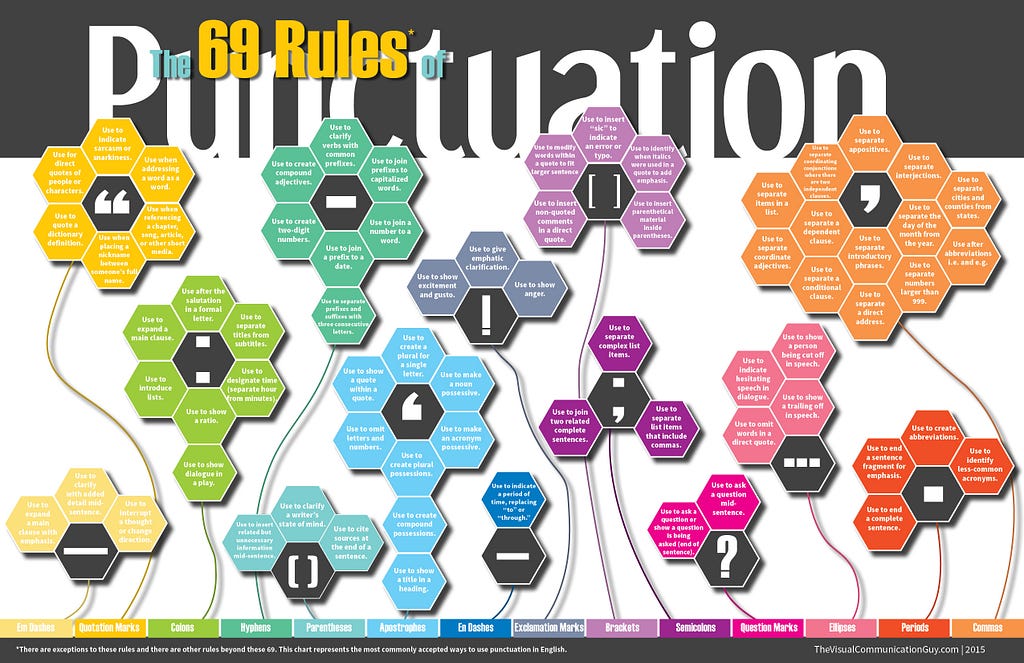
Snoots, rejoice! This handy infographic from Curtis Newbold (view here to enlarge) reduces the rules of proper punctuation to a series of color-coded blurbs. Even the most hard-boiled grammar delinquent is sure to get the message.
We are standing on the beach. We are waving our hands as if to say Help! or Goodbye! but we are not sure which. There is fine black and yellow and white sand squishing into our toenails and the sun is bright enough that we wish we had brought shades. This island that we’re on is not the most comfortable island in the world but we have lived here our whole lives, our parents and our parents’ parents have lived here their whole lives, and we are not about to leave. Not even now that the island has tugged free of its base and started to float away, westward, westward.
It is an uncomfortable day. The sun is too bright and the wind is blowing something fierce. They are blowing down the trees. Cynthia and Robert and Hank and Cecilia are not too happy about this. These are not their real names. We are not happy about it as well. We are getting burnt and we feel itchy and we do not like this. But we have to stay out here as the edges of the horizon fade so that we can tell our children and our grandchildren that we were there, are here. Little Evie starts to cry. That is not her real name but her crying is real. We shush her. We tell her: This is the start of something new.
It is later when we find out that although we do have electricity, we do not have cell phone reception. Or cable. This is not what we expected. We thought things would stay the same if we allowed our island to float away but already, things are changing. We spend our days chatting with each other and visiting. We have all changed our names to something we feel is closer to our nature. We have lost track of the days but we believe that the distance between us and them is now more than two hours. Bob pretends that he knows, that he is keeping track because he used to be an engineer. We don’t really need engineers here so instead, he tells us facts and occasionally tries to build things. Like hammocks. And fishing poles. We already have fishing poles so we don’t understand why he would try building one. We are constantly surprised by what we can do. Some people have decided that they will fish. Others have decided they will garden. Others have discovered a knack for fixing machinery and making car parts out of what we have on the island. Others entertain the children and teach them how to count and say the alphabet. But sometimes their alphabets are confused and we find our children counting on their fingers in ways that are not like the way we count on our fingers. We hold parties for their birthdays and they are good parties with plenty of fruit and some fish. We do not eat much meat other than fish because we went a little overboard early on and there are now very few animals on the island. But the birds are beautiful and they sing all day long.
In the beginning when our island first floated away, we kept a lookout for other sights of land. We had been on the western edge of the world and all we knew was that we were floating further and further away from the rest of mankind. On maps, nothing past our island. We decided to draw our own maps, to label newly found countries and continents. But days then weeks then months then years went by and every day, the unchanging ocean. We understood then, why no one had ever charted the territory. There was simply nothing here but miles and miles of ocean. We could barely even tell that we were moving; we became so habituated with the rolling of the waves below us, with the lull of water.
When the first of us died, we rolled them up in cloth, the way we heard sailors did, and put them out to sea. That’s when we began to write down our stories of the mainland, now years more than two hours away. We each remembered different things. One of us remembered the crisp sweet crunch of apples in the fall. Another remembered the way it felt to be pressed together like a grilled cheese sandwich in the subway. Keller or maybe Connor remembered the way red sand crumbled between his fingers in the desert and the giant arches of stone. Patty remembered heavy metal music and the crush of sweaty bodies at a concert. Joe remembered cool stone and libraries below ground. The green mild flesh of avocado and the tartness of kiwi. The smell of something other than the sea breeze. The sound of ten thousand people rather than one thousand. We remembered volcanoes and waterfalls, the force of an airplane engine. We remembered so much that we weren’t sure whether what we remembered were actually real or from dreams or books. We no longer looked to the ocean for a glimpse of land.
Years and years passed and the ones of us that remembered the mainland slowly faded away, first minds then bodies. We rarely looked to the ocean unless it was to fish. And one by one, we wrapped bodies in cloth and dropped them over the steepest side of our island, where there was no beach but rock jutting out over water, the east side.
When we did see the hazy outline of something in the distance, we thought, Oh, that must be a whale, I’ve heard of those. We pictured whales as giant fish with happy smiles, small dots for eyes, smooth as a cartoon. The darkness on the horizon stayed still and we ignored it, saying, That’s just the whale. It won’t do anything. And we continued on with our days as the darkness grew larger and larger until we were close enough to see, with binoculars, that it was no whale.
It was gray rock and trees that we had never seen before. Brown sand and bright birds. This was all we could tell with our binoculars as we traveled parallel to it, our island still heading westward. And people. We could see strange houses made of what must be red brick and tile, so different from the ones we had. Our island traveled closer and closer to it until it was only a quick boat ride away, not even an hour. Through our binoculars, we saw others waving and pointing our way the same way we waved and pointed towards them. We named them in our heads with our names, we watched them watching us and as we passed by, all we knew to do was stand and watch as the island took us further and further away.
Confession comes easily for Karl Ove Knausgård. In an interview with the Paris Review a few years ago, when asked about Min Kampf and his interest in Paul Celan, he made a curious admission:
My book is very much about what experiences are and what they’re good for, but it isn’t one of those experiences in itself. It’s a secondary thing. It’s a secondary book. A book about experiences that doesn’t produce those experiences, if you understand the difference. That’s why I’m writing about Celan instead of trying to write like Celan. It really is second best.
That Knausgård would chose a poet as a point of comparison, and one commonly praised and derided as hermetic, is notable. There are writers who represent personal experiences, often for the sake of parsing their nuances and significance, and then there are ones who create, as opposed to recreate, an experience within a piece of writing. If a poem is, at the most cursory level, a record of the poet experiencing the otherness of consciousness, in and by way of language, then subject matter, “content,” “having a message” is coincidental to this, a decoy of convenience, a ruse. The hope is that both writer and reader will skate through the lines of a poem on the heels of an inexplicable vibrancy, a quality of spontaneous synthesis of ideas and rhetorical effects more popularly known as magic. It would be embarrassing and insufficient to call Celan a magician. It would be even more so in the case of the author under review here, Brazilian novelist, essayist, and short story writer Clarice Lispector. That being said, it wouldn’t be too far off the mark. Here is someone for whom the creation of secondary experiences was foreign. Or, in her words: “Creation is not a comprehension, it is a new mystery.”
Over the past few years, there has been a concerted effort by Lispector’s biographer Benjamin Moser and New Directions to bring her work to wider notice. The publication of four newly translated novels and a biography, Why This World, have led to this high point, New Directions’ release of The Complete Stories. Eighty-six stories drawn from nine collections, written across a period of forty years, the earliest of which was penned when Lispector was still a teenager. The overall impression one has, reading The Complete Stories from beginning to end, is the development and broadening of a distinct, inimitable sensibility; even in the earliest stories that tone, that voice, the rangy cross-pollination of grotesquerie and abstraction, of introspective daydream and deadpan comedy, are rendered in sentences supposedly even more angular and idiosyncratic in Portuguese than they are here, in English.
The details of Lispector’s life are well known. But maybe it would be worth recounting them as she might have. Clarice Lispector wasn’t born in 1920, in the Ukraine. Her family didn’t move to Brazil in 1922; her mother didn’t die eight years later, of syphilis, contracted under circumstances too horrible to mention here glibly, as a biographical note, in a book review. She wasn’t one of the first women law students in Brazil, didn’t publish her first book at twenty-three, didn’t leave the country soon after with her new husband, an ambassador, whose diplomatic work led her to, of all places, Washington D.C.. These things happened, but they didn’t exist. For them to exist, she would have had to create a language for them. In her fiction, she was concerned with other things, with subtleties of perception so finely graded they might be deemed fantastical or imaginary. In the preferred style of the mystics, she lived and wrote according to “the path of negation,” Negative Way, Via Negativa (to quote that Jewish seer of the late Austro-Hungarian Empire, Franz The Son: “What is laid upon us is to accomplish the negative; the positive is already given.”) “…not having any secrets, yet maintaining the enigma,” she called it: exploding the characteristics of things beyond the strictures of their appearances.
Lispector was fascinated with the plasticity of consciousness. The sense of otherness that permeates the phenomenal world and all relationships, particularly those between people, was a continual point of obsession for her. This is common enough among poets yet among writers of prose fiction, slightly more unusual. There are similarities here to the work of Gertrude Stein, for example, and the very few stories Laura Riding wrote, but Lispector differs even from them in her blending of the intersubjective dynamics of daily interactions between people, with the bizarre associative capacities of a mind making connections where it pleases. Her work is often compared to Virginia Woolf, but these stories more closely resemble Woolf at her most unconventional and playful; the Woolf who would write a book-length autobiography of Elizabeth Barrett and Robert Browning’s cocker spaniel, Flush.
No wonder animals appear repeatedly throughout her stories. Chickens, monkeys, horses. In the late sketch, “A Full Afternoon,” a man carries a marmoset onto a public bus. The marmoset leaps onto the lap of a lady seated near its owner. This is treated as the high point of her day. Later, the lady looks back on the experience as enigmatic and vaguely liberating. “But that’s how it goes,” Lispector writes. “…[N]o one’s ever heard of a marmoset that failed to be born, live and die — just because it didn’t understand itself or wasn’t understood.” Such observations were characteristic of Lispector. As in the poetry of Rilke, her fiction valorizes the innocence of animals, their freedom from metacognition and self-consciousness; their relationship to the world around them is unmediated by analytical intelligence — direct, alert, guileless.
Rilke praised the intuitive capacities of animals and one might imagine Lispector would as well; her descriptions of people and situations are hyper-observant — her characters compulsively reading the tea leaves of each other’s micro-expressions. The detail and intricacy of her tracking the ambiguities of people’s non-verbal interactions are as elaborate and subtly moving as anything in Proust or Woolf. This capacity is in evidence in even the earliest stories here, and didn’t seem to be something she needed to cultivate in herself or develop. It wasn’t a talent, it seems, but a dispensation. In “Love,” a narrator, Ana, stands on a station platform watching a blind man chew gum. Where a quick description might do, Lispector writes:
Leaning forward, she stared intently at the blind man, the way we stare at things that don’t see us. He was chewing gum in the dark. Without suffering, eyes open. The chewing motion made it look like he was smiling and then suddenly not smiling, smiling and not smiling — as if he had insulted her, Ana stared at him. And whoever saw her would have the impression of a woman filled with hatred.
Many could describe a blind man with such vividness and precision; it takes a different order of sensitivity, though, to track those perceptions back to their origin, to show how they might shape the bodily attitude of the woman standing near him, studying him.
The main through-line of these stories concerns the interior lives of women, often of a standing and circumstance similar to Lispector during the time of each piece’s composition: in her youth she portrayed the frustrations, aspirations, and neuroses of young, intelligent, shy women; in middle age, she portrayed the reflexive ruminations and witticisms of older women. What’s significant is that she did so with earthiness and wit and an eye for the revealing contradiction. The stories are unpredictable, their structures often rupture, collapse, and gather themselves back together in novel, disorienting ways. Which is to say, her language captures the currents and eddies of the unconscious, in swirling, asymmetrical syntactical patterns. One wonders if this would work so well if, in doing so, she wasn’t also so consistently funny.
There are brilliant pieces to be found throughout. In the earliest section, “Another Couple of Drunks,” with the camp horror of its stream-of-consciousness monologue, already lays out in miniature the full-blown phantasmagoria of the masterpiece of her later years, “Where Were You at Night.” Frequently anthologized stories such as “The Egg and the Chicken” and “The Smallest Woman in the World” can be appreciated in the context of their original collections, but also in contrast to pieces that take their guiding conceits and push them to even further extremes. The absurdist repetitions of “The Egg and the Chicken” appear, for example, in “Report on the Thing,” a late piece that reads like Wittgenstein possessed by Rabelais, as impersonated by Groucho Marx. In both, an object — an egg, an alarm clock — is scrutinized and reinvented to such a degree, they become a means for exploring how human perceptions function when liberated from a dependency on categorical thinking. The results: Simone Weil on a heavy dose of psilocybin.
Some of the stories exhaust themselves after a few pages; others, such as “Dry Sketch of Horses” or “Brazilia,” read more like a collection of memorable lines than stories. Her problem, if anything, appeared to be an inability to not write extraordinary sentences, so occasionally the sentences won out, at the expense of a story. The advantage of this is that — on any given page — a reader can be assured she’ll be caught by at least a half dozen phrases of biting, alien rightness. Some of these will evade immediate understanding, yet exude the resonance of homegrown gnostic insight: “…an angel’s fall is a direction”; “We are all deformed by our adaption to the freedom of God”; “Beyond the ear there’s a sound, at the far end of sight a view, at the tips of the fingers an object — that’s where I’m going.” If the Void had a Twitter account, it’d crank out similar aphorisms.
It’s this quality of cryptic transmission which bends even the most seemingly autobiographical and naturalistic stories into allegory. From the 1974 collection The Via Crucis Of The Body, there is the simple, affecting account of a narrator running into an old friend, a poet, an alcoholic, then inviting him back to her apartment to talk. Their conversation is recorded without much embellishment, with odd mix of pathos and menace. One day he could kill someone, he tells her; you’re pretty, he tells her; after petting her dog he tells her: once he shot a dog. After seeing her friend out, the narrator says:
I sat there smoking. My dog was watching me in the dark. That was yesterday, Saturday. Today is Sunday, May twelfth, Mother’s Day. How can I be a mother to this man? I ask myself and there’s no answer. There’s no answer for anything. I went to bed. I had died.
Plaintive yet ambiguous: the only way to say such things. When simple statements encompass elaborate unknowns, they take on the pressure of what they can’t account for. Despite our common language, reality is hermetic, mutable. Each moment to a subtle degree recreates the terms through which we know ourselves. Lispector knew this, and for this reason the unpredictability of her work as it unfolds sentence by sentence is matched by juxtapositions of manner and approach, story by story.
By her biographer Moser and others, Lispector has been characterized as a mystic, a witch, a figure of mystique and glamour. Well, but very often shyness plus beauty equals mystique; and a capacity to fluidly create works out of one’s unconscious is attributed to mysticism. It would be enough to call Lispector an original, whose authority is embedded in her abiding strangeness. It’s a strangeness instantly recognizable for anyone who has thoughts rolling around in their head, that they didn’t prompt, and can’t quite account for. That’s the proof of Lispector’s greatness. She crafted stories out of what people can’t get used to, being born for no reason they know, inside a universe whose expansion they have no sensory evidence of, though astronomy and physics attests to it. As long as that feeling of unease lingers, these stories will remain primary, true.
DON’T MISS OUT
Sign up for our newsletter to get submission announcements and stay on top of our best work.
YOUR INBOX IS LIT
Enjoy strange, diverting work from The Commuter on Mondays, absorbing fiction from Recommended Reading on Wednesdays, and a roundup of our best work of the week on Fridays. Personalize your subscription preferences here.