As a child, I feared my father more than any creature on earth or in my dreams. There was never physical violence, just a relentless vibe of something very heavy in the air. You could feel it from the backseat of the car, or in the leaden silence at the dinner table. That he would kill everything in sight to protect his family was never in doubt, yet decoding and verifying his love was a mystifying puzzle that at times seemed impossible to crack.
By modern standards, the summer carnival sponsored each year by the Harrisburg Lions Club might not seem like much, but back when I was a kid, in the 1960s, it felt as if benevolent aliens had annexed Susquehanna Township and erected a magnificent kingdom of rust and glitter in the dead field behind the outboard motor store. Too young to attend the event alone in those early years, I had the strange pleasure of being escorted by my father. He took me because this is what kids do and his kid was going to have a good time, goddamn it.
Typically, the other fathers at the fair seemed to enjoy themselves as much as their kids, chucking baseballs at steel milk bottles, eating sno-cones, or allowing some drunk to guess their weight. Merv didn’t engage in things like that. To him, this was weak, silly behavior. Any adult male trying to squirt water into the mouth of a plastic clown deserved no respect and would surely suffer the wrath of a vicious world that preyed on fools.
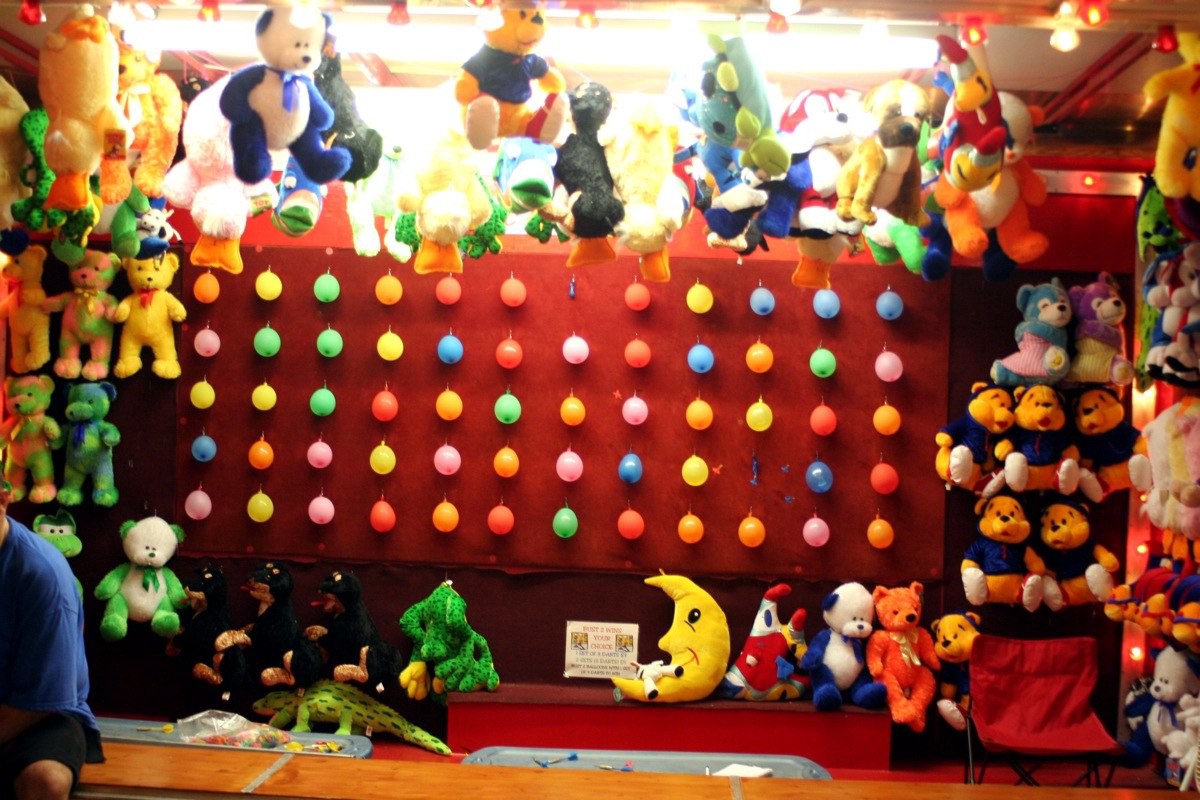
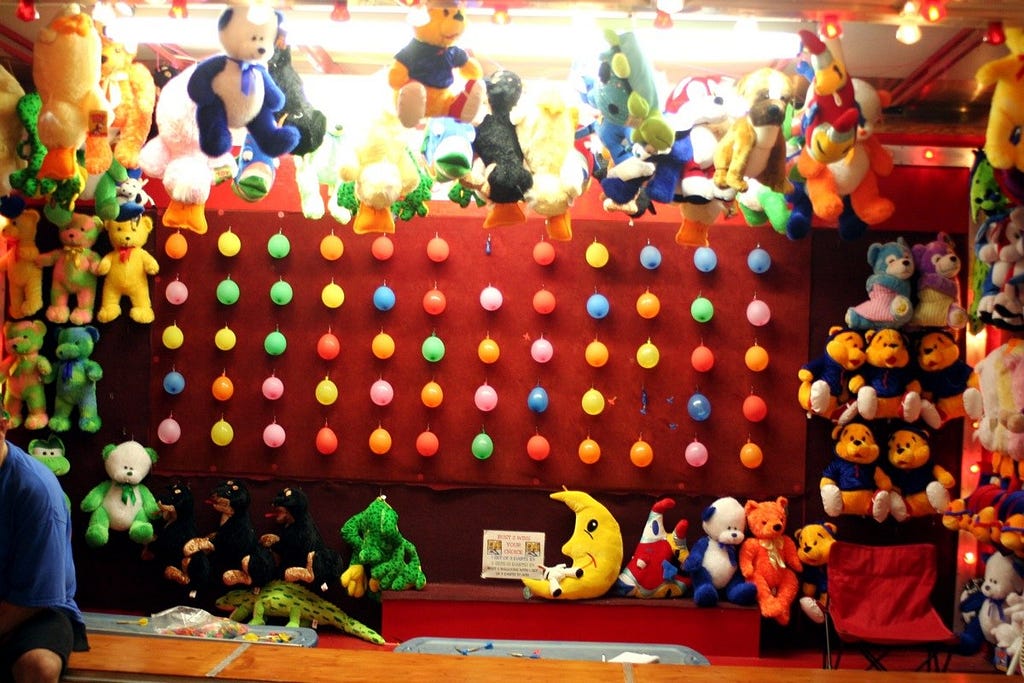
He stalked the grounds two steps behind me like the Secret Service, keeping a sharp eye out for any sort of trouble that might enter my space, be it human, mechanical or otherworldly. There was very little talk. When I wanted to play a game, he’d nod and pay the guy running the booth, shooting him “the look” that delivered a simple message: The kid wins. To be on the business end of Merv’s glare was to get an instant education in the art of compliance. Soon I’d be walking off with an enormous rash-inducing stuffed monkey that journeyed to Harrisburg all the way from the Martian shores from Hong Kong. Not bad for popping one out of six balloons.
The severe, solemn fun continued: select rides that Merv deemed would not shear my head off, and more games of chance where the concept of chance had been eliminated. I was riding the lone black horse on the carousel (a wish predictably granted after hushed words were exchanged between my dad and the attendant) when I heard the strange thumps. They seemed to come from another part of the world and threw off the rhythm of the calliope. Even old Blackie looked spooked. My father’s face whirled past me at erratic intervals as the last blur of sunlight vanished somewhere beyond Sixth Street.
By the time I exited the ride the thumping had ceased and Merv told me it was getting late. For a split second, a request for “ten more minutes” crossed my mind, but I knew not to negotiate with him. Maybe he noticed a fleeting twitch in my eyebrows.
“Okay, what else?” he exhaled with a gust of cigarette smoke.
I led him toward a glowing rocket I saw in the distance as the mysterious noise returned. It was louder now; slow, deliberate, full of intent — more of a pound than a thud. I tried to follow it, grabbing my father’s hand, but it died off abruptly. We neared the rocket — which was just a tall, rocket-shaped hut that housed a small balding lady selling vaguely rocket-shaped Fudgsicles and other snacks unrelated to outer space. Soon she was offering me options for my sundae. Peanuts? Chocolate syrup? Marshmallow? Did we want one spoon or two? Merv had little patience for this sort of thing.
“Have you ever heard of the atomic bomb?” he inquired of the confused woman. “Well, the people who made it didn’t ask as many questions as you do.” The transaction was completed in silence.
I had almost finished my ice cream when it exploded again, so sharp and brazen I could feel it through my sneakers. I saw my father’s shoulders jump — he hated being surprised by loud noises. That’s when I knew it was real.
We both turned at the same time. Beyond the edge of the fair, in an empty corner of the field, sat a green pickup truck; motor running, high beams fixed, illuminating another car. Wordlessly, we stepped into the darkness as the dead straw beneath our feet crackled, making our way toward the headlights as they sliced through a drifting cloud of exhaust.
Pound!
3 HITS 25 CENTS the sign next to the old junker said. The car was a charred humpback relic from some past world I was glad not to have known. It looked like a collapsed elephant, graciously awaiting a paradise that would never come. A skinny frustrated teenager took his final swing, shook his head, and jumped off the roof. He returned the sledgehammer to a man wearing a cowboy hat and cautiously glanced at his buddies who laughed and hopped and held their bellies. The cowboy, making no attempt at humor, suggested he take up sewing. Another teen boy, shirtless despite the cool evening, slapped some coins into the cowboy’s hand as if they were old friends and bounded onto the hood. He did a little dance for his pals and then went to work on the dashboard through the gaping hole where a windshield had once protected the car’s occupants from weather and blood-feasting insects. Although energetic, the kid was dumb, and unable to cause any significant damage. The dashboard, having been the target of countless ambushes in the past, was free of instruments or anything remotely breakable. He did manage to expose a cottony looking substance that protruded through a tight seam in the metal, but his friends were unimpressed and responded accordingly. In defiance, he let loose with a spastic barrage on the car, which only caused the cowboy to whip off his hat and swat him on the ass. “Damn you, boy — can’t you count?” he hollered. That one played big with the crowd.
Those obnoxious aggressive teenagers, with their brash laughing voices — they reminded me of my older brothers. Boy, would I love to shut them up and bring a little peace to the planet, I thought. But I was a punk; barely six. I looked up at my father, the man who had refused me nothing since we arrived at the fair. But he shook his head “no.” Bashing a car with a sledgehammer was beneath his magnificent powers; an empty expression of rage without purpose. Kid stuff. “It’s getting late,” he reminded me.
We’d only made it a few steps before the thud. It was deep and booming. Behind us, a thick-waisted, bull-like man had taken a swing at the car to the delight of his crummy-looking children. My dad squinted, merely observing, as the man took a moment to remove his suit jacket. His tie was undone and sweat was already soaking through his shirt. He wiped his hands on his pants and picked up the sledgehammer again. Another commanding strike left a respectable crease in the driver’s door. Four more followed and the door was now cratered in the middle. His kids jumped up and down, embracing one another in a clump of buckteeth and lopsided Mohawks. Even the teenagers applauded. With a heaving chest and lungs sucking truck exhaust, the man passed the sledgehammer back to the cowboy. He’d gotten his fifty cents worth and was smart enough to know that the next swing might have embarrassed him. In his mind, he was stepping away in victory and even managed a trembling smirk as his diaphragm struggled to bring order to his thoracic cavity. Underneath the bull was just a fat guy with no moxie and no heart.
I was scrutinizing the little celebration going on in front of me when I felt a nudge. As always, Merv had been watching me. A rare half-smile came to his face and he winked.
The bull was sucking down a bottle of grape soda like it was medicine when my dad handed the cowboy a few bills. He grabbed the sledgehammer before it was even offered to him. Then he slowly walked around the car, gazing into its past. The sledgehammer was disrespectfully tucked under his arm like a cardboard mailing tube.
Satisfied with his inspection, he now gripped the sledgehammer. I recall hearing a whoosh, seeing a blur of movement, and the sound of a meteor hitting the earth. Merv had launched an attack on the driver’s side doorpost — the bar of steel that joins up with the windshield frame. The noise he created was unlike the other bangs and wallops in the field that night. This sounded like the end of the world. Like continents splitting apart. A chunk of chrome that survived countless fairs before this took flight and landed in the vicinity of the Fudgesicle rocket. Somewhere a teenage voice called out, “Damn!” Merv continued to pummel the doorpost until it V’d inward and caused the corner of the roof to list. Now he walked around to the opposite doorpost and beat it so mercilessly that the front grill and headlight sockets appeared to form a face that grimaced in agony. The teenagers, the bull, and the cowboy gazed on in silence. To cheer or even make a comment would be like whistling in church.
You could see the ridged outline of every muscle through his t-shirt. A history nobody wanted to learn was written in his eyes. The cowboy made no attempt to tally the hits as the assault went on — urgent, relentless, personal. (The whole time with a lit cigarette in his mouth!) He continued until the entire front section of the roof sagged. The doorposts, loyal supporters of the car’s structural integrity since it rolled off the assembly line, had finally clocked out. Then, in a very somber, almost reverent manner, Merv stepped onto the hood to finish what he started. He raised the sledgehammer, and began tapping out the dots and dashes.
POUND.
I love you.
POUND.
Do you read me?
POUND.
I love you.
When he was through, the roof sloped almost completely down to the dashboard. The open space that once held a windshield no longer existed. The junker was now a wreck, and its value as something to be beaten drifted off with the people exiting the fair. The cowboy slumped against the pickup truck and crooked his hat in a way that made his eyes disappear.
My father was barely winded as we walked out of the field. He rested his forearm on my shoulder and said, “Time to go home.”
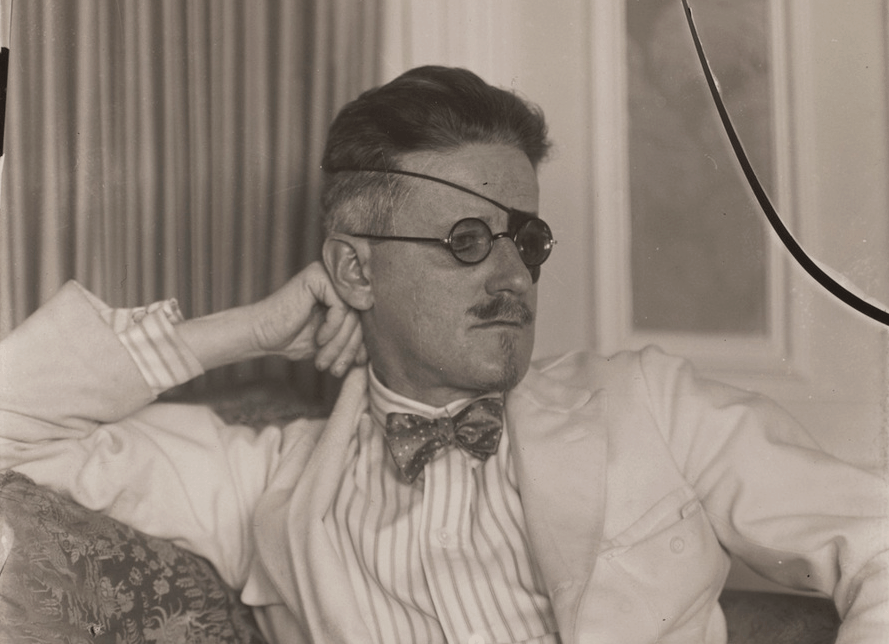
It frustrates me to see that a work of art as radical as Ulysses has been rendered so tame by time that even Mayor Nutter — and what a Joycean name that is! — participates in the annual Bloomsday celebration at the Rosenbach Museum here in Philadelphia. What was once transgressive is now pedestrian. Yes it’s wonderful that so many people across the globe get together to celebrate a book of all things, yes, yet I can’t help wondering why we insist on living in the past.
In keeping with James Joyce’s own love of lists, here’s a terribly subjective list of ten books published in this century that are in different ways as inventive as Ulysses was in 1922. These novels aren’t necessarily inspired by Ulysses, except insofar as it has affected every subsequent novel, but like Joyce’s masterpiece they challenge us in ways we never knew to expect. If nothing else, Bloomsday should remind us to pick up some books not despite their difficulty but because of it.
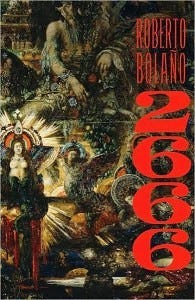
2666 by Roberto Bolaño
On the surface, the five sections of 2666 have little in common. They read like entirely separate novels and it’s possible that that’s how Bolaño wanted them published. But held together in one volume — written while the author awaited a liver transplant and released after his death — we are forced to find our own lines of thoughts and thematic connections.
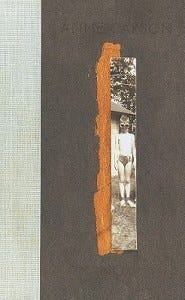
NOX by Anne Carson
NOX serves as an epitaph for the author’s brother in the form of a book. The text fills one long document that we pull from a box like tissues at a funeral. The combination of imagery and poetry makes us rethink what a book can be and, by extension, what we can be. Maybe it’s not a “novel.” So what.
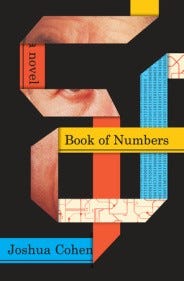
Book of Numbers by Joshua Cohen
There’s no escaping textual linearity in a bound novel unless we’re willing to skip around and choose our own order of adventure, but Book of Numbers manages to internalize the garden-of-forking-paths logic of the internet and use it in the service of a clever and enjoyable and ultimately old-fashioned story. Cohen’s latest novel seems to retell the entirety of Wikipedia the way Ulysses retold the Odyssey.
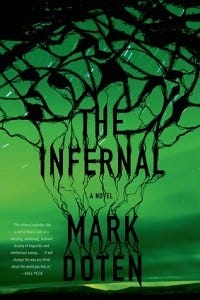
The Infernal by Mark Doten
Doten’s debut novel mines the current war-on-terror headlines for stories that to any reasonable human would sound invented were they not all too real in their horror. It’s a book that understands that absurdity has become our dominant aesthetic; in participating in the absurd and interrogating it and ultimately embracing it, Doten also helps us see alternatives to it.
How Should a Person Be? by Sheila Heti
The “Sheila Heti” who appears in How Should a Person Be? shouldn’t be confused with the flesh-and-blood Sheila Heti whose name appears on the cover any more than the object Magritte depicted in “The Treachery of Images” should be confused with a real, physical pipe. Yet for all the novels struggling these days to undermine the artifices of fiction, How Should a Person Be? is the one that feels most simultaneously real and unreal. It’s lovely and heartbreaking and then lovely some more.
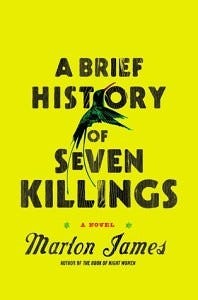
A Brief History of Seven Killings by Marlon James
In this masterful novel, set mostly in Jamaica, James enlists an ensemble cast of memorable characters and channels their individual voices with such alacrity it’s possible to forget that there’s an author pulling the strings at all. It feels at times like the entire human experience, in all its glory and all its depravity, gets rendered bare on the page. To whatever extent Dublin is synonymous with Ulysses, you can count on there one day being Brief History walking tours of Kingston.
Liquidation by Imre Kertész
The advertising agent Leopold Bloom was born in 1866 to a Hungarian Jewish father and an Irish Protestant mother. It’s conceivable that his father was been born around the time of Hungary’s 1848 uprising against the Austrian Empire. We cannot understand Bloom without some sense of the treatment of Europe’s Jewish population at the turn of the twentieth century. As Daniel Torday does in his recent and magnificent debut novel The Last Flight of Poxl West, the Hungarian Nobel laureate Imre Kertész shows us the ways in which that Ulysses-era fear mongering reached its awful nadir four decades later.
Out by Natsuo Kirino
It would be a shame if the well-deserved love heaped upon Oe and Murakami caused us to lose sight of the Japanese novelist Natsuo Kirino. Her novels, often categorized as crime fiction, challenge conventional gender roles and her homeland’s patriarchal institutions. That makes her genuinely dangerous to the status quo and Out in particular — in which a fed-up woman finally kills her husband — can inspire the kind of intellectual liberation we all so desperately need. It’s gruesome and wonderful. A hundred years ago, it would have been considered obscene.
Requiem by Curtis White
Taking its inspiration in part from Mozart’s Requiem, White’s resplendent novel actually manages to be shocking in much the way I bet Ulysses was when it first appeared. The shock here — moral, sexual — serves the vital function of shaking us from our comfort zones. White isn’t telling us what to feel, only reminding us that we’re capable of feeling.
Alif the Unseen by G. Willow Wilson
Here’s another one of those novels that both draws on some of the literary traditions codified by James Joyce and moves the conversation in exciting new directions. In particular, it asks us to look at the changing nature of humanness as we embody new digital technologies and at how those changes might inspire new ways of forging relationships across traditional theological boundaries.
Dog Men is a strange book. Alana Noël Voth has a prose style that reads like a cross between something you’d find in fanfiction or a teenager’s blog post: that is, it is utterly unliterary. Or perhaps anti-literary: the eponymous first story in the collection is of a genre that can only be described as “queer erotic werewolf thriller,” operating with such obvious clichés that at first I thought it was supposed to be ironic, or parody:
The girls heard a growl then spun around, pressing themselves together, holding hands. First, they saw a set of glowing yellow eyes then the silhouette of a man before his face emerged in the sparse light, a face covered by a thick layer of hair. The dog man curled his lips back revealing teeth long and sharp as a dog’s. He lifted a pair of hair-covered hands then scratched the air with long, black nails. This was no pot-induced hallucination. Tally screamed.
But take the seven stories in Dog Men as a sum total and Voth’s agenda suddenly seems to embrace the oddness, the stilted language, the awkward dialogue. “[It] doesn’t require a Master’s-level vocabulary,” Donna Lee Miele puts it for the Atticus Review. And there is something deserved in that, something refreshingly anti-intellectual: if this is what un-literary literature looks like, then I for one am willing to bite.
Dog Men takes its name from one of the stories in the collection, but “men are dogs,” could have worked as a title, too. Masculinity is aligned with abuse — yet men are also the victims of fierce unrequited attraction. Voth situates her stories in a violent world that seems devoid of love; what love there is, anyway, is deeply damaged. In “Boxy Temples,” Kylie gives birth to the world’s most beautiful boy only to be scorned by him for a life of prostitution; in “My Name is Brighton,” Paul makes the mistake of raping a girl who will later be transformed into a zombie; and in “Reservoir Bitch,” Spike stubbornly assumes a male identity only to unravel in the arms of his friend, Rand.
Voth — whose work has been anthologized in some number of gay erotica collections — tends to take a queer slant when shaping her characters, although oftentimes their sexual orientations bring them unhappiness and abuse. Most problematically, Spike in “Reservoir Bitch” is apparently identifying as a man because of sexual abuse and it is through straight-boy Rand’s love that he can finally surrender to being a woman again. In other stories, the cruelty is subtler, such as in “Benediction,” where Brent falls in love with his friend Ron, although Brent knows Ron thinks of girls when he touches him:
Ron held out a lighter, a little unsteady, the flame flickering, and we met eyes over the fire. I wanted to say, “I love you, man.” I love you. But I inhaled the smoke instead, and the butt of my cigarette gave way to ember, and I coughed. Ron looked away, lighting his own cigarette before lifting his eyes to the willow as he leaned against the fence, hair falling into his eyes. With one hand, I touched his elbow. He crossed his arms over his chest and didn’t say anything and didn’t look at me either.
Heterosexual relationships don’t fare much better; no matter who you are, then, or whom you like, Voth believes love hurts like hell. In “Marcelle,” Ronan enters into a humiliating S&M relationship with the girl of his dreams while fleeing the mocking ghost of his brother:
“Think about it,” she said. “Who’s stronger? The sadist or the masochist?”
I wanted her to be stronger. That was obvious.
Dog Men culminates with “Genuflection,” a wild and radiant love story that burns with the friction of obsession and rejection. It is the standout piece in the collection — perhaps in part because it is the most traditionally “literary.” Here Voth seems most aware and in control of her language, the most willing to work with image and metaphor and purpose:
Anyone living on East Colfax knows the sun never burns out here. Even when the sun goes down, we got the heat inside us. The gringos explain our heat as hostility. Maybe they think right — in some cases — but building a baseball field and coffee shop chains deeper into the east, that’s just like gringos to think a baseball field covers brown with green. I don’t hate gringos; I’m half gringo myself even if I don’t look it. Mom was gringa, silkworm-white; she was also a traitor.
Dog Men, then, might undo itself: if the collection has taken a stance as being stridently anti-literary, while its best story is recognizably working within the tradition of the higher literary short story, then what does this mean for Voth’s agenda? No matter: whatever it is, Dog Men is a curious beast, and a bold collection to find in publication. Its publisher, Tiny Hardcore, has gambled with Voth’s blog-like ordinariness — and perhaps she’s pulled it off.
Visit Tiny Hardcore Press’s website to order the book.
There’s nothing pint-sized about Neal Stephenson. He’s famous not only for his supersized books (the last three clocking in between 850 and 1,050 pages); he’s also made a career of unpacking Big Ideas on everything from modernity and the nature of time to nanotechnology and our genetically-engineered future.
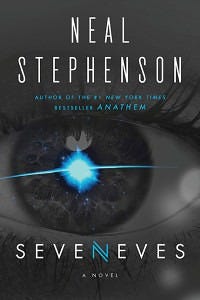
In his new science fiction book Seveneves, Stephenson lays out a scenario for how humanity could survive a catastrophic natural disaster. Strictly as an exercise in visionary technology, it’s a virtuoso performance. But this isn’t just a manual on how to carry on after the apocalypse. He also has plenty to say about human relationships aboard a spacecraft and what our future might look like thousands of years from now.
I talked with Stephenson about the world-building responsibility of science fiction writers, his dislike of dystopian fiction, and why we need new stories to help us create a better future. Our conversation aired on Public Radio International’s To the Best of Our Knowledge. You can subscribe to the TTBOOK podcast here.
Steve Paulson: Your book begins with the news that one day, without warning, the moon blows up and all kinds of catastrophic events follow. What happens?
Neal Stephenson: Scientists figure out that it’s going to lead to a meteor bombardment unlike anything the Earth has seen since the primordial times of the solar system. That sounds pretty poetic, but the bottom line is that humanity is toast, and the only survivors are going to go into space in an ark — a swarm of small vessels called the “cloud ark.”
SP: So once scientists realize there is very limited time left for humans to survive on Earth, they have to figure out how to put a whole bunch of people up into space fast, so they can survive for generations to come.
NS: And not only people, but a genetic record of all of the non-human species of plants and animals that now populate the Earth. You can’t keep sequoias and blue whales and giraffes alive in space for thousands of years, but you can send up their DNA records on a thumb drive and reconstitute them later.
SP: Why were you interested in this idea of imminent catastrophe on Earth, so that people have to figure out how to survive?
NS: You know, when I was a kid growing up in Ames, Iowa, I used to ride my bike down to the bookmobile every week and check out whatever new science fiction they had. On one of those trips, I picked up a space ark kind of book. It’s a whole little sub-genre onto itself, and I was fascinated by the general idea. I don’t remember the title or who wrote the book, but you know how it is when you’re a kid; if you reach the right book at the right time, it can make a huge impact on you. I think it’s been gestating for at least that long, but it took me a while to come up with the right catastrophe. It’s actually hard to come up with an end of the world scenario.
SP: So you picked blowing up the moon?
NS: I did it for really particular reasons. You’ve got to have enough advance warning to build an ark. If an asteroid comes out of nowhere tomorrow and destroys the Earth, you can’t make an ark book out of that. And if it happens slowly over hundreds of years, like climate change, then people either ignore it or they just solve the problem instead of flying into space.
SP: In your novel, this whole infrastructure has to be set up really fast. There’s the International Space Station, but you have to get scientists and lots of other people off the Earth. What else is launched into space?
NS: There’s not time to build new kinds of space vehicles. Basically, we take the rockets we already know how to make, and on top of each one, we put a new thing called an arklet, which is just a big tin can with some life support systems that are capable of supporting maybe half a dozen human beings. They go up into the same orbit as the International Space Station and fly as a kind of swarm. If you’ve ever seen BBC nature movies of swarming behavior in fish or birds, there’s a mesmerizing thing they do if a predator comes through; they can move apart to allow it to pass through and then they re-form into the swarm again.
SP: So there aren’t many people in each of these tiny space ships, but they are interconnected in some way.
NS: Yeah, they have a kind of mesh internet they use to stay in touch. They can dock with each other so that people and stuff can be passed back and forth between them. There are little ferries, little rockets that move back and forth.
SP: The scientists also hook up a big asteroid to the International Space Station to shield it from radiation.
NS: In my slightly futuristic version of the space station, there’s an asteroid mining company that has already gone out and lassoed a nickel iron asteroid called Amalthea. They brought it back to the space station and kind of bolted the two things together. So that just happens to be there at the time the catastrophe starts. And it ends up becoming a central element of the plot because they can use its mass as a shield not just from radiation, but also from meteorites and other bad stuff coming their way.
SP: What’s the energy source that’s powering all of these space ships?
NS: The main thing you now see when you look at the International Space Station is photovoltaic panels. Those are huge and they make a lot of power, but probably not enough for the cloud arks. There’s another kind of power generator the Soviets pioneered that we use as well — based around a little puck of really radioactive stuff. It’s literally hot and stays hot for decades. If you put one of those in a sealed container and turn that heat into electricity, then you’ve got an electrical generator that’s capable of running for a couple of decades. We avoid using those now unless the mission really calls for it because the technology is a little tricky and people are worried about what happens if the rocket crashes. But if the perception of risk changes — let’s say in this book — everyone drops their scruples about using these kinds of generators. So every arklet that goes up has one of these things mounted to its tail.
SP: So your whole scenario is based on plausible science. There’s no faster-than-light travel or anything like that in your story.
I’ve done some things that are very improbable, but…I try to do it all with known technology.
NS: There’s none of that. I’ve done some things that are very improbable, but I’ve tried to front-load that in the book and then once the basic scenario is set up, I try to do it all with known technology. Nothing against the Star Treks and Star Wars of the world with their hyperspace and teleporters, but I wanted to see what we could do in a hard science fiction book that doesn’t violate any laws of physics.
SP: Do you have a science background yourself?
NS: Yeah, I came from a science and engineering family. I studied physics in the university and have been a bit of an autodidact since then. I don’t have a lot of formal training, but between what I do know and the people I know, it’s possible for me to stick reasonably close to physical reality.
SP: Do you spend much time talking with scientists and engineers to figure out how we could go out into space and survive there?
I have a ridiculous amount of space lore stored up in my brain…
NS: In this case it was a two-part process. I have a ridiculous amount of space lore stored up in my brain, just from the fact that I have been a nerd about this my whole life. When I was three years old, I was sitting on the rug in front of the big black and white TV watching Gemini missions take off. When I was 10, I had all the rockets memorized and I knew way too much about this stuff. So I had enough to draw on to get pretty far into this book without having to reach out a lot. Once I got about halfway through, I did start reaching out to some people I know who actually do this for a living. There’s a company in Seattle called Planetary Resources that’s a real asteroid mining company, and another one called Tethers Unlimited that comes up with all kinds of innovative space technologies. I’ve known people at those companies and they were generous in helping me flesh out some of these scenarios.
SP: The other piece of this story is that back on Earth, billions of people will die, so there’s the question of who gets to survive. You have something called “the casting of lots,” which is your way of choosing the people who go up into space. How does this work?
NS: Well, some people clearly need to go up there, like astronauts and scientists, so they get chosen in a different way. In terms of populating the cloud ark with the people who will found the future of the human race, it’s important to do it in a way that strikes people as fair and that preserves the diversity of the human race. In this casting of lots, people from every country and every political unit are chosen to represent their area in the cloud ark.
SP: A man and a woman are chosen from each group. Like Noah’s Ark, they will populate the future.
NS: That’s controversial in some parts of the world, but most places are happy to supply a man and a woman. They’re all brought together in training centers where they are brought up to speed on the basics of how to live in space and how orbital mechanics work. Then there is a further selection process to decide who is going to be launched up.
SP: Did you try to imagine how you would respond to the news that the Earth would soon be destroyed and you only had two years left to live?
NS: Strangely enough, I wasn’t thinking that much about what my own reaction would be. The book I wanted to write was more about the people who survive. You have to make choices when writing a novel. There’s kind of a breakpoint fairly early in the book where the people who are already up there and know they will survive the disaster just basically say, “Look, we have to start living for ourselves and get ready for this.”
SP: I get the sense that you really enjoy mapping out this whole elaborate scenario. You go into a lot of detail about all the technology that’s needed to sustain humans in space. Is this an exercise in world building?
NS: It is. All science fiction and fantasy is to some extent an exercise in world building. In this case, the challenge was to strike a balance. If you get too deep into the weeds and talk too much about the technical stuff, it’s just not interesting. But if you don’t talk about it at all, then it gives you too much freedom as a writer to do whatever you want. So in this case, I’m looking for ways in which the physical constraints of life support and what rockets can and can’t do, can be developed into interesting plot points that tell stories about people.
SP: The basic premise of your story is that the Earth as a livable environment is destroyed and billions of people die. Is this a dystopian novel?
NS: No. For me a dystopian novel is one in which everybody doesn’t die. They are still around and living in bleak, meaningless circumstances. So on one level, my book is way sadder and more depressing than any dystopian book because of the total wipe out of the population. But it’s happening as a result of a disaster. It’s not because somebody is mean.
SP: You’ve been outspoken in your criticism of how too much science fiction has become dark and dystopian. In fact, you launched a project to encourage other science fiction writers to create more optimistic stories about the future. How does your novel fit into that larger vision?
NS: Well, it doesn’t have to. The project you mentioned, Project Hieroglyph, is a worthy thing to work on. This book isn’t directly part of that, but once we get past the disaster scenario that occupies the first section, we do see how the descendants of the people who went up in the cloud ark have created a new kind of civilization in the distant future. It’s in that part of the book where you start to see some of the themes that we were talking about with the Hieroglyph Project.
SP: What is the problem with all of the dystopian stories we have today?
NS: It’s just tired, and everyone knows that it’s tired. I mean, the term dystopia used to be rarely heard, only used by critics. Last year, I went onto Apple TV and was browsing the latest selections and they had a whole content category labeled “Dystopian Futures.” This has become the default way in which the future is depicted in basically all science fiction movies.
SP: The future almost always looks bad, doesn’t it?
NS: Yeah, they take the stuff that we now have — the buildings, cities, vehicles and so on — and they throw dirt on them and beat them up and break the windows and knock things over and then that’s the future in which all these things are set. I don’t think I’m the only person who’s bored with that.
SP: A few years ago, you wrote a fascinating article in the World Policy Journal where you said the US has lost the ability to do big projects. When you and I were growing up, we saw people land on the moon and now we don’t even have a manned space program. Have we forgotten how to create big projects that can make the world better?
NS: Yeah. Just the other week there was a terrible train crash in Philadelphia because we don’t have a system for checking to make sure that a train full of human beings isn’t going too fast. It’s just amazing the extent to which we’ve let our infrastructure fall behind the rest of our civilization.
SP: What happened? Why have we apparently lost this capacity to create visionary projects?
So for the last few decades, the kinds of really smart geeks who in the 50s and 60s would have been building rockets or something have been moving to Silicon Valley and creating startups to make little apps.
NS: I think it’s a number of things. For a while that was all we did, with NASA and the bomb program and the interstate highway system. Then when information technology came along, it kind of blindsided us. Suddenly there was this whole new branch of technical endeavor that came out of nowhere, which people hadn’t anticipated. Very lucrative, very attractive, very easy to get into. So for the last few decades, the kinds of really smart geeks who in the 50s and 60s would have been building rockets or something have been moving to Silicon Valley and creating startups to make little apps. That’s where a lot of our brain power has been going lately. But I do think it’s turning around and we’re now seeing people like Elon Musk, who made his fortune doing information technology. But he’s now turning back to the question, What can we now do in the physical world? Can we make a high-speed hyperloop that connects Los Angeles to San Francisco? Can we go to Mars?
SP: Is this something entrepreneurs need to do, if the government isn’t doing it?
NS: That’s an important question because a lot of these things can’t be done without a productive interaction with governments. It’s cool to think of creating high-speed rail links. But in order to get the right of way and all the stuff you need, you’ve gotta have a relationship with governments. Traditionally, the libertarian ethos of the tech industry has been at odds with that.
SP: Do science fiction writers have a responsibility to help us dream about what the future could be — imagining these kinds of big projects that we’ve forgotten how to do?
NS: I would turn it around and say that is all science fiction writers can do. At the end of the day, we think up things and write them down in what we hope is a reasonably compelling fashion. Every so often we hear of some young scientist or engineer or even a whole company that will seize on one of these stories and become inspired by it and decide they want to make it a reality. So if science fiction writers have any usefulness at all, other than as entertainers, then it inheres in that.
SP: If we go back in history and look at the development of robotics or the space program, did some of those ideas come out of science fiction?
NS: There’s clearly some interplay between science fiction and actual development projects. If you’re a science fiction writer, it’s tempting to overplay that hand and overestimate the importance of our profession, which I would avoid. But I wouldn’t underestimate it. There is some connection there.
SP: You’re also suggesting that we need better stories. If we’re going to have a more positive future, we need stories to help us envision that future.
NS: That was the basic insight of the Hieroglyph Project and the related Center for Science and the Imagination that we set up at Arizona State University — to develop these stories in a mindful and deliberate way. And the jury’s still out, I think, on what the result is going to be. It can’t hurt to try the experiment of encouraging people to tell such stories and see what happens.
SP: There are a few obvious things we need to figure out how to do. For example, coming up with better energy sources that don’t just dabble around the edges but can really power our economy. Fossil fuels just won’t cut it much longer.
NS: I think it’s worse than that. My fear is that fossil fuels could actually cut it for a really long time. Fossil fuels have come back big in North America because of fracking and natural gas. So economically, we could be riding that pony for a lot longer. But we can’t afford to do that in terms of its effects on climate and the oceans and so on.
SP: Climate change might lead to catastrophe in the next century or two. Does that keep you awake at night?
So big climate change is coming and that’s just a basic reality of the next few centuries.
NS: I think we are definitely headed towards catastrophe. If you look at the numbers on the amount of carbon that we’ve put into the air, it’s almost unbelievable. There are a lot of well-intentioned ideas that people have put forth to try to reduce the rate at which we put more carbon into the air, or even to reverse the trend by pulling carbon out of the air, but not much is actually happening. What is happening doesn’t even scratch the surface. So big climate change is coming and that’s just a basic reality of the next few centuries.
SP: Two-thirds of the way into your novel, Seveneves — in fact, on page 569 — you do something kind of crazy. The story suddenly skips ahead 5,000 years. What’s the idea here?
NS: Well, right before that moment, there’s a conversation among the survivors that’s foundational to everything that happens next. It’s a conversation about human nature and the history of the human race up to that point — whether it’s worth saving, what’s wrong with humans, what’s good about them, and how the human race ought to go forward from that point. Some things are said that can’t be unsaid and some decisions are made that cast very long shadows into the future. So I felt the best way to highlight the outcome of that conversation was just to jump directly to a point in the distant future, rather than trying to tell the story year by year over a long span of time.
SP: If we manage to survive another 5,000 years, do you think humans will be fundamentally different in the future?
NS: Well, the premise of this book is that we make a decision to be fundamentally different. But there’s no unanimity, which is a very typical human thing. So you have people who are fundamentally different, but in different ways. The decisions that these people make get translated into action through genetic engineering.
SP: Do you consider yourself an optimist about the future?
NS: By any kind of empirical measure, things are getting better for most people. The total amount of violence in the world is going down. The total amount of money is going up. Measures of human health are generally on an upward trend. There are plenty more benefits that we can reap from education and improvements in technologies. So there are all kinds of reasons to be optimistic. There’s also an on-going struggle with certain aspects of human nature that are unattractive.
SP: Like what?
NS: Well, certain emotional reactions just seem hard-wired into our systems — for example, scapegoating and instincts toward mob violence. We’ve seen them over and over throughout history. And it’s not hard to make that happen. That’s what demagogues do. That’s what a certain kind of dictator does — to stir up people’s passions in ways that speak to the most base parts of their natures. So that tendency is always there. The only way to fight it is to put these really complicated and finicky institutions into place, to erect barriers and firewalls that prevent those things from running out of control. That’s a war that each generation has to fight all over again.
Last year, HBO broke the hearts of legions of speculative fiction devotees when it dropped its plans to adapt Neil Gaiman’s American Gods into a TV series. But thanks to a straight-to-series order from Starz, the warring deities that populate the beloved 2001 novel will soon be duking it out on the small screen.
The series, first optioned by HBO in 2011, boasts an impressive pedigree. Bryan Fuller, (“Hannibal” and “Pushing Daisies”) and Michael Green (“Gotham” and “Kings”) have both signed on as showrunners, while Neil Gaiman himself will executive produce.
With no premiere date yet announced, it’ll probably be a good chunk of time before the series debuts. But anything that causes Gaiman to describe himself as “a ball of glorious anticipation” must be worth getting excited over.
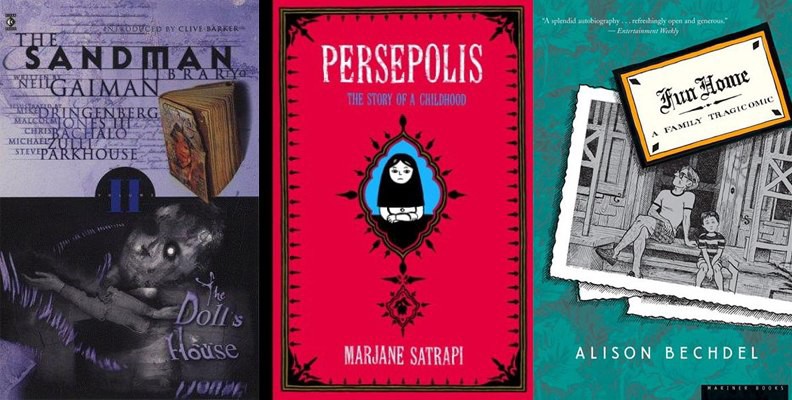
Although professor Ryan Bartlett taught English 250 at Crafton Hills College in Yucaipa, California, for three semesters without a single complaint about the syllabus, student Tara Shultz recently took offense at the course’s inclusion of four graphic novels. Due to their depictions of sex and violence, Shultz called for the eradication of Marjane Satrapi’s Persepolis, Brian K. Vaughan and Pia Guerra’s Y: The Last Man, Neil Gaiman’s The Sandman: The Doll’s House, and Alison Bechdel’s Fun Home.
As someone who also read Fun Home in a college course, I find the study of graphic novels refreshing and integral to understanding diverse modes of storytelling. Tara Shultz, who found its content “shocking” and “pornographic,” would probably be shocked even further by the thought of sold-out audiences flocking to New York to see Fun Home on Broadway, the play inspired by Bechdel’s graphic novel.
What is literature for, if not to shock us? It’s good to be shocked.
Cheryl A. Marshall, president of the College, appears to agree. She thankfully declined Shultz’s request to ban the books in question. While the request is unfortunately unsurprising — a long history of banned books suggests a hefty list of students and parents scandalized by works of literature — Tara Shultz was aware of the syllabus from the beginning, and therefore could have dropped the class if she’d done her research. Instead, she attempted to prevent any other student from reading them, which is blatantly obnoxious.
President Marshall released a statement supporting the college’s policy on academic freedom which “requires an open learning environment at the college. Students have the opportunity to study controversial issues and arrive at their own conclusions and faculty are to support the student’s right to freedom of inquiry. We want students to learn and grow from their college experiences; sometimes this involves reaffirming one’s values while other times beliefs and perspectives change.”
Even though the desert sun has dipped far below the mountaintops, a leftover burn snakes up through the asphalt of Saint Mary’s parking lot. The automatic entrance wheezes open to admit Magnus. In the hallways, he makes one wrong turn, then another, before he finds the elevator.
The doors part; a woman presses against the back corner.
“Going up?” Magnus asks.
She says, “I’m a star.” A flannel nightgown sags past her slippers. “I’m going to shoot right down out of this place.”
“I like your hair.” Thick synthetic strands pouf around her head. Perhaps she will be one of Magnus’s charges.
“Just wait,” she says. “On my third trip to France, the virtuoso composed a — pretty — about me. It was my theme song.” She executes a stiff curtsey. “When can we begin?”
The elevator dings and they step out.
A nurse seated behind a computer says, “I’m Annie. You can only be Magnus. I see you’ve met our Mrs. Brandey — looks like I’ll have to change the elevator code again.”
Magnus nods and takes the seat Annie offers.
“She’s one of our wanderers.” While Annie shuffles papers, Magnus glances at her. She is big-boned with long, thick, dark hair secured in a ponytail. She wears bubblegum lipstick too light for her complexion. “Your background checked out fine. I’m pleased to find a volunteer. We never get takers for the twelve-to-three shift.”
“I go to work at four in the morning,” Magnus says. “I don’t sleep at night.”
“And you’re interested in volunteering with the elderly?”
“Yes.” Magnus fidgets. He hopes that Saint Mary will be the outlet he has been searching for, the place where he can interact with people when he is at his most alert and needy: the middle of the night. Tentatively, he tells Annie, “But I’d also love to work with babies. Infants, I mean.”
“Really?” she says. “A man like you? How surprising. A man who loves cute babies.”
Magnus shrugs and doesn’t tell her that he prefers the ugly babies, their squished faces and unnaturally colored skin, their hair sprouting in strange places. Such tiny homeliness stirs his affection. They are brand-new, but flawed, an endearing contradiction.
“Not that I don’t adore babies myself,” she says. “Not that a man can’t… Well.” She clears her throat. “Would you like to see the newborns?”
Magnus follows her up one floor and down a hallway. They stand side by side in front of the glass and stare into the dim room filled with miniature beds.
“I wish we could have a volunteer for the babies,” Annie says. “Sensory stimulation is so important in the first few weeks. They can only see thirty or so inches in front of their nose, so you have to get right up close.”
“I could stay with them,” says Magnus, imagining a baby wriggling in his swaddling.
“That would be nice,” says Annie, “but we can’t. New parents are… protective. If only they knew the infinite good a volunteer could do, especially when we are so short-staffed.” She doesn’t move, though. “Do you know how to properly hold a baby?”
“I think so. Not really.”
Annie opens the door and they enter the cheddar soup-smelling nursery. She hands him a baby. The power of holding a person only hours old makes him long for the influence of fatherhood, of his presence in a life from its very inception. Annie says that he’s a natural.
Tuesdays and Thursdays at midnight, Magnus steps into the air-conditioned hospital from the neon glow of Las Vegas, retrieves his volunteer nametag from the unmanned reception desk, and heads to geriatrics.
Alone in the stainless steel kitchen, he slices sugar-free banana bread and brews decaffeinated coffee. Then he searches for the wanderers, those patients with dementia or insomnia who wake suddenly — or never fall asleep in the first place — and spend their night hours perambulating the hallways. Annie explained the many benefits of a midnight snack. The routine calms the patients, helps them remember where they are, even induces them into sleep. They’re less likely to hallucinate or fall or wander away lost if they keep busy, and eating is as good an activity as any. The term for his charges’ nighttime restlessness is “sundowning,” as if one of their symptoms is to become nocturnal, like the desert life that surrounds them.
Tonight, Mrs. Brandey drapes herself over the television in the entertainment room. Her cheek presses against the top of the dark box. “Don’t you ever leave me again!” she says shrilly, then lowers her voice to a croaking old baritone. “But I love your twin sister.” Her voice rises. “But I am the mother of your children! The godmother! The grandmother!”
Mrs. Brandey is reminiscing about her days on a seventies soap opera. Magnus tried to look up her acting career, but she often changes the name of the soap and his internet search turned up blank. Maybe she worked under a forgotten pseudonym. The nurses know nothing.
Magnus guides Mrs. B. away from the television and finds Mr. and Mrs. Herrera at opposite ends of a room, their backs to each other. Annie told him that one spouse’s diagnosis increases the other’s risk sixfold: a startling influence of proximity, like the one Magnus imagines a father might have over his son. Though the Herreras rarely acknowledge each other, they stay in a close orbit.
His charges settle around the table, and Magnus lights a centerpiece candle. He likes them to feel attended to.
Mrs. Brandey says, “Today I went to the zoo in a beautiful black boat of a car.” A bit of plum skin sticks to her bottom lip. “I wanted to see the lioness because she is devastated; her mate died of confinement, and she must raise the cub on her own.”
After snack time, Magnus leads the patients to their bedrooms — the Herreras’ rooms adjoin and he delivers them last in case they remember to say goodnight.
Mr. Herrera watches his wife disappear inside and says, “Who is that dirty girl? Maybe she’ll buy me a… the drink. With ice cream. Ice cream and… a milk shiver.”
Over Mr. Herrera’s window hangs a painting of a pond, mother duck in its center. Three ducklings trail behind. The movement of the sun, its shadows and nightly disappearance, agitates Mr. Herrera; the painting covering the window is an attempt to make his world more static. He says, “Do you think she likes strawberry?”
Magnus shrugs. “You should ask her in the morning. Now it’s time to sleep.”
In the empty corridors, Magnus tries to shut off his brain, to forget that he lives alone, that his greatest wish in life is to become a father, that he ate cold pizza for breakfast at eight in the evening — but he can’t forget himself.
One thing he had forgotten, that Mr. Herrera’s painting returns to him: a book, The Ugly Duckling, read by his mother, and his intense disappointment when the ugly one grew beautiful. Each night the same story, but he never accepted the transformation.
Magnus finds Annie the nurse counting pills. She has started to wear blush and eye shadow. He wonders if she paints herself always, or only when he’s on the schedule.
She snaps a bottle shut. “Do you want to go?”
“Yes,” he says. “Thank you.”
She brushes lightly against his upper arm and leads him down the hall, up one story. At week fourteen, she says, in preparation for birth, a baby pretends to breathe.
When they reach the door, she swipes the key-card dangling from her lanyard and a light flashes green. Her zebra-striped bra shows through the white uniform.
“Have fun,” Annie says. “I’ll be back for you later.”
This is their arrangement: Magnus gets twenty-seven minutes to hold, coo at, and tickle the babies in the half-hour gap between shifts. For these thirty minutes, Annie is the hospital staff. No visitors are allowed and the new parents are passed out. If questioned, he will say that he’s a doctor. Magnus knows how to handle a baby, to sanitize his hands. He’s careful. His presence comforts the infants when everyone else is too busy. Annie told Magnus that it was obvious he shares her commitment to the patients’ wellbeing, and then she proposed, a surprise to him, these unofficial visits. They will benefit everyone, she said as he nodded along, grateful that she had unwittingly absorbed his silent desires.
Magnus’s eyes adjust to the dim nightlights that glow every few feet along the nursery; the fluorescents turn off at nine o’clock as a form of sleep training. The room is a white-tiled square, one wall a window into the hallway, with not much inside besides five rows of tiny beds, usually only half or a third filled, and a couple metal-and-corduroy chairs. Everything feels quiet, though the air rustles with breath. Soon, his eyes make out a tiny arm, a round head, a cocooned body. He smells warm cheese. The babies.
Finally, among these new and most lonesome of souls, he feels at home.
The nameplate affixed to the closest wheely-bassinet reads “Leslie Lars Hunter.” Little Leslie Lars’s eyes aren’t closed all the way, but his lips purse and saliva trails to his blanket: deep sleep.
Magnus searches for the ugliest baby. Beneath a pink blanket, he finds Vanessa D’migi, her name a handsome hum of syllables. She smells of parmesan.
Vanessa’s bony bottom fits in Magnus’s one palm and her lumpy head fits in his other. Her long, thin body rejects all the fat, happy babies from commercials. Reddish freckles spot her yellow skin. A patch of dark hair grows over her left ear and her eyes are very close together, even for a baby. Such a unique form can only produce a unique person, and Magnus thrills at the possibilities concentrated in her six pounds. He adores her, homely Vanessa D’migi.
At four in the morning, Magnus arrives for work in a part of the Las Vegas Valley that everyone calls Water Wasters. Green Acres, the development’s official name, is where all the rich people build houses with custom bathrooms and custom billiards rooms and extra-large bedrooms so that no one has to spend any time in the living room together. All the houses have lush green lawns, as required by the homeowners association, and jungle-inspired pools. The construction workers could never afford a Water Waster, which Magnus assumes is the reason everyone else hates this job. Magnus hates it because fake beauty is the only aesthetic allowed in Green Acres’ man-made desert oasis.
At lunch, he holds a peaches-and-cream jellybean between his thumb and pointer finger: the size of a two-month-old fetus. He places the bean back in its baggie.
Magnus, a roofer, works above the other men, on a platform for the sun, which burns into his back as soon as it rises. Though he sucks down water, he only has to piss once. It’s June in the desert.
The midnight snacks are ready, but the only person Magnus can find is Mrs. Brandey. They sit side by side at the round table. The absent wanderers are hopefully asleep, but he isn’t supposed to enter their dark bedrooms without reason. Not that he wants to: the cold black of the rooms reminds him that the person beneath the sheet might be only a body, a cold object itself. The death of the old, with their long lives to extinguish, feels more substantial than the death of babies. An infant is a clean slate, reproducible in another nine months, but the old have been shaped so precisely that not even a clone would be their replica.
“Mrs. B.,” he asks, “where are the others?”
“God fuck them!” Her hand slams against her plate. Bits of cake smash up through her fingers and crumbs scattershot around her place setting. She runs through an angry slew of curses, then moans, “I hate… I hate… I hate… the block. Inside of me.” Her dirty hands fold calmly in her lap. “They’re jealous. Bright green, in fact.”
The most disconcerting part of his job is this: accepting the patients’ outbursts tranquilly, as though nothing is wrong. His nonchalant reaction should soothe them, but he doesn’t understand why he must pretend that Mrs. B. is perfectly fine when, in fact, her brain is boiling over, melting away the neuron connections that once made her herself.
“Mrs. B.,” he says, a shiver running through his spine, “would you like some yogurt?”
She leans her face towards him, the wig low on her forehead. Her denture-less mouth collapses over her gums and her bottom eyelids droop, though the top ones are taut, making her eyes strangely round. “You know, Magnus,” she says. She has never called him by his name before, though he’s introduced himself twenty times and wears a nametag in large print. “Nurse Annie is in love with you.” The candlelight flickers over the wet spot her tongue leaves on her lips.
Magnus blushes and ducks his head. “No.”
“I’ve been on this earth for ninety years.” Her records list her as seventy-nine, but Magnus nods. “Nurse Annie loves you, true and deep, with the sort of love Amos and I shared on episode one hundred forty-two.”
“Who told you this?” Magnus asks.
“Told me what?”
“Who told you Annie, Nurse Annie… that she…” Magnus cannot say the rest. Every day, he sleeps in the patch of sun on his bed to trick his subconscious into believing it’s near someone’s body heat. Even in Las Vegas, a city of night, where most days the sun burns mean and harsh, it is difficult to find a woman willing to sleep all afternoon and into evening. Annie, the night nurse, might. They could coordinate their lives as sundowners.
“Stop mumbling,” Mrs. Brandey says. “Now let me tell you about Amos. He owned a… the place with horses. Like salad dressing. A suave man, Amos! He wanted to whisk me away so we could raise a family of seven, but I was a city girl, through and through.”
After snack time, Annie finds him. “At thirteen weeks,” she says, “a baby develops a unique set of fingerprints.”
Magnus trails her down the hallway. Mrs. B.’s love idea makes him a bit afraid of Annie. She doesn’t love him, she doesn’t know him, but Magnus can’t slip the thought. He is forty-two and he’d guess that Annie is three or so years younger. She looks motherly, soft and sure of herself on a corporeal level. She’s almost as tall as Magnus — he’s tall — which means he wouldn’t need to lean far to kiss her.
When they reach the nursery, Annie stops in front of the viewing window, where she stood on the night they met.
“They’re cute, aren’t they?” she says. “Babies are so cute.”
“Most of them.”
“They’re cute. If I ever had a baby…”
He asks quickly, “You don’t have any kids?”
She holds up her unadorned left hand. Magnus feels an unexpected wash of relief: he would not need to inherit her children; they could make their own. Annie is likely nearing the end of her childbearing days, encouragement to work quickly. “We’d better let you in,” she says, “before time’s up.”
He wonders if he and Annie, both reasonably attractive, could produce an ugly baby, or if their offspring would turn out like everyone else’s, plump and button-nosed. Maybe their baby would wind up with Magnus’s big chin and Annie’s abbreviated forehead and all his features would squish to the center of his face. Maybe he’d come out with a cleft palate.
Before Magnus’s shift ends, he finds Mrs. Brandey, wigless, in the hallway, her nails digging into her forearm. Continents of scabs show through her sparse hair.
“You’re out of bed,” he says, “let me help you.” He pries her thumb away from her arm’s thin flesh.
“I hate you!” she says.
Her hand flies up and slaps him across the face. The blow is soft, like a thrown pillow, but he trembles with shock. “I want to help,” he says.
“You never make me happy. You never do. I hate this.” Her hands flutter through the air around her body. “Isn’t it time to begin?”
Though Magnus suspects that Mrs. B. knows he cannot help her, not really, she allows him to lead her to bed. She pulls her wig, left on the quilt, over her eyes.
Wednesdays are hardest, the low point of his week, bookended by the highs of volunteer shifts. Wednesday night, he drives away from the city, away from the noise and people, the constant blush of neon. The truck winds up humming across Death Valley on a road illuminated only by his headlights. He tries to lose his mind to the air rushing through the window and resonating in his ears, but instead, his body dissolves. Somehow, his hands stay on the steering wheel, his foot presses on pedals, his spine fits along the seat, but he is only a brilliant collision of synapses. These are the sparks that the wanderers are losing, the sparks he worries are extinguishing, already, from his own brain. He needs redefinition, wholeness, a replica — himself, outside himself, where he can observe. He must begin, again.
But for now, he pulls the wheel hard left, turning the truck back the way it came. He cannot be late for Water Wasters.
Skylights are Magnus’s specialty. He not only knows how to install all shapes, sizes, and types, but he also knows where to install them. The movement of the sun plays so often across his back as he works that he can predict where and when, with what intensity, the sun will enter an envisioned skylight, where the light will move inside a room.
Magnus is so good at his job that it bores him. Sometimes, he counteracts this boredom by imagining what his skylights will illuminate. For a bedroom, he pictures the couple who will wake up below him. Kitchen skylights must brighten the spots people will stand in most often: before the stove or the sink. If there’s a dining nook, he’ll place the skylight to spotlight it at breakfast. At the completion of each skylight, he etches his initials into its frame: a pitiful way to leave a legacy.
As dawn overtakes the workers, one of the plumbers boasts about the strength of his sperm and how it impregnated his girlfriend for the second time.
“The first one was enough,” he says, “but now we gonna have two on our hands.”
“Is it a boy or girl?” Magnus asks, entering the conversation against his better judgment. It burns, knowing that this indifferent man will be a father twice over before Magnus has his first chance.
“Man, I got no idea,” says the father-to-be. “When can you even know that shit?”
An ultrasound at eighteen to twenty weeks, thinks Magnus. The girlfriend might be that far along; she hasn’t come to the site for a couple of months. Magnus thinks of her as a woman who spends more money on acrylics than groceries. An embryo grows fingernails at nine weeks and at thirty-two weeks the nails extend beyond the tips of the fingers, long enough for the enwombed baby to scratch itself or its mother.
When Magnus reaches Saint Mary, he heads to the television room, Mrs. B.’s favorite spot.
“Hello, Charles,” she says. “Can we begin? Isn’t it time?”
When lost in her fantasy world, she has addressed him as “the postman” and “Señor Hondurez,” but never before as “Charles.” He asks her if she’s hungry.
She shuts her eyes and turns her head away, as though he scares her. “You look suspicious,” she says. “What have you done to me?”
“It’s all right. This is snack time. We’re going to have cookies.” He realizes that he’s altered his voice to talk with her, the way he babbles to the infants.
Her eyes still closed, she holds out her hand. “Take me away, Charles, if you must.”
He leads her, trembling, to the dining room.
A few other wanderers are out. Mr. Herrera strokes the leaves of a potted plant while Mrs. Herrera stares at her reflection in a darkened window. Magnus seats them around Mrs. B. He tries to set a good example with his own sugar-free cookies and the caffeinated coffee he made just for himself, wiping his mouth and patting up the drops that plop onto the table. His charges forget simple things like what a napkin is for and that coffee is sometimes too hot to drink. Magnus has learned to set the mugs out to cool before passing them around.
“Charles,” says Mrs. Brandey, “may I have another pastry? I used to bake pastries like this when you were a little boy.”
Magnus’s curiosity piques: Charles might occupy Mrs. B.’s real, not her television, life. “Oh, yes,” he says, “they were delicious. How did you make them, again?”
Mrs. B. wiggles more firmly into her chair. “Well, they were difficult. First I’d grow the blueberries.” The cookies on their plates are chocolate chip. “Then to the mill for flour, the farmer Jonson for eggs.” This sounds complicated, but perhaps she lived in the country between the soap’s tapings — if there were tapings. “I churned the butter myself, of course.”
“Didn’t I help you?”
Mrs. B. ignores his question in favor of eating another cookie. He wonders what she was like as a baby, whose guidance brought her to this place.
Mr. Herrera keeps reaching for his cup, but his quavering hand won’t cooperate. Mrs. Herrera is sorting her crumbs, large to small. Magnus wonders if an infant, a fresh life to focus on, might bring them back to themselves, or bring them together, just for a moment or two.
When Magnus walks Mrs. Brandey to her room, she says, “You stay out! I know about you.” Then, thoughtfully, she asks, “Do you own the meaning of the word ‘ravish’?”
He wonders about the world inside her mind, flip-flopping from the present to the past to the fictional. Does he sometimes look like her son, or does he look like himself and she attaches her son’s name to him, or does she even have a son? Maybe her entire life has become a derivative of the soap opera.
Annie is typing on her computer when Magnus approaches. “Only a few babies tonight,” she says, smiling. She walks him to the nursery; her toes point outward, a quirk that Magnus had not before noticed, and he feels a stab of jealousy for all the peculiarities that might pass through her genes, that would have nothing to do with him.
When she stoops to open the door with the card attached to her lanyard, Magnus stretches his arms to either side of the doorframe, trapping her in front of his chest. If she wants, she can retreat into the nursery.
But she turns as one of the babies begins to cry, a high note that gradually drops lower. Another baby joins in with a mewl, and soon all the newborns are fussing.
The baby sounds make Magnus feel protected, as though he and Annie are in a warm, loud bubble where they can demand the things they need. Magnus tilts his chin enough to kiss her closed lips. She tastes like milk and he puts his hands on her shoulders, then kisses her again next to her ear. He can’t tell if she approves, so he pushes his eyes open to search for a clue in her face. Her eyes are closed.
“I’m going to go in,” he says.
“Oh,” she says, “go. Medical companies are working on a new drug that releases these same hormones in depressed patients. Dopamine.”
He releases her shoulders and she presses against the door for him to pass.
He is grateful to be alone with the babies, who will be gone tomorrow or the next day or the next, and whose entreaties are small and straightforward. One baby is still mewling and Magnus picks him up. His shiny dark skin and big eyes will win him love. When the baby quiets, Magnus begins the search.
A raspberry birthmark covers the eye of Bill Joseph Bush, but otherwise his features are well-proportioned. Only six other babies — all male and blue-swaddled — fill the bassinets. The ugliest sleeps on the end of the row, his little hands stuck over his face as though he knows that no one — no one but Magnus — wants to look at him. Magnus pries the hands away and the ten fingers all grip his index.
The boy, Hank Applebranton, has a nose like a fat slug crawling diagonally across his face. Maybe it broke during the struggle out of his mother. His eyes are tiny, beady things hidden beneath his already-massive eyebrows. Hair arcs from his one ear around to the other, like an old man’s, and his wrinkled red skin smells of charred Swiss cheese. He may be the ugliest baby ever. Magnus holds Hank close to his chest. This baby needs him. The others will be doted on by parents and strangers alike, but to little Hank, Magnus’s concentrated affection will be remarkable. Magnus carries Hank to the observation window, within reach of the fluorescent hallway lights.
Illuminated, Hank looks even uglier. His dark pupils float behind the yellow skin of the lids, his nose looks raw and fleshy, his face squinches up like a dried prune. The little body gurgles and sighs, its newly working insides acclimating to the world. A well of pride opens inside Magnus’s chest. He is Hank’s father, he can feel it, he can believe it, he was the one above Hank’s mother when he was conceived, the one who massaged her feet and held his ear over her navel. The one who watched Hank wrench himself into reality.
A rap on the window startles Magnus from his fantasy.
“Charles!” Mrs. Brandey says from the other side of the glass. She clutches a few peacock feathers and silk ties, items from the shrine of her television days that she maintains atop her dresser. “Join the others. I need you for my audience.”
Magnus’s guts twist as if colicky. He should be watching the old people, not the babies. Anything could happen to Mrs. B. on this, an unfamiliar floor. She shuffles away and he hurries after her, out of the nursery — though he pauses to place a pen from his pocket in the jamb of the self-locking door.
When Magnus catches up with Mrs. B., she thrusts her face into the bundle still held in his arms.
“What, may I ask, are you doing with that baby?”
Hank and Mrs. B.’s proximity has filled Magnus with a realization: they have the same potential, the infants and the wanderers, to become absolutely anything, because they have no idea who they are. Those stuck in the middle of life, like him, are the only ones resigned to single, straightforward identities: construction worker, volunteer. Father, maybe, someday. He says, “This is my baby. Charles Junior.”
“You never had a baby. There is no baby!” Mrs. Brandey’s voice is loud, hysterical. “You never made me a grandmother!”
Hank starts to cry and that’s when Magnus panics. No, he shouldn’t have a baby. He’s not allowed to remove Hank from the nursery. Technically, he’s not even allowed to see Hank in the nursery. Annie has warned him about horrible germs; maybe peacock feathers can transmit bird flu. “All right, Mrs. B.,” he says, “this isn’t a baby. I’m going to put it back and then we’ll go down to your room.” Magnus wonders if part of the reason he brought Hank along was because he wanted Mrs. B. to meet the infant. Hank is a magic charm, shiny-new, with endless possibility. Magnus hoped, foolishly, that Hank might have some effect on her.
“Charles, you had better get rid of that baby right now! I am fraught with grief. Oh my, oh my,” she says and flings her hand across her brow, “now you might miss the show. It will be a grand show. Everyone awaits.” She shakes her fist of ties and feathers at Magnus. “I will expect you in the womb, promptly, with all the others.”
“Good,” he says, chastised. He escorts her to a nearby chair, promises to return for her soon, then hurries the baby back towards the nursery.
Just as he is about to place Hank in his bassinet, Annie returns.
“I thought I heard a noise,” she says. “Is everything all right? Was someone shouting?” She takes the whimpering Hank from Magnus’s arms. “Oh, god. This one is terrible. He looks like he was dropped on the head. Did you drop him on his head? What’s wrong with his nose?”
Magnus shrugs. “It’s always been diagonal like that.”
Annie checks the baby over. After she re-swaddles, she moves Hank’s blanket across his face. Magnus can see that the blanket isn’t suffocating him, but he worries about how Hank feels, having his face hidden like that, just because he’s not pleasant to look at. Annie is ruining his self-esteem at age two days.
As Magnus pushes Hank’s blanket down, a scream leaks through the wall: Mrs. B.
“What was that?” Annie bites her lower lip as she hurries from the nursery.
In his last moments with Hank, Magnus kisses the top of his head, the leathery, orangey scalp. Hank remains peaceful while most of the babies are crying in gasps, in sobs, in hiccups and snorts, snot smelling of soapy mozzarella, their negligible identities dissolving. The wails blend and Magnus wouldn’t be able to tell their sounds apart even if he spent days curled up on the nursery floor, listening. The cries enter his ears as the same lament: love me, care for me, find me beautiful no matter what please please please don’t leave. A sense of regret overtakes him as he realizes that he’s found the ugliest infant; his search is over. No one will appreciate Hank as much as he does.
When he becomes a father, he’ll stand on the outsiders’ side of the glass, possibly years from now; someone will likely own a newborn uglier than his, but Magnus will only be allowed to hold, to give love to, his own baby. He won’t be able to predetermine if it’s ugly or not, boy or girl, crier or napper. This seems a tragedy.
The nursery door locks behind him and he heads down the hall to check on Mrs. B. She’s with the others in the television room, a peacock feather in each hand and a few more stuffed down the front of her dress, their tops tickling her chin.
“Charles!” she says. “You are just in time for the show. Do you plan to watch peacefully” — she thumps the dead television — “or will I have to truss you up, too?”
“I’ll watch,” says Magnus.
“This dirty girl wanted to be trussed!” cries Mr. Herrera. He and his wife sit along the back wall. Annie, trying to unknot a silk tie that binds the couple’s wrists together, kneels before them. “I wanted to be! Trussed!” His hand jiggles, throwing off Annie’s working fingers.
“This is one of her worst episodes.” Annie speaks in staccato. “They come every few weeks. She gets the others involved.”
“Watch the episode!” Mrs. Brandey flaps the feathers, slowly at first, then harder and harder, but she doesn’t ascend. “I might have blamed you,” she says, staring into Magnus’s eyes, “but I don’t. It’s your fault you’ll never begin.”
A knot forms in Magnus’s stomach, a knot that grows and grows.
“Help me!” says Annie. “Get over here and help me.” She’s red-faced, standing now, hands fisted on her hips. “I don’t see how our Mrs. Brandey tied these two together so tight.”
The way Annie says “our Mrs. Brandey,” as if she and Magnus own another person, together, floors him.
“When can we begin?” Mrs. B. jigs. “Begin! Begin!”
“This is what can happen when you’re gone for only twenty-seven minutes,” Annie says. “Too much can happen.”
He nods. He is not a father; he didn’t know.
“Why are you doing this?” says Mrs. B., pointing a feather at Annie. “He’s a good boy. Happily ever after. You all need to watch. It’s a fucking lie.” She stamps her foot three times.
“I understand,” Magnus says. He reaches out to touch Annie and she flops the tie into his hand.
“Mother of god!” Mrs. Brandey shrieks. She walks in agitated circles. “We need to begin!” On the ground beneath her, a yellow puddle forms. It smells of her medication.
The knot inside Magnus tightens. At the start of life, a person should belong to his parents; at the end, to his children; but both stages are ceded to the hospital. He and Annie, not young or old, belong nowhere but to each other, their proper place in Saint Mary a limbo between floors.
Together, Annie and Magnus escort the patients back to their rooms. Magnus wishes that he was through sundowning, that he’d already fulfilled his own long years. In the elevator, neither here nor there, Annie slips her hand into his, and Magnus feels the enormous chore of the future. It is time for him to stop wandering. How strange, he thinks, that the hospital keeps babies on one story, the elderly on the story below, as though with time a body grows enough to sink through the ceiling and finish off life in a place scarcely different.
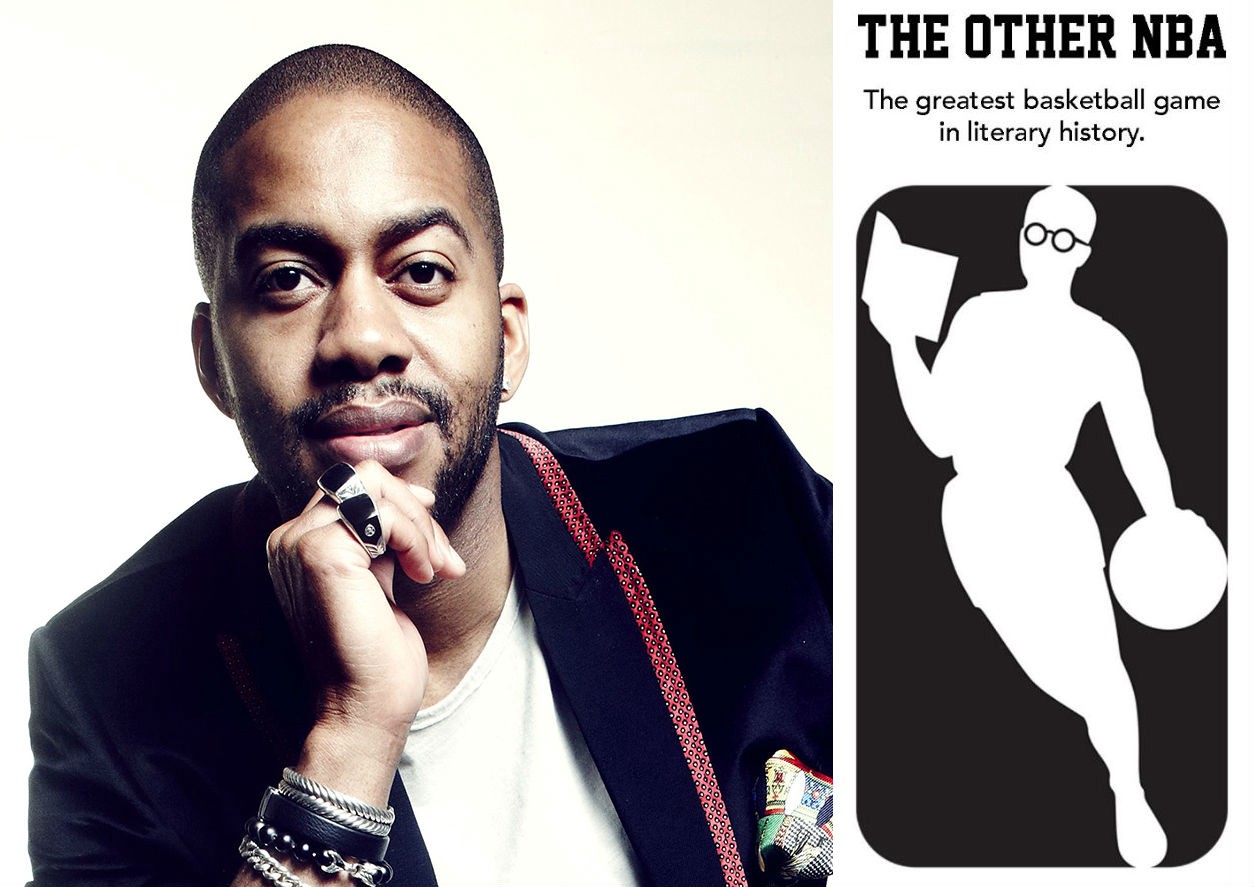
In a few days — Saturday, June 20th at 3pm — the National Book Foundation is putting on a basketball game. Let the strangeness sink in: the presenter of the National Book Awards is pitting writers against editors, publicists, festival organizers, and a host of publishing people in…a basketball game. The event is going by the name, “The Other NBA,” because, apparently, I’m not the only one who gets a little frustrated with the book world for throwing around the NBA acronym every November when there is, very clearly, already a fully-functioning, some would say thriving, Lebron-and-Steph-buoyed institution going by that name. The proceeds from the game are going to the National Book Foundation’s reading program, BookUp, which is in the midst of an expansion to Detroit. (Pistons fans, feel free to imagine here an elongated, singsong “De-troit Bas-ket-ball.”)
I decided that (1) I should somehow get involved in the game, and (2) I should talk with Mitchell Jackson, the unofficial captain of the Writers Team and a proud member of the Book Up family.
Dwyer Murphy: First off, this is an event being put on by the National Book Foundation. Does that mean it’s going to be black tie? Is Cipriani’s involved?
Mitchell Jackson: Oh heck no. This is super casual with St. Francis College involved. There’s no dress code, though I will suggest being camera ready, otherwise known as social most post worthy. We’ll be snapping.
DM: The game is being billed as “the greatest basketball game in literary history.” Tell me about your training regimen. I assume you’ve been working with a shot doctor, sleeping in a hyperbaric chamber, consulting with Dr. James Andrews, eating a lot of pasta dinners, that sort of thing. Typical greatest game ever stuff.
MJ: I actually have been working out a bit. I went to an indoor gym and shot around a few weeks ago. It was the first time I’d done so in over a year. Then just this past week, I went to a park in Battery City and played four-on-four half court. I felt things aching that should not be aching, but it also felt good to compete. Not sure how much practice everyone else is doing, but I hope at the least everyone stretches. We sure don’t want any Kyrie Irvings or Kevin Loves out there.
DM: You’re raising money for BookUp, an after-school reading program. I hear you’re a faculty member. Can you tell me about the program and what you do?
MJ: BookUp is a program that sends authors into schools and gets kids excited about reading. We read, write, play games, whatever we can to get them engaged. Then twice a quarter we also take them on literary-related field trips, outings at the end of which they get money to buy books. It’s an amazing program. I love seeing kids excited about reading.
DM: And now BookUp is expanding to new cities?
MJ: Yes, the game is to help raise money to bring BookUp to Detroit. And with all the turmoil in Detroit in the last few years, I can’t think of a city that needs it more. I’m of the mind that reading helps build dynamic kids. And that dynamic kids have the chance to transform their circumstances.
DM: Okay, so the game is between a team of writers and a team of publishing people. I’m looking at your squad. Seems pretty decent. Alex Gilvarry’s rangy. Valeria Luiselli gives you rim protection. Where do you fit in? Secret weapon?
MJ: I haven’t seen anyone play yet, so I can’t say how I fit in. But I’ve played a few games in my life, so I’ll see where I can help and try and help. Alex is a young guy and I’m hoping he has young legs and plays doggish defense. Valeria has lived in some tough places, so I’m banking she’s got some scrap in her too. We’ll be like the Bad Boy Detroit Pistons.
DM: How about the publishing team? We should probably get the trash-talk started now. John Freeman’s too pretty to really bang around in the post, right? How about the rest of the team?
MJ: I get the feeling John Freeman can play. I haven’t seen it, but he looks pretty athletic. But at our age athleticism is all but out the window, so he’d better be a smart player too. I think Steph Opitz is athletic. We’ll see what the jump shot is looking like though. As far as trash talking. This used to be how I felt (maybe there’s still some residue of this in me too): if you didn’t get paid to play professional basketball somewhere in the world, then you can get dealt with. So unless there’s some retired semi-pros on the other side, I feel good about my chances playing against just about anyone. Plus, word on the literary streets is Jess Walter can play. Maybe we can get some Northwest buddy-ball going.
DM: Final pitch? Why should people come out to the game instead of, say, going to the park to celebrate the summer solstice?
MJ: You can go the park almost any weekend in the summer and see the same thing. But this game, this could be the first and the last. Don’t do for us. Do it for those kids in Detroit. Don’t forget we have Pulizter winner Greg Pardlo’s playlist. Where else can you hear his DJ skills?
“No live organism can continue for long to exist sanely under conditions of absolute reality,” Shirley Jackson wrote, “even larks and katydids are supposed, by some, to dream.” In his unsettling new novel, A Head Full of Ghosts, Paul Tremblay combines demon possession with reality TV, toying with ideas of perception, belief, and hard truth. Tremblay’s work shows us how irresistible the darker corners of imagination can be, too.
When Marjorie Barrett begins to show signs of madness, and medical treatment doesn’t offer any answers, her parents turn to their Catholic priest, Father Wanderly. The previously stable family has fallen on hard times, and when the offer of an exorcism comes just prior to an offer from a production company to film the whole thing, the Barretts hastily accept both. A Head Full of Ghosts is written from the perspective of the Barrett’s younger daughter, Merry, fifteen years after The Possession airs.
I spoke with Paul Tremblay recently about the ghosts in his head, horror in the literary world, and his new connection to Iron Man.
Heather Scott Partington: This book certainly freaked me out. I’m not usually a horror reader. But as someone unfamiliar with the genre, I appreciate the novel’s accessibility. It’s written so well. Can you talk about how this book came about? Did you decide to write something in the exorcism genre (is that a thing?), and then develop a story, or did the story idea come to you first?
Paul Tremblay: Thank you for the kind words and, yes, I’m glad I freaked you out.
In February 2013 I was doing some research for a book about an 8th grader obsessed with ending the world and stumbled across some deconstructive essays about William Friedkin’s The Exorcist. It occurred to me that while there have been recent literary updates of vampires, zombies, and werewolves, there hadn’t been much in the way of possession novels. Hollywood had pumped out a spate of possession movies that did well enough financially but they were mostly formulaic PG-13 fodder; with the exception of the first Paranormal Activity, which is clever and affective…let’s not mention the sequels. So how about a secular/skeptical exorcism novel? Why not, right? From there the two sisters, Marjorie and Merry, appeared, and I knew the story would be told from the younger, unafflicted sister’s POV. I could use Merry as a narrator to keep the reader off balance, leave people wondering if there was or wasn’t something supernatural going on.
All that and I had Bad Religion’s song “My Head Is Full of Ghosts,” running through my own head. Seriously, I think I listened to that song over 100 times that month.
HSP: It’s apparent right away how you use an alternate voice — a blog persona — to call out similarities between the family’s turn on a reality show and other famous exorcism narratives, especially The Exorcist. That’s a really clever way to offer commentary from within your own story. There’s also a frame story element of an interview. Can you talk about how these ideas became a part of AHFoG?
PT: Instead of avoiding the inevitable comparisons to The Exorcist and other horror texts, I decided to go all in, embrace the similarities and use them to my advantage. The blogger within the story lets the reader know that we’re all in on it, that we know the beats and the scares and the lore, that it’s all part of our pop cultural DNA. But that a priori knowledge doesn’t clarify what is or isn’t reality within the story, and instead serves to make things more complicated. I usually struggle with non-fiction/critical essay writing but the blog posts were so much fun and became this weird dissertation on my lifelong love/hate relationship with horror. Hopefully the push and pull at genre tropes and expectations works and still makes for a satisfyingly disturbing and creepy story.
As far as the narrative frame goes (a best-selling author interviewing Merry fifteen years after the fact), it was the opportunity to add another filter or layer to the POV; another retelling and reshaping of the story, of what it was that happened, if we’ll ever be able to know what happened at all.
HSP: Without giving anything away, there’s a strong sense of doubt that runs parallel to the ideas of demon possession and schizophrenia. This has the nice effect of knocking your reader off balance. Every time we think we might do something, we find out that we don’t — but that never feels disrespectful to the reader. It’s done well. Is that something you’ve been a fan of in your own reading and viewing?
Horror is often about how we live in the liminal, whether we want to or not.
PT: Absolutely. Ambiguity and the horror of possibility play a part in so many of my favorite horror stories: Shirley Jackson’s We Will Always Live in the Castle, Mark Danielewski’s House of Leaves, Victor LaValle’s Big Machine, Charlotte Perkins Gilman’s “The Yellow Wallpaper,” Stewart O’Nan’s The Speed Queen, and so many more. What those stories have in common is that they exist in this liminal space between the real (or what we perceive to be real) and an unsettling but familiar irreality. Horror is often about how we live in the liminal, whether we want to or not.
I wanted a similar vibe for AHFoG. Along with the different layers of narrative, I worked to keep the cases for what was really wrong with Marjorie — the supernatural-explanation and rational-explanation — in balance throughout the novel. The hope was that as I kept piling on the evidence to both sides, it would seem like either case could collapse at any time.
HSP: A Head Full of Ghosts is full of references to unexpected things — Richard Scarry, for example, and TV. It’s a nice balance of lightheartedness to give the reader breaks between the more intense scenes. Reality TV’s take on truth and investigation also feature in the book. What might potential readers be surprised to learn made it into the book? Any unexpected details or strange things from your life as you were writing it?
PT: Unlike my weirdboiled crime novels, I didn’t start this book with a detailed summary/outline. I had a beginning, ending, narrative frame, and the three part structure in mind. I winged it from there. With the book in some ways being about influence and how it affects story, I kept an open mind to the unexpected, unanticipated. I let whatever I was watching and reading seep in. And it was a fun, freeing way to work.
When you trust your subconscious enough to put something in a story and then figure out why it really needed to be there later, when that works out, aye that’s the stuff.
My daughter Emma was around Merry’s age while I was writing the novel and a lot of her personality and outrageous outbursts made it into the book. (Her, as a pre-schooler being able to shimmy up the hallway walls to the ceiling did not make it into the book…and now I’m regretting it!) The house the Barrett’s live in is a combination of my sister’s current house (sorry, Erin) and the house I grew up in. Lastly, and without getting too spoilery, there was a personal quirk I took from my older son and used it as a character detail in the beginning of the novel, almost as an afterthought. This character quirk turned out to be a vital, plot-turning detail for the ending. When you trust your subconscious enough to put something in a story and then figure out why it really needed to be there later, when that works out, aye that’s the stuff.
HSP: I had no idea until I started reading AHFoG that Pope Francis did (what was widely perceived as) an exorcism on a man in 2013 in St. Peter’s Square. How did current events or trends in TV influence the book? It seems like a dialogue between older stories and horror movies and a more contemporary sense of reality as it relates to what we can see with our own eyes, even if that is heavily edited).
PT: I had no idea either! I found it in one of my random exorcism-spinning-head-green-puke Google searches. The YouTube clip seemed innocuous enough, but then reading that so many people were convinced it was proof Pope Francis had conducted an exorcism in public was certainly an unexpected and serendipitous find. I wanted more head-spinning in the vid though. Alas.
Reality TV certainly plays a big role in the novel. Merry’s and Marjorie’s parents — due to financial desperation — agree to become the stars of a reality TV show called The Possession. I used the TV show to make things more real and less real at the same time. I’m convinced a show like that, if not in development already, could happen. I treated the why-and-how of the show as realistically as possible. Of course, we know that reality TV is hardly as real as advertised. Comparing the TV reenactments and staging, the blogger’s deconstruction of the show, and Merry’s admittedly imperfect memories makes, hopefully, for a nice dizzying affect.
Part of the appeal of the horror genre is the sense of adding to/participating in a conversation hundreds of year old…
I’m fascinated by the dialogue you described. Part of the appeal of the horror genre is the sense of adding to/participating in a conversation hundreds of year old: from oral folklore and myth to Grendel to Poe to Shirley Jackson to The Exorcist to Stephen King to last year’s wonderful The Babadook. It’s all there (the good and the bad), building and stealing from each other, and informing and reshaping. As a math guy (well, I have a master’s degree in it, anyway, and that’s what it says on the diploma, math guy) I like to think of stories, especially stories that fit within a genre tradition, as grown or developed in a manner similar to new mathematical theorems; these new discoveries as direct and indirect offshoots from previous ones.
On the other hand, on a much more macro level, I’m more than a little worried about how living in the age of information/disinformation affects our stories, how we tell them, and how it affects our perceptions, and even how we think. There’s a horror story for you: the age of influence run amuck. Amuck! I half-kid, but the blogger in my novel proposes that if Marjorie is possessed, it’s by the horrible monster that is pop culture.
HSP: One of the most compelling elements of AHFoG is how mental illness — schizophrenia — is manipulated and misconstrued by several characters. Does your book have something to say about how mental illness is mischaracterized? Or, is the 14 year old Marjorie’s affliction just a part of the conflict she feels as a character and therefore necessary in the story?
PT: It was certainly necessary to the story, the foil to being possessed by a supernatural entity. Her symptomatic behavior/irrational leaps of logic coupled with the appalling decision making of the adults, leads to the most horrific consequences. The idea that the scenes with the least amount of potentially supernatural fireworks would be the most horrific was important to me. I hope that most readers feel bad for Marjorie and see her as a tragic figure and not an evil one. She’s a fourteen-year-old girl who’s already suffering, and is then made to suffer more because of the ignorance, sexism, and manipulations of the men (her dad, the priests, the psychiatrist, the show runner) who bully their way in and never really listen to what Marjorie is telling them. Those adults are as much to blame for what ultimately happens as anyone.
HSP: What do you think some of the challenges are for contemporary horror writers? You’ve become known as a crossover from literary fiction into horror. Does that have any meaning to you, or are you one of the “genre is meaningless” guys? Who are your favorite authors of literary horror?
PT: It does have meaning to me. And the pairing of the two words “literary horror,” seems to piss off a bunch of folks.
Horror is still stigmatized by many. Despite overwhelming evidence to the contrary, horror (or any other genre) is not inherently inferior. You still see articles crop up, usually once or twice a year with hey-is-genre-lit-innately-sucky? To wit [this] recent Guardian click-hole piece. Or Glen Duncan’s obnoxious review of Colston Whitehead’s excellent Zone One. Quoting Duncan’s first line: “Colson Whitehead is a literary novelist, but his latest book, ‘Zone One,’ features zombies, which means horror fans and gore gourmands will soon have him on their radar. He has my sympathy.” Ironically, this last sentence applies to anyone who has read Duncan’s unfortunate and misogynist sequel to his excellent The Last Werewolf. But I digress…
Despite my (not-so) cheap shot at Duncan, there are horror fans who do view the term literary as pejorative.
But the good news is that we are seeing less of the old-guard attitude toward genre and we are in the middle a golden age of horror fiction
Speaking as a contemporary horror writer, it’s frustrating having to fight that battle on two fronts. I don’t know what the solution is. But the good news is that we are seeing less of the old-guard attitude toward genre and we are in the middle a golden age of horror fiction. Lucky us! There are many talented and worthy writers engaging horror in new, imaginative, and yes, terrifying ways. For the past seven years I’ve been on the board of directors for the Shirley Jackson Awards. To quote our mission: “In recognition of the legacy of Shirley Jackson’s writing, and with permission of the author’s estate, the Shirley Jackson Awards have been established for outstanding achievement in the literature of psychological suspense, horror, and the dark fantastic.” Our now seven-years worth of winners and finalists is a great snapshot of the excellent horror fiction.
All time favorite literary horror authors start with Joyce Carol Oates and Peter Straub. Below are my recent personal favorites, that I haven’t mentioned already, category style. And I only regret that I’ll inevitably leave off some great writers.
Novels: Stephen Graham Jones’ Demon Theory, Elizabeth Hand’s Generation Loss, Michael Cisco’s The Traitor, Brian Evenson’s Immobility, Helen Oyeyemi’s White Is for Witching, Stefan Kiesbye’s Your House Is on Fire Your Children All Gone, Sarah Langan’s The Keeper, and this year’s When We Were Animals by Joshua Gaylord.
Short story collections: John Langan’s The Wide Carnivorous Sky, Livia Llewellyn’s Engines of Desire, Yoko Ogawa’s The Diving Pool, Laird Barron’s The Beautiful Thing That Awaits Us All, Nathan Ballingrud’s North American Lake Monsters, and Kelly Link’s Magic for Beginners.
HSP: Robert Downey Jr. I mean. Robert. Downey. Jr. Focus Features. The whole thing. That must have been a good day, when you found out A Head Full of Ghosts is going to be made into a movie?
PT: It certainly was! The possibilities are fun to think about. Screenwriters Ben Collins and Luke Piotrowski are currently working on the screenplay. I’ve tweeted at them (that sounds threatening, doesn’t it? I don’t mean it to be.) that I entrust Marjorie and Merry to them. And they didn’t block me! An omen of great things to come. Not a Damien from the movie The Omen. That would be bad.
My younger brother Dan is convinced that the father (not the father father, er, a priest, but, you know, the father, the dad, ugh…) John Barrett is our dad. He’s not. My brother is a terrible person for thinking such a thing. Still, Dan sent me my favorite text after the Focus Features option was announced:
“Iron Man is our dad.”
DON’T MISS OUT
Sign up for our newsletter to get submission announcements and stay on top of our best work.
YOUR INBOX IS LIT
Enjoy strange, diverting work from The Commuter on Mondays, absorbing fiction from Recommended Reading on Wednesdays, and a roundup of our best work of the week on Fridays. Personalize your subscription preferences here.