Redditor bbbron says they found a surprise inside a copy of Herman Voader’s Four Plays of Our Time that they bought in a used bookstore.
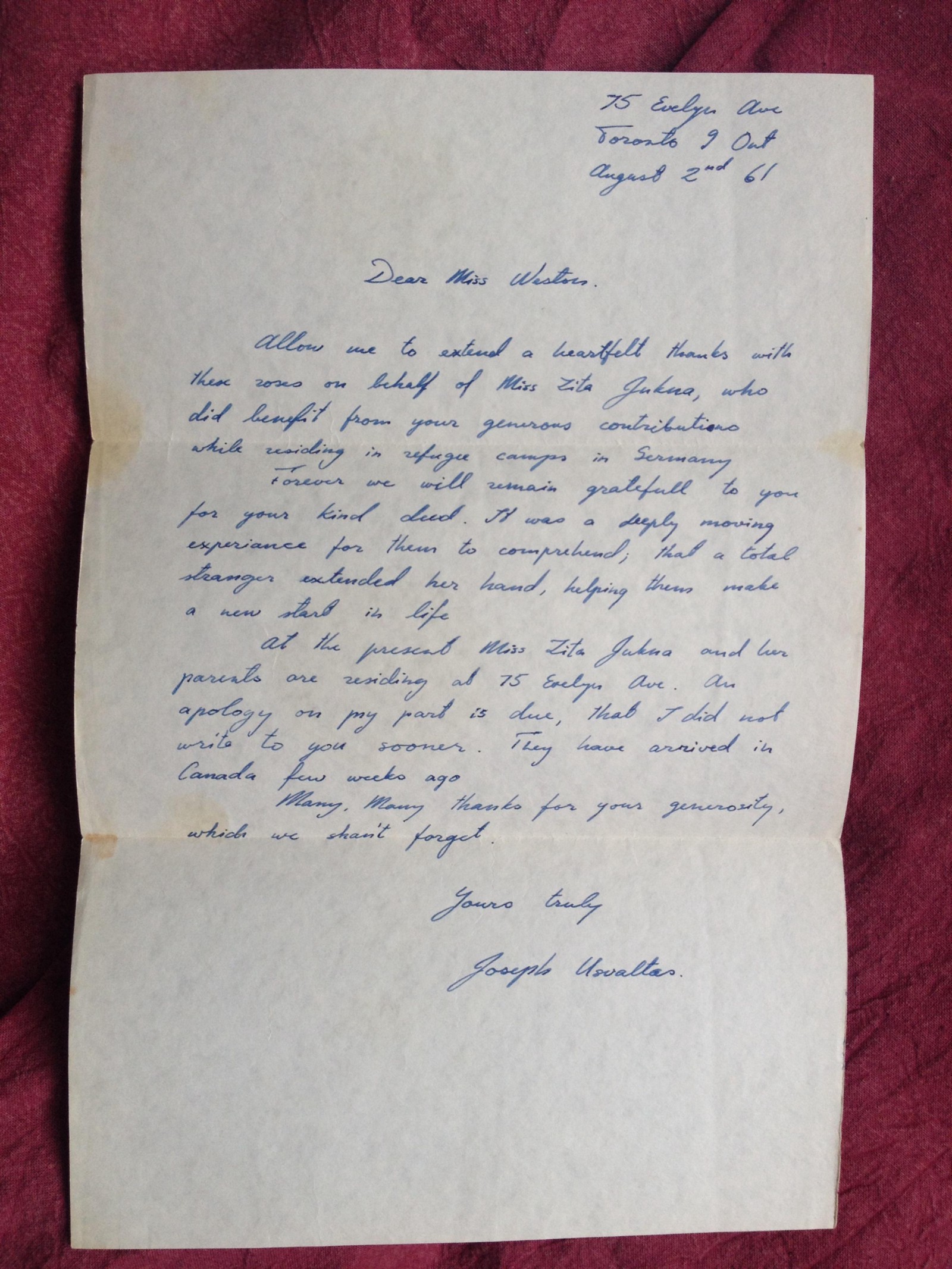
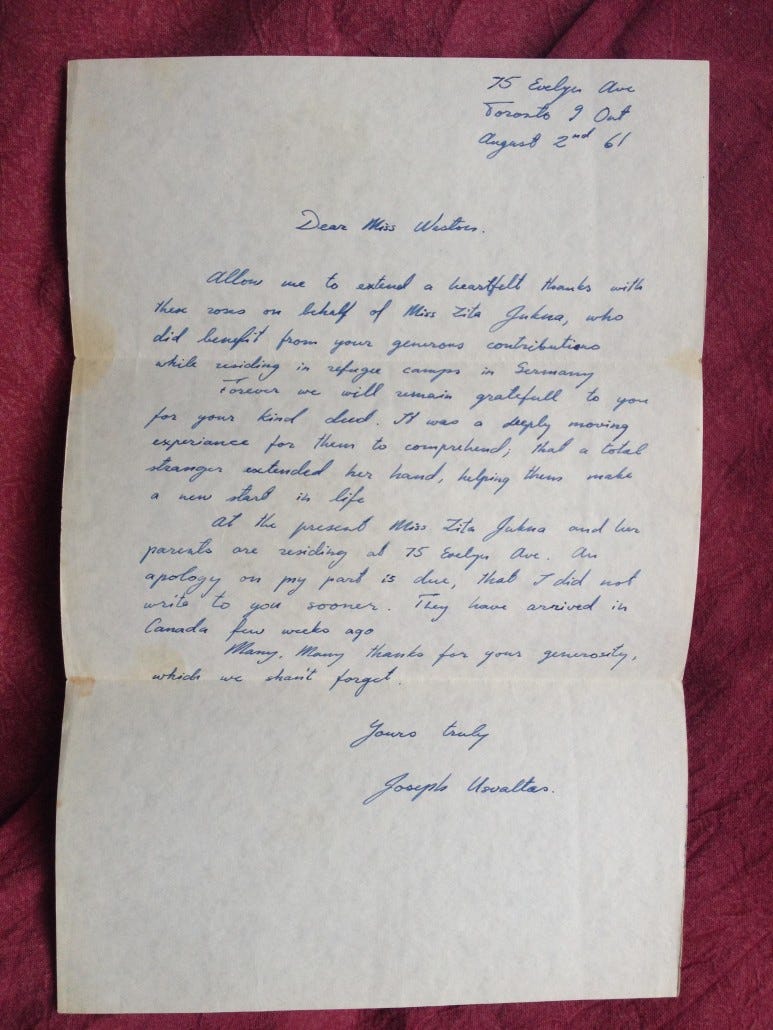
“Flipped open a book in a secondhand store…to find this letter thanking the recipient for helping a family escape a German refugee camp.”
The letter (which apparently was sent with flowers) is a note of thanks to a woman who aided a refugee family at the start of the construction of the Berlin Wall. “Forever we will remain gratefull to you for your kind deed,” writes Joseph Usvaltas “It was a deeply moving experience for them to comprehend; that a total stranger extender her hand, helping them make a new start in life.”
To my dear Mamma. This, my first attempt at composition, is affectionately and dutifully inscribed by her affectionate daughter, Victoria.
By the time she died in 1901, Queen Victoria had survived five assassination attempts, given birth to nine children, and reined for 64 years, the longest of any British monarch in history. But by the time she turned 11, she had already written a children’s book. And on June 22, The Adventures of Alice Laselles will hit bookshelves — nearly 200 years after it was written.
In Alice, the beribboned protagonist is sent away to boarding school, and must solve the mystery of “who put the cat in Miss Dunscombe’s kitchen.” Along the way she encounters a “poor little French orphan,” the daughter of a rich London banker, and lots of pastel. The book includes Victoria’s illustrations, restored and updated (and a little bit eerie).
Written for a homework assignment, the book offers a window into the mind of an assiduous future royal who “studied with private tutors and spent her free time with her dolls and her governess.” A bit bleak, perhaps, but conducive to precocity. And after two centuries spent chilling in the royal archives at Windsor, Alice will surely be thrilled to see the light day.
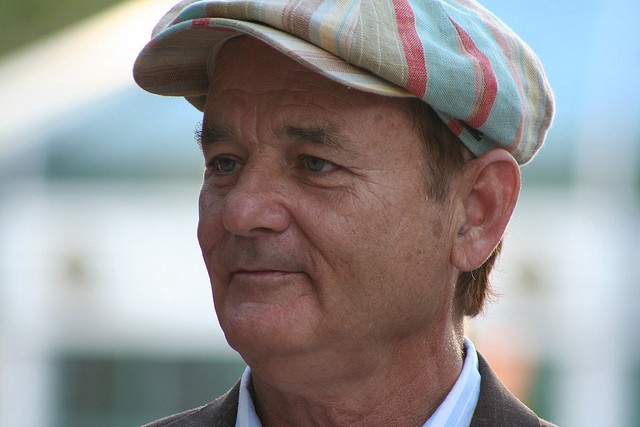
When Walt Whitman wrote “Crossing Brooklyn Ferry” in 1856, he probably did not have in mind a bumbling parapsychologist in a khaki flight suit. But that didn’t stop legendary comic and erstwhile Ghostbuster Billy Murray from leading the charge last week at the 20th annual Poets House Brooklyn Bridge Poetry Walk.
Each year, tri-state area Whitmanites trek across the 5,989 foot long bridge; at the end of their journey they recite the poem, which, in nine exuberant stanzas, describes the ferry ride that once spanned the Manhattan-Brooklyn divide, today traversed by the Brooklyn Bridge.
Flow on, river! flow with the flood-tide, and ebb with the ebb-tide! Frolic on, crested and scallop-edg’d waves!
Murray is a self-professed poetry lover, and has put in appearances at several Poets House events (in 2009 he gave the first ever reading at the nonprofit’s headquarters). He said of the Whitman poem, “It’s beautiful to read with all of it happening right in front of your eyes.”
The event, capped off by a celebratory dinner in DUMBO, also featured readings by Mark Doty, Thomas Lux, Vijay Seshadri, and high schooler Anita Norman, winner of the Poetry Out Loud National Recitation Contest.
Here’s hoping the event is reprised as many times as February 2 in Groundhog Day.*
A large majority of the Japanese public, in the wake of Gifu City Library’s planned attempt to break a world record, are up in arms about this seemingly obscure question. According to the Telegraph, the book domino event “was intended to promote Gifu as a ‘book city,’” as well as to celebrate architect Toyo Ito’s renovations.
Book-lovers, however, have vehemently criticized the upcoming event as disrespectful to the books and their authors. The Telegraph provides an example of a particularly scathing remark, found on the event’s Facebook page: “Books are not toys to be used as dominoes. Gifu City government should be ashamed.”
Is the world record attempt a shameless, even cruel betrayal of books in pursuit of fame and revenue, or is it perhaps a harmless, entertaining act of celebration?
United Biscuits, a UK-based food manufacturer, is the current record holder after toppling 5,318 books — specifically, copies of The Guinness Book of World Records — domino-style.
The book domino event in Gifu City is set to take place on July 12th, right before the library reopens on July 18th. Liam O’Brien of Melville House reports the event is rumored to involve 10,000 books.
“I have followed a woman into the wilderness.” Seriously. I have. These aren’t my words, but they apply here. When I read Quintan Ana Wikswo’s collection of stories, The Hope of Floating has Carried Us This Far, I felt as if I was following her through a type of wilderness of words. Far deeper than the sparse text on the page, down past the gorgeous yet eerie photographs Wikswo took and wove in with her text, there lives a story of something wanting to rise up. It’s continual and won’t ever plateau. Growing, yet not aging: it’s a steady stretching of each character who wants to believe in the concept of connecting. In the opening story, Wikswo writes about the need for and complexity of human connection: “I gather her letters together in a string and keep them in a place where no one will look. These secret specimens of lost words, of cartography and discovery and longing.”
Even though the reader follows Wikswo’s characters through every yearning, the stories are not necessarily plot-driven. They’re about sound and rhythm, imagery and pace. The reader takes in more than a story, but language, too. In that aforementioned opening story, “The Cartographer’s Khorovod,” the reader is immediately swept into Wikswo’s description-driven flow. “Immediately” as in the very first sentence: “When she writes to me as she did before, at first there is the incomprehensible sound of crickets, and then there is my familiar smell, a scent released from my pores as dark and full of longing as they were before.” Following the sound of her sentence and the imagery contained within, the reader is sent off into a collection where text and image intersect in order to create a sense of identity-searching in each character. As the language and photographs engage more with each other throughout the book, the characters, too, engage with a type of landscape — both literal and metaphorical — weaving human with wilderness.
In “Aurora and the Storm,” for instance, Wikswo writes about identity through the imagery of a landscape. “[When] I look out into the wilderness, I am looking through something, through a translucent pane that separates me from the beyond. There has been a change in pressure, and a collapse. A skin diver’s lung, or a chambered nautilus too far into the deep. There has been a shattering, and now all is softness.” Here, the narrator sees beyond what she has seen before, which, in turn, brings her to a different understanding of her relation to that space — the depth of her identity as it shifts from shattered to softness.
The wilderness is a place to lose ourselves. It’s that space where we can get lost and twisted, dizzy and confused, but it is by finding our way through that wilderness that we begin to find ourselves. But let’s stop right now with that cliché — let’s put an end to the obvious metaphors of journey and transformation — because while wilderness is a predominating theme in Wikswo’s work, clichés and easy metaphors do not exist anywhere in the book’s pages. Yes, there is an underlying topic of transformation, and yes, the landscape and setting of the stories span out and transform with the characters, but these stories don’t use setting to give the character a vague stage on which to act. Instead, place and person begin to merge.
It’s another way of saying life occurs in The Hope of Floating has Carried us This Far. Not just life as in breathing and all of our biology, but life as in the science of connection, too. The art of continuously trying to become new, to renew is discussed and discovered through Wikswo’s words. The vehicle for all of this merging and transformation doesn’t occur through plot or narrative arc, but, again, through language.
From “Holdfast Crowbiter”:
“Our world a punctured lung that contracts and expands without ease. What is close comes near, then billows away far from reach. So much is evacuated, then all is spasm, and gashes, and wet tissue. Where there is pain, there is a gasp. Our rib cage cleaved accordion, the organ no longer used for lovemaking. The air we expel is stale with fear.”
Here, Wikswo gives the reader a type of poetics of where self and place intersect then interact. I’m not quite sure what the plot of this story is, but that doesn’t matter as it is the language and sound of the story that drove me through it. Gliding along the undulating river of her rhythm and imagery, my mind flowed with Wikswo’s words and I could feel the transformations taking place in the text not because of any events, but because of this lingual movement.
Ultimately, in this collection, every story is a poem with life thriving throughout each image. That, combined with Wikswo’s own photographs of different types of nature, creates a multi-sensory reading experience. You don’t just read the stories; you engage with them through consideration and interpretation. For instance, when you take this text: “Prayers for bones that bend instead of break are prayers for our bodies to be soaked in vinegar, pickled, unable to expire. Pray for good winds. Pray for calm seas. For our immortality. What we have here is a multi-sensory reading experience and it sucks you in. A large contributor to the pace and flow in this example is the use of repetition — “pray.” This technique is powerful, as it feels as if through the repeated phrases and descriptions, a momentum is gathering, a meaning shifting and maturing into larger and connected concepts. Pray for good winds. Pray for calm seas. For our immortality. As often as possible, pray for something that does not exist. The story builds.
Aside from these connections brought forth through wilderness, the different characters begin to create and communicate themselves through each other. In “The Kholodnaya Voyna Club,” for instance, two people merge through the lyrical. Wikswo writes, “The pilot shared the same dreams with her at night, unconscious. Autobiographically accurate, yet identical. They had even dreamed them at the same hour, and woke together, crying. She drove the pilot so crazy, sometimes it seemed possible they were the same person. Perhaps a single schizophrenic.”
It is through these stories and photographs in which not only are identities created and discovered, but the experience of connection becomes vibrant. Tangible, even. One aspect that Wikswo concentrates on in “My Nebulae, My Antilles,” is that of how we learn to speak through writing. “When I was a small child, I was very silent. I was known for my silence. It was not known that I kept a diary. In its earliest life, it was a simple count of the day’s activities. Tally up the scabs on my kneecaps. The sixteen collectors that live within a beet. As the days passed, I learned that paper listens.”
The reader, too, is listening. She’s reading closely, attentively as she follows Wikswo through these meditations of where wilderness lives not only outside of us, but within us, as well. The reader weaves around and discover the ways in which through language, wilderness is a type of getting lost in beauty — getting lost in herself. Through this, the senses created by this reading experience are forever heightening. It is through Wikswo’s poetic language and movement that we can recognize, live, and exist in our own ecology of complexity.
Iconic horror actor Christopher Lee passed away this week. The actor — who played Dracula, Saruman, and Count Dooku among other roles — was famous for his deep and theatrical voice. In the above video, listen to him read Poe’s classic poem “The Raven.”
Hello, and welcome to my week-by-week review of everything in the world. Today I am reviewing vaping.
The new thing that everybody is talking about that isn’t called cupcakes is called vaping. It’s when smoking is done using electronic cigarettes instead of boring old paper ones. What is an electronic cigarette, you ask? It’s the future of cigarettes. Picture a regular cigarette but made of metal, and it gets the internet. Objects that get the internet are becoming commonplace. I saw a thermostat that gets the internet — I guess so you can send your friends messages to tell them whether they should bring a sweater when visiting. When I was a kid, hosts would provide the sweaters.
Personally, I’ve never been a fan of smoking. It’s smelly and bad for you and a very expensive habit. Some people really enjoy it though. So much so that they smoke an entire pack a day. That’s like me with raisins! But I don’t smoke raisins, I eat them.
Anyway, electronic cigarettes are making smoking cool again. Only the elite can afford such high-end smoking devices, and boy do people who vape look classy! Poor people are still stuck using things like pipes or just putting a lit pile of tobacco in their hands and leaning over it.
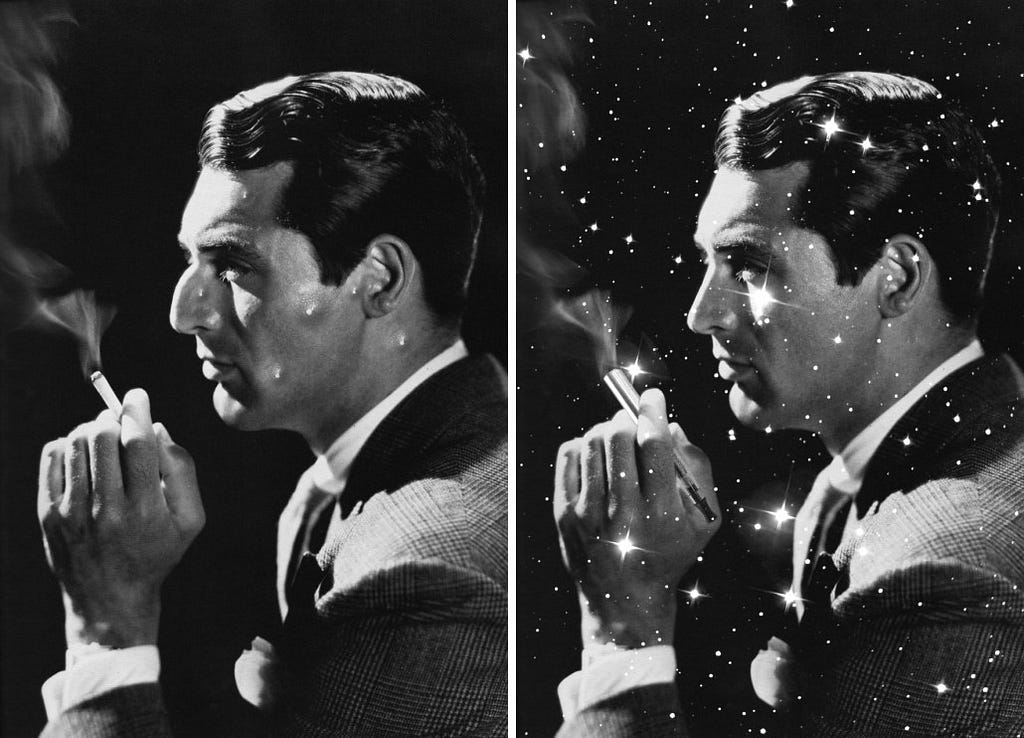
For evidence of how cool vaping is, look at this rendering of Cary Grant with a traditional cigarette versus with an electronic one.
I didn’t think Cary Grant could be cooler, but there you have it.
However, there are some real downsides to vaping. For one, you can’t put your electronic cigarette out in someone’s face if you get angry at them. More importantly, metal things rust, and electronic cigarettes are wet all the time from being sucked on. Now instead of cigarette butts on the street, we’re going to have rusty metal lying around and anyone who hasn’t had their tetanus shot is going to be in real trouble.
And even though I’m not a smoker, I’m going to be sad to see The Marlboro Man become a robot, because robot cowboys remind me of Yul Brynner in Westworld and he was scary.
BEST FEATURE: Exciting flavors beyond tobacco, such as rose, steak, and watermelon! WORST FEATURE: Everyone will want to try your electronic cigarette and you won’t get enough to yourself.
Please join me next week when I’ll be reviewing Dwayne ‘The Rock’ Johnson.
Not too long ago I made another mix, for Largehearted Boy, focusing on music that either inspired my new book, or best complemented it. But now it’s June and I need summer mixes to celebrate surviving the worst winter I’ve ever experienced. Below are some tracks to help me forget every one of those 100+ inches of snow that fell on Boston over the last 6 months. Like any good mix, these are meant to be listened to in order. Enjoy!
1. Hey Mami — Sylvan Esso
I like to ease into summer mixes with a breezy track that builds. Sonically this opening track off of Sylvan Esso’s eponymous debut serves that purpose perfectly — but lyrically it’s much more complex as it turns a depressingly ubiquitous story of sexual street harassment on its head across several verses. I love the paradox between content and tone in songs like this. Great for strutting on by as you too “pull on the eyeballs of all the kids standing tall.”
2. Cowboy Guilt — Torres
Off the brand-new album by Georgian singer-songwriter sensation, Torres, this song continues in the same vein of powerfully poppy music with a dark undercurrent. I could have just as easily chosen any song off this album, so why this one? I just threw a dart at my computer screen and this is the track it pierced right before destroying my laptop.
3. From Dog to God — Prayers
Just when I was feeling at a loss for this year’s fallback, go-to ultimate summer jam album I discover Prayers, with their irresistibly catchy and dark “cholo goth” movement. The marriage of gangster rap and new wave feels predestined in this song, with lyrics like: In and out of bad scenes / Always been a bad seed / Loyal to my family / Death Always chasin me / From Dog to God I’m alone in this world / I’m alone I’m alone I’m alone / I’m alone in this fuckin world. Both their albums, SD Killwave and Gothic Summer, are made for driving around with the top down while your black nail polish dries.
4. Queen — Perfume Genius
Off his third album, this track has it all. Soaring melodies, epic drum-ins, haunting backing chorus, and catchy synth chords all make you feel like you’re spinning around an endless luminescent shaft of pure light before the killer refrain, “no family is safe when I sashay,” stops you in your tracks like a death drop.
5. Hawaiian Death Song — Duke Garwood
I had the honor of performing with Duke recently in London, where we collaboratively improvised on stage at the Roundhouse Theatre. Duke belongs to that upper echelon of musicians whose mesmerizingly powerful live performances can barely be hinted at in recordings. This track gets about halfway there, which still makes it better than thousands of songs by other artists. Watching Duke’s fingers play across the guitar as effortlessly as if he were brushing the hair from his eyes, I couldn’t believe the powerfully evocative tones that sprang forth — laying a magickal backdrop for his low, spare vocals. Here’s to hoping Duke comes stateside soon and we all get to see him live.
6. Ha Ha Ha — The Julie Ruin
The latest project from riot grrrl godmother and third wave feminist Kathleen Hanna, The Julie Ruin is every bit as fierce and fun as her previous projects Le Tigre, and Bikini Kill. What summer mix would be complete without a song that ends by chanting “HA HA HA HA ARMAGEDDON” over and over and over again?
7. Let It Bleed — Goat
Buried at the heart of my hands-down favorite album of 2012, Let It Bleed is an unstoppable hybrid of afro-caribbean rythms, fuzzed-out garage riffs, blaring saxophone, and witchy lyrics — all from a group of Swedish musicians who wear masks on stage and insist they’re the latest incarnation of a lost voodoo lineage. In other words: it’s everything I love about all of Goat’s music, and what sets them apart from the sheep (see what I did there?). I can’t get through any season without picking them up and giving them a spin.
8. Wide Open — Growing
I once asked some colleagues what music they thought of when they read my poems, and one Black Ocean author named this track. Until then I had actually never heard it before, but I instantly fell in love and now it’s definitely something I aspire too. Every summer mix needs a song you can get stoned and completely lost in, and this buzzing, layered, complexly harmonic drone that clocks in just a few seconds under 16 minutes fits the bill. Turn out the lights, dilate your third eye and float up through the vastly deep and ever-expanding celestial ocean.
9. Hi-Five — Angel Olsen
I’ve spent numerous summers of my life getting over perennial spring breakups. Consequently every summer mix needs a breakup song, but not just any breakup song — a triumphant one that propels you off the couch, puts your back on your feet and in front of that next great love (or, you know, one-night-stand). Angels Olsen’s Burn Your Fire For No Witness is one of my favorite albums of 2014, and while every song on it cuts me open in way or another, this particular one sews me back up.
10. Lights On — FKA Twigs
Speaking of one-night-stands, what good is a summer mix if you can’t get freaky to it? FKA Twigs puts the “freak” back in “freaky,” as evidenced by every one of her unapologetically visionary music videos. If your partner isn’t DTF to FKA then s/he isn’t worth the F in the first place.
11. Close Your Eyes (And Count to Fuck) — Run The Jewels (feat. Zack De La Roche)
Summers are also about giving the finger to authority. Whether it’s throwing your textbooks out the window, or playing hooky from work so you can spend the day reminding yourself why being alive actually feels good as you soak up some critical vitamin D on the beach, you need a reliably anti-authoritarian jam. You know who hates authority more than you do? Rage Against The Machine’s Zack De La Roche. He makes a guest appearance on this track from the phenomenal sophomore release, Run The Jewels 2, and you can roll around the world all day to this while flipping every oppressive motherfucker both birds as hard as you possibly can.
***
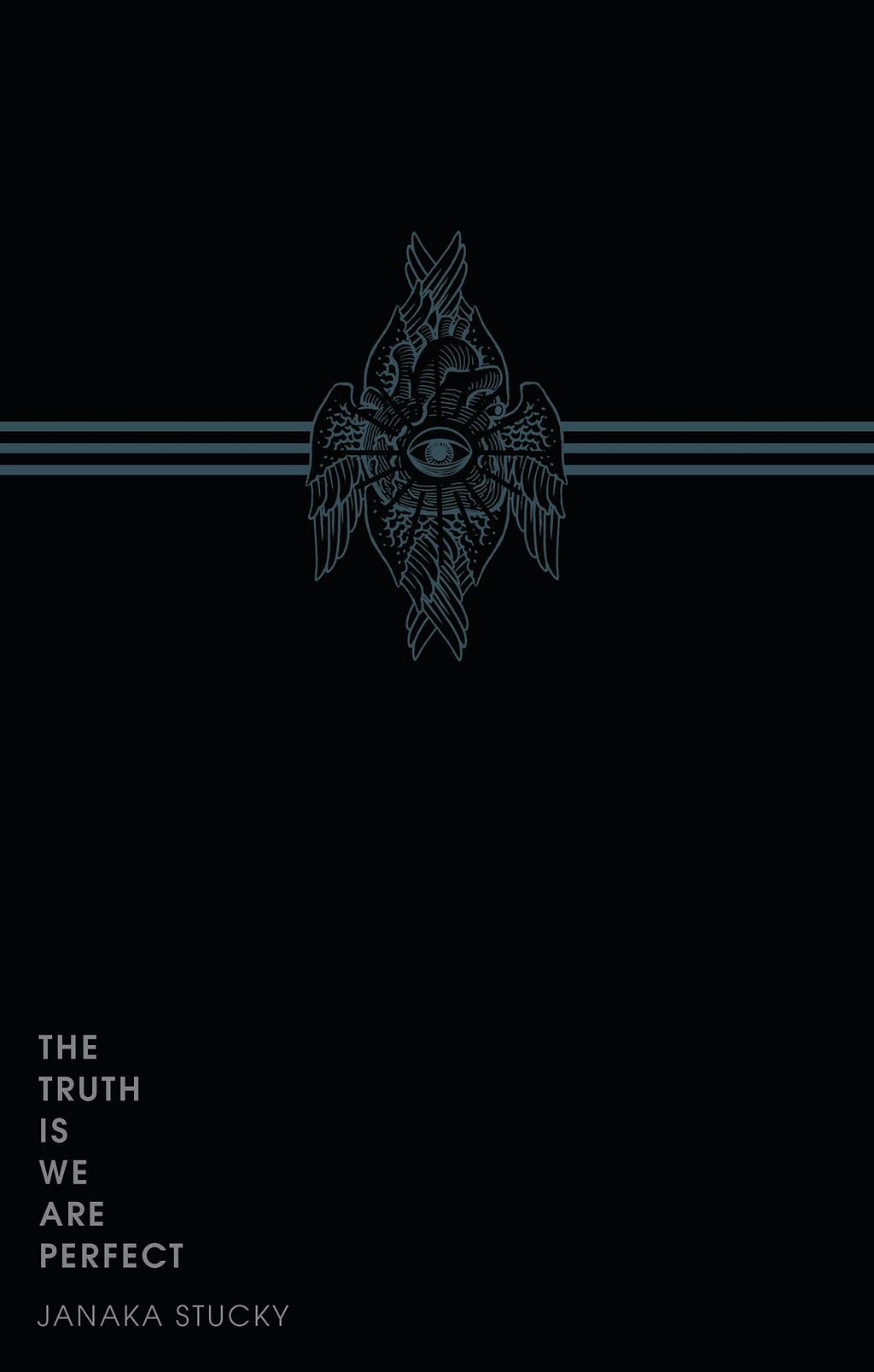
— Janaka Stucky is the author of The Truth Is We Are Perfect (Third Man Books, 2015) and the Publisher of Black Ocean as well as its annual poetry journal, Handsome. He is also the author of two chapbooks: Your Name Is The Only Freedom and The World Will Deny It For You. He likes his whiskey neat and his music dirty.
DON’T MISS OUT
Sign up for our newsletter to get submission announcements and stay on top of our best work.
YOUR INBOX IS LIT
Enjoy strange, diverting work from The Commuter on Mondays, absorbing fiction from Recommended Reading on Wednesdays, and a roundup of our best work of the week on Fridays. Personalize your subscription preferences here.