The 2015 Hugo Nominees

The nominees for Science Fiction’s famous Hugo awards were just announced. Many of the most acclaimed and popular books are missing, thanks to the overwhelmingly successful “Sad Puppies” voting campaign. There will be lots of discussion on fixing the Hugo rules in the upcoming weeks, but for now here are the nominees:

Best Novel (1827 nominating ballots)

  • Ancillary Sword, Ann Leckie (Orbit US/Orbit UK)
  • The Dark Between the Stars, Kevin J. Anderson (Tor Books)
  • The Goblin Emperor, Katherine Addison (Sarah Monette) (Tor Books)
  • Lines of Departure, Marko Kloos (47North)
  • Skin Game, Jim Butcher (Roc Books)

Best Novella (1083 nominating ballots)

  • Big Boys Don’t Cry, Tom Kratman (Castalia House)
  • “Flow”, Arlan Andrews, Sr. (Tor.com, 11–2014)
  • One Bright Star to Guide Them, John C. Wright (Castalia House)
  • “Pale Realms of Shade”, John C. Wright (The Book of Feasts & Seasons, Castalia House)
  • “The Plural of Helen of Troy”, John C. Wright (City Beyond Time: Tales of the Fall of Metachronopolis, Castalia House)

Best Novelette (1031 nominating ballots)

  • “Ashes to Ashes, Dust to Dust, Earth to Alluvium”, Gray Rinehart (Orson Scott Card’s InterGalactic Medicine Show, 05–2014)
  • “Championship B’tok”, Edward M. Lerner (Analog, 09–2014)
  • “The Journeyman: In the Stone House”, Michael F. Flynn (Analog, 06–2014)
  • “The Triple Sun: A Golden Age Tale”, Rajnar Vajra (Analog, 07/08–2014)
  • “Yes, Virginia, There is a Santa Claus”, John C. Wright (The Book of Feasts & Seasons, Castalia House)

Best Short Story (1174 nominating ballots)

  • “Goodnight Stars”, Annie Bellet (The End is Now (Apocalypse Triptych Book 2), Broad Reach Publishing)
  • “On A Spiritual Plain”, Lou Antonelli (Sci Phi Journal #2, 11–2014)
  • “The Parliament of Beasts and Birds”, John C. Wright (The Book of Feasts & Seasons, Castalia House)
  • “Totaled”, Kary English (Galaxy’s Edge Magazine, 07–2014)
  • “Turncoat”, Steve Rzasa (Riding the Red Horse, Castalia House)

Best Related Work (1150 nominating ballots)

  • “The Hot Equations: Thermodynamics and Military SF”, Ken Burnside (Riding the Red Horse, Castalia House)
  • Letters from Gardner, Lou Antonelli (The Merry Blacksmith Press)
  • Transhuman and Subhuman: Essays on Science Fiction and Awful Truth, John C. Wright (Castalia House)
  • “Why Science is Never Settled”, Tedd Roberts (Baen.com)
  • Wisdom from My Internet, Michael Z. Williamson (Patriarchy Press)

Best Graphic Story (785 nominating ballots)

  • Ms. Marvel Volume 1: No Normal, written by G. Willow Wilson, illustrated by Adrian Alphona and Jake Wyatt, (Marvel Comics)
  • Rat Queens Volume 1: Sass and Sorcery, written by Kurtis J. Weibe, art by Roc Upchurch (Image Comics)
  • Saga Volume 3, written by Brian K. Vaughan, illustrated by Fiona Staples (Image Comics))
  • Sex Criminals Volume 1: One Weird Trick, written by Matt Fraction, art by Chip Zdarsky (Image Comics)
  • The Zombie Nation Book #2: Reduce Reuse Reanimate, Carter Reid (The Zombie Nation)

Best Dramatic Presentation, Long Form (1285 nominating ballots)

  • Captain America: The Winter Soldier, screenplay by Christopher Markus & Stephen McFeely, concept and story by Ed Brubaker, directed by Anthony Russo and Joe Russo (Marvel Entertainment, Perception, Sony Pictures Imageworks)
  • Edge of Tomorrow, screenplay by Christopher McQuarrie, Jez Butterworth, and John-Henry Butterworth, directed by Doug Liman (Village Roadshow, RatPac-Dune Entertainment, 3 Arts Entertainment; Viz Productions)
  • Guardians of the Galaxy, written by James Gunn and Nicole Perlman, directed by James Gunn (Marvel Studios, Moving Picture Company)
  • Interstellar, screenplay by Jonathan Nolan and Christopher Nolan, directed by Christopher Nolan (Paramount Pictures, Warner Bros. Pictures, Legendary Pictures, Lynda Obst Productions, Syncopy)
  • The Lego Movie, written by Phil Lord & Christopher Miller, story by Dan Hageman, Kevin Hageman, Phil Lord & Christopher Miller, directed by Phil Lord & Christopher Miller (Warner Bros. Pictures, Village Roadshow Pictures, RatPac-Dune Entertainment, LEGO System A/S, Vertigo Entertainment, Lin Pictures, Warner Bros. Animation (as Warner Animation Group))

Best Dramatic Presentation, Short Form (938 nominating ballots)

  • Doctor Who: “Listen”, written by Steven Moffat, directed by Douglas Mackinnon (BBC Television)
  • The Flash: “Pilot”, teleplay by Andrew Kreisberg & Geoff Johns, story by Greg Berlanti, Andrew Kreisberg & Geoff Johns, directed by David Nutter (The CW) (Berlanti Productions, DC Entertainment, Warner Bros. Television)
  • Game of Thrones: “The Mountain and the Viper”, written by David Benioff & D. B. Weiss, directed by Alex Graves ((HBO Entertainment in association with Bighead, Littlehead; Television 360; Startling Television and Generator Productions)
  • Grimm: “Once We Were Gods”, written by Alan DiFiore, directed by Steven DePaul (NBC) (GK Productions, Hazy Mills Productions, Universal TV)
  • Orphan Black: “By Means Which Have Never Yet Been Tried”, ” written by Graham Manson, directed by John Fawcett (Temple Street Productions, Space/BBC America)

Best Editor, Short Form (870 nominating ballots)

  • Jennifer Brozek
  • Vox Day
  • Mike Resnick
  • Edmund R. Schubert
  • Bryan Thomas Schmidt

Best Editor, Long Form (712 nominating ballots)

  • Vox Day
  • Sheila Gilbert
  • Jim Minz
  • Anne Sowards
  • Toni Weisskopf

Best Professional Artist (753 nominating ballots)

  • Julie Dillon
  • Jon Eno
  • Nick Greenwood
  • Alan Pollack
  • Carter Reid

Best Semiprozine (660 nominating ballots)

  • Abyss & Apex, Wendy Delmater editor and publisher
  • Andromeda Spaceways In-Flight Magazine, Andromeda Spaceways Publishing Association Incorporated, 2014 editors David Kernot and Sue Bursztynski
  • Beneath Ceaseless Skies, edited by Scott H. Andrews
  • Lightspeed Magazine, edited by John Joseph Adams, Stefan Rudnicki, Rich Horton, Wendy N. Wagner, and Christie Yant
  • Strange Horizons, Niall Harrison, editor-in-chief

Best Fanzine (576 nominating ballots)

  • Black Gate, edited by John O’Neill
  • Elitist Book Reviews, edited by Steven Diamond
  • Journey Planet, edited by James Bacon, Christopher J Garcia, Lynda E. Rucker, Pete Young, Colin Harris, and Helen J.Montgomery
  • The Revenge of Hump Day, edited by Tim Bolgeo
  • Tangent SF Online, edited by Dave Truesdale

Best Fancast (668 nominating ballots)

  • Adventures in SF Publishing, Brent Bower (Executive Producer), Kristi Charish, Timothy C. Ward & Moses Siregar III (Co-Hosts, Interviewers and Producers)
  • Dungeon Crawlers Radio, Daniel Swenson (Producer/Host), Travis Alexander & Scott Tomlin (Hosts), Dale Newton (Host/Tech), Damien Swenson (Audio/Video Tech)
  • Galactic Suburbia Podcast, Alisa Krasnostein, Alexandra Pierce, Tansy Rayner Roberts (Presenters) and Andrew Finch (Producer)
  • The Sci Phi Show, Jason Rennie
  • Tea and Jeopardy, Emma Newman and Peter Newman

Best Fan Writer (777 nominating ballots)

  • Dave Freer
  • Amanda S. Green
  • Jeffro Johnson
  • Laura J. Mixon
  • Cedar Sanderson

Best Fan Artist (296 nominating ballots)

  • Ninni Aalto
  • Brad W. Foster
  • Elizabeth Leggett
  • Spring Schoenhuth
  • Steve Stiles

The John W. Campbell Award for Best New Writer (851 nominating ballots)
Award for the best new professional science fiction or fantasy writer of 2013 or 2014, sponsored by Dell Magazines. (Not a Hugo Award, but administered along with the Hugo Awards.)

  • Wesley Chu*
  • Jason Cordova
  • Kary English*
  • Rolf Nelson
  • Eric S. Raymond

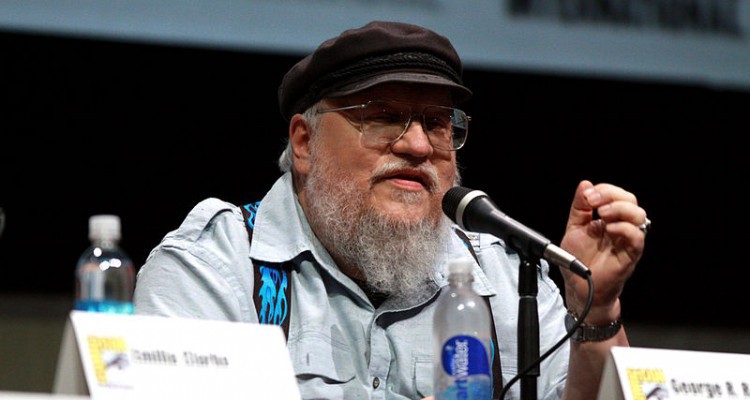
George R.R. Martin Plans to Finish The Winds of Winter by 2016, Teases Possible New Plot Twist

A couple weeks ago, the creators of Game of Thrones confirmed the show would spoil plots from the as-yet-unfinished final A Song of Ice and Fire novels. That news story seems to have further kick Martin into gear, who has long been worried about the “freight train” of the TV show overtaking his novels. He recently canceled several appearances and also decided not to write any episodes for the next season of Game of Thrones (typically he writes one a season). Yesterday, he released a new Sansa teaser chapter of book six, The Winds of Winter, on his website. Today, he told EW that he was determined to finish the book before season 6 airs:

I wish it was out now. Maybe I’m being overly optimistic about how quickly I can finish. But I canceled two convention appearances, I’m turning down a lot more interviews — anything I can do to clear my decks and get this done.

He mentions regretting the break in writing he took to promote A Dance with Dragons, noting “the iron does cool off” when he goes away from writing too long. Martin also said that he recently came up with a huge new plot twist:

“This is going to drive your readers crazy,” he teases, “but I love it. I’m still weighing whether to go that direction or not. It’s a great twist. It’s easy to do things that are shocking or unexpected, but they have to grow out of characters […] But this is something that seems very organic and natural, and I could see how it would happen. And with the various three, four characters involved… it all makes sense. But it’s nothing I’ve ever thought of before. And it’s nothing they can do in the show, because the show has already — on this particular character — made a couple decisions that will preclude it, where in my case I have not made those decisions.”

Read the full EW article here.

“Something at the Bottom of Every New Human Thought”: A Spoiler-Free Look at It Follows and…

Currently riding a 95% rating on Rotten Tomatoes, It Follows is the latest rare horror flick to break out among America’s casual filmgoers. It’s a thrilling movie, and should appeal both to people who watch one horror movie a year and those of us who’ve seen Jason X more than once. And as you’ve probably guessed from the link that got you here, there are a few things in It Follows for fans of great literature.

In It Follows, an American teenager and her friends are tormented by a deadly and unpredictable curse. I won’t reveal the curse, or give away any of the film’s nightmarish sequences. But a popular 20th century poem soundtracks an intense early scene, and a lesser-read and equally fascinating work pops up regularly throughout the movie. One of the film’s main characters (you can tell she’s the smart one, because she’s the only one wearing glasses) is constantly seen reading from a seashell-shaped e-reader, periodically interjecting her scenes with quotes from Fyodor Dostoyevsky’s 1869 novel The Idiot.

Why Dostoyevsky, and why not one of his more popular books, like Crime and Punishment or The Brothers Karmazov? Why The Idiot, a book that’s only read by scholars and people who want to find out why Iggy Pop named his first solo album after it? To hear Ilja Wachs, a literature professor at Sarah Lawrence College (and full disclosure, one of my favorite people) tell it, The Idiot could be considered at least as traumatizing as any horror film.

“My father said ‘Don’t read it, because you’re going through adolescence and it will upset you,’” recalls Wachs. “I broke into his book case and read it anyway.” Over three nights, reading with a flashlight under the covers, Wachs finished the book.

Wachs’s passion for the book is probably not one that Dostoyevsky would share. “Dostoyevsky thought it was a failure,” says Wachs, “and one of the reasons he felt that way is that his hero is a Christ-like figure, without any capacity for anger and judgment, and there’s something unreal about such a being.”

Failure or not, unrealistic or not, The Idiot’s fingerprints can be found in film, literature, theatre and music, from a Kurosawa adaptation to a Harlan Ellison short story to a joke in The Producers. There have been least a dozen English translations. The protagonist, Prince Myshkin, is an epileptic 26-year-old descended from a noble family. His kindness, empathy and trusting nature earns him the “idiot” title from his peers, including gorgeous femme fatale Natasya, her obsessive, hothead suitor Rogozhin, the aristocratic General Epanchin and his sheltered daughter Aglaya. Of course, the story is doused with Dostoyevsky’s bleak elucidations on humanity, and as one with even a passing sense of Dostoyevsky might guess, there are several unhappy plot twists.

The latter element puts The Idiot in line with It Follows, which has more horrific moments than most horror franchises. Yet even for a fan of both the novel and the film, it’s hard to discern why writer/director David Robert Mitchell chose Dostoyevsky’s novel to be quoted throughout his film. It Follows’s horrors are supernatural, whereas The Idiot’s are man-made. Critics often simplify The Idiot’s characters as inverses of each other (i.e. levelheaded Myshkin vs. unstable Rogozhin, conniving Natasya vs. naive Aglaya), but it seems a stretch to apply those characteristics to It Follows’s teens, who owe more to your standard horror movie teens (particularly the classic ’70s and ’80s slasher era) than anything in Russian lit. The protagonist is likable, but far from Christ-like. If anything, The Idiot enhances It Follows more than it represents it, augmenting the film’s foreboding atmosphere with quotes from a writer who could create anxiety and suspense as artfully as any of the Russian greats.

So is The Idiot a crucial plot point to It Follows? Probably not, and its use in the film might even be superfluous. But just as with watching Lisa Simpson cite Gravity’s Rainbow, it’s a treat for those of us who’ve read the book, and more incentive for the rest of us to check it out. And as for interpreting connections between The Idiot and It Follows, maybe we should take Dostoyevsky’s own advice from the former, via Prince Myshkin himself — “To achieve perfection, one must first begin by not understanding many things! And if we understand too quickly, we may not understand well.”*

*Translation: Pevear and Volokhonsky

The Irresolvable Situation, a conversation with Thomas Pierce, author of Hall of Small Mammals

The following conversation took place between Thomas Pierce, author of Hall of Small Mammals and Halimah Marcus, Editor-in-Chief of Electric Literature’s Recommended Reading, at Community Bookstore, in Brooklyn, on March 27, 2015, and has been edited for length and clarity.

Halimah Marcus: Yesterday there was a review in The L Magazine that said you were “a classicist in fabulist’s clothing.” I felt that was quite apt.

Thomas Pierce: That sounds good to me [laughs]. I don’t really pay much attention to those things. When I’m writing I don’t think, “Oh, this clearly fits into the fabulist tradition.” Maybe after the fact I’ll think about it, minimally, but generally it’s not something I consider — whether a story fits into a particular genre.

HM: What about in terms of your influences?

TP: I don’t know. That’s such a bad answer, I realize, but I read a lot, and for any different story it might be slightly different. There are so many writers I admire who have had an influence on me, but I never have anyone in mind when I’m writing a story.

HM: Sure, many writers want to read work that’s very different from what they write so as not to be too influenced. I like that description because this collection, to me, with all the different characters and their hobbies and interests, has a bit of a “cabinet of curiosities” feel. The title, Hall of Small Mammals, is taken from the Natural History Museum, which is known for its dioramas. The collection features a miniature wooly mammoth and an old carnival-style monster, so I’m wondering, what about the diorama peaks your interest?

TP: I will say that some of the stories are diorama-like, but I’m always in the diorama. I exist in the diorama all the time. We all do probably, to some extent. We’re in the diorama right now, maybe. So I never feel like I’m looking from the other side of glass, to answer your question. I feel very strongly that I might be one of the people I’m writing about. I do not think of myself as separate from or better than my characters.

HM: What’s really interesting about a diorama is that you want to be inside of it. I was also thinking while reading certain stories, specifically “Shirley Temple Three” and “Grasshopper Kings,” about the interplay between science and religion, which you touch on pretty subtly. Do you think about these big themes?

TP: I would say that the role they serve in the stories is rooted in my own attempts to figure out what it means to be alive. That is to say, I’m tapping into my own general sense of confusion — you know, confusion about the world and why we’re here. Religion and science, broadly speaking, those are two avenues available to us in making sense of the universe — of investigating the universe — and I’m interested in the overlap between the two. Sometimes science and religion can coexist and inform one another and other times they cannot, and they knock against each other. When they intersect in unexpected ways, I’m fascinated by that — by the strange allowances we sometimes make in order to hold onto a pre-existing belief or worldview. We have to make choices about how we explain the world to ourselves.

HM: In “Shirley Temple Three,” there’s a son who works for a television show where they bring back extinct animals. He rescues a miniature wooly mammoth from the show, brings it to his mother’s house, and abandons it there, where, of course, it becomes very unhealthy, because it’s a wooly mammoth living in…?

TP: Near Atlanta. Yeah, pretty hot in Atlanta.

HM: My interpretation is that this mother is starting to really see her son’s moral failings. She’s a religious person and he represents a morally ambiguous, scientific field, and the way she comes around to see how he has disappointed her was really profound.

TP: He’s a bit of a know-nothing in some ways. He doesn’t know the science, he doesn’t understand the science, but he shows up with this mammoth, and the way the mother contextualizes the mammoth is definitely inspired by her religious background. The mammoth presents a huge challenge to her beliefs — to the way she’s thought of the world and existence until now — and here it is in her very own backyard, in a dog pen. When it becomes sick and needs help — physically and maybe even spiritually — the mother does her best to help it. She prays for it. She calls over her pastor.

HM: It also makes me think about how quickly deep empathy for an animal can be evoked. Maybe it’s ugly or possibly never existed, but suddenly you just care about it so much.

TP: It’s a bit of cheat [laughs].

HM: In “Saint Possy,” a couple moves into a new house and they find a skull with candles under the stairs. I thought, this is going in a haunted house, tear-the-family-apart direction but that situation ends up revealing the couple’s really sweet love for each other.

TP: That one started like that, as an almost-ghost story, but it didn’t click for me until the couple began trying to explain the skull and their behavior to themselves, until it became an anecdote they tell at parties, this scary thing that happened to them once. That’s when I realized there was something else going on in the story — that there was another level to it. It was more fun for me to write at that point. I actually wanted to finish it. I doubt I would have ever shared it with the world if not for that development.

HM: It pleased me that they handled the situation in the same way.

TP: Right, it drives them both to craziness.

HM: Well, since we’re talking about individual stories, I’d love to hear about “Videos of People Falling Down,” because it’s structured very differently, with these vignettes that work together. For me it evoked a kind of surveillance state present in your New Yorker story, “This is an Alert.” These people have been caught on video, then it’s on the Internet; it’s there forever and everyone sees it.

TP: What those stories might have in common is they deal with a vague paranoia — that paranoia probably being my own — that is related to a feeling of powerlessness in the world. The stories both involve bodiless, system-less systems, very vast and nebulous entities that exert control over our lives. In the case of “This Is an Alert,” there is a war happening, up in the clouds, but we don’t know the particulars of it and we don’t see it. We have to trust that it’s actually happening. The characters read about it in the news but have no actual proof of it. They are disconnected from it, but at the same time it’s something that’s impacting their lives. The videos story is similar except the war is the Internet. The Internet consumes our lives, eats it up, digests it, and spits it back out. It’s all of us — but larger than us. It’s something beyond us that feels uncontrollable — not to mention diffuse and hard to locate — and that can feel kind of scary.

HM: Getting back into the philosophical territory, “The Real Alan Gass” is about a woman who confesses to her husband that she’s had a “dream husband” whom she’s been dreaming about for years. She knows a lot about him, and they have a very real and active marriage in her dreams. I’m going to read a line:

Alan Gass is a ghost, and Walker knows you cannot fight ghosts. They are insidious. You can’t punch a ghost or write it a drunken email. You can only pretend the ghost is not there, hope it loses interest, evaporates, moves on, does whatever it is that ghosts do when they disappear completely.

I noticed a reoccurrence of this notion of a second bottom to things: things that disappear, and then disappear further. Do you want to comment on this idea?

TP: That’s a tough question. You’re right in that there’s often something that happens in the stories that either escalates the plot to a new level of absurdity or pulls the rug out from under the characters, again and again. With “Alan Gass,” the main character goes looking for his girlfriend’s dream husband, but of course it’s kind of an irresolvable situation. There’s no obvious recourse. If you were to wake up tomorrow and your significant other said they were married to someone else in their dreams, how do you respond to that? You either make peace with it and say “I accept that about you,” or you don’t, and there’s not really a clean way of investigating that mystery. You can’t write a drunken email, you can’t knock on a door. So, yes, there is a bottomlessness to that.

HM: Yes, and the solution has to be in your own thought control, which can be very frustrating if that’s the only solution, because you can be so powerless in your own ways of thinking.

TP: I mean it’s a decision he has to make. To be okay with it or not. There’s no external action that can fix this.

HM: Do you feel that the wife was being intentionally aggressive by sharing this dream marriage?

TP: There are two versions of this story. Maybe I shouldn’t really confess this here [laughs]. One was first published in Subtropics, in which her aggression is even more emphasized. Walker, the main character, fears this is some kind of provocation, that it’s the girlfriend’s way of pushing him away or testing their relationship. I like that version of the story, too, but I also like this version that’s a little happier. It ends more with him making peace with this thing — whether it’s a provocation or not. I don’t know why I prefer this new ending more, but I suppose it just makes sense to me. One option is for him to throw out his own test to her and say, “Well, in fact, here’s x, y, and z that could potentially break apart our relationship,” or he can say, “I accept it.” The idea of him accepting this about her appeals to me. So maybe it’s me being a little starry eyed about relationships.

HM: I do think you’re excellent with endings.

TP: Well, not everyone says that, so I’m glad to hear you say that.

HM: Really? I just think you have rhythm about your last lines. Even if the story is meant to be unresolved, the last line has a feeling of resolve. If you don’t mind me reading another example, this is from “We of the Present Age:”

Smoke danced through the rafters of the barn, and there, up ahead, illuminated by a ring of red and blue glass lanterns, was the creature, lurching toward us with rows of sharp teeth and two long curving tusks, its chest puffed with breath, a single knowing blue eye at the center of its giant apish head. We were very, very quiet.

The reason I love this is because I think a lesser writer wouldn’t have added that line, “We were very, very quiet.” When I read it I thought, “that was great.” What do you look for in an ending?

TP: This is something I struggle with for sure. Finding the right ending is tricky and it’s the thing I probably spend the most time on. I’m generally a fast writer. I can often get the first three-quarters of a story out in about a week — and sometimes even a day, depending — but then I get to the ending and sometimes need to spend another few weeks trying to figure it out. Sometimes that means starting over. Sometimes it just entails finding the right chord. What do I look for in an ending? It doesn’t have to answer every question. This is a book of stories about people for whom it’s really about the questions. I think the stories are really clear plot-wise, and I think more often than not it’s clear what comes next, after the last sentence. But I like to end on a — sort of — opening up? There are stories that do this in the end [makes gesture] and then there are stories that do this [makes another gesture], and I prefer the first one. This is not helpful for your recorder. I’m making wild arm gestures. [To the recorder] I like an upward opening V, arms up in the air, like talking to God maybe. I prefer up-V endings.

HM: Do you think about the rhythm of sentences, particularly at the end?

TP: Yes, I think about rhythm. I wouldn’t say I’m a writer who is obsessed with sentences. I mean, there is such a thing as a beautiful sentence, and I’m very pleased when a sentence does its job or is surprising or when it could exist independently and still be interesting, but beautiful sentences are not what I’m chasing when I read or write. I’m more interested in a beautiful story. I do understand that the sentences add up to the story, of course they do, and a lot of magic can happen on the sentence-level, but that’s just not where my mind is when I’m writing. I think more about rhythm in terms of the overall structure and plot. I consider myself more of a what-happens-next type of writer. I think, “Is this a time for advancing the action, or is this a time for digression, for a thought, for a description?” I think about the larger rhythm. When you get to the ending, it does have to achieve a certain kind of momentum or energy, and that is tied up with the micro-rhythms of course, but it’s momentum that I want more than anything else. Because I want readers to feel like they’re still hurtling forward even after they’ve finished the last sentence.

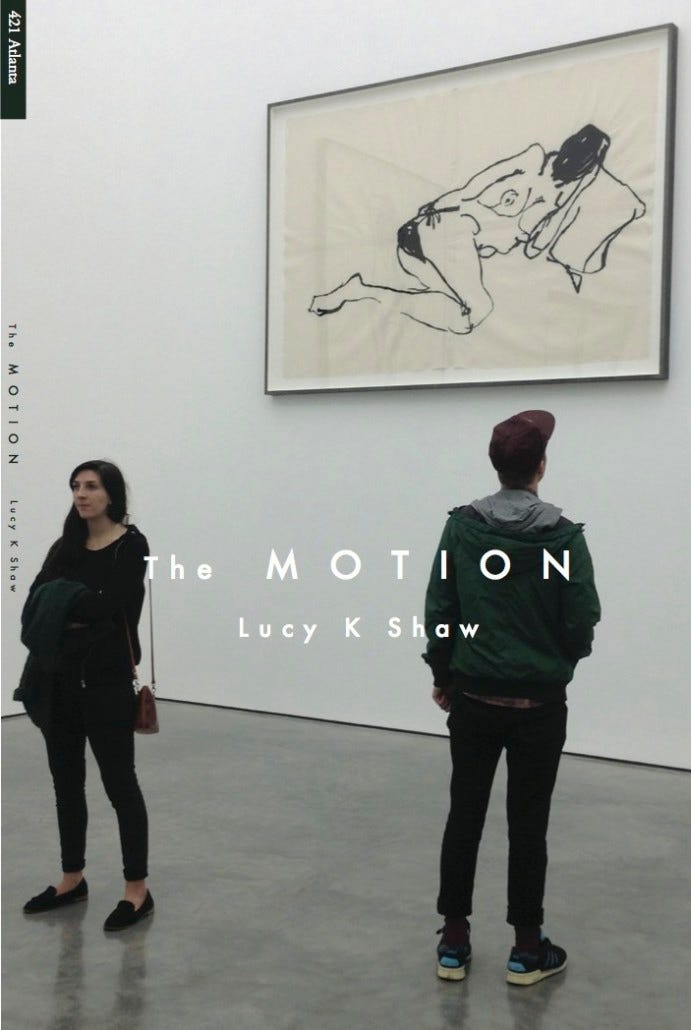
APRIL MIXTAPE by Lucy K. Shaw

Lucy K Shaw

If my first book, The Motion, was being made into a movie, it would be very expensive to make. It is set in five different countries. There are scenes at The British Museum, at Sylvia Plath’s house, in Central Park, in Brooklyn, in Queens, at an office building close to Toronto airport, in an apartment in the center of Paris, and outside of a courthouse in the suburbs of Berlin, to name just a few of the locations. If my book was being made into a movie, I would want for it to be directed by Meggie Green.

This playlist is basically how I envision the soundtrack to that movie. And I have based it off of a mix CD given to me by my uncle when I was about thirteen years old.

The mix CD had the words, ‘DIVERSE DIVAS’ written across it in permanent marker. And I don’t think it is unrealistic to say that it must have changed my life, because it featured really great songs by really, really great singers. I mean, I’m talking about Aretha Franklin and Billie Holiday and Dusty Springfield and Janis Joplin and so on… Just these incredibly powerful and distinct female voices.

So when I started putting this mixtape together to go with my book, I remembered that CD I used to listen to every day and I decided that it must be time to make a part two. Because I’m not 13 anymore. I’m 27. And nobody uses CD players.

This playlist follows the trajectory of the book, in a loose way. ‘The Motion’ is described as a ‘collection of short prose’ but there is, in my humble opinion, a narrative throughout. When I listen to these songs in this order, it feels like there is already a movie happening in my mind, because these are all recordings which have felt important to me while I was writing this book, which it seems I must have been doing over the course of the last twenty-seven years.

It’s all about love and time and distance. My life. This book. And I think so are these songs. That’s my intention.

I decided to let male artists feature on the tracks a couple of times (Kanye & Nas…) And there’s a Drake B-side right at the end which may or may not have had something to do with the concept for a lot of things. There’s really not much to say about that except that at some point, in my head, it all fell into place.

If my book was being made into a movie, I would want it to be directed by Meggie Green and I would want it to begin with the sweet yet robust yet completely luxurious voice of Dinah Washington. I would need it to feature an all-star cast of diverse divas.

TRACK LISTING

1. TEACH ME TONIGHT — Dinah Washington

2. LIKE SMOKE — Amy Winehouse feat. Nas

3. DARK END OF THE STREET — Aretha Franklin

4. MOON INDIGO — Nina Simone

5. BBD — Azealia Banks

6. PERIPHERY — Fiona Apple

7. DIAMONDS REMIX — Rihanna feat. Kanye West

8. HOW HIGH THE MOON — Ella Fitzgerald

9. MOMENT 4 LIFE — Nicki Minaj feat. Drake

10. NO PRESSURE OVER CAPPUCCINO — Alanis Morissette

11. CASSANDRA — Emmy The Great

12. ABSENCE OF GOD — Rilo Kiley

13. MOODY’S MOOD FOR LOVE — Amy Winehouse

Can a mixtape have an encore? Because this one does.

14. FLAWLESS REMIX — Beyonce Knowles & Nicki Minaj

15. THE MOTION — Drake

16. YOU BELONG TO ME — Patsy Cline

— Lucy K. Shaw is the author of The Motion (421 Atlanta, 2015) and the founding editor of Shabby Doll House. She lives in Berlin.

BuzzFeed Launches Emerging Writers Fellowship: An Interview with Literary Editor Saeed Jones

Update 4/28: you can now apply through submittable.

BuzzFeed is going literary. The ever-growing media company launched BuzzFeed Books in December of 2013, and this year it is launching several projects under new Literary Editor Saeed Jones. First up is the BuzzFeed Emerging Writers Fellowship program, which has a “mission of diversifying the broader media landscape by investing in the next generation of necessary voices.” The four-month fellowships “give writers of great promise the support, mentorship, and experience necessary to take a transformative step forward in their careers” and also include a healthy $12,000 stipend. (Check out the full information and application procedure here.)

I talked with BuzzFeed Literary Editor Saeed Jones about the fellowship program, journalism in the internet age, and the need for diversity in publishing.

Lincoln Michel: It seems like you’ve had a whirlwind of things happen in the last year. Your poetry book, Prelude to Bruise, was published by Coffee House in August to widespread (and deserved!) acclaim. You were just a finalist for the National Book Critics Circle Award. And now you are becoming BuzzFeed’s Literary Editor. What prompted the move and what else are you working on?

Saeed Jones: My hope was to write the kind of book I very much wish I’d been able read when I was a teenager growing up in Lewisville, Texas. The only books in the public library about “homosexuality” focused on AIDS or “dealing” with your gay kids. So to have my work recognized on this scale has been truly stunning and a bit overwhelming. Last winter, Shani Hilton, BuzzFeed News’ executive editor, challenged me to think about what I wanted the next mountain to be. I launched BuzzFeed’s LGBT vertical two years ago. I’ve had the tremendous honor of editing work by a team of five brilliant writers and reporters who I believe are among the best in their respective beats. I’m so proud of what we’ve built together and what they will continue to do as a team. But I’m most excited when I’m creating new spaces and projects. When I first pitched the fellowship and the literary magazine and the answer from Shani and Ben Smith, BuzzFeed’s editor-in-chief, was an enthusiastic yes, I actually teared up. What an amazing opportunity! In retrospect, working as BuzzFeed’s LGBT editor while promoting my book and planning these projects has made for a really intense few months, but I’m so excited I’m literally cackling at my desk right now.

The fellowship is just the beginning of what I really like to think of as a kind of literary movement coming to BuzzFeed. In addition to the fellowship program, I’ll be launching a literary magazine — about a year from now — as well as a reading and salon series. We’ll also be hosting creative writing workshops. I have so much to learn and an incredible amount of work ahead of me, but this feels like an organic shift for myself. BuzzFeed has never asked me to choose between my life as a literary writer and my life as an editor here; this new promotion grows out of that relationship. The first time I met Ben Smith in person during the interview process for the LGBT editor position, he said, “I loved the essay you published on The Rumpus. I wish we’d publish it here.” So, in a way, this feels like we’ve come full circle. Isaac Fitzgerald — who edited that essay — set us on this path when he launched BuzzFeed Books over a year ago. He’s been publishing essays by writers like Mac McClelland, Lev Grossman, and James Hannaham alongside hilarious and entertaining posts that celebrate reading as a way of life. I think it’s fair to say there were a few skeptics initially about the idea of book culture and BuzzFeed culture coming together, but it totally works. I’m excited to push us even further and publish new fiction, poems and lyric essays by writers we adore and writers we will soon be obsessed with. Oh, and I’m pretty stoked about being able to pay them for their work.

LM: Let’s talk about money. The four-month fellowship includes a $12,000 stipend. For a long time, the publishing world has shied away from talking about the financial realities of writing and editing, and the world has often been limited to people who could afford unpaid internships to get in the door. Why was it important for you to provide your fellows with a stipend?

SJ: One day, centuries from now, a famous historian — I’m picturing a sharp-witted black woman because I sincerely believe black women are from the future — will look back and say, “I can’t believe they used to expect young writers to move to one of the most expensive cities in the world and work for free so they could learn how to become better writers.” When we expect young writers to get experience via unpaid internships, we’re actually saying we want only wealthy people writing about American culture in an influential way. That’s what we get, right? Or rather, that’s what we’ve gotten used to accepting as normal when in fact, it’s a kind of fiction. Diversity is reality. So, in order to do my part to support being in step with reality, I’m really excited about creating an opportunity for emerging writers to get experience and mentorship while also receiving financial support. You can’t expect someone to do their best work if they’re exhausted and broke. Well, maybe you can expect it but doing so strikes me as a bit cruel.

You can’t expect someone to do their best work if they’re exhausted and broke. Well, maybe you can expect it but doing so strikes me as a bit cruel.

It’s important to add too that I’m keeping a very open mind about “emerging,” which, I guess, typically is read to mean young. Sure, I look forward to giving young writers a shot, but I’d also like to see all kinds of writers of great promise apply: writers who are transitioning out of academia, for example, and have published a few essays but are struggling to get a foothold in this new field; writers from marginalized communities who so often aren’t given an opportunity to tell their own stories, etc. Writers will have from now until October to apply to the fellowship and the program will start in January 2016.

LM: The fellowship program sounds really ambitious. The fellows are not only practicing pitching and writing different types of work, but also attending workshops and panels with established writers and editors. Can you elaborate on how that will work? What kind of writers and editors will you be bringing in?

SJ: My hope is that the fellowship will be joyfully rigorous for everyone involved. I’m designing a curriculum that balances learning opportunities with time to write. Everything we’ll do in the fellowship will be aimed toward positioning the writers to thrive after the four-month program is over. They will write for BuzzFeed, of course, but also will be encouraged to pitch to other publications because navigating the industry as a freelancer is a wild and sophisticated process. Toward that end, I look forward to introducing the fellows to amazing writers and editors like Jenna Wortham at the New York Times Magazine and Kai Wright at The Nation. Establishing relationships with future colleagues and mentors is so important and, I’ve found, very difficult for emerging writers who don’t have a clue where to begin. So we’ll work on that together. I’m also going to be hosting a salon series in NYC that will bring together writers, artists, and thinkers along with the fellows. I think this is going to be a transformative experience for the fellows as well as myself.

LM: Do the fellows pick a field (say politics or entertainment or the arts) to be mentored in? What else should potential applicants know?

SJ: Part of the applicants’ statement of purpose will need to address the two following questions: “If given this opportunity, what are three to five reported stories/personal essays you would pursue? And how do these stories reflect your drive and personal mission?” So, yes my expectation is for applicants to have a sense of what aspect of culture they’re most excited about engaging and interrogating. They’ll come with a sense of direction and my job will be to help get them there.

LM: Publishing and journalism are frequently — and correctly — critiqued for being very white, as well as very male and middle/upper class. However, for all the gripping about the new media outlets, they have been doing a much better job of hiring diversely. Do you think things are improving in the industry overall?

SJ: I’m cautiously optimistic. On one hand, we’re seeing media organizations like BuzzFeed, Fusion, and others actively working to create diverse newsrooms. I suppose we could consider The New Republic an example of this shift too, though it seems TNR didn’t change until it was finally and rightfully shamed into doing so. Meanwhile, based on last year’s Publishers Weekly survey, the publishing industry is basically 89% white. How many black literary agents do you know? How many major publishers are run by women? So, maybe there is a shift happening right now. We’ll see. Creating meaningful diversity in media will take time and tremendous effort. When I say “meaningful diversity,” I’m talking about hiring brilliant people from diverse backgrounds, covering or publishing work that speaks to a multiplicity of experiences, as well as having diversity throughout the company from the interns up to the board room. A newsroom that has zero people of color one week then five people of color the following week is a better newsroom. But better isn’t the same as good.

LM: The journalism landscape has changed more drastically in the last fifteen years than perhaps any other industry. What do you think young writers who are just starting out should know?

SJ: Jazmine Hughes just joined the New York Times Magazine as an editor. I’m so excited to see what she does there. Rallain Brooks — one of the hardest working young writers I know — has such an intelligent heart. He has been doing work with Adult Magazine, Guernica, and The Audubon Society. (It’s amazing, isn’t it? How hard writers in NYC work. We take it for granted, I think.) He just joined Huffington Post as a features editor. And, let’s be real, where would we be without Ashley Ford’s essays? I think we’re all better for every essay of hers we read. And forgive me, but I won’t lie: I get to work with so many brilliant writers at BuzzFeed. Matt Ortile, Heben Nigatu, Alanna Okun, and Arianna Rebolini are just a few of the writers here whose work astounds and delights me. Oh, and if people aren’t reading Durga Chew-Bose’s essays, they aren’t living life to the fullest.

LM: In addition to the Emerging Writer Fellowships, I know that you are working on a BuzzFeed literary magazine. What can you tell us about that? Any idea when that might launch?

SJ: I’ve been working on the developing the concept for the fellowship since last year. It’s so important to get it right when we’re tasked with creating new spaces and platforms for writers. And yes, I’m in the early stages of creating a literary magazine featuring short fiction, poetry, and lyric essays for BuzzFeed’s readership. My goal is to figure out what a literary magazine could be in the 21st century. We’ll launch around March 2016. Established magazines like Poetry as well as new publications like The Offing and Winter Tangerine Review are publishing absolutely wonderful work and embracing the social web in a way that’s really exciting to watch and learn from. Combining BuzzFeed’s tremendous platform and technology with a deep appreciation for original, creative writing is going to be wild in the best sense of the word.

art is not the enemy of everyday life; rather art exists to color and clarify everyday life.

But, you know, I’ll say this: I can already tell you BuzzFeed’s literary magazine will be rooted in the idea that diversity is reality and should be reflected in the work we publish as well. An idea I keep returning to as I continue to work on the magazine’s vision is that art is not the enemy of everyday life; rather art exists to color and clarify everyday life. The Paris Review published “The Ballad of Ferguson” by Frederick Seidel — a native of St. Louis, born in 1936 — on Nov. 25, 2014. That’s the day the grand jury in Ferguson, Missouri, decided not to indict Darren Wilson. Seidel’s ballad opens with the line “A man unzipping his fly is vulnerable to attack” and closes with “Martin Luther King is dead.” It struck me as a real missed opportunity on the part of The Paris Review. Seidel, of course, is a talented and award-winning poet, but were no black writers of a similar caliber available that week? Were any black writers even asked if they’d be interested in writing a poem about Ferguson? I’m going to learn from that mistake and try my best not to repeat it here at BuzzFeed.

Terms of Endearment: Satin Island by Tom McCarthy

by Will Chancellor

Tom McCarthy’s fourth novel, Satin Island, asks us to consider what’s left in the absence of feeling. McCarthy writes in the tradition of Alain Robbe-Grillet, whose collection of essays, For a New Novel, argued that repeating geometric structures should replace psychological depth and the outbursts of passion found in the bourgeois novels of 1950’s France. As an heir determined to invest rather than squander his inheritance, McCarthy has shown, with each book, how to advance the nouveau roman without betraying its core tenets. In fact, we can take the title of McCarthy’s debut, Remainder, as indicative of what’s left over after the plump cake of potential literature is sliced with Robbe-Grillet’s knife. In short, what’s left is a cardboard disk with knife marks like an asterisk; a flattened star with the narrator as an infinitesimal intersection and his intuitive leaps as doomed radii.

Yeah, but seriously, what’s left? Certainly not action. Imagined action, maybe, but not action in a conventional sense. The narrator of Satin Island is a man, referred to only as U., earning a living wage as the “chief ethnographer” for a global consulting firm. He is given total autonomy to compose a Great Report on our times. “What do I do? I’m an anthropologist. Structures of kinship; systems of exchange, barter and gift; symbolic operations lurking on the flipside of the habitual and the banal: identifying these, prising them out and holding them up, kicking and wriggling, to the light — that’s my racket. When these events (events! If you want those, you’d best stop reading now) took place…” All praise be to the headhunter who found U. Tom McCarthy’s dream job: being paid to sit in a room, contemplate minute details like denim weaves in France and proto-bungee jumpers in Vanuatu — both examples taken from Satin Island — and assemble these findings in a report that will define his generation, if not all generations. The action of Satin Island is the line from one of U.’s insights to the next. Structure and linkages between ideas take precedence over story — think of a crime drama like True Detective and remove everything but the scenes where the hero is clipping articles, slapping a file folder excitedly, and taping photographs to a corkboard. In the acknowledgments to Satin Island, McCarthy writes, “Satin Island gestated during a 2010 residency at the International Artists Studio Programme in Stockholm, which I spent projecting images of oil spills onto huge white walls and gazing at them for days on end.” All of McCarthy’s work is highly structured and the inclusion of this detail seems like no accident, but rather an aid in visualizing U. as action hero in the assembly of the Great Report.

Tom McCarthy has written modernist, structural fiction from the start, but details that once seemed minor have grown in importance with each new work. A former soccer referee named Anton in McCarthy’s first written, but second published, novel, Men in Space, explicitly stated the importance of geometry: “Anton recalls his refereeing days in Bulgaria: the trick was to see all the near-identical shirts, repeated runs, sudden departures, switches and loop-backs as one single movement, parts of a modulating system which you had to watch from outside, or above, or somewhere else.” Lines, squares, arcs, these are the things that create a game and transform a cast of uniformed scrubs into players. Any group of characters, fictional or not, waits “for the moment when the whistle will once more release them into game time, into pure geometries of green and white.” It is the geometries that we must observe, not the players, because the men are without qualities and the network is the only hope we have or arriving at meaning.

Remainder presented the absence of feeling as a potential source of drama; the text does little to dissuade the first-time reader from thinking it’s a comeback story. My thoughts when first reading it were: ‘Okay, maybe the narrator’s apathy is a cortical deficit. This poor guy just got beaned by a falling satellite and his limbic system is rattled to say the least. But his Project can save him! Stella can, nay, must get her groove back!’ That reading of Remainder doesn’t really pan out. We do go from, “I felt neutral,” in chapter one to a refrain of “I felt happy,” in the closing scene, but the nameless narrator’s happiness is unrecognizably bizarre.

Serge, the protagonist of Tom McCarthy’s Booker Prize shortlisted novel, C, is acutely aware of his place in this universe. While fighting as an aviator in World War I, Serge gets flattened. “Within reaches of this space become pure geometry…he’s the clamp that holds the pencil to the compass, moving as one with the lead; he is the lead, smearing across the paper’s surface to become geometry himself…” Just as Edwin Abbott did in his speculative novel Flatland, McCarthy literally removes a dimension from the story; in a paragraph he takes us from the cockpit of a fighter plane in a dogfight to a pencil-drawn arc on a sheet of paper — and somehow it’s fascinating.

Satin Island, explicitly a novel about writing a novel about writing a novel… makes clear that U. will not be ‘feeling’ much of anything. U.’s reaction to an ecstatic text from his boss that they secured a contract: “The Project was the Koob-Sassen Project; we’d been going after the contract for some time. Good, I texted. The answer came more quickly this time: Good? That’s it? I deliberated for a few seconds, then sent back a new message: Very good.” U. relating a tryst: “When I arrived at Madison’s, we had sex.” And finally, U. receiving news of Petr’s cancer:

Hey, he said: you know that goiter they were going to take out? Yes, I replied. Well, he told me, they did; and then they cut it up to look at it and it was cancerous. Shit, I said. Yes, he said. Good thing they took it out, I said. No, U., he said, the goiter’s just an indicator: I’ve got thyroid cancer. Shit, I said again. Yes, he repeated — but it’s not that bad. How come? I asked. Because, he said, as cancers go, thyroid is a pretty lowly one: a lickspittle of cancers, a cadet. It’s almost never fatal. What do you have to do, I asked. I have to drink a bunch of iodine, he said. It soaks up all the bad cells and destroys them. It will make me radioactive. I’ll be going round town oozing rays and isotopes, like a plutonium rod. Far out, I said. Yes, he said: I’ll be able to look straight through girls’ clothes and see what colour underwear they’ve got on. Really? I asked. Of course not, he said. But I will ooze rays. Far out, I said again; I didn’t know what else to say. Yeah, he repeated, far out.

Words, like the blind moles they are, burrow into the dirt before all of us when we’re faced with catastrophically bad news. Does that make us monsters? Hardly. That’s not what McCarthy highlights in this scene. There’s more going on here than being at a loss for words. U. is rejecting emotion by failing to respond to Petr’s levity in any kind of humane way. In fact, we see this empathic blindness in U.’s hypothesis that the exterior world is carcinogenic and the likely culprit of Petr’s thyroid cancer: “The stuff of the world is black. If Petr’s flesh was turning black it was because he’d let the world get right inside him, let it saturate him…”

I never thought I would find myself arguing the importance of authorial intent, but I think knowing what McCarthy is up to helps readers understand Satin Island. After four novels that could be described as an emotional wasteland, the question arises, How intentional is the lack of empathy in the novels of Tom McCarthy? I’d say very. And, if we read his books from an Eames chair in the library of his French literary estate, we can better see McCarthy’s unique contribution to the nouveau roman: these books are funny and Satin Island is his funniest work to date.

McCarthy’s intentionality is most evident in three successive paragraphs near the novel’s climax. U. has become preoccupied with a newspaper story of a parachutist’s death in which the authorities are considering foul play. “As I held the page above my knees, sat on a tube train shuttling through a tunnel, the question of the murder’s true location resolved itself for me: I realized the crime scene, properly speaking, was the sky. Or, to flip this one back out as well: the sky was a crime scene.” For half of the novel, U. speculates as to motive and opportunity and finally arrives at a brilliant solution to the logical problem of the murdered parachutist. Laughing, we rejoice with him, “I’d made a genuine discovery, a breakthrough, on the scale of Schrödinger’s or Einstein’s. Of this I was quite certain. Fuck! I shouted, one more time; then I sat down, shot through with revelations. The year would be a glorious one.” McCarthy then juxtaposes that mania with, “Petr was admitted to hospital in mid-January. The cancer had spread all round his body. It was particularly bad in his lungs.” The fluid the doctors extract from his lungs is compared to Cherryade and the smudged and blackened windows of the hospital U. is visiting, “upset me, much more than the fact of Petr’s illness did.” U. is livid about the windows, indifferent to his friend other than as a source of metaphor for the Great Report, and then, “The next week brought a massive disappointment: I discovered that my parachutist theory didn’t work.” It strains credulity to believe that this contrast of insight and emptiness is accidental. And, when this potentially frustrating section of the novel is read in light of McCarthy’s intention to remove feeling, a character who appears impossibly callous becomes hilarious.

The central conflict of the Satin Island is, Who tampered with the dead skydiver’s rig? This activating incident calls to mind the ill-fated hot air balloon in Enduring Love. But, importantly, McCarthy takes his novel in the opposite direction of Ian McEwan, who was exploring the emotional impact and psychological ramifications of watching that fall. (Were McCarthy to write McEwan’s novel, he would be interested in the five men, as vectors, converging on a balloon in the field and, when the event was over, would reveal the precise origins of the reeds woven to make the balloon’s wicker basket — and, somehow, it would be fascinating.) Unlike McEwan, who moves as quickly as possible from the geometric to the human, McCarthy obsesses on the vertical and, in this way, advances the nouveau roman, adding a third dimension to a largely two dimensional world.

Satin Island begins with U. observing an oil spill, and that billowing oil resurfaces throughout every chapter of the novel, “Earth wells back up and reveals itself; nature’s hidden nature gushes forth.” Petr’s cancer cells are sent to Greece for a lab screening to find a new cytotoxic agent. They resonate with Jaffa-orange extract which leads U., in a characteristic intuitive leap, to envision burning oil-wells in the Middle East, “their smoke-plumes blackening the sky — and blackening the orange groves as they drifted across these, leaving tarry deposits on trees’ barks, on leaves, and on the fruit itself. When that scene came to me, when I pictured all its hatred, all its violence, all its blackness being injected into Petr, I knew — instinctively and with complete certainty — that he was going to die.” Oil as death, literally fossilized death, rising up to intrude on our flat world and a parachutist with a doomed rig falling making the sky a crime scene. This tension of the world above pushing down and the world below pushing up flattens the reader into McCarthy’s cardboard disc, which justifies the geometry of the nouveau roman in a new and exciting way. Anyone who appreciates beautifully crafted sentences will find the same delights here as in his previous novels, but readers willing to surrender to McCarthy’s idiosyncratic conceptions of story will be flattened.

Satin Island

by Tom McCarthy

Powells.com

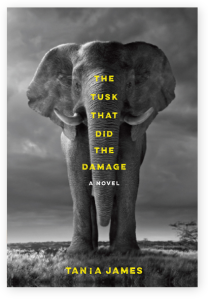
A Strange and Methodical Thing, an interview with Tania James, author of The Tusk That Did The…

Tania James

Tania James approaches the narrative in her second novel with a twist. In The Tusk That Did The Damage, three voices braid together to tell the story of those involved in killing, preserving, and documenting the wild elephants of South India. Although all are remarkably developed and command their own distinct identity within James’ fluid pages, one character stands head and shoulders above the others — both figuratively and literally. It’s The Gravedigger, the menacing elephant to whom James gives voice in Tusk.

As James says in our conversation, The Gravedigger’s voice was always her starting point; the narrative spawned from there, wrapping in years of research and interviews conducted in India. In the Knopf offices at the Random House headquarters, I spoke to James about the novel’s germination. She wore a shirt spotted with panthers — she’s had her fill of elephants for now.

Meredith Turits: What did you start with: an idea or a voice?

Tania James: I started with a real-life elephant who would trample his victims and then bury them. Sometimes he’d carry the body on his back for a mile and protect the burial site. I just thought that was a really strange and methodical thing — it sounded like someone out of Tell-Tale Heart, a kind of macabre distortion, but also a tender act.

I thought, I want to write about this elephant. But then I was inhibited by the rule of anthropomorphizing: you don’t want to give human traits to animals. I tried to write from a first person perspective that was consciously anthropomorphizing and sort of fanciful, but it didn’t quite work with the other voices, because those are rather contemporary. Then I tried to write around the elephant, but I was concurrently doing this research on elephant behavior, and it seemed to me that there was a lot of potential in exploring elephant interiority.

I thought maybe I could use a close third person, but also jump into the minds of the keepers when I needed to and have a sort of flexible third person. That’s when things started getting fun for me.

MT: When the voice of the elephant actually revealed itself to you, how did the format on the page become apparent?

TJ: Nobody’s asked me that — that’s a good question. I was reading Hologram For The King, and that also had interesting spaces between paragraphs, and I just felt like that was a way into the elephant’s mind. It also reflects the distance between the humans and the elephants: there are pockets that we can understand, but there are also white spaces that we can’t.

MT: You said in another interview that you didn’t want to write an elephant that stood in for all elephants — that you wanted the elephant to be a uniquely informed elephant. Is that referring to a particular issue you see across fiction, where a writer tries to create a character representing all members of a set, in order to make a commentary?

TJ: There’s a lot of Indian-American fiction out there, so it’s not so much the case anymore, but it is the case that if you’re not writing about someone who’s been represented before, or who’s rarely been represented, they just tend to be viewed as a symbol or a stand-in for every member of that group. I didn’t want that to be the case here. I was trying to write an allegory. I assumed that people might bring that perception, because people have strong opinions and feelings about elephants. They just pull on your heartstrings in some way. You empathize with them. I just thought, This is the challenge: to create a character who has been shaped by experiences.

MT: You have a background in film, and I was wondering if you think that informs your writing — the way you construct visual scenes or landscapes?

TJ: I did documentary film and I probably have more experience in editing than anything else. Editing is more about paring down and cutting and cutting and cutting. If anything I learned from documentary has bled into my work as a writer, it’s that ‘kill your darlings’ mentality. This used to be a much longer book. I’ve had the help of editors, but I also have the sense myself — how to tighten up dialogue and let silence or a look convey the meaning.

MT: What do you think is markedly different about the two mediums?

TJ: Well, the obvious difference is that when you’re making a documentary, at least from the editorial perspective, you’re working with just a mountain of material, so you’re trying to see the beautiful shape that’s in a block of marble. You’re trying to pare down. In fiction you’re working from the ground up. Working in editing, there’s a narrative flow and structure. I didn’t learn about documentary storytelling in a regimented, three-act structure. It was in this more intuitive sense, focused on ‘what leads into the next?’ I think that’s how I approach structure in terms of the novel, also.

MT: Do you think the writer and the filmmaker have the same kind of responsibility going into a work? Are you dealing with the same moral weight?

TJ: I think that there are bigger responsibilities with documentary filmmaking, because you have responsibilities to your subjects and to your viewer, but then also a responsibility to your own artistic vision. I haven’t even watched this thing called Jinx, but there are these repercussions to what you’re showing. Are you going to harm the subject? How do you stay true to your vision without causing harm? That’s one of the questions that the filmmakers in my book grapple with.

But then also, in fiction, there can be a responsibility if you’re representing a group of people who don’t necessarily speak for themselves. I was trying to write from the perspective of a poacher in a fictionalized village but I still felt that there were people I’ve met who would be able to recognize details of their lives in that story, so I felt a responsibility to them. Even when these characters were doing questionable things, I wanted those things to be true to the world I was creating.

MT: How did the nature of your research or the way you perceived the project change when you actually went to India over the course of your several trips for the book?

TJ: I am a bit of a control freak and planner. This is why I would not be a great documentary filmmaker — you have to be able to just go with the flow and react to what the person’s saying. Partly because I was meeting people who were just so far outside my realm, I had a list of things I was supposed to ask, and I had preconceived notions of what these people were going to be like. For example, if I was going to meet a poacher, I had this anxiety about it — I didn’t want them to think I was exploiting them, which I was to a degree, and I didn’t want them to feel like I was judging them.

…they were just matter-of-factly telling me these really gruesome poaching stories.

So, I had these anxieties, which were unnecessary, because they were just matter-of-factly telling me these really gruesome poaching stories. In their minds, it wasn’t that big of a deal. It’s not that different from hunting a deer. I can see the logic of that — this majesty and sacredness that we’ve ascribed to elephants, our empathy to these animals as opposed to others, those are somewhat arbitrary decisions. My life is sanitized of animal danger. I have an urbanized perspective. I was bringing these notions to all of my interviews. It was a challenge for me to loosen up and to be able to have normal conversations and to let stories develop along the way.

MT: Did the interviews change the direction of the project in any significant way?

TJ: Definitely. I did a lot of writing from the elephant perspective, but then I stopped writing and did all of this field research in Kerala and Assam, and while I was researching, I was thinking, ‘I don’t know what I’m looking for, but hopefully I’ll know when I find it.’ I was gathering, gathering, gathering, and then went back and pulled what I wanted to pull, and developed a story from there. And then I went back to do research to firm up what I had already written.

MT: Did your writing habits change in different locations?

TJ: I was in Delhi when I was writing this, and I would wake up, make my tea, and sit at my desk. I’ve since had a baby, so that has messed with my chi. But if I’m in a different country, I’ll adjust to the time change and then I’m just back at the desk in the morning.

The great thing about travel for writers is you can’t help but observe…

The great thing about travel for writers is you can’t help but observe, and you’re always making mistakes, so you’re always very self-aware and aware of the world around you. I think it was a good time to go to Delhi for me because, although I don’t know if I realized it at the time, I needed a bucket a cold water on the head — a total immersion of something I was totally unfamiliar with.

MT: What were you reading during the period that the project was in gestation?

TJ: Many books! I’m thinking off the top of my head of The True History of the Kelly Gang by Peter Carey, which helped me think about the poacher’s voice. It’s really funny. It’s about an Australian outlaw around the turn of the century or the late 1800s, which you would think is a dry, historical story, but the voice is from the perspective of this outlaw, and it’s filled with colloquialisms that are irreverent and funny and it helped me think about writing a poacher with that kind of voice, because you automatically think that with this label of “poacher,” it’s going to be a dark and humorless and depressing story. And it is dark — but the poacher has a kind of dry humor. That’s what allowed me to access him as a person, instead of just telling the story as a type.

MT: How do you come to find the things that you are reading as you write? Because I know what we choose to read as we write is very precious, since we can either be choosing works that inform us, or to read specifically what does not.

TJ: I’m always curious as to what my friends are reading — but in Delhi I had no friends really, just my husband. He works on enforcement of environmental law, so he was reading a lot of nonfiction, so I tended to read a lot of nonfiction on those subjects. It’s how this book came to be, because I was reading Caroline Fraser’s Rewilding The World. She talks a lot about corridors and how to allow these spaces for large wildlife to exist. We have to have these corridors and pathways for them to move through. I started thinking about elephants. That book led me to another nonfiction book called Elephants on the Edge by G.A. Bradshaw, so it was almost a domino effect — one book mentions another, and you kind of get deeper and deeper in the hole.

MT: Has the nature of what you choose to read while working on different books changed over the years, as you’ve published more?

TJ: This is a good question. It makes me want to go back and remember what I read but it’s all such a blur now! It feels so far away. From my perspective now, it feels random. Part of being in Delhi, I didn’t always have the books that were coming out new here, and I would just wander into a bookstore and there’s The Hungry Tide by Amtiav Ghosh, which is also about similar man versus nature issues. I guess I was trying to look for books that my book might be in a conversation with.

MT: What is the strongest pull to the page for you? Is it the desire to see the work come together, or to finish, or because you have to be there?

TJ: It’s a voice that makes the writing fun for me. There’s a lot of time spent revising the same ten pages of the story over and over and over when you’re trying to find that voice and that spark, and sometimes it just comes from an odd thing that someone says. I remember that when I was writing that poacher section, he says something like, “I wouldn’t touch her with a boatman’s pole.” I was reading this interview with Michael Fassbender and he said, “I wouldn’t touch her with a ten-foot pole,” and I thought, That’s a cool idiom, but how would Manu say that? What metaphors would be at his fingertips? And “boatman” occurred to me, so I had him say, “I wouldn’t touch her with a boatman’s pole,” and something about that snippet of dialogue made him come alive for me and also made him a pleasure to write. Especially with material that’s a heavy subject matter like this, it was important to find voices that were sustaining me in a certain way.

Recommended Reading opens its doors for submissions today, April 1, for one month only.

Recommended Reading is the weekly fiction magazine of Electric Literature, and with 75,000 subscribers in just over two years, it’s the fast growing literary magazine around. Every four weeks, we publish a piece of original fiction: two-thousand to eight-thousand-words long, with no other constraints except quality. We’re looking for short stories that are bold, affecting, and presented with a distinct style. But the best way know what we want is to dig into our extensive archives.

Recommended Reading launched in May 2012 and has since published 150 issues, including original work by Stephen Millhauser, A.M. Homes, Helen DeWitt, Jim Shepard, Ben Marcus, and Mary Gaitskill. We also pride ourselves in championing new voices, and have been early supporters of writers such as Maggie Shipstead, Rebecca Schiff, Diane Cook, and Matt Sumell.

Recommended Reading is digital-only, available for free online and in ePub, and for $1.99 and issue on Kindle and through ourApple Newsstand App. We pay writers $300 per story. Simultaneous submissions are fine, but please submit only one story at a time.

To submit, click here.

Wifey Redux

by Kevin Barry

This is the story of a happy marriage but before you throw up and turn the page let me say that it will end with my face pressed hard into the cold metal of the Volvo’s bonnet, my hands cuffed behind my back, and my rights droned into my ear — this will occur in the car park of a big-box retail unit on the Naas Road in Dublin.

We were teenage sweethearts, Saoirse and I. She was exquisite, and seventeen; I was a couple of years the older. She was blonde and wispily slight with a delicate, bone-china complexion. Her green eyes were depthless pools — I’m sorry, but this is a love story — and I drowned in them. She had amazing tits, too, small but textbook, perfectly cuppable, and an outstanding arse. I mean literally an outstanding arse. Lasciviously draw in the air, while letting your tongue loll and eyes roll, the abrupt curve of a perfect, flab-free butt cheek: she had a pair of those. It was shelved, the kind of arse my father used to say (in wry and manly sidemouthing) you could settle a mug of tea on. Also, she had a raunchy laugh and unwavering taste and she understood me. In retrospect, with the due modesty of middle age, I accept there wasn’t that much to understand. I was a moderately poetical kid, and moderately rebellious, but diligent in my studies all the same, and three months out of college I had a comfortable nook secured in the civil service. We got married when Saoirse was twenty-one and I was twenty-three. That seems impossibly young now but this was the late eighties. And we made a picture — I was a gorgeous kid myself. A Matt Dillon type, people used to say, which dates me. But your dates can work out, and we were historically lucky in the property market. We bought a fabulous old terrace house with a view to the seafront in Dun Laoghaire. We could lie in bed and watch the ships roll out across Dublin Bay, all lighted and melancholy in the night. We’d lie amid the flicker of candles and feast on each other. We couldn’t believe our luck.

We had bought the place for a song. Some old dear had died in it, and it had granny odors, so it took a while to strip back the flock wallpaper and tan-colored linoleum, but it was a perfect dream that we unpeeled. The high ceilings, the bay windows, the palm tree set in the front garden: haughty Edwardiana. We did it up with the sweat of our love and frequently broke off from our DIY tasks to fuck each other histrionically (it felt like we were running a race) on the stripped floorboards. The house rose 35 percent in value the year after we bought it. It has since octupled in value.

Those early years of our marriage were perfect bliss. Together, we made a game out of life — everything was an adventure; even getting the tires filled, even doing the groceries. We laughed a lot. We tiddled each other in the frozen foods aisle. We bit each other lustfully in the back row of the pictures at the late show, Saturdays. We made ironical play of our perfect marriage. She called me “Hubby” and I called her “Wifey.” I can see her under a single sheet, with her bare, brown legs showing, and coyly in the morning she calls to me as I dress:

“Hubby? Don’t go just yet… Wifey needs… attendance.”

“Oh but Wifey, it’s past eight already and…”

“What’s the wush, Hubby?”

Saoirse could not (and cannot) pronounce the letter R — a rabbit was a wabbit — which made her even more cute and bonkable.

I rose steadily in the civil service. I was pretty much unsackable, unless I whipped out a rifle in the canteen or raped somebody in the photocopier room. Hubby went to work, and Wifey stayed at home, but we were absolutely an equal partnership. Together, in slow-mo, we jogged the dewy, early-morning park. Our equity by the month swelled, the figures rolling ever upwards with gay abandon. The electricity of our enraptured smiles — ! ! — could have powered the National fucking Grid. Things just couldn’t get any better, and they did.

In the third year of our marriage, a girl-child was born to us. Our darling we named Ellie, and she was a marvel. She was the living image of her beautiful mother, and I was doubly in love — I pushed her stroller along the breezy promenade, the Holyhead ferry hooted, and my heart soared with the black-backed gulls. Ellie slept eight hours a night from day one. Never so much as a teething pain. A perfect, placid child, and mantelpiece-pretty. We were so lucky I came to fear some unspeakable tragedy, some deft disintegration. But the seasons as they unrolled in south County Dublin were distinct and lovely, and each had its scheduled joys — the Easter eggs, the buckets and spades, the Halloween masks, the lovely tinsel schmaltz of Crimbo. Hubby, Wifey, Baby Ellie — heaven had come down and settled all about us.

If, over the subsequent years, the weight of devotion between Saoirse and I ever so fractionally diminished — and I mean tinily — this, too, I felt, was healthy. We probably needed to pull back, just a tad, from the obsessive quality of our love for each other. This minuscule diminishing was evident, perhaps, in the faint sardonic note that entered our conversation. Say when I came home from work in the evening, and she said:

“Well, Hubby?”

With that kind of dry up note at the end of a sentence, that sarcastic stress? And I would answer in kind:

“Well, Wifey?”

Of course the century turned, and early middle age slugged into the picture, and our arses dropped. Happens. And sure, I began to thicken a little around the waist. And yes, unavoidably, the impromptu fucking tends to die off a bit when you’ve a kid in the house. But we were happy still, just a little more calmly so, and I repeat that this is the story of a happy, happy marriage. (Pounds table twice for emphasis.)

Not that I didn’t linger sometimes in memory. How could I not? I mean Saoirse, when she was seventeen, was… erotic perfection. I could never desire anyone more than I did Saoirse back then. It was painful, almost, that I had wanted her so badly, and it had felt sinful, almost (I was brought up Catholic), to be able to sate my lust for her, at will, whenever I wanted, in whatever manner I wanted, and for so many ecstatic years.

I’m not saying she hasn’t aged well. She remains an extremely handsome woman. She has what my mother used to call an excellent hold of herself. Certainly, there is a little weight on her now, and that would have seemed unimaginable on those svelte, fawnish, teenage limbs, but as I have said, I’m no Twiggy myself these days. We like creamy pasta dishes flecked with lobster bits. We like ludicrously expensive chocolate. The kind with chilli bits baked in and a lavender dusting. And yes, occasionally, in the small hours, I suffer from… weeping jags. As the ships roll out remorselessly
across Dublin Bay. And fine, let’s get it all out there, let’s — Saoirse has developed a Pinot Grigio habit that would knock a fucking horse.

But we are happy. We love each other. And we are dealing.

Because we married so young, however, and because we had our beautiful Ellie so early in life, we have that strange sensation of still being closely attuned to the operatics of the teenage world even now as our daughter has entered it. It’s almost as if we never left it ourselves, and we know all the old steps of the dance still as Ellie pelts through that skittle sequence of drugs, music, fashion, melancholia, suicidal ideation and, well, sex.

The difficult central fact of this thing: Ellie is now seventeen years old and everything about her is a taunt to man. The hair, the coloring, the build. Her sidelong glance, and the hoarseness of her laugh, and the particular way she pokes the tip of her tongue from the corner of her mouth in sardonic dismissal, and the hammy, poppy-eyed stare that translates as:

“Are you for weal?”

No, she can’t say her Rs either. And she wears half-nothing. Hot pants, ripped tights, belly tops, and she has piercings all over. A slash of crimson lippy. Thigh-high boots.

Now understand that this is not about to get weird and fucked up but I need to point out that she is identical to Saoirse at that age. I am just being brutally honest here. And I would plead that the situation is not unusual. It’s just one of those things you’re supposed to keep shtum about. Horribly often, our beautiful, perfect daughters emerge into a perfect facsimile of how our beautiful, desirable wives had been, back then, when they were young. And slim. And sober. There is a horrid poignancy to it. And to even put this stuff down on paper looks wrong. There are certain people (hello, Dr. Murtagh!) who would see this and think: your man is bad again. So I should just get to the story of how the trouble started. And, of course, it concerns my hatred for the boys who flock around my beautiful daughter.

Oh, trust me. Every hank of hair and hormones with the price of a lip ring in the borough of Dun Laoghaire has been panting after our Ellie. But she flicked them all away, one after the other, nothing lasted for more than an innocent date or two. Not until young and burly Aodhan McAdam showed up on the scene.

Even saying the horrible, smug, hiccupy syllables of that fucker’s name makes me retch. He wasn’t her usual type, so immediately I was worried. The usual type — so far as it had been established — was black-clad, pale-skinned, basically depressed-looking, given to eyeliner and guitar cases, Columbine types, sniper material, little runts in duster coats, addicted to their antihistamine inhalers, self-harmers, yadda-yadda, but basically innocent. I knew by the way she carried herself that she did not succumb to them. A father can tell — although this is another of the facts you’re supposed to keep shtum about. But then — hear the brush and rattle of doom’s timpani drums — enter Aodhan McAdam.

“Howya doin’ boss-man?”

This, quickly, became his ritual greeting when I answered the door, evenings, and found him in his track pants and Abercrombie & Fitch polo shirt on the checkered tiles of our porch. He typically accompanied the greeting with a pally little punch on my upper arm and a big, toothy grin. He was seventeen, six two, with blonde, floppy hair, and about eight million quids’ worth of dental work. Looked like he’d been raised on prime beef and full-fat milk. Handsome as a movie star and so easy in his skin. One of those horrible, mid-Atlantic twangs — these kids don’t even sound fucking Irish any more — and broad as a jeep; I had no doubt he could beat the shit out of me. Which meant that I would have to surprise him.
I knew after the first two weeks that they were fucking. It was the way she carried herself — she was little-girl no more. And what did her mother do about this? She went and fetched another bottle of Pinot Grigio from the fridge.

“Saoirse, we need to talk about what’s going on back there?”

Wrong, I know, you’re supposed to leave these things be. But I couldn’t… I couldn’t not bring it up. It was poisoning me.

Saoirse and I were in the front den. We keep the bigger TV in there, and the coffee table we commissioned from the Artisans-with-Aids program, and a retro fifties couch in a burnt-orange shade that our shapes have settled into — unpleasantly, it makes it look like we have arses the size of boulders — and stacks upon stacks of DVDs climb the
walls, just about every box set yet issued.

“I suppose you know,” I said, “that they’re, well… you know.”

“Don’t,” Saiorse said.

I sighed and left the den. The way it worked, Ellie had the use of the sitting room down back of the ground floor; no teenager wants to sit with her parents. She’d had a decorator in — it was got up in like a purple-and-black scheme — and she had a really fabulous Eames couch we’d got at auction for her sixteenth, and I went down there to check on Aodhan and herself. The shade was down, and they were watching some hip-hop crap on satellite, and they were under a duvet. This was a summer evening.

“Yo, Popsicle,” Ellie said.

“Hey,” Aodhan McAdam said, and leered at me.

I unleashed the coldest look I could summon and tried to say something and felt like I had a mouthful of marbles. I went back to the front den. I settled into the massive arse shape on my side of the couch.
“Do you realize,” I said, “that they’re under a duvet back there?”

“Mmm-hmm?”

Saoirse was watching a Wire episode with crew commentary and was nose deep in a bucket-sized glass of Pinot Grigio. She drank it ice-cold — I could see the splinters of frozen crystals in there.

“I mean what the fuck are they doing under a duvet? It’s July!”

She turned to me, and smiled benignly.

“I think we can pwesume,” she said, “that she’s jackin’ him off.”

“Lovely,” I said.

“Ellie’s seventeen,” she said. “The fuck do you think she’s
doing?”

“That fucking little McAdam bastard…“

“Not so little,” Saoirse said. “And actually he’s kinda hot?”

You’re supposed to just deal. But my brain would not stop whirring. I lay there that night in bed, and I was under siege. Random images came at me which I will not describe. I was nauseous. I knew it was a natural thing. I knew there was no stopping it. And as the morning surfaced on the bay, I tried to accept it. But I got out of the bed and I felt like I’d fought a war. I thought, maybe it’s better that he’s a rugby type rather than one of the sniper types. At least maybe he’s healthier.

That evening, after work, as I took my walk along the prom, with the cold sea oblivious, I saw them: the rugby boys. They hang out by a particular strip of green down there, sitting around the rain shelter, or tossing a ball about, and chortling all the time, chortling, with their big shiteater grins and testosterone. They all have the floppy hair, the polo shirts in soft pastels, the Canterbury track pants, the mid-Atlantic twangs. Aodhan McAdam was among them, and he saw me, and grinned, and he made a pair of pistols with his fingers and fired them at me.

Ka-pow, he mouthed.

Ha-ha, I grinned back.

He was no doubt giving the rest of the scrum a full account about what went on beneath the duvet. Of course he was! And later he was back for more. Bell rings about ten: orthodontic beam on porch. In fact, he appeared to have pretty much moved into the house. Every night now he was among us.

“Babes!” she squealed, and she raced down the hallway, and leapt onto him, and right there — right in front of me! — he cupped her butt cheek.

Now often, between box-set episodes, Saoirse and I hang in the kitchen — it’s maybe our fave space, and it’s tricked out with as much cutesy, old-timey shit as a soul could reasonably stomach. The Aga. The stoneware pots from Puglia. The St. Brigid’s Cross made out of actual, west of Ireland reeds for an ethnic-type touch. We snack hard and we just, like, sway with the kitchen vibe? But now Ellie and Aodhan were invading. Eighteen times a night they were out of the back room and attacking the fridge. Saoirse just smiled, fondly, as they ploughed into the hummus, the olives, the flatbreads, the cold cuts, the blue cheese, the Ben & Jerry’s, the lavender-dusted chocolate from Fallon & Byrne. I watched the motherfucker from the island counter — the way he wolfed the stuff down was unreal.

“Do they feed you at your own place at all, Aodhan?” I said, wryly.

He chortled, and he took out a six-pack of Petit Filous yoghurts, and he made for the couch-and-duvet in my back room. He mock-punched me in the gut as he passed by.

“This ol’ boy’s runnin” on heavy fuel,” he said, and he mussed my hair, or what’s left of it.

Later, in the den, I turned to Saoirse:

“He’s treating me like a bitch,” I said.

She was freezeframing bits of The Wire that featured the gay killer Omar because she had a thing for him. She had lately been waking in the night and crying out his name.

“So what are you going to do about it?” she said.

“I know they’re fucking,” I said. “I can just… smell it?”

“You need to talk to Doctor Murtagh about this,” she said.

“Meaning?”

“Meaning cognitive fucking thewapy,” she said. “Meaning medication time. Meaning this is looking like a bweakdown-type thing again?”

All over the house, I felt like I could hear him… chomping? You know sometimes, in a plane, when your ears are weird, and they flip out the food trays, and you chew, and you can hear the jaw motions of your own mastication in a loud, amped, massively unpleasant way? It was like I was hearing that all over the house —

Aodhan!

Chomping!

Also, he was using the downstairs loo, under the stairs, and of course he pissed like a prize stallion. Saoirse thought it was all marvellous, and she talked increasingly about how hot she thought he was, as hot almost as Omar. We’re talking a lunk but angelically pretty — like a beefy choirboy that could mangle a bear? Fucking hideous.

Then summer thickened and there was a heat wave. We garden, and we have a terrific deck — done out with all this Tunisian shit we bought off the lepers in Zarzis — overlooking the back lawn. During the heat wave, Aodhan and Ellie took over the deck space. I watched from the kitchen — I was deveining some king prawns while Saoirse expertly pestled a coriander-seed-and-lime-zest marinade. Ellie lay face down on the lounger, in a string bikini, and he sat on the lounger’s edge, and with his big sausagey fingers he untied the top of the bikini, and pushed the straps gently back. Then he shook the lotion bottle, rubbed a squirt of it onto his palms, and began to massage it in, super-slow, like some fucking porno setup. Through the open window I heard her throaty little moans, and I saw the way she turned to him, adoringly, and he bent down and whispered to her, and she squealed.

“Next thing,” I said to Saoirse, “they’re actually going to have it off in front of us.”

“What is she, a nun?”

“I’ve had enough of this,” I said.

I flung the prawns into the Belfast sink and I stormed out of the house. I bought cigarettes for the first time in six months and lit one right there on the forecourt of the Topaz. I smoked, and I took off along the prom. I passed the rugby boys’ rain shelter, and it was deserted, and I saw that there was an amount of graffiti scrawled around the back wall of the shelter. I went to have a closer look.

Nicknames, stuff about schools-rugby rivals, so-and-so loves such-and-such, or so-and-so loves ???, but then, prominently, this:

ELLIE P THE BLO-JOB QUEEN
B-L-O! And P! That they had used my surname’s initial for emphasis, the P of my dead father’s Prendergast! I went and power-walked the length of the pier and back three times. A glorious summer evening, and busy on the pier, with friends and neighbors all about — but I just ignored them all; I pelted up and down, with my arms swinging, and I ground my teeth, and I cried a little (a lot), and I smoked the pack.

I could see the neighbors thinking:

Is he not great again?

Later, in the den:

Aodhan had gone home, and I could hear the thunk, shlank, whumpf of her music from upstairs, and Saoirse had gone into her keeping-an-eye-on-me mode; she was all concerned and hand-holdy now.

“I think we can pwesume, hon,” she said, “that he didn’t, like, white it himself?”

“A gentleman!” I said. “But even so he’s been mouthing off, hasn’t he? And it doesn’t bother you at all that she’s…”

I couldn’t finish it.

“She’s seventeen, Jonathan.”

“I say we front her.”

“This is nuts. And say what? That she shouldn’t be giving blow jobs?”

“Please, Saoirse…”

“I was giving blow jobs at seventeen.”

“Congratulations.”

“As you well know.”

“But I wasn’t mouthing off about it, was I? I was keeping it to myself!”

“Just leave it, Jonathan…”

Again that night I hardly slept. I developed this incessant buzzing sound in my head. It sounded like I had a broken strip light in there. More images came at me, and you can picture exactly what they were:
Ellie, descending.

And big Aodhan McAdam — ! — grinning.

The next morning I went to her room. Fuck it, I was going to be strong. There was going to be a conversation about Respect. For herself, for her home, for her parents. For duvets. I knocked, crisply, twice, and I pushed in the door, and I could feel that my forehead was taut with self-righteousness (or whatever), and I found her in a sobbing mess on the bed.

Suicidal!

Ellie’s tears nuke my innards.

“Oh, babycakes!” I wailed. “What is it!”

I threw myself on the bed. So much for the Respect conversation. Aodhan, it turned out, had taken his oral gratification and skedaddled. It was so over.

She was inconsolable. We had the worst Saturday morning of all time in our house. Which is saying a great deal. She was between rage and tears and when she is upset she behaves appallingly, my angel. It started right off, at breakfast:
A sunny Saturday, heaven-sent, in peejays — it should have been perfection. Saoirse was sitting at the island counter, trembling, as she ate pinhead porridge with acai fruit and counted off the hours till she could start glugging back the ice-cold Pinot Grigio. I was scraping an anti-death spread the color of Van Gogh’s sunflowers onto a piece of nine-grain artisanal toast. Ellie was vexing between flushes of crimson rage and sobbing fits and making a sound like a lung-diseased porpoise.

“Oh please, Ell?” I said. “It’s only been, like…”

“Eleven weeks!” she cried. “Eleven weeks of my fucking life I gave that dickwad!”

“Look, baby, I know it doesn’t seem like it now? But you’ll get over this and it might work out for the best and…”

And maybe the blow-job rep will start to fade, I didn’t say.

“What’s this?” she said.

She held a box of muesli in her hand.

“It’s a box of muesli,” I said.

“No it is not,” she said.

Admittedly, it was an own-brand line from a mid-range supermarket — a rare anomaly.

“Ah, Ellie, it’s fine, look, it’s actually quite tasty…”

She turned the box upside down and emptied the muesli onto the limestone flags that had cost peasants their dignity to hump over from County Clare.

“This is not actual ceweal,” she said. “This is, like, twibute ceweal?”

She began with her bare feet to slowly crush the muesli into the flagstones. Deliberately grinding up and down, with a steady rhythm to her step, like a French yokel mashing grapes, or a chick on a Stairmaster set to a high gradient.

“I want him back,” she said.

“Ah, look, Ellie, I mean…”

“I want Aodhan back.”

She came across the flags and caught me by the peejay lapels.

“And I want him back today!”

I fell to my knees and hugged her waist.

“But this is madness!” I cried.

Generally speaking, in the run of a life, when you find yourself using the expression —

“But this is madness!”

— you can take it that things are not going to quickly improve. It was half ten in the morning but Saoirse didn’t give a toss any more and she went to the fridge and took the cork from a half-drunk bottle of Pinot Grigio. With her teeth.

So! The next development!

I was sent to have a heart-to-heart with Aodhan McAdam. He had, of course, switched his phone off — they are by seventeen experts in avoidance tactics. And Ellie could not and would not lower her dignity by going to find him herself. And Saoirse hadn’t left the house in eleven months, except for Vida Pura™ blood transfusions, Dakota hotstone treatments, and Beach Body Bootcamp (abandoned). So it was down to me. I was to find out his mood, his motives, his intentions. Essentially, I was to win him back. Saoirse was as intent on getting him back as Ellie. He was male youth, after all, and she liked having that stuff around the house.

It turned out that McAdam worked a Saturday job. Oh right, I thought, so he’s going with the humble shit — a Saturday job! He worked at this DIY warehouse on the Naas Road. I got in the Volvo and rolled. I played a motivational CD. N’gutha Ba’al, the Zambian self-confidence guru, told me in his rich, honeyed timbre that I had a warrior’s inner glow and the spirit of a cheetah. I cried a little (a lot) at this. I felt husky and brave and stout-hearted but the feeling was fleet as the light on the bay. Traffic was scant but scary. Cars edged out at the intersections in abrupt, skittery movements. Trucks loomed, and the sound of their exhausts was horrifyingly amplified. Pedestrians were straight out of a bad dream. Everybody’s hair looked odd. I drove through the south side of the city, tightened my grip on the wheel and tried to remember to breathe in the belly. The Volvo was grinding like an assassin as I pulled into the Do-It-Rite! car park. I tried to play the thing like I was an ordinary Joe, a Saturday-man just out on an errand, but I knew at once I wanted to climb up the store’s signage and rip down that exclamation mark

!

from Do-It-Rite!

I stormed — stormed! — towards the entrance but that didn’t work out, as the automatic doors did not register my presence as a human being. So I had to take a little step back and approach the doors again — but still they would not part — and I reversed three steps, four, and approached yet again, but still they would not part, and in my shame I raised my eyes to the heavens, and I saw that the letters of the Do-It-Rite! signage were so flimsily attached, with just brackets and screws, and this too was an outrage — the shoddiness of the fix. Then a Saturday-man approached and the doors glided open and I entered the store in the slipstream of his normalcy.

I hunted the aisles for Aodhan McAdam. They were shooting day-for-night in the vast warehouse space, it was luridly strip-lit, and I prowled by the paint racks, the guttering supplies, the mops and hinges, the masonry nails, the rat traps and the laminate flooring kits, and some cronky half-smothered yelps of rage escaped my throat as I walked, and every Saturday-man I passed did a double take on me. The place was the size of a half-dozen soccer pitches patchworked together, and the staff wore yellow dungaree cover-alls, so that they could be picked out for DIY advice, and eventually I saw up top of a set of cover-alls the blond, floppy hair, the megawatt grin and the powerful jaw muscles, those hideous chompers.

“Aodhan!”

The grin turned to me, and it was so enormous it dazzled his features to an indistinctness, I saw just that exclamation mark

!

from the Do-It-Rite! — but when he focused, the grin died, at once, right there.

“Jonathan?”

I went to him, and I smiled, and I took gently his elbow in my hand.

“Can we talk, Aodhan?”

“Sure, man, I mean…”

Now it is a rare enough occurrence in contemporary life that the occasion presents itself for truly felt speech. We are trapped — all of us — behind this glaring wash of irony. But in the quietest aisle of the Do-It-Rite! that Saturday&msadh;drylining accessories — as Aodhan McAdam and I squatted discreetly on our haunches, I spoke honestly, and powerfully, and from the heart.

“Listen,” I said, “I know about the blow jobs. That’s perfectly natural. I was getting blow jobs myself when I was seventeen. I wasn’t broadcasting the fact, and I could spell, but I was…”

He tried to rise from his haunches, he tried to get away, but I had this strange animal strength (your eyebrows ascend, Dr. Murtagh), and I kept his bony elbow clamped in my claw, and I lasered my eyes into his, and he was scared enough, I could see that.

I said:

“Ellie Prendergast, or should I say Ellie P., is the most beautiful girl in this city. She is an absolute fucking angel. If you hurt her, I will kill you. I’m telling you this now so you can give yourself a chance.”

I slapped him once across the face. It was a manic shot with plenty of sting to it. I told him of youth’s fleeting nature. I told him he didn’t realize how quickly all this would pass. I told him how it had been for me. I spoke of the darknesses that can so quickly seep between the cracks of a life. I told him of the images I had witnessed and voices I had heard. He began to cry in fear. I told him how my Wifey had been plagued by evil faeries in the night — oh it was all coming out! — and how my Ellie was to me a deity to be worshipped, and I would protect her with my life.

“I have type 1 diabetes!” he sobbed. “I can’t deal with this
shit!”

Oh but I laid it on with a motherfucking trowel. I brought him to the pits of despair and showed him around. My threats were veiled and made stranger by the serenity of my smile. I said I expected him on the porch at eight o’clock, in his track pants and his Abercrombie & Fitch polo shirt. But before that he would have a job to do. We rose from our haunches and I caught the scruff of his neck and I led him along the aisles to the paint racks — Saturday-men watched, staff in yellow cover-alls watched, but no one approached us — and I showed him the white paint, how much of it there was and how cheap it was, and I explained I’d be pulling a spot check on the rain shelter at seven o’clock, sharp.

I let go of him then. I sucked up the last of my calm, and I said:

“Listen, Aodhan, we’re doing a shopping run this afternoon… Can I fetch anything in particular? You two go for that barbecue salmon in the vac-packs, don’t you?”

I left him ashen-faced and limp. I prowled the aisles some more and now these hot little barks of triumph came up as I walked. The Saturday-men avoided my eyes, and they scurried from my path, and I barked a little louder. As I’m here, I thought, why not pick up a couple of things?

So I bought an extendable ladder and a claw hammer. The automatic doors registered my presence at once and I was let outside to the sun-kissed afternoon. I propped and extended the ladder against the front of the store and I climbed with the claw hammer hanging coolly in my grip. It took no more than a half-dozen wrenches to loose the exclamation mark

!

from the Do-It-Rite and carefully I placed it under my arm — it was light as air — and I descended. I walked across the car park. I placed it carefully on the tarmac in front of the Volvo — my intention was to drive over it and smash it to pieces — but then I thought, no, that would be too quick. So I got down on my knees and I started to tap gently with the hammer at the blue plastic of the exclamation mark

!

until it began to crack here and there, and tiny shatter lines appeared, and these joined up, piece by piece, until the entire surface of the

!

had become a beautiful mosaic in the blue of the sign, like the trace of tiny backroads on an old map — marking out lost fields, lost kingdoms, a lost world — and I was serene as a bird riding the swells of morning air over those fields.

The squad car appeared.