Uruguayan journalist and novelist Eduardo Galeano has passed away at age 74 after a struggle with cancer. Galeano was a prolific author, but his best-known work is perhaps 1971’s Open Veins of Latin America: Five Centuries of the Pillage of a Continent, an exploration of the history and the continued pillage of Latin America by Europe and the US. The book was banned in several Latin American countries under military dictatorships, and Galeano was exiled after a Military junta took power in Uruguay in 1973. Galeano also wrote poetry, fiction, and journalism in his long career. His work often combined myth, journalism, history, and literature. He died in Montevideo, Uruguay, where he was also born.
Galeano wrote at the crossroads of myth, history and memory. It was a place I knew to be home, his writing felt like home.
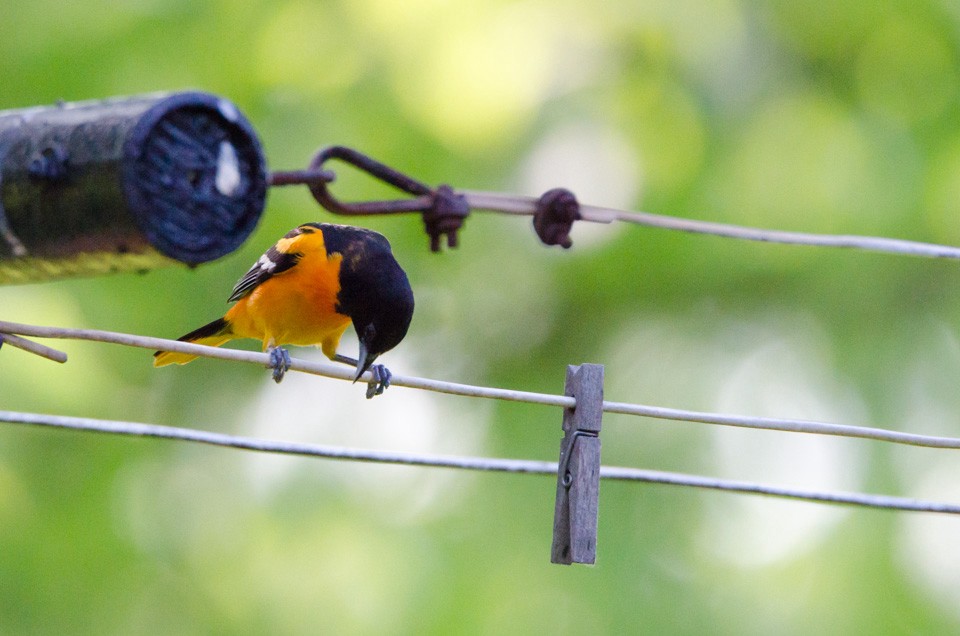
A bend in the river. A flaw in the surface. How many continents has this lone oriole crossed to come balance on our sagging clothesline, and what urgent thing is he trying to tell us? That those who could translate his song are lagging a thousand miles behind? Or that those who can speak both his tongue and ours have not yet been born, that we will go into the ground and a thousand years pass before their eyes open, the wayward atoms of our nests and tongues having been dispersed, reassigned, and repurposed into their bright, unforeseeable bodies?
•
Lament
No more swamp existence for you, with all its pleasures, all that rooting around in forgotten quarters for forgotten nickels. No more meretricious jazz piano eliding your way between gross destinations, unreviewed memoirs by former conundrums, videos of venal comebacking musicians going viral on the spiral screen. No more slowly starving cathedrals into being, no more convalescing by feel, no more nosing out the neglected harmonica part that was meant to fluff out the flourish but got buried so deep in the mix you could get the bends coming up from that. No more lonesome nights on the couch of the cute girl who will never think of you as anything but “that sad guy that sleeps on my couch sometimes.” No more paid lunch hours reciting quasi- pornography in limbic pentameter, no more coughing up eloquently Venn-diagrammed faux-Whitmanesque vibes. No more driving everyone nuts insisting that the less frequently listened-to B-side is where the genius really lies. No more perturbing the air with your smooth but inscrutable pantomime gestures. No more bop bop bopping along the Via Negativa while grasping the dangling string of a helium balloon bouquet with all thy might, as if it somehow really mattered, as if, if you could only hold on… No more lamenting the precipitous decline of the panic industry, the sudden disappearance of the Flightless Dough, the unforeseen renaissance of the infidels with their zinfandels. No more making goddamn sure that your goddamn verbs agree with your goddamn nouns, no more assaulting strangers with spray cheese in the street to protest your parents’ politics. No more wet dreams, no more dry ice, no more dry heaves, no more wetware, no more sad sacks, the anti-world has given you notice, there’s no more going going, no more coming coming back.
•
Fireworks
First we tamed heat, and we called it fire. Then we tamed light, and we called it the movies. Then came the sky, such an obvious idea we were kicking our unhelpful hands for hours, and birds to puff up the little scars in it. Fortune-tellers arrived the next day, there was much spirit traffic in the streets, and I decided I wanted to call you up but we hadn’t taught telephones how to ring yet. People used to play with every part of the pig back then, which is how you know that we are in serious decline. Why not declare war on those who think otherwise? But that would be messy and frustrating and Saturnalia is equally entertaining, even though I hear its organizing committee is as rotten as last month’s melons. Egalitarianism may be in a soft death spiral but scientists tell us new forms of thought will continue evolving in all sorts of corners and crevices your average human couldn’t finesse a finger into, which might be a source of hope in dark times and is, at any rate, something fine to chat about idly at cocktail parties. Tonight there will be fireworks, thousands of miles from any human observer and on the sub-molecular level. I’m going to get a bottle of wine anyway, and a lightweight folding picnic table. I’m hoping that you’ll come too.
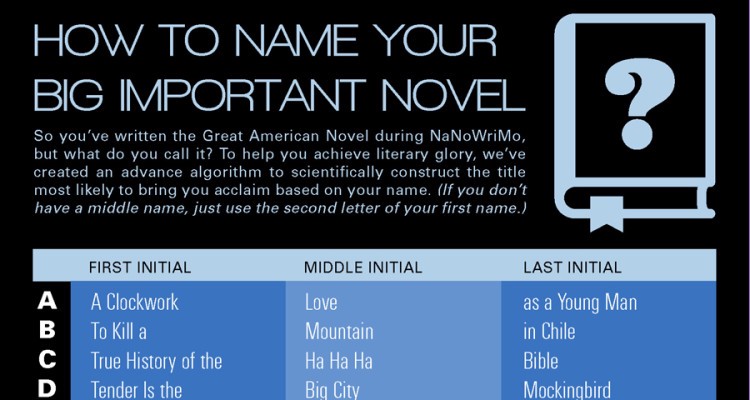
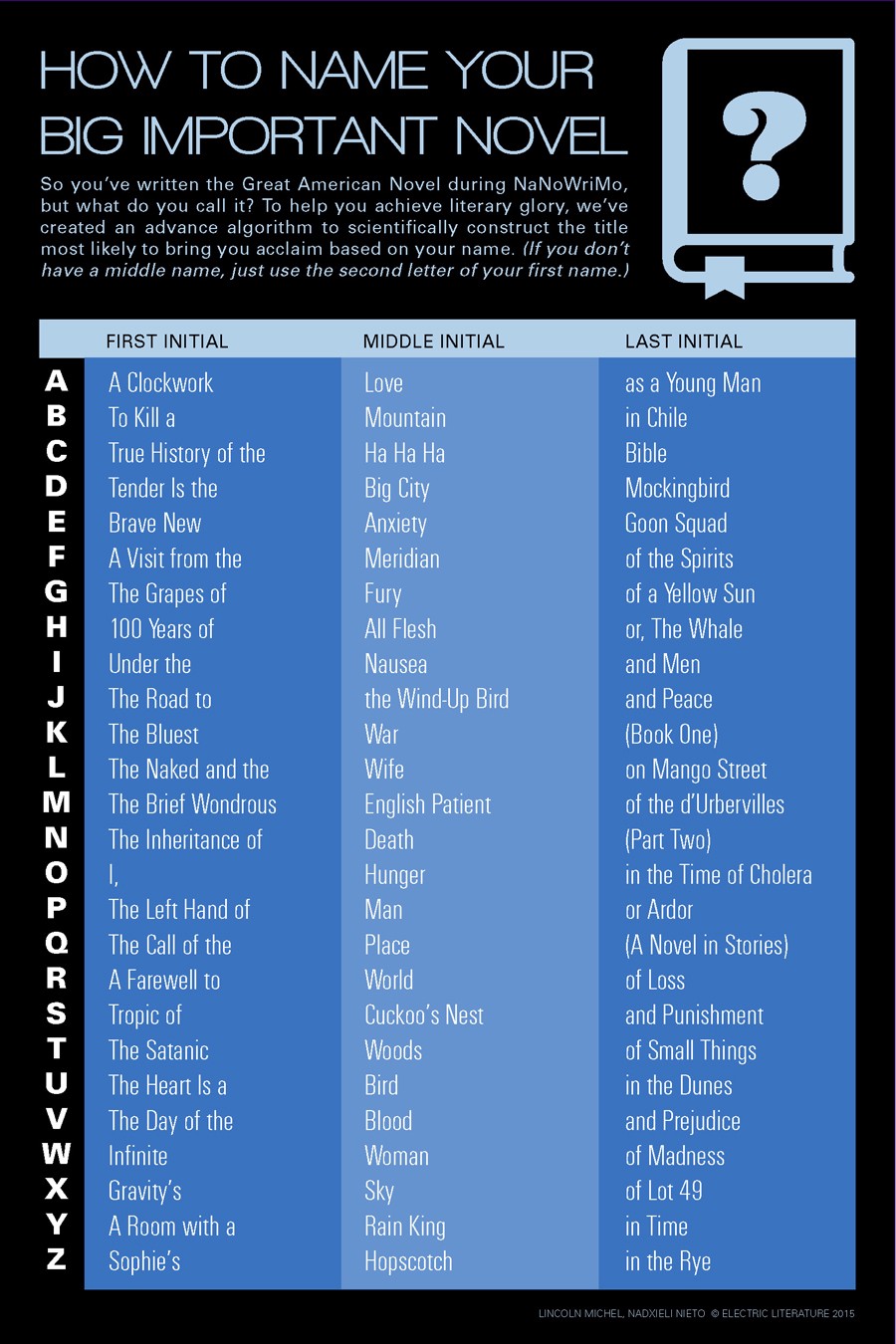
Everybody knows you don’t judge a book by its cover, you judge it by its title. Nadxieli Nieto and I have made the following infographic to help you name your Big Important Literary Novel.
Everybody knows you don’t judge a book by its cover, you judge it by its title. Nadxieli Nieto and I have made the following infographic to help you name your Big Important Literary Novel.
Editor’s note: Any resemblances to actual celebrities — alive or dead — are miraculously coincidental. Celebrity voices channeled by Courtney Maum.
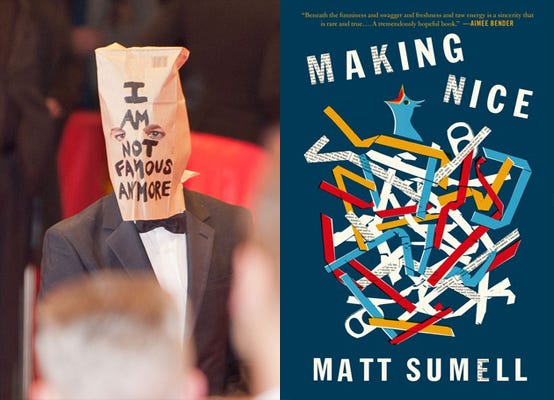
People say I’m a troublemaker, but I prefer to think I have a keener sense of my mortality than most. My parents were freelance clowns when I was growing up in Los Angeles, so you know. What the fuck.
The tabloids say I’m reigning in my restless ways, searching for better parts. The tabloids also say I’m cobbling together a set of stolen selves: the party boy bit I’ve taken from DiCaprio; the existential art guy my attempt to out Franco Franco; the bad boy thing is Madonna-era Sean Penn.
What no one realizes is that I’m just trying to be myself. But in this metamodernist world where even sincerity is winky, it’s hard to know what being myself even means. I get caught for drunk driving, I finger other people’s girlfriends, I smoke cigarettes and yell obscenities during other people’s plays. I am fucking HUMAN. But no one wants to give me any after school special credit for that.
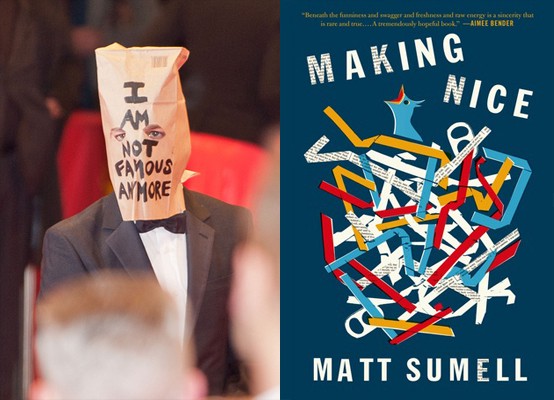
It can be a pretty lonely place out there for a bad guy with a good heart, but I’m feeling just a modicum of better since reading Matt Sumell’s “Making Nice.” This book’s a set of thirteen interconnected short stories about a carwreck of a man named Alby who’s trying to navigate the world as an anchorless thirty one year old in the wake of his mother’s death from cancer.
As you can insinuate from the book’s title, (because we’re all ironic now), Alby’s not a nice guy. He’s terrible to young women, old women, and young children alike. The only species that escapes his constant wrath are animals, whom he seemingly takes in to offset his indelible rage. In the story, “If P, Then Q”, Alby rescues what “looked like a dog’s heart with a bird’s head stuck on, a blob with a beak” that he thinks is a falcon and trains accordingly as such, assuring his feeble pupil that he “only need to worry about three things: how to fly, how to hunt, and how to fuck.” A package arrives from falcongloves.com and Alby takes his training sessions to backyard where he and his derelict father watch the poor thing “hop around the grass like a toad between us.” It turns out that the falcon was actually a sparrow, and it also turns out that Alby’s dad, in a drunken stupor, squashed the bird erroneously underfoot and tried to cover it up by offering to look for it once he declared it missing. They do so, pops and little Alby, “scouring the ground and the shrubs and the trees around the house, calling out for him. Whistling, like we were happy.”
Well, hey, you know what? That’s really fucking sad. It really fucking got to me to hear words about another guy who has problems with his dad. My dad — and this is well documented, I’m not just talking trash — is a messed up Vietnam vet, drug dealing Mephistopheles of a father, but he’s still my dad. There are scenes in this book where it’s so clear that Alby’s father is behind every insecurity that Alby has developed, and then there are other scenes where the two of them are throttling through their native waters of Long Island in “a sixteen-foot, gel-coatless and oxidized blue MFG covered in pine needles”, the sunshine upping everything great about the water and Alby’s father leaning in towards the steering wheel to holler “Where we goin’?” and his impossibly happy son belting back, “Who cares!”
We hurt the ones we love the most, that’s for fucking sure. That is, for example, the reason I totalled Alec Baldwin and got myself fired from that stupid Broadway play. It’s also the reason I can’t hold down a relationship to save my freaking life. People say Macaulay Culkin went nutso when Mila Kunis left him, but Macaulay Calkin went nutso because he couldn’t make Mila stay.
Alby doesn’t have much luck in the love department, either. He uses nicknames for the fairer species that are fresh-off-the-playground-clever, (“Hi, high jeans!” for starters,) but his pick up lines don’t work because unlike Alby’s conscience, the women he’s going after aren’t three years old.
This might not be the place to share this, but then I’ve never been one for geographical decorum: I had a sushi date with Hillary Duff once where she requested that all of the grains in her maki rolls be replaced with brown rice. (“Hi, high maintenance!”, Alby, amirite?) I gave myself a compensational handjob afterwards for not punching her in the face.
Anyhowdle. The author behind this “Making Nice” book seems pretty shrewd, and his headshot gives the impression that he’s moderately attractive, and because I don’t like competition, after coming to these two conclusions I read everything negative people had to say about his work online. A lot of reviewers are calling Sumell’s humor “savage.” “Ferocious” is another one, “heartbreaking” comes up a lot. One Amazon reviewer who calls herself “The Manic Reader” said her sensibilities were offended. Someone else said she really liked “Confederacy of Dunces” but that this book was more like “Dunces with Wolves.” I felt kind of defensive of my brother Sumell when I read that one. It’s like, get some organizational control over your mixed metaphors, you nut!
Let me tell you what’s going on under Alby’s savagery, under all that posturing, the car accidents, the violence and the getting beaten up. Alby’s got a tender heart under his bruised skin. The man can’t even watch jewelry commercials without getting emotional, you know? He spends his time pestling cat food up with applesauce, TUMS tablets, hard-boiled eggs and water to feed his dying bird. He continually tries to seduce women by complimenting their outfits and he’s got nothing — not one bullet point of a game plan — after that.
This is the story of a man who is absolutely and positively in the world without a plan, or rather someone who is tetherless because his mother’s death set his plan on fire. The world is an intolerably cruel place if you allow yourself to love someone, and I’m sorry to say that my time so far upon it has shown that you don’t always get back what you give.
Say you’re young. And it’s the early nineties. And you teach writing on one of the coasts to support yourself, and you begin each class by having students write non-stop to fill notebook pages. Just keep the pen moving, you tell them. Don’t stop.
And say one day you write with them, to set an example, and as you scrawl, the words “horse” and “brother” appear, and emotions attack — you might lose it right there, in front of these students. You are so choked up you stand and face the chalkboard and look for chalk that hasn’t been there for years. Why? you think. But you know why. Sort of.
You know for sure your brother was with you when you first saw horses. He held your hand when you couldn’t stop pointing. They’d be running together soon, he told you, and he explained what a jockey was, why silks and saddlecloths came in such different bright colors. In your mind he knew everything, so when they broke from the gate, you rose to watch like he did. He screamed for the nine, which your mother bet on for him with lawn-mowing cash. And when the nine shot past to win going away, you shouted “Go!” like he did, and he grabbed your forearm and squeezed.
Let’s also say that, an hour after you teach this class, you decide to write fiction about horseracing. Fiction, you believe, would be easier. Your goal is a short story a magazine will publish, since you need to publish to keep teaching, and this story’s words rush from you as if someone near is dictating them. In fact this story doesn’t stop for anyone’s 5,000 word max. It wants to keep on. It has legs. It’s a novel, dammit — you have no time for a novel. You need to teach in order to pay rent and eat and engage in things like relationships. So teach is what you do, with this ready-to-run-novel-project shelved.
Then, with a woman, you again visit a track, where, again, thoroughbreds compel you, especially when they sprint. At this point in your life you’ve seen plenty of beauty, in girlfriend’s smiles, in grandparents’ wrinkles, but out here, at this track, the magnificence of so much life on the run beats all. So the next morning, back you are, drafting your novel. But bang, the phone rings: your brother, who lives across the country, is ill with symptoms he’d rather not dwell on. You fear he has HIV, pray he doesn’t. In time he proves disturbingly private compared to those days when he guided your childhood, and, worse, he keeps asking you to keep his illness hush. His livelihood, he explains, depends on your silence. Maybe one day he’ll let you tell the world for him, but not now. Now what he needs is brotherhood.
You respond by maintaining as much reticence as possible. You want your girlfriend to know. You stop writing your novel — fictional horses running no longer quite matter. Anyway you need to teach, so when you talk to people now, it’s more and more often about their writing. These lessons you plan, to encourage others to develop their stories, strike you as why you were put on earth.
Or so you believe until the Thanksgiving weekend you learn it’s true. Goddamn HIV. And this is no line — it’s a truth your brother has told you directly. He again asks for secrecy, and you comply. You return to your horseracing novel, seeing it as a place to corral secrets metaphorically. Its characters grow reticent, too, some up against death at junctures in their lives when the world expects them to love. And now, trying to co-narrate, is a new voice when you write, a black guy’s voice, obviously not your brother’s, because this guy keeps saying he has a story he wants told to anyone who will listen. Like you and your brother, this guy grew up poor. He insists on being in your novel on the days your brother fails to return calls. So when he — the black guy — wants to narrate a chapter, you give him full run.
And run he does. His story, fluid and strong, is that he, too, has seen horses burst out of a gate and go. He gets what you and your brother got. It’s as if he, you, and your brother could win a ton at the track someday. That is, if you keep letting him into this novel. And continue to keep your real brother’s secret.
Rent needs to be paid, though. And lately there’s been this woman. So to publish — in order to teach — you write other stories, short stories, totally made-up. The comical ones get published; you keep teaching and affording a roof; months, then many months, pass. When you’re not teaching, you sometimes go to the track. You like the track. It offers escape from being an adjunct instructor, from rejection by magazines, from the vitriol seemingly thriving in the parts of this country you see on TV. Worse, you sense strongly that by now your brother has full-blown AIDS. And then he tells you he does. He’s tried to keep this from you because, well, you are the easily charged up one, the one who couldn’t stop pointing at horses.
So now your novel insists on exploring discrimination and injustice, on how hatreds like that affect family and trust and budding love. You revise feeling certain your brother would get it. He’d even get the parts about the black guy, whose chapters often focus on trying to stay alive.
Still, you and your real brother don’t seem all that close. Or as in touch as you feel with your characters. Maybe you and he and this black guy will gamble in some story you’ll write, but the longer you revise, the less this seems possible.
Then comes a bad phone call. Your brother can barely walk. Certainly you and he will never charge forth as effortlessly as those horses you watched as kids. Nor will he ever again visit a track with you — the man is infirm. And your novel, wouldn’t you know, starts becoming more of a mess.
And then, near a summer midnight, he is gone. The funeral confuses and darkens your manuscript all the more. His secret is out in the real world; you’ve lost control of it. You’ve lost control of many things. Your ability to love, your enthusiasm for sentences, the encouragement you lent your students — these once-apparent talents have become difficult, and you avoid them.
But when you’re the fortunate son, there’s always another spring. And another, and another again, each enveloping you more brightly than the last. Then, in a lengthy stretch of brightness and sure-footedness, you’re revising you novel with new spirit. You can’t stop reimagining, reconsidering, adding subplots that occur to you because you’ve survived. If this novel will testify to the power of brotherhood, you will tweak it until publication is inevitable.
And, somehow, you find yourself here, in a morning. You are twenty-five years older than when you wrote nonstop with those students, more than a thousand miles from the track where two kids marveled at horses.
But you’re into this morning. It has you satisfied. Because you’re reading proofs of your novel, the one you’ll call Watch Me Go.
The day Tomas Tranströmer died, I read a “squabble” between several literary men over the accuracy and authenticity of Robin Robertson’s translations of Tranströmer. Robin Fulton, another translator of his poetry, accuses Robertson of a kind of soft plagiarism, and Alan Brownjohn, who had reviewed Robertson’s translations favorably in the Times Literary Supplement, of failing to identify the problems with the work:
An excessively large number of Robertson’s lines are identical to mine in my Tranströmer translations (as published by Bloodaxe, and New Directions): elsewhere, wittingly or unwittingly, Robertson makes arbitrary changes to the Swedish, a language he does not seem to understand. His versions are neither dependable translations nor independent imitations: they show a cavalier disregard for Tranströmer’s texts and I have yet to see a reviewer able or willing to say so.
The Scottish poet W. S. Milne then writes in to point out that “Robin Robertson is hardly the first poet to make ‘arbitrary changes’ in his versions from a foreign language. The most famous (or perhaps notorious?) case is that of Robert Lowell in his Imitations of 1961.” Fulton’s response: “If only Robertson had vandalized Tranströmer in the way Lowell vandalized his originals the results might have been interesting, but a version which tinkers with only a word or phrase here and there hardly begins to be an imitation — it reads only like a translation with hiccups.” This goes on for a bit. On Twitter, a poet and translator I follow suggested that perhaps works in translation should be reviewed by translators.
That night over dinner I asked my husband what he knew about the Tranströmer controversy, since the magazine he edits had published two translations by Robertson. We talked about the difficulty of even assessing either side of the argument, if one doesn’t speak Swedish. At the very least, you’d need to make a careful comparison between translations on a poem to poem basis. We do not speak Swedish, and we had not done so. Nonetheless, we both resolutely agreed that Robertson’s translations were not very good; they were pedestrian.
Several years ago, on my blog, I compared two versions of a Rainer Maria Rilke poem, “Portrait of My Father as a Young Man,” one translated by Stephen Mitchell and the other by Edward Snow. I strongly prefer the Mitchell translation, which to my mind makes more felicitous choices throughout, but the impact is most felt in the final couplet. The Mitchell translation, which I read first, ends: “Oh quickly disappearing photograph / in my more slowly disappearing hand.” Beautiful, right? The Snow translation: “O you swiftly fading daguerreotype / in my more slowly fading hands.” What Rilke would have held (if we are to assume the poem is based on real experience) was probably a daguerreotype, but “photograph” is more immediate, and “disappearing” is so much more ominous than “fading.” A “fading memory” is a cliché; we may fear the slow fade to death, but not as much as our ultimate disappearance.
A language scholar commented on the post to tell me that “Mitchell’s translation, like all other English translations of Rilke except Snow’s, is poetically ‘beautiful’ — beautified, falsified, conventionalized and dull — anything but Rilke” and that if I wanted to appreciate Rilke I should “LEARN GERMAN” (emphases his). I dismissed this idea as absolutely silly; I’m not going to ignore all work translated from languages I don’t speak. But in truth, I have thought about his comment for years.
Who gets to translate? And who gets to review translations? There’s a tradition of poets translating from languages they don’t speak fluently, with the aid of a fluent assistant and/or a dictionary; I’ve done it myself. On some level, I feel that it’s more important to be “fluent,” not just conversationally fluent but poetically fluent, in the receiving language. I don’t believe poetry is “what’s lost in translation,” but a technically faithful translation could end up being a terrible poem in English. Edmund Wilson famously detested Vladimir Nabokov’s translation of Alexander Pushkin’s Eugene Onegin, an extremely literal translation that abandons the original’s intricate form. Wilson calls this exercise an act of “perversity” and “torture” that arises from a “desire both to suffer and make suffer.”
My husband said he tends to demur from reviewing translations, at least of poetry. (Less so with novels, where there is less intense focus on individual word choice and poetic effects like cadence, which aren’t typically expected to be maintained in translation.) It seems like the right thing to do; if you don’t know the poet’s original work, what are you reviewing? But when you whittle the already small pool of poetry critics down to those who are multilingual or translators themselves, the result is that hardly anyone reviews translations, and in turn fewer people read them. If nobody reads poetry, less than nobody reads international poetry.
I was thinking about all this while sitting in the audience of a live interview with Kazuo Ishiguro, in an auditorium at the University of Colorado, Denver. During the reception beforehand, I chatted with a few people about the critical reception so far of his new novel, The Buried Giant. The reviews have been mixed at best. But I find that I don’t trust many reviewers with an Ishiguro novel. Ursula Le Guin initially called it failed fantasy (“It was like watching a man falling from a high wire while he shouts to the audience, ‘Are they going say I’m a tight-rope walker?’”) but she has since retracted her comment. Michiko Kakutani, in the New York Times, calls it an “eccentric, ham-handed fairy tale with a jumble of story lines” that fails “to create a persuasive or fully imagined fictional world.” This may be true; I haven’t read it yet. However, the response was similar to The Unconsoled, though with less “it’s a failed mixture of genres” and more “WTF even is this.” The Unconsoled could fairly be called eccentric and jumbled; certainly the world it creates is not “persuasive” in the sense of feeling anything like the real world. But it succeeds in creating, through fiction, the exact sensation of a long, bad dream; while you’re reading it, the anxiety is almost unbearable, though it’s clear that nothing (as in any novel!) is actually at stake. It’s a fascinating experiment. Whether or not any one reader likes it seems beside the point.
Who should review Ishiguro? His novels frequently incorporate elements of fantasy or science fiction without committing fully to the conventions of those genres. Is it better or worse, when picking up an Ishiguro book, to have expertise in fantasy and science fiction? Could that expertise actually prejudice you against the work? In theory expertise should help. It should also help to have knowledge of Japanese folk tales, of post-war exile, of collective consciousness, of the science of memory. I know a little about neuroscience; does it help? I suppose it only helps if you’re sympathetic in the first place to the author’s intentions. It doesn’t help if you come to it wanting either a faithful representation of the world as it is, or a fully imagined fictional world, instead of something in between, a world full of holes. Your eyes don’t collect all the information necessary to rebuild the world in your head; it would be a waste of resources. Instead they collect just enough data to get a sketch, and your mind fills in the rest. (Obviously, there’s a wall over there, and a ceiling above us.) Ishiguro seems interested in allowing us to experience that world in the middle, between the outside reality we have no direct access to, and the internal world, with all our assumptions comfortably in place.
There was another literary kerfuffle recently when Stephin Merritt (best known as the principal singer/songwriter in The Magnetic Fields) wrote a tetchy, dismissive review of two novels for The Tournament of Books. Again, the role of expertise comes into question — does it matter, in this context (a silly bracket tournament for books, not a serious review outlet) that Merritt is not an expert lit critic? He’s coming to the books, and offering his opinion, as the storied “general intelligent reader.” But the tone feels off because it’s abutting against similar pieces from writers and editors with a lot more exposure to published criticism — it wouldn’t stand out in a stream of Goodreads or Amazon reviews, where one man’s impressionistic opinion is as good as any other’s. The best critics do more than explain why they liked or didn’t like a book; they try to understand books, and show other readers, by example, how to read and think about those books. Specialized expertise can work in service of that goal, but is probably not as important as a willingness to attempt to be a work’s most thoughtful reader.
A swan’s foot, like a duck’s, is a webbed claw. In traversing swan shit and mud, these claws naturally gunk up and reek. Nobody in the history of the world, save another swan, has licked a swan’s foot while that foot was still attached to the swan.
So begins “The Swan as a Metaphor for Love,” which in little more than a page, encapsulates the pitch-black humor, vivid grossness, and scathing critique of human emotions that is characteristic of Amelia Gray’s Gutshot. In Gray’s hands, a swan — commonly the epitome of avian grace, reverence and respect, emblematic of romance through its use in corny ‘love boat’ rides — stinks of “bacterial purge,” and will “bite you and tear your flesh.” The swan “will attack you… if you are trying to have a conversation with their mate,” conjuring the vision of a jealous lover, so insecure in their relationship that they imagine everyone a threat. Famously known for their tradition of mating for life:
someone found a swan once that was twenty-four years old and probably it was mating for life, which everyone made a big deal out of even though the swan was not even old enough to rent a car. The swan wasn’t yet acquainted with life enough to silently hyperventilate in its bed.
For Gray, the sentimental symbolism of the swan is naïve, overcome by the reality of love, as “anyone who claims the swan is a majestic and noble creature has never seen a swan up close.” Her juxtaposition of the superficially clean, composed swan, and its underbelly of filth and shit, is representative of Gray’s view of the human condition as a whole. In her work, nothing is quite what it seems.
Gray published her first novel, THREATS, in 2012, and with Gutshot returns to short fiction, adding to her collections AM/PM (2009) and Museum of the Weird (2010). Like Museum of the Weird, Gutshot is comprised of a series of unsettling short stories, which on the surface appear unrelated, have faint threads that link them: violence, sickness, madness and desire. Both collections elicit a sense of foreboding, characteristically emblematic of Gray’s writing, as epitomized in her novel, THREATS, a book both extremely unsettling and deeply moving.
The novel’s account of both manifest and metaphysical mysteries deftly communicates what is just as often inexpressible — grief, mourning and depression — by undermining reality with her protagonist David’s unreliable, borderline insane, narration. In Gutshot, Gray continues to use mentally unstable and unpredictable characters, and thus is able to create worlds with uncanny realities, at once strange and familiar, and always unexpected.
Perhaps the most unsettling attribute of Gray’s writing is her deadpan presentation of what are quite often unspeakable acts, and while this unsettling detachment gnaws away as we read, we are unwilling to remove ourselves from our discomfort before reaching the disturbing climax. In “The Moment of Conception,” a couple attempt a sort of procreation ritual that involves “some sacrifice,” to say the least. When promoted by his partner to consent, rather than fear the man feels “dominated by the thought that it was difficult to find a person with whom I shared so many of my hobbies.” After dismembering his penis and sewing it inside her “bloody sex,” the two lie entwined, feeling:
There were things that we would do for each other, sacrifices we would make, and the proof of that fact was in front of us plain as an hour in the day. It was a beautiful morning or afternoon.
By offering the horrific and disturbing without judgment, Gray intensifies their effect on us. We become more disturbed by violence and psychosis when these thoughts and actions are offered to us neutrally, as if they were normal.
Gray’s writing frequently leaves us mystified, unable to comprehend the scenes laid out before us with near-sociopathic detachment. In “House Heart,” one of the most twisted stories in Gutshot, a couple kidnap and imprison a young prostitute who “smelled like a bowl of sugar that had been sprayed with a disinfectant.” They bribe her to live within the arterial ventilation system of their house like a human hamster, engaging in a game they call ‘House Heart.’ Aroused by her fear and the thought of her captivity, they make love as she crawls above them, pressed onto her stomach, dehumanized. Either completely unaware of, or resistant to, the idea that their behaviour is abhorrent, the couple believe “each of us had our individual function and hers was to embody the house, which had begun to smell like a hot scalp.” At no point does Gray indicate if she supports or condemns their beliefs and behaviors, and this absence of moral compass permeates her work, causing the reader to question their own morality when faced with such ambiguity.
Her neutral tone, enhanced by the use of third person narration, encourages us to embrace her writing’s dark secretions without conscience, simultaneously engaging in gleeful enjoyment of the repugnance provoked, feeling repulsed by the sickness of her creations. One of this collection’s standout stories, “Fifty Ways to Eat Your Lover,” plays with these conflicting reactions of delight and disgust, and is guaranteed to make those of any gender wince. This list of ways to graphically maim and torture your male lover is fantastically funny and absolutely vile in equal measure. Charting a relationship from start to finish, Gray subverts romantic tropes, suggesting, “When he tells you he loves you, paper-cut his fingertips and suck their blood. When he asks you to marry him, panfry his foreskin.” The story exemplifies the underlying feminism, even misandry, prevalent in Gray’s writing, which is refreshingly brazen and unapologetic.
Adding another layer to the delicate disturbance is the unnerving sense of familiarity contained within many of Gutshot’s stories. Gray’s characters act on feelings that most people only daydream or fantasise about. There is a sense that they signify repressed desires to commit inappropriate, taboo, even immoral actions. Thus, the true horror of her work is founded in its realism: while some stories are fantastical, others are undeniably plausible. “Away From” is on the extreme end of this, with its themes of kidnapping, rape and murder, all discussed in Gray’s typically detached tone; the victim thinks to herself “Well now you are in a predicament,” and later “the thing about fighting is you can’t fight forever”. In “Curses,” twins inflict awful illnesses upon their mother, for no apparent reason other than sick gratification, and with no penance. It would be amiss to assume no child has ever wished for the ability to do the same, but disturbing to consider all the same.
Despite this, Gray’s writing is, at times, extremely funny. Many scenes elicit bursts of unabashed laughter amidst the gore and strangeness. In “Thank You,” two women exchange ‘thank you’ notes of increasingly elaborate forms:
a postal tube arrived and the woman opened it to release eight disorientated white mice. They tumbled out in a line and scrambled for safety. She gave them water and sliced up an apple but was confused by their presence until later that evening when, save for one, they seized and made tiny bowel movements which produced the alphabet beads T H A N K O and U. The last one was uncomfortably constipated in a life-threatening way until she took him to the vet and had the Y extracted at the expense of forty-five dollars.
There is the sense that, for Gray, the gross and the amusing go hand-in-hand. In an interview with The New Yorker, she commented, “Life is a natural mix of horror and humor.” While this is hard to disagree with, in Gutshot she takes this idea to the extreme. Comic scenes do not come as relief for the reader, but rather heighten our experience of the bizarre and unsettling. By making us laugh, she offers a brief thrill of pleasure, before plunging us back into the horror. It can, at times, be alienating, and certainly one needs a strong stomach to read. Gutshot seems most suited to those with an appreciation of dark comedy. Gray’s warped imagination and love of the absurd has created a haunted house of human perversion, brimming with black humor.
[Editor’s note: read “These Are the Fables” from Gutshot in Electric Literature’s Recommended Reading.]
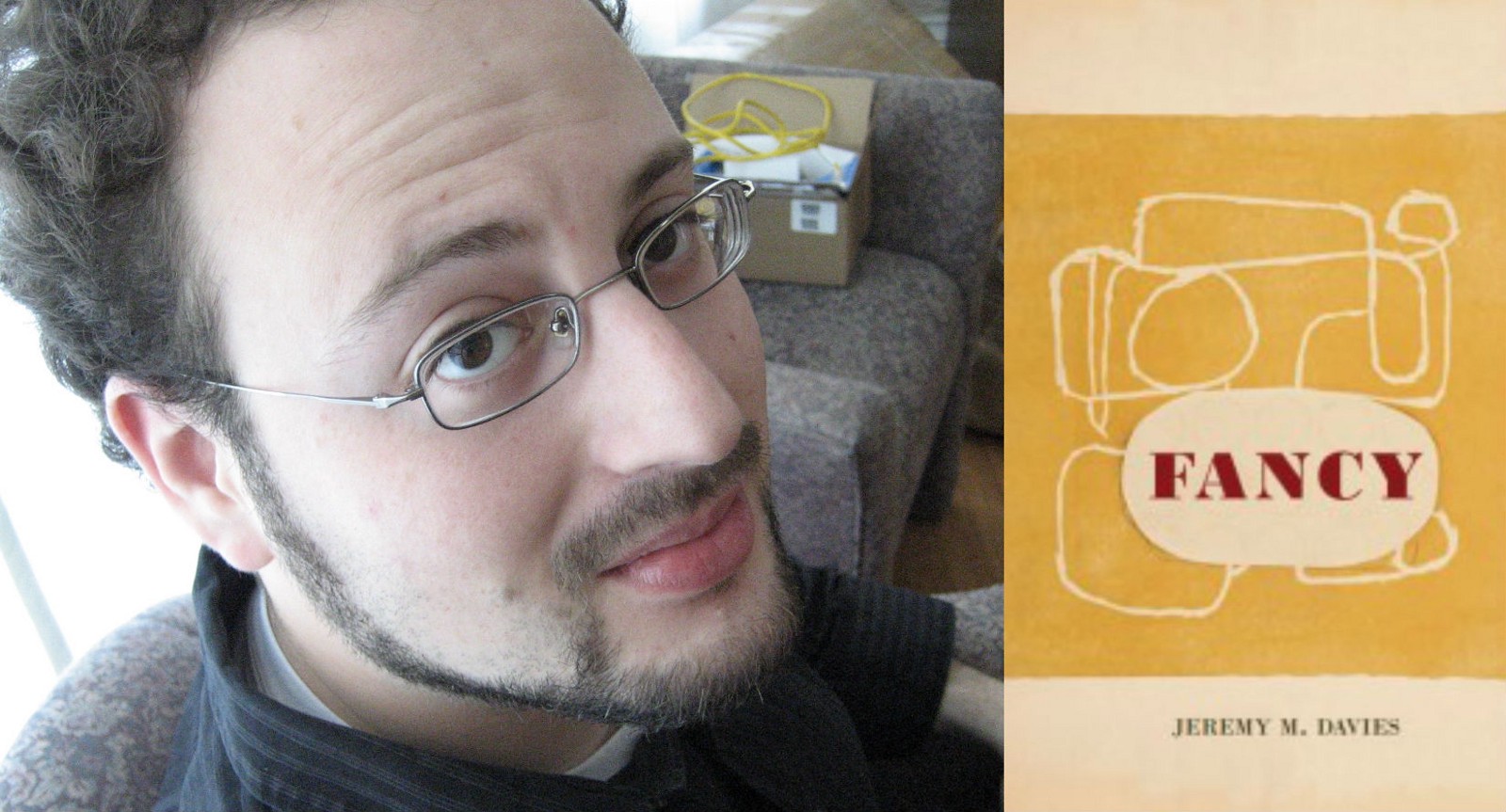
At a 2011 reading in St. Louis, hosted by the university we both attended (though not concurrently), I heard Jeremy M. Davies read from his work in progress. The passage he read was about a character who painstakingly hung mirrors along the street where he walked to work so that he would never lose sight of the reflection of his house. The character’s name was Rumrill and I haven’t yet fully managed to get his voice out of my head. That might be why my head hasn’t been feeling quite right for the past three and a half years.
The voice — by turns corrosively witty, obsessive, anxious, and hallucinatory — is the driving force behind Davies’s newly published novel, Fancy. It follows 2009’s Rose Alley, which documented the making of a failed film about the Earl of Rochester during the May 1968 uprising in Paris. Whereas Rose Alley was a verbally promiscuous, prismatic sex comedy, Fancy turns its gaze inward. It begins with Rumrill delivering instructions to the supposed caretakers of his twenty cats in the foyer of his home. Then he begins to recount how he, too, was once a caretaker for a man named Brocklebank, who owned thirty cats. And no cats of any kind seem to be around … Rumrill’s monologue builds into a deeply strange ontological investigation, as well as a hypnotic and compulsively readable account of one man’s baroque attempts to process and cope with the world inside and outside his house. It is an invention of great wit, imagination, and feeling — what they used to call, a few centuries ago, “fancy.”
Fancy “could become a cult classic,” according to a starred Publishers Weekly review, and the Times Literary Supplement called it “a witty and ingenious polyphonic invention.” Joining Rose Alley (Counterpath, 2009) and Fancy (Ellipsis, 2015), Jeremy M. Davies’s debut collection of short fiction, The Knack of Doing, will be published by David R. Godine/Black Sparrow later this year. He is Senior Editor at Dalkey Archive Press. I was very glad to have the opportunity to interview him by e-mail.
Eric Lundgren: While the novel takes the form of cat-sitting instructions, Rumrill, the novel’s narrator and I guess we could say protagonist, turns this form to his own private and delightful ends. I kept thinking of J. L. Austin’s notion of “performative language,” the way certain kinds of language alter reality or create reality anew. Early on Rumrill refers to his instructions as “arias.” To what extent did you have the sense of performance while you were writing this? It’s a one-man show in many ways.
Jeremy M. Davies: It would be a difficult performance to pull off, live. Performative but not necessarily performable.
Do you know Wallace Shawn’s monologue The Fever, which is meant to be put on in a private rather than a public space? I’ve never seen it played — there’s an excellent audio version available, but that’s not the same thing as having someone standing in your own living room, “acting” as you try to avoid eye contact. But my notion of what it might be like to have that text delivered to you in this fashion, without your knowing what you’ve gotten yourself into — and without a way out, since you’re already at home — was in my peripheral vision as I was knocking Fancy into shape. A monologue beginning pretty harmlessly, comically, gradually getting sinister, cutting off lines of (rhetorical) escape, and recasting familiar things as threatening. So, perhaps “undermining” reality than creating it anew.
Which, at just about the other end of the engagé scale from Shawn, is kind of an old trope in “weird tales,” isn’t it? The words you shouldn‘t hear, the knowledge that you’re not meant to have, uncovered in a “house on the borderland,” leaving you mad … Though here this world-destroying kernel is concealed in a bunch of supposed cat-sitting instructions. To each his own?
EL: Which raises the issue of Fancy’s fantastical edge. You do a lot of what the SF crowd calls world-building, here.
JMD: You know, parenthetically, I have trouble with that term. I understand how it can serve as useful shorthand, but something about its recent ubiquity rubs me the wrong way. As though every work of fiction doesn’t already “build a world” with its own and necessarily fantastical/fictive rules, no matter whether they happen to be dressed up like everyday things rather than folkloric or science-fictional ones … Am I being oversensitive? (I’m really asking.)
EL: “Building,” I suppose, in the sense of establishing what is and isn’t possible in a fictional world line by line. As opposed to deferring to a kind of consensus reality. This is important in Fancy, the idea of language as a system for processing the world and the eroding effects of secondhand language and cliché.
Part of the fun of any novel worth its wood-pulp is, for me, the delight I take in suspending my assumptions as it teaches me how it means to be read…
JMD: I’d say that “consensus reality” doesn’t just apply to brand names and smartphones and city landmarks and all the other impedimenta we use to signal that a book takes place in what’s meant to be the real world: it also applies to genre. That is, we have a consensus as to what makes a fantasy novel, we have a consensus as to what makes a coming-of-age story. So “They had their usual seats at Wrigley Field” and “They had their usual seats by the warp-drive monitoring station” each provides an equal (if different) number of reference points. Whereas the real trick is in setting out the rules for how the world of the book works, as you say — which is as much a linguistic process as it is a juggling of generic expectations. Part of the fun of any novel worth its wood-pulp is, for me, the delight I take in suspending my assumptions as it teaches me how it means to be read — as it makes its various concessions to and perpetrates its various violations upon the history of the form.
But yes, Fancy’s world is one that takes very seriously the prospect of language eroding thought, and thought eroding reality. Mainly what it wants to teach you is suspicion.
EL: And Fancy’s is a very sparsely furnished world. Outside of Rumrill’s house, and his precursor Brocklebank’s house, we have a train station, a bridge, a library … am I forgetting anything?
JMD: The railway graveyard … ?
EL: I loved the railway graveyard. And there’s the high-rise tenement in which the prospective cat-sitters live, and which blocked Rumrill’s view of the town, and which seems to represent a sort of obscure doom that has fallen over the area. But I guess what I’m saying is that you tend to avoid the dense substantiating stuff we’d find in a more conventionally realistic fiction.
JMD: See, to me, that doesn’t sound sparse at all! A train station, a bridge, a library — that’s a hell of a lot more generous than some stories. This starkness is probably more attributable to the fact that Rumrill’s town lacks the usual signifiers placing it in a recognizable somewhere, so the information he does volunteer floats in the middle of a lot of supposition, rather than being suspended in a known quantity like “Paris” or “Sheboygan.” Its landmarks come to feel a bit talismanic.
Unless you’re Michel Butor, though, or someone with a similar project — that is, if you have a program of density, as in his wonderful Passing Time — you’re probably doing something wrong if your substantiating “stuff” feels dense, as such…
EL: Fancy’s landscape isn’t deliberately starved or denuded of facts, but every fact is harassed. There’s a pervasive sense of doubt in the novel, applying to even its most central propositions: the existence of Rumrill’s cats, and the Mr. and Mrs. Pickles he’s supposedly instructing, to begin with. Rumrill’s phenomenological doubts are a key theme — kind of a wobbly fulcrum for the whole book — and this extends to the narrative world. So it’s world-building and world-undermining at once.
JMD: What we do learn is always subject to second-guessing, yes. Rumrill isn’t even sure what the weather is like outside (or, anyway, he refuses to make a clear statement without gainsaying it in the next line). On the subject of science fiction, now that you’ve let that imp out of the bottle, I’ll mention that another work often on my mind when writing Fancy was a Michael Moorcock story, I think called “The Dream of Earl Aubec.” It’s a creation myth of sorts, and — bearing in mind I haven’t read it in more than twenty years and am inevitably going to be remembering it wrong — is about a prehistorical hero-type being talked by a goddess into venturing out beyond the known world. The man is hesitant because he knows there’s nothing out there — the world drops off and turns into chaos where the map ends. But the goddess prevails upon him, and when he sets his no-doubt jewel-encrusted boot over the border, he doesn’t fall off the edge: the map is instantly filled in, and not with new countries, but countries that were always there. So Rumrill’s town is perhaps the remnant of a country where the bloom’s come off of that act of creating what was already there; or where the foundation of this creation has been — here’s that word again — undermined. Things are turning back into mush. Save, that is, for a library, a bridge, etc.; save for what our very unheroic and jewelry-free hero is present, in person, to witness and thereby keep stable.
But then it’s an open question even to himself whether Rumrill is fighting a holding action against the mush or is actually its agent.
EL: It’s not a place that would appear on any map, but I do think of Rumrill’s home as being in a Midwestern town, although I don’t know why. Maybe it’s because we both live here, a few hours apart, although I rarely see you.
JMD: That’s funny, I see you all the time.
I think of it as Midwestern too. It’s a scrambled, impossible, certainly post-”obscure doom” Midwest, but I won’t pretend that the resemblance is coincidental. I’ve lived here a decade now and I still feel as though it might as well be Mars. (Or, more to the point, as though I might as well be from Mars.)
EL: It may also be the horizontal quality of much of the architecture, or the sense of ruination (the sewers aren’t functioning well and rats are showing up in bank lobbies, and the library mainly stocks survival manuals).
JMD: Aha! See? It is conventionally realistic fiction. This stuff is practically documentary!
EL: I also have the sense that recluses, I mean hard-core recluses, prefer the Midwest.
JMD: I could hypothesize, irresponsibly, that this is because there are less people crowded together here than on the coasts and borders? And yet enough people everywhere for it to feel inhabited, even teeming, despite an accompanying sense of emptiness due to the absence of topography. It incites loneliness but offers no solitude, and is almost anti-picturesque over long stretches: it’s a place where things are both rigorously human sized (with nothing much taller than a person, and for miles in every direction) and yet often inappropriate for human habitation (because fouled and then abandoned by industry, for example; or simply because it’s not much more than a filled-in swamp). You’re made to feel like the center of the universe while also feeling enormously exposed and vulnerable. Which induces a special form of crazy. Especially if you’re a transplant from places with greater population density, more amenities, more community, more tallness. I can imagine a Brocklebank landing here from Vienna and looking out over the corn-and-soy fields, yelling: wake up and make some sense, damn it!
EL: There’s a beautiful description in here of how cats might read rearranged furniture as a science-fictional geography. Part of Brocklebank’s treatise on cat-fancying, which Rumrill quotes from time to time in his monologue, ends up in a pulpy science-fiction journal along the lines of Weird Tales. I’ve been told you’re a big Doctor Who fan and I wonder how you see this line of influence playing out here and perhaps in future works.
JMD: Whoa, whoa, whoa — you’ve been told? Who have you been talking to?
All the time my family thought they were sending me to yeshiva to get God, I was actually studying Doctor Who.
All right, it’s a fair cop. Doctor Who was a foundational text for me, growing up — I’m talking about the ’80s now. All the time my family thought they were sending me to yeshiva to get God, I was actually studying Doctor Who. I imagine there are probably still copies of holy books at my grade school that have little blue ball-point TARDISes scratched into the flyleaves. But look, I consumed nothing but science fiction till after eighth grade. Any novel without some fantastical element in it bored me stupid. Then I read Joyce and Bernhard and Borges and realized that there were sneakier, more challenging, and funnier ways to avoid tedium than having explicit recourse to fantasy. Or, to put it another way, that style could be more fun than spaceships. (Not that you can’t also have both.)
So, yes, Fancy has a pulpy/Lovecraftian air to it, at times, along with the qualities of alienness and phenomenological slipperiness we’ve already spoken about. And Rose Alley has a super villain and lots of other jiggery-pokery that you’d have to call “unrealistic.” But those are more jokes than subjects.
As to future work, who can say. There’s a novel to be written about the odd relationship kids brought up in religious atmospheres can develop with what I’ll call “competing mythologies.” After all, it can’t be news to anyone that Western religion is where we get the notion of there being canon and noncanon (that is, apocrypha/fan fiction) — such a vexed issue with convoluted, long-running properties like Who or the Abrahamic religions: these impossible things happened, but absolutely not those …
EL: There’s a sense in which Brocklebank’s system of cat-fancying does come to feel religious. In any case, it’s a total system for understanding the world. Rumrill seems to be living out the consequences of this system, this faith as it were, although he’s a less than perfect exegete.
JMD: Judaism as a pedagogical and scholarly discipline is extraordinarily concerned with exegesis, with mapping every scintilla of the universe with rules derived from rules derived from texts derived from conversations derived from rumors derived from annotations derived from interpretations derived from texts derived from marginal comments. There’s a Talmudic echo in Brocklebank’s cat-fancying system and Rumrill’s study/sabotage of it. But, then, the revelation that the only place B. could get excerpts of his tractatus published during his lifetime was in a Weird Tales analogue is a good indication that his ideas were pretty cracked even before Rumrill got his hands on them.
There’s a Barry N. Malzberg story in which aliens torture a science-fiction hobbyist to get their grubby little protuberances upon an issue of a pulp magazine he has in his collection, all because one of its long-dead contributors published there a secret of unimaginable importance in the guise of a short story. I’m not sure I read that until after I finished Fancy, but it goes to show … something. Not least that there are preoccupations (like science fiction) that have a way of evolving into bizarre and potentially unsavory theologies (not to mention bizarre and potentially unsavory theologies that have a way of evolving into science fiction).
EL: Brocklebank’s commandments are definitely bizarre. And there’s just a great deadpan sense of humor in the way they’re presented. Rereading the book, I’m both impressed by the control of the voice and retroactively concerned for your sanity. I can’t really imagine what long-term immersion in this project would be like. Rose Alley was an elaborately structured novel with several Oulipian constraints in place. I’m curious what your own writing systems were here and how they helped you to control the material in Fancy.
JMD: There’s the Rumrillish sentence and then the Brocklebankian sentence. Those structures were the container for all the book’s material, one size fits all, and were adhered to with occasionally discomfiting rigidity; it was a sort of autosuggestion: the trance state that minimal music can induce. (What was it Bob Ashley said? “Short ideas repeated massage the brain”?) So while I’d hesitate to call Fancy Oulipian, the syntactical rules for these sentences, their shape and rhythm, were indeed determined in advance, and these determined in turn the shape of the book and also much of its content (this notion of being infected by other peoples’ manners of speech, and having your mind remade as a consequence, is itself a consequence of my imposing upon myself these manners of speech). Having said all that, though, it probably goes without saying that I’m not so interested in rules and constraints for their own sake; at the end of the day, I want to have produced something good, to have added something of value to the tradition. (Which is my way of saying I cheat like a bastard as needed.)
EL: I was thinking particularly of the passages from different composers and musicians that are appropriated for Brocklebank’s opus — this was pointed out in an astute review by Paul Griffiths in the TLS. Those liftings definitely bring different air, verbal draughts, into the book.
JMD: Rumrill, greedy amoeba that he is, absorbed almost all of Brocklebank’s role, leaving the old man with only the words of others. The idea behind cento’ing my betters was, as you say, to put something into the book that originated outside its airless pocket-universe. (But the sheer, perverse fun of repurposing serious music writing to be about something as seemingly insignificant as managing your house pets can’t be left out of the equation.)
Part of the challenge and the pleasure of Fancy was seeing how all sorts of different statements could become Rumrillish or Brocklebankian if subjected to the same pressures. I even experimented with hiding bits of other novels in Fancy, “translated” and denuded into plodding, methodical Rumrill-speak; for example, the first line of Gravity’s Rainbow. (None of these survived into the finished book, thank goodness, though it was pretty funny at the time …) Try it at home!
EL: One rule of Fiction Writing 101 that you break quite pleasurably in Fancy is the prohibition on dream sequences. There’s one in which Rumrill dreams he’s dressed as the Queen of England, and another where he dreams an opera in detail. There’s also that M.C. Escher mirror-corridor sequence on the train.
JMD: What prohibition? Oh dear; I don’t think I got that memo. Do they call it Moresby’s Law, or something? (“‘No!’ cried Kit with force. ‘Dreams are so dull! Please!’”)
EL: Yeah, it was the very first class. They handed out AWP badges. You came in late, and naked … you don’t remember?
JMD: I’ve never had that dream . . . I did actually have the train dream, though, more or less as described in Fancy. Maybe I shouldn’t be admitting that. And I have dreamed entire nonexistent movies or plays (or: on waking I had the impression of having done so), and I did have a nightmare when very young about there being an afterlife that was essentially identical to this life, just grayer. Terrifying.
If you’re alone too often, it’s can be difficult to tell the difference between a memory and a dream.
If you’re alone too often, it’s can be difficult to tell the difference between a memory and a dream. Not that you have trouble distinguishing reality from fantasy or any such dime store nonsense, but in a very ordinary and unavoidable sense, in the absence of stimuli, external proofs, it can be easy to mistake a conversation you might really have had for one you’ve only dreamed about having. Texturally, that kind of confusion typifies Rumrill’s world (or Rumrill himself). He isn’t sure, frequently, whether an event happened before or after another. That non-logic is native to dreaming. Dreams were also, in terms of their practical use, one of a few ways the book has to escape the foyer and point Rumrill at subjects that wouldn’t otherwise come up.
Brocklebank dreams too. He speaks initially of his system having come to him in a dream, to “an incredibly detailed degree.” This sentence originates in some liner notes by the composer Mauricio Kagel, but I was probably thinking too of Jacques Roubaud’s epic autobiographical novel The Great Fire of London, which was inspired (if that’s the word) by a dream the author had during a period of loneliness and despondency. Or, to be more accurate, what Roubaud dreamed about was a project he was never able to complete; The Great Fire of London isn’t the edifice he hoped to build but a record of his defeat. Brocklebank would sympathize.
As to the mirrors … this is one of those subjects it’s virtually impossible to address without sounding like an ass. Mirrors, marionnettes, mannequins, and masks are hotspots for twaddle. Really, the “mirror corridor” section of Fancy began as 100% schtick: it grew from my taking a preposterous postulate seriously (like so much of the book). But you’re right it rhymes with the train dream, and with much else in Rumrill’s world, which (not to put too fine a point on it) is in toto a brand of Midwestern, phenomenological nightmare — unalloyed solipsism being another preposterous postulate Fancy chooses to take in deadly earnest. Rumrill can only see Rumrills, endlessly, and endlessly isolated.
It comes down, I think, to my own real terror and fascination with sameness, repetition. With the autophagy one is driven into when too long alone, or too much aware. With the strictly nursery-school but nonetheless rather upsetting notion that there’s no real way to get out of your head without losing it.
EL: As a public librarian myself, I naturally enjoyed your portrayal of Rumrill’s erotic activities in the stacks with his former supervisor, back before he became a cat-fancier and amanuensis to Brocklebank. He in fact meets Brocklebank through his work at the library, suggesting (plausibly I think) that public library work may be an entry point into deep eddies of idiosyncrasy and corrosive solitude. But Rumrill looks back on his time in the stacks with a genuine, if befuddled, tenderness, it seems.
JMD: I suppose Rumrill’s tenderness is inherited from me. I would have liked to be a librarian. I did work for a time at my college library; I loved losing myself in the semi-abandoned Dewey Decimal stacks (everything past a certain date was cataloged Library of Congress style, but no one ever bothered to convert the older books). I’d disappear a lot when I was meant to be shelf-reading or putting back returned titles. I probably did bring a couple of friends down there with me. It was one of the most private places on campus, despite being open to the public. You’d run into students on even the most forsaken spot of waste ground in the dead of February, but, strange to say, the depths of the library went unmolested. (And books, of course, make excellent sound baffles.)
It’s easy for city-dwellers to take libraries for granted — I mean for their services, not for their potential as trysting places. (Or, anyway, both.) Out on the plains, they’re absolutely necessary. It’s a sort of miracle that, even in the most destitute and far-flung Midwestern towns I’ve passed through, being choked to death by car culture and misdirected capital, there’s usually still a little public library holding on for dear life. I feel certain the rest of their funding will be cut in a year or two, and then — well, on comes the “obscure doom.”
EL: Yeah, we’re still holding out. That may be why I find Rumrill sympathetic despite his repellant qualities. He’s a holdout. And not to sentimentalize your work, I hope, but I find Fancy quite moving as a document of the immense imaginative work Rumrill has undergone to cope with loneliness and to make life in what he repeatedly calls “the big world out there” tolerable for himself.
People keep apologizing to me for finding the book funny or sad.
JMD: Then I’ve done something right. People keep apologizing to me for finding the book funny or sad. I assure you all sentiment and comedy were very much intended! Rumrill and Brocklebank are both tragic figures, to my mind. That their tragedy is of no consequence, in itself, only makes them more so; as does the comedy of their (perhaps successful!) attempts to force the rest of reality into their mold.
EL: Finally, I have to ask about your own cats. How many of them are there, if any? What are their names? Have their food and water bowls been filled recently? In general, how are they doing?
JMD: I didn’t have any while writing Fancy — there goes the roman à clef! But my wife brought one with her when she moved in, so I do have one now — his name is Osip. He’s fine, fed, watered; healthy. Extremely free with complaints, by no means a silent cog in any abstruse ontological machinery (that I know of). He’s in a permanent snit because we also came to adopt a three-legged Indian street dog named Zuleika, who would really rather that the cat get no attention whatever. She’s now eaten three copies of Bresson’s Notes on the Cinematographer, so I know she’s got taste. I’ll give the menagerie your regards.
If you’ve heard the rumblings aboutthe Hugo nominations, perhaps you just shrugged your shoulders and said “what’s a Hugo again?” Even if you know that the Hugo Award is one of the two most coveted science fiction and fantasy literary prizes (the other being the Nebula), you still might assume the controversy is a nerdy Alien Vs. Predator situation in which picking a side feels like rooting for an arbitrary monster. But that’s not the case here. What has happened is simple: an angry mob has exploited a loophole in how nominations occur in order to crash a party that they seemingly detest anyway. The gaming of the Hugo Awards Ballot wasn’t executed for frivolous reasons: it was organized by racist, homophobic people who want science fiction to be going backwards instead of looking toward the future.
Was the airlock left open for certain creatures to enter the starship of the Hugo Awards? Yes. On both the Hugo website and the site for the current World Con (SasquanCon) you’ll notice that to become a voting member requires about $40 dollars. Even the Hugo Awards site itself says specifically “voting is easy.” If you have the 40 bucks and you don’t care about not attending the ceremony itself, you can vote. In the past, this hasn’t really resulted in what most would consider overt gaming-of-the-system, but the ability is clearly there.
So, what happened this year? Here it is briefly: a campaign started by largely politically conservative science fiction and fantasy enthusiasts got together and decided they’d had enough of alleged liberal bias in the Hugo Awards. This movement is known as “Sad Puppies,” and sometimes as “Rabid Puppies” in an attempt to mock people (liberals? I guess?) who are (one has to assume) affected by the woes of small animals. If you’ve ever listened to Rush Limbaugh, you can imagine how clever these folks think these code-words/monikers are.
The Sad Puppies campaign began two years ago, organized by two writers named Larry Corriea and Brad R. Torgersen in an effort to de-throne what they perceive as a “social justice warrior” strangle-hold on the science fiction and fantasy publishing awards. Torgersen, for example, lambasted the Hugos as turning into “an affirmative action award” that was given out “because a writer or artist is (insert underrepresented minority or victim group here) or because a given work features (insert underrepresented minority or victim group here) characters.” In previous years, their attempt to get “their” authors on the ballot has been less than successful. However, his year’s efforts were overwhelming successful, in part because an even more reactionary splinter ballot put forward by Vox Day. In the Best Novel Category 3 of the 5 nominees were on their ballots, while in the Best Novella, Best Novellete, and Best Short Story Categories 100% of the nominees were Sad Puppies or Rabid Puppies. Overall, 61 of the nominees were from one of the two Puppies slates and a mere 24 nominees were on neither.
Now, in fairness, the “liberal elite” that the Sad/Rabid Puppies claim to be fighting against, such as John Scalzi, have encouraged members to vote for titles or to vote to increase diversity in nominations before. From a third-grade notion of “fairness” it could be easy to argue these conservative folks have done the same thing, simply flipped the tables on the liberal masters of science fiction and fantasy. However, the supposed liberal faction has never put forward a single slate that won anything like 61 nominations.
While Larry Corriea and Brad R. Torgersen have gotten a lot of the credit in the press, the real power behind this year’s Hugo nominations is someone else: Theodore Beale. Beale goes by the pseudonym of Vox Day, and is conveniently the lead editor of Castalia House — a new press that landed 9 nominations plus two more for Vox Day as editor. Castalia House publishes a writer named John C. Wright, who, if you didn’t know any better, you might think has suddenly become the greatest science fiction writer in the world, literally overnight. Wright, famous for his homophobic rants, garnered an amazing six Hugo nominations thanks to the Sad and Rabid Puppies ballot stuffing scheme of the Hugos.
Now, as someone who has attended a number of SFWA events and occasionally feels like an outsider for my own odd reasons, I will say you have to be some kind of monster to get yourself kicked out of this organization of largely sweet, supportive, and yes, politically diverse group of people. Vox Day/Theodore Beale thinks women can’t go to college or rather, can’t deal with science when they do. He thinks people like Darwin are awful. He once intentionally misinterpreted a satirical letter John Scalzi wrote decrying rape culture and attempted to paint John Scalzi as a rapist.
So, because Larry Corriea and Brad R. Torgersen believed their politics were being excluded from the Hugos they created their latest “ballot” of their “Sad Puppies.” With the help — sought after or not — of Vox Day, they essentially got enough votes to get all of their nominees nominated for awards in numerous categories. I’m not saying Corriea and Torgesen or even Wright are reactionary hate-speech folks like Beale, but his influence helped them win.
So, the Sad/Rabid Puppies have indicated how purely democratic the Hugo Awards actually are, but they also revealed their smallness. Weirdly, these people claim to be championing books and other writing which are more “popular” than the liberal books they excluded. But this “suppressed popularity” just isn’t real. As Jason Sanford points out, novels like The Three Body Problem by Cixin Liu and Annihilation by Jeff VanderMeer sold better than most of the novels on the Sad/Rabid Puppies slate.
Perhaps there’s nothing wrong with Scalzi’s tactics and there’s nothing wrong with the tactics of the Sad/Rabid Puppies. Like Scalzi, they’re “just” exploiting a system that’s easy to exploit to get writing on a ballot that they think is worthwhile. But this is not the loyal opposition. These are people using somewhat legitimate tactics to perpetrate a racist and intolerant point of view. Or at the very least, using a racist and intolerant publisher (Beale) to wield power to get their moment in the sun. Just because you play by the “rules” doesn’t mean you’re being remotely fair or kind.
So what next? There are a lot of cries now to open up the voting procedures even more, while other people I’ve talked to feel like making into more of a closed club house is actually the only solution. In any case, while the Hugos assumed everybody would play fair, and perhaps had too loose of a policy, we cannot put the blame on the burgled for leaving their door unlocked.
But that’s not the real issue. The real issue is that there are groups of people motivated in opposition to progress. Last year’s Hugo Nominations were among some the most diverse ever. This year, in the categories untouched by the Sad Puppies, like Graphic Novel, we see the excellent G.Willow Wilson being nominated for her Ms. Marvel “No Normal” series; a storyline about a Muslim teenage superhero, which is certainly something that Beale/Vox Day would likely be opposed to. The Sad Puppies also were only able to influence the best novel category to a point; acclaimed books like Anne Leckie’s Ancillary Sword still made it on. But how are these people supposed to feel about this? Would you even want to show up to the awards?
There’s an old Ali G. sketch in which “Ali G.” interviews Noam Chomsky and ignorantly asks him what would happen if he “invented his own language.” After muttering hilarious nonsense words at Chomsky, the noted linguist says to Ali G. that “no one will pay attention to you if you behave this way.” Which is what the response should be to the Sad Puppies. If people choose to vote in the Hugos this year in the categories they approve of or just simply cast “no award” for all the categories isn’t really that much of an issue, to me. Because what this group of spiteful people have done is demonstrated that we should do nothing except not pay attention to them. At all. If they believe the Hugos or any other organization is trying to exclude them they are, or at least should be, correct. Because these are the people who — by their own admission — are asking science fiction to look backward and not forward.
The Sad and Rabid Puppies might think they have “won,” but their coup isn’t all that relevant. This rude ballot stuff from bigots isn’t a revolution, but instead the last cries of political dinosaurs flopping over. The Nebulas and other awards will solider on with more progressive science fiction and fantasy, and the Hugos may yet survive this. The future is still coming, no matter how loud these angry (or sad) dinosaurs cry.
Update 4/11:
*Sad Puppies and Rabid Puppies are different slates. The article talks about both at the same time because there are clear connections. However, it should be re-emphasized the movements are separate.
*It has been pointed out to me that it has been well documented that the Rabid Puppies reached out to GamerGate specifically for advice and assistance. GamerGate supporters have been known to threaten women with rape and death. (Though some members claim those threats are satire.) Presumably, not all Rabid Puppies are like GamerGate supporters and not all Sad Puppies support either. Still, a clear connection between GamerGate and the Rabid Puppies exists.
*Vox Day/Theodore Beale was kicked out of SFWA for specifically calling N.K. Jemisin a “half savage” on the SWFA Twitter feed.
*This article did not intend to suggest everyone who supports the Sad Puppies or Rabid Puppies are bigoted individuals. Instead, that connections to bigoted practices and ideals seem to exist.
*The article did not intended to suggest that the author believes John Scalzi’s suggested Hugo nominations in past years were actually equivalent with the Sad and Rabid Puppies slates. Simply that it could be argued that the methodology was similar. It is my opinion, however, that Scalzi’s suggested nominations were not born out of political/ideological desires, while both the Sad and Rabid Puppies are specifically and overtly political.
DON’T MISS OUT
Sign up for our newsletter to get submission announcements and stay on top of our best work.
YOUR INBOX IS LIT
Enjoy strange, diverting work from The Commuter on Mondays, absorbing fiction from Recommended Reading on Wednesdays, and a roundup of our best work of the week on Fridays. Personalize your subscription preferences here.