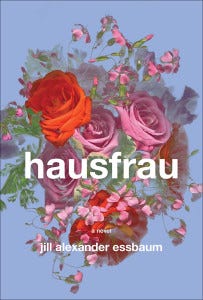
INTERVIEW: Jill Alexander Essbaum, author of Hausfrau

Hausfrau cover

Jill Alexander Essbaum’s debut novel, Hausfrau, chronicles the unraveling of Anna Benz, an American living in Zurich with her husband and three children. Anna chafes at responsibility and expectation. She defies interpretation as a mother. As a stranger in the bleak Swiss landscape, neither motherhood, nor German language classes, nor torrid affairs, nor Jungian analysis by Doktor Messerli make Anna feel whole. Hausfrau is at once erotic and soulful. Essbaum brings her signature attention to detail to Hausfrau. I’m still haunted by it, weeks after I read it.

I’ve known Jill for the better part of three years. She is a poetry professor at the University of California, Riverside’s Palm Desert MFA program. I graduated from the program in 2013, but not before being profoundly affected by Jill’s class and lectures. We caught up recently so I could ask her about Hausfrau.

Heather Scott Partington: I know you’re going to spend a lot of time answering questions about how your poetry influenced this novel. So I’ll just go there first. I couldn’t help but think about how you said that when you wrote Hausfrau, you’d record yourself reading it and then listen to it to make subsequent edits. It didn’t surprise me that it was so delicately worded.

As I tried to look for evidence of your poetic footprint in the book, I was struck by how you manage tension. Quite often Anna will make a statement and then immediately undermine it. There is a connection from one line to the next. And Hausfrau builds to a crescendo near the end. (Of course, with the book’s themes, that could be said to be sexual rise, too — it’s impossible to talk about this book without innuendo, pun, or double entendre.) This book is a treat to read. I really felt a sense of how one part informs another — almost like I was rewarded as your reader for carrying small details with me as I read. Can you talk about how you thought about structure? And is there any kind of transference of poetic timing to prosaic?

Jill Alexander Essbaum: First off, thank you so much — not simply for this interview, but also for this question. The structure of the book is unquestionably informed by my poetry. All those years writing sonnets and triolets and strangely rhymed creatures of my own invention taught me a crucial truth: form matters. And the shape of a thing — ANY thing — will define (inform, circumscribe, underscore) a person’s interaction with it. Consider a hospital. You wouldn’t build a trauma center so that its many wings were laid out in individual buildings scattered over acres of rolling countryside. Why not? Because people would die. That’s an extreme example, but it makes the point. Hausfrau has some resemblance to a (non-specified) formal poem. The three sections might be said to correspond to three stanzas. The equal length of each evokes a specified composition, a quatrain or a tercet perhaps. That each section is marked by a birthday party is reminiscent of a refrain. There’s a sonnet-like turn in the plot two-thirds of the way into the book. The language lessons and the psychoanalysis amplify, correspond to, and maybe even (dare I?) rhyme with the narrative. But I didn’t set out to accomplish this. It came through organically as the story unfolded. Things like this MUST be organic and develop on their own. Otherwise, it simply won’t work.

HSP: On a note related to structure, did the idea of Predestination inform plot? There’s an arguable sense of doom from the beginning — and by mentioning trains and Anna you get us thinking of Karenina (more on her, in a bit). But do you think plot, itself, is predetermined? To what extent are we dealing with a prescribed set of dominoes when it comes to how we structure novels? To what extent was the structure of the book influenced by the idea of free will and Anna’s chafing at the Calvinistic concept?

JAE: I’m going to redirect for a second and talk briefly about religion (since you sort of brought it up). I think this is a deeply religious book. In the final pages Anna rejects most any notion of preordained destiny and makes a very clear-headed (if blunt and terrible and terribly irrevocable) decision. The domino conversation with the priest is the only thing that makes her feel anywhere near better that day. And even earlier, one of the most benevolent moments that occur between Anna and her husband is his admission that yes, he believes in God. He makes a statement along the lines of ‘without God, nothing matters — and Anna, things matter.’ It’s an unexpected confession. Frankly, I didn’t even expect it when I wrote it. The surprise of it makes it truer.

But that isn’t the question you asked. Prescribed dominoes when we structure novels? This is the only novel I’ve structured, though I’ve put together many books of poetry. Really there’s only one rule: does it work? No? Then do it differently. Repeat until it does. Until it works best of all.

Anna’s most profound understanding of herself, her life, her mistakes happens only when she is left with nothing and no one but herself. She’s lost all connection with the rest of the world. Even her phone is gone. Sex stopped saving her. Sex with HERSELF couldn’t even redeem her. Her analyst slammed the last window. All failsafes fail. It’s just Anna and her own true self, the one she sees and recognizes and greets in the mirror that last, regrettable morning.

This is a long way around saying Anna could not have arrived at an active expression of free will if she hadn’t spent three hundred pages being crushed by her choices. While I don’t know that I’d say the structure is influenced so much by these ideas, there’s no doubt that the resolution of the book depends entirely upon it. Exclusively upon it.

HSP: One of my favorite things: Anna is a paradox, and she is also defined by paradoxical logic — the “is and is not” and “was and was not”-s. Her thinking is binary, but contradictory. She seems to have the most clarity when she in darkness (even “little deaths,” sometimes literally having sense forced into her). Do you think poems allow more easily for this kind of exploration of duality? Are poets more inclined to be comfortable with ambiguity than novelists? The idea that you can both be and not be at the same time? The idea that if you define yourself by one set of rules, you’re sure to break them? Are there contradictory ways you define yourself, too?

JAE: Oy. This is the question that hot-seats me, Heather. I don’t have children, I wasn’t married to a Swiss man, and I didn’t have a slew of affairs, but Anna and I have a few things in common. I’ve mentioned some religious struggles and those are more or less my own. Finishing this book preceded an extreme crisis of faith (I’m not convinced the two are related, I’m not convinced they are not). Anna doesn’t claim to be a believer — but I do. Or, I try to. Then there’s this whole issue of solitude. Writing necessitates it. But what about when you aren’t writing? It’s very difficult not to feel very alone sometimes, even when I know I’m not. Anna imposes her own solitude for reasons of self-preservation. As an artist, it comes down to the simple fact that without time spent apart from everyone else, I wouldn’t be able to put this stuff to paper. But Anna’s faithlessness, her loneliness, her passivity, her active fear of action, the losses that come to possess her — they are as much my own as hers. All artists live in a cloud of doubt. They have to. It’s the contradictions that make the art.

Do poems allow for more exploration of these nuances than prose? No. I don’t think so. But I think as a result of my years of writing poetry, these things were more easily accessible to me than perhaps some more rudimentary aspects of fiction craft. Like, when’s the last time you heard a poet gripe about plot or POV? It was those things I had to wrestle harder in order to pin them to a mat. Or, rather, to a page.

HSP: The paradoxes made me very aware of contrast and delineation: particularly the descriptions of characters with the most visual in their looks — Polly Jean and Stephen, for example. I was also hyper-aware of Bruno’s black and white thinking. Anna seems to be permanently stuck in shades of grey. Here’s what I wonder — how do you feel about her? Do you like her? Does it matter if we do?

JAE: I think about Anna every day. I worry about about her even now. I would say I love her but she doesn’t let anyone love her. I want to shake her. I have no problems gossiping about her, venting against her. I don’t know that her likability ever once crossed my mind. I would never say she got what she deserved. But I would say, perhaps this: because of the choices she made and the inevitable results of these actions, Anna’s life unfolded with tragic consequence.

She may not be likeable. She doesn’t need to be. But she desperately needs to be loved. And not in the way that she’s been seeking it. I think I love her. We should love her. And not because she merits it. But because she doesn’t.

HSP: What was the genesis of the Doktor character? Is she meant to be an idea, or a person? In some ways she becomes Anna’s inner monologue — or perhaps the other component of her dialog. I’m curious about how the doktor came to be.

JAE: Well, my husband and I moved to Zurich so he could study psychoanalysis. And I’ve seen the same analyst for years now. Doktor Messerli had to be there. And we had to have an ‘in’ to Anna’s head that wasn’t just a loop of Anna’s yammering thoughts. It’s a combination of Doktor Messerli’s instruction, Bruno’s ultimate Bruno-ness, and what she learns in German class I think that pulses her through that last chapter and into ultimate consciousness. Without Doktor Messerli, she wouldn’t have understood a thing.

HSP: Let’s talk about the dreams. I don’t generally love dreams in novels, but taken with the Jungian analysis and ideas of anima/animus and shadow, I think they provided important insight about Anna. I think part of why Hausfrau feels so universal to me — or perhaps, like a novel from another era — is Jung’s presence in the story, this constant idea of interpretation. Anna is seeking interpretation of herself, not help. It seems like many contemporary novelists don’t want to go there, or to even admit that there could be a formalist interpretation of what they write. So many things I read now seem to challenge the idea of interpretation: they’re just words, story, plot. But Hausfrau seems to inspire it. How comfortable are you with interpretation of your work?

JAE: You know, I’m suspicious of dreams in books too. Because they’re boring and too self-serving. However, I do think these dreams work and the reason I think they work is because they aren’t dream sequences, per se, but they serve as dialogue between Anna and Doktor Messerli. So that may be a reason that you experience them differently than you may otherwise?

I do believe that dreams are interpretable. Analysis and praxis have taught me so.

HSP: What did you want to accomplish with Anna’s dreams?

JAE: I’m not sure that I wanted to accomplish anything, but I think I did accomplish something and it’s this: when she dreams, she tells the truth. It’s a truth told through association, to be sure. But it’s the only time she doesn’t hide behind hems and haws. Without them, the narrative survives easily intact. But with them we have Anna at her most naked. What she deems, she is.

HSP: How do you like to read? What draws you to a novel? I’m sure you’re going to get asked a lot about your writing process, but I’m interested in your reading process. What speaks to you in a book?

JAE: I like to see what happens when words that don’t usually bump up against each other, do. I’m very invested in crisp, precise prose. I like specifics. I read a lot of specialty encyclopedias to get my fill of that. I also like collected letters and literary diaries.

HSP: My favorite chapter, hands-down, is the riff on fire. It’s such an Essbaumian Riff. When did you start riffing? Have you always seen inside the connections of words? I keep trying to think of a label for how you manipulate words (poetry?) — it seems like words function differently for you than they do for other people (or at least, most of us mortals). The closest thing I can liken it to is synesthesia, where the brain crosses wires meant only to go one way. Can you talk about what that process of connecting words is like for you?

I don’t think in a straight line. But maybe no one does?

JAE: I don’t think in a straight line. But maybe no one does? I think several steps ahead as well, and all at once. There’s a riff at the end that jumps from Burn to Berne to Capitol to Capital to Bruno and then runs through Wagner and Nazis and grammar and stars and a bunch of other things until it gets to das Kind, the German word for child. At this point in the novel, this is Anna’s brain on exhaustion. But I wrote it very quickly. I saw it all-of-a-scene and at the same time. I like what you’ve said about crossed wires and synesthesia. Sometimes I feel like I’m having all the feelings of a thing at once so, I have them. I talk too fast. I jump ahead. Its very hard to sit still. Likewise, in writing. I have all the words at once. This is where being able to step back in as a good self-editor comes in very useful.

Words are living, magical things. And I love them.

HSP: Anna feels in some ways like the embodiment of misogynistic stereotypes. I believe at one point she even refers to her own “hysterical grief.” At the same time, she seems to defy stereotypes about motherhood and loving wives, sometimes by not knowing exactly what those things should look or feel like. How did Anna’s story come to you? I know there was a moment when you pulled ver to the side of the road because you finally understood how to tell this story. What did you discover that day?

JAE: I’ve mentioned this to a few people and it’s been met with great disapproval but, I believe it so I’ll offer it here: Bruno, in his own, complicated way, is a good guy. Is the book’s hero. He knows, but he loves and accepts. He lets Anna be Anna. I don’t think he’s dismissive of her feelings — I tend to think he’s shoving everything down so that he can continue to live a married life with her. I mean — how would one live out a life with Anna?

The scene in the kitchen is deeply complex. In the aftermath, she thinks it through (edited for brevity): I had this coming … she wasn’t the textbook example of a battered wife. She hadn’t been victimized into believing she deserved what she got. She decided it all on her own. In a violent, complicated world… it was lucid, quick and generous solution to a problem of have and lack. I had this coming and I got what I deserved. He’d never hit her before and he would never hit her again. He wasn’t a violent man. There was no pattern of abuse. I brought this to myself. Myself, I provoked this.

I wrote that with a great deal of caution and care. Because I needed her to be clear, mindful, and to speak a truth. She’s not a battered woman. She’s not abused. He shouldn’t have slammed her against the wall and she didn’t deserve it. But she kicked an angry dog. To look at Anna through this lens at this moment is troubling and difficult and uncomfortable.

But all of Anna’s story is troubling and uncomfortable. The sex, the lies, the tedious passivity. The revelation I had was that this wasn’t a first-person story. I knew her, I understood her — but I wasn’t her. The epiphany was that Hausfrau isn’t the JAE story. This came with some fundamental complications. Chiefly, I had to reign in my own will. I have my own ideas about how a woman might best survive all her shitty situations. But to impose those notions is to turn the book into some kind of morality tale (it may already be one).

That said, her surroundings, the landscape, the trains she takes, the shops where she buys her groceries, the grammar points she confuses, all the sites and all the sights belonged to me. I was a forlorn expatriate with little to do. I was sad. My marriage ended in Switzerland. Anna’s context is entirely familiar. What’s different between us is how we dealt with our surroundings.

HSP: I won’t ask you if Hausfrau is a retelling of Anna Karenina, but in light of the book’s Jungian themes, I do wonder if you think there are certain types of stories that beg telling over and over. Did you write with that idea in mind? How do you think this work fits into the larger oeuvre of difficult women? Or does it?

JAE: (It’s not.)

Loss is really the one thing we all share, rich and poor and stupid and smart alike.

I think what demands telling and retelling and re-retelling is this: any story in which complicated grief and desperate sadness is the main character. Anna’s the embodiment of loss. Self-inflicted? Much of it, yes. But not all. Loss is really the one thing we all share, rich and poor and stupid and smart alike. We learn compassion by experiencing the loss of others. We learn love by letting other people share in our own stories of loss.

HSP: What did this novel make you wish you’d learned before you started to write it?

JAE: Nothing. If I knew anything beforehand I would have written a different novel. I think it’s important to let each thing you write teach you how to write it. You must listen to what you do. Let it be in control. I don’t step in until I know what it demands of me.

This was an incredibly humbling experience. Empowering? Yes. But humbling. I had to sit still. The work didn’t do itself. I had to up. It demanded my full attention.

HSP: Is there anything you wanted me to ask that I didn’t?

JAE: In my fantasy casting of Hausfrau, the Movie, I always saw Kate Winslet as Anna and Liam Neeson fifteen years ago as Bruno (alternately: Daniel Craig or maybe really any hot man who can pull a mean face). Anna MUST be cast her age (say, how about Jenna Fischer? I’d LOVE to see her try this. It could be her break-out role a la Jennifer Aniston in The Good Girl). Helen Mirren would kill as Doktor Messerli. Ray Winstone isn’t as handsome as Archie, but I like him for the part. Jeremy Renner as Karl. Mary? Hm. I would have loved Marcia Gay Harden also 15 years ago. Stephen, though. Who to play Stephen? It should be someone who’s a bit of a jerk. Not the most handsome man. Judi Dench would make a fine Ursula. Who are good kid actors these days? No clue.

And yes, I named the baby after PJ Harvey. I quoted a song from Uh-Huh Her near the end of the book (it just slid right in!) and I think I listened to White Chalk about a thousand times during my years in Switzerland. Those albums saved my soul.

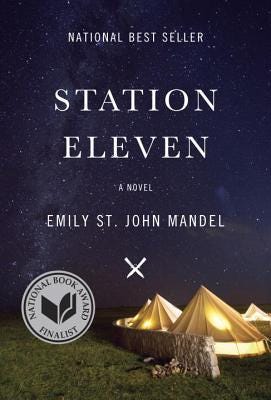
George R. R. Martin Backs Emily St. John Mandel’s Station Eleven for Hugos

Station Eleven book cover

On Monday, I wrote about how the “genre wars” seem to finally be coming to an end. In 2015, it’s increasingly common for so-called “literary” writers to write genre books and so-called “genre” writers to be reviewed and published in literary magazines. Writers and readers are reading across genres like never before, and that’s a great thing!

Perhaps some good evidence of this trend happened this week when A Song of Ice and Fire author George R. R. Martin took to his blog to call Emily St. John Mandel’s Station Eleven the best novel he read in 2014:

One could, I suppose, call it a post-apocolypse novel, and it is that, but all the usual tropes of that subgenre are missing here, and half the book is devoted to flashbacks to before the coming of the virus that wipes out the world, so it’s also a novel of character, and there’s this thread about a comic book and Doctor Eleven and a giant space station and… oh, well, this book should NOT have worked, but it does. It’s a deeply melancholy novel, but beautifully written, and wonderfully elegiac… a book that I will long remember, and return to.

Martin, a titan of the fantasy genre, said he’d vote for Station Eleven for Best Novel in the Hugo Awards, which is one of the most prestigious awards for science fiction and fantasy. Station Eleven was also a finalist the National Book Awards, which is one of the most prestigious awards for literary fiction. The novel is a beautiful and, as Martin says, melancholy take on the post-apocalypse. It follows a band of Shakespearean actors as they move through the ruins of a plague-ravaged North America. It’s the prefect example of a novel that can’t be pegged as purely “literary” or purely “science fiction.” It is both at the same time.

Here’s our reviewer’s take:

Station Eleven is one of the finest novels I’ve read in some time, a book that succeeds sentence to sentence, scene to scene, and as a piece of philosophical art. In spite of its obsession with Shakespeare’s life and work, this book doesn’t set out to court greatness. But with the restrained brilliance of its prose, the humility of its attention to story and dramatic construction, and its unwillingness to give us easy answers it may have achieved that greatness all the same.

I had the pleasure of interviewing Emily St. John Mandel for the National Book Foundation, which you can read here.

Write a 200-Word Essay, Win the New England Inn of Your Dreams

by Elizabeth Vogt

If you’ve always wanted to own an idyllic Maine inn and can churn out a 200-word essay like it’s a lengthy Twitter rant, then entering this contest should be at the top of your to-do list. After twenty-two years, the current owner — and former winner — of the Center Lovell Inn in the “Lake District” of southwest Maine has decided to retire and is opening the contest back up to “fulfill someone else’s dream.”

The rules? Simply pay a $125 entry fee and write 200 words on “why you would like to own and operate a country inn.” The grand prize is the warranty deeds to the Center Lovell Inn and abutting property, but if the contest receives 7,500 entrants, the winner also gets a check for $20,000. The postmark deadline is May 7th, so you have plenty of time to decide if you want to quit your day job and hide away in the mountains for the next few decades.

Midweek Links: Literary Links from Around the Web (March 11th)

Looking for some interesting reading to get you through hump day? Here are some literary links from around the web to check out:

The New Yorker looks at Liu Cixin, “China’s Arthur C. Clarke”

Kazuo Ishiguro responds to Ursula K. Le Guin’s attack, saying, “I’m on the side of the pixies”

Here’s our take on Ishiguro/Le Guin and “the last holdouts of the genre wars”

Questlove (The Roots) reviews a new memoir from Kim Gordon (Sonic Youth)

Here’s a list of wonderfully miserable memoirs to fuel your depressing reading

From Jamaica to Minnesota to Myself: a moving essay from Marlon James

Ever wonder how hard it is to be an ebook bestseller? All it takes is a few thousand dollars

Lastly, the New York Times wonders if you can tell the difference between a computer’s writing and a human’s

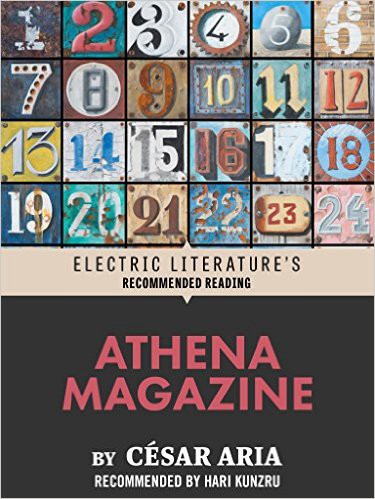
Athena Magazine

by César Aira, recommended by Hari Kunzru

When we were twenty, Arturito and I launched a literary magazine called Athena. With youthful enthusiasm and a fervent sense of mission, we devoted ourselves body and soul to the work of writing, layout, printing and distribution… or at least the diligent planning of those activities, the scheduling and budgeting. We knew nothing about the publishing business. We thought we knew all about literature, but were happy to confess our almost total ignorance of the concrete mechanisms that convey literature to its readers. We’d never set foot in a printing works, and didn’t have the vaguest idea of what had to happen before and after printing. But we asked and we learned. Many people gave us helpful advice, warnings, and guidance. Poets with a long experience of self-publishing, editors with ten short-lived magazines to their credit, booksellers and publishers, they all made time to tell us how it worked. I guess we seemed so young to them, just a pair of kids, so keen to learn and make it happen, they must have been moved by a fatherly concern, or by the hope that our naivety would alchemically transmute their own failures, and bring about the long-delayed triumph of poetry, love, and revolution.

Of course, once we gathered all the necessary information and began to do the sums, we saw that it wouldn’t be so easy. The obstacle was economic. The rest we could manage, one way or another; we didn’t lack self-confidence. But we had to have the money. And no one was going to give it to us just like that, as we realized when our first timid appeals came up against an impenetrable barrier. In those days, there weren’t any funding bodies that you could apply to for publishing grants. Luckily, our families were well off and generous (up to a point). We had another advantage too: intrepid youth, without burdens or responsibilities, taking no thought for the far-off tomorrow. We were prepared to stake everything we had, without hesitation; that’s what we were doing all the time, in fact, because we were living from day to day.

We managed to scrape up enough money to pay for the first issue. Or we anticipated that we would have the sum when the moment came to pick up the copies from the printer. Reassured on that account, we set about gathering, organizing and evaluating the material. Since our ideas and tastes coincided, there were no arguments. We let our imaginations run wild, invented new provocations, discovered new authors, laid claim to the forgotten, translated our favorite poets, composed our manifestos.

But although we were deeply absorbed in the intellectual aspect of the enterprise, we didn’t forget about the money. Not for a moment. We couldn’t have, because everything depended on it, not just the existence of the magazine, but also its physical appearance, the number of pages, the illustrations we could include (in those days, anything other than type required the use of costly metal plates); especially the number of pages, which was essential for any calculation. At the printing works they’d given us a provisional “cost schedule” for various page sizes and numbers of pages, in different combinations. The quality of the paper, it turned out, made very little difference. There could be 32 pages, or 64, or… The printers worked with numbers of “sheets,” which was something we never fully understood. Mercifully, they simplified the choices for us. We took it on ourselves to complicate them.

We thought long and hard about the frequency of publication: monthly, biannual, triannual? Had it been simply up to us, dependent only on our zeal, we would have made it fortnightly or weekly… There was no shortage of material or enthusiasm on our part. But it all depended on the money. In the end we adopted the view of Sigfrido Radaelli, one of our obliging advisors: literary magazines came out when they could. Everyone accepted that; it was the way things were. When we accepted it ourselves, we realized that irregularity would not oblige us to give up our idea of selling subscriptions. All we had to do was change the formula from a period of time (“yearly subscription”) to a number of issues (“subscription for six issues”).

Recounting all these details now, they seem absurdly puerile, but they were part of a learning process, and maybe a new generation is repeating those lessons today, mutatis mutandis, as the love of poetry and knowledge is eternally reborn. The prospect of having subscribers and, more generally speaking, the desire to do a good job led us into an area of greater complexity. The general perspective was important: we felt that whether or not our readers were subscribers they were entitled to a product that would continue over time. The subscribers would be more entitled, of course, because they would have paid in advance. Continuity mattered to us too. We were depressed by the mere thought that our magazine might decline or dwindle with successive issues. But we had no way to insure against it. In fact there was no guarantee that we’d even be able to get enough money to print a second issue. With admirable realism, we left sales out of our calculations. Even more realistically, we anticipated a diminution of the energy that we’d be able to devote to bothering our families and friends for money… Basically, the question was: Would we be able to bring out a second issue of Athena? And a third? And all the following issues, so as to build up a history? The answer was affirmative. If we could get the first issue out, we could get the others out as well.

I don’t know if we hypnotized each other, or were led to believe what we wanted to believe by our fervent commitment to literature, but we ended up convincing ourselves. Once we were sure our venture would continue, we felt we could indulge in some fine-tuning. Our guiding principle was a kind of symmetry. All the numbers of the magazine had to be equivalent to the others, in number of pages, amount of material, and “specific gravity.” How could we ensure that? The solution that occurred to us was curious in the extreme.

We’d noticed that literary magazines often brought out “double issues,” for example, after number 5, they’d bring out 6–7, with twice as many pages. They usually did this when they got behind, which wouldn’t be the case for us, because we’d already opted for irregularity. But it gave us an idea. Why not do it the other way around? That is, begin with a double issue, 1–2, not with double the pages, though, just the 36 we’d already decided on. That way, we’d be covered: if we had to make the second issue slimmer, it could be a single issue: 3. If, on the other hand, we maintained the same level, we’d do another double issue, 3–4, and we’d be able to go on like that as long as the magazine prospered, with the reassuring possibility of reducing the number of pages at any time, without losing face.

It must have occurred to one of us that “double” was not an upper limit; it could be “triple” too (1–2–3), “quadruple” (1–2–3–4), or any other multiple we liked. There were known cases of triple issues: rare, admittedly, but they existed. We hadn’t heard of anything beyond triple. But there was no reason for us to be deterred by a lack of precedents. The whole aim of our project was, on the contrary, to innovate radically, in the spirit of the times, producing the unusual and unheard-of. There were practical reasons, too, why the double-issue solution didn’t merit our immediate adhesion. From a strictly logical point of view, if we had to cut back, who was to say that we would have to cut back by exactly half? It would have been very strange if we did. Our publishing capacity could have been reduced by lack of funds, inflation, fatigue or any number of accidents, all unforeseeable in their magnitude as well as their occurrence, so we might well have had to cut back to less than half… or more. That’s why starting with a triple issue (1–2–3) gave us more flexibility: we could cut back by a third, or by two thirds, so the second issue could be double (4–5) or single (4). But if, as we hoped, we managed to sustain the momentum, the second issue would be triple again (4–5–6). There was something about this speculation, so lucid and irrefutable (given the premises), that excited us and carried us away, as much as the rushes of literary creation itself, or even more.

We wanted to do a good job. We weren’t as crazy as it might seem. After all, editing a literary magazine, the way we were doing it, is a gratuitous activity, rather like art with its unpredictable flights of inspiration, or play, and for us it served as a bridge between future and the childhood we’d just left behind. Though we hadn’t left it behind entirely, to judge from our abstract perfectionism, so typical of children’s games. To give you an idea…

The triple issue ruled out the possibility of cutting back by exactly half. That possibility, with its strict symmetry, was, we had already decided, very unlikely to correspond to reality, but we were sad to be deprived of it, even so. Especially since there was no reason to deprive ourselves of anything: all we had to do was start with a Quadruple Issue (1–2–3–4), that way we’d still have the possibility of cutting back by half (the following issue would be double: 5–6), or if our means were not so far reduced, we could cut back by just a quarter (and follow the inaugural quadruple issue with a triple: 5–6–7), or if our laziness or lack of foresight or circumstances beyond our control obliged us to do some serious belt-tightening, the second issue would be a single: 5. If, however, providence was kind, we would bring out another normal, that is, quadruple issue: 5–6–7–8.

It’s not that we thought, even for a moment, of producing a first issue three or four times thicker than the one we had at first envisaged. Those initial plans remained intact, and they were very reasonable and modest. We never thought of making it any bigger; our first issue, as we had designed it, with its 36 pages, seemed perfect to us. The texts were almost ready, neatly typed out; there were just a few unresolved questions concerning the order (should the poems and the essays be grouped separately or should they alternate?), and whether or not to include a particular short story, whether to add or remove a poem… Trifling problems, which would resolve themselves, we were sure. If not, it wouldn’t matter much: we wanted Athena to have a slightly untidy, spontaneous feel, like an underground magazine. And since there was no one breathing down our necks, we took our time and went on calculating for the future.

All this was notional, which gave us free rein to speculate boldly. It was like discovering an unsuspected freedom. Maybe that’s what freedom always is: a discovery, or an invention. What, indeed, was to stop us from going beyond the Quadruple Issue to make it Quintuple, or Sextuple… ? Beyond that we didn’t know the words (if they existed), but that in itself was proof that we were entering territory untouched by literature, which was the ultimate aim of our project. We were embarking on the great avant-garde adventure.

If we presented the first issue of Athena as a “decuple” issue, that is, numbers 1–2–3–4–5–6–7–8–9–10, we would, at one stroke, secure a marvelous flexibility with regard to the size of future issues. We’d be covered against all contingencies, able to cut back in accordance with our straitened circumstances, without having to resign ourselves to gross approximations. If the cost of the first issue was a thousand pesos (an imaginary sum, solely for the purposes of the demonstration), and it was a Decuple Issue, and if we ran short for the second and could only muster 700 pesos, we’d make it a “septuple issue” (11–12–13–14–15–16–17). If 500 pesos was all we could get, it would be a quintuple issue (11–12–13–14–15); but if we raised a thousand pesos again, it would be another decuple (11–12–13–14–15–16–17–18–19–20). And if our utter idleness prevented us from collecting more than 100 pesos, we’d make the next issue a single: no. 11. The “single” issue, containing a single number, would be as low as we could go. Whatever the first issue was would be “normal.”
We found these fantasies exhilarating, as I said, and it’s true. Even today, so many years later, writing these pages, I can still feel some of that exhilaration, and I still understand it as we did back then: this was the world turned upside down, and we were venturing into it with the exuberance that the young bring to everything that happens in their lives. Wasn’t that the definition of literature: the world turned upside down? At least, of literature as we imagined it and wanted it to be: avant-garde, utopian, revolutionary. We delighted in the idea of swimming against the current: dreams are usually dreams of grandeur, but ours were of smallness, and they were dreams of a new kind: dreams of precision and calculation, poetry adopting the unprecedented format of real equations. We thought of our project as the first literary version of Picabia’s mechanical paintings, which we adored.

We continued on this route, spurring ourselves on. Why should we be limited by the number ten? There was, perhaps, a practical, concrete reason. It determined a minimum number of pages if we had to economize drastically: three. A magazine less than three pages long (the length it would have if, at some point, compelling economic considerations forced us to bring out a single issue) would not be a magazine. A practical, concrete limit wasn’t going to hold us back, but we complied with it provisionally, and put it to the test. We found two holes in the reasoning that I have set out schematically here. First, there could be a magazine of less than three pages. It could consist of a single page. And more importantly, a tenth of our Decuple Issue wouldn’t be three pages, but 3.6, since the inaugural (decuple) issue of Athena would conform to the printers’ standard format that we had adopted as our norm: thirty-six pages.

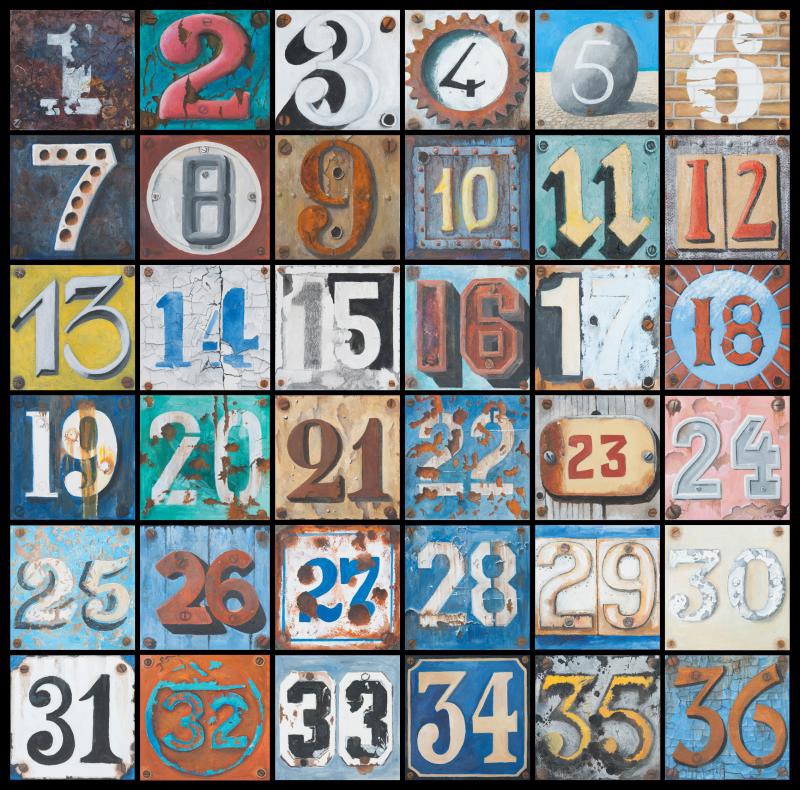
So, predictably, we began to consider a first issue that would be thirty-six-fold, so to speak. An issue made up of numbers 1–2–3–4–5–6–7–8–9–10–11–12–13–14–15–16–17–18–19–20–21–22–23–24–25–26–27–28–29–30–31–32–33–34–35–36. That would allow for an almost total flexibility. Why hadn’t we thought of it before? Why had we wasted our time with “triples” and “quadruples” and “decuples” when there was such an obvious solution right under our noses? The printer’s “sheet” should have shown us the way right from the start, from the moment we discovered its existence, the famous “sheet” that was unfolding now before our eyes, like a rose in time.

The problem was how to fit those numbers on the cover. Would there be enough room for them all, and the hyphens, between the title and the date? Wouldn’t it be a bit ridiculous? There was the option of replacing them with an austere “Nos. 1–36,” but for some reason we found that unsatisfactory. Defiantly, we decided to go the opposite way: filling the cover with numbers, big ones, in nine rows of four. Without any explanation, of course: we’d never have dreamed of explaining our contingency plan to the readers.

This confronted us with a serious objection: whether or not we provided explanations, people would look for them anyway — that’s just how the human mind is made. And a thirty-six-fold issue would suggest an obvious explanation, which everyone would find convincing: that the numbers on the cover had something to do with the number of pages. As they did, in fact, but not in what would seem to be the obvious way. This connection completely spoiled the fun of the idea, which we abandoned immediately. At that point I think we felt that we’d never really been satisfied with thirty-six.

Freeing ourselves of that bad idea freed us completely. We leaped to really big numbers, first a thousand, then ten thousand, which had a special prestige because of its Chinese associations. China, with the Cultural Revolution in full swing, was much in vogue at the time.

Any more moderate number would have seemed insufficient. Ten thousand. But no more than ten thousand. We could have gone wild and continued up into the millions, or the billions; but we were engaged in a very concrete and practical task — producing a magazine — not in wild speculation. We weren’t intending to abandon realism, though a mediocre, storekeeper’s realism had never been a part of our intellectual outlook. Ten thousand guaranteed total originality, without tipping over into unworkable folly. We made sure of this with pencil and paper, setting it all out in black and white.

Making an issue composed of ten thousand numbers meant that the “single” issue would be 0.0036 of a page. We weren’t math wizards. We had to do the calculations step by step, visualizing it all. This made the process infinitely more interesting; it became an adventure among strange and novel images. How did we arrive at 0.0036? Like this: if we reduced the magazine by a factor of ten, it would have 3.6 pages; if we reduced it by a factor of 100, it would have 0.36 pages, that is, a bit more than a third of a page or three tenths of a page; if the factor was a thousand, the magazine would be 0.036 pages long, that is, a bit more than three hundredths of a page; and if we increased the factor to ten thousand, thus reducing the magazine to a “single” issue, that issue would consist of 0.0036 of a page, in other words a little more than three and a half thousandths of page. We had to visualize this too, to get a clear idea of what it meant. Referring to the budget prepared for us by the printers, we saw that the page size we had chosen for the first issue, in accordance with our means, was 8 by 6 inches. So the area of each page would be 48 square inches. Divided by 10,000, that gave 0.0048 square inches, which had to be multiplied by 3.6 (that is, by the number of ten thousandths produced by the previous calculation). The result was 0.01728 square inches… Should we round up? No, exactitude was the key, or one of the keys, to the enchantment that transported us. And unless we were mistaken (we covered a lot of paper with our calculations), 0.01728 square inches was the area of a rectangle 0.1516 inches high and 0.1140 inches wide. That wasn’t so easy to visualize. It was futile trying to use the imagination as a microscope to see that molecule, that speck suspended in a moment of sunlight (it didn’t seem heavy enough to settle). We had leaped beyond the sensory and the intuitive, into the realm of pure science, and yet — this was the supreme paradox — it was there that we found the true, the real Athena, in the form of a “single” issue, springing from our heads just as the goddess whose name we had borrowed had sprung from the head of her father.

Game of Totes: Canvas Is Coming

Oh, my sweet summer child, what do you know of totes? Totes that stack a hundred high in your tiny Brooklyn apartment, totes in every color for every feeling, totes that hold other totes inside themselves.

But do you wonder if there is one literary tote bag to rule them all?

This April, Electric Literature and Vol. 1 Brooklyn will unite to answer that question, putting to rest the question that book fans have been wondering for ages: who makes the greatest tote bag of them all?

Who should sit atop the canvas throne in the greatest battle between unfastened bags with parallel handles? Who will win the Game of Totes? We want your advice! We’re looking for submissions by Monday, March 30th. What we need is a picture of the literary tote and your reasons why you think it is the best tote bag on the planet. On April 6th, we will unveil the entrants to the tournament, and ask you, the reader, to vote on which 12 will make it to the next round, to be judged by a panel of experts. Finally, on April 20th at Housing Works in the island fortress of Manhattan we will host the final round of the Game of Totes to find out whose bag can hold the most books, stand up to the worst public transportation condition, and hold the most kittens. Well maybe we won’t do the kitten thing, but there will probably be pictures of cats and/or direwolves in tote bags!

Send nominations to jason [at] vol1brooklyn.com.

MARCH MIX by Laura van den Berg

STUCK

The title of this mix tape is “stuck” because these are songs I listened to when I was stuck on Find Me — I worked on the book on-and-off for about six years, so this stuck-ness happened a lot, which accounts for why there were so many years. Sometimes leaving the book alone for a while was the best thing, to give myself space for my understanding of the book to evolve and shift, but at other points just showing up on the regular and looking at the thing was what I needed to do and during those times, music made continuing on seem a lot more possible somehow.

I’m actually not going to say much about the individual songs because — as weird as this may sound — I don’t actually have a lot to say about them. I can’t really express what makes something a good writing song for me: I need a certain amount of energy and a certain kind of beat, something that makes me feel more present and, at the same time, something that I can disappear into. I like stuff that has a kind of hypnotic quality. I listen to a song for as long as I like listening to it. I don’t sweat finding new stuff too much. At this point, I feel the same way about bands as I do about friends: I have my people, but if someone introduces me to someone really cool, well then all right.

  1. “Bone Machine,” The Pixies.
  2. “An Apology,” Future Islands.
  3. “How it Ends,” DeVotchKa.
  4. “Knife,” Grizzly Bear.
  5. “In Motion,” Trent Reznor.
  6. “Old Strange,” Steve Gun.
  7. “Bixby Canyon Bridge,” Death Cab for Cutie.
  8. “No Fit State,” Hot Chip.
  9. “Don’t You Forget About Me,” Simple Minds.
  10. “Let Me Clear My Throat,” DJ Cool.
  11. “Love Will Tear Us Apart,” Joy Division.

***

— Laura van den Berg is the author of the short story collections What the World Will Look Like When All the Water Leaves Us, a Barnes & Noble “Discover Great New Writers” selection, and The Isle of Youth, which won the Rosenthal Family Foundation Award from the American Academy of Arts & Letters and The Bard Fiction Prize. Find Me, Laura’s first novel, was published by FSG in February.

VIDEO: A Library Tank that Gives Out Free Books

While most tanks ruin lives, Argentinian artist Raul Lemesoff has built one to encourage reading. Lemesoff’s “Weapon of Mass Instruction” sculpture to “attack people in a very nice and fun way.” The “tank” is built on a 1979 Ford Falcon. The following video, produced by 7-UP, shows the mobile library in action.

7UP celebrates #FeelsGoodToBeYou campaign with raul lemesoff’s ‘weapons of mass instruction’ from designboom on Vimeo.

The Last Holdouts of the Genre Wars: on Kazuo Ishiguro, Ursula K. Le Guin, and the Misuse of Labels

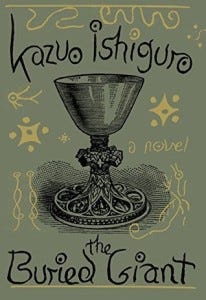
The Buried Giant

If you’re like me and grew up reading Raymond Carver alongside Raymond Chandler and Marvel comics alongside Flannery O’Connor, you know it is a great time for fiction. In 2015, the walls between genre fiction and literary fiction are mostly in ruins. The New Yorker devotes issues to science fiction and crime, the Library of America collects work by H. P. Lovecraft and Kurt Vonnegut, the National Book Foundation awards medals to Stephen King and Ursula K. Le Guin, and MFA and Clarion grads debate George R. R. Martin and Junot Diaz alike. If you are a teenager now, the concept of the genre wars could feel as anachronistic as cassette tapes and landlines.

Except, somehow skirmishes in the genre wars keep flaring up. Even today there remain holdouts, fighting Hatifled-and-McCoy-battles on blogs and twitter over ancient insults. The most recent argument occurred last week over Kazuo Ishiguro’s latest novel, The Buried Giant. In a New York Times interview, Ishiguro wondered if readers would understand what he was trying to do: “Will they be prejudiced against the surface elements? Are they going to say this is fantasy?” Ursula K. Le Guin, among others, took great umbrage, arguing that not only was the book fantasy, it was failed fantasy: “It was like watching a man falling from a high wire while he shouts to the audience, ‘Are they going say I’m a tight-rope walker?’”

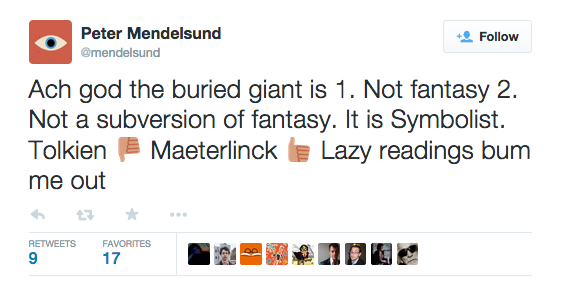
At Salon, Laura Miller wrote about how the book is not fantasy but rather a meshing of modern realism with medieval romance. At Flavorwire, Jonathan Sturgeon agreed: “…The Buried Giant is not a genre work: its inspiration predates fantasy literature. It would be inane, even absurd, to retroactively apply the fantasy label to Homer’s Odyssey because it has monsters.” On Twitter, Peter Mendelsund, who designed the jacket, had yet another label to apply:

twitter Ishiguro

Finally, Ishiguro came out to say that he hadn’t meant to insult fantasy: “If there is some sort of battle line being drawn for and against ogres and pixies appearing in books, I am on the side of ogres and pixies.”

As is typical in the genre wars, everyone seems to be talking past each other. The idea that Ishiguro “despises” genre — as Le Guin suggests — seems suspect. In the same interview that sparked the controversy, Ishiguro said that the atmosphere of The Buried Giant was inspired by western and samurai movies; he doesn’t seem concerned if his work is construed as genre. He does seem worried, however, that readers of his previous novels might come to The Buried Giant with the wrong expectations. All writers worry about how their books will be received, and Ishiguro had a similar problem with the science fiction-tinged Never Let Me Go being attacked by some for not being SF enough and by others for being too SF.

I don’t think genre labels are meaningless. Indeed, genres can be vital traditions for writers to work in and draw inspiration from. Genre distinctions are real — genre mash-ups wouldn’t exist without readers being able to distinguish between the genres being mashed — but genre, like so many labels, is better understood as a spectrum than separate boxes. Some works are clearly operating in a specific genre tradition, while others mix different traditions, and yet others simply play with a few elements while doing their own thing.

Part of the problem is that both the genre and literary worlds have incoherent and contradictory definitions of the words “genre” and “literary.” This often leads to a pointless game of appropriation, where literary critics and readers say that the best genre writers have “transcended genre” and should count as literary fiction, while, at the same time, genre fans declare that famous literary writers belong to genres they never considered themselves a part of. Raymond Chandler is “really” literary fiction while Italo Calvino is “actually” fantasy. (The most absurd proprietary claim I’ve ever encountered was a SF fan arguing that Philip Roth’s The Plot Against America — an otherwise realist novel that imagines what would have happened if FDR had lost the 1940 election — was by definition science fiction because all alternative history books are posited on a theory of multiple realities resulting, for some reason I can’t remember, from teleporting wormholes.)

The problem with this appropriation game is that it eschews any understanding of history, tradition, influence, or context in favor of “winning.” It turns criticism into politics instead of a means to better understand and appreciate books.

This is where I think Le Guin — who is one my favorite fiction writers — falters. She simultaneously defines Ishiguro’s work as fantasy, and then claims that it doesn’t work as real fantasy. Well, then maybe Ishiguro was correct all along in saying the label didn’t fit. If Ishiguro tells us his influences were westerns, samurai films, and 14th-century chivalric poems, what does it matter if the result can or can’t be labeled fantasy? Do the labels “fantasy” or “realism” advance an understanding of what he is doing?

Le Guin is right about the literary world having a tradition of genre snobbery. She talked about some of that history here at Electric Literature with Michael Cunningham. There was absolutely a time when genre work was walled-off from the so-called “literary” world, with literary critics and magazines thumbing their noses at certain genres (fantasy, horror, romance) while absorbing others into the canon (Victorian gothic, magical realism, southern gothic). Indeed, even a decade ago — when I began submitting fiction — it was common for literary magazines to openly state they weren’t open to genre fiction and for creative writing classes to disallow vampires and aliens. There are still a few stubborn holdouts, but they are a dwindling group.

But if the genre world has been marginalized, they’ve also walled themselves off. It is just as common to see genre fans call literary fiction “mundane fiction” and scoff at the “lack of imagination” of literary writers as it is to see literary fiction fans assume that all genre fiction is formulaic and poorly-written. Jonathan Lethem had a great essay about the fact that while the literary fiction world erred by not recognizing the likes of Delany, Dick, and Le Guin, the SF world made an equal error in ignoring the likes of Thomas Pynchon, Angela Carter, and Don DeLillo. The ignorance has been mutual.

Fortunately, “has” is the key word here. These battle lines and distinctions feel increasingly anachronistic. Nowadays, Karen Russell writes about werewolves and Colson Whitehead writes about zombies while NYRB reviews A Song of Ice and Fire. Yes, it is harder to win a Hugo if you are thought of as “literary” and harder to win a Pulitzer if you are thought of as “genre,” but we really do live in a time of genre-bending and omnivorous reading. Writers feel increasingly comfortable to write in any genre they desire, as well they should.

REVIEW: Turtleface and Beyond by Arthur Bradford

by Alexander Norcia

My grandfather’s late sister, Esther, fell within the loose category of people who are often credited with creating a “scene.” She claimed TGI Fridays hoarded the best ketchup in the world, and she once got in a major dispute with management when someone caught her exiting with three bottles of the good stuff smuggled in her purse. When I was in middle school, she backed her 2005 Volvo V70 station wagon out of her driveway, across a two-lane street, and straight into her neighbor’s living room. Before there were cellphones, Esther called my house almost every night to complain about something mundane, and when her name appeared on the caller ID, we all argued about who would answer it. A few years before Esther died, she did ring us up, however, with some actual of sad news: Somebody had run over her mutt, Hennessey, and the culprit had driven away without so much as providing a note. Of course, we were distressed to hear about Hennessey’s death, not only because we quite liked the dog but also we had learned, only hours earlier, that my grandfather had been the one behind the wheel. He phoned my mother, as he did several other immediate relatives, in a frantic plea for rationalization: He hit Hennessey once, and seeing him suffer, he had decided to end his misery by hitting him a second time. For him, upsetting his sister with his direct involvement wasn’t an option. This incident became something of a family secret, and naturally, everyone knew except for Esther. While the manslaughter of a beloved pet soon developed into a crude anecdote, it also came to occupy an uncomfortable space, over time, that made us laugh, made us smile at the bizarre moral issue my grandfather had to face. We felt as sorry for him just as much as we did for Esther, and as we were implicitly involved in the ridiculous drama, we had no right to criticize him.

An onlooker in the title story of Arthur Bradford’s second collection, Turtleface and Beyond, is left with a similar predicament. After he witnesses his friend, Otto, sprint down the face of a steep cliff, dive into a river, and smash his face on the shell of a turtle, he must choose what to do with the harmed creature (all the while his pseudo-daredevil pal remains unconscious): Should he abandon it? Should he, at another’s suggestions, let it die and then stir it into a soup? Should he duct tape the crack and bring the animal back home, nursing and praying for its survival, hiding it from the probable disapproval of his knocked-out buddy?

He makes, as do many of Turtleface and Beyond’s characters, a harried and seemingly well-intentioned decision, and Bradford, as we all learned to do with my grandfather’s confession, never passes any judgment. Instead, Bradford challenges the reader into becoming a smiling bystander, forgoing condemnation, and while his work is surreal yet understated in its strangeness (blurbing respectively for his first collection, Dogwalker, Zadie Smith labeled it “the mutt’s nuts,” and David Foster Wallace as “a book that’s like being able to have lunch with the part of you that dreams at night”), it’s most to his credit that he maintains the surrealism and strangeness without ever being disparaging. With Bradford’s hilarious and whimsical prose, it feels as if I’m reading a string of family-esque secrets, the silly actions of good people and poor choices that, barring being a character in, say, a Victorian romance, you can hold with your closest relatives without much consequence.

How else can I explain my amusement in finishing “The LSD and the Baby,” a narrative that chronicles, as the title suggests, a group of drug-users and a baby (who may or may not have consumed poisonous berries in the woods)? How else can I qualify my utter glee after reading “Resort Tik Tok,” a tragedy of a young author who travels to Thailand to write but becomes much too busy fantasizing about having sex with the resort owner’s wife? Bradford’s absence of judgment prevails, as it does throughout his work, when his characters are confronted with an ethical dilemma, often brought on by animals: In one case, William, a hermit in Vermont, misses when shooting a porcupine and worries “the creature [is] out for revenge”; in another, Willis, suffering from a snakebite, convinces a group en route to a wedding (well, at least one person in a group en route to a wedding) to bring him along to see if any of the guests might be doctors.

The narrator, Georgie, acts as a tonal link throughout the stories in Turtleface and Beyond. Georgie is a man that can be best expressed as being exceptionally unexceptional. He exists, much like Sam Lipsyte’s loser-laced “Gary,” the recurring, peripheral character who stands, at most times, as the protagonist’s best friend in Homeland, among others. Gary is a slightly more extreme version of the narrator, a reminder of what he could become with perhaps one more poor decision (for instance, Lewis “Teabag” Miner writes in his alumni newsletter that “Gary is a guy you might remember… though judging from back editions of Catamount Notes, most don’t”). Georgie moves throughout the book in a similar way to Gary — for him, nothing ever ends neatly, or nothing is ever fully resolved — and he seems to float from place-to-place, popping in-and-out, without much overarching change or emotional consequence. Georgie remains relatively the same, and no story of his, in any great effect, has a bearing on the others.

In “Travels with Paul,” Georgie hitches a ride to the West Coast with the cousin of a former lover. He flees to Pittsburgh after they commit an act of unintended arson in the home of a woman whom Paul insists is an old friend. We’re not sure whether or not Georgie makes it across the country (he probably doesn’t) and most, if not all, of the stories end similarly, peaking with a degree of uncertainty. In “Wendy, Mort, and I,” Georgie shouts up the stairs to his ex-girlfriend, though it isn’t certain she even hears him.

The collection is, in other words, episodic, and with the exception of Georgie’s voice, not much else carries throughout the whole, other than the most ridiculous of details. In “Lost Limbs,” for example, Georgie loses the lower-half of his leg after sticking it into an operating wood chipper (“Who would’ve guessed my day would be turning out like this?”). In “The Box,” which has nothing to do with his being an amputee and all to do with destroying a mysterious structure in his backyard, Georgie comments, “Earlier that year I’d lost my foot in a wood-chipper accident.” Chronologically, it’s logical (“The Box” comes after “Lost Limbs”), but the missing leg functions as a comical nod to consistency rather than an allusion loaded with meaning. It’s slightly cartoonish, and I was reminded, often, of the unacknowledged death-and-rebirth of South Park’s Kenny. Perhaps I did so because Bradford directed the Emmy-nominated documentary 6 Days to Air, an inside look at the organized chaos of putting together an entire South Park episode in a less than a week, but it could also be because he has, like his friends Trey Parker and Matt Stone, created an absurd and satiric world all his own.

Bradford’s professional life centers on the disabled; he is the co-director of Portland’s Camp Jabberwocky, a residential camp for men and women with disabilities. He created How’s Your News?, a former television series and feature film that focused on a group of reporters with developmental disabilities. It’s evident that much of his background shows on the page. As in Dogwalker, many of the characters of Turtleface and Beyond suffer from some sort of handicap or unfortunate deformity. In addition to the frequent appearance of animals, the grappling with disabilities is the most blatant element of Bradford’s fiction. In “Orderly,” Georgie feels guilty about flirting — and starting an affair — with a woman in the psych ward where he works. In “217-Pound Dog,” Georgie tries to help an unraveling lawyer with his splintering marriage, all the while dealing with the attorney’s erratic behavior and his abnormally large Newfoundland and Irish wolfhound mix, Boots. While much of Bradford’s success does arise from his sincere ability to avoid criticism of his characters, there’s also an odd sweetness to his words. However misguided, there’s something particularly humane about Georgie trying to rehabilitate a turtle in children’s wading pool in his apartment. There’s something clearly moving about him struggling to break his dog out of the kennel.

Bradford has, in short, taken immense care in constructing his universe, and he also appears, as Georgie and his friends in “Turtleface,” to be the member of “a group of people in no particular hurry.” In Farrar, Straus, and Giroux’s “Work in Progress blog,” Bradford addresses “what, exactly,” he has “been doing for the past fourteen years.” It’s a question he has been “anticipating.” and it’s probably not an unfair one. Dogwalker was released to acclaim in 2001, and his only other major publication since was Benny’s Brigade (2012), a children’s book. Yet despite the gap of more than a decade, Turtleface and Beyond arrives as if it’s a seamless extension of its predecessor, as if it’s a mere continuation than a grand aesthetic advancement. In lieu of “Catface,” a character of Dogwalker’s opening story whose flat face resembles that of a cat, we now have “Turtleface.” But none of this is to say that Bradford has floundered.

He has, instead, simply given us more secrets and, as is often the case, a reason to want more.

[Editor’s note: read Arthur Bradford’s “The Box” in Electric Literature’s Recommended Reading.]

Turtleface and Beyond: Stories

by Arthur Bradford

Powells.com