The Power of Culture: an interview with Marie Mutsuki Mockett, author of Where the Dead Pause, and…

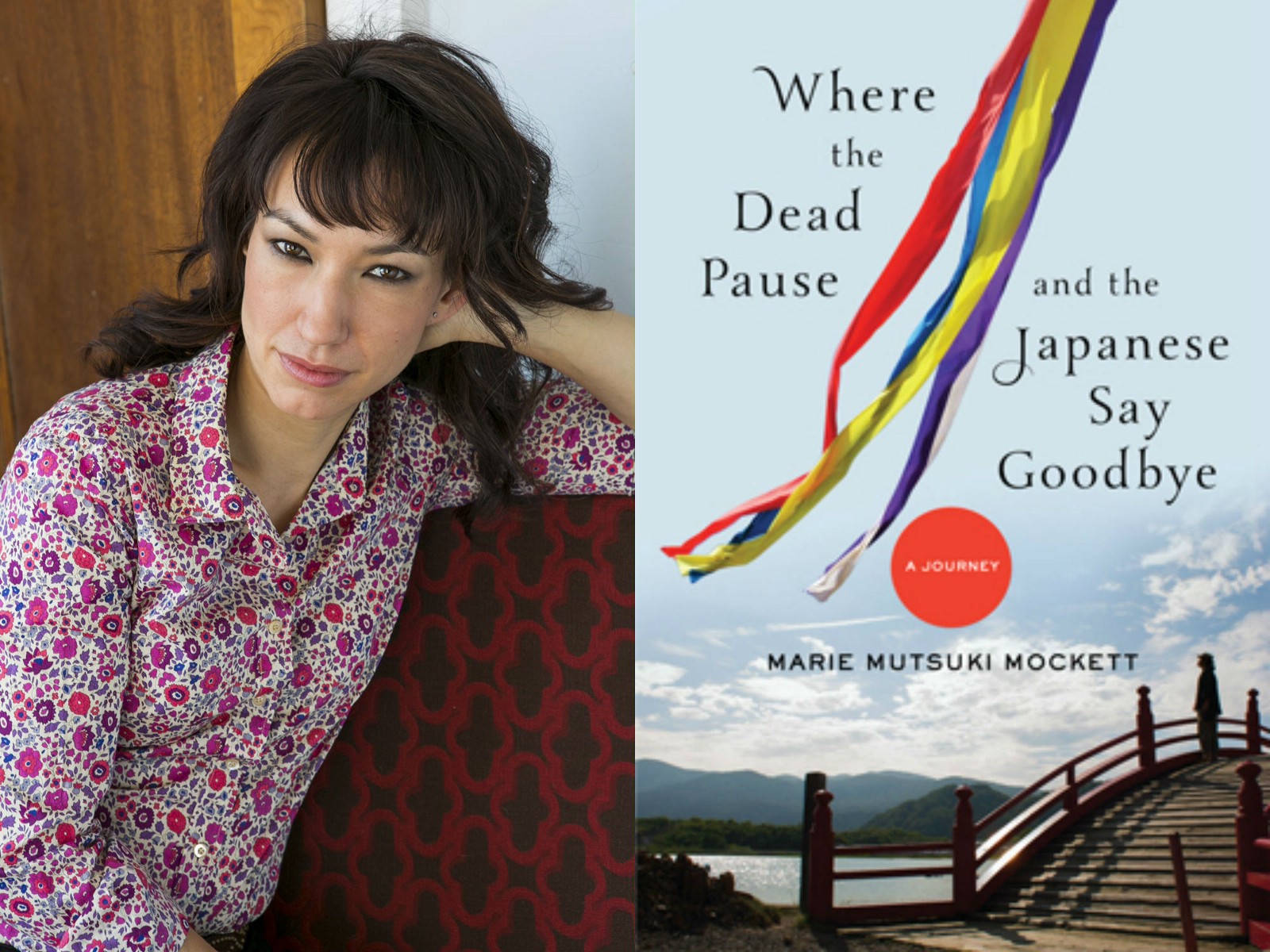
Marie Mockett was born and raised in California to a Japanese mother and an American father. Her first novel, Picking Bones From Ash (2011), incorporated many of the themes — Japanese fairy tales, ghosts, Japan’s Mount Doom — she would later revisit in her memoir of grief and mourning, Where the Dead Pause and the Japanese Say Goodbye (2015). Mockett’s family owns and runs a Zen Buddhist temple 25 miles from the Fukushima Daiichi nuclear power plant, the site of the nuclear meltdown that occurred in the wake of the 2011 Tohoku earthquake and tsunami, which left more than 15,000 people dead. With so much grief and mourning experienced at once, some of the survivors began to see ghosts, and others exhibited signs of spirit possession. In her new book, Mockett writes about the Buddhist exorcisms that priests performed to release these survivors from their grief, and she recounts her visit to a female shaman in the hopes of relief from her own sadness following the death of her father.

Grief after a loved one’s death is universal, but the traditions of mourning vary by culture. Like Mockett, I grew up observing the Taiwanese version of Obon — the month long Ghost Festival, where we make offerings to our ancestor’s spirits — without quite understanding its cultural context. When I was twelve my paternal Irish American grandfather was dying of cancer, and while I stood in the kitchen washing dishes my Taiwanese mother saw the white ribbon in my hair and commanded me to take it off. I protested — my paternal grandmother had given it to me, and I thought it looked pretty. My mother became agitated and explained that white was the color of mourning in “our” (Chinese) culture and wearing the ribbon in my hair was bad luck. Having been raised in New York City, where Judeo-Christian culture dominates, this was the first time I understood that death is a culture that we learn. Mockett’s book helped me understand what is universal about death, and gave context to what isn’t.

After seeing Mockett read at the Asian-American Writers’ Workshop, I wrote to her with some questions. We ended up discussing cultures of mourning, how jazz guided her narrative structure, female shamans, and her hopes for what this book might achieve, for herself and for others.

Kavanagh: Your book is about grief and mourning centered around Japanese culture, particularly Buddhism. From you research and your experiences, what are some differences between how Americans and Japanese process grieving?

Mockett: The Medieval Europeans called Death “the great equalizer” — he’ll come and get you whether you are a prince or a pauper. He will also show up if you are Japanese or American. And death — and the grief those left behind experience — is universally terrible.

But our responses to grief do vary depending on our culture. This, to me, is one of the beautiful things about human beings — that generations have spent time trying to figure out how to ameliorate the awful pain of suffering. It’s like in the Fairy Tale of Sleeping Beauty; there is the terrible curse, but then the Lilac Fairy comes along and tries to make things a little bit better. The compassion humans can have for each other functions like this too.

In Japan, there are so many customs — some local and some country wide — that encourage us to remember the dead just after they have left us and then for generations after. We think of them as watching over us. As a child, I didn’t understand the importance of this belief — it seemed maudlin and overly sentimental. But I do now realize that the most painful thing about losing someone, is that horrible feeling of being forever severed from someone who was part of your essential emotional architecture. The many mourning traditions in Japan are designed to assure us that we don’t completely lose those bonds and that every year, via Obon, we are able to welcome our ancestors home to spend time with us.

Kavanagh: Do you think going through the different rituals of Obon in Japan helped you finally come to terms with your grief after your father’s death, or was it time that ultimately helped you come through?

Mockett: I think it was both.

I think that some wounds are so deep, they do require enormous time to heal. And in my case, I needed a lot of time to understand exactly what hurt so much and why. I’m still in the phase of figuring out how I will live now that I’m out of the worst of the shock. Most of us will only have time to help us with grief — most people will not get to travel to Japan on a stipend funded by the US and Japanese governments. So, I want to stress that time is your best friend when you are suffering — it certainly was mine.

But the repetition of the rituals of Obon — and the many non-Obon related Buddhist rituals I participated in — also helped me to understand that my grief was one story in a sea of stories. I realized I would have to open up my heart further and feel a greater connection to other people, in order for the overwhelming pain to diminish. If I only focused on myself, then the pain would simply overwhelm everything. And that was the great gift of all the Obon rituals — they did really start to help me put my life in context.

Kavanagh: I saw you read at the Asian-American Writers’ Workshop in NYC recently. You said that you have many friends who are jazz musicians, so while thinking of the ordering of your book you saw each chapter as a song in a set list. You also said that you loosely structured your book around the cycle of a soul. Could you explain how that process worked?

Mockett: In the first few drafts of the book, I tried to follow a conventional narrative structure, with myself as the main character. I call this kind of book the “overcoming” book. I tried to write about my “overcoming.” But this did not work particularly well. I really resisted being the main character of the book — that is not a role I have ever wanted to play. And I don’t have that chatty, “I’m your best friend” voice that makes a book like that work for a contemporary audience. It felt forced and the writing showed my great discomfort.

I had been kicking around an idea for a long time — using the life cycle of a soul as the structure for a long work. At one point, when I was struggling with structure, I asked my editor what she thought of this idea and she was intrigued. And so, I started shaping the book loosely around that premise. We begin with:

The disaster
Some people die
Some people survive but are possessed by the dead
Some of the dead move on
Some of the living go to visit the dead
Some of the living cannot let go of the dead, and the dead cannot let go of them
The dead come back to visit once a year
Eventually, we let these yearly visitors go
The living who are in deep mourning go to Mt. Doom for a final farewell
Etc.

That was the narrative structure I had in mind.

At the same time, I knew that not every chapter — or essay as some have called the chapters — was going to be the same in mood or in tone. Some are slight and poetic. Others are more active and more muscular. And so, I started to think about a jazz set — like how a masterful musician will put together a set so it unfolds with a natural shape, with “openers” and then with tunes that are intimate, and then other tunes that deepen the mood. I would look at my chapters and think — now, if this was the second set of Kurt Elling and Laurence Hobgood at Birdland on a Friday night, what kind of a tune would I play next? Would I speed things up? Would I need to linger in a poetic moment? How would I close out the set? Questions like this helped me shape my book as well. I’m a great believer that art learns from art. All artists are essentially trying to express something — and to address creative questions. Sometimes, looking at another art form can lead you to an answer. Sometimes, looking at another art form brings you to the truth in a way that is “slant,” to rob a quote from Emily Dickinson.

Kavanagh: In the book you talk about your American grandmother’s insistence that your Japanese mother teach you what is beautiful about Japan, and you visited Japan and learned Japanese at a young age. Still, there are many times in your book when you’re reminded that you are a “foreigner” because you are American, and are sometimes told that you won’t be able to understand what it means to be Japanese (an attitude I’ve experienced in Taiwan). In America, especially if we are non-white and/or have immigrant parents, we defiantly tell one another that anyone can become American. Why do you think the attitude is different in Japan? How did you reconcile the push-back you received with your desire to learn more about Buddhism and Japanese culture?

Mockett: Japan is a homogenous country. Many people are born there and die there and they don’t come from anywhere else — their roots go way, way back. The United States, more than anywhere else I have been, believes in reinvention, and in redemption at any moment. And while there are pockets of people who can trace their roots very far back in the United States (people who, not surprisingly, can be very conservative in their thinking), MOST of Japan is like this, though things are slowly changing.

I am married to a man from Scotland, and we recently had this conversation — how even in his old world, western European country, there is not the same belief as there is in America, that people can change, or that you can have a second shot at life.

It is very hard for an American who has not spent a lot of time out of the United States to understand how unique her attitude is — and to, at the same time — have a respect for what is good and what is limiting about old world attitudes. And Japan has an old world attitude. Remember — Japan was a country that completely kept out all foreigners, and barred its citizens from ever leaving until about 1868. If a Japanese person accidentally found himself drifting out to sea, and then getting picked up by a foreign vessel and then traveling the world before he tried to return home…well, the chances were high he would never be allowed back. Some of that attitude still remains. It’s very common for people to say that once Japanese leave Japan and live abroad, they can never return. Even my mother says this — too many years in America make it impossible for her to “be” Japanese again.

Even “inscrutable” cultures have their values and their rules and it behooves us to take the time to understand them.

But I also believe — because I’m a humanist — that people are people. Even “inscrutable” cultures have their values and their rules and it behooves us to take the time to understand them. We have all had that experience where sometimes just encountering something slightly different from what we are used to helps us to understand ourselves better — to grow. Maybe someone out there in the throes of grief will read about grief in Japan, and heal a little bit.

Conversely, maybe some stubborn Japanese will feel a little less anxious to have seen me, working hard to try to translate their culture to the outside world. And maybe — this is my true hope — the Japanese themselves will understand and value their culture better against the backdrop of a global world.

When I am in Japan, I am always struck by the number of books that highlight: “How to be Japanese” or “What does it mean to be Japanese?” There is tremendous anxiety in Japan about how to “fit in” in the world, because many are acutely aware that they do not. The American in me says — well, so what?

Kavanagh: Over at The Toast there was a recent conversation about Asian American writing where a writer named Ari Laurel had this to say:

“A professor and mentor of mine brought up the notion of performing for white readers. I try very hard to avoid shamanism in my work, and an attitude of bestowing a sort of ancient wisdom for non-Asian readers. It feels like self-exotification and self-betrayal. I notice that I will do things like mention Chinese philosophy and, say, Instagram, in the same paragraph. I will have narrators go on a tangent about spam instead of offering a standard “ethnic” food porn scene.”

I’m curious what you have to say in response to this, considering you are a Japanese-European American author writing about female shamanism in Japan. How did you first become interested in the female shaman of Japan? Can you explain their role in Japanese society and how it has evolved?

Mockett: The only way that writing or talking about ancient Asian wisdom is “performing for white people” is if deep down you believe in part that to talk about such things is performance, or that Chinese culture (and all the cultures that have borrowed heavily from China, like Japan) has a special lock on wisdom. It doesn’t.

If, on the other hand, you approach subjects like shamanism, healing and Daoism as facets of humanity and human culture, and speak about them in such a fashion, then how can you be performing? In that case, you are trying to reveal an aspect of the human experience which has, for centuries, been helpful and healing, even as it may also have been beguiling.

I became interested in shamanism originally because I read somewhere that it is one of mankind’s (and I hope you will forgive me here for using such a non PC term) oldest and most basic forms of religious expression. All cultures have a shamanic tradition. Yes, even white people!

One of the things that makes Japan so fascinating, is that its older, “pagan” roots were not stamped out by the weight of monotheism, as was the case in Europe; there, older religions were gradually choked off by the introduction of Christianity, so today, we only experience that kind of religious expression via the yearly decorating of Christmas trees, or Easter eggs, or even in the more watered down animistic expression of a Disney cartoon in which anything from a mouse to a car can talk and be our friend.

But before I go any further — what is a shaman? The loose definition of a shaman is that he — or she — is one who communicates directly with the gods by going into a trance, receives instruction and then returns to humanity to deliver whatever the news might be. Often a shaman is a healer. Scholars see traces of the shamanic tradition in everything from rock concerts in which a star musician helps bring an audience into a collective high, to charismatic college professors, to faith healers. There is some debate about male versus female shamans — the men tend to “fly” up to meet the gods, while women tend to become possessed. But I won’t go into that distinction here. Nonetheless, the fact remains, that shamanism seems to be a natural expression of man’s religious nature. So. To talk about China or, in my case, Japan, as having a “lock” on this tradition, would be arrogant.

I’m drawn in general to the study of religion because I think it is a natural impulse for people to try to express themselves in a religious or spiritual way. I am also a believer in the importance and power of science. These days, the term “spiritual” is quite loaded. But I do think that people seek meaning, and an understanding of their own inner worlds and their history and imagination. Science, a relatively newer discipline, can offer us only so much assistance. So, how to adapt the old religious practices for the modern world?

Not everyone agrees with me of course — and that can be a subject for another debate. But in general, I really like the work of people like Karen Armstrong, who asks us to consider how we might have a modern and healthy relationship to “God,” while still remaining true to the accomplishments of science that are our birthright.

I also think the question of how to have a healthy relationship with the whole notion of “spirituality” is a vital question for modern people. Look at the violence wrought around the world in the name of religion. Some would say that the answer is to reject all notions of God completely, and that if the world embraced atheism, then this kind of violence would stop.

I’m of the opinion, as I said above, that people are inherently meaning seeking creatures, and that the language of religion, which has given us performance, music, poetry and art, are vital to keeping us healthy and whole. So, I’m very interested in this question not of eradicating religion, but of how it can fit into modern life. And to do that, we have to look at how religion has functioned in the past and how it might fit into the present. And so, no, I don’t find it weird at all that an otherwise “modern” person in Japan might experience the shock of the tsunami and the mass casualties that resulted as a kind of spiritual trauma and believe herself to be possessed. And if she is given an exorcism in conjunction with the benefits of modern medicine and feels better, who is to say that this wasn’t exactly what she needed?

In your book you make it clear that in Japan there is a matter of fact acceptance about exorcism and shamanism that I found very comforting because I have a family history of Daoist exorcism and shamanism. How literally do people take these rituals?

I tried hard to bring out this point toward the end of my book — whether or not people in Japan believe in exorcism. I think that there is now an overemphasis on trying to disprove the literalness of most religious experience — and this, again, is where I’m indebted to Karen Armstrong and others.

I don’t think the “point” of most religious experience is whether or not it can be proven scientifically. Obviously, it can’t be. I mean, we can measure brain waves when people meditate and see that they do in fact undergo a physical change. But there is no proof that would placate a hard core scientist that God, the being, exists. But I don’t think that’s the “point” of God.

Can you prove love? Can you recreate it in a laboratory? Can you locate grief? Can you prove or force faith? Can you prove to someone who hates Mozart that Mozart was a genius? I don’t think that you can. To an extent, all these things are subjective. They are a reflection of personal experience in the world. This is for me the realm of all that is spiritual or religious.

That’s the power of culture. It is the collective wisdom of people who have, for centuries, tried to address the deepest and most difficult questions about being alive.

I think a healthy relationship with religion understands that it is metaphoric, that it expresses something you feel inside you. To go down the path of trying to factually prove all religious experience, or to insist that religion has a predictable and causal relationship with the elements of the universe is, I think, a misuse of the power of religion. But if you understand that, as in my case, a Japanese female shaman might know how to speak to me in such a way as to assuage my grief, when all logical paths have been exhausted, then what’s wrong with that? That’s the power of culture. It is the collective wisdom of people who have, for centuries, tried to address the deepest and most difficult questions about being alive.

Finally — a note about female shamans. Anthropologists think that once upon a time, we all lived in a matriarchy. There are vestiges of this matriarchy around the world, though this was stamped out. The vilification of witches, for example, is seen by some as an example of how the old European matriarchy was ultimately repressed. We know that female shamans once ruled most of Asia. Japan, because it is an island located at the end of the Eurasian continent, has preserved some of these traditions in the form of the female shaman, though she is disappearing. I find this fascinating. Given our current concern with equal rights for women, I wonder what lessons from history we might learn that are applicable to the modern world that can make our lives better.

Kavanagh: As a writer, what books and authors are you and your writing in conversation with? I think this is a more accurate way of asking about influence — seeing writing as a conversation with culture.

Mockett: This is a challenging question — one in which my reflex is to obfuscate or hide. But I’ll try to answer.

For every book that has cast Japan as a funny, weird, quirky, “oh the inscrutable East” kind of place, I am trying to say: No, here is what is human. Not only am I showing you what is human about Japan, but hopefully expanding your understanding of what is to be human, period. It is easy for us to access the humanity in stories that are set in cultures that have Judeo/Christian roots. This is true, even if one is a diehard atheist, which, frankly, is an attitude that comes from the Judeo/Christian tradition anyway, and its efforts to convert all and explain all and control all of the external world.

To Karen Armstrong, I am saying, yes, I understand that difference between mythos and logos, and here is a modern country (Japan) that did not stamp out its pagan and animistic religion, but kept it alive in tandem with a more modern religion (Buddhism). Might this not point to a healthy way that modern man can live with religiosity in his life?

To Richard E Nisbett, the distinguished professor of Social Psychology at Ann Arbor, I am saying: well, yes, as a matter of fact, our culture does literally determine what we see in our environment and landscape. In fact, it impacts what kinds of advertising work on us. It impacts how we want to design our houses, our temples and our parks. But in as much as all this helps us to understand foreign cultures, doesn’t it also speak to what the human mind can do, and how, in a very practical, non-hippy-dippy-I’m-on-a-vision-quest-pass-me-the-bong kind of way, the mind can actually expand? Don’t we want it to?

To Hayao Kawai, the Japanese Jungian psychologist whom I never met, and who sadly passed away a few years ago, I would say: I read your books and they changed my understanding of the psyche and thus of story. And while I know your work was partly intended to help the Japanese understand themselves, I can’t help but feel that it has also given us the basis from which to understand more about people and culture in general. Shouldn’t we train ourselves to understand that a story can resolve “with a beautiful image,” and that in wabi sabi, beauty is only complete when we accept death?

I paraphrase here, but Katherine Hepburn once said that she didn’t like Meryl Streep’s acting because all one heard was “click click click.” Hepburn found Streep too calculated.

Often, now, when I read a novel, I hear the click click click of it. And I don’t want to.

To all the young writers out there, then, I say stretch yourselves. There is no one right way to write a novel or to structure it. We are at an exciting time when how we read changes, and that means our stories can change too. Please be brave and bold and be thinkers, in addition to observers and craftsmen and women. And eliminate the “click click click” from your book. Because it exists in a lot of books.

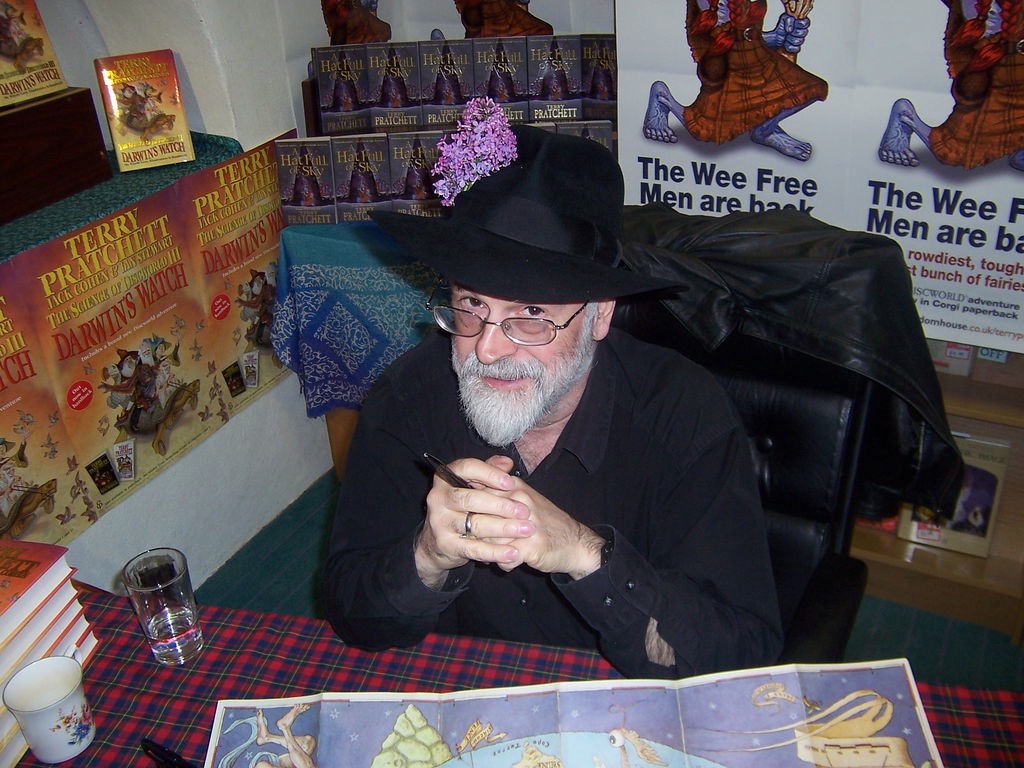
Beloved Fantasy Author Terry Pratchett Has Passed Away at Age 66

Terry Pratchett, the celebrated fantasy author best known for his massive Discworld series, has passed away today at the age of 66. He had long been battling with Alzheimer’s disease. In a statement, Transworld Publishers’ Larry Finlay said:

I was deeply saddened to learn that Sir Terry Pratchett has died. The world has lost one of its brightest, sharpest minds.

In over 70 books, Terry enriched the planet like few before him. As all who read him know, Discworld was his vehicle to satirize this world: he did so brilliantly, with great skill, enormous humour and constant invention.

Terry faced his Alzheimer’s disease (an ‘embuggerance’, as he called it) publicly and bravely. Over the last few years, it was his writing that sustained him. His legacy will endure for decades to come.

My sympathies go out to Terry’s wife Lyn, their daughter Rhianna, to his close friend Rob Wilkins, and to all closest to him.

Terry passed away in his home, with his cat sleeping on his bed surrounded by his family on 12th March 2015. Diagnosed with PCA1 in 2007, he battled the progressive disease with his trademark determination and creativity, and continued to write. He completed his last book, a new Discworld novel, in the summer of 2014, before succumbing to the final stages of the disease.

We ask that the family are left undisturbed at this distressing time.

Pratchett reportedly passed away in his home with his cat and family surrounding him.

Photo by Myrmi

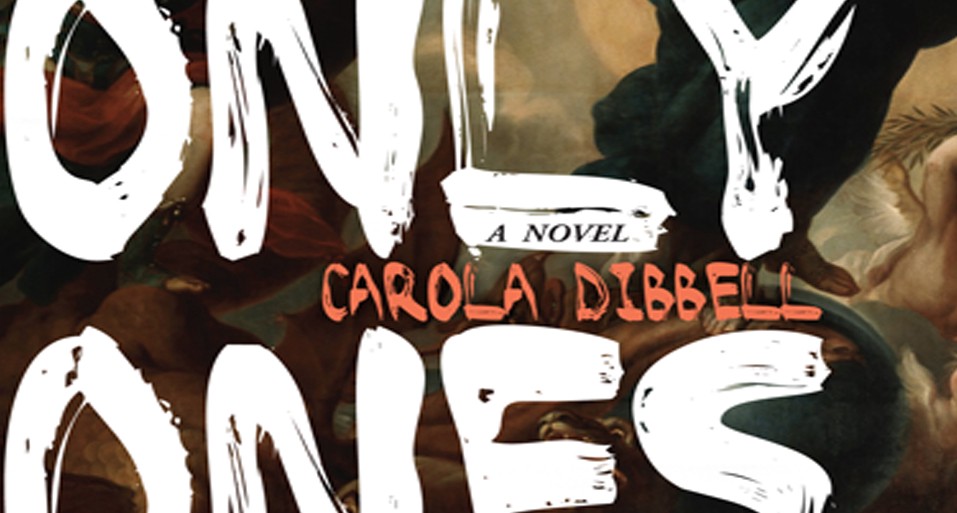
In A Word, Voice: The Only Ones by Carola Dibbell

by Jenna Leigh Evans

When you’ve seen one apocalypse, you’ve seen them all: there’s some real bad news, plus enough survivors left to tell the tale. What distinguishes a post-apocalyptic story, then, is who is doing the telling, and how. In a word, voice. In this regard, Carola Dibbell’s The Only One shines.

Our heroine is one of the handfuls that remain healthy after a series of pandemics decimate the global population. Her name is Inez, but the story opens with her telling us her sobriquet, I. “That’s what they call me. I’m lucky they call me anything,” she confides. She might as well be saying, Call me Ishmael. Anonymous yet fiercely individual, a castaway with little to her name except a hell of a story, she was found as an infant, the only one alive on a doomed bus.

Inez is a “hardy,” a genetic mutation capable of surviving exposure to disease, and as such has the most valuable DNA in the world. Frequently, in fiction, such mutations are paragons of purity. Inez, though, is an uneducated young hooker from Queens, and in this way, not unique in either her world or ours. She’s sullied, vulnerable, selling her hair, blood, and urine as well as donating her eggs for cash (as anyone who’s been down to their last fifty cents can tell you, this is hardly science fiction). This person, then, is the world’s great hope; but the fact that her genes could create a master race confers no special status on her whatsoever. If this comes as a surprise, what part of hooker from Queens don’t you understand?

It’s her DNA that has her entangled with a ramshackle cadre of for-hire geneticists who’ve promised a client mad with grief over the death of her children that they can clone Inez, creating adoptive children resistant to plague. Human cloning is illegal, though, and Inez is to undergo extraordinarily dangerous physical trials — with no legal protection, in order to produce progeny she’ll have no rights to It’s typical of Dibbell’s wry, socially-conscious humor that when Inez wants a guarantee that she’ll be paid, the wealthy, liberal client cries in disgust, “Why do you do this? Why do you treat your life as something that can be bought and sold?”

The client changes her mind, leaving Inez ill equipped to raise the clone, a girl who genetically shares the distinction and burden of being another “only one.” She returns to Queens, now a single mother living in the projects and vying for scarce resources. “Let me say a little about quarantine, which maybe you heard of or even went in once,” she says, in the pitch-perfect cadences of the outer boroughs. “…When everyone is finished dying, wait two more weeks. Then who is left could go. Now all you have to do is stay alive the regular way, and there is smoke and dust and anti-Patho spray, and they put you on trucks to some kind of Center but the trucks are commandeered and you are on Union Turnpike, which is a mess. Rickshaws, bikes, more trucks, cops in bubble suits, and everywhere, crowds on foot, running and shoving. You want food? Get on a line. Want shelter? Get on a line.” This is not exactly a world apart from ours.

Inez proves to be a devoted mother, despite her confusion about her daughter, Ani, being a clone — the media is hysterical with “clone panic,” horror stories meant to whip up revulsion on ethical grounds. Is it me or not me? she asks herself, watching Ani play. It’s not a farfetched question, as anyone with an organ donor’s heart now beating in their own chest can attest. “Maybe something is wrong with it. Maybe it is a crime against nature. But I wished we weren’t the only ones,” she concludes.

Dauntless, loving, Inez copes with the staggering bureaucracy of schools, arguing with teachers about her kid being dubbed “oppositional,” schlepping across town to work three jobs to secure Ani the best possible future. Pandemics aside, domed communities and rickshaws on the turnpike aside — all the story’s colorful dystopian backdrop aside — this is the central irony at the heart of Dibbell’s novel: Inez is far from being the only one.

The Only Ones

by Carola Dibbell

Powells.com

INTERVIEW: Jill Alexander Essbaum, author of Hausfrau

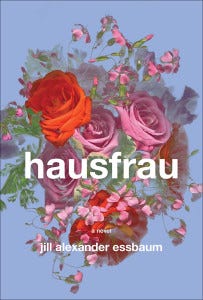
Hausfrau cover

Jill Alexander Essbaum’s debut novel, Hausfrau, chronicles the unraveling of Anna Benz, an American living in Zurich with her husband and three children. Anna chafes at responsibility and expectation. She defies interpretation as a mother. As a stranger in the bleak Swiss landscape, neither motherhood, nor German language classes, nor torrid affairs, nor Jungian analysis by Doktor Messerli make Anna feel whole. Hausfrau is at once erotic and soulful. Essbaum brings her signature attention to detail to Hausfrau. I’m still haunted by it, weeks after I read it.

I’ve known Jill for the better part of three years. She is a poetry professor at the University of California, Riverside’s Palm Desert MFA program. I graduated from the program in 2013, but not before being profoundly affected by Jill’s class and lectures. We caught up recently so I could ask her about Hausfrau.

Heather Scott Partington: I know you’re going to spend a lot of time answering questions about how your poetry influenced this novel. So I’ll just go there first. I couldn’t help but think about how you said that when you wrote Hausfrau, you’d record yourself reading it and then listen to it to make subsequent edits. It didn’t surprise me that it was so delicately worded.

As I tried to look for evidence of your poetic footprint in the book, I was struck by how you manage tension. Quite often Anna will make a statement and then immediately undermine it. There is a connection from one line to the next. And Hausfrau builds to a crescendo near the end. (Of course, with the book’s themes, that could be said to be sexual rise, too — it’s impossible to talk about this book without innuendo, pun, or double entendre.) This book is a treat to read. I really felt a sense of how one part informs another — almost like I was rewarded as your reader for carrying small details with me as I read. Can you talk about how you thought about structure? And is there any kind of transference of poetic timing to prosaic?

Jill Alexander Essbaum: First off, thank you so much — not simply for this interview, but also for this question. The structure of the book is unquestionably informed by my poetry. All those years writing sonnets and triolets and strangely rhymed creatures of my own invention taught me a crucial truth: form matters. And the shape of a thing — ANY thing — will define (inform, circumscribe, underscore) a person’s interaction with it. Consider a hospital. You wouldn’t build a trauma center so that its many wings were laid out in individual buildings scattered over acres of rolling countryside. Why not? Because people would die. That’s an extreme example, but it makes the point. Hausfrau has some resemblance to a (non-specified) formal poem. The three sections might be said to correspond to three stanzas. The equal length of each evokes a specified composition, a quatrain or a tercet perhaps. That each section is marked by a birthday party is reminiscent of a refrain. There’s a sonnet-like turn in the plot two-thirds of the way into the book. The language lessons and the psychoanalysis amplify, correspond to, and maybe even (dare I?) rhyme with the narrative. But I didn’t set out to accomplish this. It came through organically as the story unfolded. Things like this MUST be organic and develop on their own. Otherwise, it simply won’t work.

HSP: On a note related to structure, did the idea of Predestination inform plot? There’s an arguable sense of doom from the beginning — and by mentioning trains and Anna you get us thinking of Karenina (more on her, in a bit). But do you think plot, itself, is predetermined? To what extent are we dealing with a prescribed set of dominoes when it comes to how we structure novels? To what extent was the structure of the book influenced by the idea of free will and Anna’s chafing at the Calvinistic concept?

JAE: I’m going to redirect for a second and talk briefly about religion (since you sort of brought it up). I think this is a deeply religious book. In the final pages Anna rejects most any notion of preordained destiny and makes a very clear-headed (if blunt and terrible and terribly irrevocable) decision. The domino conversation with the priest is the only thing that makes her feel anywhere near better that day. And even earlier, one of the most benevolent moments that occur between Anna and her husband is his admission that yes, he believes in God. He makes a statement along the lines of ‘without God, nothing matters — and Anna, things matter.’ It’s an unexpected confession. Frankly, I didn’t even expect it when I wrote it. The surprise of it makes it truer.

But that isn’t the question you asked. Prescribed dominoes when we structure novels? This is the only novel I’ve structured, though I’ve put together many books of poetry. Really there’s only one rule: does it work? No? Then do it differently. Repeat until it does. Until it works best of all.

Anna’s most profound understanding of herself, her life, her mistakes happens only when she is left with nothing and no one but herself. She’s lost all connection with the rest of the world. Even her phone is gone. Sex stopped saving her. Sex with HERSELF couldn’t even redeem her. Her analyst slammed the last window. All failsafes fail. It’s just Anna and her own true self, the one she sees and recognizes and greets in the mirror that last, regrettable morning.

This is a long way around saying Anna could not have arrived at an active expression of free will if she hadn’t spent three hundred pages being crushed by her choices. While I don’t know that I’d say the structure is influenced so much by these ideas, there’s no doubt that the resolution of the book depends entirely upon it. Exclusively upon it.

HSP: One of my favorite things: Anna is a paradox, and she is also defined by paradoxical logic — the “is and is not” and “was and was not”-s. Her thinking is binary, but contradictory. She seems to have the most clarity when she in darkness (even “little deaths,” sometimes literally having sense forced into her). Do you think poems allow more easily for this kind of exploration of duality? Are poets more inclined to be comfortable with ambiguity than novelists? The idea that you can both be and not be at the same time? The idea that if you define yourself by one set of rules, you’re sure to break them? Are there contradictory ways you define yourself, too?

JAE: Oy. This is the question that hot-seats me, Heather. I don’t have children, I wasn’t married to a Swiss man, and I didn’t have a slew of affairs, but Anna and I have a few things in common. I’ve mentioned some religious struggles and those are more or less my own. Finishing this book preceded an extreme crisis of faith (I’m not convinced the two are related, I’m not convinced they are not). Anna doesn’t claim to be a believer — but I do. Or, I try to. Then there’s this whole issue of solitude. Writing necessitates it. But what about when you aren’t writing? It’s very difficult not to feel very alone sometimes, even when I know I’m not. Anna imposes her own solitude for reasons of self-preservation. As an artist, it comes down to the simple fact that without time spent apart from everyone else, I wouldn’t be able to put this stuff to paper. But Anna’s faithlessness, her loneliness, her passivity, her active fear of action, the losses that come to possess her — they are as much my own as hers. All artists live in a cloud of doubt. They have to. It’s the contradictions that make the art.

Do poems allow for more exploration of these nuances than prose? No. I don’t think so. But I think as a result of my years of writing poetry, these things were more easily accessible to me than perhaps some more rudimentary aspects of fiction craft. Like, when’s the last time you heard a poet gripe about plot or POV? It was those things I had to wrestle harder in order to pin them to a mat. Or, rather, to a page.

HSP: The paradoxes made me very aware of contrast and delineation: particularly the descriptions of characters with the most visual in their looks — Polly Jean and Stephen, for example. I was also hyper-aware of Bruno’s black and white thinking. Anna seems to be permanently stuck in shades of grey. Here’s what I wonder — how do you feel about her? Do you like her? Does it matter if we do?

JAE: I think about Anna every day. I worry about about her even now. I would say I love her but she doesn’t let anyone love her. I want to shake her. I have no problems gossiping about her, venting against her. I don’t know that her likability ever once crossed my mind. I would never say she got what she deserved. But I would say, perhaps this: because of the choices she made and the inevitable results of these actions, Anna’s life unfolded with tragic consequence.

She may not be likeable. She doesn’t need to be. But she desperately needs to be loved. And not in the way that she’s been seeking it. I think I love her. We should love her. And not because she merits it. But because she doesn’t.

HSP: What was the genesis of the Doktor character? Is she meant to be an idea, or a person? In some ways she becomes Anna’s inner monologue — or perhaps the other component of her dialog. I’m curious about how the doktor came to be.

JAE: Well, my husband and I moved to Zurich so he could study psychoanalysis. And I’ve seen the same analyst for years now. Doktor Messerli had to be there. And we had to have an ‘in’ to Anna’s head that wasn’t just a loop of Anna’s yammering thoughts. It’s a combination of Doktor Messerli’s instruction, Bruno’s ultimate Bruno-ness, and what she learns in German class I think that pulses her through that last chapter and into ultimate consciousness. Without Doktor Messerli, she wouldn’t have understood a thing.

HSP: Let’s talk about the dreams. I don’t generally love dreams in novels, but taken with the Jungian analysis and ideas of anima/animus and shadow, I think they provided important insight about Anna. I think part of why Hausfrau feels so universal to me — or perhaps, like a novel from another era — is Jung’s presence in the story, this constant idea of interpretation. Anna is seeking interpretation of herself, not help. It seems like many contemporary novelists don’t want to go there, or to even admit that there could be a formalist interpretation of what they write. So many things I read now seem to challenge the idea of interpretation: they’re just words, story, plot. But Hausfrau seems to inspire it. How comfortable are you with interpretation of your work?

JAE: You know, I’m suspicious of dreams in books too. Because they’re boring and too self-serving. However, I do think these dreams work and the reason I think they work is because they aren’t dream sequences, per se, but they serve as dialogue between Anna and Doktor Messerli. So that may be a reason that you experience them differently than you may otherwise?

I do believe that dreams are interpretable. Analysis and praxis have taught me so.

HSP: What did you want to accomplish with Anna’s dreams?

JAE: I’m not sure that I wanted to accomplish anything, but I think I did accomplish something and it’s this: when she dreams, she tells the truth. It’s a truth told through association, to be sure. But it’s the only time she doesn’t hide behind hems and haws. Without them, the narrative survives easily intact. But with them we have Anna at her most naked. What she deems, she is.

HSP: How do you like to read? What draws you to a novel? I’m sure you’re going to get asked a lot about your writing process, but I’m interested in your reading process. What speaks to you in a book?

JAE: I like to see what happens when words that don’t usually bump up against each other, do. I’m very invested in crisp, precise prose. I like specifics. I read a lot of specialty encyclopedias to get my fill of that. I also like collected letters and literary diaries.

HSP: My favorite chapter, hands-down, is the riff on fire. It’s such an Essbaumian Riff. When did you start riffing? Have you always seen inside the connections of words? I keep trying to think of a label for how you manipulate words (poetry?) — it seems like words function differently for you than they do for other people (or at least, most of us mortals). The closest thing I can liken it to is synesthesia, where the brain crosses wires meant only to go one way. Can you talk about what that process of connecting words is like for you?

I don’t think in a straight line. But maybe no one does?

JAE: I don’t think in a straight line. But maybe no one does? I think several steps ahead as well, and all at once. There’s a riff at the end that jumps from Burn to Berne to Capitol to Capital to Bruno and then runs through Wagner and Nazis and grammar and stars and a bunch of other things until it gets to das Kind, the German word for child. At this point in the novel, this is Anna’s brain on exhaustion. But I wrote it very quickly. I saw it all-of-a-scene and at the same time. I like what you’ve said about crossed wires and synesthesia. Sometimes I feel like I’m having all the feelings of a thing at once so, I have them. I talk too fast. I jump ahead. Its very hard to sit still. Likewise, in writing. I have all the words at once. This is where being able to step back in as a good self-editor comes in very useful.

Words are living, magical things. And I love them.

HSP: Anna feels in some ways like the embodiment of misogynistic stereotypes. I believe at one point she even refers to her own “hysterical grief.” At the same time, she seems to defy stereotypes about motherhood and loving wives, sometimes by not knowing exactly what those things should look or feel like. How did Anna’s story come to you? I know there was a moment when you pulled ver to the side of the road because you finally understood how to tell this story. What did you discover that day?

JAE: I’ve mentioned this to a few people and it’s been met with great disapproval but, I believe it so I’ll offer it here: Bruno, in his own, complicated way, is a good guy. Is the book’s hero. He knows, but he loves and accepts. He lets Anna be Anna. I don’t think he’s dismissive of her feelings — I tend to think he’s shoving everything down so that he can continue to live a married life with her. I mean — how would one live out a life with Anna?

The scene in the kitchen is deeply complex. In the aftermath, she thinks it through (edited for brevity): I had this coming … she wasn’t the textbook example of a battered wife. She hadn’t been victimized into believing she deserved what she got. She decided it all on her own. In a violent, complicated world… it was lucid, quick and generous solution to a problem of have and lack. I had this coming and I got what I deserved. He’d never hit her before and he would never hit her again. He wasn’t a violent man. There was no pattern of abuse. I brought this to myself. Myself, I provoked this.

I wrote that with a great deal of caution and care. Because I needed her to be clear, mindful, and to speak a truth. She’s not a battered woman. She’s not abused. He shouldn’t have slammed her against the wall and she didn’t deserve it. But she kicked an angry dog. To look at Anna through this lens at this moment is troubling and difficult and uncomfortable.

But all of Anna’s story is troubling and uncomfortable. The sex, the lies, the tedious passivity. The revelation I had was that this wasn’t a first-person story. I knew her, I understood her — but I wasn’t her. The epiphany was that Hausfrau isn’t the JAE story. This came with some fundamental complications. Chiefly, I had to reign in my own will. I have my own ideas about how a woman might best survive all her shitty situations. But to impose those notions is to turn the book into some kind of morality tale (it may already be one).

That said, her surroundings, the landscape, the trains she takes, the shops where she buys her groceries, the grammar points she confuses, all the sites and all the sights belonged to me. I was a forlorn expatriate with little to do. I was sad. My marriage ended in Switzerland. Anna’s context is entirely familiar. What’s different between us is how we dealt with our surroundings.

HSP: I won’t ask you if Hausfrau is a retelling of Anna Karenina, but in light of the book’s Jungian themes, I do wonder if you think there are certain types of stories that beg telling over and over. Did you write with that idea in mind? How do you think this work fits into the larger oeuvre of difficult women? Or does it?

JAE: (It’s not.)

Loss is really the one thing we all share, rich and poor and stupid and smart alike.

I think what demands telling and retelling and re-retelling is this: any story in which complicated grief and desperate sadness is the main character. Anna’s the embodiment of loss. Self-inflicted? Much of it, yes. But not all. Loss is really the one thing we all share, rich and poor and stupid and smart alike. We learn compassion by experiencing the loss of others. We learn love by letting other people share in our own stories of loss.

HSP: What did this novel make you wish you’d learned before you started to write it?

JAE: Nothing. If I knew anything beforehand I would have written a different novel. I think it’s important to let each thing you write teach you how to write it. You must listen to what you do. Let it be in control. I don’t step in until I know what it demands of me.

This was an incredibly humbling experience. Empowering? Yes. But humbling. I had to sit still. The work didn’t do itself. I had to up. It demanded my full attention.

HSP: Is there anything you wanted me to ask that I didn’t?

JAE: In my fantasy casting of Hausfrau, the Movie, I always saw Kate Winslet as Anna and Liam Neeson fifteen years ago as Bruno (alternately: Daniel Craig or maybe really any hot man who can pull a mean face). Anna MUST be cast her age (say, how about Jenna Fischer? I’d LOVE to see her try this. It could be her break-out role a la Jennifer Aniston in The Good Girl). Helen Mirren would kill as Doktor Messerli. Ray Winstone isn’t as handsome as Archie, but I like him for the part. Jeremy Renner as Karl. Mary? Hm. I would have loved Marcia Gay Harden also 15 years ago. Stephen, though. Who to play Stephen? It should be someone who’s a bit of a jerk. Not the most handsome man. Judi Dench would make a fine Ursula. Who are good kid actors these days? No clue.

And yes, I named the baby after PJ Harvey. I quoted a song from Uh-Huh Her near the end of the book (it just slid right in!) and I think I listened to White Chalk about a thousand times during my years in Switzerland. Those albums saved my soul.

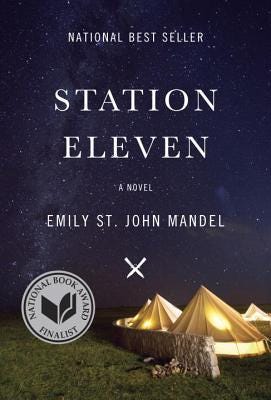
George R. R. Martin Backs Emily St. John Mandel’s Station Eleven for Hugos

Station Eleven book cover

On Monday, I wrote about how the “genre wars” seem to finally be coming to an end. In 2015, it’s increasingly common for so-called “literary” writers to write genre books and so-called “genre” writers to be reviewed and published in literary magazines. Writers and readers are reading across genres like never before, and that’s a great thing!

Perhaps some good evidence of this trend happened this week when A Song of Ice and Fire author George R. R. Martin took to his blog to call Emily St. John Mandel’s Station Eleven the best novel he read in 2014:

One could, I suppose, call it a post-apocolypse novel, and it is that, but all the usual tropes of that subgenre are missing here, and half the book is devoted to flashbacks to before the coming of the virus that wipes out the world, so it’s also a novel of character, and there’s this thread about a comic book and Doctor Eleven and a giant space station and… oh, well, this book should NOT have worked, but it does. It’s a deeply melancholy novel, but beautifully written, and wonderfully elegiac… a book that I will long remember, and return to.

Martin, a titan of the fantasy genre, said he’d vote for Station Eleven for Best Novel in the Hugo Awards, which is one of the most prestigious awards for science fiction and fantasy. Station Eleven was also a finalist the National Book Awards, which is one of the most prestigious awards for literary fiction. The novel is a beautiful and, as Martin says, melancholy take on the post-apocalypse. It follows a band of Shakespearean actors as they move through the ruins of a plague-ravaged North America. It’s the prefect example of a novel that can’t be pegged as purely “literary” or purely “science fiction.” It is both at the same time.

Here’s our reviewer’s take:

Station Eleven is one of the finest novels I’ve read in some time, a book that succeeds sentence to sentence, scene to scene, and as a piece of philosophical art. In spite of its obsession with Shakespeare’s life and work, this book doesn’t set out to court greatness. But with the restrained brilliance of its prose, the humility of its attention to story and dramatic construction, and its unwillingness to give us easy answers it may have achieved that greatness all the same.

I had the pleasure of interviewing Emily St. John Mandel for the National Book Foundation, which you can read here.

Write a 200-Word Essay, Win the New England Inn of Your Dreams

by Elizabeth Vogt

If you’ve always wanted to own an idyllic Maine inn and can churn out a 200-word essay like it’s a lengthy Twitter rant, then entering this contest should be at the top of your to-do list. After twenty-two years, the current owner — and former winner — of the Center Lovell Inn in the “Lake District” of southwest Maine has decided to retire and is opening the contest back up to “fulfill someone else’s dream.”

The rules? Simply pay a $125 entry fee and write 200 words on “why you would like to own and operate a country inn.” The grand prize is the warranty deeds to the Center Lovell Inn and abutting property, but if the contest receives 7,500 entrants, the winner also gets a check for $20,000. The postmark deadline is May 7th, so you have plenty of time to decide if you want to quit your day job and hide away in the mountains for the next few decades.

Midweek Links: Literary Links from Around the Web (March 11th)

Looking for some interesting reading to get you through hump day? Here are some literary links from around the web to check out:

The New Yorker looks at Liu Cixin, “China’s Arthur C. Clarke”

Kazuo Ishiguro responds to Ursula K. Le Guin’s attack, saying, “I’m on the side of the pixies”

Here’s our take on Ishiguro/Le Guin and “the last holdouts of the genre wars”

Questlove (The Roots) reviews a new memoir from Kim Gordon (Sonic Youth)

Here’s a list of wonderfully miserable memoirs to fuel your depressing reading

From Jamaica to Minnesota to Myself: a moving essay from Marlon James

Ever wonder how hard it is to be an ebook bestseller? All it takes is a few thousand dollars

Lastly, the New York Times wonders if you can tell the difference between a computer’s writing and a human’s

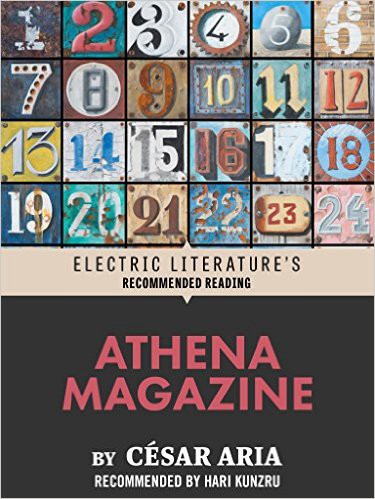
Athena Magazine

by César Aira, recommended by Hari Kunzru

When we were twenty, Arturito and I launched a literary magazine called Athena. With youthful enthusiasm and a fervent sense of mission, we devoted ourselves body and soul to the work of writing, layout, printing and distribution… or at least the diligent planning of those activities, the scheduling and budgeting. We knew nothing about the publishing business. We thought we knew all about literature, but were happy to confess our almost total ignorance of the concrete mechanisms that convey literature to its readers. We’d never set foot in a printing works, and didn’t have the vaguest idea of what had to happen before and after printing. But we asked and we learned. Many people gave us helpful advice, warnings, and guidance. Poets with a long experience of self-publishing, editors with ten short-lived magazines to their credit, booksellers and publishers, they all made time to tell us how it worked. I guess we seemed so young to them, just a pair of kids, so keen to learn and make it happen, they must have been moved by a fatherly concern, or by the hope that our naivety would alchemically transmute their own failures, and bring about the long-delayed triumph of poetry, love, and revolution.

Of course, once we gathered all the necessary information and began to do the sums, we saw that it wouldn’t be so easy. The obstacle was economic. The rest we could manage, one way or another; we didn’t lack self-confidence. But we had to have the money. And no one was going to give it to us just like that, as we realized when our first timid appeals came up against an impenetrable barrier. In those days, there weren’t any funding bodies that you could apply to for publishing grants. Luckily, our families were well off and generous (up to a point). We had another advantage too: intrepid youth, without burdens or responsibilities, taking no thought for the far-off tomorrow. We were prepared to stake everything we had, without hesitation; that’s what we were doing all the time, in fact, because we were living from day to day.

We managed to scrape up enough money to pay for the first issue. Or we anticipated that we would have the sum when the moment came to pick up the copies from the printer. Reassured on that account, we set about gathering, organizing and evaluating the material. Since our ideas and tastes coincided, there were no arguments. We let our imaginations run wild, invented new provocations, discovered new authors, laid claim to the forgotten, translated our favorite poets, composed our manifestos.

But although we were deeply absorbed in the intellectual aspect of the enterprise, we didn’t forget about the money. Not for a moment. We couldn’t have, because everything depended on it, not just the existence of the magazine, but also its physical appearance, the number of pages, the illustrations we could include (in those days, anything other than type required the use of costly metal plates); especially the number of pages, which was essential for any calculation. At the printing works they’d given us a provisional “cost schedule” for various page sizes and numbers of pages, in different combinations. The quality of the paper, it turned out, made very little difference. There could be 32 pages, or 64, or… The printers worked with numbers of “sheets,” which was something we never fully understood. Mercifully, they simplified the choices for us. We took it on ourselves to complicate them.

We thought long and hard about the frequency of publication: monthly, biannual, triannual? Had it been simply up to us, dependent only on our zeal, we would have made it fortnightly or weekly… There was no shortage of material or enthusiasm on our part. But it all depended on the money. In the end we adopted the view of Sigfrido Radaelli, one of our obliging advisors: literary magazines came out when they could. Everyone accepted that; it was the way things were. When we accepted it ourselves, we realized that irregularity would not oblige us to give up our idea of selling subscriptions. All we had to do was change the formula from a period of time (“yearly subscription”) to a number of issues (“subscription for six issues”).

Recounting all these details now, they seem absurdly puerile, but they were part of a learning process, and maybe a new generation is repeating those lessons today, mutatis mutandis, as the love of poetry and knowledge is eternally reborn. The prospect of having subscribers and, more generally speaking, the desire to do a good job led us into an area of greater complexity. The general perspective was important: we felt that whether or not our readers were subscribers they were entitled to a product that would continue over time. The subscribers would be more entitled, of course, because they would have paid in advance. Continuity mattered to us too. We were depressed by the mere thought that our magazine might decline or dwindle with successive issues. But we had no way to insure against it. In fact there was no guarantee that we’d even be able to get enough money to print a second issue. With admirable realism, we left sales out of our calculations. Even more realistically, we anticipated a diminution of the energy that we’d be able to devote to bothering our families and friends for money… Basically, the question was: Would we be able to bring out a second issue of Athena? And a third? And all the following issues, so as to build up a history? The answer was affirmative. If we could get the first issue out, we could get the others out as well.

I don’t know if we hypnotized each other, or were led to believe what we wanted to believe by our fervent commitment to literature, but we ended up convincing ourselves. Once we were sure our venture would continue, we felt we could indulge in some fine-tuning. Our guiding principle was a kind of symmetry. All the numbers of the magazine had to be equivalent to the others, in number of pages, amount of material, and “specific gravity.” How could we ensure that? The solution that occurred to us was curious in the extreme.

We’d noticed that literary magazines often brought out “double issues,” for example, after number 5, they’d bring out 6–7, with twice as many pages. They usually did this when they got behind, which wouldn’t be the case for us, because we’d already opted for irregularity. But it gave us an idea. Why not do it the other way around? That is, begin with a double issue, 1–2, not with double the pages, though, just the 36 we’d already decided on. That way, we’d be covered: if we had to make the second issue slimmer, it could be a single issue: 3. If, on the other hand, we maintained the same level, we’d do another double issue, 3–4, and we’d be able to go on like that as long as the magazine prospered, with the reassuring possibility of reducing the number of pages at any time, without losing face.

It must have occurred to one of us that “double” was not an upper limit; it could be “triple” too (1–2–3), “quadruple” (1–2–3–4), or any other multiple we liked. There were known cases of triple issues: rare, admittedly, but they existed. We hadn’t heard of anything beyond triple. But there was no reason for us to be deterred by a lack of precedents. The whole aim of our project was, on the contrary, to innovate radically, in the spirit of the times, producing the unusual and unheard-of. There were practical reasons, too, why the double-issue solution didn’t merit our immediate adhesion. From a strictly logical point of view, if we had to cut back, who was to say that we would have to cut back by exactly half? It would have been very strange if we did. Our publishing capacity could have been reduced by lack of funds, inflation, fatigue or any number of accidents, all unforeseeable in their magnitude as well as their occurrence, so we might well have had to cut back to less than half… or more. That’s why starting with a triple issue (1–2–3) gave us more flexibility: we could cut back by a third, or by two thirds, so the second issue could be double (4–5) or single (4). But if, as we hoped, we managed to sustain the momentum, the second issue would be triple again (4–5–6). There was something about this speculation, so lucid and irrefutable (given the premises), that excited us and carried us away, as much as the rushes of literary creation itself, or even more.

We wanted to do a good job. We weren’t as crazy as it might seem. After all, editing a literary magazine, the way we were doing it, is a gratuitous activity, rather like art with its unpredictable flights of inspiration, or play, and for us it served as a bridge between future and the childhood we’d just left behind. Though we hadn’t left it behind entirely, to judge from our abstract perfectionism, so typical of children’s games. To give you an idea…

The triple issue ruled out the possibility of cutting back by exactly half. That possibility, with its strict symmetry, was, we had already decided, very unlikely to correspond to reality, but we were sad to be deprived of it, even so. Especially since there was no reason to deprive ourselves of anything: all we had to do was start with a Quadruple Issue (1–2–3–4), that way we’d still have the possibility of cutting back by half (the following issue would be double: 5–6), or if our means were not so far reduced, we could cut back by just a quarter (and follow the inaugural quadruple issue with a triple: 5–6–7), or if our laziness or lack of foresight or circumstances beyond our control obliged us to do some serious belt-tightening, the second issue would be a single: 5. If, however, providence was kind, we would bring out another normal, that is, quadruple issue: 5–6–7–8.

It’s not that we thought, even for a moment, of producing a first issue three or four times thicker than the one we had at first envisaged. Those initial plans remained intact, and they were very reasonable and modest. We never thought of making it any bigger; our first issue, as we had designed it, with its 36 pages, seemed perfect to us. The texts were almost ready, neatly typed out; there were just a few unresolved questions concerning the order (should the poems and the essays be grouped separately or should they alternate?), and whether or not to include a particular short story, whether to add or remove a poem… Trifling problems, which would resolve themselves, we were sure. If not, it wouldn’t matter much: we wanted Athena to have a slightly untidy, spontaneous feel, like an underground magazine. And since there was no one breathing down our necks, we took our time and went on calculating for the future.

All this was notional, which gave us free rein to speculate boldly. It was like discovering an unsuspected freedom. Maybe that’s what freedom always is: a discovery, or an invention. What, indeed, was to stop us from going beyond the Quadruple Issue to make it Quintuple, or Sextuple… ? Beyond that we didn’t know the words (if they existed), but that in itself was proof that we were entering territory untouched by literature, which was the ultimate aim of our project. We were embarking on the great avant-garde adventure.

If we presented the first issue of Athena as a “decuple” issue, that is, numbers 1–2–3–4–5–6–7–8–9–10, we would, at one stroke, secure a marvelous flexibility with regard to the size of future issues. We’d be covered against all contingencies, able to cut back in accordance with our straitened circumstances, without having to resign ourselves to gross approximations. If the cost of the first issue was a thousand pesos (an imaginary sum, solely for the purposes of the demonstration), and it was a Decuple Issue, and if we ran short for the second and could only muster 700 pesos, we’d make it a “septuple issue” (11–12–13–14–15–16–17). If 500 pesos was all we could get, it would be a quintuple issue (11–12–13–14–15); but if we raised a thousand pesos again, it would be another decuple (11–12–13–14–15–16–17–18–19–20). And if our utter idleness prevented us from collecting more than 100 pesos, we’d make the next issue a single: no. 11. The “single” issue, containing a single number, would be as low as we could go. Whatever the first issue was would be “normal.”
We found these fantasies exhilarating, as I said, and it’s true. Even today, so many years later, writing these pages, I can still feel some of that exhilaration, and I still understand it as we did back then: this was the world turned upside down, and we were venturing into it with the exuberance that the young bring to everything that happens in their lives. Wasn’t that the definition of literature: the world turned upside down? At least, of literature as we imagined it and wanted it to be: avant-garde, utopian, revolutionary. We delighted in the idea of swimming against the current: dreams are usually dreams of grandeur, but ours were of smallness, and they were dreams of a new kind: dreams of precision and calculation, poetry adopting the unprecedented format of real equations. We thought of our project as the first literary version of Picabia’s mechanical paintings, which we adored.

We continued on this route, spurring ourselves on. Why should we be limited by the number ten? There was, perhaps, a practical, concrete reason. It determined a minimum number of pages if we had to economize drastically: three. A magazine less than three pages long (the length it would have if, at some point, compelling economic considerations forced us to bring out a single issue) would not be a magazine. A practical, concrete limit wasn’t going to hold us back, but we complied with it provisionally, and put it to the test. We found two holes in the reasoning that I have set out schematically here. First, there could be a magazine of less than three pages. It could consist of a single page. And more importantly, a tenth of our Decuple Issue wouldn’t be three pages, but 3.6, since the inaugural (decuple) issue of Athena would conform to the printers’ standard format that we had adopted as our norm: thirty-six pages.

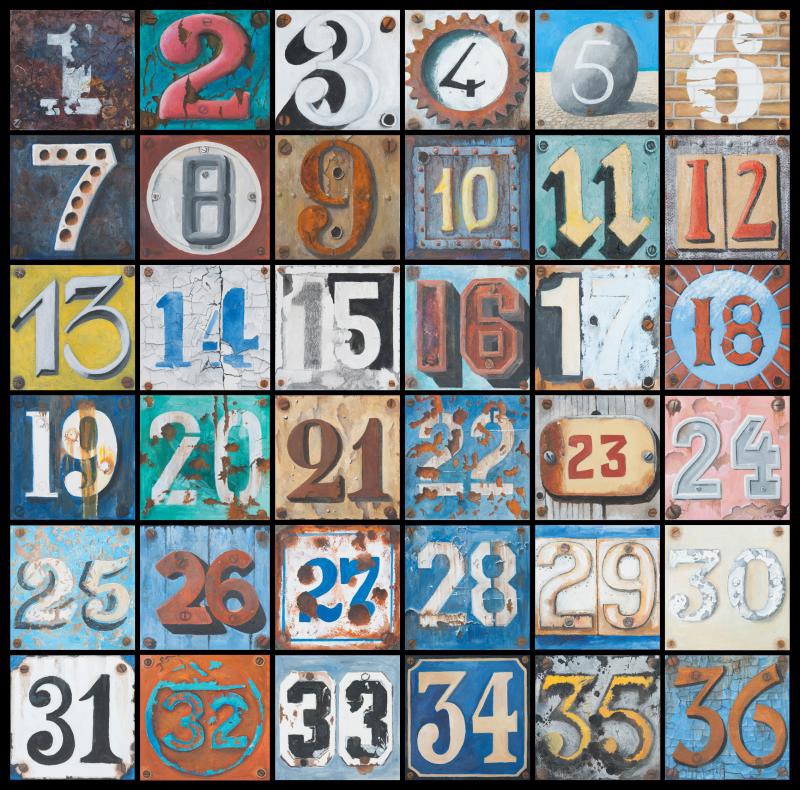
So, predictably, we began to consider a first issue that would be thirty-six-fold, so to speak. An issue made up of numbers 1–2–3–4–5–6–7–8–9–10–11–12–13–14–15–16–17–18–19–20–21–22–23–24–25–26–27–28–29–30–31–32–33–34–35–36. That would allow for an almost total flexibility. Why hadn’t we thought of it before? Why had we wasted our time with “triples” and “quadruples” and “decuples” when there was such an obvious solution right under our noses? The printer’s “sheet” should have shown us the way right from the start, from the moment we discovered its existence, the famous “sheet” that was unfolding now before our eyes, like a rose in time.

The problem was how to fit those numbers on the cover. Would there be enough room for them all, and the hyphens, between the title and the date? Wouldn’t it be a bit ridiculous? There was the option of replacing them with an austere “Nos. 1–36,” but for some reason we found that unsatisfactory. Defiantly, we decided to go the opposite way: filling the cover with numbers, big ones, in nine rows of four. Without any explanation, of course: we’d never have dreamed of explaining our contingency plan to the readers.

This confronted us with a serious objection: whether or not we provided explanations, people would look for them anyway — that’s just how the human mind is made. And a thirty-six-fold issue would suggest an obvious explanation, which everyone would find convincing: that the numbers on the cover had something to do with the number of pages. As they did, in fact, but not in what would seem to be the obvious way. This connection completely spoiled the fun of the idea, which we abandoned immediately. At that point I think we felt that we’d never really been satisfied with thirty-six.

Freeing ourselves of that bad idea freed us completely. We leaped to really big numbers, first a thousand, then ten thousand, which had a special prestige because of its Chinese associations. China, with the Cultural Revolution in full swing, was much in vogue at the time.

Any more moderate number would have seemed insufficient. Ten thousand. But no more than ten thousand. We could have gone wild and continued up into the millions, or the billions; but we were engaged in a very concrete and practical task — producing a magazine — not in wild speculation. We weren’t intending to abandon realism, though a mediocre, storekeeper’s realism had never been a part of our intellectual outlook. Ten thousand guaranteed total originality, without tipping over into unworkable folly. We made sure of this with pencil and paper, setting it all out in black and white.

Making an issue composed of ten thousand numbers meant that the “single” issue would be 0.0036 of a page. We weren’t math wizards. We had to do the calculations step by step, visualizing it all. This made the process infinitely more interesting; it became an adventure among strange and novel images. How did we arrive at 0.0036? Like this: if we reduced the magazine by a factor of ten, it would have 3.6 pages; if we reduced it by a factor of 100, it would have 0.36 pages, that is, a bit more than a third of a page or three tenths of a page; if the factor was a thousand, the magazine would be 0.036 pages long, that is, a bit more than three hundredths of a page; and if we increased the factor to ten thousand, thus reducing the magazine to a “single” issue, that issue would consist of 0.0036 of a page, in other words a little more than three and a half thousandths of page. We had to visualize this too, to get a clear idea of what it meant. Referring to the budget prepared for us by the printers, we saw that the page size we had chosen for the first issue, in accordance with our means, was 8 by 6 inches. So the area of each page would be 48 square inches. Divided by 10,000, that gave 0.0048 square inches, which had to be multiplied by 3.6 (that is, by the number of ten thousandths produced by the previous calculation). The result was 0.01728 square inches… Should we round up? No, exactitude was the key, or one of the keys, to the enchantment that transported us. And unless we were mistaken (we covered a lot of paper with our calculations), 0.01728 square inches was the area of a rectangle 0.1516 inches high and 0.1140 inches wide. That wasn’t so easy to visualize. It was futile trying to use the imagination as a microscope to see that molecule, that speck suspended in a moment of sunlight (it didn’t seem heavy enough to settle). We had leaped beyond the sensory and the intuitive, into the realm of pure science, and yet — this was the supreme paradox — it was there that we found the true, the real Athena, in the form of a “single” issue, springing from our heads just as the goddess whose name we had borrowed had sprung from the head of her father.

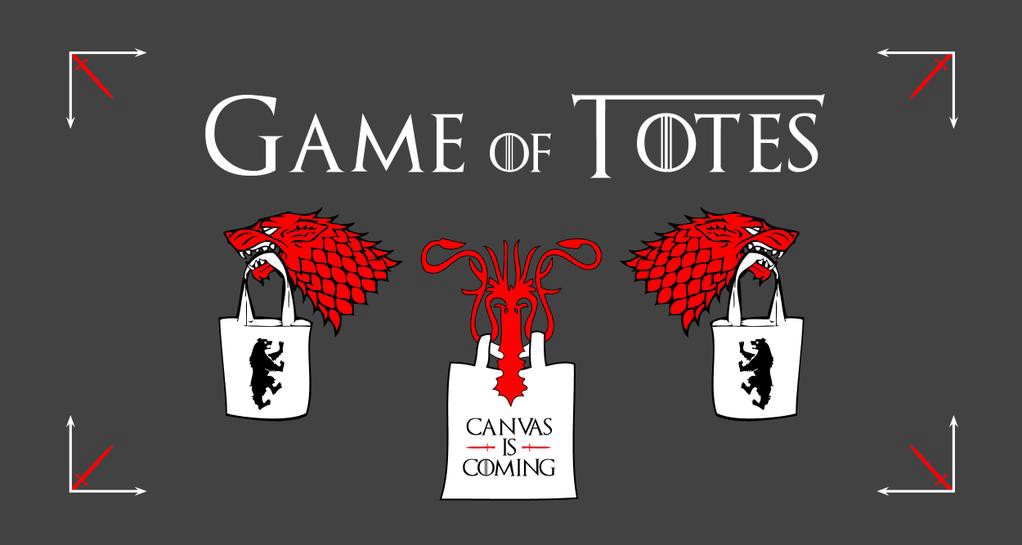
Game of Totes: Canvas Is Coming

Oh, my sweet summer child, what do you know of totes? Totes that stack a hundred high in your tiny Brooklyn apartment, totes in every color for every feeling, totes that hold other totes inside themselves.

But do you wonder if there is one literary tote bag to rule them all?

This April, Electric Literature and Vol. 1 Brooklyn will unite to answer that question, putting to rest the question that book fans have been wondering for ages: who makes the greatest tote bag of them all?

Who should sit atop the canvas throne in the greatest battle between unfastened bags with parallel handles? Who will win the Game of Totes? We want your advice! We’re looking for submissions by Monday, March 30th. What we need is a picture of the literary tote and your reasons why you think it is the best tote bag on the planet. On April 6th, we will unveil the entrants to the tournament, and ask you, the reader, to vote on which 12 will make it to the next round, to be judged by a panel of experts. Finally, on April 20th at Housing Works in the island fortress of Manhattan we will host the final round of the Game of Totes to find out whose bag can hold the most books, stand up to the worst public transportation condition, and hold the most kittens. Well maybe we won’t do the kitten thing, but there will probably be pictures of cats and/or direwolves in tote bags!

Send nominations to jason [at] vol1brooklyn.com.

MARCH MIX by Laura van den Berg

STUCK

The title of this mix tape is “stuck” because these are songs I listened to when I was stuck on Find Me — I worked on the book on-and-off for about six years, so this stuck-ness happened a lot, which accounts for why there were so many years. Sometimes leaving the book alone for a while was the best thing, to give myself space for my understanding of the book to evolve and shift, but at other points just showing up on the regular and looking at the thing was what I needed to do and during those times, music made continuing on seem a lot more possible somehow.

I’m actually not going to say much about the individual songs because — as weird as this may sound — I don’t actually have a lot to say about them. I can’t really express what makes something a good writing song for me: I need a certain amount of energy and a certain kind of beat, something that makes me feel more present and, at the same time, something that I can disappear into. I like stuff that has a kind of hypnotic quality. I listen to a song for as long as I like listening to it. I don’t sweat finding new stuff too much. At this point, I feel the same way about bands as I do about friends: I have my people, but if someone introduces me to someone really cool, well then all right.

  1. “Bone Machine,” The Pixies.
  2. “An Apology,” Future Islands.
  3. “How it Ends,” DeVotchKa.
  4. “Knife,” Grizzly Bear.
  5. “In Motion,” Trent Reznor.
  6. “Old Strange,” Steve Gun.
  7. “Bixby Canyon Bridge,” Death Cab for Cutie.
  8. “No Fit State,” Hot Chip.
  9. “Don’t You Forget About Me,” Simple Minds.
  10. “Let Me Clear My Throat,” DJ Cool.
  11. “Love Will Tear Us Apart,” Joy Division.

***

— Laura van den Berg is the author of the short story collections What the World Will Look Like When All the Water Leaves Us, a Barnes & Noble “Discover Great New Writers” selection, and The Isle of Youth, which won the Rosenthal Family Foundation Award from the American Academy of Arts & Letters and The Bard Fiction Prize. Find Me, Laura’s first novel, was published by FSG in February.