Midweek Links: Literary Links from Around the Web (March 4th)

Looking for some interesting reading to get you through hump day? Here are some literary links from around the web to check out:

From Stephen King’s haunted house to Oscar Wilde’s sexuality, here are history’s craziest lit rumors

Karl Ove Knausgaard says, “Writing is a way of getting rid of shame.”

A candid interview with superstar agent Chris Parris-Lamb

Despite the dragons, Laura Miller says Ishiguro’s new novel isn’t a fantasy

The Millions looks at the persistence of the physical book in the digital age

And Michael Nye writes an ode to print submissions

Publishers Weekly takes a look at Unnamed Press

The MFA-gate controversy continues to swell, and we had two responses: one sorta rebuttal and one in agreement with the central problem

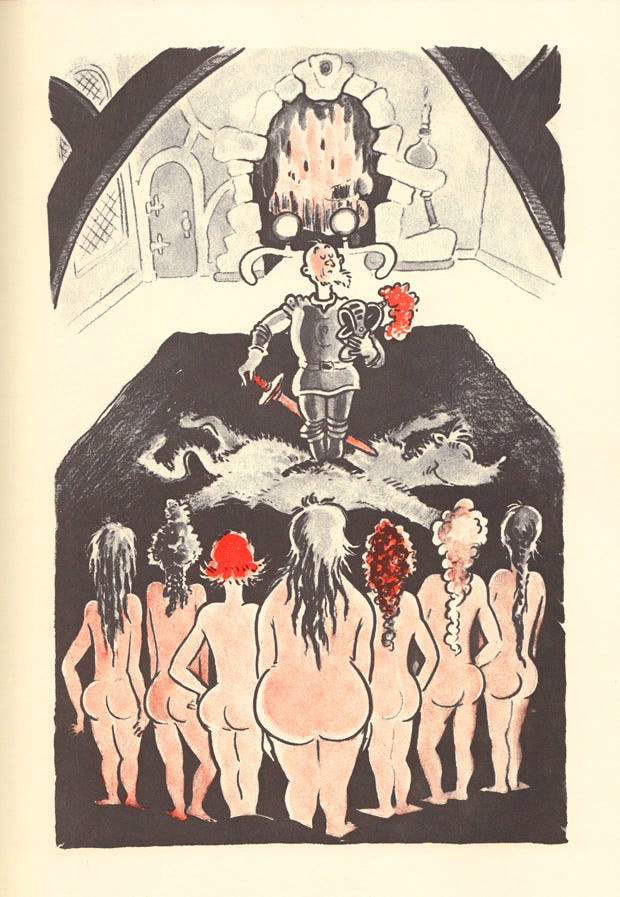
Lastly, Brain Pickings uncovers an adult Dr. Seuss book

Adult Seuss

Handcrafted Dolls

They met in Rose Garden Park. She arrived late. Shane watched her set up her stand, a card table, a white tablecloth, and handcrafted baby dolls lifted from a cardboard box. She placed the dolls on the table and stood by them. She was a small blonde. His mother was a small blonde. She was prettier than his mother. He was selling glass-covered prints of bunnies and pandas with tiny red hearts painted on their chests. She thought they were awful. He agreed. They sold to single women. He sold lots of them. She sold nothing. As the day ended she sold her first doll for one hundred dollars. She was excited. He asked her to dinner. She suggested a Japanese restaurant. She selected what they ate. At fifteen she had joined the Venceremos Brigade, went to Cuba, and cut cane. She’d worked as a linesman for PG & E. She’d gone to UC Berkeley. She’d been a radical. She was still a radical. She was twenty-four, separated from her husband who was thirty. They’d been separated a short time. The next day she sold two dolls, then a third. She thought it was unbelievable. He asked her to dinner again. They went to the same restaurant. He left his wallet on the counter and had to go back in to get it. The little waitress said, “She’s got you flipping out, doesn’t she?” They made out in the parking lot. She had an unfurnished apartment on the ground floor of an old building. There was only a mattress and a blanket on the living room floor, a table with a single chair in the kitchen, a set of Calphalon pots and pans, and a phone in the empty bedroom. They made love. They did this repeatedly. She said, “I don’t want to go too fast, emotionally.” She made a picnic high in the Berkeley Hills. They could see all of Berkeley, Albany, and then Oakland to the south, and across the bay San Francisco with fog over Russian Hill. They spent every day of the next two weeks together. They drove to Point Arena, then back. She’d had an abortion. Her husband had not wanted a baby. Shane watched her work on her dolls. He loved her face, the slant of her cheekbones. In Oakland a trio of black guys walking by his van saw her on the front seat circling him with furious kisses and began singing a capella: “…I’m hers, she’s mine, wedding bells are gonna chime; singing do wah diddy, diddy dum, diddy do…” in do-wop harmonics, grinning and waving at them when they looked out. Her face was flushed. So was his. It was wonderful, their energy spinning out across the sidewalks. He needed more prints. She went to L.A. with him to get them. They made love in the Half Moon Motel on Sepulveda. Back in Berkeley he cut out all of his other girls. He called each one and told them. She heard him do it. That night she went out to the market. Someone came to her door. Shane got up and opened it. A light-skinned Cholo with a buzz cut and a flattened nose looked at him and said, “Who the fuck are you?” Shane said, “Yeah, so who the fuck are you?” The guy turned around and walked away. He was a solidly built guy, with a diamond stud in his left ear. Shane closed the door. She’d asked him not to answer the phone, but hadn’t said anything about answering the door. When she came back she cooked dinner. He told her about the guy. She said that was my husband; just don’t answer the door. She was a wonderful cook. The cardboard box of dolls sat on the floor next to them as they ate. He stayed a week longer than he was supposed to. He had never been happier. She was a runner. He wasn’t. Every morning she ran a circuit around Lake Merritt in Oakland. He ran with her and got stronger. He had to go back to the north shore of Lake Tahoe. It was July now, and the lake would be bumper-to-bumper with tourists. He would sell a lot of prints. She could sell her dolls. He had to work there through August. They could run early in the mornings on the high mountain golf courses cut between the pines before anyone else was up. They would see deer, and the air was so pure it was unbelievable. Every day you would wake up and feel it was the most wonderful day of your life. She would love it. The sky would be as blue as the lake. The lake would be shockingly cold to swim in. There was a club there you could sauna in after you swam. He had to leave early in the morning. She said she would meet him there. She would finish the wash the next day and bring him up the rest of his clean clothes when she came.

That night when he started in again she put her hand on herself and said, “No, it wants to be quiet for a while.” They lay there for a moment, and then she said, “No, it doesn’t want to be quiet anymore.” A week later her car loaded with all her belongings showed up at Tahoe. It parked on the lakeside of the highway with the sparkling blue of the lake behind it. He watched her get out and walk onto the dusty lot, coming along all the other arts and crafts stands, and knew she was the loveliest thing he had ever seen. There were a number of women at his stand and she brought him his folded jeans and clean T-shirts, then told him she was leaving, that she didn’t know where she was going. He said, “What are you saying?” She said, “I don’t mean to shock you, but I have to go.” He was shocked, saying, “I don’t understand this. Why do you have to go?” She said, “I wanted to tell you face to face.” “Well, you have,” he said, “but why?” “It’s not you,” she said. He tried to argue. Nothing worked. The women were looking at them. “Could you walk me to the car?” She put the clothes down on the stand. Crossing the road she was careless about the traffic. A car came too close and he pulled her back, keeping her from getting hit. “At least spend the night and get a fresh start in the morning.” “I can’t,” she said. “If I don’t go now, I’ll end up staying the rest of my life.” “Jesus Christ,” he said, “what’s wrong with that?” “No,” was the answer, “I can’t.” She kissed him and got in the car. Under all her clothing in back he saw the box of baby dolls, the box of pots and pans. It had been a good, deep kiss. He watched her drive away, going east toward Reno, her hand out the window, fluttering goodbye. Coming back across the lot, he heard McMaster, the painter of the very large, very bad paintings, say, “What was that?” Shane said, “You tell me.”

One month later, the summer over, he began looking for her. He looked for her in other cars. He looked for her in the street. He went to the lake in Oakland and watched the runners. He went to the Japanese restaurant. No one had seen her. He drove to her empty apartment in Berkeley and looked up her landlord and asked for her forwarding address. There wasn’t one. He called the phone company and got new listings in every major city in the country. He made countless calls, dialing everyone with her last name at least once. He called the gas company saying he was her husband, saying there was a mix-up and had she given them their correct forwarding address? They gave him one. It was somewhere in the mountains in back of Santa Cruz down on the coast. He drove there and found the house in the redwoods. No one was inside. The doors were locked. He went around the back and opened a window and went in. It was her sister’s house. He found a letter to the sister with a return address in Portland, Oregon.

A week later he spent all of his money to fly to Portland.

He checked into a nice downtown hotel. It had begun to rain. She might be living with someone. It was dark out when he found her address. Her car was parked on the street. It was her car. There was nothing inside it. The building was a three-story building in a block of apartments. The outside locking panel had only a numbered security pad. The famous Portland rain was now coming down hard. Upstairs on the third floor a lit-up window was partially open. He shouted her name. He shouted it again. He saw her looking out the window, staring down at him for a moment before she recognized him. She came downstairs and opened the door and brought him upstairs. She asked how he found her. Inside the door he kissed her. She stepped aside and let him in. The apartment was just like the one in Berkeley, completely empty save for the mattress with quilt and pillow on the floor, and a book lying facedown next to the mattress. A small lamp next to the book was the only light in the room. The book was One Hundred Years of Solitude by Gabriel García Márquez. He told her about finding the letter. “You’re soaked,” she said. “Let me dry your hair.” Taking his coat she walked off in the dark and came back with a towel and began drying his hair. “I’m impressed,” she said, “with how you found me.” He wanted to turn and kiss her again, this time really kiss her. Something made him hesitate. He didn’t know what it was. She went in the kitchen and turned on the lights and made some tea. There were two chairs at the table. He took one and sat down. Her pots and pans were hanging on hooks above the stove. She was running a restaurant in downtown Portland. He didn’t see the cardboard box of dolls. She had walked in, looked at the menu, told them how she could improve their business, and just like that they hired her. “Why Portland?” Shane said. “It’s where I ran out of money,” she said. “I wanted to see if I could survive in a place where I didn’t know anyone. It’s something I always wanted to do.” “That’s amazing,” he said. The restaurant was really doing well. They really liked her. “Is there anyone else?” No, she wasn’t seeing any anyone. She hated to say this, but she really needed to get to sleep. She had to be up early to open the restaurant. “It takes up all my time.” He saw her studying him. “I’ve got a hotel room,” he said. “You’re welcome to sleep here,” she said. He stood and put his coat back on. “No,” he said, “I’ll let you get to sleep, but I’ll get up really early and meet you for breakfast.” She agreed, asking what hotel and he told her. They set the time. She again said he could stay. “No,” he said, “not tonight.” Did he want a taxi? No, he wanted to walk; he liked the rain. She walked him to the door, her side lightly pressed into his, and they kissed again, a better kiss this time, and he left, happy with himself, knowing if it were to happen it would happen now in the right way, on equal terms, with her coming back to him, believing now that it was going to happen.

Looking up in the rain he saw her light go out.

Walking back downtown in the dark he didn’t mind getting soaked.

Early in the morning she came to his hotel and up to his room. When she came in he thought it would happen now, but there wasn’t time, she was pressed for time, and they went downstairs and ate in the dining room. She told him to go back to L.A. and write her. He said, “No, I want you to come with me.” “Listen,” she said, “you’re an exceptional person in many ways. You’re good-looking and smart and have a basic sweetness — ”

“Whoa — ” Shane said.

“No,” she said, “I want to talk about this.”

“So where’s the ‘but’?”

“It’s how you go about things.”

“How I go about things has put me right here with you, at this table.”

“Yes, it has, but that’s because I’m weak — ”

“You’re not weak.”

“No, I am, more than you know. I want you to go back to L.A. and write me, okay? Could you do that?”

“Jesus Christ, there really is someone else, isn’t there?” Shane said.

“We’ve already gone over this; there isn’t, okay?”

Shane stared at her.

“Now you’re angry, aren’t you?”

“No, I’m not.”

“Yes,” she said, “you are, so I really shouldn’t say anything.”

“About what?”

“About us, about me. Because I’m good-looking, and you’re good-looking, you think my being with you makes you even more good-looking. It’s all so vain — ”

“Are you nuts?” Shane said. “That’s how to stand something on its head. You really don’t like me, do you?”

“I do like you. I just don’t think you understand — ”

Shane grabbed her wrist.

“Okay,” he said, “can we stop this?”

“Yes,” she said, “let’s stop it.”

“Okay,” Shane said, letting go of her wrist.

She pulled her hand back.

“Thank you,” she said. She stood up, lifting her coat off the chair.

“What are you doing?”

“I have to go.”

“Why?”

“Because you are mad, and I’ve got to get to work.”

“I don’t get it. Last night you asked me to stay. Why are you putting all this on me?”

“I don’t know,” she said. “I can’t explain myself.”

Shane took the check and walked over to the waitress and gave it to her, waiting as she rang up the charges. He paid and went outside. Paula was waiting at the bottom of the steps. The rain had stopped, and he walked her out to her car and they didn’t kiss and she left for work and he went back into the hotel and packed and checked out and flew back to L.A.

Nine months later he saw her again.

He was working in Rose Garden Park. She wasn’t. She was looking. She came by his stand. Standing behind her, a few feet back, was the same Cholo guy who had knocked on the door. He had the same haircut, and a mustache now. He stood tall and straight, and didn’t look at Shane. Paula was in a dress. Shane had never seen her in a dress.

She was very beautiful, and very pregnant.

She stepped farther away from the guy and came close to Shane. Her face was fuller than he remembered. “I really would like to talk to you, but I can’t right now.”

“I see that,” Shane said.

“Maybe I can come by later.”

“Sure,” Shane said.

She looked away and turned back around.

For the rest of the fair he kept looking for her. She never came by. When the fair was over and he packed up his van and drove off from the empty park he was the last vendor to leave.

Looking back all he saw was the long sweep of lawn, the packed dirt path across it, the trees beyond the park, the big house beyond the trees, and a small boy riding a bicycle way up at the top of the long diagonal path.

Shane had a long dull drive to L.A. He didn’t feel like doing it. He stopped the van and parked and walked back across the street. The trees and houses at the edge of the park formed a natural bowl. The light was leaving the sky, melting the houses and trees and park into the dark.

He went out on the lawn and lay down on the grass.

The sound of the bicycle on the long path came toward him, the spokes of the bike making a whirring rill–a playing card attached between the spokes snapping against the wires as they turned–that increased and then faded as the boy went by.

Shane lay there. The mornings had been cool, the afternoons warm, the evenings cool again. The sound from the bicycle was gone. The grass was cool and damp. The work season was over with. He heard the crickets start up. He lay there for a while longer, his eyes open, and saw the small orb of soft light that was Venus appear in the dark. A slow wind began flowing across the lawn. Several cars, their headlights on, went by along the street. The wind was warm. The night grew quiet. He saw other stars appear. He sketched their lines–Orion, Polaris, Cassiopeia, The Big Dipper–across the dark. There was an order out there.

Getting up, he walked back across the street and got in the van. He started it up and pulled out onto the street. He knew now he’d never had a chance. Funny he hadn’t realized that before.

He switched the headlights on, looking out at the road ahead.

How the MFA Glut Is a Disservice to Students, Teachers, and Writers

by Anonymous

[Editor’s note: the following post is by a former MFA instructor who did not wish to be identified.]

Recently, there was a bit of an internet dust-up over an essay at The Stranger by a former MFA instructor. In “Things I Can Say About MFA Writing Programs Now That I No Longer Teach in One,” Ryan Boudinot unleashed a scathing indictment of the creative writing MFA industry. Despite the furor over the piece, its illumination of the problems with the overproliferation of MFA programs — that there are too many programs with no standards, and that this is adding to the student debt crisis and fattening school’s coffers at the expense of students and teachers — is important, and worth examining further.

Without a doubt, Boudinot’s essay has its problems. It’s smug and occasionally tone-deaf, and a line about a student’s childhood abuse memoir, while clearly meant to be hyperbolic, was in poor taste. But the blunt quality of the piece unfortunately overshadowed some salient, hard-hitting real talk about the MFA industry, and the blowback attacked his more inflammatory remarks while neatly avoiding the substance of his essay.

The result was slew of similarly smug, moralizing blog posts, comments, Facebook threads, and tweets, where people wagged their fingers at Boudinot and lectured a whole lot of nonsense, including that all graduate-level teachers should encourage a love of reading in their students and be willing to teach them self-reflection and self-discipline, as if they were young children instead of people in a master’s program receiving the highest degree in their field. (Author Nick Mamatas rightly took one of these posts to task for its mealy-mouthed equivocating.)

You don’t need an MFA to write. Unlike practicing medicine or law, there is no degree whose successful completion stands between you and your craft. You can write to your heart’s content in private, sell short stories to magazines, publish a book, publish fifty books, all without an MFA.

So why are MFAs useful? Strictly speaking, there are two potential benefits that are unique to MFAs: having a (university) teaching credential, and having funded time to focus on your craft. The latter only applies to funded programs, of course, so when it comes to unfunded programs, the only real potential benefit is the ability to teach at the college level — which, given the glut of MFA graduates and the trend away from hiring tenure-track faculty, becomes a dicey proposition at best.

You’ll notice I didn’t include “getting feedback on your work” or “a writing community” in that list. That’s because these things are available many places outside of the MFA framework. You can join a writing group in your community or online, you can hire someone for a private consultation, you can have a writing buddy, you can attend local readings and literary events, you can take any number of workshops or seminars, go to writing festivals, and so on. I similarly did not include “having a credential” as a benefit, because having spoken to editors and agents about this issue, it’s clear that the surfeit of MFA programs has resulted in MFAs being completely worthless as a credential (with the exception of a few select top programs like Iowa, UT-Austin, and Michigan). The reasoning seems to be that if anyone can get one, what does it say if you have one? Not much.

People have been criticizing Boudinot for suggesting that talent is “born,” not made. His point, however blunted by his rhetoric, is fundamentally true: there are some for whom written expression and the gifts of narrative come naturally, and others for whom it does not. For some reason it has become taboo to suggest that people might not be able to do whatever it is they set their mind to. A diet of inspirational narratives in which all it takes is a dream and a montage to reach your loftiest ambitions has clouded common sense. We’ve managed to confuse the fact that a good writer could be anyone with the idea that anyone could be a good writer. (Hat-tip to Pixar’s Ratatouille for that profound lesson.) Case in point: I myself enjoy singing, and frequently fantasize about singing for large audiences (and in musicals, and in nightclubs — you get the idea). But even if I practiced for eight hours every day, there would be limitations to what I could ultimately do, because I simply don’t have the gift of song. Years of singing for pleasure has yielded some minor improvement in the quality of my voice, but that’s all. And there’s nothing wrong with this, no moral judgment attached to it. But if I wanted to be a professional singer more than anything in the world, I’d eventually have to come to terms with the fact that that would never happen. That would be painful, but that wouldn’t make it any less true. To say otherwise would be intellectually dishonest.

So who benefits from MFAs? People sneer about their function — “You can’t teach good writing!” is a refrain uttered often enough — but that’s not what they’re for, is it? They’re meant to take people with nuggets of potential — gifts that already exist, but need nurturing — and bring them into contact with talented writers and teachers, and other students who are roughly around their level, so that they might all potentially advance together, and learn from and alongside each other. (And if the program is funded, give them a bit of a break from the demands of full-time work so that they might refocus their energies.)

It is, of course, impossible to know who will be “the real deal” from an application, and even harder to guess who will be successful in the long run. (And what does success mean? Critical acclaim? Aesthetic longevity? Money?) There are writers who attend the most prestigious MFA programs who never write again. There are people without MFAs whose fiction will be taught for hundreds of years. There are people who have very comfortable, mid-level writing careers, some with MFAs, some without. There are people who shun the idea of writing as an art form, write commercial books, and become millionaires. There are people who do the same, self-publish their e-book, sell four copies, and never try again.

And admitting someone to an MFA program is never an exact science. In a way, you’re trying to gauge someone’s potential energy. Do they already have something going for their work, that they would they benefit from a focused, intensive program in which aesthetic questions are being asked, artistic goals are being set, and pointed critique is being offered? When reading applications, programs are looking for students who already have something going for their work. Maybe they write unnervingly unsettling worlds, or lucid prose, or masterful characterizations, or can weave a tight, juggernaut of a plot. (Or, ideally, can do many of these at once.) Whatever it is, it catches the reader’s attention. Anyone who has read magazine slush piles knows what it’s like to slog through writing with no distinguishing characteristics whatsoever for hours until stumbling upon exciting and wonderful and real.

In an MFA program with standards — and by that I simply an MFA program that selects what it believes to be the best candidates from a pool of applicants — you end up with a group of writers who, for better or worse, rose to the top of that pool. When a program offers funding — that is, when the school believes enough in its program to provide tuition remission, and fellowships/TAships — the applicant pool increases and the quality of the resulting class will be, generally, higher. Even given aesthetic biases, variations in taste, etc., you end up with a class of writers of a certain potential caliber. In these programs, the gap between students with the lowest and highest potential energy is fairly narrow. Again, what they will do with their careers is unknown — everything from discipline to market forces to sheer dumb luck could affect the overall outcome of their writing lives — but they’re all on a similar playing field. This isn’t everything, of course, because program directors aren’t psychic and writers all levels of talent can be terrible workshop participants, but it is something.

But there’s another breed of MFA program out there, proliferating constantly. These programs have nearly 100% admittance rates, fund zero percent of their students, collect outrageously high tuition, and often pay their instructors very little. And because there are so many people (rightly or wrongly) clamoring for MFAs, they have no incentive for standards, either — no incentive to reject any person, no matter how badly they write. One person’s money is as green as the next, after all. If you’ve received an undergraduate degree and can type on a computer, you’re in.

That sentence requires careful observation, so I’ll write again, and expand on it a little: If you’ve received an undergraduate degree and can type on a computer, you can be admitted to a master’s degree program in creative writing with no other qualifications. Unlike, say, a terminal degree in physics, where a student would have to display not just adequacy in basic math but singular skills when it came to their particular subdiscipline of physics, an MFA applicant applying to one of these programs does not have to demonstrate any proficiency in their “field” beyond being able to put words onto a page. That this is a statement that can be written truthfully is astonishing, damning, and depressing.

In this scenario, a talented applicant who has been diligently improving her craft for a decade can be admitted alongside a person who doesn’t believe in negative feedback, has only read four books in his entire life, and doesn’t have a clear sense of how a comma works, how to write a character, or how a plot is constructed. (There is no shame in not knowing these things, of course, but there’s also a place where they shouldn’t be, and that’s the terminal degree in the field.) And so in these programs, the gap between the students with the lowest and highest potential energy is massive.

There are several problems with this setup. First, it makes teaching wildly difficult. How can an instructor, no matter how compassionate or gifted, have a unified conversation with the class about aesthetics or craft when there are students who can barely process or discuss the assigned texts or workshop stories?

As for the students who shouldn’t have been admitted in the first place: MFA programs are two years long, three at the most. If they enter below the standard of where a master’s student should be, the entire two years will be spent catching up to, at best, where they should have been when they entered — and then the program is over and they’re several years out of the job market, possibly in a hole of student debt, and sporting a functionally useless degree. And then what?

Last, if you’re a writer attending classes with a random mishmash of people who fall into the above category, some of whom refuse to read, others who are using the classes as a very expensive form of therapy, and so on, how useful will they be to you? When talented students get caught up in these programs — by accident, or because of its proximity to where they live, or any other reason — their time is cheapened and made infinitely harder by classmates who don’t have the wherewithal to provide valuable critique, or who is being taught by an underpaid teacher stretched thin by too many classes and too many energy-sucking students. And so that program has benefitted no one, except the university, which is making a tremendous amount of money. (There are almost three hundred MFA programs currently open in the US alone, with more cropping up all the time. Here’s your reason why.)

It seems unfair to excoriate people like Boudinot for pointing out that the emperor has no clothes, when the problem should be traced back to its source: the schools who treat MFA programs like cash cows, admitting as many students as they can cram into their classrooms or foist onto their online instructors, with no consideration for the damage being done to the students who should be, and want to be, in an MFA program. These schools do a disservice to their students — both the prepared and unprepared — their instructors, and the academic standards they supposedly value. They should be ashamed of themselves and shuttered for fraud. The problem isn’t the MFA itself — it’s the overabundance of programs that act like for-profit online universities — taking advantage of desperate people who don’t know any better.

(This is not to say that there aren’t problems with privilege, institutional prejudices, and aesthetic biases in MFA programs. There are, absolutely. But you combat those biases with diversifying your faculty and application readers, and providing funding so students can afford to attend, not simply opening up more and more MFA programs until everyone who has the passing notion to be a professional writer can sign up.)

It’s true that in his essay, Boudinot seems to conflate “serious” reading with a specific kind of serious reading (people have pointed out that his worship-worthy suggestions are a very particular brand of white dude literature), but his point is still valid: part of being a writer is aggressively shaping your own canon. That canon can contain whatever you want it to, but you have to be willing to expand it, to receive suggestions, to read new work and offer more specific observations than “I didn’t like this” or “It confused me.” You have to open to reading whatever is handed to or suggested to you, and articulate how you think it succeeds or fails. That’s how you grow as a reader and writer.

And to suggest that instructors at the graduate school level should be required to coddle their students, beg them to read and do their assignments, and prod them into meeting deadlines is ludicrous. As someone who has previously taught at one of the latter types of MFA programs, I can say that they’re littered with students who can’t do the work and students who won’t do the work. And therein lies the source of Boudinot’s frustration, and the frustration of grad-level creative writing instructors everywhere, who need the employment but can’t speak up about these frustrations until the school is in their rearview mirror.

If you don’t like expanding your reading tastes (or reading, period), if you can’t meet deadlines, if you have no desire to receive feedback from other people, if you have no interest in improving your work, if you just want an echo chamber instead of a critique, if you aren’t interested in questions of craft, if you think writing is a get-rich-quick scheme and are looking to write the next [insert blockbuster here], if you can’t handle rejection or criticism, if you have no desire to revise, and if you’re not comfortable with the idea that some stuff you write will never see the light of day, then don’t get an MFA. You don’t belong there. (Also, all of these qualities will make being a writer very difficult.) It is a waste of your time and money, and the time of your instructor, and your classmates who have potential and who care about their classes.

Just because you can get an MFA, doesn’t mean you should.

Vocational Gratitude and the MFA: A Rebuttal of Sorts to Ryan Boudinot

When I was getting my MFA in 2007, I found myself enrolled in a teaching practicum designed to help me and other prospective MFAs and PhDs on fellowship learn the basics of teaching freshman composition. One day in class, a fellow student raised his hand in response to a question the instructor had asked about the best ways to get students thinking and writing in an exploratory manner and said: “Well, does it matter? They don’t have anything interesting to say anyway.” The comment, deployed with smugness and free-floating antagonism, struck me as terribly depressing. At the time, I was not a newbie in the classroom — I had taught creative writing and English in various forms for roughly 3 years — but neither had I approached the Irish-coffee-sipping, annotating-with-expletives stage in my career that is prevalent in so many satires and, sadly, real life episodes of veteran teacher-hood. Eight years of adjuncting later — first in New York, then Boston and now New Orleans — in which I have taught everything from Sophomore English and Business Writing to Introduction to Creative Writing at the secondary, undergraduate, and non-traditional levels, that throwaway comment still tears at my nerves.

While the gap between college freshman and creative writing MFA students is considerable, novelist and erstwhile-teacher Ryan Boudinot exhibits a similar brand of contempt in his feature for The Stranger: “Things I Can Say About MFA Writing Programs Now That I No Longer Teach In One,” which caused much strenuous debate among book people on the internet this week. That said, I did find myself laughing (darkly) a couple of times over the course of reading Boudinot’s article and some of his points are incredibly valid — especially what he says about the importance of “woodshedding” as an aspiring writer on which he, wisely, ends his screed: “That’s why I advise anyone serious about writing books to spend at least a few years keeping it secret. If you’re able to continue writing while embracing the assumption that no one will ever read your work, it will reward you in ways you never imagined.”

Sound advice.

Moreover, I would imagine that Boudinot intends his article to come as a refreshing breeze of truth-to-power in the swamp of glad-handing and back-pattery which is our present literary moment; that he is bringing the antics of Daniel Tosh and/or Bill Mahr to the book-world at long last; and that by “shooting from the hip” and “telling it like it is” when it comes to the MFA-circuit he is giving vent to the prevailing dissatisfactions of his colleagues.

Fair enough.

I am somewhat of a crank myself, especially in the glow of my computer screen. A good diatribe can be good for the soul whose compass is, by and large, decency pointing. Mark Twain, Edmund Wilson and Edgar Allan Poe were all of them fantastic at it.

What I did, however, find pernicious and inconsistent in Boudinot’s article are the assertions he makes that degrade his “hardworking, thoughtful” former students and by extension the teacher-student contract at large, while severely limiting the breadth of the greater literary community.

Before he is even properly out of the gate, Boudinot writes: “The vast majority of my students were hardworking, thoughtful people devoted to improving their craft despite having nothing interesting to express and no interesting way to express it.” Then, under the first section heading of his article? listicle? essay? blog post? rant? titled, “Writers are born with talent,” he goes on to say: “Either you have a propensity for creative expression or you don’t… It’s simply that all writers are not born equal. The MFA student who is the Real Deal is exceedingly rare, and nothing excites a faculty advisor more than discovering one. I can count my Real Deal students on one hand, with fingers to spare.”

Well, fine. Apart from the murkiness of defining true “talent” and what Boudinot calls the “Real Deal,” not to mention the self-importance of the notion that “faculty advisors” like Boudinot are there to “discover” talent as opposed to, say, nourishing it in their students — in a contradictory turn, Boudinot titles a later section heading, “You don’t need my help to get published” — it’s unclear at whom the campaign is directed.

If directed at students, well, then that’s a shame. There is probably one, if not multiple of Boudinot’s former students out there somewhere hanging their heads in embarrassment and self-loathing for allowing themselves to be taken in by him on the basis of collegiality and mutual respect.

If directed at writers, well, then we can take it. Nothing worse has been said about us in Goodreads reviews or, for that matter, writing workshops. And very few writers or readers have been laboring under the delusion all their lives that a story by Joyce Carol Oates (hardworking, committed) is equal to one by Flannery O’Connor (talented, revelatory).

And if directed at MFA programs themselves, well, then good luck. While stating that you cannot teach someone to become a good writer is not unreasonable in and of itself, it is by no means prohibitive of trying and is, furthermore, predicated on a few things you cannot reasonably assume about people obtaining an MFA: 1. That all of them enter into a program to become famous writers. 2. That pointing out such a fallacy is going to effectively discourage anyone from obtaining such a degree. 3. That there are no other tangible benefits to getting an MFA — a graduate degree in the study and practice of literature — apart from pursuing ever-elusive “Real-Deal-ness” and the skillset that will enable you to write that singular story, or poem, or essay which will enable you, in turn, to become a working writer with a publication bio.

Did I get an MFA in fiction?

I did.

Am I still paying loans?

You bet.

Do the collective profits I’ve made from now two books of fiction and a slew of publications amount to an infinitesimal fraction of what I spent on said degree?

On Garth Risk Hallberg’s advance, I declare it.

And yet even if I had never been published — even if I had never been told by my wonderful and nurturing professors that I possessed a drip of “talent” — even if I had “woodshedded” every last bit of the Cormac-McCarthy-redolent juvenilia I produced in the course of 4 workshops and 3 post-curricular faculty advisements — even then, I still would’ve happily not attended my MFA graduation ceremony feeling privileged and enriched to have had the luxury of devoting myself with boozy asceticism to two years of living and breathing my craft. (It may be unfair of me to assume that Boudinot is one of those writers for whom the process of sitting down in his pajamas to commune with the denizens of imagined worlds is an inexorable agony he would not wish on anyone.)

Yet here’s the crux with Boudinot’s article. He doesn’t take aim with precision enough and he isn’t assertive enough in his ribbing; he’s not going to take down the MFA blimp or else, if he is, he won’t come out and say it. Flippantly proclaimeth he: “Here are some of the things I learned from these experiences.” His words are contemptuous and harmful, I think, because they take no proper shape. They are interested in “woodshedding,” in Boudinot’s terms, his students, the MFA system, bad writing, among a host of other fears, yet nothing emerges from that conflagration redemptive or otherwise. Clickbait accomplished.

I subtitled this piece “A Rebuttal of Sorts” because you can’t argue against a non-argument. Boudinot’s freeform mean-spiritedness does nothing but make bookish people feel crappy.

Case in point the subject heading: “No one cares about your problems if you’re a shitty writer” — one in which section Boudinot states, “Just because you were abused as a child does not make your inability to stick with the same verb tense for more than two sentences any more bearable. In fact, having to slog through 500 pages of your error-riddled student memoir makes me wish you had suffered more” — and then, with un-self-conscious irony, “It’s not important that people think you’re smart.”

Another of Boudinot’s maxims: “If you aren’t a serious reader, don’t expect anyone to read what you write.” In this section, after citing an incident in which Boudinot assigns an especially thirsty “Real Deal[er]” “three big novels for the period between semesters” “almost as a joke” — he chooses David Foster Wallace and Thomas Pynchon with a dash of Roberto Bolano, though what these authors’ most tumescent works are liable to teach a fiction MFA about crafting a competent short story, the understandable standby of such programs, is unclear — Boudinot says that, “Students who claimed to enjoy ‘all sorts’ of books were invariably the ones with the most limited taste. One student, upon reading The Great Gatsby (for the first time! Yes, a graduate student!), told me she preferred to read books ‘that don’t make me work so hard to understand the words.’ I almost quit my job on the spot.”

The Anglo-centrism and fuddy-duddy-ness of this statement withstanding — has any one ever lapsed into premature brain-death from not having read The Great Gatsby, one of the most overrated “classics” I can think of? — Boudinot’s assertions here smack of superciliousness and vainglory. Just what is he railing against in this passage? The decline of American culture at large? Writers just getting their sea legs as readers? The students who looked up to him in the low-residency MFA Program in which he was teaching at the time, whose Fitzgerald-deprived coarseness threatened to unseat the cradle of his art?

West-Eggers, clearly, every one.

Which brings me to what, as a reader and writer, I suspected the gist of this piece really was. By launching jibes at incurious readers and talentless writers Boudinot seems to be distancing himself from the notion of writer-as-vocation, a phenomenon for which the proliferation of MFA Programs feasibly could be held to account. The logic goes that if you can go to school to learn, say, how to weld or salvage dive, then you can also go to school to become proficient in creative writing, which Boudinot sees as an insult to the vaunted craft and moreover futile, “Real Deal[ers]” excepted.

Because Boudinot’s craft is exalted, elusive — a proving ground for real-ass minds. Fake-ass ones need not apply.

Yet by viewing writing as a craft that chances are you’ll fail to learn, Boudinot is doing something as damaging to education as he believes is being done to the craft of writing. Namely, he is doing what I have seen done by dozens of parents of students at the private schools where I’ve taught and by dozens of students once they arrive at undergraduate institutions: viewing education as a means to an end instead of a valuable end itself. Boudinot seems to think about MFA Programs: if you won’t emerge from one a successful working writer, why bother?

What he doesn’t realize is that by making writing and writing know-how into instruments that fail he is pushing them further into the vocational camp, and further away from the profound alchemical mystery he makes them out to be. And in the end, is that such a bad thing? If writing is in its essence a deep-sounding of human experience in all its variety, unreality and inconsistency then why would we not want to deepen the pool of those who would practice it to people who, yes, haven’t read The Great Gatsby, to people who start writing later in life, to people with chaotic day-to-day lives who could use some advice from experienced writers on how to make room for the practice they love, to people who don’t have the verve of Colson Whitehead but find their voice in Larry Brown?

No matter which way you decide to look at it, writing in its earliest stage takes the form of an apprenticeship, learned and rehearsed. Whether this apprenticeship takes place between the writer and her dog-eared copy of Beloved, and the writer and the MFA professor she pays to read and comment on her work makes little difference. Apprenticeships leads over time to vocations and vocations, worked hard at, amount to a life.

MFA Programs and the teaching of writing make a sacred space for such practices in a culture that decreasingly values words, stories and the exactitude of nuanced thought. They are not a long con on the part of universities, as Boudinot implies, but an opportunity for people with stories to tell to see those stories and the making of them through the lens of craft and sustained practice. If the writer so wishes, they’re there for a price, even if the results never make it to print.

The professor who would come to be my mentor in the MFA Program I attended began our first workshop together in a way I will never forget. He told us to view workshop and the greater program of which we were part not as something medicinal, engineered to intravenously alter our creations into some predetermined shape, but rather as one of “the last great collective art forms,” whereby the writing professor along with twelve fellow writers around a table rethink and refigure a story together.

“In this way,” he said, “we are writing as one.”

I do believe those were his words.

How Leonard Nimoy’s Spock Taught Me to Be a Writer

If I’d been raised with any sort of religion, Spock would have been my family’s patron saint of the dictionary. Sticking a grade-schooler in front of Star Trek might lead to a brief obsession with spandex, but with me it also meant absorbing tons of non-grade school words. From “purview” to “enmity” to “geneticist” to plain-old “stoic,” the scholarly verbal style of Mr. Spock made my child-self even more bookish than I already was. But my connection with Spock went beyond words. Because while Leonard Nimoy’s performance as Spock did make me love books differently, he also taught me about the inherent coolness of being your own brand of brainy outsider.

Leonard Nimoy’s recent passing has made a lot of us nostalgic about his impact on pop culture and all of our lives, specifically. In competition with all of television ever, the various Star Treks have the monopoly on smarty-pants, bookish characters, and among those characters, none were more intelligent or more sophisticated than Mr. Spock. Spock is regarded as the great brainy scientific guy of his universe, but really, the character is a little more nuanced than just being “the smart one.” Instead, Spock is the representative outsider in a universe of outsiders. If Star Trek was long regarded as something only for nerds (outsiders) then Spock was the Trekkie who lived in Star Trek, often mocked by his friends and colleagues for his inherent “otherness.” Nimoy’s portrayal of this kind of outsider appealed not just to “geeks,” but people of mixed ethnic heritage, too. His hopeful commiseration with a biracial young fan back in 1968, recently resurfaced, illustrating just how much people benefited from Spock for identification and comfort.

In the narrative of Star Trek, Spock is a biologically half-human/half Vulcan among people who are full-on humans. In this fictional future, Spock’s status as an officer in Star Fleet is eschewed by his dad because it breaks with Vulcan tradition; father Sarek wanted Spock to go to the Vulcan Science Academy. If you’re a kid who’s ever told your parents you want to be a writer instead of having a “real career,” you know what this is like. By being an actual space-alien who is both alien to humans and sort of looked-down on by his own people, Spock rocks the whole Groucho Marx-not-being-part-of-a-club-that-would-have-him-as-a-member-thing really hard.

And yet, the writing on Star Trek was better than you can believe. Mr. Spock could easily have been reduced to comic relief; a fish-out-of-space-water played for laughs. True, in some of the 60’s Star Trek’s most wha-wha moments, the crew of the Enterprise laughs heartily at how much Spock “doesn’t get it.”But those stumbles are trumped by the fact that Spock is so much more well-read than Captain Kirk, Bones, Scotty, and even the guy named Chekov. Here’s a guy who can quote from any philosophic text and most of the western canon literally without blinking an eye (though occasionally arching an eyebrow). The half-alien among a group of smart humans knows more about “their” books than anyone else. Spock has read Dickens and likes him. He’s brushed up on his Shakespeare and insinuates that he is the literary (and maybe biological) decedent of Sherlock Holmes. If you were in the minority of being bookish growing up, it was pretty easy to locate yourself in Mr. Spock.

But Spock was the beginning of Geek Chic, which means Spock’s brand of bookish hipsterdom isn’t arch despite all the eyebrow arching. Though you could call Spock a sexier Sherlock Holmes from Outer Space that would be doing him a disservice because he’s more of an original character than that. He’s stoic and detached from his emotions partially because he’s born that way, but partially because it’s the only way he can figure out how to function. As a little kid, I was teased a lot for having a dorky gait, nerdy clothes or nerdy interests. Both laughably and painfully, I can remember confronting playground bullies by telling them that throwing rocks or dirt clods at me wasn’t “logical.” This paraphrasing of Spock’s favorite subject — logic — is an obvious defense mechanism as a little kid. If you pretend not to have feelings (like Spock does), you can’t get those feelings hurt. Spock isn’t a cool nerd because he’s affecting anything at all. He’s a cool nerd because he’s so obviously fucked up, but doesn’t really give a shit what you think of him. He does this because — for the most part — he’s totally in control of his emotions.

This is why the best Star Trek episodes deal with Spock totally losing it.

Whether it’s his hormonal breakdown in “Amok Time,” clashing with his father in “Journey to Babel,” or his noble sacrifice in Star Trek II: The Wrath of Khan, Spock is best liked by audiences when he’s being forced to deal with the kind of stuff brainy artists try to control: raw feelings which can’t be explained or contained. When I was in fourth grade I proudly said my favorite book (like of ALL time) was a Star Trek novel called Yesterday’s Son, written by the wonderful writer A.C. Crispin. In it, Crispin postulates that Spock has an illegitimate son living in the ancient past of a slightly barbaric planet. When reunited, Spock and his son “Zar” (cool name!) do not get along. As a fourth grader, this novel blew my mind because I had no idea who I was supposed to side with. (I was also fuzzy on how Spock could have a kid he didn’t know about, but whatever…) Why was my nerdy hero Spock being saddled with responsibilities of adulthood? At this point, I thought his primary job was to zip around space with his best friend Captain Kirk, what was the deal with all the soul searching? Perhaps there was more too storytelling than big adventures. Spock and Star Trek made me wonder if all of this was just a little more real than I’d previously assumed. After this, one of my earliest short story attempts was straight-up Star Trek fan fiction. In it, a 10-year-old boy (guess where I got that idea) was imbued with Spock’s “katra” (his soul.) In Star Trek III, Spock’s katra actually rattles around in the head of his good friend Dr. McCoy, so I figured someone like me could probably get Spock’s soul, too. If a 5th grader was harboring Spock’s soul, would anyone really know? How could you prove it? Or, more interestingly, how could anyone prove that I wasn’t Spock?

In one of his last interviews with Hero Complex for the LA Times late last year, Leonard Nimoy noted that from an early point, he realized that the character of Spock had a fantastic “interior life.” This strikes me as being 100% correct and exactly what is so compelling about the way Nimoy conceived of and created this fictional person. If you were so full of passion, but you didn’t really know what to do with it, you might come across as stoic, too. Among my writer-friends, I notice I’m one of the more loud-mouthed ones at the party, but among non-writers, I’ve become more tight-lipped as I’ve grown older. More stoic. More Vulcan. My emotions, I find, have a place in my writing, but sometimes incorporating them healthily into my life is hard. Nobody struggled with this more than Mr. Spock.

I think most writers (and other artists) are all more like Vulcans than we care to admit. We aren’t inherently cold and emotionless, but instead, compartmentalized with our feelings. In the fictional history of Star Trek, the Vulcan race was once even more violent than the human race, before everybody got their act together. Meaning, Spock is suppressing and controlling all sorts of inherently destructive impulses. But he channels that (healthily or not) into his work. This vortex of chaos keeps him going, which is why we love him. Our interior lives are often a vortex — and sometimes that vortex is Star Trek style, like the creature who can drive you insane if you look directly at it in the episode “In Truth is There No Beauty?”. This alien thing — a Medusan — supposedly makes you insane because it contains too much truth. We never saw much of Spock’s creative output (a song played on the Vulcan harp here and there) but as a prose writer, I think Spock would have been uniquely equipped to handle the kind of too-close-too-home action that being a writer requires. After all, he looked into the vortex of that Medusan truth monster and lived to tell the tale.

Ultimately, Spock’s interior life and personal conflicts exist because we believe Spock exists. Meaning, had Leonard Nimoy played his character with an ounce of sarcasm, the complexity and identification many of us had with this character would not have materialized. Spock wasn’t just a metaphor for our interior lives, he was a real person. We will all miss Leonard Nimoy. He was a fantastic writer, director, husband, father, philanthropist, and of course, actor. But in rendering the paradoxically confused confidence of Spock, he made many of us Stark Trek fans into artists, thinkers, and writers. Which if you allow yourself to consider for one second, is totally and completely, fascinating.

REVIEW: Girl in a Band by Kim Gordon

If the name “Kim Gordon” means nothing to you, and the title of her memoir, Girl in a Band, doesn’t spark interest, then maybe it will be the cover that draws you in: a New York City subway car, Gordon’s slightly upturned chin, messy blonde hair, Taurus band shirt. She looks faintly down her nose at the camera and maybe you think, as her fans always have, that this woman is afraid of nothing.

“The music matters,” Gordon writes in the opening pages of her memoir, “but a lot comes down to how the girl looks. The girl anchors the stage, sucks in the male gaze, and, depending on who she is, throws her own gaze back out into the audience.”

Kim Gordon and Thurston Moore founded the no wave/noise rock band Sonic Youth in 1981, going on to produce a number of seminal records including Daydream Nation, EVOL, and Sister. When Moore and Gordon married in 1984, the couple cemented themselves in indie rocker lore as being the ones who made it. “I guess it was love at first sight,” Gordon is quoted as saying in Michael Azerrad’s Our Band Could Be Your Life. But in October 2011, Sonic Youth’s label, Matador, issued a devastating statement saying the couple was separating.

For New York, Nitsuh Abebe wrote, “Picture hundreds of thousands of indie-rock fans learning that their parents were getting divorced.” Elissa Schappell said in Salon, “What’s scarier than a couple deciding — after 30 years of being in a band they created, 27 years of marriage, 17 years spent raising a child — that now they’re done with it?” And on a street in Greenwich Village, my boyfriend turned to me and only half-joking asked, “If Kim and Thurston can’t make it, how can we?”

Girl in a Band begins at the end: the final Sonic Youth concert in Sao Paulo. “Marriage is a long conversation, someone once said, and maybe so is a rock band’s life. A few minutes later, both were over.” Gordon rewinds to her childhood, recalling a youth spent in Rochester, on the Klamath River in Oregon, and also in L.A., Hawaii, and Hong Kong. Gordon notes that her ancestors were pioneers; whether this is to draw a connection to her own travel, or her music, either stands. She also introduces her brother and childhood tormentor, Keller: “No matter how hard I tried, I could never not react to Keller, but neither could I depend on my parents to protect me or take my side…Maybe that’s why for me the page, the gallery, and the stage became the only places my emotions could be expressed and acted out comfortably.” But later, Gordon sourly recalls Keller as being the beginning of her problems with Thurston: “The codependent woman, the narcissistic man…It’s a dynamic I have with men that began, probably, with Keller.”

As if not knowing where to go from there, Gordon changes course to reflect on the songs, albums, and ”times I have the most to say about or remember best.” The transition is clumsy and begs the question why Gordon didn’t compose the entire memoir in such a fashion to begin with; instead, the opening 130 pages are reduced to a sort of extended introduction that doesn’t quite work. Later, Gordon returns to what is increasingly the drive of her memoir: her problems with Thurston. She finds out about his affair through a text message: counseling, promises, and lies follow. “Someone told me later she would have been happy seducing anyone in the band,” Gordon writes of the ‘other woman,’ who she never calls out by name (but is known to be the art book editor Eva Prinz). “In fact, I was the first one she pursued.” Gordon goes on, painting an increasingly ugly portrait of Thurston’s lover: “Everyone who met her or encountered her had the same toxic, dark reaction, the same feeling of ‘What was that?’ as if someone, or something, was trying to take them over.”

At one point, when talking about New York City, Gordon observes that, “It’s hard to write about a love story with a broken heart.” It’s unclear how conscious she is that this is exactly what she’s doing. In fact, to someone unfamiliar with Gordon’s career, Girl in a Band might feel like petty tattling: look what a horrible man my ex-husband is. Although she ventures into talking about the music and art scene of New York, it is often with the same nasty renunciation: “These days, when I’m in New York, I wonder, What’s this place all about, really? The answer is consumption and moneymaking…New York City today is a city on steroids.” Gordon goes on to rant that, “Today we have someone like Lana Del Rey, who doesn’t even know what feminism is, who believes it means women can do whatever they want, which, in her world, tilts toward self-destruction, whether it’s sleeping with gross older men or getting gang-raped by bikers. Equal pay and equal rights would be nice. Naturally, it’s just a persona. If she really truly believes it’s beautiful when young musicians go out on a hot flame of drugs and depression, why doesn’t she just off herself?”

Even the title of the memoir, Girl in a Band, is tinged with Gordon’s bitterness, a nod to her least favorite question: “What’s it like being a girl in a band?” Yet Gordon is so much more than the ex-wife of Thurston Moore, or just “a girl in a band”: she is also a visual artist, the producer on Hole’s first album and friend of Kurt Cobain, creator of the fashion line X-Girl, and has acted in films by Gus van Zant, Todd Haynes, and Oliver Assayas as well as episodes of Gossip Girl and Girls, not to mention numerous musical acts. But despite a long and inspiring artistic life, Girl in a Band always seems to return to the affair. Even as Gordon recognizes that she is writing with a broken heart, she alienates the readers who are–despite her skepticism–more interested in Gordon herself than in any gossip or accusations.

“You’ll never know what I feel inside,” Gordon vows in Sonic Youth’s “Little Trouble Girl.” But now that we do, the spite and hurt might make us wish we’d never asked.

Girl in a Band: A Memoir

by Kim Gordon

Powells.com

ESSAY: Other People by Emma Törzs

Once, when I was twenty-two and working in a liquor store, an old white woman came in and told me her son had died in the Vietnam war, and his body been flown home. She wanted badly to see him one last time, but though she begged and begged for a viewing she was told by military personnel that his face had mostly been destroyed, and she was not allowed to look. “They were trying to spare me,” she said, “against my will.” So during the service she tore down the aisle and ripped off the flag and pushed open the lid of his coffin, and inside was a dead Vietnamese child, not her son, his small corpse wrapped in a green wool blanket and his face perfectly intact. “They sent us hundreds of dead children,” she told me, “and none of them were ours.”

She was an alcoholic, one of many regulars who stood waiting outside our doors before we opened at nine a.m., their backs to the blood-freezing cold of the Minnesota wind, breathing into their hands and peering through the window at me as I counted the register. I’d started working at the liquor store as a direct result of being fired from a different job, a café in Uptown where I’d been late every single day of the three months I worked there. I’d caused a terrible scene in the office in front of my embarrassed managers; not an impressive you-can’t-fire-me-I-quit-scene, but the kind with guttural sobs and mucous pooling first in my palms, then running silver down the cuffs of my sleeves. That evening my friend took me to the liquor store and I broke down again in the whiskey aisle. She led me to the counter by the wrist and presented me, deflated and soggy, to the guy at the register. “Do you have any specials for people who’ve just been fired?” she asked.

He gave me an airline serving of Jagermeister and a job application. Soon thereafter I began. My co-workers were all dark beards beneath woolen beanies, and one other woman who was twenty-eight and had recently lost her virginity. “Now I’m really trying to slut it up,” she said. Sometimes certain Somali men would ask us, “What do your husbands think of you working in a place like this?” and we would say, “Who’d be crazy enough to marry us?”

The store had recently been stung by undercover underagers and hit with a sixty thousand dollar fine, so we were now required to enter a birthday for each patron in order to unlock the computer and process the order. These men who asked about our husbands were often the same men who, when I said, “Date of birth?” would answer, “9/11,” and stare set-faced at me as if waiting for hysteria. I might have been nervous, except often enough their hijab’d wives came in with them and stood a pace behind their husbands’ shoulders and mouthed sorry to me, smiling, shrugging, rolling their eyes; what can you do?

“I thought Muslims didn’t drink,” I said to my co-worker.

“When has God ever stopped anyone from being an asshole?” she said, having her own conversation.

What can you do? My boss was miserable, and slunk into the basement to smoke weed when things were slow. He was the son of the owner, destined to inherit the beer dynasty, and when I had a headache he advised me to duck behind the counter and take a shot of sour-apple Pucker. “Go on,” he said, “I won’t tell.” He reported only to his sister, who came in every few weeks to walk the aisles with her lumpy long-haired dachshund, trailing judgmental fingers over dusty bottles of Boone’s Farm and telling my boss he was worthless; meanwhile the dachshund hunkered down to take a shit by the Captain Morgan’s. He’d glance at me mid-business, and then turn deliberately away, his little doggy face shamed but determined. This was how I felt the whole year.

“You’re just another white person feeding booze to the Natives and ruining our lives,” said Wheelchair Mike, before he threw up all over the carpet. He came in the next day with his grandson to buy vodka and to apologize for the vomit, and led the kid over to the newly-Lysol’d spot of rug in front of the counter, pointing, saying, “Here’s where it went down, but you can barely even tell.”

“It’s always so nice to see you,” said Stefan, in his gentle, choir-boy voice. He’d been an atomic physicist before his eyes and hands were blown away in an experiment gone wrong, and a rare operation had separated his ulna and radius so now at the end of each arm he had two enormous fleshy pincers, with which he held his white cane and his plastic flask of Early Times.

“Today’s the day,” said Lotto Jackass, who never knew when he was being made fun of. “You yahoos are gonna wish you were me.”

“Gonna haul it in big, huh?” said a bearded co-worker. “Gonna blow your whole fucking paycheck on lottery tickets and then make it all back, huh? What’re you gonna buy with that dumptruck of money?”

“I’m going to save it,” said Lotto Jackass, licking his fingers and counting out a stack of one-dollar bills. “And I’m not going to share it with any of you, either.” He was about half my size, with lots of shiny grey hair and a nine-month stomach. Desperate, unpleasant eyes, like two beetles paddling frantically on their backs in a puddle of filthy water. The gambling addicts were the real heartbreakers, the customers we pitied so strongly we despised them: they were so much more pathetic than the alcoholics, because the gamblers had hope. They were the Queen’s mirror on our own futile, repeated actions towards happiness.

“I don’t know where my son’s body really is,” the old woman told me. “Or if he ever really died. I’ve been searching and searching.”

I asked my friends and the internet, “Is it true? Did the US government send back anonymous bodies instead of American soldiers’?”

“No,” said the internet.

“It’s a good story,” said my friends.

Ostensibly why I took the job in the first place: for good stories, none of them mine until this moment. My own went like this. Nights, I’d sit hatted and gloved in the cement-floored back room with my co-workers, drinking squat bottles of Mickey’s and waiting for my best friend to come and drink with us before walking me home down the ice-paved desertion of 27th avenue. Past the moonless hollows of Matthew’s Park, past the La Perla factory where we sometimes hauled trash bags of misshapen tortillas from the dumpsters, and past the soup-smelling hall of our ground-floor two-bedroom, which housed five people, two of whom lived in a pile of blankets beneath our dining room table and all of whom were young and discontent and ready to move on, but where? One of us would get high in the evenings and pound out childhood memories into a typewriter. One of us drank a liter of Coke every day and made a fortress of empty Little Caesar’s Hot-N-Ready boxes. One of us played the same three chords on her guitar over and over until there was no music left to it. We had hope. We still do.

“Criminal, what they did to us,” said the old woman. That day she had a blackened eye, and from the swollen eggplant lake of it she peered across the counter at me. “Can you imagine weeping over the grave of somebody you’ve never even met?”

Of course I can. In my role-plays of grief I have felt loss on almost every level, and I have cried uselessly for anyone. A body standing in for a body: does it matter, in the end, which body we bury?

Yes. But tell me your story and I’ll cry for you, too.

Sunday Sundries: Literary Links from Around the Web (March 1st)

Looking for some Sunday reading? Here are some literary links from around the web that you might have missed:

A.N. Devers gives a primer on the fantastic fiction of Kelly Link

Jedediah Barry on books that double as labyrinths

Some controversial thoughts on writing from an ex-MFA teacher

An interview with the publisher of NYRB Classics

When whimsy becomes a weapon: Rob Spillman on Miranda July

“We’re all exploited here”: editors talk about paying writers

And an infographic on the day jobs of famous writers

A new journal of illustrated fiction for your pocket launches today

Is Jim Harrison the Rodney Dangerfield of literature?

Alexander Chee reviews the new Jonathan Lethem and talks about the pleasures of minor works by major writers

Kiese Laymon reviews the new Paul Beatty, calling it one of the most important books of the 21st century

Sixpenny Magazine: a new journal of illustrated fiction

We at Electric Literature are always interested in combining fiction with digital innovation, so were excited to hear about Sixpenny Magazine, a new journal of “illustrated stories for your pocket.” Sixpenny takes it’s name from the “everyman” sixpence magazines of yore, but adapts the format for the digital times. Each story takes six minutes to read, and the first issue will have work from Bill Roorbach, Judy Chicurel, Max Allbee, and more. The magazine launches on March 1st with an event at NYC’s Bowery Poetry Club.

We asked publisher Kate Thomas a few questions about the journal:

What motivated you to start Sixpenny?

Elizabeth [Leonard] and I wanted to have something to read on a smartphone that wouldn’t make us feel dirty after we read it, like more Kardashian news for example. We wanted something that would bring substance to the in-between parts of our days and we love literary fiction and I love graphic novels. We wanted something that was inclusive and far-reaching, and everything brewed together to make Sixpenny. Every story takes about six minutes to read.

What role do you see the magazine having in the literary world?

We’d like to see literary fiction be subject to a broader criticism, outside of the literary and academic world. I do a short story book club with my non-writer friends and it works really well for a busy lifestyle, but initially it was difficult for my friends to feel as if their opinion was worthwhile because they didn’t have much experience with short fiction. There was an “otherness” about short stories that I’d like to see go away with Sixpenny, because literary fiction is such a life enriching thing and I think everyone could use more of it.

What is the difference between the digital and the print editions?

The digital edition works on a “choose-your-own” subscription price basis and all the profits are shared equally by the writers, illustrators, and founding editors of Sixpenny — about 14 people. We do not have advertisements, because we want a totally immersive experience. At the end of each story, the writers and illustrators discuss their inspirations for the story and there is a discussion area for the readers too so it becomes a little short story “book club” community. The idea is that the readers become a part of our co-operative magazine and are invested in making it what they want it to be. We also like the idea of artists being paid for their work!

We have a limited edition print run because we love print, just a real tactile desire for it. It’s also pocket sized, 5.5 by 6 inches, and has unnecessary gold foil because it’s beautiful. It’s not a money maker for sure.

We will also be doing a maker edition so that people can print out their own magazine using folded letter or A4 paper and turn it into works of literary art, by using paper engineering for example, or altering the text.

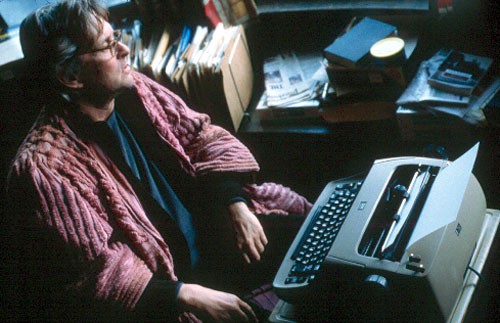
Exploring and Rebuilding Genres: Notes on Jo Walton

How does it shape a writer to analyze their own genre of choice? Though numerous writers can shift between reviews and fiction, the number known equally well as both novelists and critics is smaller. Head into the realm of contemporary science fiction and fantasy, and the number dwindles further. Thomas M. Disch’s 1998 The Dreams Our Stuff Is Made Of: How Science Fiction Conquered the World was, like the work of its author, alternately insightful and frustrating–Disch made some interesting points about science fiction and the larger culture, but also occasionally bogged down in Disch’s own feuds, including one with Ursula K. Le Guin. Reading it today can be a strange experience, as the insights and jabs grow increasingly at odds with one another as the book progressed.

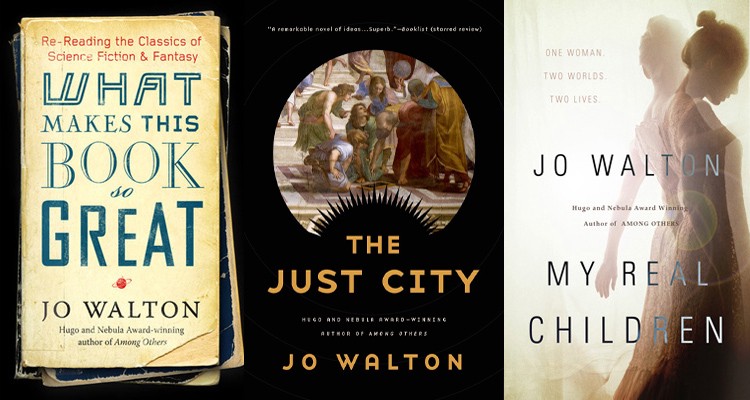
Last year brought with it Jo Walton’s What Makes This Book So Great, which compiled two and a half years’ worth of short columns that Walton had written for Tor.com. (Walton is still a regular contributor to the site.) Her focus was on fantasy and science fiction; in her introduction to the book, she notes that her “genre perspective” persisted for works that fell outside of those boundaries. As examples, she cited “how George Eliot should have single-handedly invented science fiction or wishing wistfully that A.S. Byatt had read Delany.” Reading it proves insightful, both for the boundaries of science fiction and fantasy and to get insight into Walton’s own creative process.

To date, Walton has released eleven novels; her twelfth is due out this summer. She’s received several major awards for her work, including a World Fantasy Award for 2004’s Tooth and Claw and a Nebula and Hugo for 2011’s Among Others. Some of Walton’s work foregrounds its supernatural or speculative elements; other works are more ambiguous. In her review of Among Others, Elizabeth Hand noted that “Walton does a deft job of balancing much of her tale upon a knife-edge where the reader is never quite sure whether the magic described is real or imagined.” Whether you read said novel as fantasy or realism, its bibliophilia and exploration of flawed familial dynamics make for a subtle, compelling read. It’s a novel that abounds with references to the science fiction and fantasy of the late 1970s, and it’s that community in which its protagonist immerses herself.

Walton also has a fondness for alternate histories, both as a writer and as a reader. (Her exploration of Terry Bisson’s Fire on the Mountain also contains some discussion of utopian novels, which will be relevant shortly.) Farthing, about a politically-charged murder and its investigation, began the Small Change trilogy. In the trilogy’s history, British aristocrats negotiated peace with Hitler early in the Second World War; by the time of the late 1940s, war between the Nazis and the Soviets rages on, and the worst aspects of British society appear to be hastening a shift into fascism. In Walton’s essay on Josephine Tey’s Brat Farrar, she notes that some of the quirks of Tey’s setting prompted her to envision the alternate timeline for Farthing:

This is a 1949 in which people cheerfully went on holiday in France eight years before and in which a thirteen year old running away seven years before could cross France and get work on a ship there — in 1941 and 1942? Surely not.

Last year’s My Real Children began with an institutionalized woman named Patricia Cowen as she looks back on her life, her memories adversely affected by her dementia. The novel begins as a straightforward look at her youth in the first half of the twentieth century; at a critical moment, a decision is made, and the novel follows the two timelines that result. To compare it to another novel of a life re-lived in 20th-century Britain, it’s Sliding Doors to the Groundhog Day of Kate Atkinson’s Life After Life. (Walton has cited Ken Grimwood’s Replay as one of the stories she feels that it resembles most.) There’s plenty in My Real Children that impresses, including the subtle differences between each of the two timelines.

It’s also a powerfully sad book: dementia claims Patricia in each one, and by the end of the novel, the state in which she exists is one of confusion, unsure of which set of memories is real. But at the same time, it’s unexpectedly optimistic: neither of the timelines in which she lives precisely lines up with our own. It’s the butterfly effect in practice, perhaps: that the outcome of one phone call might lead the world in a wildly different direction. For all that the novel makes certain outcomes inescapable, it also takes as a given that one ordinary human life can effect change on a grand scale.

The relative realism of much of her recent work sits in sharp contrast to her latest novel, The Just City. Throughout What Makes This Book So Great, Walton moves through a variety of styles and approaches to genre. Samuel R. Delany is frequently discussed, and there are also long stretches dedicated to Lois McMaster Bujold’s galaxy-spanning Vorkosigan novels and stories and Steven Brust’s works set in Dragaera. (Walton describes it as “[looking] like fantasy but there’s no doubt in my mind that it’s science fiction underneath.”) Given this omnivorousness with respect to genre shadings, it’s tempting to see The Just City as a kind of end run around the boundaries that expectations of styles and subgenres can establish.

What makes The Just City a particularly intriguing read in light of all of that, then, is that it isn’t just an idiosyncratic work blending science fiction and fantasy–it’s a work by someone who knows the ins and outs of both genres. Though for all of that, it’s also proudly in certain traditions: specifically, the idea of a seemingly utopian society with a flaw at its heart. The way in which that society emerges is unique, however: Greek gods decide to set up Plato’s Republic in the distant past, and summon willing participants from throughout time to govern it.

Walton has written that this is the first book in a trilogy, and it’s a particularly unconventional beginning: The Just City’s narrative is one that by necessity encompasses everything from intrigue among the gods to Socrates communicating to robots from the future to the logistics of setting up a utopian society. It’s unabashedly philosophical science fantasy, and suggests that Walton is staking out a very particular corner of the genre as her own. For all that The Just City is staking out its space with Big Ideas and a narrative that both spans time and occasionally exists outside of it, Walton roots much of it in recognizable psychology. It’s a quality that helps the book hold together–grounded characters accepting an eminently fantastical premise goes a long way.

The essay that closes What Makes This Book So Great is titled “Literary criticism vs. talking about books.” In it, Walton notes that she doesn’t consider herself a critic, but does explore some of the larger issues that her explorations of novels and stories have sparked, noting in particular “a divide within SF between literary and popular” that she notes is “drawn in a very strange way.” However Walton views these pieces, they do a fine job of re-opening discussion on some works, pointing readers towards others that may be unfamiliar, and providing illuminating looks at her own fiction. As author and reader, Walton’s contributions on both sides of the divide are helping expand and shape the genres in which they’re found.