Sixpenny Magazine: a new journal of illustrated fiction

We at Electric Literature are always interested in combining fiction with digital innovation, so were excited to hear about Sixpenny Magazine, a new journal of “illustrated stories for your pocket.” Sixpenny takes it’s name from the “everyman” sixpence magazines of yore, but adapts the format for the digital times. Each story takes six minutes to read, and the first issue will have work from Bill Roorbach, Judy Chicurel, Max Allbee, and more. The magazine launches on March 1st with an event at NYC’s Bowery Poetry Club.

We asked publisher Kate Thomas a few questions about the journal:

What motivated you to start Sixpenny?

Elizabeth [Leonard] and I wanted to have something to read on a smartphone that wouldn’t make us feel dirty after we read it, like more Kardashian news for example. We wanted something that would bring substance to the in-between parts of our days and we love literary fiction and I love graphic novels. We wanted something that was inclusive and far-reaching, and everything brewed together to make Sixpenny. Every story takes about six minutes to read.

What role do you see the magazine having in the literary world?

We’d like to see literary fiction be subject to a broader criticism, outside of the literary and academic world. I do a short story book club with my non-writer friends and it works really well for a busy lifestyle, but initially it was difficult for my friends to feel as if their opinion was worthwhile because they didn’t have much experience with short fiction. There was an “otherness” about short stories that I’d like to see go away with Sixpenny, because literary fiction is such a life enriching thing and I think everyone could use more of it.

What is the difference between the digital and the print editions?

The digital edition works on a “choose-your-own” subscription price basis and all the profits are shared equally by the writers, illustrators, and founding editors of Sixpenny — about 14 people. We do not have advertisements, because we want a totally immersive experience. At the end of each story, the writers and illustrators discuss their inspirations for the story and there is a discussion area for the readers too so it becomes a little short story “book club” community. The idea is that the readers become a part of our co-operative magazine and are invested in making it what they want it to be. We also like the idea of artists being paid for their work!

We have a limited edition print run because we love print, just a real tactile desire for it. It’s also pocket sized, 5.5 by 6 inches, and has unnecessary gold foil because it’s beautiful. It’s not a money maker for sure.

We will also be doing a maker edition so that people can print out their own magazine using folded letter or A4 paper and turn it into works of literary art, by using paper engineering for example, or altering the text.

Exploring and Rebuilding Genres: Notes on Jo Walton

How does it shape a writer to analyze their own genre of choice? Though numerous writers can shift between reviews and fiction, the number known equally well as both novelists and critics is smaller. Head into the realm of contemporary science fiction and fantasy, and the number dwindles further. Thomas M. Disch’s 1998 The Dreams Our Stuff Is Made Of: How Science Fiction Conquered the World was, like the work of its author, alternately insightful and frustrating–Disch made some interesting points about science fiction and the larger culture, but also occasionally bogged down in Disch’s own feuds, including one with Ursula K. Le Guin. Reading it today can be a strange experience, as the insights and jabs grow increasingly at odds with one another as the book progressed.

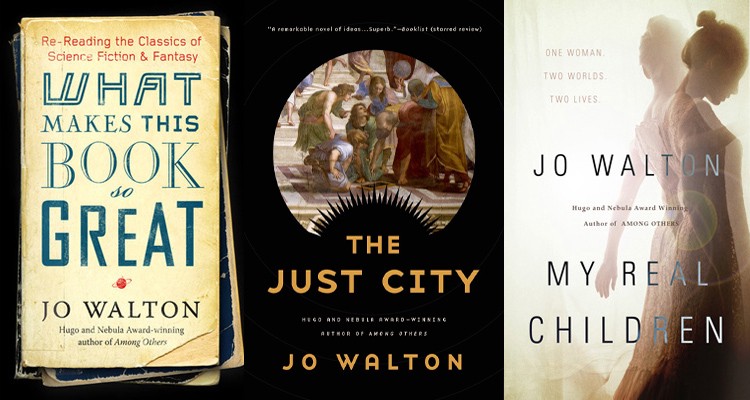
Last year brought with it Jo Walton’s What Makes This Book So Great, which compiled two and a half years’ worth of short columns that Walton had written for Tor.com. (Walton is still a regular contributor to the site.) Her focus was on fantasy and science fiction; in her introduction to the book, she notes that her “genre perspective” persisted for works that fell outside of those boundaries. As examples, she cited “how George Eliot should have single-handedly invented science fiction or wishing wistfully that A.S. Byatt had read Delany.” Reading it proves insightful, both for the boundaries of science fiction and fantasy and to get insight into Walton’s own creative process.

To date, Walton has released eleven novels; her twelfth is due out this summer. She’s received several major awards for her work, including a World Fantasy Award for 2004’s Tooth and Claw and a Nebula and Hugo for 2011’s Among Others. Some of Walton’s work foregrounds its supernatural or speculative elements; other works are more ambiguous. In her review of Among Others, Elizabeth Hand noted that “Walton does a deft job of balancing much of her tale upon a knife-edge where the reader is never quite sure whether the magic described is real or imagined.” Whether you read said novel as fantasy or realism, its bibliophilia and exploration of flawed familial dynamics make for a subtle, compelling read. It’s a novel that abounds with references to the science fiction and fantasy of the late 1970s, and it’s that community in which its protagonist immerses herself.

Walton also has a fondness for alternate histories, both as a writer and as a reader. (Her exploration of Terry Bisson’s Fire on the Mountain also contains some discussion of utopian novels, which will be relevant shortly.) Farthing, about a politically-charged murder and its investigation, began the Small Change trilogy. In the trilogy’s history, British aristocrats negotiated peace with Hitler early in the Second World War; by the time of the late 1940s, war between the Nazis and the Soviets rages on, and the worst aspects of British society appear to be hastening a shift into fascism. In Walton’s essay on Josephine Tey’s Brat Farrar, she notes that some of the quirks of Tey’s setting prompted her to envision the alternate timeline for Farthing:

This is a 1949 in which people cheerfully went on holiday in France eight years before and in which a thirteen year old running away seven years before could cross France and get work on a ship there — in 1941 and 1942? Surely not.

Last year’s My Real Children began with an institutionalized woman named Patricia Cowen as she looks back on her life, her memories adversely affected by her dementia. The novel begins as a straightforward look at her youth in the first half of the twentieth century; at a critical moment, a decision is made, and the novel follows the two timelines that result. To compare it to another novel of a life re-lived in 20th-century Britain, it’s Sliding Doors to the Groundhog Day of Kate Atkinson’s Life After Life. (Walton has cited Ken Grimwood’s Replay as one of the stories she feels that it resembles most.) There’s plenty in My Real Children that impresses, including the subtle differences between each of the two timelines.

It’s also a powerfully sad book: dementia claims Patricia in each one, and by the end of the novel, the state in which she exists is one of confusion, unsure of which set of memories is real. But at the same time, it’s unexpectedly optimistic: neither of the timelines in which she lives precisely lines up with our own. It’s the butterfly effect in practice, perhaps: that the outcome of one phone call might lead the world in a wildly different direction. For all that the novel makes certain outcomes inescapable, it also takes as a given that one ordinary human life can effect change on a grand scale.

The relative realism of much of her recent work sits in sharp contrast to her latest novel, The Just City. Throughout What Makes This Book So Great, Walton moves through a variety of styles and approaches to genre. Samuel R. Delany is frequently discussed, and there are also long stretches dedicated to Lois McMaster Bujold’s galaxy-spanning Vorkosigan novels and stories and Steven Brust’s works set in Dragaera. (Walton describes it as “[looking] like fantasy but there’s no doubt in my mind that it’s science fiction underneath.”) Given this omnivorousness with respect to genre shadings, it’s tempting to see The Just City as a kind of end run around the boundaries that expectations of styles and subgenres can establish.

What makes The Just City a particularly intriguing read in light of all of that, then, is that it isn’t just an idiosyncratic work blending science fiction and fantasy–it’s a work by someone who knows the ins and outs of both genres. Though for all of that, it’s also proudly in certain traditions: specifically, the idea of a seemingly utopian society with a flaw at its heart. The way in which that society emerges is unique, however: Greek gods decide to set up Plato’s Republic in the distant past, and summon willing participants from throughout time to govern it.

Walton has written that this is the first book in a trilogy, and it’s a particularly unconventional beginning: The Just City’s narrative is one that by necessity encompasses everything from intrigue among the gods to Socrates communicating to robots from the future to the logistics of setting up a utopian society. It’s unabashedly philosophical science fantasy, and suggests that Walton is staking out a very particular corner of the genre as her own. For all that The Just City is staking out its space with Big Ideas and a narrative that both spans time and occasionally exists outside of it, Walton roots much of it in recognizable psychology. It’s a quality that helps the book hold together–grounded characters accepting an eminently fantastical premise goes a long way.

The essay that closes What Makes This Book So Great is titled “Literary criticism vs. talking about books.” In it, Walton notes that she doesn’t consider herself a critic, but does explore some of the larger issues that her explorations of novels and stories have sparked, noting in particular “a divide within SF between literary and popular” that she notes is “drawn in a very strange way.” However Walton views these pieces, they do a fine job of re-opening discussion on some works, pointing readers towards others that may be unfamiliar, and providing illuminating looks at her own fiction. As author and reader, Walton’s contributions on both sides of the divide are helping expand and shape the genres in which they’re found.

INTERVIEW: Jayinee Basu, author of Asuras

Jayinee Basu is a Calcutta-born writer, translator, and poet whose debut book of poetry, Asuras, was recently published by Civil Coping Mechanisms. Here, she talks about her new book, Indian literary culture, mythology, and the intersections of science and art.

Caleb Hildenbrandt: One thing that really stood out to me as I read Asuras was the how this poetry, at times very personal and emotionally violent and even sensual (you know, like how we expect poetry to be), also folded in references (often rather oblique or obscure ones) to the worlds of medicine and biology and psychology. You were a pre-med student, so these references make sense from the standpoint of biographical analysis, but what made you decide to include them in your poetry, especially as they’re often very niche and inaccessible to a lay reader?

Jayinee Basu: So the sad truth is that the huge majority of things that I’ve been reading during the making of this book have been science textbooks, and many of these poems started in chemistry and physics classes where I struggled to remain awake and present. Even in the hands of a capable teacher, basic science material can be really tedious. One way I dealt with that is by thinking about concepts like conservation of energy or rotational inertia as scalable systems that you can use as metaphors for more macro, abstract phenomenon. This is a really cheap and easy trick to make unintelligible aspects of your life make some sort of sense, and also to remember an otherwise confusing concept on a midterm. Although the purpose was less about getting an A (this would be clear looking at my GPA) than making an interesting conceptual connection.

CH: Can you elaborate on some of those connections?

JB: One thing I think about a lot is elastic potential energy, google’s definition of which is: “energy stored as a result of deformation of an elastic object, such as the stretching of a spring. It is equal to the work done to stretch the spring, which depends upon the spring constant k as well as the distance stretched.”

A spring can be made of anything, as long as it has an acceptable combination of elasticity and rigidity. Humans are elastic and rigid in a bunch of bizarre ways, so I think about that in relation to histories of oppression, about how powerful groups put in an enormous amount of effort and work into keeping less powerful groups contained, essentially spring-loading them for rebellion. When that rebellion will happen depends on the historical context, like the severity of brutality inflicted and the duration of its perpetration, which I think of as the distance stretched, as well as the unique confluence of factors that cause uprisings at a specific moment in time, which I think of as the spring constant k.

Of course, this is an imperfect and maybe ludicrous metaphor in various ways, main one being that people don’t even superficially resemble springs. But still, I feel that the concept of ‘coiledness’ and ‘compression’ and ‘release’ are useful when thinking about human behavior.

CH: Your work carries a strong undercurrent regarding oppression and rebellion, particularly in poems like “Beleghata,” in which you allude to Bhagat Singh and the Indian Independence Movement. Coming, as you do, from Calcutta, how does your cultural background shape you poetry, and your politics?

JB: Thank you for spelling it that way, I still feel a strange dissonance seeing it spelled Kolkata even though it’s phonetic. I spent the first six years of my life in Calcutta, and despite having a generally horrible memory, so many aspects of living in that city are branded into my brain. I think the most important way it has influenced me is by giving me a very direct understanding of the depths of poverty and violence that human beings are capable of enduring and inflicting.

Calcutta is (was? probably is) a politically charged place. I remember once at a picnic with my parents and their friends I got up and took the microphone (there is always a microphone around at Bengali gatherings for drunken singing) and said I wanted to talk about the Dunkel Draft. I was three, and had read those words on a wall with a big hammer and sickle without knowing what it meant. My parents laughed a lot. I still feel like that frequently, seeing words that refer to events that have incomprehensibly huge effects, trying to figure out how I should feel about it, and feeling like I’m three years old. Other things I remember about living under sort-of-communism: standing in line for gross tasting milk, people knocking on your door collecting taxes for various causes, consuming translated Soviet children’s literature. The last was the best part.

Calcutta has also informed a lot about how I feel about gender. I shouldn’t go into it because it pisses me off too much. Every single girl and woman worker in my mom’s nonprofit is trying to pay off a dowry. Once I was supposed to be taking care of this really poor little girl with a brick embedded in her forehead because some asshole kid had hit her with it. I couldn’t figure out how to keep her entertained so I gave her some colored pencils and paper and asked her what she wanted to draw. She said she had never drawn before, so I suggested she start with a circle. She wasn’t really grasping the concept of drawing and didn’t want to make a mark on the page. Like she was physically uncomfortable with the idea of leaving a mark. That always stuck with me as the most distressing effect of poverty and the devaluation of the girl child. Or maybe it’s actually really enlightened or something, I don’t know.

In terms of poetry, it’s funny. Bengalis are real stuck up about their literary heritage. You produce one old guy who wrote a bunch of good shit (Rabindranath Tagore) and you think your people are birthed into being by Saraswati herself. My parents are both really into Tagore and I think he is deeply boring. I do like the Ray family though, especially Sukumar Ray. I like the idea of poetry serving as snarky social commentary. I also like Purnendu Patri (I’m just listing people I’ve translated) because his poems are really hot, which is nice in a culture that can be kind of weird about sex.

CH: There are so many trains of thought in there that I want to follow up on, but first, since you brought up Saraswati, let me really quickly touch on mythology — you’ve titled your collection Asuras, which from my limited understanding, references a group of Vedic entities which are just really hard to map to modern / Western ways of thinking about mythology. They’re the bad guys, or at least some of them are, but not ‘demons’ in the typical sense, and also they’re affiliated with nature and knowledge-seeking. So, not following the ‘popular’ mythic binaries of good / bad, natural-wild / artificial-cultured, all-or-nothing.

JB: Asuras are really interesting — there’s that question on OKCupid that asks what drives you, and the choices are something like love, knowledge, self expression, and something else I’m forgetting. I actually felt guilty putting down knowledge, because I felt like I had some kind of moral duty to put down love (love in a universal sense) but I really think curiosity has kept our species alive for the most part, and definitely me on a personal level. Even when I hate most everyone and think that humans are the worst and can’t be trusted, I’m still like, fuckin’ magnets tho, how do they work?

I’m not the best versed in Hindu mythology but as far as I can tell, asuras have been literally demonized for their unchecked knowledge-seeking and lack of humility, which I think is a pretty apt characterization of the scientific discipline. I am fascinated by epistemologies that force us to reassess the controls we set in a given experiment, the questions we choose to ask, and the types of phenomena we consider appropriate for scientific examination. I think of the internet as the ultimate asura — filled with information but ultimately without a purpose.

CH: I like that idea of the Internet being the ultimate asura. You talk a bit in your poetry about the Internet, or at least about computers — 404 errors, the grey checkerboard background of Photoshop, etc. I mean even just now you elaborated on the idea of curiosity-as-motivator by talking about OKCupid surveys. And there’s certainly a lot of ‘net poetry’ out there now, in which poets use the internet or artifacts of digital technology or quotes from online conversation as the raw material for their writing. Your poetry doesn’t seem (to me) to really fit in that category, though — there’s too much of the physical world still there, and lines like “a world full of butter and condensation and cascades of sarod / sizzling hot on your golden skin” (to select nearly at random, there are so many) seem to situate you in an almost imagistic vein. What kind of poetic tradition do you see yourself as working out from?

JB: I can definitely see imagism — I am really into image-making in its various forms, and I associate poetry more with painting than anything else. My senior thesis was mostly a concrete poem I made on a broken typewriter. It took me a while to think about how to answer this question because like I can tell you who I enjoy reading and who I have been reading while making this book — Rosmarie Waldrop, Rae Armantrout, Richard Brautigan, Alice Notley — but I don’t want to suggest that I’ve managed to incorporate any qualities of what makes these poets really remarkable into my own work. I think my writing process might lack the kind of literary intentionality that seems implied in the question.

I will say that I’m pretty into ekphrasis and that Asuras started originally as an image by image meditation on Zoe Strauss’s excellent photo book America. It was originally going to be titled Reading America. Some of the poems still retain the titles of her images. I went through the book at a really pivotal point in my life, when I first moved to San Francisco and was trying to process how I was allowed to live here when people who had lived here their entire lives were getting pushed out of it. Being an immigrant, I am really sensitive to any senses of entitlement to a place, or to a place retaining a certain character. I have a lot of trouble with decolonization and anti-appropriation rhetoric, since I have experienced both sides of the coin and am not sure how to feel about what seems to me an ideology that would require, at its most honest, nearly everyone who lives in this country to leave.

But to take a stab at answering your question I think aesthetically I feel most like neo-expressionist painters like Emil Nolde, Anselm Kiefer, and Daniel Richter. I value hypersubjectivity a lot.

CH: Who do you refer to when you describe people being pushed out of San Francisco? I’m reminded a bit of one poem in Asuras where you / the speaker (I assume they’re pretty close in much of this book?) claim that “westerners specialize / in manufacturing // semblances of struggling, / notions of movement.” Is that a description of this immigration dynamic?

JB: Just like ninety year-old grandmothers and families of five, the general story of gentrification. Despite the fact that I have negative money and am an immigrant myself, I’m still demographically a gentrifier and that makes me feel bad. That poem isn’t directly about gentrification though — it’s more about the struggle to define your personal battles/demons when you live a life that offers few “natural” obstacles like widespread poverty or violence or hunger or illness. That’s not a sentiment meant to diminish anyone’s pain, because pain is relative. Anger and pain, even if induced, are good propellants for action. It’s something like this thing Sam Dwyer posted on his instagram of a picture of a piece of bismuth and something his mentor said about how “the physicality of history is turning into a menger sponge, a theoretical object of infinite surface, and zero volume.” I think that’s particularly true of the history of the left.

CH: So does your poetry supply that missing volume? (Or I guess, is your poetry even leftist?) How do you process that shallowness that permeates western / gentrifier / liberal thought?

JB: I don’t know if my poetry is leftist, I hope it has a place there. I’m not saying that this tendency for all edges and no volume is a bad thing. I don’t even think it’s particularly shallow. It’s actually kind of wonderful for political thought to constantly be acknowledging the infinite number of unique experiences and holes that can exist within a generalized contour. I think the ultimate project of the left is for us to be able to abandon heuristics altogether and interact with each other on the terms we set for ourselves. This requires a massive amount of acknowledged humanity and shared language. It’s a worthy, if impossible, goal.

The history of the left is characterized by constant self-policing and splintering, which really takes a toll on our ability to organize and pin down political objectives. The jargon-based identity politics that has really taken off on the Internet seems to be a direct reaction to that inability to organize. Everyone wants to find their people — the ones who have experienced similar traumas and have a shared language with which to discuss that trauma. But no one will ever understand your trauma in all its subtlety, in all the little details of it that really make it yours, and realizing that is a disturbance in and of itself.

This stuff can feel really alienating to me. I view our hyper-inclination to form ideological tribes as a very real threat to understanding each other, regardless of the totally decent intentions and political necessity of said tribe. It’s really easy to forget the “strategic” part of Spivak’s strategic essentialism. But I say that as someone who has suffered relatively little in terms of acceptance. The need for a tribe is more urgent for some existences than others.

I also want to be clear that I’m not trying to characterize radical movements as being inherently insular or hysterical or fascist in a way that’s typical of white people who are mad that they have to be conscious of their word choices. Social justice warriors are overall a good phenomenon. I just enjoy making fun of myself and my friends, and especially the impossible desire to be a good person. Self loathing is a terrible thing to waste.

CH: That’s a really powerful point, that so much leftist or progressive thought, now carried out online, takes the form of increasingly niche terms for tribes and traumas, but the traumas are ultimately unknowable (or at least the nuances of those traumas.)

At the same time, I’m thinking of your poem “Twin Beds on Cantrell St.” which uses incredibly simple, common language to describe trauma (or a prelude to a trauma) — the speaker of the poem addresses someone else in bed, realizes something is very wrong, but concludes, “the room cost me fifty bucks / and we can’t just leave without / coming to some kind of grasping / of why it’s okay for me to do / what I intend to keep on doing.” And it’s so chilling, because there’s nothing in the language that indicates malice or is even exceptional in terms of word choices, but the entitlement comes through with horrifying clarity precisely because of that simple, everyday language. How do you see your role in addressing trauma in writing? What’s your hope for the reader when they read that?

JB: I don’t feel like I know enough about the way trauma works to be able to really lead a dialogue about it, but I am really interested in studying how the emergent sensation of trauma (“I have been hurt and I am traumatized”) comes from the multitude of small and huge instances of pain an individual may face throughout their life, and how that sensation helps or hurts them. Not everyone feels traumatized, although it’s likely that everyone has felt pain. It’s like small amounts of “controlled” trauma is supposed to help a person by giving them “a tougher skin” (I always think of it as emotional microdermabrasion) but under what circumstances can trauma be controlled? Do you have to trust or love the agent administering the trauma? Can it be yourself?

As the ways in which we interact with each other becomes more complex, the experience and expression of trauma starts manifesting in these really fantastical arabesques, through things like art and porn. It is easy to make fun of 14 year olds on Tumblr who identify as various different Otherkin but it’s also just really impressive that they’ve managed to access these seemingly super opaque parts of themselves and given them names that other people recognize. That’s kind of amazing to me, someone whose general response to anxiety and uncertainty is to get a really bad stomachache and fall asleep. I’m also interested in the feedback loop of trauma influencing normative behavior standards which people publicly comply with but completely fuck up in their private life, causing more trauma and an increased enforcement of normative behavior. It’s a strange effect that leads to things like the collapse of alt lit.

I don’t really have a specific hope for the reader except just to notice if something makes them uneasy or to laugh and try to pinpoint what about the poem had that effect.

CH: Can you expand a little bit on what you meant by the collapse of alt lit being brought about by people publicly (but not privately?) complying with normative standards? Admittedly, I think I first heard about you via ‘alt lit’ circles, although your writing bears very little semblance to much of what is pointed to as typical ‘alt lit’ — in fact, I wasn’t even sure it was a community you were aware of.

JB: It would be dishonest for me to say I’m not associated with alt lit. Its collapse was a sad thing for me in many ways, since it involved my friends and people I had been romantically involved with. One unhappy aspect of jargon-y social movements is that the words can be used like sparkly ornaments to attract the people you want to sleep with, and once you’re there naked in front of each other, the ornaments are just in a pile on the floor because you haven’t actually internalized any of the concepts; so you end up hurting people because of your carelessness. This is a generous characterization of the ‘macktivist.’ Many are outright predators.

I find that kind of codified yet superficial use of language really curious. Science language is used like that a lot, to code for ‘truth’ and ‘power’. It can go from being just a language thing to an attitude thing. On the first day of a semester, my best professor stressed the inductive nature of science and that you can’t prove anything is always true, but only that some things are not always true. My worst professor said that he had a Ph.D., made fun of astrology, and characterized science as being based in ‘facts’. They said similar things, but in a way where I wanted to learn from one of them and wanted to roll my eyes every time the other one said anything at all.

I felt somewhat paranoid about this when I was using words like ‘stochaistic’ in my poems. I didn’t want it to read as “look at meeeeeee, I know SCIENCE, I’m sooooo smart and correct”. I wanted to be sure that I was using those words because of the specificity of their meaning and not as a way to add legitimacy to something that might be seen as fluffy. I think that is what I like about alt lit — there is no real pressure to legitimize your work because there is already an acknowledgment and even celebration of its fluffiness. Art so often does feel fluffy and pointless, even for people who are making it. Like, who gives a shit really about what you think or how you feel except your mom or someone who has a crush on you or something.

Boyhood’s Richard Linklater May Adapt Where’d You Go, Bernadette

Although Boyhood lost out to Birdman at the Oscars, director Richard Linklater is a hot name in Hollywood again and film fans are waiting to see what he does next. The Hollywood Reporter is reporting that he may be going from Boyhood to womanhood and adapting Maria Semple’s best-selling Where’d You Go, Bernadette:

Semple’s novel, which was adapted for Annaupurna by Fault in Our Stars writers Scott Neustadter and Michael H. Weber, centers on an agoraphobic architect and mother named Bernadette Branch who goes missing prior to a family trip to Antarctica. The book is narrated by her 15-year-old daughter Bee Branch.

The comedic novel is written in a series of emails, memos, bills, and other documents. Linklater is currently in talks to direct but hasn’t officially taken over the project.

Analog Love in the Digital Age: Absolving Roberto Acestes Laing

by Nicholas Rombes

Two Dollar Radio

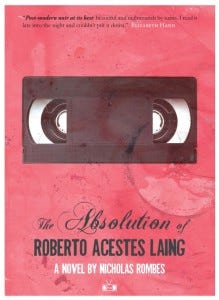
It was a last minute idea. Just days before my debut novel The Absolution of Roberto Acestes Laing was due to be sent to the printer, I floated an idea past Two Dollar Radio’s Eric Obernauf: how about including a form at the back of the book that could be clipped out and snail-mailed to me? In exchange, I would sort through the vast film archive of Roberto Acestes Laing — the novel’s reclusive film-obsessed protagonist who is under the spell of movies by famous directors that don’t exist — and snail-mail back to the reader 1) a personalized letter typed on old letterhead, 2) a segment of 16 mm film from the archive, and 3) a film-related fragment from the archive. In the age of Facebook, Twitter, and forms of social media not even imagined yet, I know I’m not alone in desiring a different sort of texture in my correspondence with people. There is something gift-like in the exchange of snail mail which includes a trace or residue of personality that’s sometimes masked or lost in the interwebs. The process of snail mailing is a deliberate act in a way that posting or tweeting isn’t, an act that reveals something of the person otherwise hidden.

Comic Book mail in form

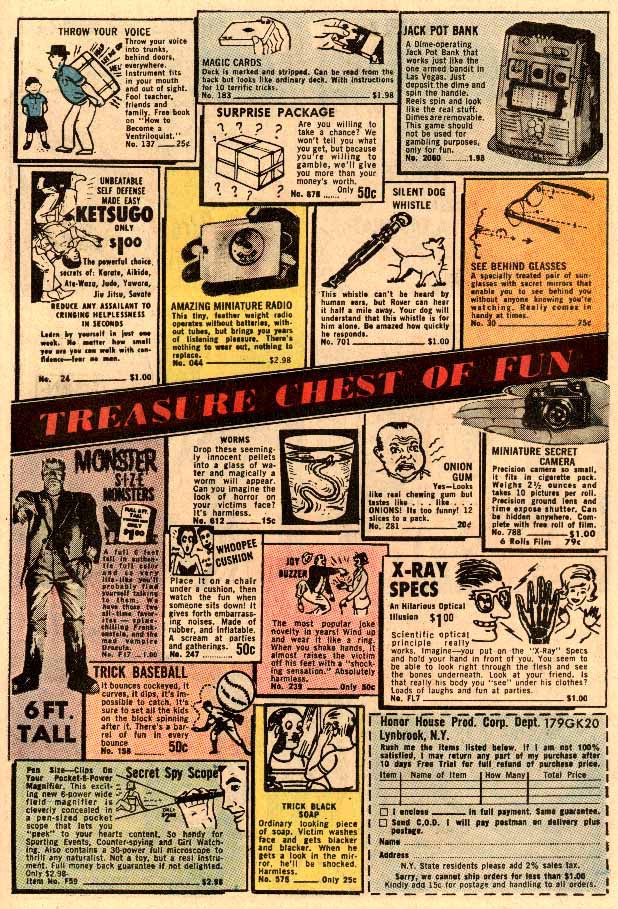
I was inspired by my own experiences, first as a young reader of 70s comic books that included mail-in forms that promised everything from tiny green plastic army figures (cool) to onion gum (unlike most gum, it unfortunately “lasted” a long time) to (?)trick black soap (um . . .) to the silent dog whistle (how could you tell if it worked?). And then later, devouring cheap Ray Bradbury paperbacks from Bantam, I’d send in the forms for the Bantam Book Catalog, printing my name and address in the impossibly small spaces. Most of the time, I was slightly disappointed (except for the onion gum, which really was onion-y) and yet it was always more about the weird human connection between me and the person who’d be receiving my request. I tried to imagine who these people were, at the other end of my mailing. When my request for the silent dog whistle arrived at The Honor House Production Corporation, Department 20 5 G K 68, on Wilbur Street, in Lynbrook, NY, what sort of person was there to open my letter?

NightmareTrails
Nightmare Trails

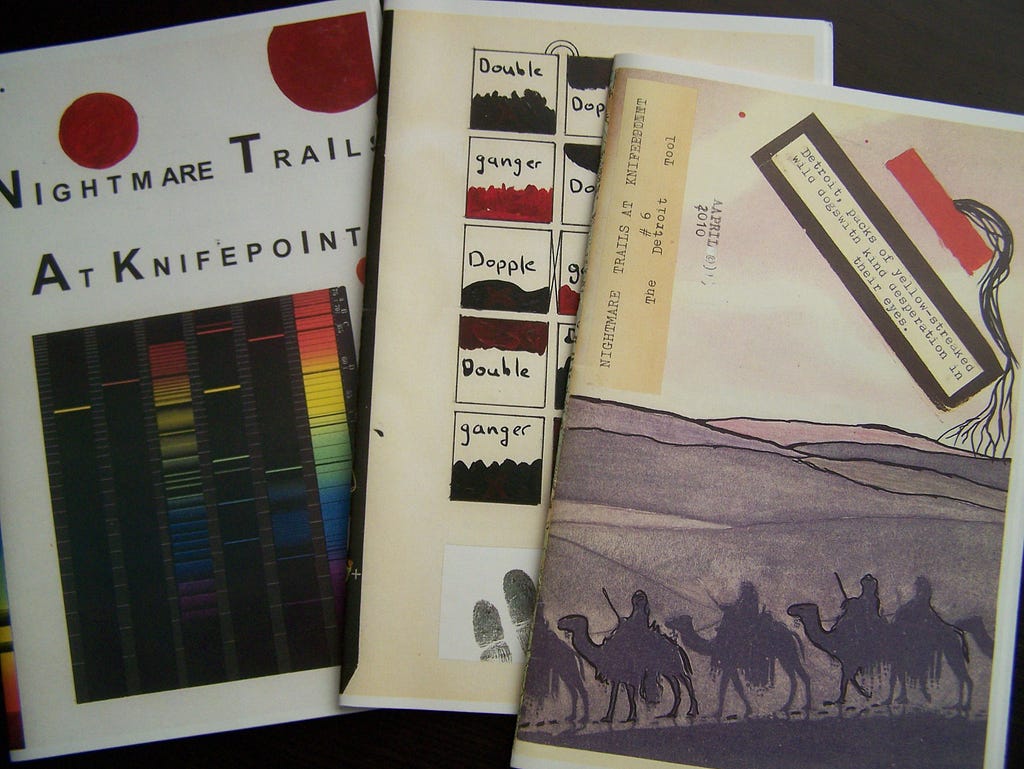
My first experience with my own mail projects began in 2009, when I snail-mailed, in installments, Nightmare Trails at Knifepoint, a serialized novella to around sixty subscribers. The process was thrilling and grueling, mostly because I handcrafted, printed, and distributed the pamphlets myself, mailing one installment a month out, and yet the process of corresponding with readers in this way was exhilarating, as it has been with the Roberto Acestes Laing archive project. What’s markedly different this time is that many readers send me, along with their requests, ephemera of all sorts. Some of these are clearly related to the book or to movies in general, while others are head-scratchingly obscure and bear no relationship (as far as I can tell) to the book itself.

RD Laing

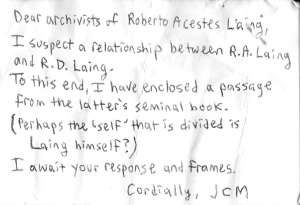
One of my favorites is a note from Joe (I’m just using first names) that “suspects a relationship between R. A. Laing and R. D. Laing,” and that includes a photocopied page from his 1960 book The Divided Self: An Existential Study in Sanity and Madness. Although I’d not heard of this other Laing before, the passage marked by Joe eerily mirrors the Laing of the novel: “He may lack the experience of his own temporal continuity. He may not possess an over-riding sense of personal consistency or cohesiveness. He may feel more insubstantial than substantial, and unable to assume that the stuff he is made of is genuine, good, valuable.”

Here is a catalog of some of the others:

stickers

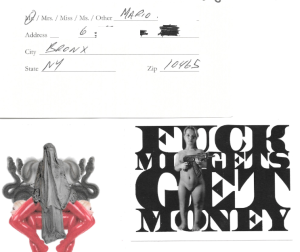
— From Mario in the Bronx, several stickers, one of which shows a gun-toting small person with the logo “Fuck Midgets Get Money.” This one creeped my wife out, and while I honestly have no idea why I was sent this, I do like the heft of the gun.

Artifact book

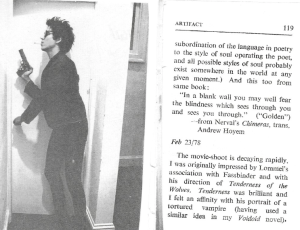
— From Anna in Maine, two pages from Artifact, a tiny book / diary by Richard Hell, which also, strangely, features a gun. The connection to the Laing novel might be the line from Hell’s book that reads “The movie-shoot is decaying rapidly.” I love that sentence and wish I had thought of it for the novel.

Isaac Asimov

— From Paul in Michigan, a page from Isaac Asimov’s 1963 book The Human Body: Its Structure and Operation with a “Marian High School” sticker. I hadn’t realized Asimov had written textbooks, and looking through an online version The Human Body I found some sentences that are so simple and direct and (I hate to use the word, but it fits) charming, such as “If the nose were nothing more than a mere air vent, there would seem no need for elaborating its structure,” and “Such specializations [different hair types] are absent in man and, indeed, our coat of hair is a poor one altogether.” I don’t know why Paul sent this item or what connection it bears to Laing.

VHS sleeve

— From Melissa in California, the back of a VHS sleeve. This one I get, because some of the films Laing describes were VHS based and there’s something of the dirt, degradation, and mistakism of analog in Laing himself.

Paris, Texas

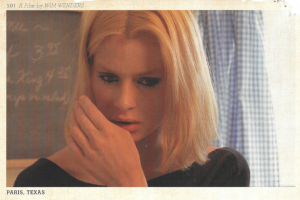
— From Adam in Madison, Wisconsin, a Paris, Texas postcard with one of the nicest notes I’ve received: “Thank you for your terrifying, fathomless, powerful work.” I’m grateful whenever the book speaks to someone, but I always think the best parts were written in an accidental way and I also know that for everyone who strongly loves the novel there’s someone, probably, who strongly hates it.

Julia Kristeva

— From Karen in London, a degraded, photocopied picture of theorist Julia Kristeva, whose ideas play an outsized role in the book. It’s the photo that’s used on the translated-into-English edition of her book Powers of Horror, and I don’t know for certain whether or not it was Karen’s intention to send an image with such generation loss, but the haunted aura of the degraded photo is very much in keeping with Laing’s fading memory and his monstrous decision to destroy the films so that no one else can remember them, either.

I save all the mailings I receive and actually think of them as part of the sprawling narrative of the novel itself, an extension of the fictive world that Laing, the ghost of his daughter, the narrator, and others in the book inhabit. The people who write have dipped into my world though the novel, and now I dip into theirs, imagining and conjuring stories about who they are, what they do, and the simple, remarkable fact that our lives have touched each other in some small way. I hope, at last, it’s more than analog nostalgia, and yet that’s certainly part if it: a yearning in the digital era to communicate through something more than a flat screen.

And thus, and so: if you would like to receive an archival packet from the Laing archive, please follow these procedures: send a tweet to @ElectricLit that names a film by known director that does not exist, but that you wish did exist. For instance: “Alfred Hitchcock’s non-existent 1967 film When the Tide Comes In.” The deadline is Wednesday, March 4, midnight EST. In conjunction with the editors of Electric Literature, I will select five “winners” who shall receive, via snail mail, film-related documents from the archive of Roberto Acestes Laing.

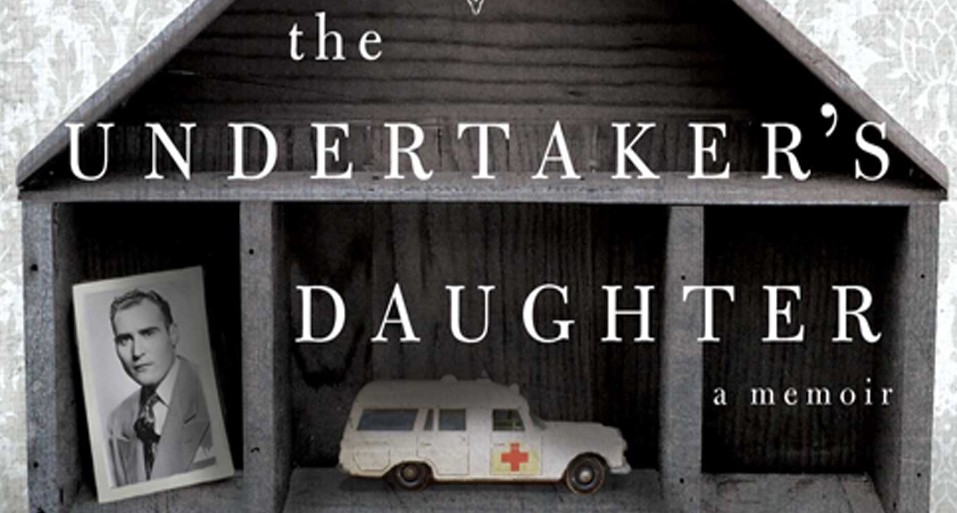
REVIEW: The Undertaker’s Daughter by Kate Mayfield

In Kate Mayfield’s memoir, The Undertaker’s Daughter, we get a peek into the house of a family living in close proximity to the dead. An undertaker in a rural Kentucky town in the 1960s, Mayfield’s father was at the constant beck-and-call of its citizens. Mayfield’s family lived above his small mortuary. A ring of the family’s phone meant death, and necessitated Mayfield’s father leaving the family to step into action — ushering local families through difficult decisions about final arrangements for their loved ones while almost simultaneously preparing the deceased’s body to be put in the ground. Mayfield is honest and reflective in The Undertaker’s Daughter, evoking rosy nostalgia. Here, though, the lessons in ethics are seen through a series of vignettes about death and dying, the science of Mayfield’s family’s business.

Mayfield’s mother hushed her children daily as visitations and funerals took place in the rooms below their living quarters. Out of respect for the deceased’s families, Mayfield develops a personality that is equal parts reactionary and controlled. “I learned that to live in an environment that cared for the needs of a constant flow of people — both living and dead,” Mayfield says, “it was necessary to steal an ounce of personal freedom wherever and whenever I found it.” Each of the Mayfield children absorbs the odd circumstances of their life differently, but they also each seem to have this same dichotomy within them. Their lives demand periods of silence and control, while being constantly exposed to heightened emotion and grief from the relatives of the dying. “I was funeral home trained from the beginning,” she tells us. Mayfield and her siblings had to live with death.

Mayfield’s father emerges at first as a saintly figure, generous almost to a fault. It’s clear that he takes pride in his job and sees his own behavior around the families of the dead as equally important to the work he does in the embalming room. Mayfield presents him initially through a filter of adoration: “Each funeral as an opportunity to imprint his stamp,” Mayfield tells us, “the details of which bore his personal touch. Not one strand of the corpse hair should go astray, not one of a family’s requests should go unheeded. A final perfected image, a memorable experience, was his unwavering goal.” But as the memoir continues, it becomes clear that Mayfield’s father — perfectionist though he is in his work — is no saint. His life as an undertaker pulls him away from his family more often than not and, as Mayfield ages, she comes to learn that in the time apart, he becomes someone else. She eventually identifies her father as more human, someone altogether different than the stolid image he presents to the town. The Undertaker’s Daughter asks us to consider how our role models may be both benevolent and flawed at the same time.

Mayfield’s view of herself changes as she ages, too, especially as she dates outside her race and comes up against the racial prejudices of people in her hometown. Through her father, she comes to know a reclusive woman who has been rejected by the town. Father and daughter take this recluse under their wing, and the relationship deeply affects Mayfield. She says, “I grew up feeling split down the middle with a partial stake in the robustness of life, and another that needed to retreat to silence and observation, to be alone and undisturbed.” Mayfield’s memoir feels a little too long by about one-fourth — the same conclusions regarding her father could have been realized in fewer pages, and she veers into a legal battle over property that feels like a separate B-plot — but she clearly renders her father as a complicated man, and in the process shows us how her family had to sacrifice to make his vocation possible.

Mayfield’s memoir doesn’t flinch when dishing out the details of death. In fact, she ventures into the specifics of her father’s work without ever becoming macabre. She seems to know there’s a certain amount of curiosity about the subject, while strategically tempering the scientific information with personal stories and portraits of small town Kentucky life. Mayfield does her strongest work when she shows her father as a real man with faults, and when she describes the many rituals surrounding death and dying that became a part of her daily life in the house of an undertaker. She never did want to take on the work herself, but she recognizes the significance of how her father let her into his world. “He could have chosen to declare the funeral home off-limits to my childhood. But he didn’t,” she says. “How fortunate I was that he allowed me to follow him downstairs each day to occupy his world.”

The Undertaker’s Daughter

by Kate Mayfield

Powells.com

INFOGRAPHIC: A Map of the Literary Genres

According to the fine folks at Pop Chart Labs, there’s a theory that genres exist for the benefit of bookstores and at the expense of readers. Similar to a Las Vegas casino, booksellers manipulate the environment to lure you toward the money makers — I imagine librarians will be the first to object to this theory. So Pop Chart decided to look beyond these commonly accepted distinctions to see how the genres relate and where books belong based on content rather than commerce. “We went in with the idea that we were looking not at commercial distinctions, but instead peering deep into the text of the book, at almost the cellular level,” said Rachel Mansfield of Pop Chart.

The approach created some difficult decisions and surprising results: The Lion, the Witch, and the Wardrobe found its home under the “Christian” genre, rather than the expected fantasy. Explore the chart and discover what kind of books you really like. The poster is available for $29.

literary genre map

Midweek Links: Literary Links from Around the Web (February 25th)

Looking for some interesting reading to get you through hump day? Here are some literary links from around the web to check out:

What’s in an ending? The Millions takes a look at the art of the final sentence

A reading vigilante is trying to protect Boston Public Library readers from awful books

Seven books in translation that will let you to travel the world through fiction

A lost Sherlock Holmes story has been found… but it is probably a fake

Washington Post on why digital native teens still prefer reading on paper

The Guardian on only reading non-white authors for a year

A survey of John Updike’s short stories

20 female Harlem Renaissance authors you should read

Lastly, new collection of rediscovered dark fairy tales puts the grim in Brothers Grimm

The Long Walk North

It didn’t surprise anybody much that David Tremaine had finally gone and done what he always said he wanted to do, the thing he talked about, even way back in high school when we were on the basketball team together and he hadn’t gotten really sick yet, and even after that, when mania got hold of him and threw him naked and sleepless up on freeway medians or got him drunk on gasoline or sat him down at internet poker tables to drain his dad’s credit cards; even when he was stable, full of lithium carbonate and living on a couch in the den of his parents’ house in Lake Havasu City, collecting their mail and feeding their Corgi and keeping the dahlia garden alive while Holt and Marian Tremaine were in Rockport for the summer (where David was not allowed — in Rockport people talked), and, surprise, he did it: he walked north, with only a change of clothes, a Gore-Tex parka, and five hundred bucks, until he could walk no further, until he took his last step a mile south of Gift Lake in Alberta, where he sat down in the ice and wind, wrote a note to Nadine, and froze to death. The walk had taken him six and a half months.

David used to come out to Vegas and stay with me so he didn’t have to pay for a hotel room — he wanted every penny for poker — and on most visits he was normal, but one time I remember he was way up high, manic as they come, talking so fast I didn’t see how he could breathe, ropy, skinny-guy muscles standing out under his shirt, drops of sweat running down his forehead and dripping off his eyelashes, and even now I can’t think of him any other way but cross-legged on my bed, poking my chest with a forefinger that felt like the handle of a wrench, commanding me to understand why pot-limit Omaha 8 was the best form of the game, why it was all right to stare at an eclipse, why his brother George had killed himself, why he never would. I loaned him my old shitbox Chevette while he was here that time so he could drive downtown and play at Binion’s, knowing that that was probably a bad idea, and it turned out I was right, because he didn’t come back. I never reported the car stolen — I didn’t want David to get in any trouble, he had enough to worry about. It wasn’t till four months later that I saw him again, in Havasu (I was there to see my mother), sitting by himself in a crowded coffee shop, secretly drawing ballpoint portraits of girls sitting at nearby tables, and I said Whassup or something, but he didn’t recognize me at first, maybe the sun was in his eyes, maybe because I’d lost a few pounds, maybe because Pete was with me at the time and I was physically transformed by anger — Pete and I were feuding about the reappearance in his life of an old lover I knew Pete still had feelings for — but David eventually figured me out and stood up and gave me a hug, a broad, real hug that felt good and whole, saying, I was missing you, Theo. There’s probably some big German compound word for how I felt — gleeful that Pete had seen the hug and David’s enthusiasm in giving it, sad that nothing would ever come of it, jealous that Pete got a hug, too, even though they’d never met. We sat for a while, David drew our portraits, chattered about some girl, talked about walking north like always; normal. The car never came up. I didn’t care. We left, me and Pete, silent on the drive home.

Pete never mentioned David after that, so I knew he’d been affected by him, his presence. It wasn’t long before Pete and I finally said so long motherfucker to each other, a transition from not-single to single whose climax was an ugly fight in the hallway of the apartment building, fists and everything, I got a kick in the balls, Pete got arrested, I moved out in less than three hours, to Nadine’s. Thank god for Nadine and all the little sisters of the world.

The following week I got a call from Holt Tremaine. He told me that a friend of a friend of his who worked at the DMV had looked up the license plate of a Chevrolet of uncertain provenance that David had come home with one day months ago, and that it just so happened that it belonged to me, that he was sorry, could I come get the car? Nadine gave me a ride out to Havasu to pick it up, but she wouldn’t come inside the Tremaines’ with me, saying she’d never liked them, ever since junior high school when they came to a bake sale and bought tons of shit from every kid but her, but I was pretty sure she didn’t come in mainly because she’d always been mortally shy around David and probably had a crush on him like everybody else, so I went in on my own, but David wasn’t there. Turns out they’d put him in Rawson-Neal in Vegas to get his meds stabilized, his 34th hospitalization according to Holt, a figure he cited while digging obscenely through his pockets for the ignition key to my car. I asked them if they thought David might like a visitor, and they said, matter-of-factly, as if warning me of sharks in shallow waters, Better wait, he’ll probably be restrained and isolated for a few days. They just stood there and smiled. I left. I tried to visit David at Rawson-Neal a week later, but he’d been discharged.

After the Peter breakup, Nadine tolerated me in her little house in Henderson for a couple months while I moped and half-assedly looked around for an apartment and a job I could stand. One evening she brought home a boy, some wannabe gangbanger, crude tattoos on his neck and a broken tooth, maybe he was the real deal, what did I know. Nadine made dinner for all three of us, Western omelets and chorizo and margaritas, while Ricky and I sat at the little kitchen table, nothing to say to each other, neither of us even trying, listening to Nadine chatter in the high, quaky way she does when she’s nervous and excited at the same time, and when it came time to eat, Nadine sat down with us, but Ricky picked up his plate and drink, said, Where’s your room, and walked off in the direction Nadine pointed. She and I sat there, Nadine staring at her omelet, grinning like a little kid on the first day of summer, saying nothing, and a venomous part of me kept her there for several minutes, not imparting approval for her to get up and go join him, until finally I stood and said I was going in the TV room to watch Arrested Development and finish eating, and, not to worry, that I had a date, too, and would be out of the house in less than an hour. She probably knew I was lying, but I don’t think either of us cared. She went in her room to be with her boy, and I sat down to watch TV, but realized that I did not ever want to hear my sister moan, so I picked up my shoes and walked out to the car, barefoot, not wanting to spend a second longer in that little house, filled as it was with youthful sexual presence.

I drove to the Mirage. I waited in line behind the tourists checking in, watching the tropical fish wiggle in the narrow, twenty-by-thirty-foot aquarium that served as a backdrop to the front desk. I got a nonsmoking room, but it still smelled like smoke. I went downstairs and sat at the lowest-limit poker table I could find, a $2-$4 Hold’em game. I lost half my stake pretty quick but managed to stay about even for a couple hours after that. The dealer was pushing me my first decent pot when I heard the sound of clapping: a single person’s slow, deliberate applause, sharp, loud pops that elbowed aside the incessant ding and whistle of the slots and drove right to the eardrums. It got everyone’s attention, though at first no one could tell where it was coming from. Then I saw, up in the raised, roped-off area in the corner of the poker room, where the $40-$80 and higher games were run, a wild-haired young man, wearing a sleeveless t-shirt, his arms tanned to the burnt reddish-brown of a transient, watching and clapping as the dealer pushed a pile of black chips his way. His opponent, a middle-aged Korean woman with a hot-flash fan, stood up and began to walk away just as two men came over, they looked comically like Secret Service guys, dark suits, RayBans, wires curling from their ears that disappeared into their shirt collars. They stood behind David and waited while he built towers out of his chips, childlike, concentrating on balance and distribution and aligning the stripes on the edges. A woman came over with a stack of banknotes and some paperwork in hand and cashed him out. David stuffed the wads of cash in all four pockets of his jeans. Then one security guy leaned down and said something in David’s ear. David closed his eyes. He made a hard fist of one hand. Then he stood and turned to strike the big man, but he grabbed David’s wrist before he could let the punch fly. David violently yanked his arm away, causing the goon to lurch. The second guard grabbed David’s hair and other wrist, wrenching his arm up behind his back. The men virtually carried him out of the poker room, his forearm jammed up against a shoulder blade, David smiling, laughing at the two musclefucks. I stuffed my chips into my pockets as fast as I could and jogged after them, saying I’m with him, let him go, he’s not well, I’ll take care of him, but the big bastards ignored me and threw David out of a rarely used exit that led to the parking garage, where he landed face first, cutting his forehead and cheekbone badly enough that I had to give him my shirt to stanch the blood. In the car David pulled out all his money, fifty-two grand, waved it around, hooting and shouting and bleeding, then reached over, stuck a finger inside the hip of my jeans, pulled on the material enough to make a gap between it and my skin, and tucked ten thousand dollars inside. The stack of hundreds was warm and moist from blood. He said, Let’s drive out to Mustang Ranch, man, let’s do it, I could fuck all night, but when I told him I was tired, and that I had a room at the Mirage, he asked me if I had brought my laptop and did I have a credit card he could use, could I sneak him back into the hotel, that he wanted to play poker online in my room. I desperately wanted to tell him yes, but the truth was I could not — I didn’t have my laptop, my cards were maxed, and I didn’t think I could sneak him in looking like he did. David threw my bloody shirt in my face, climbed out of the car and ran back into the casino. I didn’t stay. I drove around, out toward the low hills surrounding the city till dawn, then went back to Nadine’s and parked behind her little Corolla. I didn’t go in the house. I fell asleep in the back seat, waking around one when it got too hot to breathe. Nadine’s car was gone.

I found work as an accountant for a firm that manufactured air conditioner filters, and moved into a small house just a few blocks from Nadine. I kept the blood-smeared ten thousand in an empty chicory coffee can on the bottom shelf of the refrigerator. I called the Tremaines now and then, but no one ever answered or returned my calls. It had always been that way, though.

Nadine and Ricky were arrested for drugs after getting pulled over in her little Corolla driving from L.A. to Vegas, a serious arrest, too, they’d had enough coke on them to be classified as traffickers. Some unknown put up both their bonds, which was scarier to me than the arrest, it meant that there were some big people pushing the chips around out there. Nadine told me she hadn’t known the drugs were in the car — they were attached to the underside of the chassis like a limpet mine — and I believed her, I knew she wouldn’t do anything like that, she worked as a pit boss for chrissake, never in trouble in her life. Her lawyer urged her to plead guilty and hope for the best, but she was sentenced to a year in jail. She served every minute of it.

While she was inside I watched her house and fed her fish and watered and mowed, and with the ten grand I paid her bills and mortgage, it was enough to cover more than seven months’ worth. When she got out, I drove her home where she wandered around the house, looked in all the rooms, fed her fish, then sat me down at the little kitchen table while she cleaned out the refrigerator. As she sat on the floor, a bottle of Fantastic and a roll of paper towels at her knee, she told me she’d taken art classes in jail. She told me that whenever anyone finished a picture the teacher stuck it up on the cinderblock walls so everyone could see, and one day about two months ago she saw a big piece of white paper taped up next to hers, covered in little drawings, portraits of other prisoners, dozens of them covering the whole sheet. It was signed David Tremaine. Nadine told me that at the bottom of the paper she’d written Hi David Love Nadine Staples in black wax pastel, and sometime later she noticed he’d written on her drawing of a carousel horse Nadine I love you, but that was as far as the correspondence got because a guard saw it and changed the rules so the teacher couldn’t tape up pictures anymore, fearing gangs could communicate that way, even though every third person in the whole jail had a fucking cell phone.

Nadine finished cleaning the freezer, emptied out the old ice cubes, ran the kitchen tap, waiting for the stagnant, brownish water in the pipes to empty out, and fresh, clear water to replace it, refilled the trays, and stuck them back in the freezer. She closed it and gave me a big smile. It wasn’t the same smile as before. She wasn’t the same person.

I didn’t see much of her for several months after that. I had found someone new, Harry, we met in the earphones aisle of Target, him a divorced Beacon Hill heir with three kids and fifteen years of deep analysis behind him, and me, from the desert, working for a living, loath to head-shrinkers, not even a pet to tether me, and we would joke about how we were so different, that one day we’d have to break up because of it. Then, coming up on a year together, the joke dissipated, eroded to slivers from overuse, no longer necessary as a talisman against its own prophesy. That was when Nadine called.

David had been released from jail, and the first thing he did was turn up on Nadine’s doorstep, a box of melting chocolates in one hand and a colored-pencil drawing of a whole carousel of carousel horses, so dynamic and layered, she told me, that she imagined it in motion, the horses bobbing, the tinny music playing, the carnival barker shouting offstage, the evening and its jewels of light a curtain around it all. Nadine let him in. Following a few weeks of “exquisite normal,” as she put it, an entirely out-of-character use of language for her, David told her that he felt great, that the meds had done their job but now he didn’t need them anymore, and so he quit taking them. He unofficially moved in.

One morning early her cell phone rang. It was Ricky calling from prison, and she answered it, David right there in bed with her, so she got up and went into the TV room to talk, but he followed her and crouched down behind the couch to listen. The volume must have been turned up on the phone because David could hear both ends of the conversation, some of which was of a sexual nature, and when she hung up, David sprung out from behind the couch, startling her, screaming at her about her infidelities, how long had they been going on, and Nadine told him she had no plans to ever see Ricky again, especially since she and David had gotten together, but it still upset him so much he locked himself in the hallway bathroom with a utility knife, and wouldn’t come out for hours. It finally ended bloodlessly, but after that David was irrationally possessive of Nadine, and jealous of anyone she spent time with, going so far as to follow her to work at Harrah’s — she was a waitress now, no longer a pit boss, being an ex-con ruined that career — watching her at a distance, pretending to play the slots. She didn’t know this until he confronted her while she was on her way to the bathroom at lunchtime one day. He told her he’d seen the craps player she’d been flirting with, and Nadine told him she hadn’t been flirting, he was a good client with a lot of money, and it was her job to be extra nice to him, and David said, Exactly how nice do you have to be? then followed her into the bathroom and began to sob leaning up against her stall door. Incredibly, no one called security on him, and Nadine took him home, missing the last half of her shift, and getting into no little trouble for it, too. After that she talked to casino security to make sure they never let David in again.

One night he accused her of having the police and the FBI and Homeland Security watching his every move, he knew this because there were cameras everywhere, plus they wouldn’t let him into Harrah’s to see his own girlfriend. Nadine denied this, and he struck her in the chest with a hard, closed fist. The next time he tried to hit her, she put her arm up to defend herself, and the punch, delivered with hypermanic force, broke it clean in two, so that her forearm bent in the middle like a carpenter’s square. That’s when David ran out into the night and Nadine called me.

After the emergency room set her arm, she came to stay with Harry and me. David started sneaking into our yard in the middle of the night, either begging through the front door to talk to Nadine, or hissing my name, calling me a slanderer and a fag and a rat, saying that he knew what I was really doing and that it wasn’t going to work. Nadine didn’t want to call the cops, saying David was just sick, that he never would have hurt her if he’d been on his meds, and I actually felt the same way, plus an arrest would send him back to jail, so Harry sat alone in his desire to sic the LVPD on him, and it took both me and Nadine to convince him not to.

Nadine stayed with us while David rampaged, committing assaults with telephone calls and emails and sometimes a double-fisted hammering at the front door. Before long she had been with us for more than a month, never leaving, even once, somehow having wrangled a leave of absence from work. The night David threw a coil of garden hose through our bedroom window was the night Harry moved out. The incident convinced Nadine and me that our safety trumped David’s freedom, so we called the cops, but David had disappeared. He came back a few nights later, wearing nothing but cutoff jeans and a six-week beard, broke through the back door, and dragged Nadine out into the yard by her good arm. This time the neighbors called the police, and the short of it was that David went back to jail to finish out his sentence, with six months tacked on. Nadine never told me what his original crime had been.

In Nadine’s absence, David had covered every available surface of the inside of her house, including the ceilings, the lampshades, the inside walls of the refrigerator, every sheet and blanket, and the bowl of the toilet, with portraits of Nadine done in red and blue Sharpie, all the same pose, all from her high-school yearbook picture, a 4” x 6” color print she kept in a frame on top of her dresser, or used to. The floors were littered with spent pens, like shell casings. Her fish were dead.

I tried to convince Nadine to sell and move into a new place, that she could live with me while she house-hunted, but she wanted to stay. We repainted, but ghosts of the drawings worked their way up through the coats of eggshell white. Nadine said she wanted to paint everything black so nothing would show through, but I told her those ghosts would still be there, so we wound up sanding and scraping the whole interior, big flakes of white paint with red and blue streaks on them fluttering to the floor to be swept up and thrown away. We threw out everything, too, including the refrigerator, TV, and furniture. Nadine started over. It took two months. Harry called once, early on, advising me that movers would be coming to collect his stuff. I wasn’t heartbroken. At least not about Harry.

David, we found out later, was released from jail to the custody of his parents in Havasu, who started to reward him with cash every time he took his meds, something I’ll bet they wished they’d thought of years ago, because it worked — David stayed stable. He never called me or Nadine, but he sent one or two letters to her, with APOLOGY INSIDE written on the envelope in blue Sharpie. I never found out if Nadine read them.

It was Pete, of all people, who issued the last David report.

Pete sent me a terse email saying that he had something of mine, a jacket, my letterman’s jacket from high-school basketball, did I want him to mail it back to me. Plus he wanted to send me a check, he said he owed me $85 for some dinner I had no memory of, that he didn’t want to have any debt hanging over his head. My first inclination was to write back and tell him to take a deep breath and fuck himself, but instead I responded with my address and a cool thank you. I also asked how he was, and the response was a thousand-word cataract of personal history, interspersed with guilt, accusation, apology, provocation, and insatiable repine. And confession: he told me that even before our memorable breakup he had begun to pursue David, “accidentally” running into him at the coffee shop again, talking about the walk north, would he ever really do it, asking to be taught poker, staking David for higher-limit games, going over to David’s house, where he made friends with his mother Marian, and stayed on good terms with her, even after David put an end to his friendship with Pete following his clumsy pass at him in the back of a gypsy on the way back from a bad night at a $20-$40 game at the MGM Grand. David gently pushed him away, saying he had a feeling this was coming, and that he was sorry it had, because he really valued their friendship, but that it would have to end, because this sort of thing never works out, you can’t have lust in a friendship, especially one-sided lust. Pete and Marian continued to email and Facebook and meet for the occasional coffee, and it was at their last meeting that Marian told him that David had left them a note a couple days earlier saying he had started his walk north, that all would be well, he would take his meds the whole time. Holt had talked Marian out of filing a missing persons report, saying that David was an adult and could take care of himself, especially if he was medicated. Pete told me that this all happened more than six months before. He finished his email with an anemic Take care. I didn’t write him back. The next day an article in the Review-Journal reported that David had been found in Canada by a hunter.

On a cool, breezy Saturday Nadine had me over for lunch. I was sitting at her little kitchen table — she’d replaced the one David had ruined with the exact same model — reading business emails on my phone while she cooked grilled cheeses on white bread and served them with Ruffles and beer, when a knock came at the door. We both froze. She wasn’t expecting anybody, and nobody she knew simply dropped by. We looked at each other. I read in her eyes, and I know she read in mine, that it could only be Ricky. I was afraid of Ricky.

But it wasn’t him. It was Holt Tremaine.

“Sorry to bother you on a Saturday,” he said, his hands busy in both front pockets of his slacks, the cuffs of his sports jacket bunching up. “I found your address on the internet, you know, and I wanted to deliver something, from David, he had it on him… on his person… when they found him, and I think it’s for you.”

Holt reached into an inside jacket pocket and found a dirty, water-stained envelope that read NADINE in dull pencil. He handed it to her, then jammed his hand back in his front pocket. “It’s not in very good shape. Hello, Theo.”

I said Hello back. Holt Tremaine left.

Nadine folded the letter in half and put it in a kitchen drawer, the one next to the stove that held notepads and matchboxes and screwdrivers and the like. She sat down with me at the table. The grilled cheeses had cooled. The chips were all fragments, the end of the bag. I wondered if Nadine would open the letter, after I’d gone home, would she cry when she read it, would she refold it carefully and tuck it in a book she’d never read, would she burn it in the sink, was it a love letter, a defense, an apology, a memory, a manifesto, was it a mere travelogue, or a drawing, a landscape in pencil of his last view, was it unfinished, did it freeze when he licked the envelope shut, was there anything in there about me.