Ewan McGregor to Adapt Philip Roth’s American Pastoral

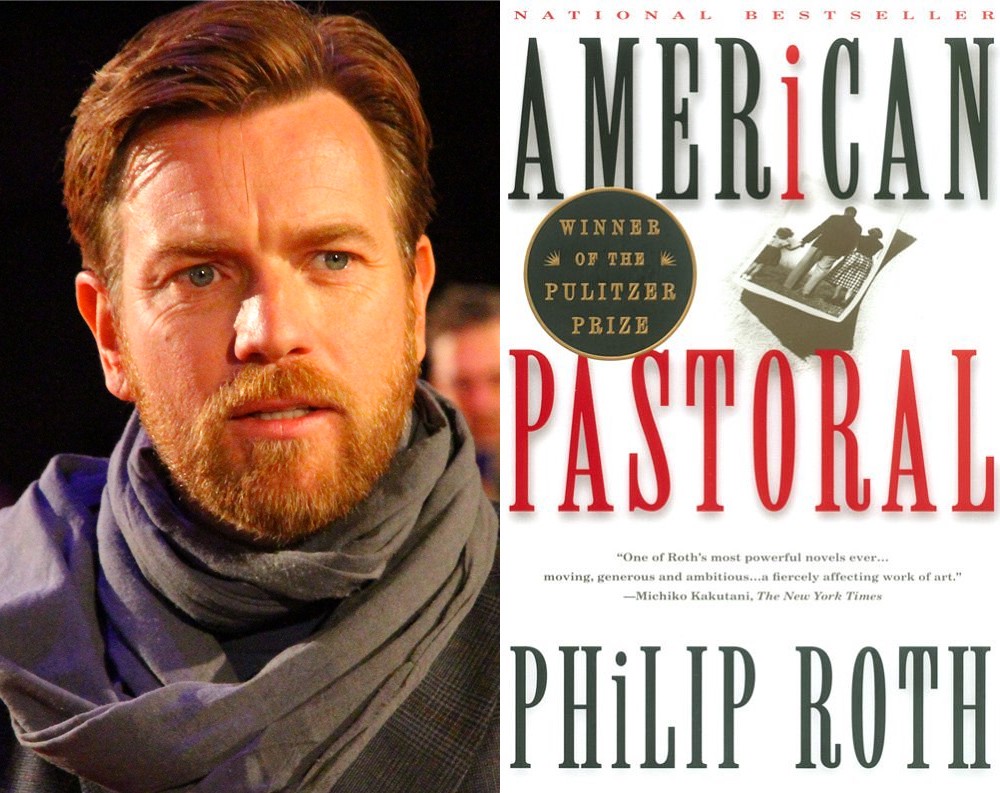
Ewan McGregor is slated to make his directorial debut with Philip Roth’s Pulitzer-winning American Pastoral. McGregor was attached to star in the film last year and previously Phillip Noyce was attached to direct. Now that Noyce has stepped aside, McGregor is taking over directing duties as well. The brown-haired Scotsman McGregor was already a bit of an odd choice for Pastoral’s blond Jewish-American Swede Levov, and his directorial takeover might mean we have another Philip Roth adaptation flop to look forward too. Despite Philip Roth’s vast body of acclaimed and award-winning novels, there has yet to be a great adaptation of his work. (Here’s Adam Chandler on the “sad history” of Philip Roth adaptations.)

On the other hand, McGregor has been itching to direct a film for years and maybe he will be up to the task. The screenplay was written by The Lincoln Lawyer writer John Romano, and Jennifer Connelly and Dakota Fanning will co-star.

REVIEW: History of Cold Seasons by Joshua Harmon

History of Cold Seasons reads like William Faulkner wrote it after he moved north, read a bunch of surreal prose poetry, and then wrote straight through a New England winter. Joshua Harmon’s fiction — he’s also a poet and essayist — might even be called New England Gothic: His landscapes are sinister and dark, and the macabre functions as powerfully in Harmon’s northeast as it does in Faulkner’s deep south. In the spirit of the great Southern Gothic writers — Flannery O’Connor also comes to mind — the stories in Harmon’s History of Cold Season almost always have something deranged at their very core.

Take, for example, “The Burning House”, a story in which a child quietly notes evidence of an elderly woman — likely his babysitter’s mother — trapped in the attic at his babysitter’s house. He doesn’t mention the woman in the attic to anyone, and he returns to his babysitter’s every day after school. He remembers sitting in his babysitter’s kitchen, avoiding the dog-haired cookies, and watching cigarette smoke float through the air. He says, “Afternoons, always, were waiting for the sound of tires in Phyllis’s driveway, for the glow of headlights through Phyllis’s windows, for the sound of my mother’s voice at Phyllis’s door.” One cold winter night, the babysitter’s house burns down, and the story of the elderly mother — padlocked and trapped inside that attic — becomes a blip on the regional news cycle. Phyllis speeds off without a trace that night. The boy, on the other hand, remains in the same town, haunted by his memory of his babysitter and her mother, and unsettled by the ease with which the rest of the town forgets them. He says, “Our town was a town of closed doors, a town of curtained windows.”

“Rope” — the opening story of the collection, published here at Electric Literature’s Recommended Reading — is another great example of the twisted and gothic nature of the collection. In the story, two young sisters imagine that their older brother keeps a girl tied to a tree in the woods. This idea mostly seems to be a childhood flight of the imagination, except it’s conjured with such vivid and haunting detail that it feels real. In a terrifying manner, the imagined story does become real as the sisters accidentally bring a pair of boys into the woods with them to search for the tied girl. “A few feet away, Mindy stands against another tree,” the narrator says, “her hands also snared by her sides, and I pretend I cannot hear the things she is saying, the sounds she is making.”

Harmon’s stories also often demonstrate an experimental edge. “The Lighthouse Keeper”, for example, is constructed of dozens of nearly self-contained poetic vignettes, with titles like “Beachcombing”, “Ghost Stories”, and “The House In The Dunes.” Over the course of the story, an in-danger relationship between the lighthouse keeper and his lighthouse emerges, but the real joy of the piece lies in its close attention to the haunted language and imagery, evocative of a lonely lighthouse, “rising from the end of a narrow, rocky peninsula.”

The longest story in the collection — “The Passion of Asa Fitch” — is the most realist of the bunch, and it features an irritable elderly man living in the remote and snowy foothills of Massachusetts. This story demonstrates another move in Harmon’s repertoire: dark comedy. It finds joy in the absurdity of the world. Asa Fitch might be ailing and unpleasant, he might survive on family-size bags of potato chips and half-gallons of ice cream, but he also has an unexpected charm. The story finds its drive in Asa’s sexual pursuit of Marnie, the nurse who comes to check on him twice a week. Harmon writes that Asa, “…often considers wandering off into the woods on a cold night, alone save for a bottle of brandy, but always concludes that he would rather enjoy congress with a woman one last time…” In this funny, poignant, and appropriately claustrophobic story, Harmon conveys a physically ailing but cognitively sharp old man who’s raging against the dying light in all of his particular ways.

Reading History of Cold Seasons feels a bit like driving past remote and decrepit homes, wondering who lives there?, and then actually getting an answer. In the spirit of Faulkner and O’Connor, Harmon’s stories drill down to the spot where something’s rotten. They trace the manner in which people behave in twisted ways in response to a twisted world.

History of Cold Seasons

by Joshua Harmon

Powells.com

Artist Turns Books into Crystallized Fossils

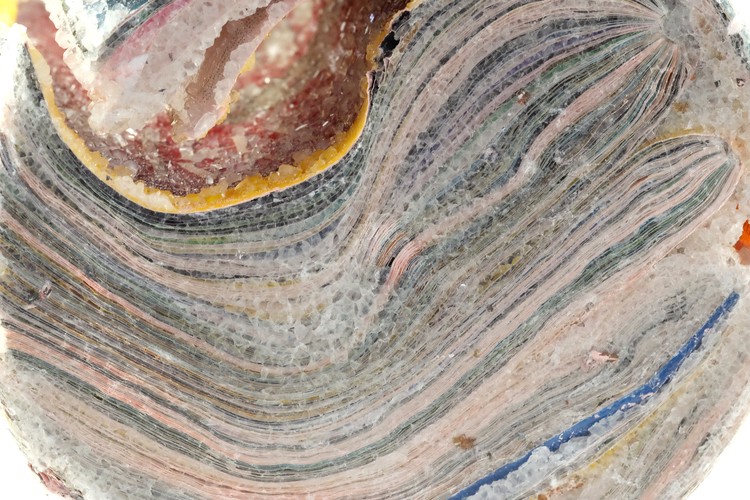
Some people say that print books are fossils in an age of e-readers, but artist Alexis Arnold decided to make that literal. In her Crystallized Book Series, Arnold turns the Bible, Billy Budd, the San Francisco phone book, and other books into crystallized art objects with Borax crystals. She explains:

The Crystallized Book Series addresses the materiality of the book versus the text or content of the book, in addition to commenting on the vulnerability of the printed book. The crystals remove the text and transform the books into aesthetic, non-functional objects. The books, frozen with crystal growth, have become artifacts or geologic specimens imbued with the history of time, use, and nostalgia. The series was prompted by repeatedly finding boxes of discarded books, by the onset of e-books, and by the shuttering of bookstores.

Click around the gallery above, or check out the entire series here.

(h/t Black Balloon)

Recently Discovered Dr. Seuss Book Coming This Summer

Harper Lee is no longer the only beloved American author to have a recently discovered manuscript be published this summer. Today, Random House announced that a lost Dr. Seuss book, What Pet Should I Get?, will be published this July as well. And like Harper Lee’s Go Set a Watchman, the new Dr. Seuss — the pen name of Ted Geisel — is also a sequel. The book features characters from One Fish Two Fish Red Fish Blue Fish trying to decide what pet to get. The book was found in nearly finished black and white illustrations. According to Random House, the book was likely written between 1958 and 1962.

Audrey Geisel, Dr. Seuss’s wife, said this in a statement:

While undeniably special, it is not surprising to me that we found this because Ted always worked on multiple projects and started new things all the time — he was constantly writing and drawing and coming up with ideas for new stories.

This isn’t the only forthcoming posthumous Seuss book. At least two more books were found, although their titles and release dates have not been announced yet.

Saint Andrews Hotel

by Sara Majka, recommended by A Public Space

In 1963, an eleven-year-old boy named Peter Harville was committed to a state mental hospital in the western part of Maine, far from the island where he grew up. He had tried to commit suicide by cutting his wrists with his father’s coping saw, but he hadn’t made much of a mess. A pile of sawdust below the bench absorbed much of the blood. He lay on the ground watching the sawdust turn red until he realized someone had opened the door. Peter? his father asked, not moving or coming in. Peter? Are you all right? Peter noticed that his father spoke more gently than usual, and the shed felt warm and calm; for the moment he was happy. The crack in the door let in light glittery with dust.

The father ran to call the doctor, then walked stiffly up the grassy slope in the backyard to get his wife. She was clipping laundry at the top of the hill. She — Helen — wondered what was wrong with her husband’s mouth, the way it moved as if with a life of its own, as if he was having spasms.

The next week she packed a bag for Peter and his father took him on the ferry, then into the Cutlass sedan that was kept in the lot on the mainland with a key under the seat for anyone on the island who had an errand to run. They were at the hospital by three. Afterward, the father checked into a hotel. He went to the bar across the street and had several pints of beer. It had been ten years since he’d spent a night off island and he spoke little, just studied the line of coasters taped to the wall behind the bar. His hands twitched on the counter. They were small-boned and fine, adept at gutting fish and killing the lambs during the summer slaughter, thinking of those lambs dangling in the walk-in no more than he thought of anything else.

In the hotel room, he took off all his clothes — the room lit in vertical lines by the blinds — and folded back the sheets, then slid inside and tried to sleep. When he got home, he didn’t say much to his wife. She listed object after object, asking if they’d let Peter keep it.

You’ll baby him, he said.

What is there left to baby? she wondered, looking around the empty house.

Sometimes I dream about him, she said to her friend Eleanor. They were hanging laundry; the wind came up the grassy slope and blew all the soft clothes on the line, the chambray shirts and white cotton sheets, her blue nightgown with lace along the neckline.

While her friend clipped, Helen stared across the sea. She felt as though she had lost something but she kept forgetting what it was, and when she remembered she couldn’t understand it. Do you suppose it’s a long trip? Helen asked, her voice sounding like it arose from a daydream. The idea had come to her over days, like a bubble expanding in the back of her mind, that it had been a mistake, that she would take the ferry, find the car, drive to the hospital, tell the doctors it had been an accident with the saw, that it wasn’t true what her husband said about Peter.

Her hand slipped, and a gust of wind took the sheet and blew it down the hill. Both women laughed and chased after it, barefoot in cotton skirts, two thirty-year-old women chasing after a sheet, then drinking instant coffee in the kitchen with a plate of crackers between them. They gossiped about the hotel where Eleanor worked as a housekeeper. She was seeing one of the men there, someone’s cousin who was going back to Boston in two weeks. She was a tall, thin, bent-backed woman with violet circles under her eyes. Helen watched her, watched the liquidness of new love — the way her talk spilled, her eyes shone, how her hands slid through the air — and thought, he’s going to leave and she’ll still be here.

One day the ferry went out to sea but the mainland never came. The captain turned back fearing he would run out of gas. He tried again the next day, but still couldn’t find the shore. In time, he took it as a matter of course, as they all did, as they forgot their desires with some relief, as the desires when they arose had been impractical, painful. One man painted in the loft of an old barn. All his canvasses were of blue trees. The islanders hung them in their living rooms, and there was something hopeful in it, as if they had kept a belief in the symbolic power of beauty.

Peter stayed in the hospital until he was twenty-one. He would have left earlier but nobody could find his parents, and the hospital had put him to use in the kitchen. When he left, he couldn’t find the island on any maps. In the place where it should have been was a sprinkle of land, most of it not much more than rocks. The most promising landmass turned out to be nothing but sandy slopes and beach grass. He was told someone had tried to start a leper colony on it years ago, but it had proved inhospitable. He traveled the coast for some time, taking on construction jobs or working the docks, looking for anything familiar.

He finally took the bus up north and got off in Portland, Maine. He stood there, a medium-sized boy with pale coloring and a slow, coltish walk. Across the street he saw an old brick building with “Saint Andrews Hotel” lettered in faded white paint. Inside, a threadbare green carpet spread across a large, mostly empty lobby. A cluster of sofas and upholstered chairs huddled at the center; several of the residents sat there. The hotel rented rooms by the night, but also long-term, and many of the people had been living there for years.

He took a room for a month. When the month was up he paid again. He liked it there; he liked to sit idly with the other residents. In the hospital, they had sat for hours on the long, narrow sun porch, everyone squished in with African Violets and end tables. All the old men leaning on canes, their eyes in the light as opaque as glass marbles. No sooner had Peter left the hospital than he found another one. How strange we are. How different we are from how we think we are. We fall out of love only to fall in love with a duplicate of what we’ve left, never understanding that we love what we love and that it doesn’t change… The way they sat on tattered velvet chairs — the old men with crooked legs and the couple arguing in sleep-starved voices and the boys, too skinny, wearing their hair in delicate shapes along their temples.

He took a job at a fish stall in the Portland Public Market and would come back with the belly of his white T-shirt — the place where he leaned against the counter — stained watery red and orange. What have you been up to, Petey? Betty would call out. She worked behind the desk, and always had shadows of mascara under her eyes, even during the morning shift.

He would shower, then return to the lobby, the low tide smell still clinging to him. The people talked lazily back and forth. A man drinking from a coffee-stained paper cup turned to him, and said, I used to have a wife from Chicago. Know what she did?

No, Peter said.

Fell in love with the butcher, the man said.

Another man said, Don’t pay him any mind.

Things went much as they had in the hospital, until one day a girl came in. She was beautiful — fourteen, fifteen, slender, knock-kneed. She used to live on the island, used to ride up and down the dirt road on her bicycle, her wispy hair flying after her. She wore a lavender skirt instead of cutoffs and her face had lost some of the boyishness, but otherwise she hadn’t changed.

No, man, someone said when Peter started to walk over. That one’ll put you in jail.

No, he said. I know her. He froze before he got to the desk. Something was wrong. He realized what it was and backed away: she should have been older than him. She should have been nearly thirty.

In the morning, he followed her from the hotel. She walked to the old port section of town, along cobblestone streets and down to the ferry terminal. She walked through the building and out into the fenced-in area where people waited. She put down her bag and stood there, a cardigan folded over her arm. She must be mistaken, he thought, standing like that in front of a boat that never left the harbor. It must have once been a nice boat, with a cream-colored canopy and dark wood accents, but the hull was leaking rust; a dozen wooden park benches had been dragged under the canopy. He thought there was no sense in it, but then an old, silver-haired man emerged from the cabin, and took the girl’s ticket. She boarded.

When Peter tried to board, the captain said, We don’t sell tickets on this end. This is the return boat.

Peter asked where it was returning to, but the captain shook his head, then tied the rope, pulled in the metal ramp, and disappeared the same way he came. Soon the engine sounded.

The next time someone from the island came, it was a friend of Peter’s father’s, an old fisherman, a drunk with a bulbous nose and gaping pores. Peter had always liked him, found something gentle in him that had been missing in his own father. As with the girl, the man hadn’t changed, hadn’t aged. Peter followed him down the hall to the bar in the corner of the old ballroom, and sat next to him. The bartender poured Peter the bottoms from old bottles of wine. The man was impressed — Helps to know people, the man said. They talked for a while. The man said he had never lived on an island, that he drove trucks for a shipping company. Always wanted a boat, though, he said. He opened his wallet and showed a slip of paper tucked inside the silky creases. He wasn’t a man for impulses, but there it was, a ticket to look at whales for the next day.

In the morning, Peter walked with him to the same ship the girl had left on. After the man boarded, Peter extended a wad of bills towards the captain, who looked at it kindly as if not understanding what Peter was showing him, but wanting to understand.

For months no one came, then a small, strong, dark-haired woman appeared. She wore a cheap-looking polyester skirt and a scallop-sleeved peach blouse. It was his mother. Like the others, she hadn’t aged. She edged around the lobby like she used to do when they went shopping on the mainland, dropping her shoulders so her body moved inward. She used to pick through shirts and speak as if annoyed with him, then hold the shirts up to his frame and purse her lips. In the hospital he would sit on the bed and look out the window, certain she would come, but she never came, that slight figure never appearing on the hill, never coming in, never explaining to the doctors and looking angry at him only to have the anger turn to relief when they got outside. Now she had come after all, but what was it? What did it mean?

She stopped at the desk, then went down the hallway, following the man who carried her bag.

He tried to get her name or room number from Betty. She’s too old for you, she said.

She reminds me of my mom, he said.

She shook her head. Sorry, she said, it’s regulations. She took a dollar from the drawer so he could buy coffees from across the street.

In the morning, his mother reappeared in clothes even more drab — a gray skirt and an ill-fitting blouse and sandals so tight that her feet squished out between the straps. She went over to the utility cart to pick out her breakfast. She hovered over the metal tray with pastries piled on doilies — the doilies reused until grease blots seeped through the paper — at last selecting a Danish with a circle of yellowed cream at the center. She ate her breakfast in a high-backed chair along the wall, eating slowly as if she were on a trip away from home for the first time, getting to pick what she wanted, and enjoying the secrecy of her choice.

Peter handed her a newspaper.

What’s this? she asked, holding it away from her.

I thought you’d like it, he said.

Thank you, but I don’t read the paper.

After his mother left the lobby, Betty bought the paper from him. She did the crossword puzzle, frowning at the paper as if it had done something to her. Do I remind you of your mom? she asked.

Not in the least, he said.

She invited him to her room after her shift for a cocktail. When he arrived, she had showered and washed off her makeup. She had spread nips on the table, and he lifted up the fanciest bottle. She gestured for him to take another. Go ahead, put them in your pockets, she said. He picked a Jack Daniels and some gin, and slid them in his pockets. She motioned for him to take more. She talked to him about something — applying to college, or a trade program. He opened a bottle and drank. She ran a hand over her face as if looking for something. You should listen, she said. You can’t stay here forever. I’d like it if you could, but you can’t.

He thought of opening another, but instead tapped his pockets, moved to the door, and said, You coming to clams?

Sure, she said. I’m coming, but —

When he walked out to the hall, his mother was walking past. Are you finding everything to your liking? he asked, falling into step with her.

Everything is fine, she said.

There are brochures in the lobby with some attractions, he said. If there is anything I can do for you.

I’m quite all right.

He said, I was wondering where you’re from. She kept moving; he reached and touched her arm but she shrank from him. You remind me of someone I know is all, he said, someone I once knew. And I don’t mean to bother you. I just wanted to make sure you were having a nice time.

She stopped — they were in the lobby — and studied him. I’m from Stamford, Connecticut, she said.

Do you have a son?

A daughter.

Does she look like you, or like your husband?

Like me, she said.

Do you have a picture?

That’s enough.

She meant it to come out more lightly than it did. When she saw his pain, she asked him to show her the brochures, and she took several, even ones she had no interest in. He gave her directions to cafés and shops. He invited her to clams. She told him she would stop by, hoping she wouldn’t be able to find it.

The people at the hotel ate clams at a rundown place by the docks that had five-cent littlenecks on Tuesdays. They sat inside on tables covered with plastic gingham cloths. The back door was open, but the wind didn’t come through. The door looked onto a parking lot filled with lobster traps and rope crusted with dried-out crustaceans. Beyond that lay the harbor. From there, Helen appeared, her head turned toward the ocean, as if she hadn’t realized yet that she was inside. Peter stood, and the others stopped talking. She looked up, saw the table of scraggly people and the young man, his hair a fine sandy gold and his body shimmering with sweat. She hadn’t noticed before how different he was from the others. It occurred to her that she could take him with her, as if he could fit into her purse. She thought of her house in the development, the driveway with squares of concrete that reflected the moon.

You came, he said.

Yes, the directions were good. She sat down, keeping her purse on her lap.

No one is going to take it, he said.

She laughed. It’s just habit.

We ordered already. We would have waited, but we didn’t —

No, it’s fine — I’m glad you didn’t. Sometimes I can never find the places I need to find. She glanced at the table for a menu, but didn’t see one. She lifted an arm to flag the waitress, but he pulled her arm down. Clams, he said.

Clams?

You order clams.

What else?

Clams, Portuguese roll, ear of corn, iced tea with sugar. Just say — never mind. He looked up. The waitress had come over. She’ll have the clams, he said, and the waitress nodded and walked away. I’ll have the clams, Helen repeated. Very good choice, someone said.

When the food came they stopped talking. Chipped stoneware bowls were filled with shells the colors of seagulls, with clams so small they must have been illegal. They picked out the graying bellies with little forks, and dredged them through butter, their lips shining with the oil. The thin, waxy napkins that came in the packs of plastic silverware only blotted the oil. On the walk home — No, not home, Helen caught herself — she said to Peter, I’m glad I came.

You thought you wouldn’t be? he said, holding his arm out to see the shadow.

Yes, she said. I thought it might be strange.

But you’re glad?

I’m glad.

At the hotel bar, they had several drinks, things she wanted that he wouldn’t normally have ordered. Things mixed with cranberry juice, grapefruit, grenadine. Oh! she said, aren’t you going to eat your cherry? The cherry was at the bottom, speared to an orange by a pirate’s knife. He had never gotten a pirate’s knife before. Two cherries! she said. She’s happy, he thought. I’m happy was the next thought, trailing the first like a tail that was just beginning to wind around. The unfamiliar recognition of joy, the discomfort in it, the panic. Will it leave me? How to make it not leave me? Thinking that if he pretended it wasn’t there, it wouldn’t leave.

At the end of the bar, he saw the captain of the ferry, hunched over, one arm circling a beer. No, Peter thought. No, no, no. He turned to his mother. She was lining up swords. She looked like a little girl. He asked her how long she was staying at the hotel. She said she wasn’t sure. He asked if she was taking a boat the next day. She didn’t understand. Are you taking a boat somewhere? he said. Anywhere? Just — are you getting on a boat tomorrow?

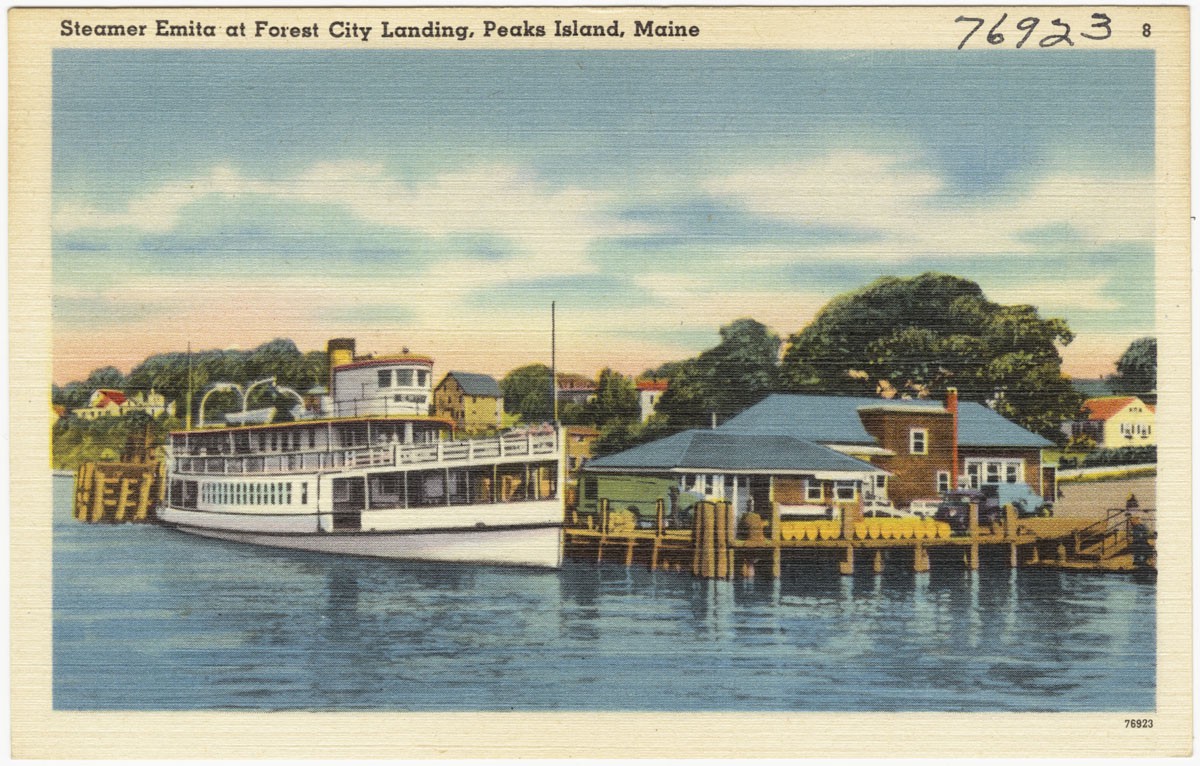
To Peaks Island, she said. It was a tourist island close to the mainland. The picture on the brochure had captivated her.

Can I come with you?

It might be better if I go alone, she said. I’ve had such little time to be alone. It sent pain through him. She saw it. She said, I don’t know you.

Do you feel like you know me? That you might have known me before?

I read paperbacks, she said. I go to restaurants and sit by the window and read.

That’s what I like to do, too.

In the morning, she stood in the lobby, holding a straw hat. He walked toward her. He could see Betty approaching him, so he walked faster. When Betty realized what he was doing, she stopped in the center of the room, under the place where a chandelier used to hang.

Outside, he lifted his mother’s bag.

I hope the person I remind you of was kind, she said.

She was always kind.

Well, there’s that at least.

When they got to the ferry building, the window where she had bought the ticket was boarded up, or she couldn’t remember where it was, or something else happened to confound them. I don’t understand, she told the captain when they got to the boat, it seems it’s just as easy to sell it here. She looked at Peter and said she would stay if he wanted that, but he handed over her bag and said to go on, that he would be there when she got back.

Midweek Links: Literary Links from Around the Web (February 18th)

Looking for some interesting reading to get you through hump day? Here are some literary links from around the web to check out:

Ayn Rand rewrites Harry Potter at The Toast

The screenwriter of The Imitation Game explains how to write characters smarter than you

Do kids these days think of reading as a social exercise?

On Jeff VanderMeer and why weird stories tell us the most about reality

What Jon Stewart’s The Daily Show meant for publishing

Jonathan Sturgeon on the war novel in the information age

Gawker on the greatness of Octavia Butler

Loorie Moore on Miranda July

Zadie Smith on the comedy of Key and Peele

Lastly, a new short story by Murakami up at the New Yorker

INTERVIEW: Elisa Albert, author of After Birth

It’s not an uncommon experience, when reading a novel, to wonder: when is this thing going to take off? When is someone going to slip a quarter into the jukebox and let this novel start singing? That is not a question one asks when reading Elisa Albert. From the very first page of After Birth, Albert comes out swinging, singing, with remarkable control and beguiling style. Her narrator, Ari, is instantly captivating, with a voice so distinct and idiosyncratic as to be unforgettable. The language dazzles from sentence to sentence, inviting hysterical laughter and wincing and knowing nods and every response in between. It’s a novel you’ll want to start over the second you finish it, a reading experience in which you will exhaust your highlighter of its yellow. It’s a novel about which your unbridled enthusiasm will become contagious, and you’ll end up convincing anyone who will listen to pick up a copy of their own.

It was a thrill to chat with Albert and ask her a few questions by email.

Vincent Scarpa: After Birth is an uproariously funny book, and I so admire the way the humor is doing double duty: we’re meant to laugh, of course, but also to consider the context within which Ari is saying or thinking these comical, often vicious things, and what’s being said in the margins, what isn’t being said instead. Did you have a clear sense when writing the novel that humor would function as a kind of defense or deflecting mechanism for Ari, your narrator? Did it develop in tandem with her voice? It reads seamlessly, yet I imagine a great deal of work went into fine-tuning the voice and figuring out what tonal parameters Ari was going to be operating within.

Elisa Albert: Ari was clear to me from the get-go. Her humor comes from an inability to be emotionally dishonest. This is a blessing and a curse. Being a bad liar is rough going. What we’re “supposed” to do/be/say/think and what we actually do/are/say/think often don’t line up, and generally speaking we lie our goddamn faces off about it, sometimes long and hard enough that we actually lose touch with ourselves. So it’s this huge relief, I think, when we come across someone who’s rigorously honest. Laughter is relief. We are ridiculous egotistical stubborn stingy hypocritical blind jackasses. It’s not human frailty that’s funny, mind you; it’s our predilection for pretense that’s funny.

But what’s even funnier is how we tend to punish honesty. People who say what they really think and feel, we usually try to make them out to be fools, or crazy. Once in a great while we relent and glorify them and treat them like gods and let them do the heavy philosophical lifting for us. But mostly, the truth is inconvenient, not to mention impolite. But at the same time we all kind of aspire to be honest and are jealous of people who can be honest. Which in itself is hilarious, because honest people are usually the most tortured! By us! Pure comedy. What a wacky species.

So yes, I think humor is about clinging — be it naked, battered, maligned — to honesty. Ari strikes me as the saddest kind of funny/tortured hybrid, though: the idealist. She genuinely can’t believe that everything is so fucked up. She’s agape at how fucked up things are: her own mother, the friendships she’s failed to make or keep, American urban planning, gender politics, obstetrics. I think she’s kind of sweet in her idealism. She’s not wrong about things, per se, but she’s making life very, very difficult for herself. Accepting how fucked up things are is a kind of maturity. Ari’s not there yet. Which is probably good, ’cause acceptance and maturity are not as funny as the kind of wild cynicism that is born of thwarted idealism.

Fortunately, my editor had a very astute sense of when I was going too far with Ari, and I trusted her judgment. To me, the stuff in the “cut” file is hilarious, but it’s good to be reined in sometimes. There was one long particularly intense section riffing on the difference between a cunt and a pussy. I visit its grave on the regular, but it’s better off in the underworld.

VS: I guess it’s a question of tone, too, when you’re talking about navigating a balance between humor and tragedy. But it’s so often situated as though the two are mutually exclusive; as if a person, a character, has feelings one at a time, as if things happen that way. They don’t, and that’s something you prove so beautifully on the page. I’m thinking in particular of a flashback where a shrink tells Ari to write a letter to bring to her mother’s gravesite. “Sorry you’re dead, Mom, I love you,” she writes, adding in hindsight that it was, “the best [she] could come up with, and a lie.” That line made me cackle and cringe simultaneously, and it’s a great example of how your blunt wit never once undercuts the palpable sadness we see in Ari — conversely, it textures it. Do you think it’s true that comedy gives a kind of dimension to a character that can’t be established any other way? Because I think what makes Ari unforgettable is the distance between the two spaces we see her ricocheting in — her endearing hilarity and her deep uncertainty about motherhood, her untetheredness — and the two feel imbricated, inextricable from one another.

EA: Comedy and tragedy inform and undercut each other. Maybe you’ve heard the old saying: To those who feel, life is a tragedy; to those who think, life is a comedy. We’re all hopefully trying to strike some sort of balance between the two, because either extreme is insufferable. Everything always having to be funny, that’s exhausting and distancing and straight up annoying. Nonstop tragedy, that’s exhausting and self-absorbed and shortsighted.

VS: One of the many exceptional strengths of this novel is the lens you use to examine female friendship and the ways in which those relationships can operate with the same volume of dependency and intimacy as do romantic relationships, if not more so. Ari’s friendship with Mina — a former riot-grrl musician turned poet, also a new mother — causes Ari to say, “She’s like a big old bell I can feel ringing in the best part of me. The vibrations go on and on and on, clear away the cobwebs, all the dense, cluttered junk, and it’s like oh my god there’s so much space in here, I had no idea there was so much room in me, what a pleasant place I turn out to be.” Which reads like the best you could possibly hope for in romantic love, but Ari is finding it in Mina, whom she has known only a brief while, as opposed to her husband. It’s a kind of dynamic I think shows like Broad City and Girls portray in interesting, if occasionally imperfect, ways. Do you feel like there’s a deficit in fiction of authentic female friendships such as this? If so, what about the ways in which these friendships are portrayed feels incomplete, or toned down?

The puritanical idea of marriage as an endpoint, after which we are emotionally done, is unthinkable.

EA: I think if we’re open we fall in love many, many times throughout our lives, in ways that go beyond simply sexual vs. platonic. The puritanical idea of marriage as an endpoint, after which we are emotionally done, is unthinkable. That kind of closed circuit, codependent relationship that refuses to make room for any other intimacies: no thanks. Friendships can be such great romances. Ari’s not getting what she needs from her husband just now, but how dumb is the idea that we can always get what we need from one person?

I don’t think there’s a deficit of portrayals of authentic one-on-one friendship so much as there’s a deficit of actual authentic one-on-one friendship. Part of what makes those friendships so exquisite and valuable is that they are relatively rare. It’s cool that they’re rare. You treat them differently as such. The shitty ones come and go, no big. Ari’s problem is that (see above, idealist) she wants so much more. That’s how idealism screws you.

I adore everything about Broad City: the humor, the vitality, the chemistry, the irreverence, the straight up who-gives-a-shit-we’re-having-fun. It’s a thing of beauty, what those ladies have going on. It’s once in a lifetime. But it bears almost no resemblance to Girls, which I also watch with great interest. The portrayal of friendship in those shows is not remotely similar. This doesn’t really address your question, but the constant comparisons of these two completely distinct television shows belies a real cluelessness about what each show is actually doing. They’re completely dissimilar in tone, humor, structure, objective, and execution. One is the self-sufficient friend you actually fucking capital-L Love unreservedly in the pit of your stomach in a way that seems likely chemically beneficial to all your internal organs, and the other is the smart pain-in-the-ass but occasionally transcendent but kind of hideously needy drama queen who wears you down, but whatever, she’s all right and you’ve known her since forever, so fine. Both shows are made by people with titties, but that’s not sufficient commonality for serious cultural commentary, people. And we shouldn’t be so starved for recognition of female-made art that we’re willing to pretend it is. Try again, media columnists. Try harder.

VS: In writing a book that is at least in part about postpartum depression, I wonder what you felt you were up against in terms of a reader coming in with preconceived notions of what the narrative might look like. Did the subject matter feel especially delicate? Did you feel a pressure to be in any way careful? Or does one get mired in uncontrollable muck that way? Similarly, I wonder what, if any, hesitation you felt in writing about motherhood, which has of course always been politicized and ruthlessly evaluated by society, but perhaps never so ubiquitously and loudly as it is now. I was fascinated by how the novel handled the surrounding environment for a new mother — the competing schools of thought, the unsolicited advice, the self-righteous judgement at every turn — and couldn’t hope for a better narrator than Ari to take us through what often seems like a space of real toxicity, even if the intentions are good.

EA: In mainstream media, there is almost nothing artful or interesting about early motherhood. It is just this huge unspoken glossed over nothing, and it’s glaring. Occasionally you’ll see lame attempts, all the dumb clichés: the sex-starved husband, the crying fat cow of a mother, the house-arrest, the overwhelming disgust at anything having to do with the female body in any kind of mammalian function. Cue the laugh track. I heard there was some Super Bowl commercial for baby formula under the guise of “let’s stop the mommy wars!” which, omg, dismantling the master’s house with the master’s tools, much?

I felt unquestionably qualified to write about early motherhood because I was in it when I was writing. And I was noticing a lot of things, and asking a lot of questions, and taking careful note of what I found. I was a correspondent from deep within the trenches. I don’t worry about readers’ preconceived notions, because the whole point of a novel is to blow readers’ preconceived notions to bits.

“Space of real toxicity,” by the way, ain’t that the truth. Fear of shitting while giving birth is yet another of those tired tropes people like to trot out for a giggle, but actually it’s a surprisingly apt metaphor for how all babies are born in this country: into some seriously toxic cultural crap.

VS: I’m sure that, as you do press for this book, you must be expecting the inevitable questions about whether or not what you’ve written is an autobiographical novel. I can’t think of a less relevant inquiry, but I do wonder if you share Ari’s concern, regarding motherhood, when she asks, “So who’s gonna write about it if everyone doing it is lost forever within it?” That rung especially true to my ears, and I’m wondering if it served in any way as an impetus toward writing this particular novel? As I read, I thought how refreshing your take on this must be for so many mothers who haven’t seen their experience rendered with any kind of accuracy or honesty. I felt so enlivened when — in a moment of immemorial, maternal fellowship with Mina — Ari remarks, “This is my motherfucking dissertation.” In these ways, it feels like a deeply personal book, regardless of the truth-content.

EA: Both those lines came late in the writing of the novel, which I guess is proof positive that I write to find out what I know. Ari and I have a few things in common, but a lot of our experiences are not the same. She’s a version of me having an all-around rougher time of it. She’s an exaggeration of a tendency to take the bleakest view. She’s a distillation of a bad day. She’s a poltergeist, but before we hold up the crucifix and banish her, we should probably hear her out on a thing or two. I love her with great tenderness, like a mama should.

Author photograph courtesy of Hulya Kilicaslan

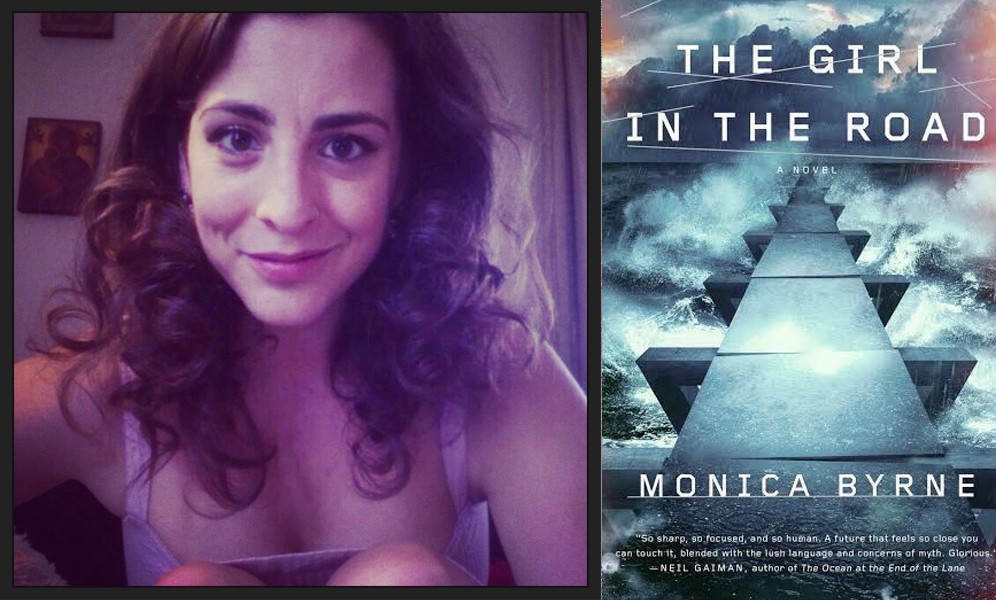
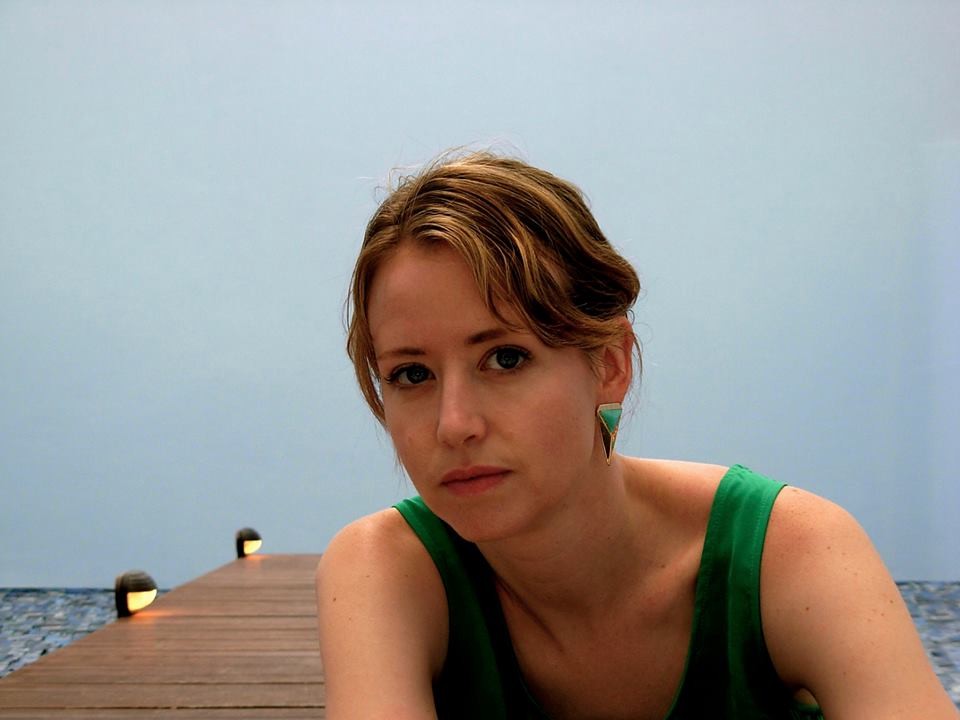
INTERVIEW: Monica Byrne, author of The Girl in the Road

Monica Byrne is a writer based in Durham, North Carolina, where she’s a playwright in residence at Little Green Pig Theatrical Concern. Byrne has published essays and short stories in The Atlantic, Virginia Quarterly Review, WIRED, The Baffler, Glimmer Train, and The Rumpus, among others. She’s traveled widely to countries including Morocco, Italy, Ethiopia, Trinidad, India, Fiji, Costa Rica, Iran, and the Philippines, and plans to travel in many more. She holds degrees in biochemistry from Wellesley and MIT. This summer she will teach at the Shared Worlds teen SF/F writing camp.

Her first, critically acclaimed novel, The Girl in the Road, was published by Penguin Random House in 2014, with the trade paperback edition out today.

Set about 50 years in the future, The Girl in the Road is a complex and twisty narrative that chronicles the paths of Meena in India and Mariama in Africa. As the novel opens, Meena is in desperate headlong flight, enemies in pursuit, and Mariama must make a trek across the Sahara. Central to the novel is The Trail, an “energy harvesting” bridge that spans the Arabian Sea. It’s an audacious creation by the author, but nothing compared to the bold portrayals of Meena and Mariama, whose fates, as they say, are linked, although not in predictable ways. In addition to strong characterization and a unique premise, The Girl in the Road teems with rich (but not overwhelming) description that makes the future seem both tactile and lived-in.

I interviewed Byrne via email about the novel, and her travels.

Jeff VanderMeer: How do you personally internalize research, and what does “research” entail for you?

Monica Byrne: I’m a pleasure-seeker. That’s basically it. When I try to explain what creative research is like, people say, “So you just get to have fun?” and I’m like, “Yeah, and then I write about it.” Even doing calculations for The Girl in the Road was fun because I knew it would help me tell a more true story. When I was in grad school for geochemistry, I was supposed to be learning things to pass tests or design experiments. But what I really wanted to do was learn things so I could fasten them upon a much larger tapestry of meaning.

As soon as I’m not having fun, I know I’m off the path — trying to satisfy some external notion of what’s good or worthwhile, instead of thrilling myself. Pleasure is my magnetic north.

JV: Did anyone ever tell you as a writer to “just drop the reader right into the action and let them adjust”?

MB: Haha, no, but I do remember reviewers on the Online Writing Workshop always telling each other that they needed to cut the first several pages of their story. I thought, “I’ll just cut the part of my career where anyone needs to tell me that.”

JV: What is the importance of a name to identity? What do names signify to you?

MB: Huge! I can’t proceed without the right name. It just feels bad, like I’m trying to walk a dog that doesn’t want to walk, so she goes slack and I end up dragging her. Sometimes I have to “audition” a name for days or even weeks to see if it’s a right fit. If I start referring to a character or place name in moments of unthinking, then I know it’s right.

JV: The loss of a parent in a novel can be trite, not felt on the page. But in The Girl In the Road, this loss is important and it is deeply felt. Did that develop naturally?

MB: I hope it is, because that was the central event of my young life. I lost my mother as a functional parent when I was seven, and she died when I was twenty. Processing that loss, first as a child, then as a teenager, then as a twenty something, became the blueprint for The Girl in the Road.

I still miss her constantly. I dream about her all the time. I love and am so proud of The Girl in the Road, but I’d have never written it if she hadn’t died. That makes it all bittersweet.

JV: There also seems to be a theme of betrayal in the novel. Could you speak to this?

MB: I think that, when one grows up with massive loss, one way of coping is to form very fierce and passionate relationships. It’s my seven-year-old self saying “Don’t leave! (I get to leave.) But you don’t!” And if they do, even kindly, it’s perceived as abandonment, and the seven-year-old goes supernova.

Unfortunately, that’s how I perceived every breakup in my twenties, regardless of what actually happened. Every separation echoed the Alpha Separation. So each of the sunderings in The Girl in the Road are representative of how I’ve received various relationships’ ends — basically, as betrayals.

JV: You’re a scientist in addition to a writer. I felt the milieu of your novel quite strongly, but I didn’t feel as if it was that science-driven, which I mean in a good way. Yes, there’s advanced tech and all of that, but it exists at the proper level in the narrative. Was it always that way in your rough drafts?

MB: Yes. I never wanted tech to take center stage in the book; I wanted it to serve a supporting background role, as it does in my daily life. Plus, that spared me the agony of having to, say, actually figure out how a kiln works. I could just say, “Simple sugars! They break down and rearrange! In cube form, because that’s the only shape we can manage in 2068!”

I like thinking about how technology is both revolutionary and rudimentary at the same time. In college, I used Napster, which was like an unthinkable treasure trove at the time, and now it seems like banging rocks together. Now, I tell my iPhone to play a song, but I have to speak very slowly and clearly and Siri still gets confused and directs me to the nearest Planned Parenthood instead. Technology has to work imperfectly to seem real.

JV: And in what ways is your science background a plus or a liability in writing fiction? The Trail is a fascinating creation but it’s largely because of the human element that it comes to life.

MB: It was definitely a plus. I had the training to at least approach all of my scientific research topics — climate change, metallic hydrogen, trail mooring, and so on. I also asked a few experts to weigh in, like my friend Stefan Gary, who’s a research oceanographer in Scotland. He was able to read the manuscript and tell me immediately what was and wasn’t plausible.

I’ve always been anticipating a reader who’ll stand up at a convention and say, Look, the Trail can’t work, here are my calculations. No one has yet! I want to thump my chest and be all MIT, WHAT but I bet someone’s working on it. They’re out there. Scheming.

JV: Would it be an accurate reading of your novel to say that you believe that we won’t see progress on matters of class in the future? (In any cultural context.)

MB: Progress, maybe, but not resolution. It seems to me that in any capitalist society, class will still be a tribal marker, even if all other distinctions — sex, gender, race — fall away. But keep in mind that the farthest we’re seeing ahead here is 2068. That’s nothing. The problems of 2068 are just the problems of 2015, writ large.

JV: Diversity in fiction is a topic of frequent conversation and debate. Your novel doesn’t feature any major white characters. How do think of diversity in terms of your fiction and what do you think it means in terms of the audience for your fiction?

MB: It doesn’t feature any white characters at all, actually, and that was very deliberate. The novel is set in India and Africa, so there are comparatively not many white people there; but still, every time I introduced an incidental character, because I was raised in a white supremacy, my instinct was to make it a white man. And in each case I asked myself, “Is there any reason it has to be?” and there’s never an answer other than “it feels right,” which is the smooth-talking patriarchy in a double-breasted suit. So, fuck him. The doctor in South Sudan? African woman. The tourists in Mumbai? Chinese. And so on.

Not seeing my sex and gender represented in fiction definitely affected me when I first sat down to write my own stories.

Not seeing my sex and gender represented in fiction definitely affected me when I first sat down to write my own stories. I couldn’t really think of a female hero because I’d been raised on Frodo, Muad’Dib, and so on. So I just try to remember that in all dimensions: writing the world I both see and want to see, and so, helping to create it. And then, that attracts like minds. I want to cultivate a community of fans who want to learn from each other.

JV: Do you think a writer can write accurately about a place they haven’t experienced first-hand? Where lies the lack in that case?

MB: Hmmm. Depends on what you mean by “accurate.” I was really pleased when my agent assumed I’d been to all the places I described in The Girl in the Road. I haven’t. I’ve been to Ethiopia and Kerala, but not Dakar, Nouakchott, or downtown Mumbai. I looked at a hundred pictures, though, and watched a shitload of YouTube videos. (Protip: want to get a feel for a city? YouTube search “[city] taxi” or “streets of [city]” and videos will come up, guaranteed.) I tried to be as accurate as possible in my depictions, incorporating what I saw, and not contradicting anything I saw. For example, the description of Bamako as “a windy city sprawled on the banks of a river the color of steel” came straight from my impression of three seconds of a YouTube video.

But would a person from Bamako feel the same way? I don’t know.

The funny thing is, I’ve also physically been to places that I don’t feel like I could describe at all. The best example of this was the Underground River in Sabang, in the Philippines. I’d been so excited about it because I love river caves, but the trip was overdeveloped to death: uniformed personnel taking my picture so they could sell it to me later, the boatman talking nonstop about cave formations that looked like dicks, and so on. Halfway through, I just shut down. It was like I was gliding through a simulation. I was physically in the cave and yet so mad that I couldn’t see the cave. If I wrote anything truthful about that experience, it would be about fury and blindness. (And maybe entitlement, ha ha.)

JV: You’ve traveled a lot in the last year and along the way you’ve written with passion and precision about places like Iran that most Americans perceive in a very particular and narrow way. Is seeing the whole, so to speak, simply a matter of unlatching our impressions of a government or regime from the actual people who live in a country, or is it more complex than that?

MB: Oh, yes, the government and people are worlds apart. Just as an example, Iranian people generally have very warm feelings toward American people. You’d never know that from the hostility between our governments.

After having been there, it’s actually hard for me to remember what Iran is “supposed to be like” in the American imagination. Because all I remember is the kindness of the people, the staggering natural and architectural beauty, the closeness of families, the reverence for artists. The feeling of being in love with a kingly presence, ancient cypresses, golden dust.

But you know how astronauts say, “Once you see the Earth from above, you see all our divisions are meaningless, blah blah blah”? And I’m like, well, we’d love to, comrade, but that opportunity isn’t available to us. In the same way, it’s not possible to send every American to Iran to show them what an extraordinary place it is. So I just try to say it every chance I get, and hope it does some good.

JV: Does your travel directly inspire your fiction writing? Anything from your recent travels that stuck in your mind in particular from the perspective of narrative?

MB: Yes. I travel to write and I write to travel. Often, I travel to a new place without knowing why, only that I feel drawn there. That’s what happened with both Belize and Iran. Once I got there, I found what it is that’d been calling me — in Belize, the cave in Cayo where my next novel is set; and in Iran, the zurkhaneh in Yazd that’s become the basis for a new fictional religion.

The zurkhaneh has no Western analog that I know — it’s like a sacred gym where men perform ritual feats of strength in devotion to Ali, the second Shia imam. And…like…I can’t even describe how I felt when I went there for the first time. I was in total rapture. When I came out I wanted to scream and shout and pound my hands against the wall to get out all the energy that had accumulated in my body. I watch YouTube videos and turn up the volume and go into a frenzy. I need to go back to Iran for a thousand reasons, but I’d go back just for the zurkhaneh and nothing else.

JV: What’s your favorite word?

MB: Sanovy. It’s in The Left Hand of Darkness — as in, “the Sanovy teachings” — and then never mentioned again. But it struck me as the loveliest word I’d ever read, and I even named my own language after it. N’phora d’emwaia. Hanalelaca emwitia.

INTERVIEW: Laura van den Berg, author of Find Me

by Porochista Khakpour

find me

I had to go on Facebook and hit “See Friendship” to figure out when I first became friends with my favorite author-friend on earth, Laura van den Berg — it appears to be October 2009. We’ve had many friends in common for years, and I still remember her first book coming out around then (a couple years after my debut novel), and finding her rather fascinating from a distance. She was of course incredibly beautiful and seemed internet-addicted like me, plus a bit weird, possibly even as goofy as me, deadly smart. All of this was true, luckily for me. We corresponded for some time about boring publishing things and then I think we first met when she came to a PEN/Faulkner reading of mine in DC, when she was a fellow at the Gilman School in Baltimore. She gave me advice when I was feeling distraught over not finding a publisher for my second novel, then I hooked her up with a class I could not teach at Johns Hopkins, then we met at AWPs often. And she and Elliott Holt and I even had a birthday weekend in Baltimore where somehow we recreated the famous Lindsey-Britney-Paris photo with incredible accuracy. Every time she’d come back to NYC we’d have a nice dinner — at The Smile — and dream of spending more time together. She was my main date at my last birthday party, and when my book came out, Laura was my go-to: she was in conversation with me for my second novel launch party and then we did a reading together at Brookline Booksmith. She came to my Fordham class, my Bruce High Quality Foundation class, and soon Bard and Sarah Lawrence — and I will teach her forever, because I’ve found her work inspires students like no one else. Did I mention she is a genius? She is. She applied for the Bard Fiction Prize, and got it, just as I got hired as a Writer in Residence — all a happy accident, truly — so now a few nights a week we have slumber parties at the faculty house she has there. We both have dogs in our life, Oscar the lab and Cosmo the poodle, who are young men and best friends. Baltimore, DC, Boston, New York City, Annandale, we’ve seen some places — but our true dream is visiting each others’ homes in Los Angeles and Florida. We bond over being mall girls, with kind of crappy tastes, outsiders to all sorts of fancy East Coast pedigreed crud. I could live on hot dogs, Laura seems obsessed with the Filet O’ Fish. There are some things I would write here but I can’t, so here is a placeholder (it has to do with what a special person she has been for me, especially in some very horrible times). She is also, like me, a bit of a former goth (you can get a touch of this with her aversion to smiling in photos). She was also a bad student! We have very similar taste in books — we have an endless appetite for weird stuff. I also think we both look like we fit in more than we do, but that is a superpower we should not discuss too much.

Also, our mutual friend Karen Russell has created a girl-gang for us called Team Sorceress — it’s just us, Kelly Link, Aimee Bender, and one dead author Leonora Carrington. We’ve never all hung out as a group yet, but Sorceresses are not so basic and know there is always time (we have a dead member after all).

So now, just as her debut novel and third book Find Me comes out, I’m going to ask her a lot of stuff I know the answer to and then maybe some other stuff.

Porochista Khakpour: When you first imagined being a writer was it the short story or the novel you thought you’d be doing?

Laura van den Berg: Short stories, sort of by default — that was the first form of literature I fell in love with and so it was the first form I aspired to try on my own. But when I began to fall in love with novels, the desire to write one myself, in a kind of dreamy, far off sort of way, was definitely sparked.

PK: It takes me sometimes five-to-ten times as long to write the first draft of a short story, so the whole thing fascinates me. What was the process like on this and how was it different? Is this actually your first novel? So few writers are good at both, but you are clearly one. Would you go back to stories or a novel next?

LvdB: I tried to approach a novel draft in the same way I would a story draft: write the whole thing straight through, in a big frenzy. I finished a first draft in six months, but then worked on the book on-and-off for six years. Having a 300 page disaster on your hands was very different than a 25 page disaster, turns out. Also, life just got in the way at times, you know? Which happens with stories too, of course, but when I’m really into a story I’m working on, I can work on it a little bit here and there and those pieces actually have a chance of adding up to something worthwhile. But novels want your life more than stories do, or at least that’s how it feels for me, and so much of the essential work was done at residences, when it could have my life for a set period of time, or during stretches at home where I could lock myself away and forget the world.

As for what’s next, I think both! I’m working on a new novel project and also new stories. When I was only working on the novel, it was very hard to not be finishing anything for long stretches, that constant state of suspension and unfinishedness, which was why I started writing stories along the way and ended up with The Isle of Youth. That story-novel rhythm seems to be a good one for me. I hate the sensation of being overly confined, so I like to have multiple projects on the table, lest I feel too chained to one thing.

PK: I thought Find Me was bought on proposal. Is that true? What was it like working that way? You had just wrapped the second collection tour!

LvdB: Oh my lord it was most definitely not bought on proposal. Nothing against proposals, but it would be hard for me to work that way. When my agent sent out The Isle of Youth, she also sent out Book One of Find Me — with the hope that both projects would speak to someone and luckily that happened. I had been working on the novel for a long time by then, but still Isle was the book that got finished first. When my editor bought the book, she’d read the first 150 pages and had a very clear sense of the voice and overall project. At that point, I had finished a full draft, but knew the second part wasn’t right, so I ended up chucking it and rewriting at a residency not long before Isle came out. It was a good situation, in that the support gave me the confidence I needed to take certain leaps and at the same time my editor knew, and supported, the nature of the project, so I wasn’t too worried about turning in the book and having someone say, “What?! Where is the historical romance set in a underwater city I thought I was getting?”

I really can’t imagine doing fiction solely on proposal, unless the terms were extremely vague. Like: you will write “something fiction-y” in the next “5–10 years.”

PK: Okay, I’m going to go there: dystopian novels! Everyone is talking about them, especially you and Edan Lepucki and Emily St John Mandel (and sometimes I’m in this group too). What do you think of this? And I joked recently to Karen Russell at our Lannan conversation last month, life feels so dystopian right now that we might need utopian novels (or post-dystopian?!) But what do you think of the larger conversation this work is part of, in this sense. Do you love or hate that dystopian tag? Is part of the novelty here that young women are doing it?

LvdB: I don’t mind the “dystopian” tag at all. It seems accurate to me, but at the same time I do think it’s important to acknowledge that “dystopian” is a very broad term, like “realism.” Which is to say Station Eleven and California and Fiona Maazel’s Last Last Chance and Ben Marcus’s The Flame Alphabet and Shane Jones’ Crystal Eaters and McCarthy’s The Road and Justin Cronin’s The Passage could all be classified as “dystopian” but offer radically different reading experiences and views of the world.

Certainly there is a big wave of dystopian literature right now, in a way that feels concentrated, but is it any wonder, when we think about where we are in terms of our current moment? At the same time, the tradition of dystopian literature runs deep, and I imagine the recurring desire to engage with a dystopian landscape rises from every generation having moments where the world feels insane and unlivable, and feeling moved to respond to that.

PK: Tell me about where the character of Joy came from. She is so unforgettable and yet because I know you I feel you in her in so many ways.

LvdB: The book was always narrated by Joy, it was never anyone else’s story, yet it took me a long time to figure out what was crackling beneath Joy’s immediate story, to figure out what’s driving her at a core level. Of course, these are important things to know about any character, but they take on a particular kind of weight and importance when you’re working in the first person and that “I” is speaking to you directly — Why is this “I” speaking now? What’s behind that desire to talk? What kind of story are they telling? Ultimately Joy’s background and damage is very different than my own history — I had a pretty typical suburban childhood in many ways — but there are definitely bits of me in there too. A lot of the landscape details come from life, for example, and also it’s not at all hard for me to imagine the worst-case scenario. My imagination, my sight, is disaster oriented.

PK: The lyrical, the fragment, the interrogative, there is so much poetry in this book in a sense. It always feels so appropriate. I think of your tactic as a writer as being a “great inhabitor” — -you take stories like an actor and approach them all uniquely, as in: what does this mission require of me, etc? The story always calls the shots, overshadows any writer ego, and in that way I also feel that you are always conscious of ambiance in all your work. Can you talk about that?

LvdB: Ambiance is so important to me in fiction. Some writers reinvent the ambiance from book to book and for others, there is something of a signature tone. For me, I think the ambiance is somewhat consistent from book to book. My voice is as it is, at least for now, but because of that I’m very conscious of how I can stretch and get that voice and worldview to evolve, to do new things, to inhabit more fully and in different ways.

PK: There is both the epic and the general and macro here mixed in with the everyday and specific and micro — totally, ambiantly, thematically etc. We get the extraordinary with the banal. I feel these juxtapositions in your stories too. I think I do this a lot as well. The friction between two opposing elements always for me is what’s compelling. Is this a conscious move for you?

LvdB: Not initially, but then during those long cycles of re-seeing and re-writing, I certainly become conscious of emphasizing certain contrasts. There are a lot of mirrors and inversions in the book. The two parts contrast each other in some ways — inside vs. outside; stasis vs. movement; cold vs. moving toward warm; landlocked vs. coast — but they are mirrors as well. I see the Mansion in Book Two, for example, as echoing the Hospital from Part One. So with the architecture I was, at a certain stage in the process, conscious of drawing out those parallels and dissonances.

PK: Which brings me to setting! We have Florida, Massachusetts, Kansas, and more. I know much of this answer but can you talk about he function of setting in this?

LvdB: Honestly I think the various settings are partly a product of having moved so much while working on the book: North Carolina, Pennsylvania, Baltimore, Massachusetts, Maine. Often I was in some kind of commuting situation, so on the road a lot, and I spent chunks of time in Utah, Key West, and New York. I spent so many hours looking through windows at different corners of the American landscape, and the places that made the strongest mark found a place in the world of the book.

PK: Karen [Russell] and I spoke a lot about moving around for jobs, all over the country, the pros and cons of this gypsy/hobo/wanderer life we get if we are lucky! What do you think?

LvdB: In a lot of ways, I think it’s been really good for me. I lived in Florida, where I’m from, for twenty-two years, unbroken. I went to college in my hometown. So to see so much of the country has been a tremendous gift and has made my work better. I have no doubt about that. That said, I have been super nomadic for a long time now and I’m approaching my limit. I don’t know that it’s starting to become bad for my writing. I’m just tired of moving. I’m living at Bard College in the Hudson Valley at the moment and I love it here and I have no idea where I’ll be after. Maybe it’s old lady-itis settling in, but a big part of me wants desperately to settle somewhere and never ever move again.

PK: Then there is the issue of the real vs. the surreal. I feel like Florida and California are crazy places so in a sense, we are being more realists than people think when we portray them perhaps. But also in your book, memory loss and the idea of the forgetting — doesn’t this seem something very close to home? I think of how social media works like drugs, they say, what it does to the brain. . .the other day at our Bard house, we both couldn’t remember a thing for a few minutes. I only ask because I think we are both very much online a lot.

LvdB: I see the novel as being most immediately concerned with how memory works at an individual level, but certainly I was thinking about the collective forgetting we do culturally — we see this at the level of town/city, state, country, world. The internet parallel is an interesting one, the possibility that it facilitates that kind of collective forgetting. I do think the internet has made life feel more ephemeral. There will be a flurry around a news story or some piece of information, but how much is being internalized in a meaningful way? Remembered in a meaningful way?

PK: The other night we talked about this dream of mine, an essay I never wrote called “The Extrovert’s Dilemma,” but that I think we should do together since I think we are the most out-of-the-closet extroverts in letters. We both think introversion is a bit overrated, no? Still waters run deep — but do they really? Always?! Anyway, tell me about being an extrovert author, especially in this culture of introvert glory.

LvdB: It does seem like there have been a lot of “woe is introvert” pieces of late — they feel all the feelings! — that also manages to misread the extrovert personality. Being an extrovert can feel a little alien as a writer. I don’t fetishize solitude. I like being in the world. I like being around people (assuming the people in question are cool and not horrible; if they are horrible, then forget it). The solitude it takes for me to write a book is about all the solitude I can stand. Most writers I know like to be in the Quiet Car on Amtrak. I hate the quiet car. I am Café Car all the way.

PK: Obviously I adore Paul Yoon, your husband, who is Quiet Car for sure. (Readers, in the brief period that Paul was on Facebook — a moment when Paul actually thought he could make the thing elegant — it was my daily delight to deface his captions and comments sections with all-caps profanities.) You guys balance each other so beautifully — and maybe tied with my friends Danzy Senna and Percival Everett, you are my favorite lit couple! Let me be People Magazine for a second: tell me a bit about the functional two-writer household (I only have known the dysfunctional ones!)

LvdB: I can see all the obvious pitfalls of living with another writer, but I’ve always loved not having to explain myself in certain ways (like the need to go to residences, for instance). If you are engaged in the same kind of life, in your different ways, there is a kind of unspoken language and closeness that I really cherish.

PK: A funny thing about us living together is that our habits are so compatible. For one thing our food-compatibility! We are EATERZ, for sure. Can you talk to me about food and writing and your perfect writing day meal?

LvdB: Well, I have major low blood sugar, so when I get really hungry I basically turn into the Incredible Hulk and act like a lunatic until I get food. I am not the most pleasant EATERZ when I’m Hulk Hungry, so my ideal writing day meal would involve lots of little meals to prevent Hulk Hungry from setting in. I have been really into these beet and turmeric drinks lately (I know, I’m sorry, what can you do), so I’d start with one of those. Later I would have a tomato and kale salad with a enormous portions of soppressata and mozzarella. Basically soppressata and mozzarella with springs of kale. And then an afternoon snack of apples and almond butter. And then a grapefruit. I love grapefruit, even if I remain a little mystified by how to properly eat one. And then some tater tots, which is in my view a perfect food. And then homemade tofu with dashi and sheets of seaweed. And then a Filet-O-Fish, my great weakness. Please note that all of this food is appearing in my kitchen by magic.

PK: I feel a bit betrayed by the chicness of your food there, just as I did when you made me such a beautiful breakfast that one day (I whined, I thought we were both supposed to be wonky cooks!) Well, we are both crazy dog ladies — now talk to me about having a dog now as a writer.

LvdB: Oh, I love having a dog. I grew up with lots of pets, so it feels natural to have a dog in my life now and I think dogs can be great for writers. For one thing, writers are usually needy and in need of validation and let’s be honest, no one is going to love you like your dog. I mean you could be the worst person in the world and your dog will still be epically excited to see you. To be clear I aspire to not be the worst person in the world, in hopes of being loved by both dog and human, but you get my point.

Emotional fulfillment aside, dogs are great for writers because they get them in a routine and get them out in the world. My dog is only seven months and he is very attached to going on walks twice a day. And so that’s built into my routine and it’s a useful way to keep track of time and to organize the days and it guarantees I’ll always get outside for a bit. I hardly even take my phone with me on these walks. I watch my dog play in the snow. I look at the sky. It’s tremendous.

PK: Finally, tell me about your devotion to Team Sorceress.

LvdB: It’s the only team I’ve ever been on, and I think we should get T-shirts.

The Struggle To Be A Good Critic

In preparation for my second residency at the Bennington Writing Seminars, I read the submissions from the other writers in my workshop. One of them startled me. It was a novel excerpt about a free Black man kidnapped and sold into slavery. The premise wasn’t so much what surprised me, but rather the identity of the writer. I googled the writer’s name and found her to be a White woman. Despite admiring her language, I was offended. How dare a White woman write a story about my ancestors? Even though it was my job to critique her work in hopes that it would get better, I did not trust her — or any White person — for that matter writing about marginalized people. After all, H.P Lovecraft said in reference to Black people, “A beast they wrought, in semi-human figure,/ Filled it with vice, and called the thing a Nigger.” Children’s books written by White authors were rampant with racism, such as The Story of the Little Black Sambo, Tintin in the Congo, or Let’s Hurry or We’ll Miss a Public Lynching. Even though my colleague’s intention was not to offend African-Americans, I felt very uneasy, perhaps even paralyzed in my ability to critique her story in the right way. But what is the right way? Was the way in which I emotionally responded to her story wrong? After all, the submission, although of course a rough draft, was very well-written. I found myself entranced by her descriptions of Louisiana even if the setting was a plantation. It was a conflict that stirred me both as an artist and a Black woman of Louisiana Creole descent on my father’s side.

In order to thoroughly critique a work, one must pay attention to elements such as plot, characterization, pacing, language, so on and so forth. A reader does not have to feel an emotional connection to a piece of literature in order to recognize its merit. For example, I don’t have to like Moby-Dick in order to acknowledge that it’s a beautifully-written story. However, this issue becomes complicated and nuanced when the work itself is about and read by marginalized people, especially when the writer is White. Are or should there be limitations in who gets to write the stories of people of color and what unique challenges are faced by minority readers when critiquing these particular texts?

Being one of very few minorities in my MFA program, I wanted to be able to assert my authority within predominately White spaces. There was one instance when a White colleague, and former mentor of mine, was giving a lecture on race and White privilege in a lecture. During the Q&A part, I raised my hand multiple times, the only minority to do so, and was never given the microphone by the runners. Meanwhile, I had to listen to other students express their hardships of writing about Black characters because they may not have Black friends. I asked myself, can White writers sympathize with Black characters even if they do not know any Black people in real life? Do they subconsciously put up a barrier when reading about them in fiction? After all, when Rue from The Hunger Games was portrayed by a Black actress, there were countless people who thought that her death on screen was less sympathetic because she was not White. Hearing these comments at the lecture only intensified my feeling of wanting White writers to not touch people of color in their works at all. But, I needed to step outside of myself and ask other Black writers if they felt the same.

Besides being published in Quarterly West, Zoe Mungin, is a Black and Latina fiction writer studying at the MFA program of the University of Massachusetts-Amherst. When I asked her what are the difficulties in analyzing a work about a PoC and whether this critique is affected by the writer’s identity, she replied, “There’s always a question of validity: whether the critique is valid in any way, if it’s worth as much of a critique as from White peers, because of the very idea of partiality.” Being the only Black person in her workshop, Zoe is most aware of how art is continually interpreted under the White gaze and finds herself alone in adding pressure to conversations so that multi-disciplinary perspectives are considered. White people are always at the center of conversations, even while discussing the works that are not about them. Like Zoe, I’ve been that Black girl in workshop who was afraid to speak up to my White classmate about her story because I understood the different power dynamics involved. On the one hand, I wondered, how dare this White woman write about Black people? On the other hand, how dare I have the gall to correct her? Will I even be taken seriously if I do?

But Zoe’s experience, like many others, raises an interesting point. If our White counterparts fear that our partiality is overshadowing our ability to critique a work, does this imply that a good critic must maintain a sizable, emotional distance from a story in order to analyze it properly? mensah demary, a Black fiction and nonfiction writer, as well as the Editor of Specter Magazine, does not agree: “We clamor for our own stories, to see ourselves in narratives, because that close emotional proximity matters; to see yourself in a narrative can be transformative. That close emotional proximity is political, revolutionary, when attempting to reclaim your identity, your stories.” For people of color like mensah, Zoe, and myself, that feeling of being able to resonate with a story should be the impetus we need to reclaim them as our own, as well as our identities because it reinforces collectivity and solidarity through artistic mediums, such as literature.

But another more polemical question emerges: are minorities the only writers allowed to create works about themselves? Ideally, any writer should be able to create the story of his or her choosing. Lena Dunham received a ton of flack for only having White characters in an extremely diversity place such as Brooklyn. In her interview with NPR , Dunham responded to the criticism by saying that she wrote a series that was honest and close to her experience, relaying to me that perhaps Black people, or any other minority for that matter, did not play any significant role in her life. Even when she inserted Donald Glover, in a few episodes of season 2, Kareem Abdul Jabbar blatantly said that a “black dildo would’ve sufficed and cost less.” A writer must handle a story with more care if he or she is writing about a traditionally oppressed group, especially if that writer does not face the same systemic disadvantages as his subjects. Furthermore, the discrepancy between the rate of White versus PoC writers is a factor that certainly cannot be ignored in this conversation, for even if a writer from each group pens creative masterpieces about minorities, statistically-speaking the former party has a higher chance of it being published. Think about it. According to a study conducted by the Cooperative Children’s Book Center at the University of Wisconsin, only 93 out of 3,200 children’s books published in 2013 featured Black protagonists. According to another study conducted by Lee &Low Books, no African-American authors made the Top 10 NYT Best Sellers List for Print and E-Book Fiction in 2012. As a result, White authors are given the large platform to promote our own stories while those most like the subjects clamor for even a fraction of the same exposure. As noted by mensah, “Whites have had, for centuries, the opportunity to tell the stories of PoC, and have proven to use that opportunity to expand their privilege and supremacy, at the expense, and on the backs, of others.”

So you see, this struggle is multi-layered and more difficult to elucidate the further one reaches to its roots. One cannot entirely blame the writer for his or her inspiration that later becomes published because therein exists a structural issue within the industry. However, to absolve a White writer completely of writing about PoCs even if the work is brilliant would be to ignore the countless others who tried to be successful at the same story, while reclaiming their identities, and failing.

What does this mean for the minority fiction writer in an MFA workshop or the editor of a respected magazine? They are confronted with different modes of perception when handling a text when it’s written by a White writer than a PoC. If it’s the former, our critiquing skills are undermined. If it’s the latter, we may be subjected to condemnation for perhaps rejecting a story from someone of our own when we are aware that not many make it to that level of acclaim. As mensah later said in his interview, “I once said that Zadie Smith struggles with the Black American voice in her characters, specifically in her novel On Beauty. The voice can be stilted at times, or perhaps off-key — maybe it fails my authenticity test. Anyway, there was some mild push-back on this statement.”

Both mensah and Zoe have grown weary of having White writers create works about PoCs. I thought I was too, but then I had a change of heart. When I entered into workshop and spoke to the woman who wrote the story, I discovered that she had been doing her research for about sixteen years. Although our classmates did not necessarily gravitate towards her characters using a lot of dialect, I loved it. Even when the session was over, we had breakfast together because she wanted to get more of my opinion on how she was handling a language different from her own. From that moment, I realized that I was so incredibly wrong in my thinking. Not only was this woman a very good writer, but she was also a compassionate person who wanted to make sure that she did justice to her story. I felt even more flattered that she asked me what I thought instead of rebuffing my critique, which involved me stressing how important it was to detail the brutality of slavery, as well as, using a bunch of hand gestures to accentuate my point.

Junot Diaz in The New Yorker wrote how his workshops were too White in his MFA program and that he and his colleagues never discussed how racial identities affected their writing. While I agree with this sentiment, for this particular event, I experienced something different. I felt like I was being listened to, and even respected. If a White person wanted to write about a person of color, does his/her research, and wants to learn more from his/her subjects, why not? Writers create their best works from seeing a world of possibilities. Therefore, is it too optimistic to think that they cannot find them in people who are unlike themselves?

We as writers, literary theorists, editors, and critical thinkers, must incorporate multiple lenses into our literary discourses so that the artists of this generation and the next will not operate through modes that inadvertently oppress those to whom they may be paying homage. There still needs to be dialogue about what works and does not work on a technical level. However, whenever we discuss a work about PoCs, we need to add another layer to our analyses. We are handling a work that is “unconventional” and that it needs to become the center, even if that means dismantling formally held, oppressive beliefs. We have to push ourselves more, become acclimated with what makes us uncomfortable, and question why that is so. And most of all, we must not silence the opinions that reside outside the normative for it is from there that we can truly be enlightened with our artistic choices. There may never be a way to conclusively reconcile these issues but working to be able to alternate different forms of consciousness may be a good place to begin.