If we’re lucky enough to reach old age, our lives will continue to surprise us—in ways that are as varied and utterly transformative as our youth. In speaking to friends and elders, I got to see the range of experiences that someone can have later in life, on their path to deeper self-discovery: uplifting, sad, adventurous, fraught, unexpected.
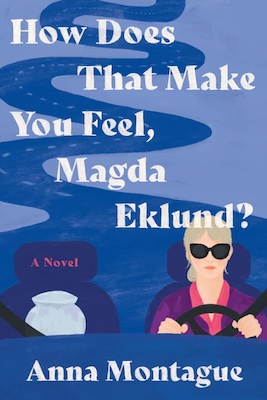
Over the course of the years I spent writing my first novel, some of my friends and loved ones were reaching advanced age with the question: what do I do now? That line informed How Does That Make You Feel, Magda Eklund?, the story of a New York psychiatrist who unexpectedly winds up on a road trip with her best friend’s urn..
I’m, of course, far from the first writer to be intrigued by the foibles of humanity, especially at an age where you think you have it all figured out—only to be humbled time and again. Whether it’s pursuing a giant, relentless marlin or embarking on a road trip with your ex-husband, here are a few favorites with senior protagonists on great adventures:
Lucy Barton, a writer, embarks on a road trip with her ex-husband, William, in the hope of understanding a family secret just revealed to him. Over the course of the journey, Strout beautifully depicts the peaks and valleys of a marriage, and the ways in which family— despite everything that can tear them apart—will endure.
Allan Karlsson couldn’t be less interested in the celebrations for his 100th birthday. He’s tired of the nursing home in which he’s taken residence, would prefer to have more freedom with which to drink vodka, and so he slips out the window and winds up on a rollicking adventure. Beyond what he sees, though, it becomes clear that Karlsson has lived many adventures before that— as a munitions expert, bearing witness to some of the biggest (literal) explosions in history.
An elderly woman living a solitary life in the woods is startled when, on a routine walk, she comes across a note explaining the presence of a dead body. The curious part? There is no body. The narrator becomes obsessed with unspooling the mystery, but in doing so, begins to lose her grip on reality. The explanations for this note and the subsequent discoveries could prove either innocent or deeply disturbing, the unreliable narrator pulling the reader further into the depths of her confusion.
Backman’s beloved first novel chronicles a crotchety old man whose life is rocked by the arrival of his new neighbors: a young couple and their two cheerful daughters. This comic romp is a heartwarming one, showing the value of friendship (however unexpectedly it arrives) and its ability to shift our perspective.
This classic novella chronicles an aging fisherman whose months-long streak of catching nothing has rendered him profoundly unlucky. When a giant marlin crosses his path, his obsession with catching—and then protecting—the fish reaches furious new heights.
McBride’s latest opens with an old church deacon who, unexpectedly and in plain view of a housing project, shoots a drug dealer. This surprising act of violence leads to a moving, heartfelt story about the interconnectedness between the characters, and, ultimately, the capacities of humanity and faith to change our lives.
Grace is a retired math teacher, whose life is rocked by a long-lost friend’s death, after which she is bequeathed their old house on a Mediterranean island. Puzzling over her friend’s death requires her to examine her own life, delving into the past and reimagining what her future could look like.
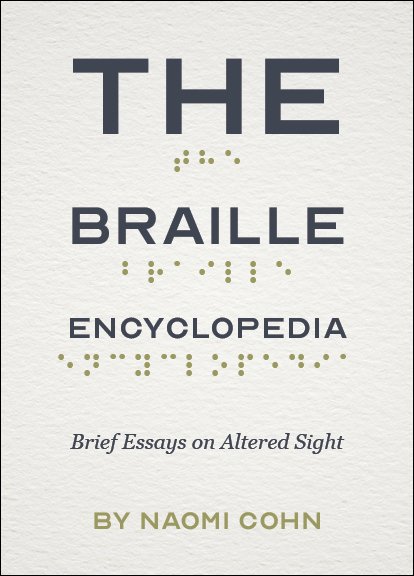
Naomi Cohn’s memoir focuses on her progressive vision loss and her embrace of braille as an act of reclaiming her love of reading and writing, along with an expanded sensory and sensual existence in the world. Intertwined with this focus are themes braided and bountiful, including a history of Louis Braille and his writing and reading system, a medical narrative of her declining eyesight, her academic parents’ intellectualism, and her love of nature, art, and drawing. Conveyed in short non-chronological essays organized as alphabetical encyclopedia entries, The Braille Encyclopedia: Brief Essays on Altered Sight is a poetically rich narrative, replete with abecedarian index, on releasing former dreams to immerse oneself into pleasurable new ones that become, as she writes, “my real work.”
Naomi Cohn and I lived next door to each other for more than 25 years in St. Paul, Minnesota, leading parallel lives as writers. We talked on the phone about her memoir’s abecedarian structure, how braille opened up a tactile world of sensory reading and writing, her wry sense of humor, and her adaptations to a world of altered sight.
Camille LeFevre: Naomi, in your book you note Rebecca Solnit’s The Encyclopedia of Trouble and Spaciousness as inspiration for The Braille Encyclopedia. Your childhood passion for The International Wildlife Encyclopedia also figures thematically throughout the essays. Why did the abecedarian approach serve you in crafting and organizing your book?
Naomi Cohn: I read Solnit’s book as I was starting to explore personal essay after years of focusing on poetry. The way she used alphabetical form made me think, this is a perfect way to organize my work. But I wondered how much I wanted to mimic a traditional encyclopedia, which can be dry, unemotional, and fact-y. And does everything in it have to be provable? Or claiming a stance of expertise? Meanwhile, the project morphed from an essay into prose poems and finally a memoir. Going the abecedarian route freed me from chronology, from single dramatic points in time, because that’s not my experience of going blind. I’ve spent 30 years tackling all of the topics in the memoir; the encyclopedia was a great scaffold in the early stages. But then I’d find the memoir was missing an emotional note or piece of crucial information; that the book needed more about my parents or Louis Braille, and new topics emerged in the magic space between that scaffold and what the book needed.
CL: Why the term “altered sight” and how does that resonate throughout the memoir for you?
When I began learning braille, I reclaimed my love of reading and a way of writing that isn’t digital.
NC: I choose that term for a practical reason. I wanted the title to be invitational. I have my own baggage about blindness and readers may bring their own baggage.I wanted a term less loaded than “blind,” and with more of a sense of possibility to it. One theme of the book is that I truly feel two things at once that are contradictory: my love of reading and writing, and coming to realize there are different ways of seeing. No one can see everything at once. Some see less well, which means other things come forward, which is also a metaphor for how we exist in the world. Having the capacity to read braille, to take in language through my hands, is expansive.It’s amazing, right? So, my narrative arc of being a sighted person to becoming legally blind in my 60s reflects both a terrible loss and an evolution into different ways of being, and is a way of living and inviting the reader into both those truths.
CL:A great example, in your book, is your “reading” of Vermeer’s painting “Woman in Blue Reading a Letter” as an abstraction of meaning and metaphor.
NC: Yes. When I could see, I could make out details. Being legally blind allowed me to focus on the abstraction I couldn’t see in my 20s. Moreover, a key focal point in the painting is a letter gripped in a woman’s hands as she reads it, but the viewer, even a fully sighted one, can’t read the letter. The image, then, to me is more about a sensual relationship with reading, which is how I experience my relationship with braille.
CL:Right, and your tactile descriptions of learning braille have me wondering how reading and writing have become more embodied for you than when you were sighted.
The dots under my fingers could be a book and a whole world.
NC: It’s a love affair. It’s all about touch. While I was losing my vision, I’d still read print but the eyestrain became self-injurious at a certain point. Then I got books on tape in specialized formats. Now there are all sorts of technologies for auditory and text-to-speech reading. But when I began learning braille, I reclaimed my love of reading and a way of writing that isn’t digital. Even though it was arduous at first. Such a puzzle. A mystery, that the dots under my fingers could be a book and a whole world. But each stage of difficulty, every stage of learning, brought me into an awareness of what’s so wonderful about reading and writing: They are actions we do with our bodies. I’m constantly aware of the magic of that. When I read braille, even if I’m scattered and worried about 10,000 things, I put my fingers on the page and I’m centered and grounded and brought back into my body.
CL: I’m constantly amazed, in real life and in your book, at your resilience; at your ability to transform life-changing challenges into new-life experiences.
I put my fingers on the page and I’m centered and grounded and brought back into my body.
NC: I can’t sit on a park bench and observe like I used to. I make visual mistakes, like saying hello to mailboxes and real-estate signs because they might be people. In my teaching with older adults and people with disabilities, I try to model imperfection, like typos. Some of my students mis-hear things in interesting ways. What I’m getting at is that one of disability’s gifts is creativity; disability requires creativity just to get through the day. Many things require a hack to figure out. Louis Braille inventing a tactile writing system is an amazing creative hack. So that’s baked into disability experience. If we’re lucky we develop that creativity muscle and don’t have to apply it only to making sure we have clean underwear, food, and shelter. My blindness is an asset; it’s made me more creative.The natural habit of adaptation is also a creative habit.
CL:Your memoir runs counter to expectations in many ways. In its form. In its can-do tone, but without toxic positivity. In the humor you discover in what sighted people may find harrowing situations. Woodshop classes for the blind! Who is Naomi as a character in your memoir?
NC: I love this question. Because as memoir, the book has an arc of overcoming and understanding. But the book’s non-traditional, quirky shape is deeply related to my life experiences. People read memoir because they’re curious about other people’s lives, or want to figure out their own life. My experience is not here to entertain a reader. Nor am I engaging in self-exploitation. I’m not the most touchy-feely person; nor do I melt down into puddles in the book. That is true to who I am, and it’s also a character choice. Sure, there are moments in my life when I’m a weeping creature with fangs. But that’s not where the book spends its time. The humor is baked in. It’s genuine to who I am. That’s also a classic way of moving through the world to set people at ease when you present a problem to them, such as a disability.
My blindness is an asset; it’s made me more creative.
CL: Naomi, as neighbors, we were both childless cat ladies. So why are there so many dogs, and no cats, in your memoir?
NC: I love cats and still dream about my cats who have passed on. But there’s a way in which the dog is a more enthusiastic and sensual experiencer of the world. And that’s part of what I hope comes across in the memoir: That I’m expanding my other senses while reclaiming my love of reading and writing. And braille is learning to lean into who I am today. I’m stereotyping dogs, but in general, a dog isn’t necessarily seeing that pile of poop but smelling it and wanting to roll around in it. Dogs are all about going with the senses you’ve got. And living in the now.
I remember how you cried when I walked towards you and took your hand in my hand.
After the wedding, we danced all night in Casa de España to our favorite songs, to our friends’ joy, to our love. My feet were aching. When I complained about the pain, you took me to the side of the dance floor and brought a chair for me to sit on. You knelt in front of me, took off my heels, and gave me a foot massage. A friend took a picture of me in my wedding gown with my bare foot in your hand.
I don’t have a picture of your forehead cut open, nor of the red blood running through your nose until it reached for your mouth, like a river flowing into the sea.
Our naked bodies on a hotel bed. Your left hand on my breast, your wet kisses on my neck. “My wife, I’m so lucky that you are my wife,” you whispered, and I stared at your wedding band shining on your finger.
We were hungry. Late at night we walked hand in hand to Walgreens to get snacks. You chose a box of cheese sandwich crackers, and we went back to the hotel. We sat next to each other at the bedroom balcony and opened up a bottle of rum. Our laughter merged with the sound of the waves and the palm trees in San Juan. We stayed awake till dawn. Until there were no crackers or rum left.
On our first trip together, you let me have the window seat in the airplane. You knew how much I loved it. I fell asleep on your chest while we were up in the air. We opened the tray to fill out the tourist card, took pictures of our left hands with our new wedding rings and the first document we checked “married” on. You carried my luggage when we landed in Punta Cana.
A room with an ocean view. Carefully chosen lingerie. Days spent between the bed and the water. You wrote our names on the sand with a heart and a “Just Married” next to them. You didn’t stop taking pictures of me. You didn’t stop saying how much you loved me.
I asked you to stop ordering so many drinks at the bar.
It was a Monday. You brought another six pack of Medalla to our house. I threw it to the floor of the unfinished terrace in the backyard and yelled: “I will not allow any more alcohol in this house. I’m tired of it.” I was actually tired of you. Maybe I threw the beers to the floor because I couldn’t throw you, or my job, or grad school, or our house, or our marriage, or myself. You cried. Right there or later in our bed until you fell asleep. Or so I remember it. Or so I want to remember it, that I paid with guilt for my cruelty.
Some Friday nights made me feel that we were like any other young married couple. You picked up a medium pizza with onions, half bacon, half ham. We sat on the couch to watch comedy movies on the TV your dad bought for us. The dogs lay on the floor right next to us. My dreams were small.
Some Friday nights made me feel that we were like any other young married couple.
I called my best friend crying.
“We still don’t have a dining table at the house,” I told her. “Don’t cry! You have a husband that really loves you, and that’s what matters the most,” she answered. “It takes time to put a house together.”
I didn’t tell her that you were drinking beers every day and the fridge was almost empty.
I hated being a full-time teacher, a full-time grad student, and a full-time wife. I fell asleep on the couch as soon as I arrived from work every afternoon until the next day. “I feel so alone,” you kept telling me over and over, and I didn’t listen.
Every few months you cut plantains and green bananas from our backyard, put them inside shopping bags, and gifted them to our neighbors.
When we invited friends over, it took me too long to clean. “Why are you so slow? Stop being so obsessed about the details. Go take a shower, and I’ll finish the rest,” you told me as you took the mop from my hands. I felt inadequate.
I called in sick to work because our car didn’t have enough gas.
You stayed awake all night when I had to finish my final paper. You made me coffee and rubbed my neck. “You’ve got this. You’re almost done. I’m here with you.” A few months later you celebrated my diploma by taking a picture of it and posting it on social media with a caption that read, I am so proud of my wife.
It was summer and you were wearing a long sleeve T-shirt to cover your arms.
You started losing students. I wanted to think it was because of the economy and not because you didn’t make it to the music lessons. You didn’t leave the bedroom for a week. When you did, you didn’t have a job anymore.
In the mornings I got dressed for work and sat on the bed staring at the floor. It took me an hour to stand up and leave the house while you slept. I was afraid to leave the house for fear I’d find your dead body lying on the kitchen floor when I came back and opened the door.
You promised to trim the tree that was in front of the house. When I came home from school, I found you crying in the kitchen.
“Are you okay?”
“I killed the tree,” you told me. “I cut it too much.”
I looked through the window and saw that the tree was missing most of its branches. “Don’t worry, it will grow back,” I reassured you.
And it did.
Marriage Addictions II
We argued on our way to celebrate our anniversary and my birthday. You spent the money we were going to use for the weekend escapade. When we arrived at the hotel you gave me a gift and a handwritten card. The line on the card read, “I’m sorry for not being able to give you all you deserve.” And I sobbed.
The line on the card read, ‘I’m sorry for not being able to give you all you deserve.’
“These marks are old. Do you believe me?” you asked me while you took off your shirt to get inside the pool and I stared at the fresh red dots on your arm.
“I know,” I lied.
I waited for you at my parents’ house for a family dinner. “I feel I’m getting sick. I prefer to stay home,” you told me when I called you to ask why you were taking so long. When I made it to our house you were dressed up to go out.
“Where are you going?” I asked, and the argument started. “I’m getting some beers,” you answered.
“I’m sick of your drinking. If you are going to keep drinking like that you better not come home,” I yelled.
Hours passed by and you didn’t return. I was frightened. I thought you were dead. You came back to the house in the morning and told me that you had a relapse. That was the beginning of a war that I will always feel responsible for.
You invited me to a twelve-steps group in Levittown. I went to the family meetings while you went to the recovering addicts meeting. I saw a young woman talking to you outside of the room. She was celebrating eight months of being clean. I remember the fear in her eyes when you told her you were having a relapse after years of being sober. That night you stopped attending the recovery meetings.
An old man from my group lost his wife to drugs. He gifted me a book with a note in the back that read: “Choose yourself.”
I took off my wedding rings and put them on the coffee table just before falling asleep on the couch. When I woke up in the morning, I couldn’t find them. “Maybe the dog swallowed them by accident,” you told me. I wanted to believe you.
You came trembling to the bedroom with a glass of water. You got in the bed, and when you hugged me, your skin boiled hot.
El Dragón song played on your radio. That was your hell anthem. You turned off the bedroom lights and lay in bed for hours staring at the ceiling. The demons were visiting again.
A list of lost items:
1. the gold and diamond watch Abuela gave me
2. the white and blue sapphire necklace that used to be Titi Carla’s
3. your wedding band
4. did you take mine?
Track marks. Underneath your long-sleeved shirt. Red dots that marked the trail of your veins.
Another list:
1. your guitar
2. your drum set
3. our radio
4. your bike
5. your job
6. my car
7. hope
I found syringes in the toilet tank. Inside your shoes. I found a spoon in the washer when I was doing laundry. It was bent, burned at the bottom with an uneven black circle.
Our neighbor punched you in the face when he learned you stole his skateboard. Our goddaughter was visiting us. She sobbed when your body hit the floor. I pressed her against my chest.
I was trapped in a never-ending scavenger hunt.
Marriage Addictions III
You brought home the street hunger. You turned on the stove, took out the milk, the bag of cornmeal while I made sure you didn’t burn anything. That you didn’t burn yourself. I was cleaning behind you, tripping over you with every step, every half turn like a failed attempt to dance a son Cubano. Without the party. Without the joy. Without the music. You were annoyed as if I were stepping on your feet. You never understood how difficult it was to clean dry cornmeal from a pot, from the ceiling, from the cabinets, from the table, from the floor, from the clothes, from a plate . . . you only knew how to spill it. From the stumbles and our fractured dance in the kitchen you went to the dining table spilling cornmeal on your way. Absent, with full veins and an empty stomach, you sat at the table and tried to eat a few bites without falling from your chair. I sat at the table with you and shook you on the shoulder to keep you awake, but I stood up and went back to the kitchen because I didn’t want to see you anymore. You fell asleep with your face on the plate. I cleaned the mess on the floor while it was still fresh. I waited for you to wake up to take off your shirt and clean your face.
You took the keys I hid inside a kitchen drawer, opened the front door, and left our house. When I got out of the bathroom to get ready for bed, I realized you were gone. I went back inside the shower and stayed under the warm water as long as I could stand, until my fingers were wrinkled and my skin extra clean. It distracted me from the fear of a panic attack. It helped me to avoid thinking about all the bad news I could get.
What if he overdoses?
What if the police call me to identify his body?
I dismissed the thoughts.
He has experience shooting drugs. He won’t make a mistake.
I was looking for you in Sabana Seca and saw from a distance a homeless man crossing the street. Except, it was you. I couldn’t recognize you. I called your name, and when you turned, I saw your face. Your forehead injured, a river of blood running between your big, green eyes that didn’t recognize me either.
“Where are you going?” I yelled from inside the car.
I was looking for you in Sabana Seca and saw from a distance a homeless man crossing the street. Except, it was you.
“I’m going home, don’t you see?” you answered from across the street with your eyes lost, yourself lost. You were walking in the opposite direction of the way home, and I wondered for how long you’d been trying to return.
“Get inside, I’ll take you home.” You didn’t look at me, but you got inside the car. Maybe you were trusting the voice that promised to take you home.
Can you take a picture of a soul breaking?
I came home from work and found you on the floor. I threw myself on top of your body and shook you as strong as I could to see if you were alive, as if I could bring back your soul from the dead. You opened your eyes. I remember your blank stare. Your white eyes. I remember things I don’t want to remember. That I don’t want to write about. Consider them written in this space:
“I don’t want to be married to you anymore,” I blurted out on a Sunday morning. You went to live with your parents. I stayed by myself in a haunted house.
I received a call from a neighbor a few days after you moved out. “I believe your house was broken into,” she said on the phone. I hurried home from work and saw the broken kitchen window. Our TV on the ground outside. Your body coming out from the window. I pushed you as soon as you came out of the window.
“What’s wrong with you? Are you insane?” I yelled, and you didn’t respond.
You took the TV from the ground, and I took it from you. “If you ever come to this house again, I’ll call the police,” I told you.
“Fuck you,” you responded as you stumbled into the street.
A woman drove by, and you got inside of her car. She sped off. Until I no longer saw you.
Grief is perhaps the most universal experience we share. It transcends everything that categorizes us—culture, class, religion, gender, even species. Yet for something with such ubiquitous reach, it is an entirely individual process. There’s no road map for when and how those five key stages will manifest, or for the infinite secondary stages one encounters.
Pulling the lens back from our emotional attachments to it, one of the interesting things about grief is the realization of who or what brings comfort to the bereaved. I know from recent events it’s not always the people we expect—and in fact releasing those expectations may make the process more bearable. It might not be the person we consider our “ride or die” who will show up the strongest or the most often. It’s not necessarily the people with whom we’ve had the deepest conversations about life who will know the right things to say. Nor is it a given that a friend or family member grieving the same loss will be the one who makes us feel the most understood.
My novelThe Coat Check Girl opens with the protagonist, Josie, returning to work following the loss of her beloved grandmother. Nanette was Josie’s anchor through a difficult childhood and messy foray into early adulthood, and without her Josie is unmoored. Compounding this is the fact that she has an acrimonious relationship with her mother, the one person with whom she should be able to bond in their shared grief. It is instead her makeshift family of coworkers at Bistrot restaurant—including the mysterious new coat check girl—along with a dubious love interest who bolster her in the aftermath of Nanette’s passing.
Here are nine other books that address the theme of navigating grief through found family:
The third book in Josselsohn’s historical series travels between World War Two-era Italy and the present. Callie is mourning the loss of her sister, with whom she had a troubled relationship. In cleaning out the family home, she discovers evidence of their grandmother’s mysterious past. She travels to Italy to fulfill a promise she’d once made to her sister and to uncover her grandmother’s secret. There she meets restaurant owner Oliver, whose own wartime family history may be linked to hers, and Emilia, an elderly hotel owner who seems to have known her grandmother. In unraveling the mystery, she and Oliver forge a connection that takes their lives in new directions, just as she and Emilia learn what it really means to be a sister.
This is the first book in a trilogy and another that jumps time and place as two characters come to understand how their complicated pasts intersect. Set in Paris, D.C., and Tehran among other places, Rumi and the Retribution is a fast-paced political thriller. Noor Rahman has been grieving her mother’s murder for two decades—grief exacerbated by the many unanswered questions surrounding her death. When Gabriel McKnight—a former Navy SEAL turned bestselling author—walks into her life, he leads her on an intriguing international journey. This journey, and her burgeoning relationship with Gabriel, will ultimately bring Noor closure with the help of a series of clues her mother left her through key passages of Rumi’s poetry.
This beautiful novel chronicles the AIDS epidemic on alternating timelines—the 1980s, when it began in the United States, and a more contemporary era in which the protagonists reflect on it. Because of the nature of the epidemic, some of the characters both afflicted by AIDS and impacted by grief over their fallen friends and lovers are alone in their struggles, having been disowned by their families of origin. The Great Believers is a testament to the enduring power of friendship.
A Little Life follows four college friends who move to New York after graduation and attempt to carve their very different paths in the world. This group is a safety net for the protagonist, Jude, who was abandoned as an infant and suffered an unthinkably traumatic childhood. It is friends and mentors, one of whom eventually adopts him as an adult, who attempt to help Jude face down his many demons. Another stunning exploration of the critical role friends can play in assuaging the isolation to which we are all susceptible.
After a string of unfortunate events Nora Seed decides she’s had enough of life and swallows a handful of pills. But instead of death, she finds herself in the titular library, run by a woman who bears a striking resemblance to the school librarian who offered her solace during a childhood tragedy. The Midnight Library houses books that offer Nora different versions of her potential existence. In exploring the infinite paths available to her, she discovers the life she was leading was worth it after all.
This quirky novel-turned-television series about a woman forging a path in a male-dominated industry—and world—in the early 1960s embodies the theme in myriad ways. Elizabeth learns she’s pregnant shortly after her partner’s untimely death and soon finds herself alone with her young daughter. Despite her almost pathological independence, to raise her daughter successfully Elizabeth has no choice but to rely on the kindness of others—including colleagues, a neighbor, and a delightfully anthropomorphized dog named Six-Thirty.
Sam and Sadie’s friendship is born of tragedy—they meet while Sam is recovering from the car accident that killed his mother. While he never fully rebounds physically or emotionally, his long and complicated relationship with Sadie is one of the threads that keeps his life from unraveling completely. And when Sadie grieves the demise of her first real relationship, it’s Sam who coaxes her back from the brink of despair.
One of the quintessential memoirs about grief—with one of literature’s great titles—this book is about the year that followed the sudden death of Joan Didion’s husband, John Gregory Dunne. During this time Didion embarks on a deep exploration into grief as she grapples with how to define herself without the life partner from whom she was inseparable for forty years. This process is compounded by their daughter Quintana’s very serious health issues, from which she won’t recover—thereby leaving Didion little choice but to find family with whom to navigate these dark waters. Fortunately theirs is a vast and varied network of friends, many famous, most well-intentioned, who support Didion through this time.
The protagonist and narrator of this quiet story is mourning the loss of a dear friend and mentor who took his own life. She adopts his equally bereft Great Dane, Apollo, and embarks on an effort to understand who her friend was, flaws and all, while dealing with the threat of eviction for housing a dog in a pet-averse building. What at first seems a relationship born strictly of necessity soon comes to show our protagonist the ineffable bond we can share with our canine companions.
Several months ago I was lucky enough to meet a Riverhead publicist at a mixer for Black folks who work in book publishing. We started chatting, and she mentioned that she was working on Danzy Senna’s soon to be released novel, Colored Television. I felt, in that moment, like a chasm in the earth had opened underneath me. I have long been a huge fan of Senna’s work. I first discovered her writing in the fall of my freshman year in high school. I was a new student at a wealthy, conservative, and very white all boys college preparatory school on a majestic, rustic campus in Hunting Valley, OH. Having transitioned from public school, I was having some trouble adjusting to the environment, and rather than socialize during my free periods, I roamed the stacks of the library. The school may not have been for me, but the library was exquisite, like something out of an east coast boarding school fever dream. Every day I explored, pulling books down from the shelves. I felt subversive, judging each book by its cover and jacket copy, and choosing whether or not I was going to read it. That year, I discovered Arundhati Roy, Anna Quindlen, and Norman Mailer, among others. I also discovered Danzy Senna, and her luminous debut, Caucasia. For the first time, I was aware, as I read, of that feeling you get when you are truly seen, understood in an authentic way, because you see your experience reflected on the page for the first time.
Here was an author who wrote about what it meant to live at the intersection of multiracial identity, to feel equally pulled in multiple directions, some of which were at odds with your surroundings. I was smitten, and have remained so in the years since. Colored Television, published in September, is clever, laugh-out-loud funny, and unafraid to bask in the complexities of multiracial identity. I had a wide-ranging conversation with Danzy Senna about making art, selling out, and the evolution of our priorities as we age.
Denne Michele Norris: I love beginnings, so I always like to ask writers about the genesis of their work. I’m wondering where this novel came from? What inspired it?
Danzy Senna: It was many years ago that the inklings came to me. I’ve been living in L.A. for many years as a novelist, and I kept wanting to write about L.A., and I love the literature of L.A., and I kept thinking ‘Where’s my L.A. novel?’ But the first inklings of this novel were a family, this Black family that occupied a fluid place in the creative class. So often novels about Black families are steeped in tropes where they’re either living in poverty or they’re super wealthy, moving on up to the east side, and I was interested in this other class space of Blackness, this creative class where there’s a lot of wealth of culture, but the bank account is low. And I also wanted to write about a Black couple where it’s a more equal relationship, but there are problems nonetheless, and then I started dipping my toe into Hollywood, and I was like wait a minute, this stuff is really good. These people were giving me some really good material.
DMN: Just to go back to the class stuff for a minute, one of the most interesting things about this book, you’re right, is that it subverts the tropes around Black storytelling related to class. You’ve got the creative class, the intellectual class, but as you said, this family doesn’t have much money. They’re nomadic, but they’ve had the chance to settle into this mansion and really fantasize about a different life. And Jane gets completely swept up in the fantasy.
Our dreams and identities and fantasies are so, so susceptible.
DS: I see her as a really susceptible person, and I think you see that in the origins of their relationship: the psychic telling her whom she should be with, and her getting fixated on an image and a catalog. I’m fascinated by how much we’re influenced by the images that are fed to us. Our dreams and identities and fantasies are so, so susceptible. And Jane, in particular, is even more vulnerable to how people see her, how she is read, so much so that her identity becomes wrapped up in these images and fantasies, and how she thinks the people around her are seeing her. And she’s always been this way.
DMN: Let’s talk about Jane as a character. She is delicious. Her obsession with status is amazing, her snap judgments about everyone around her are unwaveringly accurate. Her belief in the novel she’s writing, which as a reader, I knew was doomed. I found myself feeling so many things for her, and about her—loving her, judging her—and I’m wondering what it was like to write her.
DS: All of my characters are shadow selves of me. I’m exploring aspects of my own self, and the people around me, but I’m cutting out other parts of myself to zoom in on some element, some flicker I saw in myself. By the time I’m finished writing, it’s no longer me, it’s this other figure that might be a cousin to me. I have all the same feelings: love them, don’t trust them, find them infuriating, but also delicious. So she articulates things that might flit through my head, and I let her go down that road even further. But it’s like the id. She brings out all these qualities that we suppress in ourselves. Her obsession with status, for instance. I was tapping into the parts of me that have that. Her susceptibility to popular culture and to aspirational fantasies. We all have that, and mostly we repress it, but for the character I take it, perhaps, 10 degrees further. But she’s not wrong all the time. I don’t distance myself from her entirely, nor did I with my last character. I like the darkness in my characters. I think you have to love that if you’re writing them.
DMN: It’s funny because my first novel is coming out next spring, and all I do in my free time is scroll trulia and look for homes I could buy in other parts of the country—because New York City is astronomical, right? I never really thought I’d want to leave New York, never thought about buying property, but it’s recently become something I really want. So as I was reading this, I kept thinking about doggedly pursuing your art for so long, for so many years, which is feels like both Jane and Lenny have done, and allowed each other to do, and then sort of reaching a point where you begin to realize that life is more than just the art you want to make.
DS: It becomes about aging, too, and about growing into reality. I lived on coffee, chardonnay, brie, and crackers for years in a row apartment in New York. I’d get up, work until 10, then go to work, and come home and work on my novel. And I remember that self with such affection. But I can’t live like that now. I have children! But it’s also that you get tired and you need more balance and you need vegetables, you know? And this is part of Jane’s susceptibility. She’s moving through the chapters of her life. Thinking of the Jane that lived in Brooklyn, for her it’s like looking at herself through a window. She feels separated from that self, and she’s torn between Lenny, who’s happy to keep being nomadic, and Hamilton, who’s the extreme opposite in that capitalism has completely taken hold of him. And for Jane, it kind of comes down to her kids. They’re her reality check because she’s left thinking about how their lifestyle affects these two little people they must care for.
DMN: I wanted to go back to what you said earlier, about your characters being shadow selves. I read a review, recently, that ende by drawing a connection between you—Danzy, the writer, the author—and Jane. I wanted to ask you about the reader’s tendency to conflate the author and the character, especially when you do write characters that resemble you, or come from your background. Does that impact how you approach writing fiction? How much do you think about it?
DS: I have a lot of thoughts on this because if you are a woman of color, or any marginalized identity, you will be assumed to be writing a diary, or autobiography, much more than if you are a white male writer. Somewhere in there is the idea that you are not capable of the complexity of writing fiction, and if it has any resemblance to you, then surely, it’s confessional. And that’s steeped in racism, sexism, and the condescension that you didn’t write 500 drafts of this and aren’t deeply in control of this as a construct. This was never a diary, though I am aware of all the ways it will be read that way. But the trick, then, is on the reader, because this took so much conniving to write fiction. I am as much Lenny as I am Ruby, as I am Jane. All of these characters were created by me, so all of them come from me, in some way. I think that the more marginalized you are, the more you’re going to be read as only being capable of writing autobiography or memoir. With my first novel, that happened to me hundreds of times when I was going out and talking about that book, and in the reviews. And it’s one of the things I’m most proud of about Caucasia—that it was complete bullshit. Everything in that book was constructed. I never went on the run with my mother. I never passed as white a single day in my life. And so that book is the result of deep intellectual thought and creative construction and work, the labor of creating something that is new. And that I think this is stolen from you when that assumption is made.
DMN: That’s such a great answer to a very complex question
Unless the reader is in my body, they don’t know how much fictionalizing I did.
DS: It can look as much like you, have as many autobiographical details as you want, and it can still be completely fictional. Unless the reader is in my body, they don’t know how much fictionalizing I did. And in order for me to write a book like Caucasia or Colored Television, I had to create some fictive distance. You must create that between yourself and your main character, even if it looks like you, even if the biographical details are yours. And I just really think that labor is stolen from writers who are assumed to be writing about themselves.
DMN: I’ve never heard anyone address that assumption in that way, and I think it’s hugely important because you’re right, it’s labor that gets stolen from writers of color, queer and trans writers, all the time. I’m going to adopt that language. I remember reading Caucasia, and looking at your author photo, and then wondering how much of that novel was autobiographical, back when I first read it in high school. And then I thought to myself, this couldn’t possibly be autobiographical! I thought to myself, so Danzy Senna was on the lamb with her mother, spent her teen years living on a hippie lesbian commune? I realized it was an absurd assumption to make, right then and there.
DS: You had enough common sense to know that! So much of that novel was in dialogue with Faulker, with Black literature of the 20th century, and that’s other labor that’s taken from you. That I’ve read literature and I’ve thought about these things in a bigger, more abstract way. But also, and let me think how to put this. When I went out and tried to sell Caucasia as a young twenty-six year old debut writer, all of these editors I met with wanted to know if this was true, if this had ever happened to me. And I when I said no, that none of this ever happened to me, that I found in my life a point of departure, that I’d thought about my life with my siblings and my Mom and my Dad, and thought how could I find a place to digress from the truth, and go into the construct, this one editor said good, that means you’re going to write other novels. If this was true, this would be your one, thinly disguised novel and we’ll never hear from you again, but if you can make this up, you can make up many stories. And I think when people ask you to piece together what part is true, and what part is made up, they’re asking you to do something impossible with a novel. Jeanette Winterson said a line that always stuck with me. She said asking someone to do that is like asking someone to turn wine back into grapes. The process is done. This is the wine, and the grapes are in there.
DMN: My feeling is that Colored Television is gesturing at something profound about the commodification of Blackness in the world of art making. I’m thinking about Lenny, and about how early the book Jane feels like adding one small “emblem of Blackness” would make his art sell out at shows, but he refuses because it feels commercial. Then by the end of the book, Lenny is painting more racialized work, and it’s selling out, and they’re able to engage in some of that class mobility Jane has been working towards for so long. So in the end, Jane gets some of what she wants. And I am curious what you think about that.
DS: I had this rather strange interview a few weeks ago where the interviewer, a white guy, was disappointed in Lenny for choosing to racialize his work, for having capitulated in the end, and putting this little emblem of Blackness into his work. And I sort of reject that notion, that somehow making one’s art more overtly racial lessens it, or goes against its purity. Like, maybe it makes the work better. After Caucasia did so well, a lot of gatekeepers in publishing suddenly and overtly suggested that I move on from the race thing and graduate, and become one of the white girl writers. It was like, “Okay, you get to be a real artist now because you can put the origin story to bed. You get to write real novels that are more universal in scope.” And I firmly reject this. That is a weakness of white literature, its inability to write about race. From a purely artistic perspective, that is a strength of being a Black writer. To see America as an outsider sees it makes you more capable of seeing the bigger picture than if you’re too steeped in the blindness of whiteness. So I leave it to the reader to decide whether or not Lenny made his work better or worse, but I certainly don’t think it means that his work is less pure, or less artistic, or less valuable.
DMN: How do you think Lenny feels about it?
DS: I don’t know. I leave it to the reader to decide what they think. But that’s kind of what I’m grappling with in this novel, at the beginning anyway. Because the questions of Black representation that we face would, I think, shock a lot of white writers who are never asked to think about these things. Like, can I write about this, or from which angle should I write about this? Our awareness of the white gaze is there from the moment we set pen to paper, and part of our work is to find all of these strategies that allow us to be free of that, to write what we want to write, in the way we want to write it. And so, through Lenny, I was looking at someone who makes the choice to obscure and reject that pressure to commodify his Blackness in his art, and then through Jane, someone who embraces signaling their Blackness in their art. But they’re both facing the same pair of eyes that they must navigate throughout the novel.
When asked in an interview about her relationship to her home state, Maine novelist Elizabeth Strout balked. “That’s like asking me what’s my relationship with my own body,” she said. “It’s just my DNA.”
That’s how I feel too—that Maine, where I was born and lived until my mid-20s, is so central to my selfhood that its significance is impossible to articulate. I can’t stop trying though. In my debut collection, Certain Shelter, the poems consider the potato harvest and the shut-down paper mills and the cold rolling in from Casco Bay and how living amid all of it has made the speaker wary, perhaps, but also tender. This is a person willing, in her measured Yankee way, to belong to a place that she knows cannot fully last. I love her for it.
Like my speaker, I think often about the places we belong to or from which we are exiled—by choice or otherwise. That fascination emerges often in my writing but also in my reading. I keep reaching for books that give keen attention to a particular geography and the complexities of connection between a place and its people. It’s a pleasure to recommend eight such collections here.
Part of Bull City Press’s Inch series, Rodríguez’s chapbook is small—when held open, about the size of a postcard. That’s fitting for a collection in which each poem is dispatched from and titled for a particular place: Chicago, Weslaco, Punta Cana, Las Vegas. As a visitor in these cities, the speaker’s experience is informed by his identity as a Texan and the son of Mexican immigrants.
In these poems—tight, inviting narratives in which no detail is wasted—we often see the speaker set apart: quietly studying photos at Ellis Island and considering his family’s very different immigration story, buying coffee at the Kansas convenience store where the cashier won’t touch his hand. When he imagines he’s being mocked by a waiter in Frankfurt, he thinks of his father ordering at a restaurant back in the U.S. “with Spanish still heavy on his lips, / still fatigued with uncertainty, diaspora….” And while the speaker’s unease is apparent, so is the pleasure he takes in traveling with his loved partner or hearing Mexican Spanish on a London bus. After a day spent walking New York, he arrives at the Brooklyn Bridge sweaty and chafed, where he can “believe that sometimes / there is no joy without a little bleeding.” Through these poems, we become witnesses to that joy and to joy’s potential cost.
The poems in Glitter Road that explore the speaker’s “Mississippi season” make themselves obvious, appearing grouped together in subsections, with titles that often include location names. At first, this seems like a dichotomy, with the poems of the speaker’s life as a parent, partner, and Black woman in New England set in contrast to the poems of the South, many of which address the region’s legacy of enslavement. It’s a smart organizational choice by O’Neil. The speaker, we learn, grew up in the South, and has returned in part “[t]o love the magnolia and lament the smell. / This place is not finished with me.” The speaker, like we are, is experiencing dichotomy. Love and lament, offered in poems so sonically pleasing that the ugliness they confront is doubly staggering. And the speaker doesn’t allow anyone to look away from it—herself included. In “Rowan Oak,” she drinks wine and dines on oysters at an estate that once depended on the labor of enslaved people. “Praise every / complicated bite,” she says of a stew made from the meal’s leftovers. “Each spoonful becomes a memorial, a reckoning.”
Biddle City is a myth—one that says Lansing, Michigan, was founded when settlers bought neighboring land that proved unusable. “And we have a lot in common / with the scammed people who came and built a life / in Biddle City. Like them, it was not an America / we expected,” Chan writes. This we includes the Filipina American speaker, her family, and their community in Michigan—made up mostly of women who immigrated for marriage or employment opportunities, Chan explains in the collection’s notes.
While the title prepares us for the speaker’s departure from Biddle City and we read the book through that lens, the poems address her experiences growing up there and her work as an adult to understand its impacts. She calls it her “brief and little home,” but it is so prominent in her memory that it’s become the focus of a full collection: prose poems and haiku and variations on pantoums in which the repeated lines change a little each time so we have the sense that as the speaker considers this place—where “[e]verything was a rectangle,” where she was one of two Asian girls at her school—she is remaking the story, just a little. She is making her own myth. “My brother and I talk about Biddle City all the time now. // Each time, we think of something new to remember.” Biddle City holds the speaker. In a book as immersive as this one, it holds us too.
In a lyric essay that comprises the central section of her collection, Ampleman explains how she came to be fascinated by space travel: a museum exhibition of the Apollo 11 command module that carried Neil Armstrong, Buzz Aldrin, and Michael Collins to the moon for the first lunar landing in 1969. You can imagine what she might have been thinking as she viewed the vehicle—how much was asked of those astronauts, doing momentous but necessarily lonely work.
A space launch is also a launching into foreignness and vulnerability. It’s from that viewpoint—and through the language of space travel—that the speaker explores domestic life, infertility, motherhood, and the burden of chronic disease. Giving birth becomes a flight mission: “Dear shear pins—shaved off as the launch system // rises, unhurried—be divided.” She loves her partner like “docking latches, pneumatic system / powered by nitrogen, holding / space modules together.” She takes fertility medication to “make the eggs / inside her develop, fertile, / moons that wax gibbous” while medication for an autoimmune disease puffs her face like an astronaut’s “in the fluid shift of microgravity.” In less capable hands, such references could have become tiresome but Ampleman deploys them in ways that feel intrinsic and necessary and often surprising. Unlike Aldrin’s gold visor, which “still reflects whatever’s / in front of it,” these poems offer new imagery, merging the intergalactic and the quotidian to strange and satisfying effect.
As Reeve’s speaker faces personal unrest—pregnancy loss, the exhaustion of parenting, her partner’s degenerative disease, the demands of art-making—she returns again and again to the natural elements of her environment. She stands among the harbor beech that are reclaiming Andrews Bald, she lets “the ribcage of Earth” rise and fall under her. She names the flora and fauna and topography of southern Appalachia with such specificity that the naming becomes a litany—not one of tedium but a way of saying you exist in this place.
Which isn’t to say that she’s perfectly at peace. “How content, in this place, is each thing / to be what it is,” the speaker observes—about things, but perhaps not people. “My heart goes one way, my body goes another,” she later admits. These poems are generous with the reader—so emotionally forthright that we are with the speaker in her disquiet. We see, as she does, how even the foamflowers can be “open like kids’ hands, asking for something.” And when she talks about the holy basil, we hope she’s telling us something about herself as well, all of us watching as the plant “shoulders aside / rosemary, valerian, and lavender / so its large wings can open.”
“I think I remember stories because they are violent. // Or because there is music,” writes Drake in a collection that considers both brutality and musicality, often drawing connections between them. Its speaker “must sing / the hum of the yucca // and the icy heartbeat / of river” even as that river has been dammed, its water robbed. When the desert moans at night, it brings the smell of a bloody nose. In “Put on that KTNN,” Hank Williams “rolls in / all over again, easy and easy // and blue” above a desert that was, in another geologic era, “thrashed by thunderstorms and sea.”
Drake’s poems, lyrical and expansive, are often situated in or near the Navajo Nation, offering personal and collective histories tightly linked to the land. In Monument Valley, “the rocks look like women, hushed together.” The Badlands are “gray teeth swimming in ghosts.” Throughout, the land is a dynamic presence—a character as real and living as the speaker, who chooses not to alienate herself from it, even when connection feels tenuous or demanding. Driving in Long Beach, the speaker is reminded “this city is homeland, too / though it burns more often. // So we speak kindly to the land / when we can.” If the burning is violence, the kind speech is music. And like the speaker, we remember each.
In Stray Latitudes, the language of the poems is often as spare as their landscapes: a closed-down mall, the alley behind the Harris Teeter grocery store, half-built suburban neighborhoods on which work has been stopped. This isn’t to suggest that the pieces are bleak or barren, but they acknowledge isolation and uncertainty, often with gentleness and acceptance. When the speaker finds a dead owl on a quiet dirt path, he thinks its eyes ask “why here” and he’s too cold to stop but carries the question with him. When a real estate agent says she can imagine him living in the house she’s showing, “[w]hat she means is that lived life / is still ahead of us, perfectly open, / and that no one has ever felt lonely / in the place where we are standing.” We—the readers and the speaker—recognize loneliness is inevitable. Questions are inevitable. Can we make peace with them? The speaker thinks so. “The only lesson / I hope to teach them,” he says of his four children, “is that doubt is its own / kind of worship, / and that the water / you drink as you wander / this desert of unknowing / must always be love.”
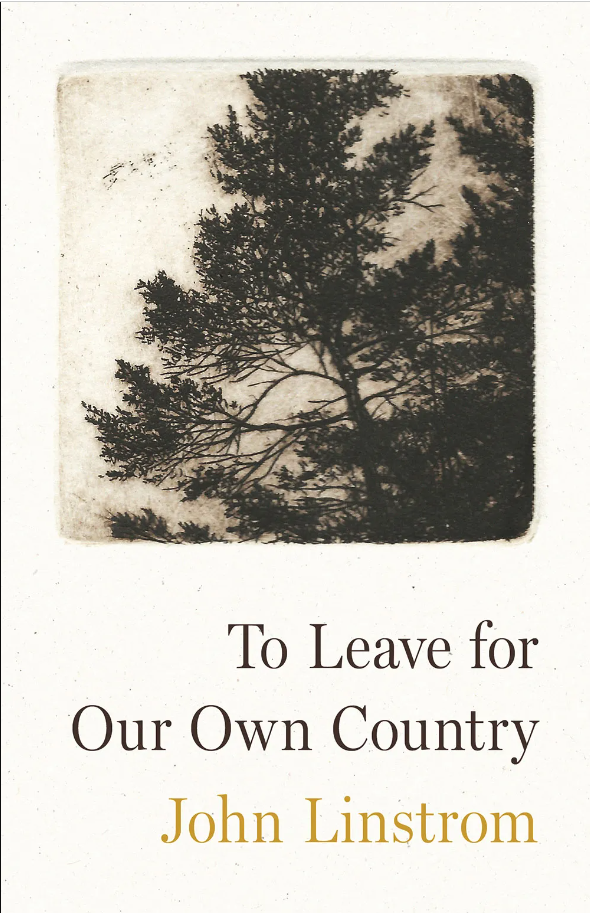
In a poem set in the Museum of Modern Art, visitors have come to witness “a bit of domesticity and dream, / a place to spend some time, but while we swirl // the dust of other homebodies around / in rooms of light and shade, we’re bound to float // where we have flown before.” This image—of seeking beauty in the world, and of seeking to understand it—is central to Linstrom’s collection, as is the tendency of people to return to the familiar. To want to belong to a place.
This collection also belongs to places. Its first three sections are named for specific states or a city—geographies to which the speaker gives a quiet, sharp attention. The foam from the Con Edison plant on the East River is considered as closely as the whitecaps of Lake Michigan, and there’s a loveliness to all of it, though with the specter of danger. Climate change. The death of loved people. The speaker describes his city as “a room resonant with confusion and us.” He is honest about surrounding sadness and earnest in his desire to counterbalance it: “We love this world so; we pour into it.”
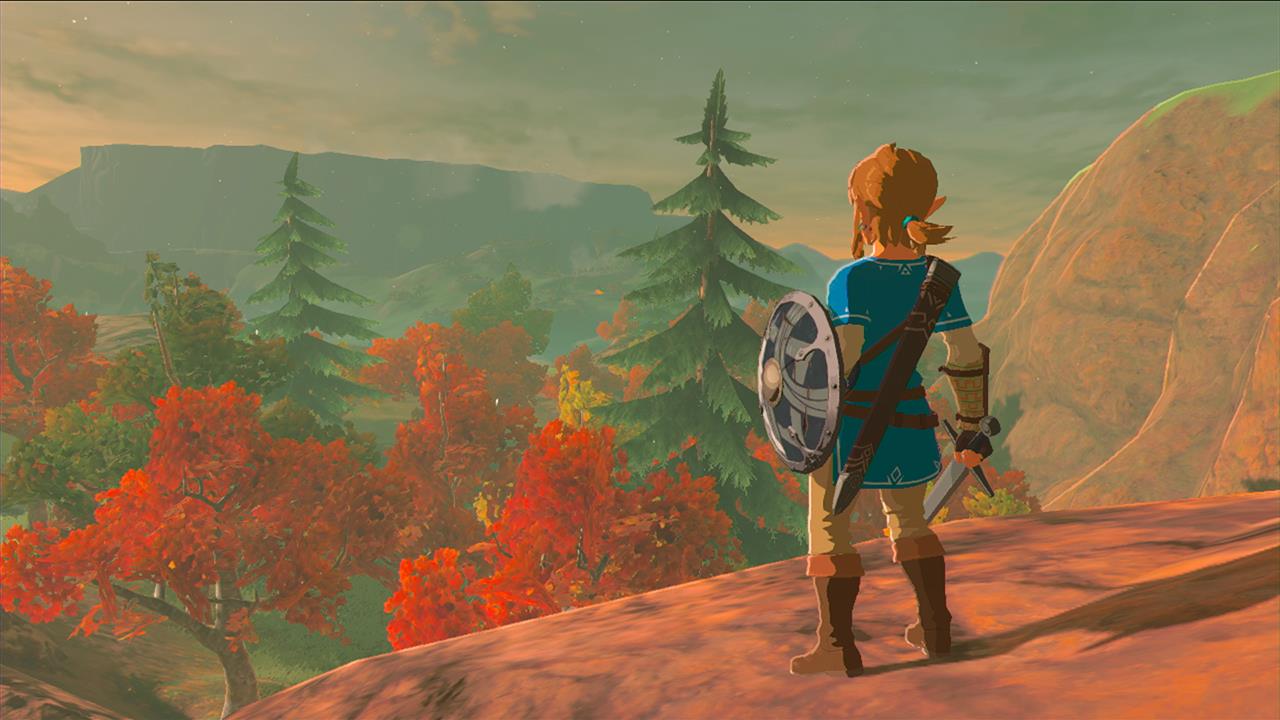
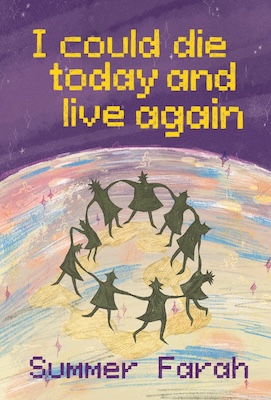
“how lonely it can be / to be a certain type of character. singular purpose. looped dialogue,” writes Summer Farah in her poetry chapbook I could die today and live again, published by Game Over Books in 2024. The collection, which explores empire, intimacy, grief, and play amidst the backdrop of The Legend of Zelda, is haunted by cycles: the cycles of the moon, of mourning, of occupation, of poetic form, and the regenerative cycles of death and rebirth within video games. What would it feel like, Farah asks, to be an NPC trapped within the endless loop of a game on repeat? How can we create growth and meaning from these patterns we find ourselves (re)living?
As I write this, it is the one-year anniversary of the current iteration of Israel’s genocide in Gaza: 365 days and 76 years of schools, hospitals, homes, and refugee camps being destroyed by bombs paid for by American tax dollars; of families being torn apart and displaced; of forced starvation and denial of access to medical care; of the targeting and erasure of entire bloodlines. It is easy to succumb to despair in the face of this unfathomable cruelty, but this also marks 365 days and 76 years of Palestinian resistance; of unprecedented international solidarity; of men risking their lives to dig children out from under the rubble; of radical, unwavering hope; of the steadfast conviction that Palestine will be free. “SOMETIMES ALL OF OUR RESISTANCE IS / UNDONE WHEN NIGHTFALL COMES,” Farah writes, “BUT WE WILL NEVER FORGET / CHAMPIONS LEAVE MEMORIES IN SUNLIGHT / IF YOU CLOSE YOUR EYES IN THE SHIMMER / YOU CAN FEEL THEIR BREATH ON YOUR SKIN.”
I’m grateful to have had the chance to talk to Summer over Zoom about obsession, persona, video games, and the peculiar way that poem excerpts proliferate on Tumblr.
Ally Ang: To start, what is your origin story with The Legend of Zelda?
Summer Farah: I’ve been playing Zelda games my whole life. I have an older brother who was really into video games, and we have a pretty big age difference—he’s six and a half years older than me—so video games were one of the things that we would do together a lot in bonding, because it’s easy to be three years old and play video games with a ten-year-old. My earliest favorite games were Pokemon and Zelda. I have really vivid memories of watching my brother play Ocarina of Time and he would be going through dialogue really fast because he’d played through the game multiple times. And I’m like four-ish, I’d just started learning how to read, and I would be like, I want to read what they’re saying. And he was like, but I already know what they’re saying. So I started reading fast, and a lot of my relationship to reading and narrative and processing is around playing games.
Zelda games are one player, but my brother would give me a controller that wasn’t connected to anything and tell me I was Navi just to make me chill out, and I would believe him. And then every time Navi goes away—because she’s not there all the time—I’d be like, where did I go? And he’d say, I’m protecting you. Don’t worry. So that’s my origin story with Zelda, becoming a person alongside playing the games. I’ve played all of them throughout my life. I was just playing Twilight Princess before we got on the call.
AA: I want to talk about the two epigraphs that open the collection, one from Etel Adnan (“Such apprehension, such madness! Is the sea aware that her heroic beauty may be in disuse, someday? The moon never experienced the sinking of empires that she witnessed; day after day, she longs for a shimmering heat”) and one from Kamaro from Majora’s Mask (“I am disappointed, oh moon. I have died!”) I think these epigraphs do a great job of preparing the reader for both the world of references and influences that you’re drawing upon in this book, and for some of the themes and motifs that recur throughout the book, including the moon, death, and empire. You are a poet who is unafraid to reference and you build a rich landscape of literary and cultural references in all your work, so how did you land on these two epigraphs to open the book?
SF: When I was far in the process of writing and editing the book, I was spending a lot of time with Etel Adnan’s work. I’d been reading her off and on for a while and considered her a writer that was theoretically important to me because of the artistic communities that I’m in and knowing her legacies. I liked her work, but I wasn’t as immersed in it as I am now. When I was editing the book I was reading Sea and Fog. There’s an eeriness in her work, a kind of surreal mystic feeling that her language is so encased in, that feels like you have a cool breeze around you, and that can either be comforting or isolating. That’s my favorite thing when I read, and it’s also one of the things that really draws me to a lot of Zelda games, particularly Majora’s Mask. The book takes inspiration from all Zelda games, but Majora’s Mask is kind of like the anchoring game. As I was reading Etel Adnan’s work, I was like, wow, the vibes are like Zelda! It’s fun to recognize the repetitions of what I’m drawn to in such disparate artworks.
I wanted to frame the book in some way outside of games, because it is so involved with games, so I was thinking about what else this work is in conversation with. It’s also an attempt at anti-imperial writing or critiquing empire, so I was trying to think about it in lineage with the writers I’m most drawn to for their criticisms of empire as well as their art writing. Etel Adnan is doing both of those things. At the same time, it felt like a good window into the things that I’m always pushing together in my head and making hold hands.
With the epigraph from Majora’s Mask, my work is often concerned with death, and Majora’s Mask is a game where you are putting on the faces of characters who have died. That quote is a character’s last words to you. I found something really compelling in that phrase, in that lament to the moon, especially as the moon is an empirical figure in Majora’s Mask. Out of context, it felt really beautiful, and in context, it felt really sad. I liked thinking about these two addresses that are, again, from very disparate things, but very connected.
AA: You are someone who I think of as reveling and indulging in your various obsessions through your writing, whether that be Mitski or Supernatural or Zelda. The depth of your love for your obsessions is evident in your work, but it’s not an uncritical love. In your endnote about the poem “IN GERUDO VALLEY,” you call out early racist depictions about the Gerudo people in the franchise and write about feeling conflicted about playing the game in their corner of the map. How did you approach writing this poem, and how do you more generally navigate writing about—to use a dated phrase—problematic faves?
SF: I had a lot of trashed drafts about Gerudo. I was thinking a lot about Ganondorf and how he’s the only man born into this desert society and he is the root of all evil, and there is this wholehearted villainizing of this man from the desert. My brother and I talk about this sometimes. There is this interesting recognition when you’re a kid playing these games and you’re like, oh, this fantasy setting is supposed to be inspired by my culture, and they’re the villains; that’s kind of weird and it makes me uncomfortable. But I never really thought about it that deeply.
I don’t really play first person shooters or games that are very engaged with violence against Arabs, but the reality is that JRPGs, Japanese role-playing games, are super Orientalist. They have baffling depictions of West Asia and Muslim nations; it’s kind of funny sometimes—horrifying, but super fascinating. I play a lot of JRPGs that have a medieval fantasy setting and so I see it a lot, and I mean, it bothers me, but it’s not the worst thing in the world. What gets me more is when I log on and I see the ways these depictions are held by fans and players. There’s an uncritical embrace of these depictions and a wholehearted indulgence in the violence of sexualization of these vaguely West Asian/North African Muslim women. What does it mean to think that it’s really awesome that Gerudo is like this?
Tears of the Kingdom is doing a lot of work to try to correct this racist history. There’s less villainizing, there’s more of a vibrance to the region, and it feels like a well developed region so it’s fun to go there.
I feel like a weird responsibility as a Palestinian player of Zelda games to be like, let’s think about it. But I don’t want to all the time! So I think that’s what a lot of my failed drafts were trying to poke at, but ultimately it didn’t feel honest enough, because my experience of playing the games with regards to Gerudo was weird, but the sense of recognition and fondness outweighed the understanding of violence in my own playing. It wasn’t until I was exposed to fandom that I realized the potential for violence. And since the book is very much about the act of playing with loved ones or putting yourself into the game, the criticisms didn’t feel honest in the poem. I think I could probably do it in an essay, but a poem didn’t feel like the right space and this book didn’t feel like the right space.
AA: This chapbook uses a variety of poetic forms—including the pantoum, contrapuntal, and concrete poems—but one in particular that recurs throughout this work (and your work in general) is the prose poem. In your interview on the Poet Talk podcast with Jody Chan & Sanna Wani, you talk about the prose poem’s propulsive quality and frantic energy being something that draws you to it, but I was wondering if you could talk a bit about how you approach the line/line breaks in prose poems and what drew you to prose poems for this chapbook in particular.
SF: I draft a lot in prose poems—maybe not so much anymore, but when I was writing the book, every poem’s first draft was a prose poem, and then as I went through phases of editing, they became what they were. Eventually, I had a book that only had one prose poem in it, and I was like, that’s not me.
I like the neatness and the tightness of a prose poem. When it comes to thinking about the line, I like the different ways to indicate space and breath in a prose poem like caesura, or slashes, or playing with punctuation. It feels like there’s more opportunities to play with what that break intends. A slash feels different than a caesura which feels different than a hard stop with a period, or the kind of rhythm that you can create with a very, very long list with no punctuation at all, letting words run into each other. It feels like everything is in a container, and you’re shaking it, and it’s landing in a different way.
It also felt apt for a game book where I’m turning hyperfixation into something productive. I think that’s a lot of my writing in general—maybe a lot of people’s writing—the excising of an obsession. I’m a yapper. I talk a lot. I can go on and on and on a lot about the things that I like, and the prose block feels aligned with that act and intention.
The prose poems in the book are the more interior poems. They’re the ones that feel more in my voice than in the player voice that I blend with my own throughout. It was very intentional to signal that we’re tapping into something that is more genuinely Summer. Originally, when I only had one prose poem, I was like, well, this book doesn’t really feel like me at this point. So going back in, the last two poems I wrote were “INTERLUDE: PARALLEL PLAYING W/U” and the last poem. Those are both 100% me, as much as the poet’s voice can be me. Those are very intentionally breaking away from the facade of the player character lens. And I was like, well, they gotta be prose poems because that is when I’m my most honest, vulnerable, clear self.
AA: Throughout the collection you have persona poems about different NPCs, like the moon children of Majora’s Mask and the “snot-bubble child on Outset Island” of Wind Waker. As a player, what is your relationship to the NPCs of the Zelda franchise, and as a poet, how did you decide on such a polyvocal collection (rather than, for example, having the whole collection be from the perspective of the player character)?
SF: I wanted to think about the implications of cycles within the series. I think a lot about how Link, Zelda, and Ganondorf are stuck in this cycle, but then there is a whole world that is also living in the context of the game. My favorite Zelda games have the most vibrant NPCs, like Wind Waker. Everyone on every island is distinct and has their own individual relationship to the player character. In a lot of the art that I like to spend time with, I’m interested in intimacy and companionship, which I know is maybe a little baby brained or problematic sometimes in that the TV is not your friend. But I fell in love with art because of this sense of intimacy and companionship and the dependability of repetition, of something being on every Thursday, or in the case of Zelda games, the familiar things that you can latch onto in every game and the newness in which they occur.
A slash feels different than a caesura which feels different than a hard stop with a period, or the kind of rhythm that you can create with no punctuation at all, letting words run into each other.
I wanted to think about what the consequences are for the others in the world that the game is building. The moon children are so freaky and hollow that I felt a lot of freedom to project onto them. They’re genderless, they don’t speak very much, and they’re kind of just scattered about. There’s a sense of collectivity through them, so what if it’s a “me and my girls” kind of thing?
I thought about figures that were striking to me, that would stop me from continuing on with the story, characters that I would always talk to if I entered an area. Like the couple in the square that’s always spinning, I always go to talk to them. The kid on Outset Island, that was like my niece—when she first started experiencing colds, she didn’t like it when we cleaned her face. She doesn’t like it when you take stuff from her, and that extends to her boogers. So I was cleaning a lot of toddler snot, and sometimes it’d be like, all right, fine, live with snot on your face. And my brother and I would joke that she’s like that little kid on Outset Island that’s always sneezing. It’s this dual projection of what were the things that I was drawn to, that I would always want to talk to as if they were my friend, and then, when I think of the things that my life is filled with now, how do they appear in the game?
AA: “INTERLUDE: PARALLEL PLAYING W/U” is one of my favorite poems, partially because it’s so surprising in the trajectory of the book. It feels like we’re stepping out of the game into the living room we’re playing it in, and it also feels like the speaker of this poem is the closest to you and not an obvious persona. Can you talk about how you decided where this poem would go and what shift it signals in the remainder of the collection?
SF: That was one of the last ones I wrote because after a conversation with my editor, MJ, I realized the book was kind of a bummer and playing video games should be fun, so I really wanted to have fun. I wanted to remind myself that I enjoy playing games and I’m writing about them because they’re a thing I do to enjoy myself.
In thinking about the order, I wanted it to feel like you’re starting a new game: there’s the stage setting where you’re getting lore and context and you have your player character with their basic personality, but then as you play you get more attached to the story and start projecting yourself on the player character and the world becomes more in depth because of what you’re giving to it. “INTERLUDE” coming after “ODE TO THE SNOT-BUBBLE CHILD ON OUTSET ISLAND” felt like a moment of really strong projection and fixation. I wanted that poem to feel like when you realize you’ve been playing for six hours and it’s dark outside, allowing the reader to pull away from the game and reset and think about why they’re here, reading a book about video games.
“INTERLUDE” is very engaged with friendship and community, and falling back into the book with “ELEGY FOR LOST FRIENDS” and then the climax and denouement of the book felt right. There are some games that tell you to rest your eyes so I wanted it to feel like that.
AA: Repetition, rebirth, and memory are very significant to this collection, both in terms of subject matter and in the structure of the book and the poems themselves. The reader finds themselves reckoning with these cycles of life, death, erasure, remembrance, grief that at times feel liberating (the ability to start over or reset) and at other times feels doomed (like how occupation wears different faces but the violence of it remains the same). How do you, in your poems and in your life, reckon with or resist the hopelessness of feeling trapped in these cycles?
SF: I was at a reading yesterday and one of the poets I was reading with read June Jordan’s “Apologies to All the People in Lebanon,” and he was like, this poem was written in the 1980s but it could’ve been written today. And that makes it a useful poem to read to contextualize an emotional moment as we see Lebanon continue to be bombarded by Israel, but it’s also devastating that there is a continued relevance for that work. I am always holding that when you revisit older literature from 40 or 100 years ago, it can feel overwhelming because it’s like nothing has changed, but it’s useful to have those words. I will still feel sad and fucked up that we’re talking about the same things, dispelling the same propaganda, fighting the same battles, but now I can use these arguments and the work that has already been done to push things forward.
In games you can try something over and over again, and if it keeps not working, you can do something different and sometimes it works. I feel bad and upset all the time thinking about the world: it’s been a year of genocide in Gaza and the climate’s getting worse and everything’s kind of getting worse. I know that there’s always been times when it’s felt like the worst that things could possibly be, and it takes people thinking about those past moments and using those tools to build better tools. With repetition, there comes knowledge and education and you can get stronger and sharper for whatever the next big, terrible thing in the world is. It’s never a clean slate: things might happen again but it’s not like things didn’t also happen yesterday, and we learned from them, so we can hold yesterday as we go through it again today, and it’ll be different. It’ll always be different.
AA: What has it been like to have this chapbook out in the world? What has surprised you about the experience?
I always try to acknowledge that the book that I’ve made doesn’t exist without the histories and legacies of resistance and people fighting occupation.
SF: It’s been weird. I’ve done zines before, self-published DIY kind of things, and it’s always fun to know that people are holding something that I put together. But in the case of this book, it’s releasing into the worst fucking time ever, so I struggle with the desire to push it the way I might’ve if it came out a few years ago. I’m not the biggest self-promo person in the first place because it feels weird, but it’s been useful in some ways to have attention on me so I can use it to support people in Gaza.
I always try to acknowledge that the book that I’ve made doesn’t exist without the histories and legacies of resistance and people fighting occupation. I describe the book as an allegory for how empire corrupts childhood, so if I’m to read the book in a space and benefit from it in any way, whether that be monetary or just someone being nice to me, it also has to honor the real children whose lives are being corrupted by empire.
I’m weird and obsessive and anxious so I search my name every day to see if anyone’s talking about my poems. I love to look at Tumblr to see what people are saying about my work. It’s honestly surprising that it’s selling—not in a self-deprecating way, but it’s cool that people are holding something that I made. I like to share things with people; I like the idea that my voice is in their head or they’re spending time with it. And the fact that I got to do a tour with a chapbook is really fucking awesome. I feel grateful that there were people at my stops! That was also surprising, that people showed up to see me do poems. I guess these are all very basic low self-esteem writer things.
AA: I’m so curious, what do you see people saying about your work on Tumblr?
SF: There was this one account that was sharing excerpts from various poems, and what was fascinating is that they didn’t say which poems they were from, they just named the book itself. These excerpts were so pulled out of context that it’s kind of awesome. I loved seeing people tagging their favorite fictional characters. I was like, this is what it’s all about! It’s also super fascinating to see the ways that—and this isn’t to be mean or critical—people are often incurious and don’t read what it is that they’re quoting or sharing or engaging with. I’ve seen excerpts from this one blog reposted on Twitter or Instagram or used in graphics on Tumblr, and it’s still not saying the title of the poem. The book’s title has become the poems’ title. There’s this layered engagement with the work where the excerpt itself is taking on a life of its own outside of context and it’s super interesting to see that happening and be like, how far will this go?
I love seeing Richard Siken talking to people about his work. I think it’s so funny. Early on when he started being super active on Twitter, it was clear that so many people never read his books and had only read the lines that people use in GIF sets on Tumblr. Like, have some humility! Go to the library! But he’s a very successful writer who sold thousands of copies of his debut; I’m just a guy publishing with a little indie press. It’s interesting that those processes happen to everyone.
AA: I mean, who knows? Maybe you’ll be the next Richard Siken and people will be asking you big life questions like you’re an oracle on Twitter.
SF: Actually, I would love that, because as much as he’s online, I’m online. I would love to be doing something more useful if I could, like helping a teenager out. That would be awesome.
Electric Literature is pleased to reveal the cover of Lonely Women Make Good Lovers by Keetje Kuipers, which will be published by BOA Editions on April 8, 2025. You can pre-order your copy here.
The daring and deeply sexy poems in Lonely Women Make Good Lovers are bold with the embodied, earthy, and startlingly sensual. These unforgettable love poems—queer, complicated, and almost always compromised—engage a poetics of humility, leaning into the painful tendernesses of unbridgeable distance. As Kuipers writes, love is a question “defined not by what we / cannot know of the world but what we cannot know of ourselves.” These poems write into that intricate webbing between us, holding space for an “I” that is permeable, that can be touched and changed by those we make our lives with. In this book, astonishingly intimate poems of marriage collide with the fetishization of freedom and the terror of desire. At times valiant and at others self-excoriating, they are flush with the hard-won knowledge of the difficulties and joys of living in relation.
Here is the cover, designed by Sandy Knight, art by Vivian Greven:
Author Keetje Kuipers: “If you’ve ever had sex in front of a mirror, you know that the sex you’re having in your mind is often not the sex you find yourself having in your reflection. The wet mouths, the quiver of flesh—sometimes it’s less sexy than you thought, and sometimes it’s actually a whole lot hotter. Locating the equivalence between the inside and the outside can be a gymnastics of the mind (not just of the sweaty body), and book covers can work the same way: what’s on the inside and what’s on the outside are very much in the eye of the beholder.
My new collection of poems, Lonely Women Make Good Lovers, is, for me, a deeply sexy book. And while it deals in plenty of themes that wander far beyond the bounds of the bedroom—including forgiveness, humility, and grief—more than anything else it is an embodied book. So I wanted an embodied cover to go with it, something female-forward, sensual without being clichéd, sexy without being porn.
But finding a piece of art that felt both embodied and also subversive, playful, and empowered quickly revealed itself to be an impossible task. Every image I found either objectified the bodies it contained or attempted to undercut their sensuality with violence. There were cherries popping from full lips, bondage scenes, and what looked like nude robots wearing stilettos—it was essentially a collection of all the tropes I had tried to craft my poems to push against.
Luckily, a friend pointed me towards a series of paintings by the German artist Vivian Greven, whose Greco-Roman sculpture-influenced work is often rendered with the crispness of a photograph and the electricity level of a live power line. As described on her website, Greven’s paintings ‘transcend traditional depictions of intimacy by capturing the vulnerability of metamorphosis.’ Whether writing about death, love, shame, or sex, this excavation of vulnerability—and its ability to change us—is always what I hope my poems are working towards.
And part of the vulnerability of metamorphosis is in the question of what we’re willing to reveal in that moment of change—both to others and to ourselves. As I write in the book, ‘I hadn’t yet / learned the difference between a shadow cast / in the shape of my desire and the contract a body / makes with its own hunger.’ BOA book designer Sandy Knight got this instantly, and designed a cover around Greven’s ‘) ( XI’ that balances the earthy embodiment present in my poems with the simultaneous neon glow of self-revelation. The completed cover for Lonely Women Make Good Lovers honors how difficult it is to reconcile how we see ourselves inside and outside, and to not only feel but allow ourselves to witness the shudder of one body’s need pressed up against another’s.”
When the ominous appears in fiction, it increases anticipation and deepens empathy. As readers watch a character struggle with a feeling of unease caused by people or events, it offers them the pleasure of intimacy. Like the character, they have, in their own lives, questioned if something that urges wariness is real or imagined. As the matter is resolved for the character, the reader will feel catharsis.
Sometimes readers meet unease in the opening chapters, and sometimes it appears throughout, never lessening until a final, breathtaking finish as in the three stories on my list, ‘Audition,” “Solo Works for Piano,” and “Bartow Station.” But regardless of how often or where unease descends, it’s a powerful magnet for readers who come to fiction not only for the enjoyment a well-made story or novel provides, but to find company in the loneliness caused by a troubling darkness in their own lives.
In my novel, The Causative Factor, the ominous makes its appearance in the first chapters. Rachel and Rubiat meet at art school and become inseparable, both surprised by their intense mutual passion. That passion is soon tested, however, when Rubiat gives in to a reckless, self-destructive impulse that sets him adrift and unaccounted for. Rachel manages to resume her life and her studies, but she’s uncertain whether he’s alive or dead. As she looks back at that day in the park when Rubiat disappeared, she feels deep disquiet and with hindsight, everything seems ominous.
That feeling of foreboding is different from heart-pounding fright; it’s more subtle, softly buzzing underneath action and dialogue, always changing but never diminishing entirely. Its lack of visibility is what makes it potent. Readers have only clues and hints, and because it’s secretive and mostly hidden, shame is often a part of it. In this way, the eight titles below will deliver foreboding, but not fear.
In this novel about caretaking relationships and the making of art, the source of unease is the fledgling friendship between Jean, a retired office worker who spends her time welding metal sculptures in her living room, and Elliot, the 19-year-old unemployed kid next door who helps her with the physically demanding tasks her art requires. Elliot is always on the verge of sliding back into his old life with a shiftless crowd of users and trouble-makers while Jean negotiates her own risky desires, sometimes managing to alienate her new friend and sometimes managing to give him exactly what he needs, but always walking a tightrope through his unpredictable moods.
Most of the action in this novel takes place in a large and successful Chinese restaurant in a small midwestern city where Leo Chao, owner and employer, maintains a tense environment, verbally abusing family and staff. The ominous is evoked not only by this tyrannical father and employer but also, and more dramatically, by an outdated freezer room in the basement of the restaurant. Bribes have allowed it to pass inspection, and the reader learns in the beginning of the novel that its major defect is a door that tends to lock the unsuspecting inside. That is why a key is always kept on an interior shelf. When tensions escalate and emotions run high, the reader suspects the freezer will become a weapon.
In the way that Hitchcock made those gentle, feathered creatures that sing to us from tree tops ominous, Goldbloom does the same for a married woman’s pregnancy. Surie is a fifty-seven-year-old Chassidic mother and grandmother when she discovers she’s pregnant. In her religious tradition, it is shameful for a couple their age to have intercourse, so Surie, who is a large woman already, hides the pregnancy under roomy dresses and tells no one, not even the husband she loves. But as the clock ticks and the fetus develops, Surie conflates the loss of her gay son who left their community and committed suicide, with the baby growing inside her. Soon the pregnancy will be visible to all and though she yearns to share her feelings, her husband refuses any mention of their lost child.
The Book of Lost Light by Ron Nyren
This is a novel about a son’s struggle to gain independence from his widowed father. Arthur Kylander is a photographer and like his mentor, Eadweard Muybridge, the photographer famous for revealing the secrets of animals in motion, he has a similar project: to reveal the movement of time. The narrator tells us how it works in the novel’s first sentence: “From the time I was three months old until I was nearly fifteen, my father photographed me every afternoon at precisely three o’clock.” It is an unusual kind of possessiveness and as the narrator ages, the routine becomes more and more troubling. But Joseph can’t stop it, because mixed in with his desire to escape, there is also a son’s unwillingness to destroy his father’s lifelong project.
Schwartz’s novel centers on a long married, middle-aged couple, Reuben and Ardith. When Ardith has an affair with the town’s beloved doctor who is also a family friend, the stability of their lives is threatened. In this novel, the ominous makes its appearance in the peacefulness of the doctor’s finished and orderly house. Compared to the house Ardith lives in with Ruben and their two sons, its lack of chaos is seductive. Arden and Ruben are in the midst of a renovation they will never have the money or time to complete, so tools, stacks of wood, and ladders furnish their living spaces. Could the doctor’s house alone threaten the love Ardith has for her husband and family?
“Audition” in American Short Fiction 23.72 by Denne Michele Norris
I read “Audition” in 2020 and it has stayed with me. Here the ominous saturates the point of view. The reader is placed in the mind of the Reverend Doctor Preston McKinsey, a widowed man who lives with his teenage son, Davis, a boy he no longer can abide after the Reverend finds him having sex with another boy in their pergola. He tries to throw his son out of the house, but Davis refuses to leave and under the shadow of the Reverend’s biblically inspired judgment, they continue to coexist in a state of mutual disrespect. The tension grows until they arrive in New York for Davis’s audition at a prestigious music school and it doesn’t break until an event on a subway platform changes everything.
“Bartow Station” is from Witness, the most recent collection of short fiction by Jamel Brinkley. We meet the narrator in the locker room on his first day driving for U.P.S.. As he gets ready, a fellow driver tells him he should get himself better shoes or his feet will suffer. But the shoes he wears have a sentimental value that seems to be wrapped up with the narrator’s deceased cousin, Troy. The reader understands, from the first time the name is dropped, that Troy haunts everything the narrator does and as our curiosity about what happened builds, so does our foreboding.
“Solo Works for Piano” is one of eight stories about Korean Americans living in the United States. Albert Uhm seemed to have a brilliant musical career before him, yet rather than traveling the world as a great classical pianist, he has ended up teaching at Hofstra University on Long Island. Sasha, another former student from Albert’s class, has given piano up entirely to devote herself to the project of raising her daughter, a young but entirely undisciplined musical prodigy. This wild child not only has disrupted Sasha’s life, but as soon as she sits down at Albert’s piano, we realize that the delicate equilibriums of Arthur’s carefully maintained existence will collapse in the tornado of this mother and child.
DON’T MISS OUT
Sign up for our newsletter to get submission announcements and stay on top of our best work.
YOUR INBOX IS LIT
Enjoy strange, diverting work from The Commuter on Mondays, absorbing fiction from Recommended Reading on Wednesdays, and a roundup of our best work of the week on Fridays. Personalize your subscription preferences here.