A Visit to Our Meanest Relative Can Only End in Tears

“Nuts” by Katie Schorr

Everybody on my father’s side had assimilated in what I’d call the cultural sense: they’d stopped talking Jewish. My father and his progenitors, they put away their deep borough accents, buried their surety of doom, their wryness and their rye. It wasn’t a rejection of god or the Torah, neither of which held any sway, but about not sounding like the kind of person certain other people don’t like. Only the prepubescent Hasids knew to stop me with their lulav and etrog. I could’ve rebuked them, could’ve told them my face in fact belonged mostly to my Protestant mother. But I secretly loved their knowing. 

My daughter did too. Unlike me, though, it wasn’t a secret. 

Bunny, at seven, dressed every day like she was auditioning for Fiddler on the Roof, mixing orange plaid dresses with woolen tights the color of lichen and the ancient pilling cardigans of a babushka. Bunny sometimes wrapped her hair in one of the old silk scarves I’d inherited from my grandmother, Bunny’s thick dark bangs and both ears sticking out the sides, making her look bedraggled and forlorn, one that was both feral and matronly, a suffering sort of girl from another time. When the boys with their payot asked us if we were Jewish, she didn’t lie the way I did; she said, louder than seemed wise, “Yes!” 

On a Thursday, in the small kitchen of our Park Slope apartment, she produced a first-grade worksheet from the bottom of her backpack.

“Bunny, I can’t read this.” Bunny drew on everything, including her own skin, the tops of her hands, and her homework. She’d obscured the directive and questions with a long potato face, arched eyebrows, flat black line of a mouth, and swirling hypnotized eyes. It didn’t seem to matter to her that the artistry was unremarkable; it didn’t seem to be about that.

“I’m the one who has to read it,” she said, snatching the paper from me and squinting at it. “Interview an elder relative. There are eight questions. Who can I talk to?” 

“Grandma Shelly is an elder relative.” 

Bunny shook her head. “She’s not old.”  

Point taken. Nat’s mother dyed her long hair red and got up and down from the floor faster than I did. 

“There has to be someone better.”

Like a whorl of reflux from a forgotten meal, up rose my great aunt Lillian, my grandmother’s sister-in-law. Unassimilated, openly judgmental, Socialist, divorced. As bold in her unpleasantness as my own child was about wanting to have been born in another time.   

“How old is she?” Bunny demanded.  

I calculated. “Over ninety.”  

Bunny stood reverently still. “Have I ever met her?” 

I shook my head. In fact, I hadn’t really talked to Lillian in two decades. As family lore demanded, I remembered Aunt Lillian as monstrous. Until I brought her up to Bunny, I’d forgotten that I also remembered her fondly—during my childhood visits, she always seemed pleased to see me, interested in whatever words I could eke out, and remarked on certain promising things about me (“Sadie, you have the posture of Philippe Petit”)—at which point the Lillian in my mind began to sway between an unfiltered pariah and a wry, intelligent old lady who could see right through me. This amorphous hovering, like one of those haunted Halloween portraits that turn the living into skeletons or zombies when seen from certain angles, was perhaps even more frightening. I suddenly regretted suggesting a visit to someone who probably had every right to loathe me as much as my family did her. 

“Was she in the Holocaust?” 

Bunny had recently become intrigued by the Holocaust, had just last week asked a stooped old man in line at the grocery store if he’d been in it. 

I shook my head. “You know what, though? I think she could be losing it, mentally. Who knows if she could even answer any of your questions?” 

Bunny ignored me. “Is she nice?” 

“No,” I said, scooping crumbs and an apple core from the bowels of Bunny’s backpack and dropping them into the compost. “She’s pretty mean.”  

“That’s OK,” Bunny said quickly. “I can handle it.” 

Already, our hypothetical visit had turned into a dare.

“Don’t we have a birthday party this weekend?” 

“We have to go see her, Mom. 

I should’ve just said no. I wanted to. But arguing with Bunny always depleted me, which was why I mostly did what my husband did, and avoided it. 

Those dark discerning eyes blinked curtly up at me, waiting for my acquiescence. If we were really going to do this, however, to see this woman my parents wouldn’t see, this woman who didn’t really like my parents either, we would need to bring some buffers. 

“And Milt can’t come,” Bunny declared.

I closed my eyes. “Your brother is three. Where’s he going to go?” 

“Just leave him with Daddy,” she pressed.  

Daddy. Everyone liked Nat; he was warm and relaxed and deeply tolerant, for practical reasons (he worked in real estate). My mother would joke that I must’ve had a perfect childhood because I’d married someone so much like my own father. And I would joke that she was right. (In reality, Nat was much harder for me to talk to than my dad, and, yet, much softer with the children, quicker to solve their problems, to break a rule if it meant they’d be happy, a practice that had become the family way.)  

Aunt Lillian might not have censored herself in front of me beginning back when I was Bunny’s age, but she was unlikely to do her worst in front of easy, charming Nat.  

“If we go, Daddy’s coming. And so’s Milt,” I said as I washed my crumby fingers. “But you should know Aunt Lillian isn’t, she isn’t like your grandparents. At all.”  

“OK. How?”  

“Well. She’s not a fan of what Israel is…is doing.” 

Bunny looked at me. “Neither are you.” 

“Right. But I don’t yell about it.” 

“Grandma doesn’t yell about it.” 

“Well, Grandma sent money to the Israeli army. Aunt Lillian would yell at her for that, if Grandma was on my side of the family.” 

I waited for Bunny to say something. “I’m not saying she’s wrong to yell. Maybe I should yell more.” 

Bunny looked absently past me. 

“Mommy,” she said quietly, her soft palm on my arm, “will she like me?”  

I covered her hand with mine. We were on different pages. As usual. “I don’t know.”  

Bunny nodded, her upper lip rising gravely. “I’m a lot.”  

I was the one who’d told her she could be a lot. But I’d done it less in horror than in wonder. Last year, in kindergarten, Bunny insisted on carrying two large tote bags filled with dress-up clothes and her favorite books to school every day. She said she needed them. Her teacher told me she’d rarely open the bags, but if another student so much as peeked at them, Bunny would instantly panic, sobbing quietly but unabatedly. This teacher was the gentle kind and always shuttled Bunny to the quiet corner, along with the bags, to recover from the affront. 

This year, the totes and the meltdowns had been replaced by three separate reports of Bunny calling the same two girls sheep for copying all of each other’s classwork and, at the conclusion of her rants, spitting on the ground next to their shoes. 

“They lie for each other, Mommy! They lie.”  

 Her conviction exasperated me, but I made a point of telling her the opposite. And I wasn’t lying. Exasperated or not, I really was in awe of her.  

“So is she,” I admitted. “Which is maybe why we should just call her instead of visiting—”

“Actually, I don’t care if she likes me,” she announced. “Please let’s go. Before she dies. We have to go before she’s dead!” 


On the drive down the Belt, I explained to everyone about my great aunt Lillian’s estrangement from our family.  

Lillian had delivered an impromptu speech at the Bar Mitzvah of her grandson, my cousin Weston, twenty years back, in a sun-drenched Humanistic Northern California synagogue with more windows than walls. In what had sounded to me at the time like jest, she’d called her ex-husband, my Great Uncle Julius—a former union organizer turned highly paid public speaker and consultant—a sellout, a capitalist, a traitor. He’d traded the ethos of her kind of socialism, the kind that required unending struggle, for what she considered an excess of comfort and security. This was how my parents put it to me anyway. She’d called Julius as much before, of course, but never in front of so many non-Jews (Weston’s father was Chinese and an atheist). 

In the ensuing years, I learned from my parents that Lillian’s daughter—my father’s first cousin—had blamed her mother for her father’s headaches, for his ulcerous guilt, but also for the incessant unstitching of her own self-worth. Lillian made her question herself and now she couldn’t stop. After the party that evening, Lillian’s daughter followed in the example of her long-suffering father and went on strike. They stopped speaking to her. My father and the rest of the cousins, company men all, did the same. 

At the Bar Mitzvah, I remember the wobbly buzz—nauseating and electric—that I got in my stomach at Lillian’s performance, her exacting tone, and the way my whole extended family went immediately on edge, some stiff, some stiffly smiling, and others, like sweet, pubescent Weston, dopey next to her in his baggy suit, opening his mouth wide and then quickly covering it in an attempt not to laugh.  

Great Aunt Lillian was so angry. 

But she was also not speaking nonsense. 

I remember her saying, in front of everyone, that she could not abide her own kin taking so much more than their fair share. I remember her looking right at her ex-husband and saying, “What happened to you, honey? What happened?” 

Occasionally, I’d wonder if it would be me who’d bridge the gap, call her up, make a visit, make amends. 

It wasn’t. Well, it hadn’t been.     

Lillian lived in a limestone apartment building in Gravesend. She’d been kind but terse over the phone, suggesting we come any day that suited us, that she had nothing on the calendar anymore. 

“Does she look like Grandma?” Bunny asked. 

“Kind of,” I told her. “She’s little. Always wears red lipstick. Oh my god, why are we doing this?” 

Bunny groaned and Milt shouted, “I don’t know!” 

I felt Nat’s calloused fingers on my earlobe. I bristled at the contact, shaken from my anxious clench, and then relished it. Nat glanced at the speedometer as I barreled past Staten Island’s humble skyline across the water because going faster might make this all be over sooner. 

“You think she’s renovated since you last visited?” mused Nat. “These longtime owners, they die and then they sell for less than they could because nobody’s touched it for forty years. It’s a shame.”  

“She rents, Nat.” 

He looked at me aghast. “A renter? OK. Got it. Forty years renting.” He whistled, seemed to consider the dark flat New York Bay outside his window as he did the math before looking down at his phone. 

“What are you going to ask her, Bun?” I asked. How my aunt could not be even a little charmed by this odd child, I couldn’t imagine. Through the rearview mirror, I watched Bunny’s eyelids drop to keep me out of whatever she was planning. 

“You’ll see.” 

I imagined my own questions: Were you ever in a bread line? Did you go by yourself to the March on Washington and what kind of shoes did you wear? What did you mean when you asked Uncle Julius what happened to him? Do you ever wonder what happened to me? 


There were so many parking spots outside her building, I worried we’d missed a city evacuation. 

“Here we are!” I called out brightly. 

We rode the birdcage elevator up and turned down a dim hallway at whose eerie end stood the object of our visit. 

“And here I am! Ta-da!” Lillian leaned against the doorjamb in a red silk shirt and black slacks.

I’d last seen her, from afar, at my grandmother’s funeral, fifteen years ago. Her skin had been olive then, her bob bottle-dye black, smudged at the hairline. It was a shock to see her now, hair completely white and jaggedly orbiting a face once severe, now mottled as a gratin, her small body bent across the shoulders in a resolute way. She smelled like bottled lily and orange juice. 

I nudged my resistant brood forward. 

“Hello,” I sang, but Milt seemed to recognize something in my tremolo. At three, he was as tiny as Bunny was tall, as silly as she was defiant and stern. Not so silly then, though, as he wrapped himself around my thigh, which itself was wrapped in black tights, his untended fingernails digging in. I felt my pantyhose rip just below my butt. 

Only pausing for a second, I continued on, my flannel dress, tight on top, swung loose over my hips, keeping the tear hidden.

Her eyes were like lights flashing as she blinked up at me. It was impossible to tell, because she’d not yet spoken, not yet smiled, how she felt about us, whether she was pleased we’d at last arrived or dismayed we’d gone through with it.

“Hello, my darling,” she purred at last, that nasal, wizened cat voice tossing itself over me like a fur coat. Three of her teeth were missing, one near the front, the other two, in back, creating airless open tunnels. She reached out to hug me, one of her fat gold earrings cold against my neck. “Sadie.” 

It was impossible to tell whether she was pleased we’d at last arrived or dismayed we’d gone through with it.

“I’m sorry. I’m so sorry,” I said, my eyes going blurry. 

“Take your shoes off, doll,” she said, letting go of me roughly, as though it was I who was holding on too tight. 

The children hurried in behind her, Nat guiding them with a hand on each shoulder. 

“And you must be Nat,” she said to him. 

Nat looked behind him and then at her. “I guess I must. Wonderful to meet you, Lillian. You’re a legend. According to Sadie.” 

Lillian seemed pleased to hear it, her mouth twitching. 

“Well, look at this bootlicker you got here, Sadie.”  

Nat chuckled.  

Lillian took our bland bouquet of coats and carried them down a hallway and out of sight.

Her place was just as I remembered: the bulky gold and brown brocade sofa flanking the wall beside us where I’d been photographed asleep against my mother’s arm, and above it, a window just as wide, its beige doctor’s office blinds half open. On the smooth white horseshoe coffee table were cut glass bowls filled with the peanut M&Ms, pistachios in their shells, and plastic-wrapped sesame candy that’d drawn a molar out of my mouth when I was in fifth grade. Opposite the sofa, to our right, sat the low black lacquered credenza my cousins and I got screamed at for smudging, a bulky television on top, its screen wiped clean. 

A matching black China cabinet swathed the entire far wall, inside of which were all of Lillian’s Hummels. My grandmother had had them too, and though I’d never once touched them, I’d badly wanted to. They weren’t quite dolls to me, but tiny emotive creatures contained in porcelain. Lillian had maidens, mostly, in various states of reverie, and a bespectacled pharmacist, a gaunt rosy-cheeked rabbi, a blonde boy holding a blob of balloons in primary colors. It was the rabbi I’d coveted, so tired had I grown of my blithe yellow-haired dolls with their shiny dresses and empty eyes. Mightn’t he change our games in some deep, unknowable way, say vaguely important things like my great uncle, maybe, or snipe cleverly like Lillian herself, but I didn’t have the guts to ask to hold him in my own hands, was afraid I’d seem weird. This? She’d have wrinkled her nose at me. Him you want?

On the highest shelf, a shelf I’d never been tall enough to see before, was a black and white photograph, the only photo in the cabinet. It was Lillian at Bunny’s age, sitting primly between her father, a narrow-faced bald man, and mother, a somber woman with dark hair piled on the top of her head, a woman who was probably the age I was now. 

When Lillian returned, Bunny pushed her brother aside.

“Hi, Aunt Lillian. I’m Bunny. Your great-great niece.” 

“Me too!” sang Milt. 

“Oh my god, Sadie.” Lillian let her mouth hang open as she stared at Milt.

“The eyelashes! That chin, oh my god. Do you see it? Is it just me? This child is gorgeous. He’s Julius. He’s a tiny Julius.”  

I summoned Julius’s gleaming hairless head, the black hairs wafting out of his ears, the curl of his upper lip. “Oh. Yeah.”  

Lillian looked at me, aghast. “No one’s ever told you that?” 

I stroked the orange paisley scarf wrapped around Bunny’s dark hair. “No,” I said, stupidly. For a moment, we all waited for her to say who Bunny looked like.

Lillian bent at the waist and leaned close to my expectant daughter. “My darling. You know, looks aren’t everything.” 

I gasped. I closed my eyes a second; I didn’t want to look down to see what this had done to Bunny and for good reason; when I opened them, I saw her little chin flat against her chest, eyes on the floor. She was trying very hard not to cry. 

There was a sob. Bunny was crying into her hands. 

“Oh look what I did!” Lillian smacked her lips and shook her head. “Listen, as I’ve always said,” Lillian continued, waving one bony blue-veined finger at me, “never trust anyone with a simple nose.”

She had always said that. And I’d listened. I’d lived it, unable to take seriously every milquetoast idiot with a nose of no consequence. The aphorism had sounded profound to me as a child, as though it were truthful enough to root out the bad from the good, but now that she’d just called Bunny plain to her face, I felt only angry and embarrassed, embarrassed I’d crossed the threshold at all. 

Bunny, recovered but splotchy-cheeked, dropped to her knees beside the coffee table and began pecking at the sweets.  

“Explain this bigotry?” called large-nosed Nat as he stacked the bagels and lox we’d brought onto the dining table. Nat’s parents, like mine, were mixed, but his paternal side was Protestant, and it was his Scottish father’s face he’d inherited. By the time I learned his last name, the day after we met at our mutual friend’s wedding, I’d already made assumptions about his schnoz and how much character it had afforded him. 

“Oh, it’s a joke!” Lillian laughed. “Can you not take one?” 

I ought to have ignored her and announced to the room how beautiful Bunny was. But I waited a moment too long.  

“You can’t trust people who’ve not had to suffer. I’m complimenting you, Nat!” 

Bunny was, of course, listening, her eyes darting between us, her head perfectly still, mouth closed as she whittled a peanut M&M down for parts. 

Lillian stood up, as fast as my mother-in-law. “Well, what’ve you brought me?” Peering at the table, she turned back. “Egg?” 

“Bunny loves an egg bagel,” I said. 

“Sadie, she got your mother’s goyim genes.” 

I got red and deflected. “You know my mother would never touch a carb.”     

When I was around ten and at my urging, my Presbyterian mother told me what we would do if it was ever too dangerous to be Jewish again. She lay beside me in my twin bed and made a list. Though I hadn’t the chutzpah to argue with her, I didn’t want what she was offering: her old last name, a bedroom at my uncle’s house in New Hampshire, church every Sunday. I imagined instead that I’d remain myself, outwitting everybody and surviving. 

Last month, Bunny asked me what we were supposed to do now about the people who were being taken from their homes, the immigrants, the new Jews, as she’d heard me call them once at home. I told her I had no idea, save for phone calls and protests. We had no spare room. I had no brother in New Hampshire. And anyway, they couldn’t hide in plain sight like I could’ve. Like I still can. 

Bunny marched toward the table with her folder. “Can I start?”    

“Just a second, doll,” Lillian said, on her heel. She slid into a seat, her narrow wisp of a body poking out from her chair like a tulip on the verge of a droop.  

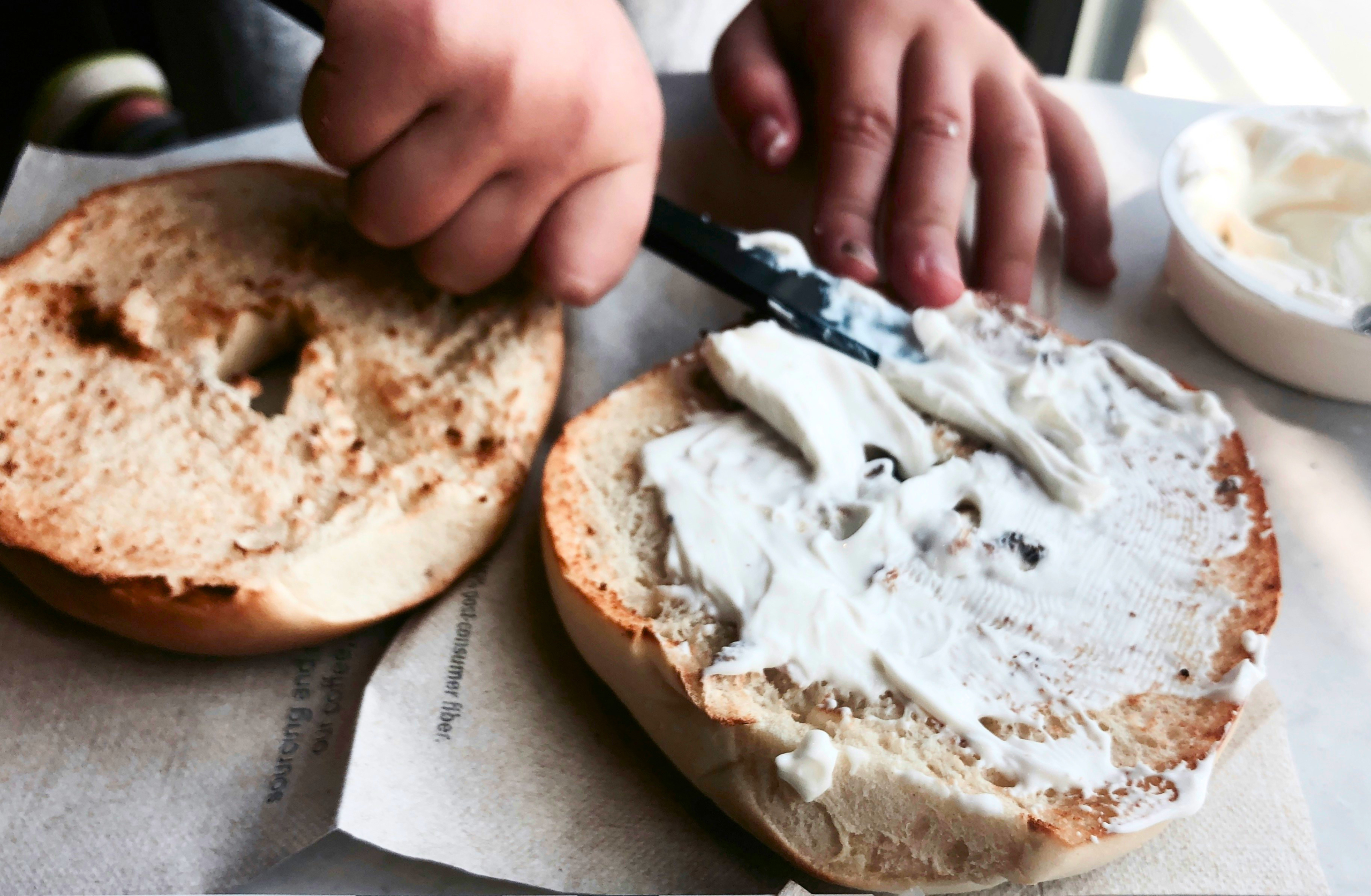
Lillian’s round table was set with gold-rimmed melamine plates, pink and green patterned china cups and saucers, and white paper napkins folded into triangles. She’d folded them neatly, in preparation for us. In addition to our goyim bagels, we’d brought cream cheese and whitefish salad and nearly a pound of lox. From her own refrigerator, Lillian had set out three cans of Diet Cel-Ray, a tub of whipped butter, a jar of capers, and a plum tomato. 

Nat had one knee bent into the couch, surveying the street. “It’s interesting, Lillian,” he called to her without turning around. “You’re at the end of the hallway here but you don’t get a corner view. Does anybody? Some people must’ve combined two units, no?” 

She shook her head as she plucked a halved bagel from the bunch and dropped it with a smack on her plate. “Not allowed here. Every unit is the same.” 

I smiled. “That’s wonderful.” 

“Is it?” Lillian cocked her head at me. “I wouldn’t mind a corner view. Nat, maybe you can convince the authorities? Tell them you’re a professional!”  

He seemed to be considering this, even though it was clearly a joke. “You should live as well as you can for as long as you can.” 

This, Lillian ignored, reaching for the cream cheese.  

“Come eat,” I told Nat.  

Milt dropped a handful of M&Ms on his plate. 

“Not before dinner,” I said.   

My son reached to gather the collar of my dress in both hands, one button popping off its thread and plunking against the table with a sound only I heard. “Yes,” he whispered. I smiled, in thrall to his defiance. How could I not?   

“Let’s start with a bagel,” Nat said, sitting down beside him.   

Milt screamed. 

“Quiet!” Bunny commanded. “I’m about to start my interview!”  

Lillian spread her cream cheese slowly, forking the glistening lox and setting it on her bagel like a toupee, and on that, a tomato cap festooned with capers.

“Can she…” I looked at my Aunt Lillian, who nodded as she chewed.  

“What’s your full name?” Bunny held her folder open with one wavering hand. 

“Lillian Hanna Faust.” She pronounced her middle name, a name I’d never known was hers, the Yiddish way: HAH-nuh. 

“What year were you born?” 

“1931.” 

This whole thing could’ve been done over the phone. Why had I bent to Bunny? Why hadn’t we just sent Lillian these questions in a letter? I was sweating. When Bunny got to the last of her questions, we’d still be on the first halves of our bagels and then what would we talk about? 

“Where were you born?” 

“The Brownsville and East New York Hospital.” 

Bunny’s pen stopped moving part of the way through the word brown. 

“And that’s gone now, right?” I was stalling, giving her time to catch up. 

“Do you want me to write it?” Lillian offered Bunny with surprising tenderness, ignoring me. 

“She has to write it,” I said.   

Lillian made a face like I’d slapped her. “It’s not her fault I gave her half the alphabet.” 

“What did Bunny get?” Milt asked. 

“A joke,” Lillian said. 

“I want a joke!” 

“He can’t have a joke. It’s my interview!” Bunny cried. “I’m writing as fast as I can! They say I have to write it so, so, I’m writing it!” 

I watched as she mangled the letters, pressing down so hard, her pencil tip broke.

“I didn’t bring a sharpener,” she mumbled, her chest rising higher and the plates in her face looking like they might unbind themselves. 

I found a pen in my purse and handed it to her. She pushed it away.

“Have you eaten your bagel yet, Bun?” I asked, though I knew she hadn’t. 

“I wouldn’t blame you,” Lillian breathed into Bunny’s ear. “These bagels are absurd.” 

“She’s an absurd girl,” I said, though it didn’t come out in the silly way I wanted; it sounded dismissive. Cruel, even. To make up for my mistake, I placed my hand on Bunny’s and a seam tore below my left arm. 

“I never asked for these bagels,” Bunny said quietly. “You just think I like them because I ate them once.” 

This wasn’t true but I didn’t want to embarrass her (or myself) any more than I already had. 

“When you’re distracted,” I reminded Bunny, “you sometimes forget to eat. And when you don’t eat, you get upset.” 

“When I get a lecture, I get upset,” Lillian said out the side of her mouth. 

“And when you get upset,” I continued, ignoring Lillian, although, in a way, I was speaking to her too, “it’s hard to know…what to do to help.” 

Lillian sized me up from across the table.   

“Not to get off topic here,” Nat said, “but can I ask how well you get along with your neighbors?” 

“You may and we get along fine. I don’t speak to them and they don’t speak to me,” Lillian said. She gestured toward Bunny. “Does she know Jewish?”  

Yiddish, she meant. She meant also for me to perhaps not know what she meant, to have to ask, and I was relieved that I didn’t have to, that I did know, that she couldn’t take me for a fool, or for someone like my mother. 

I finished my glass of water and poured myself a Cel-ray. “Who would teach her?” 

Bunny raised her writing hand, pen tip pointing at the ceiling fan. Her bagel had a bite out of now. I hadn’t even seen her take it.  “How am I related to you?” Bunny asked. 

Lillian stood up and shuffled away from us. She hauled a folding stepladder from the front closet, tucking the whole of it inside, and climbing on. Nat ran over and put his hands out lest she topple. Her slacks made meditative shushing sounds I could hear from the table. 

“Can I do that for you, Lillian?” 

“You cannot!” she said, all but her stockinged calves out of view. 

Bunny waited silently, refusing to look at me, while Milt ducked away, for, I knew, more M&Ms, as Lillian reemerged with a thick red leather-bound album. 

She pushed her plate aside and opened to the first page. “I was married to him.”  

There was young Julius, his sharp chin, full cheeks, those mournful eyes. 

Bunny eyed her brother. “He does look like Milt.” 

Milt beamed and scrambled over to Lillian, who, without so much as a groan, lifted him into her lap. 

“Nice looking guy,” Nat said, peering at the photo from across the table. 

“He was!” Lillian snapped. “Nice, polite. He looked how he was.” 

“Nice people aren’t necessarily easy to be married to,” I said.  

“We’re not?” Nat opened his mouth in mock alarm. 

I rolled my eyes, smiled for my great aunt. “Aren’t I the nice one?” It was a joke and an aspiration. 

Nat patted my cheek and reached into his pocket for his phone, on which I could see a call from a colleague, silenced after some consideration. I felt my face get hot very fast. It wasn’t the tenderness I was responding to but the condescension. We both knew how much everybody liked him and we both knew how hard I worked to be liked. Just yesterday morning, at the park where I’d brought the kids early, Nat showed up a half hour later to cheers from three or four other fathers, and mothers, too, hovering around the play structure. I’d brought donuts, but it was Nat they were most pleased to see. 

Nat noticed all the effort I made to be liked: the times I brought cookies or pizza (or laughed loudly at somebody’s not-so-funny joke), and the times I was easygoing with the kids, letting them stay up late, resolving their arguments without yelling at either one. Nat noticed and he loved it; he told me so. But sometimes I wondered what he would tell me if I didn’t try so hard. Sometimes it was all I thought about. 

We both knew how much everybody liked him and we both knew how hard I worked to be liked.

Lillian’s eyes flicked from me to Nat for a second, unreadable, then she seemed to drop away, inside herself again.     

“Julius was a doll,” Lillian said. “A hypocrite, but he was easy to come home to, he was an easy man.” 

“So what happened?” I asked. “Nobody got divorced back then, right?” 

“Not nobody! I drove him out of his mind. I questioned him, I doubted him, I told him he wasn’t interesting enough for me and so he said adieu!” 

No one could insult her worse than she could insult herself.  

“Adieu?” Milt peered up at her. “Is that a bad word?”

“It means goodbye,” muttered Bunny as she wrote.  

Lillian afforded Bunny no extra points for her knowledge, instead smoothing Milt’s hair with her manicured fingers, a stillness on her face I couldn’t read.

None of us spoke. 

Our master of ceremonies continued transcribing Lillian’s words, penmanship jagged but clear. Milt had slid off Lillian’s lap and gone under the table. Also under the table were Nat’s hands tapping a message into his phone, too busy with weekend work for another attempt at enticing my aunt to do an impossible apartment upgrade. Milt drifted into the living room, unburdening us. 

“He wanted to take care of me,” Lillian explained in a softer voice. “He wanted to give me things.”  

I nodded. 

“He said when I first met him that I was the smartest girl he’d ever known. Which wasn’t true, no student was I, but I loved hearing it. We’d gone to see The Valley of Decision with Gregory Peck and I think Julius thought of me like the maid, the sweet girl, the loyal girl, the good listener, you understand? I liked that version of me too except she didn’t exist. He wanted me to say it was alright the way he wanted more for himself than the fellows he was negotiating for and I didn’t think it was. He didn’t want to talk about big ideas with me, he wanted to talk logistics, all the time, the plans, the deals, the numbers. He wanted me to be here,” Lillian said, extending a flattened palm out in the air half a foot lower than her shoulder, “his little soldier. Am I making it plain? Every time I opened my mouth, he’d brace himself. At dinner, at breakfast, in bed. He’d flinch! At his own wife! Do you flinch at her, Nat?” 

Nat stuck his phone into his pocket after a moment. He had not heard her, didn’t know if he ought to say yes or no. 

“Sorry,” he mouthed to me. “Closing got delayed and the seller is pissed.” 

Lillian tried again. “Do you mind when she argues with you, Nat?” 

I took a slow breath, and then another, waiting for him to answer. “She doesn’t argue with me. We don’t argue with each other.”   

Nat rubbed his thumb along the webbing between my fingers. With his thumb, he was telling me that we were not like Lillian and Julius. And we weren’t. I didn’t argue with him, not out loud. 

When Milt was six weeks old, I slipped into a frayed, weepy pocket during which it was hard to wash my hair, hard to wear anything but soft pants and a very old pair of dirty sneakers. Nat, without telling me, hired a woman, a night nurse, to stay at our apartment every night for two weeks and get Milt to sleep. It was very generous of him and, I conceded, a relief to put Bunny to bed without Milt in my arms, but it cost more money than we had and it wasn’t what I wanted. I didn’t want it at all. So, every night, I’d agree with Nat about what a boon Teresa the nurse was, and then I’d roll over and cry quietly until I passed out, waking to a wet nightgown, that violent reminder to pump. Things were better now. Nat thought he’d made them better. And I took medicine for the crying. 

“That’s a shame,” Lillian murmured. 

The air here felt slippery and dangerous, like if we inhaled deeply enough, maybe someone might start arguing. Maybe even me. 

“Tell me about your family growing up,” Bunny read from her paper. 

“I had two little brothers who I loved, the baby especially. My mother was very bright and quiet and then she got sick.” Lillian pointed to her head. “In her brain. My father was not so bright and always angry. He worked for a tailor. My mother should have gone to college, I think. She read the newspaper every day. Start to finish.” 

Bunny wrote all of this down, carefully. Lillian let her and began to eat, relishing one bite, then another, as we sat in silence until I saw Milt dancing in the corner of my eye. 

I nudged Nat with my elbow and he looked up from his phone. “Can you…take him?” 

“Where’s the bathroom?” Nat asked brightly. 

Lillian dropped her bagel and stood up very quickly. “Of course. Let me show you.” Like a cat, she slipped into the hallway, which fed into, ostensibly, the bedrooms and bathroom. “Come, Milt! Come, Nat! I’m going to show you the bathroom!” she sang loudly. 

I patted the parts of my dress that had undone themselves. It was an old dress, one I’d worn before kids, before breastfeeding, before Nat, even. I’d gotten it second-hand and worn it to a holiday party where someone had told me I looked like a character in Mad Men. The dress was finished now. Why I’d worn it today, I wasn’t sure.   

Lillian returned but did not sit. She hovered with two hands on the table and flicked her chin toward her grand-niece. She must’ve felt that her lipstick had been lost on the lox because she pressed her mouth together in an effort to remake it. “Next!” 

“Can you tell me something about our family that I might not know?” Bunny asked.  

From the bathroom came Milt’s screams, Nat’s resonant murmuring. I didn’t want to abandon Nat to the meltdown, but I wanted to know what Lillian was going to say. My longing felt at that moment like a day’s worth of unmet hunger, like that Yom Kippur fast I’d only once done as a teenager to test my devotion, my Jewishness, just in case I might one day need to up the ante, though I was yet to be asked, not by Nat, not by anyone. I stayed in my dining chair, my eyes darting toward the hallway, hovering meekly between my progeny. 

Lillian took a sip of her cold coffee. “Well, did you know that my children won’t speak to me?”

Bunny shook her head. “Why?” 

“They think I’m a monster.” 

Bunny looked up at me then back at her. “You’re not a monster,” she said firmly.

“I might be,” Lillian snapped. “I was a difficult wife, a difficult mother. I’m a difficult person. I wanted everybody in my family to understand things as I did. And they didn’t. They don’t.” Her lips like worms had begun to wriggle across her face with something she seemed to want to contain.  

Her bitterness was not a shock, but the emotion under it was. 

“It’s not so much fun being the bitch,” Aunt Lillian said. We didn’t curse in our house, and I could see Bunny’s eyes widen at the word.

“I’m sorry,” I said. “I’m sorry they shut you out. That we did.”  

Aunt Lillian raised her eyebrows. 

Bunny interrupted again, heroically, speaking over some detritus in her throat. 

“What’s your favorite snack?” she asked. 

Good god. We’d dropped into the miscellaneous portion now. 

Lillian held her hands up and scoffed. “Nuts?” 

Bunny wrote the word slowly, slower than any answer so far.   

“OK. Nuts. Now last question. What’s something hard about your life that you don’t really mind?”  

“That’s your own question too, right?” I asked her. I was impressed, and I wanted them both to know. 

Bunny nodded. “The original was do you have a pet.” 

Lillian snorted. 

“What’s something hard about your life that you don’t really mind?” I asked Bunny.

I knew the answer. She was going to say Milt, her brother Milt, whose screams had at last abated. If I listened through the silence, I could hear water running. It was having a brother, a brother I’d foisted on her, that was hard but that she didn’t really mind. She wished he’d never been born but she couldn’t help loving him a little bit too. 

Bunny lowered her head and spoke to the table.  

“You,” she said.  

I stared at her. What remained of my dress’s seams pressed into my hot skin. I looked down at my hands. 

“Me?” I chirped. “I’m the hard thing about your life?” 

“She doesn’t mind!” Lillian shouted. “That’s good news!”  

I kept my face as unmoving as I could so my cheeks wouldn’t get wet. “Why am I the hard thing?” 

The enveloping softness of the carpet under my feet was not a comfort then, so I pressed harder against it.  

In a small voice, she said, “You’re not brave. But it’s OK.” 

I was woozy, blood gathering across my collarbone, I could feel it tingling, my tongue solidifying, stomach humming and hollowed out. I kept my eyes open even though I didn’t want to.  

“What exactly are you talking about?”  

Bunny would not look at me. She shrugged. “You pretend. Like now, you’re acting like you’re not that mad. But you are.” 

I saw my aunt’s mouth contort. She was pretending, too. 

“So, being brave is, is getting mad?” 

“For you, it is,” Lillian spat quietly.

“Hell of a bathroom you got there! Did that clawfoot tub come with the place?” Milton and Nat returned together in lockstep.  

“I pooped,” Milton declared with grim pride.  

“Not in the tub!” Nat clarified.  

“Shut up!” Bunny bellowed at both of them.  

“You shut up!” I shouted, as angry as I felt, pretending nothing, the outside of me reflecting my insides so exactly, I felt like my skin had fallen off. 

“Sadie,” said Nat.  

“Don’t yell just to prove yourself to her,” Aunt Lillian muttered, peering up at me, her brown eyes catching the light and shining. “Or to me.” 

“Sorry. I’m sorry, Mommy. I’m really sorry,” Bunny mumbled, shaking her head wildly. She’d dropped deep down into her throne of a dining seat, her nubby blue smock dress folding in on itself and over her. 

I shook my head, crying breathlessly and stupidly in front of them all. I wasn’t sure what the right thing to say was and to whom. What I usually said, what I usually did, was what neither my aunt nor my daughter wanted from me, so I said what I’d have rather kept to myself. “Yeah. I do pretend. So I don’t hurt people’s feelings. Like…” I gestured at Lillian.      

At this, Lillian made a grunt as loud as a clap, chastening whatever courage I’d just mustered. 

I wiped my nose with my ruined dress. “Thank you so much for having us.”  

Nat had begun clearing the table. “The coffee was wonderful.”  

“It wasn’t.” Lillian gazed at him and then at me. “You’re running away from the fight. Tell her she’s wrong. She’s a kid. She doesn’t know what she’s saying.”  

But Bunny did know. She knew more than most kids her age ought to know. Bunny was right. 

I shook my head at my great aunt, watching Nat gather three wobbly Cel-Rays. “You told me not to impress you. Now you tell me to fight. What do you want?”

“Honey, you don’t need to be embarrassed,” said Lillian, without a thread of the tenderness she had used to speak to Bunny. 

I stacked the plates, my sleeve catching in the cream cheese. “Bunny talks like that when she’s tired.” 

“I’m not tired,” Bunny said, her earlier penitence undone. 

“Should we leave the bagels?” Nat asked Lillian. 

“Please don’t.” 

Lillian reached across the table to me and encircled my arm with her cool hand. “You’ll never be like me, Sadie. No matter what you do.” Her consonants were crisp, brutal. She was holding onto me tightly. “You follow the rules. You’re nice. Just like your uncle.” 

Tumescent with shame, I nodded dumbly. Lillian’s eyebrows were arched. She did not look like my grandmother. She looked like Bunny’s drawing. And also, maybe, Bunny. 

“Take it as a compliment,” Aunt Lillian demanded.  

I tucked my hair behind my ear, the busted stitching of my dress exposing my soaked armpits like strings stretched over a guitar’s sound hole, and told Lillian goodnight. 


In the car, Milt had fallen asleep, the porcelain of his stolen Hummel (the rabbi, my rabbi!) like a watchful glowing moon in his arms. 

Bunny remained alert. She’d held my hand all the way to our parking spot and when I wordlessly buckled her into her car seat, she’d said, over and over, “I’m bad, I’m bad, I’m bad,” to which I’d shaken my head furiously as Nat thundered, uncharacteristically, “Nobody thinks that, Bunny!” 

Now, in the back, Bunny seemed to have forgiven herself and me as she gazed ahead. 

“Aunt Lillian never answered your last question.” I was picking at a wound that hadn’t even scabbed.  

Red and white orbs of tail lights and highway lights guided us north toward home. Beside Nat shone the blackness of Gravesend Bay and just beyond, the Verrazano, regal in its nighttime banner of electrics. 

“I hate it about me too,” I told Bunny without turning around. “That I’m not brave.” 

“I don’t,” Nat murmured. 

“I know you don’t,” I said sharply. 

“Isn’t it brave to be sorry? You’re always sorry.” He turned his head sideways and smiled at me with no teeth. “She’s not.” 

I didn’t know if he meant Lillian or Bunny, Bunny who listened quietly to us as she gripped her car seat’s armrests, her defiant heart pinned in with five straps to prevent disaster. He meant it as a compliment. But he didn’t know I wasn’t sorry half the times I claimed to be.     

“Maybe,” I said because Bunny was right: I didn’t want to fight. 

“The hard thing in Lillian’s life that she doesn’t really mind is herself,” said Nat. “Your great great-aunt is the hard thing. Write that, Bunny.” 

He sounded so proud of himself. 

How could I tell him he was wrong? I didn’t know what the hard thing was that Lillian didn’t mind, but I knew she could hardly bear herself. I could hardly bear myself sometimes. That was what made us both brave.  

Bunny stared at me in the rearview mirror, as still and silent as the bridge outside our window. 

“I think she’s asleep with her eyes open,” Nat whispered. 

I nodded and stared at the road ahead. She was asleep with her eyes open. She had been for a while. 

It was too hot now and, as Nat drove, I tried to shuck my coat off from below my seatbelt but it was too bulky. I had to unbuckle. As the car’s alarm rang, I shrugged my arms free. Ignoring Nat’s concerned glances, I slipped my fingers under the torn armpit of my tattered dress and wrenched the sleeve clean off. 

“Sadie. You have to buckle.” 

I leaned my bare shoulder against the window. “I know,” I said as the alarm dinged and dinged. “I will.” 
7 Innovative Collections From Poets Without MFAs

This list won’t be a screed against the MFA. Other than this one sentence, I won’t write “MFA industrial complex.” Almost a century old, a master’s degree in creative writing now seems inescapable—to be a writer, you need one. While I don’t find that logic persuasive, most modern writers emerge from or eventually become entangled with the fine arts degree. But what happens when writers create without these institutional pressures? 

In the world of prose, I think of Fran Ross’s Oreo, so original, hilarious, and ecstatic—a formally ingenious book. And what about Annie Dillard’s wild inventions in Pilgrim at Tinker Creek or Holy the Firm? She ended up with a university teaching post, but I can’t imagine either of these works emerging as a master’s thesis. Outside the United States, J. A. Baker’s The Peregrine comes to mind, too, evoking a totalizing fascination with falcons in diaristic prose that is unbearably beautiful. Each of these books is sui generis, authored by singular minds transfiguring literary and cultural history without heeding predominant tastes or trends. 

In the world of poetry, I’ve especially struggled to locate writers without MFAs, with a few exceptions like Louise Glück and Danez Smith, different generations but both luminaries to me. It’s taken years—some posting on social media and scouring author bios—but I’ve found a few MFA-less contemporary poets whose expansive imaginations have produced exciting, inventive books. While each writer is distinct, their taste, sensibility, and allegiances are manifold. No one advises them where to go, so they go everywhere. 

Whitman. Cannonball. Puebla. by Rodrigo Toscano

This book has a theatrical sweep, its poems reading like monologues and dialogues that think and revise and name and trouble naming itself. Toscano talks through economy, empire, and the multifarious registers of language, laboring—this being a special focus of his—to include and undermine theoretical jargon that can ally and alienate. Toscano’s mind is exciting and expansive. But where his poetry most impresses and surprises is at the hyper-local level of words, specifically the interjections like um, yeah, ugh, oh, etc. that juxtapose the book’s philosophical rigor, creating funny, insightful, and tonally rich poems.

Common Disaster by M. Cynthia Cheung

Some of Cheung’s most compelling poems are ghazals, and the collection itself begins to resemble a radif, a word repeating at the end of lines. “Exile” is one such word, accruing conflicting meanings. Exile is place, body, history. Nothing is one thing. The poet herself is physician, dreamer, historian, mother, wife. The self, like the radif, repeats—altered slightly each time. Common Disaster is the perfect title then. Disaster may be common—in more than one sense of the word—but as the collection demonstrates, it is not endured equally. Cheung is a musician: often brutal subjects cast in lucid lines, beauty rendered without consolation. The pandemic, hospital rooms, the Silk Road—each becomes a site where history and intimacy converge. If a person is a crossing of multiple histories, few poets trace that crossing with such immediacy and tenderness.

My Heresies by Alina Stefanescu

I don’t think you’ll find a more provocative cover. Bring it with you to your local coffee shop, DMV, or even to church. Really, it will provoke. Her poems traverse so many subjects, histories, obsessions, questions, antecedents, epigraphs, forms, and more—we have cameos from Homer to László Földényi to Maximus the Confessor. These poems are like a strange heretical religion: They don’t just focus on the unattended moment, which poetry can be so good at, but they also create assemblages that mystify. I love these poems. You are dreaming with a poet who seems limitless in her imagination.

Frame Inside a Frame by Daniel Lassell

Lassell builds an architecture wherein poems work individually and astonish as a collection. The poet works and reworks what a frame can signify. Sometimes, frames include and exclude the past, and a subject in one poem will be transfigured in another, a frame inside a frame. Lassell thinks through so many spatial possibilities in a world disordered and overwhelmed by information and content. However, the poet doesn’t sentimentalize unity. The synecdochal texts question wholeness and stability, especially through a series of erasure poems, “The Temple of Salt,” that reimagine linguistic and theological possibilities in Genesis. These erasures are some of the finest poems I’ve read this year.

Animal Unfit by Megan Nichols

Sometimes, as they say, art does aspire to the condition of music. Here is such a book. These poems are marvels of the everyday in the Ozarks. The project is living, attending to the vicissitudes of motherhood and the fraught pleasures of desire. A careful, devoted observer, Nichols writes poems filled with unruly questions that forego tempting and easy resolutions. For her child, whose father is no longer around, she offers to “be your trellis, at best.” These are poems about wildness—the feral exterior and volatile interior. 

Natural History by Brandon Kilbourne

No exhibit is a neutral representation of knowledge. In natural history museums, for instance, dioramas can occlude the vexed entanglement between science and empire. Kilbourne, a longtime research biologist, complicates the historical production and transfer of knowledge—history isn’t partitioned with great and noble scientific inquiry on one side and racist colonial plundering on the other. Natural History makes clear that what we know cannot be divested from how we have come to know. Intricate in design and sonorous, the poems startle both in erudition and cadence. Whether he writes about himself or a recipe, Kilbourne situates the subject—the poems often open with periodic sentences so that the subject doesn’t appear neutral or unburdened by history. The effect Kilbourne achieves could only arise through this unexpected but necessary reciprocity of science and poetry.

Transit by David Baker

Some say if you write long enough, you keep writing and rewriting the same poem. Nature poets, in particular, can vanish into the landscape, protected by flora and fauna nomenclature. However, Baker writes inimitably beautiful poems about the natural world that make me rethink what the “natural world” even is. What fascinates me is how he thinks through subjects, with heterogeneous methodologies and vocabularies and histories. In one poem, “Oikos,” the poet ruminates his way through vexed conceptions of home and hospitality, of ethics, the form of the poem restive: spacious in some sections, controlled and hymnal in others. The language is conversational, full of puns, but also learned, melodic—the poet attempts to make a dwelling for his beloveds while remaining aware of the terrors inextricable to that process. 

A Satire That Captures the Absurdity of Being a Writer in Hollywood

I spent two years trying to sell TV shows in Los Angeles. Before my first pitch, I asked my agent if I should dress casually or formally. She told me to dress “NYC cool,” which was absolutely not one of the options. I can’t say my memories of my time in Hollywood were “good,” necessarily; I never quite felt like I fit in. 

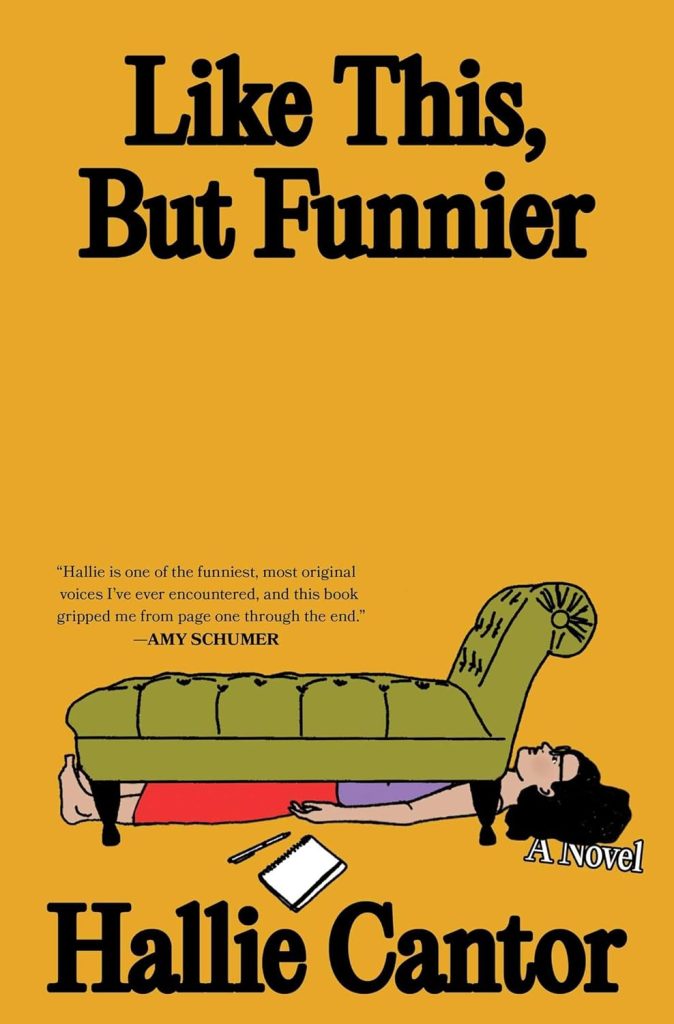
After I left LA, I wasn’t keen to re-enter that world: the world of pitching ideas you never thought would reach viewers, of waiting in “development hell” for months, of never getting an official rejection, but instead just watching the industry slowly ghost you. Because of the sour taste Hollywood left in my mouth, I was particularly struck by how much I enjoyed Hallie Cantor’s Like This, But Funnier, the perfect satire of the TV writing industry. Her protagonist, Caroline, captures exactly what it means to spend your days pitching a nebulous idea for a TV show while wondering if your life is ever going to start moving. Cantor deftly describes the negative space that fills your world when the industry demands you have a close personal connection to your story, but your days are spent in your PJs in front of a laptop, so you don’t think that story is quite that compelling. She skewers how attached execs can be to small, unimportant details of a pitch that become impossible to build a world around. She roasts the industry’s obsession with authenticity while making the same type of show over and over again. All while capturing a complex female protagonist struggling to manage her relationship, her career, and her uncertainty about starting a family.

Cantor and I met over Zoom to discuss the screenwriting industry, letting our characters live in uncertainty, and envying the nine-to-five. 


Ginny Hogan: How did the character of Caroline change during the drafting process of Like This, But Funnier?

Hallie Cantor: In my first draft, she was oddly very grumpy and annoyed all the time. And I think that was partly because I was grumpy and annoyed about having to write a first draft. And that came out in the character. It’s also an easy place to find humor: this self-defensive, cynical crouch of like, this is stupid, that’s stupid. But that gets grating over 300 pages. In later drafts, I really pushed myself to find places where she’s more terrified or elated or any other emotion. So she’s not just constantly annoyed.

GH: I imagine that this was very much inspired by experiences that you had as a writer. Did you consider writing a memoir?

HC: I never thought about writing a memoir. I didn’t even think that I was going to be writing about my own experiences at all. I set out looking for an idea for a funny fictional novel. Then, I had this idea about a writer married to a therapist, which I am in real life. Gradually, in my subconscious, I started feeding pieces of my own experiences into Caroline’s, and the story became what it is. But often, when I’m writing, I take a real feeling and hang it on a scaffolding of a bigger premise. That’s not only more fun for the writer, but it’s more fun for the reader to read about somebody who’s lying and stalking, caught in a web of their own deception, instead of a plot that’s more like “she felt bad about herself for a couple years.”

GH: One of the things I loved in the book was Caroline’s TV show pitches. The pitches get worse and worse, but the studio gets more and more excited about them. She gets caught in this web of lies; she’s not sure that it’s ethical for her to pitch the show because the character is inspired by her husband’s patient. And on top of that, she knows the pitches are bad. And I found it very real – it can feel like the industry’s taste is not aligned with your own. But I’m wondering, for a person who is outside of Hollywood, was there anything you wanted to explore that felt too far-fetched? Anything you had to rein in to make it more believable?

I think her journey is about having the self-compassion to not be afraid of her own ambivalence.

HC: Not really. There’s a section that’s just emails from her agents and executives giving her notes on the script. An early reader said, “This section feels like a different tone from the rest of the book. This is a little too heightened.” And I was surprised because a lot of that was taken verbatim. There’s definitely a bit of satirizing, but I didn’t think of the book as a Hollywood satire because the reality of Hollywood is so silly and ridiculous. I just wanted to present that on a plate to people outside of it.

GH: That really comes through. Did you know when you started writing how you wanted Caroline’s story to end?

HC: Not specifics. I had a sense that I wanted her to have a changed relationship by the end, both with herself and with her work. For so much of the book, her fatal flaw is that she feels like to be worthy, she has to be exceptional. She thinks she has to be the most talented, that she has to rise above everybody else in Hollywood. And by the end, she’s open to the idea that her creativity can connect her to other people instead of setting her apart from them. I did note that I didn’t want her to decide one way or the other about the question of whether or not to become a parent, which is also a big thread in the book. I didn’t want the takeaway to be, “yeah, you should have kids,” or, “no, it’s okay not to have kids.” I wanted to honor her ambivalence. And honestly, she’s not even ready to make that decision. I think her journey is about having the self-compassion to not be afraid of her own ambivalence.

GH: That’s so interesting. I know it’s becoming a bigger thing to depict child-free women in books and on TV, which is so cool because that’s definitely been missing. At the same time, I also think it’s so cool to depict a woman who just stays in uncertainty. That is definitely missing from the conversation.

HC: So many articles are like, “I wasn’t sure, but now I have my two-year-old.” Well, okay, you figured it out, but what about the rest of the world? 

GH: There are parts of the book that felt so close to home in terms of how people talk in Hollywood, especially with Caroline’s agent. Was there anything that felt almost cringy to write?

With those experiences, you’re carrying the shame, internalizing it,
wondering if you were asking for it.

HC: There’s one scene about a Secret Santa gift exchange in a writer’s room. And it’s not even really necessary for the plot, but I always knew that I wanted to include a moment like it. I’ve had these experiences in the TV writing industry, as people do in a lot of creative industries, where somebody makes a joke or says something that’s a bit off, and you don’t realize until later that it upset you. But at the same time, you don’t wanna say anything because getting along with the other writers is such a big part of the job—you want to be part of a cohesive social unit. But with those experiences, you’re carrying the shame, internalizing it, wondering if you were asking for it. And I wanted to show that. Specifically, how the accumulation of those kinds of experiences could affect Caroline. And could affect the way that she feels about herself and her career. But it was difficult to write. I found myself experiencing this self-doubt of like, is this even anything? Should I not even include this? Is she being a whiner?

GH: Creative careers are so idealized, and Caroline is a woman who’s had a lot of conventional success and is still dissatisfied. So I love that scene because it really shows that she has not had a super smooth ride, and yet, she herself still idealizes this career path and can’t imagine doing anything else.

HC: That’s a big part of it. You do idealize the career, and you don’t want to seem ungrateful because you do love what you’re doing. But then, there are these parts of it that you’re like, this didn’t feel so good.

GH: Is there anyone in Hollywood you were worried would be upset by the book?

HC: There are maybe some people who could see themselves in it, but the honest truth is, I don’t think that they read books. And even for people who have read it, it’s easier to recognize a behavior in others than in yourself. In the meetings I’ve had about the book, people have been like, “Oh, it’s so accurate, everybody I know is like that.” And I’m like, “Yeah, and you.”

GH: Did the process of writing the book change how you view your screenwriting career? Or screenwriting as a field?

HC: If anything, it underscored for me how much free work we’re expected to do as screenwriters. It sounds counterintuitive because, obviously, writing a novel is the ultimate piece of free work. But it felt different; I knew that even if I didn’t sell the novel, it could exist as a piece of art in the world. And that was very satisfying. It also made me reflect on the years I had spent working on pitches and scripts that are basically blueprints for something else. And you have a small chance of getting paid and a very slim chance of the work getting produced. It can be very hard to feel that your work is valued in those circumstances.

GH: Was it easier to get motivated for something that you knew you could make on your own?

HC: Definitely. I had gotten to a point where I was pretty jaded about working on pitches because after enough failures, I was like, well, this is not gonna be anything. I’m just doing this on the off chance that I get paid, but no one’s ever going to read it or enjoy it in the way that an audience is meant to enjoy something. So it was very exciting to work on a novel and think that even if I ended up publishing it on a blog, people could still read it.

GH: Do you want the book to change readers’ perceptions of the TV writing industry?

I don’t think I’m the first person to say that the entertainment industry is tough.

HC: It’s an interesting question. I certainly didn’t set out with that intention. And I don’t think I’m the first person to say that the entertainment industry is tough. In the years since writing the first draft of the book, we had the writer’s strike, which showed people the bigger structural issues facing TV writers. So if anything, the book can function as a magnifying glass. It lets the reader zoom in on what it feels like to work within a system that is constantly demanding that you bang on the door to prove yourself over and over and over. And how easy it is to adopt a worldview about your worth, and value of your labor, and your relationships to other people, and how much you can trust what other people say, and how authentic you can be with other people, and all these things that have a massive impact on us as humans.

GH: The relationship aspect comes through so well in the book. Caroline is married to a therapist. And I know from my own experience that there’s this dynamic between being in a creative career and being married to someone who has a stable job. I’m curious what your thoughts are on it. Does it ever make you envy a nine-to-five?

HC: All the time. And my husband not only has a stable job, but it’s a job that concretely helps people. So it’s very easy to be like, What have I done with my life? But yeah, I’m doing it. I’m telling myself that laughter helps people in its own way.

GH: It does! And I tell myself that all the time too.

HC: And the flip side is that you do get to see the downsides of a nine-to-five, where this person has to go to work every day, even when they feel crappy and wanna take a nap. And as creatives, we do have the freedom to make our own schedule and all those other things that we can appreciate.

15 Must-Read Small Press Books of Spring 2026

Recently, I was texting with the editor of my most recent book about how there seem to be cycles in in literature, some kind of zeitgeist or collective unconscious, like how for a minute there were so many retellings of Frankenstein (like this, and this, and this, and this). 

Speculative fiction has been having a moment for a while, and in many works—including the ones on this list—there is also a deep current of loss and isolation. And ghosts. What’s interesting to me, just as how the Frankenstein retellings came from really different writers, is the way the through lines in books from this season cross generations, genres, and perspectives. The story collections from Patricia Henley and Tayyba Kanwal, whose debuts have nearly three decades of distance between them, have a lot more in common than the jacket copy would suggest. Similarly, ire’ne lara silva and Wesley Brown capture a kind of familial longing, though Brown’s realism is literary (in the genre sense) and silva’s is magical. 

My editor said he’s starting to see a lot of Icarus metaphors, but what I’m seeing is writers using narrative to try and articulate our contemporary moment, even if their work is set in the 14th Century, like Lauren C. Johnson. None of these books fly too close to the sun, but all take that same soaring ambition. 

Tin House: Clutch by Emily Nemens

A group of five college friends take a trip to Palm Springs, the first time they’ve all been together in years. Careers, children, marriages, and aging parents make connecting in person difficult, even though they always keep up with each other in the group chat. Yet, as elder millennials, the fourth decade of their lives is about to become a flash point: Changes are coming for each of the women. Their renewed closeness creates a scaffolding they all hold on to, but it also reminds them of the times they were less supportive, wrapped up in their own concerns. Clutch is a novel that explores the complexity and nuance of long female friendships, and Nemens writes this dynamic with perfect pitch. The only reason to put this engrossing novel down is to text your bestie.

Regal House: A Woman in Pink by Megan A. Schikora

After being entwined in a decade-and-a-half long relationship, the nameless woman in Schikora’s novel and Dutch, the charismatic leading man in her idea of a love story, ultimately part. Though they were never fully honest with each other as a couple, hiding the pieces of their past lives dealing with substance abuse and disordered eating, the protagonist of the novel cannot let Dutch go. Even when he marries, she pines for him and what they could have been, to the point that she considers Dutch’s wife the “other woman.” The protagonist tracks her relationship with Dutch along with another love story, that of June Carter and Johnny Cash. A Woman in Pink chronicles the relatable if heartbreaking reality that love is not always enough to make a partnership work, and takes a hard look at what healing actually means. 

Cornerstone Press: Apple & Palm by Patricia Henley

In the town of Whistle Pig, people are living their lives. Characters recur in Patricia Henley’s latest. For example, Jill Zebrak, who in one story regularly retrieves her elderly father from the local casino and mildly tolerates his lover who is closer in age to her than him, appears in another story where she takes in two young girls after their parents die in a murder-suicide. Yet Henley’s collection is not bleak: There is a vibrant artist colony in Whistle Pig, amorous octogenarians, and a true sense of community. What Henley does best is describe how small-town life has both a frustrating insularity and inescapable points of connection. Apple & Palm looks at the ways we live and the choices we make not only for our own survival, but also for the survival of the people who surround us. 

Black Lawrence Press: Talking with Boys by Tayyba Kanwal

A domestic worker trapped in a Dubai household of extraordinary wealth schemes for her and the other workers to get out; a Houston family’s babysitter lands a spot on a reality show about nannies, and they attempt to use this to catapult their own children to fame; in Lahore, a privileged woman seeks her own economic agency, only to be rebuked by her husband, all while a gifted bracelet from her son—meant to convey his prosperity—circles her wrist like a handcuff. In Pakistan, and in the Pakistani diaspora, Kanwal’s characters are pushing against customs and expectations, or angling for power and dominance. The stories are written with attention to an emotional center. It’s not always clear who the villain is, and that’s the point in these heartfelt and beautifully textured stories.

Dzanc Books: The Shipikisha Club by Mubanga Kalimamukwento

In this multi-generational novel, the higher price that women pay, from action to silence, is cracked open. Sali, the only child of an evangelical family, stands trial for the murder of her husband. Fourteen years earlier, she was living in her family’s home and was pregnant by a married man. After his accidental death, she is wedded to a local police officer who swears to raise the child as his own. Yet, while Sali and her husband go on to have two more children, they struggle with money and marital fidelity. The murder trial makes the Zambian national headlines, and Sali’s 15-year-old daughter Ntashé has to reconcile what the newspapers print and what she hears in the courts against what she knows of her mother. Sali’s own mother must do the same. Gripping.

University of New Mexico Press: something out there in the distance by Grant Faulkner and Gail Butensky

In this hybrid work, photographs of Joshua trees, Ferris wheels, and old motels are companions to the story of Dawn and Johnny, who are on a road trip across the American West. Dawn, a photographer, has cancer. Johnny, the driver, navigates highways and red dirt roads, and drives onto a golf course to flip a donut. The effect is that of chronology by postcard, narrative through mile-markers. The book captures the desolate beauty of both the desert plains and mountains, punctuated by tiny, dying towns. something out there in the distance is a slim volume containing a deep emotional weight. 

Arte Público Press: the light of your body by ire’ne lara silva

After a brush with death, Antonio encounters his first love, a man who has passed over and is caring in the afterlife for Antonio’s child who did not survive to infancy; Emma Elisa grows marigolds all season to host an elaborate Día de los Muertos party, where her community builds altars and considers the past; a spirit of death inhabits a tattooed body, falls in love with a hospice nurse, and runs a taco truck with vegan options. In these loosely linked stories, the veil between the dead and the living is a mere shimmer. The collection speaks to erotic desire, brings myth into reality, confronts generational trauma, and addresses colonialism all in stunning, gorgeous prose. The beauty in how silva writes speaks to our complicated histories and yearning bodies. 

Rescue Press: Lonesome Ballroom by Madeline McDonnell

Betty is a young woman with a famous feminist mother best known for executing a re-imagining of the ceiling of the Sistine Chapel, and that shadow hangs over Betty just as an elaborate fresco. As Betty experiences the messy part of early adulthood when friendships and relationships change, her childhood begins to feel more distant. In conversation with a server at Lonesome Ballroom, at happy hours with her grandmother, or wading through the discourse of her marriage, Betty cannot quite find her footing. She’s smart, she’s educated, but she also doesn’t have a clear sense of herself. McDonnell’s Lonesome Ballroom expertly wrestles with questions of third-wave feminism and familial inheritance, all while perfectly capturing the anxieties of the turn of the 21st century. A wild—and for women of a particular generation, highly relatable—ride. 

McSweeney’s: Looking for Frank Wills by Wesley Brown

The Watergate scandal of 1972 is embedded in the American consciousness, but less remembered is Frank Wills, then a young man who had worked his way up to a security guard at the Watergate complex. On June 17th, he noticed that locks to one of the office suites had been tampered with and called the police, ultimately bringing down the Nixon presidency. In this short novel, Wesley Brown blends the true story of Wills with the fictionalized account of Wayne Beasley, a Black Korean war vet who runs a family barbershop in Savannah and recounts his memories of Wills as a child, a young adult, and then a man at the center of major historical event. The novel emerges as a conversation between generations that asks questions about race, politics, war, and family. Looking for Frank Wills is a powerful retelling of Wills’s story. 

7.13 Books: Sunset at Lion Rock by Matthew Wong Foreman

Born to a Chinese mother and a British father, Eric is out of place at school in Hong Kong and called a “ghost” for his light-complexioned face. Eric is caught between different realities: should he speak English or Cantonese? How does he negotiate his separated parents’ different perspectives against his own experiences? How does he figure out who is against who he wants to be? Wong Foreman takes all of these questions and alchemizes them into an exploratory narrative that centers Eric and excavates family dynamics. There’s an epistolary element that brings the voices in closer, but the center is Eric and his struggles. A novel that’s as broad as it is heartfelt. 

Biblioasis: Every Time We Say Goodbye by Ivana Sajko, translated by Mima Simić

In the aftermath of a romantic breakup, a writer and journalist departs the apartment he shared with his partner, making all of the arrangements within ten days. On a train to Berlin, the narrator of Sajko’s novel reflects on his (and her) culpability for their parting while also ruminating on memories of his family, like his alcoholic father who died alone and his mother who made a harrowing escape from his father’s violence. A compressed book, every sentence sings with emotional resonance and is imbued with the protagonist’s regret. Every Time We Say Goodbye is a master class in both economy of language and expansiveness of feeling.

SFWP: The West Façade by Lauren C. Johnson

It’s 1348 in Paris, on the west façade of Notre Dame, and the statue of Sainte Geneviève has been gifted an orange by a woman who climbs the wall to reach her. Though the forms that adorn and guard the cathedral look still to passerby, they’re conscious beings who can loose themselves from their niches for one night each moon cycle and explore the city, its people, and its pleasures. Geneviève wants more than one night monthly, and despite the cautioning she is given, isn’t so interested in the rules after she’s tasted the orange. The West Façade draws on everything from Eve’s eating of the apple to Cinderella needing to return before midnight to questions about what consciousness and sentience means—all the more a salient line of inquiry in the age of AI. Johnson takes the art of another era and contemporizes it to a compelling, original effect. 

Guernica Editions: Breathing Is How Some People Stay Alive by Alison Gadsby

In this linked collection of speculative fiction, an accountant who is learning to swim is interrogated by her humanoid companion; a woman is unanchored in time and cannot remember giving birth to her daughter or even who she is; and in the title story, a couple argues incessantly and from such deep unhappiness the woman dreams hopefully of contracting a fatal tumor. Gadsby’s stories have simmering resentment, the cruelty of children, and the terror of never belonging as characters right alongside her unhappy people, threaded together with recurring themes. The effect is a glittering collection with high emotional tension. 

Tin House: The Valley of Vengeful Ghosts by Kim Fu

The adulthood experience of purchasing a first home becomes something much more pronounced for Eleanor Fan. As she grew up, her mother, Lele, helped her with everything—even into adulthood—but after Lele’s death, Eleanor is left without her guidance and ultimately buys a property that’s less of a home and more of a sodden cage. As the Pacific Northwest rain continues to fall, Eleanor must reckon with both the absence of her mother’s strong force in her life, and the appearance of a new force: ghosts who speak to her. Fu’s novel shows the impact of isolation on a young woman consumed by grief, as the story unfolds with increasing intensity. A literary page-turner. 

Palimpsest Press: The Unravelling of Ou by Hollay Ghadery

The perspective in The Unravelling of Ou belies the seriousness of the book: The narrative is told from the viewpoint of a sock-puppet named Ecology Paul. Of course, Ecology Paul must be puppeted by someone, and that’s Minoo, who is struggling with feelings of isolation. The sock-puppet speaks less to whimsy and more to how desperately people need to be seen and listened to, and how deeply feelings of shame are buried. Yet while the sock puppet is a source of comfort to Minoo, her adult daughter is not having it, and Minoo must work through her own feelings in order to save the relationship. Ghadery takes a silly premise and transforms it into a captivating, layered story. A feat of imagination and execution. 

We Were Too Young to Understand What Happened With the Man in the White Van

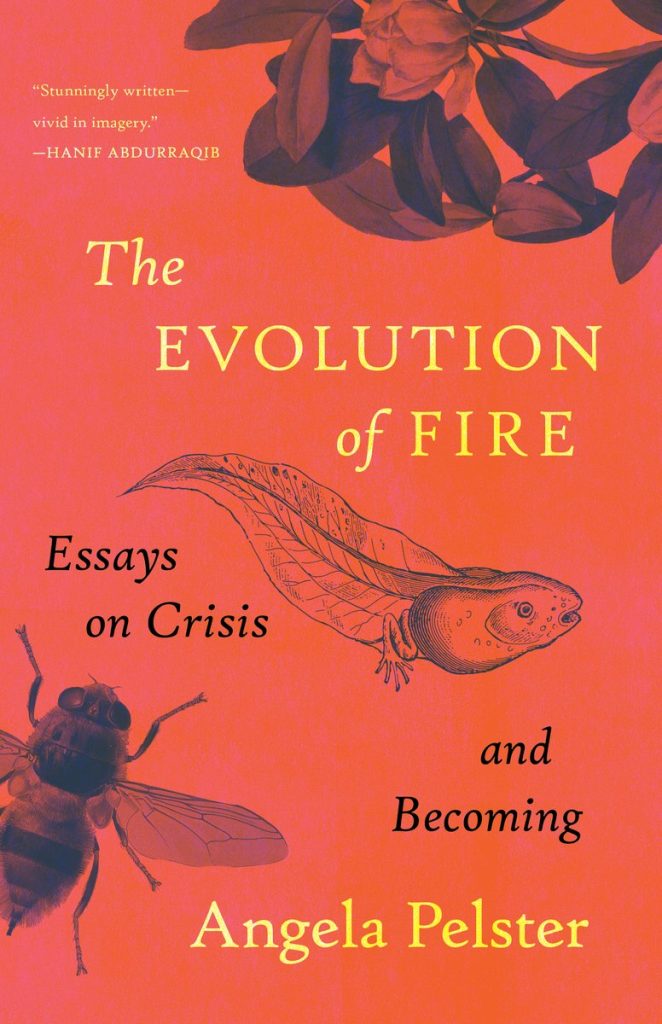
“Metamorphosis,” an excerpt from The Evolution of Fire by Angela Pelster

It’s the kind of hot summer day in rural Alberta where my limbs hang so heavy that I wobble as I walk, almost drunkenly, and bump against Caroline and Kim beside me. “Sorry,” I mutter, and they push me away half-heartedly while Chris weaves back and forth on his yellow BMX bike. We’ve been kicked out of the house and told to go play. We already rambled through the ditches, took turns targeting trees with rocks, moseyed our skinny legs past the few houses around us, past a farmer’s field with cows, a small creek, past the frog pond where we catch tadpoles in the spring and pour them into glass jars that we set inside the house so we can watch them grow and lose their tails and sprout their funny legs.

I learned about metamorphosis in school last year, and it makes my stomach and fingers and feet and head fill with happiness to think about it. The magic of it. Right there in this pond. Like some witch is waving her wand and zapping creatures into other creatures, except the witch is Mother Nature.

I don’t understand it exactly, but metamorphosis seems a lot like evolution. And evolution means that some people think we used to be monkeys. I look at Caroline while we walk and imagine her covered in hair, imagine her teeth and mouth turned enormous, her picking bugs off my head and eating them like the sister monkeys do on nature shows, swinging from a tree with one arm. That I can imagine; we’re both excellent at hanging from the monkey bars on the playground at recess.

But she’s too old to actually do that now. The girls in her grade just stand around in groups and talk, yell at the boys, sometimes walk around the yard, but I can still do the highest baby-drop of anyone in my class.

I don’t think our family believes in evolution though. At least, I don’t think our church does, but I’m not sure. Maybe people at church who don’t believe in evolution haven’t thought much about tadpoles, because it’s scary to see how weird they look when they’re caught between half tadpole and half frog, but it’s also super cool. And that makes me wonder if maybe I’m a half something too.

The tadpoles in our pond have all turned to frogs by now, so we keep walking, aimless, talking, sometimes laughing, nudging one another along in the heat, meandering back home with no real purpose but that we want to return. Maybe this time we’ll be allowed to stay inside and watch something on TV in the cool dark of the family room, though we already know there’ll only be soaps on midafternoon. We aren’t allowed to watch soaps.

It’s a white van. No windows on the side. But instead of driving by, it reaches us and stops.

The roads are deserted. Heatwaves simmer ghostly above the asphalt while the power lines hum over our heads and a chickadee dee-dees to some bird-love in the forest. We have the place to ourselves, it seems. The world.

But then, there’s the sound of a vehicle turning onto our gravel subdivision road, coming behind us slowly. We turn to watch it, move to the side to let it pass as we’ve been taught. There’s plenty of room; the road is wide. It’s a white van. No windows on the side. But instead of driving by, it reaches us and stops. A man with curly hair smiles and asks us for directions to a place nearby. We all know where it is, but Caroline, the oldest and best at talking to strangers, steps forward and walks around to his window to answer him. She’s smiling and confident as always, easy with strangers. I watch her and envy that ease, wonder if I’ll ever learn to talk to people the way she does because I’m the shy one. I will also be “the tall one,” my aunt has predicted, because Caroline will be “the pretty one.” We follow her lead to the front of the van.

He doesn’t seem to understand what she’s saying, which is strange because the directions are simple, but how fun to know more than a grown-up. The man opens the door to hear Caroline better, I think, and the door comes between us, separates us from her while we wait. He’s still confused, and she repeats herself again, but she looks nervous and shy now, uncertain, which is strange. Finally, the door closes and the stranger drives away.

The air hums. None of us move. We, four children, stand on the gravel road, the sun hot on our dark heads. We look at the wet, white puddle on the ground in front of us until Chris asks what it is.

“Pee,” says Caroline. “He peed in front of me.” But it looks nothing like pee.

We look at one another, at the puddle, at our shoes. We wonder if something just happened to us. Some change planted deep and about to sprout. We feel it, but don’t know if it matters. Should we tell someone? Mom is at work, so it would have to be Dad. Dad is risky—he could get mad.

My stomach fills with something like fear, but I don’t understand it. We decide to tell. We turn toward the cool walls of the shop in the backyard, where Dad is at work on somebody’s car.

He’s furious when Caroline tells him that some man just peed in front of her, and he understands something about it that I don’t, something related to my fear. He calls the police and then jumps into his old green pickup with the other mechanic he’s hired for help and leaves us alone while he drives around looking for the curly-haired man in the white van.

I don’t understand: his anger, his driving around, his calling the police. But the something sick and scared is bigger now. We go inside the house. No one is around to tell us not to. We gather in the bedroom that I share with Caroline, the four of us on our two beds, and we wait.

There’s a very tall, very large police officer at our door later that night, and Dad greets him like a friend showing up to a party. Something has shifted in him now, and his anger is gone, replaced by an emotion that seems more like excitement. He guides the policeman through our house and sits him at our kitchen table, in Caroline’s chair. We stand beside him, two at each elbow, gathered like a family photograph. He looks at each of us children, asks us our names, smiles, puts a business card in each of our small hands. It has a silhouette picture of a man behind bars and black and red letters that say Crime Stoppers. His name is DET. G. F. (Gary) Jones, it says, but we don’t use his name. We hardly say anything. He asks us questions about the van, what the man said, what he looked like, what we said back to him. He writes down notes. It’s very quiet as the pen scratches along the paper. And then he pulls out a photo album as thick as my palm is wide.

“These,” he says, opening up to the very first page, “are all men who’ve done similar things to kids around here.”

Around here? I wonder. To other kids? Maybe kids I know?

There are pages and pages of men in the album, and I wonder why so many of them are going around peeing, why they would do it in front of kids. The men look sad and tired; some of them look scary; none of them look like the curly-haired man from the white van.

The policeman stays for a long time taking notes, and he tells us that the Royal Canadian Mounted Police will search the area for the next few weeks. When he’s done, he looks up and around at our house, says that it’s very nice. Most visitors say this, and my dad smiles, pleased, and we all know what’s coming next.

“Would you like a tour?” he asks the policeman. And the policeman says yes.

Like a travel guide, my dad shows him our dining room off the kitchen and the table loaded with papers to be filed; he shows him the office packed with boxes from our childhood to be sorted through, the room with the empty hot tub that rarely works, the bathrooms, our messy bedrooms. He opens our door and shows him our pink canopied bedroom filled with clothes and toys, dolls and books, our life spread out before him.

The policeman smiles. I can tell he wants to leave now, had maybe only ever been politely interested, though my dad doesn’t seem to notice it. Dad continues to tell him about the double thickness of the walls, the fire-retardant insulation, how he designed the house himself, had the blueprints done up from his own drawings, and then finally, he’s finished. They’re at the door shaking hands. The policeman leaves. Dad returns to his shop out back; Chris and Kim go to their separate bedrooms; Caroline and I go to ours.


Years later, when I’m a teenager and old enough to understand but somehow still don’t, I say something to Caroline late one night, lying in the dark while we talk, about the time that man peed in front of us. “Peed in front of us” has become our code for the thing we don’t know how to discuss and the title we give to that moment that changed us without our understanding why. But Caroline’s old enough now, too, and tonight she’s had enough of the code.

“It wasn’t pee,” she spits, angry and hurt at my little-sister stupidity.

Caroline had once told me that she’d stopped wearing pretty earrings after that day.

“Oh,” I say dully. And I remember again the man’s face, my dad’s anger, the police visit and the photo album. I remember, remember, remember how the van door had opened and cut me off from Caroline, and that something had happened to all of us, but in different ways. How no one talked to us about it. How Caroline had once told me that she’d stopped wearing pretty earrings after that day, said she’d thought that maybe he’d done it because she’d worn those earrings. Wanted to look pretty.

And I think of how it had ended with the policeman’s visit and a guided tour through our house, all our private spaces on display with us kids clinging at the edges. I think of the tadpoles we used to catch in the spring, the way their arms ripped through their chests one day when it was time. And I wonder if it hurt. If they knew what it meant. We carried them back to the pond when it happened so they wouldn’t die in our jars. They clung to the edges as we poured, their hearts beating hard beneath pale skin, little bodies of uncertainty shaken loose from their homes into unknown territory. They grabbed for one another as they fell, arms outstretched, like sisters in the dark, like fire reaches for fire, the warmth of another flame.


From The Evolution of Fire: Essays on Crisis and Becoming. Copyright © 2026 by Angela Pelster. Used by permission of Milkweed Editions. All rights reserved.

This Debut Novel Transforms Myth Into Flesh

Myths rarely disappear. They mutate, migrate, and reappear in new forms. In contemporary fiction, their presence is often subtle, embedded in the structures of narrative or the emotional architecture of characters wrestling with forces larger than themselves.

In Parted Gods, Alfredo Félix-Díaz builds a novel that moves between the ancient and the modern through the lives of fraternal twins Antonella and Federico Adamo—a painter and a jazz pianist whose artistic ambitions unfold across Berlin, Sicily, and New Orleans. Drawing on classical mythology while remaining grounded in contemporary artistic life, the novel brings music, painting, and literature into constant conversation. The result is a narrative attentive not only to plot but to rhythm, image, and artistic inheritance.

Félix-Díaz comes to the novel with a background in theater and screenwriting—disciplines that emphasize movement, dialogue, and visual composition. Those influences shape the structure of Parted Gods as much as myths do. The novel’s scenes often feel staged and the prose carries a musical cadence that mirrors the inner lives of its characters.

I sat down with Félix-Díaz to discuss the novel’s relationship to myth, how music and visual art shape narrative voice, and what happens when artists working across disciplines bring those sensibilities into fiction.

Summer Stewart: Alfredo, myth has persisted as a structural backbone in literature for centuries. What drew you specifically to the “hermaphrodite” myth and mythic duality while writing Parted Gods?

Alfredo Félix-Díaz: I wanted to start from the biggest cliché about love. Baudelaire used to say that there is nothing more beautiful than a cliché or a common saying—the first thing that approaches people before a “forest of symbols” opens up. Everyone talking about love says things like, “Oh, my other half” or “my better self.” Yet, when you really go into the myth, as my characters do, a huge world opens up. It implies a sense of history. My characters are international beings—Sicilians with a conflicted past. Their father is Argentinian and their mother is Austrian; they feel they have no “path,” but they have the path of this mythical past: the idea that we were once powerful beings joined together, but we were split apart.

It also speaks to a present that is relatable to all of us—the feeling that we are split within ourselves and split from the other. I’m very interested in right- and left-brain dynamics and the asymmetries between them. The myth puts my characters into a dramatic situation. We want to rejoin ourselves; we want to be powerful like the gods.

In Plato’s Symposium, this myth is told by Aristophanes, a comic poet. It’s not presented as a “true” final solution for what love is; it’s a bit grotesque. It goes against the ideal of Greek beauty. We were “monsters” before we were “complete.” This simple cliché about love has layers of darkness, an aspiration toward the divine, and an animalistic side. It implies the things that divide us from the gods—like the lack of “mating seasons,” which leads to the necessity of social controls like the taboo against incest. All these layers were buried in a myth that seems so accessible.

SS: Before turning to the novel, you worked extensively in theater and screenwriting. How do those disciplines shape the way you think about pacing and scene construction?

AFD: A lot of that is subconscious. In theater and screenwriting, you are used to having a “problem,” or something happening in every scene—even if it’s just someone trying to cross a room filled with plants and people.

I always like my characters to have “stage business” or props. For example, I have an image of Federico putting butter on toast while speaking to his sister. I don’t always dare to have a conversation if there isn’t enough stage business to ground it.

However, I tried to move away from cinema in terms of the “embodied self.” When Antonella gains awareness of her brother’s memories, she gains awareness of what he was feeling in his body. That is something I can’t easily transmit in cinema or theater. I leaned into that to avoid making a “cinematic” novel where you are just seeing things from the outside.

The moment you have twins, you get the friction that we usually only have inside ourselves.

SS: Antonella and Federico are both artists navigating ambition and rivalry. What does the dynamic of twinhood allow you to explore, regarding artistic identity, that might not emerge with a single protagonist?

AFD: It allows for dialogue and evades the “echo chamber.” Artists can be very Whitman-like: “I am myself and I am my universe.” The moment you have twins, you have a divided consciousness. Are they one? Are they two? You get the friction that we usually only have inside ourselves.

When you’re writing, is it your brain? Your feelings? Your fear? Your desire to please a reader? With twins, I can take that inner turmoil and dramatize it. For me, drama is always at least two people in dialogue. One person looking at themselves in a mirror doesn’t interest me as much.

SS: The novel moves through Berlin, Sicily, and New Orleans. How did those environments shape the emotional atmosphere, and what led you to choose them?

AFD: I was living in Berlin as I wrote the novel. I grew up in Mexico City and San Diego—San Diego is so spread out and Mexico City is a “monster”—but Berlin is complex and big enough to sustain everything I could imagine. I could contain the whole map in my head like a stage.

Regarding New Orleans, I identified with Federico’s approach because I’ve only been there a few times. He enters it as a complete foreigner, though he has “been there” through his music. Jazz and the piano playing he admires happened there, partly in reality and partly in his imagination. That gives it an unsettling energy.

Sicily is my favorite part of the novel, yet I have never been there. It represents an aspirational world. I love ancient Greek culture, and so much of it was in Sicily. For me, it is a world of nostalgia for something you lost but never actually had. Italian friends who read the manuscript couldn’t believe I’d never been. I compare it to the birth of opera or the violin in the Renaissance; they were created by people trying to recreate the sound of the ancient Greek lyre without actually knowing what it sounded like. From that imagination, something completely new was born.

SS: Music feels embedded in the prose itself. Do you think of scenes in terms of musical composition

I write novels like poems—which is a huge struggle.

AFD: Not exactly, because I’m not actually good at music! It’s a point of frustration for me. I had a piano at home as a kid, but I didn’t start classes until I was 15 or 16, which felt too late.

What you’re feeling is likely that I am a poet, and I think like a poet. I write novels like poems—which is a huge struggle. I wish I could just sit down and write a terrible first draft to get the story out, but I can’t. Every section I start, I have to find the perfect phrase, the right accent, the right alliteration. It’s tiresome, but it creates a musicality that comes more from poetry than from a technical knowledge of music.

SS: Antonella’s work as a painter introduces another artistic language. How did visual art influence your construction of imagery?

AFD: It was exciting to tell the story through the eyes of a painter. It gave me a lot of liberties. She is the narrator, and even when she’s telling Federico’s story, she has an aesthetic vision. She cares about color, shape, and composition.

I’ve written catalogs for sculptures before, and I love interpreting the world through that lens. Again, it’s a bit of a “frustrated artist” thing—I painted a bit as a teenager but wasn’t very good at it. It’s nice to take those frustrations and work through them in fiction.

SS: Many novels about artists focus on success or failure, but Parted Gods seems more interested in the psychological cost of creating. What questions about ambition were you exploring?

AFD: The concept of “success” is actually quite off-putting to me. Having lived in Europe for a long time, I feel this is a Central European novel. There, people aren’t as obsessed with the concept of success as Americans are. I find it strange when people track how much money a movie made on its opening weekend—why do we care? That’s for industry magazines.

The poet Paul Celan once asked the poet Ingeborg Bachmann why she wanted to go to America, saying he was puzzled by a place where experience is measured by success. I share that sensibility.

The twins’ ambition is deeper and perhaps more “dangerous” than success: It’s the act of creation itself—the “peak experience.” It’s about stealing fire from the gods. When you are possessed by the muse, you feel a sense of power. That “high” of inspiration is their true ambition.

SS: You engage with classical mythology without it becoming a simple retelling. How do you see myth functioning in contemporary fiction?

AFD: I think the “hero’s journey” has been cheapened by Hollywood. In ancient Greek myth, a hero isn’t necessarily someone who saves people; a hero is someone who has the capacity to suffer.

What if these myths were not myths, but facts occurring in our own bodies?

I try to do what Flannery O’Connor did with the Catholic religion. Myth was religion. I want to treat myth as an “incarnational” art—as if it were real. There is a famous anecdote about O’Connor where someone called the Eucharist a “wonderful symbol,” and she replied, “If it’s a symbol, to hell with it.” For her, it was a fact.

I wanted to make Greek myth a literal, incarnational fact. In Western art, art has often taken the place of religion. I wanted to take this to the level of the “grotesque,” asking: What if these myths were not myths, but facts occurring in our own bodies?

SS: Do you think of Parted Gods as engaging with a particular literary lineage?

AFD: Certainly Flannery O’Connor, but also the Impressionists like Joseph Conrad and Ford Madox Ford. They always used a narrator who was part of the story. Antonella is a bit of an unreliable narrator, but only because she filters everything through her own eyes. She isn’t lying to the reader; she’s telling the story to herself.

I also have to mention Hermann Hesse. I read all his novels as a teenager and then forgot about them, thinking they were “teenage” readings. But looking back, my focus on duality and twins is very much like a Hesse novel—like Narcissus and Goldmund or Steppenwolf. I also touch on alchemy toward the end of the book, which also ties back to that Jungian influence found in Hesse.

SS: Is there anything else you’d like to add about the “incarnational” aspect of the book?

AFD: I don’t care much for “newness.” Homer is the peak; we’ve been going downhill since then! But I think the idea of bringing myth into the body is what makes this work.

Painting has always done this. Antonella values Velázquez. In his paintings, you see Hephaestus working in his smithy. If no one told you he was a god, you wouldn’t know—he looks like a contemporary worker. Rembrandt’s Artemis is a huge, physical woman who has nothing to do with the “ideal” Greek form. Painting brings the gods into the present of the painter. I wanted to do that with the novel: to give the myth flesh.

Electric Literature Belongs to All of Us

Dear Reader,

This is my last fundraising letter to you as Executive Director. In my 10 years in this role, and 16 at Electric Literature, I have seen funding for the arts gutted. In 2025, we received $57,000 in grant funding, compared to $127,000 the previous year. This $70,000 reduction was a result of the Trump Administration dismantling the NEA and attacking artistic expression. As an indirect result, other funders have been spread thin and grant amounts have been broadly reduced. 

I wish we lived in a country where there was more federal, state, and organizational support for the arts. Maybe one day we will. In the meantime, it’s on all of us to step up. Last year, you did. Individual donations to Electric Literature went from $155,000 in 2024 to $215,000 in 2025—a $60,000 increase that nearly covered EL’s grant losses.

One of the hardest lessons I’ve learned as Executive Director is to ask for what EL needs. This sounds simple, but for years I was inclined to ask for less—to ask for the amount that sounded palatable, or seemed achievable—and to make up the difference with debt and sacrifice. It took our community stepping up last year to teach me that getting what we need is possible.

Your support also taught me that caring for Electric Literature is not a responsibility I shouldered alone. As a nonprofit, Electric Literature does not belong to any one person; it belongs to all of us. To the staff, to the thousands of writers we publish and pay, and to the millions of readers who read their work for free every day.

Electric Literature is undergoing an exciting transition as I step away and other staff members take the reins. We’ve set a more ambitious goal for this spring fundraiser so that EL’s new leadership has the security to face whatever challenges lie ahead. Their vision for Electric Literature is fresh and inspiring and worthy of your investment. Together, we are strong, and the future of literature is bright.

I’m asking you, once more, to support this organization we all love before the April 15 deadline. We’re still over $20,000 away from our $35,000 target—maybe this goal is ambitious, but it’s what we need, so it’s what we’re asking for. Time is running out; please give generously.

Gratefully yours, 

Halimah Marcus
Executive Director

Nothing Says Closure Like Being Robbed

The Person Who Lives Here Doesn’t Live Here Anymore

The man who’s called me out to pick his lock is lying. He doesn’t live there. I know this, because it’s my apartment.

When I received the message, my first reaction was shock. Not a stomach-churning kind of shock—like when Sarah decided to up and leave after ten years of marriage and told me with nothing but a text—but more a feeling of surprise. That of everyone in this damn city they could steal from, they’d choose me.

I thought about calling the police, but left the number undialed. I guess a part of me was curious. Everything’s already so fucked, I wanted to prod it a bit more just to see what would happen. So now I’m on my way to help a man break into my own home.

When I arrive, he’s sitting on the worn corridor carpet, staring at the ceiling. He’s in his late twenties, wearing tight jeans, a baggy tee featuring a band I’ve never heard of, and an old beanie. He’s a little jittery—understandable, given that he’s about to commit a felony—but all things considered he’s holding it together. It’s a look not so different from that of most of my customers. I used to enjoy watching their concern melt into relief whenever I teased their door open. I’d smile as they stepped over the threshold, arms outstretched as though hugging an old friend. That’s how I used to feel getting home, too. These days, I shuffle Metropolis-like through my front door, past wedding photos, past the jacket that Sarah used to say suited me, past the boomerang from our trip to Australia that we swore we’d learn how to throw. Everything’s preserved, like Pompeii after Vesuvius erupted—except in this case it was Sarah blowing up my life.

The man flashes a fake ID bearing my name. “I appreciate you coming out so quickly,” he says with as much confidence as he can muster.

I stare at him for a moment, pondering my next move. Confronting him’s still an option, of course. There’s no room in those drainpipe jeans of his for a weapon, and I’m sure a combination of old man strength and primal rage would see me through. But the same morbid curiosity that brought me here keeps dragging me along for the ride.

So instead, I sit there, picking the lock with the quiet professionalism I’d give any other customer. After a few minutes, the door springs open.

I wait in the van as he loads his car with my shit: the widescreen TV Sarah and I used to snuggle up in front of; the record player she bought me for my thirtieth; the food processor that’s been collecting dust for a year.

As the man drives away into the night, I step inside. Everything’s gone: not just the expensive stuff, but the small things too. Liquor, coasters, even the damn boomerang. And for the first time in forever, I can breathe a little more easily.

9 Little Odysseys That Don’t Go Very Far, and That’s the Whole Point

I love a rousing epic, but I’m equally drawn to smaller, more interior odysseys—stories set in kitchens, in unassuming towns, or in the mind itself. Unlike larger-than-life quest narratives with a traditional (and traditionally male) protagonist, these little odysseys take place in spaces often coded as female and just as often dismissed as unimportant. But their smallness is precisely the point, and although they promise neither resolution nor reward, they offer something equally rich: friction, intimacy, insight, and a slow remaking of the self.

My book, Troika, chronicles a three-day road trip to California’s Central Coast. In the car: me, my 77-year-old mother, and my 22-year-old daughter. We drive 250 miles south to Solvang, a quaint Danish town made famous by the 2004 film Sideways, meander through the Santa Ynez Valley, stop at an ostrich farm, visit a stunning outdoor light installation in Paso Robles, bicker, binge-watch the second season of The White Lotus, and embark on a quest for the best latte art. It’s a modest journey—three women, three days, an unambitious itinerary—but along the way, Troika explores the complicated interior landscapes of myth, migration, and memory, braiding together echoes of the Odyssey, a legacy of loss, and a family history of fleeing from monsters, both real and imagined.

The nine books on this list undertake similarly circumscribed journeys: across a parlor, through a single unruly sentence, back into a childhood bedroom. Their protagonists are daughters, mothers, wives, caretakers, and strivers—women who struggle with the weight of inheritance and expectation, confront and name their own desires, and navigate uncharted interior terrain. But even when hemmed in by economic exigency, physical disability, or cultural constraints, these protagonists show us that nothing is more heroic than a consciousness finding a way forward on its own terms.

Ducks, Newburyport by Lucy Ellmann

Over the course of a single, breathless, looping sentence that runs for a thousand pages, the unnamed narrator muses about her failed first marriage, her happy second marriage, her four children, her health, her health insurance, money, her part-time job baking pies, her earlier job as an untenured history professor, the sites of Native American massacres near the small Ohio town where she lives with her family, GRWM routines, climate change, internet headlines, and the thrumming violence just beneath the surface of American life. We may not know her name, but she contains multitudes, and by the end of the novel, she feels like a close friend.

Washington Square by Henry James

Catherine Sloper’s beautiful, clever mother died in childbirth, and Catherine—who grows up to be neither clever nor beautiful—is left in the care of her meddlesome older aunt and her exacting, acerbic father, a well-regarded doctor who believes that “you are good for nothing if you aren’t clever.” What’s a girl to do, especially if she’s stuck in her father’s house with no marriage prospects? If you’re Catherine, you endure a broken heart, quietly defy your controlling father, take up needlepoint, find your backbone and your voice, and realize that your small-seeming life may not be so small after all—especially if you live it on your terms…

Scavengers by Kathleen Boland

A mother and daughter embark on a treasure hunt in the Utah desert. They are carrying an unreliable map, a lifetime of resentments and regrets, and not enough sunscreen. The mother, Christy, is erratic and irresponsible; the daughter, Bea (short for Beautiful), seeks order in numbers and weather patterns. Their search for treasure loops and meanders, but much of the narrative drama takes place in the cramped spaces of memory, text exchanges, and snatches of conversation. A fraught, uneasy tenderness slowly builds between the two women as they chart an unexpected path back to each other.

Goodbye, Vitamin by Rachel Khong

Ruth’s fiancé has dumped her for another woman (“I loosened the jar lid,” she notes, “so someone else could open him”). Her father, who has Alzheimer’s, is flinging his pants and shirts into trees. Ruth returns to her childhood home, where she cooks cruciferous vegetables (her father calls them “crucified vegetables”) and jellyfish, which are supposed to stave off cognitive decline, accompanies her parents on walks to the park, and searches for projects that spark her father’s interest. The novel’s modest scale—meals prepared, notes left on the refrigerator, snatches of dialogue overheard in the street—belies its immense affection, wry hilarity, and attentive intelligence.

A Cup of Water Under My Bed by Daisy Hernández

Daisy Hernández is five when she begins learning English—a language that sounds like “marbles in the mouth”—and for years afterward, the hurt of being the first to leave her Cuban-Colombian family for another language lingers. Her fluency puts her at a remove from the people she loves most; so does identifying as bisexual and speaking out in a culture that traditionally values stoicism and silence. But no matter how far she ventures, writing allows her to remain close to home; writing, she says, “is how I leave my family and how I take them with me.”

All Fours by Miranda July

A self-described semi-famous artist sets out on a cross-country drive, but 20 minutes into her trip, she checks into a small-town motel. There, she spends an exorbitant amount of money redecorating the motel room, engages in an unconsummated affair, and dreads the “estrogen cliff” that will send her hurtling into the jaws of menopause. The novel is polarizing—readers have dismissed the protagonist as self-indulgent and unlikable and cringed at her no-holds-barred frankness—but I was brought to tears by her fearless willingness to explore the darkest recesses of her psyche and the rich intimacy of female friendships that undergird the novel.

The Penelopiad by Margaret Atwood

Odysseus’s loyal wife, Penelope, spends most of The Odyssey weaving, waiting, and weeping. Now that she’s dead, she’s ready to drop some truth bombs from the underworld. She is no longer willing to bite her tongue, to keep the right doors closed and go to sleep during the rampages. She’s sardonic and angry. She regrets not standing up for the maids Odysseus and Telemachus slaughtered when Odysseus returned to Ithaca, but it’s too late; their voices haunt her story, for the maids understand better than anyone the steep cost of keeping the home fires burning.

We Are Never Meeting in Real Life. by Samantha Irby

Why go outside when you can hang out in your apartment with the internet, the TV, and your garbagemonster cat? Samantha Irby sees no reason for it. Her bowels are irritable, her arthritis is flaring, the dating scene is “fucking dire,” and her job skills are limited to—in her words—surly phone answering, playing the race card, and eating other people’s lunches in the break room. Also, her mind is a “never-ending series of shame spirals” leavened with depression and anxiety, which is why she’s staying home in her day pajamas, eating the snacks she ordered online, and spinning the dross of daily life into gold.

Priestdaddy by Patricia Lockwood

Imagine your father (who, incidentally, spent your college tuition on a guitar that once belonged to Paul McCartney) is one of a handful of non-celibate Roman Catholic priests in the world. You are nothing like him. You write poetry. On the internet, which has just become a thing, you meet another poet in a poetry chat room, and the two of you marry (at 19!)) and move to Savannah. You’re poor and happy, until a catastrophe forces you and your husband to move back into your father’s house, which in this case also happens to be the house of God. Lockwood’s main instrument of resistance—her profane, poetic, loose-limbed, exquisitely unhinged voice—punctures the domestic claustrophobia and creates its own sacred spaces.

8 Revolutionary Novels and Stories by Arab Women

Women’s stories feel different to me. People say that if only women ruled the world, there would be no more war (a lovely thought, and one I’ve been returning to lately) because women are socialized to revert first to empathy, to the collective rather than the fiercely individual, to taking care of other people and thinking of their needs, sometimes to a fault. We see that in the lens they bring to their fiction. Women in war hold families together; women in fiction often emphasize the vulnerable, rather than the physically strong. And they act—as the International Prize for Arabic Fiction (IPAF) called the women in Amira Ghenim’s A Calamity of Noble Houses—as “custodians of memory,” preserving a version of events that course-corrects accepted patriarchal accounts.

Over four years, I had the privilege of reading and translating Areej Gamal’s Sawiris Prize-winning novel Mariam, It’s Arwa. The book, emphatically and sublimely female, is about a multiplicity of revolutions, the most literal of them appearing in its frame plot, during the Arab Spring in Tahrir Square and Cairo’s streets. The novel spans generations of women: the mother who falls in love across class and religion and risks everything to follow her heart; the daughter who leaves an unhappy home and emigrates to Germany to find herself; the abused grandmother who has internalized the idea that a woman is nothing if she doesn’t bear a son; and the mother who nearly dies in her quest to make that dream a reality. And of course, the two main characters’ love is its own revolution—a remaking of the world as a more inclusive place in spite of itself, even if their world is one small apartment on Champollion Street. It’s my favorite kind of book: a book by a woman about women taking their lives into their own hands. One that centers women at the forefront of revolution/war and social change. 

While my definition of “revolutionary” here is broad—encompassing societal revolution and personal rebellions against tradition—I admit that war is at the forefront of my mind. As I’m writing this, the normal city sounds in Amman, Jordan, where I am, are interspersed with emergency sirens, occasionally fighter jets and explosions. The US and Israel are attacking Iran, which is attacking back, and we are war-adjacent. More or less safe—we hope—but affected, as is the entire region. It’s hard not to see echoes of this chaos appearing in some of the novels on this list. But when I look around, I’m grateful to see echoes of the heroines’ tenacity and resilience, as well. These novels have much to teach us about the importance of knowledge-gathering and memory, seeking out joy in the midst of crisis, and rejecting any entity that tries to write our stories for us.

Woman at Point Zero by Nawal El Saadawi, translated by Sherif Hetata

Nawal El Saadawi (1931-2021), the Egyptian writer, medical doctor, and psychologist, has often been compared to Simone de Beauvoir and Virginia Woolf—an outspoken feminist and activist whose writing had a dramatic impact on generations. Jailed under Sadat for “crimes against the state,” she wrote about authoritarianism, feminism, and capitalism, and Woman at Point Zero—what the British-Palestian writer and lawyer Selma Dabbagh calls a “small volume of fury”—is one of her seminal works. The main character, Firdaus, is in prison awaiting execution after killing a man. As she tells her story, it is difficult not to feel both anger and empathy. There are few points of hope in the book, in which money is the only source of autonomy for a woman and prostitution near-inevitable for one born without, yet it is through landmark novels like this one, with its fierce condemnation of patriarchal society, that change is possible. Pleasant? No. To say that the book needs a content warning would be an understatement. Important? Incredibly.

The Granada Trilogy by Radwa Ashour, translated by Kay Heikkinen

I first read William Granara’s translation of Granada, the trilogy’s first book, as part of a book club, where members were heartbroken that the subsequent parts were untranslated. Now, for the first time, the whole trilogy is available in English. The story begins in 1492, when the Arab kingdom of Granada falls to the Christian Castilians, and the Moorish presence in Spain becomes unstable. The text follows a Muslim family as it tries to make sense of the forced conversions, book burnings, job loss, immigration, rebellion, and Inquisition until, one hundred years later, their descendants are deported en masse. The women in the book stand out, particularly Salima, a great lover of books and a healer, and Maryama, her sister-in-law, who is clever, defiant, and compassionate, a rallying point for the community in chaotic times. Women are at the core of this book, conserving knowledge and holding their families together.

Planet of Clay by Samar Yazbek, translated by Leri Price

Told in lyrical, often cinematic prose from the perspective of a neurodivergent young woman named Rima, Planet of Clay depicts the Syrian Civil War and the aftermath of the chemical attack and siege on Ghouta. Rima, who does not speak, spent much of her childhood in a school library and has a deep love of books and painting. We find her lost in her thoughts when the book opens, trapped in a cellar with only boxes of paper and a pen, recording her story as she runs out of food. The war has stripped her of all the people she loved, and she cannot grasp why. “We are toys made out of clay, small toys, quick to break and crumble,” she writes. Still, this careful storyteller sees beauty at times when others don’t look for it, using her imagination to make sense of and find light in a dark world.

A Calamity of Noble Houses by Amira Ghenim, translated by Miled Faiza and Karen McNeil

Set in 1930s Tunis, A Calamity of Noble Houses was shortlisted for the IPAF in 2021. It begins with Tunisian revolutionary Tahar Haddad, author of Our Women in the Shari’a and Society, and places her in the context of two upper-crust families, the conservative Ennaifers and the more progressive Rassaa family. Here, Haddad, a real historical figure from humble origins who was instrumental in shaping the future of women’s rights in Tunisia, falls in love with the young Zbaida Ali Rassaa, who becomes the wife of Mohsen Ennaifer. When dubious accusations of an affair surface, tragedy strikes. The novel decenters Haddad to tell the story of the two families as narrated by eleven different characters from disparate social classes who, together, paint a rich portrait of a nation in flux, spanning several decades.

Passage to the Plaza by Sahar Khalifeh, translated by Sawad Hussain

In 1987, during the First Intifada, a curfew is imposed in a Nablus neighborhood, and three women are trapped inside the same house. Nuzha, its owner and daughter of a prostitute, is furious at society and the whispers that her mother was a spy for Israel. Sitt Zakia, a middle-aged midwife, uses faith as a barrier against the political violence surrounding her. And Samar, the optimist, is a university graduate studying how the Intifada has affected Palestinian women’s lives. Together, they hatch a plan to thwart Israeli soldiers’ effort to barricade the street. Like Mariam, It’s Arwa, this novel doesn’t gloss over the multiple fronts of the ongoing revolution. When it was published in 1990, the novel was criticized for daring to depict domestic violence on the part of Palestinian freedom fighters. But Khalifeh makes it clear that these women’s oppression is twofold: both Israeli Occupation and the patriarchy itself.

Minor Detail by Adania Shibli, translated by Elisabeth Jaquette

A finalist for the National Book Award and longlisted for the International Booker Prize, Minor Detail won the 2023 LiBeraturpreis, but the awards ceremony was indefinitely postponed in solidarity with Israel after the October 7 Hamas attacks—a move that drew criticism from numerous organizations. The novel is a haunting meditation on war and memory that includes two intertwined stories. The first begins in 1949, when an Israeli battalion massacres an encampment of Bedouins in the southern Negev and abducts a Palestinian teenager whom they rape, kill, and bury. The second is the story of a young woman from Ramallah, born twenty-five years to the day after this crime, who sets out to uncover more details about it, encountering obstacle after obstacle as she attempts to access archives that will give her information about her country’s past. This is knowledge-seeking as revolution at its best.

Blood Feast by Malika Moustadraf, translated by Alice Guthrie

Malika Moustadraf was a force of nature and an icon of feminism who passed away in 2006, at just 37 years old. A “rebel realist,” as she called herself, Moustadraf’s prose is so embodied that it often turns the stomach. It details what translator Alice Guthrie calls “an unflinching look at the worst traumas of the female experience in patriarchal society, shot through with wit, wordplay, and razor-sharp political commentary.” Her stories fearlessly take on abject poverty, religious hypocrisy, pimps and incels, a girl’s horrifying first period, cybersex, and the failure of the Moroccan medical system to help those in need. Moustadraf was maligned in her time due to her literary activism, and her two books had fallen out of print in Arabic at the time of her death; it’s thanks in large part to Guthrie’s tireless advocacy that her writing is now available again in both Arabic and English. 

The Story of Zahra by Hanan al-Shaykh, translated by Peter Ford

I bought my Arabic copy of this book for the cover art: a girl in a swing, her eyes closed, a daisy covering her mouth. Then I read about Zahra—“flower” in Arabic—a girl who yearns to be close to her mother, who, in turn, uses Zahra as a shield in her love affair. Originally published in 1980, this classic of the Lebanese Civil War is about a young woman seeking to establish her own identity, one who spends years escaping. First from an authoritarian father and disappointing mother to West Africa—where she has a miserable marriage—then back to war-torn Beirut, where she begins an affair with a sniper. The book tackles childhood trauma, assault, the complex emotional landscape of emigration, and the stigma surrounding female sexuality. Unlike Firdaus in Woman at Point Zero, Zahra experiences and embraces pleasure—a point of hope, if not ultimately of salvation.