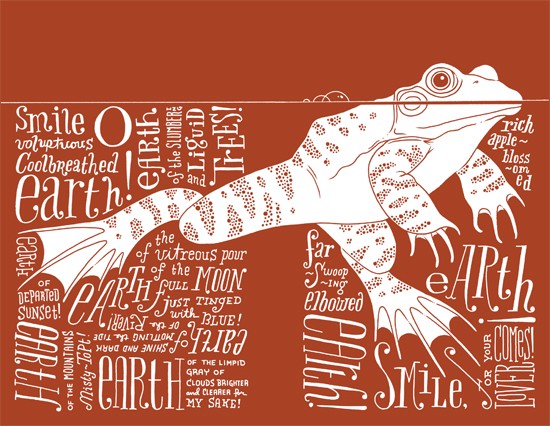
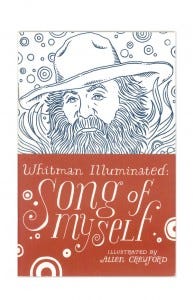
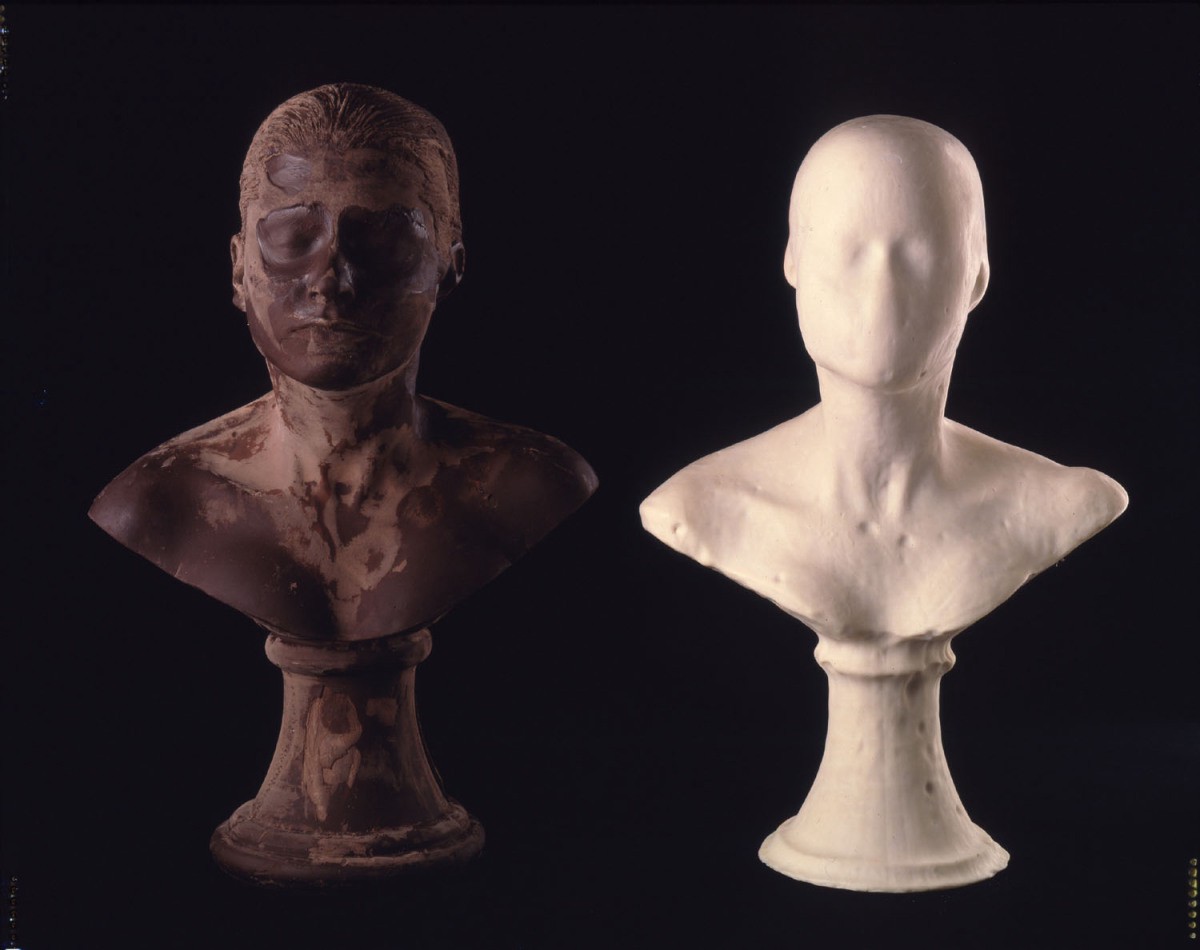
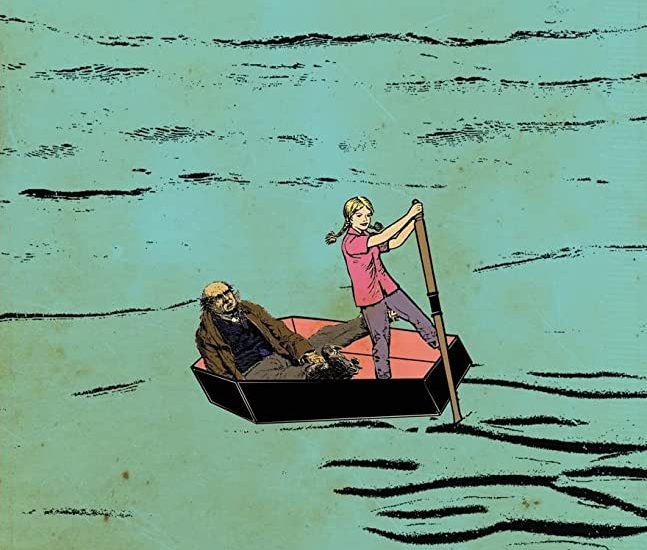
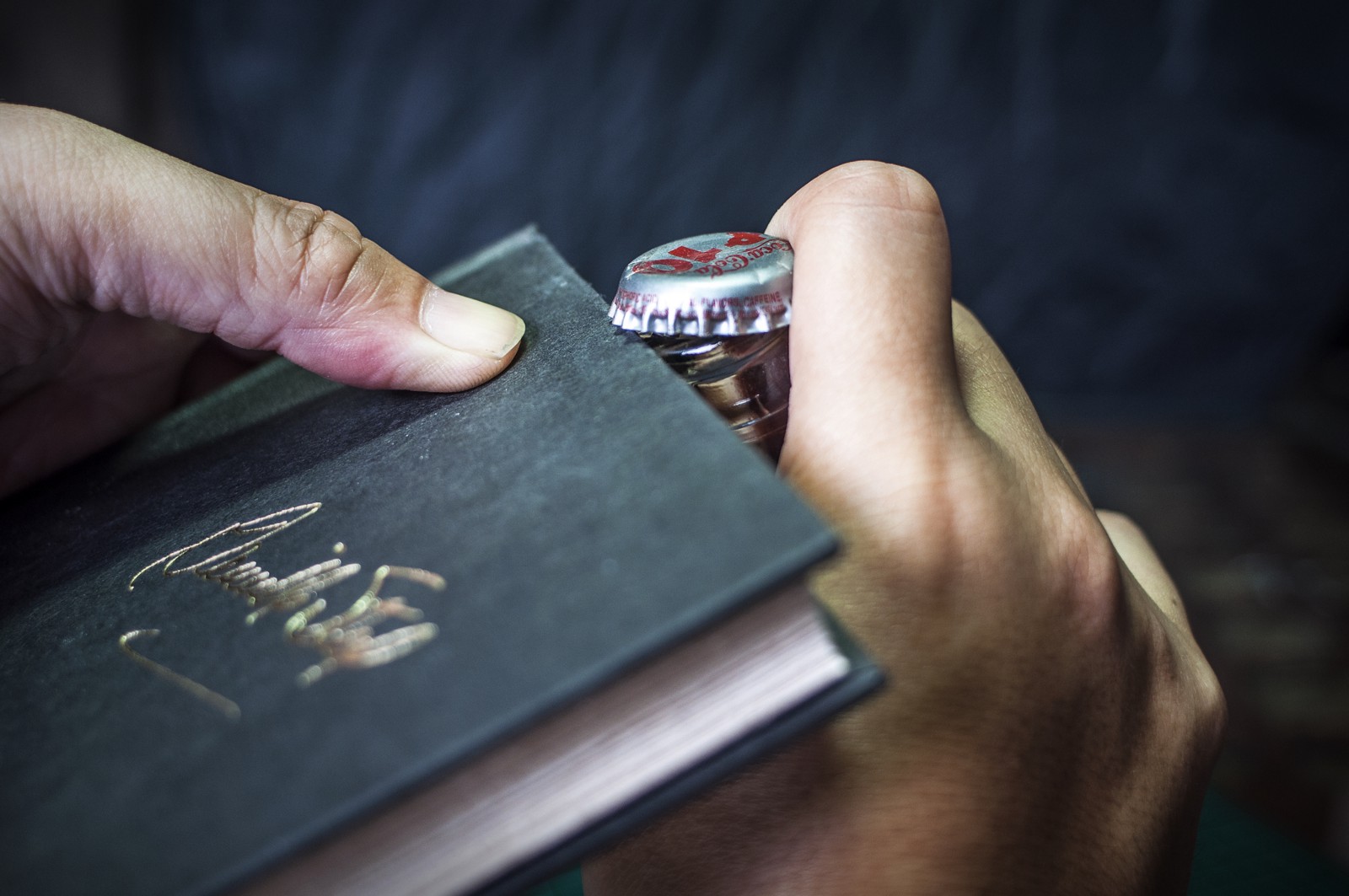
If you like poetry and gorgeous illustrations, then you’ll want to rush and check out the latest book from Tin House: Whitman Illuminated. Artist Allen Crawford turns Whitman’s epic “Song of Myself” into a book length illustrated wonder. Check out the sample images in the gallery, and buy one for your coffee table or poetry loving friend.
[Editor’s note: this article was sponsored by AbeBooks.com.]
Ten years before The Da Vinci Code was published, Arturo Perez-Reverte’s The Club Dumas came out. It follows a book dealer tasked with authenticating an antique book. While on mission he finds a pattern in the symbology which leads him into a world of secrecy and dark religious practices. (Watch what I’m doing here). The book eventually becomes Roman Polanski’s film The Ninth Gate. Which becomes The Da Vinci Code, which becomes National Treasure, and Nancy Drew is holding a kill list and training at night. While there’s nothing new about the detective novel or film adaptation, it’s worth saying plainly that artwork not only sets mood for the audience and readership; whether informing the choices characters make or foreshadowing danger looming ahead, those who skip over it or take it for granted risk donning a dunce cap as they speak up in book club.
In honor of great illustrations used in books, here’s a quick list of names and works to know.
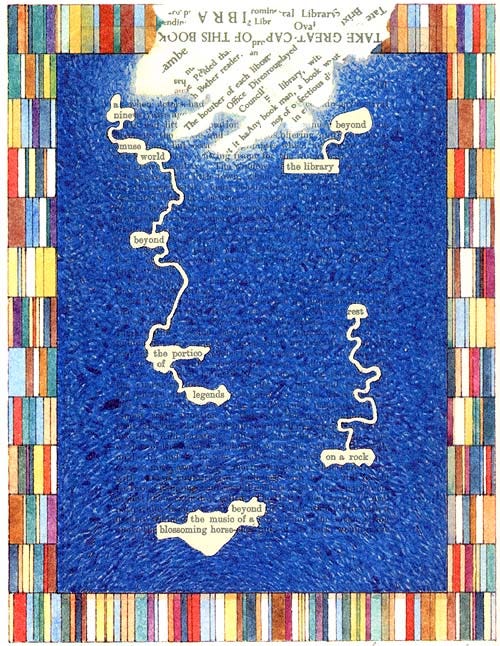
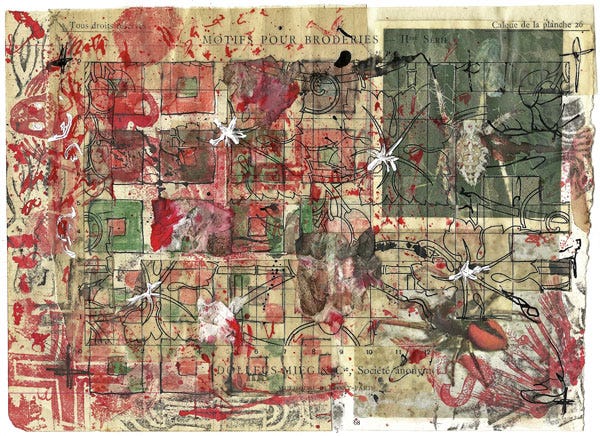
Next to the Jefferson Bible, Tom Phillips’ A Humument is one of the most famous erasures. By painting, collaging, and drawing over the pages of the W. H. Mallock’s A Human Document, Phillips made a text distinct in its own right, following a protagonist named Toge who appears, logically enough, only when the words “together” and “altogether” have presented themselves through Mallock’s original text. Readers used to staring at white space will find themselves far from home with A Humument which embeds text in illustration rather than the other way around.
We’re in a caption contest. All of us. I’m not joking. Look at Facebook. Look at memes and animated GIFs. It’s easy to be pithy, but sincerity is hard. Matt Kish has found a way. Rather than captioning pre-existing graphics, Kish has taken prose from each page of Herman Melville’s Moby Dick (and more recently Joseph Conrad’s Heart of Darkness), working on one page per day, he’s produced one illustration to match each quotation. Some think the artwork in Moby-Dick in Pictures looks a little unfinished, and maybe it does, but some see what 552 days of imagining look like on paper and feel pretty good about life.
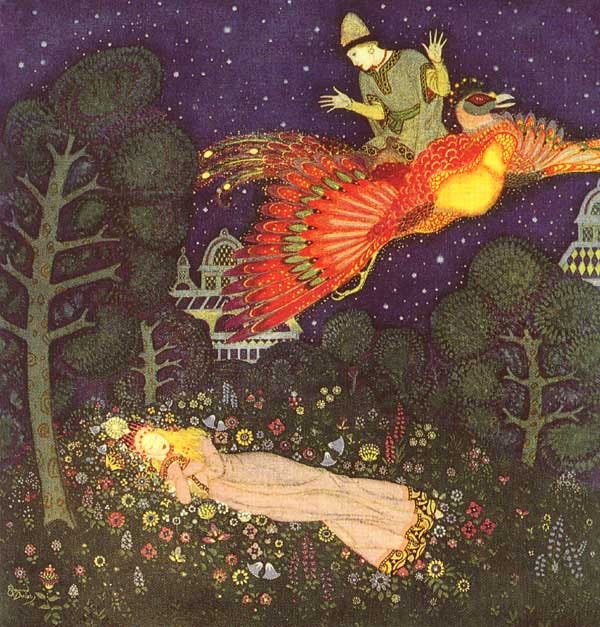
Edmund Dulac isn’t as well known as Aesop or Roald Dahl but he should be. He worked in a time known as The Golden Age of Illustration, placing work through the first half of the 20th Century in printings of Sleeping Beauty, The Stories of Hans Christian Andersen, and The Arabian Nights. He was born in France and lived in England and died in 1953 at the age of 70 at work on Milton’s Comus while Mickey Mouse danced on TV.
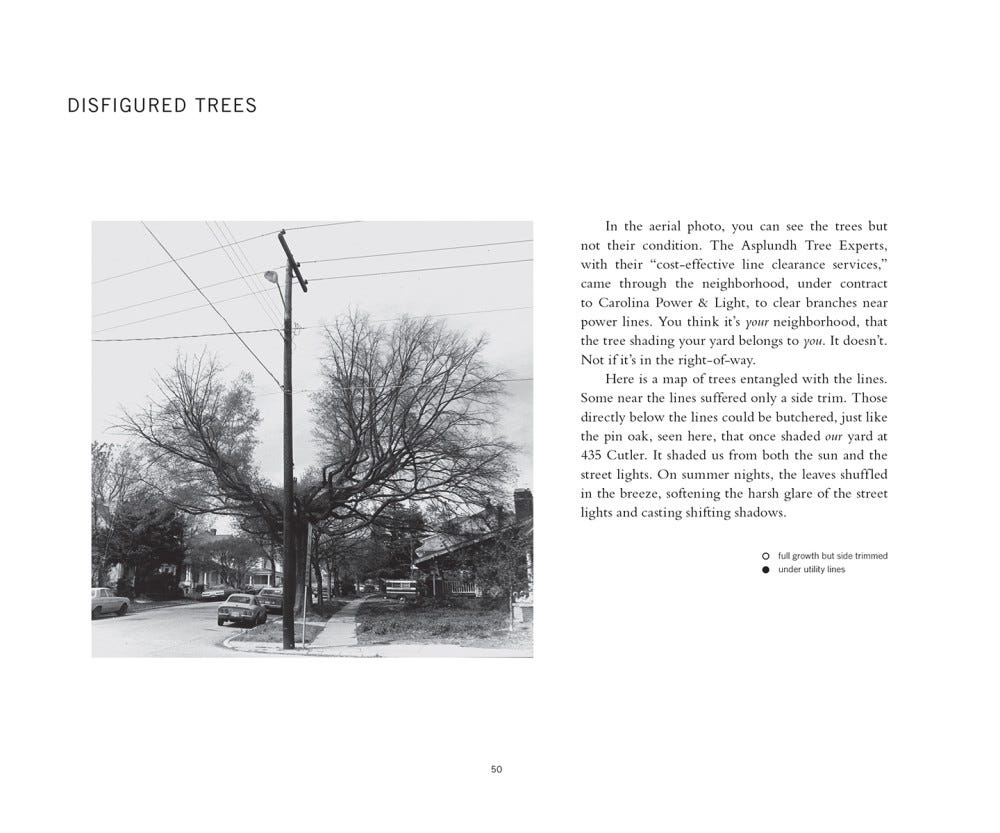
In February 2003 Colin Powell appeared at the United Nations in Midtown Manhattan and made a case for going to war in Iraq. He took with him aerial photographs which showed longitude, latitude and, through a history of regional violence, worry about weapons and the destruction they cause. In Everything Sings, Dennis Wood argues all maps are ideological and he pursues their limits and strengths across his neighborhood, Boylan Heights. In a section titled “Disfigured Trees” he writes, “In the aerial photo, you can see the trees but not their condition.” He might have cautioned the General Assembly, We can make out a payload, but not what’s inside it. In addition to weapons, he might have searched for children, jack-o’-lanterns, and the perspectives of people from the axes they walk. In February 2003, on the floor of the United Nations, Dennis Wood would have challenged not only the pixels shown on the maps but what the maps stood for.
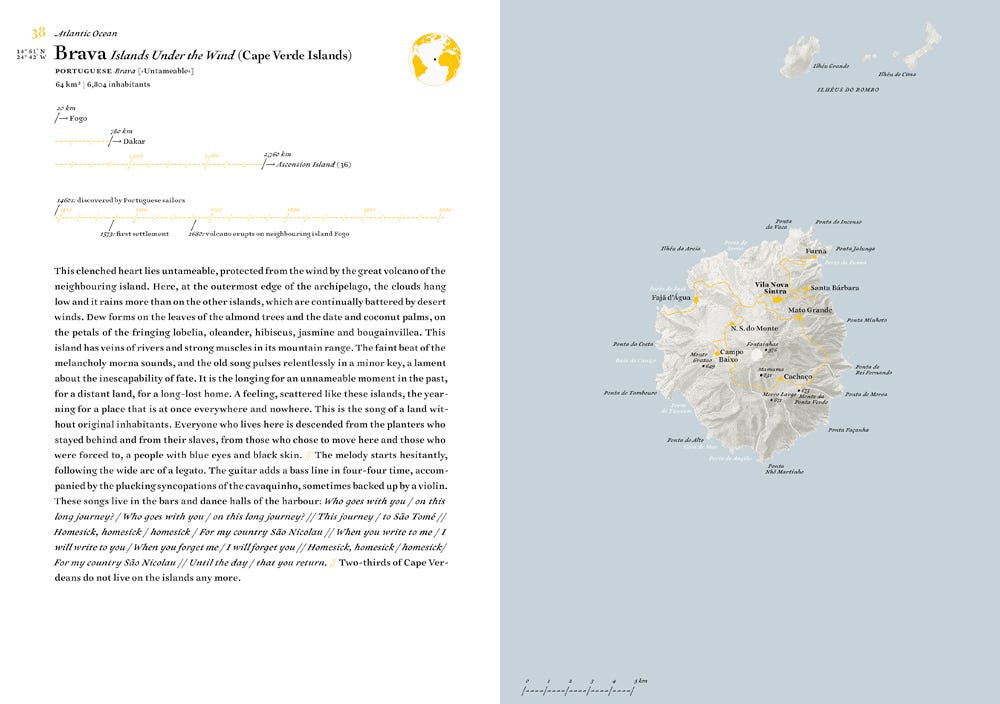
If you find comfort in Everything Sings, you’ll find the opposite in Atlas of Remote Islands. In it, Judith Schalansky covers 50 of the loneliest places on Earth. On the verso, below a time-line, and the number of inhabitants (if any), she delivers a prose poem in the present tense. There’s no room for paragraph breaks here so a double slash will have to do. On the recto, a gray mass sits adrift in blue. Each map in the book serves as a dedication to those small, boxed-off scribbles artificially drawn as afterthoughts near images of bigger masses. The maps here are planned out as part of the main event. They’re married to the prose, one map to each entry, rolling one next to the other like the animals in Noah’s Ark. The book proves that dedications, like marriages, can be lonely business.
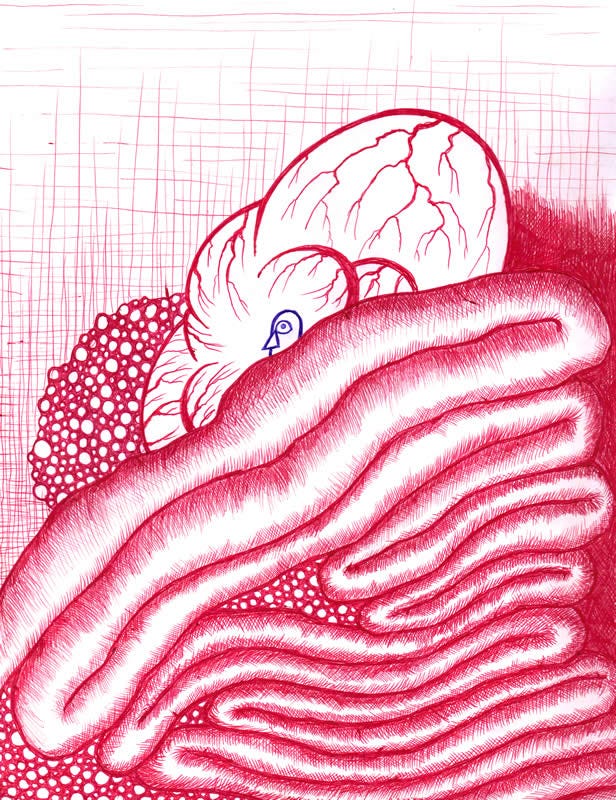
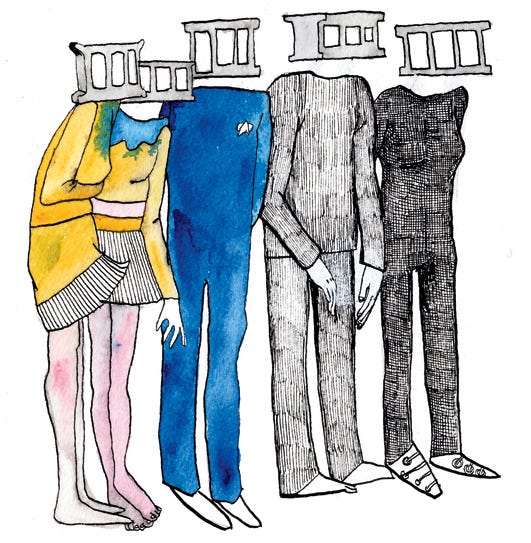
Though Calamari Press has put out some of the most interesting titles in the last decade or so, including several from Gary Lutz, Chiara Barzini’s Sister Stop Breathing is a particularly good example of the interplay between artwork and prose. The book consists of 38 short fictions but very few of them contain what normally passes for story. Most of the entries take the form of a sketch or advice, something darker than a recipe but not quite as terrorizing as a spell. For instance, the title selection opens, “What can you do if you want your sister to stop breathing?” Of course, two thirds of the pieces are matched with illustrations or what Derek White, the founder of Calamari, calls “synchronous images.” Some of the images, like the one paired with “Red Spiders,” have a link that’s obvious before reading the story. Some, like the image of hands accompanying “Vauville,” make sense only after the piece has been read. They haunt.
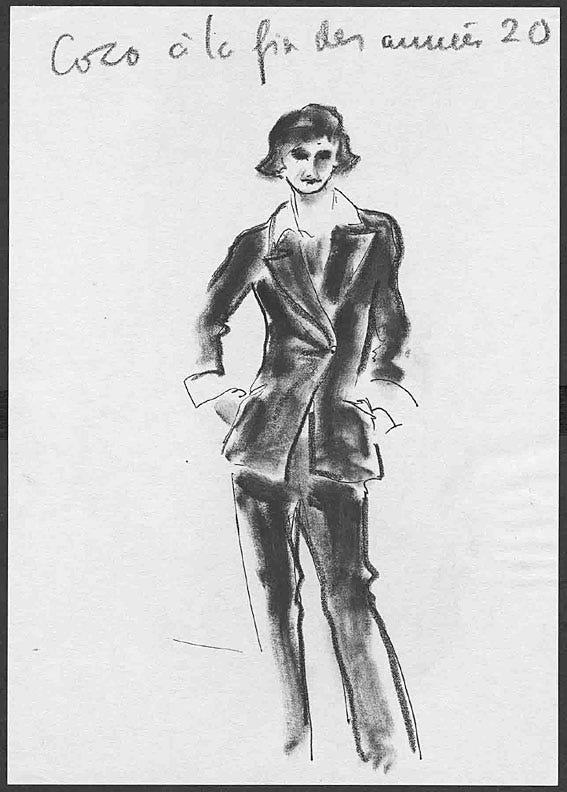
Karl Lagerfeld is known for designing haute couture for Fendi and Chanel and wearing very high collars that make him look like a sexual deviant. It turns out that at least one of those things relies on drawing well. After releasing The Allure of Chanelin 2008, Puhskin Press has recently released a deluxe version of Coco Chanel’s life story as told by Paul Morand, which includes illustrations by Lagerfeld that do justice to the term sketch. They look like they were made quickly with the aim of suggesting more than what’s there. You can conjure fabric if you like or enjoy them as is. Apparently the man has more than a few tricks up his sleeve. Maybe a few under his collar.
Calling Bianca Stone an artist is like calling Deion Sanders an athlete; she’s got game in different fields. Having penned and illustrated several chapbooks, she’s also collaborated with Anne Carson to produce Antigonick(which the above image is taken from), and recently released a book of poetry called Someone Else’s WeddingVows. She also so happens to have produced the Single-Sentence Animation for A-J Aronstein’s “Flower Box.” She can probably disarm a bomb blindfolded and dunk on you too. Only time and Bond villains will tell.
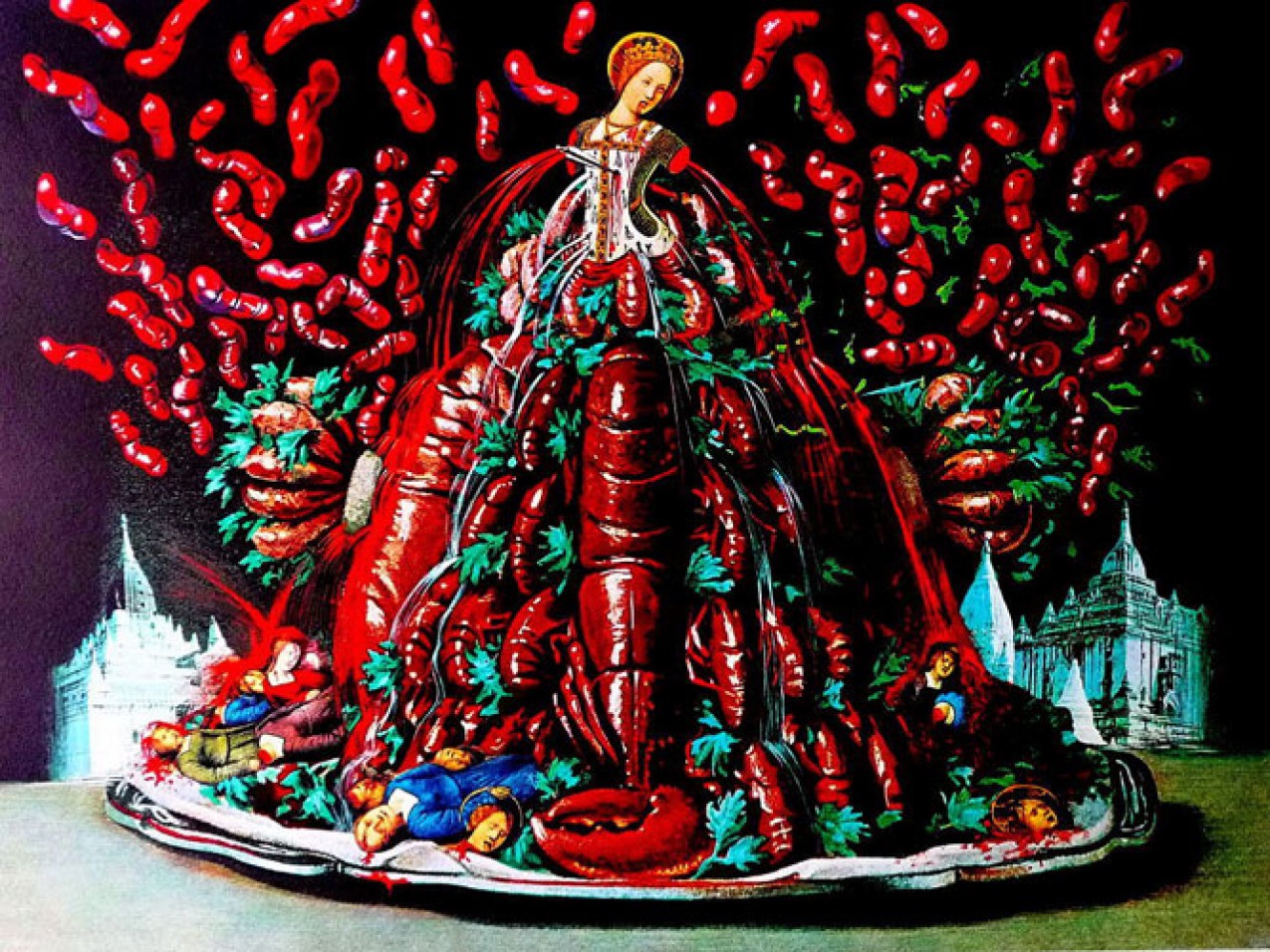
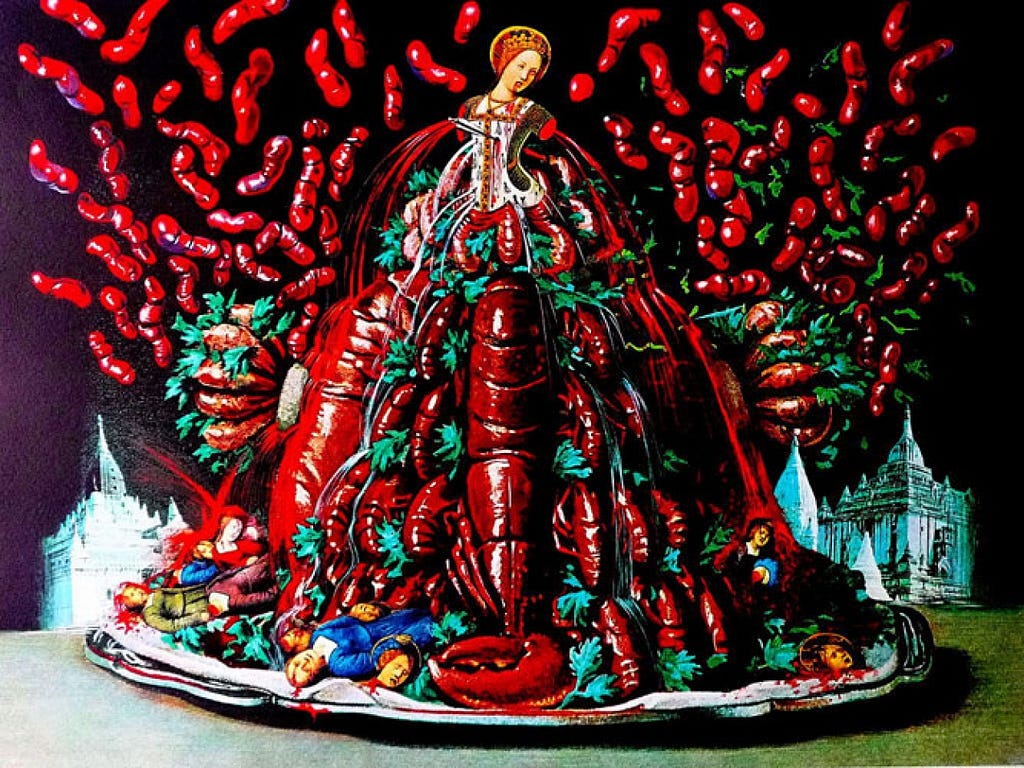
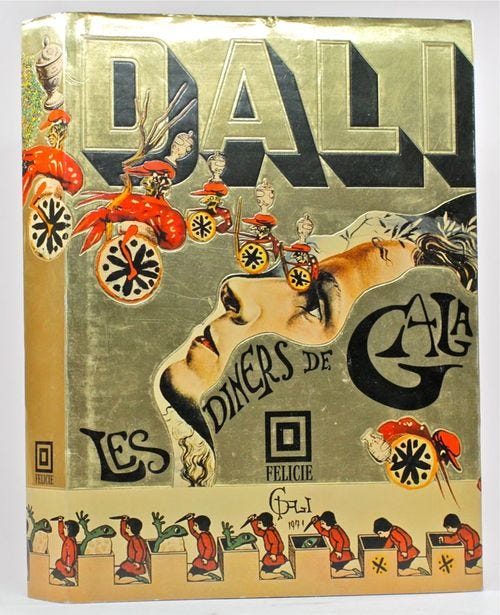
Though it’s not the first thing that comes to mind when one thinks Salvador Dali, he illustrated plenty of book covers and not only his own. Prior to being pigeonholed as the premier posterist for freshman dorm rooms, his illustrations were placed on the covers of books by such greats as Dante Alighieri and William Shakespeare. It turns out that, even in art, across centuries and centuries, the cool kids really do hang together.
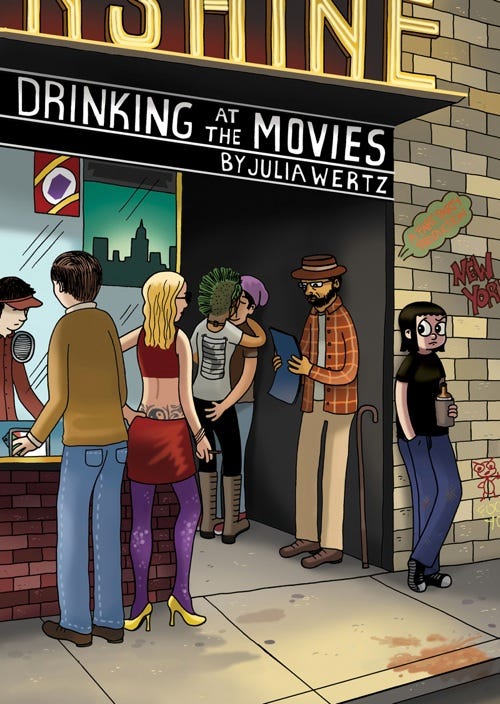
Julia Wertz, I bet you never thought you’d follow Salvador Dali on a list, but if there are things to learn from Drinking at the Movies or this article, they’re a) that you often make errors in judgment and b) that I can address an author directly even if I’ve never met her. Let’s add to that c) you draw pretty damn well and d) even though you have a bad mouth, a memoir in comics can be pretty poignant.
Submissions are open for Electric Literature’s Recommended Reading, but they close June 1st. Send those stories in!
Recommended Reading, a magazine by Electric Literature, publishes one story a week, each chosen by today’s best authors and editors. Though Recommended Reading features original fiction as well as reprints, we will only consider previously unpublished stories during our spring submission period.
Before submitting, please take some time to read Recommended Reading, especially those recommended by Electric Literature, in which we showcase original fiction. Recommended Reading publishes fiction ranging in length from 2,000 to 10,000 words, and pays each contributor $300. We accept simultaneous submissions, but if your story is accepted elsewhere, please withdraw it immediately through the Submittable system. We can only consider one story by an author at any given time.”
A Monstrous Primer: In Frankenstein (1818), Mary Shelley has Victor Frankenstein say the following about the creature he has labored among “the unhallowed damps of the grave” to create: “How can I describe my emotions at this catastrophe, or how delineate the wretch whom with such infinite pains and care I had endeavored to form? His limbs were in proportion and I had selected his features as beautiful. Beautiful! — Great God! His yellow skin scarcely covered the work of muscles and arteries beneath; his hair was of a lustrous black, and flowing; his teeth of a pearly whiteness; but these luxuriances only formed a more horrid contrast with his watery eyes, that seemed almost of the same color as the dun white sockets in which they were set, his shriveled complexion, and straight black lips.” As soon as the doctor has glimpsed his creation, he can no more regard its components as separate; much like the life he calls down from the sky to make his creature walk and breathe, the creature’s physiognomy is elemental and eternal. And so if “all mankind is of one author and is one volume,” as John Donne says, we at Electric Literature believe that all art is part of the same monstrous body, disparate yet complementary. In that spirit, this biweekly column will devote itself to illuminating the gorgeous and grotesque connections between outwardly different works of art, organized around a theme. The column means to recommend an aesthetic experience to the reader. She might, for example, read the book while listening to the record and then watch the movie. Or abide with the catalog raisonné while listening to the record before watching the movie and reading the book — in any order she so chooses. The Head, the Torso and the Legs will go to make the creature whole. Alternative Cuts, every posting, will follow.
Media Frankenstein #1: Manmade Apocalypse
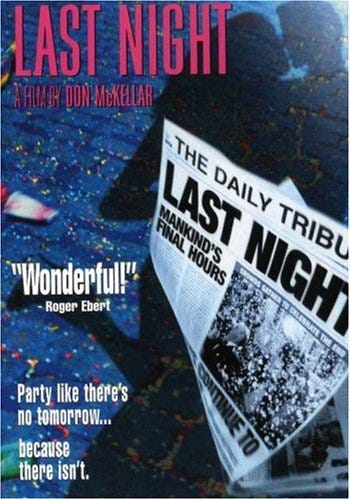
THE HEAD: Last Night, dir. Don McKellar (1998)
What if you knew the precise date and time that the world as you know it would cease to exist?
Would you spend your last hours on this earth with your loved ones, staging a drear and unseasonal Christmas? Or crossing off acts on your sex bucket-list like bedding your high school French teacher, perhaps, or a middle-aged virgin you picked up online? Would you run blood-drunk through the streets, shooting down strangers and toppling buses? Or would you relax in a chair on your roof with an old record player and a glass of red wine, cherishing the solitude we carry with us always, acknowledging solitude, making it yours? Such are the circumstances of Canadian director Don McKellar’s wonderfully subversive and curiously warm pre-apocalyptic film Last Night, which boasts a stellar indie cast the
likes of Sandra Oh, Sarah Polley and body-horror auteur David Cronenberg, who plays a power-company owner calling all of his customers (and many of the film’s characters) to console them: “I hope you’re doing well and spending these final hours in peace with your loved ones. Rest assured that we will make every effort to keep the gas flowing right until the end.” Herein lies the film’s tenderhearted gallows humor, which only grows more wrenching the closer we get to the final countdown. Every character’s leave-taking of another is weighted with agonizing foredoom, including a scene in which one male bro-friend rejects the sexual advances of his pal before saying: “See ya.” The pal’s response: “No you won’t.” In many ways it’s the film’s glib comedy juxtaposed with its unrepentant darkness that hits the viewer so hard, utilizing the funny/sad dichotomy of authors such as George Saunders and filmmakers such as Bobcat Goldthwait. By default the film’s characters are resigned, and yet their behaviors and choices belie them; with a couple exceptions, they’re terribly hopeful. And although, as in many of the best end-times narratives (see Cormac McCarthy’s The Road), we never get the precise reason for the world’s demise, by the end of the film that reason seems ultimately so far from the point that maybe we’re better off not knowing. We make our own apocalypse, regardless of whether or not we have caused it.
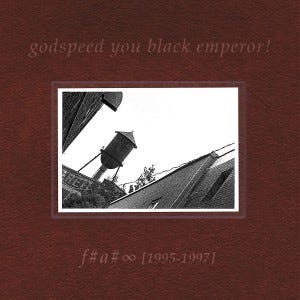
THE TORSO: Godspeed You! Black Emperor’s F ♯ A ♯ ∞ (1997)
It should come as little surprise that a heavily modified cut of the track “East Hastings” taken from Godspeed You! Black Emperor’s first record F ♯ A ♯ ∞ (pronounced: “F sharp, A sharp, Infinity”) is not only from a Canadian band, but also features in the beginning of Danny Boyle’s meth-zombie opera 28 Days Later (2002), in the scene where Cillian Murphy shambles in disbelief through the streets of an abandoned London. The scene is telling of the existential melancholy at the heart of the record, itself a sort of paean to the end-times — not before the last hour or in those that stretch after, but as the end is going down. Following in the footsteps of Mogwai and Rodan, the Montreal-based post-rock band Godspeed You! Black Emperor summons nothing less than a glockenspiel, horn, violin, slide guitar, Swans-esque industrial clamor and loop tracks of a raving messianic street preacher to do its business over the course of a full hour and change. The first track “Dead Flag Blues” begins with the voice of a man intoning over string instruments: “The car’s on fire and there’s no driver at the wheel. And the sewers are all muddled with a thousand lonely suicides. And a dark wind blows.” He goes on to say: “The skyline was beautiful on fire. All twisting metal stretching upwards. Everything washed in a thin orange haze.” You might be reading Baudelaire. Until the first “movement” dissolves — Godspeed writes not songs, but movements — and the music ascends, quiets down, ripples outward, before rising again in a fog of reverb; becomes the only thing you hear (if you are listening to it right). The universe’s entropy begins to swirl around your head. Yet much as in the film Last Night, the music is never all dark as with Swans or Godspeed’s electrified cousin Neurosis, but spry and orchestral and cautiously mournful, a last living wake for a vanishing world.
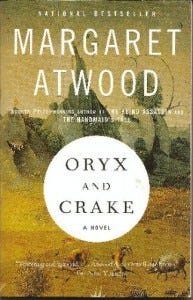
THE LEGS: Oryx & Crake by Margaret Atwood (2003)
If Last Night evokes the pre-apocalyptic world and Godspeed’s F ♯ A ♯ ∞ the apocalypse itself then Oryx & Crake, the first novel in fellow-Canadian Margaret Atwood’s MaddAddam Trilogy, takes us on a final descent into darkness, the world in the wake of extended decay. The novel centers around a character named Snowman, formerly Jimmy, who after years of living ferally among the wastes of what used to be planet earth has come to resemble a sort of Bigfoot, prolifically hairy, covered in superannuated bug-bites and clothed in a “dirty bedsheet,” yet also sporting such remnants of civilization as a watch that no longer ticks and an “authentic-replica Red Sox baseball hat.” Moving back and forth in time between Snowman’s attempts in the present to navigate a world populated only by genetic splices (Pigoons, Wolvogs, Rakunks and a breed of uncanny, lab-grown humans called Crakers), and the doomsday-precipitating events that took place in the past among Snowman himself, an enigmatic girl named Oryx and a sociopathic prodigy named Crake, the novel establishes a direct correlation between the Then and the Now, the World and the not-World, which is nothing if not chilling in its oblique resemblance to what will probably go down within the next century or so if we don’t get our shit together quick. Yet in spite of its vibrant colors and charnel-house comedy, Oryx & Crake may be one of the bleakest eschatological narratives ever penned, bleaker even than McCarthy’s The Road (a book which contains more than its own fair share of cautious optimism), though both books are creation myths. Snowman, its hero, is wholly alone, foraging among the ruins: “[Snowman] scans the horizon, using his one sunglassed eye: nothing. The sea is hot metal, the sky a bleached blue, except for the hole burnt in it by the sun. Everything is so empty. Water, sand, sky, trees, fragments of past time. Nobody to hear him. ‘Crake!’ he yells. ‘Asshole! Shit for brains!’ … No answer, which isn’t surprising. Only the waves, wish-wash, wish-wash. He wipes his fist across his face, across the grime and tears and snot and the derelict’s whiskers and sticky mango juice. ‘Snowman, Snowman,’ he says. ‘Get a life.’” And while the mystery of how Snowman is able to survive the apocalypse, not to mention the reason the world has to end Atwood by and by reveals, such answers do nothing to alleviate either the reader or Snowman’s existential terror in the face of a barren eternity. Yet Snowman continues to stockpile supplies, to curse his scorched, unlucky stars, to teach the Crakers what he knows, “pedagogue, soothsayer and benevolent uncle.”
What <em>Last Night, </em>F ♯ A ♯ ∞, and <em>Oryx & Crake </em>all seem to be suggesting, apart from a gleefully mordant brand of Canadian fatalism, is the tragedy not that the world has to end, or that when it does we will likely have caused it but the tragedy, rather, that we as a species will be compelled to soldier on.
The human comedy plays out, whether or not we are actively laughing.
Alternative Cuts:
(The Hunger Games Trilogy by Suzanne Collins; The Pixies’ Doolittle (1998); A Boy and His Dog, dir. L.Q. Jones (1975))
(The Road by Cormac McCarthy (2006); Igor Stravinsky’s The Rites of Spring; Goya’s “black paintings”)
(Pastoralia by George Saunders (2001); Miracle Mile dir. Steve de Jarnett (1988); Deltron 3030’s City Rising from the Ashes EP (2013)
(Zone One by Colson Whitehead (2011); 28 Days Later dir. Danny Boyle (2002); The Misfits’ Earth A.D./Wolf’s Blood (1983)
All published writers are alike; every unpublished writer is unpublished in her own way.
Or maybe not. Most unpublished writers — assuming they actively want to find a readership for their work — are unpublished for one of a few reasons.
First, there are writers who are truly bad. I don’t believe in objective taste, so what I really mean is there are writers who are truly clueless. They have no idea how far off they are from the kind of writing that gets published, and so they probably never will be.
Then, there are writers who are good — you could call it a talent for writing, or you could say they have a talent for emulating writing that meets our current standards for “good” — who just haven’t put in the time yet. They’re in a pre-published state, but if they continue to work (reading, making connections, finding their markets) they’ll eventually be published.
Then there is the broad middle — writers who are pretty good, or almost good, but stuck. Often, they are willing to work — they take classes, they seek out mentors, they profess a desire to edit their manuscripts into publishable shape. The problem is, they’re doing the wrong kind of work. They’ve heard stories about some famous writer, like Robert Lowell, tinkering with his poems even after they were published in books, changing a word or a line break or a comma, and they think that’s what revision is. That is not what revision is, and this is why their work is not getting appreciably better.
An Analogy from the Seedy World of Marketing
My day job is in content marketing (and it’s doubly/meta seedy, because the product in question is marketing software). I recently had an epiphany about revision based on an excellent, if somewhat sensationalist marketing presentation that my boss did called “Everything You Know About Conversion Rate Optimization Is Wrong.”
First, let me explain what conversion rate optimization is. If you have some kind of transactional website, like an e-commerce site to sell small-press novels, or a SaaS platform where you try to get people to sign up for a free trial of your software, the page where those transactions happen (or don’t) is called a landing page. And since your success as a business more or less depends on how many people you can get to “convert” on that landing page (i.e., buy the book or sign up for the free trial), businesses usually attempt to optimize their conversion rates through various tests. A high conversion rate translates to a high percentage of your site’s visitors converting into a customer or lead.
A lot of the “best practices” and received wisdom around conversion rate optimization have to do with tests that are designed to hack your potential customer’s psychology. Some of these tests involve visual elements on the page, such as the shape, color, size, or location of the button your visitor needs to click to complete the conversion process. Others involve copy, like the main heading on the page or the “call to action” (the words on the button, such as “Add to Cart” or “Start My Free Trial”). Is longer or shorter better? Do exclamation points help? What if you put a big yellow arrow on the page, pointing to the button? Et cetera, et cetera. The idea is that you can eke a few more conversions out of the same number of visitors with these tricks that make your page more persuasive or frictionless.
My boss’s presentation drew from data and tests to make a case that this whole approach to conversion rate optimization is wrong-headed. Basically, he said, stop futzing around with the button color — you can only make small incremental gains that way, and many of those apparent gains are illusory anyway (due to statistical insignificance, for example). If you really want to improve your conversion rate, you need to make radical changes. For example, change the offer: Maybe it’s not that people aren’t buying the book because your button is the wrong shade of green, but because nobody wants that book.
This isn’t to say that it’s not worth testing the button color. You can mess around with that level of testing once you know for sure that people actually want what you’re peddling.
Everything You Know About Revision Is Wrong
So here’s my theory: Revision works the same way. For the same reason that most businesses fail slowly — by focusing on small details instead of the big picture — most writers can’t get their work better than a certain level of passable mediocrity because they’re optimizing the small stuff before they hit on a project that’s worth optimizing. They approach revision through tinkering and line edits, trying to improve the poem with different enjambment on line 3 or changing “blue” to “cerulean.” But those small edits can only make a poem or a novel or a memoir 1–5% better. A radical revision that completely rethinks the form or concept or scope or flow could make it twice as good.
Of course, this theory doesn’t apply only to unpublished writers. Any writer has the chance to make any project dramatically better through a complete re-envisioning of the project. George Saunders was reportedly stuck on the story “Sea Oak” for a long time until he decided to change the whole ending and make the aunt come back as a zombie. Maggie Nelson wasn’t happy with Bluets until she decided to abandon the form of poetry completely and write it as a series of numbered paragraphs.
Remember, though, that any revision is a kind of test. Completely redesigning your landing page could very well tank your results, and the same is true of revision. This is why I always recommend doing revisions in a new file — don’t kill your first-version darling, just tuck it away where it can be recovered. Revisions, like theories, are only worthwhile if they can fail.
The three men I’ve bitten arms off of are doing well. I felt guilty for many years. I was afraid I had completely ruined their lives. Of course it must have been difficult for them. But a physical disability doesn’t have to make anyone unhappy. If a person has a great will to live, he’ll recover from the very greatest traumas.
At times I was quite wild when I was young. I generally managed to keep myself under control in the daytime, but at night I could be a real ferocious beast. My first husband was a very gentle, sensitive man. In the mornings he made thin pancakes fried golden brown in butter and poured coffee mixed with frothed milk into my blue earthenware mug. One morning he just couldn’t wait for me to get up. The pancakes were ready and the coffee getting cold. He sat down softly on the edge of my bed and slid his left hand caressingly over my long, soft hair, shoulders, and back. I woke with a start. A wild rage came over me. I pounced on to his upper arm and before I understood what I was doing, I had bitten his whole arm off.
When we filed the divorce papers, I cried bitterly. “You could at least have snarled… ” he said as he was leaving. “That you suddenly, just like that… ”
Jaan is now married to a frail actress. She certainly won’t ever bite him. Jaan works at the automobile museum. At open-air events he earns good money with his artificial arm. He sits next to the driver in open Benzes and De Dion Boutons and points the way, controlling his arm by means of a control panel. In the evening a little light flashes in his arm as well.
Tourists photograph him like mad and Jaan is a made man all over town.
I had therapy for two years and then had the courage to get married again. My second husband’s name was also Jaan. We joked that he must be a hard man indeed to take me to be his wife. And himself a discus thrower and the great Olympic hope of the entire nation. It happened already on our wedding night.
As I was expecting a child, I suddenly felt a great tiredness in the midst of all the wedding hubbub. Suddenly I just couldn’t dance anymore or sit at the table either. I staggered through the rooms of the hunting lodge we had hired for our wedding reception and climbed the stairs. Jaan was still busy with our guests and an hour later he followed me up to our bedroom. He pushed aside the heavy, white brocade curtains of the canopy bed, kissed me passionately on my half-open lips, opened the hooks on the front of my wedding dress, lay down beside me on the bed and put his right arm under my neck. I felt his gigantic, rapidly twitching muscle. Rage struck me like a thunderbolt. Just as lightning rends a tree with one blow, I had, in a fraction of a second, shattered our people’s Olympic hopes. Blood spurted onto the white brocade curtains. Everything all around was suddenly red-white, the approaching ambulance siren rose and fell, the ambulance crew in red overalls stormed in and tried to stop the spurting flow of blood from Jaan’s upper arm, lunatic-asylum nurses in white coats wrenched my arms behind my back and led me, with the hooks of my wedding dress open, to the madhouse. Seven months later I gave birth to a dear little girl and got out of the locked ward. For years I lived in the countryside at my grandmother’s and helped the old girl with the farmwork. I still took very strong medication. My daughter Maarja was four when we moved back to town. The newspapers didn’t write about us anymore.
Jaan married his former beloved just after the accident. Soon after that triplet sons were born to them. Jaan worked at the chocolate factory as a mascot. This job made his family downright wealthy. You see, Jaan had a chocolate arm and was the factory’s most expensive attraction. Every evening, when the tour group children had eaten Jaan’s arm, a new one was moulded for him. Jaan’s sons worshipped their father.
Some years later I met my third husband. For months I tried to convince him that he should find himself a less dangerous woman. But he tried to make me believe that I was completely well. Against my will my daughter Maarja had been waking me in the morning for years and I hadn’t attacked her a single time.
We got married in 1998 on St John’s day in a close family circle. Maarja was our bridesmaid. My husband — his name was Jaan, too — carried me in his arms to a tiny altar bordered with blossoming lilacs and bird cherry trees at the edge of the forest. Framed by tall fir trees we were joined together under the slanting rays of the evening sun. We pressed wedding rings of genuine raw gold onto each other’s finger. They glittered like mad with a wild, dazzling sparkle. Jaan had made the rings himself, he was, after all, a world-famous goldsmith. You would have to look far and wide for a stronger, broader-shouldered man.
I was happy and content. Jaan constantly gave me the most unusual jewelry as presents. I worked as a model for his masterworks. We were always travelling around the world’s most special places.
It happened at the Istanbul World Smithing tournament. Jaan had been hammering day and night without a break. Barely had the gold been able to cool a bit when it was put jingling around my wrists, ankles and hips. We reached the final.
Jaan’s opponent was a little old man whose origins were unknown to everyone. He was able to hammer out jewelry as fine as mist, but his special trump card was supple and beautifully glimmering golden hair. Copper snakes crafted by the old man twisted their way out of gold chests and coiled round the models’ waists and arms. The flute played ever more beautifully and passionately, the drum rumbled some wild and elusive rhythm. Watching this from between the curtains backstage, I suddenly fell into a heavy, restless sleep on my snail sofa. Then Jaan touched my cheek. “Wake up, my dear,” he said, pressing onto my head a gold crown on which a hundred seven-metre-long candles were burning. “Our turn!”
I don’t remember how it happened, but suddenly Jaan’s two strong arms were lying at our feet. The old man smiled sinisterly.
I gave everything else back to Jaan, but I’m holding on to those candles and my wedding ring like some great treasure. I’m not able to forget Jaan. He swore before everyone that it was an accident and his own fault. I escaped a years-long prison sentence and committal to a psychiatric hospital.
Maarja still writes to Jaan to this day. She says he lives in the Kham region of Tibet and has made wings for himself. With the aid of huge shoulder and upper-back muscles he flies around the Himalayas. He’s married to a Tibetan beauty and they have a bevy of children. Jaan is the only person in the world who really knows how to fly. Maarja wants us to visit them some time.
When my candles have finally burnt down and my wedding ring no longer sparkles with such a wild dazzle, then perhaps we’ll really go.
“I knew all about the crash when I moved onto Boundary Street in 2003,” Lenora says in the novella that opens Bonnie ZoBell’s collection, What Happened Here. “Everyone in San Diego did. Twenty-five years earlier, the deadliest airline disaster in U.S. history occurred above our homes before we lived here.” Since the crash, this San Diego neighborhood thrives, populated by people from all walks of life. But the 1978 crash of PSA Flight 182 into North Park still haunts like a specter.
The subtle differences in how each character lives in the shadow of tragedy make ZoBell’s work feel delicately tuned
, important. ZoBell is able to capture the irony that surrounds any gruesome disaster: We are repulsed by tragedy, and yet we’re drawn to it.
Several stories in What Happened Here have an undercurrent of fear; the characters’ anxieties or comfort with disaster each manifest differently. The characters’ proximity to disaster (or simply the location of a disaster) means they are acutely aware of rhythms of a higher frequency. They are highly sensitive: hearing, often, noises that signify heightened emotions. Heather, the young woman in “People Scream,” is haunted by a scream she can’t identify. “This Time of Night” echoes that scream with another; a couple camps near San Onofre, the nuclear “boobs” visible in much of the surrounding area, and the wife’s anticipation of a nuclear alarm puts her on edge. Sound is important again — transformative, even — in “Sea Life,” the tale of a surfer who takes a journey out to sea and is changed by the echolocation of a dolphin pod. This is a tightly connected collection.
Characters, psychiatric disorders, and descriptions of place each bleed from one story to another.
This is a neighborhood story, too, giving it a lovely dramatic irony: The reader is privileged to see through each person’s eyes, while what the characters see of each other is limited. This is the experience of any neighborhood. North Park, with its wild macaws, draws characters — and the reader — in. ZoBell’s vivid descriptions of the houses, the dividing line between old and new (pre- and post-tragedy) homes, and the macaws that fly overhead give a consistent sense of place. Just as it is for the characters, it’s hard for the reader to leave the world of North Park for too long.
For some in the story, especially Lenora’s bipolar husband, John, the haunting tragedy is a cause of so much anguish that it alters their behavior. “John began blaming the fiery metal nightmare plummeting from the sky for causing such a ravenous reoccurrence of despair in him. He was sure there was a parallel to the anniversary.” John’s mania spirals out of control, and the story is emblematic of the anxiety that buzzes throughout the neighborhood. Anticipation and dread about the anniversary exist in tandem.
ZoBell deftly describes the duality of emotion — the fascination with tragedy
— that impacts any place where horrific death occurs.
In “Sea Life,” the story of Sean, a less-than-confident surfer, we see the compelling, addictive power of danger. ZoBell plays with elements of expectation and anticipation. Sean ends up abandoning his friends, the shore, all sense of purpose in an effort to maintain the spell he’s under.
“He feels so good it’s frightening. He doesn’t think he could ever have wished for more than he’s feeling now. Even if he doesn’t quite know where he is or how he’s going to get back to shore. The current has pushed him to rockier waters, where there are reefs that cut, waves that pull…
“Then he feels it again, only this time it’s stronger and he’s sure. It’s a texture, a pulsation, a signal. It’s a locomotion, a singing inside. He’s never felt such euphoria. Sounds travel up and down his legs; his insides pulsate, echo. Lying on his stomach on his board, he never wants to pull his arms out of the sea again.”
Like characters drawn to the history of the tragedy, Sean finds himself unable to let go, to return to the life he knew before his hyper-awareness. Many of ZoBell’s characters are pulled by things that aren’t good for them. But they find themselves unable to resist the draw, the duality of macabre fascination.
At the neighborhood gathering to mark the anniversary of the crash, Lenora observes that “the aerial photo of the accident presiding over the chips and guacamole was a litmus test for the soul.” Twenty-five years later, the accident is as much a part of the neighborhood as its diversity and colorful birds. It drives some characters to depression, sends others out in search of affection or answers to mysterious questions. As Archie, one of the neighbors who is most knowledgeable about the crash says, “You have to appease the spirits, man, so they’ll leave you be, or you’ll get stuck here with them.” Each character in this collection has a choice: accept the ghosts that haunt North Park, or be forever haunted by their presence.
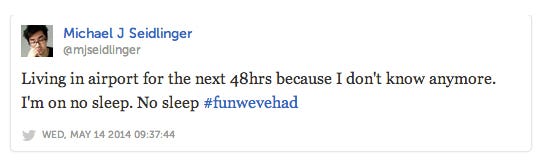
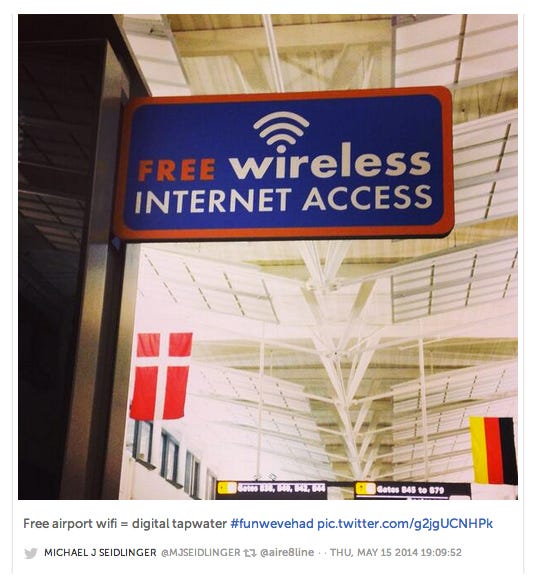
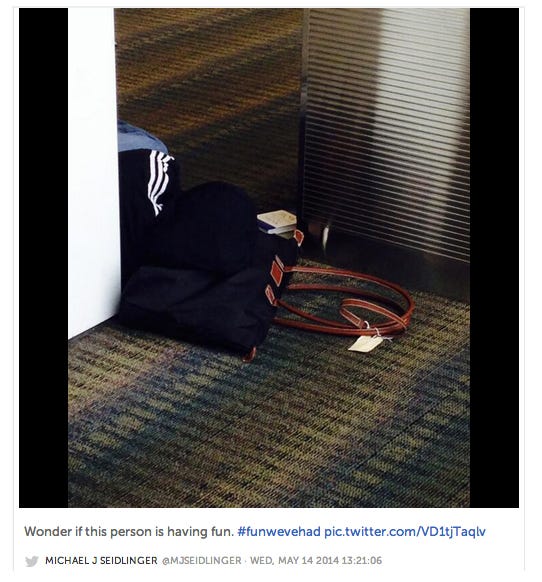
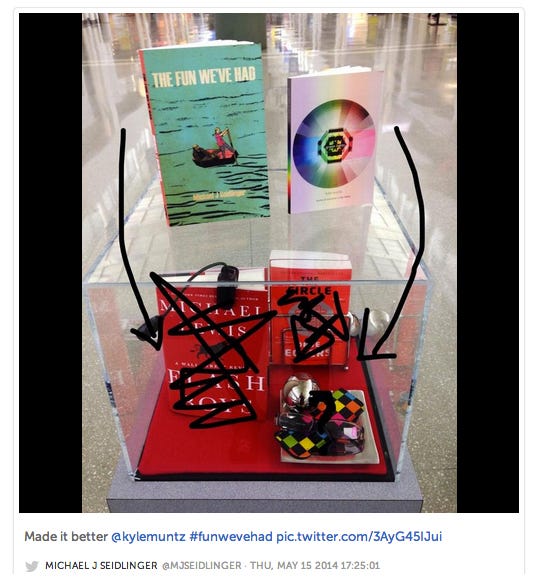
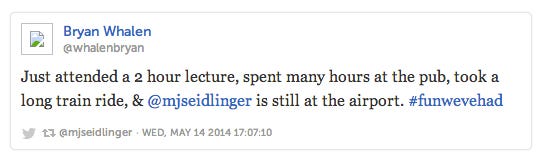
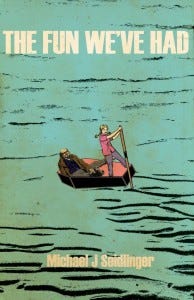
The idea was simple yet absurd: Live in an airport for forty-eight hours to promote my latest book, The Fun We’ve Had. This would be long enough to feel stranded, and more than enough to feel distanced from the blasé of daily routine. At the time, I didn’t know how long that would actually be.
I feared that I’d barely make it past the twelve-hour mark.
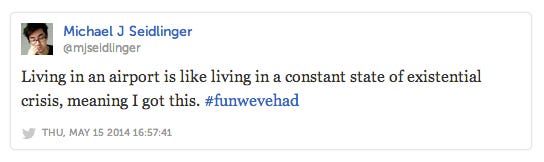
I would remain online and available, tweeting and posting for the duration of the performance. It sounded like fun, maybe, but it helped that I wasn’t alone at the airport, joined by Kyle Muntz, a good friend and author of a number of books, including his most recent, Green Lights.
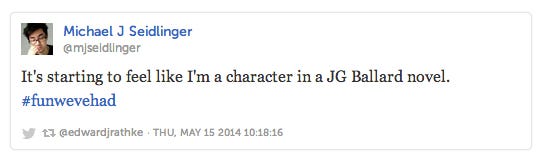
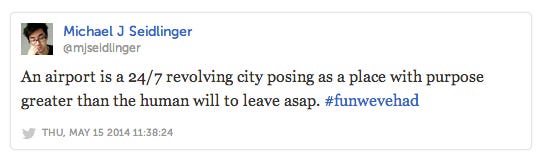
It helped that the airport functioned as a suitable metaphor for the book’s setting, given that being in an airport is a lot like being lost at sea. So many places and possibilities to drift, but not if you don’t already know where it is that you’re going. In the case of Kyle and I, we weren’t going anywhere. We weren’t actually getting on an airplane. We remained in stasis, disconnected from all tethers except the digital variety for the entire duration of the performance.
This was a performance.
This was an experiment.
And it was also a sort of nontraditional celebration of a book’s official publication because, in theory, I wanted to do something totally different, even if it ended up being a failure.
But I was worried. I was worried in the week or two leading up to performance. I had trouble sleeping and had begun to view May 14th, the day when the performance would begin, as a sort of blockade, that one precise moment in the future where everything would stop. Something entirely final.
I thought about how plausible it could be living in an airport for two days. I thought about how social media would be the one buoy for the performance, and whether or not Kyle and I would discover the airport Wi-Fi to be inferior. I couldn’t fathom how the entire performance would play out, but figured, at the very worst, we’d get kicked out or abandon the entire thing a couple hours in. It would be fine — we could always ditch the entire thing in the first few hours.
I kept telling Kyle, “It’ll be great.”
Not that he doubted the performance. Kyle was far more optimistic than I was.
Really, I was trying to convince myself that it’d be okay.
“If it sucks, we could tell people that we decided to leave the country or something.”
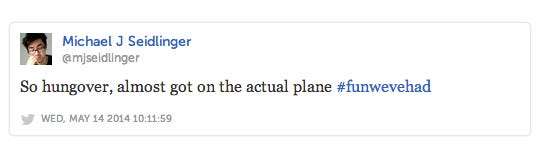
Yeah, I was definitely worried. Kyle and I met up about a day before the performance to hang out and, ideally, to plan out how the hell we would survive living in the airport. But instead of planning, we amassed a modest selection of local craft brews and started on washing away the worry with a nice calming beer buzz. It seemed like a good choice at the time; besides, we were two friends eager to talk shop and catch up on what had consumed our creative lives since our last discussion at AWP. It seemed right that we went into the performance low on sleep and hungover. Now that I look back, I’m not sure I could have gone into this any other way but tired and drunk. Seems like most situations of mine begin with one and/or the other. Anxiety would have murdered me.
May 14th, early morning, around 9AM, we walked into Arrivals and spent ten minutes dazed, scanning the big digital screen listing out all of the arrivals and departures. I’m not sure why we bothered since we knew about the particulars of the flight — its departure at 9:55AM, its destination, John F. Kennedy International Airport — and it would depart with at least two empty seats. I wonder if JetBlue employees bothered calling out our names over the terminal speakers, figuring Kyle and I for yet another example of poor traveling, late and in dire threat of being left behind.
The truth is, I needed a moment to soak in the atmosphere. I needed to let the confusion pass. I needed to stand still and stare to keep the waves of nausea from mounting.
Man I was hungover.
We were able to print our boarding passes without speaking to a single airline employee, which helped because I wasn’t sure I would have been able keep a straight face. If anyone asked, I’m sure we would have been found out right from the start. But no one bothered to look. Every step had become like anything else: a casual encounter with technology.
When you’re rushed through security, no one pays attention to anyone else. No one wants to take off their belts, their shoes, have their items scanned and judged, while they too are forced through a comprehensive check.
“I hate having to take my laptop out of the damn bag.”
“Yeah man,” Kyle yawned.
“I have this irrational fear about how their scanners will erase everything on my hard drive.”
“Do you have your work-in-progress on the laptop?”
“Maybe.”
Kyle laughed.
“Not funny.”
Kyle laughed harder.
“Okay it’s a little funny.”
Kyle and I waited in that line like everyone else, already worn down, most definitely uncomfortable, and, most of all, absolutely uninterested in anything other than getting past this point. Afterward, we were packed in with the crowd being shuttled toward the terminals. We spilled out into a long concourse, full of so many stores and other services, it would be quite easy to mistake the airport for yet another shopping mall.
Because we had no other destination, Kyle and I stumbled towards gate B70, which had already been boarded upon our arrival. In that numbing haze of a hangover, I walked towards the gate, stopped only by the sudden glance of one of the Jetblue employees, figuring me for the type that gives flight attendants a hard time. I nearly boarded that plane. I know, so stupid. Not quite the best start. But it was the beginning.
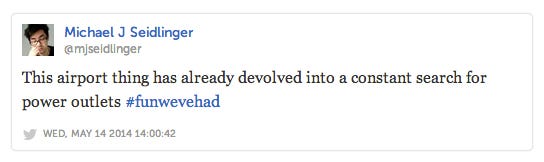
After that, we became cautious. I didn’t want to commit to any particular location. We walked the concourse once, twice, three times, stopping only for coffee and accessible power outlets where plugging in the laptop, our phones and other devices became a sort of checkpoint, a consistent choke point, and an act that ultimately became the bulk of the performance. At the start, I intended on live-tweeting the entire performance. It seemed like a good idea going in, only to be abandoned after walking the concourse once.
When you enter an airport, there’s the immediate response, an imperative to flee. You don’t want to be here, not in this setting full of repeated landscapes and muted situations. There’s the feeling of being watched while, at the same time, washed out, sapped of any and all energy you may have had. Sometimes there’s a layover, but in the case of why I was there, it was living, attempted living.
For the most part, our minds were blanketed by the dull hum and constant rush of wave after wave of people hurrying to leave, looking to disappear from the very setting that I’d become well-accustomed to over the duration of the entire performance. But we were here, and besides coffee, liquor, and social media, there wasn’t a whole lot to be desired. I guess that’s what nudged me in the direction of seeing the irony of the entire experience.
It wasn’t supposed to be ironic, not initially. However, when the first day sped by quickly as a mixture of moving from terminal to terminal, meaningless locations that served only as places where we could remain online and out of the way — not at all suspicious given that the majority of customers and travelers surrounding us did exactly the same — the performance revealed its true form.
Having fun at an airport? Surely that’s ridiculous.
I mean, really: People stuck at an airport between flights typically turn to their computers and their phones; they pass out on terminal floors, smoke cigarettes and pipes in the provided smoking lounges; they spend more than anyone ever should on overpriced meals at strategically placed restaurants and eateries.
The irony could be seen in the exaggeration of people’s attempts to deal with such an unpleasant setting. But here we were, two writers stranded by choice. We saw the humor in the performance, and turned a blind eye to anything else, becoming like journalists in mock wonder, studying the satire. Any tweets, pictures, or posts turned into those sorts of declarations of the aforementioned irony. But Kyle and I were fine with that. We knew it would be a risk. We were open to evolving alongside every new discovery.
Because we had figured out what we were actually doing here, we turned our attention to blurring the hours, speeding up time. It was barely 5PM when we honed in on the airport bars. A drink here, one there, we let the hours fade by nursing what would have been gulped down quickly. We had to make each drink count, given the expense. We had a chance encounter with friend and author, Amber Sparks, who had stopped by one of the bars to waste away the hour or so before her flight.
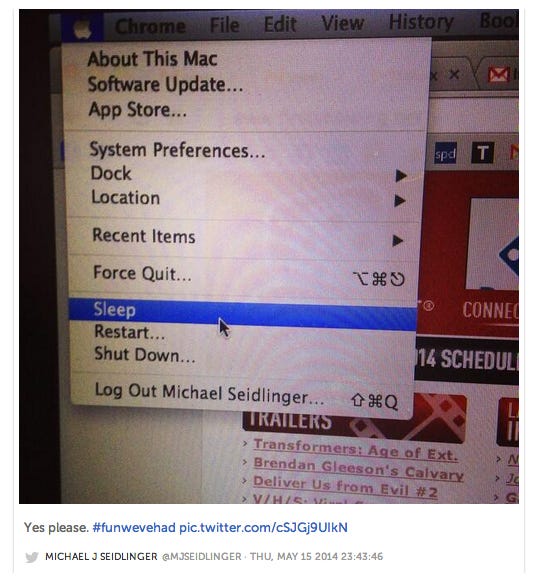
Amber opted for a drink, much like we did, to shorten the hour(s) of waiting. Exhaustion started to set in by nightfall. The bartenders were intrigued and mystified by the performance. They let us stay, going so far as to offer the place as a “safehouse” if we felt like we had nowhere else to go, or needed to hide from airport security. Too bad airport bars close at 10PM. If you keep drinking, you can prolong the inevitable threat of fatigue setting in. Keep the buzz from fading. We drunkenly walked to the international terminals, where flights from Paris, Korea, Japan, and one from Italy, would give us enough of a pocket of time to doze. I’m positive that we wouldn’t have made it to the second day if we weren’t able to sleep without disruption until shortly after dawn.
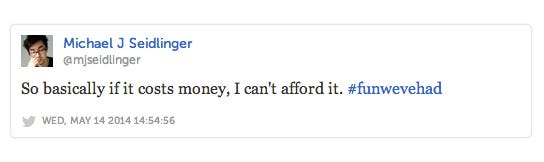
It’s interesting to see how prices become sensible after drifting between the airport’s various absurdities for over eighteen hours. When we found a concourse liquor supplier offering two bottles for forty-five dollars, we couldn’t resist the purchase.
Kyle observed the available options.
“Damn, not bad.”
I agreed. The prices weren’t that bad.
“We’ve been in this airport for way too long.”
Those bottles became a lifeline, much like social media, the only other thing keeping Kyle and I from giving up. Sure, the fun existed, but we never lost sight of the fact that we could do what we were doing somewhere better. Drunk, soon to be hungover, we did what you’d probably expect: we turned to those screens, the mobile device, the laptop screen, only to find dozens upon dozens of Facebook, Gmail, and Twitter messages, not to mention a dizzying amount of unanswered emails.
They were from friends interested in receiving updates, wanting to know what the hell we were thinking. They wanted to talk, to see if we were okay. But as the night of the first rolled into the morning of the second, the names became unfamiliar. People I’d never spoken to before contacted me. Some of the names I’d seen across social media but we’d never spoken.
<span class=”right” style=”font-weight: inherit; font-style: inherit;”>The audacity and absurdity of this performance gave people seemingly a reason to reach out </span>
, and what transpired over the last day was not only reassuring but also the perfect remedy to exhaustion. It felt a lot like reacting to an audience, in a situation where there was no actual stage, only the performance, a bizarre scenario of being stranded. And yet, the audience responded to our S.O.S. signal, wanting to become a part of the adventure, if only tangentially.
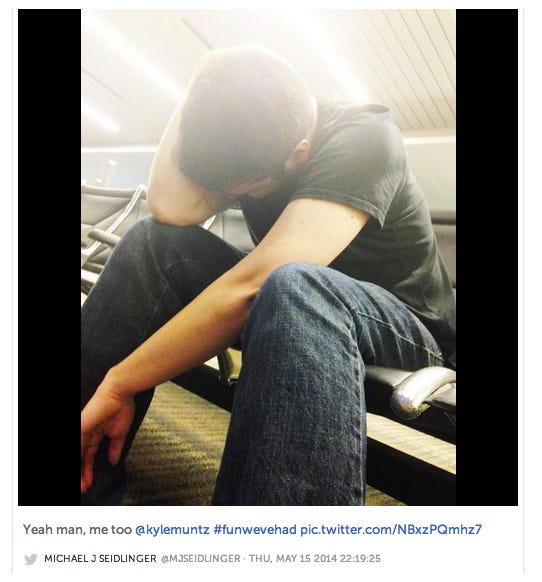
Day two. 9AM turned to 11AM turned to 3PM without so much as a single change. Time felt like it stood still and yet, the clock continued to tick. Every time I’d check, Kyle and I were getting closer to the end. Suddenly we felt like we could actually make it. We felt horrible but we held on. We didn’t move around much on the second day, opting instead for empty terminals near power outlets, putting headphones on even if we didn’t have music playing. Sure, we bought coffee, a bagel, going through with a dare by someone that prefers to remain nameless: eating a Cinnabon, which nearly brought me to my knees.
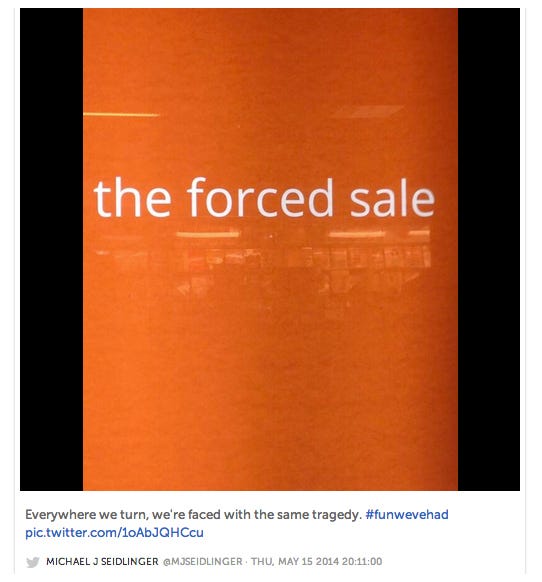
We took photos from around the concourse, anything that seemed to accentuate the irony that had now become brutally close and painful. Our pockets were empty — the meager budget we’d allotted long since spent, and yet we mustered up the funds to go for broke on a much needed airport massage.
After the massage, I asked Kyle, “What the hell did we pay for?”
“Yeah, I fell asleep.”
I felt dizzy, more nauseous than relaxed. “I think I did too.”
“Let’s not mention this to anyone.”
“Deal.”
We were out of cash and had to wait out the rest of the day with none of the usual options. Every dollar set aside for the performance gone, but we still had those two bottles left, some empty coffee cups, and an airport terminal floor to sleep on.
Fun fact: Add “airport” in front of any word and instantly it loses all meaning.
I didn’t care anymore. I remember telling Kyle, “Photos man. Take photos of all the trashcans. Anything.”
The previous night, it had been easy to remain undetected; yet on the second night, the night of May 15th into the 16th, Kyle and I discovered that we had to be far more selective. We couldn’t venture into just any concourse or store. We couldn’t afford any more food or coffee, and by the time we started to suspect that we were becoming a little too odd, a little too obvious, most of the stores had closed for the evening. We had nothing else left but to leave. We left the concourse area for the baggage claim, staying the final four hours in the drowned out glow where travelers wait to be picked up. Kyle and I sipped from those coffee cups and chatted online with those that had become invested in the performance no matter how distanced and remote they were from the actual adventure.
At one point, Kyle and I reflected on the events, the relative ease of the first day, countered by the horrible drawl of the second; we thought about the metaphor of an airport as being “lost at sea.”
Kyle spoke about that the first day, “It went by so quick, man. It felt like we had only been here for an hour but when I looked at the phone, eighteen hours down.”
“It’s the booze.”
He agreed, “It’s always the booze.”
“Look at us now…”
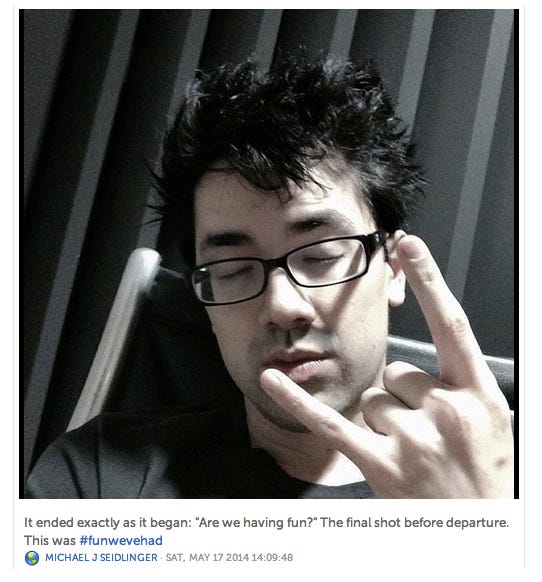
Yeah we were a wreck, but it was almost over. We talked about the performance as a whole, which brought up the question, the one that started it all:
<span class=”left” style=”font-weight: inherit; font-style: inherit;”>“Are we having fun?”
It’s here that I can finally say it in clear confidence: Yes. Despite the dreaded lows, the answer is a resounding yes.
While ambling around crowded bars and sneaking into empty terminals, I had at least one screen by my side. Be it via mobile or laptop, I had an audience; I had acquaintances and friends, old and new. There’s absolutely no point in having a screen to look at if there isn’t a voice, an image, a personality or two blinking and twinkling from behind that screen. Knowing well that that those voices were people seeking out the latest update, the situation, the happenstance of the airport performance piece, was reassuring. It’s still interesting, thinking about how I had people staying up later than anticipated to help keep me stay awake while I nodded off in an airport terminal at 4AM. They cared. They had fun, wanting to talk a bit longer. In the relative insanity of the performance, there was something to be had, an odd form of fun.
It became something beyond a promotional stunt for a book (not that I’m positive that was ever my sole intention); during its two-day stretch, I spoke about the book perhaps only a handful of times. This experience became something far more personal, something more intimate with the audience that it drew in from the already crowded social media waves. The reason for their interest, I’ve come to understand, was due to the sheer oddity of the idea. It’s simple, yet absurd, completely contrary to the typical promotional venture, and yet, via the irony of the question being asked, “Are we having fun?” It took on an interesting context in relation to its source material, “The Fun We’ve Had.”
I’m not sure I have anything definitive to say at this point, less than a week after the experience; however, I can say that I’d do it again.
<span class=”right” style=”font-weight: inherit; font-style: inherit;”>I would like to do something like this for every book I publish. Not the exact same stunt, mind you, but something, a performance, a declaration… an experiment.
Something that feels exciting, odd, and/or dangerous. Something that connects with an audience beyond the book itself. Since catching up on sleep, I’ve begun thinking about the possibilities, what can be done to not only promote a book but also bring fun and fuel to an audience. A book takes on its own life, but the author, and to a lesser extent, its publisher, has a responsibility to spread word of the book’s existence. It’s becoming more and more difficult these days; people become bored, disinterested after a single glance. What keeps people’s attention? I’m no different from the prospective reader. I get bored easily too. This idea began due to being bored with the hustle of promoting a book. I wanted to do something different. I wanted to do something fun.
If it’s fun and/or risky for you, if it pushes you out of your element, chances are it’ll be fun and interesting for everyone else that bothers to pay attention. This was risky. I could have been caught. It could have bombed, not even a single response or message from people that could have been watching. The performance could have been excruciating to both me, the one out of his element, and the viewer, who could easily scroll past the post without any concern. Not everyone will look; even fewer will listen, yet for those that fit into the former, it’s a potential fit for fun.
We’re supposed to have fun, right?
I’m certain that I did just that and, for the people that reached out when they could have very well remained lurkers and strangers watching from behind the comfort of their own screens, we rode the digital waves for a spell, letting the fun and confusion, those digital memories, become time-stamped within messages, tweets, and chat logs across all accounts. There’s something thrilling about having shared a moment that might have otherwise never been true. In the blotted-out light of an airport hallway, I had an audience and an audience had me. Kyle and I moved into the dreary deep end of the performance on little sleep and too much liquor, but we kept going because there was never a quiet moment. There was never a moment that didn’t involve inspecting the very act that became true: Why are you staying in an airport? Why bother doing something like this? And, more so, was it worth it?
While writing this essay, I scrolled through all the messages sent and received for some sort of answer. I’m overwhelmed by just how many messages I’ve received. I look at the comments and the likes, the few favorites and retweets, but I keep going back to the correspondence, namely one individual, someone that I’m sure would never have contacted me if it wasn’t for the performance. We’ve since spoken on a daily basis. It’s thrilling to be able to make a close connection with a new reader and, more importantly, new friend. Because that’s where it matters; ultimately, it’s about making contact, finding reason in the stasis of the storm of endless information and chatter. And if you’re stranded and or stuck — think the endless sea from the book or the dreary and dull setting of an airport —
There’s a lot of potential out there to try something new. It might not work. It might fail. But what’s important is to try. I encourage everyone to think outside of the box and try something new to help garner a response. It’s not just about marketing. It’s about making a connection, fostering a readership.
“Are we having fun? I’m having fun when I’m with you.”
But I’m not just reciting a few lines from the book. I am speaking in all honesty to the audience that remained by my side. I am having fun when I’m with you. I hope you know that I’m talking to you, every single one of you.
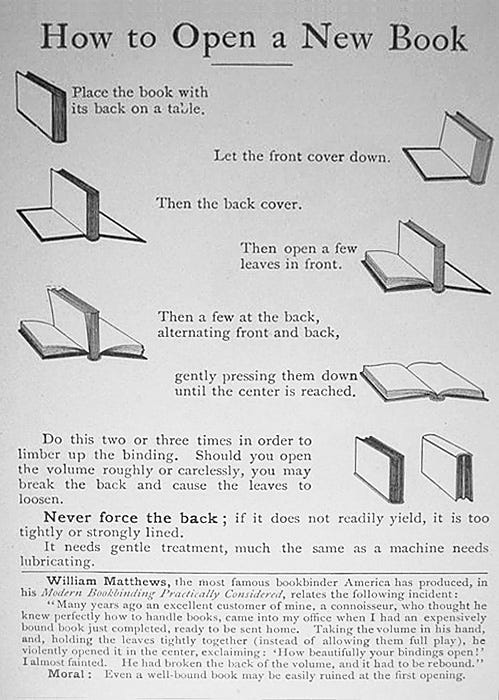
Opening a new book may seem so easy a baby could do it, but the dangers — from paper cuts and cracked bindings to the baby drooling all over the pages — are numerous. Luckily, there are a few techniques readers have developed over the centuries to ensure a smooth reading experiences. Here are a few of the most popular:
The Isaac Newton: A scientifically simple technique, the Isaac Newton uses gravity to soften the spine of new book.
The Hard Sell: This technique is popular at AWP book fair tables. It involves shoving a small press novel into the hand of an unsuspecting book fair attendee with such force that the spine cracks down the middle. Often coupled with the phrase, “Oh, you’ll love this one. You just have to buy it.”
The Spoiler: Readers who use The Spoiler start by opening the last page of a new book, then get pissed that they ruined the ending, and finally toss it — spine otherwise unbent — in a to-read pile in the corner.
Scratch ’n’ Sniff: People who love the smell of new books can use their nose to flip and press pages.
The Precious: A favorite of collectors who want to keep their books in as near mint condition as possible, The Precious involves only opening pages at a thirty degree angle to ensure the spine never bends. The downside is that readers often can’t make out the two words on each line closest to the gutter, but at least the books stay pretty.
Centipedin’: Centipedin’ uses hard bends every ~50 pages so that the spine is broken into many segments. These segments should run across the length of the spine. If they are running across the width of the spine, man, how did you do that?
Puppy Earing It: Readers with puppies or small dogs can slide a few treats between the pages of a new book and let their dog loosen up the binding as Fido digs for a snack.
The Pick a Card!: Here, a reader flips the pages back and forth rapidly while every now and then smashing a forefinger into a random page.
Ogre Open: The Ogre Open often happens by accident. A reader will be attempting to gently fold a section of the book and instead snaps the glue with their dumb, clumsy hands. Ogre Openers tend to get pissed, promise themselves they’ll gently bend the next section, then screw it up again fifty pages later.
Karate Chop: This is the only opening technique that does not actually involve opening the book. Instead, the reader says “hiya!” and firmly chops the spine from the outside until sufficiently loosened.
The Assembly Line: Good for book clubs, this book opening technique requires at least three people: one to lay the book on its back, a second to bend the spine at regular intervals, and a third to gently press each section down.
The E-Reader: The E-Reader involves clicking a button on some gizmo and then smugly talking for twenty minutes about how paper is dead, only luddites read physical books, and the future of literature is 3D-printed, cloud-based hypertext fan fiction Google Glass apps.
The “I Totally Read That”: This method is for readers who frankly have better things to do than read a book — like cable TV marathons and candy-based cellphone games — but who still would like to look well-read. Basically, all you need to do is chaotically ruffle, bend, dog-ear, punch, and scratch at the book until it looks like a novel lovingly reread a dozen times. Then place it on the shelf for any guest to see.
DON’T MISS OUT
Sign up for our newsletter to get submission announcements and stay on top of our best work.
YOUR INBOX IS LIT
Enjoy absorbing fiction from Recommended Reading on Mondays, strange, diverting work from The Commuter on Wednesdays, and a roundup of our best work of the week on Fridays. Personalize your subscription preferences here.