Hmm, to explain myself, these three sonnets [below] are part of a sequence I’ve been working on since 2008. My sonnets have been read by pornstars, webcam models, and now I’ve moved onto avatars, who I recorded from the avatar website, sitepal.
Now, I know sonnets are old fashioned and quaint, but if you indulge me, the next time we have a drink I’ll pick up the tab, or at least let you run out of the bar first.
Ok, good, so, when I first started writing these, I was working with the structure of a “Shakespearian” sonnet, which of course wasn’t invented by Shakespeare, but is now associated with him. I had, uh, “bard on the brain,” having just finished All the World’s A Grave (Plume, 2008), a new play I wrote by culling and rearranging lines from the works of Shakespeare: Prince Hamlet goes to war to capture Juliet, and returns to his country to find that his mother had murdered his father and married Macbeth. But for the sonnets, I couldn’t stick with Shakespeare, and I adjusted and revised until I had what I think is a contemporary, American form: 13 lines, with rhymes that aren’t consciously audible. (Side note: Did you know that execution day in early America was Friday the 13? If you had hot corn to sell, that was the day to go the town square to find a crowd.)
Oh, but I have kept Shakes’ themes.
Sonnets, in my estimation, are about sex and lust, and occasionally self-righteous rage.
That seems like a “timeless” list of subjects, no?
I rankle at the notion of “timelessness.” Usually, such talk is the stuff of forcing some kid to read something boring (to keep them in the safe stuff; the more contemporary, the less sanctioned). Either that, or it’s an excuse to produce work that’s politically absent, i.e., politically passive (and encouraging of passivity).
One of the things I wanted to do in these sonnets was bring them into a contemporary mindset, and out of the atavism that’s associated with “poetry.”
Of course, that’s the reason that five of the “Seven Webcam Models read Sonnets” (published by Vice) were banned from youtube. (Here’s a bit about that at PEN.) I wanted Webcam models because they’re the now pin-up girl, the now representation of sex and lust. Sonnets or webcam performance: it’s art about sex and lust. Webcam performers never see their patrons live, are completely independent, and remotely stir up emotions and thoughts that their audience may not be able to access without them — just like poets. I never in my wildest dreams thought I would be so fortunate as to find someone to play out the hypocrisy of “poetry is only for the finer folks, i.e., not webcam models and their ilk,” but youtube did it.
But back to timelessness. As much as sonnets are a thing of the past, as much as poetry is presumed to be not the stuff of the webcam model and a contemporary ethos, sonnets fit perfectly on smartphone screens. For the last five years, as I muddled through the city, drinking martinis and showing people my latest sonnets, that was something I grew to appreciate.
Sonnets are a perfect 21st century text delivery vehicle.
And that was something that got me to thinking about how sonnets move through time, and move us through time. And that, in turn, got me to thinking about avatars, which are pretty eerie: as our descendants, they feel like they’re looking backwards at us — like we’re in the past and they’re in a present that’s inevitable. And that line of thinking led to “avatars read sonnets,” because it’s our future. Poetry is a kind of time travel, and these things are our future selves.
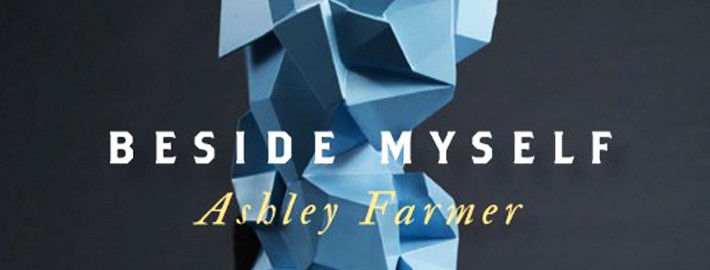
In Beside Myself, Ashley Farmer tells 53 stories in 112 pages. Her debut collection of (mostly) flash fiction is fractured by design, relying on recurring images — neighborhood lawns at night, amusement parks, tunnels of love, grocery stores, TVs turned to the news, cosmetics counters at malls — to provide cohesion. On the surface, each story seems to take place in a recognizable reality, but then
Farmer scrapes at that realistic surface like a puppy at a door, wanting to be let outside to play.
The “reality” of Beside Myself is an off-kilter one, where a man who has fallen over can be unzipped to reveal a smaller man inside, “curled like a question mark.”
Beside Myself is published by Tiny Hardcore, Roxane Gay’s independent press, and these stories are the sort of elliptical experimentations you’d expect when reading an issue of the often-excellent PANK, the literary journal also edited by Gay. Farmer’s stories has been published in a number of hip literary places — not only PANK, but also DIAGRAM, elimae, HOBART, Juked (where Farmer is an associate editor), etc. — which doesn’t surprise me.
Her work is reminiscent of Aimee Bender, Sheila Heti, and Aurelie Sheehan
’s recent collection, Jewelry Box.
Farmer’s best stories take at least a couple pages to tell. In “Coffin Water,” a warning from a father brings about thoughts of funerals and leaking caskets, finally reaching a moment where the young narrator realizes the gaps of knowledge in her father’s thinking about the world, and also in her own. In “DMV,” a driving test — particularly, some melted figurines on the dashboard — leads to a sort of spiritual awakening, the narrator realizing that there are “hands everywhere: one guiding the car like a toy, one waving us toward the bridge, another pointing to the bank of the river.” In “Where Everyone Is a Star” (the most conventional story here), a woman who has “been hired to guide children’s bodies through the air” sees her entire marriage crumble against the backdrop of a gymnastics competition. Elsewhere, a grandfather makes neon light, a tiger yearns first to be captured and then to be free, and a game show contestant’s answers become abstract (“I guessed ‘__’”).
Little in Beside Myself grips — or intends to grip — on a narrative level. Characters seldom have names and blur from one story to the next. To the degree that a reader recognizes him/herself in these pieces, it’s like stepping, as one of Farmer’s characters does, “through shards of [his/her] reflection.” Taken individually, each story is fascinating. But as a collection, its elusive quality occasionally wears me out. These stories keep slipping away, and Beside Myself resists sustained meaning; what does it add up to?
Still,
Beside Myself — closer to poetry than fiction — haunts with its lovely use of language
. This might be Farmer’s foremost goal. Stars are referred to as “pushpins holding black fabric together.” A field is “a surface of water complicated by moonlight.” During sleep, “sheep count you.” The best moments remind the reader that reality can be a strange, startling place. “There is always so much surprise along the path to the barn,” Farmer writes, and Beside Myself introduces a writer who excels at finding all those surprises hidden in the dirt.
Visit Tiny Hardcore Press’s website to preorder the book.
On Friday, we tweeted about the hypothetical, hardcore “metal-fiction” genre. Suddenly, thanks to our creative and clever followers, the #MetalFiction hashtag was born. After combing through over 200 hundred contributions that combine classic literature with heavy metal bands, here are our 41 favorites.
In an age when it’s assumed that any well-received book will have a film adaptation follow, and when many writers forgo the novel and go straight for the money-making screenplay, it is expected that all authors would relish the opportunity to have their stories brought to the big screen. But this was not much the case for Kurt Vonnegut. After two live-action adaptations of his work, he renounced the medium in the preface of the script for a made-for-TV movie he made in the early ’70s. Excerpts from the movie can be found on YouTube and also on The Airship Daily, although full-length copies are few and far between.
“I am not going to have anything more to do with film–for this reason: I don’t like film,” he writes. “Film is too clankingly real, too permanent, too industrial for me. As a stingy child of the Great Depression, I am bound to complain that it is also too fucking expensive to be much fun.”
From 1972’s “Between Time and Timbuktu”
The movie, Between Time and Timbuktu, is an amalgamation of some of Vonnegut’s short stories and was written primarily by Emmy-winning writer and director David Odell. 20 years later, Vonnegut must have changed his opinion, as he appeared in a short-lived TV series based on his collection of short stories, Welcome to the Monkey House.
However, the stage was a kinder beast for Vonnegut. In an interview with The Boston Globe, Vonnegut’s literary executor, Donald Farber, recalls how Vonnegut came alive when was writing for the stage. “Kurt would write books, and it was lonely,” Farber said. “When he got into writing plays, we all assembled at the theater and we had a ball. It was an adventure for him. It was an opportunity to socialize and work on the play and be around the theater instead of sitting in a room by himself typing out a piece of paper and throwing it in the wastebasket.”
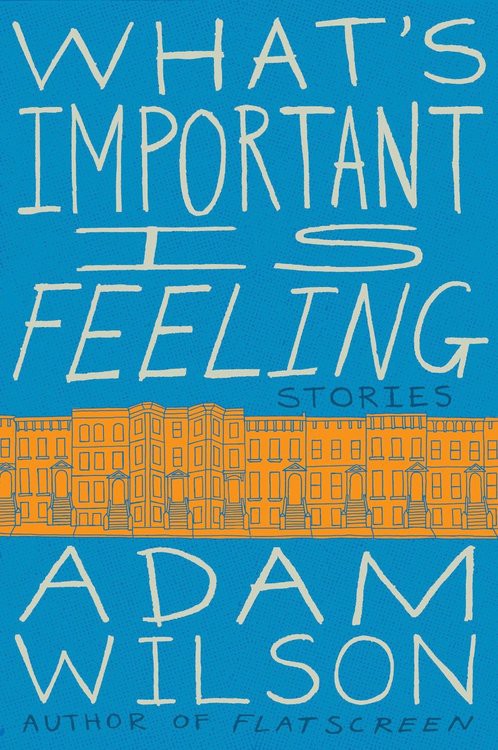
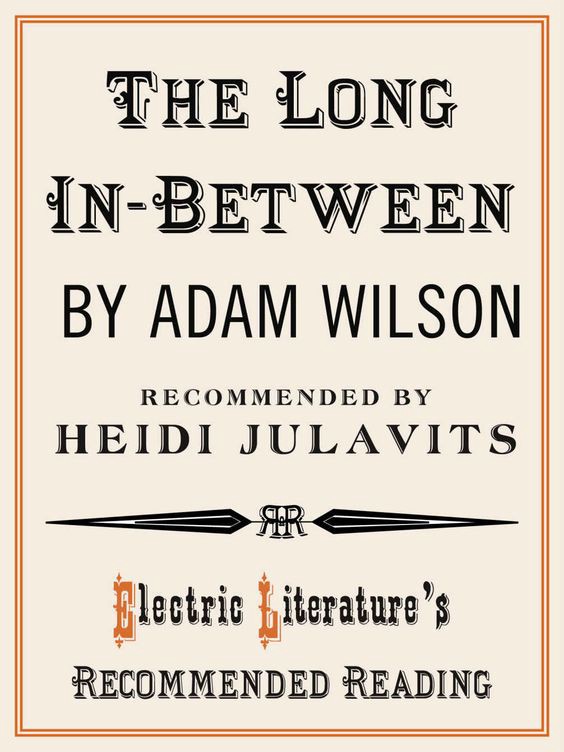
Heidi Julavits, the award-winning author of The Vanishers and co-Editor of The Believer, is the guest editor of the latest issue of Recommended Reading. This week’s story, Adam Wilson’s “The Long In-Between,” will appear in his forthcoming collection What’s Important is Feeling. In her introduction, Heidi calls “The Long In-Between” “incredibly funny” and “a great relief to read.”
Read the story for free online, get it for Kindle, or download it on the Recommended Reading app for iPhone and iPad.
Last fall someone sent me a link to a New York Times Opinionator blog post called “When Clothes No Longer Make the Man,” the opening paragraph of which ends with this alarming assertion: “the writing of fiction where the device of disclosing the nature of character through clothes seems to all but be destroyed.”
Click to purchase the full collection
Destroyed! I imagined fictional industries disappearing — ateliers shuttering, textile factories closing down, whole closets of fictional clothing sold on ebay at disrespectfully low prices. The writer, Lee Siegel, goes on to claim that today’s fiction writers no longer use clothing to provide character clues because appearances are increasingly rigged, and thus implicitly meaningless. “Clothes,” he writes, “have become more like costumes, intended more to hide than reveal who we are, or what we would like to be.”
So much is wrongheaded about this argument — not least of which is Siegel’s failure to understand that clothing is and always has been a costume, i.e. that clothing has never communicated a crystalline message but rather a highly complex visual code that, depending on a character’s (or a person’s) place in history (and actual place — are they on the beach? In the boardroom?), requires different keys to crack — but I’m embarrassed to say that, in the midst of my deep irritation, I blamed this wrongheadedness on Siegel’s certain variety of straight maleness. Only a certain variety of straight man, I peevishly thought, would fail to see how even the examples he cites to support his thesis — Zadie Smith describes a character wearing flip-flops and cargo shorts — actually undermine it. Flip-flops are not Birkenstocks. They are not Tevas. They are not Jesus thongs or cork wedges or Dr. Scholl’s or even, in the plainest possible iteration of this category of footwear, “sandals.” This character is probably (I’m guessing — Siegel refuses to give the context — is she at her father’s third wedding? Her first day on the job as a commercial air pilot?) low-key and I-don’t-give-a-fuck or is trying to appear low-key and like she doesn’t give a fuck. The difference between what a character wants us to believe about her (via her clothing), and what we know, from other cues, to be true, well, within that gap is where we’ll find a naked, telling human.
At any rate. I wanted to write a retort, but who has the time? Instead I huffed and stewed. And then I read Adam Wilson’s short story, “The Long In-Between.” This story — written by a straight man! — is the most perfect rebuttle to Siegel’s thesis that now I can now stop worrying about the fate of fictional clothing ateliers; more importantly, I can stop worrying that all those straight men out there are failing to even notice (never mind break) my daily code. Adam’s story is about surfaces and facades, and his characters are quite aware of how they succeed and fail to communicate their intended (or not) identities through the artistic medium of hair, clothing, the “occasionally affected Pan-European patois,” the name-checking of Edward Said and Judith Butler. This is a short story that reads like a psychological and sociological study of contemporary plumage strategies. It is also incredibly funny, and it involves Israel, lesbians, incest, and academics. Mel Gibson makes an appearance. It features Sam Lipsyte-quality sentence art. It features the flaneur-istic architecture of a Deborah Eisenberg story. It is smartly dense while also reading breezily. It is an impressive pleasure — and to this person, currently wearing a highly encoded and incredibly misleading outfit — a great relief to read.
Heidi Julavits
Author of The Vanishers
Click to purchase the Kindle edition
The Long In-Between
by Adam Wilson, Recommended by Heidi Julavits
In August of 2006, during Israel’s relentless bombing of Lebanon, and days after Mel Gibson said his piece about the Jews, I came to New York City to live with a woman who had once been my college professor. Her name was Elizabeth, and she was staying, for the summer, in a SoHo loft previously occupied by an internationally famous daytime talk-show host. The Host had since moved one flight up to the building’s penthouse, where he threw lavish parties, audible through the floorboards, a weekly reminder of New York’s immutable social infrastructure. No matter how high you climbed, there would always be someone above you.
I knew none of this when I arrived on the Fung Wah bus from Boston. It was a hot day, and humid. The sky was purple-gray, clouds swollen with coming rain. My hair was a mess. My bra clasp dug into my spine.
I dragged my suitcase from the subway, eyeing the women on lunch break whom I’d come here to become: interns in bubble skirts tapping furiously at cell phones, their legs moving in long, deliberate strides. They appeared to be members of a similar but distinctly different species. A taller species.
The elevator opened directly into the apartment. It was an oblong, open space decorated in a series of large abstract paintings accented in gold leaf, and ugly. The furniture looked imported from a Palm Beach condo: white shag area rug with matching throw pillows on white leather love seats and recliners. The walls were cream colored, or crème colored, according to Elizabeth, who occasionally affected a Pan-European patois. The other walls were windows. From certain angles you could see across Greene Street into the Apple Store. A kitchen emerged at the end of the room, complete with two industrial sinks whose gleaming hoses wrapped themselves like long bracelets around the spouts.
I was not particularly impressed. I’d grown up middle class in an upper-class suburb of Boston and had spent countless hours in friends’ McMansions just as tastelessly gaudy as this Prince Street apartment. The décor signified a brand of generic wealth that I had come to find provincial.
Elizabeth appeared from behind the fridge.
“Darling, you’re here,” she said. “Welcome. Isn’t this place hideous?”
Elizabeth walked on tiptoe; she still fancied herself a dancer, though she’d quit ballet in college. She wore a terry-cloth robe that showed off striated thighs and taut, toned calves. She was three inches taller, but otherwise we looked almost the same: flat chests, no hips, prominent cheekbones, “penetrative” brown eyes, Ashkenazi noses, and pale skin caked with foundation. It was a look that had failed me through high school and most of college, but I had high hopes for my new life among the sun-fearing fashionistas. Androgyny was back after an overdue hiatus.
Elizabeth, almost twenty years my senior, was the product of previous boom times for heroin chic. She’d spent the better part of the nineties complementing the look with an actual needle stuck in her arm. After rehab, she’d managed to buckle down and finish her thesis, a sunless tract on AIDS and the American death drive. The published version had earned her a small following in certain academic circles. Now she carried herself with a jaded self-confidence that attracted men and women alike — but mostly men, and mostly gay — and that I did my best to emulate.
During my four years of college I had developed what is sometimes called a girl-crush — though the term sounds too cutesy for what I felt — on Elizabeth. I’d taken her class on late capitalism (the syllabus was divided between Edward Said and Judith Butler) in the second semester of my freshman year. By semester’s end I had already copied her hairstyle (straightened black bangs), clothing style (gothic airline stewardess), and eating style (S.S.S. — soup, salad, sashimi), and was finding excuses to stop by her office on an almost daily basis.
Elizabeth was new to Boston — she’d done her graduate work at Columbia — and seemed appreciative of both the company and worship. I saw her as the epitome of urbanity, and the embodiment of an academic idyll that otherwise existed only in past tense novels by nostalgic baby boomers. Elizabeth and I played out this campus fantasy, smoking imported Gauloises on the library steps and discussing all relevant isms. But mostly we talked about the men in our lives, whom we referred to as our dudefriends.
“Dudefriend thinks it’s his life’s work to sperm up my eggs,” said Elizabeth, once. “If only we were lesbians.”
“If only,” I said, unsure what she meant. Was the implication that we would be a lesbian couple, or just a couple of lesbians?
“I mean, I’m not one of those overpopulation people, or worse, the oh-so-magnanimous doomers who don’t want to subject a future generation to blah blah blah. But what happens when my son is molested by his math teacher?”
“Isn’t that a cross-that-bridge-when-you-get-there sort of thing?”
“Oh, he’ll definitely get molested,” said Elizabeth. “The question is whether to uphold the traditions of our rape-shaming society by telling him his body has been traumatized, or refrain from comment and hope he remembers it fondly, some kind of passionate hug session from the man who taught him Boolean algebra.”
“What kind of school are you imagining this is?”
“School of hard knocks,” said Elizabeth.
When she decided to sabbatical in Manhattan, it seemed natural that I tag along. I was, by then, two years out of college, with no life goal except the vague intention to move to New York as soon as I could afford it. Elizabeth was able to secure me an internship at an ad agency run by an old family friend, so long as I promised to maintain ironic distance from the industry’s consumerist credo, in much the same way that Elizabeth “ironically” bought dresses at Barneys.
She led me to a small room behind the kitchen. The floor was stacked with books and printouts. There was no desk, just a coffee table, couch, and mounted plasma television, unplugged. A week-old Times was open on the table. The photo showed a bombed-out building in Beirut. A shirtless man lay injured in the rubble, trapped beneath fallen pipes. Another man tried to lift him out by the arm, but the injured man appeared limp and immobile, content where he was.
“My office,” said Elizabeth. She cleared space so we could sit. We lit cigarettes. Elizabeth ashed on the couch.
“My cousin’s,” she declared with a wave. “Or his for now at least. He bought it for eight, wants to sell it for ten. Old story. And I get to squat here until fall when the market’s meant to change. The art and furniture are rented, by the way. I did my best to dissuade him.”
I’d heard of this cousin, an I-banker. Elizabeth liked to brag about the non-penetrative experiments they’d engaged in as adolescents in Pittsburgh. The Cousin was tall and handsome, and still felt guilty about these encounters, which he remembered as being only semi-consensual. Elizabeth remembered things differently — in her version, she was the aggressor — but she liked the power position his guilt placed her in. For years he’d been paying off Elizabeth’s Amex.
Elizabeth caught me scanning the Times.
“Hideous,” she said. “Just hideous. Women and children they’re killing. Innocents. It makes me sick. And the macho Republican Zionists like my cousin cheering them on.”
The last part irked her most. Two things Elizabeth hated were Zionism and machismo, though she’d flirted with the former on kibbutz after college (“Yitzhak Rabin and pharmaceutical-grade ecstasy, darling — those were different times”) and the latter was a trait she proudly manifested. I do not mean to suggest that Elizabeth’s sympathy for Lebanese civilians was insincere, but something about the word hideous — the same adjective she’d used to describe the apartment’s art — made me wonder if it wasn’t all theory for her, some kind of ideological chess match unrelated to actual suffering.
“It’s terrible,” I said, and hesitated, resisting a defense of what I knew was indefensible. Israel was a sore subject between us. I’d been indoctrinated early, and there were feelings from my upbringing I had trouble abandoning. Members of my own family had been exiled from Europe, shipped to Palestine for refuge while their parents were murdered. Besides, the Arab treatment of women and homosexuals didn’t seem to mesh with the radical queer feminism we both espoused.
“You’re right,” I said. “Horrible.” Which it was. Israel was behaving horribly with its showy display of firepower, raining bombs over Beirut as if it were a video game. I’d said so to my father when he’d defended the attacks, ranting at the dinner table about Hezbollah, spearing a chunklet of chicken on his fork and waving it for agonizing minutes while he continued to talk. “They want to destroy us,” he’d said, but it was he, with his hate-filled eyes and four-pronged flesh flag, who appeared bent on destruction. He and the young Israeli soldiers I’d seen photographed shirtless on the Internet, holding Uzis in perfect hip-hop posture.
At home, it was easy to argue with my archaic, conservative parents, but out in the world I fought urges to defend their worldview, to fight my leftist friends who seemed to stick up for every minority group except the Jews. There was general agreement that assimilation had happened and anti-Semitism in America was a thing of the past, but I couldn’t shake the sense that this dismissal was its own anti-Semitism, or an excuse for it. Jews were the new WASPS: privileged, powerful, perfect targets for blame.
I sniffed my armpit.
“Take a shower, darling,” said Elizabeth. “The bathroom’s something to believe.”
The fete was held so I might meet prospective suitors. I’d recently broken ties with my dudefriend, Clarke, who’d taken a prestigious gig gofering for the House’s only out-gay congressman. Suitors was the word Elizabeth used. Fete was also her word, though it was only a dinner party. The real fete was upstairs, at the Host’s apartment. His bass shook and rattled the glass table, making music with our tumblers.
Elizabeth leaned into Mike, her on-off, surprisingly all-American dudefriend. The others disdained him and baited him, he of the strong jaw and aggressive heterosexuality. According to Elizabeth, Mike had once been a star PhD candidate in sociology at Yale, but a car accident had rendered him partially brain damaged. He occasionally showed flashes of past brilliance, blurting full-formed ideas after hours of silence, but most of the time Mike fumbled his words, failing to articulate what was there on the tip of his tongue, tantalizingly out of reach. He was also always drunk. Mike was a happy drunk, and treated me with warmth. Elizabeth’s friends brought out the worst in him. “Stop, please,” Mike said, but Nikil kept on talking.
“Michael,” said Nikil. “I am not, as it were, defending Melvin Gibson. I am simply pointing out that, if the situation were reversed — if Mr. Gibson had slurred against Arabs or homosexuals — then no one would be quite so up in arms.”
Mike pressed tumbler to forehead and let out a sigh. We’d been on the subject for most of the evening, but Nikil couldn’t let go. Mo leaned into Nikil and squeezed his partner’s elbow.
“It’s no use,” said Mo, shaking his shiny, shaven head. “He’s never going to understand.” They spoke of Mike like he wasn’t there. It occurred to me that Mike, a protestant from Chicago, was the only member of the ethnic majority in our group.
“Well, if you won’t defend him, then I will,” said Elizabeth. I thought she was talking about Mike. Elizabeth rose from her seat, raised her tumbler.
“Mel Gibson had every right to say what he said,” said Elizabeth. “It’s about time someone did.”
“Salut,” said Nikil, and they clinked drinks. Elizabeth wiggled her butt a little bit.
“If the situation were reversed, then wouldn’t Mel Gibson be the Jewish one?” said Suitor #1, a brunette named Brian Feldstein whom I disliked immensely.
Feldstein was attractive enough, with clean teeth, hazel eyes, and the kind of the cock-clipping skinny jeans that were just coming into style. What annoyed me was his closeness to Elizabeth. He’d graduated a year ahead of me, and was, by all accounts, her first and truest protégé, a whip-smart artist of the sneer and bon mot, in whose shadow I stayed. Besides, I thought he was an asshole. In class he’d always cut down my comments, and at parties he alternated between ignoring me and acting overly familiar, draping an arm over my shoulder and calling me “kid.” I considered Feldstein my nemesis. Not that I’d say so to Elizabeth. There was an erotic element to his idolatry that Elizabeth enjoyed, and that I couldn’t quite provide. I sensed he saw me as some kind of consolation prize. I solaced myself by imaging Feldstein masturbating in the dark, cradling his pathetic penis, resigned to the fact that he would never fuck either of us.
“We mustn’t speak in hypotheticals,” said Nikil, who always spoke in hypotheticals. He himself had been a protégé, along with Elizabeth, of the great Said. “We must approach the reality of the situation, which is this: the Israelites invaded Palestine, brought about apartheid, and enjoy the careless killing of Muslim women and children. To phrase it any other way would be to euphemize, anesthetize, soften the blow. We cannot share sympathy with this murderous regime. We cannot let tribal allegiances get in the way of reason.”
Elizabeth listened intently, still standing, prepped for another salut. I wanted to point out that Palestine and Lebanon were two entirely different countries. Mike refilled his scotch and drank it down in a long gulp without grimacing. Tonight was more of the same — the things he put up with for Elizabeth’s love. Or “love,” as she often reminded us, fingers raised in fangish air quotes. Feldstein placed a hand on my knee. Mo looked at Nikil and said, “Lighten up,” and Nikil’s face broke into a boyish grin, and soon everyone was laughing.
“Sorry,” said Nikil. “I’m so used to trying to fire up my students that it carries over into dinner party zealotry. Jesus, this is good scotch.”
Suitor #2 lit a joint and passed it to Nikil. When their fingers touched, #2 — another old friend of Elizabeth’s from grad school — leaned into Nikil and noogied his head.
“The picture of ethnic harmony,” said Elizabeth. “If only you two were the leaders of nations.”
The evening went as planned. After ten minutes of #2’s valiant but futile cunnilingus, he stroked my hair and said he understood. He’d seen my face; he knew it wasn’t easy to leave the tribe. “Nikil knows he’s a hypocrite. He would be stoned to death in Pakistan. The best thing that ever happened to him was being sent to that boy’s school in London.”
The word lover is ridiculous — perhaps even redonkulous — and it speaks to my state of generational denial that I referred to #2 as my lover, and refused to acknowledge that redonkulous was a word. That fall, when I was sharing a place in Greenpoint with Jenny and the Piñata Artist, I used the word redonkulous to describe, among other things: piñata art, Elizabeth, the Prince Street apartment, and Mr. #2 himself.
My lover was exactly twice my age, and from Omaha, but he lived like a British bachelor, surviving on Heinz beans, bodega tomatoes, and Earl Grey tea. He owned neither mop nor broom, and was constantly reshaping his redonkulous goatee.
The situation wasn’t exactly what I had in mind, but Elizabeth seemed so happy about the match, and I liked the way he knew what I was going to say before I said it, and that he read poetry as well as theory, and his furry gut, which I found refreshing after years of envying Clarke’s smooth six-pack. Elizabeth said it was always a good idea to date someone uglier than yourself, though she’d broken her own rule with the objectively hot Mike.
#2 had a poorly self-assembled Ikea bed frame, so we spent most nights that week on an air mattress at Elizabeth’s — the Cousin had rented decorative furniture to display to potential buyers, but not beds. We shared a spare room the Host used for stashing his children when they’d visited from L.A. The rooms had not been repainted, and ours bore a safari mural on all four walls. Giraffes, monkeys, and lions watched over as we screwed and talked and slept.
The sex had improved considerably since Elizabeth and I had bought matching vibrators. I could get off in mere minutes if I used it while he entered from behind. For her part, Elizabeth said Mike refused to incorporate the object out of masculine insecurity. She said it like she was impressed.
In the mornings I would head to my internship, dressed in clothes from Elizabeth’s closet, plus a pair of heels from Barney’s that she’d bought me on the Amex and that raised me to an appropriate height for a SoHo intern.
The work was tedious and brainless — light administrative stuff and the maintenance of a couple Excel spreadsheets — but I was happy there, bitching with the other interns about the idiocy of our bosses and of print advertising in general. None of us planned to stay past summer. Print was dead, digital was here, and these old-fashioned agencies would be razed to make way for start-ups that better appreciated our web-heavy résumés.
I went along with this talk, though I was privately a print nostalgic, fantasizing about using the gig as a gateway to glossy magazines. Anything seemed possible. The others were from Reno, Gainesville, and Iowa City, and I came to understand that the SoHo aliens I’d initially found threatening were only posers like me, that in fact all of real New York was itself a simulacrum of the somehow realer New York of our Hollywood-assisted imaginations.
Happy hour was upon us. Jenny said, “Ugh, I hate my arms,” code meaning either “Compliment my arms” or “Criticize a part of your own body in solidarity.” She was a fellow intern, an F.I.T. grad from Seattle with an upturned Irish nose, prominent American breasts, straight blond hair, and impeccable fashion sense. Jenny complained ad infinitum, but registered these complaints in the knowingly jocular tone of one who understands the relative triviality of her issues. I could tell she thought I took myself too seriously.
“My neck makes me look like a bird,” I said, and waited for someone to disagree. No one disagreed. We sipped vodka tonics, vodka-tinis, and vodka-Tito’s, which were like margaritas, but with Tito’s brand vodka instead of tequila, plus a splash of Red Bull.
“Your guy’s in the news again,” said Jenny.
“What guy?” I imagined #2 on the front page of the Post, led away in handcuffs by campus security. A girl points an accusatory finger. She’s wrapped in a blanket and looks like a less birdlike me.
“The talk-show host. Dude’s been getting crunk since the breakup. Plowing through B-listers. He’s supposedly throwing these parties every night. It’s super sad. You gotta get your skinny ass up there.”
“Perhaps,” I said, and checked my cell. I was supposed to meet Elizabeth, Mike, and #2 for dinner in twenty minutes.
“Can’t you ditch?” said Jenny.
“Elizabeth would kill me. She had to pull strings to get the reservation.”
“Or at least meet up later? Party tonight at Aaron’s. Maybe find a boy your own age, sucka.”
“Sorry,” I said. “Maybe next time.” I pounded my Tito’s and left a twenty on the table.
The line at the restaurant spilled onto the street. Mike stood apart from us, smoking, giving off a moody vibe.
“What’s his deal?” I asked Elizabeth. “Probably his period,” she said. #2 let out a giggle, but I felt bad for Mike. He and Elizabeth got along in private, but she treated him terribly around other people. My favorite night so far was Sunday, when the three of us had watched a movie on Elizabeth’s laptop. The film was plotless and opaque. Instead of paying attention I’d focused on Mike, whose body lay beside mine, Elizabeth’s head in his lap. Mike’s fingers curled around her bony biceps, closing so thumb met fingertips. I could tell that Mike, too, had lost interest in the film — only Elizabeth followed the action on screen — but he wasn’t bored. He looked perfectly peaceful stroking her hair with one hand and her arm with the other, the weight of their bodies sagging the air mattress, making my side rise up like a small, cresting wave.
At dinner, when the plates had been cleared, Elizabeth made an announcement.
“I’ve decided to write a screenplay,” she said. “Get out of academia once and for all.”
“Get out of academia?” said #2. “That’s devil talk, lady. Blasphemy. Universities are the last safe places for ideas in this capitalist oligarchy.”
Universities were also the last safe places for #2. They accommodated his perpetual adolescence — the drinking and fanciful facial hair and impressing girls like me — and he took offense at Elizabeth’s insinuation that his kingdom was a ghetto. That Elizabeth had tenure made it more annoying. #2 adjuncted at Baruch and City College, mostly freshman comp. He blamed his failure to rise on the fact that Jews weren’t the beneficiaries of affirmative action. This was a good thing for society, he made a point of pointing out, but bad luck for him as an individual.
“Academia,” said Elizabeth, “is just so academic.”
“So what’s the screenplay about?” I asked, horrified. Why wasn’t I privy to this information before she’d made the announcement? Why hadn’t she asked me to collaborate?
“Postmodern incest,” said Elizabeth.
“As opposed to the other kinds of incest?” said #2.
“As opposed to bullshit,” said Elizabeth.
“This should be good.” Mike’s tone was sarcastic. He’d finished four bourbons during dinner. Mike slumped in his chair, pulled at his open collar.
“I don’t follow,” said #2.
“It’s the last taboo,” said Elizabeth. “The film is about a brother and sister who announce themselves as a romantic unit. Their parents don’t understand. Their friends don’t understand. Even you all at this table, my closest friends, my most” — air quotes — “enlightened friends, look at me like I’m sick for uttering the word.”
Mike didn’t look at her like she was sick; he looked at her like he was sad. He had a pained wrinkle between his eyebrows that reminded me, for a moment, of the Lebanese man lying injured in the rubble.
“Stop talking,” Mike said.
“No, I want to hear this,” said #2. “Please enlighten us, Elizabeth.”
“The shrink thinks the girl has Stockholm syndrome. That it all leads back to childhood trauma. Truth is, brother and sister are incredibly attractive, and they want each other. They” — air quotes — “love each other. The love” — air quotes — “that dare not speak its name.”
“And what about kids?” said Mike. “What about the… the…” His arm made a circling motion.
“Genetics?” I said.
“Genetics,” Mike repeated. “What about the goddamn genetics?”
“They don’t plan to have children. They see themselves — their lifestyle, really — as the end of the evolutionary line. They are the last generation. It’s a de-evolution, a return to amoeba sexuality, the final frontier for humans.”
Mike made a fart sound with his mouth.
“I think what Mike means,” I said, trying to diffuse the tension and make myself indispensable, “is that it seems unbelievable for them to be American characters. But what if you made them German? Could that work? I think that would make a lot of sense.”
“But I still don’t understand what it’s about,” said #2.
“She wants to fuck her cousin,” said Mike. “That’s what it’s about.”
“And that makes it postmodern?”
“I slept with my cousin years ago,” said Elizabeth. “That has nothing to do with it.”
“You said you only did second base,” said Mike.
“And that doesn’t count? Is that what you’re saying? That the sex act is only complete once the man has come to climax?”
“It’s a joke to you,” said Mike. “Everything’s a joke.”
“Darling,” said Elizabeth. “I’m dreadfully serious.”
“You’re ruining… ,” said Mike. “You’re ruining… and you’re so fucking noncha… noncha…”
“Nonchalant,” I said, though I’d lost the thread.
“Nonchalant,” said Mike. “So fucking nonchalant. You’re ruining your life.”
“By writing a screenplay?”
“You know why,” said Mike.
Elizabeth barred her arms in an X across her body.“This is not your decision,” she said.
In bed I asked #2 why he’d never dated Elizabeth. I’d assumed he wasn’t up to her intellectual standards.
“Are you kidding? She’s a psycho.”
“Eccentric.”
“Psycho. You know she was in the nuthouse, right?”
“You mean rehab. For heroin.”
“That JAP’s never shot heroin in her life. Maybe she snorted it once or twice.”
“Don’t call her that. It’s an ethic slur.”
“But I’m Jewish.”
“That makes it worse,” I said. I rolled over, checked my cell. There was a picture text from Jenny. She posed beside a pyramid of White Castle burgers. A tattooed dude leaned toward the pyramid with his mouth wide open. The way they’d shot it made it seem like he had a giant mouth, big enough to fit all the burgers at once. Jenny looked like she was laughing.
“You don’t like me much,” said #2. “Do you?”
“No,” I said. “I guess I don’t.”
The roof overlooked Manhattan from across the river. A film crew was set up on the street below. A fifty-foot crane lit the neighborhood, sharing long beams of light like a small, near sun, giving the city in the distance a surreal mystic shimmer, as if it weren’t there at all but were only a hologram sprung forth from the crane’s godly glow. Jenny held her phone over the edge to snap a photo. The photo came out blurry, black with a dot of white light at its center. “Ill,” said Jenny.
There were no more dudefriends or lovers. Elizabeth had ignored Mike’s calls for three days. #2 hadn’t even texted.
Jenny took my arm. We crossed the roof and then descended the ladder back into the party. A dozen donkey piñatas hung by tinsel from the ceiling. The piñatas were decorated with Polaroids of battered women. Every hour, the artist would ceremoniously smash one with a Wiffle bat, spilling an assortment of loose pills onto the partygoers. A group sat Indian style on the floor, sifting for Adderall among the Advil and CVS-brand antihistamine. The installation was called Mules.
Some dancers made a circle at the room’s center. Jenny said, “I love this song,” and pulled us in. Her style of dancing approximated jumping. She bounced further toward the ceiling with each upbeat, mouthed the words. It looked like Jenny was speaking in tongues, perhaps in prayer to the great lord of gravity, asking to be lifted, weightless, above us all.
Jenny’s eyes were closed. The other dancers looked around as they jangled, trying to match each other’s moves, or gauge the aptitude of their own. A dude made exaggerated air-humps in my direction, buffering against rebuff by pretending to be joking. I pictured Mike on the dance floor, pre-accident. In my head he was confident, fleet-footed. He wore a fedora, tap shoes, a white tuxedo.
I thought about leaving the party and showing up at his apartment. Mike in a bathrobe and day-old stubble, pleasantly surprised when he opened the door. We would not say a word. He would open the robe, and I would press my body against his, head to heart. He would close the robe around us.
I knew I was not someone who would show up at Mike’s apartment. Not out of loyalty, but because I was afraid. At some point, I let the air-humper hump my leg.
The clinic was just around the corner. The magazines were either in Spanish or stupid, so I stared at the TV while I waited for Elizabeth. The U.N. had urged both states to ceasefire, but Hezbollah refused to stop sending rockets and Israel refused to stop dropping bombs. CNN’s aerial camera circled over northern Lebanon, zooming in and out on devastated areas. From above, the region looked like a beat-up map, with certain sections so heavily creased and worn they’d become literal gray areas, topographical erasures.
In a few days, the current conflict would end, but I remember thinking, as I sat in the Planned Parenthood waiting room, that both parties were too stubborn and hateful to ever truly change, and so were condemned to an eternal cycle of murder and mourning, with occasional respites in between. Sometimes the respites were brief — a month, a year — but occasionally there would come a long in-between, long enough for the people to forget their grief and enjoy the prevailing peace. And I remember thinking that this state of being — the long in-between — was the best life had to offer.
On the walk to the clinic I’d asked Elizabeth if she was sure she wanted to go through with it. I’d seen enough movies to know I was supposed to ask.
“I’m forty-one,” said Elizabeth.
“That’s not too old,” I said, though I wasn’t certain of the science.
Two weeks later I will come home to find Elizabeth fucking my nemesis Brian Feldstein on the floor. He will be on top, arms clenching her neck in a not so gentle strangle. Elizabeth will moan, “Don’t stop.” When Brian sees me, he will turn and say, “Sup?” but he won’t stop strangle-fucking, and Elizabeth won’t even notice that I’m there. Shaking with anger, I will get back in the elevator, ride up to the penthouse, and trail a group of young women into the Host’s apartment. The room will be filled with people I vaguely recognize, and the Host will weave among these people, stopping for handshakes and back-claps before moving on to the next group. The Host won’t stop smiling, as if any change in expression might transform him into another, lesser being. When he approaches me, I will lean in and kiss his cheek as if I know him. His breath will smell of cough drops. His hand will grace my hip. A blogger will snap a photo from across the room, and in the morning I will be referred to as “Mystery Woman.” The photo will make it look as though he’s blushing at something I’ve said. Jenny and my other coworkers will ask for details, and I will tell them I don’t kiss and tell, but say it in such a way — slightly smirking, one eyebrow raised — as to imply that, yes, perhaps I am not so innocent as they might have imagined.
That afternoon, Elizabeth will come into the kitchen and ask if I am angry at her. I’ll lie and say I’m not angry, because I have no real right to be angry. Elizabeth will say, “Well, I’m starving,” and eat peanut butter from the jar with a plastic spoon. She’ll say, “Don’t you get it?” and I’ll say, “Get what?” and she’ll say, “I did it ironically. The whole thing was ironic.”
When we got back from the clinic it was already evening. The Apple Store’s sign lit the street, opulent white, iconic apple frozen in its bitten state.
Elizabeth plugged in the TV. There weren’t any channels, just fuzz. “Shit,” she said. “I never called Time Warner.”
The fuzz was antiquated, analog, a remnant of another era. Elizabeth left the TV on. She laid her head in my lap.
“I have you,” she said. “You’re mine.”
I took a long, deep breath. The A/C was cool against my neck. I wrapped a strand of Elizabeth’s hair around my finger.
“I’m yours,” I said.
End
About the Author
Adam Wilson is the author of the novel Flatscreen, a National Jewish Book Award finalist, and the forthcoming collection of short stories What’s Important is Feeling. His stories have appeared in The Paris Review, Tin House, VICE, and The Best American Short Stories, among many other publications. In 2012, he received The Terry Southern Prize which recognizes “wit, panache, and sprezzatura” in work published by The Paris Review. He teaches creative writing at NYU and Columbia and lives in Brooklyn.
About the Guest Editor
Heidi Julavits is the author of four novels, including the PEN-award-winning The Vanishers. She is the co-founder of the highly influential cultural magazine The Believer, and is currently, along with Leanne Shapton and Sheila Heti, editing a book called Women in Clothes. An associate professor at Columbia University and the recipient of a Guggenheim Fellowship, she lives in New York City and Maine.
About Recommended Reading
Recommended Reading is the weekly fiction magazine of Electric Literature, publishing here every Wednesday morning. In addition to featuring our own recommendations of original, previously unpublished fiction, we invite established authors, indie presses, and literary magazines to recommend great work from their pages, past and present. The Recommended Reading Commuter, which publishes every Monday, is our home for flash and graphic narrative, and poetry. For access to year-round submissions, join our membership program on Drip, and follow Recommended Reading on Medium to get every issue straight to your feed. Recommended Reading is supported by the Amazon Literary Partnership, the New York State Council on the Arts, and the National Endowment for the Arts. For other links from Electric Literature, follow us, or sign up for our eNewsletter.
In 2009, Short Flight/Long Drive books put out Mary Miller’s first book, a story collection called Big World. Word got out and people ate her stories up. It was hard not to. They were blunt and tight little nuggets. Her first novel and Big 5 debut, The Last Days of California, comes out from Liveright books (an imprint of WW Norton) this week. I was not the only one eager to see how this short story writer handled the longer form.
Miller does not disappoint. The plot of The Last Days of California goes something like this: Teenage Jess goes on a road trip with her family to (surprise!) California. Except this isn’t an ordinary road trip made for ordinary reasons. They’re going to California because the End is Nigh and this family has been Saved and California is where they will meet Jesus. In a lesser writer’s hands, this would turn into some kooky, shtick-filled romp, but there are no shticks in this book. Instead, we find Jess and her family — a family that feels ordinarily real and painfully relatable.
Jess is a girl who finds herself wavering between a lot of things: faith and the lack thereof, jealousy and pity for her sister Elise, loving her family because they are what she knows while coming to see them at times as something completely alien. It’s in this wavering that Miller’s writing becomes its most powerful. In the still moments, something heartbreaking and unflinching comes out, something heartbreaking and unflinching and beautiful. The book has already been met with its fair share of praise, and I wouldn’t be surprised to see more of that coming.
I got the chance to e-mail with Miller about the book before the press whirlwind of her book began. The result follows.
I read that you grew up Catholic, and your upbringing didn’t really focus on the rapture. What is it about the rapture that is compelling to you? I always thought it sounded terrifying — even the part where the Christians got zapped up to heaven, because it seems like some sort of weird alien abduction, except it’s God and not aliens.
I honestly don’t think I’d heard of the rapture until a few years ago. Catholics didn’t speak of the rapture when I was growing up (and I’m suspecting this hasn’t changed). I think that’s what I found so compelling during May of 2011 when Harold Camping predicted it for the second time. I was visiting my parents in Jackson, Mississippi — watching the news with my dad every night and reading the paper with him every morning. There was a lot of rapture coverage. I found it all pretty bizarre, these people who were giving away everything, abandoning their families to go on the road and warn people.
I started to wonder what would compel someone to do this, who these people were. I started to wonder if they were really so different from my family.
I thought Jess and Elise’s relationship was really interesting, since Jess seemed to feel both tenderness and bitterness toward Elise, in equal measures. Did any of this derive from relationships with your own siblings?
I have a sister and two brothers. I love them all terribly, but my relationship with my sister is much more complicated. We get disappointed in each other easier; our lives are more intertwined. I want the very best for her, more than I want for myself, and yet, if she got all of these things, all of my dreams for her, I know I would be jealous.
My sister and I are four years apart, but we had a close relationship growing up. I was scared of the dark so I made her sleep in the bed with me every night until I was fifteen or sixteen. Then one day I decided I wasn’t scared anymore and locked her out. I remember her wailing at my closed door, really throwing a fit, and I still didn’t let her in. I had made her dependent on me, and then, on a whim, decided I didn’t need her. I still feel kind of bad about this.
I love writing about sisters. I hardly ever put brothers in my stories — there’s just not as much to explore within those relationships for me. There’s more separation; my brother’s accomplishments and failures don’t affect me in the same way.
I also like the way you presented Elise’s beauty, in that it was an asset in some ways, but mostly it was a detriment. Could you speak more on female beauty and what society does with it? I feel like it tends to complicate platonic female-female relationships, which are often complicated enough on their own.
This is a great question; I feel like I’d need ten thousand words to even begin to touch it, but here goes…
Elise’s beauty enables her rebellion in a lot of ways. She can walk out the door and men will do whatever she asks, give her whatever she wants. It also puts her at a greater risk of being taken advantage of and provides her with more opportunities to screw up — in this case, to find herself pregnant at seventeen.
I agree that beauty complicates female relationships. As a woman, I struggle daily to separate who I am from what I look like. I am more than my weight, more than my face and hair and the tiny lines developing on my forehead. We see our friends struggle with these things, as well, so it can present a sort of “who’s winning” situation when a girlfriend loses weight or has plastic surgery to fix her “flaws.” We need these flaws in others in order to feel okay about ourselves. (I’m speaking for myself here, what I’ve experienced, and I know this isn’t the case for all women. I also know it sounds totally shallow and horrible and I work daily on becoming more accepting of myself as well as others.)
What were you like when you were Jess’s age?
I was a lot like Jess. I was always looking into mirrors, trying to recognize myself.
I felt like a stranger to myself. I remember staring intensely into my eyes to try and see who was behind them. I would often catch my reflection and it would surprise me.
I read that you’re working on a book currently about Typhoid Mary. It seems like quite a range you have, from short shorts to a novel to a novel that requires a lot of research. What have you learned by going from form to form?
That novel has gone by the wayside for now. I’m hoping to pick it back up, but I don’t know if I will. It’s scary writing about a totally unfamiliar world in a decade in which you didn’t live. I kind of freaked out at around 30k words. Now I’m writing essays and short stories and just trying to sit down every day and write something, no matter what. I’ve been having trouble finishing things but I’m working at that. I’m also reading a ton.
I used to write a lot of flash fiction but I don’t anymore.
The more words I write, the more words I feel I need in order to tell a story.
I’m jealous of you for being a Michener fellow. Are there any bad things about the fellowship, to help make me slightly less jealous?
I graduated from the Michener Center in May so I’m not currently a student there, sadly. It was a great three years. I have nothing negative to say about my own experience: Austin is nice; I didn’t have to work; they paid me a living wage to write, during which I started and completed this novel. The Michener Center is also a very welcoming and friendly environment; the vibe is non-competitive because we all get the same level of funding and writing styles vary wildly, i.e. there’s not a “Michener aesthetic.”
That being said, the program might not be ideal for everyone. As Fellows, we’re required to work in our primary genre in addition to a secondary genre. I chose playwriting because I’m a shitty poet and screenwriting seemed like too much work. I wasn’t terribly in love with playwriting but it was interesting to be a part of that community for a while. We also don’t have many professors on permanent faculty. MCW brings in visiting writers each semester, which makes it a bit difficult to establish long-term relationships with a number of professors, but I got to eat cookies with Denis Johnson and Cristina Garcia made me dinner so I’m not complaining.
What have you been reading lately?
I recently returned from a booksellers’ conference in Denver and scored some advance reader copies. I loved Willy Vlautin’s The Free and David S. MacLean’s The Answer to the Riddle is Me. I didn’t want either of these books to ever end. I’m trying to read more currently instead of decades behind everyone else.
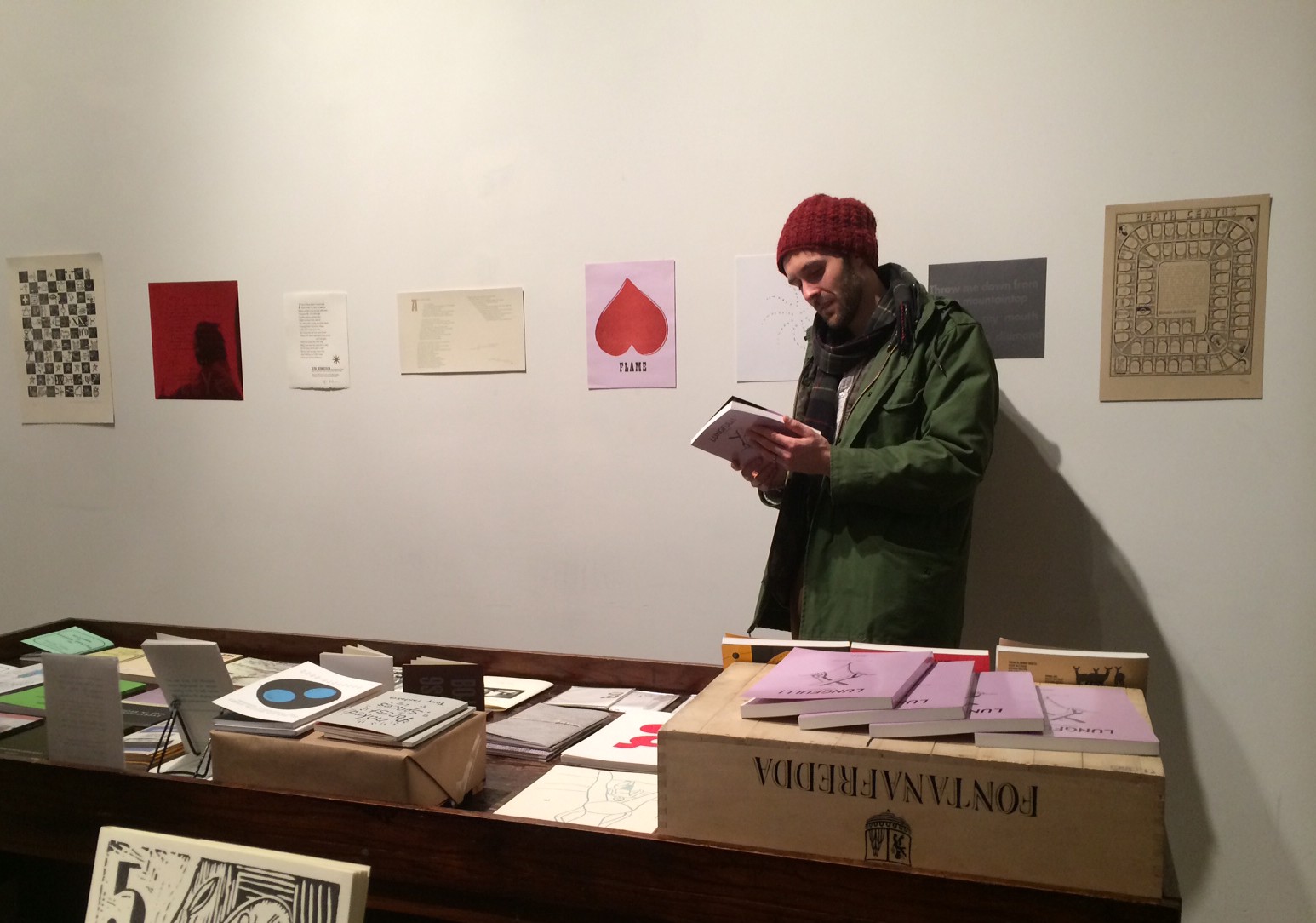
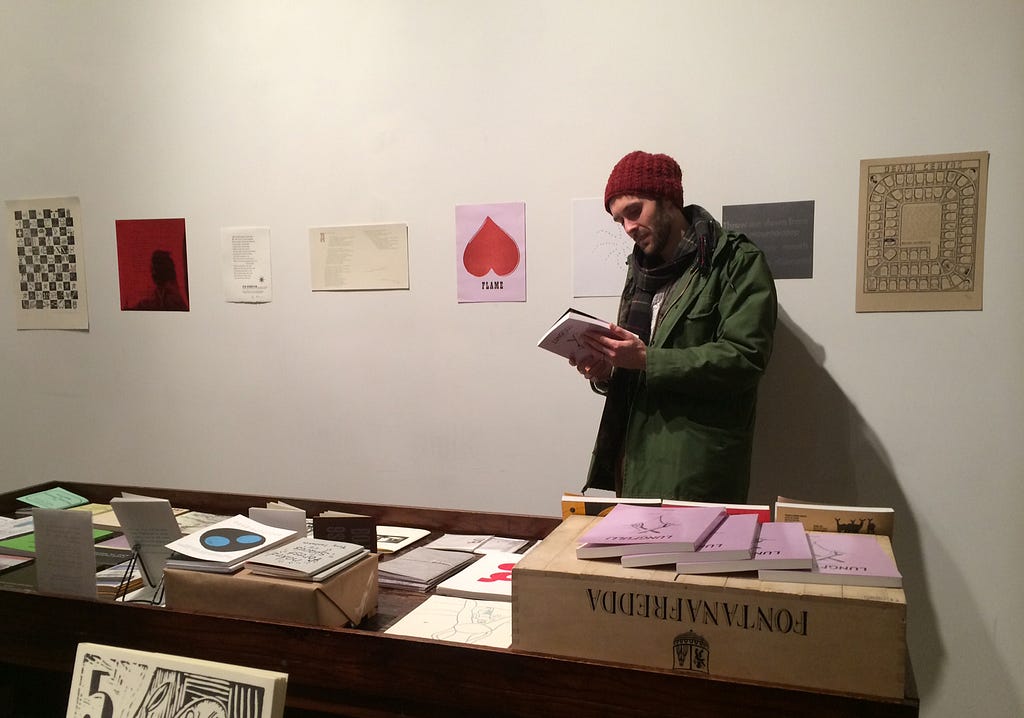
The future of the brick-and-mortar bookshop may just lie with the independent, the niche, and the nomadic. New York’s latest pop-up bookstore is Third Factory, hosted by Ugly Duckling Presse. The shop occupies a storefront in Gowanus’ Old American Can Factory for the month of February and hopefully even longer.
The shop features titles from independent poetry publisher Ugly Duckling Presse, as well as Archipelago Books, United Artists Books, Belladonna*, and Akashic Books. They are also accepting self-published titles and chapbooks on consignment.
In addition to selling rare titles and art prints, Ugly Duckling aims to cultivate a community space for lovers of small press publishing. The store will be staffed by the publisher’s editors as well as two artists-in-residence, Sarah Anne Wallen and Woody Leslie. Starting this week, Third Factory will host readings, performances, and other events, and every Saturday people gather to stitch chapbooks.
Chapbooks by Woody Leslie
The shop is the most recent of a string of literary ventures in the borough. Mellow Pages still keeps its doors open in Bushwick. The Newsstand had a short but sweet six-month run in the Lorimer-Metropolitan station. Hullabaloo Books boasts itself as the world’s smallest bookstore and Crown Heights’ largest.
Third Factory is located on 3rd Street, just east of the recently opened Whole Foods. It is open Thursday through Tuesday from 12–6 pm. Check Twitter (@udpbooks) to stay abreast of upcoming events.
This has really been a crap winter in New York, and February is traditionally the shittiest month here and many other places, too. I mean January, after all, is a new year, the start of something. March blows but at least there’s hope for April and May. While February — this is just the godawful middle of the suck. So obviously, I’ve compiled a playlist of spirited, uplifting, sunny songs to weather the storm, right? Um, sorry, no. As the Buddha says, the only way to go through it is to go through it. So with that somewhat masochistic notion in mind, I offer up a (sadly ‘90s-centric) slowcore, melancholy soundtrack to the month, the musical expression of that inner cold, rain and snow that defines February’s mood. Embrace ye these our darkest days!
1. Low (2-step)
“And the light it burns your skin in a language you don’t understand.” This track, from their ’99 album Secret Name, is the musical equivalent of a polar vortex. It also bears mention that Low hails from Duluth, Minnesota, where as of this writing the temperature is minus eleven.
2. Widowspeak (Harsh Realm)
I love this band; they are sort of the rock and roll heir apparent to Low, IMHO. And how could I pass up a song called Harsh Realm? I guess this is the only real hipster band I am including in this playlist; I had to do it just to prove I have listened to music made in this century.
3. Riding Alone For Thousands of Miles (Brick City Love Song)
I was looking for music for a film I was supposed to direct a couple of years ago and I happened upon this Newark-based instrumental group, sort of a classically-inspired Godspeed. I have no idea if they are still around or not, but I think they’ve put their stuff up on archive.org and it is worth checking out, even if they did steal their name from a Chinese movie.
4. Danger Mouse/Sparklehorse (Dark Night of the Soul feat. David Lynch)
I don’t even know what to say about this track. It is so perfect. Just go and buy it, put it in your phone, lie down in a soot-filled snow bank, and listen to it nine times. When the Devil shows his head, spring is just six eons away.
5. Tindersticks (Cherry Blossoms)
Okay, so this track is kind of pretentious. I like it anyway. “4 AM, six feet down.” That’s kind of what it feels like these days to walk two blocks to the deli. The cold puts voices in my head, and the voices have these sensitive British accents, and I have no idea what they are saying to me, but since they are British, I do what they want.
I met Lina Paul a few years ago at the Brooklyn Rod and Gun club and she introduced me to her ethereal, haunting music. She’s a Berlin-based stage and film actress who turned to making sounds. She’s like an avant garde Cat Power meets Bjork. I haven’t been in touch with her, but I think her music is amazing and sad and for whatever reason incredibly visual: I just keep seeing things when I hear it.
7. Holte (Road Song)
Holte is a new project by Red Hook Brooklyn-based visual artist Patricia Thornley in collaboration with Austin Hughes and other musicians. I guess you’d put them in the Americana category, but that tells like less than half the story. I wouldn’t call this song all that melancholy, especially when it hits the big major chords, but I think we needed a break from all the abject pretentia and sadness that I’ve dumped here. Full disclosure: I played piano on this track.
8. Jana McCall (Again and Again)
I really miss the ’90s. If you are reading this you were probably in grade school in the ’90s, so I’ll tell you: the ’90s were great. There was a sense that things were getting better in the world, and there was still an underground that wasn’t instantly co-opted by fashion brands, and independent film was actually independent, and the internet hadn’t turned every band into the same band, and people actually had conversations without staring at electronic devices every two minutes.
9. Sarah Ogan Gunning (I am a Girl of Constant Sorrow)
S.O.G. was a Kentucky folk singer who was first recorded by Alan Lomax in 1937. She sang a lot about coal miners and the coal miners union, and was a half sister to Aunt Molly Jackson. In this song she reveals eating bulldog gravy for breakfast. Bulldog gravy was a coal miner thing, a combination of water, flour, and grease. I think it’s also gotta be the title of my next book.
10. Be Good Tanyas (Waiting Around to Die)
What happens when you combine the best Canadian girl-folk trio of all time with the best American songwriter of all time? You get this, the BGT’s unforgettable cover of the Townes Van Zandt classic. I met TVZ in Austin, Texas, in, yes, the ’90s. It was his last show in the US before he passed away at age 51. I asked him what was up, and he said “Just waitin’ around to die.” You don’t have to believe that story but it’s true.
11. Dinah Washington (This Bitter Earth)
Just for a change of pace, something not from the last couple of decades. I first came to love this track when I saw Charles Burnett’s 1979 film Killer of Sheep a few years ago; it is possibly the most truly, deeply independent film ever made, shot on a shoestring in Watts when Burnett was a student at UCLA.
12. the everybodyfields (Medicine Girl)
the everybodyfields were a duo from Tennesse that made a few albums in the ’00s and then broke up. I think they were a couple. I saw them once in New York and it was a transcendent show. It’s really too bad that they broke up. It’s bad when anyone breaks up. I don’t like breaking up. This song is about morphine, I think, and death. Maybe it’s not possible to write sad, beautiful songs about morphine and death and not break up.
13. Charles Atlas (Edith)
I don’t think too many people know this brilliant, mostly-instrumental group. A few years ago after a break-up I was obsessed with them, and played their album To The Dust over and over. It’s really quite a meditative masterpiece IMHO. This song is called Edith but I can’t tell if it’s about someone named Edith or not, and it’s one of the only songs they’ve recorded that includes the human voice.
14. This Is The Kit (Birchwood Beaker)
TITK is an English folk band fronted by Kate Stables, whose voice is strangely normal and surreal at the same time. I think this song is about living in Norway, since Odin is invoked. Carry through the snow!
— Peter Mattei is the author of The Deep Whatsis. His award-winning plays have been staged in various theaters across the country to critical acclaim, and his first feature film, Love in the Time of Money, was developed at the Sundance Directors Lab and produced by Robert Redford. He’s created and written original series pilots for HBO, CBS, ABC, FOX, and other networks. He splits his time between Brooklyn, upstate New York, and Austin, Texas.
Gabriel Blackwell’s new novel trades in dread, its “dissolution” a reprise of the chilling fade in his debut, Shadow Man (2012), yet the reading has its own pleasures, in particular the yelp of recognition: “All along my route these obscene shades climbed out of basements and storm drains or darted out of alleys… like an umbral army rousted from the crypts and mausoleums of Providence.”
The style of H.P. Lovecraft fits so comfortably here that anyone familiar with Blackwell’s previous novel will be all the more impressed.
Shadow Man likewise erased identity behind washes of language, but with the telegrammatic punch of noir. The change of key, this time out, reveals adept fingering.
Dissolution serves up a layer cake of terror and entrapment in which Lovecraft is merely the frosting. The novel follows the plan of Pale Fire, creating a text with commentary, and the author speaks from behind a doppelganger “Gabriel Blackwell,” impoverished by chasing a runaway girlfriend across the country to Providence. This narrator finds bottom-rung work, pulping papers, and stumbles across the last letter completed by Lovecraft (a legendary correspondent). More intriguing still, the letter’s addressed to yet another Gabriel Blackwell, care of an insane asylum.
The book in hand, then, combines Lovecraft’s letter, the mysterious correspondent, and Blackwell’s commentary — all three in downward spiral.
As for Lovecraft, he’s beset by an “umbral army” which may be deathbed hallucinations or may be the Eldritch itself, set loose somehow by the “Blackwell” to whom he’s writing. That’s the fun part, as I say: a parody of the “Master of the Weird” that itself sends shivers. Dissolution’s other two tumbles, however, prove less engaging.
The Blackwell working the paper shredder begins with the difficulties of Lovecraft’s manuscript: “The thicket of… characters, …their lack of line breaks….” In footnotes and endnotes, he does little besides reiterate such ambiguities. Even the mugging that robs him of the original amounts to another degree of unreliability. The robbery mirrors the Lovecraft letter, in that both narratives feature mutilation, and indeed this Blackwell turns into a horror story: “ink-smeared… a blistering blackened thing.” Neat as the correlation may be, though, it only takes us back to where we’ve been since the first, with both text and reader going to pieces.
As for the other Blackwell, the asylum inmate — his letter to Lovecraft apparently contained sketches of Cthulu creatures, and so triggered the final delirium.
It prompted the entire meta-exercise we’re reading via its echo of an earlier brilliant madman.
Daniel Schreber, a German judge from the turn of the previous century, published a notorious memoir of his psychotic break, and Blackwell’s novel takes its title from Schreber’s 1903 text, referenced explicitly in a couple of footnotes. Schreber too saw human beings as “fleeting-improvised,” dissolving, and so he provides yet another avatar for the “Darkness,” which in Blackwell’s novel is “a constant, hidden only to those who wished not to see it.”
The layer cake, that is, risks a lack of variety. A passion for the dark never hurt W.G. Sebald, to be sure, but then Sebald never allowed promising story possibilities to drop. Blackwell abandons such promise (a detective, a pregnancy) in favor of ruminations on his impossible paperwork.
On the other hand, he begins and ends in poverty and homelessness, and, really, is there a scarier thing of darkness? This novel’s richest passages — distinctive for more than wordplay — come when our commentator grapples with living down and out in 21st-Century America. There he finds the last work of a fascinating writer and, with next to no resources, he must try to forge meaning. The worst of the monsters haunting Dissolution is that of literature itself, fallen among the use-and-discard labor force.
Sign up for our newsletter to get submission announcements and stay on top of our best work.
YOUR INBOX IS LIT
Enjoy strange, diverting work from The Commuter on Mondays, absorbing fiction from Recommended Reading on Wednesdays, and a roundup of our best work of the week on Fridays. Personalize your subscription preferences here.