In South Africa, novels have always been written in a society of fundamental divisions, in particular racial ones, and in a country where culture, language, land and other resources are perpetually contested. Most South African literature, especially since the mid-20th century, deals with colonialism and Apartheid and their aftermath, whether directly or indirectly. It was, and is, impossible to ignore the weight of history when it is still so present in people’s lives. Sometimes one may imagine you’re escaping it by setting your novel outside the country. Even then, though, the reprieve is partial and brief.
Because of the multiracial, multilingual and multicultural nature of the country, the idea of a great South African novel, one that would encompass a broad variety of South African experiences, is elusive. The perspective is always specific, always limited.
For a small, young and relatively isolated literature, South Africa probably punches above its weight in producing interesting writers and good novels. In part, this is because the complexity of the social and political world in which South Africans live has always tended to heighten the intensity of human experience.
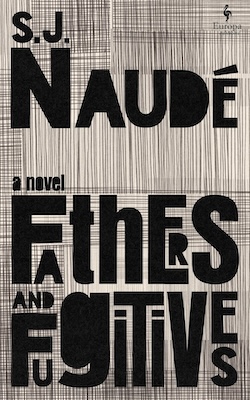
My novel Fathers and Fugitivesfollows a queer South African journalist living a lonely and drifting life in London. His father’s will compels him to visit a long-lost cousin on the old family farm in the Free State, deep in the South African hinterland. My book is about fatherhood and family, loyalty and betrayal, inheritance and belonging. The fraught history of colonialism and Apartheid forms a barely visible, but inescapable, backdrop.
Schoeman, who as a young man was briefly a novice for the Franciscan priesthood in Ireland, was the kind of author who turned his back on the world to write. Both as a novelist and historian, he was enormously productive. In 2017, at the age of 77, he took his own life, leaving behind a manifest of sorts about dying with dignity.
This Life is a novel about four generations of a white pioneer family in a barren and remote part of South Africa. The book is obsessed with the tough poetry of the landscape. It is narrated by an old woman, now all alone, who, it is suggested, was in love only once, secretly, with her sister-in-law. Now she is trying to finally collect and order her memories. The narrative is cyclical, wrestling with Africa and the place that someone of European descent may or may not have in it. The book may sound bleak, but the quality of the writing transforms it.
This book by Galgut, the first South African author since J. M. Coetzee to win the Booker Prize, is an elegant and moving novel in three parts. The protagonist, Damon, remembers three journeys—to Greece, Africa and India. He is, respectively, the Follower, the Lover and the Guardian. For one reason or another, each journey ends in disaster. In an arresting formal innovation, the book alternates between a first and third person narrative (sometimes in a single sentence) to dramatise how close and real memories can be. No matter how far you travel, this book seems to say, you can never escape yourself.
One of South Africa’s most interesting and talented contemporary novelists. In this delicate and hypnotic novel, a lexicographer assists a man working in a museum and who is collecting Afrikaans words that are no longer in use. Her treasured collection of shells are then stolen in a burglary. The subsequent search for her shells becomes intertwined with her work at the museum and the motley crew of people she encounters there, and a general survey of her life and its losses. Behind every loss there is an earlier loss, the narrator at one point muses. Part of what makes this book so moving is precisely the slippery, infinite regression of losses it suggests. It also, consolingly, relativises personal loss against cosmic events.
A magisterial novel by perhaps the foremost living novelist in Afrikaans. These days, Van Niekerk lives in the Netherlands and has apparently fallen silent, but this book could be the closest anyone has come to producing the Great South African Novel. Narrated by Milla, a white woman who has ALS and is bedridden, the book follows the story of the complex power shifts between her and Agaat, the mixed-race woman who is taking care of her. Milla took Agaat in as an abandoned child. Initially she treated her like her own child, but then she became a maidservant and nanny. Now immobile and increasingly unable to communicate, Milla has to reckon with not only her and Agaat’s own history, but by implication the entire country’s fraught history of the second half of the 20th century.
Heyns is a highly accomplished South African novelist and the country’s foremost literary translator. He has written numerous surprisingly different novels, but his debut – a tender, unsentimental coming of age (and coming out) story, set in a small Free State town during the Apartheid years of the 60s – is a good place to start. The reader cannot be left unmoved by Simon, a bright, bookish and sensitive boy finding his way through the intrigues of childhood in the dusty streets of Verkeerdespruit. Heyns’s warm, understated humor adds to the satisfaction.
Ntshanga is one of the most exciting young South African novelists. In this book, his debut, we follow a group of young friends adrift in a Cape Town awash with chemicals (they sniff glue, smoke crystal meth, gulp pain killers and observe the city through fresh eyes). Ntshanga has written two more books since his debut, and it turns out this disorienting and somewhat surreal account of young lives in post-Apartheid Cape Town, with its strange and beautiful twists and turns and arresting descriptions, was indeed a harbinger of good things to come.
Rose-Innes is one of the very best South African novelists writing in English. Katya Grubbs, Rose-Innes’s protagonist in this novel, is in the business of pest relocation rather than extermination. This brings her to the attention of a property developer whose gated residential development outside Cape Town, Nineveh, has been rendered uninhabitable due to an infestation of strange insects. Katya takes up residence in the empty estate and is gradually drawn deeper into its chaotic urban wilderness, exposing the tensions between the natural and man-made worlds.
Disgrace is one of South Africa’s Nobel-prize winning author’s masterpieces. It is also a controversial work that has elicited much debate and discomfort, particularly in South Africa. Published in 1999, not long after democratisation in South Africa, it follows David Lurie, a divorced and middle-aged professor of communication and Romantic Poetry at a Cape Town university. Lurie has created a comfortable, if somewhat detached, life for himself. He teaches his classes and pays a weekly visit to a prostitute. When he seduces one of his students, the consequences however fundamentally disrupt his contentment, forcing him to retreat to his daughter’s smallholding, where an incident of violence and unspeakable terror occurs. This chain of events leaves Lurie humiliated and disgraced.
Forty years after the publication of Leaving the Land, Pulitzer Prize finalist Douglas Unger returns with his fifth novel, Dream City, an excoriating tale of hope, greed, and betrayal in Las Vegas. C.D. Reinhart is Unger’s fatally flawed protagonist, a failed actor bent on self-improvement who is forced to be the public face of his company when a construction worker dies in a terrible accident.
Dream City stands out among contemporary novels for tackling the subject of money head on. In his brilliant portrayal, Unger reveals every level of casino economics, from the bottom to the top, and gives the reader a terrifying view of a world where the individual is always playing against the house, and the house is American finance. In doing so, Unger lays bare the role of illusion and greed in our system and proposes that people place risky bets so they can briefly experience the luxury of hope.
Douglas Unger presently teaches writing at the University of Nevada Las Vegas, where he is cofounder (with Richard Wiley) of the Creative Writing MFA. We met Unger decades ago when he taught in Syracuse University’s Creative Writing MFA program. In this conversation, we spoke to him about writing political fiction and how his Las Vegas novel is a cautionary tale about aspirational greed, the casino economy, and “a culture that puts a price tag on everything at the expense of humane values.”
Sorayya Khan & Laura McNeal: You describe your work as political fiction. How have your interests as a novelist developed over time, and are you surprised that your journey as a novelist has taken you from small town life in Leaving the Land and The Turkey Wars, to political strife in Argentina in Voices from Silence and El Yanqui, and now to Las Vegas in DreamCity?
Douglas Unger: It’s been twenty years since I’ve published a new book, so it’s nice to think there might be continuity with the others. I’m not surprised. I’ve always been drawn to books and plays about social changes and how they affect the characters, to stories written against something. Some reviewers tagged my early fiction as “political” with Leaving the Land, a novel that takes on the death of the family farm and its replacement by a macro-scale system of corporate owned farms (along with everything else). The Argentina novels, especially Voices from Silence, I wrote in deep pain at murderous injustice. I witnessed the rise of a brutal military dictatorship that “disappeared” two of my student-exchange brothers and subjected the surviving family I loved and many friends to horrific abuse. I’m experiencing PTSD right now as I follow the rise of violent fascism in the United States—all seems in place for a dictatorship here. I feel we must prepare, with no little urgency. That’s a future story, one I still hope won’t happen.
Dream City takes on a system motivated by aspirational greed. The main character measures his self-worth by money, and by how far he climbs a corporate ladder. I hope his destiny set within the metaphor of Las Vegas and the casino economy acts as a kind of cautionary tale for a culture that puts a price tag on everything at the expense of humane values. Also, I mean to write against the usual Las Vegas-mobster story cliché. Dream City shines light on a Wall Street gang. Is it political? I hope so, but more importantly that it might be interesting.
SK & LM: What is Dream City saying about capitalism and morality? Is the novel an indictment of capitalism, or is it a story about a character, Curtis “C.D.” Reinhart, who is a flawed capitalist? Was the income inequality in the book inspired by things you see happening in the US now?
Douglas Unger: For years, I carried a copy of Thomas Piketty’s Capital in the Twenty-first Century on a Kindle and kept re-reading it, mindful also that what economist John Kenneth Galbraith predicted in The New Industrial State has already happened: the line between big business piracy and elected governments has disappeared. Early drafts of Dream City started about midway through what’s now the third major section—C.D. has lost his job and his money, and he’s stuck in the shock of that, like an existential illness. A stuck character examining his life, just thinking, is not the best beginning, so I rewrote the story more chronologically to develop the boom and bust straight into the crash. Las Vegas was one of the most devastated places in the nation by the Great Recession, with highest jobless numbers and foreclosures. The big casino-resorts fell into receivership or hovered at the edge. I know many people financially ruined, who lost jobs and homes, because of what? As books about that era make clear, Andrew Ross Sorkin’s Too Big To Fail, McDonald’s and Robinson’s A Colossal Failure of Common Sense, Michael Lewis’ The Big Short, our economy isn’t capitalism anymore, in the Adam Smith or Milton Friedman sense (whose lectures I attended at the University of Chicago). The economy became a pyramid-like betting scheme fueled by insidious greed of powerful people with large concentrations of wealth, backed by trick-and-trap practices of a banking culture that deceived and exploited hard-working people. With the Roberts’ Supreme Court rulings that trash financial regulations, similar three-card monte games are recycling around again. There’s no free market capitalism left except for a small business sector, farmers’ markets, maybe eBay. The whole system favors monopolies or cartels. C.D. senses this, though he doesn’t quite understand it as it’s happening all around him. He sets out to join a circle of rich and powerful pirates who inhabit his world. That he fails, after modeling himself after the business elite he knows, leaves him baffled, his whole life upended. His solution, I hope, might suggest a remedy: to renew basic human values that matter most—love, family, neighbors helping neighbors, and to leave the money-chasing delirium behind.
SK & LM: Is Dream City an exposé of the Las Vegas casino business in the way that Upton Sinclair’s The Jungle was an exposé of the 20th-century meat industry? It felt, to us, like a brilliant form of muckraking.
Douglas Unger: The Las Vegas in Dream City is a metaphor, meant to evoke the business ideologies of the 21st century not only for casino-resorts. In many ways, the casino industry is more honest than most other businesses—odds are against the players, but at least the odds are posted and available to anyone who asks. I’ve simplified and fictionalized some industry complexities. But, yes, Upton Sinclair’s The Jungle, Frank Norris’ The Octopus, Theodore Dreiser’s The Financier and The Titan, and Sinclair Lewis’ Babbitt, are influences. So is John Updike’s third novel in his trilogy of the boomer generation, Rabbit is Rich. Rather than muckraking, I mean one takeaway to suggest a vision similar to Hieronymus Bosch’s allegorical triptych painting, “The Haywain”; or a vivid scene in the baroque Spanish masterpiece novel by Luis Vélez de Guevara, El diablo cojuelo: the parade of Fortune, in which the unlucky or blithely unaware get crushed beneath the wagon wheels.
SK & LM: Tell us about the research that went into creating the scenes that give precise details about construction and finance in Las Vegas.
Douglas Unger: Research for Dream City relied mainly on talking to people and listening: to casino-resort executives, ironworkers, electricians, teamsters, culinary workers, hotel designers, dealers, salespeople, and front desk clerks. Through my wife, Dr. Carola Raab, a professor in UNLV’s famed College of Hospitality, I frequently joined the “breakfast bunch” of her colleagues who met monthly on a Sunday, all of them experts in finance, marketing, gaming, management, and who had lived and worked in Las Vegas for decades. The book Super Casino, by Pete Earley, is influential; as is John L. Smith’s Sharks in the Desert, along withhis columns about local issues, personalities, and books about the casino moguls. Sally Denton’s foundational The Money and The Power is a must-read about the origins of the at times shady business culture in Las Vegas. For theory and insight into what drives the place (and the country), I rely on the late great historian (and friend) Hal Rothman, his Neon Metropolis. Over the many years I’ve spent co-founding and building the Creative Writing International program at UNLV (why I moved to Las Vegas 33 years ago), we’ve depended on donors, and in the early years, on one generous donor especially who worked as a top casino executive. We established a nonprofit institute that funded readings, panels, Ph.D. fellowships, grants for journals and presses, and City of Asylum for dissident writers. All this morphed into the Beverly Rogers, Carol C. Harter Black Mountain Institute that has helped to grow a thriving literary culture in Nevada. The “donor cultivation” experience provided me glimpses into a circle of the Las Vegas wealthy and elite, as did my obsessive work with political campaigns. In my opinion, the best research for a novel, or at least the contemporary realist novel, is to talk to people and listen. Every scene or chapter based in finance, business or construction has its seed in a story told to me.
Dream City fictionalizes certain figures and personalities, combining and recombining them into characters that are pure inventions. It does the same with some of the casino-resort corporations and their characters, reimagining them with made-up names. I’ve braided these inventions into a narrative alongside easily recognizable histories and tales of iconic casino-resorts and some powerful people drawn from the era of the 1990s through the Great Recession. Also, during the time-period of Dream City, the Las Vegas Sun published a series of exposés on the shocking deaths and safety deficiencies caused by shoddy, negligent practices in the construction industry, for which the newspaper won a Pulitzer Prize for Public Service. Worker safety is an important undercurrent in the larger story. I know ironworkers and members of trade unions who fought those battles. And I spent hour after hour researching statistics and facts: financial reports, gaming, real estate, banking, foreclosures, layoffs, worker safety. I had to simplify and omit so many complexities to make a readable story. I worry about oversimplification, what purists about Las Vegas might think about this. I also worry about too many facts. Advice to writers: do not attempt a novel based on so many facts! You risk getting lost in them!
SK & LM: We both loved the novel’s reference to King Learin Part Three: “In college, for a class in Shakespeare’s tragedies, one of C.D.’s assignments had been a close study of King Lear.” C.D. recalls that the class “learned how tragedy can happen in a conceptual space between nothing and never, everything in between becoming some otherworldly playing out of actions already doomed.” This seems like an excellent summing up of the novel and C.D.’s character. His awareness of his impending doom is what makes him pitiable. When did you decide C.D. would be a theater student and a failed actor—from the beginning, or later on? And can you tell us anything about the source of this scene?
Douglas Unger: This interpretation of Shakespeare’s King Lear is my variation on thoughts from the late great poet and dear friend, and teacher, too—my friends have always been my best teachers—Hayden Carruth. His essay “Lear” appears in his collection Suicides and Jazzers. Hayden and I talked about “King Lear” along with many other poems, books, plays, and writers, at his kitchen table or mine in upstate New York and when he visited in Las Vegas. He talked about “Lear” as Shakespeare’s longest poem. How it’s bookended between five repetitions each of the words “nothing” and “never” expresses an existential truth. Writing about the boom and bust Las Vegas economy when it crashed into bankruptcy, this concept summed up for me what had happened. The action moves directly downhill, no stops, from disaster to insanity to catastrophe.
Dream City started with a character, the failed actor, lost to himself, moving from role to role in his life. There’s a whole book of cut chapters about his theater studies, his fledgling career and failures, also what it is to be his type of sexually attractive male to so many women and men, and how he learns, painfully, to be more human. He represents for me how, in contemporary society, most men start out as lost, insecure beings who don’t really know what their social or cultural role should be anymore. They have a natural power, partly a sexual power, but they’re unsure how that power should be used. For some, this insecurity results in a tendency to withdraw and grow quiet, with simmering unhappiness; others act out through aggressive, too often abusive behaviors shunned by society, which is also unhappy, and can get dangerous. Or—as happens with C.D.—there’s a choice to pursue money as a substitute for self-worth, which is, sadly, the most acceptable male role in American society.
In his thoughtful book, Enigmas of Identity, scholar and theorist Peter Brooks suggests that a character’s search for identity is themotivating force in literary fiction. He asserts that most of us have at least two identities bound up in the same person: the identity we conceive ourselves to be and project to the world plus another one continually investigating, interrogating, and making unstable our conceived identity. I feel this is probably true. Still, I suspect Brooks’ theory applies better to male characters than female characters in stories. It seems to me that most women, also women characters in literature, are more secure about who they are, or at least they have more resources to draw upon to develop and nurture their identities. Of course, women have more external, difficult obstacles to overcome to self-actualize, all socially inflicted, most often by direct male oppression or by cultures of male hegemony (in addition to the natural pressures of motherhood or the choice or life circumstances not to be mothers). This identity principle feels important to Dream City, because, deservedly or not, the women in his life save C.D. from himself. I hope that rings true. In a larger sense, too, I hope I’ve done justice to the ever-shifting identities of Las Vegas. It’s been too long between books. I’m experiencing a bit of stage fright about this. Twenty years! Still, I’m grateful Dream City is out there now for anyone who might be interested. After so long, that feels so very good.
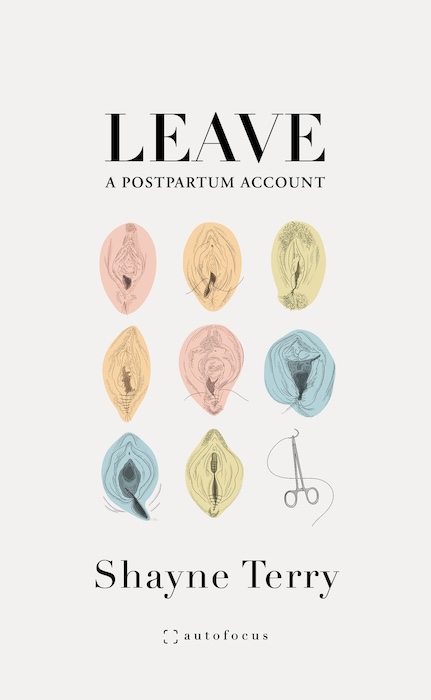
Electric Literature is pleased to reveal the cover of Leave: A Postpartum Account by Shayne Terry, which will be published by Autofocus Books on February 25, 2025. You can pre-order your copy here.
Shayne Terry’s fourth trimester is not going as planned. Instead of bonding with her new baby, she’s stuck on the couch with a third-degree tear, barely able to walk. When the women in her family show up to help, they come bearing family secrets and old wounds that also need repair. Begun as notes on Terry’s phone documenting a parental leave gone awry, Leave: A Postpartum Account examines a healing process complicated by capitalism, intergenerational trauma, and a healthcare system with a long history of devaluing women. This powerful postpartum account treats birth as a portal, one that can connect us to a lineage of pain, joy, death, and life. And at a time when our bodily autonomy is being stripped away, Leave is an urgent exploration of one woman’s experience recovering from birth in America.
Here is the cover, designed by Amy Wheaton:
Author Shayne Terry: “Early on in this project, I thought I was writing an essay. That essay grew longer and longer until I realized I might be working on a book. This was 2021 and I was spending a lot of time researching obstetric anal sphincter injuries, trying to understand what had happened to me by reading articles in medical journals and watching surgical repair instructional videos on YouTube. I was captivated by the line drawings I encountered in medical textbooks and how much they resembled botanical illustrations. I decided to include my own drawings in the project and imagined them as chapter headings or separating parts of the book. I am not, however, an artist, and I was never satisfied with my drawings, so eventually I abandoned them.
Fast forward to 2023, when I first spoke with Michael Wheaton at Autofocus about the book. Two things he said made me certain that Autofocus was the right home for this very personal story. The first: ‘This is a book that pretends to be about birth, but it’s really about death.’ He got it. The second thing he said was that his wife Amy, who does all the cover illustrations for Autofocus books, had experienced a similar injury. I understood immediately how meaningful it would be to work with Amy on the cover.
I suggested the medical textbook illustration style, and Amy took that direction and knocked it out of the park. I love that the cover gets in your face; this book is not for everyone, and a good cover enables readers to self-select. At the same time, the colors Amy chose serve to soften the body horror, in my opinion, just enough. The cover is subversive, bold yet gentle, and I know it will help the book find its people.”
Designer Amy Wheaton: “Shayne has taken this painful thing that happens to so many women and written about it in a way that makes me feel understood — as I know this work will do for so many others. I loved Shayne’s idea to do a medical drawing or a series of drawings of vaginal tears. I’ve long been interested in that style of illustration, and having torn badly myself during my first son’s birth, I thought it completely necessary to represent the book in this way. I thought about all those who will find community in her words. I wanted to represent her, them, and myself.
I looked through as many photos and medical illustrations as I could find—different degrees of tearing, stitching, episiotomies. I drew a series in-line with the style we’ve developed for Autofocus covers. I thought about Shayne’s experience, I thought of my own experience, the lack of research there is on female health, the treatment women of color experience in contrast. At first, I thought to use different skin tones on the illustrations, but instead opted for colors unnatural to the skin to show the female anatomy the way it is often treated in procedures like these, as a means-to-an-end for birth. I lined them up like numbers, leaving the last spot for sterile instruments, the inverse of the female anatomy.”
A year before she dies, Sophy has a visitor in the hospital. It is the renowned painter John Millais, of the pre-Raphaelite Brotherhood. He brings everything: paint, palettes, linseed oil, stretched canvas already prepped a soft brown, a stand, a jar full of brushes, a jar full of stuff to clean the brushes, palette knives, a change of clothes. Then he offers her a chagrined smile and leaves, these things in a heap, only to come back with more things: clothes for her to wear, a drop cloth for her floor, a crate for her to rest her arm on, should she choose to sit.
Sophy chooses to stand.
The critics appear as he paints. It has been a long time since Sophy last saw them. The first one hovers at John’s shoulder and squints at Sophy. “So waifish,” he says.
“Absolutely none of the boldness that made her famous,” the second critic adds, materializing behind the first.
“But that makes this rendition all the more intimate and sad,” the third critic says, having appeared in a corner. “And who better to render the heartbroken tragedy of her life than her brother-in-law?”
The first critic nods. “They always had a connection.”
“Look directly at me, Sophy,” John instructs. “As you did twenty-five years ago.”
He thinks he can hide the emaciation within her clothes, the thinness of her wrists in a dynamic pose. Her face is another story; her nose has suffered the loss of fat, its imperfections more pronounced. At least her lips and chin are the same, as full, as bold, as set in gorgeous disapproval as they were when she was a child. He paints into the night, pausing only to massage cramps out of his wrist.
1873
The asylum is called Manor Farm House. During the first of Sophy’s admissions, she finds it a tolerable place to live; she plays piano and reads and sometimes takes visitors. James Caird, a well-to-do from her hometown in Perth, Scotland, comes three times. On the third, he asks her to marry him.
“You look splendid,” he says.
She does not. Her thinness has not read delicate since she was a child; now, she is emaciated, and her dress a decade out of fashion.
He never understood her fame, James tells her. He’s met a few of the pre-Raphaelites and found them to be jumped-up, sex-crazed, pompous windbags. James Caird prefers science. He wants to fund an expedition to Antarctica. He thinks Sophy’s family cares too much about what people think of their daughters, and that all Sophy needs to cure her hysteria is fresh air and sunshine.
“And about your family,” James says. “You need solitude to recover your resilience. Once we are married, I don’t want you seeing them so much, especially that John.”
With this addendum, Sophy accepts on the spot.
Before their wedding, her sister Effie stands behind her at the vanity and pins Sophy’s hair. “Do you remember when you came to stay with me in London? I would tell Ruskin that I had to brush your hair just to have an excuse to get away from him.” Effie picks up limp sections of Sophy’s hair from her shoulders and lets them fall. “I was so jealous of it. But look how thin it is now.”
The first critic is there. He mutters to itself. “The hair,” he says. “Surely the crowning of Sophy’s sensuousness was her hair unbound. Millais’ portraits of Sophy’s other sisters always had their hair pinned and netted.”
Effie puts their faces together in the mirror. Her hair has begun to gray, her cheeks begun to line. Sophy, though a decade younger, has long since gone this way. Her hair is brittle and comes out in pieces.
“You can stay with me and John instead,” Effie says. “You must know that after all this time, we forgive you. No one even talks about it anymore. You needn’t be afraid to come back to society.”
The wedding is sedate and quiet, accompanied by hushed voices of people scared that a sudden sound might shatter the careful peace between Sophy’s parents, weeping with disapproval, and the bride, whose face hurts from smiling. When the ceremony is finished, she boards a sleeper train with her husband, James Caird. Only that night, in the cabin, does her mistake become obvious: as he enters her, James Caird says into her ear, “I saw ‘Portrait of a Young Lady‘ in a gallery ten years ago, and wanted you every day since.”
The three critics, crowded at the window of the compartment, smirk at this. The second points out, “A man of science is nearly always a man of art. You cannot separate the two.” But it is too late for Sophy to do anything else but endure, and bleed a little on the sheets, as she loses a long speculated-over virginity.
1869
The eve of her that first institutionalizing, Sophy plays the family piano in Bowerswell House for hours. Her mother cries. “It’s so beautiful,” she says to Sophy’s father. “Why can’t she speak to us like she speaks to those keys?”
Sophy is a woman of twenty-six, but still thin like a girl, with the same jutting collarbone and delicate wrists as when she sat for her most famous portrait. In the morning, John Millais arrives to escort her to the Manor Farm House. It is the least he can do, he assures her parents. He takes Sophy’s hand like it is as fragile as porcelain.
“Dr. Tuke is very good,” he says. “He understands passionate people like you.”
They take the train all the way to Chiswick. Effie appears briefly, to kiss her sister and husband on the cheeks, before rushing off to a social engagement. She promises Sophy will feel so much better, so very soon. The Manor’s garden boasts a tangle of roses lining a neat, brick walkway. But when Sophy arrives, all the rosebuds are shorn to nubs, thick and bare and gray, waiting for warm weather to return.
Dr. Tuke escorts Sophy to his office after the intake is over. The patient’s chair is close to the window, where she can look down at the garden. The critics follow her, but at a distance. She has gotten less interesting, lately.
‘Do you think your hysteria is down to your tendency to seduce men with wives?’ Dr. Tuke asks.
“Do you think your hysteria is down to your tendency to seduce men with wives?” Dr. Tuke asks. He pulls at his collar. “Is your anorexia nervosa so that you can maintain your sex appeal?”
It was a marvel how a rosebush could be cut nearly down to its roots, down to a stubble of branches, and still flourish in the next bloom.
“Were you the cause of the demise of your sister’s first marriage?”
On the pathway below, John Millais is leaving. Sophy watches him as he stoops to touch one of the pruned-off bushes, inspecting it like it might tell him whether it will grow taller, bloom more beautifully, than the rest. Dr. Tuke cranes his neck to see the path and harumphs into his mustache.
“It’s my advice you get married,” he says. “Perhaps in absenting the rumors about your relationship to your brother-in-law, you’ll feel better.”
1859
Sophy is sixteen, and at a party. Her portrait, which her family has rejected, has been sold to John’s friend George Price Boyce. She is invited to the unveiling. Effie and John are there; Sophy hasn’t seen them for three years. Boyce’s lover, Fanny Cornforth, is also present, her neckline shoved sloppily to one shoulder. Her portrait, sized the same, is displayed beside Sophy’s.
“Aren’t we gorgeous?” she asks by way of introduction, and kisses Sophy’s cheek.
Fanny’s portrait is called “Bocca Baciata”—the mouth that has been kissed. Next to this rendering—Fanny’s parted lips, apple-cheeks, flushed skin—and in the matching gold frames Boyce has procured, Sophy’s portrait is all the more suggestive.
“You’re so quiet,” Fanny says, her arm snuck around Sophy’s girlish waist. “Isn’t she so quiet?”
Sophy-at-thirteen looks down on Sophy-at-the-party from the wall.
The third critic appraises her. “She demonstrated so much erotic potential, so young.”
“Contextualized through display next to Boyce’s famously promiscuous mistress, you can’t help but imagine that this is how Millais intended her image be received all along,” the second critic says. “Passionately.”
“Don’t you look lovely, my muse?” Boyce asks, kissing Sophy’s hand.
“I wish your parents had kept it,” Millais says, kissing Sophy’s other hand.
“I think you look terrible,” Effie says, and everyone, even the critics, laugh from their bellies. In every room Sophy enters the artists whisper and circle her, the reclusive muse of John Millais. Bursts of merriment echo into the hallway. She opens a door to another receiving room and finds Fanny kissing George Price Boyce, open-mouthed. The critics follow and crowd her wherever she goes.
“One imagines she was an object of great lust in her time,” the first one says.
“Even before ‘Portrait of a Young Lady,’ she exuded sexual charisma,” the second says.
They jog to keep up with her. The third critic is waiting behind the door when Sophy flings it wide.
“Given Millais and Sophy’s obvious closeness,” he says, “one wonders about the timing of Sophy’s trip to London, and Effie’s subsequent failed marriage to John Ruskin.”
“Sensuous!” the first shouts down the street at Sophy.
“Coy!” the second shouts as Sophy buys a ticket for the train.
“Notorious!” the third shouts as her parents’ manservant meets Sophy at the Perth station.
The critics press their heads together at her childhood door and go on: what undeniable attraction she must have had for Millais to level such a gaze at him, what suggestive maturity she displayed by lifting her chin so. What about the rumors that Effie Gray banned them from seeing each other? How tragic, for John, to have two such noted loves of his life, and to only be allowed to choose one.
In the morning Sophy’s parents let themselves into her room to find the mirror, the pearl-inlaid brush, the canopy, and the vanity all cracked, broken, slashed, and dented. The critics chatter on, even when Sophy holds a pillow over her head and screams.
1857
John Millais has finally finished “Portrait of a Young Lady.” Before he reveals it to the world, he unveils it for Sophy’s family. The critics gasp three identical gasps, and then there is silence. Sophy’s mother begins to weep. Sophy’s little sister Alice oohs and aahs. Sophy’s father jumps to his feet, shouting, “What’s the meaning of this?!” Effie sits in brooding silence, her hand grips Sophy’s so tightly, white spots appear on Sophy’s skin.
“Sophy is an incredible muse,” John says, admiring the portrait. “Her likeness stirs great emotion in all of us.”
“It’s pretty,” Alice says.
John nods serenely.
The sitting had gone on so long, Sophy did not look at the painting afterward, only fell asleep and was carried to bed. Who is the woman in front of her? It captures her best, her most intimate, her deepest self plainly surfaced. She has not even had time to see this face in the mirror, yet. Sophy turns and sees her parents’ faces. They are aghast, pained.
She flees upstairs and sits for long hours at her vanity, while bursts of shouting sound below her.
Her father comes first, his face red and mustache bristled. “Your sister has worked so hard to escape the gossips, you know, after all that business with Ruskin.”
Sophy crosses to the bed and pulls the cover to her chin.
“We’ve given you and John a great deal of trust, you understand, letting him chaperone you in London, and all those portrait sittings. I’d hate to think you were acting against the interests of the family.”
A critic, probably the first, who knows her best, snuggles in next to her. “Masterpiece,” he whispers.
“Remember your honor,” her father says, and leaves.
“Once-in-a-generation face,” the critic goes on. “Mature beyond her years.”
Effie comes next, once Sophy is already asleep, slamming the door open like a crack of thunder through a clear night. She seizes Sophy’s pearl-inlaid brush and uses it to wallop Sophy about the legs and shoulders.
“You slut,” she says. “You temptress. How could you do this to me again? You’re never going to see John again. I’ll never let you sit another portrait as long as I live.”
Another critic pets the angry red skin on Sophy’s thigh. “That penetrating gaze,” he sighs. “I wonder, what is the object of the desire spelled so clearly on her face?”
Effie yanks Sophy’s door so hard on the way out that it misses the latch and bangs right open again.
John is the final visitor. Just before the light comes crawling back over the horizon, he comes crawling into her bed, a solid wall of man. “My dear, my sweet muse, don’t worry about all this fuss.” He captures sections of her hair in his big fingers and winds them into unthinking knots. “When I unveil your portrait to society it will achieve such acclaim that your family will see this as an embarrassing overreaction and not speak of it again.”
When I unveil your portrait to society it will achieve such acclaim that your family will see this as an embarrassing overreaction and not speak of it again.
He touches his fingers against the neck he bared to her family.
“Great art moves us all, but not always in the same direction,” he says. “Don’t worry about Effie. She’ll come around.”
“Immortal life through painting, the most beautiful girl in Scotland, a wonder, a triumph, a star,” John and the critics chant softly through the night. Finally, when the light turns blueish, John slips away, and Sophy collapses in sleep.
1856
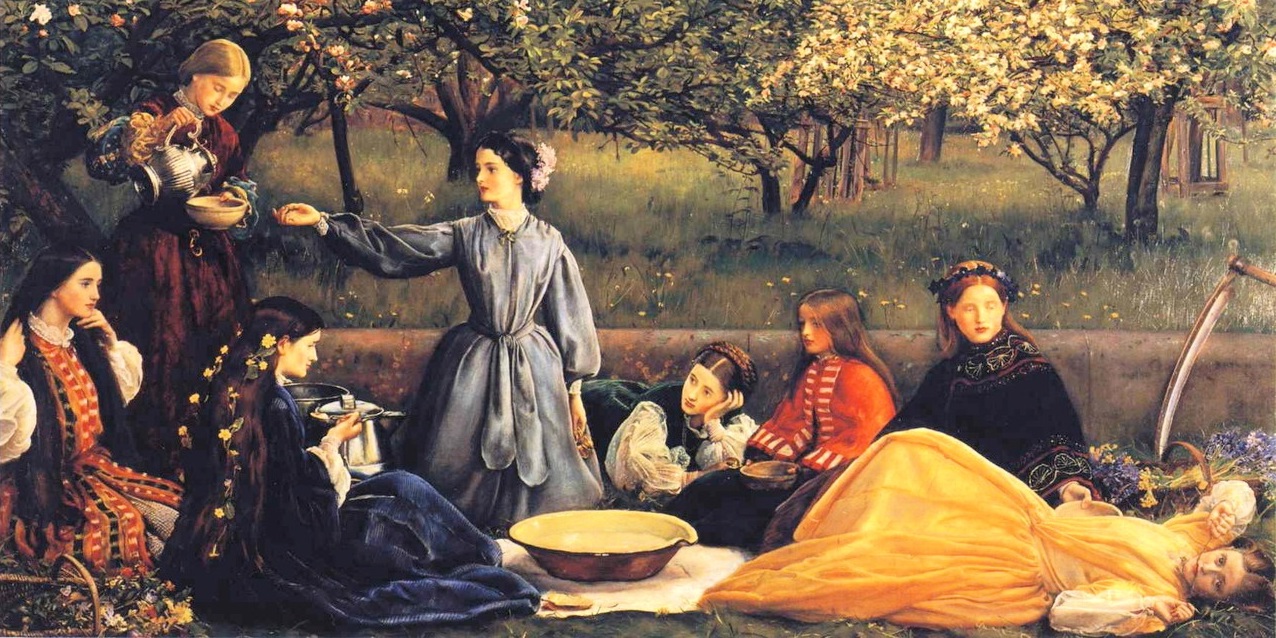
After John Millais marries Effie, she offers up Sophy to be his muse. “She owes me,” Effie says. “And I can’t bear the gossip from my divorce, I won’t be painted again.” John puts Sophy in two well-received, nostalgic portraits of the Scottish countryside: Autumn Leaves and Apple Blossoms.
In London, society is beside themselves over the debut of this earnest new muse. Not only is she unusually beautiful—not at all waifish but strong, hale, and determined—Sophy is the little sister of Effie Gray, and society is not done discussing that scandalous divorce.
“She’s perfectly captured in a year of change,” a critic says. “The only autumn where Sophy will be both girl and woman. Look at the flush of her cheeks! It hints at imminent sexual maturity, the way a flower hesitates before unfurling.”
Effie and John take Sophy to galleries, to houses, to studios; she sits for sketches and plays piano, but John won’t let any other painter have her. “I alone can tell Sophy’s story,” he says. “She’s far too complex for the rest of you.” When she turns thirteen, he tells her to wear the green dress to bring out the red in her hair.
“Have you noticed how impersonal a portrait is?” he asks, swiping charcoal on canvas like he is brushing away a fly. “How boring? How can you capture a person’s essence when you’re instructed to cover up this birthmark, do away with that mole, make larger the eyes and the lips. Infuriating. Not everyone has your natural beauty, Sophy.”
Finally, he paints, starting with her bold, upturned chin. It is a foundation on which to set her rouged lips, full and womanly and turned down not in a pout, but in knowing frankness. Her nose is imperfect; he includes the slight crooked curve of its bridge and sets her nostrils at a flare. Her cheeks—almost as red as her lips, stained with an inconsistent blush, and her hair—a mountain onto itself, or a river, maybe, made with red and brown and deepest black.
He works on her eyes late into night, until they cut through the portrait.
“It would ruin it if I knew what you were thinking,” he tells Sophy as he paints. “The allure is in what you restrain. But oh, how I wish.”
He sweeps his brush over the canvas. “How I wish, how I wish.”
Effie comes early in the morning to the room where Sophy is asleep upright and John is still painting, to bring him eggs. She looks at the painting, and looks at Sophy, and back at the painting, and back at Sophy. Her eyes narrow. John looks impossibly pleased with himself, nearly out of breath with the exertion of his talents. In the peripheries of the room, figures shift as if to move closer; critics, who can sense what Effie can sense, that this one is special.
1854
But at first, the critics don’t care about Sophy. They care about Effie. When Effie and Ruskin divorce, they’re everywhere. They speculate about why the marriage has gone unconsummated for so many years. Perhaps she has an odor, perhaps she is deformed in an un-pleasing way, perhaps she menstruates more than a woman should.
“How could you possibly understand?” Effie asks Sophy, tucked under her sister’s thin little arm. “You’re just eleven. I’ll die if I have to go to that doctor, I’ll simply die.”
The doctor is to determine the credibility of rumors that Effie has retained her virginity through six years of marriage. It will be useful in arguments of annulment.
“All because he doesn’t like my hair,” Effie moans.
She does not mean the hair on her head.
One morning, she wakes Sophy up in the hotel they are staying in in London for the months it takes to sort out Effie and Ruskin’s separation.
“You would do anything for me, right?” Effie asks. “Tell me you would. Don’t think I don’t know that you owe me.”
She gives Sophy a folded note and directions to John Millais’ studio.
“Don’t let them see you,” Effie says. She means the critics that follow her everywhere.
On the way, Sophy opens the note: Written: —and finally come together as one, my dear Mr. Millais, is it foolish to believe fate has allowed me to save myself for you? I await your hands along my sides, ache for them to—Sophy closes the note.
In the studio, Sophy sits and awaits his reply. While she waits, even her breath wanes, risking nothing from the humidity of her mouth. A stray blink, the lift of her collarbone with her breath, may distract Millais from his work. All around her, setting oil paint stretches and cracks as it dries. Millais presides in the center, busy in session.
“You have the most incredible patience,” he says, hours later, when he finally takes the note. Sophy says nothing, but her face more than makes up for it.
1852
Sophy turns nine, and her behavior is so good, her letters so neat, that her parents decide she will make the perfect chaperone and companion for Effie, who has gotten so lonely in London that she is beginning to act out. They have concerns about Effie taking up painting and arguing with her husband and his friends. Ruskin is a complicated man, but undeniably improves the Gray family fortunes.
“Be good, Sophy,” her mother says. “Help to keep them together, if you can.”
Effie squeals when she sees Sophy on the train platform.
“We’ll be proper society ladies,” Effie says. “You’ll see. I have us in fittings all day. You deserve a fine hat for your trouble. And we don’t let a single boorish man hold us back, not even Ruskin.”
They go to parties where Effie is at the center of every room, clever witticisms leveled at London’s pre-Raphaelites until they are nearly all falling at her feet with adoration. Effie teaches Sophy to kiss a cheek properly, to critique a painting for symbolism of its colors, and all of her laughs. Short, amused titters behind a hand or a fan; delighted, gay peals with their heads thrown back; even the derisive snort, which Effie says must only be deployed against a nemesis. Outside Ruskin’s house, Effie is bright and lovely and loud.
But inside, Sophy counts the taps of Effie’s fingers against a dinner table designed for twenty and used by three, until Ruskin reaches over and stills them.
When the sisters retire upstairs, Effie throws herself against Sophy’s big poster bed.
“Sophy, Sophy,” she wails. “Married five years and still a virgin. Could you even stand it?”
Effie flips herself to look at Sophy in the vanity mirror.
“When I was your age, I couldn’t keep him away. I’d half-fancy he likes little girls most of all. You stay away from Ruskin, Sophy, I don’t need the competition.” She throws a frilly little pillow at Sophy. “I don’t know what I’d do without you, though. You must never leave me.”
At the next party, Effie departs without Sophy, and Ruskin comes to her room with a book.
“I wrote this for your sister when she was young,” he says. “Do you want to know what happens?”
He sits in an armchair and pats his knee, draws little Sophy up into his lap with a hand around her waist. It’s a whimsical story, about a wicked brother and a kind one and their adventures through Austria. At the end, the wicked brother is turned to stone, and the kind one inherits their family’s lands. As he reads, Ruskin moves his hand all around; Sophy’s thigh, Sophy’s shoulder, Sophy’s thin little arm.
“Pretty little girls never stay that way,” he sighs. “I’d marry you, Sophy, but you’d only grow old on me.”
There are no critics in the room. There is no one to observe besides Sophy and Ruskin, not even to tell the story wrong.
“I don’t want to marry you,” says little Sophy.
“Shh,” answers Ruskin. “I’m thinking about the love you could give me, if I could only freeze you in time.” And he moves his hand around, all around.
At the train station when they leave London together, Effie cries into Sophy’s small shoulder, and Sophy stretches her arm to touch Effie’s hair, in a manner that might make up for what she has lost.
1882
Back to the asylum. John steps away from the canvas. He packs his paints, palettes, oil. The jars full of brushes and of stuff to clean the brushes. He folds the drop cloth. Sophy touches the back of her neck, which aches from holding still.
Her body will ache until she dies, which will be soon. The coroner will diagnose her death as a seventeen-year atrophy; rumors of suicide-by-starvation will be hard to substantiate. Effie will be in the room when it happens, firmly clasping Sophy’s cold hand between hers. She will bring a vase of flowers, news of her children, and before she leaves, touch Sophy’s face, to see if she can find something in there as expressive as what her husband put to canvas years ago.
Breeze cuts through the heady aroma of paint. John takes Sophy’s arm and leads her around the easel, careful to keep her slightly shaking body steady.
“Well?” he asks. Brown paint dapples his forehead where he swipes the back of his hand to clear a sheen of sweat. Gray, from her clothes, mottles his fingers.
The painting is simple and uninspired, the figure’s expression smiling and bland. “Disappointing,” a critic whispers. Sophy can’t see anything. Only black void at the center of the canvas, a nothingness her whole life has amounted to, her potential captured just once and given to the world before she could find it. She lifts her hand to reach to herself, in case herself is reaching back.
There’s nothing more delicate than a line. In the world of my Triple Sonnets, my lines consist of approximately ten syllables each, mimicking our natural speaking pattern of saying ten syllables and then pausing. I love the tightness of this line—how plot, conceit, and yes, romance, are brought out in a compact yet deliberate space. Romance is a necessity, and because lines are delicate, getting to the point and excising unnecessary words brings us closer to the sincere truth.
When a loved one asks me, “What’s in your heart?” I feel closer to them. When seeking out poetry collections, I look for poems full of heart. When I say “heart,” I’m referring to the emotional core that moves the poem forward into volta—or the infinite turns of realization. In my day-to-day life, I often have trouble saying what I mean. I’m constantly telling myself: “Speak from the heart and others will follow suit.” I want to be less self-conscious. I want to be as fearless as I am in my poems.
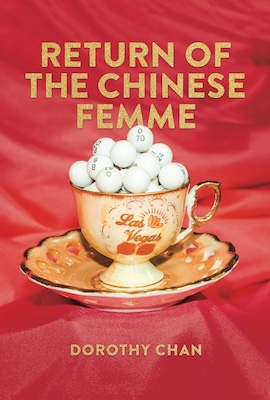
Return of the Chinese Femme, my fifth poetry collection, feels like a true return in many ways. Like its predecessors, Attack of the Fifty-Foot Centerfold and Revenge of the Asian Woman, it’s a return to the B-movie-and-Star-Wars-inspired-grand-gesture-filmic-title. More importantly, Return is a culmination of all the subjects I return to: food, sex, fantasy, pleasure, family, and of course, queer Asian femme identity within these themes. In Chinese culture, eight is the lucky number, because when it’s flipped upside down, it voltas into an infinity symbol.
I’m proud to present the following poetry collections by Asian American authors. These collections represent the infinite volta.
I love opening with a feast, and Ina Cariño’s Feast is a sensory-spellbinding-steamed-rice-in-the-throat collection of tongue and salt. An immediate intimacy, revealing history within the body, is established through food, or in Cariño’s words,
“my family dines luxurious—peasant food in crystal bowls: seven thousand six hundred forty-one islands jostling in my soup.”
As the speaker’s tongue picks up salt, they further reveal:
“I salt the rice heavy when the meat is low, to trick my stomach out of hunger. my muscles still remember old aches—as if suspended in the salt of an ocean I crossed alone. how much can the body take?”
Salt is linked to the body, revealing intergenerational histories and traumas. This astounding collection reminds me how often, our bodies sense these histories and traumas before our minds even begin processing. I adore Cariño’s moments of unabashed clarity, like “I’m a different kind of brute from what the man on the train thought— ”. This queer declarative rings throughout, and I’m entranced by moments like “on days when I feel more like a woman / than a man” and “& on days when I don’t feel like a woman / or a man.” Cariño gives us intimacy from the queer body to intimacy within a familial history of cooking. “Perishable” is a standout in this collection, and I admire the familial intimacy of “my grandmother taught me how to slit / the milky belly of my favorite fish” to “…picked the meat clean / of tines—scooped it soft into my mouth.” Feast transforms the role of the mouth in Asian American poetics through intimate scenes.
“I was born right after midnight on a date marked for chaos,” Mookerjee opens False Offering. This ultra-femme, ultra-kink, ultra-hot rage collection gives us the “hot trance” of “100 ways to make / your nipples show through your shirt.”
Mookerjee is a performer both on and off the page, and through Sailor Moon transformation sequences, we’re simultaneously graced with a queer appreciation of fashion and a limitless encyclopedic knowledge. She is creating her own 21st-century Vanitas painting with pleasures of long nails, velvet couches, cosmetics, and oils. Through these earthly pleasures, Mookerjee constantly urges the reader to fight the colonizer’s gaze. “Truly” is a standout, and through sexy usage of the forward slash, the speaker seduces us into the poem:
“How can you not be a lesbian when you watched movies with characters named truly scrumptious I mean she is on the beach in white frills like a three-layer cake.”
A wonderous moment occurs with this intense, declarative volta, adding a further homage to American family cinema:
“I’ll start over you can learn a lot about my sexuality if you watch chitty chitty bang bang.”
Barizo’s stunningly fluid collection juxtaposes various modes of performance within a millennial backdrop:
“…the more Time presses the more beautiful they become— lover / husband mistress child—I played Goldberg Variations as she slept thinking of the geologic proportions of Manhattan: limestone, marble, malachite.”
The quirk of language from the role (“lover / husband mistress child”) to the tactile (“limestone, marble, malachite”) plays off the sequential movements of Barizo’s hybrid work. “I’m alive I’m alive” is the meditative chant that closes “Woman on the Verge,” a poem that is representative of Barizo’s unwinding of what exactly makes a woman. The social constructions of gender are a major study throughout, and I adore her juxtapositions of “Mozart piano concertos” and “used the massage / chair as vibrator.” After all, what is highbrow? What is lowbrow? Sexual health and awareness is everything. Gender is a construct. Amidst the intersectionality of these topics, Barizo always crucially lands on tenderness—
“It is just past eight thirty in the city and I wanted to write a poem about currency but it turned out to be about love, what I mean is to live is to rapacious:”
With finesse, she tackles the age-old question: “Is every poem bound to be a love poem?”. “Coda,” another stunner answers this:
“And what is it you hate? She asked. Bureaucracy. And what is it you love? he asked. Rivers.”
Adrienne Chung is a true master of language. Winner of the 2022 National Poetry Series, selected by Solmaz Sharif, Organs of Little Importance combines Jungian psychology, Y2K nostalgia, critical theory, poetic footnotes, and sexy-quirks-of-peculiar-playfulness within high femme interiority and emotion. This collection is luxe and introspective. I am thoroughly transfixed with Chung’s language:
“When I understood that she did not understand me at all, I left and pornographically cried in the terra-cotta-tiled bathroom, the door to which did not open onto a moonlit balcony where a handsome man stood smoking a cigarette, with sex appeal and feeling.”
Chung defines zeitgeist: within the speaker’s personal experiences, she projects outwards into millennial culture and feminist theory and praxis. Within the playfulness of word combinations like “love languages,” “how he likes his martini, his hand job…,” and the glorious “dickmatized,” the speaker is critiquing the patriarchal structures of our society and putting up the metaphorical middle finger at the male gaze. Her speaker emphasizes ironies that further call out patriarchy; for instance, in “Blindness Pattern,” she states: “4. Color blindness afflicts men at a rate several times that / of women” and “5. (How unsurprising it is, then, that they have such difficulty distinguishing between stop and go?).”
I would follow Eugenia Leigh’s speakers to the ends of this earth. Leigh is a master of balancing the delicate line with fierceness, truth, and reveal. “All my life I thought I was hard to love,” she writes, and it serves as the perfect landing and infinite volta into an exploration of healing. I admire how she names “Palpable rage” and “Our people, collectively unwilling // to let go, believe we share / a turbulence, a complex emotional cluster.” It is through these “complex emotional clusters” that Leigh’s speaker pivots us through familial trauma and rage at patriarchal forces that make her question, “How to be mother enough.”
I marvel at this pivotal volta in “Consider the Sun”:
“…Have you found what you’re looking for, a handwritten No below it — and beyond the doors
wobbled a lone dresser drawer holding a flask and a book from 1928 called Come Be My Love.”
I will keep “Have you found what you’re looking for” in my poetic pocket.
I’m a femme born in the Year of the Snake sending a love letter to Stark, a femme born in the Year of the Tiger. This is a gorgeous collection framed by hybridity: stunning collages featuring the author’s mother grace us. Stark writes in “Ballad of the Red Wisteria”:
“Is red love with a knack for breaking code first memories: sure, first memories of home include a pick-pocket or two, a stolen newspaper route coupon drawers and ketchup packets: but that’s survival, baby”
Stark voltas several rounds here, from her skillful use of caesuras to the multiplication of red, to the emphasis on immigrant survival and honoring our Asian mothers and their sacrifices for us. She weaves through the tale of Little Red Riding Hood, drawing out the implications of this story through the Asian femme lens. In “Hungry Poem in the Language of the Wolf,” Stark continues her caesura collaging, opening:
“Call us what you will thief, slut, mastermind, reaper, ordinary time calls us mis-memory, we were born in a time of great need, wanted nothing that wouldn’t pay us when my mother is sick when I am sick, we spend it talking talking.”
And it is through our mothers that we learn defiance, hence the “knack / for breaking code.” In the title poem, Stark’s speaker narrates:
Craig Santos Perez writes in from unincorporated territory [åmot], winner of the 2023 National Book Award for Poetry and the fifth collection from Perez’s unincorporated territory series:
“teach them about our visual literacies
our ability to read the intertextual sacredness of all things,”
I am awestruck by this collection with its sequential layering, intertextuality, abundance, and elements of surprise through language, honoring the author’s native Guåhan (Guam) and the Chamoru people and language. Perez utilizes the space of the lyric to show both the speaker’s present moment and Guam’s history. For instance, in “ginen the micronesian kingfisher,” the speaker pays homage to the extinct Guam Kingfishers, known as sihek. In this sequence, he opens with a literal sacred space for “avian silence” in the middle of the page. This is followed by an upside-down citation (at the bottom of the page) explaining the arrival of invasive brown tree snakes in 1944, thus putting the sihek population in danger. He closes with a sacred plea:
“will guam ever be safe enough to re-wild native birdsong.”
Perez’s connections between food and empire made me the most curious.
“kikko is an ancient chamoru chief who once caught 10,000 green sea turtles & stored their tears in bottles”
In explaining the meaning behind the Kikkoman soy sauce name, the speaker then transitions into an even larger history within taste:
“yet where the greater east asia co-prosperity sphere failed…. to the fifth taste of umami & the sixth taste of empire.”
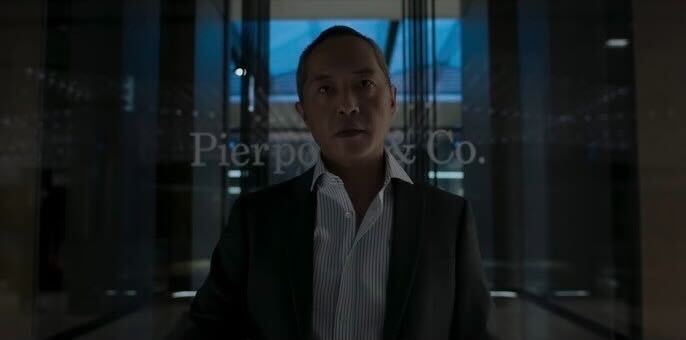
This is not the war cry of a gladiator in the arena, but the primal scream of a trader on the floor in HBO’s financial drama, Industry. The words belong to Rishi Ramdani (Sagar Radia), following his threat to crack people’s heads during a tense trade, which inspires his boss, Eric Tao (Ken Leung), to remind him that he can’t threaten actual violence at work. That’s rich coming from Eric, who keeps a baseball bat ominously within reach of his desk.
Even if Rishi is all talk and Eric never swings the bat, violence pervades the fictional, London-based investment bank of Pierpoint. And while the blows exchanged by this cutthroat band of bankers are all rhetorical, they’re no less bloody for it. Pierpoint’s many players wield flowery metaphors and baroque phrases as swords, dictating and narrating their trades like archaic bloodsport. And ethics aside (which could be the Pierpoint motto), they’re not totally off on their self-casting as warriors and killers. While literal punches are rarely thrown, the financial schemes these one-percenters enact with a handful of carefully chosen words often have a crushing impact on the everyday people they hardly consider—and that’s to say nothing of the way they cut each other to the bone in the process.
By creating a kingdom where concepts of respect and civility are only as valuable as they are lucrative, Industry becomes its own cycle of violence: casual cruelty trickles down from the top, saturating the trading floor until it feels normal to its inhabitants. It’s no coincidence that the series premiere features an employee literally working himself to death, a tragedy from which his coworkers are expected to promptly move on. When an environment that unhealthy goes unchecked from the jump, it can’t help but overflow into its employees’ personal lives, and ultimately out into an unsuspecting world.
In the show’s third season, Rishi emerges as one of the clearest embodiments of Pierpoint’s vicious ethos. He has so absorbed the spirit of the land that his moral compass has been completely demagnetized, and his seeming addiction to high-risk/higher-reward opportunities seeps dangerously from his dealings at work into his personal finances until he finds himself in levels of debt he can’t escape from. While almost everyone at the firm uses violent language to describe their trades (they don’t “outmaneuver” the competition, they “kill” and “gut” and “slaughter” them), Rishi transcends any metaphorical buffer to be directly and intentionally hurtful.
Blinkered by the pursuit of profit (and Eric’s bat-wielding encouragement of that pursuit), Rishi doesn’t even notice the violence innate to his language. When it’s pointed out to him after being brought to the attention of the HR department Pierpoint often pretends they don’t have, Rishi can’t fathom why he should be reprimanded for the very thing that makes him good at his job. “Why would I censor myself?” he asks. “The contract in this place is simple: as long as I’m making money, I’m free.”
The company doesn’t care if Rishi’s language is violent or not; they only care if his violence is profitable.
Despite the HR charade, he’s proven right: during an intense, drug-fueled trade in which Rishi spearheads a highly risky position, Eric calls a security team to remove him from the desk—until the risk pays off in an eight-figure win for the company. Right on cue, Eric calls off the dogs, and Rishi’s would-be funeral turns into a parade.
Lost as he may be in the fog of war, Rishi understands that Pierpoint’s charter is purely financial and wholly insatiable. Ultimately, the company doesn’t care if Rishi’s language is violent or not, literally or in effect; they only care if his violence is profitable. As long as it is, it will be tolerated and even venerated, due process be damned.
It’s a mindset that follows the employees home. For Rishi, that means cheating on his wife and gambling greatly with their money. For Yasmin Kara-Hanani (Marisa Abela) and former employee, Harper Stern (Myha’la), it permeates the fabric of their friendship.
After two seasons of using each other as ladders to grapple their way up the financial ranks, Yas and Harper have cautiously rebuilt a friendship by season three. When an argument with Yas’ lecherous, embezzling father leads to him jumping off a moving yacht and drowning right in front of her, it’s Harper that comforts Yas and helps cover up the non-murder (fittingly, it was only words that sent him over the edge). This act bonds them together, even as Harper’s Machiavellian scheming leads her to run her own investment fund as Yas’s client—less because Yas is a friend than because Harper sees her as easily influenced.
After all, a friendship forged in the war zone of Pierpoint’s trading floor is subject to the same rules of combat preached by Rishi and Eric. When Harper’s new business partner, Petra (Sarah Goldberg), commands her to use Yas’s gullibility to exploit Pierpoint’s vulnerable position in the market, Harper acquiesces after only a few mild protestations, just moments after comforting Yas in the midst of a crisis about her father’s death. If profit is king, then any profitable angle—no matter how personally horrific—demands to be exploited. Harper may have absorbed Pierpoint’s killer ethics, but she hasn’t yet accepted the consequences of the game; when she preys on Yas’s weaknesses, she still privately believes she can silo her personal relationships from her professional violence.
Not even a fight between friends is free from the violent language of its corporate origins.
But the two are inextricably intertwined. When Yas realizes that Harper played her, the pair incinerate their friendship as a result. In classic Pierpoint fashion, Harper and Yas lob linguistic Molotov cocktails back and forth until even the viewer feels scorched. “My pain is useful to you,” Yas says. Harper simultaneously hides behind her professional justification and takes a personal stab at Yas’ wealthy upbringing: “This is the business. Sorry the world is showing you what it is, without any of the protections that you are so clearly used to.”
This blurring of the professional and the personal is the culture Pierpoint creates:not even a fight between friends is free from the violent language of its corporate origins. If Pierpoint has taught them anything, it’s how to work an angle, and as they weaponize their shared history, the fight evolves from broad slashes to heat-seeking missiles targeting any vulnerability they can find. They sharpened their knives cutting deals for the company, and now that they have each other in their sights, they’re simply throwing what they know.
Only once they’ve emptied themselves of all the poison they have to spew do they resort to actual, physical violence: one slap to the face each. Compared to the verbal onslaught, it’s almost funny, a formality to commemorate a war without weapons. It couldn’t possibly hurt more than what’s been said.
Watching Industry’s characters cut into one another is often as hard, if not harder, to watch than even the bloodiest fights from Game of Thrones. The violence here is not a simple physical act stemming from an emotional turn or an escalation of tensions; rather, the violence dripping from every one of their words represents its own emotional escalation. Thrones had its share of acid-tongued schemers and back-room machinations, but at some point, its characters would usually take their personal issues to the arena or the battlefield, where any blows they landed were simply reflecting emotions they had already expressed.
As shocking as a hacked limb or slit throat can be, viscera doesn’t carry emotional valence, and ironically, most gore is so extreme as to be almost intangible to viewers. By contrast, watching Industry’s characters engage in a full-on psychological blitz is both excruciating and exhilarating to witness. When Harper and Yas drop bomb after verbal bomb on one another, each detonation opens a fresh wound that may be less visible, but is all the more relatable for the way it echoes our own scars from friends or family. And theirs isn’t even the grisliest battle to watch.
As savagely as Harper and Yas act toward each other, they’re still only the militarized product of Pierpoint—the trickle-down violence compared to the original source. Eric may not have been party to the company’s original sin, but he’s a few decades of experience and several rungs up the corporate ladder closer to it than the analysts and associates below him. That close to the top, the imperative to do whatever it takes to protect profits is even more concentrated, combined with a heightened instinct for self-preservation; no one wants to fall back down the ladder once they’ve climbed it.
In that atmosphere, a friend is only a friend while their interests align with yours. Harper and Yas are still young enough (and newly unemployed by Pierpoint enough) that a future reconciliation is possible, perhaps when their personal and professional aims are no longer at cross-purposes. Their coin might be flipped to contempt for now, but by season’s end, it already looks primed to flip back to friendship, with the two killers reconnecting once they have new targets in their crosshairs. But in the rarified air that Eric occupies with the other Pierpoint elites, there’s less oxygen to spare on friendly considerations.
Still, if you’ve managed to scrape and claw your way to the top like Eric has, you’ve likely only done so with the occasional support of other climbers. In Eric’s case, that’s Bill Adler (Trevor White), who Eric hired during his New York salad days. Bill has since lapped Eric to become a global head at Pierpoint, and despite the expected corporate grappling (I play you, you play me), they’ve maintained about as close an approximation of friendship as their stratum would allow. They’re close enough that Eric is the only person at Pierpoint Bill confides in when he discovers that he has a malignant brain tumor and not long to live. Eric is sincerely affected, and the men share one of the show’s rare moments of true tenderness, even if it manages to characteristically circle back to Pierpoint as they swear to fight for the company’s soul together.
It’s still a surprisingly moving moment considering all of the horrible things we’ve seen these two men do, which makes it all the more crushing when Eric uses this information to trade the remainder of his own soul–-and Bill’s career—for one more rung on the ladder. After another exec warns Eric that Bill is only keeping him around as a “useful idiot,” Eric commits one of the most violent acts in recent television history with nothing but a few carefully deployed words and a blackened heart. At a crucial moment, when Bill is about to close a deal that may save Pierpoint from bankruptcy, Eric fabricates a conversation that never happened in order to slyly suggest to Bill, in front of a table of execs and investors, that he forgot the nonexistent conversation they’d supposedly had mere moments ago.
The masked barbarity of Eric’s words hits us just as their implication hits Bill, who is visibly shaken by his apparent decline in mental acuity. Eric, having successfully teed himself up, lands the final blow by convincing Bill to tell the entire table of execs about his tumor, knowing it will spell his doom. The betrayal is horrifying to witness; between the mock concern on Eric’s face and the crestfallen look on Bill’s, we feel as though we’re watching a word-of-mouth execution.
In weaponizing the deeply personal for professional gain, Eric pledges his ultimate fealty to Pierpoint and their ethos. When he goes on to bring in suspicious foreign investors as his own save-the-day plan, he’s not betraying his earlier goal of preserving Pierpoint’s soul; he’s affirming the fact that it was always corrupt, and he its corruptible pawn—a useful idiot to the company, if not to Bill. Unlike Harper in her betrayal of Yas, Eric holds no illusions about being able to keep his personal and professional lives separate. He’s just willing to trade one for the other, dropping the friendship/contempt coin down the slot machine and hoping for triple sevens.
As Eric and the remaining execs plot to pin Pierpoint’s bad performance on Bill’s lapses, an unnamed c-suiter says the quiet part out loud: “While I respect the rules of the game, I find pinning this all on a sick man morally unconscionable. But, tomorrow is more important than yesterday for Pierpoint.”
Empowered by the invisible weight of the British pound, words can end careers or mint millionaires
Contained in that deadly couplet is the Pierpoint ethos writ large: an ability and a willingness to write over any amount of human cost with simply a few words. It’s also a penthouse echo of something Harper previously said to Yas when explaining why she enjoys working in their industry: “It’s a perpetual present tense.” Whether using their words to paper over past traumas or to create new ones in the name of profiteering, the ultimate joke of the show’s language is not on the people harming one another with words, but on the countless others their words ultimately hurt.
The punchline is that the chosen vocation of these linguistic assassins is one where their words are underwritten by more than just personal animus.When wielded by Industry’s besuited executioners and empowered by the invisible weight of the British pound, words can end careers or mint millionaires; they can make the wind blow and shape reality, causing trickle-down effects their speakers wouldn’t have time to consider even if they wanted to. Ironically, those same violent words help to insulate their speakers, abstracting the consequences of their market-moving actions and absolving them of all crimes—after all, it’s just language.
The flimsiness of a system built on that lie comes under scrutiny in the season finale, which sees the younger bankers attempt to double down on it even as the veterans finally feel a wobble. Even though Yas and Harper haven’t spent nearly as much time being indoctrinated into Pierpoint’s primeval ways as Eric and Rishi, they’ve spent long enough in that home built on violence that they both choose to make violence their home rather than embarking on healthier paths to unknown ends. For Yas, that means heart-stabbing a man she probably loves to get engaged to a man she probably doesn’t, but whose family name (and wealth) makes her instant demiroyalty. For Harper, it means growing dreadfully bored of the (relatively) respectful, legal work environment she and Petra have built after all of thirty seconds. If there’s a way to exist in their industry without back-stabbing or killing everyone around you, she’s tried it long enough to know it’s not for her. Rishi, meanwhile, is far beyond any moment of choosing violence and has arrived at the point of being swallowed up by it. His reckless words and gambles culminate in the shocking murder of his wife, a scene that suggests clearer than ever that violent words do, in fact, beget violent actions.
As for Eric, he turns out to have sold his soul for nothing, his coin fruitlessly eaten by the slot machine. After the takeover, he’s laid off by the same executive who inspired his betrayal of Bill. “There’s no business need for you at Pierpoint now”: a death sentence if he’s ever heard one. As it turns out, Pierpoint’s new bedfellows have as little respect for their acquired workforce as Pierpoint does, and Eric is well enough acquainted with the cycles of corporate violence to realize his fate even quicker than Bill did: “I get that I was a useful idiot.”
The problem is, Eric—like Yas, and Harper, and Rishi—doesn’t know how to be useful in any kingdom that won’t cosign his violence. “Your desk is your house,” he says in one last speech to rally Pierpoint’s troops. That makes Eric spiritually homeless now, a victim of the snake finally eating its tail. You can’t teach your employees to kill everyone in sight and arm them with the language to do so without eventually facing some collateral damage.
As he makes his final arrangements, Eric tosses his ever-handy bat away. He’s leaving the arena; he has no use for it anymore.
Books about ballet dancers are, invariably, books about growing up. Whether it is a young child desperate to win a place at a ballet school, a ballerina escaping from a dangerous relationship, or a memoir about finding a sense of belonging in the dance world, ballet books return again and again to the pain and the complication of leaving childhood behind.
To grow up while navigating the world of ballet is fraught with contradictions. Female ballet dancers are told to be ethereal, obedient, child-like. At the same time, puberty is dragging them forwards into adulthood, and men are making them the object of their sexualising gaze. Male dancers also face painful mixed messaging, their commitment to dance challenged by prejudice at a delicate stage of their lives. Books about ballet take the universal experience of adolescence and add a painful cocktail of competitiveness, body-image issues, power dynamics, and longing for acceptance. But among all these trials, ballet books are brimming with an enduring love for dance, a love that both uplifts and complicates dancers’ relationship with their art.
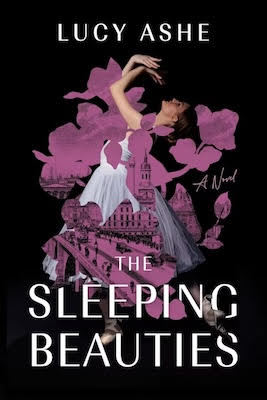
In my novel The Sleeping Beauties, ballet is both an escape from the hardship of the Second World War, and a dangerous obsession. Briar Woods grows up consumed with dance, determined that her life will follow the rigid path she has imagined for herself. When this journey is thwarted by the thorny obstacles of desire, a powerful man, motherhood, loss and guilt, she struggles to keep hold of her grip on reality. As with many books about ballet, when Briar’s life is dragged off course, she loses control of her understanding of who she is, her identity thrown into chaos.
I have chosen eight books that cut to the heart of what it means to learn to define oneself as a dancer.
Set in both the present day and during the AIDS crisis, this is a psychologically powerful novel about longing for acceptance in a complicated adult world. Carlisle Martin’s childhood holds secrets, some of which she will not admit even to herself. When, as an adult, she returns to New York City to visit her father, those memories cannot remain hidden any longer. She confronts her relationship with her ballerina mother and her father’s partner, James, learning what it is she needs to let go of in order to accept her past. The novel opens with a description of a ballet class, the fragile relationship between a teacher and student revealed: “He watches his words take shape in the boy’s body.” For this is the power of an adult mentor in the world of professional dance: every word can transform but also destroy.
Alice Robb’s memoir is subtitled “On loving and leaving dance,” and it is this complicated dynamic of love and loss that informs the book. Drawing on her own experience as a dancer in New York City, as well as interviews with others, she interrogates the ballet establishment’s turbulent relationship with dancers and their bodies. She examines body-image, the pressure on dancers to be thin, the legacy of Balanchine and the influence he held over his dancers, and the disturbing infantilisation of female dancers. Women’s bodies “are in constant flux,” she writes. “As hard as we tried to stay physically immature—breast-less, hip-less, premenstrual—we couldn’t fight time.” For me, as an ex-dancer with vivid memories of my time at the Royal Ballet School, her words resonated. But this book is interesting for all women, not only those who have been through elite ballet training. The book reminds us how fragile those teenage years are for girls, the words we hear from those in influential positions impacting on our sense of self well into our adult lives.
There are two versions of this book, one for adults and one for middle grade children. This second version and its ability to inspire and educate young people is an example of the tremendous influence Copeland has on shaping and transforming the image of the ballerina. Misty Copeland, principal ballerina at American Ballet Theatre, was the first African American woman to be promoted to principal. Her memoir takes the reader through the different stages of her career, from her late entry to ballet at the age of thirteen, to her momentous rise through the company. Her story is inspiring and makes it clear that the traditions of the ballet world can adapt to welcome and celebrate diversity.
Miriam Landis is a former professional dancer and ballet teacher, and her middle grade novel Lauren in the Limelight brings a refreshing new perspective to the familiar story of young people trying to make it in the world of dance. With a diverse cast of characters, the novel is about friendship, self-understanding, and a love of dance. It explores many of the challenges that children face as they grow up and learn who they want to be. Many of these are specific to ballet—the excitement of a first pair of pointe shoes, the nerves of auditions, the disappointments that must be endured—but it is also a novel about those crucial moments of transition and adjustment as children develop. The illustrations by Jill Cecil are playful and add beautiful detail to the book.
Tatelbaum’s memoir provides an honest and compelling narrative of the challenges of keeping the dream of being a dancer alive. She trained in a variety of elite New York dance schools and committed herself entirely to life as a dancer. That dream, however, proved elusive and cruel, leading to numerous injuries and financial challenges. Teaching Pilates to pay the bills, she continued building her dance career, working with immense resilience to take on each opportunity. Most dance memoirs are written by famous dancers with impressive resumés at top companies. To read a memoir by a dancer who faced the more typical path of resistance and struggle is refreshing, not least because it is a reminder that life as a dancer can take many forms. It is, Tatelbaum writes, about “the conflict so many of us experience between having a day job and having a dream. You won’t need to know about pliés to relate.”
A novel about a trailblazing Black ballerina, this is a story about celebrating success while navigating through obstacles of belonging, traumatic past events, attachment issues, and family. When Cece Cordell is promoted to principal at the New York City Ballet, the changes to her life come at a dangerous cost. Cuffy describes her novel as the book she wishes she’d had available to her, a Black ballerina in an establishment that traditionally has been predominantly white. Cece’s relationship with others and with herself is turbulent, and she must truly face her demons if she is to stop repeating the patterns of her past.
At eleven years old in the midst China’s cultural Revolution, Li Cunxin was selected for dance training by Madame Mao’s cultural delegates. His memoir tells a remarkable story of a child taken from rural poverty in Maoist China, and brought to Beijing to study ballet. During a cultural exchange to America, he fell in love with an American woman, leading to a thrilling narrative of his defection to America and his journey to becoming one of the most famous dancers in the world. This is a humbling and inspirational memoir about determination in the face of poverty, political strife, repression, and loss.
A historical novel about the girl who modelled for Edgar Degas’s Little Dancer Aged Fourteen sculpture, this is a ballet story that reveals the dangerous power of wealthy patrons. Set in 19th century Paris, Marie van Goethem and her sister struggle to make ends meet after their father dies. Marie trains at the Paris Opéra, attracting the attention of Degas and modelling for him in his studio. Her sister Antoinette, meanwhile, faces her own challenges while working as an extra in a play. Rich with historical detail, this is a novel about the corruption and abuse of power embedded in the beautiful settings of art, dance, and theater.
With his coat collar raised against spitting rain, a Humphrey Bogart type might have walked the streets of Choe Myeongik’s Pyongyang. At least that’s how I see Pyongil, the main character of “Walking in the Rain,” published in 1936 in northern Korea, the first story from the collection Patterns of the Heart. Gazing up at the city’s enormous ancient gates on his way to work at a factory, Pyongil occasionally stops by a talkative photographer’s studio with whom he shares too many drinks. Patterns of the Heart underlines the country’s hardboiled, hard-drinking characters, its poverty, its modern sensibility, and its tragic romance.
But when Choe holds all this up to the light of his prose, like a Vermeer still life, the city, the country, and its figures seem to glisten and gleam. His visual descriptions are precise, beautiful: “Pyongil yawned and stared at the right ear, which was now red as a tangerine slice” and spots a young gisaeng in the light of the rickshaw man’s lantern: “the face flecked with the soft down of a freshly hatched chick still hovered before his eyes; together they reminded him of a blade of grass on which he had cut his finger as a child.”
Spanning from the 1930s to the 1950s, these nine short stories observe the lives of a failed revolutionary addicted to morphine, bookish types confronted by dying fathers and lovers, a woman being trafficked on the train to Manchuria, a young hero leading a prison break, and more.
The publication of these northern and North Korean short stories, written about a century ago, into today’s English by Janet Poole is nothing short of miraculous.
A Pyongyang native, Choe Myeongik lived and wrote through the Japanese occupation, the liberation, the emergence of the North Korean communist state born out of Soviet occupation, and then the war. His works were banned by South Korea until the 1990s. Prior to his short story collection, Janet Poole translated the celebrated Yi Taejun’s essays and stories and wrote When the Future Disappears.
I spoke to translator and professor of Korean literature Janet Poole about northern Korea’s transition into North Korea, men of no character, and revolutionary dreams.
Esther Kim: You write in your translator’s note you long dreamed of translatingChoe Myeongik (Ch’oe Myŏngik; Choi Myong Ik). Can you describe where you first hit upon Choe’s name?
Janet Poole: I first heard of Choe Myeongik a long time ago when I first went to Korea for my dissertation research around the late 1990s. He’s not a particularly well-known or canonical writer. Even today, when I talk to people in Korea, apart from scholars, most haven’t heard of him. I was writing a dissertation on modernism, and a friend of mine said well, you should look at the work of Choe Myeongik because I was interested in urban stories, and how the city was described in 1930s Korea.
Of course, I was intrigued to hear that his city is Pyongyang. Once I read his stories, I realized how much the Cold War had shaped my own reading of the past because I had just spent several years thinking about the city of Seoul. And actually, for me, some of the most touching urban stories from that era study Pyongyang, which I thought was fascinating.
EK: Was it easy or somewhat difficult to translate his stories?
Even today, when I talk to people in Korea, apart from scholars, most haven’t heard of Choe Myeongik.
JP: Now his language is quite hard. Choe Myeongik is a real stylist, who wrote these really, really long sentences. That’s one of the issues. It’s a trend in the 1930s. But his are super long. They can be oblique, and there’s many dialects from the north you can’t always figure out. Dictionaries are not always helpful. People often don’t know what they mean. He’s also quite an intellectual. From his stories, he’s obviously well-read in European literature and Japanese literature. He’s really interested in words, dialect, and lexicon. I think he picks words carefully. He’s also interested in dialogue. That can be really hard to figure out on the page when he’s deliberately showing different classes of people, peasant characters as well as the urbanized. They can be quite hard to understand. And the last thing is, a lot of words have disappeared.
EK: Since the stories range from the 1930s into the 1950s, and northern Korea splits off into North Korea, I felt that the stories go from the grimmer underbelly of a city to a scrubbed “healthy realism” after 1945. For example, “The Engineer” (1952) is a story of sacrifice and heroism. It felt like some of the endings became more like television. Neatly tied. Why are there more happy endings versus sad endings after the division?
JP: For most of Choe Myeongik’s life—he was born in 1903—he grew up under colonial occupation, and after such a long period of colonial rule, that longing for independence was real. That desire to escape the society that’s being built in the late ‘30s, and the war time in the earlier stories, so then the dream of independence is real. Especially in the way it played out in Korea where the country got divided immediately and then everything became chaotic, especially in the South.
In the North, people bought into this real feeling of “We’re trying to build something different.” Now, in Choe’s case, he was already living in Pyongyang, so he just stayed where he was. There were writers who moved from the South to the North. And he just stayed where he was. I should also say that there were lots of people who moved from the North to the South, so he decided to stay.
A writer, who has been so attuned to and critical of society under one Japanese colonial, capitalist wartime regime, would want to be part of something that was better. I think that feeling probably would be individual, but also more broadly shared in society.
I also don’t want to be naive. I’m sure there’s also political pressure as well. I’m stressing the individual to you because I feel that everyone goes straight to political pressures first. But I feel that they might be coming together.
So “The Engineer” when I first heard that story, I read the first version. And I tried in this book to include both versions because there’s a different ending in the later version. And the first version felt quite melancholic, actually, whether the main character, Hyeonjun died all alone looking at what he’s achieved. And on the one hand, he’s a hero? I guess? But on the other hand, he’s died all alone. And there’s something quite melancholic about that. And then the following year, it was republished with a paragraph monumentalizing his achievement. So I guess that means that somebody else felt the ending was too sad the way it was.
There has to be a sense that death was worthwhile. The engineer’s sacrifice was worthwhile. But you can read that in many different ways. Sure, from the government’s point of view, they would want his sacrifice to be worthwhile. But I’m pretty sure that if you were going through civil war [the Korean War,] just five years after the Asia Pacific war [WWII], there would be a desire to want to somehow make this worthwhile. That incredible violence and death and the desire for something restorative from it. In that sense, I understand the desire to have these slightly happier endings.
EK: Why is it important to read the North Korean half of the collection without dismissing it as propaganda?
JP: There are so many problems with that. It gives too much credit to political power in a way. He was writing under censorship under Japanese rule, and he clearly found a way to write around it. And so I think we owe it to Choe Myeongik to see how he did that in the North as well.
It’s really important to acknowledge that a writer is grappling with the situation, describing the world, their lives, and their experience just as much as the earlier stuff. I don’t see why the later stories should be dismissed. Terms like “propaganda” or “literature,” which are usually opposed when we talk about North and South Korean literature, clearly come from the Cold War thinking that we’re still embedded in.
Something written in the so-called West or South Korea, or whatever configuration that you’re thinking of, something written there can only be literature and free, whereas something written in North Korea can only be propaganda…. I think that dramatically reduces the complexity of the situation and what writing means. Not to mention, it diminishes the individual achievements of the writers.
I included the long story, “The Barley Hump” (1947) because I felt it was important to look at Choe’s attempt to describe the transition. I couldn’t decide whether to include it or not just because it’s so long.
EK: That was my personal favorite.
[People think] something written in South Korean can only be literature and free, whereas something written in North Korea can only be propaganda.
JP: I’m glad to hear that because I hesitated a bit. It is important, especially when I live in North America, to understand the desire that went into North Korea, and this is separate from what North Korea is today because I’m not in any way condoning what North Korea is today, but we need to respect that desire for a better society, which comes from a critique of Japanese colonialism.
When I found the final story, “Voices of the Ancestral Land,” (1952) I said, “Wow, here’s a story that’s really describing that experience of being bombed.” We know it happened. It’s all come out over the past few years: The bombs, the evacuee columns…
It’s important to find a written trace of that experience of being in the evacuee line, desperately trying to escape gunfire from American bombers. It’s really important to have that perspective, especially in today’s world where this is still happening. That experience needs to be recognized and affirmed.
EK: You write you translated during Covid in the translator’s note at the end. Illness is a running fact of life inside his stories. Do you think the lockdowns affect your selections of his stories for the collection? Or is it something that just features in his work as a whole?
JP: He is focused on illness, I would say.
It’s like that with the revolutionary too in “Patterns of the Heart”. He’s in some ways, a hopeless addict, but he’s still got more charisma and attraction than the main character. In that time he was living in, there’s somehow a loss of energy or strength or vitality, and these sicker characters paradoxically have more hope and dynamism about them.
The way in which writers often write about 1930s Korea is in the vein of sickness and illness, but I would say that Choe does that more. And he’s also quite graphic and detailed, which is what drew me to his writing in the first place. Compared to other writers at that time, he really, really delves into visual description.
I don’t really imagine Choe Myeongik — I mean, I never knew him — but I don’t imagine him moving a lot. I imagine him in his room with his books like the main character of “Walking in the Rain”.
And in “Patterns of the Heart,” you take the train to Harbin, but then you’re inside that room, that very memorable room. And that also feels very claustrophobic to me. There’s this balance between these really confined spaces where dramas play out, almost like theater, and then these expansive movements. That relationship is present in many of his stories.
EK: You write that Choe Myeongik’s language is really filmic, cinematic. There’s that photographer character in the first short story “Walking in the Rain.” Which of these stories would you like to see made into a screen adaptation?
JP: The filmic just came to me with“Walking in the Rain” because I love the opening section where Choe takes the aerial view and then zooms in and then enters the photographer’s studio. The story asks us right away to think in terms of photography.
I love “Walking in the Rain,” but that feels a bit more like a play than a screen although it is very filmic.“A Man of No Character”could definitely be a film. “Patterns of the Heart” could be a film too, but it would be a bit grim and dark, but it would be interesting.
“Patterns of the Heart” is one of my favorite stories that I especially like to use in classes to think about the figure of the revolutionary and revolutionary dreams, how people talked about Japanese rule, and how the Communist Party was wiped out. But it doesn’t mean that dream did not survive or wasn’t reborn. He shows that in that story. And then of course, the love triangle. Love triangles are always great for moving people along. He likes his love triangles. I always get reading his story is a real sense of expansion of the northern space of northern Korea into Harbin, Manchuria. There’s a real sense of geography that moves with the north Manchurian railway, which enabled relations with different cities such as Harbin.
EK: The title Patterns of the Heart for the collection is very evocative.
JP: ShinMun (心紋) is playing with the Chinese characters. It’s not in service of traditional or neo-traditionalist storytelling. It’s a modern, early 20th-century tale that involves the railroad and heroin/morphine and a love triangle. And these are very early 20th-century motifs that he’s using to describe or explore his way of thinking about art.
In many of his stories, he poses art against activism or art against business or the right-wing…There seems to be a constant struggle in versions of art, whether that be literature or painting, against other ways of living life, whether it’s business, making money, being active, maybe even being a revolutionary. Those always seem to be juxtaposed. He’s working through the tension of how to live in his moment.
The first time I saw a leech, it was attached to the shin of a shrieking artist. It was not a lone hanger-on: she was dappled in bloodsuckers from her ankle to her inguinal groove. I have never birthed an artist (/anyone), but after nearly a decade of working with them in adult form, I imagined each of them must have been the kind of kid you couldn’t turn your back on for a second without chaos ensuing. I knew a painter who made her own brushes from roadkill she bare-handed off filthy road shoulders into the back of her hatchback, unfazed by the rotten guts gushing onto her upholstery, her grocery bags, her light fall jacket. I knew a sculptor who made towering objects out of pink fiberglass insulation she hand-shaped and -sanded without any protective gear. Artists: prancing barefoot in places I wouldn’t traverse in boots. Artists: wading naked into murky, stagnant freshwater and emerging—surprise, surprise!—covered in leeches. Their heedlessness astounded me; it seemed boundless and propulsive. I would say they were committed to it, but commitment implies a level of conscious intention beyond innate constitutional bent. If the world were truly an oyster, the artists I know seemed compelled to slurp it down at every turn, with no regard for provenance or proper handling nor concern for the wracking shits that might follow. Whereas I won’t eat a cherry tomato plucked straight from my own vine without first giving it a clean-water rinse.
2.
My lifelong avoidance of unnecessary peril doesn’t extend to avoidance of pain. By the time I reached puberty, I actively practiced stoic endurance of minor and more advanced agonies. I would still my face and then wrap my hand around the branch of a picker bush and squeeze, gripping for longer, then harder, then both; thrust my tongue against the terminals of 9-volt batteries for an escalating count; stick my fingers into the blue edges of candle flames and whizzing fan blades until my skin went from screaming to numb; slowly press the lit ends of cigarettes against the soft flesh of my inner forearm until it sizzled enough to scar. My ultimate dream was to be able to calmly extinguish one on my tongue.
I did not want to injure myself nor did I find relief in the pain.
I didn’t then—and don’t now—think of these behaviors as self-harm: I did not want to injure myself nor did I find relief in the pain. I only wanted to master my reaction to pain so I could remain impassive when it arrived. It never crossed my mind to wish for a future in which taking ever greater afflictions in stride might be an unnecessary skill; my imagination hit its limit at wanting to bear ever more of it without flinching.
3.
Phlebotomy, today, might conjure images of white rooms, gloved technicians, single-use tourniquets, and ruby-filled test tubes, but long before the days of collecting small amounts of blood for laboratory analysis, the word—born of the Greek phleb– ‘vein’ + –tomia ‘cutting’—referred to the longstanding historical practice of therapeutic bloodletting. This was during the thousands of years many cultures believed the health of the body was governed by four “humours”—blood, phlegm, and black and yellow biles—and that illness was the result of those humours falling out of balance. Bloodletting was prescribed for an impossibly wide range of maladies and was performed either by slicing a vein or artery and draining the necessary amount of “bad blood” into a purpose-made receptacle, or by the generous application of leeches. It was considered good practice to take blood enough to make the subject faint, a sort of hard reset via aggressive emptying of the bloated rivers inside us.
4.
Not long after I started squeezing thorns and fingering flames, I began seeking out art that aimed a blade at an artery. I didn’t want funny or sweet or fumbling; I eschewed epiphanies and hope. I wanted work that started at broken and ended at shattered. Here, too, endurance was key: films with thematic and/or formal aims to excruciate; music that rejected melody and refused crescendo; literature that fomented distress and scorned resolution. Art that asked too much of me. Art that bullied my ears and my eyes. Art that harrowed my heart and mind for hours, weeks, years. If it didn’t leave me spent and shivering, it was too twee for me.
5.
My therapist talks about “regulation strategies.” About how, for most people, the drive to alleviate psychic discomfort is swift and strong—an often-irresistible urge to replace uncomfortable feelings with (at least momentarily) more pleasurable ones. A sort of “act first, think later” approach to making it through the existential pains of any given day, or life. “You,” she says, “have almost the opposite strategy.” I am not a person who’s at risk of impulsivity or its associated regrets; my peril is in abiding much more pain than strictly necessary for much longer than I should.
6.
When my marriage ended, I finally located the limits of my endurance. It took eight years for the ripples to reach my outer rim.
7.
That first year, while physically separated but still legally bound, I had a space in a shared studio building. My neighbors were also my friends. We would head to the studio together and then shut our separate doors. The walls were onion skin-thin and there were frequent disputes over noise. Someone bounced a ball over and over; someone laughed too loudly for too long; someone’s “open music” shredded someone else’s concentration to ribbons. None of it mattered to me. I was too well-practiced at keeping numb. I had a makeshift desk, an old laptop, good headphones. As I stared at the blank screen, I would float my fingers above the surface of the keyboard, flexing them over the keys without striking—without “making a mark,” a visual artist might say, if a keystroke displayed on a glowing screen could be considered the expressive equivalent of a smudge of charcoal, a pencil flick.
8.
In college, I read a book about a pianist who eschewed his instrument for one full year, instead practicing for hours every day on a soundless wooden board notched with 88 keys. It was a sort of penance, a kind of prayer, a form of mourning. The pianist’s brother had gone missing and the silence was a tribute—and tether—to his absence.
9.
The silence of my keyboard was not a choice, it was a necessity: whatever depths I needed to plumb to marshal language sat too close to my water table. If I concatenated more than a phrase or two, my body would wrack with sobs. This weeping was independent of my will. My neighbors would rush to my door to make sure I was ok. Often I didn’t realize I was crying until they arrived.
10.
In those early days of separation, it wasn’t only the act of writing that made me sob. Listening to music, watching a film, reading a book—any of the sorts of aesthetic experiences I once enjoyed had the potential to reduce me to a pile of damp rubble. Likewise those I once scorned: corny rom-coms, girl-power pop anthems.
I walked the world like a peeled grape. Membranous, exposed.
Even a bee collecting pollen or a bright smile from a stranger might unexpectedly wrench open the spigot of grief. I called it “flash flooding,” as it was both unpredictable and uncontrollable. I walked the world like a peeled grape. Membranous, exposed. Juice spilling from my eyes at the slightest touch. But while my inner reservoir overflowed and poured down my face, the inciting emotions remained at a distance, shadowy forms lurking on a far shore, obscured by a thick fog, only glimpsable in contour.
11.
In a 2023 interview with The Paris Review, the poet Rita Dove says: “Bad confessional poetry has always raised my hackles, because it goes skewering in deep, exclaiming Ooh, look at this blood! But I’m like, No one’s interested in your blood. Make me bleed as I’m reading.” I ponder the locus of the “bad” within that formulation. Is the act of confession “bad” in itself? Is “good” inversely proportional to evidence of blood?
12.
I can’t help but hear an echo of my younger self in Dove’s disdain for unconcealed injury, her hunger for the sharp end of the blade. But younger still, before I began to train myself to endure injury without flinching, I was an open font of rage. I collided, constantly, with everyone—parents, siblings, teachers, friends. I listened to furious punk and riot grrrl albums and screamed along. I scribbled spoken-word screeds in gold glitter pen and imagined performing before an audience of similarly seething peers. When did I begin to privilege the appearance of being impervious to pain over the defiant display of my wounds?
13.
An apocryphal Hemingway quote floats around the online writersphere: “There’s nothing to writing. All you do is sit down at a typewriter and open a vein.” I wonder how the people who pass it around could square such a sanguineous belief with Hemingway’s tourniquetted prose. My own literary education was certainly a bloodless one, a virtuous inculcation into Lishian constraint, dedicated to the meticulous stripping away of every hint of excess or sentiment. The list of don’ts was endless: weak verbs, adverbs, fancy words, dialogue tags other than “said,” first-person point-of-view, similes and metaphors, dreams, cancer, the word “then”(!). If those workshops had an altar, it would have been consecrated to clean, dry bones.
14.
I think about the artist Catherine Opie and her photographic Self-Portraits, /Cutting and /Pervert, the messages carved into the artist’s skin captured blooming with fresh blood. I think of Marc Quinn’s Self 1991, a frozen cast of the artist’s head made from 10 pints of his own blood. I think of Piero Manzoni’s 90 numbered cans of Artist’s Shit. Beuy’s Fettstuhl. Andy Warhol’s oxidized piss and cum paintings. Judy Chicago’s Red Flag. Ana Mendieta. Andres Serrano. Blood, urine, semen, feces, fat, entrails—a sizeable contingent of modern and contemporary artists materialize their (/our) innards in their work. They shock and scandalize, fascinate and unsettle. I have heard these artists criticized, even demonized! But never for the “bad confessional” act of putting literal blood on the page (/substrate).
I think about the difference between expressing too much blood linguistically (derisible, “bad,”) and expressing too much blood haematically (medicinal, brave). I can’t help but wonder whether gender is a factor in the difference of perception—the feminized association with expelling blood, the masculinized association with extracting it.
15.
At the end of The Paris Review’s 1993 interview with Toni Morrison, her interviewer asks “Do you ever write out of anger or any other emotion?”, to which she replies, in part: “I don’t trust that stuff…if it’s not your brain thinking cold, cold thoughts, which you can dress in any kind of mood, then it’s nothing. It has to be a cold, cold thought. I mean cold, or cool at least. Your brain. That’s all there is.” For years—decades—I subscribed to this belief, which mapped so neatly onto my indoctrination into the literature of dry bones. Until the shipwreck of my divorce and the upheaval it uncorked uncovered a conundrum: how to approach the page when emotion roils like magma for an epoch instead of a moment? Without an answer, unable to reconcile my ingrained aesthetic principles with my ongoingly tectonic state, I chose not to approach it at all. While I worked to find my footing and rebuild my life, I wrote hundreds of “notes” in my phone—loose, emotive fragments related to the changes I was going through:
i go for a brisk hike with my grateful dog/get a vigorous massage from a spirit-healer/talk to some voyeuristic lady about people she’ll never know from an armchair too squishy for proper company/sizzle up every vegetable in the fridge/drink water/breathe deep. none of it matters/nothing will budge.
I never tried to develop them further. What would be the point? They were too visceral to be “good.” My cool brain was nowhere to be found.
16.
Whatever I might have endured before, it had never been enough to splinter my aesthetic from my emotions and my emotions from my intellect, and so I waited—too long—for the reversal of a rupture that in fact would never heal. My therapist encouraged me to “feel my feelings,” but I did not see the use of this. I wanted not just to write from but to live my whole life from the crow’s nest of my cold thoughts.
My therapist encouraged me to ‘feel my feelings,’ but I did not see the use of this.
Even worse than impeding my ability to intellectually distance myself from my pain, “feeling my feelings” impinged on my ability to endure it at all. My instinct was to prevent myself from succumbing to softness. I did not want my appetite for aesthetic brutality diminished, my unflappability in the face of discomfort decreased. I wanted to dispassionately observe my emotions, to autopsy them cleanly (no excess, no mess) in my work. I did not want to surrender to their muck.
17.
It took eight years for the pain of not writing to surpass my capacity for fortitudinous endurance. Only then did I begin to question the predicate of the matter: Who was my wordless austerity serving? What if my work was still worth making, even without cold thoughts or dry bones? What if there’s room in serious, “good” writing for moments of unconcealed emotion, for semantic intemperance, for imperfection and vulnerability?
18.
I’d grown up with the idea that artists stood solitary and clear-eyed apart from the crowd. Is bleeding on the page at odds with “good” writing because it shatters the illusion of singular genius? Blood connects us. It animates our original umbilical bond. We all emerge slicked in blood. We all bleed red.
19.
In an interview with Elle magazine, the memoirist Melissa Febos discusses her frustration with the dismissal of the value of telling our own stories:“This logical fallacy was rampant in creative writing circles, and still is: that if it has therapeutic value, it can’t be good art.”
I can’t help but notice that I read this in Elle and not The Paris Review.
20.
I might never be a tomato-straight-from-the-vine-eater or an uninhibited-plunger-into-murky-pools, but as my relationship to the expressive impulse changed, it was artists—their collective embrace of abandon, their commitment to material exploration, their unapologetic aesthetic obsessions both highbrow and low—who offered me new frames of reference and expanded my sense of possibility for my work. Slowly I reassessed my attachment to stoic dispassion. Piece by piece, I embraced a gradual relinquishing of restraint. Instead of working from a space of detachment, scrupulously keeping my guts to myself in order to “make [the reader] bleed,” I began to allow blood to flow (/show) in my work. To seek connection over control, despite the risk of impugnable prose. This is not an easier path for me. But at least for now, it’s the way my blood beats.
21.
Recently, an artist friend who knows about my shifting relationship to my writing practice sent me Fanny Howe’s essay “Bewilderment.” In it, Howe writes that “[b]ewilderment is an enchantment that follows a complete collapse of reference and reconcilability. It breaks open the lock of dualism (it’s this or that) and peers out into space (not this, not that).” I return to this sentiment again and again as I consider the (once unquestionable to me, now unquestionably false) dichotomy between confessionality and creative merit, between emotional distance and aesthetic discernment.
Everything about us and all that surrounds us is messy and complicated
Howe’s essay loops and wanders, referencing spirals, circling, mazes, whirling, dizziness, oscillation, doubling, unraveling, repetition, and return in both content and form, and I find its disorientation clarifying as I write about bloody/bloodless prose and contemplate the value of confusion, contradiction, vulnerability, and disclosure in (my) art and in life. There is nothing clean or spare about being a human–everything about us and all that surrounds us is messy and complicated and perpetually in-between. Why should “good” writing be any different?
I take a line from “Bewilderment” and make it my own; I hang it above my desk:
Decorating and perfecting any subject [every sentence] can be a way of removing all stench of the real until it becomes an astral corpse.
22.
Leeches are still used in medicine today for a very specific form of bloodletting. Their bite contains anesthetic and anti-coagulant properties that, after certain surgeries, help promote the free flow of blood until healing occurs. Without the leeches’ assistance, these blood vessels might become congested, which can lead to tissue death and amputation. In this way, bloodletting after a trauma can be the difference between successful restoration and irreversible damage.
23.
The brain is not a mortuary chamber. The heart is not a metronome. A tourniquet is an essential tool when arresting a hemorrhage, but if you leave it in place too long, you’ll lose the limb.
Growing up as a monster kid, Dracula, Frankenstein, and the Wolf Man were basically the big three, the unholy trinity of spookiness. I tore through Stoker and Shelley, but wondered why there wasn’t an equally-iconic fictional take on the werewolf. Sure, there were the great Universal films—Frankenstein Meets the Wolf Man is a yearly rewatch—but back in the early ‘90s, my local library’s shelves seemed relatively bare of werewolf fiction, with a handful of exceptions like Stephen King’s Cycle of the Werewolf.
You would think there’d be more, right? The werewolf archetype is an iconic monster for a reason and plays on our basest fears in a unique way. What if the people closest to us are secretly monsters, ready to tear us apart (anyone who grew up with an alcoholic parent is probably nodding along right now)? And conversely, what if we’re harboring a monstrous nature underneath our own exteriors? What if, deep down, there’s something horrible inside us, just waiting to take control? To do beastly thing with our bodies, once a month, and all we can do is bear witness to the aftermath. Don’t we all worry, despite our best intentions, we might inadvertently hurt our loved ones, our partners, our children? That our own monsters, whatever they might be, could get the better of us?
One thing that’s always motivated me creatively is that old adage, write the books you want to read. My upcoming novel, Good Dogs, is my attempt at doing something new and interesting with one of our most iconic monsters. Of late, slashers have been enjoying a real renaissance thanks to writers like Stephen Graham Jones (I Was a Teenage Slasher, Lake Witch Trilogy) and Brian McAuley (Curse of the Reaper, Candy Cain Kills). I’ve always loved a good slasher tale, so with Good Dogs I combined the tropes: a group of werewolves goes off to the woods to hunt in peace, until a mysterious killer starts picking them off one by one.
While writing my novel, I took a deep dive into lycanthropic literature, and there’s way more fascinating books out there than there used to be. Here are some books you can really sink your teeth into!
Thor by Wayne Smith
Released in 1994, Wayne Smith’s Thor is a preeminent classic of the genre. Told from the point of view of a family’s German Shepherd, Thor, the book details the schism caused by the arrival of Uncle Ted, who raises Thor’s hackles and soon reveals himself to be a very bad dog. The book’s unique POV helps cement its status as a genre classic. It was also adapted for film in the 1994’s Bad Moon.
For another inventive take on the werewolf mythos, look no further than Joshua Gaylord’s 2015 Shirley Jackson-nominated novel When We Were Animals (which sounds kinda like a Killers song, doesn’t it?). WWWA centers on Lumen Fowler, a teenage girl growing up in a midwestern town with a very odd tradition: when its children come of age, for one year, they turn feral during the full moon. While the children don’t turn into wolves, their inner bestial natures reveal themselves, providing for a unique commentary on puberty, tradition, and familial secrets.
The premise starts like a Hallmark movie—high-powered NYC executive comes home to the small town where she grew up and falls for a local contractor—but our intrepid C-suiter falls victim to a werewolf bite within the first few pages. Combining body horror and personal trauma with some humorous flourishes, Such Sharp Teeth flips the script on both lycanthropy and the aforementioned Hallmark build, delivering a heartfelt, compulsively readable novel.
Adapted into the 1981 Joe Dante movie of the same name, Gary Brandner’s The Howling shares some elements with the film but is entirely its own beast. After surviving a horrific attack, Los Angelenos Karyn and Roy Beatty decamp for the mountain hamlet of Drago in search of some good, old-fashioned small town peace and quiet. But in typical horror fashion, all isn’t as it seems! Something’s howling in the woods, Roy’s having an affair, and Karyn’s trapped in the mountains with a pack of werewolves. Spawning two book sequels as well as a film franchise, Brandner’s The Howling is easily one of the most iconic works in the subgenre.
Carnivorous Lunar Activities by Max Booth III
Named after a quote from the 1981 classic An American Werewolf in London, Carnivorous Lunar Activities is an offbeat horror comedy perfect for fans of Kevin Smith movies. When Ted’s old friend Justin thinks he’s turning into a werewolf and wants Ted to kill him. Is Justin crazy? As the clock ticks closer to midnight, Ted’s going to have to make a decision. Filled with whip-smart dialogue, Carnivorous is a compelling story about the nature of friendships and how they wax and wane.
After a mother and daughter go missing in the Alaskan wilderness, the woman’s brother, Troy Spencer, sets out in search of them. This one’s got it all—an eye-popping setting, mystery/thriller elements, mysterious outsiders, and monster-on-monster action. If you enjoyed True Detective: Night Country, Nola’s novel is a perfect followup, combining polar wilderness and supernatural elements with a fast-paced plot.
Perhaps the preeminent modern werewolf novel, Mongrels is a coming-of-age story about a family of itinerant werewolves, societal outcasts who drive “werewolf cars” and guzzle wine coolers and always pee outside the backdoor. Like several of the other contemporary takes, Jones puts his own spin on the mythos. Did you know french fries are the lycanthrope’s Achilles heel? At once realistic, grounded and moving, with liberal splashes of humor and an off-kilter POV that holds concepts like identity and family up to a fun house mirror, Mongrels is a can’t-miss read.
DON’T MISS OUT
Sign up for our newsletter to get submission announcements and stay on top of our best work.
YOUR INBOX IS LIT
Enjoy strange, diverting work from The Commuter on Mondays, absorbing fiction from Recommended Reading on Wednesdays, and a roundup of our best work of the week on Fridays. Personalize your subscription preferences here.