An Addict Is Only a Tourist in the Land of the Living

Walking the Ghost by Adam Spiegelman

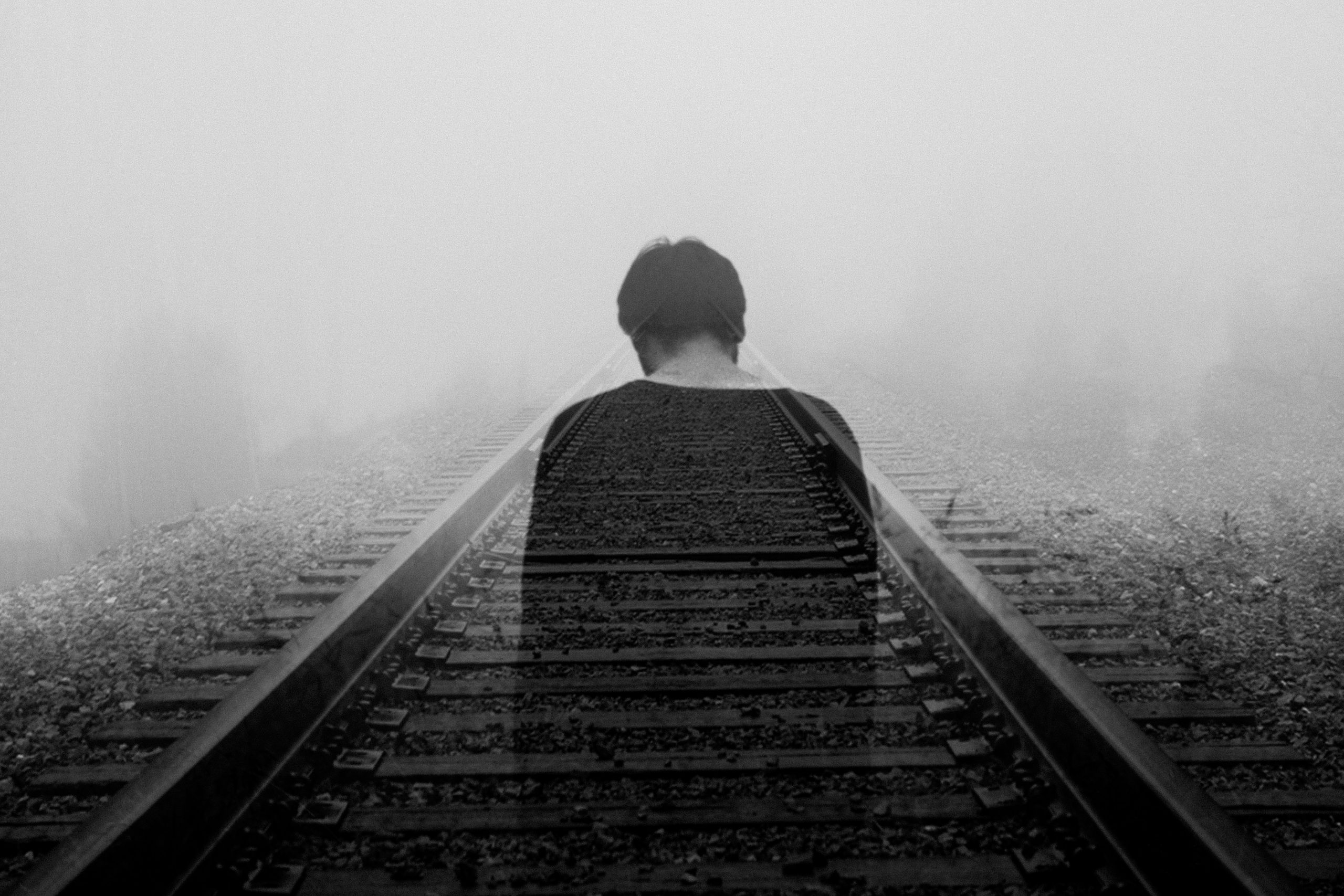
September 25, 2022. It is a 40 minute walk from the nearest train station to the spot along the water in Queens where Nick died, two years ago today. There are two bridges to cross on the way there and the sky is a sullen gray like an ice rink after heavy traffic; the air is thick with mist. I have sunglasses on, my hood up, and an umbrella, and I feel as if I am traveling into the past. If I see a bag on the ground that’s a sign and I’ll do it. If I run into one of the people I owe money to around here it’s a sign. Of what? In prior weeks, against the dizzying heat of a distended summer, I began to retreat from life as the familiar horizon of grief again advanced. All around me, the world has become very strange, indeed. I feel I am seeing things through a series of layered transparencies—street signs and storefronts and park benches surrounded by spectral counterparts drawn from separate memories, each slightly warped or askew. 


In a poem, To Charles Williams, written in honor of his late friend, C.S. Lewis writes about loss disrupting the integrity of the self. He says, “Your death blows a strange bugle call, friend, and all is hard / To see plainly or record truly”. This death has unmoored him, made the familiar dubious, turned him everywhere into a mere visitor, his own life a foreign country. “Is it the first sting of the great winter, the world-waning?” He asks, “Or the cold of spring?”


The closest street address to where it actually happened is a Department of Sanitation Building in an industrial part of Maspeth, Queens. In the cul de sac, a profusion of wildflowers obscures what was once the entrance to a small creekside encampment. I push through the undergrowth. Gone are the shack, the tents, and the shopping carts. On a sliver of rocky beach, a balled-up tarp is studded with orange caps, aluminum cans, and chip bags. New growth has obscured the old contours of the embankment and I am, jarringly, returned to the alien present. Confused, I search for evidence of the cabin’s foundation, for the saint candles I lit on this date last year. No luck. I look across the water at the Kosciusko Bridge, I stare through the mist at the concrete factory, I listen for that strange bugle call, expecting to hear my name in his voice. 


From the beginning, Nick was a secret within a secret.

From the beginning, Nick was a secret within a secret. I first saw him late one night in Chinatown—spring 2017—stumbling up Mott Street past seafood markets fronted with sodden wooden troughs, the last of their ice dumped to melt on the curb. He leaned on his bike like a walker, hair long and dreading, eyes all but closed. I was wary, having heard of him through a pair of troubled rich girls I knew he was ripping off, selling them dope at an extraordinary markup. I had recently reentered bona fide heroin addiction after a few agonized on-and-off-and-on-again years, and was still able to maintain a plausible daylight existence at the expense of a family kept at arm’s length. Everything about the man repelled me—his hands like fossilized mitts, the colorless skin of his face that sagged like boiled meat from the bone. When he stopped beside me and spoke, his eyes were fluttering slits but his voice was calm and conspiratorial, surprisingly soft. I leaned towards it. “She not picking up her phone for you either?” 


 Junkies love to demonstrate their mastery, their medical expertise. Some of their sacred folk medicine: the cold water extraction; ascorbic acid, lemon juice, or white vinegar for shooting crack; using table salt to scrub the film off the inside of a lightbulb; red grapefruit juice; micron filters; ice cubes on testicles and in assholes; bioavailability; binding efficiency… When someone would miss a shot and blow up their shit, you’d sometimes hear another scabby, nodding junkie begin a lecture about using a hot compress to try and prevent abscesses from forming, or to relieve them once they arrive. I might say something like, you just have to cover it in Neosporin, a lot of it, and soak a towel in boiling water then press it down and towards your wrist like you’re rolling out pizza dough. Personally, I’ve never tried it.


Recovery circles propose that for the active addict, the drug fulfills the same role, metaphysically, that the Higher Power is meant to serve for the sober addict—a constant companion and a locus of comfort. In recovery, though, the intended sense of belonging in the world is accessed through communion. In addiction, the longed-for fantasy is of perfect solitude, the obliteration of interrelation. I craved certainty and resolution, I reveled in the crippled physics of my shriveled universe. Time was punctuated by intervals between hits; the ideal day was the undifferentiated one. High or with the mere promise of a high in the foreseeable future, it became possible to endure the busiest shift, trek through a blizzard, rob any loved one or love any stranger, all in service of justice. What is just for the addict is comfort, and what is unjust, evil even, is being uncomfortable. The sick junkie, upon hearing that his dealer is around and holding, miraculously begins to feel well, marginally high even, on the strength of this faith alone, long before ingesting the substance. 


Nick and I were not fast friends. We traveled separately in the orbit of a girl we adored, the daughter of celebrities, Jane, who’d recently been introduced to heroin and who we professed to want to keep from harm. At the time, I saw myself, in this triad, as a good angel, Nick as the devil. In reality, we were both enabling and exploiting her, all three of our habits growing steadily more dire. When Jane disappeared suddenly for rehab, Nick and I continued on, in the darkness of winter, bound by the shared loss and the need to combine resources. It began tentatively. Every night between seven and nine, I would tell my roommate (to whom the severity of my addiction was a secret) a transparent lie, walk out into the cold and meet Nick at the Graham Ave station. Together, we would pool our money and go meet his connect, who lived closer to me, had the good dope (not the strongest, admittedly, but the most trustworthy), and who Nick initially refused to let me meet. In return, I would surrender one extra bag to him before he hopped on his bike and disappeared. In all, this took about 25 minutes, and we did it every night. Gradually, as weeks turned into months, I began to let him use in my apartment before departing for the evening, first only in the stairwell, then only if my roommate was gone, until finally, even that boundary dissolved. 


There are episodes in my time with Nick that I want to manipulate endlessly, hold like loose gems up to the light, trying to find the angle on which the prism refracts most beautifully. I want some alchemical miracle to change the tenor of memories without disturbing their content. But my obsessive excavation of the past produces no new revelations, no redemptive artifacts. I probe the sites of memory too often, infecting them with the grit and oil of the present. Nick is dead and I am alive. The dead stay put, changeless—we grow unrecognizable to them. Am I trying to change him? I am trying to keep his life suspended, exercising our history to stop it from resolving into slack sentimentality, to keep it from passing from meaning into mere meaningfulness. 

I try flattering interpretations or cynical or academic ones. I might remember our later, failed sex as attempts to rejoin the world, to resurface and prove we still had working, useful bodies. And I could remember the failure on its own, the limpness and numbness, and decide we meant to prove ourselves heterosexual.

I could reconfigure his kleptomania as a symptom of love. And that he resisted stealing from me as proof of devotion. I was, incidentally, the recipient of ugly jackets and designer wallets, tee shirts in the wrong size, polaroid film (though I had no camera) and paints I’d never use. It was symbolic, of course; everything would turn into drugs.


Eight months into our friendship, a hot summer day, waiting waiting waiting for our dealer, Simon, to respond, Nick and I walked up Graham Avenue from the BQE to the subway station. We stopped in each smoke shop and grocery store, on a mission to find cucumber-lime Gatorade. He chatted constantly at me, buzzing from shelf to shelf, whipping open refrigerators, juggling unripe avocados. We’d probably shot coke or ketamine or popped Xanax or some combination before venturing out, I’m not quite sure. There was no cucumber-lime Gatorade in stock anywhere. Every time we’d leave one store for the next he’d wink at me and open his tote bag, displaying pints of ice cream he’d stolen. The bag filled up with different flavors and brands as we approached the station. He liked Van Leeuwen the best—the mint chip and cookies n’ cream. At the final grocery store on Graham and Metropolitan, I found the right Gatorade. As I was paying, Nick stumbled out the door behind me, tote bag bulging cartoonishly. The cashier yelled something, hopped the counter, and sprinted out the door after him. I took my Gatorade, glanced around the corner, and ran in the opposite direction. 

We reunited a few blocks west, behind a granite and tile warehouse. He was grinning. Everything amused him. Simon texted. As we walked to pick up, he sorted through his bag and tossed the ice cream pints into various trash cans, saving only one. When we got home, he popped the container in the microwave until the ice cream was liquid—warm even, more a soup than a milkshake—and slurped it down. 


The medications available for treating opioid dependence are blunt instruments.

On October 1, 2018, Nick left early in the morning and never returned, picked up by the police doing graffiti and, having several outstanding warrants, sent to Rikers. In a letter he sent me from prison, he talks repeatedly about trying to get off dope and methadone. He says, “After being off almost a month, I was still feeling like shit and I was always chasing it and wasting my money. I had to get back on and especially things have been pretty hectic recently and I can’t put myself in danger by being all sick and tired and weak. This isn’t the time or place for anything like that. I really wanted to get off. I just couldn’t do it right now. Honestly that makes me pretty sad. I didn’t want to come out with a habit and have to go to a clinic on my first day out…” 

The medications available for treating opioid dependence are blunt instruments. Methadone and Buprenorphine are maintenance opioids, powerful narcotics that people may be dependent on for the rest of their lives or may use to taper gradually off—a protracted withdrawal that ultimately leaves them weakened for weeks, even months. Naltrexone, originally used for alcohol dependence, is an opioid blocker, which occupies the receptors, rendering them unable to initiate the euphoric, high-inducing effects of opioids. It is a pill that needs to be taken orally once a day. Vivitrol (naltrexone in Extended-Release Injectable Suspension) was approved in 2010 for the treatment of opioid dependence and blocks the effects of drugs like morphine, heroin, and synthetic opioids for a period of 30 days following intramuscular administration. To receive Vivitrol or Naltrexone, an addict has to be completely detoxed from opioids for a period of eight to fourteen days, depending on the drugs used. For addicts unable to enter a detox unit or without the time and resources to successfully detox themselves, this is a nearly impossible task. 


“Let me do it, let me do it, it’ll be easier,” Nick said. We were showering together, about a month before he went to jail, made momentarily hyper-alert by the extraordinary, bell-ringing shots of cocaine we’d just injected. I felt individual crystalline droplets exploding against my skin. The rumble of water battering the tiles was like artillery, and the sound itself a kind of rising atmospheric pressure. The initial 30 seconds of white light and divine heat following injection had subsided and the frigid horror was again upon me—a feeling of otherworldly dread, unimaginable fear, one I knew with mathematical certainty would arrive and yet felled me every time. There was a terrifying tightness growing in my chest, something badly off. My heart raced faster than it ever had before, despite my perfect stillness. 140, 180, 200 beats per minute, I saw numbers in my periphery, I heard scratching at the door. Colors reached out to touch me: yellow, orange, red, strobing…

I was thin enough to observe the flesh in the upper left-hand corner of my chest pulsating wildly. Transfixed, I expected at any moment to feel the final pop—in my chest, in my neck, my head. I was going to die, I was already dead, I had killed myself. Nick continued to talk at me as I lowered myself to the floor of the shower. He was blessed with a profound, almost distasteful sense of calm, one I’d never encountered before or since—an apparent immunity to panic, to psychosis. 

“You said you weren’t going to do this again,” he said, shielding his face from the spray. “You promised.”

“It’s different this time, it’s real, you have to call someone,” I whispered, sure that if I spoke at full volume, my heart would explode. “I’m having a heart attack.” 

He didn’t say anything, just stepped out of the shower. An alarming shimmer was now seeping in from the edges of my vision; I was at the bottom of a bright white well.

“Wait, don’t go, can you hold my hand and count breaths with me?” I moved my lips very carefully. They were gray and shingled with fluttering rinds of dead skin. I couldn’t hear myself. An invisible halo of noises had descended around my head, a shriek like a jet engine, like train brakes, wailing metal on metal. Nick returned holding a syringe of smack the color of Aunt Jemima’s and turned off the water. He knelt down. I could see in his eyes I’d fucked his high. He was burning up inside. Roughly, he looped and tightened the belt around my upper arm, shoving the end in my mouth to hold taut without a word. 

“You owe me a bun,” he said. His face was stony, disinterested even, but his fingers, probing my forearm for a bulging vein, were gentle and precise. When, finally, crimson darted into amber and he lowered the plunger, the plug was pulled and insanity rapidly drained out of me. I was restored, I was reborn. I couldn’t feel my heart at all; it might as well have stopped. The icy tundra of psychosis had thawed and reasonableness, rationality bubbled up in its place. 


I have been getting regular injections of Vivitrol, the opioid blocker, on and off for the past six years. Every few months, my insurance acts as if it’s the first they’re hearing of this medication and threatens not to cover the next dose. Then, my doctor and I have to wait around as we’re transferred from robot voice to robot voice until finally someone somewhere obliges. Without insurance, the retail cost of Vivitrol is around $1,738 a month. 

Two days after getting Vivitrol in August 2022, a month before the 2nd anniversary of Nick’s death, I started having pain at the injection site on my buttcheek. I have heard from other recipients about soreness and redness for days after, to the point of having difficulty sitting comfortably, though I myself had never experienced a reaction. On the third day after the shot, my left butt cheek was noticeably swollen and tender, by the fourth day the pain was so bad I was limping. In the colorectal surgeon’s office I stripped half naked and bent over a table while he shoved a thick needle into the affected area. Fuck, he said and showed me the syringe, now full of a putrid, spam-colored fluid. He scheduled me for surgery the following day at a nearby hospital, where he’d put me under and drain the infection.


The trials of loving an addict as a helpless bystander are well documented. I loved Nick while we used together and continued to even after our paths diverged. When he was arrested, I didn’t have time to cry and shake my fist at the sky, nor did I have the resources or wherewithal to bail him out. It was just over. Without a single handhold left in the living world, I fell and fell. My body was in tatters. I used drugs for two, liquidating everything, determined to leave no trace. I would die just like they promised. I overdosed twice, my dick dripped nonstop bloody piss, my legs were cratered with skin ulcers. Jails, institutions, or death, they say in AA, the ends are always the same. But I balked at death. I fled the city for institutions, and I got sober; Nick continued to the bitter end. While he was still alive I often wished he would die and sometimes acted as if he already had. These are thoughts I am sure members of my family had about me, too, though I have never asked. 


Because Vivitrol blocks the effects of opioids, and because of my well-documented medical history of substance abuse, the doctors and nurses at Mt. Sinai West took turns regretting to inform me that I would have to take ibuprofen following the procedure, and that it might be moderately to severely painful. The worse news was, because of the nature of the infection, and the size and placement of the incisions being made, the wound would have to be kept open with drains for several months following the surgery. 


In his 1917 essay, Mourning and Melancholia, Freud describes the process of mourning as cessation of interest in the outside world, loss of the capacity to love, inhibition of all activity, and a lowering of the self-regarding feelings to a degree that…culminates in a delusional expectation of punishment. In mourning, there is a turning inwards, a morbid narcissism, the world has become impoverished. In contrast, melancholia is described as grieving for something that has not been lost—a love object that is still within reach, but has changed meaning irrevocably. In mourning it is the world which has become poor and empty; in melancholia it is the ego itself.1 The addict is the terminal melancholic, suffering from a ceaselessly famished ego, one sated—though barely—by the miraculous effect of the substance, and in the romantic relation of addict to substance, which supersedes all others as the primary intimate relationship. 


In the time between my getting sober and Nick’s death, certain meanings changed irreversibly. The drugs I could never touch again and all the touchstones and rhythms of life that attended them had become apocalyptic and remote, and Nick, himself emblematic of a chapter closed, stood chief among them. Opioid dependence is a kind of Schrodinger’s cat state of threshold experience. The dope addict is always in oscillation between wakefulness and perhaps-permanent oblivion, life and death indefinitely deferred. He is only a part-time resident of hell, and a perennial tourist in the land of the living. 


Reentry into the waking world, the working world, was difficult. I found myself on first dates struggling to explain away the wasted years, to valorize myself, to make light of, dodge, or outright lie. On one occasion, I spoke at length about being an end of life caretaker for my ailing grandparents, on another I was solemn and reticent about the brutality of basic training as a marine. In a dark club, a guy put his hand down my pants and felt the smooth, circular depression on my crotch—the scarred remains of an abscess resulting from a missed hit. Nail gun accident, I blurted out. The urgent, solitary mission of finding and acquiring more drugs was a deep-sea pressure holding the other, incidental parts of my life together, and, having come to the surface, my identity collapsed, had become shapeless and muddled.


After the surgery, my left butt cheek continued to bulge abnormally, now due to the thick dressing required to soak up the constant discharge of pus, blood, and tissue. Bands of plastic and suturing wove in and out of the flayed skin, quilting it like a poorly tied roast. Having to rinse and redress the incisions multiple times a day, the skin around the area became livid and blistered from the bandaging adhesives. 


For a few weeks, the dripping gashes took on mystical properties. Daily, I was at the mercy of a body turning inside out. The narcissism of self-pity transfigured a medical mishap into a myth of sainthood. I was being punished for having gotten well while others continued to suffer and die; I was being branded for past crimes I had yet to make right.  Upon waking, a lurid brown stain bloomed through the fitted sheet and into my mattress pad. In the shower, dark gobs of blood and gray ribbons of tissue conjured images of continuous miscarriage. My addiction, a once-cherished and carefully nurtured child, now rotten and forcefully expelled. 


The perpetual anxiety of bursting, of spillage and overflow held hostage my erotic attention. Laying in bed with the man I had been seeing, Tony, I dreamt of his thrusting penis drawing back from my asshole and piercing instead the wet, forbidden abyss of my surgical wound. We had been having numerous problems in our relationship—failures of communication, games of denial and withholding. I was leaving the door open on a dream of  a world that no longer existed and spent all my time loitering on its threshold. Are you still in love? Tony asked me repeatedly, a blanket accusation. Still in love with Nick? No longer in love with him? I didn’t know. Peeling back the bandages, the overwhelming stench of putrefaction would fill the room. The smell of a veterinary office, a zoo. 


Even now, years later and sober multiple times over, the story I recount reflexively about Nick’s death and my concurrent relapse is not the true story. In the autumn of 2020, roughly two years into sobriety and two years since I’d last seen him, I finally relented and responded to a text inviting me to participate in a photo shoot he was doing for a magazine. It was disturbing to see him. I wanted to feel the same kind of narcotized adoration—the bliss of infinite postponement, of collapsing into someone, draining into them like a river into a swirling estuary. Instead, when he hopped into my car and hit the crack pipe, I felt I was meeting him again for the first time. I was afraid of being ripped off, no longer a co-conspirator; I was outside the joke. 

Recounting the timeline of my relapse, I tell people that when Nick killed himself by filling his shack with carbon monoxide a week after our reunion, the anguish activated a dormant reflex and I was high before I could even register the loss—like a sleepwalker suddenly coming to, knife in hand. People of all ages shake their heads and touch my shoulder, glassy eyed and sympathetic. I hide inside the legibility of this story. The logic all checks out; who wouldn’t be felled by such extreme upheaval? It is an untouchable alibi. I am granted clemency. The truth is I shot heroin the day of our reunion. I wanted to be close to him again, to huddle around the same flickering fire, the sustenance provided by once more sharing a secret. I said, “I drove you around all day, you owe me a bag,” and he gave me two.


The bleeding was continuous, requiring constant care. I lost sensation in the upper outer region of that buttcheek. My relationship with Tony collapsed. I could think only of myself, of monitoring the extremes of my body, afraid of what might escape those crusting vents that seemed to breathe on their own, threatening speech. I courted pity wherever I went. The undressing, lavage, and redressing a kind of retreat to private worship, the wound a surrogate child. In Mourning and Melancholia, Freud writes, By taking flight into the ego, love escapes extinction2. Could I reach into the infected pocket and pull out his name? 


The scars that remain from my surgery are permanent—three dark puncture wounds, sunken and hard like tufting buttons. They interrupt the erotic act, punctuate it, demanding a pause for address. Repeatedly, I am put on trial, asked to either reveal myself or deliberately retreat. These areas of scarring—striations, ridges, tracks not just on my butt but all over my body—are monuments, promiscuous exhibits of history, demanding a claim or disavowal of authorship.


The confluence of wanting help and being able to get it is usually brief.

September 25, 2020. Later on, after I’ve left the riverbank, I receive a call from a friend of Nick’s, an emissary from the past. She says she has ten hours before she can be admitted to detox the next morning. Around the country, dope fiends lie dead in the aisles of supermarkets and in parked cars and at picnic tables. I pocket waterproof surgical tape at CVS and walk out without paying. I wish her luck, knowing she won’t make it. The confluence of wanting help and being able to get it is usually brief—a flare falling across the sky, then gone. 

Earlier in the summer, a good friend of mine, Harry, overdosed and died in his childhood bedroom during a visit to see his parents. His mother asked if I thought he killed himself. I didn’t know what the good answer was, if there was one that might bring his death into coherence, if I could make him heroic. The funeral was packed, which shocked me. I’d assumed I was his only friend, but I was really just his last. Two months from now, in November, another friend, Luke, sober for years longer than I have ever been, will also relapse. He will die the same night. Here is what I’m saying: There is no justice. I saw his body; I saw his black mouth. I will learn that he was the father of three little kids with dark skin and white blonde hair. I will meet his wife for lunch. I will learn that for a year he only washed his hair with tree sap, that they owned a parcel of woods upstate with a small creek running through it. It turns out they’d been planning to leave the city for good. It turns out I barely knew him at all.


Note: Some names in this essay have been changed to maintain privacy.

  1.  Freud, S. (1972). Trauer und melancholie =: Mourning and melancholia: 1917. Merck, Sharp & Dohme. ↩︎
  2.  Freud, S. (1972). Trauer und melancholie =: Mourning and melancholia: 1917. Merck, Sharp & Dohme. ↩︎

10 Poetry Collections About Digital Life

One of the first forms my creative writing students adopt is the list. I love a list for its generosity and promiscuity, its non-hierarchical logic and stochastic lineation, its tendency to produce itself: to advance—accumulate—through coincidences and association and proximity, reassembling under the approximate logic of adjacency and wish fulfillment. Anyone can write a list and no list is complete; each item, like one site among a constellation, points us to other things or other futures. This list, too, is not meant to be an exhaustive inventory of poetry books about digital life or even an inventory of poetry books about the internet. Like media artist and curator Marisa Olson, who used the term “postinternet” in 2006 to describe a growing canon of art under the influence of the internet—work that described and critiqued nascent conditions of production and distribution; emerging social relations structured by obscured power dynamics—I think of the books on this list as work that observes and interrogates norms that we associate today with new media and networked capitalism, mining and miming the markup languages and polyphonic rhythms of the internet for glitches that might re-write the programmatic whole. Since at least 2017, when poet and digital poetics theorist William Lessard and The Brooklyn Rail described me as “Frank O’Hara traveling the hyper-connected contemporary landscape via iPhone” (“Adventures in Self-Voyeurism”), my work has been increasingly treated through its engagement with persona curation, surveillance cultures, glitch aesthetics, and the dislocative cadences of migration and passing.

With my latest book, a full-length collection of poems called Windows 85, I use address and apostrophe to kink the generative fictions of screen play, channeling the epistolary affect of digital interactions to clarify the melting point of incommensurable copresence; a form of wanting that has nothing to do with fulfillment or even pleasure—the redemption of an intimacy actualized through distance, blur, and withdrawal: “… how I want to be close to you / because I feel this way but I wouldn’t feel this way / if we were together.” The encounters that occur in Windows 85 appear and evaporate with a simultaneity that I want to liken to any streaming, always-on interaction, where the urge to join (with) another person in an indeterminant “here” or “now” doesn’t just muddle a spatial-temporal order but the border between bodies, without which one can just as suddenly become the other.  

One of the questions that prompted me to make this collection was: can I adapt my media theory to verse? There are so many great examples of novels in verse; maybe Windows 85 is theory in verse. Like the books on this reading list suggest, collections of poetry installed in digital cultures have a tendency to straddle or evade formal markers and generic categories, challenging readers to broaden our notions about what poetry looks like; what a poem does.

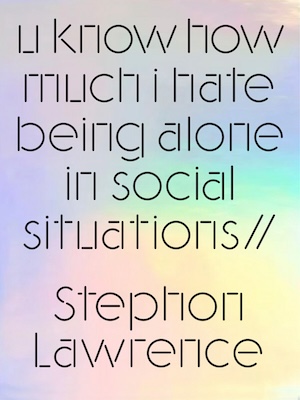
u know how much i hate being alone in social situations by Stephon Lawrence

With quick wit and earnestness, u know how much i hate being alone in social situations skims the everyday insecurities and traumas of being human, or part human, on again off again, amidst the cringe rituals of office share interactions and work emails, the theater box of Twitter, the spectacle of health and wellness, and the anomalous soundtrack brought by haphazard public transit—the almost imperceptible transition from person and persona, one’s inner world and the instantaneous public, a changeover collapsed by the fact of being always online. Stephon Lawrence’s poems harness the abridged spelling and slang of chatspeak and a polychromatic array of emojis in service of a self-aware address to an audience that is often imagined and always implied. Shifting from unsent voicemails to unfinished HTML script to celebrity rendezvous and dreams within dreams (within dreams), Lawrence’s speaker navigates heartache and clickbait with playful aplomb and deep vulnerability. 

Hivestruck by Vincent Toro

As our relationship with the internet continues to update, reflected by the metaphors—network, swarm, multitude, assemblage—we deploy to understand “collective intelligence,” Vincent Toro’s Hivestruck traces a trajectory of media with punchy lyricism, anecdotal storytelling, and relentless experiments in form, reanimating a life that can be measured by the screens one has possessed or been possessed by. Toro’s code-switching, polysemic verse looks out as much as it looks in, detailing the zombification of watching and being watched in the “panopticonfederacy” with mic-drop parody and solemn observation. Hivestruck’s poems, organized into three sections, shift between ballads to braided haibuns to the Latin American décima to cleave poems to the crab canon—an invention of Toro’s which, in reversing the language of a poem’s first half, recreates the effects of a mirror on the bottom. Others take the form of persona poems in which Toro ventriloquizes machines and content moderators and, elsewhere, digital content itself, inverting lenses to address the reader-user: “I am an icon. My profile/page when double-clicked updates you/on my status. One million views … .” With its diffuse structure and theoretical concentration, Hivestruck reminds us of the possibilities both obscured and precipitated by the limitations we impose, whether or not we know it, on ourselves. 

The Rendering by Anthony Cody

A poetry collection that serves as a counterarchive, The Rendering attends to the historical ledger that has not merely been omitted from the record but resists conventional representation. With no desire for “the whole picture,” these poems, many of which offer multiple pathways of reading through Anthony Cody’s use of annotation and enjambment, also upend the archival urge for totality. Cody combs digital public domains to collage historical ruin with contemporary ecocide, manipulating photojournalist Dorothea Lange’s photographs of the Dust Bowl, U.S. Weather Bureau reports, transcripts of UN climate change panels and interviews with Dust Bowl refugees with graphic design software to create a visual-verbal communication that, at times, resembles a galaxy of command prompts. The Rendering’s transgenerational scope reminds readers that environmental and economic precarity and mass displacement and migration must be understood as mutually constituted under the design of consumer capitalism, now as in the past.

Reps by Kendra Sullivan

Reps, like its title suggests, is a collection of poetry as a triptych, each part exercising the formal structure and thematic organization expected of a poetry collection. Kendra Sullivan diverts often, moving from the ventriloquism of machine-learning in “Exercises Against Empathy” to the repetition of an origin story in “A Typology of Possible Biographies,” whose poems all open with the expository mantra: “A story about.” Sullivan’s poems are observational, abbreviated, curious, and attentive, imbued with a self-reflexivity that allows her speakers to question the terms of their own representation, as well as the conditions of expression and production. Though it isn’t until the book’s third section, “Margaret, Are You Grieving?” where an unbroken narrative emerges: a young artist’s coming of age at Ground Zero. Like other books on this list, Reps edges the territories of the digital world and the very material ecological world to insist on an ethics of reparation, for our natural world and to one another.

Titanic by Cecilia Corrigan

Cecilia Corrigan’s Titanic, which was awarded the Madeleine P. Plonsker Emerging Writer’s Residency Prize by Lisa Robertson in 2013, was the first book I’d read that felt digitally native, in the sense that reading Titanic—an epistolary romance, a pitch for a TV show, a script for reality … all of these—felt like being on the internet: more virtual than cyberspace. Father of AI Alan Turing plays Corrigan’s protagonist, a man on the run, escaping love (and death) for the digital dreamscape of disembodied consciousness within a book of poetry interspersed with chatboxes and pop-up ads, correspondences between William and Alice James, appearances by Miley Cyrus and Katy Perry, transcriptions of late night talk shows and episodes of Buffy the Vampire Slayer, declaring that all of these, too, are poetry. In Titanic, as on the internet, everyone is playing a character, and maybe even themselves.

Throng by Jose Perez Beduya

Another recipient of the Madeleine P. Plonsker Emerging Writer’s Residency Prize (awarded by Jennifer Moxley in 2011), Throng investigates ruins of the present in the aftermath of limitless horizons: the catastrophe of experience and knowledge brought by the consummation of absolute access; that anything and indeed everything can be accumulated, seized, sorted, sold back to us, as us. The collection’s poems, many of them written in neat couplets and tercets, glimpse a narrative that can only look back, that can only sift through fragments, without any attempt to restore or redeem. Jose Perez Beduya’s hushed tones drape his matter-of-fact lyric cycles in a vaporous lullaby that haunts and disorients, mirroring the speaker’s hunt for an identity premised on simulation, a sense of subjectivity absent individuation, in which narrative relation is often constituted by the re-citing of a collective “we”: the anonymous throng of the title. But Beduya’s book is not an examination of self and community so much as it is a reenactment of the patterns by which selfhood is continuously negotiated inside “the bright wheel” that acts as Throng’s leitmotif.

Pixel Flesh by Agustín Fernández Mallo, translated by Zachary Rockwell Ludington

Pixel Flesh (Carne de Píxel, literally “pixel meat” in the Spanish original), is a love story that substitutes plot for the information overload of media saturation. Like the small square of data belonging to its title, the book exploits its streaming prose form—presented in dual Spanish-English, as translated by Zachary Rockwell Ludington—while embedding its series of breakups with found texts lifted from Spanish periodicals alluding to science and philosophy, physics and metaphysics, scraps of quantum theory and the flotsam of code unmoored from an operating system: enmeshing the net/work of art and science. Agustín Fernández Mallo, whose background is in experimental physics, tests the limits of a pixel’s inherent drift toward reproduction and displacement—each pixel, after all, is just a sample of an original image, and Pixel Flesh’s story does not advance so much as iterate, collecting, in each successive sequence, fragments of memories that may or may not be the speaker’s own, a love that is endlessly displaced and thus endlessly desired.

Travesty Generator by Lillian-Yvonne Bertram

Years before OpenAI normalized conversational generative artificial intelligence with ChatGPT, which would become, two months after its launch, the fastest-growing consumer software app in history, programmer and poet Lillian-Yvonne Bertram was already adapting Python, JavaScript, and Perl programming languages to produce poems that counter dominant narratives of Black lives while critiquing the assumed neutrality of science and algorithmic objectivity. In Travesty Generator, Bertram pays heed to an ongoing history of Black erasure and the racialized surveillance and securitization that shapes and is shaped by biased technology, including the predictive analytics of search engines. Bertram’s collaborative permutations are incantatory and haunting, their versions and reversions channeling the lives and deaths of Trayvon Martin and Eric Garner—“People also search for: Emmett Till”; “People also ask what was Harriet Tubman’s life like?”—serving as both an elegy and the inauguration of a Black futurity. The ambiguity of most repurposed language divested of context is here reconveyed with urgency and social-political agency; Bertram’s self-reflexive poems interrogate the atrophy of cultural memory under an attention economy and, moreover, their own formal structures through a relation of violence that is implied and inevitable. But by recasting last words and returning a voice to Black bodies, restoring them to legibility and subjectivity by writing, as Bertram does in the early 14-part sequence, “Counternarratives,” from their point of view, Travesty Generator’s collaborations serve as a call to witness beyond the distancing gaze of science and social media.

MissSettl by Kamden Ishmael Hilliard

Kamden Ishmael Hilliard’s 2022 debut collection explores empire’s extant processes of racialization and colonialism with honesty and humor and a scathing playfulness that speaks to the poet’s use of mimicry as subversion. Like its title suggests, MissSettle is interested in unsettling the structures of language and logic, our assumptions about knowledge, literacy, belonging, and bodies, their institutionalized inscribing and cultural co-opting. Hilliard’s roving gaze sights transcultural practices, hyper-linking distant subjects, encounters, and histories with a stream-of-consciousness verve and vibe that wants to turn the paper into a screen and the act of page-turning into the dégagé scroll of social media, plus the offhand interjection that all of this is being composed on the go. “I don’t even want reparations/yet !” Hilliard’s speaker insists. “First , I will take a #3 combo/bc i’m hungry and a #2 pencil ,/not cause negros remain unprepared/for ontological warfare—but bc/I need to jot all this down.” Though it flaunts a velocity that mimics our contemporary cascade of content abundance, the book resists quick reading. Instead, Hilliard’s frisky and provocative asides and grammatical idiosyncrasies require we look back (look again) at the ways in which syntax and citizenship undergo interrogation, derangement, and revision in these poems salted with self-aware exclamation and dramatized ellipsis, the interlude necessary for a poetics of reconstitution.  

The Kármán Line by Daisy Atterbury

Cross-genre and multidisciplinary, The Kármán Line rims perimeters, layers, boundaries both bodily and virtual, internal and public, geopolitical and extraterrestrial in pursuit of a novel epistemology, a thinking and a writing “in service of a togetherness.” Daisy Atterbury’s hypnotic narrative converges systems thinking and environmental studies with childhood anecdotes and often obscured histories of colonization, militarization, and securitization across interconnected sequences addressed to a lover, moving without signal from ruminative prose to the glitchy enjambment of verse amidst the insidious specter of radioactive fallout, from the galactic Zone of Avoidance to Sushi King and Spaceport America, from the coded come-ons of Tinder to the collected notes of Wittgenstein and cartographic recreations that reinscribe unequal realities. Along the way, readers witness the nascent encounters and non-encounters through which a love begins to take shape, never without Atterbury accounting for the potentiality of disaster or crisis, the etymological turning point when something irrevocably changes. Atterbury’s scope is generous; her voice tender, speculative, and mindful of the body undergoing various operations of dis/placement and re-embodiment across digital spaces and the dream of deep space—everything orbiting the motoric hub of desire, the necessity of being undone in order to be remade, together with another, gleaming what Atterbury calls “a radical softness,” a being (in touch), which is beyond descriptive narrative, beyond territorialization or metrics, beyond the regulatory divisions signaled by her debut collection’s title. 

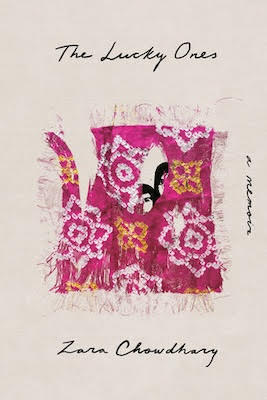
Zara Chowdhary on Coming of Age During Anti-Muslim Violence in India and the U.S.

Zara Chowdhary’s The Lucky Ones is a devastating, timely memoir about survival, reclamation and what it means to exist on the margins of society and within your own familial unit. Zara speaks to us, raw and unfiltered, about growing up as a young muslim girl in Ahmedabad, India, in the aftermath of a train being burned. The incident, declared an “act of terrorism” by Narendra Modi, Gujarat’s then-chief minister, instigates anti-muslim sentiments, rouses Hindu mobs into rushing through Gujarat’s streets, villages, and towns, “looting, raping, and burning alive the state’s Muslim citizens.” A lockdown follows, Muslims are pushed into areas that slowly turn into ghettos, and the fear of a mob grows as days slow down for Zara and her family, and many others like them. 

While young Zara battles the confines of muslimhood, fast-approaching womanhood, and familial expectations alongside the fear of becoming another number, another body in the ongoing genocide, Chowdhary deftly expands the scope of the narrative by weaving other stories, of women raped, families destroyed, and also, lives sacrificed to save others. In between, we are acquainted with Punjabi verses, Zara’s grandfather’s love for sufism, her grandmother’s pride in Garba, young Zara’s refuge in Sanskrit, and these diffuse moments of horror. 

Chowdhary’s prose bites like her narrative. Underneath every word, every vivid image, is a rage that simmers, proving what Zara confesses to me: writing for her is an act of expulsion, something that boils out of her.

Writer, producer, and educator, Zara has an MFA in Creative Writing and Environment from Iowa State University. She has worked for studios like Eros Entertainment, Red Chillies, and her work has aired on channels such as National Geographic India. Over Zoom on a Thursday evening, Zara and I talk about terrorism and the muslim boogeyman, navigating adolescence in a ghetto, language as reclamation, and more.


Bareerah Ghani: In an earlier chapter, you talk about the impact of America’s “war on terror” narrative on how the Godhra train incident itself was framed in the public eye. You write, “Americans make war and decimating an enemy look cool.” In another place, you mention representation in film, saying, “Cinema is always mocking and parodying my faith.” I would love to know your thoughts on the extent to which the shadow and influence of American propaganda and representation of Muslims in mass media can be reduced or even eradicated? 

Zara Chowdhary: I remember the exact moment of watching the twin towers crumble. I remember that sinking feeling when I heard the news saying, this is Islamic terror and jihadist, and the language was so fresh on the tongue, and so new, there was almost a greed with which people were chewing it up. A gluttonous feeling for, here we have a villain who we can throw all this language at, and look how terrifying this villain of this new age is! And having grown up also in a culture where cinema was very binary, there were only good heroes and terrible wart-faced villains, I knew instantly that the new villain of my generation was going to be a person of my faith. 

I was a 9th-grade student but it was so innate, that fear, because this was something that had been percolating in the air, especially in a place like India, for so long. We had the history of the partition. We had a bloody history of sixty years at that point, of just hatred and animosity, and constantly having to push ideas of Secularism at groups that really were happier to misunderstand each other. And then to see this language come in, in 2001, really felt like it had been glamorized, Hollywood-ized suddenly. Because the way America does these things is with swagger. Like when Afghanistan was being bombed, and the way that language and rhetoric seemed to empty those spaces of people. Those were just barren lands they were bombing, looking for that one bad guy, and there was no mention of the towns or the villages whom this was decimating. So this language of Islamic terror, it was the first time I had seen that happen. And less than six months later, in 2002, when the train burned in Godhra, hours in, when there hadn’t even been a forensic investigation, to have the leader of a modern Indian secular state look at the carnage and call it an act of terror, the word Islamic didn’t need to be added to that phrase anymore. It just hung in the air.

At the time, I was trying to pull away from faith, starting to question how much I felt like I belonged, how much this faith accepted me in my broken ways. And yet, something about that moment brought about this sense of gut level loyalty. And also, gut level pain. Knowing that everything that generations of your family have been, generations of Indians, Muslims across the world have been, has suddenly been put to question because of these few acts that have happened at the margins of the faith of such a major world religion.

I remember the exact moment of watching the twin towers crumble… I knew instantly that the new villain of my generation was going to be a person of my faith.

We know that propaganda can be both good and bad. I think if there’s storytelling, nuanced humanizing of people, there are ways for us to tear apart this idea of Islamic terror, and the stereotype of a Muslim. I see a lot of that work already underway, especially in my generation. Before we can be writers and engineers and doctors, we first have to be good Muslims, and be models in that way. Especially those who are artists and those who have a voice are trying to do that work to minimize some of that stereotyping. I don’t know how much you can eradicate something in a world where a villain is always needed, when you don’t want to look at systems and systemic issues, and you always need an Other, a bogeyman. It’s going to be very hard for us to completely erase this idea. And that’s the tension I’m always looking at – if, in a situation, whether it’s a Muslim, or another minority in another context who have been made into the Other, the villain, what are the bigger systemic issues that they’re trying to push under the carpet?

BG: In the book, you talk quite fondly about your life before the pogrom, how it was like growing up around different cultures and religions. I would love for you to share how such exposure played a role in the development of your identity as a muslim.

ZC: So the funny thing is, even though I was raised in this weird sort of family lockdown on this 8th story of a building for the first sixteen years, I always felt my sense of Muslimness very rooted to the land. I think all of us, to some degree, are defining our Muslimness in reaction to or in conversation with the world around us—the place we’re in, the country we’re in, the society we’ve been born into. And for me, my Muslimness at the time was very much being chiseled into shape by the fact that there were all these other faiths around me. I was very, very lucky. Whether it was through going to a convent school that Catholicism was such a huge part of my growing years, or the fact that we lived in a community of primarily Zoroastrian Parsis, who showed us what it means to seek asylum in a land and make it your own. To have generational stories be told to us, to have Jain women tie rakhi to my father. All of these really did inform my sense of Muslimness, because then I saw myself as just one of many. And I was able to understand that my existence didn’t impinge on the non-existence of someone else. In fact, it became better and somehow sweeter by the coexistence of all of these others. 

For me, the tensions for a lot of those years came as my neighborhood became more and more ghettoized. Because what happens in a ghetto is that you push together people who are all of the same kind. But there is no same kind, right? We’re all multifaceted beings. So in this little ghetto as well, you had a Muslim who was half Yemeni and half Gujarati, a Muslim who was some erstwhile royalty and still pretended to be that, you had somebody else who was Dawoodi Bohra Muslim, who are a different subsect, and have a very different understanding of the faith. You had rich and poor Muslims, you had caste as a divider between Muslims. So then, when you’re in that ghetto, and you start to compete and contrast amongst yourselves, that also starts to define what you want to be, and what kind of Muslim you want to be. 

BG: You talk about both the danger and comfort of being concentrated in a ghetto, how it can both heal you and also consume you. Can you talk a little bit about the duality of that experience while you were navigating adolescence, which is already a turbulent time for anybody but especially for girls?

ZC: I love this question! This was part of my obsession, really, with writing about Khanpur, my neighborhood. Because when you’re forced into these tiny spaces with all of these people who are, again, your people, your kind, you all live together on this one side of the river, there’s this comfort that if a big horde comes across the river in the middle of the night to torch us, we will all die together. It’s this kind of massive, existential comfort. But then, on the micro everyday level, there’s still the point of, if I want to go down to the grocer, I have to wear my dupata a certain way, because not only will the boys cat call at me, but some auntie will see them, and then she will go tell the liftwala who will go then tell my mom, who will say it to my daadi, and then I’ll be called out for it. So there’s this sort of daily exhaustion of living in a world where your whole identity comes down to every single act every day, and that judgment is so final and sticks with you, that by the time you’re ready to get married and leave, there’s a whole resume of what Zara did while she lived in Khanpur. Add to this the fact that we’re leaving this world on a daily basis, going across this bridge into what is the newer city, the modern side of the city, to the most prestigious school in town. What does it then mean to be the girls from the ghetto who are going into that part of town? The constant being looked down on, the scrutiny of our shalwars, the dissing of our food. And so that sense of unbelonging, even in a place like school, which is supposed to be your safe space, your space to learn and evolve in, it amplified that tension on a daily basis. 

BG: The heart of this book is belonging to a place, to people. An integral component is Amma’s story, how she’s treated like an outsider, her relationship severed with her own parents. So Amma pours herself into her daughters, giving them a sense of belonging. I’m curious about your thoughts on how daughters-in-law in patriarchal structures can reclaim their sense of belonging to their primary familial unit, their parents and siblings?

I think all of us, to some degree, are defining our Muslimness in reaction to or in conversation with the world around us.

ZC: I wish I had answers to how. This is actually where I’ve always leaned into Islam, to a big degree, because if you look at the text and what Islam tells you, you never belong to anybody but Allah. And that central tenet has always been foundational to me and I know it’s been foundational to my mother—this idea that you only return to that one source. That’s where you’ve come from, and that’s where you go back to, and therefore you do not belong to this earth, to a family, to a nation in the same way that you belong to that source. So that sort of more mystical, transcendental thinking is something I’ve found very helpful in rooting yourself and making a home within yourself, even if you’re surrounded by a system or a family where you don’t feel like you belong.

I was reading this really fascinating book this week, Islam and Anarchism by Mohamed Abdou, and he talks about how fascism is this mass psychology, and how all of us, because we have lived through colonialism, or through oppression in one form or the other, we all have little micro fascistic cells within us, we all have some amount of that oppressive ability within us. I think when you start to recognize that you could be oppressed or you could also be an oppressor, and you start to distinguish those things within yourself, that’s when you will find that you have agency and you have choice. Even in the most oppressed conditions, including during a genocide, you are not completely without agency. There are certain parts of you that are yours, that nobody can take away from you. When I look at Gaza right now, and I see people say, حَسْبُنَا اللَّهُ وَنِعْمَ الْوَكِيلُ (Hasbunallah wa ni’mal-Wakil) that is them saying it is only this one source that is my witness, and is my everything. That’s an active agency as well, of giving everything of yourselves to this other caretaker, so that what is in front of you cannot oppress you.

BG: Wow, that’s a beautiful perspective. Thank you for sharing that. To stay on this idea of belonging, I love the way you talk about your love for Sanskrit. You write, “Saying it aloud makes me a part of its tangled mythology, gives me a place to belong.” Can you talk about your experience with the languages you know, and how they’ve offered you roots to ground yourself in?

ZC: I grew up in this incredible, strange intersection of different regional linguistic cultures. My father’s side, my granddad came from Punjab and so he had this love for Punjabi-Sufi poetry and Urdu. My grandmother on my dad’s side was from Gujarat and so for her, Gujarati including Gujarati film, theater, literature was something that she was always hungry for and and just very proud of.

On my mom’s side, my grandfather was part Pathan, and then the other side was South Indian. Somewhere back in the generations, I think they had spoken Pashto or Dari and the other side of the family spoke Tamil, and Telugu. So there was this rootedness to the south of India that was beautiful, and then the grandmother on that side came from the western coast, which is where a lot of the first Arab traders and sort of saints came when they came to the subcontinent via ships. So there was a lot of mix between this coastal community where the Alphonso Mangoes come from, and Arab influence. She was this strange mix of village person who loved oysters and mussels and mangoes, but also had this very Arab leaning ideas of texture and design, and aesthetic.

None of these people like each other but they embody their cultures and just by being themselves, they were pouring them into us, one way or the other. So for me, language was always that first place of refuge. I would try to write in all the different scripts, because I just loved how beautiful they looked. And there’s just so many sounds that your mouth could play around with. 

As a Hindi teacher now, I’ve had to learn how the different parts of your vocal system make different sounds. Suddenly, I have an appreciation for those of us who are born multilingual or into multilingual homes. I’m like, Oh, my goodness! I was learning how to use velar sounds, labial sounds and dental sounds, without knowing what I was doing. And this is the story for most Indians. They all grow up at these intersections of what their family culture is, versus the place culture, versus the space that they go to work in. That’s just the beauty of belonging to a place like India. And yet in all of this, Sanskrit is a mystery. It’s a classical language, not practiced as a spoken language. It’s only the language of the mythological texts, and then the language of prayer, the language of Buddhism, Hinduism, Jainism. For me, it was just a way to unlock certain things that were already being held away from me. So if you were growing up Muslim in the nineties, you were already being told, especially in places like Ahmedabad, that oh, these festivals are not for you. You’re not welcome here, or why are you singing these devotional songs. So for me, language was reclamation. It was a way of saying, No, I am from this land, and therefore the stories of Durga, of Parvati, of Shiv are mine, and as long as my mouth knows how to make those sounds, those stories will be mine. It was that struggle to belong through physiologically training yourself to belong.

BG: I’m curious, how many languages can you speak?

ZC: So English, Hindi, Urdu, Gujarati are the ones I’m most comfortable with. But I can definitely fully understand Punjabi. I can understand Tamil pretty well, and Telugu, to a little degree. I lived in Bombay for 7 years, so Marathi feels very familiar to me.

BG: Love that! I’m really fascinated by written Hindi because my grandfather used to know it, and because my ancestry is from Bombay. My daadi I think knew Gujrati. We have an offshoot spoken language that is sort of like Gujarati, it’s called Memoni.

ZC: So what you call Memoni is what we call Kutchi. And that sort of Kutchi-Gujarati kind of spills into Sindhi, and if you hear Haryanvi in India, you’ll hear notions of that as well, because we were very much nomadic groups, trading groups that moved around and picked up bits of each other’s language. It’s why I’m a language teacher. I’m fascinated by how language moves and flows across the globe.

BG: You know I didn’t appreciate Urdu as much as I do now, and so I understand the concept of language as reclamation. As I’m trying to lean into my identity as a Pakistani, I have a growing fascination with that language. It’s from this desire to belong to that place, to that identity.

ZC: I’ll tell you a story. I was at this reading the other day in Chicago, at an art gallery, and after I finished it, the gallerists called me, and they’re like, Can you read Gujarati? I was like, yeah, of course I can. I studied it until like 7th grade. So they show me this painting that they’ve acquired, which is this intensely complicated canvas. There’s figures and there’s illustrations. But in the middle of all this and all around it, this artist has just hand scrawled in Gujarati in little sections. In some of them, he’s just naming birds and trees and in other places, he’s saying things like, my heart has this deep desire that one day somebody far away will look at this.

Just think about the fact that I am standing in a gallery in Chicago. This girl, who all her life has been told Gujarat doesn’t belong to you, and you don’t belong to Gujarat. And this Muslim Gujarati artist, who speaks nothing but Gujarati, who writes nothing but Gujarati. Nobody in that room can tell what is in his canvas, but I happen to be there, and I can.

A Cruise Ship for the Disappeared

Awaiting the Declassification of Documents at Some Point in the Near or Distant Future

The cruise ship washed ashore, tipped sidelong, keel sunning itself beneath the cold November sky. The ship was a city block of aluminum alloy and wedged between two stone jetties. The area was roped off with caution tape. I explained to the police officer working security that I was the insurance claim inspector assigned to the case. Big case, the cop said, looking over his shoulder to the boat’s bulk. He lifted the tape, letting me through. I’m not sure he would have if I’d told him the second half of the story. How my wife was on the ship when it went missing, dropping off radar three years ago. I left that part out.

The boat appeared to have just left port. The bleached hull hadn’t aged, the festival colors of her name still vibrant as the day they’d set out. The news reports on every channel didn’t lie. 3000 people swallowed by the sea. My wife, Linda, among them. Her friends too. It was a bachelorette party. Linda didn’t want to go. Hated the open ocean, the threat of foodborne illness, the environmental sin, but she couldn’t turn down her best friend.

She said she’d send a postcard when they reached their island port, but the postcard never arrived.

A rope ladder hung from the railing above. I climbed hand over hand, rough fiber harsh beneath my palm. My boss said it would be hard to navigate the deck with the halls tilted 45 degrees. Snap the pictures and get out. I don’t want to file a second claim if you know what I mean. He didn’t specify which rooms he wanted investigated. He originally said I should take the pictures outside, but I pushed him. Can’t get an accurate assessment if you don’t go in. He didn’t fight. I needed to see the last place she slept, the last room she inhabited. It’s hard to accept when there’s no body, when the reports still don’t make sense. I’m sure the government will come clean in the future, another wave of extraterrestrial documents getting declassified like they do every year, another wave of information ignored because we all have so much other trash going on in our lives that an alien invasion is the last thing on our minds.

I balanced myself against the hallway wall, stepping on even-number doors. The area smelled of cleaning solution, of lemons and harsh chemicals, though I’d been assured no one had come aboard to disinfect. I was the first to walk these halls after the initial search and rescue team had dropped the latter part of their title. Above was room 331. I wrapped my hands around the knob and turned. I pushed up with all my strength, sending the door back on its hinges. I grabbed onto the interior and hoisted myself up. My arms shook.

I saw Linda’s suitcase. The collection of smiling and slightly deranged raccoon stickers coating the luggage was unmistakable. Her toiletries filled the bowl of the sink, lying flat against the shower glass, toothbrush and vanilla face cream and birth control. I scaled the space as if it were a rock wall. The bed was wedged against a dresser. I pictured Linda walking through the room, tilting her face towards the sun on the balcony, texting me late at night from beneath the sheets, saying how much she missed me, how much the vast blackness of the ocean unnerved her. You can’t just walk home if your ship goes down. It’s not like a fender bender, I remembered her saying. You can only swim so long. I hoped she hadn’t had to swim, that it was some tractor beam snatching the ship from the ocean’s surface, that all the passengers now resided on some utopian planet, making friends with the locals who’d been skilled with translation technologies and dietary needs.

I don’t know what I hoped to find in Linda’s room. Her ghost waving at me from her bed, spirit cellphone in hand trying to send one last message? A note tucked into a nightstand drawer, a quickly sketched caricature of what had come for her, a ransom note in another’s unearthly scrawl? There was nothing. I checked each drawer. Just socks and bathing suits and complimentary robes. I snapped pictures of each. A job is a job, even if you sob as you do it. It’s unfair some people comprehend mysteries while others are left in the dark, when others have loved ones swallowed by those mysteries, every last molecule swept from Earth by things we aren’t allowed to understand.

Nothing inside was waterlogged. The carpet and comforters didn’t squelch with sea water. The boat hadn’t capsized. No tentacled monstrosity had pulled it beneath the waves.

I took a final photograph of the room and told myself I’d photoshop Linda in there as if it were that postcard. I’d mail it to myself so that when I received it, I could pretend there was still a chance she’d be coming back. Even if it was only for a second, just a single glimpse of our worlds aligning once again.

Sapphic Undertones Littered L.M. Montgomery’s Fiction, as Well as Her Female Friendships

My favorite book is a pale, mint green, Illustrated Junior Library edition with edges sprayed indigo blue. The girl on the cover wears a white pinafore over a practical plaid dress. Her two orangey-red braids fall around her shoulders, topped off with a wide-brimmed straw hat covered in freshly-picked flowers. She balances the hat with one hand as she gazes off into the distance, past farms and a quaint town of yellow houses and a modest church. On the back cover, beneath a shady tree, there’s a two-story farmhouse with green shutters and green gables, and when the book opens flat, the whole picture is revealed: the red-haired girl walks along the white picket fence of the house’s property, apart from the small town, lost in a world of her own making. 

It was a birthday gift from my aunt the year I turned nine. “I know you’ll love this,” she’d said, beaming, when I opened it. I thanked her but kept the book up high on a shelf, where it remained for many months. I looked at it sometimes, intrigued by the girl on the cover and the charming watercolor illustrations inside, but never read it, convinced it was a boring, childish story about old-fashioned manners and puffed sleeves. Sure, I’d worn out an animated VHS and at least one paperback copy of Little Women, but I’d since moved on to John Bellairs books and ghost stories like The Dollhouse Murders and Behind the Attic Wall, scary tales of weird, lonely kids doing things they weren’t supposed to do. 

Reading was my primary form of entertainment and my emotional escape hatch. In the days before smart phones and the internet, childhood evenings stretched on for days, especially when you were socially awkward with few friends. Books were a place to hide.

One cold winter night, it was pitch-dark outside, the house still and quiet, other than the sound of the evening news playing in living room. I was lying on my floor, staring at the ceiling. Janet Jackson’s Rhythm Nation played faintly from my boombox radio. I glanced at the collection of paperbacks piled by my bed, all of them dog-eared, their covers bent. My mother told me that might ruin them, but as far as I was concerned my teacher sanctioned it when she told us, “I don’t read books; I devour them.” To bend a spine and fold a page was therefore the greatest compliment. It was proof of love. It was also proof I’d already read them all. 

It was proof of love. It was also proof I’d already read them all. 

Except there was still that copy of Anne of Green Gables. Resigned, I took it out and inspected the cover again. What was she—Anne (I did like that she shared my middle name)—looking at? What pulled her attention beyond the edge? I wished I could step into the picture and see for myself. The house on the back did look sort of eerie, in a way. Empty, beneath a darkening sky, yet still enticing, like I could somehow open the door and step inside. I flipped through the pages and read some of the chapter titles. I had no idea what “epoch” and “vexation” meant, but I was curious. Plus, the clothes in the illustrations reminded me of the Victorian ghosts I’d been reading about.  

I stopped on a painting of Anne and another girl walking through the snowy woods at night. The two little girls hastened out hand in hand and hurried through Lover’s Lane… the caption read. There were other pictures of this pretty brown-haired girl, Diana, with Anne. In one, they were about my age, standing in a garden of flowers. Anne implores her, “Do you think you can like me a little—enough to be my bosom friend?” 

Something clicked then. I needed to know what was going on in this book. I turned back to the beginning and started reading. Eventually the television went silent; the hallway light turned off. My cat scratched at the bedroom door to be let in, and outside my window, cold wind whistled through the trees. But I was fully immersed in the world of Avonlea. I’d fallen in love with Anne, her “bosom friend” Diana, stern Marilla, soft-hearted Matthew, even the awful Mrs. Rachel Lynde. I cheered when Anne stood up for herself, calling Mrs. Lynde “a rude, impolite, unfeeling woman” and when she smashed her slate over Gilbert Blythe’s head, and I was determined to find my own copy of the mysterious “Lady of Shalott.” 

It turns out there was an even bigger compliment than dog-earing a book: reading so fervently you can’t even stop to mark your place. 

Though there were indeed plenty of manners and puffed sleeves involved, Anne Shirley was no shrinking violet. Instead of the dull morality tale I’d expected, I read about the pain of social ostracization, struggling with bone-deep loneliness and emotional dysregulation, and coping with childhood trauma by escaping into idealized fantasies. I didn’t have any of that language yet, of course—I just instantly identified with the experiences of a rural, Canadian orphan born a century earlier, despite the fact that we had nothing in common on the surface. 

In a way, Anne of Green Gables was arguably more horror story than the ghost stories I’d been consuming. It has certainly haunted me ever since.

Decades after that night, right before Covid shut down the world, I attended a weekend writing workshop at Ragdale, the artist’s retreat in Lake Forest, Illinois. When I pulled up to the house, I was struck with the strangest déjà vu. Something about it felt so familiar, like I was walking into a dream I’d once had. 

It was only after I left, when I looked back at a photo of the Arts & Crafts style white house with green shutters, that I realized it resembled the house on the back of my original copy of Green Gables. No wonder, then, my mind conjured it as a strange sort of memory. I pulled out the book again, cover faded now, its corners battered and pages slightly yellowed from time, and wondered why something kept bringing me back to that place, prodding me to look deeper into L.M. Montgomery. To make some sense of my immediate, and persistent, affinity to her worlds. 

Except, from what I knew, the author wasn’t particularly interesting. Unlike Louisa May Alcott, author of my first literary crush (Jo March), Montgomery didn’t leave any provocative quotes or politically-charged content behind. According to her official back-of-the-book bio, she lived a quiet, seemingly easy life as a college-educated preacher’s wife on Prince Edward Island. I’d chalked her books up to pure fiction, and concluded that reading more into them—like a romantic longing between Anne and Diana—was projecting modern context onto the past. There didn’t seem to be much more to Montgomery than was written plainly on the page.

However, I had plenty of time during the pandemic to watch TV and burrow into rabbit holes, so that’s what I did. And wow, was I (once again) wrong. 

In Netflix’s Russian Doll, Nadia, played by Natasha Lyonne, carries around a tattered copy of Montgomery’s lesser known, but equally adored, Emily of New Moon. “Everybody loves Anne,” she says. “But I like Emily. She’s dark.” 

I was thrilled by the reference to Emily Starr, and yet that declaration irked me, for what I thought was a misrepresentation, or misunderstanding, of Anne Shirley. Yes, New Moon has the reputation of being Green Gables’ grittier sister story. The protagonist a little less sanguine, the adversaries a bit more callous. But as I long suspected and soon learned, most of Montgomery’s stories are pretty dark if you scratch, even faintly, on the surface—a trait they apparently share with the author herself. 

Most of Montgomery’s stories are pretty dark if you scratch, even faintly, on the surface.

Lucy Maud Montgomery (“Maud” to her friends) may be remembered as a prim and proper minister’s wife and author of saccharine children’s stories, but according to her biographers, she regretted her joyless marriage, pined over her female friends, battled what doctors diagnosed as “manic-depressive episodes,” believed in astrology and prophetic dreams, proclaimed she did not believe in the Christian afterlife, and struggled to reconcile her inner turmoil with her brighter public persona. Quite the departure from my original impression. 

She’d even penned a wide variety of gothic ghost and crime stories for magazines, alongside snarky—and revealing—personal journals that scandalized those close to her after her death. But because they challenged the virtuous image of Anne and her creator, those stories were buried for decades, until they were compiled into a collection titled Among the Shadows: Tales From the Darker Side (1990) which has since gone out of print, and like her journals, received little public attention.

Montgomery’s body of work, especially those forbidden diaries, reveals a complicated picture of the lauded writer, one that gives more depth and dimension to both the woman herself and her beloved characters.

Though she was a master of balancing gloomy topics like death and abuse with an expansive optimism in fiction, she had very little of the latter in her real life. She waged a constant battle against loneliness and in true queer fashion, struggled between doing what was expected of her—what was socially acceptable—and being true to herself. 

The best word to describe Montgomery’s life is “contradiction.” Her public life and private life were two very different things, and both contrasted with her unedited inner life. This was no accident, either. She diligently separated the different parts of herself and worked hard to keep them that way. Then she curated them even further. She wrote her journal (which she called her “grumble book”) by hand first, then typed the entries later, editing as she went. Toward the end of her life, aware they might actually have a larger audience, she edited them yet again; some were burned. Still more—at least 175 pages worth, according to Liz Rosenberg in her Montgomery biography House of Dreams—went missing after her death. 

In New Moon, Emily burns all her journals so Aunt Elizabeth can’t read them. “You have evidently something there that you are ashamed to have seen and I mean to see it. Give me that book,” Aunt Elizabeth demands. Emily shoves them inside the kitchen stove instead. 

What was Montgomery hiding when she burned her own diaries, if so much of what remained was still unflattering, including copious insults to her husband? One tantalizing possibility, considering how much speculation there’s long been about the sapphic undertones in Anne Shirley and Diana Barry’s relationship (at least on Anne’s part), is the true nature of her female friendships. While L.M. Montgomery’s sexuality is a hotly debated academic topic (see: The Bosom Friends Affair), and it’s impossible to draw any absolute conclusions from such a distance, there’s quite a bit to consider there. 

All throughout her life, Montgomery had intense, romantic relationships with women, despite her defensive declaration, “I am not a lesbian” in one 1932 journal entry. It’s clear that she valued men as friends, but rarely lovers, save one misguided tryst she cut off at the knees, and that the most cherished people in her life, including the one person she wanted to be with at the end of it, were women. 

Throughout her life, Montgomery had intense, romantic relationships with women.

The first boy in her life, Nate Lockhart, like Anne’s Gilbert Blythe, was her academic rival at their one room schoolhouse in Cavendish. They seemed like a great match, with similar interests, and Montgomery spent a lot of time talking about him with her best friend Penzie Macneill. For all outward appearances, Montgomery had a crush on Nate. But when he reciprocated, she pulled away. After he declared his love, she avoided him, and wrote in her journal, “Why is it that all through my life the men I’ve liked best were the ones I couldn’t love?” Similarly, Emily Starr bemoans that all boys automatically become beaux just because “he happened to give you a pencil or an apple and picked you out frequently for his partner.” 

Meanwhile Montgomery wrote Penzie letters addressed to “My own dearest love” and told her, “I wish that instead of writing to you I could go to you and get my arms around you and kiss you.” She referred to Penzie as “My own sweet wildwood rose” (a reference to her hair, red like Anne Shirley’s) while saying Nate was a “detestable pig.” 

Anne writes similar letters to Diana, complete with terms of endearment, and kisses them. Likewise, in New Moon, when Emily thinks she ate a poisoned apple, she writes to her dearest friend Ilse in what she fears are her final moments, to tell her she loves her, and to leave her a necklace, the only thing of value she owns. 

The two of them also have an argument over whether they’d rather be Joan of Arc (infamously burned at the stake, in part, for the crime of witchcraft and “bearing man’s dress”) or Francis Willard—a 19th century suffragist who, like Montgomery, had a number of passionate same sex friendships, including a “living and traveling companion” of over 20 years. 

While it’s true that pseudo-romantic relationships between girls were common in the 19th century, Penzie’s responses were apparently not as enthusiastic or frequent, causing a desperate Montgomery to accuse her of abandonment. 

These letters survive only because Penzie’s son saved them. When Montgomery found out he still had them decades later, she begged him to burn them. 

As Irene Gammel writes in Looking for Anne of Green Gables, Montgomery also burned a keepsake box filled with mementos, which included a love poem titled “A Moonlight Walk” she wrote for another childhood friend named Amanda (the two were nicknamed “Mollie” and “Pollie” and formed a lot of the inspiration for Anne and Diana). Nate Lockhart and another boy found the poem, copied it, and shared it with the entire school. Due to its romantic content, they’d assumed she’d written for one of the boys in class. 

The box also contained fur from a pet cat that Montgomery and her dearest friend in adulthood, Frede (pronounced “Fred”) Campbell, had named “Mignonnette Carissima Montgomery Campbell,” combining their last names. 

Montgomery’s emotional tie to that keepsake box seems to be mirrored in her short story The Old Chest at Wyther Grange, in which a child finds an old chest at her grandmother’s house and is told the sad story of its original owner, a woman deserted by her lover. “Let us put all these things back in their grave,” the grandma says. “They are of no use to anyone now.” 

Until she married (reluctantly) at age 36, the only men Montgomery seemed to tolerate in her life were those kept firmly at arm’s length. For instance, during her stay in Saskatchewan, she’d made friends with brother and sister Will and Laura Pritchard. Like so many others, Will declared his love for her while she wrote him off as a brother or “jolly comrade.” Laura, on the other hand, was her “twin spirit.” 

The only men Montgomery seemed to tolerate in her life were those kept firmly at arm’s length.

Years later, when she found out Will had died, she was heartbroken, and maybe feeling guilty, impulsively agreed to marry another man who had been pursuing her, Edwin Simpson. But almost as soon as she accepted Edwin’s proposal, she was frantic with regret. She felt caged and his very touch “repulsed” her. Unfortunately, there were severe social and legal consequences to breaking it off. Montgomery was trapped. The best she could do was insist on a long engagement. 

So she found a teaching position that allowed her to move as far away from Edwin as possible. While there, she had a fling with a young farmer named Herman Leard, the first and only time she seemed to enjoy being physically involved with a man. But as with Will, she more comfortably proclaimed that in hindsight, after Herman had passed from the flu in 1899. Herman was also engaged to someone else at the time, so perhaps that’s why she felt safe enough to experiment with him—no risk of commitment in that dalliance. She even invited him to her room at night, though she didn’t allow much more than kissing. After he pushed her to go a little too far, she ended the arrangement abruptly, though she still didn’t find the courage to dump Edwin until her grandfather died and she was called home. Edwin didn’t take it lightly, either; in fact, he became threatening and refused to let her go. But she dug in her heels and was eventually freed from him. 

After shaking off Edwin, Montgomery worked at a newspaper in Halifax and made money writing her “potboilers”—stories like The Girl at the Gate, the tale of a young woman’s ghost returning to fulfill a lover’s vow she’d made in life. She’d pledged: “I promise I will be true to you forever, through as many years of lonely heaven as I must know before you come. And when your time is at hand, I will come to make your deathbed easy as you have made mine.” 

Montgomery believed spirits could come back for those they loved, and she took solemn oaths very seriously, both in her fiction and her own life. Any fan will remember the oath Anne and Diana took to be bosom friends “as long as the sun and moon shall endure.” In the sequel Anne of Ingleside, Diana says, “…but we have kept our old ‘solemn vow and promise, haven’t we?” Anne replies: “Always…and always will.” 

Her attachments to women only intensified in adulthood. When Nora Lefurgey arrived to board with Montgomery and her grandmother, the two became immediate friends. They slept in the same bed together, which was a common practice, but despite mentioning that Nora sometimes knocked her from the mattress onto a chair, when her friend was away, Montgomery wrote that she was “lonesome” sleeping without her. They walked together on Lover’s Lane (the same featured in Green Gables) and shared a secret diary in which they wrote back and forth, skewering Victorian social mores and even making fun of Montgomery’s future husband, a local minister they nicknamed “The Highlander.” In L.M. Montgomery and Gender, Vappu Kannas says of the two, “Female intimacy also presents itself in the two women flirting with each other on the pages of the diary, so much so that the actual romantic lead couple of this mock-serious romance seems to be Nora and Maud.” 

And yet, in the midst of this apparent happiness, in her own journal, Montgomery wrote that she was feeling “dull and depressed” and “sick of existence.” She also worried that she was “practically alone in the world.”

After Nora moved on, depressed Montgomery agreed to marry the oft-maligned Ewan “The Highlander” Macdonald, but she didn’t celebrate what should’ve been a happy occasion. She dragged the engagement out for as long as possible, telling him that she wouldn’t marry until her grandmother was gone. By the time that happened, Montgomery was 36 and Anne of Green Gables was already a bestseller.

She dragged the engagement out for as long as possible, telling him that she wouldn’t marry until her grandmother was gone.

It’s anyone’s guess why she felt like she had to get married when she was already supporting herself, except that she always seemed torn between doing what she wanted to do and what was expected of her in polite society. From a young age, she traveled alone in a time when that was simply not done; she managed to go to college, without support, and became a teacher, resisting her grandparents’ attempts to marry her off in her teens and twenties, and when she couldn’t find a job as a journalist, she published poems and salacious stories instead. She’d always been driven to succeed, and she had the ability to do so. The local paper called her college graduation speech a “literary gem” and compared her to the likes of George Eliot. But ultimately, she chose to roll the dice on rural married life rather than face what she described as a “drab, solitary, struggling middle age.” 

There wasn’t even a honeymoon period. In the early days of her marriage, she longed for her latest best friend, Frede, who was away at college (paid for by Montgomery). During one of her so-called “3 a.m. moods” she wrote of her wedding day, “I felt a horrible inrush of rebellion and despair… I felt like a prisoner.” She was not in love with Ewan and she did not want to be a minister’s wife. She wrote, “I would not want him for a lover, but I hope at first that I might find a friend in him.” 

Sadly, rather than stability, Montgomery’s marriage brought more turmoil. She and her husband argued when she refused to write under her married name, and despite being the primary source of income, Ewan disparaged her books and never read a single one (she in turn never dedicated one to him). She suffered from postpartum depression and the tragedy of a stillborn child. Her husband also had “moods,” and believed their entire family, including their two sons, were doomed to “eternal damnation.” He spent days at a time unable to function. She explained away these humiliating periods as physical illness to their friends and neighbors. 

Montgomery regretted getting married and even considered divorce, but ultimately her desire to do the socially acceptable thing won out once again. 

For a while, Frede was the one bright spot in her life. When they’d first connected, Montgomery was in the early stages of writing Green Gables. Over time the two became inseparable. Frede made Montgomery’s wedding feast and came to stay with her after her first child was born. The two of them were in “beautiful concord” and Montgomery proclaimed she finally had “the home I had dreamed of having” with Frede.  

Frede made Montgomery’s wedding feast and came to stay with her after her first child was born.

Montgomery was pregnant with her third child when Frede, by then living in Montreal, came down with typhoid fever and nearly died. Without concern for herself or her pregnancy, Montgomery rushed to be with Frede until she recovered, as she couldn’t “face a world without Frede in it.” 

Afterwards, when Frede married a soldier, Montgomery wrote that she was “dumbfounded, flabbergasted, knocked out and rendered speechless.”

 In her short story The Promise of Lucy Ellen, similar to the earlier Girl at the Gate, Cecily and Lucy Ellen, two women who vowed to live together forever as a married couple, are torn apart when Lucy Ellen agrees to marry a man. Cecily is furious, and tries to stop it, but Lucy Ellen is so despondent that in the end Cecily chooses to make her happy rather than hold her to their prior promise. “Here’s your beau, Lucy Ellen,” she says. “and I give you back your promise.” After she makes that sacrifice, Cecily goes upstairs with “tears rolling down her cheeks” and declares, “It’s my turn to wish I was dead.”

After the first World War ended, Frede came down with pneumonia in the global flu epidemic. Montgomery ran to be with her again, but this time, already weak from her previous illness, doctors said there was no chance Frede would pull through. 

As she lay dying, Montgomery reminded Frede of a promise they’d made to visit one another after death, à la The Girl at the Gate. “You’ll be sure to come, won’t you?” 

“Certainly,” Frede swore.

Montgomery said she even wanted them to share the same epitaph on their gravestones: After life’s fitful fevers she sleeps well.

When Frede died in 1919, “the most terrible year of [her] life,” Montgomery had another breakdown she never fully recovered from. Despite all her wealth and success, Montgomery lamented that she could not buy happiness. Her mental health declined rapidly in that second half of her life, even as she continued writing bestseller after bestseller, escaping deeper into dream worlds as her own deteriorated around her. 

To the community, she was the minister’s wife, dutifully caring for him during his frequent illnesses, raising their children and writing sweet books about childhood. The truth was she’d become addicted to the medications intended to help her debilitating depression. She was tortured by the many losses she’d endured and the state of the world, with a second World War triggering her trauma from the first. Her wayward oldest son was a constant source of strife, and her husband, who she never really loved, was entirely dependent on her. 

At the end of her life, after so many fruitless attempts to mold herself into the Edwardian feminine ideal, Montgomery found herself unfulfilled and alone, despite ticking off all the right boxes and overcoming a traumatic, semi-orphaned childhood to raise her own family and have a successful writing career (which was itself skirting the line of acceptability). The one person she wanted with her was gone. 

In a 1939 diary entry, Montgomery pictured her final moments. She wrote that she’d be lying in bed beneath a photo of Frede she’d hung on the bedroom wall. She’d “step into that picture and hold out my hands to her as she stands among the shadows and say, ‘Beloved, we are together again, and the years of our severance are as if they had never been.’”

Her last journal entry read: “My life has been hell, hell, hell. My mind is gone—the world has gone mad. I shall be driven to end my life. Oh God, forgive me.”

On April 24, 1942, Lucy Maud Montgomery died at home in bed. The official cause was coronary thrombosis. But as with so many other things about her personal life, there was a public story and a private one. In 2008, Montgomery’s granddaughter admitted that the world-renowned author had actually taken her own life.

Like her final diary entry pleaded, forgiveness is a recurrent theme in Montgomery’s work. Marilla forgives Anne’s temper; Anne forgives Marilla’s mistakes. Diana Barry’s parents forgive them for drinking the raspberry cordial after Anne nurses Diana’s little sister back to health. Emily begs Aunt Elizabeth’s forgiveness for disgracing the Murrays at a prayer meeting, and for “cutting a bang.” In Among the Shadows, the transgressions are even more serious. Murderers, thieves, people suffering with addiction, spurned lovers, and spirits from beyond the veil all seek compassion and second chances in a world that doesn’t accept them. The “darkness” in her stories is an attempt to make sense of an uncertain, often unfriendly existence in which she often felt very much alone and misunderstood. 

Like her final diary entry pleaded, forgiveness is a recurrent theme in Montgomery’s work.

In others, she wrote her characters the happy ending she was unable to give herself. “My life is a perfect graveyard of buried hopes,” Anne of Green Gables said. “That’s a sentence I read once and I say it over to comfort myself in these times that try the soul.”

Whatever L.M. Montgomery privately wrestled with, or felt she needed absolution from, in friendship or love, and stuck in a time that wasn’t equipped to support her in myriad ways, I hope she’d at least be content to know that her work continues to inspire us generations later.   

On the final page of New Moon, Emily, Montgomery’s literary doppelganger, ready to embark on her writing career, wrote in her brand-new journal: “I am going to write a diary, that it may be published when I die.” 

These revelations about Lucy Maud Montgomery, and by extension her characters, were shocking, but not surprising. Though they challenged everything I thought I knew about one of my favorite stories, they also validated my underlying suspicions: she and I were in fact kindred spirits all along.

Like Maud, I learned to keep certain truths to myself.  

Ultimately, Anne of Green Gables is a Rorschach test. Readers interpret the text through their own worldview. Is it a squeaky-clean, optimistic tale of overcoming adversity, espousing traditional values? Or is it a subversive, proto-feminist work reflecting the psychological struggles and frustrated Sapphic tendencies of the author?

Two things can be true.

As for “The Lady of Shalott,” I finally got around to reading that, too. It was an interesting choice for Anne, and a revealing one on Montgomery’s part. 

Maybe the poem was her own childhood revelation, and like so many other things, she shared it with Anne. I’d like to think young Maud spent a sleepless winter evening reading Tennyson by candlelight, a cat scratching at her door, her heart responding to something her mind can’t quite interpret: the Lady of Shallot’s desire to be seen and not be seen. Because to be seen was dangerous. It meant a type of death, perhaps even literal. But most definitely, social. Being truly free, just like for the Lady of Shallot, was simply not possible. The isolated woman, trapped and alone, can only watch others move through the world in reverse, through a mirror. When she finally gives in to the temptation and ventures out into the world, she is rewarded with death. But she’d already decided it was worth it. She was, after all, half-sick of shadows. 

10 Books About Being Desi and Gay

“You’re Desi and gay–what’s that like?” This question was asked sometimes with a touch of fascination, that someone born and raised in the subcontinent can also be queer, or, more often, with concern: what it means to be queer in a country where the current conservative regime denied marriage equality in 2023 and where the leader of the opposition, perceived as a bastion of hope for the liberal-minded, touts a polite variation of ‘just don’t rub it in our faces’. 

I would direct the curious, whatever may be the reason for the curiosity, to the Instagram page, aptly titled ‘Yes We Exist, India’, that documents individual and political stories of the many queer Desis who live in India. 

A year later, as I prepare for the paperback launch of The Sea Elephants, I find myself considering the question from a writerly perspective. When I submitted an early draft of The Sea Elephants to my first workshop in the MFA program at the University of Massachusetts Amherst, the main character, Shagun, was asexual. The workshop leader, the writer Sabina Murray, said that it was dying to be a gay love story, pointing to the subtext that indicated his romantic interest in Marc who, in that draft, was his friend. I came out later that semester and started to rewrite my novel, wanting every page of it to ache with queer desire. When I turned for guidance to queer stories from India written in English, I found a nearly empty literary landscape that, at the time, had two titles that became my refuge: Blue Boy by Rakesh Satyal, set in the US, and Boyfriend by Raja Rao, set in India.

The reality has changed drastically over the last six or years, and there are more more queer stories set in India or centering on characters of Indian origin: not enough, apparently, to quell the observation I shared, but that is better than what was out there when I was writing The Sea Elephants, and I will take it.

Here are some queer narratives that were personally meaningful to me and while it is not meant as an exhaustive list, these stories normalize and illustrate the lives of queer folx from modern India in all their rich complexity.

The Way You Want to Be Loved by Aruni Kashyap

I had first encountered Aruni’s writing in his powerful, tense queer story published in the Boston Review, How to Date a Hindu Fundamentalist. Written at the fragile intersection of identities–queer and Assamese, queer and migrant, queer and small town resident, queer and folk magic practitioner–these stories are an exploration of the many complex identities that queer Desis simultaneously embody, slipping with the same ease–or, in some cases, unease–into a mother’s arms as into a lover’s embrace. 

Tell Me How to Be by Neel Patel

 Tell Me How to Be examines the complex relationship between a queer Desi man, born in the U.S., and his mother, a first generation migrant who, after the recent death of her husband, is exploring a romantic connection even as her son is working through heartbreak. Patel makes queer gaze so integral to the story that it shapes the brushstrokes, big and small, of its world that is both expansive and intimate.

My Father’s Garden by Hansda Sowvendra Shekhar

I had, years back, read The Adivasi Will Not Dance. It was the first work of Dalit fiction that I had read in English (and the only one, until I found Father Maybe an Elephant and Mother Only a Small Basket, But…, an extraordinary collection not available in the US).  My Father’s Garden moves through small town India, including Jamshedpur, the childhood home of my parents, as it explores the narrator’s unrequited loved for a classmate, his tumultuous affair with a country doctor, and his father’s thriving garden where son and caregiver recognize that relationship is urgent need of tending. Deeply Desi, deeply queer.

Cobalt Blue by Sachin Kundalkar

Originally written in Marathi, and translated into English by the celebrated scholar Jerry Pinto, Cobalt Blue was the first work of queer regional literature that I encountered. As someone from the state Andhra which borders the state of Maharashtra, where the novel is set, the authentically-captured geography and social and familial milieu felt so personal that I did not watch its Netflix-adaptation despite all the accolades it has earned, afraid that it might bleach the images and sensory memories the book left me with. My elevator pitch for this book? A brother and sister fall in love with the same man in the historic town of Pune.

A Life Apart by Neel Mukherjee

Mukherjee’s The Lives of Others is a literary family narrative that felt sumptuously written in the tradition of both Hindu epics and the best Hindi film melodramas from the ‘80s. A Life Apart moves from Kolkata to Oxford to London and is a restrained study of queer friendships, the intersection of queerness and fragile immigrant identity (the main character is, without giving too much away, an undocumented migrant on one leg of his journey), and the profound influence that place and its cultural legacy has on individual lives, particularly the ones that are marginalized.

Blue Boy by Rakesh Satyal

Satyal’s intersection of mythic and personal love, which I explore in my own works, was particularly important to me as I wrestled with my own conflicts with religion: my love for Hindu mythology at odds with the current political co-opting of these stories towards violent ends. Blue Boy is a story of a second-generation immigrant who, as he is coming of age, realizes that he is queer and falls in love with Krishna, the blue-skinned Hindu god of Love. It has been turned, recently, into an award-winning short film that I hope will bring this dazzling novel into the lives of more readers.

A Married Woman by Manju Kapur

Kapur’s novel is unfortunately not available in the U.S. but it is a critical read for anyone interested in queer Desi fiction. Set against the horrific demolition of the Babri Masjid in 1992, the event that precipitated a series of events which led, eventually, to the election and re-election of the present conservative government in India, the story looks at the relationship of the narrator, a homemaker, with a man who is killed in communal riots and a widowed Muslim woman. Written at the rare intersection of queerness and communal conflicts, it is also a subtly-written look at the fluidity of sexuality that is deeply steeped in time and place.

Crocodile Tears by R. Raja Rao

Rao is credited with being the first Indian writer working in English to write a novel with a queer main character. It was published in India in 2018, the year the country’s supreme court decriminalized homosexuality, overturning a colonial-era law. Almost all sixteen protagonists in these stories are forced into the anonymity brought about by decades of criminalization and social stigma, and yet each piece is particular to the place it is set in and written in a distinct style that is in alignment with its main character’s psyche and origins.

Mohanaswamy by Vasudhendra

The ten stories set primarily in the state of Kerala collectively trace a queer narrative arc that reflects the writer’s own journey and that many queer folx from conservative homes and places will find familiar: from a denial of a forbidden identity to its secret pursuit, from loss that forces us to confront our shame, to an eventual acceptance of our queer selves. While Kerala is one of the two most popular Indian tourist spots, in Vasudhendra’s writing we encounter the lived reality of the town that lives in the shadow of–even as it intersects with–the idyllic image of the state found on picture postcards and travel websites.

Babyji by Abha Dawesar

This, I think, is the first queer narrative set in India that found international acclaim, the Stonewall Award for Lesbian Fiction it was accorded with bringing it to more readers. The novel traces the narrator’s coming-of-age journey through the three affairs that she has: two with older women and one with a classmate. While over the last few years some readers and critics have critiqued the sixteen-year-old narrator’s relationship with older women and the depiction of her fantasies, where she imagines herself as the man in her relationship with women, I do think that understanding her social, cultural history, how little she has access to in terms of queer dating options, language, or even imagination will allow readers to bring a more empathetic perspective to this necessary text.

8 Books About Finding Magic in the Domestic

In the fantasy books I read as a child, the hero was often unassuming, misunderstood, flustered, out of sync with the world. But then she’d learn the truth: she was actually a wizard. Or she could speak to animals. Or she could zoom between centuries, or cover unfathomable distances on the wings she never knew she had. As a child, I knew it could happen to me, too, if I was patient. Until then, I would keep reading. 

But as l grew older, and particularly after I became a parent, magical worlds gave way to the daily grind. With three young kids, this life started feeling even more circumscribed—particularly during the pandemic. No one was coming to tell me that I had unexpected powers, and however much I wished it, I would not be swept away into another dimension where life made more sense.

As a reader and as a writer, my focus shifted: I wanted stories that dabbled in small magic while still tethered to the life I knew—one with dishes piling in the sink and laundry to fold and people to care for and care about. In How to Capture Carbon, my new short story collection, I wanted to understand how people’s everyday lives might unfold if brushed by the fantastic, to see how this dusting of enchantment would transform characters and their worlds, making life at once strange and more understandable. From a story of a mother unraveling when her whole family’s shoes go curiously missing, to another of a woman whose pie crusts become life rafts following a natural disaster, the stories in my collection use the domestic as a foundation and then blossom outward into the surreal.

You might call it Kitchen Surrealism, or perhaps Domestic Fantastic for the charming consonance. Stories of this type can interweave fairytale with fixing a broken faucet, or find the uncanny in untangling the box of charger cords (one of my least favorite tasks), or tell a ghost story in which the haunting is less about horror and more of a way to understand the world of the living. In the Domestic Fantastic, leaps into strangeness create a mirror in which to better glimpse the reality of domestic life. In each of the books below, the authors illuminate that magic that already exists in the mundane, if only I look close enough to see it.

The Shame by Makenna Goodman

Alma, the mother in Makenna Goodman’s slim, propulsive novel is driving through the darkness, on the way to leave her life behind. “I put my water bottle down onto cough drop wrappers in the cup holder and saw a half-sucked one stuck to the console. Next to it was a crust of stale bread and some broken baby sunglasses, like bird skeletons.” It’s a life measured by the daily duties of caring for her children and her family’s Vermont homestead—tapping maple trees, shopping on eBay, endless cycles of taking winter clothes off and putting them on again. But each small moment telescopes into the surreal as Alma imagines the other lives she could be leading and also fantasizes about a potter, Celeste, who she’s seen on social media—a woman who first inspires Alma’s writing and then becomes an obsession. 

A Ghost in the Throat by Doireann Ní Ghríofa

In A Ghost in the Throat, Irish poet and essayist Doireann Ní Ghríofa writes about her obsession with the life of 18th-century Irish noblewoman Eibhlín Dubh Ní Chonaill, whose famous lament poem, or caoineadh, the author first heard in school. Now a mother herself, Ní Ghríofa‘s immersion into the life of a woman who lived centuries ago runs alongside her lists of chores and notes about expressing milk for her newborn daughter in the NICU. “This is a female text borne of guilt and desire, stitched to the soundtrack of cartoon nursery rhymes,” she writes. This book brings together the pieces of these two lives into a quilt that shows how these small moments echo through the centuries, and how the ghosts of the past are stitched the present. 

Lost and Wanted by Nell Freudenberger

Theoretical physicist Helen Clapp knows how to unravel the unknowns of the universe and how to explain black holes and quantum cosmology to the general public. But when other mysteries appear in her life—after an old friend, Charlie, dies, Helen keeps receiving her texts, and Helen’s young son says he’s seen Charlie’s ghost–she must find a new way to respond. The interweaving of the secrets of the universe and the dark matter that is domestic life makes this book hum with atomic energy, particularly at its conclusion, where some questions are answered and other mysteries remain, haunted by the most challenging solution: love.

The Blue Jay’s Dance by Louise Erdrich

The cover of my copy of Louise Erdrich’s The Blue Jay’s Dance reads “A Memoir of Early Motherhood”—but on the inside, the book’s subtitle is “A Birth Year.” The latter seems to reflect the transformation that Erdrich records not only in her own life with her family, but in the natural world around her. “Simultaneously with the birth of each baby, as if the obstacle of close confinement makes me aware of greater freedoms in the woods, the impulse to get outside hits me, strengthens, becomes again a habit of thought, a reason for storytelling, an uneasy impatience with walls and roads.” The magic here is in the steadiness of Erdrich’s attention: on the “magnetic ocean” of the wind, on the real and imaginary gardens that she plants, on the wilderness inside and out, including that of her growing children.

 Housekeeping by Marilynne Robinson

Ordinary things have always seemed numinous to me,” Marilynne Robinson said in an interview with the Paris Review. In her first novel, Housekeeping, the numinous shines through the ironing, tidying, sewing, and scrubbing that several generations of a family of women do to hold on to their home and to each other after a series of losses in the town of Fingerbone. The rhythm of daily tasks feels like a charm that two sisters, Ruth and Lucille, use to ward off further disaster, and run counterpoint to Ruth’s growing connection to the more dream-like world of her unusual aunt. For me, the novel is less about whether the choice to lean into routine or into the unknown is the right one, but about the courage to continue living, day by day. 

The Woman Warrior by Maxine Hong Kingston

“‘You must not tell anyone,’ my mother said, ‘what I am about to tell you.’” This memoir starts urgently, with a secret, and with other stories that shape Hong Kingston’s understanding of her family’s past and her experience of growing up Chinese American in California in the 1940s and 1950s. The stories her mother tells her take her deep into Guangdong province and also into the territory of ghosts and mythic figures, like Fa Mu Lan, who leaps walls and defeats giants. While the narrator travels freely through time and space, from the real to the magical and back again, the stories always feel located in small moments. They are told from kitchens and laundries and overturned orange crates, while starching collars and at bedtime. They are stories from home, of home, that ultimately help Hong Kingston find her own voice.

Gingerbread by Helen Oyeyemi

The kitchen is the epicenter of the surreal in this 2019 novel, one of many of Oyeyemi’s that looks at the world and turns it appealingly (and often, hilariously) askew. Here, Harriet Lee’s home-baked gingerbread is not a benign, saccharine confection. It’s laced with strange magic, and which Harriet applies to a particularly fraught domestic experience—the parent-teacher association (or, as it’s called in Gingerbread, the Parental Power Association). Unusual events and revelations ensue: Harriet’s daughter falls seriously ill after making her own gingerbread—or she might just be traveling to Harriet’s possibly fictional home country of Druhástrana. Oyeyemi starts with a biscuit tin and lets the contents ripple outward into the fantastic, showing how much can come from butter, flour, and a little sweetness. 

Wild Milk by Sabrina Orah Mark

This beautifully uncanny story collection is filled with mothers, fathers, stepmothers, brothers and grandmothers, all of them doing ordinary things against a backdrop of the increasingly surreal. In one story, the narrator’s mother calls from the dentist every day—for ten years. “’I really wish you would get married already,’ she sighs. She sounds like her mouth is slowly filling up with mice.” In another, a mother who works to remove lice from other children’s heads finds that her own sons have turned into gigantic daughters with lice densely populating first their hair, then their knees, as rainwater slowly floods their house. These stories themselves create a slow flood of strangeness that helped me to see both the bizarre and the beautiful in domestic life.

In Kay Chronister’s Novel, a Father Is Sacrificed for a Bog Wife Who Never Arrives

For generations, in forms both practical and supernatural, the Haddesley family’s existence has been inseparable from the cranberry bog. Family lore has long led to a belief that their stewardship –– and their sacrifice of their patriarch to the bog –– yields a bog-wife who then marries and bears children for the patriarchal successor. 

However, at the start of Kay Chronister’s The Bog Wife, the titular character fails to materialize after the reining Haddesley father is sacrificed, leaving the five remaining Haddesley siblings to navigate life without the rituals that have sustained them for all of history. As the reality of their lives begins to bend away from the stories they have long held as fact, the siblings must make decisions about their relationships to one another, the land, and the truth of their family history. 

The author of Thin Places and Desert Creatures, Chronister brings a deeply Gothic sensibility to her latest novel. Riveting, deeply eerie, and lushly atmospheric all at once, Chronister’s novel offers a spellbinding rumination on a variety of tangled ecosystems. Through deeply considered characters, a nuanced, specific portrayal of the bog, and supernatural elements that reveal our deepest human impulses, Chronister invites readers to contemplate the ways in which the systems and histories we are part of can both hold us and be deeply harmful, all at once. 

I had the opportunity to speak with Chronister over Zoom about succession, environmental stewardship, the harms created by patriarchal systems, and the way stories can be used to obfuscate difficult truths.


Jacqueline Alnes: I had a dream (nightmare?) about a bog when I was in the middle of this novel, which seems like a testament to how much this particular environment seeped into my consciousness. It made me think about how much you probably were immersed in this landscape while writing. What drew you to bogs?

Kay Chronister: When I started writing The Bog Wife, I was still living in Arizona, which is about the least boggy landscape you could exist in. I knew I wanted to write an American Gothic novel and I felt like I wanted it to be really grounded in a sense of place, as well as ecology and culture. I was thinking about a few different kinds of wetland environments and I ended up getting really interested in bogs because they tend to be less hospitable to life than other wetlands and they have some unusual ecological features that ended up working well on a symbolic level for me. 

I didn’t actually get out to see the kind of bog I was writing about until several months into the novel. I’m very glad I went. Being able to smell it and touch it and experience it and be there was really useful. I was deeply absorbed in bogs and bog facts for a long time.

JA: What’s the wildest fact you came across?

Bogs are different than other ecosystems in that they have this rhythm in this process of succession, which seems to work best when they are almost benignly neglected.

KC: The thing that surprised me most to learn about bogs is that most ecologists consider them to be intrinsically transitional ecosystems. Usually, a place is not a bog forever. When I started the novel, I thought this was going to be a book about climate change, in some sense, or ecological decay, and I kept being resisted in writing that plot by the facts of bog ecology. When I realized it was a transitional landscape—change is what it does—that really altered the trajectory of the book. They are really resilient, because they are supposed to change and evolve.

JA: In the book, the bog feels difficult to pin down. It felt peaceful and violent all at once, like it could preserve a body, which seems like a kind of embalming, but has elements of potential harm inherent as well. I felt like I could never really get grounded in the bog because it felt so alive and still at the same time, if that makes sense.

KC: I was struck by that when I visited a couple different peat bogs—both of them struck me that way. From the surface, if you don’t understand what you’re looking at, it doesn’t look like much is going on. So much of their activity and what they are doing is invisible, under the surface. Understanding what you’re looking at requires context or experiential touching and feeling, which is discouraged because that kind of interaction harms the bogs.

JA: Which aligns so well with how the Haddesley family views “their” bog. They believe they have this claim over it, which opens this thread of humans believing they have power over land or are “stewards of the land.” In the case of the Haddesley’s, it becomes interesting to wonder whether they are protecting the bog from invasive species or are they themselves an invasive species. 

KC: I really wrestled with the question of whether bogs need stewards, need human interaction generally, as well as in the particular case of this family who really aren’t doing a great job of stewardship. In some cases, they do. In Cranberry Glades, West Virginia, they’re doing a lot to keep invasive species out of the area to avoid them outcompeting the native plants. Bogs are different than other ecosystems in that they have this rhythm to them in this process of succession, which seems to work best when they are almost benignly neglected. That might be true for a lot of ecosystems, that benign neglect would be the ideal situation for them. What’s difficult is that as human beings we have to use land for things like agriculture and to live on, so then the question becomes if benign neglect isn’t on the table, then what is the best we can do? When our obligations to ourselves as humans and society come into conflict with what would be best for an ecosystem, what do we prioritize? 

JA: I can’t not bring up the Bog Wife. For generations, this family has believed that a woman would come out of the bog for the eldest son to take as his wife. I love the way you describe the Bog Wife in the novel as being of the earth, even smelling of the earth. What did you think about while writing this character, especially since she is of this other powerful character in the book, the bog itself?

KC: The mythology of the bog wife began with other stories about nonhuman women who marry into human families, like selkies. There is Welsh folklore of a woman made out of flowers who is brought to life. Thinking about those stories, what I find fun is that there is a certain amount of ambiguity as to how human this woman appears and how human she really is, and how much the husband in question is willfully deluding himself about having some kind of quasi-human marriage partner. I went back and forth about how much to physically describe the bog wife and how much to describe the logistics of this dirt and plant woman who had raised five children and lived in a house and seemed to exist like a human for a while. I ultimately decided, which is pretty habitual for me, that I don’t care very much about the logistics. I wanted her to be in a state of flux. She is more human for a period of time and then less.

JA: Part of her character is interesting because it seems like she has some kind of pervasive sadness that interrupts her life. I started thinking about that and ecological grief and the parallels between how much she wants to be there and how much the bog really wants anyone around. This relationship between place, this specific ecological feature, and other humans is so complicated. 

KC: One of the areas I really wanted to leave a certain amount of ambiguity was whether she ever enjoyed or embraced or felt comfortable in her role as mother and wife. We don’t get very much access to her perspective and her children experience her in such different ways that you’re left unsure about what exactly is wrong with her during that period of sadness and to what extent there was any amount of love or happiness there. Thinking about her in the context of selkie stories and other non-human wives, I think they are often symbolic representations of women who are oppressed and who don’t have very much of a voice. They are often fitted into this role of wife and mother without being consulted or having a lot of agency. In a certain sense, that is what you think might be going on with her, but there is also a sense in which she is made out of dirt and plants and she wants to return to dirt and plants. 

JA: Speaking of having little choice, I’m thinking about the Haddesley children, who have not grown up venturing beyond the property line. Wenna, the sister who does, is almost thought of as two Wennas after she returns -– the Wenna out there and the Wenna within. The way the Haddesley siblings are isolated means they cannot access medicine, traditional schooling, people outside their family, histories outside their own, etc. What did you learn from writing about this particular kind of isolation, especially in regard to place? 

KC: When I started the novel, I was thinking a lot about how I wanted to represent the family’s isolation. I knew in some sense it was going to be deeply harmful to them, for the obvious reasons you mention, but I didn’t want it to be a totally bleak picture either. I wanted them to feel, whether it’s true or not, that there is something unique and enjoyable and comfortable and safe about the fact that they have grown up in this tiny family culture, isolated from everyone else. Holding those two things together from the perspective of the siblings, it was interesting to play with that and think about the things they’re missing that they don’t even know they are missing and the things they think they have gained, that from an outsider’s perspective you might think are not so great.

Selkies and other non-human wives are often fitted into this role of wife and mother without being consulted or having a lot of agency.

I read a lot about fundamentalist families and families involved in fringe religious movements who live in isolation and it was really useful in thinking about how complex that experience can be and that retrospectively, for children who grow up and leave, there is this comfort in family culture that is really hard for an outsider to understand. 

JA: I love that you make it clear how difficult leaving can be, whether it’s a codependent relationship, a place, isolation, a past self you’re trying to leave behind. I thought you captured so well how humans want to find light in things, even when there is so much dark in a situation. 

KC: The core of this book, for me, was exploring a family system that is deeply dysfunctional and deeply unhealthy in some ways, but also has its own equilibrium or momentum. I’m interested in the ways that family systems work together and, within that, how much people can slowly accommodate without realizing what they are accommodating. When you are writing about a family with history and heritage and legacy on their shoulders, you can see this slow, gradual slide, not just over a lifetime, but over generations, of people accepting something as normal that, from the outside, we cannot fathom thinking about as normal.

JA: Succession comes up several times throughout the novel. There is a belief in lineage. At a certain point, I don’t know if it’s knowledge, age, or the events at the beginning of the book, but something breaks and so the characters are forced to question whether or not they want to perpetuate the cycle that’s been happening for years. Is that something to take pride in or is it not? 

KC: The characters in the novel find not having a template terrifying, even if the template is deeply uncomfortable for them. They would rather have a template than have to create something new.

JA: I was thinking about that while reading the rituals. On some level, the rituals feel supernatural (you know, is a woman really going to emerge from the bog?) but on another, they feel deeply human. We all have those rituals that we try to cling to in an attempt to prove to ourselves that we are normal and our families are okay. 

KC: The bog, for the family, functions almost as this feedback system. More broadly, supernatural elements in the book serve as externalization of the family’s drama. The bog itself is an externalization of the family, or they experience it that way. The supernatural elements, for me, are an amplifier. They make it feel bigger and more heightened but really, the story is about these human elements and how each of the siblings is experiencing their family changing.

JA: Thinking about the way the Haddesley children were taught the history of themselves, I won’t spoil any plot points, but their isolation means that the family narrative impressed upon them is difficult to wriggle free from, even after their patriarch dies. It made me think about how stories can be a cushion from the hard truths we don’t really want to know about ourselves or our lineage or our parents’ pasts. What did you think about story while crafting this one?

Rituals are a way of imposing a narrative on a transition or a change or on something that threatens to be chaotic on its own.

KC: I studied British history and I was thinking about these narratives that people use to manage their sense of themselves or their families, or even their countries, and the extent to which these narratives are not really at all about what happened, but about meeting emotional needs. So often, that’s how memory works. We take experience and we create narratives from it. That is amplified for this family because their experience of the world is so tightly controlled by narrative. Even the interactions of these siblings with the bog are always preemptively framed by these narratives they have been told all of their lives, so they almost don’t get to have individual, first-person experience of it. It’s already been filtered. Rituals are like that. Rituals are a way of imposing a narrative on a transition or a change or on something that threatens to be chaotic on its own. Thinking about how important narrative is in this family, it was fun to build in lots of different ways that these narratives are introduced into their lives—there are the oil paintings, the memoirs, the rituals, the verbal stories. It was very important to me that we eventually get not just a debunking of an old narrative, but that we have access to new narratives at the end. It’s hard for us to experience things without some form of narratives, I think.

JA: We have to talk about the patriarchal structure of this family, right? 

KC: Those extremely patriarchal, extremely gendered family structures played into the way I organize the family in this novel. I was thinking about royal succession and this family viewing themselves as kind of a royal family. To them, the word “patriarch” has no negative connotation, right? It’s simply a role that the oldest son takes on, it’s not objectionable. What made it more complicated for me, as I was building this family system where there seems to be a patriarch and he seems to have absolute control and the sole right to carry on the line, is that he is in a very vulnerable position, given the way this family cycle works. Eventually, he will be sacrificed for the good of the family. He is also the only one who has to enter an uncomfortable and unwelcome intimacy with the land. There are certain trade-offs to this family. 

I thought a lot about royal succession and kingship, too. I was finishing a dissertation about British history while I started this novel and one of the things I was reading quite a lot of was 17th and 18th century press about the Kings. There is so much almost tabloid attention given to their bodies and their reproductive systems—and for Queens, too, of course—and whether or not they are going to be able to produce an heir. It’s an extremely intrusive, public claim on their bodies that exists in this weird, uncomfortable combination with the fact that they have an immense amount of power over other people. 

JA: It’s an immense amount of pressure. As an outsider, it’s sad to witness the ways in which that power can stifle someone’s life who otherwise might be a fully self-aware person who might be able to be more than they could in this role. 

KC: It’s probably trite at this point to say that the patriarchy hurts men too, but that’s very much a part of the drama of this family and the tragedy of the family in this novel. As much as being a patriarch is as much an artificial role you’re forced to take as being a wife or being a sister and not being allowed to take on any power.

JA: After spending so much time in this geography, in this place, with these characters, what will stay with you?

KC: Normally when I write something, I don’t feel very attached to the characters or the world. I feel ready to move on once I’m done. What surprised me about this book is how much I felt attached to the characters and how much I loved living in this weird, insular world with them. As we’ve been discussing, in a lot of ways, their family is wildly dysfunctional, but there is this strange, enticing coziness to their life that I almost was enticed by while I was writing it. It was hard to pull myself out of at the end.

JA: Maybe that’s why I’m dreaming about it. 

I Am an Eight-Year-Old Orpheus

An excerpt from The Mortal and Immortal Life of the Girl From Milan by Domenico Starnone

Between the ages of eight and nine, I set out to find the pit of the dead. At school, in Italian class, I had recently learned about the legend of Orpheus and how he travelled to the underworld to bring back his girlfriend, Eurydice, who, unhappily, had wound up there after getting bitten by a snake. My plan was to do the same for a girl who was not my girlfriend but who might be if I managed to lead her back above ground from below, charming cockroaches, skunks, mice, and shrews along the way. The trick was to never turn around to look at her, which was harder for me than for Orpheus, with whom I believed I had a fair amount in common. I, too, was a poet, but in secret; I composed deeply tragic poems if I didn’t catch sight of the girl at least once a day, which was rare because she lived across the street from me in a brand new, sky-blue building.

It all started one Sunday in March. The windows of our fourth-floor apartment looked out onto the girl’s large third-floor balcony and its stone parapet. I was an unhappy child by nature, the girl was the opposite. The sun never shone in our house, it always seemed to shine at the girl’s. Her balcony was filled with colorful flowers, my windowsill was bare, at the very most a grey rag hung from a metal wire after my grandmother used it to mop the floor. That Sunday I started to notice the balcony, the flowers, and the happiness of the girl, who had pitch black hair like Lilyth, the Indian wife of Tex Willer, a cowboy comic that my uncle and I both liked to read.

It looked like she was pretending to be a wind-up ballerina, hopping here and there with her arms above her head and every so often doing a pirouette. From inside came her mother’s voice, now and then calling out genteel reminders, like, be careful, don’t get sweaty, or, I don’t know, easy does it with the pirouettes or you’ll bump into the glass door and get hurt. The girl always replied delicately, don’t worry, mammina, I’m being careful. Mother and daughter spoke to each other like people in books or on the radio, making me yearn less for the words themselves, which I’ve since forgotten, but for their enchanting sound, which was so different from anything I had heard at home, where we only spoke dialect.

I spent entire mornings at the window, dying to cast off my actual self, transform into a handsome, clean, new person, capable of uttering sweet poetic words straight out of my primer, settle on her balcony, within those sounds and colors, and live forever by her side, asking her every so often and very politely: may I please touch your braids?

At one point, however, she noticed me, and I stepped back in embarrassment. I don’t think she liked that. She stopped dancing, stared directly at my window, and started dancing even more energetically. And because I carefully remained out of sight, she decided to do something that took my breath away. With not a little effort, she climbed onto the stone parapet, stood up, and started dancing like a ballerina up and down the narrow ledge.

How beautiful her little body was against the sunlit windows, her arms above her head, twirling boldly, so exposed to death. I stepped forward so that she could see me, ready to throw myself into the abyss with her if she were to fall.


Seeing how one year before, Mr. Benagosti, my elementary school teacher, had told my mother that I was destined for great things, it seemed that finding the entrance to the pit of the dead, raising its lid, and descending into its depths would be an easy enough task to accomplish. Much of the information I had gathered about the dangerous fosse came from my maternal grandmother, who knew a lot about the hereafter thanks to friends, acquaintances, and relatives who had recently been killed by bombs or in battles either on sea or land—or from frequent conversations with her husband, whose life had been cut short two years after they were married.

What I liked about my grandmother was that I never felt shy around her, mainly because she loved me more than her own children—my mother and uncle—but also because she held no authority within our home. We treated her like a dumb servant, whose only task was to obey our orders and work. As a result, I’d ask her endless questions about whatever subject crossed my mind. I must’ve been very persistent because sometimes she called me petrusinognemenèst, meaning that I was like parsley in soup, chopped parsley, the dark green kind, like the flies that flew around the steamy kitchen in the summer, their wings sometimes growing heavy with moisture, making them fall into the soup pot. Go away, she’d say, what do you want from me? Buzz off, shoo, shoo, shoo. She’d try and brush me off, but then she’d laugh, and I’d start to laugh, too, and occasionally I’d even tickle her so hard she’d say, stop, stop, you’re going to make me wet my pants, scoot, go away. But of course, I never did. I was practically mute back then, always on my own, somber, both at home and school. I only opened up to her, and she was as mute with others as I was. She kept her words deep inside, using them only with me, if at all.

She first started telling me the story about the pit of the dead the year before, around Christmas. I was feeling sad and had asked her: how does a person die? While swiftly plucking a recently slaughtered chicken with a look of revulsion on her face, she answered me absent-mindedly: you lie down on the ground and stop breathing forever. Forever? I asked. Forever, she replied. But then she got worried—maybe because she saw me lie down on the freezing cold floor, and while it might not have killed me, it could’ve easily led to catarrhal bronchitis—and she called me over—vienaccàbelloranònna—to where she was standing with the dead chicken half-submerged in boiling water. What’s the matter? What’s going on? Who hurt you? No one. So why do you want to die? I told her I didn’t want to die, I just wanted to spend a little time dead and then get back up. She explained that you can’t be dead just for a little, unless you’re Jesus, who came back to life after three days. The best thing I could do, she suggested, would be to stay alive forever, and not get distracted and end up dead by mistake. Then, to get across just how awful it was down there, she started to tell me about the pit of the dead.

The entrance, she began, has a cover. This cover—I can still remember each and every word she said—is made of marble and has a lock, a chain, and a bolt, because if people don’t close it like they’re supposed to, all the skeletons down there that still have a little flesh on them will try to sneak out, together with the rats that scurry in and out of those dirty yellow sheets they wrap around people when they die. Once you raise the cover, you have to pull it shut behind you right away, then go down some steps, but they don’t lead to a hallway or sitting room with lots of furniture or some ballroom with crystal chandeliers and gents and ladies and damsels, no, but into a stormy cloud of dirt with thunderbolts and lightning and rain that comes down in buckets and stinks like rotting flesh, and a wind—what a wind, Mimí!—that’s so strong it grinds down mountains and fills the air with powdery dust, yellow like tuff. In addition to the moaning wind and the thunder from the endless storms, she went on to say, there’s the constant sound of hammering and chiseling from all the dead people in their tattered shrouds, all men, watched over by boy-angels and girl-angels with red eyes and purple robes, long hair fluttering in the wind, and wings like this chicken, but black like a crow’s, either pulled in tight behind them or spread out wide, depending on what they have to do. The dead men toil at crushing enormous blocks of hard marble and granite into pebbles, boulders that extend all the way out to sea, where huge waves of mud crash over them, spraying rotten foam, just like when you squeeze a rotten orange and worms come out. Ahmaronnamía, so many dead men. And dead women, too, and always in distress. Because everything around them quakes and trembles in that terrible wind—the mountains, the sky with its dirt clouds and the foul sewage-water that rains down sideways across the stormy sea—there’s always something cracking open in the distance, sometimes the whole landscape splits apart, and the clouds come crashing down like tidal waves. And when that happens, the dead women, all wrapped up tight in their shrouds, have to run over there and sew it back up either with needles and thread, or with relatively modern looking sewing machines, patching up the mountains and sky and sea with strips of suede, while the angels, their eyes growing even redder with rage, scream at them: what are you doing? What the hell are you thinking? You idiots, you whores, get back to work, just do your work.

My mind reeled at her stories of those constantly whipping winds and earthquakes and tidal waves, and I listened with my mouth open wide. Later, though, I realized that her story contained quite a few contradictions. My grandmother’s accounts didn’t exactly shine with precision, and I always had to tighten them up a bit. She had left school in second grade, I was already in third and, therefore, I was clearly smarter. When I forced her to go back and clarify a few things, sometimes all she gave me was half a sentence, other times she told me longer and more detailed stories. Then I’d reconfigure all the details inside my head, welding one to the other with my imagination.

People who work, Mimí, are never bad—she taught me—it’s the people who don’t work, who get fat off the labors of others who are pieces of shit, and there are so many of them out there!

Even so, I was still full of doubts. Where was this marble cover? Was it in the courtyard of our building or beyond the main entrance, and if so, was it to the left, or right? You had to lift it up—fine, I got that—and go down a bunch of stairs, and then surprise, surprise, you walked into a wide-open space with clouds, rain, wind, thunder, and flashes of lightning, but was there electricity down there? A light switch? And if you needed something, who could you ask? When I pestered my grandmother for details, it was as though she’d forgotten what she’d already told me, and I had to remind her of everything. Once, when filling in the gaps, she went into great detail about the black-feathered angels, who, according to her, were mobsters and spent all their time flapping around in the dust, insulting the hard-working men and women who were busy hammering and sewing. People who work, Mimí, are never bad—she taught me—it’s the people who don’t work, who get fat off the labors of others who are pieces of shit, and there are so many of them out there! People who think they come straight from Abraham’s nuts, who just want to boss people around: do this, do that, do it now. Her husband, my grandfather—who died when he was twenty-two (he was two years younger than she was) and consequently had remained that age forever, making me the only kid in the world to have a twenty-year old grandfather with a heavy black moustache and pitch black hair—never just hung around on scaffolding for fun, never stood there without actually building things. Her husband had learned how to be a fravecatóre at the tender age of eight and went on to become an excellent mason. Then, one afternoon, he fell off a tall building and not because he didn’t know what he was doing but because he was exhausted, because those bums had made him work too hard. He shattered every single bone in his body, including his handsome face, which resembled my own, and blood had come gushing out of his nose and mouth. On a separate occasion, she told me that he also used to tickle her, and he did it up until the day he died, when he went off to toil forever in the hereafter, leaving her all alone on this side, without a penny, with a two-year-old little girl and a baby on the way, destined to become a person who’d never know a moment of peace. But get over here, you scazzamaurié, come over here to your nonna, who loves you so.

She often called me that: scazzamauriéll. I was her naughty but charming devil, a pain in the ass and scallywag, who chased away the nightmares and dark thoughts that overshadowed her worst days. Scazzamaurielli, she said, lived among the dead, in that huge pit; they spent their time running around, jumping off boulders, screaming and laughing and beating each other up. Small but strong, they picked up marble shards and sharp splinters of granite and placed them in big baskets. Then, after choosing the flattest and sharpest ones, they touched them with their thick fingers to make them fiery hot and threw them like darts at the men-ghosts and girl-ghosts that rose up from the cadavers, emanating smoke, their cruel feelings not quite ready to turn entirely to ash. Sometimes—she said quietly one day when she was particularly melancholy—the scazzamurielli made themselves wafer thin and squeezed past the marble cover and out of the pit, and traveled all around Naples, sneaking into the houses of the living. They chased away the crueler ghosts that lived there and brought about general good cheer. They even managed to drive off the phantasms that haunted my grandmother most, the horrifying and disrespectful ones who didn’t care how weary she was, or how she’d spent her whole life sewing thousands of suede gloves for ladies, or how she now had to slave away for her daughter, son-in-law, and grandchildren, when the only person she was ever truly willing to wait on hand and foot was me.


To be honest, I would’ve preferred being a poet-enchanter that could extract girlfriends from the underworld than an elfin nightmare-slayer. But at that point in time, it didn’t really matter. The little ballerina who danced dangerously on the parapet didn’t fall and break every bone in her body, the way my grandfather had, but hopped back down onto the balcony and ran inside, causing my heart not to jump into my throat but to land on my sleeve.

All the same, I started to worry about her. Although she hadn’t fallen then, I was scared that one day she would, and consequently I didn’t have much time to get to know her. So, I waited until she reappeared on the balcony and, when she did, I raised my hand in a wave, but a feeble one, so I wouldn’t feel ashamed if she didn’t wave back.

Which, in fact, she did not, not then and not ever, either because it was objectively hard to see my gesture or because she didn’t want to give me the pleasure. Consequently, I decided to spy on the front door of her building. I hoped she’d come out alone so that I could become friends with her and talk about stuff in proper Italian, and then say: you know that if you fall, you’ll die? That’s how my grandfather died. It felt important to let her know that so she would have all the necessary elements to decide if she wanted to continue to expose herself to the danger or not.

For days on end, I dedicated all my free time after school and before starting my homework—time that I usually spent playing in the street, getting into fights with kids who were rowdier than me, and undertaking all sorts of dangerous challenges like doing flips over iron bars—to that goal. But she never came out, not on her own or with her parents. Clearly her life followed a different schedule, or else I was just unlucky.

But I didn’t give up. I was extremely restless at that age, my head was filled with words and fantasies, all of which concerned the girl. There was no coherence to them—coherence doesn’t belong to the world of children, it’s an illness we contract later on, growing up. I remember wanting several things all at once. I wanted, purely by chance, to find myself standing in front of their apartment door. I would ring the bell and say to her father or mother—preferably her mother, as fathers scared me then and still do— in the language of the books that I was reading thanks to Mr. Benagosti, who lent them to me: Signora, your beloved and beautiful daughter dances so exquisitely on the parapet that I can’t sleep; I am deeply concerned that she will fall to the sidewalk below, that blood will come gushing from her mouth and nose, just as it did to my grandfather, the mason. But, at the same time, I also wanted to stand at my window and wait for the girl to come back and play on her balcony so that I could show her that I wasn’t afraid of risking my life either, that I could wriggle out the bathroom window, creep along the wall, and climb back in through the kitchen window, without ever looking down. I had done it twice already—it actually wasn’t that hard because the two windows were connected by a narrow sill—and with a nod from her I’d happily do it a third time. If I ever did manage to talk to her, I would also tell her—because one word always leads to another—that I was in love with her beautiful soul, that my love was eternal, and that, if she really wanted to dance on the ledge and risk falling to her death, she could count on me to bring her back from the underworld, that I wouldn’t stupidly turn around and look at her. Spying on her, dying in some bold act for her, or rescuing her from deep underground weren’t conflicting thoughts but separate moments in a single event where, one way or another, I always came out looking good.

Spying on her, dying in some bold act for her, or rescuing her from deep underground weren’t conflicting thoughts but separate moments in a single event where, one way or another, I always came out looking good.

In the meantime, not only was I unsuccessful in making contact with her, but a long rainy spell prevented me from even watching her play on her balcony. Instead, I devoted all my energy, between one rain shower and the next, to searching for the entrance to the underworld so I wouldn’t be caught unprepared in case tragedy struck. Actually, as soon as my grandmother told me about it, I started my search but without wasting too much time on it. Because of Mr. Benagosti’s books, the comics my mother bought me, and the movies I saw at Cinema Stadio, I had been so busy acting out countless roles—cowboy, orphan, deck hand, shipwreck survivor, game hunter, explorer, knight errant, Hector, Ulysses, and the entire tribune of the plebes, to name just a few—that looking for the entrance to the land of the dead had become secondary. But with the girl’s intrusion into my life of adventure, I redoubled my efforts and got lucky.

One afternoon when I wasn’t allowed to go far from home because of the rain—mo chiuvéva, mo schiuvéva, mo schizziàva soltanto my grandmother crabbily said—and only down to the puddle-filled courtyard with Lello, my friend who lived in Staircase B, I discovered, just beyond the patch of grass where the palm tree stood, a rectangular slab of stone longer than I was tall, complete with a heavy chain that glistened in the rain. I froze when I saw it and not just from the cold and damp but out of fear.

“What’s the matter?” my friend asked in alarm. I liked Lello because when there were no other kids around, he spoke in an Italian that sounded a little bit like the books I read.

“Quiet!”

“Why?”

“The dead will hear you.”

“What dead?”

“All of them.”

“Cut it out . . . ”

“No, really. They’re down there. If we can unlock the chain and lift up the rock, all the ghosts will come out.”

“I don’t believe you.”

“Touch the chain, see what happens.”

“Nothing’s going to happen.”

“Touch it.”

Lello walked over to it while I kept my distance. He knelt down and in the very moment that he cautiously touched the chain, a blindingly bright bolt of lightning exploded in the sky, followed by heavy thunder. I fled, with Lello right behind me, ashen with fear.

“See?” I said out of breath.

“Yeah.”

“Would you go down there with me?”

“No.”

“What kind of friend are you?”

“There’s a chain.”

“We can break the chain.”

“You can’t break chains.”

“You’re just chicken. If you don’t want to, I’ll ask friend of mine. She’s not afraid of anything.”

And then something utterly mind-boggling happened.

“You mean the girl from Milan?” Lello asked with a wicked smile.

That’s when I found out that the girl of my dreams had a nickname, and that I wasn’t the only one who had noticed her. But there was more. Apparently, it was a well-known fact that when it was sunny, I either stood at my window ogling her or loitered outside the front door to her building. Admit it!

I retreated into my usual silence, but not before saying vafanculostrunznunmeromperpcàzz, the magic formula I used when no one understood just how special I was and what great things I’d go on to accomplish one day.

Decolonize Your Bookshelf With These Buzzy New Books by Native American Writers

Indigenous Peoples’ Day is an opportunity to recognize the diversity and contributions of Native Americans throughout U.S. history, an alternative to the overly simplistic and mythologized narrative of Columbus Day. This year in particular, indigenous authors have published eclectic, riveting new literary works. From witty romantic comedies to gory thrillers to ultramodern poetry collections, the Native voices of today present an electrifying vision of literature’s future.

The Mighty Red by Louise Erdrich

At long last, a new book by this powerhouse of Native American literature has arrived. After a three-year hiatus, Erdrich’s new novel ruminates on climate change, human legacy, economic inequality, and the tragedies of ordinary life. The story’s centerpiece is a hasty and presumably doomed wedding between free-spirited ex-goth-girl Kismet and jittery football hero Gary, and a vibrant cast of characters orbits the pair. Erdrich’s words glistens as she traces the couple’s fate, weaving a balanced tapestry of levity, tragedy, and humor.

The Sky Was Once a Dark Blanket by Kinsale Drake

This shimmering debut poetry collection, selected by Jacqueline Allen Trimble for the National Poetry Series, encompasses what it means to be young, queer, and Native American in today’s world. Drake’s writing is vibrant and hyper-present, infused with the terroir of the Southwest. The collection’s lens of concern ranges from Internet culture to climate change’s effects to popular music. Kinsale Drake’s urgent, precise, and fierce poetic voice marks her as an author to watch.

The Indian Card: Who Gets to Be Native in America by Carrie Lowry Schuettpelz

The United States government’s displacement of Native Americans has separated them not only from their land but from their own identities. Forcible relocation, with census-taking by colonizers, made it more difficult for Native Americans to trace their ancestry. In the present day, each tribe grapples with this violent legacy differently when defining eligibility for tribal enrollment. Some calculate blood quantum, others trace genealogy trees, and still others determine their own methods. in this groundbreaking blend of memoir and reportage. In this groundbreaking blend of memoir and reportage, Carrie Lowry Schuettpelz examines the cultural, sociological, and historical factors that can impact self-identification as Native in this groundbreaking blend of memoir and reportage.

The Truth According to Ember by Danica Nava

The first Native American romantic comedy to be published by a major traditional publisher, The Truth According to Ember will hopefully inspire more representation in genre fiction. In this witty, drama-filled debut, Ember embellishes a few details on her resume—including her race, which she marks as Caucasian—and finds herself in a high-stakes corporate world. She’s immediately drawn to IT guy Danuwoa, the only other Native American in the office, and despite the strict HR department, they can’t help but fall for each other. As Ember’s white lies spiral out of control, this hilarious romp becomes more and more memorable.

Fire Exit by Morgan Talty

The debut novel from acclaimed author of Night of the Living Rez asks hard-hitting questions about family ties, indigenous identity, and mental illness. Narrator Charles grew up on Maine’s Penobscot Reservation, but controversial blood quantum rules force him to leave after the sudden death of a family member. For decades, he watches from across the river as his daughter grows up unaware of his existence. One day, his daughter’s disappearance prompts Charles to reconsider the way he has handled this secret and others throughout his life. Poignant, arresting, and deeply human, this novel will stay with you long after you’ve turned the final page.

The Paranormal Ranger: A Navajo Investigator’s Search for the Unexplained by Stanley Milford, Jr.

A book about cryptids for the skeptic-minded, The Paranormal Ranger draws on Stanley Milford’s years of experience as a Navajo ranger investigating mysterious happenings like skinwalker sightings and unidentified flying objects. Milford’s unique perspective as a law enforcement officer allows him to approach each scenario with logical reasoning while being open-minded to folkloric events. Along the way, he tells unforgettable stories and presents new evidence for the possible existence of supernatural forces.

Indian Burial Ground by Nick Medina

Nick Medina blends coming-of-age drama and supernatural horror in his thrilling second novel. He showcases his range through two perspectives: in the present day, Noemi just wants to move off the reservation until her boyfriend’s suspicious death upends everything she thought she knew. Meanwhile, a generation earlier, her Uncle Louie grapples with his mother’s disappearance and other unexplainable phenomena. Louie’s return to the reservation sets off a chain of events that bring the pair closer to a mysterious folkloric evil. Medina’s atmospheric writing and impeccable pacing will leave your hair standing on end long after turning the final page.

Anishinaabe Songs for a New Millennium by Marcie R. Rendon

In her first full-length poetry collection, novelist and performer Marcie R. Rendon calls upon her White Earth Anishinaabe ancestors and composes poem-songs that resonate across past, present, and future. Rendon’s poems reflect upon the challenges that her reservation has faced and how these challenges will be projected forward onto future generations. Her poems also celebrate the blessings of nature and dedicate attention to the resplendent details of every day. With vivid sensory detail and rhythmic lyricism, Rendon faithfully depicts the concerns of today’s and tomorrow’s indigenous poets.

I Was a Teenage Slasher by Stephen Graham Jones

This unique twist on the horror-slasher genre takes the form of a confessional “memoir” written by main character Tolly Driver and addressed to his crush. Tolly, a teenage boy from West Texas, attends a house party that turns humiliating, sparking within him an all-consuming desire for revenge. The ‘80’s high school setting provides the perfect taste of nostalgia, and Stephen Graham Jones’s bloody, atmospheric writing supplies hair-raising suspense.

Perennial Ceremony: Lessons and Gifts from a Dakota Garden by Teresa Peterson

Teresa Peterson offers an intimate guide to honoring Mother Earth throughout all four seasons in this expansive hybrid collection of prose and poetry. In tender, deliberate prose, Peterson shares her experience of blending her Christian faith with her Dakota background. Her stories, recipes, and advice provide inspiration for gardeners, cooks, writers, and anyone seeking a closer connection to nature.

Wandering Stars by Tommy Orange

Tommy Orange needs no introduction. In this follow-up to his acclaimed first novel There There, Orange shepherds the reader across timelines, generations, and perspectives, armed with his signature narrative voice. He offers a clear-eyed, unsparing perspective on the legacy of American violence against Indigenous communities; hence, the novel becomes an incisive critique in addition to a sprawling epic. Some beloved characters from There There return, but Wandering Stars explores new plot avenues, making it accessible to a first-time Tommy Orange reader, too.

Exposure by Ramona Emerson

In this highly anticipated follow-up to Shutter, detective Rita Todacheene returns to face her most dangerous case yet. The thriller alternates between Rita’s perspective as she grapples with a newly discovered ability to see the ghosts of murder victims and the perspective of the serial killer she is tracking down. Tightly paced, with evocative description and a strong sense of voice, this is a novel you won’t be able to put down until the final word.

By the Fire We Carry: The Generations-Long Fight for Justice on Native Land by Rebecca Nagle

In the 90s, attorneys for a Muscogee citizen appealed his death-row sentence on the basis that Oklahoma had no jurisdiction over a crime committed on “Indian country.” That murder case ended up in the Supreme Court where the decision could mean millions of acres of land would be returned to the Muscogee, Choctaw, Chickasaw, Seminole and Cherokee nations. In the lead-up to the 2020 ruling, Rebecca Nagle, a member of the Cherokee nation, turned to the past—carefully researching the forced displacement and loss of tribal lands in Oklahoma—to understand the legal battle that would have profound implication for the future of Native American sovereignty.

The Forgetters: Stories by Greg Sarris

Inspired by Southern Pomo and Coast Miwok creation stories, Greg Sarris’s collection plays with time and mythology. In the book, two crow sisters sit on the Sonoma Mountain and recount stories: stories of shapeshifters playing tricks, of Mexican farmworkers working the land, of love gone cold. The Forgetters is a 21st-century fable about the importance of remembering and honoring our history.

The Bone Picker: Native Stories, Alternate Histories by Devon A. Mihesuah

In this terrifying short story collection, monsters and deities from Choctaw folktales come alive, skulking in the shadows, waiting in the dark for their next prey. In one story, a professor, pretending to be Native to obtain tenure, discovers that his lie has horrifying consequences. In another, a farmer is a shapeshifting owl, disguised with ill intentions. In the scariest story, three children in the woods unwittingly stumble upon the bone-picker, a supernatural creature who feeds off rotting flesh with their long claws. Not for the faint-hearted, this is a book that will stay with you long after the final pages.

mother by m.s. RedCherries

m.s. RedCherries was adopted out of the Northern Cheyenne Nation and raised by non-Native parents and their debut uses poetry as a vessel to complicate questions of identity, race, and belonging. A poignant collection that isn’t afraid to shatter poetic conventions to create a new kind of storytelling.

Whiskey Tender by Deborah Jackson Taffa

Deborah Jackson Taffa was born in the California Yuma reservation and raised on and off in New Mexico’s Navajo Nation. Her grandparents were educated in government-backed boarding schools that systematically stripped Indigenous children of their culture and identity, while her parents believed that to secure their future, they had to sacrifice their land and their traditions. Her memoir Whiskey Tender expertly blends archival texts with family history into a searing meditation on the fallacy of the American dream and the cost of assimilation.