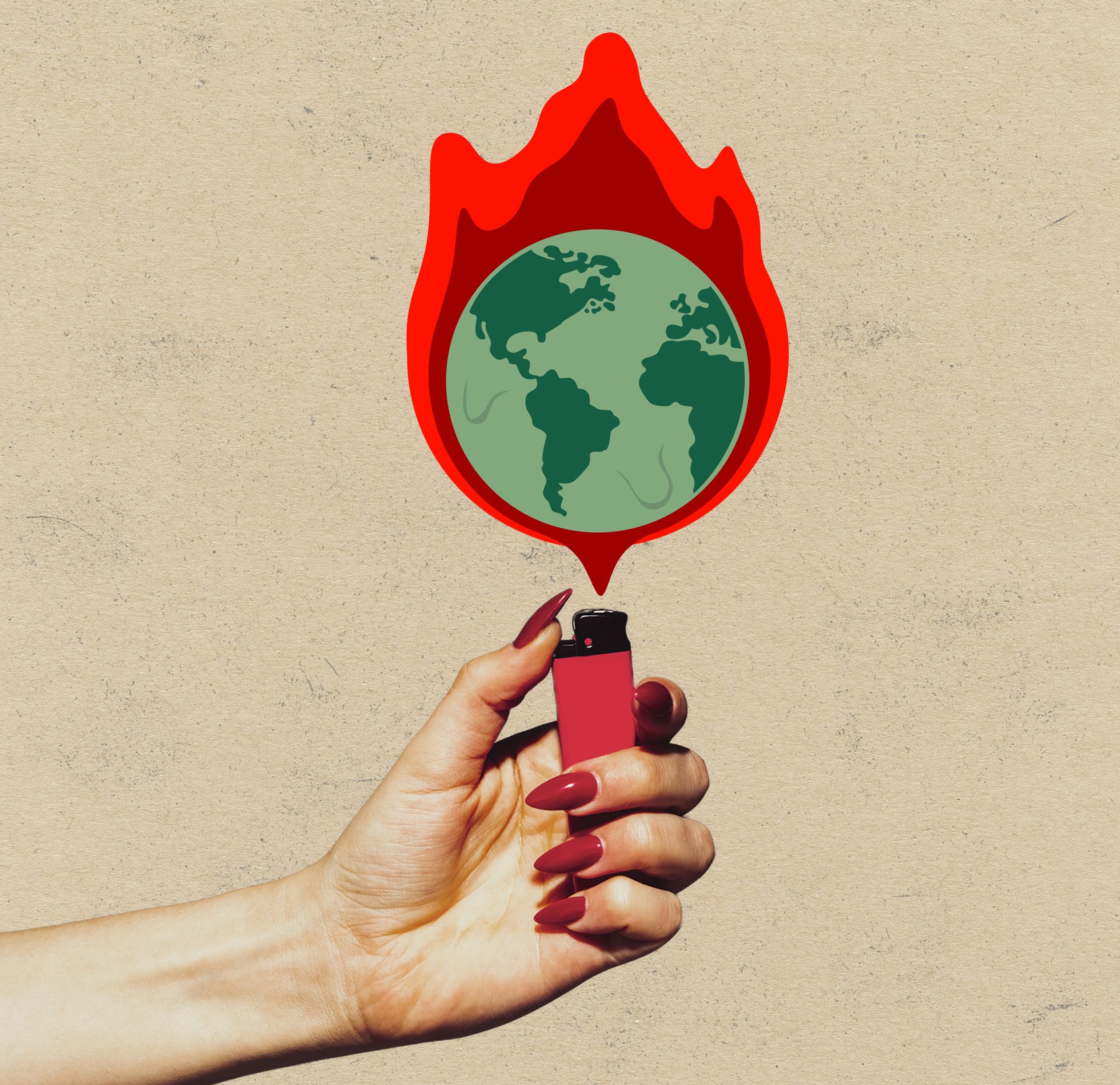
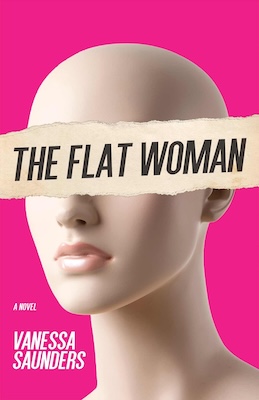
In Vanessa Saunders’ novel The Flat Woman, seagulls fall dead from the sky, ash poisons the air, and women are blamed for a climate crisis caused by a soda pop/prison/hotel megacorporation. For the narrator, “the woman,” this is all particularly personal. Her mother has been arrested for alleged seagull ecoterrorism, and the woman has what she calls “leaky boundaries”—she literally experiences parts of the natural world (grass, fish, feathers) inside her body. Hiding these things from everyone but her enigmatic aunt, the woman moves in with a climate activist/Elvis impersonator who ultimately turns violent toward her.
Surreal, funny, repulsive, and brilliantly thought-provoking, The Flat Woman is an example of what bold and original climate writing can do. At every turn, it complicates the intersection of public and private traumas. After all, what does it mean to miss your mother when the natural world is dying all around you? And if you can’t or won’t fight climate change, how can you stand up to your abusive boyfriend? Ultimately, Saunders’ speculative dystopia demands the reader acknowledge two truths, neither forgivable: we are largely powerless within institutional systems of harm; and most of us are complicit in the most quotidian of ways, by failing to act in the face of evil.
Saunders and I spoke over Zoom about humor as an antidote to despair, how representations of women’s pain have trained us to accept violence, and ethics in the age of information overload.
Rachel Taube: You’ve said that this book began as a way to process the violence that had been inflicted on you in your own relationships with men. You also wrote: “What surprised me was this: while this was supposed to be a book about male violence against women, the story also centers my villainy.” Can you elaborate on that transformation and what you mean by “villainy”? How did this come to be a book about climate change?
Vanessa Saunders: I think that victimhood is very comfortable and easy, but victimhood as it intersects with villainy is a lot more interesting to me artistically.In the context of this project, I was thinking about my relationship to worsening climate change. Thinking through a lot of small choices that I made, often very thoughtlessly and lazily. The book became a way of working out ways in which I was in the wrong even as I processed ways in which I had been socialized to become a victim of violence. And I’m not here talking about physical violence, but there were definitely quite a few emotional things that I was just—oof, that should not have been that situation, you know? You can see ways in which women’s pain, women’s anger, and violence against women have been represented in stories, and you can see how these stories have trained us to accept violence, to stifle anger, to silence pain.
When you’re a kid, I think you expect to become a certain type of person we also see in stories, quite a heroic character. And then you grow up and a lot of people are bystanders of a lot of harm. And occasionally people are also aggressors as well. In the time in which we live, this age of information, this question of ethics becomes more intense because we have a lot more access to and information about all the horrible things that are happening. And this can be incredibly uncomfortable, especially since many of us don’t do the right thing with the information that we have, and I think that can cause a lot of anxiety.
Interestingly, the decision to write about climate change wasn’t originally part of my plan. But it was a product of what I was subconsciously thinking about.
RT: I’m interested in what you said about how women’s stories train us to accept violence. Do you feel like stories about violence against women have trained us to accept climate change?
VS: Actually, yes. Because so many of them are just doom and gloom, oh this horrible thing is going to happen. That’s been done. We need to think about new ways to talk about these kinds of stories, in ways that aren’t just straight depressing, because that’s just prefabricated thought. That’s just not interesting.
RT: Let’s dig into where climate change meets violence in this book:The Flat Woman is full of dead birds—their feathers, their blood. In the latter half, there are also several grotesque scenes of cows being slowly run down in the street or eaten by vultures. Most people in the novel, absurdly, ignore this violence. But as a reader, I felt repulsed pretty viscerally, in particular because of the narrator’s “leaky boundaries.” Do you think the reader has—or do we want to have?—leaky boundaries?
VS: I feel like you’re reading it here as kind of like a hyper empathy or affinity with the natural environment. If we’re thinking about gender in this essentialist way, leaky boundaries would be a form of ecological care, which is certainly better than not caring. Interestingly, her physical condition does not translate to a broader sense of action or justice against the environment. It actually is the opposite, where she ends up working for this company that is ruining the planet and incarcerating her mother. It’s also worth mentioning that this is a very uncomfortable position to be in: taking in the pain and the ephemera of the world. In the case of climate change, most people have probably cut themselves off from their leaky boundaries.
RT: Do you have a preferred reading of leaky boundaries, or intention?
VS: I think it could be read as an allegory for mental illness. Or it could also be read as a metaphor for rape culture and the general state of women’s bodies, especially in America. Women do go through a lot of crazy transformations in their life, with puberty, menopause, and, for some people, pregnancy and childbirth. So, the female body is kind of this porous, unstable vessel. And if we think about that in the context of rape culture, the woman is seen as an object that is permissible to dominate or take control over. We do live in a country where women don’t have the federal right to abortion. I live in Louisiana, and I can’t get an abortion even if it was medically necessary, though there’s some ambiguity. So, I think it could speak to the ways in which women’s bodies are seen as permeable objects, and the lack of control that women have and autonomy over their own bodies, some of it being biological and other elements of it being social.
RT: You mentioned how overwhelming empathy can be, so I’d like to turn to another way to talk about climate change, which is absurdity and humor. This is a really funny book, in the most dystopian way. One example, the boyfriend, a self-described climate activist, has all the right language about corporate greed and privilege and personal responsibility—and uses them equally to abuse his girlfriend and promote his Elvis impersonator act. It’s terrifying and funny—or so terrifying it is funny? So, talk to me about the Elvis impersonators. More broadly, I’m wondering if you have thoughts about how humor or satire can be used as a revolutionary tool in writing.
VS: I’m from the Bay Area, and I started at San Francisco State in 2008. At that time San Francisco was very much a city dominated by queer culture, and a specific representation of masculinity that was very camp, very in your face, and I think queer-coded. It was totally normal for me to get onto the MUNI at noon on a Tuesday and see someone get on in a tutu, nipple tassels, shirtless. Another thing that I might have been thinking about subconsciously was the idea of the gurlesque, which is a kind of poetics theory that Lara Glenum and Ariel Greenberg came up with.Basically, these female poets that perform their identity in a really exaggerated or amplified way, as a form of taking back the gender identity that has repressed you and traumatized you and defiantly making fun of it but in a way that kind of reclaims the power.
It feels like we’re a culture that’s very preoccupied with looking backwards, because we’re terrified to think about what’s ahead.
I felt like it was important to write about climate change in a way that was not morbidly depressing. I know that one of my favorite authors, Ben Lerner, talked about how love is an antidote to despair, and I think that humor is as well. I think that if you can write a story about climate change that is funny and ridiculous—I thought it would be a way to dismantle the way that this issue is thought about, and to provoke something that’s more true and I guess more frustrating about climate change: We can laugh at it, there’s also something that you can do about it.
RT: Let’s get down to the line level. I can see your poetry background in the way the novel’s language often shirks a kind of emotional labor. The text comes fast and unpredictable. Incomplete sentences keep the reader at a distance, keep the narrator at a distance from herself. The book, of course, is called The Flat Woman, and there are references throughout to the “flat” tones and expressions of the narrator and her boyfriend. Sometimes, this flatness felt like an experience of trauma. Other times, it felt like the narrator’s refusal to reckon with her complicity. Can you talk about how you settled on the tone, and what flatness implies to you?
VS: The flat woman was actually the first line of the book, before I ever came up with anything else. She did not have a name. You have impulses as an artist and then later on, you actually really understand why you made certain decisions. I think it was my decision to play with certain representations of stories about women growing up who I felt were often super one-dimensional and flat. I’ll never forget watching one of the James Bond movies, and he has this movie-long narrative about this romance. In the sequel, the woman is gone, she is never addressed or explained, she’s just totally absent. I remember being profoundly upset by that as a kid. This was my attempt to integrate that kind of flatness into a story of feminist critique. Of course she’s not going to stick up for herself when she’s getting abused. Do any of the paper-thin protagonists in the fairy tales ever draw attention to the violence that’s being inflicted against them? In a story about violence against women, flatness has an important role in providing a connection to stories outside of the text.
The other part of it is that, yes, she is flattened by trauma. One way to read it is the trauma of the access to information. Her trauma isn’t just personal, it’s also public. I think the source of the flatness was always somewhat universal, in the trauma of girlhood and the trauma of exposure to a world built on exploitation of the vulnerable.
RT: I was struck by the line, “[T]he grief pattern of a bird is relentless flight. This is the only known grief pattern of a bird.” There’s grief surrounding the narrator’s absent, imprisoned mother; and there’s also a strong sense of climate grief, at least for the reader. They feel equally absurd and senseless. What happened when you put these ideas side by side?
VS: In a way, this was trying to make something public, which was the experience of mass extinction, into something very personal. What has struck me always about my personal experience with grief is how eager people become to blame someone over the death. That’s part of what got me interested in questions of responsibility ethics in disasters. But as a writer—the mode of poetry is, I think, largely preoccupied with universals. Fiction has the same preoccupations, but you’re trying to figure out ways in which you can explore universals through the particularity of a character. I wanted to put those two things in conversation with each other, and to explore how hard the simultaneous experience of both can really be.
One thing that my husband and I talk about a lot is how our culture is today in a kind of a state of arrested development, with all these nostalgia bands, resurgence of old movies, it feels like we’re a culture that’s very preoccupied with looking backwards, because we’re terrified to think about what’s ahead. And maybe that’s where kind of that flatness comes from, which is this overwhelming feeling of grief, but then feeling like you need to repress those overwhelming feelings, to the point where you just become very apathetic.
RT: The narrator is experiencing this public or climate grief very differently than the only male character, her boyfriend. I got the sense that, between the narrator, and her aunt, and the woman protester who burns herself alive, not only are women having this grief experience but maybe they also have some unique responsibility to react to climate change in a certain way—a particular power or opportunity, to at least protest.
VS: I think you’re picking up something really important about the book that we haven’t talked about yet, which is: It’s not just a question about blame, but also thinking about blame in the context of feminism. It’s easier to blame a woman for something than a man. It’s not only the lack of male privilege, but there are some qualities that people tend to naturally ascribe to women, which would be maybe a predilection for instability or being crazy or hysterical. Another part is, we kind of expect more empathy and less selfishness from women.
We are being asked to sacrifice our own livelihoods for the personal gain of a very small group of corporate and politicians who are in power.
In the story, women are unquestionably held responsible for climate change, and then there are small pockets of women revolting against climate change at the same time. We know that women take on a lot that they don’t necessarily need to, internal pressures that women feel based on responsibilities that are gendered in society. Perhaps these women are revolting because they feel this sense of inherent guilt that the men are not subjected to. And maybe that guilt and responsibility is a good thing in the end—but it would be easier to not feel that sense of responsibility.
RT:I can’t end the interview without asking about this line, which stopped me in my tracks: “She begins to count down from ten. If I get to one and his hands are still on my neck, she thinks, I will ask him to stop.” As he’s choking her, her boyfriend is lecturing her about the climate crisis. I found I could reframe her thought in those terms, too: if we get to 1.5 degrees, say, we will ask corporations to stop their endless pollution. But there’s a hesitation, because if we do ask them to stop, it’s going to change everything, and we’ll have to admit how bad things really are. Can you talk to me about this moment in the novel?
VS: What you’re picking up on there is kind of the doubleness, which comes from the parable, or the allegorical qualities, which came from this project staying in the poetry genre for so long. That moment is kind of a parallel to our own relationship with harmful systems. I feel like we could be in a little bit of an abusive relationship with the powers that be, in the sense that we are being asked to sacrifice our own livelihoods and the livelihoods of our descendants for the personal gain of a very small group of corporate and politicians who are in power.
It becomes interesting as an ethical question: What is your responsibility in a situation where you truly lack power? Most of us are in the position of being strangled. We are a woman being strangled, maybe without the physical ability to fight back. It’s a moment where she’s rationalizing what’s happening, because she has no power to stop him. And then I thought about it more: She doesn’t even ask him. Right? She doesn’t ask him to stop. So, maybe she has more power than she thinks she has. Maybe if she were to try to stick up for herself, then something would be disrupted in what’s going on between them. I think that there is a lot of power in mass action, but this book looks at the parts of us that don’t want to engage in that kind of activity, and some of the reasons why. The parts of us that are traumatized, exhausted, or just intrinsically selfish. And these behaviors are part of human reality, but I don’t think they get integrated into a lot of stories, especially about climate change and disaster, because those are often centered around heroic characters who are likeable and do likeable things.
The date was set for the breakup. Marco and I decided we could each bring two friends. We would make a day of it.
I chose Yulia and Caleb. Yulia because she was Yulia, and we’d sworn years ago never to do anything important without each other. And Caleb because I was pretty sure he had a crush on me. Not that I wanted Marco to be so jealous he changed his mind about the breakup. I just didn’t want it to be too easy. I’d been to breakups that were excruciatingly civil, just soboring. We all deserved to feel something.
Marco invited Geoff and Cooper, but they were both in bed with hangovers from some other breakup I wasn’t invited to (there were a lot of them that summer, before we all left for college), and we couldn’t postpone. Yulia, the first of us to leave, would be two time zones away tomorrow, and I couldn’t do this without her. It was our last chance.
I’d assumed I would be the one to break up with Marco. But without Geoff and Cooper there to support him, I wondered if that would be unnecessarily cruel. Plus, at the burger drive-thru, when we teased Caleb for ordering orange juice instead of an espresso shake, he said, “Have you tasted orange juice?” with such surprising sensuousness that it wasn’t really fair to Marco at all. Yulia even caught my eye and fanned herself. We both knew it was ridiculous to be attracted to these boys—especially when the whole reason for this breakup was so I’d be free to pursue the real men waiting in college and beyond—but we couldn’t help ourselves.
So there it was. To preserve his dignity, Marco was going to have to be the one to break up with me. Honestly, it was a relief. I didn’t have to worry about finding the right moment. I could just sit back and enjoy the day. After all, it was our last together. Once Yulia left, it would be Marco, then Caleb, then me, in quick succession.
We took our shakes to the public pool. Yulia and Caleb sat under the oak trees while Marco swam laps, plowing head-down through clumps of leaf litter. I claimed the next lane over. I tried to keep pace, coming up for air exactly when he did. He could have broken up with me then, one word every time we surfaced for breath. Maybe he thought it was too early in the day. In the car, sitting on our towels, I wondered if Yulia could tell it hadn’t happened yet.
Then we drove to Target. We looked at the dorm room display, piled with things that promised to be essential to our impending, separate lives: a plastic basket for carrying our shampoo to the shower, a miniature vacuum, a rice cooker in which we could supposedly bake a pound cake. Yulia ran her hand over a subdued pinstripe comforter. I tried to imagine her in a room I’d never seen, with a roommate I’d never met, surrounded by unfamiliar objects.
While we stood before these things and tried to divine from them our futures, Marco had gone off and bought a necklace with my initial on it. He peeled the price tag away with his teeth and gave it to me in the Target parking lot.
The necklace came in a little plastic packet. It was heavier than expected. “Why would you give this to me?” I said, because he was making this breakup extra weird. “Go back and return it.” But he wouldn’t. I thought about tucking it discreetly between the seat cushions in Caleb’s hatchback. Then I thought about putting it on and never taking it off for the rest of my life. Instead, I turned around and offered it to Yulia. She hesitated.
“If I had a boyfriend, maybe I would keep him,” she whispered to me, behind Caleb’s car. “Then if I was awkward at college, everyone would think I was just pining.”
“Take it,” I said, placing the necklace into her palm, “and pine for me instead.” She shook it out of its packet and I held her hair up while she put it on.
Next we went to the cineplex to see a movie. I was trying to enjoy myself, I really was. But what if we made it through the whole day and didn’t break up? And what if that opened up a wormhole at the other side of which we were neither together nor apart? What if I had to go to college like that, not knowing?
The movie ended and I was annoyed. Everyone seemed to have forgotten this was a breakup. Who kept suggesting all these activities? Marco couldn’t wait too long, or the others would leave—and wasn’t the point that we’d all be together when it happened? After the movie we went to the shave ice truck, and after the shave ice truck Caleb invited us to his neighborhood, which had its own basketball court.
We sat on the court and Marco dealt cards. I said, “We should do this every summer. Even if we lose touch, or whatever. We should all get back together and have a day like this, once a year.”
Yulia nodded like she was on board, which frustrated me. I didn’t actually want to relive this day every year. I’d only said it to see if Marco would call me a hypocrite. You’re the one who didn’t want to leave the door open, I wanted him to say. You said it was like a refrigerator. When you leave the door open, even a little, everything gets spoiled.
But he didn’t. “Your turn,” he said.
It was getting dark. I could see Caleb’s house on the other side of the high chain link fence that completely enclosed the basketball court. His dad was moving around in the kitchen.
I didn’t play a card. “Caleb,” I said. “Break up with me.”
“What?”
“Pretend you’re Marco, and break up with me.”
“Why?”
“Because someone needs to!”
“Okay, uhh, ‘I’m Marco, and I don’t want to be your boyfriend anymore.’”
“You know that’s not what I mean,” I said.
“What doyou mean?” said Caleb.
I didn’t say anything. What did I mean?
Caleb dropped his cards face up on the blacktop. “I hope you get your breakup,” he said, walking off the court. The gate clanged shut behind him.
Yulia, who was sucking on the letter T of my necklace, spat it out. “Wait,” she said, “does it lock both ways?”
Marco ran to the gate, rattled the handle. It didn’t open. “Hey!” he yelled after Caleb. “Let us out!”
Caleb, without turning around, gave a salute-like wave.
“I’ll call 911!” Marco yelled.
“No, you won’t,” said Yulia. She got up, steered him to the center of the court, and pressed on his shoulders until he sat back down. “There’s something we need to do first.”
In the distance, I saw Caleb open the door to his house. Yulia sat down and took my playing cards from me, collapsing them into a neat stack. Then she held both my hands in hers.
“You trust me?” she said.
I did. Yulia understood what I needed: more than Marco, more than anyone. Oh, I was terrified, though. This was not how I’d imagined it. Yulia’s hands were a little sweaty. The charm of my necklace—her necklace—glinted in the fading light. She could say it would never be the same again. She didn’t have to, because I already knew.
In the first scene of Interior Chinatown—the television series based on the novel of the same name—Willis Wu longs for nothing more than his desire to be a witness. A witness to a crime scene, sure, but a witness nonetheless. To Willis, this is the only path toward relevance possible for an Asian American like himself. “Nothing ever changes,” he complains to his coworker in the back of a Chinatown restaurant. “Sometimes I just feel like there’s a whole world out there that I never get to see, as long as I’m trapped here in Chinatown… I feel like I’m a background character in someone else’s story.”
Willis’s relegation to the background is what anchors Charles Yu’s National Book Award-winning novel, Interior Chinatown. The story follows Taiwanese American actor Willis Wu as he strives to break out of roles such as “Generic Asian Man Number One” and “Background Oriental Male,” and toward something grander: the cherished role of “Kung Fu Guy.” Through precise metafiction and darkly funny prose, Yu satirizes the racist stereotypes thrusted onto Asians and Asian Americans. Written entirely in screenplay format, the novel also critiques Hollywood’s stifling, unimaginative representation by turning the genre of the screenplay on its head.
Four years after Interior Chinatown’s publication, Yu turns this screenplay-turned-novel back toward the screen as the showrunner for its TV adaptation, which just released earlier this week on Hulu. As a fellow Angeleno disenchanted by the limitations of media representation, I jumped at the opportunity to meet with Yu over Zoom. We discussed the narrative strengths of prose vs. television, how both Interior Chinatowns are in conversation with one another, and why satire is often the right approach when it comes to confronting difficult subjects.
Jalen Giovanni Jones: I know you’re a writer of many hats. You write short stories, novels, non-fiction, and for TV. I’m wondering—is your process much different when you write for the page, versus when you’re writing for the screen?
Charles Yu: Good question. Well, yes and no. I think from the outside they probably both look like me wincing in pain, walking around my house, eating things, my family afraid to talk to me. On a practical level, for prose I feel I’m much more comfortable doing that. Not to say I’m any better at it, but I just feel like I know how ideas will come, and how to gestate them. I’ve just had enough things that either worked or didn’t work, and so I have a better sense with how that goes. With TV and film, I’m relatively new to it. I’ve only been doing it for about 10 years, and so I rely much more on other people. For Interior Chinatown (the show), I had a bunch of writers and producers and executives who gave me notes. With prose, the unit, the constituent unit, is the sentence—or the word, even. I think in sentences, and I really had to learn how to think in images. I had to understand that sitting at the computer writing a TV pilot or feature script is not really necessarily the same—you’re not producing language for people to read. You’re thinking about a blueprint, a series of visuals that a director, a production designer, camera people, will have to translate. That is a really different activity.
JGJ: I’m sure the novel version of Interior Chinatown really lent itself pretty well to being turned into a TV series. Did you always have it in mind for this to go to TV?
CY: You know, it’s funny. I came up with this format while I was in the writers room for a show I was working on. I was on the staff of the first season of Westworld on HBO, which was an amazing experience. It was my first job in TV, and I’m so grateful to that job for many reasons—one being that it helped me crack the form of this book. I had been struggling with it for years, and so when I started to think of writing Willis as a background actor, I asked: “What does that look like?” And it said, “Well, maybe it looks like him trying to sneak into a script.” That’s really how it started. It wasn’t that I wanted to adapt something, or that I was going to sell this.
Hulu and many others rightfully wondered: How would you show this idea of Willis in this liminal space? There’s a picture, or like a fish tank, of the world that is the cop show, and Willis is not in the tank at the beginning. He’s outside, in the margin; on the side of the stage. To show that, we really had to give the feeling of a police procedural, as if it’s going on all around you, and show how you can’t get into that world. So, the short answer of the question is, in theory it seems like it lends itself well, but in practice, it was actually quite hard to figure out.
JGJ: With your experience of Interior Chinatown as both a novel and a TV show, I’m wondering what narrative strengths you think books might have that TV shows don’t, and vice versa.
CY: Interiority, subjectivity, that is so much of it for me. [In a book] you can drop a reader right into the character’s mind. You can tell and show in ways that are much harder to get to [in TV]. For me, what you’re doing when you’re writing prose is you’re activating the imagination of the reader. You’re collaborating with them in that way. [Writing prose] is also a solo activity. So that, to me, is the strength—the singularity of the voice, the consistency of tone, it’s easier to maintain for [prose].
In TV especially, I think more so than in film, is a very collaborative thing. That’s its strength, but it’s also one of its challenges. How do you blend so many different writer’s input, creativity, and ideas into something? That was really a learning curve for me. Even from the writing phase in a writer’s room, I’m there with ten, eleven other people that have got ideas I would never have come up with in 100 years by myself. Then, once we all get together, the whole is greater than the sum of its parts. For me, that’s the strength and the joy of that kind of creation.
JGJ: That is so cool. I write prose too, and I’ve never thought about prose writing as also being a collaborative process in that way. We really are collaborating with the reader’s imagination.
How is it switching between writing prose and screenwriting, given how different they are in their processes? Do you find the shift more jarring, or fruitful for you as a writer?
CY: It can be jarring, to be honest. Sometimes I carry too much, like I’m stuck in my “prose writer” hat, and I’ll be obsessively fussing with the language of the action line, when in reality no one will ever see that—[the action line is] a direction to a camera person or to a production designer. It’s not like anyone will care about your poetry there. One of my bosses had said that. At my first [screenwriting] job, she was like “Yeah, this is lovely. But we can’t really film this tone poem.” It sounds meaner when I say it like that, but it was basically… that. [laughs]
JGJ: Sometimes you just have to hear it!
One thing I found super resonant, in both the book and the TV version, is how they’re both so confrontational when it comes to critiquing Asian American stereotypes and tropes. What made you realize that confronting these archetypes head on, through satire, was the right approach?
CY: I have to credit this one reader. I was in Brookline in Massachusetts, doing a reading, and after my reading they came up to me. He was like “I think you write about racial identity and ethnic identity, but you do it in a coded way.” This was before Interior Chinatown. That comment was so direct, it came right at me, and I remember being spun out and kind of wrestling with that. In the moment I think I tried to play it off a little bit, but I am really grateful to that [reader]. I don’t know if that person will ever hear this, but if they are out there: Thank you. Because that actually sent me down a years-long rabbit hole of wondering why I would shy away from writing explicitly about these characters and their racial backgrounds, and about their parents being immigrants. I would only hint at it before. With this book, I wanted to be almost uncomfortably direct and on the nose.
Some of this, to be honest, was in the shadow of the 2016 election, when Trump had come to office with a wave of xenophobia and anti-immigrant sentiment. And here we are again, eight years later, so I feel it’s still relevant. Wanting to name it and then go from there, rather than be coy about it—that’s also part of what Willis’s journey is. He’s been taught by his dad, both in the show and in the book, to play it safe. To learn to play by the rules and be invisible, be in the background—that’s your strategy for survival. In some ways, I was doing that same thing until I wrote this book.
JGJ: What I love about these stories is how they blur the line between what’s real and what’s absurd or unreal. It makes me think about our current political climate, and how absurd even day-to-day life can feel. Big question, but how do you think satire and absurdism helps us better reckon with these hard times?
CY: I love political satire. I feel like it’s an easier way in toward very difficult times. Often, there’s this kind of truth that can be said in humor that’s not just more entertaining, but more insightful. I feel like humor is going at it from a different part of the brain. It’s not just hitting the logical part of the brain, it’s stirring up something. To me, that’s what I hope the show can do. The show hopefully is funny—we’ve got some very funny people in it—but it’s a satire. Through this story we’re looking at the world, not from how a political writer or an essayist would look at it, but from the inside out. From the perspective of Willis or other characters, who are trying to find their way into the narrative, who are trying to find their place in the world. I hope that’s a different angle. You know, that’s not the same angle as we always see.
JGJ: Looking at it from these different angles. That comment reminds me of what Cathy Park Hong had written in Minor Feelings, about how people of color look sideways [at childhood].
It’s interesting to witness Interior Chinatown in this new context of our time. There’s been a lot of new Asian representation since 2020, when the novel was released. Films like Everything Everywhere All At Once, American Born Chinese, Dìdi, Minari, have offered us more representation. I’m wondering how you find the themes of Interior Chinatown operating differently, four years later?
CY: I’m glad you brought up Dìdi. I saw that with my wife and kids when it came out in theaters. To state the obvious, there’s just more representation than there was when I started writing this book, around 2013. In the many years it took to write the book, and then in the few years that it took to make this series, a lot of things had changed. Things have gotten better in terms of representation of underrepresented groups on screen. But to me, the question doesn’t go away. It just gets a little bit more complicated in terms of how we sustain that. How do you make sure you’re telling stories that continue to deepen and broaden perspectives? As you break through and get to tell more kinds of stories from different viewpoints, audiences want more specificity. They want to hear and see different aspects of a community’s experience. To me that’s the challenge, but it’s also the opportunity. Now we don’t have to start from zero. We can start from a place where there’s assumed knowledge, or assumed empathy. You watch Dìdi, for example, and it’s a coming of age story. It’s just a classic, beautiful, hilarious, coming of age story that’s visually inventive—and the kid is Taiwanese American. That’s incredible.
Same with American Born Chinese. Full disclosure, that’s my brother’s show, and Kelvin Yu created that show based on Gene Luen Yang’s amazing graphic novel, American Born Chinese. A classic. [The show] blends mythology, family drama, teen romance, surrealism, and all these amazing things together. To get to do that on a big platform like Disney+ is pretty amazing.
JGJ: Were there any changes between the novel and the TV show iterations of Interior Chinatown that you found particularly exciting?
CY: A big one that comes to mind is Ronnie Chieng’s character. His name is Fatty Choi, and in the book he’s really a very minor character, just mentioned in passing a couple of times. But the idea of Willis having a best friend was very appealing. We were able to show not only that friendship between two guys who had grown up together in Chinatown, but also how their paths diverged throughout the season. One tries to assimilate—Willis’s path is to leave Chinatown, leave home, and try to enter the world of “Black and White,” where he has to make his own space and make his own role. Fatty, on the other hand, because Willis is gone, gets to step up into Willis’s shoes. He’s almost like Willis’s understudy, and he gets to take on the role of Willis, in a way. I won’t spoil it, but to me that was fun. Also, just getting to work with Ronnie, because I’ve been a fan of his for so long—he’s so talented and funny, and just watching him breathe light. From the book to the screen, that was one big change.
JGJ: What do you hope audiences will gain from watching this series? And what’s something new that you hope readers of the novel will gain from watching its TV adaptation?
CY: One, I want people to be entertained more than anything. I want to tell a good story. And two, if there’s a takeaway, I don’t want to reduce it to any one message or larger theme, because I think there’s a bunch of things. But they all come back to the idea of people being real.
If the book has a thesis, and if the show has a thesis, it’s that in all moments we are potentially either kind of wearing a mask, or letting the mask slip off a little bit. There’s moments throughout the story where, through that lens—even through all the craziness and surrealism going on—you can see that ultimately, these people are all just trying to figure out who they are. There’s ways we can do that in the literal sense, asking ourselves questions like “Am I a detective, or am I a waiter?” But that questioning is trying to get into a different version of asking: “What is real, and what matters to me? How do I authentically connect, or show somebody else my true self? How do I see past somebody else’s costume, and into their true self?” That’s what I hope people gain. And that feeds into the second half of your question too. Because they are different, I hope the two are in conversation with each other going forward.
I yearn for a literary world where, as readers, we’re familiar with a wider spectrum of narrative traditions and approaches than what we now think of as the canon. We Bengalis love so much to talk, to weave tales, to let our anecdotes tangle with each other’s into a larger collective imagination. We love our adda—those hours of conversation over cups of cha, over plates of bhaat, daal and bhorta, at the doorstep where we continue to linger before leaving the party. True to Bengali hospitality, I want readers around the world to share in this love of spinning stories, and using language for social change.
South Asian literature is still starting to make space for itself in western publishing. Within that niche scene, Bangladeshi narratives are often mixed up with, left in the shadow of, or perceived through the prism of literature from India or Pakistan. The reality is that very few western readers are familiar with the vast ocean that is Bangladeshi literature, which contains within it stories of Bangladesh’s ethnic diversity, as well as the world of Bengali literature, i.e. literature penned in the Banga language or written by Bengalis from Bangladesh (as opposed to Bengali authors from India’s West Bengal). In politics, these categories divide. In art, we remember that we all share a common heritage, whose experiments in history, romance, politics, satire, folk tales, magic realism, science fiction, and thriller all coalesce into a rich tapestry of imagination and testimony. When readers aren’t interested in an art form, publishers struggle to accommodate it. When publishers don’t make space for an art form, readers remain deprived. In the absence of familiarity, we overlook, misunderstand, stereotype. What’s beautiful about literature is that it takes one real moment of contact between a reader and a text to bridge these gaps, and what follows is a truly unique relationship that transcends obstacles of commerce and space and time.
The authors in this list, which is by no means exhaustive, write from Canada, the United Kingdom, India, and parts of the United States. Through their stories, they help bring Bangladesh—its space, its words, its people, its pains and moments of miracle—closer to a readership that is still beginning to understand it.
While many books portray Bangladesh’s Liberation War of 1971, Abir’s debut novel is among the few that take us back to the ‘60s, when East Pakistan was gearing up for the mass uprising of a nationalist movement. Britain’s partitioning of India and Pakistan has left the region in a storm. Families are separating from each other and from their own land under the strange order to live where their religion, and not their home, resides. Hindu minorities are the prime targets of attack in Pakistan.
Shelley is one such Hindu man in East Pakistan (what is now Bangladesh), a student of English literature bearing the name of the British poet. Roxana, a Muslim woman, his childhood love. Their relationship becomes a mirror for the religious differences tearing the region apart. Amidst this chaos of Hindu-Muslim riots and student revolutions, Bangladeshi author Rahad Abir—a PhD candidate of creative writing at the University of Georgia—brings to life the historic campus of Dhaka University, Madhur Canteen, and Fuller Road, where decades of Bangladesh’s cultural and political past have unfolded. More literally, he brings to life the statue of a beloved character whose death pierces the story early in the novel. The book becomes an exploration into the human mind—how it processes loss when love and politics become embroiled.
Gemini Wahhaj is a Bangladeshi writer based in Houston, an associate professor of English at Lone Star College. Her debut is a novel told in voices, set partially in the time of America’s invasion of Iraq and, at other times, in Bengal’s past through the Partition and later Bangladesh’s independence. Nasir Uddin is an engineering professor, a hero to his now grown and successful students. His first-person recollections take the reader through his own impoverished past set against the region’s political turmoil. Interspersed with his memories are the present life of his daughter Beena, a PhD candidate studying English literature in Texas. Beena’s allegiances to the idea of home form the emotional core of the novel, as she navigates between Bangladesh, which her parents call home, Mosul, where she spent parts of her childhood, and America, where her adult life as a scholar and a wife bristle against the US’s invasion of Iraq.
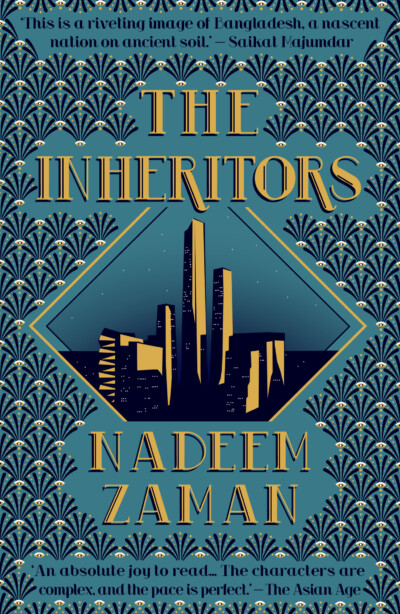
The Great Gatsbyset in Dhaka. Nisar Chowdhury, Zaman’s version of Nick Carraway, is a Bangladeshi expat based in the US, forced to revisit Dhaka to sort out his family’s real estate transactions. A rich businessman by the name of Junaid Gazi wants to buy his properties, particularly the one facing—you guessed it—the house of a woman named Disha, Nisrar’s first cousin. Like Nick, Nisrar casts a writer’s gaze on Disha and Gazi’s story; unlike Daisy and Gatsby, the Bangladeshi couple are spouses estranged by divorce. The Inheritors is the fourth book by Nadeem Zaman, who teaches in the English department at St. Mary’s College of Maryland. His adaptation of Fitzgerald’s classic takes a look at Dhaka, old and new, to critique the lives of its elite society.
Good Girls by Leesa Gazi, translated by Shabnam Nadiya
Lovely and Beauty are sisters, 40 years old on the day this novel takes place. Their mother, Farida, has never let them out of their home alone. Today, though, on her birthday, Lovely is allowed to venture into Dhaka on her own. For only a limited amount of time.
Leesa Gazi is an author and filmmaker based in London whose work with the Komola Collective promotes untold female narratives through theatre. In this translation by Shabnam Nadiya, a graduate of the Iowa Writers’ Workshop, Gazi’s taut, tense prose takes us through Lovely’s first day of moving about in a city full of risks and possibilities for a young woman in touch with her desires. We travel with Lovely through Dhaka’s familiar streets, to the alleys of Gawsia Market, where women buy their clothes, and through tense rickshaw rides to the temptations of Ramna Park, where Dhaka’s lovers meet. We get a taste of what freedom feels like when it’s a rare privilege, and the sinister things that fester in its absence.
“We still say the Urdu word —ab-o-hawa, water and wind—for weather. We’d never deny a beautiful phrase. We say pani, as Bangladeshi Muslims, the word for water used throughout North India and Pakistan. West Bengali Indians use jol or pani, interchanging the words depending on whom they’re speaking to. Bangladeshi Hindus will say jol, distinguishing themselves from the Muslim majority. Both words can be traced back to Sanskrit, paniyam the word for drinkable; jala the word for water. Language, down to a single word or phrase, might reveal whether we were Muslim or Hindu, starting with all our separate words for water, bathing, hello, goodbye,” Tanaïs writes in their memoir.
Tanaïs is a writer and self-taught perfumer, an American Bangladeshi Muslim femme artist who grew up in the US’s South, Midwest, and New York. Through the refracted lens of these perspectives, In Sensorium crafts an olfactory memoir, braiding South Asia’s diverse pasts with Tanaïs’s journey through their cultural, spiritual, sexual and artistic identities. The book is divided, like a perfume, into Base, Heart, and Head Notes. In each of these sections, the text engages with strands of South Asian history that have been shaped by power dynamics—what the author labels as ‘patramyths’—detangling a tapestry of languages, myths, rituals and spiritual practices passed down over the decades in the region.
Tahmima Anam’s fourth novel takes us to the fast-paced, glossy world of America’s tech startup culture. Asha Ray is born to Bangladeshi parents, grows up in Jackson Heights, and pursues a PhD to develop an algorithm that will inject robots with empathy. But the accidents of love and inspiration swiftly move her from academia to entrepreneurship in a tech incubator, where the app she and her partner develop acquires cult status. The story that follows is funny with an edge, a dissection of how the tech world engages with gender politics.
Based in London, Anam acquired critical acclaim for her Bengal trilogy, which spans across milestone moments of Bangladesh’s political past. The Startup Wife is her foray into the world of tech and writing what she called, in one of our conversations, a story of “coming-of-rage”. While its setting is far from Bangladesh, Anam shared how the novel is inspired by Sultana’s Dream, an iconic work of sci-fi about a feminist utopia written by Rokeya Sakhawat Hossain, one of the first Bengali Muslim women authors to write in English in early 20th century Bengal (and discussed by Tanya Agathocleous in EL here!).
In Cox’s Bazaar along the Bay of Bengal, a devastating storm uproots coastal lives, estranging families. Amidst World War II, a Japanese pilot and a British doctor cross paths during their stay in Burma. After the Partition of India in 1947, a married couple is forced by circumstances to move to East Pakistan and start their life anew. At some point between these events, an illiterate young girl on a beach teaches herself to read from war pamphlets showered onto her by accident. All these lives overlapped with each other at various times, and the chain of events they set in motion will help us connect the dots in the life of Shahryar, a father and struggling immigrant scholar in the US, the protagonist of the Canada-based author, Arif Anwar’s debut novel. The book illustrates the repercussions of violence and colonial presence reverberating decades into its characters’ lives. The book also imagines the impact of the 1970 Bhola Cyclone, which destroyed half a million lives in East Pakistan and India’s West Bengal.
Rahman’s debut novel unfolds during the Afghanistan war and the financial crisis of 2007-08, moving from Kabul to London to New York, Islamabad, Dhaka, Oxford and New Jersey.
It follows two men of mathematics, old friends separated by class and life’s circumstances, one of them an unnamed banker who serves as the book’s Sebaldian narrator, and the other, Zafar, who shows up unexpectedly at his friend’s doorstep. Their reunion transcribes a story of love, power, and the possibilities of human knowledge. The novel’s settings and central concerns draw heavily from the author’s own life—born in Sylhet, Bangladesh before his family moved to England, Rahman studied mathematics at Oxford, worked as an investment banker in New York’s Goldman Sachs, and moved onto humanitarian work alongside his career in writing and broadcasting.
Abeer Hoque’s lyrical, sparse prose recreates the spaces she has known as home: Nigeria, Bangladesh, and the United States. The more discursive chapters of this memoir are interjected by brief snapshots of poems, conversations, and passages from Hoque’s time in a psychiatric ward, where the author stayed after a suicide attempt. Through these fragmented stories, Olive Witch makes space for the intimate experiences of growing up—frictions with parents, the tug of multiple cultures on one’s identity, marks left by loves and friendships, the struggles of mental health, and the clarity made possible by a relationship with the written word.
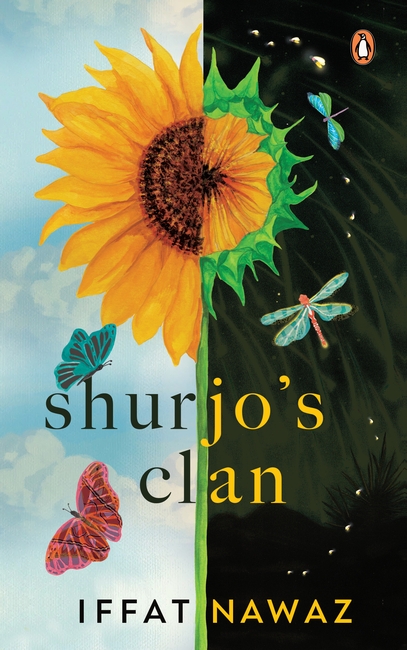
Named after the sunflower, Shurjomukhi is born to a family that has lost two sons to war. Her father’s brothers were martyred in 1971. Her grandmother drowned years before them. But this family continues to hold each other close, living in an ‘asymmetrical’ building fashioned after the old Bengali phenomenon of the ‘der tola bari’, a one-and-a-half storey house. In this novel, the asymmetry translates into their day-to-day lives. During the day the family exists in the Known World, where regular people live and breathe. By night, the Unknown World brings back Shurjo’s uncles who have passed away—together, the family eat and chat and celebrate love as if nothing has changed.
Iffat Nawaz grew up in Bangladesh and moved to the United States after a heart attack took her father’s life on a flight. His brothers, like Shurjomukhi’s uncles, were among the first wave of freedom fighters to be martyred during the war. The impact of these absences inspired Nawaz, who writes from Kerala now. Her debut novel explores how history can affect multiple generations of a family, especially when they hesitate to talk about it.
London and Dhaka emerge in bursts of hope, despair, and compassion in Nadia Kabir Barb’s short story collection. Based in England, where the author and columnist also co-runs the South Asian writers’ collective called The Whole Kahani, Barb writes about moments of truth that reveal the emotional and psychological cores of her characters. Siblings dissect the demise of their parents’ marriage in “Don’t Shoot the Messenger”. A son reckons with his late mother’s past in “Strangers in the Mirror”. A homeless man begs a promising young woman to take a second shot at life elsewhere in the collection. The stories showcase moments of intimacy in the bustle of Bangladesh and England’s urban life.
Written by Yáng Shuāng-zǐ and translated by Lin King, Taiwan Traveloguemasquerades as a translation of a rediscovered text from a Japanese novelist, Aoyama Chizuko, who sails to Japanese-occupied Taiwan in 1938 and becomes infatuated with Taiwanese cuisine, culture, and her charming interpreter, Chizuru.
As the novel unfolds, Aoyama is forced to reckon with the impact of the imperialist regime she represents, and how those power dynamics inevitably bleed into her cherished relationships with the people of the island. With footnotes from both Yang and King sprawled throughout its pages, the reader must interrogate if they can trust Aoyama-san as a reliable narrator and her perspective as a colonizer on colonized land, and more importantly, ask themselves what biases their own interpretation of the story.
I sat down with King to discuss the very meta process of translating a novel about translation, the impact she hopes English readers will gain from a queer story set in Japanese occupied-Taiwan, and how it feels to have translated the first Taiwanese novel to be longlisted (and therefore shortlisted) for the National Book Award in translation.
Hairol Ma: First off, congratulations on being a National Book Award finalist for translation. How does it feel to have translated the first Taiwanese novel to ever make the longlist?
Lin King: It’s all very surreal. It feels like a confluence of timing and what the book is about, since the content itself is about translation, but it was definitely a surprise. We’re also the only translated book from East Asia to be nominated in the longlist this year. I personally don’t have any expectations going into the winner announcement, because having gotten this far is already a first and historic win for us.
HM: What drew you to translating this book?
LK: I knew Shuang-Zi because of a short piece we did for an online chapbook from the Asian American Writer’s Workshop on queer Taiwanese literature, edited by Chi Ta-wei and Ariel Chu. Originally I wanted to translate the whole of that novel, but it was already attached to a publisher and another translator. Shuang-Zi told me she had a new book out, that I could read it and see if I was interested. After reading it, I thought that genre-wise, it might be an even better fit for U.S. readership compared to her first novel, and was personally fascinated with the idea of translating a faux translation.
HM: There are so many layers to this novel: you’re now bringing us the English translation of a Mandarin novel disguised as a translation of a rediscovered text from a Japanese writer. What was your experience translating a novel about translation?
LK: It was a huge privilege in many ways. The original novel has the fictional premise of being a historical text translated from Japanese into Mandarin, with Shuang-Zi as the translator, and therefore already has a lot of footnotes. With the original Taiwanese publication, Shuang-Zi even got into a little bit of controversy with some readers who’d thought the book was a genuine translated historical text rather than being entirely fictional. Because there was already a “translator” in the story, the structure allowed me to interject myself as a translator in the text in a way that’s not normally done in English-language translations, where there tends to be an emphasis on “seamlessness” that makes readers forget that they’re reading a translation at all. Adding on to Shuang-Zi’s footnotes, I was able to make the translation almost academic in a sense, and therefore a lot more precise. And because the story is about an aspiring translator, it feels like there’s more room to get really specific about technicalities like romanization with accents or including different pronunciations of the same words. There’s more room for translation.
HM: Yes, I wanted to talk about the footnotes: there are footnotes throughout this book, which have really added to its identity as a meta-novel about translation. What was your approach to placing your own footnotes throughout this work, and how did they interact with Yang’s footnotes?
LK: My editor, Yuka Igarashi, and I had decided for the first draft to just be maximalist. Wherever there was any question about something, I added a footnote, and later we discussed which ones were necessary to keep. For example, one decision we made later on was to add a map, which removed a lot of footnotes about place names and geography.
In Taiwan, where a lot of books are translated from other languages into Mandarin, it’s not unusual to have translator’s footnotes even in fiction. In English, footnotes are rare unless it’s a “classic.” I hope our approach with this translation will challenge this norm.
HM: Japanese-controlled Taiwan is a time I haven’t really seen written about in contemporary English-language literature, although it is a time our grandparents and great-grandparents lived through. Could you share a bit more about the historical context this novel is set in?
LK: This novel is set in the 1920s-30s, when Taiwan was part of the Japanese empire. A lot of English-language readers might not know this, but Taiwan was governed by Japan for 50 years, from 1895 to 1945. During this period of time, the idea of Taiwanese identity had yet to be fully formed—it wasn’t a nation, but a place where indigenous Taiwanese peoples and migrants from China had settled and called it home. The idea of Taiwan as a nation wasn’t there. When Japan took over, people in Taiwan were told they were now children of the Japanese emperor. This included my grandparents, who were educated in Japanese as kids. In World War II, they fought in the Japanese army.
If English readers can learn even one bit of Taiwanese history, I’d consider it a job well done on our part.
After World War II, Taiwan was given to the Kuomintang, or the Chinese Nationalist Party, which had been defeated by the Chinese Communist Party and driven out of the mainland.There was relief among people in Taiwan, because they were now rid of the colonial hierarchy between the local people and the Japanese, but there was also disappointment, because the Kuomintang newcomers also held a lot of prejudice against the locals who had fought for the Japanese and spoke Mandarin poorly.
This story just precedes the war, so we’re still smack in the middle of those 50 years of Japanese occupation.
HM: What was it like translating a novel about translation and its colonial impacts?
LK: The book doesn’t explicitly condemn or condone anything. Even though the characters end on the note of “colonialism=bad,” there is still a lot of genuine love and affection, and a good-faith interchange of ideas and cultures that aren’t portrayed in a negative light. Ultimately the “lesson” taken away is imperialism=bad, jingoism=bad, but there is still a lot that the book does to make the case that interpersonal relationships born of these times aren’t purely bad. Translating these dynamics was challenging but fun for me, because there’s a lot of nuance to convey what people are missing as they speak to each other.
HM: There are so many nuances in interpersonal relationships here. At its core, I read Taiwan Travelogue as a love story that is burdened by prejudice and complicated by colonial power dynamics, which are subtly communicated through the differences by which Chi-chan and Aoyama-san move through their cultural contexts. What was your approach to making sure these subtleties were conveyed to English readers?
LK: On a linguistic level, Aoyama-san and Chi-chan talk a lot about the formality of language and the hierarchy it embodies. Because Aoyama-san is superior in social, financial, and ethnic status, Chi-chan, who works for her as an interpreter and sometimes assistant, speaks to her in Japanese honorific speech, “keigo”. One of the plot points is Aoyama-san trying to get Chi-chan to speak to her in casual speech because she thinks of them as “friends”. But that hierarchy is so ingrained that Chi-chan doesn’t, and doesn’t want to, drop the honorifics. Neither Mandarin nor English has honorific speech systems, so it’s a lot harder to convey the schisms. In the English translation, I tried to make tonal distinctions when someone is speaking formally versus casually—do they use contractions, idioms, big words, exclamation points? It was difficult to finesse the tone.
HM: Through its layers of disguise, Taiwan Travelogue delivers incisive commentary around authenticity, colonialism as literal consumption, and of course, translation. What do you hope English readers will take away from this novel?
LK: This is complicated and is a political platform for some folks in contemporary Taiwan. There’s an idea that Taiwan’s current difference in identity from Mainland China in large part begins with this seismic shift we had during the 50 years under Japanese rule. Taiwanese society is largely made up of Minnan or Hakka people who migrated from Mainland China, and some people use this to argue that Taiwan remains culturally Chinese, but one irrefutable wedge is the half-century under Japan. I think if people in the West were to know more about this, they’d gain a better idea of at least one reason why Taiwan asserts itself as distinct in identity. I don’t know if Shuang-Zi intended it to be political, but I think it’s inevitable to read Taiwan Travelogue through a geopolitical lens. If English readers can learn even one bit of Taiwanese history, I’d consider it a job well done on our part.
HM: This novel made me so nostalgic and extremely hungry for all the delicious food in Taiwan. Did you get to do any fun research around Taiwanese cuisine for your translation process?
When you build a fanbase, people grow attached to you, and they then have more of a stake in your well being and survival.
LK: A lot of the food described in the book would be an educational experience even for Taiwanese readers, since it isn’t commonly consumed in modern Taiwan. That’s one of Shuang-Zi’s areas of expertise: food history. She can get very granular, so sometimes I ended up doing deep Google dives where I end up in some middle-aged Taiwanese man’s Facebook, because his hobby is to document the food in Taichung or something, and I’m relying on “the commons” to see different pictures and descriptions of some bygone food. A lot of times I watched archival news footage about some vendor who used to make some specific food. Since I wasn’t able to physically travel during the pandemic, I had to imagine it.
HM: My follow up on that is, If you could try one of the dishes in the book, which would it be?
LK: That’s a trick question. It would obviously be the “leftover soup”, for the same reasons that Aoyama-san and Chi-chan ordered it, which I won’t divulge.
HM: Are there any easter eggs in the book that we can watch out for?
LK: For any manga or anime fans out there, Aoyama is actually named after the author of Detective Conan. Shuang-Zi and I are both fans.
HM: What impact do you hope Taiwan Travelogue will have?
LK: Ever since the U.S. presidential election, I’ve been thinking about how this book will be received in the U.S. I’m promoting it at the Miami Book Fair at the end of November in Florida—a state that is famously banning books, and ones about LGBTQ issues in particular. And this is a queer book about Taiwan, criticizing colonialism. Before November 5, I wouldn’t have thought much about it, but now it feels a little bit precarious. I wonder if this book will be banned, even though there’s no sex in it, and it’s not explicit. I wonder if it will prove more controversial than we thought. What if we’re entering an era where Taiwan has more freedom of speech than the U.S.?I wonder if the geopolitical shifts will affect how this book is read in the English language.
Following that train of thought, I’m also nervous about the next four years and what that might mean for Taiwan. I’m thinking a lot about soft power, how clout comes from the degree to which people feel connected to a place or culture. With Japanese anime or Korean pop music, for example, when you build a fanbase, people learn more about you, grow attached to you, and they then have more of a stake in your well being and survival. One hopes that if people know more about Taiwan, through Taiwan Travelogue and other works, they would feel that they don’t want this culture to disappear.
From my secluded bench, tucked behind the spiderweb ladder, I observe the mothers—the real mothers—from a safe distance. No one has tried to speak to me yet this morning, thank God. Mine is the only bench on the playground with decent shade—the perfect spot for introverted parents or perverts. Of which I am neither, to be clear.
I take my notebook out of Zenia’s diaper bag and sketch the geometry of tunnels and slides, replacing the children with tiny triangle-shaped robots. Very satisfying. I try to capture in pencil the way one mother’s face lights up, electrified, as her toddler waves from the top of the orange slide. Look at you! So brave! Even if it’s someone else’s kid doing something mildly cute, all the moms are charmed.
I can’t imagine marshalling up such delight, day after day. My own mother never looked at me this way, with such visible adoration—or if she did, it was before I was old enough to remember. That doesn’t count.
I glance up from my sketchbook to make sure Zenia is not crying or choking, still breathing. She’s sitting in the same spot, plump and eerily placid on the fake plastic grass. This is one thing I do appreciate about my new job as a nanny, or “part-time personal childcare specialist.” The objective is clear: keep the baby alive. Of all the jobs I’ve had—plunging fries into boiling vats of grease, stretching canvases for my work-study during art school, and, most recently, performing the vaguely defined duties of marketing assistant at a design firm—I’ve never had a job where the stakes are so terrifyingly high, and yet the required tasks are so mind-numbing.
“Mind if I join you?”
A woman sits next to me, cradling a toddler, and pulls an enormous, blue-veined breast out of her tank top. The kid looks too old for breastfeeding—but what do I know? She latches, sucking with such intense animal desire that I am, I’ll admit, slightly aroused.
The transformation of bulging boob into something as practical as a hammer—I can’t look away. It’s like in nature documentaries when a deer is devoured, or a zebra is gruesomely giving birth. How bizarre and ugly and perfect, for this to be the way the world works.
“Hope this is okay?”
I look down at my sketchbook.
“Of course,” I say, too vehement, overcompensating.
I’ve never been this up-close before. When my half-brothers were babies, it was chalky formula—I would mix and shake until the yellow chunks turned liquid, tilting the leaky bottles into their awful whimpering mouths.
“Which one is yours?” the mother asks.
I point to Zenia, who has managed to scoot her tiny self over to a cluster of other tiny children, all grabbing at one another’s faces and toppling over their clumsy limbs. Zenia sits calmly on the edge of the chaos, observing.
Compared to most babies, Zenia isn’t too bad. At six months, she is starting to emerge from alien-form into something that resembles a human. She’s figuring out the ways her body can move. She can’t crawl, exactly, but she rocks back and forth on her belly, scooting forward inch by inch like a drunken slug. She never seems frustrated by how little distance she can progress, which is sort of inspiring.
“The one in the yellow shirt?”
The mom is careful not to say, the Black baby, which would be the most obvious way to distinguish Zenia from all the others.
“That’s her.”
And I’m about to clarify, I swear, I’m about to explain that I am only paid to watch her from the hours of 10am to 3pm, but something about the way this woman glances at me and then at Zenia and then back at me—her face softening and reconstructing itself, shifting into curiosity—compels me to keep my mouth shut, to not steer this woman’s thoughts onto the right track, to allow her to make the wrong assumption.
“She’s gorgeous.”
“Thank you.”
“Absolutely beautiful,” the woman insists, with a fierceness that startles me. She whispers it like we are under attack.
“I can’t take any credit. Obviously.” Then I add, surprising myself, “She’s adopted.”
The woman nods. “I was wondering. I didn’t want to assume . . . .”
“No problem.”
“But wow, adoption. How wonderful. What a lucky little girl.”
The woman smiles at me with a sticky-sweet admiration that both lights me up and makes me queasy. I kind of like the way it feels, this piercing attention, this enthusiastic welcome into the private world of motherhood. And not just any motherhood, but a special kind. A badge of honor on my chest.
I keep going. I can’t stop myself.
“She’s had a lot of challenges to overcome,” I hear myself say. “Not exactly a healthy prenatal environment, if you know what I mean.” Where this shit is coming from, pouring so effortlessly from my mouth, I have no idea. “It’s been rough, but so worth it.”
The woman removes the boob from her toddler’s mouth, prompting a shriek of outrage, then offers the other nipple as consolation. Surely this kid is at least two years old? The child sighs in pure contentment, all desires satisfied—the way I was told Heaven would feel, if you would only truly believe, truly repent, if only, if only.
“I always wanted to adopt,” the woman says, wistful. “It breaks my heart, all those kids needing a home.”
I nod.
“But now that I have my Chloe, I worry that I wouldn’t love another person’s baby as much as my own.” She glances at me, nervous. “Not that your daughter isn’t yours. But you know what I mean.”
“Sure,” I say. Curt but forgiving. I have the power here. It feels fantastic.
“All I mean is, mommying is hard. And then to add adoption on top of it. I can’t imagine.”
What the actual hell: mommying?
Still, I bask in this camaraderie, this cozy campfire circle I’ve only glimpsed from afar. All those years taking care of my little brothers while my mom worked, I was only performing the required tasks. Feeding, diapering, scolding, soothing. It doesn’t count, apparently, unless someone believes you’re the real thing.
The way this woman with the toddler attached to her breast is smiling, with such forceful kindness, offering me her phone number and saying we should keep in touch—“Sounds good,” I say, “I love making new mom friends!”—it feels like compensation. Like revenge. It feels very right.
On the walk back from the playground to Sophia’s house, Zenia stares up at me from her stroller, wide-eyed and accusatory, like she knows what I’ve done.
“Not a word,” I tell her. “Don’t you dare.”
She giggles, babbles something incoherent in response.
We are in cahoots.
The mansions in this neighborhood are pastel-painted and whimsical, playful with their wealth, ornate as giant wedding cakes. The shaded sidewalk is laced with azalea bushes in lipstick brights: red, pink, magenta. Accepting this job feels in many ways like defeat—like officially admitting that my debt-ridden fine arts degree is of zero practical use—and yet, the lack of creative energy required to care for a baby, the repetitiveness of feeding and cleaning and soothing, has opened space in my mind to see things again, to notice the choreography of light and lines and color. Or maybe it’s watching Zenia become newly aware of her surroundings, the way she studies a leaf or the sky or her own hands with such curiosity, that’s making me newly awake to the world, too.
I struggle to get the bulky stroller up Sophia’s porch stairs, tipping it sideways, Zenia dangling precariously in her shoulder straps, before lurching through the front door. The wheels of the stroller on the foyer’s marble floors squeak like the mice that are living somewhere behind the walls of my studio apartment. I find them bloody and squished in their traps each morning but, somehow, they keep procreating.
“Almost finished in here,” Sophia calls out.
“No worries! Take your time!”
I can hear it in my voice in every conversation with Sophia—this wobbly, pathetic cheerfulness, how desperately I want her to like me. And now there is this new guilt, too: the giddy power I stumbled into at the playground, my bizarre charade.
Why the hell had I claimed to be the mother? Sophia and Zenia are, as far as I can tell, the only Black people in this neighborhood. They are surely noticed, notable. It won’t be long before my lie is uncovered.
I unstrap Zenia from her stroller and bounce her on my hip. It’s only been a week, but I’m pretty sure Zenia is starting to bond with me. Hopefully when Sophia emerges from her study, she will be impressed.
Sophia is a lawyer. Not criminals and courtrooms, but something to do with wills . . . or maybe taxes. She took several months off after giving birth and is transitioning back, working from home. She hinted during my interview last week that soon she’ll be ready to return to the office, which might mean full time for me. I can’t afford to screw this up.
“Hey, Z.” Sophia is wearing a red button-down blouse and dangly earrings, shimmering silver discs that seem tempting for a baby, just begging to be yanked. “Get over here.”
She speaks with matter-of-fact affection, never that annoying sing-song tone that afflicts other moms. Sophia’s voice has a huskiness to it, like a 1930s movie star, or a secret smoker. She holds out her lovely arms and plucks her daughter out of mine.
Zenia reaches immediately for an earring. I gasp—that delicate earlobe sliced in half—but Sophia tilts her head, all graceful instinct, and casually diverts Zenia’s hand while keeping her eyes fixed on me. “How’d she do?”
The ease with which Sophia shifts from lawyer to mother—no, that’s not it; there is no shift, no dividing line. She remains exactly herself, solid, stunning, like those Andy Warhol paintings where the colors change from one image to the next while Marilyn Monroe’s face holds steady in its perfection.
“She did great! Such a sweetheart. We’re really starting to hit it off, I think.”
“I mean, schedule-wise?”
“Right. She slept for maybe an hour in the stroller. I tried giving her the bottle, but she didn’t take much.”
“Only the real shit, hm, Z?”
Sophia smiles, sort of, and carries Zenia to the couch. She drapes a leopard-print nursing blanket over her chest, slipping the baby underneath. She is more protective of her privacy than my new mom-friend. Or maybe she does not trust me, specifically, as a witness.
“Check’s on the counter.”
I try not to lurch. “Thanks so much.”
“You can stay for a minute if you want. Cool off before heading back to the bus. There’s iced tea in the fridge.”
This is the first time Sophia has suggested that I linger. My playground lie must be working its magic even here, transforming me into someone more interesting, more worthy.
“Iced tea sounds amazing!”
Take it down a notch, I tell myself.
“Feel free to add a little something to it.” Sophia nods her head toward a mahogany cabinet with glass doors, displaying an impressive collection of liquor bottles.
“Oh. I wouldn’t want . . . .”
“Be my guest. It’s officially the weekend. I’ll join you, after I’m done.”
Sophia peeks under the nursing wrap at hidden Zenia. The sharp edges of her face soften, and when she looks back up at me, the smile is just starting to fade. For a brief moment, I am bathed in the glory of that maternal gaze.
Of the three bourbon options, I select the prettiest bottle and splash a respectable amount into my iced tea. When Sophia looks away, I pour in a couple more shots.
“Cheers,” I say, awkwardly lifting my glass into the air.
My playground lie must be working its magic even here, transforming me into someone more interesting, more worthy.
I sit in the black-and-white crescent moon chair, facing the couch. Sophia’s pencil-thin braids arch down to her hips like the branches of a weeping willow. She is whispering something to Zenia under the nursing blanket that I can’t hear.
My own mother claims that she tried to breastfeed me, but that I refused her milk—proof, according to her, that I’ve always been uncooperative, an ungrateful daughter from the start.
The chair is not comfortable, but it feels expensive. I cross and uncross my legs. Sophia can’t be all that much older than me. Next month, I’ll be thirty. Does time work differently for some people? I don’t see how it’s possible to manage a career and a child while still accomplishing all the regular human stuff like showering and running errands and having sex once in a while.
As a kid, I always felt so much older than the girls my own age—girls who spent their free time at the mall or lounging around each other’s rooms, girls who didn’t have to grow up so quickly. And now, weirdly, it’s the opposite. I got stuck somehow.
“I should let my boyfriend know I’m taking a later bus,” I say, embarrassed to be looking at my phone in front of Sophia, even though I am technically off the clock. Danny is expecting me to meet him at the bar where he and his classmates engage in their usual Friday afternoon debauchery.
I text him to say that Sophia asked me to work late. That bitch! he texts back, with an angry orange-face emoji. I send a shrug, plus a heart emoji for good measure.
“Didn’t know you have a boyfriend,” Sophia says, as if surprised, as if she knows anything about me at all.
“We’ve been dating about a year. He’s getting his master’s in public health. At Emory.” I hope this makes me more impressive by proxy. Sophia doesn’t respond.
Under the blanket, she is transferring Zenia from one breast to the other. I can hear sucking and grunting, the smacking of tiny lips. In my own breasts I feel an ache. Not to be a mother—God no—but to know with such certainty what my body is good for.
“And what about you?” I say.
“What about me?”
“Is Zenia’s father, um, in the picture?”
The bourbon has already loosened my tongue. I’d been curious about this during my interview but hadn’t been bold enough to ask. Sophia seemed too responsible—too perfect—to have gotten accidentally pregnant.
“Sperm donor,” Sophia says. “IVF.”
“Oh. That’s cool.”
“Is it?”
My cheeks burn. “I think so?”
Sophia laughs. “I was ready to be a parent, and tired of tapping my feet, waiting for the right guy. So I said, what the hell.”
“See? You knew what you wanted, and just went for it. Very cool.”
I sound ridiculous, I realize.
Sophia removes the nursing blanket and Zenia emerges, sleepy and milk-drunk. “Good work, Z.” She sets Zenia down on the rug while she goes to the kitchen. “Don’t worry,” she says over her shoulder, “I have some pumped milk in the fridge for the next feeding.”
“No judgment here!” My voice is extremely loud.
Zenia starts to fuss. I slide down onto the floor, jangling an elephant rattle in front of her face until she quiets down.
“You’re good with her.”
Sophia says this flatly, without a smile—not a compliment, just an observation.
“She’s a super easy baby,” I say.
“Compared to your last job?”
“Ha! More pleasant company than my coworkers, that’s for sure. Better direct communication skills.”
I’m pleased with this joke, remembering the passive aggressive emails I used to receive from the digital designers. But Sophia, mixing her drink at the counter, cocks her head, confused.
“The kids you used to nanny for?”
I forgot: I’d claimed to have legitimate nannying experience when applying for this job, using the phone number of a friend as a fake reference. Raising siblings didn’t seem like something you’re allowed to include on a resumé. “Oh. Yes. Definitely easier.” Maybe that first lie during my interview had paved the way for the one I told today. Maybe my mother was right: give Satan the tiniest slack and he’ll wrap the rope around your throat.
“I took care of my little brothers growing up. Well, half-brothers.” After so many lies, I’m surprised to hear myself revealing something true. “They’re still my point of reference, more than the kids I used to nanny for. Demon-children, basically. Compared to them, Zenia is an angel.”
Sophia smiles at this. She returns to the couch, swirling the ice in her glass. I’m still on the floor with Zenia. I can’t stand up now and leave the baby alone on the rug, but it’s weird sitting cross-legged at Sophia’s feet, like a child.
“Maybe I just resented them, you know?” I can’t stand silence, especially when I’m drinking. “As soon as I came home from school, I was in charge of the baby and the toddler. From the time I was like nine or ten, I was the one cooking dinner, changing diapers, wrestling them into bed.”
Sophia nods without looking up. “I had a single mom, too.”
“Oh yeah?”
“No siblings, though. Just me.”
She leaves it at that.
“Hard in a different way, I guess?”
She shrugs. “I’m good at hard.”
On the floor next to me, Zenia is doing her scooting slug routine. I watch Sophia watching her. The love is visible in her face—subtle, unlike the obnoxious mothers on the playground, but still a physical, palpable thing. How could I not want this? How could I want anything other than what Sophia has?
I can see my younger self so clearly, standing at the stove, trying to study for a vocabulary quiz while stirring a pot of chili, Jasper screaming in my arms and Jackson throwing a tantrum at my feet, gritting my teeth, wanting so badly to hurl them both against the wall. I spanked the boys when necessary—maybe more than necessary—but I never let myself hit them as hard as I wanted to. I maintained control by repeating the mantra that I would never, ever have kids of my own.
“It prepared you well, raising your brothers,” Sophia says. She picks up Zenia and places her on her lap. “You’re good at it, obviously.”
She’s tipsy, too, I can tell.
“I wasn’t sure if I would be,” Sophia continues. “Good at it, I mean.”
I have the ridiculous urge to tell her about my lie on the playground—I won’t, of course—just to see how she’d react, to have the pleasure of being in on the joke together.
“But you’re like superwoman,” I say. “You make it look so easy.”
Sophia rolls her eyes. “That’s exactly what’s wrong with this country.”
“What is?”
“That. Superwoman? Fuck.”
I nod. It might be the bourbon clouding my brain, but I have no idea what she means.
Danny and Fiona are seated at the back of the bar. Fiona waves me over—“Join us!”—as if I wasn’t invited, as if she’s doing me a favor. Empty beer glasses are gathered in a corner of the table, proof that their other classmates were here and already left.
Fiona is wearing a flowery shawl thing draped over her shoulders. She makes dressing like a grandmother sexy. Her dark chaotic hair is piled on top of her head in an enviable mess, curls shooting off in every direction.
I lean into Danny for a kiss, exaggerating—extending the peck into something with dramatic flair, a bit of tongue.
“Hey, babe,” Danny says, surprised.
My drinking session with Sophia has injected me with extra boldness. My body doesn’t feel as plain as it usually does. Danny and Fiona dated a year or so ago, before I met him, when they had both just started their graduate program. I try to be nonchalant about their friendship, but whenever Fiona is around, I discover that I’m more conservative than I imagine myself to be.
“So, first week down,” Danny says. “You deserve a drink.”
“Yes, please.”
“She’s a nanny now,” he tells Fiona. “Can you believe that?”
Fiona grins. “I can’t believe it.” She tosses her curls, her shawl slipping off one shoulder.
“I mean, you,” Danny says, “Changing diapers, singing lullabies? It’s impossible to picture.”
He means it as a compliment, I know, but it stings. He seems to have forgotten how I spent my childhood. He also seems to have forgotten that he promised me a drink. I go to the bar and order a whiskey with a splash of water. It’s the cheap, tacky brand my stepfather always drank—the awful stench on his hot breath—before he finally left for good. My mother used to drink it too, by default, before she replaced drinking with Jesus.
I relish the sharp medicinal burn of it, the fire in my throat. Impossible to picture? Fuck you, I think, watching Danny as he watches Fiona talk. I finish the whiskey in one big gulp, ask for another, the same razor-in-the-throat brand, and charge both to Danny’s tab.
Back at the table, Fiona turns her attention to me. She seems eager to change the subject from whatever they were talking about while I was gone. “So, a nanny, huh? What’s she like, the mother?”
The way she says mother, like an insult, makes me wince. I can’t bring Sophia, even the thought of her, into this disgusting bar.
“Just a typical rich, helicopter mom,” I lie. “Organic snacks and baby flashcards and all that.”
“Ugh,” Fiona says. “Those people are awful.”
“The worst.”
“We think the oil barons and hedge-fund dudes are the ones destroying the planet, and they are, but it’s the resource-hoarding parents, too,” Fiona says. “Like, as long as they’re fighting for their own precious kid to get the very best education, toys, soap, whatever, they can convince themselves it’s activism.”
“Totally,” I say. This is the sort of thing Danny and his public health friends are always talking about. How to prioritize doing the most good—quantity over quality—for the largest possible group. Something about a train barreling down the tracks, a decision about who to save. I can’t think of anything more intelligent to say, and before I know it, I am launching into the story of my lie at the playground. “All the stay-at-home moms assumed I was one of them, so I just sort of played along.”
Fiona’s eyes light up, bright and glittery. “And they believed it?”
“Of course.”
I don’t mention the adoption part. I can’t remember whether I’ve mentioned to Danny that Sophia and Zenia are Black. Hopefully not.
“I bullshitted my way through a harrowing birth story. They ate it up.”
“That’s brilliant,” Fiona says. “You’re like a spy!”
Despite myself, I feel a spark of pride. It sucks that all the activities I seem to excel at most—lying, giving blowjobs, taking care of other people’s kids—aren’t things I particularly enjoy. I think about the pure pleasure of guiding charcoal across paper or splashing color across canvas. I’m starting to accept there isn’t necessarily a correlation between joy and talent.
“I don’t get it,” Danny says. “What’s the point?”
I shrug, my cheeks burning. “Just for fun.”
“Just because she could,” Fiona says.
And, yes, this is closer to the truth.
Danny is twisting his napkin around his finger. “You’re not acting out some fantasy? Secretly pining to have a baby?”
So this, not the ethics of my lie, is what concerns him. We’ve both said we don’t want kids, but we never pretend it’s a decision we would necessarily be making together. After graduation, Danny plans to open a clinic in the Philippines, where he served in the Peace Corps. He says I, not we, when speaking of his plans. I haven’t yet gotten up the nerve to ask where I might fit in.
It sucks that all the activities I seem to excel at most—lying, giving blowjobs, taking care of other people’s kids—aren’t things I particularly enjoy.
“Absolutely not,” I say. “I would be a terrible mother.”
Danny laughs. He raises his glass with a little smile, clicks it against mine. I watch his Adam’s apple swell and contract as he gulps down his drink.
I want him to argue, even if half-heartedly, to tell me that even though I don’t want to be a parent, I would still be a good one. Or at least not a terrible one. At least better than my own mother was, which I figure is the best any of us can really aim for.
Deep in my chest I feel a shift—a slight crack in the door, an opening up to the terror of possibility. I can sort of see myself years from now, with someone else or maybe alone, making a different choice, out of spite—just to prove everyone wrong.
On Monday, Sophia greets me with lukewarm professionalism, as if getting slightly drunk together never happened. Zenia has a runny nose, she informs me, nothing to worry about. She tells me when Zenia last ate and when she had her last diaper change. She places her daughter in my arms and flutters a finger-wave before closing the door to her office.
I won’t go back to the playground today, I tell myself. Too risky.
But after an hour of coma-inducing indoor play, I am strapping Zenia into the stroller and walking toward the park. Part of me hopes my mom-friend won’t be there, that I can take out my sketchbook and remain anonymous. Part of me is thrilled by the thought of seeing her again.
My bench is already occupied—a grey-haired grandmother dispensing snacks like a fairytale witch. I place Zenia on the fake rubber grass and scan the playground. A group of rowdy boys run past us, hollering and wielding sticks, one of them leaping straight over Zenia like a track star clearing a hurdle. Zenia looks alarmed but keeps her cool. The wary curiosity on her face makes her look exactly like Sophia.
“Hey there!” My mom-friend is waving. I’m not sure I would have recognized her—too many women here look exactly the same.
She is walking over to me, along with another woman who is pushing a double stroller. “This is my friend Emily,” she says, draping her arm around the other woman’s shoulder: an affection built on something sturdier, more substantial, than chance encounters on the playground. “And this is—actually, I don’t think I caught your name last time?”
“Sophia,” I say.
Why not?
Emily—my mom-friend’s real friend—nods hello, not particularly interested. She bends to lift the stroller’s shade. One of her twins is asleep; the other is wide-eyed. These babies are very young and skinny—creepy, translucent creatures.
“So cute,” I say.
“Emily’s older daughter and my Chloe are best buds,” says my mom-friend. She points at a toddler, the one she’d been breastfeeding last time, and it seems even more absurd now, seeing her waddle across the playground with this other little girl.
My single fake-child feels inconsequential, especially compared to Emily’s three. She is picking up one of the twins to nurse. When the baby latches on, she winces, sucks in a breath of air, the stoic cringe of someone familiar with pain.
I need to bring Zenia over so that I too have something to show for myself. But now there are only two white babies where she had been sitting. A purple stuffed elephant is on the ground where my fake-daughter should be.
“Zenia?”
I look left and right, scan the expanse of the playground, look absurdly under the nearest bench. My chest is tight, throbbing. She can’t even crawl—how far could she have gone?
I take off at a not-quite run, self-conscious about my visible panic. Girls are cackling as they spin around on a safer version of a merry-go-round. Two gay dads are coaching their nervous toddler down a slide. A huddle of mom-friends—trendier and bitchier looking than mine—are sipping smoothies and eyeing me with disdain.
“Zenia?!”
That will never be me, the mothers are telling themselves, negotiating with whatever god they’ve decided to trust.
Just as I’m envisioning a kidnapper, a police hunt, a wailing Sophia beating her fists at my chest, I spot Zenia among a cluster of older kids who are playing under the plastic pirate ship. A boy, maybe eight or nine, picks her up, his hands in her armpits. “My captive,” he growls in a fake British accent.
“Put her down!” I yell. Startled, the boy drops her to the ground. Zenia bursts into tears.
I scoop her up and glare at the boy. He must have moved her across the playground like a prop, assigning her a role in whatever game he was orchestrating.
“We were just playing,” the boy says, glaring right back, no shame at all.
And, sure, maybe it was totally innocent, but I despise him. He’ll grow up to be an entitled asshole—I can see it in his face. He will manipulate girls into doing things they are only pretending to be ready for, will teach them new ways to be ashamed.
I want to slap this kid, or spit in his face. But I only manage to roll my eyes and say, in the sternest adult voice I can muster, “You ask first, before picking up someone’s baby,” and walk Zenia back to where I left the stroller.
“Oh, good, there she is,” says my mom friend—this woman whose name I will never know.
“Just wanted to play with the big kids.” I try to steady my breath. And that’s when I see Sophia, fiddling with the latch in the playground’s gate.
With her grey slacks and button-down blouse and red pointed-toe heels, Sophia should look out of place here at the playground—but no, she somehow makes all the other moms, with their leggings and t-shirts and oversized diaper bags, seem like the ones who don’t belong.
“Everything alright?” Sophia says, gracefully stepping around a discarded plastic shovel. Her face is impossible to read.
“Of course,” my mom-friend says with a hostile smile. “Sophia here was just looking for her daughter.” She gestures at me and Zenia, to make sure there is no confusion. “But she found her. All good!”
Sophia holds her gaze steady on me. “So, you’re the mother.”
No visible anger, just a statement, like this betrayal is precisely what she expected.
“Is that so hard for you to believe?” says my mom-friend, her face animated with righteous indignation. She is energized by this chance to defend me from the injustice of false assumptions. For a moment, before shame overtakes me, I feel weirdly vindicated, almost proud.
“No,” Sophia says. “Not hard to believe at all.” She reaches out and silently takes her daughter from me.
I didn’t realize how tense Zenia’s body was in my arms, how on edge, until I see the way she relaxes in Sophia’s embrace, their bodies melting into each other.
The other two moms watch this exchange in confusion, trying to figure out if they should intervene, and on whose behalf. I wait for Sophia to speak, but she offers no explanation. She doesn’t care what these women think—of her, or of me. She begins to walk away, with Zenia in her arms. “You coming?” I avoid looking at the other two moms as I gather up the diaper bag and push the stroller to where Sophia is waiting just outside the gate.
“You forgot the bottle,” she says, pulling it from her purse. “I had a break between meetings. Since you weren’t answering your phone, I figured I’d see if you two were here.”
“Sorry,” I say, as if this carelessness—leaving the bottle behind, leaving my phone on mute—is what I’m apologizing for.
“I don’t know what was going on back there,” Sophia says. There is a pause like an invitation, like hope, as if we are both curious if I can produce a valid explanation. “But it’s obvious that I cannot trust you.”
I feel myself deflate. There is nothing I can say to redeem myself.
“Want me to help bring the stroller back?” I say, finally.
The way Sophia looks at me, her genuine pity, makes my stomach churn. She balances Zenia on her hip, steering the stroller with one hand as they walk away.
She will always be exactly the mother that Zenia needs, I can tell. She will be hard and uncompromising when necessary, will offer silent backrubs during teenage heartbreaks. She will teach Zenia how to soothe her own baby when she becomes a mother herself. Their love will be fierce and complicated. They will not remember me at all.
The terror that spiked through my chest when I couldn’t find Zenia has dulled to a quiet, steady ache. I wish I could have given her a kiss goodbye, at least. Without the weight of her in my arms, without any plans for the rest of the day, my sudden freedom is lonely and terrifying.
I reach for my phone, desperate to hear someone’s voice. Danny should be the obvious first call—he’s supposed to be my go-to person—but my finger hovers over his number, hesitant. It’s not that I’m worried about his response. He could be sympathetic and comforting, or openly disgusted with me for losing yet another job—I don’t really give a shit. He is not the person I want to call.
It’s only after I dial my mother’s number, wait for her to pick up as the phone rings and rings, that I register how strange it is that it’s her voice I need to hear.
“What’s wrong?” my mother says, without a hello.
“Nothing. I’m fine.”
“You don’t sound fine.”
I’m surprised she can hear it in my voice. We have never been especially connected. I grew inside her body, the most intimate type of knowing, and yet she has often felt like the person who understands me least.
“Just on a break from work. Thought I’d call to say hi.”
I haven’t told my mother about being a nanny—haven’t even told her about being fired from my previous job at the design firm. I reveal only the parts of my life that will make her believe I am relatively okay.
“Well, then. Hi.”
“Hi.”
“If you called more often, it wouldn’t feel so unusual.”
“I know, Mom.”
It’s only when we are playing these roles—her scolding, me bristling—that we know how to talk to each other. It’s a comfort, in a way.
“Sure nothing’s wrong?”
I can’t bear to admit the truth. I’m not even sure what the truth is. I can’t tell whether it’s losing Zenia or Sophia or the paycheck—or some other loss entirely, something I’m not even yet aware of having lost—causing this awful ache in my chest.
The absence of it, whatever it is, makes it hard to breathe.
“I was going to have a baby.”
Even after all the other lies, it shocks me how easily this one, too, slips off my tongue. Give Satan the tiniest slack and he’ll wrap the rope around your throat. But the rope also feels like a lifeline, something I can use to keep myself from drowning.
“I had a miscarriage.”
Somehow, this feels closer to the truth than anything true I could say.
“Oh.”
I cringe, waiting for a lecture, a backhand of blame. Of course, she knows that I’m not a virgin, but we’ve never verbally acknowledged it. Beyond the basic Evangelical shame thing, my mother has always been obsessed with keeping me from ruining my life in the same way that hers, at seventeen, had been ruined. The only time she ever caught me kissing a boy, she slapped me so many times that the boy started to cry, poor kid.
But now, when she does speak, my mother’s voice shocks me with its gentleness.
“I’m so sorry, sweetie. How awful.”
The sobs pour out of me, an eruption, a rupture. The sympathy I’ve elicited from my mother is so unusual, so unexpected, that it makes her response feel warranted—like I have lost an actual baby, like I deserve this type of comfort.
I lean against the gate of the playground, metal digging into my shoulder blades. I can’t remember ever truly crying in my mother’s presence, but obviously I must have, when I was young. Maybe she used to rub my back? Maybe she used to sing and run her fingers through my hair? And maybe my body remembers, even if I don’t, because I can feel my muscles relax, my jaw unclenching, my legs becoming wobbly and weak, as if I’m being carried, as if I still have time before I’ll need to stand on my own.
Over a decade has passed since I traded the sunny, desert landscape of El Paso, Texas, for the vibrant chaos of East Coast city life. And no matter the distance, all roads lead back to Texas, my compass, guiding me home.
Although much has been said about The Texas-Mexico border, for me, it contains multitudes: it is home, my community, my comfort, and my voice—a voice resonating alongside diverse storytellers who have deeply shaped and inspired me.
This connection was especially profound when I wrote my debut poetry collection, Cowboy Park, which reflects on my upbringing in a place often misrepresented. The collection honors those who influenced me and the writers who came before me. In moments of doubt or homesickness, I turn to these poets to anchor my identity as a Tejano, a Mexican-American from the Lone Star State. In one way or another, each collection is committed to revealing painful truths and uncovering beauty within them. Their work has ignited my passion to write my truths—a calling that feels more urgent now than ever. Our stories as writers of color enrich the literary world, and these poets have paved the way for me to share my own.
In the pantheon of Texas writers, the goddess watching over us all is the incomparable Gloria Anzaldúa. Her magnum opus, Borderlands: La Frontera, is a sacred text for any writer, especially those of us who identify as queer. Born in the Rio Grande Valley, this Chicana feminist weaves her lived experiences into both prose and poetry. Anzaldua’s forward-thinking work remains timeless, challenging concepts of binaries, physical and mental borders, and gender roles. Anzaldua was one of the first writers where I truly saw myself reflected in her words, hearing an amalgamation of English, Spanish, and Spanglish. Her unapologetic code-switching defies labels like “pocha” Instead, she embraces these polarities, this split self, subverting expectations of what it means to be wholly Mexican or American. Reading her work empowers me, reminding me that dual and hybrid language are integral to who I am and the culture that raised me, as vital as any academic diction. Her work offers solace and understanding of existing as a hybrid individual. As she puts it: “To survive the Borderlands/you must live sin fronteras/be a crossroads.” Discovering her work was like unearthing a family heirloom. I am lucky to feel part of her kin, and I hope to make her proud. She is truly a treasure, the mother to us all, our glory, our Gloria, nuestra Gloria.
In this collection, Francis captures the essence of the Texas landscape with raw and radiant elements. Her descriptive lines, vernacular, and imagery create a tangible mythology, blending grit with whimsy. I appreciate her use of several Texas symbols—pepper sauce, horses, or even a Conoco station—because she elevates the ordinary, making it significant and beautiful. Francis’ keen attention to detail enlivens each poem. Through unexpected pairings and rhythmic repetition, she transports readers into a world where transformation is possible. In one poem, a speaker becomes a horse, while another explores the haunting echoes of gun violence with lyrical incantation. “What you can’t forget—you tell—or die in it.” I couldn’t agree more with this line. This unforgettable truth underscores her powerful voice of witness, ritual, and confession. Rather than merely telling stories, Francis conjures them, inviting us to explore the magical alongside the familiar, encouraging us to believe in the impossible. Her work showcases poetry’s ability to reshape perceptions and highlight the extraordinary in everyday life.
Vanessa Angélica Villareal’s Beast Meridian is a shape-shifting force of nature. This hybrid collection merges confessional poetry, experimental line structure, lyricism, photography, and portraits, making it a visually striking and collage-like book. Villareal’s work was unlike anything I had seen before, capturing the reader’s attention and never letting go. She reveals her most intimate moments with unflinching honesty. Take, for instance, the poem “Escape, a Waxwing Migration,” where she writes, “The men who love you have a backhand for every desire,” or the vivid enumerations in “A Field of Onions: Brown Study,” where she states, “To panic is to feel all your wildness at once.” Each poem is its own entity, a universe or constellation of powerful hurt, creating a world I slip into, empathize, and dwell in. What I admire most is the pure candor and vulnerability in this book. Villareal lays bare her life and heart, inviting us to see and experience it. The emotion she creates is striking and timeless, precisely because of her openness. Her work inspires me to take risks, to keep questioning, to be bold–gutsy.
There is nothing coy about this collection. Winner of the National Book Poetry Prize, Ben’s bold, in-your-face, poetry throws caution to the wind by defying conventions. His playful diction captures a voice that is passionate, confident, sexy, and a little dangerous. Garcia’s flexibility with language and grammar feels like an act of defiance, experimenting with form, language, and punctuation shows his daring move not to follow any traditions or conventions and instead reshaping them. The sonics throughout the collection calls out like a siren, seducing us into a realm of queer excellence, fierceness, and some trepidations. “this Mary is her own // talking bouquet//never let a man speak for you or call you // what he wants // I learned that the hard way // amorphophallus titanum // it sure sounds pretty in a dead tongue.” Garcia’s lush language is packed with several twists of the tongue and whips of the wrist. It is an inspiration because of its daring movements and refusal to kneel to the norm, carving a new path for others to follow. I must confess, I am a little jealous of his work because it challenges societal norms by exalting the voices of BIPOC queer folks. Garcia reshapes our understanding of queer identity. The true definition of a chingón. He raises the bar with this book.
Every story has two sides, including those less often spoken about in writing. Natalie Scenters-Zapico defies this notion in her riveting second collection, Lima: Limon. It’s a book about doubling—the domestic versus the public, and how beauty can’t exist without its counterpart. Lima: Limon explores themes of marianismo and machismo, highlighting the grip these flawed societal concepts have on the Latinx community: “Each husband takes a piece of my body home with them in every limón. A piece of my body they can slice into quarters & squeeze into their beer.” As a fellow “paisana” from El Paso, Natalie invites us to look deeper, to see the shadows and lights, the violence imposed on those living on the border. Candid and fearless, this collection is indelible; her poems leave a mark—a faded scar I occasionally outline around my body. It’s a reminder of the world I lived in, often ignored or misconstrued by the media. Reading Natalie’s books teaches me the importance of being vulnerable and unapologetic. Her work continually inspires me to push boundaries without guilt. It documents life and death. Without her voice, I wouldn’t be as courageous, both on and off the page.
Saúl Hernández’s How to Kill a Goat and Other Monsters captivates through its use of storytelling and compelling lines full of gorgeous texture. The book is a tapestry of complexity and richness, deeply personal and heartfelt. Set against the backdrop of the Rio Grande region and El Paso, the collection delves into themes of queerness, familial ties, and the impact of living in a highly militarized environment. The speaker’s journey of self-discovery is poignant, as he grapples with identity and learns self-kindness amidst adversity. His words echo with tenderness, familial bonds, and tragedy: “I unravel petals all day with my tongue, I tease a boy telling him I don’t like anything in me unless it’s love.” The poems explore the physical and emotional toll of violence, with the haunting loss of an uncle weaving through the narrative. Hernández’s lines are exquisite, full of mystery and heartache, drawing readers into a hypnotic dance before delivering their delicate but powerful impact. Hernández’s work transforms personal pain into a narrative of empowerment.
This list wouldn’t be complete without “el maestro” himself, Benjamin Alire Sáenz. A New Mexico native who has made El Paso his home for years. Dreaming of the End of War continues to resonate, given our current political climate, with its riveting storytelling and painful honesty. It’s a book about displacement in every sense, urging us to interrogate our society by first examining our own personal battles. It reflects on and exercises how to be empathetic. There is something Whitmanesque about these poems: “I am the man… I am the busboy… I am a boy… I am walking in the desert. I see that I am reaching a border. A bullet is piercing my heart.” Dreaming the End of the War challenges us to confront our difficult truths.
In Brynja Hjálmsdóttir’s first poetry book to be translated into English, women swim in radioactive pools, twist their hair into earthworms, and live in glass balls that are constantly being shaken by someone else. Invoking Old Norse mythology and Icelandic folklore, the poems in A Woman Looks Over Her Shouldersatirize our modern society and its gendered expectations.
We follow the protagonistic creature through the book’s three sections—The Fantasist, A Woman Looks Over Her Shoulder, and The Whore’s City. Trapped in an oppressive patriarchal society, she longs for more and peers through the keyhole of the door that is locked, barring her entry to the kind of utopia that’s found in The Whore’s City. Eventually, she opens it. The Whore’s City, a reimagining of the world under the reign of the biblical Whore of Babylon, is a gender-equal society, quite unlike the one she has been subject to, where women are independent, self-sufficient, and free. Where “the coffee is always hot / and the doors always open”.
A Woman Looks Over Her Shoulderis a surreal, funny, and visceral exploration of what it’s like to be a woman: the desires, the fears, sufferings, and the pleasures. To be looking over your shoulder as you escape the hands shaking that glass ball to find your voice, claim it, and wield its power. While distinctly Icelandic—immersed in images of turf houses, whale fat, Ragnarök, and black sand beaches—the voices in these poems tell of familiar experiences. Of our strange and beautiful world and what it could look like.
Brynja splashed onto the literary scene in Iceland with her first poetry book, Okfruman (e. Zygote), which was awarded the Poetry Book of the Year by the Icelandic Booksellers’ Choice Awards and was nominated for the Icelandic Women’s Literary Award. Since discovering this book in the beloved Mál og menning bookstore in Reykjavík, I’ve picked up each of her books with excitement and awe at the way she uses language to craft striking, corporeal images that reflect our reality in all its surreality. After translating A Woman Looks Over Her Shoulder, I had the pleasure of speaking with the poet about the process of writing it, about its unique Icelandic inheritances and context, and the promise of a utopia based on equality and hope.
Rachel Britton: A Woman Looks Over Her Shoulder is quite different from your first book, Okfruman (e. Zygote), in terms of both content and form. Could you describe how you came to this project? What inspired you to write this book?
Brynja Hjálmsdóttir: I was not going to write this book at all. After my first book of poetry, I was determined to write prose, essays, or fiction. The debut was a success, as far as poetry goes, and this confused me, made me slightly paranoid. I didn’t do any writing for a few months after finishing my debut, being a bit lost. I was reading though, a lot of very different things, looking for inspiration. The book came to me eventually, I tried to stop it, but it could not be stopped.
RB: The book is vitally intertextual. Poems reference the Bible, the Poetic Edda, Under the Glacier by Halldór Laxness, and Icelandic folktales like “The Sealskin”. Invoking all of these texts in one space brings up several ponderings for me: the differences in portrayals and attitudes towards women in the Bible and Old Norse texts; how the introduction of Christianity in Iceland affected the lives of women in the country; and the dynamic between Old Icelandic folktales, myths, and beliefs with Christianity. I’m curious to know how these texts influenced the writing of this work. And how?
In [The Bible], I found this wonderful metaphor of the great Whore of Babylon as a city and I thought: Wow, that must be one great city.
BH: At the dawn of writing this, I was immersed in all sorts of texts. Poetry from all over the world, essays, and folklore. Something started to brew from this. The middle section of the book was the first to be written. It came very naturally. It is a group of poems, or a group of siblings, that all start with the same phrase “A woman …”. Once that part was finished, I felt a need to have a classic three-arc structure: an opening chapter, a middle, and an end. My first book of poems is a sort of coming-of-age story that starts with innocence and then things get darker as the “story” progresses. I wanted it to be completely reversed in this one. It starts in darkness and then gradually moves towards the light. It ends in a Utopia.
The book is very referential, but it is not necessarily very intellectual. It is not a “learned” book, and I think it can be read without knowing all the references—but they are fun to spot for readers who are into that. Poetry is about the economy of words, and through references you can say many things without saying them directly. It’s free material.
Before writing, I was reading a lot, folklore especially, and started to notice these very exciting phrases, themes, wordplay, and repetitions in older texts. I saw how poetic it all was. From this, I returned to my favorite book of the Bible: Revelation. I should probably mention that I am not a Christian, and I navigate the Bible exactly like I do folklore: as text, myth, a literary form, a rhythm, or poetry, rather than a religious document. But in Revelation I found this wonderful metaphor of the great Whore of Babylon as a city and I thought to myself: Wow, that must be one great city. This became a core concept.
RB: You have a background in film studies, as well as writing, and I’ve always found that your poems have a sort of cinematic quality to them in the sense that the images are so striking and clear. It’s like a camera zooms in on the women in these poems as they dive into radioactive pools as their skin turns purpura and scarlet. Did film, or other media—such as books, music, and visual art—impact your writing of these poems? If so, how?
BH: Yes, yes, yes. All my work is deeply influenced by film. Central, always, is my favorite genre, the horror film. At a very early age I became fascinated by horror films and B-movies in general. For a period of time, it became almost an obsession. I had to get my hands on every bad movie I could see. Horror, sexploitation, martial arts, etc. The worse the quality, the better. I do love quality cinema, as well, everything from classic Hollywood to contemporary art films, but exploitation really is what gets me going. So this cinematic, often grotesque imagery, stems from this twisted fascination, I guess.
RB: Are there any books by Icelandic authors you would recommend to readers who enjoy A Woman Looks Over Her Shoulder?
BH: I highly recommend reading Kristín Ómarsdóttir’s poetry. She is a rare, exceptional voice. Her poetry is available in English, translated by Vala Þóroddsdóttir. Ásta Fanney Sigurðardóttir is great and has also been translated by Vala. Those two are definite VIPs (Very Important Poets). I will also recommend two novels: A Fist or a Heart by Kristín Eiríksdóttir and The Mark by Fríða Ísberg.
RB: Women’s history in Iceland exhibits an independence, strength, and determination to achieve equality. Recently, the 2023 Women’s Strike brought tens of thousands of people together in the Reykjavík city center to protest gender-based wage inequality and violence in a continued effort to achieve equality. What role do you see literature and its crucial place in Icelandic culture playing in this fight for a society that is equal, where “all are welcome”?
We live in a world full of butterflies, a world where innocent children are crushed beneath buildings… All this is normal in our strange world.
BH: When I wrote this book, I didn’t really have the intention of writing something political, or specifically feminist. I just wanted to write about strange feminine stories and spaces. But it turns out, writing about that is political. Some reviewers said my book was very angry and bitter, which was surprising to me, as I feel it’s quite playful. Others thought the choice of material was old-fashioned, that I was doing what Svava Jakobsdóttir and Ásta Sigurðardóttir did sixty years ago. And it’s not wrong. I am indeed working within this framework, bringing a classic surreal-feminist vision into a contemporary setting.
Gender equality in Iceland is decent, women’s voices are heard, our bodies are not absurdly regulated. But there is still work to be done. Gender-based violence continues to exist, and then there is the economic injustice. Many people work many hours to keep cash out of our pockets and keep us too busy to do anything about it. Women’s work is hard work that is not fully compensated. Literature is as much a part of shining a light on that as anything. To be honest, though, political jargon and user-friendly slogans are not literature to me, not poetry. I believe the subject can be (and must be) approached in a nuanced and interesting way, in a fun way. And that is being done. Regardless of subject matter, I think women and queer writers are turning out the most interesting stuff in modern Icelandic literature.
RB: It’s funny that you mention Svava Jakobsdóttir and Ásta Sigurðardóttir, that some critics thought you were doing the same thing that these writers were doing back in the 1950s and 1960s, because I drew similar connections, like the illustrations throughout the book, which remind me of Ásta’s linocuts that accompanied her short stories. However, I read these poems as an evolution of what these early modernist female writers were doing in Iceland, as you say, bringing them “into a contemporary setting” and conversation. Could you elaborate, perhaps, on how (and whether) you see the poems in this book as part of a lineage of female Icelandic writers?
BH: I hope there is some evolution going on! When I’m writing something I’m not really thinking about whether it’s a part of a lineage. But this need (or urge, or addiction) to write and publish that writing, is driven by a wish to take part in some conversation—with what came before and what is happening at the moment. Once a piece of writing is finished, you may start seeing it as part of something bigger, a lineage as you say.
As I said earlier, I wrote this book when I wanted to write something completely different. When it was finished, and I knew what it was, I wanted to connect it aesthetically to this particular period in Icelandic literary history, the ’60s and ’70s, the heyday of some of my idols. I did drawings in black ink and cut out collages in black and white, that illustrate the second act of the book. The original Icelandic book cover is in red and white, very much a nod to covers of books by writers like Ásta and Svava, as well as Jakobína Sigurðardóttir and Vilborg Dagbjartsdóttir. My designer, Kjartan Hreinsson, made the cover very sexy and modern, while staying true to the aesthetic.
So, yes, this conversation is indeed happening. Inside the book and outside.
RB: Lastly, in the third section of the book, you imagine a kind of apocalyptic utopia, The Whore’s City, which is feminist, a little strange, beautiful, and, most importantly, accepting. What does your personal utopia look like?
BH: This book is about doors, about open doors and closed doors. I see the first part of the book as the closed door, the final part is the open door, and the middle is a sort of a limbo in between. The final chapter is definitely a Utopia, not necessarily apocalyptic, but certainly strange. In this part, I really allow myself to let loose my inner surrealist. I do view myself as a proper surrealist, in the way that I believe that a surreal depiction of our world can be a more honest way of portraying it than through realism. We live in a world full of butterflies, a world where innocent children are crushed beneath buildings, a world where some people eat poisonous fish and others eat bread leavened with fungus and bacteria. All this is normal in our strange world.
I don’t know what my Utopia looks like, but I know I must believe in it. We have been made to believe that Utopia is unreachable. This is the cruel, political mission of the powers-that-be. But we have to believe. We cannot succumb to total cynicism. That is why I chose to end my book like this, like an old school modernist. The Utopia, The Whore’s City in the end of the book, is as plausible a world as any. It might seem scary, but it is mostly beautiful, truly, truly beautiful.
For the 15,000 people who visit our site every day (3.5 million per year), reading Electric Lit costs nothing. For the 1,500 writers who submitted their work to us this year, submission also costs nothing.
And yet Electric Lit is not free.
If you read Electric Literature, you already know what we are about: supporting writers and making their work as accessible as possible. Our recent awards, success stories, and many accomplishments in this effort are detailed below. We’re driven by the unshakeable belief that stories matter and literature has the power to change the world.
Electric Literature is a nonprofit organization with 8 staff members and 3 paid interns. We publish 15 articles per week—essays, reading lists, short stories, flash fiction, poetry, graphic narratives, interviews, and criticism—by over 500 writers per year.
Our work costs $500,000 annually, and last year, 33% of that was donated by 2,000 of our readers—people like you! The average donation of $65 made a difference. We depend on you to keep the lights on.
Electric Literature may be free to read, but the costs are real and going up. We need to raise $25,000 by December 31, 2024 to keep Electric Literature going into next year. In these uncertain times, the only thing I know for sure is that we cannot afford to take the organizations and institutions we care about for granted. If the continued existence of Electric Literature means something to you, please make a contribution today.
Electric Literature’s Accomplishments in 2024
Both/And, EL’s groundbreaking essay series by trans writers of color, is going to be a book! Edited by Denne Michele Norris and featuring new essays by Raquel Willis, J Wortham, Akwaeke Emezi, and more, Both/And is forthcoming from HarperOne in August 2025.
Through our Banned Books USA initiative, Electric Literature gave away 2,362 banned books to readers in Florida, and partnered with 16 local organizations to distribute them to vulnerable populations, including LGBTQ youth.
We increased the number of articles we publish by 50%, from 10 to 15 posts per week. We published 462 writers and counting, leading to other significant career opportunities. For example, Taisya Kogan told us that after her very first publication, “Mrs. Morrison Corrects Her Obituary,” went up on Electric Literature, she received emails from not one, not two, but three agents.
Last year, Electric Literature made its debut inBest American Short Stories with three stories, a historic first for any online magazine. This year we have two, “Phenotype” by Alexandra Chang and “Extinction” by Azareen Van der Vliet Oloomi. Lauren Groff also selected “Quantum Voicemail” by Kristen Iskandrian and “Chicken-Flavored and Lemon-Scented” by Katherine Heiny (now in production to become a TV show) as distinguished stories. “Didi” by Amber Caron was selected by Amor Towles as an O’Henry Prize-winning story. Wesley Morris selected Autumn Fourkiller’s Both/And essay “I Am Three Things a Woman Should Never Be” as a distinguished essay in Best American Essays 2024.
We celebrated EL’s 15th anniversary at the Masquerade of the NEON Death, with hosts Emma Copley Eisenberg, Vanessa Chan, Deesha Philyaw, Clare Sestanovich, and Mateo Askaripour, all of whom are Electric Literature contributors.
At the Hudson Valley Craft Camp, our first writing bootcamp, 34 writers learned about revision and close reading from accomplished novelists Marie-Helene Bertino and Francine Prose.
In response to the lack of publication opportunities for nonfiction writers, we launched the new Personal Narrative series, which publishes a new essay every Thursday.
Continuing Manuscript Consultationslaunched in 2023, Electric Literature editors worked closely with 55 writers on their manuscripts. EL is also now offering revisions consultation to returning writers.
Bodies, Lakes, and Other Uninhabitable Places by AJ Romriell
Teetering on the edge, I slip from my shoes and take a seat on the sand, surprised at how comfortable it feels. The Great Salt Lake shoreline is behind me, rocky and jagged. This sand is soft, a startling contrast as I wiggle my feet and bury them deep. I lift a handful of specks to my eyes. I know about this lake, though this is the closest I’ve ever been. I know about oolitic sand: pill-shaped, oblong, and smooth—softness created by pressure and time, made of pressed quartz, carbonate grains, the tiny fecal pellets of brine shrimp. This one handful might easily contain particles up to a thousand years old. A thousand years of compression. I open my fingers and let the fragments drop back to the shore. It’s a marvel to be here.
The Great Salt Lake stretches for nearly 1,700² miles. It’s the largest saltwater lake in the western hemisphere, a terminal lake, Utah’s very own Dead Sea. I’m here now because I’ve heard you can’t sink when you float in the water. People say it’s a unique experience, and I’d like to feel it for myself. But I’m hesitating now. I’m afraid to step into the water and disturb it. I’m afraid of what lurks in the depths I cannot see. There are legends of a beast living here—the North Shore Monster, some cousin to Loch Ness—but I’m trying to persuade myself it’s fake. The lake is an inhospitable environment. Nothing but brine shrimp and algae can survive this level of salinity. Only they have learned to live with poison.
The irony of being there after contracting the virus struck like cold iron against my gut.
I heard the University of Utah Hospital’s Infectious Diseases Clinic in Salt Lake City was one of the best, and after my positive HIV diagnosis, I was determined to have a good doctor for my long-term care. The clinic had even been the second in the world to provide free PrEP, a drug that when used by HIV-negative people would almost certainly protect from infection. I’d been meaning to get some for years, but the hour-and-a-half drive always felt so far. I relied on a repeated stasis of I’ll go eventually. The irony of being there after contracting the virus struck like cold iron against my gut.
After checking in, I sat on a soft, floral, purple chair in the waiting room. As a precaution for COVID-19, they taped off two chairs between each open seat. One other person sat in the waiting room—far away on the opposite side because it was 2020 and because it was much safer to move through the world at a distance during a global pandemic. I pulled Mark Doty’s memoir Heaven’s Coast from my bag. I was just over halfway through the story, unsure if I should continue. I knew Doty’s partner died of AIDS in the end, and maybe that’s why my eyes glossed over.
I put the book away and pulled out Tiny Beautiful Thingsinstead, a book full of printed advice columns. After reading through a few pages and realizing I’d retained nothing, I closed it too. I was grateful when the nurse popped open the door and called my name so I could at least get up and move.
Past the doors, I was weighed and measured. The nurse recorded my blood pressure and heart rate and asked questions about my medical history and general lifestyle. “You seem really healthy,” she said with a smile.
“Except for the whole HIV thing,” I said, trying to laugh, but she turned away again. I then told her I had no allergies, no known history of heart disease. I told her about my ADHD and bipolar medications and that in the past I’d taken antidepressants and anti-anxieties. I described my semi-healthy eating habits, my on-and-off relationship with yoga, and how, when I had sex, I let the other guy decide if he wanted to use a condom.
I felt like such a cliché: just another gay guy being dangerous, not using condoms, not asking for names, looking for hookups and one-night stands, and because I was in Utah where Mormons populated over half the state, the cliché ex-Mormon whose life was on the downhill because he left the religion. Still, if she judged me for any of this, she didn’t show it. We moved on to the next question.
In the video game, The Last of Us, gamers play as Joel, a smuggler who’s escorting fourteen-year-old Ellie across a post-apocalyptic landscape. It’s 2033, twenty years after the cordyceps infection caused the collapse of civilization. The infection, passed through bites and spores and blood, comes from a fungus—a living ecosystem that has spread across the world. As you travel across the broken, disparate country, you have to sneak past or fight through the innumerable infected, as well as marauders and cannibals and the army, to stay alive. It’s simply a game of survival.
What makes Ellie so important is that she is infected, but she never turned into a monster. She’s somehow immune. No one knows why, but there’s a group trying to find out: The Fireflies. A collective of the only remaining people hoping for a better future. They have a doctor in Utah who thinks he can reverse engineer a cure. Ellie just has to make it there first.
Joel discovers Ellie’s infection status early in the game. On the night he smuggles her out of Boston, as rain slams against the broken stones of an apocalyptic city, they get caught by the army. The soldiers scan their blood for the virus. And the scan comes back positive for Ellie. After escaping, Joel nearly shoots her, and Ellie only stops him by showing the bite scar on her arm, a scar that wouldn’t have healed had she gotten sick.
And perhaps what’s most interesting about all this is the fact that Ellie is actually infected. It’s not that she couldn’t catch the virus. The disease is alive in her body. Something inside simply stopped the infection from taking over her mind. She’s learning how to survive in a body that was meant to die.
Maybe what lives here now only gets to live by default.
Only four life-forms have found a way to live in the Great Salt Lake. Brine shrimp. Brine flies. Algae. Photosynthetic Bacteria. That’s it. They are the only ones who have found a way to live within the vast salinity of the water. And I wonder if it’s because they’re born strong. Maybe because the life that came before helped them evolve enough to adapt. Maybe what lives here now only gets to live by default.
The famous grave robber, Jean Baptiste, was once exiled to Antelope Island, a little landmass in the middle of the lake. In 1862, he was convicted of robbing three hundred graves in the Salt Lake City Cemetery. In addition to his exile, Baptiste also had his ears cropped and had a tattoo forced onto his forehead that read Robbing the Dead.
He disappeared after six weeks there. Vanished. Many think he floated away on a cow hide boat, or that he ripped apart the boards of his little shack to do it. One man said he saw Baptiste working in a mine in Colorado. Another said he found Baptiste’s skull in the lake. Others said he drowned and now haunts the shores, forever Ghoul of the Great Salt Lake, nothing more than an apparition, stalking the still water each night.
I can’t help but wonder if he might’ve gotten swept into the whirlpool drains rumored to exist beneath the lake’s surface. They would have spit him out into the Pacific Ocean. At least, that’s how the North Shore Monster got here. Swam right through it, up the drain. A snake in a pipe. Searching for a way out.
The nurse left after her questions, and the doctor came in soon after. She walked me through the scientific language of HIV: CD4 counts and viral loads and numbers I didn’t understand. She told me how HIV attacks blood cells that help the body fight infection. It clogs those cells, copies them, multiplies, disperses the disease, poisons the blood, would make me a person more vulnerable to other infections and diseases. She told me if HIV remains untreated, it will lead to AIDS: the moment a body can’t fight off infection well enough to survive. She told me medication could reverse the progression of the virus. She told me I could live with HIV, but that didn’t make sense to me. I thought back to the two-day sex-ed portion of my sophomore year health class, learning the world had progressed far in its understanding of HIV since the first diagnosis in 1981. But I could only really remember two things about HIV from those lessons:
HIV progresses to AIDS, and AIDS leads to death.
HIV & AIDS were associated with gay men.
There was this monster inside me that had always felt inevitable. The diagnosis I always feared would come. But the doctor said I could survive. I just didn’t know if that was true. The only thing I knew was that I would never fully recover from this.
As Ellie and Joel cross the country, they lose people along the way. This is to be expected in a story such as this. And it hurts to see them pass. It hurts because, no matter how hard you try, you cannot save them. Take Joel’s friend Tess for example, who’s bitten while protecting Ellie from the Infected.
The first time I played through this portion, I moved quickly. Joel gets separated from the others and has to pass through his own area of Infected to find them. I sprinted through, found Tess and Ellie as quickly as possible, slammed my body against a blocked door to get to them, smashed the controls so I could break through, as if I could save them if I just pressed that square button hard enough. When I found Tess fighting off one of the Infected, I body slammed it off her. I saved her. Or I thought I did. It’s not too long before she reveals that she had been bitten in that encounter. She goes on to sacrifice herself, holding off the army so Joel and Ellie can escape.
I stand outside that door for as long as I can because I don’t want to fail again.
When I played through the second time, I tried to reach her faster, as if I could change her fate by sheer force of will. But it doesn’t work. You break through that door and she’s there fighting off the Infected, in the same position she’s always in. So, now when I play, I stay outside the door longer. I carefully explore through rooms downstairs so I can find every resource available. I stand outside that door for as long as I can because I don’t want to fail again. But failure is inevitable. You don’t get to choose.
In 2011, Brigham Young University produced a movie about Jean Baptiste and his exile to The Great Salt Lake islands. They called it Redemption, and the questions it raised were divisive ones: did Baptiste’s punishment fit his crimes? And how long does it take to forgive—if we can forgive at all? They’re interesting questions. I also don’t know if they need to be asked because—how could the deceased grant him forgiveness anyway?
Still, David Stevens who played the role of Jean Baptiste wanted to create some form of humanity within the character he was playing. He said, “Someone’s got to forgive him,” but even Stevens had a hard time figuring out how to give someone who had robbed countless graves human qualities. Eventually, he claimed that Baptiste was able to forgive himself in part because Baptiste believed in a life after death. “It’s just bones,” Baptiste says in the movie, concerning the people he graverobbed, as if this can excuse his choices. “They don’t need these things. I do.”
Logically, I understand that he is right. Technically, dead bodies in the ground don’t need rings and necklaces and money. It still feels wrong to me. And yet, I’m not sure whether Baptiste deserved the punishment he got. I don’t know if he deserved worse.
“So when was the last time you got tested?” my doctor asked.
“For HIV?”
“Yes. Or any other STIs.”
I paused, my cheeks burning. The last time I came in, I was told I should get tested at least every six months to be safe. I knew it would be unproductive to lie at this point, but the shame still slammed against my jaw as I tried to wrap my tongue around the words, “Probably about six years.”
“And have you been sexually active that entire time?” she asked, seemingly unphased by my answer.
“Yeah,” I said, choking on my admittance. “So, I guess it could have happened anytime over those six years.”
“It’s likely to be more recent,” she said, voice steady, her words holding the weight of my body, our very own trust fall. “Our bodies tend to know when something is wrong, and they tell it to our brains. We often seek help right in the moments that we need it without knowing why we were seeking at all. It’s only afterwards that we understand why our bodies were calling out for help.”
The fabric of the chair crinkled under the pressure of my nails. “I should have been coming this whole time, I know.”
She met my eyes, and I could nearly see the silhouette of myself in them. “So, why didn’t you?”
I paused. It wasn’t a question I knew how to answer. Years later, I still don’t know how to answer. But I tried to come up with something. “I guess it just felt inevitable, you know? Like, if there’s no stopping it—why care? Or maybe I just believed if I ignored it, it wouldn’t happen.”
I would go on to learn that when the first diagnosed wave of HIV came in 1983, nobody knew how to treat it. By 1987, HIV had infected 32,000 people in the US alone, and over half of them had already died. It was a miracle of sorts when they discovered a failed cancer drug stopped HIV-infected cells from multiplying in the body. Not a cure, but a treatment. The downside: it destroyed the liver and lowered blood cell counts to a deadly amount.
HIV fought back. It mutated, and the drug eventually stopped working.
HIV fought back. It mutated, and the drug eventually stopped working. What came next were years of taking twelve to twenty-four pills a day that helped a person with HIV live longer, but it also made them a bedridden kind of sick. Many people with HIV just stopped taking them, determining a short life was better than never experiencing the world at all.
“You’re not alone in these feelings,” she told me. “A lot of my patients have said similar things.” And I got that she was trying to make me feel better, make me feel part of a larger community: people just trying to keep living and moving and thriving, but it didn’t feel good to know other people had been this confused and hopeless too.
You meet Henry and Sam about halfway through The Last of Us. They’re brothers. Survivors. The only ones from their group to remain alive. You find them while running from marauders in Pittsburgh. You quickly find out they’re also seeking the Fireflies—for a safe place to land. Together, you help each other make it out of the city. You journey through a maze of sewers where a group of survivors once lived—at least until the Infected got in and killed everyone. You then pass through a town that’s been abandoned, where the overgrowth of plants has crafted the streets into gardens.
And then there’s this moment, another one of these moments, when I pause because I don’t want to move forward, because I know what comes next. The Pittsburgh marauders are about to find us again. They’re going to bring their Humvee turned tank, and all I’ll have is a rifle on the top floor of a house to try and defend us all. Henry, Sam, and Ellie will run away from the tank. They’ll run toward me, and the tank will follow. A man will poke his head out from the top to throw a Molotov, and I will kill him. The bomb will explode in his hand. It will cover the tank in flames.
And you know where this is going don’t you? It’s come to that point in the story where inevitably something bad has to happen. I will stand there, in that house, in a neighborhood that was once a home but is now a graveyard, and all will quiet. They will be outside, just a few feet away from the house where I stand, and they will feel safe. They will feel happy. For one final moment, they’ll laugh at their own impossible survival.
I know apocalypses don’t allow this for long, so I pause. I hold this last moment before the world shatters.
There’s a legend that Jean Baptiste’s ghost remains here in the water. And though it’s not like he killed anyone, I’m still afraid of what that haunting could mean. I’m even more afraid that the North Shore Monster might live here too, swimming too deep for me to see. Still, I step into the water.
I watch for monsters in whirlpools, but I’ve yet to find one.
My heart thrums against my ribcage and throat. I study the crystalline surface and search for brine shrimp. I place my hand against the water and swipe my fingers through the surface. Liquid swirls as it moves around the breach, crafting tornados in the water. I watch for monsters in whirlpools, but I’ve yet to find one. Still, it’s like I can feel them just beneath the surface. As if they’re waiting. For what I can’t be sure.
When I remove my hand from the water and let it dry beneath the sun, a soft layer of white salt remains. Caked to my skin. Crackling apart as I move my fingers. Bits of dust crumble back into the lake as I move. Leftover minerals. I hate the feeling—like chalk dust stuck beneath my fingernails. I drop my hand back in, and the white evaporates into the great big body of water. And I wonder if I could just rest in a place like this rather than being placed in the earth. I could disappear into the water like Baptiste. Sink away. Become a mystery. Refuse to answer their questions: Why didn’t you use a condom? Why didn’t you ask him to pull out? What were you thinking?Did you even know his name?
I’d rather become the unanswerable question: never let anyone know what became of this body that once housed me.
My doctor handed me a pill. Biktarvy. She told me, taken once a day, the pill would reverse the progression of HIV and AIDS. She said I may have a few weeks of sickness while the medication acclimated, but after that, I shouldn’t feel any side-effects. And as long as I took it every day, at the same time every day, HIV likely wouldn’t find a way to fight back. I could live a long and healthy life.
But Ryan White died at eighteen. Rock Hudson died at sixty. Characters in the musical Rent died too.Heaven’s Coast, which still sat in my bag: the story of a man whose partner slowly, agonizingly, dies of AIDS. These are the only stories of HIV I knew. And I hadn’t even finished Heaven’s Coast. I couldn’t go any further. I didn’t want to know how the story ended. Because these are the stories that built my history, that time when scientists didn’t know how to treat the infection. Proof that my survival is really just contingent on the fact of my birth to a time when science knows how to treat me.
And as I looked for clarity, for any ounce of relief, I asked my doctor, “Can HIV be reversed then? And AIDS too?” I paused, staring into her eyes. “Does that mean I can come back from this?”
She reached out then to take my hand. She smiled, and she nodded. “That’s what it means.”
The infected seemingly come out of nowhere, sprinting toward Ellie and Henry and Sam. I turn my weapon to them. Fire shot after shot after shot. But somehow, no matter how hard I try, one breaks through. It tackles Sam. For only a second. I shoot it off him, and he gets up. Terrified, Henry asks him if he’s okay, and Sam says yes. Henry asks if he’s sure. Sam says yes.
The scene changes. Joel, Ellie, Sam, and Henry are safe in another house. It’s night. Ellie sits beside Henry and Joel are laughing, chatting about motorcycles, and Henry, who was only seven before the virus hit, begs Joel to tell him what it was like to ride one. Ellie stands and says she wants to check in on Sam who is taking stock of their food in the other room, counting cans of peaches and determining how long they can last on all they have.
When Ellie enters, Sam seems especially agitated. He moves to the window, facing the moonlit landscape outside. His dirty white shirt and green hoodie droop loose down his body, maybe just a little too big for him, maybe something he’s supposed to grow into. He takes a deep breath. He looks down. He asks Ellie, “How is it you’re never scared?”
“Who says that I’m not?” she says.
Sam walks toward her, shaking his head. “What’re you scared of?”
After making a joke about creepy scorpions, Ellie says that she’s afraid of being by herself. Her eyes glisten just a little bit more. “I’m scared of ending up alone.”
She then asks Sam what he’s afraid of. “Those things out there,” he says. “What if they’re trapped in there without any control of their body?” He pauses. Looks down again. Blinks quickly. “I’m scared of that happening to me.”
Ellie tries to console him, tells him that those things aren’t people anymore. They talk about the Infected and heaven and fears. Then Ellie leaves, and Sam collapses into a chair. He sighs. Winces. Pulls up his pantleg to reveal a bloody tear in his calf. He will become one of the infected by morning. Sam will attack Ellie, and Henry will kill him to save her. And because he’s so horrified by what he’s done, he’ll turn the gun on himself. The scene will end. Ellie and Joel will be alone again.
The very thing that killed him is the thing she gets to survive.
And I can see the way Sam’s death weighs on Ellie. She carries Sam’s toy robot with her, like a necessity, as important as food and bandages and weapons. And years later, that robot will stand on the shelf beside her desk as she journals about what it means to live with infection. Because that’s the weight—a kind of survivor’s guilt. Because the very thing that killed him is the thing she gets to survive.
Salt. Gold. Iridium. Calcium. Magnesium. Any other mineral fragment from mines in the mountains nearby, fragments that fill the body of The Great Salt Lake. These are both good and bad. Salt regulates fluid balance in our cells, the nerve impulses in my body. The balance of water and electrolytes allows lungs to breathe, a heart to beat, a stomach to digest. Magnesium is vital for the health of the heart and bones. Zinc affects cognitive function and the immune system.
But these minerals are a type of pollution in the lake. As the concentration of these minerals in the lake grows, it threatens the lives of what naturally lives inside. Lowering levels of the lake have exposed eight hundred square miles of the lakebed with contaminated soil, earth infected with toxic compounds and heavy metals.
I once found a business named Ocean Alchemy that sells the water, or “Great Salt Lake Manna,” for $50 per 32 oz. Bottle. They claim the salt is “magical” and “life-giving” like alchemists of old described the philosopher’s stone: an elixir of life. I want to believe that by ingesting the waters of that lake, I could somehow find healing. But the idea of drinking this water makes me shiver.
Maybe instead, minerals can enter by some simple touch, seep into my body and soothe: my muscles, my skin, my marrow and blood. And I know salt doesn’t heal so much as it preserves, so maybe that’s all I can wish for here—to live just a little longer. And I want to live. I want to survive. Perhaps it’s a selfish action, but if I could, I would stick out my tongue, let it pickle against the water’s surface, ingest enough of this world to cure a poisoned body.
Ellie wasn’t alone when she was bitten. She was with her best friend. Riley. And Ellie was in love with her. In a mall, after riding a carousel and playing arcade games and putting on Halloween masks to scare each other, they turn on music and dance on a circle of glass-topped counters. They laugh. They kiss. They look deep into each other’s eyes, and the infected burst into the room.
They decide to wait it out, become infected together, fight for whatever life they have left.
They’re not fast enough, Ellie and Riley. They’re both bitten, and while they could make their end a quick one, they decide to wait it out, become infected together, fight for whatever life they have left. And this is the last we hear of their story. We aren’t shown the rest, but we don’t need to see it. We can surmise what happened next. Only Ellie is still around.
A year later, Ellie and Joel find themselves standing at a ledge—the hospital in Salt Lake City, their final destination, close in the background. The Fireflies are stationed there. They’re still looking for a cure. We’ve come all this way. We’re nearly there. The game’s almost over, and Joel turns to Ellie. “We don’t have to do this. You know that, right?”
“What’s the other option?” Ellie says.
“Just… be done with this whole damn thing.”
Ellie shakes her head and backs up. Just a step. “After all we’ve been through. Everything that I’ve done.” She pauses. Looks away. Sighs. Squints against the bright afternoon sun. A bird chirps in the background, and Ellie nods as if steeling herself, making her decision. “It can’t be for nothing.”
I was walking on this golden path in the woods. Nearing the end of October, on the day I was diagnosed with HIV, my friend took me to a nearby riverside trail. We kept pace together, silent for a long time. Fresh fallen leaves lay like bricks I wanted to follow home, away from this place, this diagnosis, this person I had become. Fall had always been my favorite time of year: brightly colored leaves, the snap of chill air, my grandma’s spiced apple cider and sticky maple cookies. Though she had died of cancer years before, something still sparked within my veins when I would take out her old recipes, like some part of her might linger beyond the confines of her disease. Death had felt close to me when she passed. It felt even closer now, as golden leaves broke from their dark branches and my vision cracked with tears, the path blurring in front of me.
“I’m so sorry,” Kylie said, and I nodded. My voice was lost in the void of cold wind sweeping against my arms, bumps rising on my skin. I couldn’t say it was okay. I couldn’t say it wasn’t okay. We both knew both of those statements were true. But my doctor had told me the infection wouldn’t kill me, wouldn’t change my life nearly at all. My diagnosis wouldn’t be a death-sentence. It sure felt like a life-sentence.
And when I told my friend what my doctor had said, she responded, “Well, that’s good, isn’t it?”
“I don’t know,” I said, stopping on the path, holding my breath just a little longer. “I guess I just—well.” I could feel tears breaking against my eyelids again. “This may sound weird, but I want this to be a moment where everything changes. Where I become a different person—someone who cares about his body, cares about what happens to it. I want to tell the story. I want it to mean something.”
She smiled at me like she understood, and I think she did. I’m still trying to figure it out.
On Halloween night, only two weeks after my diagnosis, I found myself paralyzed in the shower. I had agreed to throw a party for my friends, but a certain terror in doing so had overtaken me in the few hours before. I stepped from the bathtub amid a haze of hot and humid air, and my gut churned. I paused on the steps of the doorway. My new boyfriend, Terrence, sat on the living room couch and glanced up when I appeared. A sly smile crossed his face but dropped away. Even with our relationship being so new, he saw the pain within me.
“What’s up?” he asked me, his voice somber. “Are you okay?”
“I don’t know.” My muscles knotted tighter. My legs weakened and I dropped onto the steps.
Terrence ran to me, catching me in his arms. He peered deep into my eyes and said, “Talk to me.”
“I just don’t want to do this,” I told him, trying to understand the weakness of my own body. “I want to call it off. Just spend the night with you.”
He paused. Said “We can do that. But you were excited for this. What happened?”
A small noise moved in my throat, not an actual word. I still dug for an answer. We sat in silence, the air between us still and soft. “Well,” he said, rubbing my shoulders, “I could be completely wrong. But is it because they don’t know about your diagnosis?”
And though he kept talking, I didn’t hear the rest. Tears dripped down my face, sliding into the crease of my lips, a salty flavor tracing my tongue. My hands clenched tight, nails digging into my palms, and I stared at him blankly, my body shivering. “It’s just—they don’t know about me,” I said. “They don’t know what’s inside me. They don’t know I’m poisonous.”
“Oh babe,” Terrence said, pulling me closer, wrapping his arms around me, pressing me to his chest. And I wept—cried out every fear, every ounce of terror I held beneath my skin.
He, of course, said I wasn’t poisonous, but I fought the urge to push him away.
He, of course, said I wasn’t poisonous, but I fought the urge to push him away. I wanted to tell him I wasn’t worth the risk, wanted to save him from the apocalypse in which I had found myself. But I didn’t. Instead, I lifted my arms and wrapped them around him too.
I can’t tell you how long we stayed on those steps, the hot, misty air dissipating above us, my body still wet from the shower, my skin pressing against his shirt, tears soaking into the cloth. But I know I felt his heart beating in time with mine, life pulsing beneath the surface of blood and marrow and skin. I know he held me still tighter.
A cure is not found. It all seems meaningless, doesn’t it? Ellie and Joel traversed the entire country, and it doesn’t work out. There is no cure. Ellie will keep living. Others will keep dying.
In the final moments, as Ellie and Joel walk over a spring green field, wind whipping at their clothes and hair, Ellie stops. She tells a story—the story of how she became infected. “I wasn’t alone,” she says. She tells him about Riley, about the moment they both got bit, how they huddled together as they cried and Riley said, “Let’s just wait it out. Y’know, we can be all poetic and just lose our minds together.” Ellie pauses in her story, then adds, “I’m still waiting for my turn.”
Joel tries to speak, but Ellie pushes. “She was the first to die. And then it was Tess. And then Sam.”
“None of that is on you,” Joel says, his arms crossed. The sun dips deeper behind the mountains that lay just beyond.
“No, you don’t understand,” Ellie says, and there’s a desperation in her voice. A frustration. Because how could he ever understand what it means to live like this?
“I struggled for a long time with surviving,” Joel says. He drops his arms, fidgets with the watch his daughter once gave him, the daughter who didn’t survive the end of the world. “And you—no matter what, you keep finding something to fight for.”
There are people who bathe in the Great Salt Lake, saying the water heals their arthritis, their muscle pains, their headaches, their spirits. They claim this so-called “Lake in the Sky” is a place of transcendence. I want to believe them.
And when I think about surviving, I think about all those who didn’t get to. It makes the feeling complicated. Somehow both grateful and angry, joyful and sad. I so often hate myself while I’m also trying to learn how to not. I want to reach back through the chasm of time and tell those who came before that I’ll make my life mean something. For me. For them, that I’ll tell it—this story of death and disease and life. I don’t know why I was born in this time. I don’t know why I get to live. I don’t know if I deserve to. I’m still searching for answers.
I spread my arms wide, lay my back against the water’s surface, allow my feet to drift up and meet the air. As the sun rises higher into the sky, I close my eyes and let light burn red through my eyelids. I float effortlessly: head, back, knees, feet. I’m held up by salinity, a salt water so dense it can lift a body, a bed of minerals I can almost imagine would heal me. But I don’t think that’s the point. And if there’s a monster in this lake—beast, robber, whirlpool, grave—I know it lies far beneath me. It’s a fascinating thing I think: to know I don’t have to sink.
DON’T MISS OUT
Sign up for our newsletter to get submission announcements and stay on top of our best work.
YOUR INBOX IS LIT
Enjoy strange, diverting work from The Commuter on Mondays, absorbing fiction from Recommended Reading on Wednesdays, and a roundup of our best work of the week on Fridays. Personalize your subscription preferences here.