We Need To Rewrite Ourselves an Ethics of Care in the Classroom and Beyond

The World Wasn’t Made Straight Up and Down by Heather Lanier

The cherry tomatoes look like little planets on their vines, their centimeter-sized axes tilted this way and that way in the sun. It’s September. Will they ripen enough for next week’s salad? Will they sweeten into October? I don’t know. I’m a clueless, newbie tomato grower—and a relatively new homeowner in this small New Jersey town. But tilt your face to the sky, and you can feel it: the sun’s angle is lower. Next week, we reach the equinox, when light and dark sit evenly on the day’s scale. And although the Earth is warming a fraction of a degree every year, it’s still hurling away from the sun in the usual way it has done since the beginning of its hurling. It’s still angling this Garden State and the whole northern hemisphere toward darkness—and giving the southern hemisphere a turn at extra light.


I read recently that seasons only exist because “God didn’t make the world straight up and down.” I didn’t know exactly what the writer meant. The concept of queerness came to mind. God made the world gay. Which is true, or partly true, for the part of the world that’s gay. Then the concept of moral ambivalence came to mind. God didn’t make a world of perfect justice. The world we inhabit is often not “made right.” Which is also true. Like in this case: 

My small Jersey town has been gossiping recently about a vacant lot that finally sold. That lot, they wrote in neighborly online forums. 

That one sold?!  

Yes, that one! 

A mile from me, on a street of mostly one-story homes parsed out on small square plots, one lot sits vacant, like an eighth of an acre escaped suburban colonization. It’s a rare patch of land allowed to lie fallow. Over the years, a “for sale sign pops up, then disappears, pops up, then disappears.  

What’s wrong with that lot? Another neighbor was new enough to ask the same question I had. 

Someone else linked to a news story.

Nine years ago, a house sat on that lot. A sixteen-year-old boy who lived there burned it down. His parents were still inside. 

My God!

F-ing monster. 

Then came the assigning of culprits. 

Video games! 

Cell phone use? 

The gossip pivoted to whether the lot would become a single-family home or apartments for college kids, the latter of which residents predict will be very loud and disrespectful of parking laws. And that is how we, of the Internet, went from death by arson to where we put our cars. 

But later down the thread, someone quietly, as in without comment, shared a longer article.

The boy’s father was out of work with back pain. His mother was in the last stage of leukemia. He decided that if he burned his own house down, his parents would escape, and they’d collect insurance. That’s what he told police. The idea came to him in a dream, he said. “I was kinda laying downstairs watching TV . . . and then I kinda fell asleep and kinda had a dream of, like, us having, like, more money and my mom being fine and everything like that.”

The parents lived for a week before succumbing to burns. 

Nine years ago, a house sat on that lot. A sixteen-year-old boy who lived there burned it down.

The judge said that, because the boy’s parents suffered especially painful deaths, the boy should be tried as an adult. 

This is what I thought the writer meant when she said: God didn’t make the world straight up and down.

The boy got 20 years. When he’s released, the lot’s new house will be six years old, the same length of time his mother lived with  cancer.


But that’s not what the writer meant at all. She meant:

“If God had made the world straight up and down, we would have no seasons or change, just the sun shining straight at the equator all year round. The tilt made the way for long light as well as long darkness. The earth moves, sometimes giving and sometimes taking, then spinning around and giving something or taking something back again.” (Emily P. Freeman)


A week past the equinox, the vines in our front yard are still erupting small green orbs, shiny as bald men’s heads. Over the span of days, the cherry tomatoes still turn from yellow to orange to red. This surprises me. It’s officially fall. We’re still taking small bites of summer. 

This isn’t the case for the heirlooms. They rot before they ripen. Or they crack in spirals at the top, because (we’ve been told) we both over- and under-water them, which is apparently a thing. To give something both too much of what it needs, and not enough. 


I pass “that lot” on my runs. Over the weeks, it acquired a port-a-potty, a few men in day-glow orange, a small digger, and then a big hole, with mounds and mounds of dirt. 

The mounds reminded me of the dirt my next-door-neighbor dug up last summer. A nurse in her sixties, Helen moved in because her daughter and son-in-law lived five houses down. She wanted to be closer to her three grandsons. She wanted to turn her backyard into a swimming pool for the boys. 

Men cut down trees, dug a big hole, and then shaped and paved that hole. They added a textured cushiony bottom meant to protect her grandsons’ boxy little feet. 

“I’ve never spent this much money in all my life,” she said to me. “Promise me you’ll use the pool.” 

I nodded.

“Really, it’s for all the kids,” she said hopefully. “It’s for the neighborhood.” She gestured to our street, which was quiet because no neighbors were outside. 

Hundreds of years ago, someone decided we should all live like this: in these silos, these cubes of apartments or houses, solo or with our closest people. Not with cousins or friends or greater collectives. And so, we do. When Helen moved in, she replaced a middle-aged social worker. Helen’s house came with five rose bushes between our lot and hers, rose bushes that the former owner  had regularly tended with sheers and gloves and a wide-brimmed hat. Hundreds of reddish-pink blooms flourished. I could smell them from my front door. 

But Helen split her time between her grandsons and her gig as a hospice nurse. On some days, she helped a one- and four- and six-year-old learn how to live, and on other days, she helped eighty- and ninety-year-olds learn how to die. Or, as she’d probably correct me, learn how to live while dying. 

“Dying is a part of life,” she once said. We were standing beside the rose bushes, on opposite sides of our shared wood fence. I was not actually sure whose fence it was, hers or mine, and I liked it that way. Whenever a wonky beam fell, one of us put it back into place.

The rose bushes grew a little gnarly, covered in white five-starred remnants of blossoms. They still bloomed, but sporadically. Green leaves were yellow-tipped. Because Helen was too busy tending to her grandsons and her patients, she didn’t have time to tend the roses. And because my children were partly hers, in the sense that she offered to watch them whenever, it seemed like her roses were partly mine. So I, a person who manages to simultaneously under- and over-water tomatoes, was seriously considering the project of rose maintenance. 

But I never maintained Helen’s roses, because the world is not made straight up and down, and tomatoes burgeon and blight, and Helen’s grandsons only had two summers in that swimming pool.


A suited man in a button-up, no tie, gathered the town’s parents into the high school cafeteria. He said the words, new state formula. He said the words, district restructuring

Because there is a very finite number of dollars in the pot used to educate children, the state takes a town’s variables and plugs them into a formula. But the state’s old formula was deemed insufficient—some districts hadn’t been getting enough. Which meant other districts had “too much.” These were called “overfunded.” Our town had “too much.” 

Ours is a small town, a one-by-two-mile grid of residential roads and a main street running east to west. Small towns are not economically efficient. A building still needs to be heated, no matter the number of kids inside. And each kid gets a dollar-amount delivered via the formula, a formula that has never enabled our district to employ buses—the kids walk, or parents drive them. 

The meeting with the suited man really meant: school closures, job losses. Teachers got cut. The ones who didn’t have tenure found themselves shuffled into strange spots. 

A seventh-grade Language Arts teacher became a fifth-grade self-contained special ed teacher. My former next-door neighbor was the social worker but became our daughter’s special ed case worker—or maybe both. The high school art teacher was now the director of special education. This meant that the guy who used to teach fifteen-year-olds mosaic portraiture was now the boss of the program for kids with disabilities. And one of Helen’s grandsons is autistic. And the district had not yet supplied Helen’s grandson with the aide his IEP guaranteed him. Which somehow resulted in the former art teacher putting Helen’s four-year-old grandson in a physical restraint. 

Because Helen was too busy tending to her grandsons and her patients, she didn’t have time to tend the roses.

But get this: Helen’s son-in-law, Joe, was the person who stepped into the vacant position of high school art teacher. Which meant he was now teaching mosaic portraiture while his autistic son was being restrained. And his child’s restrainer was also a superior administrator. 

Joe is a soft-spoken illustrator and tattoo-artist with a beard and long blondish hair he puts into a bun. And when I say soft-spoken, I mean it. I can hardly hear him. I very much want to hear him. He and his wife, Blair—and Helen, and I—all fly rainbow flags on an otherwise not-so-rainbow-flag-flying street. But Joe will not raise his voice across the lawns when we chat. He will not raise his voice amidst the neighborhood’s aggressive fleet of leaf blowers. He will not even raise his voice after his pseudo-superior calls one day to report that he had to physically restrain Joe’s four-year-old. The leaf blowers raged, and Joe reported this with a Buddha’s expression.

Joe’s wife, Blair—Helen’s daughter—works with autistic kids for a living. She is fiery and passionate and wears leggings of wild prints and calls herself “a spazz.” So when the high-school-teacher-turned-special-education-director called her to explain why physically restraining her son was the only viable option in a district that hasn’t supplied him with the aide he needs, Blair understandably lost her shit. 

It wasn’t that restraining a child is absolutely forbidden. Blair knew it was sometimes necessary if a kid posed imminent danger to themself or another. But she said that wasn’t the case with her four-year-old. He was restrained for swiping stuff off desks and taking off his pants. He was restrained because they didn’t like his behavior.

She collected herself to meet with her kid’s teachers, where she tried to teach her kid’s teachers how to teach kids with autism. 

You know what I’m saying, right? I’m saying the world was not created straight up and down.


A friend of mine is an excellent tomato grower. She grows so many that she has to grind them up and blend them with jalapeños and onions and make salsa with them. She has so many tomatoes she gets kind of sick of them, because she can only eat so much salsa. She cans it and gives it away, or stores it for winter. Do you need any salsa? She will gladly give you a jar.


“They didn’t even know what a [blankety-blank] was,” Blair told me in front of my driveway beside Helen’s—I was about to say our—gnarly roses. 

I didn’t catch the blankety-blank, but as a mother to a kid with disabilities, I understood blankety-blank to be a basic, requisite teaching tool for kids with autism. 

I said that’s fucked up. 

Blair shook her head in disbelief.

Then one day, Joe’s pseudo-superior-slash-child-restrainer informed Joe and Blair that their four-year-old could no longer attend the school. Like, at all. And Blair had to explain to him that it is unlawful for a public school to refuse educating a child, that it has been unlawful since Congress passed the IDEA act in 1975, a law Congress has never actually funded it to its full promise. In other words, the bill to fund the education of all kids is literally “underfunded.”

The former art teacher (-slash-child-restrainer-slash-pseudo-superior) handed the family a list of possible schools and told them to call around and see if someone would take their boy. Meanwhile, he said, the district would send someone to their home to teach him—for 90 minutes a day. “Basically, baby jail,” Blaire said. But the child was not permitted to attend the local school, which—on account of the fact that Blair’s family (not to mention my family, and Helen) paid about 10,000 dollars a year in taxes to fund—was actually his school. 

The loud-legginged autism specialist and the soft-spoken tattoo artist put up a for-sale sign. 

A few months later, Helen did too.


There they go still! Three weeks later, officially past the equinox: green orbs still dangling from brown, blighted plants, sending wishes into the fall. It feels like they’re giving us promises they might not be able to keep. 

Writing checks their bodies can’t cash, my mind hears from the eighties movie, Top Gun. A lieutenant commander barks it into the face of young Tom Cruise. The line turns a body into a bank, a person into a repository for limited resources, which our culture sometimes does. It’s why we feel bad if we get sick, or can’t work, or just want to sleep in, which we will probably want to do even more now that the northern hemisphere is creeping toward its longest night.


Candace Fujikane’s Mapping Abundance for a Planetary Future is a dense read, but she offers a useful phrase: capitalism’s “rhetoric of scarcity.” As a fourth-generation Japanese settler of Hawai’i and a scholar of the Kānaka Maoli (Native Hawaiians), she contrasts capitalism’s “rhetoric of scarcity” to what she calls “Indigenous economies of abundance.” 

“Capital produces a human alienation from land,” Fujikane writes, “In what I refer to as the settler colonial mathematics of subdivision, cartographies of capital commodify and diminish the vitality of land by drawing boundary lines around successively smaller, isolated pieces of land….” 

Blair had to explain to him that it is unlawful for a public school to refuse educating a child.

I think of our silos. I think of the small square plots on our streets, including the street with “that lot.” I think of the lake just a few blocks from “that lot.” Filled with seaweed, unsafe for swimming, it lived downstream from the literal “worst” Superfund site in America. Benzene, toluene, xylene, methanol, arsenic, lead, mercury—all of it was dumped into the landfill by chemical corporations. All of it seeped into the lake. Leukemia cases climbed. The lake turned strange colors, was declared “dead,” was drained, remediated, and refilled. Today on my runs, I spot people at the lake’s edges with fishing poles, but I’m told they always toss back what they catch. 

And then I read this Fujikane quote:

“Capitalist modes of production manufacture the perception of scarcity….” And I think of when my family and I moved to this town. I explained to the school district that my daughter would need a one-to-one aide. Their official reply was: “Aides are in short supply. There are no more aides.” 

Then they met my daughter. Two days later she had an aide.

The school district used a rhetoric of scarcity to determine which kids it would support, and which kids it would restrain, and eventually remove.


You might say that in creating the IDEA Act—the law guaranteeing all kids the right to a decent education—Congress wrote a check that its body wouldn’t cash, had no plans of cashing.


My friend Dave drives a truck with a bumper sticker that reads, Sure You Can Trust the Government Just Ask a Native. When I ask him what tribe he belongs to, he names the people native to this land: the Lenni Lenape. Translated to mean true people, the Lenni Lenape believed the land could not be owned.

Dave tells me that when his grandmother was only six, she was taken from her parents, split from one of her siblings, and sent with another sibling to a white school. If she spoke her native tongue, she was beaten. Now in his sixties, Dave’s trying to learn what he can of his tribe. It’s hard when his ancestors were violently torn from their history—his history.

The Penn Museum says there are no known speakers of Unami, the language of the Lenni Lenape. 


“Mapping abundance is a refusal to succumb to capital’s logic that we have passed an apocalyptic threshold of no return.” –Candace Fujikane


The world was not made straight up and down, and consequently, humans learned to farm. Farming was a way to respond to the seasons of growth and scarcity. Farming took more time and energy than hunting and gathering, but it yielded greater output from the land. The land could produce 10 to 100 times the caloric energy as it did when we hunted and gathered—even if the calories themselves were less nutritious. We got more out of the land. So about twelve-thousand years ago, we became land-rooted. Not all of us. Not the Lenni Lenape and other tribes. But gradually, most humans stayed put. Towns grew up around them. Then city-states. Then political power. Kings. War.

“Whereas hunter-gatherer societies generally viewed resources as belonging to everyone, agriculture led to a system of ownership over land, food, and currency that was not (and is still not) equitably distributed among the people.” – Johns Hopkins University Center for a Livable Future

Multiple scholars argue that farming marks the beginning of social injustice.


I don’t want to turn the tomatoes into commodities. I want to live in wonder of them. Green in these shrinking days, they ask me to hold myself in awe of their bulbous selves. They grow in a season that will end them. Yes, the cracked spirals on their tops mean I’ve both under- and over-watered them. But the cracks also evoke the mathematical precision of fractals: spiral galaxies, curled fern leaves, nautilus shells. 


Nobody actually knows why the boy burned the house down. Or if he burned it down at all. Later, he said he didn’t do it—said police forced the confession. Still later, he pleaded guilty—probably for a lighter sentence. 

The prosecutor said it was the most troubling case she’d ever worked on. 

His public defender said he could not publicly weigh the boy’s remorse, but that the boy felt “very badly.”

A family friend reported that, just days before the fire, his mother had told the boy that she was giving up on her six-year fight with cancer. 

The boy used to lie by her bed at night to care for her.

The boy’s fire—was it a counterattack on medical bankruptcy? On capitalism? On living in these fragile little silos? On a world of not-enough?

Or was it a fluke? A faulty spark? 

Most humans stayed put. Towns grew up around them. Then city-states. Then political power. Kings. War.

Or was it a response to the entire concept of loss? A way to say to pain: enough.


The Spanish teacher at my kids’ school was needed to translate for new ESL students, and I guess there was nobody else to teach Spanish, because a Language Arts teacher started teaching World Cultures. The kids now study World Cultures instead of Spanish, which, ironically, most need even more because an increasing number of their peers speak it.

For their first World Cultures project, the kids are making murals. My daughter tells me her group’s theme: summer in winter.

“What’s summer in winter,” I ask.

“Like, snowmen at the beach,” she says. “Things like that.”

Just a month ago, they poured off the beach and into the classroom. Their families might even still have sand in the backseats of their cars. Mine does. If my daughter’s group members are like her, they spent late August bemoaning school structure, the loss of long days in the sun. Forget that snowmen on July sand wouldn’t survive—Olaf taught them that. The mural is an alternate reality. It will keep the world tilted, but also let it orbit straight up and down. Or it will stop the earth’s orbit altogether. It will hold everything that comes and goes, comes and goes, all at once. Abundance of everything. Scarcity of nothing.

Cherry tomatoes ripening against the backdrop of snow.

My neighbor Helen, still swimming with her grandsons next door. Autumn leaves tumbling into the warm pool around them.

A boy still in his parents’ house, his mother well. He’s a child, and he’s also grown.


But isn’t that what the judge did? Tried a teen as a man. Turned a kid into an adult. 


A week after learning about the murals, I ask my daughter how they’re coming along. She says summer-in-winter was only half-finished. World Cultures is only forty-five minutes long. The murals had to be abandoned.

Time is another limited resource economists measure.


Our house is a 1400-square-foot cape cod. It was built in 1960, when multigenerational living dipped into a decades-long low. In the four years that we’ve been here, we’ve tried to build a beautiful life. A little world made right—straight up and down. We planted the tomatoes. We befriended the autism advocate and the soft-spoken illustrator who we thought would one day teach our kids mosaic portraiture. We accepted Helen’s backyard generosity, and admired her roses that could have needed me. We believed we’d become more and more entangled. We believed our entanglement, our neighborly agape would serve as dissent against these small silos someone decades ago agreed we should live inside. 

We still have other neighbors we lean on, and neighbors who lean on us. Ten-year-old Dave from around the corner tumbles through the front door each morning, and we help him get to school. On Saturday mornings, Ellen beeps, and one of our kids piles into her car for art class, so I can take the other to adaptive soccer. There, another person helps my daughter learn how to kick. We need more people because we have more people in our silo with needs. Which is why Helen moved onto our street in the first place—to be close to her people who needed her. 

And this feels beautiful. But also scary. See “that lot.” See terrible choices when not-enoughness threatens to swallow a family whole.

Joe and Blair’s old house is now owned by a single guy named Derek. He doesn’t have kids yet. I haven’t seen much of him except on Halloween night, when he gave out candy. That’s the only day when Americans agree we should all give something away.


The house on “that lot” is now a wood frame for what will clearly be a two-story colonial—far larger than the small ranchers around it. You can see right through the beams. The walls are made of air, are made of the image of the trees behind the house. Wind blows through what will soon become a new home, for another family. 

We still have other neighbors we lean on, and neighbors who lean on us.

On my runs, I say a little prayer as I go past. A prayer is a form of giving, but it doesn’t feel like enough. I’d like to give something more practical. Like what? Medicare for all? Or at least the vote for it—if politicians would give us the option. For now, I say a prayer for the boy, who is now a man, and I say a prayer for his parents, who are probably beyond time and have probably long forgiven, if the dead even need to forgive.

They say heaven is beyond time, which I think means it’s never at a loss for resources.  


A realtor once told me that a swimming pool makes a home less desirable, so I wondered if the new pool would hurt Helen’s attempt to sell her house. Sometimes economics isn’t about not enough of something everyone needs, but too much of something nobody wants. Like, that lot—too much loss. We are used to some loss in a family’s life, but not that much. Or like those kids—a barebones school district wants some kids, but not others. Not the neurodivergent ones. 

But Helen’s house sold in days. 

She writes from her new place in a different state to say that everyone’s doing well, including her autistic grandson. He has an aide now, which means he has the support to stay in a general education classroom, which is what Joe and Blair wanted for him—and what, fifty years ago, the US government promised kids like him, and kids like mine.

Helen also reports that my new neighbors are very nice people, and grandparents too. It was the pool, they told Helen, that sold them. They have a granddaughter around the corner. She loves to swim.

I don’t know my new neighbors yet—they haven’t moved in. I don’t know if I’ll feel drawn to care for their roses, or if they’ll even let me. I know that there was a car in their driveway all day yesterday. It had a bumper sticker that read Medicare for All. Which, regardless of your politics, is another way of saying Enough for Everyone. Or For Everyone: Enough.


Sometimes I run because I’m trying to pant out my rage at a world that’s so imperfect. That’s so not-right. I pant clouds of white into the frosty air and think things like:

If God had made the world straight up and down, the schools would have enough money to pay for all the teachers. And the teachers would know how to teach all the kids.

If God made the world straight up and down, the judge would show mercy. A boys’ dreams would always lead him to a love we understand. 

If God made the world straight up and down, no group of humans would ever seek to annihilate another group. My friend would be able to learn the language of his ancestors. 

If God made the world straight up and down, someone’s enough would never cause someone else’s not-enough.


But really, if God made the world straight up and down, every day would be twelve hours long—everywhere. And there would be no seasons. Which means a few places would always have tomatoes, and most places would never have them. 

Scientists aren’t sure humans would have evolved on such a planet anyway.


It’s November. The leaves on the tomato vines have finally darkened a blackish-green, wilting like lettuce gone bad. They drape over the cylindrical cages. The frost came. 

I pluck the last of the green heirlooms, which remarkably haven’t blighted or cracked. I place them on a southern-facing windowsill, bottoms-up. Eight green orbs in a line. Zero checks offered from their globular bodies. Zero promises. Just green beauty. Maybe even possibility. Maybe they’ll ripen. 


If there is a God who brought all of creation into being, then this God only made the world slanted. And this God brought humans to this slanted world. The justice, I think, is up to us. Maybe this Maker slanted the world so that we have to reach for each other. So that our abundance of tomatoes must be shared. So that we sometimes need, and cannot ever, any of us, go it alone. 

I remember what that was like as a new mother: the strange, arms-free feeling when someone takes your baby.

If that’s the case, these silos we’ve built are offenses in a battle against our tenderness. They are lies against our gift of mutual need. The world is not made straight up and down: we’ve responded with a pathology in how we treat each other. In our architecture of border fences and budget formulas, we’ve responded with a pathology of independence and scarcity and disregard. Which means we need to knock on each other’s doors. Offer our jars. Become more entangled. Oh, but we need so much more than that. We need to rewrite ourselves an ethics of care.


“Clouds do not abide by man-made boundaries, traveling across them to water the land.” –Candace Fujikane 


One hot July day, I found myself floating in Helen’s amoeba-shaped pool with Blair and her three boys. Blair was holding her youngest, the giant ten-month-old. I offered to hold him so Blair could float solo. She didn’t wait even a second to accept.  

I remember what that was like as a new mother: the strange, arms-free feeling when someone takes your baby. The knots in your back holler with relief because they’re no longer tightening to hold another body. For as long as Blair’s third son let me hold him, Blair was free. So, for as long as I could, I held her giant baby, making goofy, wide-eyed faces at his grinning, nostrilly, goofy self. And the water held me a little as I bobbed. And the water held Blair, too. And Helen was holding all of us, because she had gifted us the water to hold us—and of course because she’d also held Blair as a baby. Helen had even held, inside herself, the part of Blair that would hold, eventually, her three boys. At the time, though, Helen was not herself being held by the water—she was at work caring for her patients. And this, I think, is what it means to accept the tilt of the world: neither having “enough” nor having “too much.” Just being held and holding.


10 Thrilling Books About Women on the Verge

Men on the verge have dominated literature for decades. Raskalnikov wandered the streets of Moscow, driven to murder by philosophy; Holden Caulfield let us know we’re all goddamn phonies. Gatsby held parties as an act of passive aggression; Humbert Humbert absconded with a young teen. All the while, women protagonists were either absent entirely or supposed to remain relatable. Literature has featured female characters who were “on the verge”—but almost all of them have been driven to insanity because of a man, or serve to illuminate something about that man’s past (see: Bertha Rochester or Miss Havisham), or are just so crazy that it’s sexy (step right up, Steinbeck’s Cathy Ames).

Truly three-dimensional female protagonists who are working through their own issues were rare until a couple of decades ago, bar a handful of examples. And when they did pop up in literature, their creators were often dismissed as hysterics with little talent. Sylvia Plath was just a woman with a tragic life who happened to write things down, male critics argued; Nora Ephron’s real-life divorce was the main event, rather than her writing skill. In other words, writing about a “woman on the verge” comes with a lot of sexist baggage.

The protagonist of my debut novel, Clickbait, is a woman named Natasha with some serious issues. Her main issue is that she just became the news—a very bad thing for a journalist. She flagrantly violated her newspaper’s ethical standards, and now, disgraced, demoted and divorced, she spends her days in a clickbait factory tabloid job where she writes stories like ‘Does Elon Musk have a Kardashian love child??’ and ‘Bridezilla sparks debate with pronouns’. When an old flame moves into her spare room, she becomes dangerously obsessed with him—and her media life and her personal life threaten to collide in a very public way.

Natasha is the very definition of a “woman on the verge”. She’s moody, warped and maladaptive; she ping-pongs between daydreaming about having a readymade husband and baby and living out life as a tradwife, and committing to a “radical childfree” lifestyle and living in the woods. She is working through who she is when men aren’t looking. Like the protagonists of some of my favorite novels from the past couple of years, she isn’t likable—and she certainly isn’t demure.

I think there’s a very clear reason why both readers and writers are leaning more toward “unlikeable” protagonists: the news cycle of the past five years has made even the most stable of us feel like packing up and moving into the middle of the woods at one point or another. The very proliferation of the meme-phrase “in this economy?!” is proof that we’ve all been dragged into the meta-analysis of society’s collapse. 

Clickbait is set in a bottom-feeder newsroom where reporters aggregate and spin stories about rape, murder and discount cookies, day after day. The psychic toll this kind of job takes on journalists is very rarely spoken about—and it’s something I wanted to explore through my characterization of Natasha. 

I have a few recommendations for readers who are looking for company in the wallowing pit—because you just can’t be expected to Live, Laugh, Love through 2024. 

Worry by Alexandra Tanner

Tanner’s book about two sisters trying to make it work in New York City while they juggle awful jobs, a new dog named Amy Klobuchar, and parents who want them to get Botox is one of the funniest things I’ve ever read. It’s compulsively readable from the first sentence and it pulls no punches in its wryly humorous description of modern life. Tanner really makes us examine our responses to people and situations, and her characters’ reactions feel real: as her protagonist half-heartedly responds to dick pics and spends her time compulsively scrolling through the social media posts of Utah’s most obnoxious tradwives, I recognized my own most masochistic defense mechanisms.

It’s testament to Tanner’s talent that I read this compulsively in the 4am half-light while breastfeeding my newborn son. I was pretty much unable to concentrate on anything at that moment in time beyond “Am I The Asshole” posts on Reddit, yet this one drew me in and demanded I pay attention.

The New Me by Halle Butler

The New Me is a dark novel with a wink-wink-nudge-nudge light-sounding title. It follows Millie, a young woman whose anxieties and depressive tendencies interfere with her ability to pretty much bond with anyone or anything, as she navigates a job she hates yet can’t help wanting to succeed in. 

The petty characters Butler writes feel familiar, and even though most of their behaviors and impulses are loathsome, you can often understand exactly how they got there. Millie refuses to feel grateful for her own fairly privileged position—the financial support of her parents, for instance—and she has a serious superiority complex about the people who she encounters at her awful job. She’s someone you want to pick up and shake, but she’s also someone you end up feeling sorry for, despite yourself. The gap between what she expected her life to look like and what it looks like for the duration of the novel is painful, and we’ve all felt a semblance of that pain.

Queenie by Candice Carty-Williams

Queenie isn’t just a deep-dive into one woman’s psychological tics but also a beautiful portrait of London in all its diversity and its downfalls. Carty-Williams, in a very Zadie Smith-esque way, is able to draw attention to a plethora of social issues—gentrification, racism, misogyny, the cruelties of capitalism and the generation effects of immigration—within a few short scenes (the first chapter somehow manages to draw attention to every one of these, while remaining readable and at times heartrending).

Queenie is a protagonist who makes a lot of bad decisions, but you keep rooting for her. Carty-Williams does a good job of showing how unfairly society reacts to her even as she demands Queenie take responsibility for her own “stuff” (as Queenie continually calls it). And she also does a good job of portraying how no one truly comes back together on their own—Queenie’s imperfectly perfect support system often takes center-stage, too.

Beautiful World, Where Are You by Sally Rooney

Beautiful World, Where Are You is probably the most divisive of Rooney’s books—where the characters of Conversations with Friends and Normal People, with their snappy dialogue and their tortured inner worlds, were relatable to many, BWWAY’s Alice feels much closer to Rooney herself.

The action is interspersed with long emails between the two main characters as they discuss philosophy and classism in and around discussing what’s happened recently in their lives. Alice gets involved with a highly suspect man named Felix and moves herself out to the countryside after having a breakdown following the massive success of her novel (I told you it felt personal). Her best friend Eileen, meanwhile, is in an on again/off again relationship with the much more likable Simon.

Like all Rooney books, this one really hinges on the dialogue and the chemistry between the characters. I liked that she didn’t shy away from Alice’s struggles, even if most of us would see them as “first world problems”, and that she portrayed her as a little unstable, a little ungrateful, but also somehow incredibly relatable.

Death Valley by Melissa Broder

I’m obsessed with pretty much everything Melissa Broder does: as soon as I finished The Pisces (“that fish-sex book,” as my husband calls it), I ordered Milk Fed, then read Broder’s online work, then preordered Death Valley.

Death Valley is without a doubt her weirdest book yet—and that’s saying something for an author who wrote convincingly about sex with a merman. A writer goes out to the desert to find inspiration for her latest novel, while her father is dying in the hospital and her husband is incapacitated with an unknown illness. She goes out for a hike one day and gets lost—and a whole bunch of weird stuff happens from there.

What Broder does so well is portray completely surreal, bizarre situations that somehow get right to the center of human experience. At one point in this novel, her protagonist is inside a cactus, being bottle-fed soda by the implied ghost of her father. If anyone else tried this scene, it wouldn’t work, and that’s putting it lightly—but Broder manages to make it tender, emotional and universal-feeling. 

My Sister, The Serial Killer by Oyinkan Braithwaite

This is a tale of two women who give in to their darkest impulses, hilariously and horrifyingly yet somehow believably. It often gave me Margaret Atwood vibes. 

I love a witty novel about women getting empowered in the absolute worst way and this ticks all those boxes. But even more than the fast-paced narrative, what I enjoyed was the ingenious way the author goes about her characterization. She introduces us to two people who seem like they couldn’t be more different—then sets about proving how they’re actually cut from the same cloth.

Vladimir by Julia May Jonas

Vladimir is a novel that deeply creeped me out and stayed with me long after I’d finished it. A literature professor whose husband has been involved in a sexual scandal continues to work on campus, trying to keep her head down—until she herself becomes obsessed with a new, young hire. One second, she’s simply thinking about this man a lot, and inviting him over for a swim in her pool; the next, she’s living out the most disturbing and predatory kidnapping fantasies. 

Jonas manages, in a very Nabokov-esque way, to make us feel like accomplices to her protagonist’s twisted behavior. It’s a dark novel that explores the complexity of female desire and how it can get warped, and it also makes a middle-aged woman with a grown daughter the focal point, which is especially unusual.

Really Good, Actually by Monica Heisey

The protagonist of Heisey’s Really Good, Actually is, like the author, a young divorcee with a biting wit and an unapologetic way of listing her own mistakes and demerits. If you’re a  fan of dark humor, you’ll love everything from the sardonic writing to the sarcastic title, and the cover art to the final page, which is just as beautifully crafted as the first one (seriously, take a peek and it will make you laugh out loud. This is a novel that starts with a bang).

Maggie is newly divorced, broke and trying to remake her life in Toronto after it all imploded at the age of 29. And as someone who constantly uses humor as a defense mechanism, I really appreciated the way in which she managed to tell a quite sad story through that lens. Just because Maggie tells a lot of jokes doesn’t mean she isn’t suffering. In fact, the jokes often amp up during her most vulnerable moments. I found it a touching portrayal of a woman trying to “just get on with it” and “keep smiling through it all” when the worst thing she could’ve imagined has just happened to her. You can easily see how Heisey found success in the writers’ room for Schitt’s Creek.

The Quiet Tenant by Clemence Michallon

Michallon tells the story of a serial killer through the multiple perspectives of the women who surround him: the bartender who has a crush on him, the teenage daughter who still lives with him—and the one woman he didn’t kill, who is a prisoner in his home.

What I loved about Michallon’s novel wasn’t just the incredibly twisty and well-paced plot, but the fact that it put these women’s emotional lives front and center. Instead of delving into the mind of the male killer, we get to watch what happens when his daughter meets his captive, and watch a burgeoning relationship. Instead of hearing how he wants to stalk his next victim, we see that young woman almost falling into his trap.

It was the details that really made this one for me, like when May finally gets to lie down on a bed after years of being held captive in a shed and finds it unbearably soft and has to move onto the floor; or how her teeth physically hurt after she eats sweet food after so long; or how she pines for the mundane, like a jog along the side of a road. In the most out-there situations, Michallon writes with searing emotional honesty.

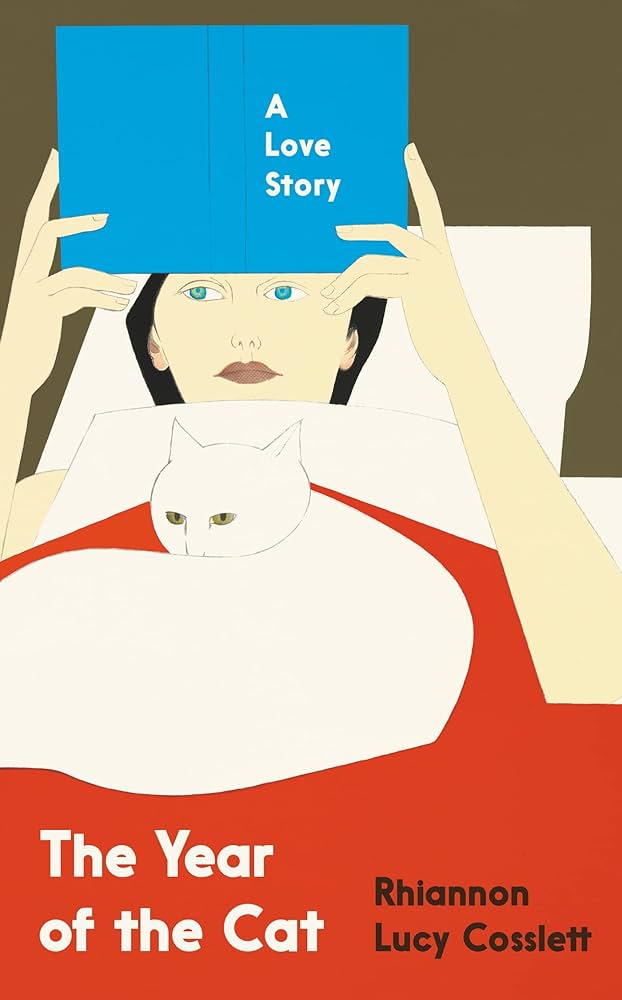
The Year of the Cat by Rhiannon Lucy Cosslett

This is a memoir that is ostensibly about Cosslett’s first year living with a small, demanding, endlessly entertaining cat called Mackerel during the pandemic. But it’s also about her family history, the disabled brother she grew up alongside, her relationship with her husband in lockdown, and their back-and-forth about whether they’re going to finally take the leap and have a baby.

Fans of Cosslett’s Guardian columns will know that she manages to write about deeply emotional and sometimes truly devastating subjects with humor and honesty (her Republic of Parenthood series got me through the first year of my son’s life). This book is an extension of some of the issues she’s touched on before, with lots of asides for the feline lovers among us. It’s tender, it’s witty and it speaks to what it means to be a thirtysomething millennial woman today, in a generation where we have fewer financial opportunities than our parents but twice as many expectations foisted upon us. I go back to it often.

Exclusive Cover Reveal: “Casualties of Truth” by Lauren Francis-Sharma

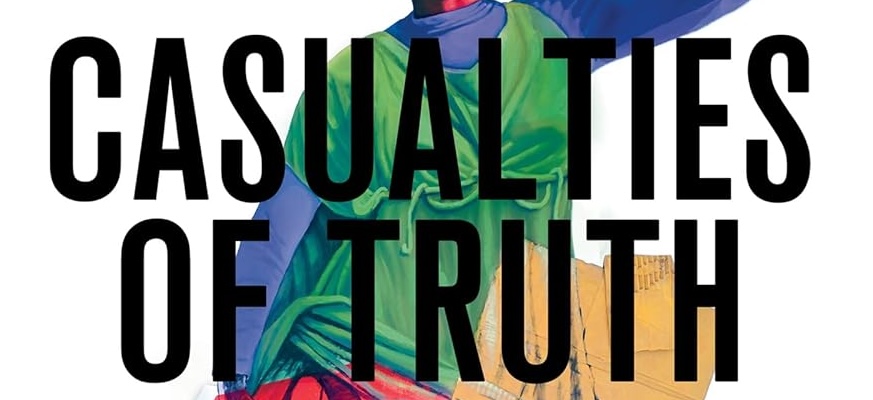
Electric Literature is pleased to reveal the cover of Casualties of Truth, the new novel by acclaimed writer Lauren Francis-Sharma, which will be published by Grove Atlantic on February 11th, 2025. You can preorder it here.


Prudence Wright seems to have it all: a loving husband, Davis; a spacious home in Washington, D.C.; and the former glories of a successful career at McKinsey, which now enables her to dedicate her days to her autistic son, Roland. When she and Davis head out for dinner with one of Davis’s new colleagues on a stormy summer evening filled with startling and unwelcome interruptions, Prudence has little reason to think that certain details of her history might arise sometime between cocktails and the appetizer course.

Yet when Davis’s colleague turns out to be Matshediso, a man from Prudence’s past, she is transported back to the formative months she spent as a law student in South Africa in 1996. As an intern at a Johannesburg law firm, Prudence attended sessions of the Truth and Reconciliation hearings that uncovered the many horrors and human rights abuses of the Apartheid state, and which fundamentally shaped her sense of righteousness and justice. Prudence experienced personal horrors in South Africa as well, long hidden and now at risk of coming to light. When Matshediso finally reveals the real reason behind his sudden reappearance, he will force Prudence to examine her most deeply held beliefs and to excavate inner reserves of resilience and strength.

Lauren Francis-Sharma’s previous two novels have established her as a deft chronicler of history and its intersections with flawed humans struggling to find peace in unjust circumstances. With keen insight and gripping tension, Casualties of Truth explosively mines questions of whether we are ever truly able to remove the stains of our past and how we may attempt to reconcile with unquestionable wrongs. 


Here is the cover, designed by Becca Fox:


“A departure from designing Lauren Francis-Sharma’s previous book, Book of the Little Axe, I was truly captivated by how the author toggled seamlessly between protagonist Prudence Wright’s present-day life in Washington D.C. and her unsettled past in Johannesburg, South Africa throughout Casualties of Truth,” says Becca Fox, the designer. 

“A novel at its heart, the story also walks the line of a revenge thriller with deep historical roots, and it was crucial to find imagery that picked up on this energy. While doing extensive research, I was immediately struck by Vivien Kohler’s Of Reason and Requiem, which felt like a South African ‘Lady Liberty’ to me. With the artist’s permission, we were able to recolor the illustration to harken back to the South African flag while also paying homage to modern-day America. The embedded street sign iconography also lent itself well to the story (without giving too much away!) — you always dream of happy coincidences like that as a designer. I was also drawn to working with a condensed typeface like Akzidenz Grotesk that felt as bold and fresh as the story to round out the design.”


She looks a bit like lady liberty, doesn’t she? My editor nodded in agreement. She’s got that high tilt in her chin, that erect pose, those soft folds of fabric beneath her waist….but is she the right cover?

Having spent time in South Africa, I was certain the artist designing the proposed cover for my latest novel, Casualties of Truth, was someone who understood the aesthetics of the country. And yet, my novel isn’t just about South Africa. It is a diasporic novel that shows the interconnectedness of people in the struggle for freedom, a novel about hidden pasts, a novel about motherhood and marriage, and yes, too, a novel about Apartheid and the post-Apartheid era. But my protagonist, Prudence, lives a life far from the one the woman on the cover appears to live. Prudence is a Harvard Law and Business School graduate, a former McKinsey consultant, a woman who can afford to stay home to care for her autistic son. And she is also frightened. When a man she met in Johannesburg over twenty-years earlier is introduced as her husband’s new colleague, Prudence finds herself unraveled by thoughts of what she could lose at this man’s resurfacing.

The novel is a fast-paced ride through Baltimore, Johannesburg, Trinidad, and the Maryland suburbs of Washington, D.C.  So, what cover might capture these places, might capture over forty years of one woman’s life? I wasn’t sure, but when I looked at my “Lady Liberty,” I could see triumph in the colors of the South African flag. Living in South Africa in 1996, only two years after the flag’s unveiling, I remembered hearing the joke about how the little strip of yellow in the flag represented all the electric fences whites were putting up to keep Blacks out. But this wry humor isn’t notable in my Lady Liberty’s proud face, a face she seems intent on shielding from some terrible glare. Is it the sun boring down on her or something else? And what of the sign at her hip? Is the reader to understand the traffic signs—STOP and NO PARKING—to be warnings about Prudence’s impending journey? And what of her bare feet? Are they a sign of struggle or of comfort? Will a reader turn away from them or are they an invitation to remove one’s shoes before entering a welcoming place to hear a gripping tale? My Lady Liberty stands alone in the midst of a stark white space, hyper-visible, and still, what remains for me is the most important question of all—will readers be curious enough to reach for her?  

My Lady Liberty stands alone in the midst of a stark white space, hyper-visible.

In early 2024, I flew to South Africa for the final bit of research I needed for the novel. I had been searching for a recorded testimony for one case in particular that I’d transcribed onto notepads which I had been carrying around for nearly thirty years. I still knew the story from memory: a group of boys betrayed by a Black state operative, an askari, who promised to take them for resistance training with the ANC, and the boys never made it home. I had seen those boys’ mothers at the hearings, I had wept for them all, and had never forgotten them. 

As is often the case with research, it would take being on the ground to find people who would invest enough in your work to assist. It would be a random trip to Freedom Park in Pretoria where I would meet a guide, Badresh Kara, who would send me the link for the recording I’d been hoping to find for years. So excited and finally relaxed enough to be a tourist, I spent the next afternoon wandering Johannesburg art galleries with a dear friend, looking for inspiration for my cover. We landed at Gallery Momo, where my friend introduced me to the owner, Monna Mokoena. He told me about their U.S. residency program and about some artists he’d be featuring later in the year, the kind of work I described I might be interested in seeing. Let’s keep in touch, he said. But I didn’t keep in touch.

After weeks of mulling over the decision, I finally told my editor I was ready to finalize my choice. My Lady Liberty had been haunting my dreams, her pursed lips like an admonishment.

A few days later my editor sent a link with the name of the artist whose work had inspired the cover. Vivien Kohler. I found a few videos about Kohler and as I watched them, something in the background of one of his art shows rang familiar. I sent the link to my friend. Is this the same gallery we visited?

It is…. she wrote back.

Lady Liberty and I had crossed the same paths albeit at different times. Yet, now we had arrived at the same place together, ready to share a story that crosses time and continents to reveal our common humanity, our common desires. Mere coincidence? Perhaps. But I don’t believe in coincidences. Rather, I believe we must always be reading the world for signs of truths yet to come.”

9 Books About Women Leaning into Darkness to Find Power 

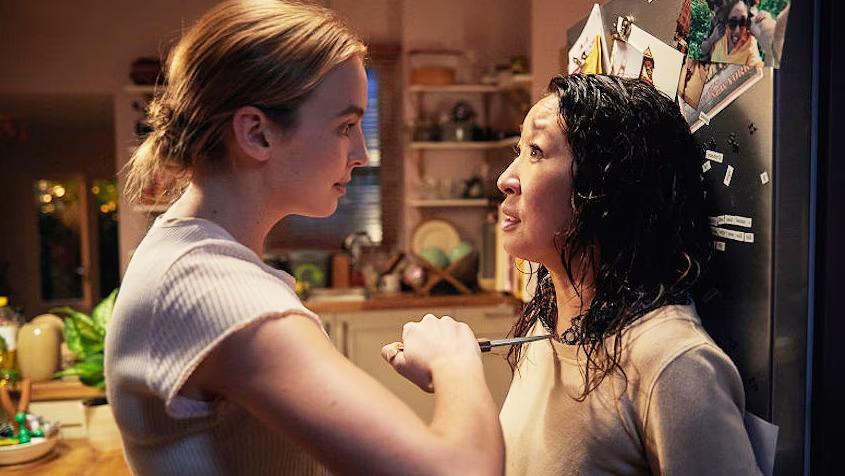
It began, for me, with Xena. I was ten years old, living in South Africa. Home alone after school, seeking a snack, perhaps. I heard the haunting melody of Bulgarian Bagpipes lilting from the lounge. I followed the melody. There, on the TV, a warrior woman rode a palomino horse out of the mists, stripped her armor and weapons, and began to bury them. The rest, as they say, is history. I was fascinated and entranced by Xena, by her search for redemption, yes, but also by the continual temptation to give in to her “evil” side. I found the back-and-forth between Xena and her arch enemy Callisto and ex-mentor Alti to be the most riveting thing a pre-teen can experience. La Femme Nikita followed, then Buffy, and Dark Angel—and each of these shows had one thing in common: Strong women. Complex women. And my favourite: women doing unhinged things. 

Let me be clear here, not women suffering with mental health struggles, which is not an “unhinged” behavior, rather: with women doing objectively bad things, or women simply doing strong, loud, not-strictly-feminine things. Things that society deems unacceptable, whether rightly or wrongly. When writing The Madness, I wanted to bring the girls to the party, to have my own Scooby-gang where the girls take a stand and play a part. To face and rectify a system that continually places them beneath, a system that first creates them and then punishes them. Why do we love Killing Eve? Why do we root for Villanelle in her horrid behavior, and cheer on Eve on as she spirals from “good girl” into something more unhinged? Why do we watch, fascinated, as nurse Ratchet behaves badly, cheer as the Bad Moms behave badly, and celebrate when Harley Quinn bashes brains? Is it catharsis? Emotional release by proxy? We love women leaning into their rage, their darkness, their power—women taking up space. Are unhinged women our new anti-hero? The new villain we love to adore? I, for one, hope so, but I also know this isn’t a new “trope”. Perkins Gilman’s The Yellow Wallpaper, Bronte’s Wuthering Heights, and Chopin’s The Awakening (to name a few), illustrate this fact. It does seem, however, that we are salivating for this type of story more than ever before. 

To celebrate the release of my debut adult novel, The Madness, where a group of misfit outsider women take on a systemic (and supernatural) evil, I’ve put together a list of some of my favourite novels that feature unhinged women. Proceed with caution.

Cursed Bunny by Bora Chung

Let’s begin with a book of short stories to get our juices flowing, shall we? I loved some of these stories far more than others, but the ones I loved, I loved. I am an avid Weird Fiction girlie, and proudly so. The first two stories in this collection alone are worth the book—“Head” and “The Embodiment”—and both fall into my definition of Unhinged Women. In the first story, a woman finds a disembodied head in her toilet one morning, and continually attempts to flush it away. It is a nauseating examination of the disintegration of her identity after being talked into ignoring the problem by the family around her. “The Embodiment” follows a woman who becomes mysteriously pregnant after being prescribed birth control tablets to control her heavy period. It examines patriarchal power structures in a society that dictates the value of a woman through the lens of marriage and motherhood, and is delightfully gross. For short, sharp shocks, give this one a go.

The Vegetarian by Han Kang

In the tradition of Atwood’s The Edible Woman, Kang’s The Vegetarian follows Yeong-hye as she attempts to purge her mind by renouncing the eating of meat, which is, in her culture, a shocking act of rebellion. Initially passive, her rebellion takes on more and more extreme forms, leading to a complete and total metamorphosis. The Vegetarian is told in three POVs, none of which are her own, a consciously-chosen device, I think, to aid in the demonstration of her apparent passivity. Despite all this, Yeong-hye has the power. Her “unhinged” actions terrify those in her life, pushing them away, until she realizes her ultimate fantasy—her ultimate power, and is finally transformed.

Gone to See the River Man by Kristopher Triana

There are many, many trigger warnings here, so please look them up before you read if you need them. This short novel follows Lori, a woman with an unhealthy romantic obsession with killer-of-women, Edmund Cox, who is currently locked in prison. They have a bizarre relationship conducted via letter. When Edmund writes and gives her a task to complete, Lori accepts as a way to prove her love. The task? Simple. Deliver a key to The River Man. Lori jumps at the chance, and brings her disabled sister along for the ride. Lori is, questionably, as unhinged as Edmund Cox is, and she is a deeply flawed, mostly unlikable character… and one I couldn’t stop reading. On her journey, Lori did unspeakable things, and I kept turning the pages anyway. For a truly unhinged experience, definitely give this one a go.

Grotesque by Natsuo Kirino

I love a good fictional unhinged friendship—or frenemyship. Grotesque follows the history of two prostitutes that have been brutally murdered, from their time at a prestigious girls’ high school through the twisting pathway to their ultimate end. Narrated by the unemotional sister of one of the victims, the novel delves into the strict societal expectations that both women have been up against their entire lives—expectations revolving around their sex, their gender, and the expectations of their perceived value— and how it changed and manipulated their characters over the course of years. Grotesque is a brilliantly executed jumble of unreliable narrators with a truthful story at its heart, an examination of the ways that society makes monsters of women by withholding freedom and equality.

Confessions by Kanae Minato

After her four year-old daughter drowns in a pool, teacher Yuko Moriguchi has decided to retire. But not before she teaches her final lesson. There is something very compelling in the cold manner that Yuki delivers her narrative, slowly closing in on the murderers of her precious child, until they realize with horror the revenge she has already put into place. Told from various perspectives, but circling back to Yuki for her final nail in the coffin, this short read is a sharp shock that speaks to moral ambiguity, grief and vengeance.

The Lost Daughter by Elena Ferrante

Leda—middle aged, divorced, and alone now that her two grown children have left her to live with their father—takes a trip to the Ionian coast for her own enjoyment, surprised at the sense of relief and freedom she feels now that her daughters have gone. While there, she becomes entangled with a young mother named Nina, and Nina’s young daughter. Through a seemingly trivial event, the theft of a doll, Ferrante explores female identity, and the ambivalence some women feel towards motherhood, and the internalized guilt, shame, and rage it engenders. Leda herself is an oft-aloof character with a certain coldness about her, often times vindictive, and withholding, and full of deep resentment. In stark contrast to the ideal of motherhood society presents as sacrificial, pure, self-effacing, and submissive. As Leda meditates on the happenings around her through the lens of memory, she notes that “No one depended anymore on my care and, finally, even I was no longer a burden to myself.” Perhaps, one day, a mother contemplating the very natural and complex emotions around motherhood won’t make an “unhinged” list, but for now, it remains.

Diavola by Jennifer Marie Thorne

In this delicious vacation-horror, we follow Anna as she navigates a dreaded family holiday to Italy. Anna’s voice is dry, jaded and wholly refreshing as she attempts to survive her boisterous, often irritating family. The location of their vacation is the beautiful Monteperso villa. It has everything you could want: gorgeous views, proximity to a vineyard, pool, vengeful ghost. The usual. Anna is such a fun anti-hero—villain, even—and watching her navigate a haunting both by her family and a vengeful la dame blanche was the icing on a very delicious cake. Anna’s casual acceptance of her own haunting was hilarious and truly unhinged.

Maeve Fly by CJ Leede

Maeve, sarcastic and apathetic, but also somehow innocent, ditches her nighttime routine of reading in bars like her literary heroes, and instead begins to explore a darker hobby. One with a lot more blood. This entire novel is one unhinged descent into inhumanity, and none of the characters are likeable in any way. Yet we keep reading. “Men have always been permitted in fiction and in life to simply be what they are, no matter how dark or terrifying that might be. But with a woman, we expect an answer, a reason.”

Check trigger warnings here, folks! 

The Haar by David Sodegren

Muriel lives on a remote Scottish island that is being threatened by a large corporate property developer. Most of her neighbours have already capitulated and sold their land, but Muriel and a straggling few are standing strong. Muriel feels hopeless until she discovers… something hiding in the haar, the mists that cover the shoreline. Muriel, a woman in her eighties, is undoubtedly unhinged in the best way. Not only is she a one-woman army against a multi-millionaire villain, but she is also willing to work with a dangerous amorphous blob without many qualms, and as the body-count rises (and body parts liquefy), she goes with the flow. Maud is the granny we all need!

The Former Leaders of Jewish Voice for Peace on Organizing an Anti-Zionist Movement

In the weeks that followed the horrific attack on October 7th, we saw as one of the largest movements in American history rose up to stop the incoming genocide in Gaza. To date, Israel has killed at least 40,000 people in its unprecedented campaign in the small, two-mile wide stretch of land, destroying civilian, political, and health infrastructure, and acting as one of the largest dispossessions of Palestinians since Israel’s founding in 1948.

In response, anti-Zionist and Palestinian solidarity groups around the country came together to demand a ceasefire and an end to U.S. military aid to Israel. Jewish-led groups were at the forefront of this, with the nearly 25,000 member organization Jewish Voice for Peace (JVP) as the most notable as they held demonstrations, blockades, and civil disobedience in cities from coast-to-coast. JVP has been an established project in fighting for Palestinian rights, in normalizing anti-Zionist Jewish identity and pushing the Boycott, Divestment, and Sanction (BDS) movement to demand Israeli accountability and the end of the occupation of Palestinian land. In doing so, they have become notorious in many Jewish circles, where association with JVP can be enough to have relationships with mainstream Jewish organizations completely severed.

In its nearly 30 years of life, JVP has reshaped itself to accommodate a growing and changing demographic base, taking on new strategies and evolving to highlight underrepresented Jewish voices and those often left behind by both the left and the Jewish establishment. Two former staff members were at the heart of building the organization during the first two decades of this century, and helped to see the organization from its early days as a mostly California-based group to the evolving powerhouse it has become today. In an effort to chronicle the lessons they learned in their time in leadership at JVP, Rabbi Alissa Wise and Rebecca Vilkomerson have published a new book, Solidarity Is the Political Version of Love: Lessons from Anti-Zionist Jewish Organizing, that looks back on what they learned from years organizing one of the most direct, and divisive, organizations fighting for justice. 

We talked with Vilkomerson and Wise about what motivated them to write this book, what experiences they had in building JVP that might be instructive for others considering what it takes to change the world, and what those lessons mean for one of the most significant moments in the entire history of the conflict.


Shane Burley: When I was reading this book what stood out was that this was a real organizer book, meaning that it jumped into the nitty gritty of how movement building works and the lessons you walked away with from your work in Jewish Voice for Peace (JVP). What made you focus on the practical activist work when you were considering how to tell your story?

Rebecca Vilkomerson: The reason we want to talk about organizing, first of all, is it doesn’t get talked about that much. The mechanics and the specificity of it. The book is about and for the Palestine movement, but we actually also wanted it to be much broader, so we talked with folks at organizations like Showing Up for Racial Justice and Hindus for Human Rights. And there’s a very specific kind of organizing of when you’re trying to shift your own community’s perspectives and where part of your fight is within your own community. 

Some of it is specifically for organizers, but we also hope that it’ll reach people more broadly who are thinking about moving from activists to becoming organizers. I think now, especially, all these new people are coming into the Palestine movement and need leadership development and political analysis and strategy. All of those skills and questions are critically important, and that is what a lot of people are thinking about now as they consider the political crisis we are in. 

Alissa Wise: When we were pitching the idea to Haymarket Books and were in conversation with them about what the book could look like, we discussed how the organizing approach we practiced in JVP is often more durable and long-term and can offer broad lessons.  

There has been a trend of emergent organizing that has less staying power in terms of building power over time, versus the approach that JVP has often taken that requires digging in over time. With everything from developing member leaders, campaigning, and building organization, the model we have worked with is both institutional and flexible so we can evolve as the political winds change. This is another important piece for the Left, to build and sustain enduring organizations that are not static and ossified, but instead incredibly responsive. From our reading of organizing history, this has been an important part of what has allowed movements to thrive over time.

SB: There are a lot of different elements to JVP’s approach, from both being a mass movement organization and a kind of non-profit, to being a Palestine solidarity organization but also a place where a lot of people reclaim, or redefine, their relationship with Jewish identity. How did you balance these different components of the project together when you were building it up to the movement it has become today?

RV: We name this in the book, that the productive tensions of the organization always living in what we call “both/and” situations, which are present in the examples you mention. Especially as we matured in our leadership, we were able to name these tensions with our staff and members. You shouldn’t pretend that those contradictions don’t exist and instead want to live with those tensions and be responsive to them. The truth is, sometimes we got that balance right, and sometimes we didn’t. We used a few examples in the book when we felt like we balanced them in the right way and where we erred on the wrong side and, hopefully, learned from it. 

AW: One of the important takeaways from the book is that we never had a strict solidarity model where we are essentially there to do what Palestinians ask us to do. It was a more complicated solidarity model where we understood that we have these serious accountabilities to Paletinians and ingrained ourselves into our work in the organization. But, at the same time, we were clear that there were Jewish communal concerns that were part of our obligation and mission. There is work that has to be done in the Jewish community that is a venn diagram with Palestine solidarity work, but is actually separate from it. And that was always a tension. So for me personally since October 7th I have focused on picking up the side of the venn diagram that doesn’t fit squarely in JVP, which is the project of building a Judaism outside of Zionism. That is important, but it’s not the same thing as JVP’s organizing model. For a long time, JVP was trying to do both and it does get messy. I think the way we navigated it was we tried things, some worked, some didn’t. Jews are implicated in this but are not the victims of Israeli oppression the way Palestinians are, and there is an injury to the Jewish community in this. So this tension remains so you have to take each choice as they happen and weigh the pros and cons of different priorities and tactics. This is one of the ways in which identity politics and solidarity politics rub up against one another. 

SB: Who do you think the primary audience is for JVP? Are actions and strategies meant to target primarily those in the Jewish community, or do you use your positionality to move politics beyond Jewish organizational life?

AW: It’s interesting you use the word “audience” because we review several examples in the book where JVP was instrumental in achieving actual, tangible victories in the movement because of our position as Jews in solidarity with Palestinians. But that’s different from the audience because that positionality is about who we are working with. But when you say audience I think that’s true, but as organizers we are always trying to reach the people who are setting the tone for the Jewish community with actions, but it’s those who are participants in Jewish culture who are movable that we want to invite in. So there are the legacy Jewish institutions that might be the audience, but it’s the members of those organizations that we actually want to come into our ranks.   

RV: This gets back to the “both/and” analogy. At different times we had different, though complementary targets and/or audiences. Early on (even before I was on staff) we had an approach, which later was echoed by IfNotNow’s strategy. In the early 2000s in San Francisco, we applied to be part of the Jewish Community Relations Council (JCRC) and were shocked that we weren’t accepted. We wanted to be a part of the larger Jewish communal infrastructure and they didn’t want us. And that continued as our politics sharpened, where institutions like Hillel excluded anything JVP related. So at a certain point we were like fuck them, we will create our own Jewish institutions that reflect our whole selves. That was an evolution. Our job was not to reform the Jewish world from the inside, but to build a whole new one. So we were still often speaking to the Jewish community, but also creating space for Palestinian voices and other people who wanted to speak for Palestinian liberation but were silenced by weaponized accusations of antisemitism. 

SB: There seems to be a debate happening in the anti-Zionist world about how much collaboration or even relationship is possible with larger Jewish organizations that generally have some degree of a pro-Israe consensus. So, for example, if an organization like JVP is allowed to hold an event at a Jewish Community Center, that may be a victory since they were able to get past the censors and will be able to reach a larger Jewish audience often kept away from them. 

But at the same time, there’s also a push to build Jewish life completely outside of these institutions. To build new synagogues, community centers, even a sense of Jewish identity that doesn’t fight for its space in the mainline Jewish world, but on its own terms completely. How do you think about this  negotiation, and are those two strategies actually at odds with one another?

AW: I have a dream to start a new movement of Judaism, a truly new stream of Judaism that we would establish, which could supplant the existing ones. I was recently talking with a group of rabbis about it and pitching my idea and one of them really took issue with the idea of “supplanting.” He said that we don’t want to supplant them. We have lots of people that are inside of these institutions that are moving them on these issues and that’s actually really important work. So we had a philosophical conversation about what we’re doing, and what it means to sort of create an alternative that can somewhat replace some of those old institutions in the lives of many Jews. And, if successful, this becomes the future of American Jewish life. So then the question is, how do we do that if we aren’t trying to replace these existing organizations. 

Our job was not to reform the Jewish world from the inside, but to build a whole new one.

—Rebecca Vilkomerson

The aesthetics of this is part of the problem because people also enjoy the rebellious nature of building a new project, which they sometimes don’t want to then become the status quo. This can also be part of the conversation around projects like Rabbis for Ceasefire, which I co-founded, where some anti-Zionists will pose the question immediately about why all the participants aren’t themselves openly anti-Zionists. And this perspective can miss the reality of the organizing work involved, which is that you don’t get everybody on board right away. Not everyone comes into this work exactly where you, as the organizer, might want them to be. So part of my hope for this book is that it will create a space for us who are in conversations with our local communities about these issues so we can ask that exact question of the difference between just mobilizing supporters and organizing a community so as to move them along on an issue.

This means asking people: what is your vision of change is you are looking for, what the Jewish community could look like. Do you want to change organizations or do you want to build new ones? Do you want these older institutions to disappear so new ones can take their place? And I think right now we are not at that level of discourse because of the aesthetics of activism that are playing out right now. 

RV: I don’t disagree, but also it takes two to tango. Alissa has an incredible vision for Judaism beyond Zionism, but that’s also a different question than the viability of the organizations that have taken control of Jewish life now. And with the way that mainstream Jewish organizations treat us, there is not necessarily a pressing threat of cooptation right now. We are so far from that. So we should just be aware that there isn’t just an aesthetic of being told we don’t belong, but actually we’ve been told over and over again in often the most hateful ways possible that we don’t belong and in ways that are incredibly hurtful on purpose. This is more personal than strategic, but I struggle being in relationship with any group that has not called for a ceasefire. I feel like we may not hold many values in common. 

SB: We’re also talking at a really heightened moment where people are drawing really sharp political lines, often because the moment seems so dire as the genocide continues in Gaza. But sometimes these choices are different from strategic ones that we need to make as part of long-term movement building. What kind of strategic lessons do you have from your experience of organizing in other moments of heightened emotions that might be helpful today?

RV: This returns to “both/and” and the ongoing productive strand of debate that has continued through JVP. Instead of spending all of our time and energy in conversation with people who were still out of reach, we were able to build something where people who were ready to take action could do so. That has proven strategically effective because the low hanging fruit was always Jewish people who already didn’t feel like they had a Jewish home, so connecting with them rather than moving people who would have to leave their Jewish home and come to another. So when finding people who already felt outside of Jewish life they were able to discover a new Jewish community that felt precious, beautiful ,and meaningful. So we chose to focus on the unorganized, the often unaffiliated Jews who may have affinity for our politics, rather than re-organizing those already deeply involved in existing institutions. At different times you might want to choose different approaches, and there are also different lanes within the movement. For example, right now JVP can be a container for those who are ready and Rabbis for Ceasefire is creating a place for people who are in process of changing their politics. You can have both of these strategic options. 

SB: With some of these mass protests over the past year led by leftist Jewish organizations like JVP, there is a question about whether or not we are seeing a resurgence of the Jewish left. Do you think that something distinctly new is happening right now, or is this just the continuation of the work that has been happening for years?

I became a rabbi in the first place, because I want to make sure that there is an ethical, liberatory Judaism for future generations.

—Alissa Wise

AW: It could be that what you’re noticing is a really good development in that people are noticing that Jewishness as a category is genuinely under threat by the ways that it’s been completely conflated with Zionism. And that it’s actually strategically expedient for people who identify as Jews to be able to draw the distinction between Zionism as a political project and Judaism and Jewishness as a religious and cultural tradition. The debate on that conflation has steadily had the volume turned up, because of JVP’s shift to being anti-Zionist and debates around antisemitism definitions like the International Holocaust Remembrance Alliance definition, which has been used to stifle pro-Palestinians speech, has brought it into focus more. 

RV: This is beyond just the question of the Jewish left: there has been a return of the left in general. The left is undeniably stronger than it was, definitely ten years ago, probably even twenty years ago. Since the late 1960s, even. So the Jewish left is a part of that and responsive to that. So we were always here, but we weren’t here in the size and prominence we are now. A big part of that, like Alissa was talking about, is that there are multiple conversations happening right now about how to build Jewish communities beyond Zionism institutionally. This has existed for a long time, but to have enough strength, power, experience, and ambition to be able to put a name to it and build institutions is a different stage in this. 

AW: I was having lunch with a friend and we were talking about this question of whether or not Judaism and Jewishness continuing is something you would feel proud for your kids and your grandkids to be a part of. Does this matter in our heart of hearts? I wonder how much of what is animating people to be involved in these projects and to show up like they have is that this is a live question. This is my motivation in life. I feel personally responsible, and I became a rabbi in the first place, because I want to make sure that there is an ethical, liberatory Judaism for future generations. And I think that possibility is up in the air at the moment. This is part of the parallel fight that’s happening right now, and it’s been simmering the past number of years. I wonder if this is what’s in the air, a sense of pressure, and obligation and responsibility to our Jewish ancestors and our Jewish family and our Jewishness itself. 

Whose Story Is It? 8 Novels That Belong to More Than One Character

“Whose story is this?” workshop critiquers often ask when a character in a manuscript seems to be narrating someone else’s experience or when a different character might be more intimately related to the story than the one the writer chose. But sometimes a story belongs to more than one person. 

My mother is one of six children, and I grew up fascinated by the exponential number of family dynamics that produced. My grandfather could be a cranky codger, shouting, “Close the damn door!” within seconds of anyone’s arrival. My grandmother, featured in nearly every family photo with a Budweiser in one hand and a cigarette in the other, hugged without letting her body touch yours. Together, my grandparents drove all over the US and into Canada and Alaska in a VW Vanagon outfitted into a makeshift RV, identifying and photographing birds and plants everywhere they went. They also set up helplines in every community they lived in, volunteered in Scouts, and appeared on national television as foraging experts at a wilderness festival. They were complicated and interesting, and every sibling had a unique relationship with each one. Watching my aunts and uncles, I learned early that no two people perceive the same events in quite the same way, that the very facts of a story are determined by the teller. This revelation fueled my desire to become a writer, hatching my curiosity to explore all the sides of a story. 

Novels that employ more than one point-of-view character follow this same quest. Some play alternating viewpoints against each other to expose contradictions in a tragedy, a mystery, or a family system. Others encompass a wide span of history, and the switching points of view plant the reader in a front row seat to a range of eras or generations. Others engage with atrocities visited upon vast communities, and alternating viewpoints enrich a reader’s understanding beyond one person’s truth. 

I chose dual points of view for my novel Without You Here to reveal both sides of the significant relationship between an aunt and niece. Nonie and Noreen bond over their mutual offbeat status in the family, and Nonie’s suicide during Noreen’s childhood leaves Noreen to grow up in the shadow of her loss, weighed down by generations of family worry and denial. Unless I gave Nonie a point-of-view role, she would have existed only as a memory. Instead, when we slip into the past with her, her vividness underscores the staying power of Noreen’s longing for her as well as the hazards of their kindred challenges. 

Done well, using more than one storyteller can deepen a story’s complexity, turning a prism versus a single lens onto the people and themes at hand. Here are eight novels that alternate point-of-view characters effectively and often poignantly.

Silver Sparrow by Tayari Jones

Set in Atlanta in the 1980s, Silver Sparrow tells the story of a pair of half-sisters, only one of whom knows the other exists. The secret sister is fully aware of their father’s duplicity, and when she befriends the “public” sister, things get complicated. Swapping between the sisters’ vantage points immerses the reader in the web of alliances and betrayals inherent in this family structure. 

Back in 2011, I attended an event celebrating the launch of this novel. After reading, Jones discussed her decision to use more than one point of view, saying something along the lines of, “You should act like each point of view costs twelve hundred dollars,” a sage reminder for writers choosing this strategy. If we’re going to split the narrative across two or more voices, every voice needs to earn its keep.

Tin Man by Sarah Winman

Michael and Ellis provide this novel’s narrative duet. Best friends growing up, they also engage in a brief sexual affair in their teen years, but Ellis finds his forever love in Annie, whose tenderness toward both men allows her to understand the strength of their connection better than they do. Rather than competing with it, she nurtures a bond among all three until tragedy ultimately tears them apart. Here the alternating voices tiptoe us into the deepest intimacies these men shared. Like the finest of harmonies, each voice bolsters and sweetens the other. 

The Death of Vivek Oji by Awaeke Emezi

A chorus of voices narrates this sad and beautiful story of grief and reckoning. After Vivek Oji’s lifeless body lands on his family’s threshold, his closest relatives and friends ache to make sense of his death. Vivek’s own voice adds notes from an ethereal afterlife. Only a few trusted allies knew Vivek was transitioning and had chosen the woman’s name Nnemdi for a hoped-for future that never materializes. This secret profoundly affects how each narrator describes their hopes and worries for Vivek/Nnemdi, which makes the use of multiple narrators especially powerful.

The Prettiest Star by Carter Sickels

Brian, on the decline with AIDS in the mid-1980s, returns from New York City to his family home in a small Appalachian Ohio town to die. A filmmaker, he’s already recorded the deaths of many friends and his longtime lover, and he’s intent on recording his own as well. The point of view trades among Brian, his younger sister, Jess, and their mother, Sharon, while all three struggle toward some kind of acceptance and connection before it’s too late. Rampant homophobia and fear of AIDS turn Brian’s community and home into hostile territory, and the varying points of view offer a personal, poignant angle on one family’s struggle to love each other around and through prejudices and resentments.

Hieroglyphics by Jill McCorkle

In this novel of difficult losses, place connects the point-of-view characters, Shelley, Frank, and Lil. Shelley lives with her two sons in the same house where octogenarian Frank lived as a child. After Frank and his wife Lil retire to the area, Frank becomes obsessed with his old house. He’s a stranger to Shelley, and his repeated visits and requests to be allowed inside trigger her childhood memories of a violent family life. Tragic deaths plague the family histories of each point-of-view character, and the patchwork of viewpoints hauntingly and beautifully melds the shared themes of complicated grief and nostalgia. 

Black Cake by Charmaine Wilkerson

Among many family secrets Benny and Byron learn after their mother Eleanor’s death, the biggest is that her name actually wasn’t Eleanor. The recording that not-Eleanor bequeathed to her children, to answer a host of questions they hadn’t known to ask, provides one of the narrative voices in the book, joining Benny and Byron as well as a select few other family members and important friends. The multiple voices move across generations and geography, adding nuance and layers to a tangled family story set against the backdrop of Jamaican diaspora.

The Bonesetter’s Daughter by Amy Tan

As in many of Tan’s novels, an American-born adult child is attempting to reconcile her life with the heritage of her immigrant parent(s). Ruth, born in America, had a fraught relationship with her widowed single mother LuLing when she was growing up. Now, balancing her life with a career that isn’t quite what she’d hoped for, she’s got a fraught relationship with her boyfriend’s teen daughters. Meanwhile, LuLing’s slipping into dementia. In a last-ditch effort to learn more about her mother before it’s too late, Ruth hires a translator to transcribe the memoir-style manuscript LuLing gave her years before. These transcriptions serve as LuLing’s point-of-view sections. 

I first encountered this book on audio, which made the most of the novel’s dual voices. An older woman whose first language is likely Chinese narrates LuLing’s sections, highlighting the shift in voices as well as LuLing’s visceral connection to a previous home. Audio or not, the two voices deftly portray the richness and pressures of families straddling Old and New worlds.

The Prophets by Robert Jones, Jr.

Set on an antebellum Mississippi plantation, this story focuses on two men, Isaiah and Samuel, enslaved laborers in charge of the barn and in love with one another. Other point-of-view characters complement their tragic but elegiac love story, broadening the story’s lens to a much wider scope. We hear from other enslaved men and women as well as a few members of the enslaving family—including the delusional plantation owner’s wife, who roams the grounds at night, occasionally sexually assaulting men in a lurid effort to catch up or get even with her husband, several of whose rape-spawned children populate the ranks of their plantation labor force. This novel’s chorus of individual voices adds up to a macroscopic representation of the brutal daily realities of chattel slavery and their toll on the relationships among the enslaved and on the humanity of the enslavers.

In “Brothers and Ghosts,” a Vietnamese Diaspora Family Cannot Escape Their Generational Wounds

At the beginning of Khuê Phạm’s debut novel Brothers and Ghosts, translated by Charles Hawley and Daryl Lindsey, the narrator makes a confession: “I don’t know how to pronounce my own name.” It’s not something you hear often and something unimaginable for many. But for Kiều, the young Vietnamese German writer at the center of Phạm’s adroit novel, it’s the effect of a lifetime of trying to assimilate into German society. She was born in Germany, after all, and there is no reason not to be like any other German (that is, white Germans). She goes by Kim and keeps her Vietnamese heritage at bay.

But once her grandmother dies, leaving a will, Kiều and her family are urged to visit their American relatives to reveal their inheritance. In California, it would be the first time she’s around so many other Vietnamese people in a very long time. The experience forces her to confront not only her heritage but her family history.

In many ways, Kiều’s story is very familiar to children of immigrants. My birth name, for instance, is Phong, and though it wasn’t any of my decision, my parents legally changed it before I started school to something more “American.” Likewise, I spent most of my teen years trying to fit into mainstream American culture.

But Phạm goes beyond the theme of the individual’s cultural loss. Brothers and Ghosts is a novel about how a family ends up scattered around the world. While it might be easy to lay blame on war and history—indeed, that is a large part of Kiều’s situation—Phạm highlights the inner works of family and its members, the ways they protect or deceive one another, the ways they disappoint us, they ways they support us, and ultimately, what we inherit from them.

I had a chance to talk to Khuê Phạm via Zoom about her novel, growing up as a child of immigrants, and the meaning of family.


Eric Nguyen: Brothers and Ghosts follows the stories of three family members. You have Kiều, her father Minh, and her uncle Sơn. Why did you choose to tell this story through three characters?

Khuê Phạm: I experimented a bit with the number of characters and how I wanted to tell the story. Originally, I wanted to tell the story of the two brothers who end up on different sides of the political division line because that’s a conflict I know from my own family and I have always been intrigued by it. However, when I started writing, I showed the first drafts to my agent and publisher and they felt that the person who’s narrating the story was Kiều, that she’s very important to build a bridge to readers who may not know the conflict in Vietnam very well. Kiều belongs to the second generation; she grows up between east and west, and at the beginning of the story, she’s very naive. She doesn’t know anything about the history of her family or indeed the history of Vietnam, perhaps like the reader. So, she became a narrative tool to uncover the different layers of her family’s journey. 

EN: All your characters are in a way outsiders. Kiều’s Vietnamese German, but she lives in a very white society. You have Minh, who’s an outsider in his own family since he left in the middle of the war for Germany. And then there’s Sơn, who is deemed a traitor once Saigon falls and the Communists take over. Why was it important to have these outsiders be the path through your novel?

KP: They are all outsiders for those very reasons that you described, but they’re not outsiders to me. The experiences they have are normal and worth telling. Contemporary German readers, and I guess many American readers, will not be familiar with the fact that there are indeed quite a number of second generation [Vietnamese diasporic] writers nowadays. But I do feel that this outsider perspective says a lot about mainstream society and I too have often felt a bit as an outsider growing up in Germany. It’s a perspective that feels very familiar to me. Writing a book is a chance to bring people into the center that are sometimes on the margins. 

When the book came out in Germany, a lot of Germans told me they could identify with the story even though they have a very different cultural background. The family dynamics, the generational conflicts, the battles for opinions and values, that is something that everybody knows about and it’s a very universal experience. 

EN: I saw myself in your book, too, especially Kiều. Brothers and Ghosts is very much a story about Kiều trying to find her roots. At the beginning, she doesn’t even know how to pronounce her name correctly, and it’s not until her family takes a trip to the US that she’s forced to face her family’s history and culture, despite having spent most of her life running away from that as she tries to assimilate into German culture. She uses a non-Vietnamese name, Kim, for example. Why do you think we—especially immigrants and children of immigrants—why do you think we run away from our history and culture?

KP: I have seen this happen over and over again to children of immigrants who grew up in a different country, this pressure to assimilate, this pressure to become normal, to become like everybody else around them, the feeling that it’s so much cooler to be German or American or French than Vietnamese. This internal cultural and racial hierarchy, even children seem to pick up so easily. I can even see it with my 4-year-old son, and I don’t condemn it because I know that feeling very well. 

Looking at the German context, I would say that at the time when I grew up in Berlin in the 90s, the climate in Germany was very difficult. There was xenophobic undertone in Germany because it was the years after the fall of the Berlin Wall. East and West were kind of somehow coming together. Germany as a country was trying to assimilate into each other, you could say.

There were a lot of tensions that translated into racist attacks. There have been a lot of high-profile racist attacks on asylum seekers. At that time, growing up in Germany, I felt this constant sense of distrust. People would always ask me, “where are you from?” And I would say, “I’m from Berlin,” because I was born in Berlin and I had a German passport and I speak German so much better than my crappy Vietnamese. Yet people wouldn’t believe me. They would always say “No, but where are you really from?”

This nagging question gave me the sense that somehow, I would always be so different and I would never be accepted. It made me quite angry and I think it made me quite angry at my Vietnamese heritage. 

Now it’s very different. Luckily the country has become much more tolerant. Also, I’m much older and I’m able to hold that thought in my head, that I am German and Vietnamese, and maybe that leads to some sort of a third identity. Not only is it an additional culture that I possess, but also additional struggles within me that power my writing. I feel now that all the things I felt were very difficult also is part of who I am.

EN: I’m going to take this next question from your book. At one point Kiều asks, “how much does it take to understand where you come from?” How would you answer that question?

KP: I am still trying to understand where I come from. I wrote this book because I feel that you cannot really understand yourself if you don’t understand your family. Kiều engaging with her family and going to California and spending time with her relatives, she moves outside of her comfort zone into a zone that is unfamiliar and scary to her. She doesn’t speak Vietnamese very well. She feels that somehow this shouldn’t have anything to do with her, that her family is holding her back. But the more she engages, the more she realizes that a lot of things, a lot of her own mannerisms, a lot of her own values are shaped by the values of her family.

Perhaps even some of the traumas that her family has gone through in the aftermath of war and due to immigration and making it in life, the way they’re dealing with their past is by not looking at it. And she’s doing the same. The dark experiences of being a refugee, of being in a country at war, they’re covered in silence, but somehow that silence is passed on from one generation to the next. We have it in us, we just don’t really know how to name it or how to find it. 

EN: Your main character is named after Kiều from the classic Vietnamese epic poem, The Tale of Kiều. In the poem, Kiều sacrifices herself to save her father and brother from prison. Reading your book, I couldn’t help but think of all the women who appear in your novel who sacrifice themselves or go through hardships for their family. You call it “the art of suffering.” There’s Minh’s mother who still works to take care of her family after the war is over and her husband is at reeducation camp. There’s Kiều’s mother who gave up a life of activism to raise her children. 

But there’s a different type female character in Brothers and Ghosts as well. We’re introduced to Kiều’s aunt in Vietnam after the war, where she’s evolving to be this strong-willed woman. Then later, we meet another character, Lee, a Vietnamese American lesbian, who’s very outwardly rebellious. Do you see feminism as changing between different cultures and generations? And what do we do with that?

KP: I’ve been thinking about what it would mean for me to live in Vietnam, and there are two things that I always feel would prevent me from being happy there. One is I don’t think I could be happy as a writer because there’s no press freedom or freedom of speech. And the second is the fact that I’m a woman and I always feel that the role given to women by society, and that is shaped by Confucian values as described to The Tale of Kiều, keeps them small and turn them into servants to their families and husbands and older sons. They fulfill their role, they don’t make demands, they suffer in silence. 

At the same time, the Vietnamese women I know, and this is I think probably very contrary to Western cliches, are very strong. They have this kind of subordinate role, but they’re strong-minded. They’re so hardworking, they go to work, they raise their children, they do the household chores, they take care of the money at home. They’re so tough, that’s something that’s often overlooked. 

I guess my way of feminism is influenced by having grown up in the west and being very self-determined. But I do feel I actually have an additional layer of feminism due to the fact that I’m Vietnamese. As a woman of color, you have to set your determination even higher because you’re dealing with a world of white people. I have this question to overcome my cultural background. Then there’s the second world that I’m dealing with, which is the world of men. So as an Asian woman, people have a lot of assumptions about me, and that often leads to people like me being underestimated.

I think people like me have to be much tougher to raise their voice and make themselves heard. My female characters are testament to that. On one hand, you may underestimate them when you first see them, but when you look deeper, you realize how strong they are.

EN: Along with the theme of sacrificing oneself for family, your book also touches on obligation to family and duties to the family. These affect how they act and, at the end, the secrets they keep. Why do you think obligation and duty are such powerful concepts in your characters’ lives? In our lives?

KP: It’s such a Vietnamese experience. You grow up somehow knowing that you need to fulfill certain duties in your family, and you grow up with this feeling that you need to fulfill your parents’ expectations and that sense that they’ve made a lot of sacrifices so you can have a better life. Isn’t that one of the key components of being a kid in a Vietnamese family? Of course, in that kind of family, obligation is something that’s very stifling. It’s probably very stifling to a lot of kids in Vietnam, but especially to Vietnamese kids growing up in the West, because we see other families, other kids who don’t have that sense of obligation or crazy expectations from their parents. We see that and we long for that freedom. We long for that easy life they have. It looks so much better than in our families.

I’m critical of some of the very strict ways that Vietnamese and perhaps Asian families raise their kids. As a mother myself now, I do feel that it’s good to show love to your children. I do feel it’s good to praise them, say they did great, rather than always piling one expectation on top of another. But I also now understand my parents loved me as much as anybody else did, but they had different other ways of expressing their love.

They also learn it from their own parents, this very authoritarian, strict, harsh way. And again, it’s something that has defined me and that’s why I wanted to show it.

In my book, I show how Kiều struggles with it. This is one of the reasons why she rejects her Vietnamese heritage because it burdens her so much. But then later, she also comes to almost admire or at least respect the strong values that lie behind it when you do sacrifice yourself for the family. 

I’m also a bit more ambiguous now about this sense of familial obligation. When I look at my family or other Vietnamese families, I do feel that the bond is quite strong. In my own family, I feel that I can always rely on them; there are things I never would need to discuss with them, and it’s perhaps a bit different from what I’ve seen in some German families. We expect a lot from each other, but we also take care. I feel that the part of taking care should be stronger than the part of the expectation. 

EN: Yeah. There are two sides to it. You could see familial obligation as something burdensome, oppressive, but on the other hand, showing your obligation and duty to your family is a type of love language. But is there happiness in obligation and duty? 

KP: I notice within myself a strong sense of wanting to give something back to my family. Somehow, it’s important for me to fulfill that. What you can do as a second-generation person is to define for yourself what you want to give back. Maybe that’s the way to do it. Not to take on the burden that is placed upon you, but to follow that instinct within you, to find your individual way of satisfying it. 

Happiness is always best when you do it your own way and not the way that your parents taught you.

I have my own kid now, he’s four. When I look at him, I want him to know where he comes from, but I don’t want him to be burdened by it. He doesn’t have to speak the language, he doesn’t have to perform a certain role, he just needs to know that he’s special. That’s all I want. 

The Bedtime Story That Keeps Him Awake

“Good Night, Sleep Tight” by Brian Evenson

I.

“There is a saying,” his mother had told him several times, just before sleep, when he was still quite young, “always three graves.” She had taken the saying from a book, he discovered years later in college. The same book, as it turned out, from which she had taken many of the stories that, late at night, she had told him to frighten him. Even once he learned that, they still frightened him.

“Why three?” he asked her that first time.

She shrugged. “One for the father,” she said. His own father at the time was already gone, buried. “One for the mother. And, well . . .”

She seemed reluctant to go on. She had been, he now guessed with the perspective of several additional decades, pretending this reluctance, but he hadn’t known this at the time.

“Tell me,” he forced himself to say, though he dreaded what he might hear. But wouldn’t hearing it be better than imagining it?

She shook her head slowly. “I’ve already said too much,” she claimed. And then she turned off the light and left the room, leaving him alone in the darkness.


Later, once he had a child of his own, he wondered why his mother had terrified him so when he himself was just a child. He would never do something like that to his own son. No sane parent would. Was his mother not sane, was that the problem? Or was she simply cruel?

And why was she like that only at night, and not even every night? During the day she was kind, loving. Most nights she was this too. Only one night in twenty would she terrify him. If he was asked what on the whole his childhood had been like, he wouldn’t hesitate to say, Happy.

Seen in that light, what harm, really had been done to him? He had turned out all right, had had a few frightened nights, but ultimately this had had little effect on him. He wasn’t “traumatized,” he didn’t need a therapist, he lived what by all outward appearances was an implacably normal life.

He was, true, still afraid of the dark, but even that was hardly an issue. Anything to disrupt the dark, even the blue dot on the wireless router across the room and beneath the desk, was enough to allay his fear. It was never a problem, his fear was always in check.

Or, rather, it had only been a problem once, years ago, when he and his wife had first bought the house they lived in now and there was a power outage. He had woken up in the pitch dark not knowing where he was and feeling he was back in his childhood room again, in that same dark, having just been told another awful story. This one about a man who accidentally drank a ghost.

He must have gasped, or made an exclamation of some kind. Before he knew it his wife was awake beside him and was touching his side, which made him gasp again—he heard himself this time. And then she spoke. “Are you ok, honey?” she said, or “Sweetie, what’s wrong?” He couldn’t remember which now. Hearing her voice, he knew where he was and his panic began to subside. A moment later there was a beep, and the blue light of the router came on again, and everything was fine.


The strange thing, it seemed to him thinking about it years later, was that she tried to scare me at all. She never did during the day, never even said Boo! to him, was never anything but kind. So why at night? Not every night either, not one night in ten. There was no real regularity, so he could never predict when it might be coming. No matter the night, she would come in first and read to him—nothing scary, just a normal kid’s book pulled from his shelves. She would read to him and then tuck him in, kiss his forehead, and leave the room. She would turn off the light on the way out the door. But on those nights when she was going to frighten him, even though she flicked the switch down as usual, the light somehow stayed on. He did not know how this could be—he had tried to make the switch do that himself but never could. And she always acted too like the light had gone off properly, as if she believed herself to be leaving him in darkness. “Good night,” she said, “sleep tight,” and closed the door.

But a few minutes later the door would silently slide open again and she would come back in, taking her place in the chair beside the bed without a word. She would remain like that for a moment, silent, hands resting lightly on her knees, and then turn to look at him.

“Do you want to hear a scary story?” she would say. And then, whether he said yes or no or nothing at all, she would tell him one.


What made her come back? Why did she return some nights but not most nights? He wasn’t sure. There was no reason that he could make out. She just did.

He asked his mother about it once, when he was older, when he was in college—before he met his wife-to-be and long before his son was born. The two of them were in the living room she generally reserved for company. But now that he was away at college he qualified, he supposed, as company.

In a lull in her recitation of neighborhood gossip, he had asked, “Why did you used to tell me those scary stories?”

She gave him a strange look, as if genuinely surprised. At first he read it to be surprise that he would mention during the day what they never acknowledged except at night, but then she said, “What scary stories?”

“You know,” he said. “At night.”

She made a little noise of disgust. “I never told you scary stories!”

But she had, he insisted. He went on to explain how she had left the room and then come silently back in shortly after.

“What nonsense!” she said. “Once I left I never came back in. Why would I?”

“But you did,” he insisted.

She shook her head. “You must have dreamed it,” she said.


He hadn’t dreamed it, he was sure he hadn’t. Why would she lie? he wondered, once back in his dorm room. Shame, perhaps. Or perhaps she genuinely didn’t remember.

He lay on his bed, staring up at the flaking acoustic tiles. On the other side of the room he could hear his roommate talking to himself as he tried to complete his chemistry homework, mumbling scraps of formulae. Or maybe, he thought, even at the time she didn’t know she was doing it.


One story she told was about a creature that looked human but wasn’t.

One story she told was about a creature that looked human but wasn’t. Mostly it couldn’t be distinguished from a human but it was, so she said, “capable of atrocious self-distortion.” To him, very young, the phrase sounded like a spell. “It was capable, for instance,” his mother said, “of growing as tall as the ceiling, and then across it, and then lengthening itself down the wall. You can walk into a room only to find it behind you and above you and before you all at once. The worst thing to do is notice it. If you notice it, well, what choice does it have but to fall all around you and do away with you?” She gave him a smile—or half her mouth did anyway. The other half tried to smile but failed. “Good night,” she said, and turned off the light and left him alone in the dark.


Another story: this one told slowly, in almost hypnotic tones, about a boy. “A boy not unlike yourself,” his mother said, and smiled. A boy who went into the woods and crawled into a hole he found there, and found, at the bottom of that hole, not roots and grubs and rocks, but a long glittering passageway, illuminated by torches and lined down one side in mirrors.The boy had heard enough fairy tales to feel optimistic about where this passageway would lead. Walking along it, his reflection pacing beside him in the mirrored glass, he dreamed of piles of gold, enchanted princesses, witches and ogres and other villains that he would defeat with one deft twist of his clever mind.

He was so caught up in his thoughts that he did not notice that even though the mirrors had come to an end long ago, his reflection still walked beside him, more and more solid, matching him step for step, indistinguishable from him in every detail except that the creature that used to be his reflection couldn’t smile properly. Every time it tried to smile, it came out glittering and terrifying, little shards of mirrored glass in place of teeth.

His mother stopped speaking, rocking slowly in her chair, staring at nothing.

“When did he notice?” the boy finally asked.

“Eh?” said his mother, coming to. “Only when it was too late.”

“Too late for what?”

His mother stretched, stood. She went to the doorway and lingered in it a moment, then reached out with what seemed an unnatural slowness and switched off the light.

“Let’s just say,” said her voice out of the darkness, “that someone who either was the boy or looked like the boy came back down the passage a few hours later, spattered with blood. When he reached the part of the hall that was mirrored, it made no reflection of him at all.” 


His mother claimed to have never told him that story either. 


II.

He was naturally thinking about this, couldn’t help but think about it, when he and his wife and son went to visit his mother. Normally they stayed in a hotel, ostensibly so as not to be a bother to her, but the real reason, a reason which he didn’t share with his wife or his mother, and certainly not his son, was that he was worried his mother would offer to read a bedtime story to his son, worried too about whether she would frighten him once she was done, just as she had done to him growing up.

This time, his mother had specifically asked for them to stay with her. “But we don’t want to bother you,” he said. It wouldn’t be a bother, she claimed: when they stayed in a hotel she didn’t see as much of them as she would like. She would, she claimed, sleep in the recliner. She didn’t mind: most nights she slept in the recliner anyway. He and his wife could have her bed.

He protested. They couldn’t do that to her!

But no, she insisted, they could. They should! And as far as their son went, he could simply take his father’s old room.


Later, speaking to his wife about it, he found himself hard-pressed to know how to justify his desire to cancel their trip. “You’re being ridiculous,” his wife said. “She’s old. She won’t be around much longer. If she wants us to stay with her, so what? If it gives her satisfaction, we should say yes.”

“But what if she tells our son stories?” he asked, hearing even as he said it how ridiculous it sounded.

“What’s wrong with that?”

Scary stories,” he said.

His wife laughed. “Your mom?” she said. “That sweet old thing? She would never do something like that.”

And yet she had, he wanted to say. She did it to me. But since he had never managed to say this to his wife before, he did not feel like he could start now. It would sound like a lie he was telling to get his way.


Still, when he called his mother back to let her know they’d be staying with her, he couldn’t stop himself from telling her there was one rule.

“Rule?” she said. 

“No scary stories,” he said. “You can read to him and even put him to bed, but you can’t scare him. Not like you used to do to me.”

She made a disgusted noise. “This again!” she said. “You and your delusions! I thought we’d moved past them long ago.”

“Promise,” he said, ignoring her.

“Of course I promise,” she said. “I’d never scare any little boy, and never have.”

“What about—” he started.

“I never have,” she said firmly.

“But—”

“I’m getting off the phone,” she said, speaking louder now. “I’m expecting a call. If you don’t want to stay with me, then don’t. But be honest about it. Stop making up these ridiculous stories to justify it.”


But she had told him those stories, she had. Yes, it didn’t sound like something she’d do. Yes, it was hard to believe it had happened unless you had been the boy in the room forced to listen to them. But if you were that boy, which he was, you knew she had told them, even if you couldn’t convince anybody else.

Yes, it was hard to believe it had happened unless you had been the boy in the room forced to listen to them.

It upset him that she denied it, that she continued to deny it after all these years. If she would just admit it, that would be enough. It hadn’t damaged him, he wasn’t traumatized, he didn’t need a therapist, he was ok, he was normal, he was, he was, and yet this nagged at him, nagged and nagged. It stood in the way of him and his mother having a real relationship, and had been in the way ever since he was eight.


They went. They stayed with his mother, that lovely, harmless old lady who wouldn’t hurt a fly, but who had periodically terrified him while he was growing up. And they weren’t even her stories! She had stolen them out of a book! Did that make it better or worse?

She made them a lovely meal and they sat at the table and chatted with her about the neighborhood gossip, until the moment his wife looked to him and said, “You’re awfully quiet tonight.”

He was awfully quiet. He was lost in his thoughts. He was thinking about what he’d have to do to catch his mother telling scary stories to his son.

But he rallied, joined the chatter. Better to do that, better to do nothing suspicious, nothing to give himself away.


After supper, his son put his pajamas on, then sat playing with some action figures he had brought with him. Soon, he started to yawn.

“Somebody’s getting sleepy,” his grandmother said.

The man didn’t say anything.

“Sweetie, do you want your granny to read to you and tuck you in?”

His wife looked at him when his mother said it, to see what he would do. But he still didn’t say anything.

“Sure,” his son said.

And there was his son, with his hand clasped gently in his grandmother’s hand as she led him away.

“Are you all right?” his wife asked.

“Fine,” he said, his voice strained. “Just fine.” He kissed her. At a little distance he heard the door to his former room open, then close.

They hugged, then separated. “I’m going to take a shower,” his wife said.

“I’ll be along in a little bit,” he said. “I’m going to read.”


But he did not read. Instead, he snuck into the dark hall that led to his son’s room, stationing himself at one end of it. He would, he believed, be invisible to anyone coming out of the bedroom, and if not he could pretend he was just going to or coming from the master bedroom, which was at the other end of the hall.

He could hear his mother’s voice, gentle, a distant murmuring, from his old room. He could see a sharp line of light beneath the door.

Some time went by. After a while, his mother came out.

“Good night,” she said from the doorway. “Sleep tight.” She walked toward him. And then, without seeing him, even though she came just five or six feet away, she turned out of the hall and into the living room.

I should have reached out and touched her, he thought. Then I would be the one scaring her. The thought made him smile.

But no, that wasn’t why he was there. He needed to be patient, to wait.


From his vantage he could see his mother. She was in the recliner, sleepy, leaned all the way back. She was reading, but her head jerked a little each time she almost nodded off.

She wasn’t going to go back in, he thought. There was no point waiting. They might have to stay with his mother twenty nights before anything happened. He had accomplished nothing. He was getting tired. He rubbed his face. He should have scared her after all.


And then, suddenly, he thought he heard something down the hall. His wife, maybe? He peered through the darkness and yes, there was someone there, near his son’s room, and his eyes had adjusted enough for him to see that it was his mother.

How did she creep so quietly from her chair? he wondered. Almost involuntarily, his eyes flicked toward the living room. There, in the chair, was his mother.

Panicked, he looked back at his son’s door. The light in his son’s room was on now—he could see the band of light under the door. And there, outside of the door, was his mother too. She was in the chair and in the hall at the same time.

He took one shaky step forward then found, abruptly, that he couldn’t move. He tried to speak, but the sound came out strangled and weak, hardly a sound at all.


From down the hall, his mother was looking at him, her eyes glittering coldly in the dark. There was something off about her smile, even in the dark. About one side of her smile.

To the other side of him, in the living room, out of sight now, he could hear his mother, his other mother, snoring softly.

The mother outside the door reached out. It seemed to him that her arm stretched a little longer than an arm should be able to stretch before her hand closed around the doorknob. She eased the door open and silently entered his son’s room, his old room, leaving him helpless, still unable to move, alone in the dark.

8 Brilliant Flash Fiction Books That Pack a Quick Punch

Flash fiction is a form that often skirts the line between narrative poetry and short fiction, offering a depth of narrative and poetic expression.

When I think about books that have had the most palpable impact on me, I realize that many of them use innovative forms. And many of the most memorable flash fiction books combine form and content in unexpected ways. Betsy Reed argued that one of most important things we can learn from the work of novelist Milan Kundera is “[t]he inseparability of form and content”. And this idea about how form and content are inseparable helps explain why innovative forms in literature are so jarring, so memorable. Every form offers unique strengths and opportunities. And by combining various forms and content in deliberate and unconventional ways, unexpected depths and ranges of expression are possible. The following eight works of flash fiction use innovative forms in the service of their compelling narratives, and I explore how their form adds to their power.  

Palm of the Hand Stories by Yasunari Kawabata

A glance at the table of contents tells the tale. Only two or three pages separate these brief flashes of stories, which Kawabata called “palm-of-the-hand stories” because they were small enough to hold in your palm. The titles are ripe with meaning, much like a poetry collection where titles bear a lot of the weight of meaning. And the titles are often small things —“The Ring”, “Canaries”, “Photograph” “Glass”, Summer Shoes”, ”Umbrella”, and “A Child’s Viewpoint”. Consider how poetic the prose leans. The page-and-a-half-long flash story “The Girl Who Approached the Fire” ends with these lines after the narrator dreams he sees a girl running toward a fire because she does not want to be near him: “In a dream there is no bluffing or pretense.” And then goes on to leave this line standing by itself after a line break—a loud and terse ending: “I felt desolate to think so”.  Another flash story from the collection called “The Sparrow’s Match Making” begins with this: “Long accustomed to a life of self-indulgent solitude, he began to yearn for the beauty of giving himself to others.” Two short pages later, after hopelessly considering whether he will ever find a wife, flipping a coin, and seeing two sparrows dive into a pond, he is changed. The story ends with the narrator musing, “And then, with a clear-hearted greeting to the girl in the photograph, he felt the greatness of God”. This is a long distance to travel in a brief couple pages, but Kawabata does this often throughout this collection. 

Revenge of the Lawn by Richard Brautigan

The publisher describes these as sixty-two “ultra-short stories”.  Like Kawabata’s collection, titles bear a heavy burden of meaning. Consider the title story’s title, “An Unlimited Supply of 35 Millimeter Film”, “Winter Rug”, “The Pretty Office”, “Ernest Hemingway’s Typist”, “Thoreau Rubber Band”, and “The Post Offices of Eastern Oregon”. And with such a short time to work their magic, these flash stories pull the reader into their world in direct and memorable fashion. For example, “A Short History of Religion in California” begins with “There’s only one way to get into it: We saw the deer in the meadow.” And “An Unlimited Supply of 35 Millimeter Film” begins with the following: “People cannot figure out why he is with her.” And “Getting to Know Each Other” starts with a brief declarative sentence that begs the reader to lean in to hear more: “She hates hotel rooms”. Brautigan makes direct use of the structure to echo meanings in other flash stories. In “Forgiven”, he opens with “This story is a close friend or perhaps a lover to a story called “Elmira”. Why Brautigan began the story in this way instead of simply placing the story beside the earlier story, “Elmira” only he knows. But like all Brautigan’s fiction, this book is ripe with his inimitable voice—a blend of soaring imagination and seeming lightness, with a tender and heavy heart hidden at its core. 

Whiskey, Etc. by Sherrie Flick

Sherrie Flick’s Whiskey, Etc. makes the most of the unique meaning-making opportunities available in the flash fiction story collection form in fascinating ways. The book is organized into eight thematically linked sections of flash stories: songs, pets, coffee/tea, dessert, art, cars and canoes, soap, and whiskey. And Flick compels her readers into her story worlds with irresistible openings. “Anna” begins with “Anna dreams about crickets”. And “Shadows” starts with “The sun refused to begin”. “The Paperboy” opens with “I seduced the paperboy yesterday” and ends with “He will never forget me. I will be the first woman he ever loved”. Like the narrator of “Paperboy”, these flash stories seduce the reader and cannot be forgotten. 

Delta 88 by Christopher Chambers

After first reading these flash stories slowly over an extended period, savoring them, they haunted me long after I stopped reading. Donald Ray Pollack wrote that Chambers’ flash fiction collection “does so much in so few pages” and Jennifer S. Davis observed, “These shorts are spare on words, but not on heart and insight”. I agree. Flash stories like “The Beatles”, “Heavy Metal”, “The Velvet Underground”, “Muscle Car” and the title story will make you recognize moments from your life that you’ve forgotten, moments that defined you and broke your heart. The collection is full of sentences like this from “Spaghetti Western”: “Our whiskey was Canadian and our cigars, Swisher Sweet, glowed like the eyes of stray dogs in the flickering blue darkness”. The voice of these stories is familiar, authentic, and irresistible. This is how the flash story, “Memphis” begins: “I was between jobs, getting by on what I’d skimmed from the till at my last bartending gig. I liked to sip Stoli straight up to keep an even keel in the wee hours and they fired me for drinking on the job. So I was biding my time at a roadhouse by the river, nursing a longneck, tapping my foot to a rock-a-billy trio with a stand-up bass when there, I swear, across the smoky room, appears the girl of my dreams.” Throughout these stories, a consistent voice emerges that rings with the truth of felt experience. These twenty-four soulful flash fiction stories build on each other, accumulating emotion and meaning, adding up to something beyond their individual narratives that will make you recognize parts of yourself you need to remember. This collection makes you remember your past and, like the narrator of “Memphis”, come to the conclusion that “Even now I think, if I’d known then what I know now, I’m afraid I’d do it all pretty much the same.”

Einstein’s Dreams by Alan Lightman

This collage of flash stories imagines dreams by Albert Einstein in 1905 while he was working in a patent office, just as he was realizing his theory of relativity—a new conception of time and reality. Bursting with imagination—like the best work by Italo Calvino—each of these brief stories imagines a different world and reality in which time is experienced uniquely. Even the titles are time-obsessed, each a date of a dream by Einstein. One flash story chapter titled “14 April 1905 begins, “Suppose time is a circle, bending back on itself. The world repeats itself, precisely, endlessly”. Another flash story titled “24 April 1905” starts with this: “In this world, there are two times. There is mechanical time and there is body time”. A later story, “15 June 1905” imagines that “In this world, time is a visible dimension”. Lightman’s flash stories illuminate the many radical possibilities for reality and time.

The Collected Works of Billy the Kid by Michael Ondaatje

Ondaatje wrote in the afterword to this book that it was the first book he’d written where he’d “swam into the deep end”. And I’m glad he did. Taking up his childhood obsession with westerns, this book is a collage of brief flashes of poems, prose, interviews, and songs about Billy the Kid. The way these moody and sometimes matter-of-fact elements interact and echo off each other are captivating. Describing the structure, Ondaatje writes that “there had to be some unspoken or hidden link” between moments and elements he combined. After reading this book I was haunted by the image of Billy the Kid hiding out in a barn, watching the sunbeams cut through the cracks in the walls. In the afterword, Ondaatje admitted that, at first, he didn’t know how he felt about the “crazy content and possibly crazy form” in this book. But, for the reader, content and form intersect in fascinating ways and create an unforgettable experience.

The House on Mango Street by Sandra Cisneros

In this novella-in-flash, Sandra Cisneros tells the story of Esperanza Cordero, as she comes of age in Chicago. Using brief flash fiction length chapters that feature titles instead of chapter numbers, Cisneros combines the strengths of both flash fiction and the novella form. As with poetry collections and short story collections, titles of individual works like “Hairs”, “My Name”, Cathy Queen of Cats”, “Laughter”, “Hips” and “Born Bad” create meanings in ways that aren’t possible in traditional novels. And the structure that the numerous brief flash fiction stories/chapters impose on the work—much the way a sonnet creates turns and emphasis with its form and stanzas—cause memorable lyrical openings and closings. For example, “Linoleum Roses” begins with a sad declaration: “Sally got married like we knew she would, young and not ready but married just the same” and ends three brief paragraphs later with: “She sits at home because she’s afraid to go outside without his permission. She looks at all the things they own: the towels and the toaster, the alarm clock and the drapes. She likes looking at the walls, and how neatly their corners meet, the linoleum rises on the floor, the ceiling smooth as wedding cake”. The flash fiction form, with is closeness to narrative poems, allows for numerous lyrical and poetic insights like the following from “Four Skinny Trees”: “They are the only ones who understand me. I am the only one who understands them. Four skinny trees with skinny necks and pointy elbows like mine”. The novella form lends its unique balance of brevity and depth to offer an even more impactful experience for readers as they follow Esperanza’s journey. 

We the Animals by Justin Torres

This novella-in-flash by Justin Torres reveals the turbulent lives of three brothers as they grow up together. Pam Houston described this book as a “musical tornado of a novel”. And there is a musicality to the prose. Consider the musical way repetition is used in the chapter “Us Proper”: “When we were brothers, we were Musketeers. . . We were monsters, Frankenstein, the bride of Frankenstein, the baby of Frankenstein…we were the three Bears, taking revenge on Goldilocks for our missing porridge. The Magic of God is three. We were the magic of God. . . The stooges were three, the Chipmunks.” This is one of the benefits of the flash fiction form: because it is so closely related to poetry—and narrative poems, particularly—it lends itself to this musicality and repetition. A review of the book in Elle magazine argued that “The imagistic power of We The Animals exists in inverse proportion to its slim 128 pages.” But I would go further and argue that the imagistic power of the book exists, in part, because of its slim 128 pages. The concision and power of the novella form, combined with the layers of meaning and lyrical qualities engendered by flash fiction help propel the powerful impact of this work on readers. Dorothy Allison described the book as a “miracle in concentrated pages”. The miracle of Torres’ work is how he melds what Ondaatje might affectionally call his “crazy content and possibly crazy form” by choosing to tell his turbulent and heartful coming of age story using the constraints, concision, lyrical and poetic opportunities, and power that the innovative novella-in-flash form offers.