When asked in an interview about her relationship to her home state, Maine novelist Elizabeth Strout balked. “That’s like asking me what’s my relationship with my own body,” she said. “It’s just my DNA.”
That’s how I feel too—that Maine, where I was born and lived until my mid-20s, is so central to my selfhood that its significance is impossible to articulate. I can’t stop trying though. In my debut collection, Certain Shelter, the poems consider the potato harvest and the shut-down paper mills and the cold rolling in from Casco Bay and how living amid all of it has made the speaker wary, perhaps, but also tender. This is a person willing, in her measured Yankee way, to belong to a place that she knows cannot fully last. I love her for it.
Like my speaker, I think often about the places we belong to or from which we are exiled—by choice or otherwise. That fascination emerges often in my writing but also in my reading. I keep reaching for books that give keen attention to a particular geography and the complexities of connection between a place and its people. It’s a pleasure to recommend eight such collections here.
Part of Bull City Press’s Inch series, Rodríguez’s chapbook is small—when held open, about the size of a postcard. That’s fitting for a collection in which each poem is dispatched from and titled for a particular place: Chicago, Weslaco, Punta Cana, Las Vegas. As a visitor in these cities, the speaker’s experience is informed by his identity as a Texan and the son of Mexican immigrants.
In these poems—tight, inviting narratives in which no detail is wasted—we often see the speaker set apart: quietly studying photos at Ellis Island and considering his family’s very different immigration story, buying coffee at the Kansas convenience store where the cashier won’t touch his hand. When he imagines he’s being mocked by a waiter in Frankfurt, he thinks of his father ordering at a restaurant back in the U.S. “with Spanish still heavy on his lips, / still fatigued with uncertainty, diaspora….” And while the speaker’s unease is apparent, so is the pleasure he takes in traveling with his loved partner or hearing Mexican Spanish on a London bus. After a day spent walking New York, he arrives at the Brooklyn Bridge sweaty and chafed, where he can “believe that sometimes / there is no joy without a little bleeding.” Through these poems, we become witnesses to that joy and to joy’s potential cost.
The poems in Glitter Road that explore the speaker’s “Mississippi season” make themselves obvious, appearing grouped together in subsections, with titles that often include location names. At first, this seems like a dichotomy, with the poems of the speaker’s life as a parent, partner, and Black woman in New England set in contrast to the poems of the South, many of which address the region’s legacy of enslavement. It’s a smart organizational choice by O’Neil. The speaker, we learn, grew up in the South, and has returned in part “[t]o love the magnolia and lament the smell. / This place is not finished with me.” The speaker, like we are, is experiencing dichotomy. Love and lament, offered in poems so sonically pleasing that the ugliness they confront is doubly staggering. And the speaker doesn’t allow anyone to look away from it—herself included. In “Rowan Oak,” she drinks wine and dines on oysters at an estate that once depended on the labor of enslaved people. “Praise every / complicated bite,” she says of a stew made from the meal’s leftovers. “Each spoonful becomes a memorial, a reckoning.”
Biddle City is a myth—one that says Lansing, Michigan, was founded when settlers bought neighboring land that proved unusable. “And we have a lot in common / with the scammed people who came and built a life / in Biddle City. Like them, it was not an America / we expected,” Chan writes. This we includes the Filipina American speaker, her family, and their community in Michigan—made up mostly of women who immigrated for marriage or employment opportunities, Chan explains in the collection’s notes.
While the title prepares us for the speaker’s departure from Biddle City and we read the book through that lens, the poems address her experiences growing up there and her work as an adult to understand its impacts. She calls it her “brief and little home,” but it is so prominent in her memory that it’s become the focus of a full collection: prose poems and haiku and variations on pantoums in which the repeated lines change a little each time so we have the sense that as the speaker considers this place—where “[e]verything was a rectangle,” where she was one of two Asian girls at her school—she is remaking the story, just a little. She is making her own myth. “My brother and I talk about Biddle City all the time now. // Each time, we think of something new to remember.” Biddle City holds the speaker. In a book as immersive as this one, it holds us too.
In a lyric essay that comprises the central section of her collection, Ampleman explains how she came to be fascinated by space travel: a museum exhibition of the Apollo 11 command module that carried Neil Armstrong, Buzz Aldrin, and Michael Collins to the moon for the first lunar landing in 1969. You can imagine what she might have been thinking as she viewed the vehicle—how much was asked of those astronauts, doing momentous but necessarily lonely work.
A space launch is also a launching into foreignness and vulnerability. It’s from that viewpoint—and through the language of space travel—that the speaker explores domestic life, infertility, motherhood, and the burden of chronic disease. Giving birth becomes a flight mission: “Dear shear pins—shaved off as the launch system // rises, unhurried—be divided.” She loves her partner like “docking latches, pneumatic system / powered by nitrogen, holding / space modules together.” She takes fertility medication to “make the eggs / inside her develop, fertile, / moons that wax gibbous” while medication for an autoimmune disease puffs her face like an astronaut’s “in the fluid shift of microgravity.” In less capable hands, such references could have become tiresome but Ampleman deploys them in ways that feel intrinsic and necessary and often surprising. Unlike Aldrin’s gold visor, which “still reflects whatever’s / in front of it,” these poems offer new imagery, merging the intergalactic and the quotidian to strange and satisfying effect.
As Reeve’s speaker faces personal unrest—pregnancy loss, the exhaustion of parenting, her partner’s degenerative disease, the demands of art-making—she returns again and again to the natural elements of her environment. She stands among the harbor beech that are reclaiming Andrews Bald, she lets “the ribcage of Earth” rise and fall under her. She names the flora and fauna and topography of southern Appalachia with such specificity that the naming becomes a litany—not one of tedium but a way of saying you exist in this place.
Which isn’t to say that she’s perfectly at peace. “How content, in this place, is each thing / to be what it is,” the speaker observes—about things, but perhaps not people. “My heart goes one way, my body goes another,” she later admits. These poems are generous with the reader—so emotionally forthright that we are with the speaker in her disquiet. We see, as she does, how even the foamflowers can be “open like kids’ hands, asking for something.” And when she talks about the holy basil, we hope she’s telling us something about herself as well, all of us watching as the plant “shoulders aside / rosemary, valerian, and lavender / so its large wings can open.”
“I think I remember stories because they are violent. // Or because there is music,” writes Drake in a collection that considers both brutality and musicality, often drawing connections between them. Its speaker “must sing / the hum of the yucca // and the icy heartbeat / of river” even as that river has been dammed, its water robbed. When the desert moans at night, it brings the smell of a bloody nose. In “Put on that KTNN,” Hank Williams “rolls in / all over again, easy and easy // and blue” above a desert that was, in another geologic era, “thrashed by thunderstorms and sea.”
Drake’s poems, lyrical and expansive, are often situated in or near the Navajo Nation, offering personal and collective histories tightly linked to the land. In Monument Valley, “the rocks look like women, hushed together.” The Badlands are “gray teeth swimming in ghosts.” Throughout, the land is a dynamic presence—a character as real and living as the speaker, who chooses not to alienate herself from it, even when connection feels tenuous or demanding. Driving in Long Beach, the speaker is reminded “this city is homeland, too / though it burns more often. // So we speak kindly to the land / when we can.” If the burning is violence, the kind speech is music. And like the speaker, we remember each.
In Stray Latitudes, the language of the poems is often as spare as their landscapes: a closed-down mall, the alley behind the Harris Teeter grocery store, half-built suburban neighborhoods on which work has been stopped. This isn’t to suggest that the pieces are bleak or barren, but they acknowledge isolation and uncertainty, often with gentleness and acceptance. When the speaker finds a dead owl on a quiet dirt path, he thinks its eyes ask “why here” and he’s too cold to stop but carries the question with him. When a real estate agent says she can imagine him living in the house she’s showing, “[w]hat she means is that lived life / is still ahead of us, perfectly open, / and that no one has ever felt lonely / in the place where we are standing.” We—the readers and the speaker—recognize loneliness is inevitable. Questions are inevitable. Can we make peace with them? The speaker thinks so. “The only lesson / I hope to teach them,” he says of his four children, “is that doubt is its own / kind of worship, / and that the water / you drink as you wander / this desert of unknowing / must always be love.”
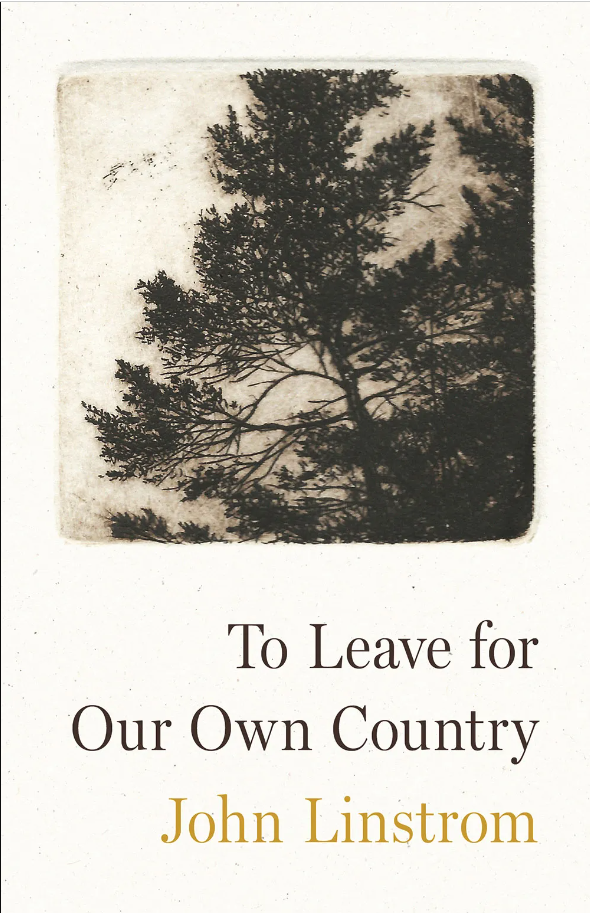
In a poem set in the Museum of Modern Art, visitors have come to witness “a bit of domesticity and dream, / a place to spend some time, but while we swirl // the dust of other homebodies around / in rooms of light and shade, we’re bound to float // where we have flown before.” This image—of seeking beauty in the world, and of seeking to understand it—is central to Linstrom’s collection, as is the tendency of people to return to the familiar. To want to belong to a place.
This collection also belongs to places. Its first three sections are named for specific states or a city—geographies to which the speaker gives a quiet, sharp attention. The foam from the Con Edison plant on the East River is considered as closely as the whitecaps of Lake Michigan, and there’s a loveliness to all of it, though with the specter of danger. Climate change. The death of loved people. The speaker describes his city as “a room resonant with confusion and us.” He is honest about surrounding sadness and earnest in his desire to counterbalance it: “We love this world so; we pour into it.”
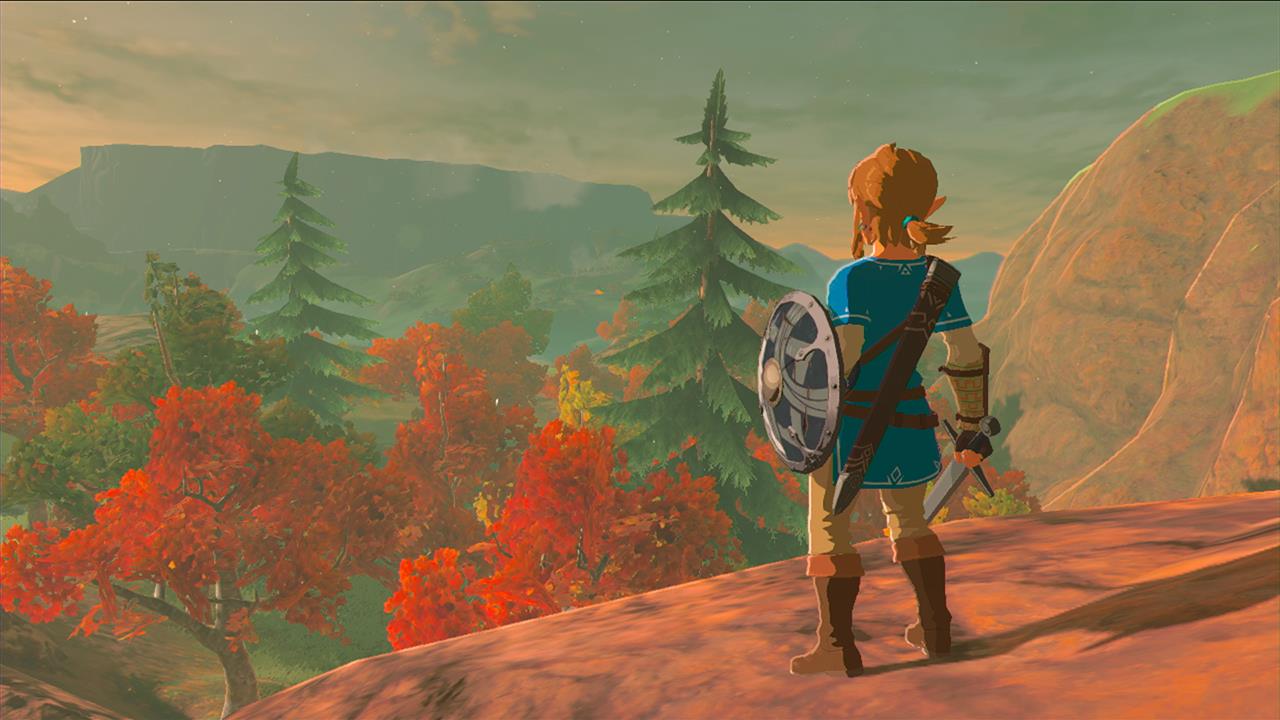
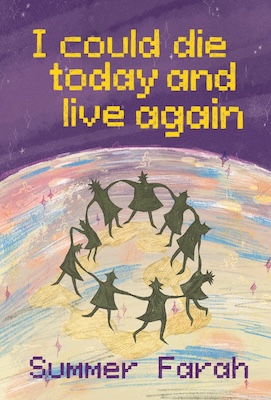
“how lonely it can be / to be a certain type of character. singular purpose. looped dialogue,” writes Summer Farah in her poetry chapbook I could die today and live again, published by Game Over Books in 2024. The collection, which explores empire, intimacy, grief, and play amidst the backdrop of The Legend of Zelda, is haunted by cycles: the cycles of the moon, of mourning, of occupation, of poetic form, and the regenerative cycles of death and rebirth within video games. What would it feel like, Farah asks, to be an NPC trapped within the endless loop of a game on repeat? How can we create growth and meaning from these patterns we find ourselves (re)living?
As I write this, it is the one-year anniversary of the current iteration of Israel’s genocide in Gaza: 365 days and 76 years of schools, hospitals, homes, and refugee camps being destroyed by bombs paid for by American tax dollars; of families being torn apart and displaced; of forced starvation and denial of access to medical care; of the targeting and erasure of entire bloodlines. It is easy to succumb to despair in the face of this unfathomable cruelty, but this also marks 365 days and 76 years of Palestinian resistance; of unprecedented international solidarity; of men risking their lives to dig children out from under the rubble; of radical, unwavering hope; of the steadfast conviction that Palestine will be free. “SOMETIMES ALL OF OUR RESISTANCE IS / UNDONE WHEN NIGHTFALL COMES,” Farah writes, “BUT WE WILL NEVER FORGET / CHAMPIONS LEAVE MEMORIES IN SUNLIGHT / IF YOU CLOSE YOUR EYES IN THE SHIMMER / YOU CAN FEEL THEIR BREATH ON YOUR SKIN.”
I’m grateful to have had the chance to talk to Summer over Zoom about obsession, persona, video games, and the peculiar way that poem excerpts proliferate on Tumblr.
Ally Ang: To start, what is your origin story with The Legend of Zelda?
Summer Farah: I’ve been playing Zelda games my whole life. I have an older brother who was really into video games, and we have a pretty big age difference—he’s six and a half years older than me—so video games were one of the things that we would do together a lot in bonding, because it’s easy to be three years old and play video games with a ten-year-old. My earliest favorite games were Pokemon and Zelda. I have really vivid memories of watching my brother play Ocarina of Time and he would be going through dialogue really fast because he’d played through the game multiple times. And I’m like four-ish, I’d just started learning how to read, and I would be like, I want to read what they’re saying. And he was like, but I already know what they’re saying. So I started reading fast, and a lot of my relationship to reading and narrative and processing is around playing games.
Zelda games are one player, but my brother would give me a controller that wasn’t connected to anything and tell me I was Navi just to make me chill out, and I would believe him. And then every time Navi goes away—because she’s not there all the time—I’d be like, where did I go? And he’d say, I’m protecting you. Don’t worry. So that’s my origin story with Zelda, becoming a person alongside playing the games. I’ve played all of them throughout my life. I was just playing Twilight Princess before we got on the call.
AA: I want to talk about the two epigraphs that open the collection, one from Etel Adnan (“Such apprehension, such madness! Is the sea aware that her heroic beauty may be in disuse, someday? The moon never experienced the sinking of empires that she witnessed; day after day, she longs for a shimmering heat”) and one from Kamaro from Majora’s Mask (“I am disappointed, oh moon. I have died!”) I think these epigraphs do a great job of preparing the reader for both the world of references and influences that you’re drawing upon in this book, and for some of the themes and motifs that recur throughout the book, including the moon, death, and empire. You are a poet who is unafraid to reference and you build a rich landscape of literary and cultural references in all your work, so how did you land on these two epigraphs to open the book?
SF: When I was far in the process of writing and editing the book, I was spending a lot of time with Etel Adnan’s work. I’d been reading her off and on for a while and considered her a writer that was theoretically important to me because of the artistic communities that I’m in and knowing her legacies. I liked her work, but I wasn’t as immersed in it as I am now. When I was editing the book I was reading Sea and Fog. There’s an eeriness in her work, a kind of surreal mystic feeling that her language is so encased in, that feels like you have a cool breeze around you, and that can either be comforting or isolating. That’s my favorite thing when I read, and it’s also one of the things that really draws me to a lot of Zelda games, particularly Majora’s Mask. The book takes inspiration from all Zelda games, but Majora’s Mask is kind of like the anchoring game. As I was reading Etel Adnan’s work, I was like, wow, the vibes are like Zelda! It’s fun to recognize the repetitions of what I’m drawn to in such disparate artworks.
I wanted to frame the book in some way outside of games, because it is so involved with games, so I was thinking about what else this work is in conversation with. It’s also an attempt at anti-imperial writing or critiquing empire, so I was trying to think about it in lineage with the writers I’m most drawn to for their criticisms of empire as well as their art writing. Etel Adnan is doing both of those things. At the same time, it felt like a good window into the things that I’m always pushing together in my head and making hold hands.
With the epigraph from Majora’s Mask, my work is often concerned with death, and Majora’s Mask is a game where you are putting on the faces of characters who have died. That quote is a character’s last words to you. I found something really compelling in that phrase, in that lament to the moon, especially as the moon is an empirical figure in Majora’s Mask. Out of context, it felt really beautiful, and in context, it felt really sad. I liked thinking about these two addresses that are, again, from very disparate things, but very connected.
AA: You are someone who I think of as reveling and indulging in your various obsessions through your writing, whether that be Mitski or Supernatural or Zelda. The depth of your love for your obsessions is evident in your work, but it’s not an uncritical love. In your endnote about the poem “IN GERUDO VALLEY,” you call out early racist depictions about the Gerudo people in the franchise and write about feeling conflicted about playing the game in their corner of the map. How did you approach writing this poem, and how do you more generally navigate writing about—to use a dated phrase—problematic faves?
SF: I had a lot of trashed drafts about Gerudo. I was thinking a lot about Ganondorf and how he’s the only man born into this desert society and he is the root of all evil, and there is this wholehearted villainizing of this man from the desert. My brother and I talk about this sometimes. There is this interesting recognition when you’re a kid playing these games and you’re like, oh, this fantasy setting is supposed to be inspired by my culture, and they’re the villains; that’s kind of weird and it makes me uncomfortable. But I never really thought about it that deeply.
I don’t really play first person shooters or games that are very engaged with violence against Arabs, but the reality is that JRPGs, Japanese role-playing games, are super Orientalist. They have baffling depictions of West Asia and Muslim nations; it’s kind of funny sometimes—horrifying, but super fascinating. I play a lot of JRPGs that have a medieval fantasy setting and so I see it a lot, and I mean, it bothers me, but it’s not the worst thing in the world. What gets me more is when I log on and I see the ways these depictions are held by fans and players. There’s an uncritical embrace of these depictions and a wholehearted indulgence in the violence of sexualization of these vaguely West Asian/North African Muslim women. What does it mean to think that it’s really awesome that Gerudo is like this?
Tears of the Kingdom is doing a lot of work to try to correct this racist history. There’s less villainizing, there’s more of a vibrance to the region, and it feels like a well developed region so it’s fun to go there.
I feel like a weird responsibility as a Palestinian player of Zelda games to be like, let’s think about it. But I don’t want to all the time! So I think that’s what a lot of my failed drafts were trying to poke at, but ultimately it didn’t feel honest enough, because my experience of playing the games with regards to Gerudo was weird, but the sense of recognition and fondness outweighed the understanding of violence in my own playing. It wasn’t until I was exposed to fandom that I realized the potential for violence. And since the book is very much about the act of playing with loved ones or putting yourself into the game, the criticisms didn’t feel honest in the poem. I think I could probably do it in an essay, but a poem didn’t feel like the right space and this book didn’t feel like the right space.
AA: This chapbook uses a variety of poetic forms—including the pantoum, contrapuntal, and concrete poems—but one in particular that recurs throughout this work (and your work in general) is the prose poem. In your interview on the Poet Talk podcast with Jody Chan & Sanna Wani, you talk about the prose poem’s propulsive quality and frantic energy being something that draws you to it, but I was wondering if you could talk a bit about how you approach the line/line breaks in prose poems and what drew you to prose poems for this chapbook in particular.
SF: I draft a lot in prose poems—maybe not so much anymore, but when I was writing the book, every poem’s first draft was a prose poem, and then as I went through phases of editing, they became what they were. Eventually, I had a book that only had one prose poem in it, and I was like, that’s not me.
I like the neatness and the tightness of a prose poem. When it comes to thinking about the line, I like the different ways to indicate space and breath in a prose poem like caesura, or slashes, or playing with punctuation. It feels like there’s more opportunities to play with what that break intends. A slash feels different than a caesura which feels different than a hard stop with a period, or the kind of rhythm that you can create with a very, very long list with no punctuation at all, letting words run into each other. It feels like everything is in a container, and you’re shaking it, and it’s landing in a different way.
It also felt apt for a game book where I’m turning hyperfixation into something productive. I think that’s a lot of my writing in general—maybe a lot of people’s writing—the excising of an obsession. I’m a yapper. I talk a lot. I can go on and on and on a lot about the things that I like, and the prose block feels aligned with that act and intention.
The prose poems in the book are the more interior poems. They’re the ones that feel more in my voice than in the player voice that I blend with my own throughout. It was very intentional to signal that we’re tapping into something that is more genuinely Summer. Originally, when I only had one prose poem, I was like, well, this book doesn’t really feel like me at this point. So going back in, the last two poems I wrote were “INTERLUDE: PARALLEL PLAYING W/U” and the last poem. Those are both 100% me, as much as the poet’s voice can be me. Those are very intentionally breaking away from the facade of the player character lens. And I was like, well, they gotta be prose poems because that is when I’m my most honest, vulnerable, clear self.
AA: Throughout the collection you have persona poems about different NPCs, like the moon children of Majora’s Mask and the “snot-bubble child on Outset Island” of Wind Waker. As a player, what is your relationship to the NPCs of the Zelda franchise, and as a poet, how did you decide on such a polyvocal collection (rather than, for example, having the whole collection be from the perspective of the player character)?
SF: I wanted to think about the implications of cycles within the series. I think a lot about how Link, Zelda, and Ganondorf are stuck in this cycle, but then there is a whole world that is also living in the context of the game. My favorite Zelda games have the most vibrant NPCs, like Wind Waker. Everyone on every island is distinct and has their own individual relationship to the player character. In a lot of the art that I like to spend time with, I’m interested in intimacy and companionship, which I know is maybe a little baby brained or problematic sometimes in that the TV is not your friend. But I fell in love with art because of this sense of intimacy and companionship and the dependability of repetition, of something being on every Thursday, or in the case of Zelda games, the familiar things that you can latch onto in every game and the newness in which they occur.
A slash feels different than a caesura which feels different than a hard stop with a period, or the kind of rhythm that you can create with no punctuation at all, letting words run into each other.
I wanted to think about what the consequences are for the others in the world that the game is building. The moon children are so freaky and hollow that I felt a lot of freedom to project onto them. They’re genderless, they don’t speak very much, and they’re kind of just scattered about. There’s a sense of collectivity through them, so what if it’s a “me and my girls” kind of thing?
I thought about figures that were striking to me, that would stop me from continuing on with the story, characters that I would always talk to if I entered an area. Like the couple in the square that’s always spinning, I always go to talk to them. The kid on Outset Island, that was like my niece—when she first started experiencing colds, she didn’t like it when we cleaned her face. She doesn’t like it when you take stuff from her, and that extends to her boogers. So I was cleaning a lot of toddler snot, and sometimes it’d be like, all right, fine, live with snot on your face. And my brother and I would joke that she’s like that little kid on Outset Island that’s always sneezing. It’s this dual projection of what were the things that I was drawn to, that I would always want to talk to as if they were my friend, and then, when I think of the things that my life is filled with now, how do they appear in the game?
AA: “INTERLUDE: PARALLEL PLAYING W/U” is one of my favorite poems, partially because it’s so surprising in the trajectory of the book. It feels like we’re stepping out of the game into the living room we’re playing it in, and it also feels like the speaker of this poem is the closest to you and not an obvious persona. Can you talk about how you decided where this poem would go and what shift it signals in the remainder of the collection?
SF: That was one of the last ones I wrote because after a conversation with my editor, MJ, I realized the book was kind of a bummer and playing video games should be fun, so I really wanted to have fun. I wanted to remind myself that I enjoy playing games and I’m writing about them because they’re a thing I do to enjoy myself.
In thinking about the order, I wanted it to feel like you’re starting a new game: there’s the stage setting where you’re getting lore and context and you have your player character with their basic personality, but then as you play you get more attached to the story and start projecting yourself on the player character and the world becomes more in depth because of what you’re giving to it. “INTERLUDE” coming after “ODE TO THE SNOT-BUBBLE CHILD ON OUTSET ISLAND” felt like a moment of really strong projection and fixation. I wanted that poem to feel like when you realize you’ve been playing for six hours and it’s dark outside, allowing the reader to pull away from the game and reset and think about why they’re here, reading a book about video games.
“INTERLUDE” is very engaged with friendship and community, and falling back into the book with “ELEGY FOR LOST FRIENDS” and then the climax and denouement of the book felt right. There are some games that tell you to rest your eyes so I wanted it to feel like that.
AA: Repetition, rebirth, and memory are very significant to this collection, both in terms of subject matter and in the structure of the book and the poems themselves. The reader finds themselves reckoning with these cycles of life, death, erasure, remembrance, grief that at times feel liberating (the ability to start over or reset) and at other times feels doomed (like how occupation wears different faces but the violence of it remains the same). How do you, in your poems and in your life, reckon with or resist the hopelessness of feeling trapped in these cycles?
SF: I was at a reading yesterday and one of the poets I was reading with read June Jordan’s “Apologies to All the People in Lebanon,” and he was like, this poem was written in the 1980s but it could’ve been written today. And that makes it a useful poem to read to contextualize an emotional moment as we see Lebanon continue to be bombarded by Israel, but it’s also devastating that there is a continued relevance for that work. I am always holding that when you revisit older literature from 40 or 100 years ago, it can feel overwhelming because it’s like nothing has changed, but it’s useful to have those words. I will still feel sad and fucked up that we’re talking about the same things, dispelling the same propaganda, fighting the same battles, but now I can use these arguments and the work that has already been done to push things forward.
In games you can try something over and over again, and if it keeps not working, you can do something different and sometimes it works. I feel bad and upset all the time thinking about the world: it’s been a year of genocide in Gaza and the climate’s getting worse and everything’s kind of getting worse. I know that there’s always been times when it’s felt like the worst that things could possibly be, and it takes people thinking about those past moments and using those tools to build better tools. With repetition, there comes knowledge and education and you can get stronger and sharper for whatever the next big, terrible thing in the world is. It’s never a clean slate: things might happen again but it’s not like things didn’t also happen yesterday, and we learned from them, so we can hold yesterday as we go through it again today, and it’ll be different. It’ll always be different.
AA: What has it been like to have this chapbook out in the world? What has surprised you about the experience?
I always try to acknowledge that the book that I’ve made doesn’t exist without the histories and legacies of resistance and people fighting occupation.
SF: It’s been weird. I’ve done zines before, self-published DIY kind of things, and it’s always fun to know that people are holding something that I put together. But in the case of this book, it’s releasing into the worst fucking time ever, so I struggle with the desire to push it the way I might’ve if it came out a few years ago. I’m not the biggest self-promo person in the first place because it feels weird, but it’s been useful in some ways to have attention on me so I can use it to support people in Gaza.
I always try to acknowledge that the book that I’ve made doesn’t exist without the histories and legacies of resistance and people fighting occupation. I describe the book as an allegory for how empire corrupts childhood, so if I’m to read the book in a space and benefit from it in any way, whether that be monetary or just someone being nice to me, it also has to honor the real children whose lives are being corrupted by empire.
I’m weird and obsessive and anxious so I search my name every day to see if anyone’s talking about my poems. I love to look at Tumblr to see what people are saying about my work. It’s honestly surprising that it’s selling—not in a self-deprecating way, but it’s cool that people are holding something that I made. I like to share things with people; I like the idea that my voice is in their head or they’re spending time with it. And the fact that I got to do a tour with a chapbook is really fucking awesome. I feel grateful that there were people at my stops! That was also surprising, that people showed up to see me do poems. I guess these are all very basic low self-esteem writer things.
AA: I’m so curious, what do you see people saying about your work on Tumblr?
SF: There was this one account that was sharing excerpts from various poems, and what was fascinating is that they didn’t say which poems they were from, they just named the book itself. These excerpts were so pulled out of context that it’s kind of awesome. I loved seeing people tagging their favorite fictional characters. I was like, this is what it’s all about! It’s also super fascinating to see the ways that—and this isn’t to be mean or critical—people are often incurious and don’t read what it is that they’re quoting or sharing or engaging with. I’ve seen excerpts from this one blog reposted on Twitter or Instagram or used in graphics on Tumblr, and it’s still not saying the title of the poem. The book’s title has become the poems’ title. There’s this layered engagement with the work where the excerpt itself is taking on a life of its own outside of context and it’s super interesting to see that happening and be like, how far will this go?
I love seeing Richard Siken talking to people about his work. I think it’s so funny. Early on when he started being super active on Twitter, it was clear that so many people never read his books and had only read the lines that people use in GIF sets on Tumblr. Like, have some humility! Go to the library! But he’s a very successful writer who sold thousands of copies of his debut; I’m just a guy publishing with a little indie press. It’s interesting that those processes happen to everyone.
AA: I mean, who knows? Maybe you’ll be the next Richard Siken and people will be asking you big life questions like you’re an oracle on Twitter.
SF: Actually, I would love that, because as much as he’s online, I’m online. I would love to be doing something more useful if I could, like helping a teenager out. That would be awesome.
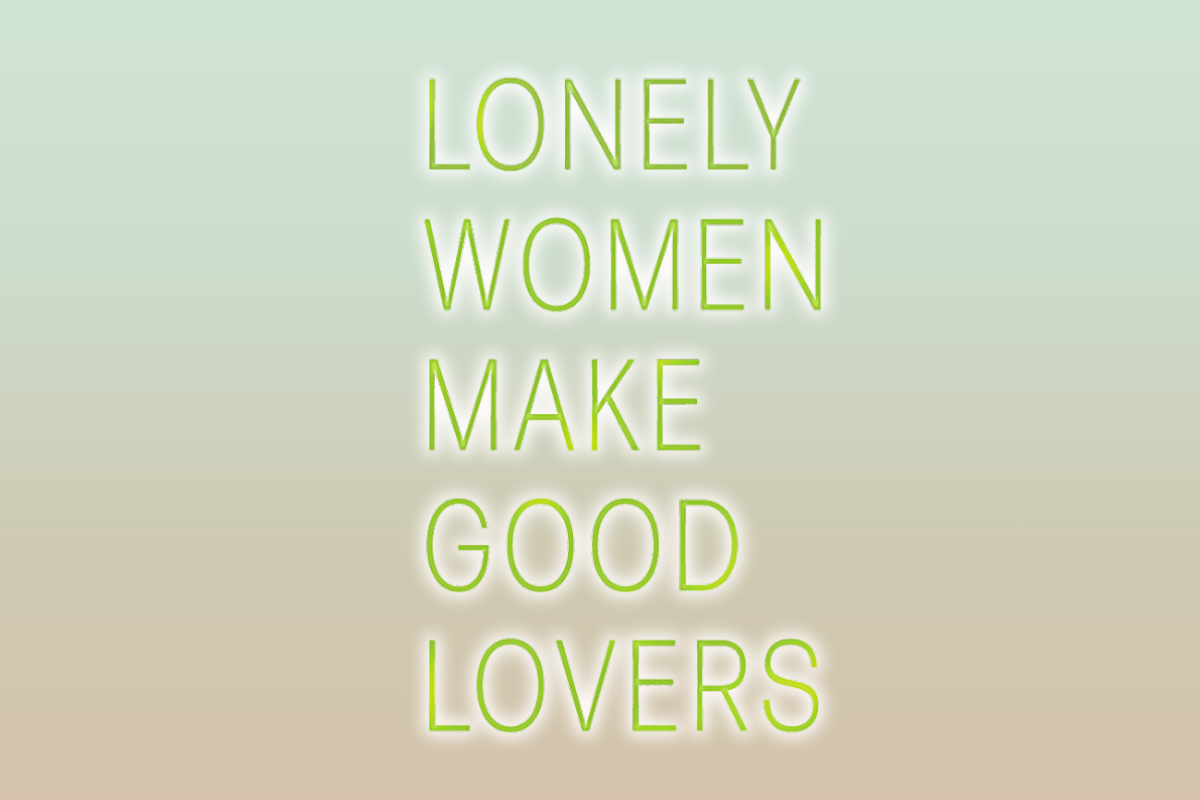
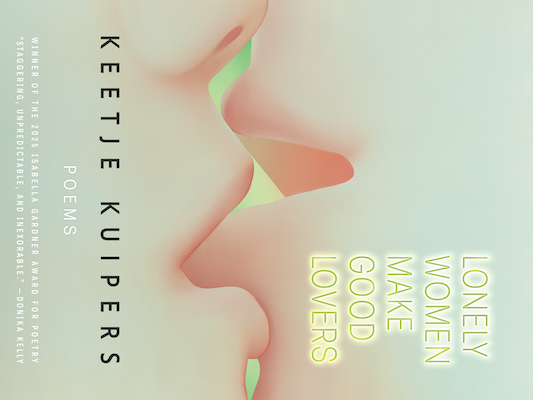
Electric Literature is pleased to reveal the cover of Lonely Women Make Good Lovers by Keetje Kuipers, which will be published by BOA Editions on April 8, 2025. You can pre-order your copy here.
The daring and deeply sexy poems in Lonely Women Make Good Lovers are bold with the embodied, earthy, and startlingly sensual. These unforgettable love poems—queer, complicated, and almost always compromised—engage a poetics of humility, leaning into the painful tendernesses of unbridgeable distance. As Kuipers writes, love is a question “defined not by what we / cannot know of the world but what we cannot know of ourselves.” These poems write into that intricate webbing between us, holding space for an “I” that is permeable, that can be touched and changed by those we make our lives with. In this book, astonishingly intimate poems of marriage collide with the fetishization of freedom and the terror of desire. At times valiant and at others self-excoriating, they are flush with the hard-won knowledge of the difficulties and joys of living in relation.
Here is the cover, designed by Sandy Knight, art by Vivian Greven:
Author Keetje Kuipers: “If you’ve ever had sex in front of a mirror, you know that the sex you’re having in your mind is often not the sex you find yourself having in your reflection. The wet mouths, the quiver of flesh—sometimes it’s less sexy than you thought, and sometimes it’s actually a whole lot hotter. Locating the equivalence between the inside and the outside can be a gymnastics of the mind (not just of the sweaty body), and book covers can work the same way: what’s on the inside and what’s on the outside are very much in the eye of the beholder.
My new collection of poems, Lonely Women Make Good Lovers, is, for me, a deeply sexy book. And while it deals in plenty of themes that wander far beyond the bounds of the bedroom—including forgiveness, humility, and grief—more than anything else it is an embodied book. So I wanted an embodied cover to go with it, something female-forward, sensual without being clichéd, sexy without being porn.
But finding a piece of art that felt both embodied and also subversive, playful, and empowered quickly revealed itself to be an impossible task. Every image I found either objectified the bodies it contained or attempted to undercut their sensuality with violence. There were cherries popping from full lips, bondage scenes, and what looked like nude robots wearing stilettos—it was essentially a collection of all the tropes I had tried to craft my poems to push against.
Luckily, a friend pointed me towards a series of paintings by the German artist Vivian Greven, whose Greco-Roman sculpture-influenced work is often rendered with the crispness of a photograph and the electricity level of a live power line. As described on her website, Greven’s paintings ‘transcend traditional depictions of intimacy by capturing the vulnerability of metamorphosis.’ Whether writing about death, love, shame, or sex, this excavation of vulnerability—and its ability to change us—is always what I hope my poems are working towards.
And part of the vulnerability of metamorphosis is in the question of what we’re willing to reveal in that moment of change—both to others and to ourselves. As I write in the book, ‘I hadn’t yet / learned the difference between a shadow cast / in the shape of my desire and the contract a body / makes with its own hunger.’ BOA book designer Sandy Knight got this instantly, and designed a cover around Greven’s ‘) ( XI’ that balances the earthy embodiment present in my poems with the simultaneous neon glow of self-revelation. The completed cover for Lonely Women Make Good Lovers honors how difficult it is to reconcile how we see ourselves inside and outside, and to not only feel but allow ourselves to witness the shudder of one body’s need pressed up against another’s.”
When the ominous appears in fiction, it increases anticipation and deepens empathy. As readers watch a character struggle with a feeling of unease caused by people or events, it offers them the pleasure of intimacy. Like the character, they have, in their own lives, questioned if something that urges wariness is real or imagined. As the matter is resolved for the character, the reader will feel catharsis.
Sometimes readers meet unease in the opening chapters, and sometimes it appears throughout, never lessening until a final, breathtaking finish as in the three stories on my list, ‘Audition,” “Solo Works for Piano,” and “Bartow Station.” But regardless of how often or where unease descends, it’s a powerful magnet for readers who come to fiction not only for the enjoyment a well-made story or novel provides, but to find company in the loneliness caused by a troubling darkness in their own lives.
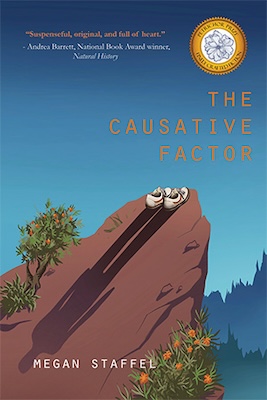
In my novel, The Causative Factor, the ominous makes its appearance in the first chapters. Rachel and Rubiat meet at art school and become inseparable, both surprised by their intense mutual passion. That passion is soon tested, however, when Rubiat gives in to a reckless, self-destructive impulse that sets him adrift and unaccounted for. Rachel manages to resume her life and her studies, but she’s uncertain whether he’s alive or dead. As she looks back at that day in the park when Rubiat disappeared, she feels deep disquiet and with hindsight, everything seems ominous.
That feeling of foreboding is different from heart-pounding fright; it’s more subtle, softly buzzing underneath action and dialogue, always changing but never diminishing entirely. Its lack of visibility is what makes it potent. Readers have only clues and hints, and because it’s secretive and mostly hidden, shame is often a part of it. In this way, the eight titles below will deliver foreboding, but not fear.
In this novel about caretaking relationships and the making of art, the source of unease is the fledgling friendship between Jean, a retired office worker who spends her time welding metal sculptures in her living room, and Elliot, the 19-year-old unemployed kid next door who helps her with the physically demanding tasks her art requires. Elliot is always on the verge of sliding back into his old life with a shiftless crowd of users and trouble-makers while Jean negotiates her own risky desires, sometimes managing to alienate her new friend and sometimes managing to give him exactly what he needs, but always walking a tightrope through his unpredictable moods.
Most of the action in this novel takes place in a large and successful Chinese restaurant in a small midwestern city where Leo Chao, owner and employer, maintains a tense environment, verbally abusing family and staff. The ominous is evoked not only by this tyrannical father and employer but also, and more dramatically, by an outdated freezer room in the basement of the restaurant. Bribes have allowed it to pass inspection, and the reader learns in the beginning of the novel that its major defect is a door that tends to lock the unsuspecting inside. That is why a key is always kept on an interior shelf. When tensions escalate and emotions run high, the reader suspects the freezer will become a weapon.
In the way that Hitchcock made those gentle, feathered creatures that sing to us from tree tops ominous, Goldbloom does the same for a married woman’s pregnancy. Surie is a fifty-seven-year-old Chassidic mother and grandmother when she discovers she’s pregnant. In her religious tradition, it is shameful for a couple their age to have intercourse, so Surie, who is a large woman already, hides the pregnancy under roomy dresses and tells no one, not even the husband she loves. But as the clock ticks and the fetus develops, Surie conflates the loss of her gay son who left their community and committed suicide, with the baby growing inside her. Soon the pregnancy will be visible to all and though she yearns to share her feelings, her husband refuses any mention of their lost child.
The Book of Lost Light by Ron Nyren
This is a novel about a son’s struggle to gain independence from his widowed father. Arthur Kylander is a photographer and like his mentor, Eadweard Muybridge, the photographer famous for revealing the secrets of animals in motion, he has a similar project: to reveal the movement of time. The narrator tells us how it works in the novel’s first sentence: “From the time I was three months old until I was nearly fifteen, my father photographed me every afternoon at precisely three o’clock.” It is an unusual kind of possessiveness and as the narrator ages, the routine becomes more and more troubling. But Joseph can’t stop it, because mixed in with his desire to escape, there is also a son’s unwillingness to destroy his father’s lifelong project.
Schwartz’s novel centers on a long married, middle-aged couple, Reuben and Ardith. When Ardith has an affair with the town’s beloved doctor who is also a family friend, the stability of their lives is threatened. In this novel, the ominous makes its appearance in the peacefulness of the doctor’s finished and orderly house. Compared to the house Ardith lives in with Ruben and their two sons, its lack of chaos is seductive. Arden and Ruben are in the midst of a renovation they will never have the money or time to complete, so tools, stacks of wood, and ladders furnish their living spaces. Could the doctor’s house alone threaten the love Ardith has for her husband and family?
“Audition” in American Short Fiction 23.72 by Denne Michele Norris
I read “Audition” in 2020 and it has stayed with me. Here the ominous saturates the point of view. The reader is placed in the mind of the Reverend Doctor Preston McKinsey, a widowed man who lives with his teenage son, Davis, a boy he no longer can abide after the Reverend finds him having sex with another boy in their pergola. He tries to throw his son out of the house, but Davis refuses to leave and under the shadow of the Reverend’s biblically inspired judgment, they continue to coexist in a state of mutual disrespect. The tension grows until they arrive in New York for Davis’s audition at a prestigious music school and it doesn’t break until an event on a subway platform changes everything.
“Bartow Station” is from Witness, the most recent collection of short fiction by Jamel Brinkley. We meet the narrator in the locker room on his first day driving for U.P.S.. As he gets ready, a fellow driver tells him he should get himself better shoes or his feet will suffer. But the shoes he wears have a sentimental value that seems to be wrapped up with the narrator’s deceased cousin, Troy. The reader understands, from the first time the name is dropped, that Troy haunts everything the narrator does and as our curiosity about what happened builds, so does our foreboding.
“Solo Works for Piano” is one of eight stories about Korean Americans living in the United States. Albert Uhm seemed to have a brilliant musical career before him, yet rather than traveling the world as a great classical pianist, he has ended up teaching at Hofstra University on Long Island. Sasha, another former student from Albert’s class, has given piano up entirely to devote herself to the project of raising her daughter, a young but entirely undisciplined musical prodigy. This wild child not only has disrupted Sasha’s life, but as soon as she sits down at Albert’s piano, we realize that the delicate equilibriums of Arthur’s carefully maintained existence will collapse in the tornado of this mother and child.
It is perfectly understandable that many people would feel trepidation about having a writer in the family. What private foibles and peccadilloes might be used to define a fictional protagonist; which family secrets will be revealed in a memoir?
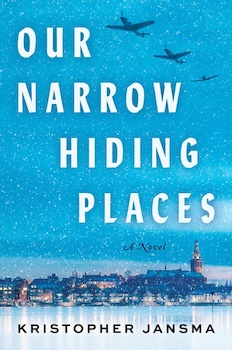
Novelist Kristopher Jansma’s grandmother, a survivor of the Hunger Winter of 1944, had a different attitude, hoping that her talented progeny might one day tell her story and bring attention to an under-studied area in WWII history: the Nazis’ occupation of Holland, and the famine their blockade caused during the final year of the war.
Her aspirations were realized this summer with the publication of Jansma’s fourth novel, Our Narrow Hiding Places, which, according to the author, is based directly on his grandmother’s experiences growing up in Holland during the war. As a work of fiction, though, there is room for narrative embellishment and elements of magical realism. The sections set in the ‘40s are framed by chapters in the present-day, in which Will Geborn (a stand-in of sorts for Jansma) confronts his own sense of self while listening to the stories his grandmother, Mieke, tells him.
History buffs will come to Hiding Places for the beautifully detailed sections set in the past, but the novel’s central subject—the genetic, cultural, and emotional inheritance from Will’s ancestors—lies within the novel’s back-and-forth structure, and enriches what could otherwise have been a mere history lesson.
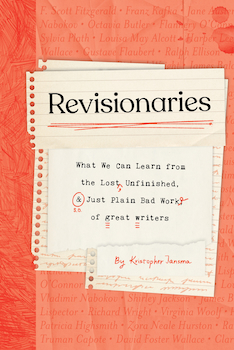
Sating the appetites of his most ardent fans, Jansma now brings forth yet another book, his first essay collection, Revisionaries: What We Can Learn from the Lost, Unfinished, and Just Plain Bad Work of Great Writers. The pieces in this book—which should prove of interest to anyone curious about the creative processes of canonical novelists—serve as pep talks aimed at young writers intimidated by the inimitable genius of Virginia Woolf, F. Scott Fitzgerald, Richard Wright, and others. By analyzing their unpublished or unfinished works, Jansma demythologizes these giants of literature without diminishing their greatness. He shows how, through the input and assistance of spouses and editors, rigorous revision, and repeated failure and rejection, they created the works they’re rightly known for today.
I met Jansma during his stint teaching at Sarah Lawrence College, and caught up with him near the beginning of his book tour for Hiding Places. We talked via video call about how his real family history informed his novel, his research into Dutch culture and folklore, and his column about unfinished business.
Seth Katz: A couple of years ago you published an essay in Tablet discussing your conversion to Judaism, whether that made you a “Jewish Writer,” and what that was supposed to mean in the first place. At one point, you say it felt odd, as a previously non-religious person, to convert from “nothing” to “something.” In Our Narrow Hiding Places, Will thinks of his Dutch ancestry as, likewise, “nothing.” Was part of your work in writing this book to find out what it means, also, to be a Dutch writer?
Kristopher Jansma: Yeah, absolutely. I love that connection. Will gave me a chance to voice some of the things that I had always felt about being Dutch growing up, which never meant a whole lot to me. I had an awareness—not of it being “nothing,” but of it not being the same as what it meant to other people I knew to have the heritages that they had. Italian friends would invite me over for the feast of the Seven Fishes, and I had a Jewish friend when I was young who invited me to a Passover seder. I had this constant feeling growing up that other people have these cultural things that they get to turn to when things are hard or when they’re looking for meaning in life, and I just didn’t really have that.
I started working on this book early in 2020 during Covid, and that was also when I decided that I wanted to convert to Judaism. At the same time, I was talking with my grandmother about our Dutch past and trying to connect with what she had to share. And interestingly, when I first met my wife, Leah, who is Jewish, my grandmother mentioned offhandedly that we have Jewish relatives from generations ago. I finally got a chance in this process to dig through some of her files. She has a family tree that goes back to the 1600s, and we do have a Jewish relative named Jacob DeWitt, who emigrated. I think the story is that he fled Portugal during the Inquisition and came to Holland, which was a fairly common thing at the time, as Holland was one of the few places that would accept Jews. And so, it seems as if it died off there; he either stopped practicing or converted, or something else. But during my conversion process, I had to pick a Hebrew name to use, and I went with Jacob, in honor of my ancestor. Jacob was also the name of the Jewish character in my second novel, Why We Came to the City.
SK: One way that you explore Dutch culture in the novel is through folktales. When did you start exposing yourself to Dutch folktales and how did your interest in folklore inform your vision for the novel?
KJ: I went looking for it because I knew that might be a way to connect to something further back. And when I teach magical realism in my classes, often we’ll talk about how some of the elements that seem magical to us may be more familiar in the culture where the stories are coming from because they’re drawing from myths or legends or folklore. So I started looking around for these older Dutch folktales and found a collection online, and then later I was able to find an actual book of them. And they’re wonderful. One that comes up in the book a couple times is a story about a boarwith fiery tusks that inadvertently shows the early Dutch citizens how to plow the land for farming purposes. The tusks leave these giant ruts in the ground, and then things start growing from the mounds of earth, and this becomes the key to an agricultural society. I just loved that idea. So I started reading them all and pulling little bits out that I wanted to reference in the story. I did ask my grandmother about it eventually, and she said, “Oh, I’d never read any of these,” and she said she grew up on Hans Christian Andersen and the Brothers Grimm. By the time she was growing up those had taken over.
SK: With this being your fourth published novel, are you able to look back and see any connective tissue in all of your work? It seems to me that there is almost always an element of storytelling built into each novel. In this case, you have Mieke telling her grandson stories about her childhood under Nazi occupation. At first these sections seem to be flashbacks, but eventually it becomes clear that she’s narrating these episodes to Will. And of course, eventually, we learn who authored the eely folktales.
It’s always a question for me when I’m reading: who’s telling this story? Why is it being told to me?
KJ: I think that’s probably the biggest through-line between all the things I’ve written. When I went to the Johns Hopkins writing workshop, it was steeped in a postmodern ethos. The program was founded by John Barth, and one of my professors was Stephen Dixon. With one of my earliest workshop professors, actually—this was at a summer program at Brown—we looked a lot at stories within stories and things like that. It’s always a question for me when I’m reading: who’s telling this story? Why is it being told to me? If there’s a narrator, are they trying to confess something, or are they trying to be forgiven for something? If it’s written in the third person, where is it supposed to have come from? Those are big questions that I always have as a reader, so they find their way into what I’m writing.
But this one was really different for me in a way. All three of the other books are really about friendships, or people finding family among friends. I’d never written something about an actual family, and this is very much about someone grappling with who their family is and what they’ve inherited from them. Some of that comes from my own discomfort in writing about specific people in my life. If I’m writing a story and there’s a mother in the story, people are always going to look at that and think that’s my mother, right? I always have reservations about writing about people without their permission. Other writers don’t seem to have this problem. But in this case, I felt really good about it because I knew my grandmother wanted me to write this story about her. And then the other members of the family that come up in the intermediate generation are very different from my parents. When I gave them the book, I was worried that they were going to be upset about it, and I was relieved when I heard back from them that they liked it.
SK: That’s actually a great segue, because I wanted to ask you about something that you mentioned at the book launch in Brooklyn last August. You said that you visited the Netherlands with your grandmother while you were working on the book. That must have been an extraordinary experience.
KJ: I wanted to go there from the start, but because of Covid, I had to keep putting it off. Every time I thought that I had a window where I could travel, Covid cases would tick up again. The situation in Europe was shifting all the time. Holland was in a lockdown phase for much longer than we were here. And then finally, by 2022, about two years after I started writing the book, the manuscript was mostly finished. I was thinking to myself, well, maybe I don’t really need to go. I managed to get a lot through research. And I’d been to The Hague before, a couple of times, and remembered it pretty well, and I felt like the descriptions had come through.
But then I decided I’d fly out there, spend a week, visit a couple of museums, and I wanted to walk around in The Hague and go to some of the places that my grandmother had described. When I called my grandmother to let her know that I was going, she got very quiet, and she was like, “Oh, good for you.” And then a couple days later, I got a call from my mother: “Oma bought a ticket. She’s going to go.” It had never occurred to me that, at 85 years old, she would want to hop on a plane during Covid when she was as nervous as anybody about just leaving the house to go to the grocery store. But she wanted to go and be part of it.
So I met her in The Hague. She stayed with a childhood friend of hers there, and the two of us drove down to the apartment building where her family had lived during the war. We stood in front of the building and she told me all about it. If I hadn’t stopped her, she probably would have just started buzzing until somebody let her in. She was quite emotional to be back there again, and memories started coming back to her while we stood there that she hadn’t described to me before. She pointed to a specific window in front to show me which apartment was hers. And then she pointed to some places where the brick still had little chips in it, and she said that was from when she was by the window one day and saw a soldier on the other side of the street. She waved to him, and he just lifted his gun up and started shooting. We had talked at that point for weeks and weeks over the phone, and I’d never heard that story before.
SK: And that’s in the book! One of the most horrifying moments.
KJ: Yeah, I was able to then go back and revise some things, and I added a bunch of other details that I found while I was there. But I was able to put that scene into that section of the novel because I just couldn’t believe it.
SK: Now that we’ve discussed the genesis of your novel, let’s talk about Revisionaries—which, with its focus on the writing process and inclusion of writing prompts for the reader, is very much aimed at young writers. Is there one of these chapters that speaks most to your own insecurities as a writer? Whom do you relate to most here?
KJ: I started writing these as columns for Electric Literature called “Unfinished Business.” I was actually having lunch with former EL editor Michael Seidlinger, at one point, and I was telling him I had always wanted to teach a class where all we would read were unfinished works. And he suggested that I write these columns about them instead. But I never lost the idea that there was something instructive about these books—there’s some reason why I, as a writer, keep going back to them. Eventually I was able to figure out what that was. Looking at the unfinished or lost work of these writers shows us their mere-mortal nature.
The first one in the book is F. Scott Fitzgerald, and that may be the closest to my fears as a writer. In high school, I loved The Great Gatsby, thought it was a perfect novel. I tell the story in the book about being in college and sneaking into this graduate class on Faulkner, Fitzgerald, and Hemingway, and reading Gatsby again and being more impressed than ever at how perfect it was. But then, reading Tender Is the Night, which I hadn’t read before, I was even more blown away. The deeper I got into it, the more depressed I got, because now I was appreciating how good these books are on a level that I hadn’t been able to before. When I was first reading them, I had this feeling that I could write something like that. Right? Maybe. And I think this happens to a lot of us: the deeper our appreciation grows for the writers we love, the more inhuman and immortal they become in our minds. We start realizing, well, I just can’t ever live up to that.
And then we read The Love of the Last Tycoon, which was the final book that we were going to read for Fitzgerald. It’s not finished, but even the parts that are there are terrible. I was really stunned coming off of Tender is the Night. Reading those hundred some-odd pages of this book, I was like… this is kind of awful. The main character’s name is really corny, the writing’s not great, there are weird errors in here. I was really sad about that at the time because I thought this was what alcoholism and depression did to Fitzgerald: he lost his talent. But then as I looked into it more deeply—I write about this in the chapter—I realized actually that he was coming out of all that and regaining his abilities, and he was working really hard for the first time in a while and staying sober. He was keeping himself on task and relentlessly plotting the whole thing out. It’s just that he died before he got to make it really good.
When you look closely at his other books, you see that they also went through these early stages where they were pretty bad. And he had a lot of help from both Zelda and then later his editors—they were the ones who really pushed him to turn them into these amazing books. And so that was what I suddenly realized: it’s not just this one genius figure who creates a flawless book out of nothing. There’s a process that you go through where it starts off bad, and then it gets better and better and better. Fitzgerald was a relentless reviser, which I had never known before. And none of that jibes with the myths around Fitzgerald as this freewheeling, heavy-drinking party guy in the Jazz Age. And that’s okay. But I do want people, particularly writers, to know that. He was that guy, but he also banged out short stories to pay the rent and would revise things within an inch of their life. He had these insane outlines, giant charts with multiple layers going through all the themes and every character and exactly what happens in each part of the book. All that hard work that you don’t ever get to see on the other end.
SK: One theme that comes up repeatedly in these pieces is the contributions of editors, collaborators, and other people in a writer’s life. That comes up for Kafka and Woolf, as well as Fitzgerald, as you were just saying
KJ: Fitzgerald never knew how to punctuate dialogue. His own editor says that in the notes at the beginning of The Last Tycoon. It’s the mistake I correct on all my freshmen’s papers. Like, where does the comma go? And now you’re able to go to Princeton and see Fitzgerald’s typed drafts, and you can see all the little mistakes and stuff like that that he’s making everywhere. He forgets how to spell the name of one of the characters in the book.
SK: Which of these unfinished works do you think holds up the best as it stands, and which one do you most wish had been brought to completion?
KJ: Let me start with the second part, the book that I think could have been great. I’m a little torn between Patricia Highsmith and Truman Capote, but I’ll go with Capote’s Answered Prayers. Some parts of it got published while he was still alive, and publishing those little excerpts may have ruined everything, because the people he was writing about started to shun him from society when they realized they were in his book. That worsened his spiral of despair. But what I love about Truman’s story is that he couldn’t admit that he was giving up on the project, even though I think he knew it was over. He would continue to pretend that he was writing it, and apparently would show up at parties with a manuscript that was like 10 or 12 printed pages of an excerpt from one of the stories that was finished, and then a whole bunch of blank pages. And he would even give readings from it, but he would either just be reading pieces that were finished or making things up on the spot. No one actually knows how much more of it he ever wrote because there are no copies that still exist. He claimed that he left it in a locker in the Greyhound station in Los Angeles and never went back for it. And there’s still a piece of me that wishes somebody would find it, even though I think that building has been destroyed.
I think The Pale King by David Foster Wallace is one I enjoyed reading the most, because there is so much to that novel that even though it doesn’t really get where it’s going, after hundreds of pages. The parts that you get along the way are really developed and wonderful. And, you know, it’s frustrating because you never quite see how they’re all going to connect. But the experience of reading those fragments… I think it’s probably the most satisfying of all of them—it’s some of the most beautiful writing he ever did.
David and Marco, my two youngest, walk into the forest and return with wounded animals, branches that resemble people, leaves in the perfect shape of a star, colorful rocks for which they invent fantastical stories. If we’re lucky, Pedro, who turns fifteen next week, will consider them childish and simply ridicule them. More often, he’ll snap the branches, crumple the leaves in his fist, throw the rocks as far as he can, and should the animal die, I worry that David and Marco question if their older brother isn’t partly responsible, if there isn’t a lesson they’re meant to learn.
Today, though, David and Marco enter the forest and return with a soldier.
Or—I think he’s a soldier. He wears no uniform but flame-bathed clothes soiled by dark, indefinable stains. Textures that make me swallow hard. He’s likely out of rations and starving. Whatever fight he survived, it must have been several days from here. After two years, the war has finally discovered this pocket of the Spanish map.
The soldier’s rifle is strapped across his chest. It troubles him not to grip it in his hands, one of which is badly wounded.
Our house sits alone in the woods. My husband built it: my wedding gift. He doesn’t trust me, so I had supposed this—more than a desire to live amid nature—was why he moved us so far from others: nobody would have an opportunity to steal me away. Later, I assumed it was because he didn’t trust himself. Far from the village, he’d be far from drink. Now, though, I’m convinced he knew all along he would beat me and didn’t want the villagers to lay eyes upon my bruises.
The soldier frowns at my black eye, my split lip, the fingerprint marks along my neck. I set my needles down to receive him. He had approached the clearing seeking help, but seeing my bruises his posture stiffens. So that’s the order of things—a battle-torched soldier sunken-eyed from hunger should pity me. He slides the rifle so he can quickly sling it off his shoulder, glances at David and Marco. They wail when my husband is atop me as though they’re the ones receiving his fists. But afterwards, with their father gone, you’ve never seen two happier boys. They live for the respite. The soldier considers the lightness in their step, their unburdened shoulders, how this picture might come together.
“No need to be afraid,” I tell him, perhaps foolishly. My voice is raspy. Will be for several days yet. It was only yesterday my husband returned from the village reeking from drink. Increasingly, a more common occurrence, ever since the fascists severed Catalonia from the rest of Spain two months ago. When Vinaroz fell and all of Aragon with it, not once did we hear a muted thud of an explosion. No rifle reports. No puffs of smoke. Nothing. Even this patch of sky above didn’t interest the fascists. The moon seemed closer than Vinaroz. You wouldn’t have guessed it from my husband. He behaved like a hunted man, as though he was the main prize the fascists sought, as though the world now expected him to keep them from Catalonia, as though the world had ever expected anything of him. “Come in. We have a soup over the fire. Some clean clothes, too.” Where there’s one soldier, there are bound to be others. Something is set to begin.
My boys sit near him as he hunches over his bowl. Even Pedro.
What is it like, they want to know. The war. How exciting? How dangerous? What pulled him into it? Where is he from? Did the fascists destroy his home?
“Nothing’s ever happened in my village. You could drop a thousand shells onto it and not one would detonate.” Despite what he’s telling them, he says it playfully, even a touch tenderly. The hard, apprehensive edges of his countenance are rounding the more time he spends with us.
Have you killed anyone? What happened to your clothes? To your hand?
I shush and scold them, but he smiles away my concern and answers, “I’ve been given the opportunity to stand up for what I believe in.” His eyes are bright mossy green. The way the skin crinkles at their corners when he smiles, it’s like a beckoning finger. He’s probably ten years younger than me. Probably closer in age to Pedro.
“Our father is a soldier,” Pedro says, staking some ground. His shoulders aren’t pulled back. For his tone, they might as well be.
The soldier returns to his soup, face relaxed, but I see the question he’s asking himself: if her husband is away, who has done this to her? “Which regiment is he with?” he asks Pedro. “Maybe we’ve crossed paths.”
“He’s a Freemason.”
“And the regiment?”
“He fights with the Freemasons,” Pedro says, angrily this time.
The soldier understands: the child will perceive each question as a challenge.
“Brave that he should give himself for such a noble cause.”
David and Marco smile at this. Pedro only nods, setting his jaw as his father does—lips pursed, chin out ahead of the rest of his face, each tooth below battling those up top. When his father was younger, someone must have convinced him such an expression radiated seriousness, even danger. To me, it always made him look powerless—the squeaky bark of a small dog—and, at the start, I loved him for it. But that was a long time ago.
“Will you be staying the night?” Marco asks. Most questions he shouts, and this one’s no different.
David joins in. “Will you?” He grabs the soldier’s knee when he asks it. He is a tactile boy, always with a hand on one of us, as though being the middle child requires him to bridge Pedro and Marco.
The soldier laughs through his nostrils. A gentle smile, no menace behind it. “The fight’s still out there,” he says to my two youngest. “I just have to find it.”
“It will be there tomorrow,” I say. I’m doing this for my boys, I tell myself. They need to see—even Pedro, especially Pedro—that there are other ways for a man to be. “You won’t last but an afternoon off that soup. Stay the night. We’ll send you off with a full stomach.”
Pedro ignores him. Through his impotent fury, he wants us all to do the same. David and Marco notice this, but they’re too excited by the presence of a guest to bend to Pedro. I watch how freely they move about the soldier when they realize they need not predict his next mood and movement. It breaks my heart that half a day passed before they truly relaxed.
David takes his hand. Marco doesn’t hesitate holding the wounded one. Together, they weave around and enter the thickening trees with him. Their father often yells at Marco to collect the viscera of the animal he’s skinning, with a fist, not your fingertips! He’s still a gentle boy and doesn’t understand why he can’t remain so. Yet, as they disappear into the forest, the nubs of the soldier’s hands over Marco’s, I see no hesitation in my youngest.
Later, the boys sit near the house and direct the soldier as he attempts to whittle a dog from a chunk of wood. It’s Culito they’re trying to recreate. The mixed breed we once had, so named because of its disproportionately large backside. My husband had brought him home as a puppy two years ago. I need to know you’re safe when I’m not here. But then he threw open the door drunk one night and the dog wouldn’t stop barking for what he was doing to us.
David and Marco bounce the figurine about the dirt, tilt it so it urinates an imaginary stream on one tree after another. Culito had a system. He would awake determined to empty his bladder onto every tree that encircled the house. He was a patient and diligent gardener—little here, little there, what’s the rush.
“Thank you,” the soldier tells me. We’re standing side by side. I feel the heat off his body, a body that’s trying to learn again how to relax. “I hadn’t realized how much I needed this.”
“David and Marco, too.”
“It feels so familiar. Like it’s out of a dream or a memory.” He says it tentatively. “The next time I blink, you’ll disappear.”
“If only.”
He faces me. “Will your husband return soon?”
There’s a flurry above us, a rush of feathers, a dance between two birds right before they come together. We both lower our heads.
“Wherever he goes after his drunken nights, he’s gone for days.” When he does repentantly return home, it isn’t until my bruises have turned a ghostly blue. You could fool yourself they were never there, or at least never that bad.
“Is he really a Freemason?”
“He carries the card because there’s no other way to get paid for a job around here, and he needs money to drink.”
“Haven’t you tried running off?” The birds are not being quick about their business. Pine needles drift down between us.
When he does repentantly return home, it isn’t until my bruises have turned a ghostly blue.
“It’s my husband’s greatest obsession that I’ll pack what I can and take the boys.”
“Why don’t you?”
“I’d be sentencing us to death.”
That night, we make a fire outside. It’s David and Marco’s idea. Together, they and the soldier gather large stones to border the pit. In the shape of Culito’s rear, David insists. Pedro remains near the house, sulking, while his brothers laugh for what they create.
Around the fire we eat soup and chew on strips of meat their father dried. Pedro is sure to tell the soldier so. He says it as though the man has taken food off his father’s plate. “He must be a great hunter,” the soldier says.
“He is.” To all our ears, it sounds like a threat.
“The seasoning is impressive, too.”
“I don’t like you wearing his clothes.”
“Pedro,” I say, admonishing him.
“When he returns,” the soldier says, “please express my gratitude.”
“I’ll let him know you were here.”
The fire leaps about Pedro’s eyes, then he shifts and they go black.
“Perhaps,” I say to the soldier, “you can share a story with us. My father used to require it of his guests. Your grandfather,” I tell the boys, “had a bad leg and an even worse pair of lungs. But also a desire to see the world. Everyone in the village knew, if a stranger was passing through, point them to Justicio Vallarte’s door. He’d travel through their stories.”
“Is that how you met Papa?” Marco asks.
“No. Your father was always just there. So,” I say to the soldier now, “what’s happening beyond the trees?”
“A story from out there?” He’s scratching his chin with his wounded hand, searching the treetops. “I’d have to change every ending.”
“About your home then.”
“That I can do.” He repositions himself on the log, sets down his bowl. Before he starts, he palms his mouth to catch a sneeze. I’m touched by this courtesy. My husband cackles like the schoolyard’s menace for how we jump and tense when he sneezes. “Like Marco, I’m the youngest of three boys. The difference in age is the same, as well. Once, at this exact time in our lives, when I was nine and Xabier was ten and Aitor fourteen, the three of us stole a boat. Somebody had seen a whale, and I convinced my brothers this was our moment. We each had a knife no bigger than—David, hold out your pointer finger. Well, slightly bigger than that. The plan was: hunt the whale, get rich off its meat. A good plan, I’d say. Turns out sailing isn’t as easy as the old fishermen make it look.”
David asks, “So what happened?”
“Something my village talks about to this day. We managed—”
He stops, turns to peer into the impenetrable night. I’m about to ask what he’s heard when, over the crackling of the fire, I suddenly hear it, too. Voices and the snapping of branches. At least a dozen men not trying to hide their approach. The soldier says to me, “Nobody knows I’m alive.”
I keep my voice calm for my boys’ sake. “In their bedroom you’ll find a half-made chair. Behind it is a loose panel in the wall. My husband hides his bottles there. It’ll be tight.” He drags his foot about where he sat and takes his bowl with him. I whisper to my boys, though it is specifically for Pedro’s sake, “Those are the fascists out there. Just be respectful. If they enter the house and find your father’s papers, they’ll hunt him. But they won’t go in there, will they? Because we’re not going to give them any reason to.”
The men must see or smell the fire. One by one their voices drop and others shout lowly for them to quiet. There’s the quick slide of rifle bolts, bullets shucking into chambers. “If we remain calm,” I say, “they will, too.”
From out of the forest’s darkness comes a gruff voice, a command. “Who’s out there?”
“Me and my sons,” I call.
Movement in the night, then the fire’s faint glow slips over the fascists’ shapes. They’ve fanned out, more than twenty of them. Each bends their knees as a predator on the hunt, their rifles against their shoulders. A few lower their weapons when they see that my sons are only children. The officer in the middle, the one with the gruff voice, asks, “Who’s in the house?” To his men he orders, “Aim at the windows.”
“Feel free to search it.”
“And we won’t find your husband cowering under a bed.”
“He’s in someone’s bed, but not mine.”
Now they see my bruises. I’d forgotten about them this past hour.
“Your husband do that to you?”
“Does it bother you he did?”
The officer’s lips curl into a derisive smile—another woman who’s yet to learn her place. “How does it work here? The man needs a little break so makes sure nobody’s tempted to run off with you while he’s gone?”
“Ask him when you get to town. Look for the one who’s filled himself to the brim.”
It feels good speaking this openly about my husband before his sons, but Pedro’s chin is out in front of his face again.
The officer pays this no attention. He studies the house, squints at the windows. “It’s tilted.”
“And that he built sober.”
He levels a grocer’s eye on my boys. To Pedro he says, “We’ll be back in a few years for you.” He then signals to the others—a sideways jerk of his head—and they blend into the forest once more. The four of us maintain a steady watch on the night as though the fascists might yet leap from it. When I’m certain they’ve gone, I reach over and squeeze Pedro’s knee but he slaps my hand away. “You did so well,” I tell them. Marco is smiling at the praise, shakily. His lips are determined to turn down. “It’s over,” I assure them. Their father’s been yelling at the walls about fascists for over two years, since before the war began. “After all this worrying, and for what?”
David and Marco want the soldier to sleep between them. He assures them he will, but the excitement of the day has exhausted them, even Pedro, so they’re asleep while the soldier and I sit at the lopsided dining table passing back and forth a dust-covered bottle of neglected grain alcohol. We haven’t touched flame to candle should the fascists return.
“I knew I was putting you at risk.”
“No more than is typical for us.”
He rubs down a splintered divot of the table’s edge. It’s probably the drink, but I’m focusing on his hands as though they provide an answer. But to what? Long dormant parts of my body tingle their response. He says, “I can remain here until your husband returns.”
“Don’t.”
“I’ll leave my rifle then. Hidden away should things ever get too bad.”
“You’re going to need it.”
“Our side has more rifles than men now.”
“My husband knows every corner of this forest. He gives a second glance when a leaf’s out of place. Besides, I’ve had every opportunity to poison him. I’m incapable of it.”
“How can you be so resigned?”
“Maybe before—while my father lived and Pedro was a kinder child—I could have run off. Too late now. He’d kill us if I tried.”
He’s shaking his head. In disbelief, perhaps disappointment.
“You’ll see,” I say. “Live long enough and life empties you out so you’re only a vessel for others.”
“And not for hope?”
“I have hope. I hope my boys don’t become my husband. That they don’t make the mistakes I did.”
The soldier passes me the bottle. I put my hand over his. With my thumb I stroke the uneven nubs of his missing fingers. The slightest tensing in his muscles carry into his hand. “It’s been so long since I’ve been touched with any tenderness,” I tell him. “I’ve forgotten how that feels.”
“I can’t give that to you. I’m sorry.”
“A wound?” There are, I think, other things we can do. Still with my hand on his, I scoot closer until my leg presses against his. That slight change in warmth moves through me. But when I find his eyes in the dark, I see pity in them.
“I’ve promised myself to another,” he says. For my sake, he adds, “Otherwise…”
I stop him. “There’s no need.” I let go of his hand but remain where I am. Out the window, the fire’s embers are a pure red against the black. With each breath they fade. “What’s she like?”
“Mariana?”
I nod.
“She’s a fighter.” He probably means nothing by it. I feel the thorn, nevertheless.
“A soldier?”
“No, a writer.” I wait for more, so he adds, “She is Erlea.”
He expects a reaction.
“You’ve never heard of her?”
I open my arms to show him my world.
“She’s a political writer,” he says. “She helped me put words to my ideas.”
“Which are?”
“Not my brother’s.” He considers a high corner of the room, then waves at the window. “They killed him, my brother who believed there existed something salvageable in everybody, even the worst of us. They hung him in a cemetery.”
“I’m sorry.”
“I can’t stop imagining his murder. It’s different every time. Yet I always see him forgiving his killers before he thinks to forgive himself. Me, I can’t.”
I don’t say anything. I know enough to know there exist no saints among us. Even my father would be hounded from time to time by his personal set of demons.
“Mariana was right,” he says. “She was always right. This ends only one way. We must rid the world of them entirely. There can be no peace until we do.”
Wouldn’t it be nice to be so confident. “I envy her.”
“She’d laugh if she heard someone say that. She and her children are refugees in their own country.”
Though she has children, I imagine she’s his age, that she still possesses her youth. Mine passed me by—the world, too—while I was trying to keep my husband from getting upset. “I’ve never had any luck with this life. What I look forward to is the next one, of getting to start again.”
“But this is the one you were born to.”
“And the one I brought my sons into.” I stand. “You’ll still stay the night? I haven’t driven you away, have I?”
The faint light outside etches kind lines around his eyes. “I told David and Marco I’d wedge between them.”
“Terrible to be jealous of your children.” I take the bottle and finish the rest of it. Like swallowing one of the embers.
The morning sky is a creamy blue, the color of a starling’s eggs, and just as delicate. It could crack from our breaths spilling upon it. Pedro awoke sullen and left before breakfast, saying he was going to check the traps. I manage to convince the soldier to stay for lunch. It will be fish, David promises. So he and Marco lead the soldier to the river with their poles. He takes his rifle with him. At no point can I remember him not having it within reach. I keep thinking of his offer. The rifle has kept him alive this long, yet he believes I need it more than him.
The rifle has kept him alive this long, yet he believes I need it more than him.
The trees sliver their shapes as the three recede. Then I’m alone. It often occurs so abruptly. One minute my sons are clinging to me, my husband jealously observes my every step, I feel like my head is being held under water, and then everyone is gone and I have more air than I need.
This morning, I remain outside, sitting where I did last night. The ashes from the fire have drifted over the stones that remain in the outline of Culito’s rear. His coat was silver-black. The ashes thinly dusting the grey rocks evoke it. I’ll have to point it out to David and Marco. To this day my husband has blamed us for the dog’s death. Often, when the boys make a mistake, he’ll yell at them. And you think you deserve another dog? But even at their most playful or lonesome they’ve never asked for another.
Looking still at the rocks, my focus shifts. Boot prints in the ashes. They could be Pedro’s, though I don’t remember him walking in this direction when he left. Would the soldier have been so careless? And then I recognize the shape of the boot.
My vision swings left to right, behind me, back in front—the trees blur, the world spins. He’s here, somewhere. I hold in a breath to calm myself, search the gaps in the trees. “Arturo?” I call. Best my husband comes now, with the soldier and his rifle far away. “Arturo, show yourself.” The thing is, I never know exactly how it will go, what he will be capable of, so my heart clogs my throat when I see a figure through the trees. Then there’s another figure and another and more yet, all of them in the fascists’ dark blue uniforms. And at the front, leading them to the house, is Pedro.
“No,” I cry. Something in me breaks. It stops my breath. I clutch my stomach. A surprise: there are other ways yet to be hurt.
The officer from last night walks alongside him. “O sea que…” He’s smiling, draws the words out, practically sings it. “So someone was in there after all.” He flicks a finger at the house. Several of his soldiers look anxiously at one another. “Go,” he commands. One charges in, obligating others to follow. Were David and Marco inside, they’d have been shot on sight. If Pedro understands this, it doesn’t register on his face. He wears a hardened expression, as if all this is my fault. “I suppose,” the officer says, “you did tell me to search it.” I’m not worried they’ll notice my husband’s papers. They’ll pass right over them hunting for the soldier.
“You won’t find him,” I say. “He left hours ago.”
“She’s lying,” Pedro says. His voice cracks with a truculent note.
I want nothing more than to grab Pedro and hold him to me. Perhaps I haven’t lost him for good—not yet—but he’s at the officer’s side like a devoted adjutant, and I discover I’m pegged to the log.
“Where are your other two?” the officer asks.
“Foraging for mushrooms.” Yesterday, before the soldier’s appearance, we had spoken of doing so. The officer judges the possibility of this from Pedro’s tight lips that curl inwards.
Inside the house there’s a brief shout and the crash of glass. This perks the officer’s posture, but a moment later the soldiers file out, shaking their heads, while one holds the broken pieces of the frame that held my father’s one photograph, contrite, on the verge of offering an apology. With another flick of his fingers the officer orders him to toss it to the side. He then draws a tight circle with his finger. “Search the perimeter. He could be hiding nearby.”
“I already said, he left this morning.” The photograph of my father has been gashed by broken glass. It sits in the grass, nearly severed in two, about to be trampled by the soldiers. I try for a quick inventory: does anything of my life before my husband remain?
“If we find him, you’ll be wishing it was your husband’s fists you were contending with.”
Pedro shifts at this. The officer doesn’t seek to assure him. He must figure there’s little more he can get from my son. I turn back to the firepit, my husband’s boot print in the ashes—deal first with the soldier, then it’d be my turn. “You won’t.”
After completing their sweep, the fascists gather around the officer. I hear him sigh. He stands directly in front of me, trampling the print. “Normally, I’d make an example of you. But who would tell the story? The trees? I’ll entrust your husband with the honor.” To Pedro, he says, “You’ll let him know.” Pedro gives an uncertain nod. Much of the fight has left him. “If the soldier returns, you know where to find us. I promise we’ll spare your mother.” With his toe, he taps mine. “So, which way did the red go?”
I motion behind me.
“We came from that direction.”
“He’s a soldier. He’s searching for the war.”
The officer considers this, doesn’t appear convinced. He smiles while studying my bruises. His vision drifts to Pedro, the pieces of the picture frame, then the teetering house. “What else could I threaten to do to you?” I don’t acknowledge this or his final derisive chuckle. To his men he says, “He’s somewhere in the forest.”
They move away with all the discretion of a marching band, every footfall snapping branches. Pedro’s head is down. When I approach him, he steps back. Angry tears streak his face.
“My boy.” I open my arms to him. “You need to know: I’ve never been more hurt. But not for anything you’ve done to me.” Again, he steps back. “Please,” I say. “I need to know you’ll be able to forgive yourself.”
“I heard you,” he yells. “Last night. With the soldier. What you wanted to do with him. You’re lucky I didn’t tell the fascists.”
“I’m sorry you heard that.”
“I heard it all.” His arms are down and he’s crying openly. Finally, I can bring him to me, but the moment I touch him, he pushes me away and runs off. I watch him go and wait, wait for the sounds of him to disappear, wait to see if the silence might deliver my husband. When it doesn’t, I start running, too.
In a few months, the snowmelt will turn the creek into a wide, uncrossable river, further penning me in. These early summer days, the frigid and swiftly moving water comes only to my knees. It rushes between large stones and hurtles against the creek’s sharp bends. I listen for shouting while I run along its bank, until, finally, further ahead I see David holding Marco. The two are pressed against a tree, their expressions terror stricken, eyes fixed on something near the creek, a carve in the earth I still can’t see. I run towards that, not my children, fearing the gruesome scene I’ll find.
But the soldier is still alive. His face is scratched and he’s bleeding from his mouth. As I come up the bank, I see he’s kneeling on my husband’s back, hogtying him. My husband’s complexion is ashen from drink and mottled bright red with fury. He twists as he yells at David and Marco to untie him. Neither child moves. They only press harder against the tree. All goes still—my husband’s attempts to thrash himself free, even, it seems, the noisy water—when my husband spots me. It’s a jackal’s smile. “There she is,” he yells. “There’s the slut.”
I ignore him and crouch next to David and Marco. “I need you two to go home. Don’t run. Walk as casually as you can while collecting mushrooms. There are soldiers nearby. The same from last night. If they find you, say you’re foraging. Whatever you do, don’t run. And when they ask, the soldier left this morning headed for town. Our lives depend on this story. Now go, but slowly.”
They start. David turns around first, then Marco. They look at me, their father. He shouts, “Tell Pedro where I am.”
I smile warmly at them. “A casual pace. Collect every mushroom you see. I’ll be back soon.”
I don’t turn until long after they’ve vanished from sight. My husband is laughing at me. Snarling laughter. “Even when you try to give yourself to a man,” he says, “he won’t take you.” I walk down to the bank, wondering where he got that bit from. Not Pedro. And had my husband watched us through a window last night, he would have broken down the door. No, he’s just guessing at this fact. He’s always been able to sense my vulnerabilities. “How you tried to convince me otherwise. All those wasted years worrying.” Drink has deadened his tongue. Bloodshot squiggles his eyes. He’d probably been driven out of town by the fascists’ presence and thought, when he saw the soldier leave the house this morning with our two youngest, that he could best him.
The soldier extends the rifle. I think of the woman he promised himself to. She’d probably take it. I wave it off. A shadow passes over the soldier’s face, a coldness. Like the season changing to winter, I feel the warmth bleed out of him. It will be on him to kill my husband. My eyes go to the trigger. What force does that curve of metal exert on him? It is there for one distinct purpose. I signal for him not to do it. All this my husband misses. He’s still laughing. “No wonder we’re losing,” he says. “Our side’s so amariconado they get the women to do the killing for them.” To me, he orders, “Now release me.”
“Shush.” I kneel and search through his back pockets worried I won’t find it but, no, there it is. He tries glancing over his shoulder. “What are you doing?” I pull his Masonic party card from his pocket.
“Roll him onto his side,” I say. “Get him against this rock.” The soldier does, and I put the party card in my husband’s front shirt pocket so it pokes out. “Bitch,” he barks and spits at me. It mostly dribbles across his chin. He thrashes wildly now. Blood seeps from his wrists, further sinking the rope binding him. “Fucking whore!”
He tries to bite the card, then reach it with that chin.
I stand. “Leave him for the fascists to find.”
“You’re going to kill me,” my husband shouts.
“No,” I say. “Not me.”
He shouts for help, screams Pedro’s name. “Call the fascists to you,” I tell him.
“I’m sorry,” he says. “I’m sorry.” He’s apologizing not to me but to the soldier. “We’re on the same side. We have the same enemies. The fight needs every one of us.”
The soldier doesn’t acknowledge this but slings the rifle over his shoulder. He says, “Was it Pedro?”
“He heard me last night.”
My husband is yelling over this that he’ll change, he’ll never lay a hand on me again. All he wants is to love and protect me.
“I knew you’d kill me one day,” I tell him, “that it was only a matter of time, so I stopped caring about myself. Our boys, though. I had no other way to keep them safe.” If I caressed his mud-streaked cheek, a final goodbye, he’d try to bite me, so I turn up my hands and grimace.
He’s screaming at us while we walk away. “I’ll kill you. I’ll slit your throats.” The soldier turns back from time to time, as if trying to puzzle out a riddle—we can leave these brutes to destroy themselves. Then, my husband must accept there’s no saving himself, but he still has a chance to be buried with company. He shouts, “A red! Come quick, a red!” He’s shredding his vocal cords for the effort.
I point to the west. “They’ll be arriving from this direction.”
The soldier looks off to the east. I try imagining what awaits him there. He must, too. His body’s stiffened. Those kind lines around his eyes and mouth are gone. His time with David and Marco was but brief relief. He is, once more, the leery and troubled young man they brought to our house. I want to tell him to let go of that person and remain with us. But in what world would that be possible? Fascists prowl this forest. Mariana is out there. So are his brother’s killers. Turning back to me, he asks, “Will you be all right?”
“For the first time in a long time, I don’t know. It’s an improvement.” I lean toward him and kiss his cheek, one side then the other, holding my lips there. “Thank you.”
I watch him cross the creek. Only when the trees on the other side begin to conceal him do I turn, heading for the north, re-entering the forest’s cool and fragrant shadows. A bird sings nearby. Above, the branches whoosh and rustle. I can still hear my husband’s shouts when I bend for my first mushroom, grabbing it by the base and wiggling it from the earth’s soft clutch.
Do you remember it? When you changed? Or, stranger still, when you were between one thing and another? I do. When my breasts started to show beneath my T-shirt—buds, they called them, but it never felt like a flowering. In the dictionary under buds, it explains: in certain limbless lizards and snakes a limb bud develops. That’s more like it.
Girlhood can be brutal. Your body swells, hair sprouts haphazardly, and then you bleed from between your legs while everyone behaves as if it’s perfectly normal. Perhaps it’s the bleeding that sets the men upon you, like the wolves of fairy tales, because that follows soon after. But there’s power in this new body, too, if you know how to find it.
In writing my debut novel, Amphibian, I wanted to conjure a girlhood like this, as I had felt it: hyper sensorial, rich with fledgling desires and fraught with new social rules—and, at times, frightening. My 12-year-old protagonist, Sissy, feels her body changing, except she’s not changing like the other girls. “Puberty is vicious,” her mother says, brushing her worries away. Obsessed with stories of how other women’s bodies have transformed before her, and judged by a chorus of ribald girls in her head, she and her best friend Tegan depart from the make-believe woods of childhood to find themselves somewhere new and terrifying.
Fabulism offered me a vehicle for this feeling—of crossing uncharted terrain. The following list of books, while all literary fiction, also borrow from the toolbox of magic realism and horror to convey the experience of girlhood in all its delight and barbarity.
Ren Yu is a mermaid. She tells you so on the first page. She doesn’t come from the tradition of red-haired shell-breasted singing mermaids; she is ripped, disinterested in humans, particularly men, and, by the climax of the book—she’s bloody. Ren narrates the story of her self-determined transformation starting from her life as a young competitive swimmer, so addicted to the water and the race that she licked the chlorine from her skin when she missed the pool. But as the pressure to win, and to prove herself by getting into an Ivy League college mounts, along with cruelties from her crew of fellow swimmers, she starts to pursue her longing to be a mermaid with a near holy embrace of physical pain.
First published in 1963, it’s considered a classic of Norwegian literature, but, I find, too few people have read it. Siss, the leader of the pack at school, is fascinated by Unn, the reclusive yet defiant new arrival in their rural community. One night, they share their feelings for each other in a scene simmering with strange tension. The next day, Unn, embarrassed by what passed between them, skips school to visit the Ice Palace, a frozen waterfall in the Norwegian fjords transformed every winter into a fantastical labyrinthine structure. Unn never returns; and Siss is left to make sense of her loss. Fragmentary and hauntingly poetic, the horror here is all below the surface—apt in this world of ice and snow; it’s in the mark on Unn’s body, the mysterious “other,” apparitions and night terrors, and in her secret that’s never told.
“We would not be born out of sweetness, we were born out of rage,” says the pack of girls (and one queer boy) who serve as our first-person plural narrator for much of the book. They speak and move collectively, as obsessive in their adoration of some as they are wantonly cruel to others: the titular brutes. The swampy Florida town in which these eighth graders live sends its young people into the clutches of a seedy talent scout, one of its Technicolor cast of characters, with the book opening on the disappearance of the famous televangelist’s daughter, Sammy. The narrative occasionally flashes forward to the girls’ adult lives written in the first person singular, to demonstrate how fully the bonds of girlhood can break. But while the story tracks the shocking events of one summer, its preoccupation is elsewhere: in the depths of their loyalty, in the oppressive power of the small town, and in the sinister pull of whatever lurks beneath the surface of the lake.
Cecilia was the object of Seven’s obsession during their school days together. When a chance encounter at the chiropractor’s office where Seven works as a cleaner puts the two now adult women back in each other’s orbit, it prompts a stream of sensorial memories for Seven. Unmoored by the power of her past desires, she—and us by extension—loses her grip on the present, flung back to a girlhood full of poetic grotesqueries: eye sockets sucked of their juices, so many slugs, crows everywhere, bodily fluids of every ilk, a breast bitten “off like a bulb of blood,” and a longing so deep and misunderstood that Seven can only envision its fulfillment as violence. This surreal novella packs a punch.
“Are you really a mermaid or does it just feel that way in the awkward body of a ‘teenage girl?’” the unnamed narrator asks herself in The Seas. It’s little wonder that mermaids recur on this list, adored by girls for their shimmering beauty and feared in folktales for their untamed sexuality, an apt contradiction. Our unnamed narrator is stuck in a coastal fishing town, sad and outcast, holding vigil for her long-lost sailor father and in love with Jude, an older man returned from the Iraq war broken. She holds onto what her father once told her: that she is, in fact, a mermaid. In prose so wildly original and spare it’s staggering, our narrator falteringly pursues her two passions—Jude and the sea—but as her slippages between fantasy and reality become more frequent, we, too, depart on a different sort of tale.
Another polyvocal entry, this historical fantasy is told mostly by a group of five teenage Jewish girls obsessed—as was the rest of Atlanta in 1915—with the real life lynching of Jewish factory superintendent Leo Frank for the murder of Mary Phagan. This public trauma is experienced through their adolescent lens, and Frank is mythologized as an object of the girls’ hungry desires. Urgent and lyrical, the novel is as much about this crime—with all its relevance today—as it is about girlhood and the power of devotion. Determined to keep his memory alive, they use dirt from the garden to create a golem in his image, but then––brilliantly––their golem starts to speak.
The bookopens with Fernanda tied to a chair in a cabin having been kidnapped, not by some sinister creep, but by her teacher, Miss Clara. We track back to learn how Fernanda and her best friend Annelise (“the inseparables”) like to gather after school with their six-girl clique in an abandoned building. Here they indulge in humiliating dares, rituals to the rhinestone-encrusted, drag queen God of their imaginings. The novel plays on the line between pleasure and pain, fear and desire—or, in Annelise’s thinking, between horror and orgasm. The tone is ominous, propulsive, and wholly befitting its teen subjects in its fevered twistedness.Of all the books on the list, Jawbone is perhaps most specifically about the horrors of adolescence and how becoming a woman can be a horror story itself.
Early in noam keim’s debut collection of lyrical nonfiction, The Land is Holy, they awake panicked from a dream where they are running away from disaster, carrying only what is in their pack. They realize they have been called to do ancestral work, to unearth their family’s lineages, even as they are now estranged and in exile. “I have lost my way from home,” they write, “And I am trying to learn which way it is again.”
How does one heal from trauma, both personal and ancestral? What stories do we get to hear? Which ones aren’t ours to share? These are among the many questions keim asks in The Land is Holy. A queer Arab Jew, born into a settler family in occupied Palestine, keim explores their personal and ancestral past as well as what it means to build a home in an often inhospitable world. Taking joy in blooming lindens, cactus fruit, the migration of the stork, and other aspects of the natural world, even as the climate is collapsing, keim reminds us how nature itself can be restorative and can provide a shift, “a release of sorts.”
Winner of the 2022 Megaphone Prize by Radix Printing and Publishing Cooperative, judged by Hanif Abdurraqib, Keim’s collection explores finding freedom despite imprisonment, finding one’s identity outside of binaries, finding healing through nature. “We will win freedom for all, in the shape of forests of trees…in the fields of green leaves…We will win freedom for all, and erect structures of connection. Together, after all.”
A trauma worker, medicine maker, and flaneur freak, keim has been awarded numerous fellowships and awards. We met last year at the Sewanee Writers Conference, where they astounded me with their reading from a different work. We spoke recently by phone, and followed up with questions by email. We discussed rooting one’s writing in nature, the freedom found in estrangement, and how walking influences their writing practice.
Deirdre Sugiuchi: You introduce yourself in the opening chapter saying “I was born on Christmas Day in the desert of Palestine, the settler child of Fernand and Hassida…” Can you explain what a settler is? How has this identity shaped you and given you perspective on the current destruction taking place in Gaza?
noam keim: A foundational truth about my life is that I would not have been born without the existence of Zionism: my parents met in the Zionist State where they both lived at the time, even though this wasn’t their ancestral land. My family made a life on a land that was violently taken away from other people: that’s what being a settler means.
My father was raised in France, the son of Holocaust survivors, and my mother was born in the Zionist state from Moroccan parents. I grew up in France, as we moved when I was a baby, and every summer when I’d go back there, I would experience the whiplash of the Zionist society. I have believed in Palestinian freedom and self-determination for as long as I remember (even though my politics refined themselves over time), and as someone whose family shaped the violence inflicted on people indigenous to the land, it means a responsibility. A responsibility to write this book, to engage with the violence of my lineage without shying away from its truths.
As we enter almost a year of genocide in Gaza, my internal landscape has shifted: I am angry, I am devastated and I am clearer than ever that we will see a free Palestine in this lifetime.
DS: What first attracted me to your writing is how you address the collision of climate collapse and ancestral trauma. Can you discuss this, your call to do ancestral work, and how you see our (collective) ancestors’ actions impacting our present-day environment?
My family made a life on a land that was violently taken away from other people: that’s what being a settler means.
nk: I started writing The Land is Holy in late 2021, at a time when I was experiencing deep grief, from my job working with people impacted by the carceral state, from the pandemic, and from living on Turtle Island. We were experiencing floods in the city where I live, and I was watching our accelerating climate apocalypse feeling hopeless. My body kept telling me to run away, and, as the grandchild of Holocaust survivors, and the grandchild of people who survived internment camps, I am deeply aware of the ways my own DNA has been shaped by the trauma of my ancestors. I felt the need to go back, uncover their stories, as a way of making sense of what was unraveling in my own body. I needed to ground myself in the past to start seeing sparks of hope for the future: my people have survived apocalypses before, so, I can too.
By rooting myself in plants, animals, and the natural elements of my ancestral lineage, I was able to heal a lot of the wounds I was carrying, and to start imagining a life of joy and abundance, even in a time of deep loss and destruction.
DS: How does bird-watching, and other forms of paying attention to nature, shape your writing?
nk: I spend a lot of time playing with the metaphor in my head, and the book is organized in 15 essays that each examine some kind of natural element to make sense of my own experiences. The book deals with heavy subjects: sexual assault, interpersonal violence, prison, genocide.
Thinking about ideas and memories through metaphor allows me to access feelings that are not always readily available to me. Focusing on the small, on the detail of a bird, a leaf, a water source, makes it easier for me to tell stories that I would otherwise keep secret.
Being around trees and flowers and birds also takes me out of my own ego: there is a vast world that existed before me and that will continue to blossom after my time on this plane. It allows me to write about my own trauma, without (hopefully) falling into the trap of navel gazing.
DS: I love lyrical memoirs, and I love your writing, but part of the attraction for me in reading this book was to further my understanding of the creation of Israel and the ensuing conflict in Palestine When you write about your grandparents’ migration from Morocco to Israel, you say “They were both part of a moment in history when Arab Jews were manipulated to leave their homelands and populate the lower echelons of the Zionist State and justify the rejection of Arabness as a whole.” Can you elaborate?
nk: Let me start by naming clearly that I am an Arab Jew, whose people came from one of the largest Jewish communities in North Africa. There used to be 300,000 Jewish people living in Morocco and their influence on Moroccan identity is palpable in every corner of the country. Most Jewish people left, including my grandparents.
When the Zionist State was built, it simply did not have enough bodies to sustain itself: the European Jews who were the architects of the State needed to build a critical mass in order to fully settle the land. This is when the idea came to bring in the Arab Jews, from Moroccan, Yemen, Syria, Iraq, via propaganda or fabricated antisemitic violence (look up the bombing of the Baghdad synagogue). Once they migrated, they were put first in ma’abarot, transit reeducation camps before being relocated to the less desirable parts of the country, including the “buffer zones” with historical Palestinian communities. There’s many great resources to learn more about it, including Ella Shohat scholarship on Mizrahi Jews (Jews from the Orient) and their place in the racist nation in which they live. Emily Benichou Gottreich wrote some excellent books on the history of Jewish people in Morocco but I am partial to Aomar Boum’s book Memories of Absence: How Muslims Remember Jews in Morocco.
In my childhood home, using the term Arab to describe ourselves was not allowed, even though this was how we were read everywhere in the French city I grew up in. We also did not learn darija, Moroccan Arabic, which was the language my grandparents used daily to converse amongst themselves. Worse, I did not learn about the ma’abarot until I was an adult, sitting with my grandmother late at night.
I am not an academic or a historian of the Zionist State, and I don’t intend my book to be didactic. However, I wanted to tell stories that allowed American readers to understand a reality that is often described as “too complex” from the lens of personal archives of someone instead of scholarship.
DS: One of the threads of this book addresses your estrangement from your parents, particularly from your mother, who was violent. “I don’t think you ever move on from leaving a life behind,” you write, but at the same time, you also note how, by leaving your life, you have the freedom to become who you are, and even to embrace your trans identity. Can you expand upon the freedom gained by leaving/ setting boundaries?
nk: I am a strong believer of holding multiple complex and often contradictory truths at once and my relationship to freedom is very much centered around diverging and equally important realities: I regret moving to the United States and I would not have built a life for myself without going into exile. To be honest, everybody I know who is in exile shares that sentiment. I have gained incredible freedom and have been able to heal so much of my childhood wounds and I would do anything to be able to settle back into a version of my old Parisian life.
I grew up in a very violent household, a violence enacted by both my parents. It wounded me, deeply. When I became estranged from my family, I felt deep shame. There’s something monstrous about having to walk away from caretakers who could not love you and raise you and I believed it pointed to all the ways I was broken.
Part of the project of The Land is Holy was for me to examine “What does it mean to be free?” and for me to reckon with the sacrifices that personal freedom requires. I also wanted to question how much my personal freedom was rooted in my commitment to collective liberation. I wanted to release the shame of walking away.
I am now in community with a lot of people for whom estrangement was the only path forward and I am grateful for every single brave one who decided to walk away.
DS: I feel like so much of my writing practice is influenced by walking. Can you discuss the impact that walking has on your writing practice?
nk: Hmmm, I could write an entire book dedicated to walking (I kinda did), but I am a compulsive walker.
I grew up on a pedestrian street and spent my childhood walking everywhere. As an adult, I have refused to learn how to drive and I am terrified of two-wheelers, so I walk and take public transportation (and get driven by my kind kind friends). The pace of walking is important to me, and I think is reflected in my writing: it’s slower, more attuned to the details, more permeable to what is around.
I often develop my thoughts during my daily 90-minute walk. I’ll take an idea I am trying to develop for myself, and ruminate. It’s very meditative for me and my writing is really impacted by the way the idea unfolds at the pace of my feet.
Email, we can probably all agree, is generally a bummer. At the moment, my inbox is a jumble of stressful news stories and tasks I’m behind on jammed alongside emails from friends I really do want to answer and sales on things I don’t need but will definitely spend some time scrolling. (I’d bet I’m not the only one who’s felt a little zing of happiness on reading a “you’ve been chosen!” subject line, only to discover it’s not a writing prize but a sale at the Gap.)
Here’s one way to make email a little more fun: a selection of newsletters to spark your creativity, and, hopefully, inspire you to step away from your screen and back to your notebook or the natural world. Below, you’ll find newsletters from artists, writers, and thinkers that might just bring some joy back to your inbox.
You don’t have to be an artist to love Wendy Mac’s Draw Together—and I find, in fact, that freeing myself from the expectation that I’ll make something “good” is really part of the joy of the Draw Together Newsletter. I’ve used her exercises, like blind contour portraits, in my writing classes as experiments in cultivating our attention, and I got a kick out of my attempt at the 30-Day Drawing Habit at the beginning of this year. Draw Together combines MacNaughton’s expertise as an illustrator with her interest in mindfulness, as in this post, Take a Breath, which offers two drawing exercises designed to help manage stress and overwhelm. Paid subscribers get access to the Grown-Ups Table (GUT), which includes a weekly post with an art assignment, tips, guest interviews, and more. If you don’t want to spring for a subscription just yet, you can scroll back in the archives and find some treasures, or you can check out the Draw Together podcast.
Writer Suleika Jaouad started her newsletter, The Isolation Journals, at the beginning of the pandemic, as a way to “turn that isolation into creative solitude and connection.” Her Sunday Prompts feature a writer or artist who offers a brief essay and a journaling prompt. My favorites include Carmen Radley’s invitation to “create an inventory of your loves” and Susan Cain’s prompt to “write about a time when something you loved and lost returned in a different form.” (I recently wrote my own Sunday Prompt, which was grouped with a lovely essay by Elizabeth Gilbert under the shared title “Unreasonable Love.”) More than anywhere else I’ve seen on Substack, Jaouad’s readers engage with these prompts and share their writing in the comments. If you’re looking for a little shot of inspiration each Sunday and the sense of community that comes from seeing how a whole group of people from around the world respond to the same piece of writing, you’ll find it here.
In her newsletter, Heretic author Jeanna Kadlec, describes astrology as a counterpoint to productivity culture and a path into more mindfulness in your writing process. Free subscribers get a new moon and full moon newsletter each month, as well as regular author interviews; paid subscribers also get a Sunday emailed called The Week Ahead which offers “a detailed breakdown of the week’s astrological events with advice on what writing/creative activities are best (or are to be avoided),” as well as access to a Discord community, first dibs on booking astrological readings with Kadlec, and extra newsletters for major transits, like Mercury Retrograde. Writers who are already interested in astrology will find a lot to love here—but I don’t think you have to be immersed in the language of astrology to find meaning in Kadlec’s newsletter. I know only that my October birthday makes me a Libra, and I’ve come to really appreciate Astrology for Writers as a way of thinking about time and as a means of helping me reflect on what’s happening around me and how that might impact my writing life. A recent piece on the Full Moon, for example, considered what it means to be “in the messy middle of process” in our lives and our writing and offered a series of writing prompts to encourage reflection about how our environment, health, and relationships might be shaping our relationship to creativity at the moment.
Oliver Burkeman, author of Meditations for Mortals and Four Thousand Weeks, writes his twice-monthly, free newsletter, The Imperfectionist, about “productivity, mortality, the power of limits, and building a meaningful life in an age of bewilderment.” If you, like me, are allergic to the productivity bro hustle that’s an ubiquitous feature of most writing on time management literature but are still weirdly compelled by the hope that maybe there’s a better system out there somewhere, I bet you’ll love Burkeman’s writing. Each issue of The Imperfectionist contains one little gem of an idea or a way to reframe how we think about productivity, work, and time. (Some of my favorites include his assertion that “You can’t hoard life,” the reminder that “There’s no such thing as a fresh start,” and a recent musing on “Kayaks and Superyachts,” an excerpt from his new book Meditations for Mortals.) Burkeman’s writing manages to always feel both practical and refreshingly human.
Madelleine Müller, a Danish writer and musician, describes The Bed Perspective as “a newsletter about navigating chronic illness and creativity from a feminist and anti-ableist perspective.” Every second Wednesday, subscribers get an article on the experience of sustaining a creative practice while living with chronic illness, informed by Müller’s feminist and anti-ableist perspective. Müller also shares short meditations aimed at helping readers navigate health challenges, and she hosts community chats every other Friday. If you are living with chronic illness or trauma or love someone who does, I think you’ll find lots here to comfort and inspire you. Even writers without those particular challenges, though, will find the self-compassion and wisdom about creative practice Müller shares valuable. I particularly like her piece on tiny creative acts, like a word dump, lyric diary, dream diary, or more, to help you stay creative in difficult times.
Like Draw Together, See You, the newsletter created by artist and illust-writer Carolyn Yoo, focuses on drawing and visual journaling, but you don’t have to be a proficient artist to benefit from Yoo’s work. See You offers a great mix of exercises, like this post on visual journaling, and smart ways of thinking about sustaining a creative practice, as in her argument that instead of feeling like we have to make art (or write) every day, we should identify our minimum and maximum creative time. Free subscribers get access to weekly creative advice and glimpses of Carolyn’s artistic practice, review of art materials, monthly roundups, and interviews with other artists and illustrators; a paid membership gets subscribers access to the “Ask CYOO” advice column and archived sketchbook and process posts.
Writer and editor Sarah Lyn Rogers’s newsletter Curiosity and Ritual follows a publishing schedule guided by the solstices, equinoxes, and cross-quarter days. Against the creative writing workshop imperatives to write every day or just get your butt in the chair, Rogers’s newsletter focuses on “the ebbs and flows of the seasons and creative energy.” Each newsletter closes with a ritual or experiment to help you in your creative practice. The vibe is a little witchy and wryly funny, as in an August newsletter marking the halfway point between summer solstice and autumn equinox, which was titled Well, are you having a brat summer? (a traditional Lughnasadh question) and featured Shrek alongside Charli XCX and the encouragement to consider “How can I invite more ‘brat’ into my life?” A newsletter from late September, titled Another hermit girl autumn: desert hermit edition, offered readers prompts for “eclipse-themed journaling,” asking “In this season, what would you like to let go of? Or what were you shown it’s time to leave behind?” Even as someone who has to think hard to remember the difference between a solstice and an equinox, I find that Rogers’s newsletters, with their rituals and probing questions, always reach me at just the right time.
Founded by writer and editor Sherisa de Groot, Literary Liberation describes itself as “a companion space to Raising Mothers, focusing on our writing, our wellness and our parenting practices.” Literary Liberation focuses on writing by the Global Majority and members of marginalized communities, and in just over six months, the newsletter has already featured an amazing array of workshops and interviews. Featured writers and workshop leaders include writers Elizabeth Acevedo and Emily Raboteau, agent Cherise Fisher, and more. Free members get access to all class and event offerings and occasional additional posts; Sarah Dalton’s about learning to make birth art during her second pregnancy and the related workshop, After Birth: Postpartum Narratives, is one example of a really valuable free offering. (Workshops range from $100 to $275, depending on the number of sessions; payment plans and scholarships are available.) Paid members get access to Literary Liberation prompts, interviews, private writing sessions, and more. If you could use more community and inspiration in your writing life, Literary Liberation is a great place to start.
Whether we like it or not, literary history tends to follow a known path. In high school, we read The Grapes of Wrath by John Steinbeck, and we are told this is the definitive book about The Dust Bowl. In college, we are introduced to T.S. Eliot’s long poem “The Waste Land” and told that this work is an example of high modernism. But what if I told you that The Grapes of Wrath is not a Dust Bowl novel after all and that “The Waste Land” is actually a confessional poem about T.S. Eliot’s long-lost muse, Emily Hale? The books in the following list challenge the reception of well-known figures in literary history like Steinbeck, Eliot, Sylvia Plath, and Robert Lewis Stevenson and, in some cases, add in new historical literary figures who have nearly been erased.
Although assigned The Grapes of Wrath in high school, the difference for me was that my family had come over from Oklahoma to California during the Dust Bowl, so this book really struck me. After I read it, I rushed home to call my grandmother to tell her about it. But my grandmother wasn’t impressed. Instead, she told me Steinbeck got it all wrong. I was confused by her reaction. Why was she so upset about this great author’s work? My teacher told me it was a classic. I had no idea how right my grandmother’s reaction was.
When I first stumbled upon and read Sanora Babb’s novelWhose Names Are Unknown, written in the late 1930s while she was volunteering with the Farm Security Administration, which built resettlement camps for Dust Bowl refugees, I was overwhelmed with emotion. Babb’s was a story that humanized the experiences of those who had suffered through the worst natural disaster the United States had ever faced thus far, a version where we got to know the characters before the worst days of their lives, when they had to flee to California to find work. Here was a book that told a version of the Dust Bowl story that aligned with the one my grandmother had told me. So, why were we reading The Grapes of Wrath in high school and not Babb’s book? Turns out it’s because Steinbeck borrowed and appropriated material from Babb’s notes, and because of this, her book, which was under contract with Random House at the time, was dropped by the publisher and wasn’t released until she was on her deathbed in 2004. When I finished reading Whose Names Are Unknown, I was fascinated with Babb and knew that she had to be my next biographical subject. And now, five years later, my biography about Babb,Riding Like the Wind: The Life of Sanora Babbwill hopefully set this record straight.
My biography aims to correct the record by returning to the archives with the intent of writing Sanora Babb’s name back into the canon that has forgotten her. The life of Sanora Babb teaches us something about how to better understand the story of American Literature. Hers is the story of a strong woman who was not deterred by those who wished to tell her story for her, or by those who would not let her tell her own story. From an impoverished childhood living in a dugout farming broomcorn in eastern Colorado to trying to pursue a life as a writer in California during the Depression, Babb’s story relates to her on-the-ground reportage of the Dust Bowl. Later, Babb was in a writing group with Ray Bradbury for over forty years and had an intimate relationship with Ralph Ellison. She defied “miscegenation” laws in California and lived with the cinematographer James Wong Howe until they could legally marry, and she was blacklisted by the House Un-American Activities Committee during the McCarthy Era. She wrote two novels, a memoir, poetry, and short story collections, and published her work in national magazines like Saturday Evening Post and Seventeen.
I’m not the only writer who challenges popular literary history to find the truth. In each of the eight books listed below you’ll find a different take on literary history, where you’ll not only see the literary elite you thought you knew differently, but you’ll also discover new figures.
On January 2, 2020, 1,131 sealed letters held at Princeton University Library Special Collections from T.S. Eliot to Emily Hale were finally opened after fifty years. And the two women who wrote these biographies: Lyndall Gordon and Sara Fitzgerald, were waiting at the archive doors. They wanted to be the first to discover who the mysterious Emily Hale was–the woman who inspired T.S. Eliot as he wrote his famous poems. And, Indeed, what we discover in Gordan’s The Hyacinth Girl and Fitzgerald’s The Silenced Muse is that the correspondence Hale saved between Eliot and herself has forever changed the narrative that Eliot so carefully crafted. In these letters, Eliot reveals the confessional nature of his poems. How Hale was the “hyacinth girl” in “The Waste Land” and “a rose of Memory” in the Four Quartets. As Gordan tells us in her introduction, “to read Eliot’s letters to Emily during the thirties and early forties is to enter poems in the making.” In Fizgerald’s carefully crafted biography of Emily Hale, The Silenced Muse she traces the life of this previously unknown woman and brings her back to life.
By the time I entered college and grad school, my mostly male professors told me that Slyvia Plath was just a young woman’s poet, as Emily Van Duyne writes in Loving Sylvia Plath, “a phase to pass through and grow out of in order to be taken seriously.” Van Duyne also reminds us how “Plath’s suicide is frequently presented as a capricious choice of a spoiled girl seeking revenge, rather than the culmination of a mental health crisis.” In her critical biography, Van Duyne fearlessly takes on the tired narrative that’s been cemented around Plath’s life and challenges it to include the sexual and physical violence Plath endured while married to Ted Hughes, along with how Hughes managed to control the narrative about Plath for decades after her death. This refreshing narrative takes on the immense task of finding our way back to the person Plath really was.
Thomas Travisano’s biography Love Unknown: The Life and Worlds of Elizabeth Bishop broke the mold found in previous biographies about Bishop, where she was often made out to be the woman who was abandoned (both by her parents and her lovers) and who thereby became an alcoholic. In these works, Bishop’s grief and isolation were cherry-picked and displayed on a pedestal as if she were being picked apart: broken piece by broken piece. She became a muse of sorrow, blazoned. In Travisano’s biography Bishop is given the voice of authority. She isn’t picked apart into tiny fragments. Instead, what emerges through this careful study is the complex life experienced by one of America’s greatest poets.
In this new biography about Robert Lewis Stevenson and his wife Fanny Van de Grift by Camille Peri, we get to know the woman who helped shape one of the world’s most beloved writers. We learn that Fanny was a tomboy who after leaving her home Indiana for the Silver mine boom towns in Nevada, traveled to Europe with her daughter and two sons to escape her cheating husband. It was at an artist retreat in France in 1876 that Fanny and Robert first met. A meeting that according to Peri fueled both of their lives and sent the two on adventures around the world. Fanny, who was also a writer, short stories and colorful accounts about their life together, even contributed to helping her husband write the novels he is famous for. It’s about time that someone took on telling the story of this unique, and powerful literary partnership.
In these two biographies, the form of biography is reinvented so that it can be used to tell the story of two renowned literary figures whose lives had been lost from the archives. Both books not only bring back two lives, but share the nearly impossible journey both writers took in order to recover their stories.
In Traces of Enayat, Mersal takes us with her as she travels to Egypt in search of Enayat al-Zayyat, a brilliant young novelist who took her own life at age 27. In Egypt, Mersal finds that not only does no one know who al-Zayyat is, but those who do know her suppress what they know. What follows is a harrowing journey into al-Zayyat’s hidden life.
In A Ghost in the Throat, Ní Ghríofarecovers the life of the 18th-century noblewoman, Eibhlín Dubh Ní Chonaill, whose story was preserved through the poem she wrote about her husband’s murder, “The Keen for Art O Laoghaire.” Ní Ghríofa wraps this biography in her autobiography, describing her archival journey in trying to find the poet’s life between her busy life as a mother. By sharing the difficult journeys they both took, Mersal and Ní Ghríofa not only bring these forgotten writers back to life but they also show us the difficulties one faces when one tries to recover what has been lost.
This final selection is the OG of revolutionary biographical form. “We have stopped, or we have pretended to stop, the flow of time, and all the lesser lives with which we are here concerned are collected for the introduction.” So begins Johnson’s 1972 biography where she breaks the form of biography in order to tell the story of Mary Ellen Peacock Nicolls Meredith whose life had been overshadowed by the life of her famous husband, the Victorian writer, George Meredith. Johnson found Meredith’s letters tucked in Vera and Cliff Whiting’s house, letters that helped her unlock the life of the mysterious woman who was the model for George Meredith’s Diana of the Crossways. A woman who had been written off as an adultress, a woman who “got what she deserved” when she died young and alone a few years later. Johnson begins her biography at her vision of what Meredith’s lonely funeral would have been like, and at it she gives Meredith agency, even in ghost form, to lead us toward the story of her life.
DON’T MISS OUT
Sign up for our newsletter to get submission announcements and stay on top of our best work.
YOUR INBOX IS LIT
Enjoy strange, diverting work from The Commuter on Mondays, absorbing fiction from Recommended Reading on Wednesdays, and a roundup of our best work of the week on Fridays. Personalize your subscription preferences here.