I Walked Away From My Job As A Queer Educator 

A Study of Labor and Fire: On Being a Queer Educator in the Second Lavender Scare by J. Bonanni

I

It is December 2022 and I am reading A Raisin in the Sun with my four classes of 8th grade students at a middle school on Cape Cod. Desks are arranged in a circle so that we can perform cold readings of the play, allowing each student to be different characters on different days. We are midway through the book, an edition I’ve chosen because it adheres to Hansberry’s original intentions with the play, scenes and words which are often deleted for schools—Mrs. Johnson, the word faggot, the n-word.

Before we encounter the slurs, I ask the students to have an honest conversation about each one, a practice I picked up from Matthew Kay’s book, Not Light But Fire. With the students, we have just covered a whole week of Black history from slavery to Civil Rights in our ELA classroom because this won’t be taught in their Civics classrooms as 8th graders. For each slur, I ask them to consider:

What does this word mean for you personally?

What images does this word conjure?

What is your relationship to the word?

Who gets to use it? Why?

If I have done my job as an educator—building trust and community within each classroom—there is an exchange of dialogue. Maybe there are some arguments, and eventually there’s a consensus that certain words are now reserved for certain communities because of the violences enacted on those communities by people who historically held positions of social power. Equally important, there’s a consensus that no one can give another person permission to use these words.

But, if the kids don’t like each other, or they don’t like me, or they don’t like themselves enough to speak, then the room stays quiet. One or two students may not be afraid to articulate their thoughts, in which case I will converse with those students. If no one speaks, I model my own relationship to these slurs, and hope that this can act as a guide for them.

Today we are approaching page 56, where Hansberry’s character, Walter, is about to call George’s shoes “faggoty.” George has more money than Walter. I warn the students before we see the word.

When I look over at Aiden, he has turned to Steven, his close friend. He is trying to grab Steven’s attention. He is smiling at the word faggot. I pause. I wait for his eyes to meet mine.

When they finally do, the room is quiet. Having worked with kids for over fifteen years, I have learned to perfect my death stare. Here, though, I can see it all: death stares back at me.

Equally important, there’s a consensus that no one can give another person permission to use these words.


Before I was a teacher, I was a writer. Working at a residential school with kids with developmental disabilities from 2008 until 2015, I learned to compartmentalize my creative life with my working one, and therefore, never bothered to create a pen name. During this time, earlier poems of mine focused largely around issues of class and mental illness. I think much of this preoccupation stemmed from the political climate of the time—Obama was president and the U.S. momentarily looked poised for movement in a direction of Queer inclusion, something I had craved since my early childhood.

I think, sometimes, about the poets of the New York School—O’Hara, Schuyler, Ashbery. Frank O’Hara’s poems were Queer. They were out. Ashbery, despite identifying as gay, read as much more cryptic. In a 1982 interview, Ashbery commented:

“There might be a lot of suppressed or sublimated eroticism in my poetry because, as I say, I write off of people whom I’m thinking about. Some of them are people to whom I’m sexually attracted. But I try to keep that quiet, not out of prudery, but just because it seems there are more important things, though I don’t yet know what they are.”


In 2021, Jay, an 8th grade boy, was teased for being effeminate. He was in another teacher’s ELA class, though I wish he had been placed in mine so as to protect him, at the very least, for fifty- five minutes a day. In one of my classes, we read “All Summer in a Day” by Ray Bradbury, and after discussing the protagonist, Margot, who is locked in a closet by her classmates, the conversation orbited around bullying. Some of the girls in the class started to share about “someone” who got teased for being gay.

“Well, he doesn’t even know he’s gay,” one girl tried to explain.

“If he hasn’t identified as gay, then we can’t be calling him that,” I said. This poor kid. “He’s fourteen,” I said with an exhaustion that felt both overworked and personal.

Jay had not yet stated to anyone that he was gay. He shouldn’t have to. And no one should be bullying him in the meantime. I came out when I was 21.

Jay had befriended one girl, whom another student, Darrell, then began dating. About 100 feet from campus, outside the town library, Darrell tackled Jay, shoved him with both hands to the concrete parking lot, wailed on his face with his fists. Jay left the scene bloodied, brushing off the small stones from the skin of his scraped knees.

Some faculty theorized that Jay was attacked because Jay is friends with Darrell’s girlfriend. Anyone who’s gay knew this was bullshit. It was a hate crime, and no one wanted to call it a hate crime because the school is wealthy and predominantly heterosexual and white, and therefore, runs on the electric pulse of Stepford.

Jay’s parents chose not to press charges. In the meantime, Jay’s teachers changed his schedule; not Darrell’s.

Later in the year, Darrell got in his third first fight. Besides a few in-school suspensions, nothing happened. By June, I emailed the district’s Director of Special Education and the Superintendent. “In my time in Special Education, I’ve seen students outplaced for worse. It is not safe here,” I wrote.

The district’s Director of Special Education replied that we could not discuss the matter because of “confidentiality.” I reminded her that Darrell was under all of our care—in fact, I was the primary English teacher for Darrell.

Around that same time, one boy hacked into Jay’s friend’s phone. He found a series of text messages with Jay that “proved” he was gay. That student shared these texts with his friends, all of whom were vying for the same alpha male status. When the guidance counselor interviewed both Jay and his friend, she chose not to tell the administration. Or the police.

Jay had not yet stated to anyone that he was gay. He shouldn’t have to.

What else do we bury? Ray Bradbury writes, “The children pressed to each other like so many roses, so many weeds, intermixed, peering out for a look at the hidden sun.” Margot, too, was locked in a closet.


In October of 2022, a math teacher arrived at my classroom door to tell me a group of boys had uncovered a reading of mine on YouTube in which I read poems that dealt specifically with Stonewall’s history. The boys, of course, were laughing. Karla, an educational assistant in the room, said, “Mr. Bonanni is a friend of mine. Do you even know what Stonewall was?” She ensured they knew. The room went quiet. I was thankful for Karla’s support, though still, a part of me wishes that the math teacher just wouldn’t have told me anything.


Back in September, some of the kids had googled me, found pictures of me reading poems, my author photo. They screenshotted them to their iPads, their phones. At first I didn’t know what happened to these photos. I found it creepy, but didn’t address it; let the teachers who know about it report it, I told myself. Let the administration handle it, there are more important things. When the principal approached me in October, she said that she’d taken away the culprits’ iPads.

“Was there anything homophobic?” I asked. It was hard for me to ask, but I knew enough to ask it. She told me there wasn’t, but she had been working at the school for three months, our fifth principal in three years. She was new and cisgender and heterosexual.


In February of 2023, they find, on one student’s TikTok account, videos he created using photos that he’s taken or found of his teachers. I am one of the targets. “Is there anything homophobic?” I ask again. No. Again, I won’t believe it. I ask to see them. I want my own copies.

I am called out of my last period class for an impromptu meeting. I fumble through papers, give instructions to a sub, and walk to the principal’s office. Two police officers are there sitting, next to three other teachers.

“You are allowed to have union representation,” the principal says to the teachers. Why would I need it? I did nothing wrong. No one asks for it.

At the principal’s large conference table, we sit down with the Orleans Police Department, and Detective J. tells us that there’s nothing criminal about the kid’s TikToks because there’s nothing sexual. The student had taken a picture of a science teacher bending over. When I tell them this is sexual, Officer J. says that it’s “arguable.” He says there’s not a pattern yet, even though this same student had shared my home address with other students in the beginning of the year. He says there’s nothing “threatening.” I am a rabbit in a corner.

“I don’t feel safe,” I tell the room. “And I want to know if there are guns in the home.”


In March of 2018 a technology teacher, hired at a neighboring elementary school within our district, had been found to be molesting children. It was in the local paper. Another special education teacher stepped into my class to check in. It had been awhile since we talked. Because we were both, at that time, within the silent, often ignored, world of special education within the building, we occasionally bonded over being left out of scheduling or a field trip or an assembly. When we began to talk about the horrific nature of the incident, she said she knew the child molester, and that she had met him before. Then she said, “We all knew he was gay.”

Did she not know the difference between gay and pedophilia? I didn’t correct her. She knew I was gay, I knew I was gay, and therefore, my place there must have been to ensure I am not to be confused with grooming, with a pedophile, so I just allowed her to talk. “Terrible,” I said.

II

During February break of 2023, I like some thirst traps on Twitter, now X, without fully realizing that when you like something on Twitter, the activity is public. Shirtless muscley blondes, hot Latinos, wet Black men, and cut Asian men pointing their hard dicks at the camera. Instagram fluent, but not Twitter fluent. This is why they call it a trap.

The students who stalked me find this. One voice says I brought this on myself. It was an amateur move. Unprofessional. How could I not know my likes were public? Okay, Boomer. But the embarrassment is not embarrassment because embarrassment is temporary. What is this feeling that shakes each muscle in my body? Shame. The blood moves into my face, and I shiver at night for a week while I ruminate over it.

Detective J. tells us that there’s nothing criminal about the kid’s TikToks because there’s nothing sexual.

When the kids talk about it in the new teacher’s math class, she tells me. I make the account private, then ‘unlike’ the thirst traps. How sad that good nudes got unliked.


I apply to a job that I know I will never get at a university in Boston.

I get a request to follow me by a fake teacher at the high school in the next town: it’s clearly another student trying to harass me. I follow them back, then block them. I make my Twitter public and write: Being a Queer educator is like being assaulted every day. The next day, I make the account private.

This is the same week that the state of Tennessee passes a law that outlaws drag shows. Close to a dozen bills just like it work their way through Republican led legislatures, as though a fire’s embers rise, propagate, then land on each capital courthouse steps. The same week, Biden’s student loan debt relief is challenged in the Supreme Court. I now have another 10 grand to pay back and a car with 160,000 miles on it. I start an application to teach at a prestigious private school, fooling myself into thinking that this will make it any better.

More fake accounts have requested to follow me. They all claim to be Asian men, which is the race of one of the thirst traps I had liked and which had been posted by my friend, a queer Chinese-American poet. Some of the fake accounts are more impressive than others in their homophobic racism.

One fake account pretends to be an Asian man who teaches at the public school in the next town. Another fake account pretends to be an Asian writer. Another account just says “I like farts.” One has some handywork. The person has doctored an Asian American man’s face onto people saying, “Me at my writers’ conference.”

Queer baiting by 14-year-old boys. I try to think of a time that this level of bullying and harassment occurred in my life. I remember it now: I was 14.


Alex Chee’s course description for the 2023 Summer Fine Arts Work Center Catalog reads:

“Self-censorship is pervasive for LGBTQ+ writers, whether we are considering being out at work or addressing intergenerational trauma. How can we recuperate what we have hidden even from ourselves — much less others — as we set out to write fiction, and how can we write about it meaningfully, without harming or re-traumatizing ourselves or others?”

His course is sold out by the beginning of March. I won’t attend. It’s too expensive on a teacher’s salary. That first weekend of March, I delete my Twitter account.


One of my favorite drag queens, Headda Lettuce, has a joke: What’s the difference between an onion and Ron Desantis? You don’t cry when you chop up Ron Desantis. The last time I saw Hedda Lettuce was in Puerto Vallarta, Mexico. She belted out show tunes, insulted the audience, and paddled ping pong balls from beneath her skirt. On the same vacation, I dropped in to la farmacia to stock up on things I might need for later in the U.S., where everything requires a reason, an explanation, a prescription. I bought antibiotics and some variation of speed. I bought sixty dollars’ worth of Clonipin, an antianxiety medication doctors in the U.S. have been hellbent on controlling since the opiate epidemic ravaged our country. I smuggled the pills home in a Tylenol container in 2020, some still in a drawer somewhere. Surprisingly, the whole U.S. population is not all addicted to downers. But we’re not all pure either.


In March of 2023, my paranoia keeps me up at night. In my mind it plays out in the worst possible scenario: The kids will tell the other kids. Some kids will tell their parents. Maybe the parents won’t mind? Doubtful, it’s New England, where the Puritans landed and where their boat-shoed ancestors still reign in moral superiority. The parents will tell the administration. The administration will tell the Superintendent. They will get the lawyer. No one tells me, but I can feel the clock tick until I get called into an office to have my sit-down about professionalism. I could say the account was hacked. I could say one of the kids did it, that it was a fake account, which is the least believable. Shame rises through me like a snake, starting in my stomach and moving into my head. My blood flushes. At night I shiver.

I apply to more jobs. Fight, flight, freeze.

I take the Mexican Clonipin. I make an appointment with a nurse practitioner for antidepressants, SSRI’s I haven’t had to take since I was in college 15 years ago. When I was coming out. It comes to me when I make that appointment: I’m not here to inspire the next generation of writers. I’m here to survive.


Here’s a headline I saw: “Teacher Fired After Students Discover OnlyFans Account.” Apparently, she had filmed herself having sex with her husband, created an Only Fans, uploaded it for her followers under a different name, and students discovered it. The school administration then fired her. When they discovered that this teacher had performed sex for money, parents were “outraged.”

I consider how boundaries between coy posing and porn can blur—first a person posts their own thirst trap to Instagram, and then they get likes. They hit the gym more and work on their body. They post more thirst traps, they get more likes. They think: Maybe I could be an influencer. Maybe I could profit off of this somehow. What if that could get me the vacation I wanted this year? But when, exactly, do thirst traps become porn?

More importantly, why was my first reaction: At least I’m not her.

Why was my second reaction, Wait. This girl needed a side hustle. We all do.


In 1595, Shakespeare wrote a play titled Love’s Labor’s Lost which centers around three lords who are recruited by a king to study under him for three years. The conditions the king requires for the three-year period of study: one day of full fasting weekly, with only one meal on the other days.

I try to think of a time that this level of bullying and harassment occurred in my life. I remember it now: I was 14.

Each student must also only live on just three hours of sleep per night. The final condition? Celibacy. The lord Berowne says, “O these barren tasks, too hard to keep—/ Not see ladies, study, fast, not sleep.” The play is performed for Elizabeth I one Christmas. The play is a comedy.


It’s still March 2023, and I am losing sleep. My coping skills—running, meditation, writing—help with this, but the sleeplessness continues. I run 4-mile bursts outside or on the treadmill at the gym, but because my anxiety prevents me from eating adequately, it starts to feel like something akin to an eating disorder. I am 130 pounds as a 5 foot 8 inch 38 year old man. It’s a weight people strive for, but in all my burning, I can see in the mirror the way my jaw extends wider over my thinning neck.


I don’t report any of the fake Twitter accounts to the administration. Why? It’s cyber-harassment and it violates the school’s technology policy. The police could likely hunt down the IP addresses of these kids. But I liked a nude. I liked multiple nudes. If they know this, it’s a conversation about professionalism, and, in likelihood, one in which I apologize for thinking that my Twitter was private, or, one in which I lie and claim the account was made by a student, or lie even further and say that my account got hacked. I’m not sure what they know, what they’ve already hunted down. Perhaps they’re extending me a small forgiveness? Perhaps they understand that becoming the pariah of 8th grade boys is punishment enough for my actions? Perhaps they realize that, with my union, I can easily obtain a lawyer and call this exactly what it is: discrimination against someone for being too faggoty. And perhaps they know how much that costs. I certainly don’t.

I now realize why my tweets had more views—the students were viewing them—why my LinkedIn Profile kept “getting noticed.” Parents could have been googling me. For weeks I hope it will blow over. I don’t tell my partner or even my closest friend. I bury it. Like so many Queers are taught to do.


In Kansas in 2022, Willie Edward Taylor Carver Jr. won Teacher of the Year. After being warned not to discuss his identity with students, not to discuss “gay issues” in his high school classes, after bearing witness to harassment, after being harassed himself, Willie quit teaching. He wrote a book: Gay Poems for Red States.

I like to think that my situation is different, and it is, in that my environment is slightly less hostile: In Massachusetts, there would, at least, be conversation about whether it was homophobic or not to harass a Queer teacher. In Kansas, of course, in Appalachia, they just fire you. Willie’s administrators said, “We will not protect you,” on the subject of being an out teacher. “At least they were honest,” Willie says in an interview.

My administrators are actually required by law to protect me from homophobic harassment. Does that make me lucky? Should I be happier because of this? In so many ways, the similarities are there: I was searched out by kids. When they learned that I was gay, those kids made fun of me. I order Willie’s book.

When I talk to Willie about what happened, he says, “It’s a hate crime.”


Love’s Labor’s Lost, Shakespeare’s play about having to famish oneself through fasting, lack of sleep, and suppression of sexual desire, all for the trade-off of an education, is considered a comedy. But rather than everyone marrying at the end, as they do in most Shakespearean comedies, this play culminates when the Princess’s father dies. Shakespeare’s comedy about education, about famishment, about sexual repression, ends, instead, with death.


My biggest inner Queer wants to say I knew they were following me. I want to say, I knew my likes on Twitter were public. Seek me out? Stalk me? Make fun of a gay? Here. Try a nude. Fuck you. I did it on purpose. I really want to be that Queer. I’m not. At least not yet.


That Friday, I take my doctor’s appointment through telehealth. Parked at a state park, it is me and the pine trees and the Bluetooth and a decision to go on pills for my happiness.

I’m not here to inspire the next generation of writers. I’m here to survive.

“So you’re a teacher and you’re having some stress at work?” the PA asks.

“Yeah, I haven’t had this level of anxiety in a really long time,” I tell him.

“So we’re going to start you on small dose of 10 milligrams, and then we’ll up the dose to 20,” he says. “And for the anxiety, I have a script that I’ll send over to your pharmacy that’s non habit forming, take it over the weekend. Some people say it makes them tired, others say it makes them a little dazed. You’ll have to see.”

“Thanks,” I say, “I just need to get to June.”

“Sure thing. We can taper it off in the summer, and then, if you need to go back on it in September, we can taper you back on it. We’ll schedule your next appointment in four weeks to see how you’re doing.”

“Thanks,” I say. Back on antidepressants in September? Really? What kind of advice was that? Why didn’t he ask me if I had reached out to my support network? If I had a therapist? Have you thought of different jobs, John? Your transferrable skills? Is this how it all worked? You tell a doctor you’re a teacher, and they write you a script for whatever psych med you need to keep teaching? Power through it. 180 days; you can hack it or you can’t.

The anxiety medication gives me cotton mouth, dry eyes, and a hazey vision clouds my perception. When I look it up, it’s an antihistamine. Basically Benadryl. The first week on Celexa, my side effects are worse than anything I experienced the week prior: insomnia, hot flashes, panic attacks, headaches, fatigue, exhaustion. I almost abandon the med completely. The only times in my life I have taken an SSRI has had to do with the way the world perceived my sexuality. Coming out in the early aughts. Homophobia.

I read some Celexa reviews online and resolve to stay the course.

I stuff the Benadryl in my nightstand drawer, and pull out something stronger: that stash of Mexican Clonipin, smuggled here, just before our world shut down.


By the end of March 2023, Ron Desantis attempts to expand the Don’t Say Gay bill from its initial legislative K-3 to grades 4-12. If I taught in Florida, I couldn’t teach my curriculum: Sara Denizan’s short stories, The 57 Bus, the excerpts from The Men with the Pink Triangle.

Meanwhile, I have started a unit on literature of the Holocaust with my 8th graders, and, to provide appropriate context, I lecture about WWII history and Hitler’s rise to power for a week. I say, “In a democracy we must have free exchange of ideas. That’s why we can’t burn books here.”

My administrators are actually required by law to protect me from homophobic harassment.

“Unless you’re in Florida,” one of my students says.

“Or Texas,” another chimes in.

My heart and how it beats so. My heart, my heart.


I facetime my poet-friend, Michael Bondhus. He has written three books of very Queer, gender- bending poetry. When I tell him what happened, he relays a similar story about middle schoolers finding a picture on his MySpace. “This was after I had left the school though,” he says. He now works as a professor at a community college in New Jersey. He pauses for a moment. Looks up. He says, “Albert Camus says, ‘We must imagine Sisyphus happy.’”


In Love’s Labour’s Lost, Berowne confesses his inability to suppress sexual attraction for the sake of his schooling: “From women’s eyes this doctrine I derive. They sparkle still the right Promethean fire. They are the books, the arts, the academes.”


I apply to a local private high school. The charter school in Hyannis. I apply to Phillips Andover Academy. I apply to Deerfield Academy. Boarding schools far, far away. I apply to a pharmaceutical company as a trainer—I think it’s a trainer? Once, when I worked at a residential school for children with comorbid disabilities, I was certified to distribute psychiatric medication. I put this on my resume.

Around this time, some of the writers I met when I was in Tahoe studying poetry decide we need a Zoom call. We pour ourselves a drink and check in about our writing. All of us, except one, is looking for another job. I tell them I have also been on a search for something else. It’s as though after holding it together during the pandemic, during lockdown, during remote learning, hybrid learning, in-person learning, policing masks and 3-foot distances, I am only now unraveling. I tell them I got cyberbullied this year. That a kid made a TikTok with my face that he had found off the internet, and that my administration did nothing. Not even an apology.

“That happened in my building,” another teacher says. “And all the teachers that were subjected to it quit.”

One of my friends is a UX Writer for a major bank. None of us know what this means, but she tells us to look into it: UX means user experience, where a writer would write for the tech, keeping in mind the ease of the user’s journey through that tech. She calls herself a glorified copywriter, works remotely, and shares her salary, which includes six digits none of us have ever dreamed of making. She emails all of us, then proceeds to walk us through the process of applying. She sends us an annotated job description that translates all the corporate- speak into language that reflects our transferrable skills.


“I might sell out,” I tell my friend, Keri. We had worked together at the same residential school for kids with disabilities and tonight we’re drinking boxed wine out of mugs. She has decided to quit her job as a special educator at a charter school outside Boston. “Sell out!” she says,“ “Then you can help me.”

I am only now unraveling. I tell them I got cyberbullied this year.

Once at that same residential school, Keri guided the kids and me through a meditation to help us find our “animal ally.” White people like us used to call these spirit animals before we realized how culturally appropriative it is to do so. Regardless, I very much believe that animal guides shift throughout the course of one’s life. In my twenties, a rabbit approached me in my meditation. The interpretation said, “Be careful to always have one foot out the door.” What I learned with my jobs: Always have one foot out the door.


By the end of April I take myself off the antidepressants completely. I go for long runs at the state park and try to avoid alcohol. Sometimes I can avoid alcohol.


Phillips Andover has hired someone else by May. I wasn’t their pedigree anyway, and the thought of having my life taken from me by a school—dorm parent, coaching, teaching—makes me wonder why I ever applied in the first place.


In one interview at a top ranked public school in Massachusetts, with an International Baccalaureate curriculum, I am asked to observe an English classroom. Watching from a chair in the back, I observe one student open up her homework and dual-screen between ChatGPT and her graphic organizer. She copies and pastes, then changes some words. Another student opens up his Chromebook, looks back at me, tilts his screen so I can’t see it. Two other students are deep into a discussion of Chinua Achebe’s Things Fall Apart, which I haven’t read since 9th grade. A few others are listening intently. It is a typical public school classroom. It is very much my current classroom. Read, arrive, take out your work, and let’s discuss it. It should be simple. It’s not.

We now compete with social media, which we know arrests development. We now compete with AI bots who write papers.


In May of 2023, an eighth grader named Bob gets sent out of his class by a substitute teacher. He feels slighted, and on his way out, he screams the word, “Faggot!” The art teachers hear it. The French teacher hears it. Sixth graders hear it.

Administrators will do nothing. There will be no “restorative task.” They will bury it because they are cisgendered and heterosexual and white and don’t fully comprehend that this language is inexcusable, even from a child.

He is not my student, but he has always said hello to me in the hallways. He is well- liked by his classmates, a good baseball player, and occasionally, goofy. When I see him walking out the door, I ask to talk to him. When I ask him about what had occurred, he denies it, lays the blame on the substitute, and, like most eighth graders, reaches slowly for creative excuse-making, brown eyes grasping toward the ceiling, showing clear signs of lying.

“You might not understand the violence or the history behind that word,” I tell him. “But when you use language like that, it hurts me. And it hurts this entire community,” I tell him. I am shocked at my ability to articulate, to educate, on something so personal. My eyes tear when I say it again, and in my head I am channeling so many. Sylvia Rivera. Harvey Milk. Frank Kameny. Pedro and Danny from the Real World: “When you use language like that, it hurts an entire group of people.”

The next day, a teacher approaches me to tell me Bob wants to talk to me. She steps back into her class, and we’re in a cold hallway with no else is around. “Mr. Bonanni,” he says, “I just wanted to say that I’m sorry for what I said.”

I thank him. Peter Staley. Marsha P. Johnson. Mark Harrington. Vito Russo. Willie. Michael. It’s the most meaningful apology I’ve ever received in my life.


By June 2023, I have applied to be a UX Writer for an international bank. Like most jobs with any whim of hope, I know someone, or someone knows me. My friend has walked me through the application, provided feedback on my portfolio and my resume, which I cater to the position. I call my brother, a seasoned copywriter, and he tells me to “use the client as your editor,” to “maximize happy paths” and to “empathize with the user journey.” I learn the corporate lingo and try my best to speak it. And because of friends, there is a small hawk perched in a birch tree above the school where I work. He looks down, almost nodding.

III

At dinner, alone, on a Friday night in June, I answer the phone. It is a recruiter offering me a job as a UX Writer. I confirm the salary, a 15 percent raise, and tell him, “I’d like to accept.”


He is not my student, but he has always said hello to me in the hallways.

Love’s Labor Lost, the Shakespearean comedy that comments on learning and education, ends, unconventionally, in death. When I meet a British lit scholar at a museum in Provincetown, he tells me that Shakespeare knew full well that a comedy in 1500s Britain should have everyone married at the end. He wrote a comedic play that allowed people to laugh at the belief that in order to learn fully one must starve, chasten, and deprive themselves of rest. To learn, one must repress, repress, repress. The repression is the humor. All of the characters behave completely against their human nature. No one marries; the princess’ dad dies. But the play also ends with spring. Blooming. Nature. Shakespeare laughs at education’s demands to remove our natural instincts, and then concludes the whole comedy in birdsong.


To prepare them for their transition to high school, I read my students Charles Bukowski’s “The Laughing Heart,” knowing full-well I won’t be back next year. Because of his misogyny I’m not particularly a Bukowski fan, but this one resonates. The poem begins:

                     your life is your life
                     don’t let it be clubbed into dank submission.
                     be on the watch.
And continues:
                     the gods will offer you chances. 
                     know them.
                     take them.

I look over Thank You notes, gifts from old students, one Lego man that a student spray- painted with gold paint. I look over at the bookshelf Tyler made me in woodshop. It’s crooked and unfinished, but I’ll take it with me. I make one last trip to the laminator so I protect my National Poetry Month posters with a smooth sheen, to prevent their tearing and warping in my trunk. As I pack up my things, I have told no one that I won’t be returning. Those that know me suspect I won’t be back. Theresa, the science teacher, looks in my room. “It’s looking pretty sparse in here,” she says, and squints her eyes.


When we read aloud A Raisin in the Sun, the kids respectfully blank out Walter’s “faggoty” in every class, or at the very least, knowing enough to pause, say, “Can I say that word?” Every Walter I have taught well. “No one can give someone permission to say that,” I say, “we either understand its consequences or we don’t.”

One of my main discussion points that day, annotated in the margins of my copy of Hansbery’s play, is Walter’s insecurity. Why is he calling George’s shoes faggoty? Remember: Hansberry was a lesbian. Her word choices are precise here. I lead into this with very literal questions, followed by a deeper character analysis.

“Well he says that because he’s drunk,” Billy says.

“Okay, but I know plenty of people that drink and don’t use that language.”

“Because it’s the fifties,” Sally says, knowing full well that these terms were thrown around casually then.

“Maybe,” I say, “But what’s actually happening in the scene? I mean, with Walter? Summarize the dialogue.”

“He has just asked George to go into business with him—I mean, he’s not really asking George to do anything yet, but just, you know, to consider it.”

“Good. And then what does George do?”

“He totally blows him off. He is completely disinterested while he waits for Beneatha.”

This is usually the moment where kids start to call out, and I allow it, because I don’t want to interfere with the pacing of getting this out in the open.

“How does Walter feel about this?”

“Walter reads this as a rejection by someone that knows business, and so he responds by calling him a slur.”

“So what leads to the slur?”

“Not being able to go into business with someone rich.”

“Exactly. They call this projection in psychology: he calls him a faggot. In other words: ‘Who are you to insult my masculinity? You’re less masculine than me because, well, look at your shoes. You’re a girl.’ The biggest insult you can call a man is to call him gay because gay people aren’t considered men; in fact they’re dehumanized. In the fifties you’d lose your job, family, and housing for being gay. How does George respond?”

“Good night, Prometheus.”

“And what does this say?”

“I’m smarter than you.”

“Yes! George not only insults Walter by calling him Prometheus, an ironic Greek allusion about him saving the family—he also insults Walter’s intelligence with this allusion that flies straight over his head. He’s basically saying that power, and masculinity, in this society relies on a person’s intelligence, and that Walter really has none.”

As I pack up my things, I have told no one that I won’t be returning.

This is where I bring it home for those in the back, those who use these words casually, those who tease Jay, those who make TikToks with my face on them, those laughing at my Twitter account.

“In other words: You can call me whatever you want, but if I have more education than you, then I technically have more opportunity, and I will always have more power.”


Bukowski’s poem ends:

                     you can’t beat death but 
                     you can beat death in life, sometimes.
                     and the more often you learn to do it,
                     the more light there will be.
                     your life is your life.
                     know it while you have it. 
                     you are marvelous
                     the gods wait to delight
                     in you.

In June of 2023, I stare at the walls of my empty classroom. Students have stacked desks in the back of the room. The empty bulletin board held tight to a few staples puncturing rips of paper. The once clean, shellacked floor bounces sunlight and my own reflection. I glance out the small basement window, then take note of all the floor’s scratches.

“Goodnight, Prometheus.”
10 Great Books About the Sea by Writers of Color

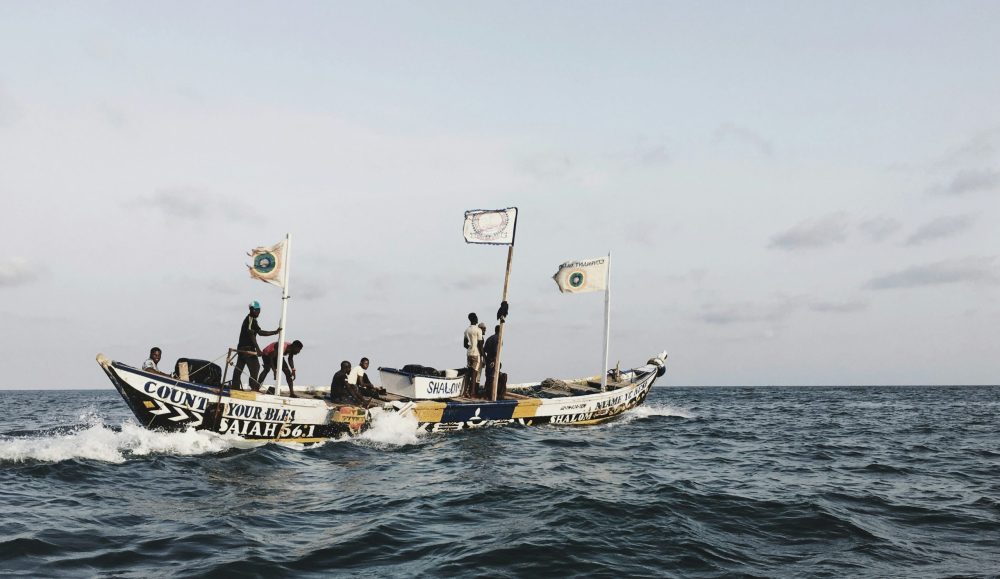
“We all belong to the sea between us,” wrote the Cuban American poet Richard Blanco. Our global ocean, the least accessible yet most critical set of ecosystems on Earth, has seemingly always been a source of spiritual and creative inspiration. The sea is the setting of dreams, of trauma, peace, beauty, curiosity, cleansing, aspirations, new life, ancient life, and unknown life in the dark for leagues and leagues between (and beneath) us. 

For more than thirty years now I’ve been lucky to read, teach, and write about the sea, often while aboard ships gazing with students and fellow authors upon a 360˚ saltwater horizon. The open ocean is a big place, of course, and our relationship with this most expansive and influential of Earth’s ecosystems is as varied, vast, and complex as human history and culture. Yet, perhaps needless to say, due to centuries of racism and misogyny, written works set at sea in English—fiction, nonfiction, and poetry—have been predominantly published by white authors, most of whom were men (myself included and likewise privileged). I adore and continue to be inspired by the sea stories crafted by such icons as Herman Melville, Joseph Conrad, and Rachel Carson, as well as those by the likes of Sarah Orne Jewett, Farley Mowat, and Mary Oliver. But dozens of extraordinary works by writers of more diverse identities somehow managed to emerge and publish classics of the genre, while more and more are being created and printed every year.

Below are just ten great works of sea literature in English by people of color. 

The Deep by Rivers Solomon

“She couldn’t determine which was worse: the pain of the ancestors or the pain of the living. Both fed off her.” So thinks Yetu, the young protagonist of The Deep, who is charged with the weighty task of holding the horrific memories of her entire underwater society, to archive their history yet not burden all the other individuals with the daily sufferings of the remembrance. Author Rivers Solomon, in collaboration with hip-hop musicians Daveed Diggs, William Hutson, and Jonathan Snipes (who had composed music riffed off the work and mythologies of previous multi-media artists), crafted a novel of a submarine world after the Middle Passage. This world of wajinru beings with Yetu as historian is composed of descendants of the thousands of pregnant human women who died and were cast overboard, as well as those women who were forced or chose to jump into the waters instead of living and subjecting their children to the terrors and inhumanity of enslavement. The Deep has a fantasy façade, but like all profound science fiction, or any sea literature for that matter, its message and struggle are crucial for our navigation of today’s world on land.

Tentacle by Rita Indiana, translated by Achy Obejas

Set in the Dominican Republic, this work of cli-fi, speculative fiction, bends the rules of this list in that it was written first in Spanish as La mucama de Omicunlé (2015)—the English translation is by the Cuban writer Achy Obejas—but I can’t resist slipping Tentacle in here, because Rita Indiana spun such a fascinating story of a beach town ravaged by global warming, overfishing, drugs, and capitalism. Prisoners watch Blue Lagoon in a room that despite the fans and the shade bakes at 115˚ F: “Movies in which the sea is full of fish and humans run in bare skin under the sun are now part of the required programming during this season, just like movies about Christ during Holy Week.” Short, profane, and punchy, Tentacle explores the art world, Spanish colonialism, gender, sex work, coastal tourism, and marine conservation. This is truly a 21st-century work of sea literature.

The Cat’s Table by Michael Ondaatje

It’s difficult for most of us to understand how central were ships and the ocean to travel and emigration before the recent age of the affordable airplane. Michael Ondaatje’s novel The Cat’s Table takes us aboard a steamship on the most important voyage of a person’s life (before they can look back and realize this to be so). The Cat’s Table is a fictionalized memoir of a boy’s voyage by steamship across the Indian Ocean and north, from Sri Lanka to a new life in Britain. In the masterful hands of Ondaatje, this recollection of an ocean passage is told personally, seamlessly, and subtly while it explores memory, childhood, class, race, and sexual awareness. Deceptively languid and breezy, The Cat’s Table serves up a rite of passage, a slice of a life and a world that is both familiar and foreign.

An Aquarium: Poems by Jeffrey Yang

Yang is an editor, publisher, translator, and poet, yet some of his earliest training was as a marine biologist. In this A-Z verse bestiary of ocean animals, from “Abalone” to “Garibaldi” to “Nudibranch,” from “Parrotfish” to “White Whale” to “Zooxanthellae,” Yang wove philosophy and politics with careful, scientific observation, helping the reader envision these animals in beautiful and compelling new contexts. He often tucked in post-colonial commentary in deceptively simple ways, such as in “Jellyfish”:

“Occasionally a crab tires of its slant-

wise ways and stowaways

on the bell of a jellyfish…

Perhaps one day both wash ashore:

the jellyfish dies, and the crab

rediscovers a new world.”

The Ordinary Seaman by Francisco Goldman

Picking up a century after James H. Williams, Francisco Goldman wrote of the plight of merchant mariners. Instead of essays, however, he created a suspenseful novel about Central American immigrant men trapped on a derelict bulk carrier that is rusting in Brooklyn at the whims of distant owners. Docked within the barbed wire of the shipyard with little knowledge of English, they have no way to get help or justice. For centuries of sea literature, ships might as well be floating prisons, and in The Ordinary Seaman this plays out intensely, if ironically while tied at the wharf: “Nowadays life on the Urus almost feels like the middle of a long ocean crossing on a real ship—the lassitude, people keeping to themselves, bored with one another, not much to do but play dominoes and tinker around or endlessly chip or paint.” That is, until Esteban begins escaping each night and finds a sympathetic bilingual lawyer. Goldman is a master of characterization, which he achieves through flashbacks and daydreams. Before the story is over, he’ll teach you how our material goods get shipped across the oceans—and by whom.

Omeros by Derek Walcott

Derek Walcott, who won the Nobel Prize in Literature in 1992, published two years earlier his epic poem Omeros, which he spun from Homer’s Iliad. Omeros is mostly set in St Lucia among the turtle fishermen and islanders. Although it references classical Greek poetry, Walcott wrote with local dialects from multiple perspectives and brought the sounds, sights, and smells of the tropics. With his readable verse and shape-shifting, time-traveling narrators, Walcott gave dignity, texture, and gravitas to communities of everyday Caribbean people in the past and present. Omeros closes with a small gift of mahi-mahi that leads to a universal theme of sea literature: the smallness of human endeavor in comparison to the indifference and immortality of the ocean: 

“Achille put the wedge of dolphin

that he’d saved for Helen in Hector’s rusty tin.

A full moon shone like a slice of raw onion.

When he left the beach the sea was still going on.”

The Whale Rider by Witi Ihimaera

“The muted thunder boomed under water like a great door opening far away,” says the narrator in The Whale Rider, a novel in which a female child is chosen to resume a centuries-old relationship where “the whale burst through the sea and astride the head was a man.” Witi Ihimaera was involved in the movie Whale Rider (2003), but the original work, the first Māori novel published in English, is quite different from the Hollywood version, including a more nuanced view of the colonial impact on indigenous New Zealanders. In the book the narrator travels to other parts of the Pacific and offers an illuminating perspective on the Polynesian Renaissance of the 1970s and ‘80s. Ihimaera based the story around a couple of actual events, including a mass stranding of sperm whales on a beach in Aotearoa New Zealand. In The Whale Rider he layered in spiritual retellings of Māori stories and even the perspective of the whale. If you can find one, I recommend reading an edition with Ihimaera’s “Author’s Notes” and the accompanying Māori glossary.

Lady with a Spear by Eugenie Clark

In the midst of the surge of ocean interest after World War II, Eugenie Clark published likely the first memoir by a female marine biologist. Her Japanese mother let young Eugenie explore the aquarium downtown on her own and took her swimming out on the beaches of Long Island. Beginning first with “underwater goggling,” diving with only a mask and fins before the availability of modern SCUBA gear, Clark earned her PhD and became a leading biologist of fish, sharks, and rays. She had a lengthy career as a professor and founding director of the Mote Marine Laboratory in Florida. Clark was a favorite of National Geographic and had a gift for what is now called science communication. Lady with a Spear, the first of her books (out of print, but easily found), recounts her early career spear-fishing and studying reef fish and sharks in the Middle East and the southeastern Pacific. She described adventures like this at a marine lab on the Red Sea: “We were munching on the last of the mermaid meat at lunch one day, when the old Rais, the ‘chief’ among the sailors, came rushing to tell us that a giant devilfish had been caught alive. We ran out to see it.”

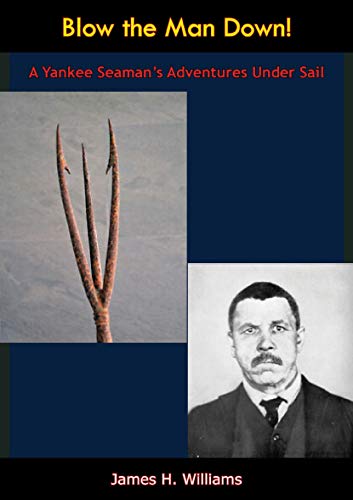
Blow the Man Down! (c. 1897-1922, anthologized 1959) by James H. Williams

 Blow the Man Down is a collection of rare newspaper articles by James H. Williams, a sailor-author who grew up in Rhode Island the son of a white Irish mother and a Black father. His dad was a mariner and died young, so as an early teenager Williams began his life at sea alone. InBlow the Man Down, edited by Warren F. Kuehl, Williams recounts his decades around the world in the merchant marine and on whaleships with a level of detail that is invaluable to historians. Williams also knew how to spin a yarn, so, much like Dana and Melville before him, he entertained with tales of storms and shipwrecks as he revealed the injustices bore by sailors. Williams became a labor leader, organizer, and public advocate for sailors’ rights. “I was only a sailor and, like most others of my class, had a sublime and abiding reverence for law and order,” Williams wrote in The Independent in 1902, which is anthologized here. “But there is a point at which patience ceases to be a virtue, and where oppression becomes the parent of rebellion.” Many of his stories speak to this, and, while the Blow the Man Down collection can be hard to find, it’s worth the extra effort. If it’s not at the library, there’s a Kindle version for sale or it’s available for free on archive.org.

The Heroic Slave by Frederick Douglass

One of America’s most gifted and important orators, Frederick Douglass first learned to read as an enslaved boy working at a shipyard in Baltimore, then he later escaped to the north by dressing as a sailor. In his Narrative of the Life of Frederick Douglass (1845), he described how for many enslaved people in the nineteenth century the vision of the sailing ship offered freedom, both literally and figuratively. Lesser known today is Douglass’s novella The Heroic Slave, which was likely the first work of fiction in English published by an African American person. Here Douglass used the tools of fiction, playing with point of view, allowing his readers to be inside the heads of both white and Black characters. His protagonist, Madison Washington, leads a rebellion to free smuggled Africans and sail them to British-held Bermuda and eventual freedom. In The Heroic Slave a white sailor relays later what Washington declared while steering the ship in a hurricane: “Mr. Mate, you cannot write the bloody laws of slavery on those restless billows. The ocean, if not the land, is free.”


Acknowledgments

Richard J. King thanks David Anderson and Alison Glassie for introducing him to some of these titles over the years.

Exclusive Cover Reveal of “Sky Daddy” by Kate Folk

Electric Literature is pleased to reveal the cover of Sky Daddy by Kate Folk, which will be published by Random House on April 08, 2025. You can pre-order your copy here.


Cross the jet bridge with Linda, a frequent flyer with a dangerous obsession, in this hilarious and provocative debut novel by the acclaimed author of Out There:

“I glimpsed many fine planes resting at their gates. A beefy Boeing 777 pulled back from F4, pivoting on his slender ankles, with surprising grace for such a big fellow. I spotted an old friend who went by the tail number N78823, an Embraer 175. I’d accompanied him to Salt Lake City a few months ago, and found him to be a playful lover, teasing me with a round of turbulence as we descended.”

To outside observers, Linda’s life might seem drab. Weekdays, she earns $20 an hour moderating comments for a video-sharing platform, then rides the bus home to the windowless room she rents in a garage on the outskirts of San Francisco. But on the last Friday of each month, she indulges her true passion: taking BART to SFO for a round-trip flight to a regional hub. Linda’s secret is that she’s sexually attracted to planes: Their intelligent windscreens, sleek fuselages and powerful engines make her feel a way that no human lover ever could. She believes her destiny is to someday “marry” one of her suitors by dying in a plane crash, a catastrophic event that would unite Linda with her soulmate plane for eternity. Linda is used to hiding her true nature, but when her coworker, Karina, invites her to a quarterly Vision Board Brunch, Linda sees a chance both to get closer to her work friend, and to nudge the universe on behalf of her destiny. However, as the vision boards seem to manifest items more quickly—and more literally—than Linda had expected, the carefully balanced elements of her life begin to spin out of her control, and she must choose between maintaining the trappings of normalcy or launching herself headlong toward her greatest dream. A subversive, unforgettable tale of the distances some will travel for true love, Sky Daddy examines desire, fate, and the longing to be accepted for who we truly are.


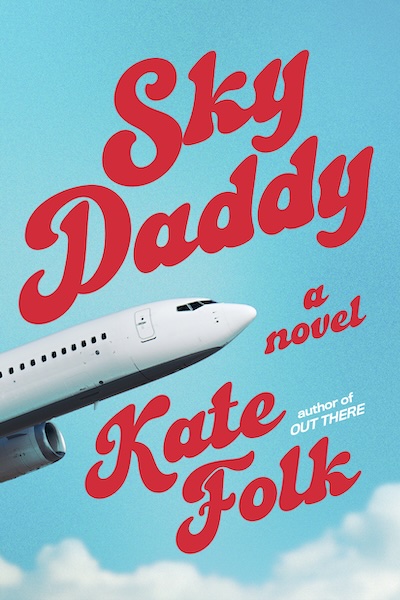
Here is the cover, designed by Sarah Horgan.

Author Kate Folk: “When I was first talking with my publishing team about the cover for Sky Daddy, we discussed vintage airline ads as a point of inspiration. There’s a glamour and beauty to these ads that feels apropos to a story about a woman who is romantically obsessed with planes. And the book also involves a lot of anthropomorphizing of planes—Linda describing planes as if they are sexy gentlemen, and comparing human men to various plane models. I knew there should be a plane on the cover, and I wanted that plane to have personality. ‘The plane should look sexy,’ I probably wrote. When I saw the first round of cover options, this one clicked for me immediately. I love how the red lettering pops against the cyan sky. The typeface feels unique and subtly evokes a retro vibe. I also love how the plane feels so active, its nose pointing upward, with an air of optimism and mischief. The book is in casual conversation with Moby-Dick, and this cover captures the spirit of embarking on a great adventure. It’s a cover that says, Get in, baby, we’re going for a ride.”

Designer Sarah Horgan: “The design directive for this project was ‘phallic planes’ and I had a lot of fun interpreting this task. The challenge was finding the balance between being too obvious and too subtle with the innuendo. One moment I would look at a cover and think ‘okay, I’ve gone too far’, and then look back and think ‘no, it’s not enough!’. The tone we wanted to convey was weird and darkly humorous. I took a lot of design inspiration from vintage airline ads, specifically their use of type and how they position the plane. I tried a range of styles from illustration, to photographic, to collage. In the end, we landed on a strategically cropped photo of a plane with bold 60’s inspired type. I think the final image sits on the subtler side of innuendo, but once you read the title and flip to the summary, you get it.”

Hope Is a Wrecking Ball

Ode to a Machine

The jukebox or the bevel grinder. 
A wheelbarrow.

Things that do their jobs
when pressed.

A dishwasher, of course,
is a comfort.

Not like a weedwhacker,
or a tire iron,

the way a wheel chock
can keep a secret.

This morning as I razed the onion grass,
I remembered

how my father once steered the riding mower
with my sister

on one knee and me on the other.
When he left,

we used our fingers to pick debris
from the dandelions,

after someone crushed his 6-disc changer
with an Easton B5.

Even a baseball bat, after all,
can be a kind of lever,

a fulcrum on which to balance
what we could not

shovel—
not hope, exactly,

but what precedes it:
a wrecking ball or a Roomba

a stopwatch or train.


When I Wake My Daughter for School She Tells Me I’ve Ruined the Dream She Had


Yes, love, I say to her: Don’t I know it?
And yet. Just imagine—

how much else can be ruined
by love,

by that which we’ve dreamed
might love us in return.

Here, dear,
is what I’ve been trying,

failing every which way
to teach you:

the world is equal parts
reverie and premonition.

Sometimes to dream
is to see the world as it could be.

Sometimes to dream
is to see the world as it is

& remain awake.

8 Books About Youthful Mistakes That Come Back to Haunt You

We all have one—that memory of something done or said with the absolute confidence of youth that makes our toes curl to recall. We think about it years later, in bed at night or on long drives or errantly in the shower and wish, cheeks somehow still flaming, that there was some way to take it back.

I myself have an entire collection, a hideous slideshow of my awkward phase, which stretched from ages 12-32. It’s good in some ways—to be humbled, to remember that it’s actually quite hard being young. But there are some mistakes that don’t just embarrass, they haunt. Because those are the ones whose consequences spread like greedy fingers into the lives of everyone around you. And although you may no longer be the same person who made that fateful decision, you sure are stuck with the fallout.

My novel The Snap is the story of Poppy Benjamin, an NFL professional trapped by the actions of her twenty two-year-old self. It’s told in two timelines so that readers can realize along with the older Poppy just how deeply she has blundered. There is no taking it back, there is only the hope of a chance to make it right, and a prayer that it is not too late.

Mistakes are inevitable, but here are eight books about life-ruiners.

Atonement by Ian McEwan

The heartbreak of this novel is how viscerally we can all relate to the sting of thinking yourself adult but being dismissed as a child. Thirteen-year-old Briony Tallis endures one such humiliation and is determined to never let it happen again. When a witness to a crime is sought, she steps forward, arranging a set of partial facts and contextless observations with a young person’s understanding but an adult’s certainty. Briony gets the satisfaction of having done something significant, of contributing confidently to the world of Things That Matter, but realizes in her later years just how much pain and suffering she has caused. The micro tragedy of cursed young lovers is contrasted with the trauma and chaos of a world war. Briony is left adrift in all of it.

I Know What You Did Last Summer by Lois Duncan

You’re probably familiar with the slasher film adaptation, but Lois Duncan’s early 70s novel relies less on jump scares than on the crushing, claustrophobic feeling of knowing almost immediately that you’ve done the wrong thing. Julie James knows that she and her friends should have told someone that they were responsible for the hit-and run death of a young boy, even though it would have meant admitting they’d been drinking. It’s often said that the cover-up is worse than the crime, but in this case it is a small attempt at absolution that sets in motion an unstoppable chain of events. The original editions have those incredibly satisfying rough pulp pages that will have you wanting to read this one in a hammock with a popsicle-stained mouth. 

Luckiest Girl Alive by Jessica Knoll

One of the hallmarks of high school is what a small slice of the world it actually is, but how all-encompassing it feels at the time. A defeat suffered there seems unsurvivable, and Ani FaNelli experiences that twice, in very different contexts. After the first, her confidence in her ability to read people is shot, but she slowly rebuilds, finding a new safe space and new people to trust in. When her world comes crashing down a second time, she runs, putting as much distance as possible between her newly created persona and her traumatic past. Then a phone call threatens to unearth everything she’s tried to leave behind, and Ani is forced to reexamine her teenage understanding of what happened to her. But absolving herself of guilt for one tragedy creates motive for the second, just when the push for accountability is coming.

Victim by Andrew Boryga

The line between opportunism and exploitation is razor-thin, as Javier Perez discovers in this meditation on telling people what they want to hear. When a well-meaning advisor suggests that Javi embellish personal tragedies in his college admissions essay, he’s hesitant. It’s not lying, but it’s not exactly true either. Once Javi is willing to present himself in a certain way, the world opens up to him, and soon he’ll take whatever he can gain through the guilt and morbid fascination of others. But pity is a double-edged sword, and although Javi is a talented writer worthy of genuine accolades, he’s built nothing on the basis of that talent and so can’t trust it.

The Seven Husbands of Evelyn Hugo by Taylor Jenkins Reid

Pragmatism is a noble quality when it comes to the real world, and no one knows that better than legendary actress Evelyn Hugo. From nothing and owed nothing, she inherently understands that to be successful, she will have to identify what people want and then give it to them. Women have long lived this way—Evelyn could be classified as a golden age precursor to the Manic Pixie Dream Girl, or Gone Girl’s infamous “cool girl” persona. But being someone else inevitably means leaving your real self behind—where you come from, what you look like, and who you love. When Evelyn’s years of stardom are behind her, she is left wondering if her successes were worth the significant sacrifice.    

Advika and the Hollywood Wives by Kirthana Ramisetti

All lives have seasons, and the way we react to people and things depend so heavily on the time when they find us. That’s the case for Advika Srinivasan, who is isolated and adrift after a personal tragedy, pouring drinks at Hollywood awards galas while dreaming of being on the other side of the bar. Maybe if her parents hadn’t moved away, she would have turned down Julian Zelding, a legendary producer 41 years her senior, when he asked her out. Maybe if she wasn’t disconnected from her lifelong friend group, she wouldn’t have needed so badly the outsized attention that Julian lavishes on her, resulting in a whirlwind marriage and elopement. But they did and she is, and so just like that, Advika is living a life she never imagined and doesn’t quite want. It takes a voice from Julian’s past to open her eyes to the severity of her situation, but by then it may be too late.

Yellowface by R.F.  Kuang

This book is a car crash you desperately want to look away from but can’t, careening forward as the tension ratchets up and up to the point where you’re literally begging the protagonist to make any other choice. June Hayward is a frustrated middling author. She watches bitterly as her sometimes-friend Athena rockets to literary stardom, attributing Athena’s ability to break out of a crowded marketplace to her Chinese-American background. June knows her talent is on par with Athena’s; the deck is simply stacked against her as a dime-a-dozen white girl in publishing. When the opportunity comes to step into Athena’s shoes, June takes it, because it’s no less than what she’s owed. The magic trick of this book is that June’s delusion is so complete she has no idea her comeuppance is coming, although the reader unbearably feels it page by unbearable page.  

The Christmas Guest by Peter Swanson

To love someone is to willfully look past their faults. Whole-hearted devotion is a beautiful thing, but it can also blind. What happens when a loved one is accused of a terrible crime? Who among us would believe it of them? American college student Ashley Smith sees this dogged loyalty firsthand when she’s unexpectedly invited to her classmate Emma Chapman’s country home for Christmas. Emma’s handsome and moody brother Adam has been questioned about the murder of a local girl. Emma dismisses the accusation out of hand, and Ashley, awed by the stately home’s crackling fireplaces and elaborate holiday décor, is inclined to agree. This novella is a scoop of a book, something I wished I could have luxuriated in for much longer. But the story’s strength is in its brevity, in knowing that whatever will happen will be soon, will be now, because the pages rush past like water through fingers until we’re left stunned and chilled at the final reveal.

For Ledia Xhoga, “What If…” Became a Debut Novel

Ledia Xhoga’s debut novel Misinterpretation opens with the unnamed narrator, a translator from Albania, accepting an assignment to interpret for a Kosovar torture survivor named Alfred. Elements of Alfred’s story map onto her own family’s experience, and the narrator becomes all-consumed by his case. As personal and professional boundaries start to blur, the narrator is caught up in the precarious lives of other asylum seekers, like Leyla, a Kurdish poet who is being stalked by her ex-husband. Eventually, the narrator has to face the consequences of her meddling and the toll it takes on her professional life, her marriage, and even the lives of the people she’s trying to help. 

The narrator reflects at one point, “Since moving to America, my life had been like… two parallel highways with regular exits onto each other.” In Misinterpretation, Xhoga artfully captures the experience of having a foot in two different worlds and how the narrator’s reality is distorted as a result of constantly shifting between them. Being able to speak so many languages and translate for so many different people gives the narrator a deep capacity for empathy, but it also complicates her relationships, blurs the lines between her identity and the people she translates for, and raises ethical questions about friendship and boundaries. 

As an immigration journalist, translator, and nonprofit director providing services to asylum seekers, I was impressed by how deftly Xhoga captures the challenges of translation and the complexities of navigating the US immigration system. I spoke to Xhoga ahead of the novel’s release to discuss what it’s like to live on the border between two worlds, the unseen struggles of asylum-seekers, and how language shapes our world view.


Shoshana Akabas: The story starts with the narrator interpreting for a Kosovar torture survivor, despite her training that “if the interpreter’s circumstances resemble the client’s, do not accept the assignment.” What drives her to accept the job anyway? 

Ledia Xhoga: For me, writing the book started with a “what if?” At one point, I volunteered to interpret for an organization that helps survivors of torture. I was supposed to interpret for someone, but it didn’t work out, and I always wondered what could have happened. So, that was the initial spark. 

What convinced me that there was a novel in it—because, you know, there could have been nothing, it could have been a short story—but what convinced me was the complexity of the main character. She is very committed to helping other people, but eventually her behavior becomes disconcerting, because she’s incapable of holding two opposing viewpoints inside of her. And the novel starts from that moment when she realizes that maybe this is not such a good idea, because Alfred’s situation is bringing up a lot of her own past traumas. But on the other hand, she can’t help it. She has this compulsion to help other people that’s unchecked, at times, by other considerations.

SA: That’s very different from how her American husband moves through the world. He sees very clear limitations and boundaries. What do you think accounts for that difference?

LX: I think some of it is probably upbringing or cultural. I’ve noticed in my life that my husband and I are very different, and with American friends, sometimes I notice that they see things differently and boundaries are different in other cultures.

SA: Like when the narrator visits Albania, everyone knows each others’ business, whereas when she’s in the United States, lots of characters keep secrets from each other.

LX: Exactly. In Albania, for example, it’s very common for people to live together. Even if you are married and have kids, you can still live with your parents. They live in such close proximity to you. That doesn’t happen as much in the United States. The idea of boundaries is much more pronounced in American culture. 

SA: I also wonder how the narrator’s translation work shapes her worldview. As a translator, she’s used to slipping into different lives and sort of embodying the person she’s interpreting for. 

LX: You have to be very flexible when you’re translating. It’s not as simple as, “I’m going to tell you this exact sentence.” It’s more like, “I’m going to say it in a way that you’ll understand.” Instead of being analytical, you’re trusting your intuition, your emotions, and understanding the other person’s body language. You’re so much more involved, immersed in the experience. 

SA: Let’s talk about the title for a minute. Translation figures into the story in so many different ways. How does the theme of mistranslation run through this book? 

LX: So many ways. In everyday communication, even within the same language, even with your family members, there can be two opposing views. You can look at the same thing in different ways. Misinterpretation is everywhere. And of course, it takes on another meaning when you bring in a different language. It’s especially pertinent to the story, because during the therapy sessions, she really misinterprets Alfred, and she withdraws so much into her own trauma, into her own past. So I started to think of ‘Misinterpretation’ as the title after I wrote the scene with Alfred when there was a real misinterpretation. But the more I continue to write, the more I could see other things being misinterpreted throughout the book. And then, there’s this wider meaning that a work of art is always going to mean something different to different people. Any work of art, anything that you create, will necessarily be, in a way, misinterpreted. 

SA: The theme of translation in this book is so beautifully complemented by the theme of immigration and the idea of having a foot in two different worlds. Can you talk a bit about how these two themes work hand-in-hand for you? 

In everyday communication, even within the same language, even with your family members, there can be two opposing views.

LX: I read this quote by Toni Morrison, “I stood at the border, stood at the edge and claimed it as central. I claimed it as central, and let the rest of the world move over to where I was.” It totally spoke to me, because it felt like that’s what I was doing. Misinterpretation is a novel about standing at the border and claiming that as your reality. The translations, interpretations, everything—it happens because you are on a border. That’s your reality, so that’s where you have to exist. 

It’s funny, because when you finish a novel, what you’ve written doesn’t fully sink in until some time has passed. So one of the things I thought about recently is the duality of experience in the novel. Some of them are very obvious: you have the Albanian language and you have English. New York City and Tirana. But then I started thinking about how this duality extended also to other elements of the novel. 

SA: Like the characters with legal status and the people who are in immigration limbo? 

LX: Yeah, the path of a person who already has their papers and the person who doesn’t have their papers. There are so many instances of doubleness or polarity. The Kurdish woman who appears in the novel, that’s another path the narrator’s life could have taken, almost like another reality, so I was just thinking about how much I internalized this duality that it became a theme for the book. 

SA: How did you approach using both Albanian and English in the text? 

LX: Initially, I didn’t have a lot of the sentences that you see in Albanian. They were in English. My editor said, “Let’s have more sentences in Albanian,” so I started having more sentences in Albanian, and it changed my perspective of the text, in a way, because then I started looking at other sentences in English and thinking, “What would they sound like if they were in Albanian?” And then I started thinking, “What would this whole novel be like if it was written in Albanian?” 

SA: That’s fascinating, because I think the characters in the book act differently when they speak in different languages and when they’re in different countries. So, it makes sense that your writing might take on different characteristics depending on which language you’re writing in. 

That’s why we read, right? So that we can realize that we have enough things in common with each other.

LX: Just those few sentences with these two elements together—the Albanian and the English—brought up so many questions. 

SA: Circling back to immigration, I appreciated how the book digs deep into different immigration stories. Many of the characters are in really complex and precarious positions. Like Zani, who was promised asylum in exchange for offering information about a crime, but the process doesn’t go as planned. What kind of research did you have to do to create these backstories? 

LX: I’m a little bit afraid of research, because I feel like it kind of paralyzes me. So, what I tend to do is: I look things up, and then I let a lot of time go by, so that it’s not so fresh in my mind, and then I use whatever has stayed in my mind. And maybe what has stayed was also the most interesting part of it. So I did read about somebody who was promised asylum for collaborating with the U.S., but it somehow didn’t work out. So, yeah, I did some research for these situations. 

SA: As we discussed, art can be interpreted or misinterpreted in many different ways, but what’s something that you hope the reader understands about “standing on the border” as a result of reading about these characters? 

LX: I hope they find commonalities with their own lives, even if they’ve never heard of Albania, or they don’t know what is on the map. No matter what, I hope that they read it and they realize, “This person has such a different culture, and their background is so different from mine, but I feel like I can relate to them.” I also think the description of the novel necessarily focuses on some of the darker aspects of the plot, but I’d like to think that the book is a little bit more colorful and has more hope, more nuance. So I hope people see that side of it. But yeah, finding things in common. I mean, that’s why we read, right? So that we can realize that we have enough things in common with each other. 

9 Books About Life-Changing Encounters With Nature

Nature as tangled forest, as oil-drenched bayou or salt desert. Nature as flux and change. In all the books discussed here, the writers use ideas of nature as backdrops for perplexing and life-changing character dilemmas. The ideas of nature are different in every case, and the protagonists are all searching for something they don’t quite understand the nature of, but the common thread is nature always presiding, abiding, inspiring and looming. Nature provoking. The searches happen within the context of an overriding concept that’s much bigger than the protagonists are, and crystallizes within a metaphorically resonant space that augments the complexity of both concept and character. In their various encounters with these spaces, whether it be an uncharted wilderness, apocalyptic landscape, or flickering apple orchard, the characters all shed one kind of skin and grow a different, sometimes extraordinarily richer one. 

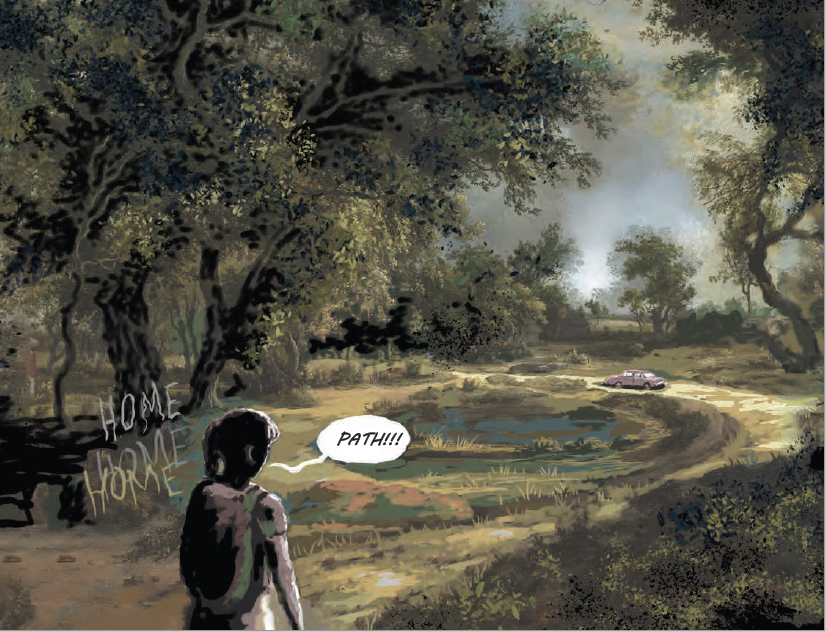
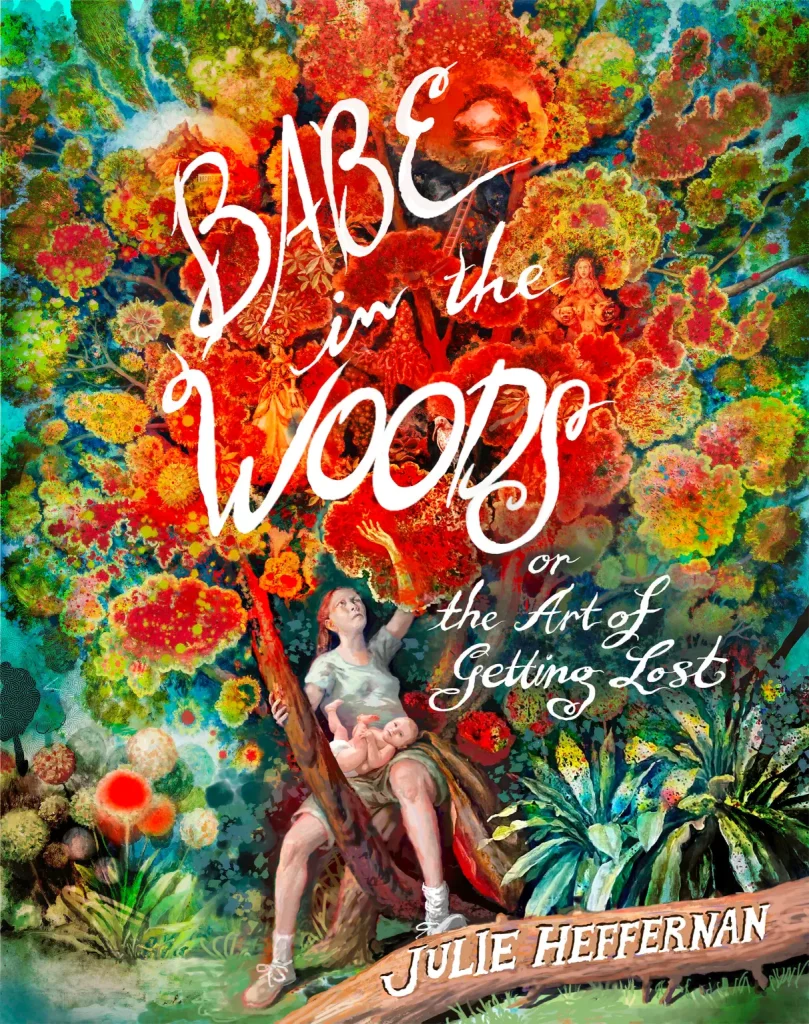
My book, Babe in the Woods, or the Art of Getting Lost, didn’t start out in the woods, or with any kind of space in mind. It didn’t even start out with much of a story. What it had was a Concept, which I thought was Grand. Concepts are serious stuff, I thought, laudable, possibly even game-changing, but in a narrative, I discovered, they’re ineffectual by themselves. While all the books I’ve selected here include at least one big concept–one that dwarfs the human stories swirling around it–it’s those puny humans and their wayward, unruly yarns that grabbed my heart. They’re the vehicles for bringing big concepts to life.  But I didn’t understand that when I started my own project.

The first draft for what would eventually become Babe tried to make its big idea primary. I wanted to shed light on what makes art “art” and give readers visual lessons in how ideas in great paintings are actually structured, how their messages are made available to an audience and deliver wisdom. The problem was, this mission amounted to a Mother Tree story, way bigger than the scope of any individual life, so there was no way to grasp it. 

A graphic novel is the perfect medium for analyzing such powerfully visual things as paintings, and what I wanted to do in my book, I thought, was show readers how the compositions of great paintings elucidate subject matter and deliver insights that make us better and wiser. That’s the sort of thing I teach—why great paintings matter—but that ambition isn’t a story. The story Babe needed turned out to be right in front of me, lying in wait, but it was one I’d never thought worth telling. It struck me as just an unruly weed because my thinking was too caught up in the Mother Tree mega-canopy idea. Mother Trees don’t need us in the slightest. We’re better off cultivating the new seedlings that do.

My own seed of a story wasn’t much more than an innocuous speck when it first occurred to me: a woman lost in the woods with a baby, that was it. But slowly it grew: she began to notice things, look more closely at the world around her, peer underneath things to discover ants and termites and her own urgent issues, ones she’d never given much thought to. She remembers things she’d squelched, discovers a need to reconcile with her dad and have that conversation with her mother she’d never dared have, all while moving through a terrain full of obstacles, real and otherwise. And, with that grand concept accompanying her, she discovers a space even grander. 

Always unpredictable, nature becomes a trope for all we can’t control. In these nine novels the settings vary widely, but each of them challenges the reader to engage deeply in that very unpredictability. Just as weather catalyzes change in the environment, these characters encounter conditions that spark changes in themselves, and in the reader too. 

The New Wilderness by Diane Cook

When I read The New Wilderness while in the middle of writing Babe, I felt immediately in kindred country. The story follows Bea and her sickly five-year-old, Agnes, who have volunteered for an experiment with 18 others to leave civilization—now polluted and overcrowded—and decamp to what’s called the Wilderness State—the last bastion of untouched nature— and the only chance Agnes has, possibly, to heal. It had been forbidden territory up until now, rapacious humans having proven themselves unworthy of it. 

Cook addresses many issues, not the least of which is how to deal with the conundrum of bringing children into a world ravaged by centuries of exploitative behavior. There’s betrayal, danger, terror around every corner; but Agnes thrives. Now Bea has to wrestle with the idea of losing her daughter in a way she’d never considered. The question is not only how does one survive in an actual wilderness with no survival skills but also how might we address the even more difficult question: what kind of world do we want? 

The Overstory by Richard Powers

Eight stories about nine people, The Overstory follows characters from different eras, backgrounds and histories whose lives, like roots, are intricately intertwined with each other through their profound engagement with trees. Some characters are fictional, some based on real people: I learned about Julia Butterfly Hill through the character of Olivia Vandergriff, and the novel’s tree scientist, Patricia Westerford, is based on the actual Canadian researcher Suzanne Simard, who studied how trees have their own unique intelligence, evinced in richly complex mechanisms of communication.

Each of Powers’s characters is beautifully drawn, with their own individual quirks and obsessions; each has their own corresponding tree. Powers’ gift is to festoon the reader in gorgeous language while also teaching us a wide and gorgeous variety of things, from the history of the Chestnut blight and ancient Chinese manuscripts to how to survive up in a tree for a year. But mostly he gives us lessons on trees, their amazing biology, how they talk to and protect each other, how they’re so much grander and more important than us. He wraps us up in imagery involving all the invisible linkages that occur between root systems, how they sustain each other and the larger environment in ways none of us can see, and the multistory book itself is structured like this root system. In the end you understand what it means to seek the wisdom of trees in thinking about our own fractured world.

North Woods by Daniel Mason

A single apple tree grows in the woods some time back in the 1600s, around which a dwelling is built, gets renovated, changes ownership, and eventually falls into ruin. But, before that, it shelters a host of different characters, living and dead, whose lives and stories span three centuries. From a young couple fleeing the strictures of their Puritan community to modern day Nora, who uses the house as a respite after she crashes her car nearby, these layered stories about endurance remind us that the past is vivid and always with us should we care to notice its traces in the smallest of details, like the age lines in a face.

We meet a variety of vividly drawn characters including a lusty beetle, a bevy of ghosts and the unforgettable Charles, who remakes his life in that same Northwoods dwelling, cultivating an entire apple orchard alongside that first tree. We meet his daughters, twins who return to the story after death, along with other inhabitants of the house who also can’t leave it. A conman, a lonely painter, a schizophrenic writer, all the characters are presented as part of a cycle of seasons divided into the twelve months of the year, and alive on the page in a world beset by the kinds of secrets that can ruin or, in the hands of wise writers, save us. 

Drive your Plow Over the Bones of the Dead by Olga Tokarczuk, translated by Antonia Lloyd-Jones

Janina, an eccentric, middle-aged Polish woman contends with a spate of animal killings she discovers in the forest outside her village. As we follow her story, meeting villagers along the way with whom she constantly tussles, we gather that mere human psychology isn’t adequate to the question of how a world becomes deranged. That seems to be why Janina is attracted to astrology, using it to make sense of the madness going on around her. Only the stars can take on such mysteries, she suggests, the distance they have on humankind offering the wide perspective of eternity needed to explain our unfathomable human cruelty. 

As the narrative unspools it looks as though the forest animals are fighting back, and we travel alongside Janina as she interacts contentiously with her community, quotes Blake, and gives people nicknames that describe their true character. Her unique voice allows us inside the tangled complexities of not only a cast of bad actors fomenting chaos around her but also her Wise Woman intelligence.

Parable of the Sower by Octavia Butler

Nature run amok is the backdrop for this dystopian novel about a teenage girl forced to decamp from her family home after a collapsing economy, war, disease, drugs and chronic water shortages have ravaged the entire United States. After Lauren Olamina’s family is killed when a fire destroys their home in what was supposed to be the one safe neighborhood left in LA, Lauren, who has the gift (or curse) of hyperempathy, is forced to face the deadly outside world on her own, armed only with the seeds she’s managed to bring with her in the hopes of finding a place safe for sowing them, and in that way, beginning again. 

As she heads north, Lauren takes up with a diverse crew of other refugees fleeing conditions like prostitution and debt-slavery, and in the course of their travels she becomes a force for hope in their dismal lives as she slowly confides her idea for a new religion, one she calls Earthseed. Her god is Change—more of an idea than something to venerate—but still something to grasp and hold on to for people doomed to live in a world riven by short-term wins and losses, the danger and uncertainty of a rudderless existence. Her idea is a way to keep going, without illusions but nevertheless with hope.

In the Distance by Hernan Diaz

A young Swede in the 19th century goes on a kind of backwards pilgrimage in search of his brother whom he lost after they disembarked in NYC. Taking another wrong turn, he finds himself alone and penniless in California, going east during the westward expansion. Inordinately tall and knowing little English, Hakan is viewed as a murderous madman by some and as a legend by others. In the course of his travels, he survives a maelstrom of violence, invidious characters, and horrifying circumstances that bring him to the brink of death over and over again. 

Terrifying characters abound, thwarting our ideas of type: hooker as sensual hag, murderous cult leader with a modicum of wisdom, naturalist going slowly insane in his search for the impossible. The desert Hakan traverses back and forth is a nightmarish place lightened only by his meeting a naturalist who is one of the only good characters in the book. This man studies imaginary creatures in alkaline pools and shows Hakan how to find water in the dry dust of a dauntingly unforgiving terrain. Despite his honesty, integrity and good intentions, Hakan over time develops a reputation as a notorious outlaw, unable to avoid doing violence in circumstances that bring even good men to the brink.  

When We Cease to Understand the World by Benjamin Labatut

In this novel, Labatut takes us into the complex and troubled minds of some of our greatest physicists—Fritz Haber, Werner Heisenberg, Erwin Schrödinger, among others—struggling with the most profound moral and scientific questions underlying all of nature. We get a glimpse inside the mind of the man who brought us such miracles and horrors as nitrogen-based fertilizers (which allowed us to feed an exploding world population) and the pesticide Zyklon B (which was the gas the Nazis used to exterminate millions of Jews).  We become intimate with the thoughts of the men who mastered the radical intricacies of nuclear physics and quantum theory, eventually bringing us the atomic bomb. 

For someone who barely passed high school Physics, I found the opportunity to peer into the minds of such geniuses, through the clarity and precision of Labatut’s language, an extraordinary experience. These are minds engaged not only in pondering the greatest mysteries of the natural world, but also unravelling their knottiness.  Thinking along with them for a few hours is breathtaking. Labatut’s ability to find words that function as metaphorical equivalents for baffling concepts in quantum physics, which manage to enfranchise even the STEM-challenged  like myself, feels almost miraculous.

Strangers in their Own Land by Arlie Russell Hochschild

Awarded a Medal of Honor by Obama, Hochschild is a renowned sociologist who travelled deep into the Louisiana bayou to live and work with poor, mostly conservative members of a community employed by but also preyed on by the oil industry. Her mission is to tell the real story of those people and their lives, detailing all the maddening and mostly counterproductive excuses they give for retaining that industry. It has been systematically destroying their environment and denying them a reliable livelihood for generations, yet they work to ensure it isn’t thrown out of the state. 

An elite Berkeley academic, Hochshild is caring and down-to-earth; for that reason she becomes a trusted member of a community who might otherwise have shunned her. This involvement allows her unique access to the people and their contradictory behavior. Oil giveth and oil taketh away and these people have had the very ground they’ve been walking on for eons taken away from them: the whole town is swallowed by a sinkhole created by oil drilling. 

In her book, Hochschild has made an enormous contribution to the left’s understanding of what makes such people tick. She theorizes about economic disparity with the image of a ladder on which people stand, hoping to slowly move up, rung after rung, waiting patiently to go that step higher, but being constantly thwarted by strangers—immigrants, the poor and needy, gays, etc.—who jump in front of them. They are constantly led to believe that outsiders—not the system—are cheating them and their children of their just deserts.

Shaman by Kim Stanley Robinson

What was it like to hang out with Neanderthals 32,000 years ago in the prehistoric time when we inhabited the earth alongside them? What really was shamanism, before it became a contemporary conceit? Who were the actual people who painted the Chauvet caves, and how did they do it? Were they anything like us at all? 

Only someone like Robinson with real science bona fides could take up such questions and turn them into historical fiction. We are first introduced to Loon, the main character, naked and alone in a stark world. We journey with him on his rite of passage, with no tools to help him in the his many struggles. His very nakedness is the medium that allows readers to assume his skin as he fights his way through the forest and encounters numerous calamities, including breaking his ankle. He seeks the means to bind it using only forest tools, figuring out how to manage while facing even more dangerous forces. 

There are shamans, healers and lovers, all rendered in beautifully imagined strokes. The shaman passes down stories and wisdom that Loon must learn and eventually shape in his own way The healer is an old woman whose practice is born of observation, the first tool of science.  The lover is an outsider who helps Loon’s people see the world in a new way.

Robinson’s remarkable ability to transport us to such a distant time and place—one that most of us couldn’t possibly imagine even though it’s somewhere in our genes—is the boon of this book. Robinson provides precisely drawn characters we can readily identify with even though they have very little language. A consummate researcher, Robinson invented their language using a combination of Basque and Proto-Indo-European, thinking carefully and compassionately about every word. 

How 10 Days Off-Roading in Mexico Helped Me Navigate A Shifting Publishing Landscape

Except for a brief period, a few years ago. My wheels had finally found the ruts of a writer’s path: I had a viral essay and New York Times bylines. I had kneeled before Poets & Writers with a writing book and been tapped by their sword on my shoulder, included on their Best Books for Writers list. As a creative writer, a freelancer, and a trusty, older-sis-type coach for newbie writers, I had a map etched out. 

Then the universe shook my Etch-a-sketch. 

The pandemic, plus bonus tragedies that can strike at any time, because life doesn’t give you a reprieve just because your day-to-day sears subheads into the history books. The backsliding of my career barely registered as a blip. 

Last year, just as I was almost upright again, legs trembling beneath me as I tried to take steps toward something that felt like life, I relented and googled this ChatGPT thing I’d been hearing so much about. 

The pity party lasted three days. 

Luckily, around that time, I’d cobbled together a self-funded reporting trip that gave me something to look forward to. In my attempt to chase the travel writer dream, I’d arranged to hitch rides with teams of drivers on the Baja XL, a 10-day off-roading rally down Mexico’s Baja Peninsula. I would hop from Jeep to 4Runner to motorcycle, riding hundreds of miles a day, much of it through desert and rocks, totaling 2,800 miles, approximately the distance from Seattle to Orlando. 

I returned not only proud about what I’d overcome on the dusty adventure, but more confident about making it as a writer. I’d learned a particular attitude on this tire-patched and duct-taped trip. Overlanders, as they’re called, know how to create a path, even when it feels like you can barely trust the land beneath your wheels. 


In the weeks before the trip, I was haunted by the thought that throwing myself into the backroads of a foreign country with strangers with just a backpack was a terrible idea. If I were on the show Naked and Afraid, my Primitive Survival Rating would be about a 1.5. Two days before I left, I checked the online group one more time. A driver who’d arrived had posted about how damn cold it was. Last minute, I bought a sleeping bag rated for 20 degrees. In my tent that first night, my toes holding just below numb, I thanked my previous self for taking good care of me.

I returned … more confident about making it as a writer.

You can’t afford to mess up in the desert. Overlanders prepare as best they can, including first checking the weather. If we’re preparing for our writing lives, how do we do this? It’s keeping up with your community, learning from people who have been where you plan to go. 

If we’re planning to make a living as writers, I’d say it’s also looking for what futurists call signals of change — evidence that something will be different, and how it will be different. It’s the first emoji you see in The New Yorker, the first time you see a job post for an AI prompt writer, the first time you recognize something as written by an algorithm. These indicators are to futurists what plot points are to writers: the building blocks of a story.

The weather determines the gear you’ll need, and, as writers, our gear lives mostly in our minds. That’s why, on top of reading and writing, I try to learn something about the business, the tools, whatever gets me traction, at least a little bit every day. I’m upgrading my gear, turning myself into a more powerful vehicle to climb my wilder, more ambitious artistic mountains and keep myself fed and housed and insured along the way. 

How you prepare depends on your resources. One Baja XL driver brought a fancy rig with a $9,000 suspension, and another vroomed in driving a police-car-auction Crown Vic with zip ties holding the bumper together. Some had day-job budgets; others had mechanical knowledge gained over decades tinkering under hoods. Once you’ve prepared as best you can, make do with what you have. 

So often, I’m pouty or paralyzed because I couldn’t afford the fancy MFA or couldn’t pay my bills if I wrote as many hours a day as I’d like. Cheryl Strayed’s words slapped me hard when I read, “You don’t have a right to the cards you believe you should have been dealt with. You have an obligation to play the hell out of the ones you’re holding.”

You have an obligation. 

If your tools include a steady income, take writing classes. If you’re rich in community, arrange a workshop with writer friends. Every moment spent envying the writing life we could have had, if only — and I say this as someone who mentally swats at those moments like mosquitos — wastes the opportunity to get creative with what’s in front of us. 

The word scrappy can mean determined or it can mean made from scraps. My writing life is both. 


On the second day of the rally, a team pulled up next to a fellow off-roader and leaned out to greet him. 

“Hey, you’ve got a flat tire,” someone from inside the vehicle pointed out.

“Oh,” he said, “you do, too.”

No one was surprised. They expected the rocky desert to do what it does, and they brought spares. They planned to spend time with a knee in the dirt, wrenching off lug nuts. They brought gloves. 

They expected the rocky desert to do what it does, and they brought spares.

Writers are not on life’s main highway. We have veered off where the view is spectacular but the ride is rough. The flat tires of rejections are part of the deal, along with writer’s block, crumpled-up starts, existential flails. 

In the software I made to organize my writing life, a graph tracks my publication attempts. The line for submissions rises high, hugged closely underneath by the one that tracks rejections. Acceptances form tiny bumps.

This is the fun we’ve chosen. It’s not fun like drinking beer and playing video games might be fun; we have to work to get that sense of satisfaction, trusting that the trail of flat tires behind us will make the summit all the sweeter. 

And we can’t be shy about how hard it really is, or how much harder it might get. 

Even the founder of the Baja XL, Andrew Szabo, who named his company The Institute for Unsafe Living Ltd., brings along a medic, prepared for the worst case scenario. One of the most well-respected drivers, Dave, has been known to bring a spare drive shaft, among other parts. It covers one of the worst-case scenarios.

I want to tell writers to be optimistic, but that would be as irresponsible as crossing your fingers and hoping no one rolls a Jeep off a cliffside. So I embrace the Stockdale Paradox. 

Admiral James Stockdale was the highest ranking officer in a POW camp for eight years. When asked afterward how he made it through, he said, “I had unwavering faith that I was going to make it in the end.”

When asked who didn’t, he said, “The optimists.”

The optimists were sure they were going to get out by Christmas, and then Christmas would come and go. Same for Easter, Fourth of July, Thanksgiving, for years. But how was Stockdale different? 

“I also never shied away from the brutal facts of our reality.”

And so the Stockdale Paradox instructs us to maintain unwavering faith that we will prevail — finish this novel, publish that chapbook, live the artist’s life — regardless of the difficulties; and, at the same time, it tells us to have the discipline to confront the most brutal facts of our current reality.

The reality is, I don’t know what AI is going to do to my creative or freelance writing career. I don’t know what the future of books looks like. 

But I have a plan for the worst case. AI can’t coach writers, lead retreats, or build community like I love to. I can actually play the corporate game quite well, if it comes to that. I can cook. 

Looking the worst of it in the eye gives me a sense of control and calm. 

I didn’t land the pitches for the Baja XL piece I’d envisioned. I wrote it anyway, on Medium. I’ll be a traveler, and I’ll be a writer, but it looks like I’ll have to do it my own way. 


Riding with a crew that had teamed up in a string of half a dozen trucks, we came upon a few motorcyclists stuck with busted wheels. Everyone pulled over. We stood in a circle, offering advice, patches, a hand to brace the tire against the rim while the bond dried. We hung around for more than an hour, just helping and hanging out. No one got left behind.

I was able to enjoy other people’s success and feel more supported in my own struggles.

Before I started my online writing group, A Very Important Meeting, and became a part of that community, I used to think that I, as an artist, had to be the singular flower in the vase. (And of course, it would be a humiliation to be anything less than the most award-winning flower.) But seeing everyone write together and afterward commiserate or celebrate helped me see myself as just one in a swath of wildflowers, all blooming on our own time. I was able to enjoy other people’s success and feel more supported in my own struggles. We can at least make each other laugh about it all, and offer to listen, towing each other out of the sand of self-doubt.

Ocean Vuong reportedly encouraged students to think of competitiveness among artists as a racetrack, something synthetic. Remove the man-made elements, the enclosure and the numbers, and all you have are horses running in a field. 

The camaraderie of the road is not only the joy, it’s the comfort, the ability to give when someone needs help, to ask for it when you do, trusting that someone will stop with you, make sure you don’t get left behind. 


I was riding with Andrew, the creator of the rally, to the hot springs one day. The road there, however, was not, indeed there. In the desert, the land moves. 

This was the refrain of the trip: 

“Is this a road?” 

“Are we on a road?” 

“Where’s the road?”

“Where’s the road?” is the essence of what writers are going through right now. We’ve thrown it into park, and we’re standing in front of our idling cars, hands shielding our eyes from the sun, staring at a pile of rocks, saying, “There used to be a road here.” 

I’m writing in the morning, doing client work, coaching writers, designing software, reading in snippets, reporting a bit, running retreats, teaching classes, sharing a one-bedroom in New York — is this a road?

One of my favorite quotes from Game of Thrones is: “Chaos isn’t a pit. Chaos is a ladder. Some are given the chance to climb, but they refuse. They cling to the realm.”

I can be guilty of clinging to the realm. I want my ’90s publishing budgets. There used to be a road there. 

We are tasked, then, with making new roads. Perhaps it’s taking a corporate job so you don’t have to think about money, waking up at 5 a.m. to write. Perhaps living cheaply in a tiny place or somewhere rural. Hell, it could be starting a side hustle as a wood soup ASMR influencer.

You might be flinging up sand and dirt, branches thwacking your windshield, saying to yourself, “I don’t think anyone’s come this way before. Is this a road?” 

Overlanders know: If you can make it a road, it’s a road. You make it one by driving it. 


At camp each night, Dave unhooked the yellow jerrycan — a color that’s supposed to signify that it contains diesel — from which instead he poured everyone margaritas. 

Along the road, we passed an SUV with a gigantic inflatable rubber ducky strapped to the top, smiled every time. 

When we saw an especially gorgeous view, we stopped to just breathe it in. 

Not everyone made it to the finish. Axles broke and teams disbanded. Sometimes all people had were the first few days. 

Not all of us will make it in writing, either. Amid my career in short form, there’s this novel I’ve spent about a decade trying to get right. I don’t know if I ever will, but I’m comforted by the times I’ve made myself cackle at my desk. I’m simply enjoying the view.

Not everyone made it to the finish. Axles broke and teams disbanded.

I know we writers are a very serious bunch, but as it turns out, having fun in your work has been shown to help you get more done and do it more creatively. Fun provides solace when you consider that our performance might only pay off in the moment it’s lived. 

This year the Baja XL was missing a driver. Dave’s friend and former teammate, Phil, had died of Covid. Dave and a few other drivers carried a memento mori coin, which some had made into a keychain. The front had a skull and an hourglass. The back said, “You could leave life right now.”

We have no idea how long our roads are. So whenever I’m stressing, which is only multiple times a day with a nightcap around 3 a.m., I try to remind myself to come back. Don’t worry so much about the destination. Celebrate the little wins along the way. Enjoy the company. Eat a taco. Make it a road trip. 


The most entertaining driver I rode with, Wilson, told me about how he had planned a trip to Baja outside of the rally with just one other friend. Five days before they were set to head down, the friend told him, “This is just so far out of my comfort zone that I’m just, I’m freaking out.”

His friend backed out and Wilson went alone, which he could do because he’d already been, had already pushed himself past the freak out, expanded what he knew he could handle. 

I was also freaked out about going to Baja, and now all I want to do is go again. I was scared to pursue a writing life, but having figured it out up until now gives me the confidence to continue making my path.

You may have heard the E.L. Doctorow quote, “Writing is like driving at night in the fog. You can only see as far as your headlights, but you can make the whole trip that way.” Off-roading told me: You can only see the road or the rocks in your headlights now. You can only make a path with the tools and the friends you’ve brought along. But you’re going to make it that way, trusting yourself to do the best you can with what you’ve got, taking care of yourself and fellow writers on the path, and rerouting when you need to, to create your most important story — that of the writer’s life you’ll live. 

The Unavoidable Intimacy of Interpretation

An excerpt from Misinterpretation by Ledia Xhoga

I was fifteen minutes late and his phone number was out of service.

Even in late January, Washington Square Park pulsed with the energy of summer. The chess players were fretting over their moves to the sound of Gershwin. The saxophonist’s Great Dane was pining for the dog run. It was Alfred who had suggested meeting here, next to the statute of Garibaldi, a name that brought to mind fragmented pieces of Italy glued together. It was an old mnemonic from high school; Garibaldi was responsible for Italy’s unification.

But Alfred was nowhere to be seen. Two men on a nearby bench didn’t match his description. He’d be alone. The agency sent photo attachments, which I rarely bothered opening. It was easy to recognize my clients from the look of expectancy, the humble bearing, the wear and tear that showed on their faces and bodies. That his phone was out of service was odd. Had they sent me the wrong phone number? The sound of footsteps. A toddler with squeaky shoes bumped into me, followed by her father and an excessive apology. Two boys holding a minidrone scurried toward the empty fountain. An elderly man was checking his watch. Could he be Alfred? He was far from the statue. Had he given up on waiting for me at our meeting spot? The man looked in his sixties. According to his file, Alfred was only in his early forties, just a few years older than me. Was it his preoccupation with his watch that made him look older? He hunched over it the same way my grandfather used to while winding up his Volna, a watch he’d bought in Moscow in the fifties. I walked toward him. Where was his phone, anyway?

“Alfred?” I said, relieved that I managed to put the accent on the second vowel, the Albanian way. “I’m sorry for being late.”

He straightened his back and waved his arm forgivingly. He did look younger from up close. His face seemed stuck in between expressions. It reminded me of an unfinished Rubik’s Cube we kept around the house, which I could never resist trying to solve.

“I was worried you were waiting somewhere else,” he said, rubbing his sunken eyes. “I saw another woman over there and thought it was you.”

“Is your phone out of service?”

“It stopped working this morning. I don’t know why.”

“Is your dentist around here? Shouldn’t we get going?”

His answer sounded muddled. The translation agency that employed me had been sending Kosovar Albanians my way. Their accent was different from mine. It took me a few seconds to get used to it, for me to understand the words immediately. We walked under the Arch and headed toward the street. I was hoping the dentist would still be willing to see him—we were late for our 6:00 pm appointment. While looking for their number on my phone, I felt a tug on my arm. Alfred was holding on to my elbow.

“Be careful.”

An SUV had run a red light. It was speeding away now, only a few steps from us. That he was a survivor of torture flashed in my mind again. I didn’t know what kind of torture it had been and was not allowed to ask for details. When his hand slid down my arm, the goose bumps surprised me.

The dentist was only a ten-minute walk from the park. We walked there silently and at some distance from each other, like a couple who had just quarreled. In no time at all, we were filling out paperwork. On a scale of 1 to 10, with 10 being the highest rating, how would you rate your dental health? On a scale of 1 to 10, with 10 being the highest rating, where would you like your dental health to be? The questions struck Alfred as ridiculous. He opened his eyes incredulously and shook his head in disbelief. He then jutted his chin toward the papers, giving me full power of attorney over his dental history. Judging from his reaction, I opted for the lower numbers. He nodded in approval. Still hoping that some questions might resonate with him, I kept reading aloud.

“Do you brush your teeth in the morning or at night? Or both?”

He was indifferent, eager to dismiss such useless formalities to deal with a toothache that had kept him up all night. He gave a deep sigh as if to say, It’s true that my dental hygiene and genetics have contributed to the state of my teeth, but do they need every single detail? Realizing there were many more pages to go through—the pile on my lap did look intimidating—he glanced around with doubt. What kind of dentist would make us do all this?

“What would you change about your smile?” I asked.

The answer consisted of several options. I had trouble interpreting the last one. Smile makeover.

“Smile transformation,” I fumbled. “Changing your smile completely.”

“Pick that one,” Alfred said without hesitation.

It was the only answer that he chose on his own. Afterward, he smiled, which frightened me. His features widened but didn’t soften, as if he were smiling against his will. He had chosen the right option after all.

“Are you ready, lovebirds?” said the receptionist, who looked tired and was massaging her shoulder.

When we stood up, she smiled in a forced way, like Alfred had earlier. Show less gum, one of the options from before, sprang to mind. She didn’t ask about insurance or payment information. We were an after-hours charity case. She led him to the back, ignoring me. She didn’t find me necessary now. The dentist would have his answers by looking at Alfred’s teeth, presumably, or at the paperwork I had completed. Waiting around random offices was the least favorite part of my assignments. Not knowing what to do, I sat back down. In the aquarium tank to my left there were no fish but several odd creatures; they were translucent with a hint of hazy gray, and long antennas.

“They’re ghost shrimp,” said a young woman sitting on the other side of the aquarium. I hadn’t noticed her till she spoke. “When they’re about to die, they turn white.”

She pressed her finger to the glass, pointing at a half-white creature. “He’s on his way out.”

She wore soft curls under an olive beret and a velveteen cape jacket in chartreuse. A long skirt of a faded material hid her knees and feet. Her appearance clashed with the bland surroundings. I had the impression that, in some mix-up of fact and fiction, she had stepped out of one of those thirties films my husband was always watching. Finding the office underwhelming, she had then zeroed in on the underwater world of the aquarium.

“It’s kind of creepy,” she said and pouted.

The receptionist tapped me on the shoulder.

“Your husband wants to see you.”

“He’s not my husband,” I said quickly. “I’m only his interpreter.”

“Oh, sorry. Could you come in the back?”

The back room was small and crowded with gleaming white machines, rather enormous for repairing such small objects as teeth. Alfred and the dentist were standing motionless to the side of the chair. The dentist looked like a late teen, but she had to be older—she was a practicing graduate student. She kept her hands in her scrubs’ pockets and threw puzzled glances at the patient whose language she didn’t understand.

“He doesn’t want to sit,” she told me, her face taut. “Can you please tell him to sit in Armenian?”

“Albanian.”

“Yeah.”

“What’s going on, Alfred?”

“I’ve never liked these machines.”

“It won’t last long.”

“These machines scare me. My father used to have to force me to sit.”

“Look, they numb you here. It doesn’t hurt like back home.” He didn’t move.

“I promise,” I said. “They do the work, but you won’t feel it.

It’s amazing.”

It took a few seconds, but Alfred did sit down in the end. “If he’s in any pain,” said the dentist, “tell him to raise his hand. I will numb him soon.”

I explained that to him, but when the drilling started, Alfred did nothing, even though his left hand kept trembling.

In Tirana, when I was a kid, they used to do our fillings and root canals without numbing. The dental office was inside our elementary school. The school dentists were two attractive women, who, in my memories, didn’t wear scrubs but blue, flowing dresses. They’d pop in and out of our classroom, calling out our names like Odysseus’s mermaids, charming us into an adventure, away from our tedious lessons. It was only later, when the drill touched a nerve and my screams echoed through the school’s hallways, that their appeal waned. Despite all that, I had never feared the dentist. Among all types of pain, physical pain was the easiest to forget.

Among all types of pain, physical pain was the easiest to forget.

“I’m sorry,” said the dental student to Alfred. “I touched a nerve.”

Alfred’s body slithered on the chair, but he didn’t make a peep. Then he sort of shriveled, reminding me of an Albanian expression I hadn’t thought of in some time—U bë sa një grusht—He became small as a fist.


There was, at times, an unnatural intimacy that developed between myself and some of the people I interpreted for. Disclosing personal and confidential information in front of someone played a trick on the brain, making us both believe we were more than acquaintances. But the amount of time we knew each other, and the context of our meeting, didn’t justify such closeness. When Alfred’s filling was over and we were walking toward the reception desk, he reached for and held my hand. It was an ordinary gesture, a substitute for saying thank you, or thank God, it’s finally over. His hand was chilly. I warmed it with mine. Holding hands with my clients wasn’t allowed. Still, when it came to most rules, one had to use judgment.

The vintage girl was still in the reception area. I admired her meticulous makeup, her hairstyle, her unique clothes. How long did it take her to transform herself into a movie star from the thirties? I, too, often longed to escape my ordinary look, to disguise myself behind a colorful façade, or to try out a personality. But it was all a fleeting fantasy. I didn’t enjoy making a fuss over my appearance, not even occasionally. I took less time than my husband to get ready. People assumed I was athletic, an erroneous impression suggested by the sporty, no-fuss clothes I preferred. The girl sighed in an exaggerated manner, then twirled her hair. She really did resemble one of the stars in the movies my husband watched.

“Do you speak any English?” I said to Alfred when we were outside.

“Where would I learn it? Everyone around me in the Bronx is Albanian.”

We walked back toward Washington Square Park, now at the mercy of a cutting wind. Even from a distance, I could make out the green benches under the hooded lanterns, where Billy and I used to sit many years ago. I hadn’t been in that park in years, since we first started dating. As Alfred and I passed the old Hangman’s Elm, my younger self flitted away to an alley on Crosby Street, ending at a bar with latticed windows and flickering candles. There used to be a French singer inside, wearing an off-the-shoulder evening gown with a daring front slit. She sang melancholy songs and played an old-school accordion. The most unusual aspect of her attire was a headlight hat she shone over the audience. Was she still there? Was the bar?

“I need an interpreter for my visits at the psychiatrist,” Alfred said. “I haven’t found anyone I trust.”

I hesitated. Sitting through his therapy sessions wouldn’t be easy.

“I know we just met,” he went on. “But I trust you. I don’t trust many people.”

Alfred had brown eyes. They were comforting and kind. I had never, till my husband, dated anyone with light eyes. Billy’s eyes were green. They could be clear, as a flowing river. At times they were turbulent, with darker shades of hazel.

“I need to talk to someone. I haven’t been well.”

“I’ll do it,” I said.

He flashed his smile again. His face was an acquired taste and I was getting used to it.

“Do you want to get a beer? I know a good place in the Bronx.”

It had been a long time since I’d been out alone with a man who wasn’t my husband or even with one who was. The past was suddenly at an arm’s reach—a casual invitation followed by a feeling of lightness, curiosity.

“I should go home.”

Then Alfred shook my hand, thanked me, and left. What would his night be like? He’d take the stairs up to his silent apartment. Open the door in the darkness. Cut vegetables on a wooden board before sliding them into a boiling pot. I saw myself sitting at his table, as his guest. He put on some music. Focused as he was on cooking, he ignored me for a while. He then turned around, refilling my wineglass while fixing me with his gaze.

I walked toward the subway, only then realizing we were going in the same direction. He was a few steps ahead of me. My feet halted, if only momentarily, on his elongated shadow.


Alfred reached out via email.

My psychiatrist said that your psychological training for interpreters is about to expire. You need to take a refresher course, she says. An imposition on your time, clearly. Will you do it? You are someone I trust. Isn’t it funny how it goes? You can spend years with someone but never trust them. Or you can, in a second. They are strict about rules in America. Too many people here. Do you remember how the dentist wouldn’t even look at my teeth without having us sign a hundred pages? Another thing is that I’m married. My wife’s name is Vilma, a woman from Tirana, like you. Our baby, a girl, will be born in one month.

I used to be afraid of my father. Children know everything. He loved me, he did, but things never worked out for him. I had vowed never to be a father. Yet, here I am. Vilma, my wife, can’t wait for the baby. The psychiatrist says that having my wife interpret during the therapy sessions is not an option. Relatives are not allowed. The training is only forty hours. Would you prefer to take it all in one week or in two weeks? Here’s a link to the registration. Can you go ahead and register?

If you can, for which I’ll be grateful, I’ll need you to sign some paperwork. You will need to scan and email it to the organization that sponsored my recovery. Can I stop by your office tomorrow?

Thank you!

A.

The nondescript, rectangular construction in Gowanus was built especially, it seemed, with the intention of splitting it into as many offices as possible. Mine was the smallest division, not much bigger than an average closet outside of New York City. There was little room to spare besides a small desk and two chairs.

Alfred was early, but he didn’t text to tell me. The door suddenly framed his lone figure, the low-hanging shoulders and gaunt face. When our eyes met, he raised his hand in a greeting.

He had cropped his hair and shaved, revealing a crooked mouth that bent further when he smiled. He had just returned from an interview for a security guard position, he explained. In his navy suit and burgundy tie, he looked the part.

“You’ll get the job.”

“Ishàlla.”

He pulled out the paperwork for the training from his backpack. We both signed it. I went to scan it in the copy room. When I returned, he had made himself comfortable in the corner chair, where no one had sat before. He dug through his backpack and handed me a bag of Albanian mountain tea sprigs.

“Vilma’s father brought it from Albania.”

“Let’s have some.”

“You can keep the rest. I brought it for you.”

He rubbed his hands to warm them up. I turned on the space heater. As I brewed tea in the building’s common kitchen, I tried to picture Alfred’s wife. What kind of Albanian woman was this Vilma? Was she beautiful in an uninteresting way, partial to gaudy clothes, and a touch arrogant? Was her life’s dream to become a TV presenter, a model, an influencer? There was an easygoing aspect to Alfred, a kind of passivity that certain high-spirited women might grow to despise. Or was Vilma—laid-back, modest, soft-spoken, surprisingly unharmed by the injustices around her—the sort of woman who found purpose in suffering, especially her husband’s? All my theories were in vain. Alfred still carried an aura of mystery about him, so how could I speculate about his wife? At first glance, he gave the impression of someone who was used to doing menial jobs, but then the more we talked, the more I got the sense he was well-read, maybe an autodidact of sorts. There was a spiritual side to him, too. It was easy to imagine him as a medieval monk, wearing a long tunic tied by a rope at the waist while assisting the poor. But, no, Alfred wasn’t a monk. He hadn’t learned to detach and observe; he was still suffering. That night at the park, he had appeared mysterious, but the bright lights of the dentist’s office had revealed his terror. He could barely handle a smile, let alone choose a wife. It was much more likely that it was Vilma who had chosen him and not the other way around. Sure, Alfred would have had to propose, but Vilma had pulled the strings.

When I returned with the teacups, the office had turned dark. It was one of those winter days when the night veil descended over the city without warning. The warm air from the heater had fogged up my only window. The distant lights above the barge-mounted excavator near the canal appeared as smudges on the glass. Alfred sat quietly. He hadn’t even taken out his phone, like people do. He was staring at my chair, as if he were in the middle of a conversation with another, invisible me. When I turned on the desk lamp, he recoiled. Then he winced, covering his eyes with his palm.

“I don’t like bright lights either,” I said, attempting to excuse his reaction.

Alfred lowered his hand. Then he looked past me and toward the door. That other me sitting in front of him had just walked out. He continued to sit in silence, glancing at a print of Berat’s castle on the wall, then staring at a photograph of my parents. His attention forced me to study my father’s eyes, his closely cropped silver hair, then my mother’s careless bun, her piercing eyes. The faces stirred a sharp longing I tried to push aside.

“Maybe we’ll have no trouble sleeping tonight,” I said, pointing to the teacups. “This tea is relaxing.”

“I’m having trouble with insomnia,” he said. “When I sleep, I see terrible images.”

I was hesitant to ask about the images, but he told me about them himself. “They’re mythical creatures,” he said. “But the features are mixed up. I’ll see a zebra with a human face, with wings and patches of fur. The weird body parts terrify me. Vilma says I should remember they are not real, but who could get used to such nightmares?”

His most remarkable feature was his eyes, I decided, and that hint of kindness they left behind. It was easy to worry about Alfred once one had made eye contact with him.

It was easy to worry about Alfred once one had made eye contact with him.

“I saw Cerberus yesterday. Do you know it? From Greek mythology?”

“No.”

“I used to read Greek mythology when I was younger. He’s a three-headed dog that guards the gates of the underworld to prevent the dead from leaving.”

“Where are the dead going?”

“To spy on the living.”

This was a joke, it turned out. He grimaced, revealing a gap between his teeth where the left canine used to be. It was kind of touching, like spotting the demolished wall of a house. Aware of my glance, he pursed his lips and rested his chin on his palm. Alfred had long eyelashes, whose shadows now reflected on his hollow cheekbones. He was following my movements with his eyes, as I ran my hand over the steam or placed my teacup on some printouts. He rarely blinked. Under the dim light, his bony face reminded me of a clay bust, still rough and unfinished.

“Thank you for doing the training for me,” he said. “As I said in the email, it means a lot.”

“How’s your wife?”

“Impatient.”

“Have you decided on a name for the baby?”

“My mother’s name. Roza.”

“Is your mother back home?”

He nodded.

“I wanted to bring her here,” he said.

“Will you?”

“I can’t. Since my father’s death, she doesn’t leave the house. I guess she’ll never come.”

I became aware of my facial expression, then of the need to shape it into something neutral. But maybe it was the effort that gave me away. Alfred was now studying my face with renewed interest.

“Odd,” I said, with barely any emotion. “My mother is the same.”

A scenario from my childhood played in my mind. We had made plans to go out of town. She had participated willingly, even excitedly. At the last moment, she announced she wasn’t going.

“I’m sorry,” Alfred said. “Is she alone?”

“She is. My father passed away.”

“My mother is alone also. We pay someone to do her shopping.”

He ran his hand over his black hair, which glistened under the light.

“I’m awash in guilt,” he said, pointing to his chest. “I’m having a baby. My mother will barely see her. My daughter won’t see the worst, thank God, but neither will she know the good things from back home. Do you have children?”

“No.”

“Not yet,” he corrected me.

I didn’t tell him that Billy and I had only discussed the possibility of having children abstractly, that we were both ambivalent about it.

“My father comes to see me sometimes,” he said. “Every summer, a moth lands on my hand. For the longest time.”

We were alone in my office and perhaps the building; everyone had left for the day. And yet we were whispering, like children who had found a hidden nook to share secrets. His chair was wobbly—it creaked when he leaned back. The space heater hissed, then stopped. A noisy truck outside shook the windows, giving me a jolt.

“So, this therapist,” he said, doing his best to smile. “She might help us both.”

From some recess of my mind, a sentence awoke. If the interpreter’s circumstances resemble the client’s, do not accept the assignment. “I don’t need any therapy,” I said. “We’re going there for you.”

Alfred nodded. “Yes, of course.”

He touched his cheek with his fingers. His skin had warmed and reddened. He held the teacup with his other hand. “I do love this tea,” he said, bringing it to his lips.

What he said, about the therapist helping both of us, stayed on my mind. The most prudent thing was to cancel our upcoming appointment. But that meant he would have to postpone his therapy till after the birth of his baby. Becoming a parent opened the doors to the traumas and unresolved issues of childhood. Even he could sense that would be the case.

An Albanian folk song broke the silence. Alfred’s phone. “Excuse me. My wife.”

He rose at once and left the room to take the call. He stood outside the glass wall of my office, turning his back on me. It had taken some effort to reconcile that image of him as a solitary figure, waiting for me in the park, with that of Alfred, a husband and father to be. Albanian men typically got married early, giving in to their family’s pressure to create a family. Why had I imagined him single?

“I’m sorry I have to leave,” he said when he returned. “But maybe I don’t have to right away. I’ll tell Vilma there was a train delay.”

“It’s getting late. You should go,” I said, not knowing what to make of that unnecessary lie.

“In a few minutes.”

We resumed drinking tea in silence.

“Have you been in therapy before?” I asked.

“Once, for a short time. You?”

“No. Never.”

Before leaving, he reached for my hands. His palms, calloused in parts, and soft in others, were warmer than mine. I closed my fists inside the cocoon of his knotty fingers. I felt the uneven surfaces, the different textures. Our handholding lasted only a few seconds, but the sensation in my fingers persisted, as if he had left behind some message for me to retrieve later.

“I think I should go,” he said, and reached for his black coat. “We can walk to the subway together. Are you leaving?”

“Not yet.”

Once he left, I turned to the translation of a refrigerator manual into Russian and Italian. Locking. Unlocking. Auto mode. Fast cooling mode. Fast freezing mode. It was mind-numbing work. Most people dealt with an appliance for years without knowing what it was truly capable of.

A text message from Alfred. Sweet dreams.

I felt the pressure of his hands on mine. Then I heard his voice. So, this therapist. She might help us both.