I might have seen you for help
from my affliction with Blackness.

I don’t know. Kendrick says
he has been diagnosed

with real nigga conditions.
I needed you to make mine

go away. I wanted you
to will the earth to swallow

the cop at my door.
My relationship with the land

is the longing of my fathers
for their kin. As you know already,

I am not from here;
and cannot make request

from the land. Your fathers
have reaped from desire.

Upon learning the palace
will have its first black son

the crown decreed he will
never be called prince

and will hold no titles.
Although I do not condone,

I understand the queen.
The boy’s mother could

have removed him from
the crown’s household

because she could imagine
him growing up

to be the queen’s housenigga.
What puts us in bed with those

who lorded themselves over us
besides our desire for mercy?

When my people knew I stopped
seeing you, they wanted to know

if I was thankful because where I’m from
it’s often said that to be kept alive by

what could kill you is a gift.
Forty-One
I blamed the time difference.
  I blamed the miles over
which our voices were carried
  by the phone when my mother
claimed my voice didn’t sound
  like mine. I blamed the ocean
between us. I repeated myself;
  but my voice sounded like
a needle. When I opened
  my mouth all 23 years of Amadou
Diallo’s life fell out. I didn’t see
  his face until I rinsed the blood
off. But I held him even without knowing
  it was him because he has my body,
I mean my brother’s body. I hugged
  him because he is mine in the way
my body is mine. I cradled him until
  his eyes opened. I cradled his head
until his mouth opened into stories
  of the many ways his hands have
failed him. He stopped the stories
  abruptly before their ends. He was
restless. He wanted a haircut, food,
  and travel all at once. He wanted to live
all 22 years of his death in a minute.
  He wanted to live like he never died.
But he left me for the shores across
  which our mothers are waiting for us.
The more I learn about memory, the less I trust my own. Neuroscientists tell us that the process of remembering does not mean that we are retrieving fixed images or scenes from a sealed vault in the brain, but rather that we are firing synapses along specific pathways, leading us back to a moment from our past that changes a little every time we send for it. The stories we tell ourselves about our past are crafted and filtered, mutable and unreliable. We cannot trust that what we believe to have happened actually happened unless we can locate evidence from outside ourselves to corroborate our own story. And even then—what if the evidence is faulty?
In the age of misinformation and artificial intelligence and the Internet, this inability to trust what we remember has grown and morphed. Now we’re often unable to trust what we see, what we hear, and even what we feel. Then again, perhaps it’s unfair to blame technology… After all, isn’t this the province of literature? Haven’t stories always made us see, hear, and feel things that are not there?
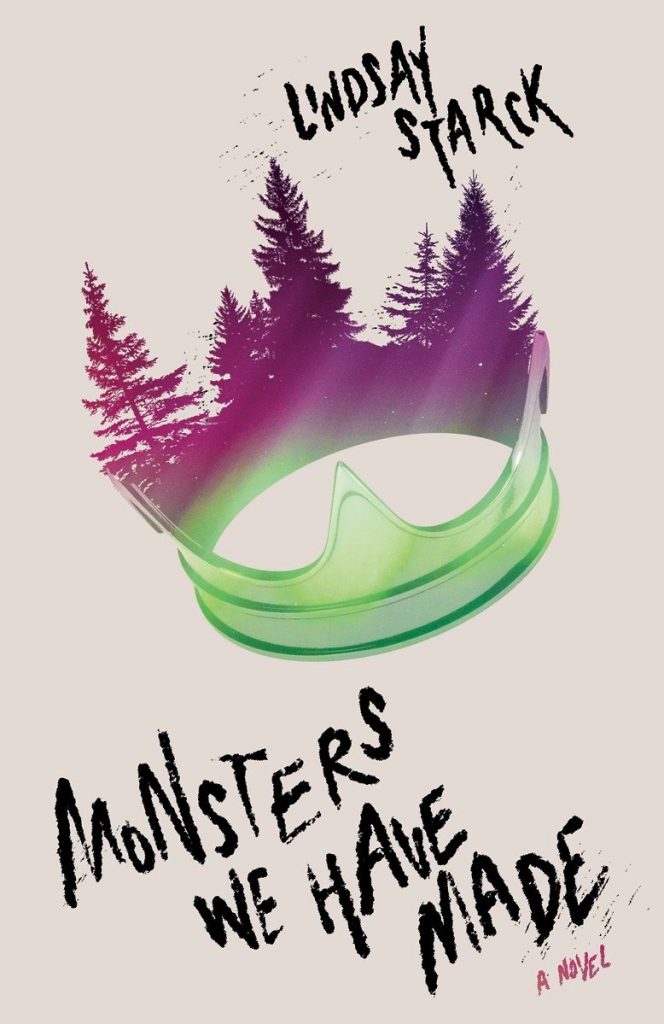
In my new novel, Monsters We Have Made, a dark and terrifying Internet legend inspires two young girls to commit a devastating crime. Thirteen years before the story opens, Sylvia’s nine-year-old daughter Faye attacked her babysitter in the name of the Kingman, a creature that she and her best friend discovered online. In the aftermath, Sylvia’s marriage, home, and family fell apart. Now Faye, recently released from a detention facility, has gone missing, and she’s left her four-year-old child behind.
As Sylvia hunts for the missing Faye, tracking her through unfamiliar cities and primeval forests, she is haunted by memories of the family she lost and by the monster who is growing ever more real to her. “In my peripheral vision,” she tells us, “I glimpsed quaking branches, cold white waves, stars colored brightly as jewels. Sometimes from my bedroom window: the crest of a black cloak coiling around the corner of the garage.” When she pages through old family photo albums, she sees the Kingman lurking just outside the frame; when she peers through the window, she sees a wooden face staring back at her.
“Sanity is a matter of borders: inside versus outside, truth versus dream, fact versus fiction,” Sylvia reflects. “How can a person tell, at any given hour, on any given sleepless night, what side of the line she is on?”
The books in this list are also concerned with those borders. What is real versus what is imagined? What is remembered and what is crafted? How do we know when to trust our perception, what do we do when our memories or our senses fail us, and what does “evidence” even mean in a world as slippery and shifting as we are?
“Scenes in a memoir,” Jill Ciment writes in her new book, “are no more accurate than reenactments on Forensic Files.” This claim is both startling and suitable for a new memoir (Consent) that revises a previous memoir (Half a Life) that Ciment wrote twenty-five years ago. The older narrator of Consent analyzes her younger self’s “memories” in Half a Life to illuminate how those memories were deliberately—sometimes creatively—crafted. In her first book, Ciment framed her relationship with an art teacher thirty years her senior as a choice she willingly made. In the second, she wonders whether it was ever possible for her seventeen-year-old self to willingly choose a married, middle-aged father of two. In a recent interview, Ciment described the first memoir as the product of the “shared mythology” that defines a relationship, and suggested that she didn’t tell the whole truth (even to herself) because she wanted the story of her marriage to be one in which she was empowered, not victimized. Her observation that “a memoir is closer to historical fiction than it is to biography” reminds us that our own memories, too, are crafted: polished, cut, exaggerated, shined.
Simultaneously a fictional biography and a counterfactual history, Biography of X follows narrator C. M. Lucca as she struggles to uncover and record the mysterious life of her recently-deceased wife, X. The trouble with X is that she was a performance artist whose entire life, we learn, was a series of performances—making it difficult for the grief-stricken Lucca to figure out which elements of their relationship were real. Lucca chooses to write X’s biography (expressly against X’s wishes) because she needs to be reassured “that our life had actually happened, that I had been there with her, and that I hadn’t imagined all those years, her company, our life, the home we had in each other—though I was forgetting her every day, forgetting whatever was between us and whom she’d been to me and who I’d been beside her.” With X gone, Lucca becomes the sole keeper of those memories; which means that she can no longer be certain of their veracity.
Ruth Ozeki’s A Tale for the Time Being, a novel concerned with the slippage between past and present, is filtered through protagonist Ruth, a writer unable to complete a memoir about her mother’s struggle with Alzheimer’s. When she finds the diary of a Japanese teenager, Nao, Ruth decides to track her down. As Ruth suffers increasingly from lapses in memory and dreams that bleed into reality, she becomes desperate for “corroboration from the outside world… that Nao and her diary were real and therefore traceable.” Over time, her own sense of self becomes uncertain: “Was she the dream? Was Nao the one writing her into being?… She’d never had any cause to doubt her senses. Her empirical sense of herself as a fully embodied being who persisted in a real world of her remembering seemed trustworthy enough, but now in the dark, at four in the morning, she wasn’t so sure.” Ruth’s uncertainty begs the question for readers, too: what evidence do we need in order to trust that what we have experienced is true?
I really love this strange, ethereal, fantastical, gem-like novel, which takes place in a magnificent, classical, sprawling mansion full of waves and statues. The protagonist, known to us as Piranesi, lives in “the House” alone and engages twice a week with a mysterious, irritable person we know only as “the Other.” When the book opens, Piranesi is content in his strange existence, unaware that anything might have come before it. But then he discovers that pages have been “violently removed” from his diary, and that other entries look like his handwriting even though he doesn’t remember writing them. When the Other informs Piranesi that he does, indeed, forget things, Piranesi’s initial shock gives way to disbelief. “‘The World’ (so far as I can tell) does not bear out the Other’s claim that there are gaps in my memory,” he muses. “And so I have to ask Myself: whose memory is at fault? Mine or his? Might he in fact be remembering conversations that never happened? Two memories. Two bright minds which remember past events differently. It is an awkward situation. There exists no third person to say which of us is correct.” Even without that third person, Piranesi’s new wariness of his own perception and experience leads him to conclude that the Other “is right about one thing. I am not as rational as I thought.”
At the heart of Valeria Luiselli’s Lost Children Archive are a boy and a girl traveling with their parents toward the Mexican border in Arizona. Their parents are sound documentarians working on different projects: their mother on the children’s immigration crisis at the border (a story that has been ignored) and their father on the last Apache leaders on the American continent (a story that has been erased). “The story I need to tell,” reflects the mother, “is the one of the children who are missing, those whose voices can no longer be heard because they are, possibly forever, lost. Perhaps, like my husband, I’m also chasing ghosts and echoes. Except mine are in history books, and not in cemeteries.” In the backseat of the car, the boy and girl play at being lost children, too; and when they finally take off alone, their game becomes real. The novel deals with the erasure of historical memory, the creation of familial memory, and the lengths we go to in order to prove to ourselves and each other that something happened. “When you get older,” the boy informs the girl, “and tell other people our story, they’ll tell you it’s not true, they’ll say it’s impossible, they won’t believe you. Don’t worry about them. Our story is true, and deep in your wild heart and in the whirls of your crazy curls, you will know it.”
One of my favorite novels to teach, Tim O’Brien’s In the Lake of the Woods is a vivid, sylvan thriller whose experiments with form and style contribute to its mystery. Centered on the disappearance of Kathy Wade—the wife of a Vietnam veteran-turned-politician John Wade—the book intersperses conventional narrative chapters with sections labeled “Evidence” (which consist of citations and interview fragments) and sections labeled “Hypothesis” (which describe all of the fates that could have befallen Kathy Wade). As the story progresses, John Wade struggles to remember what happened on the night she disappeared—but he has spent so many years deliberately forgetting what he saw and did in Vietnam that his memory is dangerous and unreliable. Although the “missing person” in the novel is ostensibly Kathy, John’s failure to remember what he did or didn’t do to her shatters any sense of a coherent self and transforms him into a type of missing person, too.
Minor Detail by Adania Shibli, translated by Elisabeth Jacquette
Adania Shibli’s slim and devastating Minor Detail is less about the erasure of the self and more about the disorienting experience of moving through a once-familiar, beloved landscape that is in the process of being erased. The first half of the novella depicts, in spare prose and unflinching detail, the rape and murder of a Bedouin woman by Israeli soldiers in Palestine in 1949. In the second half, an unnamed narrator in Ramalla undertakes a dangerous journey across borders and through checkpoints in order to learn more about the crime. The evidence she seeks is the kind of minor detail “like dust on the desk or fly shit on a painting, as the only way to arrive at the truth and definitive proof of its existence.” But no one she meets can tell her anything about the crime; and the further she travels into an occupied land from which all traces of Palestinian villages have been erased, the more disoriented she becomes. In a space in which the unimaginable—rape, murder, the bombing of the office building next door to hers—is so unrelenting as to become mundane, one’s very existence begins to feel surreal, unlikely, and nightmarish.
“The literature of adoption,” writes Shannon Gibney, “is a fictional genre in itself.” In The Girl I Am, Was, and Never Will Be, Gibney leans into this argument by weaving together her own actual adoption story (including documents and photographs) and the story of what might have happened if she had remained with her birth mother. By intentionally combining memoir with speculative fiction, the book illuminates the multiple pathways that exist between the past and the present. Gibney’s fictionalization of memory liberates the narrator from the impossible project of perfectly reconstructing the past, provides her a new angle on the present, and reminds us that the boundaries between inside and outside, truth and dream, fact and fiction are much more permeable than they appear.
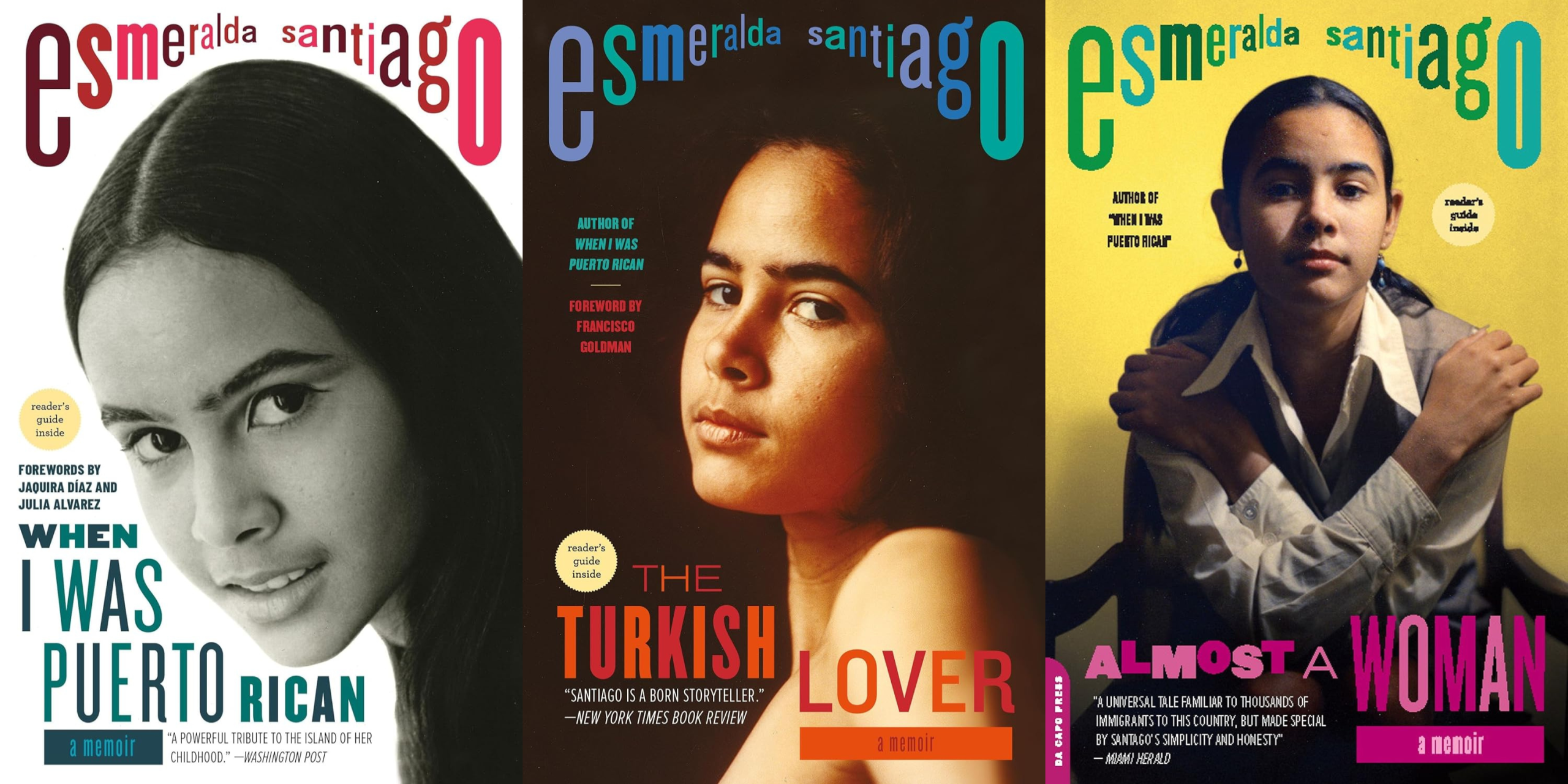
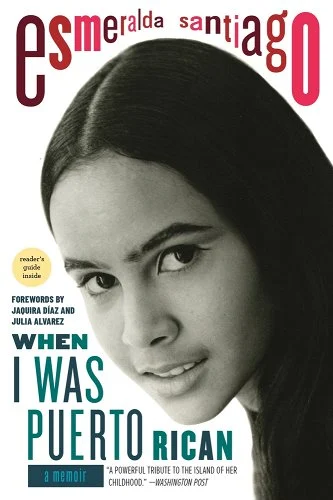
Esmeralda Santiago’s book When I Was Puerto Rican debuted 30 years ago. This memoir introduced us to Negi (Santiago), a pre-teen with a captivating voice who chronicles her life in rural Puerto Rico in the 1950s. In Santiago’s own words, the memoir captures a world that no longer exists in Puerto Rico.
We watch Negi grow from four years old to becoming a teenager, from living in rural Puerto Rico to living in Brooklyn, and from helping rear her younger siblings to having to take on the responsibility of learning English. We watch the dissolution of her parents’ relationship, constant dislocation, and how the United States transgresses into their lives by innocuous means like a nutrition guide and by a nasty concoction of powder milk and peanut butter. But we also see Negi’s curiosity, her incessant questions to her poet father, her defiance, her love of storytelling, and how Negi and her family survive. They keep going, and this memoir ends with a fairy tale ending, which is what any reader would want for Negi after reading this endearing and enduring memoir.
I interviewed Santiago via Zoom. Our conversation took frequent diversions which gave us insight into the world of working-class people in New York in the ‘60s; her ordinary, but extraordinary, mother; and how as we grow, we learn to forgive our parents and all the uprootings we may have suffered.
Ivelisse Rodriguez: All three of your memoirs, When I Was Puerto Rican, Almost a Woman, and The Turkish Lover,are being reissued, along with audio versions in English and Spanish narrated by you. What does it mean to you as a writer to have written books that have had such longevity to the extent that 30th anniversary editions are being published?
Esmeralda Santiago: I was thrilled to hear that the book has been in print for 30 years and being taught in schools across the United States and in some foreign countries. We often think our lives are so singular. But in many ways, there are so many points of connection between us and other people who are completely unlike us. This is what I love about memoir—you can write about your experience in rural Puerto Rico in the 1950s, and somebody in Moscow can get something out of it. It’s fantastic.
IR: What was the impetus to write your memoirs?
ES: I started writing from a place where I felt invisible in the United States. I had a child, and I was worried that my child would not know anything about his mother. We lived in suburban Massachusetts, and I was pretty sure I was the only Puerto Rican in this town. So I began to write because I didn’t want to forget the experience of how I grew up, and I wanted to pass it on to my children, so that they knew about it, even though they were going to have a very, very different life from the one that I had.
I started writing from a place where I felt invisible in the United States.
Also, when I was in Brooklyn, I found myself learning about the United States by reading the literature that I came across. But then at a certain point, I realized, wait a second, I’m not in this culture. None of the books are about me. And that’s when my need to write about people awakened, so that I would not be the only one going through this experience.
And when I was about 16 or 17 years old, the famous, wonderful poet, writer, essayist Langston Hughes came to my high school. He came to do a presentation about his book and to talk about being a writer. And I just remember he was just so very handsome, he was dressed beautifully, and he was this Black man with such dignity, and a beautiful voice, and he talked about his writing and about how he hadn’t seen himself in literature either.
IR: Oh my God, that’s amazing that you got to meet Langston Hughes!
ES: It was just sheer luck that on that day, I didn’t have to take my mother to welfare, or I wasn’t sick, or something. I happened to be there when this man was there with an important message for all of us. This message of writing yourself into the literature really, really stuck with me to the point where when I met people who were at his presentation, they don’t remember that event until I remind them. It was like he came from this place in Harlem to talk to me, who could barely understand English. But I literally went from school to the library and took a stack of all his books that I could find and read them all. He showed me the way to write about myself in literature, and I am forever grateful to him and to that event and to whoever organized it.
IR: Though there were hardships in your childhood, one of the things that always stood out to me about your book is how endearing it is, and how lovingly you recreate your childhood in Puerto Rico. How do you, as a writer, hold the hardships of the past alongside the love for the past?
ES: I decided to not write it from the perspective of an adult because an adult makes all kinds of assumptions about the past; we visit the past in a way that’s more comfortable for us. So, I decided I was just going to try and inhabit the child at that stage and detail what that child would have experienced and would have noticed at that age. And so, by doing that, it made it possible for me to really tell a story rather than trying to make sense of the past or turn the writing into therapy. By limiting the point of view to the child, I thought the reader would have a much more immediate connection to the experience.
IR: I was wondering about the courage to represent your mother as you saw her when you were young. She was doling out cocotazos and frequently fighting with your father. At first, she seems angry, but as we keep reading, we see what she was going through.
ES: In When I Was Puerto Rican, I just didn’t want to add the knowledge that I now have as an adult to this child’s head. As a child, all you know is what you’re seeing. For example, as a child, I didn’t have any idea about infidelity. My mother just said your dad is with other women. As a child, you can’t even envision what that means, but obviously it’s a bad thing. If you read my other memoirs, the character of Esmeralda continues to mature intellectually, so she’s better able to make those kinds of connections later on. It requires experience in life for you to understand those kinds of things.
Plus, I didn’t want to subject my parents to psychologizing. It was a literary decision that made it possible for me to avoid playing Dr. Freud.
IR: How did your mother react to the book?
ES: At some of my events, my mother would answer that question by saying, “You know, everybody talks about this book as if this is about Esmeralda, but this book is about me.” So, she understood that she was the hero in this book. Even though I’m the main protagonist, she really is the person who makes things happen for the character. And then my dad said he loved being the villain in this book.
This story was about people like us: jíbaros.
The rest of my family has been like her. They’ve been very, very supportive, encouraging and generous about not challenging any of the things that I’ve said because they all understand this is the way I saw things, even though they might have had a different experience. I’m the eldest of 11, so we all say that we each had a different mother. The more experience she had as a mother, the more she learned and became a different person.
My mother also thought it was great that this story was about people like us: jíbaros. I think my parents really understood that I picked up on something that had not been done in literature. There really wasn’t a lot of writing about the jíbaros from the perspective of the jíbaros. The books that existed about that community were written by people from places like Barcelona. They did not live that life, but I lived it. So, I wrote When I Was Puerto Rican from the perspective of a jíbara. And my mother really appreciated that. She said my book really sounds like the way it was. My parents were both smart people, and they liked reading, and they liked seeing themselves in literature.
IR: That’s an excellent point about the jíbaro experience and who was writing about it. I am glad you pointed out that this was a gap you were filling in literature by Puerto Ricans. Also, it is interesting to see how you come to understand yourself as a jíbara. Early in the text, when you’re living in Macún, you wonder what a jíbaro is, and you are told these people who live in the countryside with all there mores are nothing to aspire to. But when you moved to Santurce, you were called a jíbara, so you had to see yourself in a new way.
This is the beginning of a series of rejections and becomings that you had to endure for the rest of your life. How did this help you transition to living in Brooklyn?
ES: Well, I think when you live in chaos, you get used to living in chaos. You find ways to deal with the chaos around, for example, the chaos of being in one-room apartments with eight, nine, ten, 12, 15 people. I can’t control that. That was all we could afford. I really understood that. I was very empathetic to my mother’s struggles. In fact, at a very early age, even though I was angry at her for bringing me to New York, and not going back to Puerto Rico immediately when Raymond was fine about a year later, I really understood that a lot of what was happening around us was outside of our control, my mother’s too. I remember she would work in a sweatshop for a week, and on Friday when she got to work, it would be closed because they didn’t want to pay the workers. This happened to her all the time, to the point that she then only worked in the sweatshops where they would pay at the end of the day. She learned how to fight for herself. She had to make these transitions as well.
We were all going through these transitions: learning language, getting used to the climate, and more. All those kinds of challenges were happening to all of us at the same time. But of course, my mother had the biggest responsibility because she had all these children.
IR: One of those challenges was learning English, and this led to a fight with your mother when you came home late from the library. She accused you of thinking you could do whatever you wanted because you spoke English. In what ways did learning how to speak English give you freedom to develop a self?
ES: My mother really just drilled it into me that I had to learn English when we came to the United States because, first of all, she needed a translator. I was the eldest, and I was the most willing because I was always reading. I had to learn it fast because she couldn’t do it. And no one in our immediate family was remotely bilingual. So, I knew that this was my task. I had to learn it quickly, and I had to learn it well enough to be able to help my mom because that was the only way that I could as a little kid. I didn’t resent it. In fact, I thought it was great. I love learning. I came to the United States in 8th grade. By the time I graduated, I entered grade nine, and I was reading at a 10th grade level in English. But I couldn’t pronounce things. I couldn’t speak it. I mean, I could have, but I would have mispronounced everything. So I was very silent and quiet the first two or three years that I was in school, but I aced all my exams. I realized then that that gave me power. When translating for my mom, for example, I realized I couldn’t mess up the translation of application forms or mess up translating for a kid who’s convulsing.
The culture was harder for me. I was a teenager who wanted to be like every other girl. And, according to my mother, I was not like any other teenager because I was Puerto Rican.
IR: In Nicholsa Mohr’s Nilda, another classic book written by a Puerto Rican woman about girlhood, Nilda’s mother is giving Nilda consejos on her death bed. Among the advice the mom gives is that she warns Nilda that men will leave her with a bunch of children, and then she will have to go on welfare. This is, at times, what happens to your mother. Nilda’s mom continues with her advice and tells Nilda to always keep something for herself that is all hers and that if she cannot see beyond being a mother, then life was not worth it. What do you think are the things that your mother kept for herself that brought her joy?
ES: First, I think my mother really kept a lot of stuff from us. A lot. And I don’t know just how much. Maybe I know 4.5% of what she went through from the interviews that I did with her. And even that information was absolutely horrific to me. I know that I will never know what all her sacrifices were.
But in terms of what brought her joy, she was a child of the depression, so she just loved feeding the people she loved and making sure that they were nourished. She loved dancing. She loved music. She wasn’t a swimmer, but she liked going to the beach just to feel the salt air. She loved dressing nicely. When you’re raised very poor, you have longings for certain things. When my siblings and I all had jobs and could make money, we gave her gifts that would bring her joy.
She was somebody who was full of joy in many ways in the midst of chaos, tragedy, hard work, and humiliations. She always found a way to smile and to find joy in something. And I think she passed that on to all of her children.
IR: That’s really heartwarming—that you were able to participate in giving her that joy.
In When I was Puerto Rican, before you get to Brooklyn, you write that you did not forgive the uprooting. At this stage in your life, have you forgiven the uprooting of coming to the continental U.S.?
ES: Yeah, I guess I have. I’m not a person for regrets. As a child, I was very angry for years because I didn’t understand what had happened. Nobody explains it to you when parents break up. And then many, many years later, as I matured, as I learned, and as I knew my parents better, I understood that they really did the best that they could with what they had. Once I understood that adults do things for reasons that children cannot understand until they’re adults, then it was really easy for me to forgive.
In Puerto Rico, the doctors were ready to amputate my brother Raymond’s foot. My grandmother and all of my mother’s aunts and uncles were in New York, so they encouraged her to get a second opinion in the United States. And, the doctors in the U.S. said they could save his foot. She came back to Puerto Rico, and she asked my dad if he would go with us. My father and his family were very independence-minded, anti-imperialism, and anti-colonialism. So he refused. My mother was forced to make a choice between her children or her man. Even though they were always fighting, they really did love each other. She had to make that decision, and she chose her children. She knew that she would have to move to New York, at least for a year or two, in order to make sure that Raymond was completely well. I think once she was here, she realized, it’s equally hard here, but I have more help here. Seven years later, she did go back to Puerto Rico with all the kids that were left. And it was just me and Elsa who were in the United States. We were both studying, so we didn’t want to go back at the time.
Both my parents have passed, and I think they should be and must be very proud of the children that they had because we are two or three steps economically from where they were at their best. That was something that they wanted for us. They wanted us not to struggle quite so much. We still struggle, but the struggles are different. We live in nicer neighborhoods than we did when we were growing up. So, all their sacrifices, dreams, and aspirations did come about. I’m very proud of the work that my parents did with us.
Since its birth, Frankenstein has never lost its allure in adaptive possibilities. The novel was first adapted to the stage by Richard Brinsley Peake in 1823, just five years after the first edition of the novel was published in 1818. It’s widely known that Shelley herself attended a performance and was bemused by how he brought her masterpiece to life, even though she found it “not well managed.” Peake strips the Creature of voice and contributes the line, It lives!. The most contemporary image we have of the Creature is, of course, born of James Whale’s interpretation (I use that word loosely, as he renders the Creature nowhere close to what Shelley penned onto page) and Boris Karloff’s embodiment in Universal’s 1931 Frankenstein. It’s in this film we inherit, for all of eternity it seems, the bolts in the Creature’s neck. The voicelessness remains intact, continuing to refuse the eloquence of Shelley’s thoughtful abandoned creation.
Although I’ve engaged with Frankenstein textually for twenty years, culminating in my most recently published queer Asian Frankenstein retelling, Unwieldy Creatures, my first adaptation, Victor Frankenstein, was for the stage, a contemporary ballet dance theater adaptation I co-created with choreographer Dominic Walsh. Our adaptation didn’t just tell the story of Victor and the Creature, but also Shelley and Percy, her mother Mary Wollstonecraft, and how those relationships and losses informed her greatest work. Certainly there’s something the page can affect in a retelling that becomes more complicated in the embodied visualization on screen or stage, which must contend with how to successfully enact it, with limited funding, and with reliance on what the performer, design, or technological tool, can achieve. The reading experience is such an individualized act, and it doesn’t need to consider the flashiness of the gimmick, or the audience expectation of the spark. Our Victor Frankenstein received one review, by a reviewer who felt that whatever he wanted from a Frankenstein dance theater production, we didn’t quite deliver it.
As technological and reproductive advances open up questions around science, creation, and “nature,” Frankenstein continues to be a thriving laboratory for contemporary filmmakers. This past year, I encountered four different contemporary American films inspired by Frankenstein. I found myself considering the failure of these adaptations, a conclusion I’ve come to more often than its reverse, especially when helmed by white creators. It’s strange, isn’t it, to feel so protective over how a text is adapted by white creators, when it, itself, was brought into the world by one? Perhaps the difficulty of the Frankenstein adaptation is what also made my beloved so resonant as to stay attached to me through my entire life.
I co-created Victor Frankenstein early in my understanding of the role race, and whiteness, can perform on stage or screen, particularly when thinking of the power of the other as inflicted onto the Creature.
But in considering two of the four adaptations I saw this year, Poor Things and Birth/Rebirth, I was left wondering: Is a Creator ever able to see their Creation beyond their own biased need of greatness? Is it possible for a Creator to become both Creator and Creature all at once? When whiteness takes the wheel, how does the Creature (within the film as well as the film itself) suffer?
I first fell in love with Frankenstein at 19, the same age Shelley was when she penned my beloved into being. I was a young biracial Asian queer femme twin who’d just escaped the clutches of my dominant, narcissistic father—a Taiwanese NASA engineer by day who performed in Mandarin dramas by nights and on weekends—and an abandoning white mother who had just fled the state. It was the late 1990s, a time during which being biracial was stigmatized and made alien. If I wasn’t being exoticized—the mixed ones are always hotter, Asian women are tighter, you should meet my friend, he has yellow fever, “me love you long time”—I was asked what are you? No matter what answer I gave, I always felt creature, monstrous. It wasn’t an unfamiliar sensation, as I’d been treated like a specimen, a phenomenon, the uncanny, growing up as a mirror twin. Whatever fetishized experience I was forced to hold as a mixed race Asian teenage girl was doubled as one of twin mixed race Asian teenage girls. My relationship to my own identity apart from my twin was tenuous at best, a result of having an emotionally unstable and physically distant mother, a dominant and physically abusive father. We were kept from our American peers, surrounded by my father’s Taiwanese friends without any access to the language, sitting silently while we were ogled and referred to in a language we couldn’t understand. Beautiful and eerie, the world frightening yet familiar. Out of her own insecurity at her ability to be present with us as well as herself, my mother couldn’t get far enough away from us, or also became complicit in our exoticization—like the time she wanted us to audition in Miss Saigon at sixteen. My father’s unprocessed trauma with his own parents, complicated by having married and divorced a woman who saddled him with caring solely for children in a new country with no family support, was turned on us, raging when we made clear we were visible, independent bodies in the world, not merely there to support his own ego.
I’d been treated like a specimen, a phenomenon, the uncanny, growing up as a mirror twin.
From all of this confusion and pain, I met Frankenstein. It was through Frankenstein I learned about the narcissism of my father. I recognized the abandonment of my mother through the grief Victor experiences at his mother’s death. I navigated the duality with my twin as Victor and his creation orbited one another, as well as our complicated enmeshment that compels Victor towards and away from Elizabeth. It was in listening to the Creature’s literacy narrative I encountered a being who came to understand the world as I did—while watching my father enjoy his Mandarin-infused life to which I was relegated to the sidelines—watching and eavesdropping on others inhabiting a world he could not claim. Through the Creature’s heartbreaking plea for a companion I understood my own need to be connected to others on my own terms. As the Creature sang his devastating aria of rejection I, too, came to understand my own internalized monstrousness as a biracial person of color, a fetishized twin, seen only through the lens of others, rather than myself.
I knew nothing about Poor Things when I went to see it during the holidays. Multiple friends urged me to see it because it’s so Frankenstein. I should have been more discerning, as I’ve come to understand there is the stan whose fandom is excited by any interaction with the source of their fandom, and then there is me, who wants only the best for their beloved.
Poor Things is considered a feminist masterpiece and a journey of a woman’s female empowerment, through a fixed male gaze. It’s been disappointing how many in my community believe it is possible to create any story of female empowerment within that gaze. Is the wager still, even now, the same? If the gaze on women is composed from the eyes of men, then what is their empowerment made of?
Poor Things is a film helmed entirely by white men. Directed by Yorgos Lanthimos, the screenplay is written by Tony McNamara, based on a novel of the same name by Alasdair Gray. At its heart, the film uses the science of Frankenstein and the magic of scientific acceleration to depict a pedophilic fantasy. This embodiment is made ever more troubling given the long history of predation established between young girls and women in Hollywood and older, more powerful men who have groomed them with the promise of career and safety. This embodiment is made ever more troubling given that the central plot device that allows for this fantasy wasn’t literalized in the original novel.
If the gaze on women is composed from the eyes of men, then what is their empowerment made of?
Cinematically speaking, the film is stunning, in art direction and costuming, another trick of the hand to groom the watcher into a dopamine-fueled trance. This is also one of the ways we fall for Victorian dramas—the ruffles, the waistcoats, the coaches, the lavish countryside. We don’t question why there’s only one Black character who lasts just long enough to give our white protagonist some much needed wisdom and a check from her clueless position of privilege, because, hey, it’s the 1800s, only white people existed then! We don’t question why the heads of science are all white men. But regardless, no matter how critically aware a viewer might think they are, the conditioning of this sparkling white fantasy is still doing its part.
This is another way to make note of why Frankenstein adaptations so often fail—they focus more on the look of the thing, the science fiction of the dead body parts being brought to life, the technological magic to cinematically animate death, and less on how Frankenstein gives us the opportunity to reflect on what our creations say about our narcissistic exposures, how hidden our griefs on being rejected by those who create us.
Poor Things reminds me of a lacquered violet plum, the shade glistens as if shot in technicolor, yet when you take a bite, the rot overwhelms the brain to horrid confusion.
Bella is a woman-child. Her father, the medical scientist God (short for Godwin, its namesake Shelley’s own family and maiden name) resurrected her shortly after she drowned herself in the river while pregnant—by replacing her dead brain with that of her unborn child.
God’s father put science and progress over his safety and wellbeing by experimenting on his body in cruel and perturbing ways, such as taking out his oxyntic and pyloric juices so that he must use a contraption to make his own gastric juices (in order to discover that we need them ideally), pinned his thumbs into a small iron case to see whether he could retard the growth cycle of bones, and branded his genitals with hot irons. This is one of the first failures of this Frankenstein—using the white male lens to frame our white God as victim. Our God hires a young assistant, Max, to record his experiment Bella’s progress, who is progressing at an accelerated pace. Bella is a child in a woman’s body, waddling and speaking like a toddler, spitting out food she finds unpleasant, throwing tantrums when she doesn’t get her way, smashing dishes and important medical jars of equipment on the floor, and playing with the penis of a cadaver in God’s laboratory while stabbing its eyes out.
Max begins to fall in love with his subject. As Bella progresses, she becomes more independent and obstinate. She also begins to connect with sexual pleasure, but in her childlike state has no understanding of the complexities of desire and sexual connection.
The novel still refuses a story in which Bella speaks for herself, but at least she is a consenting adult.
Poor Things is supposedly about Bella’s journey—but one which largely depicts her insatiable sexual need as that of a horny fourteen-year-old boy, a need gratified either by men whose only desire is to control her, or clients for whom she provides a need and service as a sex worker, the only employment Bella is offered. Sexual consent is impossible because she has the (albeit rapidly-progressing) brain of her infant child, a brain that, since Bella does not age considerably throughout the film, cannot have developed that extensively. Because we are seeing her through the guise of an actual adult, played by Emma Stone, it is easy to forget Bella is not a woman, but a child with an adult body. If one possibly imagines she is consenting to her position as a sex worker, one need only be reminded that when she asks her supervisor why the sex workers are not allowed to choose their clients (their clients are the ones who get to choose), her supervisor responds, Some men enjoy that you do not like it.
In the original novel, Bella doesn’t have a child’s brain. It is a lie her husband tells to excuse her independent and free-spirited nature. The novel still refuses a story in which Bella speaks for herself, but at least she is a consenting adult.
As a Frankenstein, a novel that addresses what it means when the thing you’ve created is a monster in your eyes, Bella is called a monster, a word flung at her synonymously with the word whore, one she claims herself, but only because it is thrown at her by men who seek to control and possess her. How noble is the young scientist Max who agrees to wed her even knowing she is a whore, who sees her as both specimen he was hired to study, as well as the object of his affections? How predictable is it that this film, made by three white men, is unable to provide what Shelley gives her Creature: an opportunity for us to see Bella, and her world, from her own point of view?
What makes my beloved so unique, so resonant, for so many of us is that we do not see Frankenstein’s Creature through Frankenstein’s eyes as much as we see him through his own. Aside from three moments—when the Creature comes to life, when he approaches Frankenstein to ask for a companion, and upon seeing Frankenstein’s dead body—we become most acquainted with the Creature through his own words, his own experience. It matters that the most significant and substantial origin story we’re offered is not that of the scientist about his deep feeling of failure but of a Creature who seeks companionship and love, for his existence to be acknowledged. We learn what makes him monstrous—when Felix DeLacey comes upon the Creature attempting to befriend his blind father and misunderstands that the Creature’s hideous form does not translate to his spirit, which sets off an internalization of the world’s monstrous view of him so that he begins to exact a strategic system of revenge against his creator who has abandoned him—not through the point of view of Victor or even of Felix but himself.
In Poor Things, it is the Creator whose origin story of abuse is most centered, and it is the Creator and the Creator’s Assistant who we must witness in their grief of being abandoned by their child-woman experiment, left to sit in their loneliness and despair that their aims to control and study her have failed. Since the film is told through the eyes of men, Bella is never truly freed from their lens, never truly empowered to understand the world from her own eyes, and so neither are we.
Because we never leave the gaze of the Creator—both the men who have made the film as well as the Creators within the film’s narrative—we never see Bella outside of the object/monster/whore construction they have placed on her. After all, it is when Shelley’s Creature gets to speak, when we see the Creation from his own point of view, rather than he who has made and rejected him, that we understand.
How do we balance the cinematic titillation of the Frankenstein gimmick with the complexity of Shelley’s exchange around the maker and the made? How do we build a woman-child into a Creature without reducing her to a monstrous trope?
In 2019, I wrote Unwieldy Creatures, my queer non-binary Asian retelling of Frankenstein, because I wanted a queer POC-centered Frankenstein to exist in American fiction that explored my beloved in all the ways I most sought to find in the world.
IVF was on the rise and Georgia was beginning to restrict abortion.
IVF was on the rise and Georgia was beginning to restrict abortion. From the time I began therapy and came to terms with the toxic narcissism of my father and subsequently of so many people I would involve myself with in the mid-2000s up to that point, the word narcissist no longer held much meaning. We were having more thoughtful dialogue around how to write and publish stories by minoritized and marginalized writers that allowed for a complex range of characters, no longer relegated to caricatures of villainry or tragic sainthood. Since narcissism was almost exclusively considered the domain of men, I wanted to see what would happen if I created a Frankenstein who was a queer woman of color. How would it change the framework through which we see and understand our creator? How would the difference in power dynamic change their relationship if it were Ezra who now sought for Frankenstein’s wedding promise, instead of Elizabeth? If we made explicitly queer what many readers felt was a queer coded relationship between Victor and his dear friend Henry, what else would shift in its place? Finally, if the Creature, who has never been welcomed to participate in civilized society, was not assumed male (for isn’t it the case we accept, reject, and disrupt codes of gender because we are conditioned to live within these codes?), how would that change the way we view them? These were some of the larger ideological shifts I wanted to explore in a modern-day Frankenstein. I wanted to stitch together the heart of my beloved with my own blood, and see what would happen when I infused them with electricity.
Frankenstein is not really a horror film. It’s also not exactly science fiction, despite the fact that it’s often lauded as the first science fiction novel of the (Western) world. I have always seen Frankenstein as a film that addresses some of the most essential and complex ideas of humanity. In the capitalist mindfuck of 2024, I’m dying for a Frankenstein that addresses the ways we as marginalized bodies are used for the dominant structure’s egoist enterprise, the ways masculinity and power work hand in hand to disempower and abandon those most vulnerable. If filmmakers could mine all that Shelley gave us, we’re primed for a truly harrowing, complicated, and beautiful cinematic creation that takes into consideration that the point is not the stitching from dead body parts, the animation of electricity, the mad scientist. The point is not the Creature uncanny and awkward in their movements, soulless and cruel, seen only through the eyes of humans viewing a creature as experiment and progress. But in order to make such a creation, one needs to let go of the horror trope that has saddled Frankenstein’s Creature since the 1931 adaptation—the bolts in its head, the zombie walk, the non-verbal vocalizations. One needs to let go of the fixation on reanimation, electricity, it’s alive! One needs to let go of the film adaptation of Frankenstein as a cheap thrill, and instead consider how we might, as Frankenstein never could, see our Creature as multi-dimensional, rather than only through the eyes of voyeurism and commodification.
Just like Poor Things, the film Birth/Rebirth isn’t a Frankenstein stitched together with random dead body parts, but unlike Poor Things, Birth/Rebirth offers us a feminist lens. Shelley’s Frankenstein is a story of (white) men told by a (white) woman, during which all the women die. Poor Things is a story of a (white) woman told by (white) men (and does it hurt). Birth/Rebirth is a story of a white pathologist, a Black nurse, and her dead child, told by a (white) woman.
Shelley’s Frankenstein is a story of (white) men told by a (white) woman, during which all the women die.
In Birth/Rebirth, two women unexpectedly join forces through their separate experiences with loss. Rose, a white pathologist, has been working on bringing the dead back to life using fetal tissue. She resembles our Victor more than most modern-day Frankensteins—emotionless and obsessive, seeking solitude over connection, torn between solving the problem of her mother’s death and her own egoist need for advancement. She becomes entangled with Celie, an Afro-Latinx maternity nurse who works at Rose’s hospital, when Lila, Celie’s eight-year-old daughter, dies from bacterial meningitis. Rose steals Lila’s body to attempt to revive it through her own scientific discoveries. When Celie discovers where Rose has kept her child, she’s so desperate to have Lila back she insists on helping bring her back to life. The pain that connects Rose and Celie is that of the grief tied to the loss of Rose’s mother and Celie’s daughter.
In Frankenstein, Victor’s mother dies as a result of caring for Elizabeth after she contracts scarlet fever. Young Elizabeth survives, but his mother does not. Struck with grief and a grandiosity for his own ability to surpass the innovations of the scientists of his time, Victor becomes obsessed with curing death by reanimating the collaged bodies of the dead back to life. It’s this narrative thread that is the ghostly trail ribboning the room where Rose and Celie both need the experiment to work.
Although more compassionately complex than Poor Things, the failure of this Frankenstein remains the same: Frankenstein works because the story itself is told from that of a marginalized Creature (Shelley as a woman in the 19th century), rather than a Victor. Rose’s inability to connect emotionally to herself or others keeps Lila a specimen in her eyes, just like God’s Bella Baxter. The director’s unwillingness to bring Lila, the Creature to life—what pressure Whale has put on all Frankensteins for all of time!—means we never get to witness Lila outside of the experiment.
But, in this case, gender is only part of the story.
When I’m interviewed about Unwieldy Creatures, I often say toxic white masculinity is the true villain. I also say we learn through the novel what happens when a person reflects and examines the traumas of their own life so as not to perpetuate that harm onto others, and what happens when they don’t. In the case of Unwieldy Creatures, our narrator Plum, who replaces Frankenstein’s Captain Walton, comes to terms with her Taiwanese father’s abuse and leaves behind the glimmers of scientific achievement when she realizes how harmful Dr. Frank’s role in her life is and will become. Dr. Frank, on the other hand, never truly considers the deep mark her white father’s toxicity has imbued in her skin and in her life, which causes her to make decisions against those she claims to love, in the name of her own egoist need for success. It is this lack of examination that causes her to not only sabotage the only love she’s ever known and who enables her to make her creature, but also becomes the reason she never acknowledges her creation, left isolated and alone.
Victor is never the murderer. It is through Victor’s refusal to acknowledge his Creation in any way, that causes the Creature to enact his revenge on all the people that matter to him. People do die, but Victor is safe in his position of privilege, having never laid a hand on anyone, but also having kept the danger of his creation in the world a secret.
Birth/Rebirth is directed by Laura Moss, a white female director, who also collaborated on the screenplay. Although whiteness is not directly indicted or addressed in the film—one could make a case that Celie’s Blackness is happenstance—whiteness does rear its ugly head.
In order to keep Lila alive long enough to become a fully realized human, Rose needs fetal tissue. Rose’s chooses Lila because they are, medically speaking, a perfect match, and Rose impregnates herself to acquire the fetal tissue needed to continue the experiment. Due to Celie’s connections as a maternity nurse, she’s tasked with stealing the necessary implements while Rose monitors Lila’s progress and injects her with her fetal tissue. Trouble abounds when Rose develops an infection causing her to miscarry, depriving them of the tissue needed to keep Lila alive. When they try to use Rose’s bone marrow, Lila loses the progress of her development—speech, motor skills, recognition of her favorite songs and television programs. Lila starts to share a likeness with our cultural image of Frankenstein’s monster—her language reduced to inarticulate sounds, soulless and violent, leading her to even kill Muriel, Rose’s pig and only successfully resurrected experiment, named after her mother.
Rose and Celie find another match, a pregnant patient at the hospital, but to acquire the needed tissue, Celie must perform an amniocentesis monthly until she delivers, after which they can steal the placenta, providing enough tissue to bring Lila fully back to life. When the patient changes hospitals (stripping Celie and Rose of access to her material) as a result of the repeated, dangerous, tests, Lila dies again—this time in Celie’s arms.
This turn, irresponsibly inflicted on Celie by this white gaze, inevitably changes the frame of the monster.
Under the guise of needing paperwork filled out, Celie visits the patient at her home, so that she can drug her, induce labor and steal her placenta. The patient unexpectedly seizures and dies. This sequence of events complicates the failure of Birth/Rebirth, but from a racialized lens, in which the only Black character in the film commits thievery, crime, harm, and murder to save her daughter, while Rose remains invisible, safe from scrutiny. The film ends just before Lila is brought back to life, hopefully for good. We never learn if their experiment succeeds, what will happen for Rose and Celie once the task has been achieved, or for Lila, knowing her birth is now burdened by death.
This turn, irresponsibly inflicted on Celie by this white gaze, inevitably changes the frame of the monster. Through this gaze, the film begs the question: Is Celie made monstrous for coercing the white patient into trusting her, when her only interest is to sacrifice her health and life and that of her baby to save her own? Because our Creature—whether that of Celie or young Lila—is never given the opportunity to tell her story, the bodysnatcher Rose, protected by the gaze of her own white female creator, remains untouched, the Frankenstein tipping in the balance.
Last week I began writing a stage adaptation of Unwieldy Creatures into being. As I consider these failures, I’m left sitting with my own failed stage adaptation, in which the Creators took centerstage. Although our Creature’s voice reverberated through voiceover of Shelley’s eloquence, his three-bodied presence clung to the Creator he wanted most to love him. Our story centered the tension of Shelley’s life—as a child who lost her mother, a wife entrenched in a turbulent marriage. I’m proud of our Victor Frankenstein as my first (collaborative) attempt at bringing these loves and ideas to life, my first opportunity to embark on fashioning a story in stage and movement, the beginning of the journey that would lead me to Unwieldy Creatures. But I recognize that I hadn’t yet come to an understanding of how to visualize the othering of the Creature, an undertaking more challenging than meets the eye.
What these Frankensteins, and by that I mean the Creators of these adaptations, miss in the act of imbuing their own Creatures with life is that it was never the physical fact of them that made them monstrous. It was in the Creator’s refusal to contend with his own egoistic failure that caused him to spurn his own creation. It was in that spurning that caused him to leash his own monstrousness onto their creatures, and in that act of abandonment, onto the world.
In contemporary American film, what monstrousness does that leash onto our world? What is the consequence of bringing to life a woman-child through the eyes of the men who make, desire, and study her? What is the consequence of bringing to life a Black child through the eyes of a white woman who protects the white Frankenstein and casts only the Black mother through acts of thievery, fraud, and white death? Without the counterbalance of the Creature’s tale of what his Creator’s narcissistic irresponsibility sets into motion, what lessons does it corroborate?
As for me and my love, I’ll hold out hope for a new Frankenstein, one stitched into being by an artist both Creator and Creature, yearning, just like Shelley’s Creature, to be seen as he was, rather than as he was projected upon.
What makes a beguiling bad guy? Or, heaven forbid, an enchantingly conniving woman? In recent fiction, who are the villains we love to hate or hate to love? What characteristics are we attracted to? Complexity? Seductiveness? Brilliance? Sheer cruelty? Who can stand up to the Shakespearean Iago or Dickens’s Uriah Heep?
What I’ve found in writing fictive villains like Tony Amato in my fourth novel, Beautiful Dreamers, is that they come in all shapes and sizes, as does the trauma they both derive from and strew in their paths. They can take center stage, bawling out their villainy or they can lurk in corners, pulling strings. They can have deep histories, or they can emerge out of the ether, the full-blown embodiment of Evil with a capital E. They can be representative or individual, physically beautiful or hideously ugly, manipulative or straightforward in their villainy. We like to think we’d be immune to their schemes and betrayals. What these recent novels tell us is that we aren’t, nor are we immune to becoming them. As Bram Stoker’s Count Dracula has shown us, the line between villain and victim can be razor thin.
The title says it all: the self-proclaimed artist Ray Hanrahan is the smarmiest, whiniest, most generally disagreeable narcissist you’ll ever meet. Readers may indeed peg him as more a pain in the neck than a villain, but he makes every attempt to wreck the lives of his wife, Lucia, who is the true artist in the family and who must mask her own professional aspirations so as not to anger him, and his three children, one of whom, his daughter Leah, caters to his every whim. Ray is the egoist par excellence; all attention and allegiance must go to him. In the beginning, I found the man so obnoxious that I almost couldn’t continue reading; I wanted to wring his neck and shout to his family, “Get out! Run for the hills.” (There is something so disgustingly patronizing about Ray’s relationships with the female members of his family that every demeaning manipulative comment, seems like patriarchy on steroids.) When Ray finally gets his big break after many years of lying fallow, the family is thrilled. (Perhaps now he will be appeased; perhaps now he will loosen his iron grip.) His wife plans a huge party after the opening. His estranged daughter Jess comes into town, not without trepidation and a fresh rush of anger. Ray refuses to let any of them see his new paintings, and the stage is set for his well-earned collapse.
The institution of American slavery is the true villain in this wrenching fourth novel of the two-time National Book Award winner. In this neoslave narrative, we follow Annis and other slaves as they are sold and driven south in a hellish journey that ends in New Orleans. The “lady,” as Annis calls her, doesn’t make an appearance until almost halfway through the novel when she buys Annis in the city slave market; When the lady questions her knowledge of mushrooms, fearful of being poisoned, Annis’s impossible choice is to lie and go with the woman (Annis does know mushrooms), or succumb to the sex trade in light-skinned young Black women. At first glance, her new mistress seems like the lesser of the two evils. As time goes on, though, “the lady” evolves into a grotesque monster. She inflicts the cruelest of punishments without cause or thought; she is oblivious to the suffering of others, from the slow starvation of the skeletal serving women in her household to doling out the ultimate punishment—sending slaves down into “the hole” for days without food or drink. “The lady” is the embodiment of evil. For her and for the institution she represents, villain is too small a word.
Billy Turner in Pederson’s debut novel is a cringe-worthy villain, an alcoholic who sexually abuses his 11-year-old daughter Sunshine when he gets drunk, which is often. But, like so many villains’ stories, Billy’s doesn’t emerge full-blown but is rather the result of multiple traumas that go back for generations. Set in the swampy community of Fingertip, Louisiana, Sunshine turns to a family myth of a young female figure who tames a voracious crocodile in nearby Black Bayou. It’s a story told to her father as a boy by a mother desperate to find her way out of a brutal marriage. This is a tangled web of intergenerational abuse, and Billy Turner is as much caught in it as his innocent daughter is. The novel raises the serious question of how stories might help victims and villains alike break free from intergenerational trauma.
Like Billy Turner, Angel Maso is as much victim as villain, as pathetic and tortured a serial killer as you’ll ever meet. When he’s first introduced, Angel is a self-proclaimed pacifist, shy and withdrawn; he has a pet groundhog named Frankie; he teaches poetry in the local high school and loves to garden. He doesn’t own a gun. What combination of factors would force a man like Angel to pick up an AR-15 and murder 55 people?For author Falco, this is not a rhetorical question; he was teaching at Virginia Tech in the spring of 2007 when 32 faculty and students were murdered and 23 injured in the nation’s deadliest mass shooting in modern U.S. history and remained so for nine years until the Orlando nightclub shooting. Set in a gun-toting mountain town in Georgia, the novel depicts Angel as a rejected ex-husband and the victim of a brutal father—a poetic soul who lives almost exclusively in his own head, conjuring a beautiful alter-ego named Shelly. When he gives up gardening, is fired from his job teaching poetry at the local high school, endures multiple provocations from a violent neighbor, including the shooting of his pet, and is denied timely mental health counseling, he snaps. The genius of this novel is that it leaves the reader with the nagging suspicion that, given the country’s gun culture and dearth of mental health counseling, this could happen to many American citizens.
Rash’s novel was published in 2008. I include it here because the title character seems starkly contemporary in her amorality, ambition, and greed. From the moment we meet her at the beginning of the Great Depression, Serena Pemberton is determined to slash and burn her way to a fortune, a female version of Faulkner’s Thomas Sutpen, who vows to do whatever necessary to erect an empire to his own giant ego, regardless of the human and environmental costs. Galloping through ancient Smoky Mountain wilderness with an eagle in tow, Serena uses and abuses the poorly paid company work force. She’s determined to extend the family fortune by using violence against those who advocate making the Smokies a national park. Childless herself, she plots to kill her husband’s illegitimate young son so that he doesn’t inherit the business. She later turns on her husband. There is nothing Serena won’t do to further her own goal, which is the accumulation of money. She’s manipulative, destructive, rapacious, vicious. And it isn’t just money she wants; it’s power. It’s hard to conjure a more destructive force.
Like Ward’s Let Us Descend,The Prophets is a neoslave narrative. But while Ward’s novel shines a light on the horrific disciplinary relationship between master and slave, Jones’s story is more complex. Operating under the umbrella of the oppressive master/slave relationship is Amos the betrayer. Like the young lovers Isaiah and Samuel, Amos is a slave. There are certainly white villains aplenty roaming Jones’s novel about life on a southern plantation called “Empty”: the slave master Paul, who is cold-blooded in his operation of the farm; his wife Ruth, who tries to seduce Samuel and has him punished when he doesn’t respond; their son Timothy, who forces (and obtains) sexual favors from Samuel. But Amos is a particular kind of villain; a preacher, he convinces himself and others that, counter to West African traditions, homosexuality is counter to a Christian god’s will. Amos’s betrayal of the lovers, after they resist the breeding project they are forced into, is best for the slave community as a whole, or so he convinces himself and others. While the results of this betrayal are horrifying, there’s a lifting at the close of this lyrical novel that owes much to Toni Morrison’s Beloved, with the intimation that the worst of villains and villainous institutions can never extinguish the human spirit.
In Haigh’s novel about an abortion clinic in Boston, the 60-plus-year-old retired trucker Victor Prine plots and plans behind the scenes. Like so many lost souls in American society, he’s a purveyor of misinformation from extremist right-wing radio and network “news.” He’s deluded himself into thinking that the end times are upon us and has stashed away multiple generators, arms, canned goods, and other supplies he deems vital in the emergency he perceives to be right around the corner. A white supremacist who considers white women to be “lazy” about reproducing, because, after all, that’s their role in society, he gnashes his teeth about the reproduction rates of women of color. On his website Excelsior 11, he creates a “Hall of Shame,” in which white women’s photographs are displayed as they walk into abortion clinics across the country. His plots and plans come to a final and disastrous (for him) culmination, and he becomes more pathetic than villainous.
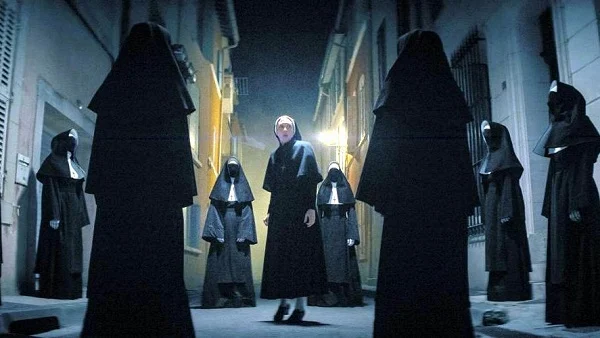
Claire Keegan’s 2021 internationalbestseller is a beautifully spare historical novel about Ireland’s mother-and-baby homes for “common” women and girls, pregnant out of wedlock, and the Magdalen laundries attached to them, which extracted unpaid labor from their victims, separating them from their children. Both were fatalities of this system, as recent gruesome discoveries of unmarked graves testify. It’s nearing Christmas in 1985when a humble coal merchant named Bill Furlong, father of five girls, makes a delivery only to find a bare-footed and thinly clad girl, a nursing mother named Sarah, locked up shivering in the convent coal shed. Thenuns, who are supported by the small-town community, including Furlong’s wife, Eileen,are a shadowy but formidable group, financed by both church and state. The villainy of the Magdalen nuns is felt in their effects on those in their care and in the smallest details: the “scrubbed” look of the girls, the way the rescued girl shakes and sobs in the Mother Superior’s presence, the padlocks on the gates. Another girl Furlong comes upon in the convent asks him to free her so that she may drown herself. There is implied threat in the smallest whisper, the slightest gesture. The effect is chilling and sinister. Keegan extends our sense of the nuns’ villainy in an afterword that outlines the story of the laundries.
Samuel Kọ́láwọlé’s The Road to the Salt Sea is a novel that examines trans-Saharan migration. The Nigerian author does not shy away from depicting violence and suffering on the page, but his account is one of empathy, tenderness, and humanity.
The novel opens with Able God attempting to escape from his country because of his involvement in a murder. Able God and Akudo, a sex worker and victim of abuse, murdered Dr. Badero in an act of self-defense at Hotel Atrium where Able God works an underpaid job despite being a university graduate. In desperation, Able God has no choice but to submit himself to Ben Ten, a swindler and human trafficker, whose ploy he had earlier rebuffed. Alongside Able God are Mofuru and Ghaddafi who, frustrated by the poverty and emptiness of their lives, are placing their hopes on being ferried to Italy where they could begin life again, begin living for the first time. But that promised life, through the desert and the sea, becomes a gift of death and dying, as the immigrants end up in Libya as prisoners of hope. The Road to the Salt Sea reveals what happens to people, a people, when they leave home in search of a future.
Darlington Chibueze Anuonye: Reading The Road to the Salt Sea made me think of Abdulrazak Gurnah’s remark that his novel Afterlives evolved from his deep interest in “the manner in which people retrieve their lives after trauma.” This is why Afterlives, indeed Gurnah’s works, embodies emotions that enable readers to empathize with even cruel characters. That sense of humane handling of violence manifests in your novel. I really want to know how you came to the decision to write this book.
Samuel Kọ́láwọlé: Before I get into my reasons for writing the novel, I’d like to address your insightful comment on the theme of violence in my novel. The discussion surrounding trauma and violence in African literature has always fascinated me. While I agree that there should be different representations of what is happening on the continent, as well as a diverse range of stories and voices, given the continent’s numerous difficulties, I find it disingenuous when critics attack a writer for simply serving as a mirror for society. That’s why terms like “poverty porn” or “trauma porn” bother me. Art does not exist in a vacuum, and artists live in a real world where people are confronted daily with violence and its consequences. Since violence is part of our collective experience and consciousness, shouldn’t it also be part of our art? I believe the legitimacy of writing about violence will not change, even if some people choose to disregard it, be unconcerned about it, or find it unpleasant. I also think it is an elitist element to the trauma porn school of thought. I love that you described my depiction of violence in my novel as “humane,” because there is a way to do it well. Violence should not be used simply for the sake of violence.
Many years ago, on a road trip through four nations, I came across a group of migrants who had made the arduous journey over the Sahara and had been deported. They told me stories that had stayed with me for years until I did something about them. I am glad this novel exists because the trans-Saharan migration crisis is not only underreported in the media, but more so in literature. The Road to the Salt Sea is a story of hope and resilience. I like that Gurnah is interested in “the manner in which people retrieve their lives after trauma.” I am also interested in moving on, even when people are not sure how to.
DCA: Thinking about Able God who survived the violence of that movement, but whose survival is marked by a disfigured sense of the world, I wonder: how is it possible to live again after so much loss of friends, family and the self?
Since violence is part of our collective experience and consciousness, shouldn’t it also be part of our art?
SK: I am interested in journeys, movements and crossroads and the toll traveling the road takes on travelers. Aside from the physical exhaustion commonly connected with traveling, there is the psychological one. So, this novel is my attempt to map out the “psychological wear and tear” of my characters as they proceed along the journey, some more noticeable than others. However, there is a sense that each of them is relying on something to keep them going and to alleviate the unpleasant impacts of the journey. For Ghadaffi, it’s his family, while for Morufu, it’s his aspirations to play football. At first, Able God is driven by fear and guilt, but his motivation gradually evolves into something more. He does things that he doesn’t even believe he is capable of. In the end, he bears the scars of a survivor which makes him even more determined, I think. The Road to the Salt Sea shows us that redemption is always possible. For Able, God the novel ends with the possibility of a new life, perhaps even a new family.
DCA: How come people like Ben Ten and Serge get away with the crimes they commit? We could say there was war in Libya at the time and that the country was stateless, but what of Nigeria, what kind of government remains ignorant of, or concerned about, such level of human abuse?
SK: The world, like in the novel, is full of villains like Ben Ten and Serge. They were called “vendors of misery” by one reviewer. They prey on unsuspecting victims, and in many ways, both big and small. Serge suffers the consequences of his crime in the story as some bad people do in real life. Ben Ten, however, fades from the story. We don’t know what happened to him, but it’s safe to presume that his criminal activities will continue unabated. This illustrates the other side of the coin as well: some people can get away with doing terrible things.
The Road to the Salt Sea is set some years after U.S./NATO’s violent intervention in Libya and the assassination of Muammar Gaddafi. Libya has become ungovernable and fractured since Gaddafi’s ouster, now ruled by warring factions and regional militia groups. Remember that Libya is the most perilous nation on the route to Europe. Nigeria and Libya are two nations plagued by political crises. The Nigerian government cares nothing about its citizens, except for the elites, and fosters ineptitude and corruption. Conditions are sometimes so dire for people that they believe their only alternative is to escape.
DCA: What has Nigeria done to make its citizens so desirous of escaping the nation so much that Mofuru and Ghaddafi saw a messiah in Ben Ten? Even in the Sahara, the immigrants chanced upon a decaying corpse beside whom a Nigerian passport was buried. Yet, the journey continued. But this is even beyond Nigeria. The number of passengers from other African countries that joined the trip on the way is heartbreaking. Your narrator offers some hints on why these characters were determined to escape their homes. War, economic hardship and political crises recurred frequently and loudly. But there’s even the strange example of Billy who believed he was “born in a body with the wrong nationality—he was born Senegalese, but he had always known he was French.” Isn’t it terrifyingly sad how the failure of a continent leaves its people vulnerable in the world?
Can our decisions influence our outcomes in life, or is there nothing an individual can do throughout their mortal life to change their fate?
SK: Absolutely. The continent’s numerous problems often inspire a certain kind of desperation among individuals, particularly the youth. There is also the idea that anything Western is better because of a deeply embedded colonial mindset. Since the 1990s, military dictatorships, interventionist policies by foreign governments, poverty, corruption, famine, and violence have pushed many sub-Saharan Africans to search for a better life in Europe and North America, continents widely perceived to be safe and prosperous. Yes, we have bad leaders and need attitudinal changes in Africa, but the global migrant issue is a crisis of inequality. Europe underdeveloped Africa and continues to do so in many respects today. Ama Atta Aido once said that Africa gave the west five hundred years and received nothing in return. In recent years, there has been a surge of military coups on the continent, toppling regimes governed by Western-backed politicians. These nations are now turning to countries such as Russia and China. I can see the motivation behind it, even if I think it’s a bad idea and they are trading one slave-master for another.
DCA: Do you think the artist has any responsibility in fixing a failed system of justice or to a failed nation?
SK: Making art is what we do as artists. In addition, we are members of society and citizens. We have societal responsibilities. Occasionally, the things we create serve as a mirror for society. It’s okay for artists to get involved in making change. Activism and the arts can be excellent allies, but not always. I think there is an unfair burden on African writers and Black writers in general to be political activist, to fix things. Artists should be free to do whatever they like. There is also an idea that art is inherently political.
DCA: Back to Able God, I almost wanted to say: what really is the onomastic impact of his name, since he had to suffer so much even though his god is able. Then, I thought about his life again: he survived. That matters, too. But I want to know your thought on this: how able is Able God’s god, that god his mother so melodramatically depended on?
Activism and the arts can be excellent allies, but not always.
SK: This is a book of paradoxes, one of which is the religious symbolism in his name and how it contrasts with his life events. I like characters with distinctive names, so the name Able God sprang to mind while I was considering renaming my protagonist—he had a different name in an earlier version of the work. I also realized that the name I chose resonated with one of the novel’s primary themes. The novel grapples with the idea of choices and predestination. Can our decisions influence our outcomes in life, or is there nothing an individual can do throughout their mortal life to change their fate? Able God battles with many forces in this novel including his own demons.
DCA: The silence that shrouds Dr. Badero’s abuse of Akudo is ominous. It was only from Able God’s sensitive observation of the sexual partners that we suspect, like Able God himself, that something was wrong in their relationship. I like how you rendered the passage: “A light-skinned woman was hunched up in the corner of the bed, sheet drawn to her chin… The corners of her lips were bloodied, and a long welt ran across her shoulder. She glanced up at Able God. As their eyes met, she quickly pulled the sheet over her shoulders and then resumed her gentle rocking. His mind strolled through many questions. From what he could see, there was no latext bodysuit, no manacles or whips. This was something else—something reprehensible had just happened.” What really happened?
SK: Badero is not only a sadomasochist but an abuser. He can get away with his crimes because of his societal status. This highlights the pervasive sexist culture of our clime, as well as the role of money and power in enabling abusers. There is a passage in the book that describes what I am talking about: “In a way, Able God felt wronged. He had known men like Dr. Badero all his life, men who dominated women—and who hurt them—men who thought sexual conquest was a God-given right.” I also wanted to explore the connection between sex trafficking and trans-Saharan migration. I attempted to explore how the circumstances are set up for sex trafficking to occur because my research found it to be a significant component of the global migration crisis. Nonetheless, Akudo has some autonomy in this novel which every character going through a bad situation should have.
The day the circus came to town, I was on duty mopping up blood so warm that steam wafted through the vast and windowless space. It puddled by the drains like spilt cranberry juice, but there was no deceiving myself about what it was, not with the feathers, the viscera. After two months working the abattoir, watching the chrome machine slit the juddering necks of turkeys was no worse than the violence of, say, a video game. The stench that once made me retch—blood, iron tang, bleach—even that I got used to. It was grim relief focusing outwards onto the birds funneling in single file, shuffling and squawking, knocking free clods of muck stuck to their lizard feet. At least I wasn’t one of them.
I was full of pep because I had a ticket to Miss Butler’s Big Folly. Once a year, it meandered to our shit town and tonight I was going. As a kid, Pa had dragged me along—flimsy attempt at bonding—but laughing at circus tricks was my one half-decent memory of him.
This was the year they found my father in bits by the sea. By that, I mean dead. I’d come home from studying at Oxford to play dutiful son and keep Ma company, who was going to bits herself. I didn’t blame her for clinging to the bottle but I’d been telling her a long time already to relinquish the feckless man, my father.
Our griefs were incompatible—I see that now: angsty teen, sloppy widow. Our pettiness piled up like the unwashed dishes moldering in the sink. She’d toss cans of beans, aiming to bruise my skull. I never retaliated like she wanted me to, like Pa used to. It was the only way she knew how to be.
I started keeping out, staying busy. There weren’t many jobs in town for a teen, but they did exist: pub work, that sort of thing. Truth told, I wanted the abattoir, some perversion about keeping death close, understanding it with what my hubris once considered my big intellect. I was eighteen and a fool. And death was just death, a brute fact, raw and unintelligible.
From a gangway across the abattoir, Skinner’s voice, “My office, chap! Now!” Joe Skinner, the bossman, was a kind of friend. I scrubbed my overalls and hands with soap that sputtered from a bucket with a nozzle. Skinner didn’t like me to show up a mess and come in reeking. Though he would never admit it, I think he was squeamish about blood.
There were rumors about Skinner. That the slaughterhouse was a front for laundering dirty money was more or less an open secret; he ran in half of southwest England’s junk from boats off the grubby pier. He’d come from dirt, same as me, but ever since he’d grafted his way into money, he fancied he was highborn gentry, always swaggering about and calling people chap and blowing his nose into silk handkerchiefs. He wore, invariably, three-piece tweeds, matching hunting cap to boot.
Trudging up the metal staircase, I heard wolf whistles from the men behind me. Each morning they drew straws for the worst job of all. I didn’t. Turkeys are chaotic elements. And while the chrome machine was very efficient, it wasn’t perfect. Rare times it missed, someone had to follow up with a stubby knife. Imagine standing there eight hours, slitting, becoming part-machine yourself. Skinner’s special dispensation had spared me the horror. And I was grateful. Still, whenever I met him, I always carried one of those stubby knives in my pocket. I can’t say why I felt the need. It wasn’t fear exactly, but the boss had secrets more than I was comfortable with.
In his office, Skinner sat cradled in an ergonomic throne, custom padding for his bad back. He sometimes made me rub his shoulders ‘til my thumbs hurt. His hulking desk had taken our biggest lads a full hour to lug up and jimmy in. A candle was burning that smelled tacky like holiday spice, cheap and sweet. The radio was tuned to something classical, but as usual he wasn’t really listening. Though Skinner was only in his forties, his face was already a fist of craggy lines, mouth always slightly gaped like he was about to pose a question. It made me jumpy. But he never asked me much of anything. We just played chess.
The first time we played I thrashed him, which pissed him off. But when I lost on purpose, he slammed the desk so hard the pieces jumped. Since then, he’d given himself permission to look up moves in Advanced Chess Strategy. Fair’s fair, he insisted. And he wasn’t a man to argue with.
Presently he was bragging about his antique board, all ivory, hand carved. Some tripe about it being a steal at auction.
“Isn’t ivory illegal?” I asked.
“Don’t talk about things you know nothing about, chap. How about some shut up.”
As usual, I was winning. He narrowed his eyes and poured two rums. “Try this,” he said, “Cask strength.”
“Rank.” I coughed. “Tastes like fucking glue, that does.”
“Wasted on you, chap.” He tutted. “Doesn’t know a nice thing.” Next came some crap about becoming a man, the old cliché about putting hair on my chest.
“I’m Cantonese. Chest hair is not my DNA.”
“Oh, he thinks he’s clever.” Skinner often spoke this way, as if to an imaginary audience, before backhanding me playfully on the arm. He paused. He had a bad habit of looming too close when he spoke. “Are you showering? You smell ghastly. I know what you need.” He peered through the blinds, then snapped them shut and swiveled the back of my chair around. I heard the desk drawer slide, then catch. Rummaging. My hand was in my pocket, fiddling with the handle of the stubby knife.
In the mornings, Skinner’s Benz crept in, then out again at night, like an amber-eyed cat, always surveilling. A private man he was. No one knew if there was a wife or kids or even friends.
Skinner never took an interest in his workers, so that first time he called me up from the killing floor all the men fell silent at their stations and tried not to stare.
“You’re all bone,” he said, “nothing to look at.” He pinched my shoulders, my wrists. “So ratty.”
He held his chin. He got a chicken tikka masala ready meal out the mini fridge and put it in the microwave. He watched me scarf it down with a sly smile, asked if I’d like another. I did. I ate slower. Then Skinner began to speak.
“We’re different, you and I,” he said, pacing like a general, “Not like the rest of them.” He swept his arm over his kingdom below. Muttered vagaries about my potential and taking me under his wing.
“That a pun?” I said.
“What?”
“Because wings round here get clipped and butchered?”
“Clever, clever,” he said. Then, slowly, mouth slightly hung, “You wouldn’t be taking the piss, now?”
I shut up. I ate curry.
Just that morning I’d seen Skinner make a grown man cry. Poor sod had drawn short straw. It wasn’t a race thing—he was Cantonese, too. Just bad luck. Skinner was the sort to tell you he didn’t see race then immediately proffer his disquisition on which immigrants from where worked the hardest, before calling himself gypsy scum, and with a grin. But it wasn’t the killing that broke the man. It was Skinner’s words—I saw it—and he didn’t get you by shouting, either. He had quiet ways of making you feel worthless, so that you’d work doggedly to get back his good graces.
I had no time for questions like was Skinner good or bad. He was good enough—kind enough, to me. When you pass your evenings with someone, even the oddest duck like Skinner, it is hard not to develop certain . . . attachments; I pitied him his loneliness and felt sometimes I even cared for him—though not once did I forget his power over me. How a single sharp word from that slurred mouth could make me quake.
“Why me?” I finally asked.
Skinner stopped pacing and turned with a bashful smile, like a toddler offering up his crayon drawing. He’d heard I was at Oxford; he’d studied there himself—so he said—but got kicked out for. . . . He trailed off, then, “what does it matter, chap. It’s been decades.”
So Skinner was lumping us together in his weird genteel fantasy. He’d plucked me out. Me. I was worthy—but of what I couldn’t surmise.
He started pacing again, rattling on. A crying injustice he’d never graduated, etc. He pinched his eyes before chucking a pistol onto the table. I just looked at the thing. And Skinner, doubled over, cackled. “Fancy a hunt?”
Round back of the abattoir were a few acres of woodland where Skinner loosed some lucky turkeys. His prize pheasants. What “hunting” meant for Skinner was running up behind the clueless birds and firing the gun at an angle, like in a gangster movie. I carried his ammo in a drawstring bag, chasing after the good Sir like some kind of golf caddy.
I carried his ammo in a drawstring bag, chasing after the good Sir like some kind of golf caddy.
The wind that morning was biting, I remember, and I breathed frost, covering my pink ears with pink hands to escape the bang of the pistol. He saw me shivering and offered his Italian leather gloves. They’re somewhere in a drawer—I still have them—though the brown dye has bled off and worn in places to suede.
I never saw him land a shot, not one. He would slap his thighs and say things like, “bloody close that time, no? Not a bad bit of sport this.” Understand turkeys are essentially idiot animals—standing targets there. He missed on purpose. There was a mellowness I sometimes caught in his eyes, the same absent look I’d glimpse in my reflection at the end of a day, wiping down the chrome surfaces. He didn’t have it in him to kill—I knew because I had no bloodlust either, not even for a turkey.
Back in Skinner’s office, rum still fizzing on my lips, I heard the drawer click shut again. I nosed my pits, my hair. Back then I had the long, unkempt mane of the death metal vocalists I idolized. Something tickled my scalp then—a barber’s comb and drops of some perfumed oil. Whenever the comb snagged I prepared to wince but instead of tugging it through the snarl, he was gentle.
“Your hair’s a knotted mess,” Skinner sneered. “I couldn’t stand the sight of it anymore. Doesn’t wee baby know how to groom?” For the five minutes he spent combing my hair—I was facing his office clock and counting every tick—he emasculated me. “No one will take you seriously in this life, little brat, if you don’t look sharp. Consider this a lesson.”
A lesson in what? I wondered.
Then he threw me with a casual question, a personal question. What were my plans for the weekend? I wanted to lie, but when someone is doing me a kindness, even one not asked for, lying makes me feel small.
“The circus, they still have those knocking about?” Then, comb hovering, he said, “I’ll tag along, chap, if you don’t mind.”
I was silent. I knew he wasn’t asking. The bastard had a comb in my hair and his thin digits on my scalp.
When he was done, Skinner slipped me a fifty-pound note as usual; he knew about Pa, Ma’s furies, too. That I was saving up to move out. He’d even trusted me with a set of keys to the abattoir so that, when things got bad at home, I could crash on the staff room sofa.
I watched him leave. The way he ambled to his Benz—those casually swinging arms, his lazy, reedy whistling—it was like he was leaving a kindergarten instead of a slaughterhouse.
The striped circus tent was atop a hill. Skinner and I peered at the laughing families filing towards us like ants. The tent’s mouth was a bright portal, out of which came cheesy pop tunes Ma and Pa used to dance to in the kitchen, tunes I was old enough to recognize but not name. I kicked at grass and inhaled. Salt smell, rock smell, brisk and metallic, hit me. And the waves walloped into the bluff. Not a kilometer away was the beach where they found Pa with junk in his veins—bad junk, Ma said—his legs all a tatter, calf bones where his shoulders should’ve been. Forensics knew him by his teeth. He’d either stumbled or flung himself off in a mad stupor. What did it matter. He’d not been home more than a handful of months in the past five years. And I’d not come near the sea since he’d died.
Skinner tossed my cheap ticket away and bought us front row. The circus used to be rammed; now it was at best half full. As a kid, the tent’s ceiling, suspended from thick cables, steel poles, had seemed impossibly tall, but now if I closed one eye, I could measure it in a few palm lengths. Pa used to clap like mad when the trapeze artists flipped, tapping his feet incessantly. Back then my toes didn’t reach the ground, so I fixated on his scruffy trainers, the hole in the mesh where his big toe danced out, his odd socks—one striped, one polka dot. Now I tapped my feet too, attempting to catch Pa’s rhythm, and told Skinner I half fancied a milkshake.
“Still a bloody kid at heart,” he roared. “I know, we’ll spike it with whisky.”
People stole glances at us—small-town celebrity like Skinner, here doing God knows with this Asian kid. I worried about the optics of the situation.
We sat silent, drinking spiked milkshakes through fat straws, slurping horribly, now and then throwing fistfuls of popcorn at our gobs. Eventually I said, “This milkshake is pretty grim.”
“It’s pigswill.” Skinner winked. “I put doubles in them.”
“I don’t want it,” I said.
The pit was edged in dark velvet curtains that swallowed the floodlights. Briefly, I saw them parted by a white-gloved stagehand. Behind the velvet was a flash of falling red as the mouth of a caged tiger yawned to catch some scrap of flesh.
Skinner was saying, “No, no. We finish what we start, chap. We don’t waste money. That’s another lesson free if you like—the milkshake was, what, three-eighty bob plus the shots plus tip and because I’m generous, as you well know, as everyone here knows, that makes twenty. A twenty, chap, a twenty, when I was your age what for a twenty I couldn’t buy” . . . etc. Christ how he maundered on, his wrists flapping magisterially.
I was saved from his diatribe by the lights dimming. A spotlight tickled the far edge of the pit. A brass band started wheezing false notes, and sleeveless men beat out a drumroll. The ringmaster in a top hat snuck his chubby face out from behind the curtain. He grinned with his mouth full of cigar, big as a gorilla’s finger. Skinner pointed and said, helpfully, “Show’s about to start.”
The things we saw that night were as follows: four riders on tiny motorcycles going 360 round a globe-shaped cage, no helmets; two contortionists pretzeled in glass boxes; a thickset man firing himself out of a cannon, pink helmet this time; a jilted woman in a pinstripe suit throwing knives at an alleged former lover crucified on plywood and spinning; a magician who, when the spotlight fell on me and Skinner, embarrassed us by manifesting a king of hearts into my pocket. It was entertaining, sure, but the tent had lost its childlike mystery. Such a ludicrous place. But what profundity did I expect to find? I was at the fucking circus.
When the tigers strutted out, I felt Skinner grip the bench. Three tigers. They didn’t seem real, motionless on plinths, waiting for the beastmaster to issue a command. When he finally blew his whistle, they strutted on hind legs, jumped through rings of fire. That heat was real, no mistake. But the tigers you could have convinced me were animatronic, their eyes so cold, like cogs were clinking behind their skulls.
Skinner snapped his fingers and pointed. “That’s fucked, chap. Who said anything about animals.”
“It was on the flyer.” I blinked at him, then added, “It’s a circus.”
“What’s next, a giraffe?”
“Sure, or an elephant.”
People stared. He was nearly shouting, “Consider an elephant, on the road and in a tiny box.”
“Skinner, you own an abattoir.”
“Thanks,” he sneered. “I nearly forgot. Thing is, some animals belong in cages, others don’t.”
“It’s what, fifty turkeys to a tiger, sixty? Relax.”
“Higher-order animals. Try a million turkeys.” Then, “What’s that look? I’m a hypocrite, is it?” He leaned close his ugly mug. I saw every black pore.
I wished I’d come alone. Not because of the lecture, but for the realization that I already knew him, this ridiculous man, better than Pa.
Pa’s favorite act was up, one of the only times I’d seen my old man ecstatic. I held Skinner down by the wrist. Lunchbox the black German Shepherd come to save the day. So beautiful she looked like a toy. But the way she moped on stage, lethargic and disaffected, her black ears down-hung, made people tense all the way to the back benches. Feisty the clown was laughing raucously to compensate, making crazy eyes at the ringmaster. Lunchbox was supposed to steal Feisty’s wig and give him the run around in a slapstick farce. The ringmaster puffed a fat cloud and boomed, “Not to worry, ladies and gentlemen. Lunchbox is having a minor strop. She hasn’t had her treat.”
Feisty led Lunchbox reluctantly behind the curtain.
People muttered.
Skinner sighed and stood, picking lint from his trousers. “That’s it, chap. I’m done.”
“Don’t ruin this for me,” I hissed. “This is a well-run establishment.” I pointed vaguely at the dented steel poles, the bit of roof patched with tape.
“That dog,” said Skinner, “is for sure getting abused, whipped, boxed behind both ears. What else.”
I yanked him down. “You’re a nutcase if you think that. Sit, you nutter. Sit.”
He shook me off.
“Leave then. Abandon me too.”
He glanced at me pityingly. It was unbearable. I shoved him. “Why’s a grown man like you always hanging around a ratty kid for anyway?”
“Leave off it, chap.”
“You’re lonely.” I stared Skinner down. “They whisper about you. Your men do. How you’re too pussy to kill. They say you’re a nonce. I’d wager you’re a nonce, too—so why haven’t you wandered your fat hands over me? That’s all this is to you, isn’t it? Buttering me up.” I shouldn’t have said it: he had nice, slim hands actually.
“I’ve been fair to you.”
“You want your own little doll to comb, is that it? Well, comb me. Comb away. I’ll be your little whatever if you teach me to be like you, to make so much fucking money that people hush and stare at their shoes when I enter a room.” I was slurring my words, tapping my feet.
He set his milkshake down and turned to go.
“No, stay. Skinner, stay, it’s alright. I get lonely too.” I hated to be begging. “The dog’ll be alright, you’ll see. If you just stay to the end, you’ll see.” I grabbed at his belt, his belt loops.
He slapped my hand away and paused. “I’m sorry about your Pa, really I am.”
Feelings barged through me then, nameless and dirty. I wanted to hit him. But he was gone already, a tweed silhouette shuffling through the benches. “You think we’re alike,” I shouted after him, “but I’ll never end up like you. As if you went to Oxford, such obvious shit.”
Every eye was on Skinner.
Briefly, he turned, his expression too dark to make out, but the pressure of that look was like hands on my neck. I sipped my milkshake. Coughed. It was atrocious.
My skin pricked when Lunchbox returned. Skinner had planted black ideas, and I couldn’t repress his intuition that some cruelty had passed behind the velvet threshold—hard to say what I noticed, some ruffling in her fur maybe, indications of hard-handling. I winced. It might sound strange but working at the abattoir had given me a sixth sense. Maybe anyone who works closely with animals, whether on the side of angels or devils, becomes attuned to their suffering. In any case, Lunchbox was performing now—if you could call it that. Something about her movements was off, the way she darted around somehow both sluggish and manic; tugging at Feisty’s size-twenty shoe, it came off begrudgingly, and she panted with such miserable effort afterwards, the shoe dangling from her mouth by the laces as she more limped than loped away, dropping it in to the side with evident uninterest.
Easy as that, it was gone. My one good memory of Pa. Now it was just Lunchbox whimpering at the edges of this dirty ring. And for the final trick, a disappearing act.
After the show I loitered out front, rocking on my toes, not wanting to go home and risk one of Ma’s sullen spells. Skinner’s Benz was gone, and the prospect of trekking back made me queasy. Coastline all the way, liquor hot in my belly, nothing but dark and dizzying thoughts to occupy me. I slumped. Slowly roused myself to leave. Couldn’t. I needed to see it for myself.
Seizing my spell of bravery—or madness—I darted behind the tent, looked skittishly over my shoulders. It was dark but for the neon sign above: Miss Butler’s Big Folly. Most of the letters were flickering or busted. I slipped beneath the barricade.
Voices bantered over a campfire, the insistent hum of generators. I crept forward. It had rained the night before and mud squelched into my trainers as every flickering shadow cranked my heart another notch. I trudged on. When I tripped over the guy lines of a tent I turned on my phone light—to hell with stealth. I heard panting in one direction and went. A large cage covered in tarp. The fabric squeaked when I parted it a few inches. My light fell on three sets of eyes, stripes and mottled patterns shifting in the dark. I shut my eyes and inhaled, bit my lip to stop from screaming. When I opened them again, the tigers had backed away, lowered their heads. Slowly, I moved off again into the labyrinth of caravans and cages.
“Lunchbox. Eat!” a voice hissed.
I edged closer. Feisty, wigless, shaved head, was leaning against a trailer in his civvies—an Adidas shell suit—martini in hand and face paint intact, though smeared red around the mouth as though he’d been backhanded. Lunchbox was clipped to a tire hub, shoulders pinched, nosing her dish. It seems odd to say but it was only then that I realized Lunchbox was an animal. Before she’d been as unreal as a celebrity. How much bigger she was up close, all bulk and rippling muscle.
“Is she hurt?” I said.
Feisty stared at me. “You. You were in that crowd tonight.” If he was surprised, he didn’t let it show. He sipped martini.
“I asked what’s wrong.” At least she wasn’t caged.
“She’s getting old is what,” said Feisty, “I can’t hardly get her to eat nothing.”
“What’ll happen to her?”
“You slow? Use your imagination.”
“You’re hurting her, admit it.”
Feisty laughed. “What are you, an activist? Fuck off. I love this dog.”
Lunchbox whined as if in agreement and coiled herself protectively around his leg. He leant down and booped her nose. That should’ve been the end of it. But seeing them like that was somehow worse.
Come, lad. Come have a drink with Feisty. You’re shaking.
I slipped the stubby knife from my pocket and heard my ragged breathing. “Give her up. Give me Lunchbox.” Even as I said it, I saw the terrible path I was on. I saw it and could not stop. It was their intimacy I couldn’t stand. I wanted to trample it.
Feisty eyed me, then pressed himself into the knife and tutted. “I see some nonsense on the road, real nonsense and real violence too. But this—you won’t shank me. Not with this bitty knife.” He knocked it to the grass, gave two quick slaps to my face. “Come, lad. Come have a drink with Feisty. You’re shaking.”
When I was ten, the first time Pa left us, before he became a wavering voice on the phone begging for money, he stole our dog. A sleepy little Maltese mutt with puffy red eyes whose white hair Ma had cut into curtains around its face, its furry mouth always wet with slobber, redolent of something half-drowned. Cute thing. He’d objected to getting a dog in the first place—Pa that is—for the expense, and particularly for a dog like that. Girlish, he called it. He would’ve had a Great Dane. But Ma was defiant.
Pa was the one who named him Dumbo, for those big, stupid impossibly soft ears. And among our miserable histories, these days with Dumbo were our finest. For a time he brought real gladness to our bungalow, despite his pee all over, his white fur dusting our only nice woollens. He yapped shamelessly for love in a way that embarrassed me. Pa had been clean a full year and things were going a little too well. The dog became his new fixation. He taught him tricks, walked him to exhaustion so Ma and him didn’t have to work things through. And when one day he—surprise, surprise—relapsed and took Dumbo with him, so too went the happy days, or what passed for them. I blamed that dog for years.
When Feisty returned with my martini I blurted, “I’ll buy her. I’ve money.”
Feisty held his eyes like he was putting the balls back into their sockets. “That’s more mental than you pulling a knife.” He fidgeted for his olive with white-painted fingers.
The clown wanted eight-hundred pounds. I haggled him to four-fifty. He looked inconsolable when we shook on it. But it could have been the makeup.
“Shall I teach you her attack command?” he said.
“Christ,” I said, “is it a dog or a sleeper agent?”
“It’s a joke. I’m a clown. Clowns tell jokes.” The makeup again impeded interpretation.
“The point is to put this life behind her.” I spat for added drama. “No commands.”
“Hail to the new saint,” he said glumly. “I’m not saying you’ll need it, but if she does misbehave, what you say is . . . .” He whispered in my ear, “red.”
I left through the empty circus tent, Lunchbox padding beside. It was a dream of mine, once, to stand there in the ring. I smelt the trickle of leftover gunpowder. No floodlights hot on my face, everything was dark and still. I saw the circus for what it was: a dying sideshow. When I exited, Lunchbox started barking something awful. The shock knocked me to my bony arse. She tugged backwards. I crawled to her and let her lick at my palms and gnaw my fingers, managed to coax her outside.
To the left were waves, the beach, stars barely lighting the way—the place where those sorry newlyweds out for a morning stroll had found my father’s bloated body. Lunchbox, frightened and obstinate, was trailing dead weight. I felt like a slaver yanking her leash, people shooting us dirty looks.
At the twenty-four-hour petrol station, I clipped Lunchbox to a bike stand. Under the sickly bright halogens, debating between dry and wet kibble, adrenaline weaning, I had a passing hope that someone might steal her. She’d cost most all the money Skinner had given me. But fuck the money. Fuck the dog, too. Because where the hell would I take her? Ma would throttle me if I brought Lunchbox home; she’d swear I was spiting her, reminding her of Pa like that. I should have done it anyway, held fast to my decision, grown a spine. I was soaked and I was filthy.
Outside, I tore open four kinds of dog food but couldn’t get Lunchbox to swallow more than a nibble. If a dog could express hauteur, she was doing so. She flicked her nose up, growled and bared her teeth when I nudged her with my shoe. Her canines were huge and cartoonish and frightening.
At the far end of the parking lot, the abattoir’s roof glowed a rusted orange. I worked the padlock, shouldered the gate and hummed going in so I wouldn’t feel so lonesome. When empty, like the circus, the place became more grotesque, the implication of death thick around us.
I unleashed Lunchbox in the staff room; she stalked around, sniffing at furniture. But when I tried to corral her into the corner shower, she went berserk, sprinting in circles, twisting away from my hands. She bit me. Without thinking, I shouted, “red.” Lunchbox froze. I picked her up like a garden gnome and put her in the shower. The way she sat on her heels was uncanny, letting the water hit her, ears fallen, unmoving. I promised never to utter the command again. Naked together in the shower, I squeezed her against my chest, felt her trembling skin and tufts of wet fur against my slowly warming hands. Her heartbeat, finding it, made me feel somehow sorry for myself. We fell asleep curled together on the sofa. It was unhappily cold when turkeys weren’t bleeding heat.
Bleak morning light through the windows, my headache crunchy like boots compacting snow. I rolled over expecting Lunchbox, but the sofa was empty, door ajar. I swore.
Out in the brisk air, I yawned and windmilled my arms, did jumping jacks to get going the blood. The sickly-looking sun rose pale over the trees. What an ugly morning to make plans.
Everything was oddly quiet. Turning the corner toward the turkey pen, I saw, spattered on the gravel, a trail of familiar cranberry. A leaden feeling stole through me. Then panic. I was not a body but a heart, going, going. Feathers, squiggles of snot-like viscera, turkeys dead by the dozens, part-eaten, parts missing, mauled. The dog, the brute of a fucking dog, lay snoozing in the midst of its carnage.
Then I heard, quiet at first, an unmistakable whistling. It grew louder, stopped. “Hang about, chap, I’m a trifle bit confused.”
I turned. Skinner was holding his chin. He did a pirouette of disbelief that would have been funny if it wasn’t monstrous. “Why the fuck,” he said, “is there a dog in my abattoir?”
We’d woken Lunchbox up. She yawned and began rifling through a turkey.
“Hang about. Hang about. Is that the—no, it isn’t—the mutt from the circus?”
“I can explain. There’s a meat and potatoes explanation.”
“No thanks.”
“Sorry?”
“Just don’t care to hear you out is all.” He scratched at his beard, then clapped his hands. He said, “You’ll kill it for me, thanks.”
“You’re kidding.” I tried lightening my voice. “Where’s the moralist from last night?”
“Oh, that. Tigers are apex predators see, but dogs—dogs are hardly better than turkeys, chap.” He paused, considered. “Not that they deserve to be abused. No animal does. But your hound seems to have done some abusing itself, seems to have played with its food here. Let’s see. . . .” He started snapping his fingers slowly, rhythmically, calculating something. “Well if we’re using your logic from last night. A dozen turkeys to a dog seems the right . . .”—he kept snapping his fingers—“yes, about the right price.”
“You can afford the turkeys.”
“I can afford all the turkeys in the world. But it’s not about the money, is it. There’s a principle here. A lesson.”
“You can’t take revenge on a fucking dog, Skinner. Fuck off with your lessons.” My voice croaked. “It doesn’t know better.”
“If it doesn’t know better, well then it won’t mind dying.” Skinner spoke liltingly. “Hmm, chap, should I revenge myself on you instead?”
“If I embarrassed you or said the wrong thing last night, I’m sorry. I’d been drinking many drinks. I didn’t—”
Skinner hushed my lips with a finger, rested it there. “This is a time for listening. You listening?”
Slowly, I nodded.
“Good. Everything you said last night doesn’t matter. The dog, actually, doesn’t matter. All that matters now is what you’re going to do for me. And you’ll do this little errand because it’s something I want to have happen. It’s simple as.” Skinner’s thin, fidgety digits crept into my hair, and he pulled himself close. “You’ll pump it with this until that dumb animal falls like an oak. Understand?”
I blinked.
His stubbly chin was on my shoulder, our chests pressed together. His soft voice worked my ear. “I’m somebody who if I want to see something happen in the world, it happens. That was true yesterday and it’ll be true today, too. Wouldn’t you agree?”
When had his pistol slithered into my palm? It looked unreal, the steel gleam and utter heft of it.
I could have walked away, taken Lunchbox with me. There were many things I might have done. But I couldn’t disappoint Skinner. Rather, it didn’t occur to me as possible. And I was thinking of myself too, of the practicalities. My bursary at Oxford provided accommodation, but not with a dog. And I could never afford independent housing, not to mention all the doggy accoutrements, the constant feeding. This was what I told myself. Slough it all off then. The turkeys. The dog. Skinner. Ma. Pa. I wanted rid of all these rotten creatures. Clean sheets, a fresh year.
I never did use the stubby knife. But that day I took up Skinner’s gun.
My malevolence was palpable to Lunchbox, who strained at her lead and wailed. No help was coming, poor girl. It was woods for twenty minutes in any direction. In my hand was a shovel, in my pocket the pistol. Silver birches, caught in light, flanked us either side; a gust swayed their branches. I was looking for a pretty spot to bury her, going in circles, anything to put off my cruel labor. Lunchbox collapsed on her front and chundered garbled turkey bits. I crouched, had my hand deep in the ruff of her collar, smelt her musk and waited patiently until she seemed well enough to go on.
Skinner didn’t want to watch the dog die, no. He just needed to know I’d kill for him. So he’d stayed behind, suddenly not in the mood to play hunting.
I leashed her to a tree, a nice tree, big and solid and bare. She writhed when I held the pistol to her temple. The last thing I wanted was to shoot more than once, to witness Lunchbox prone and wheezing. So I broke my word and said “red,” my teeth chattering something horrid. And then she was statue again. Her muscles tense with readiness, fighting not to sprint. My knees buckled, the wet earth on my palms. A dog trying not to whine sounds nearly human.
I unleashed her. She didn’t run. I didn’t deserve such loyalty. She didn’t move until I fired into the head of a nearby turkey, which, dazed, spun comically on its legs, then slumped. The bang resounded and the birds skittered from their branches. Finally, she ran. A second shot did the turkey in. I imagined Skinner hearing the pistol’s report, nodding, then whistling with his lips pursed over a cool glass of rum.
What did it mean for a thing to die? I understood it intellectually but until I dug that hole and held that turkey to my chest, steam rising into frosted air, I did not truly know. I thought of Pa, of the funeral I’d missed. My shoulders soon felt stabbed from digging, and I’d yet to shovel dirt back over the bird. The sordid affair took over an hour. An hour of avoiding the animal’s stupid, stupid eyes. By the end, my shirt and arms and face were grimed with blood. The sight of me would nauseate Skinner—I looked a horror—but he would know my loyalty and my atrocity. Then all was quiet walking back without Lunchbox, as though the wood itself, all the roots and insects, were diverting around me for shame of what I’d done.
I quit the abattoir and found work as a dishwasher. And things with Ma improved. I was patient and vulnerable and we cried.
Skinner would text from time to time, but I never replied.
Drop in for a quick game, chap.
Was it not enough money?
It’s boring when you’re not here.
You’re making a big mistake, chap.
We’re partners, aren’t we?
I miss you. I’m sorry.
Please.
I returned to Oxford nearly a year later to begin again. Eight dazzling weeks streamed by and, briefly, life was a candy apple, glazed bright gold.
Then, after term ended, I came home. I had to. Ma begged me, and I’d no money to stay on. Besides, there was someone I had finally resolved to see.
I donned my cheap suit and bought supermarket flowers wrapped in tacky film. It was brisk but sunny; lovely as a day can be for peeping your old man’s grave. I passed my primary school and, taking the long way to avoid the abattoir, passed the animal shelter. Not a hundred meters gone, I doubled back.
The shelter was a squat, rundown place, really a converted house. Inside was painted like a nursery—baby blue, smiling animal murals. I kept my head down and mumbled hello to the girl at the front desk.
Out back was a drab garden, weeds coming through the cracked pavestones. Everywhere, animal smell. Cages lined the back wall, filled with pets in various states of daze and abandonment.
There she was. Much thinner, all rib. Her ears twitched and she pressed her muzzle so hard to the wire, I thought she might get at me. She wouldn’t quit barking.
“She likes you.” The girl from the front desk was behind me. She had large, fanatical eyes. I felt ambushed.
“She hates my guts, you mean.”
“She has a great personality, can do all kinds of tricks.” The girl sounded desperate.
I let the silence hang.
“I’ll let her out so you can meet her.”
“Don’t.” I stepped back. “I’m not a dog person—really, I’m not. I was just passing.”
“What’s with the flowers?” she said.
I looked at them. They crinkled. Drooping carnations, frilly edges browning. “I’m late,” I said, patting my tie stupidly. “What happens to the dog?”
The girl smiled, but it only resembled a smile.
“What happens?” I said. I could guess, but I wanted her to say it. I deserved every detail.
About the Artist: Faye Wei Wei’s ethereal, poetic paintings feature symbolic reveries and mythical iconography. On her large-scale canvases, the artist combines pastel hues with muted earth tones to render a unique feminine symbology she derives from folklore and art history. The results are dreamlike, exploring psychological terrain as well as broader social concerns: Wei Wei is interested in the performances of gender and love. She received her BA from the Slade School of Fine Art and has exhibited in London, New York, Los Angeles, Athens, Vienna, Shanghai, and Antwerp, among other cities. In 2019, Wei Wei was awarded a commission by the British Council in Hong Kong, in collaboration with the auction house Phillips. Her work has been purchased for collections in London. She is currently at the Yale School of Art for an MFA in Painting.
Between 1976 and 1983, tens of thousands of people “disappeared” in Argentina. Their absences were designed to create a state of terror that few were strong enough to defy. But who were “the disappeared” and what did they endure?
The majority of the “disappeared” were in their twenties and early thirties, captured and often subject to torture in clandestine detention centers before being killed. Many were members of leftist political organizations—militants and activists—while others were trade unionists, journalists, students, artists, and teachers.
Some were young parents, including pregnant women. Approximately 500 babies were born in captivity, stolen from their imprisoned mothers by the military government and given to adoptive families who raised the children with no knowledge of their biological identity.
The mothers of the “disappeared”—the babies’ grandmothers, the Abuelas de Plaza de Mayo—donned white head scarves and circled the Plaza de Mayo, defying the regime and demanding the truth. Nearly fifty years later, the search for their adult grandchildren continues.
This generational wound is explored through the lens of a grieving grandmother and a North American adoptee in my historical fiction novel, The Disappeared.
Here are seven books that center the lives, experiences, and long wakes of grief left behind by those taken during Argentina’s so-called “dirty war.”
Argentine poet, author, human rights activist, translator, and professor Alicia Partnoy was one of the estimated thirty thousand people captured during Argentina’s dictatorship. In 1977, she was torn from her home and her 18-month-old daughter, who was left behind with relatives. Her memoir, translated from Spanish, is a literary account of the months she spent blindfolded in a clandestine prison called La Escuelita (The Little School) in Bahia Blanca, where she was tortured and abused, bearing witness to both death and birth. The Little School is a survivor’s memoir of unfathomable strength and human spirit.
“I may only be seven years old but they have explained everything to me. I won’t say a word.”
From the perspective of a little girl whose parents’ ideologies have made them a target of the dictatorship, Laura Alcoba recounts her childhood memories of hiding out in the small house on the outskirts of Buenos Aires where a resistance movement was setting up operations for a secret printing press behind the façade of a rabbit farm. In The Rabbit House, Laura’s world is full of forbidden conversations, secret rules, and—despite all odds—unabated wonder.
Analía grew up in the middle-class outskirts of Buenos Aires, but her strong political convictions and ideals were always in direct opposition to those of her parents, making her the black sheep of her family. Then she discovered the truth of her origins: she was a child of “disappeared” parents and her military uncle played a devastating role in their death and her adoption. In My Name is Victoria, Victoria Donda reclaims both her name and her identity, thriving in truth and establishing a successful leadership position as the youngest member of Argentina’s national congress.
Under a darkening cloud of the dictatorship, Kaddish Poznan tends the Jewish cemetery with great care, despite having been cast out by the Jewish community for his past of ill repute. Kaddish’s son, Pato, wants equally little to do with his father. When the junta’s reach extends to the Poznan family, Kaddish and his wife Lillian struggle whether to acquiesce or circumvent an impossible bureaucracy to find Pato. An endearing story about the complicated love of a father for his son and the grief of both a family and a nation.
In this classic story of magical realism narrated by a family friend, Cecilia Rueda is captured after writing an article about the dictatorship. Her husband, Carlos, begins having premonitions and waking dreams revealing the fate of his wife and others who have gone missing. Carlos begins hosting garden sessions to answer the question he shares with so many – what has happened to their “disappeared” loved ones? —but his visions subject him to a betrayal that leads to the disappearance of his teenage daughter, Teresa. Carlos is left wrestling with his own lucidity as he clings to the hope of reuniting with his family.
As a medical student in 1976, Tomás Oriilla would do anything for his childhood crush, Isabel—even if her ideological fervor puts them both at risk. Ten years later, Tomás is in exile, living in New York as Thomas Shore. He is called back to Buenos Aires, where ghosts of the disappeared force him to confront the choices he once made in the name of love. A haunting journey into the past, Hades explores love and complicity through the distorted and surreal lens of individual and collective memory.
With Jorge Videla poised to take the helm of Argentina’s military dictatorship, Berta witnesses her lover being savagely thrown to his death by junta soldiers. Convinced she will be targeted by the government, Berta flees first to her aunt’s, then escapes deeper into the countryside to hide out with family members at a remote farm. There, amongst eclectic and poetically depicted characters, Berta must subsist and keep from becoming ‘disappeared.’
Riveting and unpredictable, the 2024 presidential campaign trail reads like a novel. You literally can’t make this shit up—but if someone could, it might be Charles Dickens. Here’s a six-week slice of election summer as written by 10 writers of classic fiction.
The Candidate by Cormac McCarthy
McCarthy’s novel moves slowly, like Biden. The gray narrative follows his struggle to determine if stepping down from his candidacy is the right decision. Short sentences help the 81-year-old President get through his thoughts.
Trump I, Part III by William Shakespeare
Donald Trump’s overconfidence and recklessness make him a truly Shakespearean protagonist. Heightened language suits his strange soliloquies, and iambic pentameter makes his words surprisingly comprehensible. Despite the inaccurate plot, audiences are captivated by the drama.
The Laughing Warrior by Margaret Atwood
Kamala Harris aims to save a dystopian nation where women don’t have the right to bodily autonomy. Her opponent claims that if he wins the presidency, citizens will never vote again. Clearly, Atwood has a wild imagination.
Material Truth: Stories by Jhumpa Lahiri
In each short story, a different voter faces a shocking reality, including a Project 2025 supporter who learns that the agenda would ban pornography, a liberal arts college student who purchases a camouflage hat, and a couch salesperson who confronts customer JD Vance.
Say It to My Face by James Baldwin
A woman navigates racism at her “Black job” and homophobia in her family. She’s excited to vote for Kamala, who knows what it’s like to be marginalized. When “DEI candidate” becomes a euphemism for the N-word, she supports her candidate by doing a silk press with a round brush.
Courtesy and Civility by Jane Austen
Affluent white women gingerly discuss politics, attend a whites-only Zoom call, and raise millions of dollars for Harris. Free indirect discourse reveals that many of them are anxious about their vote until they hear Vance disparage “childless cat ladies.”
Independence by Toni Morrison
An unaffiliated moderate remains undecided between candidates. She first considers trivial factors—like Trump’s raised-fist photo and Megan Thee Stallion’s performance—but ghosts, memories, and identity turmoil urge her to contemplate her values and determine her beliefs.
To Be Young and Free by Zora Neale Hurston
As the nation crumbles, Gen Z voters enjoy dancing to “never-Trump guy” remixes on TikTok and posting images of Tim Walz on tampons. The authentic dialogue includes phrases like “Kamala is brat.” Critics call the book “unserious” until realizing its impact much later.
To The White House by Virginia Woolf
Through stream-of-consciousness narration, Trump grapples with the concept of mixed-race identity, while Kamala daydreams about inauguration. In epistolary sections, fundraising emails claim Walz will “unleash HELL ON EARTH” and press releases ask, “is Donald Trump ok?”
A Story of a Strained Country by Charles Dickens
Dickens needs more than 1,000 dense pages to recount the summer. He focuses on political issues—a fresh angle—instead of coconut emojis. Still, the novel amuses readers with vivid character descriptions, masterfully portraying Trump and Vance as “just plain weird.”
As a writer of both prose and poetry, I love to read work that falls between genres. Whether it’s fiction that leans into lyricism so unabashedly it should be called a poem, or a poem so loaded with narrative that it is, in effect, a lyrical essay, I celebrate the merging of poetry and plot to get at some otherwise inexpressible truth. I admire anyone who can write so transcendently that the lines between genres break down so it’s impossible to know what genre you’re reading in and, more importantly, it no longer matters.
While my debut poetry collection, Inconsolable Objects, falls squarely onto the poetry side of the line, everything I write is informed by a desire to tell a story, and every poem in my collection began with a narrative impulse honed into poetry. And yet, if I’d given the narrative a little bit more headroom, those poems could easily have crossed the line into prose.
Here, I present to you a highly incomplete list of books I love that live in the liminal space between genres and could be shelved in poetry, fiction, or creative non-fiction.
In his epilogue to this story, Henry Miller writes: “a clown is a poet in action. He is the story which he enacts.” Miller further states, “it is the strangest story I have yet written.” I initially encountered this little book in my father’s library when I was twelve. I was mesmerized by the language but didn’t know what to make of it. Was it a story or poem? While I couldn’t reconcile the intergeneric language, I was entranced by Miller’s tragic fable about Augustine, a clown who attempts “to depict the miracle of ascension.” Each night before an adoring crowd, Augustine falls into a trance. He is a man driven to impart not just laughter, but everlasting joy, and the ending, as with many poems, is both mysterious and devastating.
Poetry Foundation describes Lydia Davis as a short story writer, novelist, and a translator. That feels to me a bit like describing Mondrian as someone who paints lines, boxes, and squares. Lydia Davis’s writing cannot be defined by the traditional forms because her writing isn’t constrained by the typical dance moves of fiction. While she thinks of herself as a writer of fiction, it’s easy to see why she might be mistaken for a poet. Some of her stories are only one or two lines long and she freely uses enjambment and broken lines. In her essay collection Essays One, she says of her work: “…if, eventually, some of my work comes right up to the line (if there is one) that separates a piece of prose from a poem, and even crosses it, the approach to that line is through the realm of fiction.”
Yes, I know that Tinkers is squarely considered to be a novel and Paul Harding a novelist. Yes, the book won the Pulitzer for Fiction. And yet, I defy anyone who reads it to say it isn’t pure, incandescent poetry. The story, which weaves the tale of a tinker who “imagined himself somewhat of a poet” with the hallucinatory flashbacks of a dying man (his estranged son), is so lyrical you might fill a notebook with all the memorable sentences you’ll want to keep in your treasure box of beautiful writing.
Another indescribable genre-defying work crafted out of 240 numbered paragraphs (or prose poems) that navigate loss and love and profound grief through the lens of someone obsessed with the color blue. Nelson builds her book from borrowed sources: philosophy, psychology, art and music are mixed in with deeply personal observations often framed as questions. Like the elements of a great list poem, each paragraph not only functions as a whole unto itself but simultaneously as a part of the larger whole of the entire book. While the book isn’t an easy read, it offers up immense rewards.
The House on Mango Street is a series of linked poetic vignettes, a story told in the voice and language of poetry by the twelve-year-old Chicana protagonist, Esperanza as she comes of age in a working-class neighborhood in Chicago.
In one eloquent passage, Cisneros writes: “In English my name means hope. In Spanish it means too many letters. It means sadness, it means waiting. It is like the number nine. A muddy color. It is the Mexican records my father plays on Sunday mornings when he is shaving, songs like sobbing. It was my great-grandmother’s name and now it is mine.”
Citizen is the first book on this list typically shelved in with the poetry. Because it is poetry, and Claudia Rankine is one of our finest poets. But Citizen is more than just a book-length poem. It is often called a hybrid work of prose-poetry. And yes, it is that. But Claudia Rankine wrangles language into an entirely new form that doesn’t fit into any clear-cut notions of what we consider poetry or prose. She writes into that liminal space between genres to get at the lived experience of enduring daily microaggressions and being othered in America. An epic tale, a tragic, and profound work of art that bends language to the task of making the indescribable toll of being a marginalized citizen visible.
Before Denis Johnson wrote his epic Pulitzer Prize winning novels, he studied poetry at the Iowa Writers’ Workshop. In Train Dreams, he finally merges the two genres into a lyrical tale that moves and breathes and thinks like a poem while capturing the hardscrabble lives and struggle of the men who built the old West in a time of rapid transformation.
On reading the first few pages of Offill’s exquisite story of a relationship as told by an unnamed narrator, one might be confused. Wait, this isn’t a novel, this is something else entirely. Offill shrugs off the expected trappings of a novel in prose and writes in short bursts of imagistic word-crafting that might have you convinced you are reading a poem. It’s like taking a bite of something expecting to taste one thing and discovering it is something else. And yet, this is a deft and compellingly told narrative that tracks a marriage from early courtship to heartbreak and back again.
Set primarily in Antigua, this book explores mother-daughter relationships, colonialism, gender, and coming of age. This slight collection of stories is more poem-like than many poems that call themselves poems. Yes, they are stories too, but they are clearly, unequivocally poems. The first story, “Girl,” is a poem of advice to a girl from some anonymous narrator, presumably her mother. It is a short punchy list of anaphoric declarations and guidance that accumulate and leave the reader breathless.
DON’T MISS OUT
Sign up for our newsletter to get submission announcements and stay on top of our best work.
YOUR INBOX IS LIT
Enjoy strange, diverting work from The Commuter on Mondays, absorbing fiction from Recommended Reading on Wednesdays, and a roundup of our best work of the week on Fridays. Personalize your subscription preferences here.