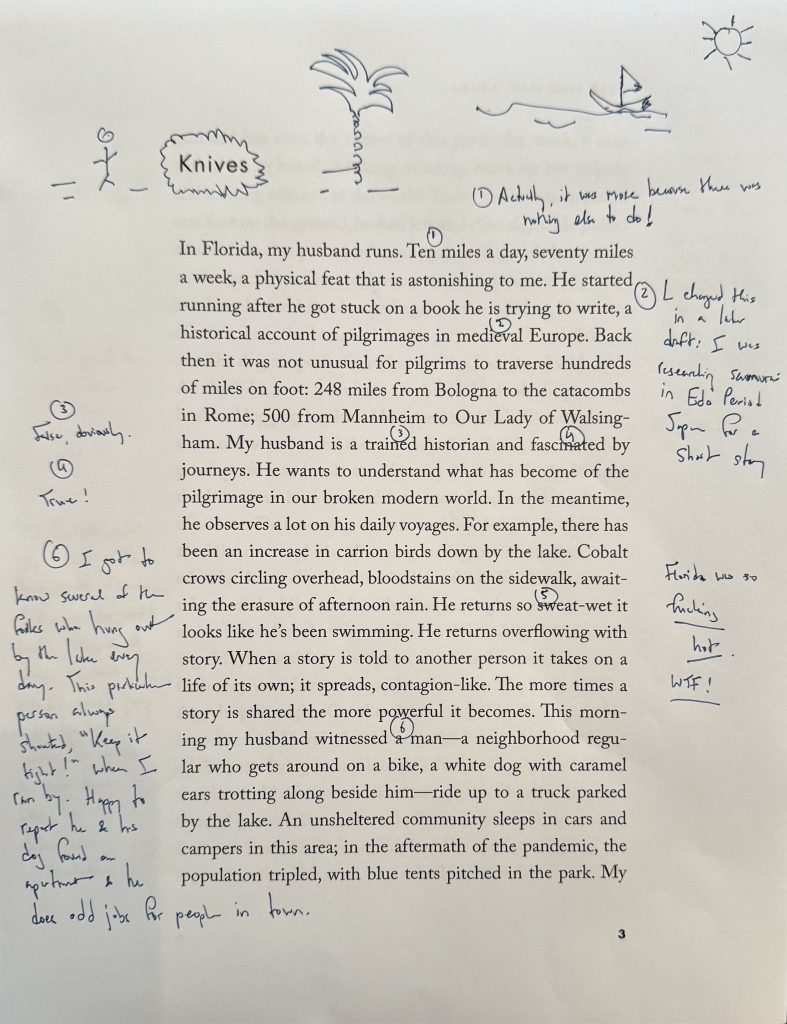
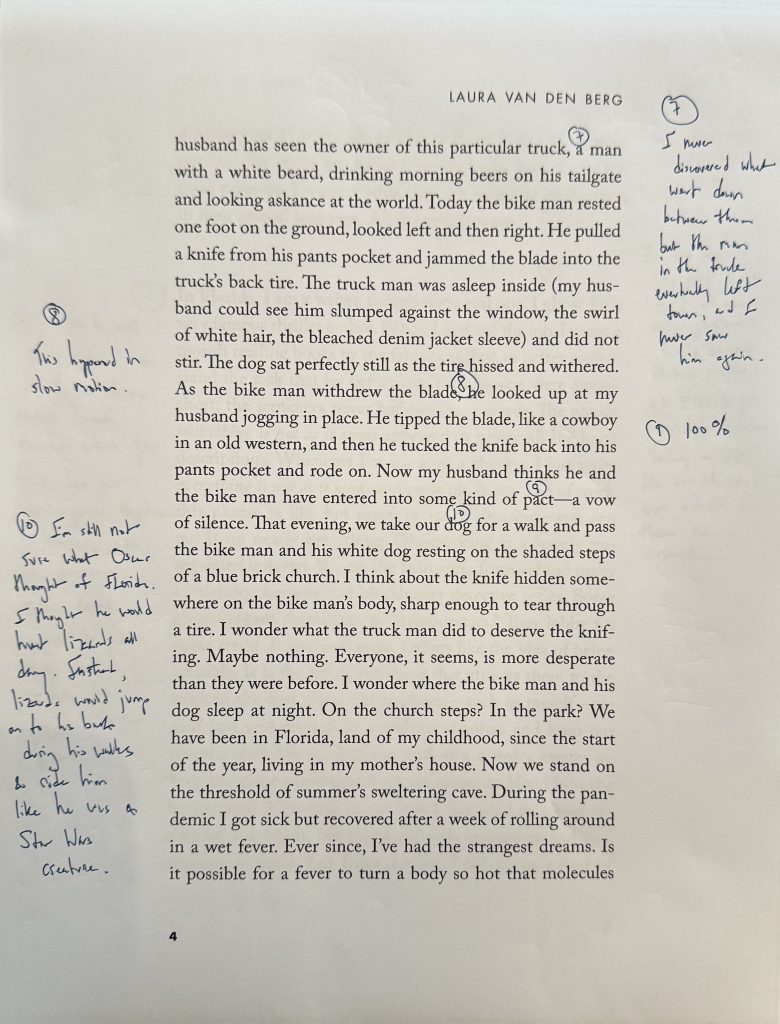
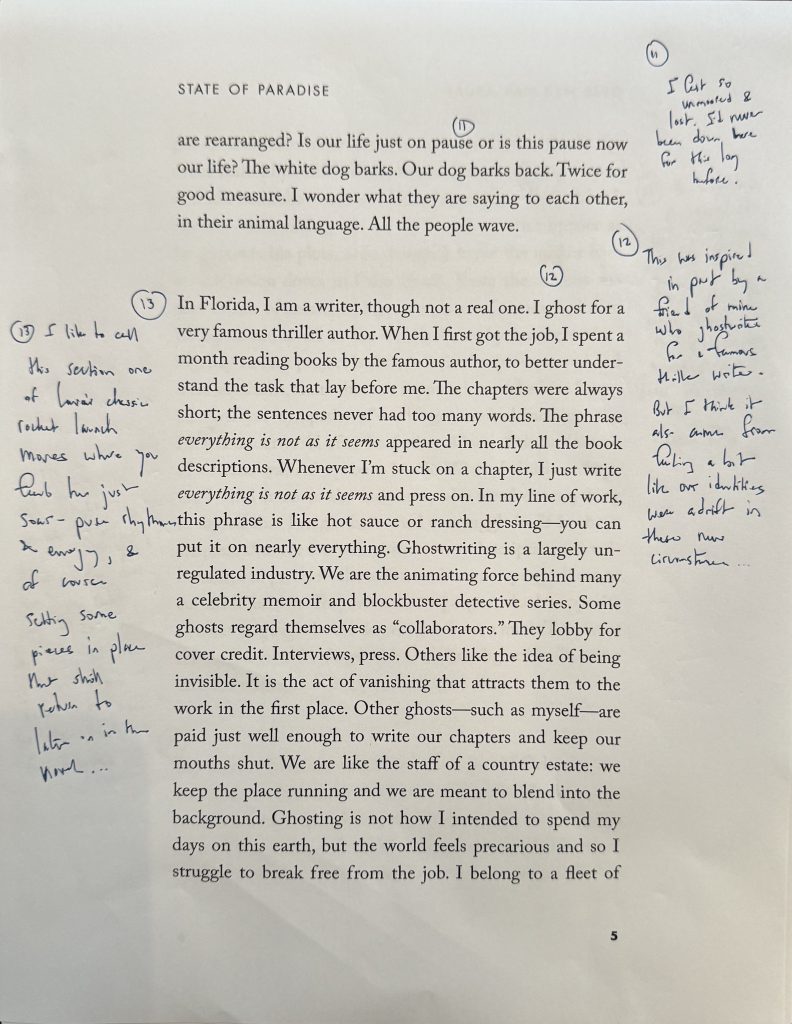
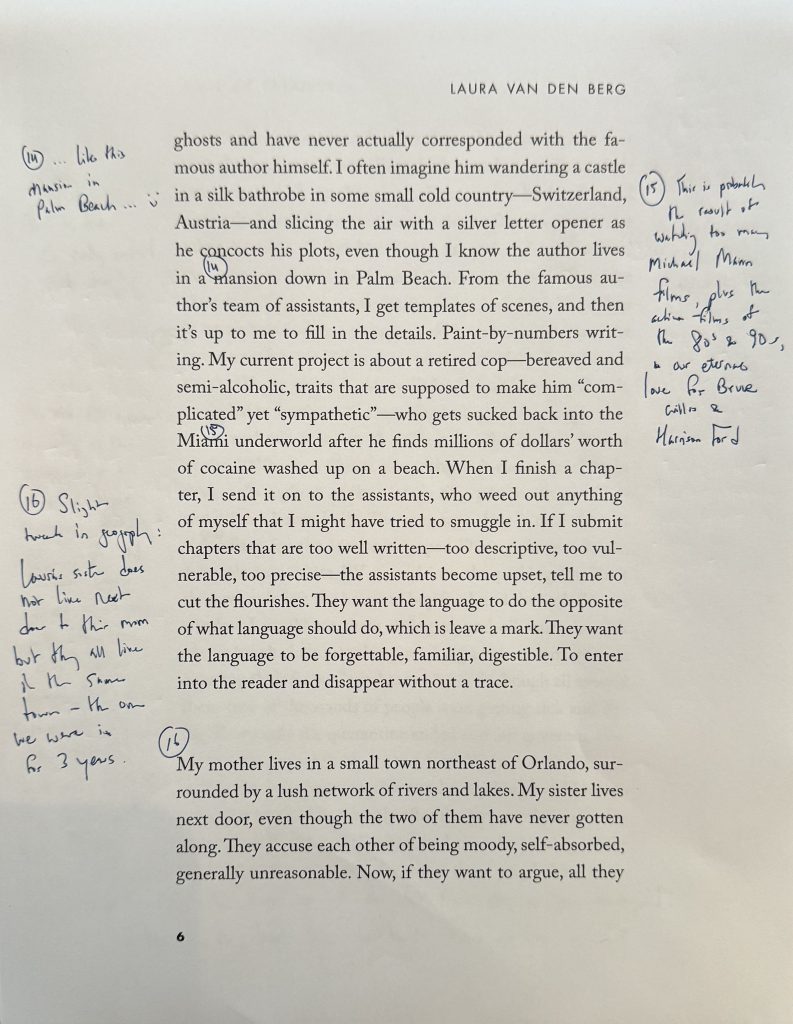
There’s this song that I love that I listened to quite a bit in the Fall of 2021. It became a kind of North Star lyric as I was rewriting my novel, Lo Fi, as it encompassed a feeling my narrator was dealing with, fresh off a too-long situationship, trying to forget someone. I wasn’t going through any kind of breakup myself as I wrote, but I needed to channel those same emotions, so I listened over and over.
I’ve found new ways to count the days that you’re not in
And there’ll come a time when you won’t be on my mind every second
Doesn’t that count for something?
To me, this lyric in the aching title track from Madi Diaz’s History of a Feeling captures a sentiment that has given me (and I think many other writers!) endless inspiration.
I have always looked to music and books about romantic heartbreak, those songs and novels that tell you of a complicated relationship that just didn’t, couldn’t—wouldn’t—work out. Or, perhaps one of those ones that never even really got its chance. These books explore the grief of loss, the things we’ll do (often stupidly) for love, and the ways we try to move on and fail. The people or exes that we keep coming back to. If you’ve got someone like this in your life—we probably all do—these are the books you should be reading.
This excellent early-twenties coming-of-age novel set in Dublin zeroes in on a toxic, emotionally abusive relationship. Megan Nolan renders the upside-down power dynamic between the narrator and Ciaran with piercing honesty, allowing the reader to see past the blinders we turn on when we fall in love, the way physical attraction can cloud all our better judgment and the way manipulation and emotional abuse can rot a relationship or person from the inside out. “I was in love with him from the beginning, and there wasn’t a thing he or anybody else could do to change it,” the narrator tells us just a few pages into the novel—and the truth of this becomes very clear. Even at our narrator’s lowest, darkest moments (of which there are many!), I was with her every step of the way, as sucked into the story as one can get in a dark yet addictive relationship. Nolan’s depiction of sex, the body, and love—and the ways we give and take all of these—are what make this book stand out from so many others that have traversed into this territory before.
Maybe it’s Paris, maybe it’s James Baldwin, maybe it’s a perfect novel. What I would consider to be my favorite ‘classic’ novel, this taut, heartbreaking story of a covert gay affair between David and Giovanni in 1950s Paris, is one of excruciating love, regret and grief. As David sits in Southern France and tells us the story, we are clear on the stakes from the beginning. There’s much to be drawn to here: the electric yet accessible prose, the snapshots of Paris of another time (desultory, charming, even in its own depression) and of course: the endless pain of a love that could never really be. A masterfully concise read—Baldwin does in 160 pages what most writers try to do in 600—this book (as many know) is a triumph of tragedy. You didn’t need me to tell you this, of course, but after reading it three times in the last handful of years (one in a muddling French!) I’m still amazed at how universal nearly every sentence of this book is.
I read this book earlier this spring in about 48 hours, immediately drawn in by the classic premise: a young woman gets involved in a tumultuous affair with an older, married man (who just so happens to be one of her coworkers.) The affair between Hera and Arthur is mildly predictable in its trajectory—how could it not be?— but what holds the reader close is Gray’s smart, hilarious and wholly commanding voice. While these types of relationship stories typically have the same arc, as there is mostly only one way for them to end, Gray’s storytelling is anything but. I do not say this lightly: this book is laugh out loud funny, and I almost never laugh out loud while reading. The humor and self-awareness will make you root for Hera, even as she makes objectively terrible decisions over and over again—and then makes some more. The sex is good, the consequences are bad, the ending you already know. You should read every word of it anyway.
Bryan Washington’s latest novel is for me, in many ways, a story of how we get through our lowest points of grief and try to make our way to the other side of it, if there is one. Cam has moved from California back home to Houston after his partner of several years, Kai, has died. He muddles through his overwhelming grief with endless sex (and there is a lot of it), self-destructive behaviors, and begins working at his old friend—TJ’s—family bakery. Once he and TJ reconnect, the antagonistic chemistry between them crackles at their first exchange. They hate each other; they love each other. They have learned to live without each other but maybe they don’t have to. Washington writes food beautifully, sex painfully, and makes you ache on every page.
Much has been written about his recent smash success that will be better and wiser than what I could say here, and even though this book is mostly comedic, it is the hardest I have cried reading a novel since A Little Life. Thanks, Dolly. A funny, extremely relatable story of a mid-thirties break-up—told almost entirely from the guy’s perspective, Dolly gets everything right about the feelings, thoughts, and actions people experience immediately post-split. I’m talking: drinking alone midday, stalking your ex online, splitting up your shit, closing the joint checking account, drinking alone in the evening—etc.. But what ultimately moved me to tears here was Alderton’s spot-on insight into being in your mid-thirties and finding yourself in a Very Different Place than many of your peers. Everyone knows Dolly Alderton is funny, that she knows relationships better than most, but it’s the heart at the core of this novel that set it apart for me.
This was one of my favorite releases of last year, by the Australian writer Amy Taylor. A breakup tale for the digital age, the narrator, Ana, begins dating a new guy she meets online after a breakup, and she quickly becomes obsessed with his ex, whom she finds out has died the year prior. It is terrifying and compelling to go down the digital rabbit hole with Ana (we’ve all done it, right? Stalking a new lover’s old flame?) but Taylor renders it all with such an undercurrent of unease as we wonder when the narrator’s obsession will come to light, what consequences it will have. It reminded me of the delicate tension of a Ripley novel, the way Ana stalks in plain sight as we hold our breaths, wondering what she will find. I like that this book turns a breakup narrative on its head: Ana doesn’t stalk her ex—in fact, he’s never even named—instead she’s haunted by another woman, one who isn’t even alive. But the frantic obsession still occupies her every thought, making it nearly impossible to actually enjoy her new relationship. In the end, which obsession is worse?
Try not to think of Timothée Chalamet, peaches, and certainly not Armie Hammer. But instead: think of sitting in the sunshine, think of the first time you fell in love, when you were far too young to know what was going on, when all you understood was the all-encompassing sensation of dopamine and hormones, the insatiable arousal. Now, imagine you live in the Italian countryside, with endless afternoons and stretches of blue sky. It’s a perfect summer, too much time to kill. Aciman’s first person novel is so gorgeous that you should read it basking in the sun yourself if you can. The falling in love is hardly straightforward: a queer sexual awakening complicated by an age and power dynamic, among other things. But Aciman’s prose and the near tangibility of the emotions on the page make me want to reach for this book again and again. Even if you’ve seen the movie, you’ll love reading this book, being reminded of how it feels to fall in love for the first time, and how to cope with the illicit fragility of a relationship like this.
I read Ponyboy this Spring at the recommendation of a friend, and it is unlike almost anything I’ve ever read. A story of youth, addiction, love, transitioning, queerness—to me this book is the story of all of those people you can’t quite forget. Yes, that one person you loved once, but also everyone that floated in and out around. The people that destroyed you and the people that put you back together, the ones you thought would never disappear but did, and the ones you thought might disappear but didn’t. Ponyboy’s tale is harrowing and heartbreaking—and very difficult to read at times—but the prose is miraculous and the ending is hopeful. It’s poetry, really, and I underlined more than I had in ages.
Kwon’s latest is an exacting, potent book of desire. The narrator, Jin, is a photographer who we immediately see struggling to produce the photos she’s promised for an upcoming exhibit; she’s been throwing out anything she shoots for ages. Married to a man, she becomes quickly enchanted, drawn to—fascinated by—a ballerina named Lidija. The relationship is charged from the beginning (to say the least) as Jin gets swept into Lidija’s life as we watch their desire unspool. Kwon’s prose is so precise, every single word chosen with delicate attention (she took nine years to write the book, and much of it reads like exquisite poetry) but she also writes passion, obsession—yearning—so well that no matter what happens, you are still thinking about this ballerina, this relationship just like our narrator.
This Patricia Highsmith classic—an illicit lesbian affair set in the 1950s in New York. Here, we follow Therese, who is dating a man she’s obviously barely interested in while working at a department store. The beautiful, mysterious, sexy Carol comes in one day, and from there it is obvious where we’re headed. As the two women grow closer together—and decide what dangers they will wade into for their desire—the story begins to feel more like that of two fugitives on the run across America as tension rises. Accessible and page-turning, this is one of Highsmith’s finest.
Long before the question of “man versus bear” began to tear up TikTok, people have contemplated what it’s like to be with a beast. The earliest art we know of, cave paintings and rock carvings, shows humans interacting with wild animals. Over the tens of thousands of years since making those early marks, people have domesticated wolves, learned how to keep livestock, and forged bonds with countless beings furred, feathered, and scaled. Oh, yeah, and started asking the tough questions on TikTok, too. It’s been a great run.
Considering this long legacy, it comes as no surprise that some of our most exciting, absorbing, and resonant stories are about the human-creature relationship. Through stories, we both tell each other what’s real and imagine what might be possible. And when we put a woman at our story’s center—as is the case in my new novel, Bear—we can explore a particularly compelling point of view on each.
In the books below, the women who meet wild creatures, both animal and mythical, are often trapped in their own lives. Domestic drudgery rules. They’re homemakers, caretakers, wives and mothers and daughters and sisters who are struggling against the limitations imposed on them. When they meet a beast, though, they are able to get to a previously inaccessible wildness. They break away from human rules, a strictly human world, and into something other—something extraordinary, something free. The beast outside provokes the transformation within. This is a reading list made to communicate how we might experience the same ourselves.
If you’ve only seen the Disney movie, you haven’t yet heard the whole of Beauty and the Beast. In this collection, fairy-tale scholar Maria Tatar gathers humanity’s many stories about those who wed animals. She writes of those animal spouses: “They stand in for everything we disavow in ourselves—ferocity, bestiality, and untamed urges. Because our relationship to them is saturated with mysterious desires and projected fantasies, our stories about them enable us to probe what remains uncivilized, unruly, and undomesticated in us.” Saturated with mysterious desires? Sounds like the ideal subject to me.
This modern classic collects Carter’s retold fairy tales, each one more unsettling than the last. Her portrayals of womanhood are provocative, challenging, and she writes men and monsters in such a way that the two blend together. In stories including “The Courtship of Mr. Lyon,” “The Tiger’s Bride,” and “The Company of Wolves,” Carter looks without flinching—has Angela Carter ever flinched?—at the terrors and thrills of an imagined relationship with a beast. It’s an unforgettable read.
Let’s leave the fairy-tale world behind for a moment to look at this decidedly 20th-century novella, full of cake mix and radio commercials, about a housewife who falls for an amphibian humanoid named Larry. I know, I know, you’ve heard that same plot a million times before, but this one, you really should pick up. No, seriously, this novel is surprising, moving, and deeply original. (If its subject rings any bells, please know that it was published a quarter century before The Shape of Water won the Oscar for Best Picture.) And it’s gorgeously written, so specific, so full. Indulge me in a name drop: I first read this after New York Times bestselling author Jessamine Chan recommended it as a “perfect book.” She was right.
Craving more woman-meets-sea-creature fiction? Look no further! The Pisces, about a grad student’s affair with a merman, is a sex-obsessed, thrilling, and profoundly weird read. It beautifully captures a particular kind of nihilism, where nothing is going your way and you’ve already decided that nothing ever will. Does that sound fun? Because it is. It’s fun, and funny, and shocking, and fantastic.
Sticking with the sea but scaling back the sex, this tender, gorgeous debut novel is about a grieving young woman’s bond with a giant Pacific octopus. The octopus, Dolores, is the main character’s last link to her lost father—but their connection is threatened when Dolores is threatened with a sale to a private aquarium. In interviews, Chung has said, “This is a story about love, loss, and cephalopods; things that everyone can relate to.” How true! So wrap your tentacles around this one and enjoy.
This poetic and wonderfully odd story is about a woman who gives birth to an owl. Everyone around the main character, Tiny, is shocked, even repulsed, but Tiny adores her dear, bizarre little bird. And thanks to the strength of the writing, we readers completely understand why. Oshetsky’s artistic vision here is unparalleled. I could not get enough.
The birds keep coming. This debut novel begins when its main character wakes from a dream about crows—only to find a severed crow’s head in her hands. The animals keep following her, in her dream life and her waking one, as she reckons with what happened on the long-ago night her sister died. Pulling from horror and the supernatural, Bad Cree is a suspenseful, atmospheric, and deeply feeling story about what connects us to each other, even across species and even after death.
In Nightbitch, the beast comes from within. This deliciously original novel is about a stay-at-home mom turning into a dog. The animal bursting out of her is ferocious, sensual, and unrestrained. What a delight! I read this book when my toddler was the same age as the main character’s, and I absolutely loved how Yoder captured the untethered animal joy of parenting a young kid, how sometimes you just want to run around and howl at the moon.
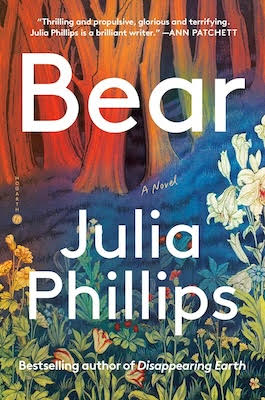
On this list about women coming into contact with wild creatures, we may have saved the wildest ones for last. Bear is a full-throated account of a lonely librarian’s sexual awakening on a private island with, yes, a bear. It’s a novel that will appall you, amaze you, and, in the end, make you consider what it would be like to do whatever you want in your life—to pursue your desires with full abandon. Perhaps, like Engel’s main character, you just need to go for it. Don’t hold back. (Though I very much hope what you desire isn’t to snuggle up with a bear!)
Masterfully written, Story Prize-winning, nationally bestselling, and exquisite at every turn, this collection includes a story called “Yeti Lovemaking.” Ferocity, bestiality and untamed urges, Maria Tatar described, when characterizing the narrative impulse to make a companion of a beast; Ma’s story has all of those, plus loneliness, loveliness, and determination. It channels all of the animal, all of the human, in only a few brief pages. Could there be a more perfect example of a collision with a creature? There could not.
Nina Sharma is a woman in love. In her debut memoir, The Way You Make Me Feel: Love In Black And Brown, she reflects on the powerful love and solidarity of Afro-Asian allyship through the lens of her own interracial relationship as an Indian woman married to a Black man.
Beginning in the suburbs of New Jersey, we follow Nina through her struggles with bipolar disorder as she simultaneously grapples with her South Asian identity. Nina shares intimate details of her experiences with psychosis that mirror the story of her meeting, falling in love, and building a life with her husband Quincy Jones.
From ruminations on Mira Nair’s classic Afro-Asian love story Mississippi Masala to the visceral confrontation of anti-Blackness in South Asian communities, Nina approaches her own life with equal parts raw vulnerability, humor, and empathy.
Yes, Nina is a woman in love. However, her love extends beyond the context of marriage. Through a deeply intimate portrait of a woman finding her place, we see Nina as someone in love with her husband, her family, and herself.
I spoke with Nina Sharma about South Asian identity, self-love in the writing process, and what Afro-Asian solidarity means to her.
Anupa Otiv: As a South Asian writer from New Jersey, this collection felt immediately personal to me. You write about your life against the backdrop of North Jersey and speak to a specific kind of South Asian upbringing in America. What role does New Jersey play in your identity as a South Asian woman? Was that something you were thinking about while writing?
Nina Sharma: Thank you! It takes a fellow New Jerseyan to notice some of the deep cut references in this book, so I really appreciate it.
Having been raised in Edison in the late ’80s and ’90s, I got to see it become the Edison it is today, an enclave of South Asian culture and community. For example, there was an ice cream shop that became a Bombay chaat house, but the structure of the building was preserved with the same ice cream sign. It wasn’t technically chaat, but they made it work for them! In a way, my journey was the inverse of that. Even though I grew up in a South Asian community, I went to a predominantly white private school and spent a large portion of my youth assimilating into whiteness.
That journey reminds me of my parents and their journey immigrating to this country. And even though Edison has a strong South Asian community, that dichotomy is a reminder of how white supremacy operates in this country and how large it looms for immigrants. It’s a large touchpoint throughout the book, and something I think about constantly having grown up in that part of New Jersey. My Edison roots deeply inform my identity as a first generation South Asian and have helped me articulate my sense of self over time.
AO: One of the most poignant relationships in this book aside from your marriage is the one you have with your parents. You write about them with such honesty and nuance, whether it’s in regards to your mental health or their grappling with your Afro-Asian relationship. What was it like writing about your parents in such a personal way?
NS: Honestly, it was very hard. It was a relentless inner conflict I faced, but I’m so grateful that my husband Quincy was a reader throughout the writing process. He helped me see the power in writing complex human characters with virtues and flaws, whether it was my parents or myself. Around the time I had begun my MFA, I would write stories about my life and relationships through a filtered lens. There was a sheen of perfection that ended up creating distance between me and the reader. Once I started to write messy stories about our fights, about dirty dishes, I found that readers were able to relate to me more.
By bestowing humanity onto everyone in this book, I hope to portray the people I love as characters readers are rooting for.
Even though it’s a memoir, I view the people in this book as characters, including myself. My hope was to portray everyone, especially my parents, with the complexity they deserved. And that complexity is what makes them endearing. By bestowing humanity onto everyone in this book, I hope to portray the people I love as characters readers are rooting for.
AO: I understand that impulse to add a “sheen of perfection.” It feels safer to withhold the inevitable ugliness of our lived experience. What allowed you to be so raw in your writing?
NS: In general, I think of myself as a private person. However, writing has always been my excuse to just let it all hang out. Essays in particular are my chosen medium to connect with others and share my raw self with the world.
One of my teachers at Columbia, Phillip Lopate, wrote in his book The Art of The Personal Essay: An Anthology from the Classical Era to Present, that the heart of the essay is a feeling of companionship between the reader and the writer and I think that is very true. Whether you’re writing broadly about complex political issues, or you’re writing something deeply intimate, that companionship is an essential component to connect with other people. It requires a level of rawness to foster that.
AO: How did you decide which stories were essential for the narrative of this collection and which ones to leave out?
NS: When I was developing the essay “Shithole Country Clubs” originally for The Margins, my editor Jyothi Natarajan was reading my essay “Shithole Country Clubs,” which has made its way into the book. At the time, there were so many competing ideas and threads in the piece. To narrow it down she asked me, “How much can this story hold?”
I think about that all the time. What is the core reactor of an essay and what will help me move closer towards that? What can be saved for another story, another essay, or another book? Sometimes, I will write something and be like “Woah, I found some gold! But this gold is for another day.” So, it doesn’t feel like leaving things out, but rather seeing potential in my stories to become something else.
AO: The collection primarily navigates your interracial marriage to Quincy Jones, however the love in this book extends beyond marriage. What struck me most was your ability to write about yourself and your own mental health journey with so much empathy and self-love. How did you practice centering self-love throughout the writing process?
NS: Writing to me is ultimately an act of self-love. The process of writing about my mental health, for example, is a way to address and overcome my reservations about it. Sometimes I’m surprised that I still encounter reservations [about mental health], but I think it’s ultimately good to have those moments of reckoning.
Afro-Asian allyship starts with two things: Listening and remembering our history.
Writing is an opportunity to dig deeper into my feelings and understand where they are coming from. Am I feeling shame? Is it internalized judgment or stigma? A big part of the process for this book was writing through that insecurity to reach a point of self-love. This is where writing myself as a character in a novel instead of the narrator of my life comes in handy. It forces me to root for myself!
AO: I love that. You’re Nina the heroine on her hero’s journey!
NS: I’m like the princess from Mario.
AO: Princess Peach?
NS: Yes!
AO: Your sense of humor is deeply present throughout this collection, even as you wrote about racism, white supremacy, and mental health. How did you lean into humor as a tool to communicate these things without sugarcoating it or overlooking it?
NS: Humor is a way to create a conversation on the page. It’s the art of capturing how we talk to one another. When we talk to friends, we emotionally heighten to get a reaction or to make them laugh. We tell jokes to bring us closer. Humor is integral to how I talk to everyone. I can’t imagine creating a relationship with my readers without it, you know?
If I’m writing and the comedy doesn’t emerge, then there’s a problem. Even if the subject matter is dark, I tend to reach for laughter. Laughter to me isn’t making light. I don’t subscribe to the idea of “comic relief.” Laughter to me is mission-driven, can help me hone in on something I want to break a silence over, laughter is maybe the first and most primal act of breaking a silence.
Back when I started performing improv comedy at The Magnet Theater in Manhattan, I was working on stories that would eventually end up in this book. I saw a flier at the theater for “You Are Not Alone,” a show that merges improv with uplifting stories about mental health and depression. When I saw that, I knew it was for me! It showed me how powerful comedy can be in making people feel seen and understood. Comedy is a tool to relate to people without minimizing myself or my experience.
AO: Another powerful tool you use is pop culture criticism. One essay in this book is about your complicated relationship with the Mira Nair film “Mississippi Masala.” What role does pop culture criticism play in storytelling for you?
NS: American pop culture is a big part of this book, partly because it’s a vehicle for assimilation as a first generation Indian American. Movies and music were an anchor for me as I was coming into myself as an Indian and an American.
With Mississippi Masala, a film about an Afro-Asian relationship, I always thought it was beautiful and iconic, but it took me a few watches to have that breakthrough moment with it. I could never understand what was stopping me from having a personal relationship with the film. Was it internalized racism? Was it simply hard to watch as I experienced something similar with my own parents over my own Afro-Asian relationship?
Writing through those feelings helped me to come to terms with them. I realized that my journey to understanding and loving that movie was mirrored in my journey to understanding and loving myself.
AO: Afro-Asian allyship is an ongoing theme throughout the book, especially in the context of your marriage. What does Afro-Asian allyship and solidarity mean to you beyond the context of romantic love?
NS: We are living in a time when teaching and recording the history of racism in this country is being threatened. We’re living in a time when racism in this country is being challenged in a new way. Diversity and inclusion programs are being threatened and cut, books are being banned in record numbers, and critical race theory is being removed from school curriculums. It’s scary, but it’s also an opportunity to stand up and outwardly oppose that future.
To me, Afro-Asian allyship starts with two things: Listening and remembering our history. Of course, there are direct actions that must be taken through protesting and mutual aid. But in a time where schools are being policed and students are being censored, knowledge is our greatest power. Remembering our history ensures we don’t repeat the same mistakes of our ancestors. We can practice that in different ways too, like donating time and money to grassroots organizations, and platforming the work of Black, queer, feminist scholars. Most importantly, I think it’s about choosing to show up every day to express and practice solidarity.
When I was fourteen, I became convinced that I was a witch. My magical powers included bringing imagined things to life, seeing the future, and an ability to make inanimate objects move. The walls in our school breathed as I walked down the hall. The posters of notable literary women in the English classroom winked at me. Having been brought up Catholic, my instinct was to try to understand why God wanted me to have these powers. But soon, searching for an answer in religion didn’t feel genuine. In truth, I was to God as waves are to shore—ebbing close then far, depending on the moon. In truth, I just needed someone to blame.
I attended an American Methodist school from second to twelfth grade. We were not a Methodist family, but the institution came recommended and was walking distance from our apartment. In school, we attended chapel every other Wednesday, we hosted religious speakers and, when permitted, we danced with no fewer than five inches between our eager bodies. We were required to take a religion class; the hem of my skirt was required to touch my knee.
One night, while standing in our San Juan apartment hallway, I saw a woman appear on the other end. Her right side was consumed by the wall, and her left was translucent and silver. The air got caught in my throat and I stood, stoic and wide-eyed, mouth agape and silent. Her hair, long and waved, billowed even though there was no wind in our concrete hallway. I took one step forward, my teenage body unsteady. She glided toward me and then disintegrated before reaching me. I pressed my eyelids to my cheeks and then looked again, but she was gone. I ran to my bedroom and shut the door behind me. On my bed, thighs hugged tight to my developing chest, I waited for her to come for me, to claim my soul. She never did.
The next day, in homeroom, I told my friend Lisa about the silver woman and her wispy hair. “You need to pray for that spirit,” Lisa said, miming the cross with her hand and kissing her fingertips. “And you need to pray for you, too.”
Instead, I told the school psychiatrist that I had seen a ghost. The doctor assured me that the ghost was likely a woman I had seen at the grocery store or on the sidewalk, her image suddenly surfacing. “Sometimes the subconscious manifests in confusing ways. If you feel you need guidance, why not speak to Reverend Maldonado?”
I pressed my eyelids to my cheeks and then looked again, but she was gone.
I rarely engaged with the religious parts of my schooling. Jesus was tacked above the door to the reverend’s classroom. Inside, our chapel songs were strewn in sheets on his desk. Leaning back on his swivel chair, the reverend prompted, “Describe the figure.”
I delved into the moment with detail and concluded, “I don’t know what to think, she was almost beautiful.”
He pursed his lips. “What did you feel when she came toward you?” he asked.
“I was stuck. I couldn’t believe it.” My heart had stopped, my breath had shortened, my feet had hardened. I’d been awestruck, but I hadn’t been afraid.
“She could have been an angel,” said the reverend. “You are unharmed and present, you haven’t gone mad, you’re not upset. This couldn’t have been a negative energy. You’re very lucky.” His answer was unexpected, although I didn’t know whether I would have preferred a different explanation. If I was not cursed, then what was I?
When I moved to New York to begin my freshman year, my powers hit a growth spurt. I began astral projecting regularly, my soul escaping my body and hovering above it, watching its limbs carry the rest to class, to the grocery store. When my soul would rejoin my body, it would startle in the mirror, taking time to find something familiar in the person staring back. Oftentimes, I would not see myself at all. By my sophomore year, the ghost voices became defined into those of two men, and their running commentary often teetered between insulting and demanding.
The taunting was such that I sometimes had no choice but to fulfill the voices’ demands. I still knew better than to drink my laundry detergent (something they asked), but other orders prompted me to leave my dorm room in the middle of the night barefoot to catch snowflakes on my tongue. Or, press my body against strangers in the darkened corners of bars, to give myself up before the voices listed all the ways in which I could lose control. I spotted orbs of white-yellow light with the corners of my eyes, hopeful that goodness had come to protect me. Sometimes, I remained under my covers all day, afraid of having to interact with others, aware that I couldn’t form a single sentence. My thoughts raced and jumbled together, meeting each other in their middles and sprouting wings from there. Is there milk left for the essays on Emerson were due by the time you get yourself out is someone home close your eyes before you forgot to hand in there is no one here with you the time mom took you am I hungry the night is coming you will die. I couldn’t grab at a single one, couldn’t explain what was taking place in my head, let alone talk around it. So I kept my lips tight, kept my head on my pillow when the weight of my consciousness became too heavy.
My senior year of college, at 21, I found myself at the Lenox Hill Hospital ER accompanied by an NYU psychiatrist. During my scheduled appointment earlier that day, after I broke down and confessed what had been plaguing me, my doctor suggested an in-patient stay to tackle my substance use and hallucinations. Desperate, I agreed. I sat in a bare and dry exam room, black sweater pulled tight across my chest, a barrier between me and the manufactured cold. Scorpions did not crawl across the floor, gnats did not buzz around the clinical lighting. I repeated this to myself each time an imagined bug threatened to get close.
Why are we here?This is a mistake.
Sometimes, I remained under my covers all day.
Two doctors sat across from me expectantly. “Tania?” One of them scrunched her nose, pressed her lips together.
“We asked when your last drink was.” A gentle push from the second lab coat.
“Last night.”
“Before or after midnight?” My eyes wandered over to the sparkling ocean behind them, held together by a rusted golden frame. I could not recognize the beach—there were no palm trees.
“We sense that you’re distracted.”
Lie. Don’t you dare tell the truth. They leaned in so close, I could feel the words leave their lips and sit on my ear.
What are you waiting for?!
Lie. “I just can’t hear anything other than these men.” I let it escape me through tired breath.
“Men?” asked the second doctor.
You dirty slut.
“They follow me everywhere. They tell me to do things. I can usually keep them under control. The alcohol helps, and the coke either helps or makes it worse, fifty-fifty. I don’t know what they want with me. They appeared one day and never went away.”
Fuck you, you whore.
“Tania,” started the first doctor. “We think that based on your current and previous drug use, you have what is called substance-induced psychosis. Basically these substances that you’ve been abusing are driving you mad. We need to admit you. Now.” I was admitted to their psychiatric wing a couple of hours after my arrival at the emergency room.
On my fourth day at the ward, as I napped between Life Skills and lunch, I was brought back to the present by a hushed, “Miss? Wake up Miss.” The young male nurse who took our vitals appeared in the doorway, his hand flipping away the dreads on his shoulder. He brought the rest of his body in and leaned his back against the frame. “Are you alright? You’ve been sleeping quite a bit.” I pushed myself up and nodded, scooping sleep gunk from my tear duct with my pinky.
“This place won’t help you, you know.”
“Excuse me?” Newly awake, my throat stumbled on sound.
“The only thing that will help you is God. You must be spiritual.” He took two steps into my room and leaned toward me to share a secret. “What you must do is run a bath and submerge yourself in the water.” He walked me through a ritual that included infusing the bath with flowers and herbs. He offered the commercial name for plants my grandmother used to grow in her backyard in Puerto Rico. I listened to his instructions closely, as if I were planning to execute them. His long dreadlocks swayed slightly as he listed home remedies for addiction and depression. “You must cleanse your spirit of demons, and then you will release your afflictions.” He waited for my reaction.
“Thank you,” my voice pushed out in one raspy whisper. I laid back in bed, awake, and didn’t get up until dinner time.
Four days later, I was discharged from the unit. As I walked out, the nurse caught up to me, dreadlocs flapping behind him. The body of the books and clothes I had amassed during my stay weighed inside my duffel bag, I still had my prescription in hand. “Remember what I told you,” he said with a pat on my back. He left his hand there for one second and continued, “or you’ll end up right back where you started.”
I listened to his instructions closely, as if I were planning to execute them.
In different cultures, or at different epochs, the ability to hear voices—from beyond, God, the stars—has been revered as a tight spiritual connection to the greater powers that be. We see less of this mindset in contemporary Western culture; less but not none. It’s been found that a fraction of people first go to their pastor or religious figure of authority with issues of mental health. And, it’s been recorded that people with psychotic symptoms who are religious are more likely to have what the psychiatric community calls delusions with religious ideation. It makes sense to me that a person’s mental illness would play on the ideas and ideals they already espoused, that previously religious folks are more likely to believe that they are Jesus, or the devil, or a saint is a testament to how mental illness interacts with identity.
How do you convince someone they aren’t hearing angels when we’ve revered religious spirits for the same thing? I imagine church scenes, not from years ago, but from our time, where people are consumed with the Holy Spirit, their bodies flailing about or falling backward, their tongues manifesting language we are too earthly to know. Were these people not protected by the cloak of religion, their actions would be perceived not as divine, but as psychosis. I imagine modern day prophets, be they living on a New York street corner or preaching in a privately-funded church. I do not doubt the purity of faith in the every-day person, but, despite my mother’s efforts, I do not veil myself in a religious system and therefore do not doubt the intrinsic nature of mental illness.
My mother, who was medicated for depression after spending a year crying, calls herself spiritual but expresses spiritualism in terms of Christianity. Although she won’t admit it, she believes in ghosts. I know this because, shortly after her sister passed away, when my cousin and I were in the first grade, I would often find her standing in the middle of a given room mumbling, “I know you’re here. I can feel you here.”
2
Jacob and I met and began dating a year after my hospital stay, when I was 22. Born and raised in a homely town nestled between the trees in the Pennsylvania woods, Jacob was a true country boy and indoctrinated in God’s plan. I was an agnostic city girl. Every Sunday, he got up early to go to church, and I spread out my body, arms and legs reclaiming the bed space he’d left. Once, I asked him if it bothered him that I wasn’t Christian. “I hate the sin, not the sinner,” he answered.
He’s going to ruin your life. I’d never told Jacob about the voices. I had spent a year substance free, but they still beat at my drums, chipped at me with insults. Even with group therapy and AA meetings under my belt, I needed help navigating my increasingly confusing mind. I was running out of energy to keep focused, and Jacob started to notice. Sobs came every night before sleep did, with or without Jacob laying beside me. Neither of us knew there were symptoms that hadn’t come into full bloom yet, but the glimpses Jacob got of what would become my psychosis worried him enough to suggest a cleansing. I agreed to go to service with him.
We made our way to the auditorium at the Times Center in Times Square, where Christian City Church, or C3, gathered. Jacob introduced me to friends I’d never known he had. On stage, a pastor in his forties wearing jeans explained what it meant to be loved unconditionally by God, how it can heal our shortcomings and lead us to success. His words ricocheted throughout the room, filling us all from different directions.
Why are we here? They came to me sitting in my seat, elbows on my knees. I blinked them away and focused on the pastor.
He got up early to go to church, and I spread out my body
Let’s go somewhere fun. I dropped my eye line to my feet for a moment, pushing against the voices. I quickly looked around at the audience, a crowd of young writers and actors and waiters and receptionists. They all nodded and smiled warmly as their leader spoke his message, his earpiece microphone jiggling slightly with each step.
Don’t test us. I closed my eyes and imagined a bright yellow light emanating from a black void. I prayed to it, asking for the voices to quiet. After a few minutes, I realized that my mind had eased, the stillness new, echoing. There was room in my mind to insert my hand and pick which thoughts I wanted to mind.
Soon, I was volunteering for the cause, spending less time applying for work and more time at the pastor’s townhouse in the West Village. Alongside his wife, their children, and other volunteers, I stuffed envelopes or crafted decorations for any given holiday. I joined a Bible study group with other women in their twenties. We went out to dinner and prayed over our food. We held hands for comfort. Our long-term relationship strengthened in God, Jacob relished in my salvation.
One night, about a year into my relationship with Jacob, as I watched TV in my empty apartment, a shadow slid up the wall, peeled itself off the cement, and began hovering around me, an abstract mass of dark. It kept to my periphery as I tried to catch a better look. Afraid, I started to wave my hands as if shooing a fly, moderately at first and then with more and more desperation. The mass began to torment me. It flew one way and then another, it got close and then retreated, got close and then retreated. You don’t have to be afraid. Drink yourself to sleep.
“No,” I said loudly. The shadow lunged at me and I dropped to the floor, arms protecting my head. It’s going to get you. You don’t deserve God’s love. “Stop it.” On my hands and knees, I crawled to my bedroom and closed the door. The shadow slipped in between the door and floor, and went up my wall, wiggling about.
“Please. Please help me. Please.” I sat at the foot of my bed, thighs against breasts, “God please help me.” There’s no one here for you. You’re all alone with us. I called Jacob, fingers vibrating from inside out. “Can you come over?”
“What’s wrong?” He heard my quiver instantly.
“I’m so scared, I don’t know what’s happening, I’m freaking out.” I’d been panting and only noticed as I tried to speak. The salt that had dewed in my eyes raced down my cheeks and met the corners of my mouth. “Please.” I couldn’t raise my voice, but managed one more plea. “Please.”
“I’m coming.”
He’s not coming. I put the phone down and covered my ears. When they got too sore, I balled my hands into tight fists. The shadow swam to an adjacent wall and covered the pictures taped to that wall. “Get out!” I climbed onto my bed and ripped off the pictures, clawing at the translucent mass. “Get out!”
The ire strangled me from the inside. My molars grinded against each other, jaw tense, temples tight. The loud knock on the front door brought me back at once. Jacob gasped when I opened it.
The shadow slipped in between the door and floor, and went up my wall, wiggling about.
For the first time, I felt my eyes swollen and stinging. The red rake trails that I had curtained my face with, from eye level to jaw bone, started to burn. Jacob lifted his cold hand and cupped my face. I let the tears go and fell to the floor, drained. Jacob squatted, and with a reassuring gaze, picked me up by the elbows. We walked the apartment as if it were a disaster area, hands held and slow pace. His head dropped when he opened my bedroom door.
“You tore it all down?” I nodded from the couch.
He walked into the room and I followed. It had taken him an hour to get to the Upper East Side from Brooklyn. I had torn every piece of paper in my room to shreds. The pictures on my wall, the poems I’d put up, everything I had put love into was now confetti strewn over every surface. “What did you see?”
“There was a shadow,” I regained my voice. “I heard… things.” Jacob sat on my bed and waved me over. I sat next to him, my head on the edge of his shoulder.
“I think you just survived the devil.” My heart muscle flinched in my chest, but I did not move. “I think that was the devil,” he repeated in awe.
“I’m exhausted.” My whole self was a ball of lead; Jacob tucked me in.
It became clear to me that I was destined for greatness, for golden light and joy. I had been born into Jesus’s legacy, had been chosen from birth. Jacob believed the same about himself. He put his complete faith in the hands of the Lord, and had yet to encounter his big break because that was the design of the master plan. By virtue of believing, a job I didn’t get or money I didn’t have were blessings. Instead, they pointed to a future where I would have earned those things the way that God wanted me to.I was constantly reminded by the church-goers around me of how lucky I was to have returned to God’s love and promise. I was a success story, a saved heathen with a new future. Except, outside of my fellowship, I was rotting.
God is not real. You’re a fool.
The voices ebbed in and out of my head, always returning a little louder. Compulsions brewed in me. I stole money from my roommate and used it to buy expensive purses and stilettos. I lied about completing errands at work and began to wear tight clothing. It was imperative that I appear fashionable, that I was seen in the trendiest bars. My drinking and stamina were sustained by my secret use of cocaine, a drug Jacob thought I had quit but that I had picked up again to fight the voices. I watched myself strut to work, my spirit hovering feet above my peacock body. I lied and cried often, the grip of truth squeezing my breastbone.
The noise inside me would quiet with God over me but I couldn’t keep God around long enough for the peace to be permanent. Each Sunday, hungover and sick, I vowed to be better, to be worthy. The pressure to keep up my personas of a perfect girlfriend, wise Christian, and fashionable city girl was breaking me. I did not know why I had to be so many people, but in doing so I was unraveling.
You’re a bad person. You’re not worth saving.
I was constantly reminded by the church-goers around me of how lucky I was to have returned to God’s love and promise.
When the shadow came again, after a year with the church, I surrendered to it. My bones ached, my joints stiffened, I could not stand through a shower, could not eat. It was just me and the shadow in a knot in the dark. The depression would last weeks, until I convinced myself that I would truly commit to God this time around.
But the voices and the orbs and the bouts of despair and paranoia soon developed complete immunity to God and His love. Jacob tried to keep me tethered to Him, but I severed that thread. I understood that God would not save me, that I was on my own. Almost two years into my relationship with Jacob, at 24, he and I broke up. I never returned to C3 and never heard from my Bible study friends, as if I’d never been there to begin with.
3
Two months after my 25th birthday, my parents flew to my neighborhood in New York for an intervention. The imbalance within me had resulted in a slew of bad decisions and false memories. Facing eviction and unable to function, I moved back home to Puerto Rico with my parents.
My mother and I sat across from a neurologist’s desk, the doctor behind it holding up scans of my brain to the light and reading through them. Please find something, please find something. She put the paperwork down and faced us. “All of the scans came back clean. As far as I can tell, there is no neurological explanation for these behaviors. Your next step should be to speak to a psychiatrist.” The truth hit me in the breastbone. I had wanted to be sick in a way that I could understand and explain. I wanted to be able to point at something and say, “See? There. That’s why.”
I was entrusted to the care of Dr. Robert, a man with a Freudian beard and olive skin, with an office in Old San Juan. I had never thought of myself as symptomatic, but Dr. Robert laid my own actions out in front of me. Puzzle pieces that he arranged to form the picture of Bipolar I. He went through my irresponsible shopping habits, my blackouts of memory. He quantified my actions as “lack of impulse control,” “illusions of grandeur,” and “hallucinations.” I was tied to the real world by the waist with a rope, and each checked symptom was a foot of slack, a measure of how far I was floating away from everything. I couldn’t feel my feet on the ground, couldn’t hear my parents’ questions. I was too far into the ether, where the ghosts had found me.
As I processed the diagnosis, my instinct was to refute it. I had heard voices. I had seen ghosts. That these manifestations were not real was besides the point. Were it not because my mania had led to eviction and debt, I would have put up more of an argument. Under a diagnosis, I came to understand that there was nothing special about me. I was different, yes, because I was sick. Now, when the episodes of mania accelerated my thoughts and hinted at bringing back the ghosts, I would find myself sitting down, laying down, with my palms pressed to my temples as if the pressure might quiet my mind. In my delusions, I was meant for something. Diagnosed, I was a statistic, a numerical anomaly, randomly plagued.
My doctor explained that perception and imagination use the same pathways in the brain. Perception moves from the outside to the inside—bottom up—and imagination goes inside to outside—top to bottom. Two lanes on the same road. Some of my friends find it funny that I don’t believe in God, but believed that two men were following me and giving me orders for the first half of my twenties. It took me a couple of years post-diagnosis to understand that this was in part because I already believed that it was possible for ghostly men to haunt a person. As I embarked on my journey back to baseline, I found it more and more difficult to differentiate between myself and my mental illness. I didn’t feel so much that I had bipolar, I felt that I was bipolar. When did my imagination start fueling my perception instead of the other way around? I’d once tried to introduce an imaginary friend to my cousin, who insisted he couldn’t see anyone standing next to me. Was I sick then?
I couldn’t feel my feet on the ground, couldn’t hear my parents’ questions.
Depression met me when I met my diagnosis. For days at a time I would lay in bed, silent, eyes fixed on the wall. I lay there through my mother poking her head into my room to ask if I was hungry. I lay there as she and my father presumably tried to understand how this bipolar had changed their daughter, how they themselves would cope. It was all I could do to lay still and be quiet. In my head, the chaos and guilt thrashed against itself, my thoughts either drowning in helplessness or taken over by the next one. After a couple of weeks, the aura of exhaustion around me was visible. I had no energy left for living. My mother suggested that I return to church. I gave a half-hearted “Sure,” even though I already knew that it wouldn’t help. Still, in an attempt to remain cooperative, I took my friend Liliana up on her standing invitation to attend the youth group she frequented.
One Friday night, she picked me up and we drove to her church. We pulled into a long driveway and went into what must have been, at one point, a two story house, now somewhat converted to a temple. She introduced me to her friends and we gathered in the former garage around soda and chips under fluorescent lights. After a few pleasantries, worship began.
“Come,” the pastor signaled for all of us to come to the front of the room. “We will pray for each one of you.” I followed my friend up to the altar, all of us pillars in no particular order. Everyone closed their eyes. I cracked one open. The pastor went pillar to pillar, and moved to a young man next, putting his hand on the man’s head.
Suddenly, a rabid growl and terrified scream filled the church. We all looked around, startled, and saw the pastor pinned down by the man he had been praying over. “Fuck you!” the man yelled in a deep and scratched-up voice. The other men in the group ripped the angry man off the pastor. “Hold him down!” yelled the leader of the church. “Bring me the water!” His wife ran behind the lectern and produced a small glass bottle. “The devil is in you!” the pastor yelled at the man squirming and turning fire-y red under those holding him down.
“Everyone, give him room!” yelled the pastor’s wife as she approached her husband and handed him the glass bottle. The pinned young man thrashed violently, fighting the grip of the guys weighing on his legs and arms.
“You are nothing! You are no one! There is no God!” his blasphemous claims echoed all around, into us.
The pastor opened the bottle and threw the water on the man’s face. “The Lord demands you gone! The Lord will condemn you! Leave this man, demon. Back to hell with you!” The man on the floor began to cackle maniacally, loud and insulting. “You motherfucker! You are a liar! You piece of shit, you have the love of no god!”
The other members of the group had formed a circle around the spectacle, their hands extended over those doing the physical work, their individual prayers and denunciations amassing into a unified hum. I stood on the far left, just outside the circle. I extended my arm toward them all and whispered to myself with eyes tightly shut, “God help us. God help us. God help us.” I prayed with every cell, with every pore, despite not knowing exactly what we needed protection from or that protection would come. The man on the floor had begun to release white bubbly saliva from his mouth. The people holding him down grew tired, and others jumped in to replace them. The pastor called out, “The Lord condemns you!” and slammed his Bible on the affected man’s chest. At once, the man stopped his fighting and laid limp on the floor. We all took a collective breath.
The pastor went pillar to pillar, and moved to a young man next, putting his hand on the man’s head.
Before I could collect my scattered thoughts, the man on the floor came to life. “You’re all fuckers! You have no god! Fuck all of you!” The hatred that sprayed from his mouth jarred us back into surreality. Those acting as human binds jumped on top of him before he could get up, the man already preparing to lunge at the pastor once again.
The pastor threw more water at him. “The power of Christ demands you gone! God will prevail! Demon, leave this man!” The circle reconvened around them and the hum grew louder. Arms stretched over the man on the floor, some members sobbed their cries to God, “release this man, release this man from evil.”
Liliana backed away from the circle and tugged at the hem of my shirt. She nodded for me to follow her, and we walked to the office in the back of the room. The cubicle windows faced the altar, a swaying group of bodies begging for mercy. “Are you ok?” she asked, motioning for me to take a seat.
“Yeah,” I lied. I was physically unharmed, but emotionally distraught. The confusion had seeped into my bloodstream. I had no words to describe what we were witnessing, making my desperation even more palpable. The pastor’s wife entered the office, shutting the door behind her carefully and quietly.
“How are you doing?” she asked, her eyes meeting mine.
“I’m ok.”
“Do you want to talk about this? There is no need to be afraid. We cannot have fear or doubt around us now.” Her tone felt accusatory.
“I don’t need to talk. I just defaulted to prayer.”
“Good,” she sat down by the door. “It might be a good idea to stay here for a while, until they get the demon out of the boy.”
The scene carried on for another hour. And then another hour after that. I felt exposed, susceptible. I wasn’t sure what afflicted the man, but I knew that my own headspace needed work. I had improved, but I was not in control of the way my brain processed information, or how my emotions reacted.
His voice broke through the prayer hum, spreading through the church in waves. The circle’s shoulders slumped. Members broke away, staggering to sit on the altar steps. The man writhing on the floor was finally liberated after one hundred and fifty minutes.His whole body was red, stark against his white polo shirt. “Come,” motioned the pastor’s wife, “It’s over.”
The pastor helped the man up, his face wet with holy water and sweat. He’d popped blood vessels from screaming. He sat on a pew, weak and panting. My friend and I stood nearby as members of the group fetched him drinking water and a towel. “Are you with us?” the pastor asked him, gripping him by the shoulders.
The man blinked and focused his eyesight. “Yes.”
I wasn’t sure what afflicted the man, but I knew that my own headspace needed work.
“How do you feel?”
“I don’t know. I don’t know what happened to me.” The terror in his face only softened when the pastor placed his hand atop the man’s wet head.
“God is in you now. There is nothing to fear.”
On the ride home, Liliana broke our silence. “It’s not always like that. This doesn’t happen often.” Her hands held onto the wheel, her fingertips turning white.
I nodded, eyes fixed on the road ahead of us.
“God is with us,” she whispered to herself.
I arrived home three hours later than expected. When I told my parents why, what I had witnessed, they believed me immediately. It was a reaction I wasn’t used to, as they had struggled to believe my hallucinations and delusions. They didn’t believe me when I said I had no memory of certain things, or if I remembered them differently. But they believed this happened. They had vocabulary for it, a religious baseline that I never fully adopted. “Say a prayer before bed,” my mother offered, “just in case.”
I did not return to the youth group, nor did I return to the church. But that night, I did say a prayer.
Dr. Robert prescribed a combination of medication as treatment. As the medicine began to kick in, it replaced my symptoms with a slight numbness, almost a gentle humming that overrode the loudness of my half-thoughts. Reading was often difficult as I would forget the beginning of a sentence by the time I reached its end. My thoughts slowed, sometimes to a glacial pace. There was an impenetrable stillness in my mind. The orbs of light in my periphery dimmed until they disappeared. The voices held on for as long as they could, but they lost volume, then lost consistency, until they were lost.
I became aware of the quiet surrounding me. No more visions, no more ghosts. I swallowed a sudden loneliness. I was part of the world now, a world I knew very little about. I still believed in ghosts, but I didn’t tell Dr. Robert that. It would always be the only reality I knew, that which was not real at all.
It began with observations. Then questions. Then speculations. Then the conclusion came that Ikenna Anyanwu, who lived at 8 Okigwe Road, was sleeping with a manfriend, Gbenga Afolabi. It had to be true. What two men who cohabited, shared a bed, fed from the same plate, and washed in the same bathroom, would claim that they were not a thing? Like husband and wife. Except in this case, the wife was a man.
The whole street gathered outside.
“Aru!Abomination,” one man shouted.
“How can a man lie with a fellow man as with a woman?” a woman cried.
“What is becoming of this generation? Our government has failed us. We don’t have stable electricity. No good roads. No clean water. Ah, we’re not even sure where our next meal will come from. Yet, these two men wish to incur Allah’s wrath upon us. Allah ka tausaya mana!God, have mercy on us!”
“We must get rid of them, lest they corrupt our sons.”
“Yes, we must.”
“Yes!” they chanted. Their faces contorted, and they nodded at each other.
The sky was darkening. The men lit torches. The women gathered big rocks. They tightened their fists around machetes and clubs. Children trailed behind. All marched down to 8 Okigwe Road.
In their lamplit room, on the mattress that pressed against half the length of the peeling wall, Ikenna Anyanwu’s mouth worked its way down Gbenga Afolabi’s nakedness. Kisses on the forehead, lips meeting lips, throats pulsing with moans. Around their sweating bodies, in cracks and corners, mosquitoes hummed and crickets sang. Ikenna’s mouth settled on the flesh just before the dark mound of hair below which Gbenga’s shaft bobbed with life. Their bodies rose and fell in harmony. Ikenna’s lips brushed Gbenga’s stiffness, and then his mouth opened and welcomed all of it in. Gbenga threw his head backward on the pillow, his hands balling up the sheets. Their eyes shut, and the world melted away.
Perhaps they had drifted to a realm where only lovers go during lovemaking. Perhaps the world had melted away around them, and they were suspended in space, their bodies so fully attuned to each other that Ikenna could have sworn he had registered nothing that night.
The wooden door came unhinged, hitting the concrete floor. The night breeze swept in, and with it came the mob, trooping in by twos and threes. Their eyes caught Gbenga and Ikenna folded into each other, arms wrapped. They dragged Ikenna away, pulling him this and that way, as though they wanted to devour him. They upended the room: they tore down the curtains, kicked the cabinet of books by the window, flung the kerosene lamp against the wall where it landed on a heap of unwashed clothes—its globe shattered, the little flame flickering and flickering, emanating, kissing fabric, erupting, the room glowing a spiteful red.
Ikenna heeded Gbenga’s screams. He glanced over his shoulder. Blows crashed into his face. The people shouted for tires and petrol. He held his arms against his face, toppled to the ground, and curled into himself, a tight ball. Gbenga’s screams persisted.
For a moment, the beating stopped. Ikenna half opened his eyes and focused on a gap before him. He leaped, mustering the last of his strength, and negotiated his escape. A woman grabbed his shirt. Her grip was weak, or the shirt was worn thin from many years of use; the cloth ripped along its middle. Ikenna fled, past rows of kiosks lining the street, past houses and the intersection where Okigwe Road ended and two other streets began, then down an alley that smelled of garbage and rat feces. He ran, momentarily inspecting the shadows behind until he could not spot them anymore. He surmounted a hill that overlooked the north of Enugu, tears and wind in his eyes. Fat whorls of smoke ascended the sky. Gbenga’s cries rang in his head.
The night was breaking into dawn. Swallows, trogons, and wagtails littered the air above. Birdsongs—a backdrop for the endless thoughts that assailed his mind. He plodded until he came upon a cliff and peeked over the precipice. He had met Gbenga during choir practice at St. Paul’s Anglican Church. A conversation led to a date, which led to trading visits, which bloomed into a first kiss, and another kiss, and then a relationship. They had made plans.
What good were the plans now?
He had received a government scholarship a month ago for graduate studies in the US. Gbenga was to join him in California after the first year of his Ph.D. program, where they could live, without fear, without judgment, and seek asylum. Or maybe they would not be asylees. Ikenna would get a job as a professor and, years later, become a permanent resident. These hopes now lay in ashes.
He inched closer to the edge of the cliff, peering down at the boulders and the river gurgling by. A rustling noise jolted him, and he turned back. A girl, about seven or eight, he guessed, gazed at him. A tray of oranges balanced on her head. He returned her stare. She was like him, stripped of everything dear. How else could he picture this girl who should be in bed at that time or waking up that morning, expecting to meet her friends at school later in the day, but instead was sent out in tattered clothes to hawk oranges? He searched her eyes. Finding nothing, he braved a step.
I love books in which a character learns, or learns to master, a new skill. I don’t necessarily buy that the character in question has to discover something deep about themself in the process of taking up Italian or marimbas, but I do believe that they’re bound to start seeing things a bit differently, to make interesting connections between elements they previously saw as belonging to different categories. And that’s when fiction can become extraordinary: when it gives you access to another mind at work, as that mind makes room for new thoughts, expands in some ways, and perhaps shrinks in others—it is pretty common to feel extremely dumb in the early stages of learning something new.
In a movie, the amassing of knowledge would more often than not be summarized in a two-minute montage: we’d see the protagonist training, or bent over books at his carrel (the passage of time indicated by changing seasons behind him), until the big match, the “your-future-relies-on-this” exam. And those movies can be great, occasionally, but novels can accommodate interiority in such spectacular ways that following its trajectory—the way its energy gets redirected on a dime, shot in the direction it now absolutely needs to go—can be the plot itself. Stories can unfold around it, but the protagonist’s mind is the plot, there is no need to rely so much on end goals, on dramatizing wins or losses, epiphanies and setbacks. The excitement lies in following a consciousness as it transforms on the way to proficiency, to fluency.
The following seven novels are, each in their own way, gorgeous examples of what I’m talking about.
This contemporary classic might not need introduction, but I’ll go for it anyway: narrated in turn by Sibylla and her young son Ludo (an absolute prodigy capable of reading ancient Greek and doing advanced calculus at age 5), it is perhaps the most fun novel ever written about the nature of intelligence. Sibylla is extremely smart herself, but can’t always keep up with her son, who’s constantly asking her to teach him something new. Yet her lessons are like magic tricks: when Sibylla teaches her son to read ancient Greek, we learn alongside him, and are entertained the whole way through. The book is smart and hilarious (Sibylla is very judgmental) without ever condescending to its reader. It assumes we are as smart as it is.
In its second half, Ludo goes on a quest to find a suitable father for himself, and the volume of lessons drops, but other types of learning come into play. Namely, he starts hearing a lot about games (chess, bridge), and there is this line that I find absolutely gorgeous in its simplicity when it comes to explaining what teaching is, and what its limits might be:
“When you play bridge with beginners—when you try to help them out—you give them some general rule to go by. Then they follow the rule and something goes wrong. But if you’d had their hand you wouldn’t have played the thing you told them to play, because you’d have seen all the reasons the rule did not apply.”
In a Toronto veterinary clinic, 15 dogs are granted (or cursed with) human intelligence overnight. The reason this happens, I’ll let the reader lucky enough not to have yet read this book find out for himself. Human intelligence doesn’t mean the dogs wake up full of opinions on the nature of time, or speaking whole sentences, but with the capacity to wonder and learn about such things. Which some of the dogs are interested in doing, and others…not so much. While a group of them establishes a common, articulated language (one dog immediately starting to pun in it, and shortly thereafter, to write poetry) others are weary of the new thoughts that naming everything has brought about. They find self-consciousness intolerable. Conflict ensues (not a spoiler alert: the pack will not stay together long). Those who embrace their new form of intelligence are in for a ride, constantly curious about the world of men. They hilariously misunderstand or near-understand it at times, but more disturbing is when they get a full grasp on what is actually going on.
What the unnamed twin boys narrating The Notebook are trying to master here is objectivity, although they would probably call it truth. Left in the “care” of their grandmother in a remote village in Eastern Europe during Nazi occupation, the brothers attempt to teach themselves to see the world dispassionately in order to mute and even perhaps annihilate (the reader quickly gathers) their feelings about the horror that surrounds them. In an early chapter, they explain their method to attain truth through studying and writing “compositions” about their surroundings:
“It is forbidden to write: ‘Grandmother is like a witch,’ but we are allowed to write ‘People call grandmother the Witch.’ It is forbidden to write: ‘the Little Town is beautiful,’ because the Little Town may be beautiful for us and ugly for someone else. Similarly, if we write: ‘the batman is nice,’ this isn’t a truth, because the batman may be capable of nasty acts that we know nothing about. So we would simply write: ‘the batman has given us some blankets.’ We would write: ‘We eat a lot of walnuts,’ because the word ‘love’ is not a definite word, it lacks precision and objectivity. ‘To love walnuts’ and ‘to love Mother’ don’t mean the same thing. The first expression designates a pleasant taste in the mouth, the second a feeling. Words that define feelings are very vague; it is better to avoid using them and to stick to the description of objects, human beings and oneself; that is to say, to the faithful description of facts.”
Such guidelines might sound like they will make for a stark and harrowing book, which it is (brutality mounts, the war ends, but something perhaps equally as bad replaces it, and the twins hone their survival skills by going through “Exercises to toughen the mind,” “Exercises to toughen the body,” “Exercises in Cruelty,” all dryly described), but it culminates in one of the most heart-wrenching endings I have read, the boys’ training complete.
In this short and absolutely delightful novel, there isn’t exactly a skill that the narrator tries to acquire: rather, she wants to master a whole philosophy of living. Stumbling upon Robert Louis Stevenson’s Treasure Island one day, she becomes convinced that the book holds all answers to a life well-lived. The book turns into her “golden compass” for a new life. She studies it relentlessly, and with an obsession that one might previously have thought reserved for scripture analysis. She tries to live according to its protagonist’s best qualities, which she redefines as the core values that should ground her existence: boldness, resolution, independence and horn-blowing. This often proves difficult, though, as she doesn’t have an income and is scared to drive, but she’s determined: she’s picked her object of study and won’t give up on it, even as her friends and family (whose concern for her is growing by the day) try to yank it away from her. She will take everyone down with her if necessary, but she won’t let go.
Another determined character is the narrator of Stephen Florida. We meet him at a time when his ultimate goal in life is to win the Kenosha Wrestling Championship (he’s a senior in college, on a wrestling scholarship). He is disciplined and so single-minded that tension rises quickly: we don’t only, as readers, start to worry that he might not win (his life shattered as a result), but also that he might (his life rendered immediately meaningless by the win, the ultimate goal already achieved at age 22). His level of commitment and obsessiveness makes it hard to imagine a positive outcome, one way or another, and yet, the description of his tactics and meticulous training is so propulsive and manic, so funny and full of heart, that we have no choice but to cheer for him. What I also love about this book is all the time we spend inside Stephen’s head while he is not training. What matters to him is time on the mat, match time. According to him, “the rest is maneuvering your mind away from the wrong things, more than keeping to the right things.” This makes it sound like Stephen’s thoughts between matches and practice might be mere blobs, floating around aimlessly as he waits, but his mind is in constant tension between those wrong and right things. He brings intensity to every little action he undertakes, including clipping toenails, and intensity is what I always look for in fiction.
I consider Maylis de Kerangal a French national treasure. Her writing is out of this world. Her sentences are immediately recognizable, inimitable in their mix of registers (colloquial, technical, lyrical)—they’re luscious and immersive. Even though she’s writing about people today, speaking normally, going about their lives, there is a sense that you’re reading mythology. I do not understand how she does it. I encountered her writing first in 2008, with her book Corniche Kennedy (which someone needs to translate into English!) and I was immediately mesmerized. As a reader, up to that point, I’d never really pictured anything while I read. The words I read would create emotional responses within me, not images. With Maylis de Kerangal, I picture everything.
Which is especially useful in Painting Time, a novel that follows Paula Karst’s journey from student at the Institut Supérieur de Peinture in Brussels (where she studies not “traditional” painting, but the at of trompe-l’oeil) to professional artist on theater and film sets. What I love about this book is how we see her reaching mastery, one trompe-l’oeil at a time, and how de Kerangal describes what mastery also creates space for: instinct. Instinct can be such a cheesy notion in fiction (novels and movies alike), but here, it rings true. The repetition of the same gestures, no matter how small, will change your body and your brain, the way they respond to the world. It’s not a plot point. Instinct, in itself, is a skill.
A Country Doctor’s Notebook by Mikhail Bulgakov, translated by Michael Glenny
A young man (Bulgakov’s alter ego), freshly out of medical school in Russia, is sent to his first post in an extremely rural area, a small remote hospital. The year is 1916. He is the only doctor there, and the weight of responsibility crushes him. He worries he’s forgotten how to fix hernias and makes a plan to study them again after his work day, but his first case is a lot more challenging than a hernia: a man brings him his daughter’s mangled body (a horrible accident), the girl barely breathing. The way the first story alternates between high-tension moments in the operating theatre and calmer scenes in which the protagonist retreats to his room to study the case at hand feels extremely true to life: the solution will be found in textbooks, the protagonist thinks. He needs to amass more knowledge, because the instincts are not yet there. By the end of the book, this will have changed.
In the first 50 pages of the book, we meet Albert, an apprentice burglar, and Jerome, his mentor. We follow Albert as he goes from house to house, learns to always identify at least two escape routes, what to look for and where, and teaches himself to stop being startled by his reflection in mirrors (always oddly placed, it turns out, when encountered in other people’s homes). Albert is a simple man. What he likes about being a burglar is the hours.
“They allowed him to do the things he really wanted to do—hang out with his friends, play pinball and basketball, get laid, go to movies in the afternoon, which he loved to do: to come out of the cool darkness of the movie, still excited with the other life he had been part of, and then to walk out into the hot, bright light of the day. He felt then that the day was something he had chosen, as he had chosen the movie.”
Still excited with the other life he had been part of—this feeling he experiences exiting a movie theatre he also encounters at work. At first, Albert spends a lot of time in the houses he burglarizes, imagining what the people who live there might do with the strange objects he notices, what they ever saw in them (a goose shaped lamp, a ceramic match-strike). But as his training progresses, he will have to sacrifice this pleasure on the altar of efficiency (and personal safety), and that feels like a tremendous loss, for both him and the reader, who’s gotten immersed and guiltily comfortable seeing the world through his eyes.
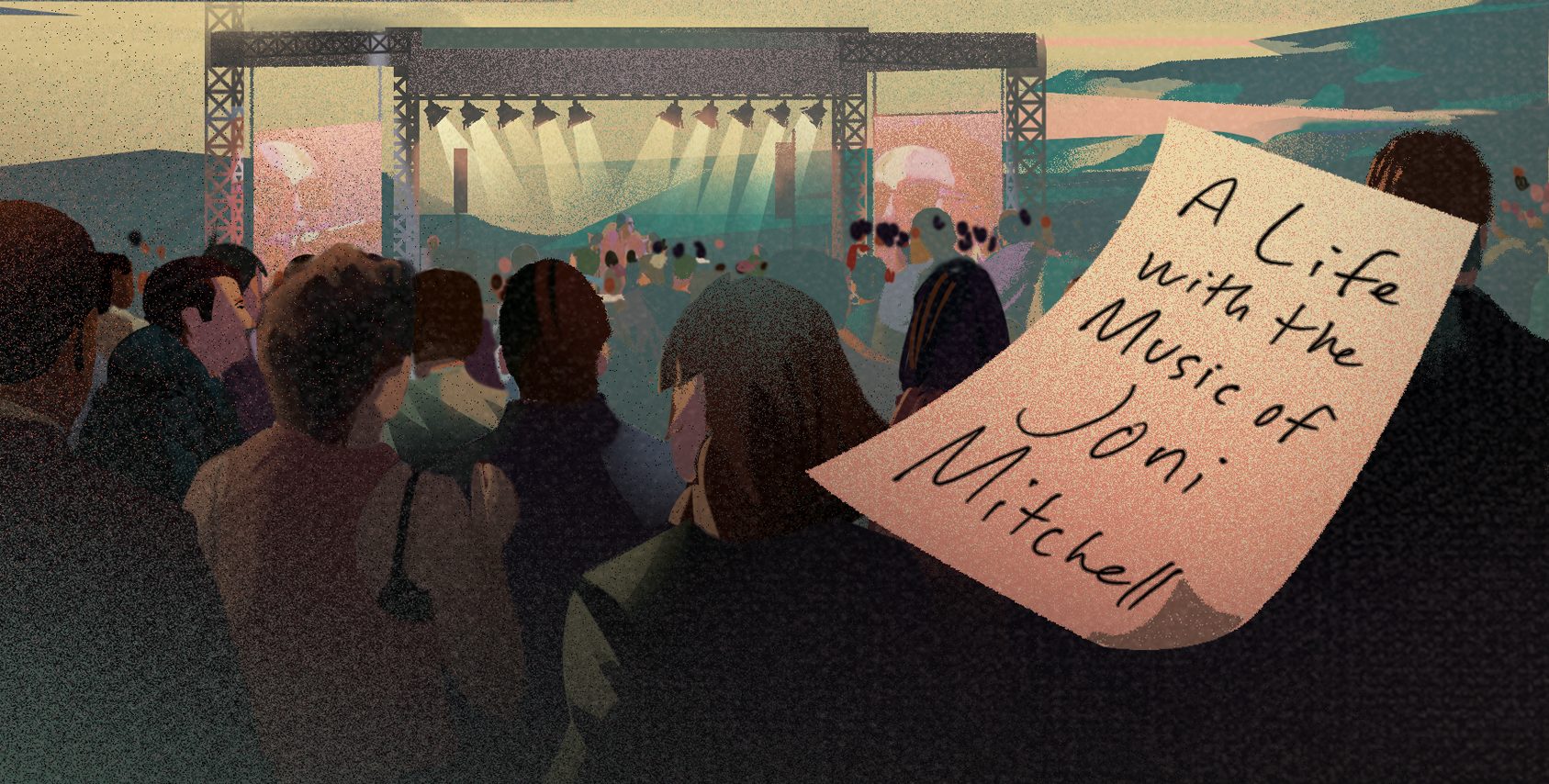
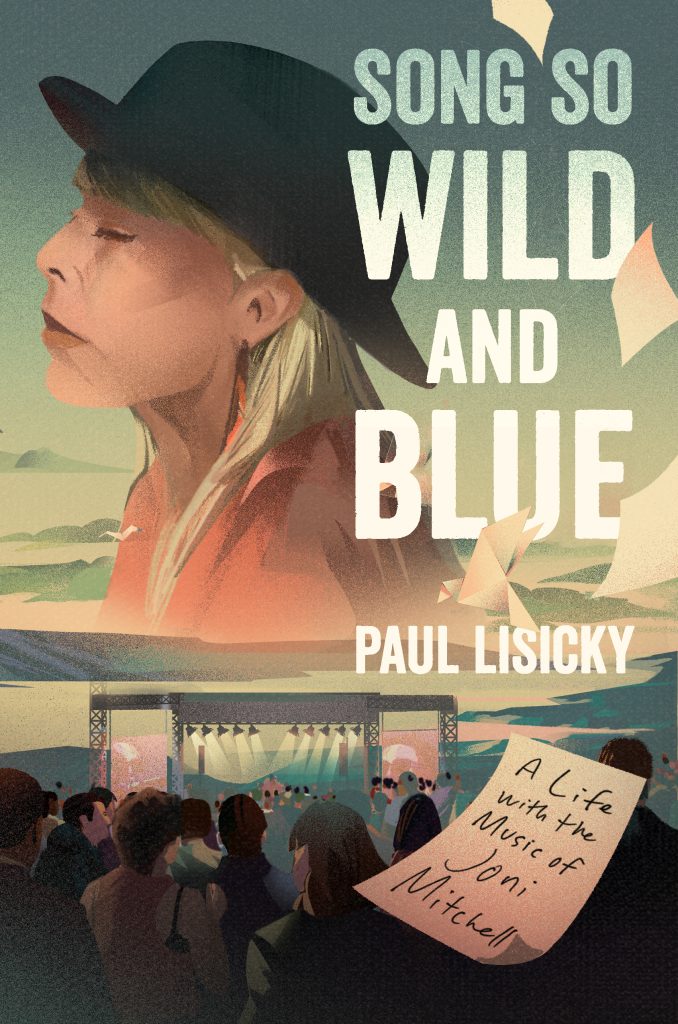
Electric Literature is pleased to reveal the cover of Song So Wild and Blue: A Life with Joni Mitchell, the new memoir by acclaimed writer Paul Lisicky, which will be published by HarperOne on February 4th, 2025. You can pre-order your copy here.
From the moment Paul Lisicky heard Joni Mitchell while growing up in New Jersey, he recognized she was that rarity among musicians—a talent whose combination of introspection, liberation, and deep musicality set her apart from any other artist of the time. As a young man, Paul was a budding songwriter who took his cues from Mitchell’s mysteries and idiosyncrasies. But as he matured, he set his guitar aside and lost himself in prose, a practice that would eventually take him to the Iowa Writers’ Workshop and into the professional world of letters. Here are his thoughts on Mitchell, his memoir, and its cover.
My book’s title comes from a line in Joni Mitchell’s song “Amelia,” which thinks about what it means to make a life in art. It’s about the solitariness of that life, the precarity—how easy it is to disappear, which was the fate of the aviator Amelia Earhart, who attempted to be the first woman to circumnavigate the world on a solo flight in 1937. The song is addressed to her, not simply as an aviator, but as a woman who struggled between the twin poles of achievement and desire. The song never reconciles this struggle. Instead, it calls on its listener to make their own connections through a chain of images, from six vapor trails in the sky, to an ascending Icarus, to a motel flung out in the desert.
Song So Wild and Blue uses that song (and others) as a starting point. It’s a book that wants to examine my development as a musician and writer through the frame of Joni’s music, but alongside that, it has questions to ask. How is art-making intertwined with self-making? How is art-making a call to connect with others? What happens when one comes up against the limits of self, and what lies on the other side of that? What are the costs of living with a drive you can’t say no to? How is performance a vehicle that both draws a stranger closer and keeps them out? What does the body have to tell us about our short time here? What does love, in all its variations, ask of us?
Here is the cover, designed by Stephen Brayda, with artwork by Marianna Tomaselli:
It’s widely known that Joni thinks of herself as a painter first. Even her phrasing summons up pictures, so the cover image had to be just right. I didn’t want it to mimic one of her paintings or her self-designed album covers. Instead, I thought of the graphic novel as a reference point, a form I love for all the ways in which the panel magnifies what it encloses. So many of Joni’s longer songs operate as sequences of panels— think of ‘Refuge of the Roads’ or ‘Song for Sharon.’ My book wants to play with that structure too.
I love the inviting palette of this image, the variations of blue, the contrast between light and dark, which suggests the oppositions that fire Joni’s lyrics and music. Love, too, the silhouette of Joni’s face in the sky, which conjures up “the hexagram of the heavens” in “Amelia.” Here Joni’s face is neither desolate nor hopeful, neither older nor younger, half human, half bird. If there’s a particular period of Joni’s arc referenced in this image, it’s 1988’s Chalk Mark in a Rainstorm, when her earlier reputation had ebbed for some years. With eyes closed, she’s attuned to her inner life, her specific vision for her work. She’s not giving over too much attention to her detractors. She’s an aspect of the landscape—all of Joni’s songs are of a piece with place, so that place reads as an emotional state—and this landscape is the Columbia River Gorge, in Washington state, where my boyfriend Jude and I traveled to see Joni perform as part of Brandi Carlisle’s Joni Jam in June 2023. The experience of that concert is central to the book, and that’s all I’ll say for now.
I’d always been drawn to the meticulousness of Joni’s songs, their sense of being sculpted line by line over time. But they’re also documents of process, seeking, exploration, spontaneity, the mutability of feeling. Little side trips. One would think that a belief in capturing spontaneity would be at odds with a commitment to technique, but Joni once again brings two contradictory perspectives into the same room. For that I thought it would be important for the cover image to suggest motion, brokenness. It shouldn’t be too fixed, too heavy or known. It should leave space for inquiry. I love the sheets of paper rising on the right, the curvature of their positioning, the handwriting on one, another folded into an origami bird, and still another too high up to be contained by any margin.
What is a family? As a child, answering that question felt like the easiest thing in the world. I was still blissfully oblivious, then, to the complexities of family life. The varying configurations, the awkward dynamics. The shapeshifting brought on by birth, death and divorce. Over the years I’ve come to understand that every family vibrates within its own unique energy; one that thrums with tender spots and triggers invisible to the non-familial eye. I’ve seen not only my own, but also countless other families warp and buckle; implode then expand, so that today the question feels like a far more difficult one to answer.
The idea of familial belonging, of chosen connections over blood ties, and of the missteps we take in protecting those we profess to care about are all themes I wanted to explore in my debut novel, Wild Ground. The ways in which outside forces can further tangle family ties was something I felt particularly drawn to. Systemic oppressions like poverty and racism have the ability to change the entire makeup of a family, impacting those affected for countless generations. In Wild Ground, the characters’ strain against these forces. My protagonist, Neef, and the relationship she has with her mother, Chrissy, is fraught with both love and contempt, as is her best friend Danny’s with his father, Denz, and grandmother, Mary. But those characters too, have suffered. Many of the mistakes they make are borne from the mistakes made before them; the societal fractures that exist through no fault of their own.
Of course, blood is not always thicker than water, and sometimes we find a sense of belonging in the unlikeliest of places. As an adult, Neef is taken in by café owners Fionnoula and Ali, and it is thanks to their kindness and acceptance that her understanding of family begins to evolve. Perhaps because I too am still trying to figure out the meaning of family, I find myself not only exploring the theme in my own writing but also seeking it out in the books that I read. So, if like me you’re constantly baffled by the flux, ebb and flow of family, here are 8 truly beautiful books that have helped make some sense of that word, while also reassuring me that we’re all as complicated and maddening as each other…
I fell in love with Mozely’s darkly lyrical prose within the first few pages of this novel, but it’s the exploration of an unsettling family dynamic that really captivated me. Teenagers Daniel and Cathy live in a makeshift cottage in the woods with their prize-fighting father, Daddy. Detached from the outside world and self-contained in their innocence, they rely on the land, hunting and foraging for food. Despite Daddy’s brute strength, his love for his children is tender; his determination to protect them at all costs, clear. But when outside forces threaten to destroy their insular existence, terrible violence ensues. The writing is gothic; imbued with a lurking sense of catastrophe and an undercurrent of unknowns. Why has Daddy chosen to isolate his family in this way? What has happened to Daniel and Cathy’s mother? How far will a person go to protect what they value most? Elmet dissects themes of social standing, poverty and family life in a way that left me both unnerved and entranced.
Set in 1990s Florida, and with a sense of place so vivid that at times it felt as though I’d visited the Sunshine State myself, Fireworks Every Night resonated with me in so many ways. The story centers around the ties that bind protagonist CC to her dysfunctional family and her inability to walk away from them despite the havoc they wreak. Dealing with everything from alcoholism and homelessness to mental health struggles and abuse, this is a hard-hitting exploration of the damage we inflict on those we love most, and the long-lasting ramifications of our choices. CC’s relationship with her troubled sister, Lorraine, is particularly heartbreaking, moving me to tears more than once. The writing is raw, relatable and real, with Raymer somehow managing to elicit sympathy for even the most despicable of behaviors.
Written as a letter from Little Dog, a young Vietnamese American man, to his illiterate mother, On Earth We’re Briefly Gorgeousis a stark examination of the realities of immigrant life and the struggle to assimilate into American culture. Although the story is largely focused on Little Dog’s secret love affair with a white boy from his school, it is underpinned by his relationship with his mother and grandmother. The family grapples with the repercussions of opioid addiction, as well as with intergenerational trauma stemming from the Vietnam War. But even through the toughest of times, we see them draw strength from one another. On Earth We’re Briefly Gorgeous is a poignant exploration of the complexities of identity both within our own families and outside of them.
You may by now have noticed that I tend to be drawn to books with heavy, depressing themes. So, although All My Mothers isn’t without its moments of truly guttural sadness, reading it felt like looking down a kaleidoscope of color and light. We meet Eva Martinez-Green, whose emotionally absent mother and physically absent father inspire a quest to discover the truth about Eva’s familial roots. Eva’s journey is infused with both joy and heartbreak as she travels from the wealthy suburbs of West London to the medieval city of Cordoba in south-central Spain, discovering maternal love in the most unexpected of places through friends, housekeepers, teachers and even a nun. Brimming with gorgeous and complex characters who move through the most vividly imagined worlds, All My Mothers unpacks the true meaning of family in the most joyous of ways.
When Velvet, a young Dominican girl leaves her abusive mother for the summer to go and stay with Ginger and Paul, a wealthy white foster couple in upstate New York, their family lives begin to unravel. Despite Velvet’s mother’s protestations, Ginger, a recovering alcoholic, introduces Velvet to horse riding. So begins Velvet’s relationship with Fugly Girl, an abused, almost feral horse with whom Velvet immediately feels a kinship. The book delves into themes of racism, class and white guilt, but what I find most intriguing about The Mare is the exploration of our fundamental needs as people. Both Ginger and Velvet, and arguably Velvet’s mother Silvia, are starved of genuine human connection, and to me this feels like a story about love going in all the wrong directions. It opens up a whole host of questions around the roles and responsibilities of family in a way that is both timely and timeless.
I’m an absolute sucker for a character-driven narrative, and for me, Shuggie Bain is up there with the very best. Set in 1980s Glasgow against a grim backdrop of Thatcher-era decimation, Shuggie is the youngest of three siblings, struggling to come to terms with his sexuality under the-less-than-watchful eye of his alcoholic mother, Agnes. Gradually abandoned by the rest of their family, Shuggie lives in a constant state of anxiety, helplessly watching on as Agnes’s addiction tears apart their lives. But despite her neglect and abuse, Shuggie refuses to give up on his mother. The novel is a harrowing exploration of the intersections between politics, poverty and trauma, but what haunts me most is Douglas’s painful portrayal of a child’s imperishable love for a parent. A few years have passed since I first met Shuggie and Agnes, and yet I still find my heart drifting to them often.
Set on a South London estate, Orlaine McDonald’s debut novel follows a year in the life of three generations of women; Livia, Mickey, and Summer as they reckon with their shared history of love, loss and betrayal. Crafted in a richly poetic prose interwoven with both joy and pain, No Small Thing plays out against the soundtrack of the character’s lives, taking you to the very soul of what it means to be Black and working-class in Britain today. The story is thought provoking and taut with emotion, but it’s the authenticity of the writing that gives it its beating heart. A compelling insight into the complexities of family life where so much is learned from both what is said and what isn’t, No Small Thing is a book that drew me in and still hasn’t let me go.
I’m a big sister myself, so although (to my knowledge) none of my siblings are serial killers, this book’s exploration of sororal love and its boundless limits holds a peculiarly special place in my heart. Set in Lagos, Nigeria, My Sister the Serial Killer tells the darkly humorous tale of nurse Korede and her sister, Ayoola, whose habit of killing off her boyfriends is becoming increasingly risky. Exploring the lengths Korede (whose profession lends itself to cleaning up blood and dealing with bodies) will go to protect her little sister, the writing is pacey, comedic and whip smart; propelling you through what should feel like an outlandish narrative, while leaving you pondering how far you would go in defense of your own family. Despite the unusual premise, it’s a book that left me yearning to speak to my siblings, reminding me of all the times we’ve gone out on a limb for one other.
“Have you heard of loneliness before?” writes Charlee Dyroff. In the not too distant future, New York City will be remembered the ancient city that once served as the “epicenter of narrative, of creation.” Loneliness as a word or concept will be mostly forgotten. Dating apps will still be a thing.
In Loneliness & Company, Lee, a promising graduate of the Program, an institution where “everything ran seamlessly without calling attention to itself,” has just been hired as a Humanity Consultant. She landed a job at a company training Vicky, an advanced AI, about friendship and empathy. But soon enough, the company’s secret mission quickly emerges: to solve loneliness. Lee, who hasn’t quite felt loneliness before but who is driven by ambition and determined to prove herself, begins earnestly to research people, friendship, love. She studies her roommate Veronika and a group of girls she calls BABES, envious of how effortless their exchanges are, allowing their algorithm to shape her. On a date, which she considers field study, she tries to be the person the BABES would fawn over. All the while, she recognizes that she is too often “the common denominator in misunderstandings,” that she, too, suffers from the human need to feel special.
Lee tries to dismantle human behavior so that she might better understand it—so she might more fully become it. Common experiences, from orgasms to friendships to nude modeling, are deconstructed so that connections between people might be better rebuilt. Dyroff, taking a page from writers like Molly McGhee and Jessamine Chan, slyly critiques social structures like dating apps, community housing, social media personas, careers, capitalism. A fast paced anthropological mystery anthropological, Loneliness & Company reminds us how even our wounds—especially ones like loneliness—are what make us human.
Annie Liontas: What does it mean to write a book about loneliness in 2024? How lonely are we?
Charlee Dyroff: This is an interesting question because loneliness has definitely been in the news more thanks, in part, to the Surgeon General’s honest op-ed in the NYT. Ever since my book came out, friends and family have been sending me articles about loneliness in schools, in workplaces, etc. In the world of Loneliness & Company, which is set in a near future, there are a lot of lonely people.
But in a way, it’s completely random that Loneliness & Company published during a time when people are open to thinking about and engaging with the topic. As you know from your own publishing career, authors don’t often have much control on when the book comes out. All we can do is pour our heart into writing it and then see what happens. I started drafting this manuscript years ago back in 2019—before the pandemic first called more attention to the unbearable sadness some kinds of isolation can cause. In some ways, writing this book was a way for me to break through my own loneliness. Ultimately, it’s a story of hope.
AL: I absolutely empathize with the need to seek out art as a way to grapple with existential isolation. You mentioned that writing is a way to break through your own loneliness. How so?
CD: I think writing can be a way of reaching out, even if we write things that we don’t expect anyone to see. It’s a way to communicate something we might not be able to otherwise… to ourselves, to strangers.
Writing this book was a way for me to break through my own loneliness. Ultimately, it’s a story of hope.
This manuscript went through so many iterations and in the first one, loneliness wasn’t a theme or part of the plot at all. A nonfiction professor of mine actually pointed out that my essays had an air of isolation, and that was really the first time I admitted to myself that I felt lonely. And it felt so shameful at the time. And of course, when I went to edit the manuscript, the questions I had about loneliness were already there, hidden in the text. So I think writing through them helped me quite a bit.
AL: Isn’t it astounding when people see traces of us in our work that we don’t even see ourselves? This is resonant with Lee, your main character, who at a certain point in the narrative becomes a subject of study for the reader. We see things about Lee that she remains blind to even as excels in certain areas of her life, and in her breakthroughs with her research with Vicky. How is Lee both part of and apart from the people in her world?
CD: Yes! Totally. You’re absolutely right about Lee. As readers, we see her blind spots, especially early on. Lee’s an interesting character to follow because she grew up in this near-future society that prides itself on efficiency. She trained in a rigorous, success-oriented research program with uniforms and schedules—and she really thrived in that sort of disciplinary environment.
Because of this, when we meet her she has a lot of drive and ambition, but is quite ignorant of anything outside of the Program. It was interesting to write a character who was so externally motivated that they almost didn’t know what they themselves wanted?
Anyway, in the book, she’s thrown into a role where she’s tasked with collecting research about humanity to help teach an AI. And because she has this almost debilitating desire to be successful, she forces herself to venture out into the world for more and more information about it… and in a lot of these situations, like when she goes to an old-school diner for the first time, we see her in the world, but how far she’s really removed from it. (Which, I think that feeling—not always knowing what to say or do, but desperately wanting to say the right thing—is actually a pretty human thing.)
AL: We see that elsewhere for Lee, too, specifically as she navigates cultural norms of dating and attraction. As the story unfolds, Lee begins to build a relationship with Chris, someone at her workplace she has met only over a messaging platform and, G, a man she met at a coffee shop and becomes involved with. What did introducing these two very different attractions do for the story, and for Lee’s character?
CD: I can’t remember who told me this, or if maybe I just overheard it at an author talk/reading, but someone once gave the advice that the best way to get to know your characters is to put them in a situation with others and see what they do… It’s a funny thing that’s always stuck in my mind.
The best way to get to know your characters is to put them in a situation with others and see what they do.
Though Chris (her quirky, nerdy boss) and G. (an attractive business man) are very different, they both help Lee learn more about herself through their interactions. For example, they both teach her about intimacy and desire… for Chris, the intimacy of being able to talk to someone, to feel like you can tell them anything. And for G., a more physical kind. But in the end, they both force her to think differently about herself, about the world, about everything she’s been taught.
AL: Much of this book is a study of human behavior—how we build friendships, how we mimic the behaviors of others, how we interpret gestures that are meaningful only because of their cultural significance. What kinds of human phenomena and tendencies drew your attention as you were writing this book?
CD: I was definitely drawn to the ways people interact with each other online and in the world, especially friends. I think sometimes friendship is almost a secret language. Or, even outside of friendship, I was interested in moments of unexpected intimacy or connection between strangers, like a brief conversation at a party with someone you’ll never meet again or when a barista or server knows your order.
Even though Loneliness & Company touches on ideas about technology and loneliness, it’s ultimately a human story full of humor and empathy, and I hope readers find something for themselves in it.
AL: Will the future be lonely?
CD: I don’t think our future has to be lonely. I hope no matter what we find ways to connect and be there for each other.
It seems that oftentimes a novel stems from questions—If we can’t name an emotion, can we still feel it? Does ambition make one isolated? How do we build human-like tech if we aren’t sure what it means to be human ourselves?—and not all of them are answered through writing a book. I just hope that even the act of reading, whether this book or others, is a way that we stay connected over time.
An excerpt from State of Paradise by Laura van den Berg
In Florida, my husband runs. Ten miles a day, seventy miles a week, a physical feat that is astonishing to me. [1] He started running after he got stuck on a book he is trying to write, a historical account of pilgrimages in medieval Europe. [2] Back then it was not unusual for pilgrims to traverse hundreds of miles on foot: 248 miles from Bologna to the catacombs in Rome; 500 from Mannheim to Our Lady of Walsingham. My husband is a trained historian [3] and fascinated by journeys. [4] He wants to understand what has become of the pilgrimage in our broken modern world. In the meantime, he observes a lot on his daily voyages. For example, there has been an increase in carrion birds down by the lake. Cobalt crows circling overhead, bloodstains on the sidewalk, awaiting the erasure of afternoon rain. He returns so sweat-wet it looks like he’s been swimming. [5] He returns overflowing with story. When a story is told to another person it takes on a life of its own; it spreads, contagion-like. The more times a story is shared the more powerful it becomes. This morning my husband witnessed a man—a neighborhood regular who gets around on a bike, a white dog with caramel ears trotting along beside him—ride up to a truck parked by the lake. [6] An unsheltered community sleeps in cars and campers in this area; in the aftermath of the pandemic, the population tripled, with blue tents pitched in the park. My husband has seen the owner of this particular truck, a man with a white beard, drinking morning beers on his tailgate and looking askance at the world. [7] Today the bike man rested one foot on the ground, looked left and then right. He pulled a knife from his pants pocket and jammed the blade into the truck’s back tire. The truck man was asleep inside (my husband could see him slumped against the window, the swirl of white hair, the bleached denim jacket sleeve) and did not stir. The dog sat perfectly still as the tire hissed and withered. As the bike man withdrew the blade, he looked up at my husband jogging in place. [8] He tipped the blade, like a cowboy in an old western, and then he tucked the knife back into his pants pocket and rode on. Now my husband thinks he and the bike man have entered into some kind of pact—a vow of silence. [9] That evening, we take our dog for a walk [10] and pass the bike man and his white dog resting on the shaded steps of a blue brick church. I think about the knife hidden somewhere on the bike man’s body, sharp enough to tear through a tire. I wonder what the truck man did to deserve the knifing. Maybe nothing. Everyone, it seems, is more desperate than they were before. I wonder where the bike man and his dog sleep at night. On the church steps? In the park? We have been in Florida, land of my childhood, since the start of the year, living in my mother’s house. Now we stand on the threshold of summer’s sweltering cave. During the pandemic I got sick but recovered after a week of rolling around in a wet fever. Ever since, I’ve had the strangest dreams. Is it possible for a fever to turn a body so hot that molecules are rearranged? Is our life just on pause or is this pause now our life? [11] The white dog barks. Our dog barks back. Twice for good measure. I wonder what they are saying to each other, in their animal language. All the people wave.
We are like the staff of a country estate: we keep the place running and we are meant to blend into the background.
In Florida, I am a writer, though not a real one. [12,13] I ghost for a very famous thriller author. When I first got the job, I spent a month reading books by the famous author, to better understand the task that lay before me. The chapters were always short; the sentences never had too many words. The phrase everything is not as it seems appeared in nearly all the book descriptions. Whenever I’m stuck on a chapter, I just write everything is not as it seems and press on. In my line of work, this phrase is like hot sauce or ranch dressing—you can put it on nearly everything. Ghostwriting is a largely unregulated industry. We are the animating force behind many a celebrity memoir and blockbuster detective series. Some ghosts regard themselves as “collaborators.” They lobby for cover credit. Interviews, press. Others like the idea of being invisible. It is the act of vanishing that attracts them to the work in the first place. Other ghosts—such as myself—are paid just well enough to write our chapters and keep our mouths shut. We are like the staff of a country estate: we keep the place running and we are meant to blend into the background. Ghosting is not how I intended to spend my days on this earth, but the world feels precarious and so I struggle to break free from the job. I belong to a fleet of ghosts and have never actually corresponded with the famous author himself. I often imagine him wandering a castle in a silk bathrobe in some small cold country—Switzerland, Austria—and slicing the air with a silver letter opener as he concocts his plots, even though I know the author lives in a mansion down in Palm Beach. [14] From the famous author’s team of assistants, I get templates of scenes, and then it’s up to me to fill in the details. Paint-by-numbers writing. My current project is about a retired cop—bereaved and semi-alcoholic, traits that are supposed to make him “complicated” yet “sympathetic”—who gets sucked back into the Miami underworld after he finds millions of dollars’ worth of cocaine washed up on a beach. [15] When I finish a chapter, I send it on to the assistants, who weed out anything of myself that I might have tried to smuggle in. If I submit chapters that are too well written—too descriptive, too vulnerable, too precise—the assistants become upset, tell me to cut the flourishes. They want the language to do the opposite of what language should do, which is leave a mark. They want the language to be forgettable, familiar, digestible. To enter into the reader and disappear without a trace.
My mother lives in a small town northeast of Orlando, surrounded by a lush network of rivers and lakes. My sister lives next door [16], even though the two of them have never gotten along. They accuse each other of being moody, self-absorbed, generally unreasonable. Now, if they want to argue, all they have to do is shout at each other through an open window or over the backyard fence. They don’t even have to leave their property or pick up the phone. Because my husband and I currently live with my mother, my sister often assumes we’ve taken her side. “I feel like I’m in an asylum,” [17] my husband said when we first arrived—and then caught himself because there is only one of us who knows for real what it’s like to live in an asylum and that person would be me. In this town, the street numbers rise when you travel south, fall when you go north. [18] We are smack between Orlando and Daytona Beach, encircled by hardwood hammocks and cypress swamps, wetlands and salt marshes. A wilderness. The Tarzan movies of the 1930s were filmed around here. A rummage shop in town sells replicas of the vintage film posters. In one Tarzan grips a bowie knife. The rummage shop is next door to the offices for the local newspaper. During the pandemic, a couple in a white RV moved into the parking lot. [19] Back then we only left the house to buy food, and through the car window I would see them sitting around oil stains in pink plastic beach chairs, smoking or taking a nap with magazines covering their faces. Casual as can be, even though all around them tens of thousands of people were getting sick and dying. Eventually the quarantine ended and our governor, who bears a striking resemblance to a Cro-Magnon in a suit, told us that the emergency was over and everything would return to how it was before. Shortly after the governor’s announcement the RV vanished. Every time I pass the parking lot for the local newspaper I wonder where those people have gone.
The newspaper has an advice column, Ask Ava. In ancient times, pilgrims journeyed to the Temple of Apollo, to consult the Oracle of Delphi on vital matters, even though the Oracle was known for inscrutable replies. I wonder if Ava regards herself as a modern-day Oracle. Today’s letter writer is seeking counsel about a friend, a woman she’s known for years. During the quarantine, the friend started texting her photos late at night. In each one, she looked more and more like the letter writer. She cropped her hair and dyed it black. She ordered new clothes and makeup. She tweezed her eyebrows into skinny arches. After the governor announced that the pandemic had been defeated, the two women went out to lunch and the letter writer said it was like sitting across from a slightly different version of herself. The friend even wore the exact same T-shirt, mint green with a pink pineapple on the front. Like she’s been in my head. The letter writer is worried that her description of this situation makes her sound unhinged. Perhaps she is the one who has suffered a psychological collapse. All those hours spent alone during the quarantine, watching the news and doomscrolling and getting lost in MIND’S EYE, a virtual reality meditation device made by ELECTRA, a Miami-based tech company. Nevertheless, she has her friend’s transformation saved, photo by photo, on her phone. One night she was watching TV and glimpsed a face—more specifically the face of her friend, which now looked a lot like her own self—filling her living room window like a small, round moon. After that, she started carrying a pocketknife. I am frankly surprised Ava has taken this one on. It seems like a lot for an advice columnist to handle. Ava says that some people are like cosmic vacuums, always searching for other selves to consume. She advises the letter writer to sever the friendship and believes the friend will simply move on to another host. I want to ask Ava if she’s ever seen Single White Female or Fatal Attraction. What if the breakup doesn’t take? Good luck with this one! Ava says.
Once, I took a self-defense class for women. The class was held in a one-room studio in a strip mall. Dingy white walls. A toilet that wouldn’t stop running. Our main task was to fend off a man with a rubber knife. The man would rush up behind us and press the blade to our throats and say something menacing like bitch, you’re coming with me. Next the instructor would walk us through how to escape. First, shrug your shoulders to your ears. Second, grab the attacker’s wrists. Third, yank the attacker’s arms down while also hurling your own weight toward the floor. But don’t sit! You want to stay standing so you can run away. In the event of an actual attack, the odds of us remembering this sequence seemed very low. Still, we all gamely struggled from one step to the next until the fake attacker—who, in my judgment, seemed to take a little too much pleasure in saying bitch, you’re coming with me—gave in and released us. The last woman to attempt escape did not follow these instructions. Instead she made fists and bent her arms like she was sitting down in a chair. Next she rammed the points of her elbows into the fake attacker’s ribs. He dropped the knife and staggered backward, as if he were the one who’d been stabbed. When it was time for her to run, she didn’t just do a sad lap around the classroom, like the rest of us. She bolted out the door and into the parking lot and she did not come back. We gathered around the windows and watched her figure grow smaller and smaller, her long brown ponytail trailing behind her like the tail of a kite. That woman had freakishly pointy elbows, the instructor told us. Like knives, those elbows. That move would not work for a regular person, with nonlethal elbows, just so you know. I learned a lot from the class, though none of it came from the instructor. For example, I learned that once you start running it can be hard to stop.
In Florida, a summer storm can feel like the end of the world is being summoned. These storms roll in most afternoons, which is to say there is a regular feeling of apocalypse. The clouds turn a dense ash black, as though nightfall has arrived hours ahead of schedule. Lightning that looks like it means to split the sky. Thunder that will make a glass tremble on a table. Blue blasts of rain. The windows leak rainwater; dirt levitates in the backyard. Hail sails down through the green boughs of trees, leaves spiderwebs on car windshields, smashes roof shingles. We watch our reflections melt and twist in the rain-soaked windows. This weather passes so quickly I’ll look outside and can’t be sure if I dreamed the ferocious storm or its flat blue aftermath, which is exactly how I felt during the pandemic, after I emerged from that fevered week, unsure if the flat blue aftermath was real life or if real life was lost forever and the world I was stepping into now was nothing more than a long, strange dream.
The passenger door swings open and a woman in a denim skirt and a black tank top hurls herself—or is hurled—onto the street.
During one of these afternoon storms our phones hum with tornado warnings. “Where do we go?” my husband asks my mother, who is reading Francis Bacon’s incomplete utopian novel, New Atlantis, in the living room. “Anywhere but outside,” she replies. My mother has taken an interest in utopian texts, now that Florida seems to be heading in the opposite direction, though every time she describes one of these alleged paradises they sound a little terrifying. Too much manual labor and religious fervor. In the end, my mother often seems disappointed by these utopias too; she is still searching for her true north. My husband, meanwhile, is disturbed that my mother’s house does not have a single windowless room. Unlike my childhood home, which had a basement. The concrete bottom shimmered with water and rats scratched out nests in the stucco walls. My father was always scattering green pellets of rat poison on the wood staircase. The house was very old and I had to venture down there periodically to flip the circuit breakers. I never used a flashlight, because I was too scared to see what was writhing around in the water below. I took one step at a time with my arms extended, fingers curling around the shadows, the poison pellets crunching under my shoes. I can remember feeling as though all the volatility in our house was alive in the water and the walls, luring me closer. So basements in Florida are a frightful thing even if they do give you a place to shelter during a tornado. I text my sister, to ask what she thinks we should do, but she doesn’t reply until the storm is at full blast. Sorry, she says. I was meditating. During the pandemic, my sister became addicted to MIND’S EYE, to putting on her white headset and sliding down into other worlds. During the quarantine, ELECTRA representatives got special permission to drive all over the state and leave free headsets on doorsteps. An alleged act of public service, to help people cope with the isolation, but still there was something strange about a black van parking in the middle of the street and unleashing a small flood of masked ELECTRA employees, each holding a white pyramid of shrink-wrapped headsets. Don’t take a shower, my sister advises. Or wash any dishes. This particular storm is a tropical system and has some staying power. My mother continues to read Francis Bacon undisturbed as the lights flicker and paintings shudder on the walls. All night my husband and I listen to the lashing rain, to the lightning that summons a cracking brightness. Our dog stands on the foot of the bed and growls. Like there are forces he wants to keep out. In the morning, I walk the dog on wet sidewalks papered with green leaves. Together we leap over fallen branches that look like the severed arms of giants. At an intersection, a white car blows through a stop sign. The windows are fogged; I hear screaming inside. The passenger door swings open and a woman in a denim skirt and a black tank top hurls herself—or is hurled—onto the street. I start in her direction, pulling the panting dog along behind me. “Hey,” I call out to her. “Are you okay?” The woman turns from the car and races down an alley, a skinny dirt path that cuts between the rows of houses. I don’t get a look at the driver before they flee, the open passenger door swinging wildly. By the time we reach the alley the woman is gone. “Be careful going out after storms,” my mother advises when we get home. “People get electrocuted by downed wires all the time.” The news is reporting that the tornado inhaled roofs and flattened fences in neighboring towns. I watch shaky camera footage of a man surveying his vanquished lawn. All the windows have been blown out; the roof is gone. In what used to be a living room the furniture is now a smashed heap of debris. I seek out what is still recognizable: a lampshade, a cracked TV screen. The man’s father in a wheelchair, shaking his fist at the heavens above. The soaking red of police lights, which make me think only of the visitation of terror, as opposed to the promise of relief, despite what the books I ghostwrite would have you believe. The absence of panes and shingles, that armor against the elements, reveals the house for what it really is—a frame, an outline, a tender suggestion of shape. I get a garbage bag and a rake and collect the branches from my mother’s yard. Strange things surface in the dirt after a big storm. A green plastic kazoo. A blue lighter. A metal dog tag, faded and bone-shaped, the lettering inscrutable. A pearl button. Where have these objects been hiding? I imagine a cave system underneath my mother’s yard, kidney-shaped caverns filled with colorful plastic toys. Today with the rake I uncover a white porcelain knob, cut clean in half, as though severed by a very sharp knife.
A place outside time. This is the phrase I overhear my husband using as he tries to describe Florida to his father over the phone. His father lives in a high-rise condo in New Jersey, and he is concerned that we are still down here. On the news, there is constant talk about Florida’s post-pandemic spiral. Speculation about whether the state is experiencing an ecological and spiritual succession. There is talk about militias creeping out of the swamp. There is talk of vandals. There is talk of literal highway robbery. (Our Cro-Magnon governor denies any of this is happening, even though there are reports that some of these forces are amassing in his name.) For the time being, I can ghostwrite my books and shop specials at the grocery and take my niece to the water park, but no one knows how much longer this version of our world will last. “Sometimes I can’t believe a place like this exists,” my husband says as we speed down a gleaming white limestone road that cuts through a palm forest, or ride an airboat around a swollen lake. Florida has a past, as all places do, but these days everyone is uncertain about its future.
Here are some facts, from when I lived here last.
Days that felt like they’d been drenched in tar. Two attempts, one experimental and one sincere. One hospitalization, in Fort Lauderdale. During my time at the Institute, I saw and experienced things I have never discussed with another human soul. A pact of silence I have made with myself. This all happened nearly two decades ago and I have lived many other lives since then, and yet the feeling of being lost in a vast wilderness—wandering and wandering until you get so tired all you want is to lie down and sleep—is never far.
In the year before I moved away from Florida, I spent hours in the all-night Denny’s with my best friend at the time, a girl I’d met in an outpatient therapy group, eating pancakes and discussing our plans for self-annihilation like two criminals plotting the heist of a lifetime. Secretly I had decided that I wanted to live, and somehow talking about death with another person made the prospect of it feel further away. Turned it into a story we could not stop telling. Then I was, to my great surprise, admitted to a doctoral program in literature, all the way up in Boston. I was twenty-two and I had only ever lived in Florida. I had not told this girl, or anyone else, that I’d even applied. Stealing away like a thief in the night seemed like the only way to go, although now, all these years later, Florida has figured out a way to call me back. My best friend felt betrayed by my sudden departure and so we stopped speaking. Because I had resolved to leave the wilderness I’d assumed that she would find her way out too. Desperation can make people mercenary like that—you spot an exit and you start running toward it and you don’t look back. You just do your best to convince yourself that the other person is right behind you. Several years ago, I learned, from a mutual friend, that this other girl did not make it out. Only by the time the wilderness took her she was not a girl but a woman, married with children. I did not ask how she did it. If she used a weapon. A knife. Which used to be integral to her master plan back when we were still young. It was around this time that I started to wonder if the wilderness is not something a person can choose to leave. Rather it is a place that lives inside us. A landscape with its own intelligence and design.
I left Florida to become a student of literature, which I did not enjoy as much as I had anticipated. For one thing, I struggled to understand my classmates, who all knew how to style winter scarves. Each time I tried to wear a winter scarf I felt like I was being strangled. I met my husband in a university lecture hall. At the time, he was on his way to becoming a doctor of history, and by chance we both attended a talk on Yevgeny Zamyatin’s We, a novel about a mathematician living in a futuristic city made entirely of glass apartment buildings. The character’s best friend is a state-sponsored poet who recites his work at public executions, and his lover is a spy for the Bureau of Guardians. The mathematician is the chief engineer for a spaceship, built for the purpose of colonizing other planets. He starts a journal with the hope it can be smuggled onto the completed spaceship. That some small part of him can escape. We was written in the early 1920s, and yet as I listened to the lecturer discuss the themes I did not feel like I was in the presence of something very old or something that existed in an inconceivable future, but rather a reality that I might meet in my lifetime. It was snowing outside; the lecture hall windows looked like they were covered by white curtains.The man I would end up marrying was sitting next to me and he was not wearing a scarf. His copy of We was open and I noticed one passage had been heavily underlined, with little stars drawn in the margins. “What’s that?” I whispered, poking him in the arm, and he slid the book over in my direction. The knife is the most durable, immortal, the most genius thing that man created. The knife was the guillotine; the knife is the universal means of solving all knots; and along the blade of a knife lies the path of paradox—the single most worthy path of the fearless mind. I had forgotten to bring my copy of We to the lecture, so the book stayed between us. Afterward, we walked to a coffee shop, sliding around in the snowy streets. Before long, we had merged our paltry furniture into a rented apartment and undertaken a life of domestic contentment that I had not ever imagined would be available to me. In the end, I never finished my dissertation, despite spending years slogging through coursework. I arrived at the realization that I did not want to spend my life writing about books that had already been written; rather, I wanted to write stories that did not yet exist. My adviser thought this was a mistake. “Writers would be nothing without us,” he sniffed. My husband did succeed in becoming a doctor of history, and after he finished his degree we moved from one city to another for his teaching jobs. I liked this itinerant life; so long as I stayed in motion I thought the wilderness would never catch me. When I landed the ghostwriting job, I told myself that becoming a ghost at least got me closer to my goal than a dissertation on Chaucer. Technically speaking I was participating in the creation of books that did not yet exist, even if they were not stories that I myself had imagined or would ever have chosen to tell.
Actually, it was more because there was nothing else to do! ↩︎
L changed this in a later draft: I was researching samurai in Edo Period Japan for a short story. ↩︎
I got to know several of the folks who hung out by the lake every day. This particular person always shouted, “Keep it tight!” when I ran by. Happy to report he and his dog eventually found an apartment, and he does odd jobs for people around town. ↩︎
I never discovered what went down between them but the man with the truck eventually left town, and I never saw him again. ↩︎
I’m still not sure what Oscar thought of Florida. I thought he would hunt lizards all day. Instead, the lizards would jump onto his back during his walks and ride him like he was a Star Wars creature. ↩︎
I felt so unmoored and lost. I had never been down here for this long before. ↩︎
This was inspired in part by a friend of mine who ghostwrites for a famous thriller writer. But I think it also came from feeling a bit like our identities were adrift in these new circumstances. . . ↩︎
I like to call this section one of Laura’s classic rocket launch moves, where you feel her just soar—pure rhythm and energy, and of course setting some pieces in place that she’ll return to later on in the novel. . . ↩︎
This is probably the result of watching too many Michael Mann films, plus the action films of the 80s and 90s, and our eternal love for Bruce Willis and Harrison Ford. ↩︎
Slight tweak in geography: Laura’s sister does not live next door to their mom, but they all live in the same town, the one we were in for three years. ↩︎
Laura is being kind and also serving the story in a specific way. . . I said other things. . . ↩︎
An RV appeared one day in the backyard of an enormous house that was falling apart. An old woman lived there alone with countless cats. We heard through neighbors that the RV couple had just shown up and made a deal with the old woman: they would help her fix the house up if she let them stay in her backyard. Lo and behold, they kept their word and fixed up the house! ↩︎
DON’T MISS OUT
Sign up for our newsletter to get submission announcements and stay on top of our best work.
YOUR INBOX IS LIT
Enjoy strange, diverting work from The Commuter on Mondays, absorbing fiction from Recommended Reading on Wednesdays, and a roundup of our best work of the week on Fridays. Personalize your subscription preferences here.